
CONTENT OF NUMBER AND SUMMARIES OF ARTICLES
EURASIAN LAW JOURNAL №10(209)2025
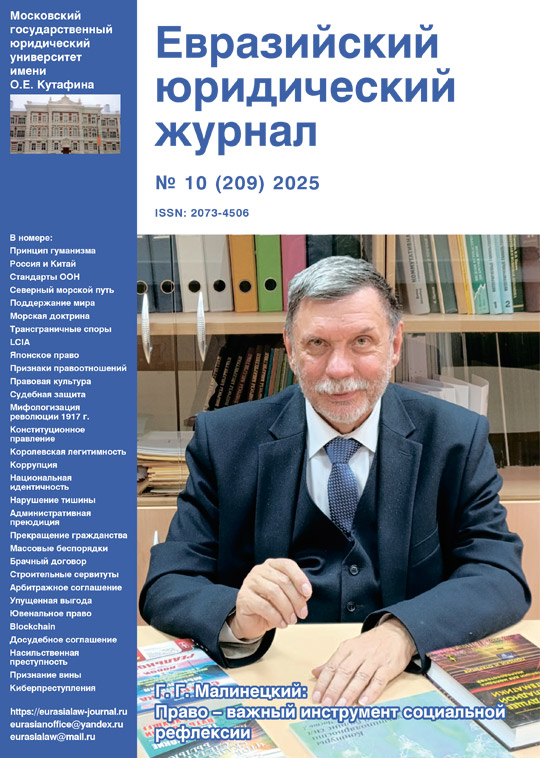
PERSONA GRATA
G. G. Malinetskiy:
Law is an important tool of social reflection
Interview with Ph.D. in physico-mathematical sciences, professor, Full Member of the Academy of Military Sciences, Head of the Department of Mathematical Modeling of Nonlinear Processes at the M. V. Keldysh Institute of Applied Mathematics of the Russian Academy of Sciences by Georgiy Gennadjevich Malinetskiy
INTERNATIONAL LAW
Atmachev S. I.
The principle of humanism and the concept of human rights in the context of the turbulence of international relations
Bezotetskaya I. P., Klimova O. V.
Problems of border cooperation in the foreign trade policy of Russia and China: international legal and customs aspects
Bisyarina A. N.
United Nations international standards for countering the trafficking of minors
Drozdova M. A.
The Northern Sea Route and LOGINK: digital integration of Russia and China in BRICS logistics
Egorov I. A., Egorov A. M.
The legal basis for the activities of military observers in the UN peacekeeping operations system
Mishalchenko Yu. V., Sekste Ya. A., Mishalchenko M. Yu.
The Maritime Doctrine of the Russian Federation: national priorities and their implementation in the modern international political and legal conditions
Smirnova M. I.
Legal status of persons with disabilities in the CIS countries: current status and development prospects
Zhao R.
The effectiveness of the multilateral arbitration agreement as a temporary mechanism of international law of the WTO Dispute Settlement Body
INTERNATIONAL PRIVATE LAW
Ivanov N. E.
The licensing of musical works in the digital environment
Khakimov A. N.
Issues of proving damages in cross-border disputes under contracts for the sale of goods
Enhua L., Zeng W.
General characteristics of the London court of international arbitration (LCIA)
LAW OF THE FOREIGN COUNTRIES
Paramuzova O. G.
On the specific features of Japan’s modern legal system: the influence of Shintoism and Confucianism on positive Japanese law and legal consciousness
Paramuzova O. G.
On the influence of the USA on the legal modernization of criminal law and criminal procedure in Japan
THEORY OF STATE AND LAW
Atmachev S. I.
Reflection of the principle of humanism in legislation
Baburin V. V., Tsviliy A. V.
Features of legal relations (using the features of criminal legal relations as an example)
Zhuravleva A. I.
Individual judicial regulation of legal relations
Musaeva A. G., Gamzaev R. G., Amirgamzaev G. M.
Russian political system
Pirova R. N.
Legal culture as a factor of stability of law and order in the modern state
Samusenko T. M., Bazyleva A. I.
Acts of official interpretation and their role in legal regulation
Serkerov S. E., Abdulmutalimova Z. M., Magamdarov I. R.
Prerequisites for the development of civil society institutions in Russia in the 1990s
Kobesov D. L.
Judicial protection of personal rights and freedoms: practice, problems, and ways of improvement
HISTORY OF STATE AND LAW
Apolskiy E. A., Buryanova E. I.
Social and legal dissertation researches in Russia at the beginning of the 20th century
Golubev A. G.
The mythologization of the October Revolution of 1917 as a means of falsifying the history of the Soviet State
Elchaninova O. Yu.
Minors as subjects of crime in the criminal law doctrine of pre-revolutionary Russia
Manatilova Z. Z., Abdurazakov M. A.
From Peter I to modernity: the significance of his reforms for the development of Russia
Nedzelyuk T. G.
State-confessional policy in Tyva: based on the materials of the Office of Ambyn-noyon Tannu-Urianhai in the State Archive of the Republic of Tyva
Novikova O. I., Rudman M. N.
Establishment of procedural institutions ensuring constitutional governance (part 2)
Serkerov S. E., Abdulmutalimova Z. M., Hasanalieva K. M.
Theoretical and historical aspects of the legal regulation of the institution of criminal responsibility in soviet legislation in the 1920s – 1960s
Titov V. Yu.
Specifics of understanding public and private appeals of Soviet citizens in the 1920s-1980s. On the issue of legislative initiatives
Ee N. Ch.
Royal legitimacy: double identity of Anglo-Saxon monarchs in light of pagan heritage and Christianity
CONSTITUTIONAL LAW
Asmandiyarova N. R.
Some issues of responsibility of persons committing corruption crimes
Dosakaev A. B., Chayka A. D.
Constitutional values as the basis for the formation of a system of moral and semantic guidelines for Russian youth
Kichalyuk O. N.
The national interests of the Russian Federation and their reflection in the law-making activities of the President of the Russian Federation
Kuryachaya M. M., Shevchenko P. E.
National identity and constitutional ideology
ADMINISTRATIVE LAW
Bondar A. G.
Problematic issues of administrative liability for violations of peace and quiet of the population (using the example of the Kabardino-Balkarian Republic)
Butenko A. K.
Violation of the peace and quiet of citizens: problems of legal regulation
Dibirov Yu. S.
Legal regulation of civil service issues in customs authorities
Erkin A. A.
Digitalization of higher education: possible concepts for administrative-legal regulation
Eroshenko Ya. Yu., Yakunin D. V.
Procedural violations in drafting a report on an administrative offense
Komarova L. V., Farikova E. A.
Relationship of administrative and criminal liability through the category of administrative jurisdiction
Maximov S. N.
Theoretical approaches to improving administrative-coercive measures for ensuring economic security
Mukhametshin F. B.
Administrative regulations on termination of citizenship of the Russian Federation (problems of theory and practice)
Smirnov A. A., Fedorovich D. Yu.
Administrative liability for searching for obviously extremist materials and gaining access to them: issues of the composition structure and practical implementation
Gavrilov A. O.
Administrative prejudice as a response to the problem of multiple administrative offenses
Kanzamanov A. K.
On the issue of the essence of mass riots in Kyrgyzstan as a negative phenomenon
Pyatakova A. O.
On the issue of legal qualification of contractual legal relations of management
Truntseva E. A.
Features of calculating the period during which a person is considered to have been subjected to an administrative penalty, provided that the main and additional penalties have been imposed
MUNICIPAL LAW
Arkireeva A. S., Osmanova A. A.
Municipal standards of social services: the need for unification or preservation of regional specifics
CIVIL LAW
Burlova Yu. A.
Problems of protecting a bona fide acquirer in civil law
Gaibatova K. D., Kasumova F. M.
Prenuptial agreement in Russian and foreign law
Zaulochnaya S. A.
Construction servitudes
Komogorov A. A.
A direct claim against a participant of a corporation for the recovery of losses caused directly to another participant
Krymshokalov A. Z., Yaitskaya E. A.
Problematic issues of the development of the system of consumer protection of tourist services
Lykov A. Yu.
The principle of effectively ensuring conditions for cooperation in modeling a political and legal ideal
Kaplanovskiy A. S., Levushkin A. N.
Concept and essence of smart contracts: comparative analysis with traditional contracts (in the context of Russian civil law)
Magomedova A. G., Mameev A. Yu.
The history of the origin and development of the supply contract in Russia
Pugacheva T. M.
Comprehensive forensic economic examination in cases challenging the debtor’s transactions
Sarkisyan V. G.
Notary protection of the rights and legitimate interests of business entities
Skryabina M. V.
Termination of a violated lease agreement for a land plot in public property
Khatuntsev O. A.
Copyright and contractual relationships in the creation of audiovisual works using artificial intelligence
Boboniyozov S. R.
Artificial intelligence as an object and quasi-subject of civil law regulation: the case of the legislation of the Republic of Tajikistan
Bochkarev D. V.
Contract of adhesion and a deal concluded on extremely unfavorable terms (bonded transaction): relationship, competition of norms and prospects of legal regulation
Dzhafarova M. E.
The role of homeowners’ associations in protecting the rights and legal interests of property owners
Kalinin S. S.
Features of legal regulation of combined insurance products under the Civil Code of the Russian Federation and the law «On the organization of insurance business in the Russian Federation»
Mamakhanov G. S.
Extraordinary circumstances in the performance of obligations under a construction contract
Myakotina Yu. V.
Smart contract in the banking sector as algorithmic form of execution of the obligation
Yao L.
Comparative legal analysis of state regulation models for venture investments in Russia and China
CIVIL PROCESS
Akhmatov D. A.
Classification of key information technologies, electronic services and digital tools in arbitration proceedings
Rassakhatskaya N. A.
The basic principles of civil procedure form
Smirnov D. D.
Enforceability of arbitration agreements in the context of institutional reform of arbitration
Starodubova U. M.
Proving lost profits in arbitration proceedings through forensic expertise
Khanin R. R.
Features of the preparatory part of a court hearing in cases involving a prosecutor
FAMILY LAW
Altynbaeva L. M.
Foster family problems in the Russian Federation and ways to solve them: domestic and foreign experience
Fedyakov I. A.
The history of the establishment and development of the institute of children’s rights in Russia
Shcheglova E. V., Abdulaeva I. A.
Disputes about children when parents are separated: novelties of legislation and problems of judicial practice
Altynbaeva L. M.
Restriction of parental rights as a measure to protect the rights and interests of minors
LAND LAW
Alexeeva N. A., Vlasenko V. N., Panchenko V. Yu.
The legal problem of incomplete information about a land plot provided as an «arctic hectare» (using the example of the zones with special conditions for the use of the territory of the Ministry of Defense of the Russian Federation).
Sekretaryov R. V.
The legal regime of confessional cemeteries within the funeral legislation system of the Russian Federation
ECOLOGICAL LAW
Klyukanova L. G.
Essential vectors of the development of the legislation of the Russian Federation on specially protected natural areas
FINANCIAL LAW
Dibirov Yu. S.
Blockchain technologies in the Russian banking system
TAX LAW
Morozova A. A.
Tax evasion
INFORMATION LAW
Olifirenko A. A.
The principle of data minimization in the legal regulation of AI model training in the practice of the European Union
Parshukov M. I.
Features of the conceptual apparatus of information law in the public sphere
ENTREPRENEURIAL LAW
Yao L.
Comparative analysis of legal strategies for IPO and M&A for investors in Russia and China
CRIMINAL LAW
Amirova D. K., Khorolskiy V. V., Merkazova V. A.
The specifics of the imposition of non-custodial punishments against minors
Bairov A. S.
Issues of combating illegal drug trafficking by organized criminal groups formed on an ethnic basis (using the Republic of Buryatia as an example)
Bokhan A. P., Rubanov V. A., Shumilina A. B.
Current state and dynamics of extremist crimes committed using the information and telecommunication network
Bunova I. I.
Criminalizing the inaction of personal account holders that endangers the security of others
Dneprovskaya M. A., Abramitov S. A., Cifryak E. Yu.
Public calls to carry out terrorist activities (art. 205.2 of the Criminal Code of the Russian Federation): some features of legal regulation
Epifanov O. S.
On certain aspects of criminal-legal characteristics of crimes in the sphere of economy
Efremova M. A.
Theft of virtual gaming property: criminal law problems and ways to solve them
Ivanova L. A., Labazanov M. S.
Current legislative trends in combating cybercrime
Madzhumaev M. M.
Unlawful processing of biometric personal data in the metaverse
Marianov A. A., Makhmudova M. A.
The concept of threat in Russian criminal law and legislation
Muraev P. P., Bolotnikov M. Yu., Nosataya D. V.
Through the prism of the new law: responsibility for sabotage in Russia
Nigmatullin R. V.
On the issue of countering cybercrime against women and girls
Tarkhanov I. A., Golubev S. I., Yuldosheva A. K.
A comparative legal analysis of criminal liability for environmental crimes with transboundary consequences in the BRICS countries
Tsymlyanskaya O. A., Arzumanyan A. A., Kovtun N. A.
Criminal infringements on aquatic biological resources: problematic aspects of law enforcement
Abbasov E. D.
On the need to organize control over drugs that are precursors for the manufacture of narcotic, psychotropic, potent, poisonous or new potentially dangerous psychoactive substances
Bokhan A. P., Litvyak L. G., Ryabko N. V.
Features of qualification of public calls to carry out extremist activities committed using the media or information and telecommunication networks, including the Internet
Zalikhanova D. E.
Prospects for the development of the institution of deferment of sentence
Romanova A. S.
Measures to counter new challenges in the field of money laundering through the use of digital assets
Sultanov R. A.
Illegal cashing-out of funds when carried out by a financial-credit institution holding a special permit (license)
Tikhomirov E. D.
Theoretical foundations for assigning fair punishment for multiple crimes
Tryaev A. G.
General social prevention of violent juvenile delinquency in modern Russia
Khasieva I. A.
The place of the features «damage» and «size» in the composition of a crime
CRIMINAL PROCESS
Begova D. Ya., Abdulkerimova M. B.
Problematic aspects and development prospects of the institution of pre-trial cooperation agreement in the criminal procedure of Russia
Endoltseva A. A.
Implementation and enforcement of the right to appeal in pre-trial criminal proceedings
Ilyashevich T. A.
Peculiarities of the legal status of the suspect and the victim during an abbreviated inquiry
Kazmirov M. A.
Problems of implementing the principle of adversarial process by the example of using special knowledge by participants in criminal proceedings in the process of proving
Nabatov M. B.
Experience in researching and evaluating the phenomenon of public trust in criminal proceedings in several foreign countries
Nazarkin E. V., Novikova L. V.
Some features of using the help of specialists in the investigation of crimes committed in the institutions of the criminal justice system of Russia
Roshka M. Ya.
Violent crime: criminological characteristics of criminal behavior and countermeasures
Semenkova E. V., Tutynin I. B.
Problems of determining the scope of the rights of a person in respect of whom proceedings on the application of compulsory medical measures are underway
Belskiy K. E.
Plea bargaining – a departure from adversarialism or a new form of it? The role of the lawyer in plea bargaining (US and UK)
Bryukhanova A.D.
On the «Memorandum on effective protection of rights» by G. V. Abshilava
Volokhova A. A., Darius A. A.
Participants in criminal proceedings as subjects of international cooperation in criminal matters
Ishina A. B.
Provision of public interests in the election and application of bail in pre-trial proceedings in a criminal case
Kornyushkin D. A., Kolosov A. L.
Justice and individualization of punishment: legal requirements and practice of their application
Mukhtorov Ya. A.
Guarantees of voluntary admission of guilt under Article 453 of the CPC of the Republic of Tajikistan: limits of proof at the stage of initiation of criminal proceedings in accelerated proceedings
Trifonova K. A., Skorikov D. G.
Digital transformation of criminal procedure activities: trends and prospects
Cherepnenko E. A.
Comparative analysis of legislative models of regulation of mass events: notification and permit procedure
CRIMINAL-EXECUTIVE LAW
Sugatov M. S.
Classification of disciplinary measures applied to persons sentenced to imprisonment: theoretical and legal aspects
JUDICIARY
Podolinskiy I. A.
Good faith in the era of digitalization: the use of AI in judicial proceedings through the lens of comparative legal analysis
CRIMINALISTICS
Amirov R. G.
Digitalization and technologization in forensic science: current status and development prospects
Afanasjeva V. I., Saakyan A.G., Safonova Yu. S.
Methodological recommendations to investigators on reviewing reports and investigating criminal cases of suicide by minors
Evlushina D. N.
On certain tactical features of search and examination of electronic media in the course of crime investigation
Zakhari l. T., Rodionova A. Z.
Modern specifics of detecting, recording and seizing digital traces in criminology
Klimova Ya. A.
The specifics of investigating cybercrimes related to the circulation of digital assets
Lozinskiy O. I
State migration registration: methodological possibility; actual necessity; biometric justification; potential in the forensic field
Kitaev N. N., Arkhipova A. N., Turkova V. N.
Problems of exposing criminals in the absence of a victim’s corpse
Nimirovskiy V. V.
Computer forensics: concept and meaning
Pakhomov M. E.
Application of technical and forensic means and methods for detecting, fixing, and removing traces of crimes that have been altered in fire conditions
Safonov A. A., Bondarev S. P.
Unmanned aerial vehicles as a tool of modern law and order
Simonova S. V., Sigerich M. Ya.
Information and analytical support system for forensic activities using artificial intelligence technologies
Firsov G. V., Brigadirova K. V.
The potential of digital technologies for crime scene documentation as a tool for reconstructing the crime mechanism
Khovavko S. M.
Organization for the prevention of serial killings
Shamshina O. S.
The issue of guarantees of the implementation of the principle of legality by the investigator when involving a person as an accused
CRIMINOLOGY
Bulgakova V. R., Bulgakov N. V.
Criminological characteristics of the modern fraudster’s personality
Voskoboev A. I., Moskvin M. M., Nasybullina R. R.
Determinants of juvenile delinquency and its dynamics
Nasreddinova K. A.
Problems and issues prevention of individual violent crimes
Rashitkhanov R. S.
Terminological uncertainty of the concept of «artificial intelligence» and its implications for criminal-law regulation
Yakhontova O. S., Leibman L. S.
Some aspects of counteraction of victimization of minors in the era of cyberbullying
Gulomov S. M.
Criminological description of kidnapping as a crime and the identity of the perpetrator
LAW ENFORCEMENT AGENCIES
Abidov R. R., Zumakulova Z. A.
Law enforcement in the system of state functions: concept and content
Iljina O. V.
Counteraction to migration crime
Kardanov A. R., Kurmanova M. K.
Psychological readiness for armed contact with an offender
Kurmanova M. K., Khromov A. M.
International cooperation in the field of training staff for law enforcement agencies
Malkova L. L., Asadov V. V.
Selected issues of strategic planning in the penal system of the Russian Federation
Marianov A. A., Abdullaev R. M.
Legal protection of minors: the role of the prosecutor’s office
Nazarova M. G., Pogorelaya S. V.
On the role of the soviet militia and NKVD in the fight against crime during the blockade of Leningrad in 1941-1944
Sypchenko A. Yu., Khakimov E. R., Silantjev V. V.
Script training as a tool for improving the rapid response skills of Interior Ministry employees: approaches and results
SECURITY AND LAW
Bichenova A. R., Dushin D. N.
The phenomenon of prohibited symbols as a threat to Russia’s national security
Dolgushina L. V., Stupina S. A., Afanasjev S. S.
Harmonization of legislation in the field of fire safety in the CIS countries: integration processes and development prospects
Takov A. Z., Bittieva L. Kh.
System of citizen security authorities
PEDAGOGY AND LAW
Bessarabov A. N., Shagieva G. R., Shamseeva G. Kh.
Education of university cadets of law enforcement agencies through a taught subject
Voskoboev A. I., Mingazizova G. G., Nasybullina R. R.
Adaptation of cadets in higher education institutions of the Ministry of Internal Affairs of Russia: a comprehensive analysis of problems and methodological recommendations
Karimulaeva E. M., Bagandova A. Sh.
Pedagogical practice as a way of forming an ethical and legal culture in the training of future teachers
Martynenko V. S., Sypchenko A. Yu., Shakirov I. M.
Training of police officers of the patrol and guard service to apply physical impact measures using real – world situation modeling methods
Nukhova Z. K., Ismailova N. A.
The role of management in optimizing HR processes in the education system
Pokusaeva N. V.
Categorical imperative of Kant in physical culture
Zorina N. S.
Problems of autodestructive behavior of juvenile convicts: factors, manifestations and ways of correction
Chernousov M. V., Fayrushina M. Z., Amanulina A. F.
Development of professional competence of future police officers
Nukhova Z. K., Nazarova F. R.
The legal status of the teacher in the modern educational environment: between creative freedom and legal responsibility
PSYCHOLOGY AND LAW
Vnukov V. I., Sigerich M. Yu.
Certain issues of ethical aspects of forensic activity
Evsikova E. V., Trubnikova S. E.
Counteraction to artificial termination of pregnancy: psychological and pedagogical aspect
STATE AND LAW
Buryanov M. S.
Problems and prospects for the development of law in the context of the digital transformation of the state
Dakhina A. A., Chelyabova Z. M.
The problem of defining the powers of state and municipal authorities in the sphere of ensuring national and regional security
ECONOMY. LAW. SOCIETY
Vorontsov D. E., Karelina E. A.
The essence of business processes and their features in the agro-industrial complex
Zvyagina A. V., Pertley A. Yu.
The relevance of financial education and measures to improve financial literacy of condemned persons in the context of modern socio-economic transformations in Russia
Zobova E. V., Kostyukova N. E., Trufanova T. A.
Organization of the work of the reception and accommodation service of hotels and other accommodation facilities at the present stage
Kalimullin L. V., Takmakova E. V.
Industrial ecosystems: essence and typology
Miniyarov A. F., Kuchukova N. M.
Assessment of the impact of restrictive measures in international trade on the economic security of the Russian Federation and development of mechanisms to eliminate them
Orlova Ya. A., Takmakova E. V.
The formation of a «green» industry in Russia: from resource dependence to resource efficiency
Popova T. V.
The socio-economic impact of forced labor on the territory of a constituent entity of the Russian Federation (using the Vladimir region as an example)
Pruzhinin A. A., Bayrushina F. F.
Hedging the risks of foreign economic activity as a method to enhance the economic security of Russian medical equipment suppliers
Chumlyakov K. S., Chumlyakova D. V., Ignatyuk Yu. L.
The role of strategizing in the development of international transport infrastructure
Yaitskaya E. A., Kardanov A. R.
Challenges of improving the quality of mediators’ performance in the context of tourism development
Chekalov A. G.
Modern methods of assessing the competitiveness of industrial enterprises
PHILOSOPHY. LAW. SOCIETY
Alshevskaya L. V.
Poetry in the philosophical discourse of V. V. Rozanov
Ananchenkova P. I.
Active longevity as a socio-philosophical category: on the question of the essence and boundaries of the phenomenon
Archibasov M. E., Mayatskaya O. B.
Sociocultural imitation as a multidimensional phenomenon
Vorokhobov A. V., Erushkina L. V., Belova E. E.
«Understanding» and «meaning» as key correlative categories of philosophical research
Zolotarev S. P., Aparina O. Yu., Bernyukevich T. V.
Contemporary science and education: the mutual influence of innovation and established approaches
Kluev A. A., Babaeva A. V., Makarova A. O.
Ethical and axiological contradictions of the migration policy of the European Union
Krasnikov S. P.
Return to metaphysics: ontological foundations of modern scientific Realism
Lustin Yu. M.
Man and society in the context of the transformation of agriculture in the Russian Empire (early 20th century)
Maslienko M. A.
Digital identity of a person: the role of institutional factors in modern society
Mezhueva E. O.
Religious and moral rejection of the state in the teaching of L. N. Tolstoy: ways of critical understanding
Openkov M. Yu., Tetenkov N. B.
Olfaction in the context of cognitive science and philosophical research
Popravko O. V., Peshev O. O.
Management ethics and cultural identity: philosophical and anthropological analysis
Przhilenskiy I. V.
The evolution of the theory of social systems in philosophical concepts of society
Semenov I. A., Kalyuzhnaya O. V.
The role of the department of spiritual affairs of foreign confessions in the implementation of state policy in the religious sphere of the Russian Empire
Tarasov A. N., Grechko I. N., Bolotov I. I.
Enactivism as an anthropological paradigm
Chudina-Shmidt N. V.
Stabilization of social tension as a condition for optimal functioning of the social system in an extreme world
Blokhin K. M.
Recognition of the authority of the Russian Orthodox Church
Voronitsyn N. V.
Synthesis of tradition and modernity in the axiological system of neo-Eurasianism
Plekhanov N. A., Proskurina D. V., Klimova A. I.
Information warfare as a new anthropological reality
Yusupova A. R.
The philosophy of transhumanism as an onto-epistemological problem
G. G. Malinetskiy:
Law is an important tool of social reflection
Interview with Ph.D. in physico-mathematical sciences, professor, Full Member of the Academy of Military Sciences, Head of the Department of Mathematical Modeling of Nonlinear Processes at the M. V. Keldysh Institute of Applied Mathematics of the Russian Academy of Sciences by Georgiy Gennadjevich Malinetskiy
INTERNATIONAL LAW
Atmachev S. I.
The principle of humanism and the concept of human rights in the context of the turbulence of international relations
Bezotetskaya I. P., Klimova O. V.
Problems of border cooperation in the foreign trade policy of Russia and China: international legal and customs aspects
Bisyarina A. N.
United Nations international standards for countering the trafficking of minors
Drozdova M. A.
The Northern Sea Route and LOGINK: digital integration of Russia and China in BRICS logistics
Egorov I. A., Egorov A. M.
The legal basis for the activities of military observers in the UN peacekeeping operations system
Mishalchenko Yu. V., Sekste Ya. A., Mishalchenko M. Yu.
The Maritime Doctrine of the Russian Federation: national priorities and their implementation in the modern international political and legal conditions
Smirnova M. I.
Legal status of persons with disabilities in the CIS countries: current status and development prospects
Zhao R.
The effectiveness of the multilateral arbitration agreement as a temporary mechanism of international law of the WTO Dispute Settlement Body
INTERNATIONAL PRIVATE LAW
Ivanov N. E.
The licensing of musical works in the digital environment
Khakimov A. N.
Issues of proving damages in cross-border disputes under contracts for the sale of goods
Enhua L., Zeng W.
General characteristics of the London court of international arbitration (LCIA)
LAW OF THE FOREIGN COUNTRIES
Paramuzova O. G.
On the specific features of Japan’s modern legal system: the influence of Shintoism and Confucianism on positive Japanese law and legal consciousness
Paramuzova O. G.
On the influence of the USA on the legal modernization of criminal law and criminal procedure in Japan
THEORY OF STATE AND LAW
Atmachev S. I.
Reflection of the principle of humanism in legislation
Baburin V. V., Tsviliy A. V.
Features of legal relations (using the features of criminal legal relations as an example)
Zhuravleva A. I.
Individual judicial regulation of legal relations
Musaeva A. G., Gamzaev R. G., Amirgamzaev G. M.
Russian political system
Pirova R. N.
Legal culture as a factor of stability of law and order in the modern state
Samusenko T. M., Bazyleva A. I.
Acts of official interpretation and their role in legal regulation
Serkerov S. E., Abdulmutalimova Z. M., Magamdarov I. R.
Prerequisites for the development of civil society institutions in Russia in the 1990s
Kobesov D. L.
Judicial protection of personal rights and freedoms: practice, problems, and ways of improvement
HISTORY OF STATE AND LAW
Apolskiy E. A., Buryanova E. I.
Social and legal dissertation researches in Russia at the beginning of the 20th century
Golubev A. G.
The mythologization of the October Revolution of 1917 as a means of falsifying the history of the Soviet State
Elchaninova O. Yu.
Minors as subjects of crime in the criminal law doctrine of pre-revolutionary Russia
Manatilova Z. Z., Abdurazakov M. A.
From Peter I to modernity: the significance of his reforms for the development of Russia
Nedzelyuk T. G.
State-confessional policy in Tyva: based on the materials of the Office of Ambyn-noyon Tannu-Urianhai in the State Archive of the Republic of Tyva
Novikova O. I., Rudman M. N.
Establishment of procedural institutions ensuring constitutional governance (part 2)
Serkerov S. E., Abdulmutalimova Z. M., Hasanalieva K. M.
Theoretical and historical aspects of the legal regulation of the institution of criminal responsibility in soviet legislation in the 1920s – 1960s
Titov V. Yu.
Specifics of understanding public and private appeals of Soviet citizens in the 1920s-1980s. On the issue of legislative initiatives
Ee N. Ch.
Royal legitimacy: double identity of Anglo-Saxon monarchs in light of pagan heritage and Christianity
CONSTITUTIONAL LAW
Asmandiyarova N. R.
Some issues of responsibility of persons committing corruption crimes
Dosakaev A. B., Chayka A. D.
Constitutional values as the basis for the formation of a system of moral and semantic guidelines for Russian youth
Kichalyuk O. N.
The national interests of the Russian Federation and their reflection in the law-making activities of the President of the Russian Federation
Kuryachaya M. M., Shevchenko P. E.
National identity and constitutional ideology
ADMINISTRATIVE LAW
Bondar A. G.
Problematic issues of administrative liability for violations of peace and quiet of the population (using the example of the Kabardino-Balkarian Republic)
Butenko A. K.
Violation of the peace and quiet of citizens: problems of legal regulation
Dibirov Yu. S.
Legal regulation of civil service issues in customs authorities
Erkin A. A.
Digitalization of higher education: possible concepts for administrative-legal regulation
Eroshenko Ya. Yu., Yakunin D. V.
Procedural violations in drafting a report on an administrative offense
Komarova L. V., Farikova E. A.
Relationship of administrative and criminal liability through the category of administrative jurisdiction
Maximov S. N.
Theoretical approaches to improving administrative-coercive measures for ensuring economic security
Mukhametshin F. B.
Administrative regulations on termination of citizenship of the Russian Federation (problems of theory and practice)
Smirnov A. A., Fedorovich D. Yu.
Administrative liability for searching for obviously extremist materials and gaining access to them: issues of the composition structure and practical implementation
Gavrilov A. O.
Administrative prejudice as a response to the problem of multiple administrative offenses
Kanzamanov A. K.
On the issue of the essence of mass riots in Kyrgyzstan as a negative phenomenon
Pyatakova A. O.
On the issue of legal qualification of contractual legal relations of management
Truntseva E. A.
Features of calculating the period during which a person is considered to have been subjected to an administrative penalty, provided that the main and additional penalties have been imposed
MUNICIPAL LAW
Arkireeva A. S., Osmanova A. A.
Municipal standards of social services: the need for unification or preservation of regional specifics
CIVIL LAW
Burlova Yu. A.
Problems of protecting a bona fide acquirer in civil law
Gaibatova K. D., Kasumova F. M.
Prenuptial agreement in Russian and foreign law
Zaulochnaya S. A.
Construction servitudes
Komogorov A. A.
A direct claim against a participant of a corporation for the recovery of losses caused directly to another participant
Krymshokalov A. Z., Yaitskaya E. A.
Problematic issues of the development of the system of consumer protection of tourist services
Lykov A. Yu.
The principle of effectively ensuring conditions for cooperation in modeling a political and legal ideal
Kaplanovskiy A. S., Levushkin A. N.
Concept and essence of smart contracts: comparative analysis with traditional contracts (in the context of Russian civil law)
Magomedova A. G., Mameev A. Yu.
The history of the origin and development of the supply contract in Russia
Pugacheva T. M.
Comprehensive forensic economic examination in cases challenging the debtor’s transactions
Sarkisyan V. G.
Notary protection of the rights and legitimate interests of business entities
Skryabina M. V.
Termination of a violated lease agreement for a land plot in public property
Khatuntsev O. A.
Copyright and contractual relationships in the creation of audiovisual works using artificial intelligence
Boboniyozov S. R.
Artificial intelligence as an object and quasi-subject of civil law regulation: the case of the legislation of the Republic of Tajikistan
Bochkarev D. V.
Contract of adhesion and a deal concluded on extremely unfavorable terms (bonded transaction): relationship, competition of norms and prospects of legal regulation
Dzhafarova M. E.
The role of homeowners’ associations in protecting the rights and legal interests of property owners
Kalinin S. S.
Features of legal regulation of combined insurance products under the Civil Code of the Russian Federation and the law «On the organization of insurance business in the Russian Federation»
Mamakhanov G. S.
Extraordinary circumstances in the performance of obligations under a construction contract
Myakotina Yu. V.
Smart contract in the banking sector as algorithmic form of execution of the obligation
Yao L.
Comparative legal analysis of state regulation models for venture investments in Russia and China
CIVIL PROCESS
Akhmatov D. A.
Classification of key information technologies, electronic services and digital tools in arbitration proceedings
Rassakhatskaya N. A.
The basic principles of civil procedure form
Smirnov D. D.
Enforceability of arbitration agreements in the context of institutional reform of arbitration
Starodubova U. M.
Proving lost profits in arbitration proceedings through forensic expertise
Khanin R. R.
Features of the preparatory part of a court hearing in cases involving a prosecutor
FAMILY LAW
Altynbaeva L. M.
Foster family problems in the Russian Federation and ways to solve them: domestic and foreign experience
Fedyakov I. A.
The history of the establishment and development of the institute of children’s rights in Russia
Shcheglova E. V., Abdulaeva I. A.
Disputes about children when parents are separated: novelties of legislation and problems of judicial practice
Altynbaeva L. M.
Restriction of parental rights as a measure to protect the rights and interests of minors
LAND LAW
Alexeeva N. A., Vlasenko V. N., Panchenko V. Yu.
The legal problem of incomplete information about a land plot provided as an «arctic hectare» (using the example of the zones with special conditions for the use of the territory of the Ministry of Defense of the Russian Federation).
Sekretaryov R. V.
The legal regime of confessional cemeteries within the funeral legislation system of the Russian Federation
ECOLOGICAL LAW
Klyukanova L. G.
Essential vectors of the development of the legislation of the Russian Federation on specially protected natural areas
FINANCIAL LAW
Dibirov Yu. S.
Blockchain technologies in the Russian banking system
TAX LAW
Morozova A. A.
Tax evasion
INFORMATION LAW
Olifirenko A. A.
The principle of data minimization in the legal regulation of AI model training in the practice of the European Union
Parshukov M. I.
Features of the conceptual apparatus of information law in the public sphere
ENTREPRENEURIAL LAW
Yao L.
Comparative analysis of legal strategies for IPO and M&A for investors in Russia and China
CRIMINAL LAW
Amirova D. K., Khorolskiy V. V., Merkazova V. A.
The specifics of the imposition of non-custodial punishments against minors
Bairov A. S.
Issues of combating illegal drug trafficking by organized criminal groups formed on an ethnic basis (using the Republic of Buryatia as an example)
Bokhan A. P., Rubanov V. A., Shumilina A. B.
Current state and dynamics of extremist crimes committed using the information and telecommunication network
Bunova I. I.
Criminalizing the inaction of personal account holders that endangers the security of others
Dneprovskaya M. A., Abramitov S. A., Cifryak E. Yu.
Public calls to carry out terrorist activities (art. 205.2 of the Criminal Code of the Russian Federation): some features of legal regulation
Epifanov O. S.
On certain aspects of criminal-legal characteristics of crimes in the sphere of economy
Efremova M. A.
Theft of virtual gaming property: criminal law problems and ways to solve them
Ivanova L. A., Labazanov M. S.
Current legislative trends in combating cybercrime
Madzhumaev M. M.
Unlawful processing of biometric personal data in the metaverse
Marianov A. A., Makhmudova M. A.
The concept of threat in Russian criminal law and legislation
Muraev P. P., Bolotnikov M. Yu., Nosataya D. V.
Through the prism of the new law: responsibility for sabotage in Russia
Nigmatullin R. V.
On the issue of countering cybercrime against women and girls
Tarkhanov I. A., Golubev S. I., Yuldosheva A. K.
A comparative legal analysis of criminal liability for environmental crimes with transboundary consequences in the BRICS countries
Tsymlyanskaya O. A., Arzumanyan A. A., Kovtun N. A.
Criminal infringements on aquatic biological resources: problematic aspects of law enforcement
Abbasov E. D.
On the need to organize control over drugs that are precursors for the manufacture of narcotic, psychotropic, potent, poisonous or new potentially dangerous psychoactive substances
Bokhan A. P., Litvyak L. G., Ryabko N. V.
Features of qualification of public calls to carry out extremist activities committed using the media or information and telecommunication networks, including the Internet
Zalikhanova D. E.
Prospects for the development of the institution of deferment of sentence
Romanova A. S.
Measures to counter new challenges in the field of money laundering through the use of digital assets
Sultanov R. A.
Illegal cashing-out of funds when carried out by a financial-credit institution holding a special permit (license)
Tikhomirov E. D.
Theoretical foundations for assigning fair punishment for multiple crimes
Tryaev A. G.
General social prevention of violent juvenile delinquency in modern Russia
Khasieva I. A.
The place of the features «damage» and «size» in the composition of a crime
CRIMINAL PROCESS
Begova D. Ya., Abdulkerimova M. B.
Problematic aspects and development prospects of the institution of pre-trial cooperation agreement in the criminal procedure of Russia
Endoltseva A. A.
Implementation and enforcement of the right to appeal in pre-trial criminal proceedings
Ilyashevich T. A.
Peculiarities of the legal status of the suspect and the victim during an abbreviated inquiry
Kazmirov M. A.
Problems of implementing the principle of adversarial process by the example of using special knowledge by participants in criminal proceedings in the process of proving
Nabatov M. B.
Experience in researching and evaluating the phenomenon of public trust in criminal proceedings in several foreign countries
Nazarkin E. V., Novikova L. V.
Some features of using the help of specialists in the investigation of crimes committed in the institutions of the criminal justice system of Russia
Roshka M. Ya.
Violent crime: criminological characteristics of criminal behavior and countermeasures
Semenkova E. V., Tutynin I. B.
Problems of determining the scope of the rights of a person in respect of whom proceedings on the application of compulsory medical measures are underway
Belskiy K. E.
Plea bargaining – a departure from adversarialism or a new form of it? The role of the lawyer in plea bargaining (US and UK)
Bryukhanova A.D.
On the «Memorandum on effective protection of rights» by G. V. Abshilava
Volokhova A. A., Darius A. A.
Participants in criminal proceedings as subjects of international cooperation in criminal matters
Ishina A. B.
Provision of public interests in the election and application of bail in pre-trial proceedings in a criminal case
Kornyushkin D. A., Kolosov A. L.
Justice and individualization of punishment: legal requirements and practice of their application
Mukhtorov Ya. A.
Guarantees of voluntary admission of guilt under Article 453 of the CPC of the Republic of Tajikistan: limits of proof at the stage of initiation of criminal proceedings in accelerated proceedings
Trifonova K. A., Skorikov D. G.
Digital transformation of criminal procedure activities: trends and prospects
Cherepnenko E. A.
Comparative analysis of legislative models of regulation of mass events: notification and permit procedure
CRIMINAL-EXECUTIVE LAW
Sugatov M. S.
Classification of disciplinary measures applied to persons sentenced to imprisonment: theoretical and legal aspects
JUDICIARY
Podolinskiy I. A.
Good faith in the era of digitalization: the use of AI in judicial proceedings through the lens of comparative legal analysis
CRIMINALISTICS
Amirov R. G.
Digitalization and technologization in forensic science: current status and development prospects
Afanasjeva V. I., Saakyan A.G., Safonova Yu. S.
Methodological recommendations to investigators on reviewing reports and investigating criminal cases of suicide by minors
Evlushina D. N.
On certain tactical features of search and examination of electronic media in the course of crime investigation
Zakhari l. T., Rodionova A. Z.
Modern specifics of detecting, recording and seizing digital traces in criminology
Klimova Ya. A.
The specifics of investigating cybercrimes related to the circulation of digital assets
Lozinskiy O. I
State migration registration: methodological possibility; actual necessity; biometric justification; potential in the forensic field
Kitaev N. N., Arkhipova A. N., Turkova V. N.
Problems of exposing criminals in the absence of a victim’s corpse
Nimirovskiy V. V.
Computer forensics: concept and meaning
Pakhomov M. E.
Application of technical and forensic means and methods for detecting, fixing, and removing traces of crimes that have been altered in fire conditions
Safonov A. A., Bondarev S. P.
Unmanned aerial vehicles as a tool of modern law and order
Simonova S. V., Sigerich M. Ya.
Information and analytical support system for forensic activities using artificial intelligence technologies
Firsov G. V., Brigadirova K. V.
The potential of digital technologies for crime scene documentation as a tool for reconstructing the crime mechanism
Khovavko S. M.
Organization for the prevention of serial killings
Shamshina O. S.
The issue of guarantees of the implementation of the principle of legality by the investigator when involving a person as an accused
CRIMINOLOGY
Bulgakova V. R., Bulgakov N. V.
Criminological characteristics of the modern fraudster’s personality
Voskoboev A. I., Moskvin M. M., Nasybullina R. R.
Determinants of juvenile delinquency and its dynamics
Nasreddinova K. A.
Problems and issues prevention of individual violent crimes
Rashitkhanov R. S.
Terminological uncertainty of the concept of «artificial intelligence» and its implications for criminal-law regulation
Yakhontova O. S., Leibman L. S.
Some aspects of counteraction of victimization of minors in the era of cyberbullying
Gulomov S. M.
Criminological description of kidnapping as a crime and the identity of the perpetrator
LAW ENFORCEMENT AGENCIES
Abidov R. R., Zumakulova Z. A.
Law enforcement in the system of state functions: concept and content
Iljina O. V.
Counteraction to migration crime
Kardanov A. R., Kurmanova M. K.
Psychological readiness for armed contact with an offender
Kurmanova M. K., Khromov A. M.
International cooperation in the field of training staff for law enforcement agencies
Malkova L. L., Asadov V. V.
Selected issues of strategic planning in the penal system of the Russian Federation
Marianov A. A., Abdullaev R. M.
Legal protection of minors: the role of the prosecutor’s office
Nazarova M. G., Pogorelaya S. V.
On the role of the soviet militia and NKVD in the fight against crime during the blockade of Leningrad in 1941-1944
Sypchenko A. Yu., Khakimov E. R., Silantjev V. V.
Script training as a tool for improving the rapid response skills of Interior Ministry employees: approaches and results
SECURITY AND LAW
Bichenova A. R., Dushin D. N.
The phenomenon of prohibited symbols as a threat to Russia’s national security
Dolgushina L. V., Stupina S. A., Afanasjev S. S.
Harmonization of legislation in the field of fire safety in the CIS countries: integration processes and development prospects
Takov A. Z., Bittieva L. Kh.
System of citizen security authorities
PEDAGOGY AND LAW
Bessarabov A. N., Shagieva G. R., Shamseeva G. Kh.
Education of university cadets of law enforcement agencies through a taught subject
Voskoboev A. I., Mingazizova G. G., Nasybullina R. R.
Adaptation of cadets in higher education institutions of the Ministry of Internal Affairs of Russia: a comprehensive analysis of problems and methodological recommendations
Karimulaeva E. M., Bagandova A. Sh.
Pedagogical practice as a way of forming an ethical and legal culture in the training of future teachers
Martynenko V. S., Sypchenko A. Yu., Shakirov I. M.
Training of police officers of the patrol and guard service to apply physical impact measures using real – world situation modeling methods
Nukhova Z. K., Ismailova N. A.
The role of management in optimizing HR processes in the education system
Pokusaeva N. V.
Categorical imperative of Kant in physical culture
Zorina N. S.
Problems of autodestructive behavior of juvenile convicts: factors, manifestations and ways of correction
Chernousov M. V., Fayrushina M. Z., Amanulina A. F.
Development of professional competence of future police officers
Nukhova Z. K., Nazarova F. R.
The legal status of the teacher in the modern educational environment: between creative freedom and legal responsibility
PSYCHOLOGY AND LAW
Vnukov V. I., Sigerich M. Yu.
Certain issues of ethical aspects of forensic activity
Evsikova E. V., Trubnikova S. E.
Counteraction to artificial termination of pregnancy: psychological and pedagogical aspect
STATE AND LAW
Buryanov M. S.
Problems and prospects for the development of law in the context of the digital transformation of the state
Dakhina A. A., Chelyabova Z. M.
The problem of defining the powers of state and municipal authorities in the sphere of ensuring national and regional security
ECONOMY. LAW. SOCIETY
Vorontsov D. E., Karelina E. A.
The essence of business processes and their features in the agro-industrial complex
Zvyagina A. V., Pertley A. Yu.
The relevance of financial education and measures to improve financial literacy of condemned persons in the context of modern socio-economic transformations in Russia
Zobova E. V., Kostyukova N. E., Trufanova T. A.
Organization of the work of the reception and accommodation service of hotels and other accommodation facilities at the present stage
Kalimullin L. V., Takmakova E. V.
Industrial ecosystems: essence and typology
Miniyarov A. F., Kuchukova N. M.
Assessment of the impact of restrictive measures in international trade on the economic security of the Russian Federation and development of mechanisms to eliminate them
Orlova Ya. A., Takmakova E. V.
The formation of a «green» industry in Russia: from resource dependence to resource efficiency
Popova T. V.
The socio-economic impact of forced labor on the territory of a constituent entity of the Russian Federation (using the Vladimir region as an example)
Pruzhinin A. A., Bayrushina F. F.
Hedging the risks of foreign economic activity as a method to enhance the economic security of Russian medical equipment suppliers
Chumlyakov K. S., Chumlyakova D. V., Ignatyuk Yu. L.
The role of strategizing in the development of international transport infrastructure
Yaitskaya E. A., Kardanov A. R.
Challenges of improving the quality of mediators’ performance in the context of tourism development
Chekalov A. G.
Modern methods of assessing the competitiveness of industrial enterprises
PHILOSOPHY. LAW. SOCIETY
Alshevskaya L. V.
Poetry in the philosophical discourse of V. V. Rozanov
Ananchenkova P. I.
Active longevity as a socio-philosophical category: on the question of the essence and boundaries of the phenomenon
Archibasov M. E., Mayatskaya O. B.
Sociocultural imitation as a multidimensional phenomenon
Vorokhobov A. V., Erushkina L. V., Belova E. E.
«Understanding» and «meaning» as key correlative categories of philosophical research
Zolotarev S. P., Aparina O. Yu., Bernyukevich T. V.
Contemporary science and education: the mutual influence of innovation and established approaches
Kluev A. A., Babaeva A. V., Makarova A. O.
Ethical and axiological contradictions of the migration policy of the European Union
Krasnikov S. P.
Return to metaphysics: ontological foundations of modern scientific Realism
Lustin Yu. M.
Man and society in the context of the transformation of agriculture in the Russian Empire (early 20th century)
Maslienko M. A.
Digital identity of a person: the role of institutional factors in modern society
Mezhueva E. O.
Religious and moral rejection of the state in the teaching of L. N. Tolstoy: ways of critical understanding
Openkov M. Yu., Tetenkov N. B.
Olfaction in the context of cognitive science and philosophical research
Popravko O. V., Peshev O. O.
Management ethics and cultural identity: philosophical and anthropological analysis
Przhilenskiy I. V.
The evolution of the theory of social systems in philosophical concepts of society
Semenov I. A., Kalyuzhnaya O. V.
The role of the department of spiritual affairs of foreign confessions in the implementation of state policy in the religious sphere of the Russian Empire
Tarasov A. N., Grechko I. N., Bolotov I. I.
Enactivism as an anthropological paradigm
Chudina-Shmidt N. V.
Stabilization of social tension as a condition for optimal functioning of the social system in an extreme world
Blokhin K. M.
Recognition of the authority of the Russian Orthodox Church
Voronitsyn N. V.
Synthesis of tradition and modernity in the axiological system of neo-Eurasianism
Plekhanov N. A., Proskurina D. V., Klimova A. I.
Information warfare as a new anthropological reality
Yusupova A. R.
The philosophy of transhumanism as an onto-epistemological problem
PERSONA GRATA
G. G. Malinetskiy:
Law is an important tool of social reflection
Interview with Ph.D. in physico-mathematical sciences, professor, Full Member of the Academy of Military Sciences, Head of the Department of Mathematical Modeling of Nonlinear Processes at the M. V. Keldysh Institute of Applied Mathematics of the Russian Academy of Sciences by Georgiy Gennadjevich Malinetskiy
INTERNATIONAL RIGHT
ATMACHEV Sergey Igorevich
Ph.D. in Law, associate professor, professor of State and civil law disciplines sub-faculty, Stavropol branch, Krasnodar University of the MIA of Russia
THE PRINCIPLE OF HUMANISM AND THE CONCEPT OF HUMAN RIGHTS IN THE CONTEXT OF THE TURBULENCE OF INTERNATIONAL RELATIONS
The modern understanding of the concepts of “human rights” and “humanism” in international law in the context of global uncertainty of international relations is considered and analyzed. Objective: to consider various factors of global development that influence both the realization of human rights and the issues of the world order that have become key in the conditions of turbulence. Methodology. The analysis and the formal legal method are based on the consideration of scientific views and established definitions. The synthesis is represented by the tendency of interconnection and interdependence both in established approaches and in the revision of individual concepts and subordination of international law to “international rules”. Conclusions: modern international relations in the concept of human rights and humanistic principles of international law have a pronounced selective character.
Keywords: international law, turbulence, Russophobia, humanism in international law, human rights.
Bibliographic list of references
1. Polulyakh D. S. Turbulence in modern world politics: discourses and practice: author’s abstract. dis. … candidate of political sciences. – M., 2016. – 30 p.
2. Baranov N. A. Turbulence is a characteristic feature of modern world politics // Observer. – 2018. – No. 2. – P. 6-17.
INTERNATIONAL RIGHT
BEZOTETSKAYA Irina Petrovna
Ph.D. in Law, associate professor, Head of Customs law and official activities sub-faculty, Far Eastern State Transport University, Khabarovsk
KLIMOVA Olesya Valerjevna
Ph.D. in Law, associate professor of State and legal disciplines sub-faculty, Far Eastern branch, VM Lebedev Russian State University of Justice, Khabarovsk
PROBLEMS OF BORDER COOPERATION IN THE FOREIGN TRADE POLICY OF RUSSIA AND CHINA: INTERNATIONAL LEGAL AND CUSTOMS ASPECTS
This article examines cross-border cooperation between Russia and China through the lens of geopolitics and the countries\’ national interests in foreign trade. The author analyzes the development stages of foreign trade and customs cooperation through a retrospective of international treaties concluded between Russia and China. Particular attention is paid to the dynamics of trade turnover between neighboring countries and the role of Russia\’s Far Eastern regions in the country\’s \”Pivot to the East\” foreign policy strategy. The influence of transport and customs infrastructure on the development potential of Russia\’s border territories is noted. The article also identifies delays in the implementation of infrastructure projects for the development of border sections at border crossings on the Russian side, insufficient development and inconsistency of legal mechanisms for organizing international free economic zones, and the absence of a long-term Program for the Development of Border Territories in the Far East.
Keywords: cooperation agreements, border trade, Russian-Chinese border, checkpoints, Chinese trade turnover, exports, Far East, customs regulations.
Bibliographic list of references
1. Iwashita Akihiro. Experience of cross-border cooperation between Russia and China over the past 10 years. [Electronic resource] – Access mode: https://src-h.slav.hokudai.ac.jp/publictn/91/iwasita.pdf (date of access: 09/30/2025).
2. Development of border territories. [Electronic resource] – Access mode: https://minvr.gov.ru/activity/kompleksnoe-razvitie-territoriy/razvitie-prigranichnykh-territoriy/(date of access: 09.24.2025).
3. Zou Xiuting Russian-Chinese zones of cross-border cooperation: prospects for interaction between the Russian Federation and the PRC // Russia and the Asia-Pacific region. – 2020. – No. 3. – P. 134-149.
4. Kashin V. B., Yankova A. D. Cross-border cooperation between Russia and China // Problems of the Far East. – 2022. – No. 4. – P. 41-55.
INTERNATIONAL RIGHT
BISYARINA Alina Narisovna
Ph.D. in Law, associate professor of International and integration law sub-faculty, Institute of Law, Ufa University of Science and Technology
UNITED NATIONS INTERNATIONAL STANDARDS FOR COUNTERING THE TRAFFICKING OF MINORS
The UN plays a leading role in shaping international standards for combating the trafficking of minors. As a result of its many years of work, the national legislation of most countries in the field of combating the trafficking of minors is based on the provisions of the fundamental documents adopted by the UN. The provisions regarding the multifaceted problem of the trafficking of minors are contained in many UN documents. These are international documents related to the elimination of poverty, the consequences of natural disasters, the fight against organized crime, illegal migration, and corruption. However, despite the adopted documents, this issue remains relevant for the entire world due to its specific nature.
Keywords: UN, UN international standards, UN documents, trafficking in minors, countering trafficking in minors.
Bibliographic list of references
1. Bisyarina A. N. Legal basis for combating trafficking in minors for the purpose of removing organs or tissues: the current state of the problem // Russian investigator. – 2015. – No. 12. – P. 15-19.
2. Epifanov A. E. Protection of minors from the risks of criminal exploitation on the Internet (comparative legal analysis of foreign and international experience) // International public and private law. – 2024. – No. 4. – P. 36-39.
3. Abashidze A. Kh., Simonova M. A., Nigmatullin R. V. [et al.]. The UN and the challenges of the modern world in the 21st century: a collective monograph. – Ufa: Bashkir State University, 2021. – 152 p.
4. Nigmatullin R. V., Suleimanova R. R. The United Nations website as an element of international communication in the fight against crime // Actual problems of communication: theory and practice: Proceedings of the XV All-Russian scientific and practical conference, Ufa, November 2, 2023. – Ufa: Ufa University of Science and Technology, 2023. – P. 35-40.
5. Shelyutto M. L. The UN Convention on the Rights of the Child and the Constitutional Level of Protection of Children’s Rights // Journal of Foreign Legislation and Comparative Law. – 2016. – No. 2 (57). [Electronic resource]. – Access mode: https://cyberleninka.ru/article/n/konventsiya-oon-o-pravah-rebenka-i-konstitutsionnyy-uroven-zaschity-prav-detey (date of access: 08/17/2024).
6. Chukreev V. A. Criminal-legal protection of a person from attacks on his anatomical and physiological properties: monograph. – M .: Prometheus, 2022. – 212 p.
INTERNATIONAL RIGHT
DROZDOVA Mariya Alexandrovna
Ph.D. in Law, associate professor, associate professor of Logistics and commercial work sub-faculty, Faculty of Transportation Process, Emperor Alexander I St. Petersburg State University of Railway Transport, St. Petersburg, Russia
THE NORTHERN SEA ROUTE AND LOGINK: DIGITAL INTEGRATION OF RUSSIA AND CHINA IN BRICS LOGISTICS
This article analyzes the role of the Northern Sea Route (NSR) in shaping a new global logistics architecture and its impact on the BRICS countries. Particular attention is paid to the benefits of this route\’s development for Russia and China, as well as the challenges for the EU and the US. The article examines the regulatory framework for cooperation in organizing transport activities, the economic and geopolitical aspects of using the NSR, and issues of digitalization and the integration of national and international transportation management platforms. The article concludes by highlighting the potential of the NSR as a strategic integration resource for BRICS, ensuring the diversification of trade routes and the development of functional transport convergence.
Keywords: Northern Sea Route, BRICS, Russia, China, EU, USA, logistics, transport law, multimodal transport, digitalization, LOGINK, GIS EPD.
Bibliographic list of references
1. Cargo traffic on the Northern Sea Route may not reach 80 million tons by 2024. [Electronic resource]. – Access mode: https://www.vedomosti.ru/business/articles/2022/06/19/927357-gruzopotok-sevmorputi?ysclid=mg55f15ptd124147529 (date accessed: 09/29/2025).
2. China has opened an express route along the Northern Sea Route. [Electronic resource]. – Access mode: https://ria.ru/20250922/kitaj-2043585370.html?ysclid=mg54gx6j3r706075202 (date of access: 09/29/2025).
3. RF Government Resolution No. 1487 of September 18, 2020 “On Approval of the Navigation Rules in the Waters of the Northern Sea Route.” [Electronic resource]. – Access mode: https://nsr.rosatom.ru/upload/iblock/a1a/Pravila-plavaniya-v-akvatorii-SMP-redaktsiya-na-01.09.2024.pdf?ysclid=mg53clcjbg935185480n (accessed: September 29, 2025).
4. Federal State Budgetary Institution “Glavsevmorput” official website. [Electronic resource]. – Access mode: https://nsr.rosatom.ru/ (date of access: 09/29/2025).
5. A stronger EU engagement for a greener, peaceful and prosperous Arctic. [Electronic resource]. – Access mode: https://ec.europa.eu/commission/presscorner/detail/en/ip_21_5214 (accessed: 29.09.2025).
6. China’s Arctic Policy. [Electronic resource]. – Access mode: https://english.www.gov.cn/archive/white_paper/2018/01/26/content_281476026660336.html (accessed: 09/29/2025).
7. EU imports record quantities of Russian LNG in 2024. [Electronic resource]. – Access mode: https://www.ft.com/content/ef4230c1-befa-4053-97b2-397c69c20002 (accessed: 09/29/2025).
8. LNG Export from the Yamal LNG Project in 2024. [Electronic resource]. – Access mode: https://chnl.no/news/lng-export-from-the-yamal-lng-project-in-2024/ (date of access: 09/29/2025).
9. National strategy for the Arctic region. [Electronic resource]. – Access mode: https://bidenwhitehouse.archives.gov/wp-content/uploads/2022/10/National-Strategy-for-the-Arctic-Region.pdf (accessed: 09.29.2025).
10. Northern Sea Route cargo set new record in 2024. [Electronic resource]. – Access mode: https://www.world-nuclear-news.org/articles/northern-sea-route-cargo-set-new-record-in-2024 (date of access: 09/29/2025).
11. Torrent J. New Arctic routes: breaking the ice of North Pole shipping. [Electronic resource]. – Access mode: https://piernext.portdebarcelona.cat/en/logistics/new-arctic-routes-breaking-the-ice-of-north-pole-shipping/ (date of access: 09.29.2025).
12. Vylegzhanin A., Bunik I., Torkunova E., & Kienko E. Navigation in the Northern Sea Route: interaction of Russian and international applicable law // The Polar Journal. – 2020. – No. 10 (2). – R. 285-302. [ Electronic resource ]. – Mode access : https://doi.org/10.1080/2154896X.2020.1844404.
INTERNATIONAL RIGHT
EGOROV Igor Andreevich
researcher at the Research laboratory “Center for Comprehensive Study of Regional Security Problems” of Pskov State University
EGOROV Andrey Mikhailovich
Ph.D. in historical sciences, associate professor, associate professor of State and legal disciplines sub-faculty, Pskov branch, St. Petersburg University of the FPS of Russia
THE LEGAL BASIS FOR THE ACTIVITIES OF MILITARY OBSERVERS IN THE UN PEACEKEEPING OPERATIONS SYSTEM
The article examines the historical and legal aspects of the formation of the institution of military observers in the system of peacekeeping operations under the auspices of the United Nations, which are the earliest and most traditional form of this kind of international activity. Special attention in the study is paid to the development of the legal framework for the organization of military observer missions in the process of interpreting the provisions of the UN Charter on regulating the functions of this international organization in the zone of armed conflict. The study is devoted to a comprehensive analysis of the evolution of the concept of UN military observers, covering their fundamental prerequisites, methodological principles, functional tasks and practical aspects of implementation in the framework of peacekeeping activities.
Keywords: UN Charter, Security Council, armed conflict, military observers, security zone, command structure, peacekeeping operation.
Bibliographic list of references
1. Kalyadin A. N., Markushina V. I., Morozov G. I., et al. Actual problems of the activities of international organizations: Theory and practice / Ed. G. I. Morozov. – M.: International Relations, 1982. – 351 p.
2. Abdulloev I. The UN and the inter-Tajik conflict: the UN peacekeeping mission in the inter-Tajik dialogue // Scientific notes of the Khujand State University named after Academician B. Gafurov. Humanitarian sciences. – 2013. – No. 1 (34). – P. 100-109.
3. Zverev P. G. Observer missions and “expanded” UN peacekeeping // Current issues of law: materials of the III International scientific conf. – M .: Buki-Vedi, 2014. – M .: Buki-Vedi, 2014. – P. 144-146.
4. Zinovsky Yu. G. Peacekeeping operations: theory and practice of multilateral diplomacy: abstract of dis. … candidate of political sciences: 23.00.04 / Moscow State Institute of International Relations (University) of the Ministry of Foreign Affairs of Russia. – M., 2009. – 28 p.
5. Egorov A. M., Egorov I. A. Security and peacekeeping in the integration mechanisms of the African Union // Eurasian Law Journal. – 2024. – No. 8 (195). – P. 27-29. – DOI 10.46320/2073-4506-2024-8-195-27-29.
6. Egorov A. M., Egorov I. A. The place of the Collective Security Treaty Organization in the system of regional and international security // Belarus in the system of international security: Collection of scientific articles of the Regional Round Table dedicated to the 105th anniversary of the Armed Forces of Belarus, Brest, February 17, 2023. – Brest: Brest State Technical University, 2023. – P. 42-47.
7. Egorov I. A. International assistance of the USSR internal affairs agencies in maintaining law and order and public safety in Afghanistan // State and Law: Evolution, Current State, Development Prospects (for the 100th Anniversary of the USSR): Proceedings of the XIX International Scientific and Theoretical Conference. In 2 parts, St. Petersburg, April 28–29, 2022 / Edited by N. S. Nizhnik, compiled by N. S. Nizhnik, E. N. Kozinnikova. Volume Part II. – St. Petersburg: St. Petersburg University of the Ministry of Internal Affairs of the Russian Federation, 2022. – Pp. 457-461.
8. Egorov I. A. Conceptual foundations of UN peacekeeping and their historical background // Eurasian Law Journal. – 2025. – No. 1 (200). – P. 68-70. – DOI 10.46320/2073-4506-2025-1-200-68-70.
9. Egorov I. A. Egorov A. M. CSTO in the system of peacekeeping and collective security in the post-Soviet space // Integration and disintegration processes in the post-Soviet space: historical and political dimension: Collection of materials from the International scientific and practical conference, Pskov, October 16-17, 2024. – Pskov: Logos LLC, 2024. – P. 57-66.
10. Egorov I. A. Features of the police education system in the modern Republic of Estonia // State and Law: Evolution, Current State, Development Prospects (on the 25th anniversary of the St. Petersburg University of the Ministry of Internal Affairs of the Russian Federation): Proceedings of the XX International Scientific and Theoretical Conference. In 2 parts, St. Petersburg, April 27–28, 2023. – SPb .: St. Petersburg University of the Ministry of Internal Affairs of the Russian Federation, 2023. – P. 1044–1046.
11. Egorov I. A., Egorov A. M. Problems of coalition peacekeeping activities on the African continent // Africa – the rising center of the emerging multipolar world. – Collection of articles / Ed. S. N. Volkov, T. L. Deich, O. V. Konstantinova. – Moscow: Institute for African Studies, Russian Academy of Sciences, 2024. – Pp. 85-94.
12. Egorov I. A., Egorov A. M. Modern trends in the development of regional security and peacekeeping systems on the African continent // Eurasian Law Journal. – 2024. – No. 7 (194). – P. 17-19. – DOI 10.46320/2073-4506-2024-7-194-17-19.
13. Conflicts in Africa: problems of settlement, peacekeeping (round table) // World Economy and International Relations. – 2019. – Vol. 63. No. 10. – P. 116-121.
14. Patlashinskaya I. V. Institutional aspects of peacekeeping activities // Studia Humanitatis. – 2016. – No. 1. – [Electronic resource]. – Access mode: https://www.st-hum.ru (date of access: 05.04.2025).
15. Akhmedov N., Shalkarova I., Egorov A., Egorov I. Topical issues of the use of peacekeeping operations in modern realities, including the military and police component: A case study of the UN and regional organizations // International Journal of Police Science & Management. – 2024. – 26 (1). – Rr . 143-154. – DOI 10.1177/14613557231206706.
16. Handbook on United Nations Multidimensional Peacekeeping Operations. – New York: Department of Peacekeeping Operations and Department of Field Support, 2003. – 205 p.
INTERNATIONAL RIGHT
MISHALCHENKO Yuriy Vladimirovich
Ph.D. in Law, Ph.D. in economical sciences professor, professor of State and international law sub-faculty, St. Petersburg State Marine Technical University
SEKSTE Yanis Arturovich
Ph.D. in historical sciences, associate professor of Theory, history of state and law, social and economic disciplines sub-faculty, St. Petersburg Institute (branch), All-Russian State University of Justice (RLA of the Ministry of Justice of Russia)
MISHALCHENKO Mariya Yurjevna
Ph.D. in Law, associate professor of International and humanitarian law sub-faculty, North-West Institute of Management, Russian Academy of National Economy and Public Administration under the President of the Russian Federation. St. Petersburg
THE MARITIME DOCTRINE OF THE RUSSIAN FEDERATION: NATIONAL PRIORITIES AND THEIR IMPLEMENTATION IN THE MODERN INTERNATIONAL POLITICAL AND LEGAL CONDITIONS
Doctrinal documents form the goals, objectives, directions, and priorities of state policy, and identify possible threats and challenges to security in a particular area of state and society. One such document is the Maritime Doctrine of the Russian Federation. Russia is one of the leading maritime powers, and its policy on international legal support for maritime security reflects its status, military capabilities, and economic potential. As one of the strongest maritime powers, Russia must use its vast resource and technological potential to ensure its own security, respond to threats and challenges to national security in a timely manner, and protect its sovereignty and national interests in the world\’s oceans. Even during periods of international political tension, the Russian Federation adheres to the principles of international maritime law and international agreements.
Keyword: International law, the maritime doctrine of the Russian Federation, Russia\’s foreign policy, national security, the Shanghai Cooperation Organization, BRICS, multipolarity, the 1982 United Nations Convention on the Law of the Sea.
Bibliographic list of references
1. Ben Suma M. M. The Maritime Doctrine of the Russian Federation and the implementation of its provisions in order to respond to the current challenges facing it // Ocean Management. – 2024. – No. 1 (24). – P. 2-9.
2. Vartanyan E. G. The problem of dividing the Caspian Sea: ways to compromise (late 20th – early 21st century) // Bulletin of Bryansk State University. – 2022. – No. 1. – P. 33-45.
3. Godovanik E. V. Maritime Doctrine of the Russian Federation: Legal View of the Content and Prospects of Implementation // Bulletin of the Russian Law Academy. – 2023. – No. 2. – P. 84-94. https://doi.org/10.33874/2072-9936-2023-0-2-84-94.
4. Zeleneva I. V. Components of the success of Russia’s foreign policy in the Indian Ocean // Bulletin of Tomsk State University. Philosophy. Sociology. Political Science. – 2023. – No. 76. – P. 249-261. 10.17223/1998863X/76/23.
5. Kudashkin A. V., Melnik N. N. The doctrine of nuclear safety of the Russian Federation and the naval doctrine // Law in the Armed Forces – Military Legal Review. – 2025. – No. 4 (333). – P. 5-15. – EDN PFYREW.
6. Electronic resource: scientific research of the World Ocean has become one of the important principles of the new Maritime Doctrine. – 02.08.2022. [Electronic resource]. – Access mode: minobrnauki.gov.ru.
7. Povalyaev A. A., Belyakov V. G. Certain aspects of the practical implementation of the provisions of the Russian maritime doctrine in the field of international legal support for maritime activities // Legal science. – 2022. – No. 9. – P. 79-83.
8. Ponomarenko I. A. Problems of legal regulation of shipping in the Arctic region of the Russian Federation // Scientific online journal “Stolypin Bulletin”. – 2022. – No. 5.
9. Electronic resource: Russia remains in the Mediterranean and expands its presence in Africa. [Electronic resource]. – Access mode: https://eadaily.com/ru/news/2025/02/12/rossiya-ostaetsya-v-sredizemnom-more-i-rasshiryaet-svoe-prisutstvie-v-afrike.
10. Decree of the President of the Russian Federation of July 2, 2021 No. 400 “On the National Security Strategy of the Russian Federation” // SPS “ConsultantPlus”.
11. Decree of the President of the Russian Federation of July 31, 2022 No. 512 “On approval of the Maritime Doctrine of the Russian Federation” // SPS “Consultant Plus”.
12. Russian shipbuilding in December 2023. – 2024 (January 3). [Electronic resource]. – Access mode: https://sudostroenie.info/novosti/41278.html (date of access: 01/30/2024).
13. Electronic resource : Russian Maritime Doctrine: Implications for NATO & the Future of Great Power Competition in the Arctic. [Electronic resource]. – Access mode: https://www.thearcticinstitute.org/2022-mssian-maritime-doc1mpower-competition-arctic/ (date accessed: 30.01.2024).
14. Kharlamova Yu. A. The struggle for the Arctic in modern geopolitical conditions // Arctic 2035: current issues, problems, solutions. – 2020. – No. 3 (3). – P. 16-27.
INTERNATIONAL RIGHT
SMIRNOVA Maya Ivanovna
Ph.D. in pedagogical sciences, associate professor of Humanitarian and social-economical disciplines sub-faculty, Crimean branch, Krasnodar University of the MIA of Russia, Simferopol
LEGAL STATUS OF PERSONS WITH DISABILITIES IN THE CIS COUNTRIES: CURRENT STATUS AND DEVELOPMENT PROSPECTS
The article analyzes the legal status of persons with disabilities in the member states of the Commonwealth of Independent States. It examines the legal framework, social protection systems, rehabilitation mechanisms, and current challenges in realizing the rights of persons with disabilities. A comparative analysis of the national legislation of Russia, Belarus, Kazakhstan, Uzbekistan, Ukraine, and other CIS countries is provided in the context of the international standards established by the UN Convention on the Rights of Persons with Disabilities. Common challenges and ways to improve legal norms to ensure the full integration of persons with disabilities into society are identified.
Keywords: disability, legal status, social protection, rehabilitation, CIS countries, UN Convention on the Rights of Persons with Disabilities, discrimination, accessible environment.
Bibliographic list of references
1. Convention on the Rights of Persons with Disabilities. [Electronic resource]. – Access mode: https://base.garant.ru/2565085/ (date of access: 06/25/2025).
2. Convention of the Commonwealth of Independent States on Human Rights and Fundamental Freedoms (Minsk, May 26, 1995) (with amendments and additions). [Electronic resource]. – Access mode: https://base.garant.ru/1119744/ (date accessed: 10/20/2025).
3. Charter of Social Rights and Guarantees of Citizens of Independent States (approved by the Interparliamentary Assembly of Member Nations of the Commonwealth of Independent States on October 29, 1994). [Electronic resource]. – Access mode: https://constitution. garant.ru/act/right/megdunar/1155307/ (date accessed: 10/20/2025).
4. Model Law of the CIS on Social Protection of Disabled Persons. [Electronic resource]. – Access mode: https://base.spinform.ru/show_doc.fwx?rgn=29091 accessed: 10/20/2025).
5. Federal Law “On Social Protection of Disabled Persons in the Russian Federation” No. 181-FZ of November 24, 1995 (with amendments and additions). [Electronic resource]. – Access mode: https://base.garant.ru/10164504/ (date of access: June 22, 2025).
6. Federal Law “On Ratification of the Convention on the Rights of Persons with Disabilities” dated 03.05.2012 No. 46-FZ. [Electronic resource]. – Access mode: https://base.garant.ru/70170066/ (date accessed: 20.06.2025).
7. Federal Law “On Amendments to Certain Legislative Acts of the Russian Federation on Social Protection of Persons with Disabilities in Connection with the Ratification of the Convention on the Rights of Persons with Disabilities” dated December 1, 2014 No. 419-FZ. [Electronic resource]. – Access mode: https://base.garant.ru/70809036/ (date accessed: 06/20/2025).
8. Law of the Republic of Belarus of June 30, 2022 No. 183-Z “On the Rights of Persons with Disabilities and Their Social Integration.” [Electronic resource]. – Access mode: https://pravo.by/document/?guid=12551&p0 =H12200183 (date accessed: 10/20/2025).
9. Social Code of the Republic of Kazakhstan dated April 20, 2023 No. 224-VII ZRK. [Electronic resource]. – Access mode: https://adilet.zan.kz/rus/docs/K2300000224/k23_224.htm (date of access: 10/20/2025).
10. Inclusive Almaty: How the city adapts to the needs of every resident. [Electronic resource]. – Access mode: https://vecher.kz/ru/article/inkliuzivnyi-almaty-kak-gorod-adaptiruetsia-k-potrebnostiam-kajdogo-jitelia.html (date of access: 10/20/2025).
11. Law of the Republic of Uzbekistan No. ZRU-641 “On the Rights of Persons with Disabilities”. [Electronic resource]. – Access mode: https://lex.uz/ru/docs/5049549 htm (date accessed: 10/20/2025).
INTERNATIONAL RIGHT
ZHAO Runfeng
magister student, Russian Academy of National Economy and Public Administration under the President of the Russian Federation
THE EFFECTIVENESS OF THE MULTILATERAL ARBITRATION AGREEMENT AS A TEMPORARY MECHANISM OF INTERNATIONAL LAW OF THE WTO DISPUTE SETTLEMENT BODY
The relevance of this study stems from the need for a comprehensive analysis of the effectiveness of this temporary mechanism in the context of a systemic crisis. The object of this study is the crisis of the World Trade Organization (WTO) dispute settlement mechanism and the search for alternative ways to ensure the functioning of the appellate body. The subject of this study is the Multilateral Arbitration Agreement (MPIA) as a temporary mechanism of international law, its legal nature, effectiveness, operational issues, and impact on the positions of WTO member states, in particular, the Russian Federation. The purpose of this study is to comprehensively assess the MPIA as a functional substitute for the Dispute Settlement Body, identify its systemic problems, and develop possible ways to overcome them. It is reasonably concluded that the Multilateral Arbitration Agreement deserves to be appreciated as a useful, but not sufficiently effective, temporary enforcement mechanism, whose primary value lies in demonstrating the ongoing need for a strong and unified justice system in international trade. The future of the MPIA will directly depend on progress in resolving the fundamental political crisis within the WTO.
Keywords: Multilateral Arbitration Agreement (MPIA), WTO Dispute Settlement Body, Appellate Body, international commercial arbitration, WTO dispute resolution, Russian Federation and the WTO, WTO DSB crisis.
Bibliographic list of references
1. Isachenko T. M., Saveliev O. V. WTO Dispute Settlement System // International Processes. – 2019. – Vol. 17. No. 4 (59). – P. 22-35. – DOI 10.17994/IT.2019.17.4.59.2. – EDN YSWSKB.
2. Gordeev A. A. Unilateral restrictive measures from the point of view of international law and WTO law // Issues of Russian and international law. – 2025. – Vol. 15. No. 1-1. – P. 427-437.
3. Isachenko T., Saveliev O. The WTO dispute settlement system: overcoming the crisis and the need for reforms // International processes. – 2025. – Vol. 17. No. 4. – P. 22-35.
4. Savransky M. Yu. New cross-border standards of conduct for arbitrators in international arbitration // Lex russica. – 2024. – Vol. 77. No. 6 (211). – P. 140-150.
5. Bortnikov S. P., Kiseleva N. S. Pre-trial dispute resolution within the WTO: consultations and conciliation procedures // Bulletin of the Samara Humanitarian Academy. Series : Law . – 2020. – No. 1 (24). – P. 80-88. – EDN DCYCKL.
INTERNATIONAL PRIVATE RIGHT
IVANOV Nikita Evgenjevich
postgraduate student of Private international law sub-faculty, OE Kutafin Moscow State Law University (MSAL)
THE LICENSING OF MUSICAL WORKS IN THE DIGITAL ENVIRONMENT
The article analyzes licensing of musical works in the digital environment with reference to international instruments (the Berne Convention, the TRIPS Agreement, WIPO treaties, EU directives) and national law. It shows that no standalone category of “digital rights” has emerged; instead, regulation relies on adapting traditional exclusive rights to online uses. The study advances the concept of a “digital license” as an integrated contractual mechanism aggregating reproduction, communication to the public and public performance, anchored in international identifiers (ISWC, ISRC, IPI, ISNI) and data-exchange standards (DDEX). The proposed approach is expected to have an ordering effect on cross-border rights administration, facilitate the reduction of transaction costs, and increase the predictability of legal enforcement in the digital economy.
Keywords: copyright, musical work, digital rights, digital license, cross-border relations, international identifiers, ISWC, ISRC, WCT, WPPT, licensing of Musical Works, digital environment
Bibliographic list of references
1. Roberts, T. Understanding Digital Rights: Definitions, Concepts, and Myths: A Report. Brighton: Institute of Development Studies (IDS), 2025. [Electronic resource]. Available at: https://opendocs.ids.ac.uk/articles/report/Understanding_Digital_Rights_Definitions_Conceptions_and_Myths/28597310 (Accessed: 25.08.2025). P. 5. 2. Mazanaev M. Sh. The Impact of Digitalization on Copyright in the Music Industry // CyberLeninka. 2025. [Electronic resource]. – Access mode: https://cyberleninka.ru/article/n/vliyanie-tsifrovizatsii-na-avtorskie-prava-v-muzykalnoy-industrii/pdf (accessed: 09.22.2025). P. 1.
3. What are Mechanical Royalties? Explained for Musicians // Ditto Music. [Electronic resource]. – Access mode: https://dittomusic.com/en/blog/what-are-mechanical-royalties-explained-for-musicians (accessed: 08/25/2025). 4. Mechanical rights . Mechanical Rights [ Electronic resource ] // Songtrust Music Publishing Glossary. [Electronic resource]. – Access mode: https://www.songtrust.com/music-publishing-glossary/glossary-mechanical-rights (date of access: 08/25/2025).
5. Ginsburg, J.C.; Treppoz, E. (eds.). International Copyright Law: US and EU Perspectives. Text and Cases. Cheltenham: Edward Elgar, 2015. pp . 437–452. [ Electronic resource ]. – Mode access : https://doi.org/10.4337/9781781006011 ( date accesses : 09.22.2025).
6. Kanaev I. A. Systemic copyright infringements in the Russian digital space / Text: direct // Young scientist. 2025. No. 18 (569). P. 287-289. [Electronic resource]. – Access mode: https://moluch.ru/archive/569/124871/ (date accessed: 09.22.2025).
7. Getman-Pavlova I. V. Conflict of Laws Regulation in Intellectual Property Law // Bulletin of Moscow State Pedagogical Univ. Series “Legal Sciences”. 2008. No. 2 (2). P. 96. [Electronic resource]. – Access mode: https://cyberleninka.ru/article/n/kollizionnoe-regulirovanie-v-prave-intellektualnoy-sobstvennosti (date of access: 08/25/2025).
INTERNATIONAL PRIVATE RIGHT
KHAKIMOV Artur Nailjevich
postgraduate student, Institute of Postgraduate and Doctoral Studies, OE Kutafin Moscow State Law University (MSAL)
ISSUES OF PROVING DAMAGES IN CROSS-BORDER DISPUTES UNDER CONTRACTS FOR THE SALE OF GOODS
The article examines the issues of proving damages in international contracts in the context an increasing number of disputes triggered by restrictive measures imposed by unfriendly states since spring 2022. A deviation from the universal approach embedded in the Vienna Convention, which sets the criteria and burden of proof for damages, has been identified. It is noted that Russian courts and arbitration tribunals predominantly apply national standards of proof, leading to a lack of uniformity and contradicting the goal of harmonizing the application of the Vienna Convention. The author points to the necessity of forming a unified legal position at the level of the Supreme Court of the Russian Federation.
Keywords: international commercial law, cross-border commercial disputes, liability for breach of contract damages, compensation for damages, proof of damages, standards of proof.
Bibliographic list of references
1. Aksenov A. G. Agreement on the international sale and purchase of goods between business entities of the CIS countries. – M.: Infotropic Media, 2012. – 256 p.
2. Kanashevsky V. A. Compensation for damages arising from the actions of a third party: Russian and international practice // Journal of Russian Law. – 2023. – Vol. 27. No. 1. – Pp. 68-77. – DOI 10.12737/jrp.2023.006. – EDN NBGFTQ.
3. Monastyrsky Yu. E. Compensation for damages in the civil law of Russia: diss. … Doctor of Law. – M., 2020. – 357 p.
4. Change of persons in an obligation and liability for breach of an obligation: commentary to Articles 330-333, 380-381, 382-406.1 of the Civil Code of the Russian Federation / Ed. A. G. Karapetyan. – M .: M-Logos, 2022. – 1582 p.
5. Sedova Zh. I. Legal forms of denial of unfair behavior. – M.: Statut, 2023. – 486 p.
6. Unification and harmonization in international private law. Theoretical and practical issues: monograph / Ed. G. K. Dmitrieva, M. V. Mazhorin. – M .: Norma: INFRA-M, 2024. – 208 p.
7. Chitty on contracts. 24th ed. – London: Sweet & Maxwell, 1977. – Vol. 1.
8. J. Linarelli. The economics of uniform laws and uniform lawmaking // Wayne Law Review. – 2002. – Vol. 48. No. 4. [Electronic resource]. – Access mode: https://cisg-online.org/files/commentFiles/Linarelli_48_WayneLRev_2002_1387.pdf (accessed: 12.10.2025).
9. Nicholas B. The French Law of Contract. – Oxford, 1992.
10. Schlechtriem P., Schwenzer I. Commentary on the UN Convention on the International Sale of Goods (CISG) / Ed by I. Schwenzer. 3rd ed. – Oxford, 2010.
11. Wirth et al. Switzerland / In: Transnational Litigation. – Oceana, 1997.
12. Giovannucci Orlandi C. Burden of proof, standard of proof, and evidence issues under the CISG // Journal of Law and Commerce. – 2019-2020. – Vol. 38. – P. 127-165. – DOI: 10.5195/jlc.2020.198. [Electronic resource]. – Access mode: https://cisg-online.org/files/commentFiles/Giovannucci-Orlandi_Burden-of-Proof.pdf (accessed: 12.10.2025).
INTERNATIONAL PRIVATE RIGHT
ENHUA Li
postgraduate student, School of Business, SEGI University
ZENG Wei
magister student, Faculty of International Relations, Belarusian State University, Republic of Belarus, Minsk; independent researcher
GENERAL CHARACTERISTICS OF THE LONDON COURT OF INTERNATIONAL ARBITRATION (LCIA)
As one of the earliest permanent institutions for international commercial arbitration, the London Court of International Arbitration (LCIA) is known for procedural flexibility, institutional neutrality, and the high enforceability of its awards. This abridged paper distils the LCIA’s institutional architecture, the main updates introduced by the 2020 LCIA Rules, and the performance signals drawn from annual reports and representative cases. It evaluates LCIA’s comparative position against other leading fora (ICC, SIAC), focusing on emergency arbitration, digital case management, early dismissal, and multi ‑ contract proceedings. The paper argues that LCIA has built a distinct advantage in speed and predictability at key procedural nodes, but still faces pressure on cost accessibility, Asia ‑ Pacific localisation, and multi ‑ lingual complexity. Policy suggestions are offered around fee structure, regional footprint, rule refinements for new technologies and smart ‑ contract disputes, and a transparent framework for data and cyber governance. The aim is to present a concise, practice ‑ oriented view of LCIA ‘ s capacity to deliver outcomes that are timely, fair, and enforceable across jurisdictions.
Keywords: LCIA; international commercial arbitration, 2020 Rules, emergency arbitration, enforceability, digital proceedings.
References
1. LCIA Arbitration Rules (2020).
2. New York Convention on the Recognition and Enforcement of Foreign Arbitral Awards (1958).
3. Arbitration Act 1996 (UK).
4. LCIA Annual Reports (latest available).
5. ICC Arbitration Rules (2021) and SIAC Rules (2016 with 2023 proposals).
6. Born G. International Commercial Arbitration (3rd ed.).
7. UNCITRAL Notes on Organizing Arbitral Proceedings (2016) and Model Law (as relevant).
8. Sheppard A. Interim measures in international arbitration (various articles).
RIGHT FOREIGN STATES
PARAMUZOVA Olga Gennadjevna
Ph.D. in Law, associate professor, associate professor of International and humanitarian law sub-faculty, North-Western Institute of Management, Russian Academy of National Economy and Public Administration under the President of the Russian Federation. St. Petersburg
ON THE SPECIFIC FEATURES OF JAPAN\’S MODERN LEGAL SYSTEM: THE INFLUENCE OF SHINTOISM AND CONFUCIANISM ON POSITIVE JAPANESE LAW AND LEGAL CONSCIOUSNESS
The research conducted by the author of this article on identifying the specificity and uniqueness of Japan\’s modern legal system. As a result, it was proven that Shintoism formed the ideological basis of Japanese law, in which norms of behavior were closely linked to religious rituals, social status, and the sacred legitimization of power. This gave rise to a unique legal culture in which legal regulation merged with ethical and religious principles, forming a stable and relatively autonomous approach to law and the state that was distinct from Western concepts.
Keywords: modern legal system of Japan, worldview basis of Japanese law, special type of legal understanding of modern Japanese people, Shintoism, Confucianism, Japanese legal culture.
Bibliographic list of references
1. Grosheva I. V. Japanese law: formation and development. – M.: Nauka, 1994. – P. 73-79.
2. Kojiki: Records of Ancient Deeds / Translated from Japanese by I. Pigulevskaya. – St. Petersburg: Petersburg Oriental Studies, 1998. – P. 14-16.
3. Nihon shoki: Annals of Japan / Translated from Japanese by N. N. Gracheva. – Moscow: Nauka, 1985. – P. 23-28.
4. Kono N. Confucianism in the Politics of the Tokugawa Shogunate // Eastern Legal Tradition. – Kyoto: Seigunsha, 1982. – P. 112-118.
5. Lebedev S. A. Confucianism as a source of the legal doctrine of Japan // Legal Thought. – 2007. – No. 4. – P. 33-39.
6. Nosovich V. I. Religious sources of Japanese law: Shintoism and its legal paradigm // Vostok. – 2004. – No. 6. – P. 45-52.
7. Hirose T. History of Japanese Law before the Meiji Era. – Tokyo: Chuo hoso, 1988.
8. Japanese Law: Formation and Development / Edited by I. V. Groshevoy. – M.: Nauka, 1994.
RIGHT FOREIGN STATES
PARAMUZOVA Olga Gennadjevna
Ph.D. in Law, associate professor, associate professor of International and humanitarian law sub-faculty, North-Western Institute of Management, Russian Academy of National Economy and Public Administration under the President of the Russian Federation, St. Petersburg
ON THE INFLUENCE OF THE USA ON THE LEGAL MODERNIZATION OF CRIMINAL LAW AND CRIMINAL PROCEDURE IN JAPAN
The article examines the impact of the United States of America on the transformation of Japan’s criminal and criminal procedural rights in the context of historical development, taking into account the influence of US politics and law. It is shown that the reform of criminal law and criminal procedure in Japan after 1945 was not just a legal revision of texts, but a profound transformation of attitudes to crime, punishment and personality, Ensuring the transition from a repressive authoritarian rule of law to the criminal law of the rule of law. The study was undertaken by the author of this article aims to identify the uniqueness and specificity of modern criminal law and criminal procedure in Japan in the context of the influence of American foreign policy and features of American legal culture, legal awareness and worldview. The author also argues that the reform of the criminal procedure was one of the most important aspects of the post-war legal transformation, which led to the formation of the rule of law and the creation of a mechanism for protecting the person from arbitrary power.
Keywords: criminal and criminal procedural law and legislation of Japan, the rule of law, legal system of Japan, public-legal idea of the USA, democratization of the criminal justice system, legal transformation
Bibliographic list of references
1. Constitution of Japan. Adopted on November 3, 1946 (came into force on May 3, 1947).
2. Criminal Code of Japan = Keihō: Law No. 45 of April 24, 1907. Effective October 1, 1908 (as amended in 2017).
3. The Criminal Code of Japan (1948 Edition). – Tokyo: Ministry of Justice of Japan, 1948.
4. Code of Criminal Procedure of Japan (1949 edition). – Tokyo: Ministry of Justice of Japan, 1949.
5. Alekseev I. A. The role of the zaibatsu in the transformation of the Japanese state and law of the Meiji period (1868-1912) // The rule of law: theory and practice. – 2021. – No. 1 (63). – P. 217-227.
6. Groshevoy I. V. Japanese law: formation and development. – M.: Nauka, 1994. – P. 263-266.
7. Kamata T. History of Japanese Legislation. – Kyoto: Heibonsha, 1976. – P. 265-268.
8. Lebedev S. A. Constitutional transformations of Japan in the 20th century // State and Law. – 2008. – No. 7. – P. 77-79.
9. Mason R., Kaiger D. G. A Brief History of Japan / Translated from English by V. Stepanova. – M .: KoLibri; Azbuka-Atticus, 2021. – 510 p.
10. Poldnikov Yu. D. Overcoming the “rut” of traditional values during the modernization of the legal system of Japan // Bulletin of the O. E. Kutafin University. – 2022. – No. 9 (97). – P. 36-45.
11. Tokune K. The political and legal system of Japan in postwar Japan. – Kyoto: University Press Center, 1982. – P. 140-143.
12. Japanese Constitutional Law / Edited by Oka Nobuo. – Tokyo: Hitorishya, 1981. – P. 64-68.
THEORY STATES AND RIGHTS
ATMACHEV Sergey Igorevich
Ph.D. in Law, associate professor, professor of State and civil law disciplines sub-faculty, Stavropol branch, Krasnodar University of the MIA of Russia
REFLECTION OF THE PRINCIPLE OF HUMANISM IN LEGISLATION
Various approaches to the concept of “humanism” are considered and analyzed in order to clarify its significance and legal consolidation in the branches of law. Purpose: it is proposed to consider the concept of “humanism” not only as a traditionally established concept of respect for a person, his rights and freedoms, but also as a widely interpreted category reflected in current legislation. Methodology. The analysis and the formal legal method are based on the consideration of scientific views and definitions that have developed in the theory of state and law. The synthesis is represented by the trend of interconnection and interdependence in the established traditional approaches. Conclusions: in modern domestic legislation, the implementation of the principle of humanism is carried out in three main aspects and has a selective character.
Keywords: humanism, principles of law, legal system, transhumanism, legislation.
Bibliographic list of references
1. Kashkina E. V. Humanism as a principle of legal responsibility under Russian legislation: Abstract of a Cand. Sci. (Law). – Moscow, 2003. – 30 p.
2. Filimonov V. D. Humanism as a principle of law // State and Law. – 2013. – No. 1. – P. 102-108.
THEORY STATES AND RIGHTS
BABURIN Vasiliy Vasiljevich
Ph.D. in Law, professor of Criminology and crime prevention sub-faculty, Omsk Academy of the MIA of Russia
TSVILIY Alexander Vladimirovich
associate professor of Administrative activities of internal affairs agencies sub-faculty, Krasnodar University of the MIA of Russia
FEATURES OF LEGAL RELATIONS (USING THE FEATURES OF CRIMINAL LEGAL RELATIONS AS AN EXAMPLE)
The article examines the objective and subjective features that characterize legal relations in the theory of Russian law, which are common to all types of legal relations, such as foreseeability, conditionality, direction, content, and guarantee. Based on their study, additional features of criminal legal relations have been identified, which fill in the gaps in their traditional description, making it difficult to correctly understand the essence, content, and main types of criminal legal relations.
Keywords: law, legal relationship, features of a legal relationship, content of legal relationships, criminal legal relationship, features of a criminal legal relationship, content of a criminal legal relationship.
Bibliographic list of references
1. Byalt V. S., Chimarov S. Yu. On the issue of the concept and characteristics of legal relations // International Journal of Humanities and Natural Sciences. – 2022. – No. 3-1. – P. 109-112.
2. Kechekyan S. F. Legal relations in a socialist society. – M.: Publishing House of the USSR Academy of Sciences, 1958. – 188 p.
3. General Theory of Law and State: Textbook / Ed. by V. V. Lazarev. – 4th ed., revised and enlarged. – M.: Jurist, 2007. – 575 p.
4. Theory of state and law: a textbook for law schools and faculties / edited by V. B. Isakov. – M .: Norma: INFRA\’M, 2020. – 656 p.
5. Khalfina R. O. General doctrine of legal relations. – M.: Legal Literature. 1974. – 352 p.
6. Khoruzhy V. V. On the issue of the essence of legal relations // Colloquium-journal. – 2019. – No. 2-6 (26). – P. 109-110.
7. Shagieva R. V. Legal relations and their role in the implementation of law // Bulletin of RUDN University. Series : Legal sciences . – 2015. – No. 3. – P. 92-99.
THEORY STATES AND RIGHTS
ZHURAVLEVA Anastasiya Igorevna
postgraduate student, Institute of Law, Penza State University
INDIVIDUAL JUDICIAL REGULATION OF LEGAL RELATIONS
The purpose of the article is to analyze the problem of individual judicial regulation of legal relations. The objectives of the study were: 1) characterization of the theoretical foundations of individual judicial regulation; 2) determination of the mechanism of individual judicial regulation; 3) reflecting the practice of Russian courts on individual judicial regulation, 4) determining the problems and prospects for the development of individual judicial regulation. The article considers the concept of individual judicial regulation of legal relations as a special form of legal influence on social relations. An analysis of the theoretical foundations, signs and functions of individual judicial regulation in the modern legal system of Russia is carried out; comparative characteristics of regulatory and individual judicial regulation are carried out; mechanisms and limits of judicial discretion are investigated, the significance of individual judicial regulation is revealed in the context of ensuring a balance between legality and justice; objective factors that determine the need for individual judicial regulation are determined; the structure of the mechanism of individual judicial regulation is given; trends in the development of individual judicial regulation in the context of digitalization of justice are revealed. Ways are proposed to improve the legal mechanisms of individual judicial regulation, taking into account the established practice of the Constitutional Court of the Russian Federation, the Supreme Court of the Russian Federation and the development of the judicial system as a whole.
Keywords: individual judicial regulation, judicial discretion, individualization of law enforcement, legal relations, judicial discretion, judicial lawmaking, legal positions, judicial practice, balance of interests, legal certainty.
Bibliographic list of references
1. Barak A. Judicial discretion / Translated from English; edited by V. A. Kikot, B. A. Strashun. – M.: Norma, 2020. – 364 p.
2. Bondar N. S., Dzhagaryan A. A. Justice: orientation towards the Constitution. – M.: Norma, 2018. – 224 p.
3. Vlasenko N. A., Zaloilo M. V. Individual legal regulation as a means of implementing legal policy // Legal policy and legal life. – 2021. – No. 1. – P. 74-82.
4. Voskobitova L. A. Digitalization and problems of ensuring the independence of the judiciary // Lex Russica. – 2023. – No. 2 (195). – P. 9-18.
5. Guk P. A., Sumenkov S. Yu. Legal exceptions and their implementation in judicial activity // Journal of Russian Law. – 2022. – No. 8. – P. 104-115.
6. Ershov V. V. Legal and individual regulation of social relations as paired categories // Russian justice. – 2020. – No. 3. – P. 14-22.
7. Ershov V. V. Fundamental general theoretical and civil-legal principles of law: monograph / State educational institution of higher prof. education “Russian Academy of Justice”. – M .: RAP, 2010. – 223 p.
8. Kornev A. V. Judicial lawmaking in the context of modern legal policy // Lex Russica. – 2022. – No. 2 (183). – P. 9-18.
9. Magomedova E. A., Zaitseva M. A. Legal certainty as a fundamental principle of Russian law // Legal science and law enforcement practice. – 2021. – No. 3 (57). – P. 6-12.
10. Neshataeva T. N. The Court and Generally Recognized Principles and Norms of International Law // Bulletin of the Supreme Arbitration Court of the Russian Federation. – 2021. – No. 3. – P. 124-140.
11. Petrov A. A., Shafirov V. M. Subject hierarchy of normative legal acts: problems of theory and practice // Journal of Russian Law. – 2023. – No. 5. – P. 39-48.
12. Salikov M. S. Uniformity of judicial practice in the Russian Federation: constitutional and legal problems // News of higher educational institutions. Jurisprudence. – 2023. – No. 1. – P. 146-159.
13. Sinyukov V. N. Russian legal system. Introduction to the general theory. – M.: Norma, 2022. – 642 p.
14. Khabrieva T. Ya., Chernogor N. N. The future of law. The legacy of academician V. S. Stepin and legal science. – M.: Norma, 2023. – 176 p.
THEORY STATES AND RIGHTS
MUSAEVA Asma Gadzhievna
Ph.D. in historical sciences, associate professor, Head of the Department of Science and Innovation, Dagestan Humanitarian Institute; associate professor of Criminal law and state law disciplines sub-faculty, Dagestan State University of National Economy, Makhachkala
GAMZAEV Rasul Gamzaevich
postgraduate student of the 3rd year of study, Russian Academy of National Economy and Public Administration under the President of the Russian Federation
AMIRGAMZAEV Gitinmagomed Magomedovich
postgraduate student of the 3rd year of study, Russian Academy of National Economy and Public Administration under the President of the Russian Federation
RUSSIAN POLITICAL SYSTEM
The article examines the concept of a political system, reveals the factors of development and the features of the functioning of the political system of the Russian Federation. The analysis of the political system allows us to present politics as a system of behavior and activity of political actors, to determine the nature of the political regime, and the degree of development of democracy. The political system of modern Russia is an evolving, emerging system that consists of political actors who consciously interact based on political culture regarding political power.
Keywords: political system, state, political power, vertical of power, activity aspect of the political system, personality, political party, set of “state and non-state” social institutions that carry out certain political functions.
Bibliographic list of references
1. Bakhmudkadiev N. D., Askerov A. S. The modern concept of interaction between the state and religion in Russia // In the collection: Bulletin of the Dagestan Humanitarian Institute. Dagestan Humanitarian Institute. – Makhachkala, 2021. – P. 103-108.
2. Buttaeva A. M. Spiritual and moral issues in the history of theological thought // In the collection: A new benchmark for regional development – integration into the Eurasian economic perspective. Proceedings of the XVIII International Scientific and Practical Conference. – Stavropol, 2024. – P. 31-36.
3. Grishnova E. E. On some aspects of the development of the political system of Russia // Social and political sciences. – 2016. – No. 3. – P. 59-62.
4. Dolgov V. M. Sorokina Yu. V. Constitutional model and modern development of the political system of the Russian Federation // Bulletin of the Volga Region Institute of Management. – 2018. – No. 5. – P. 78-86.
5. Mulyukov I. M., Badretdinova S. A. Features of the modern political system of Russia // Colloquium. – 2020. – No. 8 (60).
THEORY STATES AND RIGHTS
PIROVA Rena Nizamievna
Ph.D. in historical sciences, associate professor of General education and professional disciplines sub-faculty, (branch) Dagestan State University, Kizlyar
LEGAL CULTURE AS A FACTOR OF STABILITY OF LAW AND ORDER IN THE MODERN STATE
The modern state faces numerous challenges that threaten the stability of the legal order – from legal nihilism and declining trust in government institutions to the impact of globalization and information risks. In these circumstances, legal culture acquires particular significance as a system-forming factor, determining not only an individual\’s attitude toward the law but also the level of legal stability in society. The relationship between legal culture and the legal order can be conceptualized as interdependent: on the one hand, legal culture ensures the stability of the legal order, and on the other, a stable and just legal order shapes and strengthens society\’s legal culture. This culture fosters legal responsibility, respect for the law, and a willingness to defend one\’s rights and freedoms within the legal framework. Legal culture is not an auxiliary element of the legal system, but its foundation, without which neither the rule of law, nor social stability, nor the effective functioning of government institutions are possible in today\’s world.
Keywords: legal culture, law and order, legal awareness, legality, rule of law, legal education.
Bibliographic list of references
1. Barinova I. A. Legal culture and legal consciousness as elements of the legal system of society // Bulletin of Tomsk State University. – 2020. – No. 46. – P. 84-88.
2. Boguslavsky M. V. Legal culture: concept, structure, functions // State and Law. – 2021. – No. 9. – P. 35-41.
3. Golovistikova A. N., Dmitrieva I. K. Legal culture and legal education: textbook. – M .: Norma, 2021. – 192 p.
4. Krylova N. E. Formation of legal culture in the context of digitalization of society // Journal of Russian Law. – 2021. – No. 5. – P. 110-116.
5. Komarov S. A. General Theory of State and Law. – M.: Yurait, 2022. – 448 p.
6. Malko A. V. Legal culture and legal nihilism: the dialectic of development // Jurisprudence. – 2020. – No. 1. – P. 42-47.
7. Chechetkin A. V. Modern understanding of legal culture in Russia // Law and state: theory and practice. – 2023. – No. 2. – P. 95-101.
8. Ermakov S. P. The role of legal education in improving the legal culture of young people // Legal Initiative. – 2024. – No. 3. – P. 57-63.
9. Safonov A. I. Legal consciousness and legal culture as factors in strengthening the rule of law // Legal science. – 2023. – No. 6. – P. 18-23.
THEORY STATES AND RIGHTS
SAMUSENKO Tatyana Mikhailovna
Ph.D. in Law, associate professor, Acting Head of Theory and history of state and law sub-faculty, Far Eastern Federal University, Vladivostok
BAZYLEVA Anna Ivanovna
magister student of the Law School, Far Eastern Federal University, Vladivostok
ACTS OF OFFICIAL INTERPRETATION AND THEIR ROLE IN LEGAL REGULATION
This article examines the legal nature of official interpretations, their role in legal regulation, and their impact on legal processes. It concludes that official interpretations do not play a supporting role in relation to the interpreted acts, but are independent legal instruments. This is due both to the independent temporal limits of official interpretations and to their ability to directly influence the actual content of the interpreted legal norm (specifically, to supplement, and to override the interpreted normative legal acts), as well as to influence lawmaking.
Keywords: legal acts, acts of official interpretation, legal regulation, legal force, limits (spheres) of action.
Bibliographic list of references
1. Voplenko N. N. Types and acts of official interpretation of law // Leningrad Law Journal. 2008. No. 2. pp. 8-9. [Electronic resource]. – Access mode: https://cyberleninka.ru/article/n/vidy-i-akty-ofitsialnogo-tolkovaniya-prava-modes-and-acts-of-the-official-interpretation-on-law (date of access: 05/20/2025).
2. Chernova E. R. Legal nature of acts of official interpretation of law // Theory and practice of modern science. 2015. No. 5 (5). P. 514. [Electronic resource]. – Access mode: https://cyberleninka.ru/article/n/pravovaya-priroda-aktov-ofitsialnogo-tolkovaniya-prava (date of access: 05/20/2025).
3. Larina E. A. Legal force of acts of official interpretation // Modern science: current problems of theory and practice. Series: Economics and Law. 2019. No. 8. P. 120.
4. Dychko A. V. Loss of force of acts of official interpretation in the Russian Federation // Legal science and practice: Bulletin of the Nizhny Novgorod Academy of the Ministry of Internal Affairs of Russia. 2011. No. 1 (14). P. 346-347. [Electronic resource]. – Access mode: https://cyberleninka.ru/article/n/utrata-sily-aktov-ofitsialnogo-tolkovaniya-v-rossiyskoy-federatsii (date of access: 05/23/2025).
5. Yeltsova T. S. Termination of the validity of acts of official normative interpretation in time and its relationship with the validity in time of the interpreted normative legal act // Bulletin of UNN. 2010. No. 4. P. 275. [Electronic resource]. – Access mode: https://cyberleninka.ru/article/n/prekraschenie-deystviya-aktov-ofitsialnogo-normativnogo-tolkovaniya-vo-vremeni-i-ego-vzaimosvyaz-s-deystviem-vo-vremeni (date of access: 17.06.2025).
6. Bolonin S. Yu. The role and significance of acts of official normative interpretation in normative-legal regulation // “Bulletin of the Kazan State Agrarian University”. Scientific journal. Kazan: Publishing house of the Kazan State Agrarian University. 2008. No. 4 (10). P. 165. [Electronic resource]. – Access mode: https://www.elibrary.ru/item.asp?id=11752251 (date of access: 06/17/2025).
THEORY STATES AND RIGHTS
SERKEROV Samur Elmirovich
Ph.D. in Law, Head of Legal disciplines and teaching methods sub-faculty, Faculty of Management and Law, R. Gamzatov Dagestan State Pedagogical University, Makhachkala
ABDULMUTALIMOVA Zamira Magomedovna
Ph.D. in pedagogical sciences, associate professor of Legal disciplines and teaching methods sub-faculty, Faculty of Management and Law, R. Gamzatov Dagestan State Pedagogical University, Makhachkala
MAGAMDAROV Islam Rumikovich
ostgraduate student of Legal disciplines and teaching methods sub-faculty, Faculty of Management and Law, R. Gamzatov Dagestan State Pedagogical University, Makhachkala
PREREQUISITES FOR THE DEVELOPMENT OF CIVIL SOCIETY INSTITUTIONS IN RUSSIA IN THE 1990S
This article highlights and examines the main stages and prerequisites for the formation of civil society in Russia. The issues of the formation of civil society are a pressing issue for Russia, since at the moment the activities of our state are aimed at building democracy, and, as is known, without civil society no state can be called democratic. The formation of civil society in Russia was distinguished by significant features due to its historical development, which continues to persist and complicate the development of civil institutions.
Keywords: civil society, state, democratic state, pluralism, regime, traditional society, private property
Bibliographic list of references
1. Dravnina E. Yu. Features of the development of civil society institutions in Russia in the second half of the 19th – early 20th centuries // History of the state and law. – 2010. – No. 1.
2. Grib V. V. Interaction of the state and civil society: legal problems // History of the state and law. – 2010. – No. 23.
3. Ostapenko A. S. Public associations in the context of “participatory democracy”: dialogue between civil society and the state // State power and local self-government. – 2010. – No. 8.
4. Strus K. A. Development of the idea of civil society in the history of socio-philosophical and political thought // History of the state and law. – 2010. – No. 12.
5. Grudtsyna L. Yu. Political parties, civil society and the state // Legislation and economics. – 2009. – No. 10.
6. Grudtsyna L. Yu. Legal nature and forms of interaction between civil society and the state // Legislation and Economics. – 2007. – No. 11.
7. Ryabev V. V. Socio-political prerequisites for the formation of civil society in modern Russia // Bulletin of Moscow State Technical University. – 2004. – No. 1.
8. Solotsky D. G. Democratic elections as the basis for the formation of civil society // State power and local self-government. – 2011. – No. 3.
9. Orlova O. V. Autonomy of the individual and autonomy of civil society // State and Law. – 2006. – No. 1.
10. Grishina E. V. Civil society in Russia: experience and problems of development. – M., 2005.
THEORY STATES AND RIGHTS
KOBESOV David Lashaevich
postgraduate student of Theory and history of state and law sub-faculty, KL Khetagurov North Ossetian State University, Vladikavkaz
JUDICIAL PROTECTION OF PERSONAL RIGHTS AND FREEDOMS: PRACTICE, PROBLEMS, AND WAYS OF IMPROVEMENT
The article examines the problems and trends in the judicial protection of personal rights and freedoms of citizens in the Russian Federation, based on an analysis of the practice of the Supreme Court of the Russian Federation and regional courts of general jurisdiction. Particular attention is paid to the protection of privacy, freedom of conscience, and freedom of speech as fundamental constitutional rights enshrined in the Constitution of the Russian Federation. The absence of normative definitions of the concepts of “honor” and “dignity”, the inconsistency of judicial approaches, and the lack of unified criteria for the evaluation of evidence create legal uncertainty and hinder the effective implementation of the right to judicial protection.
Keywords: Judicial protection, personal rights and freedoms, privacy, freedom of conscience, freedom of speech, honor and dignity, Constitution of the Russian Federation, Supreme Court of the Russian Federation, law enforcement practice.
Bibliographic list of references
1. Saulyak O. P. Legal norms containing evaluative concepts: theoretical and practical problems of application // Bulletin of Moscow State Pedagogical Univ. Series: Legal Sciences. 2020. No. 4 (40). P. 40.
2. Sobachkin A.S. New resolution of the plenum of the Supreme Court of the Russian Federation on compensation for moral damage: analysis of individual provisions // Legal regulation of economic activity. 2023. No. 1. Vol. 8. P. 102
HISTORY STATES AND RIGHTS
APOLSKIY Evgeniy Alexandrovich
Ph.D. in Law, associate professor, Head of Theory and history of state and law sub-faculty, Rostov Institute (branch), All-Russian State University of Justice (RLA of the Ministry of Justice of Russia); associate professor of Civil law and process sub-faculty (branch), S. Yu. Witte Moscow University, Rostov-on-Don
BURYANOVA Evgeniya Ivanovna
Ph.D. in Law, Vice-Rector for Scientific Work, Nevinnomyssk Institute of Economics, Management and Law
SOCIAL AND LEGAL DISSERTATION RESEARCHES IN RUSSIA AT THE BEGINNING OF THE 20TH CENTURY
The aim of the work is to consider the dissertation research of EV Spektorsky, NN Alekseev and BA Kistyakovsky, conducted by them at the law faculties of the imperial Russian universities in the first years of the twentieth centuries. The relevance of the chosen topic is due to the specifics of dissertation socio-legal research in the Russian Empire, which underwent the procedure of public defense according to the nomenclature (\”category of sciences\”) \”State Law\”, provided for by the Regulation on tests for the title of a full student and for academic degrees of 1864. The conclusion is substantiated that the dissertation research conducted was mostly methodological in nature, reflecting the desire of the authors to substantiate this or that approach to understanding social phenomena and their connection with law. One of the main problems in the dissertation research of domestic legal scholars was the issue of social physics and the mechanistic theory of society. The formulation and solution of the most complex research problems by domestic legal scholars tests to the sufficient scientific competence of the authors of dissertations. Their efforts allowed developing a theoretical basis for further socio-legal research.
Keywords: dissertation, sociology of law, sociological direction, social physics, legal science, jurisprudence.
Bibliographic list of references
1. Taranovsky F. V. Textbook of the encyclopedia of law. – Yuryev, 1917. – 534 p.
2. Starchuk A. A. Sociological approach to the state and law in the legal literature of Russia in the second half of the 19th – early 20th centuries // Law and state: theory and practice. – 2019. – No. 12 (180). – P. 204-205.
3. Tomsinov V. A. Legal education and jurisprudence in Russia in the era of the “great reforms” (60s – early 80s of the XIX century): a textbook. – M .: Zertsalo-M, 2013. – P. 215-220.
4. Korkunov N. M. Lectures on the General Theory of Law. – St. Petersburg, 1886. – 313 p.
5. Dementeva N. M. Formation of the domestic sociology of law in the second half of the 19th century // News of Saratov University, Nov. series. Series: Sociology. Political Science. – 2010. – No. 3. – P. 42-44.
6. Medushevsky A. N. History of Russian sociology. – M., 1993. – 316 p.
7. Spektorsky E. V. The problem of social physics in the 17th century. Volume one. – Warsaw, 1910. – Volume 1. New worldview and new theory of science. 1910. – 564 p.
8. Spektorsky E. V. The problem of social physics in the 17th century. Volume 2. – Kiev, 1917. – 635 p.
9. Alekseev N. N. Social and natural sciences in the historical relationship of their methods: essays on the history and methodology of social sciences. – M.: Type. Imperial Moscow University, 1912. Mechanical theory of society. Historical materialism. – 1912. – 270 p. 10. Kistyakovsky B. A. Social Sciences and Law. Essays on the Methodology of Social Sciences and the General Theory of Law. – Moscow, 1916. – 704 p.
11. Mikhailov P. E. Review. E. Spektorsky. The Problem of Social Physics in the 17th Century. T. I. New Worldview and New Theory of Science. – Warsaw, 1910 // Law. Weekly legal newspaper. – 1911. – No. 9 (March 6). – P. 574-578.
12. Kovalevsky M. M. Ethnography and Sociology [Lecture, read by M. M. Kovalevsky in French]. – M.: typo-lit. company I. N. Kushnerev and Co., 1904. – 35 p.
13. Kovalevsky M. M. Clan life in the present, recent and distant past. Experience in the field of comparative ethnography and history of law. Issue I. – St. Petersburg: Brockhaus-Efron Publishing House, 1905. – 160 p. 14. Alekseev N. N. Social and natural sciences in the historical relationship of their methods: essays on the history and methodology of social sciences. – M.: Type. Imperial Moscow University, 1912. Mechanical theory of society. Historical materialism, 1912. – 270 p. 15. Kotlyarevsky S. A. N. N. Alekseev. Natural sciences and social sciences in the historical relationship of their methods: review. – M., 1912. – 7 p.
16. Kistyakovsky B. A. Problem and task of social and scientific knowledge. – M.: typo-lit. t-va I. N. Kushnerev and Co., 1912. – 31 p.
17. B. A. Kistyakovsky’s Dispute at Kharkov University // Law. Weekly legal newspaper. – 1917. – No. 13 (May 2). – P. 786-798.
HISTORY OF THE STATE AND LAW
GOLUBEV Alexey Gennadjevich
associate professor of Theory and history of state and law sub-faculty, Samara Law Institute of the FPS of Russia
THE MYTHOLOGIZATION OF THE OCTOBER REVOLUTION OF 1917 AS A MEANS OF FALSIFYING THE HISTORY OF THE SOVIET STATE
The author of the article examines domestic and foreign historiography of the October Socialist Revolution of 1917 from the point of view of the falsification of Soviet history. First, the author examines the reasons for falsification, drawing attention to Western European historical science as its source, then sets out his understanding of the falsification of history. After defining the object and subject of the study, the main part of the article first of all provides the author’s understanding of the myth. According to the author, mythologization is one of the forms of falsification of the history of the state, not only in the direction of denigration, but also in the direction of embellishment. Below are presented and commented on the assessments of Western European, Soviet and Russian researchers of the October Revolution as a phenomenon in the history of the Russian (Soviet) state. The author draws attention to the gradual process of objectification of views on the October Revolution, which is more rapid among Russian researchers than among European ones. The latter is reflected in the final part of the article.
Keywords: the state, the state system, the historiography, the myth, the social order, the political system, the revolution, the falsification.
Bibliographic list of references
1. Courtois S., Werth N., Panne J.-L., Paczkowski A., Bartoszek K., Margolin J.-L., with the participation of Koffer R., Rigoulot P., Fontaine P., Santamaria I., Buluk S. The Black Book of Communism: Crimes, Terror, Repression / Translated under the direction of E. L. Khramov. – M .: Three Centuries of History, 2001. Part 1. “The State against its People.” Chapter 1. Paradoxes of October. 2. Khrushchev N. S. Forty years of the Great October Socialist Revolution: report at the jubilee session of the Supreme Soviet of the USSR on November 6, 1957 // The Great October Socialist Revolution and the World Liberation Movement. Collection of articles. – V. 1. – M., 1958. – P. 1-57.
3. Zyuganov G. A. The feat of socialism (on the 100th anniversary of the Great October Socialist Revolution) // Bereginya. 777. Owl. – 2017. – No. 2 (33). – P. 6-24.
4. Terekhova E. A., Ershov B. A. The October Revolution of 1917. Its Significance in World History // Actual Problems of the Humanities and Natural Sciences. Series: History and Archaeology. – 2016. – No. 12 (1). – P. 1-4.
5. Nikiforov V. V. Revolution as a measure of elite incompetence. On the centenary of the Great October Socialist Revolution // Society. Environment . Development . – 2016. – No. 4. – P. 3-11.
HISTORY STATES AND RIGHTS
ELCHANINOVA Olga Yurjevna
Ph.D. in historical sciences, and associate professor, leading researcher of the center for the study of management and organization of punishment execution in the penitentiary system research, National Research Institute of the FPS of Russia
MINORS AS SUBJECTS OF CRIME IN THE CRIMINAL LAW DOCTRINE OF PRE-REVOLUTIONARY RUSSIA
The issue of juvenile delinquency has been widely discussed in legal discourse since the second half of the 19th century. This article analyzes the works of pre-revolutionary legal scholars (MN Gernet, DA Dril, AF Kistyakovsky, NN Makovsky, FN Malinin, NS Tagantsev, EN Tarnovsky) to identify the causes and factors of juvenile crime, measures to prevent it, and the personality profile of juvenile offenders. The author notes that most researchers considered socioeconomic factors, closely linked to the child\’s living conditions, to be the main reason for the steady rise in juvenile delinquency during the period under study. It was found that property crimes accounted for a large proportion of all crimes committed by adolescents, while crimes against order and crimes against the person accounted for a smaller proportion. It was concluded that pre-revolutionary scholars agreed that so-called accidental criminals were much more common among adolescent offenders than among adults. It was also shown that pre-revolutionary criminal law doctrine did not deny the existence of another category of juvenile offenders, those with so-called “vicious heredity”, characterized by manifestations of early depravity and congenital defects in psychophysical development.
Keywords: juvenile offenders; illegal act; crime; minors as subjects of offenses; personality of a minor; criminal law doctrine.
Bibliographic list of references
1. Gernet M. N. Infanticide. Sociological and comparative legal study. Moscow: Type. Imperial. Moscow University, 1911. 318 p.
2. Gernet M. N. Social factors of crime. Moscow: University press, 1905. 203 p.
3. Child criminals: a collection of articles with a preface and edited by M. N. Gernet. Moscow: Printing house “V. I. Znamensky and Co.”, 1912. 594 p. 4. Dril D. A. Phenomena of early criminality and depravity in children and adolescents, their immediate causes and social significance // Legal Bulletin. 1892. Vol. X. Book 3. Pp. 339-367; Book 4. Pp. 499-522.
5. Kistyakovsky A. F. Young criminals and institutions for their correction. Kiev: University Printing House of I. I. Zavadsky, 1878. 213 p. 6. Makovsky HH On the issue of juvenile delinquency in Moscow // Law: weekly legal newspaper. St. Petersburg, 1911, No. 11. March 20.
7. Malinin F. Causes of juvenile delinquency // Prison Bulletin. 1904. No. 7. P. 512-520.
8. The criminal world of Moscow: a collection of articles by A. M. Aronovich, N. N. Gedeonov, M. N. Gernet [and others]: with photographs, drawings and diagrams / Edited and with a preface by Prof. M. N. Gernet. Moscow: Law and Life, 1924. 246 p.
9. Tagantsev N. S. Research on the responsibility of juvenile delinquents under Russian law and the Draft legislation on this issue. St. Petersburg: Type. A. M. Kotomina, 1871. 146 p.
10. Tarnovsky EH Juvenile and juvenile delinquency in Russia // Journal of the Ministry of Justice. 1899. No. 9. P. 1-42.
HISTORY STATES AND RIGHTS
MANATILOVA Zoya Zingievna
Ph.D. in historical sciences, associate professor of World history sub-faculty, Deputy Dean for Academic Affairs, Faculty of History, R. Gamzatov Dagestan State Pedagogical University, Makhachkala
ABDURAZAKOV Murad Abdurazakovich
Ph.D. in historical sciences, associate professor of World history sub-faculty, Deputy Director for Academic Affairs, College, R. Gamzatov Dagestan State Pedagogical University, Makhachkala
FROM PETER I TO MODERNITY: THE SIGNIFICANCE OF HIS REFORMS FOR THE DEVELOPMENT OF RUSSIA
The article analyzes the reforms of Peter I as a fundamental stage of Russian modernization. The study examines the prerequisites, main directions, and consequences of his transformations in the context of the formation of a new model of state, army, economy, culture, and education. Special attention is paid to the influence of Peter’s ideas on subsequent stages of Russia’s development and their relevance in modern society. The continuity of Peter’s modernization tradition and its reflection in the politics and governance of the 21st century are demonstrated.
Keywords: Peter I, reforms, modernization, Russia, statehood, education, army, culture.
Bibliographic list of references
1. Pavlenko N. I. Peter the Great. – M., 2020.
2. Klyuchevsky V. O. Course in Russian history. – M., 2018.
3. Brickner A. G. Reforms of Peter I. – St. Petersburg, 2021.
4. Bokhanov A. N. Russia under Peter I. – M., 2019.
5. Martynov V. F. The Petrine era: culture and education. – M., 2022.
6. Skrynnikov R. G. Church and state in the era of Peter I. – St. Petersburg, 2017.
7. Berdyaev N. A. The Fate of Russia. – M., 2020.
8. Modern strategies for modernization of Russia: from Peter the Great to the 21st century // Bulletin of the Russian Academy of Sciences. – 2024.
HISTORY STATES AND RIGHTS
NEDZELYUK Tatyana Gennadjevna
Ph.D. in historical sciences, professor of Theory and history of state and law sub-faculty, Siberian Institute of Management (branch), Russian Academy of National Economy and Public Administration under the President of the Russian federation
STATE-CONFESSIONAL POLICY IN TYVA: BASED ON THE MATERIALS OF THE OFFICE OF AMBYN-NOYON TANNU-URIANHAI IN THE STATE ARCHIVE OF THE REPUBLIC OF TYVA
The study is of an analytical nature and is based on the materials of the office work that have been deposited in the National Archives of the Republic of Tuva. The phenomenon of the appointment of the first Bandido Khambo-Lama for Tuva in 1919 has not yet been sufficiently studied, and therefore requires comprehensive scientific coverage. The financial documents related to the trip to Omsk as the high priest confirm the dominance of Lubsan-Chamza Mongush and demonstrate the interest of secular government agencies in establishing the position of Bandido in the Uryankhay region.
Keywords: Siberia, Uriankhai region, Tuva, khambo-lama, Buddhism in Tuva, “yellow religion”, financial report.
Bibliographic list of references
1. Datsyshen V. G., Ondar G. A. Sayan knot: Usinsk-Uriankhai region and Russian-Tuvinian relations in 1911-1921. – Kyzyl: Rep. Typ., 2003. – 278 p.
2. National Archives of the Republic of Tyva (NART). – F. 112. – Op. 1. D. 16, 296, 299, 305.
3. Nedzelyuk T. G. State-confessional policy in Tuva: based on the materials of the office of Ambyn-noyon Tannu-Uryankhai in the State Archives of the Republic of Tuva // Eurasian Law Journal. – 2024. – No. 10. – P. 97-99.
4. Samdan A. A. Invasion of Chinese and Mongolian troops in Tuva (1918-1919) // New studies of Tuva. – 2017. – No. 4. – P. 143-152.
5. Khovalyg S. S. Center or periphery? The system of public administration in Tuva in the late 19th – early 20th centuries // Bulletin of RUDN. Series : History Russia . – 2010. – No. 3. – P. 97-109.
6. Shurkhuu D. Similarities and Differences between Mongolia and Tuwa in the Evolution of Bilateral Ties // Oirat People: Cultural Uniformity and Diversification. Senri Ethnological Studies. – 2014. – Vol. 86. – P. 127-144. [Electronic resource]. – Access mode: http://doi.org/10.15021/00002408 (accessed: 04.10.2025).
HISTORY STATES AND RIGHTS
NOVIKOVA Oksana Ivanovna
Ph.D. in historical sciences, associate professor of Theory of state and law sub-faculty, Institute of Law, Ufa University of Science and Technology
RUDMAN Mark Naumovich
Ph.D. in historical sciences, associate professor of Theory of state and law sub-faculty, Institute of Law, Ufa University of Science and Technology
ESTABLISHMENT OF PROCEDURAL INSTITUTIONS ENSURING CONSTITUTIONAL GOVERNANCE (PART 2)
The article analyzes historical and cultural conditions which led to the emergence and development of practical ways to organize and limit public power in order to ensure individual freedom. Based on the historical material of ancient Roman and medieval history, religious and political prerequisites for the formation of constitutional institutions guaranteeing the individual’s safety from state arbitrariness are revealed. The article in detail considers the role of The Papal Revolution and The Reformation in the emergence of modern foundations of constitutional governance.
Keywords: constitutional government, religious community, freedom of religion, freedom of thought, ensuring the rights, public authority, procedural institution.
Bibliographic list of references
1. Ananyev E. V. Social teachings of Western Christian traditions – the concept of possibility or the program of necessity // State, religion, Church in Russia and abroad. – 2010. – Vol. 28. No. 3. – P. 76-112.
2. Berman G. J. Western legal tradition: the era of formation / Translated from English. – M.: Infra-M – Norma, 1998. – 624 p.
3. Grafsky V. G. General history of law and state: textbook for universities. – M.: Norma, 2003. – 744 p.
4. Novikova O. I., Rudman M. N. The influence of Christian ideology of the Middle Ages on the formation of modern constitutionalism // Bulletin of the Ufa Law Institute of the Ministry of Internal Affairs of Russia. – 2017. – No. 3 (77). – P. 17-22.
5. Rudman M. N. Individualism as a universal legal tradition: from declaration to constitution // Current issues of improving legislation and law enforcement. Proceedings of the IV international scientific and practical conference, Ufa, February 8, 2014. – Ufa: Eurasian Research Institute of Legal Problems, 2014. – P. 150-157.
6. Schlesinger Jr. A. M. Cycles of American History: trans. from English / Ed. by N. I. Kolyshkin. – M: Publishing group “Progress”, “Progress-Academy”, 1992. – 688 p.
HISTORY STATES AND RIGHTS
SERKEROV Samur Elmirovich
Ph.D. in Law, Head of Legal disciplines and teaching methods sub-faculty, Faculty of Management and Law, R. Gamzatov Dagestan State Pedagogical University, Makhachkala
ABDULMUTALIMOVA Zamira Magomedovna
Ph.D. in pedagogical sciences, associate professor of Legal disciplines and teaching methods sub-faculty, Faculty of Management and Law, R. Gamzatov Dagestan State Pedagogical University, Makhachkala
HASANALIEVA Kahravani Magomedramazanovna
competitor of Legal disciplines and teaching methods sub-faculty, Faculty of Management and Law, R. Gamzatov Dagestan State Pedagogical University, Makhachkala
THEORETICAL AND HISTORICAL ASPECTS OF THE LEGAL REGULATION OF THE INSTITUTION OF CRIMINAL
RESPONSIBILITY IN SOVIET LEGISLATION IN THE 1920S – 1960S
Currently, the issues of improving criminal legislation continue to be relevant, which is due, among other things, to trends related to the growth of certain types of serious crimes. In this regard, it is interesting to refer to the historical experience of the development of Soviet criminal legislation. The purpose of the article is to study the process of formation and development of Soviet criminal legislation in the period from 1920 to the 1960s.
Keywords: criminal law, class approach, principle of analogy, crime, object of crime, subject of crime, objective side of crime, subjective side of crime, Soviet Socialist republics.
Bibliographic list of references
1. Teunaev A. S., Cherkasova A. M. COVID-19 and crime in Russia // Police and investigative activities. – 2021. – No. 1. – [Electronic resource]. – Access mode: https://nbpublish.com/library_read_article.php?id=35175 (date accessed: 09/11/2021).
2. Kudin N. S. Criminal legislation of the Russian Federation at the present stage // Proceedings of the XII International Student Scientific Conference “Student Scientific Forum”. – [Electronic resource]. – Access mode: https://scienceforum.ru/2020/article/2018021222 (date of access: 09/11/2021).
3. Krylenko N. V. Conversations about law and state. – M.: Krasnaya Nov, 1924. – 184.
4. Latsis M. I. Extraordinary commissions to combat counterrevolution. – M.: State publishing house, 1921. – 62 p.
5. Criminal Code of the Ukrainian SSR of 1927 – Kyiv: Derzhpolitvidav, 1950. – 168 p.
6. Kindyuk B. V. Main quantitative indicators of the Criminal Code of the Ukrainian SSR of 1927 // New science: hypotheses, views and facts: Collection of scientific papers / Under the general editorship of S. V. Kuzmin. – Kazan, 2017. – P. 169-173.
7. Illo D. A. Conceptual ideas of the Basic Principles of Criminal Legislation of the USSR and Union Republics of 1924 // Man: Crime and Punishment. – 2009. – No. 4 (67). – P. 44-46.
8. Resolution of the People’s Commissariat of Justice of the RSFSR of 12.12.1919 “Guiding principles of criminal law of the RSFSR” // SU RSFSR. – 1919. – No. 66. – Art. 590.
9. Trainin A. N. The elements of a crime under Soviet criminal law. – M.: State Publishing House of Legal Literature, 1951. – 388 p.
10. Kudryavtsev V. N. Objective side
HISTORY STATES AND RIGHTS
TITOV Vladimir Yurjevich
Ph.D. in historical sciences, associate professor of Natural sciences and humanities sub-faculty, Irkutsk branch, Moscow State Technical University of Civil Aviation
SPECIFICS OF UNDERSTANDING PUBLIC AND PRIVATE APPEALS OF SOVIET CITIZENS IN THE 1920S-1980S. ON THE ISSUE OF LEGISLATIVE INITIATIVES
The article is devoted to the study of appeals of Soviet citizens to authorities, as an element of civil society institutions, their specificity, historical and legal understanding and influence on political processes in the USSR. The author came to the conclusion that many private legislative initiatives were in the nature of complaints and were conditionally divided into two large blocks: “for the party” – approval of the internal political course of the CPSU and the Government, which ultimately led to the devaluation of cultural stereotypes in public opinion; “for justice” – a critical understanding of Soviet reality and imitation of the “West”.
Keywords: civil society, deputy inquiry, archival data, public organizations, complaints, labor collectives.
Bibliographic list of references
1. Decree of the Presidium of the Supreme Soviet of the USSR of 12.04.1968 No. 2534-VII On the procedure for considering proposals, applications and complaints from citizens.
2. USSR. People’s Commissariat of Workers’ and Peasants’ Inspection. United Complaints Bureau of the Central Control Commission of the People’s Commissariat of Inspection and Inspection of the USSR and the RSFSR. – Moscow, 1930. 3. Decree of the Presidium of the Supreme Soviet of the RSFSR of March 11, 1977 “On approval of the Regulation on comradely courts and the Regulation on public councils for the work of comradely courts” (as amended and supplemented by the Decree of the Presidium of the Supreme Soviet of the RSFSR of March 26, 1987).
4. Letter from the editor-in-chief of the All-Union Order of the Badge of Honor of the satirical newsreel “Wick” S. V. Mikhalkov to the General Secretary of the CPSU Central Committee, Chairman of the Presidium of the Supreme Soviet of the USSR Yu. V. Andropov dated January 5, 1984, regarding the work of the newsreel // RGANI. F. 5. Op. 90. D. 2. L. 1, 2. – Original. With the execution mark “Not reported. February 13, 1984.” 5. Golenkova Z. T. Civil society // Socis. – 1997. – No. 3. – P. 26.
6. Gobozov I. A. Social philosophy: textbook. – M., 2003. – 528 p.
7. Konstantinov L. V. Formation of the public sector as a subject of social policy: experience of conceptualization and real practices // Journal of Social Policy Research. – 2004. – No. 4. – P. 447-468.
8. Abakumov S. A. Development of civil society as a factor in optimizing social control over state activities in the context of globalization (sociological aspect): author’s abstract. dis. … candidate of sociological sciences. – M., 2006. – P. 14.
9. GARF (State Archives of the Russian Federation) F. R-8131 (Fund of the USSR Prosecutor’s Office), op. 11, d. 11, l. 47; GARF, f-r-374 (Fund of the RKI Chancellery), op. 2, d. 4. 10. GARF, f. R-374, historical information about the fund.
11. GARF, f. R-7511 (fund of the Commission of Soviet Control under the Council of People’s Commissars of the USSR), op. 1, d. 143, p. 47-52
12. Bekhterev S. L. Labor collectives in the Soviet economic system: historical and legal aspect. // Society and power. – 2013. – No. 4 (42). – P. 79-82.
13. GANIIO (State Archive of the Modern History of the Irkutsk Region), f. 127, op. 100, d. 11, l. 5. Report on the Resolution of the Central Committee of March 8, 1967 “On improving the work of rural and settlement Councils of Workers’ Deputies”, as part of hearing information on the results of elections to the Supreme Soviet of the RSFSR and local Councils of Workers’ Deputies.
14. GATO (State Archives of Tomsk Oblast), f. 5598 (E.K. Ligachev fund), op. 1., d. 17, l. 28.
15. GATO (State Archives of Tomsk Oblast), f. 5598 (E.K. Ligachev fund), op. 1., d. 17, p. 56-64.
HISTORY STATES AND RIGHTS
EE Nikita Chernamovich
postgraduate student of Public policy and history of state and law sub-faculty, Patrice Lumumba Peoples\’ Friendship University of Russia
ROYAL LEGITIMACY: DOUBLE IDENTITY OF ANGLO-SAXON MONARCHS IN LIGHT OF PAGAN HERITAGE AND CHRISTIANITY
This study examines the phenomenon of the “double identity” of Anglo-Saxon kings during the period of early Christianization of England (6th-7th centuries), when a complex interaction and coexistence of traditional Germanic pagan beliefs and Christianity took place. The work aims to understand how rulers of this transitional period balanced between different worldview systems for effective governance and legitimation of their power. Based on the study of royal genealogies, literary images, archaeological data (including artifacts from Sutton Hoo), and narrative sources (hagiographies, chronicles), it is demonstrated that “double identity” was not a mechanical syncretism but a conscious adaptation and transformation of cultural and religious narratives. This allowed kings to maintain continuity with the past, appeal to the aristocracy, and simultaneously use new mechanisms of legitimation offered by Christianity.
Keywords: England, Woten, Widsith, Textus Roffensis, Sutton Hoo, England, double identity, paganism, Christianity, early Middle Ages, Anglo-Saxon kings.
Bibliographic list of references
1. Weinberg I. P. The Birth of History. Historical Thought in the Middle East in the Middle of the First Millennium BC. – Moscow: Nauka, 1993.
2. Gurevich A. Ya. Selected Works. Ancient Germans. Vikings. – St. Petersburg: Publishing House of St. Petersburg University, 2007.
3. Bruce-Mitford R. Aspects of Anglo-Saxon Archaeology: Sutton Hoo and Other Discoveries. – London: Victor Gollancz Limited, 1974.
4. Bruce-Mitford R. Sutton Hoo and Sweden // The Archaeological News Letter. – 1948. – Vol. 2.
5. Bruce-Mitford R. The Sutton Hoo Helmet: A New Reconstruction // The British Museum Quarterly. – 1972. – Vol. 36. No. 3-4.
6. Bruce-Mitford R. The Sutton Hoo Ship-Burial. Vol. 2: Arms, Armor and Regalia. – London: British Museum Publications, 1978.
7. Chambers RW Beowulf. An Introduction. 3rd ed. – Cambridge: Cambridge University Press, 1959.
8. Chambers RW Widsith: A Study in Old English Heroic Legend. – Cambridge: Cambridge University Press, 1912.
9. Chaney WA The Cult of Kingship in Anglo-Saxon England: The Transition from Paganism to Christianity. – Berkeley: University of California Press, 1970.
10. Dickinson TM Symbols of Protection: The Significance of Animal-Ornamented Shields in Early Anglo-Saxon England // Medieval Archaeology. – 2005. – Vol. 49. – No. 1.
11. Dumville D. Kingship, genealogies and regnal lists // Early medieval kingship / Ed. by P. H. Sawyer and I. Wood. – Leeds, 1977.
12. Dumville D. The Anglian collection of royal genealogies and regnal lists // Anglo-Saxon England. – 1976. – Vol. 5.
13. Godden M. Ælfric’s Catholic Homilies: Introduction, Commentary and Glossary. – Oxford: Oxford University Press, 1979.
14. Higham NJ King Arthur: Myth-Making and History. – London: Routledge, 2002.
15. Hines J. Units of Account in Gold and Silver in Seventh-Century England: Scillingas, Sceattas and Pæningas // The Antiquaries Journal. – 2010. – Vol. 90. – P. 154-155, 166-168.
16. Lazzari L. Hagiography in Anglo-Saxon England: Adopting and Adapting Saints\’ Lives into Old English Prose (C. 950-1150).
17. Leube A. Die Verfassungsorgane // Die Germanen. – Bd. 1. – P. 515 @@ Graus F. Über die sogenannte germanische Treue // Historica. – 1959. – No. 1.
18. Markus RA Gregory the Great and a Papal Missionary Strategy // Studies in Church History. – 1970. – Vol. 6. – P. 29-38.
19. Neidorf L. The Dating of Widsith and the Study of Germanic Antiquity // Neophilologus. – 2013. – Vol. 97.
20. Neidorf L. Woden and Widsith // English Studies. – 2022. – Vol. 103. No. 1. – P. 1-18.
21. North R. Heathen Gods in Old English Literature. – Cambridge: Cambridge University Press, 1998.
22. Oddy WA, Bimson M., La Niece S. The Composition of Niello Decoration on Gold, Silver and Bronze in the Antique and Mediaeval Periods // Studies in Conservation. – 1983. – Vol. 28. No. 1.
23. Price N., Mortimer P. An Eye for Odin? Divine Role-Playing in the Age of Sutton Hoo // European Journal of Archaeology. – 2014. – Vol. 17. – No. 3.
24. Sisam K. Anglo-Saxon royal genealogies // Proceedings of the British Academy. – 1953. – Vol. 39.
25. Textus Roffensis: Rochester Cathedral Library Manuscript A. 3. 5 / Ed. by P.H. Sawyer. – Vol. 1. – Woodbridge: Boydell Press, 2010.
26. The Exeter Book / Ed. by GP Krapp, EVK Dobbie. – New York, 1936.
27. Wallace-Hadrill J. M. Early Germanic Kingship in England and on the continent. – Oxford, 1971.
28. Wenskus R. Stammesbildung und Verfassung: Das Werden der frühmittelalterlichen gentes. – Köln; Graz: Böhlau Verlag, 1961.
29. Wormald P. Lex scripta and verbum régis: legislation and Germanic kingship from Euric to Cnut // Early medieval kingship / [Ed. by P. H. Sawyer and I. Wood]. – Leeds: The Editors, 1977.
30. Sommer BS The Norse Concept of Luck // Scandinavian Studies. – 2007. – Vol. 79. – No. 3. – P. 275.
31. Graus F. Über die sogenannte germanische Treue // Historica. – 1959. – No. 1. – P. 71-121.
CONSTITUTIONAL RIGHT
ASMANDIYAROVA Nailya Rimovna
Ph.D. in Law, associate professor, associate professor of Constitutional and administrative law sub-faculty, Bashkir Academy of Public Service and Management under the Head of the Republic of Bashkortostan, Ufa
SOME ISSUES OF RESPONSIBILITY OF PERSONS COMMITTING CORRUPTION CRIMES
In this work, the topic related to corruption crime is updated. Attention was drawn to the issues of responsibility and punishment of persons who committed bribery. Statistical analysis of the number of prominent persons for committing bribery in Russia and those appointed in relation to their types of punishment is given. The problem related to the appointment of a multiple fine for committing bribery and the difficulties of its execution was highlighted. Proposals are formulated in the form of the need to develop criteria for correlating different types of punishment for bribery: a fixed fine, a multiple fine, imprisonment and other types of punishment in order to form uniformity in sentencing, and compliance with the principles of criminal law.
Keywords: corruption, bribery, criminal liability, fine, anti-corruption.
Bibliographic list of references
1. Crime and Offenses (2020-2024): Statistical Digest / Ministry of Internal Affairs of the Russian Federation, Judicial Department under the Supreme Court of the Russian Federation, Department of Supervisory Activities and Preventive Work of the Ministry of the Russian Federation for Civil Defense, Emergencies and Elimination of Consequences of Natural Disasters. – M .: [Main Information and Analytical Center of the Ministry of Internal Affairs of the Russian Federation], 2025. – 178 p. Pp. 114, 169.
2. On Amendments to the Criminal Code of the Russian Federation and the Code of the Russian Federation on Administrative Offenses in Connection with the Improvement of Public Administration in the Field of Combating Corruption: Federal Law of the Russian Federation of May 4, 2011 No. 97-FZ. – [Electronic resource]. – Access mode: http://www.consultant.ru (date accessed: 11/15/2025).
3. A former investigator who received bribes totaling over 7.5 billion rubles was sentenced to 16 years in prison // Prosecutor General’s Office of the Russian Federation (10/08/2024). – [Electronic resource]. – Access mode: https://epp.genproc.gov.ru/ru/gprf/mass-media/news/main/e468480/ (date accessed: 11/15/2025).
4. On judicial practice in cases of bribery and other corruption crimes: Resolutions of the Plenum of the Supreme Court of the Russian Federation of July 9, 2013 No. 24. – [Electronic resource]. – Access mode: http://www.consultant.ru (date accessed: 11/14/2025).
5. On Amendments to Certain Legislative Acts of the Russian Federation: Federal Law of the Russian Federation of March 8, 2015 No. 40-FZ. – [Electronic resource]. – Access mode: http://www.consultant.ru (date accessed: 11/15/2025).
6. In the Tomsk region, a former employee of the Tomsk mayor’s office was found guilty of accepting bribes on a large and especially large scale. Investigative Department of the Investigative Committee of the Russian Federation for the Tomsk Region (September 21, 2021). – [Electronic resource]. – Access mode: https://tomsk.sledcom.ru/news/item/1611782/ (date accessed: November 15, 2025). 7. Judicial statistics of the Russian Federation. – [Electronic resource]. – Access mode: https://stat.xn—-7sbqk8achja.xn--p1ai/stats/ug/t/14/s/17 (date of access: 11/14/2025).
8. The Supreme Court explained when a fine for a bribe cannot be calculated in a multiple amount. – [Electronic resource]. – Access mode: https://rapsinews.ru/publications/20210603/307103163.html (date accessed: 11/14/2025).
9. Former Chelyabinsk Vice Mayor Oleg Izvekov was sentenced in a bribery case. – [Electronic resource]. – Access mode: https://74.ru/text/criminal/2022/06/10/71345165/ (date accessed: 11/17/2025).
CONSTITUTIONAL RIGHT
DOSAKAEV Alimberdi Bazarbievich
lecturer of State and civil law disciplines sub-faculty, Stavropol branch, Krasnodar University of the MIA of Russia
CHAYKA Anastasiya Dmitrievna
lecturer-methodologist of methodological support of the educational process of the educational department, Stavropol branch, Krasnodar University of the MIA of Russia
CONSTITUTIONAL VALUES AS THE BASIS FOR THE FORMATION OF A SYSTEM OF MORAL AND SEMANTIC GUIDELINES FOR RUSSIAN YOUTH
This article focuses on the fundamental principles of shaping and developing moral and semantic guidelines for Russian youth. The Russian Constitution enshrines constitutional values as the foundation for the development of moral categories. In this regard, the system of constitutional values is intended to create a solid foundation for the comprehensive development of the individual, with the protection of family values and traditional foundations being one of the most important priorities of youth policy. An analysis of the works of Russian philosophers IA Ilyin and VS Solovyov leads the authors to the conclusion that Russian youth are a dynamic part of society, while undergoing certain changes in their views, values, and ideals as they develop into individuals.
Keywords: constitutional values, Russian youth, public institutions, state unity, protection of historical truth, youth policy, educational programs, patriotism, historical truth, family values, historical continuity.
Bibliographic list of references
1. Putin called Russian youth wonderful // TASS, 2023 (June 23). [Electronic resource]. – Access mode: https://tass.ru/obschestvo/18103027 (date of access: 09/30/2025).
2. Putin answered journalists’ questions and held a meeting of the State Council. The Main Thing // Izvestia, 2022 (December 22). [Electronic resource]. – Access mode: https://iz.ru/1445164/2022-12-22/putin-otvetil-na-voprosy-zhurnalistov-i-provel-zasedanie-gossoveta-glavnoe (date accessed: September 30, 2025).
3. Putin: The Constitution will remain the legal foundation of the Russian Federation for many decades to come // TASS, 2021 (July 15). [Electronic resource]. – Access mode: https://tass.ru/politika/11907177 (date accessed: 09/30/2025).
4. Definition of the Constitutional Court of the Russian Federation of 19.01.2010 No. 151-O-O “On refusal to accept for consideration the complaint of citizens Alekseev Nikolai Aleksandrovich, Baev Nikolai Viktorovich and Fedotova Irina Borisovna regarding the violation of their constitutional rights by Article 4 of the Law of the Ryazan Region “On the Protection of Morality of Children in the Ryazan Region” and Article 3.10 of the Law of the Ryazan Region “On Administrative Offenses” // SPS “ConsultantPlus”. [Electronic resource]. – Access mode: http://www.consultant.ru (date of access: 30.09.2025).
5. Agutin A. V., Sintsov G. V. On the issue of the origins of domestic law and the harm of the liberal legal doctrine // Representative power. – 2018. – No. 7-8 (166-167). – P. 1-6.
6. Benediktov N. A. Russian shrines: national interest. – M.: Algorithm, 2003. – 270 p.
7. Justification of Good / Ed. O. A. Platonov. – M.: Institute of Russian Civilization, Algorithm, 2012. – 656 p.
8. Ilyin I. A. Our tasks. Historical fate and future of Russia. Articles 1948-1954. In 2 volumes – M.: MP “Paror”, 1992. – P. 142-143.
9. Order of the Government of the Russian Federation of August 17, 2024 No. 2233-r “On approval of the Strategy for the implementation of youth policy in the Russian Federation for the period up to 2030” // Official Internet portal of legal information. [Electronic resource]. – Access mode: www.pravo.gov.ru (date accessed: September 30, 2025).
CONSTITUTIONAL RIGHT
KICHALYUK Olga Nikolaevna
Ph.D. in Law, associate professor, Head of Constitutional and municipal law sub-faculty, Institute of Service Sector and Entrepreneurship (branch), Don State Technical University, Shakhty
THE NATIONAL INTERESTS OF THE RUSSIAN FEDERATION AND THEIR REFLECTION IN THE LAW-MAKING ACTIVITIES OF THE PRESIDENT OF THE RUSSIAN FEDERATION
The article examines the activities of the President of the Russian Federation in the context of the restructuring of the geopolitical paradigm and the modernization of Russian statehood in order to ensure national interests. The President of the Russian Federation exercises his powers through the issuance of legal acts, such as decrees, orders, and instructions, as well as strategies and other documents with a programmatic and political content. The author emphasizes that narratives such as people\’s preservation, the preservation of national identity, state security, and the protection of state sovereignty are the priority national interests of modern Russia, and the President\’s lawmaking activities are aimed at achieving these goals.
Keywords: President of the Russian Federation, national interests, national security, strategic goals, law making.
Bibliographic list of references
1. Umnova-Konyukhova I. A. Thirty years of the Constitution of the Russian Federation through the prism of world experience of constitutional development: the present and the image of the future // Social and humanitarian sciences. Domestic and foreign literature: IAZh. Series 4: State and Law. – 2023. – No. 4. – P. 7-25.
2. Kichalyuk O. N. Program and political acts as a form of implementation of the integrative function of the President of the Russian Federation // Eurasian Law Journal. – 2024. – No. 1 (188). – P. 134-136.
3. Letuta T. V., Maksimenko E. I. National interests and economic security within the EAEU // Business Security. – 2022. – No. 4. – P. 7-10.
4. Balayan E. Yu. National constitutional values as a guarantee of protection of national interests of the state in the context of modern globalization transformation // Constitutional and municipal law. – 2024. – No. 9. – P. 29-32.
5. Umnova-Konyukhova I. A. Trends and Prospects of Constitutional Development of the Russian Federation. On the 30th Anniversary of the Constitution of the Russian Federation: monograph / INION RAS; Department of Jurisprudence. – Moscow, 2024. – 174 p. 6. Kukhtevich S. A. Lawmaking of the President of the Russian Federation: from regulatory by-laws to the use of the right of legislative initiative // Economy. Law. Society. – 2021. – No. 4. – P. 23-29.
7. Nazarov V. P. National interests in Russia’s foreign policy // Bulletin of MGIMO University. – 2024. – Vol. 17. No. 1. – P. 7-21.
8. Kazantsev S. V. National interests, strategic goals and long-term security of the Russian Federation // The World of the New Economy. – 2021. – Vol. 15. No. 1. – P. 40-49.
CONSTITUTIONAL RIGHT
KURYACHAYA Marina Mikhaylovna
Ph.D. in Law, associate professor of Constitutional and administrative law sub-faculty, Kuban State University, Krasnodar; member of the Public Chamber of the city of Krasnodar
SHEVCHENKO Polina Evgenjevna
legal adviser, Veritas Legal Support Center, Krasnodar
NATIONAL IDENTITY AND CONSTITUTIONAL IDEOLOGY
The constitutional and legal aspects of preserving the national identity of peoples in a multinational state with various types of government are considered. The article analyzes the problems of preserving the ethno-cultural and linguistic diversity of education, national identity and the ideology of national identity as a constitutional value. The phenomenon of historical memory is studied as a fundamental component of collective self-awareness and an object of constitutional legitimation. The necessity of developing complex strategies integrating educational paradigms in the context of developing media competence is substantiated. In conclusion, the importance of achieving a synergetic balance between trends ensuring national unity and the preservation of ethnocultural identities within a single civilizational space is emphasized.
Keywords: multinational people, public authority, constitutionalism, constitutional ideology, national identity.
Bibliographic list of references
1. Alikhanova V. L. Identity crisis in postmodern philosophy (based on the works of J. Baudrillard and J. Derrida) // Time of Science. – 2017. – No. 2. – P. 8-12. EDN: MWWPBV
2. Arutyunova E. M. Language conflict: cases of Tatarstan and Bashkortostan // Sociological journal. – 2019. – No. 1. – P. 98-120. – DOI: 10.19181/socjour.2018.25.1.6281. EDN: YAGTRW
3. Braudel F. Essays on History (translated from French by E. Orlova) // Academic project, S. Alma Mater, 2015. – 223 p.
4. Granin Yu. D. Globalization: the erosion of national identity // Century of globalization. – 2015. – No. 1. – P. 142-153. – EDN: TSBZRJ.
5. Drobizheva L. M. Civil, ethnic and regional identity: yesterday, today, tomorrow. – M.: ROSSPEN, 2013. – 485 p. EDN: RVDLPH.
6. Zagrebin A. E., Kozyrev A. P., Loginov A. V., Naumkin V. V., Maslov A. A., Petruschko V. I., Polunov A. Yu., Savvin A. V. Fundamentals of Russian Identity: a textbook – M .: Federal State Budgetary Educational Institution of Higher Education “Russian State University named after A. N. Kosygin”, 2024. – 191 p.
7. Castells M. The Power of Communication: a textbook / M. Castells; translated from English by N. M. Tylevich; translated from English. preface to the 2013 edition by A. A. Arkhipova; under the scientific editorship of A. I. Chernykh; National Research University Higher School of Economics. – 4th ed. – Moscow: Publishing House of the Higher School of Economics, 2023. – 591 p. – DOI: 10.17323/978-5-7598-2924-9 EDN: KPGAGG.
8. Kuryachaya M. M. Development of democracy as a goal of party building in modern Russia // Law and Politics. – 2015. – No. 1. – P. 65-71. EDN: VJVXTB.
9. Kuryachaya M. M. Development of civil society institutions in the political agenda of modern Russia // State and Law. – 2018. – No. 3. – P. 99-104. EDN: YTFNHM.
10. Maslennikova S. V. Ideology of the constitutional amendments of 2020 in the sphere of social and economic development // Law. Journal of the Higher School of Economics. – 2021. – Vol. 14. No. 5. – Pp. 24-47. – DOI: 10.17323/2072-8166.2021.5.24.47 EDN: HBWJFE.
11. Tishkov V. A., Filippova E. I. Cultural complexity of modern nations // Institute of Ethnology and Anthropology named after N. N. Miklouho-Maclay, Russian Academy of Sciences. – M.: Political Encyclopedia, 2016. – 384 p. EDN: WYZQVB.
12. Tishkov V. A. The Russian people: history and meaning of national self-awareness. – Institute of Ethnology and Anthropology named after N.N. Miklouho-Maclay, Russian Academy of Sciences. – Moscow: Nauka, 2013. – 649 p.
13. Udaltsov V. Functions of History in the Life of Society // Public Service. – 2014. – No. 3 (89). – P. 106-109.
14. Fattakhova A. R. Analysis of the state of the problem of bilingualism in Tatarstan // Young scientist. – 2021. – No. 20 (362). – pp. 200-203. EDN: JOSJJX
15. Huntington S. P. Who Are We? The Challenge of American National Identity / S. P. Huntington; trans. from English by A. Bashkirov. – M.: AST Publishing House, 2004. – 654 p.
16. Khilkhanova E. V. Tatar language in the field of education of the Republic of Tatarstan after 2018 in the mirror of public opinion. Sociolinguistics. – 2022. – No. 2. – P. 90-107. DOI: 10.37892/2713-2951-4-12-90-107 EDN: EJNUXN.
17. VTsIOM. Falsification of History – and How to Fight It? // VTsIOM. – 2022. [Electronic resource]. – Access mode: https://wciom.ru/analytical-reviews/analiticheskii-obzor/falsifikacija-istorii-i-kak-s-nei-borotsja (date of access: 03/15/2025).
ADMINISTRATIVE RIGHT
BONDAR Anton Gennadjevich
lecturer of Actions in special conditions sub-faculty, North Caucasus of Advanced Studies (branch) Krasnodar University of the MIA of Russia
PROBLEMATIC ISSUES OF ADMINISTRATIVE LIABILITY FOR VIOLATIONS OF PEACE AND QUIET OF THE POPULATION (USING THE EXAMPLE OF THE KABARDINO-BALKARIAN REPUBLIC)
This article examines the problematic issues of holding individuals, officials, and legal entities administratively liable for violating laws regarding peace and quiet. It demonstrates that streamlining the work of authorized bodies and officials in identifying administrative offenses in this area requires the development and implementation of relevant legal instruments, as well as specialized tools to systematize the problematic issues being addressed, related to the disability to take objective and timely measures aimed at holding offenders administratively liable as stipulated by law.
Keywords: peace and quiet, administrative liability, legislative gaps
Bibliographic list of references
1. Bondar A. G., Kuchmezov R. A., Korkmazov A. V. Problematic issues of bringing to administrative responsibility for violation of the legislation on silence and peace // Problems of Economics and Legal Practice. 2021. No. 4. P. 251-254.
2. Makarova Yu. A., Lipin S. A. Features of administrative responsibility for disturbing the peace and quiet of citizens // Bulletin of the Ural Law Institute of the Ministry of Internal Affairs of Russia. 2024. No. 4. P. 41-47.
3. Soynikov S. A. Improving the legislation on administrative responsibility for violating the peace and quiet of citizens // Criminological Journal. 2023. No. 2. P. 139-143.
ADMINISTRATIVE RIGHT
BUTENKO Anna Konstantinovna
Ph.D. in philosophical sciences, associate professor of Theory and history of law and state sub-faculty, Barnaul Law Institute of the MIA of Russia
VIOLATION OF THE PEACE AND QUIET OF CITIZENS: PROBLEMS OF LEGAL REGULATION
The article is devoted to the problems of legal regulation of the violation of peace and quiet of citizens. The main difficulties in effectively regulating issues related to the protection of citizens\’ rights from violations of peace and quiet are the lack of a unified federal law, differences in regional rules and time intervals, as well as difficulties in proving violations and bringing them to justice. The rejection of the draft unified federal law leaves the only way to effectively solve the problem, namely, stricter requirements for sound insulation of building materials and increased penalties for non-compliance.
Keywords: silence, rest, noise exposure, construction, legal regulation, daytime, prohibitive norms, noise insulation, sanctions, regional legislation.
Bibliographic list of references
1. Buravlev Yu. M. On the issue of administrative responsibility for disturbing the peace and quiet of citizens // Administrative law and process. – 2021. – No. 6. – P. 275-290.
2. Kiyashko E. Yu. Noise pollution of the environment and the legal framework governing the rights of citizens to peace and quiet // Education and Law. – 2025. – No. 7. – P. 582-592.
3. Kochetov A. V. Problems of legal regulation in the sphere of ensuring peace and quiet of citizens // Proceedings of the XVIII All-Russian scientific and practical conference of students and young scientists Russia in the XXI challenges, priorities and development prospects. – 2021. – P. 242-244.
ADMINISTRATIVE RIGHT
DIBIROV Yusup Saibulaevich,
senior lecturer of Administrative, financial and customs law sub-faculty, Dagestan State University, Makhachkala
LEGAL REGULATION OF CIVIL SERVICE ISSUES IN CUSTOMS AUTHORITIES
This article comprehensively examines aspects of legal regulation of civil service in customs authorities. Particular attention is given to a detailed analysis of the service process, the procedure for assigning ranks, as well as the specifics of social protection and pension provision for civil servants in the customs service. The author provides a critical analysis of the existing regulatory framework and proposes specific areas for improving legal regulation in this area. The proposed measures are aimed at increasing the efficiency of customs authorities, strengthening the professionalism of employees, and streamlining the entire civil service system in the customs sphere.
Keywords: civil service, customs authorities, legal regulation, customs officials, civil servant status.
Bibliographic list of references
1. Nazarov A. M. State civil service: theory and practical cases // Journal of Economics and Law. – 2023. – No. 9. – P. 210.
2. Golitsyn S. E., Andreva O. N. Normative and legal regulation of customs activities // Bulletin of the Academy of the Prosecutor’s Office. – 2022. – No. 4. – P. 194.
3. Davudov N. G. On changes in the system of customs authorities of Russia // Bulletin of the Russian Customs Academy. – 2024. – No. 1. – P. 340.
4. Guryeva S. U. Criteria for state civil service in customs authorities // Bulletin of the Academy of the Investigative Committee of the Russian Federation. – 2022. – No. 3. – P. 98.
5. Kuryanov T. G. Customs law // MYTH. – 2024. – P. 820.
ADMINISTRATIVE LAW
ERKIN Artem Alexandrovich
Deputy Dean, Faculty of Law, MV Lomonosov Moscow State University, junior researcher of the Laboratory of Legal Informatics and Cybernetics
DIGITALIZATION OF HIGHER EDUCATION: POSSIBLE CONCEPTS FOR ADMINISTRATIVE-LEGAL REGULATION
Digital transformations have affected all spheres of public life. The education system is no exception; on the contrary, it has become the flagship of the digitalization process. With the onset of digital transformation in the education system, the need to develop more detailed legal instruments for regulating this process has become urgent. The main goal of the administrative-legal concept for the digitalization of higher education in the context of university autonomy is to create regulatory and favorable conditions for the development of higher education, using electronic and distance technologies. Therefore, it is necessary to develop a foundation for comprehensive changes to legislation and internal regulations of universities, taking into account the specifics of educational activities in the context of developing digital technologies.
Keywords: digitalization, higher education, higher education institutions, administrative law, right to education.
Bibliographic list of references
1. Abankina I. V., Vinarik V. A., Filatova L. M. State policy of financing the higher education sector in the context of budget constraints // Journal of the New Economic Association. – 2016. – No. 3 (31). – P. 111-143.
2. Biryukov S. V. Problems of legal regulation of elections of the rector of a higher educational institution in the Russian Federation // Journal of Russian Law. – 2020. – No. 6. – P. 95-105.
3. Vasiliev I. A., Diveeva N. I., Dmitrikova E. A., Kashaeva A. A., Sheveleva N. A. Autonomy of universities: a necessary condition for the development of Russian higher education in the context of digitalization // Bulletin of St. Petersburg University. Law. – 2020. – No. 11 (4). – P. 877-902.
4. Golichenkov A.K., Berezhnov A.A. The concept of development of legal education in modern Russia: a possible approach to formation // Bulletin of Moscow University. Series 11: Law. – 2022. – No. 5. – P. 3-15.
5. Golichenkov A.K., Voronin M.V. Theoretical and methodological foundations for creating a safe digital educational environment for professional education: legal and technological aspects // Electronic scientific and educational journal History. – 2023. – No. 5. V. 127. – P. 1-17.
6. Kozyrin A. N. Modern contours of educational law // Law. – 2007. – No. 4. – P. 17-28.
7. Konovalov D. D. Development of the idea of human rights in Russia. Reflections and problem statement. – M .: Prospect, 2022. – 72 p.
8. Markina E. V. Problems of ensuring financial independence of higher educational institutions in the Russian Federation // Finance and Credit. – 2006. – No. 25 (229). – P. 15-19.
9. Romanova G. V. Digitalization of Higher Education: New Trends and Implementation Experience // Humanities. – 2020. – No. 4 (52). – P. 31-36.
10. Skobleva E. I. Financing of the higher education system in Russia at the present stage // Problems of the modern economy. – 2017. – No. 4 (64). – P. 200-203.
11. Solovieva T. O., Soloviev D. N. On the issue of implementing the principle of academic freedom in modern university education // Bulletin of Omsk State Pedagogical University. Humanitarian research. – 2017. – No. 2 (15). – P. 110-114.
12. Tomsinov V. A. The Role of the University in the Life of Society // Ethnos and Law. – 2016. – No. 1. – P. 4-8.
13. Sheveleva N. A. Budgetary and legal status of Russian state universities: limits of independence in the management of funds // Journal of Russian Law. – 2018. – No. 12. – P. 72-87.
14. Shugrina E. S. Autonomy of the university and academic freedoms: the relationship between international and national legal regulation // Actual problems of Russian law. – 2013. – No. 8. – P. 1041-1049.
15. Frolova E. A., Avdzhyan L. E., Batyrev K. A. [et al.]. Philosophy of Law. Essays. – M.: Prospect, 2025. – 288 p.
ADMINISTRATIVE RIGHT
EROSHENKO Yana Yurjevna
lawyer at Pollux LLC
YAKUNIN Dmitriy Vladimirovich
Ph.D. in Law, associate professor, associate professor of State and legal disciplines sub-faculty, Far Eastern branch, VM Lebedev Russian State University of Justice, Khabarovsk
PROCEDURAL VIOLATIONS IN DRAFTING A REPORT ON AN ADMINISTRATIVE OFFENSE
Based on an analysis of the Code of the Russian Federation on Administrative Offenses and the position of the Constitutional Court of the Russian Federation, in this research article, the author examines the issue of typical procedural violations that arise during the drafting of a report on an administrative offense. The author analyzes the consequences for the progress of an administrative offense case that entails such a procedural violation as the absence of the signature of the person drafting the report. Furthermore, the importance of the position of the Constitutional Court of the Russian Federation on this issue is emphasized.
Keywords: administrative offense report, initiation of administrative offense case, Constitutional Court of the Russian Federation, administrative punishment.
Bibliographic list of references
1. Dugenets A. S., Maslennikov M. Ya. Protocol on an administrative offense: procedural-legal and procedural significance // Scientific portal of the Ministry of Internal Affairs of Russia. – 2017. – No. 3. – P. 14.
2. Yakimov A. Yu. On the application by judges of courts of general jurisdiction of certain norms of the Code of the Russian Federation on Administrative Offenses // Administrative Law and Process. – 2011. – No. 2. – P. 7-12.
ADMINISTRATIVE RIGHT
KOMAROVA Lyudmila Viktorovna
Ph.D. in philosophical sciences, Ph.D. in Law, associate professor, professor of Constitutional and administrative law sub-faculty, Kuban State University, Krasnodar
FARIKOVA Ekaterina Alexandrovna
Ph.D. in Law, associate professor of Administrative and financial law sub-faculty, North Caucasus branch, VM Lebedev Russian State University of Justice, Krasnodar
RELATIONSHIP OF ADMINISTRATIVE AND CRIMINAL LIABILITY THROUGH THE CATEGORY OF ADMINISTRATIVE JURISDICTION
The article analyzes scientific approaches to defining the concept and legal nature of administrative prejudice in modern science. Based on current legislation and theoretical research, the article reveals the content of administrative prejudice as the main means of interconnection between criminal and administrative liability. The study examines the forms of expression and methods of establishing administrative prejudice in the articles of the Special Part of the Criminal Code of the Russian Federation, and systematizes them. The article analyzes the doctrinal provisions on the expediency of including administrative prejudice in the norms of criminal legislation.
Keywords: administrative law, criminal law, legal prejudice, administrative prejudice, administrative liability, criminal liability.
Bibliographic list of references
1. Martynova O. A., Dyadyaeva D. S. On the place of prejudice in the procedural branches of Russian law // Issues of Russian and international law. – 2024. – V. 14. No. 2-1.
2. Ergasheva Z. E. Administrative prejudice in criminal law: author’s abstract. dis. … candidate of legal sciences. – M., 2019.
3. Mamkhyagov Z. Z. Administrative prejudice in criminal law: author’s abstract. dis. … candidate of legal sciences. – Krasnodar, 2022.
4. Bogdanov A. V. Administrative prejudice in the criminal law of Russia: author’s abstract. dis. … candidate of legal sciences. – M., 2019.
5. Denisova A. V. Criminal-legal prevention of drug crimes with the help of the institute of administrative prejudice // Bulletin of the Siberian Law Institute of the Ministry of Internal Affairs of Russia. – 2021. – No. 1 (42).
6. Sabitov R. A., Knyazeva I. N. Administrative prejudice in criminal law: pros and cons // Law and order: history, theory, practice. – 2019. – No. 4 (23).
7. Rodin A. Yu., Rostokinsky A. V. Administrative prejudice and crime prevention // Education and Law. – 2021. – No. 11.
8. Krivelskaya O. V., Dorokhina N. V. Institute of administrative prejudice in modern administrative and criminal law // Education and Law. – 2023. – No. 11.
9. Dvoryanskov I. V. Administrative prejudice in criminal law // Penitentiary science. – 2023. – No. 2 (62).
ADMINISTRATIVE RIGHT
MAXIMOV Sergei Nikolaevich
Ph.D. in Law, professor, professor of Law studies sub-faculty, Sevastopol Economic and Humanitarian Institute, VI Vernadsky Crimean Federal University
THEORETICAL APPROACHES TO IMPROVING ADMINISTRATIVE-COERCIVE MEASURES FOR ENSURING ECONOMIC SECURITY
The proposed article addresses the topical issue of improving administrative-coercive measures as the main instrument for ensuring the economic security of the Russian Federation amid contemporary geopolitical and economic challenges (sanction pressure, shadow economy, cyber threats). The article concludes that traditional general-branch principles of administrative law do not fully correspond to the specific nature of the economic security sphere. An original classification of administrative-coercive measures is proposed according to the nature of their consequences for economic actors: negative, neutral, and positive (incentive/stimulatory). The key shortcomings of the current legal regulation are analyzed in detail: fragmentation, the absence of a unified federal law “On the Foundations of Economic Security of the Russian Federation”, decentralization of powers without a single coordinating and supervisory body, and insufficient elaboration of administrative procedures. The necessity of a comprehensive approach is substantiated, which includes the adoption of a basic federal law, the introduction of special sectoral principles (proportionality, consistency, and the inadmissibility of excessive restriction of the rights of bona fide market participants), and the creation of mechanisms to stimulate lawful economic behavior.
Keywords: administrative coercion, economic security, measures of suppression, coordination of activities, state body.
Bibliographic list of references
1. Dahl V. Explanatory Dictionary of the Living Great Russian Language. Vol. III. – M., 1955. – 610 p.
2. Bakhrakh D. N. Administrative law of Russia: textbook for universities. – M.: Norma, 2002. – 444 p.
3. Ivanova L. V. Administrative coercion in the system of measures to ensure economic security: author’s abstract. dis. … candidate of legal sciences. – M., 2008. – 28 p.
4. Edelev A. L. “Economic security is the basis of strategic stability of a constituent entity of the Russian Federation” // Audit and financial analysis. – 2008. – No. 5. – P. 438-448.
ADMINISTRATIVE RIGHT
MUKHAMETSHIN Faim Bayazitovich
Ph.D. in Law, professor, professor of State and legal disciplines sub-faculty, Ufa Law Institute of the MIA of Russia, Honored Lawyer of the Republic of Bashkortostan, major general of police (retired)
ADMINISTRATIVE REGULATIONS ON TERMINATION OF CITIZENSHIP OF THE RUSSIAN FEDERATION (PROBLEMS OF THEORY AND PRACTICE)
This article will analyze the administrative regulations on termination of citizenship. In the article, the author notes that the concept of “termination of citizenship” is not defined at the regulatory level today. The current Federal Law No. 138-FZ of April 28, 2023 “On Citizenship of the Russian Federation” does not include a corresponding definition. Two years have passed since the adoption of the federal law, and the law enforcement practice has already developed, but the legislation in this area is still in the active phase of formation. In this article, the author aims to analyze the law enforcement practice from a doctrinal perspective and provide some recommendations for improving the administrative regulations.
Keywords: citizenship, naturalization, termination of citizenship, revocation of citizenship, statelessness, migration policy, administrative regulations.
Bibliographic list of references
1. Avakyan S. A. Russia: citizenship, foreigners, external migration. – St. Petersburg: Publishing house “Legal Center Press”, 2003. – 643 p.
2. Andreytso S. Yu., Grishchenko T. A. Legal information for refugees in the Russian Federation: monograph / Ministry of Internal Affairs of Russia, St. Petersburg University. – St. Petersburg: R-KOPI, 2015. – 119 p.
3. Grishchenko T. A., Gripp E. Kh., Drogavtseva E. A. [et al.]. Problems of Ensuring National Security in Modern Russia: Monograph. – St. Petersburg: St. Petersburg University of the Ministry of Internal Affairs of the Russian Federation, 2021. – 187 p.
4. Grishchenko T. A. Problems of compliance with the guarantees provided for in Article 29 of the Constitution of the Russian Federation in the context of migration security // Actual problems of legislative regulation of migration processes in the territory of the CIS member states: a collection of articles based on the materials of the international scientific and practical conference. St. Petersburg, October 31, 2024 – St. Petersburg: St. Petersburg University of the Ministry of Internal Affairs of Russia, 2024. – P. 36-41.
5. Grishchenko T. A. Problems of compliance with international humanitarian law in the implementation of the migration policy of the Russian Federation in modern conditions // Actual problems of legislative regulation of migration processes on the territory of the CIS member states: a collection of articles based on the materials of the international scientific and practical conference. St. Petersburg, October 13, 2023 – St. Petersburg: St. Petersburg University of the Ministry of Internal Affairs of Russia, 2024. – P. 16-22.
6. Gruzinskaya M. A. Development of legislation on citizenship of the Russian Federation // Innovations in law, education, economics and management 2023: materials of the IX International scientific and practical conference, Gatchina, November 24, 2023. – Gatchina: State Institute of Economics, Finance, Law and Technology, 2024. – P. 16.
7. Ezhova M. Yu. Dual citizenship and some aspects of regulation of migration processes // Bulletin of the University (Russian-Tajik (Slavic) University). – 2009. – No. 2. – P. 106-110.
8. Zaitsev V. A., Drogavtseva E. A., Lampadova S. S., Tarasov A. V. Workshop on administrative and jurisdictional activities of migration departments of territorial bodies of the Ministry of Internal Affairs of Russia: a teaching aid. – St. Petersburg: St. Petersburg University of the Ministry of Internal Affairs of Russia, 2025. – 150 p.
9. Kurilyuk Yu. E. On the issue of the relationship between the concepts of “deprivation of citizenship”, “termination of citizenship” and “cancellation of decisions on admission to citizenship” // Bulletin of the All-Russian Institute for Advanced Training of Employees of the Ministry of Internal Affairs of the Russian Federation. – 2024. – No. 1 (69). – P. 49.
10. Kutafin O. E. Russian citizenship. – M.: Jurist, 2003. – 587 p.
11. Makhnenko A. Kh. The main institutions of state law in European countries of people’s democracy. – M.: Pravovedenie, 1964. – P. 171.
12. Mironov V. F., Mironov A. V. Citizenship in the Russian Federation: Russian and international acts. Comments on legislation / Under the general editorship of V. F. Mironov. – M .: NORMA Publishing House, 2003. – 512 p.
13. Mezhyan S. A., Rasskazov V. L. Constitutional and legal development of option as a method of termination or acquisition of citizenship in Russia // Scientific support for the agro-industrial complex: a collection of articles based on the materials of the 79th scientific and practical conference of students on the results of research for 2023. In 2 parts. Krasnodar, April 25, 2024. – Krasnodar: Kuban State Agrarian University named after I. T. Trubilin, 2024. – P. 909-910.
14. Melnikov E. A. Problematic issues of termination of citizenship of the Russian Federation due to the commission of a crime // Migration law. – 2024. – No. 4. – P. 28-31.
15. Peshin N. L. Sports citizenship: the content of the concept and its relationship with state citizenship // Bulletin of the Russian International Olympic University. – 2015. – No. 1. – P. 18.
16. Patrikeev V. E. Migration security – a type of national security // Current issues of legislative regulation of migration processes in the territory of the CIS member states (based on the results of the 2023 International Scientific and Practical Conference) [Electronic resource]: a collection of articles based on the materials of the international scientific and practical conference, October 13, 2023, St. Petersburg / [compiled by T. A. Grishchenko]. – St. Petersburg: St. Petersburg University of the Ministry of Internal Affairs of Russia, 2024. – P. 56-61.
17. Taeva N. E. Legislation on citizenship of the Russian Federation – the current stage of development // Law. – 2024. – No. 3. – P. 48-58.
18. Encyclopedia of State and Law / Ed. by P. S. Stuchka. – Vol. l. – M.: Moscow University Publishing House, 1925. – P. 526.
19. Yalovenko T. S. Legal status of decisions of the Constitutional Court of the Russian Federation // Bulletin of the All-Russian Institute for Advanced Training of Employees of the Ministry of Internal Affairs of the Russian Federation. – 2021. – No. 2 (58). – P. 61-70.
20. Yalovenko T. S. Law enforcement and its role in ensuring individual rights // Bulletin of the Volgograd Academy of the Ministry of Internal Affairs of Russia. – 2015. – No. 3 (26). – P. 48-59.
ADMINISTRATIVE RIGHT
SMIRNOV Alexander Alexandrovich
Ph.D. in Law, associate professor, leading researcher of Department 3, Research Center No. 4, All-Russian Research Institute of the MIA of Russia
FEDOROVICH Diana Yurjevna
Ph.D. in Law, associate professor of Organization of activities of internal affairs bodies sub-faculty, Central Command and Staff School of the Academy of Management of the MIA of Russia
ADMINISTRATIVE LIABILITY FOR SEARCHING FOR OBVIOUSLY EXTREMIST MATERIALS AND GAINING ACCESS TO THEM: ISSUES OF THE COMPOSITION STRUCTURE AND PRACTICAL IMPLEMENTATION
The article is devoted to the analysis of the novelty of the administrative-tort law of the Russian Federation, introduced by the Federal Law of July 31, 2025 No. 281-FZ and establishing liability for the search for knowingly extremist materials and obtaining access to them (Articles 13.53 of the Code of Administrative Offenses of the Russian Federation). The legal prerequisites for the emergence of a new norm, elements and signs of the composition of this administrative offense are analyzed. The article criticizes the apparent haste with which the new law was adopted without proper expert discussion, identifies the key shortcomings of the structure of the administrative offense under Article 13.53 of the Code of Administrative Offenses of the Russian Federation, and discusses the challenges of implementing it in practice. Based on this critical analysis, the article argues for the need to significantly improve Article 13.53 of the Code of Administrative Offenses of the Russian Federation and address the organizational and legal issues surrounding its practical implementation.
Keywords: administrative liability, extremist materials, search for knowingly extremist materials, gaining access to knowingly extremist materials.
Bibliographic list of references
1. Badal’yants E. O. Legal nature of responsibility for searching for extremist materials and gaining access to them // Bulletin of the Samara Law Institute. – 2025. – No. 3 (64).
2. Gusev V. A., Osipenko A. L. Use of the results of operational-search activities in the implementation of certain powers of tax authorities and in arbitration proceedings // Bulletin of the Voronezh Institute of the Ministry of Internal Affairs of Russia. – 2015. – No. 3.
3. Kozlovsky A. Yu. Possible directions for the implementation of operational-search activities to ensure the economic security of Russia in the sphere of customs affairs // Bulletin of the Russian Customs Academy. – 2012. – No. 1.
4. Korolchuk A. V. Administrative and legal support for countering the dissemination of extremist materials on the Internet: abstract of dis. … Cand. of Law. – M., 2025.
5. Motrovich I. D., Semenchuk V. V., Kulesh E. A. Use of the results of operational-investigative activities in administrative-jurisdictional proceedings // Administrative law and process. – 2018. – No. 11.
6. Dictionary of the Russian language: In 4 volumes / RAS, Institute of Linguistic Studies; Ed. by A. P. Evgenyeva. – 4th ed., reprinted – Moscow: Russian language; Polygraphresources, 1999.
ADMINISTRATIVE RIGHT
GAVRILOV Artyom Olegovich
postgraduate student of the 2nd course, FM Dostoevsky Omsk State University
ADMINISTRATIVE PREJUDICE AS A RESPONSE TO THE PROBLEM OF MULTIPLE ADMINISTRATIVE OFFENSES
The article discusses the issues of the concept of \”administrative prejudice\” and the essence of this legal phenomenon. It is shown that administrative prejudice is only one way to solve the problem of the multiplicity of administrative offenses and administrative-tort law in general. The author also substantiates the need to develop other ways to improve the effectiveness of administrative and tort law by analogy with the current norms of the Russian criminal law of on recidivism and the cumulative of crimes, cumulative of sentences, etc. The study is based on the analysis of a large number of works by legal scholars who have written about the phenomenon of administrative prejudice in Russian legal science.
Keywords: administrative prejudice, multiplicity of administrative offenses, multiplicity of crimes, administrative and tort law, administrative offense.
Bibliographic list of references
1. Ergasheva Z. E. Administrative prejudice in criminal law: diss. … Cand. of Law: 12.00.08. – M., 2019. – 215 p.
2. Serkova T. V. Repeated criminal behavior: theoretical and applied research: dis. … candidate of legal sciences: 12.00.08. – Nizhny Novgorod, 2016. – 223 p.
3. Bezverkhov A. G. Administrative prejudice in the criminal law of Russia // Current issues of criminal law, criminology, penal law: Inter-university. collection of scientific papers / Under the general editorship of A. G. Bezverkhov. – Samara, 2012. – P. 6-20.
4. Kozlov A. V. On the admissibility of administrative-legal prejudice in the criminal legislation of Russia // Bulletin of the Far Eastern Legal Institute of the Ministry of Internal Affairs of Russia. – 2012. – No. 1 (22). – P. 42-49.
5. Lopashenko N. A. There is no administrative prejudice in criminal law! // Bulletin of the Academy of the Prosecutor General’s Office of the Russian Federation. – 2011. – No. 3 (23). – P. 64-71.
6. Lopashenko N. A. Compositions of crimes with administrative prejudice – “ours among strangers”? // Russian investigator. – 2022. – No. 5. – P. 51-55.
7. Krapiva I. I. Administrative prejudice in criminal law // Law and Right. – 2025. – No. 2. – P. 254-259.
8. Kozlov Yu. M. Administrative law: textbook. – M.: Lawyer. – 1999. – 320 p.
9. Markova O. S. General features of administrative offenses and crimes // Administrative and municipal law. – 2018. – No. 6. – P. 1-8.
10. Bakhrakh D. N., Rossinsky B. V., Starilov Yu. N. Administrative Law: Textbook for Universities. – 3rd ed., revised and supplemented. – M.: Norma, 2007. – 816 p.
11. Matuzov V. O. Concept and essence of an administrative offense // Bulletin of the O. E. Kutafin University (MSAL). – 2015. – No. 8. – P. 263-266.
12. Akhtanina N. A. Social danger as a sign of an administrative offense // NB: Administrative law and administration practice. – 2019. – No. 6. – P. 30-35.
13. Pshenichkin A. A., Shumakova E. V., Makeeva I. A. Signs of an administrative offense and their characteristic features // Law and Management. – 2024. – No. 1. – P. 299-301.
ADMINISTRATIVE RIGHT
KANZAMANOV Arstanbek Kurmanbekovich
adjunct of the 3rd Faculty (Training of Scientific and Scientific-Pedagogical Staff), Academy of Law and Management of the MIA of Russia
ON THE ISSUE OF THE ESSENCE OF MASS RIOTS IN KYRGYZSTAN AS A NEGATIVE PHENOMENON
In this article, the author uses a binary approach to the categories of “essence-phenomenon” to examine the essential characteristics of mass riots. The article analyzes their relationship and significance for society and the state system of the Kyrgyz Republic. It also explores the historical context of Kyrgyz civil activism and protests, their evolution during the period of independence and modern times, and their connection to Soviet and post-Soviet legacies. The author argues for the need for an institutional definition of “mass riots” to effectively classify crimes and prevent violations of law and order. In conclusion, the article provides an overview of domestic and foreign sources and concludes that there are a number of common features that characterize mass riots as a dangerous and predictably destructive phenomenon that requires further scientific and practical study.
Keywords: essence, phenomenon, riots, concept, crime.
Bibliographic list of references
1. Hegel. Encyclopedia of Philosophical Sciences. – M., 1977. – P. 353.
2. Bagmet A. M. Mass riots: criminological, criminal-legal, criminal-procedural and forensic counteraction. – M.: Yurlitinform, 2013.
3. Vdovichenko K. G. The concept of mass riots // Modern problems of criminal policy. – 2014. – P. 101-105.
4. Grigoriev V. N. Investigation of mass riots during a state of emergency. – M.: Yurait, 2008. – P. 5-10.
5. Konovalova I. Yu. Mass riots. Social-psychological and criminal-legal aspect // Scientific notes of Kazan State University. – 2007. – V. 149. Book 6. – P. 238-241.
6. Soloviev A. Mass riots: organization, participation, calls for disobedience // Russian Justice. – 2000. – No. 7. – P. 47-48.
7. Abdulmanov A. A. Criminal-legal measures to combat mass riots: dis. … candidate of sciences. – M., 1994.
8. Abazov R. Political transformation in Kyrgyzstan and the evolution of the presidential system // Central Asia and the Caucasus. – 1999. – No. 1 (2).
9. Aripov E. A. Prevention of mass riots // Russian investigator. – 2008. – No. 8. – P. 21. 10. 10. Dzhayanbaev K. I. Criminal-legal analysis of mass riots. Features of qualification // Bulletin of the KSLA. – 2016. – No. 1. – P. 103-107.
11. Kadyrkulov I. R. Organization of the activities of bodies and divisions of the Ministry of Internal Affairs of the Kyrgyz Republic to prevent and suppress internal unrest and disorder: abstract of dis. … Cand. of Law. – M., 2015. – P. 25.
12. Omarov N. Between clans: Evolution of the political system in Kyrgyzstan. – 2005. [Electronic resource]. – Access mode: http://www. Gazeta.kg.
13. Elebaeva A. Analysis of political parties: Civil movements in Kyrgyzstan / Edited by A. Elebaeva. – M.: Academy of Sciences, 1991.
14. Esenbaev A. E. Transformational processes in political development in the first post-Soviet period, as a factor in the formation of the institution of elections. Kyrgyz National University named after J. Balasagyn. – Bishkek, 1998.
15. Engibaryan V. G. Investigation of mass riots: theoretical, organizational and methodological forensic foundations (based on the materials of the Republic of Armenia): dis. … Doctor of Law: 12.00.12. Academy of Management of the Ministry of Internal Affairs of the Russian Federation. – M., 2015. – P. 422.
16. Starostin S. A. Legal and organizational foundations of management of internal affairs bodies during mass riots: abstract of dis. … candidate of legal sciences: 05.13.10. – M., 1993. – P. 19.
17. Faskhutdinova A. V. Activities of the Internal Affairs Directorate during mass riots // International Journal of Humanities and Natural Sciences. – 2021. – No. 9-2 (60). – P. 187-189.
18. Aripov E. A. Criminal liability for mass riots: based on materials from the Kyrgyz Republic and the Russian Federation: diss. … candidate of legal sciences: 12.00.08. – M., 2008. – P. 249.
19. Kurbanov A. U. Legal regulation of the state of emergency in the Kyrgyz Republic: diss. … candidate of legal sciences: 20.02.03. – M., 2002. – P. 210.
20. Akimov V. G., Aleksanochkina I. O. Problems of tactics for preventing violations of public order during unauthorized rallies, as well as during the occurrence of mass riots // In the collection: Issues of improving the tactical and special training of law enforcement officers. Collection of scientific articles. – 2021. – P. 13-17.
21. Dictionary of the Russian language: In 4 volumes / RAS, Institute of Linguistic Studies; Ed. by A. P. Evgenyeva. – 4th ed., reprinted – Moscow: Russian language; Polygraphresources, 1999. [Electronic resource].
22. Explanatory Dictionary of the Russian Language edited by D. N. Ushakov (1935-1940). [Electronic resource].
23. Vdovichenko K. G. The concept of mass riots // Modern problems of criminal policy. – 2014. – P. 104.
24. Soloviev A. Mass riots: organization, participation, calls for disobedience // Russian Justice. – 2000. – No. 7. – P. 47-48.
25. Aripov E. A. Criminal liability for mass riots (based on materials from the Kyrgyz Republic and the Russian Federation): author’s abstract. dis. … candidate of legal sciences. – M., 2009. – P. 25.
ADMINISTRATIVE RIGHT
PYATAKOVA Alena Olegovna
postgraduate student, Faculty of Law, Ulyanovsk State University; assistant judge of the Arbitration Court of the Ulyanovsk Region
ON THE ISSUE OF LEGAL QUALIFICATION OF CONTRACTUAL LEGAL RELATIONS OF MANAGEMENT
The continuous process of transformation of law, convergence of public and private law determines the penetration of management relations into the private legal sphere. The article highlights the features of civil law management, identifies the elements of the contractual legal relationship of management. The author analyzes the issue of combining power relations and dependence with the principle of legal equality of the parties. The purpose of the study is to form an idea of the contractual legal relationship of management in private law. Results: the definition of the contractual legal relationship of management, subjective managerial law and subjective managerial responsibility is formulated.
Keywords: management, management relations, civil law management, convergence, elements of legal relations, object of management, power, principle of legal equality of the parties.
Bibliographic list of references
1. Ananyeva A. A. Agreement for the provision of operator management services // Bulletin of Perm University. Legal sciences. – 2017. – No. 37. – P. 303-311.
2. Andreev A. F. Development of management theory: a tutorial. – Moscow: Russian Customs Academy, 2013. – 120 p.
3. Belov V. A. Prospects for the Development of the General Concept of a Contract and the Principle of Freedom of Contract in Russian Private Law // Freedom of Contract: Collection of Articles / A. A. Amangeldy, V. A. Belov, A. A. Bogustov, et al.; ed. M. A. Rozhkova. – Moscow: Statut, 2016. – P. 105-158.
4. Gorbukhov V. A. Fundamentals of social management: a textbook. – Moscow: Forum, 2010. – 224 p.
5. Gutnikov O. V. Corporate liability in civil law: monograph. – Moscow: IZiSP, CONTRACT, 2019. – 488 p.
6. Egorova M. A. The relationship between the categories of “regulation” and “management” in civil law relations // Jurist. – 2014. – No. 9. – P. 18-24.
7. Korshunov N. M. Private and public law: problems of forming the foundations of a modern theory of convergence // Journal of Russian Law. – 2010. – No. 5. – P. 66-72.
8. Morozov S. Yu. The system of transport organizational agreements: monograph. – Moscow: Norma, 2011. – 352 p.
9. Morozov S. Yu. Methodological problems of studying the subject of civil law // Methodological problems of civilistic research. – 2022. – No. 4. – P. 29-47.
10. Okhotsky E. V. Theory and mechanisms of modern public administration in 2 parts. Part 1: textbook and practical course for universities / 3rd ed., revised and enlarged. – Moscow: Yurait Publishing House, 2020. – 367 p.
11. Em V. S., Zenin I. A., Kozlova N. V. [et al.]. Russian civil law. Volume I. General part. Property law. Inheritance law. Intellectual rights. Personal non-property rights: textbook / Edited by E. A. Sukhanov. – Moscow: Statut, 2015. – 960 p. 12. Kharitonova Yu. S. Corporate governance and dualism of law // Entrepreneurial law. Appendix “Law and Business”. – 2014. – No. 2. – P. 54-59.
13. Yuryeva L. A. Agreement for the management of an apartment building: monograph / Edited by I. D. Kuzmina . – Moscow : Yustitsinform , 2011. – 256 p .
ADMINISTRATIVE RIGHT
TRUNTSEVA Elena Alexandrovna
postgraduate student, Novosibirsk State University of Economics and Management (NSUEM)
FEATURES OF CALCULATING THE PERIOD DURING WHICH A PERSON IS CONSIDERED TO HAVE BEEN SUBJECTED TO AN ADMINISTRATIVE PENALTY, PROVIDED THAT THE MAIN AND ADDITIONAL PENALTIES HAVE BEEN IMPOSED
The article is devoted to the study of the procedure for executing administrative penalties for driving while intoxicated and failure by the driver of the vehicle to undergo a medical examination for intoxication, regulated by part 1 of article 12.8 and part 1 of article 12.26 of the Administrative Code of the Russian Federation. The relevance of the article is due to the significant impact of these violations on road safety. The procedure for executing administrative penalties in the form of a fine and deprivation of a person’s right to drive a motor vehicle, acting as the main and additional penalty, is accompanied by practical problems. The study revealed problems with citizens’ legal awareness regarding the procedure for executing penalties, as well as the period during which a person is considered to have been subject to an administrative penalty. The article suggests ways to solve these problems. The methodological basis of the study includes a theoretical analysis, a legal analysis of regulatory acts, an empirical analysis of judicial practice from various regions of the Russian Federation and a comparative legal method.
Keywords: road traffic safety, administrative penalty, principal penalty, additional penalty, administrative fine, deprivation of the right to drive vehicles, qualification, driving under the influence, refusal of medical examination, repeated offense.
Bibliographic list of references
1. Bobrov A. M., Ivanova O. A., Telegin A. S., Tiunova N. V. Administrative Law: for students studying in the bachelor’s degree program “Jurisprudence”, specialists in the programs “Forensic Expertise”, “Judicial and Prosecutor’s Activity”, postgraduate students in the program “Jurisprudence” / Ministry of Science and Higher Education of the Russian Federation; Federal State Budgetary Educational Institution of Higher Education “Perm State National Research University”. – Perm: Perm State National Research University, 2020. – 346 p. – ISBN 978-5-7944-3089-9. – EDN PCBQQT. 2. Borenstein A. L. Administrative responsibility / Volume Part 1. – Kursk: Closed Joint-Stock Company “University Book”, 2014. – 144 p. – ISBN 978-5-905556-97-5. – EDN SHGOYP.
3. Bakhrakh D. N., Rossinsky B. V., Starilov Yu. N. Approved by the Ministry of Education of the Russian Federation as a textbook for students of higher educational institutions studying in the specialty 021100 “Jurisprudence” / 2nd edition, amended and supplemented. – Moscow: Legal Publishing House “Norma”, 2005. – 799 p. – ISBN 5-89123-911-6. – EDN JPEXPL.
4. Code of the Russian Federation on Administrative Offenses of 30.12.2001 No. 195-FZ (as amended on 04.11.2025). – [Electronic resource]. – Access mode: http://www.consultant.ru, (date of access: 17.11.2025).
5. Lipinsky D. A., Musatkina A. A. Objectives and functions of administrative penalties // NB: Administrative law and administration practice. – 2017. – No. 2. – P. 20-37.
6. Maksimov I. V. Administrative penalties. – Moscow: Publishing House “Infra-M”, 2009. – 464 p. – ISBN 978-5-468-00287-2. – EDN SDQPUR.
7. Official website of the Ministry of Internal Affairs of the Russian Federation. – [Electronic resource]. – Access mode: http://stat.gibdd.ru/ (date of access: 11/13/2025).
8. Verdict of the Balakhna City Court of the Nizhny Novgorod Region dated August 20, 2025 in criminal case No. 1-191/2025 // Website “Court Decisions of the Russian Federation”. – [Electronic resource]. – Access mode: https://судебныересения.рф/92146881#decision/ (date of access: November 8, 2025).
9. Verdict of the Leninsky District Court of Krasnoyarsk dated October 8, 2025 in criminal case No. 1-655/2025 // Website “Court Decisions of the Russian Federation”. – [Electronic resource]. – Access mode: https://судебныересения.рф/92965520#decision/ (date of access: November 8, 2025).
10. Verdict of the Gatchina City Court of the Leningrad Region dated June 8, 2021 in criminal case No. 1-208/2021 // Website “Court Decisions of the Russian Federation”. – [Electronic resource]. – Access mode: https://судебныересения.рф/57575259#decision/ (date of access: November 8, 2025).
11. Verdict of the Shatkovsky District Court of the Nizhny Novgorod Region dated July 15, 2025 in criminal case No. 1-28/2025 // Website “Court Decisions of the Russian Federation”. – [Electronic resource]. – Access mode: https://судебныересения.рф/91192741#decision (date of access: November 16, 2025).
12. Verdict of the Sosnovsky District Court of the Nizhny Novgorod Region dated October 25, 2021 in criminal case 1-29/2021 // Website “Court Decisions of the Russian Federation”. – [Electronic resource]. – Access mode: https://судебныересения.рф/60860247#decision/ (date of access: November 8, 2025).
13. Resolution of the acting justice of the peace of judicial district No. 1 of the city of Buguruslan and the Buguruslan district of the Orenburg region, justice of the peace of the judicial district within the administrative-territorial boundaries of the entire Asekeyevsky district of the Orenburg region dated 04/24/2025 in administrative case No. 5-279/9/2025. – [Electronic resource]. – Access mode: https://sudact.ru/magistrate/doc/wXKmI24hJ8YZ/ (date of access: 11/08/2025).
14. Resolution of the justice of the peace of judicial district No. 2 of the Leninsky judicial district of the city of Tyumen, acting justice of the peace of judicial district No. 1 of the Leninsky judicial district of the city of Tyumen, dated 14.05.2025 in administrative case No. 5-384/2025/1m. – [Electronic resource]. – Access mode: https://sudact.ru/magistrate/doc/6pegnTVtVa5N/ (date of access: 08.11.2025).
15. Resolution of the justice of the peace of the judicial district of the Rodinsky district of the Altai Territory dated May 20, 2025 in administrative case No. 5-14/2025. – [Electronic resource]. – Access mode: https://sudact.ru/magistrate/doc/hjdiPbZDPjVK/ (date of access: November 8, 2025).
16. Criminal Code of the Russian Federation of 13.06.1996 No. 63-FZ (as amended on 15.10.2025). – [Electronic resource]. – Access mode: http://www.consultant.ru, (date of access: 07.11.2025).
17. Shashlova S. A. The influence of graphic images on the perception of text // Young scientist. – 2021. – No. 24 (366). – P. 68-69. – EDN JHGCIG.
18. Gurung RAR, & Herrboldt P. Picture This: Studying the Effectiveness of Illustrated Instructions. Teaching of Psychology. – 2024. – No. 52 (4). – R. 397-402. https://doi.org/10.1177/00986283241255965 (Original work published 2025).
MUNICIPAL RIGHT
ARKHIREEVA Anastasiya Sergeevna
Ph.D. in Law, associate professor of Administrative and financial law sub-faculty, Faculty of Law, IT Trubilin Kuban State Agrarian University, Krasnodar
OSMANOVA Albina Albertovna
student of the 2nd course, Faculty of Law, IT Trubilin Kuban State Agrarian University, Krasnodar; independent researcher
MUNICIPAL STANDARDS OF SOCIAL SERVICES: THE NEED FOR UNIFICATION OR PRESERVATION OF REGIONAL SPECIFICS
The article examines the problems and prospects of legal regulation of municipal standards for social services in the Russian Federation. The focus is placed on analyzing the contradictions between the need to unify requirements for the quality and scope of social services and the preservation of regional specificity under the conditions of decentralized social policy. The role of municipal entities as key participants in the provision of social services is revealed, while current regulatory acts (including Federal Law No. 442-FZ, Federal Law No. 131-FZ, and GOST R 52143–2021) and the practice of their implementation at the local level are analyzed. Particular attention is paid to the differentiation of approaches to standardization at the regional and municipal levels, as well as to the legal and organizational consequences of the absence of a unified methodology for developing standards. The conclusion proposes a “framework standard” model that combines federal requirements with the possibility of adaptation to local conditions, along with a set of measures aimed at ensuring efficiency, transparency, and effective governance in the field of social services.
Keywords: municipal standards, social services, local self-government, standardization, unification, regional specificity, GOST R 52143–2021, Federal Law No. 442-FZ, social policy.
Bibliographic list of references
1. Analytical review of the Krasnodar Territory as part of the report: “Summary of best practices in the development and implementation of municipal standards.” Center for Strategic Research. 2023. 2. GOST R 52143-2021. Social services to the population. Main types of social services. – Moscow: Standartinform, 2021.
3. Guslyakova L. G., Kalinina Yu. A. Study of standardization of social services: problems, prospects of implementation at the regional level // Journal of Social Policy Research. – 2006. – Vol. 4. No. 3. – P. 349-353.
4. Zhurukhin G. I. Fair standards for the cost of social services: economic and legal analysis // Bulletin of Social Law. – 2023. – No. 2. – P. 34-39.
5. Methodological recommendations for assessing the effectiveness of the provision of budgetary services. – Ministry of Finance of the Russian Federation, 2022. 6. Ministry of Labor of the Russian Federation. Best practices of the constituent entities of the Russian Federation for the development of social service systems. – Moscow: Ministry of Labor, 2023. – 75 p. 7. Osipova D. A., Solomin V. A. Forms of budget financing in the context of the provision of state (municipal) services in the social sphere // Modern city: power, management, economics. – 2025. – V. 1. – P. 179-186.
8. Resolution of the Government of the Russian Federation of March 24, 2022 No. 454 “On approval of the specifics of providing state and municipal services in digital form”
9. Special report of the Presidential Council for Civil Society and Human Rights “On the state of the social services system in the Russian Federation”. – Moscow: HRC, 2022. [Electronic resource]. – Access mode: https://files.oprf.ru/storage/documents/spec-doklad-kom-nko-1801.pdf.
10. Starshinova A. V. Activities of NGOs in the field of social services: problems of legal and resource support // Journal of Social Policy Research. – 2022. – No. 4 (20). – P. 41-49.
11. Tabolin, V. V. Legal theory of the modern Russian city: monograph / 2nd ed., revised and enlarged. – M .: Yurait Publishing House, 2025. – 358 p.
12. Federal Law of December 28, 2013 No. 442-FZ “On the Fundamentals of Social Services for Citizens in the Russian Federation” // Collection of Legislation of the Russian Federation. – 2013. – No. 52 (Part I). – Art. 7007
13. Federal Law of October 6, 2003 No. 131-FZ “On the General Principles of Organization of Local Self-Government in the Russian Federation” // Collection of Legislation of the Russian Federation. – 2003. – No. 40. – Art. 3822.
14. Filimonova E. A. Municipal services in the public services system: essence, features // State power and local self-government. – 2021. – No. 7. – P. 46-51.
15. Center for Strategic Research. Analysis of municipal standards of social services in the Southern Federal District. – M., 2022.
CIVIL RIGHT
BURLOVA Yuliya Alexandrovna
Ph.D. in Law, associate professor of Constitutional and civil law sub-faculty, Stavropol branch, Krasnodar University of the MIA of Russia
PROBLEMS OF PROTECTING A BONA FIDE ACQUIRER IN CIVIL LAW
The article examines the theoretical and practical aspects of protecting a bona fide acquirer in the civil turnover of the Russian Federation. The provisions of civil legislation, judicial practice of the Supreme Court of the Russian Federation, as well as doctrinal approaches to determining the legal status of a bona fide acquirer are analyzed. Special attention is paid to the problems of correlation between the principle of inviolability of property and the need to ensure the stability of civil turnover. Conclusions are drawn about the prospects for improving legislative regulation and law enforcement practice in order to strengthen guarantees for the protection of bona fide purchasers.
Keywords: bona fide acquirer, civil turnover, vindication, ownership, stability of turnover, protection of rights.
Bibliographic list of references
1. Civil Code of the Russian Federation: Federal Law of November 30, 1994 No. 51-FZ.
2. Ginovker, A. M. Problems of protecting the rights of bona fide purchasers of real estate // Property relations in the Russian Federation. – 2009. – No. 6 (93). – P. 29-33.
3. Resolution of the Plenum of the Supreme Court of the Russian Federation and the Plenum of the Supreme Arbitration Court of the Russian Federation of April 29, 2010 No. 10/22 “On certain issues arising in judicial practice in resolving disputes related to the protection of property rights and other property rights.”
4. Zhaglina, M. E. Protection of the rights of a bona fide purchaser when registering rights to real estate and transactions with it // Bulletin of the Faculty of Law of the Southern Federal University. – 2020. – Vol. 7. No. 4. – Pp. 58-63. – DOI 10.23683/2313-6138-2020-7-4-11.
5. Resolution of the Plenum of the Supreme Court of the Russian Federation of June 23, 2015 No. 25 “On the application by courts of certain provisions of Section I of Part One of the Civil Code of the Russian Federation.”
CIVIL RIGHT
GAIBATOVA Kurum Davudovna
Ph.D. in Law, associate professor of Civil law sub-faculty, Institute of Law, Dagestan State University, Makhachkala
KASUMOVA Fatima Magomedovna
magister student of the 3rd course of Civil law sub-faculty, Institute of Law, Dagestan State University, Makhachkala; independent researcher
PRENUPTIAL AGREEMENT IN RUSSIAN AND FOREIGN LAW
This article analyzes the features of legal regulation of prenuptial agreements in the Russian Federation and foreign countries, including Germany, the United States, and China. A comparative legal analysis of family law norms is conducted, revealing differences in the legal nature, content, notarization procedures, and degree of publicity of prenuptial agreements. Special attention is given to issues of spouses’ contractual autonomy, protection of property rights, and judicial control over the fairness of such agreements. The study concludes that the incorporation of foreign experience may contribute to improving the Russian legal framework governing prenuptial agreements and enhancing its effectiveness in modern socio-legal contexts.
Keywords: prenuptial agreement, family law, matrimonial property regime, spouses’ rights and obligations, comparative legal analysis, family legislation.
Bibliographic list of references
1. Gongalo B. M., Krashennikov P. V. Marriage contract. Commentary on family and civil legislation. – M.: Status, 2009. – P. 568.
2. Panenkova (Cherepkova) M.A. Regulation of the marriage contract in Russian and foreign law // Bulletin of notarial practice. – 2009. – No. 2. – P. 43-49.
3. Sosipatrova N. E. Marriage contract: legal nature, content, termination // State and Law. – 2009. – No. 3.
4. Parin D. V., Chekulaev S. S. Marriage contract: a comparative legal analysis of Russian legislation and the legislation of the USA and Australia // Legal science. – 2020. – No. 1. – P. 30-33.
5. Mikhnevich A. V., Poluyan A. V. The content of a marriage contract: a comparative legal analysis of the legislation of Russia, Germany and the USA // Modern research. Proceedings of the International (correspondence) scientific and practical conference under the general editorship of A. I. Vostretsov. – Neftekamsk, Republic of Bashkortostan, Russian Federation. – Scientific Publishing Center “World of Science” (IP Vostretsov Alexander Ilyich) (Neftekamsk), 2018. – P. 290-296. 6. Yaroshik V. V. Analysis of marriage contracts of individual foreign states and their differences from marriage contracts in the Russian Federation // Topical Issues of Modern Science. – 2024. – P. 88-94.
7. Khorshev D. V. Marriage contract in the Russian Federation and abroad // Scientific Bulletin of St. Petersburg State University of Economics. – 2024. – P. 90-94.
8. Shapkin A. V. Marriage contract in China // Innovative trends in the development of Russian science. Proceedings of the XI International Scientific and Practical Conference of Young Scientists. Vol. Part II, Krasnoyarsk, April 10-11, 2018 – Krasnoyarsk, 2018. – P. 134-136.
9. Hu Naixin. On the Legal Nature and Content of the Marriage Contract in Modern Chinese Law // Law and Order. – 2019. – No. 4. 10. Bogomolova T. G. Features of the institution of marriage contract in Russia and foreign countries // Innovative scientific research in the modern world. Collection of scientific articles based on the materials of the XII International Scientific and Practical Conference, Ufa, September 5, 2023 – Ufa: Limited Liability Company Scientific Publishing Center “Bulletin of Science”, 2023. – P. 65-69.
CIVIL LAW
ZAULOCHNAYA Svetlana Andreevna
Ph.D. in Law, Head of Civil law disciplines sub-faculty, Crimean Law Institute (branch), University of the Prosecutor of the Russian Federation, Simferopol
CONSTRUCTION SERVITUDES
The article analyzes the legal nature of construction servitudes as a legal mechanism for temporary or permanent limited use of another\’s land plot for purposes related to construction, reconstruction, repair, or operation of facilities. It examines the regulation of specific types of this legal construct in Roman law and provides a comparative legal analysis of proposals for regulating servitudes in Russian civil legislation with the relevant provisions of the model law “On Limited Real Rights”. Particular attention is paid to the problem of combining passive duties of tolerance with positive obligations to maintain the servient tenement in the support servitude (servitus oneris ferendi). Based on the research conducted, proposals for improving servitude legislation are formulated.
Keywords: limited real rights, servitude, construction servitude, support servitude (servitus oneris ferendi).
Bibliographic list of references
1. Monakhov D. A. Servitudes: monograph. Moscow: Statut, 2023. 227 p. – Access from the reference and legal system “ConsultantPlus”. – Text: electronic.
2. Ershov O. G. Construction easements // Law and Economics. – 2013. – No. 1. – P. 25-31. – Access from the reference and legal system “ConsultantPlus”. – Text: electronic.
3. Azarevich D. I. The System of Roman Law: University Course. Vol. 1-2 / Dmitry Azarevich. Vol. 1 / 3 vol.; 24. – St. Petersburg: type. A. S. Suvorin, 1887-1889, 1887. – [2], II, 484 p.
4. Pandects: Property law. Translation from German. T. 2 (T. 1: Part 2) / Dernburg G.; Edited by: Meyendorf A.F.; Translation: Blokh A.Yu., Galpern A.Ya.; Co-author: Birman I. – 6th ed., revised. – SPb.: State. Typ., 1905. – 376 p.
5. Kurdinovsky V. I. On restrictions on the right of ownership of real estate by law: (According to Russian law) / V. I. Kurdinovsky. – Odessa: type. Akts. South-Russian. societies of printing houses, 1904. – VIII, 389 p.
6. De Petris AL Il principio servitus in faciendo consistere nequit e la categoria dell’onere reale nella tradizione romanistica: dis . … PhD in legal sciences / De Petris Antonio Leo; Alma Mater Studiorum – Università di Bologna. – Bologna , 2019. – 360 p .
CIVIL RIGHT
KOMOGOROV Anton Andreevich
advocate, senior associate at the Advocates Bureau of the city of Moscow “Dyakin, Gortsunyan and Partners”; LLM MIDS (Master in International Dispute Settlement), Geneva, Switzerland
A DIRECT CLAIM AGAINST A PARTICIPANT OF A CORPORATION FOR THE RECOVERY OF LOSSES CAUSED DIRECTLY TO ANOTHER PARTICIPANT
The article examines the concept of a direct claim by a participant of a corporation against another participant for the recovery of losses caused directly to the participant of the corporation. The author analyzes the relevance of this institution for the Russian legal system, noting that the existing protection mechanisms are not always effective for safeguarding the interests of participants of corporations. Particular attention is devoted to foreign experience (the USA and Germany), where direct claims by a participant of a corruption against another participant are permitted in a number of cases and are based on the existence of fiduciary duties between such participants. The author proposes the adaptation of these approaches in the Russian legal system, substantiating the possibility of imposing a fiduciary duty on participants to act in good faith towards each other.
Keywords: direct claim, derivative claim, participant of a corporation, business judgment rule.
Bibliographic list of references
1. Glazunov A. Yu. Protection of property rights and interests of participants in business companies using the example of certain institutions of civil law: Author’s abstract. dis. Ph.D. Moscow, 2021.
2. Krasnikova E. V., Khamatkhanova A. M. Joint-stock ownership as a factor in the longevity of capitalism: Monograph. Moscow: Faculty of Economics, Moscow State University named after M. V. Lomonosov. 2018.
3. Kuznetsov A. A. Exclusion of a participant from a limited liability company. Moscow: Statut. 2014
4. Kuznetsov A. A. Challenging the reorganization of business entities // Civil Law Bulletin. 2020. No. 3.
5. Stepanov D. I. From the subject of responsibility to the nature of corporate relations // Bulletin of the Supreme Arbitration Court of the Russian Federation. 2009. No. 1.
6. Cahn A. The Shareholders’ Fiduciary Duty in German Company Law // Nordic & European Company Law Working Paper. 2017. No. 18-13.
7. Dalley PJ The Misguided Doctrine of Stockholder Fiduciary Duties // Hofstra Law Review. 2004. Vol. 33. Issue 1.
8. DeMott DA Beyond Metaphor: An Analysis of Fiduciary Obligation // Duke Law Journal. 1988. No. 5.
9. Gerner-Beuerle C., Schilling M. Comparative company law. Oxford: Oxford University Press, 2019.
10. Gilson RJ, Gordon JN Controlling Controlling Shareholders // University of Pennsylvania Law Review. 2003. Vol. 152.
11. Manne HG Mergers and the Market for Corporate Control // The Journal of Political Economy. 1965. Vol. 73. No. 2.
12. Seiler E., Taitz DM, Harnick EA Issues Relating to Controlling Shareholders. Practicing Law Institute // Doing deals: Understanding the nuts and bolts of transactional practice (Commercial law and practice course handbook series) / Ed. by Seligman S. Practicing Law Institute. 1995.
CIVIL RIGHT
KRYMSHOKALOV Ashamaz Zaurovich
senior lecturer of Physical training sub-faculty, North Caucasian Institute for Advanced Studies (branch), Krasnodar University of the MIA of Russia, lieutenant colonel of police
YAITSKAYA Elena Alexandrovna
Ph.D. in economical sciences, associate professor, Head of Commodity science, tourism and law sub-faculty, VM Kokov Kabardino-Balkarian State Agrarian University, Cherkessk
PROBLEMATIC ISSUES OF THE DEVELOPMENT OF THE SYSTEM OF CONSUMER PROTECTION OF TOURIST SERVICES
The topic of consumer protection of tourist services remains relevant in the context of global changes in the tourism industry and growing digitalization. The purpose of this work is to analyze the existing problems in the system of consumer protection of tourist services and to develop recommendations for their elimination. To achieve this goal, it is necessary to perform the following tasks: to analyze the current state of the consumer protection system, to study the impact of digitalization on this system, to propose measures to improve the legislative framework and to develop educational programs to improve the legal literacy of tourists. An integrated approach to solving these problems will ensure the sustainable development of the tourism industry and improve the quality of services provided.
Keywords: consumer protection, tourism market, fraud, poor-quality provision of services, non-provision of services, unscrupulous tour operators, digital platforms.
Bibliographic list of references
1. Law of the Russian Federation of 07.02.1992 No. 2300-1 “On the Protection of Consumer Rights”. [electronic resource]. – Access mode: https://www.consultant.ru/document/cons_doc_LAW_305/
2. Belova D. A. The Impact of Digitalization on the Legal Regulation of the Tourism and Hospitality Industry Market in the Russian Federation // In the collection: Youth Scientific Forum. Collection of articles based on the materials of the CCXXXIV Student International Scientific and Practical Conference. Moscow, 2024. Pp. 93-95. 3. Eremkin A. A. Normative and legal regulation of state and regional policy in the field of tourism // Bulletin of Science. 2023. Vol. 1. No. 12 (69). P. 1084-1093.
4. Mryl Ya. R. Legal regulation of tourism in the Russian Federation // In the collection: Actual problems of science and practice: Gatchina readings-2024. collection of scientific papers on the Proceedings of the XI International scientific and practical conference. Gatchina, 2024. Pp. 99-102.
5. Ponomareva V. V. Protection of consumer rights in the field of tourism // In the collection: Global and local trends in management, economics, jurisprudence. Proceedings of the XIX International scientific and practical conference. In 4 volumes. Under the general editorship of N. V. Lebedev. Voronezh, 2022. Pp. 269-272. 6. Solodukha D. Yu. Consumer rights in the tourism industry: features and shortcomings // In the collection: Tourism and hospitality: new concepts, opportunities and development tools. Collection of articles based on the materials of the International scientific and practical conference. Belgorod, 2023. Pp. 248-253. 7. Tamakhina A. Ya., Shershova I. S. Protection of consumer rights in the Russian tourist services market // In the collection: Actual problems of food technology, tourism and trade. Proceedings of the V All-Russian (national) scientific and practical conference. Nalchik, 2023. Pp. 119-124.
CIVIL RIGHT
LYKOV Andrey Yurjevich
lecturer of Civil and entrepreneurial law sub-faculty, Russian State Academy of Intellectual Property; postgraduate student of Theory and history of state and law sub-faculty, All-Russian State University of Justice (RLA of the Ministry of Justice of Russia)
THE PRINCIPLE OF EFFECTIVELY ENSURING CONDITIONS FOR COOPERATION IN MODELING A POLITICAL AND LEGAL IDEAL
Based on the analysis of political and legal doctrine and current legislation, the role of the principle of effective provision of conditions for cooperation, rooted in the basic human need for communication and association, is substantiated. The political and legal ideal corresponding to this principle includes the requirements for ensuring economic freedoms (movement of information, labor, capital) and preventing excessive concentration of resources, as well as measures for the uniform distribution of production across the state. Violation of the principle is manifested in regional imbalances leading to social degradation and is overcome through the improvement of legal regulation, including the legislative consolidation of requirements for the location of company headquarters in the regions of their main activity.
Keywords: political and legal ideal, principle of cooperation, regional development, economic concentration, federal intervention, state-owned companies, tax regulation, competition law.
Bibliographic list of references
1. Muntyan M. A. Globalization as a vector of world development: theoretical aspects // Globalization and problems of development of the Russian Federation: materials of a scientific conference. Part 2. – M., 2002. – P. 5-19.
2. Subetto A. I. Noospheric dialectic: “Triptych” in the form of 3 essays dedicated to reflections on the logic of development of the Era of the Great Evolutionary Turning Point and the noospheric calling of Russia. – St. Petersburg, 2023. – P. 18.
3. Grib V. V. The Importance of Competition in the Context of Global Economic Changes // Protection of Competition in the Context of Global Economic and Social Changes / Ed. by V. A. Bodrenkov, D. A. Petrov. – M., 2023. – P. 49.
4. Butakov A. V. From social contradiction to social competition – the basic legal regime (way) of state activity (Part II) // Law enforcement. – 2023. – Vol. 7. No. 4. – P. 12.
5. Florensky P. I. Proposed State Structure in the Future // Collected Works: in 4 volumes. – Vol. 2. – M., 1995. [Electronic resource]. – Access mode: https://ideology.rhga.ru (date accessed: 06/29/2025).
6. Krasnyakov N. I. The system of national-regional governance in the Russian Empire: the second half of the 17th – early 20th centuries: author’s abstract. dis. … doctor of law. – Novosibirsk, 2019. – P. 29.
7. Konovalov IA Features of local self-government in the Steppe general government // Law Enforcement Review. – 2023. – No. 2. – P. 28.
8. Matyushenok A. A. Stability of development of rural areas in the context of ensuring state security // Kant. – 2022. – No. 2 (43). – P. 50-55.
9. Akmarov P. B., Voytovich V. Yu., Knyazeva O. P. Investment development of the region as the basis for effective public administration // Bulletin of the Udmurt University. Series Economics and Law. – 2019. – Vol. 29. No. 3. – P. 265.
10. Albov A. P. Features of legal regulation of the economy in the context of international sanctions // Liberal democratic values. – 2017. – Vol. 1. No. 4. – P. 3-4.
11. Transport tax will be increased in some regions. // Vedomosti, 10/16/2025. [Electronic resource]. – Access mode: https://www.vedomosti.ru/economics/articles/2025/10/16/1147203-transportnii-nalog-uvelichat-v-nekotorih-regionah (date of access: 10/20/2025).
12. Albov A. P., Goncharov D. E. Federal intervention in the constitutional law of Russia // Scientific works of the Russian Academy of Advocacy and Notaries. – 2020. – No. 3 (58). – P. 23.
13. The President of Russia. Meeting with the head of the RusHydro company. // Official website of the President of Russia. [Electronic resource]. – Access mode: http://www.kremlin.ru/events/president/news/70773 (date of access: 01.06.2025).
CIVIL RIGHT
KAPLANOVSKIY Artyom Sergeevich
postgraduate student, Moscow Financial and Law University
LEVUSHKIN Anatoliy Nikolaevich
Ph.D. in Law, professor, professor of Civil law disciplines sub-faculty, Moscow Financial and Law University
CONCEPT AND ESSENCE OF SMART CONTRACTS: COMPARATIVE ANALYSIS WITH TRADITIONAL CONTRACTS (IN THE CONTEXT OF RUSSIAN CIVIL LAW)
This article studies the definition and content of smart contracts within the framework of the civil legislation of the Russian Federation, as well as comparing their characteristics with traditional forms of contracts. With the increasing digital transformation of the economy and the integration of distributed ledger technology, smart contracts are presented as a promising alternative to classic contractual regulation. The purpose of this study is to comprehensively study the legal nature of smart contracts, including their advantages and disadvantages in the context of protecting the rights and legitimate interests of civil criminal entities. Based on an analysis of theoretical approaches, existing legislation and the practice of applying law, the article proposes the most appropriate definition of the term \”smart contract,\” and also develops practical advice for lawyers on the design, execution and protection of rights in the field of smart contracts. Particular attention is paid to the prospects for improving the legal regulation of smart contracts in the Russian Federation.
Keywords: Smart contract, digital law, civil law, contract law, automation, blockchain, legal regulation, electronic document management, fulfillment of obligations, legal practice, lawyer, digital economy, legal responsibility, doctrine of law, algorithmization, rights of parties, financial technologies.
Bibliographic list of references
1. Szabo N. Smart Contracts: Building Blocks for Digital Markets. [Electronic resource]. – Access mode: http://www.fon.hum.uva.nl/rob/Courses/InformationInSpeech/CDROM/Literature/LOTwinterschool2006/szabo.best.vwh.net/smart_contracts_2.html (accessed: 10.10.2024).
2. Catalini C., Stratton MS The Impact of Blockchain Technology on Finance. [Electronic resource]. – Access mode: https://papers.ssrn.com/sol3/papers.cfm?abstract_id=3144903 (accessed: 10.10.2024). ( Economic approach )
3. P. De Filippi, A. Wright. Blockchain and the Law: Opportunities and Risks. Harvard University Press, 2018. (Legal approach)
4. Akhmedov A. Ya., Volos A. A., Volos E. P. “The concept of legal regulation of relations complicated by the use of smart contracts”: monograph / Under the general editorship of A. A. Volos. Moscow: Prospect, 2021. 5. Zainutdinova E. V. Smart contract in civil law. Diss. … Cand. of Law. Novosibirsk, 2022. 238 p.
6. Kvanina V. V., Savenko N. E. “Determination of a smart contract in civil circulation” // Private law (civil) sciences. 2022. Vol. 18. No. 1. P. 22-28.
7. Shvets A. V., Gaiduk V. A. Smart contracts in Russian law: lack of definition and the legal and practical problems it causes // Jurist. 2024. No. 1. P. 51-54.
8. Balobanova D. V., Kuznetsov A. V. Legal issues of the use of artificial intelligence and smart contracts in commercial activities // Law. 2024. No. 7. P. 120-135.
9. Ivanov S. P. Smart contracts: prospects for application in the field of intellectual property // Bulletin of Economic Justice of the Russian Federation. 2024. No. 8. P. 80-95.
10. Nikiforov A. S. Problems of identifying parties in smart contracts: possible solutions // Business and Law. 2024. No. 9. P. 50-65.
11. Federal Law of July 31, 2020 No. 259-FZ “On Digital Financial Assets, Digital Currency and Amendments to Certain Legislative Acts of the Russian Federation” // Rossiyskaya Gazeta. 2020. August 6.
CIVIL RIGHT
MAGOMEDOVA Amina Gennadjevna
associate professor of Civil law sub-faculty, Institute of Law, Dagestan State University, Makhachkala
MAMEEV Alexey Yurjevich
magister student of the 2nd course (correspondence department), Institute of Law, Dagestan State University, Makhachkala; place of work: JSC “Buinaksky Aggregate Plant”
THE HISTORY OF THE ORIGIN AND DEVELOPMENT OF THE SUPPLY CONTRACT IN RUSSIA
The article examines the main periods of the emergence, formation and development of the legal institution of the supply contract. Its evolution is analyzed. Starting from the period of the very first forms of development of commodity-money relations in Ancient Russia, then the Soviet historical period, until the formation of the modern construction of the supply contract at the present stage of development of the Russian Federation. It is indicated that the amendments to the Civil Code of the Russian Federation have filled it with a different content: the delivery has become a private law contract based on free will and property liability of the parties. Conclusions have been drawn on the further development of this institution, including the use of electronic forms of contract conclusion.
Keywords: supply contract, historical period.
Bibliographic list of references
1. Kamenetsky I. P. History of entrepreneurship in Russia (9th – early 20th centuries): (dedicated to the 100th anniversary of higher trade and economic education) / Kamenetsky I. P., Metelev S. E.; Federal Education Agency, Russian Trade and Economic University, Omsk Institute (branch). Moscow: Economica, 2007. P. 69. 2. “Regulations on government contracts and deliveries” (approved by the Resolution of the Central Executive Committee of the USSR, the Council of People’s Commissars of the USSR dated 11.05.1927) // SPS ConsultantPlus
3. Belyanin D. V. History of the formation of legal regulation of the supply contract in domestic law / Text: direct // Young scientist. 2021. No. 50 (392). P. 169-171. [Electronic resource]. – Access mode: https://moluch.ru/archive/392/86535/ (date accessed: 03/12/2025).
4. Braginsky M. I., Vitryansky V. V. Contractual Law. Book One: General Provisions / 3rd ed. Moscow: Statut, 2011. P. 13.
5. Anokhin V. A. Liability for breach of contractual obligations. Moscow: Norma. 2000. 346 p. 6. Braginsky M. I. Vitryansky V. V. Contract Law: General Provisions. Book 1 / 2nd ed., corrected. Moscow: Statut, 1999. 850 p.
7. Egorov N. D. Civil-legal regulation of economic relations / [Text]. M.: Jurist, 2011. 223 p.
8. Savigny F.K. Law of Obligations textbook. St. Petersburg: Legal Center Press, 2004. 570 p. 9. Bakulin A. F. Supply agreement in the activities of a corporate lawyer // Mari Legal Bulletin. 2015. No. 1 (12). P. 100-121.
10. Khramkin A. A., Vorobyova O. M., Evstashenkov A. N. [ et al.]. Handbook of the state customer / Ed. A. A. Khramkin . Moscow : Jurisprudence , 2015. 511 p.
CIVIL RIGHT
PUGACHEVA Tatyana Mikhailovna
Arbitration manager, NP SRO AU “Dostoyanie”
COMPREHENSIVE FORENSIC ECONOMIC EXAMINATION IN CASES CHALLENGING THE DEBTOR\’S TRANSACTIONS
This article examines the use of comprehensive forensic economic expertise when challenging transactions in bankruptcy proceedings. The topic is relevant given the widespread use of bankruptcy procedures for individuals and legal entities today. Meanwhile, numerous controversial issues, examples of bad faith behavior, and illegal actions by parties to bankruptcy proceedings arise during litigation. Another pressing issue is the emergence of serious risks following the conclusion of contracts with individuals and legal entities that subsequently find themselves in bankruptcy proceedings. To prevent negative consequences when formalizing civil transactions, parties to civil transactions must take various measures to verify potential counterparties. Subsequently, when defending their position in court, parties to contested transactions must resort to forensic expertise.
Keywords: forensic examination, bankruptcy, civil transaction, individuals and legal entities, insolvency practitioner, fictitious bankruptcy.
Bibliographic list of references
1. Gorskova T. N. Some issues of the application of expertise on the presence of signs of fictitious or deliberate bankruptcy // Young scientist. – 2021. – No. 48 (390). – P. 216-219.
2. Zhiltsova Yu. V., Mavrina A. V. Problems of choosing the tools of judicial financial and economic examination in cases of deliberate bankruptcy of legal entities // Accounting in budgetary and non-profit organizations. – 2021. – No. 8. – P. 2-13.
3. Kantzer Yu. A. Use of forensic examinations in challenging transactions within the framework of a bankruptcy case // Law and Management. 2024. No. 11. [Electronic resource]. – Access mode: https://cyberleninka.ru/article/n/ispolzovanie-sudebnyh-ekspertiz-pri-osparivanii-sdelok-v-ramkah-dela-o-bankrotstve (date of access: 21.11.2025).
4. Savitsky A. A. Actual tasks and issues of judicial financial and economic examination in bankruptcy cases in criminal and arbitration proceedings // Bulletin of the O. E. Kutafin University. – 2024. – No. 3 (115). [Electronic resource]. – Access mode: https://cyberleninka.ru/article/n/aktualnye-zadachi-i-voprosy-sudebnoy-finansovo-ekonomicheskoy-ekspertizy-po-delam-o-bankrotstve-v-ugolovnom-i-arbitrazhnom (date of access: 21.11.2025).
5. Yarovoy D. O. Financial and economic expertise in insolvency (bankruptcy) procedures: significance and problems // Theoretical and applied jurisprudence. – 2022. – No. 4 (14). [Electronic resource]. – Access mode: https://cyberleninka.ru/article/n/finansovo-ekonomicheskaya-ekspertiza-v-protsedurah-nesostoyatelnosti-bankrotstva-znachenie-i-problemy (date of access: 21.11.2025).
CIVIL RIGHT
SARKISYAN Valentina Georgievna
Ph.D. in Law, associate professor of Civil process sub-faculty, IT Trubilin Kuban State Agrarian University, Krasnodar
NOTARY PROTECTION OF THE RIGHTS AND LEGITIMATE INTERESTS OF BUSINESS ENTITIES
Entrepreneurship is one of the most important institutions in the modern economy. Its importance lies in the fact that it affects many areas of social relations, and for this reason, it naturally requires multifaceted legal protection. One of the non-judicial methods of protecting entrepreneurs is the notary form of protection. The current legislation on notaries allows for effective assistance to entrepreneurs in exercising their rights, and its improvement is crucial. This article examines the role of notary protection in ensuring the rights of entrepreneurs, and lists the forms of notary protection of the rights and legitimate interests of entrepreneurs, as well as their advantages and disadvantages.
Keywords: notaryship, notarial protection, out-of-court protection, rights and interests of entrepreneur.
Bibliographic list of references
1. Galushevskaya K. A. Extra-judicial forms of protection of the rights of entrepreneurs // Eurasian Scientific Journal. – 2019. – No. 1. – P. 66-67.
2. Kuzbagarov A. N. Protection of intellectual rights using alternative methods of protection // Bulletin of the Moscow University of the Ministry of Internal Affairs of Russia. – 2018. – No. 5. – P. 72-77. EDN: YAAOEX.
3. Kucherenko P. A. Human rights function of the modern notary // Legal sciences. – 2020. – No. 4. – P. 61-63.
4. Sargsyan V. G. On the issue of providing legal assistance by notaries in the Russian Federation // Humanitarian and social aspects of the development of science and education in the 21st century. In a collection of scientific papers based on the materials of the International Scientific and Practical Conference 58th Evseev Readings. – Saransk, 2022. – P. 16. – EDN ZXKSFM.
5. Sargsyan V. G., Popova V. A. Application of conciliation procedures as a way to protect the rights of entrepreneurs // Socio-economic processes of modern society: materials of the All-Russian scientific and practical conference. – Cheboksary, 2023. – P. 180-182. – EDN NZWIUN.
CIVIL RIGHT
SKRYABINA Marina Viktorovna
Ph.D. in Law, associate professor of Civil law and process sub-faculty, Sochi branch, All-Russian State University of Justice (RLA of the Ministry of Justice of Russia)
TERMINATION OF A VIOLATED LEASE AGREEMENT FOR A LAND PLOT IN PUBLIC PROPERTY
The article discusses the issue of terminating a lease agreement for a land plot located in state or municipal ownership (hereinafter referred to as public property) in the event of a significant violation by the tenant. The author analyzes law enforcement practice regarding what should be understood as a significant violation of a lease agreement for a public land plot. The author also proposes for discussion the question of the possibility of applying the retroactive effect of termination of a violated lease agreement for a land plot in public property.
Keywords: rental agreement, land plot, public property, termination of a broken contract, type of permitted use of the land, retroactivity of the effect of termination.
Bibliographic list of references
1. Novitsky I. B. Roman law: a textbook for universities. – Moscow: Zertsalo-M, 2023. – P. 27.
2. Contract law (general part): article-by-article commentary to Articles 420-453 of the Civil Code of the Russian Federation (electronic publication. Revision 2.0) / Ed. A. G. Karapetyan. – Moscow: M-Logos, 2020. – 1425 p.
CIVIL RIGHT
KHATUNTSEV Oleg Alexandrovich
Ph.D. in Law, professor, professor of Civil and business law sub-faculty, Russian State Academy of Intellectual Property
COPYRIGHT AND CONTRACTUAL RELATIONSHIPS IN THE CREATION OF AUDIOVISUAL WORKS USING ARTIFICIAL INTELLIGENCE
This article examines the legal relationships arising in connection with the creation of audiovisual works using artificial intelligence, the basis for extending legal protection to such audiovisual works, and the legal classification of contracts concluded during their creation. Specifically, the work of artificial intelligence in the creation of an audiovisual work is examined from the perspective of the creative element, and the creative component of the role of the person writing the script/prompt (technical specifications for the neural network) is assessed. The possibilities of using contract formats for commissions, author commissions, work contracts, or services in the creation of audiovisual works involving artificial intelligence are considered.
Keywords: audiovisual works, artificial intelligence, copyright, contracts in the creation of works using artificial intelligence.
Bibliographic list of references
1. Isaeva O. V. Limits of freedom of the author of a derivative work: dis. … candidate of legal sciences. – M., 2023. – 167 p. 2. Vitko V. S. Analysis of scientific ideas about the author and rights to the results of artificial intelligence activities // Intellectual property. Copyright and related rights. – 2019. – No. 3. – P. 5-22.
3. Ovchinnikov I. V. Generative artificial intelligence and copyright // Journal of the Court of Intellectual Property. – 2025. – No. 1 (47). – P. 74-82.
4. Prygunova M. D. Neural networks and generated objects: information and legal approach // Journal of the Court on Intellectual Property Rights. – 2023. – No. 3 (41). – P. 175-189.
5. Dvoryankin G. V. Artificial construction of authorship on the example of audiovisual works // Journal of the Court of Intellectual Rights. – 2023. – No. 3 (41). – P. 87-94.
6. Sitdikova R. I. Legal regulation of relations on the use of artificial intelligence technologies in the creation of audiovisual works // Journal of the Court of Intellectual Property. [Electronic resource]. – Access mode: https://ipcmagazine.garant.ru/articles/1849209/ (date accessed: 09/15/2025).
7. Kashtanova P. A. Prospects for the legal protection of works created using artificial intelligence in Russia // Journal of the Intellectual Property Court. – 2023. – No. 1 (39). – P. 120-132.
8. Alekseeva O. L., Borminskaya D. S., Gorlenko S. A., et al. Commentary on Part Four of the Civil Code of the Russian Federation (article by article) / Editor-in-chief E. A. Pavlova; S. S. Alekseev Research Center for Private Law under the President of the Russian Federation. – M .: S. S. Alekseev Research Center for Private Law under the President of the Russian Federation, 2018. – 927 p. 9. Vitko V. S. Legal nature of contracts for the creation of works: diss. … candidate of legal sciences. – M., 2018. – 309 p.
CIVIL RIGHT
BOBONIYOZOV Suhrob Rustamovich
Ph.D. Doctoral Candidate of Civil law sub-faculty, Tajik National University, Dushanbe, Republic of Tajikistan
ARTIFICIAL INTELLIGENCE AS AN OBJECT AND QUASI-SUBJECT OF CIVIL LAW REGULATION: THE CASE OF THE LEGISLATION OF THE REPUBLIC OF TAJIKISTAN
The article analyzes the legal regime of artificial intelligence (AI) in the civil law of the Republic of Tajikistan. It is shown that the current legislation allows AI to be qualified as an object of information or intellectual property, as well as to be considered a functional participant through the institution of representation (“digital agent”), but does not contain special definitions. A three-level model of regulation is substantiated: AI as an object → “digital agent” → quasi-subject with limited legal capacity. Proposals are formulated for amending the Civil Code of the Republic of Tajikistan and adopting a special Law “On Artificial Intelligence.”.
Keywords: artificial intelligence; civil law; objects of civil rights; tort liability; intellectual property; digital agent; quasi-subject.
Bibliographic list of references
1. Chesterman S. We, the Robots? Regulating Artificial Intelligence and the Limits of Law. – Cambridge: Cambridge University Press, 2021-2022. [Electronic resource]. – Access mode: https://www.cambridge.org/core/books/we-the-robots/777E9F98148F6F449A48D2DB2B645EDB?utm_source.
2. Hoffmann-Riem V. Regulation of artificial intelligence in the EU // Review of common market law. – 2023.
3. Yong, K., Bygrave, L. Artificial Intelligence and Law in Europe: Legitimacy, Accountability, and Human Rights. Oxford: Oxford University Press, 2023. 4. Hacker P. Comments on the final version of the AI Act after the Trialogues (2024) // SSRN Working Paper. – 2024. [Electronic resource]. – Access mode: https://papers.ssrn.com/sol3/papers.cfm?abstract_id=4757603&utm_source.
CIVIL RIGHT
BOCHKAREV Daniil Vyacheslavovich
postgraduate student of Business and corporate law sub-faculty, VM Lebedev Russian State University of Justice; lawyer of Rosseti CIUS EES Company
CONTRACT OF ADHESION AND A DEAL CONCLUDED ON EXTREMELY UNFAVORABLE TERMS (BONDED TRANSACTION): RELATIONSHIP, COMPETITION OF NORMS AND PROSPECTS OF LEGAL REGULATION
The article considers the relationship between an accession treaty and a contract concluded on extremely disadvantageous conditions (bonded transaction). The relevance of the investigative issue is caused by problems of law enforcement of norms provided for in article 428 of the Civil Code of the Russian Federation (then – the CC RF) and in paragraph 3 of article 179 of the CC RF, while protecting weak parties from unfair conditions. In the transactions under consideration, with increasing processes of automation of conclusion and execution of obligations, inequality of negotiation possibilities increases. Unilateral forms of influence on the contractual freedom of the weak party force the law enforcement officer in the course of paternalistic defense to resort to the factual interpretation of the unnamed principle of contractual justice. The author concludes that there is a need for legislative reform of the above-mentioned provisions, in view of the practical interpenetration of the essential features of the civil law institutions under consideration. Based on the comparative legal method, the researcher believes that an accession treaty and a transaction on extremely disadvantageous terms are related as an extended and narrow regime of judicial control over fair contract conditions. Applying the legal forecasting method, the author does not exclude the normative extension of the rule 428 CC RF by including in it the provisions of paragraph 3 of article 179 CC RF for the purposes of comprehensive protection of the \”joined\” party from unfair or obviously burdensome contractual terms.
Keywords: contract of adhesion, a deal on extremely unfavorable terms, unfair conditions, inequality of negotiation opportunities, competition of norms, a weak side.
Bibliographic list of references
1. Zweigert K., Ketz H. Comparative private law: in 2 volumes. Volume I: Fundamentals. Volume II: Contract. Unjust enrichment. Tort / Translated from German. – Moscow: International Relations, 2010. – P. 328-329.
2. Bogdanov D. E. Justice as the main principle of civil liability in Russian and foreign law. – M.: Prospect, 2013. – 232 p.
3. Karapetyan A. G., Saveliev A. I. Freedom of contract and its limits: in 2 volumes. – M.: Statut, 2012. – Volume 2: Limits of freedom to determine the terms of a contract in foreign and Russian law // SPS Consultant Plus.
4. Amangeldy A. A., Belov V. A., Bogustov A. A. et al. Freedom of contract: collection of articles / Rep. ed. M. A. Rozhkova. – M.: Statute, 2016 // SPS Consultant Plus.
5. Bagautdinova A. M., Anisimov V. A. The relationship between unfair contract terms and extremely unfavorable (enslaving) terms // Education and Law, 2020. – 10 p.
6. Vavilin E. V. Implementation and protection of civil rights. – M .: Wolters Kluwer, 2009 // SPS Consultant Plus.
7. Shirvindt A. M. Limitation of freedom of contract for the purpose of protecting consumer rights in Russian and European private law / Under the general editorship of A. L. Makovsky; Research Center for Private Law. – M .: Statut, 2014 // SPS Consultant Plus.
8. Myagkova O. I. Unfair terms of the contract in Russian civil law: diss. … Cand. of Law. – M., 2019. – 223 p.
9. Dozhdev D. V. Good faith (bona fide) as a legal principle // Political and legal values: history and modernity. – M .: Editorial URSS, 2000. – P. 97-98.
10. Dozhdev D. V. The concept of justice in the Roman legal tradition // Journal of the Moscow Patriarchate. – 2011. – No. 11. – P. 61.
11. Fogelson Yu. B. Unfair (unfair) terms of contracts // Business and Law. – 2010. – No. 10. – P. 45.
12. Zweigert K., Koetz H. Average: in 2 volumes. – Volume 2. – Translated from German. – Moscow: International Relations, 1998. – P. 14.
13. Civil, commercial and family law of capitalist countries: Collection of normative acts. Law of obligations. Textbook. Manual / Edited by V. K. Puchinsky, M. I. Kulagin. – Moscow: Publishing house of UDN, 1989. – 255 p. 14. Slavetsky D. V. The principle of protecting the weaker party to a civil contract: abstract of the dissertation… candidate of legal sciences: 12.00.03 / Volgograd. acad. of the Ministry of Internal Affairs of Russia. – Samara, 2004. – 205 p.
15. Braginsky M. I., Vitryansky V. V. Contractual Law. Book One: General Provisions. – M., 2011. – 660 p.
16. Gruzdev V. V. Unilateral opportunities of the weak party in a civil legal relationship // Law and Economics. – 2018. – No. 2 // SPS Consultant Plus.
17. Vavilin E. V. The principle of guaranteed exercise of civil rights and fulfillment of duties // “Notary”. – 2008. – No. 4 // SPS Consultant Plus.
18. Pyankova A. F. Methods of protecting the rights of the weaker party under the accession agreement // Protection of civil rights: selected aspects: Collection of articles / Ed. by M. A. Rozhkova. – M., 2017. – P. 57-80.
19. Gruzdev V. V. The emergence of a contractual obligation under Russian civil law // Wolters Kluwer. – 2010. – 253 p.
20. Hoffman, David A., Relational Contracts of Adhesion (2018). University of Chicago Law Review. – 2018. – Vol. 85. – R. 1395. – U of Penn Law School, Public Law Research Paper. – No. 17-37. – [ Electronic resource ]. – Mode access : https://virginialawreview.org/wp-content/uploads/2023/11/Hoffman_Revised.pdf ( date appeals : 10.24.2025).
21. Savranskaya D. D. Enslaving transactions // “Bulletin of Civil Law”. – 2016. – Nos. 5, 6 // SPS Consultant Plus.
22. Karapetyan A. G. Economic bases of the principle of freedom of contract // Bulletin of civil law. – 2012. – No. 3 // SPS Consultant Plus.
23. Em V. S., Zenin I. A., Kozlova N. V., et al. Russian civil law: textbook: in 2 volumes / Ed. E. A. Sukhanov. 2nd ed., stereotype. – M .: Statut, 2011 .– T. 1. General part. Property law. Inheritance law. Intellectual rights. Personal non-property rights // SPS Consultant Plus.
24. Daniel D. Barnhizer. Power, Inequality and the Bargain: The Role of Bargaining Power in the Law of Contract – Symposium Introduction. – Michigan State Law Review, 2006. – R. 841 @@ MSU Legal Studies Research Paper No. 04-28. – 12 p.
25. Kholodenko Yu. V. Invalidity of transactions with defective will: author’s abstract. dis. … candidate of legal sciences. – M., 2008. – 249 p.
26. Bakulin A. F., Kuzmina A. V. Weakness of a business agreement: standards and burden of proof // Bulletin of civil procedure. – 2020. – No. 2. – P. 203 – 250.
27. Rozhkova M. A., Afanasyev D. V. Challenging a transaction on the grounds of Article 179 of the Civil Code of the Russian Federation // Commentary on judicial practice. Issue 12 / Ed. by K. B. Yaroshenko. – M .: Legal Literature, 2006. – Pp. 31 – 39.
28. Hesselink Martijn W., Unfair Terms in Contracts between Businesses. Towards a European contract law, 2011. – Рp. 131-148 @@ Stuyck J. & Schulze R., eds., Sellier European Law Publishers, 2011. – 18 p.
29. Kucher A. N. Theory and practice of the pre-contractual stage: legal aspect. – M.: Statute, 2005. – 363 p.
30. Tserkovnikov M.A. On special protection of the weaker party in the accession agreement // Law. – 2021. – No. 9. – P. 42-27.
CIVIL LAW
DZHAFAROVA Marina Elchinovna
independent researcher, Vladivostok
THE ROLE OF HOMEOWNERS\’ ASSOCIATIONS IN PROTECTING THE RIGHTS AND LEGAL INTERESTS OF PROPERTY OWNERS
The article analyzes homeowners\’ associations (HOAs) as an instrument for protecting the rights and legitimate interests of real estate owners in Russia. It examines the legal, economic, and social aspects of HOA activities, identifying problems in their functioning, including gaps in legislation, conflicts of interest, lack of transparency, and the low efficiency of debt collection mechanisms. Results. The authors propose a set of amendments to housing and related legislation, including the introduction of a pre-trial debt collection procedure, mandatory conciliation procedures (mediation), for mechanisms preventing conflicts of interest, and enhanced oversight by local self-government bodies.
Keywords: homeowners\’ association (HOA), protection of homeowners\’ rights, apartment building management, housing legislation, judicial practice, conflict of interest, mediation, pre-trial debt recovery, local self-government, social capital.
Bibliographic list of references
1. Alferina O. N. Development of homeowners’ associations in Russia: problems and prospects // Science and education: economy and economics; entrepreneurship; law and management. – 2015. – No. 12 (55). – P. 44-48.
2. Egorova A. A. Legal regulation of housing and communal services for homeowners’ associations, management companies and utility providers / Research director I. S. Kokorin; Peter the Great St. Petersburg Polytechnic University. – St. Petersburg, 2021. 3. Kamyshanova, A. E. Homeowners’ associations and the specifics of their legal status as non-profit corporate organizations // Bulletin of the Taganrog Institute of Management and Economics. – 2018. – No. 1 (29). – P. 58-63.
4. Nyshonkova I. V. Some gaps in the legal regulation of the management of apartment buildings by homeowners’ associations // Scientific research: development vectors. Proceedings of the international scientific and practical conference. – 2020. – P. 112-118.
5. Polischuk L. I., Borisova E. I. Efficiency of Russian homeowners’ associations: the role of social capital // Sociological research. – 2020. – No. 7. – P. 65-75.
6. Chernokal’tsev D. A. Judicial practice in cases related to challenging general meetings of owners of premises in apartment buildings and disputes about the creation and liquidation of HOAs // Housing Law. – 2012. – No. 5. – P. 17-25.
CIVIL LAW
KALININ Stanislav Sergeevich
postgraduate student of Civil law and process and international private law sub-faculty, Institute of Law, Patrice Lumumba Peoples’ Friendship University of Russia
FEATURES OF LEGAL REGULATION OF COMBINED INSURANCE PRODUCTS UNDER THE CIVIL CODE OF THE RUSSIAN FEDERATION AND THE LAW “ON THE ORGANIZATION OF INSURANCE BUSINESS IN THE RUSSIAN FEDERATION”
This article examines the key aspects of legal regulation concerning combined insurance products in Russia. It analyzes the provisions of the Civil Code of the Russian Federation (CC RF) and Federal Law No. 4015-1 “On the Organization of Insurance Business in the Russian Federation.” Special attention is given to the integration of different types of insurance (such as property and personal insurance) within a single contract. The study explores the legal nature of combined insurance agreements, the specifics of co-insurance, as well as market trends and development prospects. The article concludes that the current legislation offers broad opportunities for comprehensive protection of policyholders’ property and personal interests, provided that contract terms are carefully regulated and legal enforcement is properly executed.
Keywords: combined insurance, Civil Code of the Russian Federation, Law “On the Organization of Insurance Business”, property insurance, personal insurance, co-insurance, insurance market.
Bibliographic list of references
1. Abraham Marilin Premus O. Legal mechanisms for regulating property insurance in the Russian Federation // Young scientist. – 2017. – No. 16 (150). – P. 333-335. [Electronic resource]. – Access mode: https://moluch.ru/archive/150/42195/ (date accessed: 06.03.2025).
2. Bogoyavlensky S. B., Orlanyuk-Malitskaya L. A., Yanova S. Yu. Insurance: textbook for universities / 5th ed., revised and enlarged. – M .: Yurait Publishing House, 2025. – 471 p.
3. Ermasov S. V., Ermasova N. B. Insurance by industry. Personal and property insurance: textbook for secondary vocational education / 8th ed., revised and enlarged. – M .: Yurait Publishing House, 2025. – 112 p. 4. Skamay L. G. Insurance business: textbook and practical training for secondary vocational education / 5th ed., revised and enlarged. – M .: Yurait Publishing House, 2025. – 326 p.
5. Frolova EE et al. Information security of Russia in the digital economy: the economic and legal aspects // Journal of Advanced Research in Law and Economics. – 2018. – T. 9. No. 1 (31). – pp. 89-95.
6. Rusakova EP, Frolova EE, Kupchina EV, Koshelev A. Comparative legal analysis of the procedural arrangements for attachment of earnings of a debtor in the law of the Russian Federation and China // 7th international conference on education and social sciences: Abstracts & Proceedings, DUBAI, 20-22 February 2020. – DUBAI: International Organization Center of Academic Research, 2020. – P. 159-165. – EDN ILVWVS.
7. Zankovsky S. et al. Social consequences of economic globalization: experience of developed and developing countries and perspectives of optimization // International Journal of Sociology and Social Policy. – 2021. – T. 41. No. 1/2. – pp. 211-223.
CIVIL LAW
MAMAKHANOV Georgiy Sergeevich
Russian Academy of National Economy and Public Administration under the President of the Russian Federation
EXTRAORDINARY CIRCUMSTANCES IN THE PERFORMANCE OF OBLIGATIONS UNDER A CONSTRUCTION CONTRACT
This article examines the concept and legal significance of extraordinary circumstances in the performance of obligations under construction contracts. Drawing on current legal regulations and scientific doctrine, this article examines the concept of extraordinary circumstances and their relationship with such concepts as “force majeure”, “circumstances beyond one\’s reasonable control”, and “hardship”. Considerable attention is paid to soft law acts and law enforcement practice in this area of research, particularly regarding the application of extraordinary circumstances in construction contracts. It concludes that law enforcement practice in this area needs to be improved, aimed at a more comprehensive and in-depth study of the criteria of extraordinary circumstances and force majeure during case consideration.
Keywords: extraordinary circumstances, force majeure, sanctions, contract, construction contract.
Bibliographic list of references
1. Ganieva S. M., Gimadrislamova O. R. Force majeure as a circumstance relieving from liability // Theory and practice of modern science. – 2018. – No. 5 (35). [Electronic resource]. – Access mode: https://cyberleninka.ru/article/n/fors-mazhor-kak-obstoyatelstvo-osvobozhdayuschee-ot-otvetstvennosti.
2. Dikhtyar A. I., Lavrinenko M. V. Force majeure as a basis for exemption from civil liability // Bulletin of the Magistracy. – 2021. – No. 1-4 (112). [Electronic resource]. – Access mode: https://cyberleninka.ru/article/n/fors-mazhor-kak-osnovanie-osvobozhdeniya-ot-grazhdansko-pravovoy-otvetstvennosti (date of access: 10.20.2025).
3. Ishmeeva A. S., Filippov O. A., Kharisova Z. I., Nugaeva E. D. On foreign practice of determining force majeure circumstances and conditions for exemption from liability upon their occurrence // Journal of Applied Research. – 2023. – No. 10. [Electronic resource]. – Access mode: https://cyberleninka.ru/article/n/o-zarubezhnoy-praktike-opredeleniya-fors-mazhornyh-obstoyatelstv-i-usloviyah-osvobozhdeniya-ot-otvetstvennosti-pri-ih-nastuplenii.
4. Kazakov P. I. Distribution of risks between the parties to a construction contract // Bulletin of the Magistracy. – 2020. – No. 2-5 (101). [Electronic resource]. – Access mode: https://cyberleninka.ru/article/n/raspredelenie-riskov-mezhdu-storonami-dogovora-stroitelnogo-podryada.
5. Morozov N. A., Kuznetsov L. A. Amendment and termination of an agreement due to a material change in circumstances // Bulletin of Law. – 2023. – No. 1. [Electronic resource]. – Access mode: https://cyberleninka.ru/article/n/izmenenie-i-rastorzhenie-dogovora-v-svyazi-s-suschestvennym-izmeneniem-obstoyatelstv-1 (date of access: 10/20/2025).
6. Tveritinova O. G., Rodina T. Yu. Problems of determining force majeure circumstances in a civil contract // Education and Law. – 2024. – No. 4. [Electronic resource]. – Access mode: https://cyberleninka.ru/article/n/problemy-opredeleniya-fors-mazhornyh-obstoyatelstv-v-grazhdansko-pravovom-dogovore (date of access: 10.20.2025).
7. Fishich V. A. Concepts of force majeure and hardship: a comparative analysis // Legal science. – 2022. – No. 8. [Electronic resource]. – Access mode: https://cyberleninka.ru/article/n/kontseptsii-fors-mazhora-i-zatrudneniy-hardship-sravnitelnyy-analiz.
CIVIL LAW
MYAKOTINA Yuliya Valentinovna
postgraduate student of Banking law sub-faculty, OE Kutafin Moscow State Law University (MSAL)
SMART CONTRACT IN THE BANKING SECTOR AS ALGORITHMIC FORM OF EXECUTION OF THE OBLIGATION
The article examines the smart contract as an algorithmic form of obligation execution within the civil law system. It argues that the use of program code in contractual practice does not create a new legal institution but modifies the existing mechanisms of will expression and implementation. Special attention is given to the application of smart contracts in the banking sector, where automated performance increases legal certainty and reduces operational risks. The author substantiates the need to codify the algorithmic form of obligation in the Civil Code of the Russian Federation. A draft provision is proposed, recognizing the smart contract as a technical means of performing a transaction while maintaining full legal protection of the parties. The study concludes that smart contracts can be integrated into financial transactions provided that the primacy of law over technology is preserved.
Keywords: algorithmic obligation, digital law, banking sector, automated transaction, execution of the transaction.
Bibliographic list of references
1. Akhmedov A. Ya., Volos A. A., Volos E. P. The concept of legal regulation of relations complicated by the use of smart contracts. – M .: OOO Prospect, 2021. – 224 p.
2. Akhmedov A. Ya., Volos A. A., Volos E. P. Smart contracts in civil circulation. – Saratov: Publishing center “Science”, 2020. – 69 p.
3. Vereshchagina E. A., Zolkin A. L. Creation of secure contracts in blockchain technology. – M .: OOO “Rusains”, 2022. – 132 p.
4. Gavrilova V. E. Institute of Money: from Antiquity to Financial Modernity. – M .: Publishing house “Nauchnaya”, 2023. – 188 p.
5. Civil Code of the Russian Federation (part one) of November 30, 1994 No. 51-FZ // Collection of Legislation of the Russian Federation. – 1994. – No. 32. – Art. 3301.
6. Kolesnik G. V., Bezdelov S. A. Fundamentals of distributed ledger technology. – M.: OOO “Izdatelstvo” KnoRus “, 2025. – 256 p.
7. Litvinova D. V., Tsaregradskaya Yu. K. Legal regulation of electronic commerce: domestic and foreign experience. – M .: OOO Prospect, 2023. – 88 p.
8. Puchkov V. O. Civilistic doctrine of the digital era: methodological, theoretical and applied problems. – M .: OOO Prospect, 2020. – 272 p.
9. Sannikova L. V., Kharitonova Yu. S. Digital assets: legal analysis. – M.: LLC “4 Print”, 2020. – 304 p.
10. Churilov A. Yu. Legal regulation of the use of blockchain technology. – M .: Legal house “Yustitsinform”, 2021. – 152 p.
CIVIL LAW
YAO Linyuan
postgraduate student of the 2nd course, Faculty of Law, Moscow State University
COMPARATIVE LEGAL ANALYSIS OF STATE REGULATION MODELS FOR VENTURE INVESTMENTS IN RUSSIA AND CHINA
This article provides a comparative legal analysis of state regulation models for venture investments in the Russian Federation and the People\’s Republic of China. The study reveals the fundamental differences in the philosophy and mechanisms of state intervention, defining the Russian approach as an “ecosystem creation” model and the Chinese one as a “strategic conductor” model. The paper examines in detail the organizational and legal forms of venture activity (investment partnerships in Russia and limited partnerships in China), the evolution and specifics of tax incentives, as well as the institutional architecture of the market, including the role of state development institutions and guidance funds (Government Guidance Funds). Key problems of both models are identified: for Russia – regulatory fragmentation, the crowding-out effect on private capital, and underdeveloped exit mechanisms; for China – the risks of market overheating, the politicization of investment decisions, and barriers for foreign capital. Based on the analysis, ways to improve the national systems are proposed, involving the targeted synergy of best practices: for Russia – adopting strategic coherence and aggressive tax measures; for China – greater reliance on market mechanisms and expertise.
Keywords: venture investments, state regulation, comparative legal analysis, investment partnership, Government Guidance Funds, tax incentives.
Bibliographic list of references
1. Limonov A. M., Petrova K. A. Tax incentives for venture investments: new challenges for Russia // Taxes and Finance. – 2023. – No. 4. – P. 45-58.
2. Liu W. The Role of Government Guidance Funds in China\’s Technological Rise: Opportunities and Risks // Asian Venture Capital Journal. – 2021. – Vol. 15. No. 2. – P. 112-125.
3. Zhang J. Venture Capital Law and Policy in the PRC: Towards a New Model of State-Guided Capitalism // Harvard International Law Journal. – 2020. – Vol. 61. No. 1. – R. 155-200.
CIVIL PROCEDURE
AKHMATOV Deni Abdullaevich
postgraduate student of Civil law and process sub-faculty, Russian Academy of National Economy and Public Administration under the President of the Russian Federation
CLASSIFICATION OF KEY INFORMATION TECHNOLOGIES, ELECTRONIC SERVICES AND DIGITAL TOOLS IN ARBITRATION PROCEEDINGS
The article examines the key directions and features of digitalization of arbitration proceedings, as well as the legal nature and classification of information technologies, electronic services and digital tools used in the activities of arbitration courts of the Russian Federation. The purpose of the study is to systematize and theoretically and legally comprehend the categorical apparatus of digitalization of the arbitration process, as well as to identify and grounds for classifying information and communication technologies that provide electronic justice and are involved in the digital support of the arbitration process. As a result of the analysis, it was found that information technologies form the system core of digitalization of arbitration proceedings, combining e-justice services and applied digital tools that perform procedural tasks that differ in level and function.
Keywords: digitalization of the arbitration process, information technologies in the arbitration process, electronic justice, electronic document management, digital tools in the arbitration process, videoconferencing, web conference.
Bibliographic list of references
1. Afanasyev S. F., Borisova V. F., Bryantseva O. V., Vorontsova I. V., Zarubina M. N., Kalmazova N. A., Malko A. V., Nyrkov V. V., Soldatkina O. L. Transformation of legal regulation of relations related to the use of digital technologies in the judicial system and in the system of execution of judicial acts: in 2 parts / Ed. S. F. Afanasyev, V. F. Borisova. – M .: Rusains, 2022 .– 346 p. 2. Valeev D. Kh., Makolkin N. N. Providing evidence in electronic format: problem statement // Arbitration and civil procedure. – 2022. – No. 3. – P. 35-37.
3. Valeev D. Kh., Makolkin N. N. Forecasting the dynamics of judicial protection in the context of digitalization // Bulletin of the civil process. – 2020. – Vol. 10. No. 3. – P. 227-243.
4. Druzhinina A. A., Paulov P. A. Features of the implementation of electronic legal proceedings in arbitration proceedings // Legal science. – 2021. – No. 4. – P. 187-189.
5. Ivanova E. V., Alekseev A. M., Khuraskina N. V. Problems of using information technologies in arbitration proceedings // Oeconomia et Jus. – 2017. – No. 3. – P. 24-27.
6. Kononov D. A. Issues of electronic justice in civil and arbitration proceedings in the context of digitalization // Humanities. Higher school. – 2025. – No. 1. – P. 36-41.
7. Kononov D. A. Electronic justice in civil and arbitration proceedings in the context of digitalization // International academic journal. – 2025. – No. 1. – P. 49-53.
8. Migal I. N. Some promising directions for the development of digital technologies in arbitration proceedings // Young scientist. – 2020. – No. 43 (333). – P. 242-244.
9. Mitrofanov N. V. Advantages and disadvantages of digitalization of civil, administrative and arbitration proceedings // Actual problems of state and law. – 2022. – Vol. 6. No. 24. – P. 637-645.
10. Moshkov E. A. Use of information and communication technologies in civil proceedings as a result of the emergence of a new procedural paradigm // Science Time. – 2015. – No. 2 (14). – P. 131-134.
11. Poznitskaya E. V. Problems of using electronic evidence in arbitration proceedings // Forum of young scientists. – 2021. – No. 2 (54). – P. 196-203.
12. Savvinova T.-M. V. Digitalization in the arbitration process // Issues of Russian and international law. – 2021. – Vol. 11. No. 6 (A). – P. 176-182.
13. Svistich E. E., Lakotsenina N. M. The role of information technology in arbitration proceedings // Science Bulletin. – 2024. – Vol. 2. No. 1 (70). – P. 430-434.
CIVIL PROCEDURE
RASSAKHATSKAYA Nataliya Alexandrovna
Ph.D. in Law, associate professor, associate professor of Civil process sub-faculty, Saratov State Law Academy
THE BASIC PRINCIPLES OF CIVIL PROCEDURE FORM
The presented article is devoted to the consideration of the basic provisions of the procedural order for the administration of justice in civil cases. The relevance of the study of the fundamental principles of the civil procedural form is undeniable in light of the ongoing reforms of civil proceedings. As independent fundamental principles in relation to the civil procedural form, the article examines provisions that reflect the specific features of the procedural order for the administration of justice in civil cases. The main focus is on the principles of the civil procedural form, such as the relationship between the rights and obligations of the participants in the civil process and the principle of identity.
Keywords: civil procedure, civil procedural form, basic provisions, principles of civil procedure.
Article-by-article bibliographic list
1. Golmsten A. H. The principle of identity in civil proceedings: Research. A. H. Golmsten. – St. Petersburg: type. Governing Senate, 1884. – 278 p.
2. Rassakhatskaya N. A. Civil procedural form. – Saratov: SGAP, 1998. – 87 p.
CIVIL PROCEDURE
SMIRNOV Dmitriy Dmitrievich
postgraduate student of Civil law and process and private international law sub-faculty, Institute of Law, Patrice Lamumba Russian University of Friendship of Peoples
ENFORCEABILITY OF ARBITRATION AGREEMENTS IN THE CONTEXT OF INSTITUTIONAL REFORM OF ARBITRATION
The article examines the impact of the dissolution and reorganization of arbitral institutions on the enforceability of arbitration agreements. Using the examples of Russia’s arbitration reform and the closure of the DIFC-LCIA Arbitration Center in Dubai, the study analyzes various national court approaches to determining the fate of arbitration agreements amid institutional changes. It notes that even in jurisdictions traditionally regarded as pro-arbitration, judicial practice remains inconsistent. The author concludes that a more coherent and predictable approach is required-one that respects and upholds the parties’ genuine intent to resolve disputes through arbitration.
Keywords: arbitration agreement, enforceability, arbitral institution, DIFC-LCIA, DIAC, international commercial arbitration.
Bibliographic list of references
1. Ivanov S. D., Shagalov A. V. Practical consequences of the liquidation of an arbitration institution: Moscow: Russian Institute of Modern Arbitration // New Horizons of International Arbitration. Issue 7: Collection of articles / Editor-in-chief: Yu. N. Mullina. – 2022. – P. 116-141.
2. Panov A. A., Kalinin M. S. Russian arbitration reform: two years later. Analysis of issues raised in judicial practice // Bulletin of Economic Justice of the Russian Federation. – 2018. – No. 9. – P. 66-90.
3. Savransky M. Yu., Sevastyanov G.V. Validity and enforceability of the pre-reform international arbitration agreement: some topical issues caused by the practice of the transition period // Arbitration court. – 2021. – No. 2. – P. 37-41.
4. Gary Born. International Commercial Arbitration. Third Edition. Alphen aan den Rijn. – Kluwer Law International, 2025. – Рp. 675-1026.
CIVIL PROCEDURE
STARODUBOVA Ulyana Mikhailovna
lecturer of Arbitration process, advocacy and notary services sub-faculty, Saratov State Law Academy
PROVING LOST PROFITS IN ARBITRATION PROCEEDINGS THROUGH FORENSIC EXPERTISE
In the article the author considers aspects of proving lost profit in arbitration process through forensic expertise. The author emphasizes the importance of objective establishment of the factual circumstances of the case, as well as analyzes legal and methodological approaches to the assessment of lost profits. Special attention is paid to forensic expertise and its role in the arbitration process. The author also emphasizes that forensic expertise is the main and reliable tool for proving lost profits, which contributes to the objective establishment of the actual circumstances of the case. It is concluded that proving the emergence of lost profits occurs not only by providing the plaintiff with evidence, but also by conducting a forensic examination for the most qualitative calculation of the losses incurred.
Keywords: lost profit, losses, forensic expertise, arbitration process, expert opinion.
Bibliographic list of references
1. Rossinskaya E. R. Forensic examination in civil, arbitration, administrative and criminal proceedings. – Moscow: Norma, 2006.
2. Alekseeva L. F., Parfenova A. V. Compensation for lost profits in the framework of a forensic examination // Baltic Humanitarian Journal. – 2018. – V. 7. No. 4 (25).
3. Zharsky D. P. Assessment of lost profits in the framework of forensic examination // Vector of legal science. – 2016. – No. 7.
4. Sharov A. Forensic examination in arbitration bankruptcy cases: statistics, challenges and solutions // Banking Review. Supplement “Fin Legal”. – 2024. – No. 2.
CIVIL PROCEDURE
KHANIN Rodion Ruslanovich
postgraduate student of Civil process sub-faculty, Saratov State Law Academy
FEATURES OF THE PREPARATORY PART OF A COURT HEARING IN CASES INVOLVING A PROSECUTOR
The article examines the procedural features of the prosecutor\’s participation in the preparatory stage of civil proceedings. The article examines the specifics of the prosecutor\’s powers, his role in maintaining the rule of law, and identifies difficulties in carrying out procedural duties. The relationship of the prosecutor with the court and other subjects of the process is studied in detail, and the effectiveness of his actions is evaluated. Based on the results of the analysis, specific measures are proposed to improve the quality of the work of the prosecutor\’s office and improve regulatory regulation. The article also highlights the need to improve the professional competencies of prosecutors in order to increase the level of protection of citizens\’ rights.
Keywords: civil procedure, prosecutor, preparatory part of the court session, procedural powers, legality.
Bibliographic list of references
1. Ergashev E. R. On the problems of legal regulation and the application of legal means of the prosecutor participating in the consideration of civil cases by the courts // Russian Law Journal. – 2017. – No. 3. – P. 95-102.
2. Ziganshin A. L., Vorontsova I. V. Comparison of the differences in the participation of the prosecutor in the civil process of the Russian Federation and other countries // Bulletin of Science. – 2023. – No. 12 (69). – P. 153-159.
3. Izvekov Yu. N. Conclusion of the prosecutor on a civil case // Bulletin of the Belgorod Law Institute of the Ministry of Internal Affairs of Russia. – 2016. – No. 2. – P. 51-54.
4. Isaenkova O. V., Grigoriev A. N. Participation of the prosecutor in the litigation proceedings // Arbitration and civil procedure. – 2008. – No. 3. – P. 6-10
5. Pelenitsyna M. V., Gorodetsky A. A. Modern problems of the prosecutor’s participation in civil proceedings // Scientific notes of the Crimean Federal University named after V. I. Vernadsky. Legal sciences. – 2022. – No. 2. – P. 175-182.
6. Prostova V. M., Korulina Yu. V. Problems of the theory and practice of participation of the prosecutor in civil and arbitration proceedings // Bulletin of the Academy of the General Prosecutor’s Office of the Russian Federation. – 2008. – No. 2 (4). – P. 8-14.
7. Firsova O. A. Health status as a justification for filing a claim by the prosecutor // Legality. – 2007. – No. 2. – P. 9-11.
FAMILY LAW
ALTYNBAEVA Liliya Mudarisovna
Ph.D. in Law, associate professor, Deputy Head of Civil law disciplines sub-faculty, Omsk Order of Honor Academy of the MIA of Russia
FOSTER FAMILY PROBLEMS IN THE RUSSIAN FEDERATION AND WAYS TO SOLVE THEM: DOMESTIC AND FOREIGN EXPERIENCE
The article analyzes the legal and social aspects of the institution of foster care in the Russian Federation. The key problems are considered: the lack of legal regulation, the complexity of financial support, the lack of psychological training for foster parents, as well as gaps in government support for foster families. Special attention is paid to the analysis of judicial practice on disputes arising in the field of foster care and international experience (USA, Great Britain, Scandinavian countries). In conclusion, it suggests ways to improve Russian legislation and the system of support for foster families, taking into account international standards for the protection of children\’s rights.
Keywords: foster family, custody, adoption, protection of children\’s rights, family law, judicial practice, international experience.
Bibliographic list of references
1. Nechaeva A. M. Family law: current problems of theory and practice. – M.: Yurait, 2018. – P. 245.
2. Ivanova E. Yu. Economic aspects of placing children left without parental care in families of citizens // Sociological research. – 2020. – No. 5. – P. 78-85.
3. Varga A. Ya. Systemic family psychotherapy and work with a foster family. [Electronic resource] // Counseling psychology and psychotherapy. – 2019. – Vol. 27. No. 1. – P. 122-139.
4. Definition of the Supreme Court of the Russian Federation of 2018 No. 5-KG18-168 // SPS “ConsultantPlus”.
5. Blagoveshchensk City Court of Amur Region. Case on challenging the termination of compensation payments to a foster parent // Judicial and regulatory acts of the Russian Federation. [Electronic resource]. – Access mode: https://sudrf.ru. 6. Moscow City Court. Cases on termination of foster family agreements (2020-2022). [Electronic resource]. – Access mode: https://mos-gorsud.ru. 7. Second Cassation Court of General Jurisdiction. Case regarding the procedure for a child’s communication with relatives (2022) // SPS “Garant”.
FAMILY LAW
FEDYAKOV Ivan Alexandrovich
postgraduate student of the 1st course of the full-time in the postgraduate program 5.1.3 Private Law (Civil Law) Sciences, St. Petersburg State University of Economics
THE HISTORY OF THE ESTABLISHMENT AND DEVELOPMENT OF THE INSTITUTE OF CHILDREN\’S RIGHTS IN RUSSIA
Relevance. In modern society, the protection of children\’s rights is becoming particularly important due to the development of technology, including digital communications, which creates new problems such as cyberbullying and other forms of online violence. An analysis of the historical development of the legal regulation of children\’s rights shows that, despite progress, the problem of ensuring full and effective protection of the rights of minors remains relevant. The need to create and improve regulatory mechanisms that take into account modern realities, including those regulating the virtual space, is particularly urgent. Conducting such a study makes it possible to identify gaps in legislation, determine the directions of its further development and formulate recommendations for strengthening the legal protection of children in the digital age. The purpose of this article is to provide a retrospective view of the development and current state of the legal regulation of the institution of children\’s rights in the Russian Federation. Tasks: to analyze the historical stages of the development of legal regulation of the protection of children\’s rights at the international and national levels, to study the impact of international normative legal acts and national legislation on the formation of modern legal norms in the field of protection of children\’s rights, to identify problems and shortcomings in legal regulation, to propose recommendations for improving the legislative approach in the field of protection of children\’s rights. Methodology. The methodological basis of this research consists of the following methods: historical analysis, comparative law, critical analysis, generalization and synthesis. The results of the study. The history of the establishment and development of the Institute of children\’s rights in Russia has gone through a long stage of its legal formation and development. However, today in international law there is a problem of regulating the specifics of the protection of children\’s rights in the virtual space. Conclusion. The development of a child\’s legal status in Russia demonstrates a gradual and consistent expansion of rights and guarantees. Despite significant achievements, the problem of child protection in the virtual sphere remains relevant, especially in the digital age, when phenomena such as cyberbullying are manifested.
Keywords: rights, child, protection, legal status, legal regulation.
Bibliographic list of references
1. Antonov I. M. Legislative penalization of incitement to suicide or assistance in committing suicide // Evolution of the state and law: problems and prospects: Coll. scientific. works of the 4th International. scientific. conf., Kursk, 03.24.2022. Vol. 1. – Kursk: South-West State University, 2022. – P. 239.
2. Zarina A. M. Criminal-legal means of combating bullying in Russia // Bulletin of the Moscow University of the Ministry of Internal Affairs of Russia. – 2025. – No. 1. – P. 54.
3. Kobelkova N.V. History of the development of the legal status of a child in Russia // Actual problems of law, economics and management: Collection of materials from a student scientific conference. – 2021. – P. 380.
4. Kobelkova N.V. Legal status of a child in the Russian Federation according to the code on acts of civil status, marriage, family and guardianship law of 1918 // Childhood is a territory of safety: collection of conference materials. – 2022. – P. 85.
5. Kuznetsov D. S. Criminal liability for online bullying (cyberbullying, trolling) // Legal science. – 2024. – No. 12. – P. 299.
6. Odegova L. Yu. History of the development of international legal protection of the child as an institution of international law // Bulletin of Donetsk National University. – 2021. – No. 2. – P. 64.
7. Chich Yu. A. Criminal-legal characteristics of cyberbullying – harassment using information and telecommunication networks // Theory and practice of social development. – 2023. – No. 5 (181). – P. 163.
FAMILY LAW
SHCHEGLOVA Elena Valerjevna
Ph.D. of pedagogical sciences, associate professor, Dagestan State University, Kizlyar branch
ABDULAEVA Ilmira Abduragimovna
Ph.D. of philosophical sciences, associate professor, Dagestan State University, Kizlyar branch
DISPUTES ABOUT CHILDREN WHEN PARENTS ARE SEPARATED: NOVELTIES OF LEGISLATION AND PROBLEMS OF JUDICIAL PRACTICE
The article analyzes modern approaches to resolving child custody disputes in cases of separate parental residence, taking into account recent amendments to the Family Code of the Russian Federation. Special attention is paid to court practice in Makhachkala and Moscow, revealing differences in interpreting the principle of the child’s best interests, in considering the child’s opinion, and in applying recommendations of guardianship authorities. The paper discusses cases that demonstrate contradictions between legal norms and their practical enforcement, including difficulties in executing court decisions and psychological pressure on the child. A comparative analysis of specific cases highlights regional differences in judicial practice. Based on judicial and academic analysis, the authors propose ways to improve legislation and mechanisms for protecting children’s rights.
Keywords: family law, child custody disputes, judicial practice, guardianship authorities, child’s interests.
Bibliographic list of references
1. Kudryavtseva E. V. Problems of implementing the principle of priority of the interests of the child in judicial practice // Family and housing law. – 2023. – No. 5. – P. 17-23.
2. Ryasentsev V. A. Protection of children’s rights in family disputes: legal and ethical issues // Law and Right. – 2023. – No. 7. – P. 15-21.
3. Pchelintseva L. M. Psychological aspects of the execution of decisions in cases concerning children // Legal science and education. – 2022. – No. 4. – P. 44-49.
4. Magomedova P. M. Psychological and legal aspects of legal disputes about children in the context of regional characteristics // Bulletin of the Dagestan State University. Series 2: Social Sciences. – 2023. – No. 2. – P. 85-91.
5. Sovietsky District Court of Makhachkala. Case No. 2-1531/2024. 6. Presnensky District Court of Moscow. Case No. 02-1467/2023.
7. Moscow City Court. Appellate ruling on case No. 02-2389/2023. 8. Family Code of the Russian Federation. – M., 2024.
9. UN Convention on the Rights of the Child. – New York, 1989.
FAMILY LAW
ALTYNBAEVA Liliya Mudarisovna
Ph.D. in Law, associate professor, Deputy Head of Civil law disciplines sub-faculty, Omsk Order of Honor Academy of the MIA of Russia
RESTRICTION OF PARENTAL RIGHTS AS A MEASURE TO PROTECT THE RIGHTS AND INTERESTS OF MINORS
The article provides a comprehensive analysis of the institution of restriction of parental rights as a measure to protect the rights and legitimate interests of a minor child. The theoretical approaches, functions and legal consequences of the application of this measure are considered, as well as the difference from the institution of deprivation of parental rights. Special attention is paid to the analysis of judicial practice in Russia, including decisions of the cassation courts and materials of the courts district. The problems of law enforcement are revealed: the evaluative nature of the concept of \”dangerous situation\”, the insufficiency of a six-month period for correcting the behavior of parents, the complexity of organizing contacts between a child and his parents, as well as the lack of systemic social support in Russia. In conclusion, proposals are formulated to improve the institution: clarifying criteria for assessing dangerous situations, developing social and psychological support for families, expanding rehabilitation programs and taking into account international standards for the protection of children\’s rights. The article is interdisciplinary in nature, combining legal, social and psychological approaches.
Keywords: restriction of parental rights, deprivation of parental rights, protection of children\’s rights, family law, judicial practice, dangerous environment, functions of family law.
Bibliographic list of references
1. Sukhanov E. A. Civil law: in 4 volumes. Volume 7: Family law. Inheritance law. – M .: Statut, 2019. – 640 p.
2. Egorova M. A. Limitation of parental rights: theoretical and practical problems // Family and housing law. – 2020. – No. 1. – P. 12-15.
3. Krasheninnikov P. V., Afanasyeva E. A. Family law of Russia: textbook for universities / 2nd ed., revised and enlarged. – M .: Norma, 2021. – 480 p.
4. Sukhanov E. A., Zakharova I. V. Protection of the rights of minors in family law of Russia: monograph. – M .: Prospect, 2020. – 256 p.
5. Egorova M. A. The concept of “dangerous situation” as a basis for limiting parental rights: problems of law enforcement // Actual problems of Russian law. – 2020. – No. 6 (115). – P. 112-120.
LAND LAW
ALEXEEVA Nadezhda Anatoljevna
Ph.D. in Law, associate professor of Land and environmental law sub-faculty, VM Lebedev Russian State University of Justice
VLASENKO Valeriy Nikolaevich
Ph.D. in Law, Deputy Head of Land and environmental law sub-faculty, VM Lebedev Russian State University of Justice; associate professor, Russian State Academy of Intellectual Property
PANCHENKO Vladislav Yurjevich
Ph.D. in Law, professor, All-Russian State University of Justice (RLA of the Ministry of Justice of Russia); professor, Kuzbass Institute of the FPS of Russia
THE LEGAL PROBLEM OF INCOMPLETE INFORMATION ABOUT A LAND PLOT PROVIDED AS AN “ARCTIC HECTARE” (USING THE EXAMPLE OF THE ZONES WITH SPECIAL CONDITIONS FOR THE USE OF THE TERRITORY OF THE MINISTRY OF DEFENSE OF THE RUSSIAN FEDERATION)
The study is devoted to the legal consequences of the lack of completeness of information in the Unified State Register of Rights to Real Estate and Transactions, public cadastral map and, as a consequence, – information about the requested land plots within the framework of the state program for the provision of land plots in Arctic on the basis of the Federal Law “On the peculiarities of granting to citizens of state or municipally owned land plots located in the Arctic zone of the Russian Federation and in other territories of the North, Siberia and Far East of the Russian Federation, and on amendments to certain legislative acts of the Russian Federation”. There is no information on land plots located in the Lands with Special Conditions for the Use of Territory related to the Ministry of Defense of the Russian Federation means that persons won’t get the land plot. Such refusals of local self-government bodies are challenged by the issue in question varies, there are a lot of applicants to the Court, but there is no legal position common to case every could be a president in the absence of information about the Lands with Special Conditions for the Use of Territory on the map on the site. And still there is no position of the Supreme Court of the Russian Federation on the issue. The author tries to make a conclusion about the legality or illegality of such a refusal. And concludes that the absence of information on the existence of rights (in this case – restrictions in connection with the location of the land plot in whole or in part in the Lands with Special Conditions for the Use of Territory) does not mean the absence of these rights (restrictions).
Keywords: the Lands with Special Conditions for the Use of Territory, “NaDalniyVostok.rf”, the Unified State Register of Rights to Real Estate and Transactions.
Bibliographic list of references
1. Avrunev E. I. Technological solutions for eliminating unreliable cadastral information in the Unified State Register of Real Estate // Regulation of land and property relations in Russia: legal and geospatial support, real estate valuation, ecology, technological solutions. – 2018. – T. 1.
2. Actual problems of the theory of land law in Russia: monograph / Under the general editorship of A. P. Anisimov. – M .: Yustitsinform, 2020. – 800 p.
3. Alekseeva N. A. “The correlation of interests of persons who are provided with the “Arctic hectare” and indigenous peoples” // Legal issues of real estate. – 2024. – No. 3.
4. Andrichenko L. V. Legal status of national minorities and indigenous peoples in the Russian Federation // Regulation and protection of the rights of national minorities and indigenous peoples in the Russian Federation. – M .: OJSC Publishing House “Gorodets”, 2005. – 384 p.
5. Belousova E. V. Problems of implementing the principle of social justice in regulating the legal status of indigenous peoples: international legal aspect // International public and private law. – 2018. – No. 1.
6. Zlotnikova T. V. Problems and prospects of the new land policy in the Far Eastern territories // Bulletin of the Udmurt University. Economics and Law. (date accessed: 08/27/2025).
7. Kalavriy, T. Yu. Analysis of the current state and development trends of territories of traditional nature management in the Arctic regions of the Republic of Sakha (Yakutia) // Economy: yesterday, today, tomorrow. – 2021. – Vol. 11. No. 1. – P. 48-65.
8. Samonchik O. A. Problems of legal regulation of the use of land plots by indigenous peoples // Law and state: theory and practice. – 2020. – No. 12 (192).
9. Ustyukova V. V. Land rights of indigenous peoples in the Arctic territories // Materials of the scientific and practical conference and round table “The Arctic – a territory of sustainable development and cooperation (October 20, 2017) and the round table “Legal problems of the socio-economic and innovative development of the Arctic region of Russia”, November 15, 2016.
10. Kharitonov N. M. Provision of land plots in the Far East and the Arctic: problems and development prospects // Russia: society, politics, history. Development of territories. – 2022. – No. 2 (2).
11. Filippova T. A. Causes of land disputes arising during the implementation of state cadastral registration of land plots // Geodesy, land management and cadastres: problems and development prospects: collection of scientific papers based on the materials of the IV International scientific and practical conference dedicated to the 100th anniversary of the Department of Land Management and Land Management Faculty, Omsk, March 30-31, 2022 / Ministry of Agriculture of the Russian Federation, Omsk State Agrarian University named after P. A. Stolypin. – Omsk: Omsk State Agrarian University named after P. A. Stolypin, 2022.
LAND LAW
SEKRETARYOV Roman Viktorovich
Ph.D. in philosophical sciences, associate professor Civil law disciplines sub-faculty, Vladivostok State University
THE LEGAL REGIME OF CONFESSIONAL CEMETERIES WITHIN THE FUNERAL LEGISLATION SYSTEM OF THE RUSSIAN FEDERATION
This article examines the legal status of confessional cemeteries within the framework of national burial legislation. It explores federal and municipal regulations governing the establishment, operation, and maintenance of such sites. Particular attention is paid to gaps and inconsistencies in the regulatory framework, the role of religious organizations in their administration, and judicial approaches to resolving related disputes. The author argues for the need to refine legislative terminology and procedural mechanisms so as to safeguard the rights of believers and to systematize the interaction between public authorities and religious associations.
Keywords: burial legislation, confessional cemeteries, religious organizations, municipal regulation, religious property, judicial practice.
Bibliographic list of references
1. Alekseeva N. I. Efficiency of legal regulation of property relations of religious organizations in Russia (based on judicial practice) // Bulletin of Moscow State Pedagogical University “Legal Sciences”. – 2020. – No. 4 (40). – P. 83-91. – DOI: 10.25688/2076 9113.2020.40.4.09.
2. Bagan V. V. Types of obstacles to the implementation of rights to religious property by religious organizations // Issues of Russian and international law. – 2016. – Vol. 6. No. 10A. – P. 56-67.
3. Padyukin I. Yu. Legal regulation of religious (confessional) cemeteries as real estate objects for religious purposes in the countries of the canonical territory of the Russian Orthodox Church (Russian Federation, Ukraine, Republic of Belarus, Republic of Moldova) // Praxis. – 2022. – No. 1 (8). – P. 222-238. – DOI: 10.31802/PRAXIS.2022.8.1.018.
4. Erofeev K. B. Legal status of religious cemeteries // Legal field of the modern economy. – 2015. – No. 7. – P. 75-83.
5. Ayusheeva I. Z., Soyfer T. V. Transfer of property for religious purposes to religious organizations: problems and prospects // Bulletin of the O. E. Kutafin Moscow State Law University (MSAL). – 2023. – No. 5 (105). – P. 122-130. – DOI: 10.17803/2311 5998.2023.105.5.122 130.
6. Yakunin A. S. Legal status of religious objects in the prism of secular law // Praxis. – 2020. – No. 2 (4). – P. 211-222. – DOI: 10.31802/PRAXIS.2020.4.2.013.
7. Tupikin R. V. Foreign legislation on the status of property objects for religious purposes and on the property relations of religious organizations // Law and State: Theory and Practice. – 2016. – No. 10 (142). – P. 67-76.
8. Tupikin R. V. Foreign legislation on the status of property objects for religious purposes: the experience of 13 states // Humanitarian, socio-economic and social sciences. – 2016. – No. 11. – P. 155-163.
9. Tupikin R. V. Real estate for religious purposes: results of the study of foreign experience in normative and contractual regulation // Law and state: theory and practice. – 2016. – No. 11 (143). – P. 49-53.
10. Bagan V. V. Legal status of religious cemeteries abroad // Law and state: theory and practice. – 2016. – No. 12 (144). – P. 64-67.
11. Bagan V. V. On the legal and factual grounds for classifying confessional cemeteries and confessional sections of common cemeteries as real estate objects for religious purposes // Law and Education. – 2017. – No. 2. – P. 156-163.
ENVIRONMENTAL LAW
KLYUKANOVA Larisa Gennadjevna
Ph.D. in Law, associate professor of Legal protection of environment sub-faculty, Law Faculty, St. Petersburg State University
ESSENTIAL VECTORS OF THE DEVELOPMENT OF THE LEGISLATION OF THE RUSSIAN FEDERATION ON SPECIALLY PROTECTED NATURAL AREAS
The article deals with the main trends in the development of domestic legislation on specially protected natural areas. Analyzes the practice of applying the Federal Law No. 33-FL “On Specially Protected Natural Areas”. A high degree of harmonization of its legal norms with legal norms of environmental and natural resource legislation is being determined. Conceptual changes made to its content, including the terminology, the list of specially protected natural areas, and the mechanisms of legal regulation of their protection and use, have been identified. The peculiarities of lawmaking and law enforcement practices of the subjects of the Russian Federation in the field of creation and functioning of specially protected natural areas of regional level are also explored. It is determined that the modern general concept of protection and use of specially protected natural areas is based on the importance of ensuring a balance between environmental and socio-economic development priorities in their activities.
Keywords: specially protected natural areas, environmental legislation, recreational activities.
Bibliographic list of references
1. Andreechev I. S. Changing the boundaries, transformation and liquidation of specially protected natural areas // Actual problems of Russian law. – 2022. – Vol. 17. No. 2 (135) February. – P. 163-175.
2. Land Law of Russia. Textbook. Ed. by G. A. Volkov. – M.: Prospect, 2023. – 680 p.
3. Zlotnikova T. V. International and regional experience in the development of geoparks as a legal basis for changing environmental legislation // The rule of law: theory and practice. – 2021. – No. 4 (66). – P. 28-43.
4. Klyukanova L. G. Ecological tourism in specially protected natural areas: recreational activities and environmental protection // Law. – 2023. – No. 10. – P. 59-67.
5. Krassov O. I. Environmental law: textbook for students of higher educational institutions / 2nd ed., revision. – M .: Norma, 2008. – 672 p.
6. Luneva, E. V. Legal protection of geodiversity // Journal of Russian Law. – 2024. – Vol. 28. No. 3. – P. 93-105.
7. Luneva E. V. Development of Russian legislation on geoparks // Journal of Russian Law. – 2025. – Vol. 29. No. 3. – P. 130-141.
8. Petrov V. V. Environmental law of Russia. Textbook for universities. – M .: BEK, 1995. – 557 p.
9. Sevryukov I. Yu., Taskaev E. N. Tourist and recreational activities: terminological aspect // Symbol of Science. – 2015. – No. 10. – P. 76-80.
10. Shagapova R. A. Legal regime of geoparks as specially protected natural areas: dis. … candidate of legal sciences: 5.1.2. – M, 2023. – 224 p.
FINANCIAL LAW
DIBIROV Yusup Saibulaevich,
senior lecturer of Administrative, financial and customs law sub-faculty, Dagestan State University, Makhachkala
BLOCKCHAIN TECHNOLOGIES IN THE RUSSIAN BANKING SYSTEM
This article analyzes current issues arising in banking legal relations in the context of modern financial law. It examines issues related to the digitalization of banking, blockchain technologies, consumer protection, financial stability, and anti-money laundering. Traditional banking systems based on centralized architecture are often characterized by complexity, opacity, and vulnerability to fraud and cyberattacks. In this context, blockchain, offering a decentralized and transparent solution for data storage and transmission, represents a promising technology for transforming the Russian banking system.
Keywords: banking relationships, financial law, digitalization, Blockchain, consumer protection, financial stability, anti-money laundering.
Bibliographic list of references
1. Belykh VS Banking law of Russia: a textbook. – M .: NORMA Publishing House (NORMA-INFRA M Publishing Group), 2024. – P. 450.
2. Erpyleva N. Yu. Financial law: textbook for universities / Ed. Erpyleva N. Yu. – M .: Publishing house of the Higher School of Economics, 2024. – P. 810.
3. Tosunyan G. A., Vikulin A. Yu. Banking law of Russia: a textbook. – M .: Jurist, 2023. – P. 620.
4. Lazarev D. Yu. Public-private partnership in Russia: main forms and features of practical implementation // Discussion. – 2024. – No. 11 (132). – P. 115-122. – DOI 10.46320/2077-7639-2024-11-132-115-122. – EDN SAQRRI.
5. Suleymanova A. M., Khasbulatova B. M. The concept and essence of innovation in banking // Human Progress. – 2024. – T. 10. Issue. 8. – P. 15.
TAX LAW
MOROZOVA Anastasia Alexandrovna
assistant of Financial and administrative law sub-faculty, Institute of Law, Ufa University of Science and Technology
TAX EVASION
The issue of tax behavior of economic entities continues to remain on the agenda for many countries, attracting the attention of researchers and legislators to tax compliance issues. Analyzing various methods of state influence on taxpayer behavior is a task that requires consideration of both economic and psychological factors. Economic factors such as the efficiency of the tax control system play an important role in shaping tax behavior. However, non-economic factors are equally significant, reflecting the internal motivation of citizens to comply with tax legislation. Approaching this issue requires consideration of both rational and irrational motives that can influence citizens\’ decisions to comply with tax obligations. The aim of this article is to examine some non-economic factors affecting compliance or non-compliance with tax legislation.
Keywords: tax evasion, tax legislation, economic entity, methods of tax evasion, tax liability.
Bibliographic list of references
1. Bondarev D. M. Tax discipline in the processes of budget revenue formation: diss. … candidate of economic sciences. – Vladikavkaz, 2019. – 152 p.
2. Ledovskaya A. V. Instruments of tax control in the mechanism of formation of budget system revenues: diss. … candidate of economic sciences. – Vladikavkaz, 2022. – 191 p.
3. Lyapin A. E. Statistical analysis of tax crime in Russia: diss. … candidate of economic sciences. – Moscow, 2019. – 220 p.
4. The Tax Code of the Russian Federation (text with amendments and additions as of January 21, 2025) adopted by the State Duma on July 16, 1998: approved by the Federation Council on July 17, 1998 // Official website of the President of Russia. [Electronic resource]. – Access mode: http://www.kremlin.ru/acts/bank/17706 (date accessed: 02/28/2025).
5. The Criminal Code of the Russian Federation (text with amendments and additions as of December 28, 2024) adopted by the State Duma on May 4, 1996: approved by the Federation Council on June 5, 1996 // Official website of the President of Russia. [Electronic resource]. – Access mode: http://www.kremlin.ru/acts/bank/17706 (date accessed: 02/28/2025).
6. Joel Slemrod. Tax compliance and enforcement. – 2018. – 100 p.
7. Suleymanova NH Reasons and ways of evasion of taxes // Young scientist. – 2017.
INFORMATION LAW
OLIFIRENKO Artem Alexeevich
Data Protection Specialist, responsible for AI systems security at “Square Meter” Real Estate Ecosystem LLC, participant of the OpenAI Trust Portal
THE PRINCIPLE OF DATA MINIMIZATION IN THE LEGAL REGULATION OF AI MODEL TRAINING IN THE PRACTICE OF THE EUROPEAN UNION
The article examines the principle of data minimization in the legal regulation of artificial intelligence (AI) model training within the European Union. The analysis is based on the General Data Protection Regulation (GDPR), Regulation (EU) 2024/1689 on Artificial Intelligence (AI Act), and the European Data Protection Board’s Opinion 28/2024. Special attention is paid to the distinction between the roles of the controller, who determines the purposes and means of processing personal data, and the provider, who is responsible for data quality management and transparency in the use of training datasets. The paper explores the application of data minimization during both development and deployment phases, addressing legal risks of memorization and the use of web scraping for dataset creation.
Keywords: GDPR, AI Act, data minimization, AI model training, controller, provider, web scraping, memorization.
Bibliographic list of references
1. Regulation (EU) 2016/679 of the European Parliament and of the Council of 27 April 2016 on the protection of natural persons with regard to the processing of personal data and on the free movement of such data, and repealing Directive 95/46/EC (General Data Protection Regulation) // Official Journal of the European Union. – 2016. – L 119. – P. 1-88. [Electronic resource]. – Access mode: http://data.europa.eu/eli/reg/2016/679/oj (access date: 09/07/2025).
2. Directive 95/46/EC of the European Parliament and of the Council of 24 October 1995 on the protection of individuals with regard to the processing of personal data and on the free movement of such data // Official Journal of the European Communities. – L 281. – 23.11.1995. – P. 31-50. [Electronic resource]. – Access mode: https://eur-lex.europa.eu/eli/dir/1995/46/oj/eng (date of access: 09/07/2025).
3. Judgment of the Court (Fourth Chamber) of 4 October 2024. Maximilian Schrems v Meta Platforms Ireland Limited (formerly Facebook Ireland Limited). Request for a preliminary ruling from the Oberster Gerichtshof. Case C-446/21. ECLI:EU:C:2024:834 // Court of Justice of the European Union. – Luxembourg, 2024. [Electronic resource]. – Access mode: https://curia.europa.eu/juris/document/document.jsf?text=&docid=286386&pageIndex=0&doclang=EN (date of access: 07.09.2025).
4. Regulation (EU) 2024/1689 of the European Parliament and of the Council of 13 June 2024 laying down harmonized rules on artificial intelligence (Artificial Intelligence Act) // Official Journal of the European Union. – 2024. – L 2024/1689. [Electronic resource]. – Access mode: http://data.europa.eu/eli/reg/2024/1689/oj (date accessed: 09/07/2025). 5. European Data Protection Board. Opinion 28/2024 on the interplay between the Artificial Intelligence Act and the GDPR, focusing on data minimisation in AI model training. – Brussels: EDPB, 2024. – 38 p. [Electronic resource]. – Access mode: https://edpb.europa.eu (date accessed: 09/07/2025). 6. Novelli C., Casolari F., Hacker Ph., Spedicato G., Floridi L. Generative AI in EU law: Liability, privacy, intellectual property, and cybersecurity // Computer Law & Security Review. – 2024. – Vol. 55. – Art. 106066. – DOI: 10.1016/j.clsr.2024.106066. [Electronic resource]. – Access mode: https://www.sciencedirect.com/science/article/pii/S0267364924001328 (accessed: 09/07/2025). 7. Kokmel MA, Abbas AE, Tchappi I. Striking the Balance: Generalization vs. Memorization in Anonymization and De-anonymization through LLMs // Procedia Computer Science. – 2025. – Vol. 257. – P. 888–895. – DOI: 10.1016/j.procs.2025.03.114. [Electronic resource]. – Access mode: https://www.sciencedirect.com/science/article/pii/S1877050925008518 (accessed: 09/07/2025).
8. Consolidated version of the Treaty on the Functioning of the European Union. Part One: Principles. Title II: Provisions having general application. Article 16 (ex Article 286 TEC) // Official Journal of the European Union. – P. 202. – 07.06.2016. – P. 55. [Electronic resource]. – Access mode: https://eur-lex.europa.eu/eli/treaty/tfeu_2016/art_16/oj/eng (date accessed: 07.09.2025).
INFORMATION LAW
PARSHUKOV Mikhail Igorevich
associate professor of Information law sub-faculty, VF Yakovlev Ural State Law University, Yekaterinburg
FEATURES OF THE CONCEPTUAL APPARATUS OF INFORMATION LAW IN THE PUBLIC SPHERE
This article explores the place of information law within the system of public branches of law. It examines the subject areas of information law related to the regulation of the public sphere. The specific features of the public sphere in the context of information relations are analyzed: state sovereignty and governance, constitutional values and citizens’ rights, administrative management and regulation. Key features of the conceptual apparatus of information law in the public sphere are examined, including the greater degree of technological dependence, imperativeness, formal certainty, and confidentiality of information compared to the private sphere, where discretionary norms and evaluative categories predominate. Using the example of the lack of a legislative definition of the concept of “official secret,” the problems of establishing a legal regime for restricted information are analyzed.
Keywords: information legislation, information law, information sovereignty, constitutional values, conceptual apparatus, public law sphere, official secrets, technological sovereignty, digital sovereignty, digital transformation.
Bibliographic list of references
1. Avakyan S. A. Constitutional Lexicon: State and Legal Terminological Dictionary. – M.: Yustitsinform, 2015. – P. 361.
2. Akopyan O. A., Vlasova N. V., Gracheva S. A., et al. Legal models and reality: monograph. – M.: IZiSP, 2014.
3. Alekseev S. S. General Theory of Law: In 2 volumes. Vol. II. – M.: Legal Literature, 1982. – P. 154.
4. Bachilo I. L. Information law: foundations of practical informatics. – M., 2003.
5. Bachilo I. L. Institutional approach to solving problems of the conceptual apparatus in information legislation // Conceptual apparatus in information law / Responsible. editors I. L. Bachilo, T. A. Polyakova, V. B. Naumov. Coll. Monograph. – M .: IGP RAS – Publishing House “Canon +” ROOI “Rehabilitation”, 2017. – P. 12-29.
6. Boyarintseva O. A. Current issues of legal regulation of databases generated and used in the sphere of state and municipal administration // Gaps in Russian legislation. – 2019. – No. 4. – P. 240-244.
7. Vinnitsky A. V. Public property. – M.: STATUTE, 2013.
8. Zorkin V.D. Providentia or the Law of the Future in the Age of Digitalization // State and Law. – 2020. – No. 6. – P. 9.
9. Zorkin V. D. The task of the state is to recognize and protect the digital rights of citizens // Rossiyskaya Gazeta, 2018. [Electronic resource]. – Access mode: https://rg.ru/2018/05/29/zorkin-zadacha-gosudarstvapriznavat-i-zashchishchat-cifrovye-prava-grazhdan. html (date accessed: 09/01/2025).
10. Kozhevnikov O. A. Some trends in the interaction of public and private law in modern Russia (on the issue of complex formations in the legal system) // Law enforcement. – 2017. – No. 4. – P. 8.
11. Kapustin A. Ya. State sovereignty as a factor in ensuring international information security // Shanghai Cooperation Organization: policy in the field of digitalization and international information security // Under the general editorship of the scientific. hands. NAMIB. – M., 2025. – P. 47-53.
12. Kuznetsov P. U. Information law: textbook. – M.: JUSTICE. – 2017.
13. Kuznetsov P. U. Methodological features of the digital state of state sovereignty // Shanghai Cooperation Organization: policy in the field of digitalization and international information security / Under the general editorship of scientific. hands. NAMIB. – M., 2025. – P. 67-71.
14. Kuznetsov P. U. Theoretical foundations of information law: diss. … Doctor of Law. – Ekaterinburg, 2005.
15. Naumov VB Law and the “Butlerian Jihad”: Reflections on the Threats of Using Artificial Intelligence // Information Society. – 2025. – No. 2. – P. 134, 140-141.
16. Polyakova T. A. The role of state sovereignty in the development of the theory of international information law // Shanghai Cooperation Organization: policy in the field of digitalization and international information security / Under the general editorship of the scientific. hands. NAMIB. – M., 2025. – P. 61-67.
17. Polyakova T. A., Kamalova G. G. State secret as an institution of legal support for national sovereignty and security of the Russian Federation // State and Law. – 2024. – No. 7. – P. 173-184.
18. Puchkov V. O. Conceptual and terminological apparatus of legal science: genesis, functions, structure: dissertation … candidate of legal sciences. – Ekaterinburg, 2022. – P. 21.
19. Tikhomirov Yu. A. Scientific school of public law // Journal of Russian law. – 2015. – No. 9.
20. Turanin V. Yu. Legal terminology in modern Russian legislation: theoretical and legal research: dissertation … Doctor of Law. – Belgorod, 2017.
21. Shevchenko A. V. Approaches of systems engineering to the problem of maintaining digital sovereignty.
22. Bachilo I. L. On terms and concepts in law // Law and information: issues of theory and practice. – 2014. – P. 10-28.
23. Information law: fundamentals of practical informatics. Study guide. – M.: 2001. – P. 199-203
ENTREPRENEURSHIP LAW
YAO Linyuan
postgraduate student of the 2nd course, Faculty of Law, Moscow State University
COMPARATIVE ANALYSIS OF IPO AND M&A LEGAL STRATEGIES FOR INVESTORS IN THE RUSSIAN FEDERATION AND PEOPLE’S REPUBLIC OF CHINA
This article analyzes the legal frameworks and practical opportunities of IPO (Initial Public Offering) and M&A (Mergers & Acquisitions) as investment exit strategies in Russia and China during 2022–2025. The study also identifies challenges faced by investors and proposes alternative pathways. It notes that recent global upheavals have altered capital market conditions, and Russia has been subject to extensive Western sanctions, effectively cutting off access to major foreign exchanges and financial instruments. In contrast, China has tightened state controls over IPO processes and outward capital flows, particularly concerning large technology firms. Consequently, investors in both countries are driven to seek new investment exit models, focusing on domestic transactions or alternative Asian venues such as Hong Kong, Singapore, Shanghai, Shenzhen, and Abu Dhabi. The article highlights the relevance of finding legal investment exit strategies in the current environment.
Keywords: IPO, M&A, investments, Russia, China, exit strategies.
Bibliographic list of references
1. Segal A. E. Features of the IPO market in Russia in the “new reality” (since 2022) // Scientific research of the Faculty of Economics. Electronic journal. – 2025. – No. 17 (1). – P. 39-59. [Electronic resource]. – Access mode: https://doi.org/10.38050/2078-3809-2025-17-1-39-59.
2. Jia Shaoxue. Evolution and Prospects for the Development of Chinese Legislation on Foreign Investments // Siberian Legal Review. – 2023. – Vol. 20. No. 1. – Pp. 37-47. – DOI: https://doi.org/10.19073/2658-7602-2023-20-1-37-47.
CRIMINAL LAW
AMIROVA Dilyara Kafilevna
Ph.D. in Law, associate professor, associate professor of Criminal law sub-faculty, Kazan Law Institute of the MIA of Russia, major of police
KHOROLSKIY Vladimir Vitaljevich
Ph.D. in pedagogical sciences, associate professor, senior lecturer of Tactical and special training sub-faculty, St. Petersburg Law Institute of the MIA of Russia
MERKAZOVA Valentina Anatoljevna
lecturer of Special disciplines sub-faculty, Crimean branch, Krasnodar University of the MIA of Russia, major of police
THE SPECIFICS OF THE IMPOSITION OF NON-CUSTODIAL PUNISHMENTS AGAINST MINORS
The purpose of this article is to conduct a comprehensive theoretical and legal analysis of the specifics of the imposition of non-custodial sentences against minors in the Russian Federation, identify problematic aspects of law enforcement and formulate proposals for their improvement. The fundamental principle when working with juvenile offenders is the priority of the interests of the child, which means that any decision is aimed at his well-being, devel-opment and successful integration into society, according to art. 3 of the UN Convention on the Rights of the Child and national legislation. The key principles determining the specifics of sentencing minors are: individualization (taking into account age, mental development, living conditions, and personality); humanism (minimizing traumatic effects and preferring alterna-tives to incarceration); resocialization and prevention (crime prevention, law-abiding behav-ior); and restorative justice (reparation, reconciliation, and restoration of social ties, often through mediation). The research is aimed at deepening the understanding of the theo-retical foundations and practical challenges of applying non-penitentiary punishments to minors in the Russian Federation.
Keywords: juvenile delinquency; non-custodial punishments; juvenile justice; punishment of juvenile offenders; juvenile justice.
Bibliographic list of references
1. Malikov B. Z., Tazetdinov R. R. On the issue of criminal liability of minors (based on the materials of the Republic of Bashkortostan) // Legal state: theory and practice. 2019. No. 1 (55). [Electronic resource]. – Access mode: https://cyberleninka.ru/article/n/k-voprosu-ob-ugolovnoy-otvetstvennosti-nesovershennoletnih-po-materialam-respubliki-bashkortostan (date of access: 10/20/2025).
2. Prozumentov L. M., Olkhovik N. V., Karelin D. V. Effectiveness of punishments and other measures provided for by criminal law for minors who have committed a crime // All-Russian Criminological Journal. 2020. No. 2. [Electronic resource]. – Access mode: https://cyberleninka.ru/article/n/effektivnost-nakazaniy-i-inyh-mer-predusmotrennyh-ugolovnym-zakonom-dlya-nesovershennoletnih-sovershivshih-prestuplenie (date of access: 10/20/2025).
3. Repeva A. M., Ermakova O. V. Compulsory educational measures: problems of law enforcement and prospects for improvement // Legal science and law enforcement practice. 2019. No. 3 (49). [Electronic resource]. – Access mode: https://cyberleninka.ru/article/n/prinuditelnye-mery-vospitatelnogo-vozdeystviya-problemy-pravoprimeneniya-i-perspektivy-sovershenstvovaniya (date of access: 10/20/2025).
4. Feyzullaev F. M. On the issue of implementing criminal penalties not related to deprivation of liberty in relation to minors // Agrarian and land law. 2023. No. 3 (219). [Electronic resource]. – Access mode: https://cyberleninka.ru/article/n/k-voprosu-realizatsii-ugolovnyh-nakazaniy-ne-svyazannyh-s-lisheniem-svobody-v-otnoshenii-nesovershennoletnih (date of access: 10/20/2025).
5. Federal Law of June 24, 1999 No. 120-FZ “On the Fundamentals of the System for the Prevention of Neglect and Delinquency of Minors.” [Electronic resource]. – Access mode: http://base.garant.ru/12116087/ (date of access 10.10.2025).
CRIMINAL LAW
BAIROV Andrey Semyonovich
Ph.D. in philosophical sciences, associate professor, associate professor of Philosophy and social sciences and humanities sub-faculty, East Siberian Institute of the MIA of Russia, Irkutsk, lieutenant colonel of police
ISSUES OF COMBATING ILLEGAL DRUG TRAFFICKING BY ORGANIZED CRIMINAL GROUPS FORMED ON AN ETHNIC BASIS (USING THE REPUBLIC OF BURYATIA AS AN EXAMPLE)
This article examines the problems of combating organized forms of drug trafficking by ethnic criminal groups. It provides a criminological description of drug crimes committed by organized criminal groups (OCG) and the qualifications of OCG participants. The methods of drug transportation to the territory of the republic are given. An algorithm of drug crimes committed by ethnic organized crime groups is compiled. The expediency of joint investigative and operational activities of the investigator and operational workers is seen. The places of compact residence of national diasporas in the region are analyzed. The methods of agent cover in the sphere of illegal drug trafficking in group execution are considered. The need to use interstate databases to account for all persons crossing the state border is noted.
Keywords: ethnic drug crime, diasporas, transportation, intelligence cover, investigative and operational activities, databases, criminal groups.
Bibliographic list of references
1. Federal State Statistics Service for the Republic of Buryatia based on the results of the 2021 All-Russian Population Census.
CRIMINAL LAW
BOKHAN Andrey Petrovich
Ph.D. in Law, associate professor, associate professor of Criminal law sub-faculty, Rostov branch, VM Lebedev Russian State University of Justice; associate professor of Criminal and penal law and criminology sub-faculty, Law Faculty, Rostov State University of Economics (RINE)
RUBANOV Vladimir Alexandrovich
senior lecturer of Operational-investigative activities and specialized equipment sub-faculty, Stavropol branch, Krasnodar University of the MIA of Russia, lieutenant colonel of police
SHUMILINA Anastasiya Borisovna
Ph.D. in Law, associate professor, associate professor of Commercial and entrepreneurial law sub-faculty, Don State Technical University, Rostov-on-Don
CURRENT STATE AND DYNAMICS OF EXTREMIST CRIMES COMMITTED USING THE INFORMATION AND TELECOMMUNICATION NETWORK
In the article, we analyzed statistics from 2020 to the present. As a result of the analysis, we found that the state and dynamics of extremist crimes committed using information and telecommunication technologies is growing. However, it is necessary to note a partial decrease in the total number of registered crimes in 2023, using ITS. In the first months of 2025 the number of extremist crimes again shows an upward trend – an increase of a quarter compared to the previous year. Thus, we argue that despite the response measures taken, extremism in the digital environment remains a stable and adaptive phenomenon that requires constant attention, interdepartmental interaction and prompt legal response.
Keywords: extremist activities, information and telecommunication technologies, trends, statistics, digital environment.
Bibliographic list of references
1. Tsymbal V. N. Analysis of destructive information in social networks and instant messengers // Bulletin of the Moscow University of the Ministry of Internal Affairs of Russia. – 2022. – No. 4. – P. 270-273.
2. Bokhan A. P., Bondarev S. P., Kangezov M. R. Counteraction to terrorism and extremism: legislation and practice // Eurasian Law Journal. – 2021. – No. 8 (159). – P. 390-392.
3. Suslov Yu. E. The spread of extremism among young people due to information infantilism // Bulletin of the St. Petersburg University of the Ministry of Internal Affairs of Russia. – 2023. – No. 1 (97). – P. 240-243.
4. Davydov V. O. Digital space as a place where extremist crimes are committed // All-Russian Criminological Journal. – 2024. – Vol. 18. No. 1. – P. 90-95.
5. Bokhan A. P., Chmyrev S. N., Timashkova E. V. Youth political extremism as a social phenomenon // Bulletin of the Voronezh Institute of the Ministry of Internal Affairs of Russia. – 2025. – No. 2. – P. 240-244.
6. Nikulchenkova E. V. Transformation of cybercrime: modern threats and their prevention // Bulletin of Omsk University. Series “Law”. – 2023. – Vol. 20. No. 3. – P. 97-101.
7. Gaidin A. I. Golovchansky A. V. Means of anonymization in the mechanism of criminal activity carried out on the Internet // Bulletin of the Ministry of Internal Affairs of Russia. – 2022. – No. 2. – P. 202-206.
8. Baranov V. V. Using artificial intelligence to identify and prevent the spread of extremist and terrorist propaganda on the Internet // Proceedings of the Academy of Management of the Ministry of Internal Affairs of Russia. – 2024. – No. 4. (72). – P. 117-119.
CRIMINAL LAW
BUNOVA Irina Ivanovna
Ph.D. in Law, doctoral student, Academy of Management of the MIA of Russia
CRIMINALIZING THE INACTION OF PERSONAL ACCOUNT HOLDERS THAT ENDANGERS THE SECURITY OF OTHERS
This article provides a comprehensive analysis of the rationale for developing criminal legislation aimed at more effectively protecting citizens from online criminal attacks. Particularly pressing is the issue of liability for the inaction of account owners who, by failing to take timely measures to block or report hacks, facilitate the commission of crimes and harm third parties. This legal gap reduces the effectiveness of protecting citizens\’ personal rights and discourages timely responses to threats associated with the use of digital technologies to commit crimes. It is proposed to introduce new provisions into criminal legislation that would establish liability for failure to promptly respond to cyberthreats and account abuse when such inaction facilitates the commission of crimes.
Keywords: cybercrime, information and telecommunications technology, fraud, criminal liability, human rights, personal data, personal accounts, account, inaction, privacy, digitalization.
Bibliographic list of references
1. Begishev I. R., Bikeev I. I. Crimes in the sphere of digital information circulation. – Kazan: Publishing house “Poznanie” of Kazan Innovation University, 2020. – 300 p.
2. Bukalerova L. A. The absence of a chapter in the Criminal Code “Information Crimes” is a legislative gap // Gaps in Russian legislation. – 2008. – No. 1. – P. 256-257.
3. Wang Guanglong. Criminal-legal regulation of counteracting cybercrime in China: status, trends and shortcomings // Bulletin of St. Petersburg University. – 2022. – Law 3. – P. 661-677.
4. Zhuravlenko N. I., Shvedova L. E. Problems of combating cybercrime and promising areas of international cooperation in this area // Society and Law. – 2015. – No. 3 (53). – P. 66-70.
5. Karimov A. M. Crimes in the field of computer information and crimes committed using information and communication technologies: comparative legal aspect // Bulletin of the Kazan Law Institute of the Ministry of Internal Affairs of Russia. – 2023. – V. 14. No. 1 (51). – P. 75-82.
6. Mosechkin I. N. Criminal liability for organizing a stable group of persons created to commit crimes in the field of computer information // Bulletin of St. Petersburg State University. Series 14. Law. – 2022. – No. 1. – P. 28-45.
7. Nomokonov V. A., Tropina T. L. Cybercrime as a new criminal threat // Criminology: yesterday, today, tomorrow. – 2012. – No. 24. – P. 45-55.
8. Russkevich E. A. Criminal liability for crimes in the field of computer information under the legislation of the People’s Republic of China: a comparative legal analysis // Journal of Foreign Legislation and Comparative Law. – 2018. – No. 5. – P. 112.
9. Truntsevskiy Yu. V. Unlawful impact on critical information infrastructure: criminal liability of its owners and operators // Journal of Russian Law. – 2019. – No. 5. – P. 99-106.
10. Shutova A. A. Criminal-legal counteraction to information crimes in the sphere of economic activity: theoretical and applied aspects: dis. … candidate of legal sciences. – N. Novgorod, 2017. – 264 p.
11. Fortes, Vinicius B., Salete O. Boff. An analysis of cybercrimes from a global perspective on penal law // Revista Brasileira de Direito. – 2017. – No. 13 (1). – P. 7-24.
CRIMINAL LAW
DNEPROVSKAYA Marina Anatoljevna
Ph.D. in Law, associate professor of Jurisprudence sub-faculty, Irkutsk National Research Technical University
ABRAMITOV Sergey Anatoljevich
Ph.D. in historical sciences, associate professor of Theory of law, constitutional and administrative law sub-faculty, Irkutsk National Research Technical University
CIFRYAK Ekaterina Yurjevna
student of the 4th course, Institute of Economics, Management and Law, Irkutsk National Research Technical University; independent researcher
PUBLIC CALLS TO CARRY OUT TERRORIST ACTIVITIES (ART. 205.2 OF THE CRIMINAL CODE OF THE RUSSIAN FEDERATION): SOME FEATURES OF LEGAL REGULATION
The article is devoted to the analysis of legal regulation of the crime provided for in Article 205.2 of the Criminal Code of the Russian Federation. Attention is paid to one of the alternative actions of the specified crime – public calls for terrorist activity. The judicial practice of bringing to criminal responsibility for this crime is analyzed. The authors attempted to identify some problems in the legal regulation of the moment from which public calls for terrorist activity are a completed crime. Shortcomings in the provisions of the Resolution of the Plenum of the Supreme Court of the Russian Federation dated February 9, 2012 No. 1 “On Some Issues of Judicial Practice in Criminal Cases on Terrorist Crimes” concerning this moment and creating a threat of law enforcement errors are noted.
Keywords: public calls, terrorist activity, public calls to commit terrorist activity, crime.
Bibliographic list of references
1. Anisimova I. A. Public calls for terrorist activity, public justification of terrorism or propaganda of terrorism: features of the subject and objective side of the crime // Russian-Asian Legal Journal. – 2020. – No. 4. – P. 3-8.
2. Kalininskaya Ya. S. Features of the qualification of public calls for terrorist activities, public justification of terrorism and propaganda of terrorism committed using the Internet // Bulletin of Economic Security. – 2021. – No. 5. – P. 92-96.
3. Kunashev A. A. Public calls for terrorist activity, public justification of terrorism or propaganda of terrorism: criminal-legal analysis and qualification issues // Criminal Law. – 2018. – No. 6. – P. 81-89.
4. Pomnina S. N., Vakhonina E. B. Features of determining the signs of the objective side of public calls to carry out terrorist activities, public justification of terrorism or propaganda of terrorism // Social and political sciences. – 2018. – No. 3. – P. 137-142.
5. Starodubtseva M. A. Public calls for terrorist activities, public justification of terrorism and propaganda of terrorism: the relationship of concepts // Jurislinguistics. – 2025. – No. 35 (46). – P. 98-103.
CRIMINAL LAW
EPIFANOV Oleg Stanislavovich
Ph.D. in Law, associate professor, associate professor of Criminal law and humanities sub-faculty, S. Yu. Witte Moscow University, branch in Ryazan
ON CERTAIN ASPECTS OF CRIMINAL-LEGAL CHARACTERISTICS OF CRIMES IN THE SPHERE OF ECONOMY
The relevance of the study is that economic crimes cause significant damage not only to individual citizens, but also to the state as a whole. Effective combating them requires both the improvement of criminal and other legislation, and the active participation of society and law enforcement agencies. The article examines individual aspects of the criminal-legal characteristics of economic crimes. The regulatory framework is analyzed, the main objective and subjective features of economic crimes are identified, individual problems of economic crimes that require a comprehensive approach and analysis are highlighted.
Keywords: Criminal Code of the Russian Federation, crimes, economics, criminal law, offenses, subject, corpus delicti.
Bibliographic list of references
1. Boytsov A. I. Crimes against property. – St. Petersburg: Legal Center Press, 2002.
2. Gaukhman L. D., Maksimov S. V. Crimes in the sphere of economic activity. – M.: YurInfoR, 1998.
3. Yezhov Yu. A. Crimes in the sphere of entrepreneurship: a textbook. – M.: Marketing, 2001.
4. Kokoeva A. M., Dzhorobekova A. M. Features of the subject of a criminal attack and traces of a crime in the investigation of crimes in the economic sphere // Trends in the development of science and education. – 2018. – No. 44-3.
5. Lopashenko N. A. Crimes in the sphere of economic activity: concept, system, problems of qualification and punishment: author’s abstract. dis. … doctor of legal sciences. – Saratov, 1997.
6. Lyubkin M. S. Actual problems of criminal law related to the qualification of crimes in the sphere of economic activity // Young scientist. – 2023. – No. 28 (475).
7. Firsov O. A., Aleksushin M. E. Forensic support for the detection and investigation of crimes in the economic sphere // Science and Society. – 2020. – No. 1 (36).
CRIMINAL LAW
EFREMOVA Marina Alexandrovna
Ph.D. in Law, professor, Head of Criminal law disciplines sub-faculty, Kazan branch, VM Lebedev Russian State University of Justice
THEFT OF VIRTUAL GAMING PROPERTY: CRIMINAL LAW PROBLEMS AND WAYS TO SOLVE THEM
The article discusses the problems of applying the norms of criminal law in theft of virtual gaming property – digital objects with signs of property value, but devoid of material form. The article analyzes judicial practice, doctrinal approaches and legislative gaps that arise when qualifying illegal acts committed in online multiplayer games. The necessity of improving criminal legislation is substantiated, taking into account the peculiarities of the digital economy and the legal regime of virtual goods. The author comes to the conclusion that it is necessary to recognize virtual gaming property as the subject of crimes against property, provided that its economic value, control and exclusivity of ownership are established.
Keywords: virtual property, in-game currency, theft, property crimes, digital assets, cybercrime.
Bibliographic list of references
1. Arkhipov A. V. Digital objects as a subject of theft // Criminal law. – 2020. – No. 6. – P. 16-23.
2. Stepanov P. P., Filatova M. A. Problems of criminal-legal protection of virtual gaming property // All-Russian Criminological Journal. – 2021. – Vol. 15. No. 6. – P. 744-755.
3. Obraziev K. V. Criminal attacks on digital financial assets and digital currency: problems of qualification and legislative regulation // Journal of Russian Law. – 2022. – Vol. 26. No. 2. – P. 71-87.
4. Khilyuta V. V. Limits of autonomy of criminal law // Lex russica. – 2019. – No. 4. – 117-128.
CRIMINAL LAW
IVANOVA Lyudmila Alexandrovna
Ph.D. in Law, associate professor of Legal science sub-faculty, Institute of Economics and Law, Astrakhan State Technical University
LABAZANOV Magomedrasul Sagidahmedovich
independent researcher, Astrakhan
CURRENT LEGISLATIVE TRENDS IN COMBATING CYBERCRIME
This article focuses on the specific features of cybercrime in the modern legal space. The lack of a list of criminal acts classified as cybercrime in current federal laws is identified. Therefore, the solution to the difficulties of defining the categorization of these types of criminal acts is addressed through the lens of secondary legislation. The manuscript reflects the lack of a definition of \”cybercrime\” in domestic criminal law, identifies key trends in the development of legal frameworks and issues requiring legislative regulation, and presents attempts to address the challenges of combating cybercrime internationally. It is concluded that the expansion of the spatial significance of the dissemination of the unity of legal approaches to the definition of cybercrime and the fight against it will make it possible to develop comprehensive measures for a uniform counteraction mechanism and, on this basis, reduce the opportunities for potential subjects of crimes in this area.
Keywords: cybercrime, counteraction, information technology, artificial intelligence, legal regulation.
Bibliographic list of references
1. Alekseeva M. V. Legal regulation of artificial intelligence in public administration in the Russian Federation: challenges and opportunities // Legal order and legal values. – 2025. – Vol. 3. No. 2. – P. 23-32.
2. Yeltsin A. A. Analysis of government measures aimed at combating crimes committed using information and telecommunication technologies // Problems of Economics and Legal Practice. – 2024. – V. 20. No. 3. – P. 222-226.
3. Ivanov V. I. The dark side of digitalization of Russian society: cybercrime and its challenges // Security Issues. – 2025. – No. 2. – P. 14-26.
4. Kobets P. N. Domestic and foreign approaches to the development of a conceptual apparatus in the field of combating cyberterrorism and proposals for improving this rule-making process // Law and order: history, theory, practice. – 2022. – No. 1 (32). – P. 94-101.
5. Kobets P.N., Krasnova K.A. Modern features, causes, conditions and improvement of measures to combat cybercrime // Criminal-executive law. – 2024. – V. 19 (1-4). No. 1. – P. 103-110.
6. Sidorova E. Z., Usov E. G. Digital crime: concept, criminological characteristics, prevention (part 1) // Siberian Legal Bulletin. – 2024. – No. 2 (105). – P. 89-93.
7. Tretyakova P. A. Artificial intelligence as a tool of organized cybercrime // Comparative law in the context of the internationalization of science and education. Proceedings of the Fifth international scientific conference of young scientists. – Moscow, 2024. – P. 221-225.
CRIMINAL LAW
MADZHUMAYEV Murad Mamedovich
Ph.D. in Law, leading researcher, senior lecturer of Criminal law, criminal process and criminalistics sub-faculty, Institute of Law, Patrice Lumumba Peoples\’ Friendship University of Russia
UNLAWFUL PROCESSING OF BIOMETRIC PERSONAL DATA IN THE METAVERSE
The criminal-legal assessment of the harmful appropriation of biometric data within the metaverse is undertaken, an act which results in the irreversible compromise of digital identity (or digital personality). An analysis of the current provisions of criminal law (specifically, Articles 137 and 272.1 of the Criminal Code of the Russian Federation – CC RF) has been conducted. It is discussed that there is an axiological deficit in the current legislation, its failure to recognize digital personality as an independent object of legal protection. A proposal is advanced for the preventive criminalization of personality “usurpation” (via creation of synthetic biometric identifiers) in order to facilitate a paradigm shift from data protection to the protection of the human digital twin.
Keywords: metaverse, biometric personal data, human digital twin, computer information, privacy, virtual rights, axiological deficit.
Bibliographic list of references
1. Bhowmik AK Virtual and augmented reality: Human sensory-perceptual requirements and trends for immersive spatial computing experiences // Journal of the Society for Information Display. – 2024. – T. 32. No. 8. – P. 605-646.
2. Mourtzis D. et al. Human centric platforms for personalized value creation in metaverse // Journal of Manufacturing Systems. – 2022. – T. 65. – P. 653-659.
3. Ruiu P. et al. Metaverse & human digital twin: Digital identity, biometrics, and privacy in the future virtual worlds // Multimodal Technologies and Interaction. – 2024. – T. 8. No. 6. – P. 48.
4. Kanakova A. E. Is a person a digital personality, or does a person have a digital personality? // Bulletin of Kemerovo State University. Series: Humanities and Social Sciences. – 2024. – Vol. 8. No. 1 (29). – P. 126-135.
5. Porshnev S. V., Belyaev D. O. Hidden technical channels for leakage of information processed in computing equipment: analysis of the current regulatory and methodological framework, terminology // Bulletin of the Ural Federal District. Security in the Information Sphere. – 2021. – No. 1 (39). – P. 5-13.
CRIMINAL LAW
MARIANOV Alikhan Abdulaevich
Ph.D. in historical sciences, associate professor of Legal disciplines sub-faculty, Dagestan State University, branch in Izberbash; associate professor of Legal disciplines sub-faculty, Rasul Gamzatov Dagestan State Pedagogical University, Makhachkala
MAKHMUDOVA Mariana Amrullakhovna
Ph.D. in Law, Acting Head of Criminal law and state law disciplines sub-faculty, Dagestan State University of National Economy, Makhachkala
THE CONCEPT OF THREAT IN RUSSIAN CRIMINAL LAW AND LEGISLATION
The article examines the concept of threat within the framework of Russian criminal law. The authors analyze its legal nature, objective and subjective characteristics, and the role of threat as a form of psychological violence. The study considers provisions of the Criminal Code of the Russian Federation establishing liability for threats, as well as issues of qualification and judicial practice. Special attention is given to the impact of digital communications on the manifestation of threats and the need to improve legal regulation.
Keywords: threat, psychological violence, criminal law, qualification, crime, violence, public safety.
Bibliographic list of references
1. Criminal Code of the Russian Federation of June 13, 1996 No. 63-FZ (as amended in 2025).
2. Naumov A. V. Russian criminal law. General part. – M., 2023.
3. Kudryavtsev V. N. The objective side of the crime. – M., 2022.
4. Korzhansky N. I. Mental violence in the criminal law of Russia. – St. Petersburg, 2021.
5. Gavrilov B. Ya. Commentary on the Criminal Code of the Russian Federation (article by article). – M., 2025.
6. Resolution of the Plenum of the Supreme Court of the Russian Federation of 27.12.2002 No. 29.
7. Judicial practice of the Supreme Court of the Russian Federation in cases related to threats of murder or violence // Supreme Court of the Russian Federation. – 2024. 8. Materials of court decisions and scientific commentaries on cases related to threats in the digital environment.
CRIMINAL LAW
MURAEV Petr Petrovich
Ph.D. in Law, associate professor, professor of Fire training sub-faculty, Volgograd Academy of the MIA of Russia
BOLOTNIKOV Maxim Yurjevich
Deputy Head of the Department of Public Order Management at the Main Department of the MIA of Russia for the Volgograd Region, Volgograd
NOSATAYA Darya Vasiljevna
senior lecturer of Investigative work sub-faculty of the Educational Complex for Preliminary Investigation in the Internal Affairs Bodies, Volgograd Academy of the MIA of Russia
THROUGH THE PRISM OF THE NEW LAW: RESPONSIBILITY FOR SABOTAGE IN RUSSIA
The authors conducted a study of scientific paradigms aimed at comprehending the legal nature of civilizational transformations, which are reflected in procedural legal relations. The paper examines the most significant, according to the researchers, innovations introduced into the criminal and criminal procedure legislation of the Russian Federation, focusing on the analysis of Federal Law No. 586-FZ of December 29, 2022, which regulates the consideration of new crimes related to sabotage activities, as well as Federal Law No. 157-FZ of April 28, 2023, which provides a deeper understanding of the concept of intent in crimes of a sabotage nature and expands the aggravating circumstances for this category of crimes.
Keywords: transformation, procedural legal regulation, legal relations, transformation of procedural legal relations, civilizational transformations, branches of procedural law, procedural revolution, and sabotage.
Bibliographic list of references
1. Borisov S. V., Ivantsov S. V. Current issues of criminal-legal counteraction to sabotage activities // Bulletin of the Moscow University of the Ministry of Internal Affairs of Russia. – 2024. – No. 3. – P. 78-84.
2. Glazyrin S. I. Features of the criminal-legal qualification of complicity in crimes of a sabotage nature // Bulletin of the Academy of Law and Management. – 2024. – No. 1 (76). – P. 21-26.
CRIMINAL LAW
NIGMATULLIN Rishat Vakhidovich
Ph.D. in Law, professor, Head of International and integration law sub-faculty, Institute of Law, Ufa University of Science and Technology
ON THE ISSUE OF COUNTERING CYBERCRIME AGAINST WOMEN AND GIRLS
Crimes committed against women and girls have become extremely widespread in recent years. The situation has been aggravated by the use of information and communication technologies for criminal purposes. The UN draws attention to the danger of this phenomenon within the framework of the annual International Day for the Elimination of Violence against Women. States are improving their legislation in this area, but significant results have not yet been achieved. The reasons for this include the high latency of crimes in the IT sphere, the constant improvement of technological processes, the lag in legal regulation, the need for training appropriate personnel, and others. Systematic and prompt responses to these issues, coupled with the activation of international cooperation based on the 2024 UN Convention against Cybercrime, will reduce the severity of the problem.
Keywords: cybercrime, human rights, femicide, UN Convention against Cybercrime, threats and persecution.
Bibliographic list of references
1. Bukalerova L. A., Ostroushko A. V., Kriez O. Crimes against the information security of minors committed through information and telecommunications networks (including the Internet) // Bulletin of St. Petersburg University. Law. – 2021. – Vol. 12. No. 1. – P. 17-35.
2. Vishnevetskaya I. N. Cyber-violent crime against women // Legal policy and legal life. – 2023. – No. 4. – P. 331-337.
3. Leletova M. V. Use of information and telecommunication technologies as a method of committing violent crimes against the individual // Bulletin of the Kazan Law Institute of the Ministry of Internal Affairs of Russia. – 2022. – Vol. 13. No. 2 (48). – P. 51-56.
4. Kobets P. N. Problems and prospects for the development of criminal legislation of the Russian Federation in the field of combating cybercrime // 25 years of experience in applying the Criminal and Criminal-Executive Codes of the Russian Federation: problems and development prospects: Collection of materials from the round table within the framework of the XII Perm Congress of Legal Scientists, Perm, October 29, 2022 / Comp. A. I. Sogrina. – Perm: Perm Institute of the Federal Penitentiary Service, 2022. – P. 53-57.
5. Nigmatullin R. V. International cooperation of states in the fight against cybercrime // International public and private law. – 2025. – No. 4 (141). – P. 18-22.
6. Yashin A. V., Frolova T. A. Modern problems of countering cybercrime in the Russian Federation // Bulletin of Penza State University. – 2023. – No. 2 (42). – P. 58-62.
CRIMINAL LAW
TARKHANOV Ildar Abdulkhakovich
Ph.D. in Law, professor of Criminal law sub-faculty, Kazan (Privolzhie) Federal University; Academic Director, Faculty of Law, Kazan (Privolzhie) Federal University
GOLUBEV Stanislav Igorevich
Ph.D. in Law, associate professor of Criminal law sub-faculty, Kazan (Privolzhie) Federal University
YULDOSHEVA Alina Kozimzhon kizi
magister student of Criminal law sub-faculty, Faculty of Law, Kazan (Privolzhie) Federal University
A COMPARATIVE LEGAL ANALYSIS OF CRIMINAL LIABILITY FOR ENVIRONMENTAL CRIMES WITH TRANSBOUNDARY CONSEQUENCES IN THE BRICS COUNTRIES
This article provides a comprehensive comparative legal analysis of criminal law provisions establishing liability for environmental crimes with transboundary consequences in the national legislation of the BRICS member states. The relevance of this study stems from the increasing anthropogenic burden on the environment in the context of globalization, where the consequences of environmental offenses committed within the territory of one state can cause significant harm to the ecological systems and populations of other countries. The scientific novelty lies in the comprehensive comparison of criminal law institutions across ten diverse legal systems in the context of addressing new challenges to global environmental security.
Keywords: criminal legislation of foreign countries, criminal liability, environmental crimes, environmental safety, environmental protection, transboundary consequences, BRICS, comparative law.
Bibliographic list of references
1. Golubev S. I. Criminal-legal support of environmental safety (legislative and doctrinal foundations, classification of types of environmental crimes and characteristics of the elements): dis. … Doctor of Law. – Kazan, 2022. – 495 p.
2. Boklan D. S. Sergeevna International legal framework for preventing transboundary damage caused to the environment by economic activity // Legal Concept. – 2014. – No. 4. – P. 45-54.
3. International Law / Edited by A. Ya. Kapustin. – M.: Yurait, 2014. – 723 p.
4. Timoshenko A. S. Formation and development of international environmental law. – M.: Nauka, 1986. – 191 p.
5. Kayushnikova Yu. E. Comparative legal analysis of the features of national legislation in the field of environmental protection in the BRICS countries // Business. Education. Law. – 2016. – No. 2 (35). – P. 226-232.
6. Anisimov A. & Kayushnikova Ju. (2019). Trends and Prospects for legislative regulation of legal responsibility for environmental protections in BriCs Countries: Comparative law // BRICS Law Journal. – No. 6. – P. 82-101.
7. Artamonova M. A. On some issues of criminal liability for environmental crimes under the legislation of foreign countries // Bulletin of the Samara Humanitarian Academy. Series: Law. – 2013. – No. 2 (14). – P. 175-184.
8. Stepanova M. A., Krekhovets A. V. General characteristics of the criminal law of the Islamic Republic of Iran // Bulletin of the BelUI of the Ministry of Internal Affairs of Russia. – 2020. – No. 4. – P. 59-62.
CRIMINAL LAW
TSYMLYANSKAYA Olga Afanasjevna
Ph.D. in economical sciences, associate professor, associate professor of Humanities and socio-economic disciplines sub-faculty, Rostov Law Institute of the MIA of Russia
ARZUMANYAN Andrey Arsentjevich
Ph.D. in Law, Associate Professor, Associate Professor of Criminal process and criminalistics sub-faculty, Southern Federal University; Southern University of Management, Business and Law, Rostov-on-Don.
KOVTUN Nadezhda Anatoljevna
Ph.D. in pedagogical sciences, associate professor of Procedural law sub-faculty, Don State Technical University, Rostov-on-Don
CRIMINAL INFRINGEMENTS ON AQUATIC BIOLOGICAL RESOURCES: PROBLEMATIC ASPECTS OF LAW ENFORCEMENT
Aquatic biological resources are being depleted every year due to an unconscious approach to their withdrawal, through the commission of administrative offenses, as well as criminal acts. Despite the fact that some of them are replenished, it will take a significant period of time. It is worth noting that the damage caused to aquatic biological resources is not immediately obvious, it cannot be determined precisely, and the consequences become apparent after a while. Considering measures to prevent criminal encroachments on aquatic biological resources, the authors of the article focus on carrying out activities to highlight information at the local level regarding public areas intended for fishing, on liability measures for non-compliance with legislation. In addition, the current criminal legislation should be finalized and the existing legal conflicts eliminated. Most of the environmental crimes are of a blank nature, which in practice causes a lot of problems regarding their classification. An analysis of judicial practice has shown the disproportionality of the punishment imposed in relation to the commission of a criminal act by a group of persons to the damage caused. In each specific case, the courts should determine the amount of damage caused to the environment, as well as the ways to compensate for it, and all the circumstances of the crime committed. In practice, there are problems distinguishing the crime provided for in Article 256 from Part 2 of Article 253 of the Criminal Code of the Russian Federation. In article 256 of the Criminal Code of the Russian Federation, when interpreted literally, aquatic biological resources of the continental shelf and the exclusive economic zone of the Russian Federation are not considered as the subject of criminal encroachment. At the same time, in part 2 of Article 253 of the Criminal Code of the Russian Federation, these resources are explicitly mentioned as an object of protection. However, the Supreme Court of the Russian Federation, in its explanations, allows the possibility of applying Article 256 of the Criminal Code of the Russian Federation in relation to acts directed against the aquatic biological resources of the continental shelf and the exclusive economic zone of the country. This circumstance raises doubts among the authors of the article about the adequacy and accuracy of the formulations used in Article 256 of the Criminal Code of the Russian Federation.
Keywords: environmental safety, aquatic biological resources, fishing regulations, administrative offenses, criminal law, crimes, preventive measures, and regional legislation.
Bibliographic list of references
1. Semenova I. V. Responsibility for offenses related to the illegal extraction of aquatic biological resources: problems of terminology // Administrative and municipal law. – 2025. – No. 2. – P. 1-10.
2. Mukhambetov F. N. Illegal extraction and trafficking of aquatic biological resources: monograph / Ed. by Doctor of Law, Professor S. F. Milyukov. – M .: Yurlitin-form, 2023. – 184 p.
3. Kazantseva O. G., Fedorova E. A., Tolopchenko O. V. Features of environmental crime in the sphere of aquatic biological resources and measures for its prevention // North Caucasian Legal Bulletin. – 2025. – No. 3. – P. 139-147.
4. Petrova T. M. Issues of qualification and legislative regulation of crimes against especially valuable plants: new in criminal legislation // Kriminalist. – 2025. – No. 1. – P. 59-64.
5. Lopashenko N. A. Environmental crimes: criminal-legal analysis: monograph. – M .: Yurlitinform, 2017. – 526 p.
6. Fatkullin S. T. Problems of qualification of environmental crimes in the case of competition of norms, unfinished criminal activity and complicity // Law and order: history, theory, practice. – 2023. – No. 2 (37). – P. 113-121.
7. Commentary on the Criminal Code of the Russian Federation in 4 volumes. Volume 3. Special Part. Section IX / Ed. V. M. Lebedev. – M .: Yurait Publishing House, 2025. – 296 p.
8. Sidorov S. A., Pinchuk O. V. Current issues of accounting for the catch of marine biological resources by a person engaged in fishing on the continental shelf and in the exclusive economic zone of the Russian Federation // NB: Administrative law and administration practice. – 2019. – No. 6. – P. 12-21.
9. Galimov D. I. Criminal-legal and criminological problems of combating crime in the sphere of extraction of aquatic bioresources: author’s abstract. dis. … candidate of legal sciences. – M., 2007. – 246 p.
10. Mityakina N. M., Fedoryashchenko A. S. Distinctive characteristics of an environmental offense // Bulletin of the Belgorod Law Institute of the Ministry of Internal Affairs of Russia named after I. D. Putilin. – 2025. – No. 3. – P. 30-35.
CRIMINAL LAW
ABBASOV Evgeniy Dmitrievich
postgraduate student of Criminal and penal law and criminology sub-faculty, Faculty of Law, Rostov State University of Economics (RINE)
ON THE NEED TO ORGANIZE CONTROL OVER DRUGS THAT ARE PRECURSORS FOR THE MANUFACTURE OF NARCOTIC, PSYCHOTROPIC, POTENT, POISONOUS OR NEW POTENTIALLY DANGEROUS PSYCHOACTIVE SUBSTANCES
The article analyzed some issues affecting the illicit trafficking of precursors of narcotic, psychotropic potent, poisonous or new potentially dangerous psychoactive substances. As a result of the analysis, it was found that a significant problem, in addition to the direct determination of new narcotic drugs and psychotropic substances, is the organization of control over drugs that are precursors for their manufacture. Thus, we come to the conclusion that one of the important spectrum of supervision is state control over the pharmacy business – this is an undeniably important element in the prevention and prevention of drug crimes. The higher the level of government involvement in the retail sale of medicines, the less likely it is to disrupt sales processes in this area.
Keywords: precursors, new psychoactive substances, narcotic drugs, psychotropic substances, manufacture, circulation.
Bibliographic list of references
1. Kuzovlev V. Yu. Illegal drug laboratory as a criminal-legal category // Bulletin of the All-Russian Institute for Advanced Training of Employees of the Ministry of Internal Affairs of the Russian Federation. – 2020. – No. 4 (56). – P. 26-37.
2. Zaer E. V., Lebedenko S. E. Some issues of the appointment and production of forensic examinations to determine the method of obtaining narcotic drugs: historical aspect and current state of the problem // Forensic science: yesterday, today, tomorrow. – 2022. – No. 4. – P. 84-91.
CRIMINAL LAW
BOKHAN Andrey Petrovich
Ph.D. in Law, associate professor, associate professor of Criminal law sub-faculty, Rostov branch, VM Lebedev Russian State University of Justice; associate professor of Criminal and penal law and criminology sub-faculty, Law Faculty, Rostov State University of Economics (RINE)
LITVYAK Larisa Gennadjevna
Ph.D. in Law, associate professor, professor of Specialized disciplines sub-faculty, Krasnodar University of the MIA of Russia
RYABKO Natalya Vladimirovna
Ph.D. in Law, lecturer of Administrative law sub-faculty, Rostov Law Institute of the MIA of Russia
FEATURES OF QUALIFICATION OF PUBLIC CALLS TO CARRY OUT EXTREMIST ACTIVITIES COMMITTED USING THE MEDIA OR INFORMATION AND TELECOMMUNICATION NETWORKS, INCLUDING THE INTERNET
The article discusses issues related to the qualification of public calls for extremist activities committed using the media or information and telecommunication networks, including the Internet. Attention was paid to the establishment of intent and motive when making appeals. And accordingly, not every statement can be qualified as an extremist crime. It was noted that law enforcement practice should take into account the balance between the need to suppress extremist manifestations and the protection of the right to freedom of expression.
Keywords: public appeals, extremist activities, information and telecommunication networks, the Internet, motives for committing a crime.
Bibliographic list of references
1. Glazkova L. V. Extremist crimes committed using the sphere of telecommunications and computer information // Actual problems of Russian law. – 2021. – No. 12. – P. 172-174.
2. Bokhan A. P., Bondarev S. P., Kangezov M. R. Counteraction to terrorism and extremism: legislation and practice // Eurasian Law Journal. – 2021. – No. 8 (159). – P. 390-392.
3. Bokhan A. P., Chmyrev S. N., Timashkova E. V. Youth political extremism as a social phenomenon // Bulletin of the Voronezh Institute of the Ministry of Internal Affairs of Russia. – 2025. – No. 2. – P. 240-244.
CRIMINAL LAW
ZALIKHANOVA Djamilya Eldarovna
competitor, Moscow State Linguistic University
PROSPECTS FOR THE DEVELOPMENT OF THE INSTITUTION OF DEFERMENT OF SENTENCE
Deferment of sentence is an important instrument of criminal-legal influence, which finds its application in the context of the ongoing humanization of criminal law in the Russian Federation and the growing interest of the state in the formation of a favorable environment for minors. In this regard, the trend towards expanding the application of suspended sentences is of particular interest. The article analyzes the new provision of the criminal code on the deferral of the serving of sentence, as well as the prospects for the development of inter-branch regulation of the institution of sentence deferral, including a review of certain problems arising in the construction of its constituent norms.
Keywords: deferment of sentence, grounds for setting aside of deferment of sentence, resocialization of convict, inter-branch regulation of sentence deferral.
Bibliographic list of references
1. Vorozhtsov S. A., Davydov V. A., Doroshkov V. V., et al. Criminal proceedings in the court of first instance: a scientific and practical manual / Edited by V. M. Lebedev. – Moscow: Norma, 2011. – 512 p.
2. Dolgikh T. N. Grounds and procedure for resolving the issue of deferring the execution of a court sentence // SPS “ConsultantPlus”. – 2025. – P. 3. – [Electronic resource]. – Access mode: http://www.consultant.ru (date accessed: 10/25/2024).
3. Bill No. 825017-8 “On Amendments to Article 82 of the Criminal Code of the Russian Federation.” [Electronic resource]. – Access mode: https://sozd.duma.gov.ru/bill/825017-8#bh_histras
4. Karpov K. N. Criminal-legal significance of final procedural decisions on release from criminal liability and punishment // Siberian Legal Review. – 2024. – No. 1. – P. 10.
5. Ashin AA, Voytovich A. P., Volzhenkin B. V., et al. Commentary on the Criminal Code of the Russian Federation (article by article) / Ed. by A. I. Chuchaev. 2nd ed., corrected, revised and enlarged. – Moscow: Contract, infra-m, 2010. – 1032 p. 6. Krasilnikova M. S. The relationship between the norms of industry legislation on deferment of serving a sentence (Article 82 of the Criminal Code of the Russian Federation) // Man: crime and punishment. – 2014. – No. 4 (87). – P. 140-144.
7. Sysoev R. A. On the essence of the institution of deferment of sentence for drug addicts // Penitentiary Science. – 2015. – No. 1 (29). – P. 28-31.
8. Gertsenzon A. A., Isaev M. M., Piontkovsky A. A., Utevsky B. S. Criminal law. General part: textbook / Scientific editor V. D. Menshagin. – 4th ed., revised. – Moscow: Legal Publishing House of the USSR Ministry of Justice, 1948. – 472 p. 9. Borzenkov G. N., Golodnyuk M. N., Zubkova V. I., Komissarov V. S., et al. Criminal Law. General Part: Textbook / Edited by G. N. Borzenkov, N. F. Kuznetsova, Yu. M. Tkachevsky. – Moscow: Moscow University Publishing House, 1993. – 368 p.
CRIMINAL LAW
ROMANOVA Anna Stanislavovna
postgraduate student of Criminal law, criminal process, and forensic science sub-faculty, Institute of Law, Patrice Lumumba Peoples\’ Friendship University of Russia
MEASURES TO COUNTER NEW CHALLENGES IN THE FIELD OF MONEY LAUNDERING THROUGH THE USE OF DIGITAL ASSETS
This paper examines the impact of new technologies on improving the system of measures to combat money laundering and terrorist financing. It examines the risks associated with the anonymity of digital assets, including the use of private cryptocurrencies, mixers, cross-chain bridges, and decentralized exchanges (DEXs), which complicate transaction tracking, and describes methods for money laundering. Furthermore, the paper also describes some methods for countering these threats at the national level and in foreign countries, the article provides a rationale for regulating digital asset operators through the introduction of licensing and their inclusion in the AML/CFT system.
Keywords: money laundering, terrorist financing, digital assets, cryptocurrency, stablecoin, neural networks, KYC, FATF.
Bibliographic list of references
1. Rashid Alhajeri, Abdulrahman Alhashem. Using Artificial Intelligence to Combat Money Laundering // Intelligent Information Management. – 2023. – Vol. 15. No. 4.
2. Lashchenko R. A. Innovative technologies in preventing the legalization (laundering) of funds or other property acquired by criminal means // Scientific Bulletin of the Orel Law Institute of the Ministry of Internal Affairs of Russia named after V. V. Lukyanov. – 2024. – No. 1 (98). [Electronic resource]. – Access mode: https://cyberleninka.ru/article/n/innovatsionnye-tehnologii-v-preduprezhdenii-legalizatsii-otmyvaniya-denezhnyh-sredstv-ili-inogo-imuschestva-priobryotennyh (date of access: 12/29/2024).
3. Nuralieva Ch. A., Melisova S. A., Iglikov O. K. Use of artificial intelligence in the field of combating money laundering and the financing of terrorism // VOGUE. – 2024. – No. 2 (5). [Electronic resource]. – Access mode: https://cyberleninka.ru/article/n/ispolzovanie-iskusstvennogo-intellekta-v-sfere-protivodeystviya-otmyvaniyu-prestupnyh-dohodov-i-finansirovaniyu-terrorizma (date of access: 12/27/2024).
4. Romanova A. S. Some ways of using artificial intelligence to combat the legalization of criminal proceeds through digital assets // Eurasian Law Journal. – 2025. – No. 5 (204). – P. 444-446. – EDN UUVRBQ.
CRIMINAL LAW
SULTANOV Radik Abdulkerimovich
adjunct, Kazan Law Institute of the MIA of Russia
ILLEGAL CASHING-OUT OF FUNDS WHEN CARRIED OUT BY A FINANCIAL-CREDIT INSTITUTION HOLDING A SPECIAL PERMIT (LICENSE)
The article examines problems of criminal-law qualification of illegal cashing-out of funds involving licensed financial-credit institutions. The author analyzes the concept and forms of illegal cashing-out, identifies features of the participation of legitimate banks in criminal schemes, and considers existing approaches to qualifying such acts under various articles of the Criminal Code of the Russian Federation (Arts. 171, 172, 174, 174.1, 201, 204). The absence of a dedicated statutory provision on liability for illegal cashing-out is noted, which creates contradictory law-enforcement practice. Particular attention is paid to the increased social danger posed by the use of licensed credit institutions, which undermines trust in the financial system.
Keywords: illegal cashing-out of funds, financial-credit institution, banking license, economic security, criminal-law qualification.
Bibliographic list of references
1. Boykova E. P. Some problems of qualification of crimes related to illegal cashing and transit of funds // Bulletin of the Samara Humanitarian Academy. Series “Law”. – 2014. – No. 2 (16). – P. 74. 2. Vvedensky A. Yu. Illegal cashing of funds as a threat to economic growth and the problem of criminal-legal qualification // Bulletin of the Belgorod Law Institute of the Ministry of Internal Affairs of Russia named after I. D. Putilin. – 2023. – No. 1. – P. 32-35.
3. Gandaloev R. B. Regional economic security as an integral part of the national security of the Russian Federation // Education. Science. Scientific personnel. – 2020. – No. 4. – P. 165-168.
4. Kamenskaya K. V., Khabibulin A. G. On some legislative and doctrinal problems of counteracting illegal cashing of funds: analysis and assessment // Legal science: history and modernity. – 2021. – No. 5. – P. 153-158.
5. Krestovsky I. A. Internal banking security when implementing measures to combat the legalization of proceeds from crime // Entrepreneur’s Guide. – 2018. – No. 37. – P. 129-134.
6. Milova I. E., Salikova A. A., Rzhevsky V. A. Mechanisms of criminal-legal counteraction to criminal cashing // Scientific research in the modern world. Theory and practice: a collection of selected articles of the All-Russian (national) scientific and practical conference, St. Petersburg, June 10, 2021. – St. Petersburg: ChNODPO GNI “NATSRZAVITIE”, 2021. – P. 191-193. 7. Sizov V. A. Problems of detection and suppression of crimes related to illegal cashing of funds and creation of “one-day firms” // News of higher educational institutions. Volga region. Social sciences. – 2016. – No. 2 (38). – P. 100-106.
CRIMINAL LAW
TIKHOMIROV Egor Dmitrievich
postgraduate student of Criminal law and criminology sub-faculty, Faculty of Law, MV Lomonosov Moscow State University
THEORETICAL FOUNDATIONS FOR ASSIGNING FAIR PUNISHMENT FOR MULTIPLE CRIMES
The article deals with key theoretical positions regarding the rules of assigning fair punishment for multiple offenses. The author highlights the strengths and weaknesses of radical theories (consecutivism based on consecutive multiple punishment and concurrentivism providing concurrent sentencing). A compromise solution to the problems is proposed through the prism of the doctrine of retributivism. According to the author, it is necessary for the legislator to abandon the limitation of the final punishment for multiple crimes to one and a half times the term or amount, and the application of a particular theory of punishment – consecutivism or concurrentivism – should be made dependent on whether the act committed and the personality of the perpetrator represent a greater or lesser danger to society, respectively.
Keywords: theories of legal punishment, retributivism, consecutivism, concurrentivism, principle of justice, multiple crimes.
Bibliographic list of references
1. Artemenkov M. N. The utilitarian role of punishment and its role in the formation of the modern penitentiary system // Historical, philosophical, political and legal sciences, cultural studies and art criticism. Questions of theory and practice. – 2011. – No. 3 (9). – P. 17-20.
2. Vezlomtsev V. E. Social and philosophical analysis of punishment: retributivism and consequentialism. Abstract of Cand. Sci. (Philos.) Dissertation. – St. Petersburg, 2010. – 22 p.
3. Korsakov K. V. Traditions of consequentialism and retributivism in the doctrines of criminal punishment: from the Pre-Socratics to German idealism // Antinomies. – 2025. – No. 2. – P. 159-183.
4. Kulikov M. V. Retributivism and consequentialism in theories of legal punishment // Bulletin of the Kuzbass Institute. – 2011. – No. 4 (7). – P. 74-77.
5. Maslov V. A. Declared and true goals of criminal punishment // Lex Russica. – 2022. – No. 12 (193). – P. 52-62.
6. Ogleznev V. V., Bondarev V. G. Philosophy of punishment: the potential of compromise theories // Vestn. Tomsk. state University. Philosophy. Sociology. Political Science. – 2024. – No. 81. – P. 129-139.
7. Seregin A. V. Against metaphysical retributivism // Philosophical Journal. – 2021. – No. 1. – P. 5-19.
8. Smirnov A. M., Spasennikov B. A. The influence of long-term isolation from society on the provision of the regime of serving a sentence in places of deprivation of liberty // Penitentiary science. – 2008. – No. 4. – P. 28-30.
9. Tatikov R. U. Problems of life imprisonment under the legislation of the Republic of Kazakhstan // Criminal-executive law. – 2020. – T. 15 (1-4). – No. 2. – P. 197-205.
10. Utkin V. A. Problems of the theory of criminal punishments: a course of lectures. – Tomsk: Publishing House of Tomsk State University, 2018. – 240 p.
11. Lippke R. Retributive Sentencing, Multiple Offenders, and Bulk Discounts. Mark D. White (ed), Retributivism: Essays in Theory and Policy. – 2011. – P. 212-231.
CRIMINAL LAW
TRYAEV Anatoliy Gennadjevich
Deputy Head of the Department for Regional Legislation and Registration of Municipal Charters of the Office of the Ministry of Justice of the Russian Federation for the Republic of Tatarstan, Kazan
GENERAL SOCIAL PREVENTION OF VIOLENT JUVENILE DELINQUENCY IN MODERN RUSSIA
Despite the regularly conducted criminological studies, the problem of preventing violent crime of minors in our country cannot be considered finally solved, as evidenced by the results of statistical data of the Ministry of Internal Affairs of the Russian Federation. The article provides the results of an analysis of the concept and essence of the term “prevention of violent crime of minors in modern Russia”, from the standpoint of historical and natural-legal approaches, its author\’s definition is disclosed, the principles underlying preventive activities are disclosed. The main directions of preventing violent crime of minors in modern Russia have been clarified and characterized: political, economic, cultural and educational, adequate to the main spheres of society in which the socially dangerous act we are considering is manifested.
Keywords: violent crime, minors, warning, directions.
Bibliographic list of references
1. Abramova V. I., Kashirskaya E. M., Mentyukova M. A. Juvenile delinquency: criminological characteristics and preventive measures // Actual problems of state and law. – 2023. – Vol. 7. No. 4 (28). – P. 558-568.
2. Aminova Z. L. Personal factors of juvenile delinquency of violent orientation // Legal thought. – 2018. – No. 4 (108). – P. 112-118.
3. Brusentseva V. A. Problems of preventing violence against minors // Legal science. – 2017. – No. 6. – P. 47-50.
4. Valuyskov N. V. Problems and features of prosecutorial supervision in the prevention of juvenile delinquency // Issues of Russian and international law. – 2022. – Vol. 12. No. 7-1. – P. 168-174.
5. Gotchina L. V. Juvenile and youth crime: status and prospects // Russian deviantological journal. – 2021. – No. 1 (2). – P. 304-313.
6. Demidova-Petrova E. V. Juvenile delinquency: features, causal complex // Bulletin of the Kazan Law Institute of the Ministry of Internal Affairs of Russia. – 2023. – Vol. 14. No. 1 (51). – P. 51-58.
7. Dudkevich I. S. Methods of preventing juvenile delinquency: identifying factors of antisocial and deviant behavior // Legal Science. – 2023. – No. 11. – P. 227-230.
8. Zaiko T. M. Measures to combat juvenile and youth crime: legal and psychological-criminological aspects: monograph. – Tambov: LLC “Consulting company Yukom”, 2017. – 85 p.
9. Kolemasov V. N., Sergeeva T. A. Formation of the Institute for Combating Juvenile Delinquency, Problems of Prevention // Science. Society. State. – 2020. – Vol. 8. No. 2 (30). – P. 95-103.
10. Kolesnikov R. V. General social and special criminological measures for the prevention of modern juvenile delinquency // Bulletin of the Voronezh Institute of the Ministry of Internal Affairs of Russia. – 2020. – No. 4. – P. 197-203.
11. Kulikov E. A., Kulaevsky A. V. Aspects of the criminological characteristics of violent juvenile delinquency and some problems of its prevention // Society and Security Insights. – 2019. – Vol. 2. No. 2. – P. 115-127.
12. Pyatina N. Yu. On the issue of improving the system of preventing violent crime among minors in the Russian Federation // Bulletin of Science and Education. – 2017. – Vol. 1. No. 7 (31). – P. 47-55.
13. Syurkova T. A., Korneeva Ya. A. Behavioral therapy as a means of primary prevention of juvenile delinquency (on the example of the Arkhangelsk region) // All-Russian Criminological Journal. – 2019. – Vol. 13. No. 1. – P. 73-84.
14. Simonova S. S. Theory and practice of crime prevention: a textbook / Volgograd Institute of Management – branch of the Russian Presidential Academy of National Economy and Public Administration. – Volgograd: Publishing house of the Volgograd Institute of Management – branch of RANEPA, 2022. – 76 p.
CRIMINAL LAW
KHASIEVA Iman Alievna
competitor of Criminal and penal law sub-faculty, Saratov State Law Academy
THE PLACE OF THE FEATURES “DAMAGE” AND “SIZE” IN THE COMPOSITION OF A CRIME
In many provisions of the Special Part of the Criminal Code of the Russian Federation, the legislator uses terms such as damage and amount, which, however, are assigned different roles in the elements of the crime, as these terms represent elements that in some cases serve as criminal elements, while in others they serve as qualifying and especially qualifying elements. This article characterizes the different purposes of the elements of “damage” and “amount” in crimes against property and identifies the main problems that arise in law enforcement practice, both due to the lack of a unified position regarding the relationship between these elements and in establishing them.
Keywords: crimes against property, damage, size, significant damage, large-scale damage, especially large-scale damage.
Bibliographic list of references
1. Artemenko N. N. Assessment of the categories “size” and “damage” in the qualification of crimes against property // Scientific notes of the Kazan branch of the Russian State University of Justice. – 2024. – V. 20. – P. 139-143.
2. Gaukhman L. D. The relationship between large size and large damage under the Criminal Code of the Russian Federation // Legality. – 2001. – No. 1. – P. 34.
3. Dovgan M. A. Form of real damage in criminal law // Bulletin of the Belgorod Law Institute of the Ministry of Internal Affairs of Russia named after I. D. Putilin. – 2024. – No. 4. – P. 93-99.
4. Ermakova O. V. Actual problems of legislative regulation of crimes against property, constructed according to the type of material elements of the crime // Society, law, statehood: retrospective and prospect. – 2023. – No. 3.
5. Ermakova O. V. Reflection of a socially dangerous act and the mechanism of its commission in the norms of the special part of the Criminal Code of the Russian Federation (conceptual foundations). – M .: Yurlitinform, 2022. – P. 384.
6. Commentary on the Criminal Code of the Russian Federation / Under the general editorship of V. M. Lebedev. – M., 2004. – P. 367.
7. Lopashenko N. A. Crimes against property. Author’s course. In 4 books. Book I. General theoretical study of attacks on property: monograph. – M .: Yurlitinform, 2019 .– P. 296.
8. Romanyuk V. I. On the issue of the relationship between the concepts of “damage” and “size” in criminal law // Almanac of a young researcher. – 2018. – No. 4. – P. 56-59.
CRIMINAL PROCEEDINGS
BEGOVA Dinara Yakubovna
Ph.D. in Law, associate professor of Criminal process and criminalistics sub-faculty, Institute of Law, Dagestan State University, Makhachkala
ABDULKERIMOVA Milana Batyrhanovna
magister student of Criminal process and criminalistics sub-faculty, Institute of Law, Dagestan State University, Makhachkala
PROBLEMATIC ASPECTS AND DEVELOPMENT PROSPECTS OF THE INSTITUTION OF PRE-TRIAL COOPERATION AGREEMENT IN THE CRIMINAL PROCEDURE OF RUSSIA
The article examines theoretical and law enforcement problems of the institution of pre-trial cooperation agreements in the Russian criminal procedure. Based on a critical analysis of doctrinal approaches and judicial practice, key problematic aspects of implementing this institution are identified, including questions about the legal nature of the prosecutor\’s submission, law enforcement discretion in assessing the investigative situation, procedural deadlines, and the procedure for sentencing. Special attention is paid to the problem of ensuring fair punishment for organizers of criminal groups. Specific measures are proposed to improve the normative regulation of the institution, including a differentiated approach to mitigation of punishment and formalization of the procedure for evaluating the fulfillment of obligations.
Keywords: pre-trial cooperation agreement, prosecutor\’s submission, investigative situation, special procedure of judicial proceedings, fairness of punishment, criminal procedural law.
Bibliographic list of references
1. Kim D. V. Theoretical and applied aspects of forensic situations: monograph / Ed. V. K. Gavlo. – Barnaul: Publishing house of Altai University, 2008. – 195 p.
2. Serova E. B. Forensic support of criminal prosecution carried out by the prosecutor, as a private theory of the science of forensic science // Problems of strengthening legality and law and order: science, practice, trends. – 2018. – No. 11. – P. 363-371.
3. Andreeva V. A. Investigative situation as a criterion for the prosecutor’s decision to conclude a pre-trial cooperation agreement // Russian judge. – 2024. – No. 3. – P. 28-32.
4. Naumov A. M. Controversial issues of the prosecutor’s submission in accordance with Article 317.5 of the Code of Criminal Procedure // Legality. – 2024. – No. 3. – P. 24-27.
5. Sargsyan T.B. Conciliation procedures in criminal proceedings and their application at the preliminary investigation stage: author’s abstract. dis. … candidate of legal sciences. – Krasnodar, 2012. – 25 p.
6. Zaika A. M., Bagautdinov F. N. Pre-trial cooperation agreement: unresolved issues // Legality. – 2022. – No. 11. – P. 13-19.
CRIMINAL PROCEEDINGS
ENDOLTSEVA Anna Andreevna
Ph.D. in Law, senior lecturer of Criminal process sub-faculty, V. Ya. Kikot Moscow University of the MIA of Russia
IMPLEMENTATION AND ENFORCEMENT OF THE RIGHT TO APPEAL IN PRE-TRIAL CRIMINAL PROCEEDINGS
This article examines issues related to regulating the procedure for filing complaints with the court in pre-trial criminal proceedings. The author examines the history of the institution of appeal, analyzes its current regulations in the Russian Criminal Procedure Code, and emphasizes the distinction between extrajudicial and judicial appeal procedures, the need for legislative regulation regarding the requirements for filing a complaint, and the preservation of the right to choose who will review the complaint. Reasoned conclusions are presented regarding the improvement of appeal mechanisms in pre-trial criminal proceedings, which serve as a guarantee of individual rights and interests.
Keywords: pre-trial criminal proceedings, complaint, constitutional rights and freedoms, citizens\’ access to justice, freedom of appeal.
Bibliographic list of references
1. Andreeva O. I., Zheleva O. V. Abuse of subjective rights by the accused and its overcoming during the preliminary investigation: monograph. – Tomsk: Publishing House of Tomsk State University, 2019. – 240 p.
2. Zhidkova E. I. In the book: Course of criminal procedure / Ed. by D.Sc. (Law), prof. L. V. Golovko; Lomonosov Moscow State University, Faculty of Law, Department of Criminal Procedure, Justice and Prosecutor’s Supervision. – 4th ed., corrected and enlarged. – Moscow: Statut, 2025. – 1041 p. 3. Kolokolov N. A. Judicial review in criminal proceedings: a textbook for university students majoring in Jurisprudence / Ed. by N. A. Kolokolov. – 2nd ed., revised and enlarged. – M .: UNITY-DANA: Law and Right. – 2009. – 847 p.
4. Ustinov A. A. Proof during the court’s consideration of criminal case materials during pre-trial proceedings: diss. … Cand. of Law. – M., 2022. – 235 p.
5. Khimicheva G. P., Khimicheva O. V., Michurina O. V. Commentary on the Criminal Procedure Code of the Russian Federation: a teaching aid for universities. – M.: Unity-Dana: Law and Right, 2002. – 287 p.
6. Khimicheva O. V., Sharov D. V. On the implementation of freedom of appeal in criminal proceedings // Proceedings of the Academy of Management of the Ministry of Internal Affairs of Russia. – 2019. – No. 1 (49). – P. 99-104.
7. Khimicheva O. V. Theses on improving the institute of appeal in pre-trial proceedings in criminal cases // Modern problems of criminal procedure: solutions: collection of materials of the International scientific and practical conference Ufa September 24, 2020 / Under the general editorship of A. Yu. Terekhov. – Ufa: Ufa Law Institute of the Ministry of Internal Affairs of Russia, 2020. – P. 204-208.
8. Shcheglov M. I. The relationship between prosecutorial supervision and judicial control during preliminary investigation: diss. … Cand. of Law. – M., 2024. – 251 p.
9. Yartsev R. V. Judicial errors in the consideration of complaints under Article 125 of the Criminal Procedure Code // Criminal Procedure. – 2020. – No. 5. – P. 36-41.
CRIMINAL PROCEEDINGS
ILYASHEVICH Tatyana Anatoljevna
senior lecturer of Criminal process sub-faculty, V. Ya. Kikot Moscow University of the MIA of Russia; senior lecturer of Security in the digital world sub-faculty, NE Bauman Moscow State Technical University
PECULIARITIES OF THE LEGAL STATUS OF THE SUSPECT AND THE VICTIM DURING AN ABBREVIATED INQUIRY
The article focuses on the legal status of the suspect and the victim in the context of a shortened form of inquiry. It examines the impact of general legal trends and changes in legislation on the criminal process, emphasizing the importance of reducing the time required to resolve cases and lowering the cost of investigation. The article also highlights the rights and obligations of the participants in the process, including the ability to choose the form of inquest, the specific conditions for initiating and conducting the inquest, and the guarantees for protecting their legal interests. The article emphasizes the legal status of the participants in the shortened form of inquiry. The article concludes that there are differences in the legal status of a suspect and a victim during a shortened inquest and a general inquest.
Keywords: criminal proceedings, inquiry in abbreviated form, legal status, victim, suspect.
Bibliographic list of references
1. Markelov A. G. Criminal procedural status of a suspect in a compromise technology of conducting an inquiry in an abbreviated form // Criminal proceedings in Russia and foreign countries: problems and development prospects. – 2023. – P. 164-167.
2. Spirin A. V., Zhuravleva N. M. Procedural guarantees for ensuring the rights of participants in criminal proceedings in the context of an abbreviated form of inquiry // Bulletin of the Ural Law Institute of the Ministry of Internal Affairs of Russia. – 2022. – P. 28-32.
3. Strogovich M. S. Course of Soviet criminal procedure. Vol. 1. Basic provisions of the science of Soviet criminal procedure. – M.: Nauka, 1968. – P. 207.
CRIMINAL PROCEEDINGS
KAZMIROV Maxim Alexandrovich
Judge of the Irkutsk Regional Court in honorary retirement; senior lecturer of Civil, administrative and criminal process sub-faculty, East Siberian Branch, Russian State University of Justice, Irkutsk
PROBLEMS OF IMPLEMENTING THE PRINCIPLE OF ADVERSARIAL PROCESS BY THE EXAMPLE OF USING SPECIAL KNOWLEDGE BY PARTICIPANTS IN CRIMINAL PROCEEDINGS IN THE PROCESS OF PROVING
Part two continues the discussion of the controversial issues previously raised in Part one regarding the possibility and necessity of continuing to apply in Russian criminal proceedings at the pre-trial stage the principle of adversarial proceedings in the spirit of the Anglo-Saxon legal system with the potential possibility of carrying out two investigation parallels carried out by the defense and the prosecution, in comparison with the possibility of expanding the application of the principle of “favoring the defense” in relation to the stage of preliminary investigation of the Romano-Germanic (continental) legal type.
Keywords: criminal proceedings, principle of adversarial process, principle of favoring the defense, special knowledge, process of proof, expert opinion, Anglo-Saxon legal system, Romano-Germanic (continental) legal system.
Bibliographic list of references
1. Antonov O. Yu. Problems of using specialized knowledge in criminal proceedings and ways to solve them // Actual problems of Russian law. – 2017. – No. 6 (79). – P. 149-157.
2. Davletov A. A. The problem of adversarial proceedings is unsuccessfully resolved in the Criminal Procedure Code of the Russian Federation // Russian Justice. – 2003. – No. 8. – P. 16-18.
3. Zaitseva E. A. Implementation of competitive principles in the application of specialized knowledge in criminal proceedings. – M.: Volgograd: VA MVD of Russia, 2006. – 192 p.
4. Kazmirov M. A. Problems of implementing the principle of adversarial proceedings using the example of using special knowledge by participants in criminal proceedings in the process of proving (part 1) // Eurasian Law Journal. – 2025. – No. 9 (208). – P. 375-377.
5. Course of criminal procedure / [Arutyunyan A. A. et al.]; edited by L. V. Golovko; Moscow State University named after M. V. Lomonosov, Faculty of Law, Department of Criminal Procedure, Justice and Prosecutor’s Supervision. – Moscow: Statut, 2016. – 1276 p.
6. Mikheenkova M. A. Favor defensionis and its manifestation in modern criminal proceedings: dissertation … candidate of legal sciences. – M., 2012. – 279 p.
7. P’yanov N. A. Theory of State and Law: a textbook: for students of higher educational institutions studying in the direction of training the specialty “Jurisprudence”: in 2 parts / Ministry of Education and Science of the Russian Federation, Federal state budget. educational institution of higher prof. education “Irkutsk State University”, Legal Institute. – Irkutsk: Irkutsk State University Publishing House, 2011. – 2 volumes. – 286 p. 8. Criminal Procedure in Western States: [study guide] / K. F. Gutsenko, L. V. Golovko, B. A. Filimonov; edited by Gutsenko K. F.; Lomonosov Moscow State University. Faculty of Law. – 2nd ed., supplemented and corrected. – Moscow: Zertsalo-M, 2002. – 517 p.
CRIMINAL PROCEEDINGS
NABATOV Mikhail Borisovich
Ph.D. in Law; Lawyer of the Moscow Region Bar Association
EXPERIENCE IN RESEARCHING AND EVALUATING THE PHENOMENON OF PUBLIC TRUST IN CRIMINAL PROCEEDINGS IN SEVERAL FOREIGN COUNTRIES
The article analyzes the experience of studying and evaluating the public\’s attitude towards criminal proceedings using the example of a number of foreign countries belonging to different legal families. The author proposes an original understanding of the Unified Criminal Justice System (UCJS) as a systematic combination of law enforcement and judicial activities that are ontologically unified. It is reasonable to believe that in order to ensure the stable and progressive development of the entire Unified System of Criminal Justice and criminal proceedings in particular, it is necessary to professionally assess the level of public trust and conduct systematic and scientifically based work to maintain a sufficient level of public trust in this area of public law activity.
Keywords: criminal proceedings, Unified Criminal Justice System (UCJS), public trust in criminal proceedings, public attitude towards criminal proceedings in foreign countries.
Bibliographic list of references
1. Kilina I. V. Alternative methods of resolving criminal-legal conflicts. – M .: INFRA-M, 2024. – 232 p.
2. Pobedkin A. V. Procedural guarantees of the objectivity of criminal proceedings in the context of digitalization risks // Development of the doctrine of counteracting the investigation of crimes and measures to overcome it in the context of digital transformation: Collection of scientific articles based on the materials of the international scientific and practical conference, Moscow, May 21, 2021 / Edited by Yu. V. Gavrilin, Yu. V. Shpagina. – M .: Academy of Management of the Ministry of Internal Affairs of the Russian Federation, 2021. – P. 31-40.
3. Access to Security, Justice & Rule of Law in Nepal An assessment report. – October, 2011. – R. 112.
4. Anthony N. Doob Canadian Journal of Criminology. Research on Public Confidence in the Criminal Justice System: A Compendium of Research Findings from Criminological Highlights 6th Annual Reinventing Criminal Justice Symposium Ottawa, January 2014. – R. 125-140.
5. Green, Bruce A. and Roiphe, Rebecca. A Fiduciary Theory of Prosecution (2020). Articles & Chapters. American University Law Review, Vol. 69, Issue 3 (February 2020). – R. 805-862.
6. Handbook for Judicial Officers. Judicial Commission of New South Wales 2021. – R. 1255.
7. Hsieh, Ming-Li and Boateng, Francis. (2015). Perceptions of Democracy and Trust in the Criminal Justice System: A Comparison Between Mainland China and Taiwan // International Criminal Justice Review. – Volume 25 (2). – P. 153-173.
8. Hurwitz Jon & Peffley Mark. (2010). And Justice for Some: Race, Crime, and Punishment in the US Criminal Justice System // Canadian Journal of Political Science. – 43. – P. 457-479.
9. Isa Olawale Solahudeen. Ph.D. Justification for islamic penology: a comparative study of crime rates between United States of America and Saudi Arabia // Fountain University Law Journal. – 2025. – Volume 2. – No. 4. – P. 24-41.
10. Research on Public Confidence in the Criminal Justice System: A Compendium of Research Findings from Criminological Highlights 6th Annual Reinventing Criminal Justice Symposium Ottawa, January 2014. – R. D 10.
11. Sabah Al-Kariti A.A., Pourkhaqan Shahrezaee Z., Swadi A.M., & Shahi MS (2024). The Impact of International Legal Standards on Fair Trial in the Criminal Legal Systems of Iran and Iraq // Legal Studies in Digital Age. – Volume 3 (4). – P. 135-147.
12. Salvatore Christopher & Markowitz Michael & Kelly Christopher. (2013). Assessing Public Confidence in the Criminal Justice System // International Social Science Review. – Volume 88. – P. 3-16.
13. Sides John & Citrine Jack (2007). European Opinion About Immigration: The Role of Identities, Interests and Information // British journal of political science. – Volume 37 (3). – P. 477-504.
14. Stobbs Nigel & Mackenzie Geraldine & Gelb Karen (2014). Sentencing and Public Confidence in Australia: The Dynamics and Foci of Small Group Deliberations // Australian and New Zealand Journal of Criminology. – 48. – 10. – P. 1-19.
15. Turner E. R. Public Confidence in Criminal Justice // Critical Criminological Perspectives. – 2018. – R. 135.
16. Zitiervorschlag: Eliane Welte, Strafjustiz vs. Medien und Öffentlichkeit – zwei Akteure mit gegensätzlichen Interestessen, in: sui-generis 2017. – P. 201-221. – [Electronic resource]. – Access mode: https://sui-generis.ch/article/view/sg.44/643 (date of access: 23.10.2025).
17 . – 2025. – T. 27. – No. 2. – P. 111-120.
CRIMINAL PROCEEDINGS
NAZARKIN Evgeniy Valerjevich
Ph.D. in Law, associate professor, associate professor of Criminal process and criminalistics sub-faculty, Institute оf the Academy of the FPS of Russia
NOVIKOVA LYUDMILA VLADISLAVOVNA P.H.D. IN LAW, ASSOCIATE PROFESSOR, ASSOCIATE PROFESSOR OF CRIMINOLOGY SUB-FACULTY, RYAZAN BRANCH, V. YA. KIKOT MOSCOW UNIVERSITY THE MIA OF RUSSIA
SOME FEATURES OF USING THE HELP OF SPECIALISTS IN THE INVESTIGATION OF CRIMES COMMITTED IN THE INSTITUTIONS OF THE CRIMINAL JUSTICE SYSTEM OF RUSSIA
T he article discusses some of the features of using the help of specialists in the investigation of crimes committed in penitentiary institutions of the Penitentiary System of Russia. The main tasks, forms of participation of specialists, the importance of technical and forensic scientific equipment of the bodies of preliminary investigation of crimes, as well as the negative reasons for not involving the latter in conducting individual investigative actions in the territories of penitentiary institutions are revealed.
Keywords: specialist, investigator, correctional institutions, investigation, crime.
Bibliographic list of references
1. Lazareva L. V. Some aspects of proof using special knowledge in criminal proceedings // Current problems of Russian law. – 2009. – No. 1. – P. 416.
2. Methodological recommendations for collecting and forming materials of pre-investigation checks, assessing the quality of their preparation: method. manual / Auth. coll.: Tyurin A. V., Krymov A. A., Akchurin A. V. et al. – Ryazan: Academy of Law and Management of the Federal Penitentiary Service, 2012. – 14 p.
3. Nazarkin E. V. Forensic support for the detection and investigation of crimes committed in institutions of the penal system of Russia: monograph. – Ryazan: IP Kolupaeva E. V. (Publishing house), 2025. – 232 p.
CRIMINAL PROCEEDINGS
ROSHKA Mikhail Yakovlevich
senior lecturer of Criminal process and criminalistics sub-faculty, Crimean branch, Krasnodar University of the MIA of Russia, Simferopol
VIOLENT CRIME: CRIMINOLOGICAL CHARACTERISTICS OF CRIMINAL BEHAVIOR AND COUNTERMEASURES
In this article, the author examines the criminological characteristics of the personality of violent criminals, analyzing the sociodemographic, psychological, and behavioral factors that influence their criminal behavior. Particular attention is paid to the interrelationship between the biological and social factors that shape aggressive tendencies. Based on statistical data and criminological research, the author identifies the main types of violent criminals (impulsive aggressors, calculating criminals, individuals with antisocial and psychopathic traits), as well as their key motives (revenge, greed, domestic conflicts, sexual aggression). The author emphasizes the role of social environment, family dysfunction, alcoholism, and drug abuse in the genesis of violent crime. Particular attention is given to the analysis of the gender and age characteristics of criminals, their educational level, and their criminal background.
Keywords: violent crime, criminal personality, criminological characteristics, crime prevention, aggressive behavior, and social factors
Bibliographic list of references
1. Afanasyeva O. R., Goncharova M. V. Criminological portrait of the criminal’s personality // Bulletin of the Moscow State Regional University. Series: Jurisprudence. – 2016. – No. 3. – P. 40-49.
2. Criminology (general part): textbook / General editors A. V. Kudryavtsev and A. E. Mikhailov; RANEPA, Vladimir branch. – Vladimir: Vladimir branch of RANEPA, 2020. – P. 147-149.
3. Antonyan Yu. M. Criminology: a textbook for the academic bachelor’s degree / 3rd ed., revised and enlarged. – M .: Yurait Publishing House, 2019. – P. 234-236.
4. Statistics and Analytics // Report of the Ministry of Internal Affairs of Russia on the state of crime in Russia for 2023. [Electronic resource]. – Access mode: https://xn--b1aew.xn--p1ai/dejatelnost/statistics.
5. Zmanovskaya E. V. Deviantology: (Psychology of deviant behavior): a teaching aid for students of higher educational institutions. – 2nd ed., corrected. – M .: Publishing Center “Academy”, 2004. – P. 184-187.
6. Andreichev I. A. Analysis of criminological characteristics of the personality of a violent criminal // Bulletin of the Russian New University. – 2021. – No. 2. – P. 120-125.
7. Kasimov V. O. Criminological characteristics of the personality of mature criminals // Modern law. – 2017. – No. 11. – P. 94-98.
8. Statistics of those convicted of violent crimes for 2023. [Electronic resource]. – Access mode: https://sudstat.ru/.
9. Zmanovskaya E. V. Deviantology. Psychology of deviant behavior textbook, for students of higher education institutions / 6th ed., corrected. – M .: Academy, 2018. – 286 p.
10. Criminology: textbook / Ed. by A. I. Dolgova. – 4th ed., revised and enlarged. – M .: Norma, 2022. – 368 p.
11. Shurygina E. D., Glazkova L. V. Criminological characteristics of persons committing murders associated with rape and/or violent acts of a sexual nature // Young scientist. – 2023. – No. 27 (161). – P. 63.
12. Dozortseva E. G. Abnormal development of personality in adolescents with delinquent behavior. – M.: State Scientific Center of SSP named after V. P. Serbsky, 2004. [Electronic resource]. – Access mode: https://psychlib.ru/inc/absid.php?absid=19188.
13. Bokov A. V., Sadovnikov S. A., Antonyan E. A., et al. Criminology: textbook / Ed. by S. M. Inshakov. – M., 2005. – P. 211.
14. Yuri M. A. Typology of violent criminals // Violent crime in Russia. – 2001. – No. 1. [Electronic resource]. – Access mode: hnps://cyberleninka.ru/article/n/tipologiya-nasilstvennyh-prestupnikov.
15. Gilinsky Ya. I., Orlov V. N., Artemenko N. V. [et al.]. Criminology: textbook / Ed. Ya. I. Gilinsky, V. N. Orlov. – M .: Justice, 2019 .– P. 243. [Electronic resource]. – Access mode: https://book.ru/book/930550.
CRIMINAL PROCEEDINGS
SEMENKOVA Evgeniya Viktorovna
Ph.D. in Law, associate professor of Criminal process sub-faculty, V. Ya. Kikot Moscow University of the MIA of Russia
TUTYNIN Igor Borisovich
Ph.D. in Law, associate professor, professor of Criminal process sub-faculty, V. Ya. Kikot Moscow University of the MIA of Russia
PROBLEMS OF DETERMINING THE SCOPE OF THE RIGHTS OF A PERSON IN RESPECT OF WHOM PROCEEDINGS ON THE APPLICATION OF COMPULSORY MEDICAL MEASURES ARE UNDERWAY
The article discusses the main problems that an investigator may face when deciding on the possibility of exercising the rights of a suspect or accused person against whom proceedings are underway to apply a compulsory medical measure. According to the Criminal Procedure Law, such a decision can be made taking into account the conclusion of a forensic psychiatric examination, as well as, if necessary, the conclusion of a medical organization providing psychiatric care in inpatient settings. At the same time, the legal nature of the conclusion of the above-mentioned organization seems to be uncertain, as well as the procedure for obtaining and using it in resolving the issue of the possibility of a person suffering from a mental disorder exercising the rights granted to him. The authors argue for the need for more detailed regulatory regulation of the above issues.
Keywords: proceedings on the application of compulsory medical measures, a person against whom proceedings on the application of compulsory medical measures are being conducted, the scope of criminal procedural rights, the conclusion of a forensic psychiatric examination, the conclusion of a medical organization providing psychiatric care in inpatient settings.
Bibliographic list of references
1. Volynsky A. F., Prorvich V. A. Computer forensics in the system of criminal-legal protection of the “traditional” and digital economy: monograph. – M .: Economica, 2020. – 475 p.
2. Galimova A. O., Galimov O. Kh. Issues of using special knowledge in criminal proceedings at the present stage // Bulletin of the Siberian Law Institute of the Ministry of Internal Affairs of Russia. – 2025. – No. 1 (58). – P. 74-81.
3. Dyakonova O. G. Expert review of the forensic examination report: concept, essence, regulatory framework // Journal of Russian Law. – 2023. – No. 4. – P. 84-97.
4. Elagina E. V. Institute of Specialized Knowledge in Criminal Proceedings: A Study Guide. – St. Petersburg: St. Petersburg Law Institute (branch) of the University of the Prosecutor’s Office of the Russian Federation, 2019. – 115 p.
5. Linev A. N. On the issue of the procedural status of a review of an expert’s opinion // Bulletin of the Moscow University of the Ministry of Internal Affairs of Russia. – 2020. – No. 1. – P. 118-120
6. Makeeva I. V. Expert opinion in criminal proceedings: features and place in the system of evidence // Liberal democratic values. – 2023. – Vol. 7. No. 3. – P. 12-17.
7. Rossinskaya E. R. Special knowledge and modern problems of its use in legal proceedings // Journal of Russian Law. – 2001. – No. 5. – P. 33-34.
8. Stelmakh V. Yu. Expert opinion in criminal proceedings: legal nature and prospects for use in evidence // Electronic supplement to the Russian Law Journal. – 2017. – No. 4. – P. 77-92.
9. Trapeznikova I. I. Special knowledge in criminal proceedings in Russia: concept, features, structure: author’s abstract. dis. … candidate of legal sciences. – Chelyabinsk, 2004. – 24 p.
10. Eisman A. A. Expert opinion. Structure and scientific justification. – M., 1967. – 52 p.
CRIMINAL PROCEEDINGS
BELSKIY Kirill Evgenjevich
managing partner, “Belsky and Partners” Law Firm, Moscow
PLEA BARGAINING – A DEPARTURE FROM ADVERSARIALISM OR A NEW FORM OF IT? THE ROLE OF THE LAWYER IN PLEA BARGAINING (US AND UK)
A number of American legal scholars argue that the true “adversarial” model of trial no longer practically exists in the American and English criminal justice systems. The dominance of judicial efficiency policies has led to the increasing use of plea bargaining in common law countries and the abandonment of a full-scale trial. The aim of the study was to identify the reasons for the popularization of plea bargaining in these jurisdictions and the new role that attorneys are involved in negotiating the terms of the plea bargain are acquiring. In doing so, a comparison was made between the approaches to plea bargaining in the US and the UK. During the study the following research methods were used: empirical methods of comparison, description, interpretation; theoretical methods of formal and dialectical logic; private-scientific methods: historical-legal, comparative-legal. As a result, the author concludes that in common law countries both opposing parties in criminal cases have come to represent a kind of working group, cooperating for the purposes of ensuring the administration of justice through criminal proceedings, and coming to an agreement on the fate of a particular person. Thus, the zealous adversarialism that has been the main characteristic of criminal proceedings in the countries of the Anglo-American legal family is a thing of the past, giving way to a more constructive approach involving cooperation between the prosecution and defense in the public interests.
Keywords: plea bargaining, judicial effectiveness, procedural economy, prosecutor, defense counsel, adversarialism, cooperation.
Bibliographic list of references
1. Bloomberg, A. Criminal Justice. – Chicago: Quadrangle, 1970.
2. Eisenstein, J., & Herbert, J. Felony Justice: An Organizational Analysis of Criminal Courts. – Boston: Little, Brown and Company, 1977.
3. Tissen O. N. Conciliation procedures in the criminal proceedings of the USA // International criminal law and international justice. – M .: Jurist, 2015. – No. 5. – P. 19-22.
4. McConville, Mike. Mirsky, Chester L. Jury Trials and Plea Bargaining: A True History. – Oregon: Hart Publishing, 2005. – 388 pp.
5. The Judicial Process in Comparative Perspective. By Mauro Cappelletti. – Oxford: Clarendon Press. 1989. – XXIV + 417 pp.
6. James Willard Hurst. The Functions of Courts in the United States, 1950-1980. – Madison: Disputes Processing Research Program, University of Wisconsin, 1980.
7. Roger Stetson. – Lawyer. – September 1996.
8. Zusammenstellung bei van Raden/Strempel, Strukturanalyse der Rechtspflege, Sonderdruck des Bundesanzeigers. – WIBERA, 1991.
9. Heydebrand, Wolf V. & Carroll Seron. Rationalizing Justice: The Political Economy of the Federal District Courts. – SUNY Press, 1990.
10. US Department of Justice. Performance Measures for the Criminal Justice System: Discussion Papers from the BJS-Princeton Project. – DIANE Publishing, 1994. – 167 pp.
11. Eisenstein, J., & Herbert, J. Felony Justice: An Organizational Analysis of Criminal Courts. – Boston: Little, Brown and Company, 1977.
12. Smith, S., DeJong, E., & Burrow, J. The Supreme Court, Crime, & The Ideal of Equal Justice. – New York: Peter Lang, 2003.
13. Feeley, M. Plea Bargaining and the Structure of the Criminal Process. – Justice System Journal, 7. – 1982.
14. Alschuler, A. The Defense Attorneys Role in Plea Bargaining // Yale Law Journal. – 1975. – No. 1179. – 1313-14.
15. Meeker, J., & Pontell, H. Court Caseloads, Plea Bargains, and Criminal Sanctions: The Effects of Section 17 PC in California // Criminology. – 1985. – No. 23. – 119-143.
16. Lawyer\’s Ethics is an Adversary System. By Monroe H. Freedman. – New York: The Bobbs-Merrill Company, Inc., 1975.
17. Miller Herbert S., McDonald William F., Gramer James. Plea Bargaining in the United State. – National Institute of Law Enforcement and Criminal Justice, 1978.
CRIMINAL PROCEEDINGS
BRYUKHANOVA Alena Dmitrievna
postgraduate student of Criminal procedure sub-faculty, Ulyanovsk State University
ON THE “MEMORANDUM ON EFFECTIVE PROTECTION OF RIGHTS” BY GV ABSHILAVA
This article examines GV Abshilava\’s original concept, the “Memorandum for Effective Protection of Rights”, which includes doctrinal, legal, and practical provisions aimed at ensuring defense attorneys provide qualified legal assistance, as well as lawful, reasonable, fair, and humane decisions. The Memorandum envisions eight stages of implementation. Dynamically interconnected, they gradually replace one another, forming a “trajectory” for the defense attorney\’s professional work to provide qualified legal assistance and achieve a just decision. In conclusion, the author concludes that GV Abshilava\’s work represents a scientifically sound and practically applicable “trajectory” aimed at achieving fair decisions for individuals who seek qualified legal assistance from a defense attorney. Its key element is a clearly defined research and legal approach, implemented by an expert council (highly qualified scholars and highly professional practitioners), and applicable to any case and individual. This is the first and highly significant tool for ensuring high-quality implementation of legal defense in criminal proceedings, which, in general, can be assessed as a promising but complex area requiring further development to establish and function as a fully-fledged tool used in criminal proceedings in the Russian Federation.
Keywords: defense advocate, qualified legal assistance, memorandum of effective protection of rights, preliminary investigation, legal proceedings, adversarial proceedings, and criminal proceedings.
Bibliographic list of references
1. Abshilava G. V. Memorandum of effective protection of rights as a formula for achieving a legal decision // Eurasian Law Journal. – 2025. – No. 5 (204). – P. 376-379.
2. Baev O. Ya. Tactics of criminal prosecution and professional defense against it: scientific and practical manual. – Moscow: Exam, 2003. – P. 347-348.
3. Bezlepkin B. T. Handbook of the Judge on Criminal Procedure / 4th ed. – Moscow: Prospect, 2014. – P. 67.
4. Goldzitskaya E. Yu. Problems of determining the evidentiary value of a specialist’s opinion // Young scientist. – 2023. – No. 52 (499). – P. 239-242.
5. Matsun E. A. Procedural position of a specialist in criminal proceedings in Russia: diss. … candidate of legal sciences. – Chelyabinsk, 2013. – 309 p.
6. Nurbaev D. M. Expert opinion as evidence in criminal proceedings // Business. Education. Law. – 2024. – No. 2 (67). – P. 270-275.
7. Rasulova N. S. Expert opinion as a means of proof in criminal proceedings: diss. … candidate of legal sciences. – Moscow, 2022. – 237 p.
8. Rasulova N. S., Rossinsky S. B. Expert opinion as a reference and auxiliary means of evidence in criminal proceedings. – Moscow: Yurlitinform, 2023. – 176 p.
9. Stelmakh V. Yu. Expert opinion in criminal proceedings: legal nature and prospects for use in evidence // Electronic supplement to the Russian Law Journal. – 2017. – No. 4. – P. 77-92.
10. Tarasov A. A. Procedural and tactical-psychological problems of investigating crimes by a group of investigators: diss. … candidate of legal sciences. – Kuibyshev, 1990. – P. 20.
11. Khomutov S. V. Scientific, methodological and organizational foundations of forensic assessment of expert and specialist opinions: diss. … Cand. of Law. – Rostov-on-Don, 2019. – 217 p.
12. Eisman A. A. Expert opinion: Structure and scientific justification. – Moscow: Legal Literature, 1967. – P. 91.
13. Yargutova V. Yu. Participation of a specialist in the formation of evidence in criminal cases of crimes in the sphere of economic activity: theoretical and applied aspects: dis. … candidate of legal sciences. – Nizhny Novgorod, 2019. – 251 p.
CRIMINAL PROCEEDINGS
VOLOKHOVA Alla Alexandrovna
postgraduate student, Voronezh Institute of Economics and Law
DARIUS Andrey Andreevich
postgraduate student, Voronezh Institute of Economics and Law
PARTICIPANTS IN CRIMINAL PROCEEDINGS AS SUBJECTS OF INTERNATIONAL COOPERATION IN CRIMINAL MATTERS
The article discusses the relevance of international cooperation in the field of criminal proceedings in the modern world. The author highlights the main aspects of international cooperation, such as providing legal assistance and performing procedural actions in different countries of the world. Special attention is paid to the study of subjects of international cooperation in criminal matters and their role in this process. The article defines the areas of international cooperation that are reflected in the Criminal Procedure Code of the Russian Federation and are not reflected in this way, as well as defines the circle of participants in international cooperation in the field of criminal proceedings, and classifies them.
Keywords: international cooperation, criminal proceedings, legal aid, procedural actions, international treaties, subjects of international cooperation, extradition, confiscation of proceeds.
Bibliographic list of references
1. Volevodz A. G. Legal foundations of new directions of international cooperation in the sphere of criminal procedure: Diss. … Doctor of Law. Moscow, 2002. 462 p.
2. Zaitsev O.A., Fadeev P.V. On the concept and distinctive features of the subject of legal assistance in criminal proceedings // Problems of preliminary investigation and inquiry: Collection of scientific papers. Moscow: All-Russian Research Institute of the Ministry of Internal Affairs of Russia, 2002. Pp. 3-13. 3. Smirnov P. A. Concept and content of international cooperation in the field of criminal proceedings as one of the areas of international fight against crime // International criminal law and international justice. 2011. No. 1. P. 3-5.
4. Tabaldieva V. Sh. The concept of criminal procedural status of subjects of international legal assistance in criminal cases // Russian investigator. 2004. No. 9. P. 9-12.
5. Tamaev R. S. International cooperation in the fight against crime (political problems of legislative regulation of legal assistance): Diss. … Cand. of Law. Moscow, 2002. 163 p.
6. Shcherbakov V. V. Implementation of the norms of international law in the activities of preliminary investigation bodies: Diss. … Cand. of Law. Moscow, 2004. 210 p.
CRIMINAL PROCEEDINGS
ISHINA Alevtina Borisovna
adjunct, Faculty of Training of Scientific and Pedagogical Personnel, V. Ya. Kikot Moscow University of the MIA of Russia
PROVISION OF PUBLIC INTERESTS IN THE ELECTION AND APPLICATION OF BAIL IN PRE-TRIAL PROCEEDINGS IN A CRIMINAL CASE
The article is based on a comprehensive analysis of the norms of domestic criminal procedure legislation, the provisions of the criminal procedure codes of the CIS countries, and the opinions of scientists in this field. Special attention is paid to the approaches to the limits of the permissibility of using bail, depending on the nature and degree of public danger of the committed act, and the issues of using bail to compensate for the damage caused by a crime are also considered. The results of this research contribute to the development of the regulation of the institution of bail and simultaneously form the basis for improving law enforcement practice, ensuring a balance between public and private interests in achieving the goals of criminal proceedings.
Keywords: bail, security, procedural guarantees, public interests, degree of public danger, and compensation for damages.
Bibliographic list of references
1. Andronik N. A. Preventive measures chosen by the court at the request of the preliminary investigation bodies: problems of law enforcement and legislative application: diss. … candidate of legal sciences. – Ekaterinburg, 2022. – 222 p.
2. Bogdanchikov S. V. Bail in criminal proceedings: diss. … candidate of legal sciences. – Moscow, 2009. – 160 p.
3. Vershinina S. I. Bail in the system of preventive measures. Diss. … Cand. of Law. – Samara, 1998. – 178 p.
4. Grishin A. V. Practical and theoretical issues of using bail as a preventive measure in criminal proceedings // Current issues of criminal and civil proceedings. The State Traffic Safety Inspectorate and other law enforcement agencies as subjects of law enforcement: a collection of scientific articles. – Oryol Law Institute of the Ministry of Internal Affairs of the Russian Federation named after V. V. Lukyanov, 2018. – P. 262-269.
5. Ishina A. B. Comparative legal analysis of the selection and application of a preventive measure in the form of bail on the example of the Republic of Belarus and the Russian Federation // Criminal procedure and forensic science: legal foundations, theory, practice, didactics: Collection of abstracts of speeches and reports of participants in the International scientific and practical conference dedicated to the 75th anniversary of the birth of Professor N. G. Shurukhnov, Ryazan, November 29, 2024. – Ryazan: Academy of Law and Management of the FSIN, 2025. – P. 91-95.
6. Mikhailov V. A. Application of bail in Russian criminal proceedings // Omsk Higher School of Police of the Ministry of Internal Affairs of the Russian Federation. – Omsk: Publishing house of OmskGTU, 1993. – 145 p.
7. Popov K. V. Problems of court participation in the application of preventive measures: diss. … candidate of legal sciences. – Krasnodar, 2004. – 220 p.
8. Fokin A. S. Problems and trends in improving the institution of bail in Russian criminal proceedings: diss. … Cand. of Law. – Rostov-on-Don, 2007. – 185 p.
9. Khimicheva O. V., Tutynin I. B. Ensuring compensation for harm caused by a crime: Certain aspects of improvement // Society, law, statehood: retrospective and prospect. – 2025. – No. 1 (21). – P. 66-70.
10. Tsyretorov A. I. Bail as a preventive measure: some problems and ways to improve efficiency // Criminal Justice. – 2021. – No. 17. – P. 62-65.
CRIMINAL PROCEEDINGS
KORNYUSHKIN Dmitriy Alexandrovich
postgraduate student, Voronezh Institute of Economics and Law
KOLOSOV Alexey Leonidovich
postgraduate student, Voronezh Institute of Economics and Law
JUSTICE AND INDIVIDUALIZATION OF PUNISHMENT: LEGAL REQUIREMENTS AND PRACTICE OF THEIR APPLICATION
The article considers the relevance of issues of justice of court decisions in the context of applying state enforcement measures and sentencing. The study analyzes the main regulatory legal acts that guarantee the right to judicial protection and appeal against decisions of state bodies, as well as the principles of justice and legality in criminal and criminal procedure legislation. Among other things, the article contains an analysis of doctrinal sources and materials of legal practice that indicate the redundancy of the provisions of Article 99 of the Code of Criminal Procedure of the Russian Federation in terms of the circumstances to be taken into account when choosing a preventive measure.
Keywords: justice, judicial decision, state coercion, rights and freedoms, legality, individualization of punishment, information about the identity of the perpetrator, selection of a preventive measure.
Bibliographic list of references
1. Vovk E. V. The principle of justice in judicial activity: dis. … candidate of legal sciences. Rostov-on-Don, 2024. 217 p.
2. Magankova A. A. Current issues of fairness of the verdict of the court of first instance in modern criminal proceedings in Russia: diss. … candidate of legal sciences. Chelyabinsk, 2013. 263 p.
CRIMINAL PROCEEDINGS
MUKHTOROV Yakhyodzhon Azimovich
adjunct, Faculty 3 (Training of scientific and scientific-pedagogical personnel), Academy of Law and Management of the MIA of Russia
GUARANTEES OF VOLUNTARY ADMISSION OF GUILT UNDER ARTICLE 453 OF THE CPC OF THE REPUBLIC OF TAJIKISTAN: LIMITS OF PROOF AT THE STAGE OF INITIATION OF CRIMINAL PROCEEDINGS IN ACCELERATED PROCEEDINGS
This article provides a comprehensive analysis of guarantees for the voluntary admission of guilt and the specifics of determining the limits of proof at the initiation stage of a criminal case in expedited proceedings under the legislation of the Republic of Tajikistan. It substantiates the thesis that the limits of proof should be expanded when implementing the institution of expedited proceedings. The article presents the author\’s system of guarantees for the voluntary admission of guilt, identifies gaps in the implementation of this institution, and provides practical recommendations for improving the efficiency and optimization of expedited criminal proceedings while preserving guarantees of individual rights.
Keywords: expedited proceedings, Criminal Procedure Code of the Republic of Tajikistan, criminal proceedings, admission of guilt, guarantees of voluntary admission of guilt, initiation of criminal proceedings, limits of proof, subject of proof, effectiveness of criminal proceedings
Bibliographic list of references
1. Ivanov A. L. Criminal-legal significance of admission of guilt // Bulletin of the Volga University named after V. N. Tatishchev. – 2015. – No. 2 (82). – P. 183-185.
2. Petrov I. V. Plea bargains in comparative law. – M.: Norma, 2019. – P. 78.
3. Khalimov S. A. Accelerated proceedings in criminal proceedings of the Republic of Tajikistan // Proceedings of the Academy of the Ministry of Internal Affairs of the Republic of Tajikistan. – 2015. – No. 4 (28). – P. 143-146.
CRIMINAL PROCEEDINGS
TRIFONOVA Khristina Alexeevna
Ph.D. in Law, associate professor, associate professor of Private and public law sub-faculty, Volgograd Institute of Business
SKORIKOV Dmitriy Gennadjevich
Ph.D. in Law, associate professor, Head of Investigative work sub-faculty of the Educational and Scientific Complex for the Preliminary Investigation in the Department of Internal Affairs, Volgograd Academy of the MIA of Russia
DIGITAL TRANSFORMATION OF CRIMINAL PROCEDURE ACTIVITIES: TRENDS AND PROSPECTS
The article discusses significant changes in criminal procedure legislation in the context of optimizing information and technological processes for organizing the work of law enforcement agencies in the Russian Federation. It highlights the importance and effectiveness of digital mechanisms for implementing the right to defense through the introduction of a comprehensive information system for the Russian Bar Association and video conferencing for remote meetings with a defense attorney. The article also discusses the possibility of using data hashing algorithms to capture digital traces not only during the collection of digital data, but also during the capture of the content and results of investigative actions. The article analyzes the new format for conducting investigative actions.
Keywords: digitalization, digital data hashing algorithm, video conferencing, investigative actions.
Bibliographic list of references
1. Rossinskaya E. R., Ryadovsky I. A. Tactics and technology of non-verbal investigative actions in cases of computer crimes: theory and practice // Lex russica. 2021. – V. 74. No. 9. – P. 102-118.
2. Buglaeva E. A. Digital technical means of recording information in the activities of law enforcement agencies // Bulletin of SUSU. Series: Law. – 2020. – No. 4. – P. 35-39.
3. Antonov I. O., Klyukova M. E., Kugurakova V. V., Verin A. Yu. Procedural features and prospects for using digital copies of the visual environment of an investigative action in a criminal case // Eurasian Advocacy. – 2022. – No. 4 (59). – P. 56-61.
4. Zuev S. V., Zazulin A. I. Digital Code of Criminal Procedure: a new concept of legal development // Law and order: history, theory, practice. – 2024. – No. 1 (40). – P. 67-77.
CRIMINAL PROCEEDINGS
CHEREPNENKO Elena Alexandrovna
Ph.D. in Law, senior lecturer of Criminal law and criminology sub-faculty, Crimean branch, Krasnodar University of the MIA of Russia, Simferopol
COMPARATIVE ANALYSIS OF LEGISLATIVE MODELS OF REGULATION OF MASS EVENTS: NOTIFICATION AND PERMIT PROCEDURE
In this article, the author examines approaches to ensuring security and law and order during mass events based on a comparative analysis of international experience. The article explores the legal frameworks for regulating public events in Germany, France, and several Scandinavian countries. Special attention is given to analyzing the legal regimes (notification and authorization), the organizational structures of law enforcement agencies, and the tactics and procedures used in interactions with event organizers and participants. The article identifies key differences in national approaches, ranging from the strict centralized model in France to decentralized systems and the unique Scandinavian model based on principles of social welfare and prevention. Special attention is paid to general trends in the organization of public order protection: the territorial principle of building police systems, the presence of specialized units, clear legislative regulations, and strict liability for violations.
Keywords: human rights, public order, police, communication, mass events, international experience.
Bibliographic list of references
1. Federal Law on Assemblies and Processions. [Electronic resource]. – Access mode: https://www.gesetze-im-internet.de/versammg/.
2. Salenko A. V. Freedom of peaceful assembly in Russia and Germany: a comparative analysis of the notification procedure // Electronic supplement to the Russian Law Journal. – 2018. – No. 5. – P. 63-69.
3. Laws of a number of countries on holding rallies and mass events. [Electronic resource]. – Access mode: https://ria.ru/.
4. Podolsky A. L. Freedom of assembly. Evolution and current state of the issue in the USA, Germany and Russia // Legal state: theory and practice. – 2015. – No. 1. – P. 144-148.
5. Maraev T. I. French police agencies and their role in ensuring public order and security during major sporting events // Bulletin of the Moscow University of the Ministry of Internal Affairs of Russia. – 2014. – No. 12. – P. 178-182.
6. Cecilie Hoigard Policing the North // Crime and Justice. – 2011. – August. Vol. 40. No. 1. – Crime and Justice in Scandinavia August 2011. – R. 265-348.
CRIMINAL-EXECUTIVE LAW
SUGATOV Maxim Sergeevich
adjunct, Faculty of Training Scientific and Pedagogical Personnel, Academy of Law and Management of the FPS of Russia
CLASSIFICATION OF DISCIPLINARY MEASURES APPLIED TO PERSONS SENTENCED TO IMPRISONMENT: THEORETICAL AND LEGAL ASPECTS
This article examines the theoretical, legal, and practical aspects of classifying disciplinary measures for persons sentenced to imprisonment. Based on an analysis of penal legislation and doctrinal approaches, the relationship between various criteria for distinguishing between disciplinary measures is examined, their patterns and impact on the legal status of convicts are identified. Particular attention is paid to the proportionality of disciplinary measures, their role in maintaining the established order of serving a sentence, and ensuring the lawful application of coercive measures. The results obtained can be used to improve the theoretical foundations of disciplinary responsibility and the practice of its implementation in penal institutions.
Keywords: disciplinary responsibility, disciplinary measures, classification, legal status of convicts, penal law, regime, imprisonment.
Bibliographic list of references
1. Kurbatova G. V., Yuzhanin V. E., Pavlukhin A. N., Eriashvili N. D. Disciplinary responsibility of persons sentenced to imprisonment. – M .: Limited Liability Company “Unity-Dana Publishing House”, 2017. – P. 48.
2. Lipinsky D. A., Khachaturov R. L., Shishkin A. G. Measures of legal liability: Monograph. – M.: IC RIOR: NIC INFRA-M, 2014. – P. 90.
3. Strogovich M. S. Logic. – M.: Gospolitizdat, 1949. – P. 137-138.
4. Epaneshnikov V. S. Legal liability of persons serving a sentence of imprisonment: author’s abstract. dis. … doctor of law: 12.00.08. – M., 2000. – P. 35.
5. Babayan S. L. Legal regulation of the application of incentive and disciplinary measures in the educational influence on those sentenced to imprisonment: dis. … candidate of legal sciences: 12.00.08 / Academy of Law and Management. – Ryazan, 2003. – P. 164.
6. Commentary on the Criminal Executive Code of the Russian Federation / Under the general editorship of S. V. Stepashin. – 2nd edition, revised and enlarged. – Moscow: Jurist, 2001. – P. 405.
7. Chorny V. N. Disciplinary practice and disciplinary measures in prisons of European countries: analytical review. – Ryazan: Academy of the Federal Penitentiary Service of Russia, 2014. – P. 7.
8. Melikyan A. M. Disciplinary offenses committed by convicts in correctional institutions and their prevention: dis. … candidate of legal sciences: 12.00.08. – Rostov n / D, 2000. – P. 59.
9. Vasiliev A. I. Legal basis for the application of incentive and disciplinary measures to those sentenced to imprisonment. Study guide. – Ryazan, publ. RVSh MVD USSR, 1982. – P. 53.
10. Fedyaev A. V. Penalties applied to convicts serving sentences in correctional institutions of the Russian Federation: dissertation … candidate of legal sciences: 12.00.08. – Omsk, 2005. – P. 10.
11. Criminal-executive law of Russia: textbook / Ed. by V. I. Seliverstov. – 9th ed., revised and enlarged. – M .: Norma: INFRA-M, 2024. – P. 354.
12. Malikov B. Z., Drozdov A. I. Criminal-executive law: problems of the institution of changing the conditions of serving a prison sentence / 2nd edition, supplemented and revised. – Samara: Samara Law Institute of the Federal Penitentiary Service, 2010. – P. 48.
LEGAL PROCEEDINGS
PODOLINSKY Ilya Alexandrovich
postgraduate student, assistant, Tyumen State University
GOOD FAITH IN THE ERA OF DIGITALIZATION: THE USE OF AI IN JUDICIAL PROCEEDINGS THROUGH THE LENS OF COMPARATIVE LEGAL ANALYSIS
The article examines the impact of integrating generative artificial intelligence (AI) systems on the procedural behavior of participants in civil and arbitration proceedings through the lens of the principle of good faith. Based on a comparative legal analysis of court cases from the United States and Australia, the study explores judicial approaches to qualifying the actions of legal representatives who relied on inaccurate data generated by AI. It is demonstrated that a failure to verify the accuracy of information is regarded as a manifestation of procedural bad faith. The conclusion emphasizes that the personalization of professional accountability can strengthen public trust in the judiciary, while requiring its consistent implementation within the Russian legal system.
Keywords: artificial intelligence, digitalization, good faith, procedural law, abuse of rights, comparative legal analysis, professional responsibility.
Bibliographic list of references
1. Amberg JW Artificial Intelligence Goes to Court // LACBA News. [Electronic resource]. – Access mode: https://lacba.org/?pg=lacba-news&blAction=showEntry&blogEntry=130388 (date of access: 09/05/2025).
2. Taylor J. Lawyer caught using AI-generated false citations in court case penalized in Australian first // The Guardian. [Electronic resource]. – Access mode: https://www.theguardian.com/law/2025/sep/03/lawyer-caught-using-ai-generated-false-citations-in-court-case-penalized-in-australian-first (date accessed: 09/28/2025). 3. Kartashov V. N. Principles of law: concept, structure, functions // Legal notes of the Yaroslavl State University named after P. G. Demidov. Principles of law. Issue 10. Yaroslavl, 2006.
4. Bolovnev M. A. Effectiveness of counteracting abuse of procedural rights: dis. … candidate of legal sciences. Omsk, 2018.
5. Reshetnikova I. V. The many faces of good faith in procedural law // Laws of Russia: experience, analysis, practice. 2024. No. 2.
6. Sklovsky K. I. The Transaction and its Effect. Commentary on Chapter 9 of the Civil Code of the Russian Federation. The Principle of Good Faith. Moscow: Statut, 2019. 7. Lukyanenko M.F. Evaluation concepts of civil law. Moscow: Statut. 2010.
8. Mikhailova E. V. Functions of the prosecutor in civil and arbitration proceedings // State power and local self-government. 2025. No. 3.
CRIMINALISTICS
AMIROV Ravil Gaisovich
senior lecturer of Forensic science sub-faculty, Kazan Law Institute of the MIA of Russia
DIGITALIZATION AND TECHNOLOGIZATION IN FORENSIC SCIENCE: CURRENT STATUS AND DEVELOPMENT PROSPECTS
The article examines current measures to introduce digital technologies into the forensic activities of law enforcement agencies of the Russian Federation. We studied the practical activities of law enforcement officers to introduce advanced technologies in the fight against crime, which in its development is dynamic and constantly improves both the methods of committing crimes and the technical means with which the latter are committed, and also proposed their own measures to improve this type of forensic activity, optimize and more rational use of labor and time of law enforcement officers.
Keywords: criminalistics, digital systems, technological processes, digital traces.
Bibliographic list of references
1. Melanina M. V., Akhmed Nadir N. A., Ponomareva V. S. Theoretical approaches to defining the concepts of “digital economy” and “digitalization” // Horizons of Economics. – 2022. – No. 5 (71).
2. Smushkin A. B. On the issue of naming the theory “Electronic digital forensics” // Problems of criminal procedure, forensics and forensic examination. – 2024. – No. 1 (13). – P. 15-21.
2. Pastukhov P. S. On the need to develop computer forensics // Perm legal almanac. Annual scientific journal. – 2022. – No. 1. – P. 479-488.
4. Rossinskaya E. R. Theory of information and computer support for forensic activities: concept, system, basic patterns // Bulletin of the East Siberian Institute of the Ministry of Internal Affairs of Russia. – 2023. – No. 2 (89). – P. 193-202.
5. The Velociraptor System. [Electronic resource]. – Access mode: https://docs.velociraptor.app/ (accessed: 05/23/2025).
6. UFADE system. [Electronic resource]. – Access mode: https://github.com/prosch88/UFADE (date of access: 05/23/2025).
CRIMINALISTICS
AFANASJEVA Viktoriya Ivanovna
lecturer of Criminology sub-faculty, St. Petersburg Academy of the Investigative Committee of the Russian Federation
SAAKYAN Artem Grigorjevich
Ph.D. in Law, associate professor, Deputy Head of Preliminary investigation sub-faculty, Nizhny Novgorod Academy of the MIA of Russia
SAFONOVA Yuliya Sergeevna
Ph.D. in Law, associate professor, associate professor of Preliminary investigation sub-faculty of the Educational and Scientific Complex for Preliminary Investigation in the Internal Affairs Bodies, Volgograd Academy of the MIA of Russia
METHODOLOGICAL RECOMMENDATIONS TO INVESTIGATORS ON REVIEWING REPORTS AND INVESTIGATING CRIMINAL CASES OF SUICIDE BY MINORS
In the article, the author examines the causes and conditions that contribute to the development of self-destructive behavior in minors. The article also provides an algorithm for the investigator\’s work in reviewing procedural verification materials and investigating criminal cases involving minors who have committed suicide, as well as identifying individuals who have incited or facilitated suicide. The article outlines the investigator\’s work at the scene of a minors\’ suicide and the specific aspects of solving and investigating such cases. Additionally, the article discusses the challenges faced by investigators when dealing with minors who have attempted suicide. Measures have been proposed to prevent suicidal behavior among minors, as well as measures of responsibility for their legal representatives.
Keywords: minor, victim, investigator, suicide, suicide, Investigative Committee of the Russian Federation.
Bibliographic list of references
1. Marennikova T. Yu., Vestov F. A. The role of the state in improving measures to prevent criminal suicide of minors // Basis. – 2023. – No. 1 (13). – P. 41-44.
2. Samoilov T. V., Petrov D. S. Attempted suicide of a minor as a result of domestic violence // Gaps in Russian legislation. – 2023. – Vol. 16. No. 7. – P. 106-110.
3. Chagin V. S. Activities of juvenile affairs units to prevent teenage suicides // Psychology and pedagogy of service activities. – 2023. – No. 1. – P. 59-61.
CRIMINALISTICS
EVLUSHINA Darya Nikolaevna
Ph.D. in Law, associate professor of Preliminary investigation sub-faculty, Volgograd Academy MIA of Russia
ON CERTAIN TACTICAL FEATURES OF SEARCH AND EXAMINATION OF ELECTRONIC MEDIA IN THE COURSE OF CRIME INVESTIGATION
In this article, the author highlights some of the tactical features of the seizure of electronic media in the course of criminal investigations, and emphasizes the need to take into account the specific nature of electronic communications, their dynamism, and the variety of formats, which requires investigators to have a high level of expertise and knowledge in the field of information technology. The article provides an algorithm for the seizure of electronic media, and the author discusses the tactical aspects of inspecting these media and provides specific recommendations for documenting this investigative action.
Keywords: investigative actions, electronic media, excavation, investigation, tactical features, inspection.
Article-by-article bibliographic list
1. Fabrichnov A. G. The concept of electronic means of communication: information and legal aspect // Humanitarian, socio-economic and social sciences. 2014. No. 7.
2. Gonchar V. V., Galiev D. V. Features of inspection and seizure of electronic storage media, taking into account the requirements of Art. 164. 1 of the Criminal Procedure Code of the Russian Federation // Bulletin of the Moscow University of the Ministry of Internal Affairs of Russia. 2020. No. 2. [Electronic resource]. – Access mode: https://cyberleninka.ru/article/n/osobennosti-osmotra-i-izyatiya-elektronnyh-nositeley-informatsii-s-uchyotom-trebovaniy-st-164-1-upk-rf (date of access: 15.10.2025).
3. Kornaukhov M. V., Ignatov D. Yu. Tactical features of preparation for the seizure of electronic information carriers during a search (seizure) // Scientific component. 2022. No. 4 (16).
4. Pautov S. S. Basic tactical features and techniques for seizing computing equipment and electronic storage media during investigative actions // Bulletin of the Investigative Committee of the Ministry of Internal Affairs of Russia. 2024. No. 1.
5. Lisenkov D. E., Viktorov A. V. Tactics and methods of inspection of digital information carriers // Information bulletin of the Main Directorate of the Ministry of Internal Affairs of Russia for St. Petersburg and the Leningrad Region. 2019. No. 3 (84).
CRIMINALISTICS
ZAKHARI lyas Tyulyugenovich
lecturer of Fundamentals of forensic science sub-faculty of the Educational and Scientific Complex of the forensic science, Volgograd Academy of the MIA of Russia
RODIONOVA Alina Zairovna
student of the 5th course, Faculty of Training of Forensic Experts and Police Operations Officers, Volgograd Academy of the MIA of Russia; independent researcher
MODERN SPECIFICS OF DETECTING, RECORDING AND SEIZING DIGITAL TRACES IN CRIMINOLOGY
This article is devoted to the study of modern possibilities for detecting, fixing, and removing digital traces in forensic science. The authors propose a definition of a digital trace and assess the dual nature of this term. They describe the properties and characteristics of each type of digital trace and develop recommendations for working with digital traces and using modern forensic tools. The authors identify the main challenges faced by specialists working with digital traces and propose promising areas for criminal law and forensic expertise to address these challenges.
Keywords: digital trace; classification of digital traces; digital devices; detection, fixation, and removal of digital traces; mechanism of trace formation; technical and forensic means; IT technologies.
Bibliographic list of references
1. Theory of information and computer support for forensic activities: monograph / Ed. E. R. Rossinskaya. – M .: Prospect, 2022. – 256 p.
2. Luzgin I. I. Digital investigation as a branch of forensic technology // Issues of criminology, forensics and forensic examination. – 2023. – No. 2 (54). – P. 11-17.
3. Khomyakov E. G. On the essence of digital traces in forensics and their recording // Society, law, statehood: retrospective and prospect. – 2025. – No. 1 (21). – P. 71-82.
4. Bakhteyev D. V. Forensic classification of digital evidentiary information // Forensic science in the context of the development of the information society (59th annual forensic readings): collection of articles of the International scientific and practical conference. – M .: Academy of Management of the Ministry of Internal Affairs of Russia, 2018. – Pp. 44-49.
5. Kushnarev A. S. Digital traces in forensics, their use in the investigation of crimes // Issues of Russian justice. – 2024. – No. 32. [Electronic resource]. – Access mode: https://cyberleninka.ru/article/n/tsifrovye-sledy-v-kriminalistike-ih-ispolzovanie-pri-rassledovanii-prestupleniy (date of access: 09.20.2025).
6. Sokolova A. V. Transformation of the conceptual and categorical apparatus of forensic science in the context of digitalization // St. Petersburg International Forensic Forum: Proceedings of the International Scientific and Practical Conference. – SPb.: St. Petersburg University of the Ministry of Internal Affairs of Russia, 2024. – P. 726-728.
CRIMINALISTICS
KLIMOVA Yana Alexandrovna
Ph.D. in Law, associate professor, professor of Criminalistics of the criminalistics sub-faculty of the Educational and Scientific Complex for the Preliminary Investigation in the Department of Internal Affairs, Volgograd Academy of the MIA of Russia
THE SPECIFICS OF INVESTIGATING CYBERCRIMES RELATED TO THE CIRCULATION OF DIGITAL ASSETS
This article examines the specifics of investigating cybercrimes related to digital asset circulation in the context of developing modern technologies. The author examines the legal aspects of defining digital assets, analyzes the status of cryptocurrency in Russian legislation and its existing varieties, and examines the challenges of investigating cybercrimes in this area. The author\’s scientific novelty lies in the broad interpretation of the term “digital assets” proposed. Based on an analysis of the legal framework governing criminal proceedings related to this issue and established practice, the need for unified approaches to investigating crimes in this area and improving law enforcement practices is substantiated.
Keywords: digital forensics, digital technologies, IT, cybercrime, crime investigation, digitalization, digital assets, cryptocurrency.
Bibliographic list of references
1. Safronyuk A. O., Grimalskaya S. A. On the issue of criminal liability for the theft of virtual game items and accounts in the Russian Federation // Education and Law. – 2023. – No. 5. – P. 378-381.
CRIMINALISTICS
LOZINSKIY Oleg Ivanovich
Ph.D. in Law, associate professor of Procedural law sub-faculty, South Russian Institute of Management (branch), Russian Academy of National Economy and Public Administration under the President of the Russian Federation, Rostov-on-Don
STATE MIGRATION REGISTRATION: METHODOLOGICAL POSSIBILITY; ACTUAL NECESSITY; BIOMETRIC JUSTIFICATION; POTENTIAL IN THE FORENSIC FIELD
The article substantiates the author\’s position on the potential for the formation of a methodological, scientific, technical, hardware and software base for the implementation of the project of state microbiome registration, using scientific and theoretical knowledge and empirical developments in the field of innovative forensic biometric technology based on the properties of the human microbiome for identification, verification and diagnosis of personality. The study identified the range (categories) of persons in respect of whom state microbiome registration can be implemented, as well as identified government agencies whose competence this activity may potentially include. In the course of the research, the main conceptual categories and empirical algorithms on the topic under study are formulated. Based on the results of the study, it was concluded that the state microbiome registration will effectively solve the tasks of criminal proceedings related to the detection and investigation of crimes by facilitating the identification and confirmation of the identity of the suspect.
Keywords: microbiome registration, human microbiome, microbiome footprint, biometric technology, forensic identification, verification and personality diagnostics.
Bibliographic list of references
1. Almyroudis NG et al. Pre- and post-engraftment bloodstream infection rates and associated mortality in allogeneic hematopoietic stem cell transplant recipients // Transplant Infectious Disease. -2024. – Vol. 9. No. 6. – P. 201-207.
2. Averbuch D. et al. Antimicrobial Resistance in Gram-Negative Rods Causing Bacteremia in Hematopoietic Stem Cell Transplant Recipients: Intercontinental Prospective Study of the Infectious Diseases Working Party of the European Bone Marrow Transplantation Group // Clinical Infectious Diseases. – 2023. – Vol. 105. No. 9. – P. 1916-1923.
3. Alonso CD Epidemiology and outcomes of Clostridium difficile infections in hematopoietic stemeell transplant recipients // Clinical Infectious Diseases: An Official Publication of the Infectious Diseases Society of America. – 2022. – Vol. 37. No. 9. – P. 93-99.
4. Allen EK et al. Characterization of the nasopharyngeal microbiota in health and during rhinovirus challenge // Microbiome. – 2024. – Vol. 5. – P. 227-234.
5. Donia MS et al. A systematic analysis of biosynthetic gene clusters in the human microbiome reveals a common family of antibiotics // Cell. – 2023. – Vol. 238. No. 9. – P. 1612-1623.
6. Dickson RP, Erb-Downward JR Towards an ecology of the lung: new conceptual models of pulmonary microbiology and pneumonia pathogenesis // Hie Lancet. Respiratory Medicine. – 2024. – Vol. 7. No. 9. – P. 438-446.
7. Dicksved J. et al. Molecular analysis of the gut microbiota of identical twins with Crohn’s disease // The ISME journal. – 2021. – Vol. 27. No. 4. – P. 416-423.
8. Vesga-Lopez O. et al. Gender differences in generalized anxiety disorder: results from the National Epidemiologic Survey on Alcohol and Related Conditions (NESARC) // The Journal of Clinical Psychiatry. – 2024. – Vol. 99. No. 13. – P. 1509-1516.
9. Finegold SM et al. Pyrosequencing study of fecal microflora of autistic and control children // Anaerobe. – 2020. – Vol. 14. No. 84. – P. 639-647.
10. Quigley EMM The gut microbiota and the liver. Pathophysiological and clinical implications // Journal of Hepatology. – 2023. – Vol. 38. No. 7.-P. 1170-1181.
11. Goldenberg RL Intrauterine infection and preterm delivery // The New England Journal of Medicine. – 2020. – Vol. 542. No. 2019. – P. 1571-1577.
12. Gebhart D. et al. A modified R-type bacteriocin specifically targeting Clostridium difficile prevents colonization of mice without affecting gut microbiota diversity // mBio. – 2024. – Vol. 9. No. 2. – P. 1231-1239.
13. Williams BL et al. Application of novel PCR-based methods for detection, quantitation, and phylogenetic characterization of Sutterella species in intestinal biopsy samples from children with autism and gastrointestinal disturbances // mBio. – 2022. – Vol. 7. No. 4. – P. 962-968.
14. Zhang X. et al. Structural changes of gut microbiota during berberine-mediated prevention of obesity and insulin resistance in high-fat diet-fed rats // PloS One. – 2023. – Vol. 2. No. 9. – P. 425-429.
15. Erb-Downward JR et al. Analysis of the lung microbiome in the \”healthy\” smoker and in COPD // PloS One. – 2021. – Vol. 72. No. 5. – P. 163-168.
16. Vershinin N. N. Identification properties of the human microbiome // Scientific journal “Legal Fact”. – 2024. – No. 6. – P. 129-134.
17. Kuntseva A. V. Forensic value of the human microbiome for achieving the goals and solving the problems of criminal proceedings // Legal Science and Practice. – 2024. – No. 5. – P. 78-82.
CRIMINALISTICS
KITAEV Nikolay Nikolaevich
Ph.D. in Law, associate professor associate professor of Jurisprudence sub-faculty, Irkutsk National Research Technical University; Honored Lawyer of the Russian Federation
ARKHIPOVA Anastasiya Nikolaevna
Deputy Director for Academic Affairs, Institute of Economics, Management and Law, Irkutsk National Research Technical University
TURKOVA Valentina Nikolaevna
Deputy Director for Educational Work, Institute of Economics, Management and Law, Irkutsk National Research Technical University
PROBLEMS OF EXPOSING CRIMINALS IN THE ABSENCE OF A VICTIM\’S CORPSE
The article discusses the issues of solving and investigating crimes in the absence of the victim\’s corpse. It highlights the specific nature of building investigative theories, conducting operational and investigative measures, and selecting investigative actions, which is necessary to establish and prove the fact of murder in the absence of the victim\’s body. Using specific criminal cases where the convictions have entered into force, the article demonstrates that it is possible to convict the perpetrators even in the absence of the victim\’s remains. It is noted that poor-quality operational and investigative work with suspects has led to the delay in solving this category of crimes for many years.
Keywords: crime investigation, “bodyless” murders, and identification of the perpetrators.
Bibliographic list of references
1. Archive of the Stavropol Regional Court. – 1986. – Art. 15-17 of the verdict of August 12, 1986 in relation to Slivko A.E.
2. Kostoev I., Viktorov V. Russia: the criminal world. – M., 1998. – P. 140-141.
3. Strelets N. N. Forensic medical differentiation and identification of ash during the destruction of a corpse (its parts) by burning: diss. … doctor of medical sciences. – Kharkov, 1973.
4. Archive of the Kursk Regional Court, 2011.
5. Karamov S. Tearing off the mask of integrity // Socialist legality. – 1987. – No. 3. – P. 34-35.
6. Drapkin L. Ya., Gritsenko P. P. The Importance of Forensic Medical Examination in the System of Detection and Investigation of Crimes // Russian Law Journal. – 2006. – No. 1. – P. 141.
7. Archive of the Moscow Regional Court, 2000. Criminal case No. 2-222. – Volume 3; pp. 96-106.
8. Arkhipova A. N. International practice of investigating murders in the absence of the victim’s body // Forensic science in the law enforcement system: conference materials. – M., 2008. – P. 206.
9. Letter No. 01-24/A-205 dated January 12, 2009. Personal archive of A. N. Arkhipova.
10. Khmeleva A. V. Using the conclusion of a situational examination in the investigation of murders “without a corpse” // The World of Forensic Science. – 2024. – No. 2. – P. 140-144.
CRIMINALISTICS
NIMIROVSKIY Vitaliy Valerjevich
Ph.D. in Law, professor of Sectoral and legal disciplines sub-faculty, Zhukov Military Academy of the National Guard of the Russian Federation, St. Petersburg
COMPUTER FORENSICS: CONCEPT AND MEANING
The article presents a systematic analysis of the scientific justification for the definition of computer forensics, the significance of which is related to the search for more modern methods of crime detection, identification, and registration by law enforcement agencies. The author draws attention to the possibility of using the scientific achievements of computer forensics in criminal proceedings. The article examines a group of computer evidence facts that should be taken into account in forensic science. The focus is on the key concept of digital evidence in forensic examinations and investigations. The need to update computer forensics knowledge and the expert\’s need for specialized interpretation of electronic evidence have been substantiated.
Keywords: computer forensics, crime, forensic examination, digital evidence, and specialized interpretation
Bibliographic list of references
1. Danilkina V. M. On the place of computer forensics in the system of forensic knowledge // Bulletin of the Moscow University of the Ministry of Internal Affairs of Russia. – 2022. – No. 5. – P. 98-103.
2. Ishchenko E. P. At the origins of digital forensics // Bulletin of the O. E. Kutafin University. – 2019. – No. 3 (55). – P. 15-28.
3. Klimova Ya. A. Digital forensics: development prospects // Bulletin of the Volgograd Academy of the Ministry of Internal Affairs of Russia. – 2020. – No. 4 (55). – P. 128-132.
4. Novokshonov D. V. Organization of interaction between the investigator and the commanders of military units in the investigation of crimes in the context of a special military operation and martial law // Military Law. – 2025. – No. 4 (92). – P. 136-141.
5. Obidin K. V. Electronic evidence: a necessary stage in the development of criminal proceedings // Actual problems of Russian law. – 2020. – Vol. 15. No. 11. – P. 198-206.
6. Rossinskaya E. R. The concept of the doctrine of information-computer forensic models as the basis for methods of investigating computer crimes // Bulletin of the East Siberian Institute of the Ministry of Internal Affairs of Russia. – 2021. – No. 2 (97). – P. 190-200.
7. Pastukhov P. S. On the need to develop computer forensics // Perm legal almanac. – 2018. – No. 1. – P. 450-460.
8. Criminal Code of the Russian Federation No. 63-FZ. (adopted on June 13, 1996, as amended and supplemented, entered into force on September 1, 2025). [Electronic resource]. – Access mode: http://www.consultant.ru (date accessed: 09.23.2025).
CRIMINALISTICS
PAKHOMOV Mikhail Evgenjevich
senior lecturer of Trasology and ballistics sub-faculty of the Training and Scientific Complex of Expert Criminalistic Activities, Volgograd Academy of the MIA of Russia
APPLICATION OF TECHNICAL AND FORENSIC MEANS AND METHODS FOR DETECTING, FIXING, AND REMOVING TRACES OF CRIMES THAT HAVE BEEN ALTERED IN FIRE CONDITIONS
The scientific article is devoted to the features of the application of technical and forensic means and methods in the course of the detection, fixation and seizure of material traces of crimes that have undergone changes under the conditions of fire. The features of the interaction of a forensic specialist with an investigator are shown. The analysis of empirical material is carried out: criminal cases, forensic examinations, and the results of interviewing forensic specialists who took part in the examinations of the places of incidents related to fires are also carried out and analyzed. In addition to methodological recommendations for conducting photo and video shooting, the article shows the possibilities of using the following tools and methods: visual-optical, infrared illuminators, ultraviolet illuminators, fingerprint powders, zinc carbonate suspension, colloidal silver solution, silver nitrate solution, etc.
Keywords: technical and forensic means and methods, crime scene examination, material traces, trace detection, trace fixation, trace removal, forensic specialist, fire.
Bibliographic list of references
1. Mailis N. P. On the specifics of interaction between a specialist and an investigator in criminal proceedings // Forensic examination. – 2020. – No. 1 (61). – P. 13-17.
2. Danilkin I. A. Interaction of investigators and specialists of forensic units of internal affairs bodies // Forensic examination. – 2008. – No. 2 (14). – P. 106-112.
3. Pakhomov M. E. Possibilities of detecting traces of a close shot on calico exposed to thermal influence // World of Law. – 2022. – No. 11-12 (247-248). – P. 38-44.
4. Ljungkvist E., Thomsen B. Interpretation of afire scene with ultraviolet light – an assessment of the possible utilization of ultraviolet light at fire scene and subsequent recommendation for procedures // Forensic Sci. Int. – 2019. – Vol. 297. – P. 284-292.
5. Cheshko I. D., Printseva M. Yu. Preservation of fingerprints after thermal exposure // In the collection: Fire investigation. – St. Petersburg, 2019. – P. 66-70.
6. Dontsova Yu. A. Features of forensic assessment of objects of fingerprint examination, examined at the stage of detection, identification, recording and removal of fingerprints // Forensic examination. – 2021. – No. 3 (67). – P. 33-42.
7. Latyshov I. V., Dontsova Yu. A. Modern problems of scientific and methodological support for forensic examination of fingerprints // Forensic examination. – 2019. – No. 3 (59). – P. 32-41.
8. Sokolova A. N., Cheshko I. D. A set of devices and equipment for the work of a fire-technical expert at the scene of an incident // Forensic examination. – 2009. – No. 4 (20). – P. 21-32.
CRIMINALISTICS
SAFONOV Andrey Alexandrovich
Ph.D. in Law, associate professor, associate professor of Technical and forensic support for expert investigations sub-faculty of the Forensic Science Research Complex, V. Ya. Kikot Moscow University of the MIA of Russia
BONDAREV Sergey Petrovich
Ph.D. in Law, Head of Criminal law and criminology sub-faculty, Stavropol branch, Krasnodar University of the MIA of Russia
UNMANNED AERIAL VEHICLES AS A TOOL OF MODERN LAW AND ORDER
This article examines the role of unmanned aerial vehicles (UAVs) in modern law enforcement in the context of the industrial revolution. The integration of UAVs into the activities of law enforcement agencies opens up new horizons for improving the efficiency, effectiveness and accuracy in the investigation of crimes, but also requires an integrated approach to legislative and personnel support. Attention is drawn to the need to comply with procedural rules to ensure the admissibility of the data obtained in court proceedings. The importance of introducing innovative training methods, such as gamification and virtual reality, which can help train UAV operators, improving their data analysis and management skills, is emphasized.
Keywords: unmanned aerial vehicles, UAVs, technological transformation, artificial intelligence, digital ecosystem, law enforcement, evolutionary processes, production mechanization, electrification, automation, computerization, law enforcement, law enforcement.
Bibliographic list of references
1. Lukinsky I. S. Typology of industrial revolutions and their classifications through the prism of innovations in the field of technical and forensic support // Bulletin of Kemerovo State University. Series: Humanities and social sciences. – 2023. – Vol. 7. No. 4. – P. 505-511.
2. Exploring Police Drone’s Market Size Dynamics 2025-2033. [Electronic resource]. – Access mode: https://www.datainsightsmarket.com/reports/police-drone-1537559# (accessed: July 23, 2025).
3. Gounella R. Ferreira GM, Amorim MLM, Soares JN, Jr., Carmo JP A Review of Optical Sensors in CMOS. Electronics. – 2024. – No. 13. – R. 691. [Electronic resource]. – Access mode: https://doi.org/10.3390/electronics13040691 (accessed: 23.07.2025).
4. Seidaliyeva U., Ilipbayeva L., Utebayeva D., Smailov N., Matson E.T., Tashtay Y., Turumbetov M., Sabibolda A. LiDAR Technology for UAV Detection: From Fundamentals and Operational Principles to Advanced Detection and Classification Techniques. Sensors 2025, 25, 2757. [Electronic resource]. – Access mode: https://doi.org/10.3390/s25092757 (accessed: 23.07.2025).
5. Lukinsky I. S., Nesmelov P. V. Improving the training of law enforcement officers in the use of UAVs to solve operational and service tasks // Improving the tactical and special training of law enforcement officers: collection of scientific papers of the All- Russian conference, Moscow, October 26, 2018 / Under the general editorship of A. Kh-A. Pikhov. – Moscow: Moscow University of the Ministry of Internal Affairs of the Russian Federation named after V. Ya. Kikot, 2018. – P. 426-431.
6. Abduragimova T. I., Lukinsky I. S. Some aspects of 3D modeling during inspection of the crime scene // Interpolitex-2016: Proceedings of the XX International Anniversary Exhibition “Interpolitex-2016”, Moscow, October 18-21, 2016 / General editor: Marichev N. S. – Moscow: Interpolitex, 2016. – P. 259-261.
7. Sumina A. V., Lukinsky I. S. Inspection of the crime scene in cases of crimes committed with the use of projectile firearms, using digital three-dimensional scanning technologies // Theory and practice of forensic examination in modern conditions : materials of the IX International scientific and practical conference, Moscow, January 26-27, 2023. – Moscow: Blok-Print, 2023. – P. 331-333.
8. Lukinsky I. S., Ermoshkin D. A. Three-dimensional laser scanners and three-dimensional photogrammetry: a comparative analysis // Forensic examination and research. – 2022. – No. 2. – P. 55-58.
9. Lukinsky I. S., A. V. Sumina. Laser scanning and photogrammetry: Comparison of measurement errors // The state and law of Russia in the modern world: collection of reports of the XII Moscow Legal Week. XXII International scientific and practical conference . XXIII International scientific and practical conference of the Faculty of Law of Moscow State University named after M. V. Lomonosov: at 5 o’clock, Moscow, November 23-25, 2022. Volume 4. – Moscow: Publishing center of the University named after O. E. Kutafin ( MSAL), 2023. – P. 218-221. 10. Zasypkin I. V., Aldushina K. V. Prospects for the use of UAVs of the Ministry of Internal Affairs of Russia during special operations in emergency situations // In the collection: Current issues of the use of innovative training tools for employees of law enforcement agencies of the Russian Federation. Collection of scientific articles based on the results of a scientific and practical conference. – 2023. – P. 52-57.
11. Lukinsky I. S., Baulina A. A. Gamification as a tool for adapting students of educational organizations of the Ministry of Internal Affairs of Russia to the conditions of professional activity // Actual problems of adaptation of cadets and students of educational organizations of the Ministry of Internal Affairs of Russia to the conditions of professional activity: All-Russian scientific and practical conference: collection of scientific papers, Moscow, March 27, 2024. – Moscow: Moscow University of the Ministry of Internal Affairs of the Russian Federation named after V. Ya. Kikot, 2024. – P. 216-219.
12. Sumina A. V., Belanovsky K. A. Virtual reality technologies during crime scene inspection: application features // Chemistry and technology of biologically active substances for medicine and pharmacy: IV School of young scientists: abstracts of reports, Moscow, April 15-19, 2024. – Moscow: D. I. Mendeleyev University of Chemical Technology of Russia, 2024. – P. 139.
CRIMINALISTICS
SIMONOVA Svetlana Valentinovna
Ph.D. in Law, associate professor, Head of Document examination sub-faculty of the Training and Scientific Complex of Expert-Criminalistic Activity, Volgograd Academy of the MIA of Russia
SIGERICH Mikhail Yaroslavich
senior lecturer of Document examination sub-faculty of the Training and Scientific Complex of Expert-Criminalistic Activity, Volgograd Academy of the MIA of Russia
INFORMATION AND ANALYTICAL SUPPORT SYSTEM FOR FORENSIC ACTIVITIES USING ARTIFICIAL INTELLIGENCE TECHNOLOGIES
The article presents the development of an AI-powered information-analytical system designed to support forensic-criminological activities through the integration of regulatory, methodological, and scientific resources. The study addresses the fragmentation of existing information sources, the lack of semantic interconnections, and the limited decision-support capabilities of conventional automated systems. The proposed architecture incorporates an ontology-based knowledge model of criminological expertise, a semantic search module leveraging NLP models, and flexible deployment options (on-premise, cloud, and hybrid). Special emphasis is placed on a user-centered interface, automated content updating mechanisms, and compliance with information security requirements.
Keywords: forensic-criminological activity; information-analytical system; artificial intelligence; semantic search.
Bibliographic list of references
1. Shamrai A. V. Implementation of automated information systems in forensic activities // Health is the basis of human potential: problems and solutions. – 2021. – Vol. 16. No. 4. – P. 1757-1766.
2. Kharlamova O. A. Application of modern information technologies in solving expert problems // Bulletin of the Tula State University. Economic and legal sciences. – 2022. – No. 2. – P. 172-178.
3. Geraskin M. Yu., Kharchenko I. V. Use of information technologies in modern forensic activities // Current issues of criminalistics and forensic examination: collection of materials from the international scientific and practical conference dedicated to the 105th anniversary of the Forensic Service of the Ministry of Internal Affairs of Russia, Irkutsk, June 6-7, 2024. – Irkutsk: East Siberian Institute of the Ministry of Internal Affairs of the Russian Federation, 2024.
4. Biryukov V. V., Biryukova T. P. Modern Possibilities of Informatization of the Production of Forensic Examinations // Kazan Criminal Procedure and Forensic Readings: Proceedings of the International Scientific and Practical Conference. In 2 parts, Kazan , April 28, 2022 / Editorial Board: Yu. N. Kuleshov (editor-in-chief) [et al.]. Volume Part 1. – Kazan: Limited Liability Company “YurEksPraktik”, 2022. – P. 70-78.
5. Shimkin V. N., Kumratova E. M. Current issues of information support for the activities of state forensic institutions // Criminal policy and law enforcement practice: collection of materials from the IX International scientific and practical conference , St. Petersburg, March 11, 2022 / General editor E. N. Rakhmanova. – St. Petersburg: Center for Scientific and Information Technologies “Asterion”, 2022. – P. 347-353.
CRIMINALISTICS
FIRSOV Gennadiy Vitaljevich
Deputy Head of Fundamentals of forensic science sub-faculty of the Training and Scientific Complex of Expert-Criminalistic Activity, Volgograd Academy of the MIA of Russia
BRIGADIROVA Kristina Viktorovna
senior lecturer of Criminalistic technology sub-faculty of the Training and Scientific Complex of Expert-Criminalistic Activity, Volgograd Academy of the MIA of Russia
THE POTENTIAL OF DIGITAL TECHNOLOGIES FOR CRIME SCENE DOCUMENTATION AS A TOOL FOR RECONSTRUCTING THE CRIME MECHANISM
The article examines the transformation of the forensic expert\’s activities for crime scene documentation. Key technologies such as 3D laser scanning, photogrammetry, and panoramic photography are analyzed, and their effectiveness in overcoming the limitations of traditional methods is proven. The main focus is on how the created digital copy of the crime scene becomes a tool for reconstructing the crime mechanism. In conclusion, it is argued that the integration of digital methods into practice forms a new standard of proof, enhancing the objectivity and clarity of the evidence base for the investigator and the court.
Keywords: forensic science, 3D-scanning, photogrammetry, crime mechanism, forensic expert, trace documentation.
Bibliographic list of references
1. Averianova T. V., Belkin R. S., Korukhov Yu. G., Rossinskaya E. R. Forensic science: for students, graduate students and teachers of law schools and faculties, cadets and listeners of higher educational institutions of law enforcement agencies, practitioners / 4th and building , revised and supplemented. – Moscow: Legal Publishing House “Norma”, 2014. – 928 p. 2. Volynsky A. F. Forensic support for the disclosure and investigation of crimes; Moscow University of the Ministry of Internal Affairs of Russia named after V. Ya. Kikot. – Moscow, 2016. – 195 p.
3. Kozlov A. E., Makarova E. N., Romanova O. L. Modern technical and forensic tools used during the inspection of the crime scene: a tutorial. – St. Petersburg: St. Petersburg University of the Ministry of Internal Affairs of the Russian Federation , 2024. – 64 p.
4. Gorskaya D. A., Sorokina A. O. Prospects for the development of crime investigation methods // Collection of articles of the XXIV International Research Competition, Penza, April 10, 2025. – Penza: Science and Education, 2025. – P. 70-72.
5. Sezonova T. V. Modern technical and forensic means of examining a crime scene // Scientific Bulletin of the Oryol Law Institute of the Ministry of Internal Affairs of Russia named after V. V. Lukyanov. – 2020. – No. 4 (85). – P. 67-73.
CRIMINALISTICS
KHOVAVKO Sergey Mikhailovich
Ph.D. in Law, associate professor, associate professor of Criminal law and operational-investigative activities of the internal affairs bodies sub-faculty, Crimean branch, Krasnodar University of the MIA of Russia, Simferopol
ORGANIZATION FOR THE PREVENTION OF SERIAL KILLINGS
The article examines the specifics of organizing the prevention of serial murders; analyzes the causes and conditions that contribute to the commission of serial murders and proposes measures to eliminate them. Measures to prevent serial murders have been proposed to include combating child pornography, domestic drunkenness, and drug addiction; strengthening administrative oversight and control over individuals prone to violence; increasing patrols during difficult operational situations; engaging the public; and intensifying legal propaganda and victim prevention. Specific organizational measures are proposed to improve the effectiveness of preventive measures.
Keywords: serial murder, violence, pornography, crime prevention, legal propaganda, victim prevention, criminal investigation department.
Bibliographic list of references
1. Bartol K. Psychology of criminal behavior. – St. Petersburg: Prime-EVROZNAK, 2004. – 352 p. (Project “Psychological Encyclopedia”).
2. Kryukova E. S. Forensic view on the concept of “serial murder” // Legal Bulletin of DSU. – 2013. – No. 2. – P. 93-102.
3. Report on the Use of Pornography by Sex Offenders. Federal Department of Justice. – Ottawa, Canada, 1983.
4. Silber MH and Pines AM Pornography and sexual abuse of women in sex roles. – 1984. – Vol. 10. – P. 857-868.
5. Kline, W. B. The Impact of Pornography on Children and Adults. New York: Morality in Media, 1999.
6. Final Report of the Attorney General’s Commission on Pornography. Nashville, TN: Rutledge Hill Press, 1986, pp. 232-236.
CRIMINALISTICS
SHAMSHINA Olga Sergeevna
senior lecturer of Preliminary investigation sub-faculty, Volgograd Academy of the MIA of Russia
THE ISSUE OF GUARANTEES OF THE IMPLEMENTATION OF THE PRINCIPLE OF LEGALITY BY THE INVESTIGATOR WHEN INVOLVING A PERSON AS AN ACCUSED
The article discusses the investigator\’s activities in organizing and conducting the interrogation of a suspect in the commission of a crime under Article 322.1 of the Criminal Code of the Russian Federation. It provides an analysis of the specific features of the investigation and the circumstances that need to be established in the investigation of the organization of illegal migration. Based on this analysis, the article offers recommendations that can improve the efficiency and quality of the interrogation of a suspect.
Keywords: migration, illegal migration, suspect, organization of illegal migration, interrogation of a suspect.
Bibliographic list of references
1. Larionov I. A. Features of the participation of a translator in the investigation of crimes in the sphere of organizing illegal migration // Bulletin of Tula State University. Economic and legal sciences. – 2016. – No. 2-2. – P. 117-123. – EDN WKGZYH.
2. Kaunov A. M. Certain aspects of the initial stage of the investigation of illegal crossing of the state border // Jurist – Pravoved: scientific-theoretical and information-methodical journal. – Rostov-on-Don, 2025. – No. 1 (112). – P. 126-133.
CRIMINOLOGY
BULGAKOVA Viktoriya Ruslanovna
Ph.D. in Law, senior lecturer of Criminal law and criminology sub-faculty, Barnaul Law Institute of the MIA of Russia
BULGAKOV Nikolay Vladimirovich
adjunct, Barnaul Law Institute of the MIA of Russia
CRIMINOLOGICAL CHARACTERISTICS OF THE MODERN FRAUDSTER\’S PERSONALITY
This article, based on an analysis of statistical data published by the Judicial Department of the Supreme Court of the Russian Federation under Article 159 of the Criminal Code of the Russian Federation for the period from 2020 to 2024, revealing socio-demographic, moral, psychological, physiological, and criminal-legal characteristics, presents a profile of the modern fraudster, distinguishing them from other types of mercenary criminals. The results obtained are of high practical value for the development of effective criminological measures to prevent this type of socially dangerous act, which is actively evolving in the context of the transformation of modern crime.
Keywords: fraud, personality profile, socio-demographic characteristics, modern fraudster.
Bibliographic list of references
1. Avanesov G. A., Inshakov S. M., Antonyan E. A. [et al.]. Criminology: a textbook for university students studying in the field of “Jurisprudence” / Edited by G. A. Avanesov. 7th ed. Moscow: UNITY-DANA, 2020. 448 p.
CRIMINOLOGY
VOSKOBOEV Alexander Ivanovich
Ph.D. in pedagogical sciences, Head of Tactical and special training sub-faculty, Rostov Law Institute of the MIA of Russia, colonel of police
MOSKVIN Mikhail Mikhaylovich
senior lecturer of Fire training sub-faculty, Stavropol branch, Krasnodar University of the MIA of Russia, lieutenant colonel police
NASYBULLINA Rufiya Rafaeljevna
lecturer of Professional training sub-faculty, Ufa Law Institute of the MIA of Russia, lieutenant of police
DETERMINANTS OF JUVENILE DELINQUENCY AND ITS DYNAMICS
The article is devoted to the multifaceted problem of juvenile delinquency. The authors analyze the phenomenon of juvenile delinquency analyzing it as an indicator of social dysfunctions and a potential threat to the future of society. The historical evolution of approaches to adolescent delinquency is considered, from archaic punitive concepts to the modern paradigm of juvenile justice, focused on correction and resocialization. The dilemma between the public demand for tougher punishments and the preventive and restorative goals of specialized justice systems is highlighted. A comprehensive analysis of etiological factors at the micro and macro levels is presented, including individual characteristics, family dysfunctions, peer influence, socio-economic determinants, and the role of the educational system. Special attention is paid to the structure of juvenile delinquency, which is dominated by attacks on property, which is confirmed by statistical data.
Keywords: juvenile delinquency, crime dynamics, criminological characteristics of juvenile delinquency, prevention of juvenile delinquency.
Bibliographic list of references
1. Baev V. V., Bigalieva Ya. G., Isaenko A. S., Plutenko D. S. Juvenile delinquency // Kronos. – 2021. – No. 1 (51). [Electronic resource]. – Access mode: https://cyberleninka.ru/article/n/prestupnost-nesovershennoletnih-1 (date accessed: 08/18/2025).
2. Lykov E. N., Shutova E. N. Towards the Prevention of Juvenile Delinquency // Gaps in Russian Legislation. – 2023. – No. 2. [Electronic resource]. – Access mode: https://cyberleninka.ru/article/n/k-preduprezhdeniyu-prestupnosti-nesovershennoletnih (date accessed: 10/18/2025).
3. Svechnikov N. I., Knyazkina A. Yu. Juvenile delinquency: personality of the offender, causes, prevention // PenzSU Bulletin. – 2020. – No. 3 (31). [Electronic resource]. – Access mode: https://cyberleninka.ru/article/n/prestupnost-nesovershennoletnih-lichnost-prestupnika-prichiny-profilaktika (date accessed: 08/18/2025).
4. Khatuntsev M. I. Features of juvenile delinquency // Bulletin of science. – 2023. – No. 11 (68). [Electronic resource]. – Access mode: https://cyberleninka.ru/article/n/osobennosti-prestupnosti-nesovershennoletnih-2 (date accessed: 08/18/2025).
5. Chernova S. A. Criminological characteristics of juvenile delinquency // Proceedings of the XVI International Student Scientific Conference “Student Scientific Forum”. [Electronic resource]. – Access mode: https://scienceforum.ru/2024/article/2018035161 (date accessed: 08/18/2025).
CRIMINOLOGY
NASREDDINOVA Kristina Alexandrovna
Ph.D. in Law, associate professor, associate professor of Criminal law disciplines sub-faculty, Samara Law Institute of the FPS of Russia
PROBLEMS AND ISSUES OF PREVENTION OF INDIVIDUAL VIOLENT CRIMES
The peculiarities of the prevention of violent crimes always cause certain problems for law enforcement agencies, firstly, it is related to the protection of the most important values for any person – this is life and his health; secondly, the problems of prevention lie in the existing personal relationship between the victim and the offender, when the cause of the conflict, among other things, can be precisely the behavior of the victim. We are talking here as misconduct (when a victim with his asocial behavior can provoke a criminal to use violence against him) both about legitimate behavior and here we are talking about the same law enforcement officers, when, due to their chosen profession, they are constantly in a situation of possible use of violence against them by offenders, and the so-called victims of “family” violence, when children and women become hostages to people prone to violence. The latter category of victims, in our opinion, is the most vulnerable and unprotected today by criminal law. That is why the analysis of crimes under Art. 115, 116 and 116.1 of the Criminal Code of the Russian Federation is of scientific interest, since they characterize less dangerous violent crimes on the one hand and the most latent on the other. The punishment and the achievement of its goals show how effectively protection measures are applied to the victims of the crimes in question and make it possible to draw certain conclusions from the point of view of the prevention of these acts. Taking into account the growth of crimes provided for by Art. 116.1 of the Criminal Code of the Russian Federation can already be concluded that administrative punishments for the commission of beatings provided for in the administrative legislation do not achieve their goals for at least the last 4 years.
Keywords: beatings, slight harm to health, prevention, punishment, law enforcement agencies.
Bibliographic list of references
1. Official website of the Judicial Department of the Supreme Court of the Russian Federation (section: judicial statistics). [Electronic resource]. – Access mode: http://www.cdep.ru/ (date of access: 09/12/2025).
CRIMINOLOGY
RASHITKHANOV Ruslan Salikhovich
Deputy Director, Institute for Legal Analysis of Information and Media Security Issues, OE Kutafin Moscow State Law University (MSAL); Head of the Laboratory for Legal Research in the Sphere of National Security, IM Gubkin Russian State University of Oil and Gas (National Research University)
TERMINOLOGICAL UNCERTAINTY OF THE CONCEPT OF “ARTIFICIAL INTELLIGENCE” AND ITS IMPLICATIONS FOR CRIMINAL-LAW REGULATION
The article examines the critical problem of the absence of a legally established definition of artificial intelligence. It provides a detailed analysis of the terminological uncertainty prevalent in legal doctrine, where two main approaches dominate – understanding AI as a tool and as an autonomous system – while also reviewing conflicting international approaches. It is discussed that this uncertainty creates systemic gaps in law enforcement. A conceptual definition of AI for criminal law purposes is proposed, encompassing key criteria such as autonomy, learning capability, and the emulation of cognitive functions. As a solution, a set of legislative measures is formulated: the direct incorporation of the definition into law, the introduction of a qualifying element “using AI”, and the creation of specific criminal offenses. The practical significance of the proposed measures for developing an adequate legal response to the challenges posed by the criminal use of artificial intelligence technologies is emphasized.
Keywords: artificial intelligence; computer-related crime; cybercrime; criminology.
Bibliographic list of references
1. Bessonov A. A. Artificial intelligence in crime: tool or subject? // Investigation of crimes: problems and solutions. – 2022. – No. 3 (37). – P. 28-32.
2. Bugakov I. A., Elistratov V. V., Tsarkov A. N. On the features and levels of artificial intelligence. Part 1. Conceptual foundations // Bulletin of the Institute of Engineering Physics. – 2022. – No. 4 (66). – P. 92-101.
3. Denisov N. L. Conceptual foundations for the formation of an international standard in establishing criminal liability for acts related to artificial intelligence // International criminal law and international justice. – 2019. – No. 4. – P. 18-20.
4. Eremeev D. V. Prospects for the use of artificial intelligence in criminal proceedings // Scientific notes of the Crimean Federal University named after V. I. Vernadsky. Legal sciences. – 2022. – V. 8 (74). No. 1. – P. 141-148.
5. Ibatullina D. M. Artificial intelligence in the criminal law doctrine // Bulletin of the Kazan Law Institute of the Ministry of Internal Affairs of Russia. – 2023. – T. 14. No. 2 (52). – P. 65-69.
6. Ivaschenko M. A. Artificial intelligence in the criminal legislation of Russia // Academic thought. – 2020. – No. 4 (13). – P. 62-65.
7. Kibalnik A. G., Volosyuk P. V. Artificial intelligence: questions of criminal law doctrine awaiting answers // Legal science and practice: Bulletin of the Nizhny Novgorod Academy of the Ministry of Internal Affairs of Russia. – 2018. – No. 4 (44). – P. 173-178.
8. Laptev V. A. The concept of artificial intelligence and legal liability for its work // Law. Journal of the Higher School of Economics. – 2019. – No. 2. – P. 79-102.
9. Mosechkin I. N. Artificial intelligence in criminal law: prospects for improving protection and regulation: monograph. – Kirov: Vyatka State University, 2020. – 111 p.
10. Mosechkin I. N. Artificial intelligence and criminal liability: problems of formation of a new type of subject of a crime // Bulletin of St. Petersburg State University. Series 14. Law. – 2019. – No. 3. – P. 461-476.
11. Tarasov I. N. Problems of legal regulation on the example of the concept of “artificial intelligence” // Lex russica. – 2022. – Vol. 75. No. 1. – P. 122-130.
12. Tatarinov K. A., Muzyka S. M., Anikienko N. N., Savchenko I. A. Socio-economic impact of artificial intelligence on the development of human society // Bulletin of the Altai Academy of Economics and Law. – 2024. – No. 6-1. – P. 176-181.
13. Khisamova Z. I., Begishev I. R. Criminal liability and artificial intelligence: theoretical and applied aspects // All-Russian Criminological Journal. – 2019. – No. 4. – P. 564-574.
14. Shcherbakov M. G. Problems of legal regulation of the transformation of the legal status of artificial intelligence: problem statement // Scientific notes of the Crimean Federal University named after V. I. Vernadsky. Legal sciences. – 2019. – No. 3. – P. 73-81.
CRIMINOLOGY
YAKHONTOVA Olesya Sergeevna
Ph.D. in Law, associate professor, associate professor of Criminology sub-faculty, St. Petersburg University of the MIA of Russia
LEIBMAN Luiza Stanislavovna
listener, St. Petersburg University of the MIA of Russia; independent researcher
SOME ASPECTS OF COUNTERACTION OF VICTIMIZATION OF MINORS IN THE ERA OF CYBERBULLYING
The article examines the main individual and group aspects of countering cyberbullying; attempts to identify individually defined personality traits that predestine a tendency to victimization in the context of information technology threats; identifies a mechanism for interaction between government agencies and teaching staff that allows for increased security; as well as the full-fledged development of minors. The most effective strategies for countering mass and individual victimization have been identified, both in terms of the work of federal executive authorities and information control and supervision, and in terms of the work of educational organizations and other institutions that form the social environment in which children and adolescents find themselves on a daily basis.
Keywords: cyberbullying, bullying; victimization of minors; counteraction to information crimes; cybervictimization; victimization prevention.
Bibliographic list of references
1. Besschetnova O. V., Volkova O. A., Aliev Sh. I., Ananchenkova P. I., Drobysheva L. N. The Impact of Digital Media on the Mental Health of Children and Youth // Problems of Social Hygiene, Health Care and History of Medicine. – 2021. – No. 3. [Electronic resource]. – Access mode : https://cyberleninka.ru/article/n/vliyanie-tsifrovyh-media-na-psihicheskoe-zdorovie-detey-i-molodezhi (date of access: 02/05/2025).
2. Namazova-Baranova L. S., Kovtun O. P., Anufrieva E. V., Naboychenko E. S. The Importance of Behavioral Determinants in the Formation of Overweight and Obesity in Adolescents // Preventive Medicine. – 2019. – Vol. 22. – No. 4-2. – P. 43-48.
3. Styazhkina S. A. Victimological prevention of crimes committed against minors on the Internet // Bulletin of the Udmurt University. Series “Economics and Law”. – 2023. – No. 1.
4. Polubinsky V. I. Victimological aspects of crime prevention. – M. 1980. – P. 56.
5. Butovskaya M. L., Rusakova G. S. Bullying and bullies in the modern Russian school // Ethnographic review. – 2016. – No. 2. – P. 99-115.
6. Karaush I. S., Kupriyanova I. E., Kuznetsova A. A. Cyberbullying and suicidal behavior in adolescents // Suicidology. – 2020. – No. 1 (38). – P. 118.
7. Soldatova G. U., Yarmina A. N. Cyberbullying: features, role structure, parent-child relationships and coping strategies // National Psychological Journal. – 2019. – No. 3 (35). – P. 19.
8. Nikolaou D. Does cyberbullying impact youth suicidal behaviors? // Journal of health economics. – 2017. – No. 56. – R. 30-46.
9. Bastrykin A. I. Crimes against minors in the Internet space: on the issue of victimological prevention and criminal-legal assessment // All-Russian Criminological Journal. – 2017. – No. 1. – P. 8.
CRIMINOLOGY
GULOMOV Saidshokh Murodalievich
postgraduate student, Patrice Lumumba Peoples\’ Friendship University of Russia
CRIMINOLOGICAL DESCRIPTION OF KIDNAPPING AS A CRIME AND THE IDENTITY OF THE PERPETRATOR
The article presents a comprehensive analysis of kidnapping as a contemporary socio-legal problem. The research covers criminal law, criminological and operational-investigative aspects of this dangerous crime. Based on the analysis of investigative practice and scientific data, the features of qualifying kidnapping and problems of distinguishing it from related crimes are revealed. The central part of the work is devoted to the study of the criminal\’s personality. A detailed typology has been developed that takes into account the motives of offenders, their role in the criminal group and socio-demographic characteristics. Special attention is paid to the operational-investigative characteristics of kidnappings, its main components are considered in detail: methods of committing crimes, characteristics of criminals, potential victims and sources of information. The necessity of transitioning from responding to already committed crimes to a system of preventive measures is proven. Practical recommendations for improving the fight against kidnapping are proposed, including the development of interagency cooperation and strengthening international cooperation.
Keywords: kidnapping, criminal profile, operational-investigative characteristics, organized crime, criminal law qualification, crime prevention.
Bibliographic list of references
1. Puchin V. M. Problems of qualification of kidnapping in the new criminal legislation of the Russian Federation // Bulletin of Tomsk State University. – 1998. – Issue 4. – P. 66-69.
2. Fedorovich D. Yu. Concept and content of operational-search characteristics of conventional crimes that infringe on personal freedom // Scientific portal of the Ministry of Internal Affairs of Russia. – 2015. – No. 1. – P. 52-55.
3. Vasiliev A. M. Typology and features of the criminological characteristics of the personality of a criminal who committed a crime involving the disappearance of a person // Criminological Journal of the Baikal State University of Economics and Law. – 2015. – Vol. 9. No. 4. – P. 629-639.
4. Bies M. Low R. The Kidnap Business. – London: Pelham Books, 2012. – 295 p.
5. Kozlov V. I. Operational-search measures to counter criminal threats to the law enforcement function of the state (legal and methodological problems): author’s abstract. dis. … doctor of legal sciences. – M., 2009. – 51 p.
LAW ENFORCEMENT AGENCIES
ABIDOV Ruslan Rizuanovich
senior lecturer of Fire training sub-faculty, North Caucasian Institute for Advanced Studies (branch), Krasnodar University of the MIA of Russia, major of police
ZUMAKULOVA Zarema Akhmatovna
Ph.D. in Law, associate professor, Head of Civil law and process sub-faculty, Institute of Law, Economics and Finance, Kabardino-Balkarian State University, Nalchik
LAW ENFORCEMENT IN THE SYSTEM OF STATE FUNCTIONS: CONCEPT AND CONTENT
Ensuring law and order and maintaining the rule of law remain one of the key functions of the State, without which it is impossible to imagine the existence of a stable, just and secure society. Law enforcement is an integral part of the public administration system aimed at protecting the rights and freedoms of citizens, preventing violations of the law and maintaining public order. This area has a direct impact on the stability of the state structure and the trust of citizens in the institutions of power. The purpose of this study is to comprehensively examine law enforcement as one of the main state functions, to reveal its content, structure, role in ensuring the rights and freedoms of citizens, as well as the principles of interaction between law enforcement agencies and other elements of the state mechanism.
Keywords: state, law enforcement agencies, law-making, law and order, security.
Bibliographic list of references
1. Galimov O. Kh., Galimova M. A. Law enforcement agencies of the Russian Federation // Research report dated October 28, 2020. Ministry of Internal Affairs of the Russian Federation. 2021.
2. Gutieva I. G., Manukyan A. R. Concept and essence of organizational and analytical functions of the internal affairs bodies of the Russian Federation // Eurasian Law Journal. 2020. No. 7 (146). P. 387-388.
3. Dadyukova M. N. The role and significance of the law enforcement function of the state // Science Time. 2022. No. 8 (104). P. 5-9.
4. Irgit A. G. The essence and content of the law enforcement function of the modern state // In the collection: Strategic development of domestic science: national self-awareness, hidden competitive advantages. Collection of articles from the National (All-Russian) scientific and practical conference with international participation. Ufa, 2024. Pp. 99-102. 5. Orlov Yu. K. Judicial system and law enforcement agencies. Moscow: Prospect, 2023.
6. Sibgatullin F. S. The essence and content of the law enforcement function of the modern state // Scientific notes of the Crimean Federal University named after V. I. Vernadsky. Legal sciences. 2023. Vol. 9 (75). No. 2. P. 104-108.
LAW ENFORCEMENT AGENCIES
ILJINA Olga Vasiljevna
Ph.D. in Law, associate professor of Law enforcement sub-faculty, Penza State University
COUNTERACTION TO MIGRATION CRIME
The purpose of the work is to study the criminological and organizational-legal aspects of counteraction to migration crime in modern conditions. It is concluded that counteraction to migration crime should be comprehensive and multifaceted. Materials and methods. The implementation of research objectives was achieved through the analysis of the positions of some scientists, in which the study of criminological and organizational-legal aspects of counteraction to migration crime in modern conditions is carried out. The methodological potential includes methods of comparative legal and historical legal analysis, which allow us to compare approaches and features of countering migration crime. Results. The criminological and organizational-legal aspects of countering migration crime have been studied, the issues of developing and improving legislation in this area have been identified, and attempts have been made to solve them solutions to the issues of crime prevention committed by migrants. Results and discussion As a rule, population migration is understood as the movement of significant masses of people between states or within states – accordingly, there are different types and types of migration: labor migration, legal and illegal migration, internal and external, etc. The globalization processes that occur in modern society have an impact on the increase in migration flows: the openness of borders and the development of transport infrastructure motivate large masses of people to move in search of a better life and better living conditions. International conflicts are also a separate factor in migration: people living in the “hot spots” of the world also seek to move to more prosperous regions.
Keywords: migration, migration crime, law enforcement agencies, detection, prevention, counteraction, criminological factors.
Bibliographic list of references
1. Gabdullina E. You can leave without going to court // Business magazine “Kommersant”. – [Electronic resource]. – Access mode: https://www.kommersant.ru/doc/6609596. (date accessed: 10/01/2025).
2. Abyzov R. M., Botvin, I. V. Migration crime in Russia: problems of determination and prevention // Legal science and practice: Bulletin of the Nizhny Novgorod Academy of the Ministry of Internal Affairs of Russia. – 2021. – No. 3 (55). – P. 56-62.
3. Sokov V. S. Organization of illegal migration: problems of prevention and ways to solve them // Young scientist. – 2019. – No. 2 (61). – P. 603-606.
4. Fedorova Yu. A. The problem of migrant crime // Young scientist. – 2019. – No. 11 (249). – P. 111-113.
5. Putin ordered a “radical update” of approaches to migration policy // Kommersant online publication. – [Electronic resource]. – Access mode: https://kommersant-ru.turbopages.org/turbo/kommersant.ru/s/doc/6610966 (accessed: 10/01/2025).
6. Rodionov D. The Investigative Committee of Russia is recording a steady increase in crimes committed by migrants // Internet publication “Rhythm of Eurasia”. – [Electronic resource]. – Access mode: https://www.ritmeurasia.ru/news–2024-05-25–sledstvennyj-komitet-rossii-fiksiruet-neuklonnyj-rost-prestuplenij-migrantov-73535 (date of access: 01.10.2025).
7. Gromova A. The State Duma called diasporas “mafia structures” // Internet publication “Gazeta.Ru”. – [Electronic resource]. – Access mode: https://www.gazeta.ru/social/2024/01/17/18141769.shtml (date accessed: 01.10.2025).
LAW ENFORCEMENT AGENCIES
KARDANOV Alim Ruslanovich
senior lecturer of Fire training sub-faculty, North Caucasian Institute for Advanced Studies (branch) of the Krasnodar University of the MIA of Russia, major of police
KURMANOVA Marina Kelletovna
Ph.D. in biological sciences, associate professor of Agricultural mechanization sub-faculty, VM Kokov Kabardino-Balkarian State Agrarian University, Cherkessk
PSYCHOLOGICAL READINESS FOR ARMED CONTACT WITH AN OFFENDER
Psychological readiness of law enforcement officers for armed contact is not just a component of professional training, but a vital resource that determines the effectiveness and safety of operational actions. The analysis shows that stress resistance, developed emotional intelligence, high-quality professional training and support from the team are key factors that shape this readiness. Modern service in law enforcement agencies is associated with constant risks and a high degree of uncertainty. In such conditions, stress resistance becomes the foundation of both personal and public safety. Identifying the factors that influence the development of this resistance, as well as finding effective ways to strengthen it, are tasks on the solution of which the success of training law enforcement officers for work in extreme conditions depends.
Keywords: armed offender, counteraction, psychological readiness, stress resistance, emotional intelligence, anxiety level, training.
Bibliographic list of references
1. Zhavoronok Yu. Yu. Methods of psychological self-regulation used by employees of the internal affairs bodies of the Russian Federation to improve the effectiveness of shooting exercises / In the book: Youth, Science and Civilization. Proceedings of the International Student Scientific Conference. Editor-in-Chief N. N. Tsukanov. Krasnoyarsk, 2022. Pp. 558-561. 2. Kosovsky V. B., Kosovskaya D. V. The Importance of Psychological Readiness in the Process of Fire Training / In the collection: Collection of scientific articles following the results of the Russian Science Week at the Ryazan branch of the Moscow University of the Ministry of Internal Affairs of Russia named after V. Ya. Collection of scientific papers. Ryazan, 2022. Pp. 66-70.
3. Koksharov A. V. Moral, psychological and legal training of police officers // In the collection: Research activities at a classical university: traditions and innovations. Proceedings of the International scientific and practical festival. Ivanovo, Ermak st., 39. 2020. Pp. 506-508. 4. Pivovarov V.N., Kosyakin V.N., Tyukin V.G. Theoretical and methodological prerequisites for the formation of psychophysical readiness of police officers to suppress the actions of offenders // Psychology and pedagogy of service activities. 2021. No. 3. P. 201-206.
5. Teuvazhukov A.Kh. Psychological preparation of police officers for fire contact // Russian Scientific Bulletin. 2025. No. 3. P. 245-249.
Irgit A. G. The essence and content of the law enforcement function of the modern state // In the collection: Strategic development of domestic science: national self-awareness, hidden competitive advantages. Collection of articles of the National (All-Russian) scientific and practical conference with international participation. Ufa, 2024. Pp. 99-102. 6. Ukrainsky S. V., Struganov S. M., Barkalov S. N. Formation of professional qualities in employees of internal affairs bodies necessary for performing operational and service tasks in extreme situations // Bulletin of the Krasnodar University of the Ministry of Internal Affairs of Russia . 2021. No. 2 (52). P. 139-142.
LAW ENFORCEMENT AGENCIES
KURMANOVA Marina Kelletovna
Ph.D. in biological sciences, associate professor of Agricultural mechanization sub-faculty, VM Kokov Kabardino-Balkarian State Agrarian University, Cherkessk
KHROMOV Aslan Mukhametbievich
lecturer of Physical training sub-faculty, North Caucasian Institute for Advanced Studies (branch), Krasnodar University of the MIA of Russia, major of police
INTERNATIONAL COOPERATION IN THE FIELD OF TRAINING STAFF FOR LAW ENFORCEMENT AGENCIES
Modern realities require law enforcement personnel to be highly trained and able to counter new challenges such as terrorism, cybercrime, and organized crime. These threats, often transnational in nature, require coordinated efforts at the international level. Therefore, the relevance of international cooperation in law enforcement training is clear. It allows for the unification of efforts by various countries to enhance the skills of specialists, share best practices, and create common standards for responding to threats. The purpose of this paper is to analyze existing models of international cooperation in law enforcement training. The study aims to identify key factors contributing to the success of such programs and develop recommendations for their improvement.
Keywords: transnational security, police, advanced training, international cooperation, Interpol.
Bibliographic list of references
1. Resolution 10/7 Combating transnational organized crime against cultural property. [Electronic resource]. – Access mode https://www.unodc.org/documents/treaties/UNTOC/COP/SESSION_10/Resolutions/Resolution_10_7_-_Russian
2. Lapshina I. E. International Law: Textbook. Moscow: Publishing House of Bauman Moscow State Technical University, 2022. 86 p. ISBN 978-5-7038-5820-2. 3. Larina E., Ovchinsky V. Cyberwars of the 21st Century. What Edward Snowden kept silent about. Moscow: Knizhny Mir, 2014. 352 p. 4. Pikhov A. Kh.-A. Theoretical foundations of counteracting transnational crime: dis. … Doctor of Law: 12.00.08. Krasnodar: Krasnodar University of the Ministry of Internal Affairs of Russia, 2017. 488 p.
5. Pikhov A. Kh.-A. Legal basis for combating transnational crime // Study guide. M., 2022.
6. Reshnyak M. G. Modern problems of the operation of criminal law in space: monograph. Moscow: Yurlitinform, 2013. 160 p.
7. Sitnikov K.A. International police cooperation: concept, principles, types and forms // Administrative law and process. 2025. No. 2. P. 46-50.
LAW ENFORCEMENT AGENCIES
MALKOVA Larisa Leonidovna
Ph.D. in economical sciences, associate professor, associate professor of Humanities and social and economic disciplines sub-faculty, Faculty of Law, Vologda Institute of Law and Economics of the FPS of Russia
ASADOV Vatan Vagifovich
Ph.D. in Law, associate professor of Criminal law disciplines and the organization of the execution of punishments not related to the isolation of convicts from society sub-faculty, Pskov branch, University of the FPS of Russia
SELECTED ISSUES OF STRATEGIC PLANNING IN THE PENAL SYSTEM OF THE RUSSIAN FEDERATION
The article presents a scientific analysis of the issues of strategic planning in the penal system of the Russian Federation: the main documents of strategic planning in the penitentiary sector are considered, the main problematic issues related to strategic planning are identified, and ways to solve them are outlined. Currently, the system of strategic planning documents in the penal enforcement system requires improvement in terms of forming their proper architecture. Such a system should cover both issues of goal-setting (through the adoption of an industry development strategy) and issues of direct planning and programming (through the adoption of appropriate government programs and federal targeted programs, as well as other long-term activity plans aimed at achieving the targets of the industry strategy). planning documents should be of an integrated, interdepartmental nature, formed at the strategic (federal) strategic level, finding their reflection in the current planning of the territorial bodies of the penitentiary system and their subordinate institutions.
Keywords: penal enforcement system, strategic planning, state program, departmental project, internal project, development concept, federal target program.
Bibliographic list of references
1. Bgashev M. V. Management Dictionary. Modern management science in concepts and terms. Saratov: Amirit, 2017. 53 p.
2. Dyadkin O. N., Kalyashin A. V. Documents for planning the development of the penal system of the Russian Federation in the period 2010–2030: name, type and procedure for entering into legal force // Penitentiary Science. 2022. Vol. 16. No. 3 (59). P. 302-309.
3. Ulendeeva N. I. Development of a project management mechanism in the penitentiary system // Eurasian Legal Journal. 2023. No. 5 (180). P. 371-372.
4. Gabaraev A. Sh., Novikov A. V. Theoretical and methodological foundations for preparing forecasts when forming strategic planning documents in law enforcement agencies // Issues of Russian and international law. 2025. Vol. 15. No. 4-1. P. 17-27.
LAW ENFORCEMENT AGENCIES
MARIANOV Alikhan Abdulaevich
Ph.D. in historical sciences, associate professor of Legal disciplines sub-faculty, Dagestan State University, branch in Izberbash; associate professor of Legal disciplines sub-faculty, Rasul Gamzatov Dagestan State Pedagogical University, Makhachkala
ABDULLAEV Ramazan Magomedrasulovich
magister student, Faculty of Management and Law, R. Gamzatov Dagestan State Pedagogical University, Makhachkala
LEGAL PROTECTION OF MINORS: THE ROLE OF THE PROSECUTOR’S OFFICE
The article examines the key areas of activity of the Prosecutor’s Office of the Russian Federation in protecting the rights of minors. It analyzes constitutional and international legal foundations of prosecutorial supervision, as well as forms of the prosecutor’s participation in civil, administrative, and criminal proceedings. The preventive function of the prosecutor’s office in preventing neglect, juvenile delinquency, and social maladjustment is revealed. Special attention is paid to the effectiveness of prosecutorial supervision, staffing issues, and digitalization of child protection processes. Based on the analysis of scientific sources and practice, measures are proposed to improve the effectiveness of the prosecutor’s office in this field.
Keywords: prosecutor’s office, minors, prosecutorial supervision, child rights protection, prevention, juvenile justice, legal safeguards.
Bibliographic list of references
1. Constitution of the Russian Federation. – Adopted by popular vote on December 12, 1993 (as amended in 2023).
2. Federal Law of 17.01.1992 No. 2202-I “On the Prosecutor’s Office of the Russian Federation”.
3. Family Code of the Russian Federation of 29.12.1995 No. 223-FZ.
4. UN Convention on the Rights of the Child (New York, 11/20/1989).
5. Voevodin V. V. Prosecutor’s supervision of compliance with the rights of minors. – M .: Yurlitinform, 2021.
6. Astafieva A. A. The role of the prosecutor in protecting the rights of the child // Journal of Russian Law. – 2022. – No. 7. – P. 45-53.
7. Mikhailova E. V. The prosecutor’s office and prevention of juvenile neglect // Bulletin of Law. – 2023. – No. 2. – P. 25-29.
8. Prosecutor General’s Office of the Russian Federation. Report on the state of law and order in the Russian Federation for 2024 – Moscow, 2025.
LAW ENFORCEMENT AGENCIES
NAZAROVA Marina Grigorjevna
Ph.D. in philosophical sciences, associate professor, associate professor of Humanities and social and economic disciplines sub-faculty, Faculty of Law, Vladimir Law Institute of the FPS of Russia
POGORELAYA Svetlana Vladimirovna
Ph.D. in philosophical sciences, associate professor, associate professor of History, archaeology, and local history sub-faculty, Institute of Humanities, AG and NG Stoletov Vladimir State University
ON THE ROLE OF THE SOVIET MILITIA AND NKVD IN THE FIGHT AGAINST CRIME DURING THE BLOCKADE OF LENINGRAD IN 1941-1944
The article is devoted to the consideration of crimes committed in the besieged city of Leningrad. The siege of Leningrad has been officially recognized as genocide of national and ethnic groups that made up the population of the Soviet Union, a war crime, and a crime against humanity. The harsh conditions of the blockade put pressure on the moral and legal side of the city\’s life, forcing residents to commit illegal actions. Theft of food and food stamps came out on top among all crimes. The feeling of hunger and the need to survive pushed spiritual and moral attitudes into the background, forcing people to commit illegal actions. Along with the heroic moments, criminal acts committed by the townspeople were also observed. Despite the difficult conditions in besieged Leningrad, the Soviet police and the NKVD managed to combat crime, solve crimes, help citizens survive in the besieged city, and maintain security and public order.
Keywords: blockade, famine, genocide, crime, theft, gang, immoral behavior, Soviet police, сonvict, NKVD, GULAG.
Bibliographic list of references
1. Aladyina L. S., Erin D. A., Fedotova I. N. History of domestic law enforcement agencies (1917 – beginning of the 21st century): textbook; Vladim. legal int. – Vladimir, 2006. – 124 p.
2. Dyadenko M. Yu. The Siege of Leningrad in 1941-1944 as Genocide: Criminal-Law Characteristics of a Criminal Act // Journal of Russian and East European Historical Research. – 2018. – No. 4 (15). – P. 133-150.
3. Nazarova M. G. On the problem of counteracting neo-Nazism and neo-fascism in modern society // Law and state: theory and practice. – 2022. – No. 3 (207). – P. 37-39.
4. Yakovleva M. A., Marchenko E. M. Features and problems of combating crime by the Leningrad police during the siege // Ius publicum et privatum: online scientific and practical journal of private and public law. – 2021. – No. 4 (14). – P. 29-32.
5. Bazunov V. V., Detkov M. G. Prisons of the NKVD-MVD in the punitive system of the Soviet state. – M., 2000. – P. 20.
6. Lomagin N. A. Unknown blockade: Doc., appendix. Book 2. – St. Petersburg: Publishing House “Neva”, 2004. – 480 p.
LAW ENFORCEMENT AGENCIES
SYPCHENKO Alexander Yurjevich
lecturer of Internal affairs agencies in special conditions sub-faculty, Omsk Academy of the MIA of Russia
KHAKIMOV Erik Rishatovich
senior lecturer of Special training sub-faculty, Ufa Law Institute of the MIA of Russia
SILANTJEV Vyacheslav Vyacheslavovich
lecturer of Physical training sub-faculty, Voronezh Institute of the MIA of Russia
SCRIPT TRAINING AS A TOOL FOR IMPROVING THE RAPID RESPONSE SKILLS OF INTERIOR MINISTRY EMPLOYEES: APPROACHES AND RESULTS
The article discusses the importance of script training as a tool for improving the rapid response skills of employees of the Ministry of Internal Affairs (MIA). The main focus is on approaches to the development and conduct of scenario training, their practice and results. Examples of real-world scenarios such as the arrest of an armed criminal and the suppression of mass riots are given, with their detailed analysis. Recommendations on the implementation of a scenario approach in the staff training system, including the training of instructors and the use of innovative technologies, are also presented, as well as problems that may hinder the effective conduct of such training. The article emphasizes that scenario training is a powerful tool for developing the skills and confidence of employees in the face of modern challenges.
Keywords: script training, rapid response skills, Interior Ministry staff, tactical and special training, imitation of real situations, teamwork, post-training analysis, innovative technologies, crisis situations, conflict prevention.
Bibliographic list of references
1. Eskov A. V., Mityukov E. A., Sturki A. K., Sinyazhnikov D. A. Professional service training of students within the framework of the implementation of the discipline “tactical and special training” // Human Progress. – 2025. – V. 11. No. 1.
2. Zarechnev D. O., Grichanov A. S. Innovative technologies in the educational process in the discipline “Tactical and special training” // Actual problems of combating crimes and other offenses. – 2012. – No. 12-2. – P. 116-118.
3. Khvastunova E. M. On the issue of optimizing the process of teaching the academic discipline “tactical and special training of police officers” // Bulletin of the Barnaul Law Institute of the Ministry of Internal Affairs of Russia. – 2018. – No. 2 (35). – P. 40.
4. Shubin S. P. Features of conducting comprehensive classes on the discipline “Tactical and special training” // Bulletin of the Barnaul Law Institute of the Ministry of Internal Affairs of Russia. – 2019. – No. 1 (36). – P. 214-216.
5. Federal Law “On Police” No. 3-FZ of February 7, 2011 // Collection of Legislation of the Russian Federation. – 2011.
6. Order of the Ministry of Internal Affairs of the Russian Federation No. 44 of February 2, 2024 “On approval of the Procedure for organizing the training of personnel to fill positions in the internal affairs bodies of the Russian Federation” // Official portal of legal information. – 2024.
SAFETY AND LAW
BICHENOVA Anna Rolandievna
senior lecturer of Criminal law disciplines sub-faculty, Samara Law Institute of the FPS of Russia
DUSHIN Dmitriy Nikolaevich
cadet of the 3rd course, Faculty of Law, Samara Law Institute of the FPS of Russia
THE PHENOMENON OF PROHIBITED SYMBOLS AS A THREAT TO RUSSIA\’S NATIONAL SECURITY
The author of this article explores the importance of symbolism as the most important linguistic means in regulating social relations. The article analyzes the peculiarities of the influence of symbols in the context of extremist ideology on minors and youth as a means of manipulating social values, as well as ways of legal protection and protection within the framework of bringing to legal responsibility for the dissemination of prohibited symbols. Conclusions are drawn about the need for a comprehensive impact of all institutions of society and the state in effectively ensuring the “Strategy for Countering Extremism in the Russian Federation”.
Keywords: symbolism, symbol, extremism, “AUE”, prevention of extremism, national security, phenomenon, paraphernalia.
Bibliographic list of references
1. Dmitrieva D.V. Explanatory dictionary of the Russian language. – M.: Progress, 2003.
2. Efremova T. F. Explanatory Dictionary of Efremova. – M.: Progress, 2000.
3. Code of the Russian Federation on Administrative Offenses of December 30, 2001 No. 195-FZ (as amended on April 7, 2025) // Rossiyskaya Gazeta. – 2001. – No. 256.
4. Order of the Government of the Russian Federation of 23.12.2021 No. 122-r (as amended on 27.10.2023) “On approval of the plan of the main events carried out within the framework of the Decade of Childhood for the period up to 2027” // Collected Legislation of the Russian Federation. – 2021. – No. 5. – Art. 914.
5. Criminal Code of the Russian Federation of 13.06.1996 No. 63-FZ (as amended on 28.02.2025) // Collected Legislation of the Russian Federation. – 1996. – No. 25. – Art. 2954.
6. Fasmer M. R. Etymological dictionary of the Russian language. – M.: Progress, 1973.
7. Elleström L. Symbolism, language and mediality // Actual problems of philology and pedagogical linguistics. – 2023. – No. 1. – P. 18-31.
8. Noth Winfried The criterion of habit in Peirce’s definitions of the symbol source // Transactions of the Charles S Peirce Society. – 2010. – P. 82-93.
9. Nikitin Yu. V. Reasons for the spread of “AUE” among minors: problems and solutions // Bulletin of the Penza State University. – 2023. – No. 2. – P. 51-57.
10. Arestova E. N., Borbat A. V. Problems of counteracting the public demonstration and dissemination of fascist and Nazi symbols (legal aspect) // All-Russian Criminological Journal. – 2023. – No. 5. – P. 421-431.
SAFETY AND LAW
DOLGUSHINA Lyubov Viktorovna
Ph.D. in chemical sciences, associate professor, Head of Forensic science sub-faculty, Siberian Fire and Rescue Academy of the EMERCOM of Russia, Zheleznogorsk
STUPINA Svetlana Alexandrovna
Ph.D. in Law, associate professor, associate professor of Forensic science sub-faculty, Siberian Fire and Rescue Academy of the EMERCOM of Russia, Zheleznogorsk
AFANASJEV Sergey Sergeevich
magister student, Faculty of Correspondence and Distance Learning Siberian Fire and Rescue Academy of the EMERCOM of Russia, Zheleznogorsk; Special Fire and Rescue Unit No. 3 of the Federal State Budgetary Institution “Special Directorate of FPS No. 36 of the Ministry of Emergency Situations of Russia” (Siberian, Altai Territory)
HARMONIZATION OF LEGISLATION IN THE FIELD OF FIRE SAFETY IN THE CIS COUNTRIES: INTEGRATION PROCESSES AND DEVELOPMENT PROSPECTS
The article analyzes the integration processes in the regulatory and legal regulation of fire safety in the member states of the Commonwealth of Independent States, emphasizing the role of the latter as a key element of national and regional security. In the context of globalization, urbanization and climate change, the risks of cross-border fires are increasing, requiring the harmonization of legislation for a coordinated response. The author substantiates the commonality of threats, the economic feasibility of sharing resources and increasing efficiency through unified protocols. The article examines the activities of the IPA CIS and the CSTO, including model laws. The article analyzes the national legislation of Russia, Belarus and Kazakhstan, which forms a comprehensive system of preventive measures and control. Recommendations on improving the state policy in the field of fire safety are proposed. The necessity of developing a unified conceptual framework, unifying requirements for equipment and fire extinguishing systems, the expediency of adopting the Basics of legislation at the level of the Union State, as well as the introduction of a unified information platform for monitoring, rapid data exchange, threat analysis and forecasting for preventive measures is substantiated.
Keywords: fire safety, CIS, CSTO, legal regulation, harmonization of standards, interstate cooperation, emergencies.
Bibliographic list of references
1. Artamonova G.K., Cheboksarov P.A. Harmonization of the legislation of the CSTO member states and the CIS member states in the field of protecting the population and territories from emergency situations in the context of modern globalization processes // Legal policy and legal life. – 2016. – No. 3. – P. 62-71.
2. Perevalov D. V. Harmonization of security legislation within the Union State // Eurasian integration: economics, law, politics. – 2025. – Vol. 19. No. 1 (51). – P. 109-117.
3. Makarov D. A., Sabirova A. K. International legal regulation of standardization in the field of organizing the work of the fire department // XXVI Tsarskoye Selo Readings: Proceedings of the international scientific conference, St. Petersburg, April 19-20, 2022. Volume I. – St. Petersburg : Leningrad State University named after A. S. Pushkin, 2022. – P. 368-372.
4. Svyatogorova A. E. Harmonization of emergency legislation as a function of the modern state in the context of globalization // Legal regulation of the activities of the Ministry of Emergency Situations of Russia on issues of ensuring safety and eliminating the consequences of natural disasters: materials of the round table, St. Petersburg, April 5, 2011 / Under the general editorship of V. S. Artamonov. – St. Petersburg, 2011. – P. 42-45.
SAFETY AND LAW
TAKOV Aslanbek Zaurbievich
lecturer of Fire training sub-faculty, North Caucasian Institute for Advanced Studies (branch), Krasnodar University of the MIA of Russia, captain of police
BITTIEVA Leyla Khazhbekirovna
Ph.D. in economical sciences, associate professor of Commodity Science, Tourism and Law sub-faculty, VM Kokov Kabardino-Balkarian State Agrarian University, Cherkessk
SYSTEM OF CITIZEN SECURITY AUTHORITIES
The main objective of this work is to study the structure of the bodies responsible for the protection of citizens and the mechanisms by which their activities are regulated. To achieve this goal, it is necessary to solve several problems: analyze the organizational principles of the security system, consider the forms of interaction between public and private entities, and identify current difficulties and suggest possible ways to eliminate them. The proposed measures to improve the system of ensuring the security of citizens include the development of uniform standards of interaction, modernization of legislation taking into account modern threats and strengthening of partnerships between public and private structures. Their implementation can significantly increase the level of protection of citizens and the adaptability of the entire system to new challenges.
Keywords: citizens, state, security, protection of rights and freedoms, national security.
Bibliographic list of references
1. Borisova A. Yu., Kocherov Yu. N., Sharlova M. N. Internal affairs bodies in the state mechanism for ensuring public order and safety of citizens // In the collection: Criminal-legal, criminal-procedural and forensic aspects of combating modern crime. Collection of scientific articles of the Regional Round Table. Edited by A. D. Avetisyan, V. V. Koliev, M. R. Kangezov, A. A. Ryasov, D. A. Ryasov. Stavropol, 2022. Pp. 45-50. 2. Brisberg S. A. Cyber fraud as a threat to the economic security of the individual, society, and state // In the collection: Actual problems of science and practice: Gatchina readings-2024. collection of scientific papers based on the Proceedings of the XI International scientific and practical conference . Gatchina, 2024. Pp. 379-383.
3. Vyhodov A. A. On the issue of defining the main tasks of internal affairs bodies in ensuring national security // Law and order: history, theory, practice. 2021. No. 3 (30). P. 7-13.
4. Kurskaya A. F. Ensuring national security // In the collection: State power and local self-government in the modern period. Collection of scientific papers. Sterlitamak, 2024. Pp. 52-55.
5. Tikhaleva E. Yu. State and public security as strategic national priorities: current state // Bulletin of Surgut State University. 2024. Vol. 12. No. 4. P. 143-154.
PEDAGOGY AND LAW
BESSARABOV Alexander Nikolaevich
Ph.D. in political sciences, lecturer of Tactical and special training sub-faculty, Rostov Law Institute of the MIA of Russia
SHAGIEVA Gulnara Rifovna
Deputy Head of Professional training sub-faculty, Ufa Law Institute of the MIA of Russia, colonel of police
SHAMSEEVA Gulnara Khamitovna
Ph.D. in philological sciences, associate professor, associate professor of Linguistics and for-eign languages sub-faculty, Kazan Law Institute of the MIA of Russia
EDUCATION OF UNIVERSITY CADETS OF LAW ENFORCEMENT AGENCIES THROUGH A TAUGHT SUBJECT
The article is devoted to the analysis of the role of taught academic disciplines in the education system of cadets of universities of the Ministry of Internal Affairs of Russia. In the context of the increasing complexity of professional activity and high demands on the personal qualities of employees, the authors justify the need to consider each discipline not only as a source of knowledge, but also as a tool for forming a civic position, professional ethics, moral values and psychological stability. The authors note that the urgency of the problem lies in the need for a systematic approach to education, where every element of the educational process, including academic discipline, should be aimed at achieving a single educational goal. Special attention is paid to the legal education of cadets and university students of the Ministry of Internal Affairs of Russia.
Keywords: education, cadets, legal education, professional ethics, legal consciousness-ness, personal development.
Bibliographic list of references
1. Adaeva O. V. Features of the implementation of legal education of employees of internal affairs bodies // Gaps in Russian legislation. – 2018. – No. 6. [Electronic resource]. – Access mode: https://cyberleninka.ru/article/n/osobennosti-osuschestvleniya-pravovogo-vospitaniya-sotrudnikov-organov-vnutrennih-del (date accessed: 09.09.2025).
2. Bezhetsentsev A. A., Igoshin N. A. Methods of moral and legal education of cadets of educational organizations of the Ministry of Internal Affairs of Russia // Moscow pedagogical journal. – 2025. – No. 1. [Electronic resource]. – Access mode: https://cyberleninka.ru/article/n/metody-nravstvenno-pravovogo-vospitaniya-kursantov-obrazovatelnyh-organizatsiy-mvd-rossii (date of access: 09.09.2025).
3. Kozikov Ya. S., Besprozvannykh S. N., Tikhonchuk A. A., Galunin A. S. Education of cadets of universities of law enforcement agencies through the taught subject // Scientific notes of Lesgaft University. – 2017. – No. 5 (147). [Electronic resource]. – Access mode: https://cyberleninka.ru/article/n/vospitanie-kursantov-vuzov-silovyh-vedomstv-cherez-prepodavaemyy-predmet (date of access: 09.09.2025).
4. Nesterenko I. S., Khromykh A. A., Nefedova N. A. Multicultural education of cadets in the framework of curatorial activities in educational organizations of the Ministry of Internal Affairs // Problems of modern pedagogical education. – 2022. – No. 75-2. [Electronic resource]. – Access mode : https://cyberleninka.ru/article/n/polikulturnoe-vospitanie-kursantov-v-ramkah-kuratorskoy-deyatelnosti-v-obrazovatelnyh-organizatsiyah-mvd (date of access: 09.09.2025).
5. Frolenkov V. N. Sports and patriotic education of cadets studying at universities of the Ministry of Internal Affairs of Russia // Science-2020. – 2025. – No. 1 (75). [Electronic resource]. – Access mode: https://cyberleninka.ru/article/n/sportivnoe-i-patrioticheskoe-vospitanie-kursantov-obuchayuschihsya-v-vuzah-mvd-rossii (date of access: 09.09.2025).
PEDAGOGY AND LAW
VOSKOBOEV Alexander Ivanovich
Ph.D. in pedagogical sciences, Head of Tactical and special training sub-faculty, Rostov Law Institute of the MIA of Russia, colonel of police
MINGAZIZOVA Gulnara Gumyarovna
Ph.D. in pedagogical sciences, associate professor, associate professor of Linguistics and foreign languages sub-faculty, Kazan Law Institute of the MIA of Russia
NASYBULLINA Rufiya Rafaeljevna
lecturer of Professional training sub-faculty, Ufa Law Institute of the MIA of Russia, lieutenant of police
ADAPTATION OF CADETS IN HIGHER EDUCATION INSTITUTIONS OF THE MINISTRY OF INTERNAL AFFAIRS OF RUSSIA: A COMPREHENSIVE ANALYSIS OF PROBLEMS AND METHODOLOGICAL RECOMMENDATIONS
The presented article is devoted to the critically important problem of cadet adaptation in higher educational institutions of the Ministry of Internal Affairs of Russia. The relevance of the topic is due to the increasing requirements for the professional training of law enforcement officers and the need for their successful integration into a strictly regulated service and educational environment. The paper emphasizes that successful adaptation is a key factor for the formation of professional identity, preventing deviant behavior and reducing the risks of expulsion. Three main levels of adaptation are considered: professional, psychophysiological and social, each of which requires the development of specific skills and overcoming significant stress associated with a regular life, high physical and mental stress. Special attention is paid to the legal regulation and the role of moral and psychological support, which is a set of measures aimed at developing cadets with the necessary professionally significant qualities and maintaining their high morale, according to the current orders of the Ministry of Internal Affairs of Russia. The article also touches upon the importance of careful selection of candidates for higher education institutions of the Ministry of Internal Affairs and the formation of their correct value orientations, as one of the prerequisites for successful adaptation.
Keywords: adaptation of cadets, universities of the Ministry of Internal Affairs of Russia, moral and psychological support, professional training, legal support for moral and psychological support, deviant behavior.
Bibliographic list of references
1. Zhigalova E. A. Adaptation of cadets to service and educational activities of higher educational institutions of the Ministry of Internal Affairs of Russia // Bulletin of the East Siberian Institute of the Ministry of Internal Affairs of Russia. – 2014. – No. 4 (71). [Electronic resource]. – Access mode: https://cyberleninka.ru/article/n/adaptatsiya-kursantov-k- sluzhebnoy-i-uchebnoy-deyatelnosti-vysshih-uchebnyh-zavedeniy-mvd-rossii (date of access: 01.10.2025).
2. Kanunnikov R. I. Social and psychological adaptation of cadets of universities of the Ministry of Internal Affairs of Russia // Education and Law. – 2025. – No. 1. [Electronic resource]. – Access mode: https://cyberleninka.ru/article/n/sotsialno-psihologicheskaya-adaptatsiya-kursantov-vuzov-mvd-rossii (date of access: 09/01/2025).
3. Otradnova A. S. Pedagogical conditions for the adaptation of cadets of educational organizations of the Ministry of Internal Affairs of Russia to educational and service activities // Bulletin of the St. Petersburg University of the Ministry of Internal Affairs of Russia. – 2016. – No. 4 (72). [Electronic resource]. – Access mode: https://cyberleninka.ru/article/n/pedagogicheskie-usloviya-adaptatsii-kursantov-obrazovatelnyh-organizatsiy-mvd-rossii-k-uchebno-sluzhebnoy-deyatelnosti (date of access: 09/01/2025).
4. Ryabova M. G., Otradnova A. S. Individual psychological characteristics of cadets in the process of adaptation to the educational environment of the University of the Ministry of Internal Affairs of Russia // Pedagogical education in Russia. – 2016. – No. 6. [Electronic resource]. – Access mode: https://cyberleninka.ru/article/n/individualno-psihologicheskie-osobennosti-kursantov-v-protsesse-adaptatsii-k-obrazovatelnoy-srede-vuza-mvd-rossii (date of access: 09/01/2025).
PEDAGOGY AND LAW
KARIMULAEVA Elmira Magomedovna
Ph.D. in pedagogical sciences, associate professor, R. Gamzatov Dagestan State Pedagogical University, Makhachkala
BAGANDOVA Aminat Shamilovna
magister student of the 2nd course, Faculty of Management and Law, R. Gamzatov Dagestan State Pedagogical University, Makhachkala
PEDAGOGICAL PRACTICE AS A WAY OF FORMING AN ETHICAL AND LEGAL CULTURE IN THE TRAINING OF FUTURE TEACHERS
This article examines current issues of modern university education, which highlights the role and importance of pedagogical practice in the formation of a student\’s personality as a future teacher. The formation of an ethical and legal culture plays a special role in the professional training of future teachers, as this is an important factor in the training of future teachers. The main aspects of the formation of the ethical and legal culture of teachers are the training of ethical values, legal knowledge and skills of their application in practice. In this regard, the importance and importance of pedagogical practice is steadily increasing. Pedagogical practice is an effective means of forming the ethical and legal culture of future teachers, ensuring their professional readiness for ethical and legal interaction in the educational field. Such experience contributes to the education of responsible and competent professionals who are able to provide a safe and fair educational environment.
Keywords: professional education, student – future teacher, pedagogical practice, educational environment, ethical and legal culture, ethical values, legal knowledge.
Bibliographic list of references
1. Burlakova T. V. Individualization of pedagogical practice of future teachers // Yaroslavl Pedagogical Bulletin. – 2011. – No. 4. Volume II (Psychological and pedagogical sciences). – P. 172-176.
2. Demidov A. A., Tretyakov A. L. The St. Petersburg model of ethical and legal education of children and youth: some approaches to the process of forming the legal culture of an individual // Management Consulting. – 2016. – No. 5. (89).
3. Kolyshkina V. A. Implementation of legal education issues in the educational process // Humanitarian research. Pedagogy and psychology. – 2021. – No. 8. – [Electronic resource]. – Access mode: https://cyberleninka.ru/article/n/realizatsiya-voprosov-pravovogo-prosvescheniya-v-obrazovatelnom-protsesse (date of access: 09/17/2025).
4. Ochirov G. D. Pedagogical practice in the system of professional training of primary school teachers // Bulletin of BSU. Education. Personality. Society. – 2015. – No. 4. – P. 58-63.
5. Svetonosova L. G. Pedagogical practice of undergraduate students at the university: target, content and evaluation components // Professional pedagogical education. – 2017. – No. 5. – P. 78-82.
6. Gadzaova L. P., Makambaeva Y. Zh., Murzaeva B. T. [et al.]. Modern issues of pedagogy and psychology: theoretical and methodological approaches and practical results of research: monograph. – Cheboksary: ID “Sreda”, 2025. – 288 p. – ISBN 978-5-907965-22-5. – DOI 10.31483/a-10686. 7. Umarova M.K. Pedagogical practice is an important condition for the formation of professional competence of future teachers of the Russian language // Scientific notes. – 2016. – No. 1 (46). – P. 193-201.
PEDAGOGY AND LAW
MARTYNENKO Vladislav Sergeevich
Ph.D. in pedagogical sciences, associate professor, Deputy Head of Physical training sub-faculty, Volgograd Academy of the MIA of Russia
SYPCHENKO Alexander Yurjevich
lecturer of Internal affairs agencies in special conditions sub-faculty, Omsk Academy of the MIA of Russia SHAKIROV Ilshat Maratovich lecturer of Special training sub-faculty, Ufa Law Institute of the MIA of Russia
TRAINING OF POLICE OFFICERS OF THE PATROL AND GUARD SERVICE TO APPLY PHYSICAL IMPACT MEASURES USING REAL – WORLD SITUATION MODELING METHODS
The article discusses the importance of training police officers of the patrol and patrol service (PPS) to apply physical impact measures using real – world situation modeling methods. The importance of psychological and physical training of employees is emphasized, as well as the need to integrate legal aspects into the training process. Examples of scenario training, such as apprehending a suspect and working in conditions of mass events, are given, with a detailed analysis of their significance. Recommendations for the implementation of this approach are also discussed, including the development of unique scenarios and the training of instructors. The article discusses possible problems that may arise during the implementation of scenario training, and emphasizes the need for a systematic approach to improving the skills of police officers. The work focuses on the fact that the use of real–world situation modeling methods can significantly improve the readiness of teaching staff to respond to various challenges.
Keywords: police training, patrol duty, physical impact, simulation of real situations, scenario training, psychological training, practical skills, safety, unified approach.
Bibliographic list of references
1. Troyan E. I., Morozov D. V. Training police officers in tactics for the use of physical force based on the use of the situational method // Police activity. – 2021. – No. 5. – P. 9-16.
2. Bordachev A. Yu. On the issue of special training of cadets of students of educational institutions of the Ministry of Internal Affairs of Russia // International Journal of Humanities and Natural Sciences. – 2024. – P. 25-28.
3. Troyan E. I., Silkin N. N. Training of patrol police officers in the use of physical force based on the situational method // Bulletin of the St. Petersburg University of the Ministry of Internal Affairs of Russia. – 2020. – No. 4 (88). – P. 207-214.
4. Federal Law “On Police” No. 3-FZ of February 7, 2011 // Collection of Legislation of the Russian Federation. – 2011.
5. Order of the Ministry of Internal Affairs of the Russian Federation No. 44 of February 2, 2024 “On approval of the Procedure for organizing the training of personnel to fill positions in the internal affairs bodies of the Russian Federation” // Official portal of legal information. – 2024.
PEDAGOGY AND LAW
NUKHOVA Zaira Kazanapovna
Ph.D. in historical sciences, associate professor of Social sciences and law sub-faculty, Faculty of Management and Law, R. Gamzatov Dagestan State Pedagogical University, Makhachkala
ISMAILOVA Nigar Arif kyzy
magister student of the 2nd course, Faculty of Management and Law, R. Gamzatov Dagestan State Pedagogical University, Makhachkala
THE ROLE OF MANAGEMENT IN OPTIMIZING HR PROCESSES IN THE EDUCATION SYSTEM
The paper examines the role of management in optimizing HR processes in education with a focus on HR analytics, digital tools, and project management. It analyzes key HR challenges and review practices of Russian universities, including those in Dagestan. The findings suggest that the effectiveness of HR decisions depends on managerial culture, leaders’ readiness to use data, and the ability to embed innovative technologies into daily routines. Recommendations are provided for developing analytical infrastructure and cultural prerequisites for change.
Keywords: educational management, HR processes, HR analytics, digital tools, project management.
Bibliographic list of references
1. Chulanova O. L. Modern approaches to human resource management in educational organizations // Bulletin of Eurasian Science. – 2020.
2. Salogorova A. V. HR analyst as a tool for increasing the effectiveness of personnel decisions // CyberLeninka. – 2021.
3. Sopilko N. Yu. HR analytics And involvement staff V educational organizations // Economics RSUH. – 2023.
4. Lomonosova N.V. Analytical tools in personnel management: predictive models of turnover // Proceedings of the scientific conference. – 2023.
5. Bobina M. Digitalization of Human Resource Management in Russia // Journal of East European Management Studies. – 2024.
6. Reporting materials and local regulations of digital transformation programs (HSE University, Kazan Federal University, Tomsk Polytechnic University). – 2022-2025. 7. Practices of universities of Dagestan (Dagestan State University named after R. Gamzatov, Dagestan State Pedagogical University, Dagestan State Technical University): project reports and regulations of HR processes . – 2022-2025 .
PEDAGOGY AND LAW
POKUSAEVA Natalya Vasiljevna
senior lecturer of the Higher School of Theory and Methodology of Physical Education and Life Safety, Pacific National University, Khabarovsk
CATEGORICAL IMPERATIVE OF KANT IN PHYSICAL CULTURE
The article is devoted to exploring the possibility of applying Immanuel Kant\’s categorical imperative within the system of physical education and sport. The subject of the research is the analysis of the potential integration of Kantian ethical principles into the methodology of physical culture as a tool for developing not only physical skills but also moral character. The aim of the study is to rethink traditional approaches to physical education through the prism of the categorical imperative, which prescribes acting according to a maxim that could serve as a universal law. The analysis reveals that the incorporation of Kantian principles fosters the development of intrinsic motivation and an awareness of personal responsibility among learners, whereas traditional methods – focused solely on achieving results and enhancing competitiveness – often neglect the cultivation of ethical self-consciousness. The article highlights the contradictions between the pragmatic orientation of modern sport and the Kantian principle of respecting the individual as an end in itself rather than merely as a means. The scientific novelty of the research lies in developing an interdisciplinary approach to physical education that merges the philosophical foundations of Kant\’s ethics with practical methods in sports pedagogy. The paper proposes promising avenues for further research, including the empirical assessment of the effectiveness of integrating Kantian principles into educational programs and the formulation of practical recommendations for coaches aimed at achieving a balanced development of athletic proficiency and moral qualities.
Keywords: catergorical imperative, physical culture, moral education, sports ethics, Kant’s philosophy, ethical self-consciousness, sports pedagogy
Bibliographic list of references
1. Kant I.K. Foundations of the Metaphysics of Morality. – Moscow: AST Publishing House, 2023. – 384 p.
2. Simon RL Fair play: The ethics of sport. – Routledge, 2018.
3. Bailey R. Physical education and sport in schools: A review of benefits and outcomes // Journal of school health. – 2006. – T. 76. No. 8. – pp. 397-401.
4. Bredemeier BL, Shields DL Sports and character development // Journal of Physical Activity and Health. – 2006. – T. 3. No. 2. – P. 255-256.
5. Valekh A. The unity of sport and morality in theoretical and practical training in boxing // Bulletin of Science and Practice. – 2021. – Vol. 7. No. 8. – P. 415-424.
6. Halep disqualified for four years for doping // Vedomosti. Sport. – 2023 (September 12). [Electronic resource]. – Access mode: https://www.vedomosti.ru/sport/tennis/articles/2023/09/12/994881-halep-diskvalifitsirovana-na-chetire-goda-za-doping (date of access: 12.04.2025).
7. Denisova G. S., Tuzova A. A., Gaidamaka T. A. Sport as a factor in the formation of morality // Human health, theory and methods of physical education and sports. – 2020. – No. 4 (20). [Electronic resource]. – Access mode: https://cyberleninka.ru/article/n/sport-kak-faktor-formirovaniya-nravstvennosti (date accessed: 03.04.2025).
PEDAGOGY AND LAW
ZORINA Natalya Sergeevna
senior researcher of the Department for Improving Legal Regulation of the Penitentiary System of the Center for the Study of Problems of Management and Organization of the Execution of Sentences in the Penitentiary System of the Federal State Institution “Research Institute of the Federal Penitentiary Service”
PROBLEMS OF AUTODESTRUCTIVE BEHAVIOR OF JUVENILE CONVICTS: FACTORS, MANIFESTATIONS AND WAYS OF CORRECTION
The problem of autodestructive behavior of juvenile convicts is one of the most acute in modern prison psychology due to its high prevalence and risks to the life and health of adolescents. The article examines the problem of autodestructive behavior among juvenile convicts serving sentences in educational colonies. The main psychological features of this category of persons, the relationship of character accentuation with a tendency to self-destructive behavior, as well as the influence of penitentiary stress on its occurrence are analyzed. Its main forms and features of manifestation in conditions of penitentiary institutions are described. The scientifically based directions of psychocorrective and preventive work aimed at reducing the risks of auto-destruction are presented.
Keywords: autodestructive behavior, educational colony, juvenile convicts, penal enforcement system, Federal Penitentiary Service of Russia, character accentuation, penitentiary stress, self-destructive behavior, psychological correction.
Bibliographic list of references
1. Dmitrieva N. V., Antilogova L. N., Kachkina L. S. Psychological characteristics of young convicts prone to auto-aggressive actions // Psychopedagogy in law enforcement agencies. – 2015. – No. 2 (61). – P. 49-52.
2. Gurova O. V. Social and psychological aspects of the prevention of self-destructive behavior of juvenile convicts // Problems of modern pedagogical education. – 2018. – No. 60-4. – P. 412-416.
3. Shkityr E. Yu. Self-destructive behavior in the pre-suicidal period in juvenile suicides // Bulletin of new medical technologies. – 2016. – Vol. XLVIII. – No. 3. – P. 88-91.
4. Wedge M. The Self-Destructive Teenager.
5. On approval of the Instructions for organizing the activities of the psychological service of the penal system. [Electronic resource]. – Access mode: order of the Ministry of Justice of the Russian Federation dated 12.12.2005 No. 238 // “ConsultantPlus”.
6. Zorina N. S. The influence of family dysfunction on the formation of criminal behavior of adolescents // Law and Order. – 2023. – No. 1. – P. 159-161.
7. Order of the Ministry of Justice of Russia dated June 21, 2005 No. 91 (as amended on July 21, 2016) “On approval of the Instructions on the organization of educational work with convicts in educational colonies of the Federal Penitentiary Service” // “Consultant Plus”.
8. Avagyan S.K. Psychological characteristics of the personality of juvenile convicts with different types of character accentuations. – 2019. – No. 5.
PEDAGOGY AND LAW
CHERNOUSOV Maxim Viktorovich
senior lecturer of Special training sub-faculty, Stavropol branch, Krasnodar University of the MIA of Russia, major of police
FAYRUSHINA Margarita Zufarovna
Ph.D. in political sciences, lecturer of Professional training sub-faculty, Ufa Law Institute of the MIA of Russia
AMANULINA Anisa Firdusovna
Ph.D. in Law, senior lecturer of Civil law disciplines sub-faculty, Kazan Law Institute of the MIA of Russia
DEVELOPMENT OF PROFESSIONAL COMPETENCE OF FUTURE POLICE OFFICERS
The article discusses current issues of improving the professional training of law en-forcement officers in modern conditions. The challenges posed by the dynamic operational environment, the development of technology and the globalization of criminal processes are analyzed, requiring not only knowledge but also developed professional skills from Interior Ministry staff. The analysis of the regulatory framework governing police training is presented, in particular, the provisions of the Order of the Ministry of Internal Affairs of Russia dated February 2, 2024 No. 44 concerning the organization of personnel training, the use of e-learning and distance technologies are considered. The importance of developing legal, op-erational-tactical, psychological, communicative, technical, informational, physical and fire skills among future police officers is emphasized. Special attention is paid to the competence-based approach in personnel training, which involves not just the acquisition of knowledge, skills, and abilities, but the formation of integral professional competence, including the willingness and ability to apply the ac-quired knowledge in real situations.
Keywords: professional training, police officer, educational organizations of the Ministry of Internal Affairs of Russia, competence approach, professional skills, compe-tence development, legal regulation.
Bibliographic list of references
1. Bykhtina N. V., Ryazanova N. A. Formation of professionalism and competence of an employee (specialist) of the internal affairs bodies // Bulletin of the BelYuI of the Ministry of Internal Affairs of Russia. – 2009. – No. 2. [Electronic resource]. – Access mode: https://cyberleninka.ru/article/n/formirovanie-professionalizma-i-kompetentnosti-sotrudnika-spetsialista-organov-vnutrennih-del (date of access: 11.07.2025).
2. Dekkert D. V. Legal culture of a police officer: essence, features of formation and development // Bulletin of Chelyabinsk State University. Series: Law. – 2023. – No. 4. [Electronic resource]. – Access mode: https://cyberleninka.ru/article/n/pravovaya-kultura-sotrudnika-politsii-suschnost-osobennosti-formirovaniya-i-razvitiya (date of access: 11.07.2025).
3. Malkova T. V., Khismatulina N. V., Pugacheva S. A. The Impact of Project-Based Learning on the Development of Communicative Competence in Future Police Officers // Scientific Notes of Lesgaft University. – 2022. – No. 5 (207). [Electronic resource]. – Access mode: https://cyberleninka.ru/article/n/vliyanie-proektnogo-obucheniya-na-razvitie-kommunikativnoy-kompetentsii-u-buduschih-sotrudnikov-politsii (date of access: 11.07.2025).
4. Pakhomov V. I. Characteristics of the power abilities of police officers and methods of their development // Science-2020. – 2024. – No. 1 (68). [Electronic resource]. – Access mode: https://cyberleninka.ru/article/n/harakteristika-silovyh-sposobnostey-sotrudnikov-politsii-i-metodika-ih-razvitiya (date of access: 11.07.2025).
5. Federal Law “On Police” dated January 28, 2011 No. 3-FZ // Collection of Legislation of the Russian Federation. – 2011.
PEDAGOGY AND LAW
NUKHOVA Zaira Kazanapovna
Ph.D. in historical sciences, associate professor of Social sciences and law sub-faculty, Faculty of Management and Law, R. Gamzatov Dagestan State Pedagogical University, Makhachkala
NAZAROVA Farida Rasimovna
magister student of the 2nd course, Faculty of Management and Law, R. Gamzatov Dagestan State Pedagogical University, Makhachkala
THE LEGAL STATUS OF THE TEACHER IN THE MODERN EDUCATIONAL ENVIRONMENT: BETWEEN CREATIVE FREEDOM AND LEGAL RESPONSIBILITY
The article examines the legal status of teachers in the context of modern educational challenges. The authors analyze the relationship between pedagogical freedom and legal responsibility as key elements of a teacher’s professional activity. Special attention is paid to the judicial practice of Makhachkala and the Republic of Dagestan, where trends in resolving labor and ethical-legal conflicts in education are observed. Based on the analysis of legal acts and court decisions, the authors propose ways to harmonize pedagogical freedom and legal responsibility, including improving teachers’ legal culture. The conclusion emphasizes the need to develop a balanced legal status of the teacher that ensures autonomy, rights guarantee, and adequate legal protection mechanisms.
Keywords: teacher, legal status, pedagogical freedom, legal responsibility, court practice.
Bibliographic list of references
1. Constitution of the Russian Federation. – Adopted by popular vote on December 12, 1993 (as amended and supplemented).
2. Ivanov A. I. Labor law: textbook. – M .: Prospect, 2020. – 512 p.
3. Polenova S. V. Pedagogical freedom and legal restrictions in educational activities // Bulletin of Pedagogical Law. – 2021. – No. 4. – P. 14-19.
4. Federal Law of 29.12.2012 No. 273-FZ “On Education in the Russian Federation” (as amended in 2024).
5. Labor Code of the Russian Federation of 30.12.2001 No. 197-FZ (as amended in 2024).
6. Soviet District Court of Makhachkala. Case No. 1540006 of March 26, 2025. – [Electronic resource]. – Access mode: https://sovetskiy–dag.sudrf.ru/modules.php?case_id=200747958 (date of access: October 5, 2025).
7. Makhachkala schools are faced with massive salary debts to teachers // Caucasian Knot. – 2024. – [Electronic resource]. – Access mode: https://www.kavkaz-uzel.eu/articles/402971 (date accessed: 10/05/2025).
8. Appellate ruling on the case of the Federal State Budgetary Educational Institution of Higher Professional Education “Dagestan State Pedagogical University” // Garant. – 2023. – [Electronic resource]. – Access mode: https://www.garant.ru/products/ipo/prime/doc/124270327 (date of access: 05.10.2025).
9. Pchelintseva L. M. Problems of the legal culture of teachers in the context of modern labor legislation // Legal science and education. – 2022. – No. 2. – P. 33-37.
PSYCHOLOGY AND LAW
VNUKOV Vyacheslav Ivanovich
Ph.D. in Law, associate professor of Criminal law and process sub-faculty, Institute of Law, Volgograd State University
SIGERICH Mikhail Yaroslavich
senior lecturer of Document examination sub-faculty of the Training and Scientific Complex of Expert-Criminalistic Activity, Volgograd Academy of the MIA of Russia
CERTAIN ISSUES OF ETHICAL ASPECTS OF FORENSIC ACTIVITY
The article is devoted to the issues of ethical aspects of forensic activities, including compliance with professional ethics by forensic experts. Particular attention is paid to the importance of following the norms of the law and maintaining high standards of professionalism, honesty and objectivity in the work of experts. The role of etiquette and professional training of personnel for internal affairs bodies, as well as the basic principles of forensic research, such as confidentiality, objectivity, professionalism, responsibility and independence, are considered. The importance of compliance with these principles for ensuring justice and protection of the rights of citizens in the process of investigating crimes is emphasized. The necessary principles for compliance with ethical aspects within the framework of forensic activities are proposed.
Keywords: forensic activities, professional ethics, forensic experts, legal norms.
Bibliographic list of references
1. Federal Law “On State Forensic Activity in the Russian Federation” dated May 31, 2001 No. 73-FZ.
2. Federal Law “On Police” dated February 7, 2011 No. 3-FZ.
3. Rossinskaya E. R., Galyashina E. I., Zinin A. M. Theory of forensic examination (Forensic expertology): textbook. – M .: Legal publishing house “Norma”, 2016. – 368 p.
4. Karpova A. V., Bragish A. V., Manilkin N. V. Legal regulation of professional ethics of employees of internal affairs bodies // Education and Law. – 2023. – No. 4. – P. 84-86.
5. Aminev F. G. On the professional ethics of a forensic expert in the Russian Federation / F. G. Aminev // Baikal Research Journal. – 2016. – Vol. 7. No. 6. – P. 19.
6. Shinkevich P. P. Digital etiquette of an employee of the internal affairs bodies in the conditions of the information society // Society and state. – 2023. – No. 1 (41). – P. 20-23.
PSYCHOLOGY AND LAW
TRUBNIKOVA Svetlana Evgenjevna
student of the 3rd course, Faculty of Judicial Specialists Training (Faculty of Law), Crimean branch, VM Lebedev Russian State University of Justice, Simferopol; independent researcher
EVSIKOVA Elena Vitaljevna
Ph.D. in Law, associate professor, associate professor of Civil and administrative proceedings sub-faculty, VM Lebedev Russian State University of Justice; associate professor of Administrative and financial law sub-faculty, Crimean branch, VM Lebedev Russian State University of Justice, Simferopol, Honored Lawyer of the Republic of Crimea
COUNTERACTION TO ARTIFICIAL TERMINATION OF PREGNANCY: PSYCHOLOGICAL AND PEDAGOGICAL ASPECT
The article analyzes the opinions of scientists on the issue of abortion in the context of its causes and consequences. In particular, the authors explore the reasons for artificial termination of pregnancy, as well as the consequences of abortion, including its impact on a woman\’s mental health. The article also examines the provision of psychological assistance during pre-abortion consultations and suggests pedagogical approaches to addressing these issues. Based on the research conducted, the authors have developed a system of measures aimed at preventing and reducing the incidence of artificial termination of pregnancy in the Russian Federation, which they believe to be more effective in the current context.
Keywords: Artificial termination of pregnancy, abortion, reproductive health, pre-abortion consultation, measures for the prevention and warning of artificial termination of pregnancy.
Bibliographic list of references
1. Morozova Z. A., Kryukova T. L. Abortion in young women: pros and cons (discussion of the consequences) // Actual problems of educational psychology. Collection of scientific materials of the II interregional panel discussion with international participation for teachers of higher education and secondary vocational education. Volume Issue XIII. – Yaroslavl, 2022. – P. 152-160. 2. Pultavskaya V. The Impact of Termination of Pregnancy on a Woman’s Psyche. [Electronic resource]. – Access mode: https://azbyka.ru/zdorovie/vliyanie-preryvaniya-beremennosti-na-psihiku-zhenshhiny-v-pultavskaya (date of access: 10/20/2025).
3. Miklyaeva A. V., Rumyantseva P. V. “What should I do with my pregnancy?”: strategies for psychological counseling (based on an Internet forum) // Counseling psychology and psychotherapy. – Moscow: MGPPU, 2022. – P. 152-160.
STATE AND LAW
BURYANOV Maxim Sergeevich
Master of Law, postgraduate student, Institute of Economics, Management and Law, Moscow City Pedagogical University; expert of the Youth Council under the Commissioner for Human Rights in the Russian Federation
PROBLEMS AND PROSPECTS FOR THE DEVELOPMENT OF LAW IN THE CONTEXT OF THE DIGITAL TRANSFORMATION OF THE STATE
This article examines the challenges and prospects for legal development in the context of the digital transformation of the state. The scientific and practical significance of the study stems from the need to find ways to ensure human-centered development of the state in the context of digitalization through improved legal regulation. Key and related definitions of concepts are provided. It is concluded that the digital transformation of the state must be supported by innovative legal development that takes into account the priority of human rights and the widespread adoption of 4.0 technologies. Ultimately, digital human rights should become indicators of the effectiveness of the state\’s digital transformation as a benchmark for inclusiveness, accountability, transparency, decentralization, and genuine human centricity.
Keywords: law, state, digital transformation, human-centered development, digital human rights.
Bibliographic list of references
1. Amelin R. V., Channov S. E. Evolution of law under the influence of digital technologies. – M .: NORMA, 2023. – 280 p.
2. Buryanov M. S. Digital human rights in the context of global processes: theory and practice of implementation. – Monograph. Under the scientific editorship of S. A. Buryanov. – M .: Rusains, 2024. – 148 p.
3. Buryanov M. S. Digital human rights as a condition for the effective participation of Russia and other member states of the Eurasian Economic Union in digitalization 4.0 // Technical and technological problems of service. – 2021. – No. 2 (56). – P. 83-90.
4. Buryanov M. S. Digital rights of the child: monograph. – M .: RUSAINS, 2023. – 294 p.
5. Buryanov S. A. International recognition of the right to freedom of conscience and problems of its implementation in the Russian Federation in the context of modern global processes. – M., 2020. – 624 p.
6. Buryanov S. A., Buryanov M. S. In Search of an Adequate World Order. The Future of the Rule of Law in the Era of Digital Globalization 4.0 // Century of Globalization. – 2024. – No. 2 (50). – P. 127-140. – DOI: 10.30884/vglob/2024.02.10
7. Buryanov S. A., Buryanov M. S. Human rights as a key factor in achieving sustainable managed development // The Age of Globalization. – 2022. – No. 4 (44). – P. 97-1 10. DOI: 10.30884/vglob/2022.04.07.
8. Buryanov S. A., Buryanov M. S., Nikitaev D. M. The right to freedom of conscience in the context of global processes: theory and practice of implementation in the Russian Federation. (Master’s degree). Monograph. Under the scientific editorship of S. A. Buryanov. – M .: Rusains, 2020 .– 236 p. 9. Kartskhia A. A. Digital state: monograph. – M .: Prospect, 2021. – 208 p.
10. Kuksin I. N., Krivenkiy A. I., Severukhin V. A. On the understanding of law, the content of legal education and the legal culture of participants in educational relations. – M., 2018. – 56 p.
11. Lukashuk I. I. Globalization and the State // Journal of Russian Law. – M.: Norma, 2001. – No. 4. – P. 64-75.
12. Lukashuk I. I. Globalization and Law // State and Law. – 2005. – No. 12. – P. 112-115.
13. Lukashuk I. I. Globalization, state, law, 21st century. – M.: Spark, 2000. – 279 p.
14. Nersesyants V. S. Philosophy of Law. – M., 1997. – P. 376.
15. Pashentsev D. A., Zaloilo M. V. Transformation of legal reality in the digital age: a collection of scientific papers. – M.: Institute of Legislation and Comparative Law under the Government of the Russian Federation: INFRA-M, 2019.
16. Ponkin I. V. The concept of a digital state: concept, nature, structure and ontology // Public Service. – 2021. – Vol. 23. No. 5 (133). – P. 47-52. – DOI 10.22394/2070-8378-2021-23-5-47-52.
17. Azarova N. V. et al. Problems and challenges of the digital society: trends in the development of legal regulation of digital transformations: collective monograph: in 2 volumes / Ed. by N. N. Kovaleva. – Saratov: Publishing house of SSLA, 2020. – Vol. 1. – 456 p.; Vol. 2. – 136 p.
18. Sinyukov V. N. Digital law and problems of stage-by-stage transformation of the Russian legal system // Lex russica. – 2019. – No. 1 (9). – P. 9-18. – https://doi.org/10.17803/1729-5920.2019.154.9.009-018.
19. Farkhutdinov I. Z. Evolution of international law from Westphal to Versailles: monograph. – M .: INFRA-M, 2024 .– 446 p. (Scientific thought). – DOI 10.12737/2135819.
20. Farkhutdinov I. Z. Evolution of international law from Versailles to Munich (1919-1938). Myths and realities: monograph. – M .: INFRA-M, 2025 .– 496 p. (Scientific thought). – DOI 10.12737/2188100.
21. Chumakov A. N. Globalization and digitalization: social consequences of cumulative interaction // Questions of Philosophy. – 2021. – No. 8. – P. 36-46.
22. Burianov M. Global Digital Human Rights in the Implementation of the Global Digital Compact: The Toolkit for Human-Centered GovTech, AI and Global Governance. – United Humans Press, 2025. – 380 p.
23. Buryanov M. Global digital human rights in the implementation of the Global Digital Compact // Kindle Edition. – 2024. – 491 p.
24. Schwab K. Shaping the Fourth Industrial Revolution. – Cologny-Geneva: Portfolio Penguin, 2018. – 287 RUR
STATE AND LAW
DAKHINA Anna Alexandrovna
Ph.D. in Law, associate professor of State and law disciplines and international law sub-faculty, VN Tatishchev Astrakhan State University
CHELYABOVA Zalina Magomedzagirovna
Ph.D. in Law, associate professor of Criminal law and law enforcement activities sub-faculty, VN Tatishchev Astrakhan State University
THE PROBLEM OF DEFINING THE POWERS OF STATE AND MUNICIPAL AUTHORITIES IN THE SPHERE OF ENSURING NATIONAL AND REGIONAL SECURITY
The article examines the trends in the development of legislative and doctrinal understanding of the powers of state and municipal authorities in the field of national and regional security. The focus is on the diversity of interpretations and attempts to define the boundaries of this concept, and the need for a clear and uniform legislative vision of powers in this area is actualized for a clearer differentiation between the national and regional levels. No lesser need is emphasized at the local government level.
Keywords: powers, state authorities, municipal authorities, national security, regional security, provision, systematization of powers.
Bibliographic list of references
1. Avakyan S. A. Constitutional Law of Russia: Study Course. In 2 volumes. Vol. 1. – M.: Norma, 2021. – 864 p.
2. Zakharov A. V. Financial foundations of local self-government. – M.: Finance and Statistics, 2023. – 318 p.
3. Kokotov A. N. Constitutional law of Russia: a course of lectures. – M .: Prospect, 2021. – 576 p.
4. Pashentsev D. A. Legal Foundations of National Security: a tutorial. – M .: Justice, 2022. – 218 p. 5. Postovoy N.V. Municipal law of Russia: textbook. – M .: Jurisprudence, 2023. – 432 p.
6. Soloviev S. G. Legal problems of the implementation of local government powers. – St. Petersburg: Publishing house of St. Petersburg State University, 2021. – 192 p.
7. Spektor E. I. Budget financing of municipalities. – M.: Jurisprudence, 2023. – 276 p.
8. Starov A. I. Legal foundations of state security: monograph. – St. Petersburg: Publishing house of St. Petersburg State University, 2022. – 304 p.
9. Shugrina E. S. Municipal law: textbook. – M .: Norma, 2023. – 560 p.
ECONOMY. RIGHT. SOCIETY
VORONTSOV Denis Evgenjevich
competitor, State University of Management, Moscow
KARELINA Ekaterina Alexandrovna
Ph.D. in economical sciences, associate professor, associate professor of World economy and international economic relations sub-faculty, State University of Management, Moscow
THE ESSENCE OF BUSINESS PROCESSES AND THEIR FEATURES IN THE AGRO-INDUSTRIAL COMPLEX
The article establishes that there are a number of approaches to defining the concept of “business process”, which vary depending on the context, industry, research objectives, specifics of the type of economic activity, and internal needs of the organization. Business processes as a basic element of management in relation to the agricultural sector have the following grounds: a key priority for an economic entity is consumer orientation; the complexity of management processes requires modeling the company\’s activities to integrate various types of activities (production, innovation, technological, economic, marketing); the increasing importance of information as a resource for production activities; the need to identify “bottlenecks” in the activities of internal departments, in relationships with partners. The specifics of business processes in the agro-industrial complex are related to: seasonality of production, dependence on natural conditions, long-term investments, resource cycling, complexity of logistics, government regulation of agricultural activities, networking, innovative technologies, financial variability.
Keywords: agro-industrial complex, business processes, agricultural production.
Bibliographic list of references
1. Lindsay A., Downs D., Lunn K. Business processes – attempts to find a definition // Information and Software Technology. – 2003. – Vol. 45. Issue 15. [Electronic resource]. – Access mode: https://www.sciencedirect.com/science/article/abs/pii/S0950584903001290?via%3Dihub.
2. Jacobson I. The Object Advantage, ISBN 0 201 42289 1, Addison-Wesley, 1995.
3. Hammer M., Champy J. Re-engineering the Corporation: A Manifesto for Business Revolution. – New York: Harper Business, 1993.
4. Tersine R. Open University. [Electronic resource]. – Access mode: www.ou.edu/class/tersine.
5. Eriksson H., Penker M. Business Modeling with UML. -JohnWiley& Sons, 2000.
6. GOST R ISO 19439-2008 Enterprise integration. Enterprise modeling framework. [Electronic resource]. – Access mode: https://docs.cntd.ru/document/1200075561?ysclid=m9gqpnh9t6600508703.
7. Luskatova O. V., Roberts M. V. Modern problems of business process reengineering: a tutorial. – Vladimir: Publishing house of Vladimir State University, 2011. – 146 p.
8. Rodtsevich O. N. Definition of the concept “business process”: history of origin and modern concept // Bulletin of Polotsk State University. Series: Economic and legal sciences. – 2015. – No. 13. – P. 40-48.
ECONOMY. RIGHT. SOCIETY
ZVYAGINA Alena Vladislavovna
senior researcher of the Department for the study of the problems of employment of convicts and economic problems of the functioning of the Penitentiary System of the Center for the Study of Problems of Management and organization of the execution of Sentences in the Penal System of the Federal Penitentiary Institution “Research Institute of the Federal Penitentiary Service”
PERTLEY Anastasiya Yurjevna
lecturer of Accounting, analysis, finance and taxation sub-faculty, Faculty of Economics, Academy of Law and Management of the FPS of Russia
THE RELEVANCE OF FINANCIAL EDUCATION AND MEASURES TO IMPROVE FINANCIAL LITERACY OF CONDEMNED PERSONS IN THE CONTEXT OF MODERN SOCIO-ECONOMIC TRANSFORMATIONS IN RUSSIA
The article explores the topic of financial education and improving the level of financial literacy of convicts based on the results of a survey of employees of the penal system of the Russian Federation (on the example of social work units with convicts). The level of need for relevant knowledge among convicts has been determined. The most common forms of activities with convicts aimed at improving financial literacy have been identified. The popular topics of financial education have been revealed. The category of persons involved in conducting relevant activities with convicts has been determined. The effectiveness of the activities conducted for convicts to improve their financial knowledge during their imprisonment has been highly assessed.
Keywords: social work with convicts, penal system of the Russian Federation, financial literacy of convicts, financial education.
Bibliographic list of references
1. Sokolova E. A. Financial culture as a psychological and pedagogical phenomenon // Personality in a changing world: health, adaptation, development. – 2023. – Vol. 11. No. 4 (43). – P. 332-342.
2. Sokolova E. A. Formation of policy in the field of developing financial literacy of the population as a mechanism for implementing the law enforcement function of the state / Law enforcement agencies of Russia: problems of formation and interaction: collection of materials from the Interuniversity scientific and practical conference with international participation. – Pskov, 2023. – P. 230-237.
3. Sokolova E. A., Pavlova L. V. Financial education as a promising direction of educational work with convicts / Scientific works of the Federal State Institution Research Institute of the Federal Penitentiary Service of Russia: scientific and practical quarterly publication. – Moscow, 2023. – P. 109-114.
ECONOMY. RIGHT. SOCIETY
ZOBOVA Elena Valerjevna
Ph.D. in economical sciences, associate professor of Service and tourism sub-faculty, GR Derzhavin Tambov State University
KOSTYUKOVA Natalya Evgenjevna
information support specialist for the national project “Safe High-Quality Roads”
TRUFANOVA Tatyana Anatoljevna
Ph.D. in psychological sciences, associate professor of Economics and management sub-faculty, GR Derzhavin Tambov State University
ORGANIZATION OF THE WORK OF THE RECEPTION AND ACCOMMODATION SERVICE OF HOTELS AND OTHER ACCOMMODATION FACILITIES AT THE PRESENT STAGE
This article examines the role of guest service standards in hospitality industry enterprises, which is one of the key elements influencing the quality of front-of-house operations. It is this department that forms the guest\’s first and last impression of their stay at the hotel, which directly affects the company\’s financial results. The authors also note the impact of innovation on service quality. Attention is drawn to the fact that systematic implementation and compliance with standards, combined with innovation, are the basis for the competitiveness and economic sustainability of a hotel enterprise.
Keywords: hospitality industry, reception and accommodation service, service standard, innovations in the hotel business, personalization, process innovations, product innovations, organizational and managerial innovations, digitalization, digital services.
Bibliographic list of references
1. Zhuravleva I. V. Development of a service culture in a hotel // Bulletin of the Kerch State Marine Technological University. – 2018. – No. 3. – P. 73-81.
2. Karapetyan K. F. Analysis of the main directions of innovative development of the hotel complex // Economics and Management: Problems, Solutions. – 2025. – Vol. 2. No. 1 (154). – P. 191-200.
3. Kotenko D. A. Study of issues of improving the organization of activities of the reception and accommodation service of hotels and other accommodation facilities // Economy and Society. – 2016. – No. 11-1 (30). – P. 762-765.
4. Morozov M. M. Digitalization of business processes in tourism and hotel business // Tourism and hospitality in the mainstream of the digital economy: a collection of articles based on the materials of the International scientific and practical conference, Belgorod State University, April 17, 2020 / Responsible. editor O. K. Slinkova. – Belgorod State University: Belgorod National Research University, 2020. – P. 82-85.
5. Mysova O. S. The place and role of standardization in hotel operations // In the world of scientific discoveries. – 2012. – No. 6-1 (30). – P. 134-146.
6. Ovchinnikova I. G. Innovative activities of hotel enterprises in the context of crisis and global digitalization // Geography and tourism. – 2021. – No. 1. – P. 29-31.
7. Skabeeva L. I. Aspects of developing standards for operating procedures of a hotel enterprise // Service plus. – 2020. – Vol. 14. No. 2. – P. 3-12.
8. Smotrina O. S., Rakhmatulin T. Z. Review of methodological tools for assessing the management of a hotel business enterprise // Azimuth of scientific research: economics and management. – 2020. – Vol. 9. No. 3 (32). – P. 326-329.
9. Latkin A. N., Ilyina E. L., Sheveleva L. A., Sergeeva V. S. Creation of an innovative environment in hotel enterprises // Beneficium. – 2020. – No. 3 (36). – P. 12-20.
10. Surina A. A., Umanskaya M. V. Innovations in the hotel business: how technologies are changing service standards // Innovations. Intelligence. Culture: Proceedings of the VIII International Scientific and Practical Conference, Tobolsk, April 25, 2025. – Tyumen: Tyumen Industrial University, 2025. – P. 126-129.
11. Filin S. A., Yakushev A. Zh. Organizational and managerial innovations as the basis of the digital economy // National interests: priorities and security. – 2018. – Vol. 14. No. 7 (364). – P. 1319-1332.
12. Shemeneva O. V., Krivosheeva T. M., Semirikova E. A. Innovations in the hotel business // Service in Russia and abroad. – 2012. – No. 10 (37). – P. 168-174.
13. Shuvaeva K. S., Morozova N. S. Increasing the competitiveness of hotel enterprises through the introduction of innovations // Tourism industry: opportunities, priorities, problems and prospects. – 2020. – Vol. 17. No. 1. – P. 400-405.
ECONOMY. RIGHT. SOCIETY
KALIMULLIN Leonid Vyacheslavovich
Ph.D. in economical sciences, Head of the Rosstat Regional Office of Moscow and the Moscow Region (Moscowstat)
TAKMAKOVA Elena Valerjevna
Ph.D. in economical sciences, associate professor, professor of Innovation and applied economics sub-faculty, IS Turgenev Orel State University
INDUSTRIAL ECOSYSTEMS: ESSENCE AND TYPOLOGY
The article discusses approaches to defining the essence of industrial ecosystems as a natural stage in the development of production systems based on the principles of circular economy. The authors clarify the definition of industrial ecosystems by defining its key characteristics (circularity, self-organization, diversity, sustainability, territorial alignment). The article proposes a comprehensive typology of industrial ecosystems based on criteria such as maturity, industry coverage, type of integrator, and the dominant type of value created. Special attention is paid to the balance model, which provides a dynamic balance of economic, material, energy, institutional, and innovative aspects.
Keywords: industrial ecosystem, circular economy, sustainability, innovation.
Bibliographic list of references
1. Kalundborg Symbiosis. [Electronic resource]. – Access mode: https://www.symbiosis.dk/en/
ECONOMY. RIGHT. SOCIETY
MINIYAROV Arsen Florisovich
magister student of Economic security sub-faculty, Ufa State Petroleum Technical University
KUCHUKOVA Nafisa Makhmutovna
Ph.D. in economical sciences, associate professor of Economic security sub-faculty, Ufa State Petroleum Technical University
ASSESSMENT OF THE IMPACT OF RESTRICTIVE MEASURES IN INTERNATIONAL TRADE ON THE ECONOMIC SECURITY OF THE RUSSIAN FEDERATION AND DEVELOPMENT OF MECHANISMS TO ELIMINATE THEM
In the context of increasing geopolitical tensions and the application of a set of restrictive measures against the Russian Federation, the issue of ensuring economic security has become critically important. The purpose of this study is to provide a comprehensive assessment of the impact of sanctions restrictions on international trade on key parameters of Russia\’s economic security and to develop a systematic mechanism for their neutralization. The study is based on a systematic approach, comparative and structural analysis, and statistical methods of evaluation, which allowed for the identification of key channels of influence and vulnerabilities. The scientific novelty of the study lies in the development of a multi-level system of adaptation mechanisms that combine short-term stabilization measures and long-term structural restructuring of the economy. The study revealed that the most significant negative impact of the restrictive measures was on the financial and technological sectors, making the tasks of import substitution and diversification of foreign economic relations more relevant. As a response to the challenges, a set of interconnected measures was proposed, including structural and technological adaptation, foreign economic diversification, strengthening financial sovereignty, and improving the institutional framework for risk management. The practical significance of the study lies in the fact that its findings and recommendations can be used by government agencies in the development and adjustment of strategic documents in the field of economic security and foreign economic policy.
Keywords:economic security, restrictive measures, international sanctions, foreign trade, financial stability.
Bibliographic list of references
1. Decree of the President of the Russian Federation of May 13, 2017 No. 208 “On the Economic Security Strategy of the Russian Federation for the period up to 2030.”
2. Glazyev S. Yu. On external threats to Russia’s economic security // Journal of Economic Theory. – 2022. – Vol. 19. No. 1. – P. 5-15.
3. Tarusin M. A., Belyaev S. A. Sanctions pressure and economic security: new challenges and responses // Questions of Economics. – 2023. – No. 5. – P. 45-60.
4. Drobysheva I. S. Import substitution under sanctions: problems and prospects for Russian industry // Russian Foreign Economic Bulletin. – 2022. – No. 8. – P. 78-92.
5. Connolly R. Russia’s economic policy under sanctions: from adaptation to transformation? // World Economy and International Relations. – 2023. – Vol. 67. No. 2. – P. 15-25.
6. Official website of the Bank of Russia. – [Electronic resource]. – Access mode: https://www.cbr.ru (date of access: 15.10.2025).
7. Official website of the Federal State Statistics Service (Rosstat). – [Electronic resource]. – Access mode: https://rostat.gov.ru (date of access: 15.10.2025).
8. Slovak M. V. Sanctions pressure and ways to diversify and strengthen the sustainability of the Russian economy // IX Student Law Forum “The Paradigm of Law at the Current Stage of Development of Society: From Theory to Practice”: Collection of articles from the forum. In 4 volumes, Moscow, November 10, 2022 – 12, 2023 / General editorship of A. V. Sladkova. Volume 1. – Moscow: O. E. Kutafin Moscow State Law University (MSAL), 2023. – P. 412-415.
9. Challenges and Prospects in Oil and Gas: Growth Points for the Industry under Sanctions. – [Electronic resource]. – Available at: https://www.vedomosti.ru/industry/industrial_policy/articles/2024/09/16/1062593-vizovi-iperspektivi-v-neftegaze-tochki-rosta-otrasli-v-usloviyah-sanktsii (Accessed: 15.10.2025).
10. Minakov A. V., Agapova T. N. Growth of monetization of the Russian economy as a factor in ensuring economic security // Bulletin of Economic Security. – 2023. – No. 3. – P. 198-204. – DOI: 10.24412/2414-3995-2023-3-198-204.
ECONOMY. RIGHT. SOCIETY
ORLOVA Yana Andreevna
postgraduate student, State University of Management, Moscow
TAKMAKOVA Elena Valerjevna
Ph.D. in economical sciences, associate professor, professor of Innovation and applied economics sub-faculty, IS Turgenev Orel State University
THE FORMATION OF A “GREEN” INDUSTRY IN RUSSIA: FROM RESOURCE DEPENDENCE TO RESOURCE EFFICIENCY
The article examines the concept of “green” industry as an integrated approach that integrates elements of sustainable development, circular economies, and greening of production. The comparative characteristics of the concepts of industrial development are carried out according to such criteria as: purpose, emphasis, approach, engine, unit of analysis. The strategic necessity of the transition to a “green” industry for Russia, due to economic, environmental, and geopolitical challenges, is substantiated. The article pays special attention to substantiating the strategic need for the transition of the Russian Federation to a “green industry” as a tool for overcoming resource dependence; it also examines the transition to a resource-efficient development model based on deep processing, innovation, and the principles of circular economy.
Keywords: “green” economy, “green” industry, resource efficiency.
Bibliographic list of references
1. Silvestrov S. N., Zinchenko Yu. V. Sustainable development: “Green” modernization as conditions for the transition to a new industrial revolution // The World of the New Economy. – 2017. – No. 3. – P. 6-13.
2. Altenburg T., Assmann C. Green Industrial Policy. Concept, Policies, Country Experiences. – Geneva, Bonn: UN Environment; German Development Institute / Deutsches Institut für Entwicklungspolitk (DIE). 2017. – [Electronic resource]. – Access mode: https://unido.org/sites/default/files/files/201712/greenindustrialpolicybook.pdf
3. Mochalova L. A., Ignatyeva M. N., Strovskiy V. E. Ecological modernization of mining technologies: monograph. – Ekaterinburg, 2017. – 176 p.
4. Isachenko T. M., Ilyagueva B. Z. Experience in applying “green” industrial policy instruments // Russian Foreign Economic Bulletin. – 2019. – No. 7. – P. 34-48.
ECONOMY. RIGHT. SOCIETY
POPOVA Tamara Vladimirovna
Ph.D. in economical sciences, associate professor, Head of Human, social and economic studies sub-faculty, Law Faculty, Vladimir Law Institute of the FPS of Russia
THE SOCIO-ECONOMIC IMPACT OF FORCED LABOR ON THE TERRITORY OF A CONSTITUENT ENTITY OF THE RUSSIAN FEDERATION (USING THE VLADIMIR REGION AS AN EXAMPLE)
Based on economic calculations and sociological research, this article substantiates the socioeconomic impact of using forced labor as an alternative to imprisonment, using the Vladimir region as an example. The opportunity to maintain family ties and improve professional skills contributes to the successful social adaptation of convicts and reduces recidivism. Direct and indirect economic benefits result from the labor activity of those sentenced to forced labor, manifesting in increased income and optimized expenditures for the state, firms (the business sector), and households, positively influencing regional economic development. The author substantiates the need for further development and organizational and legal improvement of the institution of forced labor.
Keywords: forced labor, involvement of convicts in labor, social effect, economic effect, budgetary effect.
Bibliographic list of references
1. Korobkova E. A. Current issues in the activities of penal units not related to the isolation of convicts from society // Vedomosti UIS. 2025. No. 8. P. 6-12
2. Seliverstov V. I. Forced labor: prospects, limits and risks of development // Penitentiary science. 2024. Vol. 18. No. 1 (65). P. 43-50.
3. Strogovich Yu. N., Medvedeva I. N. Deportation of foreign citizens and stateless persons from the Russian Federation – the price of the issue // Scientific works of the Federal State Institution Research Institute of the Federal Penitentiary Service of Russia (scientific and practical quarterly publication). Issue 4. Moscow: Federal State Institution Research Institute of the Federal Penitentiary Service of Russia, Federal State Institution Research Institute of the Federal Penitentiary Service of Russia, 2024. 270 p.
4. Tatarov K. Yu. Forced labor at the enterprise: economic aspect // Bulletin of the Moscow University named after S. Yu. Witte. Series 1: Economics and Management, 2017. No. 1 (20). P. 96-102.
ECONOMY. RIGHT. SOCIETY
PRUZHININ Alexey Alexandrovich
student, Ufa State Petroleum Technical University; independent researcher
BAYRUSHINA Flarida Fatihovna
Ph.D. in economical sciences, associate professor, Ufa State Petroleum Technical University
HEDGING THE RISKS OF FOREIGN ECONOMIC ACTIVITY AS A METHOD TO ENHANCE THE ECONOMIC SECURITY OF RUSSIAN MEDICAL EQUIPMENT SUPPLIERS
In the context of transforming global supply chains and the changing architecture of international trade, Russian suppliers of medical equipment are facing systemic challenges to their economic security. The article identifies the specific risk structure of foreign economic activity for importers of high-tech medical equipment, including currency, price, logistics, and sanctions risks. An adaptive hedging system has been developed; it involves creating a balanced portfolio of derivative financial instruments, taking into account the limited access to international financial markets. The article provides practical recommendations for integrating hedging into a company\’s economic security system.
Keywords: risk hedging, foreign economic activity, economic security, medical equipment, currency risks, derivative financial instruments, risk management, sanctions risks.
Bibliographic list of references
1. On currency regulation and currency control: Federal Law of 10.12.2003 No. 173-FZ (as amended on 24.07.2023) // Collected Legislation of the Russian Federation. – 2003. – No. 50. – Art. 4859.
2. Gamza V. A. Financial risks: theory and practice of management. – Moscow: Alpina Publisher, 2023. – 412 p.
3. Hull JC Risk Management and Financial Institutions / 6th ed. – Hoboken: Wiley, 2023. – 480 p.
4. Review of the Moscow Exchange derivatives market: analytical report. – Moscow: Moscow Exchange, 2025. – 89 p.
5. Report on the development of the medical equipment market in the Russian Federation / Ministry of Industry and Trade of Russia. – Moscow: [b. i.], 2025. – 156 p.
6. Bayburina E. R. Currency risk management under sanctions restrictions // Finance and Credit. – 2024. – No. 3. – P. 45-59.
7. Bayrushin F. T., Salov I. V., Abramov I. R. Information security as a factor in ensuring social stability in Russian society // Eurasian Law Journal. – 2023. – No. 8 (183). – P. 427-428.
8. Kovalev V. V. Modern methods of hedging financial risks // Money and credit. – 2024. – No. 1. – P. 23-35.
9. Pruzhinin A. A. Assessment of economic security risks in the implementation of foreign economic activity by an enterprise // Actual problems of ensuring the economic security of the state, regions, enterprises: collection of scientific articles of the VI International scientific and practical conference. – Ufa, 2022. – P. 271-273.
10. Maltseva Yu. S. Features of risk management in the medical industry // Economy and entrepreneurship. – 2024. – No. 2. – P. 67-72.
ECONOMY. RIGHT. SOCIETY
CHUMLYAKOV Kirill Stanislavovich
Ph.D. in engineering, associate professor of Transport and technological systems sub-faculty, Tyumen Industrial University
CHUMLYAKOVA Darya Vladimirovna
Ph.D. in economical sciences, associate professor of Economics and production organization sub-faculty, Tyumen Industrial University
IGNATYUK Yuliya Leonidovna
Ph.D., associate professor of Intelligent systems and technologies sub-faculty, Tyumen Industrial University
THE ROLE OF STRATEGIZING IN THE DEVELOPMENT OF INTERNATIONAL TRANSPORT INFRASTRUCTURE
The article substantiates the need to apply strategizing in the formation of the methodology for the development of international transport infrastructure. The evolution of management systems is considered, the characteristics of the main approaches to management are given, and special attention is paid to the research of strategizing as a modern paradigm of strategic management. It is noted that the role of strategizing increases in modern conditions of a dynamically changing external environment, this contributes to a constructive change in approaches and principles in management, including in relation to the object of research. Based on a step-by-step approach to building a methodology for the development of international transport infrastructure the main stages of strategizing its development are highlighted.
Keywords: management, strategic planning, strategizing, international transport infrastructure, integration, adaptation, internationalization.
Bibliographic list of references
1. Aaker D. Strategic Market Management. 7th ed. / Translated from English edited by S. G. Bozhuk. – St. Petersburg: Piter, 2007. – 496 p.
2. Balandin D. A., Ershov K. O., Pytkin A. N. Strategizing the development of the regional industrial complex. – Ekaterinburg: Institute of Economics, Ural Branch of the Russian Academy of Sciences, 2015. – 149 p. – ISBN 978-5-94646-533-5.
3. Zeldner A. G. The place of strategizing in the conceptual-categorical system of forecasting // Economic sciences. – 2012. – No. 93. – P. 7-15.
4. Sasaev N. I. Strategizing the Russian Gas Industry: Far Eastern Vector. – Moscow: OOO First Economic Publishing House, 2022. – 164 p. – (Library “Strategy of the Russian Far East”). – ISBN 978-5-91292-444-6. – DOI 10.18334/9785912924446.
5. Ganchenko D. N., Soina-Kutishcheva Yu. N., Ryabtseva L. V. [et al.]. Strategizing socio-economic development: theory and practice. – Moscow: OOO “CONVERT”, 2021. – 224 p. – ISBN 978-5-6047189-4-0.
6. Tonysheva L. L., Kuznetsova N. L. Theoretical and methodological aspects of strategizing the technological development of an oilfield service company in a digital environment // Bulletin of the Belgorod University of Cooperation, Economics and Law. – 2023. – No. 3 (100). – P. 62-72. – DOI 10.21295/2223-5639-2023-3-62-72.
7. Chumlyakov K. S. Theory of development of international transport infrastructure based on the internationalization of the transport network of internal territories. – Kirov: Interregional Center for Innovative Technologies in Education, 2024. – 87 p. – ISBN 978-5-907851-97-9.
8. Shmeleva N. V. Strategizing the development potential of the Arctic regions with the aim of implementing the policy of import independence // Strategizing: Theory and Practice. – 2023. – Vol. 3. No. 1 (7). – P. 72-85. – DOI 10.21603/2782-2435-2023-3-1-72-85.
9. Yaroshevich N. Yu. The mechanism of strategizing in the management of industrial complexes in the conditions of a turbulent external environment // Strategic development of the innovative potential of industries, complexes and organizations: Collection of articles of the XI International scientific and practical conference , Penza, October 10-11, 2023. – Penza: Penza State Agrarian University, 2023. – P. 459-462.
10. Yaroshevich N. Yu. Strategizing: Development of a Scientific Paradigm // e-FORUM. – 2022. – Vol. 6. No. 1 (18). – P. 4.
11. Bower JL Managing the resource allocation process: a study of corporate planning and investment. – Boston: Harvard Business School, 1970. – RUB 363
12. Mathews J. Strategizing, Disequlibrium and Profit // Stanford University Press. – 2006. – May 16. – R. 2, 6, 9.
ECONOMY. RIGHT. SOCIETY
YAITSKAYA Elena Alexandrovna
Ph.D. in economical sciences, associate professor, Head of Commodity science, tourism and law sub-faculty, VM Kokov Kabardino-Balkarian State Agrarian University, Cherkessk
KARDANOV Alim Ruslanovich
senior lecturer of Fire training sub-faculty, North Caucasian Institute for Advanced Studies (branch), Krasnodar University of the MIA of Russia, major of police
CHALLENGES OF IMPROVING THE QUALITY OF MEDIATORS\’ PERFORMANCE IN THE CONTEXT OF TOURISM DEVELOPMENT
The study identified the main challenges facing mediators in the domestic tourism sector in Russia. These include insufficient professional training, a lack of unified performance standards, and difficulties interacting with local communities. These factors negatively impact the quality of services provided, which, in turn, reduces tourist satisfaction and hinders the development of domestic tourism. An analysis of international experience has shown that successful practices in training and certifying mediators, as well as standardizing their activities, contribute to improving the quality of tourism services. Applying these approaches to the Russian context could significantly improve interactions between tourists and local communities, which is an important factor for the sustainable development of tourism in the regions.
Keywords: mediation activities, tourism services, domestic tourism, tourist satisfaction, certification and standardization of activities.
Bibliographic list of references
1. Federal Law “On an Alternative Dispute Resolution Procedure with the Participation of a Mediator (Mediation Procedure)” dated July 27, 2010 No. 193-FZ. [Electronic resource]. – Access mode: https://www.consultant.ru/document/cons_doc_LAW_103038/
2. Islamova R. V. State policy in the field of tourism // IT Arctic. 2024. No. 3. P. 17-26.
3. Maksimova E. V., Anisimova Yu. A. Vector of development of legal institutions in the tourism sector in the light of globalization processes // Education and Law. 2025. No. 7. P. 272-277.
4. Mezentseva A. A. Practice of applying standards in the tourism industry // In the collection: Actual problems and prospects for the implementation of national projects in the Russian Federation. Collection of works of the All-Russian scientific and practical conference with international participation. Pavlovo, 2024. Pp. 30-33. 5. Mryl Ya. R. Legal regulation of tourism in the Russian Federation // In the collection: Actual problems of science and practice: Gatchina readings-2024. Collection of scientific papers on the Proceedings of the XI International scientific and practical conference. Gatchina, 2024. Pp. 99-102.
6. Panova E. A. Organizational and legal mechanisms for regulating tourist services // Hotel Business. 2023. No. 3. P. 168-174.
7. Prokopovich G. A. Main directions of improving legislation in the field of providing tourist services // Bulletin of the Moscow University of the Ministry of Internal Affairs of Russia. 2025. No. 1. P. 124-128.
ECONOMY. RIGHT. SOCIETY
CHEKALOV Arsen Georgievich
postgraduate student of the 3rd course, North Caucasus Federal University, Stavropol
MODERN METHODS OF ASSESSING THE COMPETITIVENESS OF INDUSTRIAL ENTERPRISES
The article is devoted to the urgent problem of systematization and analysis of modern methods for assessing the competitiveness of industrial enterprises. The paper presents a detailed classification of strategic analysis tools, which includes both well-known matrices (BCG, McKinsey, Ansoff, Porter\’s 5 forces) and models less common in domestic practice. The research uses the method of a systematic approach and system analysis, which allows not only to describe each tool, but also to reveal its potential for practical application. The study demonstrates that despite the variety of approaches, matrix methods remain a universal and visual tool for diagnosing a company\’s competitive position.
Keywords: enterprise, method, assessment, competitiveness, matrix.
Bibliographic list of references
1. Porter M. E. Competition. – Moscow: Williams, 2005. – 608 p.
2. Lowy A., Hood P. The Power of the 2×2 Matrix: Using 2×2 Thinking to Solve Business Problems and Make Better Decisions. – San Francisco: Jossey-Bass. A Wiley Imprint, 2019. – 347 pp.
PHILOSOPHY. LAW. SOCIETY
ALSHEVSKAYA Larisa Vladimirovna
Ph.D. in philosophical sciences, associate professor of Philosophy, sociology and history sub-faculty, AA Ezhevsky Irkutsk State Agrarian University
POETRY IN THE PHILOSOPHICAL DISCOURSE OF VV ROZANOV
The primary goal of this paper is to study creativity as a spiritual process. Within the context of the philosophy of science by Russian thinker VV Rozanov, poetry is examined as an element of scientific knowledge. The importance of Rozanov\’s first philosophical work, \”On Understanding,\” in the emergence and subsequent development of scholarly interest in poetry as a problem of study and in the detailed construction of this object of research is documented. Using poetic art as an example, this article presents and explores the objective and subjective aspects of the creative process, its goals, and its fundamental properties for understanding its main subject—beauty. Poetry and artistry are defined as ways of expressing beauty in the realm of words. A conclusion is drawn regarding the importance of poetic creativity in understanding objective processes. The connection between theoretical constructs on creative art in Rozanov\’s philosophy and his characterization of the uniqueness of Russian poetic creativity is traced. The prospects for studying poetry in the history of Russian philosophy are determined.
Keywords: VV Rozanov, creativity, spirit, philosophy, poetry, AS Pushkin, forms of creativity.
Bibliographic list of references
1. Varlamov A. Rozanov. – M .: Young Guard, 2022. – 700 p.
2. Mandelstam O. Works. [Electronic resource]. – Access mode: https://www.litmir.me/br/?b=19047&p=35 (date of access: 04.08.25).
3. Rozanov V. V. A. S. Pushkin / V. V. Rozanov // About writers and writing. – M.: Republic, 1995. – P. 36-47.
4. Rozanov V. V. Return to Pushkin (On the 75th anniversary of his death) / V. V. Rozanov // Among the artists. – M .: Republic, 1994. – P. 371-375.
5. Rozanov V.V. Gogol / V.V. Rozanov // About writers and writing. – M.: Republic, 1995. – P. 119-124.
6. Rozanov V. V. On the death of Pushkin / V. V. Rozanov // On writers and writing. – M .: Republic, 1995. – P. 643-647.
7. Rozanov V. V. Ends and beginnings…. / V. V. Rozanov // About writers and writing. – M .: Republic, 1995. – P. 78-95.
8. Rozanov V. V. M. Yu. Lermontov / V. V. Rozanov // About writers and writing. – M.: Republic, 1995. – P. 69-78.
9. Rozanov V. V. On the Borders of Poetry and Philosophy. [Electronic resource]. – Access mode: http://az.lib.ru/r/rozanow_w_w/text_1900_na_granitzah_poezii.shtml?ysclid=mdwtne83d8142249650 (date of access: 04.08.25).
10. Rozanov V. V. New research on Fet / V. V. Rozanov // About writers and writing. – M .: Republic, 1995. – P. 614-618.
11. Rozanov V.V. About Nekrasov’s complacency / V.V. Rozanov // About writers and writing. – M.: Republic, 1995. – P. 125-138.
12. Rozanov V.V. About Lermontov / V.V. Rozanov // About writers and writing. – M.: Republic, 1995. – P. 641-644.
13. Rozanov V. V. On understanding / V. V. Rozanov – St. Petersburg: Nauka, 1994. – 541 p.
14. Rozanov V. V. About the Pushkin Academy / V. V. Rozanov // Among the artists. – M .: Republic, 1994. – P. 166-173.
15. Rozanov V.V. Pushkin and Lermontov / V.V. Rozanov // About writers and writing. – M.: Republic, 1995. – P. 602-605.
16. Rozanov V. V. 25th anniversary of Nekrasov’s death / V. V. Rozanov // About writers and writing. – M .: Republic, 1995. – P. 108-119.
17. Uralsky M. Vasily Rozanov as a provocateur of spiritual turmoil of the Silver Age. – St. Petersburg: ALETEYYA, 2022. – 566 p.
18. Fateev V. A. Biography of Vasily Rozanov. – M .: Pushkin House, 2013. – 1088 p.
PHILOSOPHY. LAW. SOCIETY
ANANCHENKOVA Polina Igorevna
associate professor, Research Institute of Healthcare Organization and Medical Management, Moscow City Department of Healthcare
ACTIVE LONGEVITY AS A SOCIO-PHILOSOPHICAL CATEGORY: ON THE QUESTION OF THE ESSENCE AND BOUNDARIES OF THE PHENOMENON
In the context of demographic aging and the transformation of the social structure, active longevity is becoming a key guideline for humanistic and socially oriented policies. This article is aimed at a philosophical understanding of the essence of active longevity as a socio-cultural phenomenon and a concept that forms new meanings of aging. Active longevity is considered not only as an extension of the period of vital activity of an elderly person, but also as an integral category combining biological, social, cultural and existential dimensions. The boundaries and internal contradictions of the phenomenon are analyzed, and its value and anthropological potential are revealed in the context of changes in the model of work, family, intergenerational interaction and subjective perception of age.
Keywords: active longevity, aging, social philosophy, quality of life, identity, person, age, meaning of life.
Bibliographic list of references
1. Bashkireva A. S., Bogdanova D. Yu., Bilyk A. Ya., Shishko A. V., Kachan E. Yu., Kulapina M. E. Possibilities of managing the quality of life in old age based on the concepts of active longevity // Clinical Gerontology. – 2019. – Vol. 25. No. 3-4. – P. 70-79.
2. Belozerskikh S. N. Modern view of old age: philosophical and anthropological aspect // Bulletin of the Northern (Arctic) Federal University. Series: Humanities and social sciences. – 2016. – No. 5. – P. 55-61.
3. Zaitseva Yu. B. Stereotypical ideas of mass consciousness and “old people” // Theoretical and experimental psychology. – 2008. – V. 1. No. 1. – P. 13-28.
4. Kalachikova O. N., Korolenko A. V., Natsun L. N. Theoretical and methodological foundations of the study of active longevity // Monitoring public opinion: economic and social changes. – 2023. – No. 1 (173). – P. 20-45.
5. Samygin S. I. The meaning of old age in the context of postmodern society // Humanitarian of the South of Russia. – 2022. – Vol. 11. No. 3. – P. 16-29.
PHILOSOPHY. LAW. SOCIETY
ARCHIBASOV Maxim Evgenjevich
senior lecturer of Political science and public relations sub-faculty, Ufa University of Science and Technology
MAYATSKAYA Olga Borisovna
Ph.D. in philosophical sciences, associate professor of Political science and public relations sub-faculty, Ufa University of Science and Technology
SOCIOCULTURAL IMITATION AS A MULTIDIMENSIONAL PHENOMENON
The article examines the features of imitation in the era of digital transformation and globalization, notes that socio-cultural imitation is taking on new forms and scales, permeating all spheres of public life; an analysis of imitation processes in various spheres of public life is carried out, general patterns of socio-cultural imitation are identified, the specifics of this phenomenon in the political sphere, popular culture, scientific activity, digital environment, the connection of imitation with postmodern theories of simulacra is revealed. It is established that socio-cultural imitation in modern society is becoming a systemic phenomenon, and digitalization enhances imitation processes, creating new forms of hyperreality, where simulacra can dominate authentic social and cultural practices.
Keywords: imitation personality, imitation, social imitation, social transformation, simulacrum, manipulation, socio-cultural imitation, mass culture, digital environment, postmodernism, social networks, blogosphere, political communications, scientific activity, mass media.
Bibliographic list of references
1. Hegel G. The Laws of Dialectics. Universal World Irony. – M .: Alistorus, 2019. – P. 52.
2. Baudrillard Jean. Simulacra and Simulation. – [Electronic resource]. – Access mode: https://lit.lib.ru/k/kachalow_a/simulacres_et_simulation.shtml (date of access: 11/10/2025).
3. Zakirova T. V. The False Life of Modern Society and Its Connection with Social Imitation // Intelligence, Innovation, Investment. – 2021. – No. 1. – P. 107.
4. Zinoviev A. L. The Factor of Understanding. – M.: Algorithm, Eksmo, 2006. – 528 p. – (Philosophical bestseller). – P. 429.
5. Kara-Murza S. G. Manipulation of consciousness. (Series: History of Russia. Modern view). – M., 2000.
6. Kiryushin A. N., Astashova A. N. The idea of the simulacrum in understanding the virtual: from Plato to postmodernism. – [Electronic resource]. – Access mode: https://www.human.snauka.ru/2012/08/1593 (date of access: 11/10/2025).
7. Makeeva E. A., Kondrashova K. E., Litvinova M. A. Epistemological and educational foundations of the Socratic method // Young scientist. – 2016. – No. 17 (121). – pp. 566-568.
8. Mukhametzhanova N. M. Social imitation: essence and prerequisites for its emergence // Monuscript. – 2019. – Vol. 12. Issue. 10. – P. 171.
9. Skirbekk G., Gilje N. History of Philosophy. Textbook for universities. – M .: VLADOS, 2001. – P. 532.
10. Solovov D. N. The concept of virtuality in medieval philosophy // Bulletin of the Peoples’ Friendship University of Russia. – 2010. – No. 4. – P. 74.
11. Toshchenko Zh. T. Phantoms of Russian society. – M.: Center for Social Forecasting and Marketing, 2015. – P. 314-315.
12. Khabibullina Z. N. Imitation as a socio-cultural attribute of modern society // Context and reflection: philosophy about the world and man. – 2022. – V. 11. No. 5A. – P. 146-147.
13. Yumartov D. A. Virtual reality as a space of free self-identification // VSU Bulletin. – 2021. – No. 1. – P. 140.
PHILOSOPHY. LAW. SOCIETY
VOROKHOBOV Alexander Vladimirovich
Ph.D. in philosophical sciences, professor of Humanitarian and socio-economic disciplines sub-faculty, Privolzhsky branch, MV Lebedev Russian State University of Justice, Nizhny Novgorod
ERUSHKINA Liliya Vladimirovna
Ph.D. in sociological sciences, Vice-Rector for International Cooperation, K. Minin Nizhny Novgorod State Pedagogical University
BELOVA Ekaterina Evgenjevna
Ph.D. in philological sciences, associate professor of Theory and practice of foreign languages and linguodidactics sub-faculty, K. Minin Nizhny Novgorod State Pedagogical University
“UNDERSTANDING” AND “MEANING” AS KEY CORRELATIVE CATEGORIES OF PHILOSOPHICAL RESEARCH
The article examines the status of the key correlative categories “understanding” and “meaning” in philosophical research. A hierarchical scheme is constructed, emphasizing the distinction between the semiotic level of meaning, seen as the signification of a sign, and the extra-semiotic level, where meaning is the orderliness and value of something. The analysis covers the phenomena of nonsense and absurdity, which arises from violations of syntactic or semantic rules. Particular attention is paid to the axiological sphere as a meaning-forming field of human life and activity. The act of understanding is the cognition of objective meaning. This process occurs within a horizon, and its distortion leads to misunderstandings, necessitating critical reinterpretation to achieve a broader perspective, as seen in philosophical hermeneutics.
Keywords: philosophical methodology, understanding, meaning, semiotics, nonsense, absurdity, hermeneutics.
Bibliographic list of references
1. Vorokhobov A. V., Ulanov M. V. The problem of the method and development of a model for studying the history of philosophy // Eurasian Law Journal. – 2023. – No. 9 (184). – P. 302-304.
2. Demina L. A. Paradigms of meaning: logical and epistemological analysis: specialty 09.00.01 “Ontology and theory of knowledge”: dissertation for the degree of Doctor of Philosophy. – Moscow, 2006. – 383 p.
3. Nesterov A. Yu. Semiotics as a methodology and ontology // Semiotic studies. – 2021. – Vol. 1. No. 1. – P. 6-13.
4. Vorokhobov A. V. Genesis and evolution of the anti-metaphysical trend in the philosophy of modern times // Bulletin of Tomsk State University. Philosophy. Sociology. Political Science. – 2021. – No. 63. – P. 64-74.
5. Semikopov D. V., Spirin V. K. Metaphysical personalism and existential personalism // Bulletin of Minin University. – 2025. – V. 13. No. 2 (51).
6. Vorokhobov A. V. Specification of axiological experience and the ontological nature of values // State and law in a changing world: legal priorities for preserving and strengthening traditional Russian spiritual and moral values (for the Year of the Family in the Russian Federation ): materials of the All-Russian scientific and practical conference, Nizhny Novgorod, March 21, 2024. – 2025. – P. 17-21.
7. Sulima I. I. Potential of anthropological issues in general humanitarian training // Legal science and practice: Bulletin of the Nizhny Novgorod Academy of the Ministry of Internal Affairs of Russia. – 2024. – No. 1 (65). – P. 274-275.
8. Vorokhobov A. V., Ulanov M. V. Critique of the neo-Kantian concept of the history of philosophy in the context of the hermeneutic approach of Hans-Georg Gadamer // Eurasian Law Journal. – 2023. – No. 10 (185). – P. 354-356.
9. Kokarevich M. N. Philosophical essentialism as a methodology for reconstructing cultural and historical reality: specialty 09.00.11 “Social Philosophy”: abstract of a dissertation for the degree of Doctor of Philosophy. – Tomsk, 2004. – 31 p.
10. Vorokhobov A. V., Zimina M. V., Merzlyakova A. V. Conceptualization of the methodology for studying the history of philosophy // Eurasian Law Journal. – 2025. – No. 4 (203). – P. 529-530.
11. Vorokhobov A. V., Zimina M. V., Pronina N. S. Problems of developing a methodology for studying philosophy // Eurasian Law Journal. – 2025. – No. 4 (203). – P. 555-557.
12. Vorokhobov A. V. Interpretation of the ontological argument in the philosophical theology of Charles Hartshorne // Christian reading. – 2021. – No. 1. – P. 115-126.
PHILOSOPHY. LAW. SOCIETY
ZOLOTAREV Sergey Petrovich
Ph.D. in philosophical sciences, professor of Philosophy, history and pedagogy sub-faculty, Stavropol State Agrarian University
APARINA Olga Yurjevna
Ph.D. in historical sciences, associate professor of State and legal disciplines sub-faculty, Stavropol Institute of Cooperation (branch), Belgorod University of Cooperation, Economics and Law
BERNYUKEVICH Tatyana Vladimirovna
Ph.D. in philosophical sciences, professor, professor of Social humanities and technologies sub-faculty, National Research Moscow State University of Civil Engineering
CONTEMPORARY SCIENCE AND EDUCATION: THE MUTUAL INFLUENCE OF INNOVATION AND ESTABLISHED APPROACHES
In the current scientific and educational processes, there is a close relationship between innovative solutions and established traditions. The use of new methods and technologies is inextricably linked to reliance on time-tested knowledge and experience. This study utilizes a dialectical method to examine the evolution of modern Russian science and education. A balanced analysis of the relationship between science and society\’s demands for modern technologies is provided, reflecting the dynamic development of promising knowledge and the boundless potential of human potential. The synthesis of the evolution of science, education, and youth culture is explored. It is emphasized that the state must systematically support and develop new scientific research and innovative projects while respecting existing traditions and providing guarantees for the sustainable development of society\’s scientific and technological progress.
Keywords: traditions, education, theory, science, principles, knowledge, learning strategy, methods, scientific research, innovation.
Bibliographic list of references
1. Arutyunov S. A. Cultures, traditions and their development and interaction. Moscow: Direct-Media, 2014. 385 p.
2. Baklanova O. A., Baklanov I. S., Lukyanov G. I., Pokhilko A. Basic reflections of sociality in modern social philosophy // Eurasian Law Journal. 2024. No. 3 (190). P. 527-529.
3. Dudina E. A. Mentoring as a special type of pedagogical activity: essential characteristics and structure // Bulletin of NSPU. 2017. Vol. 7. No. 5. Pp. 25-36.
4. Ivlev V. Yu., Inozemtsev V. A., Ivleva M. L. Theoretical and methodological study of the psychological concept of giftedness as a form of scientific knowledge // Humanitarian Bulletin. 2020. No. 5 (85). P. 5. 5. Ivleva M. L., Ivlev V. Yu., Inozemtsev V. A. Psychological concept of giftedness as a type of scientific knowledge and methodological principles for studying its philosophical foundations // Bulletin of Moscow State Technical University MAMI. 2013. Vol. 2. No. 4 (18). P. 145-155.
6. Kuhn T. The structure of scientific revolutions. Moscow: AST, 2003. 605 p.
7. Lukyanov G. I., Baklanov I. S., Baklanova O. A., Osadchiy A. A. Features of the problematization and genesis of ideas about the phenomenon of sociality in social and philosophical knowledge // Eurasian Law Journal. 2024. No. 4 (191). P. 534-535.
8. Przhilensky V. I. Social technologies: fundamental and applied problems. Moscow: Norma, 2016. 176 p.
9. Przhilensky V. I. Philosophy of science as a research program: between the history of science and the theory of knowledge // NB: Philosophical studies. 2013. No. 3. P. 205-228.
10. Rozov M. A. Towards a methodology for analyzing the ethos of science // Philosophy of Science. 2005. Vol. 11. No. 1. Pp. 137-154.
11. Spitsina D. D., Baklanov I. S., Kadanina A. V. Ideological foundations for the formation of a digital society: value and temporal guidelines of modern youth as generation Z // Eurasian Law Journal. 2024. No. 2 (189). P. 547-548.
12. Schumpeter J. A. Theory of economic development; Capitalism, socialism and democracy. Moscow, 2007. 861 p.
PHILOSOPHY. LAW. SOCIETY
KLUEV Artem Andreevich
senior lecturer of Philosophy and social sciences sub-faculty, K. Minin Nizhny Novgorod State Pedagogical University
BABAEVA Anastasiya Valentinovna
Ph.D. in philosophical sciences, Dean, Faculty of Humanities, K. Minin Nizhny Novgorod State Pedagogical University
MAKAROVA Alexandra Olegovna
senior lecturer of Philosophy and social sciences sub-faculty, K. Minin Nizhny Novgorod State Pedagogical University
ETHICAL AND AXIOLOGICAL CONTRADICTIONS OF THE MIGRATION POLICY OF THE EUROPEAN UNION
The article examines the problem of the discrepancy between the principles underlying the migration policy of the European Union and the practice of its application. There is no unity between the countries in the implementation of the Union migration strategy, and a classification of EU countries is proposed, based on the principle of “openness” of the state in relation to migration flows. The content and essence of the discussions between EU countries on migration issues go beyond financial problems and issues of socio-cultural adaptation of displaced persons. In relation to the latter, individual EU countries tend to develop a “hygienic discourse”, thereby violating the human rights declared by the Union. The authors attempt to prove that the difficulties of the EU migration strategy are not least axiological in nature, which only increases the problems of integration of states.
Keywords: migration policy, migrants, displaced persons, values, European Union, human rights, humanistic ideals.
Bibliographic list of references
1. Bolshakov G. A. Comparative analysis of the policy of integration and multiculturalism in the Scandinavian countries // Theory and practice of social development. – 2013. – No. 5.
2. Denisenko M. B., Kharaeva O. A., Chudinovskikh O. S. Immigration policy in the Russian Federation and Western countries. – M., 2003.
3. Gasanov R. M. Migration crisis in Europe: causes, consequences, prospects for resolution // Actual problems of modern international relations. – 2016. – No. 7. – [Electronic resource]. – Access mode: https://cyberleninka.ru/article/n/migratsionnyy-krizis-v-evrope-prichiny-posledstviya-perspektivy-razresheniya (date of access: 04.08.2025).
4. Mikheev D. V. Migration policy of the Northern European countries and its changes in the context of the migration crisis (2014–2016) // Historical journal: scientific research. – 2017. – No. 6.
5. Morozova N. M., Alymova A. G., Yakovleva E. S. Immigration and migration policy in the countries of Northern Europe // DEMIS. Demographic studies. – 2021. – No. 1. – [Electronic resource]. – Access mode: https://cyberleninka.ru/article/n/immigratsiya-i-migratsionnaya-politika-v-stranah-severnoy-evropy (date of access: 07/28/2025).
6. Plevako N. S. History of immigration policy in Sweden (1945–1990s) // Northern Europe: problems of history. – Issue 7. – M., 2011.
7. Potemkina O. Yu. The European Union in anticipation of the Pact on Migration and Asylum // Scientific and Analytical Bulletin of the Institute of Europe of the Russian Academy of Sciences. – 2020. – No. 4. – [Electronic resource]. – Access mode: https://cyberleninka.ru/article/n/evropeyskiy-soyuz-v-ozhidanii-pakta-o-migratsii-i-ubezhische (date of access: 15.08.2025).
8. Pronyakina E. D. The future of a united Europe: intercultural conflicts and the EU migration policy // Political expertise: POLITEX. – 2016. – V. 12. No. 1.
9. Rybakov A. V. The Pact on Migration and Asylum as a Basis for the Formation of a New Migration Policy of the European Union // Law and Politics. – 2021. – No. 10. – [Electronic resource]. – Access mode: https://cyberleninka.ru/article/n/pakt-o-migratsii-i-ubezhische-kak-osnova-formirovaniya-novoy-migratsionnoy-politiki-evropeyskogo-soyuza (date of access: 15.08.2025).
10. Khrishkevich T. G. Baltic region countries in the context of the migration crisis of 2014-2015: challenges to European unity // Pskov Military-Historical Bulletin. – 2017. – Issue 3.
11. Chernysheva O. V. Swedish immigration as a problem of the meeting of cultures in scientific literature and journalism // Northern Europe: problems of history. – Issue 6. – M., 2007.
12. Zuckerman E. New connections. Digital cosmopolitans in the communicative era. – M .: Ad Marginem Press, 2015.
13. Gérard-François Dumont. La politique d’immigration de l’Union européenne: une stratégie volontaire ou contrainte? Berramdane, Abdelkhaleq, Rossetto, Jean. La politique europeenne d’immigration. – Editions Karthala, 2009.
PHILOSOPHY. LAW. SOCIETY
KRASNIKOV Sergey Pavlovich
Ph.D. in philosophical sciences, associate professor of Humanities and foreign languages sub-faculty, Russian University of Cooperation
RETURN TO METAPHYSICS: ONTOLOGICAL FOUNDATIONS OF MODERN SCIENTIFIC REALISM
This article examines the problem of the metaphysical foundations of modern scientific knowledge in the context of the realist turn of recent decades. The positivist program of eliminating metaphysics from scientific discourse has revealed its own paradoxical nature, as scientific practice itself has become permeated with ontological assumptions, without which the formulation of research questions is impossible. The author traces the transformation of attitudes towards metaphysics from radical rejection to recognition of its inescapability from the structure of scientific knowledge. Contemporary scientific realism explains the implicit metaphysical assumptions empirically woven into the fabric of scientific theories, proposing a naturalized metaphysics open to correction. Key ontological problems of substance, causality, and the laws of nature are analyzed; they are not resolved by a return to metaphysics but are instead formulated in new ways. Particular attention is given to the pluralism of competing metaphysical programs in the philosophy of science and the lack of definitive criteria for choosing between them. The author critically assesses the risks of dogmatizing ontological commitments and demonstrates that the balance between the metaphysical boldness of theoretical thought and empirical modesty remains an unresolved methodological problem. The return of metaphysics is interpreted not as a restoration of speculative systems, but as a recognition of the ontological burden of scientific practice itself, requiring critical reflection on the conditions of the possibility of knowledge.
Keywords: metaphysics, scientific realism, ontological foundations, positivism, naturalized metaphysics, philosophy of science, ontological commitments.
Bibliographic list of references
1. Golovko N.V., Ertel I.I.J. Ladyman, D. Dennett, and J. Lowe: Scientific Realism and the Metaphysics of Possibilities // Siberian Philosophical Journal. – 2021. – Vol. 19. No. 4. – Pp. 5-33. – DOI: 10.25205/2541-7517-2021-19-4-5-33. – EDN QGYTYI.
2. Dovgalenko N. V. Metaphysics in the modern situation: analysis of the philosophical ideas of positivism, structuralism, post-structuralism // Bulletin of Tomsk State University. Philosophy. Sociology. Political Science. – 2022. – No. 69. – P. 57-65. – DOI: 10.17223/1998863X/69/7. – EDN SBHITJ.
3. Kosykhin V. G., Malkina S. M. Metaphysics and realism: contexts of return // Epistemology & Philosophy of Science. – 2021. – No. 2. – P. 216-224.
4. Krysin D. A., Mukin V. A. Metaphysics in the evolution of positivism: from exclusion to integration // Man. Society. Inclusion. – 2023. – No. 4 (56). – P. 35-41. – EDN CAHKOV.
5. Opolev P. V. Reflections on metaphysics in science and scientific metaphysics // Cognition and activity: from past to present. – Omsk: Federal State Budgetary Educational Institution of Higher Professional Education “Omsk State Pedagogical University”, 2020. – P. 415-419. – EDN DIWYRG.
6. Stolyarova O. E. The Return of Metaphysics as a Subject of Historical Ontology: An Analytical Review (End) // Digital Scientist: Philosopher’s Laboratory. – 2021. – Vol. 4. No. 2. – Pp. 180-197. – DOI: 10.32326/2618-9267-2021-4-2-180-197. – EDN XWOOKG.
7. Stolyarova O. E. The Return of Metaphysics as a Fact: Monograph. – Moscow: Publishing House “Russian Society for the History and Philosophy of Sciences”, 2019. – 200 p. – (Library of the journal “Epistemology & Philosophy of Science”).
8. Fakhrudinova E. R., Fakhrazov A. S., Shestakov K. A. Philosophy: Metaphysics and Ontology // Trends in the Development of Science and Education. – 2023. – No. 98-2. – P. 156-158. – DOI: 10.18411/trnio-06-2023-110. – EDN HBNMWA.
PHILOSOPHY. LAW. SOCIETY
LUSTIN Yuriy Mikhailovich
Ph.D. in philosophical sciences, associate professor, Mikhail Tugan-Baranovsky Donetsk National University of Economics and Trade
MAN AND SOCIETY IN THE CONTEXT OF THE TRANSFORMATION OF AGRICULTURE IN THE RUSSIAN EMPIRE (EARLY 20TH CENTURY)
Justification: the article explores the processes of human and society transformation in the context of changing agriculture of the Russian Empire in the early 20th century. This topic is particularly relevant in connection with modern agricultural trends, the specifics of considering the agricultural issue in connection with historical dynamics and socio-economic development. The purpose of the study is to examine the evolution of agrarian structures, the impact of PA Stolypin\’s reforms, social stratification, the development of capitalist relations, and their consequences for the peasantry. Methods. The authors use the method of historicism and correlation analysis, which is necessary for obtaining a high-quality result. Results. In the process of analyzing social, economic, and cultural changes, including increased mobility, the authors conclude that family and religious traditions are changing, and new forms of peasant movement are emerging. Some attention is given to the interaction between technological backwardness, social conflicts, and political processes.
Keywords: man, society, transformation, agriculture, Russia, the beginning of the 20th century, Stolypin reform, social stratification, capitalism, peasantry, agrarian reforms, social contradictions, industrialization, social dynamics.
Bibliographic list of references
1. Bredikhin A. V. Cossacks in the context of frontier modernization (using the Far East as an example in the late 19th – early 20th centuries) // Journal of Frontier Studies, 2024. Vol. 9. No. 3 (35). P. 127-142.
2. Bredikhin A. V. Counteraction of Cossack organizations to the activities of sects in the South of Russia // Bulletin of Slavic Cultures, 2020. No. 56. P. 45-54.
3. Bredikhin A. V. S. E. Golubitsky: Fundamentals of rabbit breeding in the Russian Empire // Agrarian Bulletin of the Upper Volga Region, 2025. No. 2 (51). P. 23-27.
4. Gladkov I. S., Zorina I. Yu. Development of Russian industry in the 19th – early 20th centuries // Regional Economics: Theory and Practice, 2009. No. 5. P. 75-76.
5. Kashapova A. A. Peasant movement in the first years of the revolution // Forum of young scientists, 2018. No. 8 (24). P. 329-331.
6. Mironov B. N. Social history of Russia during the imperial period (18th – early 20th centuries). Genesis of the individual, democratic family, civil society and the rule of law. St. Petersburg, 2000. Vol. 1. P. 128. 7. Nikulin P. F. Main directions and results of the Stolypin agrarian reform (1906-1916) // Bulletin of Tomsk State University. History, 2012. No. 1 (17). P. 6-10.
8. From Farm to Factory: A New Interpretation of the Soviet Industrial Revolution / Robert S. Allen [translated from English by E. Volodina]. Moscow: Russian Political Encyclopedia (ROSSPEN), 2013. Pp. 103-107.
9. Rogozhnikova N. E. Agrarian reforms in Russia in 1917-1920 (based on materials from the Samara province) abstract of a dissertation for the degree of candidate of historical sciences, specialty 07.00.02; [Togliatti Polytechnic Institute]. Samara, 2000. 22 p. 10. Senyavsky A.S. Urbanization process in the USSR in the economic dimension: structural and institutional aspects // VTE. 2019. No. 2. P. 151.
11. Sorokin P. A. Man. Civilization. Society. M.: Republic, 1992. 544 p.
12. Sysoev V. L. Study of the former state peasantry of the late 19th – early 20th centuries in Soviet and modern historiography // TSU Bulletin. 2021. No. 194. P. 177-184.
13. Tugan-Baranovsky M. I. Why serfdom fell // “Teaching history at school”: scientific, theoretical and methodological journal. 2011. No. 1. P. 21-25.
14. Chekmarev O. P. Development of agriculture in Russia from imperial times to the present day: a brief overview // Bulletin of the Leningrad State University named after A. S. Pushkin. Scientific journal. 2014. Vol. 6. Economics. No. 4. P. 72-88.
PHILOSOPHY. LAW. SOCIETY
MASLIENKO Mariya Alexandrovna
lecturer of Criminal law disciplines sub-faculty, ID Putilin Belgorod Law Institute of the MIA of Russia
DIGITAL IDENTITY OF A PERSON: THE ROLE OF INSTITUTIONAL FACTORS IN MODERN SOCIETY
The article is devoted to the philosophical and anthropological analysis of institutional mechanisms for the formation of digital identity in modern society. Digital identity is considered as a dynamic process that rethinks the human self in a hybrid reality, and the roles of government, educational, and corporate institutions are analyzed. Special attention is paid to existential challenges: the preservation of authenticity, freedom of choice, and the balance between autonomy and control.
Keywords: digital identity, digital profile, institutional mechanisms, authenticity, depersonalization, biopolitics, digital literacy, performance, algorithms, autonomy.
Bibliographic list of references
1. Solovieva L. N. Digital identity as a new type of identity for a person in the information age // Society: philosophy, history, culture. – 2018. – No. 12 (56). [Electronic resource]. – Access mode: https://cyberleninka.ru/article/n/tsifrovaya-identichnost-kak-novyy-vid-identichnosti-cheloveka-informatsionnoy-epohi (accessed: 08/20/2025).
2. Veliev D. D. Digital consciousness and identity // Studia Humanitatis. – 2023. – No. 2. [Electronic resource]. – Access mode: https://st-hum.ru/en/node/1326 (date accessed: 08/20/2025).
3. Bauman Z. Liquid Modernity / Z. Bauman; Zygmunt Bauman; [translated from English by S. A. Komarov]. – Moscow [and others]: Piter, 2008. – 238 p.
4. Kraynov A. L. Digital identity as a condition of human existence in a digital society // Bulletin of the Saratov University. New series. Series: Philosophy. Psychology. Pedagogy. – 2024. – V. 24. No. 2. – P. 137-141.
5. Lisenkova A. A. Transformation of identity in the digital age // Questions of Philosophy. – 2020. – No. 3. – P. 65-74.
6. Khramova L. S. Personal identity in the era of digital transformation // Intelligence. Innovations. Investments. – 2023. – No. 4. – P. 130-135.
7. Miklyaeva A. V. Digital society and digital socialization: prospects for social and psychological research // Social Psychology and Society. – 2024. Vol. 15. No. 2. – P. 5-11.
8. Burnashev R. F., Ulmasova Sh. M. Information society and existential personality crisis: a psychoanalytic view of digital identity // Best research work 2025: a collection of articles from the XVI International research competition, Penza, February 20, 2025. – Penza: Science and Education (IP Gulyaev G. Yu.), 2025. – P. 64-68
PHILOSOPHY. LAW. SOCIETY
MEZHUEVA Elena Olegovna
Ph.D. in philosophical sciences, associate professor, Head of Humanities and special disciplines sub-faculty, Tula Institute (branch), All-Russian State University of Justice (RLA of the Ministry of Justice of Russia)
RELIGIOUS AND MORAL REJECTION OF THE STATE IN THE TEACHING OF LN TOLSTOY: WAYS OF CRITICAL UNDERSTANDING
The article analyzes Leo Tolstoy\’s religious and nihilistic teachings on the state. Tolstoy believed that all states are based on violence, and therefore their existence contradicts the principles of Christianity. According to Tolstoy, the state is not a necessary form of social organization, and in the future it should be abolished through non-violent means, through the spiritual self-improvement of individuals based on true faith. Tolstoy\’s ideas were criticized by Russian religious philosophers (NA Berdyaev, IA Ilyin, and others), who accused Tolstoy of maximalism and moralism, but recognized the value of the state, law, and the possibility of using imperfect and violent methods to improve social life.
Keywords: religion, state, Church, non-violence, Christianity
Bibliographic list of references
1. Berdyaev N. A. Spirits of the Russian Revolution. [Electronic resource]. – Access mode: http://royallib.com. (date of access: 10/11/2025).
2. Berdyaev N. A. The Nightmare of Evil Good (About I. Ilyin’s Book “On Resisting Evil by Force”). [Electronic resource]. – Access mode: http: //azbyka.ru (date accessed: 10/11/2025).
3. Zenkovsky V. V. History of Russian philosophy. In 2 volumes: Vol. 1. Part 2. – L.: Ego, 1991. – 280 p.
4. Ilyin I. A. On Resisting Evil. (Open letter to V. Kh. Davatts) // On Resisting Evil by Force. – M.: DAR, 2005. – 118 p.
5. Ilyin I. A. On resisting evil by force. – M: DAR, 2005. – 118 p.
6. Kozlikhin I. Yu. Leo Tolstoy as a mirror of Russian legal consciousness // Bulletin of St. Petersburg University. – 20114. – Series 4. Issue 14. – P. 5-14.
7. Nizhnikov S. A. On the admissibility of force: the problem of moral policy in domestic thought // Bulletin of the Peoples’ Friendship University of Russia. Scientific journal. Philosophy Series. – 2011. – No. 4. – P. 30-40.
8. Tolstoy L. N. What is my faith? [Electronic resource]. – Access mode: http://royallib.com. (date of access: 10/11/2025).
9. Tolstoy L. N. The Law of Violence and the Law of Love. [Electronic resource]. – Access mode: http://royallib.com. (date accessed: 10/11/2025).
10. Tolstoy L. N. The Kingdom of God is within you. [Electronic resource]. – Access mode: http://royallib.com. (date of access: 10/11/2025).
11. Florovsky G. Paths of Russian Theology. – Kiev: “Path to Truth”, 1991. – 600 p.
PHILOSOPHY. LAW. SOCIETY
OPENKOV Mikhail Yurjevich
Ph.D. in philosophical sciences, professor, professor of Philosophy and sociology sub-faculty, MV Lomonosov Northern (Arctic) Federal University, Arkhangelsk
TETENKOV Nikolay Borisovich
Ph.D. in philosophical sciences, associate professor, associate professor of Philosophy and sociology sub-faculty, MV Lomonosov Northern (Arctic) Federal University, Arkhangelsk
OLFACTION IN THE CONTEXT OF COGNITIVE SCIENCE AND PHILOSOPHICAL RESEARCH
Of the sensory organs, priority is usually given to sight and hearing, only they are recognized as “philosophical senses”. The authors of the article consider this point of view to be erroneous and suggest adding the sense of smell to hearing and vision and also recognizing the sense of smell as a “philosophical” sense. The authors\’ position is based on discoveries made in molecular biology, physiology, and neurobiology. Hearing and vision provide a simplified view of reality, and discoveries made in molecular, physiology, and neurobiology have made it possible to enrich these ideas, make them brighter and richer. The results of the discoveries were used by perfumers when creating new perfumes and virtual reality specialists to create a complete perception of reality. Multisensory museums have become the practical embodiment of combining virtual reality with the sense of smell.
Keywords: olfaction, perfumery, smell, museums of smell, scent of time, H. Keller, Kanauj, Grass.
Bibliographic list of references
1. Mushemble R. Civilization of smells. 16th – early 19th centuries. – M .: New Literary Review, 2023. – P. 13-15.
2. Ackerman D. General history of feelings. – M .: KoLibri Azbuka-Atticus, 2018. – 450 p.
3. Levent N., Pascual-Leone A. Multisensory Museum: An Interdisciplinary Look at Touch, Sound, Smell, and Space. – Moscow: Museum of Contemporary Art, Garage, 2022. – 627 p.
4. Belman S. Roses, oil and algae: smells at the service of visuality. How and why French museums play perfumers // The Art Newspaper Russia. – 2025. – No. 03 (130). – P. 17.
5. Barnett S. Rain in History, Science, and Art. The First Book on the History of Rain. – Moscow: Livebook 2020. – 376 p. 6. Ackerman D. General history of feelings. – M.: KoLibri Azbuka-Atticus, 2018. – P. 11.
7. Sekiguchi Ryoko. The Call of Smells. – M.: Ad Marginem Press, 2025. – 272 p.
8. Sansom Ian. Paper. About the most fragile and eternal material. – M.: AST, CORPUS, 2015. – P. 28, 96.
9. Why do old books smell? [Electronic resource]. – Access mode: https://www.livelib.ru/translations/post/88807-zhelaniyu-ponyuhat-starye-knigi-est-nauchnoe-obyasnenie.
PHILOSOPHY. LAW. SOCIETY
POPRAVKO Olga Viktorovna
Ph.D. in philosophical sciences, associate professor, associate professor of Philosophy and educational management sub-faculty, Melitopol State University
PESHEV Oleg Olegovich
Ph.D. in philosophical sciences, associate professor of Philosophy and educational management sub-faculty, Melitopol State University
MANAGEMENT ETHICS AND CULTURAL IDENTITY: PHILOSOPHICAL AND ANTHROPOLOGICAL ANALYSIS
The author explores philosophical concepts and concepts denoting holistic identity; defines the concepts of \”cultural identity\”, \”personal identity\”, \”national identity\”, etc. The work reflects the specifics of the content of ethical norms and principles that are implemented in various cultures, identifying those foundations and principles that are most significant for managing a large team with many cultures. It also examines examples of sociocultural attitudes that are common to various nations and social groups and contribute to the organization of effective interaction between groups and beyond. The authors explore the mechanisms of identity formation, the sense of belonging to society, and the relationship between the individual and the team. The article examines the socio-cultural context of identity in Russia, analyzes the problems and ways to solve the crisis conditions associated with this aspect of the relationship.
Keywords: identity, compliance, national identity, intangible cultural heritage, self-identification, traditions, human capital management, values, digitalization.
Bibliographic list of references
1. Alenkova Yu. V. Cultural memory and problems of cultural identity // In the collection: Kopytin readings – I, II. Collection of articles from the International scientific and practical conference. Under the general editorship of M. I. Matyushevskaya. – 2018. – P. 114-116.
2. Baglyuk S. B. Ethics of personnel management in a cross-cultural perspective // National Association of Scientists. – 2020. – No. 53-4 (53). – P. 26-30.
3. Burkova A. V. Inheritance as a basis for systemic succession management: scientific dynasties, cultural identity and stability in an era of crisis // Bulletin of the East Siberian Open Academy. – 2025. – No. 57 (57).
4. Grosheva L. I. Cultural identity of young people in the context of a mass cultural crisis // In the collection: Russian society today: values, institutions, processes. Proceedings of the All-Russian scientific conference. – St. Petersburg, 2023. – P. 946-948.
5. Dolgova I. V. Corporate ethics as a form of public consciousness in the management of a modern enterprise // Innovations in management. – 2019. – No. 19.
6. Dorofeev D. Yu. Concepts of human identity: philosophical and anthropological analysis // Cultural Studies. – 2013. – No. 1 (64). – P. 214-222.
7. Kovalev A. A. Existential dilemma of national identity: philosophical and anthropological analysis // Vectors of well-being: economy and society. – 2023. – Vol. 49. No. 2. – P. 105-118.
8. Kondakov I. V., Sokolov K. B., Khrenov N. A. Civilizational identity in the transitional era: cultural, sociological and art history aspects. – Moscow: Progress-Tradition, 2011. – 1024 p.
9. Mironova T. N. On Continuity in the Development of Russian Society // Bulletin of the Moscow Humanitarian University. – 2025. – No. 1. – P. 45-53.
10. Orlova M. G. On the issue of forming a reputational compliance culture // Bulletin of the Siberian State University of Railway Engineering: Humanitarian Research. – 2019. – No. 2 (6). – P. 11-16.
11. Orlova M. G. Compliance system as an anti-crisis mechanism for activating the human factor // Bulletin of the Siberian State Transport University. – 2015. – Issue. 2 (32). – P. 71-75.
12. Pozdnyakov A. A. Youth and the problem of national identity in the modern world // Education and cultural space. – 2023. – No. 1. – P. 119-126.
13. Rezchikova V. V. The problem of identity: philosophical and anthropological analysis // Bulletin of the Leningrad State University named after A. S. Pushkin. – 2015. – Vol. 2. No. 3. – P. 83-92.
14. Sadokhin A. P. Introduction to the Theory of Intercultural Communication: a tutorial. – Moscow: KIORUS, 2014. – 254 p.
15. Sidnenko T. I. Transformation of the socio-cultural integrity and ethno-national identity of society in the context of modernization of the regional education system management // In the collection: Transformation of identities: the experience of Europe and Russia. Collection of scientific articles . In 2 parts. Ed. by E. V. Viktorova. – St. Petersburg, 2021. – P. 221-232. 16. Yusupova A. S. Human capital management in the context of cultural diversity: values and identity of young people as a factor in organizational development // Economics and Management: Problems, Solutions. – 2025. – Vol. 9. No. 3 (156). – P. 122-131.
17. Yakovenko I. G. Identity and Dialogue // Questions of Social Theory: Scientific Almanac. – 2010. – Vol. IV. Man in Search of Identity / Ed. by Yu. M. Reznik and M. V. Tlostanova. – Moscow: Association “Interdisciplinary Society of Social Theory”. – P. 513-518.
18. Adler Ronald B., Rosenfeld Lawrence B., Proctor Russel. F. Interplay: the process of interpersonal communication. – 14th Ed. – New York: Oxford University Press, 2018.
19. Bovée Courtland L., Thill John V. Business Communication Today // 9th Ed. – New Jersey: Pearson, Prentice Hall, 2008.
20. Giddens A. Modernity and Self-Identity. Self and Identity in the Late Modern Age. – Cambridge: Polity Press, 1991.
PHILOSOPHY. LAW. SOCIETY
PRZHILENSKIY Igor Vladimirovich
Ph.D. in sociological sciences, associate professor of Humanities sub-faculty, Faculty of Social Sciences and Mass Communications, Financial University under the Government of the Russian Federation
THE EVOLUTION OF THE THEORY OF SOCIAL SYSTEMS IN PHILOSOPHICAL CONCEPTS OF SOCIETY
In this article, the author examines the development of the philosophical theory of society from the perspective of a systemic approach. The concept of system in social philosophy is applied not only to the phenomenon of society, but also to other social phenomena, institutions, and organizations. These are considered as subsystems of more complex and extensive social systems of functioning and management. It is noted that management systems in modern society require a new way of organizing groups responsible for decision-making, as the object of management itself becomes complex, multifaceted, and even hybrid. The systemic theory of society, developed jointly by philosophers and sociologists, played an important role in the algorithmization of social system management, and the theory of systems itself, in all its major variations, has become a major event in the development of social thought in recent decades.
Keywords: system approach, social system, society, cybernetic method, social management, algorithmization.
Bibliographic list of references
1. The Positive Philosophy of Auguste Comte. Transl. by Frederic Harrison. In Three Volumes. Volume II. – Batoche Books, Kitchener, 2000. – 446 p.
2. Bakuradze A. B. Functions and hierarchy of values of social organization management // Bulletin of Tver State University. Series “Philosophy”. – 2018. – No. 1. – P. 17-26.
3. Bertalanffy L. von. General systems theory – a review of problems and results / Systems research: Yearbook. – Moscow: Nauka, 1969. – 520 p.
4. Blauberg I. V., Sadovsky V. N., Yudin E. G. Systems approach: prerequisites, problems, difficulties. – M.: Knowledge, 1969. – 48 p.
5. Condillac E. Works: In 3 volumes. Vol. 2. – M.: Mysl, 1982. – 539 p.
6. Lektorsky V. A., Shvyrev V. S. Methodological analysis of science (types and levels) / Philosophy, methodology, science. – M .: Science, 1972. – 236 p.
7. Marx K., Engels F. Works. Vol. 46. Part I. – Kiev: Politizdat Ukraine, 1982. – 515 p.
8. Moiseev N. N. Modern rationalism. – M.: Nauka, 1995. – 285 p.
9. Sadovsky V. N. Foundations of the General Theory of Systems. – Moscow: Nauka, 1974. – 276 p.
10. Spencer G. Scientific, political and philosophical experiments. – Minsk: Sovremenny literator, 1999. – 1407 p.
11. Whitehead A. N. Adventures of Ideas. – M.: IFRAS, 2009. – 382 p.
12. Uemov A. I. General theory of systems. Analogous and parametric variants // Priroda. – 1975. – No. 11. – P. 12-17.
PHILOSOPHY. LAW. SOCIETY
SEMENOV Ivan Alexandrovich
Ph.D. in philosophical sciences, associate professor of Humanities and socio-economic disciplines sub-faculty, Faculty of Law, Vladimir Law Institute of the FPS of Russia
KALYUZHNAYA Olga Vasiljevna
Ph.D. in historical sciences, associate professor of State and legal disciplines sub-faculty, St. Petersburg University of the FPS of Russia
THE ROLE OF THE DEPARTMENT OF SPIRITUAL AFFAIRS OF FOREIGN CONFESSIONS IN THE IMPLEMENTATION OF STATE POLICY IN THE RELIGIOUS SPHERE OF THE RUSSIAN EMPIRE
The article is devoted to the analysis of some aspects of the activities of the Department of Spiritual Affairs of Foreign Confessions, established in the Russian Empire to work with non-Orthodox organizations, namely Old Believers and so-called sectarians. A concrete example shows the mechanism for ensuring interaction between government agencies and religious associations, as well as the steps taken by the organization to strengthen interreligious dialogue and cooperation. Based on the materials of the periodical press and information resources of the Foundation of the Department of Spiritual Affairs of Foreign Confessions of the Ministry of Internal Affairs of the State Historical Archive, it is concluded that the organization in question is important in establishing interfaith dialogue and ensuring security in the Russian Empire.
Keywords: Department of Spiritual Affairs of Foreign Confessions, interfaith dialogue, Ministry of Internal Affairs of Russia, spiritual security, Federal Penitentiary Service of Russia, Russian statehood.
Bibliographic list of references
1. Kalyuzhnaya O. V. The Russian Orthodox Church and the elections to the First State Duma (based on materials from the church periodical press) // Bulletin of the N. I. Lobachevsky University of Nizhny Novgorod. – 2024. – No. 5. – P. 25-32.
2. Russian State Historical Archive / Collection of the Department of Spiritual Affairs of Foreign Confessions of the Ministry of Internal Affairs. [Electronic resource]. – Access mode: https://fgurgia.ru/object/2848389 (accessed: 20.10. 2025).
3. Semenov I. A. Charitable activities of the Catholic congregation “Brothers of Christian Schools” // Eurasian Law Journal. – 2023. – No. 9 (184). – P. 321-322.
4. Slavinsky N.V. Creation of the Main Prison Administration of the Ministry of Internal Affairs of the Russian Empire // Society and Law. – 2009. – No. 3 (25). – P. 242-245.
5. Teryukova E. A. Department of Spiritual Affairs of Foreign Confessions and Ethno-Confessional Policy of the Russian State (XVIII – Early XX Centuries) // State, Religion, Church in Russia and Abroad. – 2010. – No. 4. – P. 204-208.
PHILOSOPHY. LAW. SOCIETY
TARASOV Alexey Nikolaevich
Ph.D. in philosophical sciences, professor, Head of Philosophy, political science and theology sub-faculty, PP Semenov-Tyan-Shansky Lipetsk State Pedagogical University
GRECHKO Irina Nikolaevna
student, PP Semenov-Tyan-Shansky Lipetsk State Pedagogical University; independent researcher
BOLOTOV Ivan Ivanovich
student, PP Semenov-Tyan-Shansky Lipetsk State Pedagogical University; independent researcher
ENACTIVISM AS AN ANTHROPOLOGICAL PARADIGM
This article examines the enactivist approach (4E-cognitive science) as a promising direction in contemporary philosophical anthropology. It analyzes the critique of the classical Cartesian paradigm, which views consciousness as a representational mechanism confined to the brain. It argues for a shift to understanding human cognition as an embodied, embedded, distributed, and enactive process. It argues that enactivism offers an ontology of human existence as a continuous co-creation of the world through practical interaction, which bridges the gap between the bodily and the mental, the subjective and the objective.
Keywords: philosophical anthropology, enactivism, embodied cognition, distributed consciousness, corporeality, cognitive science, externalism, activity.
Bibliographic list of references
1. Barysheva I. V., Pishikina G. N., Frolova E. V. Digital platform as a tool for creating a unified educational environment // Humanitarian studies of Central Russia. – 2025. – No. 1 (34). – P. 46-53.
2. Kaverina O. G., Menzhulina A. S. Digital transformations in professional education // Humanitarian studies of Central Russia. – 2025. – No. 2 (35). – P. 40-48.
3. Kosygina E. A. Features of pedagogical work on the formation of motivation for educational activities among students studying in the field of training “Special (defectological) education” // Humanitarian studies of Central Russia. – 2024. – No. 3 (32). – P. 68-75.
4. Panfilova A. A., Cherenkova S. V. Use of digital educational resources in the practical training of students // Humanitarian studies of Central Russia. -2025. – No. 1 (34). – P. 54-58.
5. Prutskov A. V. Teaching Java programming at a university: pedagogical aspects // Humanitarian studies of Central Russia. – 2024. – No. 4 (33). – P. 62-68.
6. Pushnova V. V. Comparative analysis of the concepts: “digital literacy” and “computer literacy” as system-forming components of the subject “Computer Science” // Humanitarian studies of Central Russia. – 2025. – No. 2 (35). – P. 49-57.
7. Ryabukhina E. A., Safonov V. I., Firsova S. A. Determining the options for choosing future professional training for university applicants by means of organizing online testing // Humanitarian studies of Central Russia. – 2024. – No. 3 (32). – P. 48-57.
8. Stoyanov A. S. Abolition of gender differentiation in technology lessons: students’ expectations // Humanitarian studies of Central Russia. – 2024. – No. 4 (33). – P. 86-100.
9. Suravtsova Yu. S., Korovko I. L. Stylization of graphics in the video game environment // Humanitarian studies of Central Russia. – 2024. – No. 3 (32). – P. 84-92.
10. Trubitsyn D. V. Globalization, modernization and national identity: a positive synthesis of data on the dynamics of macrosystems // Questions of Philosophy. – 2025. – No. 7. – P. 56-67.
11. Artemenko VG Higher IT Education: Maintaining Quality in the Age of Rapid Growth // Studies on Russian Economic Development. – 2025. – Vol. 36. No. 5. – P. 704-712.
PHILOSOPHY. LAW. SOCIETY
CHUDINA-SHMIDT Natalya Vitaljevna
Ph.D. in philosophical sciences, associate professor of Humanitarian and social-economic disciplines sub-faculty, Crimean branch, Krasnodar University of the MIA of Russia, Simferopol
STABILIZATION OF SOCIAL TENSION AS A CONDITION FOR OPTIMAL FUNCTIONING OF THE SOCIAL SYSTEM IN AN EXTREME WORLD
The article discusses the possibility of stabilizing the rapidly growing social tension in order to ensure the optimal functioning of the social system. The analysis presented in this article is particularly relevant in the context of considering the possibility of stabilizing social tension in an extreme society undergoing transformation. In this context, it is important to recognize that both the transformational processes and the extreme society have the potential for destabilization and criticality, leading to increased social tension among both individual countries and the global population.
Keywords: social tension, social system, extremality, extremality world.
Bibliographic list of references
1. Bozhovich L. I. Problems of personality formation / Ed. by D. I. Feldshtein. 2nd ed. – M.: Publishing house “Institute of Practical Psychology”, Voronezh: NPO “MODEK”, 1997. – 352 p.
2. Voronina N. D. Social tension: a conceptual scheme. [Electronic resource]. – Access mode: https://cyberleninka.ru/article/n/ponyatie-sotsialnoy-napryazhennosti-v-otechestvennoy-i-zarubezhnoy-sotsialno-gumanitarnoy-nauke/viewer
3. Guseinov A. Sh. Protest activity of the individual. – dis. … Doctor of Psychology, specialty 19.00.01 – General psychology, personality psychology, history of psychology. – Krasnodar, 2016. – 505 p.
4. Zaitsev A.K. Paradigms of violence and non-violence in conflictology // Social conflict. – 1999. – No. 4. – P. 3-22.
5. Zdravomyslova E. A. Paradigms of Western sociology of social movements. – St. Petersburg: Nauka, 1993.
6. Merton R. Social structure and anomie // Sociology of crime: Modern bourgeois theories. – M .: Progress, 1966.
7. Parsons T. Theory of collective behavior. – M.: Science, 1972; Smelser N. Sociology / Translated from English. edited by 8. Freud Z. Psychoanalytic Etudes. – Minsk: OOO Popurri, 1996. – 606 p.
PHILOSOPHY. LAW. SOCIETY
BLOKHIN Konstantin Maximovich
postgraduate student, State University of Education
RECOGNITION OF THE AUTHORITY OF THE RUSSIAN ORTHODOX CHURCH
The article provides an overview of the mechanism of recognition of the authority of the Russian Orthodox Church. The author consistently reconstructs the stages of the formation and institutionalization of church authority, highlights its theological, institutional, cultural, identification, and political-diplomatic foundations, and evaluates practical strategies and resources (public activities, international contacts, and social initiatives) that ensure the real legitimization of the Russian Orthodox Church, while simultaneously identifying key limiting factors and contradictions affecting the sustainability and scale of recognition.
Keywords: Russian Orthodox Church, ROC, authority, recognition, institutional authority, interreligious dialogue, church-state relations.
Bibliographic list of references
1. Bredikhin A. V. National and religious problems in the Donetsk and Lugansk People’s Republics // Russia and the new states of Eurasia. 2017. No. 2 (35). P. 69-82.
2. Bredikhin A. V. Counteraction of Cossack organizations to the activities of sects in the South of Russia // Bulletin of Slavic Cultures, 2020. No. 56. P. 45-54.
3. Erasova E.A., Bredikhin A.V. Old Believers in the modern Orenburg region: the dynamics of traditions, social adaptation and the role in the formation of the identity of the younger generation // Arkhont. 2025. No. 2 (53). P. 4-9.
4. Eremin A. V. Russian Orthodox Church and State at the Turn of the Century: Archetypes and Images of the Post-Soviet Era // Bulletin of the Russian Academy of Arts. 2017. No. 3. P. 11-22.
5. Zaychenko A. Authority as a political resource of the Russian Orthodox Church // Bulletin of ministries and churches “East-West”. – [Electronic resource]. – Access mode: https://www.eastwestreport.org/articles/R12.1.8.html (date accessed: 01.11.2025).
6. Krasov A. V. Relations between the state and the church in Russia during the first patriarchal period (1589-1700) // Scientific notes of OSU. Series: Humanities and social sciences. 2020. No. 4 (89). P. 23-30. 7. Kulaga V. V. Church unity and canonical tradition // Works of the Minsk Theological Academy. 2018. No. 15. P. 150-151.
8. Lobazova O.F. The authority of the church as a factor in the religiosity of the population // Eurasian Union of Scientists. 2015. No. 5-8 (14). P. 24-28.
9. Obukhov A. I. The adoption of Christianity in Russia and its significance // Young scientist. 2023. No. 10 (73). P. 11-14.
10. Khudiev.S. What is the authority of the Church based on? // Pravoslavie.Ru. – [Electronic resource]. – Access mode: https://pravoslavie.ru/63536.html (date accessed: 01.11.2025).
PHILOSOPHY. LAW. SOCIETY
VORONITSYN Nikolay Vladimirovich
postgraduate student, State University of Education
SYNTHESIS OF TRADITION AND MODERNITY IN THE AXIOLOGICAL SYSTEM OF NEO-EURASIANISM
Neo ‑ Eurasianism appears as an axiological strategy in which the synthesis of tradition and modernity serves as a tool for the formation of an imperial integrative identity. Tradition is reinterpreted and institutionalized as a resource of legitimization and mobilization, while modernity is used selectively as a set of technological and organizational tools. The article analyzes the historical prerequisites for the transition from classical Eurasianism to neo ‑ Eurasianism, key value categories (conciliarity, state, hierarchy, and collective mission), mechanisms for the transformation of sacred meanings into political practices, aesthetic and media strategies for legitimization, and internal dilemmas of doctrine related to the combination of authoritarianism and pragmatic integration in the era of globalization.
Keywords: Eurasianism, neo-Eurasianism, axiology, synthesis of traditions, modernity, traditions, the state, conciliarity, legitimation, mitopoiesis.
Bibliographic list of references
1. Bagramov E. A. Russia and the project of the Eurasian Union // Eurasia. Peoples. Cultures. Religions. 1995. No. 1 (3). P. 18-23
2. Bazavluk S. V. Critique of Eurasianism and Neo-Eurasianism // Post-Soviet Studies. 2018. No. 8. P. 727-728.
3. Bredikhin A. V. Eurasian vector of development of the Russian Federation: exodus to the East // Bulletin of Moscow University. Series 18. Sociology and political science, 2023. Vol. 29. No. 1. P. 98-109.
4. Bredikhin A. V. Eurasian-African Dialogue // Diplomatic Bulletin. Law, Economics, Politics. 2024. No. 1 (24). P. 34-45. 5. Bredikhin A. V. Cultural and philosophical perception of Eurasian ideology in Mongolia // Issues of national and federal relations. 2023. Vol. 13 (100). P. 2889-2896.
6. Gumilev L. N. Rhythms of Eurasia: Epochs and Civilizations. St. Petersburg: Leningrad Publishing House, 2009. 701 p. 7. Dugin A.G. Project “Eurasia”. M.: Eksmo: Yauza, 2004. 512 p.
8. Savitsky P. N. Continent Eurasia. Moscow: Agraf, 1997. 461 p.
9. Trubetskoy N. S. Europe and Humanity. Sofia: Russian-Bulgarian Publishing House, 1920. 82 p.
PHILOSOPHY. LAW. SOCIETY
PLEKHANOV Nikolay Alexandrovich
competitor of Philosophy, political science and theology sub-faculty, PP Semenov-Tyan-Shansky Lipetsk State Pedagogical University
PROSKURINA Darya Vadimovna
student, PP Semenov-Tyan-Shansky Lipetsk State Pedagogical University; independent researcher
KLIMOVA Anna Ivanovna
student, PP Semenov-Tyan-Shansky Lipetsk State Pedagogical University; independent researcher
INFORMATION WARFARE AS A NEW ANTHROPOLOGICAL REALITY
This article explores the philosophical and anthropological implications of information warfare, extending beyond its traditional understanding as a political tool. The aim of the work is to demonstrate the thesis that information warfare represents more than just a technology of manipulation, but a new anthropological reality radically transforming the ontological and axiological foundations of human existence. The methodological framework utilizes a synthesis of J. Baudrillard\’s concepts of simulation, U. Beck\’s “risk society”, and M. Foucault\’s biopower. The author concludes that in the postmodern era, information warfare is becoming an immanent medium of human existence, constituting a new, “split” subjectivity that blurs the boundaries between the real and the virtual, truth and lies, and war and peace. This leads to a fundamental transformation of the very concept of “human”: from a subject endowed with will and reason, they are increasingly transformed into a product and element of digital discursive practices, a point of application of forces in the ongoing battle for reality.
Keywords: information warfare, philosophical anthropology, simulacrum, hyperreality, postmodernism, security, digital culture.
Bibliographic list of references
1. Vlasov D. A. Features of the development of diagnostic materials for the academic discipline “Decision-making theory” // Humanitarian studies of Central Russia. – 2024. – No. 2 (31). – P. 65-73.
2. Vyhodets R.S. Policy of Ensuring Information and Psychological Security of the CSTO in the Context of Global Strategic Competition // Bulletin of the Peoples’ Friendship University of Russia. Series: International Relations. – 2025. – Vol. 25. No. 1. – P. 78-86.
3. Kosygina E. A. Features of pedagogical work on the formation of motivation for educational activities among students studying in the field of training “Special (defectological) education” // Humanitarian studies of Central Russia. – 2024. – No. 3 (32). – P. 68-75.
4. Prutskov A. V. Teaching Java programming at a university: pedagogical aspects // Humanitarian studies of Central Russia. – 2024. – No. 4 (33). – P. 62-68.
5. Pushnova V. V. Comparative analysis of the concepts: “digital literacy” and “computer literacy” as system-forming components of the subject “Computer Science” // Humanitarian studies of Central Russia. – 2025. – No. 2 (35). – P. 49-57
6. Ryabukhina E. A., Safonov V. I., Firsova S. A. Determining the options for choosing future professional training for university applicants by means of organizing online testing // Humanitarian studies of Central Russia. – 2024. – No. 3 (32). – P. 48-57.
7. Stoyanov A. S. Abolition of gender differentiation in technology lessons: students’ expectations // Humanitarian studies of Central Russia. – 2024. – No. 4 (33). – P. 86-100.
8. Suravtsova Yu. S., Korovko I. L. Stylization of graphics in the video game environment // Humanitarian studies of Central Russia. – 2024. – No. 3 (32). – P. 84-92.
9. Tatunts S. A. Formation of a new multipolar world order in the context of a global information war // Information Society. – 2024. – No. 3. – P. 2-9.
10. Shchennikova I. Information wars: justification of the need for legal regulation using the example of the Russian Federation, Israel and the USA // Law. – 2024. – No. 8. – P. 71-77.
PHILOSOPHY. LAW. SOCIETY
YUSUPOVA Alsu Railеvna
assistant of Philosophy, history and social engineering sub-faculty, Ufa State Petroleum Technological University
THE PHILOSOPHY OF TRANSHUMANISM AS AN ONTO-EPISTEMOLOGICAL PROBLEM
Abstract: This article presents a critical analysis of the ontological and epistemological foundations of transhumanist philosophy. It reveals the ontological and epistemological roots of transhumanist ideas, grounded in evolutionary anthropology, materialism, and postmodernism, which pose challenges to understanding the nature of human essence. The brief history of transhumanist philosophy confronts the problem of the ontological and epistemological interpretation of transhumanist ideas and the search for a rational and scientific approach to understanding the essence and nature of humankind as the object of transhumanism. It concludes that transhumanist philosophy, at its current stage of development, based on materialistic and rationalistic assumptions, is incapable of grasping the full scope of human nature and its spiritual essence, and, accordingly, of unambiguously defining the ontological and epistemological foundations of the problem.
Keywords: philosophy, transhumanism, positivism, materialism, rationalism, faith, knowledge, understanding.
Bibliographic list of references
1. Ratzinger D. Introduction to Christianity. – San Francisco: Ignatius Press, 2010. – 300 p.
2. Bostrom N. Genetic enhancements of humans: a transhumanist perspective // Ethics of sports technologies and human enhancement. – Thomas H. Murray, Wu Teck Chuan. – London: Routledge, 2017. – P. 339-352.
3. More, M., Vita-More, N. The Transhumanist Reader: Classic and Contemporary Essays on the Science, Technology, and Philosophy of the Human Future. Chichester: John Wiley & Sons, 2013, 480 p. 4. Harris, D. Enhancement of Evolution: The Ethical Case for Making People Better. Princeton: Princeton University Press, 2010. 272 p. 5. Sandberg A. Morphological Freedom: Why We Don’t Just Want It, We Need It // Transhumanist Reader. Classic and Contemporary Essays on Science, Technology, and the Philosophy of the Future of Humanity, edited by Mora M., Vita-Mor N. – Chichester: Wylie – Blackwell, 2013. – P. 64.
6. Russo M. T., Di Stefano N. The posthuman body and beauty // Notebooks on bioethics. – 2014. – Vol. 25. No. 3. – P. 457-466.
7. Colombetti E. Contemporary posthumanism: technological and social singularity // Notebooks on bioethics. – 2014. – Vol. 25. No. 3. – P. 367-377.
8. Bostrom N. History of transhumanist thought // Journal of Evolution and Technology. – 2005. – Vol. 14. No. 1. – P. 1-25.
9. Jonas H. The Phenomenon of Life: Toward a Philosophical Biology. – Evanston: Northwestern University Press, 2001. – 303 p.
10. Ratzinger D. Faith and the Future. – San Francisco: Ignatius Press, 2009. – 118 p.
11. Jonas H. The Imperative of Responsibility: In Search of an Ethics for the Technological Age. – Chicago: University of Chicago Press, 1984. – 255 p.
G. G. Malinetskiy:
Law is an important tool of social reflection
Interview with Ph.D. in physico-mathematical sciences, professor, Full Member of the Academy of Military Sciences, Head of the Department of Mathematical Modeling of Nonlinear Processes at the M. V. Keldysh Institute of Applied Mathematics of the Russian Academy of Sciences by Georgiy Gennadjevich Malinetskiy
INTERNATIONAL RIGHT
ATMACHEV Sergey Igorevich
Ph.D. in Law, associate professor, professor of State and civil law disciplines sub-faculty, Stavropol branch, Krasnodar University of the MIA of Russia
THE PRINCIPLE OF HUMANISM AND THE CONCEPT OF HUMAN RIGHTS IN THE CONTEXT OF THE TURBULENCE OF INTERNATIONAL RELATIONS
The modern understanding of the concepts of “human rights” and “humanism” in international law in the context of global uncertainty of international relations is considered and analyzed. Objective: to consider various factors of global development that influence both the realization of human rights and the issues of the world order that have become key in the conditions of turbulence. Methodology. The analysis and the formal legal method are based on the consideration of scientific views and established definitions. The synthesis is represented by the tendency of interconnection and interdependence both in established approaches and in the revision of individual concepts and subordination of international law to “international rules”. Conclusions: modern international relations in the concept of human rights and humanistic principles of international law have a pronounced selective character.
Keywords: international law, turbulence, Russophobia, humanism in international law, human rights.
Bibliographic list of references
1. Polulyakh D. S. Turbulence in modern world politics: discourses and practice: author’s abstract. dis. … candidate of political sciences. – M., 2016. – 30 p.
2. Baranov N. A. Turbulence is a characteristic feature of modern world politics // Observer. – 2018. – No. 2. – P. 6-17.
INTERNATIONAL RIGHT
BEZOTETSKAYA Irina Petrovna
Ph.D. in Law, associate professor, Head of Customs law and official activities sub-faculty, Far Eastern State Transport University, Khabarovsk
KLIMOVA Olesya Valerjevna
Ph.D. in Law, associate professor of State and legal disciplines sub-faculty, Far Eastern branch, VM Lebedev Russian State University of Justice, Khabarovsk
PROBLEMS OF BORDER COOPERATION IN THE FOREIGN TRADE POLICY OF RUSSIA AND CHINA: INTERNATIONAL LEGAL AND CUSTOMS ASPECTS
This article examines cross-border cooperation between Russia and China through the lens of geopolitics and the countries\’ national interests in foreign trade. The author analyzes the development stages of foreign trade and customs cooperation through a retrospective of international treaties concluded between Russia and China. Particular attention is paid to the dynamics of trade turnover between neighboring countries and the role of Russia\’s Far Eastern regions in the country\’s \”Pivot to the East\” foreign policy strategy. The influence of transport and customs infrastructure on the development potential of Russia\’s border territories is noted. The article also identifies delays in the implementation of infrastructure projects for the development of border sections at border crossings on the Russian side, insufficient development and inconsistency of legal mechanisms for organizing international free economic zones, and the absence of a long-term Program for the Development of Border Territories in the Far East.
Keywords: cooperation agreements, border trade, Russian-Chinese border, checkpoints, Chinese trade turnover, exports, Far East, customs regulations.
Bibliographic list of references
1. Iwashita Akihiro. Experience of cross-border cooperation between Russia and China over the past 10 years. [Electronic resource] – Access mode: https://src-h.slav.hokudai.ac.jp/publictn/91/iwasita.pdf (date of access: 09/30/2025).
2. Development of border territories. [Electronic resource] – Access mode: https://minvr.gov.ru/activity/kompleksnoe-razvitie-territoriy/razvitie-prigranichnykh-territoriy/(date of access: 09.24.2025).
3. Zou Xiuting Russian-Chinese zones of cross-border cooperation: prospects for interaction between the Russian Federation and the PRC // Russia and the Asia-Pacific region. – 2020. – No. 3. – P. 134-149.
4. Kashin V. B., Yankova A. D. Cross-border cooperation between Russia and China // Problems of the Far East. – 2022. – No. 4. – P. 41-55.
INTERNATIONAL RIGHT
BISYARINA Alina Narisovna
Ph.D. in Law, associate professor of International and integration law sub-faculty, Institute of Law, Ufa University of Science and Technology
UNITED NATIONS INTERNATIONAL STANDARDS FOR COUNTERING THE TRAFFICKING OF MINORS
The UN plays a leading role in shaping international standards for combating the trafficking of minors. As a result of its many years of work, the national legislation of most countries in the field of combating the trafficking of minors is based on the provisions of the fundamental documents adopted by the UN. The provisions regarding the multifaceted problem of the trafficking of minors are contained in many UN documents. These are international documents related to the elimination of poverty, the consequences of natural disasters, the fight against organized crime, illegal migration, and corruption. However, despite the adopted documents, this issue remains relevant for the entire world due to its specific nature.
Keywords: UN, UN international standards, UN documents, trafficking in minors, countering trafficking in minors.
Bibliographic list of references
1. Bisyarina A. N. Legal basis for combating trafficking in minors for the purpose of removing organs or tissues: the current state of the problem // Russian investigator. – 2015. – No. 12. – P. 15-19.
2. Epifanov A. E. Protection of minors from the risks of criminal exploitation on the Internet (comparative legal analysis of foreign and international experience) // International public and private law. – 2024. – No. 4. – P. 36-39.
3. Abashidze A. Kh., Simonova M. A., Nigmatullin R. V. [et al.]. The UN and the challenges of the modern world in the 21st century: a collective monograph. – Ufa: Bashkir State University, 2021. – 152 p.
4. Nigmatullin R. V., Suleimanova R. R. The United Nations website as an element of international communication in the fight against crime // Actual problems of communication: theory and practice: Proceedings of the XV All-Russian scientific and practical conference, Ufa, November 2, 2023. – Ufa: Ufa University of Science and Technology, 2023. – P. 35-40.
5. Shelyutto M. L. The UN Convention on the Rights of the Child and the Constitutional Level of Protection of Children’s Rights // Journal of Foreign Legislation and Comparative Law. – 2016. – No. 2 (57). [Electronic resource]. – Access mode: https://cyberleninka.ru/article/n/konventsiya-oon-o-pravah-rebenka-i-konstitutsionnyy-uroven-zaschity-prav-detey (date of access: 08/17/2024).
6. Chukreev V. A. Criminal-legal protection of a person from attacks on his anatomical and physiological properties: monograph. – M .: Prometheus, 2022. – 212 p.
INTERNATIONAL RIGHT
DROZDOVA Mariya Alexandrovna
Ph.D. in Law, associate professor, associate professor of Logistics and commercial work sub-faculty, Faculty of Transportation Process, Emperor Alexander I St. Petersburg State University of Railway Transport, St. Petersburg, Russia
THE NORTHERN SEA ROUTE AND LOGINK: DIGITAL INTEGRATION OF RUSSIA AND CHINA IN BRICS LOGISTICS
This article analyzes the role of the Northern Sea Route (NSR) in shaping a new global logistics architecture and its impact on the BRICS countries. Particular attention is paid to the benefits of this route\’s development for Russia and China, as well as the challenges for the EU and the US. The article examines the regulatory framework for cooperation in organizing transport activities, the economic and geopolitical aspects of using the NSR, and issues of digitalization and the integration of national and international transportation management platforms. The article concludes by highlighting the potential of the NSR as a strategic integration resource for BRICS, ensuring the diversification of trade routes and the development of functional transport convergence.
Keywords: Northern Sea Route, BRICS, Russia, China, EU, USA, logistics, transport law, multimodal transport, digitalization, LOGINK, GIS EPD.
Bibliographic list of references
1. Cargo traffic on the Northern Sea Route may not reach 80 million tons by 2024. [Electronic resource]. – Access mode: https://www.vedomosti.ru/business/articles/2022/06/19/927357-gruzopotok-sevmorputi?ysclid=mg55f15ptd124147529 (date accessed: 09/29/2025).
2. China has opened an express route along the Northern Sea Route. [Electronic resource]. – Access mode: https://ria.ru/20250922/kitaj-2043585370.html?ysclid=mg54gx6j3r706075202 (date of access: 09/29/2025).
3. RF Government Resolution No. 1487 of September 18, 2020 “On Approval of the Navigation Rules in the Waters of the Northern Sea Route.” [Electronic resource]. – Access mode: https://nsr.rosatom.ru/upload/iblock/a1a/Pravila-plavaniya-v-akvatorii-SMP-redaktsiya-na-01.09.2024.pdf?ysclid=mg53clcjbg935185480n (accessed: September 29, 2025).
4. Federal State Budgetary Institution “Glavsevmorput” official website. [Electronic resource]. – Access mode: https://nsr.rosatom.ru/ (date of access: 09/29/2025).
5. A stronger EU engagement for a greener, peaceful and prosperous Arctic. [Electronic resource]. – Access mode: https://ec.europa.eu/commission/presscorner/detail/en/ip_21_5214 (accessed: 29.09.2025).
6. China’s Arctic Policy. [Electronic resource]. – Access mode: https://english.www.gov.cn/archive/white_paper/2018/01/26/content_281476026660336.html (accessed: 09/29/2025).
7. EU imports record quantities of Russian LNG in 2024. [Electronic resource]. – Access mode: https://www.ft.com/content/ef4230c1-befa-4053-97b2-397c69c20002 (accessed: 09/29/2025).
8. LNG Export from the Yamal LNG Project in 2024. [Electronic resource]. – Access mode: https://chnl.no/news/lng-export-from-the-yamal-lng-project-in-2024/ (date of access: 09/29/2025).
9. National strategy for the Arctic region. [Electronic resource]. – Access mode: https://bidenwhitehouse.archives.gov/wp-content/uploads/2022/10/National-Strategy-for-the-Arctic-Region.pdf (accessed: 09.29.2025).
10. Northern Sea Route cargo set new record in 2024. [Electronic resource]. – Access mode: https://www.world-nuclear-news.org/articles/northern-sea-route-cargo-set-new-record-in-2024 (date of access: 09/29/2025).
11. Torrent J. New Arctic routes: breaking the ice of North Pole shipping. [Electronic resource]. – Access mode: https://piernext.portdebarcelona.cat/en/logistics/new-arctic-routes-breaking-the-ice-of-north-pole-shipping/ (date of access: 09.29.2025).
12. Vylegzhanin A., Bunik I., Torkunova E., & Kienko E. Navigation in the Northern Sea Route: interaction of Russian and international applicable law // The Polar Journal. – 2020. – No. 10 (2). – R. 285-302. [ Electronic resource ]. – Mode access : https://doi.org/10.1080/2154896X.2020.1844404.
INTERNATIONAL RIGHT
EGOROV Igor Andreevich
researcher at the Research laboratory “Center for Comprehensive Study of Regional Security Problems” of Pskov State University
EGOROV Andrey Mikhailovich
Ph.D. in historical sciences, associate professor, associate professor of State and legal disciplines sub-faculty, Pskov branch, St. Petersburg University of the FPS of Russia
THE LEGAL BASIS FOR THE ACTIVITIES OF MILITARY OBSERVERS IN THE UN PEACEKEEPING OPERATIONS SYSTEM
The article examines the historical and legal aspects of the formation of the institution of military observers in the system of peacekeeping operations under the auspices of the United Nations, which are the earliest and most traditional form of this kind of international activity. Special attention in the study is paid to the development of the legal framework for the organization of military observer missions in the process of interpreting the provisions of the UN Charter on regulating the functions of this international organization in the zone of armed conflict. The study is devoted to a comprehensive analysis of the evolution of the concept of UN military observers, covering their fundamental prerequisites, methodological principles, functional tasks and practical aspects of implementation in the framework of peacekeeping activities.
Keywords: UN Charter, Security Council, armed conflict, military observers, security zone, command structure, peacekeeping operation.
Bibliographic list of references
1. Kalyadin A. N., Markushina V. I., Morozov G. I., et al. Actual problems of the activities of international organizations: Theory and practice / Ed. G. I. Morozov. – M.: International Relations, 1982. – 351 p.
2. Abdulloev I. The UN and the inter-Tajik conflict: the UN peacekeeping mission in the inter-Tajik dialogue // Scientific notes of the Khujand State University named after Academician B. Gafurov. Humanitarian sciences. – 2013. – No. 1 (34). – P. 100-109.
3. Zverev P. G. Observer missions and “expanded” UN peacekeeping // Current issues of law: materials of the III International scientific conf. – M .: Buki-Vedi, 2014. – M .: Buki-Vedi, 2014. – P. 144-146.
4. Zinovsky Yu. G. Peacekeeping operations: theory and practice of multilateral diplomacy: abstract of dis. … candidate of political sciences: 23.00.04 / Moscow State Institute of International Relations (University) of the Ministry of Foreign Affairs of Russia. – M., 2009. – 28 p.
5. Egorov A. M., Egorov I. A. Security and peacekeeping in the integration mechanisms of the African Union // Eurasian Law Journal. – 2024. – No. 8 (195). – P. 27-29. – DOI 10.46320/2073-4506-2024-8-195-27-29.
6. Egorov A. M., Egorov I. A. The place of the Collective Security Treaty Organization in the system of regional and international security // Belarus in the system of international security: Collection of scientific articles of the Regional Round Table dedicated to the 105th anniversary of the Armed Forces of Belarus, Brest, February 17, 2023. – Brest: Brest State Technical University, 2023. – P. 42-47.
7. Egorov I. A. International assistance of the USSR internal affairs agencies in maintaining law and order and public safety in Afghanistan // State and Law: Evolution, Current State, Development Prospects (for the 100th Anniversary of the USSR): Proceedings of the XIX International Scientific and Theoretical Conference. In 2 parts, St. Petersburg, April 28–29, 2022 / Edited by N. S. Nizhnik, compiled by N. S. Nizhnik, E. N. Kozinnikova. Volume Part II. – St. Petersburg: St. Petersburg University of the Ministry of Internal Affairs of the Russian Federation, 2022. – Pp. 457-461.
8. Egorov I. A. Conceptual foundations of UN peacekeeping and their historical background // Eurasian Law Journal. – 2025. – No. 1 (200). – P. 68-70. – DOI 10.46320/2073-4506-2025-1-200-68-70.
9. Egorov I. A. Egorov A. M. CSTO in the system of peacekeeping and collective security in the post-Soviet space // Integration and disintegration processes in the post-Soviet space: historical and political dimension: Collection of materials from the International scientific and practical conference, Pskov, October 16-17, 2024. – Pskov: Logos LLC, 2024. – P. 57-66.
10. Egorov I. A. Features of the police education system in the modern Republic of Estonia // State and Law: Evolution, Current State, Development Prospects (on the 25th anniversary of the St. Petersburg University of the Ministry of Internal Affairs of the Russian Federation): Proceedings of the XX International Scientific and Theoretical Conference. In 2 parts, St. Petersburg, April 27–28, 2023. – SPb .: St. Petersburg University of the Ministry of Internal Affairs of the Russian Federation, 2023. – P. 1044–1046.
11. Egorov I. A., Egorov A. M. Problems of coalition peacekeeping activities on the African continent // Africa – the rising center of the emerging multipolar world. – Collection of articles / Ed. S. N. Volkov, T. L. Deich, O. V. Konstantinova. – Moscow: Institute for African Studies, Russian Academy of Sciences, 2024. – Pp. 85-94.
12. Egorov I. A., Egorov A. M. Modern trends in the development of regional security and peacekeeping systems on the African continent // Eurasian Law Journal. – 2024. – No. 7 (194). – P. 17-19. – DOI 10.46320/2073-4506-2024-7-194-17-19.
13. Conflicts in Africa: problems of settlement, peacekeeping (round table) // World Economy and International Relations. – 2019. – Vol. 63. No. 10. – P. 116-121.
14. Patlashinskaya I. V. Institutional aspects of peacekeeping activities // Studia Humanitatis. – 2016. – No. 1. – [Electronic resource]. – Access mode: https://www.st-hum.ru (date of access: 05.04.2025).
15. Akhmedov N., Shalkarova I., Egorov A., Egorov I. Topical issues of the use of peacekeeping operations in modern realities, including the military and police component: A case study of the UN and regional organizations // International Journal of Police Science & Management. – 2024. – 26 (1). – Rr . 143-154. – DOI 10.1177/14613557231206706.
16. Handbook on United Nations Multidimensional Peacekeeping Operations. – New York: Department of Peacekeeping Operations and Department of Field Support, 2003. – 205 p.
INTERNATIONAL RIGHT
MISHALCHENKO Yuriy Vladimirovich
Ph.D. in Law, Ph.D. in economical sciences professor, professor of State and international law sub-faculty, St. Petersburg State Marine Technical University
SEKSTE Yanis Arturovich
Ph.D. in historical sciences, associate professor of Theory, history of state and law, social and economic disciplines sub-faculty, St. Petersburg Institute (branch), All-Russian State University of Justice (RLA of the Ministry of Justice of Russia)
MISHALCHENKO Mariya Yurjevna
Ph.D. in Law, associate professor of International and humanitarian law sub-faculty, North-West Institute of Management, Russian Academy of National Economy and Public Administration under the President of the Russian Federation. St. Petersburg
THE MARITIME DOCTRINE OF THE RUSSIAN FEDERATION: NATIONAL PRIORITIES AND THEIR IMPLEMENTATION IN THE MODERN INTERNATIONAL POLITICAL AND LEGAL CONDITIONS
Doctrinal documents form the goals, objectives, directions, and priorities of state policy, and identify possible threats and challenges to security in a particular area of state and society. One such document is the Maritime Doctrine of the Russian Federation. Russia is one of the leading maritime powers, and its policy on international legal support for maritime security reflects its status, military capabilities, and economic potential. As one of the strongest maritime powers, Russia must use its vast resource and technological potential to ensure its own security, respond to threats and challenges to national security in a timely manner, and protect its sovereignty and national interests in the world\’s oceans. Even during periods of international political tension, the Russian Federation adheres to the principles of international maritime law and international agreements.
Keyword: International law, the maritime doctrine of the Russian Federation, Russia\’s foreign policy, national security, the Shanghai Cooperation Organization, BRICS, multipolarity, the 1982 United Nations Convention on the Law of the Sea.
Bibliographic list of references
1. Ben Suma M. M. The Maritime Doctrine of the Russian Federation and the implementation of its provisions in order to respond to the current challenges facing it // Ocean Management. – 2024. – No. 1 (24). – P. 2-9.
2. Vartanyan E. G. The problem of dividing the Caspian Sea: ways to compromise (late 20th – early 21st century) // Bulletin of Bryansk State University. – 2022. – No. 1. – P. 33-45.
3. Godovanik E. V. Maritime Doctrine of the Russian Federation: Legal View of the Content and Prospects of Implementation // Bulletin of the Russian Law Academy. – 2023. – No. 2. – P. 84-94. https://doi.org/10.33874/2072-9936-2023-0-2-84-94.
4. Zeleneva I. V. Components of the success of Russia’s foreign policy in the Indian Ocean // Bulletin of Tomsk State University. Philosophy. Sociology. Political Science. – 2023. – No. 76. – P. 249-261. 10.17223/1998863X/76/23.
5. Kudashkin A. V., Melnik N. N. The doctrine of nuclear safety of the Russian Federation and the naval doctrine // Law in the Armed Forces – Military Legal Review. – 2025. – No. 4 (333). – P. 5-15. – EDN PFYREW.
6. Electronic resource: scientific research of the World Ocean has become one of the important principles of the new Maritime Doctrine. – 02.08.2022. [Electronic resource]. – Access mode: minobrnauki.gov.ru.
7. Povalyaev A. A., Belyakov V. G. Certain aspects of the practical implementation of the provisions of the Russian maritime doctrine in the field of international legal support for maritime activities // Legal science. – 2022. – No. 9. – P. 79-83.
8. Ponomarenko I. A. Problems of legal regulation of shipping in the Arctic region of the Russian Federation // Scientific online journal “Stolypin Bulletin”. – 2022. – No. 5.
9. Electronic resource: Russia remains in the Mediterranean and expands its presence in Africa. [Electronic resource]. – Access mode: https://eadaily.com/ru/news/2025/02/12/rossiya-ostaetsya-v-sredizemnom-more-i-rasshiryaet-svoe-prisutstvie-v-afrike.
10. Decree of the President of the Russian Federation of July 2, 2021 No. 400 “On the National Security Strategy of the Russian Federation” // SPS “ConsultantPlus”.
11. Decree of the President of the Russian Federation of July 31, 2022 No. 512 “On approval of the Maritime Doctrine of the Russian Federation” // SPS “Consultant Plus”.
12. Russian shipbuilding in December 2023. – 2024 (January 3). [Electronic resource]. – Access mode: https://sudostroenie.info/novosti/41278.html (date of access: 01/30/2024).
13. Electronic resource : Russian Maritime Doctrine: Implications for NATO & the Future of Great Power Competition in the Arctic. [Electronic resource]. – Access mode: https://www.thearcticinstitute.org/2022-mssian-maritime-doc1mpower-competition-arctic/ (date accessed: 30.01.2024).
14. Kharlamova Yu. A. The struggle for the Arctic in modern geopolitical conditions // Arctic 2035: current issues, problems, solutions. – 2020. – No. 3 (3). – P. 16-27.
INTERNATIONAL RIGHT
SMIRNOVA Maya Ivanovna
Ph.D. in pedagogical sciences, associate professor of Humanitarian and social-economical disciplines sub-faculty, Crimean branch, Krasnodar University of the MIA of Russia, Simferopol
LEGAL STATUS OF PERSONS WITH DISABILITIES IN THE CIS COUNTRIES: CURRENT STATUS AND DEVELOPMENT PROSPECTS
The article analyzes the legal status of persons with disabilities in the member states of the Commonwealth of Independent States. It examines the legal framework, social protection systems, rehabilitation mechanisms, and current challenges in realizing the rights of persons with disabilities. A comparative analysis of the national legislation of Russia, Belarus, Kazakhstan, Uzbekistan, Ukraine, and other CIS countries is provided in the context of the international standards established by the UN Convention on the Rights of Persons with Disabilities. Common challenges and ways to improve legal norms to ensure the full integration of persons with disabilities into society are identified.
Keywords: disability, legal status, social protection, rehabilitation, CIS countries, UN Convention on the Rights of Persons with Disabilities, discrimination, accessible environment.
Bibliographic list of references
1. Convention on the Rights of Persons with Disabilities. [Electronic resource]. – Access mode: https://base.garant.ru/2565085/ (date of access: 06/25/2025).
2. Convention of the Commonwealth of Independent States on Human Rights and Fundamental Freedoms (Minsk, May 26, 1995) (with amendments and additions). [Electronic resource]. – Access mode: https://base.garant.ru/1119744/ (date accessed: 10/20/2025).
3. Charter of Social Rights and Guarantees of Citizens of Independent States (approved by the Interparliamentary Assembly of Member Nations of the Commonwealth of Independent States on October 29, 1994). [Electronic resource]. – Access mode: https://constitution. garant.ru/act/right/megdunar/1155307/ (date accessed: 10/20/2025).
4. Model Law of the CIS on Social Protection of Disabled Persons. [Electronic resource]. – Access mode: https://base.spinform.ru/show_doc.fwx?rgn=29091 accessed: 10/20/2025).
5. Federal Law “On Social Protection of Disabled Persons in the Russian Federation” No. 181-FZ of November 24, 1995 (with amendments and additions). [Electronic resource]. – Access mode: https://base.garant.ru/10164504/ (date of access: June 22, 2025).
6. Federal Law “On Ratification of the Convention on the Rights of Persons with Disabilities” dated 03.05.2012 No. 46-FZ. [Electronic resource]. – Access mode: https://base.garant.ru/70170066/ (date accessed: 20.06.2025).
7. Federal Law “On Amendments to Certain Legislative Acts of the Russian Federation on Social Protection of Persons with Disabilities in Connection with the Ratification of the Convention on the Rights of Persons with Disabilities” dated December 1, 2014 No. 419-FZ. [Electronic resource]. – Access mode: https://base.garant.ru/70809036/ (date accessed: 06/20/2025).
8. Law of the Republic of Belarus of June 30, 2022 No. 183-Z “On the Rights of Persons with Disabilities and Their Social Integration.” [Electronic resource]. – Access mode: https://pravo.by/document/?guid=12551&p0 =H12200183 (date accessed: 10/20/2025).
9. Social Code of the Republic of Kazakhstan dated April 20, 2023 No. 224-VII ZRK. [Electronic resource]. – Access mode: https://adilet.zan.kz/rus/docs/K2300000224/k23_224.htm (date of access: 10/20/2025).
10. Inclusive Almaty: How the city adapts to the needs of every resident. [Electronic resource]. – Access mode: https://vecher.kz/ru/article/inkliuzivnyi-almaty-kak-gorod-adaptiruetsia-k-potrebnostiam-kajdogo-jitelia.html (date of access: 10/20/2025).
11. Law of the Republic of Uzbekistan No. ZRU-641 “On the Rights of Persons with Disabilities”. [Electronic resource]. – Access mode: https://lex.uz/ru/docs/5049549 htm (date accessed: 10/20/2025).
INTERNATIONAL RIGHT
ZHAO Runfeng
magister student, Russian Academy of National Economy and Public Administration under the President of the Russian Federation
THE EFFECTIVENESS OF THE MULTILATERAL ARBITRATION AGREEMENT AS A TEMPORARY MECHANISM OF INTERNATIONAL LAW OF THE WTO DISPUTE SETTLEMENT BODY
The relevance of this study stems from the need for a comprehensive analysis of the effectiveness of this temporary mechanism in the context of a systemic crisis. The object of this study is the crisis of the World Trade Organization (WTO) dispute settlement mechanism and the search for alternative ways to ensure the functioning of the appellate body. The subject of this study is the Multilateral Arbitration Agreement (MPIA) as a temporary mechanism of international law, its legal nature, effectiveness, operational issues, and impact on the positions of WTO member states, in particular, the Russian Federation. The purpose of this study is to comprehensively assess the MPIA as a functional substitute for the Dispute Settlement Body, identify its systemic problems, and develop possible ways to overcome them. It is reasonably concluded that the Multilateral Arbitration Agreement deserves to be appreciated as a useful, but not sufficiently effective, temporary enforcement mechanism, whose primary value lies in demonstrating the ongoing need for a strong and unified justice system in international trade. The future of the MPIA will directly depend on progress in resolving the fundamental political crisis within the WTO.
Keywords: Multilateral Arbitration Agreement (MPIA), WTO Dispute Settlement Body, Appellate Body, international commercial arbitration, WTO dispute resolution, Russian Federation and the WTO, WTO DSB crisis.
Bibliographic list of references
1. Isachenko T. M., Saveliev O. V. WTO Dispute Settlement System // International Processes. – 2019. – Vol. 17. No. 4 (59). – P. 22-35. – DOI 10.17994/IT.2019.17.4.59.2. – EDN YSWSKB.
2. Gordeev A. A. Unilateral restrictive measures from the point of view of international law and WTO law // Issues of Russian and international law. – 2025. – Vol. 15. No. 1-1. – P. 427-437.
3. Isachenko T., Saveliev O. The WTO dispute settlement system: overcoming the crisis and the need for reforms // International processes. – 2025. – Vol. 17. No. 4. – P. 22-35.
4. Savransky M. Yu. New cross-border standards of conduct for arbitrators in international arbitration // Lex russica. – 2024. – Vol. 77. No. 6 (211). – P. 140-150.
5. Bortnikov S. P., Kiseleva N. S. Pre-trial dispute resolution within the WTO: consultations and conciliation procedures // Bulletin of the Samara Humanitarian Academy. Series : Law . – 2020. – No. 1 (24). – P. 80-88. – EDN DCYCKL.
INTERNATIONAL PRIVATE RIGHT
IVANOV Nikita Evgenjevich
postgraduate student of Private international law sub-faculty, OE Kutafin Moscow State Law University (MSAL)
THE LICENSING OF MUSICAL WORKS IN THE DIGITAL ENVIRONMENT
The article analyzes licensing of musical works in the digital environment with reference to international instruments (the Berne Convention, the TRIPS Agreement, WIPO treaties, EU directives) and national law. It shows that no standalone category of “digital rights” has emerged; instead, regulation relies on adapting traditional exclusive rights to online uses. The study advances the concept of a “digital license” as an integrated contractual mechanism aggregating reproduction, communication to the public and public performance, anchored in international identifiers (ISWC, ISRC, IPI, ISNI) and data-exchange standards (DDEX). The proposed approach is expected to have an ordering effect on cross-border rights administration, facilitate the reduction of transaction costs, and increase the predictability of legal enforcement in the digital economy.
Keywords: copyright, musical work, digital rights, digital license, cross-border relations, international identifiers, ISWC, ISRC, WCT, WPPT, licensing of Musical Works, digital environment
Bibliographic list of references
1. Roberts, T. Understanding Digital Rights: Definitions, Concepts, and Myths: A Report. Brighton: Institute of Development Studies (IDS), 2025. [Electronic resource]. Available at: https://opendocs.ids.ac.uk/articles/report/Understanding_Digital_Rights_Definitions_Conceptions_and_Myths/28597310 (Accessed: 25.08.2025). P. 5. 2. Mazanaev M. Sh. The Impact of Digitalization on Copyright in the Music Industry // CyberLeninka. 2025. [Electronic resource]. – Access mode: https://cyberleninka.ru/article/n/vliyanie-tsifrovizatsii-na-avtorskie-prava-v-muzykalnoy-industrii/pdf (accessed: 09.22.2025). P. 1.
3. What are Mechanical Royalties? Explained for Musicians // Ditto Music. [Electronic resource]. – Access mode: https://dittomusic.com/en/blog/what-are-mechanical-royalties-explained-for-musicians (accessed: 08/25/2025). 4. Mechanical rights . Mechanical Rights [ Electronic resource ] // Songtrust Music Publishing Glossary. [Electronic resource]. – Access mode: https://www.songtrust.com/music-publishing-glossary/glossary-mechanical-rights (date of access: 08/25/2025).
5. Ginsburg, J.C.; Treppoz, E. (eds.). International Copyright Law: US and EU Perspectives. Text and Cases. Cheltenham: Edward Elgar, 2015. pp . 437–452. [ Electronic resource ]. – Mode access : https://doi.org/10.4337/9781781006011 ( date accesses : 09.22.2025).
6. Kanaev I. A. Systemic copyright infringements in the Russian digital space / Text: direct // Young scientist. 2025. No. 18 (569). P. 287-289. [Electronic resource]. – Access mode: https://moluch.ru/archive/569/124871/ (date accessed: 09.22.2025).
7. Getman-Pavlova I. V. Conflict of Laws Regulation in Intellectual Property Law // Bulletin of Moscow State Pedagogical Univ. Series “Legal Sciences”. 2008. No. 2 (2). P. 96. [Electronic resource]. – Access mode: https://cyberleninka.ru/article/n/kollizionnoe-regulirovanie-v-prave-intellektualnoy-sobstvennosti (date of access: 08/25/2025).
INTERNATIONAL PRIVATE RIGHT
KHAKIMOV Artur Nailjevich
postgraduate student, Institute of Postgraduate and Doctoral Studies, OE Kutafin Moscow State Law University (MSAL)
ISSUES OF PROVING DAMAGES IN CROSS-BORDER DISPUTES UNDER CONTRACTS FOR THE SALE OF GOODS
The article examines the issues of proving damages in international contracts in the context an increasing number of disputes triggered by restrictive measures imposed by unfriendly states since spring 2022. A deviation from the universal approach embedded in the Vienna Convention, which sets the criteria and burden of proof for damages, has been identified. It is noted that Russian courts and arbitration tribunals predominantly apply national standards of proof, leading to a lack of uniformity and contradicting the goal of harmonizing the application of the Vienna Convention. The author points to the necessity of forming a unified legal position at the level of the Supreme Court of the Russian Federation.
Keywords: international commercial law, cross-border commercial disputes, liability for breach of contract damages, compensation for damages, proof of damages, standards of proof.
Bibliographic list of references
1. Aksenov A. G. Agreement on the international sale and purchase of goods between business entities of the CIS countries. – M.: Infotropic Media, 2012. – 256 p.
2. Kanashevsky V. A. Compensation for damages arising from the actions of a third party: Russian and international practice // Journal of Russian Law. – 2023. – Vol. 27. No. 1. – Pp. 68-77. – DOI 10.12737/jrp.2023.006. – EDN NBGFTQ.
3. Monastyrsky Yu. E. Compensation for damages in the civil law of Russia: diss. … Doctor of Law. – M., 2020. – 357 p.
4. Change of persons in an obligation and liability for breach of an obligation: commentary to Articles 330-333, 380-381, 382-406.1 of the Civil Code of the Russian Federation / Ed. A. G. Karapetyan. – M .: M-Logos, 2022. – 1582 p.
5. Sedova Zh. I. Legal forms of denial of unfair behavior. – M.: Statut, 2023. – 486 p.
6. Unification and harmonization in international private law. Theoretical and practical issues: monograph / Ed. G. K. Dmitrieva, M. V. Mazhorin. – M .: Norma: INFRA-M, 2024. – 208 p.
7. Chitty on contracts. 24th ed. – London: Sweet & Maxwell, 1977. – Vol. 1.
8. J. Linarelli. The economics of uniform laws and uniform lawmaking // Wayne Law Review. – 2002. – Vol. 48. No. 4. [Electronic resource]. – Access mode: https://cisg-online.org/files/commentFiles/Linarelli_48_WayneLRev_2002_1387.pdf (accessed: 12.10.2025).
9. Nicholas B. The French Law of Contract. – Oxford, 1992.
10. Schlechtriem P., Schwenzer I. Commentary on the UN Convention on the International Sale of Goods (CISG) / Ed by I. Schwenzer. 3rd ed. – Oxford, 2010.
11. Wirth et al. Switzerland / In: Transnational Litigation. – Oceana, 1997.
12. Giovannucci Orlandi C. Burden of proof, standard of proof, and evidence issues under the CISG // Journal of Law and Commerce. – 2019-2020. – Vol. 38. – P. 127-165. – DOI: 10.5195/jlc.2020.198. [Electronic resource]. – Access mode: https://cisg-online.org/files/commentFiles/Giovannucci-Orlandi_Burden-of-Proof.pdf (accessed: 12.10.2025).
INTERNATIONAL PRIVATE RIGHT
ENHUA Li
postgraduate student, School of Business, SEGI University
ZENG Wei
magister student, Faculty of International Relations, Belarusian State University, Republic of Belarus, Minsk; independent researcher
GENERAL CHARACTERISTICS OF THE LONDON COURT OF INTERNATIONAL ARBITRATION (LCIA)
As one of the earliest permanent institutions for international commercial arbitration, the London Court of International Arbitration (LCIA) is known for procedural flexibility, institutional neutrality, and the high enforceability of its awards. This abridged paper distils the LCIA’s institutional architecture, the main updates introduced by the 2020 LCIA Rules, and the performance signals drawn from annual reports and representative cases. It evaluates LCIA’s comparative position against other leading fora (ICC, SIAC), focusing on emergency arbitration, digital case management, early dismissal, and multi ‑ contract proceedings. The paper argues that LCIA has built a distinct advantage in speed and predictability at key procedural nodes, but still faces pressure on cost accessibility, Asia ‑ Pacific localisation, and multi ‑ lingual complexity. Policy suggestions are offered around fee structure, regional footprint, rule refinements for new technologies and smart ‑ contract disputes, and a transparent framework for data and cyber governance. The aim is to present a concise, practice ‑ oriented view of LCIA ‘ s capacity to deliver outcomes that are timely, fair, and enforceable across jurisdictions.
Keywords: LCIA; international commercial arbitration, 2020 Rules, emergency arbitration, enforceability, digital proceedings.
References
1. LCIA Arbitration Rules (2020).
2. New York Convention on the Recognition and Enforcement of Foreign Arbitral Awards (1958).
3. Arbitration Act 1996 (UK).
4. LCIA Annual Reports (latest available).
5. ICC Arbitration Rules (2021) and SIAC Rules (2016 with 2023 proposals).
6. Born G. International Commercial Arbitration (3rd ed.).
7. UNCITRAL Notes on Organizing Arbitral Proceedings (2016) and Model Law (as relevant).
8. Sheppard A. Interim measures in international arbitration (various articles).
RIGHT FOREIGN STATES
PARAMUZOVA Olga Gennadjevna
Ph.D. in Law, associate professor, associate professor of International and humanitarian law sub-faculty, North-Western Institute of Management, Russian Academy of National Economy and Public Administration under the President of the Russian Federation. St. Petersburg
ON THE SPECIFIC FEATURES OF JAPAN\’S MODERN LEGAL SYSTEM: THE INFLUENCE OF SHINTOISM AND CONFUCIANISM ON POSITIVE JAPANESE LAW AND LEGAL CONSCIOUSNESS
The research conducted by the author of this article on identifying the specificity and uniqueness of Japan\’s modern legal system. As a result, it was proven that Shintoism formed the ideological basis of Japanese law, in which norms of behavior were closely linked to religious rituals, social status, and the sacred legitimization of power. This gave rise to a unique legal culture in which legal regulation merged with ethical and religious principles, forming a stable and relatively autonomous approach to law and the state that was distinct from Western concepts.
Keywords: modern legal system of Japan, worldview basis of Japanese law, special type of legal understanding of modern Japanese people, Shintoism, Confucianism, Japanese legal culture.
Bibliographic list of references
1. Grosheva I. V. Japanese law: formation and development. – M.: Nauka, 1994. – P. 73-79.
2. Kojiki: Records of Ancient Deeds / Translated from Japanese by I. Pigulevskaya. – St. Petersburg: Petersburg Oriental Studies, 1998. – P. 14-16.
3. Nihon shoki: Annals of Japan / Translated from Japanese by N. N. Gracheva. – Moscow: Nauka, 1985. – P. 23-28.
4. Kono N. Confucianism in the Politics of the Tokugawa Shogunate // Eastern Legal Tradition. – Kyoto: Seigunsha, 1982. – P. 112-118.
5. Lebedev S. A. Confucianism as a source of the legal doctrine of Japan // Legal Thought. – 2007. – No. 4. – P. 33-39.
6. Nosovich V. I. Religious sources of Japanese law: Shintoism and its legal paradigm // Vostok. – 2004. – No. 6. – P. 45-52.
7. Hirose T. History of Japanese Law before the Meiji Era. – Tokyo: Chuo hoso, 1988.
8. Japanese Law: Formation and Development / Edited by I. V. Groshevoy. – M.: Nauka, 1994.
RIGHT FOREIGN STATES
PARAMUZOVA Olga Gennadjevna
Ph.D. in Law, associate professor, associate professor of International and humanitarian law sub-faculty, North-Western Institute of Management, Russian Academy of National Economy and Public Administration under the President of the Russian Federation, St. Petersburg
ON THE INFLUENCE OF THE USA ON THE LEGAL MODERNIZATION OF CRIMINAL LAW AND CRIMINAL PROCEDURE IN JAPAN
The article examines the impact of the United States of America on the transformation of Japan’s criminal and criminal procedural rights in the context of historical development, taking into account the influence of US politics and law. It is shown that the reform of criminal law and criminal procedure in Japan after 1945 was not just a legal revision of texts, but a profound transformation of attitudes to crime, punishment and personality, Ensuring the transition from a repressive authoritarian rule of law to the criminal law of the rule of law. The study was undertaken by the author of this article aims to identify the uniqueness and specificity of modern criminal law and criminal procedure in Japan in the context of the influence of American foreign policy and features of American legal culture, legal awareness and worldview. The author also argues that the reform of the criminal procedure was one of the most important aspects of the post-war legal transformation, which led to the formation of the rule of law and the creation of a mechanism for protecting the person from arbitrary power.
Keywords: criminal and criminal procedural law and legislation of Japan, the rule of law, legal system of Japan, public-legal idea of the USA, democratization of the criminal justice system, legal transformation
Bibliographic list of references
1. Constitution of Japan. Adopted on November 3, 1946 (came into force on May 3, 1947).
2. Criminal Code of Japan = Keihō: Law No. 45 of April 24, 1907. Effective October 1, 1908 (as amended in 2017).
3. The Criminal Code of Japan (1948 Edition). – Tokyo: Ministry of Justice of Japan, 1948.
4. Code of Criminal Procedure of Japan (1949 edition). – Tokyo: Ministry of Justice of Japan, 1949.
5. Alekseev I. A. The role of the zaibatsu in the transformation of the Japanese state and law of the Meiji period (1868-1912) // The rule of law: theory and practice. – 2021. – No. 1 (63). – P. 217-227.
6. Groshevoy I. V. Japanese law: formation and development. – M.: Nauka, 1994. – P. 263-266.
7. Kamata T. History of Japanese Legislation. – Kyoto: Heibonsha, 1976. – P. 265-268.
8. Lebedev S. A. Constitutional transformations of Japan in the 20th century // State and Law. – 2008. – No. 7. – P. 77-79.
9. Mason R., Kaiger D. G. A Brief History of Japan / Translated from English by V. Stepanova. – M .: KoLibri; Azbuka-Atticus, 2021. – 510 p.
10. Poldnikov Yu. D. Overcoming the “rut” of traditional values during the modernization of the legal system of Japan // Bulletin of the O. E. Kutafin University. – 2022. – No. 9 (97). – P. 36-45.
11. Tokune K. The political and legal system of Japan in postwar Japan. – Kyoto: University Press Center, 1982. – P. 140-143.
12. Japanese Constitutional Law / Edited by Oka Nobuo. – Tokyo: Hitorishya, 1981. – P. 64-68.
THEORY STATES AND RIGHTS
ATMACHEV Sergey Igorevich
Ph.D. in Law, associate professor, professor of State and civil law disciplines sub-faculty, Stavropol branch, Krasnodar University of the MIA of Russia
REFLECTION OF THE PRINCIPLE OF HUMANISM IN LEGISLATION
Various approaches to the concept of “humanism” are considered and analyzed in order to clarify its significance and legal consolidation in the branches of law. Purpose: it is proposed to consider the concept of “humanism” not only as a traditionally established concept of respect for a person, his rights and freedoms, but also as a widely interpreted category reflected in current legislation. Methodology. The analysis and the formal legal method are based on the consideration of scientific views and definitions that have developed in the theory of state and law. The synthesis is represented by the trend of interconnection and interdependence in the established traditional approaches. Conclusions: in modern domestic legislation, the implementation of the principle of humanism is carried out in three main aspects and has a selective character.
Keywords: humanism, principles of law, legal system, transhumanism, legislation.
Bibliographic list of references
1. Kashkina E. V. Humanism as a principle of legal responsibility under Russian legislation: Abstract of a Cand. Sci. (Law). – Moscow, 2003. – 30 p.
2. Filimonov V. D. Humanism as a principle of law // State and Law. – 2013. – No. 1. – P. 102-108.
THEORY STATES AND RIGHTS
BABURIN Vasiliy Vasiljevich
Ph.D. in Law, professor of Criminology and crime prevention sub-faculty, Omsk Academy of the MIA of Russia
TSVILIY Alexander Vladimirovich
associate professor of Administrative activities of internal affairs agencies sub-faculty, Krasnodar University of the MIA of Russia
FEATURES OF LEGAL RELATIONS (USING THE FEATURES OF CRIMINAL LEGAL RELATIONS AS AN EXAMPLE)
The article examines the objective and subjective features that characterize legal relations in the theory of Russian law, which are common to all types of legal relations, such as foreseeability, conditionality, direction, content, and guarantee. Based on their study, additional features of criminal legal relations have been identified, which fill in the gaps in their traditional description, making it difficult to correctly understand the essence, content, and main types of criminal legal relations.
Keywords: law, legal relationship, features of a legal relationship, content of legal relationships, criminal legal relationship, features of a criminal legal relationship, content of a criminal legal relationship.
Bibliographic list of references
1. Byalt V. S., Chimarov S. Yu. On the issue of the concept and characteristics of legal relations // International Journal of Humanities and Natural Sciences. – 2022. – No. 3-1. – P. 109-112.
2. Kechekyan S. F. Legal relations in a socialist society. – M.: Publishing House of the USSR Academy of Sciences, 1958. – 188 p.
3. General Theory of Law and State: Textbook / Ed. by V. V. Lazarev. – 4th ed., revised and enlarged. – M.: Jurist, 2007. – 575 p.
4. Theory of state and law: a textbook for law schools and faculties / edited by V. B. Isakov. – M .: Norma: INFRA\’M, 2020. – 656 p.
5. Khalfina R. O. General doctrine of legal relations. – M.: Legal Literature. 1974. – 352 p.
6. Khoruzhy V. V. On the issue of the essence of legal relations // Colloquium-journal. – 2019. – No. 2-6 (26). – P. 109-110.
7. Shagieva R. V. Legal relations and their role in the implementation of law // Bulletin of RUDN University. Series : Legal sciences . – 2015. – No. 3. – P. 92-99.
THEORY STATES AND RIGHTS
ZHURAVLEVA Anastasiya Igorevna
postgraduate student, Institute of Law, Penza State University
INDIVIDUAL JUDICIAL REGULATION OF LEGAL RELATIONS
The purpose of the article is to analyze the problem of individual judicial regulation of legal relations. The objectives of the study were: 1) characterization of the theoretical foundations of individual judicial regulation; 2) determination of the mechanism of individual judicial regulation; 3) reflecting the practice of Russian courts on individual judicial regulation, 4) determining the problems and prospects for the development of individual judicial regulation. The article considers the concept of individual judicial regulation of legal relations as a special form of legal influence on social relations. An analysis of the theoretical foundations, signs and functions of individual judicial regulation in the modern legal system of Russia is carried out; comparative characteristics of regulatory and individual judicial regulation are carried out; mechanisms and limits of judicial discretion are investigated, the significance of individual judicial regulation is revealed in the context of ensuring a balance between legality and justice; objective factors that determine the need for individual judicial regulation are determined; the structure of the mechanism of individual judicial regulation is given; trends in the development of individual judicial regulation in the context of digitalization of justice are revealed. Ways are proposed to improve the legal mechanisms of individual judicial regulation, taking into account the established practice of the Constitutional Court of the Russian Federation, the Supreme Court of the Russian Federation and the development of the judicial system as a whole.
Keywords: individual judicial regulation, judicial discretion, individualization of law enforcement, legal relations, judicial discretion, judicial lawmaking, legal positions, judicial practice, balance of interests, legal certainty.
Bibliographic list of references
1. Barak A. Judicial discretion / Translated from English; edited by V. A. Kikot, B. A. Strashun. – M.: Norma, 2020. – 364 p.
2. Bondar N. S., Dzhagaryan A. A. Justice: orientation towards the Constitution. – M.: Norma, 2018. – 224 p.
3. Vlasenko N. A., Zaloilo M. V. Individual legal regulation as a means of implementing legal policy // Legal policy and legal life. – 2021. – No. 1. – P. 74-82.
4. Voskobitova L. A. Digitalization and problems of ensuring the independence of the judiciary // Lex Russica. – 2023. – No. 2 (195). – P. 9-18.
5. Guk P. A., Sumenkov S. Yu. Legal exceptions and their implementation in judicial activity // Journal of Russian Law. – 2022. – No. 8. – P. 104-115.
6. Ershov V. V. Legal and individual regulation of social relations as paired categories // Russian justice. – 2020. – No. 3. – P. 14-22.
7. Ershov V. V. Fundamental general theoretical and civil-legal principles of law: monograph / State educational institution of higher prof. education “Russian Academy of Justice”. – M .: RAP, 2010. – 223 p.
8. Kornev A. V. Judicial lawmaking in the context of modern legal policy // Lex Russica. – 2022. – No. 2 (183). – P. 9-18.
9. Magomedova E. A., Zaitseva M. A. Legal certainty as a fundamental principle of Russian law // Legal science and law enforcement practice. – 2021. – No. 3 (57). – P. 6-12.
10. Neshataeva T. N. The Court and Generally Recognized Principles and Norms of International Law // Bulletin of the Supreme Arbitration Court of the Russian Federation. – 2021. – No. 3. – P. 124-140.
11. Petrov A. A., Shafirov V. M. Subject hierarchy of normative legal acts: problems of theory and practice // Journal of Russian Law. – 2023. – No. 5. – P. 39-48.
12. Salikov M. S. Uniformity of judicial practice in the Russian Federation: constitutional and legal problems // News of higher educational institutions. Jurisprudence. – 2023. – No. 1. – P. 146-159.
13. Sinyukov V. N. Russian legal system. Introduction to the general theory. – M.: Norma, 2022. – 642 p.
14. Khabrieva T. Ya., Chernogor N. N. The future of law. The legacy of academician V. S. Stepin and legal science. – M.: Norma, 2023. – 176 p.
THEORY STATES AND RIGHTS
MUSAEVA Asma Gadzhievna
Ph.D. in historical sciences, associate professor, Head of the Department of Science and Innovation, Dagestan Humanitarian Institute; associate professor of Criminal law and state law disciplines sub-faculty, Dagestan State University of National Economy, Makhachkala
GAMZAEV Rasul Gamzaevich
postgraduate student of the 3rd year of study, Russian Academy of National Economy and Public Administration under the President of the Russian Federation
AMIRGAMZAEV Gitinmagomed Magomedovich
postgraduate student of the 3rd year of study, Russian Academy of National Economy and Public Administration under the President of the Russian Federation
RUSSIAN POLITICAL SYSTEM
The article examines the concept of a political system, reveals the factors of development and the features of the functioning of the political system of the Russian Federation. The analysis of the political system allows us to present politics as a system of behavior and activity of political actors, to determine the nature of the political regime, and the degree of development of democracy. The political system of modern Russia is an evolving, emerging system that consists of political actors who consciously interact based on political culture regarding political power.
Keywords: political system, state, political power, vertical of power, activity aspect of the political system, personality, political party, set of “state and non-state” social institutions that carry out certain political functions.
Bibliographic list of references
1. Bakhmudkadiev N. D., Askerov A. S. The modern concept of interaction between the state and religion in Russia // In the collection: Bulletin of the Dagestan Humanitarian Institute. Dagestan Humanitarian Institute. – Makhachkala, 2021. – P. 103-108.
2. Buttaeva A. M. Spiritual and moral issues in the history of theological thought // In the collection: A new benchmark for regional development – integration into the Eurasian economic perspective. Proceedings of the XVIII International Scientific and Practical Conference. – Stavropol, 2024. – P. 31-36.
3. Grishnova E. E. On some aspects of the development of the political system of Russia // Social and political sciences. – 2016. – No. 3. – P. 59-62.
4. Dolgov V. M. Sorokina Yu. V. Constitutional model and modern development of the political system of the Russian Federation // Bulletin of the Volga Region Institute of Management. – 2018. – No. 5. – P. 78-86.
5. Mulyukov I. M., Badretdinova S. A. Features of the modern political system of Russia // Colloquium. – 2020. – No. 8 (60).
THEORY STATES AND RIGHTS
PIROVA Rena Nizamievna
Ph.D. in historical sciences, associate professor of General education and professional disciplines sub-faculty, (branch) Dagestan State University, Kizlyar
LEGAL CULTURE AS A FACTOR OF STABILITY OF LAW AND ORDER IN THE MODERN STATE
The modern state faces numerous challenges that threaten the stability of the legal order – from legal nihilism and declining trust in government institutions to the impact of globalization and information risks. In these circumstances, legal culture acquires particular significance as a system-forming factor, determining not only an individual\’s attitude toward the law but also the level of legal stability in society. The relationship between legal culture and the legal order can be conceptualized as interdependent: on the one hand, legal culture ensures the stability of the legal order, and on the other, a stable and just legal order shapes and strengthens society\’s legal culture. This culture fosters legal responsibility, respect for the law, and a willingness to defend one\’s rights and freedoms within the legal framework. Legal culture is not an auxiliary element of the legal system, but its foundation, without which neither the rule of law, nor social stability, nor the effective functioning of government institutions are possible in today\’s world.
Keywords: legal culture, law and order, legal awareness, legality, rule of law, legal education.
Bibliographic list of references
1. Barinova I. A. Legal culture and legal consciousness as elements of the legal system of society // Bulletin of Tomsk State University. – 2020. – No. 46. – P. 84-88.
2. Boguslavsky M. V. Legal culture: concept, structure, functions // State and Law. – 2021. – No. 9. – P. 35-41.
3. Golovistikova A. N., Dmitrieva I. K. Legal culture and legal education: textbook. – M .: Norma, 2021. – 192 p.
4. Krylova N. E. Formation of legal culture in the context of digitalization of society // Journal of Russian Law. – 2021. – No. 5. – P. 110-116.
5. Komarov S. A. General Theory of State and Law. – M.: Yurait, 2022. – 448 p.
6. Malko A. V. Legal culture and legal nihilism: the dialectic of development // Jurisprudence. – 2020. – No. 1. – P. 42-47.
7. Chechetkin A. V. Modern understanding of legal culture in Russia // Law and state: theory and practice. – 2023. – No. 2. – P. 95-101.
8. Ermakov S. P. The role of legal education in improving the legal culture of young people // Legal Initiative. – 2024. – No. 3. – P. 57-63.
9. Safonov A. I. Legal consciousness and legal culture as factors in strengthening the rule of law // Legal science. – 2023. – No. 6. – P. 18-23.
THEORY STATES AND RIGHTS
SAMUSENKO Tatyana Mikhailovna
Ph.D. in Law, associate professor, Acting Head of Theory and history of state and law sub-faculty, Far Eastern Federal University, Vladivostok
BAZYLEVA Anna Ivanovna
magister student of the Law School, Far Eastern Federal University, Vladivostok
ACTS OF OFFICIAL INTERPRETATION AND THEIR ROLE IN LEGAL REGULATION
This article examines the legal nature of official interpretations, their role in legal regulation, and their impact on legal processes. It concludes that official interpretations do not play a supporting role in relation to the interpreted acts, but are independent legal instruments. This is due both to the independent temporal limits of official interpretations and to their ability to directly influence the actual content of the interpreted legal norm (specifically, to supplement, and to override the interpreted normative legal acts), as well as to influence lawmaking.
Keywords: legal acts, acts of official interpretation, legal regulation, legal force, limits (spheres) of action.
Bibliographic list of references
1. Voplenko N. N. Types and acts of official interpretation of law // Leningrad Law Journal. 2008. No. 2. pp. 8-9. [Electronic resource]. – Access mode: https://cyberleninka.ru/article/n/vidy-i-akty-ofitsialnogo-tolkovaniya-prava-modes-and-acts-of-the-official-interpretation-on-law (date of access: 05/20/2025).
2. Chernova E. R. Legal nature of acts of official interpretation of law // Theory and practice of modern science. 2015. No. 5 (5). P. 514. [Electronic resource]. – Access mode: https://cyberleninka.ru/article/n/pravovaya-priroda-aktov-ofitsialnogo-tolkovaniya-prava (date of access: 05/20/2025).
3. Larina E. A. Legal force of acts of official interpretation // Modern science: current problems of theory and practice. Series: Economics and Law. 2019. No. 8. P. 120.
4. Dychko A. V. Loss of force of acts of official interpretation in the Russian Federation // Legal science and practice: Bulletin of the Nizhny Novgorod Academy of the Ministry of Internal Affairs of Russia. 2011. No. 1 (14). P. 346-347. [Electronic resource]. – Access mode: https://cyberleninka.ru/article/n/utrata-sily-aktov-ofitsialnogo-tolkovaniya-v-rossiyskoy-federatsii (date of access: 05/23/2025).
5. Yeltsova T. S. Termination of the validity of acts of official normative interpretation in time and its relationship with the validity in time of the interpreted normative legal act // Bulletin of UNN. 2010. No. 4. P. 275. [Electronic resource]. – Access mode: https://cyberleninka.ru/article/n/prekraschenie-deystviya-aktov-ofitsialnogo-normativnogo-tolkovaniya-vo-vremeni-i-ego-vzaimosvyaz-s-deystviem-vo-vremeni (date of access: 17.06.2025).
6. Bolonin S. Yu. The role and significance of acts of official normative interpretation in normative-legal regulation // “Bulletin of the Kazan State Agrarian University”. Scientific journal. Kazan: Publishing house of the Kazan State Agrarian University. 2008. No. 4 (10). P. 165. [Electronic resource]. – Access mode: https://www.elibrary.ru/item.asp?id=11752251 (date of access: 06/17/2025).
THEORY STATES AND RIGHTS
SERKEROV Samur Elmirovich
Ph.D. in Law, Head of Legal disciplines and teaching methods sub-faculty, Faculty of Management and Law, R. Gamzatov Dagestan State Pedagogical University, Makhachkala
ABDULMUTALIMOVA Zamira Magomedovna
Ph.D. in pedagogical sciences, associate professor of Legal disciplines and teaching methods sub-faculty, Faculty of Management and Law, R. Gamzatov Dagestan State Pedagogical University, Makhachkala
MAGAMDAROV Islam Rumikovich
ostgraduate student of Legal disciplines and teaching methods sub-faculty, Faculty of Management and Law, R. Gamzatov Dagestan State Pedagogical University, Makhachkala
PREREQUISITES FOR THE DEVELOPMENT OF CIVIL SOCIETY INSTITUTIONS IN RUSSIA IN THE 1990S
This article highlights and examines the main stages and prerequisites for the formation of civil society in Russia. The issues of the formation of civil society are a pressing issue for Russia, since at the moment the activities of our state are aimed at building democracy, and, as is known, without civil society no state can be called democratic. The formation of civil society in Russia was distinguished by significant features due to its historical development, which continues to persist and complicate the development of civil institutions.
Keywords: civil society, state, democratic state, pluralism, regime, traditional society, private property
Bibliographic list of references
1. Dravnina E. Yu. Features of the development of civil society institutions in Russia in the second half of the 19th – early 20th centuries // History of the state and law. – 2010. – No. 1.
2. Grib V. V. Interaction of the state and civil society: legal problems // History of the state and law. – 2010. – No. 23.
3. Ostapenko A. S. Public associations in the context of “participatory democracy”: dialogue between civil society and the state // State power and local self-government. – 2010. – No. 8.
4. Strus K. A. Development of the idea of civil society in the history of socio-philosophical and political thought // History of the state and law. – 2010. – No. 12.
5. Grudtsyna L. Yu. Political parties, civil society and the state // Legislation and economics. – 2009. – No. 10.
6. Grudtsyna L. Yu. Legal nature and forms of interaction between civil society and the state // Legislation and Economics. – 2007. – No. 11.
7. Ryabev V. V. Socio-political prerequisites for the formation of civil society in modern Russia // Bulletin of Moscow State Technical University. – 2004. – No. 1.
8. Solotsky D. G. Democratic elections as the basis for the formation of civil society // State power and local self-government. – 2011. – No. 3.
9. Orlova O. V. Autonomy of the individual and autonomy of civil society // State and Law. – 2006. – No. 1.
10. Grishina E. V. Civil society in Russia: experience and problems of development. – M., 2005.
THEORY STATES AND RIGHTS
KOBESOV David Lashaevich
postgraduate student of Theory and history of state and law sub-faculty, KL Khetagurov North Ossetian State University, Vladikavkaz
JUDICIAL PROTECTION OF PERSONAL RIGHTS AND FREEDOMS: PRACTICE, PROBLEMS, AND WAYS OF IMPROVEMENT
The article examines the problems and trends in the judicial protection of personal rights and freedoms of citizens in the Russian Federation, based on an analysis of the practice of the Supreme Court of the Russian Federation and regional courts of general jurisdiction. Particular attention is paid to the protection of privacy, freedom of conscience, and freedom of speech as fundamental constitutional rights enshrined in the Constitution of the Russian Federation. The absence of normative definitions of the concepts of “honor” and “dignity”, the inconsistency of judicial approaches, and the lack of unified criteria for the evaluation of evidence create legal uncertainty and hinder the effective implementation of the right to judicial protection.
Keywords: Judicial protection, personal rights and freedoms, privacy, freedom of conscience, freedom of speech, honor and dignity, Constitution of the Russian Federation, Supreme Court of the Russian Federation, law enforcement practice.
Bibliographic list of references
1. Saulyak O. P. Legal norms containing evaluative concepts: theoretical and practical problems of application // Bulletin of Moscow State Pedagogical Univ. Series: Legal Sciences. 2020. No. 4 (40). P. 40.
2. Sobachkin A.S. New resolution of the plenum of the Supreme Court of the Russian Federation on compensation for moral damage: analysis of individual provisions // Legal regulation of economic activity. 2023. No. 1. Vol. 8. P. 102
HISTORY STATES AND RIGHTS
APOLSKIY Evgeniy Alexandrovich
Ph.D. in Law, associate professor, Head of Theory and history of state and law sub-faculty, Rostov Institute (branch), All-Russian State University of Justice (RLA of the Ministry of Justice of Russia); associate professor of Civil law and process sub-faculty (branch), S. Yu. Witte Moscow University, Rostov-on-Don
BURYANOVA Evgeniya Ivanovna
Ph.D. in Law, Vice-Rector for Scientific Work, Nevinnomyssk Institute of Economics, Management and Law
SOCIAL AND LEGAL DISSERTATION RESEARCHES IN RUSSIA AT THE BEGINNING OF THE 20TH CENTURY
The aim of the work is to consider the dissertation research of EV Spektorsky, NN Alekseev and BA Kistyakovsky, conducted by them at the law faculties of the imperial Russian universities in the first years of the twentieth centuries. The relevance of the chosen topic is due to the specifics of dissertation socio-legal research in the Russian Empire, which underwent the procedure of public defense according to the nomenclature (\”category of sciences\”) \”State Law\”, provided for by the Regulation on tests for the title of a full student and for academic degrees of 1864. The conclusion is substantiated that the dissertation research conducted was mostly methodological in nature, reflecting the desire of the authors to substantiate this or that approach to understanding social phenomena and their connection with law. One of the main problems in the dissertation research of domestic legal scholars was the issue of social physics and the mechanistic theory of society. The formulation and solution of the most complex research problems by domestic legal scholars tests to the sufficient scientific competence of the authors of dissertations. Their efforts allowed developing a theoretical basis for further socio-legal research.
Keywords: dissertation, sociology of law, sociological direction, social physics, legal science, jurisprudence.
Bibliographic list of references
1. Taranovsky F. V. Textbook of the encyclopedia of law. – Yuryev, 1917. – 534 p.
2. Starchuk A. A. Sociological approach to the state and law in the legal literature of Russia in the second half of the 19th – early 20th centuries // Law and state: theory and practice. – 2019. – No. 12 (180). – P. 204-205.
3. Tomsinov V. A. Legal education and jurisprudence in Russia in the era of the “great reforms” (60s – early 80s of the XIX century): a textbook. – M .: Zertsalo-M, 2013. – P. 215-220.
4. Korkunov N. M. Lectures on the General Theory of Law. – St. Petersburg, 1886. – 313 p.
5. Dementeva N. M. Formation of the domestic sociology of law in the second half of the 19th century // News of Saratov University, Nov. series. Series: Sociology. Political Science. – 2010. – No. 3. – P. 42-44.
6. Medushevsky A. N. History of Russian sociology. – M., 1993. – 316 p.
7. Spektorsky E. V. The problem of social physics in the 17th century. Volume one. – Warsaw, 1910. – Volume 1. New worldview and new theory of science. 1910. – 564 p.
8. Spektorsky E. V. The problem of social physics in the 17th century. Volume 2. – Kiev, 1917. – 635 p.
9. Alekseev N. N. Social and natural sciences in the historical relationship of their methods: essays on the history and methodology of social sciences. – M.: Type. Imperial Moscow University, 1912. Mechanical theory of society. Historical materialism. – 1912. – 270 p. 10. Kistyakovsky B. A. Social Sciences and Law. Essays on the Methodology of Social Sciences and the General Theory of Law. – Moscow, 1916. – 704 p.
11. Mikhailov P. E. Review. E. Spektorsky. The Problem of Social Physics in the 17th Century. T. I. New Worldview and New Theory of Science. – Warsaw, 1910 // Law. Weekly legal newspaper. – 1911. – No. 9 (March 6). – P. 574-578.
12. Kovalevsky M. M. Ethnography and Sociology [Lecture, read by M. M. Kovalevsky in French]. – M.: typo-lit. company I. N. Kushnerev and Co., 1904. – 35 p.
13. Kovalevsky M. M. Clan life in the present, recent and distant past. Experience in the field of comparative ethnography and history of law. Issue I. – St. Petersburg: Brockhaus-Efron Publishing House, 1905. – 160 p. 14. Alekseev N. N. Social and natural sciences in the historical relationship of their methods: essays on the history and methodology of social sciences. – M.: Type. Imperial Moscow University, 1912. Mechanical theory of society. Historical materialism, 1912. – 270 p. 15. Kotlyarevsky S. A. N. N. Alekseev. Natural sciences and social sciences in the historical relationship of their methods: review. – M., 1912. – 7 p.
16. Kistyakovsky B. A. Problem and task of social and scientific knowledge. – M.: typo-lit. t-va I. N. Kushnerev and Co., 1912. – 31 p.
17. B. A. Kistyakovsky’s Dispute at Kharkov University // Law. Weekly legal newspaper. – 1917. – No. 13 (May 2). – P. 786-798.
HISTORY OF THE STATE AND LAW
GOLUBEV Alexey Gennadjevich
associate professor of Theory and history of state and law sub-faculty, Samara Law Institute of the FPS of Russia
THE MYTHOLOGIZATION OF THE OCTOBER REVOLUTION OF 1917 AS A MEANS OF FALSIFYING THE HISTORY OF THE SOVIET STATE
The author of the article examines domestic and foreign historiography of the October Socialist Revolution of 1917 from the point of view of the falsification of Soviet history. First, the author examines the reasons for falsification, drawing attention to Western European historical science as its source, then sets out his understanding of the falsification of history. After defining the object and subject of the study, the main part of the article first of all provides the author’s understanding of the myth. According to the author, mythologization is one of the forms of falsification of the history of the state, not only in the direction of denigration, but also in the direction of embellishment. Below are presented and commented on the assessments of Western European, Soviet and Russian researchers of the October Revolution as a phenomenon in the history of the Russian (Soviet) state. The author draws attention to the gradual process of objectification of views on the October Revolution, which is more rapid among Russian researchers than among European ones. The latter is reflected in the final part of the article.
Keywords: the state, the state system, the historiography, the myth, the social order, the political system, the revolution, the falsification.
Bibliographic list of references
1. Courtois S., Werth N., Panne J.-L., Paczkowski A., Bartoszek K., Margolin J.-L., with the participation of Koffer R., Rigoulot P., Fontaine P., Santamaria I., Buluk S. The Black Book of Communism: Crimes, Terror, Repression / Translated under the direction of E. L. Khramov. – M .: Three Centuries of History, 2001. Part 1. “The State against its People.” Chapter 1. Paradoxes of October. 2. Khrushchev N. S. Forty years of the Great October Socialist Revolution: report at the jubilee session of the Supreme Soviet of the USSR on November 6, 1957 // The Great October Socialist Revolution and the World Liberation Movement. Collection of articles. – V. 1. – M., 1958. – P. 1-57.
3. Zyuganov G. A. The feat of socialism (on the 100th anniversary of the Great October Socialist Revolution) // Bereginya. 777. Owl. – 2017. – No. 2 (33). – P. 6-24.
4. Terekhova E. A., Ershov B. A. The October Revolution of 1917. Its Significance in World History // Actual Problems of the Humanities and Natural Sciences. Series: History and Archaeology. – 2016. – No. 12 (1). – P. 1-4.
5. Nikiforov V. V. Revolution as a measure of elite incompetence. On the centenary of the Great October Socialist Revolution // Society. Environment . Development . – 2016. – No. 4. – P. 3-11.
HISTORY STATES AND RIGHTS
ELCHANINOVA Olga Yurjevna
Ph.D. in historical sciences, and associate professor, leading researcher of the center for the study of management and organization of punishment execution in the penitentiary system research, National Research Institute of the FPS of Russia
MINORS AS SUBJECTS OF CRIME IN THE CRIMINAL LAW DOCTRINE OF PRE-REVOLUTIONARY RUSSIA
The issue of juvenile delinquency has been widely discussed in legal discourse since the second half of the 19th century. This article analyzes the works of pre-revolutionary legal scholars (MN Gernet, DA Dril, AF Kistyakovsky, NN Makovsky, FN Malinin, NS Tagantsev, EN Tarnovsky) to identify the causes and factors of juvenile crime, measures to prevent it, and the personality profile of juvenile offenders. The author notes that most researchers considered socioeconomic factors, closely linked to the child\’s living conditions, to be the main reason for the steady rise in juvenile delinquency during the period under study. It was found that property crimes accounted for a large proportion of all crimes committed by adolescents, while crimes against order and crimes against the person accounted for a smaller proportion. It was concluded that pre-revolutionary scholars agreed that so-called accidental criminals were much more common among adolescent offenders than among adults. It was also shown that pre-revolutionary criminal law doctrine did not deny the existence of another category of juvenile offenders, those with so-called “vicious heredity”, characterized by manifestations of early depravity and congenital defects in psychophysical development.
Keywords: juvenile offenders; illegal act; crime; minors as subjects of offenses; personality of a minor; criminal law doctrine.
Bibliographic list of references
1. Gernet M. N. Infanticide. Sociological and comparative legal study. Moscow: Type. Imperial. Moscow University, 1911. 318 p.
2. Gernet M. N. Social factors of crime. Moscow: University press, 1905. 203 p.
3. Child criminals: a collection of articles with a preface and edited by M. N. Gernet. Moscow: Printing house “V. I. Znamensky and Co.”, 1912. 594 p. 4. Dril D. A. Phenomena of early criminality and depravity in children and adolescents, their immediate causes and social significance // Legal Bulletin. 1892. Vol. X. Book 3. Pp. 339-367; Book 4. Pp. 499-522.
5. Kistyakovsky A. F. Young criminals and institutions for their correction. Kiev: University Printing House of I. I. Zavadsky, 1878. 213 p. 6. Makovsky HH On the issue of juvenile delinquency in Moscow // Law: weekly legal newspaper. St. Petersburg, 1911, No. 11. March 20.
7. Malinin F. Causes of juvenile delinquency // Prison Bulletin. 1904. No. 7. P. 512-520.
8. The criminal world of Moscow: a collection of articles by A. M. Aronovich, N. N. Gedeonov, M. N. Gernet [and others]: with photographs, drawings and diagrams / Edited and with a preface by Prof. M. N. Gernet. Moscow: Law and Life, 1924. 246 p.
9. Tagantsev N. S. Research on the responsibility of juvenile delinquents under Russian law and the Draft legislation on this issue. St. Petersburg: Type. A. M. Kotomina, 1871. 146 p.
10. Tarnovsky EH Juvenile and juvenile delinquency in Russia // Journal of the Ministry of Justice. 1899. No. 9. P. 1-42.
HISTORY STATES AND RIGHTS
MANATILOVA Zoya Zingievna
Ph.D. in historical sciences, associate professor of World history sub-faculty, Deputy Dean for Academic Affairs, Faculty of History, R. Gamzatov Dagestan State Pedagogical University, Makhachkala
ABDURAZAKOV Murad Abdurazakovich
Ph.D. in historical sciences, associate professor of World history sub-faculty, Deputy Director for Academic Affairs, College, R. Gamzatov Dagestan State Pedagogical University, Makhachkala
FROM PETER I TO MODERNITY: THE SIGNIFICANCE OF HIS REFORMS FOR THE DEVELOPMENT OF RUSSIA
The article analyzes the reforms of Peter I as a fundamental stage of Russian modernization. The study examines the prerequisites, main directions, and consequences of his transformations in the context of the formation of a new model of state, army, economy, culture, and education. Special attention is paid to the influence of Peter’s ideas on subsequent stages of Russia’s development and their relevance in modern society. The continuity of Peter’s modernization tradition and its reflection in the politics and governance of the 21st century are demonstrated.
Keywords: Peter I, reforms, modernization, Russia, statehood, education, army, culture.
Bibliographic list of references
1. Pavlenko N. I. Peter the Great. – M., 2020.
2. Klyuchevsky V. O. Course in Russian history. – M., 2018.
3. Brickner A. G. Reforms of Peter I. – St. Petersburg, 2021.
4. Bokhanov A. N. Russia under Peter I. – M., 2019.
5. Martynov V. F. The Petrine era: culture and education. – M., 2022.
6. Skrynnikov R. G. Church and state in the era of Peter I. – St. Petersburg, 2017.
7. Berdyaev N. A. The Fate of Russia. – M., 2020.
8. Modern strategies for modernization of Russia: from Peter the Great to the 21st century // Bulletin of the Russian Academy of Sciences. – 2024.
HISTORY STATES AND RIGHTS
NEDZELYUK Tatyana Gennadjevna
Ph.D. in historical sciences, professor of Theory and history of state and law sub-faculty, Siberian Institute of Management (branch), Russian Academy of National Economy and Public Administration under the President of the Russian federation
STATE-CONFESSIONAL POLICY IN TYVA: BASED ON THE MATERIALS OF THE OFFICE OF AMBYN-NOYON TANNU-URIANHAI IN THE STATE ARCHIVE OF THE REPUBLIC OF TYVA
The study is of an analytical nature and is based on the materials of the office work that have been deposited in the National Archives of the Republic of Tuva. The phenomenon of the appointment of the first Bandido Khambo-Lama for Tuva in 1919 has not yet been sufficiently studied, and therefore requires comprehensive scientific coverage. The financial documents related to the trip to Omsk as the high priest confirm the dominance of Lubsan-Chamza Mongush and demonstrate the interest of secular government agencies in establishing the position of Bandido in the Uryankhay region.
Keywords: Siberia, Uriankhai region, Tuva, khambo-lama, Buddhism in Tuva, “yellow religion”, financial report.
Bibliographic list of references
1. Datsyshen V. G., Ondar G. A. Sayan knot: Usinsk-Uriankhai region and Russian-Tuvinian relations in 1911-1921. – Kyzyl: Rep. Typ., 2003. – 278 p.
2. National Archives of the Republic of Tyva (NART). – F. 112. – Op. 1. D. 16, 296, 299, 305.
3. Nedzelyuk T. G. State-confessional policy in Tuva: based on the materials of the office of Ambyn-noyon Tannu-Uryankhai in the State Archives of the Republic of Tuva // Eurasian Law Journal. – 2024. – No. 10. – P. 97-99.
4. Samdan A. A. Invasion of Chinese and Mongolian troops in Tuva (1918-1919) // New studies of Tuva. – 2017. – No. 4. – P. 143-152.
5. Khovalyg S. S. Center or periphery? The system of public administration in Tuva in the late 19th – early 20th centuries // Bulletin of RUDN. Series : History Russia . – 2010. – No. 3. – P. 97-109.
6. Shurkhuu D. Similarities and Differences between Mongolia and Tuwa in the Evolution of Bilateral Ties // Oirat People: Cultural Uniformity and Diversification. Senri Ethnological Studies. – 2014. – Vol. 86. – P. 127-144. [Electronic resource]. – Access mode: http://doi.org/10.15021/00002408 (accessed: 04.10.2025).
HISTORY STATES AND RIGHTS
NOVIKOVA Oksana Ivanovna
Ph.D. in historical sciences, associate professor of Theory of state and law sub-faculty, Institute of Law, Ufa University of Science and Technology
RUDMAN Mark Naumovich
Ph.D. in historical sciences, associate professor of Theory of state and law sub-faculty, Institute of Law, Ufa University of Science and Technology
ESTABLISHMENT OF PROCEDURAL INSTITUTIONS ENSURING CONSTITUTIONAL GOVERNANCE (PART 2)
The article analyzes historical and cultural conditions which led to the emergence and development of practical ways to organize and limit public power in order to ensure individual freedom. Based on the historical material of ancient Roman and medieval history, religious and political prerequisites for the formation of constitutional institutions guaranteeing the individual’s safety from state arbitrariness are revealed. The article in detail considers the role of The Papal Revolution and The Reformation in the emergence of modern foundations of constitutional governance.
Keywords: constitutional government, religious community, freedom of religion, freedom of thought, ensuring the rights, public authority, procedural institution.
Bibliographic list of references
1. Ananyev E. V. Social teachings of Western Christian traditions – the concept of possibility or the program of necessity // State, religion, Church in Russia and abroad. – 2010. – Vol. 28. No. 3. – P. 76-112.
2. Berman G. J. Western legal tradition: the era of formation / Translated from English. – M.: Infra-M – Norma, 1998. – 624 p.
3. Grafsky V. G. General history of law and state: textbook for universities. – M.: Norma, 2003. – 744 p.
4. Novikova O. I., Rudman M. N. The influence of Christian ideology of the Middle Ages on the formation of modern constitutionalism // Bulletin of the Ufa Law Institute of the Ministry of Internal Affairs of Russia. – 2017. – No. 3 (77). – P. 17-22.
5. Rudman M. N. Individualism as a universal legal tradition: from declaration to constitution // Current issues of improving legislation and law enforcement. Proceedings of the IV international scientific and practical conference, Ufa, February 8, 2014. – Ufa: Eurasian Research Institute of Legal Problems, 2014. – P. 150-157.
6. Schlesinger Jr. A. M. Cycles of American History: trans. from English / Ed. by N. I. Kolyshkin. – M: Publishing group “Progress”, “Progress-Academy”, 1992. – 688 p.
HISTORY STATES AND RIGHTS
SERKEROV Samur Elmirovich
Ph.D. in Law, Head of Legal disciplines and teaching methods sub-faculty, Faculty of Management and Law, R. Gamzatov Dagestan State Pedagogical University, Makhachkala
ABDULMUTALIMOVA Zamira Magomedovna
Ph.D. in pedagogical sciences, associate professor of Legal disciplines and teaching methods sub-faculty, Faculty of Management and Law, R. Gamzatov Dagestan State Pedagogical University, Makhachkala
HASANALIEVA Kahravani Magomedramazanovna
competitor of Legal disciplines and teaching methods sub-faculty, Faculty of Management and Law, R. Gamzatov Dagestan State Pedagogical University, Makhachkala
THEORETICAL AND HISTORICAL ASPECTS OF THE LEGAL REGULATION OF THE INSTITUTION OF CRIMINAL
RESPONSIBILITY IN SOVIET LEGISLATION IN THE 1920S – 1960S
Currently, the issues of improving criminal legislation continue to be relevant, which is due, among other things, to trends related to the growth of certain types of serious crimes. In this regard, it is interesting to refer to the historical experience of the development of Soviet criminal legislation. The purpose of the article is to study the process of formation and development of Soviet criminal legislation in the period from 1920 to the 1960s.
Keywords: criminal law, class approach, principle of analogy, crime, object of crime, subject of crime, objective side of crime, subjective side of crime, Soviet Socialist republics.
Bibliographic list of references
1. Teunaev A. S., Cherkasova A. M. COVID-19 and crime in Russia // Police and investigative activities. – 2021. – No. 1. – [Electronic resource]. – Access mode: https://nbpublish.com/library_read_article.php?id=35175 (date accessed: 09/11/2021).
2. Kudin N. S. Criminal legislation of the Russian Federation at the present stage // Proceedings of the XII International Student Scientific Conference “Student Scientific Forum”. – [Electronic resource]. – Access mode: https://scienceforum.ru/2020/article/2018021222 (date of access: 09/11/2021).
3. Krylenko N. V. Conversations about law and state. – M.: Krasnaya Nov, 1924. – 184.
4. Latsis M. I. Extraordinary commissions to combat counterrevolution. – M.: State publishing house, 1921. – 62 p.
5. Criminal Code of the Ukrainian SSR of 1927 – Kyiv: Derzhpolitvidav, 1950. – 168 p.
6. Kindyuk B. V. Main quantitative indicators of the Criminal Code of the Ukrainian SSR of 1927 // New science: hypotheses, views and facts: Collection of scientific papers / Under the general editorship of S. V. Kuzmin. – Kazan, 2017. – P. 169-173.
7. Illo D. A. Conceptual ideas of the Basic Principles of Criminal Legislation of the USSR and Union Republics of 1924 // Man: Crime and Punishment. – 2009. – No. 4 (67). – P. 44-46.
8. Resolution of the People’s Commissariat of Justice of the RSFSR of 12.12.1919 “Guiding principles of criminal law of the RSFSR” // SU RSFSR. – 1919. – No. 66. – Art. 590.
9. Trainin A. N. The elements of a crime under Soviet criminal law. – M.: State Publishing House of Legal Literature, 1951. – 388 p.
10. Kudryavtsev V. N. Objective side
HISTORY STATES AND RIGHTS
TITOV Vladimir Yurjevich
Ph.D. in historical sciences, associate professor of Natural sciences and humanities sub-faculty, Irkutsk branch, Moscow State Technical University of Civil Aviation
SPECIFICS OF UNDERSTANDING PUBLIC AND PRIVATE APPEALS OF SOVIET CITIZENS IN THE 1920S-1980S. ON THE ISSUE OF LEGISLATIVE INITIATIVES
The article is devoted to the study of appeals of Soviet citizens to authorities, as an element of civil society institutions, their specificity, historical and legal understanding and influence on political processes in the USSR. The author came to the conclusion that many private legislative initiatives were in the nature of complaints and were conditionally divided into two large blocks: “for the party” – approval of the internal political course of the CPSU and the Government, which ultimately led to the devaluation of cultural stereotypes in public opinion; “for justice” – a critical understanding of Soviet reality and imitation of the “West”.
Keywords: civil society, deputy inquiry, archival data, public organizations, complaints, labor collectives.
Bibliographic list of references
1. Decree of the Presidium of the Supreme Soviet of the USSR of 12.04.1968 No. 2534-VII On the procedure for considering proposals, applications and complaints from citizens.
2. USSR. People’s Commissariat of Workers’ and Peasants’ Inspection. United Complaints Bureau of the Central Control Commission of the People’s Commissariat of Inspection and Inspection of the USSR and the RSFSR. – Moscow, 1930. 3. Decree of the Presidium of the Supreme Soviet of the RSFSR of March 11, 1977 “On approval of the Regulation on comradely courts and the Regulation on public councils for the work of comradely courts” (as amended and supplemented by the Decree of the Presidium of the Supreme Soviet of the RSFSR of March 26, 1987).
4. Letter from the editor-in-chief of the All-Union Order of the Badge of Honor of the satirical newsreel “Wick” S. V. Mikhalkov to the General Secretary of the CPSU Central Committee, Chairman of the Presidium of the Supreme Soviet of the USSR Yu. V. Andropov dated January 5, 1984, regarding the work of the newsreel // RGANI. F. 5. Op. 90. D. 2. L. 1, 2. – Original. With the execution mark “Not reported. February 13, 1984.” 5. Golenkova Z. T. Civil society // Socis. – 1997. – No. 3. – P. 26.
6. Gobozov I. A. Social philosophy: textbook. – M., 2003. – 528 p.
7. Konstantinov L. V. Formation of the public sector as a subject of social policy: experience of conceptualization and real practices // Journal of Social Policy Research. – 2004. – No. 4. – P. 447-468.
8. Abakumov S. A. Development of civil society as a factor in optimizing social control over state activities in the context of globalization (sociological aspect): author’s abstract. dis. … candidate of sociological sciences. – M., 2006. – P. 14.
9. GARF (State Archives of the Russian Federation) F. R-8131 (Fund of the USSR Prosecutor’s Office), op. 11, d. 11, l. 47; GARF, f-r-374 (Fund of the RKI Chancellery), op. 2, d. 4. 10. GARF, f. R-374, historical information about the fund.
11. GARF, f. R-7511 (fund of the Commission of Soviet Control under the Council of People’s Commissars of the USSR), op. 1, d. 143, p. 47-52
12. Bekhterev S. L. Labor collectives in the Soviet economic system: historical and legal aspect. // Society and power. – 2013. – No. 4 (42). – P. 79-82.
13. GANIIO (State Archive of the Modern History of the Irkutsk Region), f. 127, op. 100, d. 11, l. 5. Report on the Resolution of the Central Committee of March 8, 1967 “On improving the work of rural and settlement Councils of Workers’ Deputies”, as part of hearing information on the results of elections to the Supreme Soviet of the RSFSR and local Councils of Workers’ Deputies.
14. GATO (State Archives of Tomsk Oblast), f. 5598 (E.K. Ligachev fund), op. 1., d. 17, l. 28.
15. GATO (State Archives of Tomsk Oblast), f. 5598 (E.K. Ligachev fund), op. 1., d. 17, p. 56-64.
HISTORY STATES AND RIGHTS
EE Nikita Chernamovich
postgraduate student of Public policy and history of state and law sub-faculty, Patrice Lumumba Peoples\’ Friendship University of Russia
ROYAL LEGITIMACY: DOUBLE IDENTITY OF ANGLO-SAXON MONARCHS IN LIGHT OF PAGAN HERITAGE AND CHRISTIANITY
This study examines the phenomenon of the “double identity” of Anglo-Saxon kings during the period of early Christianization of England (6th-7th centuries), when a complex interaction and coexistence of traditional Germanic pagan beliefs and Christianity took place. The work aims to understand how rulers of this transitional period balanced between different worldview systems for effective governance and legitimation of their power. Based on the study of royal genealogies, literary images, archaeological data (including artifacts from Sutton Hoo), and narrative sources (hagiographies, chronicles), it is demonstrated that “double identity” was not a mechanical syncretism but a conscious adaptation and transformation of cultural and religious narratives. This allowed kings to maintain continuity with the past, appeal to the aristocracy, and simultaneously use new mechanisms of legitimation offered by Christianity.
Keywords: England, Woten, Widsith, Textus Roffensis, Sutton Hoo, England, double identity, paganism, Christianity, early Middle Ages, Anglo-Saxon kings.
Bibliographic list of references
1. Weinberg I. P. The Birth of History. Historical Thought in the Middle East in the Middle of the First Millennium BC. – Moscow: Nauka, 1993.
2. Gurevich A. Ya. Selected Works. Ancient Germans. Vikings. – St. Petersburg: Publishing House of St. Petersburg University, 2007.
3. Bruce-Mitford R. Aspects of Anglo-Saxon Archaeology: Sutton Hoo and Other Discoveries. – London: Victor Gollancz Limited, 1974.
4. Bruce-Mitford R. Sutton Hoo and Sweden // The Archaeological News Letter. – 1948. – Vol. 2.
5. Bruce-Mitford R. The Sutton Hoo Helmet: A New Reconstruction // The British Museum Quarterly. – 1972. – Vol. 36. No. 3-4.
6. Bruce-Mitford R. The Sutton Hoo Ship-Burial. Vol. 2: Arms, Armor and Regalia. – London: British Museum Publications, 1978.
7. Chambers RW Beowulf. An Introduction. 3rd ed. – Cambridge: Cambridge University Press, 1959.
8. Chambers RW Widsith: A Study in Old English Heroic Legend. – Cambridge: Cambridge University Press, 1912.
9. Chaney WA The Cult of Kingship in Anglo-Saxon England: The Transition from Paganism to Christianity. – Berkeley: University of California Press, 1970.
10. Dickinson TM Symbols of Protection: The Significance of Animal-Ornamented Shields in Early Anglo-Saxon England // Medieval Archaeology. – 2005. – Vol. 49. – No. 1.
11. Dumville D. Kingship, genealogies and regnal lists // Early medieval kingship / Ed. by P. H. Sawyer and I. Wood. – Leeds, 1977.
12. Dumville D. The Anglian collection of royal genealogies and regnal lists // Anglo-Saxon England. – 1976. – Vol. 5.
13. Godden M. Ælfric’s Catholic Homilies: Introduction, Commentary and Glossary. – Oxford: Oxford University Press, 1979.
14. Higham NJ King Arthur: Myth-Making and History. – London: Routledge, 2002.
15. Hines J. Units of Account in Gold and Silver in Seventh-Century England: Scillingas, Sceattas and Pæningas // The Antiquaries Journal. – 2010. – Vol. 90. – P. 154-155, 166-168.
16. Lazzari L. Hagiography in Anglo-Saxon England: Adopting and Adapting Saints\’ Lives into Old English Prose (C. 950-1150).
17. Leube A. Die Verfassungsorgane // Die Germanen. – Bd. 1. – P. 515 @@ Graus F. Über die sogenannte germanische Treue // Historica. – 1959. – No. 1.
18. Markus RA Gregory the Great and a Papal Missionary Strategy // Studies in Church History. – 1970. – Vol. 6. – P. 29-38.
19. Neidorf L. The Dating of Widsith and the Study of Germanic Antiquity // Neophilologus. – 2013. – Vol. 97.
20. Neidorf L. Woden and Widsith // English Studies. – 2022. – Vol. 103. No. 1. – P. 1-18.
21. North R. Heathen Gods in Old English Literature. – Cambridge: Cambridge University Press, 1998.
22. Oddy WA, Bimson M., La Niece S. The Composition of Niello Decoration on Gold, Silver and Bronze in the Antique and Mediaeval Periods // Studies in Conservation. – 1983. – Vol. 28. No. 1.
23. Price N., Mortimer P. An Eye for Odin? Divine Role-Playing in the Age of Sutton Hoo // European Journal of Archaeology. – 2014. – Vol. 17. – No. 3.
24. Sisam K. Anglo-Saxon royal genealogies // Proceedings of the British Academy. – 1953. – Vol. 39.
25. Textus Roffensis: Rochester Cathedral Library Manuscript A. 3. 5 / Ed. by P.H. Sawyer. – Vol. 1. – Woodbridge: Boydell Press, 2010.
26. The Exeter Book / Ed. by GP Krapp, EVK Dobbie. – New York, 1936.
27. Wallace-Hadrill J. M. Early Germanic Kingship in England and on the continent. – Oxford, 1971.
28. Wenskus R. Stammesbildung und Verfassung: Das Werden der frühmittelalterlichen gentes. – Köln; Graz: Böhlau Verlag, 1961.
29. Wormald P. Lex scripta and verbum régis: legislation and Germanic kingship from Euric to Cnut // Early medieval kingship / [Ed. by P. H. Sawyer and I. Wood]. – Leeds: The Editors, 1977.
30. Sommer BS The Norse Concept of Luck // Scandinavian Studies. – 2007. – Vol. 79. – No. 3. – P. 275.
31. Graus F. Über die sogenannte germanische Treue // Historica. – 1959. – No. 1. – P. 71-121.
CONSTITUTIONAL RIGHT
ASMANDIYAROVA Nailya Rimovna
Ph.D. in Law, associate professor, associate professor of Constitutional and administrative law sub-faculty, Bashkir Academy of Public Service and Management under the Head of the Republic of Bashkortostan, Ufa
SOME ISSUES OF RESPONSIBILITY OF PERSONS COMMITTING CORRUPTION CRIMES
In this work, the topic related to corruption crime is updated. Attention was drawn to the issues of responsibility and punishment of persons who committed bribery. Statistical analysis of the number of prominent persons for committing bribery in Russia and those appointed in relation to their types of punishment is given. The problem related to the appointment of a multiple fine for committing bribery and the difficulties of its execution was highlighted. Proposals are formulated in the form of the need to develop criteria for correlating different types of punishment for bribery: a fixed fine, a multiple fine, imprisonment and other types of punishment in order to form uniformity in sentencing, and compliance with the principles of criminal law.
Keywords: corruption, bribery, criminal liability, fine, anti-corruption.
Bibliographic list of references
1. Crime and Offenses (2020-2024): Statistical Digest / Ministry of Internal Affairs of the Russian Federation, Judicial Department under the Supreme Court of the Russian Federation, Department of Supervisory Activities and Preventive Work of the Ministry of the Russian Federation for Civil Defense, Emergencies and Elimination of Consequences of Natural Disasters. – M .: [Main Information and Analytical Center of the Ministry of Internal Affairs of the Russian Federation], 2025. – 178 p. Pp. 114, 169.
2. On Amendments to the Criminal Code of the Russian Federation and the Code of the Russian Federation on Administrative Offenses in Connection with the Improvement of Public Administration in the Field of Combating Corruption: Federal Law of the Russian Federation of May 4, 2011 No. 97-FZ. – [Electronic resource]. – Access mode: http://www.consultant.ru (date accessed: 11/15/2025).
3. A former investigator who received bribes totaling over 7.5 billion rubles was sentenced to 16 years in prison // Prosecutor General’s Office of the Russian Federation (10/08/2024). – [Electronic resource]. – Access mode: https://epp.genproc.gov.ru/ru/gprf/mass-media/news/main/e468480/ (date accessed: 11/15/2025).
4. On judicial practice in cases of bribery and other corruption crimes: Resolutions of the Plenum of the Supreme Court of the Russian Federation of July 9, 2013 No. 24. – [Electronic resource]. – Access mode: http://www.consultant.ru (date accessed: 11/14/2025).
5. On Amendments to Certain Legislative Acts of the Russian Federation: Federal Law of the Russian Federation of March 8, 2015 No. 40-FZ. – [Electronic resource]. – Access mode: http://www.consultant.ru (date accessed: 11/15/2025).
6. In the Tomsk region, a former employee of the Tomsk mayor’s office was found guilty of accepting bribes on a large and especially large scale. Investigative Department of the Investigative Committee of the Russian Federation for the Tomsk Region (September 21, 2021). – [Electronic resource]. – Access mode: https://tomsk.sledcom.ru/news/item/1611782/ (date accessed: November 15, 2025). 7. Judicial statistics of the Russian Federation. – [Electronic resource]. – Access mode: https://stat.xn—-7sbqk8achja.xn--p1ai/stats/ug/t/14/s/17 (date of access: 11/14/2025).
8. The Supreme Court explained when a fine for a bribe cannot be calculated in a multiple amount. – [Electronic resource]. – Access mode: https://rapsinews.ru/publications/20210603/307103163.html (date accessed: 11/14/2025).
9. Former Chelyabinsk Vice Mayor Oleg Izvekov was sentenced in a bribery case. – [Electronic resource]. – Access mode: https://74.ru/text/criminal/2022/06/10/71345165/ (date accessed: 11/17/2025).
CONSTITUTIONAL RIGHT
DOSAKAEV Alimberdi Bazarbievich
lecturer of State and civil law disciplines sub-faculty, Stavropol branch, Krasnodar University of the MIA of Russia
CHAYKA Anastasiya Dmitrievna
lecturer-methodologist of methodological support of the educational process of the educational department, Stavropol branch, Krasnodar University of the MIA of Russia
CONSTITUTIONAL VALUES AS THE BASIS FOR THE FORMATION OF A SYSTEM OF MORAL AND SEMANTIC GUIDELINES FOR RUSSIAN YOUTH
This article focuses on the fundamental principles of shaping and developing moral and semantic guidelines for Russian youth. The Russian Constitution enshrines constitutional values as the foundation for the development of moral categories. In this regard, the system of constitutional values is intended to create a solid foundation for the comprehensive development of the individual, with the protection of family values and traditional foundations being one of the most important priorities of youth policy. An analysis of the works of Russian philosophers IA Ilyin and VS Solovyov leads the authors to the conclusion that Russian youth are a dynamic part of society, while undergoing certain changes in their views, values, and ideals as they develop into individuals.
Keywords: constitutional values, Russian youth, public institutions, state unity, protection of historical truth, youth policy, educational programs, patriotism, historical truth, family values, historical continuity.
Bibliographic list of references
1. Putin called Russian youth wonderful // TASS, 2023 (June 23). [Electronic resource]. – Access mode: https://tass.ru/obschestvo/18103027 (date of access: 09/30/2025).
2. Putin answered journalists’ questions and held a meeting of the State Council. The Main Thing // Izvestia, 2022 (December 22). [Electronic resource]. – Access mode: https://iz.ru/1445164/2022-12-22/putin-otvetil-na-voprosy-zhurnalistov-i-provel-zasedanie-gossoveta-glavnoe (date accessed: September 30, 2025).
3. Putin: The Constitution will remain the legal foundation of the Russian Federation for many decades to come // TASS, 2021 (July 15). [Electronic resource]. – Access mode: https://tass.ru/politika/11907177 (date accessed: 09/30/2025).
4. Definition of the Constitutional Court of the Russian Federation of 19.01.2010 No. 151-O-O “On refusal to accept for consideration the complaint of citizens Alekseev Nikolai Aleksandrovich, Baev Nikolai Viktorovich and Fedotova Irina Borisovna regarding the violation of their constitutional rights by Article 4 of the Law of the Ryazan Region “On the Protection of Morality of Children in the Ryazan Region” and Article 3.10 of the Law of the Ryazan Region “On Administrative Offenses” // SPS “ConsultantPlus”. [Electronic resource]. – Access mode: http://www.consultant.ru (date of access: 30.09.2025).
5. Agutin A. V., Sintsov G. V. On the issue of the origins of domestic law and the harm of the liberal legal doctrine // Representative power. – 2018. – No. 7-8 (166-167). – P. 1-6.
6. Benediktov N. A. Russian shrines: national interest. – M.: Algorithm, 2003. – 270 p.
7. Justification of Good / Ed. O. A. Platonov. – M.: Institute of Russian Civilization, Algorithm, 2012. – 656 p.
8. Ilyin I. A. Our tasks. Historical fate and future of Russia. Articles 1948-1954. In 2 volumes – M.: MP “Paror”, 1992. – P. 142-143.
9. Order of the Government of the Russian Federation of August 17, 2024 No. 2233-r “On approval of the Strategy for the implementation of youth policy in the Russian Federation for the period up to 2030” // Official Internet portal of legal information. [Electronic resource]. – Access mode: www.pravo.gov.ru (date accessed: September 30, 2025).
CONSTITUTIONAL RIGHT
KICHALYUK Olga Nikolaevna
Ph.D. in Law, associate professor, Head of Constitutional and municipal law sub-faculty, Institute of Service Sector and Entrepreneurship (branch), Don State Technical University, Shakhty
THE NATIONAL INTERESTS OF THE RUSSIAN FEDERATION AND THEIR REFLECTION IN THE LAW-MAKING ACTIVITIES OF THE PRESIDENT OF THE RUSSIAN FEDERATION
The article examines the activities of the President of the Russian Federation in the context of the restructuring of the geopolitical paradigm and the modernization of Russian statehood in order to ensure national interests. The President of the Russian Federation exercises his powers through the issuance of legal acts, such as decrees, orders, and instructions, as well as strategies and other documents with a programmatic and political content. The author emphasizes that narratives such as people\’s preservation, the preservation of national identity, state security, and the protection of state sovereignty are the priority national interests of modern Russia, and the President\’s lawmaking activities are aimed at achieving these goals.
Keywords: President of the Russian Federation, national interests, national security, strategic goals, law making.
Bibliographic list of references
1. Umnova-Konyukhova I. A. Thirty years of the Constitution of the Russian Federation through the prism of world experience of constitutional development: the present and the image of the future // Social and humanitarian sciences. Domestic and foreign literature: IAZh. Series 4: State and Law. – 2023. – No. 4. – P. 7-25.
2. Kichalyuk O. N. Program and political acts as a form of implementation of the integrative function of the President of the Russian Federation // Eurasian Law Journal. – 2024. – No. 1 (188). – P. 134-136.
3. Letuta T. V., Maksimenko E. I. National interests and economic security within the EAEU // Business Security. – 2022. – No. 4. – P. 7-10.
4. Balayan E. Yu. National constitutional values as a guarantee of protection of national interests of the state in the context of modern globalization transformation // Constitutional and municipal law. – 2024. – No. 9. – P. 29-32.
5. Umnova-Konyukhova I. A. Trends and Prospects of Constitutional Development of the Russian Federation. On the 30th Anniversary of the Constitution of the Russian Federation: monograph / INION RAS; Department of Jurisprudence. – Moscow, 2024. – 174 p. 6. Kukhtevich S. A. Lawmaking of the President of the Russian Federation: from regulatory by-laws to the use of the right of legislative initiative // Economy. Law. Society. – 2021. – No. 4. – P. 23-29.
7. Nazarov V. P. National interests in Russia’s foreign policy // Bulletin of MGIMO University. – 2024. – Vol. 17. No. 1. – P. 7-21.
8. Kazantsev S. V. National interests, strategic goals and long-term security of the Russian Federation // The World of the New Economy. – 2021. – Vol. 15. No. 1. – P. 40-49.
CONSTITUTIONAL RIGHT
KURYACHAYA Marina Mikhaylovna
Ph.D. in Law, associate professor of Constitutional and administrative law sub-faculty, Kuban State University, Krasnodar; member of the Public Chamber of the city of Krasnodar
SHEVCHENKO Polina Evgenjevna
legal adviser, Veritas Legal Support Center, Krasnodar
NATIONAL IDENTITY AND CONSTITUTIONAL IDEOLOGY
The constitutional and legal aspects of preserving the national identity of peoples in a multinational state with various types of government are considered. The article analyzes the problems of preserving the ethno-cultural and linguistic diversity of education, national identity and the ideology of national identity as a constitutional value. The phenomenon of historical memory is studied as a fundamental component of collective self-awareness and an object of constitutional legitimation. The necessity of developing complex strategies integrating educational paradigms in the context of developing media competence is substantiated. In conclusion, the importance of achieving a synergetic balance between trends ensuring national unity and the preservation of ethnocultural identities within a single civilizational space is emphasized.
Keywords: multinational people, public authority, constitutionalism, constitutional ideology, national identity.
Bibliographic list of references
1. Alikhanova V. L. Identity crisis in postmodern philosophy (based on the works of J. Baudrillard and J. Derrida) // Time of Science. – 2017. – No. 2. – P. 8-12. EDN: MWWPBV
2. Arutyunova E. M. Language conflict: cases of Tatarstan and Bashkortostan // Sociological journal. – 2019. – No. 1. – P. 98-120. – DOI: 10.19181/socjour.2018.25.1.6281. EDN: YAGTRW
3. Braudel F. Essays on History (translated from French by E. Orlova) // Academic project, S. Alma Mater, 2015. – 223 p.
4. Granin Yu. D. Globalization: the erosion of national identity // Century of globalization. – 2015. – No. 1. – P. 142-153. – EDN: TSBZRJ.
5. Drobizheva L. M. Civil, ethnic and regional identity: yesterday, today, tomorrow. – M.: ROSSPEN, 2013. – 485 p. EDN: RVDLPH.
6. Zagrebin A. E., Kozyrev A. P., Loginov A. V., Naumkin V. V., Maslov A. A., Petruschko V. I., Polunov A. Yu., Savvin A. V. Fundamentals of Russian Identity: a textbook – M .: Federal State Budgetary Educational Institution of Higher Education “Russian State University named after A. N. Kosygin”, 2024. – 191 p.
7. Castells M. The Power of Communication: a textbook / M. Castells; translated from English by N. M. Tylevich; translated from English. preface to the 2013 edition by A. A. Arkhipova; under the scientific editorship of A. I. Chernykh; National Research University Higher School of Economics. – 4th ed. – Moscow: Publishing House of the Higher School of Economics, 2023. – 591 p. – DOI: 10.17323/978-5-7598-2924-9 EDN: KPGAGG.
8. Kuryachaya M. M. Development of democracy as a goal of party building in modern Russia // Law and Politics. – 2015. – No. 1. – P. 65-71. EDN: VJVXTB.
9. Kuryachaya M. M. Development of civil society institutions in the political agenda of modern Russia // State and Law. – 2018. – No. 3. – P. 99-104. EDN: YTFNHM.
10. Maslennikova S. V. Ideology of the constitutional amendments of 2020 in the sphere of social and economic development // Law. Journal of the Higher School of Economics. – 2021. – Vol. 14. No. 5. – Pp. 24-47. – DOI: 10.17323/2072-8166.2021.5.24.47 EDN: HBWJFE.
11. Tishkov V. A., Filippova E. I. Cultural complexity of modern nations // Institute of Ethnology and Anthropology named after N. N. Miklouho-Maclay, Russian Academy of Sciences. – M.: Political Encyclopedia, 2016. – 384 p. EDN: WYZQVB.
12. Tishkov V. A. The Russian people: history and meaning of national self-awareness. – Institute of Ethnology and Anthropology named after N.N. Miklouho-Maclay, Russian Academy of Sciences. – Moscow: Nauka, 2013. – 649 p.
13. Udaltsov V. Functions of History in the Life of Society // Public Service. – 2014. – No. 3 (89). – P. 106-109.
14. Fattakhova A. R. Analysis of the state of the problem of bilingualism in Tatarstan // Young scientist. – 2021. – No. 20 (362). – pp. 200-203. EDN: JOSJJX
15. Huntington S. P. Who Are We? The Challenge of American National Identity / S. P. Huntington; trans. from English by A. Bashkirov. – M.: AST Publishing House, 2004. – 654 p.
16. Khilkhanova E. V. Tatar language in the field of education of the Republic of Tatarstan after 2018 in the mirror of public opinion. Sociolinguistics. – 2022. – No. 2. – P. 90-107. DOI: 10.37892/2713-2951-4-12-90-107 EDN: EJNUXN.
17. VTsIOM. Falsification of History – and How to Fight It? // VTsIOM. – 2022. [Electronic resource]. – Access mode: https://wciom.ru/analytical-reviews/analiticheskii-obzor/falsifikacija-istorii-i-kak-s-nei-borotsja (date of access: 03/15/2025).
ADMINISTRATIVE RIGHT
BONDAR Anton Gennadjevich
lecturer of Actions in special conditions sub-faculty, North Caucasus of Advanced Studies (branch) Krasnodar University of the MIA of Russia
PROBLEMATIC ISSUES OF ADMINISTRATIVE LIABILITY FOR VIOLATIONS OF PEACE AND QUIET OF THE POPULATION (USING THE EXAMPLE OF THE KABARDINO-BALKARIAN REPUBLIC)
This article examines the problematic issues of holding individuals, officials, and legal entities administratively liable for violating laws regarding peace and quiet. It demonstrates that streamlining the work of authorized bodies and officials in identifying administrative offenses in this area requires the development and implementation of relevant legal instruments, as well as specialized tools to systematize the problematic issues being addressed, related to the disability to take objective and timely measures aimed at holding offenders administratively liable as stipulated by law.
Keywords: peace and quiet, administrative liability, legislative gaps
Bibliographic list of references
1. Bondar A. G., Kuchmezov R. A., Korkmazov A. V. Problematic issues of bringing to administrative responsibility for violation of the legislation on silence and peace // Problems of Economics and Legal Practice. 2021. No. 4. P. 251-254.
2. Makarova Yu. A., Lipin S. A. Features of administrative responsibility for disturbing the peace and quiet of citizens // Bulletin of the Ural Law Institute of the Ministry of Internal Affairs of Russia. 2024. No. 4. P. 41-47.
3. Soynikov S. A. Improving the legislation on administrative responsibility for violating the peace and quiet of citizens // Criminological Journal. 2023. No. 2. P. 139-143.
ADMINISTRATIVE RIGHT
BUTENKO Anna Konstantinovna
Ph.D. in philosophical sciences, associate professor of Theory and history of law and state sub-faculty, Barnaul Law Institute of the MIA of Russia
VIOLATION OF THE PEACE AND QUIET OF CITIZENS: PROBLEMS OF LEGAL REGULATION
The article is devoted to the problems of legal regulation of the violation of peace and quiet of citizens. The main difficulties in effectively regulating issues related to the protection of citizens\’ rights from violations of peace and quiet are the lack of a unified federal law, differences in regional rules and time intervals, as well as difficulties in proving violations and bringing them to justice. The rejection of the draft unified federal law leaves the only way to effectively solve the problem, namely, stricter requirements for sound insulation of building materials and increased penalties for non-compliance.
Keywords: silence, rest, noise exposure, construction, legal regulation, daytime, prohibitive norms, noise insulation, sanctions, regional legislation.
Bibliographic list of references
1. Buravlev Yu. M. On the issue of administrative responsibility for disturbing the peace and quiet of citizens // Administrative law and process. – 2021. – No. 6. – P. 275-290.
2. Kiyashko E. Yu. Noise pollution of the environment and the legal framework governing the rights of citizens to peace and quiet // Education and Law. – 2025. – No. 7. – P. 582-592.
3. Kochetov A. V. Problems of legal regulation in the sphere of ensuring peace and quiet of citizens // Proceedings of the XVIII All-Russian scientific and practical conference of students and young scientists Russia in the XXI challenges, priorities and development prospects. – 2021. – P. 242-244.
ADMINISTRATIVE RIGHT
DIBIROV Yusup Saibulaevich,
senior lecturer of Administrative, financial and customs law sub-faculty, Dagestan State University, Makhachkala
LEGAL REGULATION OF CIVIL SERVICE ISSUES IN CUSTOMS AUTHORITIES
This article comprehensively examines aspects of legal regulation of civil service in customs authorities. Particular attention is given to a detailed analysis of the service process, the procedure for assigning ranks, as well as the specifics of social protection and pension provision for civil servants in the customs service. The author provides a critical analysis of the existing regulatory framework and proposes specific areas for improving legal regulation in this area. The proposed measures are aimed at increasing the efficiency of customs authorities, strengthening the professionalism of employees, and streamlining the entire civil service system in the customs sphere.
Keywords: civil service, customs authorities, legal regulation, customs officials, civil servant status.
Bibliographic list of references
1. Nazarov A. M. State civil service: theory and practical cases // Journal of Economics and Law. – 2023. – No. 9. – P. 210.
2. Golitsyn S. E., Andreva O. N. Normative and legal regulation of customs activities // Bulletin of the Academy of the Prosecutor’s Office. – 2022. – No. 4. – P. 194.
3. Davudov N. G. On changes in the system of customs authorities of Russia // Bulletin of the Russian Customs Academy. – 2024. – No. 1. – P. 340.
4. Guryeva S. U. Criteria for state civil service in customs authorities // Bulletin of the Academy of the Investigative Committee of the Russian Federation. – 2022. – No. 3. – P. 98.
5. Kuryanov T. G. Customs law // MYTH. – 2024. – P. 820.
ADMINISTRATIVE LAW
ERKIN Artem Alexandrovich
Deputy Dean, Faculty of Law, MV Lomonosov Moscow State University, junior researcher of the Laboratory of Legal Informatics and Cybernetics
DIGITALIZATION OF HIGHER EDUCATION: POSSIBLE CONCEPTS FOR ADMINISTRATIVE-LEGAL REGULATION
Digital transformations have affected all spheres of public life. The education system is no exception; on the contrary, it has become the flagship of the digitalization process. With the onset of digital transformation in the education system, the need to develop more detailed legal instruments for regulating this process has become urgent. The main goal of the administrative-legal concept for the digitalization of higher education in the context of university autonomy is to create regulatory and favorable conditions for the development of higher education, using electronic and distance technologies. Therefore, it is necessary to develop a foundation for comprehensive changes to legislation and internal regulations of universities, taking into account the specifics of educational activities in the context of developing digital technologies.
Keywords: digitalization, higher education, higher education institutions, administrative law, right to education.
Bibliographic list of references
1. Abankina I. V., Vinarik V. A., Filatova L. M. State policy of financing the higher education sector in the context of budget constraints // Journal of the New Economic Association. – 2016. – No. 3 (31). – P. 111-143.
2. Biryukov S. V. Problems of legal regulation of elections of the rector of a higher educational institution in the Russian Federation // Journal of Russian Law. – 2020. – No. 6. – P. 95-105.
3. Vasiliev I. A., Diveeva N. I., Dmitrikova E. A., Kashaeva A. A., Sheveleva N. A. Autonomy of universities: a necessary condition for the development of Russian higher education in the context of digitalization // Bulletin of St. Petersburg University. Law. – 2020. – No. 11 (4). – P. 877-902.
4. Golichenkov A.K., Berezhnov A.A. The concept of development of legal education in modern Russia: a possible approach to formation // Bulletin of Moscow University. Series 11: Law. – 2022. – No. 5. – P. 3-15.
5. Golichenkov A.K., Voronin M.V. Theoretical and methodological foundations for creating a safe digital educational environment for professional education: legal and technological aspects // Electronic scientific and educational journal History. – 2023. – No. 5. V. 127. – P. 1-17.
6. Kozyrin A. N. Modern contours of educational law // Law. – 2007. – No. 4. – P. 17-28.
7. Konovalov D. D. Development of the idea of human rights in Russia. Reflections and problem statement. – M .: Prospect, 2022. – 72 p.
8. Markina E. V. Problems of ensuring financial independence of higher educational institutions in the Russian Federation // Finance and Credit. – 2006. – No. 25 (229). – P. 15-19.
9. Romanova G. V. Digitalization of Higher Education: New Trends and Implementation Experience // Humanities. – 2020. – No. 4 (52). – P. 31-36.
10. Skobleva E. I. Financing of the higher education system in Russia at the present stage // Problems of the modern economy. – 2017. – No. 4 (64). – P. 200-203.
11. Solovieva T. O., Soloviev D. N. On the issue of implementing the principle of academic freedom in modern university education // Bulletin of Omsk State Pedagogical University. Humanitarian research. – 2017. – No. 2 (15). – P. 110-114.
12. Tomsinov V. A. The Role of the University in the Life of Society // Ethnos and Law. – 2016. – No. 1. – P. 4-8.
13. Sheveleva N. A. Budgetary and legal status of Russian state universities: limits of independence in the management of funds // Journal of Russian Law. – 2018. – No. 12. – P. 72-87.
14. Shugrina E. S. Autonomy of the university and academic freedoms: the relationship between international and national legal regulation // Actual problems of Russian law. – 2013. – No. 8. – P. 1041-1049.
15. Frolova E. A., Avdzhyan L. E., Batyrev K. A. [et al.]. Philosophy of Law. Essays. – M.: Prospect, 2025. – 288 p.
ADMINISTRATIVE RIGHT
EROSHENKO Yana Yurjevna
lawyer at Pollux LLC
YAKUNIN Dmitriy Vladimirovich
Ph.D. in Law, associate professor, associate professor of State and legal disciplines sub-faculty, Far Eastern branch, VM Lebedev Russian State University of Justice, Khabarovsk
PROCEDURAL VIOLATIONS IN DRAFTING A REPORT ON AN ADMINISTRATIVE OFFENSE
Based on an analysis of the Code of the Russian Federation on Administrative Offenses and the position of the Constitutional Court of the Russian Federation, in this research article, the author examines the issue of typical procedural violations that arise during the drafting of a report on an administrative offense. The author analyzes the consequences for the progress of an administrative offense case that entails such a procedural violation as the absence of the signature of the person drafting the report. Furthermore, the importance of the position of the Constitutional Court of the Russian Federation on this issue is emphasized.
Keywords: administrative offense report, initiation of administrative offense case, Constitutional Court of the Russian Federation, administrative punishment.
Bibliographic list of references
1. Dugenets A. S., Maslennikov M. Ya. Protocol on an administrative offense: procedural-legal and procedural significance // Scientific portal of the Ministry of Internal Affairs of Russia. – 2017. – No. 3. – P. 14.
2. Yakimov A. Yu. On the application by judges of courts of general jurisdiction of certain norms of the Code of the Russian Federation on Administrative Offenses // Administrative Law and Process. – 2011. – No. 2. – P. 7-12.
ADMINISTRATIVE RIGHT
KOMAROVA Lyudmila Viktorovna
Ph.D. in philosophical sciences, Ph.D. in Law, associate professor, professor of Constitutional and administrative law sub-faculty, Kuban State University, Krasnodar
FARIKOVA Ekaterina Alexandrovna
Ph.D. in Law, associate professor of Administrative and financial law sub-faculty, North Caucasus branch, VM Lebedev Russian State University of Justice, Krasnodar
RELATIONSHIP OF ADMINISTRATIVE AND CRIMINAL LIABILITY THROUGH THE CATEGORY OF ADMINISTRATIVE JURISDICTION
The article analyzes scientific approaches to defining the concept and legal nature of administrative prejudice in modern science. Based on current legislation and theoretical research, the article reveals the content of administrative prejudice as the main means of interconnection between criminal and administrative liability. The study examines the forms of expression and methods of establishing administrative prejudice in the articles of the Special Part of the Criminal Code of the Russian Federation, and systematizes them. The article analyzes the doctrinal provisions on the expediency of including administrative prejudice in the norms of criminal legislation.
Keywords: administrative law, criminal law, legal prejudice, administrative prejudice, administrative liability, criminal liability.
Bibliographic list of references
1. Martynova O. A., Dyadyaeva D. S. On the place of prejudice in the procedural branches of Russian law // Issues of Russian and international law. – 2024. – V. 14. No. 2-1.
2. Ergasheva Z. E. Administrative prejudice in criminal law: author’s abstract. dis. … candidate of legal sciences. – M., 2019.
3. Mamkhyagov Z. Z. Administrative prejudice in criminal law: author’s abstract. dis. … candidate of legal sciences. – Krasnodar, 2022.
4. Bogdanov A. V. Administrative prejudice in the criminal law of Russia: author’s abstract. dis. … candidate of legal sciences. – M., 2019.
5. Denisova A. V. Criminal-legal prevention of drug crimes with the help of the institute of administrative prejudice // Bulletin of the Siberian Law Institute of the Ministry of Internal Affairs of Russia. – 2021. – No. 1 (42).
6. Sabitov R. A., Knyazeva I. N. Administrative prejudice in criminal law: pros and cons // Law and order: history, theory, practice. – 2019. – No. 4 (23).
7. Rodin A. Yu., Rostokinsky A. V. Administrative prejudice and crime prevention // Education and Law. – 2021. – No. 11.
8. Krivelskaya O. V., Dorokhina N. V. Institute of administrative prejudice in modern administrative and criminal law // Education and Law. – 2023. – No. 11.
9. Dvoryanskov I. V. Administrative prejudice in criminal law // Penitentiary science. – 2023. – No. 2 (62).
ADMINISTRATIVE RIGHT
MAXIMOV Sergei Nikolaevich
Ph.D. in Law, professor, professor of Law studies sub-faculty, Sevastopol Economic and Humanitarian Institute, VI Vernadsky Crimean Federal University
THEORETICAL APPROACHES TO IMPROVING ADMINISTRATIVE-COERCIVE MEASURES FOR ENSURING ECONOMIC SECURITY
The proposed article addresses the topical issue of improving administrative-coercive measures as the main instrument for ensuring the economic security of the Russian Federation amid contemporary geopolitical and economic challenges (sanction pressure, shadow economy, cyber threats). The article concludes that traditional general-branch principles of administrative law do not fully correspond to the specific nature of the economic security sphere. An original classification of administrative-coercive measures is proposed according to the nature of their consequences for economic actors: negative, neutral, and positive (incentive/stimulatory). The key shortcomings of the current legal regulation are analyzed in detail: fragmentation, the absence of a unified federal law “On the Foundations of Economic Security of the Russian Federation”, decentralization of powers without a single coordinating and supervisory body, and insufficient elaboration of administrative procedures. The necessity of a comprehensive approach is substantiated, which includes the adoption of a basic federal law, the introduction of special sectoral principles (proportionality, consistency, and the inadmissibility of excessive restriction of the rights of bona fide market participants), and the creation of mechanisms to stimulate lawful economic behavior.
Keywords: administrative coercion, economic security, measures of suppression, coordination of activities, state body.
Bibliographic list of references
1. Dahl V. Explanatory Dictionary of the Living Great Russian Language. Vol. III. – M., 1955. – 610 p.
2. Bakhrakh D. N. Administrative law of Russia: textbook for universities. – M.: Norma, 2002. – 444 p.
3. Ivanova L. V. Administrative coercion in the system of measures to ensure economic security: author’s abstract. dis. … candidate of legal sciences. – M., 2008. – 28 p.
4. Edelev A. L. “Economic security is the basis of strategic stability of a constituent entity of the Russian Federation” // Audit and financial analysis. – 2008. – No. 5. – P. 438-448.
ADMINISTRATIVE RIGHT
MUKHAMETSHIN Faim Bayazitovich
Ph.D. in Law, professor, professor of State and legal disciplines sub-faculty, Ufa Law Institute of the MIA of Russia, Honored Lawyer of the Republic of Bashkortostan, major general of police (retired)
ADMINISTRATIVE REGULATIONS ON TERMINATION OF CITIZENSHIP OF THE RUSSIAN FEDERATION (PROBLEMS OF THEORY AND PRACTICE)
This article will analyze the administrative regulations on termination of citizenship. In the article, the author notes that the concept of “termination of citizenship” is not defined at the regulatory level today. The current Federal Law No. 138-FZ of April 28, 2023 “On Citizenship of the Russian Federation” does not include a corresponding definition. Two years have passed since the adoption of the federal law, and the law enforcement practice has already developed, but the legislation in this area is still in the active phase of formation. In this article, the author aims to analyze the law enforcement practice from a doctrinal perspective and provide some recommendations for improving the administrative regulations.
Keywords: citizenship, naturalization, termination of citizenship, revocation of citizenship, statelessness, migration policy, administrative regulations.
Bibliographic list of references
1. Avakyan S. A. Russia: citizenship, foreigners, external migration. – St. Petersburg: Publishing house “Legal Center Press”, 2003. – 643 p.
2. Andreytso S. Yu., Grishchenko T. A. Legal information for refugees in the Russian Federation: monograph / Ministry of Internal Affairs of Russia, St. Petersburg University. – St. Petersburg: R-KOPI, 2015. – 119 p.
3. Grishchenko T. A., Gripp E. Kh., Drogavtseva E. A. [et al.]. Problems of Ensuring National Security in Modern Russia: Monograph. – St. Petersburg: St. Petersburg University of the Ministry of Internal Affairs of the Russian Federation, 2021. – 187 p.
4. Grishchenko T. A. Problems of compliance with the guarantees provided for in Article 29 of the Constitution of the Russian Federation in the context of migration security // Actual problems of legislative regulation of migration processes in the territory of the CIS member states: a collection of articles based on the materials of the international scientific and practical conference. St. Petersburg, October 31, 2024 – St. Petersburg: St. Petersburg University of the Ministry of Internal Affairs of Russia, 2024. – P. 36-41.
5. Grishchenko T. A. Problems of compliance with international humanitarian law in the implementation of the migration policy of the Russian Federation in modern conditions // Actual problems of legislative regulation of migration processes on the territory of the CIS member states: a collection of articles based on the materials of the international scientific and practical conference. St. Petersburg, October 13, 2023 – St. Petersburg: St. Petersburg University of the Ministry of Internal Affairs of Russia, 2024. – P. 16-22.
6. Gruzinskaya M. A. Development of legislation on citizenship of the Russian Federation // Innovations in law, education, economics and management 2023: materials of the IX International scientific and practical conference, Gatchina, November 24, 2023. – Gatchina: State Institute of Economics, Finance, Law and Technology, 2024. – P. 16.
7. Ezhova M. Yu. Dual citizenship and some aspects of regulation of migration processes // Bulletin of the University (Russian-Tajik (Slavic) University). – 2009. – No. 2. – P. 106-110.
8. Zaitsev V. A., Drogavtseva E. A., Lampadova S. S., Tarasov A. V. Workshop on administrative and jurisdictional activities of migration departments of territorial bodies of the Ministry of Internal Affairs of Russia: a teaching aid. – St. Petersburg: St. Petersburg University of the Ministry of Internal Affairs of Russia, 2025. – 150 p.
9. Kurilyuk Yu. E. On the issue of the relationship between the concepts of “deprivation of citizenship”, “termination of citizenship” and “cancellation of decisions on admission to citizenship” // Bulletin of the All-Russian Institute for Advanced Training of Employees of the Ministry of Internal Affairs of the Russian Federation. – 2024. – No. 1 (69). – P. 49.
10. Kutafin O. E. Russian citizenship. – M.: Jurist, 2003. – 587 p.
11. Makhnenko A. Kh. The main institutions of state law in European countries of people’s democracy. – M.: Pravovedenie, 1964. – P. 171.
12. Mironov V. F., Mironov A. V. Citizenship in the Russian Federation: Russian and international acts. Comments on legislation / Under the general editorship of V. F. Mironov. – M .: NORMA Publishing House, 2003. – 512 p.
13. Mezhyan S. A., Rasskazov V. L. Constitutional and legal development of option as a method of termination or acquisition of citizenship in Russia // Scientific support for the agro-industrial complex: a collection of articles based on the materials of the 79th scientific and practical conference of students on the results of research for 2023. In 2 parts. Krasnodar, April 25, 2024. – Krasnodar: Kuban State Agrarian University named after I. T. Trubilin, 2024. – P. 909-910.
14. Melnikov E. A. Problematic issues of termination of citizenship of the Russian Federation due to the commission of a crime // Migration law. – 2024. – No. 4. – P. 28-31.
15. Peshin N. L. Sports citizenship: the content of the concept and its relationship with state citizenship // Bulletin of the Russian International Olympic University. – 2015. – No. 1. – P. 18.
16. Patrikeev V. E. Migration security – a type of national security // Current issues of legislative regulation of migration processes in the territory of the CIS member states (based on the results of the 2023 International Scientific and Practical Conference) [Electronic resource]: a collection of articles based on the materials of the international scientific and practical conference, October 13, 2023, St. Petersburg / [compiled by T. A. Grishchenko]. – St. Petersburg: St. Petersburg University of the Ministry of Internal Affairs of Russia, 2024. – P. 56-61.
17. Taeva N. E. Legislation on citizenship of the Russian Federation – the current stage of development // Law. – 2024. – No. 3. – P. 48-58.
18. Encyclopedia of State and Law / Ed. by P. S. Stuchka. – Vol. l. – M.: Moscow University Publishing House, 1925. – P. 526.
19. Yalovenko T. S. Legal status of decisions of the Constitutional Court of the Russian Federation // Bulletin of the All-Russian Institute for Advanced Training of Employees of the Ministry of Internal Affairs of the Russian Federation. – 2021. – No. 2 (58). – P. 61-70.
20. Yalovenko T. S. Law enforcement and its role in ensuring individual rights // Bulletin of the Volgograd Academy of the Ministry of Internal Affairs of Russia. – 2015. – No. 3 (26). – P. 48-59.
ADMINISTRATIVE RIGHT
SMIRNOV Alexander Alexandrovich
Ph.D. in Law, associate professor, leading researcher of Department 3, Research Center No. 4, All-Russian Research Institute of the MIA of Russia
FEDOROVICH Diana Yurjevna
Ph.D. in Law, associate professor of Organization of activities of internal affairs bodies sub-faculty, Central Command and Staff School of the Academy of Management of the MIA of Russia
ADMINISTRATIVE LIABILITY FOR SEARCHING FOR OBVIOUSLY EXTREMIST MATERIALS AND GAINING ACCESS TO THEM: ISSUES OF THE COMPOSITION STRUCTURE AND PRACTICAL IMPLEMENTATION
The article is devoted to the analysis of the novelty of the administrative-tort law of the Russian Federation, introduced by the Federal Law of July 31, 2025 No. 281-FZ and establishing liability for the search for knowingly extremist materials and obtaining access to them (Articles 13.53 of the Code of Administrative Offenses of the Russian Federation). The legal prerequisites for the emergence of a new norm, elements and signs of the composition of this administrative offense are analyzed. The article criticizes the apparent haste with which the new law was adopted without proper expert discussion, identifies the key shortcomings of the structure of the administrative offense under Article 13.53 of the Code of Administrative Offenses of the Russian Federation, and discusses the challenges of implementing it in practice. Based on this critical analysis, the article argues for the need to significantly improve Article 13.53 of the Code of Administrative Offenses of the Russian Federation and address the organizational and legal issues surrounding its practical implementation.
Keywords: administrative liability, extremist materials, search for knowingly extremist materials, gaining access to knowingly extremist materials.
Bibliographic list of references
1. Badal’yants E. O. Legal nature of responsibility for searching for extremist materials and gaining access to them // Bulletin of the Samara Law Institute. – 2025. – No. 3 (64).
2. Gusev V. A., Osipenko A. L. Use of the results of operational-search activities in the implementation of certain powers of tax authorities and in arbitration proceedings // Bulletin of the Voronezh Institute of the Ministry of Internal Affairs of Russia. – 2015. – No. 3.
3. Kozlovsky A. Yu. Possible directions for the implementation of operational-search activities to ensure the economic security of Russia in the sphere of customs affairs // Bulletin of the Russian Customs Academy. – 2012. – No. 1.
4. Korolchuk A. V. Administrative and legal support for countering the dissemination of extremist materials on the Internet: abstract of dis. … Cand. of Law. – M., 2025.
5. Motrovich I. D., Semenchuk V. V., Kulesh E. A. Use of the results of operational-investigative activities in administrative-jurisdictional proceedings // Administrative law and process. – 2018. – No. 11.
6. Dictionary of the Russian language: In 4 volumes / RAS, Institute of Linguistic Studies; Ed. by A. P. Evgenyeva. – 4th ed., reprinted – Moscow: Russian language; Polygraphresources, 1999.
ADMINISTRATIVE RIGHT
GAVRILOV Artyom Olegovich
postgraduate student of the 2nd course, FM Dostoevsky Omsk State University
ADMINISTRATIVE PREJUDICE AS A RESPONSE TO THE PROBLEM OF MULTIPLE ADMINISTRATIVE OFFENSES
The article discusses the issues of the concept of \”administrative prejudice\” and the essence of this legal phenomenon. It is shown that administrative prejudice is only one way to solve the problem of the multiplicity of administrative offenses and administrative-tort law in general. The author also substantiates the need to develop other ways to improve the effectiveness of administrative and tort law by analogy with the current norms of the Russian criminal law of on recidivism and the cumulative of crimes, cumulative of sentences, etc. The study is based on the analysis of a large number of works by legal scholars who have written about the phenomenon of administrative prejudice in Russian legal science.
Keywords: administrative prejudice, multiplicity of administrative offenses, multiplicity of crimes, administrative and tort law, administrative offense.
Bibliographic list of references
1. Ergasheva Z. E. Administrative prejudice in criminal law: diss. … Cand. of Law: 12.00.08. – M., 2019. – 215 p.
2. Serkova T. V. Repeated criminal behavior: theoretical and applied research: dis. … candidate of legal sciences: 12.00.08. – Nizhny Novgorod, 2016. – 223 p.
3. Bezverkhov A. G. Administrative prejudice in the criminal law of Russia // Current issues of criminal law, criminology, penal law: Inter-university. collection of scientific papers / Under the general editorship of A. G. Bezverkhov. – Samara, 2012. – P. 6-20.
4. Kozlov A. V. On the admissibility of administrative-legal prejudice in the criminal legislation of Russia // Bulletin of the Far Eastern Legal Institute of the Ministry of Internal Affairs of Russia. – 2012. – No. 1 (22). – P. 42-49.
5. Lopashenko N. A. There is no administrative prejudice in criminal law! // Bulletin of the Academy of the Prosecutor General’s Office of the Russian Federation. – 2011. – No. 3 (23). – P. 64-71.
6. Lopashenko N. A. Compositions of crimes with administrative prejudice – “ours among strangers”? // Russian investigator. – 2022. – No. 5. – P. 51-55.
7. Krapiva I. I. Administrative prejudice in criminal law // Law and Right. – 2025. – No. 2. – P. 254-259.
8. Kozlov Yu. M. Administrative law: textbook. – M.: Lawyer. – 1999. – 320 p.
9. Markova O. S. General features of administrative offenses and crimes // Administrative and municipal law. – 2018. – No. 6. – P. 1-8.
10. Bakhrakh D. N., Rossinsky B. V., Starilov Yu. N. Administrative Law: Textbook for Universities. – 3rd ed., revised and supplemented. – M.: Norma, 2007. – 816 p.
11. Matuzov V. O. Concept and essence of an administrative offense // Bulletin of the O. E. Kutafin University (MSAL). – 2015. – No. 8. – P. 263-266.
12. Akhtanina N. A. Social danger as a sign of an administrative offense // NB: Administrative law and administration practice. – 2019. – No. 6. – P. 30-35.
13. Pshenichkin A. A., Shumakova E. V., Makeeva I. A. Signs of an administrative offense and their characteristic features // Law and Management. – 2024. – No. 1. – P. 299-301.
ADMINISTRATIVE RIGHT
KANZAMANOV Arstanbek Kurmanbekovich
adjunct of the 3rd Faculty (Training of Scientific and Scientific-Pedagogical Staff), Academy of Law and Management of the MIA of Russia
ON THE ISSUE OF THE ESSENCE OF MASS RIOTS IN KYRGYZSTAN AS A NEGATIVE PHENOMENON
In this article, the author uses a binary approach to the categories of “essence-phenomenon” to examine the essential characteristics of mass riots. The article analyzes their relationship and significance for society and the state system of the Kyrgyz Republic. It also explores the historical context of Kyrgyz civil activism and protests, their evolution during the period of independence and modern times, and their connection to Soviet and post-Soviet legacies. The author argues for the need for an institutional definition of “mass riots” to effectively classify crimes and prevent violations of law and order. In conclusion, the article provides an overview of domestic and foreign sources and concludes that there are a number of common features that characterize mass riots as a dangerous and predictably destructive phenomenon that requires further scientific and practical study.
Keywords: essence, phenomenon, riots, concept, crime.
Bibliographic list of references
1. Hegel. Encyclopedia of Philosophical Sciences. – M., 1977. – P. 353.
2. Bagmet A. M. Mass riots: criminological, criminal-legal, criminal-procedural and forensic counteraction. – M.: Yurlitinform, 2013.
3. Vdovichenko K. G. The concept of mass riots // Modern problems of criminal policy. – 2014. – P. 101-105.
4. Grigoriev V. N. Investigation of mass riots during a state of emergency. – M.: Yurait, 2008. – P. 5-10.
5. Konovalova I. Yu. Mass riots. Social-psychological and criminal-legal aspect // Scientific notes of Kazan State University. – 2007. – V. 149. Book 6. – P. 238-241.
6. Soloviev A. Mass riots: organization, participation, calls for disobedience // Russian Justice. – 2000. – No. 7. – P. 47-48.
7. Abdulmanov A. A. Criminal-legal measures to combat mass riots: dis. … candidate of sciences. – M., 1994.
8. Abazov R. Political transformation in Kyrgyzstan and the evolution of the presidential system // Central Asia and the Caucasus. – 1999. – No. 1 (2).
9. Aripov E. A. Prevention of mass riots // Russian investigator. – 2008. – No. 8. – P. 21. 10. 10. Dzhayanbaev K. I. Criminal-legal analysis of mass riots. Features of qualification // Bulletin of the KSLA. – 2016. – No. 1. – P. 103-107.
11. Kadyrkulov I. R. Organization of the activities of bodies and divisions of the Ministry of Internal Affairs of the Kyrgyz Republic to prevent and suppress internal unrest and disorder: abstract of dis. … Cand. of Law. – M., 2015. – P. 25.
12. Omarov N. Between clans: Evolution of the political system in Kyrgyzstan. – 2005. [Electronic resource]. – Access mode: http://www. Gazeta.kg.
13. Elebaeva A. Analysis of political parties: Civil movements in Kyrgyzstan / Edited by A. Elebaeva. – M.: Academy of Sciences, 1991.
14. Esenbaev A. E. Transformational processes in political development in the first post-Soviet period, as a factor in the formation of the institution of elections. Kyrgyz National University named after J. Balasagyn. – Bishkek, 1998.
15. Engibaryan V. G. Investigation of mass riots: theoretical, organizational and methodological forensic foundations (based on the materials of the Republic of Armenia): dis. … Doctor of Law: 12.00.12. Academy of Management of the Ministry of Internal Affairs of the Russian Federation. – M., 2015. – P. 422.
16. Starostin S. A. Legal and organizational foundations of management of internal affairs bodies during mass riots: abstract of dis. … candidate of legal sciences: 05.13.10. – M., 1993. – P. 19.
17. Faskhutdinova A. V. Activities of the Internal Affairs Directorate during mass riots // International Journal of Humanities and Natural Sciences. – 2021. – No. 9-2 (60). – P. 187-189.
18. Aripov E. A. Criminal liability for mass riots: based on materials from the Kyrgyz Republic and the Russian Federation: diss. … candidate of legal sciences: 12.00.08. – M., 2008. – P. 249.
19. Kurbanov A. U. Legal regulation of the state of emergency in the Kyrgyz Republic: diss. … candidate of legal sciences: 20.02.03. – M., 2002. – P. 210.
20. Akimov V. G., Aleksanochkina I. O. Problems of tactics for preventing violations of public order during unauthorized rallies, as well as during the occurrence of mass riots // In the collection: Issues of improving the tactical and special training of law enforcement officers. Collection of scientific articles. – 2021. – P. 13-17.
21. Dictionary of the Russian language: In 4 volumes / RAS, Institute of Linguistic Studies; Ed. by A. P. Evgenyeva. – 4th ed., reprinted – Moscow: Russian language; Polygraphresources, 1999. [Electronic resource].
22. Explanatory Dictionary of the Russian Language edited by D. N. Ushakov (1935-1940). [Electronic resource].
23. Vdovichenko K. G. The concept of mass riots // Modern problems of criminal policy. – 2014. – P. 104.
24. Soloviev A. Mass riots: organization, participation, calls for disobedience // Russian Justice. – 2000. – No. 7. – P. 47-48.
25. Aripov E. A. Criminal liability for mass riots (based on materials from the Kyrgyz Republic and the Russian Federation): author’s abstract. dis. … candidate of legal sciences. – M., 2009. – P. 25.
ADMINISTRATIVE RIGHT
PYATAKOVA Alena Olegovna
postgraduate student, Faculty of Law, Ulyanovsk State University; assistant judge of the Arbitration Court of the Ulyanovsk Region
ON THE ISSUE OF LEGAL QUALIFICATION OF CONTRACTUAL LEGAL RELATIONS OF MANAGEMENT
The continuous process of transformation of law, convergence of public and private law determines the penetration of management relations into the private legal sphere. The article highlights the features of civil law management, identifies the elements of the contractual legal relationship of management. The author analyzes the issue of combining power relations and dependence with the principle of legal equality of the parties. The purpose of the study is to form an idea of the contractual legal relationship of management in private law. Results: the definition of the contractual legal relationship of management, subjective managerial law and subjective managerial responsibility is formulated.
Keywords: management, management relations, civil law management, convergence, elements of legal relations, object of management, power, principle of legal equality of the parties.
Bibliographic list of references
1. Ananyeva A. A. Agreement for the provision of operator management services // Bulletin of Perm University. Legal sciences. – 2017. – No. 37. – P. 303-311.
2. Andreev A. F. Development of management theory: a tutorial. – Moscow: Russian Customs Academy, 2013. – 120 p.
3. Belov V. A. Prospects for the Development of the General Concept of a Contract and the Principle of Freedom of Contract in Russian Private Law // Freedom of Contract: Collection of Articles / A. A. Amangeldy, V. A. Belov, A. A. Bogustov, et al.; ed. M. A. Rozhkova. – Moscow: Statut, 2016. – P. 105-158.
4. Gorbukhov V. A. Fundamentals of social management: a textbook. – Moscow: Forum, 2010. – 224 p.
5. Gutnikov O. V. Corporate liability in civil law: monograph. – Moscow: IZiSP, CONTRACT, 2019. – 488 p.
6. Egorova M. A. The relationship between the categories of “regulation” and “management” in civil law relations // Jurist. – 2014. – No. 9. – P. 18-24.
7. Korshunov N. M. Private and public law: problems of forming the foundations of a modern theory of convergence // Journal of Russian Law. – 2010. – No. 5. – P. 66-72.
8. Morozov S. Yu. The system of transport organizational agreements: monograph. – Moscow: Norma, 2011. – 352 p.
9. Morozov S. Yu. Methodological problems of studying the subject of civil law // Methodological problems of civilistic research. – 2022. – No. 4. – P. 29-47.
10. Okhotsky E. V. Theory and mechanisms of modern public administration in 2 parts. Part 1: textbook and practical course for universities / 3rd ed., revised and enlarged. – Moscow: Yurait Publishing House, 2020. – 367 p.
11. Em V. S., Zenin I. A., Kozlova N. V. [et al.]. Russian civil law. Volume I. General part. Property law. Inheritance law. Intellectual rights. Personal non-property rights: textbook / Edited by E. A. Sukhanov. – Moscow: Statut, 2015. – 960 p. 12. Kharitonova Yu. S. Corporate governance and dualism of law // Entrepreneurial law. Appendix “Law and Business”. – 2014. – No. 2. – P. 54-59.
13. Yuryeva L. A. Agreement for the management of an apartment building: monograph / Edited by I. D. Kuzmina . – Moscow : Yustitsinform , 2011. – 256 p .
ADMINISTRATIVE RIGHT
TRUNTSEVA Elena Alexandrovna
postgraduate student, Novosibirsk State University of Economics and Management (NSUEM)
FEATURES OF CALCULATING THE PERIOD DURING WHICH A PERSON IS CONSIDERED TO HAVE BEEN SUBJECTED TO AN ADMINISTRATIVE PENALTY, PROVIDED THAT THE MAIN AND ADDITIONAL PENALTIES HAVE BEEN IMPOSED
The article is devoted to the study of the procedure for executing administrative penalties for driving while intoxicated and failure by the driver of the vehicle to undergo a medical examination for intoxication, regulated by part 1 of article 12.8 and part 1 of article 12.26 of the Administrative Code of the Russian Federation. The relevance of the article is due to the significant impact of these violations on road safety. The procedure for executing administrative penalties in the form of a fine and deprivation of a person’s right to drive a motor vehicle, acting as the main and additional penalty, is accompanied by practical problems. The study revealed problems with citizens’ legal awareness regarding the procedure for executing penalties, as well as the period during which a person is considered to have been subject to an administrative penalty. The article suggests ways to solve these problems. The methodological basis of the study includes a theoretical analysis, a legal analysis of regulatory acts, an empirical analysis of judicial practice from various regions of the Russian Federation and a comparative legal method.
Keywords: road traffic safety, administrative penalty, principal penalty, additional penalty, administrative fine, deprivation of the right to drive vehicles, qualification, driving under the influence, refusal of medical examination, repeated offense.
Bibliographic list of references
1. Bobrov A. M., Ivanova O. A., Telegin A. S., Tiunova N. V. Administrative Law: for students studying in the bachelor’s degree program “Jurisprudence”, specialists in the programs “Forensic Expertise”, “Judicial and Prosecutor’s Activity”, postgraduate students in the program “Jurisprudence” / Ministry of Science and Higher Education of the Russian Federation; Federal State Budgetary Educational Institution of Higher Education “Perm State National Research University”. – Perm: Perm State National Research University, 2020. – 346 p. – ISBN 978-5-7944-3089-9. – EDN PCBQQT. 2. Borenstein A. L. Administrative responsibility / Volume Part 1. – Kursk: Closed Joint-Stock Company “University Book”, 2014. – 144 p. – ISBN 978-5-905556-97-5. – EDN SHGOYP.
3. Bakhrakh D. N., Rossinsky B. V., Starilov Yu. N. Approved by the Ministry of Education of the Russian Federation as a textbook for students of higher educational institutions studying in the specialty 021100 “Jurisprudence” / 2nd edition, amended and supplemented. – Moscow: Legal Publishing House “Norma”, 2005. – 799 p. – ISBN 5-89123-911-6. – EDN JPEXPL.
4. Code of the Russian Federation on Administrative Offenses of 30.12.2001 No. 195-FZ (as amended on 04.11.2025). – [Electronic resource]. – Access mode: http://www.consultant.ru, (date of access: 17.11.2025).
5. Lipinsky D. A., Musatkina A. A. Objectives and functions of administrative penalties // NB: Administrative law and administration practice. – 2017. – No. 2. – P. 20-37.
6. Maksimov I. V. Administrative penalties. – Moscow: Publishing House “Infra-M”, 2009. – 464 p. – ISBN 978-5-468-00287-2. – EDN SDQPUR.
7. Official website of the Ministry of Internal Affairs of the Russian Federation. – [Electronic resource]. – Access mode: http://stat.gibdd.ru/ (date of access: 11/13/2025).
8. Verdict of the Balakhna City Court of the Nizhny Novgorod Region dated August 20, 2025 in criminal case No. 1-191/2025 // Website “Court Decisions of the Russian Federation”. – [Electronic resource]. – Access mode: https://судебныересения.рф/92146881#decision/ (date of access: November 8, 2025).
9. Verdict of the Leninsky District Court of Krasnoyarsk dated October 8, 2025 in criminal case No. 1-655/2025 // Website “Court Decisions of the Russian Federation”. – [Electronic resource]. – Access mode: https://судебныересения.рф/92965520#decision/ (date of access: November 8, 2025).
10. Verdict of the Gatchina City Court of the Leningrad Region dated June 8, 2021 in criminal case No. 1-208/2021 // Website “Court Decisions of the Russian Federation”. – [Electronic resource]. – Access mode: https://судебныересения.рф/57575259#decision/ (date of access: November 8, 2025).
11. Verdict of the Shatkovsky District Court of the Nizhny Novgorod Region dated July 15, 2025 in criminal case No. 1-28/2025 // Website “Court Decisions of the Russian Federation”. – [Electronic resource]. – Access mode: https://судебныересения.рф/91192741#decision (date of access: November 16, 2025).
12. Verdict of the Sosnovsky District Court of the Nizhny Novgorod Region dated October 25, 2021 in criminal case 1-29/2021 // Website “Court Decisions of the Russian Federation”. – [Electronic resource]. – Access mode: https://судебныересения.рф/60860247#decision/ (date of access: November 8, 2025).
13. Resolution of the acting justice of the peace of judicial district No. 1 of the city of Buguruslan and the Buguruslan district of the Orenburg region, justice of the peace of the judicial district within the administrative-territorial boundaries of the entire Asekeyevsky district of the Orenburg region dated 04/24/2025 in administrative case No. 5-279/9/2025. – [Electronic resource]. – Access mode: https://sudact.ru/magistrate/doc/wXKmI24hJ8YZ/ (date of access: 11/08/2025).
14. Resolution of the justice of the peace of judicial district No. 2 of the Leninsky judicial district of the city of Tyumen, acting justice of the peace of judicial district No. 1 of the Leninsky judicial district of the city of Tyumen, dated 14.05.2025 in administrative case No. 5-384/2025/1m. – [Electronic resource]. – Access mode: https://sudact.ru/magistrate/doc/6pegnTVtVa5N/ (date of access: 08.11.2025).
15. Resolution of the justice of the peace of the judicial district of the Rodinsky district of the Altai Territory dated May 20, 2025 in administrative case No. 5-14/2025. – [Electronic resource]. – Access mode: https://sudact.ru/magistrate/doc/hjdiPbZDPjVK/ (date of access: November 8, 2025).
16. Criminal Code of the Russian Federation of 13.06.1996 No. 63-FZ (as amended on 15.10.2025). – [Electronic resource]. – Access mode: http://www.consultant.ru, (date of access: 07.11.2025).
17. Shashlova S. A. The influence of graphic images on the perception of text // Young scientist. – 2021. – No. 24 (366). – P. 68-69. – EDN JHGCIG.
18. Gurung RAR, & Herrboldt P. Picture This: Studying the Effectiveness of Illustrated Instructions. Teaching of Psychology. – 2024. – No. 52 (4). – R. 397-402. https://doi.org/10.1177/00986283241255965 (Original work published 2025).
MUNICIPAL RIGHT
ARKHIREEVA Anastasiya Sergeevna
Ph.D. in Law, associate professor of Administrative and financial law sub-faculty, Faculty of Law, IT Trubilin Kuban State Agrarian University, Krasnodar
OSMANOVA Albina Albertovna
student of the 2nd course, Faculty of Law, IT Trubilin Kuban State Agrarian University, Krasnodar; independent researcher
MUNICIPAL STANDARDS OF SOCIAL SERVICES: THE NEED FOR UNIFICATION OR PRESERVATION OF REGIONAL SPECIFICS
The article examines the problems and prospects of legal regulation of municipal standards for social services in the Russian Federation. The focus is placed on analyzing the contradictions between the need to unify requirements for the quality and scope of social services and the preservation of regional specificity under the conditions of decentralized social policy. The role of municipal entities as key participants in the provision of social services is revealed, while current regulatory acts (including Federal Law No. 442-FZ, Federal Law No. 131-FZ, and GOST R 52143–2021) and the practice of their implementation at the local level are analyzed. Particular attention is paid to the differentiation of approaches to standardization at the regional and municipal levels, as well as to the legal and organizational consequences of the absence of a unified methodology for developing standards. The conclusion proposes a “framework standard” model that combines federal requirements with the possibility of adaptation to local conditions, along with a set of measures aimed at ensuring efficiency, transparency, and effective governance in the field of social services.
Keywords: municipal standards, social services, local self-government, standardization, unification, regional specificity, GOST R 52143–2021, Federal Law No. 442-FZ, social policy.
Bibliographic list of references
1. Analytical review of the Krasnodar Territory as part of the report: “Summary of best practices in the development and implementation of municipal standards.” Center for Strategic Research. 2023. 2. GOST R 52143-2021. Social services to the population. Main types of social services. – Moscow: Standartinform, 2021.
3. Guslyakova L. G., Kalinina Yu. A. Study of standardization of social services: problems, prospects of implementation at the regional level // Journal of Social Policy Research. – 2006. – Vol. 4. No. 3. – P. 349-353.
4. Zhurukhin G. I. Fair standards for the cost of social services: economic and legal analysis // Bulletin of Social Law. – 2023. – No. 2. – P. 34-39.
5. Methodological recommendations for assessing the effectiveness of the provision of budgetary services. – Ministry of Finance of the Russian Federation, 2022. 6. Ministry of Labor of the Russian Federation. Best practices of the constituent entities of the Russian Federation for the development of social service systems. – Moscow: Ministry of Labor, 2023. – 75 p. 7. Osipova D. A., Solomin V. A. Forms of budget financing in the context of the provision of state (municipal) services in the social sphere // Modern city: power, management, economics. – 2025. – V. 1. – P. 179-186.
8. Resolution of the Government of the Russian Federation of March 24, 2022 No. 454 “On approval of the specifics of providing state and municipal services in digital form”
9. Special report of the Presidential Council for Civil Society and Human Rights “On the state of the social services system in the Russian Federation”. – Moscow: HRC, 2022. [Electronic resource]. – Access mode: https://files.oprf.ru/storage/documents/spec-doklad-kom-nko-1801.pdf.
10. Starshinova A. V. Activities of NGOs in the field of social services: problems of legal and resource support // Journal of Social Policy Research. – 2022. – No. 4 (20). – P. 41-49.
11. Tabolin, V. V. Legal theory of the modern Russian city: monograph / 2nd ed., revised and enlarged. – M .: Yurait Publishing House, 2025. – 358 p.
12. Federal Law of December 28, 2013 No. 442-FZ “On the Fundamentals of Social Services for Citizens in the Russian Federation” // Collection of Legislation of the Russian Federation. – 2013. – No. 52 (Part I). – Art. 7007
13. Federal Law of October 6, 2003 No. 131-FZ “On the General Principles of Organization of Local Self-Government in the Russian Federation” // Collection of Legislation of the Russian Federation. – 2003. – No. 40. – Art. 3822.
14. Filimonova E. A. Municipal services in the public services system: essence, features // State power and local self-government. – 2021. – No. 7. – P. 46-51.
15. Center for Strategic Research. Analysis of municipal standards of social services in the Southern Federal District. – M., 2022.
CIVIL RIGHT
BURLOVA Yuliya Alexandrovna
Ph.D. in Law, associate professor of Constitutional and civil law sub-faculty, Stavropol branch, Krasnodar University of the MIA of Russia
PROBLEMS OF PROTECTING A BONA FIDE ACQUIRER IN CIVIL LAW
The article examines the theoretical and practical aspects of protecting a bona fide acquirer in the civil turnover of the Russian Federation. The provisions of civil legislation, judicial practice of the Supreme Court of the Russian Federation, as well as doctrinal approaches to determining the legal status of a bona fide acquirer are analyzed. Special attention is paid to the problems of correlation between the principle of inviolability of property and the need to ensure the stability of civil turnover. Conclusions are drawn about the prospects for improving legislative regulation and law enforcement practice in order to strengthen guarantees for the protection of bona fide purchasers.
Keywords: bona fide acquirer, civil turnover, vindication, ownership, stability of turnover, protection of rights.
Bibliographic list of references
1. Civil Code of the Russian Federation: Federal Law of November 30, 1994 No. 51-FZ.
2. Ginovker, A. M. Problems of protecting the rights of bona fide purchasers of real estate // Property relations in the Russian Federation. – 2009. – No. 6 (93). – P. 29-33.
3. Resolution of the Plenum of the Supreme Court of the Russian Federation and the Plenum of the Supreme Arbitration Court of the Russian Federation of April 29, 2010 No. 10/22 “On certain issues arising in judicial practice in resolving disputes related to the protection of property rights and other property rights.”
4. Zhaglina, M. E. Protection of the rights of a bona fide purchaser when registering rights to real estate and transactions with it // Bulletin of the Faculty of Law of the Southern Federal University. – 2020. – Vol. 7. No. 4. – Pp. 58-63. – DOI 10.23683/2313-6138-2020-7-4-11.
5. Resolution of the Plenum of the Supreme Court of the Russian Federation of June 23, 2015 No. 25 “On the application by courts of certain provisions of Section I of Part One of the Civil Code of the Russian Federation.”
CIVIL RIGHT
GAIBATOVA Kurum Davudovna
Ph.D. in Law, associate professor of Civil law sub-faculty, Institute of Law, Dagestan State University, Makhachkala
KASUMOVA Fatima Magomedovna
magister student of the 3rd course of Civil law sub-faculty, Institute of Law, Dagestan State University, Makhachkala; independent researcher
PRENUPTIAL AGREEMENT IN RUSSIAN AND FOREIGN LAW
This article analyzes the features of legal regulation of prenuptial agreements in the Russian Federation and foreign countries, including Germany, the United States, and China. A comparative legal analysis of family law norms is conducted, revealing differences in the legal nature, content, notarization procedures, and degree of publicity of prenuptial agreements. Special attention is given to issues of spouses’ contractual autonomy, protection of property rights, and judicial control over the fairness of such agreements. The study concludes that the incorporation of foreign experience may contribute to improving the Russian legal framework governing prenuptial agreements and enhancing its effectiveness in modern socio-legal contexts.
Keywords: prenuptial agreement, family law, matrimonial property regime, spouses’ rights and obligations, comparative legal analysis, family legislation.
Bibliographic list of references
1. Gongalo B. M., Krashennikov P. V. Marriage contract. Commentary on family and civil legislation. – M.: Status, 2009. – P. 568.
2. Panenkova (Cherepkova) M.A. Regulation of the marriage contract in Russian and foreign law // Bulletin of notarial practice. – 2009. – No. 2. – P. 43-49.
3. Sosipatrova N. E. Marriage contract: legal nature, content, termination // State and Law. – 2009. – No. 3.
4. Parin D. V., Chekulaev S. S. Marriage contract: a comparative legal analysis of Russian legislation and the legislation of the USA and Australia // Legal science. – 2020. – No. 1. – P. 30-33.
5. Mikhnevich A. V., Poluyan A. V. The content of a marriage contract: a comparative legal analysis of the legislation of Russia, Germany and the USA // Modern research. Proceedings of the International (correspondence) scientific and practical conference under the general editorship of A. I. Vostretsov. – Neftekamsk, Republic of Bashkortostan, Russian Federation. – Scientific Publishing Center “World of Science” (IP Vostretsov Alexander Ilyich) (Neftekamsk), 2018. – P. 290-296. 6. Yaroshik V. V. Analysis of marriage contracts of individual foreign states and their differences from marriage contracts in the Russian Federation // Topical Issues of Modern Science. – 2024. – P. 88-94.
7. Khorshev D. V. Marriage contract in the Russian Federation and abroad // Scientific Bulletin of St. Petersburg State University of Economics. – 2024. – P. 90-94.
8. Shapkin A. V. Marriage contract in China // Innovative trends in the development of Russian science. Proceedings of the XI International Scientific and Practical Conference of Young Scientists. Vol. Part II, Krasnoyarsk, April 10-11, 2018 – Krasnoyarsk, 2018. – P. 134-136.
9. Hu Naixin. On the Legal Nature and Content of the Marriage Contract in Modern Chinese Law // Law and Order. – 2019. – No. 4. 10. Bogomolova T. G. Features of the institution of marriage contract in Russia and foreign countries // Innovative scientific research in the modern world. Collection of scientific articles based on the materials of the XII International Scientific and Practical Conference, Ufa, September 5, 2023 – Ufa: Limited Liability Company Scientific Publishing Center “Bulletin of Science”, 2023. – P. 65-69.
CIVIL LAW
ZAULOCHNAYA Svetlana Andreevna
Ph.D. in Law, Head of Civil law disciplines sub-faculty, Crimean Law Institute (branch), University of the Prosecutor of the Russian Federation, Simferopol
CONSTRUCTION SERVITUDES
The article analyzes the legal nature of construction servitudes as a legal mechanism for temporary or permanent limited use of another\’s land plot for purposes related to construction, reconstruction, repair, or operation of facilities. It examines the regulation of specific types of this legal construct in Roman law and provides a comparative legal analysis of proposals for regulating servitudes in Russian civil legislation with the relevant provisions of the model law “On Limited Real Rights”. Particular attention is paid to the problem of combining passive duties of tolerance with positive obligations to maintain the servient tenement in the support servitude (servitus oneris ferendi). Based on the research conducted, proposals for improving servitude legislation are formulated.
Keywords: limited real rights, servitude, construction servitude, support servitude (servitus oneris ferendi).
Bibliographic list of references
1. Monakhov D. A. Servitudes: monograph. Moscow: Statut, 2023. 227 p. – Access from the reference and legal system “ConsultantPlus”. – Text: electronic.
2. Ershov O. G. Construction easements // Law and Economics. – 2013. – No. 1. – P. 25-31. – Access from the reference and legal system “ConsultantPlus”. – Text: electronic.
3. Azarevich D. I. The System of Roman Law: University Course. Vol. 1-2 / Dmitry Azarevich. Vol. 1 / 3 vol.; 24. – St. Petersburg: type. A. S. Suvorin, 1887-1889, 1887. – [2], II, 484 p.
4. Pandects: Property law. Translation from German. T. 2 (T. 1: Part 2) / Dernburg G.; Edited by: Meyendorf A.F.; Translation: Blokh A.Yu., Galpern A.Ya.; Co-author: Birman I. – 6th ed., revised. – SPb.: State. Typ., 1905. – 376 p.
5. Kurdinovsky V. I. On restrictions on the right of ownership of real estate by law: (According to Russian law) / V. I. Kurdinovsky. – Odessa: type. Akts. South-Russian. societies of printing houses, 1904. – VIII, 389 p.
6. De Petris AL Il principio servitus in faciendo consistere nequit e la categoria dell’onere reale nella tradizione romanistica: dis . … PhD in legal sciences / De Petris Antonio Leo; Alma Mater Studiorum – Università di Bologna. – Bologna , 2019. – 360 p .
CIVIL RIGHT
KOMOGOROV Anton Andreevich
advocate, senior associate at the Advocates Bureau of the city of Moscow “Dyakin, Gortsunyan and Partners”; LLM MIDS (Master in International Dispute Settlement), Geneva, Switzerland
A DIRECT CLAIM AGAINST A PARTICIPANT OF A CORPORATION FOR THE RECOVERY OF LOSSES CAUSED DIRECTLY TO ANOTHER PARTICIPANT
The article examines the concept of a direct claim by a participant of a corporation against another participant for the recovery of losses caused directly to the participant of the corporation. The author analyzes the relevance of this institution for the Russian legal system, noting that the existing protection mechanisms are not always effective for safeguarding the interests of participants of corporations. Particular attention is devoted to foreign experience (the USA and Germany), where direct claims by a participant of a corruption against another participant are permitted in a number of cases and are based on the existence of fiduciary duties between such participants. The author proposes the adaptation of these approaches in the Russian legal system, substantiating the possibility of imposing a fiduciary duty on participants to act in good faith towards each other.
Keywords: direct claim, derivative claim, participant of a corporation, business judgment rule.
Bibliographic list of references
1. Glazunov A. Yu. Protection of property rights and interests of participants in business companies using the example of certain institutions of civil law: Author’s abstract. dis. Ph.D. Moscow, 2021.
2. Krasnikova E. V., Khamatkhanova A. M. Joint-stock ownership as a factor in the longevity of capitalism: Monograph. Moscow: Faculty of Economics, Moscow State University named after M. V. Lomonosov. 2018.
3. Kuznetsov A. A. Exclusion of a participant from a limited liability company. Moscow: Statut. 2014
4. Kuznetsov A. A. Challenging the reorganization of business entities // Civil Law Bulletin. 2020. No. 3.
5. Stepanov D. I. From the subject of responsibility to the nature of corporate relations // Bulletin of the Supreme Arbitration Court of the Russian Federation. 2009. No. 1.
6. Cahn A. The Shareholders’ Fiduciary Duty in German Company Law // Nordic & European Company Law Working Paper. 2017. No. 18-13.
7. Dalley PJ The Misguided Doctrine of Stockholder Fiduciary Duties // Hofstra Law Review. 2004. Vol. 33. Issue 1.
8. DeMott DA Beyond Metaphor: An Analysis of Fiduciary Obligation // Duke Law Journal. 1988. No. 5.
9. Gerner-Beuerle C., Schilling M. Comparative company law. Oxford: Oxford University Press, 2019.
10. Gilson RJ, Gordon JN Controlling Controlling Shareholders // University of Pennsylvania Law Review. 2003. Vol. 152.
11. Manne HG Mergers and the Market for Corporate Control // The Journal of Political Economy. 1965. Vol. 73. No. 2.
12. Seiler E., Taitz DM, Harnick EA Issues Relating to Controlling Shareholders. Practicing Law Institute // Doing deals: Understanding the nuts and bolts of transactional practice (Commercial law and practice course handbook series) / Ed. by Seligman S. Practicing Law Institute. 1995.
CIVIL RIGHT
KRYMSHOKALOV Ashamaz Zaurovich
senior lecturer of Physical training sub-faculty, North Caucasian Institute for Advanced Studies (branch), Krasnodar University of the MIA of Russia, lieutenant colonel of police
YAITSKAYA Elena Alexandrovna
Ph.D. in economical sciences, associate professor, Head of Commodity science, tourism and law sub-faculty, VM Kokov Kabardino-Balkarian State Agrarian University, Cherkessk
PROBLEMATIC ISSUES OF THE DEVELOPMENT OF THE SYSTEM OF CONSUMER PROTECTION OF TOURIST SERVICES
The topic of consumer protection of tourist services remains relevant in the context of global changes in the tourism industry and growing digitalization. The purpose of this work is to analyze the existing problems in the system of consumer protection of tourist services and to develop recommendations for their elimination. To achieve this goal, it is necessary to perform the following tasks: to analyze the current state of the consumer protection system, to study the impact of digitalization on this system, to propose measures to improve the legislative framework and to develop educational programs to improve the legal literacy of tourists. An integrated approach to solving these problems will ensure the sustainable development of the tourism industry and improve the quality of services provided.
Keywords: consumer protection, tourism market, fraud, poor-quality provision of services, non-provision of services, unscrupulous tour operators, digital platforms.
Bibliographic list of references
1. Law of the Russian Federation of 07.02.1992 No. 2300-1 “On the Protection of Consumer Rights”. [electronic resource]. – Access mode: https://www.consultant.ru/document/cons_doc_LAW_305/
2. Belova D. A. The Impact of Digitalization on the Legal Regulation of the Tourism and Hospitality Industry Market in the Russian Federation // In the collection: Youth Scientific Forum. Collection of articles based on the materials of the CCXXXIV Student International Scientific and Practical Conference. Moscow, 2024. Pp. 93-95. 3. Eremkin A. A. Normative and legal regulation of state and regional policy in the field of tourism // Bulletin of Science. 2023. Vol. 1. No. 12 (69). P. 1084-1093.
4. Mryl Ya. R. Legal regulation of tourism in the Russian Federation // In the collection: Actual problems of science and practice: Gatchina readings-2024. collection of scientific papers on the Proceedings of the XI International scientific and practical conference. Gatchina, 2024. Pp. 99-102.
5. Ponomareva V. V. Protection of consumer rights in the field of tourism // In the collection: Global and local trends in management, economics, jurisprudence. Proceedings of the XIX International scientific and practical conference. In 4 volumes. Under the general editorship of N. V. Lebedev. Voronezh, 2022. Pp. 269-272. 6. Solodukha D. Yu. Consumer rights in the tourism industry: features and shortcomings // In the collection: Tourism and hospitality: new concepts, opportunities and development tools. Collection of articles based on the materials of the International scientific and practical conference. Belgorod, 2023. Pp. 248-253. 7. Tamakhina A. Ya., Shershova I. S. Protection of consumer rights in the Russian tourist services market // In the collection: Actual problems of food technology, tourism and trade. Proceedings of the V All-Russian (national) scientific and practical conference. Nalchik, 2023. Pp. 119-124.
CIVIL RIGHT
LYKOV Andrey Yurjevich
lecturer of Civil and entrepreneurial law sub-faculty, Russian State Academy of Intellectual Property; postgraduate student of Theory and history of state and law sub-faculty, All-Russian State University of Justice (RLA of the Ministry of Justice of Russia)
THE PRINCIPLE OF EFFECTIVELY ENSURING CONDITIONS FOR COOPERATION IN MODELING A POLITICAL AND LEGAL IDEAL
Based on the analysis of political and legal doctrine and current legislation, the role of the principle of effective provision of conditions for cooperation, rooted in the basic human need for communication and association, is substantiated. The political and legal ideal corresponding to this principle includes the requirements for ensuring economic freedoms (movement of information, labor, capital) and preventing excessive concentration of resources, as well as measures for the uniform distribution of production across the state. Violation of the principle is manifested in regional imbalances leading to social degradation and is overcome through the improvement of legal regulation, including the legislative consolidation of requirements for the location of company headquarters in the regions of their main activity.
Keywords: political and legal ideal, principle of cooperation, regional development, economic concentration, federal intervention, state-owned companies, tax regulation, competition law.
Bibliographic list of references
1. Muntyan M. A. Globalization as a vector of world development: theoretical aspects // Globalization and problems of development of the Russian Federation: materials of a scientific conference. Part 2. – M., 2002. – P. 5-19.
2. Subetto A. I. Noospheric dialectic: “Triptych” in the form of 3 essays dedicated to reflections on the logic of development of the Era of the Great Evolutionary Turning Point and the noospheric calling of Russia. – St. Petersburg, 2023. – P. 18.
3. Grib V. V. The Importance of Competition in the Context of Global Economic Changes // Protection of Competition in the Context of Global Economic and Social Changes / Ed. by V. A. Bodrenkov, D. A. Petrov. – M., 2023. – P. 49.
4. Butakov A. V. From social contradiction to social competition – the basic legal regime (way) of state activity (Part II) // Law enforcement. – 2023. – Vol. 7. No. 4. – P. 12.
5. Florensky P. I. Proposed State Structure in the Future // Collected Works: in 4 volumes. – Vol. 2. – M., 1995. [Electronic resource]. – Access mode: https://ideology.rhga.ru (date accessed: 06/29/2025).
6. Krasnyakov N. I. The system of national-regional governance in the Russian Empire: the second half of the 17th – early 20th centuries: author’s abstract. dis. … doctor of law. – Novosibirsk, 2019. – P. 29.
7. Konovalov IA Features of local self-government in the Steppe general government // Law Enforcement Review. – 2023. – No. 2. – P. 28.
8. Matyushenok A. A. Stability of development of rural areas in the context of ensuring state security // Kant. – 2022. – No. 2 (43). – P. 50-55.
9. Akmarov P. B., Voytovich V. Yu., Knyazeva O. P. Investment development of the region as the basis for effective public administration // Bulletin of the Udmurt University. Series Economics and Law. – 2019. – Vol. 29. No. 3. – P. 265.
10. Albov A. P. Features of legal regulation of the economy in the context of international sanctions // Liberal democratic values. – 2017. – Vol. 1. No. 4. – P. 3-4.
11. Transport tax will be increased in some regions. // Vedomosti, 10/16/2025. [Electronic resource]. – Access mode: https://www.vedomosti.ru/economics/articles/2025/10/16/1147203-transportnii-nalog-uvelichat-v-nekotorih-regionah (date of access: 10/20/2025).
12. Albov A. P., Goncharov D. E. Federal intervention in the constitutional law of Russia // Scientific works of the Russian Academy of Advocacy and Notaries. – 2020. – No. 3 (58). – P. 23.
13. The President of Russia. Meeting with the head of the RusHydro company. // Official website of the President of Russia. [Electronic resource]. – Access mode: http://www.kremlin.ru/events/president/news/70773 (date of access: 01.06.2025).
CIVIL RIGHT
KAPLANOVSKIY Artyom Sergeevich
postgraduate student, Moscow Financial and Law University
LEVUSHKIN Anatoliy Nikolaevich
Ph.D. in Law, professor, professor of Civil law disciplines sub-faculty, Moscow Financial and Law University
CONCEPT AND ESSENCE OF SMART CONTRACTS: COMPARATIVE ANALYSIS WITH TRADITIONAL CONTRACTS (IN THE CONTEXT OF RUSSIAN CIVIL LAW)
This article studies the definition and content of smart contracts within the framework of the civil legislation of the Russian Federation, as well as comparing their characteristics with traditional forms of contracts. With the increasing digital transformation of the economy and the integration of distributed ledger technology, smart contracts are presented as a promising alternative to classic contractual regulation. The purpose of this study is to comprehensively study the legal nature of smart contracts, including their advantages and disadvantages in the context of protecting the rights and legitimate interests of civil criminal entities. Based on an analysis of theoretical approaches, existing legislation and the practice of applying law, the article proposes the most appropriate definition of the term \”smart contract,\” and also develops practical advice for lawyers on the design, execution and protection of rights in the field of smart contracts. Particular attention is paid to the prospects for improving the legal regulation of smart contracts in the Russian Federation.
Keywords: Smart contract, digital law, civil law, contract law, automation, blockchain, legal regulation, electronic document management, fulfillment of obligations, legal practice, lawyer, digital economy, legal responsibility, doctrine of law, algorithmization, rights of parties, financial technologies.
Bibliographic list of references
1. Szabo N. Smart Contracts: Building Blocks for Digital Markets. [Electronic resource]. – Access mode: http://www.fon.hum.uva.nl/rob/Courses/InformationInSpeech/CDROM/Literature/LOTwinterschool2006/szabo.best.vwh.net/smart_contracts_2.html (accessed: 10.10.2024).
2. Catalini C., Stratton MS The Impact of Blockchain Technology on Finance. [Electronic resource]. – Access mode: https://papers.ssrn.com/sol3/papers.cfm?abstract_id=3144903 (accessed: 10.10.2024). ( Economic approach )
3. P. De Filippi, A. Wright. Blockchain and the Law: Opportunities and Risks. Harvard University Press, 2018. (Legal approach)
4. Akhmedov A. Ya., Volos A. A., Volos E. P. “The concept of legal regulation of relations complicated by the use of smart contracts”: monograph / Under the general editorship of A. A. Volos. Moscow: Prospect, 2021. 5. Zainutdinova E. V. Smart contract in civil law. Diss. … Cand. of Law. Novosibirsk, 2022. 238 p.
6. Kvanina V. V., Savenko N. E. “Determination of a smart contract in civil circulation” // Private law (civil) sciences. 2022. Vol. 18. No. 1. P. 22-28.
7. Shvets A. V., Gaiduk V. A. Smart contracts in Russian law: lack of definition and the legal and practical problems it causes // Jurist. 2024. No. 1. P. 51-54.
8. Balobanova D. V., Kuznetsov A. V. Legal issues of the use of artificial intelligence and smart contracts in commercial activities // Law. 2024. No. 7. P. 120-135.
9. Ivanov S. P. Smart contracts: prospects for application in the field of intellectual property // Bulletin of Economic Justice of the Russian Federation. 2024. No. 8. P. 80-95.
10. Nikiforov A. S. Problems of identifying parties in smart contracts: possible solutions // Business and Law. 2024. No. 9. P. 50-65.
11. Federal Law of July 31, 2020 No. 259-FZ “On Digital Financial Assets, Digital Currency and Amendments to Certain Legislative Acts of the Russian Federation” // Rossiyskaya Gazeta. 2020. August 6.
CIVIL RIGHT
MAGOMEDOVA Amina Gennadjevna
associate professor of Civil law sub-faculty, Institute of Law, Dagestan State University, Makhachkala
MAMEEV Alexey Yurjevich
magister student of the 2nd course (correspondence department), Institute of Law, Dagestan State University, Makhachkala; place of work: JSC “Buinaksky Aggregate Plant”
THE HISTORY OF THE ORIGIN AND DEVELOPMENT OF THE SUPPLY CONTRACT IN RUSSIA
The article examines the main periods of the emergence, formation and development of the legal institution of the supply contract. Its evolution is analyzed. Starting from the period of the very first forms of development of commodity-money relations in Ancient Russia, then the Soviet historical period, until the formation of the modern construction of the supply contract at the present stage of development of the Russian Federation. It is indicated that the amendments to the Civil Code of the Russian Federation have filled it with a different content: the delivery has become a private law contract based on free will and property liability of the parties. Conclusions have been drawn on the further development of this institution, including the use of electronic forms of contract conclusion.
Keywords: supply contract, historical period.
Bibliographic list of references
1. Kamenetsky I. P. History of entrepreneurship in Russia (9th – early 20th centuries): (dedicated to the 100th anniversary of higher trade and economic education) / Kamenetsky I. P., Metelev S. E.; Federal Education Agency, Russian Trade and Economic University, Omsk Institute (branch). Moscow: Economica, 2007. P. 69. 2. “Regulations on government contracts and deliveries” (approved by the Resolution of the Central Executive Committee of the USSR, the Council of People’s Commissars of the USSR dated 11.05.1927) // SPS ConsultantPlus
3. Belyanin D. V. History of the formation of legal regulation of the supply contract in domestic law / Text: direct // Young scientist. 2021. No. 50 (392). P. 169-171. [Electronic resource]. – Access mode: https://moluch.ru/archive/392/86535/ (date accessed: 03/12/2025).
4. Braginsky M. I., Vitryansky V. V. Contractual Law. Book One: General Provisions / 3rd ed. Moscow: Statut, 2011. P. 13.
5. Anokhin V. A. Liability for breach of contractual obligations. Moscow: Norma. 2000. 346 p. 6. Braginsky M. I. Vitryansky V. V. Contract Law: General Provisions. Book 1 / 2nd ed., corrected. Moscow: Statut, 1999. 850 p.
7. Egorov N. D. Civil-legal regulation of economic relations / [Text]. M.: Jurist, 2011. 223 p.
8. Savigny F.K. Law of Obligations textbook. St. Petersburg: Legal Center Press, 2004. 570 p. 9. Bakulin A. F. Supply agreement in the activities of a corporate lawyer // Mari Legal Bulletin. 2015. No. 1 (12). P. 100-121.
10. Khramkin A. A., Vorobyova O. M., Evstashenkov A. N. [ et al.]. Handbook of the state customer / Ed. A. A. Khramkin . Moscow : Jurisprudence , 2015. 511 p.
CIVIL RIGHT
PUGACHEVA Tatyana Mikhailovna
Arbitration manager, NP SRO AU “Dostoyanie”
COMPREHENSIVE FORENSIC ECONOMIC EXAMINATION IN CASES CHALLENGING THE DEBTOR\’S TRANSACTIONS
This article examines the use of comprehensive forensic economic expertise when challenging transactions in bankruptcy proceedings. The topic is relevant given the widespread use of bankruptcy procedures for individuals and legal entities today. Meanwhile, numerous controversial issues, examples of bad faith behavior, and illegal actions by parties to bankruptcy proceedings arise during litigation. Another pressing issue is the emergence of serious risks following the conclusion of contracts with individuals and legal entities that subsequently find themselves in bankruptcy proceedings. To prevent negative consequences when formalizing civil transactions, parties to civil transactions must take various measures to verify potential counterparties. Subsequently, when defending their position in court, parties to contested transactions must resort to forensic expertise.
Keywords: forensic examination, bankruptcy, civil transaction, individuals and legal entities, insolvency practitioner, fictitious bankruptcy.
Bibliographic list of references
1. Gorskova T. N. Some issues of the application of expertise on the presence of signs of fictitious or deliberate bankruptcy // Young scientist. – 2021. – No. 48 (390). – P. 216-219.
2. Zhiltsova Yu. V., Mavrina A. V. Problems of choosing the tools of judicial financial and economic examination in cases of deliberate bankruptcy of legal entities // Accounting in budgetary and non-profit organizations. – 2021. – No. 8. – P. 2-13.
3. Kantzer Yu. A. Use of forensic examinations in challenging transactions within the framework of a bankruptcy case // Law and Management. 2024. No. 11. [Electronic resource]. – Access mode: https://cyberleninka.ru/article/n/ispolzovanie-sudebnyh-ekspertiz-pri-osparivanii-sdelok-v-ramkah-dela-o-bankrotstve (date of access: 21.11.2025).
4. Savitsky A. A. Actual tasks and issues of judicial financial and economic examination in bankruptcy cases in criminal and arbitration proceedings // Bulletin of the O. E. Kutafin University. – 2024. – No. 3 (115). [Electronic resource]. – Access mode: https://cyberleninka.ru/article/n/aktualnye-zadachi-i-voprosy-sudebnoy-finansovo-ekonomicheskoy-ekspertizy-po-delam-o-bankrotstve-v-ugolovnom-i-arbitrazhnom (date of access: 21.11.2025).
5. Yarovoy D. O. Financial and economic expertise in insolvency (bankruptcy) procedures: significance and problems // Theoretical and applied jurisprudence. – 2022. – No. 4 (14). [Electronic resource]. – Access mode: https://cyberleninka.ru/article/n/finansovo-ekonomicheskaya-ekspertiza-v-protsedurah-nesostoyatelnosti-bankrotstva-znachenie-i-problemy (date of access: 21.11.2025).
CIVIL RIGHT
SARKISYAN Valentina Georgievna
Ph.D. in Law, associate professor of Civil process sub-faculty, IT Trubilin Kuban State Agrarian University, Krasnodar
NOTARY PROTECTION OF THE RIGHTS AND LEGITIMATE INTERESTS OF BUSINESS ENTITIES
Entrepreneurship is one of the most important institutions in the modern economy. Its importance lies in the fact that it affects many areas of social relations, and for this reason, it naturally requires multifaceted legal protection. One of the non-judicial methods of protecting entrepreneurs is the notary form of protection. The current legislation on notaries allows for effective assistance to entrepreneurs in exercising their rights, and its improvement is crucial. This article examines the role of notary protection in ensuring the rights of entrepreneurs, and lists the forms of notary protection of the rights and legitimate interests of entrepreneurs, as well as their advantages and disadvantages.
Keywords: notaryship, notarial protection, out-of-court protection, rights and interests of entrepreneur.
Bibliographic list of references
1. Galushevskaya K. A. Extra-judicial forms of protection of the rights of entrepreneurs // Eurasian Scientific Journal. – 2019. – No. 1. – P. 66-67.
2. Kuzbagarov A. N. Protection of intellectual rights using alternative methods of protection // Bulletin of the Moscow University of the Ministry of Internal Affairs of Russia. – 2018. – No. 5. – P. 72-77. EDN: YAAOEX.
3. Kucherenko P. A. Human rights function of the modern notary // Legal sciences. – 2020. – No. 4. – P. 61-63.
4. Sargsyan V. G. On the issue of providing legal assistance by notaries in the Russian Federation // Humanitarian and social aspects of the development of science and education in the 21st century. In a collection of scientific papers based on the materials of the International Scientific and Practical Conference 58th Evseev Readings. – Saransk, 2022. – P. 16. – EDN ZXKSFM.
5. Sargsyan V. G., Popova V. A. Application of conciliation procedures as a way to protect the rights of entrepreneurs // Socio-economic processes of modern society: materials of the All-Russian scientific and practical conference. – Cheboksary, 2023. – P. 180-182. – EDN NZWIUN.
CIVIL RIGHT
SKRYABINA Marina Viktorovna
Ph.D. in Law, associate professor of Civil law and process sub-faculty, Sochi branch, All-Russian State University of Justice (RLA of the Ministry of Justice of Russia)
TERMINATION OF A VIOLATED LEASE AGREEMENT FOR A LAND PLOT IN PUBLIC PROPERTY
The article discusses the issue of terminating a lease agreement for a land plot located in state or municipal ownership (hereinafter referred to as public property) in the event of a significant violation by the tenant. The author analyzes law enforcement practice regarding what should be understood as a significant violation of a lease agreement for a public land plot. The author also proposes for discussion the question of the possibility of applying the retroactive effect of termination of a violated lease agreement for a land plot in public property.
Keywords: rental agreement, land plot, public property, termination of a broken contract, type of permitted use of the land, retroactivity of the effect of termination.
Bibliographic list of references
1. Novitsky I. B. Roman law: a textbook for universities. – Moscow: Zertsalo-M, 2023. – P. 27.
2. Contract law (general part): article-by-article commentary to Articles 420-453 of the Civil Code of the Russian Federation (electronic publication. Revision 2.0) / Ed. A. G. Karapetyan. – Moscow: M-Logos, 2020. – 1425 p.
CIVIL RIGHT
KHATUNTSEV Oleg Alexandrovich
Ph.D. in Law, professor, professor of Civil and business law sub-faculty, Russian State Academy of Intellectual Property
COPYRIGHT AND CONTRACTUAL RELATIONSHIPS IN THE CREATION OF AUDIOVISUAL WORKS USING ARTIFICIAL INTELLIGENCE
This article examines the legal relationships arising in connection with the creation of audiovisual works using artificial intelligence, the basis for extending legal protection to such audiovisual works, and the legal classification of contracts concluded during their creation. Specifically, the work of artificial intelligence in the creation of an audiovisual work is examined from the perspective of the creative element, and the creative component of the role of the person writing the script/prompt (technical specifications for the neural network) is assessed. The possibilities of using contract formats for commissions, author commissions, work contracts, or services in the creation of audiovisual works involving artificial intelligence are considered.
Keywords: audiovisual works, artificial intelligence, copyright, contracts in the creation of works using artificial intelligence.
Bibliographic list of references
1. Isaeva O. V. Limits of freedom of the author of a derivative work: dis. … candidate of legal sciences. – M., 2023. – 167 p. 2. Vitko V. S. Analysis of scientific ideas about the author and rights to the results of artificial intelligence activities // Intellectual property. Copyright and related rights. – 2019. – No. 3. – P. 5-22.
3. Ovchinnikov I. V. Generative artificial intelligence and copyright // Journal of the Court of Intellectual Property. – 2025. – No. 1 (47). – P. 74-82.
4. Prygunova M. D. Neural networks and generated objects: information and legal approach // Journal of the Court on Intellectual Property Rights. – 2023. – No. 3 (41). – P. 175-189.
5. Dvoryankin G. V. Artificial construction of authorship on the example of audiovisual works // Journal of the Court of Intellectual Rights. – 2023. – No. 3 (41). – P. 87-94.
6. Sitdikova R. I. Legal regulation of relations on the use of artificial intelligence technologies in the creation of audiovisual works // Journal of the Court of Intellectual Property. [Electronic resource]. – Access mode: https://ipcmagazine.garant.ru/articles/1849209/ (date accessed: 09/15/2025).
7. Kashtanova P. A. Prospects for the legal protection of works created using artificial intelligence in Russia // Journal of the Intellectual Property Court. – 2023. – No. 1 (39). – P. 120-132.
8. Alekseeva O. L., Borminskaya D. S., Gorlenko S. A., et al. Commentary on Part Four of the Civil Code of the Russian Federation (article by article) / Editor-in-chief E. A. Pavlova; S. S. Alekseev Research Center for Private Law under the President of the Russian Federation. – M .: S. S. Alekseev Research Center for Private Law under the President of the Russian Federation, 2018. – 927 p. 9. Vitko V. S. Legal nature of contracts for the creation of works: diss. … candidate of legal sciences. – M., 2018. – 309 p.
CIVIL RIGHT
BOBONIYOZOV Suhrob Rustamovich
Ph.D. Doctoral Candidate of Civil law sub-faculty, Tajik National University, Dushanbe, Republic of Tajikistan
ARTIFICIAL INTELLIGENCE AS AN OBJECT AND QUASI-SUBJECT OF CIVIL LAW REGULATION: THE CASE OF THE LEGISLATION OF THE REPUBLIC OF TAJIKISTAN
The article analyzes the legal regime of artificial intelligence (AI) in the civil law of the Republic of Tajikistan. It is shown that the current legislation allows AI to be qualified as an object of information or intellectual property, as well as to be considered a functional participant through the institution of representation (“digital agent”), but does not contain special definitions. A three-level model of regulation is substantiated: AI as an object → “digital agent” → quasi-subject with limited legal capacity. Proposals are formulated for amending the Civil Code of the Republic of Tajikistan and adopting a special Law “On Artificial Intelligence.”.
Keywords: artificial intelligence; civil law; objects of civil rights; tort liability; intellectual property; digital agent; quasi-subject.
Bibliographic list of references
1. Chesterman S. We, the Robots? Regulating Artificial Intelligence and the Limits of Law. – Cambridge: Cambridge University Press, 2021-2022. [Electronic resource]. – Access mode: https://www.cambridge.org/core/books/we-the-robots/777E9F98148F6F449A48D2DB2B645EDB?utm_source.
2. Hoffmann-Riem V. Regulation of artificial intelligence in the EU // Review of common market law. – 2023.
3. Yong, K., Bygrave, L. Artificial Intelligence and Law in Europe: Legitimacy, Accountability, and Human Rights. Oxford: Oxford University Press, 2023. 4. Hacker P. Comments on the final version of the AI Act after the Trialogues (2024) // SSRN Working Paper. – 2024. [Electronic resource]. – Access mode: https://papers.ssrn.com/sol3/papers.cfm?abstract_id=4757603&utm_source.
CIVIL RIGHT
BOCHKAREV Daniil Vyacheslavovich
postgraduate student of Business and corporate law sub-faculty, VM Lebedev Russian State University of Justice; lawyer of Rosseti CIUS EES Company
CONTRACT OF ADHESION AND A DEAL CONCLUDED ON EXTREMELY UNFAVORABLE TERMS (BONDED TRANSACTION): RELATIONSHIP, COMPETITION OF NORMS AND PROSPECTS OF LEGAL REGULATION
The article considers the relationship between an accession treaty and a contract concluded on extremely disadvantageous conditions (bonded transaction). The relevance of the investigative issue is caused by problems of law enforcement of norms provided for in article 428 of the Civil Code of the Russian Federation (then – the CC RF) and in paragraph 3 of article 179 of the CC RF, while protecting weak parties from unfair conditions. In the transactions under consideration, with increasing processes of automation of conclusion and execution of obligations, inequality of negotiation possibilities increases. Unilateral forms of influence on the contractual freedom of the weak party force the law enforcement officer in the course of paternalistic defense to resort to the factual interpretation of the unnamed principle of contractual justice. The author concludes that there is a need for legislative reform of the above-mentioned provisions, in view of the practical interpenetration of the essential features of the civil law institutions under consideration. Based on the comparative legal method, the researcher believes that an accession treaty and a transaction on extremely disadvantageous terms are related as an extended and narrow regime of judicial control over fair contract conditions. Applying the legal forecasting method, the author does not exclude the normative extension of the rule 428 CC RF by including in it the provisions of paragraph 3 of article 179 CC RF for the purposes of comprehensive protection of the \”joined\” party from unfair or obviously burdensome contractual terms.
Keywords: contract of adhesion, a deal on extremely unfavorable terms, unfair conditions, inequality of negotiation opportunities, competition of norms, a weak side.
Bibliographic list of references
1. Zweigert K., Ketz H. Comparative private law: in 2 volumes. Volume I: Fundamentals. Volume II: Contract. Unjust enrichment. Tort / Translated from German. – Moscow: International Relations, 2010. – P. 328-329.
2. Bogdanov D. E. Justice as the main principle of civil liability in Russian and foreign law. – M.: Prospect, 2013. – 232 p.
3. Karapetyan A. G., Saveliev A. I. Freedom of contract and its limits: in 2 volumes. – M.: Statut, 2012. – Volume 2: Limits of freedom to determine the terms of a contract in foreign and Russian law // SPS Consultant Plus.
4. Amangeldy A. A., Belov V. A., Bogustov A. A. et al. Freedom of contract: collection of articles / Rep. ed. M. A. Rozhkova. – M.: Statute, 2016 // SPS Consultant Plus.
5. Bagautdinova A. M., Anisimov V. A. The relationship between unfair contract terms and extremely unfavorable (enslaving) terms // Education and Law, 2020. – 10 p.
6. Vavilin E. V. Implementation and protection of civil rights. – M .: Wolters Kluwer, 2009 // SPS Consultant Plus.
7. Shirvindt A. M. Limitation of freedom of contract for the purpose of protecting consumer rights in Russian and European private law / Under the general editorship of A. L. Makovsky; Research Center for Private Law. – M .: Statut, 2014 // SPS Consultant Plus.
8. Myagkova O. I. Unfair terms of the contract in Russian civil law: diss. … Cand. of Law. – M., 2019. – 223 p.
9. Dozhdev D. V. Good faith (bona fide) as a legal principle // Political and legal values: history and modernity. – M .: Editorial URSS, 2000. – P. 97-98.
10. Dozhdev D. V. The concept of justice in the Roman legal tradition // Journal of the Moscow Patriarchate. – 2011. – No. 11. – P. 61.
11. Fogelson Yu. B. Unfair (unfair) terms of contracts // Business and Law. – 2010. – No. 10. – P. 45.
12. Zweigert K., Koetz H. Average: in 2 volumes. – Volume 2. – Translated from German. – Moscow: International Relations, 1998. – P. 14.
13. Civil, commercial and family law of capitalist countries: Collection of normative acts. Law of obligations. Textbook. Manual / Edited by V. K. Puchinsky, M. I. Kulagin. – Moscow: Publishing house of UDN, 1989. – 255 p. 14. Slavetsky D. V. The principle of protecting the weaker party to a civil contract: abstract of the dissertation… candidate of legal sciences: 12.00.03 / Volgograd. acad. of the Ministry of Internal Affairs of Russia. – Samara, 2004. – 205 p.
15. Braginsky M. I., Vitryansky V. V. Contractual Law. Book One: General Provisions. – M., 2011. – 660 p.
16. Gruzdev V. V. Unilateral opportunities of the weak party in a civil legal relationship // Law and Economics. – 2018. – No. 2 // SPS Consultant Plus.
17. Vavilin E. V. The principle of guaranteed exercise of civil rights and fulfillment of duties // “Notary”. – 2008. – No. 4 // SPS Consultant Plus.
18. Pyankova A. F. Methods of protecting the rights of the weaker party under the accession agreement // Protection of civil rights: selected aspects: Collection of articles / Ed. by M. A. Rozhkova. – M., 2017. – P. 57-80.
19. Gruzdev V. V. The emergence of a contractual obligation under Russian civil law // Wolters Kluwer. – 2010. – 253 p.
20. Hoffman, David A., Relational Contracts of Adhesion (2018). University of Chicago Law Review. – 2018. – Vol. 85. – R. 1395. – U of Penn Law School, Public Law Research Paper. – No. 17-37. – [ Electronic resource ]. – Mode access : https://virginialawreview.org/wp-content/uploads/2023/11/Hoffman_Revised.pdf ( date appeals : 10.24.2025).
21. Savranskaya D. D. Enslaving transactions // “Bulletin of Civil Law”. – 2016. – Nos. 5, 6 // SPS Consultant Plus.
22. Karapetyan A. G. Economic bases of the principle of freedom of contract // Bulletin of civil law. – 2012. – No. 3 // SPS Consultant Plus.
23. Em V. S., Zenin I. A., Kozlova N. V., et al. Russian civil law: textbook: in 2 volumes / Ed. E. A. Sukhanov. 2nd ed., stereotype. – M .: Statut, 2011 .– T. 1. General part. Property law. Inheritance law. Intellectual rights. Personal non-property rights // SPS Consultant Plus.
24. Daniel D. Barnhizer. Power, Inequality and the Bargain: The Role of Bargaining Power in the Law of Contract – Symposium Introduction. – Michigan State Law Review, 2006. – R. 841 @@ MSU Legal Studies Research Paper No. 04-28. – 12 p.
25. Kholodenko Yu. V. Invalidity of transactions with defective will: author’s abstract. dis. … candidate of legal sciences. – M., 2008. – 249 p.
26. Bakulin A. F., Kuzmina A. V. Weakness of a business agreement: standards and burden of proof // Bulletin of civil procedure. – 2020. – No. 2. – P. 203 – 250.
27. Rozhkova M. A., Afanasyev D. V. Challenging a transaction on the grounds of Article 179 of the Civil Code of the Russian Federation // Commentary on judicial practice. Issue 12 / Ed. by K. B. Yaroshenko. – M .: Legal Literature, 2006. – Pp. 31 – 39.
28. Hesselink Martijn W., Unfair Terms in Contracts between Businesses. Towards a European contract law, 2011. – Рp. 131-148 @@ Stuyck J. & Schulze R., eds., Sellier European Law Publishers, 2011. – 18 p.
29. Kucher A. N. Theory and practice of the pre-contractual stage: legal aspect. – M.: Statute, 2005. – 363 p.
30. Tserkovnikov M.A. On special protection of the weaker party in the accession agreement // Law. – 2021. – No. 9. – P. 42-27.
CIVIL LAW
DZHAFAROVA Marina Elchinovna
independent researcher, Vladivostok
THE ROLE OF HOMEOWNERS\’ ASSOCIATIONS IN PROTECTING THE RIGHTS AND LEGAL INTERESTS OF PROPERTY OWNERS
The article analyzes homeowners\’ associations (HOAs) as an instrument for protecting the rights and legitimate interests of real estate owners in Russia. It examines the legal, economic, and social aspects of HOA activities, identifying problems in their functioning, including gaps in legislation, conflicts of interest, lack of transparency, and the low efficiency of debt collection mechanisms. Results. The authors propose a set of amendments to housing and related legislation, including the introduction of a pre-trial debt collection procedure, mandatory conciliation procedures (mediation), for mechanisms preventing conflicts of interest, and enhanced oversight by local self-government bodies.
Keywords: homeowners\’ association (HOA), protection of homeowners\’ rights, apartment building management, housing legislation, judicial practice, conflict of interest, mediation, pre-trial debt recovery, local self-government, social capital.
Bibliographic list of references
1. Alferina O. N. Development of homeowners’ associations in Russia: problems and prospects // Science and education: economy and economics; entrepreneurship; law and management. – 2015. – No. 12 (55). – P. 44-48.
2. Egorova A. A. Legal regulation of housing and communal services for homeowners’ associations, management companies and utility providers / Research director I. S. Kokorin; Peter the Great St. Petersburg Polytechnic University. – St. Petersburg, 2021. 3. Kamyshanova, A. E. Homeowners’ associations and the specifics of their legal status as non-profit corporate organizations // Bulletin of the Taganrog Institute of Management and Economics. – 2018. – No. 1 (29). – P. 58-63.
4. Nyshonkova I. V. Some gaps in the legal regulation of the management of apartment buildings by homeowners’ associations // Scientific research: development vectors. Proceedings of the international scientific and practical conference. – 2020. – P. 112-118.
5. Polischuk L. I., Borisova E. I. Efficiency of Russian homeowners’ associations: the role of social capital // Sociological research. – 2020. – No. 7. – P. 65-75.
6. Chernokal’tsev D. A. Judicial practice in cases related to challenging general meetings of owners of premises in apartment buildings and disputes about the creation and liquidation of HOAs // Housing Law. – 2012. – No. 5. – P. 17-25.
CIVIL LAW
KALININ Stanislav Sergeevich
postgraduate student of Civil law and process and international private law sub-faculty, Institute of Law, Patrice Lumumba Peoples’ Friendship University of Russia
FEATURES OF LEGAL REGULATION OF COMBINED INSURANCE PRODUCTS UNDER THE CIVIL CODE OF THE RUSSIAN FEDERATION AND THE LAW “ON THE ORGANIZATION OF INSURANCE BUSINESS IN THE RUSSIAN FEDERATION”
This article examines the key aspects of legal regulation concerning combined insurance products in Russia. It analyzes the provisions of the Civil Code of the Russian Federation (CC RF) and Federal Law No. 4015-1 “On the Organization of Insurance Business in the Russian Federation.” Special attention is given to the integration of different types of insurance (such as property and personal insurance) within a single contract. The study explores the legal nature of combined insurance agreements, the specifics of co-insurance, as well as market trends and development prospects. The article concludes that the current legislation offers broad opportunities for comprehensive protection of policyholders’ property and personal interests, provided that contract terms are carefully regulated and legal enforcement is properly executed.
Keywords: combined insurance, Civil Code of the Russian Federation, Law “On the Organization of Insurance Business”, property insurance, personal insurance, co-insurance, insurance market.
Bibliographic list of references
1. Abraham Marilin Premus O. Legal mechanisms for regulating property insurance in the Russian Federation // Young scientist. – 2017. – No. 16 (150). – P. 333-335. [Electronic resource]. – Access mode: https://moluch.ru/archive/150/42195/ (date accessed: 06.03.2025).
2. Bogoyavlensky S. B., Orlanyuk-Malitskaya L. A., Yanova S. Yu. Insurance: textbook for universities / 5th ed., revised and enlarged. – M .: Yurait Publishing House, 2025. – 471 p.
3. Ermasov S. V., Ermasova N. B. Insurance by industry. Personal and property insurance: textbook for secondary vocational education / 8th ed., revised and enlarged. – M .: Yurait Publishing House, 2025. – 112 p. 4. Skamay L. G. Insurance business: textbook and practical training for secondary vocational education / 5th ed., revised and enlarged. – M .: Yurait Publishing House, 2025. – 326 p.
5. Frolova EE et al. Information security of Russia in the digital economy: the economic and legal aspects // Journal of Advanced Research in Law and Economics. – 2018. – T. 9. No. 1 (31). – pp. 89-95.
6. Rusakova EP, Frolova EE, Kupchina EV, Koshelev A. Comparative legal analysis of the procedural arrangements for attachment of earnings of a debtor in the law of the Russian Federation and China // 7th international conference on education and social sciences: Abstracts & Proceedings, DUBAI, 20-22 February 2020. – DUBAI: International Organization Center of Academic Research, 2020. – P. 159-165. – EDN ILVWVS.
7. Zankovsky S. et al. Social consequences of economic globalization: experience of developed and developing countries and perspectives of optimization // International Journal of Sociology and Social Policy. – 2021. – T. 41. No. 1/2. – pp. 211-223.
CIVIL LAW
MAMAKHANOV Georgiy Sergeevich
Russian Academy of National Economy and Public Administration under the President of the Russian Federation
EXTRAORDINARY CIRCUMSTANCES IN THE PERFORMANCE OF OBLIGATIONS UNDER A CONSTRUCTION CONTRACT
This article examines the concept and legal significance of extraordinary circumstances in the performance of obligations under construction contracts. Drawing on current legal regulations and scientific doctrine, this article examines the concept of extraordinary circumstances and their relationship with such concepts as “force majeure”, “circumstances beyond one\’s reasonable control”, and “hardship”. Considerable attention is paid to soft law acts and law enforcement practice in this area of research, particularly regarding the application of extraordinary circumstances in construction contracts. It concludes that law enforcement practice in this area needs to be improved, aimed at a more comprehensive and in-depth study of the criteria of extraordinary circumstances and force majeure during case consideration.
Keywords: extraordinary circumstances, force majeure, sanctions, contract, construction contract.
Bibliographic list of references
1. Ganieva S. M., Gimadrislamova O. R. Force majeure as a circumstance relieving from liability // Theory and practice of modern science. – 2018. – No. 5 (35). [Electronic resource]. – Access mode: https://cyberleninka.ru/article/n/fors-mazhor-kak-obstoyatelstvo-osvobozhdayuschee-ot-otvetstvennosti.
2. Dikhtyar A. I., Lavrinenko M. V. Force majeure as a basis for exemption from civil liability // Bulletin of the Magistracy. – 2021. – No. 1-4 (112). [Electronic resource]. – Access mode: https://cyberleninka.ru/article/n/fors-mazhor-kak-osnovanie-osvobozhdeniya-ot-grazhdansko-pravovoy-otvetstvennosti (date of access: 10.20.2025).
3. Ishmeeva A. S., Filippov O. A., Kharisova Z. I., Nugaeva E. D. On foreign practice of determining force majeure circumstances and conditions for exemption from liability upon their occurrence // Journal of Applied Research. – 2023. – No. 10. [Electronic resource]. – Access mode: https://cyberleninka.ru/article/n/o-zarubezhnoy-praktike-opredeleniya-fors-mazhornyh-obstoyatelstv-i-usloviyah-osvobozhdeniya-ot-otvetstvennosti-pri-ih-nastuplenii.
4. Kazakov P. I. Distribution of risks between the parties to a construction contract // Bulletin of the Magistracy. – 2020. – No. 2-5 (101). [Electronic resource]. – Access mode: https://cyberleninka.ru/article/n/raspredelenie-riskov-mezhdu-storonami-dogovora-stroitelnogo-podryada.
5. Morozov N. A., Kuznetsov L. A. Amendment and termination of an agreement due to a material change in circumstances // Bulletin of Law. – 2023. – No. 1. [Electronic resource]. – Access mode: https://cyberleninka.ru/article/n/izmenenie-i-rastorzhenie-dogovora-v-svyazi-s-suschestvennym-izmeneniem-obstoyatelstv-1 (date of access: 10/20/2025).
6. Tveritinova O. G., Rodina T. Yu. Problems of determining force majeure circumstances in a civil contract // Education and Law. – 2024. – No. 4. [Electronic resource]. – Access mode: https://cyberleninka.ru/article/n/problemy-opredeleniya-fors-mazhornyh-obstoyatelstv-v-grazhdansko-pravovom-dogovore (date of access: 10.20.2025).
7. Fishich V. A. Concepts of force majeure and hardship: a comparative analysis // Legal science. – 2022. – No. 8. [Electronic resource]. – Access mode: https://cyberleninka.ru/article/n/kontseptsii-fors-mazhora-i-zatrudneniy-hardship-sravnitelnyy-analiz.
CIVIL LAW
MYAKOTINA Yuliya Valentinovna
postgraduate student of Banking law sub-faculty, OE Kutafin Moscow State Law University (MSAL)
SMART CONTRACT IN THE BANKING SECTOR AS ALGORITHMIC FORM OF EXECUTION OF THE OBLIGATION
The article examines the smart contract as an algorithmic form of obligation execution within the civil law system. It argues that the use of program code in contractual practice does not create a new legal institution but modifies the existing mechanisms of will expression and implementation. Special attention is given to the application of smart contracts in the banking sector, where automated performance increases legal certainty and reduces operational risks. The author substantiates the need to codify the algorithmic form of obligation in the Civil Code of the Russian Federation. A draft provision is proposed, recognizing the smart contract as a technical means of performing a transaction while maintaining full legal protection of the parties. The study concludes that smart contracts can be integrated into financial transactions provided that the primacy of law over technology is preserved.
Keywords: algorithmic obligation, digital law, banking sector, automated transaction, execution of the transaction.
Bibliographic list of references
1. Akhmedov A. Ya., Volos A. A., Volos E. P. The concept of legal regulation of relations complicated by the use of smart contracts. – M .: OOO Prospect, 2021. – 224 p.
2. Akhmedov A. Ya., Volos A. A., Volos E. P. Smart contracts in civil circulation. – Saratov: Publishing center “Science”, 2020. – 69 p.
3. Vereshchagina E. A., Zolkin A. L. Creation of secure contracts in blockchain technology. – M .: OOO “Rusains”, 2022. – 132 p.
4. Gavrilova V. E. Institute of Money: from Antiquity to Financial Modernity. – M .: Publishing house “Nauchnaya”, 2023. – 188 p.
5. Civil Code of the Russian Federation (part one) of November 30, 1994 No. 51-FZ // Collection of Legislation of the Russian Federation. – 1994. – No. 32. – Art. 3301.
6. Kolesnik G. V., Bezdelov S. A. Fundamentals of distributed ledger technology. – M.: OOO “Izdatelstvo” KnoRus “, 2025. – 256 p.
7. Litvinova D. V., Tsaregradskaya Yu. K. Legal regulation of electronic commerce: domestic and foreign experience. – M .: OOO Prospect, 2023. – 88 p.
8. Puchkov V. O. Civilistic doctrine of the digital era: methodological, theoretical and applied problems. – M .: OOO Prospect, 2020. – 272 p.
9. Sannikova L. V., Kharitonova Yu. S. Digital assets: legal analysis. – M.: LLC “4 Print”, 2020. – 304 p.
10. Churilov A. Yu. Legal regulation of the use of blockchain technology. – M .: Legal house “Yustitsinform”, 2021. – 152 p.
CIVIL LAW
YAO Linyuan
postgraduate student of the 2nd course, Faculty of Law, Moscow State University
COMPARATIVE LEGAL ANALYSIS OF STATE REGULATION MODELS FOR VENTURE INVESTMENTS IN RUSSIA AND CHINA
This article provides a comparative legal analysis of state regulation models for venture investments in the Russian Federation and the People\’s Republic of China. The study reveals the fundamental differences in the philosophy and mechanisms of state intervention, defining the Russian approach as an “ecosystem creation” model and the Chinese one as a “strategic conductor” model. The paper examines in detail the organizational and legal forms of venture activity (investment partnerships in Russia and limited partnerships in China), the evolution and specifics of tax incentives, as well as the institutional architecture of the market, including the role of state development institutions and guidance funds (Government Guidance Funds). Key problems of both models are identified: for Russia – regulatory fragmentation, the crowding-out effect on private capital, and underdeveloped exit mechanisms; for China – the risks of market overheating, the politicization of investment decisions, and barriers for foreign capital. Based on the analysis, ways to improve the national systems are proposed, involving the targeted synergy of best practices: for Russia – adopting strategic coherence and aggressive tax measures; for China – greater reliance on market mechanisms and expertise.
Keywords: venture investments, state regulation, comparative legal analysis, investment partnership, Government Guidance Funds, tax incentives.
Bibliographic list of references
1. Limonov A. M., Petrova K. A. Tax incentives for venture investments: new challenges for Russia // Taxes and Finance. – 2023. – No. 4. – P. 45-58.
2. Liu W. The Role of Government Guidance Funds in China\’s Technological Rise: Opportunities and Risks // Asian Venture Capital Journal. – 2021. – Vol. 15. No. 2. – P. 112-125.
3. Zhang J. Venture Capital Law and Policy in the PRC: Towards a New Model of State-Guided Capitalism // Harvard International Law Journal. – 2020. – Vol. 61. No. 1. – R. 155-200.
CIVIL PROCEDURE
AKHMATOV Deni Abdullaevich
postgraduate student of Civil law and process sub-faculty, Russian Academy of National Economy and Public Administration under the President of the Russian Federation
CLASSIFICATION OF KEY INFORMATION TECHNOLOGIES, ELECTRONIC SERVICES AND DIGITAL TOOLS IN ARBITRATION PROCEEDINGS
The article examines the key directions and features of digitalization of arbitration proceedings, as well as the legal nature and classification of information technologies, electronic services and digital tools used in the activities of arbitration courts of the Russian Federation. The purpose of the study is to systematize and theoretically and legally comprehend the categorical apparatus of digitalization of the arbitration process, as well as to identify and grounds for classifying information and communication technologies that provide electronic justice and are involved in the digital support of the arbitration process. As a result of the analysis, it was found that information technologies form the system core of digitalization of arbitration proceedings, combining e-justice services and applied digital tools that perform procedural tasks that differ in level and function.
Keywords: digitalization of the arbitration process, information technologies in the arbitration process, electronic justice, electronic document management, digital tools in the arbitration process, videoconferencing, web conference.
Bibliographic list of references
1. Afanasyev S. F., Borisova V. F., Bryantseva O. V., Vorontsova I. V., Zarubina M. N., Kalmazova N. A., Malko A. V., Nyrkov V. V., Soldatkina O. L. Transformation of legal regulation of relations related to the use of digital technologies in the judicial system and in the system of execution of judicial acts: in 2 parts / Ed. S. F. Afanasyev, V. F. Borisova. – M .: Rusains, 2022 .– 346 p. 2. Valeev D. Kh., Makolkin N. N. Providing evidence in electronic format: problem statement // Arbitration and civil procedure. – 2022. – No. 3. – P. 35-37.
3. Valeev D. Kh., Makolkin N. N. Forecasting the dynamics of judicial protection in the context of digitalization // Bulletin of the civil process. – 2020. – Vol. 10. No. 3. – P. 227-243.
4. Druzhinina A. A., Paulov P. A. Features of the implementation of electronic legal proceedings in arbitration proceedings // Legal science. – 2021. – No. 4. – P. 187-189.
5. Ivanova E. V., Alekseev A. M., Khuraskina N. V. Problems of using information technologies in arbitration proceedings // Oeconomia et Jus. – 2017. – No. 3. – P. 24-27.
6. Kononov D. A. Issues of electronic justice in civil and arbitration proceedings in the context of digitalization // Humanities. Higher school. – 2025. – No. 1. – P. 36-41.
7. Kononov D. A. Electronic justice in civil and arbitration proceedings in the context of digitalization // International academic journal. – 2025. – No. 1. – P. 49-53.
8. Migal I. N. Some promising directions for the development of digital technologies in arbitration proceedings // Young scientist. – 2020. – No. 43 (333). – P. 242-244.
9. Mitrofanov N. V. Advantages and disadvantages of digitalization of civil, administrative and arbitration proceedings // Actual problems of state and law. – 2022. – Vol. 6. No. 24. – P. 637-645.
10. Moshkov E. A. Use of information and communication technologies in civil proceedings as a result of the emergence of a new procedural paradigm // Science Time. – 2015. – No. 2 (14). – P. 131-134.
11. Poznitskaya E. V. Problems of using electronic evidence in arbitration proceedings // Forum of young scientists. – 2021. – No. 2 (54). – P. 196-203.
12. Savvinova T.-M. V. Digitalization in the arbitration process // Issues of Russian and international law. – 2021. – Vol. 11. No. 6 (A). – P. 176-182.
13. Svistich E. E., Lakotsenina N. M. The role of information technology in arbitration proceedings // Science Bulletin. – 2024. – Vol. 2. No. 1 (70). – P. 430-434.
CIVIL PROCEDURE
RASSAKHATSKAYA Nataliya Alexandrovna
Ph.D. in Law, associate professor, associate professor of Civil process sub-faculty, Saratov State Law Academy
THE BASIC PRINCIPLES OF CIVIL PROCEDURE FORM
The presented article is devoted to the consideration of the basic provisions of the procedural order for the administration of justice in civil cases. The relevance of the study of the fundamental principles of the civil procedural form is undeniable in light of the ongoing reforms of civil proceedings. As independent fundamental principles in relation to the civil procedural form, the article examines provisions that reflect the specific features of the procedural order for the administration of justice in civil cases. The main focus is on the principles of the civil procedural form, such as the relationship between the rights and obligations of the participants in the civil process and the principle of identity.
Keywords: civil procedure, civil procedural form, basic provisions, principles of civil procedure.
Article-by-article bibliographic list
1. Golmsten A. H. The principle of identity in civil proceedings: Research. A. H. Golmsten. – St. Petersburg: type. Governing Senate, 1884. – 278 p.
2. Rassakhatskaya N. A. Civil procedural form. – Saratov: SGAP, 1998. – 87 p.
CIVIL PROCEDURE
SMIRNOV Dmitriy Dmitrievich
postgraduate student of Civil law and process and private international law sub-faculty, Institute of Law, Patrice Lamumba Russian University of Friendship of Peoples
ENFORCEABILITY OF ARBITRATION AGREEMENTS IN THE CONTEXT OF INSTITUTIONAL REFORM OF ARBITRATION
The article examines the impact of the dissolution and reorganization of arbitral institutions on the enforceability of arbitration agreements. Using the examples of Russia’s arbitration reform and the closure of the DIFC-LCIA Arbitration Center in Dubai, the study analyzes various national court approaches to determining the fate of arbitration agreements amid institutional changes. It notes that even in jurisdictions traditionally regarded as pro-arbitration, judicial practice remains inconsistent. The author concludes that a more coherent and predictable approach is required-one that respects and upholds the parties’ genuine intent to resolve disputes through arbitration.
Keywords: arbitration agreement, enforceability, arbitral institution, DIFC-LCIA, DIAC, international commercial arbitration.
Bibliographic list of references
1. Ivanov S. D., Shagalov A. V. Practical consequences of the liquidation of an arbitration institution: Moscow: Russian Institute of Modern Arbitration // New Horizons of International Arbitration. Issue 7: Collection of articles / Editor-in-chief: Yu. N. Mullina. – 2022. – P. 116-141.
2. Panov A. A., Kalinin M. S. Russian arbitration reform: two years later. Analysis of issues raised in judicial practice // Bulletin of Economic Justice of the Russian Federation. – 2018. – No. 9. – P. 66-90.
3. Savransky M. Yu., Sevastyanov G.V. Validity and enforceability of the pre-reform international arbitration agreement: some topical issues caused by the practice of the transition period // Arbitration court. – 2021. – No. 2. – P. 37-41.
4. Gary Born. International Commercial Arbitration. Third Edition. Alphen aan den Rijn. – Kluwer Law International, 2025. – Рp. 675-1026.
CIVIL PROCEDURE
STARODUBOVA Ulyana Mikhailovna
lecturer of Arbitration process, advocacy and notary services sub-faculty, Saratov State Law Academy
PROVING LOST PROFITS IN ARBITRATION PROCEEDINGS THROUGH FORENSIC EXPERTISE
In the article the author considers aspects of proving lost profit in arbitration process through forensic expertise. The author emphasizes the importance of objective establishment of the factual circumstances of the case, as well as analyzes legal and methodological approaches to the assessment of lost profits. Special attention is paid to forensic expertise and its role in the arbitration process. The author also emphasizes that forensic expertise is the main and reliable tool for proving lost profits, which contributes to the objective establishment of the actual circumstances of the case. It is concluded that proving the emergence of lost profits occurs not only by providing the plaintiff with evidence, but also by conducting a forensic examination for the most qualitative calculation of the losses incurred.
Keywords: lost profit, losses, forensic expertise, arbitration process, expert opinion.
Bibliographic list of references
1. Rossinskaya E. R. Forensic examination in civil, arbitration, administrative and criminal proceedings. – Moscow: Norma, 2006.
2. Alekseeva L. F., Parfenova A. V. Compensation for lost profits in the framework of a forensic examination // Baltic Humanitarian Journal. – 2018. – V. 7. No. 4 (25).
3. Zharsky D. P. Assessment of lost profits in the framework of forensic examination // Vector of legal science. – 2016. – No. 7.
4. Sharov A. Forensic examination in arbitration bankruptcy cases: statistics, challenges and solutions // Banking Review. Supplement “Fin Legal”. – 2024. – No. 2.
CIVIL PROCEDURE
KHANIN Rodion Ruslanovich
postgraduate student of Civil process sub-faculty, Saratov State Law Academy
FEATURES OF THE PREPARATORY PART OF A COURT HEARING IN CASES INVOLVING A PROSECUTOR
The article examines the procedural features of the prosecutor\’s participation in the preparatory stage of civil proceedings. The article examines the specifics of the prosecutor\’s powers, his role in maintaining the rule of law, and identifies difficulties in carrying out procedural duties. The relationship of the prosecutor with the court and other subjects of the process is studied in detail, and the effectiveness of his actions is evaluated. Based on the results of the analysis, specific measures are proposed to improve the quality of the work of the prosecutor\’s office and improve regulatory regulation. The article also highlights the need to improve the professional competencies of prosecutors in order to increase the level of protection of citizens\’ rights.
Keywords: civil procedure, prosecutor, preparatory part of the court session, procedural powers, legality.
Bibliographic list of references
1. Ergashev E. R. On the problems of legal regulation and the application of legal means of the prosecutor participating in the consideration of civil cases by the courts // Russian Law Journal. – 2017. – No. 3. – P. 95-102.
2. Ziganshin A. L., Vorontsova I. V. Comparison of the differences in the participation of the prosecutor in the civil process of the Russian Federation and other countries // Bulletin of Science. – 2023. – No. 12 (69). – P. 153-159.
3. Izvekov Yu. N. Conclusion of the prosecutor on a civil case // Bulletin of the Belgorod Law Institute of the Ministry of Internal Affairs of Russia. – 2016. – No. 2. – P. 51-54.
4. Isaenkova O. V., Grigoriev A. N. Participation of the prosecutor in the litigation proceedings // Arbitration and civil procedure. – 2008. – No. 3. – P. 6-10
5. Pelenitsyna M. V., Gorodetsky A. A. Modern problems of the prosecutor’s participation in civil proceedings // Scientific notes of the Crimean Federal University named after V. I. Vernadsky. Legal sciences. – 2022. – No. 2. – P. 175-182.
6. Prostova V. M., Korulina Yu. V. Problems of the theory and practice of participation of the prosecutor in civil and arbitration proceedings // Bulletin of the Academy of the General Prosecutor’s Office of the Russian Federation. – 2008. – No. 2 (4). – P. 8-14.
7. Firsova O. A. Health status as a justification for filing a claim by the prosecutor // Legality. – 2007. – No. 2. – P. 9-11.
FAMILY LAW
ALTYNBAEVA Liliya Mudarisovna
Ph.D. in Law, associate professor, Deputy Head of Civil law disciplines sub-faculty, Omsk Order of Honor Academy of the MIA of Russia
FOSTER FAMILY PROBLEMS IN THE RUSSIAN FEDERATION AND WAYS TO SOLVE THEM: DOMESTIC AND FOREIGN EXPERIENCE
The article analyzes the legal and social aspects of the institution of foster care in the Russian Federation. The key problems are considered: the lack of legal regulation, the complexity of financial support, the lack of psychological training for foster parents, as well as gaps in government support for foster families. Special attention is paid to the analysis of judicial practice on disputes arising in the field of foster care and international experience (USA, Great Britain, Scandinavian countries). In conclusion, it suggests ways to improve Russian legislation and the system of support for foster families, taking into account international standards for the protection of children\’s rights.
Keywords: foster family, custody, adoption, protection of children\’s rights, family law, judicial practice, international experience.
Bibliographic list of references
1. Nechaeva A. M. Family law: current problems of theory and practice. – M.: Yurait, 2018. – P. 245.
2. Ivanova E. Yu. Economic aspects of placing children left without parental care in families of citizens // Sociological research. – 2020. – No. 5. – P. 78-85.
3. Varga A. Ya. Systemic family psychotherapy and work with a foster family. [Electronic resource] // Counseling psychology and psychotherapy. – 2019. – Vol. 27. No. 1. – P. 122-139.
4. Definition of the Supreme Court of the Russian Federation of 2018 No. 5-KG18-168 // SPS “ConsultantPlus”.
5. Blagoveshchensk City Court of Amur Region. Case on challenging the termination of compensation payments to a foster parent // Judicial and regulatory acts of the Russian Federation. [Electronic resource]. – Access mode: https://sudrf.ru. 6. Moscow City Court. Cases on termination of foster family agreements (2020-2022). [Electronic resource]. – Access mode: https://mos-gorsud.ru. 7. Second Cassation Court of General Jurisdiction. Case regarding the procedure for a child’s communication with relatives (2022) // SPS “Garant”.
FAMILY LAW
FEDYAKOV Ivan Alexandrovich
postgraduate student of the 1st course of the full-time in the postgraduate program 5.1.3 Private Law (Civil Law) Sciences, St. Petersburg State University of Economics
THE HISTORY OF THE ESTABLISHMENT AND DEVELOPMENT OF THE INSTITUTE OF CHILDREN\’S RIGHTS IN RUSSIA
Relevance. In modern society, the protection of children\’s rights is becoming particularly important due to the development of technology, including digital communications, which creates new problems such as cyberbullying and other forms of online violence. An analysis of the historical development of the legal regulation of children\’s rights shows that, despite progress, the problem of ensuring full and effective protection of the rights of minors remains relevant. The need to create and improve regulatory mechanisms that take into account modern realities, including those regulating the virtual space, is particularly urgent. Conducting such a study makes it possible to identify gaps in legislation, determine the directions of its further development and formulate recommendations for strengthening the legal protection of children in the digital age. The purpose of this article is to provide a retrospective view of the development and current state of the legal regulation of the institution of children\’s rights in the Russian Federation. Tasks: to analyze the historical stages of the development of legal regulation of the protection of children\’s rights at the international and national levels, to study the impact of international normative legal acts and national legislation on the formation of modern legal norms in the field of protection of children\’s rights, to identify problems and shortcomings in legal regulation, to propose recommendations for improving the legislative approach in the field of protection of children\’s rights. Methodology. The methodological basis of this research consists of the following methods: historical analysis, comparative law, critical analysis, generalization and synthesis. The results of the study. The history of the establishment and development of the Institute of children\’s rights in Russia has gone through a long stage of its legal formation and development. However, today in international law there is a problem of regulating the specifics of the protection of children\’s rights in the virtual space. Conclusion. The development of a child\’s legal status in Russia demonstrates a gradual and consistent expansion of rights and guarantees. Despite significant achievements, the problem of child protection in the virtual sphere remains relevant, especially in the digital age, when phenomena such as cyberbullying are manifested.
Keywords: rights, child, protection, legal status, legal regulation.
Bibliographic list of references
1. Antonov I. M. Legislative penalization of incitement to suicide or assistance in committing suicide // Evolution of the state and law: problems and prospects: Coll. scientific. works of the 4th International. scientific. conf., Kursk, 03.24.2022. Vol. 1. – Kursk: South-West State University, 2022. – P. 239.
2. Zarina A. M. Criminal-legal means of combating bullying in Russia // Bulletin of the Moscow University of the Ministry of Internal Affairs of Russia. – 2025. – No. 1. – P. 54.
3. Kobelkova N.V. History of the development of the legal status of a child in Russia // Actual problems of law, economics and management: Collection of materials from a student scientific conference. – 2021. – P. 380.
4. Kobelkova N.V. Legal status of a child in the Russian Federation according to the code on acts of civil status, marriage, family and guardianship law of 1918 // Childhood is a territory of safety: collection of conference materials. – 2022. – P. 85.
5. Kuznetsov D. S. Criminal liability for online bullying (cyberbullying, trolling) // Legal science. – 2024. – No. 12. – P. 299.
6. Odegova L. Yu. History of the development of international legal protection of the child as an institution of international law // Bulletin of Donetsk National University. – 2021. – No. 2. – P. 64.
7. Chich Yu. A. Criminal-legal characteristics of cyberbullying – harassment using information and telecommunication networks // Theory and practice of social development. – 2023. – No. 5 (181). – P. 163.
FAMILY LAW
SHCHEGLOVA Elena Valerjevna
Ph.D. of pedagogical sciences, associate professor, Dagestan State University, Kizlyar branch
ABDULAEVA Ilmira Abduragimovna
Ph.D. of philosophical sciences, associate professor, Dagestan State University, Kizlyar branch
DISPUTES ABOUT CHILDREN WHEN PARENTS ARE SEPARATED: NOVELTIES OF LEGISLATION AND PROBLEMS OF JUDICIAL PRACTICE
The article analyzes modern approaches to resolving child custody disputes in cases of separate parental residence, taking into account recent amendments to the Family Code of the Russian Federation. Special attention is paid to court practice in Makhachkala and Moscow, revealing differences in interpreting the principle of the child’s best interests, in considering the child’s opinion, and in applying recommendations of guardianship authorities. The paper discusses cases that demonstrate contradictions between legal norms and their practical enforcement, including difficulties in executing court decisions and psychological pressure on the child. A comparative analysis of specific cases highlights regional differences in judicial practice. Based on judicial and academic analysis, the authors propose ways to improve legislation and mechanisms for protecting children’s rights.
Keywords: family law, child custody disputes, judicial practice, guardianship authorities, child’s interests.
Bibliographic list of references
1. Kudryavtseva E. V. Problems of implementing the principle of priority of the interests of the child in judicial practice // Family and housing law. – 2023. – No. 5. – P. 17-23.
2. Ryasentsev V. A. Protection of children’s rights in family disputes: legal and ethical issues // Law and Right. – 2023. – No. 7. – P. 15-21.
3. Pchelintseva L. M. Psychological aspects of the execution of decisions in cases concerning children // Legal science and education. – 2022. – No. 4. – P. 44-49.
4. Magomedova P. M. Psychological and legal aspects of legal disputes about children in the context of regional characteristics // Bulletin of the Dagestan State University. Series 2: Social Sciences. – 2023. – No. 2. – P. 85-91.
5. Sovietsky District Court of Makhachkala. Case No. 2-1531/2024. 6. Presnensky District Court of Moscow. Case No. 02-1467/2023.
7. Moscow City Court. Appellate ruling on case No. 02-2389/2023. 8. Family Code of the Russian Federation. – M., 2024.
9. UN Convention on the Rights of the Child. – New York, 1989.
FAMILY LAW
ALTYNBAEVA Liliya Mudarisovna
Ph.D. in Law, associate professor, Deputy Head of Civil law disciplines sub-faculty, Omsk Order of Honor Academy of the MIA of Russia
RESTRICTION OF PARENTAL RIGHTS AS A MEASURE TO PROTECT THE RIGHTS AND INTERESTS OF MINORS
The article provides a comprehensive analysis of the institution of restriction of parental rights as a measure to protect the rights and legitimate interests of a minor child. The theoretical approaches, functions and legal consequences of the application of this measure are considered, as well as the difference from the institution of deprivation of parental rights. Special attention is paid to the analysis of judicial practice in Russia, including decisions of the cassation courts and materials of the courts district. The problems of law enforcement are revealed: the evaluative nature of the concept of \”dangerous situation\”, the insufficiency of a six-month period for correcting the behavior of parents, the complexity of organizing contacts between a child and his parents, as well as the lack of systemic social support in Russia. In conclusion, proposals are formulated to improve the institution: clarifying criteria for assessing dangerous situations, developing social and psychological support for families, expanding rehabilitation programs and taking into account international standards for the protection of children\’s rights. The article is interdisciplinary in nature, combining legal, social and psychological approaches.
Keywords: restriction of parental rights, deprivation of parental rights, protection of children\’s rights, family law, judicial practice, dangerous environment, functions of family law.
Bibliographic list of references
1. Sukhanov E. A. Civil law: in 4 volumes. Volume 7: Family law. Inheritance law. – M .: Statut, 2019. – 640 p.
2. Egorova M. A. Limitation of parental rights: theoretical and practical problems // Family and housing law. – 2020. – No. 1. – P. 12-15.
3. Krasheninnikov P. V., Afanasyeva E. A. Family law of Russia: textbook for universities / 2nd ed., revised and enlarged. – M .: Norma, 2021. – 480 p.
4. Sukhanov E. A., Zakharova I. V. Protection of the rights of minors in family law of Russia: monograph. – M .: Prospect, 2020. – 256 p.
5. Egorova M. A. The concept of “dangerous situation” as a basis for limiting parental rights: problems of law enforcement // Actual problems of Russian law. – 2020. – No. 6 (115). – P. 112-120.
LAND LAW
ALEXEEVA Nadezhda Anatoljevna
Ph.D. in Law, associate professor of Land and environmental law sub-faculty, VM Lebedev Russian State University of Justice
VLASENKO Valeriy Nikolaevich
Ph.D. in Law, Deputy Head of Land and environmental law sub-faculty, VM Lebedev Russian State University of Justice; associate professor, Russian State Academy of Intellectual Property
PANCHENKO Vladislav Yurjevich
Ph.D. in Law, professor, All-Russian State University of Justice (RLA of the Ministry of Justice of Russia); professor, Kuzbass Institute of the FPS of Russia
THE LEGAL PROBLEM OF INCOMPLETE INFORMATION ABOUT A LAND PLOT PROVIDED AS AN “ARCTIC HECTARE” (USING THE EXAMPLE OF THE ZONES WITH SPECIAL CONDITIONS FOR THE USE OF THE TERRITORY OF THE MINISTRY OF DEFENSE OF THE RUSSIAN FEDERATION)
The study is devoted to the legal consequences of the lack of completeness of information in the Unified State Register of Rights to Real Estate and Transactions, public cadastral map and, as a consequence, – information about the requested land plots within the framework of the state program for the provision of land plots in Arctic on the basis of the Federal Law “On the peculiarities of granting to citizens of state or municipally owned land plots located in the Arctic zone of the Russian Federation and in other territories of the North, Siberia and Far East of the Russian Federation, and on amendments to certain legislative acts of the Russian Federation”. There is no information on land plots located in the Lands with Special Conditions for the Use of Territory related to the Ministry of Defense of the Russian Federation means that persons won’t get the land plot. Such refusals of local self-government bodies are challenged by the issue in question varies, there are a lot of applicants to the Court, but there is no legal position common to case every could be a president in the absence of information about the Lands with Special Conditions for the Use of Territory on the map on the site. And still there is no position of the Supreme Court of the Russian Federation on the issue. The author tries to make a conclusion about the legality or illegality of such a refusal. And concludes that the absence of information on the existence of rights (in this case – restrictions in connection with the location of the land plot in whole or in part in the Lands with Special Conditions for the Use of Territory) does not mean the absence of these rights (restrictions).
Keywords: the Lands with Special Conditions for the Use of Territory, “NaDalniyVostok.rf”, the Unified State Register of Rights to Real Estate and Transactions.
Bibliographic list of references
1. Avrunev E. I. Technological solutions for eliminating unreliable cadastral information in the Unified State Register of Real Estate // Regulation of land and property relations in Russia: legal and geospatial support, real estate valuation, ecology, technological solutions. – 2018. – T. 1.
2. Actual problems of the theory of land law in Russia: monograph / Under the general editorship of A. P. Anisimov. – M .: Yustitsinform, 2020. – 800 p.
3. Alekseeva N. A. “The correlation of interests of persons who are provided with the “Arctic hectare” and indigenous peoples” // Legal issues of real estate. – 2024. – No. 3.
4. Andrichenko L. V. Legal status of national minorities and indigenous peoples in the Russian Federation // Regulation and protection of the rights of national minorities and indigenous peoples in the Russian Federation. – M .: OJSC Publishing House “Gorodets”, 2005. – 384 p.
5. Belousova E. V. Problems of implementing the principle of social justice in regulating the legal status of indigenous peoples: international legal aspect // International public and private law. – 2018. – No. 1.
6. Zlotnikova T. V. Problems and prospects of the new land policy in the Far Eastern territories // Bulletin of the Udmurt University. Economics and Law. (date accessed: 08/27/2025).
7. Kalavriy, T. Yu. Analysis of the current state and development trends of territories of traditional nature management in the Arctic regions of the Republic of Sakha (Yakutia) // Economy: yesterday, today, tomorrow. – 2021. – Vol. 11. No. 1. – P. 48-65.
8. Samonchik O. A. Problems of legal regulation of the use of land plots by indigenous peoples // Law and state: theory and practice. – 2020. – No. 12 (192).
9. Ustyukova V. V. Land rights of indigenous peoples in the Arctic territories // Materials of the scientific and practical conference and round table “The Arctic – a territory of sustainable development and cooperation (October 20, 2017) and the round table “Legal problems of the socio-economic and innovative development of the Arctic region of Russia”, November 15, 2016.
10. Kharitonov N. M. Provision of land plots in the Far East and the Arctic: problems and development prospects // Russia: society, politics, history. Development of territories. – 2022. – No. 2 (2).
11. Filippova T. A. Causes of land disputes arising during the implementation of state cadastral registration of land plots // Geodesy, land management and cadastres: problems and development prospects: collection of scientific papers based on the materials of the IV International scientific and practical conference dedicated to the 100th anniversary of the Department of Land Management and Land Management Faculty, Omsk, March 30-31, 2022 / Ministry of Agriculture of the Russian Federation, Omsk State Agrarian University named after P. A. Stolypin. – Omsk: Omsk State Agrarian University named after P. A. Stolypin, 2022.
LAND LAW
SEKRETARYOV Roman Viktorovich
Ph.D. in philosophical sciences, associate professor Civil law disciplines sub-faculty, Vladivostok State University
THE LEGAL REGIME OF CONFESSIONAL CEMETERIES WITHIN THE FUNERAL LEGISLATION SYSTEM OF THE RUSSIAN FEDERATION
This article examines the legal status of confessional cemeteries within the framework of national burial legislation. It explores federal and municipal regulations governing the establishment, operation, and maintenance of such sites. Particular attention is paid to gaps and inconsistencies in the regulatory framework, the role of religious organizations in their administration, and judicial approaches to resolving related disputes. The author argues for the need to refine legislative terminology and procedural mechanisms so as to safeguard the rights of believers and to systematize the interaction between public authorities and religious associations.
Keywords: burial legislation, confessional cemeteries, religious organizations, municipal regulation, religious property, judicial practice.
Bibliographic list of references
1. Alekseeva N. I. Efficiency of legal regulation of property relations of religious organizations in Russia (based on judicial practice) // Bulletin of Moscow State Pedagogical University “Legal Sciences”. – 2020. – No. 4 (40). – P. 83-91. – DOI: 10.25688/2076 9113.2020.40.4.09.
2. Bagan V. V. Types of obstacles to the implementation of rights to religious property by religious organizations // Issues of Russian and international law. – 2016. – Vol. 6. No. 10A. – P. 56-67.
3. Padyukin I. Yu. Legal regulation of religious (confessional) cemeteries as real estate objects for religious purposes in the countries of the canonical territory of the Russian Orthodox Church (Russian Federation, Ukraine, Republic of Belarus, Republic of Moldova) // Praxis. – 2022. – No. 1 (8). – P. 222-238. – DOI: 10.31802/PRAXIS.2022.8.1.018.
4. Erofeev K. B. Legal status of religious cemeteries // Legal field of the modern economy. – 2015. – No. 7. – P. 75-83.
5. Ayusheeva I. Z., Soyfer T. V. Transfer of property for religious purposes to religious organizations: problems and prospects // Bulletin of the O. E. Kutafin Moscow State Law University (MSAL). – 2023. – No. 5 (105). – P. 122-130. – DOI: 10.17803/2311 5998.2023.105.5.122 130.
6. Yakunin A. S. Legal status of religious objects in the prism of secular law // Praxis. – 2020. – No. 2 (4). – P. 211-222. – DOI: 10.31802/PRAXIS.2020.4.2.013.
7. Tupikin R. V. Foreign legislation on the status of property objects for religious purposes and on the property relations of religious organizations // Law and State: Theory and Practice. – 2016. – No. 10 (142). – P. 67-76.
8. Tupikin R. V. Foreign legislation on the status of property objects for religious purposes: the experience of 13 states // Humanitarian, socio-economic and social sciences. – 2016. – No. 11. – P. 155-163.
9. Tupikin R. V. Real estate for religious purposes: results of the study of foreign experience in normative and contractual regulation // Law and state: theory and practice. – 2016. – No. 11 (143). – P. 49-53.
10. Bagan V. V. Legal status of religious cemeteries abroad // Law and state: theory and practice. – 2016. – No. 12 (144). – P. 64-67.
11. Bagan V. V. On the legal and factual grounds for classifying confessional cemeteries and confessional sections of common cemeteries as real estate objects for religious purposes // Law and Education. – 2017. – No. 2. – P. 156-163.
ENVIRONMENTAL LAW
KLYUKANOVA Larisa Gennadjevna
Ph.D. in Law, associate professor of Legal protection of environment sub-faculty, Law Faculty, St. Petersburg State University
ESSENTIAL VECTORS OF THE DEVELOPMENT OF THE LEGISLATION OF THE RUSSIAN FEDERATION ON SPECIALLY PROTECTED NATURAL AREAS
The article deals with the main trends in the development of domestic legislation on specially protected natural areas. Analyzes the practice of applying the Federal Law No. 33-FL “On Specially Protected Natural Areas”. A high degree of harmonization of its legal norms with legal norms of environmental and natural resource legislation is being determined. Conceptual changes made to its content, including the terminology, the list of specially protected natural areas, and the mechanisms of legal regulation of their protection and use, have been identified. The peculiarities of lawmaking and law enforcement practices of the subjects of the Russian Federation in the field of creation and functioning of specially protected natural areas of regional level are also explored. It is determined that the modern general concept of protection and use of specially protected natural areas is based on the importance of ensuring a balance between environmental and socio-economic development priorities in their activities.
Keywords: specially protected natural areas, environmental legislation, recreational activities.
Bibliographic list of references
1. Andreechev I. S. Changing the boundaries, transformation and liquidation of specially protected natural areas // Actual problems of Russian law. – 2022. – Vol. 17. No. 2 (135) February. – P. 163-175.
2. Land Law of Russia. Textbook. Ed. by G. A. Volkov. – M.: Prospect, 2023. – 680 p.
3. Zlotnikova T. V. International and regional experience in the development of geoparks as a legal basis for changing environmental legislation // The rule of law: theory and practice. – 2021. – No. 4 (66). – P. 28-43.
4. Klyukanova L. G. Ecological tourism in specially protected natural areas: recreational activities and environmental protection // Law. – 2023. – No. 10. – P. 59-67.
5. Krassov O. I. Environmental law: textbook for students of higher educational institutions / 2nd ed., revision. – M .: Norma, 2008. – 672 p.
6. Luneva, E. V. Legal protection of geodiversity // Journal of Russian Law. – 2024. – Vol. 28. No. 3. – P. 93-105.
7. Luneva E. V. Development of Russian legislation on geoparks // Journal of Russian Law. – 2025. – Vol. 29. No. 3. – P. 130-141.
8. Petrov V. V. Environmental law of Russia. Textbook for universities. – M .: BEK, 1995. – 557 p.
9. Sevryukov I. Yu., Taskaev E. N. Tourist and recreational activities: terminological aspect // Symbol of Science. – 2015. – No. 10. – P. 76-80.
10. Shagapova R. A. Legal regime of geoparks as specially protected natural areas: dis. … candidate of legal sciences: 5.1.2. – M, 2023. – 224 p.
FINANCIAL LAW
DIBIROV Yusup Saibulaevich,
senior lecturer of Administrative, financial and customs law sub-faculty, Dagestan State University, Makhachkala
BLOCKCHAIN TECHNOLOGIES IN THE RUSSIAN BANKING SYSTEM
This article analyzes current issues arising in banking legal relations in the context of modern financial law. It examines issues related to the digitalization of banking, blockchain technologies, consumer protection, financial stability, and anti-money laundering. Traditional banking systems based on centralized architecture are often characterized by complexity, opacity, and vulnerability to fraud and cyberattacks. In this context, blockchain, offering a decentralized and transparent solution for data storage and transmission, represents a promising technology for transforming the Russian banking system.
Keywords: banking relationships, financial law, digitalization, Blockchain, consumer protection, financial stability, anti-money laundering.
Bibliographic list of references
1. Belykh VS Banking law of Russia: a textbook. – M .: NORMA Publishing House (NORMA-INFRA M Publishing Group), 2024. – P. 450.
2. Erpyleva N. Yu. Financial law: textbook for universities / Ed. Erpyleva N. Yu. – M .: Publishing house of the Higher School of Economics, 2024. – P. 810.
3. Tosunyan G. A., Vikulin A. Yu. Banking law of Russia: a textbook. – M .: Jurist, 2023. – P. 620.
4. Lazarev D. Yu. Public-private partnership in Russia: main forms and features of practical implementation // Discussion. – 2024. – No. 11 (132). – P. 115-122. – DOI 10.46320/2077-7639-2024-11-132-115-122. – EDN SAQRRI.
5. Suleymanova A. M., Khasbulatova B. M. The concept and essence of innovation in banking // Human Progress. – 2024. – T. 10. Issue. 8. – P. 15.
TAX LAW
MOROZOVA Anastasia Alexandrovna
assistant of Financial and administrative law sub-faculty, Institute of Law, Ufa University of Science and Technology
TAX EVASION
The issue of tax behavior of economic entities continues to remain on the agenda for many countries, attracting the attention of researchers and legislators to tax compliance issues. Analyzing various methods of state influence on taxpayer behavior is a task that requires consideration of both economic and psychological factors. Economic factors such as the efficiency of the tax control system play an important role in shaping tax behavior. However, non-economic factors are equally significant, reflecting the internal motivation of citizens to comply with tax legislation. Approaching this issue requires consideration of both rational and irrational motives that can influence citizens\’ decisions to comply with tax obligations. The aim of this article is to examine some non-economic factors affecting compliance or non-compliance with tax legislation.
Keywords: tax evasion, tax legislation, economic entity, methods of tax evasion, tax liability.
Bibliographic list of references
1. Bondarev D. M. Tax discipline in the processes of budget revenue formation: diss. … candidate of economic sciences. – Vladikavkaz, 2019. – 152 p.
2. Ledovskaya A. V. Instruments of tax control in the mechanism of formation of budget system revenues: diss. … candidate of economic sciences. – Vladikavkaz, 2022. – 191 p.
3. Lyapin A. E. Statistical analysis of tax crime in Russia: diss. … candidate of economic sciences. – Moscow, 2019. – 220 p.
4. The Tax Code of the Russian Federation (text with amendments and additions as of January 21, 2025) adopted by the State Duma on July 16, 1998: approved by the Federation Council on July 17, 1998 // Official website of the President of Russia. [Electronic resource]. – Access mode: http://www.kremlin.ru/acts/bank/17706 (date accessed: 02/28/2025).
5. The Criminal Code of the Russian Federation (text with amendments and additions as of December 28, 2024) adopted by the State Duma on May 4, 1996: approved by the Federation Council on June 5, 1996 // Official website of the President of Russia. [Electronic resource]. – Access mode: http://www.kremlin.ru/acts/bank/17706 (date accessed: 02/28/2025).
6. Joel Slemrod. Tax compliance and enforcement. – 2018. – 100 p.
7. Suleymanova NH Reasons and ways of evasion of taxes // Young scientist. – 2017.
INFORMATION LAW
OLIFIRENKO Artem Alexeevich
Data Protection Specialist, responsible for AI systems security at “Square Meter” Real Estate Ecosystem LLC, participant of the OpenAI Trust Portal
THE PRINCIPLE OF DATA MINIMIZATION IN THE LEGAL REGULATION OF AI MODEL TRAINING IN THE PRACTICE OF THE EUROPEAN UNION
The article examines the principle of data minimization in the legal regulation of artificial intelligence (AI) model training within the European Union. The analysis is based on the General Data Protection Regulation (GDPR), Regulation (EU) 2024/1689 on Artificial Intelligence (AI Act), and the European Data Protection Board’s Opinion 28/2024. Special attention is paid to the distinction between the roles of the controller, who determines the purposes and means of processing personal data, and the provider, who is responsible for data quality management and transparency in the use of training datasets. The paper explores the application of data minimization during both development and deployment phases, addressing legal risks of memorization and the use of web scraping for dataset creation.
Keywords: GDPR, AI Act, data minimization, AI model training, controller, provider, web scraping, memorization.
Bibliographic list of references
1. Regulation (EU) 2016/679 of the European Parliament and of the Council of 27 April 2016 on the protection of natural persons with regard to the processing of personal data and on the free movement of such data, and repealing Directive 95/46/EC (General Data Protection Regulation) // Official Journal of the European Union. – 2016. – L 119. – P. 1-88. [Electronic resource]. – Access mode: http://data.europa.eu/eli/reg/2016/679/oj (access date: 09/07/2025).
2. Directive 95/46/EC of the European Parliament and of the Council of 24 October 1995 on the protection of individuals with regard to the processing of personal data and on the free movement of such data // Official Journal of the European Communities. – L 281. – 23.11.1995. – P. 31-50. [Electronic resource]. – Access mode: https://eur-lex.europa.eu/eli/dir/1995/46/oj/eng (date of access: 09/07/2025).
3. Judgment of the Court (Fourth Chamber) of 4 October 2024. Maximilian Schrems v Meta Platforms Ireland Limited (formerly Facebook Ireland Limited). Request for a preliminary ruling from the Oberster Gerichtshof. Case C-446/21. ECLI:EU:C:2024:834 // Court of Justice of the European Union. – Luxembourg, 2024. [Electronic resource]. – Access mode: https://curia.europa.eu/juris/document/document.jsf?text=&docid=286386&pageIndex=0&doclang=EN (date of access: 07.09.2025).
4. Regulation (EU) 2024/1689 of the European Parliament and of the Council of 13 June 2024 laying down harmonized rules on artificial intelligence (Artificial Intelligence Act) // Official Journal of the European Union. – 2024. – L 2024/1689. [Electronic resource]. – Access mode: http://data.europa.eu/eli/reg/2024/1689/oj (date accessed: 09/07/2025). 5. European Data Protection Board. Opinion 28/2024 on the interplay between the Artificial Intelligence Act and the GDPR, focusing on data minimisation in AI model training. – Brussels: EDPB, 2024. – 38 p. [Electronic resource]. – Access mode: https://edpb.europa.eu (date accessed: 09/07/2025). 6. Novelli C., Casolari F., Hacker Ph., Spedicato G., Floridi L. Generative AI in EU law: Liability, privacy, intellectual property, and cybersecurity // Computer Law & Security Review. – 2024. – Vol. 55. – Art. 106066. – DOI: 10.1016/j.clsr.2024.106066. [Electronic resource]. – Access mode: https://www.sciencedirect.com/science/article/pii/S0267364924001328 (accessed: 09/07/2025). 7. Kokmel MA, Abbas AE, Tchappi I. Striking the Balance: Generalization vs. Memorization in Anonymization and De-anonymization through LLMs // Procedia Computer Science. – 2025. – Vol. 257. – P. 888–895. – DOI: 10.1016/j.procs.2025.03.114. [Electronic resource]. – Access mode: https://www.sciencedirect.com/science/article/pii/S1877050925008518 (accessed: 09/07/2025).
8. Consolidated version of the Treaty on the Functioning of the European Union. Part One: Principles. Title II: Provisions having general application. Article 16 (ex Article 286 TEC) // Official Journal of the European Union. – P. 202. – 07.06.2016. – P. 55. [Electronic resource]. – Access mode: https://eur-lex.europa.eu/eli/treaty/tfeu_2016/art_16/oj/eng (date accessed: 07.09.2025).
INFORMATION LAW
PARSHUKOV Mikhail Igorevich
associate professor of Information law sub-faculty, VF Yakovlev Ural State Law University, Yekaterinburg
FEATURES OF THE CONCEPTUAL APPARATUS OF INFORMATION LAW IN THE PUBLIC SPHERE
This article explores the place of information law within the system of public branches of law. It examines the subject areas of information law related to the regulation of the public sphere. The specific features of the public sphere in the context of information relations are analyzed: state sovereignty and governance, constitutional values and citizens’ rights, administrative management and regulation. Key features of the conceptual apparatus of information law in the public sphere are examined, including the greater degree of technological dependence, imperativeness, formal certainty, and confidentiality of information compared to the private sphere, where discretionary norms and evaluative categories predominate. Using the example of the lack of a legislative definition of the concept of “official secret,” the problems of establishing a legal regime for restricted information are analyzed.
Keywords: information legislation, information law, information sovereignty, constitutional values, conceptual apparatus, public law sphere, official secrets, technological sovereignty, digital sovereignty, digital transformation.
Bibliographic list of references
1. Avakyan S. A. Constitutional Lexicon: State and Legal Terminological Dictionary. – M.: Yustitsinform, 2015. – P. 361.
2. Akopyan O. A., Vlasova N. V., Gracheva S. A., et al. Legal models and reality: monograph. – M.: IZiSP, 2014.
3. Alekseev S. S. General Theory of Law: In 2 volumes. Vol. II. – M.: Legal Literature, 1982. – P. 154.
4. Bachilo I. L. Information law: foundations of practical informatics. – M., 2003.
5. Bachilo I. L. Institutional approach to solving problems of the conceptual apparatus in information legislation // Conceptual apparatus in information law / Responsible. editors I. L. Bachilo, T. A. Polyakova, V. B. Naumov. Coll. Monograph. – M .: IGP RAS – Publishing House “Canon +” ROOI “Rehabilitation”, 2017. – P. 12-29.
6. Boyarintseva O. A. Current issues of legal regulation of databases generated and used in the sphere of state and municipal administration // Gaps in Russian legislation. – 2019. – No. 4. – P. 240-244.
7. Vinnitsky A. V. Public property. – M.: STATUTE, 2013.
8. Zorkin V.D. Providentia or the Law of the Future in the Age of Digitalization // State and Law. – 2020. – No. 6. – P. 9.
9. Zorkin V. D. The task of the state is to recognize and protect the digital rights of citizens // Rossiyskaya Gazeta, 2018. [Electronic resource]. – Access mode: https://rg.ru/2018/05/29/zorkin-zadacha-gosudarstvapriznavat-i-zashchishchat-cifrovye-prava-grazhdan. html (date accessed: 09/01/2025).
10. Kozhevnikov O. A. Some trends in the interaction of public and private law in modern Russia (on the issue of complex formations in the legal system) // Law enforcement. – 2017. – No. 4. – P. 8.
11. Kapustin A. Ya. State sovereignty as a factor in ensuring international information security // Shanghai Cooperation Organization: policy in the field of digitalization and international information security // Under the general editorship of the scientific. hands. NAMIB. – M., 2025. – P. 47-53.
12. Kuznetsov P. U. Information law: textbook. – M.: JUSTICE. – 2017.
13. Kuznetsov P. U. Methodological features of the digital state of state sovereignty // Shanghai Cooperation Organization: policy in the field of digitalization and international information security / Under the general editorship of scientific. hands. NAMIB. – M., 2025. – P. 67-71.
14. Kuznetsov P. U. Theoretical foundations of information law: diss. … Doctor of Law. – Ekaterinburg, 2005.
15. Naumov VB Law and the “Butlerian Jihad”: Reflections on the Threats of Using Artificial Intelligence // Information Society. – 2025. – No. 2. – P. 134, 140-141.
16. Polyakova T. A. The role of state sovereignty in the development of the theory of international information law // Shanghai Cooperation Organization: policy in the field of digitalization and international information security / Under the general editorship of the scientific. hands. NAMIB. – M., 2025. – P. 61-67.
17. Polyakova T. A., Kamalova G. G. State secret as an institution of legal support for national sovereignty and security of the Russian Federation // State and Law. – 2024. – No. 7. – P. 173-184.
18. Puchkov V. O. Conceptual and terminological apparatus of legal science: genesis, functions, structure: dissertation … candidate of legal sciences. – Ekaterinburg, 2022. – P. 21.
19. Tikhomirov Yu. A. Scientific school of public law // Journal of Russian law. – 2015. – No. 9.
20. Turanin V. Yu. Legal terminology in modern Russian legislation: theoretical and legal research: dissertation … Doctor of Law. – Belgorod, 2017.
21. Shevchenko A. V. Approaches of systems engineering to the problem of maintaining digital sovereignty.
22. Bachilo I. L. On terms and concepts in law // Law and information: issues of theory and practice. – 2014. – P. 10-28.
23. Information law: fundamentals of practical informatics. Study guide. – M.: 2001. – P. 199-203
ENTREPRENEURSHIP LAW
YAO Linyuan
postgraduate student of the 2nd course, Faculty of Law, Moscow State University
COMPARATIVE ANALYSIS OF IPO AND M&A LEGAL STRATEGIES FOR INVESTORS IN THE RUSSIAN FEDERATION AND PEOPLE’S REPUBLIC OF CHINA
This article analyzes the legal frameworks and practical opportunities of IPO (Initial Public Offering) and M&A (Mergers & Acquisitions) as investment exit strategies in Russia and China during 2022–2025. The study also identifies challenges faced by investors and proposes alternative pathways. It notes that recent global upheavals have altered capital market conditions, and Russia has been subject to extensive Western sanctions, effectively cutting off access to major foreign exchanges and financial instruments. In contrast, China has tightened state controls over IPO processes and outward capital flows, particularly concerning large technology firms. Consequently, investors in both countries are driven to seek new investment exit models, focusing on domestic transactions or alternative Asian venues such as Hong Kong, Singapore, Shanghai, Shenzhen, and Abu Dhabi. The article highlights the relevance of finding legal investment exit strategies in the current environment.
Keywords: IPO, M&A, investments, Russia, China, exit strategies.
Bibliographic list of references
1. Segal A. E. Features of the IPO market in Russia in the “new reality” (since 2022) // Scientific research of the Faculty of Economics. Electronic journal. – 2025. – No. 17 (1). – P. 39-59. [Electronic resource]. – Access mode: https://doi.org/10.38050/2078-3809-2025-17-1-39-59.
2. Jia Shaoxue. Evolution and Prospects for the Development of Chinese Legislation on Foreign Investments // Siberian Legal Review. – 2023. – Vol. 20. No. 1. – Pp. 37-47. – DOI: https://doi.org/10.19073/2658-7602-2023-20-1-37-47.
CRIMINAL LAW
AMIROVA Dilyara Kafilevna
Ph.D. in Law, associate professor, associate professor of Criminal law sub-faculty, Kazan Law Institute of the MIA of Russia, major of police
KHOROLSKIY Vladimir Vitaljevich
Ph.D. in pedagogical sciences, associate professor, senior lecturer of Tactical and special training sub-faculty, St. Petersburg Law Institute of the MIA of Russia
MERKAZOVA Valentina Anatoljevna
lecturer of Special disciplines sub-faculty, Crimean branch, Krasnodar University of the MIA of Russia, major of police
THE SPECIFICS OF THE IMPOSITION OF NON-CUSTODIAL PUNISHMENTS AGAINST MINORS
The purpose of this article is to conduct a comprehensive theoretical and legal analysis of the specifics of the imposition of non-custodial sentences against minors in the Russian Federation, identify problematic aspects of law enforcement and formulate proposals for their improvement. The fundamental principle when working with juvenile offenders is the priority of the interests of the child, which means that any decision is aimed at his well-being, devel-opment and successful integration into society, according to art. 3 of the UN Convention on the Rights of the Child and national legislation. The key principles determining the specifics of sentencing minors are: individualization (taking into account age, mental development, living conditions, and personality); humanism (minimizing traumatic effects and preferring alterna-tives to incarceration); resocialization and prevention (crime prevention, law-abiding behav-ior); and restorative justice (reparation, reconciliation, and restoration of social ties, often through mediation). The research is aimed at deepening the understanding of the theo-retical foundations and practical challenges of applying non-penitentiary punishments to minors in the Russian Federation.
Keywords: juvenile delinquency; non-custodial punishments; juvenile justice; punishment of juvenile offenders; juvenile justice.
Bibliographic list of references
1. Malikov B. Z., Tazetdinov R. R. On the issue of criminal liability of minors (based on the materials of the Republic of Bashkortostan) // Legal state: theory and practice. 2019. No. 1 (55). [Electronic resource]. – Access mode: https://cyberleninka.ru/article/n/k-voprosu-ob-ugolovnoy-otvetstvennosti-nesovershennoletnih-po-materialam-respubliki-bashkortostan (date of access: 10/20/2025).
2. Prozumentov L. M., Olkhovik N. V., Karelin D. V. Effectiveness of punishments and other measures provided for by criminal law for minors who have committed a crime // All-Russian Criminological Journal. 2020. No. 2. [Electronic resource]. – Access mode: https://cyberleninka.ru/article/n/effektivnost-nakazaniy-i-inyh-mer-predusmotrennyh-ugolovnym-zakonom-dlya-nesovershennoletnih-sovershivshih-prestuplenie (date of access: 10/20/2025).
3. Repeva A. M., Ermakova O. V. Compulsory educational measures: problems of law enforcement and prospects for improvement // Legal science and law enforcement practice. 2019. No. 3 (49). [Electronic resource]. – Access mode: https://cyberleninka.ru/article/n/prinuditelnye-mery-vospitatelnogo-vozdeystviya-problemy-pravoprimeneniya-i-perspektivy-sovershenstvovaniya (date of access: 10/20/2025).
4. Feyzullaev F. M. On the issue of implementing criminal penalties not related to deprivation of liberty in relation to minors // Agrarian and land law. 2023. No. 3 (219). [Electronic resource]. – Access mode: https://cyberleninka.ru/article/n/k-voprosu-realizatsii-ugolovnyh-nakazaniy-ne-svyazannyh-s-lisheniem-svobody-v-otnoshenii-nesovershennoletnih (date of access: 10/20/2025).
5. Federal Law of June 24, 1999 No. 120-FZ “On the Fundamentals of the System for the Prevention of Neglect and Delinquency of Minors.” [Electronic resource]. – Access mode: http://base.garant.ru/12116087/ (date of access 10.10.2025).
CRIMINAL LAW
BAIROV Andrey Semyonovich
Ph.D. in philosophical sciences, associate professor, associate professor of Philosophy and social sciences and humanities sub-faculty, East Siberian Institute of the MIA of Russia, Irkutsk, lieutenant colonel of police
ISSUES OF COMBATING ILLEGAL DRUG TRAFFICKING BY ORGANIZED CRIMINAL GROUPS FORMED ON AN ETHNIC BASIS (USING THE REPUBLIC OF BURYATIA AS AN EXAMPLE)
This article examines the problems of combating organized forms of drug trafficking by ethnic criminal groups. It provides a criminological description of drug crimes committed by organized criminal groups (OCG) and the qualifications of OCG participants. The methods of drug transportation to the territory of the republic are given. An algorithm of drug crimes committed by ethnic organized crime groups is compiled. The expediency of joint investigative and operational activities of the investigator and operational workers is seen. The places of compact residence of national diasporas in the region are analyzed. The methods of agent cover in the sphere of illegal drug trafficking in group execution are considered. The need to use interstate databases to account for all persons crossing the state border is noted.
Keywords: ethnic drug crime, diasporas, transportation, intelligence cover, investigative and operational activities, databases, criminal groups.
Bibliographic list of references
1. Federal State Statistics Service for the Republic of Buryatia based on the results of the 2021 All-Russian Population Census.
CRIMINAL LAW
BOKHAN Andrey Petrovich
Ph.D. in Law, associate professor, associate professor of Criminal law sub-faculty, Rostov branch, VM Lebedev Russian State University of Justice; associate professor of Criminal and penal law and criminology sub-faculty, Law Faculty, Rostov State University of Economics (RINE)
RUBANOV Vladimir Alexandrovich
senior lecturer of Operational-investigative activities and specialized equipment sub-faculty, Stavropol branch, Krasnodar University of the MIA of Russia, lieutenant colonel of police
SHUMILINA Anastasiya Borisovna
Ph.D. in Law, associate professor, associate professor of Commercial and entrepreneurial law sub-faculty, Don State Technical University, Rostov-on-Don
CURRENT STATE AND DYNAMICS OF EXTREMIST CRIMES COMMITTED USING THE INFORMATION AND TELECOMMUNICATION NETWORK
In the article, we analyzed statistics from 2020 to the present. As a result of the analysis, we found that the state and dynamics of extremist crimes committed using information and telecommunication technologies is growing. However, it is necessary to note a partial decrease in the total number of registered crimes in 2023, using ITS. In the first months of 2025 the number of extremist crimes again shows an upward trend – an increase of a quarter compared to the previous year. Thus, we argue that despite the response measures taken, extremism in the digital environment remains a stable and adaptive phenomenon that requires constant attention, interdepartmental interaction and prompt legal response.
Keywords: extremist activities, information and telecommunication technologies, trends, statistics, digital environment.
Bibliographic list of references
1. Tsymbal V. N. Analysis of destructive information in social networks and instant messengers // Bulletin of the Moscow University of the Ministry of Internal Affairs of Russia. – 2022. – No. 4. – P. 270-273.
2. Bokhan A. P., Bondarev S. P., Kangezov M. R. Counteraction to terrorism and extremism: legislation and practice // Eurasian Law Journal. – 2021. – No. 8 (159). – P. 390-392.
3. Suslov Yu. E. The spread of extremism among young people due to information infantilism // Bulletin of the St. Petersburg University of the Ministry of Internal Affairs of Russia. – 2023. – No. 1 (97). – P. 240-243.
4. Davydov V. O. Digital space as a place where extremist crimes are committed // All-Russian Criminological Journal. – 2024. – Vol. 18. No. 1. – P. 90-95.
5. Bokhan A. P., Chmyrev S. N., Timashkova E. V. Youth political extremism as a social phenomenon // Bulletin of the Voronezh Institute of the Ministry of Internal Affairs of Russia. – 2025. – No. 2. – P. 240-244.
6. Nikulchenkova E. V. Transformation of cybercrime: modern threats and their prevention // Bulletin of Omsk University. Series “Law”. – 2023. – Vol. 20. No. 3. – P. 97-101.
7. Gaidin A. I. Golovchansky A. V. Means of anonymization in the mechanism of criminal activity carried out on the Internet // Bulletin of the Ministry of Internal Affairs of Russia. – 2022. – No. 2. – P. 202-206.
8. Baranov V. V. Using artificial intelligence to identify and prevent the spread of extremist and terrorist propaganda on the Internet // Proceedings of the Academy of Management of the Ministry of Internal Affairs of Russia. – 2024. – No. 4. (72). – P. 117-119.
CRIMINAL LAW
BUNOVA Irina Ivanovna
Ph.D. in Law, doctoral student, Academy of Management of the MIA of Russia
CRIMINALIZING THE INACTION OF PERSONAL ACCOUNT HOLDERS THAT ENDANGERS THE SECURITY OF OTHERS
This article provides a comprehensive analysis of the rationale for developing criminal legislation aimed at more effectively protecting citizens from online criminal attacks. Particularly pressing is the issue of liability for the inaction of account owners who, by failing to take timely measures to block or report hacks, facilitate the commission of crimes and harm third parties. This legal gap reduces the effectiveness of protecting citizens\’ personal rights and discourages timely responses to threats associated with the use of digital technologies to commit crimes. It is proposed to introduce new provisions into criminal legislation that would establish liability for failure to promptly respond to cyberthreats and account abuse when such inaction facilitates the commission of crimes.
Keywords: cybercrime, information and telecommunications technology, fraud, criminal liability, human rights, personal data, personal accounts, account, inaction, privacy, digitalization.
Bibliographic list of references
1. Begishev I. R., Bikeev I. I. Crimes in the sphere of digital information circulation. – Kazan: Publishing house “Poznanie” of Kazan Innovation University, 2020. – 300 p.
2. Bukalerova L. A. The absence of a chapter in the Criminal Code “Information Crimes” is a legislative gap // Gaps in Russian legislation. – 2008. – No. 1. – P. 256-257.
3. Wang Guanglong. Criminal-legal regulation of counteracting cybercrime in China: status, trends and shortcomings // Bulletin of St. Petersburg University. – 2022. – Law 3. – P. 661-677.
4. Zhuravlenko N. I., Shvedova L. E. Problems of combating cybercrime and promising areas of international cooperation in this area // Society and Law. – 2015. – No. 3 (53). – P. 66-70.
5. Karimov A. M. Crimes in the field of computer information and crimes committed using information and communication technologies: comparative legal aspect // Bulletin of the Kazan Law Institute of the Ministry of Internal Affairs of Russia. – 2023. – V. 14. No. 1 (51). – P. 75-82.
6. Mosechkin I. N. Criminal liability for organizing a stable group of persons created to commit crimes in the field of computer information // Bulletin of St. Petersburg State University. Series 14. Law. – 2022. – No. 1. – P. 28-45.
7. Nomokonov V. A., Tropina T. L. Cybercrime as a new criminal threat // Criminology: yesterday, today, tomorrow. – 2012. – No. 24. – P. 45-55.
8. Russkevich E. A. Criminal liability for crimes in the field of computer information under the legislation of the People’s Republic of China: a comparative legal analysis // Journal of Foreign Legislation and Comparative Law. – 2018. – No. 5. – P. 112.
9. Truntsevskiy Yu. V. Unlawful impact on critical information infrastructure: criminal liability of its owners and operators // Journal of Russian Law. – 2019. – No. 5. – P. 99-106.
10. Shutova A. A. Criminal-legal counteraction to information crimes in the sphere of economic activity: theoretical and applied aspects: dis. … candidate of legal sciences. – N. Novgorod, 2017. – 264 p.
11. Fortes, Vinicius B., Salete O. Boff. An analysis of cybercrimes from a global perspective on penal law // Revista Brasileira de Direito. – 2017. – No. 13 (1). – P. 7-24.
CRIMINAL LAW
DNEPROVSKAYA Marina Anatoljevna
Ph.D. in Law, associate professor of Jurisprudence sub-faculty, Irkutsk National Research Technical University
ABRAMITOV Sergey Anatoljevich
Ph.D. in historical sciences, associate professor of Theory of law, constitutional and administrative law sub-faculty, Irkutsk National Research Technical University
CIFRYAK Ekaterina Yurjevna
student of the 4th course, Institute of Economics, Management and Law, Irkutsk National Research Technical University; independent researcher
PUBLIC CALLS TO CARRY OUT TERRORIST ACTIVITIES (ART. 205.2 OF THE CRIMINAL CODE OF THE RUSSIAN FEDERATION): SOME FEATURES OF LEGAL REGULATION
The article is devoted to the analysis of legal regulation of the crime provided for in Article 205.2 of the Criminal Code of the Russian Federation. Attention is paid to one of the alternative actions of the specified crime – public calls for terrorist activity. The judicial practice of bringing to criminal responsibility for this crime is analyzed. The authors attempted to identify some problems in the legal regulation of the moment from which public calls for terrorist activity are a completed crime. Shortcomings in the provisions of the Resolution of the Plenum of the Supreme Court of the Russian Federation dated February 9, 2012 No. 1 “On Some Issues of Judicial Practice in Criminal Cases on Terrorist Crimes” concerning this moment and creating a threat of law enforcement errors are noted.
Keywords: public calls, terrorist activity, public calls to commit terrorist activity, crime.
Bibliographic list of references
1. Anisimova I. A. Public calls for terrorist activity, public justification of terrorism or propaganda of terrorism: features of the subject and objective side of the crime // Russian-Asian Legal Journal. – 2020. – No. 4. – P. 3-8.
2. Kalininskaya Ya. S. Features of the qualification of public calls for terrorist activities, public justification of terrorism and propaganda of terrorism committed using the Internet // Bulletin of Economic Security. – 2021. – No. 5. – P. 92-96.
3. Kunashev A. A. Public calls for terrorist activity, public justification of terrorism or propaganda of terrorism: criminal-legal analysis and qualification issues // Criminal Law. – 2018. – No. 6. – P. 81-89.
4. Pomnina S. N., Vakhonina E. B. Features of determining the signs of the objective side of public calls to carry out terrorist activities, public justification of terrorism or propaganda of terrorism // Social and political sciences. – 2018. – No. 3. – P. 137-142.
5. Starodubtseva M. A. Public calls for terrorist activities, public justification of terrorism and propaganda of terrorism: the relationship of concepts // Jurislinguistics. – 2025. – No. 35 (46). – P. 98-103.
CRIMINAL LAW
EPIFANOV Oleg Stanislavovich
Ph.D. in Law, associate professor, associate professor of Criminal law and humanities sub-faculty, S. Yu. Witte Moscow University, branch in Ryazan
ON CERTAIN ASPECTS OF CRIMINAL-LEGAL CHARACTERISTICS OF CRIMES IN THE SPHERE OF ECONOMY
The relevance of the study is that economic crimes cause significant damage not only to individual citizens, but also to the state as a whole. Effective combating them requires both the improvement of criminal and other legislation, and the active participation of society and law enforcement agencies. The article examines individual aspects of the criminal-legal characteristics of economic crimes. The regulatory framework is analyzed, the main objective and subjective features of economic crimes are identified, individual problems of economic crimes that require a comprehensive approach and analysis are highlighted.
Keywords: Criminal Code of the Russian Federation, crimes, economics, criminal law, offenses, subject, corpus delicti.
Bibliographic list of references
1. Boytsov A. I. Crimes against property. – St. Petersburg: Legal Center Press, 2002.
2. Gaukhman L. D., Maksimov S. V. Crimes in the sphere of economic activity. – M.: YurInfoR, 1998.
3. Yezhov Yu. A. Crimes in the sphere of entrepreneurship: a textbook. – M.: Marketing, 2001.
4. Kokoeva A. M., Dzhorobekova A. M. Features of the subject of a criminal attack and traces of a crime in the investigation of crimes in the economic sphere // Trends in the development of science and education. – 2018. – No. 44-3.
5. Lopashenko N. A. Crimes in the sphere of economic activity: concept, system, problems of qualification and punishment: author’s abstract. dis. … doctor of legal sciences. – Saratov, 1997.
6. Lyubkin M. S. Actual problems of criminal law related to the qualification of crimes in the sphere of economic activity // Young scientist. – 2023. – No. 28 (475).
7. Firsov O. A., Aleksushin M. E. Forensic support for the detection and investigation of crimes in the economic sphere // Science and Society. – 2020. – No. 1 (36).
CRIMINAL LAW
EFREMOVA Marina Alexandrovna
Ph.D. in Law, professor, Head of Criminal law disciplines sub-faculty, Kazan branch, VM Lebedev Russian State University of Justice
THEFT OF VIRTUAL GAMING PROPERTY: CRIMINAL LAW PROBLEMS AND WAYS TO SOLVE THEM
The article discusses the problems of applying the norms of criminal law in theft of virtual gaming property – digital objects with signs of property value, but devoid of material form. The article analyzes judicial practice, doctrinal approaches and legislative gaps that arise when qualifying illegal acts committed in online multiplayer games. The necessity of improving criminal legislation is substantiated, taking into account the peculiarities of the digital economy and the legal regime of virtual goods. The author comes to the conclusion that it is necessary to recognize virtual gaming property as the subject of crimes against property, provided that its economic value, control and exclusivity of ownership are established.
Keywords: virtual property, in-game currency, theft, property crimes, digital assets, cybercrime.
Bibliographic list of references
1. Arkhipov A. V. Digital objects as a subject of theft // Criminal law. – 2020. – No. 6. – P. 16-23.
2. Stepanov P. P., Filatova M. A. Problems of criminal-legal protection of virtual gaming property // All-Russian Criminological Journal. – 2021. – Vol. 15. No. 6. – P. 744-755.
3. Obraziev K. V. Criminal attacks on digital financial assets and digital currency: problems of qualification and legislative regulation // Journal of Russian Law. – 2022. – Vol. 26. No. 2. – P. 71-87.
4. Khilyuta V. V. Limits of autonomy of criminal law // Lex russica. – 2019. – No. 4. – 117-128.
CRIMINAL LAW
IVANOVA Lyudmila Alexandrovna
Ph.D. in Law, associate professor of Legal science sub-faculty, Institute of Economics and Law, Astrakhan State Technical University
LABAZANOV Magomedrasul Sagidahmedovich
independent researcher, Astrakhan
CURRENT LEGISLATIVE TRENDS IN COMBATING CYBERCRIME
This article focuses on the specific features of cybercrime in the modern legal space. The lack of a list of criminal acts classified as cybercrime in current federal laws is identified. Therefore, the solution to the difficulties of defining the categorization of these types of criminal acts is addressed through the lens of secondary legislation. The manuscript reflects the lack of a definition of \”cybercrime\” in domestic criminal law, identifies key trends in the development of legal frameworks and issues requiring legislative regulation, and presents attempts to address the challenges of combating cybercrime internationally. It is concluded that the expansion of the spatial significance of the dissemination of the unity of legal approaches to the definition of cybercrime and the fight against it will make it possible to develop comprehensive measures for a uniform counteraction mechanism and, on this basis, reduce the opportunities for potential subjects of crimes in this area.
Keywords: cybercrime, counteraction, information technology, artificial intelligence, legal regulation.
Bibliographic list of references
1. Alekseeva M. V. Legal regulation of artificial intelligence in public administration in the Russian Federation: challenges and opportunities // Legal order and legal values. – 2025. – Vol. 3. No. 2. – P. 23-32.
2. Yeltsin A. A. Analysis of government measures aimed at combating crimes committed using information and telecommunication technologies // Problems of Economics and Legal Practice. – 2024. – V. 20. No. 3. – P. 222-226.
3. Ivanov V. I. The dark side of digitalization of Russian society: cybercrime and its challenges // Security Issues. – 2025. – No. 2. – P. 14-26.
4. Kobets P. N. Domestic and foreign approaches to the development of a conceptual apparatus in the field of combating cyberterrorism and proposals for improving this rule-making process // Law and order: history, theory, practice. – 2022. – No. 1 (32). – P. 94-101.
5. Kobets P.N., Krasnova K.A. Modern features, causes, conditions and improvement of measures to combat cybercrime // Criminal-executive law. – 2024. – V. 19 (1-4). No. 1. – P. 103-110.
6. Sidorova E. Z., Usov E. G. Digital crime: concept, criminological characteristics, prevention (part 1) // Siberian Legal Bulletin. – 2024. – No. 2 (105). – P. 89-93.
7. Tretyakova P. A. Artificial intelligence as a tool of organized cybercrime // Comparative law in the context of the internationalization of science and education. Proceedings of the Fifth international scientific conference of young scientists. – Moscow, 2024. – P. 221-225.
CRIMINAL LAW
MADZHUMAYEV Murad Mamedovich
Ph.D. in Law, leading researcher, senior lecturer of Criminal law, criminal process and criminalistics sub-faculty, Institute of Law, Patrice Lumumba Peoples\’ Friendship University of Russia
UNLAWFUL PROCESSING OF BIOMETRIC PERSONAL DATA IN THE METAVERSE
The criminal-legal assessment of the harmful appropriation of biometric data within the metaverse is undertaken, an act which results in the irreversible compromise of digital identity (or digital personality). An analysis of the current provisions of criminal law (specifically, Articles 137 and 272.1 of the Criminal Code of the Russian Federation – CC RF) has been conducted. It is discussed that there is an axiological deficit in the current legislation, its failure to recognize digital personality as an independent object of legal protection. A proposal is advanced for the preventive criminalization of personality “usurpation” (via creation of synthetic biometric identifiers) in order to facilitate a paradigm shift from data protection to the protection of the human digital twin.
Keywords: metaverse, biometric personal data, human digital twin, computer information, privacy, virtual rights, axiological deficit.
Bibliographic list of references
1. Bhowmik AK Virtual and augmented reality: Human sensory-perceptual requirements and trends for immersive spatial computing experiences // Journal of the Society for Information Display. – 2024. – T. 32. No. 8. – P. 605-646.
2. Mourtzis D. et al. Human centric platforms for personalized value creation in metaverse // Journal of Manufacturing Systems. – 2022. – T. 65. – P. 653-659.
3. Ruiu P. et al. Metaverse & human digital twin: Digital identity, biometrics, and privacy in the future virtual worlds // Multimodal Technologies and Interaction. – 2024. – T. 8. No. 6. – P. 48.
4. Kanakova A. E. Is a person a digital personality, or does a person have a digital personality? // Bulletin of Kemerovo State University. Series: Humanities and Social Sciences. – 2024. – Vol. 8. No. 1 (29). – P. 126-135.
5. Porshnev S. V., Belyaev D. O. Hidden technical channels for leakage of information processed in computing equipment: analysis of the current regulatory and methodological framework, terminology // Bulletin of the Ural Federal District. Security in the Information Sphere. – 2021. – No. 1 (39). – P. 5-13.
CRIMINAL LAW
MARIANOV Alikhan Abdulaevich
Ph.D. in historical sciences, associate professor of Legal disciplines sub-faculty, Dagestan State University, branch in Izberbash; associate professor of Legal disciplines sub-faculty, Rasul Gamzatov Dagestan State Pedagogical University, Makhachkala
MAKHMUDOVA Mariana Amrullakhovna
Ph.D. in Law, Acting Head of Criminal law and state law disciplines sub-faculty, Dagestan State University of National Economy, Makhachkala
THE CONCEPT OF THREAT IN RUSSIAN CRIMINAL LAW AND LEGISLATION
The article examines the concept of threat within the framework of Russian criminal law. The authors analyze its legal nature, objective and subjective characteristics, and the role of threat as a form of psychological violence. The study considers provisions of the Criminal Code of the Russian Federation establishing liability for threats, as well as issues of qualification and judicial practice. Special attention is given to the impact of digital communications on the manifestation of threats and the need to improve legal regulation.
Keywords: threat, psychological violence, criminal law, qualification, crime, violence, public safety.
Bibliographic list of references
1. Criminal Code of the Russian Federation of June 13, 1996 No. 63-FZ (as amended in 2025).
2. Naumov A. V. Russian criminal law. General part. – M., 2023.
3. Kudryavtsev V. N. The objective side of the crime. – M., 2022.
4. Korzhansky N. I. Mental violence in the criminal law of Russia. – St. Petersburg, 2021.
5. Gavrilov B. Ya. Commentary on the Criminal Code of the Russian Federation (article by article). – M., 2025.
6. Resolution of the Plenum of the Supreme Court of the Russian Federation of 27.12.2002 No. 29.
7. Judicial practice of the Supreme Court of the Russian Federation in cases related to threats of murder or violence // Supreme Court of the Russian Federation. – 2024. 8. Materials of court decisions and scientific commentaries on cases related to threats in the digital environment.
CRIMINAL LAW
MURAEV Petr Petrovich
Ph.D. in Law, associate professor, professor of Fire training sub-faculty, Volgograd Academy of the MIA of Russia
BOLOTNIKOV Maxim Yurjevich
Deputy Head of the Department of Public Order Management at the Main Department of the MIA of Russia for the Volgograd Region, Volgograd
NOSATAYA Darya Vasiljevna
senior lecturer of Investigative work sub-faculty of the Educational Complex for Preliminary Investigation in the Internal Affairs Bodies, Volgograd Academy of the MIA of Russia
THROUGH THE PRISM OF THE NEW LAW: RESPONSIBILITY FOR SABOTAGE IN RUSSIA
The authors conducted a study of scientific paradigms aimed at comprehending the legal nature of civilizational transformations, which are reflected in procedural legal relations. The paper examines the most significant, according to the researchers, innovations introduced into the criminal and criminal procedure legislation of the Russian Federation, focusing on the analysis of Federal Law No. 586-FZ of December 29, 2022, which regulates the consideration of new crimes related to sabotage activities, as well as Federal Law No. 157-FZ of April 28, 2023, which provides a deeper understanding of the concept of intent in crimes of a sabotage nature and expands the aggravating circumstances for this category of crimes.
Keywords: transformation, procedural legal regulation, legal relations, transformation of procedural legal relations, civilizational transformations, branches of procedural law, procedural revolution, and sabotage.
Bibliographic list of references
1. Borisov S. V., Ivantsov S. V. Current issues of criminal-legal counteraction to sabotage activities // Bulletin of the Moscow University of the Ministry of Internal Affairs of Russia. – 2024. – No. 3. – P. 78-84.
2. Glazyrin S. I. Features of the criminal-legal qualification of complicity in crimes of a sabotage nature // Bulletin of the Academy of Law and Management. – 2024. – No. 1 (76). – P. 21-26.
CRIMINAL LAW
NIGMATULLIN Rishat Vakhidovich
Ph.D. in Law, professor, Head of International and integration law sub-faculty, Institute of Law, Ufa University of Science and Technology
ON THE ISSUE OF COUNTERING CYBERCRIME AGAINST WOMEN AND GIRLS
Crimes committed against women and girls have become extremely widespread in recent years. The situation has been aggravated by the use of information and communication technologies for criminal purposes. The UN draws attention to the danger of this phenomenon within the framework of the annual International Day for the Elimination of Violence against Women. States are improving their legislation in this area, but significant results have not yet been achieved. The reasons for this include the high latency of crimes in the IT sphere, the constant improvement of technological processes, the lag in legal regulation, the need for training appropriate personnel, and others. Systematic and prompt responses to these issues, coupled with the activation of international cooperation based on the 2024 UN Convention against Cybercrime, will reduce the severity of the problem.
Keywords: cybercrime, human rights, femicide, UN Convention against Cybercrime, threats and persecution.
Bibliographic list of references
1. Bukalerova L. A., Ostroushko A. V., Kriez O. Crimes against the information security of minors committed through information and telecommunications networks (including the Internet) // Bulletin of St. Petersburg University. Law. – 2021. – Vol. 12. No. 1. – P. 17-35.
2. Vishnevetskaya I. N. Cyber-violent crime against women // Legal policy and legal life. – 2023. – No. 4. – P. 331-337.
3. Leletova M. V. Use of information and telecommunication technologies as a method of committing violent crimes against the individual // Bulletin of the Kazan Law Institute of the Ministry of Internal Affairs of Russia. – 2022. – Vol. 13. No. 2 (48). – P. 51-56.
4. Kobets P. N. Problems and prospects for the development of criminal legislation of the Russian Federation in the field of combating cybercrime // 25 years of experience in applying the Criminal and Criminal-Executive Codes of the Russian Federation: problems and development prospects: Collection of materials from the round table within the framework of the XII Perm Congress of Legal Scientists, Perm, October 29, 2022 / Comp. A. I. Sogrina. – Perm: Perm Institute of the Federal Penitentiary Service, 2022. – P. 53-57.
5. Nigmatullin R. V. International cooperation of states in the fight against cybercrime // International public and private law. – 2025. – No. 4 (141). – P. 18-22.
6. Yashin A. V., Frolova T. A. Modern problems of countering cybercrime in the Russian Federation // Bulletin of Penza State University. – 2023. – No. 2 (42). – P. 58-62.
CRIMINAL LAW
TARKHANOV Ildar Abdulkhakovich
Ph.D. in Law, professor of Criminal law sub-faculty, Kazan (Privolzhie) Federal University; Academic Director, Faculty of Law, Kazan (Privolzhie) Federal University
GOLUBEV Stanislav Igorevich
Ph.D. in Law, associate professor of Criminal law sub-faculty, Kazan (Privolzhie) Federal University
YULDOSHEVA Alina Kozimzhon kizi
magister student of Criminal law sub-faculty, Faculty of Law, Kazan (Privolzhie) Federal University
A COMPARATIVE LEGAL ANALYSIS OF CRIMINAL LIABILITY FOR ENVIRONMENTAL CRIMES WITH TRANSBOUNDARY CONSEQUENCES IN THE BRICS COUNTRIES
This article provides a comprehensive comparative legal analysis of criminal law provisions establishing liability for environmental crimes with transboundary consequences in the national legislation of the BRICS member states. The relevance of this study stems from the increasing anthropogenic burden on the environment in the context of globalization, where the consequences of environmental offenses committed within the territory of one state can cause significant harm to the ecological systems and populations of other countries. The scientific novelty lies in the comprehensive comparison of criminal law institutions across ten diverse legal systems in the context of addressing new challenges to global environmental security.
Keywords: criminal legislation of foreign countries, criminal liability, environmental crimes, environmental safety, environmental protection, transboundary consequences, BRICS, comparative law.
Bibliographic list of references
1. Golubev S. I. Criminal-legal support of environmental safety (legislative and doctrinal foundations, classification of types of environmental crimes and characteristics of the elements): dis. … Doctor of Law. – Kazan, 2022. – 495 p.
2. Boklan D. S. Sergeevna International legal framework for preventing transboundary damage caused to the environment by economic activity // Legal Concept. – 2014. – No. 4. – P. 45-54.
3. International Law / Edited by A. Ya. Kapustin. – M.: Yurait, 2014. – 723 p.
4. Timoshenko A. S. Formation and development of international environmental law. – M.: Nauka, 1986. – 191 p.
5. Kayushnikova Yu. E. Comparative legal analysis of the features of national legislation in the field of environmental protection in the BRICS countries // Business. Education. Law. – 2016. – No. 2 (35). – P. 226-232.
6. Anisimov A. & Kayushnikova Ju. (2019). Trends and Prospects for legislative regulation of legal responsibility for environmental protections in BriCs Countries: Comparative law // BRICS Law Journal. – No. 6. – P. 82-101.
7. Artamonova M. A. On some issues of criminal liability for environmental crimes under the legislation of foreign countries // Bulletin of the Samara Humanitarian Academy. Series: Law. – 2013. – No. 2 (14). – P. 175-184.
8. Stepanova M. A., Krekhovets A. V. General characteristics of the criminal law of the Islamic Republic of Iran // Bulletin of the BelUI of the Ministry of Internal Affairs of Russia. – 2020. – No. 4. – P. 59-62.
CRIMINAL LAW
TSYMLYANSKAYA Olga Afanasjevna
Ph.D. in economical sciences, associate professor, associate professor of Humanities and socio-economic disciplines sub-faculty, Rostov Law Institute of the MIA of Russia
ARZUMANYAN Andrey Arsentjevich
Ph.D. in Law, Associate Professor, Associate Professor of Criminal process and criminalistics sub-faculty, Southern Federal University; Southern University of Management, Business and Law, Rostov-on-Don.
KOVTUN Nadezhda Anatoljevna
Ph.D. in pedagogical sciences, associate professor of Procedural law sub-faculty, Don State Technical University, Rostov-on-Don
CRIMINAL INFRINGEMENTS ON AQUATIC BIOLOGICAL RESOURCES: PROBLEMATIC ASPECTS OF LAW ENFORCEMENT
Aquatic biological resources are being depleted every year due to an unconscious approach to their withdrawal, through the commission of administrative offenses, as well as criminal acts. Despite the fact that some of them are replenished, it will take a significant period of time. It is worth noting that the damage caused to aquatic biological resources is not immediately obvious, it cannot be determined precisely, and the consequences become apparent after a while. Considering measures to prevent criminal encroachments on aquatic biological resources, the authors of the article focus on carrying out activities to highlight information at the local level regarding public areas intended for fishing, on liability measures for non-compliance with legislation. In addition, the current criminal legislation should be finalized and the existing legal conflicts eliminated. Most of the environmental crimes are of a blank nature, which in practice causes a lot of problems regarding their classification. An analysis of judicial practice has shown the disproportionality of the punishment imposed in relation to the commission of a criminal act by a group of persons to the damage caused. In each specific case, the courts should determine the amount of damage caused to the environment, as well as the ways to compensate for it, and all the circumstances of the crime committed. In practice, there are problems distinguishing the crime provided for in Article 256 from Part 2 of Article 253 of the Criminal Code of the Russian Federation. In article 256 of the Criminal Code of the Russian Federation, when interpreted literally, aquatic biological resources of the continental shelf and the exclusive economic zone of the Russian Federation are not considered as the subject of criminal encroachment. At the same time, in part 2 of Article 253 of the Criminal Code of the Russian Federation, these resources are explicitly mentioned as an object of protection. However, the Supreme Court of the Russian Federation, in its explanations, allows the possibility of applying Article 256 of the Criminal Code of the Russian Federation in relation to acts directed against the aquatic biological resources of the continental shelf and the exclusive economic zone of the country. This circumstance raises doubts among the authors of the article about the adequacy and accuracy of the formulations used in Article 256 of the Criminal Code of the Russian Federation.
Keywords: environmental safety, aquatic biological resources, fishing regulations, administrative offenses, criminal law, crimes, preventive measures, and regional legislation.
Bibliographic list of references
1. Semenova I. V. Responsibility for offenses related to the illegal extraction of aquatic biological resources: problems of terminology // Administrative and municipal law. – 2025. – No. 2. – P. 1-10.
2. Mukhambetov F. N. Illegal extraction and trafficking of aquatic biological resources: monograph / Ed. by Doctor of Law, Professor S. F. Milyukov. – M .: Yurlitin-form, 2023. – 184 p.
3. Kazantseva O. G., Fedorova E. A., Tolopchenko O. V. Features of environmental crime in the sphere of aquatic biological resources and measures for its prevention // North Caucasian Legal Bulletin. – 2025. – No. 3. – P. 139-147.
4. Petrova T. M. Issues of qualification and legislative regulation of crimes against especially valuable plants: new in criminal legislation // Kriminalist. – 2025. – No. 1. – P. 59-64.
5. Lopashenko N. A. Environmental crimes: criminal-legal analysis: monograph. – M .: Yurlitinform, 2017. – 526 p.
6. Fatkullin S. T. Problems of qualification of environmental crimes in the case of competition of norms, unfinished criminal activity and complicity // Law and order: history, theory, practice. – 2023. – No. 2 (37). – P. 113-121.
7. Commentary on the Criminal Code of the Russian Federation in 4 volumes. Volume 3. Special Part. Section IX / Ed. V. M. Lebedev. – M .: Yurait Publishing House, 2025. – 296 p.
8. Sidorov S. A., Pinchuk O. V. Current issues of accounting for the catch of marine biological resources by a person engaged in fishing on the continental shelf and in the exclusive economic zone of the Russian Federation // NB: Administrative law and administration practice. – 2019. – No. 6. – P. 12-21.
9. Galimov D. I. Criminal-legal and criminological problems of combating crime in the sphere of extraction of aquatic bioresources: author’s abstract. dis. … candidate of legal sciences. – M., 2007. – 246 p.
10. Mityakina N. M., Fedoryashchenko A. S. Distinctive characteristics of an environmental offense // Bulletin of the Belgorod Law Institute of the Ministry of Internal Affairs of Russia named after I. D. Putilin. – 2025. – No. 3. – P. 30-35.
CRIMINAL LAW
ABBASOV Evgeniy Dmitrievich
postgraduate student of Criminal and penal law and criminology sub-faculty, Faculty of Law, Rostov State University of Economics (RINE)
ON THE NEED TO ORGANIZE CONTROL OVER DRUGS THAT ARE PRECURSORS FOR THE MANUFACTURE OF NARCOTIC, PSYCHOTROPIC, POTENT, POISONOUS OR NEW POTENTIALLY DANGEROUS PSYCHOACTIVE SUBSTANCES
The article analyzed some issues affecting the illicit trafficking of precursors of narcotic, psychotropic potent, poisonous or new potentially dangerous psychoactive substances. As a result of the analysis, it was found that a significant problem, in addition to the direct determination of new narcotic drugs and psychotropic substances, is the organization of control over drugs that are precursors for their manufacture. Thus, we come to the conclusion that one of the important spectrum of supervision is state control over the pharmacy business – this is an undeniably important element in the prevention and prevention of drug crimes. The higher the level of government involvement in the retail sale of medicines, the less likely it is to disrupt sales processes in this area.
Keywords: precursors, new psychoactive substances, narcotic drugs, psychotropic substances, manufacture, circulation.
Bibliographic list of references
1. Kuzovlev V. Yu. Illegal drug laboratory as a criminal-legal category // Bulletin of the All-Russian Institute for Advanced Training of Employees of the Ministry of Internal Affairs of the Russian Federation. – 2020. – No. 4 (56). – P. 26-37.
2. Zaer E. V., Lebedenko S. E. Some issues of the appointment and production of forensic examinations to determine the method of obtaining narcotic drugs: historical aspect and current state of the problem // Forensic science: yesterday, today, tomorrow. – 2022. – No. 4. – P. 84-91.
CRIMINAL LAW
BOKHAN Andrey Petrovich
Ph.D. in Law, associate professor, associate professor of Criminal law sub-faculty, Rostov branch, VM Lebedev Russian State University of Justice; associate professor of Criminal and penal law and criminology sub-faculty, Law Faculty, Rostov State University of Economics (RINE)
LITVYAK Larisa Gennadjevna
Ph.D. in Law, associate professor, professor of Specialized disciplines sub-faculty, Krasnodar University of the MIA of Russia
RYABKO Natalya Vladimirovna
Ph.D. in Law, lecturer of Administrative law sub-faculty, Rostov Law Institute of the MIA of Russia
FEATURES OF QUALIFICATION OF PUBLIC CALLS TO CARRY OUT EXTREMIST ACTIVITIES COMMITTED USING THE MEDIA OR INFORMATION AND TELECOMMUNICATION NETWORKS, INCLUDING THE INTERNET
The article discusses issues related to the qualification of public calls for extremist activities committed using the media or information and telecommunication networks, including the Internet. Attention was paid to the establishment of intent and motive when making appeals. And accordingly, not every statement can be qualified as an extremist crime. It was noted that law enforcement practice should take into account the balance between the need to suppress extremist manifestations and the protection of the right to freedom of expression.
Keywords: public appeals, extremist activities, information and telecommunication networks, the Internet, motives for committing a crime.
Bibliographic list of references
1. Glazkova L. V. Extremist crimes committed using the sphere of telecommunications and computer information // Actual problems of Russian law. – 2021. – No. 12. – P. 172-174.
2. Bokhan A. P., Bondarev S. P., Kangezov M. R. Counteraction to terrorism and extremism: legislation and practice // Eurasian Law Journal. – 2021. – No. 8 (159). – P. 390-392.
3. Bokhan A. P., Chmyrev S. N., Timashkova E. V. Youth political extremism as a social phenomenon // Bulletin of the Voronezh Institute of the Ministry of Internal Affairs of Russia. – 2025. – No. 2. – P. 240-244.
CRIMINAL LAW
ZALIKHANOVA Djamilya Eldarovna
competitor, Moscow State Linguistic University
PROSPECTS FOR THE DEVELOPMENT OF THE INSTITUTION OF DEFERMENT OF SENTENCE
Deferment of sentence is an important instrument of criminal-legal influence, which finds its application in the context of the ongoing humanization of criminal law in the Russian Federation and the growing interest of the state in the formation of a favorable environment for minors. In this regard, the trend towards expanding the application of suspended sentences is of particular interest. The article analyzes the new provision of the criminal code on the deferral of the serving of sentence, as well as the prospects for the development of inter-branch regulation of the institution of sentence deferral, including a review of certain problems arising in the construction of its constituent norms.
Keywords: deferment of sentence, grounds for setting aside of deferment of sentence, resocialization of convict, inter-branch regulation of sentence deferral.
Bibliographic list of references
1. Vorozhtsov S. A., Davydov V. A., Doroshkov V. V., et al. Criminal proceedings in the court of first instance: a scientific and practical manual / Edited by V. M. Lebedev. – Moscow: Norma, 2011. – 512 p.
2. Dolgikh T. N. Grounds and procedure for resolving the issue of deferring the execution of a court sentence // SPS “ConsultantPlus”. – 2025. – P. 3. – [Electronic resource]. – Access mode: http://www.consultant.ru (date accessed: 10/25/2024).
3. Bill No. 825017-8 “On Amendments to Article 82 of the Criminal Code of the Russian Federation.” [Electronic resource]. – Access mode: https://sozd.duma.gov.ru/bill/825017-8#bh_histras
4. Karpov K. N. Criminal-legal significance of final procedural decisions on release from criminal liability and punishment // Siberian Legal Review. – 2024. – No. 1. – P. 10.
5. Ashin AA, Voytovich A. P., Volzhenkin B. V., et al. Commentary on the Criminal Code of the Russian Federation (article by article) / Ed. by A. I. Chuchaev. 2nd ed., corrected, revised and enlarged. – Moscow: Contract, infra-m, 2010. – 1032 p. 6. Krasilnikova M. S. The relationship between the norms of industry legislation on deferment of serving a sentence (Article 82 of the Criminal Code of the Russian Federation) // Man: crime and punishment. – 2014. – No. 4 (87). – P. 140-144.
7. Sysoev R. A. On the essence of the institution of deferment of sentence for drug addicts // Penitentiary Science. – 2015. – No. 1 (29). – P. 28-31.
8. Gertsenzon A. A., Isaev M. M., Piontkovsky A. A., Utevsky B. S. Criminal law. General part: textbook / Scientific editor V. D. Menshagin. – 4th ed., revised. – Moscow: Legal Publishing House of the USSR Ministry of Justice, 1948. – 472 p. 9. Borzenkov G. N., Golodnyuk M. N., Zubkova V. I., Komissarov V. S., et al. Criminal Law. General Part: Textbook / Edited by G. N. Borzenkov, N. F. Kuznetsova, Yu. M. Tkachevsky. – Moscow: Moscow University Publishing House, 1993. – 368 p.
CRIMINAL LAW
ROMANOVA Anna Stanislavovna
postgraduate student of Criminal law, criminal process, and forensic science sub-faculty, Institute of Law, Patrice Lumumba Peoples\’ Friendship University of Russia
MEASURES TO COUNTER NEW CHALLENGES IN THE FIELD OF MONEY LAUNDERING THROUGH THE USE OF DIGITAL ASSETS
This paper examines the impact of new technologies on improving the system of measures to combat money laundering and terrorist financing. It examines the risks associated with the anonymity of digital assets, including the use of private cryptocurrencies, mixers, cross-chain bridges, and decentralized exchanges (DEXs), which complicate transaction tracking, and describes methods for money laundering. Furthermore, the paper also describes some methods for countering these threats at the national level and in foreign countries, the article provides a rationale for regulating digital asset operators through the introduction of licensing and their inclusion in the AML/CFT system.
Keywords: money laundering, terrorist financing, digital assets, cryptocurrency, stablecoin, neural networks, KYC, FATF.
Bibliographic list of references
1. Rashid Alhajeri, Abdulrahman Alhashem. Using Artificial Intelligence to Combat Money Laundering // Intelligent Information Management. – 2023. – Vol. 15. No. 4.
2. Lashchenko R. A. Innovative technologies in preventing the legalization (laundering) of funds or other property acquired by criminal means // Scientific Bulletin of the Orel Law Institute of the Ministry of Internal Affairs of Russia named after V. V. Lukyanov. – 2024. – No. 1 (98). [Electronic resource]. – Access mode: https://cyberleninka.ru/article/n/innovatsionnye-tehnologii-v-preduprezhdenii-legalizatsii-otmyvaniya-denezhnyh-sredstv-ili-inogo-imuschestva-priobryotennyh (date of access: 12/29/2024).
3. Nuralieva Ch. A., Melisova S. A., Iglikov O. K. Use of artificial intelligence in the field of combating money laundering and the financing of terrorism // VOGUE. – 2024. – No. 2 (5). [Electronic resource]. – Access mode: https://cyberleninka.ru/article/n/ispolzovanie-iskusstvennogo-intellekta-v-sfere-protivodeystviya-otmyvaniyu-prestupnyh-dohodov-i-finansirovaniyu-terrorizma (date of access: 12/27/2024).
4. Romanova A. S. Some ways of using artificial intelligence to combat the legalization of criminal proceeds through digital assets // Eurasian Law Journal. – 2025. – No. 5 (204). – P. 444-446. – EDN UUVRBQ.
CRIMINAL LAW
SULTANOV Radik Abdulkerimovich
adjunct, Kazan Law Institute of the MIA of Russia
ILLEGAL CASHING-OUT OF FUNDS WHEN CARRIED OUT BY A FINANCIAL-CREDIT INSTITUTION HOLDING A SPECIAL PERMIT (LICENSE)
The article examines problems of criminal-law qualification of illegal cashing-out of funds involving licensed financial-credit institutions. The author analyzes the concept and forms of illegal cashing-out, identifies features of the participation of legitimate banks in criminal schemes, and considers existing approaches to qualifying such acts under various articles of the Criminal Code of the Russian Federation (Arts. 171, 172, 174, 174.1, 201, 204). The absence of a dedicated statutory provision on liability for illegal cashing-out is noted, which creates contradictory law-enforcement practice. Particular attention is paid to the increased social danger posed by the use of licensed credit institutions, which undermines trust in the financial system.
Keywords: illegal cashing-out of funds, financial-credit institution, banking license, economic security, criminal-law qualification.
Bibliographic list of references
1. Boykova E. P. Some problems of qualification of crimes related to illegal cashing and transit of funds // Bulletin of the Samara Humanitarian Academy. Series “Law”. – 2014. – No. 2 (16). – P. 74. 2. Vvedensky A. Yu. Illegal cashing of funds as a threat to economic growth and the problem of criminal-legal qualification // Bulletin of the Belgorod Law Institute of the Ministry of Internal Affairs of Russia named after I. D. Putilin. – 2023. – No. 1. – P. 32-35.
3. Gandaloev R. B. Regional economic security as an integral part of the national security of the Russian Federation // Education. Science. Scientific personnel. – 2020. – No. 4. – P. 165-168.
4. Kamenskaya K. V., Khabibulin A. G. On some legislative and doctrinal problems of counteracting illegal cashing of funds: analysis and assessment // Legal science: history and modernity. – 2021. – No. 5. – P. 153-158.
5. Krestovsky I. A. Internal banking security when implementing measures to combat the legalization of proceeds from crime // Entrepreneur’s Guide. – 2018. – No. 37. – P. 129-134.
6. Milova I. E., Salikova A. A., Rzhevsky V. A. Mechanisms of criminal-legal counteraction to criminal cashing // Scientific research in the modern world. Theory and practice: a collection of selected articles of the All-Russian (national) scientific and practical conference, St. Petersburg, June 10, 2021. – St. Petersburg: ChNODPO GNI “NATSRZAVITIE”, 2021. – P. 191-193. 7. Sizov V. A. Problems of detection and suppression of crimes related to illegal cashing of funds and creation of “one-day firms” // News of higher educational institutions. Volga region. Social sciences. – 2016. – No. 2 (38). – P. 100-106.
CRIMINAL LAW
TIKHOMIROV Egor Dmitrievich
postgraduate student of Criminal law and criminology sub-faculty, Faculty of Law, MV Lomonosov Moscow State University
THEORETICAL FOUNDATIONS FOR ASSIGNING FAIR PUNISHMENT FOR MULTIPLE CRIMES
The article deals with key theoretical positions regarding the rules of assigning fair punishment for multiple offenses. The author highlights the strengths and weaknesses of radical theories (consecutivism based on consecutive multiple punishment and concurrentivism providing concurrent sentencing). A compromise solution to the problems is proposed through the prism of the doctrine of retributivism. According to the author, it is necessary for the legislator to abandon the limitation of the final punishment for multiple crimes to one and a half times the term or amount, and the application of a particular theory of punishment – consecutivism or concurrentivism – should be made dependent on whether the act committed and the personality of the perpetrator represent a greater or lesser danger to society, respectively.
Keywords: theories of legal punishment, retributivism, consecutivism, concurrentivism, principle of justice, multiple crimes.
Bibliographic list of references
1. Artemenkov M. N. The utilitarian role of punishment and its role in the formation of the modern penitentiary system // Historical, philosophical, political and legal sciences, cultural studies and art criticism. Questions of theory and practice. – 2011. – No. 3 (9). – P. 17-20.
2. Vezlomtsev V. E. Social and philosophical analysis of punishment: retributivism and consequentialism. Abstract of Cand. Sci. (Philos.) Dissertation. – St. Petersburg, 2010. – 22 p.
3. Korsakov K. V. Traditions of consequentialism and retributivism in the doctrines of criminal punishment: from the Pre-Socratics to German idealism // Antinomies. – 2025. – No. 2. – P. 159-183.
4. Kulikov M. V. Retributivism and consequentialism in theories of legal punishment // Bulletin of the Kuzbass Institute. – 2011. – No. 4 (7). – P. 74-77.
5. Maslov V. A. Declared and true goals of criminal punishment // Lex Russica. – 2022. – No. 12 (193). – P. 52-62.
6. Ogleznev V. V., Bondarev V. G. Philosophy of punishment: the potential of compromise theories // Vestn. Tomsk. state University. Philosophy. Sociology. Political Science. – 2024. – No. 81. – P. 129-139.
7. Seregin A. V. Against metaphysical retributivism // Philosophical Journal. – 2021. – No. 1. – P. 5-19.
8. Smirnov A. M., Spasennikov B. A. The influence of long-term isolation from society on the provision of the regime of serving a sentence in places of deprivation of liberty // Penitentiary science. – 2008. – No. 4. – P. 28-30.
9. Tatikov R. U. Problems of life imprisonment under the legislation of the Republic of Kazakhstan // Criminal-executive law. – 2020. – T. 15 (1-4). – No. 2. – P. 197-205.
10. Utkin V. A. Problems of the theory of criminal punishments: a course of lectures. – Tomsk: Publishing House of Tomsk State University, 2018. – 240 p.
11. Lippke R. Retributive Sentencing, Multiple Offenders, and Bulk Discounts. Mark D. White (ed), Retributivism: Essays in Theory and Policy. – 2011. – P. 212-231.
CRIMINAL LAW
TRYAEV Anatoliy Gennadjevich
Deputy Head of the Department for Regional Legislation and Registration of Municipal Charters of the Office of the Ministry of Justice of the Russian Federation for the Republic of Tatarstan, Kazan
GENERAL SOCIAL PREVENTION OF VIOLENT JUVENILE DELINQUENCY IN MODERN RUSSIA
Despite the regularly conducted criminological studies, the problem of preventing violent crime of minors in our country cannot be considered finally solved, as evidenced by the results of statistical data of the Ministry of Internal Affairs of the Russian Federation. The article provides the results of an analysis of the concept and essence of the term “prevention of violent crime of minors in modern Russia”, from the standpoint of historical and natural-legal approaches, its author\’s definition is disclosed, the principles underlying preventive activities are disclosed. The main directions of preventing violent crime of minors in modern Russia have been clarified and characterized: political, economic, cultural and educational, adequate to the main spheres of society in which the socially dangerous act we are considering is manifested.
Keywords: violent crime, minors, warning, directions.
Bibliographic list of references
1. Abramova V. I., Kashirskaya E. M., Mentyukova M. A. Juvenile delinquency: criminological characteristics and preventive measures // Actual problems of state and law. – 2023. – Vol. 7. No. 4 (28). – P. 558-568.
2. Aminova Z. L. Personal factors of juvenile delinquency of violent orientation // Legal thought. – 2018. – No. 4 (108). – P. 112-118.
3. Brusentseva V. A. Problems of preventing violence against minors // Legal science. – 2017. – No. 6. – P. 47-50.
4. Valuyskov N. V. Problems and features of prosecutorial supervision in the prevention of juvenile delinquency // Issues of Russian and international law. – 2022. – Vol. 12. No. 7-1. – P. 168-174.
5. Gotchina L. V. Juvenile and youth crime: status and prospects // Russian deviantological journal. – 2021. – No. 1 (2). – P. 304-313.
6. Demidova-Petrova E. V. Juvenile delinquency: features, causal complex // Bulletin of the Kazan Law Institute of the Ministry of Internal Affairs of Russia. – 2023. – Vol. 14. No. 1 (51). – P. 51-58.
7. Dudkevich I. S. Methods of preventing juvenile delinquency: identifying factors of antisocial and deviant behavior // Legal Science. – 2023. – No. 11. – P. 227-230.
8. Zaiko T. M. Measures to combat juvenile and youth crime: legal and psychological-criminological aspects: monograph. – Tambov: LLC “Consulting company Yukom”, 2017. – 85 p.
9. Kolemasov V. N., Sergeeva T. A. Formation of the Institute for Combating Juvenile Delinquency, Problems of Prevention // Science. Society. State. – 2020. – Vol. 8. No. 2 (30). – P. 95-103.
10. Kolesnikov R. V. General social and special criminological measures for the prevention of modern juvenile delinquency // Bulletin of the Voronezh Institute of the Ministry of Internal Affairs of Russia. – 2020. – No. 4. – P. 197-203.
11. Kulikov E. A., Kulaevsky A. V. Aspects of the criminological characteristics of violent juvenile delinquency and some problems of its prevention // Society and Security Insights. – 2019. – Vol. 2. No. 2. – P. 115-127.
12. Pyatina N. Yu. On the issue of improving the system of preventing violent crime among minors in the Russian Federation // Bulletin of Science and Education. – 2017. – Vol. 1. No. 7 (31). – P. 47-55.
13. Syurkova T. A., Korneeva Ya. A. Behavioral therapy as a means of primary prevention of juvenile delinquency (on the example of the Arkhangelsk region) // All-Russian Criminological Journal. – 2019. – Vol. 13. No. 1. – P. 73-84.
14. Simonova S. S. Theory and practice of crime prevention: a textbook / Volgograd Institute of Management – branch of the Russian Presidential Academy of National Economy and Public Administration. – Volgograd: Publishing house of the Volgograd Institute of Management – branch of RANEPA, 2022. – 76 p.
CRIMINAL LAW
KHASIEVA Iman Alievna
competitor of Criminal and penal law sub-faculty, Saratov State Law Academy
THE PLACE OF THE FEATURES “DAMAGE” AND “SIZE” IN THE COMPOSITION OF A CRIME
In many provisions of the Special Part of the Criminal Code of the Russian Federation, the legislator uses terms such as damage and amount, which, however, are assigned different roles in the elements of the crime, as these terms represent elements that in some cases serve as criminal elements, while in others they serve as qualifying and especially qualifying elements. This article characterizes the different purposes of the elements of “damage” and “amount” in crimes against property and identifies the main problems that arise in law enforcement practice, both due to the lack of a unified position regarding the relationship between these elements and in establishing them.
Keywords: crimes against property, damage, size, significant damage, large-scale damage, especially large-scale damage.
Bibliographic list of references
1. Artemenko N. N. Assessment of the categories “size” and “damage” in the qualification of crimes against property // Scientific notes of the Kazan branch of the Russian State University of Justice. – 2024. – V. 20. – P. 139-143.
2. Gaukhman L. D. The relationship between large size and large damage under the Criminal Code of the Russian Federation // Legality. – 2001. – No. 1. – P. 34.
3. Dovgan M. A. Form of real damage in criminal law // Bulletin of the Belgorod Law Institute of the Ministry of Internal Affairs of Russia named after I. D. Putilin. – 2024. – No. 4. – P. 93-99.
4. Ermakova O. V. Actual problems of legislative regulation of crimes against property, constructed according to the type of material elements of the crime // Society, law, statehood: retrospective and prospect. – 2023. – No. 3.
5. Ermakova O. V. Reflection of a socially dangerous act and the mechanism of its commission in the norms of the special part of the Criminal Code of the Russian Federation (conceptual foundations). – M .: Yurlitinform, 2022. – P. 384.
6. Commentary on the Criminal Code of the Russian Federation / Under the general editorship of V. M. Lebedev. – M., 2004. – P. 367.
7. Lopashenko N. A. Crimes against property. Author’s course. In 4 books. Book I. General theoretical study of attacks on property: monograph. – M .: Yurlitinform, 2019 .– P. 296.
8. Romanyuk V. I. On the issue of the relationship between the concepts of “damage” and “size” in criminal law // Almanac of a young researcher. – 2018. – No. 4. – P. 56-59.
CRIMINAL PROCEEDINGS
BEGOVA Dinara Yakubovna
Ph.D. in Law, associate professor of Criminal process and criminalistics sub-faculty, Institute of Law, Dagestan State University, Makhachkala
ABDULKERIMOVA Milana Batyrhanovna
magister student of Criminal process and criminalistics sub-faculty, Institute of Law, Dagestan State University, Makhachkala
PROBLEMATIC ASPECTS AND DEVELOPMENT PROSPECTS OF THE INSTITUTION OF PRE-TRIAL COOPERATION AGREEMENT IN THE CRIMINAL PROCEDURE OF RUSSIA
The article examines theoretical and law enforcement problems of the institution of pre-trial cooperation agreements in the Russian criminal procedure. Based on a critical analysis of doctrinal approaches and judicial practice, key problematic aspects of implementing this institution are identified, including questions about the legal nature of the prosecutor\’s submission, law enforcement discretion in assessing the investigative situation, procedural deadlines, and the procedure for sentencing. Special attention is paid to the problem of ensuring fair punishment for organizers of criminal groups. Specific measures are proposed to improve the normative regulation of the institution, including a differentiated approach to mitigation of punishment and formalization of the procedure for evaluating the fulfillment of obligations.
Keywords: pre-trial cooperation agreement, prosecutor\’s submission, investigative situation, special procedure of judicial proceedings, fairness of punishment, criminal procedural law.
Bibliographic list of references
1. Kim D. V. Theoretical and applied aspects of forensic situations: monograph / Ed. V. K. Gavlo. – Barnaul: Publishing house of Altai University, 2008. – 195 p.
2. Serova E. B. Forensic support of criminal prosecution carried out by the prosecutor, as a private theory of the science of forensic science // Problems of strengthening legality and law and order: science, practice, trends. – 2018. – No. 11. – P. 363-371.
3. Andreeva V. A. Investigative situation as a criterion for the prosecutor’s decision to conclude a pre-trial cooperation agreement // Russian judge. – 2024. – No. 3. – P. 28-32.
4. Naumov A. M. Controversial issues of the prosecutor’s submission in accordance with Article 317.5 of the Code of Criminal Procedure // Legality. – 2024. – No. 3. – P. 24-27.
5. Sargsyan T.B. Conciliation procedures in criminal proceedings and their application at the preliminary investigation stage: author’s abstract. dis. … candidate of legal sciences. – Krasnodar, 2012. – 25 p.
6. Zaika A. M., Bagautdinov F. N. Pre-trial cooperation agreement: unresolved issues // Legality. – 2022. – No. 11. – P. 13-19.
CRIMINAL PROCEEDINGS
ENDOLTSEVA Anna Andreevna
Ph.D. in Law, senior lecturer of Criminal process sub-faculty, V. Ya. Kikot Moscow University of the MIA of Russia
IMPLEMENTATION AND ENFORCEMENT OF THE RIGHT TO APPEAL IN PRE-TRIAL CRIMINAL PROCEEDINGS
This article examines issues related to regulating the procedure for filing complaints with the court in pre-trial criminal proceedings. The author examines the history of the institution of appeal, analyzes its current regulations in the Russian Criminal Procedure Code, and emphasizes the distinction between extrajudicial and judicial appeal procedures, the need for legislative regulation regarding the requirements for filing a complaint, and the preservation of the right to choose who will review the complaint. Reasoned conclusions are presented regarding the improvement of appeal mechanisms in pre-trial criminal proceedings, which serve as a guarantee of individual rights and interests.
Keywords: pre-trial criminal proceedings, complaint, constitutional rights and freedoms, citizens\’ access to justice, freedom of appeal.
Bibliographic list of references
1. Andreeva O. I., Zheleva O. V. Abuse of subjective rights by the accused and its overcoming during the preliminary investigation: monograph. – Tomsk: Publishing House of Tomsk State University, 2019. – 240 p.
2. Zhidkova E. I. In the book: Course of criminal procedure / Ed. by D.Sc. (Law), prof. L. V. Golovko; Lomonosov Moscow State University, Faculty of Law, Department of Criminal Procedure, Justice and Prosecutor’s Supervision. – 4th ed., corrected and enlarged. – Moscow: Statut, 2025. – 1041 p. 3. Kolokolov N. A. Judicial review in criminal proceedings: a textbook for university students majoring in Jurisprudence / Ed. by N. A. Kolokolov. – 2nd ed., revised and enlarged. – M .: UNITY-DANA: Law and Right. – 2009. – 847 p.
4. Ustinov A. A. Proof during the court’s consideration of criminal case materials during pre-trial proceedings: diss. … Cand. of Law. – M., 2022. – 235 p.
5. Khimicheva G. P., Khimicheva O. V., Michurina O. V. Commentary on the Criminal Procedure Code of the Russian Federation: a teaching aid for universities. – M.: Unity-Dana: Law and Right, 2002. – 287 p.
6. Khimicheva O. V., Sharov D. V. On the implementation of freedom of appeal in criminal proceedings // Proceedings of the Academy of Management of the Ministry of Internal Affairs of Russia. – 2019. – No. 1 (49). – P. 99-104.
7. Khimicheva O. V. Theses on improving the institute of appeal in pre-trial proceedings in criminal cases // Modern problems of criminal procedure: solutions: collection of materials of the International scientific and practical conference Ufa September 24, 2020 / Under the general editorship of A. Yu. Terekhov. – Ufa: Ufa Law Institute of the Ministry of Internal Affairs of Russia, 2020. – P. 204-208.
8. Shcheglov M. I. The relationship between prosecutorial supervision and judicial control during preliminary investigation: diss. … Cand. of Law. – M., 2024. – 251 p.
9. Yartsev R. V. Judicial errors in the consideration of complaints under Article 125 of the Criminal Procedure Code // Criminal Procedure. – 2020. – No. 5. – P. 36-41.
CRIMINAL PROCEEDINGS
ILYASHEVICH Tatyana Anatoljevna
senior lecturer of Criminal process sub-faculty, V. Ya. Kikot Moscow University of the MIA of Russia; senior lecturer of Security in the digital world sub-faculty, NE Bauman Moscow State Technical University
PECULIARITIES OF THE LEGAL STATUS OF THE SUSPECT AND THE VICTIM DURING AN ABBREVIATED INQUIRY
The article focuses on the legal status of the suspect and the victim in the context of a shortened form of inquiry. It examines the impact of general legal trends and changes in legislation on the criminal process, emphasizing the importance of reducing the time required to resolve cases and lowering the cost of investigation. The article also highlights the rights and obligations of the participants in the process, including the ability to choose the form of inquest, the specific conditions for initiating and conducting the inquest, and the guarantees for protecting their legal interests. The article emphasizes the legal status of the participants in the shortened form of inquiry. The article concludes that there are differences in the legal status of a suspect and a victim during a shortened inquest and a general inquest.
Keywords: criminal proceedings, inquiry in abbreviated form, legal status, victim, suspect.
Bibliographic list of references
1. Markelov A. G. Criminal procedural status of a suspect in a compromise technology of conducting an inquiry in an abbreviated form // Criminal proceedings in Russia and foreign countries: problems and development prospects. – 2023. – P. 164-167.
2. Spirin A. V., Zhuravleva N. M. Procedural guarantees for ensuring the rights of participants in criminal proceedings in the context of an abbreviated form of inquiry // Bulletin of the Ural Law Institute of the Ministry of Internal Affairs of Russia. – 2022. – P. 28-32.
3. Strogovich M. S. Course of Soviet criminal procedure. Vol. 1. Basic provisions of the science of Soviet criminal procedure. – M.: Nauka, 1968. – P. 207.
CRIMINAL PROCEEDINGS
KAZMIROV Maxim Alexandrovich
Judge of the Irkutsk Regional Court in honorary retirement; senior lecturer of Civil, administrative and criminal process sub-faculty, East Siberian Branch, Russian State University of Justice, Irkutsk
PROBLEMS OF IMPLEMENTING THE PRINCIPLE OF ADVERSARIAL PROCESS BY THE EXAMPLE OF USING SPECIAL KNOWLEDGE BY PARTICIPANTS IN CRIMINAL PROCEEDINGS IN THE PROCESS OF PROVING
Part two continues the discussion of the controversial issues previously raised in Part one regarding the possibility and necessity of continuing to apply in Russian criminal proceedings at the pre-trial stage the principle of adversarial proceedings in the spirit of the Anglo-Saxon legal system with the potential possibility of carrying out two investigation parallels carried out by the defense and the prosecution, in comparison with the possibility of expanding the application of the principle of “favoring the defense” in relation to the stage of preliminary investigation of the Romano-Germanic (continental) legal type.
Keywords: criminal proceedings, principle of adversarial process, principle of favoring the defense, special knowledge, process of proof, expert opinion, Anglo-Saxon legal system, Romano-Germanic (continental) legal system.
Bibliographic list of references
1. Antonov O. Yu. Problems of using specialized knowledge in criminal proceedings and ways to solve them // Actual problems of Russian law. – 2017. – No. 6 (79). – P. 149-157.
2. Davletov A. A. The problem of adversarial proceedings is unsuccessfully resolved in the Criminal Procedure Code of the Russian Federation // Russian Justice. – 2003. – No. 8. – P. 16-18.
3. Zaitseva E. A. Implementation of competitive principles in the application of specialized knowledge in criminal proceedings. – M.: Volgograd: VA MVD of Russia, 2006. – 192 p.
4. Kazmirov M. A. Problems of implementing the principle of adversarial proceedings using the example of using special knowledge by participants in criminal proceedings in the process of proving (part 1) // Eurasian Law Journal. – 2025. – No. 9 (208). – P. 375-377.
5. Course of criminal procedure / [Arutyunyan A. A. et al.]; edited by L. V. Golovko; Moscow State University named after M. V. Lomonosov, Faculty of Law, Department of Criminal Procedure, Justice and Prosecutor’s Supervision. – Moscow: Statut, 2016. – 1276 p.
6. Mikheenkova M. A. Favor defensionis and its manifestation in modern criminal proceedings: dissertation … candidate of legal sciences. – M., 2012. – 279 p.
7. P’yanov N. A. Theory of State and Law: a textbook: for students of higher educational institutions studying in the direction of training the specialty “Jurisprudence”: in 2 parts / Ministry of Education and Science of the Russian Federation, Federal state budget. educational institution of higher prof. education “Irkutsk State University”, Legal Institute. – Irkutsk: Irkutsk State University Publishing House, 2011. – 2 volumes. – 286 p. 8. Criminal Procedure in Western States: [study guide] / K. F. Gutsenko, L. V. Golovko, B. A. Filimonov; edited by Gutsenko K. F.; Lomonosov Moscow State University. Faculty of Law. – 2nd ed., supplemented and corrected. – Moscow: Zertsalo-M, 2002. – 517 p.
CRIMINAL PROCEEDINGS
NABATOV Mikhail Borisovich
Ph.D. in Law; Lawyer of the Moscow Region Bar Association
EXPERIENCE IN RESEARCHING AND EVALUATING THE PHENOMENON OF PUBLIC TRUST IN CRIMINAL PROCEEDINGS IN SEVERAL FOREIGN COUNTRIES
The article analyzes the experience of studying and evaluating the public\’s attitude towards criminal proceedings using the example of a number of foreign countries belonging to different legal families. The author proposes an original understanding of the Unified Criminal Justice System (UCJS) as a systematic combination of law enforcement and judicial activities that are ontologically unified. It is reasonable to believe that in order to ensure the stable and progressive development of the entire Unified System of Criminal Justice and criminal proceedings in particular, it is necessary to professionally assess the level of public trust and conduct systematic and scientifically based work to maintain a sufficient level of public trust in this area of public law activity.
Keywords: criminal proceedings, Unified Criminal Justice System (UCJS), public trust in criminal proceedings, public attitude towards criminal proceedings in foreign countries.
Bibliographic list of references
1. Kilina I. V. Alternative methods of resolving criminal-legal conflicts. – M .: INFRA-M, 2024. – 232 p.
2. Pobedkin A. V. Procedural guarantees of the objectivity of criminal proceedings in the context of digitalization risks // Development of the doctrine of counteracting the investigation of crimes and measures to overcome it in the context of digital transformation: Collection of scientific articles based on the materials of the international scientific and practical conference, Moscow, May 21, 2021 / Edited by Yu. V. Gavrilin, Yu. V. Shpagina. – M .: Academy of Management of the Ministry of Internal Affairs of the Russian Federation, 2021. – P. 31-40.
3. Access to Security, Justice & Rule of Law in Nepal An assessment report. – October, 2011. – R. 112.
4. Anthony N. Doob Canadian Journal of Criminology. Research on Public Confidence in the Criminal Justice System: A Compendium of Research Findings from Criminological Highlights 6th Annual Reinventing Criminal Justice Symposium Ottawa, January 2014. – R. 125-140.
5. Green, Bruce A. and Roiphe, Rebecca. A Fiduciary Theory of Prosecution (2020). Articles & Chapters. American University Law Review, Vol. 69, Issue 3 (February 2020). – R. 805-862.
6. Handbook for Judicial Officers. Judicial Commission of New South Wales 2021. – R. 1255.
7. Hsieh, Ming-Li and Boateng, Francis. (2015). Perceptions of Democracy and Trust in the Criminal Justice System: A Comparison Between Mainland China and Taiwan // International Criminal Justice Review. – Volume 25 (2). – P. 153-173.
8. Hurwitz Jon & Peffley Mark. (2010). And Justice for Some: Race, Crime, and Punishment in the US Criminal Justice System // Canadian Journal of Political Science. – 43. – P. 457-479.
9. Isa Olawale Solahudeen. Ph.D. Justification for islamic penology: a comparative study of crime rates between United States of America and Saudi Arabia // Fountain University Law Journal. – 2025. – Volume 2. – No. 4. – P. 24-41.
10. Research on Public Confidence in the Criminal Justice System: A Compendium of Research Findings from Criminological Highlights 6th Annual Reinventing Criminal Justice Symposium Ottawa, January 2014. – R. D 10.
11. Sabah Al-Kariti A.A., Pourkhaqan Shahrezaee Z., Swadi A.M., & Shahi MS (2024). The Impact of International Legal Standards on Fair Trial in the Criminal Legal Systems of Iran and Iraq // Legal Studies in Digital Age. – Volume 3 (4). – P. 135-147.
12. Salvatore Christopher & Markowitz Michael & Kelly Christopher. (2013). Assessing Public Confidence in the Criminal Justice System // International Social Science Review. – Volume 88. – P. 3-16.
13. Sides John & Citrine Jack (2007). European Opinion About Immigration: The Role of Identities, Interests and Information // British journal of political science. – Volume 37 (3). – P. 477-504.
14. Stobbs Nigel & Mackenzie Geraldine & Gelb Karen (2014). Sentencing and Public Confidence in Australia: The Dynamics and Foci of Small Group Deliberations // Australian and New Zealand Journal of Criminology. – 48. – 10. – P. 1-19.
15. Turner E. R. Public Confidence in Criminal Justice // Critical Criminological Perspectives. – 2018. – R. 135.
16. Zitiervorschlag: Eliane Welte, Strafjustiz vs. Medien und Öffentlichkeit – zwei Akteure mit gegensätzlichen Interestessen, in: sui-generis 2017. – P. 201-221. – [Electronic resource]. – Access mode: https://sui-generis.ch/article/view/sg.44/643 (date of access: 23.10.2025).
17 . – 2025. – T. 27. – No. 2. – P. 111-120.
CRIMINAL PROCEEDINGS
NAZARKIN Evgeniy Valerjevich
Ph.D. in Law, associate professor, associate professor of Criminal process and criminalistics sub-faculty, Institute оf the Academy of the FPS of Russia
NOVIKOVA LYUDMILA VLADISLAVOVNA P.H.D. IN LAW, ASSOCIATE PROFESSOR, ASSOCIATE PROFESSOR OF CRIMINOLOGY SUB-FACULTY, RYAZAN BRANCH, V. YA. KIKOT MOSCOW UNIVERSITY THE MIA OF RUSSIA
SOME FEATURES OF USING THE HELP OF SPECIALISTS IN THE INVESTIGATION OF CRIMES COMMITTED IN THE INSTITUTIONS OF THE CRIMINAL JUSTICE SYSTEM OF RUSSIA
T he article discusses some of the features of using the help of specialists in the investigation of crimes committed in penitentiary institutions of the Penitentiary System of Russia. The main tasks, forms of participation of specialists, the importance of technical and forensic scientific equipment of the bodies of preliminary investigation of crimes, as well as the negative reasons for not involving the latter in conducting individual investigative actions in the territories of penitentiary institutions are revealed.
Keywords: specialist, investigator, correctional institutions, investigation, crime.
Bibliographic list of references
1. Lazareva L. V. Some aspects of proof using special knowledge in criminal proceedings // Current problems of Russian law. – 2009. – No. 1. – P. 416.
2. Methodological recommendations for collecting and forming materials of pre-investigation checks, assessing the quality of their preparation: method. manual / Auth. coll.: Tyurin A. V., Krymov A. A., Akchurin A. V. et al. – Ryazan: Academy of Law and Management of the Federal Penitentiary Service, 2012. – 14 p.
3. Nazarkin E. V. Forensic support for the detection and investigation of crimes committed in institutions of the penal system of Russia: monograph. – Ryazan: IP Kolupaeva E. V. (Publishing house), 2025. – 232 p.
CRIMINAL PROCEEDINGS
ROSHKA Mikhail Yakovlevich
senior lecturer of Criminal process and criminalistics sub-faculty, Crimean branch, Krasnodar University of the MIA of Russia, Simferopol
VIOLENT CRIME: CRIMINOLOGICAL CHARACTERISTICS OF CRIMINAL BEHAVIOR AND COUNTERMEASURES
In this article, the author examines the criminological characteristics of the personality of violent criminals, analyzing the sociodemographic, psychological, and behavioral factors that influence their criminal behavior. Particular attention is paid to the interrelationship between the biological and social factors that shape aggressive tendencies. Based on statistical data and criminological research, the author identifies the main types of violent criminals (impulsive aggressors, calculating criminals, individuals with antisocial and psychopathic traits), as well as their key motives (revenge, greed, domestic conflicts, sexual aggression). The author emphasizes the role of social environment, family dysfunction, alcoholism, and drug abuse in the genesis of violent crime. Particular attention is given to the analysis of the gender and age characteristics of criminals, their educational level, and their criminal background.
Keywords: violent crime, criminal personality, criminological characteristics, crime prevention, aggressive behavior, and social factors
Bibliographic list of references
1. Afanasyeva O. R., Goncharova M. V. Criminological portrait of the criminal’s personality // Bulletin of the Moscow State Regional University. Series: Jurisprudence. – 2016. – No. 3. – P. 40-49.
2. Criminology (general part): textbook / General editors A. V. Kudryavtsev and A. E. Mikhailov; RANEPA, Vladimir branch. – Vladimir: Vladimir branch of RANEPA, 2020. – P. 147-149.
3. Antonyan Yu. M. Criminology: a textbook for the academic bachelor’s degree / 3rd ed., revised and enlarged. – M .: Yurait Publishing House, 2019. – P. 234-236.
4. Statistics and Analytics // Report of the Ministry of Internal Affairs of Russia on the state of crime in Russia for 2023. [Electronic resource]. – Access mode: https://xn--b1aew.xn--p1ai/dejatelnost/statistics.
5. Zmanovskaya E. V. Deviantology: (Psychology of deviant behavior): a teaching aid for students of higher educational institutions. – 2nd ed., corrected. – M .: Publishing Center “Academy”, 2004. – P. 184-187.
6. Andreichev I. A. Analysis of criminological characteristics of the personality of a violent criminal // Bulletin of the Russian New University. – 2021. – No. 2. – P. 120-125.
7. Kasimov V. O. Criminological characteristics of the personality of mature criminals // Modern law. – 2017. – No. 11. – P. 94-98.
8. Statistics of those convicted of violent crimes for 2023. [Electronic resource]. – Access mode: https://sudstat.ru/.
9. Zmanovskaya E. V. Deviantology. Psychology of deviant behavior textbook, for students of higher education institutions / 6th ed., corrected. – M .: Academy, 2018. – 286 p.
10. Criminology: textbook / Ed. by A. I. Dolgova. – 4th ed., revised and enlarged. – M .: Norma, 2022. – 368 p.
11. Shurygina E. D., Glazkova L. V. Criminological characteristics of persons committing murders associated with rape and/or violent acts of a sexual nature // Young scientist. – 2023. – No. 27 (161). – P. 63.
12. Dozortseva E. G. Abnormal development of personality in adolescents with delinquent behavior. – M.: State Scientific Center of SSP named after V. P. Serbsky, 2004. [Electronic resource]. – Access mode: https://psychlib.ru/inc/absid.php?absid=19188.
13. Bokov A. V., Sadovnikov S. A., Antonyan E. A., et al. Criminology: textbook / Ed. by S. M. Inshakov. – M., 2005. – P. 211.
14. Yuri M. A. Typology of violent criminals // Violent crime in Russia. – 2001. – No. 1. [Electronic resource]. – Access mode: hnps://cyberleninka.ru/article/n/tipologiya-nasilstvennyh-prestupnikov.
15. Gilinsky Ya. I., Orlov V. N., Artemenko N. V. [et al.]. Criminology: textbook / Ed. Ya. I. Gilinsky, V. N. Orlov. – M .: Justice, 2019 .– P. 243. [Electronic resource]. – Access mode: https://book.ru/book/930550.
CRIMINAL PROCEEDINGS
SEMENKOVA Evgeniya Viktorovna
Ph.D. in Law, associate professor of Criminal process sub-faculty, V. Ya. Kikot Moscow University of the MIA of Russia
TUTYNIN Igor Borisovich
Ph.D. in Law, associate professor, professor of Criminal process sub-faculty, V. Ya. Kikot Moscow University of the MIA of Russia
PROBLEMS OF DETERMINING THE SCOPE OF THE RIGHTS OF A PERSON IN RESPECT OF WHOM PROCEEDINGS ON THE APPLICATION OF COMPULSORY MEDICAL MEASURES ARE UNDERWAY
The article discusses the main problems that an investigator may face when deciding on the possibility of exercising the rights of a suspect or accused person against whom proceedings are underway to apply a compulsory medical measure. According to the Criminal Procedure Law, such a decision can be made taking into account the conclusion of a forensic psychiatric examination, as well as, if necessary, the conclusion of a medical organization providing psychiatric care in inpatient settings. At the same time, the legal nature of the conclusion of the above-mentioned organization seems to be uncertain, as well as the procedure for obtaining and using it in resolving the issue of the possibility of a person suffering from a mental disorder exercising the rights granted to him. The authors argue for the need for more detailed regulatory regulation of the above issues.
Keywords: proceedings on the application of compulsory medical measures, a person against whom proceedings on the application of compulsory medical measures are being conducted, the scope of criminal procedural rights, the conclusion of a forensic psychiatric examination, the conclusion of a medical organization providing psychiatric care in inpatient settings.
Bibliographic list of references
1. Volynsky A. F., Prorvich V. A. Computer forensics in the system of criminal-legal protection of the “traditional” and digital economy: monograph. – M .: Economica, 2020. – 475 p.
2. Galimova A. O., Galimov O. Kh. Issues of using special knowledge in criminal proceedings at the present stage // Bulletin of the Siberian Law Institute of the Ministry of Internal Affairs of Russia. – 2025. – No. 1 (58). – P. 74-81.
3. Dyakonova O. G. Expert review of the forensic examination report: concept, essence, regulatory framework // Journal of Russian Law. – 2023. – No. 4. – P. 84-97.
4. Elagina E. V. Institute of Specialized Knowledge in Criminal Proceedings: A Study Guide. – St. Petersburg: St. Petersburg Law Institute (branch) of the University of the Prosecutor’s Office of the Russian Federation, 2019. – 115 p.
5. Linev A. N. On the issue of the procedural status of a review of an expert’s opinion // Bulletin of the Moscow University of the Ministry of Internal Affairs of Russia. – 2020. – No. 1. – P. 118-120
6. Makeeva I. V. Expert opinion in criminal proceedings: features and place in the system of evidence // Liberal democratic values. – 2023. – Vol. 7. No. 3. – P. 12-17.
7. Rossinskaya E. R. Special knowledge and modern problems of its use in legal proceedings // Journal of Russian Law. – 2001. – No. 5. – P. 33-34.
8. Stelmakh V. Yu. Expert opinion in criminal proceedings: legal nature and prospects for use in evidence // Electronic supplement to the Russian Law Journal. – 2017. – No. 4. – P. 77-92.
9. Trapeznikova I. I. Special knowledge in criminal proceedings in Russia: concept, features, structure: author’s abstract. dis. … candidate of legal sciences. – Chelyabinsk, 2004. – 24 p.
10. Eisman A. A. Expert opinion. Structure and scientific justification. – M., 1967. – 52 p.
CRIMINAL PROCEEDINGS
BELSKIY Kirill Evgenjevich
managing partner, “Belsky and Partners” Law Firm, Moscow
PLEA BARGAINING – A DEPARTURE FROM ADVERSARIALISM OR A NEW FORM OF IT? THE ROLE OF THE LAWYER IN PLEA BARGAINING (US AND UK)
A number of American legal scholars argue that the true “adversarial” model of trial no longer practically exists in the American and English criminal justice systems. The dominance of judicial efficiency policies has led to the increasing use of plea bargaining in common law countries and the abandonment of a full-scale trial. The aim of the study was to identify the reasons for the popularization of plea bargaining in these jurisdictions and the new role that attorneys are involved in negotiating the terms of the plea bargain are acquiring. In doing so, a comparison was made between the approaches to plea bargaining in the US and the UK. During the study the following research methods were used: empirical methods of comparison, description, interpretation; theoretical methods of formal and dialectical logic; private-scientific methods: historical-legal, comparative-legal. As a result, the author concludes that in common law countries both opposing parties in criminal cases have come to represent a kind of working group, cooperating for the purposes of ensuring the administration of justice through criminal proceedings, and coming to an agreement on the fate of a particular person. Thus, the zealous adversarialism that has been the main characteristic of criminal proceedings in the countries of the Anglo-American legal family is a thing of the past, giving way to a more constructive approach involving cooperation between the prosecution and defense in the public interests.
Keywords: plea bargaining, judicial effectiveness, procedural economy, prosecutor, defense counsel, adversarialism, cooperation.
Bibliographic list of references
1. Bloomberg, A. Criminal Justice. – Chicago: Quadrangle, 1970.
2. Eisenstein, J., & Herbert, J. Felony Justice: An Organizational Analysis of Criminal Courts. – Boston: Little, Brown and Company, 1977.
3. Tissen O. N. Conciliation procedures in the criminal proceedings of the USA // International criminal law and international justice. – M .: Jurist, 2015. – No. 5. – P. 19-22.
4. McConville, Mike. Mirsky, Chester L. Jury Trials and Plea Bargaining: A True History. – Oregon: Hart Publishing, 2005. – 388 pp.
5. The Judicial Process in Comparative Perspective. By Mauro Cappelletti. – Oxford: Clarendon Press. 1989. – XXIV + 417 pp.
6. James Willard Hurst. The Functions of Courts in the United States, 1950-1980. – Madison: Disputes Processing Research Program, University of Wisconsin, 1980.
7. Roger Stetson. – Lawyer. – September 1996.
8. Zusammenstellung bei van Raden/Strempel, Strukturanalyse der Rechtspflege, Sonderdruck des Bundesanzeigers. – WIBERA, 1991.
9. Heydebrand, Wolf V. & Carroll Seron. Rationalizing Justice: The Political Economy of the Federal District Courts. – SUNY Press, 1990.
10. US Department of Justice. Performance Measures for the Criminal Justice System: Discussion Papers from the BJS-Princeton Project. – DIANE Publishing, 1994. – 167 pp.
11. Eisenstein, J., & Herbert, J. Felony Justice: An Organizational Analysis of Criminal Courts. – Boston: Little, Brown and Company, 1977.
12. Smith, S., DeJong, E., & Burrow, J. The Supreme Court, Crime, & The Ideal of Equal Justice. – New York: Peter Lang, 2003.
13. Feeley, M. Plea Bargaining and the Structure of the Criminal Process. – Justice System Journal, 7. – 1982.
14. Alschuler, A. The Defense Attorneys Role in Plea Bargaining // Yale Law Journal. – 1975. – No. 1179. – 1313-14.
15. Meeker, J., & Pontell, H. Court Caseloads, Plea Bargains, and Criminal Sanctions: The Effects of Section 17 PC in California // Criminology. – 1985. – No. 23. – 119-143.
16. Lawyer\’s Ethics is an Adversary System. By Monroe H. Freedman. – New York: The Bobbs-Merrill Company, Inc., 1975.
17. Miller Herbert S., McDonald William F., Gramer James. Plea Bargaining in the United State. – National Institute of Law Enforcement and Criminal Justice, 1978.
CRIMINAL PROCEEDINGS
BRYUKHANOVA Alena Dmitrievna
postgraduate student of Criminal procedure sub-faculty, Ulyanovsk State University
ON THE “MEMORANDUM ON EFFECTIVE PROTECTION OF RIGHTS” BY GV ABSHILAVA
This article examines GV Abshilava\’s original concept, the “Memorandum for Effective Protection of Rights”, which includes doctrinal, legal, and practical provisions aimed at ensuring defense attorneys provide qualified legal assistance, as well as lawful, reasonable, fair, and humane decisions. The Memorandum envisions eight stages of implementation. Dynamically interconnected, they gradually replace one another, forming a “trajectory” for the defense attorney\’s professional work to provide qualified legal assistance and achieve a just decision. In conclusion, the author concludes that GV Abshilava\’s work represents a scientifically sound and practically applicable “trajectory” aimed at achieving fair decisions for individuals who seek qualified legal assistance from a defense attorney. Its key element is a clearly defined research and legal approach, implemented by an expert council (highly qualified scholars and highly professional practitioners), and applicable to any case and individual. This is the first and highly significant tool for ensuring high-quality implementation of legal defense in criminal proceedings, which, in general, can be assessed as a promising but complex area requiring further development to establish and function as a fully-fledged tool used in criminal proceedings in the Russian Federation.
Keywords: defense advocate, qualified legal assistance, memorandum of effective protection of rights, preliminary investigation, legal proceedings, adversarial proceedings, and criminal proceedings.
Bibliographic list of references
1. Abshilava G. V. Memorandum of effective protection of rights as a formula for achieving a legal decision // Eurasian Law Journal. – 2025. – No. 5 (204). – P. 376-379.
2. Baev O. Ya. Tactics of criminal prosecution and professional defense against it: scientific and practical manual. – Moscow: Exam, 2003. – P. 347-348.
3. Bezlepkin B. T. Handbook of the Judge on Criminal Procedure / 4th ed. – Moscow: Prospect, 2014. – P. 67.
4. Goldzitskaya E. Yu. Problems of determining the evidentiary value of a specialist’s opinion // Young scientist. – 2023. – No. 52 (499). – P. 239-242.
5. Matsun E. A. Procedural position of a specialist in criminal proceedings in Russia: diss. … candidate of legal sciences. – Chelyabinsk, 2013. – 309 p.
6. Nurbaev D. M. Expert opinion as evidence in criminal proceedings // Business. Education. Law. – 2024. – No. 2 (67). – P. 270-275.
7. Rasulova N. S. Expert opinion as a means of proof in criminal proceedings: diss. … candidate of legal sciences. – Moscow, 2022. – 237 p.
8. Rasulova N. S., Rossinsky S. B. Expert opinion as a reference and auxiliary means of evidence in criminal proceedings. – Moscow: Yurlitinform, 2023. – 176 p.
9. Stelmakh V. Yu. Expert opinion in criminal proceedings: legal nature and prospects for use in evidence // Electronic supplement to the Russian Law Journal. – 2017. – No. 4. – P. 77-92.
10. Tarasov A. A. Procedural and tactical-psychological problems of investigating crimes by a group of investigators: diss. … candidate of legal sciences. – Kuibyshev, 1990. – P. 20.
11. Khomutov S. V. Scientific, methodological and organizational foundations of forensic assessment of expert and specialist opinions: diss. … Cand. of Law. – Rostov-on-Don, 2019. – 217 p.
12. Eisman A. A. Expert opinion: Structure and scientific justification. – Moscow: Legal Literature, 1967. – P. 91.
13. Yargutova V. Yu. Participation of a specialist in the formation of evidence in criminal cases of crimes in the sphere of economic activity: theoretical and applied aspects: dis. … candidate of legal sciences. – Nizhny Novgorod, 2019. – 251 p.
CRIMINAL PROCEEDINGS
VOLOKHOVA Alla Alexandrovna
postgraduate student, Voronezh Institute of Economics and Law
DARIUS Andrey Andreevich
postgraduate student, Voronezh Institute of Economics and Law
PARTICIPANTS IN CRIMINAL PROCEEDINGS AS SUBJECTS OF INTERNATIONAL COOPERATION IN CRIMINAL MATTERS
The article discusses the relevance of international cooperation in the field of criminal proceedings in the modern world. The author highlights the main aspects of international cooperation, such as providing legal assistance and performing procedural actions in different countries of the world. Special attention is paid to the study of subjects of international cooperation in criminal matters and their role in this process. The article defines the areas of international cooperation that are reflected in the Criminal Procedure Code of the Russian Federation and are not reflected in this way, as well as defines the circle of participants in international cooperation in the field of criminal proceedings, and classifies them.
Keywords: international cooperation, criminal proceedings, legal aid, procedural actions, international treaties, subjects of international cooperation, extradition, confiscation of proceeds.
Bibliographic list of references
1. Volevodz A. G. Legal foundations of new directions of international cooperation in the sphere of criminal procedure: Diss. … Doctor of Law. Moscow, 2002. 462 p.
2. Zaitsev O.A., Fadeev P.V. On the concept and distinctive features of the subject of legal assistance in criminal proceedings // Problems of preliminary investigation and inquiry: Collection of scientific papers. Moscow: All-Russian Research Institute of the Ministry of Internal Affairs of Russia, 2002. Pp. 3-13. 3. Smirnov P. A. Concept and content of international cooperation in the field of criminal proceedings as one of the areas of international fight against crime // International criminal law and international justice. 2011. No. 1. P. 3-5.
4. Tabaldieva V. Sh. The concept of criminal procedural status of subjects of international legal assistance in criminal cases // Russian investigator. 2004. No. 9. P. 9-12.
5. Tamaev R. S. International cooperation in the fight against crime (political problems of legislative regulation of legal assistance): Diss. … Cand. of Law. Moscow, 2002. 163 p.
6. Shcherbakov V. V. Implementation of the norms of international law in the activities of preliminary investigation bodies: Diss. … Cand. of Law. Moscow, 2004. 210 p.
CRIMINAL PROCEEDINGS
ISHINA Alevtina Borisovna
adjunct, Faculty of Training of Scientific and Pedagogical Personnel, V. Ya. Kikot Moscow University of the MIA of Russia
PROVISION OF PUBLIC INTERESTS IN THE ELECTION AND APPLICATION OF BAIL IN PRE-TRIAL PROCEEDINGS IN A CRIMINAL CASE
The article is based on a comprehensive analysis of the norms of domestic criminal procedure legislation, the provisions of the criminal procedure codes of the CIS countries, and the opinions of scientists in this field. Special attention is paid to the approaches to the limits of the permissibility of using bail, depending on the nature and degree of public danger of the committed act, and the issues of using bail to compensate for the damage caused by a crime are also considered. The results of this research contribute to the development of the regulation of the institution of bail and simultaneously form the basis for improving law enforcement practice, ensuring a balance between public and private interests in achieving the goals of criminal proceedings.
Keywords: bail, security, procedural guarantees, public interests, degree of public danger, and compensation for damages.
Bibliographic list of references
1. Andronik N. A. Preventive measures chosen by the court at the request of the preliminary investigation bodies: problems of law enforcement and legislative application: diss. … candidate of legal sciences. – Ekaterinburg, 2022. – 222 p.
2. Bogdanchikov S. V. Bail in criminal proceedings: diss. … candidate of legal sciences. – Moscow, 2009. – 160 p.
3. Vershinina S. I. Bail in the system of preventive measures. Diss. … Cand. of Law. – Samara, 1998. – 178 p.
4. Grishin A. V. Practical and theoretical issues of using bail as a preventive measure in criminal proceedings // Current issues of criminal and civil proceedings. The State Traffic Safety Inspectorate and other law enforcement agencies as subjects of law enforcement: a collection of scientific articles. – Oryol Law Institute of the Ministry of Internal Affairs of the Russian Federation named after V. V. Lukyanov, 2018. – P. 262-269.
5. Ishina A. B. Comparative legal analysis of the selection and application of a preventive measure in the form of bail on the example of the Republic of Belarus and the Russian Federation // Criminal procedure and forensic science: legal foundations, theory, practice, didactics: Collection of abstracts of speeches and reports of participants in the International scientific and practical conference dedicated to the 75th anniversary of the birth of Professor N. G. Shurukhnov, Ryazan, November 29, 2024. – Ryazan: Academy of Law and Management of the FSIN, 2025. – P. 91-95.
6. Mikhailov V. A. Application of bail in Russian criminal proceedings // Omsk Higher School of Police of the Ministry of Internal Affairs of the Russian Federation. – Omsk: Publishing house of OmskGTU, 1993. – 145 p.
7. Popov K. V. Problems of court participation in the application of preventive measures: diss. … candidate of legal sciences. – Krasnodar, 2004. – 220 p.
8. Fokin A. S. Problems and trends in improving the institution of bail in Russian criminal proceedings: diss. … Cand. of Law. – Rostov-on-Don, 2007. – 185 p.
9. Khimicheva O. V., Tutynin I. B. Ensuring compensation for harm caused by a crime: Certain aspects of improvement // Society, law, statehood: retrospective and prospect. – 2025. – No. 1 (21). – P. 66-70.
10. Tsyretorov A. I. Bail as a preventive measure: some problems and ways to improve efficiency // Criminal Justice. – 2021. – No. 17. – P. 62-65.
CRIMINAL PROCEEDINGS
KORNYUSHKIN Dmitriy Alexandrovich
postgraduate student, Voronezh Institute of Economics and Law
KOLOSOV Alexey Leonidovich
postgraduate student, Voronezh Institute of Economics and Law
JUSTICE AND INDIVIDUALIZATION OF PUNISHMENT: LEGAL REQUIREMENTS AND PRACTICE OF THEIR APPLICATION
The article considers the relevance of issues of justice of court decisions in the context of applying state enforcement measures and sentencing. The study analyzes the main regulatory legal acts that guarantee the right to judicial protection and appeal against decisions of state bodies, as well as the principles of justice and legality in criminal and criminal procedure legislation. Among other things, the article contains an analysis of doctrinal sources and materials of legal practice that indicate the redundancy of the provisions of Article 99 of the Code of Criminal Procedure of the Russian Federation in terms of the circumstances to be taken into account when choosing a preventive measure.
Keywords: justice, judicial decision, state coercion, rights and freedoms, legality, individualization of punishment, information about the identity of the perpetrator, selection of a preventive measure.
Bibliographic list of references
1. Vovk E. V. The principle of justice in judicial activity: dis. … candidate of legal sciences. Rostov-on-Don, 2024. 217 p.
2. Magankova A. A. Current issues of fairness of the verdict of the court of first instance in modern criminal proceedings in Russia: diss. … candidate of legal sciences. Chelyabinsk, 2013. 263 p.
CRIMINAL PROCEEDINGS
MUKHTOROV Yakhyodzhon Azimovich
adjunct, Faculty 3 (Training of scientific and scientific-pedagogical personnel), Academy of Law and Management of the MIA of Russia
GUARANTEES OF VOLUNTARY ADMISSION OF GUILT UNDER ARTICLE 453 OF THE CPC OF THE REPUBLIC OF TAJIKISTAN: LIMITS OF PROOF AT THE STAGE OF INITIATION OF CRIMINAL PROCEEDINGS IN ACCELERATED PROCEEDINGS
This article provides a comprehensive analysis of guarantees for the voluntary admission of guilt and the specifics of determining the limits of proof at the initiation stage of a criminal case in expedited proceedings under the legislation of the Republic of Tajikistan. It substantiates the thesis that the limits of proof should be expanded when implementing the institution of expedited proceedings. The article presents the author\’s system of guarantees for the voluntary admission of guilt, identifies gaps in the implementation of this institution, and provides practical recommendations for improving the efficiency and optimization of expedited criminal proceedings while preserving guarantees of individual rights.
Keywords: expedited proceedings, Criminal Procedure Code of the Republic of Tajikistan, criminal proceedings, admission of guilt, guarantees of voluntary admission of guilt, initiation of criminal proceedings, limits of proof, subject of proof, effectiveness of criminal proceedings
Bibliographic list of references
1. Ivanov A. L. Criminal-legal significance of admission of guilt // Bulletin of the Volga University named after V. N. Tatishchev. – 2015. – No. 2 (82). – P. 183-185.
2. Petrov I. V. Plea bargains in comparative law. – M.: Norma, 2019. – P. 78.
3. Khalimov S. A. Accelerated proceedings in criminal proceedings of the Republic of Tajikistan // Proceedings of the Academy of the Ministry of Internal Affairs of the Republic of Tajikistan. – 2015. – No. 4 (28). – P. 143-146.
CRIMINAL PROCEEDINGS
TRIFONOVA Khristina Alexeevna
Ph.D. in Law, associate professor, associate professor of Private and public law sub-faculty, Volgograd Institute of Business
SKORIKOV Dmitriy Gennadjevich
Ph.D. in Law, associate professor, Head of Investigative work sub-faculty of the Educational and Scientific Complex for the Preliminary Investigation in the Department of Internal Affairs, Volgograd Academy of the MIA of Russia
DIGITAL TRANSFORMATION OF CRIMINAL PROCEDURE ACTIVITIES: TRENDS AND PROSPECTS
The article discusses significant changes in criminal procedure legislation in the context of optimizing information and technological processes for organizing the work of law enforcement agencies in the Russian Federation. It highlights the importance and effectiveness of digital mechanisms for implementing the right to defense through the introduction of a comprehensive information system for the Russian Bar Association and video conferencing for remote meetings with a defense attorney. The article also discusses the possibility of using data hashing algorithms to capture digital traces not only during the collection of digital data, but also during the capture of the content and results of investigative actions. The article analyzes the new format for conducting investigative actions.
Keywords: digitalization, digital data hashing algorithm, video conferencing, investigative actions.
Bibliographic list of references
1. Rossinskaya E. R., Ryadovsky I. A. Tactics and technology of non-verbal investigative actions in cases of computer crimes: theory and practice // Lex russica. 2021. – V. 74. No. 9. – P. 102-118.
2. Buglaeva E. A. Digital technical means of recording information in the activities of law enforcement agencies // Bulletin of SUSU. Series: Law. – 2020. – No. 4. – P. 35-39.
3. Antonov I. O., Klyukova M. E., Kugurakova V. V., Verin A. Yu. Procedural features and prospects for using digital copies of the visual environment of an investigative action in a criminal case // Eurasian Advocacy. – 2022. – No. 4 (59). – P. 56-61.
4. Zuev S. V., Zazulin A. I. Digital Code of Criminal Procedure: a new concept of legal development // Law and order: history, theory, practice. – 2024. – No. 1 (40). – P. 67-77.
CRIMINAL PROCEEDINGS
CHEREPNENKO Elena Alexandrovna
Ph.D. in Law, senior lecturer of Criminal law and criminology sub-faculty, Crimean branch, Krasnodar University of the MIA of Russia, Simferopol
COMPARATIVE ANALYSIS OF LEGISLATIVE MODELS OF REGULATION OF MASS EVENTS: NOTIFICATION AND PERMIT PROCEDURE
In this article, the author examines approaches to ensuring security and law and order during mass events based on a comparative analysis of international experience. The article explores the legal frameworks for regulating public events in Germany, France, and several Scandinavian countries. Special attention is given to analyzing the legal regimes (notification and authorization), the organizational structures of law enforcement agencies, and the tactics and procedures used in interactions with event organizers and participants. The article identifies key differences in national approaches, ranging from the strict centralized model in France to decentralized systems and the unique Scandinavian model based on principles of social welfare and prevention. Special attention is paid to general trends in the organization of public order protection: the territorial principle of building police systems, the presence of specialized units, clear legislative regulations, and strict liability for violations.
Keywords: human rights, public order, police, communication, mass events, international experience.
Bibliographic list of references
1. Federal Law on Assemblies and Processions. [Electronic resource]. – Access mode: https://www.gesetze-im-internet.de/versammg/.
2. Salenko A. V. Freedom of peaceful assembly in Russia and Germany: a comparative analysis of the notification procedure // Electronic supplement to the Russian Law Journal. – 2018. – No. 5. – P. 63-69.
3. Laws of a number of countries on holding rallies and mass events. [Electronic resource]. – Access mode: https://ria.ru/.
4. Podolsky A. L. Freedom of assembly. Evolution and current state of the issue in the USA, Germany and Russia // Legal state: theory and practice. – 2015. – No. 1. – P. 144-148.
5. Maraev T. I. French police agencies and their role in ensuring public order and security during major sporting events // Bulletin of the Moscow University of the Ministry of Internal Affairs of Russia. – 2014. – No. 12. – P. 178-182.
6. Cecilie Hoigard Policing the North // Crime and Justice. – 2011. – August. Vol. 40. No. 1. – Crime and Justice in Scandinavia August 2011. – R. 265-348.
CRIMINAL-EXECUTIVE LAW
SUGATOV Maxim Sergeevich
adjunct, Faculty of Training Scientific and Pedagogical Personnel, Academy of Law and Management of the FPS of Russia
CLASSIFICATION OF DISCIPLINARY MEASURES APPLIED TO PERSONS SENTENCED TO IMPRISONMENT: THEORETICAL AND LEGAL ASPECTS
This article examines the theoretical, legal, and practical aspects of classifying disciplinary measures for persons sentenced to imprisonment. Based on an analysis of penal legislation and doctrinal approaches, the relationship between various criteria for distinguishing between disciplinary measures is examined, their patterns and impact on the legal status of convicts are identified. Particular attention is paid to the proportionality of disciplinary measures, their role in maintaining the established order of serving a sentence, and ensuring the lawful application of coercive measures. The results obtained can be used to improve the theoretical foundations of disciplinary responsibility and the practice of its implementation in penal institutions.
Keywords: disciplinary responsibility, disciplinary measures, classification, legal status of convicts, penal law, regime, imprisonment.
Bibliographic list of references
1. Kurbatova G. V., Yuzhanin V. E., Pavlukhin A. N., Eriashvili N. D. Disciplinary responsibility of persons sentenced to imprisonment. – M .: Limited Liability Company “Unity-Dana Publishing House”, 2017. – P. 48.
2. Lipinsky D. A., Khachaturov R. L., Shishkin A. G. Measures of legal liability: Monograph. – M.: IC RIOR: NIC INFRA-M, 2014. – P. 90.
3. Strogovich M. S. Logic. – M.: Gospolitizdat, 1949. – P. 137-138.
4. Epaneshnikov V. S. Legal liability of persons serving a sentence of imprisonment: author’s abstract. dis. … doctor of law: 12.00.08. – M., 2000. – P. 35.
5. Babayan S. L. Legal regulation of the application of incentive and disciplinary measures in the educational influence on those sentenced to imprisonment: dis. … candidate of legal sciences: 12.00.08 / Academy of Law and Management. – Ryazan, 2003. – P. 164.
6. Commentary on the Criminal Executive Code of the Russian Federation / Under the general editorship of S. V. Stepashin. – 2nd edition, revised and enlarged. – Moscow: Jurist, 2001. – P. 405.
7. Chorny V. N. Disciplinary practice and disciplinary measures in prisons of European countries: analytical review. – Ryazan: Academy of the Federal Penitentiary Service of Russia, 2014. – P. 7.
8. Melikyan A. M. Disciplinary offenses committed by convicts in correctional institutions and their prevention: dis. … candidate of legal sciences: 12.00.08. – Rostov n / D, 2000. – P. 59.
9. Vasiliev A. I. Legal basis for the application of incentive and disciplinary measures to those sentenced to imprisonment. Study guide. – Ryazan, publ. RVSh MVD USSR, 1982. – P. 53.
10. Fedyaev A. V. Penalties applied to convicts serving sentences in correctional institutions of the Russian Federation: dissertation … candidate of legal sciences: 12.00.08. – Omsk, 2005. – P. 10.
11. Criminal-executive law of Russia: textbook / Ed. by V. I. Seliverstov. – 9th ed., revised and enlarged. – M .: Norma: INFRA-M, 2024. – P. 354.
12. Malikov B. Z., Drozdov A. I. Criminal-executive law: problems of the institution of changing the conditions of serving a prison sentence / 2nd edition, supplemented and revised. – Samara: Samara Law Institute of the Federal Penitentiary Service, 2010. – P. 48.
LEGAL PROCEEDINGS
PODOLINSKY Ilya Alexandrovich
postgraduate student, assistant, Tyumen State University
GOOD FAITH IN THE ERA OF DIGITALIZATION: THE USE OF AI IN JUDICIAL PROCEEDINGS THROUGH THE LENS OF COMPARATIVE LEGAL ANALYSIS
The article examines the impact of integrating generative artificial intelligence (AI) systems on the procedural behavior of participants in civil and arbitration proceedings through the lens of the principle of good faith. Based on a comparative legal analysis of court cases from the United States and Australia, the study explores judicial approaches to qualifying the actions of legal representatives who relied on inaccurate data generated by AI. It is demonstrated that a failure to verify the accuracy of information is regarded as a manifestation of procedural bad faith. The conclusion emphasizes that the personalization of professional accountability can strengthen public trust in the judiciary, while requiring its consistent implementation within the Russian legal system.
Keywords: artificial intelligence, digitalization, good faith, procedural law, abuse of rights, comparative legal analysis, professional responsibility.
Bibliographic list of references
1. Amberg JW Artificial Intelligence Goes to Court // LACBA News. [Electronic resource]. – Access mode: https://lacba.org/?pg=lacba-news&blAction=showEntry&blogEntry=130388 (date of access: 09/05/2025).
2. Taylor J. Lawyer caught using AI-generated false citations in court case penalized in Australian first // The Guardian. [Electronic resource]. – Access mode: https://www.theguardian.com/law/2025/sep/03/lawyer-caught-using-ai-generated-false-citations-in-court-case-penalized-in-australian-first (date accessed: 09/28/2025). 3. Kartashov V. N. Principles of law: concept, structure, functions // Legal notes of the Yaroslavl State University named after P. G. Demidov. Principles of law. Issue 10. Yaroslavl, 2006.
4. Bolovnev M. A. Effectiveness of counteracting abuse of procedural rights: dis. … candidate of legal sciences. Omsk, 2018.
5. Reshetnikova I. V. The many faces of good faith in procedural law // Laws of Russia: experience, analysis, practice. 2024. No. 2.
6. Sklovsky K. I. The Transaction and its Effect. Commentary on Chapter 9 of the Civil Code of the Russian Federation. The Principle of Good Faith. Moscow: Statut, 2019. 7. Lukyanenko M.F. Evaluation concepts of civil law. Moscow: Statut. 2010.
8. Mikhailova E. V. Functions of the prosecutor in civil and arbitration proceedings // State power and local self-government. 2025. No. 3.
CRIMINALISTICS
AMIROV Ravil Gaisovich
senior lecturer of Forensic science sub-faculty, Kazan Law Institute of the MIA of Russia
DIGITALIZATION AND TECHNOLOGIZATION IN FORENSIC SCIENCE: CURRENT STATUS AND DEVELOPMENT PROSPECTS
The article examines current measures to introduce digital technologies into the forensic activities of law enforcement agencies of the Russian Federation. We studied the practical activities of law enforcement officers to introduce advanced technologies in the fight against crime, which in its development is dynamic and constantly improves both the methods of committing crimes and the technical means with which the latter are committed, and also proposed their own measures to improve this type of forensic activity, optimize and more rational use of labor and time of law enforcement officers.
Keywords: criminalistics, digital systems, technological processes, digital traces.
Bibliographic list of references
1. Melanina M. V., Akhmed Nadir N. A., Ponomareva V. S. Theoretical approaches to defining the concepts of “digital economy” and “digitalization” // Horizons of Economics. – 2022. – No. 5 (71).
2. Smushkin A. B. On the issue of naming the theory “Electronic digital forensics” // Problems of criminal procedure, forensics and forensic examination. – 2024. – No. 1 (13). – P. 15-21.
2. Pastukhov P. S. On the need to develop computer forensics // Perm legal almanac. Annual scientific journal. – 2022. – No. 1. – P. 479-488.
4. Rossinskaya E. R. Theory of information and computer support for forensic activities: concept, system, basic patterns // Bulletin of the East Siberian Institute of the Ministry of Internal Affairs of Russia. – 2023. – No. 2 (89). – P. 193-202.
5. The Velociraptor System. [Electronic resource]. – Access mode: https://docs.velociraptor.app/ (accessed: 05/23/2025).
6. UFADE system. [Electronic resource]. – Access mode: https://github.com/prosch88/UFADE (date of access: 05/23/2025).
CRIMINALISTICS
AFANASJEVA Viktoriya Ivanovna
lecturer of Criminology sub-faculty, St. Petersburg Academy of the Investigative Committee of the Russian Federation
SAAKYAN Artem Grigorjevich
Ph.D. in Law, associate professor, Deputy Head of Preliminary investigation sub-faculty, Nizhny Novgorod Academy of the MIA of Russia
SAFONOVA Yuliya Sergeevna
Ph.D. in Law, associate professor, associate professor of Preliminary investigation sub-faculty of the Educational and Scientific Complex for Preliminary Investigation in the Internal Affairs Bodies, Volgograd Academy of the MIA of Russia
METHODOLOGICAL RECOMMENDATIONS TO INVESTIGATORS ON REVIEWING REPORTS AND INVESTIGATING CRIMINAL CASES OF SUICIDE BY MINORS
In the article, the author examines the causes and conditions that contribute to the development of self-destructive behavior in minors. The article also provides an algorithm for the investigator\’s work in reviewing procedural verification materials and investigating criminal cases involving minors who have committed suicide, as well as identifying individuals who have incited or facilitated suicide. The article outlines the investigator\’s work at the scene of a minors\’ suicide and the specific aspects of solving and investigating such cases. Additionally, the article discusses the challenges faced by investigators when dealing with minors who have attempted suicide. Measures have been proposed to prevent suicidal behavior among minors, as well as measures of responsibility for their legal representatives.
Keywords: minor, victim, investigator, suicide, suicide, Investigative Committee of the Russian Federation.
Bibliographic list of references
1. Marennikova T. Yu., Vestov F. A. The role of the state in improving measures to prevent criminal suicide of minors // Basis. – 2023. – No. 1 (13). – P. 41-44.
2. Samoilov T. V., Petrov D. S. Attempted suicide of a minor as a result of domestic violence // Gaps in Russian legislation. – 2023. – Vol. 16. No. 7. – P. 106-110.
3. Chagin V. S. Activities of juvenile affairs units to prevent teenage suicides // Psychology and pedagogy of service activities. – 2023. – No. 1. – P. 59-61.
CRIMINALISTICS
EVLUSHINA Darya Nikolaevna
Ph.D. in Law, associate professor of Preliminary investigation sub-faculty, Volgograd Academy MIA of Russia
ON CERTAIN TACTICAL FEATURES OF SEARCH AND EXAMINATION OF ELECTRONIC MEDIA IN THE COURSE OF CRIME INVESTIGATION
In this article, the author highlights some of the tactical features of the seizure of electronic media in the course of criminal investigations, and emphasizes the need to take into account the specific nature of electronic communications, their dynamism, and the variety of formats, which requires investigators to have a high level of expertise and knowledge in the field of information technology. The article provides an algorithm for the seizure of electronic media, and the author discusses the tactical aspects of inspecting these media and provides specific recommendations for documenting this investigative action.
Keywords: investigative actions, electronic media, excavation, investigation, tactical features, inspection.
Article-by-article bibliographic list
1. Fabrichnov A. G. The concept of electronic means of communication: information and legal aspect // Humanitarian, socio-economic and social sciences. 2014. No. 7.
2. Gonchar V. V., Galiev D. V. Features of inspection and seizure of electronic storage media, taking into account the requirements of Art. 164. 1 of the Criminal Procedure Code of the Russian Federation // Bulletin of the Moscow University of the Ministry of Internal Affairs of Russia. 2020. No. 2. [Electronic resource]. – Access mode: https://cyberleninka.ru/article/n/osobennosti-osmotra-i-izyatiya-elektronnyh-nositeley-informatsii-s-uchyotom-trebovaniy-st-164-1-upk-rf (date of access: 15.10.2025).
3. Kornaukhov M. V., Ignatov D. Yu. Tactical features of preparation for the seizure of electronic information carriers during a search (seizure) // Scientific component. 2022. No. 4 (16).
4. Pautov S. S. Basic tactical features and techniques for seizing computing equipment and electronic storage media during investigative actions // Bulletin of the Investigative Committee of the Ministry of Internal Affairs of Russia. 2024. No. 1.
5. Lisenkov D. E., Viktorov A. V. Tactics and methods of inspection of digital information carriers // Information bulletin of the Main Directorate of the Ministry of Internal Affairs of Russia for St. Petersburg and the Leningrad Region. 2019. No. 3 (84).
CRIMINALISTICS
ZAKHARI lyas Tyulyugenovich
lecturer of Fundamentals of forensic science sub-faculty of the Educational and Scientific Complex of the forensic science, Volgograd Academy of the MIA of Russia
RODIONOVA Alina Zairovna
student of the 5th course, Faculty of Training of Forensic Experts and Police Operations Officers, Volgograd Academy of the MIA of Russia; independent researcher
MODERN SPECIFICS OF DETECTING, RECORDING AND SEIZING DIGITAL TRACES IN CRIMINOLOGY
This article is devoted to the study of modern possibilities for detecting, fixing, and removing digital traces in forensic science. The authors propose a definition of a digital trace and assess the dual nature of this term. They describe the properties and characteristics of each type of digital trace and develop recommendations for working with digital traces and using modern forensic tools. The authors identify the main challenges faced by specialists working with digital traces and propose promising areas for criminal law and forensic expertise to address these challenges.
Keywords: digital trace; classification of digital traces; digital devices; detection, fixation, and removal of digital traces; mechanism of trace formation; technical and forensic means; IT technologies.
Bibliographic list of references
1. Theory of information and computer support for forensic activities: monograph / Ed. E. R. Rossinskaya. – M .: Prospect, 2022. – 256 p.
2. Luzgin I. I. Digital investigation as a branch of forensic technology // Issues of criminology, forensics and forensic examination. – 2023. – No. 2 (54). – P. 11-17.
3. Khomyakov E. G. On the essence of digital traces in forensics and their recording // Society, law, statehood: retrospective and prospect. – 2025. – No. 1 (21). – P. 71-82.
4. Bakhteyev D. V. Forensic classification of digital evidentiary information // Forensic science in the context of the development of the information society (59th annual forensic readings): collection of articles of the International scientific and practical conference. – M .: Academy of Management of the Ministry of Internal Affairs of Russia, 2018. – Pp. 44-49.
5. Kushnarev A. S. Digital traces in forensics, their use in the investigation of crimes // Issues of Russian justice. – 2024. – No. 32. [Electronic resource]. – Access mode: https://cyberleninka.ru/article/n/tsifrovye-sledy-v-kriminalistike-ih-ispolzovanie-pri-rassledovanii-prestupleniy (date of access: 09.20.2025).
6. Sokolova A. V. Transformation of the conceptual and categorical apparatus of forensic science in the context of digitalization // St. Petersburg International Forensic Forum: Proceedings of the International Scientific and Practical Conference. – SPb.: St. Petersburg University of the Ministry of Internal Affairs of Russia, 2024. – P. 726-728.
CRIMINALISTICS
KLIMOVA Yana Alexandrovna
Ph.D. in Law, associate professor, professor of Criminalistics of the criminalistics sub-faculty of the Educational and Scientific Complex for the Preliminary Investigation in the Department of Internal Affairs, Volgograd Academy of the MIA of Russia
THE SPECIFICS OF INVESTIGATING CYBERCRIMES RELATED TO THE CIRCULATION OF DIGITAL ASSETS
This article examines the specifics of investigating cybercrimes related to digital asset circulation in the context of developing modern technologies. The author examines the legal aspects of defining digital assets, analyzes the status of cryptocurrency in Russian legislation and its existing varieties, and examines the challenges of investigating cybercrimes in this area. The author\’s scientific novelty lies in the broad interpretation of the term “digital assets” proposed. Based on an analysis of the legal framework governing criminal proceedings related to this issue and established practice, the need for unified approaches to investigating crimes in this area and improving law enforcement practices is substantiated.
Keywords: digital forensics, digital technologies, IT, cybercrime, crime investigation, digitalization, digital assets, cryptocurrency.
Bibliographic list of references
1. Safronyuk A. O., Grimalskaya S. A. On the issue of criminal liability for the theft of virtual game items and accounts in the Russian Federation // Education and Law. – 2023. – No. 5. – P. 378-381.
CRIMINALISTICS
LOZINSKIY Oleg Ivanovich
Ph.D. in Law, associate professor of Procedural law sub-faculty, South Russian Institute of Management (branch), Russian Academy of National Economy and Public Administration under the President of the Russian Federation, Rostov-on-Don
STATE MIGRATION REGISTRATION: METHODOLOGICAL POSSIBILITY; ACTUAL NECESSITY; BIOMETRIC JUSTIFICATION; POTENTIAL IN THE FORENSIC FIELD
The article substantiates the author\’s position on the potential for the formation of a methodological, scientific, technical, hardware and software base for the implementation of the project of state microbiome registration, using scientific and theoretical knowledge and empirical developments in the field of innovative forensic biometric technology based on the properties of the human microbiome for identification, verification and diagnosis of personality. The study identified the range (categories) of persons in respect of whom state microbiome registration can be implemented, as well as identified government agencies whose competence this activity may potentially include. In the course of the research, the main conceptual categories and empirical algorithms on the topic under study are formulated. Based on the results of the study, it was concluded that the state microbiome registration will effectively solve the tasks of criminal proceedings related to the detection and investigation of crimes by facilitating the identification and confirmation of the identity of the suspect.
Keywords: microbiome registration, human microbiome, microbiome footprint, biometric technology, forensic identification, verification and personality diagnostics.
Bibliographic list of references
1. Almyroudis NG et al. Pre- and post-engraftment bloodstream infection rates and associated mortality in allogeneic hematopoietic stem cell transplant recipients // Transplant Infectious Disease. -2024. – Vol. 9. No. 6. – P. 201-207.
2. Averbuch D. et al. Antimicrobial Resistance in Gram-Negative Rods Causing Bacteremia in Hematopoietic Stem Cell Transplant Recipients: Intercontinental Prospective Study of the Infectious Diseases Working Party of the European Bone Marrow Transplantation Group // Clinical Infectious Diseases. – 2023. – Vol. 105. No. 9. – P. 1916-1923.
3. Alonso CD Epidemiology and outcomes of Clostridium difficile infections in hematopoietic stemeell transplant recipients // Clinical Infectious Diseases: An Official Publication of the Infectious Diseases Society of America. – 2022. – Vol. 37. No. 9. – P. 93-99.
4. Allen EK et al. Characterization of the nasopharyngeal microbiota in health and during rhinovirus challenge // Microbiome. – 2024. – Vol. 5. – P. 227-234.
5. Donia MS et al. A systematic analysis of biosynthetic gene clusters in the human microbiome reveals a common family of antibiotics // Cell. – 2023. – Vol. 238. No. 9. – P. 1612-1623.
6. Dickson RP, Erb-Downward JR Towards an ecology of the lung: new conceptual models of pulmonary microbiology and pneumonia pathogenesis // Hie Lancet. Respiratory Medicine. – 2024. – Vol. 7. No. 9. – P. 438-446.
7. Dicksved J. et al. Molecular analysis of the gut microbiota of identical twins with Crohn’s disease // The ISME journal. – 2021. – Vol. 27. No. 4. – P. 416-423.
8. Vesga-Lopez O. et al. Gender differences in generalized anxiety disorder: results from the National Epidemiologic Survey on Alcohol and Related Conditions (NESARC) // The Journal of Clinical Psychiatry. – 2024. – Vol. 99. No. 13. – P. 1509-1516.
9. Finegold SM et al. Pyrosequencing study of fecal microflora of autistic and control children // Anaerobe. – 2020. – Vol. 14. No. 84. – P. 639-647.
10. Quigley EMM The gut microbiota and the liver. Pathophysiological and clinical implications // Journal of Hepatology. – 2023. – Vol. 38. No. 7.-P. 1170-1181.
11. Goldenberg RL Intrauterine infection and preterm delivery // The New England Journal of Medicine. – 2020. – Vol. 542. No. 2019. – P. 1571-1577.
12. Gebhart D. et al. A modified R-type bacteriocin specifically targeting Clostridium difficile prevents colonization of mice without affecting gut microbiota diversity // mBio. – 2024. – Vol. 9. No. 2. – P. 1231-1239.
13. Williams BL et al. Application of novel PCR-based methods for detection, quantitation, and phylogenetic characterization of Sutterella species in intestinal biopsy samples from children with autism and gastrointestinal disturbances // mBio. – 2022. – Vol. 7. No. 4. – P. 962-968.
14. Zhang X. et al. Structural changes of gut microbiota during berberine-mediated prevention of obesity and insulin resistance in high-fat diet-fed rats // PloS One. – 2023. – Vol. 2. No. 9. – P. 425-429.
15. Erb-Downward JR et al. Analysis of the lung microbiome in the \”healthy\” smoker and in COPD // PloS One. – 2021. – Vol. 72. No. 5. – P. 163-168.
16. Vershinin N. N. Identification properties of the human microbiome // Scientific journal “Legal Fact”. – 2024. – No. 6. – P. 129-134.
17. Kuntseva A. V. Forensic value of the human microbiome for achieving the goals and solving the problems of criminal proceedings // Legal Science and Practice. – 2024. – No. 5. – P. 78-82.
CRIMINALISTICS
KITAEV Nikolay Nikolaevich
Ph.D. in Law, associate professor associate professor of Jurisprudence sub-faculty, Irkutsk National Research Technical University; Honored Lawyer of the Russian Federation
ARKHIPOVA Anastasiya Nikolaevna
Deputy Director for Academic Affairs, Institute of Economics, Management and Law, Irkutsk National Research Technical University
TURKOVA Valentina Nikolaevna
Deputy Director for Educational Work, Institute of Economics, Management and Law, Irkutsk National Research Technical University
PROBLEMS OF EXPOSING CRIMINALS IN THE ABSENCE OF A VICTIM\’S CORPSE
The article discusses the issues of solving and investigating crimes in the absence of the victim\’s corpse. It highlights the specific nature of building investigative theories, conducting operational and investigative measures, and selecting investigative actions, which is necessary to establish and prove the fact of murder in the absence of the victim\’s body. Using specific criminal cases where the convictions have entered into force, the article demonstrates that it is possible to convict the perpetrators even in the absence of the victim\’s remains. It is noted that poor-quality operational and investigative work with suspects has led to the delay in solving this category of crimes for many years.
Keywords: crime investigation, “bodyless” murders, and identification of the perpetrators.
Bibliographic list of references
1. Archive of the Stavropol Regional Court. – 1986. – Art. 15-17 of the verdict of August 12, 1986 in relation to Slivko A.E.
2. Kostoev I., Viktorov V. Russia: the criminal world. – M., 1998. – P. 140-141.
3. Strelets N. N. Forensic medical differentiation and identification of ash during the destruction of a corpse (its parts) by burning: diss. … doctor of medical sciences. – Kharkov, 1973.
4. Archive of the Kursk Regional Court, 2011.
5. Karamov S. Tearing off the mask of integrity // Socialist legality. – 1987. – No. 3. – P. 34-35.
6. Drapkin L. Ya., Gritsenko P. P. The Importance of Forensic Medical Examination in the System of Detection and Investigation of Crimes // Russian Law Journal. – 2006. – No. 1. – P. 141.
7. Archive of the Moscow Regional Court, 2000. Criminal case No. 2-222. – Volume 3; pp. 96-106.
8. Arkhipova A. N. International practice of investigating murders in the absence of the victim’s body // Forensic science in the law enforcement system: conference materials. – M., 2008. – P. 206.
9. Letter No. 01-24/A-205 dated January 12, 2009. Personal archive of A. N. Arkhipova.
10. Khmeleva A. V. Using the conclusion of a situational examination in the investigation of murders “without a corpse” // The World of Forensic Science. – 2024. – No. 2. – P. 140-144.
CRIMINALISTICS
NIMIROVSKIY Vitaliy Valerjevich
Ph.D. in Law, professor of Sectoral and legal disciplines sub-faculty, Zhukov Military Academy of the National Guard of the Russian Federation, St. Petersburg
COMPUTER FORENSICS: CONCEPT AND MEANING
The article presents a systematic analysis of the scientific justification for the definition of computer forensics, the significance of which is related to the search for more modern methods of crime detection, identification, and registration by law enforcement agencies. The author draws attention to the possibility of using the scientific achievements of computer forensics in criminal proceedings. The article examines a group of computer evidence facts that should be taken into account in forensic science. The focus is on the key concept of digital evidence in forensic examinations and investigations. The need to update computer forensics knowledge and the expert\’s need for specialized interpretation of electronic evidence have been substantiated.
Keywords: computer forensics, crime, forensic examination, digital evidence, and specialized interpretation
Bibliographic list of references
1. Danilkina V. M. On the place of computer forensics in the system of forensic knowledge // Bulletin of the Moscow University of the Ministry of Internal Affairs of Russia. – 2022. – No. 5. – P. 98-103.
2. Ishchenko E. P. At the origins of digital forensics // Bulletin of the O. E. Kutafin University. – 2019. – No. 3 (55). – P. 15-28.
3. Klimova Ya. A. Digital forensics: development prospects // Bulletin of the Volgograd Academy of the Ministry of Internal Affairs of Russia. – 2020. – No. 4 (55). – P. 128-132.
4. Novokshonov D. V. Organization of interaction between the investigator and the commanders of military units in the investigation of crimes in the context of a special military operation and martial law // Military Law. – 2025. – No. 4 (92). – P. 136-141.
5. Obidin K. V. Electronic evidence: a necessary stage in the development of criminal proceedings // Actual problems of Russian law. – 2020. – Vol. 15. No. 11. – P. 198-206.
6. Rossinskaya E. R. The concept of the doctrine of information-computer forensic models as the basis for methods of investigating computer crimes // Bulletin of the East Siberian Institute of the Ministry of Internal Affairs of Russia. – 2021. – No. 2 (97). – P. 190-200.
7. Pastukhov P. S. On the need to develop computer forensics // Perm legal almanac. – 2018. – No. 1. – P. 450-460.
8. Criminal Code of the Russian Federation No. 63-FZ. (adopted on June 13, 1996, as amended and supplemented, entered into force on September 1, 2025). [Electronic resource]. – Access mode: http://www.consultant.ru (date accessed: 09.23.2025).
CRIMINALISTICS
PAKHOMOV Mikhail Evgenjevich
senior lecturer of Trasology and ballistics sub-faculty of the Training and Scientific Complex of Expert Criminalistic Activities, Volgograd Academy of the MIA of Russia
APPLICATION OF TECHNICAL AND FORENSIC MEANS AND METHODS FOR DETECTING, FIXING, AND REMOVING TRACES OF CRIMES THAT HAVE BEEN ALTERED IN FIRE CONDITIONS
The scientific article is devoted to the features of the application of technical and forensic means and methods in the course of the detection, fixation and seizure of material traces of crimes that have undergone changes under the conditions of fire. The features of the interaction of a forensic specialist with an investigator are shown. The analysis of empirical material is carried out: criminal cases, forensic examinations, and the results of interviewing forensic specialists who took part in the examinations of the places of incidents related to fires are also carried out and analyzed. In addition to methodological recommendations for conducting photo and video shooting, the article shows the possibilities of using the following tools and methods: visual-optical, infrared illuminators, ultraviolet illuminators, fingerprint powders, zinc carbonate suspension, colloidal silver solution, silver nitrate solution, etc.
Keywords: technical and forensic means and methods, crime scene examination, material traces, trace detection, trace fixation, trace removal, forensic specialist, fire.
Bibliographic list of references
1. Mailis N. P. On the specifics of interaction between a specialist and an investigator in criminal proceedings // Forensic examination. – 2020. – No. 1 (61). – P. 13-17.
2. Danilkin I. A. Interaction of investigators and specialists of forensic units of internal affairs bodies // Forensic examination. – 2008. – No. 2 (14). – P. 106-112.
3. Pakhomov M. E. Possibilities of detecting traces of a close shot on calico exposed to thermal influence // World of Law. – 2022. – No. 11-12 (247-248). – P. 38-44.
4. Ljungkvist E., Thomsen B. Interpretation of afire scene with ultraviolet light – an assessment of the possible utilization of ultraviolet light at fire scene and subsequent recommendation for procedures // Forensic Sci. Int. – 2019. – Vol. 297. – P. 284-292.
5. Cheshko I. D., Printseva M. Yu. Preservation of fingerprints after thermal exposure // In the collection: Fire investigation. – St. Petersburg, 2019. – P. 66-70.
6. Dontsova Yu. A. Features of forensic assessment of objects of fingerprint examination, examined at the stage of detection, identification, recording and removal of fingerprints // Forensic examination. – 2021. – No. 3 (67). – P. 33-42.
7. Latyshov I. V., Dontsova Yu. A. Modern problems of scientific and methodological support for forensic examination of fingerprints // Forensic examination. – 2019. – No. 3 (59). – P. 32-41.
8. Sokolova A. N., Cheshko I. D. A set of devices and equipment for the work of a fire-technical expert at the scene of an incident // Forensic examination. – 2009. – No. 4 (20). – P. 21-32.
CRIMINALISTICS
SAFONOV Andrey Alexandrovich
Ph.D. in Law, associate professor, associate professor of Technical and forensic support for expert investigations sub-faculty of the Forensic Science Research Complex, V. Ya. Kikot Moscow University of the MIA of Russia
BONDAREV Sergey Petrovich
Ph.D. in Law, Head of Criminal law and criminology sub-faculty, Stavropol branch, Krasnodar University of the MIA of Russia
UNMANNED AERIAL VEHICLES AS A TOOL OF MODERN LAW AND ORDER
This article examines the role of unmanned aerial vehicles (UAVs) in modern law enforcement in the context of the industrial revolution. The integration of UAVs into the activities of law enforcement agencies opens up new horizons for improving the efficiency, effectiveness and accuracy in the investigation of crimes, but also requires an integrated approach to legislative and personnel support. Attention is drawn to the need to comply with procedural rules to ensure the admissibility of the data obtained in court proceedings. The importance of introducing innovative training methods, such as gamification and virtual reality, which can help train UAV operators, improving their data analysis and management skills, is emphasized.
Keywords: unmanned aerial vehicles, UAVs, technological transformation, artificial intelligence, digital ecosystem, law enforcement, evolutionary processes, production mechanization, electrification, automation, computerization, law enforcement, law enforcement.
Bibliographic list of references
1. Lukinsky I. S. Typology of industrial revolutions and their classifications through the prism of innovations in the field of technical and forensic support // Bulletin of Kemerovo State University. Series: Humanities and social sciences. – 2023. – Vol. 7. No. 4. – P. 505-511.
2. Exploring Police Drone’s Market Size Dynamics 2025-2033. [Electronic resource]. – Access mode: https://www.datainsightsmarket.com/reports/police-drone-1537559# (accessed: July 23, 2025).
3. Gounella R. Ferreira GM, Amorim MLM, Soares JN, Jr., Carmo JP A Review of Optical Sensors in CMOS. Electronics. – 2024. – No. 13. – R. 691. [Electronic resource]. – Access mode: https://doi.org/10.3390/electronics13040691 (accessed: 23.07.2025).
4. Seidaliyeva U., Ilipbayeva L., Utebayeva D., Smailov N., Matson E.T., Tashtay Y., Turumbetov M., Sabibolda A. LiDAR Technology for UAV Detection: From Fundamentals and Operational Principles to Advanced Detection and Classification Techniques. Sensors 2025, 25, 2757. [Electronic resource]. – Access mode: https://doi.org/10.3390/s25092757 (accessed: 23.07.2025).
5. Lukinsky I. S., Nesmelov P. V. Improving the training of law enforcement officers in the use of UAVs to solve operational and service tasks // Improving the tactical and special training of law enforcement officers: collection of scientific papers of the All- Russian conference, Moscow, October 26, 2018 / Under the general editorship of A. Kh-A. Pikhov. – Moscow: Moscow University of the Ministry of Internal Affairs of the Russian Federation named after V. Ya. Kikot, 2018. – P. 426-431.
6. Abduragimova T. I., Lukinsky I. S. Some aspects of 3D modeling during inspection of the crime scene // Interpolitex-2016: Proceedings of the XX International Anniversary Exhibition “Interpolitex-2016”, Moscow, October 18-21, 2016 / General editor: Marichev N. S. – Moscow: Interpolitex, 2016. – P. 259-261.
7. Sumina A. V., Lukinsky I. S. Inspection of the crime scene in cases of crimes committed with the use of projectile firearms, using digital three-dimensional scanning technologies // Theory and practice of forensic examination in modern conditions : materials of the IX International scientific and practical conference, Moscow, January 26-27, 2023. – Moscow: Blok-Print, 2023. – P. 331-333.
8. Lukinsky I. S., Ermoshkin D. A. Three-dimensional laser scanners and three-dimensional photogrammetry: a comparative analysis // Forensic examination and research. – 2022. – No. 2. – P. 55-58.
9. Lukinsky I. S., A. V. Sumina. Laser scanning and photogrammetry: Comparison of measurement errors // The state and law of Russia in the modern world: collection of reports of the XII Moscow Legal Week. XXII International scientific and practical conference . XXIII International scientific and practical conference of the Faculty of Law of Moscow State University named after M. V. Lomonosov: at 5 o’clock, Moscow, November 23-25, 2022. Volume 4. – Moscow: Publishing center of the University named after O. E. Kutafin ( MSAL), 2023. – P. 218-221. 10. Zasypkin I. V., Aldushina K. V. Prospects for the use of UAVs of the Ministry of Internal Affairs of Russia during special operations in emergency situations // In the collection: Current issues of the use of innovative training tools for employees of law enforcement agencies of the Russian Federation. Collection of scientific articles based on the results of a scientific and practical conference. – 2023. – P. 52-57.
11. Lukinsky I. S., Baulina A. A. Gamification as a tool for adapting students of educational organizations of the Ministry of Internal Affairs of Russia to the conditions of professional activity // Actual problems of adaptation of cadets and students of educational organizations of the Ministry of Internal Affairs of Russia to the conditions of professional activity: All-Russian scientific and practical conference: collection of scientific papers, Moscow, March 27, 2024. – Moscow: Moscow University of the Ministry of Internal Affairs of the Russian Federation named after V. Ya. Kikot, 2024. – P. 216-219.
12. Sumina A. V., Belanovsky K. A. Virtual reality technologies during crime scene inspection: application features // Chemistry and technology of biologically active substances for medicine and pharmacy: IV School of young scientists: abstracts of reports, Moscow, April 15-19, 2024. – Moscow: D. I. Mendeleyev University of Chemical Technology of Russia, 2024. – P. 139.
CRIMINALISTICS
SIMONOVA Svetlana Valentinovna
Ph.D. in Law, associate professor, Head of Document examination sub-faculty of the Training and Scientific Complex of Expert-Criminalistic Activity, Volgograd Academy of the MIA of Russia
SIGERICH Mikhail Yaroslavich
senior lecturer of Document examination sub-faculty of the Training and Scientific Complex of Expert-Criminalistic Activity, Volgograd Academy of the MIA of Russia
INFORMATION AND ANALYTICAL SUPPORT SYSTEM FOR FORENSIC ACTIVITIES USING ARTIFICIAL INTELLIGENCE TECHNOLOGIES
The article presents the development of an AI-powered information-analytical system designed to support forensic-criminological activities through the integration of regulatory, methodological, and scientific resources. The study addresses the fragmentation of existing information sources, the lack of semantic interconnections, and the limited decision-support capabilities of conventional automated systems. The proposed architecture incorporates an ontology-based knowledge model of criminological expertise, a semantic search module leveraging NLP models, and flexible deployment options (on-premise, cloud, and hybrid). Special emphasis is placed on a user-centered interface, automated content updating mechanisms, and compliance with information security requirements.
Keywords: forensic-criminological activity; information-analytical system; artificial intelligence; semantic search.
Bibliographic list of references
1. Shamrai A. V. Implementation of automated information systems in forensic activities // Health is the basis of human potential: problems and solutions. – 2021. – Vol. 16. No. 4. – P. 1757-1766.
2. Kharlamova O. A. Application of modern information technologies in solving expert problems // Bulletin of the Tula State University. Economic and legal sciences. – 2022. – No. 2. – P. 172-178.
3. Geraskin M. Yu., Kharchenko I. V. Use of information technologies in modern forensic activities // Current issues of criminalistics and forensic examination: collection of materials from the international scientific and practical conference dedicated to the 105th anniversary of the Forensic Service of the Ministry of Internal Affairs of Russia, Irkutsk, June 6-7, 2024. – Irkutsk: East Siberian Institute of the Ministry of Internal Affairs of the Russian Federation, 2024.
4. Biryukov V. V., Biryukova T. P. Modern Possibilities of Informatization of the Production of Forensic Examinations // Kazan Criminal Procedure and Forensic Readings: Proceedings of the International Scientific and Practical Conference. In 2 parts, Kazan , April 28, 2022 / Editorial Board: Yu. N. Kuleshov (editor-in-chief) [et al.]. Volume Part 1. – Kazan: Limited Liability Company “YurEksPraktik”, 2022. – P. 70-78.
5. Shimkin V. N., Kumratova E. M. Current issues of information support for the activities of state forensic institutions // Criminal policy and law enforcement practice: collection of materials from the IX International scientific and practical conference , St. Petersburg, March 11, 2022 / General editor E. N. Rakhmanova. – St. Petersburg: Center for Scientific and Information Technologies “Asterion”, 2022. – P. 347-353.
CRIMINALISTICS
FIRSOV Gennadiy Vitaljevich
Deputy Head of Fundamentals of forensic science sub-faculty of the Training and Scientific Complex of Expert-Criminalistic Activity, Volgograd Academy of the MIA of Russia
BRIGADIROVA Kristina Viktorovna
senior lecturer of Criminalistic technology sub-faculty of the Training and Scientific Complex of Expert-Criminalistic Activity, Volgograd Academy of the MIA of Russia
THE POTENTIAL OF DIGITAL TECHNOLOGIES FOR CRIME SCENE DOCUMENTATION AS A TOOL FOR RECONSTRUCTING THE CRIME MECHANISM
The article examines the transformation of the forensic expert\’s activities for crime scene documentation. Key technologies such as 3D laser scanning, photogrammetry, and panoramic photography are analyzed, and their effectiveness in overcoming the limitations of traditional methods is proven. The main focus is on how the created digital copy of the crime scene becomes a tool for reconstructing the crime mechanism. In conclusion, it is argued that the integration of digital methods into practice forms a new standard of proof, enhancing the objectivity and clarity of the evidence base for the investigator and the court.
Keywords: forensic science, 3D-scanning, photogrammetry, crime mechanism, forensic expert, trace documentation.
Bibliographic list of references
1. Averianova T. V., Belkin R. S., Korukhov Yu. G., Rossinskaya E. R. Forensic science: for students, graduate students and teachers of law schools and faculties, cadets and listeners of higher educational institutions of law enforcement agencies, practitioners / 4th and building , revised and supplemented. – Moscow: Legal Publishing House “Norma”, 2014. – 928 p. 2. Volynsky A. F. Forensic support for the disclosure and investigation of crimes; Moscow University of the Ministry of Internal Affairs of Russia named after V. Ya. Kikot. – Moscow, 2016. – 195 p.
3. Kozlov A. E., Makarova E. N., Romanova O. L. Modern technical and forensic tools used during the inspection of the crime scene: a tutorial. – St. Petersburg: St. Petersburg University of the Ministry of Internal Affairs of the Russian Federation , 2024. – 64 p.
4. Gorskaya D. A., Sorokina A. O. Prospects for the development of crime investigation methods // Collection of articles of the XXIV International Research Competition, Penza, April 10, 2025. – Penza: Science and Education, 2025. – P. 70-72.
5. Sezonova T. V. Modern technical and forensic means of examining a crime scene // Scientific Bulletin of the Oryol Law Institute of the Ministry of Internal Affairs of Russia named after V. V. Lukyanov. – 2020. – No. 4 (85). – P. 67-73.
CRIMINALISTICS
KHOVAVKO Sergey Mikhailovich
Ph.D. in Law, associate professor, associate professor of Criminal law and operational-investigative activities of the internal affairs bodies sub-faculty, Crimean branch, Krasnodar University of the MIA of Russia, Simferopol
ORGANIZATION FOR THE PREVENTION OF SERIAL KILLINGS
The article examines the specifics of organizing the prevention of serial murders; analyzes the causes and conditions that contribute to the commission of serial murders and proposes measures to eliminate them. Measures to prevent serial murders have been proposed to include combating child pornography, domestic drunkenness, and drug addiction; strengthening administrative oversight and control over individuals prone to violence; increasing patrols during difficult operational situations; engaging the public; and intensifying legal propaganda and victim prevention. Specific organizational measures are proposed to improve the effectiveness of preventive measures.
Keywords: serial murder, violence, pornography, crime prevention, legal propaganda, victim prevention, criminal investigation department.
Bibliographic list of references
1. Bartol K. Psychology of criminal behavior. – St. Petersburg: Prime-EVROZNAK, 2004. – 352 p. (Project “Psychological Encyclopedia”).
2. Kryukova E. S. Forensic view on the concept of “serial murder” // Legal Bulletin of DSU. – 2013. – No. 2. – P. 93-102.
3. Report on the Use of Pornography by Sex Offenders. Federal Department of Justice. – Ottawa, Canada, 1983.
4. Silber MH and Pines AM Pornography and sexual abuse of women in sex roles. – 1984. – Vol. 10. – P. 857-868.
5. Kline, W. B. The Impact of Pornography on Children and Adults. New York: Morality in Media, 1999.
6. Final Report of the Attorney General’s Commission on Pornography. Nashville, TN: Rutledge Hill Press, 1986, pp. 232-236.
CRIMINALISTICS
SHAMSHINA Olga Sergeevna
senior lecturer of Preliminary investigation sub-faculty, Volgograd Academy of the MIA of Russia
THE ISSUE OF GUARANTEES OF THE IMPLEMENTATION OF THE PRINCIPLE OF LEGALITY BY THE INVESTIGATOR WHEN INVOLVING A PERSON AS AN ACCUSED
The article discusses the investigator\’s activities in organizing and conducting the interrogation of a suspect in the commission of a crime under Article 322.1 of the Criminal Code of the Russian Federation. It provides an analysis of the specific features of the investigation and the circumstances that need to be established in the investigation of the organization of illegal migration. Based on this analysis, the article offers recommendations that can improve the efficiency and quality of the interrogation of a suspect.
Keywords: migration, illegal migration, suspect, organization of illegal migration, interrogation of a suspect.
Bibliographic list of references
1. Larionov I. A. Features of the participation of a translator in the investigation of crimes in the sphere of organizing illegal migration // Bulletin of Tula State University. Economic and legal sciences. – 2016. – No. 2-2. – P. 117-123. – EDN WKGZYH.
2. Kaunov A. M. Certain aspects of the initial stage of the investigation of illegal crossing of the state border // Jurist – Pravoved: scientific-theoretical and information-methodical journal. – Rostov-on-Don, 2025. – No. 1 (112). – P. 126-133.
CRIMINOLOGY
BULGAKOVA Viktoriya Ruslanovna
Ph.D. in Law, senior lecturer of Criminal law and criminology sub-faculty, Barnaul Law Institute of the MIA of Russia
BULGAKOV Nikolay Vladimirovich
adjunct, Barnaul Law Institute of the MIA of Russia
CRIMINOLOGICAL CHARACTERISTICS OF THE MODERN FRAUDSTER\’S PERSONALITY
This article, based on an analysis of statistical data published by the Judicial Department of the Supreme Court of the Russian Federation under Article 159 of the Criminal Code of the Russian Federation for the period from 2020 to 2024, revealing socio-demographic, moral, psychological, physiological, and criminal-legal characteristics, presents a profile of the modern fraudster, distinguishing them from other types of mercenary criminals. The results obtained are of high practical value for the development of effective criminological measures to prevent this type of socially dangerous act, which is actively evolving in the context of the transformation of modern crime.
Keywords: fraud, personality profile, socio-demographic characteristics, modern fraudster.
Bibliographic list of references
1. Avanesov G. A., Inshakov S. M., Antonyan E. A. [et al.]. Criminology: a textbook for university students studying in the field of “Jurisprudence” / Edited by G. A. Avanesov. 7th ed. Moscow: UNITY-DANA, 2020. 448 p.
CRIMINOLOGY
VOSKOBOEV Alexander Ivanovich
Ph.D. in pedagogical sciences, Head of Tactical and special training sub-faculty, Rostov Law Institute of the MIA of Russia, colonel of police
MOSKVIN Mikhail Mikhaylovich
senior lecturer of Fire training sub-faculty, Stavropol branch, Krasnodar University of the MIA of Russia, lieutenant colonel police
NASYBULLINA Rufiya Rafaeljevna
lecturer of Professional training sub-faculty, Ufa Law Institute of the MIA of Russia, lieutenant of police
DETERMINANTS OF JUVENILE DELINQUENCY AND ITS DYNAMICS
The article is devoted to the multifaceted problem of juvenile delinquency. The authors analyze the phenomenon of juvenile delinquency analyzing it as an indicator of social dysfunctions and a potential threat to the future of society. The historical evolution of approaches to adolescent delinquency is considered, from archaic punitive concepts to the modern paradigm of juvenile justice, focused on correction and resocialization. The dilemma between the public demand for tougher punishments and the preventive and restorative goals of specialized justice systems is highlighted. A comprehensive analysis of etiological factors at the micro and macro levels is presented, including individual characteristics, family dysfunctions, peer influence, socio-economic determinants, and the role of the educational system. Special attention is paid to the structure of juvenile delinquency, which is dominated by attacks on property, which is confirmed by statistical data.
Keywords: juvenile delinquency, crime dynamics, criminological characteristics of juvenile delinquency, prevention of juvenile delinquency.
Bibliographic list of references
1. Baev V. V., Bigalieva Ya. G., Isaenko A. S., Plutenko D. S. Juvenile delinquency // Kronos. – 2021. – No. 1 (51). [Electronic resource]. – Access mode: https://cyberleninka.ru/article/n/prestupnost-nesovershennoletnih-1 (date accessed: 08/18/2025).
2. Lykov E. N., Shutova E. N. Towards the Prevention of Juvenile Delinquency // Gaps in Russian Legislation. – 2023. – No. 2. [Electronic resource]. – Access mode: https://cyberleninka.ru/article/n/k-preduprezhdeniyu-prestupnosti-nesovershennoletnih (date accessed: 10/18/2025).
3. Svechnikov N. I., Knyazkina A. Yu. Juvenile delinquency: personality of the offender, causes, prevention // PenzSU Bulletin. – 2020. – No. 3 (31). [Electronic resource]. – Access mode: https://cyberleninka.ru/article/n/prestupnost-nesovershennoletnih-lichnost-prestupnika-prichiny-profilaktika (date accessed: 08/18/2025).
4. Khatuntsev M. I. Features of juvenile delinquency // Bulletin of science. – 2023. – No. 11 (68). [Electronic resource]. – Access mode: https://cyberleninka.ru/article/n/osobennosti-prestupnosti-nesovershennoletnih-2 (date accessed: 08/18/2025).
5. Chernova S. A. Criminological characteristics of juvenile delinquency // Proceedings of the XVI International Student Scientific Conference “Student Scientific Forum”. [Electronic resource]. – Access mode: https://scienceforum.ru/2024/article/2018035161 (date accessed: 08/18/2025).
CRIMINOLOGY
NASREDDINOVA Kristina Alexandrovna
Ph.D. in Law, associate professor, associate professor of Criminal law disciplines sub-faculty, Samara Law Institute of the FPS of Russia
PROBLEMS AND ISSUES OF PREVENTION OF INDIVIDUAL VIOLENT CRIMES
The peculiarities of the prevention of violent crimes always cause certain problems for law enforcement agencies, firstly, it is related to the protection of the most important values for any person – this is life and his health; secondly, the problems of prevention lie in the existing personal relationship between the victim and the offender, when the cause of the conflict, among other things, can be precisely the behavior of the victim. We are talking here as misconduct (when a victim with his asocial behavior can provoke a criminal to use violence against him) both about legitimate behavior and here we are talking about the same law enforcement officers, when, due to their chosen profession, they are constantly in a situation of possible use of violence against them by offenders, and the so-called victims of “family” violence, when children and women become hostages to people prone to violence. The latter category of victims, in our opinion, is the most vulnerable and unprotected today by criminal law. That is why the analysis of crimes under Art. 115, 116 and 116.1 of the Criminal Code of the Russian Federation is of scientific interest, since they characterize less dangerous violent crimes on the one hand and the most latent on the other. The punishment and the achievement of its goals show how effectively protection measures are applied to the victims of the crimes in question and make it possible to draw certain conclusions from the point of view of the prevention of these acts. Taking into account the growth of crimes provided for by Art. 116.1 of the Criminal Code of the Russian Federation can already be concluded that administrative punishments for the commission of beatings provided for in the administrative legislation do not achieve their goals for at least the last 4 years.
Keywords: beatings, slight harm to health, prevention, punishment, law enforcement agencies.
Bibliographic list of references
1. Official website of the Judicial Department of the Supreme Court of the Russian Federation (section: judicial statistics). [Electronic resource]. – Access mode: http://www.cdep.ru/ (date of access: 09/12/2025).
CRIMINOLOGY
RASHITKHANOV Ruslan Salikhovich
Deputy Director, Institute for Legal Analysis of Information and Media Security Issues, OE Kutafin Moscow State Law University (MSAL); Head of the Laboratory for Legal Research in the Sphere of National Security, IM Gubkin Russian State University of Oil and Gas (National Research University)
TERMINOLOGICAL UNCERTAINTY OF THE CONCEPT OF “ARTIFICIAL INTELLIGENCE” AND ITS IMPLICATIONS FOR CRIMINAL-LAW REGULATION
The article examines the critical problem of the absence of a legally established definition of artificial intelligence. It provides a detailed analysis of the terminological uncertainty prevalent in legal doctrine, where two main approaches dominate – understanding AI as a tool and as an autonomous system – while also reviewing conflicting international approaches. It is discussed that this uncertainty creates systemic gaps in law enforcement. A conceptual definition of AI for criminal law purposes is proposed, encompassing key criteria such as autonomy, learning capability, and the emulation of cognitive functions. As a solution, a set of legislative measures is formulated: the direct incorporation of the definition into law, the introduction of a qualifying element “using AI”, and the creation of specific criminal offenses. The practical significance of the proposed measures for developing an adequate legal response to the challenges posed by the criminal use of artificial intelligence technologies is emphasized.
Keywords: artificial intelligence; computer-related crime; cybercrime; criminology.
Bibliographic list of references
1. Bessonov A. A. Artificial intelligence in crime: tool or subject? // Investigation of crimes: problems and solutions. – 2022. – No. 3 (37). – P. 28-32.
2. Bugakov I. A., Elistratov V. V., Tsarkov A. N. On the features and levels of artificial intelligence. Part 1. Conceptual foundations // Bulletin of the Institute of Engineering Physics. – 2022. – No. 4 (66). – P. 92-101.
3. Denisov N. L. Conceptual foundations for the formation of an international standard in establishing criminal liability for acts related to artificial intelligence // International criminal law and international justice. – 2019. – No. 4. – P. 18-20.
4. Eremeev D. V. Prospects for the use of artificial intelligence in criminal proceedings // Scientific notes of the Crimean Federal University named after V. I. Vernadsky. Legal sciences. – 2022. – V. 8 (74). No. 1. – P. 141-148.
5. Ibatullina D. M. Artificial intelligence in the criminal law doctrine // Bulletin of the Kazan Law Institute of the Ministry of Internal Affairs of Russia. – 2023. – T. 14. No. 2 (52). – P. 65-69.
6. Ivaschenko M. A. Artificial intelligence in the criminal legislation of Russia // Academic thought. – 2020. – No. 4 (13). – P. 62-65.
7. Kibalnik A. G., Volosyuk P. V. Artificial intelligence: questions of criminal law doctrine awaiting answers // Legal science and practice: Bulletin of the Nizhny Novgorod Academy of the Ministry of Internal Affairs of Russia. – 2018. – No. 4 (44). – P. 173-178.
8. Laptev V. A. The concept of artificial intelligence and legal liability for its work // Law. Journal of the Higher School of Economics. – 2019. – No. 2. – P. 79-102.
9. Mosechkin I. N. Artificial intelligence in criminal law: prospects for improving protection and regulation: monograph. – Kirov: Vyatka State University, 2020. – 111 p.
10. Mosechkin I. N. Artificial intelligence and criminal liability: problems of formation of a new type of subject of a crime // Bulletin of St. Petersburg State University. Series 14. Law. – 2019. – No. 3. – P. 461-476.
11. Tarasov I. N. Problems of legal regulation on the example of the concept of “artificial intelligence” // Lex russica. – 2022. – Vol. 75. No. 1. – P. 122-130.
12. Tatarinov K. A., Muzyka S. M., Anikienko N. N., Savchenko I. A. Socio-economic impact of artificial intelligence on the development of human society // Bulletin of the Altai Academy of Economics and Law. – 2024. – No. 6-1. – P. 176-181.
13. Khisamova Z. I., Begishev I. R. Criminal liability and artificial intelligence: theoretical and applied aspects // All-Russian Criminological Journal. – 2019. – No. 4. – P. 564-574.
14. Shcherbakov M. G. Problems of legal regulation of the transformation of the legal status of artificial intelligence: problem statement // Scientific notes of the Crimean Federal University named after V. I. Vernadsky. Legal sciences. – 2019. – No. 3. – P. 73-81.
CRIMINOLOGY
YAKHONTOVA Olesya Sergeevna
Ph.D. in Law, associate professor, associate professor of Criminology sub-faculty, St. Petersburg University of the MIA of Russia
LEIBMAN Luiza Stanislavovna
listener, St. Petersburg University of the MIA of Russia; independent researcher
SOME ASPECTS OF COUNTERACTION OF VICTIMIZATION OF MINORS IN THE ERA OF CYBERBULLYING
The article examines the main individual and group aspects of countering cyberbullying; attempts to identify individually defined personality traits that predestine a tendency to victimization in the context of information technology threats; identifies a mechanism for interaction between government agencies and teaching staff that allows for increased security; as well as the full-fledged development of minors. The most effective strategies for countering mass and individual victimization have been identified, both in terms of the work of federal executive authorities and information control and supervision, and in terms of the work of educational organizations and other institutions that form the social environment in which children and adolescents find themselves on a daily basis.
Keywords: cyberbullying, bullying; victimization of minors; counteraction to information crimes; cybervictimization; victimization prevention.
Bibliographic list of references
1. Besschetnova O. V., Volkova O. A., Aliev Sh. I., Ananchenkova P. I., Drobysheva L. N. The Impact of Digital Media on the Mental Health of Children and Youth // Problems of Social Hygiene, Health Care and History of Medicine. – 2021. – No. 3. [Electronic resource]. – Access mode : https://cyberleninka.ru/article/n/vliyanie-tsifrovyh-media-na-psihicheskoe-zdorovie-detey-i-molodezhi (date of access: 02/05/2025).
2. Namazova-Baranova L. S., Kovtun O. P., Anufrieva E. V., Naboychenko E. S. The Importance of Behavioral Determinants in the Formation of Overweight and Obesity in Adolescents // Preventive Medicine. – 2019. – Vol. 22. – No. 4-2. – P. 43-48.
3. Styazhkina S. A. Victimological prevention of crimes committed against minors on the Internet // Bulletin of the Udmurt University. Series “Economics and Law”. – 2023. – No. 1.
4. Polubinsky V. I. Victimological aspects of crime prevention. – M. 1980. – P. 56.
5. Butovskaya M. L., Rusakova G. S. Bullying and bullies in the modern Russian school // Ethnographic review. – 2016. – No. 2. – P. 99-115.
6. Karaush I. S., Kupriyanova I. E., Kuznetsova A. A. Cyberbullying and suicidal behavior in adolescents // Suicidology. – 2020. – No. 1 (38). – P. 118.
7. Soldatova G. U., Yarmina A. N. Cyberbullying: features, role structure, parent-child relationships and coping strategies // National Psychological Journal. – 2019. – No. 3 (35). – P. 19.
8. Nikolaou D. Does cyberbullying impact youth suicidal behaviors? // Journal of health economics. – 2017. – No. 56. – R. 30-46.
9. Bastrykin A. I. Crimes against minors in the Internet space: on the issue of victimological prevention and criminal-legal assessment // All-Russian Criminological Journal. – 2017. – No. 1. – P. 8.
CRIMINOLOGY
GULOMOV Saidshokh Murodalievich
postgraduate student, Patrice Lumumba Peoples\’ Friendship University of Russia
CRIMINOLOGICAL DESCRIPTION OF KIDNAPPING AS A CRIME AND THE IDENTITY OF THE PERPETRATOR
The article presents a comprehensive analysis of kidnapping as a contemporary socio-legal problem. The research covers criminal law, criminological and operational-investigative aspects of this dangerous crime. Based on the analysis of investigative practice and scientific data, the features of qualifying kidnapping and problems of distinguishing it from related crimes are revealed. The central part of the work is devoted to the study of the criminal\’s personality. A detailed typology has been developed that takes into account the motives of offenders, their role in the criminal group and socio-demographic characteristics. Special attention is paid to the operational-investigative characteristics of kidnappings, its main components are considered in detail: methods of committing crimes, characteristics of criminals, potential victims and sources of information. The necessity of transitioning from responding to already committed crimes to a system of preventive measures is proven. Practical recommendations for improving the fight against kidnapping are proposed, including the development of interagency cooperation and strengthening international cooperation.
Keywords: kidnapping, criminal profile, operational-investigative characteristics, organized crime, criminal law qualification, crime prevention.
Bibliographic list of references
1. Puchin V. M. Problems of qualification of kidnapping in the new criminal legislation of the Russian Federation // Bulletin of Tomsk State University. – 1998. – Issue 4. – P. 66-69.
2. Fedorovich D. Yu. Concept and content of operational-search characteristics of conventional crimes that infringe on personal freedom // Scientific portal of the Ministry of Internal Affairs of Russia. – 2015. – No. 1. – P. 52-55.
3. Vasiliev A. M. Typology and features of the criminological characteristics of the personality of a criminal who committed a crime involving the disappearance of a person // Criminological Journal of the Baikal State University of Economics and Law. – 2015. – Vol. 9. No. 4. – P. 629-639.
4. Bies M. Low R. The Kidnap Business. – London: Pelham Books, 2012. – 295 p.
5. Kozlov V. I. Operational-search measures to counter criminal threats to the law enforcement function of the state (legal and methodological problems): author’s abstract. dis. … doctor of legal sciences. – M., 2009. – 51 p.
LAW ENFORCEMENT AGENCIES
ABIDOV Ruslan Rizuanovich
senior lecturer of Fire training sub-faculty, North Caucasian Institute for Advanced Studies (branch), Krasnodar University of the MIA of Russia, major of police
ZUMAKULOVA Zarema Akhmatovna
Ph.D. in Law, associate professor, Head of Civil law and process sub-faculty, Institute of Law, Economics and Finance, Kabardino-Balkarian State University, Nalchik
LAW ENFORCEMENT IN THE SYSTEM OF STATE FUNCTIONS: CONCEPT AND CONTENT
Ensuring law and order and maintaining the rule of law remain one of the key functions of the State, without which it is impossible to imagine the existence of a stable, just and secure society. Law enforcement is an integral part of the public administration system aimed at protecting the rights and freedoms of citizens, preventing violations of the law and maintaining public order. This area has a direct impact on the stability of the state structure and the trust of citizens in the institutions of power. The purpose of this study is to comprehensively examine law enforcement as one of the main state functions, to reveal its content, structure, role in ensuring the rights and freedoms of citizens, as well as the principles of interaction between law enforcement agencies and other elements of the state mechanism.
Keywords: state, law enforcement agencies, law-making, law and order, security.
Bibliographic list of references
1. Galimov O. Kh., Galimova M. A. Law enforcement agencies of the Russian Federation // Research report dated October 28, 2020. Ministry of Internal Affairs of the Russian Federation. 2021.
2. Gutieva I. G., Manukyan A. R. Concept and essence of organizational and analytical functions of the internal affairs bodies of the Russian Federation // Eurasian Law Journal. 2020. No. 7 (146). P. 387-388.
3. Dadyukova M. N. The role and significance of the law enforcement function of the state // Science Time. 2022. No. 8 (104). P. 5-9.
4. Irgit A. G. The essence and content of the law enforcement function of the modern state // In the collection: Strategic development of domestic science: national self-awareness, hidden competitive advantages. Collection of articles from the National (All-Russian) scientific and practical conference with international participation. Ufa, 2024. Pp. 99-102. 5. Orlov Yu. K. Judicial system and law enforcement agencies. Moscow: Prospect, 2023.
6. Sibgatullin F. S. The essence and content of the law enforcement function of the modern state // Scientific notes of the Crimean Federal University named after V. I. Vernadsky. Legal sciences. 2023. Vol. 9 (75). No. 2. P. 104-108.
LAW ENFORCEMENT AGENCIES
ILJINA Olga Vasiljevna
Ph.D. in Law, associate professor of Law enforcement sub-faculty, Penza State University
COUNTERACTION TO MIGRATION CRIME
The purpose of the work is to study the criminological and organizational-legal aspects of counteraction to migration crime in modern conditions. It is concluded that counteraction to migration crime should be comprehensive and multifaceted. Materials and methods. The implementation of research objectives was achieved through the analysis of the positions of some scientists, in which the study of criminological and organizational-legal aspects of counteraction to migration crime in modern conditions is carried out. The methodological potential includes methods of comparative legal and historical legal analysis, which allow us to compare approaches and features of countering migration crime. Results. The criminological and organizational-legal aspects of countering migration crime have been studied, the issues of developing and improving legislation in this area have been identified, and attempts have been made to solve them solutions to the issues of crime prevention committed by migrants. Results and discussion As a rule, population migration is understood as the movement of significant masses of people between states or within states – accordingly, there are different types and types of migration: labor migration, legal and illegal migration, internal and external, etc. The globalization processes that occur in modern society have an impact on the increase in migration flows: the openness of borders and the development of transport infrastructure motivate large masses of people to move in search of a better life and better living conditions. International conflicts are also a separate factor in migration: people living in the “hot spots” of the world also seek to move to more prosperous regions.
Keywords: migration, migration crime, law enforcement agencies, detection, prevention, counteraction, criminological factors.
Bibliographic list of references
1. Gabdullina E. You can leave without going to court // Business magazine “Kommersant”. – [Electronic resource]. – Access mode: https://www.kommersant.ru/doc/6609596. (date accessed: 10/01/2025).
2. Abyzov R. M., Botvin, I. V. Migration crime in Russia: problems of determination and prevention // Legal science and practice: Bulletin of the Nizhny Novgorod Academy of the Ministry of Internal Affairs of Russia. – 2021. – No. 3 (55). – P. 56-62.
3. Sokov V. S. Organization of illegal migration: problems of prevention and ways to solve them // Young scientist. – 2019. – No. 2 (61). – P. 603-606.
4. Fedorova Yu. A. The problem of migrant crime // Young scientist. – 2019. – No. 11 (249). – P. 111-113.
5. Putin ordered a “radical update” of approaches to migration policy // Kommersant online publication. – [Electronic resource]. – Access mode: https://kommersant-ru.turbopages.org/turbo/kommersant.ru/s/doc/6610966 (accessed: 10/01/2025).
6. Rodionov D. The Investigative Committee of Russia is recording a steady increase in crimes committed by migrants // Internet publication “Rhythm of Eurasia”. – [Electronic resource]. – Access mode: https://www.ritmeurasia.ru/news–2024-05-25–sledstvennyj-komitet-rossii-fiksiruet-neuklonnyj-rost-prestuplenij-migrantov-73535 (date of access: 01.10.2025).
7. Gromova A. The State Duma called diasporas “mafia structures” // Internet publication “Gazeta.Ru”. – [Electronic resource]. – Access mode: https://www.gazeta.ru/social/2024/01/17/18141769.shtml (date accessed: 01.10.2025).
LAW ENFORCEMENT AGENCIES
KARDANOV Alim Ruslanovich
senior lecturer of Fire training sub-faculty, North Caucasian Institute for Advanced Studies (branch) of the Krasnodar University of the MIA of Russia, major of police
KURMANOVA Marina Kelletovna
Ph.D. in biological sciences, associate professor of Agricultural mechanization sub-faculty, VM Kokov Kabardino-Balkarian State Agrarian University, Cherkessk
PSYCHOLOGICAL READINESS FOR ARMED CONTACT WITH AN OFFENDER
Psychological readiness of law enforcement officers for armed contact is not just a component of professional training, but a vital resource that determines the effectiveness and safety of operational actions. The analysis shows that stress resistance, developed emotional intelligence, high-quality professional training and support from the team are key factors that shape this readiness. Modern service in law enforcement agencies is associated with constant risks and a high degree of uncertainty. In such conditions, stress resistance becomes the foundation of both personal and public safety. Identifying the factors that influence the development of this resistance, as well as finding effective ways to strengthen it, are tasks on the solution of which the success of training law enforcement officers for work in extreme conditions depends.
Keywords: armed offender, counteraction, psychological readiness, stress resistance, emotional intelligence, anxiety level, training.
Bibliographic list of references
1. Zhavoronok Yu. Yu. Methods of psychological self-regulation used by employees of the internal affairs bodies of the Russian Federation to improve the effectiveness of shooting exercises / In the book: Youth, Science and Civilization. Proceedings of the International Student Scientific Conference. Editor-in-Chief N. N. Tsukanov. Krasnoyarsk, 2022. Pp. 558-561. 2. Kosovsky V. B., Kosovskaya D. V. The Importance of Psychological Readiness in the Process of Fire Training / In the collection: Collection of scientific articles following the results of the Russian Science Week at the Ryazan branch of the Moscow University of the Ministry of Internal Affairs of Russia named after V. Ya. Collection of scientific papers. Ryazan, 2022. Pp. 66-70.
3. Koksharov A. V. Moral, psychological and legal training of police officers // In the collection: Research activities at a classical university: traditions and innovations. Proceedings of the International scientific and practical festival. Ivanovo, Ermak st., 39. 2020. Pp. 506-508. 4. Pivovarov V.N., Kosyakin V.N., Tyukin V.G. Theoretical and methodological prerequisites for the formation of psychophysical readiness of police officers to suppress the actions of offenders // Psychology and pedagogy of service activities. 2021. No. 3. P. 201-206.
5. Teuvazhukov A.Kh. Psychological preparation of police officers for fire contact // Russian Scientific Bulletin. 2025. No. 3. P. 245-249.
Irgit A. G. The essence and content of the law enforcement function of the modern state // In the collection: Strategic development of domestic science: national self-awareness, hidden competitive advantages. Collection of articles of the National (All-Russian) scientific and practical conference with international participation. Ufa, 2024. Pp. 99-102. 6. Ukrainsky S. V., Struganov S. M., Barkalov S. N. Formation of professional qualities in employees of internal affairs bodies necessary for performing operational and service tasks in extreme situations // Bulletin of the Krasnodar University of the Ministry of Internal Affairs of Russia . 2021. No. 2 (52). P. 139-142.
LAW ENFORCEMENT AGENCIES
KURMANOVA Marina Kelletovna
Ph.D. in biological sciences, associate professor of Agricultural mechanization sub-faculty, VM Kokov Kabardino-Balkarian State Agrarian University, Cherkessk
KHROMOV Aslan Mukhametbievich
lecturer of Physical training sub-faculty, North Caucasian Institute for Advanced Studies (branch), Krasnodar University of the MIA of Russia, major of police
INTERNATIONAL COOPERATION IN THE FIELD OF TRAINING STAFF FOR LAW ENFORCEMENT AGENCIES
Modern realities require law enforcement personnel to be highly trained and able to counter new challenges such as terrorism, cybercrime, and organized crime. These threats, often transnational in nature, require coordinated efforts at the international level. Therefore, the relevance of international cooperation in law enforcement training is clear. It allows for the unification of efforts by various countries to enhance the skills of specialists, share best practices, and create common standards for responding to threats. The purpose of this paper is to analyze existing models of international cooperation in law enforcement training. The study aims to identify key factors contributing to the success of such programs and develop recommendations for their improvement.
Keywords: transnational security, police, advanced training, international cooperation, Interpol.
Bibliographic list of references
1. Resolution 10/7 Combating transnational organized crime against cultural property. [Electronic resource]. – Access mode https://www.unodc.org/documents/treaties/UNTOC/COP/SESSION_10/Resolutions/Resolution_10_7_-_Russian
2. Lapshina I. E. International Law: Textbook. Moscow: Publishing House of Bauman Moscow State Technical University, 2022. 86 p. ISBN 978-5-7038-5820-2. 3. Larina E., Ovchinsky V. Cyberwars of the 21st Century. What Edward Snowden kept silent about. Moscow: Knizhny Mir, 2014. 352 p. 4. Pikhov A. Kh.-A. Theoretical foundations of counteracting transnational crime: dis. … Doctor of Law: 12.00.08. Krasnodar: Krasnodar University of the Ministry of Internal Affairs of Russia, 2017. 488 p.
5. Pikhov A. Kh.-A. Legal basis for combating transnational crime // Study guide. M., 2022.
6. Reshnyak M. G. Modern problems of the operation of criminal law in space: monograph. Moscow: Yurlitinform, 2013. 160 p.
7. Sitnikov K.A. International police cooperation: concept, principles, types and forms // Administrative law and process. 2025. No. 2. P. 46-50.
LAW ENFORCEMENT AGENCIES
MALKOVA Larisa Leonidovna
Ph.D. in economical sciences, associate professor, associate professor of Humanities and social and economic disciplines sub-faculty, Faculty of Law, Vologda Institute of Law and Economics of the FPS of Russia
ASADOV Vatan Vagifovich
Ph.D. in Law, associate professor of Criminal law disciplines and the organization of the execution of punishments not related to the isolation of convicts from society sub-faculty, Pskov branch, University of the FPS of Russia
SELECTED ISSUES OF STRATEGIC PLANNING IN THE PENAL SYSTEM OF THE RUSSIAN FEDERATION
The article presents a scientific analysis of the issues of strategic planning in the penal system of the Russian Federation: the main documents of strategic planning in the penitentiary sector are considered, the main problematic issues related to strategic planning are identified, and ways to solve them are outlined. Currently, the system of strategic planning documents in the penal enforcement system requires improvement in terms of forming their proper architecture. Such a system should cover both issues of goal-setting (through the adoption of an industry development strategy) and issues of direct planning and programming (through the adoption of appropriate government programs and federal targeted programs, as well as other long-term activity plans aimed at achieving the targets of the industry strategy). planning documents should be of an integrated, interdepartmental nature, formed at the strategic (federal) strategic level, finding their reflection in the current planning of the territorial bodies of the penitentiary system and their subordinate institutions.
Keywords: penal enforcement system, strategic planning, state program, departmental project, internal project, development concept, federal target program.
Bibliographic list of references
1. Bgashev M. V. Management Dictionary. Modern management science in concepts and terms. Saratov: Amirit, 2017. 53 p.
2. Dyadkin O. N., Kalyashin A. V. Documents for planning the development of the penal system of the Russian Federation in the period 2010–2030: name, type and procedure for entering into legal force // Penitentiary Science. 2022. Vol. 16. No. 3 (59). P. 302-309.
3. Ulendeeva N. I. Development of a project management mechanism in the penitentiary system // Eurasian Legal Journal. 2023. No. 5 (180). P. 371-372.
4. Gabaraev A. Sh., Novikov A. V. Theoretical and methodological foundations for preparing forecasts when forming strategic planning documents in law enforcement agencies // Issues of Russian and international law. 2025. Vol. 15. No. 4-1. P. 17-27.
LAW ENFORCEMENT AGENCIES
MARIANOV Alikhan Abdulaevich
Ph.D. in historical sciences, associate professor of Legal disciplines sub-faculty, Dagestan State University, branch in Izberbash; associate professor of Legal disciplines sub-faculty, Rasul Gamzatov Dagestan State Pedagogical University, Makhachkala
ABDULLAEV Ramazan Magomedrasulovich
magister student, Faculty of Management and Law, R. Gamzatov Dagestan State Pedagogical University, Makhachkala
LEGAL PROTECTION OF MINORS: THE ROLE OF THE PROSECUTOR’S OFFICE
The article examines the key areas of activity of the Prosecutor’s Office of the Russian Federation in protecting the rights of minors. It analyzes constitutional and international legal foundations of prosecutorial supervision, as well as forms of the prosecutor’s participation in civil, administrative, and criminal proceedings. The preventive function of the prosecutor’s office in preventing neglect, juvenile delinquency, and social maladjustment is revealed. Special attention is paid to the effectiveness of prosecutorial supervision, staffing issues, and digitalization of child protection processes. Based on the analysis of scientific sources and practice, measures are proposed to improve the effectiveness of the prosecutor’s office in this field.
Keywords: prosecutor’s office, minors, prosecutorial supervision, child rights protection, prevention, juvenile justice, legal safeguards.
Bibliographic list of references
1. Constitution of the Russian Federation. – Adopted by popular vote on December 12, 1993 (as amended in 2023).
2. Federal Law of 17.01.1992 No. 2202-I “On the Prosecutor’s Office of the Russian Federation”.
3. Family Code of the Russian Federation of 29.12.1995 No. 223-FZ.
4. UN Convention on the Rights of the Child (New York, 11/20/1989).
5. Voevodin V. V. Prosecutor’s supervision of compliance with the rights of minors. – M .: Yurlitinform, 2021.
6. Astafieva A. A. The role of the prosecutor in protecting the rights of the child // Journal of Russian Law. – 2022. – No. 7. – P. 45-53.
7. Mikhailova E. V. The prosecutor’s office and prevention of juvenile neglect // Bulletin of Law. – 2023. – No. 2. – P. 25-29.
8. Prosecutor General’s Office of the Russian Federation. Report on the state of law and order in the Russian Federation for 2024 – Moscow, 2025.
LAW ENFORCEMENT AGENCIES
NAZAROVA Marina Grigorjevna
Ph.D. in philosophical sciences, associate professor, associate professor of Humanities and social and economic disciplines sub-faculty, Faculty of Law, Vladimir Law Institute of the FPS of Russia
POGORELAYA Svetlana Vladimirovna
Ph.D. in philosophical sciences, associate professor, associate professor of History, archaeology, and local history sub-faculty, Institute of Humanities, AG and NG Stoletov Vladimir State University
ON THE ROLE OF THE SOVIET MILITIA AND NKVD IN THE FIGHT AGAINST CRIME DURING THE BLOCKADE OF LENINGRAD IN 1941-1944
The article is devoted to the consideration of crimes committed in the besieged city of Leningrad. The siege of Leningrad has been officially recognized as genocide of national and ethnic groups that made up the population of the Soviet Union, a war crime, and a crime against humanity. The harsh conditions of the blockade put pressure on the moral and legal side of the city\’s life, forcing residents to commit illegal actions. Theft of food and food stamps came out on top among all crimes. The feeling of hunger and the need to survive pushed spiritual and moral attitudes into the background, forcing people to commit illegal actions. Along with the heroic moments, criminal acts committed by the townspeople were also observed. Despite the difficult conditions in besieged Leningrad, the Soviet police and the NKVD managed to combat crime, solve crimes, help citizens survive in the besieged city, and maintain security and public order.
Keywords: blockade, famine, genocide, crime, theft, gang, immoral behavior, Soviet police, сonvict, NKVD, GULAG.
Bibliographic list of references
1. Aladyina L. S., Erin D. A., Fedotova I. N. History of domestic law enforcement agencies (1917 – beginning of the 21st century): textbook; Vladim. legal int. – Vladimir, 2006. – 124 p.
2. Dyadenko M. Yu. The Siege of Leningrad in 1941-1944 as Genocide: Criminal-Law Characteristics of a Criminal Act // Journal of Russian and East European Historical Research. – 2018. – No. 4 (15). – P. 133-150.
3. Nazarova M. G. On the problem of counteracting neo-Nazism and neo-fascism in modern society // Law and state: theory and practice. – 2022. – No. 3 (207). – P. 37-39.
4. Yakovleva M. A., Marchenko E. M. Features and problems of combating crime by the Leningrad police during the siege // Ius publicum et privatum: online scientific and practical journal of private and public law. – 2021. – No. 4 (14). – P. 29-32.
5. Bazunov V. V., Detkov M. G. Prisons of the NKVD-MVD in the punitive system of the Soviet state. – M., 2000. – P. 20.
6. Lomagin N. A. Unknown blockade: Doc., appendix. Book 2. – St. Petersburg: Publishing House “Neva”, 2004. – 480 p.
LAW ENFORCEMENT AGENCIES
SYPCHENKO Alexander Yurjevich
lecturer of Internal affairs agencies in special conditions sub-faculty, Omsk Academy of the MIA of Russia
KHAKIMOV Erik Rishatovich
senior lecturer of Special training sub-faculty, Ufa Law Institute of the MIA of Russia
SILANTJEV Vyacheslav Vyacheslavovich
lecturer of Physical training sub-faculty, Voronezh Institute of the MIA of Russia
SCRIPT TRAINING AS A TOOL FOR IMPROVING THE RAPID RESPONSE SKILLS OF INTERIOR MINISTRY EMPLOYEES: APPROACHES AND RESULTS
The article discusses the importance of script training as a tool for improving the rapid response skills of employees of the Ministry of Internal Affairs (MIA). The main focus is on approaches to the development and conduct of scenario training, their practice and results. Examples of real-world scenarios such as the arrest of an armed criminal and the suppression of mass riots are given, with their detailed analysis. Recommendations on the implementation of a scenario approach in the staff training system, including the training of instructors and the use of innovative technologies, are also presented, as well as problems that may hinder the effective conduct of such training. The article emphasizes that scenario training is a powerful tool for developing the skills and confidence of employees in the face of modern challenges.
Keywords: script training, rapid response skills, Interior Ministry staff, tactical and special training, imitation of real situations, teamwork, post-training analysis, innovative technologies, crisis situations, conflict prevention.
Bibliographic list of references
1. Eskov A. V., Mityukov E. A., Sturki A. K., Sinyazhnikov D. A. Professional service training of students within the framework of the implementation of the discipline “tactical and special training” // Human Progress. – 2025. – V. 11. No. 1.
2. Zarechnev D. O., Grichanov A. S. Innovative technologies in the educational process in the discipline “Tactical and special training” // Actual problems of combating crimes and other offenses. – 2012. – No. 12-2. – P. 116-118.
3. Khvastunova E. M. On the issue of optimizing the process of teaching the academic discipline “tactical and special training of police officers” // Bulletin of the Barnaul Law Institute of the Ministry of Internal Affairs of Russia. – 2018. – No. 2 (35). – P. 40.
4. Shubin S. P. Features of conducting comprehensive classes on the discipline “Tactical and special training” // Bulletin of the Barnaul Law Institute of the Ministry of Internal Affairs of Russia. – 2019. – No. 1 (36). – P. 214-216.
5. Federal Law “On Police” No. 3-FZ of February 7, 2011 // Collection of Legislation of the Russian Federation. – 2011.
6. Order of the Ministry of Internal Affairs of the Russian Federation No. 44 of February 2, 2024 “On approval of the Procedure for organizing the training of personnel to fill positions in the internal affairs bodies of the Russian Federation” // Official portal of legal information. – 2024.
SAFETY AND LAW
BICHENOVA Anna Rolandievna
senior lecturer of Criminal law disciplines sub-faculty, Samara Law Institute of the FPS of Russia
DUSHIN Dmitriy Nikolaevich
cadet of the 3rd course, Faculty of Law, Samara Law Institute of the FPS of Russia
THE PHENOMENON OF PROHIBITED SYMBOLS AS A THREAT TO RUSSIA\’S NATIONAL SECURITY
The author of this article explores the importance of symbolism as the most important linguistic means in regulating social relations. The article analyzes the peculiarities of the influence of symbols in the context of extremist ideology on minors and youth as a means of manipulating social values, as well as ways of legal protection and protection within the framework of bringing to legal responsibility for the dissemination of prohibited symbols. Conclusions are drawn about the need for a comprehensive impact of all institutions of society and the state in effectively ensuring the “Strategy for Countering Extremism in the Russian Federation”.
Keywords: symbolism, symbol, extremism, “AUE”, prevention of extremism, national security, phenomenon, paraphernalia.
Bibliographic list of references
1. Dmitrieva D.V. Explanatory dictionary of the Russian language. – M.: Progress, 2003.
2. Efremova T. F. Explanatory Dictionary of Efremova. – M.: Progress, 2000.
3. Code of the Russian Federation on Administrative Offenses of December 30, 2001 No. 195-FZ (as amended on April 7, 2025) // Rossiyskaya Gazeta. – 2001. – No. 256.
4. Order of the Government of the Russian Federation of 23.12.2021 No. 122-r (as amended on 27.10.2023) “On approval of the plan of the main events carried out within the framework of the Decade of Childhood for the period up to 2027” // Collected Legislation of the Russian Federation. – 2021. – No. 5. – Art. 914.
5. Criminal Code of the Russian Federation of 13.06.1996 No. 63-FZ (as amended on 28.02.2025) // Collected Legislation of the Russian Federation. – 1996. – No. 25. – Art. 2954.
6. Fasmer M. R. Etymological dictionary of the Russian language. – M.: Progress, 1973.
7. Elleström L. Symbolism, language and mediality // Actual problems of philology and pedagogical linguistics. – 2023. – No. 1. – P. 18-31.
8. Noth Winfried The criterion of habit in Peirce’s definitions of the symbol source // Transactions of the Charles S Peirce Society. – 2010. – P. 82-93.
9. Nikitin Yu. V. Reasons for the spread of “AUE” among minors: problems and solutions // Bulletin of the Penza State University. – 2023. – No. 2. – P. 51-57.
10. Arestova E. N., Borbat A. V. Problems of counteracting the public demonstration and dissemination of fascist and Nazi symbols (legal aspect) // All-Russian Criminological Journal. – 2023. – No. 5. – P. 421-431.
SAFETY AND LAW
DOLGUSHINA Lyubov Viktorovna
Ph.D. in chemical sciences, associate professor, Head of Forensic science sub-faculty, Siberian Fire and Rescue Academy of the EMERCOM of Russia, Zheleznogorsk
STUPINA Svetlana Alexandrovna
Ph.D. in Law, associate professor, associate professor of Forensic science sub-faculty, Siberian Fire and Rescue Academy of the EMERCOM of Russia, Zheleznogorsk
AFANASJEV Sergey Sergeevich
magister student, Faculty of Correspondence and Distance Learning Siberian Fire and Rescue Academy of the EMERCOM of Russia, Zheleznogorsk; Special Fire and Rescue Unit No. 3 of the Federal State Budgetary Institution “Special Directorate of FPS No. 36 of the Ministry of Emergency Situations of Russia” (Siberian, Altai Territory)
HARMONIZATION OF LEGISLATION IN THE FIELD OF FIRE SAFETY IN THE CIS COUNTRIES: INTEGRATION PROCESSES AND DEVELOPMENT PROSPECTS
The article analyzes the integration processes in the regulatory and legal regulation of fire safety in the member states of the Commonwealth of Independent States, emphasizing the role of the latter as a key element of national and regional security. In the context of globalization, urbanization and climate change, the risks of cross-border fires are increasing, requiring the harmonization of legislation for a coordinated response. The author substantiates the commonality of threats, the economic feasibility of sharing resources and increasing efficiency through unified protocols. The article examines the activities of the IPA CIS and the CSTO, including model laws. The article analyzes the national legislation of Russia, Belarus and Kazakhstan, which forms a comprehensive system of preventive measures and control. Recommendations on improving the state policy in the field of fire safety are proposed. The necessity of developing a unified conceptual framework, unifying requirements for equipment and fire extinguishing systems, the expediency of adopting the Basics of legislation at the level of the Union State, as well as the introduction of a unified information platform for monitoring, rapid data exchange, threat analysis and forecasting for preventive measures is substantiated.
Keywords: fire safety, CIS, CSTO, legal regulation, harmonization of standards, interstate cooperation, emergencies.
Bibliographic list of references
1. Artamonova G.K., Cheboksarov P.A. Harmonization of the legislation of the CSTO member states and the CIS member states in the field of protecting the population and territories from emergency situations in the context of modern globalization processes // Legal policy and legal life. – 2016. – No. 3. – P. 62-71.
2. Perevalov D. V. Harmonization of security legislation within the Union State // Eurasian integration: economics, law, politics. – 2025. – Vol. 19. No. 1 (51). – P. 109-117.
3. Makarov D. A., Sabirova A. K. International legal regulation of standardization in the field of organizing the work of the fire department // XXVI Tsarskoye Selo Readings: Proceedings of the international scientific conference, St. Petersburg, April 19-20, 2022. Volume I. – St. Petersburg : Leningrad State University named after A. S. Pushkin, 2022. – P. 368-372.
4. Svyatogorova A. E. Harmonization of emergency legislation as a function of the modern state in the context of globalization // Legal regulation of the activities of the Ministry of Emergency Situations of Russia on issues of ensuring safety and eliminating the consequences of natural disasters: materials of the round table, St. Petersburg, April 5, 2011 / Under the general editorship of V. S. Artamonov. – St. Petersburg, 2011. – P. 42-45.
SAFETY AND LAW
TAKOV Aslanbek Zaurbievich
lecturer of Fire training sub-faculty, North Caucasian Institute for Advanced Studies (branch), Krasnodar University of the MIA of Russia, captain of police
BITTIEVA Leyla Khazhbekirovna
Ph.D. in economical sciences, associate professor of Commodity Science, Tourism and Law sub-faculty, VM Kokov Kabardino-Balkarian State Agrarian University, Cherkessk
SYSTEM OF CITIZEN SECURITY AUTHORITIES
The main objective of this work is to study the structure of the bodies responsible for the protection of citizens and the mechanisms by which their activities are regulated. To achieve this goal, it is necessary to solve several problems: analyze the organizational principles of the security system, consider the forms of interaction between public and private entities, and identify current difficulties and suggest possible ways to eliminate them. The proposed measures to improve the system of ensuring the security of citizens include the development of uniform standards of interaction, modernization of legislation taking into account modern threats and strengthening of partnerships between public and private structures. Their implementation can significantly increase the level of protection of citizens and the adaptability of the entire system to new challenges.
Keywords: citizens, state, security, protection of rights and freedoms, national security.
Bibliographic list of references
1. Borisova A. Yu., Kocherov Yu. N., Sharlova M. N. Internal affairs bodies in the state mechanism for ensuring public order and safety of citizens // In the collection: Criminal-legal, criminal-procedural and forensic aspects of combating modern crime. Collection of scientific articles of the Regional Round Table. Edited by A. D. Avetisyan, V. V. Koliev, M. R. Kangezov, A. A. Ryasov, D. A. Ryasov. Stavropol, 2022. Pp. 45-50. 2. Brisberg S. A. Cyber fraud as a threat to the economic security of the individual, society, and state // In the collection: Actual problems of science and practice: Gatchina readings-2024. collection of scientific papers based on the Proceedings of the XI International scientific and practical conference . Gatchina, 2024. Pp. 379-383.
3. Vyhodov A. A. On the issue of defining the main tasks of internal affairs bodies in ensuring national security // Law and order: history, theory, practice. 2021. No. 3 (30). P. 7-13.
4. Kurskaya A. F. Ensuring national security // In the collection: State power and local self-government in the modern period. Collection of scientific papers. Sterlitamak, 2024. Pp. 52-55.
5. Tikhaleva E. Yu. State and public security as strategic national priorities: current state // Bulletin of Surgut State University. 2024. Vol. 12. No. 4. P. 143-154.
PEDAGOGY AND LAW
BESSARABOV Alexander Nikolaevich
Ph.D. in political sciences, lecturer of Tactical and special training sub-faculty, Rostov Law Institute of the MIA of Russia
SHAGIEVA Gulnara Rifovna
Deputy Head of Professional training sub-faculty, Ufa Law Institute of the MIA of Russia, colonel of police
SHAMSEEVA Gulnara Khamitovna
Ph.D. in philological sciences, associate professor, associate professor of Linguistics and for-eign languages sub-faculty, Kazan Law Institute of the MIA of Russia
EDUCATION OF UNIVERSITY CADETS OF LAW ENFORCEMENT AGENCIES THROUGH A TAUGHT SUBJECT
The article is devoted to the analysis of the role of taught academic disciplines in the education system of cadets of universities of the Ministry of Internal Affairs of Russia. In the context of the increasing complexity of professional activity and high demands on the personal qualities of employees, the authors justify the need to consider each discipline not only as a source of knowledge, but also as a tool for forming a civic position, professional ethics, moral values and psychological stability. The authors note that the urgency of the problem lies in the need for a systematic approach to education, where every element of the educational process, including academic discipline, should be aimed at achieving a single educational goal. Special attention is paid to the legal education of cadets and university students of the Ministry of Internal Affairs of Russia.
Keywords: education, cadets, legal education, professional ethics, legal consciousness-ness, personal development.
Bibliographic list of references
1. Adaeva O. V. Features of the implementation of legal education of employees of internal affairs bodies // Gaps in Russian legislation. – 2018. – No. 6. [Electronic resource]. – Access mode: https://cyberleninka.ru/article/n/osobennosti-osuschestvleniya-pravovogo-vospitaniya-sotrudnikov-organov-vnutrennih-del (date accessed: 09.09.2025).
2. Bezhetsentsev A. A., Igoshin N. A. Methods of moral and legal education of cadets of educational organizations of the Ministry of Internal Affairs of Russia // Moscow pedagogical journal. – 2025. – No. 1. [Electronic resource]. – Access mode: https://cyberleninka.ru/article/n/metody-nravstvenno-pravovogo-vospitaniya-kursantov-obrazovatelnyh-organizatsiy-mvd-rossii (date of access: 09.09.2025).
3. Kozikov Ya. S., Besprozvannykh S. N., Tikhonchuk A. A., Galunin A. S. Education of cadets of universities of law enforcement agencies through the taught subject // Scientific notes of Lesgaft University. – 2017. – No. 5 (147). [Electronic resource]. – Access mode: https://cyberleninka.ru/article/n/vospitanie-kursantov-vuzov-silovyh-vedomstv-cherez-prepodavaemyy-predmet (date of access: 09.09.2025).
4. Nesterenko I. S., Khromykh A. A., Nefedova N. A. Multicultural education of cadets in the framework of curatorial activities in educational organizations of the Ministry of Internal Affairs // Problems of modern pedagogical education. – 2022. – No. 75-2. [Electronic resource]. – Access mode : https://cyberleninka.ru/article/n/polikulturnoe-vospitanie-kursantov-v-ramkah-kuratorskoy-deyatelnosti-v-obrazovatelnyh-organizatsiyah-mvd (date of access: 09.09.2025).
5. Frolenkov V. N. Sports and patriotic education of cadets studying at universities of the Ministry of Internal Affairs of Russia // Science-2020. – 2025. – No. 1 (75). [Electronic resource]. – Access mode: https://cyberleninka.ru/article/n/sportivnoe-i-patrioticheskoe-vospitanie-kursantov-obuchayuschihsya-v-vuzah-mvd-rossii (date of access: 09.09.2025).
PEDAGOGY AND LAW
VOSKOBOEV Alexander Ivanovich
Ph.D. in pedagogical sciences, Head of Tactical and special training sub-faculty, Rostov Law Institute of the MIA of Russia, colonel of police
MINGAZIZOVA Gulnara Gumyarovna
Ph.D. in pedagogical sciences, associate professor, associate professor of Linguistics and foreign languages sub-faculty, Kazan Law Institute of the MIA of Russia
NASYBULLINA Rufiya Rafaeljevna
lecturer of Professional training sub-faculty, Ufa Law Institute of the MIA of Russia, lieutenant of police
ADAPTATION OF CADETS IN HIGHER EDUCATION INSTITUTIONS OF THE MINISTRY OF INTERNAL AFFAIRS OF RUSSIA: A COMPREHENSIVE ANALYSIS OF PROBLEMS AND METHODOLOGICAL RECOMMENDATIONS
The presented article is devoted to the critically important problem of cadet adaptation in higher educational institutions of the Ministry of Internal Affairs of Russia. The relevance of the topic is due to the increasing requirements for the professional training of law enforcement officers and the need for their successful integration into a strictly regulated service and educational environment. The paper emphasizes that successful adaptation is a key factor for the formation of professional identity, preventing deviant behavior and reducing the risks of expulsion. Three main levels of adaptation are considered: professional, psychophysiological and social, each of which requires the development of specific skills and overcoming significant stress associated with a regular life, high physical and mental stress. Special attention is paid to the legal regulation and the role of moral and psychological support, which is a set of measures aimed at developing cadets with the necessary professionally significant qualities and maintaining their high morale, according to the current orders of the Ministry of Internal Affairs of Russia. The article also touches upon the importance of careful selection of candidates for higher education institutions of the Ministry of Internal Affairs and the formation of their correct value orientations, as one of the prerequisites for successful adaptation.
Keywords: adaptation of cadets, universities of the Ministry of Internal Affairs of Russia, moral and psychological support, professional training, legal support for moral and psychological support, deviant behavior.
Bibliographic list of references
1. Zhigalova E. A. Adaptation of cadets to service and educational activities of higher educational institutions of the Ministry of Internal Affairs of Russia // Bulletin of the East Siberian Institute of the Ministry of Internal Affairs of Russia. – 2014. – No. 4 (71). [Electronic resource]. – Access mode: https://cyberleninka.ru/article/n/adaptatsiya-kursantov-k- sluzhebnoy-i-uchebnoy-deyatelnosti-vysshih-uchebnyh-zavedeniy-mvd-rossii (date of access: 01.10.2025).
2. Kanunnikov R. I. Social and psychological adaptation of cadets of universities of the Ministry of Internal Affairs of Russia // Education and Law. – 2025. – No. 1. [Electronic resource]. – Access mode: https://cyberleninka.ru/article/n/sotsialno-psihologicheskaya-adaptatsiya-kursantov-vuzov-mvd-rossii (date of access: 09/01/2025).
3. Otradnova A. S. Pedagogical conditions for the adaptation of cadets of educational organizations of the Ministry of Internal Affairs of Russia to educational and service activities // Bulletin of the St. Petersburg University of the Ministry of Internal Affairs of Russia. – 2016. – No. 4 (72). [Electronic resource]. – Access mode: https://cyberleninka.ru/article/n/pedagogicheskie-usloviya-adaptatsii-kursantov-obrazovatelnyh-organizatsiy-mvd-rossii-k-uchebno-sluzhebnoy-deyatelnosti (date of access: 09/01/2025).
4. Ryabova M. G., Otradnova A. S. Individual psychological characteristics of cadets in the process of adaptation to the educational environment of the University of the Ministry of Internal Affairs of Russia // Pedagogical education in Russia. – 2016. – No. 6. [Electronic resource]. – Access mode: https://cyberleninka.ru/article/n/individualno-psihologicheskie-osobennosti-kursantov-v-protsesse-adaptatsii-k-obrazovatelnoy-srede-vuza-mvd-rossii (date of access: 09/01/2025).
PEDAGOGY AND LAW
KARIMULAEVA Elmira Magomedovna
Ph.D. in pedagogical sciences, associate professor, R. Gamzatov Dagestan State Pedagogical University, Makhachkala
BAGANDOVA Aminat Shamilovna
magister student of the 2nd course, Faculty of Management and Law, R. Gamzatov Dagestan State Pedagogical University, Makhachkala
PEDAGOGICAL PRACTICE AS A WAY OF FORMING AN ETHICAL AND LEGAL CULTURE IN THE TRAINING OF FUTURE TEACHERS
This article examines current issues of modern university education, which highlights the role and importance of pedagogical practice in the formation of a student\’s personality as a future teacher. The formation of an ethical and legal culture plays a special role in the professional training of future teachers, as this is an important factor in the training of future teachers. The main aspects of the formation of the ethical and legal culture of teachers are the training of ethical values, legal knowledge and skills of their application in practice. In this regard, the importance and importance of pedagogical practice is steadily increasing. Pedagogical practice is an effective means of forming the ethical and legal culture of future teachers, ensuring their professional readiness for ethical and legal interaction in the educational field. Such experience contributes to the education of responsible and competent professionals who are able to provide a safe and fair educational environment.
Keywords: professional education, student – future teacher, pedagogical practice, educational environment, ethical and legal culture, ethical values, legal knowledge.
Bibliographic list of references
1. Burlakova T. V. Individualization of pedagogical practice of future teachers // Yaroslavl Pedagogical Bulletin. – 2011. – No. 4. Volume II (Psychological and pedagogical sciences). – P. 172-176.
2. Demidov A. A., Tretyakov A. L. The St. Petersburg model of ethical and legal education of children and youth: some approaches to the process of forming the legal culture of an individual // Management Consulting. – 2016. – No. 5. (89).
3. Kolyshkina V. A. Implementation of legal education issues in the educational process // Humanitarian research. Pedagogy and psychology. – 2021. – No. 8. – [Electronic resource]. – Access mode: https://cyberleninka.ru/article/n/realizatsiya-voprosov-pravovogo-prosvescheniya-v-obrazovatelnom-protsesse (date of access: 09/17/2025).
4. Ochirov G. D. Pedagogical practice in the system of professional training of primary school teachers // Bulletin of BSU. Education. Personality. Society. – 2015. – No. 4. – P. 58-63.
5. Svetonosova L. G. Pedagogical practice of undergraduate students at the university: target, content and evaluation components // Professional pedagogical education. – 2017. – No. 5. – P. 78-82.
6. Gadzaova L. P., Makambaeva Y. Zh., Murzaeva B. T. [et al.]. Modern issues of pedagogy and psychology: theoretical and methodological approaches and practical results of research: monograph. – Cheboksary: ID “Sreda”, 2025. – 288 p. – ISBN 978-5-907965-22-5. – DOI 10.31483/a-10686. 7. Umarova M.K. Pedagogical practice is an important condition for the formation of professional competence of future teachers of the Russian language // Scientific notes. – 2016. – No. 1 (46). – P. 193-201.
PEDAGOGY AND LAW
MARTYNENKO Vladislav Sergeevich
Ph.D. in pedagogical sciences, associate professor, Deputy Head of Physical training sub-faculty, Volgograd Academy of the MIA of Russia
SYPCHENKO Alexander Yurjevich
lecturer of Internal affairs agencies in special conditions sub-faculty, Omsk Academy of the MIA of Russia SHAKIROV Ilshat Maratovich lecturer of Special training sub-faculty, Ufa Law Institute of the MIA of Russia
TRAINING OF POLICE OFFICERS OF THE PATROL AND GUARD SERVICE TO APPLY PHYSICAL IMPACT MEASURES USING REAL – WORLD SITUATION MODELING METHODS
The article discusses the importance of training police officers of the patrol and patrol service (PPS) to apply physical impact measures using real – world situation modeling methods. The importance of psychological and physical training of employees is emphasized, as well as the need to integrate legal aspects into the training process. Examples of scenario training, such as apprehending a suspect and working in conditions of mass events, are given, with a detailed analysis of their significance. Recommendations for the implementation of this approach are also discussed, including the development of unique scenarios and the training of instructors. The article discusses possible problems that may arise during the implementation of scenario training, and emphasizes the need for a systematic approach to improving the skills of police officers. The work focuses on the fact that the use of real–world situation modeling methods can significantly improve the readiness of teaching staff to respond to various challenges.
Keywords: police training, patrol duty, physical impact, simulation of real situations, scenario training, psychological training, practical skills, safety, unified approach.
Bibliographic list of references
1. Troyan E. I., Morozov D. V. Training police officers in tactics for the use of physical force based on the use of the situational method // Police activity. – 2021. – No. 5. – P. 9-16.
2. Bordachev A. Yu. On the issue of special training of cadets of students of educational institutions of the Ministry of Internal Affairs of Russia // International Journal of Humanities and Natural Sciences. – 2024. – P. 25-28.
3. Troyan E. I., Silkin N. N. Training of patrol police officers in the use of physical force based on the situational method // Bulletin of the St. Petersburg University of the Ministry of Internal Affairs of Russia. – 2020. – No. 4 (88). – P. 207-214.
4. Federal Law “On Police” No. 3-FZ of February 7, 2011 // Collection of Legislation of the Russian Federation. – 2011.
5. Order of the Ministry of Internal Affairs of the Russian Federation No. 44 of February 2, 2024 “On approval of the Procedure for organizing the training of personnel to fill positions in the internal affairs bodies of the Russian Federation” // Official portal of legal information. – 2024.
PEDAGOGY AND LAW
NUKHOVA Zaira Kazanapovna
Ph.D. in historical sciences, associate professor of Social sciences and law sub-faculty, Faculty of Management and Law, R. Gamzatov Dagestan State Pedagogical University, Makhachkala
ISMAILOVA Nigar Arif kyzy
magister student of the 2nd course, Faculty of Management and Law, R. Gamzatov Dagestan State Pedagogical University, Makhachkala
THE ROLE OF MANAGEMENT IN OPTIMIZING HR PROCESSES IN THE EDUCATION SYSTEM
The paper examines the role of management in optimizing HR processes in education with a focus on HR analytics, digital tools, and project management. It analyzes key HR challenges and review practices of Russian universities, including those in Dagestan. The findings suggest that the effectiveness of HR decisions depends on managerial culture, leaders’ readiness to use data, and the ability to embed innovative technologies into daily routines. Recommendations are provided for developing analytical infrastructure and cultural prerequisites for change.
Keywords: educational management, HR processes, HR analytics, digital tools, project management.
Bibliographic list of references
1. Chulanova O. L. Modern approaches to human resource management in educational organizations // Bulletin of Eurasian Science. – 2020.
2. Salogorova A. V. HR analyst as a tool for increasing the effectiveness of personnel decisions // CyberLeninka. – 2021.
3. Sopilko N. Yu. HR analytics And involvement staff V educational organizations // Economics RSUH. – 2023.
4. Lomonosova N.V. Analytical tools in personnel management: predictive models of turnover // Proceedings of the scientific conference. – 2023.
5. Bobina M. Digitalization of Human Resource Management in Russia // Journal of East European Management Studies. – 2024.
6. Reporting materials and local regulations of digital transformation programs (HSE University, Kazan Federal University, Tomsk Polytechnic University). – 2022-2025. 7. Practices of universities of Dagestan (Dagestan State University named after R. Gamzatov, Dagestan State Pedagogical University, Dagestan State Technical University): project reports and regulations of HR processes . – 2022-2025 .
PEDAGOGY AND LAW
POKUSAEVA Natalya Vasiljevna
senior lecturer of the Higher School of Theory and Methodology of Physical Education and Life Safety, Pacific National University, Khabarovsk
CATEGORICAL IMPERATIVE OF KANT IN PHYSICAL CULTURE
The article is devoted to exploring the possibility of applying Immanuel Kant\’s categorical imperative within the system of physical education and sport. The subject of the research is the analysis of the potential integration of Kantian ethical principles into the methodology of physical culture as a tool for developing not only physical skills but also moral character. The aim of the study is to rethink traditional approaches to physical education through the prism of the categorical imperative, which prescribes acting according to a maxim that could serve as a universal law. The analysis reveals that the incorporation of Kantian principles fosters the development of intrinsic motivation and an awareness of personal responsibility among learners, whereas traditional methods – focused solely on achieving results and enhancing competitiveness – often neglect the cultivation of ethical self-consciousness. The article highlights the contradictions between the pragmatic orientation of modern sport and the Kantian principle of respecting the individual as an end in itself rather than merely as a means. The scientific novelty of the research lies in developing an interdisciplinary approach to physical education that merges the philosophical foundations of Kant\’s ethics with practical methods in sports pedagogy. The paper proposes promising avenues for further research, including the empirical assessment of the effectiveness of integrating Kantian principles into educational programs and the formulation of practical recommendations for coaches aimed at achieving a balanced development of athletic proficiency and moral qualities.
Keywords: catergorical imperative, physical culture, moral education, sports ethics, Kant’s philosophy, ethical self-consciousness, sports pedagogy
Bibliographic list of references
1. Kant I.K. Foundations of the Metaphysics of Morality. – Moscow: AST Publishing House, 2023. – 384 p.
2. Simon RL Fair play: The ethics of sport. – Routledge, 2018.
3. Bailey R. Physical education and sport in schools: A review of benefits and outcomes // Journal of school health. – 2006. – T. 76. No. 8. – pp. 397-401.
4. Bredemeier BL, Shields DL Sports and character development // Journal of Physical Activity and Health. – 2006. – T. 3. No. 2. – P. 255-256.
5. Valekh A. The unity of sport and morality in theoretical and practical training in boxing // Bulletin of Science and Practice. – 2021. – Vol. 7. No. 8. – P. 415-424.
6. Halep disqualified for four years for doping // Vedomosti. Sport. – 2023 (September 12). [Electronic resource]. – Access mode: https://www.vedomosti.ru/sport/tennis/articles/2023/09/12/994881-halep-diskvalifitsirovana-na-chetire-goda-za-doping (date of access: 12.04.2025).
7. Denisova G. S., Tuzova A. A., Gaidamaka T. A. Sport as a factor in the formation of morality // Human health, theory and methods of physical education and sports. – 2020. – No. 4 (20). [Electronic resource]. – Access mode: https://cyberleninka.ru/article/n/sport-kak-faktor-formirovaniya-nravstvennosti (date accessed: 03.04.2025).
PEDAGOGY AND LAW
ZORINA Natalya Sergeevna
senior researcher of the Department for Improving Legal Regulation of the Penitentiary System of the Center for the Study of Problems of Management and Organization of the Execution of Sentences in the Penitentiary System of the Federal State Institution “Research Institute of the Federal Penitentiary Service”
PROBLEMS OF AUTODESTRUCTIVE BEHAVIOR OF JUVENILE CONVICTS: FACTORS, MANIFESTATIONS AND WAYS OF CORRECTION
The problem of autodestructive behavior of juvenile convicts is one of the most acute in modern prison psychology due to its high prevalence and risks to the life and health of adolescents. The article examines the problem of autodestructive behavior among juvenile convicts serving sentences in educational colonies. The main psychological features of this category of persons, the relationship of character accentuation with a tendency to self-destructive behavior, as well as the influence of penitentiary stress on its occurrence are analyzed. Its main forms and features of manifestation in conditions of penitentiary institutions are described. The scientifically based directions of psychocorrective and preventive work aimed at reducing the risks of auto-destruction are presented.
Keywords: autodestructive behavior, educational colony, juvenile convicts, penal enforcement system, Federal Penitentiary Service of Russia, character accentuation, penitentiary stress, self-destructive behavior, psychological correction.
Bibliographic list of references
1. Dmitrieva N. V., Antilogova L. N., Kachkina L. S. Psychological characteristics of young convicts prone to auto-aggressive actions // Psychopedagogy in law enforcement agencies. – 2015. – No. 2 (61). – P. 49-52.
2. Gurova O. V. Social and psychological aspects of the prevention of self-destructive behavior of juvenile convicts // Problems of modern pedagogical education. – 2018. – No. 60-4. – P. 412-416.
3. Shkityr E. Yu. Self-destructive behavior in the pre-suicidal period in juvenile suicides // Bulletin of new medical technologies. – 2016. – Vol. XLVIII. – No. 3. – P. 88-91.
4. Wedge M. The Self-Destructive Teenager.
5. On approval of the Instructions for organizing the activities of the psychological service of the penal system. [Electronic resource]. – Access mode: order of the Ministry of Justice of the Russian Federation dated 12.12.2005 No. 238 // “ConsultantPlus”.
6. Zorina N. S. The influence of family dysfunction on the formation of criminal behavior of adolescents // Law and Order. – 2023. – No. 1. – P. 159-161.
7. Order of the Ministry of Justice of Russia dated June 21, 2005 No. 91 (as amended on July 21, 2016) “On approval of the Instructions on the organization of educational work with convicts in educational colonies of the Federal Penitentiary Service” // “Consultant Plus”.
8. Avagyan S.K. Psychological characteristics of the personality of juvenile convicts with different types of character accentuations. – 2019. – No. 5.
PEDAGOGY AND LAW
CHERNOUSOV Maxim Viktorovich
senior lecturer of Special training sub-faculty, Stavropol branch, Krasnodar University of the MIA of Russia, major of police
FAYRUSHINA Margarita Zufarovna
Ph.D. in political sciences, lecturer of Professional training sub-faculty, Ufa Law Institute of the MIA of Russia
AMANULINA Anisa Firdusovna
Ph.D. in Law, senior lecturer of Civil law disciplines sub-faculty, Kazan Law Institute of the MIA of Russia
DEVELOPMENT OF PROFESSIONAL COMPETENCE OF FUTURE POLICE OFFICERS
The article discusses current issues of improving the professional training of law en-forcement officers in modern conditions. The challenges posed by the dynamic operational environment, the development of technology and the globalization of criminal processes are analyzed, requiring not only knowledge but also developed professional skills from Interior Ministry staff. The analysis of the regulatory framework governing police training is presented, in particular, the provisions of the Order of the Ministry of Internal Affairs of Russia dated February 2, 2024 No. 44 concerning the organization of personnel training, the use of e-learning and distance technologies are considered. The importance of developing legal, op-erational-tactical, psychological, communicative, technical, informational, physical and fire skills among future police officers is emphasized. Special attention is paid to the competence-based approach in personnel training, which involves not just the acquisition of knowledge, skills, and abilities, but the formation of integral professional competence, including the willingness and ability to apply the ac-quired knowledge in real situations.
Keywords: professional training, police officer, educational organizations of the Ministry of Internal Affairs of Russia, competence approach, professional skills, compe-tence development, legal regulation.
Bibliographic list of references
1. Bykhtina N. V., Ryazanova N. A. Formation of professionalism and competence of an employee (specialist) of the internal affairs bodies // Bulletin of the BelYuI of the Ministry of Internal Affairs of Russia. – 2009. – No. 2. [Electronic resource]. – Access mode: https://cyberleninka.ru/article/n/formirovanie-professionalizma-i-kompetentnosti-sotrudnika-spetsialista-organov-vnutrennih-del (date of access: 11.07.2025).
2. Dekkert D. V. Legal culture of a police officer: essence, features of formation and development // Bulletin of Chelyabinsk State University. Series: Law. – 2023. – No. 4. [Electronic resource]. – Access mode: https://cyberleninka.ru/article/n/pravovaya-kultura-sotrudnika-politsii-suschnost-osobennosti-formirovaniya-i-razvitiya (date of access: 11.07.2025).
3. Malkova T. V., Khismatulina N. V., Pugacheva S. A. The Impact of Project-Based Learning on the Development of Communicative Competence in Future Police Officers // Scientific Notes of Lesgaft University. – 2022. – No. 5 (207). [Electronic resource]. – Access mode: https://cyberleninka.ru/article/n/vliyanie-proektnogo-obucheniya-na-razvitie-kommunikativnoy-kompetentsii-u-buduschih-sotrudnikov-politsii (date of access: 11.07.2025).
4. Pakhomov V. I. Characteristics of the power abilities of police officers and methods of their development // Science-2020. – 2024. – No. 1 (68). [Electronic resource]. – Access mode: https://cyberleninka.ru/article/n/harakteristika-silovyh-sposobnostey-sotrudnikov-politsii-i-metodika-ih-razvitiya (date of access: 11.07.2025).
5. Federal Law “On Police” dated January 28, 2011 No. 3-FZ // Collection of Legislation of the Russian Federation. – 2011.
PEDAGOGY AND LAW
NUKHOVA Zaira Kazanapovna
Ph.D. in historical sciences, associate professor of Social sciences and law sub-faculty, Faculty of Management and Law, R. Gamzatov Dagestan State Pedagogical University, Makhachkala
NAZAROVA Farida Rasimovna
magister student of the 2nd course, Faculty of Management and Law, R. Gamzatov Dagestan State Pedagogical University, Makhachkala
THE LEGAL STATUS OF THE TEACHER IN THE MODERN EDUCATIONAL ENVIRONMENT: BETWEEN CREATIVE FREEDOM AND LEGAL RESPONSIBILITY
The article examines the legal status of teachers in the context of modern educational challenges. The authors analyze the relationship between pedagogical freedom and legal responsibility as key elements of a teacher’s professional activity. Special attention is paid to the judicial practice of Makhachkala and the Republic of Dagestan, where trends in resolving labor and ethical-legal conflicts in education are observed. Based on the analysis of legal acts and court decisions, the authors propose ways to harmonize pedagogical freedom and legal responsibility, including improving teachers’ legal culture. The conclusion emphasizes the need to develop a balanced legal status of the teacher that ensures autonomy, rights guarantee, and adequate legal protection mechanisms.
Keywords: teacher, legal status, pedagogical freedom, legal responsibility, court practice.
Bibliographic list of references
1. Constitution of the Russian Federation. – Adopted by popular vote on December 12, 1993 (as amended and supplemented).
2. Ivanov A. I. Labor law: textbook. – M .: Prospect, 2020. – 512 p.
3. Polenova S. V. Pedagogical freedom and legal restrictions in educational activities // Bulletin of Pedagogical Law. – 2021. – No. 4. – P. 14-19.
4. Federal Law of 29.12.2012 No. 273-FZ “On Education in the Russian Federation” (as amended in 2024).
5. Labor Code of the Russian Federation of 30.12.2001 No. 197-FZ (as amended in 2024).
6. Soviet District Court of Makhachkala. Case No. 1540006 of March 26, 2025. – [Electronic resource]. – Access mode: https://sovetskiy–dag.sudrf.ru/modules.php?case_id=200747958 (date of access: October 5, 2025).
7. Makhachkala schools are faced with massive salary debts to teachers // Caucasian Knot. – 2024. – [Electronic resource]. – Access mode: https://www.kavkaz-uzel.eu/articles/402971 (date accessed: 10/05/2025).
8. Appellate ruling on the case of the Federal State Budgetary Educational Institution of Higher Professional Education “Dagestan State Pedagogical University” // Garant. – 2023. – [Electronic resource]. – Access mode: https://www.garant.ru/products/ipo/prime/doc/124270327 (date of access: 05.10.2025).
9. Pchelintseva L. M. Problems of the legal culture of teachers in the context of modern labor legislation // Legal science and education. – 2022. – No. 2. – P. 33-37.
PSYCHOLOGY AND LAW
VNUKOV Vyacheslav Ivanovich
Ph.D. in Law, associate professor of Criminal law and process sub-faculty, Institute of Law, Volgograd State University
SIGERICH Mikhail Yaroslavich
senior lecturer of Document examination sub-faculty of the Training and Scientific Complex of Expert-Criminalistic Activity, Volgograd Academy of the MIA of Russia
CERTAIN ISSUES OF ETHICAL ASPECTS OF FORENSIC ACTIVITY
The article is devoted to the issues of ethical aspects of forensic activities, including compliance with professional ethics by forensic experts. Particular attention is paid to the importance of following the norms of the law and maintaining high standards of professionalism, honesty and objectivity in the work of experts. The role of etiquette and professional training of personnel for internal affairs bodies, as well as the basic principles of forensic research, such as confidentiality, objectivity, professionalism, responsibility and independence, are considered. The importance of compliance with these principles for ensuring justice and protection of the rights of citizens in the process of investigating crimes is emphasized. The necessary principles for compliance with ethical aspects within the framework of forensic activities are proposed.
Keywords: forensic activities, professional ethics, forensic experts, legal norms.
Bibliographic list of references
1. Federal Law “On State Forensic Activity in the Russian Federation” dated May 31, 2001 No. 73-FZ.
2. Federal Law “On Police” dated February 7, 2011 No. 3-FZ.
3. Rossinskaya E. R., Galyashina E. I., Zinin A. M. Theory of forensic examination (Forensic expertology): textbook. – M .: Legal publishing house “Norma”, 2016. – 368 p.
4. Karpova A. V., Bragish A. V., Manilkin N. V. Legal regulation of professional ethics of employees of internal affairs bodies // Education and Law. – 2023. – No. 4. – P. 84-86.
5. Aminev F. G. On the professional ethics of a forensic expert in the Russian Federation / F. G. Aminev // Baikal Research Journal. – 2016. – Vol. 7. No. 6. – P. 19.
6. Shinkevich P. P. Digital etiquette of an employee of the internal affairs bodies in the conditions of the information society // Society and state. – 2023. – No. 1 (41). – P. 20-23.
PSYCHOLOGY AND LAW
TRUBNIKOVA Svetlana Evgenjevna
student of the 3rd course, Faculty of Judicial Specialists Training (Faculty of Law), Crimean branch, VM Lebedev Russian State University of Justice, Simferopol; independent researcher
EVSIKOVA Elena Vitaljevna
Ph.D. in Law, associate professor, associate professor of Civil and administrative proceedings sub-faculty, VM Lebedev Russian State University of Justice; associate professor of Administrative and financial law sub-faculty, Crimean branch, VM Lebedev Russian State University of Justice, Simferopol, Honored Lawyer of the Republic of Crimea
COUNTERACTION TO ARTIFICIAL TERMINATION OF PREGNANCY: PSYCHOLOGICAL AND PEDAGOGICAL ASPECT
The article analyzes the opinions of scientists on the issue of abortion in the context of its causes and consequences. In particular, the authors explore the reasons for artificial termination of pregnancy, as well as the consequences of abortion, including its impact on a woman\’s mental health. The article also examines the provision of psychological assistance during pre-abortion consultations and suggests pedagogical approaches to addressing these issues. Based on the research conducted, the authors have developed a system of measures aimed at preventing and reducing the incidence of artificial termination of pregnancy in the Russian Federation, which they believe to be more effective in the current context.
Keywords: Artificial termination of pregnancy, abortion, reproductive health, pre-abortion consultation, measures for the prevention and warning of artificial termination of pregnancy.
Bibliographic list of references
1. Morozova Z. A., Kryukova T. L. Abortion in young women: pros and cons (discussion of the consequences) // Actual problems of educational psychology. Collection of scientific materials of the II interregional panel discussion with international participation for teachers of higher education and secondary vocational education. Volume Issue XIII. – Yaroslavl, 2022. – P. 152-160. 2. Pultavskaya V. The Impact of Termination of Pregnancy on a Woman’s Psyche. [Electronic resource]. – Access mode: https://azbyka.ru/zdorovie/vliyanie-preryvaniya-beremennosti-na-psihiku-zhenshhiny-v-pultavskaya (date of access: 10/20/2025).
3. Miklyaeva A. V., Rumyantseva P. V. “What should I do with my pregnancy?”: strategies for psychological counseling (based on an Internet forum) // Counseling psychology and psychotherapy. – Moscow: MGPPU, 2022. – P. 152-160.
STATE AND LAW
BURYANOV Maxim Sergeevich
Master of Law, postgraduate student, Institute of Economics, Management and Law, Moscow City Pedagogical University; expert of the Youth Council under the Commissioner for Human Rights in the Russian Federation
PROBLEMS AND PROSPECTS FOR THE DEVELOPMENT OF LAW IN THE CONTEXT OF THE DIGITAL TRANSFORMATION OF THE STATE
This article examines the challenges and prospects for legal development in the context of the digital transformation of the state. The scientific and practical significance of the study stems from the need to find ways to ensure human-centered development of the state in the context of digitalization through improved legal regulation. Key and related definitions of concepts are provided. It is concluded that the digital transformation of the state must be supported by innovative legal development that takes into account the priority of human rights and the widespread adoption of 4.0 technologies. Ultimately, digital human rights should become indicators of the effectiveness of the state\’s digital transformation as a benchmark for inclusiveness, accountability, transparency, decentralization, and genuine human centricity.
Keywords: law, state, digital transformation, human-centered development, digital human rights.
Bibliographic list of references
1. Amelin R. V., Channov S. E. Evolution of law under the influence of digital technologies. – M .: NORMA, 2023. – 280 p.
2. Buryanov M. S. Digital human rights in the context of global processes: theory and practice of implementation. – Monograph. Under the scientific editorship of S. A. Buryanov. – M .: Rusains, 2024. – 148 p.
3. Buryanov M. S. Digital human rights as a condition for the effective participation of Russia and other member states of the Eurasian Economic Union in digitalization 4.0 // Technical and technological problems of service. – 2021. – No. 2 (56). – P. 83-90.
4. Buryanov M. S. Digital rights of the child: monograph. – M .: RUSAINS, 2023. – 294 p.
5. Buryanov S. A. International recognition of the right to freedom of conscience and problems of its implementation in the Russian Federation in the context of modern global processes. – M., 2020. – 624 p.
6. Buryanov S. A., Buryanov M. S. In Search of an Adequate World Order. The Future of the Rule of Law in the Era of Digital Globalization 4.0 // Century of Globalization. – 2024. – No. 2 (50). – P. 127-140. – DOI: 10.30884/vglob/2024.02.10
7. Buryanov S. A., Buryanov M. S. Human rights as a key factor in achieving sustainable managed development // The Age of Globalization. – 2022. – No. 4 (44). – P. 97-1 10. DOI: 10.30884/vglob/2022.04.07.
8. Buryanov S. A., Buryanov M. S., Nikitaev D. M. The right to freedom of conscience in the context of global processes: theory and practice of implementation in the Russian Federation. (Master’s degree). Monograph. Under the scientific editorship of S. A. Buryanov. – M .: Rusains, 2020 .– 236 p. 9. Kartskhia A. A. Digital state: monograph. – M .: Prospect, 2021. – 208 p.
10. Kuksin I. N., Krivenkiy A. I., Severukhin V. A. On the understanding of law, the content of legal education and the legal culture of participants in educational relations. – M., 2018. – 56 p.
11. Lukashuk I. I. Globalization and the State // Journal of Russian Law. – M.: Norma, 2001. – No. 4. – P. 64-75.
12. Lukashuk I. I. Globalization and Law // State and Law. – 2005. – No. 12. – P. 112-115.
13. Lukashuk I. I. Globalization, state, law, 21st century. – M.: Spark, 2000. – 279 p.
14. Nersesyants V. S. Philosophy of Law. – M., 1997. – P. 376.
15. Pashentsev D. A., Zaloilo M. V. Transformation of legal reality in the digital age: a collection of scientific papers. – M.: Institute of Legislation and Comparative Law under the Government of the Russian Federation: INFRA-M, 2019.
16. Ponkin I. V. The concept of a digital state: concept, nature, structure and ontology // Public Service. – 2021. – Vol. 23. No. 5 (133). – P. 47-52. – DOI 10.22394/2070-8378-2021-23-5-47-52.
17. Azarova N. V. et al. Problems and challenges of the digital society: trends in the development of legal regulation of digital transformations: collective monograph: in 2 volumes / Ed. by N. N. Kovaleva. – Saratov: Publishing house of SSLA, 2020. – Vol. 1. – 456 p.; Vol. 2. – 136 p.
18. Sinyukov V. N. Digital law and problems of stage-by-stage transformation of the Russian legal system // Lex russica. – 2019. – No. 1 (9). – P. 9-18. – https://doi.org/10.17803/1729-5920.2019.154.9.009-018.
19. Farkhutdinov I. Z. Evolution of international law from Westphal to Versailles: monograph. – M .: INFRA-M, 2024 .– 446 p. (Scientific thought). – DOI 10.12737/2135819.
20. Farkhutdinov I. Z. Evolution of international law from Versailles to Munich (1919-1938). Myths and realities: monograph. – M .: INFRA-M, 2025 .– 496 p. (Scientific thought). – DOI 10.12737/2188100.
21. Chumakov A. N. Globalization and digitalization: social consequences of cumulative interaction // Questions of Philosophy. – 2021. – No. 8. – P. 36-46.
22. Burianov M. Global Digital Human Rights in the Implementation of the Global Digital Compact: The Toolkit for Human-Centered GovTech, AI and Global Governance. – United Humans Press, 2025. – 380 p.
23. Buryanov M. Global digital human rights in the implementation of the Global Digital Compact // Kindle Edition. – 2024. – 491 p.
24. Schwab K. Shaping the Fourth Industrial Revolution. – Cologny-Geneva: Portfolio Penguin, 2018. – 287 RUR
STATE AND LAW
DAKHINA Anna Alexandrovna
Ph.D. in Law, associate professor of State and law disciplines and international law sub-faculty, VN Tatishchev Astrakhan State University
CHELYABOVA Zalina Magomedzagirovna
Ph.D. in Law, associate professor of Criminal law and law enforcement activities sub-faculty, VN Tatishchev Astrakhan State University
THE PROBLEM OF DEFINING THE POWERS OF STATE AND MUNICIPAL AUTHORITIES IN THE SPHERE OF ENSURING NATIONAL AND REGIONAL SECURITY
The article examines the trends in the development of legislative and doctrinal understanding of the powers of state and municipal authorities in the field of national and regional security. The focus is on the diversity of interpretations and attempts to define the boundaries of this concept, and the need for a clear and uniform legislative vision of powers in this area is actualized for a clearer differentiation between the national and regional levels. No lesser need is emphasized at the local government level.
Keywords: powers, state authorities, municipal authorities, national security, regional security, provision, systematization of powers.
Bibliographic list of references
1. Avakyan S. A. Constitutional Law of Russia: Study Course. In 2 volumes. Vol. 1. – M.: Norma, 2021. – 864 p.
2. Zakharov A. V. Financial foundations of local self-government. – M.: Finance and Statistics, 2023. – 318 p.
3. Kokotov A. N. Constitutional law of Russia: a course of lectures. – M .: Prospect, 2021. – 576 p.
4. Pashentsev D. A. Legal Foundations of National Security: a tutorial. – M .: Justice, 2022. – 218 p. 5. Postovoy N.V. Municipal law of Russia: textbook. – M .: Jurisprudence, 2023. – 432 p.
6. Soloviev S. G. Legal problems of the implementation of local government powers. – St. Petersburg: Publishing house of St. Petersburg State University, 2021. – 192 p.
7. Spektor E. I. Budget financing of municipalities. – M.: Jurisprudence, 2023. – 276 p.
8. Starov A. I. Legal foundations of state security: monograph. – St. Petersburg: Publishing house of St. Petersburg State University, 2022. – 304 p.
9. Shugrina E. S. Municipal law: textbook. – M .: Norma, 2023. – 560 p.
ECONOMY. RIGHT. SOCIETY
VORONTSOV Denis Evgenjevich
competitor, State University of Management, Moscow
KARELINA Ekaterina Alexandrovna
Ph.D. in economical sciences, associate professor, associate professor of World economy and international economic relations sub-faculty, State University of Management, Moscow
THE ESSENCE OF BUSINESS PROCESSES AND THEIR FEATURES IN THE AGRO-INDUSTRIAL COMPLEX
The article establishes that there are a number of approaches to defining the concept of “business process”, which vary depending on the context, industry, research objectives, specifics of the type of economic activity, and internal needs of the organization. Business processes as a basic element of management in relation to the agricultural sector have the following grounds: a key priority for an economic entity is consumer orientation; the complexity of management processes requires modeling the company\’s activities to integrate various types of activities (production, innovation, technological, economic, marketing); the increasing importance of information as a resource for production activities; the need to identify “bottlenecks” in the activities of internal departments, in relationships with partners. The specifics of business processes in the agro-industrial complex are related to: seasonality of production, dependence on natural conditions, long-term investments, resource cycling, complexity of logistics, government regulation of agricultural activities, networking, innovative technologies, financial variability.
Keywords: agro-industrial complex, business processes, agricultural production.
Bibliographic list of references
1. Lindsay A., Downs D., Lunn K. Business processes – attempts to find a definition // Information and Software Technology. – 2003. – Vol. 45. Issue 15. [Electronic resource]. – Access mode: https://www.sciencedirect.com/science/article/abs/pii/S0950584903001290?via%3Dihub.
2. Jacobson I. The Object Advantage, ISBN 0 201 42289 1, Addison-Wesley, 1995.
3. Hammer M., Champy J. Re-engineering the Corporation: A Manifesto for Business Revolution. – New York: Harper Business, 1993.
4. Tersine R. Open University. [Electronic resource]. – Access mode: www.ou.edu/class/tersine.
5. Eriksson H., Penker M. Business Modeling with UML. -JohnWiley& Sons, 2000.
6. GOST R ISO 19439-2008 Enterprise integration. Enterprise modeling framework. [Electronic resource]. – Access mode: https://docs.cntd.ru/document/1200075561?ysclid=m9gqpnh9t6600508703.
7. Luskatova O. V., Roberts M. V. Modern problems of business process reengineering: a tutorial. – Vladimir: Publishing house of Vladimir State University, 2011. – 146 p.
8. Rodtsevich O. N. Definition of the concept “business process”: history of origin and modern concept // Bulletin of Polotsk State University. Series: Economic and legal sciences. – 2015. – No. 13. – P. 40-48.
ECONOMY. RIGHT. SOCIETY
ZVYAGINA Alena Vladislavovna
senior researcher of the Department for the study of the problems of employment of convicts and economic problems of the functioning of the Penitentiary System of the Center for the Study of Problems of Management and organization of the execution of Sentences in the Penal System of the Federal Penitentiary Institution “Research Institute of the Federal Penitentiary Service”
PERTLEY Anastasiya Yurjevna
lecturer of Accounting, analysis, finance and taxation sub-faculty, Faculty of Economics, Academy of Law and Management of the FPS of Russia
THE RELEVANCE OF FINANCIAL EDUCATION AND MEASURES TO IMPROVE FINANCIAL LITERACY OF CONDEMNED PERSONS IN THE CONTEXT OF MODERN SOCIO-ECONOMIC TRANSFORMATIONS IN RUSSIA
The article explores the topic of financial education and improving the level of financial literacy of convicts based on the results of a survey of employees of the penal system of the Russian Federation (on the example of social work units with convicts). The level of need for relevant knowledge among convicts has been determined. The most common forms of activities with convicts aimed at improving financial literacy have been identified. The popular topics of financial education have been revealed. The category of persons involved in conducting relevant activities with convicts has been determined. The effectiveness of the activities conducted for convicts to improve their financial knowledge during their imprisonment has been highly assessed.
Keywords: social work with convicts, penal system of the Russian Federation, financial literacy of convicts, financial education.
Bibliographic list of references
1. Sokolova E. A. Financial culture as a psychological and pedagogical phenomenon // Personality in a changing world: health, adaptation, development. – 2023. – Vol. 11. No. 4 (43). – P. 332-342.
2. Sokolova E. A. Formation of policy in the field of developing financial literacy of the population as a mechanism for implementing the law enforcement function of the state / Law enforcement agencies of Russia: problems of formation and interaction: collection of materials from the Interuniversity scientific and practical conference with international participation. – Pskov, 2023. – P. 230-237.
3. Sokolova E. A., Pavlova L. V. Financial education as a promising direction of educational work with convicts / Scientific works of the Federal State Institution Research Institute of the Federal Penitentiary Service of Russia: scientific and practical quarterly publication. – Moscow, 2023. – P. 109-114.
ECONOMY. RIGHT. SOCIETY
ZOBOVA Elena Valerjevna
Ph.D. in economical sciences, associate professor of Service and tourism sub-faculty, GR Derzhavin Tambov State University
KOSTYUKOVA Natalya Evgenjevna
information support specialist for the national project “Safe High-Quality Roads”
TRUFANOVA Tatyana Anatoljevna
Ph.D. in psychological sciences, associate professor of Economics and management sub-faculty, GR Derzhavin Tambov State University
ORGANIZATION OF THE WORK OF THE RECEPTION AND ACCOMMODATION SERVICE OF HOTELS AND OTHER ACCOMMODATION FACILITIES AT THE PRESENT STAGE
This article examines the role of guest service standards in hospitality industry enterprises, which is one of the key elements influencing the quality of front-of-house operations. It is this department that forms the guest\’s first and last impression of their stay at the hotel, which directly affects the company\’s financial results. The authors also note the impact of innovation on service quality. Attention is drawn to the fact that systematic implementation and compliance with standards, combined with innovation, are the basis for the competitiveness and economic sustainability of a hotel enterprise.
Keywords: hospitality industry, reception and accommodation service, service standard, innovations in the hotel business, personalization, process innovations, product innovations, organizational and managerial innovations, digitalization, digital services.
Bibliographic list of references
1. Zhuravleva I. V. Development of a service culture in a hotel // Bulletin of the Kerch State Marine Technological University. – 2018. – No. 3. – P. 73-81.
2. Karapetyan K. F. Analysis of the main directions of innovative development of the hotel complex // Economics and Management: Problems, Solutions. – 2025. – Vol. 2. No. 1 (154). – P. 191-200.
3. Kotenko D. A. Study of issues of improving the organization of activities of the reception and accommodation service of hotels and other accommodation facilities // Economy and Society. – 2016. – No. 11-1 (30). – P. 762-765.
4. Morozov M. M. Digitalization of business processes in tourism and hotel business // Tourism and hospitality in the mainstream of the digital economy: a collection of articles based on the materials of the International scientific and practical conference, Belgorod State University, April 17, 2020 / Responsible. editor O. K. Slinkova. – Belgorod State University: Belgorod National Research University, 2020. – P. 82-85.
5. Mysova O. S. The place and role of standardization in hotel operations // In the world of scientific discoveries. – 2012. – No. 6-1 (30). – P. 134-146.
6. Ovchinnikova I. G. Innovative activities of hotel enterprises in the context of crisis and global digitalization // Geography and tourism. – 2021. – No. 1. – P. 29-31.
7. Skabeeva L. I. Aspects of developing standards for operating procedures of a hotel enterprise // Service plus. – 2020. – Vol. 14. No. 2. – P. 3-12.
8. Smotrina O. S., Rakhmatulin T. Z. Review of methodological tools for assessing the management of a hotel business enterprise // Azimuth of scientific research: economics and management. – 2020. – Vol. 9. No. 3 (32). – P. 326-329.
9. Latkin A. N., Ilyina E. L., Sheveleva L. A., Sergeeva V. S. Creation of an innovative environment in hotel enterprises // Beneficium. – 2020. – No. 3 (36). – P. 12-20.
10. Surina A. A., Umanskaya M. V. Innovations in the hotel business: how technologies are changing service standards // Innovations. Intelligence. Culture: Proceedings of the VIII International Scientific and Practical Conference, Tobolsk, April 25, 2025. – Tyumen: Tyumen Industrial University, 2025. – P. 126-129.
11. Filin S. A., Yakushev A. Zh. Organizational and managerial innovations as the basis of the digital economy // National interests: priorities and security. – 2018. – Vol. 14. No. 7 (364). – P. 1319-1332.
12. Shemeneva O. V., Krivosheeva T. M., Semirikova E. A. Innovations in the hotel business // Service in Russia and abroad. – 2012. – No. 10 (37). – P. 168-174.
13. Shuvaeva K. S., Morozova N. S. Increasing the competitiveness of hotel enterprises through the introduction of innovations // Tourism industry: opportunities, priorities, problems and prospects. – 2020. – Vol. 17. No. 1. – P. 400-405.
ECONOMY. RIGHT. SOCIETY
KALIMULLIN Leonid Vyacheslavovich
Ph.D. in economical sciences, Head of the Rosstat Regional Office of Moscow and the Moscow Region (Moscowstat)
TAKMAKOVA Elena Valerjevna
Ph.D. in economical sciences, associate professor, professor of Innovation and applied economics sub-faculty, IS Turgenev Orel State University
INDUSTRIAL ECOSYSTEMS: ESSENCE AND TYPOLOGY
The article discusses approaches to defining the essence of industrial ecosystems as a natural stage in the development of production systems based on the principles of circular economy. The authors clarify the definition of industrial ecosystems by defining its key characteristics (circularity, self-organization, diversity, sustainability, territorial alignment). The article proposes a comprehensive typology of industrial ecosystems based on criteria such as maturity, industry coverage, type of integrator, and the dominant type of value created. Special attention is paid to the balance model, which provides a dynamic balance of economic, material, energy, institutional, and innovative aspects.
Keywords: industrial ecosystem, circular economy, sustainability, innovation.
Bibliographic list of references
1. Kalundborg Symbiosis. [Electronic resource]. – Access mode: https://www.symbiosis.dk/en/
ECONOMY. RIGHT. SOCIETY
MINIYAROV Arsen Florisovich
magister student of Economic security sub-faculty, Ufa State Petroleum Technical University
KUCHUKOVA Nafisa Makhmutovna
Ph.D. in economical sciences, associate professor of Economic security sub-faculty, Ufa State Petroleum Technical University
ASSESSMENT OF THE IMPACT OF RESTRICTIVE MEASURES IN INTERNATIONAL TRADE ON THE ECONOMIC SECURITY OF THE RUSSIAN FEDERATION AND DEVELOPMENT OF MECHANISMS TO ELIMINATE THEM
In the context of increasing geopolitical tensions and the application of a set of restrictive measures against the Russian Federation, the issue of ensuring economic security has become critically important. The purpose of this study is to provide a comprehensive assessment of the impact of sanctions restrictions on international trade on key parameters of Russia\’s economic security and to develop a systematic mechanism for their neutralization. The study is based on a systematic approach, comparative and structural analysis, and statistical methods of evaluation, which allowed for the identification of key channels of influence and vulnerabilities. The scientific novelty of the study lies in the development of a multi-level system of adaptation mechanisms that combine short-term stabilization measures and long-term structural restructuring of the economy. The study revealed that the most significant negative impact of the restrictive measures was on the financial and technological sectors, making the tasks of import substitution and diversification of foreign economic relations more relevant. As a response to the challenges, a set of interconnected measures was proposed, including structural and technological adaptation, foreign economic diversification, strengthening financial sovereignty, and improving the institutional framework for risk management. The practical significance of the study lies in the fact that its findings and recommendations can be used by government agencies in the development and adjustment of strategic documents in the field of economic security and foreign economic policy.
Keywords:economic security, restrictive measures, international sanctions, foreign trade, financial stability.
Bibliographic list of references
1. Decree of the President of the Russian Federation of May 13, 2017 No. 208 “On the Economic Security Strategy of the Russian Federation for the period up to 2030.”
2. Glazyev S. Yu. On external threats to Russia’s economic security // Journal of Economic Theory. – 2022. – Vol. 19. No. 1. – P. 5-15.
3. Tarusin M. A., Belyaev S. A. Sanctions pressure and economic security: new challenges and responses // Questions of Economics. – 2023. – No. 5. – P. 45-60.
4. Drobysheva I. S. Import substitution under sanctions: problems and prospects for Russian industry // Russian Foreign Economic Bulletin. – 2022. – No. 8. – P. 78-92.
5. Connolly R. Russia’s economic policy under sanctions: from adaptation to transformation? // World Economy and International Relations. – 2023. – Vol. 67. No. 2. – P. 15-25.
6. Official website of the Bank of Russia. – [Electronic resource]. – Access mode: https://www.cbr.ru (date of access: 15.10.2025).
7. Official website of the Federal State Statistics Service (Rosstat). – [Electronic resource]. – Access mode: https://rostat.gov.ru (date of access: 15.10.2025).
8. Slovak M. V. Sanctions pressure and ways to diversify and strengthen the sustainability of the Russian economy // IX Student Law Forum “The Paradigm of Law at the Current Stage of Development of Society: From Theory to Practice”: Collection of articles from the forum. In 4 volumes, Moscow, November 10, 2022 – 12, 2023 / General editorship of A. V. Sladkova. Volume 1. – Moscow: O. E. Kutafin Moscow State Law University (MSAL), 2023. – P. 412-415.
9. Challenges and Prospects in Oil and Gas: Growth Points for the Industry under Sanctions. – [Electronic resource]. – Available at: https://www.vedomosti.ru/industry/industrial_policy/articles/2024/09/16/1062593-vizovi-iperspektivi-v-neftegaze-tochki-rosta-otrasli-v-usloviyah-sanktsii (Accessed: 15.10.2025).
10. Minakov A. V., Agapova T. N. Growth of monetization of the Russian economy as a factor in ensuring economic security // Bulletin of Economic Security. – 2023. – No. 3. – P. 198-204. – DOI: 10.24412/2414-3995-2023-3-198-204.
ECONOMY. RIGHT. SOCIETY
ORLOVA Yana Andreevna
postgraduate student, State University of Management, Moscow
TAKMAKOVA Elena Valerjevna
Ph.D. in economical sciences, associate professor, professor of Innovation and applied economics sub-faculty, IS Turgenev Orel State University
THE FORMATION OF A “GREEN” INDUSTRY IN RUSSIA: FROM RESOURCE DEPENDENCE TO RESOURCE EFFICIENCY
The article examines the concept of “green” industry as an integrated approach that integrates elements of sustainable development, circular economies, and greening of production. The comparative characteristics of the concepts of industrial development are carried out according to such criteria as: purpose, emphasis, approach, engine, unit of analysis. The strategic necessity of the transition to a “green” industry for Russia, due to economic, environmental, and geopolitical challenges, is substantiated. The article pays special attention to substantiating the strategic need for the transition of the Russian Federation to a “green industry” as a tool for overcoming resource dependence; it also examines the transition to a resource-efficient development model based on deep processing, innovation, and the principles of circular economy.
Keywords: “green” economy, “green” industry, resource efficiency.
Bibliographic list of references
1. Silvestrov S. N., Zinchenko Yu. V. Sustainable development: “Green” modernization as conditions for the transition to a new industrial revolution // The World of the New Economy. – 2017. – No. 3. – P. 6-13.
2. Altenburg T., Assmann C. Green Industrial Policy. Concept, Policies, Country Experiences. – Geneva, Bonn: UN Environment; German Development Institute / Deutsches Institut für Entwicklungspolitk (DIE). 2017. – [Electronic resource]. – Access mode: https://unido.org/sites/default/files/files/201712/greenindustrialpolicybook.pdf
3. Mochalova L. A., Ignatyeva M. N., Strovskiy V. E. Ecological modernization of mining technologies: monograph. – Ekaterinburg, 2017. – 176 p.
4. Isachenko T. M., Ilyagueva B. Z. Experience in applying “green” industrial policy instruments // Russian Foreign Economic Bulletin. – 2019. – No. 7. – P. 34-48.
ECONOMY. RIGHT. SOCIETY
POPOVA Tamara Vladimirovna
Ph.D. in economical sciences, associate professor, Head of Human, social and economic studies sub-faculty, Law Faculty, Vladimir Law Institute of the FPS of Russia
THE SOCIO-ECONOMIC IMPACT OF FORCED LABOR ON THE TERRITORY OF A CONSTITUENT ENTITY OF THE RUSSIAN FEDERATION (USING THE VLADIMIR REGION AS AN EXAMPLE)
Based on economic calculations and sociological research, this article substantiates the socioeconomic impact of using forced labor as an alternative to imprisonment, using the Vladimir region as an example. The opportunity to maintain family ties and improve professional skills contributes to the successful social adaptation of convicts and reduces recidivism. Direct and indirect economic benefits result from the labor activity of those sentenced to forced labor, manifesting in increased income and optimized expenditures for the state, firms (the business sector), and households, positively influencing regional economic development. The author substantiates the need for further development and organizational and legal improvement of the institution of forced labor.
Keywords: forced labor, involvement of convicts in labor, social effect, economic effect, budgetary effect.
Bibliographic list of references
1. Korobkova E. A. Current issues in the activities of penal units not related to the isolation of convicts from society // Vedomosti UIS. 2025. No. 8. P. 6-12
2. Seliverstov V. I. Forced labor: prospects, limits and risks of development // Penitentiary science. 2024. Vol. 18. No. 1 (65). P. 43-50.
3. Strogovich Yu. N., Medvedeva I. N. Deportation of foreign citizens and stateless persons from the Russian Federation – the price of the issue // Scientific works of the Federal State Institution Research Institute of the Federal Penitentiary Service of Russia (scientific and practical quarterly publication). Issue 4. Moscow: Federal State Institution Research Institute of the Federal Penitentiary Service of Russia, Federal State Institution Research Institute of the Federal Penitentiary Service of Russia, 2024. 270 p.
4. Tatarov K. Yu. Forced labor at the enterprise: economic aspect // Bulletin of the Moscow University named after S. Yu. Witte. Series 1: Economics and Management, 2017. No. 1 (20). P. 96-102.
ECONOMY. RIGHT. SOCIETY
PRUZHININ Alexey Alexandrovich
student, Ufa State Petroleum Technical University; independent researcher
BAYRUSHINA Flarida Fatihovna
Ph.D. in economical sciences, associate professor, Ufa State Petroleum Technical University
HEDGING THE RISKS OF FOREIGN ECONOMIC ACTIVITY AS A METHOD TO ENHANCE THE ECONOMIC SECURITY OF RUSSIAN MEDICAL EQUIPMENT SUPPLIERS
In the context of transforming global supply chains and the changing architecture of international trade, Russian suppliers of medical equipment are facing systemic challenges to their economic security. The article identifies the specific risk structure of foreign economic activity for importers of high-tech medical equipment, including currency, price, logistics, and sanctions risks. An adaptive hedging system has been developed; it involves creating a balanced portfolio of derivative financial instruments, taking into account the limited access to international financial markets. The article provides practical recommendations for integrating hedging into a company\’s economic security system.
Keywords: risk hedging, foreign economic activity, economic security, medical equipment, currency risks, derivative financial instruments, risk management, sanctions risks.
Bibliographic list of references
1. On currency regulation and currency control: Federal Law of 10.12.2003 No. 173-FZ (as amended on 24.07.2023) // Collected Legislation of the Russian Federation. – 2003. – No. 50. – Art. 4859.
2. Gamza V. A. Financial risks: theory and practice of management. – Moscow: Alpina Publisher, 2023. – 412 p.
3. Hull JC Risk Management and Financial Institutions / 6th ed. – Hoboken: Wiley, 2023. – 480 p.
4. Review of the Moscow Exchange derivatives market: analytical report. – Moscow: Moscow Exchange, 2025. – 89 p.
5. Report on the development of the medical equipment market in the Russian Federation / Ministry of Industry and Trade of Russia. – Moscow: [b. i.], 2025. – 156 p.
6. Bayburina E. R. Currency risk management under sanctions restrictions // Finance and Credit. – 2024. – No. 3. – P. 45-59.
7. Bayrushin F. T., Salov I. V., Abramov I. R. Information security as a factor in ensuring social stability in Russian society // Eurasian Law Journal. – 2023. – No. 8 (183). – P. 427-428.
8. Kovalev V. V. Modern methods of hedging financial risks // Money and credit. – 2024. – No. 1. – P. 23-35.
9. Pruzhinin A. A. Assessment of economic security risks in the implementation of foreign economic activity by an enterprise // Actual problems of ensuring the economic security of the state, regions, enterprises: collection of scientific articles of the VI International scientific and practical conference. – Ufa, 2022. – P. 271-273.
10. Maltseva Yu. S. Features of risk management in the medical industry // Economy and entrepreneurship. – 2024. – No. 2. – P. 67-72.
ECONOMY. RIGHT. SOCIETY
CHUMLYAKOV Kirill Stanislavovich
Ph.D. in engineering, associate professor of Transport and technological systems sub-faculty, Tyumen Industrial University
CHUMLYAKOVA Darya Vladimirovna
Ph.D. in economical sciences, associate professor of Economics and production organization sub-faculty, Tyumen Industrial University
IGNATYUK Yuliya Leonidovna
Ph.D., associate professor of Intelligent systems and technologies sub-faculty, Tyumen Industrial University
THE ROLE OF STRATEGIZING IN THE DEVELOPMENT OF INTERNATIONAL TRANSPORT INFRASTRUCTURE
The article substantiates the need to apply strategizing in the formation of the methodology for the development of international transport infrastructure. The evolution of management systems is considered, the characteristics of the main approaches to management are given, and special attention is paid to the research of strategizing as a modern paradigm of strategic management. It is noted that the role of strategizing increases in modern conditions of a dynamically changing external environment, this contributes to a constructive change in approaches and principles in management, including in relation to the object of research. Based on a step-by-step approach to building a methodology for the development of international transport infrastructure the main stages of strategizing its development are highlighted.
Keywords: management, strategic planning, strategizing, international transport infrastructure, integration, adaptation, internationalization.
Bibliographic list of references
1. Aaker D. Strategic Market Management. 7th ed. / Translated from English edited by S. G. Bozhuk. – St. Petersburg: Piter, 2007. – 496 p.
2. Balandin D. A., Ershov K. O., Pytkin A. N. Strategizing the development of the regional industrial complex. – Ekaterinburg: Institute of Economics, Ural Branch of the Russian Academy of Sciences, 2015. – 149 p. – ISBN 978-5-94646-533-5.
3. Zeldner A. G. The place of strategizing in the conceptual-categorical system of forecasting // Economic sciences. – 2012. – No. 93. – P. 7-15.
4. Sasaev N. I. Strategizing the Russian Gas Industry: Far Eastern Vector. – Moscow: OOO First Economic Publishing House, 2022. – 164 p. – (Library “Strategy of the Russian Far East”). – ISBN 978-5-91292-444-6. – DOI 10.18334/9785912924446.
5. Ganchenko D. N., Soina-Kutishcheva Yu. N., Ryabtseva L. V. [et al.]. Strategizing socio-economic development: theory and practice. – Moscow: OOO “CONVERT”, 2021. – 224 p. – ISBN 978-5-6047189-4-0.
6. Tonysheva L. L., Kuznetsova N. L. Theoretical and methodological aspects of strategizing the technological development of an oilfield service company in a digital environment // Bulletin of the Belgorod University of Cooperation, Economics and Law. – 2023. – No. 3 (100). – P. 62-72. – DOI 10.21295/2223-5639-2023-3-62-72.
7. Chumlyakov K. S. Theory of development of international transport infrastructure based on the internationalization of the transport network of internal territories. – Kirov: Interregional Center for Innovative Technologies in Education, 2024. – 87 p. – ISBN 978-5-907851-97-9.
8. Shmeleva N. V. Strategizing the development potential of the Arctic regions with the aim of implementing the policy of import independence // Strategizing: Theory and Practice. – 2023. – Vol. 3. No. 1 (7). – P. 72-85. – DOI 10.21603/2782-2435-2023-3-1-72-85.
9. Yaroshevich N. Yu. The mechanism of strategizing in the management of industrial complexes in the conditions of a turbulent external environment // Strategic development of the innovative potential of industries, complexes and organizations: Collection of articles of the XI International scientific and practical conference , Penza, October 10-11, 2023. – Penza: Penza State Agrarian University, 2023. – P. 459-462.
10. Yaroshevich N. Yu. Strategizing: Development of a Scientific Paradigm // e-FORUM. – 2022. – Vol. 6. No. 1 (18). – P. 4.
11. Bower JL Managing the resource allocation process: a study of corporate planning and investment. – Boston: Harvard Business School, 1970. – RUB 363
12. Mathews J. Strategizing, Disequlibrium and Profit // Stanford University Press. – 2006. – May 16. – R. 2, 6, 9.
ECONOMY. RIGHT. SOCIETY
YAITSKAYA Elena Alexandrovna
Ph.D. in economical sciences, associate professor, Head of Commodity science, tourism and law sub-faculty, VM Kokov Kabardino-Balkarian State Agrarian University, Cherkessk
KARDANOV Alim Ruslanovich
senior lecturer of Fire training sub-faculty, North Caucasian Institute for Advanced Studies (branch), Krasnodar University of the MIA of Russia, major of police
CHALLENGES OF IMPROVING THE QUALITY OF MEDIATORS\’ PERFORMANCE IN THE CONTEXT OF TOURISM DEVELOPMENT
The study identified the main challenges facing mediators in the domestic tourism sector in Russia. These include insufficient professional training, a lack of unified performance standards, and difficulties interacting with local communities. These factors negatively impact the quality of services provided, which, in turn, reduces tourist satisfaction and hinders the development of domestic tourism. An analysis of international experience has shown that successful practices in training and certifying mediators, as well as standardizing their activities, contribute to improving the quality of tourism services. Applying these approaches to the Russian context could significantly improve interactions between tourists and local communities, which is an important factor for the sustainable development of tourism in the regions.
Keywords: mediation activities, tourism services, domestic tourism, tourist satisfaction, certification and standardization of activities.
Bibliographic list of references
1. Federal Law “On an Alternative Dispute Resolution Procedure with the Participation of a Mediator (Mediation Procedure)” dated July 27, 2010 No. 193-FZ. [Electronic resource]. – Access mode: https://www.consultant.ru/document/cons_doc_LAW_103038/
2. Islamova R. V. State policy in the field of tourism // IT Arctic. 2024. No. 3. P. 17-26.
3. Maksimova E. V., Anisimova Yu. A. Vector of development of legal institutions in the tourism sector in the light of globalization processes // Education and Law. 2025. No. 7. P. 272-277.
4. Mezentseva A. A. Practice of applying standards in the tourism industry // In the collection: Actual problems and prospects for the implementation of national projects in the Russian Federation. Collection of works of the All-Russian scientific and practical conference with international participation. Pavlovo, 2024. Pp. 30-33. 5. Mryl Ya. R. Legal regulation of tourism in the Russian Federation // In the collection: Actual problems of science and practice: Gatchina readings-2024. Collection of scientific papers on the Proceedings of the XI International scientific and practical conference. Gatchina, 2024. Pp. 99-102.
6. Panova E. A. Organizational and legal mechanisms for regulating tourist services // Hotel Business. 2023. No. 3. P. 168-174.
7. Prokopovich G. A. Main directions of improving legislation in the field of providing tourist services // Bulletin of the Moscow University of the Ministry of Internal Affairs of Russia. 2025. No. 1. P. 124-128.
ECONOMY. RIGHT. SOCIETY
CHEKALOV Arsen Georgievich
postgraduate student of the 3rd course, North Caucasus Federal University, Stavropol
MODERN METHODS OF ASSESSING THE COMPETITIVENESS OF INDUSTRIAL ENTERPRISES
The article is devoted to the urgent problem of systematization and analysis of modern methods for assessing the competitiveness of industrial enterprises. The paper presents a detailed classification of strategic analysis tools, which includes both well-known matrices (BCG, McKinsey, Ansoff, Porter\’s 5 forces) and models less common in domestic practice. The research uses the method of a systematic approach and system analysis, which allows not only to describe each tool, but also to reveal its potential for practical application. The study demonstrates that despite the variety of approaches, matrix methods remain a universal and visual tool for diagnosing a company\’s competitive position.
Keywords: enterprise, method, assessment, competitiveness, matrix.
Bibliographic list of references
1. Porter M. E. Competition. – Moscow: Williams, 2005. – 608 p.
2. Lowy A., Hood P. The Power of the 2×2 Matrix: Using 2×2 Thinking to Solve Business Problems and Make Better Decisions. – San Francisco: Jossey-Bass. A Wiley Imprint, 2019. – 347 pp.
PHILOSOPHY. LAW. SOCIETY
ALSHEVSKAYA Larisa Vladimirovna
Ph.D. in philosophical sciences, associate professor of Philosophy, sociology and history sub-faculty, AA Ezhevsky Irkutsk State Agrarian University
POETRY IN THE PHILOSOPHICAL DISCOURSE OF VV ROZANOV
The primary goal of this paper is to study creativity as a spiritual process. Within the context of the philosophy of science by Russian thinker VV Rozanov, poetry is examined as an element of scientific knowledge. The importance of Rozanov\’s first philosophical work, \”On Understanding,\” in the emergence and subsequent development of scholarly interest in poetry as a problem of study and in the detailed construction of this object of research is documented. Using poetic art as an example, this article presents and explores the objective and subjective aspects of the creative process, its goals, and its fundamental properties for understanding its main subject—beauty. Poetry and artistry are defined as ways of expressing beauty in the realm of words. A conclusion is drawn regarding the importance of poetic creativity in understanding objective processes. The connection between theoretical constructs on creative art in Rozanov\’s philosophy and his characterization of the uniqueness of Russian poetic creativity is traced. The prospects for studying poetry in the history of Russian philosophy are determined.
Keywords: VV Rozanov, creativity, spirit, philosophy, poetry, AS Pushkin, forms of creativity.
Bibliographic list of references
1. Varlamov A. Rozanov. – M .: Young Guard, 2022. – 700 p.
2. Mandelstam O. Works. [Electronic resource]. – Access mode: https://www.litmir.me/br/?b=19047&p=35 (date of access: 04.08.25).
3. Rozanov V. V. A. S. Pushkin / V. V. Rozanov // About writers and writing. – M.: Republic, 1995. – P. 36-47.
4. Rozanov V. V. Return to Pushkin (On the 75th anniversary of his death) / V. V. Rozanov // Among the artists. – M .: Republic, 1994. – P. 371-375.
5. Rozanov V.V. Gogol / V.V. Rozanov // About writers and writing. – M.: Republic, 1995. – P. 119-124.
6. Rozanov V. V. On the death of Pushkin / V. V. Rozanov // On writers and writing. – M .: Republic, 1995. – P. 643-647.
7. Rozanov V. V. Ends and beginnings…. / V. V. Rozanov // About writers and writing. – M .: Republic, 1995. – P. 78-95.
8. Rozanov V. V. M. Yu. Lermontov / V. V. Rozanov // About writers and writing. – M.: Republic, 1995. – P. 69-78.
9. Rozanov V. V. On the Borders of Poetry and Philosophy. [Electronic resource]. – Access mode: http://az.lib.ru/r/rozanow_w_w/text_1900_na_granitzah_poezii.shtml?ysclid=mdwtne83d8142249650 (date of access: 04.08.25).
10. Rozanov V. V. New research on Fet / V. V. Rozanov // About writers and writing. – M .: Republic, 1995. – P. 614-618.
11. Rozanov V.V. About Nekrasov’s complacency / V.V. Rozanov // About writers and writing. – M.: Republic, 1995. – P. 125-138.
12. Rozanov V.V. About Lermontov / V.V. Rozanov // About writers and writing. – M.: Republic, 1995. – P. 641-644.
13. Rozanov V. V. On understanding / V. V. Rozanov – St. Petersburg: Nauka, 1994. – 541 p.
14. Rozanov V. V. About the Pushkin Academy / V. V. Rozanov // Among the artists. – M .: Republic, 1994. – P. 166-173.
15. Rozanov V.V. Pushkin and Lermontov / V.V. Rozanov // About writers and writing. – M.: Republic, 1995. – P. 602-605.
16. Rozanov V. V. 25th anniversary of Nekrasov’s death / V. V. Rozanov // About writers and writing. – M .: Republic, 1995. – P. 108-119.
17. Uralsky M. Vasily Rozanov as a provocateur of spiritual turmoil of the Silver Age. – St. Petersburg: ALETEYYA, 2022. – 566 p.
18. Fateev V. A. Biography of Vasily Rozanov. – M .: Pushkin House, 2013. – 1088 p.
PHILOSOPHY. LAW. SOCIETY
ANANCHENKOVA Polina Igorevna
associate professor, Research Institute of Healthcare Organization and Medical Management, Moscow City Department of Healthcare
ACTIVE LONGEVITY AS A SOCIO-PHILOSOPHICAL CATEGORY: ON THE QUESTION OF THE ESSENCE AND BOUNDARIES OF THE PHENOMENON
In the context of demographic aging and the transformation of the social structure, active longevity is becoming a key guideline for humanistic and socially oriented policies. This article is aimed at a philosophical understanding of the essence of active longevity as a socio-cultural phenomenon and a concept that forms new meanings of aging. Active longevity is considered not only as an extension of the period of vital activity of an elderly person, but also as an integral category combining biological, social, cultural and existential dimensions. The boundaries and internal contradictions of the phenomenon are analyzed, and its value and anthropological potential are revealed in the context of changes in the model of work, family, intergenerational interaction and subjective perception of age.
Keywords: active longevity, aging, social philosophy, quality of life, identity, person, age, meaning of life.
Bibliographic list of references
1. Bashkireva A. S., Bogdanova D. Yu., Bilyk A. Ya., Shishko A. V., Kachan E. Yu., Kulapina M. E. Possibilities of managing the quality of life in old age based on the concepts of active longevity // Clinical Gerontology. – 2019. – Vol. 25. No. 3-4. – P. 70-79.
2. Belozerskikh S. N. Modern view of old age: philosophical and anthropological aspect // Bulletin of the Northern (Arctic) Federal University. Series: Humanities and social sciences. – 2016. – No. 5. – P. 55-61.
3. Zaitseva Yu. B. Stereotypical ideas of mass consciousness and “old people” // Theoretical and experimental psychology. – 2008. – V. 1. No. 1. – P. 13-28.
4. Kalachikova O. N., Korolenko A. V., Natsun L. N. Theoretical and methodological foundations of the study of active longevity // Monitoring public opinion: economic and social changes. – 2023. – No. 1 (173). – P. 20-45.
5. Samygin S. I. The meaning of old age in the context of postmodern society // Humanitarian of the South of Russia. – 2022. – Vol. 11. No. 3. – P. 16-29.
PHILOSOPHY. LAW. SOCIETY
ARCHIBASOV Maxim Evgenjevich
senior lecturer of Political science and public relations sub-faculty, Ufa University of Science and Technology
MAYATSKAYA Olga Borisovna
Ph.D. in philosophical sciences, associate professor of Political science and public relations sub-faculty, Ufa University of Science and Technology
SOCIOCULTURAL IMITATION AS A MULTIDIMENSIONAL PHENOMENON
The article examines the features of imitation in the era of digital transformation and globalization, notes that socio-cultural imitation is taking on new forms and scales, permeating all spheres of public life; an analysis of imitation processes in various spheres of public life is carried out, general patterns of socio-cultural imitation are identified, the specifics of this phenomenon in the political sphere, popular culture, scientific activity, digital environment, the connection of imitation with postmodern theories of simulacra is revealed. It is established that socio-cultural imitation in modern society is becoming a systemic phenomenon, and digitalization enhances imitation processes, creating new forms of hyperreality, where simulacra can dominate authentic social and cultural practices.
Keywords: imitation personality, imitation, social imitation, social transformation, simulacrum, manipulation, socio-cultural imitation, mass culture, digital environment, postmodernism, social networks, blogosphere, political communications, scientific activity, mass media.
Bibliographic list of references
1. Hegel G. The Laws of Dialectics. Universal World Irony. – M .: Alistorus, 2019. – P. 52.
2. Baudrillard Jean. Simulacra and Simulation. – [Electronic resource]. – Access mode: https://lit.lib.ru/k/kachalow_a/simulacres_et_simulation.shtml (date of access: 11/10/2025).
3. Zakirova T. V. The False Life of Modern Society and Its Connection with Social Imitation // Intelligence, Innovation, Investment. – 2021. – No. 1. – P. 107.
4. Zinoviev A. L. The Factor of Understanding. – M.: Algorithm, Eksmo, 2006. – 528 p. – (Philosophical bestseller). – P. 429.
5. Kara-Murza S. G. Manipulation of consciousness. (Series: History of Russia. Modern view). – M., 2000.
6. Kiryushin A. N., Astashova A. N. The idea of the simulacrum in understanding the virtual: from Plato to postmodernism. – [Electronic resource]. – Access mode: https://www.human.snauka.ru/2012/08/1593 (date of access: 11/10/2025).
7. Makeeva E. A., Kondrashova K. E., Litvinova M. A. Epistemological and educational foundations of the Socratic method // Young scientist. – 2016. – No. 17 (121). – pp. 566-568.
8. Mukhametzhanova N. M. Social imitation: essence and prerequisites for its emergence // Monuscript. – 2019. – Vol. 12. Issue. 10. – P. 171.
9. Skirbekk G., Gilje N. History of Philosophy. Textbook for universities. – M .: VLADOS, 2001. – P. 532.
10. Solovov D. N. The concept of virtuality in medieval philosophy // Bulletin of the Peoples’ Friendship University of Russia. – 2010. – No. 4. – P. 74.
11. Toshchenko Zh. T. Phantoms of Russian society. – M.: Center for Social Forecasting and Marketing, 2015. – P. 314-315.
12. Khabibullina Z. N. Imitation as a socio-cultural attribute of modern society // Context and reflection: philosophy about the world and man. – 2022. – V. 11. No. 5A. – P. 146-147.
13. Yumartov D. A. Virtual reality as a space of free self-identification // VSU Bulletin. – 2021. – No. 1. – P. 140.
PHILOSOPHY. LAW. SOCIETY
VOROKHOBOV Alexander Vladimirovich
Ph.D. in philosophical sciences, professor of Humanitarian and socio-economic disciplines sub-faculty, Privolzhsky branch, MV Lebedev Russian State University of Justice, Nizhny Novgorod
ERUSHKINA Liliya Vladimirovna
Ph.D. in sociological sciences, Vice-Rector for International Cooperation, K. Minin Nizhny Novgorod State Pedagogical University
BELOVA Ekaterina Evgenjevna
Ph.D. in philological sciences, associate professor of Theory and practice of foreign languages and linguodidactics sub-faculty, K. Minin Nizhny Novgorod State Pedagogical University
“UNDERSTANDING” AND “MEANING” AS KEY CORRELATIVE CATEGORIES OF PHILOSOPHICAL RESEARCH
The article examines the status of the key correlative categories “understanding” and “meaning” in philosophical research. A hierarchical scheme is constructed, emphasizing the distinction between the semiotic level of meaning, seen as the signification of a sign, and the extra-semiotic level, where meaning is the orderliness and value of something. The analysis covers the phenomena of nonsense and absurdity, which arises from violations of syntactic or semantic rules. Particular attention is paid to the axiological sphere as a meaning-forming field of human life and activity. The act of understanding is the cognition of objective meaning. This process occurs within a horizon, and its distortion leads to misunderstandings, necessitating critical reinterpretation to achieve a broader perspective, as seen in philosophical hermeneutics.
Keywords: philosophical methodology, understanding, meaning, semiotics, nonsense, absurdity, hermeneutics.
Bibliographic list of references
1. Vorokhobov A. V., Ulanov M. V. The problem of the method and development of a model for studying the history of philosophy // Eurasian Law Journal. – 2023. – No. 9 (184). – P. 302-304.
2. Demina L. A. Paradigms of meaning: logical and epistemological analysis: specialty 09.00.01 “Ontology and theory of knowledge”: dissertation for the degree of Doctor of Philosophy. – Moscow, 2006. – 383 p.
3. Nesterov A. Yu. Semiotics as a methodology and ontology // Semiotic studies. – 2021. – Vol. 1. No. 1. – P. 6-13.
4. Vorokhobov A. V. Genesis and evolution of the anti-metaphysical trend in the philosophy of modern times // Bulletin of Tomsk State University. Philosophy. Sociology. Political Science. – 2021. – No. 63. – P. 64-74.
5. Semikopov D. V., Spirin V. K. Metaphysical personalism and existential personalism // Bulletin of Minin University. – 2025. – V. 13. No. 2 (51).
6. Vorokhobov A. V. Specification of axiological experience and the ontological nature of values // State and law in a changing world: legal priorities for preserving and strengthening traditional Russian spiritual and moral values (for the Year of the Family in the Russian Federation ): materials of the All-Russian scientific and practical conference, Nizhny Novgorod, March 21, 2024. – 2025. – P. 17-21.
7. Sulima I. I. Potential of anthropological issues in general humanitarian training // Legal science and practice: Bulletin of the Nizhny Novgorod Academy of the Ministry of Internal Affairs of Russia. – 2024. – No. 1 (65). – P. 274-275.
8. Vorokhobov A. V., Ulanov M. V. Critique of the neo-Kantian concept of the history of philosophy in the context of the hermeneutic approach of Hans-Georg Gadamer // Eurasian Law Journal. – 2023. – No. 10 (185). – P. 354-356.
9. Kokarevich M. N. Philosophical essentialism as a methodology for reconstructing cultural and historical reality: specialty 09.00.11 “Social Philosophy”: abstract of a dissertation for the degree of Doctor of Philosophy. – Tomsk, 2004. – 31 p.
10. Vorokhobov A. V., Zimina M. V., Merzlyakova A. V. Conceptualization of the methodology for studying the history of philosophy // Eurasian Law Journal. – 2025. – No. 4 (203). – P. 529-530.
11. Vorokhobov A. V., Zimina M. V., Pronina N. S. Problems of developing a methodology for studying philosophy // Eurasian Law Journal. – 2025. – No. 4 (203). – P. 555-557.
12. Vorokhobov A. V. Interpretation of the ontological argument in the philosophical theology of Charles Hartshorne // Christian reading. – 2021. – No. 1. – P. 115-126.
PHILOSOPHY. LAW. SOCIETY
ZOLOTAREV Sergey Petrovich
Ph.D. in philosophical sciences, professor of Philosophy, history and pedagogy sub-faculty, Stavropol State Agrarian University
APARINA Olga Yurjevna
Ph.D. in historical sciences, associate professor of State and legal disciplines sub-faculty, Stavropol Institute of Cooperation (branch), Belgorod University of Cooperation, Economics and Law
BERNYUKEVICH Tatyana Vladimirovna
Ph.D. in philosophical sciences, professor, professor of Social humanities and technologies sub-faculty, National Research Moscow State University of Civil Engineering
CONTEMPORARY SCIENCE AND EDUCATION: THE MUTUAL INFLUENCE OF INNOVATION AND ESTABLISHED APPROACHES
In the current scientific and educational processes, there is a close relationship between innovative solutions and established traditions. The use of new methods and technologies is inextricably linked to reliance on time-tested knowledge and experience. This study utilizes a dialectical method to examine the evolution of modern Russian science and education. A balanced analysis of the relationship between science and society\’s demands for modern technologies is provided, reflecting the dynamic development of promising knowledge and the boundless potential of human potential. The synthesis of the evolution of science, education, and youth culture is explored. It is emphasized that the state must systematically support and develop new scientific research and innovative projects while respecting existing traditions and providing guarantees for the sustainable development of society\’s scientific and technological progress.
Keywords: traditions, education, theory, science, principles, knowledge, learning strategy, methods, scientific research, innovation.
Bibliographic list of references
1. Arutyunov S. A. Cultures, traditions and their development and interaction. Moscow: Direct-Media, 2014. 385 p.
2. Baklanova O. A., Baklanov I. S., Lukyanov G. I., Pokhilko A. Basic reflections of sociality in modern social philosophy // Eurasian Law Journal. 2024. No. 3 (190). P. 527-529.
3. Dudina E. A. Mentoring as a special type of pedagogical activity: essential characteristics and structure // Bulletin of NSPU. 2017. Vol. 7. No. 5. Pp. 25-36.
4. Ivlev V. Yu., Inozemtsev V. A., Ivleva M. L. Theoretical and methodological study of the psychological concept of giftedness as a form of scientific knowledge // Humanitarian Bulletin. 2020. No. 5 (85). P. 5. 5. Ivleva M. L., Ivlev V. Yu., Inozemtsev V. A. Psychological concept of giftedness as a type of scientific knowledge and methodological principles for studying its philosophical foundations // Bulletin of Moscow State Technical University MAMI. 2013. Vol. 2. No. 4 (18). P. 145-155.
6. Kuhn T. The structure of scientific revolutions. Moscow: AST, 2003. 605 p.
7. Lukyanov G. I., Baklanov I. S., Baklanova O. A., Osadchiy A. A. Features of the problematization and genesis of ideas about the phenomenon of sociality in social and philosophical knowledge // Eurasian Law Journal. 2024. No. 4 (191). P. 534-535.
8. Przhilensky V. I. Social technologies: fundamental and applied problems. Moscow: Norma, 2016. 176 p.
9. Przhilensky V. I. Philosophy of science as a research program: between the history of science and the theory of knowledge // NB: Philosophical studies. 2013. No. 3. P. 205-228.
10. Rozov M. A. Towards a methodology for analyzing the ethos of science // Philosophy of Science. 2005. Vol. 11. No. 1. Pp. 137-154.
11. Spitsina D. D., Baklanov I. S., Kadanina A. V. Ideological foundations for the formation of a digital society: value and temporal guidelines of modern youth as generation Z // Eurasian Law Journal. 2024. No. 2 (189). P. 547-548.
12. Schumpeter J. A. Theory of economic development; Capitalism, socialism and democracy. Moscow, 2007. 861 p.
PHILOSOPHY. LAW. SOCIETY
KLUEV Artem Andreevich
senior lecturer of Philosophy and social sciences sub-faculty, K. Minin Nizhny Novgorod State Pedagogical University
BABAEVA Anastasiya Valentinovna
Ph.D. in philosophical sciences, Dean, Faculty of Humanities, K. Minin Nizhny Novgorod State Pedagogical University
MAKAROVA Alexandra Olegovna
senior lecturer of Philosophy and social sciences sub-faculty, K. Minin Nizhny Novgorod State Pedagogical University
ETHICAL AND AXIOLOGICAL CONTRADICTIONS OF THE MIGRATION POLICY OF THE EUROPEAN UNION
The article examines the problem of the discrepancy between the principles underlying the migration policy of the European Union and the practice of its application. There is no unity between the countries in the implementation of the Union migration strategy, and a classification of EU countries is proposed, based on the principle of “openness” of the state in relation to migration flows. The content and essence of the discussions between EU countries on migration issues go beyond financial problems and issues of socio-cultural adaptation of displaced persons. In relation to the latter, individual EU countries tend to develop a “hygienic discourse”, thereby violating the human rights declared by the Union. The authors attempt to prove that the difficulties of the EU migration strategy are not least axiological in nature, which only increases the problems of integration of states.
Keywords: migration policy, migrants, displaced persons, values, European Union, human rights, humanistic ideals.
Bibliographic list of references
1. Bolshakov G. A. Comparative analysis of the policy of integration and multiculturalism in the Scandinavian countries // Theory and practice of social development. – 2013. – No. 5.
2. Denisenko M. B., Kharaeva O. A., Chudinovskikh O. S. Immigration policy in the Russian Federation and Western countries. – M., 2003.
3. Gasanov R. M. Migration crisis in Europe: causes, consequences, prospects for resolution // Actual problems of modern international relations. – 2016. – No. 7. – [Electronic resource]. – Access mode: https://cyberleninka.ru/article/n/migratsionnyy-krizis-v-evrope-prichiny-posledstviya-perspektivy-razresheniya (date of access: 04.08.2025).
4. Mikheev D. V. Migration policy of the Northern European countries and its changes in the context of the migration crisis (2014–2016) // Historical journal: scientific research. – 2017. – No. 6.
5. Morozova N. M., Alymova A. G., Yakovleva E. S. Immigration and migration policy in the countries of Northern Europe // DEMIS. Demographic studies. – 2021. – No. 1. – [Electronic resource]. – Access mode: https://cyberleninka.ru/article/n/immigratsiya-i-migratsionnaya-politika-v-stranah-severnoy-evropy (date of access: 07/28/2025).
6. Plevako N. S. History of immigration policy in Sweden (1945–1990s) // Northern Europe: problems of history. – Issue 7. – M., 2011.
7. Potemkina O. Yu. The European Union in anticipation of the Pact on Migration and Asylum // Scientific and Analytical Bulletin of the Institute of Europe of the Russian Academy of Sciences. – 2020. – No. 4. – [Electronic resource]. – Access mode: https://cyberleninka.ru/article/n/evropeyskiy-soyuz-v-ozhidanii-pakta-o-migratsii-i-ubezhische (date of access: 15.08.2025).
8. Pronyakina E. D. The future of a united Europe: intercultural conflicts and the EU migration policy // Political expertise: POLITEX. – 2016. – V. 12. No. 1.
9. Rybakov A. V. The Pact on Migration and Asylum as a Basis for the Formation of a New Migration Policy of the European Union // Law and Politics. – 2021. – No. 10. – [Electronic resource]. – Access mode: https://cyberleninka.ru/article/n/pakt-o-migratsii-i-ubezhische-kak-osnova-formirovaniya-novoy-migratsionnoy-politiki-evropeyskogo-soyuza (date of access: 15.08.2025).
10. Khrishkevich T. G. Baltic region countries in the context of the migration crisis of 2014-2015: challenges to European unity // Pskov Military-Historical Bulletin. – 2017. – Issue 3.
11. Chernysheva O. V. Swedish immigration as a problem of the meeting of cultures in scientific literature and journalism // Northern Europe: problems of history. – Issue 6. – M., 2007.
12. Zuckerman E. New connections. Digital cosmopolitans in the communicative era. – M .: Ad Marginem Press, 2015.
13. Gérard-François Dumont. La politique d’immigration de l’Union européenne: une stratégie volontaire ou contrainte? Berramdane, Abdelkhaleq, Rossetto, Jean. La politique europeenne d’immigration. – Editions Karthala, 2009.
PHILOSOPHY. LAW. SOCIETY
KRASNIKOV Sergey Pavlovich
Ph.D. in philosophical sciences, associate professor of Humanities and foreign languages sub-faculty, Russian University of Cooperation
RETURN TO METAPHYSICS: ONTOLOGICAL FOUNDATIONS OF MODERN SCIENTIFIC REALISM
This article examines the problem of the metaphysical foundations of modern scientific knowledge in the context of the realist turn of recent decades. The positivist program of eliminating metaphysics from scientific discourse has revealed its own paradoxical nature, as scientific practice itself has become permeated with ontological assumptions, without which the formulation of research questions is impossible. The author traces the transformation of attitudes towards metaphysics from radical rejection to recognition of its inescapability from the structure of scientific knowledge. Contemporary scientific realism explains the implicit metaphysical assumptions empirically woven into the fabric of scientific theories, proposing a naturalized metaphysics open to correction. Key ontological problems of substance, causality, and the laws of nature are analyzed; they are not resolved by a return to metaphysics but are instead formulated in new ways. Particular attention is given to the pluralism of competing metaphysical programs in the philosophy of science and the lack of definitive criteria for choosing between them. The author critically assesses the risks of dogmatizing ontological commitments and demonstrates that the balance between the metaphysical boldness of theoretical thought and empirical modesty remains an unresolved methodological problem. The return of metaphysics is interpreted not as a restoration of speculative systems, but as a recognition of the ontological burden of scientific practice itself, requiring critical reflection on the conditions of the possibility of knowledge.
Keywords: metaphysics, scientific realism, ontological foundations, positivism, naturalized metaphysics, philosophy of science, ontological commitments.
Bibliographic list of references
1. Golovko N.V., Ertel I.I.J. Ladyman, D. Dennett, and J. Lowe: Scientific Realism and the Metaphysics of Possibilities // Siberian Philosophical Journal. – 2021. – Vol. 19. No. 4. – Pp. 5-33. – DOI: 10.25205/2541-7517-2021-19-4-5-33. – EDN QGYTYI.
2. Dovgalenko N. V. Metaphysics in the modern situation: analysis of the philosophical ideas of positivism, structuralism, post-structuralism // Bulletin of Tomsk State University. Philosophy. Sociology. Political Science. – 2022. – No. 69. – P. 57-65. – DOI: 10.17223/1998863X/69/7. – EDN SBHITJ.
3. Kosykhin V. G., Malkina S. M. Metaphysics and realism: contexts of return // Epistemology & Philosophy of Science. – 2021. – No. 2. – P. 216-224.
4. Krysin D. A., Mukin V. A. Metaphysics in the evolution of positivism: from exclusion to integration // Man. Society. Inclusion. – 2023. – No. 4 (56). – P. 35-41. – EDN CAHKOV.
5. Opolev P. V. Reflections on metaphysics in science and scientific metaphysics // Cognition and activity: from past to present. – Omsk: Federal State Budgetary Educational Institution of Higher Professional Education “Omsk State Pedagogical University”, 2020. – P. 415-419. – EDN DIWYRG.
6. Stolyarova O. E. The Return of Metaphysics as a Subject of Historical Ontology: An Analytical Review (End) // Digital Scientist: Philosopher’s Laboratory. – 2021. – Vol. 4. No. 2. – Pp. 180-197. – DOI: 10.32326/2618-9267-2021-4-2-180-197. – EDN XWOOKG.
7. Stolyarova O. E. The Return of Metaphysics as a Fact: Monograph. – Moscow: Publishing House “Russian Society for the History and Philosophy of Sciences”, 2019. – 200 p. – (Library of the journal “Epistemology & Philosophy of Science”).
8. Fakhrudinova E. R., Fakhrazov A. S., Shestakov K. A. Philosophy: Metaphysics and Ontology // Trends in the Development of Science and Education. – 2023. – No. 98-2. – P. 156-158. – DOI: 10.18411/trnio-06-2023-110. – EDN HBNMWA.
PHILOSOPHY. LAW. SOCIETY
LUSTIN Yuriy Mikhailovich
Ph.D. in philosophical sciences, associate professor, Mikhail Tugan-Baranovsky Donetsk National University of Economics and Trade
MAN AND SOCIETY IN THE CONTEXT OF THE TRANSFORMATION OF AGRICULTURE IN THE RUSSIAN EMPIRE (EARLY 20TH CENTURY)
Justification: the article explores the processes of human and society transformation in the context of changing agriculture of the Russian Empire in the early 20th century. This topic is particularly relevant in connection with modern agricultural trends, the specifics of considering the agricultural issue in connection with historical dynamics and socio-economic development. The purpose of the study is to examine the evolution of agrarian structures, the impact of PA Stolypin\’s reforms, social stratification, the development of capitalist relations, and their consequences for the peasantry. Methods. The authors use the method of historicism and correlation analysis, which is necessary for obtaining a high-quality result. Results. In the process of analyzing social, economic, and cultural changes, including increased mobility, the authors conclude that family and religious traditions are changing, and new forms of peasant movement are emerging. Some attention is given to the interaction between technological backwardness, social conflicts, and political processes.
Keywords: man, society, transformation, agriculture, Russia, the beginning of the 20th century, Stolypin reform, social stratification, capitalism, peasantry, agrarian reforms, social contradictions, industrialization, social dynamics.
Bibliographic list of references
1. Bredikhin A. V. Cossacks in the context of frontier modernization (using the Far East as an example in the late 19th – early 20th centuries) // Journal of Frontier Studies, 2024. Vol. 9. No. 3 (35). P. 127-142.
2. Bredikhin A. V. Counteraction of Cossack organizations to the activities of sects in the South of Russia // Bulletin of Slavic Cultures, 2020. No. 56. P. 45-54.
3. Bredikhin A. V. S. E. Golubitsky: Fundamentals of rabbit breeding in the Russian Empire // Agrarian Bulletin of the Upper Volga Region, 2025. No. 2 (51). P. 23-27.
4. Gladkov I. S., Zorina I. Yu. Development of Russian industry in the 19th – early 20th centuries // Regional Economics: Theory and Practice, 2009. No. 5. P. 75-76.
5. Kashapova A. A. Peasant movement in the first years of the revolution // Forum of young scientists, 2018. No. 8 (24). P. 329-331.
6. Mironov B. N. Social history of Russia during the imperial period (18th – early 20th centuries). Genesis of the individual, democratic family, civil society and the rule of law. St. Petersburg, 2000. Vol. 1. P. 128. 7. Nikulin P. F. Main directions and results of the Stolypin agrarian reform (1906-1916) // Bulletin of Tomsk State University. History, 2012. No. 1 (17). P. 6-10.
8. From Farm to Factory: A New Interpretation of the Soviet Industrial Revolution / Robert S. Allen [translated from English by E. Volodina]. Moscow: Russian Political Encyclopedia (ROSSPEN), 2013. Pp. 103-107.
9. Rogozhnikova N. E. Agrarian reforms in Russia in 1917-1920 (based on materials from the Samara province) abstract of a dissertation for the degree of candidate of historical sciences, specialty 07.00.02; [Togliatti Polytechnic Institute]. Samara, 2000. 22 p. 10. Senyavsky A.S. Urbanization process in the USSR in the economic dimension: structural and institutional aspects // VTE. 2019. No. 2. P. 151.
11. Sorokin P. A. Man. Civilization. Society. M.: Republic, 1992. 544 p.
12. Sysoev V. L. Study of the former state peasantry of the late 19th – early 20th centuries in Soviet and modern historiography // TSU Bulletin. 2021. No. 194. P. 177-184.
13. Tugan-Baranovsky M. I. Why serfdom fell // “Teaching history at school”: scientific, theoretical and methodological journal. 2011. No. 1. P. 21-25.
14. Chekmarev O. P. Development of agriculture in Russia from imperial times to the present day: a brief overview // Bulletin of the Leningrad State University named after A. S. Pushkin. Scientific journal. 2014. Vol. 6. Economics. No. 4. P. 72-88.
PHILOSOPHY. LAW. SOCIETY
MASLIENKO Mariya Alexandrovna
lecturer of Criminal law disciplines sub-faculty, ID Putilin Belgorod Law Institute of the MIA of Russia
DIGITAL IDENTITY OF A PERSON: THE ROLE OF INSTITUTIONAL FACTORS IN MODERN SOCIETY
The article is devoted to the philosophical and anthropological analysis of institutional mechanisms for the formation of digital identity in modern society. Digital identity is considered as a dynamic process that rethinks the human self in a hybrid reality, and the roles of government, educational, and corporate institutions are analyzed. Special attention is paid to existential challenges: the preservation of authenticity, freedom of choice, and the balance between autonomy and control.
Keywords: digital identity, digital profile, institutional mechanisms, authenticity, depersonalization, biopolitics, digital literacy, performance, algorithms, autonomy.
Bibliographic list of references
1. Solovieva L. N. Digital identity as a new type of identity for a person in the information age // Society: philosophy, history, culture. – 2018. – No. 12 (56). [Electronic resource]. – Access mode: https://cyberleninka.ru/article/n/tsifrovaya-identichnost-kak-novyy-vid-identichnosti-cheloveka-informatsionnoy-epohi (accessed: 08/20/2025).
2. Veliev D. D. Digital consciousness and identity // Studia Humanitatis. – 2023. – No. 2. [Electronic resource]. – Access mode: https://st-hum.ru/en/node/1326 (date accessed: 08/20/2025).
3. Bauman Z. Liquid Modernity / Z. Bauman; Zygmunt Bauman; [translated from English by S. A. Komarov]. – Moscow [and others]: Piter, 2008. – 238 p.
4. Kraynov A. L. Digital identity as a condition of human existence in a digital society // Bulletin of the Saratov University. New series. Series: Philosophy. Psychology. Pedagogy. – 2024. – V. 24. No. 2. – P. 137-141.
5. Lisenkova A. A. Transformation of identity in the digital age // Questions of Philosophy. – 2020. – No. 3. – P. 65-74.
6. Khramova L. S. Personal identity in the era of digital transformation // Intelligence. Innovations. Investments. – 2023. – No. 4. – P. 130-135.
7. Miklyaeva A. V. Digital society and digital socialization: prospects for social and psychological research // Social Psychology and Society. – 2024. Vol. 15. No. 2. – P. 5-11.
8. Burnashev R. F., Ulmasova Sh. M. Information society and existential personality crisis: a psychoanalytic view of digital identity // Best research work 2025: a collection of articles from the XVI International research competition, Penza, February 20, 2025. – Penza: Science and Education (IP Gulyaev G. Yu.), 2025. – P. 64-68
PHILOSOPHY. LAW. SOCIETY
MEZHUEVA Elena Olegovna
Ph.D. in philosophical sciences, associate professor, Head of Humanities and special disciplines sub-faculty, Tula Institute (branch), All-Russian State University of Justice (RLA of the Ministry of Justice of Russia)
RELIGIOUS AND MORAL REJECTION OF THE STATE IN THE TEACHING OF LN TOLSTOY: WAYS OF CRITICAL UNDERSTANDING
The article analyzes Leo Tolstoy\’s religious and nihilistic teachings on the state. Tolstoy believed that all states are based on violence, and therefore their existence contradicts the principles of Christianity. According to Tolstoy, the state is not a necessary form of social organization, and in the future it should be abolished through non-violent means, through the spiritual self-improvement of individuals based on true faith. Tolstoy\’s ideas were criticized by Russian religious philosophers (NA Berdyaev, IA Ilyin, and others), who accused Tolstoy of maximalism and moralism, but recognized the value of the state, law, and the possibility of using imperfect and violent methods to improve social life.
Keywords: religion, state, Church, non-violence, Christianity
Bibliographic list of references
1. Berdyaev N. A. Spirits of the Russian Revolution. [Electronic resource]. – Access mode: http://royallib.com. (date of access: 10/11/2025).
2. Berdyaev N. A. The Nightmare of Evil Good (About I. Ilyin’s Book “On Resisting Evil by Force”). [Electronic resource]. – Access mode: http: //azbyka.ru (date accessed: 10/11/2025).
3. Zenkovsky V. V. History of Russian philosophy. In 2 volumes: Vol. 1. Part 2. – L.: Ego, 1991. – 280 p.
4. Ilyin I. A. On Resisting Evil. (Open letter to V. Kh. Davatts) // On Resisting Evil by Force. – M.: DAR, 2005. – 118 p.
5. Ilyin I. A. On resisting evil by force. – M: DAR, 2005. – 118 p.
6. Kozlikhin I. Yu. Leo Tolstoy as a mirror of Russian legal consciousness // Bulletin of St. Petersburg University. – 20114. – Series 4. Issue 14. – P. 5-14.
7. Nizhnikov S. A. On the admissibility of force: the problem of moral policy in domestic thought // Bulletin of the Peoples’ Friendship University of Russia. Scientific journal. Philosophy Series. – 2011. – No. 4. – P. 30-40.
8. Tolstoy L. N. What is my faith? [Electronic resource]. – Access mode: http://royallib.com. (date of access: 10/11/2025).
9. Tolstoy L. N. The Law of Violence and the Law of Love. [Electronic resource]. – Access mode: http://royallib.com. (date accessed: 10/11/2025).
10. Tolstoy L. N. The Kingdom of God is within you. [Electronic resource]. – Access mode: http://royallib.com. (date of access: 10/11/2025).
11. Florovsky G. Paths of Russian Theology. – Kiev: “Path to Truth”, 1991. – 600 p.
PHILOSOPHY. LAW. SOCIETY
OPENKOV Mikhail Yurjevich
Ph.D. in philosophical sciences, professor, professor of Philosophy and sociology sub-faculty, MV Lomonosov Northern (Arctic) Federal University, Arkhangelsk
TETENKOV Nikolay Borisovich
Ph.D. in philosophical sciences, associate professor, associate professor of Philosophy and sociology sub-faculty, MV Lomonosov Northern (Arctic) Federal University, Arkhangelsk
OLFACTION IN THE CONTEXT OF COGNITIVE SCIENCE AND PHILOSOPHICAL RESEARCH
Of the sensory organs, priority is usually given to sight and hearing, only they are recognized as “philosophical senses”. The authors of the article consider this point of view to be erroneous and suggest adding the sense of smell to hearing and vision and also recognizing the sense of smell as a “philosophical” sense. The authors\’ position is based on discoveries made in molecular biology, physiology, and neurobiology. Hearing and vision provide a simplified view of reality, and discoveries made in molecular, physiology, and neurobiology have made it possible to enrich these ideas, make them brighter and richer. The results of the discoveries were used by perfumers when creating new perfumes and virtual reality specialists to create a complete perception of reality. Multisensory museums have become the practical embodiment of combining virtual reality with the sense of smell.
Keywords: olfaction, perfumery, smell, museums of smell, scent of time, H. Keller, Kanauj, Grass.
Bibliographic list of references
1. Mushemble R. Civilization of smells. 16th – early 19th centuries. – M .: New Literary Review, 2023. – P. 13-15.
2. Ackerman D. General history of feelings. – M .: KoLibri Azbuka-Atticus, 2018. – 450 p.
3. Levent N., Pascual-Leone A. Multisensory Museum: An Interdisciplinary Look at Touch, Sound, Smell, and Space. – Moscow: Museum of Contemporary Art, Garage, 2022. – 627 p.
4. Belman S. Roses, oil and algae: smells at the service of visuality. How and why French museums play perfumers // The Art Newspaper Russia. – 2025. – No. 03 (130). – P. 17.
5. Barnett S. Rain in History, Science, and Art. The First Book on the History of Rain. – Moscow: Livebook 2020. – 376 p. 6. Ackerman D. General history of feelings. – M.: KoLibri Azbuka-Atticus, 2018. – P. 11.
7. Sekiguchi Ryoko. The Call of Smells. – M.: Ad Marginem Press, 2025. – 272 p.
8. Sansom Ian. Paper. About the most fragile and eternal material. – M.: AST, CORPUS, 2015. – P. 28, 96.
9. Why do old books smell? [Electronic resource]. – Access mode: https://www.livelib.ru/translations/post/88807-zhelaniyu-ponyuhat-starye-knigi-est-nauchnoe-obyasnenie.
PHILOSOPHY. LAW. SOCIETY
POPRAVKO Olga Viktorovna
Ph.D. in philosophical sciences, associate professor, associate professor of Philosophy and educational management sub-faculty, Melitopol State University
PESHEV Oleg Olegovich
Ph.D. in philosophical sciences, associate professor of Philosophy and educational management sub-faculty, Melitopol State University
MANAGEMENT ETHICS AND CULTURAL IDENTITY: PHILOSOPHICAL AND ANTHROPOLOGICAL ANALYSIS
The author explores philosophical concepts and concepts denoting holistic identity; defines the concepts of \”cultural identity\”, \”personal identity\”, \”national identity\”, etc. The work reflects the specifics of the content of ethical norms and principles that are implemented in various cultures, identifying those foundations and principles that are most significant for managing a large team with many cultures. It also examines examples of sociocultural attitudes that are common to various nations and social groups and contribute to the organization of effective interaction between groups and beyond. The authors explore the mechanisms of identity formation, the sense of belonging to society, and the relationship between the individual and the team. The article examines the socio-cultural context of identity in Russia, analyzes the problems and ways to solve the crisis conditions associated with this aspect of the relationship.
Keywords: identity, compliance, national identity, intangible cultural heritage, self-identification, traditions, human capital management, values, digitalization.
Bibliographic list of references
1. Alenkova Yu. V. Cultural memory and problems of cultural identity // In the collection: Kopytin readings – I, II. Collection of articles from the International scientific and practical conference. Under the general editorship of M. I. Matyushevskaya. – 2018. – P. 114-116.
2. Baglyuk S. B. Ethics of personnel management in a cross-cultural perspective // National Association of Scientists. – 2020. – No. 53-4 (53). – P. 26-30.
3. Burkova A. V. Inheritance as a basis for systemic succession management: scientific dynasties, cultural identity and stability in an era of crisis // Bulletin of the East Siberian Open Academy. – 2025. – No. 57 (57).
4. Grosheva L. I. Cultural identity of young people in the context of a mass cultural crisis // In the collection: Russian society today: values, institutions, processes. Proceedings of the All-Russian scientific conference. – St. Petersburg, 2023. – P. 946-948.
5. Dolgova I. V. Corporate ethics as a form of public consciousness in the management of a modern enterprise // Innovations in management. – 2019. – No. 19.
6. Dorofeev D. Yu. Concepts of human identity: philosophical and anthropological analysis // Cultural Studies. – 2013. – No. 1 (64). – P. 214-222.
7. Kovalev A. A. Existential dilemma of national identity: philosophical and anthropological analysis // Vectors of well-being: economy and society. – 2023. – Vol. 49. No. 2. – P. 105-118.
8. Kondakov I. V., Sokolov K. B., Khrenov N. A. Civilizational identity in the transitional era: cultural, sociological and art history aspects. – Moscow: Progress-Tradition, 2011. – 1024 p.
9. Mironova T. N. On Continuity in the Development of Russian Society // Bulletin of the Moscow Humanitarian University. – 2025. – No. 1. – P. 45-53.
10. Orlova M. G. On the issue of forming a reputational compliance culture // Bulletin of the Siberian State University of Railway Engineering: Humanitarian Research. – 2019. – No. 2 (6). – P. 11-16.
11. Orlova M. G. Compliance system as an anti-crisis mechanism for activating the human factor // Bulletin of the Siberian State Transport University. – 2015. – Issue. 2 (32). – P. 71-75.
12. Pozdnyakov A. A. Youth and the problem of national identity in the modern world // Education and cultural space. – 2023. – No. 1. – P. 119-126.
13. Rezchikova V. V. The problem of identity: philosophical and anthropological analysis // Bulletin of the Leningrad State University named after A. S. Pushkin. – 2015. – Vol. 2. No. 3. – P. 83-92.
14. Sadokhin A. P. Introduction to the Theory of Intercultural Communication: a tutorial. – Moscow: KIORUS, 2014. – 254 p.
15. Sidnenko T. I. Transformation of the socio-cultural integrity and ethno-national identity of society in the context of modernization of the regional education system management // In the collection: Transformation of identities: the experience of Europe and Russia. Collection of scientific articles . In 2 parts. Ed. by E. V. Viktorova. – St. Petersburg, 2021. – P. 221-232. 16. Yusupova A. S. Human capital management in the context of cultural diversity: values and identity of young people as a factor in organizational development // Economics and Management: Problems, Solutions. – 2025. – Vol. 9. No. 3 (156). – P. 122-131.
17. Yakovenko I. G. Identity and Dialogue // Questions of Social Theory: Scientific Almanac. – 2010. – Vol. IV. Man in Search of Identity / Ed. by Yu. M. Reznik and M. V. Tlostanova. – Moscow: Association “Interdisciplinary Society of Social Theory”. – P. 513-518.
18. Adler Ronald B., Rosenfeld Lawrence B., Proctor Russel. F. Interplay: the process of interpersonal communication. – 14th Ed. – New York: Oxford University Press, 2018.
19. Bovée Courtland L., Thill John V. Business Communication Today // 9th Ed. – New Jersey: Pearson, Prentice Hall, 2008.
20. Giddens A. Modernity and Self-Identity. Self and Identity in the Late Modern Age. – Cambridge: Polity Press, 1991.
PHILOSOPHY. LAW. SOCIETY
PRZHILENSKIY Igor Vladimirovich
Ph.D. in sociological sciences, associate professor of Humanities sub-faculty, Faculty of Social Sciences and Mass Communications, Financial University under the Government of the Russian Federation
THE EVOLUTION OF THE THEORY OF SOCIAL SYSTEMS IN PHILOSOPHICAL CONCEPTS OF SOCIETY
In this article, the author examines the development of the philosophical theory of society from the perspective of a systemic approach. The concept of system in social philosophy is applied not only to the phenomenon of society, but also to other social phenomena, institutions, and organizations. These are considered as subsystems of more complex and extensive social systems of functioning and management. It is noted that management systems in modern society require a new way of organizing groups responsible for decision-making, as the object of management itself becomes complex, multifaceted, and even hybrid. The systemic theory of society, developed jointly by philosophers and sociologists, played an important role in the algorithmization of social system management, and the theory of systems itself, in all its major variations, has become a major event in the development of social thought in recent decades.
Keywords: system approach, social system, society, cybernetic method, social management, algorithmization.
Bibliographic list of references
1. The Positive Philosophy of Auguste Comte. Transl. by Frederic Harrison. In Three Volumes. Volume II. – Batoche Books, Kitchener, 2000. – 446 p.
2. Bakuradze A. B. Functions and hierarchy of values of social organization management // Bulletin of Tver State University. Series “Philosophy”. – 2018. – No. 1. – P. 17-26.
3. Bertalanffy L. von. General systems theory – a review of problems and results / Systems research: Yearbook. – Moscow: Nauka, 1969. – 520 p.
4. Blauberg I. V., Sadovsky V. N., Yudin E. G. Systems approach: prerequisites, problems, difficulties. – M.: Knowledge, 1969. – 48 p.
5. Condillac E. Works: In 3 volumes. Vol. 2. – M.: Mysl, 1982. – 539 p.
6. Lektorsky V. A., Shvyrev V. S. Methodological analysis of science (types and levels) / Philosophy, methodology, science. – M .: Science, 1972. – 236 p.
7. Marx K., Engels F. Works. Vol. 46. Part I. – Kiev: Politizdat Ukraine, 1982. – 515 p.
8. Moiseev N. N. Modern rationalism. – M.: Nauka, 1995. – 285 p.
9. Sadovsky V. N. Foundations of the General Theory of Systems. – Moscow: Nauka, 1974. – 276 p.
10. Spencer G. Scientific, political and philosophical experiments. – Minsk: Sovremenny literator, 1999. – 1407 p.
11. Whitehead A. N. Adventures of Ideas. – M.: IFRAS, 2009. – 382 p.
12. Uemov A. I. General theory of systems. Analogous and parametric variants // Priroda. – 1975. – No. 11. – P. 12-17.
PHILOSOPHY. LAW. SOCIETY
SEMENOV Ivan Alexandrovich
Ph.D. in philosophical sciences, associate professor of Humanities and socio-economic disciplines sub-faculty, Faculty of Law, Vladimir Law Institute of the FPS of Russia
KALYUZHNAYA Olga Vasiljevna
Ph.D. in historical sciences, associate professor of State and legal disciplines sub-faculty, St. Petersburg University of the FPS of Russia
THE ROLE OF THE DEPARTMENT OF SPIRITUAL AFFAIRS OF FOREIGN CONFESSIONS IN THE IMPLEMENTATION OF STATE POLICY IN THE RELIGIOUS SPHERE OF THE RUSSIAN EMPIRE
The article is devoted to the analysis of some aspects of the activities of the Department of Spiritual Affairs of Foreign Confessions, established in the Russian Empire to work with non-Orthodox organizations, namely Old Believers and so-called sectarians. A concrete example shows the mechanism for ensuring interaction between government agencies and religious associations, as well as the steps taken by the organization to strengthen interreligious dialogue and cooperation. Based on the materials of the periodical press and information resources of the Foundation of the Department of Spiritual Affairs of Foreign Confessions of the Ministry of Internal Affairs of the State Historical Archive, it is concluded that the organization in question is important in establishing interfaith dialogue and ensuring security in the Russian Empire.
Keywords: Department of Spiritual Affairs of Foreign Confessions, interfaith dialogue, Ministry of Internal Affairs of Russia, spiritual security, Federal Penitentiary Service of Russia, Russian statehood.
Bibliographic list of references
1. Kalyuzhnaya O. V. The Russian Orthodox Church and the elections to the First State Duma (based on materials from the church periodical press) // Bulletin of the N. I. Lobachevsky University of Nizhny Novgorod. – 2024. – No. 5. – P. 25-32.
2. Russian State Historical Archive / Collection of the Department of Spiritual Affairs of Foreign Confessions of the Ministry of Internal Affairs. [Electronic resource]. – Access mode: https://fgurgia.ru/object/2848389 (accessed: 20.10. 2025).
3. Semenov I. A. Charitable activities of the Catholic congregation “Brothers of Christian Schools” // Eurasian Law Journal. – 2023. – No. 9 (184). – P. 321-322.
4. Slavinsky N.V. Creation of the Main Prison Administration of the Ministry of Internal Affairs of the Russian Empire // Society and Law. – 2009. – No. 3 (25). – P. 242-245.
5. Teryukova E. A. Department of Spiritual Affairs of Foreign Confessions and Ethno-Confessional Policy of the Russian State (XVIII – Early XX Centuries) // State, Religion, Church in Russia and Abroad. – 2010. – No. 4. – P. 204-208.
PHILOSOPHY. LAW. SOCIETY
TARASOV Alexey Nikolaevich
Ph.D. in philosophical sciences, professor, Head of Philosophy, political science and theology sub-faculty, PP Semenov-Tyan-Shansky Lipetsk State Pedagogical University
GRECHKO Irina Nikolaevna
student, PP Semenov-Tyan-Shansky Lipetsk State Pedagogical University; independent researcher
BOLOTOV Ivan Ivanovich
student, PP Semenov-Tyan-Shansky Lipetsk State Pedagogical University; independent researcher
ENACTIVISM AS AN ANTHROPOLOGICAL PARADIGM
This article examines the enactivist approach (4E-cognitive science) as a promising direction in contemporary philosophical anthropology. It analyzes the critique of the classical Cartesian paradigm, which views consciousness as a representational mechanism confined to the brain. It argues for a shift to understanding human cognition as an embodied, embedded, distributed, and enactive process. It argues that enactivism offers an ontology of human existence as a continuous co-creation of the world through practical interaction, which bridges the gap between the bodily and the mental, the subjective and the objective.
Keywords: philosophical anthropology, enactivism, embodied cognition, distributed consciousness, corporeality, cognitive science, externalism, activity.
Bibliographic list of references
1. Barysheva I. V., Pishikina G. N., Frolova E. V. Digital platform as a tool for creating a unified educational environment // Humanitarian studies of Central Russia. – 2025. – No. 1 (34). – P. 46-53.
2. Kaverina O. G., Menzhulina A. S. Digital transformations in professional education // Humanitarian studies of Central Russia. – 2025. – No. 2 (35). – P. 40-48.
3. Kosygina E. A. Features of pedagogical work on the formation of motivation for educational activities among students studying in the field of training “Special (defectological) education” // Humanitarian studies of Central Russia. – 2024. – No. 3 (32). – P. 68-75.
4. Panfilova A. A., Cherenkova S. V. Use of digital educational resources in the practical training of students // Humanitarian studies of Central Russia. -2025. – No. 1 (34). – P. 54-58.
5. Prutskov A. V. Teaching Java programming at a university: pedagogical aspects // Humanitarian studies of Central Russia. – 2024. – No. 4 (33). – P. 62-68.
6. Pushnova V. V. Comparative analysis of the concepts: “digital literacy” and “computer literacy” as system-forming components of the subject “Computer Science” // Humanitarian studies of Central Russia. – 2025. – No. 2 (35). – P. 49-57.
7. Ryabukhina E. A., Safonov V. I., Firsova S. A. Determining the options for choosing future professional training for university applicants by means of organizing online testing // Humanitarian studies of Central Russia. – 2024. – No. 3 (32). – P. 48-57.
8. Stoyanov A. S. Abolition of gender differentiation in technology lessons: students’ expectations // Humanitarian studies of Central Russia. – 2024. – No. 4 (33). – P. 86-100.
9. Suravtsova Yu. S., Korovko I. L. Stylization of graphics in the video game environment // Humanitarian studies of Central Russia. – 2024. – No. 3 (32). – P. 84-92.
10. Trubitsyn D. V. Globalization, modernization and national identity: a positive synthesis of data on the dynamics of macrosystems // Questions of Philosophy. – 2025. – No. 7. – P. 56-67.
11. Artemenko VG Higher IT Education: Maintaining Quality in the Age of Rapid Growth // Studies on Russian Economic Development. – 2025. – Vol. 36. No. 5. – P. 704-712.
PHILOSOPHY. LAW. SOCIETY
CHUDINA-SHMIDT Natalya Vitaljevna
Ph.D. in philosophical sciences, associate professor of Humanitarian and social-economic disciplines sub-faculty, Crimean branch, Krasnodar University of the MIA of Russia, Simferopol
STABILIZATION OF SOCIAL TENSION AS A CONDITION FOR OPTIMAL FUNCTIONING OF THE SOCIAL SYSTEM IN AN EXTREME WORLD
The article discusses the possibility of stabilizing the rapidly growing social tension in order to ensure the optimal functioning of the social system. The analysis presented in this article is particularly relevant in the context of considering the possibility of stabilizing social tension in an extreme society undergoing transformation. In this context, it is important to recognize that both the transformational processes and the extreme society have the potential for destabilization and criticality, leading to increased social tension among both individual countries and the global population.
Keywords: social tension, social system, extremality, extremality world.
Bibliographic list of references
1. Bozhovich L. I. Problems of personality formation / Ed. by D. I. Feldshtein. 2nd ed. – M.: Publishing house “Institute of Practical Psychology”, Voronezh: NPO “MODEK”, 1997. – 352 p.
2. Voronina N. D. Social tension: a conceptual scheme. [Electronic resource]. – Access mode: https://cyberleninka.ru/article/n/ponyatie-sotsialnoy-napryazhennosti-v-otechestvennoy-i-zarubezhnoy-sotsialno-gumanitarnoy-nauke/viewer
3. Guseinov A. Sh. Protest activity of the individual. – dis. … Doctor of Psychology, specialty 19.00.01 – General psychology, personality psychology, history of psychology. – Krasnodar, 2016. – 505 p.
4. Zaitsev A.K. Paradigms of violence and non-violence in conflictology // Social conflict. – 1999. – No. 4. – P. 3-22.
5. Zdravomyslova E. A. Paradigms of Western sociology of social movements. – St. Petersburg: Nauka, 1993.
6. Merton R. Social structure and anomie // Sociology of crime: Modern bourgeois theories. – M .: Progress, 1966.
7. Parsons T. Theory of collective behavior. – M.: Science, 1972; Smelser N. Sociology / Translated from English. edited by 8. Freud Z. Psychoanalytic Etudes. – Minsk: OOO Popurri, 1996. – 606 p.
PHILOSOPHY. LAW. SOCIETY
BLOKHIN Konstantin Maximovich
postgraduate student, State University of Education
RECOGNITION OF THE AUTHORITY OF THE RUSSIAN ORTHODOX CHURCH
The article provides an overview of the mechanism of recognition of the authority of the Russian Orthodox Church. The author consistently reconstructs the stages of the formation and institutionalization of church authority, highlights its theological, institutional, cultural, identification, and political-diplomatic foundations, and evaluates practical strategies and resources (public activities, international contacts, and social initiatives) that ensure the real legitimization of the Russian Orthodox Church, while simultaneously identifying key limiting factors and contradictions affecting the sustainability and scale of recognition.
Keywords: Russian Orthodox Church, ROC, authority, recognition, institutional authority, interreligious dialogue, church-state relations.
Bibliographic list of references
1. Bredikhin A. V. National and religious problems in the Donetsk and Lugansk People’s Republics // Russia and the new states of Eurasia. 2017. No. 2 (35). P. 69-82.
2. Bredikhin A. V. Counteraction of Cossack organizations to the activities of sects in the South of Russia // Bulletin of Slavic Cultures, 2020. No. 56. P. 45-54.
3. Erasova E.A., Bredikhin A.V. Old Believers in the modern Orenburg region: the dynamics of traditions, social adaptation and the role in the formation of the identity of the younger generation // Arkhont. 2025. No. 2 (53). P. 4-9.
4. Eremin A. V. Russian Orthodox Church and State at the Turn of the Century: Archetypes and Images of the Post-Soviet Era // Bulletin of the Russian Academy of Arts. 2017. No. 3. P. 11-22.
5. Zaychenko A. Authority as a political resource of the Russian Orthodox Church // Bulletin of ministries and churches “East-West”. – [Electronic resource]. – Access mode: https://www.eastwestreport.org/articles/R12.1.8.html (date accessed: 01.11.2025).
6. Krasov A. V. Relations between the state and the church in Russia during the first patriarchal period (1589-1700) // Scientific notes of OSU. Series: Humanities and social sciences. 2020. No. 4 (89). P. 23-30. 7. Kulaga V. V. Church unity and canonical tradition // Works of the Minsk Theological Academy. 2018. No. 15. P. 150-151.
8. Lobazova O.F. The authority of the church as a factor in the religiosity of the population // Eurasian Union of Scientists. 2015. No. 5-8 (14). P. 24-28.
9. Obukhov A. I. The adoption of Christianity in Russia and its significance // Young scientist. 2023. No. 10 (73). P. 11-14.
10. Khudiev.S. What is the authority of the Church based on? // Pravoslavie.Ru. – [Electronic resource]. – Access mode: https://pravoslavie.ru/63536.html (date accessed: 01.11.2025).
PHILOSOPHY. LAW. SOCIETY
VORONITSYN Nikolay Vladimirovich
postgraduate student, State University of Education
SYNTHESIS OF TRADITION AND MODERNITY IN THE AXIOLOGICAL SYSTEM OF NEO-EURASIANISM
Neo ‑ Eurasianism appears as an axiological strategy in which the synthesis of tradition and modernity serves as a tool for the formation of an imperial integrative identity. Tradition is reinterpreted and institutionalized as a resource of legitimization and mobilization, while modernity is used selectively as a set of technological and organizational tools. The article analyzes the historical prerequisites for the transition from classical Eurasianism to neo ‑ Eurasianism, key value categories (conciliarity, state, hierarchy, and collective mission), mechanisms for the transformation of sacred meanings into political practices, aesthetic and media strategies for legitimization, and internal dilemmas of doctrine related to the combination of authoritarianism and pragmatic integration in the era of globalization.
Keywords: Eurasianism, neo-Eurasianism, axiology, synthesis of traditions, modernity, traditions, the state, conciliarity, legitimation, mitopoiesis.
Bibliographic list of references
1. Bagramov E. A. Russia and the project of the Eurasian Union // Eurasia. Peoples. Cultures. Religions. 1995. No. 1 (3). P. 18-23
2. Bazavluk S. V. Critique of Eurasianism and Neo-Eurasianism // Post-Soviet Studies. 2018. No. 8. P. 727-728.
3. Bredikhin A. V. Eurasian vector of development of the Russian Federation: exodus to the East // Bulletin of Moscow University. Series 18. Sociology and political science, 2023. Vol. 29. No. 1. P. 98-109.
4. Bredikhin A. V. Eurasian-African Dialogue // Diplomatic Bulletin. Law, Economics, Politics. 2024. No. 1 (24). P. 34-45. 5. Bredikhin A. V. Cultural and philosophical perception of Eurasian ideology in Mongolia // Issues of national and federal relations. 2023. Vol. 13 (100). P. 2889-2896.
6. Gumilev L. N. Rhythms of Eurasia: Epochs and Civilizations. St. Petersburg: Leningrad Publishing House, 2009. 701 p. 7. Dugin A.G. Project “Eurasia”. M.: Eksmo: Yauza, 2004. 512 p.
8. Savitsky P. N. Continent Eurasia. Moscow: Agraf, 1997. 461 p.
9. Trubetskoy N. S. Europe and Humanity. Sofia: Russian-Bulgarian Publishing House, 1920. 82 p.
PHILOSOPHY. LAW. SOCIETY
PLEKHANOV Nikolay Alexandrovich
competitor of Philosophy, political science and theology sub-faculty, PP Semenov-Tyan-Shansky Lipetsk State Pedagogical University
PROSKURINA Darya Vadimovna
student, PP Semenov-Tyan-Shansky Lipetsk State Pedagogical University; independent researcher
KLIMOVA Anna Ivanovna
student, PP Semenov-Tyan-Shansky Lipetsk State Pedagogical University; independent researcher
INFORMATION WARFARE AS A NEW ANTHROPOLOGICAL REALITY
This article explores the philosophical and anthropological implications of information warfare, extending beyond its traditional understanding as a political tool. The aim of the work is to demonstrate the thesis that information warfare represents more than just a technology of manipulation, but a new anthropological reality radically transforming the ontological and axiological foundations of human existence. The methodological framework utilizes a synthesis of J. Baudrillard\’s concepts of simulation, U. Beck\’s “risk society”, and M. Foucault\’s biopower. The author concludes that in the postmodern era, information warfare is becoming an immanent medium of human existence, constituting a new, “split” subjectivity that blurs the boundaries between the real and the virtual, truth and lies, and war and peace. This leads to a fundamental transformation of the very concept of “human”: from a subject endowed with will and reason, they are increasingly transformed into a product and element of digital discursive practices, a point of application of forces in the ongoing battle for reality.
Keywords: information warfare, philosophical anthropology, simulacrum, hyperreality, postmodernism, security, digital culture.
Bibliographic list of references
1. Vlasov D. A. Features of the development of diagnostic materials for the academic discipline “Decision-making theory” // Humanitarian studies of Central Russia. – 2024. – No. 2 (31). – P. 65-73.
2. Vyhodets R.S. Policy of Ensuring Information and Psychological Security of the CSTO in the Context of Global Strategic Competition // Bulletin of the Peoples’ Friendship University of Russia. Series: International Relations. – 2025. – Vol. 25. No. 1. – P. 78-86.
3. Kosygina E. A. Features of pedagogical work on the formation of motivation for educational activities among students studying in the field of training “Special (defectological) education” // Humanitarian studies of Central Russia. – 2024. – No. 3 (32). – P. 68-75.
4. Prutskov A. V. Teaching Java programming at a university: pedagogical aspects // Humanitarian studies of Central Russia. – 2024. – No. 4 (33). – P. 62-68.
5. Pushnova V. V. Comparative analysis of the concepts: “digital literacy” and “computer literacy” as system-forming components of the subject “Computer Science” // Humanitarian studies of Central Russia. – 2025. – No. 2 (35). – P. 49-57
6. Ryabukhina E. A., Safonov V. I., Firsova S. A. Determining the options for choosing future professional training for university applicants by means of organizing online testing // Humanitarian studies of Central Russia. – 2024. – No. 3 (32). – P. 48-57.
7. Stoyanov A. S. Abolition of gender differentiation in technology lessons: students’ expectations // Humanitarian studies of Central Russia. – 2024. – No. 4 (33). – P. 86-100.
8. Suravtsova Yu. S., Korovko I. L. Stylization of graphics in the video game environment // Humanitarian studies of Central Russia. – 2024. – No. 3 (32). – P. 84-92.
9. Tatunts S. A. Formation of a new multipolar world order in the context of a global information war // Information Society. – 2024. – No. 3. – P. 2-9.
10. Shchennikova I. Information wars: justification of the need for legal regulation using the example of the Russian Federation, Israel and the USA // Law. – 2024. – No. 8. – P. 71-77.
PHILOSOPHY. LAW. SOCIETY
YUSUPOVA Alsu Railеvna
assistant of Philosophy, history and social engineering sub-faculty, Ufa State Petroleum Technological University
THE PHILOSOPHY OF TRANSHUMANISM AS AN ONTO-EPISTEMOLOGICAL PROBLEM
Abstract: This article presents a critical analysis of the ontological and epistemological foundations of transhumanist philosophy. It reveals the ontological and epistemological roots of transhumanist ideas, grounded in evolutionary anthropology, materialism, and postmodernism, which pose challenges to understanding the nature of human essence. The brief history of transhumanist philosophy confronts the problem of the ontological and epistemological interpretation of transhumanist ideas and the search for a rational and scientific approach to understanding the essence and nature of humankind as the object of transhumanism. It concludes that transhumanist philosophy, at its current stage of development, based on materialistic and rationalistic assumptions, is incapable of grasping the full scope of human nature and its spiritual essence, and, accordingly, of unambiguously defining the ontological and epistemological foundations of the problem.
Keywords: philosophy, transhumanism, positivism, materialism, rationalism, faith, knowledge, understanding.
Bibliographic list of references
1. Ratzinger D. Introduction to Christianity. – San Francisco: Ignatius Press, 2010. – 300 p.
2. Bostrom N. Genetic enhancements of humans: a transhumanist perspective // Ethics of sports technologies and human enhancement. – Thomas H. Murray, Wu Teck Chuan. – London: Routledge, 2017. – P. 339-352.
3. More, M., Vita-More, N. The Transhumanist Reader: Classic and Contemporary Essays on the Science, Technology, and Philosophy of the Human Future. Chichester: John Wiley & Sons, 2013, 480 p. 4. Harris, D. Enhancement of Evolution: The Ethical Case for Making People Better. Princeton: Princeton University Press, 2010. 272 p. 5. Sandberg A. Morphological Freedom: Why We Don’t Just Want It, We Need It // Transhumanist Reader. Classic and Contemporary Essays on Science, Technology, and the Philosophy of the Future of Humanity, edited by Mora M., Vita-Mor N. – Chichester: Wylie – Blackwell, 2013. – P. 64.
6. Russo M. T., Di Stefano N. The posthuman body and beauty // Notebooks on bioethics. – 2014. – Vol. 25. No. 3. – P. 457-466.
7. Colombetti E. Contemporary posthumanism: technological and social singularity // Notebooks on bioethics. – 2014. – Vol. 25. No. 3. – P. 367-377.
8. Bostrom N. History of transhumanist thought // Journal of Evolution and Technology. – 2005. – Vol. 14. No. 1. – P. 1-25.
9. Jonas H. The Phenomenon of Life: Toward a Philosophical Biology. – Evanston: Northwestern University Press, 2001. – 303 p.
10. Ratzinger D. Faith and the Future. – San Francisco: Ignatius Press, 2009. – 118 p.
11. Jonas H. The Imperative of Responsibility: In Search of an Ethics for the Technological Age. – Chicago: University of Chicago Press, 1984. – 255 p.
INDEXING OF THE JOURNAL
International scientific and practical law journal Included in the VAK Ministry of Education and Science of the Russian Federation list
4,603 ВСЕГО, 21 СЕГОДНЯ