
CONTENT OF NUMBER AND SUMMARIES OF ARTICLES
EURASIAN LAW JOURNAL №11(210)2025
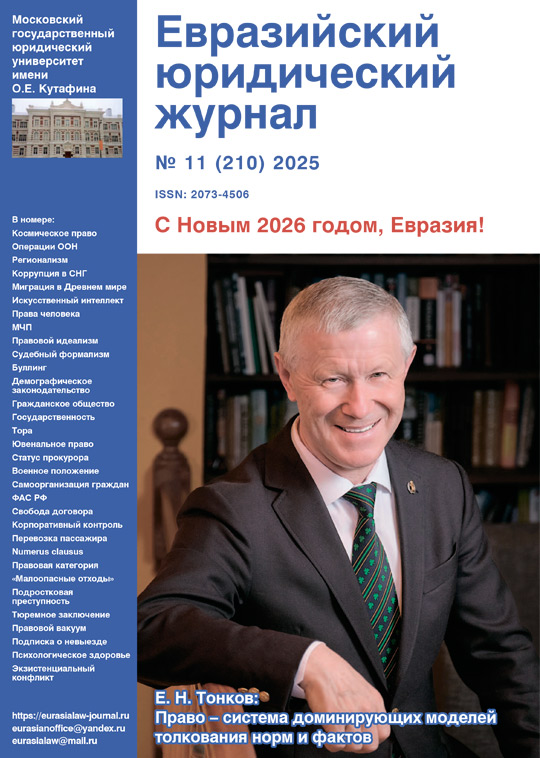
PERSONA GRATA
E. N. Tonkov:
Law as a system of dominant models for interpreting norms and facts
Interview with Ph.D. in Law, creator and editor of the «Interpretation of the Sources of Law» book series, attorney Evgeniy Nikandrovich Tonkov
INTERNATIONAL LAW
Gugunskiy D. A.
International space law: stages of evolution and prospects
Egorov I. A., Egorov A. M.
Theoretical framework and practical implementation of UN peacekeeping operations
Eryomina M. A.
Regulatory framework for legal education in the BRICS countries: current status, characteristics, and prospective areas for reform (South African experience)
Kadysheva O. V.
Normative regionalism in international law
Pavlova M. A.
Development of Eurasian e-commerce in the field of technical regulation
Sergeeva O. V.
The legal basis for the formation of the Eurasian e-commerce market: problems and prospects
Chayka Yv. V.
Animal protection law: the experience of Brazil, Bolivia, Colombia, and South Africa
Shaykhutdinova G. R., Afkhazava D. G., Vladykina A. Yu.
The human rights protection system in Africa: institutional architecture and harmonization mechanisms
Bisyarina A. N.
Combating the trafficking of minors at the regional level
Vildanov R. R.
Periodization of anti-corruption in the CIS
Ibragimov V. M.
Legal regulation of labor migration in the Ancient World
Karskaya A. S.
International legal regulation of artificial intelligence
Milkina N. A.
International legal protection of human rights: contemporary problems
Poychenko A. S.
Challenging EU restrictive measures by Russian persons: a review of certain issues arising in practice
INTERNATIONAL PRIVATE LAW
Vlasova N. V.
Formation of the anti-corruption doctrine in private international law
Moskvitin Yu. M.
Party autonomy and renvoi in private international law
Storozheva A. N., Dadayan E. V., Kharlamova S. I.
Some aspects of the implementation of the institution of reciprocity in international private law
Rubashkin A. N.
The object of characterization as a conceptual basis for the adaptation in private international law
Qiu Xicheng
Arbitration reform in China: features and disadvantages
THEORY OF STATE AND LAW
Asadullin M. R.
On the similarities and differences in the ontologies of the concepts: legal self-organization and self-organization of law
Atmachev S. I.
Legal idealism as a distortion of legal consciousness
Ivanov D. V., Lomakovskaya E. A.
The role of the codifying act in the life of a medical worker
Krasnikov I. S.
The mechanism of judicial formalism: declarations and practices
Lyapin N. M.
Bullying: issues of qualification and legal consequences
Timofeeva T. F., Timofeev V. V.
Development of demographic legislation in light of its news on parental competence
Chervonyuk V. I.
Legal symbols in the structure of legal regulators
Fedorinova E. A.
Ideological and theoretical prerequisites for the formation of the concept of civil society
Asylbaeva P. A.
Improving legal and technical tools for developing concepts as a type of legal act
Berlyakov D. P.
Legal adaptation of foreign citizens in Russia: theoretical and legal aspects
Makulova A. O.
Digital sovereignty and the limits of state control over cyberspace
Paliy R. R.
Ensuring compliance with the rule of law and protecting the rights of citizens in the field of preservation of cultural heritage objects of the peoples of the Russian Federation
Trukhan R. P.oman Petrovich
Functional interaction of legal relationships in the system of legal regulation
HISTORY OF STATE AND LAW
Azizova P. M., Magomedova R. M.
Statehood and law of Western Europe in the early feudal period. Historical and legal aspects
Alimova A. I.
Historical aspects of migration policy in modern Russia
Kalinina E. V.
Evolution of the Jewish concept of justice: from Written Torah to modern secular-religious dualism
Mikhaylik A. A., Ageenko D. M.
Peculiarities of the law of the states of the Latin East (historical and legal analysis)
Pratsko G. S., Melikhov A. I., Ponomarev P. A.
Legal and organizational issues of the activities of police personnel to protect public order during the Great Patriotic War (1941-1945)
Utyagulov M. M., Bessilin N. A., Usova Yu. S.
The first steps of the Soviet state in the sphere of agriculture in Russia in the 1917-1920 s.
Shvetsov V. V.
Impact of the institution of paternity establishment on the elimination of discrimination against children born out of wedlock
CONSTITUTIONAL LAW
Dakhina A. A., Korchagina I. V.
Citizenship of the Russian Federation in the context of the unity of the legal status of an individual: theoretical, legal and constitutional aspects
Ivanova L. A., Saranchin N. A.
The property right of a minor child to receive support from their parents as a constitutional right
Murzanov I. A.
Expert activities of public associations as a factor in combating corruption: public-law analysis
ADMINISTRATIVE LAW
Alexeeva M. V., Abdullaev E. R.
On some administrative and legal aspects of automated legally significant decision-making in the context of digital transformation of public law regulation
Bashmakova V. I.
Administrative and legal regulation of digitalization of admission procedures to universities of the EAEU States: a comparative analysis
Bezzateeva V. S.
International strategies and Russian innovations in the legal protection of minors in social networks
Grigorjeva O. O.
Prevention of emergencies involving employees of the penal enforcement system of the Russian Federation under the influence of alcohol
Ivanov Yu. A., Egorov A. E.
On some issues of information disclosure in the context of current sanctions
Igitov A. M.
National authority for prevention and combating corruption: administrative discretion and its typification
Keramova S. N., Umarova A. Sh.
Problems of legal regulation of administrative liability in the Russian Federation
Mokhov A. Yu.
Invalidation of a local government body’s acts in the mechanism of judicial protection of citizens’ rights to land
Soldatov A. P., Mardonzoda S. R.
Improving administrative legislation regarding liability for the illegal stay of foreign citizens and stateless persons
Urmancheeva T. S., Yakunin D. V.
Preferences for Russian suppliers in 2025: legal and economic bases for providing advantages
Khmil I. V., Grebennik P. D.
Legal status of the prosecutor in the administrative-jurisdictional process
Avakyan A. M.
Administrative and legal status of the All-Russian Union of Insurers
Voytov I. V.
Ethical regulation in the system of regulatory control of digital technologies in the field of higher education
Zakharov I. V.
The administrative legal institution of rulemaking of executive authorities in France, Germany and Russia
Keramova S. N.
Practical implementation of the state of war regime in Russia
Klepinin P. A.
Legal basis for administrative cooperation between executive authorities within the EAEU
Ushakov R. M.
Public-private partnership as a form of outsourcing and optimization of public functions: administrative and legal aspects
ADMINISTRATIVE PROCESS
Shcherbinina I. V., Lyapushkin P. V.
Proper notification of persons participating in an administrative case as a necessary condition for holding a court hearing
MUNICIPAL LAW
Kudryavtsev V. V., Privalova E. A.
The soviet historical experience of citizens’ self-organization in the context of the modern development of local self-government in Russia
Petrov A. P.
The role of regional authorities in the development of physical culture and sports
CIVIL LAW
Alamova S. M.
Distributed ledger technologies as a tool for certifying and confirming copyrights to intellectual property results: legal aspects
Balatskaya Yu. Yu.
A study of legal support and practices for providing education and employment to people with disabilities in Russia and Norway
Zdorovtseva A. A., Sinyakova T. V.
Features of legal regulation of free legal assistance discussed
Kitaeva A. V., Khasnutdinov R. R.
Supply contract in business activities: features of conclusion and execution
Masalimova A. A., Amineva A. Yu., Rezyapova G. F.
Actual problems of execution of testamentary refusals in the Russian Federation
Mozar Yu. V.
Liability for late fulfillment of obligations in the absence of the debtor’s fault
Оnishchenko I. S., Sidelnikova D. M.
The role of the Federal Antimonopoly Service of the Russian Federation in monitoring public procurement: the current state and problems of legal regulation
Pevtsova I. E., Mikhaylova N. A.
Consumer legal relations: structure and essence
Pronina Yu. O., Petrov N. V., Orekhov V. Ya.
General trends in the development of domestic legislation in the field of land easements
Tregubov A. N., Skripova V. I.
Privatization of national symbols: legal, economic and ethical grounds for inadmissibility of transfer of trademark «mother calls» to private property
Babaev E. A.
The legal nature of a commercial concession agreement in the system of civil contracts
Vasenev M. I.
Contractual regulation of pre-estimated losses: a balance between freedom of contract and protection of the debtor’s rights
Guseynova G. E.
Analogues of the claim for restoration of corporate control (paragraph 3, article 65.2 of the Russian civil code) in Anglo-American law
Dzhabrailov A. G.
The concept of a “temporarily absent citizen” in Russian law: gaps in civil procedural regulation
Karev M. K.
Contesting a contract for air carriage of passenger concluded at a distance due to a pricing error
Kozhin M. Yu.
Creditors’ liability in bankruptcy for damage to the «common cause»
Kolchugin A. M.
The concept of «joint causing of harm» in tortious obligations with multiple parties
Latynin A. O.
Prospects for doctrinal and law enforcement rethinking of the principle of freedom of contract in the digital future
Lepeshin D. A.
Activities of organizations for collective management of copyright and related rights in Russia and abroad: comparative legal analysis
Mingazov M. R.
The issue of determining a fair amount of compensation for the infringement of intellectual property rights amid the reform of the institution of compensation
Reimer L. R.
Legal bases and practical aspects of the development of licensing educational activities of preschool institutions
Snyatkov A. A.
The numerus clausus principle of relative rights
Romanov F. A.
Institute of residency in special economic zones: civil law analysis
Yaskin D. V.
Stages of the bailiff’s right to challenge the debtor’s transactions
CIVIL PROCESS
Lunev K. A.
Standard of proof of legal facts of abuse of procedural law
LABOUR LAW
Gilmeeva G. N.
Judicial practice of applying penalties in labour disputes in the context of resolution № 52-p of the Constitutional Court of the Russian Federation dated 14 November 2024
Kitaeva A. V., Khasnutdinov R. R.
Digitalization of personnel management: electronic document circulation and work books
Kolmykov A. A., Solovyov A. N.
Legal category of employment in Soviet and Russian law
FINANCIAL LAW
Sagitova I. F., Plotnikova A. S.
The Bank of Russia’s macroprudential policy: the architecture of financial stability
Shvets Ya. G.
The financial and legal nature of digital financial assets
TAX LAW
Oleynik A. D.
Enforcement of the tax duty of a foreign organization-taxpayer in Nigeria
LAND LAW
Ablyakimova E. E., Sadkovy I. A., Kuznetsov V. V.
Seizure of land plots in connection with their misuse: issues of theory and practice
ECOLOGICAL LAW
Mokhorov D. A., Balabkin D. A., Abrosimov I. S.
The problem of wording the concepts of «hazardous waste», «especially hazardous waste» and «low-hazard waste» in Russian legislation
Fedorenko E. V.
From burial to waste management in the legal field of the Russian Federation
Mokhorov D. A., Martinchuk N. A.
Legal regulation of countering environmental issues in the cis countries
Nazarov V. Yu.
Organizational and legal aspects of modernization of public law relations in seaside specially protected natural territories
ENTREPRENEURIAL LAW
Privezentsev F. A.
Legal regulation of gas transportation in the Russian gas supply market: issues of regulating monopoly and competition
CRIMINAL LAW
Abdullozoda B. V.
On the question of determining the subject of water pollution
Barasheva E. A.
Teenage crime in Russia: causes, legal regulation, and ways to reduce it
Burganov R. S., Valov V. D.
Cryptocurrency as a subject of theft
Vologina E. V.
Method of committing a crime as a qualifying feature and as a circumstance aggravating punishment
Gulakova V. Yu.
The institute of responsibility for complicity in a crime as a criminal law means of combating crime
Elchaninov A. P.
Imprisonment in pre-revolutionary Russia as a type of execution of punishments in the form of imprisonment
Zaidova M. U.
Incitement to hatred or enmity, as well as humiliation of human dignity: some explanations
Kerimova M. M.
Criminal law characteristics of modern drug-related crime
Klebanov L. R., Azarenkova E. A.
The illegal oil market in Africa: structure, characteristics, and negative consequences
Loos E. V., Shtab O. N., Shkurikhina N. V.
A comparative legal analysis of the criminal legislation of the Russian Federation and the People’s Republic of China in the field of migration
Lyadov E. V.
Execution of punishment in the form of correctional labor: new legislation and law enforcement
Maltseva E. V., Zhoga E. Yu., Baryshev A. M.
Legal vacuum in the provision of occult and ritual services: problems of qualification and counteraction
Olifirenko E. P.
Actual problems of prosecutorial supervision in the field of law enforcement by bailiffs (analysis of the situation using the example of the Karachay-Cherkess Republic)
Senina E. N.
The criminal law nature of restorative justice in Russia
Titov S. N.
Prospects for improving the criminal-law protection of intellectual property in the context of digital transformation and the emergence of the information society
Trifonova K. A., Tsvetkov S. B.
Optimizing the procedure for familiarization with criminal case materials at the pre-trial stage: legal mechanisms
Uglova E. A.
Analysis of the objective side of ecocide: problems of qualification and ways of improvement
Khayrusov D. S.
Theory of countering crime: some social-philosophical, criminological and forensic aspects
Zharov K. A.
Distinguishing Environmental and Property Encroachments on Forest Timber Resources in Criminal Law
Karapetyan R. M.
Problems of distinguishing between plagiarism and fraud: a criminal law analysis
Kizin E. A., Saprykin P. V.
Problems of qualification of violence in rape and sexual violence
Lisichko V. R., Sechenykh A. D.
Problems of distinguishing between completed and unfinished crimes in Russian criminal law
Nedbaylov P. A.
Social assistance for the implementation of individual entrepreneurial activities under a social contract as a subject of fraud in receiving payments
Sabanin V. S.
Optimal model of differentiation of criminal liability for corruption crimes: current issues and practical recommendations
Tsukanov S. I.
International agreements on countering cybercrime
Khasieva I. A.
The monetary expression of large and especially large scale in offenses against property
CRIMINAL PROCESS
Klishin V. V.
Specific features of interrogating drivers in the investigation of road accidents
Kulagin D. V.
The constitutional principle of solidarity as an obligatory (necessary) condition for ensuring the implementation of Federal Law № 64-FZ dated 03.23.2024
Lantukh N. V., Chasovnikova O. G.
Procedural guarantees for the protection of individual rights in criminal proceedings
Musalova Kh. M.
Issues and prospects for the development of the private prosecution institution in criminal proceedings
Nosataya D. V., Nosaty R. I., Saakyan A. G.
The need to impose a ban on approaching the victim when using a preventive measure in the form of a ban on certain actions
Polikarpova O. S.
On the significance of the institution of indictment in Russian criminal proceedings
Sukhorukova A. N., Mashkov A. A., Aparina O. Yu.
Procedural regulation of the applicant’s legal position in criminal proceedings
Khalilova V. L.
Characteristics of criminal proceedings against military personnel, taking into account the unity and differentiation of criminal procedure
Khmelev S. A.
Selected topical issues in the investigation of telephone fraud at the initial stage
Chakiev M. A.
On some problems of protecting the rights and legal interests of victims with limited health opportunities in Russian criminal proceedings
Khrustaleva V. A.
Restorative justice as a vector of modernization of criminal proceedings: from a punitive paradigm to a systemic conflict resolution
Lantukh N. V., Lyakhov I. V., Chasovnikova O. G.
On the issue of the legal and conditions for the application of a special procedure for judicial proceedings when the accused agrees with the charges brought against him
Yakubina Yu. P.
Prosecutorial supervision and judicial control during the inquiry
Yakhin E. R.
Travel restriction and good conduct undertaking: modern issues and possible solutions
CRIMINALISTICS
Buevich O. L., Klishin V. V.
Procedural and tactical issues in the interrogation of a juvenile defendant accused of a series of thefts
Klinchuk S. V., Sakhno O. O.
Tactical features of investigative examination during crime report verification
Khaskina V. Yu., Vnukov V. I.
Scientific and technical support for forensic activities in criminal proceedings
Shapovalova T. I.
Problems that arise at the scene of an accident when fixing finger marks
JUDICIARY
Kunizhev I. B.
The use of artificial intelligence and virtual/augmented reality technologies in arbitration proceedings: problems and prospects
LAW ENFORCEMENT AGENCIES
Kogan O. S., Lifanova M. V., Gerasimova D. I.
On the psychological properties of personality and the formation of professionally important qualities in law enforcement officers
Pushkarev M. E., Shcherbinin E. S.
Modern trends in the development of fire training for law enforcement officers involved in special operations
PROSECUTOR’S SUPERVISION
Baidarova M. A., Fomin V. V.
Institutional dialogue between prosecutorial bodies and human rights commissioners in the Russian Federation: assessment of the current state, problems, and directions for improving cooperation
Makhyanova R. M.
Key directions for transforming the supervisory activities of the Prosecutor’s Office
PEDAGOGY AND LAW
Andreeva E. Yu., Zakharova E. E.
The use of interactive technologies in the implementation of professional training programs in educational organizations of the Ministry of Internal Affairs of Russia
Gorbatsevich O. A., Skorokhodov A. A., Sabanov A. Yu.
The role of practical training in the pedagogical process in educational organizations of the Ministry of Internal Affairs of Russia
Gunyaev E. V., Pshatov V. V., Khrushchev A. V.
Formation of the legal and ethical culture of university cadets of the Ministry of Internal Affairs of Russia
Zhabkin A. S., Valieva G. R., Shevchenko A. V.
The theoretical foundations of the application of an integrated approach in the training of future lawyers
Zorina N. S.
Causes and conditions of delinquent behavior of juvenile convicts: a comprehensive analysis
Ivanov D. V.
Forensic experts training legal issues: approaches plurality and competition
Kopaeva E. N., Khoroshunov A. S., Zakomaldin A. S.
Problems and prospects of introducing sports disciplines into the training program for police officers
Mingazizova G. G., Khorolskiy V. V., Nagorny A. P.
Legal pedagogy as a type of general pedagogy: theoretical and methodological analysis
Mirgalimova L. M., Yaminova S. A., Boloban M. L.
Professional training of future law enforcement officers: the essence and features in the modern socio-cultural context
Filipova E. E., Ulendeeva N. I., Makarova E. L.
The use of forecasting methods for phenomena and processes in teaching at a socio-legal university
PSYCHOLOGY AND LAW
Ardashev R. G., Bokareva T. S.
Human psychological health in conditions of uncertainty of legal norms
Razinkova O. I., Fedyakin I. V., Zaitsev E. A.
Legal aspects of psychological support for families of military personnel and civilians affected by the events of the Special Military Operation
Ardashev R. G., Bokareva T. S.
Characteristics of destructive behavior in young people
STATE AND LAW
Golovina E. O.
State legal regulation of the tourism sector in the Russian Federation
Kireev M. P., Rodichkin S. V.
On the issue of anti-terrorist security of facilities and employees of internal affairs bodies
Murzina I. A., Redkin I. S.
Monitoring the quality of public and municipal services in Russia: evolution and modern tools for digital transformation
Sherstyugin G. Yu.
The use of smart contract technology in government tenders and procurement
Shulyndin L. S.
Transformation of the legal status of subjects of higher education management in Russia: from the Soviet model to the present
Bakhvalov L. P.
Legal mechanisms for preventing irregular migration in BRICS member states
POLICE AND LAW
Vildanov R. R., Filatov N. A.
Reform of the party-state system and changes in the Constitution of the People’s Republic of China
HUMAN RIGHTS
Butenko A. K.
Current issues of the activities of the Commissioner for Children’s Rights in protecting the rights of orphans and children left without parental care
ECONOMY. LAW. SOCIETY
Kalashnikova S. V., Kumpilova A. R., Dikinov A. Kh.
Innovation as a mechanism for attracting investment in the tourism industry
Marchenkova L. M.
Regulation of the economic foundations of social protection in the Russian Federation
Pavlov O. I., Pavlova O. Yu.
The relationship between the dynamics of the Gini coefficient of income and social mobility in an urbanized environment
Takmakova E. V., Nelin A. K.
The specifics of oil and gas industrial enterprises and ESG transformation
Trusova E. D., Kondratenko V. E.
Analysis of the economic condition of the budget of the Republic of Khakassia
Khananok Z. A., Sabanokova S. Kh., Avdienko I. M.
The impact of security and political stability on the tourism investment climate in the region (using the Republic of Adygea as an example)
Mao Yuqi, Zhukovskaya O. Yu.
A quantitative analysis of the impact of virtual media product quality on consumer behavior: an empirical study based on the CEPQ-two-factor model
Mironova L. G.
Assessing the competitiveness of Yakut cinema in the regional and local film distribution market
Mukhametyanova A. R., Vanchukhina L. I.
Formation of an enterprise’s innovation environment as a key element of its economic sustainability: a theoretical aspect
Takmakova E. V., Tamoyan P. G.
The platform approach as a driver of transformation of industrial product markets
PHILOSOPHY. LAW. SOCIETY
Grishina E. S.
To the criticism of Friedrich Nietzsche’s understanding of guilt as morbidity
Dik G. V., Trubnikova S. E.
Opposition to artificial termination of pregnancy: a spiritual and moral aspect
Levchenkov A. I., Krasilnikova L. I.
War as an existential conflict between the West and Russia
Lozinskiy N. N.
Management of social processes in the context of Eurasian integration
Makayeva G. Z., Makayev Kh. F., Kazymova T. S.
The phenomenon of power as a socio-cultural phenomenon in the heroic epics «Manas» and «Edigei»
Maximenko M. V., Bushkova S. A.
Тhe importance of the principles of professional ethics of an employee of the penal system
Mikhaelis V. V., Popova I. N.
Professional activities of law enforcement agencies in modern conditions: psychological risks, philosophical and methodological foundations and economic feasibility of preventing mental trauma
Maslienko M. A.
Existential risks of losing authenticity in the digital environment
Suleymanova R. R.
Modern digitization trends in public administration: social-philosophical analysis
Frolova N. A., Tarasov A. N., Kirsanov R. A.
The moral imperative as the meaning-forming core of the Russian cultural paradigm
Khomich N. V., Tatarinova L. V.
The creative subject of the 21st century in the changing philosophical paradigms
Shayslamova M. M., Kirillova E. A.
The philosophy of digital identity: personality in the age of social media
Shalashnikov G. V.
The institute of attorney-client privilege as an essential component of the professional ethics of an attorney
Kornienko K. A.
On the issue of segmentation of the communication environment of modern society through neural network influence
Moskvitin V. A.
Philosophical analysis of post-classical science: from «technical setting» to «revealing rationality»
Tratsevskiy D. S.
Equality in the ancient philosophical tradition (on the example of Plato and Aristotle)
Chebykin E. V.
The Nicolai Hartmann’s philosophic doctrine of «levels of being»
Frolova N. A., Tarasov A. N., Korolevskaya O. V.
On the anthropological dimension of Russian culture
E. N. Tonkov:
Law as a system of dominant models for interpreting norms and facts
Interview with Ph.D. in Law, creator and editor of the «Interpretation of the Sources of Law» book series, attorney Evgeniy Nikandrovich Tonkov
INTERNATIONAL LAW
Gugunskiy D. A.
International space law: stages of evolution and prospects
Egorov I. A., Egorov A. M.
Theoretical framework and practical implementation of UN peacekeeping operations
Eryomina M. A.
Regulatory framework for legal education in the BRICS countries: current status, characteristics, and prospective areas for reform (South African experience)
Kadysheva O. V.
Normative regionalism in international law
Pavlova M. A.
Development of Eurasian e-commerce in the field of technical regulation
Sergeeva O. V.
The legal basis for the formation of the Eurasian e-commerce market: problems and prospects
Chayka Yv. V.
Animal protection law: the experience of Brazil, Bolivia, Colombia, and South Africa
Shaykhutdinova G. R., Afkhazava D. G., Vladykina A. Yu.
The human rights protection system in Africa: institutional architecture and harmonization mechanisms
Bisyarina A. N.
Combating the trafficking of minors at the regional level
Vildanov R. R.
Periodization of anti-corruption in the CIS
Ibragimov V. M.
Legal regulation of labor migration in the Ancient World
Karskaya A. S.
International legal regulation of artificial intelligence
Milkina N. A.
International legal protection of human rights: contemporary problems
Poychenko A. S.
Challenging EU restrictive measures by Russian persons: a review of certain issues arising in practice
INTERNATIONAL PRIVATE LAW
Vlasova N. V.
Formation of the anti-corruption doctrine in private international law
Moskvitin Yu. M.
Party autonomy and renvoi in private international law
Storozheva A. N., Dadayan E. V., Kharlamova S. I.
Some aspects of the implementation of the institution of reciprocity in international private law
Rubashkin A. N.
The object of characterization as a conceptual basis for the adaptation in private international law
Qiu Xicheng
Arbitration reform in China: features and disadvantages
THEORY OF STATE AND LAW
Asadullin M. R.
On the similarities and differences in the ontologies of the concepts: legal self-organization and self-organization of law
Atmachev S. I.
Legal idealism as a distortion of legal consciousness
Ivanov D. V., Lomakovskaya E. A.
The role of the codifying act in the life of a medical worker
Krasnikov I. S.
The mechanism of judicial formalism: declarations and practices
Lyapin N. M.
Bullying: issues of qualification and legal consequences
Timofeeva T. F., Timofeev V. V.
Development of demographic legislation in light of its news on parental competence
Chervonyuk V. I.
Legal symbols in the structure of legal regulators
Fedorinova E. A.
Ideological and theoretical prerequisites for the formation of the concept of civil society
Asylbaeva P. A.
Improving legal and technical tools for developing concepts as a type of legal act
Berlyakov D. P.
Legal adaptation of foreign citizens in Russia: theoretical and legal aspects
Makulova A. O.
Digital sovereignty and the limits of state control over cyberspace
Paliy R. R.
Ensuring compliance with the rule of law and protecting the rights of citizens in the field of preservation of cultural heritage objects of the peoples of the Russian Federation
Trukhan R. P.oman Petrovich
Functional interaction of legal relationships in the system of legal regulation
HISTORY OF STATE AND LAW
Azizova P. M., Magomedova R. M.
Statehood and law of Western Europe in the early feudal period. Historical and legal aspects
Alimova A. I.
Historical aspects of migration policy in modern Russia
Kalinina E. V.
Evolution of the Jewish concept of justice: from Written Torah to modern secular-religious dualism
Mikhaylik A. A., Ageenko D. M.
Peculiarities of the law of the states of the Latin East (historical and legal analysis)
Pratsko G. S., Melikhov A. I., Ponomarev P. A.
Legal and organizational issues of the activities of police personnel to protect public order during the Great Patriotic War (1941-1945)
Utyagulov M. M., Bessilin N. A., Usova Yu. S.
The first steps of the Soviet state in the sphere of agriculture in Russia in the 1917-1920 s.
Shvetsov V. V.
Impact of the institution of paternity establishment on the elimination of discrimination against children born out of wedlock
CONSTITUTIONAL LAW
Dakhina A. A., Korchagina I. V.
Citizenship of the Russian Federation in the context of the unity of the legal status of an individual: theoretical, legal and constitutional aspects
Ivanova L. A., Saranchin N. A.
The property right of a minor child to receive support from their parents as a constitutional right
Murzanov I. A.
Expert activities of public associations as a factor in combating corruption: public-law analysis
ADMINISTRATIVE LAW
Alexeeva M. V., Abdullaev E. R.
On some administrative and legal aspects of automated legally significant decision-making in the context of digital transformation of public law regulation
Bashmakova V. I.
Administrative and legal regulation of digitalization of admission procedures to universities of the EAEU States: a comparative analysis
Bezzateeva V. S.
International strategies and Russian innovations in the legal protection of minors in social networks
Grigorjeva O. O.
Prevention of emergencies involving employees of the penal enforcement system of the Russian Federation under the influence of alcohol
Ivanov Yu. A., Egorov A. E.
On some issues of information disclosure in the context of current sanctions
Igitov A. M.
National authority for prevention and combating corruption: administrative discretion and its typification
Keramova S. N., Umarova A. Sh.
Problems of legal regulation of administrative liability in the Russian Federation
Mokhov A. Yu.
Invalidation of a local government body’s acts in the mechanism of judicial protection of citizens’ rights to land
Soldatov A. P., Mardonzoda S. R.
Improving administrative legislation regarding liability for the illegal stay of foreign citizens and stateless persons
Urmancheeva T. S., Yakunin D. V.
Preferences for Russian suppliers in 2025: legal and economic bases for providing advantages
Khmil I. V., Grebennik P. D.
Legal status of the prosecutor in the administrative-jurisdictional process
Avakyan A. M.
Administrative and legal status of the All-Russian Union of Insurers
Voytov I. V.
Ethical regulation in the system of regulatory control of digital technologies in the field of higher education
Zakharov I. V.
The administrative legal institution of rulemaking of executive authorities in France, Germany and Russia
Keramova S. N.
Practical implementation of the state of war regime in Russia
Klepinin P. A.
Legal basis for administrative cooperation between executive authorities within the EAEU
Ushakov R. M.
Public-private partnership as a form of outsourcing and optimization of public functions: administrative and legal aspects
ADMINISTRATIVE PROCESS
Shcherbinina I. V., Lyapushkin P. V.
Proper notification of persons participating in an administrative case as a necessary condition for holding a court hearing
MUNICIPAL LAW
Kudryavtsev V. V., Privalova E. A.
The soviet historical experience of citizens’ self-organization in the context of the modern development of local self-government in Russia
Petrov A. P.
The role of regional authorities in the development of physical culture and sports
CIVIL LAW
Alamova S. M.
Distributed ledger technologies as a tool for certifying and confirming copyrights to intellectual property results: legal aspects
Balatskaya Yu. Yu.
A study of legal support and practices for providing education and employment to people with disabilities in Russia and Norway
Zdorovtseva A. A., Sinyakova T. V.
Features of legal regulation of free legal assistance discussed
Kitaeva A. V., Khasnutdinov R. R.
Supply contract in business activities: features of conclusion and execution
Masalimova A. A., Amineva A. Yu., Rezyapova G. F.
Actual problems of execution of testamentary refusals in the Russian Federation
Mozar Yu. V.
Liability for late fulfillment of obligations in the absence of the debtor’s fault
Оnishchenko I. S., Sidelnikova D. M.
The role of the Federal Antimonopoly Service of the Russian Federation in monitoring public procurement: the current state and problems of legal regulation
Pevtsova I. E., Mikhaylova N. A.
Consumer legal relations: structure and essence
Pronina Yu. O., Petrov N. V., Orekhov V. Ya.
General trends in the development of domestic legislation in the field of land easements
Tregubov A. N., Skripova V. I.
Privatization of national symbols: legal, economic and ethical grounds for inadmissibility of transfer of trademark «mother calls» to private property
Babaev E. A.
The legal nature of a commercial concession agreement in the system of civil contracts
Vasenev M. I.
Contractual regulation of pre-estimated losses: a balance between freedom of contract and protection of the debtor’s rights
Guseynova G. E.
Analogues of the claim for restoration of corporate control (paragraph 3, article 65.2 of the Russian civil code) in Anglo-American law
Dzhabrailov A. G.
The concept of a “temporarily absent citizen” in Russian law: gaps in civil procedural regulation
Karev M. K.
Contesting a contract for air carriage of passenger concluded at a distance due to a pricing error
Kozhin M. Yu.
Creditors’ liability in bankruptcy for damage to the «common cause»
Kolchugin A. M.
The concept of «joint causing of harm» in tortious obligations with multiple parties
Latynin A. O.
Prospects for doctrinal and law enforcement rethinking of the principle of freedom of contract in the digital future
Lepeshin D. A.
Activities of organizations for collective management of copyright and related rights in Russia and abroad: comparative legal analysis
Mingazov M. R.
The issue of determining a fair amount of compensation for the infringement of intellectual property rights amid the reform of the institution of compensation
Reimer L. R.
Legal bases and practical aspects of the development of licensing educational activities of preschool institutions
Snyatkov A. A.
The numerus clausus principle of relative rights
Romanov F. A.
Institute of residency in special economic zones: civil law analysis
Yaskin D. V.
Stages of the bailiff’s right to challenge the debtor’s transactions
CIVIL PROCESS
Lunev K. A.
Standard of proof of legal facts of abuse of procedural law
LABOUR LAW
Gilmeeva G. N.
Judicial practice of applying penalties in labour disputes in the context of resolution № 52-p of the Constitutional Court of the Russian Federation dated 14 November 2024
Kitaeva A. V., Khasnutdinov R. R.
Digitalization of personnel management: electronic document circulation and work books
Kolmykov A. A., Solovyov A. N.
Legal category of employment in Soviet and Russian law
FINANCIAL LAW
Sagitova I. F., Plotnikova A. S.
The Bank of Russia’s macroprudential policy: the architecture of financial stability
Shvets Ya. G.
The financial and legal nature of digital financial assets
TAX LAW
Oleynik A. D.
Enforcement of the tax duty of a foreign organization-taxpayer in Nigeria
LAND LAW
Ablyakimova E. E., Sadkovy I. A., Kuznetsov V. V.
Seizure of land plots in connection with their misuse: issues of theory and practice
ECOLOGICAL LAW
Mokhorov D. A., Balabkin D. A., Abrosimov I. S.
The problem of wording the concepts of «hazardous waste», «especially hazardous waste» and «low-hazard waste» in Russian legislation
Fedorenko E. V.
From burial to waste management in the legal field of the Russian Federation
Mokhorov D. A., Martinchuk N. A.
Legal regulation of countering environmental issues in the cis countries
Nazarov V. Yu.
Organizational and legal aspects of modernization of public law relations in seaside specially protected natural territories
ENTREPRENEURIAL LAW
Privezentsev F. A.
Legal regulation of gas transportation in the Russian gas supply market: issues of regulating monopoly and competition
CRIMINAL LAW
Abdullozoda B. V.
On the question of determining the subject of water pollution
Barasheva E. A.
Teenage crime in Russia: causes, legal regulation, and ways to reduce it
Burganov R. S., Valov V. D.
Cryptocurrency as a subject of theft
Vologina E. V.
Method of committing a crime as a qualifying feature and as a circumstance aggravating punishment
Gulakova V. Yu.
The institute of responsibility for complicity in a crime as a criminal law means of combating crime
Elchaninov A. P.
Imprisonment in pre-revolutionary Russia as a type of execution of punishments in the form of imprisonment
Zaidova M. U.
Incitement to hatred or enmity, as well as humiliation of human dignity: some explanations
Kerimova M. M.
Criminal law characteristics of modern drug-related crime
Klebanov L. R., Azarenkova E. A.
The illegal oil market in Africa: structure, characteristics, and negative consequences
Loos E. V., Shtab O. N., Shkurikhina N. V.
A comparative legal analysis of the criminal legislation of the Russian Federation and the People’s Republic of China in the field of migration
Lyadov E. V.
Execution of punishment in the form of correctional labor: new legislation and law enforcement
Maltseva E. V., Zhoga E. Yu., Baryshev A. M.
Legal vacuum in the provision of occult and ritual services: problems of qualification and counteraction
Olifirenko E. P.
Actual problems of prosecutorial supervision in the field of law enforcement by bailiffs (analysis of the situation using the example of the Karachay-Cherkess Republic)
Senina E. N.
The criminal law nature of restorative justice in Russia
Titov S. N.
Prospects for improving the criminal-law protection of intellectual property in the context of digital transformation and the emergence of the information society
Trifonova K. A., Tsvetkov S. B.
Optimizing the procedure for familiarization with criminal case materials at the pre-trial stage: legal mechanisms
Uglova E. A.
Analysis of the objective side of ecocide: problems of qualification and ways of improvement
Khayrusov D. S.
Theory of countering crime: some social-philosophical, criminological and forensic aspects
Zharov K. A.
Distinguishing Environmental and Property Encroachments on Forest Timber Resources in Criminal Law
Karapetyan R. M.
Problems of distinguishing between plagiarism and fraud: a criminal law analysis
Kizin E. A., Saprykin P. V.
Problems of qualification of violence in rape and sexual violence
Lisichko V. R., Sechenykh A. D.
Problems of distinguishing between completed and unfinished crimes in Russian criminal law
Nedbaylov P. A.
Social assistance for the implementation of individual entrepreneurial activities under a social contract as a subject of fraud in receiving payments
Sabanin V. S.
Optimal model of differentiation of criminal liability for corruption crimes: current issues and practical recommendations
Tsukanov S. I.
International agreements on countering cybercrime
Khasieva I. A.
The monetary expression of large and especially large scale in offenses against property
CRIMINAL PROCESS
Klishin V. V.
Specific features of interrogating drivers in the investigation of road accidents
Kulagin D. V.
The constitutional principle of solidarity as an obligatory (necessary) condition for ensuring the implementation of Federal Law № 64-FZ dated 03.23.2024
Lantukh N. V., Chasovnikova O. G.
Procedural guarantees for the protection of individual rights in criminal proceedings
Musalova Kh. M.
Issues and prospects for the development of the private prosecution institution in criminal proceedings
Nosataya D. V., Nosaty R. I., Saakyan A. G.
The need to impose a ban on approaching the victim when using a preventive measure in the form of a ban on certain actions
Polikarpova O. S.
On the significance of the institution of indictment in Russian criminal proceedings
Sukhorukova A. N., Mashkov A. A., Aparina O. Yu.
Procedural regulation of the applicant’s legal position in criminal proceedings
Khalilova V. L.
Characteristics of criminal proceedings against military personnel, taking into account the unity and differentiation of criminal procedure
Khmelev S. A.
Selected topical issues in the investigation of telephone fraud at the initial stage
Chakiev M. A.
On some problems of protecting the rights and legal interests of victims with limited health opportunities in Russian criminal proceedings
Khrustaleva V. A.
Restorative justice as a vector of modernization of criminal proceedings: from a punitive paradigm to a systemic conflict resolution
Lantukh N. V., Lyakhov I. V., Chasovnikova O. G.
On the issue of the legal and conditions for the application of a special procedure for judicial proceedings when the accused agrees with the charges brought against him
Yakubina Yu. P.
Prosecutorial supervision and judicial control during the inquiry
Yakhin E. R.
Travel restriction and good conduct undertaking: modern issues and possible solutions
CRIMINALISTICS
Buevich O. L., Klishin V. V.
Procedural and tactical issues in the interrogation of a juvenile defendant accused of a series of thefts
Klinchuk S. V., Sakhno O. O.
Tactical features of investigative examination during crime report verification
Khaskina V. Yu., Vnukov V. I.
Scientific and technical support for forensic activities in criminal proceedings
Shapovalova T. I.
Problems that arise at the scene of an accident when fixing finger marks
JUDICIARY
Kunizhev I. B.
The use of artificial intelligence and virtual/augmented reality technologies in arbitration proceedings: problems and prospects
LAW ENFORCEMENT AGENCIES
Kogan O. S., Lifanova M. V., Gerasimova D. I.
On the psychological properties of personality and the formation of professionally important qualities in law enforcement officers
Pushkarev M. E., Shcherbinin E. S.
Modern trends in the development of fire training for law enforcement officers involved in special operations
PROSECUTOR’S SUPERVISION
Baidarova M. A., Fomin V. V.
Institutional dialogue between prosecutorial bodies and human rights commissioners in the Russian Federation: assessment of the current state, problems, and directions for improving cooperation
Makhyanova R. M.
Key directions for transforming the supervisory activities of the Prosecutor’s Office
PEDAGOGY AND LAW
Andreeva E. Yu., Zakharova E. E.
The use of interactive technologies in the implementation of professional training programs in educational organizations of the Ministry of Internal Affairs of Russia
Gorbatsevich O. A., Skorokhodov A. A., Sabanov A. Yu.
The role of practical training in the pedagogical process in educational organizations of the Ministry of Internal Affairs of Russia
Gunyaev E. V., Pshatov V. V., Khrushchev A. V.
Formation of the legal and ethical culture of university cadets of the Ministry of Internal Affairs of Russia
Zhabkin A. S., Valieva G. R., Shevchenko A. V.
The theoretical foundations of the application of an integrated approach in the training of future lawyers
Zorina N. S.
Causes and conditions of delinquent behavior of juvenile convicts: a comprehensive analysis
Ivanov D. V.
Forensic experts training legal issues: approaches plurality and competition
Kopaeva E. N., Khoroshunov A. S., Zakomaldin A. S.
Problems and prospects of introducing sports disciplines into the training program for police officers
Mingazizova G. G., Khorolskiy V. V., Nagorny A. P.
Legal pedagogy as a type of general pedagogy: theoretical and methodological analysis
Mirgalimova L. M., Yaminova S. A., Boloban M. L.
Professional training of future law enforcement officers: the essence and features in the modern socio-cultural context
Filipova E. E., Ulendeeva N. I., Makarova E. L.
The use of forecasting methods for phenomena and processes in teaching at a socio-legal university
PSYCHOLOGY AND LAW
Ardashev R. G., Bokareva T. S.
Human psychological health in conditions of uncertainty of legal norms
Razinkova O. I., Fedyakin I. V., Zaitsev E. A.
Legal aspects of psychological support for families of military personnel and civilians affected by the events of the Special Military Operation
Ardashev R. G., Bokareva T. S.
Characteristics of destructive behavior in young people
STATE AND LAW
Golovina E. O.
State legal regulation of the tourism sector in the Russian Federation
Kireev M. P., Rodichkin S. V.
On the issue of anti-terrorist security of facilities and employees of internal affairs bodies
Murzina I. A., Redkin I. S.
Monitoring the quality of public and municipal services in Russia: evolution and modern tools for digital transformation
Sherstyugin G. Yu.
The use of smart contract technology in government tenders and procurement
Shulyndin L. S.
Transformation of the legal status of subjects of higher education management in Russia: from the Soviet model to the present
Bakhvalov L. P.
Legal mechanisms for preventing irregular migration in BRICS member states
POLICE AND LAW
Vildanov R. R., Filatov N. A.
Reform of the party-state system and changes in the Constitution of the People’s Republic of China
HUMAN RIGHTS
Butenko A. K.
Current issues of the activities of the Commissioner for Children’s Rights in protecting the rights of orphans and children left without parental care
ECONOMY. LAW. SOCIETY
Kalashnikova S. V., Kumpilova A. R., Dikinov A. Kh.
Innovation as a mechanism for attracting investment in the tourism industry
Marchenkova L. M.
Regulation of the economic foundations of social protection in the Russian Federation
Pavlov O. I., Pavlova O. Yu.
The relationship between the dynamics of the Gini coefficient of income and social mobility in an urbanized environment
Takmakova E. V., Nelin A. K.
The specifics of oil and gas industrial enterprises and ESG transformation
Trusova E. D., Kondratenko V. E.
Analysis of the economic condition of the budget of the Republic of Khakassia
Khananok Z. A., Sabanokova S. Kh., Avdienko I. M.
The impact of security and political stability on the tourism investment climate in the region (using the Republic of Adygea as an example)
Mao Yuqi, Zhukovskaya O. Yu.
A quantitative analysis of the impact of virtual media product quality on consumer behavior: an empirical study based on the CEPQ-two-factor model
Mironova L. G.
Assessing the competitiveness of Yakut cinema in the regional and local film distribution market
Mukhametyanova A. R., Vanchukhina L. I.
Formation of an enterprise’s innovation environment as a key element of its economic sustainability: a theoretical aspect
Takmakova E. V., Tamoyan P. G.
The platform approach as a driver of transformation of industrial product markets
PHILOSOPHY. LAW. SOCIETY
Grishina E. S.
To the criticism of Friedrich Nietzsche’s understanding of guilt as morbidity
Dik G. V., Trubnikova S. E.
Opposition to artificial termination of pregnancy: a spiritual and moral aspect
Levchenkov A. I., Krasilnikova L. I.
War as an existential conflict between the West and Russia
Lozinskiy N. N.
Management of social processes in the context of Eurasian integration
Makayeva G. Z., Makayev Kh. F., Kazymova T. S.
The phenomenon of power as a socio-cultural phenomenon in the heroic epics «Manas» and «Edigei»
Maximenko M. V., Bushkova S. A.
Тhe importance of the principles of professional ethics of an employee of the penal system
Mikhaelis V. V., Popova I. N.
Professional activities of law enforcement agencies in modern conditions: psychological risks, philosophical and methodological foundations and economic feasibility of preventing mental trauma
Maslienko M. A.
Existential risks of losing authenticity in the digital environment
Suleymanova R. R.
Modern digitization trends in public administration: social-philosophical analysis
Frolova N. A., Tarasov A. N., Kirsanov R. A.
The moral imperative as the meaning-forming core of the Russian cultural paradigm
Khomich N. V., Tatarinova L. V.
The creative subject of the 21st century in the changing philosophical paradigms
Shayslamova M. M., Kirillova E. A.
The philosophy of digital identity: personality in the age of social media
Shalashnikov G. V.
The institute of attorney-client privilege as an essential component of the professional ethics of an attorney
Kornienko K. A.
On the issue of segmentation of the communication environment of modern society through neural network influence
Moskvitin V. A.
Philosophical analysis of post-classical science: from «technical setting» to «revealing rationality»
Tratsevskiy D. S.
Equality in the ancient philosophical tradition (on the example of Plato and Aristotle)
Chebykin E. V.
The Nicolai Hartmann’s philosophic doctrine of «levels of being»
Frolova N. A., Tarasov A. N., Korolevskaya O. V.
On the anthropological dimension of Russian culture
PERSONA GRATA
E. N. Tonkov:
Law as a system of dominant models for interpreting norms and facts
Interview with Ph.D. in Law, creator and editor of the “Interpretation of the Sources of Law” book series, attorney Evgeniy Nikandrovich Tonkov
INTERNATIONAL RIGHT
GUGUNSKIY Denis Andreevich
senior lecturer of International law sub-faculty, Patrice Lumumba Peoples\’ Friendship University of Russia
INTERNATIONAL SPACE LAW: STAGES OF EVOLUTION AND PROSPECTS
The article examines the evolution of international legal regulation of space activities in the context of rapid technological development and the commercialization of outer space. It analyzes the key stages in the formation of space law, from the theoretical foundations of the early twentieth century to contemporary multi ‑ level approaches that encompass both binding international treaties and soft ‑ law mechanisms. Particular attention is paid to issues related to the principle of non ‑ appropriation of space objects and rights to the use of extraterrestrial resources against the backdrop of the growing involvement of private companies and national legislation asserting private ownership of extracted resources. The article discusses the challenges and prospects of forming a unified regulatory system capable of reconciling the interests of states, commercial actors, and the international community in the context of the expanding human presence beyond Earth. The findings emphasize the need to rethink traditional legal paradigms in favor of flexible and comprehensive “space governance” capable of ensuring the sustainable and equitable development of space activities in the future.
Keywords: stages of space law, international space law, non ‑ appropriation principle, extraterrestrial resources, commercial space activities, space governance, sustainable development of outer space.
Bibliographic list of references
1. King MT, & Blank, LR (2019). International Law and Security in Outer Space: Now and Tomorrow. AJIL Unbound, 113, 125. [Electronic resource]. – Access mode: https://doi.org/10.1017/aju.2019.15.
2. Kostenko I . (2020). Current Problems and Challenges in International Space Law: Legal Aspects. Advanced Space Law, 5. [Electronic resource]. – Access mode: https://doi.org/10.29202/asl/2020/5/5.
3. Adams GD, & Yoo CS The Emerging Commercial Space Age: Legal and Policy Implications // SSRN Electronic Journal. – 2024. [ Electronic resource ]. – Mode access : https://doi.org/10.2139/ssrn.4883354.
4. Hasin G. From ‘Space Law’ to ‘Space Governance’: A Policy-Oriented Perspective on International Law and Outer Space Activities // SSRN Electronic Journal. – 2022. [ Electronic resource ]. – Mode access : https://doi.org/10.2139/ssrn.4179934.
5. Cvetkovič IR Two sides of the same coin? Examining the interrelation between the proposed new human right and the law governing outer space // Digital War, 5, 59. – 2023. [ Electronic resource ]. – Mode access : https://doi.org/10.1057/s42984-023-00066-9.
6. Bartóki-Gönczy B., Ganczer M., & Sulyok G. Space sustainability: Current regulatory challenges. // Hungarian Journal of Legal Studies. – 2024. [ Electronic resource ]. – Mode access : https://doi.org/10.1556/2052.2024.00552.
7. Henderson E. Man on Mars: How Can International Space Law Limit the Environmental Consequences of the Coming Rush for Resources in Space // Michigan Journal of International Law, 463. – 2025. [Electronic resource]. – Access mode: https://doi.org/10.36642/mjil.46.3.man.
8. Wiser L., & Aganaba T. An evolving space governance system: Balancing interests in five policy debates // Acta Astronautica, 203, 537. – 2022. [Electronic resource]. – Access mode: https://doi.org/10.1016/j.actaastro.2022.11.023.
9. Kent J. (2025). Space Resource Development and Property – Clarifying Usufruct // Journal of Air Law and Commerce. – 2025. – No. 90 (1). – R. 41. [ Electronic resource ]. – Mode access : https://doi.org/10.25172/jalc.90.1.3.
10. Beauvois E., & Thirion G. Partial Ownership for Outer Space Resources // Advances in Astronautics Science and Technology. – 2020. – No. 3 (1). – R. 29. [ Electronic resource ]. – Mode access : https://doi.org/10.1007/s42423-019-00042-0.
11. Laude E. Comment s\’appellera le droit qui régira la vie de I\’air? // Revue Juridique Internationale de la Locomotion Aerienne. – 1910. – No. 1. – P. 16-18.
12. Kolosov Yu. M. Struggle for peaceful space / 2nd ed., erased. – M.: Statute, 2014. – P. 113.
13. Zhukov, G. P. International legal problems of space exploration: diss. … Doctor of Law. – M., 1966. – P. 5.
INTERNATIONAL RIGHT
EGOROV Igor Andreevich
researcher at the research laboratory “Center for Comprehensive Study of Regional Security Problems”, Pskov State University
EGOROV Andrey Mikhailovich
Ph.D. in historical sciences, associate professor, associate professor of State and legal disciplines sub-faculty, Pskov branch, St. Petersburg University of the FPS of Russia
THEORETICAL FRAMEWORK AND PRACTICAL IMPLEMENTATION OF UN PEACEKEEPING OPERATIONS
The article provides an analysis of various theoretical and legal approaches to the definition of UN peacekeeping operations, which is due to the lack of a single generally accepted classification system for peacekeeping operations of this international organization. This leads to ambiguity in matters of intervention in conflicts, especially those of an internal nature. The study draws particular attention to the fact that a prerequisite for the establishment of peacekeeping operations is the consent of the parties to the conflict in accordance with the meaning of the UN Charter: authorizing such actions only by decision of the UN Security Council.
Keywords: UN Charter, Security Council, armed conflict, peacekeeping operation, authority, criteria, functions, principles.
Bibliographic list of references
1. Current issues in the activities of international organizations. Theory and practice / [A. N. Kalyadin, V. I. Markushina, G. I. Morozov, et al.]; Ed. G. I. Morozov. – Moscow: International Relations, 1982. – 351 p.
2. Egorov A. M., Egorov I. A. Security and peacekeeping in the integration mechanisms of the African Union // Eurasian Law Journal. – 2024. – No. 8 (195). – P. 27-29. – DOI 10.46320/2073-4506-2024-8-195-27-29.
3. Egorov I. A. International assistance of the USSR internal affairs agencies in maintaining law and order and public safety in Afghanistan // State and Law: Evolution, Current State, Development Prospects (for the 100th Anniversary of the USSR): Proceedings of the XIX International Scientific and Theoretical Conference. In 2 parts, St. Petersburg, April 28-29, 2022 / Edited by N. S. Nizhnik, compiled by N. S. Nizhnik, E. N. Kozinnikova. Volume Part II. – St. Petersburg: St. Petersburg University of the Ministry of Internal Affairs of the Russian Federation, 2022. – Pp. 457-461.
4. Egorov I. A. Conceptual foundations of UN peacekeeping and their historical background // Eurasian Law Journal. – 2025. – No. 1 (200). – P. 68-70. – DOI 10.46320/2073-4506-2025-1-200-68-70.
5. Egorov I. A. The place of the CSTO in the regional security system in the post-Soviet space // Eurasian Law Journal. – 2024. – No. 8 (195). – P. 27-29. – DOI 10.46320/2073-4506-2024-8-195-27-29.
6. Egorov I. A., Egorov A. M. CSTO in the system of peacekeeping and collective security in the post-Soviet space // Integration and disintegration processes in the post-Soviet space: historical and political dimension: collection of materials from the International scientific and practical conference, Pskov, October 16-17, 2024. – Pskov: OOO \”Logos\”, 2024. – P. 57-66.
7. Egorov A. M., Egorov I. A. Problems of coalition peacekeeping activities on the African continent // Africa – the rising center of the emerging multipolar world. – Collection of articles / Ed. S. N. Volkov, T. L. Deich, O. V. Konstantinova. – Moscow: Institute for African Studies, Russian Academy of Sciences, 2024. – Pp. 85-94.
8. Egorov I. A., Egorov A. M. Modern trends in the development of regional security and peacekeeping systems on the African continent // Eurasian Law Journal. – 2024. – No. 7 (194). – P. 17-19. – DOI 10.46320/2073-4506-2024-7-194-17-19.
9. Konyshev V. N. Problems of interaction between the Russian Federation and the United Nations in the field of peacekeeping // Political examination: POLITEX. – 2016. Vol. 12. – No. 3. – P. 70-82.
10. Lyamzin A. V., Elantseva N. S., Nikolaev Yu. V. UN peacekeeping operations: main directions of evolution // Electronic supplement to the Russian Law Journal. – 2019. – No. 1. – P. 37-46.
11. Pokrovskaya D. M. On the Formation of the Idea of Peacekeeping (using the Suez Crisis of 1956 as an Example) // Bulletin of Tambov University. Series: Humanities. – 2020. – Vol. 24. No. 184. – P. 192-200.
12. Romadan L. I. On the specifics of financing peacekeeping operations under the auspices of the UN // International Relations and Society. – 2019. – Vol. 1. No. 3. – P. 54-60.
13. Eshmakov A. Ya. UN police peacekeeping in the Republic of Haiti at the beginning of the 21st century // Bulletin of Moscow State Linguistic University. Public science . – 2020. – Issue 2 (839). – P. 55-73.
14. Akhmedov N., Shalkarova I., Egorov A., Egorov I. Topical issues of the use of peacekeeping operations in modern realities, including the military and police component: A case study of the UN and regional organizations // International Journal of Police Science & Management. – 2024. – No. 26 (1). – 143-154 p. – DOI 10.1177/14613557231206706.
INTERNATIONAL RIGHT
ERYOMINA Mariya Alexandrovna
Ph.D. in Law, associate professor of International law sub-faculty, Saratov State Law Academy
REGULATORY FRAMEWORK FOR LEGAL EDUCATION IN THE BRICS COUNTRIES: CURRENT STATUS, CHARACTERISTICS, AND PROSPECTIVE AREAS FOR REFORM (SOUTH AFRICAN EXPERIENCE)
This article provides a comprehensive analysis of the regulatory framework for higher legal education in South Africa, its evolution in the post-apartheid period and current challenges. The study identified key legislative, regulatory, and framework documents that form the foundation of the legal training system, significant achievements in increasing the accessibility and inclusiveness of legal education since 1994, as well as systemic challenges (the need to strengthen practical training and the persistence of elements of a \”Eurocentric approach\” in curriculum). The research findings may provide valuable insights for the Russian education system and serve as a source of useful ideas for Russian lawyers, academics, and professional lawyers.
Keywords: BRICS, South African legal higher education, South African LLB, South African National Qualifications Framework, legal practice in South Africa.
Bibliographic list of references
1. Church, J. (1998). ‘Legal Education in South Africa ‒ An Historical Overview’, Fundamina, 4.
2. Cowen, D. V. (1988). ‘Taught Law Is Tough Law: The Evolution of a South African Law School’, THRHR, 51.
3. Cowen, D. V. (1959). ‘The History of the Faculty of Law at the University of Cape Town, 1859–1959’, Acta Juridica.
4. Greenbaum, L. (2009). ‘A History of the Racial Disparities in Legal Education in South Africa’, John Marshall Law Journal, 3.
5. Greenbaum Lesley, South Africa (history of legal education), in: Elgar Concise Encyclopedia of Legal Education, Cheltenham 2025 (Edward Elgar).
6. Hosten W.J., Edwards A.B., Nathan C., Bosman F., Introduction to South African law and legal Theory, Durban, 1977.
7. Iya, P. F. (2001). ‘The Legal System and Legal Education in Southern Africa: Past Influences and Current Challenges’, Journal of Legal Education, 51(3).
8. Sachs, A. (1973). Justice in South Africa, University of California Press.
9. Visser, D. P. (1992). ‘As durable as the mountain: The story of the Cape Town Law School since 1859’, Consultus.
10. Whitear, N. and Freedman, W. (2015). ‘A historical review of the development of the post-apartheid South African LLB degree ‒ with particular reference to legal ethics’, Fundamina, 21.
INTERNATIONAL RIGHT
KADYSHEVA Olga Vladimirovna
Ph.D. in Law, associate professor, Acting Head of International law sub-faculty, Faculty of Law, MV Lomonosov Moscow State University
NORMATIVE REGIONALISM IN INTERNATIONAL LAW
The article examines normative regionalism as a specific form of regional cooperation, as identified by the UN International Law Commission in both its positive aspect (the creation of special norms applicable only to a limited group of states) and its negative aspect (a claim by a group of states to exclude the application of universal norms to them). It is demonstrated that normative regionalism is based in its own sources of regional law, including regional treaties, regional customary law, and regional general principles of law. The author emphasizes the transformation of the concept of “regionalism”, which has lost its rigid territorial anchoring and is no longer associated solely with the experience of the European Union. The scientific potential of the concept of normative regionalism for analyzing the legal orders of regional economic integration associations, including the EAEU, whose legal system demonstrates certain characteristics in terms of its own sources of law, the composition of subjects, and mechanisms of responsibility, is substantiated. Particular attention is given to the emergence of local legal personality of private persons, arising from the direct effect of acts adopted by the integration association within the national legal orders of its member states.
Keywords: regionalism, normative regionalism, concept of normative regionalism, International Law Commission (ILC), Fragmentation Report, regional international organizations, private persons, local legal personality of private persons.
Bibliographic list of references
1. Anufrieva L. P. The EAEU and “EAEU law” in the international legal dimension // Moscow Journal of International Law. 2016. No. 4 (104). P. 48-62. 2. Anufrieva L. P. International organizations and paraorganizations, integration associations: autonomous legal regimes (conceptual aspect of international legal science) // Greater Eurasia: Development, security, cooperation: yearbook, Moscow, October 6-7, 2021. Volume Issue 5. Part 1. Moscow: Institute of Scientific Information on Social Sciences, Russian Academy of Sciences, 2022. Pp. 356-360.
3. Anufrieva L. P. BRICS expansion in light of the principles of international law // Justice. 2023. Vol. 5. No. 4. P. 155-174.
4. Anufrieva L.P. BRICS: on the legal nature and principles of cooperation // Actual problems of Russian law. 2019. No. 12 (109). P. 123-133.
5. Baikov A. A. Comparative integration. Practice and models of integration in foreign Europe and Pacific Asia. Moscow: Aspect Press, 2012. 256 p. 6. Bekyashev K. A. EAEU: an international (interstate) organization or an international (interstate) integration association? // Eurasian Law Journal. 2014. No. 11 (78). P. 14-16.
7. Zakharova N.V. Individual – subject of international law // Soviet state and law. 1989. No. 11. P. 118.
8. Ignatenko G. V., Likhachev M. A. Reflections on the modern concept of international legal personality of an individual // News of universities. Jurisprudence. 2010. No. 4. P. 200-212, P. 204.
9. Ispolinov A.S. Local (particular) customs, the International Court of Justice and the problem of consent of states // Law. 2024. No. 8. P. 122-132.
10. Ispolinov A.S. The principle of autonomy of EU law, its external dimension and role in the process of constitutionalization of the EU // Law. Journal of the Higher School of Economics. 2022. Vol. 15. No. 5. P. 251-277.
11. Kadysheva O. V. The UN International Law Commission on Regional General Principles of Law: An Attempt to Reconcile Universalism and Reality // International Justice. 2025. Vol. 15. No. 3 (55). P. 23-39. 12. Kadysheva O. V. Regional imperative norms in international law: myth or reality. International justice. 2025. Vol. 15. No. 1 (53). P. 98-116.
13. Kapustin A. Ya., Bobrova Yu. V. International Law: Between Globalism and Regionalism // Journal of Foreign Legislation and Comparative Law. 2023. Vol. 19. No. 5. P. 45-56.
14. Kapustin A. Ya. Law of the Eurasian Economic Union: international legal discourse // Journal of Russian Law. 2015. No. 11. P. 59-69.
15. Course of international law. In seven volumes / ed. R. A. Müllerson, G. I. Tunkin. Volume 1. Moscow, 1989.
16. Lagutina M. L. Global region as an element of the world political system of the 21st century // Comparative politics. 2015. No. 2 (19).
17. Lagutina M. L., Mikhailenko E. B. Regionalism in the global era: a review of foreign and Russian approaches // Bulletin of the Peoples’ Friendship University of Russia. Series: International Relations. 2020. Vol. 20. No. 2. P. 261-278.
18. Lifshits I. M. International financial law and the law of the European Union: interaction and mutual influence. Moscow: Yustitsinform, 2020. 548 p. P. 129-144.
19. Lukashuk I. I. International Law. General Part: Textbook for Students of Law Faculties and Universities / Russian Academy of Sciences, Institute of State and Law, Academic Law University. 3rd ed., revised and enlarged. Moscow: Wolters Kluwer, 2005. 432 p. 20. Malyshev D. V. The Shanghai Cooperation Organization and its role in the system of modern international relations (on the 20th anniversary of the creation of the SCO) // Bulletin of Moscow University. Series XXV. International relations and world politics. 2021. No. 13 (4). P. 81-104.
21. Rakhimov K. Kh. Interaction of the Shanghai Cooperation Organization with international and regional organizations for the maintenance of international peace and collective security // Issues of national and federal relations. 2020. Vol. 10. No. 9 (66). P. 2322-2338.
22. Rakhimov K. Kh. Shanghai Cooperation Organization (SCO) as an international intergovernmental organization // Eurasian Law Journal. 2018. No. 1 (116). P. 46-51.
23. Sokolova N. A. Eurasian Economic Union: legal nature and the nature of law // Lex russica. 2017. No. 11. P. 47-57.
24. Universalism and regionalism in the system of international law and international relations: monograph / Ed. G. R. Shaikhutdinova, T. D. Gibadullin, L. Kh. Mingazov. Moscow: Prospect, 2025. 152 p. 25. The phenomenon of regionalism in the context of modern challenges / A. Ya. Kapustin, V. R. Avkhadeev, Ya. N. Adu [et al.]. M .: Norma , Infra – M , 2024. 240 p .
26. Brolmann CM, Regional Organizations in International Law: Exploring the Function-Territory Divide // International Organizations Law Review, 2024. Vol. 21. No. 1. Pp. 132-146.
27. Carvalho FF Regional International Organizations and Regionalism in the Theory of International Law // International Organizations Law Review. 2024. No. 21 (1). Rr . 115-131.
28. Derler ROF The existence of regional general principles of law (July 02, 2025).
29. Dopplinger L. Legal Persons as Bearers of Rights Under the ECHR // University of Vienna Law Review. 2021. No. 1. Vol. 5. Rr . 1-46.
30. Engel Ulf. Regionalism and Regional Organizations. Spatial Formats under the Global Condition / edited by Matthias Middell and Steffi Marung. Berlin, Boston: De Gruyter Oldenbourg, 2019. Pp. 310-333.
31. Fauchald OK & Stigen J. Corporate Responsibility before International Institutions // The George Washington International Review. 2009. No. 40. pp . 1025-1100.
32. Fawcett L. The History and Concept of Regionalism // European Society of International Law (ESIL) Conference Paper Series. 2012. No. 4/20r; 12. Rr . 1-17.
33. Jetschke A., & Münch S. Chapter 21: Regional organizations: a multidimensional approach to policy scope // Handbook of Regional Cooperation and Integration. Cheltenham, UK, 2024. Р p. 442-459.
34. Jetschke A., Münch S. The Existence of Courts and Parliaments in Regional Organizations: A Case of Democratic Control? // Polit Vierteljahresschr. 2020. Vol. 61. Rr . 309-333.
35. Júnior A., Calazans E. Transnational Corporations Subjectivity Based on the Criteria of the Bernadotte Case and the Traditional International Law Doctrine // Anuario Mexicano de Derecho Internacional. 2018. No. 157. Vol. XVIII. Rr . 155-189.
36. Kalinichenko P., Petrov R. On Similarities and Differences of the European Union and Eurasian Economic Union Legal Orders: Is There the ‘Eurasian Economic Union Acquis’? // Legal Issues of Economic Integration. 2016. No. 43. Issue 3. pp . 295-307.
37. Majone G. Europe’s ‘democratic deficit’: the question of standards // European Law Journal. 1998. Vol. 4. No. 1.
38. Malamud A. Gardini G. Has Regionalism Peaked? The Latin American Quagmire and its Lessons // The International Spectator, Italian Journal of International Affairs. 2012. Vol. 47. No. 1. Рр . 116-133.
39. Megret F. The Subjects of International Criminal Law I // Philip Kastner (ed.), International Criminal Law in Context, Taylor and Francis, 2017.
40. Müller A. Parlett K. The Individual in the International Legal System. Continuity and Change in International Law // European Journal of International Law. 2012. Volume 23. Issue 1. February. Rr . 294-299.
41. Oppenheim L. International law: a treatise. 1920. § 290.
42. Orakhelashvili A. The Position of the Individual in International Law // California Western International Law Journal. 2000. Vol. 31. No. 2. Art. 10. Rr . 241-276.
43. Panke D., Starkmann A. Trajectories of Regional Cooperation: A Comparative Analysis // Comparative European Politics. 2021. Vol. 19. No. 1. Рр . 1-25.
44. Schreuer S. Regionalism v. Universalism // European Journal of International Law. 1995. Volume 6. Issue 3. pp . 477-499.
45. Söderbaum F. Early, Old, New and Comparative Regionalism: The Scholarly Development of the Field. No. 64. October, 2015. Pp. 5-27.
46. Söderbaum F. Introduction: Theories of New Regionalism // Theories of New Regionalism Chapter: Introduction: Theories of New Regionalism Publisher: Palgrave Editors: Fredrik Söderbaum, Tim Shaw. Rr . 1-21.
47. In raun TR Globalization-Driven Innovation: The Investor as a Partial Subject in Public International Law: An Inquiry into the Nature and Limits of Investor Rights // The Journal of World Investment & Trade. 2014. No. 15 (1-2). Rr . 73-116.
INTERNATIONAL RIGHT
PAVLOVA Mariya Alexandrovna
Ph.D. in Law, assistant of International and integration law sub-faculty, Institute of Law and National Security, Russian Presidential Academy of National Economy and Public Administration; lecturer of International law sub-faculty, All-Russian Academy of Foreign Trade of the Ministry of Economic Development of the Russian Federation; Deputy Head of the Department of legal expertise of decisions of the Commission of the Legal Department Eurasian Economic Commission
DEVELOPMENT OF EURASIAN E-COMMERCE IN THE FIELD OF TECHNICAL REGULATION
Eurasian integration This study is aimed at considering the issues of formation and development of electronic commerce within the framework of the functioning of the Eurasian Economic Union as a whole, and specifically in the system of technical regulation of the Eurasian Economic Union. Aim. To identify the regulatory legal framework related to online commerce in the context of the functioning of the Eurasian Economic Union, as well as problematic issues, especially regarding the establishment of legal mechanisms for regulating e-commerce in the field of technical regulation. Tasks. To analyze the possible risks of the emerging model of legal regulation of the safety of goods purchased through online commerce. Methods. In this paper, using the methods of logical, comparative and predictive analysis, issues have been identified that require discussion regarding the establishment of legal regulation of electronic commerce in goods on the market of the Eurasian Economic Union. Results. The study showed that within the framework of the functioning of the Eurasian Economic Union, there are difficulties in regulating the safety of goods purchased through foreign online stores. At the same time, it seems important to protect the market of the Eurasian Economic Union from unsafe products, but at the same time, it should be understood that the implemented security control mechanisms should not slow down the development of online commerce, provoke a shortage of goods on the market of the Eurasian Economic Union or reduce consumer interest. Conclusion. The Eurasian Economic Union plays a significant role in the modern world, providing its members with comparative advantages and opportunities. Regulation of e- commerce and e-commerce is a priority for the digital environment of the Eurasian Economic Union and its member States.
Keywords: The Eurasian Economic Union, the Treaty on the Eurasian Economic Union of May 29, 2014, the Eurasian Economic Commission, electronic commerce, electronic commerce, technical regulations.
Bibliographic list of references
1. Biryukova O. V., Daniltsev A. V. When cooperation fails: global governance of digital trade // Bulletin of international organizations. – 2019. – Vol. 14. No. 1. – P. 7-20 (in Russian and English). – DOI: 10.17323/1996-7845-2019-01-01.
2. Valovenko M. V. Directions for the development of regulation of cross-border electronic commerce in the EAEU space // Young scientist. – 2023. – No. 9 (456). – P. 89-91. [Electronic resource]. – Access mode: https://moluch.ru/archive/456/100485 (date accessed: 01.10.2025).
3. Ivanchenko O. V. Information and communication infrastructure of digital trade of the countries of the Eurasian Economic Union // Bulletin of Eurasian Science. – 2021. – Vol. 13. No. 6. [Electronic resource]. – Access mode: https://esj.today/PDF/07ECVN621.pdf (date accessed: 08.10.2025).
4. Kovalev V. S. “Platform integration”: prerequisites for the transition to a common model of antitrust regulation of digital markets in the EAEU // Russian competition law and economics. – 2025. – No. 1. – P. 78-88.
5. [Electronic resource]. – Access mode: https://unctad.org/press-material/global-e-commerce-hits-256-trillion-latest-unctad-estimates (date of access: 10/28/2025).
6. [Electronic resource]. – Access mode: https://www.sellerscommerce.com/blog/ecommerce-statistics/ (date of access: 10/28/2025).
7. Electronic resource: official website of the EAEU. [Electronic resource]. – Access mode: https://www.eaeunion.org/ (date of access: 10/29/2025).
INTERNATIONAL RIGHT
SERGEEVA Olga Vyacheslavovna
Ph.D. in Law, leading research fellow of the Center of private law, Institute of Legislation and Comparative Law under the Government of the Russian Federation
THE LEGAL BASIS FOR THE FORMATION OF THE EURASIAN E-COMMERCE MARKET: PROBLEMS AND PROSPECTS
The article deals with the problems of the legal basis of the formation of the Eurasian e-commerce market. It is noted that regional integration organizations have the greatest potential in overcoming the global challenges of digitalization. At the same time, it is necessary to take into account the differences in the tools used by regional integration organizations in order to develop coordinated legal approaches to regulating the digital transformation of trade transactions. The provisions of the draft Agreement \”On Electronic Commerce of Goods in the Eurasian Economic Union\” are analyzed in the article. An assessment is given of the changes made to the text of the draft of international agreement following the results of the internal coordination by the member States of the original version of the document.
Keywords: electronic commerce, Eurasian market, international agreement, consumers, online dispute resolution.
Bibliographic list of references
1. Belousova O. V. Sources of legal regulation within the European Union: unification of international private law // Journal of Foreign Legislation and Comparative Law. – 2011. – No. 6.
2. Belousova O. V. Unification of the legislation of the European Union in the field of international private law: an analytical review // Journal of Foreign Legislation and Comparative Law. – 2012. – No. 2.
3. Vlasova N. V. Approaches to determining the applicable law in cross-border private law relations: trends and vectors of transformation in the context of global challenges // Bulletin of Moscow State Pedagogical Univ. Series “Legal Sciences”. – 2024. – No. 3. 4. Chronicle of Russian legal science: in 5 volumes: Volume II: Pages of the history of the Institute of Legislation and Comparative Law under the Government of the Russian Federation (2016-2023). – M .: ID “Jurisprudence”, 2023. 5. Majorina M. V. Digital platforms and international private law, or does cyberlaw have a future? // Lex russica. – 2019. – No. 2. 6. Muratova O. V. The role of soft law acts in regulating commercial relations in the European Union // Commercial law. – 2014. – No. 1.
7. Muratova O.V. Unification of conflict rules of international private law in the European Union // Russian Justice. – 2014. – No. 3.
8. Berg L. A., Vlasova N. V., Voskoboynik I. A. et al. The paradigm of private international law in the context of global challenges: monograph / rep. ed. S. A. Sinitsyn; preface: I. I. Shuvalov. – M.: Infotropik Media, 2025.
9. Problems of unification of international private law: monograph / ed. N. G. Doronin. – 2nd ed., revised and enlarged. – M .: ID “Jurisprudence”, 2023. 10. Zaloilo M. V., Rafalyuk E. E., N. V. Vlasova et al. Regional integrations of the states of Eurasia and Latin America: public-law and private-law aspects: monograph. – M.: RIOR: INFRA-M, 2016.
11. Sergeeva O. V. Legal regulation of online resolution of cross-border disputes involving consumers: development trends // International public and private law. – 2025. – No. 4.
12. Sergeeva O. V. Electronic Commerce in the Architecture of Normative Regulation: Searching for a Balance of Interests // Law. Journal of the Higher School of Economics. – 2024. – No. 2.
13. The phenomenon of regionalism in the context of modern challenges: monograph / ed. A. Ya . Kapustin . – M .: Norma : INFRA – M , 2024.
INTERNATIONAL RIGHT
CHAIKA Yuliya Valerjevna
scientific researcher, senior lecturer of Civil and international law sub-faculty, Nizhny Novgorod Institute of Management, Russian Presidential Academy of National Economy and Public Administration
ANIMAL PROTECTION LAW: THE EXPERIENCE OF BRAZIL, BOLIVIA, COLOMBIA, AND SOUTH AFRICA
This article provides a comparative legal analysis of contemporary animal-protection models and the biocentric reorientation of law, drawing on the experiences of Brazil, Bolivia, Colombia, and the Republic of South Africa. It demonstrates that, in Brazil, the constitutional prohibition of cruelty and the correlative duty of public authorities to protect fauna operate as the central pillars of the legal protection framework. The Bolivian approach is examined as grounded in the recognition of nature (Mother Earth) as a subject of rights under special legislation, while utilitarian constructs continue to prevail within private-law regulation. The Colombian model is analyzed through the prism of statutory recognition of animals as sentient beings and the proactive jurisprudence of the Constitutional Court, which together have driven the development of a limited form of animals “legal subjectivity”, strengthened criminal-law safeguards, and institutionalized measures concerning stray and service animals. Particular attention is devoted to South Africa as a hybrid legal order.
Keywords: animal law, animal rights, animal protection, animals’ interests, animal welfare, quasi-subjectivity, eco-constitution.
Bibliographic list of references
1. Silva, Tagore Trajano de Almeida. Animais em juízo: direito, personalidade jurídica e capacidade processual. Salvador: Evolução, 2012. 232 pp .
2. Lourenço, Daniel Braga. Direito dos Animais: fundamentação e novas perspectivas. Porto Alegre: Sergio Antônio Fabris Editores, 2008. 509 pp .
3. Wilson AP Animal Law in South Africa // Derecho Animal. Forum of Animal Law Studies. 2019. Vol. 10/1. P. 35-58.
4. Kotzé LJ Global Environmental Constitutionalism in South Africa / Alphen aan den Rijn: Kluwer Law International, 2016. 350 p. [Electronic resource]. – Access mode: https://kluwerlawonline.com (date accessed: 11/18/2025).
INTERNATIONAL RIGHT
SHAYKHUTDINOVA Gulnara Raifovna
Ph.D. in Law, professor of International law sub-faculty, Institute of Law, Kazan Federal (Privolzhie) University
AFKHAZAVA Durmishkhan Givievich
Ph.D. in Law, associate professor of International law sub-faculty, Institute of Law, Kazan Federal (Privolzhie) University
VLADYKINA Anna Yurjevna
Ph.D. in Law, associate professor of International law sub-faculty, Institute of Law, Kazan Federal (Privolzhie) University
THE HUMAN RIGHTS PROTECTION SYSTEM IN AFRICA: INSTITUTIONAL ARCHITECTURE AND HARMONIZATION MECHANISMS
The four-decade period of the African Charter on Human and Peoples\’ Rights has witnessed the establishment and evolution of a complex architecture designed to promote and protect human rights across the continent. This research provides a comprehensive analysis of its contemporary framework, which is characterized by substantial complexity in both its normative and institutional dimensions. The scholarly discourse on this system presents two competing perspectives: one acknowledges the emergence of an autonomous \”African human rights system,\” while the other offers justified criticism regarding the overly intricate and frequently ineffective protective mechanisms. The article aims to elucidate the inherent logic underlying this evolving system and to formulate recommendations for its institutional and methodological enhancement, with a view to establishing an integrated, efficient, and effective human rights protection regime in Africa.
Keywords: African human rights system, coherence, African Union reform, complementarity, judicial dialogue.
Bibliographic list of references
1. Abashidze A. Kh., Kiseleva E. V., Solntsev A. M. Africa and international law: monograph. – Moscow: RUDN University, 2020. – 498 p.
2. Abashidze. A. Kh. African system of human rights protection in the context of regional integration // Journal of International Law. – 2015. – Vol. 8. No. 2. – P. 15-28.
3. Abashidze A. Kh. International legal problems in Africa: materials of the round table / ed. A. Kh. Abashidze, E. V. Kiseleva, A. M. Solntsev. – Moscow: RUDN University, 2014. – 298 p.
4. Abashidze A. Kh., Kiseleva E. V., Solntsev A. M. The role of “soft” law in the progressive development of the African system of protection of human and peoples’ rights: monograph. – Moscow: RUDN University, 2014. – 234 p.
5. Valeev R. M. Problems of implementing the Paris Agreement on climate in the context of regional integration // International law in ensuring regional integration processes: materials of the international scientific and practical conference. – Kazan: KFU, 2019. – P. 47-52.
6. Kiseleva E. V., Solntsev A. M. Protection of human rights within the framework of African subregional organizations // Current issues of international law in Africa: materials of the round table of the X annual All-Russian scientific and practical conference / ed. A. Kh. Abashidze, E. V. Kiseleva, A. M. Solntsev. – Moscow: RUDN University, 2012. – P. 20-36.
7. Alter KJ The new terrain of international law: Courts, politics, rights. – Princeton: Princeton University Press, 2014. – 498 p.
8. Baricako G. Implementation of the decisions of the African Commission on Human and Peoples’ Rights by national authorities // L’application nationale de la Charte africaine des droits de l’homme et des peuples: collected works / eds. J. F. Flauss, E. Lambert-Abdelgawad. — Bruxelles: Bruylant; Paris: Nemesis, 2004. – P. 345-378.
9. Bonnet B. Judges\’ dialogue: a non-concept // Human Rights at the Crossroads: essays in honor of Frédéric Sudre. — Paris: LexisNexis, 2018. — P. 289-312.
10. Brunet P. Pluralism of legal orders and hierarchy of norms // Contemporary Issues in Analytic Legal Theory: collection of articles / eds. P. Brunet, FJ Arena. – Paris: Éditions Dalloz, 2011. – P. 156-178.
11. Chrot JY Law in a weakly ordered legal system: The case of the European Union // Judges\’ dialogue: essays in honor of President Bruno Genevois. – Paris: Éditions Dalloz, 2008. – P. 201-230.
12. Combacau J. Le droit international bric-à-brac ou système? // Archives de Philosophie du Droit. – 1986. – Vol. 31. — P. 89-110.
13. Delmas-Marty M. Ordered pluralism: a conceptual framework for understanding the transnational legal world. — Oxford; Portland: Hart Pub., 2009. – 345 p.
14. Diop AK The African Court on Human and Peoples\’ Rights: The Stendhalian mirror of the African human rights system // Les Cahiers de Droit. — 2014. — Vol. 55. No. 3. – P. 621-647.
15. Doumbé-Billé S. Judicialization of human rights in Africa // The individual in international society: essays in honor of Professor Paul Tavernier / ed. J. F. Akandji-Kombé. – Paris: A. Pedone, 2013. – P. 412-438.
16. Ebobrah ST Litigating human rights before sub-regional courts in Africa: Prospects and challenges // African Journal of International and Comparative Law. – 2009. – Vol. 17. No. 1. – P. 89-123.
17. Ekhator EO The impact of the African Charter on Human and Peoples\’ Rights on domestic law: A case study of Nigeria // Commonwealth Law Bulletin. — 2015. — Vol. 41. No. 2. – P. 234-259.
18. Fall AB La charte Africaine des droits de l\’homme et des peuples entre universalisme et régionalisme // Pouvoirs: revue d\’études constitutionnelles et politiques. – 2009. – Vol. 129. No. 2. – P. 121-136.
19. Habi M. Execution of decisions of the African Court on Human and Peoples’ Rights // Revue Générale de Droit International Public. — 2017. — Vol. 121. No. 3. – P. 612-634.
20. Maikassou RI The African Commission on Human and Peoples\’ Rights: A supervisory body at the service of the African Charter. — Dakar: CODESRIA, 2013. — 298 p.
21. MBaye K. Human rights in Africa. — Dakar: CODESRIA, 2002. — 312 p.
22. Mubangizi JC Some reflections on recent and current trends in the promotion and protection of human rights in Africa: the pains and the gains // African Human Rights Law Journal. – 2006. – Vol. 6. – P. 177-206.
23. National application of the African charter on human and people’s rights / eds. J. F. Flauss, E. Lambert-Abdelgawad. — Bruxelles: Bruylant; Paris: Nemesis, 2004. – 523 p.
24. Odinkalu CA The role of case and complaints procedures in the reform of the African regional human rights system // African Human Rights Law Journal. – 2001. – Vol. 1. — P. 223-260.
25. Okafor OC The African human rights system, activist forces, and international institutions. – Cambridge; New York: Cambridge University Press, 2007. – 456 p.
26. Ouguergouz F. Pan-African organization and the issue of human rights: A retrospective look // African Yearbook of International Law. — 2013-2014. – Vol. 20. — P. 467-489.
27. Potvin-Solis L. Dialogue between the European Court of Human Rights and the Court of Justice of the European Union in guaranteeing fundamental rights // Human Rights at the Crossroads: essays in honor of Frédéric Sudre. — Paris: LexisNexis, 2018. — P. 512-540.
28. Reinold T. When is more more? The proliferation of international courts and their impact on the rule of law in Africa // International Journal of Human Rights. — 2019. — Vol. 23. No. 8. – P. 1234-1256.
29. Shany Y. Assessing the effectiveness of international courts. — Oxford: Oxford University Press, 2014. — 456 p.
30. Taye MT The role of the East African Court of Justice in the advancement of human rights: Reflections on the creation and practice of the court // African Journal of International and Comparative Law. — 2019. — Vol. 27. No. 3. – P. 389-412.
31. Van der Merwe AP The advisory jurisdiction of the African Court on Human and Peoples\’ Rights // African Human Rights Law Journal. – 2005. – Vol. 5. — P. 146-172.
32. Viljoen F. International human rights in Africa. — Oxford: Oxford University Press, 2012. — 458 p.
33. Zogo Nkada SP New African constitutionalism and the guarantee of socio-cultural rights of citizens: Cases of Cameroon and Senegal // Revue Française de Droit Constitutionnel. — 2012. — No. 91. — P. 567-592.
INTERNATIONAL RIGHT
BISYARINA Alina Narisovna
Ph.D. in Law, associate professor of International and integration law sub-faculty, Institute of Law, Ufa University of Science and Technology
COMBATING THE TRAFFICKING OF MINORS AT THE REGIONAL LEVEL
The participation of states in international treaties of a universal nature allows for large-scale counteraction to the trafficking of minors, and also contributes to the integration of the legislation of different countries into a common legal field. However, the author notes that in the last decade, there has been an increase in regional treaties aimed at countering the trafficking of minors. This is due to the fact that regional and bilateral agreements take into account the nature and specifics of the interaction between states in the fight against the trafficking of minors, taking into account their priorities. Cooperation between states in the law enforcement sphere plays a significant role in the fight against the trafficking of minors.
Keywords: minors, state cooperation, trafficking in minors, and countering trafficking in minors.
Bibliographic list of references
1. Alisievich E. S. The Council of Europe protects the rights of victims of human trafficking: legal standards and risk factors // International Justice. – 2018. – No. 3. – P. 46-65.
2. Antropov R. V., Antropova N. A., Firsov O. V. Modern crime in the countries of the European Union: analysis, assessments, methods of counteraction // Russian investigator. – 2023. – No. 3. – P. 42-45.
3. Korabelnikova Yu. L. The Importance of Bilateral International Treaties in the Development of International Cooperation in the Fight against Crime // Proceedings of the Academy of Management of the Ministry of Internal Affairs of Russia. – 2015. – No. 3 (35). [Electronic resource]. – Access mode: https://cyberleninka.ru/article/n/znachenie-dvustoronnih-mezhdunarodnyh-dogovorov-v-razvitii-mezhdunarodnogo-sotrudnichestva-v-sfere-borby-s-prestupnostyu (date of access: 07/24/2025).
INTERNATIONAL RIGHT
VILDANOV Rail Ramilevich
postgraduate student of International law sub-faculty, Law Faculty, Kazan (Privolzhie) Federal University
PERIODIZATION OF ANTI-CORRUPTION IN THE CIS
The article analyzes the historical and legal development of anti-corruption policy within the CIS as a foundation for understanding the implementation of international legal norms at the present stage. It demonstrates that the regional model of combating corruption progressively evolved, moving from the declarative measures of the early 1990s to the formation of a comprehensive normative and institutional system that includes model legislation, interstate programs, and specialized bodies. The proposed periodization (1991-1995; 1995-2000; 2000-2007; 2007-2013; 2013-present) makes it possible to identify the regularities of the evolution of anti-corruption cooperation and the transition to a modern treaty-based mechanism reflected in the 2017 CIS Concept for Cooperation in Combating Corruption and the 2022 CIS Agreement on Cooperation in Combating Corruption.
Keywords: CIS, corruption, international legal norms, periodization, model legislation, treaty-based mechanism.
INTERNATIONAL RIGHT
IBRAGIMOV Vadim Maratovich
postgraduate student of the 2nd course of International and European law sub-faculty, Faculty of Law, Kazan (Privolzhie) Federal University
LEGAL REGULATION OF LABOR MIGRATION IN THE ANCIENT WORLD
The article examines the legal regulation of labor migration in the states of the Ancient World. It analyzes various forms of labor mobility, including voluntary movement of artisans and merchants, organized resettlement of military colonists, and the use of prisoners of war and slaves. The study focuses on legal and administrative mechanisms managing migration flows in the city-states of Ancient Greece, the Roman Republic and Empire, the Achaemenid state, and the Hellenistic kingdoms. Special attention is paid to the legal status of migrants, the distinction between citizens, foreigners, and slaves, as well as the role of citizenship, tax privileges, and treaty-based arrangements. Drawing on ancient sources and modern scholarship, the article argues that labor migration was a structural component of the economy and social hierarchy of ancient societies, governed by a complex system of legal and administrative norms.
Keywords: labor migration, Ancient Greece, Roman Empire, Achaemenid Empire, citizenship.
Bibliographic list of references
1. At Home Abroad: Migrants in Ptolemaic Egypt / Austrian Archaeological Institute. [Electronic resource]. – Access mode: https://www.oeaw.ac.at/en/oeai/research/classical-studies/history-of-ancient-law-and-papyrology/at-home-abroad-migrants-in-ptolemaic-egypt (date of access: 15.06.2025).
2. Coloru O. Seleukid settlements: between ethnic identity and mobility // ELECTRUM. – 2013. – Vol. 20. – P. 37-56.
3. Fischer-Bovet C. The Ptolemaic Army / Oxford academic. [Electronic resource]. – Access mode: https://academic.oup.com/edited-volume/43505/chapter/364127228? (date of access: 06/17/2025).
4. Izdimirski M. Deportations of kurtaš workers in the Achaemenid Empire according to classical literary tradition. – 2018. – No. 68. – P. 51-54.
5. Law in Ptolemaic and Roman Egypt, in E. M. Harris, M. Canevaro, Oxford Handbook of Ancient Greek Law (Oxford, Forthcoming) / Academia. [Electronic resource]. – Access mode: https://www.academia.edu/35940581/Law_in_Ptolemaic_and_Roman_Egypt_in_E_M_Harris_M_Canevaro_Oxford_Handbook_of_Ancient_Greek_Law_Oxford_Forthcoming_ (date of access: 05/30/2025).
6. Meyer EA Metics and the Athenian Phialai-Inscriptions: A Study in Athenian Epigraphy and Law. Historia Einzelschriften Bd 208. – Wiesbaden: Franz Steiner Verlag, 2009. – 47 p.
7. Minnen P. Prisoners of war and hostages in Graeco-Roman Egypt // The Journal of Juristic Papyrology. – 2000. – No. 30. – P. 155-163.
8. Oded. B. Mass deportations and deportees in the Neo-Assyrian empire. – Wiesbaden: Dr. Ludwig Reichert Verlag, 1979. – P. 77-79.
9. Radner K. Mass deportation: the Assyrian resettlement policy /Assyrian empire builders. [Electronic resource]. – Access mode: https://www.ucl.ac.uk/sargon/essentials/governors/massdeportation/ (date accessed: 05/22/2025).
10. Rise of the Persian Princes / Archaeology Magazine. [Electronic resource]. – Access mode: https://archaeology.org/issues/july-august-2023/features/persepolis-achaemenid-empire/ (date of access: 05/25/2025).
11. The Economy of Ptolemaic Egypt / World history encyclopedia. [Electronic resource]. – Access mode: https://www.worldhistory.org/article/1256/the-economy-of-ptolemaic-egypt/ (date accessed: 06/15/2025).
12. The Hellenistic and Parthian periods / Britannica. [Electronic resource]. – Access mode: https://www.britannica.com/place/ancient-Iran/The-Hellenistic-and-Parthian-periods (accessed: 05/25/2025).
13. The House of Ptolemy by E.R. Bevan / Penelope.uchicago.edu. [Electronic resource]. – Access mode: https://penelope.uchicago.edu/Thayer/E/Gazetteer/Places/Africa/Egypt/_Texts/BEVHOP/4C*.html (accessed: 06/05/2025).
14. Willing migrants? An ancient Mediterranean perspective on forced labor / University of Nottingham. [Electronic resource]. – Access mode: https://blogs.nottingham.ac.uk/argonautsandemperors/2017/11/02/willing-migrants-ancient-mediterranean-perspective-forced-labour/ (accessed: 26.05.2025).
15. Livy T. History of Rome from the founding of the city: translation: [in 3 volumes] / Titus Livy, Academy of Sciences [AS] USSR; resp. ed. E. S. Golubtsova; Editorial Board: M. L. Gasparov, G. S. Knabe, V. M. Smirin. – Moscow: Science. T. 1 / commentary: N. E. Bodanskaya, G. P. Chistyakov; ed. E. S. Golubtsova [and others]. – Moscow: Science, 1989. – 575 p.
16. Ryabtseva M. L. Federates of the Late Roman Empire (based on written sources of the 5th-6th centuries) // Via in tempore. History. Political Science. – 2016. – No. 22 (243). – P. 62-66.
INTERNATIONAL LAW
KARSKAYA Anna Sergeevna
postgraduate student of International law sub-faculty, Institute of Law, Patrice Lumumba Peoples’ Friendship University of Russia
INTERNATIONAL LEGAL REGULATION OF ARTIFICIAL INTELLIGENCE
This article analyzes the current state and development trends of international legal regulation of artificial intelligence (AI). The author examines the challenges of AI technologies pose to the legal system, including the lack of a unified definition, issues of legal personality, and liability. Approaches to national regulation in various countries and the activities of key international organizations and forums (the UN, UNESCO, OECD, and the G7) in developing ethical principles and standards in this area are highlighted. The article concludes that the international community needs to consolidate its efforts to create a comprehensive legal framework that ensures the harmonization of norms, the protection of human rights, and international security in the context of digitalization.
Keywords: artificial intelligence, technology, digitalization, international legal regulation, human rights, legislation, ethical principles, international standards.
Bibliographic list of references
1. Ponkin A. V., Redkina A. I. Artificial intelligence from the point of view of law // Bulletin of RUDN University. Series: Legal sciences. – 2018. – No. 1. – P. 91-109.
2. Minbaleev A. V. The concept of “artificial intelligence” in law // Bulletin of Udmurt University. Series Economics and Law. – 2022. – Vol. 32. No. 6. – P. 1094-1099.
3. Naumov V. B., Kamalova G. G. Issues of constructing legal definitions in the field of artificial intelligence // Proceedings of the Institute of State and Law of the Russian Academy of Sciences. – 2020. – Vol. 15. No. 1. – P. 81-93.
4. Kamalova G. G., Mosin M. V., Naumov V. B., Neznamov A. V., Nikolskaya K. Yu. Models of legal regulation of the creation, use and distribution of robots and systems with artificial intelligence: monograph / edited by V. B. Naumov. – St. Petersburg: NP-Print. – 2019.
5. Neznamov A. V. Legal aspects of the implementation of the National Strategy for the Development of Artificial Intelligence until 2030 // Bulletin of the O. E. Kutafin Moscow State Law University (MSAL). – 2019. – No. 12. – P. 82-88.
6. Filipova I. A. Legal regulation of artificial intelligence: a textbook, 3rd edition, updated and supplemented. – Nizhny Novgorod: Nizhny Novgorod State University. – 2025.
7. Avila Negri SMC Robot as Legal Person: Electronic Personhood in Robotics and Artificial Intelligence // Frontiers in Robotics and AI. – 2021. – Vol. 8. – Art. 789327.
8. Kharitonova Yu. S., Savina V. S. Artificial intelligence technology and law: modern challenges // Bulletin of Perm University. Legal sciences. – 2020. – Issue. 49. – P. 524-549.
9. Filipova I. A. Legal regulation of artificial intelligence: a textbook, 2nd edition, updated and supplemented. – Nizhny Novgorod: Nizhny Novgorod State University. – 2022.
INTERNATIONAL LAW
MILKINA Natalya Alexandrovna
postgraduate student of International law sub-faculty, Faculty of Law, AI Herzen State University of Russia
INTERNATIONAL LEGAL PROTECTION OF HUMAN RIGHTS: CONTEMPORARY PROBLEMS
This article analyzes key issues in international legal protection of human rights considering current global challenges. The main shortcomings in the work of universal and regional human rights systems are examined, including European, Inter-American, and African frameworks. Special attention is given to serious threats to human rights arising from armed conflicts, mass population displacement, climate change, and digital technology development. Contradictions between security requirements and fundamental rights in the context of counter-terrorism are analyzed. Methods for improving international legal instruments for human rights protection are proposed taking into account modern conditions.
Keywords: human rights, international law, regional protection systems, armed conflicts, migration, digitalization, terrorism, climate change, universal mechanisms, human rights activities.
Bibliographic list of references
1. Abashidze A. Kh., Solntsev A. M., Kireyeva S. A., Koneva A. E., Petrova E. A. International Protection of Human Rights: a study guide / edited by A. Kh. Abashidze. – 2nd ed., revised. – M .: RUDN University, 2024 .– 466 p. [Electronic resource]. – Access mode: https://riuc.ru/local/templates/humanrights/pdf/Международная%20защита%20прав%20чела%20(2020).pdf.
2. Abashidze A. Kh. [et al.]. Regional systems for the protection of human rights: a textbook for universities / edited by A. Kh. Abashidze. – 2nd ed., revised and enlarged. – M .: Yurait, 2023. – 378 p. [Electronic resource]. – Access mode: https://urait.ru/bcode/512773.
3. Boklan D. S., Koval V. N. Unilateral Sanctions under International Law and Effectiveness of Blocking // Moscow Journal of International Law. – 2024. – No. 2. [Electronic resource]. – Access mode: https://www.mjil.ru/jour.
4. Golubeva M. V. Historical sources of the doctrines of international law in Latin America (19th-20th centuries) // Moscow Journal of International Law. – 2023. – No. 2. – P. 63-76. [Electronic resource]. – Access mode: https://www.mjil.ru/jour/article/view/2743/2657.
5. Keburia K. O. In Defense of Human Rights and the Environment: Ruling of the African Court on Human and Peoples’ Rights of September 5, 2023 // International Justice. – 2024. – Vol. 14. No. 4 (52). [Electronic resource]. – Access mode: https://mp-journal.ru/catalog/mp-4-52-2024/.
6. Kiseleva E. V. International legal regulation of migration. – M .: Yurait, 2024 .– 242 p. [Electronic resource]. – Access mode: https://urait.ru.
7. Kovalev A. A. International Protection of Human Rights: a study guide. – M .: Statut, 2023 .– 591 p. [Electronic resource]. – Access mode: https://naukarus.com/aa-kovalev-mezhdunarodnaya-zaschita-prav-cheloveka-uchebnoe-posobie.
8. Parra Vera O., Jesus Perez E. Review of the jurisprudence of the Inter-American Court of Human Rights for the period from 2021 to 2023 // International Justice. – 2024. – Vol. 14. No. 4 (52). [Electronic resource]. – Access mode: https://mp-journal.ru.
9. Rusinova V. N. Human rights in armed conflicts: problems of the relationship between the norms of international humanitarian law and international human rights law: monograph. – M .: Statut, 2015 .– 384 p. [Electronic resource]. – Access mode: https://www.hse.ru/mag/pravo/2014–1/118927147.html.
10. Solntsev A. M. Climate Change: International Legal Dimension // Moscow Journal of International Law. – 2018. – No. 106 (1). – P. 60-78. [Electronic resource]. – Access mode: https://www.mjil.ru/jour/article/view/242/178.
11. Solntsev A. M. African system for the protection of human and peoples’ rights / 3rd ed., trans. and add. – M .: Yurait, 2023 .– 256 p. [Electronic resource]. – Access mode: https://www.litres.ru/book/aleksandr-solncev/afrikanskaya-sistema-zaschity-prav-cheloveka-i-narodov.
12. Talapina E. V. Law and digitalization: new challenges and prospects // Journal of Russian law. – 2018. – No. 2. – P. 5-17. [Electronic resource]. – Access mode: https://cyberleninka.ru/article/n/pravo-i-tsifrovizatsiya-novye-vyzovy-i-perspektivy.
13. Abashidze AH, Koneva AE, Solntsev AM Impact of the Core International Human Rights Treaties on the Human Rights Situation in States: Doctrinal Approach // Moscow Journal of International Law. – 2019. – No. 2. – P. 16-25. [Electronic resource]. – Access mode: https://www.mjil.ru.
14. Boklan DS Are restrictive measures and countermeasures justifiable by WTO security exceptions: objective or subjective approach? // Moscow Journal of International Law. – 2018. – No. 3. – P. 18-29. [Electronic resource]. – Access mode: https://www.mjil.ru.
15. Grossman C. The Inter-American System of Human Rights: Challenges for the Future // Indiana Law Journal. – 2023. – Vol. 98. No. 4. – P. 1267-1282. [Electronic resource]. – Access mode: https://cyberleninka.ru.
16. OHCHR. International Legal Protection of Human Rights in Armed Conflicts. – New York and Geneva: United Nations, 2024. [Electronic resource]. – Access mode: https://www.ohchr.org/sites/default/files/Documents/Publications/HR_in_armed_conflict_EN.pdf.
17. Parra Vera O. Protection of Economic, Social and Cultural Rights in the Inter-American System // Revista IIDH. – 2024. – No. 45. – P. 101-167. [Electronic resource]. – Access mode: https://journals.vsu.ru/law/article/view/11652.
18. Rusinova V. Contribution of the European Court of Human Rights to the Development of State Duties on Protection of the Right to Life in Armed Conflicts // European Human Rights Law Review. – 2023. – No. 3. – P. 234-251. [Electronic resource]. – Access mode: https://cyberleninka.ru.
19. Solntsev A. The Growing Importance of Human Rights Treaty Bodies in Environmental Dispute Resolution // International Courts versus Non-Compliance Mechanisms / ed. by C. Voigt and C. Foster. – Cambridge University Press, 2024. – P. 361-382. [Electronic resource]. – Access mode: https://www.cambridge.org/core/books.
INTERNATIONAL LAW
POYCHENKO Alexander Sergeevich
postgraduate student of International law sub-faculty, Patrice Lumumba Peoples\’ Friendship University of Russia
CHALLENGING EU RESTRICTIVE MEASURES BY RUSSIAN PERSONS: A REVIEW OF CERTAIN ISSUES ARISING IN PRACTICE
The article deals with the current issues addressed by individuals and legal entities in the process of challenging restrictive measures imposed by the Council of the European Union. The author examines issues of both a substantive and procedural nature and identifies contradictions in the case-law of the Court of Justice of the European Union. In particular, it is concluded that EU restrictive measures are applied against Russian applicants in a discriminatory manner, as well as in breach of their rights to a defense and effective judicial protection.
Keywords: restrictive measures, sanctions, European Union law, the Court of Justice of the European Union, human rights, discrimination, a right to defense, a right to effective judicial protection.
Bibliographic list of references
1. Boklan D.S., Koval V.V. Unilateral sanctions in accordance with international law and the effectiveness of blocking // Moscow Journal of International Law. – 2024. – No. 1. – P. 6-23.
2. Bakhin S. V., Eremenko I. Yu. Unilateral economic “sanctions” and international law // Law. – 2017. – No. 11. – P. 162-175.
3. Doraev M. G. Economic sanctions in the law of the USA, the European Union and Russia – M., Infotropic Media, 2016. – P. 115-117.
4. Hinojosa-Martínez LM, Pérez-Bernárdez C. Enhancing the Rule of Law in the European Union’s External Action. – Edward Elgar Publishing, 2023. – P. 120-122.
INTERNATIONAL PRIVATE LAW
VLASOVA Nataliya Viktorovna
Ph.D. in Law, leading researcher of the Department of Private International Law, Institute of Legislation and Comparative Law under the Government of the Russian Federation
FORMATION OF THE ANTI-CORRUPTION DOCTRINE IN PRIVATE INTERNATIONAL LAW
The article aims to identify current trends of the formation of anti-corruption doctrine in private international law, to disclose the specifics of overcoming its purely territorial nature. Issues such as the genesis and consequences of the extraterritoriality of national anti-corruption laws, conflicts of jurisdiction, as well as the interaction of conflict of laws regulation with mandatory anti-corruption norms, including through overriding rules and public order clause, were considered. Special attention is paid to the analysis of non-governmental regulatory instruments, in particular, the anti-corruption standards of the International Chamber of Commerce, which are becoming a model for business self-regulation. It is concluded that the formation of the anti-corruption doctrine in private international law is characterized by publicization, when the strengthening of transnational anti-corruption standards affects the traditional foundations of conflict of laws and the principle of autonomy of the will of the parties.
Keywords: private international law, anti-corruption, extraterritoriality, sovereignty, conflict of laws regulation, overriding rules, public order clause, transnational public order, unification, anti-corruption clause.
Bibliographic list of references
1. Bakhtizin A. R., Emelianov A. S., Zaloilo M. V. Formation and development of the theory of national sovereignty: synthesis of historical and legal knowledge and economic and mathematical modeling // Electronic scientific and educational journal “History”. – 2025. – T. 16. Issue 1 (147). – [Electronic resource]. – Access mode: https://history.jes.su/s207987840032711-1-1/. 2. Vlasova N. V. Anti-corruption clause in cross-border commercial contracts: practice of the International Chamber of Commerce // International public and private law. – 2022. – No. 4. – P. 12-15.
3. Zaloilo M. V. Cyclic legal array as an atypical legal phenomenon in the context of digitalization // Russian state studies. – 2019. – No. 1. – P. 16-24.
4. The concept of consolidation of the legislation of the Russian Federation on combating corruption: a scientific and practical guide / edited by D. A. Pashentsev. – M .: Prospect, 2021. – 112 p.
5. Lunts L. A. Course in international private law: In 3 volumes. – M.: Spark, 2002. – 1007 p.
6. Scientific concepts of the development of Russian legislation: monograph / edited by T. Ya. Khabrieva, Yu. A. Tikhomirov. 8th ed., revised and enlarged. – M .: Norma, 2024. – 656 p.
7. The paradigm of private international law in the context of global challenges: monograph / rep. ed. S. A. Sinitsyn. – M.: Infotropik Media, 2025. – 328 p.
8. Problems of unification of international private law: monograph / ed. N. G. Doronin. – M .: IZiSP – 2nd ed., revised and enlarged; Publishing House “Jurisprudence”, 2023. – 669 p. 9. Sadikov O. N. Mandatory norms in private international law // Issues of civil law and private international law: Selected works. – M .: IZiSP; ID Jurisprudence, 2015. – P. 438-455.
10. Khabrieva T. Ya. Cyclic normative arrays in law // Journal of Russian Law. – 2019. – No. 12. – P. 5-18.
11. Chernogor N. N., Zaloilo M. V., Ivanyuk O. A. The role of ethical and moral standards in ensuring compliance with prohibitions, restrictions and requirements established to combat corruption // Journal of Russian Law. – 2017. – No. 9. – P. 130-141.
INTERNATIONAL PRIVATE LAW
MOSKVITIN Yuriy Mikhailovich
postgraduate student of Civil law and process and private international law, Institute of Law, Patrice Lumumba Peoples\’ Friendship University of Russia
PARTY AUTONOMY AND RENVOI IN PRIVATE INTERNATIONAL LAW
The article analyzes the interrelation between the categories of party autonomy and renvoi in private international law. It is recognized that there is a possibility of choosing not only the substantive law, governing relations, complicated by a foreign element, but also the conflict of laws. It is concluded that the Russian approach to regulate cases of acceptance of renvoi is consistent, but limited. The conceptual ambiguity of allowing parties to choose the applicable conflict of laws norms is identified. It is clarified that no fundamental obstacles to allowing parties to choose conflict of laws rules in private relations, complicated by a foreign element, exists.
Keywords: party autonomy, choice of law, conflict of laws, renvoi, foreign element.
Bibliographic list of references
1. Anichkin A. V. Institute of reverse reference in modern international private law // Moscow Journal of International Law. – 2001. – No. 1. – P. 120-154.
2. Asoskov A. V. Conflict of laws regulation of contractual obligations. – Moscow: M-Logos, 2017. – 640 p.
3. Basedov Yu. Autonomy of will in the regulation of international relations. Towards a General course of private international law / translated from English by Yu. M. Yumasheva. – Moscow: Norma INFRA-M, 2022. – 136 p. 4. Getman-Pavlova I. V. International private law. General part: textbook for universities. 8th edition, revised and enlarged. – Moscow: Yurait Publishing House, 2025. – 346 p.
5. Kanashevsky V. A. International private law: textbook. 4th ed. revised and enlarged. – M .: International relations, 2019. – 1064 p.
6. Kostina O. V., Shevchenko O. R. Reverse reference in the theory of international private law // NOMOTHETIKA: Philosophy. Sociology. Law. – 2011. – V. 15. No. 2 (97). – P. 207-213.
7. Marysheva N. I. Reverse reference in international private law: Russian legislation // Journal of Russian Law. – 2018. – No. 11 (263). – P. 55-62.
INTERNATIONAL PRIVATE LAW
STOROZHEVA Anna Nikolaevna
Ph.D. in Law, associate professor of Civil law and process sub-faculty, Institute of Law, Krasnoyarsk State Agrarian University
DADAYAN Elena Vladimirovna
Ph.D. in Law, associate professor of Civil law and process sub-faculty, Institute of Law, Krasnoyarsk State Agrarian University
KHARLAMOVA Sabrina Igorevna
bachelor\’s degree, Institute of Law, Krasnoyarsk State Agrarian University; independent researcher
SOME ASPECTS OF THE IMPLEMENTATION OF THE INSTITUTION OF RECIPROCITY IN INTERNATIONAL PRIVATE LAW
This article analyzes the concept of reciprocity in private international law. This concept represents a set of stable rules (principles) according to which foreign law is applicable in the Russian Federation, regardless of whether Russian law applies to the relevant civil relations in a given foreign state. The paper focuses on the practical application of reciprocity and analyzes the lack of criteria for reciprocity. Proposals are made for the creation of a unified database (register) for the application of the principle of reciprocity by Russian courts.
Keywords: reciprocity, private international law, international treaties, recognition of decisions, enforcement of decisions, cross-border relations.
Bibliographic list of references
1. Popov V. V. Grounds for recognition and enforcement of foreign court decisions in Russia // Issues of Russian Justice. – 2021. – No. 15. – P. 137-152.
2. Kaganets A. A., Ovchinnikov S. N. Supranationality in the principles of European Union law // International Journal of Humanities and Natural Sciences. – 2024. – No. 5-3 (92). – P. 16-21.
3. Definition of the Supreme Court of the Russian Federation No. 302-ES21-13132 (7) dated October 23, 2024 in case No. A33-36598/2019. [Electronic resource]. – Access mode: https://kad.arbitr.ru/Card/ba801de1-3af8-41dd-a2c3-5ac2982299d0 (date of access: November 3, 2025).
INTERNATIONAL PRIVATE LAW
RUBASHKIN Artyom Nikolaevich
postgraduate student, OE Kutafin Moscow State Law University; layer at MDC Consulting Law Firm
THE OBJECT OF CHARACTERIZATION AS A CONCEPTUAL BASIS FOR THE ADAPTATION IN PRIVATE INTERNATIONAL LAW
The article examines the adaptation of national conflict-of-law rules to their supranational function in private international law. It analyzes the role of the object of qualification as a key instrument ensuring the harmonization of conflict and substantive rules of different legal systems. The author substantiates the need to distinguish the intermediary category of the legal question as a conceptual mediator between factual circumstances and legal relationships, as well as its role as a mechanism for implementing the legislative prescription to interpret concepts unknown to the law of the forum according to foreign law. The article explores the various forms in which foreign law is taken into account for the purpose of determining the scope of a conflict-of-law rule. It concludes that adaptation has a dual nature, enabling conflict-of-law rules to remain receptive to foreign legal realities while preserving their systemic autonomy.
Keywords: private international law, conflict-of-law rule, qualification, adaptation, legal question, object of qualification, interpretation of concepts, trust, autonomous characterization, lex fori, lex causae.
Bibliographic list of references
1. Biryukova N. S. The problem of legal qualification in international private law: dis. … candidate of legal sciences. – M., 2007. – P. 136.
2. Medvedev I. G. Marital property: a test of trust (issues of conflict of laws regulation) // Law. – 2016. – No. 8. – P. 41.
3. Tarikanov D. V. Conflicts of qualifications in international private law: diss. … doctor of legal sciences. – M., 2024. – P. 144.
4. Ancel B. Qualification // Répertoire de droit international. – Paris: Dalloz, 1998.
5. Von Bar L. Theorie und Praxis des internationalen Privatrechts. 2. Auflage. Bd. 1. – Hannover: Hahn’sche Buchhandlung, 1889. – S. 107.
6. Rabel E. Das Problem der Qualifikation // Zeitschrift für ausländisches und internationales Privatrecht. – 1931. – S. 250.
7. Rabel E. The Conflict of Laws: A Comparative Study. Vol. 3 “Special Obligations: Modification and Discharge of Obligations.” – Chicago: University of Chicago Press, 1950. – R. 50, 55.
8. Rigaux F. La théorie des qualifications en droit international privé. – Bruxelles: Éditions Larcier SA, 1956. – R. 112.
9. Rogerson P. Collier’s Conflict of Laws. – Cambridge: Cambridge University Press, 2013. – R. 301.
10. Wendehorst Ch. C. Tatbestand – Reichweite – Qualifikation // Vielfalt, Kollision, Kooperation: Festschrift für Hans Jürgen Sonnenberger zum 70. Geburtstag / Hrsg. M. Coester. – München: CH Beck, 2004. – S. 747.
INTERNATIONAL PRIVATE LAW
QIU Xicheng
postgraduate student of Private international law sub-faculty, OE Kutafin Moscow State Law University (MSAL)
ARBITRATION REFORM IN CHINA: FEATURES AND DISADVANTAGES
The adoption and entry into force of the new Law of the People\’s Republic of China \”On Arbitration\” marks the completion of the next round of arbitration reform in China. The article discusses new provisions and features of the Chinese law, such as the recognition of the legal force of online arbitration, the expansion of methods of concluding arbitration agreements, the definition of the \”place of arbitration\”, ad hoc arbitration and its preservation, the involvement of foreign arbitration institutions, as well as the arbitrability of international investment disputes. The author analyzes the shortcomings of the arbitration reforms in China and the new Law of the People\’s Republic of China \”On Arbitration\”, such as the definition of the principle of \”competence of competence\”, the potential impact of policy on arbitration. The new Law of the People\’s Republic of China \”On Arbitration\” increases the level of internationalization of Chinese arbitration, but at the same time it still has not accepted the internationally accepted rules and does not meet some expectations of practicing lawyers and businesses.
Keywords: arbitration reform, online arbitration, place of arbitration, ad hoc arbitration, international commercial arbitration.
Bibliographic list of references
1. Song Lianbin. Ideal and Reality of the Amendment to the Arbitration Law – from the Perspective of General Provisions // Law Journal of Nanjing University. 2025. No. 2. P. 6.
2. Du Huanfang. Inclusiveness, openness and compromise that should be inherent in the revision of the arbitration law // Collection of social sciences. 2025. No. 04. P. 115-117.
3. Shi Xianming, Zhang Yaoxuan. The essence of arbitration, features of arbitration with the participation of foreign parties and the reform of the legislation of our country on arbitration with the participation of foreign parties // Journal of the Southwest University of Political Science and Law. 2025. No. 27 (03). P. 23-37. 4. Cui Qifan. Improving the system of interim measures of international arbitration in our country in the context of the revision of the Arbitration Law // Commercial arbitration and mediation. 2025. No. 03. P. 54-67.
THEORY OF STATE AND LAW
ASADULLIN Murad Rinatovich
Ph.D. in Law, associate professor of Civil law and process sub-faculty, Bashkir Academy of Public Administration and Management under the Head of the Republic of Bashkortostan
ON THE SIMILARITIES AND DIFFERENCES IN THE ONTOLOGIES OF THE CONCEPTS: LEGAL SELF-ORGANIZATION AND SELF-ORGANIZATION OF LAW
This study examines the pressing issue of scientific terminology and the formation of the concepts of \”legal self-organization\” and \”self-organization of law\”. Since law is a self-organizing system, logical and semantic difficulties arise in understanding these concepts. In particular, it may create the erroneous impression that they are identical. The object of this study is law as a self-organizing system. The subject of this study is the concepts of \”self-organization of law\” and \”legal self-organization\”. The purpose of this study is to identify the similarities and differences in the scope and content of these legal concepts. Although \”self-organization of law\” and \”legal self-organization\” are related and can influence each other, the author uses logical and semantic principles to demonstrate that these are distinct concepts describing different aspects of human experience. They are parts of the same general concept of \”self-organization\”, but represent different aspects of the interaction between law and society. Simply put, \”self-organization of law\” refers to how law itself changes and develops, while \”legal self-organization\” refers to how people, using law, organize their activities and lives. Thus, their scope and content are not the same, and it is important to distinguish them for an accurate understanding of legal phenomena, as understanding this difference is crucial for analyzing legal processes and the role of law in society.
Keywords: legal system, law, self-organization of law, legal self-organization, scope of concept, content of concept.
Bibliographic list of references
1. Ashby WR Principles of the self-organizing dynamic system //The Journal of general psychology. – 1947. – T. 37. No. 2. – pp. 125-128. – DOI https://doi.org/10.1080/00221309.1947.9918144
2. Bogdanov A. A. Tectology. Book 1 General Organizational Science #1: Library of Russian and Soviet Classics. [Electronic resource]. – Access mode: https://traumlibrary.ru/book/bogdanov-tektologia-1/bogdanov-tektologia-1.html?ysclid=m5firb9l8y907086076, free. – Title from the screen (date accessed: 12/17/2024).
3. Bogdanov A. A. Tectology. Book 2 General Organizational Science #2: Library of Russian and Soviet Classics. [Electronic resource]. – Access mode: https://traumlibrary.ru/page/bogdanov-tektologia-2.html, free. – Title from the screen (date accessed: 12/17/2024).
4. Haken G. Synergetics: hierarchies of instabilities in self-organizing systems and devices / G. Haken; trans. from English by Yu. A. Danilov; edited [and with a preface] by Yu. L. Klimontovich. – Moscow: Mir, 1985. – 419 p.
5. Miller D., Galanter E., Pribram K. Plans and structure of behavior. Progress, 1965, 228 p. [Electronic resource]. – Access mode: https://bookap.info/book/miller_plany_i_struktura_povedeniya_1965/, free. – Title from the screen (date accessed: 12/17/2024).
6. Self-organizing systems [Collection of papers / Preface by M. K. Iovits]; Translated from English by V. G. Borodulina [et al.], Ed. [and with preface] by Dr. of Engineering Sciences T. N. Sokolov. – Moscow: Mir, 1964. – 435 p.
7. Lansing JS Complex adaptive systems // Annual review of anthropology. – 2003. – T. 32. No. 1. – P. 183-204. – DOI 10.1146/annurev.anthro.32.061002.093440.
8. Shigabutdinova A. L. Teleology and self-organization of law // Siberian Legal Review. – 2024. – No. 21 (3). – P. 286-298. – DOI 10.19073/2658-7602-2024-21-3-286-298. EDN: IMCXTS
9. Chelpanov G. I. Textbook of logic (for gymnasiums and self-education) / 9th ed. – M.: Petrograd: company \”V. V. Dumnov – Estate of the Salaev Brothers\”, 1917. – VIII, 196 p.
10. How to work on terminology. Fundamentals and methods. – M.: Nauka Publishing House, 1968. – The manual is compiled based on the works of D.S. Lotte and the Committee on Scientific and Technical Terminology of the USSR Academy of Sciences. [Electronic resource]. – Access mode: http://publ.lib.ru/ARCHIVES/K/Komitet_nauchno-tehnicheskoy_terminologii/_KNTT.html, free. – Title from the screen (date of access: 12/17/2024).
THEORY OF STATE AND LAW
ATMACHEV Sergey Igorevich
Ph.D. in Law, associate professor, professor of State and civil law disciplines sub-faculty, Stavropol branch, Krasnodar University of the MIA of Russia
LEGAL IDEALISM AS A DISTORTION OF LEGAL CONSCIOUSNESS
Various manifestations of such a distorted form of legal consciousness as legal idealism are considered and analyzed in order to clarify its impact on the development of the legal system. Purpose: it is proposed to consider the concept of \”legal idealism\” not only as traditionally established views on the distortion of individual legal awareness, but also as a phenomenon inherent in the activities of government agencies that embody the state will through the activities of their civil servants. Methodology. The analysis and the formal legal method are based on the consideration of individual provisions of normative acts, the historical and legal method, and the method of analysis. Conclusions: the need to increase the effectiveness of law, enhance the role of legal education.
Keywords: law, legal awareness, legal idealism, legal culture, distortion of legal awareness, legislation, national legal system.
Bibliographic list of references
1. Kakharov A. S. On the development of legal consciousness in the conditions of modern society // Bulletin of the Chechen State University named after. A. A. Kadyrova. – 2023. – No. 1 (49).
2. Menkova A. A. Legal nihilism and idealism as two opposites of the deformation of legal consciousness // Legal process in Russia: materials of the All-Russian interuniversity student scientific and practical conference, Nizhny Novgorod, November 16, 2023. – Nizhny Novgorod: Federal State Budgetary Educational Institution of Higher Education “Russian State University of Justice”, 2024.
3. Orlova A. A. On the issue of legal idealism in modern Russia // Modern problems of lawmaking and law enforcement: Proceedings of the All-Russian student scientific and practical conference within the framework of the Baikal Student Legal Forum-2023, Irkutsk, March 23, 2023 / editors-in-chief Yu. N. Rumyantseva, S. I. Suslova. – Irkutsk: Irkutsk Institute (branch) of VSUJ (RPA of the Ministry of Justice of Russia), 2023.
4. Yurchenko B. V. Modern understanding of the essence of legal culture // Law and state: cultural dimension: VIII International scientific and practical conference, St. Petersburg, November 24, 2023. – St. Petersburg: St. Petersburg Humanitarian University of Trade Unions, 2023.
THEORY OF STATE AND LAW
IVANOV Dmitriy Viktorovich
Ph.D. in Law, associate professor, associate professor of Medical law sub-faculty, Altai State Medical University of the Ministry of Health of Russia, Barnaul
LOMAKOVSKAYA Elizaveta Andreevna
Altai State Medical University of the Ministry of Health of Russia, Barnaul; independent researcher
THE ROLE OF THE CODIFYING ACT IN THE LIFE OF A MEDICAL WORKER
This article examines the importance of codified documents regulating medical practice. It also examines the key components of a codified act, its structure and content, and its impact on the professional activities of medical professionals and other specialists. It identifies the real effects of introducing a codified act into the modern medical field and suggests areas for modernizing the legal system to improve the quality and reliability of medical care. The article aims to understand the impact of legal provisions on medical practice and improve the level of legal support in the healthcare system.
Keywords: medical worker, codifying act, law, legislation, medicine, doctors, legal regulation.
Bibliographic list of references
1. Constitution of the Russian Federation (adopted by popular vote on 12.12.1993) (adopted by popular vote on 12.12.1993 with amendments approved during the all-Russian vote on 01.07.2020) // Collected Legislation of the Russian Federation. – 2020. – No. 31. – Art. 4398.
2. Federal Law “On the Fundamentals of Health Protection of Citizens in the Russian Federation” dated November 21, 2011 No. 323-FZ // Collection of Legislation of the Russian Federation. – November 28, 2011. – No. 48. – Art. 6724.
3. Baranov A. A. Legal regulation of the Russian healthcare system // Bulletin of Moscow University. Series 11. Legal sciences. – 2018. – No. 4. – P. 45-52.
4. Zoteev V. I, Ivanov D. V., Codification of medical law: problems and prospects for the implementation of the medical code // Society. Economy. Culture: current problems, practical solutions: collection of scientific articles from the XV International Scientific and Practical Conference (April 23-24, 2025). – P. 80-85.
5. Ivanova L. V. Fundamentals of medical law. – St. Petersburg: Piter, 2017. – 400 p.
6. Ivanov D. V., Loor A. V. The Importance of a Codified Act in Medical Activity // Eurasian Law Journal. – 2025. – No. 9 (208). – P. 67-70
THEORY OF STATE AND LAW
KRASNIKOV Ivan Sergeevich
senior lecturer of GV Maltsev Theory of state and law sub-faculty, MM Speransky Faculty of Law, Institute of Law and National Security, Russian Presidential Academy of National Economy and Public Administration (RANEPA); Visiting Lecturer (selected years), Moscow School of Social and Economic Sciences (Shaninka); Master of Laws (HSE University)
THE MECHANISM OF JUDICIAL FORMALISM: DECLARATIONS AND PRACTICES
The paper analyzes the phenomenon of legal formalism and its influence on political and legal institutions, primarily within the framework of the British legal tradition. It introduces an original typology of the formalist judge and examines the persistence of formalist reasoning, viewing the declarative theory of law as a façade concealing the law-making function of the courts. Formalism is interpreted both as a mechanism for legitimizing judicial power and as a methodology of judicial decision-making. Particular attention is given to its role in reproducing the idea of legal certainty—in its everyday sense—and the institutional autonomy of the judiciary as self-evident elements of the legal order.
Keywords: declarative theory of law, institutional independence, legitimization of judicial power, parliamentary sovereignty, judicial activism, legal formalism, legal fundamentalism, legal certainty, legal policy.
Bibliographic list of references
1. Baker JH An Introduction to English Legal History. 5th ed. Cambridge: Cambridge University Press, 2019. 704 pp. (lxvii, 637 pp.)
2. Beever A. The Declaratory Theory of Law // Oxford Journal of Legal Studies. 2013. Vol. 33. No. 3. P. 421-444.
3. Black HC A Dictionary of Law. Saint Paul, Minnesota: West Publishing Company, 1891. 1263 pp. (x, 1253 pp.)
4. Blackstone W. Commentaries on the Laws of England. Book the First. Oxford: Clarendon Press, M.DCC.LXV [1765]. 492 pp. (vii, 485 pp.)
5. Jowitt’s Dictionary of English Law. In 2 vols. Vol. 2/ed. by J. Burke. 2nd ed. London: Sweet & Maxwell, 1977. ca. 881 pp. (pp. 1055-1935).
6. Kavanagh A. The Collaborative Constitution. Cambridge: Cambridge University Press, 2024. 508 pp. (xvi, 492 pp.)
7. Paterson A. Final Judgment: The Last Law Lords and the Supreme Court. Oxford; Portland, Oregon: Hart Publishing, 2013. 365 pp. (xxx, 335 pp.)
8. Smith DC Sir Edward Coke and the Reformation of the Laws: Religion, Politics and Jurisprudence, 1578-1616. Cambridge: Cambridge University Press, 2014. 308 pp. (ix, 299 pp.)
9. Thomas EW The Judicial Process: Realism, Pragmatism, Practical Reasoning and Principles. Cambridge: Cambridge University Press, 2005. 440 pp. (xxvi, 414 pp.)
10. Pokol B. A jog szövegrétegének határai a jogértelmezésben // Jogtudományi Közlöny. 2014. No. 3. O. 128-141.
11. Goldenweiser A. A. Social Theory of Law [1924 or later] // Goldenweiser A. A. In Defense of Law: Articles and Speeches. Moscow; Berlin: Direct-Media, 2016. Pp. 96-180.
12. Kelly J. M. A Brief History of Western Legal Theory / translated from English by E. Bazhenova. St. Petersburg: Alef-Press, 2025. 542 p. 13. Lesiv B. V. Legal realism of Oliver W. Holmes: the doctrine of the ontology of case law. Moscow: Prospect, 2023. 296 p.
14. Morgan K. Laws are written in blood: murders and their consequences for the English criminal system / trans. from English by V. Ayers. Moscow: Eksmo, 2025. 336 p.
15. Petrukhin I. L. Justice: Time of Reforms. Moscow: Nauka, 1991. 208 p.
16. Foucault M. Truth and Legal Institutions: A Course at the Catholic Episcopal University of Rio de Janeiro, Delivered from May 21 to 25, 1973 // Foucault M. Intellectuals and Power: Selected Political Articles, Speeches, and Interviews. Part 2: Articles and Interviews 1970–1984 / trans. from French by I. Okuneva, general editor B. M. Skuratov. Moscow: Praxis, 2005. Pp. 40–177.
THEORY OF STATE AND LAW
LYAPIN Nikita Mikhailovich
Ph.D. in historical sciences, associate professor of Law studies sub-faculty, Astrakhan State Technical University
BULLYING: ISSUES OF QUALIFICATION AND LEGAL CONSEQUENCES
The article discusses the legal aspects of bullying, a psychological and legal phenomenon that is widespread among teenagers and young adults. Currently, there are several types of bullying that are classified as administrative and criminal offenses. The author pays special attention to cyberbullying, a form of bullying that has emerged as a result of the development of the information society. Currently, Russian legislation provides for administrative, civil, and criminal liability measures aimed at preventing bullying, but these measures are insufficient in the current legal environment. The author proposes a number of legal measures aimed at preventing this form of illegal behavior.
Keywords: bullying, harassment, petty hooliganism, slander, administrative liability, criminal liability.
Bibliographic list of references
1. Afanasyevskaya A. V. On the issue of civil liability of minors // Siberian Legal Review. – 2022. – No. 3.
2. Kurbenkov V. A., Novoseltsev A. Yu. Bullying in Russian schools: legal problems of prevention // Journal of Russian Law. – 2020. – No. 3. – P. 95-102.
3. Makarova E. A. Bullying as a psychological phenomenon studied within the framework of victimology // Bulletin of the Taganrog University of Management and Economics. – 2018. – No. 1. – P. 72.
4. Novikova M. A., Rean A. A., Konovalov I. A. Bullying in Russian schools: experience of diagnosing prevalence, gender and age characteristics and connection with school climate // Educational Studies Moscow. – 2021. – No. 3. – P. 78.
5. Letter of the Ministry of Education and Science of the Russian Federation dated 13.12.2022 No. MN-6/1873 \”On the submission of methodological recommendations\” (together with \”Methodological recommendations for employees of higher education institutions supervising educational work with young people, on the prevention of bullying (harassment) among students. Methodological manual\”). – [Electronic resource]. – Access mode: https://www.consultant.ru/document/cons_doc_LAW_437031/
THEORY OF STATE AND LAW
TIMOFEEVA Tatyana Fedorovna
Ph.D. in Law, associate professor of Civil law disciplines sub-faculty, IN Ulyanov Chuvash State University
TIMOFEEV Viktor Valerjevich
Ph.D. in Law, associate professor, Cheboksary Institute (branch), Moscow University of Humanities and Economics
DEVELOPMENT OF DEMOGRAPHIC LEGISLATION IN LIGHT OF ITS NEWS ON PARENTAL COMPETENCE
The article is devoted to the theoretical and legal analysis and understanding of parental competence in the context of changes in the institution of the family in the era of digitalization. In recent years, the concept of “parental competence” has emerged in regulatory legal acts governing demographic issues. The authors, analyzing the relevant regulatory legal acts that mention the term “parental competence”, propose developing and expanding them to include more conceptual normative transformations. The need to create new legal norms concerning parental competence, in line with modern challenges facing Russian society, characterized by rapid and often negative trends and changes in family matters, as well as in the age structure of the population, will help non-profit organizations, educational institutions, and other public and state institutions that are annually included in programs and projects aimed at developing parental competencies, in accordance with Russian Government Order No. 2580-r of September 16, 2021, to organize their work more effectively.
Keywords: national projects, demographic policy, demographic legislation, parental competence, family support, parents and persons replacing them.
Bibliographic list of references
1. Anashkina M. V., Onoprienko D. V. Problems of forming parental competence at the present stage of development of the information society // Humanities (Yalta). – 2021. – No. 3 (55). – P. 155-161.
2. Bagirowa A. P., Chereshova S. V., Zolotnitskaya L. V. Possibilities of developing parental competencies in the Russian education system // Woman in Russian society. – 2024. – No. 2. – P. 15-30.
3. Lee Ellis, David P. Farrington, Anthony W. Hoskin. Chapter 4 – Familial, Reproductive, and Peer Factors, Editor(s): Lee Ellis, David P. Farrington, Anthony W. Hoskin, Handbook of Crime Correlates (Second Edition), Academic Press, 2019. – Pages 163–203. – [Electronic resource]. – Access mode: https://www.sciencedirect.com/science/article/pii/B9780128044179000041 (accessed: 06.11.2025).
THEORY OF STATE AND LAW
CHERVONYUK Vladimir Ivanovich
Ph.D. in Law, professor, V. Ya. Kikot Moscow University of the MIA of Russia
LEGAL SYMBOLS IN THE STRUCTURE OF LEGAL REGULATORS
Law is a unique symbolic system and, being expressed in law and other textually expressed legal concepts, it (law) is at the same time completely irreducible to them. There are atypical forms of objectification of law in the socio-legal environment and, accordingly, the transmission (retransmission) of its normative content (permits, prohibitions, obligations), including through legal symbols) for perception by addressees. In this context, legal symbols are a kind of legal regulators. In this understanding, the problem of legal symbols does not fall within the scope of theoretical jurisprudence, both domestic and foreign. The proof of legal symbols as a segment of the structure of legal regulators (law) is based, among other things, on the materials of an expert survey conducted by the author, the main results of which are presented in the proposed publication. It is proposed to refer to the segment of current law that is positioned by a set of legal symbols as symbolic law, and to refer to the doctrine that supports it as symbolic jurisprudence.
Keywords: symbolic reality, law as a sign-symbolic system, the integrity of law, classes (types) of legal regulators, legitimation of legal symbols, symbolic form of digital regulators, visualization of legal principles, digitalization of legal symbols, symbolic law, and symbolic jurisprudence.
Bibliographic list of references
1. Lassalle F. The System of Acquired Rights. Works: in 3 volumes. Vol. III. – St. Petersburg, 1908.
2. Vlasenko N. A. Language of Law. – Irkutsk: East Siberian Book Publishing House, 1997. – 173 p.
3. Cherdantsev A. F. Logical and linguistic phenomena in jurisprudence: monograph. – M.: Norma: INFRA-M, 2025. – 320 p.
4. Ushakov A. A. Essays on Soviet legislative stylistics: a textbook: [In 2 parts]. Content and form in law, and the problem of legislative stylistics. – Perm, 1967. – 205 p.
5. Romanova E. A. Legal communication: general theoretical analysis: author’s abstract. dis. … candidate of legal sciences. – Saratov, 2011.
6. Chuyko N. A. Visualization of Law // Journal of Russian Law. – 2013. – No. 5 (197). – P. 121-131.
7. Chervonyuk V. I. Structure of law: theory, methodology, technologies and practices of formation: monograph. – M.: Justitsinform, 2024. – 942 p.
8. Davydova M. V. Symbols in law and legal symbols: concept and meaning // Jurisprudence. – 2009. – No. 3 (284). – P. 42-46.
9. Rechitsky V. Symbolic reality and law. – Lvov, 2007. – 730 p.
10. Chervonyuk V. I. Symbolization (anti-simulation of the symbolic) in the mechanism of action of law: traditional assessment and narratives of the metamodern era: Speech at the XXVII International Interdisciplinary Scientific and Practical Forum “Yurtekhnetics” in the format of a “round table” and in the genre of a discussion club on the topic “Symbols in law (doctrine, practice, technology)” // State and Law. – 2025. – No. 12.
11. Chervonyuk V.I. The idea of law and law in ideas: in 2 volumes. T. I. Theory, philosophy and methodology of law: monograph. – M.: Justitsinform, 2021. – P. 171-182.
12. Ippolitova E. V. Graphical user interface as an object of intellectual property: the experience of the USA and Russia // Bulletin of Economic Justice of the Russian Federation. – 2021. – No. 10. – P. 36-81.
13. Chervonyuk V. I. Principles of law in the structure of legal regulators: methodological approaches to understanding the principles of law in the discourse of domestic jurisprudence // State and Law. – 2021. – No. 10. – P. 86-96.
THEORY OF STATE AND LAW
FEDORINOVA Elena Anatoljevna
Ph.D. in Law, associate professor of Theory and history of state and law sub-faculty, St. Petersburg University of the MIA of Russia
IDEOLOGICAL AND THEORETICAL PREREQUISITES FOR THE FORMATION OF THE CONCEPT OF CIVIL SOCIETY
This article analyzes the philosophical and theoretical prerequisites for the development of the concept of civil society. It characterizes the key stages in the development of the idea of civil society from ancient philosophy to modern times. The article focuses on the study and comparative analysis of views on the essence of civil society, as well as the relationship between civil society, the state, and the individual, as reflected in the works of prominent philosophers and scholars in the history of political and legal thought. The article also examines ideas and scientific propositions related to the development of the concept of civil society in the works of prominent Russian scholars. It concludes that the process of developing the concept of civil society over various historical periods was complex and contradictory
Keywords: state, law, society, civil society, political and legal views.
Bibliographic list of references
1. Vityuk V. V. Formation of the idea of civil society and its historical evolution. – M., 1995. – 91 p.
2. Demin A. V. “Soft Law”: Practice of Application in the Context of Russian and International Law. Monograph. – Krasnoyarsk: SFU, 2018. – 96 p.
3. Kant I. Critique of Practical Reason. – St. Petersburg, 2016. – 192 p.
4. Krasheninnikov P.V. Times and law. – M.: Statute, 2016. – 256 p.
5. Locke J. Two treatises on government. – M., Chelyabinsk: Socium, 2014. – 480 p.
6. Lyutyagina E. A., Volkov A. M. Theory of State and Law. Diagrams, tables, definitions, comments: a textbook for universities / 2nd ed., trans. and add. – M .: Yurait, 2025. – 173 p.
7. Yakovlev V. F. The rule of law: issues of formation. – M.: Statut, 2012. – 489 p.
THEORY OF STATE AND LAW
ASYLBAEVA Polina Anatoljevna
competitor of Theory of state and law sub-faculty, Institute of Law, Ufa University of Science and Technology
IMPROVING LEGAL AND TECHNICAL TOOLS FOR DEVELOPING CONCEPTS AS A TYPE OF LEGAL ACT
The relevance of this work stems from the current legislative gap, manifested in the absence of a unified legal act regulating legal and technical standards for the preparation of regulatory legal acts, and concepts in particular. This gap significantly impacts the quality of concepts, which serve as key instruments for shaping public policy. The main results show that existing concepts are largely fragmented and do not meet the requirements of legal technique, whereas the proposed model ensures the structural and logical integrity, transparency, and legal legitimacy of the document. The scientific novelty of this work lies in the development of a standard concept model incorporating legal technical standards and methodological principles of strategic planning, thereby improving the effectiveness and consistency of legal regulation.
Keywords: legal concept, concept, legal technique, normative legal act, strategic planning documents, strategic planning.
Bibliographic list of references
1. Nazarov V. P. Development of theoretical and methodological foundations of strategic planning in the Russian Federation in the context of new challenges and threats: diss. … doctor of political sciences: 23.00.01. – M., 2021. – 463 p.
2. Tekenov U. A. On the formation of the concept of socio-economic development of the regions of Kazakhstan // Central Asian Economic Review. – 2016. – No. 6. – P. 23-33.
THEORY OF STATE AND LAW
BERLYAKOV Denis Petrovich
postgraduate student of Theory and history of state and law sub-faculty, Institute of Law, Altai State University, Barnaul
LEGAL ADAPTATION OF FOREIGN CITIZENS IN RUSSIA: THEORETICAL AND LEGAL ASPECTS
The lack of a comprehensive approach to ensuring the legal adaptation of foreign citizens, taking into account the specific features of a particular region, requires theoretical rethinking. The article examines some aspects of the legal adaptation of foreign citizens in the Russian legal and social space, as well as the issues of the legal status of foreign citizens, which determines their legal regime. It is noted that there are no alternative measures for the implementation of the right to education for foreign citizens, and therefore, it is proposed to establish municipal educational institutions for free Russian language training at the legislative level. Successful legal adaptation contributes to the integration of foreign citizens into the legal space and the strengthening of the rule of law. It is also proposed to amend paragraph 62 of part 1 of Article 15 of Federal Law No. 131-FZ by adding the words \”legal adaptation\” and assigning responsible persons for ensuring legal adaptation in municipal legal acts, with the development of municipal programs. The publication materials can be used for further study of the issues of ensuring legal adaptation of foreign citizens and improving law enforcement practice.
Keywords: legal status, legal regime, legal adaptation, foreign citizen, legalization.
Bibliographic list of references
1. Report of the Federal State Statistics Service (Rosstat) “Socio-economic situation in Russia”. – Ministry of Economic Development of Russia. – 2024. – No. 12. – 356 p. [Electronic resource]. – Access mode: http://ssl.rosstat.gov.ru/storage/mediabank/osn-12-2024.pdf (date accessed: 05.12.2025).
2. On the National Security Strategy of the Russian Federation: Decree of the President of the Russian Federation of July 2, 2021 No. 400 // Collected Legislation of the Russian Federation. – 2021. – No. 27. – Art. 5351 (Part II).
3. On the Concept of the State Migration Policy of the Russian Federation for 2026–2030: Decree of the President of the Russian Federation of 15.10.2025 No. 738 // Collected Legislation of the Russian Federation. – 2025. – No. 42. – 6143.
4. On the legal status of foreign citizens in the Russian Federation: Federal Law of July 25, 2002 No. 115-FZ (as amended and supplemented on August 8, 2024, No. 260-FZ) // Official Internet portal of legal information. – [Electronic resource]. – Access mode: http://pravo.gov.ru/proxy/ips/?searchres=&bpas=cd00000&intelsearch=115-%D4%C7+%EE+%EF%F0%E0%E2%EE%E2%EE%EC+%EF%EE%EB%EE%E6%E5%ED%E8%E8+%E8%ED%EE%F1%F2%F0%E0%ED%ED%FB%F5+%E3%F0%E0%E6%E4%E0%ED&sort=-1 (date of access: 06.12.2025).
5. On the register of controlled persons: Resolution of the Government of the Russian Federation of 26.12.2024 No. 1899 // Collected Legislation of the Russian Federation. – 2024. – No. 53. – Art. 8720 (Part I).
6. Analytical report on the results of the activities of the migration departments of the territorial bodies of the Ministry of Internal Affairs of Russia for January – June 2025 // Official website of the Ministry of Internal Affairs of the Russian Federation. – [Electronic resource]. – Access mode: https://xn--b1aew.xn--p1ai/dejatelnost/statistics/migracionnaya/item/68790619/ (date of access: 06.12.2025).
7. Ozhegov S. I. and Shvedova N. Yu. Explanatory Dictionary of the Russian Language: 80,000 Words and Phraseological Expressions / Russian Academy of Sciences. V. V. Vinogradov Russian Language Institute. – 4th ed., supplemented. – M .: OOO “A TEMP”, 2010. – 874 p. 8. Biryukov S. V. Legal culture: a textbook for universities. – Moscow: Yurait Publishing House, 2022.
9. Constitution of the Russian Federation: adopted by a nationwide vote on 12.12.1993, with amendments approved during the all-Russian vote on 01.07.2020 (taking into account the amendments introduced by the Laws of the Russian Federation on amendments to the Constitution of the Russian Federation of 30.12.2008 No. 6-FKZ, of 30.12.2008 No. 7-FKZ, of 05.02.2014 No. 2-FKZ, of 21.07.2014 No. 11-FKZ, of 14.03.2020 No. 1-FKZ) // Collected Legislation of the Russian Federation. – 2014. – No. 31. – Art. 4398.
10. On migration registration of foreign citizens and stateless persons in the Russian Federation: Federal Law of 18.07.2006 No. 109-FZ // Collected Legislation of the Russian Federation. – 24.07.2006. – No. 30. – Art. 3285. 11. On the procedure for implementing migration registration of foreign citizens and stateless persons in the Russian Federation: Resolution of the Government of the Russian Federation of 15.01.2007 No. 9 // Official Internet portal of legal information. – [Electronic resource]. – Access mode: http://pravo.gov.ru/proxy/ips/?searchres=&bpas=cd00000&intelsearch=+%EE+%EF%EE%F0%FF%E4%EA%E5+%EE%F1%F3%F9%E5%F1%F2%E2%EB%E5%ED%E8%FF+%EC%E8%E3%F0%E0%F6%E8%EE%ED%ED%EE%E3%EE+%F3%F7%E5%F2%E0&sort=-1 (date of access: 06.12.2025).
12. Labor Code of the Russian Federation of 30.12.2001 No. 197-FZ (as amended and supplemented on 01.12.2014, No. 409-FZ) // Collected Legislation of the Russian Federation. – 07.01.2002. – No. 1 (1). – Art. 3; 2014. – No. 49. – Art. 6918 (Part VI).
13. Family Code of the Russian Federation of 29.12.1995 No. 223-FZ (as amended on 23.11.2024, as amended and supplemented on 27.06.1998, No. 94-FZ; dated 04.02.2021, No. 5-FZ; dated 30.10.2025, No. 405-FZ) // Collected Legislation of the Russian Federation. – 1996. – No. 1. – Art. 16; 1998. – No. 26. – Art. 3014; 2021. – No. 6. – Art. 960; 2024. – No. 48. – Art. 7212. 14. On Education in the Russian Federation: Federal Law of 29.12.2012 No. 273-FZ // Official Internet Portal of Legal Information. – [Electronic resource]. – Access mode: http://pravo.gov.ru/proxy/ips/?searchres=&bpas=cd00000&intelsearch=%E2%84%96273-%D4%C7+%CE%E1+%EE%E1%F0%E0%E7%EE%E2%E0%ED%E8%E8&sort=-1 (date accessed: 06.12.2025).
15. On the Fundamentals of Protecting the Health of Citizens in the Russian Federation: Federal Law of 21.11.2011 No. 323-FZ (as amended and supplemented on 06.03.2019, No. 18-FZ; dated 02.07.2021, No. 315- FZ; dated 08.08.2024, No. 290-FZ) // Collected Legislation of the Russian Federation. – 2011. – No. 48. – Art. 6724; 2019. – No. 10. – Art. 888; 2021. – No. 27. – Art. 5143 (Part I); 2024. – No. 33. – Art. 4986 (Part I).
16. On improving public administration in the field of migration: Decree of the President of the Russian Federation of April 2, 2025 No. 205 // Collection of Legislation of the Russian Federation. – 2025. – No. 14. – Art. 1692.
17. Albov, A. P., Tsopanova I. G., Dimitrov N. N., Bespalko V. G. Legal culture as the basis and result of the rule of law: monograph / edited by A. P. Albov. – Moscow: RUSAINS, 2023. 18. On the general principles of organizing local self-government in the Russian Federation: Federal Law of 2003 No. 131-FZ // Official Internet portal of legal information. – [Electronic resource]. – Access mode: http://pravo.gov.ru/proxy/ips/?searchres=&bpas=cd00000&intelsearch=%E2%84%96131-%D4%C7+%CE%E1+%EE%E1%F9%E8%F5+%EF%F0%E8%ED%F6%E8%EF%E0%F5+%EE%F0%E3%E0%ED%E8%E7%E0%F6%E8%E8+%EC%E5%F1%F2%ED%EE%E3%EE+%F1%E0%EC%EE%F3%EF%F0%E0%E2%EB%E5%ED%E8%FF+&sort=-1 (accessed: 06.12.2025).
19. On the general principles of organizing local self-government in a unified system of public authority: Federal Law of March 20, 2025 No. 33-FZ // Collected Legislation of the Russian Federation. – 2025. – No. 12. – Art. 1200.
THEORY OF STATE AND LAW
MAKULOVA Adelina Olegovna
postgraduate student, Moscow University of Finance and Industry \”Synergy\”
DIGITAL SOVEREIGNTY AND THE LIMITS OF STATE CONTROL OVER CYBERSPACE
Digital sovereignty sits at the intersection of state control and global digital interconnectedness, creating a paradox where sovereignty is simultaneously reinforced and challenged by transnational technological dependencies. This article examines digital sovereignty as an evolving construct influenced by legal, technological, and intellectual factors. Scholars offer different interpretations of digital sovereignty, which are reflected by the author in the article. Based on the analysis, the author\’s understanding of digital sovereignty is formulated. The study also considers the limits of state control over cyberspace, which are limited by technological progress, economic dependence, international human rights norms and public resistance. Using Russia as a case study, this paper critically analyzes the effectiveness of state-led digital sovereignty initiatives and assesses their feasibility in a decentralized digital sphere. The findings suggest that a pragmatic, multi-level approach that integrates cybersecurity, regulatory framework and technological self-sufficiency is necessary for states to navigate the complexities of digital sovereignty without becoming isolated from the global digital ecosystem.
Keywords: digital, sovereignty, cyberspace, control, internet, global.
Bibliographic list of references
1. Morozov E. The Internet as an illusion. The other side of the network. – Moscow, 2014.
2. Talapina E. V. State sovereignty in the information space: new tasks of law // State and Law. – 2018. – No. 5. – P. 65.
3. Terentyeva L. V. The concept of state sovereignty in the context of globalization and information and communication processes // Law. Journal of the Higher School of Economics. – 2017. – No. 1. – P. 193.
4. Petrochenkov I. A. On the concept of digital sovereignty // Constitutional and municipal law. – 2022. – No. 7. – P. 69-73.
THEORY OF STATE AND LAW
PALIY Ruslan Romanovich
postgraduate student of Theory of state and law and state law sub-faculty, St. Petersburg Law Academy; Lead Specialist of the Operation Unit, Lakhta Center Multifunctional Complex, Branch of the Capital Construction Directorate (USZ), PJSC Gazprom
ENSURING COMPLIANCE WITH THE RULE OF LAW AND PROTECTING THE RIGHTS OF CITIZENS IN THE FIELD OF PRESERVATION OF CULTURAL HERITAGE OBJECTS OF THE PEOPLES OF THE RUSSIAN FEDERATION
This article conducts a theoretical legal analysis of the issues related to ensuring the rule of law in the field of cultural heritage preservation, presenting it as a complex legal phenomenon directly connected with the implementation and protection of citizens\’ subjective rights. The nature of legal collisions between public interests in preserving cultural heritage and the private law interests of owners, as well as users of such objects, is examined. Based on the current legislation of the Russian Federation, systemic legal mechanisms designed to ensure a balance of interests are identified, and theoretical proposals for their improvement in the context of evolving law enforcement practice are formulated.
Keywords: cultural heritage objects, rule of law, legal regime, public interest, right of ownership, conservation obligations, judicial protection.
Bibliographic list of references
1. Lavrov V. V. Legal protection of cultural heritage objects: problems at the present stage // KriminalistЪ. – 2018. – No. 4 (25). – [Electronic resource]. – Access mode: https://cyberleninka.ru/article/n/pravovaya-ohrana-obektov-kulturnogo-naslediya-problemy-na-sovremennom-etape (date of access: 07.12.2025).
2. Maiboroda V. A. Red lines in urban planning // Academia. Architecture and construction. – 2025. – No. 1. – [Electronic resource]. – Access mode: https://cyberleninka.ru/article/n/krasnye-linii-v-gradostroitelstve (date of access: 09.12.2025).
3. Usmanova R. M. On the issue of the constitutional right of citizens to cultural heritage sites // The World of Science and Ideas. – 2023. – No. 3. – [Electronic resource]. – Access mode: https://cyberleninka.ru/article/n/k-voprosu-o-konstitutsionnom-prave-grazhdan-na-obekty-kulturnogo-naslediya (date of access: 07.12.2025).
THEORY OF STATE AND LAW
TRUKHAN Roman Petrovich
competitor for the degree of Ph.D. in Law of Theory and history of state and law sub-faculty, Belgorod State National Research University
FUNCTIONAL INTERACTION OF LEGAL RELATIONSHIPS IN THE SYSTEM OF LEGAL REGULA-TION
This article examines legal relationships as a key dynamic element of the legal regulation system. Emphasis is placed on the functional interconnectedness and interdependence of legal relationships within the legal regulation mechanism. The main thesis is that legal influence is realized through a series of sequential and functionally interconnected legal relationships that form a holistic hierarchical system. The final conclusion is that the complex interaction of general regulatory, specific regulatory, protective, and procedural legal relationships forms a complex mechanism that ensures the transformation of abstract legal norms into the concrete behavior of subjects.
Keywords: legal relationship, legal regulation mechanism, functions of legal rela-tionship, dynamics of legal relationship, legal norm.
Bibliographic list of references
1. Abramov A. I. Legal relationship: functional aspects // News of higher educational institutions. Jurisprudence. – 2008. – No. 2 (277). – P. 178-190.
2. Alekseev S. S. The mechanism of legal regulation in a socialist state. – M.: Legal Literature, 1966. – 187 p.
3. Vlasenko N. A. Theory of State and Law: a textbook for the bachelor’s degree / 3rd ed., supplemented and corrected. – M .: Norma: INFRA-M, 2018. – 480 p.
4. Voplenko N. N. Essays on the General Theory of Law. – Volgograd: Publishing house of Volgograd state university, 2009. – 897 p.
5. Gubaydullin A. R. Functions of law and the legal system of society // Scientific notes of Kazan University. Series: Humanities. – 2013. – Vol. 155. No. 4. – P. 27-36.
6. Kramskoy I. S. Classification of legal relations // Social and humanitarian knowledge. – 2013. – No. 12. – P. 137-154.
7. Svirin Yu. A. Divergence in the legal system: monograph. – M.: Astra Polygraphy, 2012. – 392 p.
8. Theory of State and Law. Part 2. Theory of Law: textbook / edited by M. N. Marchenko. – M.: Zertsalo-M Publishing House, 2011. – 336 p.
9. Tuzov N. A. On legal relations in a new way // Moscow legal journal. – 2014. – No. 2. – P. 24-33.
10. Cherdantsev A. F. Theory of State and Law: a textbook for universities. – M.: Yurait-M, 2002. – 432 p.
11. Yarkova E. N. History and methodology of legal science: a textbook / 2nd ed., reprinted – M .: FLINTA, 2015. – 365 p.
HISTORY OF THE STATE AND LAW
AZIZOVA Pasikhat Magomedovna
Ph.D. in historical sciences, lecturer of Criminal law and state law disciplines sub-faculty, Dagestan State University of National Economy, Makhachkala
MAGOMEDOVA Risalat Magdibegovna
Ph.D. in historical sciences, associate professor of Criminal law and state law disciplines sub-faculty, Dagestan State University of National Economy, Makhachkala
STATEHOOD AND LAW OF WESTERN EUROPE IN THE EARLY FEUDAL PERIOD. HISTORICAL AND LEGAL ASPECTS
This article examines the issue of the formation of the early feudal state and the law of Western Europe. The processes of formation of states in Western Europe, under the influence of new consolidated laws, are studied. The role of law in the formation of the state apparatus. The article examines the issue of the creation of the first states and legal systems in the Middle Ages, their difference from the previous ones and historical patterns.
Keywords: state, law, early feudal statehood, institutions of power, \”Salic truth\”, customary law.
Bibliographic list of references
1. Chernilovsky Z. M. General history of the state and law. Moscow, 2016. pp. 67-69.
2. Batyr K. I. General history of the state and law. Moscow, 2020. P. 298.
3. Gurevich A. Ya., Kharitonovich F. E. History of the Middle Ages: M., 2015. P. 47.
4. Krasheninnikova N. A., Zhidkov O. A. History of the state and law of foreign countries. Moscow, 2019. P. 98.
5. Levandovsky A.P. The White Elephant of Charlemagne: True Stories. Moscow, 2024. P. 37. 6. Chernilovsky Z. M. Reader on the history of state and law. Moscow, 1996. P. 134.
HISTORY OF THE STATE AND LAW
ALIMOVA Alina Ildusovna
lecturer of Administrative and legal disciplines sub-faculty, Ufa Law Institute of the MIA of Russia
HISTORICAL ASPECTS OF MIGRATION POLICY IN MODERN RUSSIA
The article examines the stages of formation of migration policy, including the influence of various historical events on the dynamics of migration processes. Particular attention is paid to general issues of formation of migration legislation in Russia, demographic trends and the need to rethink migration policy, taking into account the historical context and modern realities.
Keywords: migration, migration policy, migration flows, migration challenges, migration dynamics, management, change.
Bibliographic list of references
1. Vorobyova O. D., Rybakovsky L. L., Rybakovsky O. L. Migration policy of Russia: history and modernity. – M .: Publishing house “Econ-Inform”, 2016. – 192 p.
2. Nigmatullin R. V. Cooperation of states in ensuring the security of the population: textbook; Ministry of Internal Affairs of the Russian Federation; Ufa Law Institute. – Ufa: ON and RIO ULI MVD RF, 2004. – 90 p.
3. Nigmatullin R. V., Suleimanova R. R. Foreign policy of the state in the era of digitalization // Bulletin of the Russian University of Cooperation. – 2022. – No. 4 (50). – P. 114-119.
4. Sergeeva S. N. Historical aspects of the development of migration legislation in Russia in the pre-Soviet period // Bulletin of the Moscow University named after S. Yu. Witte. Series 2: Legal Sciences. – 2019. – No. 2 (20).
5. Tomsinov V. A. Cathedral Code of 1649 as a monument of Russian jurisprudence // Cathedral Code of 1649: Legislation of Tsar Alexei Mikhailovich. – M .: Zertsalo, 2011. – P. 1-51.
HISTORY OF THE STATE AND LAW
KALININA Evgeniya Valerjevna
Ph.D. in Law Head of Civil and international law sub-faculty, Faculty of Law, Nizhny Novgorod Institute of Management (branch), Russian Presidential Academy of National Economy, and Public Administration; professor of Theory and history of state and law sub-faculty, Faculty of Law, NI Lobachevsky National Research State University of Nizhny Novgorod
EVOLUTION OF THE JEWISH CONCEPT OF JUSTICE: FROM WRITTEN TORAH TO MODERN SECULAR-RELIGIOUS DUALISM
The development of Jewish legal procedure, followed by its subsequent transformation into a dualistic model, was driven by the need to adapt to political and socio-legal transformations. As a result, a unique legal system emerged, the hybridity of which lies in the fact that Israel, a secular state, officially recognizes religious law in strictly defined areas, primarily in matters of personal status (marriage, divorce, conversion to Judaism, and certain aspects of burial). This creates a system of personal religious law. This hybrid model represents a modern response to the challenges of globalization: a search for a balance between universal legal values, state sovereignty, and the right of nations to cultural and religious identity. The evolution of Jewish national legal procedure has not been toward unification, but toward increasing complexity and pluralism.
Keywords: evolution, Jewish idea of justice, hybrid legal system, legal procedure.
Bibliographic list of references
1. Arfaksadov F. The Jerusalem Sanhedrin: Historical and archaeological research. – Kazan: Typo-lit. Imperial University, 1903. – 248 p.
2. The Pentateuch and Haftarot / Commentary by Dr. J. Hertz. – M.: Publishing House “Bridges of Culture”, “FEOR”, 2001, “Gesharim” – Jerusalem, 5761. – 1458 p.
3. Talmud. Critical translation by N. Pereferkovich. Vol. IV (Book 7 and 8). – Moscow: Publisher L. Gorodetsky, 2007. – 650 p.
4. Elon M. Jewish Law / edited by Doctor of Law, Professor I. Yu. Kozlikhin. – St. Petersburg: Publishing House “Legal Center Press”, 2002. – 611 p.
5. Cohen A. Le Talmud / Editions Payot & Rivages. – Paris, 2002. – 667 p.
HISTORY OF THE STATE AND LAW
MIKHAYLIK Anna Alexandrovna
Ph.D. in Law, associate professor of Theory and history of state and law sub-faculty, IT Trubilin Kuban State Agrarian University, Krasnodar
AGEENKO Daniil Mikhailovich
student, IT Trubilin Kuban State Agrarian University, Krasnodar; independent researcher
PECULIARITIES OF THE LAW OF THE STATES OF THE LATIN EAST (HISTORICAL AND LEGAL ANALYSIS)
The article is devoted to a historical and legal analysis of the origin and evolution of the Latin states of the East, formed by the Crusaders in the late 11th -13th centuries, with an emphasis on the institutional mechanisms of their formation and the specifics of the rule of law. The research focuses on the question of to what extent these states were a continuation of the Western European feudal model and to what extent they were the result of adaptation to the complex Middle Eastern environment, which included Byzantine, Muslim and Eastern Christian legal and administrative traditions. Methodologically, the work is based on an interdisciplinary approach combining comparative legal, institutional and socio-cultural analysis, which allows us to identify the mechanisms of legal synthesis and transfer of norms. The scientific discussion clarifies the relationship of \”imported\” norms of Western feudal law with \”Mediterranean\” commercial customs, the role of military orders as quasi-public entities, as well as the degree of influence of canon law and the Byzantine-Roman tradition on judicial procedures and statuses.
Keywords: Crusades, Latin states of the East, Kingdom of Jerusalem, feudal law, canon law, urban and maritime law, legal acculturation, William of Tyre.
Bibliographic list of references
1. William of Tyre. History of deeds in overseas lands / translated from Latin. – St. Petersburg: Eurasia, 2000. – 736 p.
2. Runciman S. History of the Crusades: in 3 volumes / translated from English. – M.: AST, 2011. – 1200 p.
3. Kosminsky E. A. Feudalism in Western Europe. – M.: Nauka, 1963. – 624 p.
4. Duby J. Economy and society of medieval Europe / translated from French. – M.: Progress, 1991. – 416 p.
5. Edbury PW The Assizes of Jerusalem. – Leiden: Brill, 2011. – 368 p. – DOI: 10.1163/ej.9789004195171.
6. Riley-Smith J. The Feudal Nobility and the Kingdom of Jerusalem. – London: Macmillan, 1973.
7. Demurova L. E. Military orders in the system of power of the Latin East // Middle Ages. – 2010. – No. 71. – P. 45-68. – DOI: 10.0000/placeholder.
8. Brundage JA Medieval Canon Law and the Crusader States. – Aldershot: Variorum, 1993.
9. Catholic Encyclopedia. The Crusades. – M.: Franciscan Publishing House, 2003. – 720 p.
10. Asbridge T. The Crusades: The War for the Holy Land. – London: Simon & Schuster, 2010.
11. Prawer J. The Latin Kingdom of Jerusalem: European Colonialism in the Middle Ages. – London: Weidenfeld & Nicolson, 1972.
12. Richard J. The Latin Kingdom of Jerusalem / translated from French. – M.: Academic Project, 2002. – 480 p.
13. CyberLeninka: articles on the history of the Crusades and the law of the Latin East. [Electronic resource]. – Access mode: https://cyberleninka.ru/ (date accessed: 10/07/2025).
HISTORY OF THE STATE AND LAW
PRATSKO Gennadiy Svyatoslavovich
Ph.D. in Law, Ph.D. in philosophical sciences, professor, professor of Commercial and entrepreneurial law sub-faculty, Don State Technical University, Rostov-on-Don
MELIKHOV Alexander Ivanovich
Ph.D. in Law, associate professor, professor of Criminal law and public law disciplines sub-faculty, Don State Technical University, Rostov-on-Don, laureate of the Volgograd Region Prize in Science and Technology
PONOMAREV Pavel Alexandrovich
Ph.D. in Law, senior lecturer of Theory and methodology of public administration sub-faculty, Academy of Management of the MIA of Russia
LEGAL AND ORGANIZATIONAL ISSUES OF THE ACTIVITIES OF POLICE PERSONNEL TO PROTECT PUBLIC ORDER DURING THE GREAT PATRIOTIC WAR (1941-1945)
The article describes the evolution of the main activities of the militia during the Great Patriotic War, based on the increasing complexity of tasks and the expansion of its functions, defined by the Government of the USSR. A brief historiographical overview of the research on this topic is given. The NPAs that regulate their work are considered and examples of solving organizational issues are given, based on the specifics of the region\’s situation (military, border, rear). The author substantiates that the main factors contributing to the protection of public order by its guards (policemen) during the war years were cooperation with other law enforcement agencies and close relationship with public organizations and the population.
Keywords: police, NKVD, Soviet government, war, public order, legal acts.
Bibliographic list of references
1. Vasiliev R. V. Organizational and legal foundations of the activities of the Soviet militia in maintaining public order and combating crime during the Great Patriotic War of 1941-1945 // In the collection: The Second World War in persons and documents: problems of the development of law and the state. Proceedings of the III All-Russian Interuniversity Student Scientific Conference. – Moscow, 2023. – P. 60-64.
2. Vinogradova O.P. Organizational and legal aspects of the activities of the Ural police during the Great Patriotic War // In the collection: Activities of law enforcement agencies in modern conditions. Collection of materials of the 20th international scientific and practical conference. Editorial board: S. A. Karnovich, P. A. Kapustyuk, N. Yu. Zhigalov. – 2015. – P. 212-215.
3. Gusak V. A. Militia of the Southern Urals during the Great Patriotic War (1941-1945): monograph / edited by R. S. Mulukaev. – Chelyabinsk: ChYuI MVD of Russia, 2007.
4. Gusak V. A. The main directions of transformation of the police system during the Great Patriotic War (1941-1945) // Bulletin of the Institute: Crime, Punishment, Correction. – 2010. – No. 10. – P. 79-82.
5. Zverkov E. A. Everyday work of the police during the Great Patriotic War // In the collection: Historical memory and modern challenges: for the 80th anniversary of the Great Victory. Proceedings of the All-Russian scientific and practical conference. Voronezh, 2025. – P. 239-242.
6. The CPSU in resolutions and decisions of congresses, conferences and plenary sessions of the Central Committee. – M., 1971. – Vol. 6. – P. 19.
7. Kuzmina A. V. The role of the police in maintaining public order during the Great Patriotic War: analysis of functions and tasks // Education and science without borders: social and humanitarian sciences. – 2025. – No. 24. – P. 17-20.
8. Mayurov N. P. Service discipline in the police during the Great Patriotic War: state and measures to strengthen it // Bulletin of the Moscow University of the Ministry of Internal Affairs of Russia. – 2015. – No. 5. – P. 21-25.
9. Mayurov N. P. The state and measures to strengthen discipline in the police during the Great Patriotic War // Bulletin of the St. Petersburg University of the Ministry of Internal Affairs of Russia. – 2005. – No. 2 (26). – P. 41-47.
10. Morozov V. A., Shatilova O. A., Ermakov E. G. Interaction of police agencies, public organizations and the population during the Great Patriotic War // Altai Legal Bulletin. – 2017. – No. 3 (19). – P. 19-23.
11. Bodies and troops of the Ministry of Internal Affairs of Russia. Brief historical essay. – M., 1996. – P. 252.
12. Pamfilets A. V. Organization and activities of the city police to protect public order in besieged Leningrad (September 1941-1942) // Bulletin of the St. Petersburg University of the Ministry of Internal Affairs of Russia. – 2014. – No. 1 (61). – P. 45-51.
13. Shatilov S. P. Some areas of activity of the police agencies in maintaining public order in the first months of the Great Patriotic War // Current issues of combating crimes and other offenses. – 2022. – No. 22-2. – P. 196-198.
14. Eriashvili N. D. The feat of the Soviet militia during the Great Patriotic War // Criminological Journal. – 2019. – No. 2. – P. 8-14.
HISTORY OF THE STATE AND LAW
UTYAGULOV Marat Mirsaitovich
Ph.D. in historical sciences, associate professor of International relations and foreign history sub-faculty, Institute of History and Public Administration, Ufa University of Science and Technology
BESSILIN Nikolay Anatoljevich
Ph.D. in historical sciences, associate professor of International relations and foreign history sub-faculty, Institute of History and Public Administration, Ufa University of Science and Technology
USOVA Yuliya Sergeevna
Ph.D. in historical sciences, associate professor of International relations and foreign history sub-faculty, Institute of History and Public Administration, Ufa University of Science and Technology
The first steps of the Soviet state in the sphere of agriculture in Russia in the 1917-1920 s.
This article examines the first legal and practical steps taken by the legislative and executive bodies of Soviet power in the country\’s agricultural sector. Having inherited from the Provisional Government a weakened economy with severe crises in critical sectors such as industry, transportation, and agriculture, the new Soviet state, amid civil war, foreign military intervention, and a very limited labor force, began to overcome an acute food crisis and, simultaneously, transition agriculture to a socialist framework. Measures to ensure population food supplies for urban and the armed forces, as well as decisions to expand cultivated areas and redevelop agricultural lands, played a significant role in the implementation of this policy.
Keywords: Russia, Soviet state, agriculture, Decree on Land, food issue, food appropriation, land socialization, land use and land management.
Bibliographic list of references
1. Agrarian policy of the Soviet government (1917-1927) / Documents and materials. Moscow, 1954. 2. Decrees of the Soviet government. TI M., 1957.
3. Decrees of the Soviet government. Volume II. Moscow, 1959. 4. Lenin V.I. PSS. T. 35.
5. Kulikov V. I. Agrarian policy of the party and the solution to the problem of improving the land fund in 1917-1927 // Questions of the history of the CPSU. 1977. No. 7.
6. Lyashchenko P. I. History of the national economy of the USSR. Vol. III. Socialism. Moscow, 1956. 7. Collection of laws and regulations of the workers’ and peasants’ government. 1917. No. 1. Art. 2.
8. Collection of laws and regulations of the workers’ and peasants’ government. 1917, No. 3. Art. 35.
9. Collection of laws and regulations of the workers’ and peasants’ government. 1918, No. 25. Article 346.
10. Collection of laws and regulations of the workers’ and peasants’ government. 1918, No. 35. Art. 468
11. The USSR for 15 years. Statistical materials on the national economy. Moscow-Leningrad, 1932. 12. Decisions of the party and government on economic issues TI M., 1967.
13. Khromov P. A. Economic development of Russia in the XIX – early XX centuries. M., 1950.
14. Shepeleva T. The struggle for bread in 1918-1919 / Red Archive. M. 1939. No. 6.
15. Grain procurement in the USSR in 1918-1920. – The period of the civil war. [Electronic resource]. – Access mode: https://ru.wikipedia.org/wiki/ (date of access: 12/4/2025).
16. Newspaper Izvestia of the All-Russian Central Executive Committee No. 44 of February 25, 1919.
HISTORY OF THE STATE AND LAW
SHVETSOV Vadim Vitaljevich
assistant of International and integration law sub-faculty, Institute of Law, Ufa University of Science and Technology
IMPACT OF THE INSTITUTION OF PATERNITY ESTABLISHMENT ON THE ELIMINATION OF DISCRIMINATION AGAINST CHILDREN BORN OUT OF WEDLOCK
In this article, the author conducts a historical and legal analysis of the relationship between the institution of establishing paternity as one of the fundamental elements of the institution of protecting children\’s rights, aimed at eradicating discrimination against children born out of wedlock. Analyzing the situation of children born out of wedlock in the Russian Empire in the late 19th and early 20th centuries and comparing it with the period of the Decree of the Presidium of the Supreme Soviet of the USSR of 8 July 1944, the author concludes that the institution of establishing paternity was a key component of the institution of protecting children\’s rights introduced by Soviet legislation aimed at eliminating discrimination against children born out of wedlock.
Keywords: illegitimate children, civil marriage, Russian Empire, family legislation, Soviet government, paternity establishment, adoption.
Bibliographic list of references
1. Krylova A. A. Illegitimate children of nobles in the Russian Empire: rights and social status // Bulletin of the South Ural State University. Series: Social and Humanitarian Sciences. – 2016. – Vol. 16. No. 4. – P. 38-43.
2. Legitimation and adoption of children: the law of March 12, 1891. Opinion of the State Council and the Ministry of Justice. Judicial practice. Commentary notes. Opinions in the literature. Appendices (sample petitions and rulings) [Electronic resource]. – access mode: https://repo.nspu.ru/handle/nspu/3303. (date accessed: 10.10.2024).
3. Antokolskaya MV Lectures on family law. – M., 1995.
4. Nechaeva L. M. Family law. Lecture course. – M., 1998.
5. Kuznetsova I. P. State policy in the field of protection of motherhood and childhood in the second half of the 1940s – first half of the 1960s (on the example of the Bashkir ASSR) // Bulletin of the Chelyabinsk State University. – 2014. – No. 8 (337). – P. 41-48.
6. Nigmatullin R. V., Bisyarina A. N. Combating trafficking in minors in the Soviet period of the Russian state (historical and legal analysis) // History of the state and law. – 2022. – No. 6. – P. 31-36.
CONSTITUTIONAL LAW
DAKHINA Anna Alexandrovna
Ph.D. in Law, associate professor of State law and international law sub-faculty, VN Tatishchev Astrakhan State University
KORCHAGINA Irina Vyacheslavovna
Ph.D. in Law, associate professor of Humanities and English language sub-faculty, General-Adm. FM Apraksin Caspian Institute of Marine and River Transport (branch), Volga State University of Water Transport, Astrakhan
CITIZENSHIP OF THE RUSSIAN FEDERATION IN THE CONTEXT OF THE UNITY OF THE LEGAL STATUS OF AN INDIVIDUAL: THEORETICAL, LEGAL AND CONSTITUTIONAL ASPECTS
Citizenship of the Russian Federation in the Context of the Unity of the Legal Status of the Individual: theoretical, Legal and Constitutional Aspects The article examines the trends in the development of the legislative and doctrinal understanding of the institution of citizenship of the Russian Federation as a constitutional guarantee of the unity of the legal status of an individual. Attention is focused on the variety of approaches to determining the essence of citizenship, from formal legal status to a substantive element of legal identity. The need for a clear and uniform constitutional and legal vision of citizenship is being actualized to ensure equality, regardless of the method of acquiring this status. It is emphasized that the principle of unity of citizenship is both a guarantee of human rights and an instrument for ensuring the sovereignty and territorial integrity of the State.
Keywords: citizenship, legal status of an individual, unity of citizenship, Constitution of the Russian Federation, constitutional guarantees, legal identity, national sovereignty.
Bibliographic list of references
1. Avakyan S. A. Constitutional law of Russia: a course of lectures. – M .: Norma, 2022. – 480 p.
2. Alekseev E. I. Theory of State and Law: textbook. – M .: Prospect, 2021. – 512 p.
3. Baglai M. V. Constitutional Law of the Russian Federation: textbook / 12th ed., revised and enlarged. – M .: Yurait, 2023. – 864 p.
4. Ivanov V. V. Problems of implementing the constitutional principle of the unity of citizenship in modern Russia // Constitutional and municipal law. – 2022. – No. 6. – P. 24-31.
5. Kim-Kimen A. N., Kapralov P. V. Transition of the constitutional status of an individual within the framework of digital citizenship // International Journal of Humanities and Natural Sciences. – 2024. – No. 11-3 (98).
6. Klyueva P. I., Fatova D. A. The relationship between the concepts of digital profile and digital citizenship through the prism of the constitutional and legal status of an individual // Traditions and innovations in the system of modern Russian law: materials of the International Congress of Young Scientists. In 3 volumes, Moscow, April 5-6, 2024. – Moscow: Publishing Center of the O. E. Kutafin University (MSAL), 2024. – No. 6. 7. Konovalov D. D. Termination of citizenship as a measure of constitutional and legal responsibility // Bulletin of Moscow University. Series 11: Law. – 2024. – No. 3. – P. 120-132.
8. Nersesyan V. S. Constitutional and legal status of an individual in Russia: theoretical and legal aspects // State and Law. – 2021. – No. 4. – P. 89-97.
9. Nudnenko L. A. Constitutional and legal status of the individual in Russia: a textbook / 10th ed., trans. and add. – Moscow: Yurait Publishing House, 2024. – P. 9.
10. Okunkov L. A. Human and civil rights in Russia: monograph. – M .: Statut, 2020. – 320 p.
11. Tkacheva N. A. Citizenship of the Russian Federation as an element of the constitutional and legal status of an individual: innovations in legislative regulation // Protection and defense of rights and legitimate interests in modern law: a collection of articles based on the results of the III International Scientific and Practical Conference (Simferopol, December 15, 2023). – Simferopol, 2023.
12. Shugrina E. S. Municipal law: textbook. – M .: Norma, 2023. – 560 p.
CONSTITUTIONAL LAW
IVANOVA Lyudmila Alexandrovna
Ph.D. in Law, associate professor of Legal science sub-faculty, Institute of Economics and Law, Astrakhan State Technical University
SARANCHIN Nikita Andreevich
independent researcher, Astrakhan
THE PROPERTY RIGHT OF A MINOR CHILD TO RECEIVE SUPPORT FROM THEIR PARENTS AS A CONSTITUTIONAL RIGHT
The article examines the property rights of a minor child to receive support from their parents. It is established that the constitutional right to full-fledged upbringing and support of a child is expressed in the right to receive alimony. The foundations laid in the Constitution of the Russian Federation have been developed in such areas as family, administrative, criminal, and civil procedural law. The article discusses the problems of applying legislation and the ways to resolve them in court, particularly in disputes related to the establishment of alimony, the revision of its amount, and the recognition of an alimony agreement as null and void. The author also identifies the main trends in the development of legislation aimed at ensuring the rights of minor children and receiving support from their parents. The authors come to the conclusion that there is a need for further improvement of legal mechanisms for regulating relations that develop in the sphere of exercising children’s property rights. In their opinion, existing problems of law enforcement indicate the need for further improvement of the legislative system and the mechanism for legal regulation of alimony relations.
Keywords: minor, property rights, alimony, agreement on payment of alimony, responsibility.
Bibliographic list of references
1. Akinfieva V. V. Changing the amount of alimony for minor children established by the court: analysis of law enforcement practice // Ex jure. – 2022. – No. 2. – P. 50-63.
2. Atamanov R. R., Molodova I. S. Dispositive regulation of alimony relations // Issues of Russian justice. – 2023. – No. 25. – P. 29-46.
3. Bardanova M. A. Development of the institution of alimony obligations in Russian family law // Bulletin of Science. – 2023. – Vol. 3. No. 9 (66). – P. 123-129.
4. Maksina S. V., Novikova I. F. Current issues of legal regulation of alimony obligations for the maintenance of minor children in the Russian Federation // Information – communication – society. – 2022. – V. 1. – P. 204-210.
5. Markovsky A. V. Current issues of protecting the legitimate interests of minors in alimony relations // Education and Law. – 2021. – No. 6. – P. 384-387.
6. Nokhrina M. L. Recipient of alimony under the Family Code of the Russian Federation: review of law enforcement practice // Notarial Bulletin. – 2023. – No. 4. – P. 27-35.
7. Rybalka E. A. Payment and collection of alimony: problems of legal regulation // Jurist-Pravoved. – 2021. – No. 1 (96). – P. 7-10.
CONSTITUTIONAL LAW
MURZANOV Ivan Alexeevich
Ph.D. in Law, associate professor of Theory and history of law and state sub-faculty, Mari State University, Yoshkar-Ola
EXPERT ACTIVITIES OF PUBLIC ASSOCIATIONS AS A FACTOR IN COMBATING CORRUPTION: PUBLIC-LAW ANALYSIS
This study analyzes current Russian legislation regulating the participation of public associations in independent anti-corruption assessment activities. The author places particular emphasis on the involvement of trade unions in this process. Examining the practices of trade union organizations and current legal norms and regulations, the author concludes that public associations, de jure, are endowed with all necessary rights and opportunities. However, their practical anti-corruption expert consulting activities face a number of legal challenges: unclear legally defined expert composition, lack of transparency in determining the factors they review, and a complete lack of legal and economic guarantees for experts. A number of practically significant issues of law enforcement are analyzed, particularly the issue of the unpaid nature of experts\’ work, the unclear mechanism for their selection, and the requirements for their education and professional competence. This article addresses the challenges of involving more civil society institutions in the implementation of measures aimed at reviewing draft regulatory legal acts, existing legal norms, and decisions of public authorities. The author provides a clause-by-clause analysis of Federal Law No. 172-FZ of July 17, 2009, \”On Anti-Corruption Review of Regulatory Legal Acts and Draft Regulatory Legal Acts\”, particularly its provisions governing the involvement of civil society institutions in this process. Based on this analysis, the author makes specific proposals for improving current legislation, thereby increasing the effectiveness of public associations\’ involvement in expert work on relevant issues.
Keywords: civil society, public associations, trade unions, anti-corruption expertise, combating corruption, corruption factor, accreditation of experts, public authorities.
Bibliographic list of references
1. Andryukhina O. V. Legal aspects of legislative regulation of independent anti-corruption expertise: problems, strategy, changes // Legal technology. – 2015. – No. 9. – P. 96-99.
2. Belyanskaya O. V. Practice of conducting independent anti-corruption examination of draft regulatory legal acts by public associations // Socio-economic phenomena and processes. – 2017. – No. 4. – P. 90-95.
3. Grib V. V. Actual problems of normative consolidation of the system of subjects of public control in the Russian Federation // Constitutional and municipal law. – 2016. – No. 1. – P. 13-16.
4. Zakharov I. V. Some problems of combating corruption in the implementation of legislation on local self-government // Actual problems of scientific support for the state policy of the Russian Federation in the field of combating corruption: a collection of works following the results of the Second All-Russian scientific conf., Institute of Philosophy and Law of the Ural Branch of the Russian Academy of Sciences, 2016. – P. 178
5. Leonenko N. T. Independent anti-corruption examination of regulatory legal acts and their drafts: understanding the theory and practice // Development of territories. – 2016. – No. 3-4 (6). – P. 28-34.
6. Pishchulin O. V. Goals, objects and subjects of public control // Bulletin of Kostroma State University. – 2014. – No. 4. – P. 108-110.
7. Rusheva A. V. The role of the trade union organization in improving the quality of working life of employees // Bulletin of the Nizhny Novgorod University named after N. I. Lobachevsky. Series: Social Sciences. – 2016. – No. 3 (43). – P. 103-109.
8. Feldman P. Ya. Trade unions in the system of public control over the implementation of the May decrees of the President of the Russian Federation // Power. – 2019. – No. 2. – P. 28.
9. Yaichnikova Yu. S. On the issue of subjects of public control // Mari Legal Bulletin. – 2012. – No. 1 (12). – P. 149-150.
ADMINISTRATIVE LAW
ALEXEEVA Marina Vladimirovna
Ph.D. in Law, associate professor, associate professor of State and legal disciplines sub-faculty, Rostov branch, VM Lebedev Russian State University of Justice; Head of Theory and history of state and law sub-faculty, Don State Technical University, Rostov-on-Don
ABDULLAEV Eldar Rivshanovich
student of the 3rd course, Faculty of law who trains specialists for the judicial system, Rostov branch, VM Lebedev Russian State University of Justice; independent researcher
ON SOME ADMINISTRATIVE AND LEGAL ASPECTS OF AUTOMATED LEGALLY SIGNIFICANT DECISION-MAKING IN THE CONTEXT OF DIGITAL TRANSFORMATION OF PUBLIC LAW REGULATION
The large-scale integration of new digital technologies (innovations), including automated decision-making, into the field of public administration (public law regulation) is radically transforming the familiar understanding not only of the essence of public administration, but also of the system, subject and principles of administrative law. The process of integrating new digital technologies (innovations) into the system of public law regulation, on the one hand, opens the way to streamlining public administration, reducing costs and minimizing negative manifestations of the human factor (administrative discretion), and on the other, opens the veil of new, previously unknown legal and organizational risks, threats to the protection of rights and legitimate interests. interests of subjects of administrative legal relations.
Keywords: legal regulation of digital (innovative) technologies, automated decision-making in the field of public administration, transformation of the subject of the branch of administrative law, convergence of public and private law, problems of ensuring a balance of public and private interests in the field of public administration, proper subject of administrative responsibility.
Bibliographic list of references
1. Admiralova I. A., Kostennikov M. V., Kurakin A. V. Actual problems of the subject of administrative law: monograph. – Moscow: INFRA-M, 2023. – P. 51.
2. Alekseeva M. V., Rybak S. V. Transformation of public administration: towards a model of a digital state // Bulletin of the Faculty of Law of the Southern Federal University. – 2025. – Vol. 12. No. 2. – P. 16-23.
3. Alekseeva M. V., Isakova Yu. I. Specifics of the development of public administration in the context of modern digital transformation // North Caucasian Legal Bulletin. – 2025. – No. 2. – P. 50-58.
4. Degtyarev M. V. Innovative public-law regimes: diss. … Doctor of Law. – M., 2024. – P. 144.
5. Resolution of the Ninth Arbitration Court of Appeal dated 06.02.2023 No. 09AP-90743/2022 in case No. A40-229939/2022. – The document was not published. // Access from the reference and legal system “Garant”.
6. Draft concept for the development of AI regulation until 2030: analysis of key provisions and potential risks. [Electronic resource]. – Access mode: https://pravo.hse.ru/religionandlaw/news/1079313649.html (date of access: 10/30/2025).
7. Saidov Z. A., Kurakin A. V. Problems of the doctrine of administrative law. – Moscow: Limited Liability Company “Unity-Dana Publishing House”, 2025. – P. 46.
8. Automated assistance in administrative decision making // Australian Government: website. [Electronic resource]. – Access mode: https://www.ag.gov.au/sites/default/files/2020-03/report-46.pdf (accessed: 04.11.2025).
ADMINISTRATIVE LAW
BASHMAKOVA Viktoriya Igorevna
postgraduate student of Administrative and financial law sub-faculty, Institute of Law, Patrice Lumumba Peoples\’ Friendship University of Russia
ADMINISTRATIVE AND LEGAL REGULATION OF DIGITALIZATION OF ADMISSION PROCEDURES TO UNIVERSITIES OF THE EAEU STATES: A COMPARATIVE ANALYSIS
This article examines the administrative and legal mechanisms for the digitalization of applicant admission procedures to higher education institutions in the Eurasian Economic Union (EAEU) member states, with a focus on personal data protection. The article analyzes Russian Federation regulations, primarily Order No. 1076 of the Ministry of Education and Science of the Russian Federation dated August 21, 2020, and Federal Law No. 152-FZ \”On Personal Data\”, as well as individual court decisions on disputes related to digital admissions. A comparative review of legal regulations in the Republic of Kazakhstan and the Republic of Belarus is provided, highlighting the specific features of their national digital admissions systems. Key risks associated with processing applicant data in digital systems are identified: opaque algorithms, lack of uniform data standards, and organizational gaps in the distribution of responsibilities. Recommendations have been formulated for the unification of regulations at the EAEU level, including the development of standardized regulations for digital admissions, the creation of an electronic applicant file, the implementation of a data subject impact assessment (DPIA), and the provision of algorithmic transparency.
Keywords: digitalization, admissions, administrative and legal regulation, EAEU, personal data, big data, regulatory unification.
Bibliographic list of references
1. Safiullin N. A., Fassakhova G. R., Nezhmetdinova F. T. Development of the super service “Online admission to a university” in the context of the digital transformation of higher education // Bulletin of the Kazan State Agrarian University. – 2021. – Vol. 16. No. 3. (date of access: 11/15/2025).
2. Bulanova M. B. Digitalization of education: challenges of the pandemic // Issues of higher education. – 2021.
3. Semenov E. V. Digitalization of Higher Education in Russia // CyberLeninka. – 2022.
4. Dmitrieva E.K., Pigareva E.A. Digitalization of Higher Education in Russia // CyberLeninka. – 2022.
ADMINISTRATIVE LAW
BEZZATEEVA Veronika Sergeevna
senior lecturer of Civil law sub-faculty, St. Petersburg University of Aerospace Instrumentation
INTERNATIONAL STRATEGIES AND RUSSIAN INNOVATIONS IN THE LEGAL PROTECTION OF MINORS IN SOCIAL NETWORKS
The article discusses the problems of protecting the rights of minors in social networks in the digital era. It provides a comparative analysis of the legislative framework of the Russian Federation, the People\’s Republic of China, and international conventions on the preservation of the privacy and personal data of minors, the right to oblivion. Special attention is given to the existing international legal framework. Based on the identified gaps and challenges in Russian legislation, specific measures have been proposed to improve it in order to enhance the effectiveness of legal protection for minors on the Internet.
Keywords: protection of minors, social networks, privacy of personal data, digital consent, international law.
Bibliographic list of references
1. Dubinina A. N. The right to be forgotten in modern society // Russian Law Journal. – 2025. – No. 1. – P. 67-74.
2. Bezzateeva V. S. Comparative legal analysis of content restrictions for minors in the Russian Federation and the countries of the European Union // Law. Right. State. Lex. Jus. Civitas. – 2025. – No. 1 (45). – P.92-95.
3. Ganyushkina E. S. The influence of social network filtering algorithms on the formation of public opinion // Telescope. – 2024. – No. 2. – P. 84-89.
4. Samosvat O. I. “Like” in social networks as an indicator of social approval among adolescents // Kazan pedagogical journal. – 2023. – No. 6-1. – P. 148-150.
5. Zotova D. V., Rozanov V. A. Pathological use of and dependence on social networks – analysis from the standpoint of the phenomenon of addictive behavior // Bulletin of St. Petersburg State University. Series 16: Psychology. Pedagogy. – 2020. – No. 2. – P. 158-183.
ADMINISTRATIVE LAW
GRIGORJEVA Olga Olegovna
Ph.D. in Law, associate professor of Administrative and financial law sub-faculty, Academy of Law and Management of the FPS of Russia
PREVENTION OF EMERGENCIES INVOLVING EMPLOYEES OF THE PENAL ENFORCEMENT SYSTEM OF THE RUSSIAN FEDERATION UNDER THE INFLUENCE OF ALCOHOL
Periodically, law enforcement officers under the influence of alcohol appear in various emergency reports. This article attempts to draw attention to the problem of harmful alcohol consumption using the example of the Russian penitentiary system and its departmental legal regulatory acts. The paper substantiates the proposal on the need to develop and implement a comprehensive preventive program that not only encourages health-preserving behavior, but also contains specific measures to help treat people with alcohol dependence at its various stages. Such rehabilitation should be extended not only to employees, but also to pensioners.
Keywords: law enforcement officers, prison staff, personnel management, educational work, emergencies, alcohol, alcohol addiction.
Bibliographic list of references
1. Lewis Z. Schlosser and Andrew A. Kudrick. Psychological Fitness for duty Evaluations // Police Chief 88. – No. 5 (May 2021). – P. 54-57.
2. Thomas E. Coghlan. Role Interference and Moral Distress in the Subjective Experience of Deep Undercover Law Enforcement Operatives // PsyD diss. – Yeshiva University, 2010.
3. Grigorieva O. O., Lukyanova E. A. Features of the organization of educational work with cadets of educational organizations of the Federal Penitentiary Service // VII International Penitentiary Forum “Crime, Punishment, Correction” (dedicated to the 80th anniversary of the Victory in the Great Patriotic War and the Year of Defender of the Fatherland): collection of abstracts of speeches and reports of participants (Ryazan, November 19-21, 2025): in 5 volumes. – Ryazan: Academy of the Federal Penitentiary Service of Russia, 2025. – Vol. 2: Legal regulation and security. – 2025. – 719 p. – P. 131-135.
4. Grigorieva O. O. Features of counteracting administrative offenses committed by employees of the penal system in the field of road safety // Modern problems of counteracting administrative delinquency: report summary. Int. scientific and practical. conf. (Minsk, November 17, 2022) / educational institution “Acad. of the Ministry of Internal Affairs of the Republic of Belarus”. – Minsk: Academy of the Ministry of Internal Affairs, 2023. – 250 p. – Pp. 36-38.
5. Gudenkova O. I. The role of human resources services in shaping a healthy lifestyle of personnel // Sobriety is a necessary condition for sustainable development of mankind: Proc. XV Int. scientific and practical. conf. OD “Union of UST “Sober Ural” / ed. R. V. Raspopov. – Tyumen: Sober Tyumen, 2017. – 310 p. – Pp. 132-135.
6. Kodirkulov A. S. Self-sabotage as a form of counterproductive behavior of law enforcement officers // Pedagogy and psychology in the activities of law enforcement officers: integration of theory and practice: materials of the international scientific and practical conference, October 24, 2024 / edited by Cand. of Psychological Sciences, Assoc. Prof. A. S. Dushkin, D.Sc. (Ped.), M. R. Ilakavichus; compiled by A. R. Sharipkulova, A. M. Morgunov. – St. Petersburg: St. Petersburg University of the Ministry of Internal Affairs of Russia, 2024. – 542 p. – Pp. 7. Zakopyrin V. N., Panin Yu. I., Grigorieva O. O., Zverev A. V. Service in the security units (regime and supervision) of institutions and bodies of the penal system of the Russian Federation: a tutorial / Federal Penitentiary Service, Academy of the Federal Penitentiary Service of Russia. – Ryazan: Academy of the Federal Penitentiary Service of Russia, 2024. – 174 p. 8. Senatova E. V. Dismissal of an employee of the penal system in connection with the commission of an administrative offense provided for in Chapter 12 of the Code of Administrative Offenses of the Russian Federation // Administrative activities of law enforcement agencies of the Russian Federation and foreign countries: collection of materials. V All-Russian scientific and practical conference, dedicated to the celebration of the 145th anniversary of the penal system of the Russian Federation and the 90th anniversary of the foundation of the Academy of the Federal Penitentiary Service of Russia. (Ryazan, April 18, 2024) / edited by E. V. Senatova. – Ryazan: Academy of the Federal Penitentiary Service of Russia, 2024. – 253 p. – Pp. 9. Smirnova I. A., Yashkina E. M., Mezhnina T. O. Sobriety as one of the main principles of state security // Sobriety is a necessary condition for sustainable development of mankind: Proc. XV Int. scientific and practical. conf. OD “Union of UST “Sober Ural” / ed. R. V. Raspopov. – Tyumen: Sober Tyumen, 2017. – 310 p. – P. 154-164.
ADMINISTRATIVE LAW
IVANOV Yuriy Alexandrovich
Head of the Foreign Economic Activity Legal Support Department at a major energy company
EGOROV Alexander Evgenjevich
Deputy Head of the Foreign Economic Activity Legal Support Department at a major energy company
ON SOME ISSUES OF INFORMATION DISCLOSURE IN THE CONTEXT OF CURRENT SANCTIONS
The article is devoted to the problem of checking contractors in the conditions of a huge number of sanctions imposed by \”unfriendly states\” against the Russian Federation, its individuals and legal entities. It explores the risks of foreign sanctions and the methods of identifying them, application of certain restrictive measures to transactions or counterparties in the course of foreign economic activity, taking into account legal measures to counter restrictions. Specific recommendations are provided for participants in foreign economic activity to optimize their work aimed at combating outdated and unreliable information that hinders effective interaction with foreign partners.
Keywords: sanctions, secondary sanctions, compliance, KYC, CIP, overcompliance, bank control, cross-border transactions, disclosure.
Bibliographic list of references
1. Surya P Subedi ‘The Status of Unilateral Sanctions in International Law’ in Unilateral sanctions in international law / edited by Surya P Subedi (Hart Publishing, 2021).
2. V Lowe and A Tzanakopoulos, ‘Economic Warfare’, Max Planck Encyclopedia of Public International: Law Oxford University Press, 2012.
3. Tamás Szabados, Economic Sanctions in EU Private International Law (Hart Publishing, 2019)
4. Jacques Périlleux, ‘L’embargo et le droit des obligations’ in Association européenne pour le droit bancaire et financier’ in L’embargo. – Bruylant, 1996.
5. Emmanuel Breen ‘Corporations and US economic sanctions: the dangers of overcompliance’ in Research Handbook on Unilateral and Extraterritorial Sanctions / edited by Charlotte Beaucillon: Edward Elgar Publishing Limited, 2021.
6. Grégoire Mallard and Anna Hanson ‘Embedded extraterritoriality: US judicial litigation and the global banking surveillance of digital money flows’ in Research Handbook on Unilateral and Extraterritorial Sanctions / edited by Charlotte Beaucillon: Edward Elgar Publishing Limited, 2021. – P. 281.
ADMINISTRATIVE LAW
IGITOV Alexander Mikhailovich
researcher of the Scientific Research Department, St. Petersburg Institute (branch), All-Russian State University of Justice (RLA of the Ministry of Justice of Russia)
NATIONAL AUTHORITY FOR PREVENTION AND COMBATING CORRUPTION: ADMINISTRATIVE DISCRETION AND ITS TYPIFICATION
The administrative and legal status of the national body for the prevention and combating of corruption has been the subject of scientific discussion for a long time. The main scientific problem of the legal institution under consideration is the contradiction between the doctrinal provisions about this body and the practice of its implementation in national legal systems, which leads to difficulties in systematizing and generalizing the experience of national legal decisions about the body under study. The article examines the role of discretion or administrative discretion in the process of establishing and subsequent functioning of the national body for the prevention and combating corruption, identifies factors influencing decision-making on this issue, provides a typification of national practices of legal regulation of the position of the body under study in the system of public authorities, and provides a legal description of the identified types. The conclusion is made about the value of the proposed typification and the possibilities of its application in applied jurisprudence.
Keywords: administrative and legal status, corruption, national authority, prevention, counteraction, discretion, typification, doctrine, administrative discretion.
Bibliographic list of references
1. Zhelonkina E. A. Administrative discretion as a form of expression of the discretion of state power // Bulletin of the Tyumen Institute for Advanced Training of Employees of the Ministry of Internal Affairs of Russia. 2015. No. 2 (5). P. 36. EDN VNWKHL.
2. Demidenko I. V. Legal superstructure and its relationship with related legal categories // Philosophy of Law. 2010. No. 6. P. 4.
3. Kwon D. A. Corruption Perception Index: Assessment of the Methodology // Power. 2015. No. 6. P. 75. EDN UCTLVV.
4. Prasolov V. I., Minkina D. A., Analysis of the dependence of the corruption perception index on GDP and the level of investment in Russia // Modern scientist. 2019. No. 5. P. 292. EDN QKUWFC.
5. Kobelev E. V., Mazyrin V. M. Corruption in Vietnam and measures to limit it: an alarming challenge for the CPV // Vietnamese studies. 2021. No. 3. P. 33.
6. Efimov G. V. Fight against corruption in Singapore // Russia and Asia Pacific region. 2008. No. 2. P. 127.
7. Marcoux J. The fight against corruption in France // Journal of Russian Law. 2012. No. 7 (187). P. 38.
8. Duborgh O. The level of corruption in Belgium and measures to combat it // Economy. Law. Printing. Bulletin of the KSEI. 2012. No. 1-2 (53-54). P. 110. EDN QOYVBD.
9. Karaulova D.S. Corruption: Denmark and Russia // Theory and practice of modern science. 2018. No. 1 (31). P. 255.
ADMINISTRATIVE LAW
KERAMOVA Saida Nazirovna
senior lecturer of Administrative and financial law sub-faculty, Dagestan State University, Makhachkala
UMAROVA Aminat Shamiljevna
magister student of Civil law sub-faculty, Dagestan State University, Makhachkala; independent researcher
PROBLEMS OF LEGAL REGULATION OF ADMINISTRATIVE LIABILITY IN THE RUSSIAN FEDERATION
This article examines a number of issues in the legal regulation of administrative liability, including the legal basis for imposing administrative liability. It examines the potential for interaction between individuals and organizations and government agencies, as well as the legal nature and primary measures of administrative enforcement. The specifics of legal regulation governing the application of these measures are analyzed. Two types of administrative liability regulation are identified: normative and individual, and their characteristics are described. Gaps in legal regulation that hinder the effectiveness of administrative liability measures are identified, and ways to improve their legal regulation are proposed. Finally, it is concluded that legal norms governing administrative liability often fail to effectively prevent administrative offenses.
Keywords: administrative liability, normative regulation, individual legal regulation, legislation, officials.
Bibliographic list of references
1. Vishnevsky D. P. Issues of administrative responsibility for offenses that infringe on the rights of citizens // NovaUm.Ru. – 2024. – No. 47. – P. 56-59.
2. Gotolova E. N. Administrative offense and administrative responsibility: concept, features, legal regulation // Science Bulletin. – 2025. – No. 5 (86). V. 4 (May). – P. 408-414.
3. Artemova A. A., Pankina I. Yu. Administrative liability as one of the types of legal liability // Young scientist. – 2021. – No. 18 (360). – P. 388-391.
4. Musretov R. A. Administrative offenses and problems of applying administrative responsibility // NovaUm.Ru. – 2023. – No. 46. – P. 96-99.
5. Vorchik B. A. Actual problems of legal regulation of administrative responsibility in the Russian Federation // International journal of humanitarian and natural sciences. – 2024. – No. 10-1 (97). – P. 265-269.
6. Mingazova E. V. Legal regulation of administrative liability measures // Naukosphere. – 2024. – No. 4-1. – P. 382-385.
7. Stakhov A. I. Administrative-coercive measures applied in extrajudicial and judicial administrative-procedural order during state control and supervision // Bulletin of the Saratov State Law Academy. – 2019. – No. 3 (128). – P. 108-117.
8. Barakhoeva A. R. Current issues of legal regulation of administrative liability of legal entities // Legal paradigm. – 2024. – Vol. 23. No. 1. – P. 72-76.
ADMINISTRATIVE LAW
MOKHOV Artem Yurjevich
senior lecturer of Legal theory and public-legal disciplines sub-faculty, Volgograd Institute of Management (branch), Russian Presidential Academy of National Economy and Public Administration
INVALIDATION OF A LOCAL GOVERNMENT BODY\’S ACTS IN THE MECHANISM OF JUDICIAL PROTECTION OF CITIZENS\’ RIGHTS TO LAND
This article examines the theoretical and legal aspects of the consequences of invalidating local government acts in land law relations as a method of judicial protection, with the aim of establishing the overall effectiveness of this method. It identifies the most typical local government decisions challenged in court by owners or other land rights holders. It also highlights the need to develop clear criteria for interaction between local governments and state authorities when deciding whether to hold owners liable for the non-use (misuse) of land in populated areas or the seizure of such land.
Keywords: court decision, protection of rights, public authority, land plot, land rights, invalidation of acts, non-use of land plot.
Bibliographic list of references
1. Anisimov A. P. On the issue of finding a balance between private and public interests in the seizure of land plots in the Russian Federation // Bulletin of the Yanka Kupala State University of Grodno. Jurisprudence. – 2019. – Vol. 9. No. 3. – P. 86-92.
2. Dvigun M. A. Invalidation of an act of a state body or local government body in the system of methods for protecting civil rights // Bulletin of the Irkutsk State University of Economics. – 2006. – No. 6. – P. 93-94.
3. Nukhkadiev M.R. Termination of ownership of a land plot in case of its improper use // Eurasian Law Journal. – 2023. – No. 10. – P. 191-192.
4. Legal basis for ensuring environmental safety: international and national levels: monograph / edited by A. P. Anisimov and A. Ya. Ryzhenkov. – M .: Yustitsinform, 2025. – 612 p.
5. Rodionova O. M. The mechanism of civil-law regulation in the context of modern private law: monograph. – M.: Statut, 2013. – 336 p.
6. Sargsyan V. G., Silagadze A. A. Invalidation of an act of a state body or local government body in court as a way to protect the rights of entrepreneurs // Power of Law. – 2024. – No. 3. – P. 136-146.
7. Starodubtseva N. V. Invalidation of an act of a state body or local government body as a way of protecting civil rights // Alley of Science. – 2018. – Vol. 4. No. 10 (26). – P. 826-829.
8. Ustyukova V. V. Protection of rights to agricultural land plots // Bulletin of the O. E. Kutafin University. – 2017. – No. 2 (30). – P. 163-170.
9. Chaplin N. Yu. Protection of owners’ rights in case of forced termination of private ownership of land plots // Economy. Law. Society. – 2020. – No. 1. – P. 41-47.
ADMINISTRATIVE LAW
SOLDATOV Alexander Petrovich
Ph.D. in Law, professor, chief researcher of the Scientific Research Center, Academy of Management of the MIA of Russia
MARDONZODA Safarmuhammad Rahmatullo
adjunct, 3rd Faculty, Academy of Management of the MIA of Russia
IMPROVING ADMINISTRATIVE LEGISLATION REGARDING LIABILITY FOR THE ILLEGAL STAY OF FOREIGN CITIZENS AND STATELESS PERSONS
This study analyzes the issue of improving administrative legislation regarding liability for the illegal stay of foreign citizens and stateless persons. It is noted that current challenges in the field of migration necessitate the development of the legal framework of the Republic of Tajikistan. Key areas include harmonizing national administrative legislation with international norms and best practices, particularly the Russian legal system. This entails revising and tightening penalties for foreign citizens and stateless persons, modernizing the quota system, and integrating digital technologies into the legal framework. In this regard, the author sees potential in developing bilateral migration agreements, launching interstate electronic services to simplify the process of issuing work patents and work permits, and establishing effective interaction information exchange to combat the illegal movement of persons across borders.
Keywords: administrative legislation, administrative responsibility, illegal migration, illegal stay, foreign citizen, stateless person, bilateral cooperation.
Bibliographic list of references
1. Akhmetova I. N., Vaysergiser E. Yu. Improving state control (supervision) in the field of migration // Jurist-Pravoved. – 2025. – No. 1 (112). – P. 20-27.
2. Babaev A. A., Safarova N. S. Prospects for cooperation between the Republic of Tajikistan and the Russian Federation in the field of migration // Paradigms and models of demographic development: collection of articles from the XII Ural Demographic Forum, International Scientific and Practical Conference, Yekaterinburg, June 3-4, 2021 / Editors O. A. Kozlova [et al.]. Volume II. – Yekaterinburg: Institute of Economics, Ural Branch of the Russian Academy of Sciences, 2021. – P. 208-215.
3. Georgievskaya E. New era of migration control. [Electronic resource]. – Access mode: https://www.advgazeta.ru/mneniya/novaya-era-migratsionnogo-kontrolya/ (date of access: 02.10.2025).
4. Nadzhibi M., Karaev S. Who will help the Tajik migrant? // Asia-Plus. – 2025 – (February 4).
5. Nikolaeva T. B. Features of documenting violations of the regime of stay of foreign citizens and stateless persons on the territory of the Russian Federation // Scientific portal of the Ministry of Internal Affairs of Russia. – 2019. – No. 4 (48). – P. 108-113.
6. Paukova Yu. V. On the issue of the grounds for applying administrative expulsion, deportation and readmission of foreign citizens // Administrative law and administration practice. – 2022. – No. 2. – P. 38-50.
7. Redkous V. M. Experience of codifying migration legislation in the legal space of the Commonwealth of Independent States // Bulletin of the Moscow University of the Ministry of Internal Affairs of Russia. – 2016. – No. 3. – P. 210-214.
8. Soldatov A. P. On the need to improve the institution of administrative responsibility in the field of ensuring the regime of stay (residence) of foreign citizens on the territory of the Russian Federation // Proceedings of the Academy of Management of the Ministry of Internal Affairs of Russia. – 2018. – No. 4 (48). – P. 190-194.
9. Soldatov A. P., Bratanovsky S. N. On improving the legal status of foreign citizens in Russia // Proceedings of the Academy of Management of the Ministry of Internal Affairs of Russia. – 2021. – No. 2 (58). – P. 50-56.
10. Khromov I. L. Current trends in crime among foreign citizens and measures to combat it (information and analytical support for operational search activities): // Monograph. – M: ID “Jurisprudence”, 2020. – P. 96.
ADMINISTRATIVE LAW
URMANCHEEVA Tatyana Sergeevna
Contract Manager, Far Eastern Institute of Management (branch), Russian Presidential Academy of National Economy and Public Administration, Khabarovsk
YAKUNIN Dmitry Vladimirovich
Ph.D. in Law, associate professor of the Higher School of Public Law, Pacific State University, Khabarovsk
PREFERENCES FOR RUSSIAN SUPPLIERS IN 2025: LEGAL AND ECONOMIC BASES FOR PROVIDING ADVANTAGES
The article examines the legal and economic foundations for granting preferences to Russian suppliers in the sphere of public and municipal procurement of goods in 2025. It analyzes recent legislative changes, with a particular focus on the unification of the national regime under Federal Laws No. 44-FZ and No. 223-FZ, as introduced by Government Decree No. 1875. Special attention is paid to the mechanisms for granting advantages, including procurement bans, access restrictions, and price preferences for of Russian origin. The article evaluates the economic effects of the preferential policy, particularly its impact on the development of domestic production, market competition, and pricing. A comparative analysis of various scholarly viewpoints and judicial practice is provided concerning the implementation of preferences. The author concludes that the preference system serves as a strategically important instrument of industrial policy, aimed at strengthening Russia’s economic sovereignty while maintaining a balance of interests among procurement participants. Emphasis is placed on the practical aspects of preference implementation, identifying key issues and current trends in their application.
Keywords: public procurement, municipal procurement, preferences, national regime, contract system, Russian suppliers, import substitution, support for domestic production, Federal Law No. 44-FZ, Federal Law No. 223-FZ, Government Decree No. 1875, judicial practice, economic security, antimonopoly control.
Bibliographic list of references
1. Gromova E. A. Gromova E. A. On the issue of granting preferences in the field of public and corporate procurement to residents of territories with a special economic activity regime // Jurist. – 2021. – No. 2. – P. 31-37.
2. Kikavets V. V. Kikavets V. V. Public procurement in Russia: concept and content // Bulletin of the Peoples’ Friendship University of Russia. Series: Legal Sciences. – 2022. – Vol. 26. No. 2. – P. 350-362.
3. Tsygankov S. S., Maskaev A. I., Volchik V. V. Tsygankov S. S., Maskaev A. I., Volchik V. V. Public procurement and innovation policy in Russia: a view from narrative economics // Russian Journal of Economics and Law. – 2024. – Vol. 18. No. 1. – P. 24-35.
ADMINISTRATIVE LAW
KHMIL Irina Vladimirovna
lecturer of Administrative and financial law sub-faculty, specialist in scientific information processing at the Department for the Organization of Scientific, Editorial and Publishing Activities of the 2nd category, Crimean branch, VM Lebedev Russian State University of Justice, Simferopol
GREBENNIK Polina Denisovna
student of the 3rd course, Crimean branch, VM Lebedev Russian State University of Justice, Simferopol; independent researcher
LEGAL STATUS OF THE PROSECUTOR IN THE ADMINISTRATIVE-JURISDICTIONAL PROCESS
The article, based on an analysis of the norms of current legislation, the practice of their application, taking into account the attempts made to rethink the provisions of the Code of Administrative Offenses of the Russian Federation, defines the role of the prosecutor\’s office in ensuring the regime of legality in public administration through the study of their legal status when participating in the administrative-jurisdictional process. Problems of an organizational and legal nature that arise when prosecutors implement their procedural functions are identified, and ways to solve them are proposed. In particular, the need to rethink the constitutional provisions is stated by highlighting a separate chapter of the Constitution of the Russian Federation, regulating the key supervisory and other derivative functions of the prosecutor\’s office, detailing their powers in the implementation of administrative prosecution, as well as introducing into the legal toolkit of the Code of Administrative Offenses of the Russian Federation the principles of mandatory participation of prosecutors in the production of certain categories of administrative cases.
Keywords: administrative-jurisdictional process, administrative prosecution, prosecutorial authorities, legal status.
Bibliographic list of references
1. Boychenko A. S. Concept and essence of administrative prosecution // Eurasian Advocacy. – 2023. – No. 1 (60). – P. 111-119.
2. Vinokurov A. Yu. Administrative prosecution as a function of the Prosecutor’s Office of the Russian Federation // Administrative and municipal law. – 2012. – No. 10. – P. 51-56.
3. Grebennik P. D. The mechanism of prosecutorial supervision over the implementation of the legislation of the Russian Federation on the protection of the rights of veterans, disabled people and pensioners: ways of improvement // Issues of judicial activity and law enforcement in modern conditions: Collection of articles based on the results of the II international scientific and practical conference dedicated to the celebration of the 10th anniversary of the reunification of Crimea with the Russian Federation, Simferopol, March 15, 2024. – Simferopol: Limited Liability Company “Publishing House Printing House” Arial “, 2024. – P. 654-661.
4. Chernoshtan T. A. On the role of the prosecutor in the administrative-jurisdictional process // Gaps in Russian legislation. – 2017. – No. 2. – P. 15-22.
ADMINISTRATIVE LAW
AVAKYAN Alesya Mnatsakanovna
Ph.D. in Law, associate professor, associate professor of Civil law sub-faculty, Kuban State University, Krasnodar
ADMINISTRATIVE AND LEGAL STATUS OF THE ALL-RUSSIAN UNION OF INSURERS
The article examines the administrative and legal status of the All-Russian Union of Insurers. It also provides a detailed overview of the legal regulation of the All-Russian Union of Insurers. The article explores the structure of the Union of Insurers and analyzes its significance and importance. It substantiates the specific public authority of the Union and highlights the main goal and objective of creating a single self-regulatory organization in the field of insurance. The article concludes that it is not advisable to impose mandatory requirements for mutual insurance societies to participate in self-regulatory organizations, as they are non-profit organizations and their activities are already regulated by self-regulation.
Keywords: All-Russian Union of Insurers, self-regulatory organization, insurance.
Bibliographic list of references
1. Svit Yu. P., Shcherbakova M. A. Problems of legal regulation of self-regulation of insurance activities // Problems of modern legislation of Russia and foreign countries: Proceedings of the IX International scientific and practical conference, Irkutsk, October 16, 2020 / Responsible. editors A. M. Bychkova, S. I. Suslova. Volume 1. Irkutsk: Irkutsk Institute (branch) of VSUYU (RPA of the Ministry of Justice of Russia), 2020. Pp. 10-103. 2. Uvakina T.V. Self-regulatory organizations in the financial market – finding a balance between public and private law mechanisms for protecting investors’ rights // Civil Law. 2020. No. 2. P. 34-37.
3. Egorova M.A. On the issue of the legal status of self-regulatory organizations in the Russian Federation // Law and Economics. 2016. No. 5. P. 11-22.
4. Pastushenko E. N., Zemtsova L. N. Current issues of financial and legal regulation of the financial market // Information security of regions. 2016. No. 3 (24). P. 50-53.
5. Struzhinskaya O. S. Self-regulation of the activities of financial market participants as a legal means of regulating entrepreneurial relations: diss. … kyun: 12.00.14. M., 2022. 247 p.
6. Sokol P. V. Insurance law: textbook for graduate students. 508 c.
7. Rybkova A. Yu. Features of financial and legal regulation of insurance control and supervision carried out by a self-regulatory organization in the financial market // Bulletin of the Saratov State Law Academy. 2018. No. 1 (120). P. 228-235.
8. Skok Ya. A. Financial and legal aspects of the activities of self-regulatory organizations // Theory and practice of social development. 2022. No. 12. P. 169-174.
9. Makeeva I. A. Administrative and legal status of SROs as subjects of public legal relations // Agrarian and land law. 2021. No. 7 (199). P. 125-129.
10. Fomichenko S. V. Features of administrative responsibility for offenses in the sphere of activities of self-regulatory organizations // Bulletin of the Nizhny Novgorod University named after N.I. Lobachevsky. 2022. No. 4. P. 146-151.
ADMINISTRATIVE LAW
VOYTOV Igor Vladislavovich
postgraduate student of the 3rd course of Administrative and financial law sub-faculty, Institute of Law, Patrice Lumumba Peoples\’ Friendship University of Russia
ETHICAL REGULATION IN THE SYSTEM OF REGULATORY CONTROL OF DIGITAL TECHNOLOGIES IN THE FIELD OF HIGHER EDUCATION
This article examines the role of ethical regulation and its relationship with legal and technical regulation in the context of the digitalization of higher education. The study demonstrates that regulatory frameworks for the digital transformation of higher education require a comprehensive approach, including not only legal and technical standards, but also ethical ones. Currently, legislators have focused primarily on regulating issues related to artificial intelligence technologies. The author concludes that ethical standards and principles developed by various civil society actors can form a solid foundation for effective legal and technical regulation of the use of digital technologies in higher education.
Keywords: education legislation, artificial intelligence, higher education, digital technologies, ethics, digital transformation, educational law.
Bibliographic list of references
1. Apresyan R. G. Ethics in Higher Education // Vedomosti. – 2005. – No. 26. – P. 63-85.
2. Bogdanova M. V., Bakshtanovsky V. I. Digitalization of education and university ethics – are two things compatible? // Bulletin of Applied Ethics. – 2021. – No. 57. – P. 120-146.
3. Tsvyk V. A., Tsvyk I. V., Moiseenko M. V. [et al.]. Educating young people: the problem of forming values in the information society. – Moscow: Peoples’ Friendship University of Russia (RUDN University), 2020. – 159 p.
4. Tsvyk V. A. Professional Ethics: Fundamentals of General Theory: Textbook / 4th ed., revised and supplemented. – Moscow: Peoples’ Friendship University of Russia (RUDN University), 2020. – 294 p.
ADMINISTRATIVE LAW
ZAKHAROV Ilya Vladimirovich
postgraduate student of the 3rd course of Administrative and financial law sub-faculty, Institute of Law, Patrice Lumumba Peoples’ Friendship University of Russia
THE ADMINISTRATIVE LEGAL INSTITUTION OF RULEMAKING OF EXECUTIVE AUTHORITIES IN FRANCE, GERMANY AND RUSSIA
The article examines the regulation of the rulemaking of executive authorities in France, Germany and Russia. The article analyzes the concept and legal nature of the rulemaking of executive authorities, as well as the regulation of the exercise of rulemaking and the regulatory framework for the exercise of normative powers. The conclusion is made about the similarity of the elements of the institutions of rulemaking and the essential differences in the understanding of the institution, at the same time indicates the validity of the need for special laws on the regulation of rulemaking of executive authorities with different understanding of the institution under study.
Keywords: rulemaking, administrative legal institution, delegated legislation, bylaws, administrative procedures.
Bibliographic list of references
1. Braban G. French administrative law. – M.: Progress, 1988. – 488 p.
2. Vasilyeva T. A. Acts of delegated legislation as a source of public law of foreign countries // Works of the Institute of State and Law of the Russian Academy of Sciences. – 2011. – No. 1. – P. 171-194.
3. Zhalinsky A. E., Roericht A. A. Introduction to German Law. – M.: Spark, 2001. – 767 p.
4. Kalish D. Yu. Legal and technical requirements for legislative acts in France // Proceedings of the Institute of State and Law of the Russian Academy of Sciences. – 2018. – No. 3. – P. 182-207.
5. Lehmann P. General administrative law. – Munich, Brühl: Bavarian School of Management; Federal Academy of Public Administration of the Ministry of the Interior of the Federal Republic of Germany, 2000. – 287 p.
6. Malinovskaya V. M. Features of the development of the science of administrative law in Germany // Law and Management. XXI century. – 2017. – No. 1. – P. 51-58.
7. Maslov V. V. Formation of the concept of “administrative act” in the European administrative-legal doctrine // Theoretical and applied jurisprudence. – 2023. – No. 3. – P. 18-29.
8. Sladkova A. V. Administrative procedures: a tutorial. – M .: Prospect, 2024. – 327 p.
9. Tifin P. Introduction to the administrative law of France. – M.: Prospect, 2025. – 512 p.
10. Detterbeck S. Allgemeines Verwaltungsrecht Paperback. – Reihe: Lernbücher Jura, 2020. – 636 s.
11. Peine FJ, Siegel T. Allgemeines Verwaltungsrecht. – Heidelberg: Müller Jur. Vlg. CF, 2022. – 420 pp.
ADMINISTRATIVE LAW
KERAMOVA Saida Nazirovna
senior lecturer of Administrative and financial law sub-faculty, Dagestan State University, Makhachkala
PRACTICAL IMPLEMENTATION OF THE STATE OF WAR REGIME IN RUSSIA
Taking into account the growing tense situation in the international arena, the martial law regime requires constant improvement. The sanctions pressure against Russia has an obligation to optimize the work of government agencies to maintain internal and external security, and has focused government policy on ensuring the defense of the state, protecting the population, and returning its own territories. The article is written using the following research methods: logical, system analysis, method of generalization, analysis, etc. In conclusion, the author concluded that the problem in resolving martial law issues is the lack of elaboration of the legislative framework, the lack of coverage of certain issues due to changing dynamic relations in society, the issue of nuclear policy and the latest innovative developments in military affairs.
Keywords: administrative and legal regime, martial law, state policy, sanctions, special military operation.
Bibliographic list of references
1. Babichev D. A. Problems of legal regulation of the implementation of prosecutorial supervision over the legality of decisions in operational-search activities of internal affairs bodies // Legal science and law enforcement practice. – 2024. – No. 1 (67). – P. 109-115.
2. Vinokurov V. A. Martial law, response levels, special military operation: concept and content // Law and state: theory and practice. – 2023. – No. 7 (223). – P. 20-25.
3. Giniyatullina I. A. On the issue of constitutional restrictions on the rights and freedoms of man and citizen // International Journal of Humanities and Natural Sciences. – 2025. – No. 5-2. – P. 15-20.
4. Stroitelev A. N. Martial law and national security // Observer. – 2019. – No. 4 (279). – P. 66-70.
ADMINISTRATIVE LAW
KLEPININ Pavel Alexandrovich
postgraduate student of the Department of Administrative Legislation and Procedure, Institute of Legislation and Comparative Law under the Government of the Russian Federation
LEGAL BASIS FOR ADMINISTRATIVE COOPERATION BETWEEN EXECUTIVE AUTHORITIES WITHIN THE EAEU
In the context of the formation of a multipolar world, Russia is an active participant in international life, which is manifested, among other things, in the development of integration processes in the post-Soviet space. The most advanced form of integration to date is the Eurasian Economic Union (EAEU), which is creating a supranational legal framework for domestic institutions. Achieving the goals set for Eurasian integration is possible through various mechanisms, one of which is administrative cooperation. Meanwhile, administrative cooperation under the EAEU Treaty is considered extremely narrowly, and in some aspects it conflicts with the EAEU\’s communitarian law. Additionally, there are organizational peculiarities in the interaction between national authorities in the EAEU, which highlights the importance of studying the issues of administrative cooperation, starting with the establishment of a system of rights.
Keywords: administrative cooperation, EAEU, integration, competent authority, macro-group of sources, ad hoc interaction.
Bibliographic list of references
1. Pustovalov E. V. Model of administrative cooperation of competent authorities ensuring the functioning of the single market for services of the EAEU // International law and international organizations. – 2020. – No. 4. – P. 29-38.
ADMINISTRATIVE LAW
USHAKOV Ruslan Mikhailovich
postgraduate student of Administrative and financial law sub-faculty, Institute of Law, Patrice Lumumba Peoples\’ Friendship University of Russia
PUBLIC-PRIVATE PARTNERSHIP AS A FORM OF OUTSOURCING AND OPTIMIZATION OF PUBLIC FUNCTIONS: ADMINISTRATIVE AND LEGAL ASPECTS
This article defines the conceptual foundations of the outsourcing model of public-private (municipal-private) partnerships. It proposes classifying the latter as a form of outsourcing and optimization of public functions—a public administration technology consisting of entrusting a private partner with the execution of public works, the production and sale of goods, and the provision of public services related to the functions of state and local bodies government. This is accomplished through the issuance of administrative acts and the conclusion of an administrative contract—a public-private (municipal-private) partnership agreement.
Keywords: public-private partnership, municipal-private partnership, public functions, outsourcing of public functions, administrative law.
Bibliographic list of references
1. Ponkin I. V., Sazonov V. E. Public-private partnership in public administration // Perm legal almanac. – 2024. – No. 7. – P. 40-52.
2. Tikhonov K. A. Public-private partnership as an object of administrative-legal relations // Legal policy and legal life. – 2024. – No. 1. – P. 144-148.
ADMINISTRATIVE PROCESS
SHCHERBININA Irina Vasiljevna
Ph.D. in Law, associate professor of Legal disciplines sub-faculty, State University of Humanities and Technology
LYAPUSHKIN Pavel Vladislavovich
student of the 2nd course, Moscow Financial and Industrial University “Synergy”; independent researcher
PROPER NOTIFICATION OF PERSONS PARTICIPATING IN AN ADMINISTRATIVE CASE AS A NECESSARY CONDITION FOR HOLDING A COURT HEARING
The issue of timely notification of persons brought to administrative responsibility remains highly relevant both at the stage of initiating proceedings on an administrative case and during its further investigation. One of the key reasons leading to the recognition of court decisions on the imposition of administrative penalties as unfair and subject to cancellation is the improper notification of the authorized jurisdictional bodies by the relevant officials. Thus, issues related to the proper notification of persons participating in an administrative case as a necessary condition for holding a court hearing require further study and discussion.
Keywords: Code of Administrative Procedure of the Russian Federation, administrative procedure, court notices and summonses, persons participating in the case, delivery and service, Internet, sufficient time, address, court summons, proper notice.
Bibliographic list of references
1. Administrative proceedings in questions and answers: a textbook / edited by A. A. Muravyov. – M .: Prospect, 2019. – 289 p.
2. Vasilkova S. V. Electronic justice in the civil process: author’s abstract. dis. … candidate of legal sciences. – Saratov, 2018. – P. 11-12.
3. Samsonova M. V., Streltsova E. G., Chaikina A. V., et al. Digital technologies in civil and administrative proceedings: practice, analytics, prospects / ed. E. G. Streltsova. – M .: Infotropic Media, 2022. – 336 p.
MUNICIPAL LAW
KUDRYAVTSEV Valentin Viktorovich
Ph.D. in Law, associate professor of Theory and history of state and law sub-faculty, Mari State University, Yoshkar-Ola; associate professor of Management and law sub-faculty, Volga State Technological University, Yoshkar-Ola
PRIVALOVA Ekaterina Alexeevna
assistant of Public law Russia and foreign countries sub-faculty, Mari State University, Yoshkar-Ola
THE SOVIET HISTORICAL EXPERIENCE OF CITIZENS\’ SELF-ORGANIZATION IN THE CONTEXT OF THE MODERN DEVELOPMENT OF LOCAL SELF-GOVERNMENT IN RUSSIA
Today, in the context of the development of Russian statehood and local self-government, in particular, the issue of developing a model of democracy that would meet the modern challenges facing our country and, at the same time, correspond to Russian historical traditions is relevant. In today\’s politics of our country, there is an increasing emphasis on continuity and respect for the historical national experience. This can also be attributed to the organization of state and public life. Russian history has rich traditions of local self-government at various stages. Among them, we can single out the Soviet historical period. The paper analyzes individual practices of local self-organization in certain periods of the USSR, compares their mechanisms with modern forms of direct implementation of local self-government by the population. Based on the results of the study, a conclusion is drawn about the possibilities of using certain elements of the historical Soviet experience at the present stage of the development of direct democracy on the ground.
Keywords: local government, democracy, state, public authority, government, people, self-organization, public self-government, society, territory, local community, territorial administration, municipality, local government, councils.
Bibliographic list of references
1. Kudryavtsev V. V. Public administration institutions in the context of municipal reform // Bulletin of the Volga State Technological University. – 2022. – No. 3-4. – P. 73-82.
2. Naruto S. V., Shugrina E. S. Municipal democracy: from theory to practice / Publishing house “Yurlitinform”. – M., 2020. – 320 p.
3. Piir A. M. Self-government in Leningrad/Petrograd residential buildings // Anthropological forum. – 2019. – No. 1. – P. 75-126.
4. Pushkina A. N. Management of apartment buildings: history and modernity // Proceedings of the Institute of State and Law of the Russian Academy of Sciences. – 2017. – Vol. 12. No. 6. – P. 7-11.
5. Shepachev V. A. Problems of legal regulation of territorial public self-government // State power and local self-government. – 2018. – No. 6. – P. 26-31.
MUNICIPAL LAW
PETROV Arkadiy Pavlovich
student, postgraduate student of the 2nd course, Volgograd Institute of Management (branch), Russian Presidential Academy of National Economy and Public Administration
THE ROLE OF REGIONAL AUTHORITIES IN THE DEVELOPMENT OF PHYSICAL CULTURE AND SPORTS
This article examines the role of regional authorities in the subjects of the Russian Federation in the development of physical culture and sports. It describes the types of governing bodies, their goals and objectives, funding methods, and examples of projects aimed at promoting sports among the population. The article also addresses the challenges faced by regional authorities and suggests solutions. Particular attention is paid to systemic problems faced by regional governments, such as uneven funding, staff shortages, and inadequate infrastructure in small towns.
Keywords: public regional management, physical culture and sports, sports events, social programs, and sports freelancing.
Bibliographic list of references
1. Isaeva L. A., Kadymov A. A. The system of self-government bodies for managing physical culture and sports // Agrarian and land law. 2022. No. 8 (212). P. 48-51.
2. Petrov A. P. The influence of the gig economy on the legal regulation of relations in the field of physical culture and sports in Russia // Transformation of legal regulation of public relations in the context of the gig economy. 2023. P. 151-155.
3. Termeleva E. E., Chernozubov M. D. The main problems of regional policy in the field of physical culture and sports (on the example of the Samara region). state and municipal administration // Scientific notes. 2023. No. 2. P. 232-237. 4. Demchenko S. V. Freelancing as a form of self-employment // Current problems of law. 2015. P. 184-186.
CIVIL LAW
ALAMOVA SVETLANA MUKHAMETOVNA
Ph.D. in Law, associate professor, associate professor of Civil and business law sub-faculty, University of Management “TISBI”
DISTRIBUTED LEDGER TECHNOLOGIES AS A TOOL FOR CERTIFYING AND CONFIRMING COPYRIGHTS TO INTELLECTUAL PROPERTY RESULTS: LEGAL ASPECTS
The article examines the legal aspects of using distributed ledger technologies to record and verify copyright in results of intellectual activity. It analyzes the archival theoretical framework for assessing the authenticity of digital records and its applicability to blockchain systems. It is noted that existing approaches to defining authenticity, reliability, and accuracy of records can be adapted to assess entries in distributed ledgers. The study identifies archival provenance, data origin, and record integrity as key characteristics for establishing trust in authorship records. It determines that distributed ledger technology has the potential to create public registers of copyright works that contain reliable information about works and their authors. Concepts of identity and integrity are considered as fundamental elements for establishing the long-term authenticity of records. The article concludes that legal regulation of blockchain platforms for copyright protection should rely on unified state standards for placing information about copyright objects in distributed databases, which will contribute to the formation of an effective mechanism for copyright protection in the digital environment.
Keywords: distributed ledgers, blockchain, copyright, digital assets, record authenticity, archival provenance, intellectual activity.
Bibliographic list of references
1. Alamova S. M. Legal mechanisms for the protection of intellectual property in the context of digitalization // Law and state: theory and practice. – 2024. – No. 9 (237). – P. 348-351.
2. Vlasov A. V. Review of the concepts of distributed ledger technologies and digital assets in order to harmonize their general application // Russian Journal of Economics and Law. – 2022. – Vol. 16. No. 4. – P. 745-761. – DOI: 10.21202/2782-2923.2022.4.745-761.
3. Duranti L. Trusting digital archives // Echo of the centuries. – 2018. – No. 2. – P. 30-37.
4. Kelloniemi A. R. How to use blockchain to ensure data security // Science Bulletin. – 2023. – Vol. 5. No. 7 (64). – P. 206-210.
5. Minbaleev A. V., Safronov E. G. Legal nature of blockchain // Bulletin of the South Ural State University. Series: Law. – 2018. – Vol. 18. No. 2. – P. 94-97. – DOI: 10.14529/law180217.
6. Meshcheryakov D. G., Ibragimov R. I. The Impact of Blockchain Technology on Intellectual Property Law // Science News 2024: Humanities and Exact Sciences: Collection of Materials of the XLIII International In-person and Correspondence Scientific and Practical Conference, Moscow, December 18, 2023: in 4 volumes. – Moscow: Research Center “Imperia”, 2023. – P. 81-82.
7. Motozov A. V., Ivanova I. A. Problems of implementation and work with peer-to-peer networks // Telecommunications and information technology. – 2018. – Vol. 5. No. 1. – P. 122-125.
8. Nikitin A. V. International experience in applying blockchain technology in systems for registering and accounting for rights to land plots // MIR (Modernization. Innovation. Development). – 2022. – Vol. 13. No. 2. – Pp. 222-237. – DOI: 10.18184/2079-4665.2022.13.2.222-237.
9. Sabennikova I. V. Theory of archival science: formation of principles and method of classification of historical documents // History and archives. – 2024. – No. 2. – P. 129-139. – DOI: 10.28995/2658-6541-2024-6-2-129-139.
10. Khorkhordina T. I. Archives and information support of historical science: humanitarian strategy of the communicative function of archives // Transformations of museums-libraries-archives and information support of historical science in the information society: a collection of articles based on the materials of a scientific and practical seminar, Moscow, February 21, 2017. – Moscow: Institute of Scientific Information on Social Sciences, Russian Academy of Sciences, 2017. – P. 228-242.
11. Shakhnazarov B. A. Complex relationship between blockchain technology and intellectual property in cross-border private law relations // Law. Journal of the Higher School of Economics. – 2019. – No. S5. – P. 121-148. – DOI: 10.17323/2072-8166.2019.5.121.147.
12. Duranti L., Blanchette J.-F. The authenticity of electronic records: the InterPARES approach // Archivaria. – 2004. – Vol. 58. – P. 163-183.
13. Rogers C. Products of InterPARES trust research // Trusting records and data in the cloud: The creation, management, and preservation of trustworthy digital content / ed. by L. Duranti, C. Rogers. – London: Facet Publishing, 2018. – P. 287-292.
CIVIL LAW
BALATSKAYA Yuliya Yurjevna
Ph.D. in pedagogical sciences, lecturer of Humanitarian and social-economical disciplines sub-faculty, Crimean branch, Krasnodar University of the MIA of Russia, Simferopol
A STUDY OF LEGAL SUPPORT AND PRACTICES FOR PROVIDING EDUCATION AND EMPLOYMENT TO PEOPLE WITH DISABILITIES IN RUSSIA AND NORWAY
The article provides a comparative analysis of the implementation of the rights of people with disabilities in the Russian Federation and Norway in the field of education and employment. Legislative initiatives and their implementation in practice are described. It is noted that programs aimed at supporting people with disabilities improve their quality of life and the level of social justice, create conditions for their integration into public activities, eliminating the possibility of discrimination against disabled people.
Keywords: people with disabilities, supported employment, accessible environment, social protection, education, disabled person, discrimination, inclusive environment, right to work
Bibliographic list of references
1. Act on Primary and Secondary Education No. 61 of 17 July 1998 (Education Act). [Electronic resource]. – Access mode: http://www.european-agency.org/country-information/norway/Norwegian files/Education_Act_Norway.pdf (date accessed: 09.09.2025).
2. Convention on the Rights of Persons with Disabilities of December 13, 2006 // IPO “Garant”. [Electronic resource]. – Access mode: http://www.garant.ru. (date accessed: 06/09/2025).
3. The Constitution of Norway, 1814 [Electronic resource]. – Access mode: https://www.stortinget.no/globalassets /pdf/english/constitutionenglish.pdf (date of access: 09.09.2025).
4. On the social protection of disabled persons in the Russian Federation: Federal Law of November 24, 1995 No. 181-FZ // IPO “Garant”. [Electronic resource]. – Access mode: http://www.garant.ru. (date accessed: 09.09.2025).
5. On measures to create an accessible living environment for people with disabilities: Decree of the President of the Russian Federation of October 2, 1992 No. 1156-FZ // IPO “Garant”. [Electronic resource]. – Access mode: http://www.garant.ru. (date accessed: 09.09.2025).
6. Order of the Government of the Russian Federation of 15.10.2020 No. 2655r. Publication.pravo.gov.ru. [Electronic resource]. – Access mode: http://publication.pravo.gov.ru/Document/View/0001202010160027?index=1 (date of access: 20.09.2025).
7. Order of the Government of the Russian Federation of August 16, 2022 No. 2253-r “On the Action Plan for the implementation of the Concept for the development in the Russian Federation of a system of comprehensive rehabilitation and habilitation of persons with disabilities, including children with disabilities, for the period up to 2025.” Publication.pravo.gov.ru. [Electronic resource]. – Access mode: http://publication.pravo.gov.ru /Document/View/0001202208220034 (date of access: September 20, 2025).
8. Labor Code of the Russian Federation of 30.12.2001 No. 197-FZ (as amended on 09/07/2025) / IPO “Garant”. [Electronic resource]. – Access mode: http://www.garant.ru. (date of access: 09/09/2025).
9. Federal Law of May 3, 2012 No. 46-FZ “On Ratification of the Convention on the Rights of Persons with Disabilities” (current version) // IPO “Garant”. [Electronic resource]. – Access mode: http://www.garant.ru. (date accessed: 09.09.2025).
10. Federal Law of December 30, 2012 No. 296-FZ “On Amendments to Articles 14 and 19 of the Federal Law “On Social Protection of Disabled Persons in the Russian Federation” (current version) // IPO “Garant”. [Electronic resource]. – Access mode: http://www.garant.ru. (date accessed: 09.09.2025).
11. Federal Law of 29.12.2012 No. 273-FZ (as amended on 17.02.2023) “On Education in the Russian Federation” (as amended and supplemented, entered into force on 28.02.2023) / IPO “Garant”. [Electronic resource]. – Access mode: http://www.garant.ru. (date of access: 09.09.2025).
12. Federal Law of December 1, 2014 No. 419-FZ “On Amendments to Certain Legislative Acts of the Russian Federation on Social Protection of Persons with Disabilities in Connection with the Ratification of the Convention on the Rights of Persons with Disabilities” / (current version) / IPO “Garant”. [Electronic resource]. – Access mode: http://www.garant.ru. (date accessed: 09.09.2025).
13. Federal Law of 12.12.2023 No. 565-FZ (as amended on 08.08.2024) “On Employment of the Population in the Russian Federation” (as amended and supplemented, entered into force on 01.03.2025) / IPO “Garant”. [Electronic resource]. – Access mode: http://www.garant.ru. (date of access: 09.09.2025).
14. Balatskaya Yu. Yu. Implementation of the rights of people with disabilities to employment and education in Russia and Switzerland: a comparative analysis // Eurasian Law Journal. – 2024. – No. 10 (197). – P. 173-175.
15. Borovikova I. V. Creating an inclusive labor market in Norway // Current issues in social sciences: sociology, political science, philosophy, history. – 2015. – No. 4 (45). [Electronic resource]. – Access mode: https://cyberleninka.ru/article/n/sozdanie-inklyuzivnogo-rynka-truda-v-norvegii (date accessed: 11.09.2025).
16. Borovkova Yu. O. Problems of inclusive labor market and promotion of employment of people with disabilities in domestic and foreign scientific literature // Shadow Economy. – 2025. – Vol. 9. No. 3. – P. 307-326.
17. Garanin V. When disability is not an obstacle to employment. [Electronic resource]. – Access mode: https://mg-tatarstan.ru/node/3455 (date of access: 09.09.2025).
18. State Program of the Russian Federation “Accessible Environment” [Electronic resource]. – Access mode: https://mintrud.gov.ru/ministry/programms/3/0?y (date of access: 09.09.2025).
19. Ytterstad G. International experience in the field of inclusive education: Norway. What does inclusion really mean: a teacher’s view? [Electronic resource]. – Access mode: http://www.childpsy.ru/lib/articles/id/25114.php (date of access: 09/21/2025).
20. Scientific and methodological recommendations based on best practices for promoting employment for students with disabilities. [Electronic resource]. – Access mode: chrome-extension://mhjfbmdgcfjbbpaeojofohoefgiehjai/index.html (date accessed: 09.09.2025).
21. Pankova E. G. Regulatory framework for inclusive education in the countries of the European Union // E-Scio. – 2019. – No. 1 (28). [Electronic resource]. – Access mode: https://cyberleninka.ru /article/n/normativno-pravovye-osnovy-inklyuzivnogo-obrazovaniya-v-stranah-evropeyskogo-soyuza (date of access: 09/17/2025).
22. Putting Inclusive Education into Practice: Experiences from Neighbouring Countries / edited by Essi Kesälahti and Sai Väyrynen [and other authors], based on reports and materials. University of Lapland Publishing Centre. – Rovaniemi, 2013. – 123 p.
23. Salamanca Declaration and Framework for Action on Special Needs Education adopted by the World Conference on Special Needs Education: Access and Quality (Salamanca, Spain, 7-10 June 1994). [Electronic resource]. – Access mode: http://www.un.org/ru/documents/decl_conv/declarations/pdf/salamanka.pdf.
CIVIL LAW
ZDOROVTSEVA Anna Arkadjevna
Ph.D. in Law, associate professor of Civil law sub-faculty, St. Petersburg Institute (branch), All-Russian State University of Justice (RLA of the Ministry of Justice of Russia)
SINYAKOVA Tatyana Vyacheslavovna
Ph.D. in Law, associate professor of Civil law sub-faculty, St. Petersburg Institute (branch), All-Russian State University of Justice (RLA of the Ministry of Justice of Russia)
FEATURES OF LEGAL REGULATION OF FREE LEGAL ASSISTANCE DISCUSSED
The article presents the position of the federal and regional legislators on the issue of the proud person\’s right to receive free legal assistance. The specific legal status of the person seeking such assistance necessitates the determination of its scope and content based on various criteria. In particular, a systematic analysis of existing legal sources allows the authors to conclude that there is a need for a differentiated approach to the issue of the disappointing person\’s right to receive free legal assistance, depending on the type of criminal punishment imposed. The article focuses on the regulatory legal acts of various regions of the Russian Federation that establish the specific conditions for providing free legal assistance to evaluate individuals. At the same time, the possibilities of providing free legal assistance to convicts are considered not only by state entities, but also by non-state entities, taking into account the specific features established by federal legislation.
Keywords: free legal aid, qualified legal assistance, convict\’s rights, legal clinic, CPI
Bibliographic list of references
1. Keferov I. R. Free legal aid to convicts: legal regulation, implementation practice: author’s abstract for the academic degree of candidate of legal sciences in specialty 12.00.08. – M., 2012. 2. Kuznetsova O. B. The right of convicted persons to free legal assistance provided by a lawyer // Legislation and Economics. – 2015. – No. 5. – P. 54-63.
3. Malyutina O. A. “Legal clinics will help everyone,” or Who is entitled to free legal aid? // Jurist. – 2019. – No. 6. – P. 72-76.
4. Novikov R. V. On the issue of the right of convicts to receive free legal aid // Bulletin of the criminal-executive system. – 2015. – No. 11 (162). – P. 10-13.
5. Smirnov A. M. Provision of free legal aid to persons sentenced to imprisonment: legal basis and issues of implementation practice // Criminal-executive system: law, economics, management. – 2020. – No. 2. – P. 6-8.
6. Federal Penitentiary Service Vologda Institute of Law and Economics Provision of free legal aid to persons serving a sentence of imprisonment: theory and practice // Collection of materials from a scientific and practical seminar (Vologda, April 16, 2020) / edited by V. M. Asmandiyarov, PhD in Philosophy. – Vologda, 2020.
CIVIL LAW
KITAEVA Alina Vladimirovna
Ph.D. in Law, associate professor of Professional disciplines sub-faculty, Samara Law Institute of the FPS of Russia
KHASNUTDINOV Renat Rafailjevich
Ph.D. in Law, associate professor of Economic crime prevention sub-faculty, Samara State University of Economics
SUPPLY CONTRACT IN BUSINESS ACTIVITIES: FEATURES OF CONCLUSION AND EXECUTION
The article examines the legal aspects of concluding and performing supply contracts within entrepreneurial activities. It analyzes the requirements of the Civil Code of the Russian Federation regarding essential terms, specification agreements, the procedure for transferring goods, allocation of risks, and liability for breach of contract. Particular attention is given to acceptance of goods by quantity and quality, the use of electronic document management, and judicial practice shaping approaches to identifying material breaches. The study provides a comprehensive overview of supply contract regulation under modern commercial conditions.
Keywords: supply contract, entrepreneurial activity, performance of obligations, quality of goods, acceptance of goods, parties’ liability, civil law.
Bibliographic list of references
1. Afanasyeva N.K. Liability of the parties under the supply contract // Science Bulletin. – 2022. – No. 4 (49). V. 4. – P. 49-56.
2. Kruglichenko A. A. Supply contract: problems of theory and practice // Young scientist. – 2025. – No. 16 (567). – P. 213-216.
3. Lukakhina V. V. Rights and obligations of the parties under a supply contract, liability for failure to perform or improper performance of a supply contract // Science Bulletin. – 2023. – No. 5 (62). Vol. 4. – P. 465-470.
4. Molchanova S. L. Supply agreement for state and municipal needs // Young scientist. – 2022. – No. 16 (411). – P. 225-227.
5. Schwartz L. V., Salmina A. V. Supply contract: main problems of application // Young scientist. – 2023. – No. 13 (460). – P. 288-293.
CIVIL LAW
MASALIMOVA Albina Almazovna
Ph.D. in Law, associate professor of Civil law sub-faculty, Institute of Law, Ufa University Science and Technology
AMINEVA Aigul Yulaevna
Ph.D. in Law, associate professor of Civil law sub-faculty, Institute of Law, Ufa University Science and Technology
REZYAPOVA Gyzel Fratovna
Ph.D. in philosophical sciences, associate professor of Civil law sub-faculty, Institute of Law, Ufa University Science and Technology
ACTUAL PROBLEMS OF EXECUTION OF TESTAMENTARY REFUSALS IN THE RUSSIAN FEDERATION
In the article, the authors identify the legal features of testamentary refusals based on the current legislation of the Russian Federation. The authors identify some modern legal difficulties that arise in the process of implementing testamentary waivers in hereditary legal relations. It is emphasized that the key problem is the fulfillment of the obligation to grant the recipient the right to use the living space. Special attention is paid to the analysis of judicial practice and doctrinal approaches to the interpretation of relevant norms. In order to solve the problems associated with the application of testamentary refusal, the authors propose general vectors for the development and improvement of national legislation in this area.
Keywords: testamentary refusal, property disposition, unilateral transaction, beneficiary, rights of heirs, debts of the testator, encumbrance.
Bibliographic list of references
1. Belitskaya N. A. Testamentary refusal as a special property testamentary disposition // Inheritance law. – 2008. – No. 3. – P. 66-71.
2. Petrovicheva E. A. Legal problems of testamentary refusal in modern inheritance law // Alley of Science: scientific and practical journal. – 2017. – No. 8. – P. 549-554.
3. Kurchina A. S. Testamentary refusal in civil law: diss. … candidate of legal sciences. – St. Petersburg, 2012. – 165 p.
4. Kolodub G. V. Problems of encumbrance of residential premises by testamentary refusal // Bulletin of the Saratov State Law Academy. – 2019. – No. 6 (131). – P. 108-111.
5. Vaseva Yu. N. Execution of testamentary refusals and assignments: problems of legal regulation // Proceedings of the II international scientific and practical conference (Perm, Perm State National Research University, October 28-29, 2011). – Perm: Perm State National Research University, 2011. – P. 96-98.
6. Bobrovskaya O. N. Testamentary refusal as a basis for the emergence of a housing legal relationship // Inheritance law. – 2008. – No. 1. – P. 21-25.
7. Nizamova E. A. On the issue of the rights of the owner and legatee to use residential premises encumbered by a testamentary refusal // Leningrad Law Journal. – 2016. – No. 3. – P. 137-145.
8. Shilokhvost O. Yu. Novels of inheritance law in the new Housing Code of the Russian Federation (critical analysis) // Journal of Russian Law. – 2005. – No. 8. – P. 53-64.
CIVIL LAW
MOZAR Yuliya Vladimirovna
lecturer of Constitutional and civil law sub-faculty, Stavropol branch, Krasnodar University of the MIA of Russia
LIABILITY FOR LATE FULFILLMENT OF OBLIGATIONS IN THE ABSENCE OF THE DEBTOR\’S FAULT
The article considers civil liability for late performance of obligations in situations where the debtor did not formally show guilt in violation of the deadline. The article analyzes the content of the principle of guilt, its transformation under the influence of practice and economic conditions, as well as cases when legislation and judicial practice allow the occurrence of liability without establishing the subjective guilt of the debtor. Special attention is paid to the categories of commercial risk, business turnover, increased duties of the debtor and objective grounds of responsibility. The conclusion is made about the need for a more precise definition of the boundaries of innocent responsibility and the balance of interests of the parties to the legal relationship.
Keywords: civil liability, late execution, debtor\’s fault, business risk, contractual relations, objective liability, violation of time, commercial turnover.
Bibliographic list of references
1. Mokshina S. A. Civil liability for breach of monetary obligations // Bulletin of science. – 2025. – No. 6 (87). [Electronic resource]. – Access mode: https://cyberleninka.ru/article/n/grazhdansko-pravovaya-otvetstvennost-za-narushenie-denezhnyh-obyazatelstv (date of access: 11/14/2025).
2. Popondopulo V. F. Liability for breach of obligations: general characteristics and problems // Leningrad Law Journal. – 2010. – No. 1. [Electronic resource]. – Access mode: https://cyberleninka.ru/article/n/otvetstvennost-za-narushenie-obyazatelstv-obschaya-harakteristika-i-problemy (date of access: 11/14/2025).
3. Bagach I. S., Kondratyuk D. L. Penalty: problems of legal nature and law enforcement // Education and Law. – 2020. – No. 8. [Electronic resource]. – Access mode: https://cyberleninka.ru/article/n/neustoyka-problemy-pravovoy-prirody-i-pravoprimeneniya (date of access: 11/14/2025).
CIVIL LAW
ONISHCHENKO Irina Sergeevna
Ph.D. in Law, associate professor, associate professor of Civil law disciplines sub-faculty, Vologda Institute of Law and Economics of the FPS of Russia; associate professor of Private law sciences sub-faculty, North-West Institute (branch), OE Kutafin Moscow State Law University (MSAL)
SIDELNIKOVA Darya Mikhailovna
magister student, North-West Institute (branch), OE Kutafin Moscow State Law University (MSAL)
THE ROLE OF THE FEDERAL ANTIMONOPOLY SERVICE OF THE RUSSIAN FEDERATION IN MONITORING PUBLIC PROCUREMENT: THE CURRENT STATE AND PROBLEMS OF LEGAL REGULATION
The article examines the potential for introducing digitalization into the activities of the Federal Antimonopoly Service of the Russian Federation in the context of monitoring public procurement in the Russian Federation. The possibilities of increasing the effectiveness of control through digitalization and automated analysis of the procurement system are being considered, allowing for the prompt identification of risks of violations of the law in procurement. Furthermore, it is proposed to introduce digital technologies into the activities of the FAS of Russia, that will allow for faster consideration of complaints and any other applications from entities involved in public procurement, thereby increasing the effectiveness of the FAS of Russia\’s activities in this area.
Keywords: antimonopoly control, competition, public procurement, digitalization, FAS of Russia, tender procedure, corruption risks.
Bibliographic list of references
1. Baksheeva A. R. Anti-corruption policy in the field of public procurement: mechanisms of state regulation // PolitBook. – 2020. – No. 3. – P. 120-134.
2. Saidulaev D. D., Zurabova H. M., Chantieva M. M. Features of antimonopoly regulation of public procurement in modern Russia // Moscow Economic Journal. – 2020. – No. 11. – P. 132-139.
3. Rukavishnikov S. M. On the issue of fragmentation of state and municipal procurement // Siberian Legal Review. – 2019. – No. 2. – P. 240-244.
4. Smirnova I. V., Makarova O. N. Supervisory bodies in the field of public procurement management in the Russian Federation // Economics and environmental management. – 2023. – No. 3. – P. 70-78.
CIVIL LAW
PEVTSOVA IRINA EVGENJEVNA
Ph.D. in Law, associate professor, associate professor of Civil law sub-faculty, Far Eastern branch, VM Lebedev Russian State University of Justice, Khabarovsk
MIKHAYLOVA Natalya Alexeevna
magister student, Far Eastern branch, VM Lebedev Russian State University of Justice, Khabarovsk
CONSUMER LEGAL RELATIONS: STRUCTURE AND ESSENCE
Based on a number of general scientific and private scientific research methods, such as analysis and synthesis, formal-legal, comparative-legal, and systematic, the article analyzes consumer legal relations. It is noted that the legal regulation of consumer relations is interdisciplinary in nature. It combines the norms of civil, administrative, procedural, and even criminal law, making it a hybrid institution that combines both private and public law elements. This dual nature creates many conflicts and challenges in law enforcement, but it also provides flexibility and adaptability to changing socio-economic conditions.
Keywords: consumer rights, consumer relations, legal nature.
Bibliographic list of references
1. Bogdan V. V. Civil regulation of consumer protection in modern Russia: problems of theory and practice: diss. … doctor of law (12.00.03). – Kursk, 2015. – P. 67.
2. Savinkova A. S. Concept and features of legal regulation of legal relations with the participation of consumers // Social Science and Social Psychology. – 2022. – No. 8 (38). – P. 236-242
3. Railyan A. A. Theoretical foundations of consumer law in Russia: civilistic research: author’s abstract. dis. … doctor of legal sciences (12.00.03). – Kazan, 2007. – 45 p.
4. Anisimov V. A. Theoretical problems of understanding the essence and meaning of the category \”consumer relations\” in civil law // Civil Law. – 2019. – No. 5. – P. 15-18.
5. Agafonova N. N. Consumer rights protection: substantive and procedural aspects: textbook. – M .: Prospect, 2021. – P. 37.
6. Arkhipov I. V. Objects of consumer legal relations // Legal science. – 2020. – No. 8. – P. 16.
CIVIL LAW
PRONINA Yuliya Olegovna
Ph.D. in economical sciences, associate professor of Civil law sub-faculty, Southwest State University, Kursk
PETROV Nikolay Vyacheslavovich
Ph.D. in historical sciences, senior lecturer of Civil law sub-faculty, Southwest State University, Kursk; senior lecturer of Constitutional and civil law sub-faculty, Kursk Academy of State and Municipal Service
OREKHOV Vladimir Yaroslavovich
postgraduate student of Civil law sub-faculty, Southwest State University, Kursk
GENERAL TRENDS IN THE DEVELOPMENT OF DOMESTIC LEGISLATION IN THE FIELD OF LAND EASEMENTS
The article examines the current state of legal relations in the field of sports and their sectoral affiliation. The relevance of this research is due to the increasing role of physical culture and sports in the daily lives of Russians, which requires clear legal regulation of legal relations in this area. Currently, there is no consensus among scholars regarding the possibility of recognizing sports law as an independent complex branch of law, which has led to the unresolved issue of the feasibility of developing a codified legal act. Based on the results of the study, the authors note that at the moment, we can talk about the development of sports law as a separate branch of law, but it is necessary to develop conceptual foundations for the development of sports legal relations in order to codify them.
Keywords: athlete, law, contract, physical education, politics.
Bibliographic list of references
1. Borzenkov B. D., Radova N. N. Sports law as a branch of law // Bulletin of the International Market Institute. – 2024. – No. 1. – P. 50-55.
2. Lavrentiev N. I. Sports law as a complex branch of legislation // Current issues of modern economics. – 2025. – No. 4. – P. 689-693.
3. Efremova E. V. Problems of development of the sports law branch in the Russian legal system // My professional career. – 2023. – Vol. 1. No. 47. – P. 184-190.
4. Kurakin A. V. Issues of sports regulation or on the subject of sports law // NB: Administrative law and administrative practice. – 2024. – No. 4. – P. 44-62.
5. Zhuravlev V. I. The right of everyone to engage in physical education and sports in the system of constitutional human rights // Bulletin of the Saratov State Law Academy. – 2012. – No. 4 (87). – P. 212-215.
6. Grebnev R. D. The nature and key ontological and structural-functional features of the constitutional right to sports // Bulletin of the Peoples’ Friendship University of Russia. Series: Legal Sciences. – 2012. – No. 1. – P. 29-36.
7. Ivanov V. D., Bardina M. Yu. Legal regulation of physical education and sports in the Russian Federation // Physical education. Sports. Tourism. Motor recreation. – 2019. – Vol. 4. No. 2. – P. 122-126.
8. Amirov I. M. Features of legal liability in the field of sports: formulation of the problem // Society and Law. – 2010. – No. 4 (31). – P. 120-127.
CIVIL LAW
TREGUBOV Alexey Nikolaevich
senior lecturer of Organization of customs control and customs operations sub-faculty, Russian Presidential Academy of National Economy and Public Administration
SKRIPOVA Viktoriya Ilyinichna
student of the 2nd course, Russian Presidential Academy of National Economy and Public Administration; independent researcher
PRIVATIZATION OF NATIONAL SYMBOLS: LEGAL, ECONOMIC AND ETHICAL GROUNDS FOR INADMISSIBILITY OF TRANSFER OF TRADEMARK “MOTHER CALLS” TO PRIVATE PROPERTY
This article provides a systematic analysis of the legal, economic, and ethical grounds preventing the registration and transfer of exclusive rights to the image of the \”Motherland Calls!\” sculpture to private ownership. The analysis of intellectual property legislation demonstrates the state\’s commitment to protecting national values. Based on civil and cultural legislation, official acts, and judicial practice, it is concluded that commercial monopolization of the Victory Monument\’s image is legally and ethically unacceptable. This symbol of fortitude and courage is protected by the state and society.
Keywords: The Motherland Calls, national symbols, trademark, copyright, cultural heritage, moral values.
Bibliographic list of references
1. Constitution of the Russian Federation: adopted by popular vote on December 12, 1993; with amendments approved by the all-Russian vote on July 1, 2020 // Official website of the State Duma. – [Electronic resource]. – Access mode: https://duma.gov.ru/legislative/documents/constitution/ (date accessed: October 15, 2025). 2. Civil Code of the Russian Federation. Part Four: Federal Law of 18.12.2006 No. 230-FZ (as amended on 23.07.2025) // Collected Legislation of the Russian Federation. – 2006. – No. 52 (Part IV). – [Electronic resource]. – Access mode: http://www.consultant.ru/document/cons_doc_LAW_64629/ (date of access: 15.10.2025).
3. Federal Law of 25.06.2002 No. 73-FZ “On Cultural Heritage Objects (Historical and Cultural Monuments) of the Peoples of the Russian Federation” // Collection of Legislation of the Russian Federation. – 2002. – No. 26. – [Electronic resource]. – Access mode: https://www.consultant.ru/document/cons_doc_LAW_37318/ (date of access: 15.10.2025).
4. Federal Constitutional Law of 25.12.2000 No. 1-FKZ “On the State Flag of the Russian Federation” (as amended) // Collection of Legislation of the Russian Federation. – [Electronic resource]. – Access mode: https://www.consultant.ru/document/cons_doc_LAW_29679/ (date of access: 15.10.2025).
5. Federal Constitutional Law of 25.12.2000 No. 2-FKZ “On the State Emblem of the Russian Federation” (as amended) // Collection of Legislation of the Russian Federation. – [Electronic resource]. – Access mode: https://www.consultant.ru/document/cons_doc_LAW_29674/ (date of access: 15.10.2025).
6. Decree of the President of the Russian Federation of 09.11.2022 No. 809 “On Approval of the Fundamentals of State Policy for the Preservation and Strengthening of Traditional Russian Spiritual and Moral Values” // Official Internet Portal of Legal Information. – 09.11.2022. – [Electronic resource]. – Access mode: https://publication.pravo.gov.ru/Document/View/0001202211090019 (date of access: 15.10.2025).
7. Order of the Government of the Russian Federation of 30.04.2016 No. 827-r “On the recognition of a cultural heritage site of federal significance: the sculpture “The Motherland Calls!” (Mamayev Kurgan, Volgograd)” // Official website of the Government of the Russian Federation. – 30.04.2016. – [Electronic resource]. – Access mode: https://static.government.ru/media/files/qR5WX0OhLRGZXWONgCaf5OL8hoADBiAn.pdf (date of access: 15.10.2025).
8. Intellectual Property Court. Decision on case No. SIP-38/2022 dated 13.04.2023 // GARANT. – [Electronic resource]. – Access mode: https://base.garant.ru/406757579/ (date of access: 15.10.2025).
9. Intellectual Property Court. Resolution No. С01-770/2024 of 14.05.2024 (in case No. А53-1…) // ConsultantPlus. — (date of access: 15.10.2025).
10. Buzova N.V. Temporal aspects of copyright and related rights // Civilist. – 2025. – No. 2. – (date of access: 15.10.2025).
11. “Motherland” is no longer a trademark // ArtPatent. – 10.07.2023. – [Electronic resource]. – Access mode: https://artpatent.ru/news/rodina-mat-bolshe-ne-tovarnyy-znak/ (date of access: 15.10.2025).
12. “They are effectively erasing it from history”: in Volgograd they have started charging for the image of the Motherland // V1.RU. – 03/18/2024. – [Electronic resource]. – Access mode: https://v1.ru/text/gorod/2024/03/18/73343876/ (date of access: 10/15/2025).
13. The State Duma sent a request to determine who owns the trademark for the sculpture “The Motherland Calls!” // INFOKAM. — March 26, 2024. — [Electronic resource]. – Access mode: https://infokam.su/gosduma-napravila-zapros-o-tom-komu-prinadlezhit-tovarnyj-znak-skulptury-rodina-mat-zovet.html (date of access: October 15, 2025).
14. Federal Service for Intellectual Property (Rospatent). SPB Culture Forum. — 03.12.2016. — [Electronic resource]. – Access mode: https://rospatent.gov.ru/ru/news/2016-12-03-spbcultureforum (date of access: 15.10.2025).
15. Reference materials on the symbols of the Volgograd region (coat of arms, flag) // Official portals. – [Electronic resource]. – Access mode: https://dgp.mid.ru/stateprotocol/nationalemblem.php (date of access: 15.10.2025).
16. Volgogradskaya Pravda. A fee will be charged for the image of the sculpture “The Motherland Calls!” in Volgograd – [Electronic resource]. – Access mode: https://www.volgograd.kp.ru/daily/27580/4906256/#:~:text=Внук%20клаптора%20Евгения%20Вучетича%20стал, заповедку%20″Салинская%20битва” (date of access: 15.10.2025).
CIVIL LAW
BABAEV Emil Afikovich
postgraduate student, Moscow Financial-Industrial University “Synergy”
THE LEGAL NATURE OF A COMMERCIAL CONCESSION AGREEMENT IN THE SYSTEM OF CIVIL CONTRACTS
The rapid development of franchising in the Russian Federation as an effective business model, the legal form of which is a commercial concession agreement, makes this study relevant. Despite its legislative codification in Chapter 54 of the Civil Code of the Russian Federation, debates regarding the legal nature of this agreement persist in law enforcement practice, leading to ambiguity in the classification of relations between the parties, dispute resolution, and, ultimately, hindering the potential development of this institution. The object of this study is civil law relations arising in the sphere of organized promotion of goods, works, and services under a single commercial designation. The subject of this study is the commercial concession agreement as a legal instrument, its essential characteristics, place in the system of civil contracts, and the specifics of legal regulation. The purpose of this study is to comprehensively analyze the legal nature of a commercial concession agreement, determine its qualifying features and systematic affiliation, and develop proposals for improving current legislation. The article concludes that this agreement is complex (mixed), combining elements of a license, a contractual agreement, and a comprehensive cooperation agreement. Key enforcement issues are identified, including those related to registration, the relationship with other contractual structures, and the parties\’ responsibilities, and specific recommendations for overcoming them are formulated.
Keywords: license agreement, concession, franchising, copyright holder, right of recourse.
Bibliographic list of references
1. Vronskaya M. V., Amaryan L. A. Commercial concession agreement and franchising agreement: a comparative legal analysis of Russian and international legislation // Territory of new opportunities. Bulletin of the Vladivostok State University of Economics and Service. – 2017. – Vol. 9. No. 4 (39). – P. 122-134. – DOI 10.24866/VVSU/2073-3984/2017-4/122-134. – EDN ZWJVOX.
2. Gushchina A. D. Legal regulation of the concession agreement in the Russian Federation: problems and prospects // Actual problems of science and practice. – 2025. – No. S2. – P. 65-68. – EDN SACZTO.
3. Osokin A. V. Commercial concession agreement in the system of entrepreneurial relations // Issues of Russian justice. – 2023. – No. 24. – P. 192-212. – EDN YSYQSZ.
4. Shcherbacheva L. V. Commercial concession agreement and related agreements: a comparative analysis // Bulletin of Economic Security. – 2022. – No. 5. – P. 245-248. – DOI 10.24412/2414-3995-2022-5-245-248. – EDN PMJQWB.
5. Belousov V. N. Commercial concession agreement in Russian law: issues of theory and practice // Siberian Legal Bulletin. – 2021. – No. 1 (92). – P. 31-37. – DOI 10.26516/2071-8136.2021.1.31. – EDN WJZRLR.
6. Vasilyeva E. N. Application of the norms of the Civil Code of the Russian Federation on a license agreement to a commercial concession agreement // Arbitration and regulation of international commercial turnover: Russian, foreign and cross-border approaches. Liber Amicorum in honor of the 70th anniversary of A. S. Komarov / Compilers and scientific editors N. G. Markalova, A. I. Muranov. – Moscow: OOO STATUT Publishing House, 2019. – Pp. 96-128. – EDN HCSVXB.
7. Popova A. G., Evstafiev I. N. The seller’s right of recourse against the manufacturer as a result of the transfer of a defective product // EUROPEAN RESEARCH: collection of articles from the XXV International scientific and practical conference: in 2 parts, Penza, February 7, 2020. Volume Part 2. – Penza: \”Science and Education\” (IP Gulyaev G. Yu.), 2020. – P. 87-90. – EDN IVGKGX.
CIVIL LAW
VASENEV Maxim Ivanovich
postgraduate student, Ural Institute of Management (branch), Russian Presidential Academy of National Economy and Public Administration, Yekaterinburg
CONTRACTUAL REGULATION OF PRE-ESTIMATED LOSSES: A BALANCE BETWEEN FREEDOM OF CONTRACT AND PROTECTION OF THE DEBTOR\’S RIGHTS
The article examines the theoretical and practical aspects of the application of the institution of pre-estimated losses in Russian civil law. The relevance of this topic is substantiated in the context of the development of trade relations and the need for effective mechanisms to protect the property interests of the parties. Based on an analysis of doctrinal approaches and judicial practice, including the experience of common law countries, the article identifies the problems of legal regulation of pre-estimated losses in Russia. The article proposes specific recommendations for improving civil legislation aimed at distinguishing between pre-estimated losses and penalties, as well as ensuring a balance between freedom of contract and the protection of the debtor\’s rights. Special attention is paid to the issues of proving damages and the court\’s role in determining the amount of compensation.
Keywords: pre-estimated losses, contract law, civil liability, damages, freedom of contract, penalty, compensation for losses, judicial practice, indemnity, limitation of liability.
Bibliographic list of references
1. Civil Code of the Russian Federation (Part One): Federal Law of November 30, 1994 No. 51-FZ. SPS: “ConsultantPlus”.
2. Dolinskaya V. V. General characteristics and legal capacity of legal entities: innovations in civil legislation // Bulletin of Volgograd University. Series 5. Jurisprudence. – 2015. – No. 2. – P. 46-52.
3. Information letter of the Presidium of the Supreme Arbitration Court of the Russian Federation dated February 26, 2013 No. 156. Access from the legal reference system “ConsultantPlus”.
4. Inshakova A. O., Turbina I. A. New policy of liability of the sole executive body of a business entity in the event of an unprofitable transaction // Bulletin of Perm University. Series “Legal Sciences”. – 2014. – No. 4. – P. 119-127.
5. Karapetyan A. G. Political and legal analysis of the draft concept for improving the general provisions of the law of obligations in terms of regulating the institution of penalties // Law. – 2009. – No. 5. – P. 63-78.
6. Libanova S. E. Constitutional principle of freedom of contract (on the example of the inter-industry institute for recovery of damages) // Civil Code of the Russian Federation: 25 years of validity: Proceedings of the All-Russian scientific and practical conference, Yekaterinburg, June 4-5, 2019. – Yekaterinburg: Federal State Budgetary Educational Institution of Higher Education \”Ural State Law University\”, 2019. – P. 185-201.
CIVIL LAW
GUSEYNOVA Gyulshan Eldanizovna
postgraduate student, Faculty of Law, MV Lomonosov Moscow State University
ANALOGUES OF THE CLAIM FOR RESTORATION OF CORPORATE CONTROL (PARAGRAPH 3, ARTICLE 65.2 OF THE RUSSIAN CIVIL CODE) IN ANGLO-AMERICAN LAW
Analyzing judicial practice, the author concludes that American corporate law does not contain an analogue to the claim for the restoration of corporate control (paragraph 3, article 65.2 of the Russian Civil Code). The primary functional equivalents of this legal mechanism are legal remedies such as challenging resolutions of the general meeting of shareholders and, more commonly, resolutions of the board of directors, as this governing body plays a significant role in decision-making in American corporations. In some cases, challenging transactions also serves as a means of restoring corporate control. Due to the length of litigation, plaintiffs often resort to procedural instruments such as preliminary injunctions. At the same time, the right to bring such claims belongs only to the person who has directly lost corporate control. In contrast, English law provides an analogue to the claim under paragraph 3, article 65.2 of the Russian Civil Code – the so-called unfair prejudice petition.
Keywords: restoration of corporate control, remedies for the protection of corporate rights, judicial practice, common law, unfair prejudice petition.
Bibliographic list of references
1. Alekseev S.S. Theory of Law. 2nd ed., revised. and additional – M.: BEK Publishing House, 1995. – 320 p.
2. Zotova E.K. Preservation of corporate control in a joint-stock company in the law of Germany and Russia: dis. … Cand. of Law. – M., 2020. – 269 p.
3. Klyuchareva E. M. Duties and responsibilities of members of governing bodies of legal entities in the law of Russia, Germany, Great Britain and the state of Delaware (USA): diss. … Cand. of Law. – M., 2023. – 216 p.
4. Sarbash S. V. Restoration of corporate control // Bulletin of civil law. 2008. – No. 4. – P. 70-79.
5. Sukhanov E. A. On the advantages and disadvantages of the new version of Chapter 4 of the Civil Code of the Russian Federation // Business and Law. – 2014. – No. 9 (452). – P. 3–23.
6. Sukhanov E. A. Comparative corporate law. – M.: Statut, 2014. – 456 p.
7. Chuprunov I. Claim under paragraph 3 of Article 65.2 of the Civil Code v. restoration of corporate control // Civilistics. – 2022. – Vol. 1. No. 2. – P. 52-81.
8. Berle AA, Means GC The Modern Corporation and Private Property. – NY: Macmillan Publishing Co, 1932. – 434 p.
9. Fama EF, Jensen MC Separation of Ownership and Control // Journal of Law and Economics. – 1983. – Vol. 26. No. 2. – P. 301-325.
10. Jensen MC, Meckling WH Theory of the Firm: Managerial Behavior, Agency Costs and Ownership Structure // Journal of Financial Economics. – 1976. – Vol. 3. No. 4. – P. 305-360.
11. Kraakman R. et al. The Anatomy of Corporate Law: A Comparative and Functional Approach. Third edition. – Oxford: Oxford UP, 2017. – 281 p.
12. Means GC The Separation of Ownership and Control in American Industry // The Quarterly Journal of Economics. – 1931. – Vol. 46. No. 1. – P. 68-100.
CIVIL LAW
DZHABRAILOV Anzor Germanovich
postgraduate student of Civil law and process and private international law sub-faculty, Patrice Lumumba Russian University of Friendship of Peoples
THE CONCEPT OF A \”TEMPORARILY ABSENT CITIZEN\” IN RUSSIAN LAW: GAPS IN CIVIL PROCEDURAL REGULATION
Article provides a comprehensive analysis of one of the most contentious problems in modern Russian legislation – the lack of a unified legal definition of the concept of a \”temporarily absent citizen\”. The methodological basis of the research is a comparative legal analysis, which revealed the specifics of the content of this category in housing, labor and civil law. The scientific novelty of the work lies in identifying a fundamental gap in civil procedural law, which currently does not provide for a special procedural status for this category of persons. The author concludes that the existing legal uncertainty creates a real threat to the implementation of the constitutional right to judicial protection for citizens performing official duties in conditions of limited communication. In conclusion, specific proposals for improving the Civil Procedure Code of the Russian Federation are formulated, aimed at creating effective procedural guarantees.
Keywords: temporarily absent citizen, legal definition, civil procedure, procedural guarantees, official duties, legal gap, access to justice, civil proceedings.
Bibliographic list of references
1. On certain issues arising during the consideration by the courts of cases on the protection of the rights of military personnel: Resolution of the Plenum of the Supreme Court of the Russian Federation of 05/29/2014 No. 8 // Bulletin of the Supreme Court of the Russian Federation. – 2014. – No. 7.
2. Reshetnikova I. V. Law of evidence in civil proceedings. – Ekaterinburg: Publishing house of Ural State Law University, 2019. – 288 p.
3. Yarkov V. V. Civil Procedure: a textbook for the academic bachelor’s degree. – 9th ed., revised and enlarged. – M .: Statut, 2021. – 784 p.
CIVIL LAW
KAREV Maksimilian Konstantinovich
postgraduate student, Saint-Petersburg University of Management Technologies and Economics
CONTESTING A CONTRACT FOR AIR CARRIAGE OF PASSENGER CONCLUDED AT A DISTANCE DUE TO A PRICING ERROR
The article examines the issue of whether a contract for air carriage of passenger concluded at a distance that contains an error in the price is contestable. The criteria set out in Article 178 of the Russian Civil Code, the opinions of scholars and Russian and foreign practice are examined. It establishes that a contract for air carriage of passenger, concluded remotely at a price that is incorrectly stated on the website or in the mobile application due to an error, may be recognized as invalid like a transaction made under the influence of a material mistake.
Keywords: contract for air carriage of passenger; material mistake; obvious slip of the tongue; obvious misprint; mistake fare; erroneous price.
Bibliographic list of references
1. Zezekalo A. Yu. New in the rules on the invalidity of transactions made under the influence of error // Law. 2015. No. 9. P. 73-88.
2. Karapetyan A. G., Baibak V. V. Analysis of problematic issues of applying Article 178 of the Civil Code of the Russian Federation on challenging a transaction due to a material error // Bulletin of Economic Justice of the Russian Federation. 2017. No. 9. P. 70-102.
CIVIL LAW
KOZHIN Mikhail Yurjevich
postgraduate student of Civil law sub-faculty, Saratov State Law Academy
CREDITORS’ LIABILITY IN BANKRUPTCY FOR DAMAGE TO THE “COMMON CAUSE”
The article examines civil liability of insolvency creditors for damage caused to the insolvency estate in bankruptcy proceedings. Bankruptcy is presented as an involuntary partnership of creditors and the debtor, which implies that creditors owe fiduciary duties towards the “common cause” and the common pool of assets. Using the case law of the Supreme Court of the Russian Federation, the article analyzes the grounds for holding creditors liable for abuse of rights and identifies typical patterns of such misconduct. It also proposes the introduction of special liability rules and behavioral standards for creditors into bankruptcy legislation.
Keywords: bankruptcy, insolvency creditors, fiduciary duties, civil liability.
Bibliographic list of references
1. Suvorov E. D. Bankruptcy law as an institution of the law of obligations and its system // Problems of civil law in judicial practice and legislation: collection of articles dedicated to the anniversary of Professor V. V. Vitryansky / ed. E. A. Sukhanov. – M .: Statut, 2021. – 420 p. 2. Sogoyan D. P. Legal capacity of the creditor community in insolvency relations: theoretical justification and practical consequences // Legal research. – 2025. – No. 8. – P. 101-121.
3. Shershenevich G. F. Competitive process. 3rd ed. – M .: Statut, 2021. – 430 p.
4. Goreva A. A. General goal and contribution as features of a simple partnership agreement: diss. … Cand. of Law. – M., 2024. – 187 p.
5. Yakovenko A. A. Models of liability of bankruptcy creditors for damage caused in bankruptcy proceedings // Bulletin of arbitration practice. – 2024. – No. 2. – P. 50-58.
6. Shishmareva T. P. Grounds and conditions for bringing to subsidiary liability those controlling the debtor and other persons in insolvency (bankruptcy) proceedings // Laws of Russia: experience, analysis, practice. – 2018. – No. 7.
7. Telyukina M. V. Commentary on the Federal Law of 26.10.2002 No. 127-FZ \”On Insolvency (Bankruptcy)\” (article by article) // SPS ConsultantPlus. 2003.
8. Agarkov M. M. Obligation under Soviet civil law // Selected works on civil law: in 2 volumes. Vol. 2. – M.: Statut, 2012. – 536 p.
9. Lang P. P. Abuse of law in the field of insolvency (bankruptcy) // Arbitration and civil procedure. – 2022. – No. 9. – P. 42-46.
CIVIL LAW
KOLCHUGIN Anton Mikhailovich
postgraduate student of Civil law and process and private international law sub-faculty, Institute of Law, Patrice Lumumba Peoples\’ Friendship University of Russia
THE CONCEPT OF “JOINT CAUSING OF HARM” IN TORTIOUS OBLIGATIONS WITH MULTIPLE PARTIES
The article examines the problematic aspect of jointness, which is a key criterion determining the model of responsibility for joint harm. The general problem of the liability model for joint harm is based on the issue of applying the joint liability model. The situation when it is difficult or impossible to distinguish the degree, nature and amount of damage between delinquents acts as a starting point in the study of the issue of the model of tort liability and its criteria. Thus, one of the criteria of joint and several liability in case of difficulty in distinguishing the nature and amount of damage is the joint actions in causing harm.
Keywords: jointness, tort liability, causing harm.
Bibliographic list of references
1. French Civil Liability in Comparative Perspective / ed. by J.-S. Borghetti, S. Whittaker. Oxford: Hart Publishing, 2021. XXIV, 536 p.
2. Koziol H., ed. Basic Questions of Tort Law from a Comparative Perspective. Wien: Jan Sramek Verlag KG, 2015. 867 p.
3. Oliphant K., ed. Aggregation and Divisibility of Damage. Wien-New York: Springer, 2009. 568 p.
4. Rogers WVH, Boom WH Unification of Tort Law: Multiple Tortfeasors. The Hague: Kluwer Law International, 2004. 313 p.
5. Spier J. (ed.) Unification of Tort Law: Causation. The Hague: Kluwer Law International. Principles of European Tort Law; Vol. 4. 2000. 176 p.
6. Van Dam C. European Tort Law. Oxford: Oxford University Press, 2013. 601 p.
CIVIL LAW
LATYNIN Artem Olegovich
postgraduate student, Kazan (Volga Region) Federal University
PROSPECTS FOR DOCTRINAL AND LAW ENFORCEMENT RETHINKING OF THE PRINCIPLE OF FREEDOM OF CONTRACT IN THE DIGITAL FUTURE
The article analyzes the transformation of the principle of freedom of contract in the digital economy, in which the autonomy of the will of the parties is limited by the architecture of platforms, algorithmic mechanisms and information inequality. The article examines the legal risks of smart contracts, the specifics of interface agreements, and the strengthening of judicial control over digital forms of transactions. The necessity of revising the classical provisions of civil law, taking into account automation, mass character and cross-border contractual relations, is substantiated. It is concluded that the normative significance of freedom of contract remains while clarifying its boundaries through imperative prescriptions, public interests, and the doctrine of protecting the weak side.
Keywords: freedom of contract, digital environment, smart contract, interface agreement, dispositivity, algorithm, judicial control.
Bibliographic list of references
1. Alexandrina M. A. Transformation of the principles of international private law in the digital age // SHS Web of Conferences. – 2021. – Vol. 109. – Article 01003. [Electronic resource]. – Access mode: https://doi.org/10.1051/shsconf/202110901003 (date accessed: 08/20/2025).
2. Boldyrev V. A., Maksimov V. A. Freedom of contract: the evolution of the legal principle in the era of informatization // Law enforcement. – 2025. – V. 9. No. 2. – P. 118-129.
3. Volos A. A. Freedom of contract and its limits in the digital environment // Bulletin of Perm University. Legal sciences. – 2024. – No. 2 (64). – P. 254-273.
4. Goldin E. T. The principle of freedom of contract: concept and content // International scientific review. – 2022. – No. LXXXV. – P. 54-60.
5. Karapetyan A. G., Saveliev A. I. Freedom of contract and its limits. Vol. 1: Theoretical, historical and political-legal foundations of the principle of freedom of contract and its limitations. – M.: Statut, 2012. – 640 p.
6. Krytsula A. A. Legal regime of smart contracts: code or agreement // Bulletin of Perm University. Legal sciences. – 2022. – No. 56. – P. 239-267.
7. Savvin A. O. Freedom of contract in the Russian Federation: legal aspects and problems // Scientific Cooperation Center “Interactive plus”. – 2023. – No. 9 (85). – P. 1-5.
8. Talapina E. Digital law and digital rights in Russia: polemical notes // Legal issues in the digital age. – 2021. – No. 1. – P. 3-16.
9. Is digital law a branch of law and should we expect the emergence of a Digital Code? // Business and Law. – 2020. – No. 4. – P. 3-13.
CIVIL LAW
LEPESHIN Dmitriy Alexandrovich
Ph.D. in Law, associate professor of Civil law and process and private international law sub-faculty, Institute of Law, Patrice Lumumba Peoples\’ Friendship University of Russia
ACTIVITIES OF ORGANIZATIONS FOR COLLECTIVE MANAGEMENT OF COPYRIGHT AND RELATED RIGHTS IN RUSSIA AND ABROAD: COMPARATIVE LEGAL ANALYSIS
The institution of collective management of copyright and related rights is present today in almost all countries of the world. Collective management includes a system for the implementation of copyright and related rights through the structure of collective management organizations for copyright and related rights (hereinafter – CMO). The relevance of this work lies in the proposed implementation of legal and procedural mechanisms from the practice of foreign countries in the activities of CMOs on the territory of the Russian Federation. The object of the study is the public relations that develop regarding the protection of the rights of authors and rights holders of copyright and related rights objects on a collective basis. The subject of the scientific article will be the principles and general mechanisms of activity of modern models of collective management. The objectives of the scientific research are comparative legal analysis of models of collective management systems for copyright and related rights in the world and the study of the integration of international experience into the legislation of the Russian Federation. The tasks of this scientific work are: establishment of the theoretical foundations of the institution of collective management of copyright and related rights, analysis and comparison of the model of collective management of rights in Russia and abroad, identification of existing problems and prospects for the development of the institution of collective management. In the course of conducting the research, the following methods were applied: the method of abstraction made it possible to study the patterns of development of legal relations regarding collective management of copyright and related rights, the systematic method was applied to determine the role of the institution of collective management within national legislation and international regulation, methods of forecasting and modeling were used to formulate a list of international mechanisms and principles that could be implemented in Russian legislation, legal analysis was carried out taking into account the specifics of the implementation of activities of comparative collective management organizations depending on the territory and location.
Keywords: collective management, models of collective management, international regulation, rights holders, comparative analysis, state regulation, accreditation, principles, copyright and related rights, implementation of norms, RAO, WIPO, intellectual property.
Bibliographic list of references
1. Bliznets I. A. Collective management of copyrights // Works on intellectual property. Vol. III: Problems of intellectual property protection in Russia and Western Europe. Moscow, 2001.
2. Dumas R. Literary and artistic property. Copyright of France, 2nd ed. (translated from French). Moscow: International Relations, 1993. P. 15. 3. Morgunova E. A. Collective management of copyright as a civil law institution // Business and Law. Supplement to the monthly legal journal. 2006. No. 5. P. 4.
4. Morgunova E. A. The role of organizations for collective management of copyright in ensuring compliance with exclusive rights to works in information and telecommunication networks // Bulletin of the O. E. Kutafin University. 2015. No. 10. P. 160-165.
5. Monuments of law: Statute of Queen Anne // Bulletin of the O. E. Kutafin University. 2017. No. 6. P. 119-120.
6. Pozdnyakova E. A. Copyright: textbook and practical training for universities / 3rd ed. M .: Yurait Publishing House, 2020. 238 p. – (Higher education). – ISBN 978-5-534-13638-8 /
7. Reshetnyak S. R. Analysis of existing problems of legal regulation of non-profit organizations and prospects for their solution // Bulletin of the expert council. 2021. No. 3 (26). P. 77-85.
8. Rochichioli E. P. Collective management of intellectual property rights // Works on intellectual property. Vol. III: Problems of intellectual property protection in Russia and Western Europe. Moscow, 2001.
CIVIL LAW
MINGAZOV Minirais Robertovich
master of civil law, postgraduate student, Law Faculty, State Academic University for the Humanities
THE ISSUE OF DETERMINING A FAIR AMOUNT OF COMPENSATION FOR THE INFRINGEMENT OF INTELLECTUAL PROPERTY RIGHTS AMID THE REFORM OF THE INSTITUTION OF COMPENSATION
The article offers a comprehensive analysis of the institution of compensation for infringement of intellectual property rights in the context of the reform of Part Four of the Civil Code of the Russian Federation. The author examines judicial practice and scholarly doctrine, identifying the key deficiencies of the current model: the lack of clear and verifiable criteria for determining a fair amount of compensation, the extremely wide range of possible compensations, and the persistent judicial tendency to substantially reduce the amounts claimed by right holders. Despite the clearly positive effects of the reform, a number of significant shortcomings remain within the existing model of compensation. The article addresses these unresolved issues and proposes possible approaches to overcoming them, including the development of industry-specific compensation ranges, the differentiation of levels of infringement, and the introduction of a structured test for assessing excessive compensation, drawing on comparative foreign experience.
Keywords: civil liability, compensation for infringement of intellectual property rights, fair amount of compensation, criteria for determining the amount of compensation, reduction of compensation, industry-specific compensation ranges.
Bibliographic list of references
1. Vorozhevich A. S. Recovery of damages and compensation as measures of liability for violation of the exclusive right to a patented object // Law. – 2019. – No. 1. – P. 26.
2. Evstigneev E. A., Kalyatin V. O., Kolzdorf M. A. [et al.]. Compensation as a measure of liability for violation of exclusive rights (part 1) // Journal of the Intellectual Property Court. – 2022. – No. 2 (36) June. – P. 152-190.
3. Ivanov N.V. Compensation for violation of exclusive rights: problems of determining the amount of liability // Law. – 2017. – No. 10. – P. 135-144.
4. Karkhalev D. N. Compensation for violation of an exclusive right // Modern law. – 2019. – No. 4. – P. 101-105.
5. Karkhalev D. N., Tomina A. P. Concept and protection of trademark rights // Jurist. – 2021. – No. 12. – P. 32-37.
6. Lukyanov R. L. Compensation as a measure of civil liability for violation of an exclusive right: diss. … candidate of legal sciences. – M., 2024.
7. Broadcast Music, Inc. v. Entertainment Complex, Inc., 198 F. Supp. 2d 1291 (N.D. Ala. 2002): decision of the U.S. District Court. [Electronic resource]. – Access mode: https://law.justia.com/cases/federal/district-courts/FSupp2/198/1291/ (date of access: 01.12.2025).
8. Capitol Records v. Thomas-Rasset, 680 F. Supp. 2d 1045 (D. Minn. 2010). [Electronic resource]. – Access mode: https://law.justia.com/cases/federal/district-courts/minnesota/mndce/0:2006cv01497/115888/402 (date of access: 01.12.2025).
9. Dream Dealers Music v. Parker, 924 F. Supp. 1146 (SD Ala. 1996).
10. Lowry’s Reports, Inc. v. Legg Mason, Inc., 302 F. Supp. 2d 455 (D. Md. 2004) // CourtListener: [electronic archive]. [Electronic resource]. – Access mode: https://www.courtlistener.com/opinion/784088/lowrys-reports-inc-v-legg-mason-inc/ (date accessed: 01.12.2025).
11. Malibu Media LLC v. Mantilla, No. 3:18-cv-01369 (D. Conn. 2020).
12. Sprigman RM, Germano F., & Brady J. Statutory Damages Under the Copyright Act. NYU Engelberg Center on Innovation Law & Policy. – 2022. – P. 40-96. [Electronic resource]. – Access mode: https://papers.ssrn.com/sol3/papers.cfm?abstract_id=4581609 (accessed: 04.12.2025).
CIVIL LAW
REIMER Ladviga Rudolfovna
postgraduate student of the course of Civil law sub-faculty, Faculty of Law, Orenburg State University
LEGAL BASES AND PRACTICAL ASPECTS OF THE DEVELOPMENT OF LICENSING EDUCATIONAL ACTIVITIES OF PRESCHOOL INSTITUTIONS
In this article, the author examines the implementation of legal and practical aspects of licensing educational activities in a preschool educational institution using the example of MDOAU No. 79 \”Aistyonok\” in Orsk. The article uses the results of an analysis of parents\’/legal representatives\’ requests for the implementation of intellectual and cognitive activities for preschoolers during their time in kindergarten. The author analyzes the experience of licensing and provides examples of additional educational programs that have been implemented in practice for 10 years. The author pays special attention to additional preschool education, which is not related to improving the implementation of the priority area of the municipal preschool educational autonomous institution and is aimed at meeting the diverse educational needs of students. Additional education can be focused on improving the physical, spiritual, moral, intellectual, and life skills of students. The author concludes that the licensing of educational activities should be considered within the framework of the functioning of a preschool institution, and as an opportunity to fully meet the diverse educational needs of students in all educational areas, expanding the opportunities for students to master basic educational programs and state educational standards.
Keywords: licensing of educational activities of a preschool educational institution, educational areas, additional education programs.
Bibliographic list of references
1. Federal Law “On Education in the Russian Federation” of December 29, 2012 No. 273-FZ (latest revision). [Electronic resource]. – Access mode: https://www.consultant.ru/document/cons_doc_LAW_140174/
2. Federal Law “On Licensing of Certain Types of Activities” dated 04.05.2011 No. 99-FZ (latest revision). [Electronic resource]. – Access mode: https://www.consultant.ru/document/cons_doc_LAW_113658/
3. Letter of the Ministry of Education of Russia dated 16.08.2023 No. 03-1321 \”On the submission of methodological recommendations\” (together with \”Methodological recommendations for planning and implementing educational activities of preschool educational institutions in accordance with the federal educational program for preschool education\”, \”Answers to typical questions on the implementation of the Federal educational program for preschool education in educational practice\”). [Electronic resource]. – Access mode: https://www.consultant.ru/document/cons_doc_LAW_455069/
4. Tax Code of the Russian Federation (TC RF) of July 31, 1998 No. 146-FZ. [Electronic resource]. – Access mode: https://www.consultant.ru/document/cons_doc_LAW_19671/
5. Order of the Ministry of Education and Science of Russia dated October 17, 2013 No. 1155 (as amended on November 8, 2022) “On Approval of the Federal State Educational Standard of Preschool Education” (Registered with the Ministry of Justice of Russia on November 14, 2013 No. 30384). [Electronic resource]. – Access mode: https://www.consultant.ru/document/cons_doc_LAW_154637/1ad1a834f2604827f926f8d5cce7251c500a26cd/
6. Official website of MDOAU “Kindergarten No. 79 \”Aistenok\” of Orsk. [Electronic resource]. – Access mode: https://mdoay79orsk.gosuslugi.ru/nash-detskiy-sad/dopolnitelnye-zanyatiya/
7. Stepanova V. S., Mironova I. B. On the definition of the concepts “Education”, “Educational activity”, “Educational service”. [Electronic resource]. – Access mode: https://cyberleninka.ru/article/n/o-definitsii-ponyatiy-obrazovanie-obrazovatelnaya-deyatelnost-obrazovatelnaya-usluga
8. Chekha V. V. Obtaining a license for preschool educational organizations: new requirements. [Electronic resource]. – Access mode: https://cyberleninka.ru/article/n/poluchenie-litsenzii-doshkolnymi-obrazovatelnymi-organizatsiyami-novye-trebovaniya/viewe
CIVIL LAW
SNYATKOV Anton Alexeevich
postgraduate student of Civil law sub-faculty, Faculty of Law, MV Lomonosov Moscow State University
THE NUMERUS CLAUSUS PRINCIPLE OF RELATIVE RIGHTS
The article examines the possibility and expediency of applying the principle of numerus clausus (closed list) to the category of relative rights in private law. The author analyzes whether this principle, traditionally characteristic of absolute rights, can be extended to relative rights. The paper consistently examines and refutes possible misconceptions related to tort and contract law, after which a functional and structural analysis of relative rights is carried out. It is concluded that strict typing is not the optimal method of regulating them, however, its application is possible in some cases, especially when recognizing the existence of relative property rights, where strict consolidation of content is acceptable.
Keywords: numerus clausus principle, relative rights, absolute rights, structure of subjective rights, private law system.
Bibliographic list of references
1. Venediktov A. V. State socialist property. – M.: Publ. and 1st type.: Publishing house of the Academy of Sciences of the USSR in Leningrad, 1948.
2. Genkin D. M. Ownership rights in the USSR. – M., 1961. – P. 47-56.
3. Gromov A. A. The influence of the impossibility of performance on the right to demand performance of a contractual obligation in kind: dissertation … candidate of legal sciences. – M., 2017.
4. Evstigneev E. A. The principle of general tort: current status and application prospects // Civil Law Bulletin. – 2017. – No. 4. – P. 45-83 @@ Evstigneev E. A. The principle of general tort: current status and application prospects // Civil Law Bulletin. – 2017. – No. 5. – P. 55-84.
5. Em V. S. Category of duty in Soviet civil law: Theoretical issues: dissertation … candidate of legal sciences. – M., 1981. – P. 90.
6. Em V. S. On the issue of the concept, content and essence of legal obligations // Problems of development of private law: a collection of articles for the anniversary of Vladimir Saurseevich Em. – M.: Statut, 2011. – P. 10-18.
7. Kormich P. A. Study of the nature of personal rights from the standpoint of the doctrine of subjective private law // Bulletin of civil law. – 2025. – No. 3. – P. 135-175.
8. Tretyakov S. V. Theoretical model of the right to someone else’s behavior and the beginning of the granting of rights in private law // Bulletin of Civil Law. – 2019. – No. 1. – P. 7-27.
9. Ulbashev A. Kh. General doctrine of personal rights. – M.: Statut, 2019. – P. 3, 4, 11, 20, 21.
10. Ertmann P. On the structure of subjective private rights // Bulletin of civil law. – 2007. – No. 3. – P. 217-241.
11. Baron, Jane B. Rescuing the Bundle-of-Rights Metaphor in Property Law // University of Cincinnati Law Review. – 2014. – Vol. 82. No. 1. – P. 57-101.
12. Berle AA, Means GC The Modern Corporation and Private Property. – New York, 1932.
13. Honore T. Ownership / Making Law Bind. Essay Legal and Philosophical. – Oxford, 1987. – P 165.
CIVIL LAW
ROMANOV Fedor Andreevich
postgraduate student, Moscow Financial and Industrial University “Synergy”
INSTITUTE OF RESIDENCY IN SPECIAL ECONOMIC ZONES: CIVIL LAW ANALYSIS
The article examines the institution of residency in the special economic zones (SEZ) of the Russian Federation from the perspective of civil law analysis. Special attention is paid to the regulatory framework for resident status, as set out in Federal Law No. 116-FZ \”On Special Economic Zones in the Russian Federation\” and special laws on certain territories. The business agreement is analyzed as a mixed agreement that includes elements of an investment agreement, lease, paid provision of services, and \”licensed\” access to a special legal regime.
Keywords: special economic zone, resident, residency status, activity agreement, special legal regime, civil-law status, tax and customs incentives, loss of resident status, Dubna, Innopolis, Skolkovo innovation center, conditional legal capacity.
Bibliographic list of references
1. Bezikova E. V. Special economic zones in the Russian Federation: financial and legal regulation: author’s abstract. dis. … candidate of legal sciences. – M., 2014. – 25 p.
2. Goncharenko D. V. Legal regime of special economic zones: diss. … Doctor of Law. – M.: MGIMO MID of Russia, 2023.
3. Gromova E. A. Agreement on the implementation of technology implementation activities in special economic zones: monograph. – M .: Yustitsinform, 2016. – 215 p.
4. Dyatlova E. V., Yusupov T. Z. Legal regulation of special economic zones as a tool for developing the economy of the Russian Federation // Young scientist. – 2015. – No. 10 (90). – P. 230-235.
5. Svintsova K. S. Administrative and legal regime of special economic zones: author’s abstract. dis. … candidate of legal sciences: 12.00.14. – Voronezh, 2010. – 25 p.
6. Serebryakova E. E. Technology-implementation special economic zones: legal aspects of creation and functioning: dis. … candidate of legal sciences: 12.00.03. – St. Petersburg, 2011. – 186 p.
7. Fedorov A. S. Specifics of the legal regime for the functioning of the Lipetsk special economic zone // Scientific notes of young researchers. – 2021. – No. 3. – P. 33-41.
8. Yusupov T. Z., Sharipova L. Z. Legal regulation of investments in special economic zones of Russia (on the example of the SEZ “Innopolis” and “Alabuga”) // Young scientist. – 2019. – No. 39 (277). – P. 153-156.
CIVIL LAW
YASKIN Dmitriy Vladimirovich
postgraduate student of Civil law and process sub-faculty, NP Ogarev National Research Mordovia State University, Cheboksary
STAGES OF THE BAILIFF\’S RIGHT TO CHALLENGE THE DEBTOR\’S TRANSACTIONS
The article examines the stages of formation and development of the institution of challenging the transactions of debtors in enforcement proceedings based on a claim by a bailiff in legislation and judicial practice. The author considers draft laws that proposed to provide bailiffs with the opportunity to apply to court for the recognition of transactions of debtors as invalid and identifies the reasons why these proposals were not implemented in laws. The author concludes that it is necessary to regulate the conditions for a bailiff\’s right to apply to court.
Keywords: enforcement proceedings, withdrawal of the debtor\’s assets in enforcement proceedings, out-of-competition contestation of transactions, authority of a bailiff.
Bibliographic list of references
1. Gureev V. A. On the issue of recognizing “liberation agreements” as fictitious and sham transactions // Laws of Russia: experience, analysis, practice. – 2014. – No. 4. – P. 32-34.
2. Lagunova E. A., Kosova O. Yu. On the issue of the possibility and necessity of granting a bailiff the right to challenge the debtor’s transactions for the withdrawal of assets // Legal science: history and modernity. – 2022. – No. 6. – P. 68-73.
3. Khikmatullin A. I. Current issues in the practice of applying enforcement measures under the federal law “On enforcement proceedings” // Effectiveness of the enforcement of court decisions and acts of other bodies: Collection of materials from the International scientific and practical conference, Kazan, Kazan (Volga Region) Federal University, June 8-11, 2011. – M .: Statut, 2011. – P. 223-233.
4. Yarkov V. V. Reflections on the essence of enforcement proceedings (through the prism of the draft Long-term program for improving the efficiency of enforcement of court decisions (2011 – 2020) // Efficiency of compulsory enforcement of court decisions and acts of other bodies: Collection of materials from the International scientific and practical conference, Kazan, Kazan (Volga Region) Federal University, June 8-11, 2011 – M .: Statut, 2011. – P. 176-186.
CIVIL PROCEDURE
LUNEV Kirill Alexandrovich
postgraduate student of Civil process sub-faculty, VF Yakovlev Ural State Law University, Yekaterinburg
STANDARD OF PROOF OF LEGAL FACTS OF ABUSE OF PROCEDURAL LAW
The article argues that the standard of proof for procedural abuses is, as a rule, the usual one (“balance of probabilities”). This is due to its application to proving, as a rule, all facts included in the subject of proof. However, the standard of proof of the absence of signs of procedural abuse in the procedural conduct of a person in bankruptcy cases (with regard to creditors included in the register of creditors\’ claims, to defendants in separate disputes on challenging transactions) and in claims related to the desire of the parties to the dispute to legalize illegally obtained income, is increased. The author draws attention to the fact that the high probability of the presence of procedural abuses in such cases determines the establishment of a higher standard of proof in relation to all legal facts proven by the above-mentioned persons.
Keywords: abuse of procedural law, standard of proof, ordinary standard of proof, increased standard of proof, proving.
Bibliographic list of references
1. Abolonin V. O. Abuse of the right to sue in civil proceedings in Germany: diss. … candidate of legal sciences. – Ekaterinburg, 2008. – 240 p.
2. Bolovnev M. A. Effectiveness of counteracting abuse of procedural rights: dis. … candidate of legal sciences. – Omsk, 2018. – 234 p.
3. Grel Ya. V. Abuse of procedural rights by the parties in civil and arbitration proceedings: diss. … candidate of legal sciences. – Novosibirsk, 2006. – 207 p.
4. Karapetyan A. G., Kosarev A. S. Standards of proof: analytical and empirical research // Bulletin of Economic Justice of the Russian Federation. – 2019. – No. 5. – P. 3-96.
5. Kozlov M.A. Correlation of standards of proof with free assessment of evidence based on inner conviction // Bulletin of civil procedure. – 2024. – Vol. 14. No. 5. – P. 206-234.
6. Osipov Yu. K. On the issue of the relationship between judicial knowledge and judicial proof: Collection of academic papers. – Sverdlovsk, 1967. – Issue 7. – P. 211-228.
7. Osipov Yu. K. Circumstantial evidence in Soviet civil proceedings: author’s abstract. dis. … candidate of legal sciences. – Sverdlovsk, 1954.
8. Osipov Yu. K. Elements and stages of application of the norms of Soviet civil procedural law // Problems of application of the norms of civil procedural law: inter-university collection of scientific articles / Editors-in-chief: K. I. Komissarov, Yu. K. Osipov. – Sverdlovsk: SYuI, 1976. – P. 5-22.
9. Prikhodko A. I. Obstruction of the resolution of cases in arbitration courts: diss. … candidate of legal sciences. – Moscow, 2006. – 229 p.
10. Reshetnikova I. V. Evidence law of England and the USA. – Ekaterinburg: Ural State Law Academy Publishing House, 1997. – 240 p.
11. Reshetnikova I. V. Law of evidence in civil proceedings. Ekaterinburg: Publishing house of the Humanitarian University, 1997. – 366 p.
12. Reshetnikova I. V. Standard of proof // Arbitration and civil procedure. – 2021. – No. 8. – P. 26-27.
13. Smola A. A. Standards, proof and the Supreme Court // Bulletin of Economic Justice of the Russian Federation. – 2018. – No. 8. – P. 129-165.
14. Yudin A. V. Abuse of procedural rights in civil proceedings: diss. … Doctor of Law. – St. Petersburg, 2009. – 537 p.
15. Yarkov V. V. Proving abuse of procedural law // Law. – 2022. – No. 7. – P. 40-51.
16. Yarkov V. V. Legal facts in the mechanism for implementing the norms of civil procedural law: diss. … doctor of legal sciences. – Ekaterinburg, 1992. – 523 p.
17. Schweizer M. The Civil Standard of Proof – What Is It, Actually? // International Journal of Evidence & Proof. – 2016. – Vol. 20. Iss. 3. – P. 217-234.
LABOR LAW
GILMEEEVA Gulnaz Nurgalievna
Ph.D. in Law, associate professor of Civil process law sub-faculty, Kazan branch, VM Lebedev Russian State University of Justice
JUDICIAL PRACTICE OF APPLYING PENALTIES IN LABOR DISPUTES IN THE CONTEXT OF RESOLUTION No. 52-P OF THE CONSTITUTIONAL COURT OF THE RUSSIAN FEDERATION DATED 14 NOVEMBER 2024
The article discusses the ways penalties are applied in labor disputes following the adoption of Resolution No. 52-P of the Constitutional Court of the Russian Federation dated November 14, 2024. The author explains that penalties were previously used mainly in civil law, but are now also possible in labor cases. The Constitutional Court has allowed courts to award penalties to employers if they fail to comply with court decisions on non-property obligations, such as failing to issue documents or make entries in employment records. An analysis of court practice shows that courts apply penalties cautiously: only for the future, in small amounts, and with regard to the principle of fairness. A conclusion is made that penalties have become not a punishment but a means of coercion to enforce court judgments and protect the employees’ labor rights.
Keywords: penalty, judicial penalty, labor disputes, Constitutional Court of the Russian Federation, civil liability, consistency, enforcement of judicial acts, protection of labor rights.
Bibliographic list of references
1. Ioffe O. S. Selected works on civil law. – M., 2020. – P. 878.
2. Kornilov A. R., Klimova A. N., Koshelyuk B. E. Concept and meaning of a penalty // Agrarian and land law. – 2023. – No. 9 (225). – P. 77-79.
3. Krivonosova S. A. Comparative legal analysis of the institution of liquidated damages in the civil and labor law of Russia and the USA // Education and Law. – 2024. – No. 3. – P. 513-518.
LABOR LAW
KITAEVA Alina Vladimirovna
Ph.D. in Law, associate professor of Professional disciplines sub-faculty, Samara Law Institute of the FPS of Russia
KHASNUTDINOV Renat Rafailjevich
Ph.D. in Law, associate professor of Economic crime prevention sub-faculty, Samara State University of Economics
DIGITALIZATION OF PERSONNEL MANAGEMENT: ELECTRONIC DOCUMENT CIRCULATION AND WORK BOOKS
The article examines key aspects of digital transformation in personnel record management in the Russian Federation, focusing on the transition to electronic document workflow and the introduction of electronic employment records. It analyzes the labor legislation regulating digital personnel documents, the procedure for maintaining employment data, the use of electronic signatures, and the requirements for protecting employees’ personal data. Special attention is given to the advantages and risks of digital technologies for employers and employees, as well as the organizational and legal conditions necessary for implementing electronic HR systems.
Keywords: digitalization; personnel record management; electronic document workflow; electronic employment records; electronic signature; personal data; labor law.
Bibliographic list of references
1. Kosareva N. A. Electronic personnel documents: problems of transition and legal regulation // Personnel officer. Labor law. – 2022. – No. 6. – P. 14-22.
2. Polyakova E. V. Electronic work books: practice of application and development prospects // Labor law. – 2023. – No. 2. – P. 35-43.
3. Vasenina N. Yu. Digital transformation in the personnel management system: new opportunities for personnel records management // Service in Russia and abroad. – 2023. – Vol. 17. No. 4. – P. 144-155.
4. Shkatulla V. I. Legal aspects of electronic document management in labor relations // Journal of Russian Law. – 2024. – No. 7. – P. 58-67.
5. Shcherbakova I. A. Personal data of employees in the context of digitalization: issues of protection and legal regulation // Labor law in Russia and abroad. – 2025. – No. 1. – P. 21-30.
LABOR LAW
KOLMYKOV Arseniy Andreevich
independent researcher, Primorsky Krai, Vladivostok
SOLOVYOV Alexander Nikolaevich
independent researcher, Primorsky Krai, Vladivostok
LEGAL CATEGORY OF EMPLOYMENT IN SOVIET AND RUSSIAN LAW
The purpose of current research is to describe the dynamics of changes in the legal category of employment in the labor law of the RSFSR (subsequently, the Russian Federation) from 1918 to the present. Special attention was paid to the substantial features of employment reflected directly in the legal definition or highlighted through analysis of laws and secondary legislation. The connection between the legal category of employment and the socio-economic formation was shown. As a result, the authors stated that there is disparity between the legal definition of employment given in the Federal Law No. 565-FZ of December 12, 2022 on Population Employment in the Russian Federation and the constitutional principle of the social state.
Keywords: employment, getting a job, law category, Employment Law, Federal Employment Law, socio-economic formation.
Bibliographic list of references
1. Lushnikov A. M. Course in labor law: textbook: In 2 volumes. Volume 1. The essence of labor law and the history of its development. Labor rights in the system of human rights. General part / 2nd ed., revised and enlarged. – Moscow: Statut, 2009. 2. Voronin B. A., Chupina I. P., Voronina Ya. V. Employment of the population as one of the problems of our time // Agrarian education and science. – 2020. – No. 3. – P. 15-19.
3. Volovskaya N. M., Plyusnina L. K., Poshevnev G. S. Sphere of employment of the population of the Soviet system: institutional, socio-cultural and status features // Ideas and ideals. – 2012. – No. 1. – P. 109-120.
4. Khudyakova S. S. Employment legislation in Russia: some issues // Bulletin of Perm University. Legal sciences. – 2007. – No. 8. – P. 131-138.
5. Decrees of the Soviet government. T. 1. October 1917 – 16 March 1918 / Institute of Marxism-Leninism under the Central Committee of the CPSU, Institute of History of the USSR Academy of Sciences – Moscow: State Publishing House of Political Literature, 1957.
6. Decisions of the Party and Government on Economic Issues. In 5 volumes: Collection of documents for 50 years. Vol. 3. 1941-1952. – Moscow: Publishing House of Political Literature of the Central Committee of the CPSU, 1968.
FINANCIAL LAW
SAGITOVA Irina Faritovna
senior lecturer of Legal disciplines sub-faculty, Neftekamsk branch, Ufa University of Science and Technology
PLOTNIKOVA Anna Sergeevna
independent researcher, Neftekamsk branch, Ufa University of Science and Technology
THE BANK OF RUSSIA\’S MACROPRUDENTIAL POLICY: THE ARCHITECTURE OF FINANCIAL STABILITY
This article provides a comprehensive analysis of macroprudential policy as a key element in ensuring the stability of the banking system of the Russian Federation. The study is due to the failure of exclusively microprudential supervision, which was clearly manifested even during the global financial crisis of 2007-2009. In the face of increasingly intense global shocks—from the COVID-19 pandemic to unprecedented sanctions pressure—the model in which the Bank of the Russia acts not only as a supervisory authority but also as a proactive architect of financial system resilience has proven its viability. The effectiveness of this model is confirmed by the ability of the Russian banking sector not only to withstand extreme external pressures but also to continue to function as a conduit for credit support to the real sector. The authors consider in detail the role of the Bank of Russia as a mega-regulator, the legal basis for its activities and the tools used, including capital buffers (countercyclical, for systemically important banks), sectoral braces and liquidity standards. Particular attention is paid to the analysis of the specifics of the implementation of this policy, such as high sensitivity to foreign economic conditions and the structural heterogeneity of the banking sector. The conclusion outlines the prospects for the development of this regulatory approach related to targeting measures, managing new risks and adapting to the challenges of the global financial system.
Keywords: macroprudential policy, Bank of Russia, economic cycle, systemic risks, banking supervision, procyclicity, capital buffers.
Bibliographic list of references
1. Bank of Russia. Assessment of the effectiveness of anti-crisis measures of the Bank of Russia. – M., 2023. – 54 p.
2. Balandin S. A. Directions for improving the functioning of the credit market in the Russian Federation // Audit statements. – 2024. – No. 3. – P. 41-46.
3. Bardina K. A. Financial stability and economic growth: the role of the financial system in ensuring sustainable development // Symbol of Science. – 2025. – No. 5-1. – P. 105-109.
4. Berezhnikh O. M., Khorolskaya T. E., Borisova D. A. The main vectors of the macroprudential policy of the Bank of Russia at the present stage // EGI. – 2024. – No. 2 (52). – P. 291-294.
5. Dzhagityan E. P. Macroprudential regulation of the banking system as a factor in financial stability: monograph. – M.: Yurait, 2025. – 215 p.
6. Dzhagityan E. P., Mukhametov O. R. Three goals of international banking regulation: analysis of interdependence and contradictions // Finance: theory and practice. – 2023. – No. 6. – P. 79-88.
7. Kartashov A. V. Financial stability as a goal of supervision in the financial market // Bulletin of the O. E. Kutafin University. – 2025. – No. 6 (130). – P. 173-180.
8. Kvitsinia A. V. The role of internal banking control and prudential supervision in managing the risk of unbalanced liquidity // Kant. – 2025. – No. 1 (54). – P. 62-69.
9. Meshkova E. I. Modern trends in financial market regulation // Financial markets and banks. – 2023. – No. 7. – P. 23-28.
10. Podolyako D. A., Ishchenko M. M. The influence of macroprudential supervision instruments on banking decision-making // Problems of Economics and Legal Practice. – 2024. – No. 3. – P. 186-190.
11. Timofeeva T. V., Snatenkov A. A. Stability of the Russian banking sector in the face of global challenges // Bulletin of the Academy of Knowledge. – 2025. – No. 1 (66). – P. 735-741.
12. Shapovalova S. S. Analysis of the impact of macroprudential measures of the Bank of Russia on the parameters of economic development // Symbol of Science. – 2024. – No. 1-1. – P. 105-109.
13. Sharif’yanova Z. F., Kvitkovskaya M. V. The influence of the Bank of Russia on the processes of lending to individuals and legal entities // Bulletin of BSU. Economics and Management. – 2025. – No. 1. – P. 167-174.
FINANCIAL LAW
SHVETS Yaroslav Gennadjevich
postgraduate student of Constitutional and administrative law sub-faculty, Law Faculty, Kazan (Privolzhie) Federal University
THE FINANCIAL AND LEGAL NATURE OF DIGITAL FINANCIAL ASSETS
This article examines the financial and legal nature of digital financial assets as a new phenomenon in modern civil circulation. It analyzes the features of their legal regulation, identifies the characteristics that bring DFA closer to traditional financial instruments, such as securities, and highlights the fundamental differences in the mechanisms for recording and certifying property rights. The article concludes that DFA have a dual nature, combining both private and public legal aspects. The restriction of their circulation in civil circulation is due to the need to ensure financial stability, protect the rights of participants in the digital market, and prevent abuse in the digital circulation.
Keywords: digital financial assets, securities, tokenization, digital economy, and financial and legal relations.
Bibliographic list of references
1. Petrakov N. A. Digital property as an object of civil rights: abstract of dis. … candidate of legal sciences. – M., 2024. – P. 12.
2. Digital economy: conceptual foundations of legal regulation of business in Russia: monograph / ed. V. A. Laptev, O. A. Tarasenko. – M: Prospect, 2020. – P. 80.
3. Goncharov A. I. Sadkov V. A. Legal nature of digital financial assets under the legislation of the Russian Federation // Legal Concept. – 2023. – No. 2. – P. 82-90.
TAX LAW
OLEYNIK Anton Denisovich
assistant researcher of the Center for Systems Analysis and Prospective Development in the field of education and science, Patrice Lumumba Peoples’ Friendship University of Russia
ENFORCEMENT OF THE TAX DUTY OF A FOREIGN ORGANIZATION-TAXPAYER IN NIGERIA
The article examines the characteristic features of the tax system of the Federal Republic of Nigeria and analyzes the institution of compulsory enforcement of a taxpayer’s tax obliga-tion in the form of tax payment, which may arise when a Russian business conducts entrepreneurial activities in Nigeria. The tax system of Nigeria, one of the most economically developed states on the Afri-can continent, is practically impossible to advise entrepreneurs investing in Nigeria’s economy. Proper tax compliance is one of the guarantees for successful business start-ups in the region. However, the activities of the organization are always associated with risk, which can also af-fect the taxpayer’s improper application of tax rules and as a consequence coercive perfor-mance of duty.
Keywords: Compulsory enforcement, tax obligation, Nigeria, taxpayer, tax system, fiscal federalism.
Bibliographic list of references
1. Adesola SM Income tax law and administration in Nigeria. Ile-Ife: University of Ife Press, 1986. 264 p.
2. Agai Nimii Adaka. Features of financing the development of the Nigerian economy: author’s abstract. diss. … Cand. of Economics: 08.00.14 / Peoples’ Friendship University of Russia (RUDN). Moscow, 2001. 209 p. 3. Ariwodola James Adebisi. Personal taxation in Nigeria: Inc. capital gains tax and capi-tal transfer tax. Lagos: Concept Publ., 1987. 198 p.
4. Are Kolawole. Taxes and tax policy: the experience of Nigeria: author’s abstract. dis. … candidate of economic sciences: 08.00.14 / Russian Peoples’ Friendship University (RUDN). Moscow, 1999. 170 p. 5. Gidirim V. Fundamentals of International Taxation. Moscow, 2017. 794 p.
6. Kozyrin A. N. Tax law of foreign countries: issues of theory and practice. Moscow: Manuscript, 1993. 112 p.
7. Kozyrin A. N. Tax law: a textbook for undergraduate students / National Research University Higher School of Economics. Moscow: HSE, 2021. 489 p. 8. Kufakova N. A. Financial law of developing countries. Moscow: Publishing house of UDN, 1988. 74 p.
9. Nasarawa State Harmonization and Administration of Revenue Law, 2020. [Electronic resource]. – Access mode: https://nasarawastate.gov.ng/pdf_documents/Nasarawa%20State%20Harmonization%20and%20Administration%20of%20Revenue%20Law%202020.pdf (accessed: 01.12.2025).
10. Olokooba SM Nigerian Taxation: Law, Practice and Procedures Simplified. Springer Briefs in Law, 2019. 186 p.
11. Shahabuddin MH IMF Working Paper: Taxation and Pricing of Petroleum Products in Developing Countries: A Framework for Analysis with Application to Nigeria / African Department. Washington: International Monetary Fund, 2003. 27 p.
12. Sheila Borne (ed.). Osborn’s Concise Law Dictionary. 19th ed. London: Sweet and Maxwell, 2001. 480 p.
LAND LAW
ABLYAKIMOVA Elvina Ernesovna
Ph.D. in Law, associate professor of Administrative and financial law sub-faculty, Crimean branch, VM Lebedev Russian State University of Justice, Simferopol
SADKOVY Ivan Alexandrovich
student, Crimean branch, VM Lebedev Russian State University of Justice, Simferopol; independent researcher
KUZNETSOV Vladislav Vladimirovich
student, Crimean branch, VM Lebedev Russian State University of Justice, Simferopol; independent researcher
SEIZURE OF LAND PLOTS IN CONNECTION WITH THEIR MISUSE: ISSUES OF THEORY AND PRACTICE
The article is devoted to a comprehensive study of the institution of the seizure of land plots in connection with their misuse. The authors conduct an in-depth analysis of the regulatory aspects of this mechanism, as well as identify its theoretical foundations and existing legal gaps. Various approaches in judicial practice to determining the grounds for the seizure of a land plot are considered. The paper also examines recent changes in legislation aimed at eliminating legal uncertainty regarding the recognition of unused land plots as an object of seizure on a par with plots used for other purposes. Through the prism of judicial practice, the procedural procedure for bringing to legal responsibility for violations of established land use rules is analyzed. In conclusion, the conclusion is made about the dialectical unity of the institution of seizure for misuse, which is based on the goal of ensuring a balance of private and public interests by initiating a complex legal procedure that is in the process of active regulatory development.
Keywords: land use, land plots, seizure of land plots, purpose of land plots, misuse of land plots, non-use of land plots, development of land plots.
Bibliographic list of references
1. Limanskaya A. P. Seizure of land plots due to their non-use and use in violation of the law // Agrarian and land law. – 2024. – No. 7 (235). – P. 86-88.
2. Marukhno V. M., Rudenko E. Yu. On the issue of the possibility of seizure of a land plot in the event of violation by the owner of the conditions for its intended use // Epomen. – 2020. – No. 41. – P. 343-351.
ENVIRONMENTAL LAW
MOKHOROV Dmitriy Anatoljevich
Ph.D. in pedagogical sciences, Ph.D. in Law, associate professor of the Higher School of Jurisprudence and Forensic Technical Expertise, Humanities Institute, Peter the Great St. Petersburg Polytechnic University
BALABKIN Dmitriy Alexeevich
independent researcher, St. Petersburg
ABROSIMOV Ilya Sergeevich
independent researcher, St. Petersburg
THE PROBLEM OF WORDING THE CONCEPTS OF “HAZARDOUS WASTE”, “ESPECIALLY HAZARDOUS WASTE” AND “LOW-HAZARD WASTE” IN RUSSIAN LEGISLATION
This article examines the definition of the terms \”hazardous\” and \”particularly hazardous\” waste in Russian legislation. It analyzes previous and current legal acts of the Russian Federation that define these terms. Analyzing Russian legislation, the authors draw their own conclusions and make proposals. They believe it is necessary to include the concepts of \”hazardous waste\” and \”particularly hazardous waste\”, which currently do not exist, in the legislation. The authors believe that the concepts of \”hazardous waste\” and \”particularly hazardous waste\”, which currently don\’t exist, need to be included in legislation. In turn, this will minimize the possibility of incorrect interpretation of legal norms and reduce the burden on courts and government agencies responsible for waste management, as there will be a verbal formulation supported by mathematical formulas.
Keywords: waste, pollution, recycling, protection, law, regulations, standards, classification.
Bibliographic list of references
1. Golichenkov A.K. Environmental law of Russia: dictionary of legal terms. – M.: Gorodets, 2008. – P. 287.
2. Tolstov P. V. On the concept of environmentally hazardous waste and substances // Bulletin of the Russian University of Cooperation. – 2012. – No. 4 (10). – P. 145-148.
ENVIRONMENTAL LAW
FEDORENKO Evgeniy Vladimirovich
postgraduate student, IS Turgenev Oryol State University
FROM BURIAL TO WASTE MANAGEMENT IN THE LEGAL FIELD OF THE RUSSIAN FEDERATION
The article provides a comprehensive analysis of the transformation of legal regulation in the field of waste management in Russia. The strategic transition from the established model of waste disposal to the gradual introduction of the principles of circular economy is being investigated. The author identifies the key systemic problems of the current legislation, including the presence of regulatory conflicts and the low effectiveness of the extended producer responsibility (EPR) mechanism. A set of measures is proposed as a solution: a legislative ban on the burial of useful fractions, the introduction of a deposit-and-refund system and the active attraction of \”green\” investments through ESG financing tools for the development of recycling infrastructure.
Keywords: law and waste, landfill regulation, closed-loop economics, extended producer responsibility (EPR), best available technologies, legislative conflicts, environmental law.
Bibliographic list of references
1. Semenova N. N., Semenov M. A. Greening the financial system: a new paradigm of economic development // Economy. Taxes. Law. – 2022. – No. 3.
2. Rykova I. N., Shkodinsky S. V., Yuryeva A. A. Foreign experience in regulating the handling of municipal solid waste and its adaptation to Russian conditions // EPP. – 2021. – No. 7.
3. Semenova N. N., Ivanova I. A., Eremina O. I. “Green” financing and ESG: an opportunity for sustainable socio-economic development // Finance: theory and practice. – 2023. – No. 5.
ENVIRONMENTAL LAW
MOKHOROV Dmitriy Anatoljevich
Ph.D. in pedagogical sciences, Ph.D. in Law, associate professor of the Higher School of Jurisprudence and Forensic Technical Expertise, Humanities Institute, Peter the Great St. Petersburg Polytechnic University
MARTINCHUK Nikita Alexandrovich
lawyer of Gazpromneft Expert Solutions LLC
LEGAL REGULATION OF COUNTERING ENVIRONMENTAL ISSUES IN THE CIS COUNTRIES
This article reveals the role of legal regulation in ensuring environmental safety in the CIS countries. The problems of the institute\’s development are analyzed: the lack of a proper legal framework, imperfect regulatory framework, lack of a unified approach to the qualification of environmental problems and offenses in this area. Article 2 of the Charter of the Commonwealth of Independent States stipulates that cooperation in the environmental field is one of the goals of the Commonwealth. The authors conclude that CIS member states have made significant efforts to address environmental issues over the past thirty years, but problems remain in the area of accountability for environmental crimes.
Keywords: environmental problems, CIS, environment, public danger, environmental crimes.
Bibliographic list of references
1. Bykovsky V.K. International legal protection of the environment in the CIS // International cooperation of Eurasian states: politics, economics, law. – 2020. – No. 4. – P. 89-95.
2. Kadomtseva A. E. Some aspects of environmental law of the CIS countries // Ocean Management. – 2020. – No. 1 (6). – P. 44-47.
3. Kapinus O. S. Environmental crimes: problems of criminal liability // Bulletin of Economic Security. – 2022. – No. 1. – P. 107-113.
4. Lavygina I. V. Environmental crimes: criminal-legal characteristics and problems of responsibility: dis. … candidate of legal sciences. – Irkutsk, 2003. – 188 p.
5. Makeeva E. D. Historical approach to the problem of relationships between society and nature // Bulletin of the Vyatka State University. – 2015. – No. 3. – P. 25-31.
6. Brinchuk M. M., Dubovik O. L., Ivanova A. L., et al. Legal liability for environmental offenses / ed. O. L. Dubovik. – M.: Institute of Geology and Law of the Russian Academy of Sciences, 2012. – 170 p.
ENVIRONMENTAL LAW
NAZAROV Vladimir Yurjevich
postgraduate student, Sevastopol State University
ORGANIZATIONAL AND LEGAL ASPECTS OF MODERNIZATION OF PUBLIC LAW RELATIONS IN SEASIDE SPECIALLY PROTECTED NATURAL TERRITORIES
This scientific article is dedicated to the study of the evolution of special protected areas located near marine areas in Russia. The author raises the issue of the insufficient legal framework and contradictory provisions regarding the legal status of coastal protected areas. The article provides recommendations for developing a coordinated management strategy for such areas, promoting civil participation, implementing innovative monitoring methods, and improving the economic tools for managing coastal protected areas and resources. This research can serve as a basis for changes in federal and regional legislation to improve the status of coastal protected areas.
Keywords: environmental protection, protected areas, management, modernization.
Bibliographic list of references
1. Shagapova R. A. Legal regime of geoparks as specially protected natural areas. Lomonosov Moscow State University; [Dissertation Council of Moscow State University.051.4]. – Moscow, 2023. – 224 p.
ENTREPRENEURSHIP LAW
PRIVEZENTSEV Filipp Andreevich
postgraduate student of Business law sub-faculty, Faculty of Law, MV Lomonosov Moscow State University
LEGAL REGULATION OF GAS TRANSPORTATION IN THE RUSSIAN GAS SUPPLY MARKET: ISSUES OF REGULATING MONOPOLY AND COMPETITION
This article analyzes the legal regulation of gas transportation in the Russian Federation, specifically antitrust issues in this area. The legislative framework governing gas transportation activities is analyzed. The central theme of the study is the creation of a competitive environment in the gas transportation sector by providing non-discriminatory access to gas transportation infrastructure. Gas transportation activities face a number of systemic constraints, the main ones being three factors: PJSC Gazprom\’s dominant position in the gas supply market, insufficient spare capacity in the pipeline network, and the imperfection of the regulatory frameworks that should guarantee independent organizations open and fair access to infrastructure for transporting the gas they produce.
Keywords: gas transportation, gas supply, dominant position, competition, gas market, natural monopoly, gas transportation system.
Bibliographic list of references
1. Aliyev E. A. International pipeline transport: legal aspects // International public and private law. – 2013. – No. 6. – P. 19-22.
2. Babicheva M. M. Balance of private and public interests in the formation of price conditions in gas supply agreements via pipeline // Legal Energy Forum. – 2016. – No. 4. – P. 22-34.
3. Varlamova A. N. Non-discriminatory access to a gas pipeline as a basis for limiting freedom of contract and the emergence of a limited property right // Competition Law. – 2020. – No. 4. – P. 9-13.
4. Gubin E. P. Economic activity, economic rights and their protection in the context of the relationship between law and economics // Entrepreneurial law. – 2021. – No. 3. – P. 3-10.
5. Commentary on the Criminal Code of the Russian Federation (article by article) / T. K. Aguzarov et al.; edited by A. I. Chuchaev. – M., 2013.
6. Korepanov K. V. Legal regulation of oil and gas transportation through main pipelines: Dissertation of a candidate of legal sciences. – M., 2016. – 210 p.
7. Kuleshova A. N. Problems of legal regulation of relations related to the transportation of oil and gas // Bulletin of the Moscow University of the Ministry of Internal Affairs of Russia. – 2020. – No. 7. – P. 94-99.
8. Lakhno P. G., Chinenova A. A. Legal regulation of relations on gas transportation through main pipelines: the experience of Russia and the USA // International public and private law. – 2013. – No. 1. – P. 13-17.
9. Parashchuk S. A. Antimonopoly regulation of access to the gas transportation system through pipelines under Russian legislation // Jurist. – 2016. – No. 1. – P. 38-46.
10. Parashchuk S. A. Legal regulation of a group of persons as a single economic entity under Russian legislation // Entrepreneurial law. – 2024. – No. 2. – P. 61-69.
11. Entrepreneurial law of the Russian Federation: textbook: in 2 volumes / ed. E. P. Gubin, P. G. Lakhno. 4th edition , revised and enlarged. – M .: Norma, INFRA-M, 2023. – Volume 1. – 808 p.
12. Entrepreneurial law of the Russian Federation: textbook: in 2 volumes / ed. E. P. Gubin, P. G. Lakhno. 4th ed ., revised and enlarged. – M .: Norma, INFRA-M, 2023. – Volume 2. – 440 p.
13. Chursina M. A. Legal regulation of access of independent organizations to the main gas pipeline // Works of the Institute of State and Law of the Russian Academy of Sciences. – 2010. – No. 1. – P. 111-124.
14. Sharifullina A. F. Legal regulation of access to gas transportation systems // Current issues of Russian law. – 2014. – No. 1. – P. 57-65.
15. Energy Law of Russia and Germany: A Comparative Legal Study / edited by P. G. Lakhno and F. Yu. Zecker. – Moscow: Jurist, 2011. – 1076 p.
CRIMINAL LAW
ABDULLOZODA Bakhodur Vali
Ph.D. in Law, senior lecturer of Criminal law and anti-corruption sub-faculty, Faculty of Law, Tajik National University
ON THE QUESTION OF DETERMINING THE SUBJECT OF WATER POLLUTION
The article analyzes the issues of determining the subject of water pollution, which is punishable under Article 226 of the Criminal Code of the Republic of Tajikistan. In particular, taking into account the specifics of this crime, the article analyzes the entire set of features of the subject of this crime. In particular, it reveals such features of the subject of this crime as an individual, sanity, and the attainment of the age of criminal responsibility. Moreover, the author addresses the controversial issues of recognizing legal entities as the subject of the crime under the analyzed article. In conclusion, the author offers recommendations for improving the criminal legislation on liability for the crime of water pollution under Article 226 of the Criminal Code of the Republic of Tajikistan.
Keywords: Criminal Code, criminal liability, crime, subject of a crime, water, water pollution, individual, sanity, age of criminal responsibility, punishment.
Bibliographic list of references
1. Gavrish S. B. Criminal-legal protection of the natural environment of Ukraine / Problems of theory and development of legislation. – Kharkov, 1994. – 639 p.
2. Grabovskaya N. P. Crimes against public safety, public order and public health / Soviet criminal law. Special part. – Kyiv: RIO MVD USSR, 1968. – 670 p. 3. Grinberg M. S. Psychophysical capabilities of a person and criminal liability // Soviet state and law. – 1974. – No. 12. – P. 70-75.
4. Zhevlakov E. N. Subject of crimes against nature // Social legality. – 1986. – No. 5. – P. 47-49.
5. Law of the Republic of Tajikistan “On Environmental Protection” dated August 2, 2011, No. 760. National Center of Legislation under the President of the Republic of Tajikistan. [Electronic resource]. – Access mode: http://www.mmk.tj/ (date accessed: 10/20/2025).
6. Ignatov A. N. Crimes against public health / Course of Soviet criminal law. – M.: Nauka, 1971. – T. VI. – 560 p.
7. Krylova N. E. Main features of the new criminal code of France. – M.: SPARK Publishing House, 1996. – 124 p.
8. Kuznetsova N. F. Crime, elements of a crime in the criminal law norm // Bulletin of Moscow State University. Law. – 1967. – No. 4. – P. 40.
9. Kuznetsova N. F. Crime and criminality. – M.: Moscow State University Publishing House, 1969. – 232 p.
10. Mikheev R. I., Korchagin A. G., Shevchenko A. S. Criminal liability of legal entities: pros and cons. – Vladivostok: Publishing house of the Far Eastern University, 1999. – 60 p.
11. Navrotsky V. A. Criminal liability for pollution of water bodies: author’s abstract. dis. … candidate of legal sciences: 12.00.08. – Kharkov, 1982. – 15 p.
12. Naumov A. V. Criminal liability of legal entities // Lex Russica. – 2015. – No. 7. – P. 57-63.
13. Povelitsina P. F. Criminal-legal protection of nature in the USSR. – M.: Legal Literature, 1981. – 87 p.
14. Popov I. V. Responsibility for criminal pollution of waters (based on materials from the Siberian and Ural Federal Districts of the Russian Federation): diss. … candidate of legal sciences: 12.00.08. – Omsk, 2003. – 201 p.
15. Romanov A. A. Criminal pollution of waters in Russia: criminal-legal and criminological research: dis. … candidate of legal sciences. – Chelyabinsk, 2010. – 204 p.
16. Serebrennikova A. V. The concept of sanity – insanity: criminal law aspects // Mental health of man and society. Actual interdisciplinary problems (Scientific and practical conference). Collection of materials / edited by G. P. Kostyuk. – 2018. – 513 p. 17. Tarbagaev A. N. Concept and purposes of criminal liability. – Krasnoyarsk: Publishing house of Krasnoyarsk University, 1986. – 120 p.
18. Tatsiy V. Ya. Crimes against natural resources of the USSR / Criminal law of the Ukrainian SSR. Special part: textbook / edited by M. I. Bazhanov et al. – K.: Higher school. Main publishing house, 1989. – 503 p. 19. Criminal Code of the Republic of Tajikistan of May 21, 1998. National Center of Legislation under the President of the Republic of Tajikistan. [Electronic resource]. – Access mode: http://www.mmk.tj/ (date accessed: 10/20/2025).
20. Criminal Law. General Part: Textbook for Bachelors / Ed. A. N. Tarbagaev. – Moscow, 2016. – 448 p.
21. Criminal case No. 1-50/13 // Archive of the Kairakkum city court.
22. Ustimenko V. V. Special subject of crime (concept and types): textbook. – Kharkov, 1986. – 58 p.
23. Filalenko A. Yu. Criminal liability for water pollution: diss. … candidate of legal sciences: 12.00.08. – Chelyabinsk, 2002. – 183 p.
24. Tsuneo Inako Modern Law of Japan. Translation from Japanese / edited by Eremin V.N., Transl.: Baturenko V.V. – M.: Legal Literature, 1981. – 269 p.
25. Tsuprenko P. G. Crimes against public safety, public order and public health / Criminal Code of the Ukrainian SSR: Scientific and practical commentary. – Kyiv: Politizdat Ukraine, 1984. – 595 p.
CRIMINAL LAW
BARASHEVA Ekaterina Alexeevna
lecturer of Philosophy, psychology and humanities sub-faculty, Ural Law Institute of the MIA of Russia, Yekaterinburg, lieutenant of police
TEENAGE CRIME IN RUSSIA: CAUSES, LEGAL REGULATION, AND WAYS TO REDUCE IT
The article is devoted to measures to counteract the growth of crimes committed by minors, as well as prevention and historical stages. A comprehensive analysis of the reasons for the commission of illegal actions was carried out. The problem of offenses and crimes among developing minors is revealed. It develops very quickly and rapidly, as it is often impossible to identify illegal actions at the stage of preparation and, as a result, timely prevention. It clarifies certain aspects and components of the application of legislation in the field of juvenile crimes, offenses, as well as problems related to the investigation of criminal cases committed by minors.
Keywords: post-war period, minors, homelessness, offenses, and crimes.
Bibliographic list of references
1. Avdeev V. A. Current issues of deprivation of liberty of minors // Criminal law: scientific and practical journal. – 2001. – No. 2. – P. 3-6.
2. Voronova E. L. Protection of the rights and interests of minors in the regions of the Russian Federation: problems, trends, prospects // Issues of juvenile justice. – 2016. – No. 1. – P. 8-11.
3. Karnozova L. M. Russian criminal justice in relation to minors and juvenile justice // State and Law. – 2018. – No. 3. – P. 54-64.
CRIMINAL LAW
BURGANOV Ramis Salikhutdinovich
Ph.D. in Law, associate professor, associate professor of Criminal law disciplines sub-faculty, Kazan branch, VM Lebedev Russian State University of Justice
VALOV Vladislav Dmitrievich
student, Faculty of Law, Kazan branch, VM Lebedev Russian State University of Justice; independent researcher
CRYPTOCURRENCY AS A SUBJECT OF THEFT
The article is devoted to a comprehensive analysis of cryptocurrency as a subject of criminal encroachment within the framework of criminal proceedings. The paper explores the key features of cryptocurrency, such as its decentralization, pseudo-anonymity, and cross-border nature, which determine the specifics of crime classification and investigation. It also analyzes current judicial practice, including verdicts in cases involving theft of mining equipment and fraud using phishing links. Special attention is given to the opinions and analyzes of scholars in this field. In conclusion, the article substantiates the need for legislative consolidation of the status of cryptocurrency as property, the development of special forensic methods, and strengthening international cooperation in order to create an adequate mechanism for criminal law protection.
Keywords: cryptocurrency, digital currency, property, blockchain.
Bibliographic list of references
1. Boranukov M.Kh. Cryptocurrency as a subject of criminal attacks against property (with examples from judicial practice) // Scientific portal of the Ministry of Internal Affairs of Russia. – 2023. – No. 2 (62).
2. Egorova M. A., Belitskaya A. V. Cryptocurrency mining in Russia and in the world: concept and legal regulation // Bulletin of the O. E. Kutafin University. – 2020. – No. 4 (68).
3. Nemova M. I. Cryptocurrency as a subject of property crimes // Law: Journal of the Higher School of Economics. – 2020. – No. 8. – P. 145-154.
4. Chukreeva V. A., Semenova N. V. Features of identifying the legalization of cryptocurrencies in the implementation of prosecutorial supervision over the implementation of laws by bodies carrying out operational-search activities // Investigative practice: scientific and practical collection. – M .: University of the Prosecutor’s Office of the Russian Federation, 2020. – Issue 212. – Pp. 52-60.
5. Dolgieva M. M. Combating the legalization of criminal proceeds using cryptocurrency // Bulletin of Tomsk State University. – 2019. – No. 4. – P. 213-218.
6. Prostoserdov M. A. Economic crimes committed in cyberspace and measures to counter them. Abstract of dissertation, 2016. – 28 p.
CRIMINAL LAW
VOLOGINA Elena Vilgelmovna
Ph.D. in Law, associate professor, associate professor of Private and Public Law sub-faculty, Volgograd Institute of Business
METHOD OF COMMITTING A CRIME AS A QUALIFYING FEATURE AND AS A CIRCUMSTANCE AGGRAVATING PUNISHMENT
In this article, the author analyzes the criminal law, investigative and judicial practice in order to establish the influence of the method of committing a crime on the qualification of the act. As well as determining the method of committing a crime as mitigating and aggravating circumstances that may affect the court\’s decision on the amount of the sentence. The author analyzes how the method of committing a crime can be determined as the main sign of the objective side of the corpus delicti. The author distinguishes between the method of committing a crime as circumstances aggravating the punishment and the qua modifying features specified in a specific legal norm. The main conclusions and indicated theses are supported by examples and judicial practice.
Keywords: method of committing a crime, qualifying sign, aggravating circumstance, investigator, court, criminal law, degree of danger, dispute leading punishment.
Bibliographic list of references
1. Buranov G.K. Aggravating circumstances in criminal law. – Ulyanovsk, 2023. – P. 55.
2. Gaskin S. S. Aggravating circumstances and their importance for the individualization of criminal liability: Abstract of Cand. Sci. (Law) dissertation. – M., 1981. – P. 110.
3. Kozlov A. P. Aggravating circumstances in Soviet criminal law: Abstract of a Cand. Sci. (Law) Cand. Sci. – M., 1977. – P. 61.
4. Myasnikov O. A. Mitigating and aggravating circumstances in Russian criminal law. diss… candidate of legal sciences. – M., 2017. – P. 43.
5. Buranov G.K. Aggravating circumstances in criminal law. – Ulyanovsk, 2023. – P. 146.
CRIMINAL LAW
GULAKOVA Violetta Yurjevna
Ph.D. in Law, associate professor, associate professor of Criminal law sub-faculty, Faculty of Law, North-West Institute of Management (branch), Russian Presidential Academy of National Economy and Public Administration, St. Petersburg
THE INSTITUTE OF RESPONSIBILITY FOR COMPLICITY IN A CRIME AS A CRIMINAL LAW MEANS OF COMBATING CRIME
This article examines the development of the concept of complexity in crime in Russian criminal law, emphasizing its importance in combating crime. It highlights the challenges associated with clarifying the meaning of complicity in crime following the criminalization of new offenses that share characteristics inherent to the concept of complicity in crime. The need to update terminology in criminal law and legislation is substantiated.
Keywords: complicity in crime, criminal law, crime control, concealment, failure to report a crime, crime.
Bibliographic list of references
1. Dvorzhitskaya M. A. Trends in the development of the institution of involvement in crime in the system of measures to ensure national security // Current issues in the fight against crime. – 2025. – No. 3. – P. 31-35.
2. Ocheredko V. A. Main directions for improving the institution of involvement in a crime // Society and Law. – 2020. – No. 2 (72). – P. 38-40.
3. Podolnaya N. N. Criminalization of modern society through the institution of involvement in crime // Proceedings of the III International Scientific and Practical Conference “Kazan Criminal Procedure and Forensic Readings”. – Kazan, 2024. – P. 172-177.
CRIMINAL LAW
ELCHANINOV Andrey Petrovich
Ph.D. in Law, senior researcher of the Federal State Institution Research Institute of the Federal Penitentiary Service of Russia, Moscow
IMPRISONMENT IN PRE-REVOLUTIONARY RUSSIA AS A TYPE OF EXECUTION OF PUNISHMENTS IN THE FORM OF IMPRISONMENT
The article is an analysis of the development of the prison system in pre-revolutionary Russia. Taking into account the material presented in the works of Russian lawyers, it examines the key stages of the formation and evolution of imprisonment in the period of the XVI-XIX centuries. The author concludes that it was only by the end of the 19th century that imprisonment became the main form of punishment in Russia, and the organization of this type of punishment was aimed not only at punishing the criminal, but also at his re-education. The study is relevant for understanding current trends and problems in the field of the execution of criminal penalties in the form of imprisonment.
Keywords: types of punishment, prison, penal system, convicts, crime.
Bibliographic list of references
1. Gernet M. N. Criminal law. General part. – Kherson: Published by N. A. Khodushin, 1913. – 202 p.
2. Kashkarov P. A. General development of the issue of the need for a radical prison reform in Russia. – St. Petersburg: Typo-lit. P. E. Lobanova, 1883. – 24 p.
3. A Brief Course in Russian Criminal Law. Compiled in accordance with the programs of the legal commission using the textbooks of L. S. Belogrits-Kotlyarovsky, N. D. Sergeevsky, and I. Ya. Foinitsky. – Kiev: Petr Barsky Printing House, 1908. – 256 p. 4. Sergeevsky N. D. Punishment in Russian law of the 17th century. – St. Petersburg: Published by the bookstore of A. F. Tsinzerling, 1887. – 300 p.
5. Foinitsky I. Ya. The doctrine of punishment in connection with prison science. – St. Petersburg: Printing House of the Ministry of Railways (A. Benke), 1889. – 504 p.
CRIMINAL LAW
ZAIDOVA Manarsha Usmakhanovna
senior lecturer of Criminal law and state and legal disciplines sub-faculty, Faculty of Law, Dagestan State University of National Economy, Makhachkala
INCITEMENT TO HATRED OR ENMITY, AS WELL AS HUMILIATION OF HUMAN DIGNITY: SOME EXPLANATIONS
The article analyzes criminal liability for extremist crimes provided for in Article 282 of the Criminal Code of the Russian Federation. The article examines the issues of qualification and proof of acts of an extremist nature, examines in detail the objective signs of the act, highlights the features of the objective side of the crime. The article also touches upon the problems of distinguishing crimes from administrative offenses and related crimes. Based on judicial practice, typical law enforcement errors are identified and ways to improve legislation are proposed in the context of increasing cybercrime. It is concluded that effective counteraction to this phenomenon requires not only legal measures, but also a purposeful and orderly state policy in the field of education, culture and interethnic relations.
Keywords: incitement to hatred, enmity, humiliation of human dignity, social group, incitement, religion, race, nationality, language, mass media.
Bibliographic list of references
1. \”Constitution of the Russian Federation\” (adopted by popular vote on 12.12.1993 with amendments approved during the all-Russian vote on 01.07.2020).
2. Resolution of the Plenum of the Supreme Court of the Russian Federation of June 28, 2011 No. 11 (as amended on October 28, 2021) “On judicial practice in criminal cases involving crimes of an extremist nature”.
3. Federal Law of June 24, 2025 No. 173-FZ “On Amendments to Article 282 of the Criminal Code of the Russian Federation”.
4. Federal Law “On Counteracting Extremist Activity” of July 25, 2002 No. 114-FZ (latest revision).
CRIMINAL LAW
KERIMOVA Milana Magomedsadikovna
senior lecturer of Criminal law and criminology sub-faculty, Institute of Law, Dagestan State University, Makhachkala
CRIMINAL LAW CHARACTERISTICS OF MODERN DRUG-RELATED CRIME
Following the collapse of the Soviet Union, the bipolar system was replaced by globalization, one of the key trends in international development today. This trend has both positive and negative aspects that require serious attention and in-depth study. One of the most important issues in this context is the increasing mortality rate caused by drug use, the rapid growth of drug-related crime, and the defense of citizens in drug trafficking cases.
Keywords: criminal law, combating drug-related crime, drug trafficking, criminal prosecution.
Bibliographic list of references
1. Jamili M. B. Characteristics of drug-related crime prevention // Eurasian Law Journal. – 2024. – No. 9 (196). – P. 322-323.
2. Sinitsyn D. A., Gabitov A. I., Salov A. S. [et al.]. The history of the formation of consumer extremism // Discussion. – 2024. – No. 12 (133). – P. 20-26. – DOI 10.46320/2077-7639-2024-12-133-20-26. – EDN GGIJTU.
3. Selimova Sh. S., Begova D. Ya. Methodology for investigating crimes related to drug trafficking // Human Progress. – 2024. – Vol. 10. No. 11. – DOI 10.46320/2073-4506-2024-11a-5. – EDN IMVWAT.
CRIMINAL LAW
KLEBANOV Lev Romanovich
Ph.D. in Law, professor, professor of Criminal law, criminal process and criminalistics sub-faculty, Institute of Law, Patrice Lumumba Peoples Friendship University of Russia
AZARENKOVA Elena Andreevna
Ph.D. in Law, associate professor, associate professor of Criminal law sub-faculty, V. Ya. Kikot Moscow University of the MIA of Russia
THE ILLEGAL OIL MARKET IN AFRICA: STRUCTURE, CHARACTERISTICS, AND NEGATIVE CONSEQUENCES
The formation and functioning of the illegal oil market in Africa is one of the central problems of illicit trade in natural resources on the continent as a whole. The scale of this market is estimated at billions of dollars annually, making it a major source of funding for organized crime, armed conflict, and corruption. The illegal oil market operates in various ways. First, it involves theft or fraud at illegal refineries, during transportation, and through the use of falsified documents. Another common method of oil misappropriation involves corruption, in which individuals, using their official position, can authorize the shipment of oil volumes exceeding established limits or transfer it to individuals who have no legal right to receive it. Additionally, theft is accomplished through violations of the terms of oil field development license agreements. Illegal oil production has a devastating impact on the economic and social well-being of African countries. It results in budget shortfalls needed to finance areas such as education, healthcare, and infrastructure development. Furthermore, illegal oil production and transportation often lead to environmental disasters and pollution.
Keywords: oil, illegal market, oil pipeline, pipeline, theft, corruption, smuggling.
Bibliographic list of references
1. Etienne Romsom “Countering global oil theft: responses and solutions.” Wider Working Paper. – 2022. – No. 35. – 102 rub.
2. Etienne Romsom “Global oil theft: impact and policy responses” [Electronic resource]. – Access mode: https://www.wider.unu.edu/publication/global-oil-theft-impact-and-policy-responses (date of access: 11/25/2025).
3. James Onisodumeya Elemchukwu and Ozimede, Christian Oshoke “Impact of Sabotage, Oil Theft and Illegal Oil Bunkering Activities on the Nigerian Environment and Economy” // Journal of Agriculture, Environmental Resources and Management. – 2023 (Jan.). – No. 5 (5) 650-1220. – R. 876-888.
4. Nwilo PC & Badejo OT “Oil spill problems and management in the Niger Delta” // International oil Spill Conference, Miami, Florida, USA. – 2005 (1). – R. 567-570.
5. Oil from Nigeria to the world/Transnational Trafficking and the Rule of Law in West Africa: A Threat Assessment. United nations office on drugs and crime. – Vienna, 2009. – R. 19-26.
CRIMINAL LAW
LOOS Evgeniy Viktorovich
senior lecturer of Criminal law and criminology sub-faculty, Barnaul Law Institute of the MIA of Russia
SHTAB Oksana Nikolaevna
Ph.D. in pedagogical sciences, associate professor, Head of Criminal law, criminal process, and forensic science sub-faculty, Altai branch, Russian Presidential Academy of National Economy and Public Administration, Barnaul
SHKURIKHINA Nadezhda Valeryevna
Ph.D. in Law, associate professor of Criminal law, criminal process, and forensic science sub-faculty, Altai branch, Russian Presidential Academy of National Economy and Public Administration, Barnaul
A COMPARATIVE LEGAL ANALYSIS OF THE CRIMINAL LEGISLATION OF THE RUSSIAN FEDERATION AND THE PEOPLE\’S REPUBLIC OF CHINA IN THE FIELD OF MIGRATION
This article raises the need for cooperation between countries in combating illegal migration, as it cannot be resolved by the efforts of a single state. Strengthening and developing partnerships between Russia and China generates mutual interest in various areas of life, including the experience of legislative regulation of social relations. The authors conduct a comparative analysis of the criminal legislation of the Russian Federation and the People\’s Republic of China in the area of migration.
Keywords: illegal migration, criminal law, counteraction, Russia, China, interaction, experience.
Bibliographic list of references
1. Legal statistics portal of the Prosecutor General’s Office of the Russian Federation. [Electronic resource]. – Access mode: http://crimestat.ru (date of access: 11/13/2025).
CRIMINAL LAW
LYADOV Eduard Vladimirovich
Ph.D. in Law, associate professor, Deputy Head of Criminal-executive law and organization of educational work with convicts sub-faculty, Academy of the Law and Management of the FPS of Russia
EXECUTION OF PUNISHMENT IN THE FORM OF CORRECTIONAL LABOR: NEW LEGISLATION AND LAW ENFORCEMENT
Criminal punishment in the form of correctional labor has existed in judicial and penitentiary practice for a long time, while being quite popular and effective. This article is devoted to the analysis of the issues of the use of correctional labor in Russia, the identification of problems of regulatory regulation of its appointment and execution, with the proposal of ways to eliminate them. The novelties of legislation affecting the application of this type of punishment in connection with the adoption of the Federal Law of the Russian Federation dated 07/23/2025 are analyzed No. 218-FZ.
Keywords: corrective labor, grave persons, subjects, criminal executive inspections.
Bibliographic list of references
1. Kashuba Yu. A. Conditional sentence (release) with mandatory involvement in labor: monograph. – M .: UNITY-DANA: Law and Right, 2018. – 167 p.
2. Lyadov E. V. Criminal punishment in the form of correctional labor: problems of legislation and practice // Eurasian Law Journal. – 2018. – No. 10. – P. 311-313.
CRIMINAL LAW
MALTSEVA Elena Valerjevna
Ph.D. in Law, associate professor of Civil law and process sub-faculty, Volzhsky branch, International Law Institute; associate professor of Management and marketing sub-faculty, GV Plekhanov Russian University of Economics
ZHOGA Elena Yurjevna
Ph.D. in Law, associate professor of Special disciplines sub-faculty, Krasnodar University of the MIA of Russia
BARYSHEV Alexander Maximovich
bachelor student, Volzhsky branch, International Law Institute; independent researcher
LEGAL VACUUM IN THE PROVISION OF OCCULT AND RITUAL SERVICES: PROBLEMS OF QUALIFICATION AND COUNTERACTION
The article explores the legal vacuum in the field of occult ritual services in Russia. The issue is relevant due to the growing esoteric market, which causes significant financial losses. The study seeks to uncover the socioeconomic and cognitive roots of demand for “magical” services. The conclusion emphasizes that a total ban would be ineffective; instead, the focus should be on education, accessible psychological support, and improving financial and legal literacy to reduce demand.
Keywords: occult services, fraud, cognitive biases, Barnum effect, legal regulation.
Bibliographic list of references
1. Gerasimenko M. S. Problems of qualification of occult practices as crimes in Russian legislation // Questions of Russian justice. – 2025. – No. 36. [Electronic resource]. – Access mode: https://cyberleninka.ru/article/n/problemy-kvalifikatsii-okkultnyh-praktik-v-kachestve-prestupleniy-v-rossiyskom-zakonodatelstve.
2. Kalinkina E. M., Sokolovskaya O. K., Fokina I. V. The concept of cognitive distortions and their role in professional activity // Problems of modern pedagogical education. – 2025. – No. 86-1. [Electronic resource]. – Access mode: https://cyberleninka.ru/article/n/ponyatie-kognitivnyh-iskazheniy-i-ih-rol-v-professionalnoy-deyatelnosti.
3. Palashov V. A. Classification of methods for committing fraud in the occult-magical sphere (based on the practice of the courts of the North-West Federal District) // N. Ex. T. – 2025. – No. 1. [Electronic resource]. – Access mode: https://cyberleninka.ru/article/n/klassifikatsiya-sposobov-soversheniya-moshennichestva-v-okkultno-magicheskoy-sfere-po-materialam-praktiki-sudov-severo-zapadnogo.
4. Salaev Z. R. The state and dynamics of fraud associated with the provision of services of an occult and psychological nature // Scientific portal of the Ministry of Internal Affairs of Russia. – 2019. – No. 4 (48). [Electronic resource]. – Access mode: https://cyberleninka.ru/article/n/sostoyanie-i-dinamika-moshennichestva-svyazannogo-s-okazaniem-uslug-okkultnogo-i-psihologicheskogo-haraktera.
5. Saunkina O. A. The Barnum Effect – Why We Believe in Horoscopes // Intellectual Potential of the 21st Century: Steps of Knowledge. – 2014. – No. 25. [Electronic resource]. – Access mode: https://cyberleninka.ru/article/n/effekt-barnuma-pochemu-my-verim-v-goroskopy.
CRIMINAL LAW
OLIFIRENKO Ekaterina Pavlovna
Ph.D. in political sciences, associate professor of Criminal law and process sub-faculty, North Caucasus State Academy, Cherkessk
ACTUAL PROBLEMS OF PROSECUTORIAL SUPERVISION IN THE FIELD OF LAW ENFORCEMENT BY BAILIFFS (ANALYSIS OF THE SITUATION USING THE EXAMPLE OF THE KARACHAY-CHERKESS REPUBLIC)
The content of the article is devoted to the analysis of actual practical problems related to the implementation of prosecutorial supervision of bailiffs. The author pays special attention to the difficulties that arise in the practical activities of employees of the supervisory authority, demonstrated by the example of a specific region of the Russian Federation. The author sees the purpose of the article as the development of effective methods for solving these problems, as well as the formation of directions for further improvement and strengthening of prosecutorial supervision over the enforcement of legislation by bailiffs. In conclusion, the author of the article formulates practical recommendations aimed at eliminating common violations identified by the prosecutor\’s office in the process of overseeing the activities of bailiffs.
Keywords: prosecutorial supervision, prosecutorial review, legislation, supervisory authority, bailiff, enforcement proceedings, debt.
Bibliographic list of references
1. Ageshkina N. A., Khlistun Yu. V., Grigorieva E. A. Scientific and practical (article-by-article) commentary on the Federal Law of October 2, 2007 No. 229-FZ “On Enforcement Proceedings” / edited by O. V. Isaenkova. – 4th ed. – Saratov: IPR Media, 2018. – 661 p.
2. Bocheverova Yu. A. Certain problems of supervisory activities of the prosecutor’s office over the implementation of legislation on enforcement proceedings // Gaps in Russian legislation. – 2012. – No. 6. – P. 193-204.
3. Vinokurov A. Yu., Grishin A. V. Prosecutor’s supervision of the execution of laws by bailiffs: a manual. – M.: Academy of the Prosecutor General’s Office of the Russian Federation, 2012. – 54 p.
4. Gadiyatova M. V. Problems of implementation of prosecutorial supervision over the execution of laws by bailiffs // The Path of Science. – 2016. – No. 12 (34). – P. 101-103.
5. Noskov A. A. Problems of prosecutorial supervision over the execution of laws by bailiffs in the Russian Federation // Legality and law and order in modern society. – 2012. – No. 2 (103). – P. 140-145.
6. Troshina N. V. Organizational and legal foundations of prosecutorial supervision over the execution of laws by bailiffs: diss. … candidate of legal sciences: 12.00.11. – M., 2019. – 214 p.
7. Ushakov S. I., Spektor L. A., Kirilenko V. S. Prosecutor’s supervision: a textbook for full-time students majoring in Jurisprudence / Ministry of Education and Science of the Russian Federation, Federal Education Agency, State educational institution of higher prof. education South-Russian State University of Economics and Service. – Shakhty (Rostov region): SUSUES, 2006 (Shakhty (Rostov region). – 112 p.
CRIMINAL LAW
SENINA Elena Nikolaevna
Ph.D. in Law, Director, Institute of Mediation, GB Mirzoev Russian University of Advocacy and Notary
THE CRIMINAL LAW NATURE OF RESTORATIVE JUSTICE IN RUSSIA
The article examines the criminal law nature of restorative justice in the Russian legal system. Based on the provisions of current legislation and modern doctrine, it analyzes the grounds and limits for the use of restorative practices as a form of criminal law response to crime. It is shown that the institution of reconciliation with the victim, active repentance, and judicial fines implement key elements of the restorative approach without going beyond the principles of criminal law and the objectives of criminal punishment. The conclusion about the dual nature of restorative justice is substantiated: on the one hand, as an ideological paradigm that orients criminal law toward the priority of compensation for harm and reconciliation of the parties, and on the other hand, as a possible alternative measure of a criminal law nature that is amenable to normative institutionalization.
Keywords: restorative justice, criminal law, criminal punishment, exemption from criminal liability, reconciliation with the victim, active repentance, Russian legal system.
Bibliographic list of references
1. Kutsumakina E. V. The idea of restorative justice and modern criminal proceedings: ways of interaction // Law and Right. – 2008. – No. 12. – P. 79-81.
2. Lysova A. V., Kuri H. Obstacles to the Development of Restorative Justice: A Comparative Analysis of Russia, Canada, and Germany // All-Russian Criminological Journal. – 2018. – Vol. 12. No. 6. – P. 806-816. – DOI 10.17150/2500-4255.2018.12(6).806-816.
3. Safonov V. N. Restorative justice and the systematic nature of law // Law and Politics. – 2024. – No. 1. – P. 80-96. – DOI: 10.7256/2454-0706.2024.1.69450.
4. Senina E. N. Foreign experience of restorative justice and mediation in resolving criminal-law conflicts // Education and Law. – 2021. – No. 8. – P. 265-270. – DOI: 10.24412/2076-1503-2021-8-265-270.
5. Suverov S. E. Reconciliation with the victim as a basis for release from criminal liability: Diss. … Cand. of Law. – Omsk, 2022. – 257 p.
6. Kholoimova A. S., Klebanov L. R. Criminal-legal contours of restorative justice // Penitentiary science. – 2025. – Vol. 19. No. 3 (71). – P. 252-260. – DOI: 10.46741/2686-9764.2025.71.3.003.
7. Braithwaite J. A Future Where Punishment Is Marginalized: Realistic or Utopian? // UCLA Law Review. – 1999. – Vol. 46. No. 6. – P. 1727-1750.
8. Dolinko D. Restorative Justice and the Justification of Punishment // Utah Law Review. –– 2003. – Vol. 2003. – No. 1. – Article 10.
9. Van Ness DW New wine and old wineskins: Four challenges of restorative justice // Criminal Law Forum. – 1993. – Vol. 4. No. 2. – P. 251-276.
CRIMINAL LAW
TITOV Sergey Nikolaevich
Ph.D. in Law, Vice-Rector for Academic and Methodological Work, associate professor of Law sub-faculty, IN Ulyanov Ulyanovsk State University of Education
PROSPECTS FOR IMPROVING THE CRIMINAL-LAW PROTECTION OF INTELLECTUAL PROPERTY IN THE CONTEXT OF DIGITAL TRANSFORMATION AND THE EMERGENCE OF THE INFORMATION SOCIETY
This article examines current issues in the criminal-law protection of intellectual property in the modern era, characterized by digitalization and the emergence of the information society. The author expresses his views on how criminal law should take into account contemporary realities, such as the development of information technology, information exchange technologies, the development of artificial intelligence systems capable of creating images, sounds, and videos indistinguishable from those created by humans, the crisis of modern international criminal law, and others. Based on the research conducted, the author makes conceptual proposals for modernizing the criminal-law protection of intellectual property. In particular, he formulates the criminal-defining and qualifying features of such crimes, the system of penalties for them, and puts forward proposals for the classification of such crimes.
Keywords: intellectual property, copyright, exclusive rights, artificial intelligence, digitalization, information society.
Bibliographic list of references
1. Truncevsky Yu. V., Osipov I. V. Legislative consolidation of quantitative parameters of cost criteria for crimes in the sphere of economic activity: patterns and calculation methods // Law. Journal of the Higher School of Economics. – 2018. – No. 3. – P. 122-148.
2. Yani P.S. The uncertainty of criminal law gives rise to insoluble problems of law enforcement // Legality. – 2020. – No. 6. – P. 32-37.
3. Darrel C. Menthe. Jurisdiction in Cyberspace: A Theory of International Spaces, 4 Mich. Telecomm. & Tech. L.Rev. 69. – 1998. – P. 69-103.
4. Margot E. Kaminski and Shlomit Yanisky-Ravid, The Marrakesh Treaty for Visually Impaired Persons: Why a Treaty Was Preferable to Soft Law, 75 U. PITT. L. REV, 2014. – P. 255-300.
CRIMINAL LAW
TRIFONOVA Kristina Alexeevna
Ph.D. in Law, associate professor, associate professor of Private and public law sub-faculty, Volgograd Institute of Business
TSVETKOV Sergey Borisovich
Ph.D. in Law, associate professor, Deputy Head of Private and public law sub-faculty, Volgograd Institute of Business
OPTIMIZING THE PROCEDURE FOR FAMILIARIZATION WITH CRIMINAL CASE MATERIALS AT THE PRE-TRIAL STAGE: LEGAL MECHANISMS
This article addresses some of the existing legal uncertainty surrounding access to criminal case materials prior to the completion of the preliminary investigation. It notes the ambiguous interpretation of criminal procedure law provisions when granting defense motions to make copies of procedural documents. It analyzes a legislative initiative to amend the Russian Criminal Procedure Code regarding the mechanism for exercising the defense\’s right to access criminal case materials. It notes the thorough consideration of this issue in the legislation of foreign countries. Based on an analysis of judicial practice, it concludes that it is necessary to expand the scope for exercising this right, thereby mitigating conflicts between investigators and defense attorneys.
Keywords: copies of procedural documents, the right to defense, familiarization with the materials of the criminal case, technical means.
Bibliographic list of references
1. Lukomskaya A. S. Implementation of the victim’s right to know about the charges brought against the accused: Current issues // Bulletin of Udmurt University. Series “Economics and Law”. – 2018. – No. 3. – [Electronic resource]. – Access mode: https://cyberleninka.ru/article/n/realizatsiya-prava-poterpevshego-znat-o-predyavlennom-obvinyaemomu-obvinenii-aktualnye-voprosy (date of access: 24.11.2025).
2. Zaitsev V. N. The procedure for familiarizing the accused with the materials of a criminal case at the stage of preliminary investigation: a modern practical view // Bulletin of the East Siberian Institute of the Ministry of Internal Affairs of Russia. – 2023. – No. 4 (107). – [Electronic resource]. – Access mode: https://cyberleninka.ru/article/n/poryadok-oznakomleniya-obvinyaemogo-s-materialami-ugolovnogo-dela-na-etape-predvaritelnogo-rassledovaniya-sovremennyy-prakticheskiy (date of access: 05.12.2025).
CRIMINAL LAW
UGLOVA Evgeniya Anatoljevna
Head of the Department of Scientific Information, Publishing and Bibliographic Support, Far Eastern Law Institute (branch), University of Prosecutor\’s office of the Russian Federation, Vladivostok
ANALYSIS OF THE OBJECTIVE SIDE OF ECOCIDE: PROBLEMS OF QUALIFICATION AND WAYS OF IMPROVEMENT
The article is a comprehensive study of the objective side of the criminal offense provided for in Article 358 of the Criminal Code of the Russian Federation, “Ecocide.” The author conducts a detailed analysis of all three alternative forms of criminal conduct that make up the legislative construct of ecocide: the mass destruction of plant or animal life, poisoning of the atmosphere or water resources, as well as committing other actions capable of causing an environmental disaster. The work identifies key problems in law enforcement practice related to the evaluative nature of the main elements of the offense. Special attention is paid to the analysis of the terminology used by the legislator. Based on the analysis presented, the article concludes that there is a need to improve the disposition of Article 358 of the Criminal Code of the Russian Federation.
Keywords: ecocide, objective side of the crime, mass destruction, environmental disaster, criminal liability, crime qualification, legislative technique, environmental crimes, air pollution, destruction of flora and fauna.
Bibliographic list of references
1. Fomenko V. L. Legal regulation of wildlife // Society and Law. – 2015. – No. 2 (52). – P. 59-62.
2. Zvereva A. I. Environmental crimes that infringe on the safety of water bodies: characteristics and distinctions with related torts. – Moscow: Limited Liability Company “Prospect”, 2019. – P. 84-119.
3. Shikula I. R., Proskuryakov A. I. Current issues of criminal-legal regulation of ecocide // Issues of Russian and international law. – 2024. – V. 14. No. 6-1. – P. 388-395.
4. Uglova E. A. Gaps and conflicts of Russian legislation in determining the subject of ecocide // Law and state: theory and practice. – 2025. – No. 5. – P. 610-613.
5. Commentary on the Criminal Code of the Russian Federation for employees of the prosecutor’s office (article by article): editor-in-chief: V. V. Malinovsky; scientific editor A. I. Chuchaev / A. A. Aryamov, V. V. Malinovsky, A. I. Chuchaev [et al.]. – 2nd edition, corrected, supplemented and revised. – Moscow: Law Firm “Contract”, 2015. – P. 1103.
6. Shikula I. R., Proskuryakov A. I. Criminal-legal analysis of ecocide: objective and subjective features, qualification issues // Law: history and modernity. – 2024. – Vol. 8. No. 2. – P. 200-212.
CRIMINAL LAW
KHAYRUSOV Denis Sergeevich
Ph.D. in Law, associate professor of Administrative activities of internal affairs bodies sub-faculty, St. Petersburg University of the MIA of Russia
THEORY OF COUNTERING CRIME: SOME SOCIAL-PHILOSOPHICAL, CRIMINOLOGICAL AND FORENSIC ASPECTS
In this article, we focused on identifying certain socio-philosophical, criminological, and forensic aspects related to the development of a crime prevention theory and their suitability for implementation within the framework of public policy. Inductive and deductive methods, bibliometric analysis, comparative analysis, and scientific synthesis were employed. The purpose of this study is to assess the integrity of philosophy, criminology, and forensic science as a basis for constructing a universal crime prevention theory. It is concluded that this theory is interdisciplinary and will consist of a number of structural and functional elements: philosophical, forensic, criminological, criminal law, criminal procedure, penological, and operational investigative.
Keywords: crime, crime, crime control, forensic science, forensic methodology, philosophy of crime.
Bibliographic list of references
1. Alieva G. M. Problems of combating crime: social and philosophical aspect // Challenges of modernity and philosophy / Proceedings of the Round Table dedicated to the UNESCO Philosophy Day. Kyrgyz-Russian Slavic University. Under the general editorship of I. I. Ivanova. – Bishkek, 2004. – P. 107-113.
2. Shestakov D. A. Towards the Philosophy of Crime (on the Development of Free Crime Studies): Report / Discussion “The Philosophy of Crime and How to Combat It”, Criminology Laboratory of the A. I. Herzen State Pedagogical Univ. with the participation of the St. Petersburg International Criminological Club and Sevastopol State University, June 7, 2024 // St. Petersburg International Criminological Club. [Electronic resource]. – Access mode: https://www.criminologyclub.ru/home/the-last-sessions/473-filosofiya-prestupnosti-i-protivodejstviya-ej#_ftnref1 (accessed: 12.10.2025).
3. Fedolov I. N. Social and philosophical aspect of the problem of combating crime // Strategic directions of combating crime at the national and transnational levels: Collection of scientific papers based on the materials of the International scientific and practical conference, Khanty-Mansiysk, May 20, 2021 / Under the scientific editorship of V. A. Avdeev, S. V. Rozenko. Volume Issue 4. – Khanty-Mansiysk: Editorial and publishing sector of the Scientific Library of Yugra State University, 2021. – Pp. 36-38. 4. Matskevich I. M. Philosophy of the fight against crime // Bulletin of the O. E. Kutafin University. – 2017. – No. 7 (35). – P. 10-18.
5. Ilyina A. S. The problem of evil in the ethics of Aurelius Augustine // Bulletin of Moscow University. – Series 7. – Philosophy. 2023. – No. 3. – P. 192-207.
6. Fiveiskaya L. V. Theological prerequisites for the formation of the theory of crime and punishment in Western European philosophy of law // Context and reflection: philosophy of the world and man. – 2018. – Vol. 7. No. 6A. – P. 28-37.
7. Ricoeur P. Conflict of Interpretations: Essays on Hermeneutics. [Electronic resource]. – Access mode: https://royallib.com/read/rikyor_pol/konflikt_interpretatsiy_ocherki_o_germenevtike.html#20480 (date of access: 09.24.2025).
8. Thomas Aquinas. Summa Theologica. Volume II. [Electronic resource]. – Access mode: https://azbyka.ru/otechnik/konfessii/summa-teologii-tom-2/5 (date of access: 10.22.2025).
9. Kovalev A. A. Features of the dialectic of good and evil in the works of early modern philosophers (T. Hobbes, B. Spinoza, G. V. Leibniz) // Philosophy and Culture. – 2021. – No. 3. – P. 85-100.
10. Subbotin Yu. V. “Justice of heavens and secular capital punishment in Spinoza’s juridical doctrine” // Leningrad Law Journal. – 2008. – No. 2. – P. 180-186.
11. Soboleva M. E. On evil in human nature in the works of Kant // Kantovsky sbornik. – 2013. – No. 4. – P. 15-29.
12. Isaev A. A. Philosophical reflections on crime and ways to combat it // Historical, philosophical, political and legal sciences, cultural studies and art criticism. Questions of theory and practice. – Tambov: Gramota, 2012. – No. 7 (21): in 3 parts. Part III. – P. 69-73.
13. Hegel G. V. F. Philosophy of Law. – M., 1990. – 524 p.
14. Shestakov D. A. Crime Prevention // Legal Journal, Kazakhstan. – 2014. – No. 4 (52). – P. 25-35.
15. Dikaev S. U., Dikaeva M. S. On the foundations of the doctrine of combating crime or the demand for non-linear judgments about crime in criminology // Criminology: yesterday, today, tomorrow. – 2019. – No. 2 (53). – P. 41-49.
16. Zelenetsky V. S. Conceptual foundations of the general theory of combating crime: diss. … doctor of law: 12.00.08. – Kharkov, 1989. – 420 p.
17. Belkin R. S. Forensic science: problems of today. Topical issues of Russian forensic science. – M.: NORMA Publishing House, 2001. – 240 p.
CRIMINAL LAW
ZHAROV Konstantin Alexandrovich
postgraduate student of Criminal law sub-faculty, OE Kutafin Moscow State Law University (MSAL)
DISTINGUISHING ENVIRONMENTAL AND PROPERTY ENCROACHMENTS ON FOREST TIMBER RESOURCES IN CRIMINAL LAW
The relevance of the article is determined by the continuing problems of differentiation of environmental and property encroachments on woody forest resources in criminal law, which are caused by the dual legal nature of wood. The article analyzes theoretical approaches to the qualification of acts related to illegal logging, destruction and trafficking of timber, with an emphasis on the competition of environmental and property crimes. The conclusion about the insufficiency of the cost criterion of harm is substantiated and a functional approach is proposed based on taking into account the condition of the object of encroachment and the nature of the lost natural (ecological) functions. The author suggests a multifactorial assessment of harm, which makes it possible to correlate criminal law qualifications with the real social danger of an act and ensure a coordinated combination of environmental and property principles of criminal law protection.
Keywords: arboreal forest resources, environmental crimes, crimes against property, qualification of crimes, criminal law protection.
Bibliographic list of references
1. Arzamasov V. Yu. Models of legal regulation of criminal liability for violation of forest legislation // Scientific and technical support of legal proceedings. 2024. No. 1. P. 6-13.
2. Arzamasov V. Yu. Improving the legal regulation of criminal liability for violations of forest legislation // Business Security. 2019. No. 2. P. 32-38.
3. Balyabin V.N., Zherebchenko A.V., Kurbakova D.O. Some issues of criminal-legal protection of forests // Modern society and law. 2024. No. 2 (69). P. 136-141.
4. Vasiliev D. V. Illegal destruction of forest plantations: criminal-legal characteristics // Civil Service and Personnel. 2023. No. 1. P. 159-163.
5. Danilov D. O. Qualification of theft of tree plantations (Article one) // Criminal law. 2024. No. 11 (171). P. 24-34.
6. Zabavko R. A., Faivkina S. D. Review of the practice of qualifying illegal logging of forest stands (Article 260 of the Criminal Code of the Russian Federation) // Analytical reviews of legal practice: collection of articles: electronic resource. Vol. Issue 19. Irkutsk: Irkutsk State University, 2022. Pp. 53-60.
7. Kovalev M. V. Some issues of qualification of crimes in the field of forest management: problems and solutions // Modern society and law. 2019. No. 2 (39). P. 91-97.
8. Kulik V. A. Characteristics of methods of preparation, commission and concealment of criminal activity in the field of forest management // Legal Science. 2023. No. 5. P. 186-191.
9. Fiskov I. A. Concept and system of crimes related to the illegal use of forests // Legal research. 2019. No. 4. P. 44-51.
10. Khromov E. V. Combating illegal logging of forest stands // Legality. 2015. No. 4 (966). P. 33-36.
CRIMINAL LAW
KARAPETYAN Robert Melsikovich
postgraduate student of the 2nd course, Institute of Law, Patrice Lumumba Peoples’ Friendship University of Russia
PROBLEMS OF DISTINGUISHING BETWEEN PLAGIARISM AND FRAUD: A CRIMINAL LAW ANALYSIS
The article examines the problems of distinguishing between attribution of plagiarism and fraud in the field of intellectual rights in the context of digitalization. The author analyzes the absence of convictions under Part 1 of Article 146 of the Criminal Code of the Russian Federation and concludes that this offense, by its nature, cannot be latent, which indicates the presence of other factors behind its practical non-application. Particular attention is paid to the fact that the misappropriation of authorship often serves as a tool for deception aimed at obtaining financial benefits, which necessitates qualification under a combination of offenses, including fraud under Article 159 of the Criminal Code. Based on an analysis of Russian and foreign practice, the article substantiates the need for a differentiated approach to qualifying acts involving the false attribution of authorship for profit. Special emphasis is placed on the influence of the digital environment: anonymity, cross-border nature, and the mass character of infringements create prerequisites for new forms of fraud related to intellectual property objects, including streams and other digital creative outputs. The author demonstrates that the expansion of digital objects and the complexity of their legal protection form favorable conditions for violent activities. The article concludes by highlighting the need to improve law-enforcement practice and to develop effective mechanisms for regulating intellectual property rights in the digital environment at both national and international levels.
Keywords: authorship misappropriation, plagiarism, fraud, digitalization, digital environment, intellectual property, criminal-law protection.
Bibliographic list of references
1. Khmelevskaya A. S., Kukartseva A. N. Protection of intellectual property in the context of digital transformation of the economy // Economy and innovation management. 2024. No. 1. P. 27-38. [Electronic resource]. – Access mode: https://cyberleninka.ru/article/n/zaschita-intellektualnoy-sobstvennosti-v-usloviyah-tsifrovoy-transformatsii-ekonomiki (date of access: 02.12.2025).
2. Anaïs Szkopinski. Droit de la propriété intellectuelle et matière pénale. Tome 1. Droit. Université Paris Saclay (COmUE), 2018. Français. 705 p.
3. Nguyen Thi Hong Nhung. Droit d’auteur dans le cyberespace au Vietnam, sous la direction d’Édouard Treppoz. Lyon: Université Jean Moulin (Lyon 3), thèse soutenue le 31 January 2012. 432 p.
CRIMINAL LAW
KIZIN Evgeniy Alexandrovich
postgraduate student, Voronezh Institute of Economics and Law
SAPRYKIN Pavel Vasiljevich
postgraduate student, Voronezh Institute of Economics and Law
PROBLEMS OF QUALIFICATION OF VIOLENCE IN RAPE AND SEXUAL VIOLENCE
The article is devoted to the analysis of the problems of qualification of violence in rape and sexual violence in Russian criminal law. The main focus is on issues related to the interpretation of the term “violence” in the dispositions of the relevant articles of the Criminal Code of the Russian Federation and its application in judicial practice. The article examines various aspects of the problem, including cases of violence applied not only to the victim, but also to third parties in order to suppress their resistance to violence. Particular attention is paid to the need for additional qualification of such actions under the relevant articles of the special part of the Criminal Code of the Russian Federation. The study also discusses various points of view on the qualification of violence, depending on its orientation and consequences, and also concludes that it is necessary to clarify and specify the objective side of the elements of crimes provided for in Articles 131 and 132 of the Criminal Code of the Russian Federation, in terms of the use of violence specifically to the victim.
Keywords: rape, sexual violence, violence, qualification of crimes, set of crimes, victim, third parties.
Bibliographic list of references
1. Andreeva M. A. Prevention of sexual crime by criminal law measures // Russian investigator. 2010. No. 7. P. 20-22.
2. The guests of Vladivostok who were found guilty of kidnapping and gang raping girls received suspended sentences. [Electronic resource]. – Access mode: https://fondpp.org/news/o-glavnom/vinovnye-v-poxishhenii-i-gruppovom-iznasilovanii-devushek-gosti-vladivostok-poluchili-uslovnyj-srok/ (date of access: 01/09/2025).
3. Guzeeva O. S. Problems of qualification of crimes against sexual inviolability and sexual freedom of the individual // Society and Law. Krasnodar: Publishing House of the Krasnodar University of the Ministry of Internal Affairs of Russia. 2014. No. 3 (49). P. 95-98.
4. Kahnii M. V. Particularly qualified types of rape: problems of theory and law enforcement // Modern law. 2007. No. 9. P. 62-64.
5. Kondrashova T. V. Problems of criminal liability for crimes against life, health, sexual freedom and sexual inviolability. Ekaterinburg: Humanitarian University, 2000. 347 p.
6. Commentary on the Criminal Code of the Russian Federation with article-by-article materials and judicial practice / edited by S. I. Nikulin. Moscow, 2002. 1183 p.
7. Kulakov A. V. Criminal-legal and criminological aspects of violent acts of a sexual nature: dis. … candidate of legal sciences. Ryazan, 2004. 216 p.
8. Motin A. V. Qualification of crimes against sexual inviolability and sexual freedom of the individual: dis. … candidate of legal sciences. Moscow, 2019. 248 p.
9. Pudovochkin Yu. Signs of a combination of crimes in modern judicial practice // Criminal law. 2009. No. 4. P. 54-59.
10. Tydykova N.V. Victim of violent sexual crimes // Bulletin of Tomsk State University. 2008. No. 316. P. 113-114.
11. Shishko A. V. Problems of qualification of sexual crimes // Current problems of the fight against crime in the Siberian region: materials of the scientific and practical conference (February 4-5, 1999): in 2 parts. Part 1. Krasnoyarsk: Krasnoyarsk Higher School of the Ministry of Internal Affairs of Russia, 1999. Pp. 148-151.
12. Bryden David P. and Sonia Langnick. Rape in the criminal justice system // Journal of Criminal Law and Criminology (1973) 87. No. 4 (1997). 1194-1384. [Electronic resource]. – Access mode: https://doi.org/10.2307/1144018 (accessed: 16.02.2025).
13. Freeman Michael DA But if you can’t rape your wife, then who[m] can you rape? // Review of the marital Rape exception. Family Law Quarterly 15. No. 1 (1981). 1-29. [Electronic resource]. – Access mode: http://www.jstor.org/stable/25739275 (accessed: 02/16/2025).
14. Giacopassi David J., and Karen R. Wilkinson. Rape and the Devalued Victim // Law and Human Behavior 9. No. 4 (1985). 367-83. [Electronic resource]. – Access mode: http://www.jstor.org/stable/1393716 (accessed: 02/16/2025).
15. Haenel Hilkye Charlotte. Controversial rape “In the book” What is Rape? // Social theory and Conceptual Analysis, 1st ed. 25-64. transcript Verlag, 2018. [Electronic resource]. – Access mode: http://www.jstor.org/stable/j.ctv371cgd7 (accessed: 02/16/2025).
16. Tadros In. (2006). Rape without consent Oxford Journal of Legal Studies. 26 (3). 515-543. [Electronic resource]. – Access mode: http://www.jstor.org/stable/3877007 (accessed: 02/16/2025).
CRIMINAL LAW
LISICHKO Vladislav Romanovich
postgraduate student, Voronezh Institute of Economics and Law
SECHENYKH Artem Denisovich
postgraduate student, Voronezh Institute of Economics and Law
PROBLEMS OF DISTINGUISHING BETWEEN COMPLETED AND UNFINISHED CRIMES IN RUSSIAN CRIMINAL LAW
The article deals with the institution of unfinished crime in the criminal law of Russia. The article analyzes the legislative regulation of responsibility for preparing for a crime, attempting to commit a crime, and voluntarily renouncing a crime. Special attention is paid to the definition of a completed and unfinished crime, as well as to the specifics of criminal liability for preparing and attempting to commit crimes. Measures to improve the domestic criminal legislation are proposed.
Keywords: criminal law, unfinished crime, preparation for a crime, attempted crime, voluntary refusal from a crime, completed crime, Special part of the Criminal Code, terminology, stages of committing a crime.
Bibliographic list of references
1. Babiy N. A. An unfinished crime is an incomplete set of elements of the crime or an unfinished execution with consequences // Criminal Law: Development Strategy in the 21st Century / ed. by Yu. V. Grachev et al. Moscow, 2016. 624 p. 2. Baimakova N. N. The moment of completion of the crime: abstract of the dissertation… Cand. of Law: 12.00.08; [Place of protection: Russian Academy of Justice]. M., 2011. 21 p.
3. Blagov E. V. Application of criminal law (theory and practice). St. Petersburg, 2004. 508 p.
4. Gaukhman L. D. Qualification of crimes: law, theory, practice / 4th ed., revised and enlarged. Moscow: Center YurInfoR, 2010. 557 p.
5. Durmanov N. D. Stages of committing a crime under Soviet criminal law [Text] / prof. N. D. Durmanov. Moscow: Gosyurizdat, 1955. 212 p.
6. Zatsepin A. M. Additional qualification of crime. General and special issues [Text]: [types of additional qualification of crimes, multiple crimes as a prerequisite for additional qualification, qualification of a set of crimes, complicity in a crime as a prerequisite for additional qualification, the problem of additional qualification of the commission of a crime, etc.]: monograph. Moscow: Prospect, 2016. 303 p. 7. Ivanov I. S. On the issue of the relationship between forms of guilt and their main features // Russian investigator. 2005. No. 11. P. 18-24.
8. Ivanchina S. A. The completed crime [Text]: monograph. Moscow: Yurlitinform, 2013. 191 p.
9. Qualification of crimes: (General and Special parts): scientific and practical manual / N. K. Semerneva; Ministry of Education and Science of the Russian Federation, State educational institution of higher prof. education “Ural State Law Academy”. Moscow: Prospect; Yekaterinburg: Ural State Law Academy, 2011. 291 p. 10. Kozlov A. P. The doctrine on stages of crime = The doctrine on stages of crime: The doctrine on stages of crime. St. Petersburg: Legal Center Press, 2002. 351 p. 11. Konyakhin V. P. Unfinished crime: criminal-legal boundaries // Modern problems of criminal policy / edited by A. N. Ilyashenko. Krasnodar, 2011. 166 p.
12. Maltsev V. V. Course of Russian criminal law. General part [Text]: [in 4 volumes]. Moscow: Yurlitinform, 2015. Vol. 3, book 1: Crime. Book 1. The category of “crime” in criminal law: Vol. 3, book 1: scientific research. 2017. 517 p. 13. New Criminal Law of Russia. General Part [Text]: study guide / Lomonosov Moscow State University; edited by N. F. Kuznetsova. Moscow: Zertsalo: Teis, 1996. 168 p.
14. Russian criminal law / edited by A. I. Korobeev. Vladivostok, 1999. Vol. 1. 602 p.
15. Sabitov R. A. Theory and practice of criminal-legal qualification [Text]: scientific and practical manual. Moscow: Yurlitinform, 2013. 590 p.
16. Tedeev K. T. Stages of committing a crime and construction of elements: abstract of dis. … Cand. of Law: 12.00.08 / Moscow State Law Academy. M., 2005. 27 p.
CRIMINAL LAW
NEDBAYLOV Pavel Andreevich
postgraduate student, assistant of Criminal Law sub-faculty, Institute of Law, Siberian Federal University, Krasnoyarsk
SOCIAL ASSISTANCE FOR THE IMPLEMENTATION OF INDIVIDUAL ENTREPRENEURIAL ACTIVITIES UNDER A SOCIAL CONTRACT AS A SUBJECT OF FRAUD IN RECEIVING PAYMENTS
The article considers the problem of attributing payments for individual entrepreneurial activity under a social contract to fraud in receiving payments. It is shown that the issue of assigning a specific payment to a social category should be decided based on the nature of such payment. It is proven that the provision of payments for the implementation of individual entrepreneurial activities does not exclude the qualification of embezzlement under art. 159.2 оf the Criminal Code of the Russian Federation.
Keywords: fraud, social benefits, entrepreneurial activity, social support for citizens.
Bibliographic list of references
1. Arkhipov A. V. Fraud in obtaining payments (Article 159.2 of the Criminal Code of the Russian Federation) criminal-legal characteristics: diss. … candidate of legal sciences. – Tomsk, 2016. – P. 67.
2. Mitrofanov T. I. Criminal-legal characteristics of fraud in obtaining payments (Article 1592 of the Criminal Code of the Russian Federation): dis. … candidate of legal sciences. – Omsk, 2016. – P. 93.
3. Inogamova-Khegay L. V. Fraud, embezzlement, misappropriation: problems of qualification of competing and related norms // Criminal law. – 2015. – No. 5. – P. 31.
4. Yani P. S. Special types of fraud // Legality. – 2015. – No. 4. – P. 25.
5. Boldyrev V. A. Fraud for the purpose of obtaining social benefits: the subject of the crime // Criminal law. – 2014. – No. 3. – P. 12.
6. Potetinov V. A. On the issue of qualification of fraud in obtaining social benefits (Article 159.2 of the Criminal Code of the Russian Federation) // Law and Practice. – 2021. – No. 3. – P. 86.
CRIMINAL LAW
SABANIN Vladislav Sergeevich
postgraduate student, Faculty of Law, AS Griboyedov Moscow University
OPTIMAL MODEL OF DIFFERENTIATION OF CRIMINAL LIABILITY FOR CORRUPTION CRIMES: CURRENT ISSUES AND PRACTICAL RECOMMENDATIONS
The purpose of the study is a comprehensive analysis of the theoretical and practical problems of differentiation of criminal liability for corruption crimes. Methods: a formal legal, comparative legal analysis of the literature has been carried out, constitutional, legal and international principles and standards have been studied as constraints on the differentiation of criminal liability, and its current model is critically evaluated. Results. Based on the modeling method, the signs of the author\’s optimal model of differentiation of criminal responsibility are revealed. Special attention is paid to the unification of the compositions, the expansion of qualifying features (including the use of information technology and consistency), the improvement of the institution of active repentance and the introduction of criminal liability of legal entities. Conclusions. Based on the identified shortcomings of the current model and the optimal model, specific legislative and law enforcement measures (interdepartmental cooperation, training, improvement of judicial control) are proposed to improve it, including unification of approaches to the qualification of corruption-related crimes (introduction of a single chapter in the Criminal Code of the Russian Federation), clarification and expansion of qualifying criteria, maintenance of new ones: systematicity, use of ICT, infliction of particularly grave consequences, improvement of the institution of privileged circumstances (active repentance, voluntary reporting), the expansion of the use of alternative punishments, etc.
Keywords: differentiation of criminal responsibility, corruption crimes, optimal model, qualifying features, criminal liability, administrative responsibility.
Bibliographic list of references
1. Sundurova O. F. Problems of differentiation of responsibility for corruption crimes // Bulletin of VUiT. – 2021. – No. 4 (100). V. 2. – P. 84-91.
2. Nezhgaltsev A. E. Criminal liability for bribery: problems and current state // Science Bulletin. – 2025. – No. 6 (87). – P. 726-732.
3. Borisov S. V., Fedin A. N. On the issue of differentiation of criminal liability for bribery // RPA Bulletin. – 2021. – No. 4. – P. 23-28. DOI 10.33874/2072-9936-2021-0-4-23-28.
4. Lebedeva A. A., Ponomareva N. S. On some features of the investigation of corruption-related crimes committed using information and telecommunication technologies // International scientific journal “Bulletin of Science”. – 2025. – No. 7 (88). Volume 1. – P. 78-85.
5. Bogdanov V. P., Bogdanova I. S. The concept of voluntariness in the notes to Articles 291 and 291 (1) of the Criminal Code of the Russian Federation // Bulletin of St. Petersburg State University. Law. – 2022. – Vol. 13. Issue No. 4. – P. 896-909.
6. Reshnyak M. G., Gladkikh V. I. Corruption-related crimes: current issues of differentiation of criminal liability // All-Russian Criminological Journal. – 2021. – Vol. 15. No. 6. – P. 756-765. – DOI 10.17150/2500-4255.2021.15(6).
7. Bagautdinov F. N. Current issues of criminal liability for bribery // Bulletin of the Kazan Law Institute of the Ministry of Internal Affairs of Russia. – 2024. – No. 1. – P. 46-52. – DOI: 10.37973 / KUI.2024.39.18.005.
8. Dyakonova D. I. On the issue of criminal liability of legal entities // Issues of Russian Justice. – 2023. – Issue No. 24. – P. 364-371.
9. Pilintsov A. V. Institute of criminal liability of legal entities // Issues of Russian justice. – 2020. – Issue No. 5. – P. 508-514.
10. Rasheva N. Yu. Directions for improving the criminal law policy of the state in the field of combating corruption // ADVANCES IN LAW STUDIES, 2022. – Vol. 10. No. 3. – Pp. 26-30. – DOI: 10.29039/2409-5087-2022-10-3-26-30. – [Electronic resource]. – Access mode: https://naukaru.ru/ru/nauka/article/51701/view#article-text (date of access: 10/28/2025).
11. Anosov A. V. Digital determinants of corruption crime // Proceedings of the Academy of Management of the Ministry of Internal Affairs of Russia. – 2023. – No. 1 (65). – P. 77-85. – DOI 10.24412/2072-9391-2023-165-77-85.
12. Saetgaraev V. F. Distinction between corrupt activities from the perspective of administrative and criminal law as a factor in improving the assessment of anti-corruption measures // Bulletin of the Kazan Law Institute of the Ministry of Internal Affairs of Russia. – 2021. – Vol. 12. Issue No. 2 (44). – P. 261-269. – DOI: 10.37973/KUI.2021.79.33.014.
13. Polyakov M. M. Corruption administrative offenses: concept, types and content // Bulletin of the University named after O. V. Kutafin. – 2015. – No. 8. – P. 209-215.
14. Zakhvatov I. Yu., Trishkin S. V. Statistical indicators of corruption crime – myth or reality? // Gaps in Russian legislation. – 2014. – No. 6. – P. 230-236.
CRIMINAL LAW
TSUKANOV Stanislav Igorevich
postgraduate student of Criminal law disciplines sub-faculty, Moscow State Linguistic University
INTERNATIONAL AGREEMENTS ON COUNTERING CYBERCRIME
The article analyzes contemporary international legal mechanisms for countering cybercrime. The aim of the study is to determine the predominant level of regulation (universal or regional) and to assess the comparative effectiveness of “hard law” and “soft law” instruments in this area. The methodology is based on comparative legal and formal legal analysis of documents from sixteen international organizations, including the UN, CoE, SCO, CIS, BRICS, EU, African Union, and others. The results show that at the current stage, the regional level of cooperation dominates, represented by both binding conventions (CoE, CIS, African Union) and recommendatory acts (model laws, resolutions). Universal regulation within the UN had until recently developed mainly in the form of “soft law” (UNGA resolutions, guidelines), but with the adoption of the UN Convention against Cybercrime in 2024, a new era is opening. The conclusion is made about the fragmentation and insufficient operational efficiency of existing mechanisms in the face of transnational threats. At the regional level, in particular for the EAEU, the necessity of developing its own multilateral agreement and establishing a specialized law enforcement body to enhance coordination is substantiated.
Keywords: cybercrime, international cooperation, Council of Europe Convention, UN Convention, soft law, regional agreements, mutual legal assistance, extradition, EAEU.
Bibliographic list of references
1. International law: textbook / ed. V. I. Kuznetsov, B. R. Tuzmukhamedov. – 3rd ed., revised. – M .: Norma: Infra-M, 2010. – 720 p.
2. Kasenova M. B. Legal regulation of cross-border functioning and use of the Internet: diss. … Doctor of Law. – M., 2016. – 511.
3. Neshataeva T. N. International organizations and law: New trends in international legal regulation. – M.: Delo, 1998. – 270, [1] p.; 21 cm.
4. Convention on Cybercrime (Budapest, 23.XI.2001). – [Electronic resource]. – Access mode: https://www.europarl.europa.eu/. Access from the SPS “Garant”.
5. Ball KM African Union Convention on Cyber Security and Personal Data Protection // International Legal Materials. – 2017. – Vol. 56. Iss. 1. – P. 164-192.
6. Agreement on cooperation between the member states of the Commonwealth of Independent States in combating crimes in the field of information technology (Dushanbe, September 28, 2018) // Access “SPS Garant”.
7. Federal Law “On Ratification of the Agreement on Cooperation between the Member States of the Commonwealth of Independent States in Combating Crimes in the Sphere of Information Technology” dated 01.07.2021 No. 237-FZ (latest revision) // Access “SPS Garant”.
8. Danelyan A. A. Cyberspace and International Law // Electronic online publication “International Legal Courier”. – 2019. – No. 4-5. – P. 5-11.
9. Ilyina M. Yu. Prospects for cooperation of the EAEU member states in the field of information security // Eurasian integration: economics, law, politics. – 2022. – No. 16 (1). – P. 119-127.
CRIMINAL LAW
KHASIEVA Iman Alievna
competitor of Criminal and penal law sub-faculty, Saratov State Law Academy
THE MONETARY EXPRESSION OF LARGE AND ESPECIALLY LARGE SCALE IN OFFENSES AGAINST PROPERTY
In Russian criminal law, liability for property crimes is differentiated based on the extent of the damage caused. To classify this type of crime, the legislator relies on objective criteria, focusing on the magnitude of property damage, as well as the value of the property, which can be classified as large or especially large. The categories of \”large\” and \”especially large\” play an important role in determining the severity of the crime committed and imposing a proportionate and fair punishment. Currently, there are certain variations in the understanding of large and especially large amounts for the offenses enshrined in Chapter 21 of the Criminal Code of the Russian Federation. This topic is relevant because even with seemingly clearly defined value criteria for determining large and especially large amounts, law enforcement practice is inconsistent, and errors in classifying property crimes occur. This article identifies problems with law enforcement and formulates proposals for improving legislation and, accordingly, law enforcement practice.
Keywords: crimes against property, large scale, especially large scale, property damage, especially large damage.
Bibliographic list of references
1. Artemenko N. N. Assessment of the categories “size” and “damage” in the qualification of crimes against property // Scientific notes of the Kazan branch of the Russian State University of Justice. – 2024. – V. 20. – P. 139-143.
2. Gaukhman L. D. The relationship between large size and large damage under the Criminal Code of the Russian Federation // Legality. – 2001. – No. 1. – P. 32-35.
3. Kichkin N. A. The influence of damage caused on the qualification of theft // Scientific almanac. – 2020. – No. 4-3 (66). – P. 22-26.
4. Kovalchuk A. V. Causing property damage by deception or abuse of trust without signs of theft under the criminal law of the Russian Federation and the Republic of Belarus: comparative legal analysis: author’s abstract. dis. … candidate of legal sciences. – M., 2014. – 25 p.
5. Lopashenko N. A. Crimes against property. Author’s course. In 4 books. Book I. General theoretical study of attacks on property: monograph. – M .: Yurlitinform, 2019 .– P. 239-242.
6. Lopashenko N. A. Crimes against property. Author’s course. In 4 books. Book II. General theoretical study of attacks on property: monograph. – M .: Yurlitinform, 2019 .– 192 p.
7. Sukhomlinov D. V. Differentiation of criminal liability for illegal seizure of a vehicle without the intent to steal // Bulletin of Oryol State University. Series: New Humanitarian Research. – 2014. – No. 6 (41). – P. 372-375.
8. Ulanova Yu. Yu. General signs of theft as part of theft. – M.: Yurlitinform, 2013. – 259 p.
CRIMINAL PROCEEDINGS
KLISHIN Vladimir Valentinovich
senior lecturer of Preliminary investigation sub-faculty of the Educational and Scientific Complex for the Preliminary Investigation in the DIA, Volgograd Academy of the MIA of Russia
SPECIFIC FEATURES OF INTERROGATING DRIVERS IN THE INVESTIGATION OF ROAD ACCIDENTS
The article is devoted to the features of organizing and conducting interrogations of drivers in the framework of road traffic accident investigations. It examines the legal basis and procedural requirements for conducting interrogations, and analyzes typical mistakes made by investigators and interrogators that affect the objectivity of the testimonies obtained. Special attention is paid to the psychological aspects of interacting with drivers, which contribute to improving the quality of the information obtained. The article provides recommendations for preparing and conducting interrogations to ensure the completeness and reliability of the results of investigative actions.
Keywords: interrogation, investigation of traffic accidents, driver, vehicle, traffic laws.
Bibliographic list of references:
1. Pyatkova I. G. Tactical features of interrogating a suspect who committed a road traffic crime // Bulletin of the Ural Law Institute of the Ministry of Internal Affairs of Russia. – 2015. – No. 2. – P. 54-56.
2. Biryukov S. Yu., Namnyasev V. V., Kolovorotny A. A. Features of the investigation of road traffic crimes: a textbook. – Volgograd: VA MVD of Russia, 2017. – 148 p.
CRIMINAL PROCEEDINGS
KULAGIN Dmitriy Vladimirovich
senior lecturer of Criminal process and forensic science sub-faculty, Faculty of Law, Orenburg State University
THE CONSTITUTIONAL PRINCIPLE OF SOLIDARITY AS AN OBLIGATORY (NECESSARY) CONDITION FOR ENSURING THE IMPLEMENTATION OF FEDERAL LAW No. 64-FZ DATED 03.23.2024
One of the means by which Russia defends national interests during mobilization, during martial law or during wartime is Federal Law FZ No. 64 of 03/23/2024, which establishes the possibility of exercising the right to defend the Fatherland (Part 1 of Article 59 of the Constitution) to persons against whom criminal proceedings have been initiated and criminal prosecution is underway. Article solves the problem by revealing the category of “rights and freedoms of citizens”, “public benefit” to prove the consistency of the Constitution of this method of protecting the fatherland. Research methodology. Within the framework of the system-structural approach, the axiological method is used in the study. In conclusion, the results of the study are summarized: at the present stage, the principle of solidarity, constitutionally enshrined in 2020 (Article 75.1 of the Constitution), institutionalizes efforts to form the unity of the state and the people. Under the conditions of the criminal law regime of criminal proceedings in special conditions, the process of securing the right of voluntary assistance to the State by concluded persons, as well as by persons against whom criminal prosecution is being carried out, has developed. The judgment is substantiated: the extension of the moral right to defend the Fatherland, enshrined in the Constitution, to the named category of persons corresponds to the principle of humanism, the criminal law policy of countering crime.
Keywords: Russian mentality, wartime, constitutional values, common good, convict.
Bibliographic list of references
1. Avdeev D. A. Constitutional and legal values: concept, types and hierarchy // Bulletin of Tyumen State University. Socio-economic and legal research. – 2020. – Vol. 6. No. 2 (22). – P. 73-91.
2. Akhmedova Z. T., Shaidabegova M. K. Russian mentality as the basis of legal consciousness. In the collection: Legal consciousness of modern society: legal, historical, social and philosophical aspects. Materials of the International scientific and practical conference, Astrakhan, March 25, 2016. – Pp. 11-13.
3. Bokova A. O., Palekha R. R. The Constitution of the Russian Federation as a social contract of modern Russian society and state // Bulletin of the Voronezh Institute of High Technologies. – 2021. – No. 1 (36). – P. 164-168.
4. Vinogradova E. V. Constitutional values – a system without hierarchy // Legal science: history and modernity. – 2022. – No. 3. – P. 78-82.
5. Vitruk N.V. On the socio-legal essence and legitimacy of the Constitution of the Russian Federation of 1993 // Russian justice. – 2008. – No. 2 (22). – P. 4-12.
6. Vyskrebtsev B. S., Sergeev A. B. Constitutional provisions as a methodological basis for further improvement of criminal proceedings (including in wartime) // Legal science and law enforcement practice. – 2025. – No. 2 (72). – P. 30-37.
7. Dranichnikova N.V., Sergeev A.B. Exemption from criminal liability of persons who have entered into a contract for military service in wartime // Investigation of crimes: problems and solutions. – 2025. – No. 1 (47). – P. 100-107.
8. Zorkin V. D. Constitutional identity of Russia: doctrine and practice report at the International Conference in the Constitutional Court of the Russian Federation (St. Petersburg, May 16, 2017) // Current problems of the theory and practice of constitutional proceedings. – 2017. – No. 12. – P. 7-30.
9. Zubarev A. A., Slinko A. A. Consolidation of Russian society in the context of a special military operation // Region: systems, economics, management. – 2023. – No. 3 (62). – P. 109-114.
10. Nikulochkin E. O., Sergeev A. B. Regulatory framework and judicial practice in providing civil-law means of confiscation of property in criminal proceedings // Society and power. – 2013. – No. 5 (43). – P. 69-74.
11. Sergeev A. B., Savchenko A. N. And again to the question of objective truth in criminal proceedings // In the collection: criminal procedure: from the past to the future. Materials of the International scientific and practical conference. In 2 parts. Edited by A. I. Bastrykin. – 2014. – P. 188-191.
12. Taraban N. A. The idea of a social contract at the current stage of political and legal research // Philosophy of Law. – 2019. – No. 1 (88). – P. 130-134.
CRIMINAL PROCEEDINGS
LANTUKH Nataliya Viktorovna
Ph.D. in Law, associate professor, professor of Criminal process sub-faculty, St. Petersburg University of the MIA of Russia
CHASOVNIKOVA Olga Georgievna
Ph.D. in Law, associate professor of Criminal law and process sub-faculty, St. Petersburg University of the State Fire Service of the Ministry of Emergencies of Russia
PROCEDURAL GUARANTEES FOR THE PROTECTION OF INDIVIDUAL RIGHTS IN CRIMINAL PROCEEDINGS
This article examines the legal system of procedural guarantees that ensure the protection of the rights and legitimate interests of an individual in criminal proceedings in the Russian Federation. The legal nature of procedural guarantees, their functions and importance for strict adherence to the legislative foundations and principles of legality, justice, and humanism are revealed and examined. The following areas for improving law enforcement practice are proposed for consideration: strengthening the role of the lawyer (defender), expanding judicial supervision and control, and introducing modern means of recording procedural actions and decisions. It is concluded that the effectiveness of procedural guarantees is a key condition for fair justice and the stability of the rule of law.
Keywords: Criminal procedure, procedural guarantees, protection of rights, judicial review, presumption of innocence, admissibility of evidence, right to defense, fair trial.
Bibliographic list of references
1. “Convention for the Protection of Human Rights and Fundamental Freedoms” (Concluded in Rome on 04.11.1950) (as amended on 24.06.2013) (together with “Protocol [No. 1]” (Signed in Paris on 20.03.1952), “Protocol No. 4 on Securing Certain Rights and Freedoms Other than Those Already Included in the Convention and the First Protocol thereto” (Signed in Strasbourg on 16.09.1963), “Protocol No. 7” (Signed in Strasbourg on 22.11.1984)).
2. Commentary on the Criminal Procedure Code of the Russian Federation (article by article) / edited by A. P. Gulyaev. Moscow: Norma, 2024. P. 1087.
3. Koni A. F. Judicial power and procedural guarantees. Moscow: Yurlitinform, 2023. P. 174.
4. Sidorov P. N. Problems of implementing procedural guarantees in criminal proceedings // Russian Justice. 2024. No. 5. P. 42-48.
CRIMINAL PROCEEDINGS
MUSALOVA Khadizhat Musalovna
independent researcher, Makhachkala
ISSUES AND PROSPECTS FOR THE DEVELOPMENT OF THE PRIVATE PROSECUTION INSTITUTION IN CRIMINAL PROCEEDINGS
The article provides a detailed analysis of the current state, problems, and prospects for the development of the institution of private prosecution in Russian criminal proceedings. The main focus of the article is on identifying the systemic dysfunctions of the institution. The results of the study demonstrate the critical procedural inequality between the parties: the private prosecutor, who does not have the authority to collect evidence, is in a disadvantageous position against the defendant, who often relies on the assistance of a lawyer. This leads to a violation of the principle of adversarial proceedings. Based on the analysis, the article presents comprehensive proposals for improving legislation and practice. The purpose of the proposed measures is to overcome the existing imbalance, simplify access to justice for victims, and increase the overall effectiveness of the institution of private prosecution, while maintaining the protection of the rights of all participants in the process.
Keywords: criminal process, private prosecution, magistrate, defendant, victim, private prosecutor.
Bibliographic list of references
1. Review of the judicial practice of the Supreme Court of the Russian Federation in private prosecution cases for 2021-2024 // Bulletin of the Supreme Court of the Russian Federation. – 2024. – No. 3.
2. Ryzhakov A. P. Criminal procedure: a textbook for universities. – M .: Yurait, 2022. – 543 p.
3. Statistical report of the Judicial Department under the Supreme Court of the Russian Federation “On the consideration of private prosecution cases in 2023”. – M., 2024.
4. Volkov A. Yu. Private prosecution in criminal proceedings: problems and development prospects // Bulletin of Moscow University. Series 11: Law. – 2023. – No. 2. – P. 45-62.
5. Doroshkov V. V. Is it necessary to eliminate private prosecution? // Magistrate. – 2021. – No. 4. – P. 3-11.
CRIMINAL PROCEEDINGS
NOSATAYA Darya Vasiljevna
senior lecturer of Investigative work sub-faculty of the Educational and Scientific Complex for Preliminary Investigation in the Internal Affairs Bodies, Volgograd Academy of the MIA of Russia
NOSATY Roman Igorevich
senior lecturer of Fire training sub-faculty, Volgograd Academy of the MIA of Russia
SAAKYAN Artem Grigorjevich
Ph.D. in Law, Deputy Head of Preliminary investigation sub-faculty, Nizhny Novgorod Academy of the MIA of Russia
THE NEED TO IMPOSE A BAN ON APPROACHING THE VICTIM WHEN USING A PREVENTIVE MEASURE IN THE FORM OF A BAN ON CERTAIN ACTIONS
This article raises an important issue about the insufficiency of existing preventive measures to ensure the safety of victims in the criminal process of the Russian Federation. It analyzes the practice of using such a preventive measure as a ban on certain actions, and pays special attention to cases where the absence of a direct ban on approaching the victim can lead to repeated cases of violence, intimidation, or psychological pressure. The authors convincingly argue for the need to legally establish the approach to the victim as an independent or mandatory element of preventive measures, which will improve the protection of the rights and legitimate interests of victims during the preliminary investigation stage.
Keywords: restriction of freedom, victim, shameful person, prohibition of approach, approach, place of residence, penal inspection, preventive measure.
Bibliographic list of references
1. Criminal Procedure Code of the Russian Federation: Federal Law of December 18, 2001 No. 174-FZ (as amended on June 7, 2025) // SPS “ConsultantPlus”.
2. Criminal Code of the Russian Federation: Federal Law of June 13, 1996 No. 63-FZ (as amended on June 24, 2025) // SPS “ConsultantPlus”.
3. Resolution of the Constitutional Court of the Russian Federation of January 31, 2024 No. 4-P \”On the case of verifying the constitutionality of part one of Article 53 of the Criminal Code of the Russian Federation in connection with the complaints of citizens O. A. Balukova and Yu. M. Chernigina\” // Collection of Legislation of the Russian Federation. – 2024. – No. 7. – Art. 1032.
4. Resolution of the Plenum of the Supreme Court of the Russian Federation of May 27, 2025 No. 1 “On Amendments to the Resolution of the Plenum of the Supreme Court of the Russian Federation of December 19, 2013 No. 41 \”On the Practice of Applying Legislation by Courts on Preventive Measures in the Form of Detention, House Arrest, Bail, and Prohibition of Certain Actions\” // Bulletin of the Supreme Court of the Russian Federation. – 2025. – No. 7. – Art. 1.
5. Verdict of the Traktorozavodsky District Court of Volgograd dated October 28, 2020 in case No. 1-384/2020 // Traktorozavodsky District Court of Volgograd. [Electronic resource]. – Access mode: http://trac–vol.sydrf.ru/modules.php?name=suddelov&srvnum=1&nameop=case&caseid=555439141&caseuid=ccc41ed4-02d7-4966-a75f-1a51950eff1a&deloid=1540006.
6. In the Russian Federation, they have begun to more frequently use measures of restraint less severe than house arrest. [Electronic resource]. – Access mode: https://tass.ru/obschestvo/22916707 (date of access: 21.07.2025).
7. Brief characteristics of the state of crime in the Russian Federation for January-December 2024. [Electronic resource]. – Access mode: https://мвд.рф/reports/item/60248328/?ysclid=mbqwcvgux171360395 (date of access: 07/21/2025).
CRIMINAL PROCEEDINGS
POLIKARPOVA Olga Sergeevna
Ph.D. in Law, senior lecturer of Administrative activities of the department of internal affairs sub-faculty, St. Petersburg University of the MIA of Russia
ON THE SIGNIFICANCE OF THE INSTITUTION OF INDICTMENT IN RUSSIAN CRIMINAL PROCEEDINGS
This article compares the significance of the institution of bringing charges during the Soviet criminal process and for modern Russian criminal proceedings. It analyzes the causes of stagnation of this procedural institution, both theoretical and related to law enforcement practice, which are relevant for the development of criminal procedure science. The article proposes a guideline for improving Russian criminal proceedings without bringing charges against a person who is under criminal prosecution during the pre-trial proceedings in a criminal case, which will lead to the development of the procedural status of a suspect, which is logically related to the principle of the presumption of innocence. The author\’s ideas are compared with discussions in the scientific community on this issue.
Keyword: the institution of charging, the institution of suspicion, criminal procedural procedures, pre-trial proceedings, and a defense attorney.
Bibliographic list of references
1. Gavrilov B. Ya. On the 20th anniversary of the Criminal Procedure Code of the Russian Federation: current state and what to do? // Kazan Criminal Procedure and Forensic Readings: Proceedings of the International Scientific and Practical Conference (Kazan, April 28, 2022): in 2 parts / ed. Yu. N. Kuleshov. – Kazan: YurEksPraktik, 2022. Part 2. – Pp. 30-36.
2. Kovtun N. N., Kovtun I. S. The Institute of Attraction as an Accused in Criminal Proceedings in Russia: Its “Classical” and “Simplified” Forms in the Context of the Innovations Discussed in the Doctrine // Jurist-Pravoved. – 2020. – No. 2 (93). – P. 121-125.
3. Nazarov A. D. Investigative and judicial errors and the criminal procedural mechanism for their elimination: conceptual foundations: diss. … Doctor of Law: 12.00.09. – St. Petersburg, 2017. – 745 p.
4. Polikarpova O. S. Retrospective of the institution of prosecution in the context of the development of the institution of suspicion in Russian criminal proceedings // Bulletin of the Belgorod Law Institute of the Ministry of Internal Affairs of Russia named after I. D. Putilin. – 2024. – No. 1. – P. 72-79.
5. Rossinsky S. B. On the inadmissibility of “pilot” charges in pre-trial proceedings in a criminal case // Siberian Legal Bulletin. – 2021. – No. 4 (95). – P. 121-128.
6. Strogovich M. S. Criminal procedure / Legal publishing house of the People’s Commissariat of Justice of the USSR. – M., 1941. – 312 p.
CRIMINAL PROCEEDINGS
SUKHORUKOVA Anastasiya Nikolaevna
senior lecturer of Criminal law disciplines, Stavropol branch, Russian University of Technology (MIREA)
MASHKOV Alexey Alexeevich
lecturer of Criminal law and operational investigative activities of the internal affairs bodies sub-faculty, Stavropol branch, Krasnodar University of the MIA of Russia
APARINA Olga Yurjevna
Ph.D. in historical sciences, associate professor of State and legal disciplines sub-faculty, Stavropol Institute of Cooperation (branch), Belgorod University of Cooperation, Economics and Law
PROCEDURAL REGULATION OF THE APPLICANT\’S LEGAL POSITION IN CRIMINAL PROCEEDINGS
The article analyzes the procedural status of the applicant as a participant in criminal proceedings. The author examines the current legislation in detail, identifying significant gaps in the regulation of the applicant\’s rights and obligations. The article substantiates the need for legislative consolidation of the applicant\’s procedural status as a full-fledged participant in the process. The author proposes specific changes to the Criminal Procedure Code of the Russian Federation, including defining the concept of \”applicant,\” listing their rights and obligations, and implementing mechanisms for guaranteeing their rights. The study combines theoretical analysis of legal norms with practical recommendations, making it valuable for regulators, law enforcement agencies, and the scientific community.
Keywords: applicant, participant in criminal proceedings, criminal proceedings.
Bibliographic list of references
1. Criminal Procedure Code of the Russian Federation of 18.12.2001 No. 174-FZ (as amended on 22.04.2024) // SPS “ConsultantPlus”.
2. Bufetova M. Sh. On the issue of the procedural status of the applicant in criminal proceedings of the Russian Federation // Bulletin of the Irkutsk State Economic Academy: Electronic scientific journal. – 2013. – No. 2.
3. Muzhenskaya N. E., Kostyleva G. V. Applicant-participant in criminal proceedings // Legality. – 2012. – No. 7.
4. Portal of legal statistics of the Prosecutor General’s Office of the Russian Federation. – [Electronic resource]. – Access mode: Access mode: http://crimestat.ru/ (date of access: 06/20/24).
CRIMINAL PROCEEDINGS
KHALILOVA Viktoriya Leonidovna
senior lecturer of PM Davydov Judicial activity and criminal process sub-faculty, VF Yakovlev Ural State Law University, Yekaterinburg
CHARACTERISTICS OF CRIMINAL PROCEEDINGS AGAINST MILITARY PERSONNEL, TAKING INTO ACCOUNT THE UNITY AND DIFFERENTIATION OF CRIMINAL PROCEDURE
This article analyzes the specifics of criminal proceedings against military personnel in the context of the unity and differentiation of criminal procedural forms. It is discussed that the absence of a dedicated chapter in the Russian Criminal Procedure Code does not preclude the existence of a special procedure for this category of individuals. This procedure is formed by a system of norms reflecting the specific nature of military personnel\’s duties. It is concluded that the differentiation of criminal proceedings is objective and necessary to account for the specific conditions of military personnel\’s work.
Keywords: criminal proceedings, military personnel, differentiation, procedural form, military courts.
Bibliographic list of references
1. Strogovich M. S. Course of Soviet criminal procedure. T. 1. – M.: Nauka, 1968. – P. 68.
2. Pashkevich P. F. Procedural forms of legal proceedings need to be differentiated // Socialist legality. – 1974. – No. 9. – P. 37-39.
3. Dikarev I. S. Differentiation of criminal procedural forms and factors that determine it // Russian Justice. – 2013. – No. 12. – P. 18-21.
4. Tsyganenko S. S. Conceptual foundations of differentiation at the current stage of criminal proceedings // Bulletin of the Faculty of Law of the Southern Federal University. – 2017. – Vol. 4. No. 3. – P. 87.
5. Artebyakina N. A. Criminal procedural form: some theoretical and practical problems // UIS: law, economics, management. – 2022. – No. 5.
6. Sychev P. G. Formation and concept of the theory of differentiation of criminal proceedings // Russian Justice. – 2015. – No. 9.
7. Khimicheva O. V., Khimicheva G. P. Differentiation as the main trend of modern criminal proceedings // Bulletin of the Moscow University of the Ministry of Internal Affairs of Russia. – 2018. – No. 1. – P. 33.
CRIMINAL PROCEEDINGS
KHMELEV Sergey Alexandrovich
Ph.D. in Law, senior lecturer of Preliminary investigation sub-faculty, V. Ya. Kikot Moscow University of the MIA of Russia, retired colonel of police
SELECTED TOPICAL ISSUES IN THE INVESTIGATION OF TELEPHONE FRAUD AT THE INITIAL STAGE
In the article, the author examines certain relevant issues related to the investigation of telephone frauds at the initial stage. The article analyzes current criminal and criminal procedure legislation, provides relevant statistical data on telephone frauds at the current stage, and develops practical recommendations for organizing preliminary investigations and conducting specific investigative actions in criminal cases related to telephone frauds at the initial stage. The article presents a set of relevant investigative actions conducted at the initial stage of investigation in criminal cases of this category, which are necessary for the successful detection of telephone frauds.
Keywords: investigator, telephone frauds, investigative actions, initial stage, investigation, planning, examination, and seizure.
Bibliographic list of references
1. Mashlyakevich V. A. Certain issues of periodization of investigation of frauds committed using telephone communications // Forensic science: yesterday, today, tomorrow. – 2024. – No. 2. – P. 152-158.
2. Sibanov Sh. M., Kalinichenko A. I., Popenkov A. V. Prospects for the digitalization of criminal proceedings in Russia // Counteracting crimes in the field of information and telecommunication technologies: collection of scientific papers of the International scientific and practical conference, Moscow, April 18, 2024. – Moscow: Moscow University of the Ministry of Internal Affairs of the Russian Federation named after V. Ya. Kikot, 2024. – P. 61-63. – EDN EIQDEH.
3. Gridasova D. S. Special knowledge of the investigator in the field of investigation of IT crimes: their importance, benefit and necessity // Counteraction to crimes in the field of information and telecommunication technologies: collection of scientific papers of the International scientific and practical conference, Moscow, April 18, 2024. – Moscow: Moscow University of the Ministry of Internal Affairs of the Russian Federation named after V. Ya. Kikot, 2024. – P. 176-179. – EDN QHOLLM.
CRIMINAL PROCEEDINGS
CHAKIEV Murat Akhmedovich
senior lecturer of Forensic science sub-faculty, St. Petersburg University of the MIA of Russia, lieutenant colonel of police
ON SOME PROBLEMS OF PROTECTING THE RIGHTS AND LEGAL INTERESTS OF VICTIMS WITH LIMITED HEALTH OPPORTUNITIES IN RUSSIAN CRIMINAL PROCEEDINGS
The article discusses the problems of protecting the rights and legitimate interests of victims with physical and mental disabilities during their procedural participation in criminal proceedings. Attention is drawn to the lack of a legally regulated opportunity to provide qualified legal assistance to first-, second-, and third-group disabled people who are recognized as victims in a criminal case at the expense of the federal budget. The article makes proposals for improving the legislation regarding the protection of the rights and legitimate interests of victims with disabilities in criminal proceedings.
Keywords: prevention of crimes; offenses; prevention; disabled person; district police commissioner; internal affairs bodies.
Bibliographic list of references
1. Kabanov P. A. Criminal victimization of persons with disabilities (disabled persons of the first and second groups): statistical measurement 2014-2015 // Legal research. – 2016. – No. 6. – P. 1-11.
2. Kharlamov V. S., Chakiyev M. A. Criminal-legal view of disabled people who became victims of crimes // Criminal legislation: yesterday, today, tomorrow: materials of the annual International scientific and practical conference, St. Petersburg, June 7-8, 2024. – St. Petersburg: St. Petersburg University of the Ministry of Internal Affairs of Russia, 2024. – P. 249-253.
3. Chakiyev M.A. On the issue of ensuring guarantees of the rights and legitimate interests of disabled persons who have become victims of socially dangerous acts // Eurasian Law Journal. – 2022. – No. 12 (175). – P. 348-349.
4. Kurbatova S. M. On the procedural vulnerability of participants in criminal proceedings from among persons with disabilities // Actual psychological, pedagogical, philosophical, economic and legal problems of modern Russian society: a collective monograph. Volume Issue 7. – Ulyanovsk: IP Kenshenskaya Victoria Valerievna (publishing house “Zebra”), 2022. – P. 183-201.
5. Kurbatova S. M. The doctrine of due process and ensuring the proper participation of persons with disabilities in investigative actions // Current issues of Russian legal proceedings: evidence using modern technologies: materials of the All-Russian (national) scientific and practical conference, Krasnoyarsk, October 21, 2022. – Krasnoyarsk: Krasnoyarsk State Agrarian University, 2022. – P. 87-90.
6. Khramov S. M. Features of the production of investigative actions in criminal cases involving persons with disabilities // Ensuring the rights of participants in criminal proceedings with disabilities: a compensatory approach: Proceedings of the International Scientific and Practical Conference (June 18-19, 2021, Krasnoyarsk). Part 2 / National Research University “Moscow Institute of Electronic Technology”; Siberian Law Institute of the Ministry of Internal Affairs of Russia; Krasnoyarsk State Agrarian University. – Krasnoyarsk, 2021. – P. 118-122. 7. Shcherba S. P. Theoretical foundations and features of criminal proceedings in cases of persons suffering from physical or mental disabilities: dissertation … Doctor of Law: 12.00.09 / All-Russian Research Institute for Problems of Strengthening Legality and Law and Order of the Prosecutor’s Office of the USSR. – Moscow, 1990. – 499 p.
8. Shcherba S. P. Criminological characteristics of persons with physical disabilities as subjects of crimes // Soviet Justice. – 1980. – No. 22. – P. 13-14.
9. Shcherba S., Zaitsev O., Sarsenbaev T. The victim in a helpless state: features of the trial // Russian Justice. – 1995. – No. 5. – P. 19-21.
CRIMINAL PROCEEDINGS
KHRUSTALEVA Veronika Alexandrovna
Ph.D. in Law, associate professor, Head of the Nika Consult Legal Center
RESTORATIVE JUSTICE AS A VECTOR OF MODERNIZATION OF CRIMINAL PROCEEDINGS: FROM A PUNITIVE PARADIGM TO A SYSTEMIC CONFLICT RESOLUTION
This article examines the state of contemporary criminal procedure, characterized by a shift away from a purely repressive model of justice toward comprehensive legal regulation mechanisms. The author emphasizes the multifaceted nature of criminal conflicts and the need for their systemic resolution, including compensation for harm to victims, restoration of law and order, rehabilitation of victims, and resocialization of offenders. An analysis of the limitations of the traditional punitive paradigm of criminal justice and the shortcomings of the penitentiary system, which ignores the restorative function of law, is conducted. The need for modernizing mechanisms for resolving criminal-legal conflicts is substantiated, taking into account the high proportion of minor and moderate crimes, insufficient protection for victims, and the need for individualized law enforcement. The study focuses on the concept of restorative justice as an alternative model for responding to offenses, and its key principles are outlined. Particular attention is paid to mediation as an effective tool for restorative justice. Prospects for implementing restorative justice in Russian criminal proceedings are examined. Restorative justice is a promising integrative mechanism capable of creating a more humane, effective, and balanced model of criminal justice, combining punitive, restorative, and preventive functions. Its implementation meets modern challenges and international standards in criminal justice.
Keywords: restorative justice; mediation; criminal proceedings; criminal-legal conflict; reconciliation of the parties; compensation for damage; resocialization; preventative measure; discretion; punitive function; conciliation procedures; victim; offender; legislative regulation; optimization of the process.
Bibliographic list of references
1. Arutyunyan A. A. Mediation in criminal proceedings: abstract of dis. … candidate of legal sciences. – M., 2012. – 32 p.
2. Golovko L. V. Alternatives to criminal prosecution in modern law. – St. Petersburg: Publishing House “Legal Center Press”, 2002. – 544 p.
3. Groenhuizen M. Victim-offender mediation: legal and procedural guarantees. Experiments and legislation in some European countries // Restoration of justice / edited by I. L. Petrukhin. – M .: Knowledge, 2011. 4. Senina E. N. Mediational-restorative approach in Russian criminal law: abstract of dis. … candidate of legal sciences. – M., 2022. – 24 p.
5. Kuri H. Mediation, Restorative Justice and Social Reintegration of Spoilers: Consequences of Alternative Measures to Criminal Punishment // Current Economic and Legal Issues. – 2015. – No. 3. – P. 172-194.
CRIMINAL PROCEEDINGS
LANTUKH Eduard Vladimirovich
Ph.D. in Law, associate professor, Head of General legal disciplines sub-faculty, Leningrad Regional Branch, St. Petersburg University of the MIA of Russia
LYAKHOV Igor Vladimirovich
senior lecturer of Labor law sub-faculty, St. Petersburg University of the State Fire Service of the Ministry of Emergencies of Russia
CHASOVNIKOVA Olga Georgievna
Ph.D. in Law, associate professor of Criminal law and process sub-faculty, St. Petersburg University of the State Fire Service of the Ministry of Emergencies of Russia
ON THE ISSUE OF THE LEGAL AND CONDITIONS FOR THE APPLICATION OF A SPECIAL PROCEDURE FOR JUDICIAL PROCEEDINGS WHEN THE ACCUSED AGREES WITH THE CHARGES BROUGHT AGAINST HIM
The article examines the system of legal nature and conditions for the application of the institution of a special procedure for judicial proceedings with the consent of the accused and the defendant with the charges brought against him. The article analyzes the regulatory framework, investigative and judicial practice, as well as the main problems of implementing a simplified trial procedure in criminal proceedings in Russia. The article pays special attention to the issues of voluntary admission of guilt by the accused, defendant, the limitations of appellate review proceedings and the absence of prejudicial significance of the decision rendered during the trial. Possible directions for improving the institution of a special procedure for judicial proceedings in cases where the accused agrees with the charges brought against him are identified.
Keywords: special procedure, criminal proceedings, guilty plea, judicial practice, procedural guarantees.
Bibliographic list of references
1. Golovko L. V. Course of criminal procedure / 2nd ed. M.: Statut, 2024. 856 p.
2. Anisimov A. P. Special procedure for judicial proceedings: development trends // Russian Justice. 2024. No. 4. P. 40-48.
3. Vasilyeva N. L. Forms and current state of application of a special procedure for judicial proceedings // Criminal Procedure Law. 2024. No. 1. P. 70-80.
CRIMINAL PROCEEDINGS
YAKUBINA Yuliya Pavlovna
Ph.D. in Law, associate professor, associate professor of Criminal process sub-faculty, VV Lukyanov Oryol Law Institute of the MIA of Russia
PROSECUTORIAL SUPERVISION AND JUDICIAL CONTROL DURING THE INQUIRY
Prosecutorial supervision and judicial control are independent types of state activity. They are focused on analyzing a wide range of sectoral legislation. These types of activities have their own focus, goals, and objectives. The procedural and organizational features of the law enforcement activities of the prosecutor\’s office and the court in modern conditions indicate the presence of significant systemic shortcomings. The study focuses on analyzing prosecutorial supervision and judicial control within the framework of the investigation process, which aims to ensure the rule of law and protect the rights of participants in the criminal process. The study examines legislative provisions, scientific views, statistics, and examples related to supervision and judicial control. Special attention is paid to the court\’s role in reviewing the investigator\’s procedural decisions and the significance of the prosecutor\’s response to violations of the law.
Keywords: prosecutorial supervision, judicial control, pre-trial proceedings, investigation in the form of an inquiry, inquirer, legality, criminal process, procedural guarantees.
Bibliographic list of references
1. Azarov V. A., Ivanov V. I. On the relationship between the concepts of “legal proceedings”, “judicial control”, “justice” // Scientific Bulletin of the Omsk Academy of the Ministry of Internal Affairs of Russia. – 2009. – No. 2 (33). – P. 45-56.
2. Korotaeva Yu. A. On the issue of the relationship between departmental and judicial control during the conduct of an inquiry // Law and Right. – 2025. – No. 2. [Electronic resource]. – Access mode: https://cyberleninka.ru/article/n/k-voprosu-o-sootnoshenii-vedomstvennogo-isudebnogo-kontrolya-pri-proizvodstve-doznaniya (date of access: 10.22.2025).
3. Kostin D. V. Organization of prosecutorial supervision over the conduct of investigations by the Federal Bailiff Service: diss. … Cand. of Law. – M., 2017. – 247 p.
4. Magomadov M. I. Judicial review, prosecutorial supervision and departmental control during the investigation // Eurasian Scientific Journal. – 2018. – No. 2. [Electronic resource]. – Access mode: https://cyberleninka.ru/article/n/sudebnyy-kontrol prokurorskiy-nadzor-i-vedomstvennyy-kontrol-pri-proizvodstve-doznaniya (date of access: 10.22.2025).
5. Plotnikov S. I. General characteristics of prosecutorial supervision over compliance with the rights of entrepreneurs at the pre-trial stages of criminal proceedings and in the implementation of operational-search activities. Skif // Issues of student science. – 2024. – No. 5 (93). – P. 252-258.
6. Yatskikh A. E., Stepanovich R. D. Prosecutor’s supervision of the procedural activities of the inquiry bodies // Young scientist. – 2022. – No. 50 (445). – P. 359-361. [Electronic resource]. – Access mode: https://moluch.ru/archive/445/97698/ (date accessed: 10.22.2025).
CRIMINAL PROCEEDINGS
YAKHIN Emil Ruslanovich
postgraduate student of the 2nd course of NV Radutnaya Criminal process law sub-faculty, VM Lebedev Russian State University of Justice
TRAVEL RESTRICTION AND GOOD CONDUCT UNDERTAKING: MODERN ISSUES AND POSSIBLE SOLUTIONS
The article examines contemporary issues in the application of a preventive measure in the form of a travel restriction and an undertaking of good conduct. The author notes that, despite the relative mildness of this measure compared to others, it nonetheless restricts constitutional rights and freedoms. The main focus is placed on the effectiveness of this preventive measure, which is undermined by the lack of effective mechanisms for monitoring compliance. The paper analyzes current law enforcement practices and identifies key reasons why investigative bodies often prefer more severe preventive measures. One possible solution proposed in the study is the introduction of electronic monitoring through mobile applications using geolocation and photo identification technologies. The advantages and potential risks of this approach are considered, including technical difficulties and concerns regarding the protection of the rights of suspects and the accused. Furthermore, the author emphasizes the need for legislative regulation of the duration of the travel restriction and the procedure for its extension, which would enhance legal certainty and reduce the risk of unjustified restrictions on individual rights. In conclusion, the author argues for the comprehensive improvement of legal regulation and the implementation of modern technologies to ensure a balance between the interests of justice and the protection of citizens rights.
Keywords: criminal procedure, preventive measures, choice of preventive measure, travel restriction, undertaking of good conduct.
Bibliographic list of references
1. Nadyseva E. Kh. Current issues of applying a preventive measure in the form of a written undertaking not to leave and bail in the modern Criminal Procedure Code of the Russian Federation // Bulletin of Moscow State Pedagogical Univ. Series: Legal Sciences. – 2017. – No. 3 (27). – P. 30-36
2. Ryzhkova M. S. Travel ban and proper behavior: legislative gaps // New Science: Problems and Prospects. – 2017. – No. 1-2. – P. 248-250
3. Chechulina V. A. Features of the implementation of a written undertaking not to leave as a preventive measure // Perm period: collection of materials of the XI International scientific and sports festival of cadets and students of educational organizations, dedicated to the 145th anniversary of the penal system of the Russian Federation, Perm, May 20-24, 2024. – Perm: Perm Institute of the Federal Penitentiary Service, 2024. – P. 359-360.
4. Tsokolova O. I. Travel ban as a restriction of individual rights // Problems of law enforcement activities. – 2015. – No. 1. – P. 6-9.
5. Yakovleva S. A., Kutyanina A. S. Criminal procedural regulation of the selection and application of a written undertaking not to leave and proper behavior // Bulletin of the Mari State University. Series: Historical Sciences. Legal Sciences. – 2018. – V. 4. No. 4 (16). – P. 100-110.
CRIMINALISTICS
BUEVICH Olga Leonidovna
lecturer of Preliminary Investigation sub-faculty of the Educational and Methodological Complex for the Preliminary Investigation in the DIA, Volgograd Academy of the MIA of Russia
KLISHIN Vladimir Valentinovich
senior lecturer of Preliminary Investigation sub-faculty of the Educational and Methodological Complex for the Preliminary Investigation in the DIA, Volgograd Academy of the MIA of Russia
PROCEDURAL AND TACTICAL ISSUES IN THE INTERROGATION OF A JUVENILE DEFENDANT ACCUSED OF A SERIES OF THEFTS
The problem of juvenile delinquency remains one of the most pressing socio-legal issues in modern Russian society. Despite the general downward trend in the number of registered crimes committed by minors, the structure of such crime is a cause for serious concern. The central investigative action aimed at obtaining evidentiary information in such cases is the interrogation of a minor defendant. It is during the interrogation that the investigator has the opportunity not only to clarify the circumstances of the crime, but also to understand the motives, living conditions, and upbringing of the adolescent — which is a mandatory element of the subject of proof in cases of this category. At the same time, conducting an interrogation of a minor defendant is a complex process that lies at the intersection of criminal procedure law, criminalistics, as well as developmental and legal psychology.
Keywords: minor, accused, legal representative, defense attorney, theft, interrogation.
Bibliographic list of references
1. Criminal Procedure Code of the Russian Federation of December 18, 2001 No. 174-FZ // Access from the reference and legal system “ConsultantPlus” (date of access: October 29, 2025).
2. Sapova A. G. Tactical features of interrogation of juvenile suspects (accused) [Text] // Scientific research. – 2018. – No. 4 (23). – P. 42-45.
CRIMINALISTICS
KLINCHUK Svetlana Vasiljevna
senior lecturer of Criminal process and forensic science sub-faculty, Crimean branch, Krasnodar University of the MIA of Russia, Simferopol, lieutenant of colonel police
SAKHNO Oksana Olegovna
senior lecturer of Forensic science sub-faculty, Voronezh Institute of the MIA of Russia, lieutenant colonel of police
TACTICAL FEATURES OF INVESTIGATIVE EXAMINATION DURING CRIME REPORT VERIFICATION
The verification of a crime report is an important stage in the initiation of a criminal case. The list of verification actions that can be carried out during the pre-investigation check is regulated by the criminal procedure legislation. Due to the specifics of this stage, the verification actions performed at the stage of checking the report of a crime have some peculiarities of their implementation. Inspection of the accident site is one of the main means of obtaining information about the event and its mechanism. This article is devoted to topical issues that arise in the process of verifying a crime report and related to the production of one of the most significant at this stage of the investigative action – an investigative inspection. The features of the production of various types of inspection are considered, taking into account the specifics of the tasks being solved at the stage of pre-investigation inspection.
Keywords: crime report, initiation of a criminal case, investigative inspection, inspection of the scene, inspection of the dwelling.
Bibliographic list of references
1. Gumenchuk O. O. Use of special forensic knowledge at the stage of verifying a crime report // Eurasian Law Journal. – 2021. – No. 7 (158). – P. 395-397.
2. Lobova S. A. On the issue of defining the concept of “verification of a report of a crime” // Humanitarian, socio-economic and social sciences. – 2018. – No. 3. – P. 102-104.
3. Dutov Yu. I., Dutov N. Yu. Some problems arising during the verification of a report of a crime and ways to overcome them // Humanities in the service of the development of agriculture and the agro-industrial complex. Proceedings of the national scientific and practical conference of scientific and pedagogical workers and students. – Voronezh, 2025. – P. 179-183.
4. Yenikeev M. I., Obraztsov V. A., Eminov V. E. Investigative actions: psychology, tactics, technology: a tutorial. – M.: Prospect, 2011. – 212 p.
5. Yanovsky R.S. Some current issues of crime scene inspection // Current issues of crime control. – 2016. – No. 2. – P. 26-29.
6. Baklanov L. A., Pavlov A. V. Inspection of the scene of an incident in a home with the consent of the persons living there before initiating a criminal case // Bulletin of the Volgograd Academy of the Ministry of Internal Affairs of Russia. – 2020. – No. 1 (52). – P. 87-92.
CRIMINALISTICS
KHASKINA Valeriya Yurjevna
Ph.D. in Law, associate professor of Document research sub-faculty of the Educational and Scientific Complex of Forensic Science Activities, Volgograd Academy of the MIA of Russia
VNUKOV Vyacheslav Ivanovich
Ph.D. in Law, associate professor of Criminal law and process sub-faculty, Institute of Law, Volgograd State University
SCIENTIFIC AND TECHNICAL SUPPORT FOR FORENSIC ACTIVITIES IN CRIMINAL PROCEEDINGS
The article presents the results of a system analysis and critical assessment of the genesis, as well as the current state of forensic and forensic activities as key subsystems of scientific and technical support for criminal proceedings. A rational and promising model for organizing this activity within the framework of the Investigative Committee of the Russian Federation is established. The study identified and analyzed the determinants of departmental segmentation of the forensic function between the Ministry of Justice and the Ministry of Internal Affairs of the Russian Federation, accompanied by lengthy controversial debates and the adoption of a number of controversial organizational and legal decisions. Based on the research conducted, the authors formulated a set of system-forming principles relevant to the area under consideration, and also proposed a list of predictable organizational and legal measures aimed at optimizing its architecture and functional mechanism.
Keywords: Forensic science, scientific and technical support, criminal proceedings, forensic examination, organizational and legal issues, digitalization, high-tech crimes.
Bibliographic list of references
1. Belkin R. S. History of domestic forensics. – M.: NORMA, 1999.
2. Volynsky A. F. On the centenary of the forensic service of the Ministry of Internal Affairs of Russia: unlearned lessons of history // Proceedings of the Academy of Management of the Ministry of Internal Affairs of Russia. – 2019. – No. 4 (52).
3. Volynsky A. F. Forensic examination before the “court of history” (expert opinion) // Forensic examination and research. – 2022. – No. 1.
4. Volynsky A. F. Scientific and technical support of criminal proceedings: from familiar problems to the realities of practice // Bulletin of the University of the Prosecutor’s Office of the Russian Federation. – 2024. – No. 1 (99). – P. 47-56.
5. Kardashevskaya M. V. The concept of forensic activity and its relationship with criminalistics and forensic examination // Detection and investigation of crimes: science, practice, experience. Collection of scientific papers. – M., 2020. – P. 35-42.
6. Koldayev V. M. From the history of practical forensics in Russia: the application of scientific methods in the search and investigation of crimes. – M.: LexEst, 2005.
7. Practical guide to conducting forensic examinations for experts and specialists: a practical guide / edited by T. V. Averianova, V. F. Statkus. – 2nd ed. – M., 2013.
CRIMINALISTICS
SHAPOVALOVA Tatyana Ivanovna
Ph.D. in Law, associate professor, associate professor of Forensic examination sub-faculty, Siberian Fire and Rescue Academy of the EMERCOM of Russia, Zheleznogorsk; associate professor of Jurisprudence sub-faculty, Academician MF Reshetnev Siberian State University of Science and Technology, Krasnoyarsk
PROBLEMS THAT ARISE AT THE SCENE OF AN ACCIDENT WHEN FIXING FINGER MARKS
The article is devoted to the analysis of the problems that arise when fixing finger marks at the scene of an accident, which significantly affect the quality of forensic examination and subsequent identification. The difficulties associated with the features of trace-receiving surfaces, such as glossy, metallic, dirty or uneven objects, as well as lighting effects that interfere with photo fixation, are considered. Special attention is paid to technical and human factors: the need for proper lighting, the use of special tools, accuracy in transferring the footprint and the risks of contamination. The author describes modern innovative methods of fixation – the use of silicone compounds, thermoplastic masses, digital scanning, three-dimensional photogrammetry, as well as the use of nanomaterials to improve accuracy. The influence of weather conditions is emphasized and the importance of strict adherence to procedures to prevent the loss of traces. In conclusion, it is concluded that there is a need for continuous improvement of practical techniques and equipment.
Keywords: fixation of footprints, finger marks, removal of footprints, trace-receiving surface, technical means, criminalistics.
Bibliographic list of references
1. Spektor L. A., Malyutin A. D. Forensic examination of volumetric fingerprints // Bulletin of the Altai Academy of Economics and Law. – 2022. – No. 10 (part 3).
2. Modern means of identifying fingerprints. [Electronic resource]. – Access mode: https://www.krim-market.ru/images/easyblog_articles/15/sirchiepdf.pdf.
LEGAL PROCEEDINGS
KUNIZHEV Idar Borisovich
postgraduate student of Organization of judicial and law enforcement activities sub-faculty, VM Lebedev Russian State University of Justice; Assistant Judge of the Tenth Commercial Court of Appeal
THE USE OF ARTIFICIAL INTELLIGENCE AND VIRTUAL/AUGMENTED REALITY TECHNOLOGIES IN ARBITRATION PROCEEDINGS: PROBLEMS AND PROSPECTS
The article analyzes the problems and prospects of using artificial intelligence, virtual and augmented reality technologies in the arbitration proceedings of the Russian Federation. The directions of digitalization of the judicial system, the impact of intelligent technologies on the effectiveness of the consideration of cases and ensuring procedural transparency are considered. Special attention is paid to the issues of regulatory regulation, cybersecurity and ethical aspects of the use of digital tools. The necessity of legislative consolidation of the status of intelligent systems and virtual evidence in arbitration proceedings is substantiated.
Keywords: artificial intelligence, virtual reality, augmented reality, arbitration, digitalization, electronic justice.
Bibliographic list of references
1. Arkhiereev N. V. On the Possibilities of Artificial Intelligence in Arbitration Process // Constitutionalization of the Administration of Justice in the Context of the Transformation of the Legal System of Russia: General Theoretical and Sectoral Aspects. Collection of materials from the XI All-Russian scientific and practical conference dedicated to the 30th anniversary of the Constitution of the Russian Federation. – Kazan, 2024. – P. 81-86.
2. Makovskaya P. N. Artificial intelligence in civil and arbitration proceedings: limits of applicability and risks // Humanitarian scientific journal. – 2025. – No. 9-3. – P. 202-221.
3. Moiseeva E. N., Artyukhin A. A. Digitalization of the arbitration process: prospects for introducing artificial intelligence in resolving economic disputes // Theory and practice of cooperation in modern society. Proceedings of the International scientific and practical conference. – Saransk, 2025. – P. 99-102. 4. Moiseeva E. N., Surodeeva K. V. On the issue of artificial intelligence in arbitration proceedings // X legal readings. Materials of the National scientific and practical conference. – Saransk, 2024. – P. 500-503.
5. Potemkina O. S., Nosko I. V. On the prospects and state of artificial intelligence in legal proceedings // State and law in the modern world. Collection of scientific articles of the All-Russian scientific and practical conference. – Rostov-on-Don, 2025. – P. 73-76.
LAW ENFORCEMENT AGENCIES
KOGAN Olga Stanislavovna
Ph.D. in medical sciences, professor of International relations, history, and oriental studies sub-faculty, Ufa State Petroleum Technological University
LIFANOVA Marina Vladislavovna
Ph.D. in Law, associate professor of Criminal law and process sub-faculty, Ufa University of Science and Technology; associate professor of International relations, history, and oriental studies sub-faculty, Ufa State Petroleum Technological University
GERASIMOVA Darya Igorevna
Ph.D. in historical sciences, associate professor of International relations, history, and oriental studies sub-faculty, Ufa State Petroleum Technological University
ON THE PSYCHOLOGICAL PROPERTIES OF PERSONALITY AND THE FORMATION OF PROFESSIONALLY IMPORTANT QUALITIES IN LAW ENFORCEMENT OFFICERS
Law enforcement officers have specific professional activities that involve extreme situations, the need to risk their lives in contact with crime, and the need to make quick and sometimes harsh decisions. This increased mental stress can lead to health problems and loss of professional capacity. Additionally, law enforcement officers have a high level of moral and professional responsibility. These circumstances make it essential for legal professionals to possess certain personal qualities, such as emotional stability, strong willpower, responsibility, discipline, and others, in order to withstand the harmful effects of their profession and maintain their health and productivity for many years. A high-quality and purposeful medical examination of applicants for law faculties, as well as preliminary and periodic medical examinations of employees in the field of law enforcement and public order protection, is of great importance for the formation of a healthy and qualified contingent of future law enforcement officers.
Keywords: Psychological characteristics of personality, emotional stability, willpower, mental stress, law enforcement officer.
Bibliographic list of references
1. Gutkin M. S., Mikhalchenko G. F., Prudilo A. V., et al. Methodology for studying the volitional organization of personality / edited by S. N. Chistyakova, T. I. Shalavina. – M.: Education, 2000. – 191 p.
2. Kupriyanov R. V. Psychodiagnostics of stress: practical course / compiled by R. V. Kupriyanov, Yu. M. Kuzmina. – Kazan: KNITU, 2012. – 212 p.
3. Kogan O. S., Lifanova M. V., Kornelyuk O. V. Some aspects of training law enforcement personnel in modern Russia // Eurasian Law Journal. – 2024. – No. 4 (191). – P. 423-425.
4. Mikhailova T. V. Psychological consequences of professional stress among employees of internal affairs bodies // Psychology and pedagogy of service activities. – 2018. – No. 3. – P. 49-51.
5. Morozova M. I., Kupchik K. V., Yashneva M. Yu. Emotional and personal characteristics of stress resistance of employees of internal affairs bodies // Extreme psychology and personal safety. – 2025. – V. 2. No. 3. – P. 48-65.
6. Practical psychodiagnostics. Methods and tests. – Samara: BAKHRAKH – M, 2004. – 672 p.
7. Khalfina R. R., Danilov E. V., Minulin A. Z. Psychological characteristics of employees providing state protection // Bulletin of the Kemerovo State University. Psychological sciences. – 2014. – No. 4 (60). V. 1. – P. 140-143.
8. Yakimova Z. V. Professional stress in law enforcement: foreign and domestic research experience // Psychologist. – 2023. – No. 1. – P. 32-50.
LAW ENFORCEMENT AGENCIES
PUSHKAREV Mikhail Evgenjevich
senior lecturer of Firearms training sub-faculty, IF Shilov Far Eastern Law Institute of the MIA of Russia, Khabarovsk
SHCHERBININ Evgeniy Sergeevich
lecturer of Firearms and technical training sub-faculty, Barnaul Law Institute of the MIA of Russia
MODERN TRENDS IN THE DEVELOPMENT OF FIRE TRAINING FOR LAW ENFORCEMENT OFFICERS INVOLVED IN SPECIAL OPERATIONS
In this work, the authors consider the current trends in the development of fire training for police officers involved in carrying out operational and service tasks in special conditions. The characteristic features of service in border and liberated territories are highlighted, where firearms become the main tool for repelling threats. It is pointed out that the existing fire training programs do not fully meet modern realities. As a solution, a comprehensive approach to modernizing training is proposed, which includes three key elements: modeling non-standard situations using equipment, exertion physicalion, and tactical scenarios; situational developing and legal competence using interactive simulators for training in instant assessment of the threat and legality of using weapons; and fostering psychological resilience through the introduction of stress factors. The purpose of the proposed measures is to develop an automated skill for effective and legal actions in extreme conditions among law enforcement officers.
Keywords: service in special conditions, simulation of shooting situations, legal competence in the use of weapons, and stress factors during shooting.
Bibliographic list of references
1. Kupavtsev T. S. The place of fire training in the structure of special training of police officers // Improving the professional and physical training of cadets, students of educational organizations and employees of law enforcement agencies: collection of materials from the XIX International scientific and practical conference. In 2 volumes, Irkutsk, June 15-16, 2017. Volume I. – Irkutsk: East Siberian Institute of the Ministry of Internal Affairs of the Russian Federation, 2017. – P. 287-291. 2. Medvedev I. V., Semenov V. V. Inclusion of elements of general and special physical training in the educational process for firearms training of police officers // State and Law in the Era of Global Change: Proceedings of the International Scientific and Practical Conference, Barnaul, June 29, 2017 / edited by S. K. Buryakov. – Barnaul: Federal State Budgetary Educational Institution of Higher Professional Education \”Barnaul Law Institute of the Ministry of Internal Affairs of the Russian Federation\”, 2017. – P. 327.
3. Pushkarev M. E., Kuchina K. N. Application of VR/AR technologies in fire training of employees of internal affairs bodies // Optimization of the educational and training process in higher education institutions. Healthy lifestyle as a factor in the prevention of drug addiction: materials of the All-Russian scientific and practical conference dedicated to the memory of the USSR Master of Sports in Sambo and Judo, Honored Coach of the RSFSR, Police Colonel E. V. Agafonov, Krasnoyarsk, May 29, 2025. – Krasnoyarsk: Siberian Law Institute of the Ministry of Internal Affairs of the Russian Federation, 2025. – P. 90-92. 4. Shcherbinin E. S. Features of fire training of employees involved in service in special conditions // Current issues of combating crimes and other offenses. – 2024. – No. 24. – P. 79-80.
PROSECUTORAL SUPERVISION
BAIDAROVA Marina Alexandrovna
Ph.D. in Law, associate professor of Justice sub-faculty, Penza State University
FOMIN Vladimir Vladimirovich
student of group 25YUM1, Penza State University
INSTITUTIONAL DIALOGUE BETWEEN PROSECUTORIAL BODIES AND HUMAN RIGHTS COMMISSIONERS IN THE RUSSIAN FEDERATION: ASSESSMENT OF THE CURRENT STATE, PROBLEMS, AND DIRECTIONS FOR IMPROVING COOPERATION
The article examines the current state and prospects for the development of institutional dialogue between prosecutorial bodies and human rights commissioners in the Russian Federation. The relevance of the topic is determined by the need to strengthen the national human rights architecture in the face of contemporary challenges. The authors analyze the problems of interaction, particularly the non-binding nature of the commissioners\’ recommendations, and propose solutions through the use of advancements in digitalization and the implementation of legislative initiatives. The effectiveness of joint efforts to restore citizens\’ rights is demonstrated using the successful practices of the Penza Region as an example. In conclusion, it is substantiated that the improvement of this interaction directly impacts the level of human rights protection and the social climate in the regions.
Keywords: institutional dialogue, prosecutorial bodies, human rights commissioner (ombudsman), human rights system, cooperation, recommendations of the commissioner, digitalization, protection of citizens\’ rights.
Bibliographic list of references
1. Baidarova M. A., Fomin V. V. Interaction of the Human Rights Commissioner with the Prosecutor’s Office in the Russian Federation: current state and development prospects // Modern Law. – 2026. – No. 2.
2. Baidarova M.A., Fomin V.V. Human rights potential and development of legal technologies in the activities of the Human Rights Commissioner in the Russian Federation // Modern law. – 2025. – No. 11.
3. Baidarova M. A., Fomin V. V. Technologies of legal education of youth, implemented by the Institute of Human Rights Commissioners in the Russian Federation // Gaps in Russian legislation. – 2025. – Vol. 18. No. 4. – Pp. 11-18. – DOI 10.33693/2072-3164-2025-18-4-11-18.
4. Baidarova M. A., Fomin V. V. Legally significant consequences in the activities of the Human Rights Commissioner: theoretical and practical aspects // Eurasian Law Journal. – 2025. – No. 4. – P. 69-72.
5. Zrazhevskaya T. D., Belonozhkin V. I., Kolobova T. V. Methodological foundations for organizing the effective activities of regional human rights commissioners in modern conditions: monograph. – Moscow: Prospect, 2020. – 208 p.
6. Fomin V. V. Report on the activities of the Human Rights Commissioner in the Penza Region in 2024. – Penza: IP Simanova E. A., 2025. – 122 p.
7. Chechelnitsky I. V. Institute of Human Rights Commissioners: Ways to Improve the Efficiency of Functioning in Modern Conditions // Lex Russica (Russian Law). – 2025. – Vol. 78. No. 3 (220). – P. 66-85. – DOI 10.17803/1729-5920.2025.220.3.066-085.
PROSECUTORAL SUPERVISION
MAKHYANOVA Rimma Mubarakovna
Ph.D. in Law, associate professor associate professor of Military administration, administrative and financial law sub-faculty, Prince Alexander Nevsky Military University of the Russian Ministry of Defense
KEY DIRECTIONS FOR TRANSFORMING THE SUPERVISORY ACTIVITIES OF THE PROSECUTOR\’S OFFICE
This article substantiates the key directions for transforming the supervisory activities of the Prosecutor\’s Office. The author believes that these directions should be based on changes in legislation on the organization and implementation of supervisory activities, as well as the results of scientific research on its essence, content, and tactical support, for the purpose of their further implementation in the supervisory practices of prosecutorial bodies. Furthermore, in order to optimize the inspection activities of prosecutors, it seems advisable to maintain digital records of the supervisory characteristics of supervised entities (subjects) to determine objective information on the state of legality.
Keywords: supervisory activities of the Prosecutor\’s Office, tactics, digital technologies.
Bibliographic list of references
1. Berenzon A. D., Melkumov V. G. The work of the prosecutor on general supervision: issues of general methodology / Editor-in-chief, State Counselor of Justice, 2nd class I. V. Chermensky. – Moscow: Legal Literature, 1974. – 144 p.
2. Nikolaeva L. A. The prosecutor’s office and legality in Soviet public administration. – Leningrad, 1978.
3. Dolezhan V. V., Tarnavsky G. S. Prosecutor’s supervision of the implementation of laws in agriculture. – Moscow, 1986.
2. Skvortsov K. F. Improving prosecutorial supervision in the USSR // Problems of improving prosecutorial supervision: a collection of articles. – Moscow, 1973. – P. 25.
3. Berenzon A. D. Legal regulation of general supervisory activities of prosecutors // Improving the legal regulation of prosecutorial supervision in the USSR: a collection of scientific articles. – Moscow, 1978. – P. 112.
4. Daev V. G., Marshunov M. N. Fundamentals of the theory of prosecutorial supervision. – Leningrad: Leningrad State University publication, 1990. – P. 71.
5. Explanatory Dictionary of the State Language of the Russian Federation (developer – Federal State Budgetary Educational Institution of Higher Education “St. Petersburg State University”), approved by the Order of the Government of the Russian Federation of April 30, 2025 No. 1102-r. Part 2 (O-Ya). – P. 256.
6. Vinokurov Yu. E. Prevention of crimes and other offenses by means of general supervision of the prosecutor’s office // Issues of the fight against crime. Issue 44. – Moscow: Legal Literature, 1986. – P. 71.
7. Vinokurov A. Yu. Legal regulation of general supervisory inspection in the Republic of Kazakhstan // Current problems of organizing prosecutorial inspection of law enforcement: collection of materials following the results of a scientific meeting (Moscow, October 10, 2023). – Moscow, 2024. – P. 30-37.
8. Vinokurov Yu. E. Prevention of crimes and other offenses by means of general supervision of the prosecutor’s office // Issues of the fight against crime. – Moscow: Legal Literature, 1986. – P. 71, 72 @@ Lomovsky V. D. Prosecutor’s review of law enforcement: a textbook. – Tver, 1993. – P. 6.
9. Makhyanova R. M. Use of artificial intelligence technologies in the implementation of supervisory activities of the prosecutor’s office // Legal science. – 2024. – No. 1. – P. 195-199.
10. Prosecutor’s supervision over the implementation of laws outside the criminal law sphere: problems of theory and practice: monograph. – Moscow: Prospect, 2023. – P. 170.
PEDAGOGY AND LAW
ANDREEVA Ekaterina Yurjevna
senior lecturer of Criminal process sub-faculty, St. Petersburg University of the MIA of Russia
ZAKHAROVA Elena Evgenjevna
senior lecturer of Administrative activities of internal affairs bodies sub-faculty, St. Petersburg University of the MIA of Russia
THE USE OF INTERACTIVE TECHNOLOGIES IN THE IMPLEMENTATION OF PROFESSIONAL TRAINING PROGRAMS IN EDUCATIONAL ORGANIZATIONS OF THE MINISTRY OF INTERNAL AFFAIRS OF RUSSIA
According to the norms of the Russian legal system, police officers must carry out actions aimed at maintaining law and order, protecting public peace, guaranteeing the constitutional rights of individuals, as well as preventing and suppressing offenses and crimes in public places. To perform their duties, police officers must have extensive theoretical knowledge in the field of law enforcement of Russian legislation, as well as correctly apply existing knowledge in practice. In order to improve the quality of training for newly recruited law enforcement officers, it is necessary to introduce modern pedagogical technologies into the educational process, which will contribute to improving the quality of training. The article presents the results of a pedagogical project on the use of interactive technologies in the implementation of the academic discipline \”Current issues of the activities of police patrol units\” of the professionally specialized cycle of the basic professional training program \”Professional training of enlisted and junior officers who were first recruited to serve in the internal bodies affairs of the Russian Federation, as a police officer\”.
Keywords: law enforcement officers, professional training, interactive technologies.
Bibliographic list of references
1. Bagina V. A., Borovkova O. A., Guleeva O. V. [et al.]. Interactive technologies in the process of developing reflective competence of future teachers // Modern educational technologies: monograph / Volume Book 6. – Novosibirsk: Limited Liability Company \”Center for the Development of Scientific Cooperation\”, 2017. – 186 p. – EDN WSWRGF.
2. Zakharova E. E. Features of the structure of the educational process at the faculties of professional training in the universities of the Ministry of Internal Affairs of Russia // Actual problems of modern pedagogical research. Collection of scientific articles of the All-Russian scientific and practical conference. Federal State Budgetary Educational Institution of Higher Education “A. I. Herzen State Pedagogical University of Russia”. – 2016. – P. 246-250.
3. Zakharova E. E. Some approaches to building a non-linear organization of initial professional training of police officers in universities of the Ministry of Internal Affairs of Russia // Pedagogical science and practice in the context of digitalization of education: new challenges and solutions. Collection of reports of the X scientific and practical conference. – St. Petersburg, 2020. – Pp. 266-274.
PEDAGOGY AND LAW
GORBATSEVICH Olga Anatoljevna
lecturer of Administrative activities of the internal affairs bodies sub-faculty, Voronezh Institute of the MIA of Russia
SKOROKHODOV Andrey Alexandrovich
lecturer of Physical training and sports sub-faculty, Institute of Physical Culture, Sports and Tourism, Peter the Great St. Petersburg Polytechnic University
SABANOV Andrey Yurjevich
Ph.D. in Law, Head of Special training sub-faculty, Ufa Law Institute of the MIA of Russia
THE ROLE OF PRACTICAL TRAINING IN THE PEDAGOGICAL PROCESS IN EDUCATIONAL ORGANIZATIONS OF THE MINISTRY OF INTERNAL AFFAIRS OF RUSSIA
The article examines the role of practical training in the pedagogical process in educational organizations of the Ministry of Internal Affairs of Russia, provides an in-depth analysis of existing problems and suggests ways to solve them. Particular attention is paid to the inconsistency of training programs with the real conditions of service and insufficient interaction between educational institutions and operational units. The analysis of the regulatory framework reveals the need for flexible and prompt updating of legislative acts for the introduction of modern technologies and training methods. Promising innovations such as situational modeling and virtual reality are considered, and the importance of evaluating the effectiveness of the practical training process is emphasized. Recommendations on improving regulatory regulation and methodological support are proposed, aimed at improving the quality of personnel training of the Ministry of Internal Affairs, taking into account modern requirements and challenges of the service.
Keywords: practical training, pedagogical process, educational organizations of the Ministry of Internal Affairs, professional competence, legal regulation, innovative teaching methods, situational modeling, virtual reality, assessment of the quality of training, personnel support of the Ministry of Internal Affairs, modern law enforcement education, methods of pedagogy, improvement of training of employees of the Ministry of Internal Affairs.
Bibliographic list of references
1. Kilimnik E. V. Development of modern higher education in educational organizations of the Ministry of Internal Affairs of Russia // Theory of Law and Interstate Relations. – 2022. – Vol. 1. No. 4 (24). – P. 264-277.
2. Tambovtsev E. A. Features of modeling extreme situations of operational and service activities in the process of training cadets and students of educational organizations of the Ministry of Internal Affairs of Russia (using the example of the discipline \”Personal safety of employees of internal affairs bodies\”) // Modern scientist. – 2020. – No. 5. – P. 44-49.
3. Order of the Ministry of Internal Affairs of the Russian Federation of 07.04.1993 No. 158 “On approval of the Model Regulation on the organization and conduct of educational practice of cadets and students of educational institutions of the Ministry of Internal Affairs of the Russian Federation in the internal affairs bodies” // SPS KonturNormativ. – [Electronic resource]. – Access mode: https://normativ.kontur.ru/document?moduleId=1&documentId=55694 (date of access: 09.11.2025).
4. Order of the Ministry of Internal Affairs of the Russian Federation No. 44 of February 2, 2024 “On approval of the Procedure for organizing the training of personnel to fill positions in the internal affairs bodies of the Russian Federation” // Official portal of legal information. – 2024.
PEDAGOGY AND LAW
GUNYAEV Evgeniy Viktorovich
senior lecturer of Fire training and activities of the department of internal affairs in special conditions sub-faculty, VV Lukyanov Oryol Law Institute of the MIA of Russia, lieutenant colonel of police
PSHATOV Viktor Vladimirovich
lecturer of Tactical and special training sub-faculty, Rostov Law Institute of the MIA of Russia, lieutenant colonel of police
KHRUSHCHEV Alexander Viktorovich
senior lecturer of Fire training sub-faculty, Siberian Law Institute of the MIA of Russia, Kras-noyarsk, major of police
FORMATION OF THE LEGAL AND ETHICAL CULTURE OF UNIVERSITY CADETS OF THE MINISTRY OF INTERNAL AFFAIRS OF RUSSIA
This article presents a deep and comprehensive analysis of the theoretical, legal, psy-chological and pedagogical foundations of educational work with cadets of educational institutions of the Ministry of Internal Affairs of Russia. Special attention is paid to substantiating the relevance of a systematic approach to the formation of a highly developed legal and ethical culture among future law enforcement officers. The paper examines the key areas, effective forms and innovative methods of educational activities designed to ensure the comprehensive development of the cadet\’s personality. The authors not only identify the actual problems and challenges faced by teachers and supervisors in the process of forming the personality of a future police officer, but also propose specific, reasonable ways to improve them. Among them, the need for the organic integration of educational and educational processes as a whole, the development of a mentoring institute for the effective transfer of professional experience and values, as well as the active use of modern information and pedagogical technologies in edu-cational practice are highlighted.
Keywords: educational work, cadets, universities of the Ministry of Internal Affairs of Russia, legal culture, mentoring.
Bibliographic list of references
1. Baburin S. V. Creation of a favorable moral and psychological climate in the cadet collective // Psychopedagogy in law enforcement agencies. – 2005. – No. 1 (23). – [Electronic resource]. – Access mode: https://cyberleninka.ru/article/n/sozdanie-blagopriyatnogo-moralno-psihologicheskogo-klimata-v-kursantskom-kollektive (date of access: 09.27.2025).
2. Barilyak I. A. Organization of educational work with cadets // Psychopedagogy in law enforcement agencies. – 2005. – No. 1 (23). – [Electronic resource]. – Access mode: https://cyberleninka.ru/article/n/organizatsiya-vospitatelnoy-raboty-s-kursantami (date of access: 09.27.2025).
3. Vitolnik G. A. Pedagogical Features of the Educational Process of Cadets of Educational Organizations of the Ministry of Internal Affairs of Russia // Problems of Modern Pedagogical Education. – 2018. – No. 60-2. – [Electronic resource]. – Access mode: https://cyberleninka.ru/article/n/pedagogicheskie-osobennosti-vospitatelnogo-protsessa-kursantov-obrazovatelnyh-organizatsiy-mvd-rossii (date of access: 09.27.2025).
4. Suchkov E. Yu., Naumlyuk A. G. The cadet collective as an object of education // Proceedings of the IX International Student Scientific Conference “Student Scientific Forum”. – [Electronic resource]. – Access mode: https://scienceforum.ru/2017/article/2017038686 (date of access: 09.27.2025).
PEDAGOGY AND LAW
ZHABKIN Anton Sergeevich
Ph.D. in Law, associate professor of Tactical and special training sub-faculty, Rostov Law Institute of the MIA of Russia, captain of police
VALIEVA Gulnaz Rishatovna
Ph.D. in economical sciences, associate professor of Socio-economic and humanitarian disciplines sub-faculty, Bashkir State Agrarian University, Ufa
SHEVCHENKO Andrey Vladimirovich
lecturer of Physical training sub-faculty, ID Putilin Belgorod Law Institute of the MIA of Russia, senior lieutenant of police
THE THEORETICAL FOUNDATIONS OF THE APPLICATION OF AN INTEGRATED APPROACH IN THE TRAINING OF FUTURE LAWYERS
The article considers an integrated approach as a key principle of modern personnel training for the internal affairs bodies of the Russian Federation. The article analyzes the theoretical foundations of the integrated approach, its components and application fea-tures in the context of educational activities of universities of the Ministry of Internal Affairs of Russia. The main directions of the integrated approach implementation are described, including the integration of theoretical and practical training, the development of professionally important personal qualities, the use of modern educational technologies and interdepartmental interaction. The need for continuous improvement of the personnel train-ing system is emphasized, taking into account the changing challenges and threats to public safety. The authors conclude that an integrated approach is a key principle of modern per-sonnel training for the internal affairs of bodies of the Russian Federation. Its implementation requires not only methodological reflection, but also practical coordination of the efforts of all participants in the educational process – from the university leadership to the cadet. It is only through the integration of theoretical knowledge, practical skills, and personal devel-opment that a new generation of police officers can be formed – professionally competent, morally stable, socially responsible, and dedicated.
Keywords: integrated approach, personnel training, universities of the Ministry of Internal Affairs of Russia, professional training, educational technologies, interdepartmental interaction.
Bibliographic list of references
1. Almukhametova G. G., Yarmukhametov A. K., Baghramyan S. L., Litvinenko A. A. On the role of the competence-based approach in the training of future lawyers // Human Progress. – 2024. – Vol. 10. Issue. 5. – P. 31. [Electronic resource]. – Access mode: http://progress-human.com/images/2024/Tom10_5/Almukhametova.pdfDOI 10.46320/2073-4506-2024-5a-29.
2. Baylepisova A. Competence-based approach to education // Norwegian Journal of Development of the International Science. – 2022. – No. 86. [Electronic resource]. – Access mode: https://cyberleninka.ru/article/n/kompetentnostnyy-podhod-k-obrazovaniyu-1 (date of access: 12/17/2025).
3. Lebedeva O. E. Competence-based approach in education // School technologies. – 2004. – No. 5. – P. 3-1.
4. Bakulina M. S. Systems and integrated approaches: similarities and differences // Bulletin of KSPU named after V. P. Astafiev. – 2011. – No. 2. [Electronic resource]. – Access mode: https://cyberleninka.ru/article/n/sistemnyy-i-kompleksnyy-podhody-shodstvo-i-razlichie (date of access: 12/17/2025).
5. Valieva A. R., Kulakova A. A., Muginova Z. R., Boloban M. L. Basic approaches to the training of future lawyers // Human Progress. – 2024. – Vol. 10. Issue. 5. – P. 33. [Electronic resource]. – Access mode: http://progress-human.com/images/2024/Tom10_5/Valieva.pdf DOI 10.46320/2073-4506-2024-5a-33.
6. Lavrentiev G. V., Lavrentyeva N. B. Methodological analysis of the system and integrated approaches and the development of an electronic educational and methodological complex // Bulletin of Altai State University. – 2011. – No. 2-1. [Electronic resource]. – Access mode: https://cyberleninka.ru/article/n/metodologicheskiy-analiz-sistemnogo-i-kompleksnogo-podhodov-i-razrabotka-elektronnogo-uchebno-metodicheskogo-kompleksa (date of access: 12/17/2025).
PEDAGOGY AND LAW
ZORINA Natalya Sergeevna
senior researcher of the Department for Improving Legal Regulation of the Penitentiary System of the Center for the Study of Problems of Management and Organization of the Execution of Sentences in the Penitentiary System of the Federal State Institution “Research Institute of the Federal Penitentiary Service”
CAUSES AND CONDITIONS OF DELINQUENT BEHAVIOR OF JUVENILE CONVICTS: A COMPREHENSIVE ANALYSIS
This article provides a comprehensive analysis of the key causes and conditions that determine the formation of delinquent behavior in juvenile convicts. The article considers the interaction of macro- and microsocial factors, individual psychological characteristics and specifics of adolescence. When analyzing the personality of teenagers, attention was paid to value orientations, needs, and motives for committing an illegal act. The factors contributing to the formation and aggravation of the criminal orientation of a teenager\’s personality, as well as the concept and features of the manifestation of criminal infection of minors held in educational colonies, have been studied.
Keywords: delinquent behavior, juvenile convicts, re-socialization, family, adolescence, educational colony, penal enforcement system, Federal Penitentiary Service of Russia.
Bibliographic list of references
1. Zorina N. S. Personality characteristics of juvenile offenders // Current issues in preventing juvenile delinquency: collection of materials from the interuniversity scientific and practical round table dedicated to the memory of professors V. I. Ignatenko and Z. S. Zaripov (on the Day of Russian Science), Ryazan, February 10, 2023. – Ryazan: Academy of Law and Management of the Federal Penitentiary Service, 2024. – P. 89-92.
2. Vasyagina N. N. Delinquent behavior of adolescents: phenomenology, causes, possibilities of prevention. // Bulletin of Practical Psychology of Education. – 2018. – Vol. 15. No. 1. – P. 12-17.
3. Causes and prevention of delinquent behavior in minors // NaukaRu. – 2020.
4. Pavlova L. V. Administrative and legal regulation of the activities of guardianship and trusteeship authorities in the field of protecting the rights and legitimate interests of children / L. V. Pavlova // Actual problems of administrative and administrative-procedural law (Sorokin Readings): a collection of articles based on the materials of the international scientific and practical conference dedicated to the memory of Doctor of Law, Professor, Honored Scientist of the Russian Federation Valentin Dmitrievich Sorokin in connection with the 100th anniversary of his birth, St. Petersburg, March 29, 2024. – St. Petersburg: St. Petersburg University of the Ministry of Internal Affairs of the Russian Federation, 2024. – P. 1312-1317.
5. Delinquent behavior: what pushes a teenager to commit illegal acts. [Electronic resource]. – Access mode: https://xn--80aidamjr3akke.xn--p1ai/articles/chto-tolkaet-podrostka-na-protivopravnye-postupki.
6. Order of the Government of the Russian Federation of April 29, 2021 No. 1138-r “On approval of the Concept for the development of the penal system of the Russian Federation for the period up to 2030” // SPS “Consultant Plus”.
PEDAGOGY AND LAW
IVANOV Dmitriy Valerjevich
Ph.D. in Law, associate professor, Dean, Faculty of Forensics and Law in Construction and Transport; Head of forensics sub-faculty, Saint Petersburg State University of Architecture and Civil Engineering
FORENSIC EXPERTS TRAINING LEGAL ISSUES: APPROACHES PLURALITY AND COMPETITION
This article discusses the legal issues related to the training of persons engaged in forensic expertise. The author believes that problems in this sphere are caused by gaps in legislation, against which pluralism and competition of approaches to the training of forensic experts have developed. The conclusion is justified that there is a systematic relationship between the forms (types) of training used, as well as the need to develop common criteria for the quality of education received by forensic experts based on the needs of individuals and bodies that are authorized to appoint a forensic examination.
Keywords: expert’s competency, forensic activities, forensic examination, forensic expert, forensic experts training
Bibliographic list of references
1. Shvedova N. N. Brief analysis of educational programs for training personnel for forensic units of territorial bodies of the Ministry of Internal Affairs of Russia // Forensic examination. – 2017. – No. 4 (52). – P. 97-104
2. Smirnova S. A., Kokin A. V. Concept of an interdepartmental center for additional professional education of forensic experts // Theory and practice of forensic examination. – 2020. – No. 15 (2). – P. 8-14.
3. Mailis N. P. On improving the professional training of forensic experts // Theory and practice of forensic examination. – 2018. – No. 13 (2). – P. 50-53
4. Vlasov O. O. Organizational and methodological aspects of training video experts // Theory and practice of forensic examination. – 2024. – No. 19 (4). – P. 18-32
5. Zhizhina M. V. Unification and standardization of forensic expert training as a necessary component of the reform of forensic activity // Theory and practice of forensic examination. – 2023. – No. 18 (1). – P. 69-75.
6. D’iakonova OG Modern directions of forensic experts primary training // Journal of Siberian Federal University. Humanities and Social Sciences. – 2020. – No. 13 (10). – P. 1662-1670.
7. Kuznetsov V. O. The nature and structure of specialized knowledge of a forensic linguist // Theory and practice of forensic examination. – 2021. – No. 16 (2). – P. 18-28
8. Khrustalev V. N. On the agenda: approval of the professional standard “Forensic expert” // Forensic examination. – 2023. – No. 3 (75). – P. 107-124
PEDAGOGY AND LAW
KOPAEVA Elena Nikolaevna
lecturer of Administrative activities of the internal affairs bodies sub-faculty, Voronezh Institute of the MIA of Russia
KHOROSHUNOV Andrey Sergeevich
Deputy Head of Fire training sub-faculty, Volgograd Academy of the MIA of Russia
ZAKOMALDIN Alexander Sergeevich
lecturer of Special training sub-faculty, Ufa Law Institute of the MIA of Russia
PROBLEMS AND PROSPECTS OF INTRODUCING SPORTS DISCIPLINES INTO THE TRAINING PROGRAM FOR POLICE OFFICERS
The article provides a comprehensive analysis of the problems and prospects of introducing sports disciplines into the training program for law enforcement officers. The key organizational difficulties associated with insufficient motivation, barriers, limited access to modern sports equipment and insufficient individualization of the training process are considered. The normative legal acts regulating the physical training of employees are analyzed, in particular, the Order of the Ministry of Internal Affairs of Russia No. 44 dated 02/02/2024, noting the need to update and expand them to introduce innovative methods. Successful innovations are described, including situational modeling, the use of video monitoring and interactive simulators, as well as the development of personalized physical training programs taking into account the diversity of service profiles of employees. The importance of an integrated approach to sports training for the formation of physical, moral, volitional and tactical skills necessary in the service is emphasized. Specific recommendations are proposed to improve the regulatory framework, the motivational system and the logistical base aimed at improving the efficiency and quality of training of the Ministry of Internal Affairs.
Keywords: sports disciplines, physical training, law enforcement agencies, motivation, innovative techniques, situational modeling, interactive simulators, regulatory and legal regulation, personalized programs, professional training, Ministry of Internal Affairs of Russia, comprehensive training, service skills.
Bibliographic list of references
1. Ermolaev D. M., Bukhtoyarov I. I., Pigarev A. Yu. [et al.]. Physical and psychological training of police officers at the initial stage of their service activities // Review of pedagogical research. – 2022. – Vol. 4. No. 7. – P. 59-63.
2. Kurginyants N. V. Improving the methodology of teaching physical training in vocational training programs // Improving the methodology of teaching special professional disciplines in educational organizations of the Ministry of Internal Affairs of Russia: materials of the All-Russian scientific and practical conference, Krasnodar, February 15, 2023 / Editorial board: A. S. Dudko, A. A. Frolov, D. A. Voronov [et al.]. – Krasnodar: Federal State Budgetary Educational Institution of Higher Professional Education \”Krasnodar University of the Ministry of Internal Affairs of the Russian Federation\”, 2023. – P. 229-231.
3. Grebenshchikov I. A. Physical training as a means of accelerating the adaptation of law enforcement officers to new environmental conditions // Law enforcement agencies: theory and practice. – 2006. – No. 3-4. – P. 79-86.
4. Order of the Ministry of Internal Affairs of the Russian Federation No. 44 of February 2, 2024 “On approval of the Procedure for organizing the training of personnel to fill positions in the internal affairs bodies of the Russian Federation” // Official portal of legal information. – 2024.
PEDAGOGY AND LAW
MINGAZIZOVA Gulnara Gumyarovna
Ph.D. in pedagogical sciences, associate professor, associate professor of Linguistics and foreign languages sub-faculty, Kazan Law Institute of the MIA of Russia
KHOROLSKIY Vladimir Vitaljevich
Ph.D. in pedagogical sciences, associate professor, senior lecturer of Tactical and special training sub-faculty, St. Petersburg Law Institute of the MIA of Russia
NAGORNY Alexander Petrovich
senior lecturer of Special disciplines sub-faculty, Crimean branch, Krasnodar University of the MIA of Russia, Simferopol, lieutenant colonel of police
LEGAL PEDAGOGY AS A TYPE OF GENERAL PEDAGOGY: THEORETICAL AND METHODOLOGICAL ANALYSIS
This article is devoted to a comprehensive analysis of legal pedagogy as an interdis-ciplinary scientific and applied field, which is a specialized type of general pedagogy. The genesis, subject, object, goals, objectives, as well as specific principles and methods of legal pedagogy are considered, demonstrating its organic connection with the fundamental pro-visions of general pedagogy while adapting to the unique needs of the legal sphere. Special attention is paid to identifying common and special features in the categorical apparatus, methodology and practical implementation of both disciplines, which makes it possible to substantiate the independence of legal pedagogy as a system-forming element of legal education and upbringing. In conclusion, the authors note that legal pedagogy is not just the application of pedagogical knowledge to law, but a full-fledged interdisciplinary science that plays a sys-tem-forming role in legal education and upbringing. Its development is the key to the successful formation of a rule-of-law state, civil society, as well as highly qualified, ethically oriented and socially responsible legal personnel capable of effectively protecting human and civil rights and freedoms.
Keywords: legal pedagogy, general pedagogy, legal education, legal education, legal culture, legal education.
Bibliographic list of references
1. Alekseeva P. M., Ershova I. V. Legal pedagogy as a type of general pedagogy // Young scientist. – 2024. – No. 43 (542). – P. 300-302. [Electronic resource]. – Access mode: https://moluch.ru/archive/542/118726.
2. Grudtsyna L. Yu. Pedagogical activity and legal pedagogy: problem statement // Education and Law. – 2016. – No. 5. – P. 142-145.
3. Ivkin D. S. Pedagogy as a science. Subject, object and problems of research. The structure of pedagogical science. The relationship of pedagogy with other sciences. The main pedagogical categories. // Proceedings of the XIV International Student Scientific Conference “Student Scientific Forum”. [Electronic resource]. – Access mode: https://scienceforum.ru/2022/article/2018028807 (date of access: 10/17/2025).
4. Korovyakovsky D. G. Philosophical and legal aspects of the development of legal pedagogy as a type of industry pedagogy // Education and Law. – 2014. – No. 11-12. [Electronic resource]. – Access mode: https://cyberleninka.ru/article/n/filosofsko-pravovye-aspekty-razvitiya-yuridicheskoy-pedagogiki-kak-vida-otraslevoy-pedagogiki (date of access: 10/17/2025).
5. Sangadzhiev B. V. Technologies of legal pedagogy in Russia // Law and Management. – 2022. – No. 3. [Electronic resource]. – Access mode: https://cyberleninka.ru/article/n/tehnologii-yuridicheskoy-pedagogiki-v-rossii-1 (date of access: 10/17/2025).
PEDAGOGY AND LAW
MIRGALIMOVA Liliya Marselevna
Ph.D. in philological sciences, associate professor, associate professor of Linguistics and foreign languages sub-faculty, Kazan Law Institute of the MIA of Russia
YAMINOVA Svetlana Alexandrovna
Ph.D. in historical sciences, associate professor of Socio-economic and humanitarian disciplines sub-faculty, Bashkir State Agrarian University, Ufa
BOLOBAN Maxim Leonidovich
senior lecturer of Tactical and special training sub-faculty, Rostov Law Institute of the MIA of Russia, major of police
PROFESSIONAL TRAINING OF FUTURE LAW ENFORCEMENT OFFICERS: THE ESSENCE AND FEATURES IN THE MODERN SOCIO-CULTURAL CONTEXT
The article is devoted to the conceptualization of professional training of future employees of the Ministry of Internal Affairs of Russia in the context of the modern socio-cultural situation. The article examines the essence and structure of training, the key features of the current information-digital and multicultural society, as well as the principles of professional competence formation. Conceptual models and ways of improving the educational process in the system of the Ministry of Internal Affairs are proposed: a competence-based approach, integration of theory and practice, use of modern pedagogical technologies, increasing the role of field and simulation classes, as well as support for continuous professional training. The article highlights the strategic directions of education reform: updating the content modules, developing interdisciplinary training, digital literacy, ethical, legal and communicative competencies, as well as criteria for evaluating the effectiveness of the educational process.
Keywords: professional training, competence approach, socio-cultural context, law enforcement pedagogy, assessment of the quality of training, simulation technologies.
Bibliographic list of references
1. Gorshkova O. V. Active teaching methods: forms and purposes of application // Concept. – 2017. – No. S3. – [Electronic resource]. – Access mode: https://cyberleninka.ru/article/n/aktivnye-metody-obucheniya-formy-i-tseli-primeneniya (date of access: 09.11.2025).
2. Gubchenko E. S. The essence and features of professional training of future employees of the Ministry of Internal Affairs of Russia in the context of the modern socio-cultural situation // Problems of modern pedagogical education. – 2022. – No. 77-2. – [Electronic resource]. – Access mode: https://cyberleninka.ru/article/n/suschnost-i-osobennosti-professionalnoy-podgotovki-buduschih-sotrudnikov-mvd-rossii-v-usloviyah-sovremennoy-sotsiokulturnoy (date of access: 09.11.2025).
3. Egorov A. A., Gluboky V. A., Glubokaya M. V. Means and methods of developing knowledge, skills, and abilities among specialists in professional service and physical training of the internal affairs bodies of the Russian Federation // Scientific component. – 2021. – No. 1 (9). – [Electronic resource]. – Access mode: https://cyberleninka.ru/article/n/sredstva-i-metody-formirovaniya-znaniy-umeniy-navykov-u-spetsialistov-po-professionalnoy-sluzhebnoy-i-fizicheskoy-podgotovke (date of access: 09.11.2025).
4. Manukyan Aline Romanovna Professional training in the internal affairs bodies of the Russian Federation // Theory and practice of social development. 2015. No. 9. – [Electronic resource]. – Access mode: https://cyberleninka.ru/article/n/professionalnaya- podgotovka-v-organah-vnutrennih-del-rossiyskoy-federatsii (date of access: 09.11.2025).
5. Nosova D. Kh., Gazizova R. R. Training of police officers for service in special conditions // Public safety, law and order in the III millennium. – 2025. – No. 11-3. – P. 81-84. – EDN ZLEEEP.
PEDAGOGY AND LAW
FILIPOVA Elena Evgenjevna
Ph.D. in physical-mathematical sciences, associate professor, associate professor of Information technology management and organization of production activities sub-faculty, Vologda Institute of Law and Economics of the FPS of Russia
ULENDEEVA Nataliya Ivanovna
Ph.D. in pedagogical sciences, associate professor, associate professor of Humanities, socio-economic and information technologies of management sub-faculty, Samara Law Institute of the FPS of Russia
MAKAROVA Elena Leonidovna
Ph.D. in pedagogical sciences, associate professor of Computer science, applied mathematics and teaching methods sub-faculty, Samara State Socio-Pedagogical University
THE USE OF FORECASTING METHODS FOR PHENOMENA AND PROCESSES IN TEACHING AT A SOCIO-LEGAL UNIVERSITY
The training of highly qualified specialists in the socio-legal field involves the acquisition by students of competencies related to the quantitative analysis of legal phenomena and processes, which is possible through the use of statistical research methods. The amount of hours allocated in the working curriculum for the disciplines \”Statistics\” and \”Legal statistics\” in socio-pedagogical and law schools is minimal, and the mathematical training of future specialists is rather weak. Therefore, teachers face an urgent problem of selecting the content of the discipline, as well as methods of teaching it. One of the difficult issues of statistics and econometrics is the forecasting of time series. The article suggests a solution to this problem by studying more accessible material in the classroom with all students.
Keywords: legal statistics, statistical methods, series of dynamics, forecasting of legal phenomena and processes, competence approach, information resources.
Bibliographic list of references
1. Luneev V. V. Legal statistics: Textbook. – Moscow: Jurist, 2007. – 448 p.
2. Shmoilova R. A., Minashkin V. G., Sadovnikova N. A., Shuvalova E. B. Theory of statistics: textbook / edited by R. A. Shmoilova. – Moscow: Finance and Statistics, 2014. – p. 427.
PSYCHOLOGY AND LAW
ARDASHEV Roman Georgievich
Ph.D. in philosophical sciences, Ph.D. in Law, Head of Philosophy and socio-humanitarian disciplines sub-faculty, East Siberian Institute of the MIA of Russia, Irkutsk; professor of Public and municipal administration sub-faculty, Institute of Social Sciences, Irkutsk State University
BOKAREVA Tatyana Sergeevna
Head of the Department of educational and methodological work, St. Petersburg Academy of the Investigative Committee of the Russian Federation.
HUMAN PSYCHOLOGICAL HEALTH IN CONDITIONS OF UNCERTAINTY OF LEGAL NORMS
This article examines the characteristics of human psychological health perceptions under conditions of uncertainty of legal norms. We assess the prospects for a person\’s involvement in situations they cannot change and cannot predict, as well as situations that pose a threat to life and health in the present and future, along with assessments of life plans and future prospects. Based on this, conclusions are drawn about the level of psychological health of the population and the prospects for transforming the quality of life.
Keywords: psychological health, conditions of uncertainty, life meanings, life goals, legal norms.
Bibliographic list of references
1. Ardashev R. G. Social security in the minds of Siberians // Sociology. – 2024. – No. 7. – P. 59-64.
2. Ardashev R. G., Adilov A. N. Social security in the modern world // Social consolidation and social reproduction of modern Russian society: resources, problems, and prospects. Proceedings of the XI International Scientific and Practical Conference. – Irkutsk, 2025. – P. 21-27.
3. Polyushkevich O. A. Optimists and pessimists in the modern world // Sociology. 2020. – No. 1. – P. 328-340.
4. Polyushkevich O. A. Prospects for the Future: Features of Perception after COVID-19 // Modern Society in the Context of Socioeconomic Uncertainty. XV International Scientific Conference “Sorokin Readings-2021”. – Moscow, 2021. – P. 149-151.
5. Polyushkevich O. A. Modern prospects of the sociology of mental health // Philosophy of health: an integrated approach. Interuniversity collection of scientific papers. – FGBOU VO Irkutsk State Medical University of the Ministry of Health of the Russian Federation. – Irkutsk, 2020. – P. 85-92.
6. Skudenkov V. A. Sociopsychology of health in a pandemic // Philosophy of health: an integrated approach. Interuniversity. collection of scientific papers. – Irkutsk, 2021. – P. 64-69.
7. Skudenkov V. A. Features of the social framework of mental health // Philosophy of health: an integrated approach. Interuniversity collection of scientific papers. FGBOU VO Irkutsk State Medical University of the Ministry of Health of the Russian Federation. – Irkutsk, 2020. – P. 39-43.
PSYCHOLOGY AND LAW
RAZINKOVA Oksana Igorevna
Ph.D. in philosophical sciences, associate professor of Philosophy sub-faculty, Russian University of Transport (MIIT); Corresponding Member of the International Academy of Sciences of Pedagogical Education
FEDYAKIN Ivan Vladimirovich
Ph.D. in political sciences, professor, professor of Philosophy sub-faculty, Russian University of Transport (MIIT)
ZAITSEV Edgard Alexandrovich
postgraduate student, Far Eastern Institute of Management (branch), Russian Presidential Academy of National Economy and Public Administration, Khabarovsk; Head of the educational licensed site, clinical and family psychologist
LEGAL ASPECTS OF PSYCHOLOGICAL SUPPORT FOR FAMILIES OF MILITARY PERSONNEL AND CIVILIANS AFFECTED BY THE EVENTS OF THE SPECIAL MILITARY OPERATION
The article analyzes the importance of psychological assistance for combatants, their families, and civilians who have faced the consequences of the special military operation. The authors examine the specific psychological issues faced by both military personnel and their families, emphasizing the need for timely and systematic psychological support to restore personal resources and facilitate successful social adaptation. The article also focuses on the legal framework for providing psychological assistance. It explores the integration of this program at the federal, regional, and municipal levels.
Keywords: participants in combat operations, military personnel, family, children, post-traumatic stress disorder, law, regulatory framework, combat stress, rehabilitation, online program, psychological assistance, rehabilitation, author\’s methodology.
Bibliographic list of references
1. Bonkalo T. I. Post-traumatic stress disorder. [Electronic resource]: digest. – M .: State Budgetary Institution “Research Institute of Health Protection of the City of Moscow”, 2023 (date of access: 04/22/2025).
2. Vasilyuk F. E. Psychology of experience (analysis of overcoming critical situations). – M.: Publishing house of Moscow University, 1984. – 200 p.
3. Gremling S., Auerbach S. Workshop on stress management. – St. Petersburg: Piter, 2002. – 240 p. (Series “Workshop on Psychology”).
4. Kadyrov R. V. Post-traumatic stress disorder (PTSD): the state of the problem, psychodiagnostics and psychological assistance: a textbook. – St. Petersburg: Rech, 2012. – 448 p.
5. Karayani A. G. Psychological consequences of participation in military operations: “not just PTSD” // Russian Military Psychological Journal. – 2023. – No. 2 (2).
6. Lewis Sh. and Lewis L. The Child and Stress. – St. Petersburg: Peter Press, 1996. – 208 p. (Series “Be Your Own Psychologist”).
7. Malkina-Pykh I. G. Extreme situations. Psychological assistance and rehabilitation of victims. – M.: Eksmo, 2005. – 960 p.
8. Melnikova M. L. Psychology of stress: theory and practice. [Electronic resource]: teaching aid / Ural. state ped. university; scientific ed. L. A. Maksimova. – Electronic data – Ekaterinburg: [b. i.], 2018.
9. Scheglova E. S., Surkova I. Yu. Dynamics of manifestation of military syndrome: structural-functionalist perspective // Bulletin of the Volga Region Academy of Public Administration. – 2010. – No. 1 (22). – P. 145-151.
PSYCHOLOGY AND LAW
ARDASHEV Roman Georgievich
Ph.D. in philosophical sciences, Ph.D. in Law, Head of Philosophy and socio-humanitarian disciplines sub-faculty, East Siberian Institute of the MIA of Russia, Irkutsk; professor of Public and municipal administration sub-faculty, Institute of Social Sciences, Irkutsk State University
BOKAREVA Tatyana Sergeevna
Head of the Department of educational and methodological work, St. Petersburg Academy of the Investigative Committee of the Russian Federation.
CHARACTERISTICS OF DESTRUCTIVE BEHAVIOR IN YOUNG PEOPLE
This article analyzes destructive behavior among young people. It identifies its types (delinquent and deviant), its characteristics, and the characteristics of its emergence. It also analyzes social assessments and the factors that influence destructive behavior. It also presents the results of a study examining how young people view destructive behavior among their peers, identifying key problem areas and personal and social risks that contribute to destructive behavior. Conclusions are drawn regarding the characteristics and strategies for preventing destructive behavior among young people, the quality of current work, and promising strategies for the future.
Keywords: destructive behavior, youth, prevention, study.
Bibliographic list of references
1. Ardashev R. G. Deviant behavior of young people in the virtual world // Russian deviantological panorama: theory and practice. Proceedings of the international scientific and practical conference. Comp.: A. A. Zhavoronkova, O. S. Kravchenko. – St. Petersburg, 2023. – P. 100-103.
2. Ardashev R. G. Mass murders in schools: assessment of mental health // Sociology. – 2024. – No. 12. – P. 27-31.
3. Ardashev R. G. Social health of the population in conditions of uncertainty // Social dynamics of the population and human potential. Proceedings of the VI International scientific and practical conference. – Moscow, 2024. – P. 84-86.
4. Baev P. A. Life crisis or new opportunities: the impact of socio-economic transformations on young people // Sociology. – 2024. – No. 11. – P. 27-31.
5. Baev P. A. Expert analysis of moral authorities of modern youth // Expert institutions in the 21st century: civilizational and digital concepts of a changing world. Collection of scientific papers of the Second international scientific and practical conference. Scientific editor T. I. Grabelnykh. – Irkutsk, 2023. – P. 512-515. 6. Polyushkevich O. A. Truth is modeled // In search of social truth. Proceedings of the IV International scientific and practical conference. General editor O. A. Polyushkevich. – Irkutsk, 2022. – P. 7. 7. Polyushkevich O. A. Morality and play in modern society // The problem of the relationship between the natural and the social in society and man. – 2022. – No. 13. – P. 41-48.
8. Polyushkevich O. A. Modern reading of the sociology of morality // Humanitarian vector. – 2021. – Vol. 16. No. 5. – P. 50-58.
9. Polyushkevich O. A. Stigmatization: analysis within the framework of I. Hoffman’s concept // Philosophy of health: an integrated approach. Interuniversity collection of scientific papers. – Irkutsk, 2019. – P. 24-29.
STATE AND LAW
GOLOVINA Ekaterina Olegovna
senior lecturer of Tourism and hotel management sub-faculty, Russian International Academy of Tourism
STATE LEGAL REGULATION OF THE TOURISM SECTOR IN THE RUSSIAN FEDERATION
The article discusses the issues of legal regulation of the tourism sector in the Russian Federation. It analyzes the current state strategies for domestic tourism and the legal acts that define the legal basis for the functioning of the tourism industry, including developing specific aspects of the legal framework for the activities of tourism enterprises, as well as the dynamics of tourist flows in the domestic market over the past few years. The article highlights the need for further improvement of legal regulation mechanisms and adaptation of the regulatory framework to modern challenges and threats, taking into account the need for advanced development and compliance with international standards.
Keywords: legal regulation of the tourism sector, tourism development strategy, tourism, tourism.
Bibliographic list of references
1. Golovina E. O. International cooperation in the field of tourism: political and legal aspect // Modern issues of the state, law, legal education: collection of scientific papers based on the materials of the XX International scientific and practical conference (Tambov, December 22, 2024). – Tambov: Publishing house \”Derzhavinsky\”, 2025. – P. 174-178.
2. Meltsov A. V. Features of state control of tourist activities in the Russian Federation // Russian regions: a look into the future. – 2020. – No. 1. – P. 96-105.
STATE AND LAW
KIREEV Mikhail Pavlovich
Ph.D. in Law, professor, professor of Management of internal affairs bodies in special conditions sub-faculty of the Center for Command and Staff Exercises, Academy of Law and Management of the MIA of Russia
RODICHKIN Sergey Vladimirovich
adjunct, Academy of Law and Management of the MIA of Russia
ON THE ISSUE OF ANTI-TERRORIST SECURITY OF FACILITIES AND EMPLOYEES OF INTERNAL AFFAIRS BODIES
The article analyzes the features of terrorist acts against police department facilities and employees of the Department of Internal Affairs of the Russian Federation. The authors refer to information materials from RIA Novosti and open sources published on the Internet in 2025 through an author\’s sample. Based on historiography, legislation, and published materials from the country\’s top leadership and scientists from the Ministry of Internal Affairs, the author attempts to present personal reflections in the format of authorial immediacy that affect the effectiveness of the anti-terrorist protection of law enforcement facilities and employees of the Ministry of Internal Affairs of the Russian Federation.
Keywords: terrorism, arson, special military operation, anti-terrorism security, terrorist acts, police stations, police officers.
Bibliographic list of references
1. Pospeev K. Yu. The problem of protecting internal affairs bodies’ own facilities from unmanned aerial vehicles // Law and order: history, theory, practice. – 2021. – No. 1 (28). – P. 94-97.
2. Shchukin V. M. Analysis of the readiness of territorial bodies of the Ministry of Internal Affairs of Russia for actions to ensure anti-terrorist security of internal affairs bodies’ facilities. – Moscow: Proceedings of the Academy of Management of the Ministry of Internal Affairs of the Russian Federation, 2014. – No. 2 (30). – P. 72-75.
3. Oleynik A. S., Abaev L. Ch. Physical protection system of important government facilities: modeling and control: monograph. – Moscow: Academy of Management of the Ministry of Internal Affairs of the Russian Federation, 2015. – P. 144.
4. Rodichkin S. V. Problematic issues in the activities of commandant units of the police of the Ministry of Internal Affairs of the Russian Federation // Law and state: theory and practice. – 2023. – No. 12 (228). – P. 234-238.
5. Abaev L. Ch., Oleinik A. S. Anti-terrorist protection of nuclear-hazardous facilities of the Russian Federation: methods and technologies // Military-political situation in the world and issues of ensuring national security of Russia: collection of materials / Russian Institute of Strategic Research. – Moscow: Russian Institute of Strategic Research, 2011. – P. 175-180.
STATE AND LAW
MURZINA Irina Alexandrovna
Ph.D. in sociological sciences, associate professor of Management and public administration sub-faculty, Penza State University
REDKIN Igor Sergeevich
magister student of Management and public administration sub-faculty, Penza State University; independent researcher
MONITORING THE QUALITY OF PUBLIC AND MUNICIPAL SERVICES IN RUSSIA: EVOLUTION AND MODERN TOOLS FOR DIGITAL TRANSFORMATION
This article examines the current system for monitoring the quality of public and municipal services in the Russian Federation as a key element of the digital transformation of public administration. Based on data from the Russian Ministry of Economic Development, the evolution, methodology, and key monitoring tools implemented through the Information and Analytical System for Monitoring the Quality of Public Services are explored. The article concludes that a transition is needed from fragmented monitoring to the creation of a holistic, customer-focused digital ecosystem of public services, where every stage of service delivery has a digital footprint and is subject to monitoring.
Keywords: digital transformation, public and municipal services, monitoring, information and analytical system for monitoring the quality of public services, public administration efficiency.
Bibliographic list of references
1. Zaiko Ya. V. Digital state: features, mechanisms and prospects for providing public services to citizens of modern Russia // Caspian region: politics, economics, culture. – 2025. – No. 3 (84). – P. 56-64.
2. Lishchuk E. N., Kapelyuk S. D. Digitalization of public services in Russia: statistical analysis // Economics, entrepreneurship and law. – 2024. – Vol. 14. No. 12. – P. 7059.
3. Retinskaya V. N., Murzina I. A. Conceptual foundations for monitoring the impact of digitalization of government agencies’ activities on society // Sociology. – 2024. – No. 10. – P. 107-113.
4. Retinskaya V. N., Murzina I. A. Information and communication technologies of public administration in the context of digitalization of modern Russian society // SEARCH: Politics. Social science. Art. Sociology. Culture. – 2023. – No. 2 (97). – P. 117-124.
5. Talapina E. V., Kozyar (Dvinskikh) D. Yu. Criteria for assessing the quality and prospects for the implementation of proactive public services // Issues of public and municipal administration. – 2024. – No. 2. – P. 64-65.
STATE AND LAW
SHERSTYUGIN German Yurjevich
postgraduate student of State and legal disciplines sub-faculty, Institute of Management Technologies, Russian Technological University (MIREA)
THE USE OF SMART CONTRACT TECHNOLOGY IN GOVERNMENT TENDERS AND PROCUREMENT
Participants in the existing public procurement system face a number of challenges that have become traditional over time, including possible inefficiency, delays in implementation, and exposure to fraud. They are often associated with extensive document flow, multiple intermediaries, and complex approval procedures, which leads to high administrative costs and time delays. The lack of transparency and accountability further exacerbates these problems, making it difficult to ensure compliance and prevent corruption. As a result, public procurement is a necessary but equally difficult and resource-intensive process. At the same time, smart contracts automatically ensure compliance with agreed terms when pre-defined conditions are met, providing unique transparency, security, and efficiency. They eliminate the need for intermediaries, reduce the risk of human error, and ensure the immutability and transparency of all transactions. The potential of smart contracts to transform procurement processes is enormous. They can automate and optimize procurement activities, from conducting tenders and bidding to direct contracting and payment procedures. This can speed up the procurement cycle, significantly reduce costs and increase compliance with imperative requirements. The immutability of the blockchain also ensures transparency and protection of all transactions from unauthorized access, thereby minimizing the risk of fraud and corruption.
Keywords: smart contract, blockchain, public procurement, automation and efficiency, legal regulation.
Bibliographic list of references
1. On the contract system in the sphere of procurement of goods, works, services to meet state and municipal needs: Federal Law of 05.04.2012 No. 44-FZ. [Electronic resource]. – Access mode: https://www.consultant.ru (date accessed: 08.11.2025).
2. On the procurement of goods, works, and services by certain types of legal entities: Federal Law of July 18, 2011 No. 223-FZ. [Electronic resource]. – Access mode: https://www.consultant.ru (date accessed: November 8, 2025).
3. Kirillova E. A., Zulfugarzade T. E. Civil law support for smart contracts. – M .: Infra-M, 2024.
4. Kuzukovskaya A. S. On the issue of departmental control in the sphere of procurement in the bodies of the Ministry of Emergency Situations // Young scientist. – 2025. – No. 30. – P. 79-80.
5. Fedyaev P. P. Smart contracts in the management of public procurement for construction // Questions of Economics and Law. – 2024. – No. 2. – P. 75-78.
6. Shepeleva K. S. Using blockchain and smart contracts to increase transparency and combat corruption in the public procurement system // Economy and business: theory and practice. – 2025. – No. 6. – P. 241-247.
7. Shmeleva M. V. System of state (municipal) procurement: methodology and implementation. – M .: Yustitsinform, 2021.
8. They came to their senses, but it was too late: in Yaroslavl, a company bought a Soviet store for 999 quintillion rubles. [Electronic resource]. – Access mode: https://76.ru/text/gorod/2025/10/10/76069469/ (date of access: 08.11.2025).
STATE AND LAW
SHULYNDIN Lev Sergeevich
postgraduate student, Institute of Law, Kazan Federal (Privolzhie) University
TRANSFORMATION OF THE LEGAL STATUS OF SUBJECTS OF HIGHER EDUCATION MANAGEMENT IN RUSSIA: FROM THE SOVIET MODEL TO THE PRESENT
The article examines the problems of the legal status of subjects of management of Russian higher education in its development from the Soviet to the modern model. The features peculiar to the modern stage of development of higher education management in Russia have been consistently identified and analyzed in their interrelation with the trends formed during the Soviet era. The direct dependence of the legal status of management entities on these features and trends is proven, as well as the impossibility of its fundamental transformation due to the continuity and consistency in the interaction of the system-forming elements of higher education management at any stage of modernization attempts, since along with the existence of traditional teaching methods, there are also traditional methods of managing domestic higher education, which are designed to maintain the status of education as a social an institution necessary for the stable and sovereign development of the State and society.
Keywords: legal status of a management entity, higher education system, executive authorities, higher education management.
Bibliographic list of references
1. Aleksandrov A. Yu. Russian Universities Facing Modern Challenges // Issues of Improving the Efficiency of Professional Education in Modern Conditions: Proceedings of the VI International Educational and Methodological Conference / edited by A. Yu. Aleksandrov, E. L. Nikolaev. – Cheboksary: Publishing House of Chuvashia University, 2014. – P. 15-19.
2. Barabanova S. V. State regulation of higher education in the Russian Federation: administrative and legal issues. – Kazan: Publishing house of Kazan. University, 2004. – 340 p.
3. Barabanova S. V., Osintsev D. V. Methods of administrative and legal influence in education // Yearbook of Russian educational legislation. – M., 2013. – P. 25-39.
4. Barabanova S. V., Peshkova (Belogortseva) H. V., Agibalova E. N., Baranov I. V., Vorontsov A. L., Menkenov A. V., Rotko S. V., Selezneva A. Kh., Chernus N. Yu., Belyaev M. A., Zenkov M. Yu., Elaev A. A., Kotukhov S. A., Timoshenko D. A. Commentary on the Federal Law of December 29, 2012 No. 273-FZ “On Education in the Russian Federation” // SPS “ConsultantPlus”, 2023.
5. Dorenko K. S., Morozova N. N. Modern trends and directions of development of higher education in Russia // Education and Law. – 2023. – No. 8. – P. 431-438.
6. Zakharova I. V. Territorial education system: administrative and marketing management. – Saratov: IPR Media, 2019. – 162 p.
7. Zbaratsky B. A. Participation of courts in lawmaking: a critical analysis of the theory and practice of legislative initiative // Actual problems of Russian law. – 2020. – No. 8. – P. 55-65.
8. History of state control (supervision) in the field of education in Russia (XVIII – early XXI centuries): anthology / edited by A. V. Zvonarev, N. M. Ladnushkina. – Moscow: Moscow State Pedagogical Univ., 2018. – Vol. 2. – Soviet Russia. – Part 2. – 172 p.
9. Levchenko I. E. Authoritative regulation of the Soviet system of higher education [Electronic resource] // Culture and nature of political power: theory and practice: collection of scientific papers / edited by A. A. Kerimov. – Ekaterinburg: Publishing House of the Ural University, 2022. – P. 159-167.
10. Mayorov A. Problems and risks of concentration of powers in the education management system // Management of the education system at different levels: vertical of power, transfer of powers and regional cooperation / edited by De Grof Jan., S. V. Yankevich; Higher School of Economics. – M .: Publishing House of the Higher School of Economics, 2019. – P. 107-113.
11. Paevskaya S. L. Management of the system of higher professional education in modern Russia // Education today: traditions and innovations: monograph in 2 books / edited by M. Yu. Burykina. Volume 2. – Stavropol: Center for Scientific Knowledge “Logos”, 2014. – Pp. 6-39. – EDN SHMUJD.
12. Panchenko A. B. Structure of the education management system in Russia // Bulletin of the Surgut State Pedagogical University. – 2021. – No. 2 (71). – P. 44-57.
13. Petrulevich I. A. Regulatory foundations of managerial management of higher education in Russia // Caucasian Science Bridge. – 2024. – No. 4 (26). – P. 80-88.
14. Pisanova A.K. Modernization of higher education in the Soviet period in Russian historiography // Bulletin of the St. Petersburg University of Railway Engineering. – 2013. – No. 1 (34). – P. 194-199.
15. Putilo N., Volkova N., Eremina O. The principle of multi-level management of the education system: experience of implementing the Federal Law “On Education in the Russian Federation” // Management of the education system at different levels: vertical power, transfer of powers and regional cooperation / edited by De Grof Jan., S. V. Yankevich; Higher School of Economics. – M .: Publishing House of the Higher School of Economics, 2019. – P. 89-106.
16. Yankevich S., Knyaginina N. Multilevel education management in Russia: problems of distribution of powers // Management of the education system at different levels: vertical of power, transfer of powers and regional cooperation / edited by De Grof Jan., S. V. Yankevich; Higher School of Economics. – M .: Publishing House of the Higher School of Economics, 2019. – P. 114-121.
STATE AND LAW
BAKHVALOV Leonid Pavlovich
postgraduate student, St. Petersburg University of Management Technologies and Economics
LEGAL MECHANISMS FOR PREVENTING IRREGULAR MIGRATION IN BRICS MEMBER STATES
Abstract: The article examines legal mechanisms for preventing irregular migration in the BRICS member states (using Brazil and Russia as cases). Based on the analysis of acts, scientific publications and law enforcement practices, the main regulatory instruments are identified: visa and registration regimes, sanctions against employers, criminal and administrative liability for violating migration rules, and border control measures. A conclusion is made about the need to combine restrictive and integration measures, as well as the importance of a balance between ensuring security and observing international human rights standards.
Keywords: migration policy, irregular migration, BRICS, Brazil, Russia.
Bibliographic list of references
1. Butenko V., Chekmazov A.I. Integration of immigrants: experience of state regulation in the countries of Northern Europe // Bulletin of the Peoples’ Friendship University of Russia. Series: State and municipal administration. – 2024. – V. 11. No. 4.
2. Schewel K., Debray A. Global trends in South–South migration // The Palgrave handbook of South-South migration and inequality / Ed. by H. Crawley, J. K. Teye. – Cham: Palgrave Macmillan, 2024.
3. Grigorieva K. S. Securitization of migration: a review of foreign empirical studies // Scientific Review. Series 2: Humanities. – 2021. – No. 4-5.
4. Malakhov V. S., Motin A. S. Law and policy in the field of migration regulation // World Economy and International Relations. – 2020. – Vol. 64. No. 7.
5. Rosina M. Criminalizing migration: The vicious cycle of insecurity and irregularity // Social Sciences. – 2024. – Vol. 13. No. 10.
6. Mukomel V. I., Denisenko M. B. Foreign workers in Russia: opinions of employers // Sociological research. – 2023. – No. 1.
7. Miller L.L. The use of case studies in law and social science research. Annual Review of Law and Social Science. – 2018. – Vol. 14. No. 1.
8. Georg Uebel RR Brazilian foreign policy for immigrants and refugees: New concepts and ethical issues // Revista Brasileira de Sociologia. – 2020. – Vol. 8. No. 19.
9. Claro CAB Do Estatuto do. Estrangeiro à Lei de Migração: avanços e expectativas // Boletim de Economia e Política Internacional. – 2020. – No. 26.
10. Rathod J. Criminalization and the politics of migration in Brazil // Ohio State Journal of Criminal Law. – 2018. – Vol. 16.
11. Ivakhnyuk I. V. International migration in Russia and in the world: new trends and prospects // International analytics. – 2023. – Vol. 14. No. 3.
12. Ryazantsev S. V., Kuznetsov N. G. The Impact of the COVID-19 Pandemic on Labor Migration from Armenia to Russia // Modern Europe. – 2022. – No. 5 (112).
13. Prudnikov A. S., Mayurov N. P. On some aspects of the activities of the divisions of internal affairs bodies on migration issues // International Journal of Constitutional and Public Law. – 2018. – No. 3.
14. Chudinovskikh O. S. Estimates of the scale of illegal migration in Russia: possible approaches and sources of information // Questions of Statistics. – 2020. – Vol. 27. No. 1.
15. Heusala A.-L., Aitamurto K., Eraliev S. Global migration and illiberalism in Russia, Eurasia, and Eastern Europe. – Helsinki: Helsinki University Press, 2024.
16. Mayurov N. P., Bakhvalov L. P. Features of legal regulation of labor migration in the BRICS countries // Law and state: theory and practice. – 2025. – No. 3.
POLITICS AND LAW
VILDANOV Ruslan Raisovich
Ph.D. in political sciences, associate professor of International relations, history and oriental studies sub-faculty, Ufa State Petroleum Technological University
FILATOV Nikita Andreevich
magister student of International relations, history and oriental studies sub-faculty, Ufa State Petroleum Technological University; independent researcher
REFORM OF THE PARTY-STATE SYSTEM AND CHANGES IN THE CONSTITUTION OF THE PEOPLE\’S REPUBLIC OF CHINA
The article discusses the reform of China\’s party-state system, the modernization of the system, and the consolidation of changes in the Constitution of the People\’s Republic of China. Based on the analysis conducted, it is concluded that the political system of the People\’s Republic of China has undergone significant transformation during the era of Xi Jinping. The authors emphasize that the system demonstrates high efficiency through the mechanism of party-state control over strategic sectors of the economy, with the state apparatus acting as an arbiter. The current Chinese model combines the authoritarian power of the Communist Party with a state-capitalist economy, ensuring stability and protecting national interests.
Keywords: China, Chinese Communist Party, Xi Jinping, Deng Xiaoping, Jack Ma.
Bibliographic list of references
1. Official website of the National People’s Congress of China. Constitution of the People’s Republic of China, 11.03.2018. [Electronic resource]. – Access mode: http://en.npc.gov.cn.cdurl.cn/constitution.html (date of access: 19.06.2025).
2. Forbes. [Electronic resource]. The 10 Richest Chinese Billionaires of 2025 / Y. Wang. – 2025 (April 1). – [Electronic resource]. – Access mode: https://www.forbes.com/sites/ywang/2025/04/01/the-10-richest-chinese-billionaires-2025/ (date of access: 06/19/2025).
3. The Diplomat. China’s Anti-Corruption Campaign: Tigers, Flies, and Everything Else. May 2022. [Electronic resource]. Available at: https://thediplomat.com/2022/05/chinas-anti-corruption-campaign-tigers-flies-and-everything-in-between/ (Accessed: June 19, 2025). 4. Official website of the State Council of the PRC. Plan for Deepening the Reform of Party and State Institutions. – 2018 (March 21). [Electronic resource]. – Access mode: https://www.gov.cn/zhengce/2018-03/21/content_5276191.htm#1 (date accessed: 06/19/2025).
5. Tavrovsky Yu. China: a plethora of plans // China. – 2020. – No. 12. – P. 30-31.
6. Zhang Qi How to build a moderately prosperous society // China. – 2021. – No. 5. – P. 16-19.
7. State Council of the People’s Republic of China. The 14th Five-Year Plan (2021-2025) for National Economic and Social Development and the Long-Range Objectives Through the Year 2035, 2021 (retrieved: April 22, 2024).
8. Ksunda Yu. Investing more effort in developing the private economy in deepening reforms // National Management. – 2018.
9. Francesco Maccheda and Junxi Liu. The Role of State-Owned Enterprises in Promoting High-Quality Economic Development: The Case of China // World Review of Political Economy. – 2025. – Vol. 16(1). – R. 26-82. – DOI: 10.13169/worlrevipoliecon.16.1.0026.
HUMAN RIGHTS
BUTENKO Anna Konstantinovna
Ph.D. in philosophical sciences, associate professor of Theory and history of law and state sub-faculty, Barnaul Law Institute of the MIA of Russia
CURRENT ISSUES OF THE ACTIVITIES OF THE COMMISSIONER FOR CHILDREN\’S RIGHTS IN PROTECTING THE RIGHTS OF ORPHANS AND CHILDREN LEFT WITHOUT PARENTAL CARE
This article focuses on current issues related to the Children\’s Rights Commissioner\’s work to protect the rights of orphans and children left without parental care, primarily providing housing for this population. Issues related to family placement of children and post-institutional care support are complex. For example, the activities of post-institutional adaptation centers are fragmented and cover only a limited number of regions. Issues related to the insufficient prevention of social orphanhood and the preservation of biological families are also pressing, due to a shortage of qualified guardianship and trusteeship personnel.
Keywords: Children\’s Rights Commissioner, orphans, children left without parental care, orphanhood, guardianship and trusteeship authorities, housing certificates, foster families, post-boarding school adaptation, preventive work.
Bibliographic list of references
1. Averina E. N. The Role of the Children’s Rights Commissioner in the System of Protecting the Rights and Legitimate Interests of Children // In the collection: Current Issues of Mediation and Judicial Reconciliation: Traditional and Alternative Approaches in Law; Criminal Law and Procedure: Problems of Theory and Practice in the Context of Modern Challenges; Constitutional Values in the Focus of Legal Science and Practice. Nizhny Novgorod, 2024. Pp. 269-273. 2. Kazantseva O. A. Report on the results of the activities of the Commissioner for Children’s Rights in the Altai Territory and the observance of the rights and legitimate interests of children in the Altai Territory in 2024. Barnaul, 2025. 89 p.
3. Kipurova S. N. Development of the problem of socialization of orphans and children left without parental care // Innovative approaches in modern science. Moscow, 2024. Pp. 38-42.
ECONOMY. RIGHT. SOCIETY
KALASHNIKOVA Svetlana Valentinovna
Ph.D. in economical sciences, associate professor, associate professor of Marketing, service and tourism sub-faculty, Maikop State Technological University
KUMPILOVA Anzhelika Ruslanovna
Ph.D. in economical sciences, associate professor, Head of Marketing, service and tourism sub-faculty, Maikop State Technological University
DIKINOV Andzor Khasanbievich
Ph.D. in economical sciences, professor, leading researcher of the Department of Scientific Research and Innovation, Kh. M. Berbekov Kabardino-Balkaria State University, Nalchik
INNOVATION AS A MECHANISM FOR ATTRACTING INVESTMENT IN THE TOURISM INDUSTRY
This article examines the challenges of attracting investment to the tourism industry of the Russian Federation. The development of innovative technologies should be considered as one of the mechanisms for increasing the investment attractiveness of the tourism industry in Russian regions. The development and implementation of innovative products and services in tourism enhance the industry\’s attractiveness to investors, while investments stimulate innovation in the industry. The purpose of this study is to analyze the relationship between innovation and investment in the tourism industry. The relevance of this study is determined by the need to develop promising sectors of the Russian economy and select new priority areas in the context of political and economic tension. Tourism is one such sector, as Russia clearly possesses potential in this area, and tourism development is becoming a priority for state policy. The development of tourism and the formation of a competitive industry in modern conditions are impossible without the development and implementation of innovative technologies. The development of innovation in tourism faces certain challenges, the solution to which can only be achieved through public-private partnerships aimed at stimulating the introduction and development of innovative products and services. Overall, tourism is a promising sector for the implementation of innovations, which contributes to the increase in the investment attractiveness of the industry.
Keywords: Innovative technologies, tourism, investments, risks, investment attractiveness, region, innovative product, service.
Bibliographic list of references
1. Grigorieva V. V., Svagdiene B., Alekseev A. N., Nikolaeva Yu. V. The role of territory branding in attracting high-quality foreign direct investment in the tourism sector // Creative Economy. – 2022. – Vol. 16. No. 4. – P. 1565-1580.
2. Ermolovskaya O. Yu., Egorova E. N., Chernikova L. I. Investment potential for tourism development in the regions of Russia // Issues of regional economics. – 2020. – No. 1 (42). – P. 45-52.
3. Lebedeva O. E. Technological innovations as a driver of investment growth in tourism infrastructure // Bulletin of the Altai Academy of Economics and Law. – 2025. – No. 4-2. – P. 266-271.
4. Martynova Yu. A. Investments in tourism and their role in the development of the region’s innovative economy: assessing efficiency and attracting capital // Innovations and Investments. – 2023. – No. 11. – P. 34-39.
5. Strelnikova M. A., Lavrishcheva N. V. Innovations in tourism: directions, technologies, advantages // Issues of industrial economics. – 2024. – No. 2 (6). – pp. 33-39.
ECONOMY. RIGHT. SOCIETY
MARCHENKOVA Liliya Mikhailovna
Ph.D. in economic sciences, associate professor, Kursk State University
REGULATION OF THE ECONOMIC FOUNDATIONS OF SOCIAL PROTECTION IN THE RUSSIAN FEDERATION
The article is devoted to the study of the legal and regulatory framework for the economic foundations of social protection in the Russian Federation. This area of social policy is important for the country\’s population. The government is increasingly focusing on various aspects of society, ensuring the rights of citizens, and improving their well-being. The implementation of constitutional principles contributes to the strengthening of the legal framework in the social sphere. There are numerous regulatory documents covering this area, so it is particularly interesting to examine some key documents.
Keywords: social protection of the population, legal support for social protection of the population, socially vulnerable groups, social risks.
Bibliographic list of references
1. The Constitution of the Russian Federation (adopted by popular vote on 12.12.1993, with amendments approved during the all-Russian vote on 01.07.2020). [Electronic resource]. – Access mode: https://www.consultant.ru/document/cons_doc_LAW_28399/.
2. Civil Code of the Russian Federation, Part 1 (CC RF) of 30.11.1994 No. 51-FZ with amendments and additions. [Electronic resource]. – Access mode: http://www.consultant.ru./.
3. Sharin V. V. Economic foundations of social work: textbook. – Moscow: INFRA-M, 2024. – 237 p.
4. Esir A. I., Kiskul O. A., Tolmacheva I. V. Study of theoretical aspects of the concept of economic security // Theory and practice of social development. – 2022. – No. 8. – P. 49-54.
5. Sheloukhina E. A., Rumachik N. A., Mezentseva E. S. Essential characteristics and key components of the state economic security system // Journal of Applied Research. – 2022. – No. 6. – P. 801-809.
6. The Social Fund of Russia in 2025: results of family support and new directions of social protection. [Electronic resource]. – Access mode: https://dzen.ru/a/Z913d6JPzSoYh6ER.
ECONOMY. RIGHT. SOCIETY
PAVLOV Oleg Ivanovich
Ph.D. in physical-mathematical sciences, associate professor of Economic and mathematical modeling sub-faculty, Patrice Lumumba Peoples\’ Friendship University of Russia
PAVLOVA Olga Yurjevna
Ph.D. in physico-mathematical sciences, associate professor of Environmental management and protection sub-faculty, Russian Presidential Academy of National Economy, and Public Administration
THE RELATIONSHIP BETWEEN THE DYNAMICS OF THE GINI COEFFICIENT OF INCOME AND SOCIAL MOBILITY IN AN URBANIZED ENVIRONMENT
Differentiation of consumption, social status, and economic opportunities in modern urbanized societies, along with rising income inequality, as measured by the Gini coefficient, creates potential barriers to social mobility, threatening sustainable urban development and social stability. This underpins the relevance of this research. The object of this study is socioeconomic processes in an urbanized environment. The subject of this study is the relationship between the dynamics of the Gini coefficient, which measures inequality in income distribution, and levels of social mobility. The aim of this study is to identify and theoretically explain the relationship between the dynamics of income inequality and opportunities for intergenerational and intragenerational mobility in an urban environment. A sustained increase in the Gini coefficient correlates with a decline in social mobility, creating a \”sticky floor\” and \”hard ceiling\” effect, but in the short term, it can stimulate alternative forms of economic mobility.
Keywords: poverty, economic mobility, social mobility, social distance, consumption, income inequality
Bibliographic list of references
1. Shevyakov A. Yu., Zharomsky V. S., Soptsov V. V. Socio-economic inequality and poverty: state and ways to reduce the scale // Economic science of modern Russia. – 2007. – No. 3 (38). – P. 62-74. – EDN IJUHIH.
2. Yakovleva A. I. Economic inequality and poverty in modern Russian society // Humanitarian of the South of Russia. – 2020. – Vol. 9. No. 1. – Pp. 291-304. – DOI 10.19181/2227-8656.2020.1.23. – EDN WNEZIX.
3. Bobkov V. N., Odintsova E. V., Bobkov N. V. Relevance of the development of a national Program for increasing incomes, reducing poverty and inequality // Standard of living of the population of the regions of Russia. – 2020. – Vol. 16. No. 2. – Pp. 9-24. – DOI 10.19181/lsprr/2020.16.2.1. – EDN YWADQE.
4. Derbeneva, A. V. Income inequality and the Gini coefficient in Russia // Economy and business: theory and practice. – 2016. – No. 11. – P. 25-27. – EDN XCIWIL.
5. Glushchenko K. P. On the issue of using the Gini coefficient and other indicators of inequality // Questions of Statistics. – 2016. – No. 2. – P. 71-80. – EDN VOBUSZ.
6. Golenkova Z. T., Sushko P. E. Social mobility in the context of migration biographies of Russians // Sociological studies. – 2016. – No. 12 (392). – P. 95-104. – EDN XGVSIX.
ECONOMY. RIGHT. SOCIETY
TAKMAKOVA Elena Valerjevna
Ph.D. in economical sciences, associate professor, professor of Innovation and applied economics sub-faculty, IS Turgenev Orel State University
NELIN Anton Konstantinovich
postgraduate student, Kuban State Technological University, Krasnodar
THE SPECIFICS OF OIL AND GAS INDUSTRIAL ENTERPRISES AND ESG TRANSFORMATION
The authors of the article analyzed the relationship between the specifics of the activities of oil and gas industrial enterprises as sustainably functioning economic agents and ESG transformation processes. The environmental, social, and managerial aspects that determine the need to integrate ESG principles into the strategy and operational activities of companies in the industry are considered. Special attention is paid to substantiating the role of stakeholders and strategic planning for achieving sustainable development goals by oil and gas industry enterprises. It has been established that the ESG transformation acts as the main factor determining the long-term competitiveness, profitability, and successful adaptation of oil and gas industry enterprises to changing market requirements.
Keywords: industry, oil and gas enterprises, ESG transformation.
Bibliographic list of references
1. Energy Strategy of the Russian Federation through 2035 (approved by RF Government Order No. 1523-r of June 9, 2020). [Electronic resource]. – Available at: http://static.government.ru/media/files/w4sigFOiDjGVDYT4IgsApssm6mZRb7wx.pdf (accessed on September 30, 2025).
2. Magdeeva M. R., Gusarova L. V., Magdeeva M. R., Zhilina N. N. The influence of integrated structures on the industrial policy of the region // Economy and Management: Problems, Solutions. – 2016. – Vol. 1. No. 1. – P. 23-27.
3. Boronenkova S. A., Matveeva V. S., Chepulyanis A. V. Concept, goals, objectives and methods of strategic analysis in the management of an economic entity // Economy and entrepreneurship. – 2017. – No. 8-2. – P. 599-605.
4. Porter M. International Competition. Methodology for Analyzing Industries and Competitors. – Moscow: Alpina Publisher, 2021. – 482 p.
5. Pilipenko I. V. Clusters and territorial-production complexes: differences between two concepts // Problems of Geoconflictology. – 2004. – No. 2. – P. 4-49.
6. Fatkhutdinov R. A. Managing the competitiveness of an organization. – M.: Market MS, 2019. – 384 p.
ECONOMY. RIGHT. SOCIETY
TRUSOVA Ekaterina Dmitrievna
assistant of Management sub-faculty, Institute of Management, Economics and Agricultural Technologies, NF Katanov Khakass State University, Abakan
KONDRATENKO Violetta Evgenjevna
student, Institute of Management, Economics and Agricultural Technologies, NF Katanov Khakass State University, Abakan; independent researcher
ANALYSIS OF THE ECONOMIC CONDITION OF THE BUDGET OF THE REPUBLIC OF KHAKASSIA
The article is devoted to a comprehensive analysis of the economic condition of the budget of the Republic of Khakassia as a tool for financial support of the socio-economic development of the constituent entity of the Russian Federation and an indicator of the sustainability of the regional economy. The purpose of the study is to identify the key factors that determine the dynamics of revenues and expenditures, the parameters of the deficit and debt burden, as well as to substantiate the directions of improving budgetary sustainability. The theoretical and methodological basis was formed by the provisions of the theory of public finance and budgetary federalism, as well as the institutional approach to assessing interbudgetary relations. The information base was formed using data from official budget reporting and materials from state financial control bodies, which allow for the comparison of planned and actual budget parameters, the structure of own revenues and non-reimbursable receipts, as well as the composition and value of debt obligations.
Keywords: budget of the Republic of Khakassia, regional finances, budgetary sustainability, revenue potential, corporate income tax.
Bibliographic list of references
1. Ablaev E. Yu., Volkov R. G. Public debt of Russian regions: budget loans as a sustainability factor // Problems of Forecasting. – 2024. – No. 6 (207). – P. 168-186.
2. Deryugin A. N. Regional budgets in 2022 // Economic development of Russia. – 2023. – Vol. 30. No. 4 (April). – P. 61-65.
3. Zemlyansky D. Yu., Klimanov V. V. Stability of regional budgets under sanctions in 2022-2024 // Journal of the New Economic Association. – 2025. – No. 1 (66). – P. 308-316.
4. Matevosova A. M. Assessing the impact of the level of public debt of the constituent entities of the Russian Federation on the rate of regional economic growth // Financial Journal. – 2024. – Vol. 16. No. 4. – P. 61-81.
5. Osmolovskaya-Suslina A. L., Borisova S. R. Revenues of regional budgets at the beginning of 2022: main trends and risk factors // Financial Journal. – 2022. – Vol. 14. No. 6. – P. 25-43.
ECONOMY. RIGHT. SOCIETY
KHANANOK Zarema Ayubovna
Ph.D. in economical sciences, associate professor, associate professor of Marketing, service, and tourism sub-faculty, Maikop State Technological University
SABANOKOVA Susanna Khazretovna
senior lecturer of Marketing, service, and tourism sub-faculty, Maikop State Technological University
AVDIENKO Irina Mikhailovna
senior lecturer of Marketing, service, and tourism sub-faculty, Maikop State Technological University
THE IMPACT OF SECURITY AND POLITICAL STABILITY ON THE TOURISM INVESTMENT CLIMATE IN THE REGION (USING THE REPUBLIC OF ADYGEA AS AN EXAMPLE)
This article examines factors influencing the regional tourism investment climate using the Republic of Adygea (KBR) as an example. Tourism is a promising sector in the current development of the Russian Federation, necessitating the search for alternative economic development. Certain regions of Russia boast abundant tourism and recreational resources, prioritizing the development of various types of tourism in these regions. The Republic of Adygea is one such region. A SWOT analysis of the Republic of Adygea\’s tourism and recreational potential allowed us to identify the impact of security and political stability on the region\’s tourism investment climate and determine tourism development prospects in the republic. Political security and stability in the region are among the factors determining the investment attractiveness of the republic\’s tourism sector. These factors serve as the basis for the development of other conditions that enhance the investment attractiveness of the region\’s tourism cluster. While the Adygea tourism cluster is highly attractive, there are challenges in attracting investment resources. Accordingly, it is necessary to implement measures based on public-private partnerships and aimed at increasing the investment attractiveness of the region as a whole.
Keywords: security, political stability, investment climate, tourism, investment climate, innovation, investment potential, resorts, information technology, resources.
Bibliographic list of references
1. Zyuganova I. N., Zaitseva A. L. Mountain tourism in the Republic of Adygea and the potential for its development in the 21st century // Regional ecological-geographical and tourist-recreational studies: a collection of scientific articles. – Voronezh: Voronezh State University, 2023. – P. 434-437.
2. Sapiyev A. Z. Domestic tourism in the Republic of Adygea // Current issues of science and education. – 2023. – No. 1. – P. 77-79.
3. Svechkarev V. G. Pedestrian tourism as a factor in strengthening health and forming a healthy lifestyle (on the example of the Republic of Adygea) // Human+: collection of materials from the III International scientific and practical conference, Magnitogorsk, November 25, 2025. – Magnitogorsk: Magnitogorsk State Technical University named after G. I. Nosov, 2025. – P. 181-185.
4. Uliticheva Yu. K., Testina Ya. S. Ethnographic tourism as a driver for tourism development (on the example of the Republic of Adygea) // Sustainable development of the economy: state, problems, prospects: collection of works of the XVIII International scientific and practical conference, Pinsk, April 26, 2024. – Pinsk: Polesky State University, 2024. – P. 174-177.
5. Ushkho A. U. Tourism as a factor in the investment attractiveness of the Republic of Adygea // Bulletin of Science of the Adyghe Republican Institute of Humanitarian Research named after T. M. Kerashev. – 2023. – No. 37 (61). – P. 138-140.
ECONOMY. RIGHT. SOCIETY
MAO Yuqi
postgraduate student (Economics and Management of the National Economy (by Industries and Sectors) (English Language Program)), Faculty of Economics, Belarusian State University
ZHUKOVSKAYA Olga Yurjevna
professor (Economics and Management of the National Economy (by Industries and Sectors) (English Language Program)), Faculty of Economics, Belarusian State University
A QUANTITATIVE ANALYSIS OF THE IMPACT OF VIRTUAL MEDIA PRODUCT QUALITY ON CONSUMER BEHAVIOR: AN EMPIRICAL STUDY BASED ON THE CEPQ-TWO-FACTOR MODEL
This study aims to quantify the differentiated impacts of content quality (as a motivator factor) and technical quality (as a hygiene factor) on consumer behavior in the context of virtual media products. The theoretical framework is grounded in the Customer-Experienced Product Quality (CEPQ) model and Herzberg\’s two-factor theory. Employing a quantitative analysis method, this research utilizes multiple regression analysis to assess the relative contributions of content and technical quality while controlling for other significant market factors. The empirical results demonstrate that while fundamental technical quality is crucial for preventing user dissatisfaction and churn, superior content quality is the core driver of consumer demand, leading to significant market success and broader cultural and economic multiplier effects. The findings of this study provide actionable strategic guidance for media platforms, advocating for a targeted resource allocation model that prioritizes investment in high-quality content creation while ensuring robust and reliable technical delivery as a fundamental guarantee.
Keywords: virtual media quality, two-factor theory, content quality, production cost, return on investment, consumer behavior.
References
1. Das Guru RR, Paulssen M. Customers’ experienced product quality: scale development and validation // Eur J Mark. – 2020. – No. 54 (4). – R. 645-70.
2. Herzberg F. One more time: How do you motivate employees? – Boston (MA): Harvard Business Review, 1968.
3. Pala F., Aydemir R. Experienced Product Quality and Brand Loyalty: Mediating Role of Customer Satisfaction // J Econ Cult Soc. – 2022. – No. 66. – R. 311-27.
4. Anderson C. The long tail: Why the future of business is selling less of more. – New York: Hyperion, 2006.
5. Elberse A. Blockbusters: Hit-making, risk-taking, and the big business of entertainment. – New York: Henry Holt and Company, 2013.
6. Barney J. Firm Resources and Sustained Competitive Advantage // J Manage. – 1991. – No. 17 (1). – R. 99-120.
7. Elberse A., Eliashberg J. Demand and Supply Dynamics for Sequentially Released Products in International Markets: The Case of Motion Pictures // Mark Sci. – 2003. – No. 22 (3). – R. 329-54.
8. Sochay S. Predicting the performance of motion pictures // J Media Econ. – 1994. – No. 7 (4). – R. 1-20.
9. Eliashberg J., Shugan SM Film Critics: Influencers or Predictors? // J Mark. – 1997. – No. 61 (2). – R. 68-78.
10. Hennig-Thurau T., Houston MB, Sridhar S. Can good marketing carry a bad product? Evidence from the motion picture industry // Mark J Res Manag. – 2006. – No. 2 (1). – R. 31-46.
11. Kim H., Kim H. The Impact of Online Reviews and Social Media on Movie Box Office Revenue // J Advert Promot Res. – 2021. – No. 10 (1). – R. 1-28.
12. Litman BR Predicting the success of theatrical movies: An empirical study // J Pop Cult. – 1983. – No. 16 (4). – R. 159-75.
ECONOMY. RIGHT. SOCIETY
MIRONOVA Lena Gavriljevna
postgraduate student, MK Ammosov North-Eastern Federal University, Yakutsk
ASSESSING THE COMPETITIVENESS OF YAKUT CINEMA IN THE REGIONAL AND LOCAL FILM DISTRIBUTION MARKET
The relevance of this study is determined by the unique phenomenon of Yakut cinema, which demonstrates exceptional resilience and success in the domestic market, successfully competing with national and Hollywood releases. Studying the factors behind this competitiveness is important for the theory of regional media systems and the development of local creative industries. The object of this study is the film distribution market of the Republic of Sakha (Yakutia). The subject of this study is the competitive advantages and limitations of Yakut cinema in the context of local and regional media consumption. The objective of the study is to conduct a comprehensive assessment of the competitiveness of Yakut cinema in its \”home\” market by identifying and analyzing its characteristic features and key competitive factors. The results of the study include a systematization of the unique identifying features of \”Yakut cinema,\” a determination of the factors that shape its sustainable competitive advantage at the local level, and the identification of structural constraints that undermine its competitiveness outside the region.
Keywords: Yakut cinema, domestic distribution, geography of production, olonkho, local chronotope.
Bibliographic list of references
1. Shishkanov A. I. The Phenomenon of Yakut Cinema // Bulletin of the International Centre of Art and Education. – 2025. – No. 3. – P. 47-55. – EDN GLXAUS.
2. Gorokhov D. S. Understanding the Yakut regional cinema from the standpoint of social theory: symbolic production and imaginary community // Kazan Social and Humanitarian Bulletin. – 2025. – No. 2 (69). – P. 19-27. – DOI 10.26907/2079-5912.2025.2.19-27. – EDN FWDVKJ.
3. Krasilnikova G. A., Lyapkina T. F. Reproduction of culture in the Yakut cinema industry // Culture and civilization. – 2022. – Vol. 12. No. 1-1. – P. 128-136. – DOI 10.34670/AR.2022.99.55.014. – EDN HTOADF.
4. Kocharyan, V. Yakut (Sakha) cinema – recreating itself // Anthropology. – 2024. – No. 1. – P. 104-108. – DOI 10.33876/2782-3423/2024-1/104-108. – EDN RKGSOE.
5. Bondarenko A. V. Creativity as a cultural phenomenon // Bulletin of Oryol State University. Series: New humanitarian studies. – 2015. – No. 4 (45). – P. 252-254. – EDN VNWWXN.
6. Mironova L. G. Development of Yakut cinema as a factor in the socio-economic development of the Republic of Sakha (Yakutia) // Discussion. – 2025. – No. 9. – P. 79-84.
ECONOMY. RIGHT. SOCIETY
MUKHAMETYANOVA Albina Rifkatovna
postgraduate student, Ufa State Petroleum Technological University
VANCHUKHINA Lyubov Iljinichna
Ph.D. in economical sciences, professor, Ufa State Petroleum Technological University
FORMATION OF AN ENTERPRISE’S INNOVATION ENVIRONMENT AS A KEY ELEMENT OF ITS ECONOMIC SUSTAINABILITY: A THEORETICAL ASPECT
Amid global turbulence and digital transformation, a company\’s economic resilience is no longer solely a function of operational efficiency. The forefront is now occupied by resilience based on the capacity for continuous innovation. This article examines the theoretical relationship between the formation of a company\’s innovation environment and its economic resilience. The objective is to systematize key contemporary scientific approaches to the mechanism through which the innovation environment influences economic resilience. The research provides a theoretical rationale for the role of a holistic innovation environment as a key determinant of such resilience. A structural-functional model of the innovation environment is developed, integrating digital, human resources, organizational-cultural, and network components. Key channels of its influence on business adaptability and competitiveness are identified. The innovation asset environment is interpreted as a strategic enabling a company\’s proactive transformation.
Keywords: Innovation environment, economic sustainability, enterprise, innovation, digital transformation, financial outcome.
Bibliographic list of references
1. Melnichenko A. M., Nekrasova T. P., Eremina I. A. Study of the relationship between innovative activity and financial performance of Russian companies // Economic sciences. – 2023. – No. 9 (226). – P. 96-106.
2. Barney JB Firm Resources and Sustained Competitive Advantage // Journal of Management – 1991. – Vol. 17. No. 1. – P. 99-120.
3. Chesbrough HW Open Innovation: The New Imperative for Creating and Profiting from Technology. – Boston: Harvard Business School Press, 2003. – 227 p.
4. Teece DJ, Pisano G., Shuen A. Dynamic Capabilities and Strategic Management // Strategic Management Journal. – 1997. – Vol. 18. No. 7. – P. 509-533.
ECONOMY. RIGHT. SOCIETY
TAKMAKOVA Elena Valerjevna
Ph.D. in economical sciences, associate professor, professor of Innovation and applied economics sub-faculty, IS Turgenev Orel State University
TAMOYAN Pavel Grigorjevich
Ph.D. in economical sciences, Administrative Director, CJSC Interstate Television and Radio Company Mir, Moscow
THE PLATFORM APPROACH AS A DRIVER OF TRANSFORMATION OF INDUSTRIAL PRODUCT MARKETS
The article is devoted to the study of the platform approach as a key factor in the digital transformation of industry in the context of \”Industry 4.0\”. The essential characteristics of the platform model (versatility, network effects, data as a key asset) are considered. The influence of platforms on the functioning of industrial product markets, expressed in the creation of new formats of interaction and changes in the strategic planning of enterprises, is analyzed. The limitations that restrain the spread of the platform approach in industry (technological, economic, organizational) are identified and systematized; the segments of industrial production that are most and least favorable for the implementation of the platform approach are also identified.
Keywords: platform approach, industry, industrial product markets, Industry 4.0.
Bibliographic list of references
1. Abdrakhmanova G. I., Gokhberg L. M., Demyanova A. V., et al. Platform economy in Russia: development potential: analytical report / edited by L. M. Gokhberg, B. M. Glazkov, P. B. Rudnik, G. I. Abdrakhmanova; National Research University Higher School of Economics. – Moscow: ISSEK HSE, 2023. – 72 p. [Electronic resource]. – Access mode: https://issek.hse.ru/mirror/pubs/share/832628936.pdf?ysclid=mhhtqass6m832911375.
2. Quint V. L., Babkin A. V., Shkarupeta E. V. Strategies for the formation of a platform operating model to increase the level of digital maturity of industrial systems // Industrial Economics. – 2022. – No. 3. – P. 249-261.
PHILOSOPHY. LAW. SOCIETY
GRISHINA Elena Sergeevna
Ph.D. in philosophical sciences, associate professor, associate professor of Philosophy and religious studies sub-faculty, Far Eastern Federal University, Vladivostok
TO THE CRITICISM OF FRIEDRICH NIETZSCHE\’S UNDERSTANDING OF GUILT AS MORBIDITY
Speaking about guilt, F. Nietzsche analyzes the experiences of his contemporaries regarding the development of Western European culture in the second half of the 19th century. The psychological context of his analysis leads him to understand guilt as suffering, while the religious context leads him to understand guilt as humiliation through the acceptance of everything weak, low, and even ugly. Without reaching the ontological level of philosophical analysis, he resolves this conflict by proclaiming the practice of experiencing guilt as painful, which, according to the author of the article, overly diminishes the content and role of guilty existence.
Keywords: ethics, guilt, conscience, self-development, redemption.
Bibliographic list of references
1. Berdyaev N. A. The Fate of Russia // Berdyaev N. A. Philosophy of Freedom. – Kharkov: AST, 2002. – 601 p. [Electronic resource]. – Access mode: https://predanie.ru/book/69716-sudba-rossii/#/toc1 (date accessed: 09/08/2025).
2. Berdyaev N. A. Philosophy of creativity, culture, art: in 2 volumes. – Moscow: Art, 1994. – V. 1, 2.
3. Nietzsche F. The Antichrist // Twilight of the Gods. – Moscow: Politizdat, 1990. – P. 17-94.
4. Nietzsche F. On the Genealogy of Morality // Selected Works. – Moscow: Prosveshchenie, 1993. – P. 377-513.
PHILOSOPHY. LAW. SOCIETY
DIK Georgiy Valerjevich
Ph.D. in historical sciences, Ph.D. in Theology, associate professor of Theological and church-practical disciplines, religious organization sub-faculty of the spiritual educational organization of higher education, Tavrichesky Theological Seminary of the Simferopol and Crimean Diocese of the Russian Orthodox Church (Moscow Patriarchate), Archpriest
TRUBNIKOVA Svetlana Evgenjevna
student of the 3rd course, Faculty of Judicial Specialists Training (Faculty of Law), Crimean branch, VM Lebedev Russian State University of Justice, Simferopol
OPPOSITION TO ARTIFICIAL TERMINATION OF PREGNANCY: A SPIRITUAL AND MORAL ASPECT
The article analyzes the legal acts of Russia and the norms of church law regarding the issue of artificial termination of pregnancy. It examines the relationship between religious and legal norms in the implementation of a woman\’s right to abortion. The article explores the current measures for preventing abortion in the Russian Federation and its constituent entities, including from a spiritual and moral perspective. Based on the analysis, the authors propose recommendations for improving measures to counteract artificial termination of pregnancy in the Russian Federation.
Keywords: artificial termination of pregnancy, legal norms, religious norms, church law, opposition to abortion.
Bibliographic list of references
1. Rule 91 of the Sixth Ecumenical Council, the Trullan Council, or the Fifth-Sixth Council. [Electronic resource]. – Access mode: https://azbyka.ru/pravo/shestoj-vselenskij-sobor-91/ (date of access: 15.10.2025).
2. Rule 21 of the Local Council of Ancyra. [Electronic resource]. – Access mode: https://azbyka.ru/pravo/ankirskij-sobor-21/ (date of access: 15.10.2025).
3. Rule 2 of St. Basil the Great. [Electronic resource]. – Access mode: https://azbyka.ru/pravo/vasiliya-velikogo-2/ (date of access: 15.10.2025).
4. Rule 8 of St. Basil the Great. [Electronic resource]. – Access mode: https://azbyka.ru/pravo/vasiliya-velikogo-8/ (date of access: 10/15/2025).
5. On the inadmissibility of abortions. [Electronic resource]. – Access mode: https://azbyka.ru/otechnik/pravila/sobranie-dokumentov-russkoj-pravoslavnoj-tserkvi-tom-2-chast-1/3_10 (date of access: 15.10.2025).
PHILOSOPHY. LAW. SOCIETY
LEVCHENKOV Alexander Ivanovich
Ph.D. in Law, professor, professor of State and civil law disciplines sub-faculty, Voronezh Institute of the MIA of Russia
KRASILNIKOVA Lyudmila Ivanovna
Ph.D. in historical sciences, associate professor, associate professor of State and civil law disciplines sub-faculty, Voronezh Institute of the MIA of Russia
WAR AS AN EXISTENTIAL CONFLICT BETWEEN THE WEST AND RUSSIA
The article attempts to explore the phenomenon of war (an armed conflict of an international nature) as the most dangerous type of socio-political conflict, which is based on certain economic, ideological, political, cultural, value-based, and worldview-based contradictions that can only be resolved through open military confrontation between warring states and their alliances. The danger of armed confrontation lies in the potential, often unpredictable, outcomes of the conflict. Additionally, there is a risk of warring states resorting to the use of nuclear weapons against their adversaries, which could lead to the destruction of humanity. The situation becomes particularly dangerous in the context of an existential conflict between the West and the Global South. The article focuses on the role of politicians from leading world powers in maintaining peace and universal security on the planet and striving to resolve existing contradictions between states, peoples, and nations.
Keywords: war, existential conflict, politics, ideology, culture, state, humanity, armed conflict of an international nature.
Bibliographic list of references
1. Stepanenkova V. M. The concept of social conflict in the theory of R. Dahrendorf // Sociological studies. – 1994. – No. 5. – P. 141.
2. Ovcharenko V. I. Psychoanalytic glossary. – Minsk: Higher School, 1994. – P. 307.
3. Anthony Giddens. Sociology / Scientific ed. V. A. Yadov; General ed. L. S. Guryeva and L. N. Iosilevich; [Translated by V. Malyshenko et al.]. – M .: Editorial URSS, 1999. – P. 652.
4. Babosov E. M. General sociology: a textbook for university students. – Minsk: Tetra Systems, 2002. – P. 109.
5. Reshetnikov Leonid. Return to Russia. – M .: OOO “Spiritual Transfiguration”, 2017. – P. 303 (319).
6. Antsupov A. Ya., Proshanov S. L. Conflictology: an interdisciplinary approach, a review of dissertation research. – M., 1997. – 239 p.
PHILOSOPHY. LAW. SOCIETY
LOZINSKIY Nikolay Nikolaevich
Vice-Rector, Southwestern State University, Kursk
MANAGEMENT OF SOCIAL PROCESSES IN THE CONTEXT OF EURASIAN INTEGRATION
The implementation of Eurasian integration plans—a complex, multi-level, and multi-factorial social process—is raising numerous challenges, the successful resolution of which directly impacts the effectiveness of its management. Modern theories of social integration, their explanatory and predictive potential, and their applicability to the subject of Eurasian integration are being tested. Also addressed in relation to Eurasian integration are the philosophical underpinnings of conflict management and competition management, the potential for social integration and adaptation, and the inadmissibility of assimilation and amalgamation. The social reaction to Eurasian integration, and especially the reaction of some political elites, poses obstacles to its successful implementation because social systems contain an inertial component that hinders the processes of assimilation and amalgamation. The primary expression of the inertia of social systems is the cultural matrix, which functions as a latency matrix (maintaining a pattern). Therefore, the success of social integration directly depends on the successful competition of cultural patterns and socially significant values, which promotes the preservation of existing identities while simultaneously allowing for the formation of new ones. In a context where previous cultural prohibitions inevitably weaken and previously established social sanctions cease to apply, only skillful management of social and cultural change enables the implementation of the key management decisions made during the implementation of the Eurasian integration plan. The ability of its participants to promptly respond to emerging conflicts and effectively manage them, preventing them from escalating into an acute phase, plays a special role in managing Eurasian integration processes. The inevitability of conflicts precludes their ignorance, much less their relegation to the periphery. Conflict management must make them functional and prevent potential dysfunction. This largely depends on the ability of management structures to rely on socio-philosophical concepts that enable the construction of sufficiently reliable theoretical, axiological, and even philosophical support for strategic decisions that implement integration change plans.
Keywords: Eurasian integration, conflict management, competition management, adaptation, social integration, cultural norms, values, behavioral patterns.
Bibliographic list of references
1. Rassadina T. A. Sociocultural aspects of social competition (youth segment) // Social and humanitarian knowledge. – 2021. – No. 1. – P. 71-79.
2. Zubok Yu. A., Chuprov V. I., Divnenko O. V. Simulative-imitative forms of rationalization as new competencies of young people in a changing social reality // Russian sociological community: history, modernity, place in world science. Proceedings of the scientific conference for the 100th anniversary of the Russian Sociological Society named after M. M. Kovalevsky, November 10-12, 2016 – St. Petersburg: Skifia-print, 2016. – P. 260-263.
3. Fedotova V. G. Good society. – M.: Progress-Tradition, 2005. – 544 p.
4. Parsons T. System of modern societies. Translation into Russian: L. A. Sedov and A. D. Kovalev. – M., 1998. [Electronic resource]. – Access mode: https://gtmarket.ru/library/basis/5395 (date of access: 09.29.2023).
5. Kataeva O. V. Problematic issues of adaptation and integration of foreign citizens into Russian society and some ways to solve them // Bulletin of the Voronezh State University. Series: Law. – 2022. – No. 1 (48). – P. 108-128.
6. Shchitova N. A., Belozerov V. S., Polyan P. M., Tikunova I. N. Adaptation and integration of migrants in the south of Russia (on the example of the Stavropol Territory) // InterCarto. InterGIS. – 2020. – V. 26. No. 1. – P. 181-189.
7. Arshin K. V. Modeling the processes of adaptation/integration of migrants: methodological aspect // Power. – 2020. – Vol. 28. No. 4. – P. 51-58.
8. Ogborne W. F. From the book “Social Change”. Part IV. Social Discontinuities // Philosophy of Science and Technology. – 2022. – Vol. 27. No. 2. – P. 72-84.
9. Yakub A. V. The concept of the “contact zone” and the “Norman question” in Russian historiography of the second half of the 20th – early 21st centuries // Modern problems of science and education. – 2012. – No. 6. – P. 652-568.
PHILOSOPHY. LAW. SOCIETY
MAKAYEVA Guzal Zainagiyevna
Ph.D. in philosophical sciences, associate professor Russian language sub-faculty, Preparatory Faculty of Pre-Master and Pre-Postgraduate Training, Kazan (Privolzhie) Federal University
MAKAYEV Khanif Fakhretdinovich
Ph.D. in pedagogical sciences, associate professor of Foreign languages sub-faculty, Institute of International Relations, History and Oriental Studies, Kazan (Privolzhie) Federal University
KAZYMOVA Tatyana Sergeyevna
senior lecturer of Foreign languages sub-faculty, Institute of Economics and Management in Construction, Kazan State University of Architecture and Engineering
THE PHENOMENON OF POWER AS A SOCIO-CULTURAL PHENOMENON IN THE HEROIC EPICS “MANAS” AND “EDIGEI”
This article provides a philosophical analysis of the fundamental principles of power as a socio-cultural phenomenon and its evolution in the heroic epics \”Manas\” and \”Edigei\”. The purpose of this study is to substantiate models of power as a socio-cultural phenomenon determined by cultural, historical, mental, and religious-ideological assumptions. The article examines the core values of the national identity of two related peoples (Kyrgyz and Tatars), as reflected in the epics. It identifies the need to examine the history of the legal culture of these peoples to provide an objective analysis of the political and legal values of national traditions. It also explores the role of historical folk experience in national consciousness and the life practices of modern society, as well as the preservation and transmission of human values, moral guidelines, and self-awareness in the context of modernization, digitalization, and transformation.
Keywords: phenomenon, power, philosophical analysis, socio-cultural phenomenon, mentality, worldview.
Bibliographic list of references
1. Aidarbekova G. B. Problems of formation of national legal culture in Kyrgyzstan // Bulletin of the Ural Institute of Economics, Management and Law. 2010. No. 2 (11). P. 9-13.
2. Anikevich A. G. Phenomenon of power: socio-philosophical analysis: abstract of dis. … Doctor of Philosophy. Sciences. Ulan-Ude, 1999. 22 p.
3. Bakirov A. A. Historical stages of the development of the epic “Manas” // Bulletin of the North-Eastern Federal University named after M.K. Ammosov. Series “Epic Studies”. 2019. No. 2 (14). P. 31-46. 4. Ivanov V. N. Yakut heroic epic Olonkho in the context of comparative study // Epics of the peoples of the world: problems and prospects of comparative study. Collection of abstracts based on the materials of the International scientific conference, Yakutsk, June 18-19, 2015. 148 p. 5. Imanaliev A. A. The problem of human existence in the epic “Manas”: abstract of the dissertation… candidate of philosophical sciences. Bishkek, 2007. 28 p.
6. Meletinsky E. M. The Origin of the Heroic Epic. Early Forms and Archaic Monuments. Moscow, 1963. 463 p. 7. Tatar Encyclopedic Dictionary / ed. M. Kh. Khasanov. Kazan: Institute of Tatar Encyclopedia, Academy of Sciences of the Republic of Tatarstan, 1998. 708 p. [Electronic resource]. – Access mode: https://tatarica.org/ru/razdely/kultura/folklor-verbalnyj/tatarskij-epos/idegej
PHILOSOPHY. LAW. SOCIETY
MAXIMENKO Marina Vyacheslavovna
Ph.D. in philosophical sciences, associate professor of Criminal, penal law and organization of the execution of sentences, not related to the isolation of convicts from society sub-faculty, Perm Institute of the FPS of Russia
BUSHKOVA Sofya Alexeevna
student of the 2nd course, Full-time faculty, Perm Institute of the FPS of Russia; independent researcher
THE IMPORTANCE OF THE PRINCIPLES OF PROFESSIONAL ETHICS OF AN EMPLOYEE OF THE PENAL SYSTEM
The article discusses the content of the new Code of Ethics and Professional Conduct for Employees of the Penitentiary System of the Russian Federation, approved by Order # 874 of the Federal Penitentiary Service of Russia dated October 24, 2025. The new code, which comes into effect on January 4, 2026, is mandatory for all employees of the penitentiary system and establishes ethical standards and rules of conduct both during work and in their personal lives. The article provides a detailed analysis of the differences between the new and old codes, including differences in section titles and the specificity of provisions. The article focuses on the shortcomings and uncertainties in the wording of the Code, which can lead to different interpretations and difficulties in its implementation. In conclusion, the article emphasizes the need to supplement the Code with principles of professional ethics for correctional officers in order to improve the quality of correctional services.
Keywords: Code of Ethics, official conduct, penal system, Federal Penitentiary Service of Russia, professional ethics, ethical requirements, and ethical standards.
Bibliographic list of references
1. Vladimirov S. V. Moral and ethical aspects of the professional activities of an employee of the penal system // Actual problems of the activities of law enforcement agencies of the Russian Federation: materials of the II All-Russian scientific and practical conference (Samara, February 13, 2025). – Cheboksary: OOO Publishing House Sreda, 2025. – P. 84-87.
2. Zhalmurzin R. B. Possibilities of professional ethics of an employee of the penal system in the moral education of cadets of a departmental university of the Federal Penitentiary Service of Russia // The world of education – education in the world. – 2022. – No. 2 (86). – P. 143-151.
3. Maksimenko M. V. The Importance of Codes of Professional Ethics in the Activities of Law Enforcement Officers // Modern Science: Current Problems of Theory and Practice. Series: Cognition. – 2023. – No. 12. – P. 132-134.
4. Maksimenko M. V. The importance of the principles of professional ethics of an employee of the penal system // Eurasian Law Journal. – 2024. – No. 9 (196). – P. 581-583.
5. Timofeeva E. A. Spiritual and moral education of the FIS employees: history and current state: monograph. – Samara: Samara Law Institute of the Federal Penitentiary Service of Russia, 2018. – 236 p.
PHILOSOPHY. LAW. SOCIETY
MIKHAELIS Vladimir Vyacheslavovich
Ph.D. in pedagogical sciences, associate professor of Information systems and information security sub-faculty, Irkutsk State University of Railway Engineering and Communications
POPOVA Irina Nikolaevna
lecturer of Philosophy and social sciences and humanities sub-faculty, East Siberian Institute of the MIA of Russia, Irkutsk, major of police
PROFESSIONAL ACTIVITIES OF LAW ENFORCEMENT AGENCIES IN MODERN CONDITIONS: PSYCHOLOGICAL RISKS, PHILOSOPHICAL AND METHODOLOGICAL FOUNDATIONS AND ECONOMIC FEASIBILITY OF PREVENTING MENTAL TRAUMA
The article is devoted to the analysis of the professional activities of law enforcement officers in the context of modern socio-political, economic and informational challenges. The article examines psychological risks arising during the performance of operational and combat missions, as well as the phenomenon of psychological trauma as a complex psychophysiological, social and existential phenomenon. Economic analysis demonstrates significant direct and indirect risks to the economic security of the state associated with the mental maladjustment of law enforcement officers. The effectiveness of preventive programs as investments in human capital and national security is substantiated. Modern approaches to psychological prevention, compensation of economic stress and increasing stress resistance are presented, including self-regulation techniques based on emotional imagery therapy. It has been shown that comprehensive prevention of psychological trauma is a key factor in increasing the professional reliability of employees in a dynamically changing environment.
Keywords: mental trauma, stress, traumatization, self-regulation, internal affairs system, police officers.
Bibliographic list of references
1. Professional training of police officers: a textbook in 4 parts / edited by V. L. Kubyshko. – M .: DGSK MVD of Russia, 2020. Professional cycle. Part 1. – 536 p.
2. The Great Medical Encyclopedia / edited by B. V. Petrovsky. – 3rd ed. – M.: Soviet Encyclopedia, 1985. – V. 25. – P. 183.
3. Frankl V. Man’s Search for Meaning. – M.: Progress, 2018. – P. 26.
4. Korotchenkova N. I. Psychological prevention of professional deformation of personality in the sphere of official activity: a tutorial / compiled by N. I. Korotchenkova. – Kemerovo: Kemerovo State University, 2016. – 140 p.
5. Order of the Ministry of Internal Affairs of Russia dated August 27, 2024 No. 500 “On approval of the Regulation on the procedure for organizing moral and psychological support for the activities of the internal affairs bodies of the Russian Federation.”
PHILOSOPHY. LAW. SOCIETY
MASLIENKO Mariya Alexandrovna
lecturer of Criminal law disciplines sub-faculty, ID Putilin Belgorod Law Institute of the MIA of Russia; postgraduate student of Philosophy and theology sub-faculty, Belgorod State National Research University
EXISTENTIAL RISKS OF LOSING AUTHENTICITY IN THE DIGITAL ENVIRONMENT
In this article, the author examines the phenomenon of the loss of personal authenticity in the context of the introduction of digital technologies and artificial intelligence. The article analyzes modern existential threats, including the subjugation of humans to technology, technological alienation, and the destruction of individual perception of one’s own essence. The author argues for the need to rethink the concept of freedom in a digital environment where individuals are constantly monitored and controlled by algorithms. The article raises the question of preserving a person\’s unique identity in the era of digitalization. The author proposes a set of measures to maintain an authentic existence, including conscious information selection and the development of one\’s inner world.
Keywords: digital technologies, authenticity, existential threats, social interaction, individuality, virtual space, personal identification, digital environment, inner world, existential crisis.
Bibliographic list of references
1. Heidegger M. On the Essence of Human Freedom. Introduction to Philosophy. – M.: Vladimir Dal, 2018.
2. Baeva L. V. Existential security in the context of technogenic culture // Bulletin of the Peoples’ Friendship University of Russia. Series: Philosophy. – 2025. – Vol. 29. No. 2. – P. 282-301.
3. Nazarova Yu. V., Kashirin A. Yu. Existential risks of artificial intelligence in the context of the axiology of transhumanism (based on the works of N. Bostrom) // Society: philosophy, history, culture. – 2023. – No. 11 (115). – P. 40-45.
4. Sergodeeva E. A. Existential security of the individual in the situation of globalization // Scientific problems of humanitarian research. – 2008. – No. 12. – P. 99-107.
5. Lezhebokov A. A., Sergodeeva E. A. Adaptation potential of value orientations of young people in the information environment // Bulletin of Adyghe State University. Series 1: Regional studies: philosophy, history, sociology, jurisprudence, political science, cultural studies. – 2024. – No. 4 (349). – P. 82-88.
PHILOSOPHY. LAW. SOCIETY
SULEYMANOVA Rimma Rifkhatovna
Ph.D. in philosophical sciences, associate professor of Political science and public relations sub-faculty, Ufa University of Science and Technology
MODERN DIGITIZATION TRENDS IN PUBLIC ADMINISTRATION: SOCIAL-PHILOSOPHICAL ANALYSIS
The article considers current trends of digitization in public administration, gives a detailed analysis of theoretical studies in the field of digital technologies. The importance of using digital tools in the management of public processes is shown in the article. The key trends that shape current directions of digital transformation are highlighted. An analysis of the main digital tools has been carried out, indicating that digitization in public administration will lead to a new spiral of social and economic development of our country, the development of new industries and services, and the latest technologies will make it possible to take effective management decisions.
Keywords: digitization, artificial intelligence, blockchain, digital tools, digital culture, electronic services, digital platforms.
Bibliographic list of references
1. Akulich M. V. Internet Marketing: a textbook for bachelors. – M .: Dashkov i K, 2016. – 352 p.
2. Alekseev I. V. Digital economy: features and trends in the development of electronic interaction // Current areas of scientific research: from theory to practice. – 2016. – No. 4-2 (10). – P. 42-45.
3. Bolshunov A. Ya., Kiseleva N. I., Marchenko G. I., Novikov A. V., Tyurikov A. G., Chernyshova L. I. Business communications: a textbook for bachelors. – M .: Financial University, Department of Sociology, 2018. – 338 p.
4. Kipervar E. A., Mamai E. V., Mizya M. S. Digital public administration: probable risks and new opportunities // Creative Economy. – 2020. – Vol. 14. No. 10. – P. 2223-2242.
5. Musaeva B. M., Platoshkina S. Yu., Makarov M. V. Public administration in the context of digital transformation // Business Bulletin of the entrepreneur. – 2024. – No. 1 (15). – P. 67-72.
6. Smotritskaya I. I., Chernykh S. I. Organizational innovations in the sphere of public administration // Bulletin of the Institute of Economics of the Russian Academy of Sciences. – 2021. – No. 1. – P. 9-25.
7. Tikhomirov V. P. Marketing in social media. Internet marketing communications: Textbook. – St. Petersburg: Piter, 2013. – 288 p.
8. Kholodnaya E. V. On some prospects for the development of electronic public administration in the context of digital transformation // Humanitarian and legal studies. – 2018. – No. 4. – P. 193-199.
9. Eskindarov M. A., Maslennikov V. V., Maslennikov O. V. Risks and chances of the digital economy in Russia // Finance: theory and practice. – 2019. – No. 5. – P. 6-17.
10. Suleimanova R. R., Nigmatullin R. V., Yamalova E. N. [et al.]. Digitalization of humanitarian education. – Ufa: Ufa University of Science and Technology, 2024. – 164 p.
PHILOSOPHY. LAW. SOCIETY
FROLOVA Nataliya Alexeevna
Ph.D. in philosophical sciences, associate professor of Philosophy, political science and theology sub-faculty, PP Semenov-Tyan-Shansky Lipetsk State Pedagogical University
TARASOV Alexey Nikolaevich
Ph.D. in philosophical sciences, professor, Head of Philosophy, political science and theology sub-faculty, PP Semenov-Tyan-Shansky Lipetsk State Pedagogical University
KIRSANOV Roman Alexandrovich
student, PP Semenov-Tyan-Shansky Lipetsk State Pedagogical University; independent researcher
THE MORAL IMPERATIVE AS THE MEANING-FORMING CORE OF THE RUSSIAN CULTURAL PARADIGM
This article explores the phenomenon of moralism as a system-forming principle of Russian culture. It demonstrates that the primacy of moral categories of goodness, justice, and “truth” over legal, pragmatic, and aesthetic values is a key factor defining the specific character of Russian philosophical thought, literature, social movements, and everyday mentality. An analysis of classical literature, religious and philosophical traditions (conciliarity, all-unity), and historical and social practices (the phenomenon of the intelligentsia, populism) reveals the historical preconditions for the formation of this cultural dominant. The article argues that understanding moralism as a cultural code is necessary for an adequate interpretation of the historical trajectory and current state of Russian society.
Keywords: Russian culture, moralism, truth, justice, Russian literature, Orthodoxy, intelligentsia, conciliarity, philosophy of culture, axiology.
Bibliographic list of references
1. Kaverina O. G., Menzhulina A. S. Digital transformations in professional education // Humanitarian studies of Central Russia. – 2025. – No. 2 (35). – P. 40-48.
2. Kosygina E. A. Features of pedagogical work on the formation of motivation for educational activities among students studying in the field of training “Special (defectological) education” // Humanitarian studies of Central Russia. – 2024. – No. 3 (32). – P. 68-75.
3. Panfilova A. A., Cherenkova S. V. Use of digital educational resources in the practical training of students // Humanitarian studies of Central Russia. – 2025. – No. 1 (34). – P. 54-58.
4. Prutskov A. V. Teaching Java programming at a university: pedagogical aspects // Humanitarian studies of Central Russia. – 2024. – No. 4 (33). – P. 62-68.
5. Pushnova V. V. Comparative analysis of the concepts: “digital literacy” and “computer literacy” as system-forming components of the subject “Computer Science” // Humanitarian studies of Central Russia. – 2025. – No. 2 (35). – P. 49-57.
6. Ryabukhina E. A., Safonov V. I., Firsova S. A. Determining the options for choosing future professional training for university applicants by means of organizing online testing // Humanitarian studies of Central Russia. – 2024. – No. 3 (32). – P. 48-57.
7. Stoyanov A. S. Abolition of gender differentiation in technology lessons: students’ expectations // Humanitarian studies of Central Russia. – 2024. – No. 4 (33). – P. 86-100.
8. Suravtsova Yu. S., Korovko I. L. Stylization of graphics in the video game environment // Humanitarian studies of Central Russia. – 2024. – No. 3 (32). – P. 84-92.
9. Shchedrina I.O., Semenova A.I. “Creativity does not fade, thought does not fade, strength is not exhausted”: preface to the publication of the article by P.S. Popov “Russian Culture and Its World-Historical Significance”. Popov P.S. Russian Culture and Its World-Historical Significance / Publication and comments by I.O. Shchedrina, A.I. Semenova // Questions of Philosophy. – 2025. – No. 5. – P. 10-25.
PHILOSOPHY. LAW. SOCIETY
KHOMICH Natalya Viktorovna
Ph.D. in philological sciences, associate professor of Philosophy, sociology and history sub-faculty, AA Yezhevsky Irkutsk State Agrarian University
TATARINOVA Larisa Viktorovna
Ph.D. in philological sciences, associate professor of English philology sub-faculty, Irkutsk State University
THE CREATIVE SUBJECT OF THE 21ST CENTURY IN THE CHANGING PHILOSOPHICAL PARADIGMS
The article is devoted to the research of the artist\’s status evolution from classical to post-non-classical philosophy. In the classical era the concept of the subject is clearly defined in the subject-object dichotomy with a particular emphasis on intentionality as a process of creative reflection and rationality as a regulator of aesthetic categories. In the non-classical period the activities of the creative subject are determined by his will, unconscious patterns and archetypes as well as his immersion in the social environment. During this time the emphasis on meaning and values is influenced by social norms and conventions as well as the power and influence of external institutions. The post-classical subject-creator consciously recreates the reality in which he is included. The creation of a work of art is not an ordered process but an open, unstructured space of formal and substantive guidelines. Conventionality and indeterminism become the main categories of thinking here allowing us to design new possible worlds and experiment in social forecasts. As a result it is concluded that even in the context of globalization and the universality of creative approaches, the Russian creator subject has different characteristics from the Western European one – the products of his creative work almost always fit into the value coordinate system of the civilizational Russian identity.
Keywords: subject, classical, non-classical, post-non-classical philosophy, creativity, possible worlds, social forecasting.
Bibliographic list of references
1. Berdyaev N. A. Philosophy of Freedom. The Meaning of Creativity. – Moscow: Pravda, 1989. – 608 p.
2. Bogdanova V. O. Philosophical understanding of the phenomenon of “subjectivity” // Society and power. – 2023. – No. 3 (97). – P. 7-17.
3. Boguslavsky M. V. Values of education in the heritage of philosophers of the Russian Diaspora (1920s-1950s) // Russian Diaspora: education, pedagogy, culture. 20-50s of the XX century. – Saransk: Mordovian State Pedagogical Institute, 1998. – P. 22-42.
4. Groys B. E. Comments on Art; [translated from German by A. Fomenko and others]. − Moscow: Art Magazine, 2003. − 341 p.
5. Dmitrieva L. M., Laluev V. Ya. Prophecy and prophets in the spiritual culture of society // Omsk Scientific Bulletin. – 2006. – No. 6 (44). – P. 34-39.
6. Kovaleva M. V., Telegin A. A. N. A. Berdyaev: the phenomenon of creativity in culture // Series “Philosophy. Sociology. Law”. – 2018. – Vol. 43. No. 3. – P. 466.
7. Kozyreva O. A. The problem of the subject in the philosophy of M. Foucault and its interpretation by J. Deleuze // Philosophy in the 21st century: challenges, values, prospects. – Ekaterinburg, 2016. – P. 289-292.
8. Naumova E. G. Creativity and creative personality in modern representative culture // Humanities and social sciences. – 2012. – No. 2. – P. 356-365.
9. Sokolova N. A. Creativity and the subject in the situation of modernity (Philosophical and cultural analysis): specialty 24.00.01 \”Theory and history of culture\”: dissertation for the degree of candidate of philosophical sciences. – St. Petersburg, 2005. – 134 p.
10. Stepin V. S. On rationality in modern culture // Bulletin of Moscow University. Series 3: Philosophy. – 2013. – No. 67. – P. 19-24.
11. Shchekaleva O. V. Justification of man through creativity in the philosophy of N. A. Berdyaev // Bulletin of the Voronezh State University. Series: Philosophy. – 2021. – No. 3. – P. 57-66.
PHILOSOPHY. LAW. SOCIETY
SHAYSLAMOVA Muslima Muslimovna
Ph.D. in historical sciences, associate professor of General humanitarian disciplines sub-faculty, Neftekamsk branch, Ufa University of Science and Technology
KIRILLOVA Elizaveta Alexandrovna
student, Neftekamsk branch, Ufa University of Science and Technology
THE PHILOSOPHY OF DIGITAL IDENTITY: PERSONALITY IN THE AGE OF SOCIAL MEDIA
The article examines the philosophical aspect of the phenomenon of digital identity in the context of the rapid development of network communications and social media. The influence of digital technologies on the transformation of the category of a subject, its autonomy and authenticity in the context of the modern information society is analyzed. Special attention is paid to the ontological and axiological foundations of digital existence, where personality appears as a construct formed by a set of symbolic and communicative practices of the online space. The ethical and cultural consequences of personality virtualization are considered, manifested in the phenomena of simulation, standardization of behavior, and dependence on online forms of recognition. It is emphasized that digital identity is becoming a key manifestation of the transformation of human existence in the era of technologically mediated communication, reflecting the tension between the desire for self-expression and the risk of loss of authenticity.
Keywords: digital identity, digital masks, digital double, social networks, self-presentation, self-expression, Internet.
Bibliographic list of references
1. Platonova S. I. Social identity as a phenomenon of digital society // Sociology of science and technology. – 2023. – No. 3. – P. 149-163. – DOI: 10.24412/2079-0910-2023-3-149-163
2. Nazarov V. N. Digital twin as a subject of information ethics // Ethical thought. – 2020. – Vol. 20. – No. 1. – Pp. 142-154. – DOI: 10.21146/2074-4870-2020-20-1-142-154.
3. Pogorelskaya E. Yu., Shtab F. V. Digital twins and new information ethics // Bulletin of the Humanitarian University. – 2023. – No. 4 (43). – P. 70-76. – DOI: 10.35853/vestnik.gu.2023.4(43).07.
PHILOSOPHY. LAW. SOCIETY
SHALASHNIKOV Gennadiy Vasiljevich
Ph.D. in philosophical sciences, associate professor of Humanities and special disciplines sub-faculty, Tula Institute (branch), All-Russian State University of Justice (RLA of the Ministry of Justice of the Russian Federation)
THE INSTITUTE OF ATTORNEY-CLIENT PRIVILEGE AS AN ESSENTIAL COMPONENT OF THE PROFESSIONAL ETHICS OF AN ATTORNEY
This article is devoted to the study of the key provisions of the institution of attorney-client privilege, which is the basis of the professional ethics of an attorney. The article examines the reasons for the violation of attorney-client privilege, including those related to the unprofessional actions of the attorney himself and the violation of professional ethics. The issues of maintaining attorney-client confidentiality are considered within the framework of the defense attorney\’s implementation of his professional status in criminal proceedings. The article focuses on the problem of the formal certainty of a lawyer\’s request and the controversial issue of whether it is necessary to include information about the client in a lawyer\’s request (as a mandatory element). The article also presents some legislative proposals aimed at strengthening the ethics of professional behavior of lawyers in the context of maintaining attorney-client confidentiality.
Keywords: lawyer, confidentiality, information, ethics, professional behavior, client, criminal proceedings.
Bibliographic list of references
1. The Constitution of the Russian Federation (adopted by popular vote on 12.12.1993 with amendments approved during the all-Russian vote on 01.07.2020) // Official Internet portal of legal information. [Electronic resource]. – Access mode: http://www.pravo.gov.ru, 04.07.2020.
2. Code of Professional Ethics of a Lawyer (adopted by the 1st All-Russian Congress of Lawyers on 31.01.2003) (as amended on 18.04.2025) // Rossiyskaya Gazeta, 05.10.2005. – No. 222.
3. Order of the Ministry of Justice of Russia dated 14.12.2016 No. 288 (as amended on 09.08.2023) \”On approval of requirements for the form, procedure for registration and submission of a lawyer’s request\” // SPS “ConsultantPlus”.
4. Decision of the Supreme Court of the Russian Federation of May 24, 2017 No. AKPI17-103 // Bulletin of the Supreme Court of the Russian Federation. – 2018. – No. 8.
5. Appellate ruling of the Appellate Collegium of the Supreme Court of the Russian Federation dated November 23, 2017 No. APL17-387 // Bulletin of the Supreme Court of the Russian Federation. – 2018. – No. 8.
6. Grinenko A. V. Attorney-client privilege and the effectiveness of defense in criminal cases // Advocate practice. – 2015. – No. 5. – P. 15.
7. Ishmaeva T. P. Attorney-client privilege: problems of enforcement // Law and order: history, theory, practice. – 2016. – No. 76. – P. 218.
8. Kolosovsky S. Procedural immunity // New Advocate Newspaper. – 2016. – No. 4 (213). – P. 45.
9. Nagornaya M. The investigator conducted a search of all the premises of the bar association // Advocate newspaper: organ of the Federal Chamber of Advocates of the Russian Federation. [Electronic resource]. – Access mode: https://www.advgazeta.ru/novosti/sledovatel-provel-obysk-vo-vsekh-pomeshcheniyakh-advokatskoy-kollegii/ (date of access: 04.11.2025).
10. Podoprikhin D. B. Actual problems of the institute of attorney-client privilege // Bulletin of SUSU. Series “Law”. – 2017. – Vol. 17. No. 2. – P. 111-116.
11. Slifish M. V. On the new rules for the protection of attorney-client privilege in criminal proceedings of the Russian Federation // Russian law: education, practice, science. – 2018. – No. 5. – P. 3.
12. Federal Chamber of Lawyers of the Russian Federation. Official website. [Electronic resource]. – Access mode: https://fparf.ru/news/fpa/evropeyskiy-podkhod-k-zashchite-prav-advokatov/ (date of access: 11/14/2025).
PHILOSOPHY. LAW. SOCIETY
KORNIENKO Konstantin Alexeevich
postgraduate student of Philosophy and cultural studies sub-faculty, Ufa University of Science and Technology
ON THE ISSUE OF SEGMENTATION OF THE COMMUNICATION ENVIRONMENT OF MODERN SOCIETY THROUGH NEURAL NETWORK INFLUENCE
The article discusses the special state of the communication environment of modern society, which is determined by the specific impact of artificial intelligence on this process. The key factor in improving the conceptual and theoretical basis and the theoretical and methodological framework for studying the impact of the developing neural network on the transformation of modern society is identified. The article highlights the key segments of the studied neural network process, which are differentiated from the point of view of anthropological understanding of the current issue, from the perspective of abstract-spatial perception of the communication environment, and also by industry. The article concludes that artificial intelligence (AI) creates a deterministic basis for distinguishing between the directions of the socio-communication space, and studying the specifics of its differentiation allows us to assess the effectiveness of neural network influence on intra-social integration.
Keywords: the deterministic basis, differentiation, AI, artificial intelligence, communication, neural network, segmentation, society.
Bibliographic list of references
1. Aristotle. Politics. – M.: URSS Publishing Group, 2024. – 288 p.
2. Vedyakhin A. How computer intelligence serves the state. [Electronic resource]. – Access mode: https://www.rbc.ru/industries/news/680f4a1b9a7947f3fd62bb99 (date of access: 11/16/2025).
3. Virtual girlfriends: how AI helps cope with loneliness (2025). [Electronic resource]. – Access mode: https://www.vc.ru/services/2299591-virtualnye-podrugi-ii-odinochestvo (date of access: 11/15/2025).
4. Garipova G. R., Silivanets A. V. Anthropocentrism in the modern information picture of the world and social problems of artificial intelligence // KANT. – 2024. – No. 2 (51). – P. 210-215.
5. Kuderin D. AI diplomacy: can algorithms help humanity resolve international conflicts? [Electronic resource]. – Access mode: https://www.science.mail.ru/articles/3504-ii-diplomatiya/ (date of access: 11/15/2025).
6. Kuprikova M. AI for managers: using neural networks in business. [Electronic resource]. – Access mode: https://www.productlab.ru/blog/iskusstvennyy-intellekt-dlya-rukovoditeley (date of access: 11/17/2025).
7. Maryin K. A. Application of machine learning methods to analyze user interests // Young scientist. – 2024. – No. 43 (542). – P. 14-16.
8. Rozanova A. Fraudsters stole at least 295 billion rubles from Russians in 2024. In May of last year, there was a record for the number of calls – 20 million per day. [Electronic resource]. – Access mode: https://www.rbc.ru/life/news/67c701169a79471c14b76fa5 (date accessed: 11/17/2025).
9. Semenov G. V. Fraud using artificial intelligence: problems and prospects // Issues of Russian justice. – 2025. – No. 5. – P. 433-437.
10. The amount of damage from telephone scammers in Russia amounted to 80 billion rubles in the first quarter. By the end of 2025, the losses of Russians could exceed 350 billion rubles. [Electronic resource]. – Access mode: https://www.sostav.ru/publication/moshenniki-75712.html (date of access: 11/17/2025).
11. Fadeev K. V., Archibasov M. E., Kornienko K. A. The Central Control Center as an institution of effective real-simulated correlation of power-management relations in the Republic of Bashkortostan // Eurasian Law Journal. – 2025. – No. 5 (204). – P. 522-523.
12. Fedorova E. E. The Value Aspect of Dialogue in the Philosophy of Socrates and the Sophists // Bulletin of Science and Education. – 2019. [Electronic resource]. – Access mode: https://www.cyberleninka.ru/article/n/tsennostnyy-aspekt-dialoga-v-filosofii-sokrata-i-sofistov (date accessed: 11/15/2025).
PHILOSOPHY. LAW. SOCIETY
MOSKVITIN Valeriy Alexandrovich
lecturer of B5 “Theoretical and Applied Linguistics” sub-faculty, postgraduate student of B4 “Philosophy and History of Russia” sub-faculty, DF Ustinov Baltic State Technical University “VOENMEH”, St. Petersburg
PHILOSOPHICAL ANALYSIS OF POST-CLASSICAL SCIENCE: FROM “TECHNICAL SETTING” TO “REVEALING RATIONALITY”
The article analyzes the crisis of scientific rationality, which is caused by its disconnection from the lifeworld, the reduction of thought to formal operations, and the transformation of language into a mere tool. The prevailing logic of technological ordering is viewed as a source of ontological contradictions rather than a means of resolving them. As an alternative, the concept of \”revealing rationality\” is proposed–a type of thinking that restores the connection between knowledge and human experience, meaning, and ethical responsibility. Its aim is to humanize science by protecting embodied consciousness from reductionism and reinstating the role of language in the pursuit of truth.
Keywords: post-nonclassical science, lifeworld, Gestell, revealing rationality, instrumentalization of language, phenomenology of technology, artificial intelligence, ontological critique.
Bibliographic list of references
1. Akchurin I. A. Unity of natural scientific knowledge / USSR Academy of Sciences, Institute of Philosophy. – Moscow: Nauka, 1974. – 206 p.
2. Wittgenstein L. Philosophical Investigations / [translated from German by L. Dobroselsky]. – Moscow: AST Publishing House, 2018. – 352 p. – (Philosophy – Neoclassic). – ISBN 978-5-17-107308-4.
3. Husserl E. Selected Works / compiled by V. A. Kurennoy. – Moscow: Territory of the Future, 2005. – 464 p. – (Alexander Pogorelsky University Library). – ISBN 5-7333–0177-5.
4. Derrida J. On grammatology / translated from French and introduction by N. Avtonomova. – Moscow: Ad Marginem, 2000. – 511 p. – ISBN 5-93321-011-0.
5. Dreyfus H. What Computers Cannot Do. Critique of Artificial Intelligence. – Moscow: URSS, 2010. – 340 p. – ISBN 978-5-397-01007-8.
6. Kasavin I. T., Stolyarova O. E. Scientific community: in search of internal and external freedom // Epistemology and philosophy of science. – 2024. – Vol. 61. No. 3. – P. 6-20. – DOI 10.5840/eps202461336. – EDN APTUGE.
7. Searle J. Rationality in Action / trans. A. Kolodiy, E. Rumyantseva. – Moscow: Progress-Tradition, 2004. – 336 p. – ISBN 5-89826-210-5.
8. Stepin V. S. Theoretical knowledge: structure, historical evolution. – Moscow: Progress-Tradition, 2003. – 743 p. – ISBN 5-89826-053-6.
9. Feyerabend P. Science in a free society. – Moscow: AST, 2009. – 384 p. – (Philosophy). – ISBN 978-5-17-040288-5. – EDN: QWVPIH.
10. Heidegger M. Being and Time / ed. V. Ayrapetyan; trans. V. V. Bibikhin. – Moscow: Academichesky Proekt, 2015. – 460 p. – (Philosophical technologies). – ISBN 978-5-8291–1228-8.
PHILOSOPHY. LAW. SOCIETY
TRATSEVSKIY Dmitriy Sergeevich
postgraduate student of Social philosophy sub-faculty, Patrice Lumumba Peoples’ Friendship University of Russia
EQUALITY IN THE ANCIENT PHILOSOPHICAL TRADITION (ON THE EXAMPLE OF PLATO AND ARISTOTLE)
This article attempts to address a significant theoretical problem by analyzing the concept of equality as a social issue within the framework of ancient philosophy. The aim of the study is to determine the content of the concept of social equality as an object of theoretical reflection in the ancient philosophical tradition. Using the philosophical doctrines of Plato and Aristotle as examples, the article explores the limited potential for conceptualizing the idea of equality in the socio-political projects of ancient thinkers. The development of the idea of equality in ancient philosophy is examined in the historical context of the formation of the social structure of the ancient polis. By applying the historical method, the study identifies social factors that define the boundaries for the implementation of egalitarian ideas in the works of Plato and Aristotle. Based on the methodology of the history of ideas, the article analyzes the principle of ensuring social equality in the political projects of ancient philosophers from the perspective of their original views on social justice, which fundamentally differ from contemporary understandings of this issue. The article proposes that the socio-historical conditions underlying the formation of the ancient philosophical tradition should be considered as the initial premises for the limited implementation of the idea of social equality.
Keywords: egalitarianism, ideal state, ancient philosophy, social justice, social hierarchy.
Bibliographic list of references
1. Aristotle. Politics. Athenian Polity. Moscow: Mysl, 1997. 458 p. 2. Batiyev L. V. Law, justice and right in European philosophy (from antiquity to the New Age) // Bulletin of the Moscow State Regional University. 2013. No. 4. P. 49-60.
3. Volkov N. A. Man and his rights in the concepts of ancient representatives of philosophical and legal thought // Historical and social-educational thought. 2015. Vol. 7. No. 6-2. P. 167-172.
4. Isaev I. A. Phantom state or imaginary polis (Greek motives) // Lex Russica (Russian law). 2017. No. 3 (124). P. 29-73.
5. Oboturova N. S. The idea of justice in the philosophical understanding of law: history and modern contexts // Penitentiary science. 2019. Vol. 13. No. 4 (48). P. 456-461.
6. Piontkevich L. Yu. Virtue in the context of Aristotle’s teaching on justice // Bulletin of the Saratov University. New series. Series: Philosophy. Psychology. Pedagogy. 2014. Vol. 14. No. 4. Pp. 47-51. 7. Plato. Republic. Series: The Word about Being. Volume 53. St. Petersburg: Nauka, 2005. 572 p. 8. Timofeeva L. N. Conflict potential of justice // Conflictology. 2015. No. 2. P. 144-154.
9. Upornikova-Pivovarov I. V. Evolution of the concept of “justice” in Greek philosophy (sophists, Socrates, Plato) // Humanitarian and socio-economic sciences. 2012. No. 4 (65). P. 130-135.
10. Shakirov S. E., Dronzina T. A. Social justice in the context of conflict theory // Bulletin of the L. N. Gumilyov Eurasian National University. Series: Historical Sciences. Philosophy. Religious Studies. 2023. No. 3 (144). P. 302-314.
PHILOSOPHY. LAW. SOCIETY
CHEBYKIN Evgeniy Valerjevich
postgraduate student of Political science and philosophy sub-faculty, Surgut State University
THE NICOLAI HARTMANN’S PHILOSOPHIC DOCTRINE OF “LEVELS OF BEING”
The aim of the study is to analyze the philosophical doctrine of Nicolai Hartmann about the levels of being in the light of the version of critical ontology he created. The scientific novelty of this study is connected with the fact that few studies on this subject can be found in the Russian philosophical literature. As a result, the author of this article manages to establish the importance of Nikolai Hartmann\’s philosophical teaching on the levels of being for the formation of his [Hartmann\’s] holistic metaphysical concept. Before starting his work on this article, the author set out to clarify and explain in detail the view of the famous German philosopher on the structure of existence as existing. To do this, he set himself the following tasks: to define ontology as a special branch of philosophical knowledge, to give a brief biography of Nicolai Hartmann and to analyze the features of his philosophical teaching about the hierarchical structure of our world.
Keywords: Nicolai Hartmann, metaphysics, ontology, levels of being.
Bibliographic list of references
1. Hartmann N. On the Foundations of Ontology / Translated from German by Yu. V. Medvedev. – St. Petersburg: “NAUKA” (A Word about the Existing), 2003. – 640 p.
2. Hartman N. Old and new ontology. (Translated by D. Mironova) // Historical and philosophical yearbook 1988. – M.: Nauka, 1988. – P. 320-324.
3. Gornstein T. N. Philosophy of Nikolai Hartmann. Critical analysis of the main problems of ontology. – L.: Nauka, 1969. – 282 p.
4. Gusev M. The question of “being as being” by N. Hartmann and the question of the “meaning of being” by M. Heidegger: two views on ontology // Horizon. Phenomenological studies. – 2019. – Vol. 8. No. 1. – P. 67-86.
5. Dobrokhotov A. L. Ontology // New Philosophical Encyclopedia: In 4 volumes. Vol. III. – 2010. – P. 149-152.
6. Kemerov V. E. Ontology // Modern philosophical dictionary / Under the general editorship of V. E. Kemerov and T. Kh. Kerimov. – 4th ed., corrected. and additional – M .: Academic project; Ekaterinburg: Business book, 2015. – P. 444-445.
7. Kisel M. A. Hartmann (Hartmann) Nikolai von // New Philosophical Encyclopedia: In 4 volumes. Volume 1 / Institute of Philosophy of the Russian Academy of Sciences, National Social and Scientific Foundation; Scientific Editorial Board: Chairman V. S. Stepin, Deputy Chairmen: A. A. Guseinov, G. Yu. Semigin, Scientific Secretary A. P. Ogurtsov. – M .: Mysl, 2010. – P. 485-486.
8. Comte-Sponville A. Ontology // Philosophical Dictionary / Translated from French by E. V. Golovina. – M .: Eterna, 2012. – 752 p.
9. Malinkin A. N. Nikolai Hartman: “the forgotten philosopher” // Culturology. XX century: Anthology. – M.: Lawyer, 1995. – pp. 648-654.
10. Heiss R. Nicolai Hartmann. A Personal Sketch // The Personalist. An International Review of Philosophy, Religion, and Literature. – Los Angeles: The School of Philosophy, University of Southern California, 1961. – No. 42 (4). – P. 469-486.
11. Peterson KR An Introduction to Nicolai Hartmann’s Critical Ontology // Axiomathes (22): Springer, 2012. – P. 291-314.
12. Tremblay F. Nicolai Hartmann and the Metaphysical Foundation of Phylogenetic Systematics // Biological Theory. – 2013. – No. 7. – P. 56-68.
13. Tremblay F. Vladimir Solovyov, Nicolai Hartmann, and Levels of Reality // Axiomathes 27. – 2017. – P. 133-146.
PHILOSOPHY. LAW. SOCIETY
FROLOVA Nataliya Alexeevna
Ph.D. in philosophical sciences, associate professor of Philosophy, political science and theology sub-faculty, PP Semenov-Tyan-Shansky Lipetsk State Pedagogical University
TARASOV Alexey Nikolaevich
Ph.D. in philosophical sciences, professor, Head of Philosophy, political science and theology sub-faculty, PP Semenov-Tyan-Shansky Lipetsk State Pedagogical University
KOROLEVSKAYA Olga Viktorovna
student, PP Semenov-Tyan-Shansky Lipetsk State Pedagogical University; independent researcher
ON THE ANTHROPOLOGICAL DIMENSION OF RUSSIAN CULTURE
This article offers a philosophical and anthropological analysis of Russian culture through its system of fundamental antinomies. It explores the fundamental contradictions between conciliarity and voluntarism, the archetypes of the \”God-bearer\” and the \”boor,\” the cult of suffering, and the pursuit of absolute will. It argues that the Russian cultural type is formed in the space of a tense dialogue between these poles. Its identity is built not on the stability of everyday life, but on existential quest and \”metaphysical thirst,\” which explains many of the characteristics of the national worldview and social practices.
Keywords: philosophical anthropology, Russian cultural type, anthropological antinomies, conciliarity, voluntarism, metaphysical thirst, cultural code, identity.
Bibliographic list of references
1. Bogdanchikov N. V., Eliseev V. K. Trusting relationships with a coach as a condition for long-term preferences in team sports in adolescence // Humanitarian studies of Central Russia. – 2025. – No. 2 (35). – P. 87-93.
2. Zakiryanov A. G., Benin V. L. Determining the level of formation of educational and professional motivation of future reserve officers // Humanitarian studies of Central Russia. – 2025. – No. 1 (34). – P. 69-80.
3. Kropivyanskaya S. O., Berezina T. I. On the issue of trends in public policy, theory and practice in the field of organizing career guidance work in general educational institutions // Humanitarian studies of Central Russia. – 2025. – No. 1 (34). – P. 59-68.
4. Martyanova E. G., Slobozhanin A. V. Methodological aspects of teaching the discipline \”History of religions of Russia\” in the system of higher education // Humanitarian studies of Central Russia. – 2024. – No. 4 (33). – P. 56-61.
5. Serkina Ya. I., Kisel A. A. Education system: is a sociological diagnosis possible? // Humanitarian studies of Central Russia. – 2025. – No. 1 (34). – P. 91-99.
6. Trofimov D. V. The role of social framing in the formation of the image policy of a regional university // Humanitarian studies of Central Russia. – 2025. – No. 2 (35). – P. 94-100.
7. Khaladov H. A. S., Khodyrev A. M., Golovina I. V., Paputkova G. A. Conceptual foundations and a model of a single space of pedagogical universities for the formation of civic identity in future teachers by means of academic mobility // Humanitarian studies of Central Russia. – 2024. – No. 4 (33). – P. 39-45.
8. Chernaya L. A. When and how the “New Time” began in Russia // Dialogue with Time. – 2025. – No. 91. – P. 186-192.
9. Shchedrina T. G., Pruzhinin B. I. Philosophical evidence of the Great Victory // Questions of Philosophy. – 2025. – No. 5. – P. 5-9.
10. Yakovleva E. A., Berezina T. I., Fedorova E. N., Limberg E. A. Fostering Patriotism in University Students through Museum and Educational Activities Using the Example of the “Repeat Witness” Project // Humanitarian Research in Central Russia. – 2025. – No. 2 (35). – P. 26-39.
E. N. Tonkov:
Law as a system of dominant models for interpreting norms and facts
Interview with Ph.D. in Law, creator and editor of the “Interpretation of the Sources of Law” book series, attorney Evgeniy Nikandrovich Tonkov
INTERNATIONAL RIGHT
GUGUNSKIY Denis Andreevich
senior lecturer of International law sub-faculty, Patrice Lumumba Peoples\’ Friendship University of Russia
INTERNATIONAL SPACE LAW: STAGES OF EVOLUTION AND PROSPECTS
The article examines the evolution of international legal regulation of space activities in the context of rapid technological development and the commercialization of outer space. It analyzes the key stages in the formation of space law, from the theoretical foundations of the early twentieth century to contemporary multi ‑ level approaches that encompass both binding international treaties and soft ‑ law mechanisms. Particular attention is paid to issues related to the principle of non ‑ appropriation of space objects and rights to the use of extraterrestrial resources against the backdrop of the growing involvement of private companies and national legislation asserting private ownership of extracted resources. The article discusses the challenges and prospects of forming a unified regulatory system capable of reconciling the interests of states, commercial actors, and the international community in the context of the expanding human presence beyond Earth. The findings emphasize the need to rethink traditional legal paradigms in favor of flexible and comprehensive “space governance” capable of ensuring the sustainable and equitable development of space activities in the future.
Keywords: stages of space law, international space law, non ‑ appropriation principle, extraterrestrial resources, commercial space activities, space governance, sustainable development of outer space.
Bibliographic list of references
1. King MT, & Blank, LR (2019). International Law and Security in Outer Space: Now and Tomorrow. AJIL Unbound, 113, 125. [Electronic resource]. – Access mode: https://doi.org/10.1017/aju.2019.15.
2. Kostenko I . (2020). Current Problems and Challenges in International Space Law: Legal Aspects. Advanced Space Law, 5. [Electronic resource]. – Access mode: https://doi.org/10.29202/asl/2020/5/5.
3. Adams GD, & Yoo CS The Emerging Commercial Space Age: Legal and Policy Implications // SSRN Electronic Journal. – 2024. [ Electronic resource ]. – Mode access : https://doi.org/10.2139/ssrn.4883354.
4. Hasin G. From ‘Space Law’ to ‘Space Governance’: A Policy-Oriented Perspective on International Law and Outer Space Activities // SSRN Electronic Journal. – 2022. [ Electronic resource ]. – Mode access : https://doi.org/10.2139/ssrn.4179934.
5. Cvetkovič IR Two sides of the same coin? Examining the interrelation between the proposed new human right and the law governing outer space // Digital War, 5, 59. – 2023. [ Electronic resource ]. – Mode access : https://doi.org/10.1057/s42984-023-00066-9.
6. Bartóki-Gönczy B., Ganczer M., & Sulyok G. Space sustainability: Current regulatory challenges. // Hungarian Journal of Legal Studies. – 2024. [ Electronic resource ]. – Mode access : https://doi.org/10.1556/2052.2024.00552.
7. Henderson E. Man on Mars: How Can International Space Law Limit the Environmental Consequences of the Coming Rush for Resources in Space // Michigan Journal of International Law, 463. – 2025. [Electronic resource]. – Access mode: https://doi.org/10.36642/mjil.46.3.man.
8. Wiser L., & Aganaba T. An evolving space governance system: Balancing interests in five policy debates // Acta Astronautica, 203, 537. – 2022. [Electronic resource]. – Access mode: https://doi.org/10.1016/j.actaastro.2022.11.023.
9. Kent J. (2025). Space Resource Development and Property – Clarifying Usufruct // Journal of Air Law and Commerce. – 2025. – No. 90 (1). – R. 41. [ Electronic resource ]. – Mode access : https://doi.org/10.25172/jalc.90.1.3.
10. Beauvois E., & Thirion G. Partial Ownership for Outer Space Resources // Advances in Astronautics Science and Technology. – 2020. – No. 3 (1). – R. 29. [ Electronic resource ]. – Mode access : https://doi.org/10.1007/s42423-019-00042-0.
11. Laude E. Comment s\’appellera le droit qui régira la vie de I\’air? // Revue Juridique Internationale de la Locomotion Aerienne. – 1910. – No. 1. – P. 16-18.
12. Kolosov Yu. M. Struggle for peaceful space / 2nd ed., erased. – M.: Statute, 2014. – P. 113.
13. Zhukov, G. P. International legal problems of space exploration: diss. … Doctor of Law. – M., 1966. – P. 5.
INTERNATIONAL RIGHT
EGOROV Igor Andreevich
researcher at the research laboratory “Center for Comprehensive Study of Regional Security Problems”, Pskov State University
EGOROV Andrey Mikhailovich
Ph.D. in historical sciences, associate professor, associate professor of State and legal disciplines sub-faculty, Pskov branch, St. Petersburg University of the FPS of Russia
THEORETICAL FRAMEWORK AND PRACTICAL IMPLEMENTATION OF UN PEACEKEEPING OPERATIONS
The article provides an analysis of various theoretical and legal approaches to the definition of UN peacekeeping operations, which is due to the lack of a single generally accepted classification system for peacekeeping operations of this international organization. This leads to ambiguity in matters of intervention in conflicts, especially those of an internal nature. The study draws particular attention to the fact that a prerequisite for the establishment of peacekeeping operations is the consent of the parties to the conflict in accordance with the meaning of the UN Charter: authorizing such actions only by decision of the UN Security Council.
Keywords: UN Charter, Security Council, armed conflict, peacekeeping operation, authority, criteria, functions, principles.
Bibliographic list of references
1. Current issues in the activities of international organizations. Theory and practice / [A. N. Kalyadin, V. I. Markushina, G. I. Morozov, et al.]; Ed. G. I. Morozov. – Moscow: International Relations, 1982. – 351 p.
2. Egorov A. M., Egorov I. A. Security and peacekeeping in the integration mechanisms of the African Union // Eurasian Law Journal. – 2024. – No. 8 (195). – P. 27-29. – DOI 10.46320/2073-4506-2024-8-195-27-29.
3. Egorov I. A. International assistance of the USSR internal affairs agencies in maintaining law and order and public safety in Afghanistan // State and Law: Evolution, Current State, Development Prospects (for the 100th Anniversary of the USSR): Proceedings of the XIX International Scientific and Theoretical Conference. In 2 parts, St. Petersburg, April 28-29, 2022 / Edited by N. S. Nizhnik, compiled by N. S. Nizhnik, E. N. Kozinnikova. Volume Part II. – St. Petersburg: St. Petersburg University of the Ministry of Internal Affairs of the Russian Federation, 2022. – Pp. 457-461.
4. Egorov I. A. Conceptual foundations of UN peacekeeping and their historical background // Eurasian Law Journal. – 2025. – No. 1 (200). – P. 68-70. – DOI 10.46320/2073-4506-2025-1-200-68-70.
5. Egorov I. A. The place of the CSTO in the regional security system in the post-Soviet space // Eurasian Law Journal. – 2024. – No. 8 (195). – P. 27-29. – DOI 10.46320/2073-4506-2024-8-195-27-29.
6. Egorov I. A., Egorov A. M. CSTO in the system of peacekeeping and collective security in the post-Soviet space // Integration and disintegration processes in the post-Soviet space: historical and political dimension: collection of materials from the International scientific and practical conference, Pskov, October 16-17, 2024. – Pskov: OOO \”Logos\”, 2024. – P. 57-66.
7. Egorov A. M., Egorov I. A. Problems of coalition peacekeeping activities on the African continent // Africa – the rising center of the emerging multipolar world. – Collection of articles / Ed. S. N. Volkov, T. L. Deich, O. V. Konstantinova. – Moscow: Institute for African Studies, Russian Academy of Sciences, 2024. – Pp. 85-94.
8. Egorov I. A., Egorov A. M. Modern trends in the development of regional security and peacekeeping systems on the African continent // Eurasian Law Journal. – 2024. – No. 7 (194). – P. 17-19. – DOI 10.46320/2073-4506-2024-7-194-17-19.
9. Konyshev V. N. Problems of interaction between the Russian Federation and the United Nations in the field of peacekeeping // Political examination: POLITEX. – 2016. Vol. 12. – No. 3. – P. 70-82.
10. Lyamzin A. V., Elantseva N. S., Nikolaev Yu. V. UN peacekeeping operations: main directions of evolution // Electronic supplement to the Russian Law Journal. – 2019. – No. 1. – P. 37-46.
11. Pokrovskaya D. M. On the Formation of the Idea of Peacekeeping (using the Suez Crisis of 1956 as an Example) // Bulletin of Tambov University. Series: Humanities. – 2020. – Vol. 24. No. 184. – P. 192-200.
12. Romadan L. I. On the specifics of financing peacekeeping operations under the auspices of the UN // International Relations and Society. – 2019. – Vol. 1. No. 3. – P. 54-60.
13. Eshmakov A. Ya. UN police peacekeeping in the Republic of Haiti at the beginning of the 21st century // Bulletin of Moscow State Linguistic University. Public science . – 2020. – Issue 2 (839). – P. 55-73.
14. Akhmedov N., Shalkarova I., Egorov A., Egorov I. Topical issues of the use of peacekeeping operations in modern realities, including the military and police component: A case study of the UN and regional organizations // International Journal of Police Science & Management. – 2024. – No. 26 (1). – 143-154 p. – DOI 10.1177/14613557231206706.
INTERNATIONAL RIGHT
ERYOMINA Mariya Alexandrovna
Ph.D. in Law, associate professor of International law sub-faculty, Saratov State Law Academy
REGULATORY FRAMEWORK FOR LEGAL EDUCATION IN THE BRICS COUNTRIES: CURRENT STATUS, CHARACTERISTICS, AND PROSPECTIVE AREAS FOR REFORM (SOUTH AFRICAN EXPERIENCE)
This article provides a comprehensive analysis of the regulatory framework for higher legal education in South Africa, its evolution in the post-apartheid period and current challenges. The study identified key legislative, regulatory, and framework documents that form the foundation of the legal training system, significant achievements in increasing the accessibility and inclusiveness of legal education since 1994, as well as systemic challenges (the need to strengthen practical training and the persistence of elements of a \”Eurocentric approach\” in curriculum). The research findings may provide valuable insights for the Russian education system and serve as a source of useful ideas for Russian lawyers, academics, and professional lawyers.
Keywords: BRICS, South African legal higher education, South African LLB, South African National Qualifications Framework, legal practice in South Africa.
Bibliographic list of references
1. Church, J. (1998). ‘Legal Education in South Africa ‒ An Historical Overview’, Fundamina, 4.
2. Cowen, D. V. (1988). ‘Taught Law Is Tough Law: The Evolution of a South African Law School’, THRHR, 51.
3. Cowen, D. V. (1959). ‘The History of the Faculty of Law at the University of Cape Town, 1859–1959’, Acta Juridica.
4. Greenbaum, L. (2009). ‘A History of the Racial Disparities in Legal Education in South Africa’, John Marshall Law Journal, 3.
5. Greenbaum Lesley, South Africa (history of legal education), in: Elgar Concise Encyclopedia of Legal Education, Cheltenham 2025 (Edward Elgar).
6. Hosten W.J., Edwards A.B., Nathan C., Bosman F., Introduction to South African law and legal Theory, Durban, 1977.
7. Iya, P. F. (2001). ‘The Legal System and Legal Education in Southern Africa: Past Influences and Current Challenges’, Journal of Legal Education, 51(3).
8. Sachs, A. (1973). Justice in South Africa, University of California Press.
9. Visser, D. P. (1992). ‘As durable as the mountain: The story of the Cape Town Law School since 1859’, Consultus.
10. Whitear, N. and Freedman, W. (2015). ‘A historical review of the development of the post-apartheid South African LLB degree ‒ with particular reference to legal ethics’, Fundamina, 21.
INTERNATIONAL RIGHT
KADYSHEVA Olga Vladimirovna
Ph.D. in Law, associate professor, Acting Head of International law sub-faculty, Faculty of Law, MV Lomonosov Moscow State University
NORMATIVE REGIONALISM IN INTERNATIONAL LAW
The article examines normative regionalism as a specific form of regional cooperation, as identified by the UN International Law Commission in both its positive aspect (the creation of special norms applicable only to a limited group of states) and its negative aspect (a claim by a group of states to exclude the application of universal norms to them). It is demonstrated that normative regionalism is based in its own sources of regional law, including regional treaties, regional customary law, and regional general principles of law. The author emphasizes the transformation of the concept of “regionalism”, which has lost its rigid territorial anchoring and is no longer associated solely with the experience of the European Union. The scientific potential of the concept of normative regionalism for analyzing the legal orders of regional economic integration associations, including the EAEU, whose legal system demonstrates certain characteristics in terms of its own sources of law, the composition of subjects, and mechanisms of responsibility, is substantiated. Particular attention is given to the emergence of local legal personality of private persons, arising from the direct effect of acts adopted by the integration association within the national legal orders of its member states.
Keywords: regionalism, normative regionalism, concept of normative regionalism, International Law Commission (ILC), Fragmentation Report, regional international organizations, private persons, local legal personality of private persons.
Bibliographic list of references
1. Anufrieva L. P. The EAEU and “EAEU law” in the international legal dimension // Moscow Journal of International Law. 2016. No. 4 (104). P. 48-62. 2. Anufrieva L. P. International organizations and paraorganizations, integration associations: autonomous legal regimes (conceptual aspect of international legal science) // Greater Eurasia: Development, security, cooperation: yearbook, Moscow, October 6-7, 2021. Volume Issue 5. Part 1. Moscow: Institute of Scientific Information on Social Sciences, Russian Academy of Sciences, 2022. Pp. 356-360.
3. Anufrieva L. P. BRICS expansion in light of the principles of international law // Justice. 2023. Vol. 5. No. 4. P. 155-174.
4. Anufrieva L.P. BRICS: on the legal nature and principles of cooperation // Actual problems of Russian law. 2019. No. 12 (109). P. 123-133.
5. Baikov A. A. Comparative integration. Practice and models of integration in foreign Europe and Pacific Asia. Moscow: Aspect Press, 2012. 256 p. 6. Bekyashev K. A. EAEU: an international (interstate) organization or an international (interstate) integration association? // Eurasian Law Journal. 2014. No. 11 (78). P. 14-16.
7. Zakharova N.V. Individual – subject of international law // Soviet state and law. 1989. No. 11. P. 118.
8. Ignatenko G. V., Likhachev M. A. Reflections on the modern concept of international legal personality of an individual // News of universities. Jurisprudence. 2010. No. 4. P. 200-212, P. 204.
9. Ispolinov A.S. Local (particular) customs, the International Court of Justice and the problem of consent of states // Law. 2024. No. 8. P. 122-132.
10. Ispolinov A.S. The principle of autonomy of EU law, its external dimension and role in the process of constitutionalization of the EU // Law. Journal of the Higher School of Economics. 2022. Vol. 15. No. 5. P. 251-277.
11. Kadysheva O. V. The UN International Law Commission on Regional General Principles of Law: An Attempt to Reconcile Universalism and Reality // International Justice. 2025. Vol. 15. No. 3 (55). P. 23-39. 12. Kadysheva O. V. Regional imperative norms in international law: myth or reality. International justice. 2025. Vol. 15. No. 1 (53). P. 98-116.
13. Kapustin A. Ya., Bobrova Yu. V. International Law: Between Globalism and Regionalism // Journal of Foreign Legislation and Comparative Law. 2023. Vol. 19. No. 5. P. 45-56.
14. Kapustin A. Ya. Law of the Eurasian Economic Union: international legal discourse // Journal of Russian Law. 2015. No. 11. P. 59-69.
15. Course of international law. In seven volumes / ed. R. A. Müllerson, G. I. Tunkin. Volume 1. Moscow, 1989.
16. Lagutina M. L. Global region as an element of the world political system of the 21st century // Comparative politics. 2015. No. 2 (19).
17. Lagutina M. L., Mikhailenko E. B. Regionalism in the global era: a review of foreign and Russian approaches // Bulletin of the Peoples’ Friendship University of Russia. Series: International Relations. 2020. Vol. 20. No. 2. P. 261-278.
18. Lifshits I. M. International financial law and the law of the European Union: interaction and mutual influence. Moscow: Yustitsinform, 2020. 548 p. P. 129-144.
19. Lukashuk I. I. International Law. General Part: Textbook for Students of Law Faculties and Universities / Russian Academy of Sciences, Institute of State and Law, Academic Law University. 3rd ed., revised and enlarged. Moscow: Wolters Kluwer, 2005. 432 p. 20. Malyshev D. V. The Shanghai Cooperation Organization and its role in the system of modern international relations (on the 20th anniversary of the creation of the SCO) // Bulletin of Moscow University. Series XXV. International relations and world politics. 2021. No. 13 (4). P. 81-104.
21. Rakhimov K. Kh. Interaction of the Shanghai Cooperation Organization with international and regional organizations for the maintenance of international peace and collective security // Issues of national and federal relations. 2020. Vol. 10. No. 9 (66). P. 2322-2338.
22. Rakhimov K. Kh. Shanghai Cooperation Organization (SCO) as an international intergovernmental organization // Eurasian Law Journal. 2018. No. 1 (116). P. 46-51.
23. Sokolova N. A. Eurasian Economic Union: legal nature and the nature of law // Lex russica. 2017. No. 11. P. 47-57.
24. Universalism and regionalism in the system of international law and international relations: monograph / Ed. G. R. Shaikhutdinova, T. D. Gibadullin, L. Kh. Mingazov. Moscow: Prospect, 2025. 152 p. 25. The phenomenon of regionalism in the context of modern challenges / A. Ya. Kapustin, V. R. Avkhadeev, Ya. N. Adu [et al.]. M .: Norma , Infra – M , 2024. 240 p .
26. Brolmann CM, Regional Organizations in International Law: Exploring the Function-Territory Divide // International Organizations Law Review, 2024. Vol. 21. No. 1. Pp. 132-146.
27. Carvalho FF Regional International Organizations and Regionalism in the Theory of International Law // International Organizations Law Review. 2024. No. 21 (1). Rr . 115-131.
28. Derler ROF The existence of regional general principles of law (July 02, 2025).
29. Dopplinger L. Legal Persons as Bearers of Rights Under the ECHR // University of Vienna Law Review. 2021. No. 1. Vol. 5. Rr . 1-46.
30. Engel Ulf. Regionalism and Regional Organizations. Spatial Formats under the Global Condition / edited by Matthias Middell and Steffi Marung. Berlin, Boston: De Gruyter Oldenbourg, 2019. Pp. 310-333.
31. Fauchald OK & Stigen J. Corporate Responsibility before International Institutions // The George Washington International Review. 2009. No. 40. pp . 1025-1100.
32. Fawcett L. The History and Concept of Regionalism // European Society of International Law (ESIL) Conference Paper Series. 2012. No. 4/20r; 12. Rr . 1-17.
33. Jetschke A., & Münch S. Chapter 21: Regional organizations: a multidimensional approach to policy scope // Handbook of Regional Cooperation and Integration. Cheltenham, UK, 2024. Р p. 442-459.
34. Jetschke A., Münch S. The Existence of Courts and Parliaments in Regional Organizations: A Case of Democratic Control? // Polit Vierteljahresschr. 2020. Vol. 61. Rr . 309-333.
35. Júnior A., Calazans E. Transnational Corporations Subjectivity Based on the Criteria of the Bernadotte Case and the Traditional International Law Doctrine // Anuario Mexicano de Derecho Internacional. 2018. No. 157. Vol. XVIII. Rr . 155-189.
36. Kalinichenko P., Petrov R. On Similarities and Differences of the European Union and Eurasian Economic Union Legal Orders: Is There the ‘Eurasian Economic Union Acquis’? // Legal Issues of Economic Integration. 2016. No. 43. Issue 3. pp . 295-307.
37. Majone G. Europe’s ‘democratic deficit’: the question of standards // European Law Journal. 1998. Vol. 4. No. 1.
38. Malamud A. Gardini G. Has Regionalism Peaked? The Latin American Quagmire and its Lessons // The International Spectator, Italian Journal of International Affairs. 2012. Vol. 47. No. 1. Рр . 116-133.
39. Megret F. The Subjects of International Criminal Law I // Philip Kastner (ed.), International Criminal Law in Context, Taylor and Francis, 2017.
40. Müller A. Parlett K. The Individual in the International Legal System. Continuity and Change in International Law // European Journal of International Law. 2012. Volume 23. Issue 1. February. Rr . 294-299.
41. Oppenheim L. International law: a treatise. 1920. § 290.
42. Orakhelashvili A. The Position of the Individual in International Law // California Western International Law Journal. 2000. Vol. 31. No. 2. Art. 10. Rr . 241-276.
43. Panke D., Starkmann A. Trajectories of Regional Cooperation: A Comparative Analysis // Comparative European Politics. 2021. Vol. 19. No. 1. Рр . 1-25.
44. Schreuer S. Regionalism v. Universalism // European Journal of International Law. 1995. Volume 6. Issue 3. pp . 477-499.
45. Söderbaum F. Early, Old, New and Comparative Regionalism: The Scholarly Development of the Field. No. 64. October, 2015. Pp. 5-27.
46. Söderbaum F. Introduction: Theories of New Regionalism // Theories of New Regionalism Chapter: Introduction: Theories of New Regionalism Publisher: Palgrave Editors: Fredrik Söderbaum, Tim Shaw. Rr . 1-21.
47. In raun TR Globalization-Driven Innovation: The Investor as a Partial Subject in Public International Law: An Inquiry into the Nature and Limits of Investor Rights // The Journal of World Investment & Trade. 2014. No. 15 (1-2). Rr . 73-116.
INTERNATIONAL RIGHT
PAVLOVA Mariya Alexandrovna
Ph.D. in Law, assistant of International and integration law sub-faculty, Institute of Law and National Security, Russian Presidential Academy of National Economy and Public Administration; lecturer of International law sub-faculty, All-Russian Academy of Foreign Trade of the Ministry of Economic Development of the Russian Federation; Deputy Head of the Department of legal expertise of decisions of the Commission of the Legal Department Eurasian Economic Commission
DEVELOPMENT OF EURASIAN E-COMMERCE IN THE FIELD OF TECHNICAL REGULATION
Eurasian integration This study is aimed at considering the issues of formation and development of electronic commerce within the framework of the functioning of the Eurasian Economic Union as a whole, and specifically in the system of technical regulation of the Eurasian Economic Union. Aim. To identify the regulatory legal framework related to online commerce in the context of the functioning of the Eurasian Economic Union, as well as problematic issues, especially regarding the establishment of legal mechanisms for regulating e-commerce in the field of technical regulation. Tasks. To analyze the possible risks of the emerging model of legal regulation of the safety of goods purchased through online commerce. Methods. In this paper, using the methods of logical, comparative and predictive analysis, issues have been identified that require discussion regarding the establishment of legal regulation of electronic commerce in goods on the market of the Eurasian Economic Union. Results. The study showed that within the framework of the functioning of the Eurasian Economic Union, there are difficulties in regulating the safety of goods purchased through foreign online stores. At the same time, it seems important to protect the market of the Eurasian Economic Union from unsafe products, but at the same time, it should be understood that the implemented security control mechanisms should not slow down the development of online commerce, provoke a shortage of goods on the market of the Eurasian Economic Union or reduce consumer interest. Conclusion. The Eurasian Economic Union plays a significant role in the modern world, providing its members with comparative advantages and opportunities. Regulation of e- commerce and e-commerce is a priority for the digital environment of the Eurasian Economic Union and its member States.
Keywords: The Eurasian Economic Union, the Treaty on the Eurasian Economic Union of May 29, 2014, the Eurasian Economic Commission, electronic commerce, electronic commerce, technical regulations.
Bibliographic list of references
1. Biryukova O. V., Daniltsev A. V. When cooperation fails: global governance of digital trade // Bulletin of international organizations. – 2019. – Vol. 14. No. 1. – P. 7-20 (in Russian and English). – DOI: 10.17323/1996-7845-2019-01-01.
2. Valovenko M. V. Directions for the development of regulation of cross-border electronic commerce in the EAEU space // Young scientist. – 2023. – No. 9 (456). – P. 89-91. [Electronic resource]. – Access mode: https://moluch.ru/archive/456/100485 (date accessed: 01.10.2025).
3. Ivanchenko O. V. Information and communication infrastructure of digital trade of the countries of the Eurasian Economic Union // Bulletin of Eurasian Science. – 2021. – Vol. 13. No. 6. [Electronic resource]. – Access mode: https://esj.today/PDF/07ECVN621.pdf (date accessed: 08.10.2025).
4. Kovalev V. S. “Platform integration”: prerequisites for the transition to a common model of antitrust regulation of digital markets in the EAEU // Russian competition law and economics. – 2025. – No. 1. – P. 78-88.
5. [Electronic resource]. – Access mode: https://unctad.org/press-material/global-e-commerce-hits-256-trillion-latest-unctad-estimates (date of access: 10/28/2025).
6. [Electronic resource]. – Access mode: https://www.sellerscommerce.com/blog/ecommerce-statistics/ (date of access: 10/28/2025).
7. Electronic resource: official website of the EAEU. [Electronic resource]. – Access mode: https://www.eaeunion.org/ (date of access: 10/29/2025).
INTERNATIONAL RIGHT
SERGEEVA Olga Vyacheslavovna
Ph.D. in Law, leading research fellow of the Center of private law, Institute of Legislation and Comparative Law under the Government of the Russian Federation
THE LEGAL BASIS FOR THE FORMATION OF THE EURASIAN E-COMMERCE MARKET: PROBLEMS AND PROSPECTS
The article deals with the problems of the legal basis of the formation of the Eurasian e-commerce market. It is noted that regional integration organizations have the greatest potential in overcoming the global challenges of digitalization. At the same time, it is necessary to take into account the differences in the tools used by regional integration organizations in order to develop coordinated legal approaches to regulating the digital transformation of trade transactions. The provisions of the draft Agreement \”On Electronic Commerce of Goods in the Eurasian Economic Union\” are analyzed in the article. An assessment is given of the changes made to the text of the draft of international agreement following the results of the internal coordination by the member States of the original version of the document.
Keywords: electronic commerce, Eurasian market, international agreement, consumers, online dispute resolution.
Bibliographic list of references
1. Belousova O. V. Sources of legal regulation within the European Union: unification of international private law // Journal of Foreign Legislation and Comparative Law. – 2011. – No. 6.
2. Belousova O. V. Unification of the legislation of the European Union in the field of international private law: an analytical review // Journal of Foreign Legislation and Comparative Law. – 2012. – No. 2.
3. Vlasova N. V. Approaches to determining the applicable law in cross-border private law relations: trends and vectors of transformation in the context of global challenges // Bulletin of Moscow State Pedagogical Univ. Series “Legal Sciences”. – 2024. – No. 3. 4. Chronicle of Russian legal science: in 5 volumes: Volume II: Pages of the history of the Institute of Legislation and Comparative Law under the Government of the Russian Federation (2016-2023). – M .: ID “Jurisprudence”, 2023. 5. Majorina M. V. Digital platforms and international private law, or does cyberlaw have a future? // Lex russica. – 2019. – No. 2. 6. Muratova O. V. The role of soft law acts in regulating commercial relations in the European Union // Commercial law. – 2014. – No. 1.
7. Muratova O.V. Unification of conflict rules of international private law in the European Union // Russian Justice. – 2014. – No. 3.
8. Berg L. A., Vlasova N. V., Voskoboynik I. A. et al. The paradigm of private international law in the context of global challenges: monograph / rep. ed. S. A. Sinitsyn; preface: I. I. Shuvalov. – M.: Infotropik Media, 2025.
9. Problems of unification of international private law: monograph / ed. N. G. Doronin. – 2nd ed., revised and enlarged. – M .: ID “Jurisprudence”, 2023. 10. Zaloilo M. V., Rafalyuk E. E., N. V. Vlasova et al. Regional integrations of the states of Eurasia and Latin America: public-law and private-law aspects: monograph. – M.: RIOR: INFRA-M, 2016.
11. Sergeeva O. V. Legal regulation of online resolution of cross-border disputes involving consumers: development trends // International public and private law. – 2025. – No. 4.
12. Sergeeva O. V. Electronic Commerce in the Architecture of Normative Regulation: Searching for a Balance of Interests // Law. Journal of the Higher School of Economics. – 2024. – No. 2.
13. The phenomenon of regionalism in the context of modern challenges: monograph / ed. A. Ya . Kapustin . – M .: Norma : INFRA – M , 2024.
INTERNATIONAL RIGHT
CHAIKA Yuliya Valerjevna
scientific researcher, senior lecturer of Civil and international law sub-faculty, Nizhny Novgorod Institute of Management, Russian Presidential Academy of National Economy and Public Administration
ANIMAL PROTECTION LAW: THE EXPERIENCE OF BRAZIL, BOLIVIA, COLOMBIA, AND SOUTH AFRICA
This article provides a comparative legal analysis of contemporary animal-protection models and the biocentric reorientation of law, drawing on the experiences of Brazil, Bolivia, Colombia, and the Republic of South Africa. It demonstrates that, in Brazil, the constitutional prohibition of cruelty and the correlative duty of public authorities to protect fauna operate as the central pillars of the legal protection framework. The Bolivian approach is examined as grounded in the recognition of nature (Mother Earth) as a subject of rights under special legislation, while utilitarian constructs continue to prevail within private-law regulation. The Colombian model is analyzed through the prism of statutory recognition of animals as sentient beings and the proactive jurisprudence of the Constitutional Court, which together have driven the development of a limited form of animals “legal subjectivity”, strengthened criminal-law safeguards, and institutionalized measures concerning stray and service animals. Particular attention is devoted to South Africa as a hybrid legal order.
Keywords: animal law, animal rights, animal protection, animals’ interests, animal welfare, quasi-subjectivity, eco-constitution.
Bibliographic list of references
1. Silva, Tagore Trajano de Almeida. Animais em juízo: direito, personalidade jurídica e capacidade processual. Salvador: Evolução, 2012. 232 pp .
2. Lourenço, Daniel Braga. Direito dos Animais: fundamentação e novas perspectivas. Porto Alegre: Sergio Antônio Fabris Editores, 2008. 509 pp .
3. Wilson AP Animal Law in South Africa // Derecho Animal. Forum of Animal Law Studies. 2019. Vol. 10/1. P. 35-58.
4. Kotzé LJ Global Environmental Constitutionalism in South Africa / Alphen aan den Rijn: Kluwer Law International, 2016. 350 p. [Electronic resource]. – Access mode: https://kluwerlawonline.com (date accessed: 11/18/2025).
INTERNATIONAL RIGHT
SHAYKHUTDINOVA Gulnara Raifovna
Ph.D. in Law, professor of International law sub-faculty, Institute of Law, Kazan Federal (Privolzhie) University
AFKHAZAVA Durmishkhan Givievich
Ph.D. in Law, associate professor of International law sub-faculty, Institute of Law, Kazan Federal (Privolzhie) University
VLADYKINA Anna Yurjevna
Ph.D. in Law, associate professor of International law sub-faculty, Institute of Law, Kazan Federal (Privolzhie) University
THE HUMAN RIGHTS PROTECTION SYSTEM IN AFRICA: INSTITUTIONAL ARCHITECTURE AND HARMONIZATION MECHANISMS
The four-decade period of the African Charter on Human and Peoples\’ Rights has witnessed the establishment and evolution of a complex architecture designed to promote and protect human rights across the continent. This research provides a comprehensive analysis of its contemporary framework, which is characterized by substantial complexity in both its normative and institutional dimensions. The scholarly discourse on this system presents two competing perspectives: one acknowledges the emergence of an autonomous \”African human rights system,\” while the other offers justified criticism regarding the overly intricate and frequently ineffective protective mechanisms. The article aims to elucidate the inherent logic underlying this evolving system and to formulate recommendations for its institutional and methodological enhancement, with a view to establishing an integrated, efficient, and effective human rights protection regime in Africa.
Keywords: African human rights system, coherence, African Union reform, complementarity, judicial dialogue.
Bibliographic list of references
1. Abashidze A. Kh., Kiseleva E. V., Solntsev A. M. Africa and international law: monograph. – Moscow: RUDN University, 2020. – 498 p.
2. Abashidze. A. Kh. African system of human rights protection in the context of regional integration // Journal of International Law. – 2015. – Vol. 8. No. 2. – P. 15-28.
3. Abashidze A. Kh. International legal problems in Africa: materials of the round table / ed. A. Kh. Abashidze, E. V. Kiseleva, A. M. Solntsev. – Moscow: RUDN University, 2014. – 298 p.
4. Abashidze A. Kh., Kiseleva E. V., Solntsev A. M. The role of “soft” law in the progressive development of the African system of protection of human and peoples’ rights: monograph. – Moscow: RUDN University, 2014. – 234 p.
5. Valeev R. M. Problems of implementing the Paris Agreement on climate in the context of regional integration // International law in ensuring regional integration processes: materials of the international scientific and practical conference. – Kazan: KFU, 2019. – P. 47-52.
6. Kiseleva E. V., Solntsev A. M. Protection of human rights within the framework of African subregional organizations // Current issues of international law in Africa: materials of the round table of the X annual All-Russian scientific and practical conference / ed. A. Kh. Abashidze, E. V. Kiseleva, A. M. Solntsev. – Moscow: RUDN University, 2012. – P. 20-36.
7. Alter KJ The new terrain of international law: Courts, politics, rights. – Princeton: Princeton University Press, 2014. – 498 p.
8. Baricako G. Implementation of the decisions of the African Commission on Human and Peoples’ Rights by national authorities // L’application nationale de la Charte africaine des droits de l’homme et des peuples: collected works / eds. J. F. Flauss, E. Lambert-Abdelgawad. — Bruxelles: Bruylant; Paris: Nemesis, 2004. – P. 345-378.
9. Bonnet B. Judges\’ dialogue: a non-concept // Human Rights at the Crossroads: essays in honor of Frédéric Sudre. — Paris: LexisNexis, 2018. — P. 289-312.
10. Brunet P. Pluralism of legal orders and hierarchy of norms // Contemporary Issues in Analytic Legal Theory: collection of articles / eds. P. Brunet, FJ Arena. – Paris: Éditions Dalloz, 2011. – P. 156-178.
11. Chrot JY Law in a weakly ordered legal system: The case of the European Union // Judges\’ dialogue: essays in honor of President Bruno Genevois. – Paris: Éditions Dalloz, 2008. – P. 201-230.
12. Combacau J. Le droit international bric-à-brac ou système? // Archives de Philosophie du Droit. – 1986. – Vol. 31. — P. 89-110.
13. Delmas-Marty M. Ordered pluralism: a conceptual framework for understanding the transnational legal world. — Oxford; Portland: Hart Pub., 2009. – 345 p.
14. Diop AK The African Court on Human and Peoples\’ Rights: The Stendhalian mirror of the African human rights system // Les Cahiers de Droit. — 2014. — Vol. 55. No. 3. – P. 621-647.
15. Doumbé-Billé S. Judicialization of human rights in Africa // The individual in international society: essays in honor of Professor Paul Tavernier / ed. J. F. Akandji-Kombé. – Paris: A. Pedone, 2013. – P. 412-438.
16. Ebobrah ST Litigating human rights before sub-regional courts in Africa: Prospects and challenges // African Journal of International and Comparative Law. – 2009. – Vol. 17. No. 1. – P. 89-123.
17. Ekhator EO The impact of the African Charter on Human and Peoples\’ Rights on domestic law: A case study of Nigeria // Commonwealth Law Bulletin. — 2015. — Vol. 41. No. 2. – P. 234-259.
18. Fall AB La charte Africaine des droits de l\’homme et des peuples entre universalisme et régionalisme // Pouvoirs: revue d\’études constitutionnelles et politiques. – 2009. – Vol. 129. No. 2. – P. 121-136.
19. Habi M. Execution of decisions of the African Court on Human and Peoples’ Rights // Revue Générale de Droit International Public. — 2017. — Vol. 121. No. 3. – P. 612-634.
20. Maikassou RI The African Commission on Human and Peoples\’ Rights: A supervisory body at the service of the African Charter. — Dakar: CODESRIA, 2013. — 298 p.
21. MBaye K. Human rights in Africa. — Dakar: CODESRIA, 2002. — 312 p.
22. Mubangizi JC Some reflections on recent and current trends in the promotion and protection of human rights in Africa: the pains and the gains // African Human Rights Law Journal. – 2006. – Vol. 6. – P. 177-206.
23. National application of the African charter on human and people’s rights / eds. J. F. Flauss, E. Lambert-Abdelgawad. — Bruxelles: Bruylant; Paris: Nemesis, 2004. – 523 p.
24. Odinkalu CA The role of case and complaints procedures in the reform of the African regional human rights system // African Human Rights Law Journal. – 2001. – Vol. 1. — P. 223-260.
25. Okafor OC The African human rights system, activist forces, and international institutions. – Cambridge; New York: Cambridge University Press, 2007. – 456 p.
26. Ouguergouz F. Pan-African organization and the issue of human rights: A retrospective look // African Yearbook of International Law. — 2013-2014. – Vol. 20. — P. 467-489.
27. Potvin-Solis L. Dialogue between the European Court of Human Rights and the Court of Justice of the European Union in guaranteeing fundamental rights // Human Rights at the Crossroads: essays in honor of Frédéric Sudre. — Paris: LexisNexis, 2018. — P. 512-540.
28. Reinold T. When is more more? The proliferation of international courts and their impact on the rule of law in Africa // International Journal of Human Rights. — 2019. — Vol. 23. No. 8. – P. 1234-1256.
29. Shany Y. Assessing the effectiveness of international courts. — Oxford: Oxford University Press, 2014. — 456 p.
30. Taye MT The role of the East African Court of Justice in the advancement of human rights: Reflections on the creation and practice of the court // African Journal of International and Comparative Law. — 2019. — Vol. 27. No. 3. – P. 389-412.
31. Van der Merwe AP The advisory jurisdiction of the African Court on Human and Peoples\’ Rights // African Human Rights Law Journal. – 2005. – Vol. 5. — P. 146-172.
32. Viljoen F. International human rights in Africa. — Oxford: Oxford University Press, 2012. — 458 p.
33. Zogo Nkada SP New African constitutionalism and the guarantee of socio-cultural rights of citizens: Cases of Cameroon and Senegal // Revue Française de Droit Constitutionnel. — 2012. — No. 91. — P. 567-592.
INTERNATIONAL RIGHT
BISYARINA Alina Narisovna
Ph.D. in Law, associate professor of International and integration law sub-faculty, Institute of Law, Ufa University of Science and Technology
COMBATING THE TRAFFICKING OF MINORS AT THE REGIONAL LEVEL
The participation of states in international treaties of a universal nature allows for large-scale counteraction to the trafficking of minors, and also contributes to the integration of the legislation of different countries into a common legal field. However, the author notes that in the last decade, there has been an increase in regional treaties aimed at countering the trafficking of minors. This is due to the fact that regional and bilateral agreements take into account the nature and specifics of the interaction between states in the fight against the trafficking of minors, taking into account their priorities. Cooperation between states in the law enforcement sphere plays a significant role in the fight against the trafficking of minors.
Keywords: minors, state cooperation, trafficking in minors, and countering trafficking in minors.
Bibliographic list of references
1. Alisievich E. S. The Council of Europe protects the rights of victims of human trafficking: legal standards and risk factors // International Justice. – 2018. – No. 3. – P. 46-65.
2. Antropov R. V., Antropova N. A., Firsov O. V. Modern crime in the countries of the European Union: analysis, assessments, methods of counteraction // Russian investigator. – 2023. – No. 3. – P. 42-45.
3. Korabelnikova Yu. L. The Importance of Bilateral International Treaties in the Development of International Cooperation in the Fight against Crime // Proceedings of the Academy of Management of the Ministry of Internal Affairs of Russia. – 2015. – No. 3 (35). [Electronic resource]. – Access mode: https://cyberleninka.ru/article/n/znachenie-dvustoronnih-mezhdunarodnyh-dogovorov-v-razvitii-mezhdunarodnogo-sotrudnichestva-v-sfere-borby-s-prestupnostyu (date of access: 07/24/2025).
INTERNATIONAL RIGHT
VILDANOV Rail Ramilevich
postgraduate student of International law sub-faculty, Law Faculty, Kazan (Privolzhie) Federal University
PERIODIZATION OF ANTI-CORRUPTION IN THE CIS
The article analyzes the historical and legal development of anti-corruption policy within the CIS as a foundation for understanding the implementation of international legal norms at the present stage. It demonstrates that the regional model of combating corruption progressively evolved, moving from the declarative measures of the early 1990s to the formation of a comprehensive normative and institutional system that includes model legislation, interstate programs, and specialized bodies. The proposed periodization (1991-1995; 1995-2000; 2000-2007; 2007-2013; 2013-present) makes it possible to identify the regularities of the evolution of anti-corruption cooperation and the transition to a modern treaty-based mechanism reflected in the 2017 CIS Concept for Cooperation in Combating Corruption and the 2022 CIS Agreement on Cooperation in Combating Corruption.
Keywords: CIS, corruption, international legal norms, periodization, model legislation, treaty-based mechanism.
INTERNATIONAL RIGHT
IBRAGIMOV Vadim Maratovich
postgraduate student of the 2nd course of International and European law sub-faculty, Faculty of Law, Kazan (Privolzhie) Federal University
LEGAL REGULATION OF LABOR MIGRATION IN THE ANCIENT WORLD
The article examines the legal regulation of labor migration in the states of the Ancient World. It analyzes various forms of labor mobility, including voluntary movement of artisans and merchants, organized resettlement of military colonists, and the use of prisoners of war and slaves. The study focuses on legal and administrative mechanisms managing migration flows in the city-states of Ancient Greece, the Roman Republic and Empire, the Achaemenid state, and the Hellenistic kingdoms. Special attention is paid to the legal status of migrants, the distinction between citizens, foreigners, and slaves, as well as the role of citizenship, tax privileges, and treaty-based arrangements. Drawing on ancient sources and modern scholarship, the article argues that labor migration was a structural component of the economy and social hierarchy of ancient societies, governed by a complex system of legal and administrative norms.
Keywords: labor migration, Ancient Greece, Roman Empire, Achaemenid Empire, citizenship.
Bibliographic list of references
1. At Home Abroad: Migrants in Ptolemaic Egypt / Austrian Archaeological Institute. [Electronic resource]. – Access mode: https://www.oeaw.ac.at/en/oeai/research/classical-studies/history-of-ancient-law-and-papyrology/at-home-abroad-migrants-in-ptolemaic-egypt (date of access: 15.06.2025).
2. Coloru O. Seleukid settlements: between ethnic identity and mobility // ELECTRUM. – 2013. – Vol. 20. – P. 37-56.
3. Fischer-Bovet C. The Ptolemaic Army / Oxford academic. [Electronic resource]. – Access mode: https://academic.oup.com/edited-volume/43505/chapter/364127228? (date of access: 06/17/2025).
4. Izdimirski M. Deportations of kurtaš workers in the Achaemenid Empire according to classical literary tradition. – 2018. – No. 68. – P. 51-54.
5. Law in Ptolemaic and Roman Egypt, in E. M. Harris, M. Canevaro, Oxford Handbook of Ancient Greek Law (Oxford, Forthcoming) / Academia. [Electronic resource]. – Access mode: https://www.academia.edu/35940581/Law_in_Ptolemaic_and_Roman_Egypt_in_E_M_Harris_M_Canevaro_Oxford_Handbook_of_Ancient_Greek_Law_Oxford_Forthcoming_ (date of access: 05/30/2025).
6. Meyer EA Metics and the Athenian Phialai-Inscriptions: A Study in Athenian Epigraphy and Law. Historia Einzelschriften Bd 208. – Wiesbaden: Franz Steiner Verlag, 2009. – 47 p.
7. Minnen P. Prisoners of war and hostages in Graeco-Roman Egypt // The Journal of Juristic Papyrology. – 2000. – No. 30. – P. 155-163.
8. Oded. B. Mass deportations and deportees in the Neo-Assyrian empire. – Wiesbaden: Dr. Ludwig Reichert Verlag, 1979. – P. 77-79.
9. Radner K. Mass deportation: the Assyrian resettlement policy /Assyrian empire builders. [Electronic resource]. – Access mode: https://www.ucl.ac.uk/sargon/essentials/governors/massdeportation/ (date accessed: 05/22/2025).
10. Rise of the Persian Princes / Archaeology Magazine. [Electronic resource]. – Access mode: https://archaeology.org/issues/july-august-2023/features/persepolis-achaemenid-empire/ (date of access: 05/25/2025).
11. The Economy of Ptolemaic Egypt / World history encyclopedia. [Electronic resource]. – Access mode: https://www.worldhistory.org/article/1256/the-economy-of-ptolemaic-egypt/ (date accessed: 06/15/2025).
12. The Hellenistic and Parthian periods / Britannica. [Electronic resource]. – Access mode: https://www.britannica.com/place/ancient-Iran/The-Hellenistic-and-Parthian-periods (accessed: 05/25/2025).
13. The House of Ptolemy by E.R. Bevan / Penelope.uchicago.edu. [Electronic resource]. – Access mode: https://penelope.uchicago.edu/Thayer/E/Gazetteer/Places/Africa/Egypt/_Texts/BEVHOP/4C*.html (accessed: 06/05/2025).
14. Willing migrants? An ancient Mediterranean perspective on forced labor / University of Nottingham. [Electronic resource]. – Access mode: https://blogs.nottingham.ac.uk/argonautsandemperors/2017/11/02/willing-migrants-ancient-mediterranean-perspective-forced-labour/ (accessed: 26.05.2025).
15. Livy T. History of Rome from the founding of the city: translation: [in 3 volumes] / Titus Livy, Academy of Sciences [AS] USSR; resp. ed. E. S. Golubtsova; Editorial Board: M. L. Gasparov, G. S. Knabe, V. M. Smirin. – Moscow: Science. T. 1 / commentary: N. E. Bodanskaya, G. P. Chistyakov; ed. E. S. Golubtsova [and others]. – Moscow: Science, 1989. – 575 p.
16. Ryabtseva M. L. Federates of the Late Roman Empire (based on written sources of the 5th-6th centuries) // Via in tempore. History. Political Science. – 2016. – No. 22 (243). – P. 62-66.
INTERNATIONAL LAW
KARSKAYA Anna Sergeevna
postgraduate student of International law sub-faculty, Institute of Law, Patrice Lumumba Peoples’ Friendship University of Russia
INTERNATIONAL LEGAL REGULATION OF ARTIFICIAL INTELLIGENCE
This article analyzes the current state and development trends of international legal regulation of artificial intelligence (AI). The author examines the challenges of AI technologies pose to the legal system, including the lack of a unified definition, issues of legal personality, and liability. Approaches to national regulation in various countries and the activities of key international organizations and forums (the UN, UNESCO, OECD, and the G7) in developing ethical principles and standards in this area are highlighted. The article concludes that the international community needs to consolidate its efforts to create a comprehensive legal framework that ensures the harmonization of norms, the protection of human rights, and international security in the context of digitalization.
Keywords: artificial intelligence, technology, digitalization, international legal regulation, human rights, legislation, ethical principles, international standards.
Bibliographic list of references
1. Ponkin A. V., Redkina A. I. Artificial intelligence from the point of view of law // Bulletin of RUDN University. Series: Legal sciences. – 2018. – No. 1. – P. 91-109.
2. Minbaleev A. V. The concept of “artificial intelligence” in law // Bulletin of Udmurt University. Series Economics and Law. – 2022. – Vol. 32. No. 6. – P. 1094-1099.
3. Naumov V. B., Kamalova G. G. Issues of constructing legal definitions in the field of artificial intelligence // Proceedings of the Institute of State and Law of the Russian Academy of Sciences. – 2020. – Vol. 15. No. 1. – P. 81-93.
4. Kamalova G. G., Mosin M. V., Naumov V. B., Neznamov A. V., Nikolskaya K. Yu. Models of legal regulation of the creation, use and distribution of robots and systems with artificial intelligence: monograph / edited by V. B. Naumov. – St. Petersburg: NP-Print. – 2019.
5. Neznamov A. V. Legal aspects of the implementation of the National Strategy for the Development of Artificial Intelligence until 2030 // Bulletin of the O. E. Kutafin Moscow State Law University (MSAL). – 2019. – No. 12. – P. 82-88.
6. Filipova I. A. Legal regulation of artificial intelligence: a textbook, 3rd edition, updated and supplemented. – Nizhny Novgorod: Nizhny Novgorod State University. – 2025.
7. Avila Negri SMC Robot as Legal Person: Electronic Personhood in Robotics and Artificial Intelligence // Frontiers in Robotics and AI. – 2021. – Vol. 8. – Art. 789327.
8. Kharitonova Yu. S., Savina V. S. Artificial intelligence technology and law: modern challenges // Bulletin of Perm University. Legal sciences. – 2020. – Issue. 49. – P. 524-549.
9. Filipova I. A. Legal regulation of artificial intelligence: a textbook, 2nd edition, updated and supplemented. – Nizhny Novgorod: Nizhny Novgorod State University. – 2022.
INTERNATIONAL LAW
MILKINA Natalya Alexandrovna
postgraduate student of International law sub-faculty, Faculty of Law, AI Herzen State University of Russia
INTERNATIONAL LEGAL PROTECTION OF HUMAN RIGHTS: CONTEMPORARY PROBLEMS
This article analyzes key issues in international legal protection of human rights considering current global challenges. The main shortcomings in the work of universal and regional human rights systems are examined, including European, Inter-American, and African frameworks. Special attention is given to serious threats to human rights arising from armed conflicts, mass population displacement, climate change, and digital technology development. Contradictions between security requirements and fundamental rights in the context of counter-terrorism are analyzed. Methods for improving international legal instruments for human rights protection are proposed taking into account modern conditions.
Keywords: human rights, international law, regional protection systems, armed conflicts, migration, digitalization, terrorism, climate change, universal mechanisms, human rights activities.
Bibliographic list of references
1. Abashidze A. Kh., Solntsev A. M., Kireyeva S. A., Koneva A. E., Petrova E. A. International Protection of Human Rights: a study guide / edited by A. Kh. Abashidze. – 2nd ed., revised. – M .: RUDN University, 2024 .– 466 p. [Electronic resource]. – Access mode: https://riuc.ru/local/templates/humanrights/pdf/Международная%20защита%20прав%20чела%20(2020).pdf.
2. Abashidze A. Kh. [et al.]. Regional systems for the protection of human rights: a textbook for universities / edited by A. Kh. Abashidze. – 2nd ed., revised and enlarged. – M .: Yurait, 2023. – 378 p. [Electronic resource]. – Access mode: https://urait.ru/bcode/512773.
3. Boklan D. S., Koval V. N. Unilateral Sanctions under International Law and Effectiveness of Blocking // Moscow Journal of International Law. – 2024. – No. 2. [Electronic resource]. – Access mode: https://www.mjil.ru/jour.
4. Golubeva M. V. Historical sources of the doctrines of international law in Latin America (19th-20th centuries) // Moscow Journal of International Law. – 2023. – No. 2. – P. 63-76. [Electronic resource]. – Access mode: https://www.mjil.ru/jour/article/view/2743/2657.
5. Keburia K. O. In Defense of Human Rights and the Environment: Ruling of the African Court on Human and Peoples’ Rights of September 5, 2023 // International Justice. – 2024. – Vol. 14. No. 4 (52). [Electronic resource]. – Access mode: https://mp-journal.ru/catalog/mp-4-52-2024/.
6. Kiseleva E. V. International legal regulation of migration. – M .: Yurait, 2024 .– 242 p. [Electronic resource]. – Access mode: https://urait.ru.
7. Kovalev A. A. International Protection of Human Rights: a study guide. – M .: Statut, 2023 .– 591 p. [Electronic resource]. – Access mode: https://naukarus.com/aa-kovalev-mezhdunarodnaya-zaschita-prav-cheloveka-uchebnoe-posobie.
8. Parra Vera O., Jesus Perez E. Review of the jurisprudence of the Inter-American Court of Human Rights for the period from 2021 to 2023 // International Justice. – 2024. – Vol. 14. No. 4 (52). [Electronic resource]. – Access mode: https://mp-journal.ru.
9. Rusinova V. N. Human rights in armed conflicts: problems of the relationship between the norms of international humanitarian law and international human rights law: monograph. – M .: Statut, 2015 .– 384 p. [Electronic resource]. – Access mode: https://www.hse.ru/mag/pravo/2014–1/118927147.html.
10. Solntsev A. M. Climate Change: International Legal Dimension // Moscow Journal of International Law. – 2018. – No. 106 (1). – P. 60-78. [Electronic resource]. – Access mode: https://www.mjil.ru/jour/article/view/242/178.
11. Solntsev A. M. African system for the protection of human and peoples’ rights / 3rd ed., trans. and add. – M .: Yurait, 2023 .– 256 p. [Electronic resource]. – Access mode: https://www.litres.ru/book/aleksandr-solncev/afrikanskaya-sistema-zaschity-prav-cheloveka-i-narodov.
12. Talapina E. V. Law and digitalization: new challenges and prospects // Journal of Russian law. – 2018. – No. 2. – P. 5-17. [Electronic resource]. – Access mode: https://cyberleninka.ru/article/n/pravo-i-tsifrovizatsiya-novye-vyzovy-i-perspektivy.
13. Abashidze AH, Koneva AE, Solntsev AM Impact of the Core International Human Rights Treaties on the Human Rights Situation in States: Doctrinal Approach // Moscow Journal of International Law. – 2019. – No. 2. – P. 16-25. [Electronic resource]. – Access mode: https://www.mjil.ru.
14. Boklan DS Are restrictive measures and countermeasures justifiable by WTO security exceptions: objective or subjective approach? // Moscow Journal of International Law. – 2018. – No. 3. – P. 18-29. [Electronic resource]. – Access mode: https://www.mjil.ru.
15. Grossman C. The Inter-American System of Human Rights: Challenges for the Future // Indiana Law Journal. – 2023. – Vol. 98. No. 4. – P. 1267-1282. [Electronic resource]. – Access mode: https://cyberleninka.ru.
16. OHCHR. International Legal Protection of Human Rights in Armed Conflicts. – New York and Geneva: United Nations, 2024. [Electronic resource]. – Access mode: https://www.ohchr.org/sites/default/files/Documents/Publications/HR_in_armed_conflict_EN.pdf.
17. Parra Vera O. Protection of Economic, Social and Cultural Rights in the Inter-American System // Revista IIDH. – 2024. – No. 45. – P. 101-167. [Electronic resource]. – Access mode: https://journals.vsu.ru/law/article/view/11652.
18. Rusinova V. Contribution of the European Court of Human Rights to the Development of State Duties on Protection of the Right to Life in Armed Conflicts // European Human Rights Law Review. – 2023. – No. 3. – P. 234-251. [Electronic resource]. – Access mode: https://cyberleninka.ru.
19. Solntsev A. The Growing Importance of Human Rights Treaty Bodies in Environmental Dispute Resolution // International Courts versus Non-Compliance Mechanisms / ed. by C. Voigt and C. Foster. – Cambridge University Press, 2024. – P. 361-382. [Electronic resource]. – Access mode: https://www.cambridge.org/core/books.
INTERNATIONAL LAW
POYCHENKO Alexander Sergeevich
postgraduate student of International law sub-faculty, Patrice Lumumba Peoples\’ Friendship University of Russia
CHALLENGING EU RESTRICTIVE MEASURES BY RUSSIAN PERSONS: A REVIEW OF CERTAIN ISSUES ARISING IN PRACTICE
The article deals with the current issues addressed by individuals and legal entities in the process of challenging restrictive measures imposed by the Council of the European Union. The author examines issues of both a substantive and procedural nature and identifies contradictions in the case-law of the Court of Justice of the European Union. In particular, it is concluded that EU restrictive measures are applied against Russian applicants in a discriminatory manner, as well as in breach of their rights to a defense and effective judicial protection.
Keywords: restrictive measures, sanctions, European Union law, the Court of Justice of the European Union, human rights, discrimination, a right to defense, a right to effective judicial protection.
Bibliographic list of references
1. Boklan D.S., Koval V.V. Unilateral sanctions in accordance with international law and the effectiveness of blocking // Moscow Journal of International Law. – 2024. – No. 1. – P. 6-23.
2. Bakhin S. V., Eremenko I. Yu. Unilateral economic “sanctions” and international law // Law. – 2017. – No. 11. – P. 162-175.
3. Doraev M. G. Economic sanctions in the law of the USA, the European Union and Russia – M., Infotropic Media, 2016. – P. 115-117.
4. Hinojosa-Martínez LM, Pérez-Bernárdez C. Enhancing the Rule of Law in the European Union’s External Action. – Edward Elgar Publishing, 2023. – P. 120-122.
INTERNATIONAL PRIVATE LAW
VLASOVA Nataliya Viktorovna
Ph.D. in Law, leading researcher of the Department of Private International Law, Institute of Legislation and Comparative Law under the Government of the Russian Federation
FORMATION OF THE ANTI-CORRUPTION DOCTRINE IN PRIVATE INTERNATIONAL LAW
The article aims to identify current trends of the formation of anti-corruption doctrine in private international law, to disclose the specifics of overcoming its purely territorial nature. Issues such as the genesis and consequences of the extraterritoriality of national anti-corruption laws, conflicts of jurisdiction, as well as the interaction of conflict of laws regulation with mandatory anti-corruption norms, including through overriding rules and public order clause, were considered. Special attention is paid to the analysis of non-governmental regulatory instruments, in particular, the anti-corruption standards of the International Chamber of Commerce, which are becoming a model for business self-regulation. It is concluded that the formation of the anti-corruption doctrine in private international law is characterized by publicization, when the strengthening of transnational anti-corruption standards affects the traditional foundations of conflict of laws and the principle of autonomy of the will of the parties.
Keywords: private international law, anti-corruption, extraterritoriality, sovereignty, conflict of laws regulation, overriding rules, public order clause, transnational public order, unification, anti-corruption clause.
Bibliographic list of references
1. Bakhtizin A. R., Emelianov A. S., Zaloilo M. V. Formation and development of the theory of national sovereignty: synthesis of historical and legal knowledge and economic and mathematical modeling // Electronic scientific and educational journal “History”. – 2025. – T. 16. Issue 1 (147). – [Electronic resource]. – Access mode: https://history.jes.su/s207987840032711-1-1/. 2. Vlasova N. V. Anti-corruption clause in cross-border commercial contracts: practice of the International Chamber of Commerce // International public and private law. – 2022. – No. 4. – P. 12-15.
3. Zaloilo M. V. Cyclic legal array as an atypical legal phenomenon in the context of digitalization // Russian state studies. – 2019. – No. 1. – P. 16-24.
4. The concept of consolidation of the legislation of the Russian Federation on combating corruption: a scientific and practical guide / edited by D. A. Pashentsev. – M .: Prospect, 2021. – 112 p.
5. Lunts L. A. Course in international private law: In 3 volumes. – M.: Spark, 2002. – 1007 p.
6. Scientific concepts of the development of Russian legislation: monograph / edited by T. Ya. Khabrieva, Yu. A. Tikhomirov. 8th ed., revised and enlarged. – M .: Norma, 2024. – 656 p.
7. The paradigm of private international law in the context of global challenges: monograph / rep. ed. S. A. Sinitsyn. – M.: Infotropik Media, 2025. – 328 p.
8. Problems of unification of international private law: monograph / ed. N. G. Doronin. – M .: IZiSP – 2nd ed., revised and enlarged; Publishing House “Jurisprudence”, 2023. – 669 p. 9. Sadikov O. N. Mandatory norms in private international law // Issues of civil law and private international law: Selected works. – M .: IZiSP; ID Jurisprudence, 2015. – P. 438-455.
10. Khabrieva T. Ya. Cyclic normative arrays in law // Journal of Russian Law. – 2019. – No. 12. – P. 5-18.
11. Chernogor N. N., Zaloilo M. V., Ivanyuk O. A. The role of ethical and moral standards in ensuring compliance with prohibitions, restrictions and requirements established to combat corruption // Journal of Russian Law. – 2017. – No. 9. – P. 130-141.
INTERNATIONAL PRIVATE LAW
MOSKVITIN Yuriy Mikhailovich
postgraduate student of Civil law and process and private international law, Institute of Law, Patrice Lumumba Peoples\’ Friendship University of Russia
PARTY AUTONOMY AND RENVOI IN PRIVATE INTERNATIONAL LAW
The article analyzes the interrelation between the categories of party autonomy and renvoi in private international law. It is recognized that there is a possibility of choosing not only the substantive law, governing relations, complicated by a foreign element, but also the conflict of laws. It is concluded that the Russian approach to regulate cases of acceptance of renvoi is consistent, but limited. The conceptual ambiguity of allowing parties to choose the applicable conflict of laws norms is identified. It is clarified that no fundamental obstacles to allowing parties to choose conflict of laws rules in private relations, complicated by a foreign element, exists.
Keywords: party autonomy, choice of law, conflict of laws, renvoi, foreign element.
Bibliographic list of references
1. Anichkin A. V. Institute of reverse reference in modern international private law // Moscow Journal of International Law. – 2001. – No. 1. – P. 120-154.
2. Asoskov A. V. Conflict of laws regulation of contractual obligations. – Moscow: M-Logos, 2017. – 640 p.
3. Basedov Yu. Autonomy of will in the regulation of international relations. Towards a General course of private international law / translated from English by Yu. M. Yumasheva. – Moscow: Norma INFRA-M, 2022. – 136 p. 4. Getman-Pavlova I. V. International private law. General part: textbook for universities. 8th edition, revised and enlarged. – Moscow: Yurait Publishing House, 2025. – 346 p.
5. Kanashevsky V. A. International private law: textbook. 4th ed. revised and enlarged. – M .: International relations, 2019. – 1064 p.
6. Kostina O. V., Shevchenko O. R. Reverse reference in the theory of international private law // NOMOTHETIKA: Philosophy. Sociology. Law. – 2011. – V. 15. No. 2 (97). – P. 207-213.
7. Marysheva N. I. Reverse reference in international private law: Russian legislation // Journal of Russian Law. – 2018. – No. 11 (263). – P. 55-62.
INTERNATIONAL PRIVATE LAW
STOROZHEVA Anna Nikolaevna
Ph.D. in Law, associate professor of Civil law and process sub-faculty, Institute of Law, Krasnoyarsk State Agrarian University
DADAYAN Elena Vladimirovna
Ph.D. in Law, associate professor of Civil law and process sub-faculty, Institute of Law, Krasnoyarsk State Agrarian University
KHARLAMOVA Sabrina Igorevna
bachelor\’s degree, Institute of Law, Krasnoyarsk State Agrarian University; independent researcher
SOME ASPECTS OF THE IMPLEMENTATION OF THE INSTITUTION OF RECIPROCITY IN INTERNATIONAL PRIVATE LAW
This article analyzes the concept of reciprocity in private international law. This concept represents a set of stable rules (principles) according to which foreign law is applicable in the Russian Federation, regardless of whether Russian law applies to the relevant civil relations in a given foreign state. The paper focuses on the practical application of reciprocity and analyzes the lack of criteria for reciprocity. Proposals are made for the creation of a unified database (register) for the application of the principle of reciprocity by Russian courts.
Keywords: reciprocity, private international law, international treaties, recognition of decisions, enforcement of decisions, cross-border relations.
Bibliographic list of references
1. Popov V. V. Grounds for recognition and enforcement of foreign court decisions in Russia // Issues of Russian Justice. – 2021. – No. 15. – P. 137-152.
2. Kaganets A. A., Ovchinnikov S. N. Supranationality in the principles of European Union law // International Journal of Humanities and Natural Sciences. – 2024. – No. 5-3 (92). – P. 16-21.
3. Definition of the Supreme Court of the Russian Federation No. 302-ES21-13132 (7) dated October 23, 2024 in case No. A33-36598/2019. [Electronic resource]. – Access mode: https://kad.arbitr.ru/Card/ba801de1-3af8-41dd-a2c3-5ac2982299d0 (date of access: November 3, 2025).
INTERNATIONAL PRIVATE LAW
RUBASHKIN Artyom Nikolaevich
postgraduate student, OE Kutafin Moscow State Law University; layer at MDC Consulting Law Firm
THE OBJECT OF CHARACTERIZATION AS A CONCEPTUAL BASIS FOR THE ADAPTATION IN PRIVATE INTERNATIONAL LAW
The article examines the adaptation of national conflict-of-law rules to their supranational function in private international law. It analyzes the role of the object of qualification as a key instrument ensuring the harmonization of conflict and substantive rules of different legal systems. The author substantiates the need to distinguish the intermediary category of the legal question as a conceptual mediator between factual circumstances and legal relationships, as well as its role as a mechanism for implementing the legislative prescription to interpret concepts unknown to the law of the forum according to foreign law. The article explores the various forms in which foreign law is taken into account for the purpose of determining the scope of a conflict-of-law rule. It concludes that adaptation has a dual nature, enabling conflict-of-law rules to remain receptive to foreign legal realities while preserving their systemic autonomy.
Keywords: private international law, conflict-of-law rule, qualification, adaptation, legal question, object of qualification, interpretation of concepts, trust, autonomous characterization, lex fori, lex causae.
Bibliographic list of references
1. Biryukova N. S. The problem of legal qualification in international private law: dis. … candidate of legal sciences. – M., 2007. – P. 136.
2. Medvedev I. G. Marital property: a test of trust (issues of conflict of laws regulation) // Law. – 2016. – No. 8. – P. 41.
3. Tarikanov D. V. Conflicts of qualifications in international private law: diss. … doctor of legal sciences. – M., 2024. – P. 144.
4. Ancel B. Qualification // Répertoire de droit international. – Paris: Dalloz, 1998.
5. Von Bar L. Theorie und Praxis des internationalen Privatrechts. 2. Auflage. Bd. 1. – Hannover: Hahn’sche Buchhandlung, 1889. – S. 107.
6. Rabel E. Das Problem der Qualifikation // Zeitschrift für ausländisches und internationales Privatrecht. – 1931. – S. 250.
7. Rabel E. The Conflict of Laws: A Comparative Study. Vol. 3 “Special Obligations: Modification and Discharge of Obligations.” – Chicago: University of Chicago Press, 1950. – R. 50, 55.
8. Rigaux F. La théorie des qualifications en droit international privé. – Bruxelles: Éditions Larcier SA, 1956. – R. 112.
9. Rogerson P. Collier’s Conflict of Laws. – Cambridge: Cambridge University Press, 2013. – R. 301.
10. Wendehorst Ch. C. Tatbestand – Reichweite – Qualifikation // Vielfalt, Kollision, Kooperation: Festschrift für Hans Jürgen Sonnenberger zum 70. Geburtstag / Hrsg. M. Coester. – München: CH Beck, 2004. – S. 747.
INTERNATIONAL PRIVATE LAW
QIU Xicheng
postgraduate student of Private international law sub-faculty, OE Kutafin Moscow State Law University (MSAL)
ARBITRATION REFORM IN CHINA: FEATURES AND DISADVANTAGES
The adoption and entry into force of the new Law of the People\’s Republic of China \”On Arbitration\” marks the completion of the next round of arbitration reform in China. The article discusses new provisions and features of the Chinese law, such as the recognition of the legal force of online arbitration, the expansion of methods of concluding arbitration agreements, the definition of the \”place of arbitration\”, ad hoc arbitration and its preservation, the involvement of foreign arbitration institutions, as well as the arbitrability of international investment disputes. The author analyzes the shortcomings of the arbitration reforms in China and the new Law of the People\’s Republic of China \”On Arbitration\”, such as the definition of the principle of \”competence of competence\”, the potential impact of policy on arbitration. The new Law of the People\’s Republic of China \”On Arbitration\” increases the level of internationalization of Chinese arbitration, but at the same time it still has not accepted the internationally accepted rules and does not meet some expectations of practicing lawyers and businesses.
Keywords: arbitration reform, online arbitration, place of arbitration, ad hoc arbitration, international commercial arbitration.
Bibliographic list of references
1. Song Lianbin. Ideal and Reality of the Amendment to the Arbitration Law – from the Perspective of General Provisions // Law Journal of Nanjing University. 2025. No. 2. P. 6.
2. Du Huanfang. Inclusiveness, openness and compromise that should be inherent in the revision of the arbitration law // Collection of social sciences. 2025. No. 04. P. 115-117.
3. Shi Xianming, Zhang Yaoxuan. The essence of arbitration, features of arbitration with the participation of foreign parties and the reform of the legislation of our country on arbitration with the participation of foreign parties // Journal of the Southwest University of Political Science and Law. 2025. No. 27 (03). P. 23-37. 4. Cui Qifan. Improving the system of interim measures of international arbitration in our country in the context of the revision of the Arbitration Law // Commercial arbitration and mediation. 2025. No. 03. P. 54-67.
THEORY OF STATE AND LAW
ASADULLIN Murad Rinatovich
Ph.D. in Law, associate professor of Civil law and process sub-faculty, Bashkir Academy of Public Administration and Management under the Head of the Republic of Bashkortostan
ON THE SIMILARITIES AND DIFFERENCES IN THE ONTOLOGIES OF THE CONCEPTS: LEGAL SELF-ORGANIZATION AND SELF-ORGANIZATION OF LAW
This study examines the pressing issue of scientific terminology and the formation of the concepts of \”legal self-organization\” and \”self-organization of law\”. Since law is a self-organizing system, logical and semantic difficulties arise in understanding these concepts. In particular, it may create the erroneous impression that they are identical. The object of this study is law as a self-organizing system. The subject of this study is the concepts of \”self-organization of law\” and \”legal self-organization\”. The purpose of this study is to identify the similarities and differences in the scope and content of these legal concepts. Although \”self-organization of law\” and \”legal self-organization\” are related and can influence each other, the author uses logical and semantic principles to demonstrate that these are distinct concepts describing different aspects of human experience. They are parts of the same general concept of \”self-organization\”, but represent different aspects of the interaction between law and society. Simply put, \”self-organization of law\” refers to how law itself changes and develops, while \”legal self-organization\” refers to how people, using law, organize their activities and lives. Thus, their scope and content are not the same, and it is important to distinguish them for an accurate understanding of legal phenomena, as understanding this difference is crucial for analyzing legal processes and the role of law in society.
Keywords: legal system, law, self-organization of law, legal self-organization, scope of concept, content of concept.
Bibliographic list of references
1. Ashby WR Principles of the self-organizing dynamic system //The Journal of general psychology. – 1947. – T. 37. No. 2. – pp. 125-128. – DOI https://doi.org/10.1080/00221309.1947.9918144
2. Bogdanov A. A. Tectology. Book 1 General Organizational Science #1: Library of Russian and Soviet Classics. [Electronic resource]. – Access mode: https://traumlibrary.ru/book/bogdanov-tektologia-1/bogdanov-tektologia-1.html?ysclid=m5firb9l8y907086076, free. – Title from the screen (date accessed: 12/17/2024).
3. Bogdanov A. A. Tectology. Book 2 General Organizational Science #2: Library of Russian and Soviet Classics. [Electronic resource]. – Access mode: https://traumlibrary.ru/page/bogdanov-tektologia-2.html, free. – Title from the screen (date accessed: 12/17/2024).
4. Haken G. Synergetics: hierarchies of instabilities in self-organizing systems and devices / G. Haken; trans. from English by Yu. A. Danilov; edited [and with a preface] by Yu. L. Klimontovich. – Moscow: Mir, 1985. – 419 p.
5. Miller D., Galanter E., Pribram K. Plans and structure of behavior. Progress, 1965, 228 p. [Electronic resource]. – Access mode: https://bookap.info/book/miller_plany_i_struktura_povedeniya_1965/, free. – Title from the screen (date accessed: 12/17/2024).
6. Self-organizing systems [Collection of papers / Preface by M. K. Iovits]; Translated from English by V. G. Borodulina [et al.], Ed. [and with preface] by Dr. of Engineering Sciences T. N. Sokolov. – Moscow: Mir, 1964. – 435 p.
7. Lansing JS Complex adaptive systems // Annual review of anthropology. – 2003. – T. 32. No. 1. – P. 183-204. – DOI 10.1146/annurev.anthro.32.061002.093440.
8. Shigabutdinova A. L. Teleology and self-organization of law // Siberian Legal Review. – 2024. – No. 21 (3). – P. 286-298. – DOI 10.19073/2658-7602-2024-21-3-286-298. EDN: IMCXTS
9. Chelpanov G. I. Textbook of logic (for gymnasiums and self-education) / 9th ed. – M.: Petrograd: company \”V. V. Dumnov – Estate of the Salaev Brothers\”, 1917. – VIII, 196 p.
10. How to work on terminology. Fundamentals and methods. – M.: Nauka Publishing House, 1968. – The manual is compiled based on the works of D.S. Lotte and the Committee on Scientific and Technical Terminology of the USSR Academy of Sciences. [Electronic resource]. – Access mode: http://publ.lib.ru/ARCHIVES/K/Komitet_nauchno-tehnicheskoy_terminologii/_KNTT.html, free. – Title from the screen (date of access: 12/17/2024).
THEORY OF STATE AND LAW
ATMACHEV Sergey Igorevich
Ph.D. in Law, associate professor, professor of State and civil law disciplines sub-faculty, Stavropol branch, Krasnodar University of the MIA of Russia
LEGAL IDEALISM AS A DISTORTION OF LEGAL CONSCIOUSNESS
Various manifestations of such a distorted form of legal consciousness as legal idealism are considered and analyzed in order to clarify its impact on the development of the legal system. Purpose: it is proposed to consider the concept of \”legal idealism\” not only as traditionally established views on the distortion of individual legal awareness, but also as a phenomenon inherent in the activities of government agencies that embody the state will through the activities of their civil servants. Methodology. The analysis and the formal legal method are based on the consideration of individual provisions of normative acts, the historical and legal method, and the method of analysis. Conclusions: the need to increase the effectiveness of law, enhance the role of legal education.
Keywords: law, legal awareness, legal idealism, legal culture, distortion of legal awareness, legislation, national legal system.
Bibliographic list of references
1. Kakharov A. S. On the development of legal consciousness in the conditions of modern society // Bulletin of the Chechen State University named after. A. A. Kadyrova. – 2023. – No. 1 (49).
2. Menkova A. A. Legal nihilism and idealism as two opposites of the deformation of legal consciousness // Legal process in Russia: materials of the All-Russian interuniversity student scientific and practical conference, Nizhny Novgorod, November 16, 2023. – Nizhny Novgorod: Federal State Budgetary Educational Institution of Higher Education “Russian State University of Justice”, 2024.
3. Orlova A. A. On the issue of legal idealism in modern Russia // Modern problems of lawmaking and law enforcement: Proceedings of the All-Russian student scientific and practical conference within the framework of the Baikal Student Legal Forum-2023, Irkutsk, March 23, 2023 / editors-in-chief Yu. N. Rumyantseva, S. I. Suslova. – Irkutsk: Irkutsk Institute (branch) of VSUJ (RPA of the Ministry of Justice of Russia), 2023.
4. Yurchenko B. V. Modern understanding of the essence of legal culture // Law and state: cultural dimension: VIII International scientific and practical conference, St. Petersburg, November 24, 2023. – St. Petersburg: St. Petersburg Humanitarian University of Trade Unions, 2023.
THEORY OF STATE AND LAW
IVANOV Dmitriy Viktorovich
Ph.D. in Law, associate professor, associate professor of Medical law sub-faculty, Altai State Medical University of the Ministry of Health of Russia, Barnaul
LOMAKOVSKAYA Elizaveta Andreevna
Altai State Medical University of the Ministry of Health of Russia, Barnaul; independent researcher
THE ROLE OF THE CODIFYING ACT IN THE LIFE OF A MEDICAL WORKER
This article examines the importance of codified documents regulating medical practice. It also examines the key components of a codified act, its structure and content, and its impact on the professional activities of medical professionals and other specialists. It identifies the real effects of introducing a codified act into the modern medical field and suggests areas for modernizing the legal system to improve the quality and reliability of medical care. The article aims to understand the impact of legal provisions on medical practice and improve the level of legal support in the healthcare system.
Keywords: medical worker, codifying act, law, legislation, medicine, doctors, legal regulation.
Bibliographic list of references
1. Constitution of the Russian Federation (adopted by popular vote on 12.12.1993) (adopted by popular vote on 12.12.1993 with amendments approved during the all-Russian vote on 01.07.2020) // Collected Legislation of the Russian Federation. – 2020. – No. 31. – Art. 4398.
2. Federal Law “On the Fundamentals of Health Protection of Citizens in the Russian Federation” dated November 21, 2011 No. 323-FZ // Collection of Legislation of the Russian Federation. – November 28, 2011. – No. 48. – Art. 6724.
3. Baranov A. A. Legal regulation of the Russian healthcare system // Bulletin of Moscow University. Series 11. Legal sciences. – 2018. – No. 4. – P. 45-52.
4. Zoteev V. I, Ivanov D. V., Codification of medical law: problems and prospects for the implementation of the medical code // Society. Economy. Culture: current problems, practical solutions: collection of scientific articles from the XV International Scientific and Practical Conference (April 23-24, 2025). – P. 80-85.
5. Ivanova L. V. Fundamentals of medical law. – St. Petersburg: Piter, 2017. – 400 p.
6. Ivanov D. V., Loor A. V. The Importance of a Codified Act in Medical Activity // Eurasian Law Journal. – 2025. – No. 9 (208). – P. 67-70
THEORY OF STATE AND LAW
KRASNIKOV Ivan Sergeevich
senior lecturer of GV Maltsev Theory of state and law sub-faculty, MM Speransky Faculty of Law, Institute of Law and National Security, Russian Presidential Academy of National Economy and Public Administration (RANEPA); Visiting Lecturer (selected years), Moscow School of Social and Economic Sciences (Shaninka); Master of Laws (HSE University)
THE MECHANISM OF JUDICIAL FORMALISM: DECLARATIONS AND PRACTICES
The paper analyzes the phenomenon of legal formalism and its influence on political and legal institutions, primarily within the framework of the British legal tradition. It introduces an original typology of the formalist judge and examines the persistence of formalist reasoning, viewing the declarative theory of law as a façade concealing the law-making function of the courts. Formalism is interpreted both as a mechanism for legitimizing judicial power and as a methodology of judicial decision-making. Particular attention is given to its role in reproducing the idea of legal certainty—in its everyday sense—and the institutional autonomy of the judiciary as self-evident elements of the legal order.
Keywords: declarative theory of law, institutional independence, legitimization of judicial power, parliamentary sovereignty, judicial activism, legal formalism, legal fundamentalism, legal certainty, legal policy.
Bibliographic list of references
1. Baker JH An Introduction to English Legal History. 5th ed. Cambridge: Cambridge University Press, 2019. 704 pp. (lxvii, 637 pp.)
2. Beever A. The Declaratory Theory of Law // Oxford Journal of Legal Studies. 2013. Vol. 33. No. 3. P. 421-444.
3. Black HC A Dictionary of Law. Saint Paul, Minnesota: West Publishing Company, 1891. 1263 pp. (x, 1253 pp.)
4. Blackstone W. Commentaries on the Laws of England. Book the First. Oxford: Clarendon Press, M.DCC.LXV [1765]. 492 pp. (vii, 485 pp.)
5. Jowitt’s Dictionary of English Law. In 2 vols. Vol. 2/ed. by J. Burke. 2nd ed. London: Sweet & Maxwell, 1977. ca. 881 pp. (pp. 1055-1935).
6. Kavanagh A. The Collaborative Constitution. Cambridge: Cambridge University Press, 2024. 508 pp. (xvi, 492 pp.)
7. Paterson A. Final Judgment: The Last Law Lords and the Supreme Court. Oxford; Portland, Oregon: Hart Publishing, 2013. 365 pp. (xxx, 335 pp.)
8. Smith DC Sir Edward Coke and the Reformation of the Laws: Religion, Politics and Jurisprudence, 1578-1616. Cambridge: Cambridge University Press, 2014. 308 pp. (ix, 299 pp.)
9. Thomas EW The Judicial Process: Realism, Pragmatism, Practical Reasoning and Principles. Cambridge: Cambridge University Press, 2005. 440 pp. (xxvi, 414 pp.)
10. Pokol B. A jog szövegrétegének határai a jogértelmezésben // Jogtudományi Közlöny. 2014. No. 3. O. 128-141.
11. Goldenweiser A. A. Social Theory of Law [1924 or later] // Goldenweiser A. A. In Defense of Law: Articles and Speeches. Moscow; Berlin: Direct-Media, 2016. Pp. 96-180.
12. Kelly J. M. A Brief History of Western Legal Theory / translated from English by E. Bazhenova. St. Petersburg: Alef-Press, 2025. 542 p. 13. Lesiv B. V. Legal realism of Oliver W. Holmes: the doctrine of the ontology of case law. Moscow: Prospect, 2023. 296 p.
14. Morgan K. Laws are written in blood: murders and their consequences for the English criminal system / trans. from English by V. Ayers. Moscow: Eksmo, 2025. 336 p.
15. Petrukhin I. L. Justice: Time of Reforms. Moscow: Nauka, 1991. 208 p.
16. Foucault M. Truth and Legal Institutions: A Course at the Catholic Episcopal University of Rio de Janeiro, Delivered from May 21 to 25, 1973 // Foucault M. Intellectuals and Power: Selected Political Articles, Speeches, and Interviews. Part 2: Articles and Interviews 1970–1984 / trans. from French by I. Okuneva, general editor B. M. Skuratov. Moscow: Praxis, 2005. Pp. 40–177.
THEORY OF STATE AND LAW
LYAPIN Nikita Mikhailovich
Ph.D. in historical sciences, associate professor of Law studies sub-faculty, Astrakhan State Technical University
BULLYING: ISSUES OF QUALIFICATION AND LEGAL CONSEQUENCES
The article discusses the legal aspects of bullying, a psychological and legal phenomenon that is widespread among teenagers and young adults. Currently, there are several types of bullying that are classified as administrative and criminal offenses. The author pays special attention to cyberbullying, a form of bullying that has emerged as a result of the development of the information society. Currently, Russian legislation provides for administrative, civil, and criminal liability measures aimed at preventing bullying, but these measures are insufficient in the current legal environment. The author proposes a number of legal measures aimed at preventing this form of illegal behavior.
Keywords: bullying, harassment, petty hooliganism, slander, administrative liability, criminal liability.
Bibliographic list of references
1. Afanasyevskaya A. V. On the issue of civil liability of minors // Siberian Legal Review. – 2022. – No. 3.
2. Kurbenkov V. A., Novoseltsev A. Yu. Bullying in Russian schools: legal problems of prevention // Journal of Russian Law. – 2020. – No. 3. – P. 95-102.
3. Makarova E. A. Bullying as a psychological phenomenon studied within the framework of victimology // Bulletin of the Taganrog University of Management and Economics. – 2018. – No. 1. – P. 72.
4. Novikova M. A., Rean A. A., Konovalov I. A. Bullying in Russian schools: experience of diagnosing prevalence, gender and age characteristics and connection with school climate // Educational Studies Moscow. – 2021. – No. 3. – P. 78.
5. Letter of the Ministry of Education and Science of the Russian Federation dated 13.12.2022 No. MN-6/1873 \”On the submission of methodological recommendations\” (together with \”Methodological recommendations for employees of higher education institutions supervising educational work with young people, on the prevention of bullying (harassment) among students. Methodological manual\”). – [Electronic resource]. – Access mode: https://www.consultant.ru/document/cons_doc_LAW_437031/
THEORY OF STATE AND LAW
TIMOFEEVA Tatyana Fedorovna
Ph.D. in Law, associate professor of Civil law disciplines sub-faculty, IN Ulyanov Chuvash State University
TIMOFEEV Viktor Valerjevich
Ph.D. in Law, associate professor, Cheboksary Institute (branch), Moscow University of Humanities and Economics
DEVELOPMENT OF DEMOGRAPHIC LEGISLATION IN LIGHT OF ITS NEWS ON PARENTAL COMPETENCE
The article is devoted to the theoretical and legal analysis and understanding of parental competence in the context of changes in the institution of the family in the era of digitalization. In recent years, the concept of “parental competence” has emerged in regulatory legal acts governing demographic issues. The authors, analyzing the relevant regulatory legal acts that mention the term “parental competence”, propose developing and expanding them to include more conceptual normative transformations. The need to create new legal norms concerning parental competence, in line with modern challenges facing Russian society, characterized by rapid and often negative trends and changes in family matters, as well as in the age structure of the population, will help non-profit organizations, educational institutions, and other public and state institutions that are annually included in programs and projects aimed at developing parental competencies, in accordance with Russian Government Order No. 2580-r of September 16, 2021, to organize their work more effectively.
Keywords: national projects, demographic policy, demographic legislation, parental competence, family support, parents and persons replacing them.
Bibliographic list of references
1. Anashkina M. V., Onoprienko D. V. Problems of forming parental competence at the present stage of development of the information society // Humanities (Yalta). – 2021. – No. 3 (55). – P. 155-161.
2. Bagirowa A. P., Chereshova S. V., Zolotnitskaya L. V. Possibilities of developing parental competencies in the Russian education system // Woman in Russian society. – 2024. – No. 2. – P. 15-30.
3. Lee Ellis, David P. Farrington, Anthony W. Hoskin. Chapter 4 – Familial, Reproductive, and Peer Factors, Editor(s): Lee Ellis, David P. Farrington, Anthony W. Hoskin, Handbook of Crime Correlates (Second Edition), Academic Press, 2019. – Pages 163–203. – [Electronic resource]. – Access mode: https://www.sciencedirect.com/science/article/pii/B9780128044179000041 (accessed: 06.11.2025).
THEORY OF STATE AND LAW
CHERVONYUK Vladimir Ivanovich
Ph.D. in Law, professor, V. Ya. Kikot Moscow University of the MIA of Russia
LEGAL SYMBOLS IN THE STRUCTURE OF LEGAL REGULATORS
Law is a unique symbolic system and, being expressed in law and other textually expressed legal concepts, it (law) is at the same time completely irreducible to them. There are atypical forms of objectification of law in the socio-legal environment and, accordingly, the transmission (retransmission) of its normative content (permits, prohibitions, obligations), including through legal symbols) for perception by addressees. In this context, legal symbols are a kind of legal regulators. In this understanding, the problem of legal symbols does not fall within the scope of theoretical jurisprudence, both domestic and foreign. The proof of legal symbols as a segment of the structure of legal regulators (law) is based, among other things, on the materials of an expert survey conducted by the author, the main results of which are presented in the proposed publication. It is proposed to refer to the segment of current law that is positioned by a set of legal symbols as symbolic law, and to refer to the doctrine that supports it as symbolic jurisprudence.
Keywords: symbolic reality, law as a sign-symbolic system, the integrity of law, classes (types) of legal regulators, legitimation of legal symbols, symbolic form of digital regulators, visualization of legal principles, digitalization of legal symbols, symbolic law, and symbolic jurisprudence.
Bibliographic list of references
1. Lassalle F. The System of Acquired Rights. Works: in 3 volumes. Vol. III. – St. Petersburg, 1908.
2. Vlasenko N. A. Language of Law. – Irkutsk: East Siberian Book Publishing House, 1997. – 173 p.
3. Cherdantsev A. F. Logical and linguistic phenomena in jurisprudence: monograph. – M.: Norma: INFRA-M, 2025. – 320 p.
4. Ushakov A. A. Essays on Soviet legislative stylistics: a textbook: [In 2 parts]. Content and form in law, and the problem of legislative stylistics. – Perm, 1967. – 205 p.
5. Romanova E. A. Legal communication: general theoretical analysis: author’s abstract. dis. … candidate of legal sciences. – Saratov, 2011.
6. Chuyko N. A. Visualization of Law // Journal of Russian Law. – 2013. – No. 5 (197). – P. 121-131.
7. Chervonyuk V. I. Structure of law: theory, methodology, technologies and practices of formation: monograph. – M.: Justitsinform, 2024. – 942 p.
8. Davydova M. V. Symbols in law and legal symbols: concept and meaning // Jurisprudence. – 2009. – No. 3 (284). – P. 42-46.
9. Rechitsky V. Symbolic reality and law. – Lvov, 2007. – 730 p.
10. Chervonyuk V. I. Symbolization (anti-simulation of the symbolic) in the mechanism of action of law: traditional assessment and narratives of the metamodern era: Speech at the XXVII International Interdisciplinary Scientific and Practical Forum “Yurtekhnetics” in the format of a “round table” and in the genre of a discussion club on the topic “Symbols in law (doctrine, practice, technology)” // State and Law. – 2025. – No. 12.
11. Chervonyuk V.I. The idea of law and law in ideas: in 2 volumes. T. I. Theory, philosophy and methodology of law: monograph. – M.: Justitsinform, 2021. – P. 171-182.
12. Ippolitova E. V. Graphical user interface as an object of intellectual property: the experience of the USA and Russia // Bulletin of Economic Justice of the Russian Federation. – 2021. – No. 10. – P. 36-81.
13. Chervonyuk V. I. Principles of law in the structure of legal regulators: methodological approaches to understanding the principles of law in the discourse of domestic jurisprudence // State and Law. – 2021. – No. 10. – P. 86-96.
THEORY OF STATE AND LAW
FEDORINOVA Elena Anatoljevna
Ph.D. in Law, associate professor of Theory and history of state and law sub-faculty, St. Petersburg University of the MIA of Russia
IDEOLOGICAL AND THEORETICAL PREREQUISITES FOR THE FORMATION OF THE CONCEPT OF CIVIL SOCIETY
This article analyzes the philosophical and theoretical prerequisites for the development of the concept of civil society. It characterizes the key stages in the development of the idea of civil society from ancient philosophy to modern times. The article focuses on the study and comparative analysis of views on the essence of civil society, as well as the relationship between civil society, the state, and the individual, as reflected in the works of prominent philosophers and scholars in the history of political and legal thought. The article also examines ideas and scientific propositions related to the development of the concept of civil society in the works of prominent Russian scholars. It concludes that the process of developing the concept of civil society over various historical periods was complex and contradictory
Keywords: state, law, society, civil society, political and legal views.
Bibliographic list of references
1. Vityuk V. V. Formation of the idea of civil society and its historical evolution. – M., 1995. – 91 p.
2. Demin A. V. “Soft Law”: Practice of Application in the Context of Russian and International Law. Monograph. – Krasnoyarsk: SFU, 2018. – 96 p.
3. Kant I. Critique of Practical Reason. – St. Petersburg, 2016. – 192 p.
4. Krasheninnikov P.V. Times and law. – M.: Statute, 2016. – 256 p.
5. Locke J. Two treatises on government. – M., Chelyabinsk: Socium, 2014. – 480 p.
6. Lyutyagina E. A., Volkov A. M. Theory of State and Law. Diagrams, tables, definitions, comments: a textbook for universities / 2nd ed., trans. and add. – M .: Yurait, 2025. – 173 p.
7. Yakovlev V. F. The rule of law: issues of formation. – M.: Statut, 2012. – 489 p.
THEORY OF STATE AND LAW
ASYLBAEVA Polina Anatoljevna
competitor of Theory of state and law sub-faculty, Institute of Law, Ufa University of Science and Technology
IMPROVING LEGAL AND TECHNICAL TOOLS FOR DEVELOPING CONCEPTS AS A TYPE OF LEGAL ACT
The relevance of this work stems from the current legislative gap, manifested in the absence of a unified legal act regulating legal and technical standards for the preparation of regulatory legal acts, and concepts in particular. This gap significantly impacts the quality of concepts, which serve as key instruments for shaping public policy. The main results show that existing concepts are largely fragmented and do not meet the requirements of legal technique, whereas the proposed model ensures the structural and logical integrity, transparency, and legal legitimacy of the document. The scientific novelty of this work lies in the development of a standard concept model incorporating legal technical standards and methodological principles of strategic planning, thereby improving the effectiveness and consistency of legal regulation.
Keywords: legal concept, concept, legal technique, normative legal act, strategic planning documents, strategic planning.
Bibliographic list of references
1. Nazarov V. P. Development of theoretical and methodological foundations of strategic planning in the Russian Federation in the context of new challenges and threats: diss. … doctor of political sciences: 23.00.01. – M., 2021. – 463 p.
2. Tekenov U. A. On the formation of the concept of socio-economic development of the regions of Kazakhstan // Central Asian Economic Review. – 2016. – No. 6. – P. 23-33.
THEORY OF STATE AND LAW
BERLYAKOV Denis Petrovich
postgraduate student of Theory and history of state and law sub-faculty, Institute of Law, Altai State University, Barnaul
LEGAL ADAPTATION OF FOREIGN CITIZENS IN RUSSIA: THEORETICAL AND LEGAL ASPECTS
The lack of a comprehensive approach to ensuring the legal adaptation of foreign citizens, taking into account the specific features of a particular region, requires theoretical rethinking. The article examines some aspects of the legal adaptation of foreign citizens in the Russian legal and social space, as well as the issues of the legal status of foreign citizens, which determines their legal regime. It is noted that there are no alternative measures for the implementation of the right to education for foreign citizens, and therefore, it is proposed to establish municipal educational institutions for free Russian language training at the legislative level. Successful legal adaptation contributes to the integration of foreign citizens into the legal space and the strengthening of the rule of law. It is also proposed to amend paragraph 62 of part 1 of Article 15 of Federal Law No. 131-FZ by adding the words \”legal adaptation\” and assigning responsible persons for ensuring legal adaptation in municipal legal acts, with the development of municipal programs. The publication materials can be used for further study of the issues of ensuring legal adaptation of foreign citizens and improving law enforcement practice.
Keywords: legal status, legal regime, legal adaptation, foreign citizen, legalization.
Bibliographic list of references
1. Report of the Federal State Statistics Service (Rosstat) “Socio-economic situation in Russia”. – Ministry of Economic Development of Russia. – 2024. – No. 12. – 356 p. [Electronic resource]. – Access mode: http://ssl.rosstat.gov.ru/storage/mediabank/osn-12-2024.pdf (date accessed: 05.12.2025).
2. On the National Security Strategy of the Russian Federation: Decree of the President of the Russian Federation of July 2, 2021 No. 400 // Collected Legislation of the Russian Federation. – 2021. – No. 27. – Art. 5351 (Part II).
3. On the Concept of the State Migration Policy of the Russian Federation for 2026–2030: Decree of the President of the Russian Federation of 15.10.2025 No. 738 // Collected Legislation of the Russian Federation. – 2025. – No. 42. – 6143.
4. On the legal status of foreign citizens in the Russian Federation: Federal Law of July 25, 2002 No. 115-FZ (as amended and supplemented on August 8, 2024, No. 260-FZ) // Official Internet portal of legal information. – [Electronic resource]. – Access mode: http://pravo.gov.ru/proxy/ips/?searchres=&bpas=cd00000&intelsearch=115-%D4%C7+%EE+%EF%F0%E0%E2%EE%E2%EE%EC+%EF%EE%EB%EE%E6%E5%ED%E8%E8+%E8%ED%EE%F1%F2%F0%E0%ED%ED%FB%F5+%E3%F0%E0%E6%E4%E0%ED&sort=-1 (date of access: 06.12.2025).
5. On the register of controlled persons: Resolution of the Government of the Russian Federation of 26.12.2024 No. 1899 // Collected Legislation of the Russian Federation. – 2024. – No. 53. – Art. 8720 (Part I).
6. Analytical report on the results of the activities of the migration departments of the territorial bodies of the Ministry of Internal Affairs of Russia for January – June 2025 // Official website of the Ministry of Internal Affairs of the Russian Federation. – [Electronic resource]. – Access mode: https://xn--b1aew.xn--p1ai/dejatelnost/statistics/migracionnaya/item/68790619/ (date of access: 06.12.2025).
7. Ozhegov S. I. and Shvedova N. Yu. Explanatory Dictionary of the Russian Language: 80,000 Words and Phraseological Expressions / Russian Academy of Sciences. V. V. Vinogradov Russian Language Institute. – 4th ed., supplemented. – M .: OOO “A TEMP”, 2010. – 874 p. 8. Biryukov S. V. Legal culture: a textbook for universities. – Moscow: Yurait Publishing House, 2022.
9. Constitution of the Russian Federation: adopted by a nationwide vote on 12.12.1993, with amendments approved during the all-Russian vote on 01.07.2020 (taking into account the amendments introduced by the Laws of the Russian Federation on amendments to the Constitution of the Russian Federation of 30.12.2008 No. 6-FKZ, of 30.12.2008 No. 7-FKZ, of 05.02.2014 No. 2-FKZ, of 21.07.2014 No. 11-FKZ, of 14.03.2020 No. 1-FKZ) // Collected Legislation of the Russian Federation. – 2014. – No. 31. – Art. 4398.
10. On migration registration of foreign citizens and stateless persons in the Russian Federation: Federal Law of 18.07.2006 No. 109-FZ // Collected Legislation of the Russian Federation. – 24.07.2006. – No. 30. – Art. 3285. 11. On the procedure for implementing migration registration of foreign citizens and stateless persons in the Russian Federation: Resolution of the Government of the Russian Federation of 15.01.2007 No. 9 // Official Internet portal of legal information. – [Electronic resource]. – Access mode: http://pravo.gov.ru/proxy/ips/?searchres=&bpas=cd00000&intelsearch=+%EE+%EF%EE%F0%FF%E4%EA%E5+%EE%F1%F3%F9%E5%F1%F2%E2%EB%E5%ED%E8%FF+%EC%E8%E3%F0%E0%F6%E8%EE%ED%ED%EE%E3%EE+%F3%F7%E5%F2%E0&sort=-1 (date of access: 06.12.2025).
12. Labor Code of the Russian Federation of 30.12.2001 No. 197-FZ (as amended and supplemented on 01.12.2014, No. 409-FZ) // Collected Legislation of the Russian Federation. – 07.01.2002. – No. 1 (1). – Art. 3; 2014. – No. 49. – Art. 6918 (Part VI).
13. Family Code of the Russian Federation of 29.12.1995 No. 223-FZ (as amended on 23.11.2024, as amended and supplemented on 27.06.1998, No. 94-FZ; dated 04.02.2021, No. 5-FZ; dated 30.10.2025, No. 405-FZ) // Collected Legislation of the Russian Federation. – 1996. – No. 1. – Art. 16; 1998. – No. 26. – Art. 3014; 2021. – No. 6. – Art. 960; 2024. – No. 48. – Art. 7212. 14. On Education in the Russian Federation: Federal Law of 29.12.2012 No. 273-FZ // Official Internet Portal of Legal Information. – [Electronic resource]. – Access mode: http://pravo.gov.ru/proxy/ips/?searchres=&bpas=cd00000&intelsearch=%E2%84%96273-%D4%C7+%CE%E1+%EE%E1%F0%E0%E7%EE%E2%E0%ED%E8%E8&sort=-1 (date accessed: 06.12.2025).
15. On the Fundamentals of Protecting the Health of Citizens in the Russian Federation: Federal Law of 21.11.2011 No. 323-FZ (as amended and supplemented on 06.03.2019, No. 18-FZ; dated 02.07.2021, No. 315- FZ; dated 08.08.2024, No. 290-FZ) // Collected Legislation of the Russian Federation. – 2011. – No. 48. – Art. 6724; 2019. – No. 10. – Art. 888; 2021. – No. 27. – Art. 5143 (Part I); 2024. – No. 33. – Art. 4986 (Part I).
16. On improving public administration in the field of migration: Decree of the President of the Russian Federation of April 2, 2025 No. 205 // Collection of Legislation of the Russian Federation. – 2025. – No. 14. – Art. 1692.
17. Albov, A. P., Tsopanova I. G., Dimitrov N. N., Bespalko V. G. Legal culture as the basis and result of the rule of law: monograph / edited by A. P. Albov. – Moscow: RUSAINS, 2023. 18. On the general principles of organizing local self-government in the Russian Federation: Federal Law of 2003 No. 131-FZ // Official Internet portal of legal information. – [Electronic resource]. – Access mode: http://pravo.gov.ru/proxy/ips/?searchres=&bpas=cd00000&intelsearch=%E2%84%96131-%D4%C7+%CE%E1+%EE%E1%F9%E8%F5+%EF%F0%E8%ED%F6%E8%EF%E0%F5+%EE%F0%E3%E0%ED%E8%E7%E0%F6%E8%E8+%EC%E5%F1%F2%ED%EE%E3%EE+%F1%E0%EC%EE%F3%EF%F0%E0%E2%EB%E5%ED%E8%FF+&sort=-1 (accessed: 06.12.2025).
19. On the general principles of organizing local self-government in a unified system of public authority: Federal Law of March 20, 2025 No. 33-FZ // Collected Legislation of the Russian Federation. – 2025. – No. 12. – Art. 1200.
THEORY OF STATE AND LAW
MAKULOVA Adelina Olegovna
postgraduate student, Moscow University of Finance and Industry \”Synergy\”
DIGITAL SOVEREIGNTY AND THE LIMITS OF STATE CONTROL OVER CYBERSPACE
Digital sovereignty sits at the intersection of state control and global digital interconnectedness, creating a paradox where sovereignty is simultaneously reinforced and challenged by transnational technological dependencies. This article examines digital sovereignty as an evolving construct influenced by legal, technological, and intellectual factors. Scholars offer different interpretations of digital sovereignty, which are reflected by the author in the article. Based on the analysis, the author\’s understanding of digital sovereignty is formulated. The study also considers the limits of state control over cyberspace, which are limited by technological progress, economic dependence, international human rights norms and public resistance. Using Russia as a case study, this paper critically analyzes the effectiveness of state-led digital sovereignty initiatives and assesses their feasibility in a decentralized digital sphere. The findings suggest that a pragmatic, multi-level approach that integrates cybersecurity, regulatory framework and technological self-sufficiency is necessary for states to navigate the complexities of digital sovereignty without becoming isolated from the global digital ecosystem.
Keywords: digital, sovereignty, cyberspace, control, internet, global.
Bibliographic list of references
1. Morozov E. The Internet as an illusion. The other side of the network. – Moscow, 2014.
2. Talapina E. V. State sovereignty in the information space: new tasks of law // State and Law. – 2018. – No. 5. – P. 65.
3. Terentyeva L. V. The concept of state sovereignty in the context of globalization and information and communication processes // Law. Journal of the Higher School of Economics. – 2017. – No. 1. – P. 193.
4. Petrochenkov I. A. On the concept of digital sovereignty // Constitutional and municipal law. – 2022. – No. 7. – P. 69-73.
THEORY OF STATE AND LAW
PALIY Ruslan Romanovich
postgraduate student of Theory of state and law and state law sub-faculty, St. Petersburg Law Academy; Lead Specialist of the Operation Unit, Lakhta Center Multifunctional Complex, Branch of the Capital Construction Directorate (USZ), PJSC Gazprom
ENSURING COMPLIANCE WITH THE RULE OF LAW AND PROTECTING THE RIGHTS OF CITIZENS IN THE FIELD OF PRESERVATION OF CULTURAL HERITAGE OBJECTS OF THE PEOPLES OF THE RUSSIAN FEDERATION
This article conducts a theoretical legal analysis of the issues related to ensuring the rule of law in the field of cultural heritage preservation, presenting it as a complex legal phenomenon directly connected with the implementation and protection of citizens\’ subjective rights. The nature of legal collisions between public interests in preserving cultural heritage and the private law interests of owners, as well as users of such objects, is examined. Based on the current legislation of the Russian Federation, systemic legal mechanisms designed to ensure a balance of interests are identified, and theoretical proposals for their improvement in the context of evolving law enforcement practice are formulated.
Keywords: cultural heritage objects, rule of law, legal regime, public interest, right of ownership, conservation obligations, judicial protection.
Bibliographic list of references
1. Lavrov V. V. Legal protection of cultural heritage objects: problems at the present stage // KriminalistЪ. – 2018. – No. 4 (25). – [Electronic resource]. – Access mode: https://cyberleninka.ru/article/n/pravovaya-ohrana-obektov-kulturnogo-naslediya-problemy-na-sovremennom-etape (date of access: 07.12.2025).
2. Maiboroda V. A. Red lines in urban planning // Academia. Architecture and construction. – 2025. – No. 1. – [Electronic resource]. – Access mode: https://cyberleninka.ru/article/n/krasnye-linii-v-gradostroitelstve (date of access: 09.12.2025).
3. Usmanova R. M. On the issue of the constitutional right of citizens to cultural heritage sites // The World of Science and Ideas. – 2023. – No. 3. – [Electronic resource]. – Access mode: https://cyberleninka.ru/article/n/k-voprosu-o-konstitutsionnom-prave-grazhdan-na-obekty-kulturnogo-naslediya (date of access: 07.12.2025).
THEORY OF STATE AND LAW
TRUKHAN Roman Petrovich
competitor for the degree of Ph.D. in Law of Theory and history of state and law sub-faculty, Belgorod State National Research University
FUNCTIONAL INTERACTION OF LEGAL RELATIONSHIPS IN THE SYSTEM OF LEGAL REGULA-TION
This article examines legal relationships as a key dynamic element of the legal regulation system. Emphasis is placed on the functional interconnectedness and interdependence of legal relationships within the legal regulation mechanism. The main thesis is that legal influence is realized through a series of sequential and functionally interconnected legal relationships that form a holistic hierarchical system. The final conclusion is that the complex interaction of general regulatory, specific regulatory, protective, and procedural legal relationships forms a complex mechanism that ensures the transformation of abstract legal norms into the concrete behavior of subjects.
Keywords: legal relationship, legal regulation mechanism, functions of legal rela-tionship, dynamics of legal relationship, legal norm.
Bibliographic list of references
1. Abramov A. I. Legal relationship: functional aspects // News of higher educational institutions. Jurisprudence. – 2008. – No. 2 (277). – P. 178-190.
2. Alekseev S. S. The mechanism of legal regulation in a socialist state. – M.: Legal Literature, 1966. – 187 p.
3. Vlasenko N. A. Theory of State and Law: a textbook for the bachelor’s degree / 3rd ed., supplemented and corrected. – M .: Norma: INFRA-M, 2018. – 480 p.
4. Voplenko N. N. Essays on the General Theory of Law. – Volgograd: Publishing house of Volgograd state university, 2009. – 897 p.
5. Gubaydullin A. R. Functions of law and the legal system of society // Scientific notes of Kazan University. Series: Humanities. – 2013. – Vol. 155. No. 4. – P. 27-36.
6. Kramskoy I. S. Classification of legal relations // Social and humanitarian knowledge. – 2013. – No. 12. – P. 137-154.
7. Svirin Yu. A. Divergence in the legal system: monograph. – M.: Astra Polygraphy, 2012. – 392 p.
8. Theory of State and Law. Part 2. Theory of Law: textbook / edited by M. N. Marchenko. – M.: Zertsalo-M Publishing House, 2011. – 336 p.
9. Tuzov N. A. On legal relations in a new way // Moscow legal journal. – 2014. – No. 2. – P. 24-33.
10. Cherdantsev A. F. Theory of State and Law: a textbook for universities. – M.: Yurait-M, 2002. – 432 p.
11. Yarkova E. N. History and methodology of legal science: a textbook / 2nd ed., reprinted – M .: FLINTA, 2015. – 365 p.
HISTORY OF THE STATE AND LAW
AZIZOVA Pasikhat Magomedovna
Ph.D. in historical sciences, lecturer of Criminal law and state law disciplines sub-faculty, Dagestan State University of National Economy, Makhachkala
MAGOMEDOVA Risalat Magdibegovna
Ph.D. in historical sciences, associate professor of Criminal law and state law disciplines sub-faculty, Dagestan State University of National Economy, Makhachkala
STATEHOOD AND LAW OF WESTERN EUROPE IN THE EARLY FEUDAL PERIOD. HISTORICAL AND LEGAL ASPECTS
This article examines the issue of the formation of the early feudal state and the law of Western Europe. The processes of formation of states in Western Europe, under the influence of new consolidated laws, are studied. The role of law in the formation of the state apparatus. The article examines the issue of the creation of the first states and legal systems in the Middle Ages, their difference from the previous ones and historical patterns.
Keywords: state, law, early feudal statehood, institutions of power, \”Salic truth\”, customary law.
Bibliographic list of references
1. Chernilovsky Z. M. General history of the state and law. Moscow, 2016. pp. 67-69.
2. Batyr K. I. General history of the state and law. Moscow, 2020. P. 298.
3. Gurevich A. Ya., Kharitonovich F. E. History of the Middle Ages: M., 2015. P. 47.
4. Krasheninnikova N. A., Zhidkov O. A. History of the state and law of foreign countries. Moscow, 2019. P. 98.
5. Levandovsky A.P. The White Elephant of Charlemagne: True Stories. Moscow, 2024. P. 37. 6. Chernilovsky Z. M. Reader on the history of state and law. Moscow, 1996. P. 134.
HISTORY OF THE STATE AND LAW
ALIMOVA Alina Ildusovna
lecturer of Administrative and legal disciplines sub-faculty, Ufa Law Institute of the MIA of Russia
HISTORICAL ASPECTS OF MIGRATION POLICY IN MODERN RUSSIA
The article examines the stages of formation of migration policy, including the influence of various historical events on the dynamics of migration processes. Particular attention is paid to general issues of formation of migration legislation in Russia, demographic trends and the need to rethink migration policy, taking into account the historical context and modern realities.
Keywords: migration, migration policy, migration flows, migration challenges, migration dynamics, management, change.
Bibliographic list of references
1. Vorobyova O. D., Rybakovsky L. L., Rybakovsky O. L. Migration policy of Russia: history and modernity. – M .: Publishing house “Econ-Inform”, 2016. – 192 p.
2. Nigmatullin R. V. Cooperation of states in ensuring the security of the population: textbook; Ministry of Internal Affairs of the Russian Federation; Ufa Law Institute. – Ufa: ON and RIO ULI MVD RF, 2004. – 90 p.
3. Nigmatullin R. V., Suleimanova R. R. Foreign policy of the state in the era of digitalization // Bulletin of the Russian University of Cooperation. – 2022. – No. 4 (50). – P. 114-119.
4. Sergeeva S. N. Historical aspects of the development of migration legislation in Russia in the pre-Soviet period // Bulletin of the Moscow University named after S. Yu. Witte. Series 2: Legal Sciences. – 2019. – No. 2 (20).
5. Tomsinov V. A. Cathedral Code of 1649 as a monument of Russian jurisprudence // Cathedral Code of 1649: Legislation of Tsar Alexei Mikhailovich. – M .: Zertsalo, 2011. – P. 1-51.
HISTORY OF THE STATE AND LAW
KALININA Evgeniya Valerjevna
Ph.D. in Law Head of Civil and international law sub-faculty, Faculty of Law, Nizhny Novgorod Institute of Management (branch), Russian Presidential Academy of National Economy, and Public Administration; professor of Theory and history of state and law sub-faculty, Faculty of Law, NI Lobachevsky National Research State University of Nizhny Novgorod
EVOLUTION OF THE JEWISH CONCEPT OF JUSTICE: FROM WRITTEN TORAH TO MODERN SECULAR-RELIGIOUS DUALISM
The development of Jewish legal procedure, followed by its subsequent transformation into a dualistic model, was driven by the need to adapt to political and socio-legal transformations. As a result, a unique legal system emerged, the hybridity of which lies in the fact that Israel, a secular state, officially recognizes religious law in strictly defined areas, primarily in matters of personal status (marriage, divorce, conversion to Judaism, and certain aspects of burial). This creates a system of personal religious law. This hybrid model represents a modern response to the challenges of globalization: a search for a balance between universal legal values, state sovereignty, and the right of nations to cultural and religious identity. The evolution of Jewish national legal procedure has not been toward unification, but toward increasing complexity and pluralism.
Keywords: evolution, Jewish idea of justice, hybrid legal system, legal procedure.
Bibliographic list of references
1. Arfaksadov F. The Jerusalem Sanhedrin: Historical and archaeological research. – Kazan: Typo-lit. Imperial University, 1903. – 248 p.
2. The Pentateuch and Haftarot / Commentary by Dr. J. Hertz. – M.: Publishing House “Bridges of Culture”, “FEOR”, 2001, “Gesharim” – Jerusalem, 5761. – 1458 p.
3. Talmud. Critical translation by N. Pereferkovich. Vol. IV (Book 7 and 8). – Moscow: Publisher L. Gorodetsky, 2007. – 650 p.
4. Elon M. Jewish Law / edited by Doctor of Law, Professor I. Yu. Kozlikhin. – St. Petersburg: Publishing House “Legal Center Press”, 2002. – 611 p.
5. Cohen A. Le Talmud / Editions Payot & Rivages. – Paris, 2002. – 667 p.
HISTORY OF THE STATE AND LAW
MIKHAYLIK Anna Alexandrovna
Ph.D. in Law, associate professor of Theory and history of state and law sub-faculty, IT Trubilin Kuban State Agrarian University, Krasnodar
AGEENKO Daniil Mikhailovich
student, IT Trubilin Kuban State Agrarian University, Krasnodar; independent researcher
PECULIARITIES OF THE LAW OF THE STATES OF THE LATIN EAST (HISTORICAL AND LEGAL ANALYSIS)
The article is devoted to a historical and legal analysis of the origin and evolution of the Latin states of the East, formed by the Crusaders in the late 11th -13th centuries, with an emphasis on the institutional mechanisms of their formation and the specifics of the rule of law. The research focuses on the question of to what extent these states were a continuation of the Western European feudal model and to what extent they were the result of adaptation to the complex Middle Eastern environment, which included Byzantine, Muslim and Eastern Christian legal and administrative traditions. Methodologically, the work is based on an interdisciplinary approach combining comparative legal, institutional and socio-cultural analysis, which allows us to identify the mechanisms of legal synthesis and transfer of norms. The scientific discussion clarifies the relationship of \”imported\” norms of Western feudal law with \”Mediterranean\” commercial customs, the role of military orders as quasi-public entities, as well as the degree of influence of canon law and the Byzantine-Roman tradition on judicial procedures and statuses.
Keywords: Crusades, Latin states of the East, Kingdom of Jerusalem, feudal law, canon law, urban and maritime law, legal acculturation, William of Tyre.
Bibliographic list of references
1. William of Tyre. History of deeds in overseas lands / translated from Latin. – St. Petersburg: Eurasia, 2000. – 736 p.
2. Runciman S. History of the Crusades: in 3 volumes / translated from English. – M.: AST, 2011. – 1200 p.
3. Kosminsky E. A. Feudalism in Western Europe. – M.: Nauka, 1963. – 624 p.
4. Duby J. Economy and society of medieval Europe / translated from French. – M.: Progress, 1991. – 416 p.
5. Edbury PW The Assizes of Jerusalem. – Leiden: Brill, 2011. – 368 p. – DOI: 10.1163/ej.9789004195171.
6. Riley-Smith J. The Feudal Nobility and the Kingdom of Jerusalem. – London: Macmillan, 1973.
7. Demurova L. E. Military orders in the system of power of the Latin East // Middle Ages. – 2010. – No. 71. – P. 45-68. – DOI: 10.0000/placeholder.
8. Brundage JA Medieval Canon Law and the Crusader States. – Aldershot: Variorum, 1993.
9. Catholic Encyclopedia. The Crusades. – M.: Franciscan Publishing House, 2003. – 720 p.
10. Asbridge T. The Crusades: The War for the Holy Land. – London: Simon & Schuster, 2010.
11. Prawer J. The Latin Kingdom of Jerusalem: European Colonialism in the Middle Ages. – London: Weidenfeld & Nicolson, 1972.
12. Richard J. The Latin Kingdom of Jerusalem / translated from French. – M.: Academic Project, 2002. – 480 p.
13. CyberLeninka: articles on the history of the Crusades and the law of the Latin East. [Electronic resource]. – Access mode: https://cyberleninka.ru/ (date accessed: 10/07/2025).
HISTORY OF THE STATE AND LAW
PRATSKO Gennadiy Svyatoslavovich
Ph.D. in Law, Ph.D. in philosophical sciences, professor, professor of Commercial and entrepreneurial law sub-faculty, Don State Technical University, Rostov-on-Don
MELIKHOV Alexander Ivanovich
Ph.D. in Law, associate professor, professor of Criminal law and public law disciplines sub-faculty, Don State Technical University, Rostov-on-Don, laureate of the Volgograd Region Prize in Science and Technology
PONOMAREV Pavel Alexandrovich
Ph.D. in Law, senior lecturer of Theory and methodology of public administration sub-faculty, Academy of Management of the MIA of Russia
LEGAL AND ORGANIZATIONAL ISSUES OF THE ACTIVITIES OF POLICE PERSONNEL TO PROTECT PUBLIC ORDER DURING THE GREAT PATRIOTIC WAR (1941-1945)
The article describes the evolution of the main activities of the militia during the Great Patriotic War, based on the increasing complexity of tasks and the expansion of its functions, defined by the Government of the USSR. A brief historiographical overview of the research on this topic is given. The NPAs that regulate their work are considered and examples of solving organizational issues are given, based on the specifics of the region\’s situation (military, border, rear). The author substantiates that the main factors contributing to the protection of public order by its guards (policemen) during the war years were cooperation with other law enforcement agencies and close relationship with public organizations and the population.
Keywords: police, NKVD, Soviet government, war, public order, legal acts.
Bibliographic list of references
1. Vasiliev R. V. Organizational and legal foundations of the activities of the Soviet militia in maintaining public order and combating crime during the Great Patriotic War of 1941-1945 // In the collection: The Second World War in persons and documents: problems of the development of law and the state. Proceedings of the III All-Russian Interuniversity Student Scientific Conference. – Moscow, 2023. – P. 60-64.
2. Vinogradova O.P. Organizational and legal aspects of the activities of the Ural police during the Great Patriotic War // In the collection: Activities of law enforcement agencies in modern conditions. Collection of materials of the 20th international scientific and practical conference. Editorial board: S. A. Karnovich, P. A. Kapustyuk, N. Yu. Zhigalov. – 2015. – P. 212-215.
3. Gusak V. A. Militia of the Southern Urals during the Great Patriotic War (1941-1945): monograph / edited by R. S. Mulukaev. – Chelyabinsk: ChYuI MVD of Russia, 2007.
4. Gusak V. A. The main directions of transformation of the police system during the Great Patriotic War (1941-1945) // Bulletin of the Institute: Crime, Punishment, Correction. – 2010. – No. 10. – P. 79-82.
5. Zverkov E. A. Everyday work of the police during the Great Patriotic War // In the collection: Historical memory and modern challenges: for the 80th anniversary of the Great Victory. Proceedings of the All-Russian scientific and practical conference. Voronezh, 2025. – P. 239-242.
6. The CPSU in resolutions and decisions of congresses, conferences and plenary sessions of the Central Committee. – M., 1971. – Vol. 6. – P. 19.
7. Kuzmina A. V. The role of the police in maintaining public order during the Great Patriotic War: analysis of functions and tasks // Education and science without borders: social and humanitarian sciences. – 2025. – No. 24. – P. 17-20.
8. Mayurov N. P. Service discipline in the police during the Great Patriotic War: state and measures to strengthen it // Bulletin of the Moscow University of the Ministry of Internal Affairs of Russia. – 2015. – No. 5. – P. 21-25.
9. Mayurov N. P. The state and measures to strengthen discipline in the police during the Great Patriotic War // Bulletin of the St. Petersburg University of the Ministry of Internal Affairs of Russia. – 2005. – No. 2 (26). – P. 41-47.
10. Morozov V. A., Shatilova O. A., Ermakov E. G. Interaction of police agencies, public organizations and the population during the Great Patriotic War // Altai Legal Bulletin. – 2017. – No. 3 (19). – P. 19-23.
11. Bodies and troops of the Ministry of Internal Affairs of Russia. Brief historical essay. – M., 1996. – P. 252.
12. Pamfilets A. V. Organization and activities of the city police to protect public order in besieged Leningrad (September 1941-1942) // Bulletin of the St. Petersburg University of the Ministry of Internal Affairs of Russia. – 2014. – No. 1 (61). – P. 45-51.
13. Shatilov S. P. Some areas of activity of the police agencies in maintaining public order in the first months of the Great Patriotic War // Current issues of combating crimes and other offenses. – 2022. – No. 22-2. – P. 196-198.
14. Eriashvili N. D. The feat of the Soviet militia during the Great Patriotic War // Criminological Journal. – 2019. – No. 2. – P. 8-14.
HISTORY OF THE STATE AND LAW
UTYAGULOV Marat Mirsaitovich
Ph.D. in historical sciences, associate professor of International relations and foreign history sub-faculty, Institute of History and Public Administration, Ufa University of Science and Technology
BESSILIN Nikolay Anatoljevich
Ph.D. in historical sciences, associate professor of International relations and foreign history sub-faculty, Institute of History and Public Administration, Ufa University of Science and Technology
USOVA Yuliya Sergeevna
Ph.D. in historical sciences, associate professor of International relations and foreign history sub-faculty, Institute of History and Public Administration, Ufa University of Science and Technology
The first steps of the Soviet state in the sphere of agriculture in Russia in the 1917-1920 s.
This article examines the first legal and practical steps taken by the legislative and executive bodies of Soviet power in the country\’s agricultural sector. Having inherited from the Provisional Government a weakened economy with severe crises in critical sectors such as industry, transportation, and agriculture, the new Soviet state, amid civil war, foreign military intervention, and a very limited labor force, began to overcome an acute food crisis and, simultaneously, transition agriculture to a socialist framework. Measures to ensure population food supplies for urban and the armed forces, as well as decisions to expand cultivated areas and redevelop agricultural lands, played a significant role in the implementation of this policy.
Keywords: Russia, Soviet state, agriculture, Decree on Land, food issue, food appropriation, land socialization, land use and land management.
Bibliographic list of references
1. Agrarian policy of the Soviet government (1917-1927) / Documents and materials. Moscow, 1954. 2. Decrees of the Soviet government. TI M., 1957.
3. Decrees of the Soviet government. Volume II. Moscow, 1959. 4. Lenin V.I. PSS. T. 35.
5. Kulikov V. I. Agrarian policy of the party and the solution to the problem of improving the land fund in 1917-1927 // Questions of the history of the CPSU. 1977. No. 7.
6. Lyashchenko P. I. History of the national economy of the USSR. Vol. III. Socialism. Moscow, 1956. 7. Collection of laws and regulations of the workers’ and peasants’ government. 1917. No. 1. Art. 2.
8. Collection of laws and regulations of the workers’ and peasants’ government. 1917, No. 3. Art. 35.
9. Collection of laws and regulations of the workers’ and peasants’ government. 1918, No. 25. Article 346.
10. Collection of laws and regulations of the workers’ and peasants’ government. 1918, No. 35. Art. 468
11. The USSR for 15 years. Statistical materials on the national economy. Moscow-Leningrad, 1932. 12. Decisions of the party and government on economic issues TI M., 1967.
13. Khromov P. A. Economic development of Russia in the XIX – early XX centuries. M., 1950.
14. Shepeleva T. The struggle for bread in 1918-1919 / Red Archive. M. 1939. No. 6.
15. Grain procurement in the USSR in 1918-1920. – The period of the civil war. [Electronic resource]. – Access mode: https://ru.wikipedia.org/wiki/ (date of access: 12/4/2025).
16. Newspaper Izvestia of the All-Russian Central Executive Committee No. 44 of February 25, 1919.
HISTORY OF THE STATE AND LAW
SHVETSOV Vadim Vitaljevich
assistant of International and integration law sub-faculty, Institute of Law, Ufa University of Science and Technology
IMPACT OF THE INSTITUTION OF PATERNITY ESTABLISHMENT ON THE ELIMINATION OF DISCRIMINATION AGAINST CHILDREN BORN OUT OF WEDLOCK
In this article, the author conducts a historical and legal analysis of the relationship between the institution of establishing paternity as one of the fundamental elements of the institution of protecting children\’s rights, aimed at eradicating discrimination against children born out of wedlock. Analyzing the situation of children born out of wedlock in the Russian Empire in the late 19th and early 20th centuries and comparing it with the period of the Decree of the Presidium of the Supreme Soviet of the USSR of 8 July 1944, the author concludes that the institution of establishing paternity was a key component of the institution of protecting children\’s rights introduced by Soviet legislation aimed at eliminating discrimination against children born out of wedlock.
Keywords: illegitimate children, civil marriage, Russian Empire, family legislation, Soviet government, paternity establishment, adoption.
Bibliographic list of references
1. Krylova A. A. Illegitimate children of nobles in the Russian Empire: rights and social status // Bulletin of the South Ural State University. Series: Social and Humanitarian Sciences. – 2016. – Vol. 16. No. 4. – P. 38-43.
2. Legitimation and adoption of children: the law of March 12, 1891. Opinion of the State Council and the Ministry of Justice. Judicial practice. Commentary notes. Opinions in the literature. Appendices (sample petitions and rulings) [Electronic resource]. – access mode: https://repo.nspu.ru/handle/nspu/3303. (date accessed: 10.10.2024).
3. Antokolskaya MV Lectures on family law. – M., 1995.
4. Nechaeva L. M. Family law. Lecture course. – M., 1998.
5. Kuznetsova I. P. State policy in the field of protection of motherhood and childhood in the second half of the 1940s – first half of the 1960s (on the example of the Bashkir ASSR) // Bulletin of the Chelyabinsk State University. – 2014. – No. 8 (337). – P. 41-48.
6. Nigmatullin R. V., Bisyarina A. N. Combating trafficking in minors in the Soviet period of the Russian state (historical and legal analysis) // History of the state and law. – 2022. – No. 6. – P. 31-36.
CONSTITUTIONAL LAW
DAKHINA Anna Alexandrovna
Ph.D. in Law, associate professor of State law and international law sub-faculty, VN Tatishchev Astrakhan State University
KORCHAGINA Irina Vyacheslavovna
Ph.D. in Law, associate professor of Humanities and English language sub-faculty, General-Adm. FM Apraksin Caspian Institute of Marine and River Transport (branch), Volga State University of Water Transport, Astrakhan
CITIZENSHIP OF THE RUSSIAN FEDERATION IN THE CONTEXT OF THE UNITY OF THE LEGAL STATUS OF AN INDIVIDUAL: THEORETICAL, LEGAL AND CONSTITUTIONAL ASPECTS
Citizenship of the Russian Federation in the Context of the Unity of the Legal Status of the Individual: theoretical, Legal and Constitutional Aspects The article examines the trends in the development of the legislative and doctrinal understanding of the institution of citizenship of the Russian Federation as a constitutional guarantee of the unity of the legal status of an individual. Attention is focused on the variety of approaches to determining the essence of citizenship, from formal legal status to a substantive element of legal identity. The need for a clear and uniform constitutional and legal vision of citizenship is being actualized to ensure equality, regardless of the method of acquiring this status. It is emphasized that the principle of unity of citizenship is both a guarantee of human rights and an instrument for ensuring the sovereignty and territorial integrity of the State.
Keywords: citizenship, legal status of an individual, unity of citizenship, Constitution of the Russian Federation, constitutional guarantees, legal identity, national sovereignty.
Bibliographic list of references
1. Avakyan S. A. Constitutional law of Russia: a course of lectures. – M .: Norma, 2022. – 480 p.
2. Alekseev E. I. Theory of State and Law: textbook. – M .: Prospect, 2021. – 512 p.
3. Baglai M. V. Constitutional Law of the Russian Federation: textbook / 12th ed., revised and enlarged. – M .: Yurait, 2023. – 864 p.
4. Ivanov V. V. Problems of implementing the constitutional principle of the unity of citizenship in modern Russia // Constitutional and municipal law. – 2022. – No. 6. – P. 24-31.
5. Kim-Kimen A. N., Kapralov P. V. Transition of the constitutional status of an individual within the framework of digital citizenship // International Journal of Humanities and Natural Sciences. – 2024. – No. 11-3 (98).
6. Klyueva P. I., Fatova D. A. The relationship between the concepts of digital profile and digital citizenship through the prism of the constitutional and legal status of an individual // Traditions and innovations in the system of modern Russian law: materials of the International Congress of Young Scientists. In 3 volumes, Moscow, April 5-6, 2024. – Moscow: Publishing Center of the O. E. Kutafin University (MSAL), 2024. – No. 6. 7. Konovalov D. D. Termination of citizenship as a measure of constitutional and legal responsibility // Bulletin of Moscow University. Series 11: Law. – 2024. – No. 3. – P. 120-132.
8. Nersesyan V. S. Constitutional and legal status of an individual in Russia: theoretical and legal aspects // State and Law. – 2021. – No. 4. – P. 89-97.
9. Nudnenko L. A. Constitutional and legal status of the individual in Russia: a textbook / 10th ed., trans. and add. – Moscow: Yurait Publishing House, 2024. – P. 9.
10. Okunkov L. A. Human and civil rights in Russia: monograph. – M .: Statut, 2020. – 320 p.
11. Tkacheva N. A. Citizenship of the Russian Federation as an element of the constitutional and legal status of an individual: innovations in legislative regulation // Protection and defense of rights and legitimate interests in modern law: a collection of articles based on the results of the III International Scientific and Practical Conference (Simferopol, December 15, 2023). – Simferopol, 2023.
12. Shugrina E. S. Municipal law: textbook. – M .: Norma, 2023. – 560 p.
CONSTITUTIONAL LAW
IVANOVA Lyudmila Alexandrovna
Ph.D. in Law, associate professor of Legal science sub-faculty, Institute of Economics and Law, Astrakhan State Technical University
SARANCHIN Nikita Andreevich
independent researcher, Astrakhan
THE PROPERTY RIGHT OF A MINOR CHILD TO RECEIVE SUPPORT FROM THEIR PARENTS AS A CONSTITUTIONAL RIGHT
The article examines the property rights of a minor child to receive support from their parents. It is established that the constitutional right to full-fledged upbringing and support of a child is expressed in the right to receive alimony. The foundations laid in the Constitution of the Russian Federation have been developed in such areas as family, administrative, criminal, and civil procedural law. The article discusses the problems of applying legislation and the ways to resolve them in court, particularly in disputes related to the establishment of alimony, the revision of its amount, and the recognition of an alimony agreement as null and void. The author also identifies the main trends in the development of legislation aimed at ensuring the rights of minor children and receiving support from their parents. The authors come to the conclusion that there is a need for further improvement of legal mechanisms for regulating relations that develop in the sphere of exercising children’s property rights. In their opinion, existing problems of law enforcement indicate the need for further improvement of the legislative system and the mechanism for legal regulation of alimony relations.
Keywords: minor, property rights, alimony, agreement on payment of alimony, responsibility.
Bibliographic list of references
1. Akinfieva V. V. Changing the amount of alimony for minor children established by the court: analysis of law enforcement practice // Ex jure. – 2022. – No. 2. – P. 50-63.
2. Atamanov R. R., Molodova I. S. Dispositive regulation of alimony relations // Issues of Russian justice. – 2023. – No. 25. – P. 29-46.
3. Bardanova M. A. Development of the institution of alimony obligations in Russian family law // Bulletin of Science. – 2023. – Vol. 3. No. 9 (66). – P. 123-129.
4. Maksina S. V., Novikova I. F. Current issues of legal regulation of alimony obligations for the maintenance of minor children in the Russian Federation // Information – communication – society. – 2022. – V. 1. – P. 204-210.
5. Markovsky A. V. Current issues of protecting the legitimate interests of minors in alimony relations // Education and Law. – 2021. – No. 6. – P. 384-387.
6. Nokhrina M. L. Recipient of alimony under the Family Code of the Russian Federation: review of law enforcement practice // Notarial Bulletin. – 2023. – No. 4. – P. 27-35.
7. Rybalka E. A. Payment and collection of alimony: problems of legal regulation // Jurist-Pravoved. – 2021. – No. 1 (96). – P. 7-10.
CONSTITUTIONAL LAW
MURZANOV Ivan Alexeevich
Ph.D. in Law, associate professor of Theory and history of law and state sub-faculty, Mari State University, Yoshkar-Ola
EXPERT ACTIVITIES OF PUBLIC ASSOCIATIONS AS A FACTOR IN COMBATING CORRUPTION: PUBLIC-LAW ANALYSIS
This study analyzes current Russian legislation regulating the participation of public associations in independent anti-corruption assessment activities. The author places particular emphasis on the involvement of trade unions in this process. Examining the practices of trade union organizations and current legal norms and regulations, the author concludes that public associations, de jure, are endowed with all necessary rights and opportunities. However, their practical anti-corruption expert consulting activities face a number of legal challenges: unclear legally defined expert composition, lack of transparency in determining the factors they review, and a complete lack of legal and economic guarantees for experts. A number of practically significant issues of law enforcement are analyzed, particularly the issue of the unpaid nature of experts\’ work, the unclear mechanism for their selection, and the requirements for their education and professional competence. This article addresses the challenges of involving more civil society institutions in the implementation of measures aimed at reviewing draft regulatory legal acts, existing legal norms, and decisions of public authorities. The author provides a clause-by-clause analysis of Federal Law No. 172-FZ of July 17, 2009, \”On Anti-Corruption Review of Regulatory Legal Acts and Draft Regulatory Legal Acts\”, particularly its provisions governing the involvement of civil society institutions in this process. Based on this analysis, the author makes specific proposals for improving current legislation, thereby increasing the effectiveness of public associations\’ involvement in expert work on relevant issues.
Keywords: civil society, public associations, trade unions, anti-corruption expertise, combating corruption, corruption factor, accreditation of experts, public authorities.
Bibliographic list of references
1. Andryukhina O. V. Legal aspects of legislative regulation of independent anti-corruption expertise: problems, strategy, changes // Legal technology. – 2015. – No. 9. – P. 96-99.
2. Belyanskaya O. V. Practice of conducting independent anti-corruption examination of draft regulatory legal acts by public associations // Socio-economic phenomena and processes. – 2017. – No. 4. – P. 90-95.
3. Grib V. V. Actual problems of normative consolidation of the system of subjects of public control in the Russian Federation // Constitutional and municipal law. – 2016. – No. 1. – P. 13-16.
4. Zakharov I. V. Some problems of combating corruption in the implementation of legislation on local self-government // Actual problems of scientific support for the state policy of the Russian Federation in the field of combating corruption: a collection of works following the results of the Second All-Russian scientific conf., Institute of Philosophy and Law of the Ural Branch of the Russian Academy of Sciences, 2016. – P. 178
5. Leonenko N. T. Independent anti-corruption examination of regulatory legal acts and their drafts: understanding the theory and practice // Development of territories. – 2016. – No. 3-4 (6). – P. 28-34.
6. Pishchulin O. V. Goals, objects and subjects of public control // Bulletin of Kostroma State University. – 2014. – No. 4. – P. 108-110.
7. Rusheva A. V. The role of the trade union organization in improving the quality of working life of employees // Bulletin of the Nizhny Novgorod University named after N. I. Lobachevsky. Series: Social Sciences. – 2016. – No. 3 (43). – P. 103-109.
8. Feldman P. Ya. Trade unions in the system of public control over the implementation of the May decrees of the President of the Russian Federation // Power. – 2019. – No. 2. – P. 28.
9. Yaichnikova Yu. S. On the issue of subjects of public control // Mari Legal Bulletin. – 2012. – No. 1 (12). – P. 149-150.
ADMINISTRATIVE LAW
ALEXEEVA Marina Vladimirovna
Ph.D. in Law, associate professor, associate professor of State and legal disciplines sub-faculty, Rostov branch, VM Lebedev Russian State University of Justice; Head of Theory and history of state and law sub-faculty, Don State Technical University, Rostov-on-Don
ABDULLAEV Eldar Rivshanovich
student of the 3rd course, Faculty of law who trains specialists for the judicial system, Rostov branch, VM Lebedev Russian State University of Justice; independent researcher
ON SOME ADMINISTRATIVE AND LEGAL ASPECTS OF AUTOMATED LEGALLY SIGNIFICANT DECISION-MAKING IN THE CONTEXT OF DIGITAL TRANSFORMATION OF PUBLIC LAW REGULATION
The large-scale integration of new digital technologies (innovations), including automated decision-making, into the field of public administration (public law regulation) is radically transforming the familiar understanding not only of the essence of public administration, but also of the system, subject and principles of administrative law. The process of integrating new digital technologies (innovations) into the system of public law regulation, on the one hand, opens the way to streamlining public administration, reducing costs and minimizing negative manifestations of the human factor (administrative discretion), and on the other, opens the veil of new, previously unknown legal and organizational risks, threats to the protection of rights and legitimate interests. interests of subjects of administrative legal relations.
Keywords: legal regulation of digital (innovative) technologies, automated decision-making in the field of public administration, transformation of the subject of the branch of administrative law, convergence of public and private law, problems of ensuring a balance of public and private interests in the field of public administration, proper subject of administrative responsibility.
Bibliographic list of references
1. Admiralova I. A., Kostennikov M. V., Kurakin A. V. Actual problems of the subject of administrative law: monograph. – Moscow: INFRA-M, 2023. – P. 51.
2. Alekseeva M. V., Rybak S. V. Transformation of public administration: towards a model of a digital state // Bulletin of the Faculty of Law of the Southern Federal University. – 2025. – Vol. 12. No. 2. – P. 16-23.
3. Alekseeva M. V., Isakova Yu. I. Specifics of the development of public administration in the context of modern digital transformation // North Caucasian Legal Bulletin. – 2025. – No. 2. – P. 50-58.
4. Degtyarev M. V. Innovative public-law regimes: diss. … Doctor of Law. – M., 2024. – P. 144.
5. Resolution of the Ninth Arbitration Court of Appeal dated 06.02.2023 No. 09AP-90743/2022 in case No. A40-229939/2022. – The document was not published. // Access from the reference and legal system “Garant”.
6. Draft concept for the development of AI regulation until 2030: analysis of key provisions and potential risks. [Electronic resource]. – Access mode: https://pravo.hse.ru/religionandlaw/news/1079313649.html (date of access: 10/30/2025).
7. Saidov Z. A., Kurakin A. V. Problems of the doctrine of administrative law. – Moscow: Limited Liability Company “Unity-Dana Publishing House”, 2025. – P. 46.
8. Automated assistance in administrative decision making // Australian Government: website. [Electronic resource]. – Access mode: https://www.ag.gov.au/sites/default/files/2020-03/report-46.pdf (accessed: 04.11.2025).
ADMINISTRATIVE LAW
BASHMAKOVA Viktoriya Igorevna
postgraduate student of Administrative and financial law sub-faculty, Institute of Law, Patrice Lumumba Peoples\’ Friendship University of Russia
ADMINISTRATIVE AND LEGAL REGULATION OF DIGITALIZATION OF ADMISSION PROCEDURES TO UNIVERSITIES OF THE EAEU STATES: A COMPARATIVE ANALYSIS
This article examines the administrative and legal mechanisms for the digitalization of applicant admission procedures to higher education institutions in the Eurasian Economic Union (EAEU) member states, with a focus on personal data protection. The article analyzes Russian Federation regulations, primarily Order No. 1076 of the Ministry of Education and Science of the Russian Federation dated August 21, 2020, and Federal Law No. 152-FZ \”On Personal Data\”, as well as individual court decisions on disputes related to digital admissions. A comparative review of legal regulations in the Republic of Kazakhstan and the Republic of Belarus is provided, highlighting the specific features of their national digital admissions systems. Key risks associated with processing applicant data in digital systems are identified: opaque algorithms, lack of uniform data standards, and organizational gaps in the distribution of responsibilities. Recommendations have been formulated for the unification of regulations at the EAEU level, including the development of standardized regulations for digital admissions, the creation of an electronic applicant file, the implementation of a data subject impact assessment (DPIA), and the provision of algorithmic transparency.
Keywords: digitalization, admissions, administrative and legal regulation, EAEU, personal data, big data, regulatory unification.
Bibliographic list of references
1. Safiullin N. A., Fassakhova G. R., Nezhmetdinova F. T. Development of the super service “Online admission to a university” in the context of the digital transformation of higher education // Bulletin of the Kazan State Agrarian University. – 2021. – Vol. 16. No. 3. (date of access: 11/15/2025).
2. Bulanova M. B. Digitalization of education: challenges of the pandemic // Issues of higher education. – 2021.
3. Semenov E. V. Digitalization of Higher Education in Russia // CyberLeninka. – 2022.
4. Dmitrieva E.K., Pigareva E.A. Digitalization of Higher Education in Russia // CyberLeninka. – 2022.
ADMINISTRATIVE LAW
BEZZATEEVA Veronika Sergeevna
senior lecturer of Civil law sub-faculty, St. Petersburg University of Aerospace Instrumentation
INTERNATIONAL STRATEGIES AND RUSSIAN INNOVATIONS IN THE LEGAL PROTECTION OF MINORS IN SOCIAL NETWORKS
The article discusses the problems of protecting the rights of minors in social networks in the digital era. It provides a comparative analysis of the legislative framework of the Russian Federation, the People\’s Republic of China, and international conventions on the preservation of the privacy and personal data of minors, the right to oblivion. Special attention is given to the existing international legal framework. Based on the identified gaps and challenges in Russian legislation, specific measures have been proposed to improve it in order to enhance the effectiveness of legal protection for minors on the Internet.
Keywords: protection of minors, social networks, privacy of personal data, digital consent, international law.
Bibliographic list of references
1. Dubinina A. N. The right to be forgotten in modern society // Russian Law Journal. – 2025. – No. 1. – P. 67-74.
2. Bezzateeva V. S. Comparative legal analysis of content restrictions for minors in the Russian Federation and the countries of the European Union // Law. Right. State. Lex. Jus. Civitas. – 2025. – No. 1 (45). – P.92-95.
3. Ganyushkina E. S. The influence of social network filtering algorithms on the formation of public opinion // Telescope. – 2024. – No. 2. – P. 84-89.
4. Samosvat O. I. “Like” in social networks as an indicator of social approval among adolescents // Kazan pedagogical journal. – 2023. – No. 6-1. – P. 148-150.
5. Zotova D. V., Rozanov V. A. Pathological use of and dependence on social networks – analysis from the standpoint of the phenomenon of addictive behavior // Bulletin of St. Petersburg State University. Series 16: Psychology. Pedagogy. – 2020. – No. 2. – P. 158-183.
ADMINISTRATIVE LAW
GRIGORJEVA Olga Olegovna
Ph.D. in Law, associate professor of Administrative and financial law sub-faculty, Academy of Law and Management of the FPS of Russia
PREVENTION OF EMERGENCIES INVOLVING EMPLOYEES OF THE PENAL ENFORCEMENT SYSTEM OF THE RUSSIAN FEDERATION UNDER THE INFLUENCE OF ALCOHOL
Periodically, law enforcement officers under the influence of alcohol appear in various emergency reports. This article attempts to draw attention to the problem of harmful alcohol consumption using the example of the Russian penitentiary system and its departmental legal regulatory acts. The paper substantiates the proposal on the need to develop and implement a comprehensive preventive program that not only encourages health-preserving behavior, but also contains specific measures to help treat people with alcohol dependence at its various stages. Such rehabilitation should be extended not only to employees, but also to pensioners.
Keywords: law enforcement officers, prison staff, personnel management, educational work, emergencies, alcohol, alcohol addiction.
Bibliographic list of references
1. Lewis Z. Schlosser and Andrew A. Kudrick. Psychological Fitness for duty Evaluations // Police Chief 88. – No. 5 (May 2021). – P. 54-57.
2. Thomas E. Coghlan. Role Interference and Moral Distress in the Subjective Experience of Deep Undercover Law Enforcement Operatives // PsyD diss. – Yeshiva University, 2010.
3. Grigorieva O. O., Lukyanova E. A. Features of the organization of educational work with cadets of educational organizations of the Federal Penitentiary Service // VII International Penitentiary Forum “Crime, Punishment, Correction” (dedicated to the 80th anniversary of the Victory in the Great Patriotic War and the Year of Defender of the Fatherland): collection of abstracts of speeches and reports of participants (Ryazan, November 19-21, 2025): in 5 volumes. – Ryazan: Academy of the Federal Penitentiary Service of Russia, 2025. – Vol. 2: Legal regulation and security. – 2025. – 719 p. – P. 131-135.
4. Grigorieva O. O. Features of counteracting administrative offenses committed by employees of the penal system in the field of road safety // Modern problems of counteracting administrative delinquency: report summary. Int. scientific and practical. conf. (Minsk, November 17, 2022) / educational institution “Acad. of the Ministry of Internal Affairs of the Republic of Belarus”. – Minsk: Academy of the Ministry of Internal Affairs, 2023. – 250 p. – Pp. 36-38.
5. Gudenkova O. I. The role of human resources services in shaping a healthy lifestyle of personnel // Sobriety is a necessary condition for sustainable development of mankind: Proc. XV Int. scientific and practical. conf. OD “Union of UST “Sober Ural” / ed. R. V. Raspopov. – Tyumen: Sober Tyumen, 2017. – 310 p. – Pp. 132-135.
6. Kodirkulov A. S. Self-sabotage as a form of counterproductive behavior of law enforcement officers // Pedagogy and psychology in the activities of law enforcement officers: integration of theory and practice: materials of the international scientific and practical conference, October 24, 2024 / edited by Cand. of Psychological Sciences, Assoc. Prof. A. S. Dushkin, D.Sc. (Ped.), M. R. Ilakavichus; compiled by A. R. Sharipkulova, A. M. Morgunov. – St. Petersburg: St. Petersburg University of the Ministry of Internal Affairs of Russia, 2024. – 542 p. – Pp. 7. Zakopyrin V. N., Panin Yu. I., Grigorieva O. O., Zverev A. V. Service in the security units (regime and supervision) of institutions and bodies of the penal system of the Russian Federation: a tutorial / Federal Penitentiary Service, Academy of the Federal Penitentiary Service of Russia. – Ryazan: Academy of the Federal Penitentiary Service of Russia, 2024. – 174 p. 8. Senatova E. V. Dismissal of an employee of the penal system in connection with the commission of an administrative offense provided for in Chapter 12 of the Code of Administrative Offenses of the Russian Federation // Administrative activities of law enforcement agencies of the Russian Federation and foreign countries: collection of materials. V All-Russian scientific and practical conference, dedicated to the celebration of the 145th anniversary of the penal system of the Russian Federation and the 90th anniversary of the foundation of the Academy of the Federal Penitentiary Service of Russia. (Ryazan, April 18, 2024) / edited by E. V. Senatova. – Ryazan: Academy of the Federal Penitentiary Service of Russia, 2024. – 253 p. – Pp. 9. Smirnova I. A., Yashkina E. M., Mezhnina T. O. Sobriety as one of the main principles of state security // Sobriety is a necessary condition for sustainable development of mankind: Proc. XV Int. scientific and practical. conf. OD “Union of UST “Sober Ural” / ed. R. V. Raspopov. – Tyumen: Sober Tyumen, 2017. – 310 p. – P. 154-164.
ADMINISTRATIVE LAW
IVANOV Yuriy Alexandrovich
Head of the Foreign Economic Activity Legal Support Department at a major energy company
EGOROV Alexander Evgenjevich
Deputy Head of the Foreign Economic Activity Legal Support Department at a major energy company
ON SOME ISSUES OF INFORMATION DISCLOSURE IN THE CONTEXT OF CURRENT SANCTIONS
The article is devoted to the problem of checking contractors in the conditions of a huge number of sanctions imposed by \”unfriendly states\” against the Russian Federation, its individuals and legal entities. It explores the risks of foreign sanctions and the methods of identifying them, application of certain restrictive measures to transactions or counterparties in the course of foreign economic activity, taking into account legal measures to counter restrictions. Specific recommendations are provided for participants in foreign economic activity to optimize their work aimed at combating outdated and unreliable information that hinders effective interaction with foreign partners.
Keywords: sanctions, secondary sanctions, compliance, KYC, CIP, overcompliance, bank control, cross-border transactions, disclosure.
Bibliographic list of references
1. Surya P Subedi ‘The Status of Unilateral Sanctions in International Law’ in Unilateral sanctions in international law / edited by Surya P Subedi (Hart Publishing, 2021).
2. V Lowe and A Tzanakopoulos, ‘Economic Warfare’, Max Planck Encyclopedia of Public International: Law Oxford University Press, 2012.
3. Tamás Szabados, Economic Sanctions in EU Private International Law (Hart Publishing, 2019)
4. Jacques Périlleux, ‘L’embargo et le droit des obligations’ in Association européenne pour le droit bancaire et financier’ in L’embargo. – Bruylant, 1996.
5. Emmanuel Breen ‘Corporations and US economic sanctions: the dangers of overcompliance’ in Research Handbook on Unilateral and Extraterritorial Sanctions / edited by Charlotte Beaucillon: Edward Elgar Publishing Limited, 2021.
6. Grégoire Mallard and Anna Hanson ‘Embedded extraterritoriality: US judicial litigation and the global banking surveillance of digital money flows’ in Research Handbook on Unilateral and Extraterritorial Sanctions / edited by Charlotte Beaucillon: Edward Elgar Publishing Limited, 2021. – P. 281.
ADMINISTRATIVE LAW
IGITOV Alexander Mikhailovich
researcher of the Scientific Research Department, St. Petersburg Institute (branch), All-Russian State University of Justice (RLA of the Ministry of Justice of Russia)
NATIONAL AUTHORITY FOR PREVENTION AND COMBATING CORRUPTION: ADMINISTRATIVE DISCRETION AND ITS TYPIFICATION
The administrative and legal status of the national body for the prevention and combating of corruption has been the subject of scientific discussion for a long time. The main scientific problem of the legal institution under consideration is the contradiction between the doctrinal provisions about this body and the practice of its implementation in national legal systems, which leads to difficulties in systematizing and generalizing the experience of national legal decisions about the body under study. The article examines the role of discretion or administrative discretion in the process of establishing and subsequent functioning of the national body for the prevention and combating corruption, identifies factors influencing decision-making on this issue, provides a typification of national practices of legal regulation of the position of the body under study in the system of public authorities, and provides a legal description of the identified types. The conclusion is made about the value of the proposed typification and the possibilities of its application in applied jurisprudence.
Keywords: administrative and legal status, corruption, national authority, prevention, counteraction, discretion, typification, doctrine, administrative discretion.
Bibliographic list of references
1. Zhelonkina E. A. Administrative discretion as a form of expression of the discretion of state power // Bulletin of the Tyumen Institute for Advanced Training of Employees of the Ministry of Internal Affairs of Russia. 2015. No. 2 (5). P. 36. EDN VNWKHL.
2. Demidenko I. V. Legal superstructure and its relationship with related legal categories // Philosophy of Law. 2010. No. 6. P. 4.
3. Kwon D. A. Corruption Perception Index: Assessment of the Methodology // Power. 2015. No. 6. P. 75. EDN UCTLVV.
4. Prasolov V. I., Minkina D. A., Analysis of the dependence of the corruption perception index on GDP and the level of investment in Russia // Modern scientist. 2019. No. 5. P. 292. EDN QKUWFC.
5. Kobelev E. V., Mazyrin V. M. Corruption in Vietnam and measures to limit it: an alarming challenge for the CPV // Vietnamese studies. 2021. No. 3. P. 33.
6. Efimov G. V. Fight against corruption in Singapore // Russia and Asia Pacific region. 2008. No. 2. P. 127.
7. Marcoux J. The fight against corruption in France // Journal of Russian Law. 2012. No. 7 (187). P. 38.
8. Duborgh O. The level of corruption in Belgium and measures to combat it // Economy. Law. Printing. Bulletin of the KSEI. 2012. No. 1-2 (53-54). P. 110. EDN QOYVBD.
9. Karaulova D.S. Corruption: Denmark and Russia // Theory and practice of modern science. 2018. No. 1 (31). P. 255.
ADMINISTRATIVE LAW
KERAMOVA Saida Nazirovna
senior lecturer of Administrative and financial law sub-faculty, Dagestan State University, Makhachkala
UMAROVA Aminat Shamiljevna
magister student of Civil law sub-faculty, Dagestan State University, Makhachkala; independent researcher
PROBLEMS OF LEGAL REGULATION OF ADMINISTRATIVE LIABILITY IN THE RUSSIAN FEDERATION
This article examines a number of issues in the legal regulation of administrative liability, including the legal basis for imposing administrative liability. It examines the potential for interaction between individuals and organizations and government agencies, as well as the legal nature and primary measures of administrative enforcement. The specifics of legal regulation governing the application of these measures are analyzed. Two types of administrative liability regulation are identified: normative and individual, and their characteristics are described. Gaps in legal regulation that hinder the effectiveness of administrative liability measures are identified, and ways to improve their legal regulation are proposed. Finally, it is concluded that legal norms governing administrative liability often fail to effectively prevent administrative offenses.
Keywords: administrative liability, normative regulation, individual legal regulation, legislation, officials.
Bibliographic list of references
1. Vishnevsky D. P. Issues of administrative responsibility for offenses that infringe on the rights of citizens // NovaUm.Ru. – 2024. – No. 47. – P. 56-59.
2. Gotolova E. N. Administrative offense and administrative responsibility: concept, features, legal regulation // Science Bulletin. – 2025. – No. 5 (86). V. 4 (May). – P. 408-414.
3. Artemova A. A., Pankina I. Yu. Administrative liability as one of the types of legal liability // Young scientist. – 2021. – No. 18 (360). – P. 388-391.
4. Musretov R. A. Administrative offenses and problems of applying administrative responsibility // NovaUm.Ru. – 2023. – No. 46. – P. 96-99.
5. Vorchik B. A. Actual problems of legal regulation of administrative responsibility in the Russian Federation // International journal of humanitarian and natural sciences. – 2024. – No. 10-1 (97). – P. 265-269.
6. Mingazova E. V. Legal regulation of administrative liability measures // Naukosphere. – 2024. – No. 4-1. – P. 382-385.
7. Stakhov A. I. Administrative-coercive measures applied in extrajudicial and judicial administrative-procedural order during state control and supervision // Bulletin of the Saratov State Law Academy. – 2019. – No. 3 (128). – P. 108-117.
8. Barakhoeva A. R. Current issues of legal regulation of administrative liability of legal entities // Legal paradigm. – 2024. – Vol. 23. No. 1. – P. 72-76.
ADMINISTRATIVE LAW
MOKHOV Artem Yurjevich
senior lecturer of Legal theory and public-legal disciplines sub-faculty, Volgograd Institute of Management (branch), Russian Presidential Academy of National Economy and Public Administration
INVALIDATION OF A LOCAL GOVERNMENT BODY\’S ACTS IN THE MECHANISM OF JUDICIAL PROTECTION OF CITIZENS\’ RIGHTS TO LAND
This article examines the theoretical and legal aspects of the consequences of invalidating local government acts in land law relations as a method of judicial protection, with the aim of establishing the overall effectiveness of this method. It identifies the most typical local government decisions challenged in court by owners or other land rights holders. It also highlights the need to develop clear criteria for interaction between local governments and state authorities when deciding whether to hold owners liable for the non-use (misuse) of land in populated areas or the seizure of such land.
Keywords: court decision, protection of rights, public authority, land plot, land rights, invalidation of acts, non-use of land plot.
Bibliographic list of references
1. Anisimov A. P. On the issue of finding a balance between private and public interests in the seizure of land plots in the Russian Federation // Bulletin of the Yanka Kupala State University of Grodno. Jurisprudence. – 2019. – Vol. 9. No. 3. – P. 86-92.
2. Dvigun M. A. Invalidation of an act of a state body or local government body in the system of methods for protecting civil rights // Bulletin of the Irkutsk State University of Economics. – 2006. – No. 6. – P. 93-94.
3. Nukhkadiev M.R. Termination of ownership of a land plot in case of its improper use // Eurasian Law Journal. – 2023. – No. 10. – P. 191-192.
4. Legal basis for ensuring environmental safety: international and national levels: monograph / edited by A. P. Anisimov and A. Ya. Ryzhenkov. – M .: Yustitsinform, 2025. – 612 p.
5. Rodionova O. M. The mechanism of civil-law regulation in the context of modern private law: monograph. – M.: Statut, 2013. – 336 p.
6. Sargsyan V. G., Silagadze A. A. Invalidation of an act of a state body or local government body in court as a way to protect the rights of entrepreneurs // Power of Law. – 2024. – No. 3. – P. 136-146.
7. Starodubtseva N. V. Invalidation of an act of a state body or local government body as a way of protecting civil rights // Alley of Science. – 2018. – Vol. 4. No. 10 (26). – P. 826-829.
8. Ustyukova V. V. Protection of rights to agricultural land plots // Bulletin of the O. E. Kutafin University. – 2017. – No. 2 (30). – P. 163-170.
9. Chaplin N. Yu. Protection of owners’ rights in case of forced termination of private ownership of land plots // Economy. Law. Society. – 2020. – No. 1. – P. 41-47.
ADMINISTRATIVE LAW
SOLDATOV Alexander Petrovich
Ph.D. in Law, professor, chief researcher of the Scientific Research Center, Academy of Management of the MIA of Russia
MARDONZODA Safarmuhammad Rahmatullo
adjunct, 3rd Faculty, Academy of Management of the MIA of Russia
IMPROVING ADMINISTRATIVE LEGISLATION REGARDING LIABILITY FOR THE ILLEGAL STAY OF FOREIGN CITIZENS AND STATELESS PERSONS
This study analyzes the issue of improving administrative legislation regarding liability for the illegal stay of foreign citizens and stateless persons. It is noted that current challenges in the field of migration necessitate the development of the legal framework of the Republic of Tajikistan. Key areas include harmonizing national administrative legislation with international norms and best practices, particularly the Russian legal system. This entails revising and tightening penalties for foreign citizens and stateless persons, modernizing the quota system, and integrating digital technologies into the legal framework. In this regard, the author sees potential in developing bilateral migration agreements, launching interstate electronic services to simplify the process of issuing work patents and work permits, and establishing effective interaction information exchange to combat the illegal movement of persons across borders.
Keywords: administrative legislation, administrative responsibility, illegal migration, illegal stay, foreign citizen, stateless person, bilateral cooperation.
Bibliographic list of references
1. Akhmetova I. N., Vaysergiser E. Yu. Improving state control (supervision) in the field of migration // Jurist-Pravoved. – 2025. – No. 1 (112). – P. 20-27.
2. Babaev A. A., Safarova N. S. Prospects for cooperation between the Republic of Tajikistan and the Russian Federation in the field of migration // Paradigms and models of demographic development: collection of articles from the XII Ural Demographic Forum, International Scientific and Practical Conference, Yekaterinburg, June 3-4, 2021 / Editors O. A. Kozlova [et al.]. Volume II. – Yekaterinburg: Institute of Economics, Ural Branch of the Russian Academy of Sciences, 2021. – P. 208-215.
3. Georgievskaya E. New era of migration control. [Electronic resource]. – Access mode: https://www.advgazeta.ru/mneniya/novaya-era-migratsionnogo-kontrolya/ (date of access: 02.10.2025).
4. Nadzhibi M., Karaev S. Who will help the Tajik migrant? // Asia-Plus. – 2025 – (February 4).
5. Nikolaeva T. B. Features of documenting violations of the regime of stay of foreign citizens and stateless persons on the territory of the Russian Federation // Scientific portal of the Ministry of Internal Affairs of Russia. – 2019. – No. 4 (48). – P. 108-113.
6. Paukova Yu. V. On the issue of the grounds for applying administrative expulsion, deportation and readmission of foreign citizens // Administrative law and administration practice. – 2022. – No. 2. – P. 38-50.
7. Redkous V. M. Experience of codifying migration legislation in the legal space of the Commonwealth of Independent States // Bulletin of the Moscow University of the Ministry of Internal Affairs of Russia. – 2016. – No. 3. – P. 210-214.
8. Soldatov A. P. On the need to improve the institution of administrative responsibility in the field of ensuring the regime of stay (residence) of foreign citizens on the territory of the Russian Federation // Proceedings of the Academy of Management of the Ministry of Internal Affairs of Russia. – 2018. – No. 4 (48). – P. 190-194.
9. Soldatov A. P., Bratanovsky S. N. On improving the legal status of foreign citizens in Russia // Proceedings of the Academy of Management of the Ministry of Internal Affairs of Russia. – 2021. – No. 2 (58). – P. 50-56.
10. Khromov I. L. Current trends in crime among foreign citizens and measures to combat it (information and analytical support for operational search activities): // Monograph. – M: ID “Jurisprudence”, 2020. – P. 96.
ADMINISTRATIVE LAW
URMANCHEEVA Tatyana Sergeevna
Contract Manager, Far Eastern Institute of Management (branch), Russian Presidential Academy of National Economy and Public Administration, Khabarovsk
YAKUNIN Dmitry Vladimirovich
Ph.D. in Law, associate professor of the Higher School of Public Law, Pacific State University, Khabarovsk
PREFERENCES FOR RUSSIAN SUPPLIERS IN 2025: LEGAL AND ECONOMIC BASES FOR PROVIDING ADVANTAGES
The article examines the legal and economic foundations for granting preferences to Russian suppliers in the sphere of public and municipal procurement of goods in 2025. It analyzes recent legislative changes, with a particular focus on the unification of the national regime under Federal Laws No. 44-FZ and No. 223-FZ, as introduced by Government Decree No. 1875. Special attention is paid to the mechanisms for granting advantages, including procurement bans, access restrictions, and price preferences for of Russian origin. The article evaluates the economic effects of the preferential policy, particularly its impact on the development of domestic production, market competition, and pricing. A comparative analysis of various scholarly viewpoints and judicial practice is provided concerning the implementation of preferences. The author concludes that the preference system serves as a strategically important instrument of industrial policy, aimed at strengthening Russia’s economic sovereignty while maintaining a balance of interests among procurement participants. Emphasis is placed on the practical aspects of preference implementation, identifying key issues and current trends in their application.
Keywords: public procurement, municipal procurement, preferences, national regime, contract system, Russian suppliers, import substitution, support for domestic production, Federal Law No. 44-FZ, Federal Law No. 223-FZ, Government Decree No. 1875, judicial practice, economic security, antimonopoly control.
Bibliographic list of references
1. Gromova E. A. Gromova E. A. On the issue of granting preferences in the field of public and corporate procurement to residents of territories with a special economic activity regime // Jurist. – 2021. – No. 2. – P. 31-37.
2. Kikavets V. V. Kikavets V. V. Public procurement in Russia: concept and content // Bulletin of the Peoples’ Friendship University of Russia. Series: Legal Sciences. – 2022. – Vol. 26. No. 2. – P. 350-362.
3. Tsygankov S. S., Maskaev A. I., Volchik V. V. Tsygankov S. S., Maskaev A. I., Volchik V. V. Public procurement and innovation policy in Russia: a view from narrative economics // Russian Journal of Economics and Law. – 2024. – Vol. 18. No. 1. – P. 24-35.
ADMINISTRATIVE LAW
KHMIL Irina Vladimirovna
lecturer of Administrative and financial law sub-faculty, specialist in scientific information processing at the Department for the Organization of Scientific, Editorial and Publishing Activities of the 2nd category, Crimean branch, VM Lebedev Russian State University of Justice, Simferopol
GREBENNIK Polina Denisovna
student of the 3rd course, Crimean branch, VM Lebedev Russian State University of Justice, Simferopol; independent researcher
LEGAL STATUS OF THE PROSECUTOR IN THE ADMINISTRATIVE-JURISDICTIONAL PROCESS
The article, based on an analysis of the norms of current legislation, the practice of their application, taking into account the attempts made to rethink the provisions of the Code of Administrative Offenses of the Russian Federation, defines the role of the prosecutor\’s office in ensuring the regime of legality in public administration through the study of their legal status when participating in the administrative-jurisdictional process. Problems of an organizational and legal nature that arise when prosecutors implement their procedural functions are identified, and ways to solve them are proposed. In particular, the need to rethink the constitutional provisions is stated by highlighting a separate chapter of the Constitution of the Russian Federation, regulating the key supervisory and other derivative functions of the prosecutor\’s office, detailing their powers in the implementation of administrative prosecution, as well as introducing into the legal toolkit of the Code of Administrative Offenses of the Russian Federation the principles of mandatory participation of prosecutors in the production of certain categories of administrative cases.
Keywords: administrative-jurisdictional process, administrative prosecution, prosecutorial authorities, legal status.
Bibliographic list of references
1. Boychenko A. S. Concept and essence of administrative prosecution // Eurasian Advocacy. – 2023. – No. 1 (60). – P. 111-119.
2. Vinokurov A. Yu. Administrative prosecution as a function of the Prosecutor’s Office of the Russian Federation // Administrative and municipal law. – 2012. – No. 10. – P. 51-56.
3. Grebennik P. D. The mechanism of prosecutorial supervision over the implementation of the legislation of the Russian Federation on the protection of the rights of veterans, disabled people and pensioners: ways of improvement // Issues of judicial activity and law enforcement in modern conditions: Collection of articles based on the results of the II international scientific and practical conference dedicated to the celebration of the 10th anniversary of the reunification of Crimea with the Russian Federation, Simferopol, March 15, 2024. – Simferopol: Limited Liability Company “Publishing House Printing House” Arial “, 2024. – P. 654-661.
4. Chernoshtan T. A. On the role of the prosecutor in the administrative-jurisdictional process // Gaps in Russian legislation. – 2017. – No. 2. – P. 15-22.
ADMINISTRATIVE LAW
AVAKYAN Alesya Mnatsakanovna
Ph.D. in Law, associate professor, associate professor of Civil law sub-faculty, Kuban State University, Krasnodar
ADMINISTRATIVE AND LEGAL STATUS OF THE ALL-RUSSIAN UNION OF INSURERS
The article examines the administrative and legal status of the All-Russian Union of Insurers. It also provides a detailed overview of the legal regulation of the All-Russian Union of Insurers. The article explores the structure of the Union of Insurers and analyzes its significance and importance. It substantiates the specific public authority of the Union and highlights the main goal and objective of creating a single self-regulatory organization in the field of insurance. The article concludes that it is not advisable to impose mandatory requirements for mutual insurance societies to participate in self-regulatory organizations, as they are non-profit organizations and their activities are already regulated by self-regulation.
Keywords: All-Russian Union of Insurers, self-regulatory organization, insurance.
Bibliographic list of references
1. Svit Yu. P., Shcherbakova M. A. Problems of legal regulation of self-regulation of insurance activities // Problems of modern legislation of Russia and foreign countries: Proceedings of the IX International scientific and practical conference, Irkutsk, October 16, 2020 / Responsible. editors A. M. Bychkova, S. I. Suslova. Volume 1. Irkutsk: Irkutsk Institute (branch) of VSUYU (RPA of the Ministry of Justice of Russia), 2020. Pp. 10-103. 2. Uvakina T.V. Self-regulatory organizations in the financial market – finding a balance between public and private law mechanisms for protecting investors’ rights // Civil Law. 2020. No. 2. P. 34-37.
3. Egorova M.A. On the issue of the legal status of self-regulatory organizations in the Russian Federation // Law and Economics. 2016. No. 5. P. 11-22.
4. Pastushenko E. N., Zemtsova L. N. Current issues of financial and legal regulation of the financial market // Information security of regions. 2016. No. 3 (24). P. 50-53.
5. Struzhinskaya O. S. Self-regulation of the activities of financial market participants as a legal means of regulating entrepreneurial relations: diss. … kyun: 12.00.14. M., 2022. 247 p.
6. Sokol P. V. Insurance law: textbook for graduate students. 508 c.
7. Rybkova A. Yu. Features of financial and legal regulation of insurance control and supervision carried out by a self-regulatory organization in the financial market // Bulletin of the Saratov State Law Academy. 2018. No. 1 (120). P. 228-235.
8. Skok Ya. A. Financial and legal aspects of the activities of self-regulatory organizations // Theory and practice of social development. 2022. No. 12. P. 169-174.
9. Makeeva I. A. Administrative and legal status of SROs as subjects of public legal relations // Agrarian and land law. 2021. No. 7 (199). P. 125-129.
10. Fomichenko S. V. Features of administrative responsibility for offenses in the sphere of activities of self-regulatory organizations // Bulletin of the Nizhny Novgorod University named after N.I. Lobachevsky. 2022. No. 4. P. 146-151.
ADMINISTRATIVE LAW
VOYTOV Igor Vladislavovich
postgraduate student of the 3rd course of Administrative and financial law sub-faculty, Institute of Law, Patrice Lumumba Peoples\’ Friendship University of Russia
ETHICAL REGULATION IN THE SYSTEM OF REGULATORY CONTROL OF DIGITAL TECHNOLOGIES IN THE FIELD OF HIGHER EDUCATION
This article examines the role of ethical regulation and its relationship with legal and technical regulation in the context of the digitalization of higher education. The study demonstrates that regulatory frameworks for the digital transformation of higher education require a comprehensive approach, including not only legal and technical standards, but also ethical ones. Currently, legislators have focused primarily on regulating issues related to artificial intelligence technologies. The author concludes that ethical standards and principles developed by various civil society actors can form a solid foundation for effective legal and technical regulation of the use of digital technologies in higher education.
Keywords: education legislation, artificial intelligence, higher education, digital technologies, ethics, digital transformation, educational law.
Bibliographic list of references
1. Apresyan R. G. Ethics in Higher Education // Vedomosti. – 2005. – No. 26. – P. 63-85.
2. Bogdanova M. V., Bakshtanovsky V. I. Digitalization of education and university ethics – are two things compatible? // Bulletin of Applied Ethics. – 2021. – No. 57. – P. 120-146.
3. Tsvyk V. A., Tsvyk I. V., Moiseenko M. V. [et al.]. Educating young people: the problem of forming values in the information society. – Moscow: Peoples’ Friendship University of Russia (RUDN University), 2020. – 159 p.
4. Tsvyk V. A. Professional Ethics: Fundamentals of General Theory: Textbook / 4th ed., revised and supplemented. – Moscow: Peoples’ Friendship University of Russia (RUDN University), 2020. – 294 p.
ADMINISTRATIVE LAW
ZAKHAROV Ilya Vladimirovich
postgraduate student of the 3rd course of Administrative and financial law sub-faculty, Institute of Law, Patrice Lumumba Peoples’ Friendship University of Russia
THE ADMINISTRATIVE LEGAL INSTITUTION OF RULEMAKING OF EXECUTIVE AUTHORITIES IN FRANCE, GERMANY AND RUSSIA
The article examines the regulation of the rulemaking of executive authorities in France, Germany and Russia. The article analyzes the concept and legal nature of the rulemaking of executive authorities, as well as the regulation of the exercise of rulemaking and the regulatory framework for the exercise of normative powers. The conclusion is made about the similarity of the elements of the institutions of rulemaking and the essential differences in the understanding of the institution, at the same time indicates the validity of the need for special laws on the regulation of rulemaking of executive authorities with different understanding of the institution under study.
Keywords: rulemaking, administrative legal institution, delegated legislation, bylaws, administrative procedures.
Bibliographic list of references
1. Braban G. French administrative law. – M.: Progress, 1988. – 488 p.
2. Vasilyeva T. A. Acts of delegated legislation as a source of public law of foreign countries // Works of the Institute of State and Law of the Russian Academy of Sciences. – 2011. – No. 1. – P. 171-194.
3. Zhalinsky A. E., Roericht A. A. Introduction to German Law. – M.: Spark, 2001. – 767 p.
4. Kalish D. Yu. Legal and technical requirements for legislative acts in France // Proceedings of the Institute of State and Law of the Russian Academy of Sciences. – 2018. – No. 3. – P. 182-207.
5. Lehmann P. General administrative law. – Munich, Brühl: Bavarian School of Management; Federal Academy of Public Administration of the Ministry of the Interior of the Federal Republic of Germany, 2000. – 287 p.
6. Malinovskaya V. M. Features of the development of the science of administrative law in Germany // Law and Management. XXI century. – 2017. – No. 1. – P. 51-58.
7. Maslov V. V. Formation of the concept of “administrative act” in the European administrative-legal doctrine // Theoretical and applied jurisprudence. – 2023. – No. 3. – P. 18-29.
8. Sladkova A. V. Administrative procedures: a tutorial. – M .: Prospect, 2024. – 327 p.
9. Tifin P. Introduction to the administrative law of France. – M.: Prospect, 2025. – 512 p.
10. Detterbeck S. Allgemeines Verwaltungsrecht Paperback. – Reihe: Lernbücher Jura, 2020. – 636 s.
11. Peine FJ, Siegel T. Allgemeines Verwaltungsrecht. – Heidelberg: Müller Jur. Vlg. CF, 2022. – 420 pp.
ADMINISTRATIVE LAW
KERAMOVA Saida Nazirovna
senior lecturer of Administrative and financial law sub-faculty, Dagestan State University, Makhachkala
PRACTICAL IMPLEMENTATION OF THE STATE OF WAR REGIME IN RUSSIA
Taking into account the growing tense situation in the international arena, the martial law regime requires constant improvement. The sanctions pressure against Russia has an obligation to optimize the work of government agencies to maintain internal and external security, and has focused government policy on ensuring the defense of the state, protecting the population, and returning its own territories. The article is written using the following research methods: logical, system analysis, method of generalization, analysis, etc. In conclusion, the author concluded that the problem in resolving martial law issues is the lack of elaboration of the legislative framework, the lack of coverage of certain issues due to changing dynamic relations in society, the issue of nuclear policy and the latest innovative developments in military affairs.
Keywords: administrative and legal regime, martial law, state policy, sanctions, special military operation.
Bibliographic list of references
1. Babichev D. A. Problems of legal regulation of the implementation of prosecutorial supervision over the legality of decisions in operational-search activities of internal affairs bodies // Legal science and law enforcement practice. – 2024. – No. 1 (67). – P. 109-115.
2. Vinokurov V. A. Martial law, response levels, special military operation: concept and content // Law and state: theory and practice. – 2023. – No. 7 (223). – P. 20-25.
3. Giniyatullina I. A. On the issue of constitutional restrictions on the rights and freedoms of man and citizen // International Journal of Humanities and Natural Sciences. – 2025. – No. 5-2. – P. 15-20.
4. Stroitelev A. N. Martial law and national security // Observer. – 2019. – No. 4 (279). – P. 66-70.
ADMINISTRATIVE LAW
KLEPININ Pavel Alexandrovich
postgraduate student of the Department of Administrative Legislation and Procedure, Institute of Legislation and Comparative Law under the Government of the Russian Federation
LEGAL BASIS FOR ADMINISTRATIVE COOPERATION BETWEEN EXECUTIVE AUTHORITIES WITHIN THE EAEU
In the context of the formation of a multipolar world, Russia is an active participant in international life, which is manifested, among other things, in the development of integration processes in the post-Soviet space. The most advanced form of integration to date is the Eurasian Economic Union (EAEU), which is creating a supranational legal framework for domestic institutions. Achieving the goals set for Eurasian integration is possible through various mechanisms, one of which is administrative cooperation. Meanwhile, administrative cooperation under the EAEU Treaty is considered extremely narrowly, and in some aspects it conflicts with the EAEU\’s communitarian law. Additionally, there are organizational peculiarities in the interaction between national authorities in the EAEU, which highlights the importance of studying the issues of administrative cooperation, starting with the establishment of a system of rights.
Keywords: administrative cooperation, EAEU, integration, competent authority, macro-group of sources, ad hoc interaction.
Bibliographic list of references
1. Pustovalov E. V. Model of administrative cooperation of competent authorities ensuring the functioning of the single market for services of the EAEU // International law and international organizations. – 2020. – No. 4. – P. 29-38.
ADMINISTRATIVE LAW
USHAKOV Ruslan Mikhailovich
postgraduate student of Administrative and financial law sub-faculty, Institute of Law, Patrice Lumumba Peoples\’ Friendship University of Russia
PUBLIC-PRIVATE PARTNERSHIP AS A FORM OF OUTSOURCING AND OPTIMIZATION OF PUBLIC FUNCTIONS: ADMINISTRATIVE AND LEGAL ASPECTS
This article defines the conceptual foundations of the outsourcing model of public-private (municipal-private) partnerships. It proposes classifying the latter as a form of outsourcing and optimization of public functions—a public administration technology consisting of entrusting a private partner with the execution of public works, the production and sale of goods, and the provision of public services related to the functions of state and local bodies government. This is accomplished through the issuance of administrative acts and the conclusion of an administrative contract—a public-private (municipal-private) partnership agreement.
Keywords: public-private partnership, municipal-private partnership, public functions, outsourcing of public functions, administrative law.
Bibliographic list of references
1. Ponkin I. V., Sazonov V. E. Public-private partnership in public administration // Perm legal almanac. – 2024. – No. 7. – P. 40-52.
2. Tikhonov K. A. Public-private partnership as an object of administrative-legal relations // Legal policy and legal life. – 2024. – No. 1. – P. 144-148.
ADMINISTRATIVE PROCESS
SHCHERBININA Irina Vasiljevna
Ph.D. in Law, associate professor of Legal disciplines sub-faculty, State University of Humanities and Technology
LYAPUSHKIN Pavel Vladislavovich
student of the 2nd course, Moscow Financial and Industrial University “Synergy”; independent researcher
PROPER NOTIFICATION OF PERSONS PARTICIPATING IN AN ADMINISTRATIVE CASE AS A NECESSARY CONDITION FOR HOLDING A COURT HEARING
The issue of timely notification of persons brought to administrative responsibility remains highly relevant both at the stage of initiating proceedings on an administrative case and during its further investigation. One of the key reasons leading to the recognition of court decisions on the imposition of administrative penalties as unfair and subject to cancellation is the improper notification of the authorized jurisdictional bodies by the relevant officials. Thus, issues related to the proper notification of persons participating in an administrative case as a necessary condition for holding a court hearing require further study and discussion.
Keywords: Code of Administrative Procedure of the Russian Federation, administrative procedure, court notices and summonses, persons participating in the case, delivery and service, Internet, sufficient time, address, court summons, proper notice.
Bibliographic list of references
1. Administrative proceedings in questions and answers: a textbook / edited by A. A. Muravyov. – M .: Prospect, 2019. – 289 p.
2. Vasilkova S. V. Electronic justice in the civil process: author’s abstract. dis. … candidate of legal sciences. – Saratov, 2018. – P. 11-12.
3. Samsonova M. V., Streltsova E. G., Chaikina A. V., et al. Digital technologies in civil and administrative proceedings: practice, analytics, prospects / ed. E. G. Streltsova. – M .: Infotropic Media, 2022. – 336 p.
MUNICIPAL LAW
KUDRYAVTSEV Valentin Viktorovich
Ph.D. in Law, associate professor of Theory and history of state and law sub-faculty, Mari State University, Yoshkar-Ola; associate professor of Management and law sub-faculty, Volga State Technological University, Yoshkar-Ola
PRIVALOVA Ekaterina Alexeevna
assistant of Public law Russia and foreign countries sub-faculty, Mari State University, Yoshkar-Ola
THE SOVIET HISTORICAL EXPERIENCE OF CITIZENS\’ SELF-ORGANIZATION IN THE CONTEXT OF THE MODERN DEVELOPMENT OF LOCAL SELF-GOVERNMENT IN RUSSIA
Today, in the context of the development of Russian statehood and local self-government, in particular, the issue of developing a model of democracy that would meet the modern challenges facing our country and, at the same time, correspond to Russian historical traditions is relevant. In today\’s politics of our country, there is an increasing emphasis on continuity and respect for the historical national experience. This can also be attributed to the organization of state and public life. Russian history has rich traditions of local self-government at various stages. Among them, we can single out the Soviet historical period. The paper analyzes individual practices of local self-organization in certain periods of the USSR, compares their mechanisms with modern forms of direct implementation of local self-government by the population. Based on the results of the study, a conclusion is drawn about the possibilities of using certain elements of the historical Soviet experience at the present stage of the development of direct democracy on the ground.
Keywords: local government, democracy, state, public authority, government, people, self-organization, public self-government, society, territory, local community, territorial administration, municipality, local government, councils.
Bibliographic list of references
1. Kudryavtsev V. V. Public administration institutions in the context of municipal reform // Bulletin of the Volga State Technological University. – 2022. – No. 3-4. – P. 73-82.
2. Naruto S. V., Shugrina E. S. Municipal democracy: from theory to practice / Publishing house “Yurlitinform”. – M., 2020. – 320 p.
3. Piir A. M. Self-government in Leningrad/Petrograd residential buildings // Anthropological forum. – 2019. – No. 1. – P. 75-126.
4. Pushkina A. N. Management of apartment buildings: history and modernity // Proceedings of the Institute of State and Law of the Russian Academy of Sciences. – 2017. – Vol. 12. No. 6. – P. 7-11.
5. Shepachev V. A. Problems of legal regulation of territorial public self-government // State power and local self-government. – 2018. – No. 6. – P. 26-31.
MUNICIPAL LAW
PETROV Arkadiy Pavlovich
student, postgraduate student of the 2nd course, Volgograd Institute of Management (branch), Russian Presidential Academy of National Economy and Public Administration
THE ROLE OF REGIONAL AUTHORITIES IN THE DEVELOPMENT OF PHYSICAL CULTURE AND SPORTS
This article examines the role of regional authorities in the subjects of the Russian Federation in the development of physical culture and sports. It describes the types of governing bodies, their goals and objectives, funding methods, and examples of projects aimed at promoting sports among the population. The article also addresses the challenges faced by regional authorities and suggests solutions. Particular attention is paid to systemic problems faced by regional governments, such as uneven funding, staff shortages, and inadequate infrastructure in small towns.
Keywords: public regional management, physical culture and sports, sports events, social programs, and sports freelancing.
Bibliographic list of references
1. Isaeva L. A., Kadymov A. A. The system of self-government bodies for managing physical culture and sports // Agrarian and land law. 2022. No. 8 (212). P. 48-51.
2. Petrov A. P. The influence of the gig economy on the legal regulation of relations in the field of physical culture and sports in Russia // Transformation of legal regulation of public relations in the context of the gig economy. 2023. P. 151-155.
3. Termeleva E. E., Chernozubov M. D. The main problems of regional policy in the field of physical culture and sports (on the example of the Samara region). state and municipal administration // Scientific notes. 2023. No. 2. P. 232-237. 4. Demchenko S. V. Freelancing as a form of self-employment // Current problems of law. 2015. P. 184-186.
CIVIL LAW
ALAMOVA SVETLANA MUKHAMETOVNA
Ph.D. in Law, associate professor, associate professor of Civil and business law sub-faculty, University of Management “TISBI”
DISTRIBUTED LEDGER TECHNOLOGIES AS A TOOL FOR CERTIFYING AND CONFIRMING COPYRIGHTS TO INTELLECTUAL PROPERTY RESULTS: LEGAL ASPECTS
The article examines the legal aspects of using distributed ledger technologies to record and verify copyright in results of intellectual activity. It analyzes the archival theoretical framework for assessing the authenticity of digital records and its applicability to blockchain systems. It is noted that existing approaches to defining authenticity, reliability, and accuracy of records can be adapted to assess entries in distributed ledgers. The study identifies archival provenance, data origin, and record integrity as key characteristics for establishing trust in authorship records. It determines that distributed ledger technology has the potential to create public registers of copyright works that contain reliable information about works and their authors. Concepts of identity and integrity are considered as fundamental elements for establishing the long-term authenticity of records. The article concludes that legal regulation of blockchain platforms for copyright protection should rely on unified state standards for placing information about copyright objects in distributed databases, which will contribute to the formation of an effective mechanism for copyright protection in the digital environment.
Keywords: distributed ledgers, blockchain, copyright, digital assets, record authenticity, archival provenance, intellectual activity.
Bibliographic list of references
1. Alamova S. M. Legal mechanisms for the protection of intellectual property in the context of digitalization // Law and state: theory and practice. – 2024. – No. 9 (237). – P. 348-351.
2. Vlasov A. V. Review of the concepts of distributed ledger technologies and digital assets in order to harmonize their general application // Russian Journal of Economics and Law. – 2022. – Vol. 16. No. 4. – P. 745-761. – DOI: 10.21202/2782-2923.2022.4.745-761.
3. Duranti L. Trusting digital archives // Echo of the centuries. – 2018. – No. 2. – P. 30-37.
4. Kelloniemi A. R. How to use blockchain to ensure data security // Science Bulletin. – 2023. – Vol. 5. No. 7 (64). – P. 206-210.
5. Minbaleev A. V., Safronov E. G. Legal nature of blockchain // Bulletin of the South Ural State University. Series: Law. – 2018. – Vol. 18. No. 2. – P. 94-97. – DOI: 10.14529/law180217.
6. Meshcheryakov D. G., Ibragimov R. I. The Impact of Blockchain Technology on Intellectual Property Law // Science News 2024: Humanities and Exact Sciences: Collection of Materials of the XLIII International In-person and Correspondence Scientific and Practical Conference, Moscow, December 18, 2023: in 4 volumes. – Moscow: Research Center “Imperia”, 2023. – P. 81-82.
7. Motozov A. V., Ivanova I. A. Problems of implementation and work with peer-to-peer networks // Telecommunications and information technology. – 2018. – Vol. 5. No. 1. – P. 122-125.
8. Nikitin A. V. International experience in applying blockchain technology in systems for registering and accounting for rights to land plots // MIR (Modernization. Innovation. Development). – 2022. – Vol. 13. No. 2. – Pp. 222-237. – DOI: 10.18184/2079-4665.2022.13.2.222-237.
9. Sabennikova I. V. Theory of archival science: formation of principles and method of classification of historical documents // History and archives. – 2024. – No. 2. – P. 129-139. – DOI: 10.28995/2658-6541-2024-6-2-129-139.
10. Khorkhordina T. I. Archives and information support of historical science: humanitarian strategy of the communicative function of archives // Transformations of museums-libraries-archives and information support of historical science in the information society: a collection of articles based on the materials of a scientific and practical seminar, Moscow, February 21, 2017. – Moscow: Institute of Scientific Information on Social Sciences, Russian Academy of Sciences, 2017. – P. 228-242.
11. Shakhnazarov B. A. Complex relationship between blockchain technology and intellectual property in cross-border private law relations // Law. Journal of the Higher School of Economics. – 2019. – No. S5. – P. 121-148. – DOI: 10.17323/2072-8166.2019.5.121.147.
12. Duranti L., Blanchette J.-F. The authenticity of electronic records: the InterPARES approach // Archivaria. – 2004. – Vol. 58. – P. 163-183.
13. Rogers C. Products of InterPARES trust research // Trusting records and data in the cloud: The creation, management, and preservation of trustworthy digital content / ed. by L. Duranti, C. Rogers. – London: Facet Publishing, 2018. – P. 287-292.
CIVIL LAW
BALATSKAYA Yuliya Yurjevna
Ph.D. in pedagogical sciences, lecturer of Humanitarian and social-economical disciplines sub-faculty, Crimean branch, Krasnodar University of the MIA of Russia, Simferopol
A STUDY OF LEGAL SUPPORT AND PRACTICES FOR PROVIDING EDUCATION AND EMPLOYMENT TO PEOPLE WITH DISABILITIES IN RUSSIA AND NORWAY
The article provides a comparative analysis of the implementation of the rights of people with disabilities in the Russian Federation and Norway in the field of education and employment. Legislative initiatives and their implementation in practice are described. It is noted that programs aimed at supporting people with disabilities improve their quality of life and the level of social justice, create conditions for their integration into public activities, eliminating the possibility of discrimination against disabled people.
Keywords: people with disabilities, supported employment, accessible environment, social protection, education, disabled person, discrimination, inclusive environment, right to work
Bibliographic list of references
1. Act on Primary and Secondary Education No. 61 of 17 July 1998 (Education Act). [Electronic resource]. – Access mode: http://www.european-agency.org/country-information/norway/Norwegian files/Education_Act_Norway.pdf (date accessed: 09.09.2025).
2. Convention on the Rights of Persons with Disabilities of December 13, 2006 // IPO “Garant”. [Electronic resource]. – Access mode: http://www.garant.ru. (date accessed: 06/09/2025).
3. The Constitution of Norway, 1814 [Electronic resource]. – Access mode: https://www.stortinget.no/globalassets /pdf/english/constitutionenglish.pdf (date of access: 09.09.2025).
4. On the social protection of disabled persons in the Russian Federation: Federal Law of November 24, 1995 No. 181-FZ // IPO “Garant”. [Electronic resource]. – Access mode: http://www.garant.ru. (date accessed: 09.09.2025).
5. On measures to create an accessible living environment for people with disabilities: Decree of the President of the Russian Federation of October 2, 1992 No. 1156-FZ // IPO “Garant”. [Electronic resource]. – Access mode: http://www.garant.ru. (date accessed: 09.09.2025).
6. Order of the Government of the Russian Federation of 15.10.2020 No. 2655r. Publication.pravo.gov.ru. [Electronic resource]. – Access mode: http://publication.pravo.gov.ru/Document/View/0001202010160027?index=1 (date of access: 20.09.2025).
7. Order of the Government of the Russian Federation of August 16, 2022 No. 2253-r “On the Action Plan for the implementation of the Concept for the development in the Russian Federation of a system of comprehensive rehabilitation and habilitation of persons with disabilities, including children with disabilities, for the period up to 2025.” Publication.pravo.gov.ru. [Electronic resource]. – Access mode: http://publication.pravo.gov.ru /Document/View/0001202208220034 (date of access: September 20, 2025).
8. Labor Code of the Russian Federation of 30.12.2001 No. 197-FZ (as amended on 09/07/2025) / IPO “Garant”. [Electronic resource]. – Access mode: http://www.garant.ru. (date of access: 09/09/2025).
9. Federal Law of May 3, 2012 No. 46-FZ “On Ratification of the Convention on the Rights of Persons with Disabilities” (current version) // IPO “Garant”. [Electronic resource]. – Access mode: http://www.garant.ru. (date accessed: 09.09.2025).
10. Federal Law of December 30, 2012 No. 296-FZ “On Amendments to Articles 14 and 19 of the Federal Law “On Social Protection of Disabled Persons in the Russian Federation” (current version) // IPO “Garant”. [Electronic resource]. – Access mode: http://www.garant.ru. (date accessed: 09.09.2025).
11. Federal Law of 29.12.2012 No. 273-FZ (as amended on 17.02.2023) “On Education in the Russian Federation” (as amended and supplemented, entered into force on 28.02.2023) / IPO “Garant”. [Electronic resource]. – Access mode: http://www.garant.ru. (date of access: 09.09.2025).
12. Federal Law of December 1, 2014 No. 419-FZ “On Amendments to Certain Legislative Acts of the Russian Federation on Social Protection of Persons with Disabilities in Connection with the Ratification of the Convention on the Rights of Persons with Disabilities” / (current version) / IPO “Garant”. [Electronic resource]. – Access mode: http://www.garant.ru. (date accessed: 09.09.2025).
13. Federal Law of 12.12.2023 No. 565-FZ (as amended on 08.08.2024) “On Employment of the Population in the Russian Federation” (as amended and supplemented, entered into force on 01.03.2025) / IPO “Garant”. [Electronic resource]. – Access mode: http://www.garant.ru. (date of access: 09.09.2025).
14. Balatskaya Yu. Yu. Implementation of the rights of people with disabilities to employment and education in Russia and Switzerland: a comparative analysis // Eurasian Law Journal. – 2024. – No. 10 (197). – P. 173-175.
15. Borovikova I. V. Creating an inclusive labor market in Norway // Current issues in social sciences: sociology, political science, philosophy, history. – 2015. – No. 4 (45). [Electronic resource]. – Access mode: https://cyberleninka.ru/article/n/sozdanie-inklyuzivnogo-rynka-truda-v-norvegii (date accessed: 11.09.2025).
16. Borovkova Yu. O. Problems of inclusive labor market and promotion of employment of people with disabilities in domestic and foreign scientific literature // Shadow Economy. – 2025. – Vol. 9. No. 3. – P. 307-326.
17. Garanin V. When disability is not an obstacle to employment. [Electronic resource]. – Access mode: https://mg-tatarstan.ru/node/3455 (date of access: 09.09.2025).
18. State Program of the Russian Federation “Accessible Environment” [Electronic resource]. – Access mode: https://mintrud.gov.ru/ministry/programms/3/0?y (date of access: 09.09.2025).
19. Ytterstad G. International experience in the field of inclusive education: Norway. What does inclusion really mean: a teacher’s view? [Electronic resource]. – Access mode: http://www.childpsy.ru/lib/articles/id/25114.php (date of access: 09/21/2025).
20. Scientific and methodological recommendations based on best practices for promoting employment for students with disabilities. [Electronic resource]. – Access mode: chrome-extension://mhjfbmdgcfjbbpaeojofohoefgiehjai/index.html (date accessed: 09.09.2025).
21. Pankova E. G. Regulatory framework for inclusive education in the countries of the European Union // E-Scio. – 2019. – No. 1 (28). [Electronic resource]. – Access mode: https://cyberleninka.ru /article/n/normativno-pravovye-osnovy-inklyuzivnogo-obrazovaniya-v-stranah-evropeyskogo-soyuza (date of access: 09/17/2025).
22. Putting Inclusive Education into Practice: Experiences from Neighbouring Countries / edited by Essi Kesälahti and Sai Väyrynen [and other authors], based on reports and materials. University of Lapland Publishing Centre. – Rovaniemi, 2013. – 123 p.
23. Salamanca Declaration and Framework for Action on Special Needs Education adopted by the World Conference on Special Needs Education: Access and Quality (Salamanca, Spain, 7-10 June 1994). [Electronic resource]. – Access mode: http://www.un.org/ru/documents/decl_conv/declarations/pdf/salamanka.pdf.
CIVIL LAW
ZDOROVTSEVA Anna Arkadjevna
Ph.D. in Law, associate professor of Civil law sub-faculty, St. Petersburg Institute (branch), All-Russian State University of Justice (RLA of the Ministry of Justice of Russia)
SINYAKOVA Tatyana Vyacheslavovna
Ph.D. in Law, associate professor of Civil law sub-faculty, St. Petersburg Institute (branch), All-Russian State University of Justice (RLA of the Ministry of Justice of Russia)
FEATURES OF LEGAL REGULATION OF FREE LEGAL ASSISTANCE DISCUSSED
The article presents the position of the federal and regional legislators on the issue of the proud person\’s right to receive free legal assistance. The specific legal status of the person seeking such assistance necessitates the determination of its scope and content based on various criteria. In particular, a systematic analysis of existing legal sources allows the authors to conclude that there is a need for a differentiated approach to the issue of the disappointing person\’s right to receive free legal assistance, depending on the type of criminal punishment imposed. The article focuses on the regulatory legal acts of various regions of the Russian Federation that establish the specific conditions for providing free legal assistance to evaluate individuals. At the same time, the possibilities of providing free legal assistance to convicts are considered not only by state entities, but also by non-state entities, taking into account the specific features established by federal legislation.
Keywords: free legal aid, qualified legal assistance, convict\’s rights, legal clinic, CPI
Bibliographic list of references
1. Keferov I. R. Free legal aid to convicts: legal regulation, implementation practice: author’s abstract for the academic degree of candidate of legal sciences in specialty 12.00.08. – M., 2012. 2. Kuznetsova O. B. The right of convicted persons to free legal assistance provided by a lawyer // Legislation and Economics. – 2015. – No. 5. – P. 54-63.
3. Malyutina O. A. “Legal clinics will help everyone,” or Who is entitled to free legal aid? // Jurist. – 2019. – No. 6. – P. 72-76.
4. Novikov R. V. On the issue of the right of convicts to receive free legal aid // Bulletin of the criminal-executive system. – 2015. – No. 11 (162). – P. 10-13.
5. Smirnov A. M. Provision of free legal aid to persons sentenced to imprisonment: legal basis and issues of implementation practice // Criminal-executive system: law, economics, management. – 2020. – No. 2. – P. 6-8.
6. Federal Penitentiary Service Vologda Institute of Law and Economics Provision of free legal aid to persons serving a sentence of imprisonment: theory and practice // Collection of materials from a scientific and practical seminar (Vologda, April 16, 2020) / edited by V. M. Asmandiyarov, PhD in Philosophy. – Vologda, 2020.
CIVIL LAW
KITAEVA Alina Vladimirovna
Ph.D. in Law, associate professor of Professional disciplines sub-faculty, Samara Law Institute of the FPS of Russia
KHASNUTDINOV Renat Rafailjevich
Ph.D. in Law, associate professor of Economic crime prevention sub-faculty, Samara State University of Economics
SUPPLY CONTRACT IN BUSINESS ACTIVITIES: FEATURES OF CONCLUSION AND EXECUTION
The article examines the legal aspects of concluding and performing supply contracts within entrepreneurial activities. It analyzes the requirements of the Civil Code of the Russian Federation regarding essential terms, specification agreements, the procedure for transferring goods, allocation of risks, and liability for breach of contract. Particular attention is given to acceptance of goods by quantity and quality, the use of electronic document management, and judicial practice shaping approaches to identifying material breaches. The study provides a comprehensive overview of supply contract regulation under modern commercial conditions.
Keywords: supply contract, entrepreneurial activity, performance of obligations, quality of goods, acceptance of goods, parties’ liability, civil law.
Bibliographic list of references
1. Afanasyeva N.K. Liability of the parties under the supply contract // Science Bulletin. – 2022. – No. 4 (49). V. 4. – P. 49-56.
2. Kruglichenko A. A. Supply contract: problems of theory and practice // Young scientist. – 2025. – No. 16 (567). – P. 213-216.
3. Lukakhina V. V. Rights and obligations of the parties under a supply contract, liability for failure to perform or improper performance of a supply contract // Science Bulletin. – 2023. – No. 5 (62). Vol. 4. – P. 465-470.
4. Molchanova S. L. Supply agreement for state and municipal needs // Young scientist. – 2022. – No. 16 (411). – P. 225-227.
5. Schwartz L. V., Salmina A. V. Supply contract: main problems of application // Young scientist. – 2023. – No. 13 (460). – P. 288-293.
CIVIL LAW
MASALIMOVA Albina Almazovna
Ph.D. in Law, associate professor of Civil law sub-faculty, Institute of Law, Ufa University Science and Technology
AMINEVA Aigul Yulaevna
Ph.D. in Law, associate professor of Civil law sub-faculty, Institute of Law, Ufa University Science and Technology
REZYAPOVA Gyzel Fratovna
Ph.D. in philosophical sciences, associate professor of Civil law sub-faculty, Institute of Law, Ufa University Science and Technology
ACTUAL PROBLEMS OF EXECUTION OF TESTAMENTARY REFUSALS IN THE RUSSIAN FEDERATION
In the article, the authors identify the legal features of testamentary refusals based on the current legislation of the Russian Federation. The authors identify some modern legal difficulties that arise in the process of implementing testamentary waivers in hereditary legal relations. It is emphasized that the key problem is the fulfillment of the obligation to grant the recipient the right to use the living space. Special attention is paid to the analysis of judicial practice and doctrinal approaches to the interpretation of relevant norms. In order to solve the problems associated with the application of testamentary refusal, the authors propose general vectors for the development and improvement of national legislation in this area.
Keywords: testamentary refusal, property disposition, unilateral transaction, beneficiary, rights of heirs, debts of the testator, encumbrance.
Bibliographic list of references
1. Belitskaya N. A. Testamentary refusal as a special property testamentary disposition // Inheritance law. – 2008. – No. 3. – P. 66-71.
2. Petrovicheva E. A. Legal problems of testamentary refusal in modern inheritance law // Alley of Science: scientific and practical journal. – 2017. – No. 8. – P. 549-554.
3. Kurchina A. S. Testamentary refusal in civil law: diss. … candidate of legal sciences. – St. Petersburg, 2012. – 165 p.
4. Kolodub G. V. Problems of encumbrance of residential premises by testamentary refusal // Bulletin of the Saratov State Law Academy. – 2019. – No. 6 (131). – P. 108-111.
5. Vaseva Yu. N. Execution of testamentary refusals and assignments: problems of legal regulation // Proceedings of the II international scientific and practical conference (Perm, Perm State National Research University, October 28-29, 2011). – Perm: Perm State National Research University, 2011. – P. 96-98.
6. Bobrovskaya O. N. Testamentary refusal as a basis for the emergence of a housing legal relationship // Inheritance law. – 2008. – No. 1. – P. 21-25.
7. Nizamova E. A. On the issue of the rights of the owner and legatee to use residential premises encumbered by a testamentary refusal // Leningrad Law Journal. – 2016. – No. 3. – P. 137-145.
8. Shilokhvost O. Yu. Novels of inheritance law in the new Housing Code of the Russian Federation (critical analysis) // Journal of Russian Law. – 2005. – No. 8. – P. 53-64.
CIVIL LAW
MOZAR Yuliya Vladimirovna
lecturer of Constitutional and civil law sub-faculty, Stavropol branch, Krasnodar University of the MIA of Russia
LIABILITY FOR LATE FULFILLMENT OF OBLIGATIONS IN THE ABSENCE OF THE DEBTOR\’S FAULT
The article considers civil liability for late performance of obligations in situations where the debtor did not formally show guilt in violation of the deadline. The article analyzes the content of the principle of guilt, its transformation under the influence of practice and economic conditions, as well as cases when legislation and judicial practice allow the occurrence of liability without establishing the subjective guilt of the debtor. Special attention is paid to the categories of commercial risk, business turnover, increased duties of the debtor and objective grounds of responsibility. The conclusion is made about the need for a more precise definition of the boundaries of innocent responsibility and the balance of interests of the parties to the legal relationship.
Keywords: civil liability, late execution, debtor\’s fault, business risk, contractual relations, objective liability, violation of time, commercial turnover.
Bibliographic list of references
1. Mokshina S. A. Civil liability for breach of monetary obligations // Bulletin of science. – 2025. – No. 6 (87). [Electronic resource]. – Access mode: https://cyberleninka.ru/article/n/grazhdansko-pravovaya-otvetstvennost-za-narushenie-denezhnyh-obyazatelstv (date of access: 11/14/2025).
2. Popondopulo V. F. Liability for breach of obligations: general characteristics and problems // Leningrad Law Journal. – 2010. – No. 1. [Electronic resource]. – Access mode: https://cyberleninka.ru/article/n/otvetstvennost-za-narushenie-obyazatelstv-obschaya-harakteristika-i-problemy (date of access: 11/14/2025).
3. Bagach I. S., Kondratyuk D. L. Penalty: problems of legal nature and law enforcement // Education and Law. – 2020. – No. 8. [Electronic resource]. – Access mode: https://cyberleninka.ru/article/n/neustoyka-problemy-pravovoy-prirody-i-pravoprimeneniya (date of access: 11/14/2025).
CIVIL LAW
ONISHCHENKO Irina Sergeevna
Ph.D. in Law, associate professor, associate professor of Civil law disciplines sub-faculty, Vologda Institute of Law and Economics of the FPS of Russia; associate professor of Private law sciences sub-faculty, North-West Institute (branch), OE Kutafin Moscow State Law University (MSAL)
SIDELNIKOVA Darya Mikhailovna
magister student, North-West Institute (branch), OE Kutafin Moscow State Law University (MSAL)
THE ROLE OF THE FEDERAL ANTIMONOPOLY SERVICE OF THE RUSSIAN FEDERATION IN MONITORING PUBLIC PROCUREMENT: THE CURRENT STATE AND PROBLEMS OF LEGAL REGULATION
The article examines the potential for introducing digitalization into the activities of the Federal Antimonopoly Service of the Russian Federation in the context of monitoring public procurement in the Russian Federation. The possibilities of increasing the effectiveness of control through digitalization and automated analysis of the procurement system are being considered, allowing for the prompt identification of risks of violations of the law in procurement. Furthermore, it is proposed to introduce digital technologies into the activities of the FAS of Russia, that will allow for faster consideration of complaints and any other applications from entities involved in public procurement, thereby increasing the effectiveness of the FAS of Russia\’s activities in this area.
Keywords: antimonopoly control, competition, public procurement, digitalization, FAS of Russia, tender procedure, corruption risks.
Bibliographic list of references
1. Baksheeva A. R. Anti-corruption policy in the field of public procurement: mechanisms of state regulation // PolitBook. – 2020. – No. 3. – P. 120-134.
2. Saidulaev D. D., Zurabova H. M., Chantieva M. M. Features of antimonopoly regulation of public procurement in modern Russia // Moscow Economic Journal. – 2020. – No. 11. – P. 132-139.
3. Rukavishnikov S. M. On the issue of fragmentation of state and municipal procurement // Siberian Legal Review. – 2019. – No. 2. – P. 240-244.
4. Smirnova I. V., Makarova O. N. Supervisory bodies in the field of public procurement management in the Russian Federation // Economics and environmental management. – 2023. – No. 3. – P. 70-78.
CIVIL LAW
PEVTSOVA IRINA EVGENJEVNA
Ph.D. in Law, associate professor, associate professor of Civil law sub-faculty, Far Eastern branch, VM Lebedev Russian State University of Justice, Khabarovsk
MIKHAYLOVA Natalya Alexeevna
magister student, Far Eastern branch, VM Lebedev Russian State University of Justice, Khabarovsk
CONSUMER LEGAL RELATIONS: STRUCTURE AND ESSENCE
Based on a number of general scientific and private scientific research methods, such as analysis and synthesis, formal-legal, comparative-legal, and systematic, the article analyzes consumer legal relations. It is noted that the legal regulation of consumer relations is interdisciplinary in nature. It combines the norms of civil, administrative, procedural, and even criminal law, making it a hybrid institution that combines both private and public law elements. This dual nature creates many conflicts and challenges in law enforcement, but it also provides flexibility and adaptability to changing socio-economic conditions.
Keywords: consumer rights, consumer relations, legal nature.
Bibliographic list of references
1. Bogdan V. V. Civil regulation of consumer protection in modern Russia: problems of theory and practice: diss. … doctor of law (12.00.03). – Kursk, 2015. – P. 67.
2. Savinkova A. S. Concept and features of legal regulation of legal relations with the participation of consumers // Social Science and Social Psychology. – 2022. – No. 8 (38). – P. 236-242
3. Railyan A. A. Theoretical foundations of consumer law in Russia: civilistic research: author’s abstract. dis. … doctor of legal sciences (12.00.03). – Kazan, 2007. – 45 p.
4. Anisimov V. A. Theoretical problems of understanding the essence and meaning of the category \”consumer relations\” in civil law // Civil Law. – 2019. – No. 5. – P. 15-18.
5. Agafonova N. N. Consumer rights protection: substantive and procedural aspects: textbook. – M .: Prospect, 2021. – P. 37.
6. Arkhipov I. V. Objects of consumer legal relations // Legal science. – 2020. – No. 8. – P. 16.
CIVIL LAW
PRONINA Yuliya Olegovna
Ph.D. in economical sciences, associate professor of Civil law sub-faculty, Southwest State University, Kursk
PETROV Nikolay Vyacheslavovich
Ph.D. in historical sciences, senior lecturer of Civil law sub-faculty, Southwest State University, Kursk; senior lecturer of Constitutional and civil law sub-faculty, Kursk Academy of State and Municipal Service
OREKHOV Vladimir Yaroslavovich
postgraduate student of Civil law sub-faculty, Southwest State University, Kursk
GENERAL TRENDS IN THE DEVELOPMENT OF DOMESTIC LEGISLATION IN THE FIELD OF LAND EASEMENTS
The article examines the current state of legal relations in the field of sports and their sectoral affiliation. The relevance of this research is due to the increasing role of physical culture and sports in the daily lives of Russians, which requires clear legal regulation of legal relations in this area. Currently, there is no consensus among scholars regarding the possibility of recognizing sports law as an independent complex branch of law, which has led to the unresolved issue of the feasibility of developing a codified legal act. Based on the results of the study, the authors note that at the moment, we can talk about the development of sports law as a separate branch of law, but it is necessary to develop conceptual foundations for the development of sports legal relations in order to codify them.
Keywords: athlete, law, contract, physical education, politics.
Bibliographic list of references
1. Borzenkov B. D., Radova N. N. Sports law as a branch of law // Bulletin of the International Market Institute. – 2024. – No. 1. – P. 50-55.
2. Lavrentiev N. I. Sports law as a complex branch of legislation // Current issues of modern economics. – 2025. – No. 4. – P. 689-693.
3. Efremova E. V. Problems of development of the sports law branch in the Russian legal system // My professional career. – 2023. – Vol. 1. No. 47. – P. 184-190.
4. Kurakin A. V. Issues of sports regulation or on the subject of sports law // NB: Administrative law and administrative practice. – 2024. – No. 4. – P. 44-62.
5. Zhuravlev V. I. The right of everyone to engage in physical education and sports in the system of constitutional human rights // Bulletin of the Saratov State Law Academy. – 2012. – No. 4 (87). – P. 212-215.
6. Grebnev R. D. The nature and key ontological and structural-functional features of the constitutional right to sports // Bulletin of the Peoples’ Friendship University of Russia. Series: Legal Sciences. – 2012. – No. 1. – P. 29-36.
7. Ivanov V. D., Bardina M. Yu. Legal regulation of physical education and sports in the Russian Federation // Physical education. Sports. Tourism. Motor recreation. – 2019. – Vol. 4. No. 2. – P. 122-126.
8. Amirov I. M. Features of legal liability in the field of sports: formulation of the problem // Society and Law. – 2010. – No. 4 (31). – P. 120-127.
CIVIL LAW
TREGUBOV Alexey Nikolaevich
senior lecturer of Organization of customs control and customs operations sub-faculty, Russian Presidential Academy of National Economy and Public Administration
SKRIPOVA Viktoriya Ilyinichna
student of the 2nd course, Russian Presidential Academy of National Economy and Public Administration; independent researcher
PRIVATIZATION OF NATIONAL SYMBOLS: LEGAL, ECONOMIC AND ETHICAL GROUNDS FOR INADMISSIBILITY OF TRANSFER OF TRADEMARK “MOTHER CALLS” TO PRIVATE PROPERTY
This article provides a systematic analysis of the legal, economic, and ethical grounds preventing the registration and transfer of exclusive rights to the image of the \”Motherland Calls!\” sculpture to private ownership. The analysis of intellectual property legislation demonstrates the state\’s commitment to protecting national values. Based on civil and cultural legislation, official acts, and judicial practice, it is concluded that commercial monopolization of the Victory Monument\’s image is legally and ethically unacceptable. This symbol of fortitude and courage is protected by the state and society.
Keywords: The Motherland Calls, national symbols, trademark, copyright, cultural heritage, moral values.
Bibliographic list of references
1. Constitution of the Russian Federation: adopted by popular vote on December 12, 1993; with amendments approved by the all-Russian vote on July 1, 2020 // Official website of the State Duma. – [Electronic resource]. – Access mode: https://duma.gov.ru/legislative/documents/constitution/ (date accessed: October 15, 2025). 2. Civil Code of the Russian Federation. Part Four: Federal Law of 18.12.2006 No. 230-FZ (as amended on 23.07.2025) // Collected Legislation of the Russian Federation. – 2006. – No. 52 (Part IV). – [Electronic resource]. – Access mode: http://www.consultant.ru/document/cons_doc_LAW_64629/ (date of access: 15.10.2025).
3. Federal Law of 25.06.2002 No. 73-FZ “On Cultural Heritage Objects (Historical and Cultural Monuments) of the Peoples of the Russian Federation” // Collection of Legislation of the Russian Federation. – 2002. – No. 26. – [Electronic resource]. – Access mode: https://www.consultant.ru/document/cons_doc_LAW_37318/ (date of access: 15.10.2025).
4. Federal Constitutional Law of 25.12.2000 No. 1-FKZ “On the State Flag of the Russian Federation” (as amended) // Collection of Legislation of the Russian Federation. – [Electronic resource]. – Access mode: https://www.consultant.ru/document/cons_doc_LAW_29679/ (date of access: 15.10.2025).
5. Federal Constitutional Law of 25.12.2000 No. 2-FKZ “On the State Emblem of the Russian Federation” (as amended) // Collection of Legislation of the Russian Federation. – [Electronic resource]. – Access mode: https://www.consultant.ru/document/cons_doc_LAW_29674/ (date of access: 15.10.2025).
6. Decree of the President of the Russian Federation of 09.11.2022 No. 809 “On Approval of the Fundamentals of State Policy for the Preservation and Strengthening of Traditional Russian Spiritual and Moral Values” // Official Internet Portal of Legal Information. – 09.11.2022. – [Electronic resource]. – Access mode: https://publication.pravo.gov.ru/Document/View/0001202211090019 (date of access: 15.10.2025).
7. Order of the Government of the Russian Federation of 30.04.2016 No. 827-r “On the recognition of a cultural heritage site of federal significance: the sculpture “The Motherland Calls!” (Mamayev Kurgan, Volgograd)” // Official website of the Government of the Russian Federation. – 30.04.2016. – [Electronic resource]. – Access mode: https://static.government.ru/media/files/qR5WX0OhLRGZXWONgCaf5OL8hoADBiAn.pdf (date of access: 15.10.2025).
8. Intellectual Property Court. Decision on case No. SIP-38/2022 dated 13.04.2023 // GARANT. – [Electronic resource]. – Access mode: https://base.garant.ru/406757579/ (date of access: 15.10.2025).
9. Intellectual Property Court. Resolution No. С01-770/2024 of 14.05.2024 (in case No. А53-1…) // ConsultantPlus. — (date of access: 15.10.2025).
10. Buzova N.V. Temporal aspects of copyright and related rights // Civilist. – 2025. – No. 2. – (date of access: 15.10.2025).
11. “Motherland” is no longer a trademark // ArtPatent. – 10.07.2023. – [Electronic resource]. – Access mode: https://artpatent.ru/news/rodina-mat-bolshe-ne-tovarnyy-znak/ (date of access: 15.10.2025).
12. “They are effectively erasing it from history”: in Volgograd they have started charging for the image of the Motherland // V1.RU. – 03/18/2024. – [Electronic resource]. – Access mode: https://v1.ru/text/gorod/2024/03/18/73343876/ (date of access: 10/15/2025).
13. The State Duma sent a request to determine who owns the trademark for the sculpture “The Motherland Calls!” // INFOKAM. — March 26, 2024. — [Electronic resource]. – Access mode: https://infokam.su/gosduma-napravila-zapros-o-tom-komu-prinadlezhit-tovarnyj-znak-skulptury-rodina-mat-zovet.html (date of access: October 15, 2025).
14. Federal Service for Intellectual Property (Rospatent). SPB Culture Forum. — 03.12.2016. — [Electronic resource]. – Access mode: https://rospatent.gov.ru/ru/news/2016-12-03-spbcultureforum (date of access: 15.10.2025).
15. Reference materials on the symbols of the Volgograd region (coat of arms, flag) // Official portals. – [Electronic resource]. – Access mode: https://dgp.mid.ru/stateprotocol/nationalemblem.php (date of access: 15.10.2025).
16. Volgogradskaya Pravda. A fee will be charged for the image of the sculpture “The Motherland Calls!” in Volgograd – [Electronic resource]. – Access mode: https://www.volgograd.kp.ru/daily/27580/4906256/#:~:text=Внук%20клаптора%20Евгения%20Вучетича%20стал, заповедку%20″Салинская%20битва” (date of access: 15.10.2025).
CIVIL LAW
BABAEV Emil Afikovich
postgraduate student, Moscow Financial-Industrial University “Synergy”
THE LEGAL NATURE OF A COMMERCIAL CONCESSION AGREEMENT IN THE SYSTEM OF CIVIL CONTRACTS
The rapid development of franchising in the Russian Federation as an effective business model, the legal form of which is a commercial concession agreement, makes this study relevant. Despite its legislative codification in Chapter 54 of the Civil Code of the Russian Federation, debates regarding the legal nature of this agreement persist in law enforcement practice, leading to ambiguity in the classification of relations between the parties, dispute resolution, and, ultimately, hindering the potential development of this institution. The object of this study is civil law relations arising in the sphere of organized promotion of goods, works, and services under a single commercial designation. The subject of this study is the commercial concession agreement as a legal instrument, its essential characteristics, place in the system of civil contracts, and the specifics of legal regulation. The purpose of this study is to comprehensively analyze the legal nature of a commercial concession agreement, determine its qualifying features and systematic affiliation, and develop proposals for improving current legislation. The article concludes that this agreement is complex (mixed), combining elements of a license, a contractual agreement, and a comprehensive cooperation agreement. Key enforcement issues are identified, including those related to registration, the relationship with other contractual structures, and the parties\’ responsibilities, and specific recommendations for overcoming them are formulated.
Keywords: license agreement, concession, franchising, copyright holder, right of recourse.
Bibliographic list of references
1. Vronskaya M. V., Amaryan L. A. Commercial concession agreement and franchising agreement: a comparative legal analysis of Russian and international legislation // Territory of new opportunities. Bulletin of the Vladivostok State University of Economics and Service. – 2017. – Vol. 9. No. 4 (39). – P. 122-134. – DOI 10.24866/VVSU/2073-3984/2017-4/122-134. – EDN ZWJVOX.
2. Gushchina A. D. Legal regulation of the concession agreement in the Russian Federation: problems and prospects // Actual problems of science and practice. – 2025. – No. S2. – P. 65-68. – EDN SACZTO.
3. Osokin A. V. Commercial concession agreement in the system of entrepreneurial relations // Issues of Russian justice. – 2023. – No. 24. – P. 192-212. – EDN YSYQSZ.
4. Shcherbacheva L. V. Commercial concession agreement and related agreements: a comparative analysis // Bulletin of Economic Security. – 2022. – No. 5. – P. 245-248. – DOI 10.24412/2414-3995-2022-5-245-248. – EDN PMJQWB.
5. Belousov V. N. Commercial concession agreement in Russian law: issues of theory and practice // Siberian Legal Bulletin. – 2021. – No. 1 (92). – P. 31-37. – DOI 10.26516/2071-8136.2021.1.31. – EDN WJZRLR.
6. Vasilyeva E. N. Application of the norms of the Civil Code of the Russian Federation on a license agreement to a commercial concession agreement // Arbitration and regulation of international commercial turnover: Russian, foreign and cross-border approaches. Liber Amicorum in honor of the 70th anniversary of A. S. Komarov / Compilers and scientific editors N. G. Markalova, A. I. Muranov. – Moscow: OOO STATUT Publishing House, 2019. – Pp. 96-128. – EDN HCSVXB.
7. Popova A. G., Evstafiev I. N. The seller’s right of recourse against the manufacturer as a result of the transfer of a defective product // EUROPEAN RESEARCH: collection of articles from the XXV International scientific and practical conference: in 2 parts, Penza, February 7, 2020. Volume Part 2. – Penza: \”Science and Education\” (IP Gulyaev G. Yu.), 2020. – P. 87-90. – EDN IVGKGX.
CIVIL LAW
VASENEV Maxim Ivanovich
postgraduate student, Ural Institute of Management (branch), Russian Presidential Academy of National Economy and Public Administration, Yekaterinburg
CONTRACTUAL REGULATION OF PRE-ESTIMATED LOSSES: A BALANCE BETWEEN FREEDOM OF CONTRACT AND PROTECTION OF THE DEBTOR\’S RIGHTS
The article examines the theoretical and practical aspects of the application of the institution of pre-estimated losses in Russian civil law. The relevance of this topic is substantiated in the context of the development of trade relations and the need for effective mechanisms to protect the property interests of the parties. Based on an analysis of doctrinal approaches and judicial practice, including the experience of common law countries, the article identifies the problems of legal regulation of pre-estimated losses in Russia. The article proposes specific recommendations for improving civil legislation aimed at distinguishing between pre-estimated losses and penalties, as well as ensuring a balance between freedom of contract and the protection of the debtor\’s rights. Special attention is paid to the issues of proving damages and the court\’s role in determining the amount of compensation.
Keywords: pre-estimated losses, contract law, civil liability, damages, freedom of contract, penalty, compensation for losses, judicial practice, indemnity, limitation of liability.
Bibliographic list of references
1. Civil Code of the Russian Federation (Part One): Federal Law of November 30, 1994 No. 51-FZ. SPS: “ConsultantPlus”.
2. Dolinskaya V. V. General characteristics and legal capacity of legal entities: innovations in civil legislation // Bulletin of Volgograd University. Series 5. Jurisprudence. – 2015. – No. 2. – P. 46-52.
3. Information letter of the Presidium of the Supreme Arbitration Court of the Russian Federation dated February 26, 2013 No. 156. Access from the legal reference system “ConsultantPlus”.
4. Inshakova A. O., Turbina I. A. New policy of liability of the sole executive body of a business entity in the event of an unprofitable transaction // Bulletin of Perm University. Series “Legal Sciences”. – 2014. – No. 4. – P. 119-127.
5. Karapetyan A. G. Political and legal analysis of the draft concept for improving the general provisions of the law of obligations in terms of regulating the institution of penalties // Law. – 2009. – No. 5. – P. 63-78.
6. Libanova S. E. Constitutional principle of freedom of contract (on the example of the inter-industry institute for recovery of damages) // Civil Code of the Russian Federation: 25 years of validity: Proceedings of the All-Russian scientific and practical conference, Yekaterinburg, June 4-5, 2019. – Yekaterinburg: Federal State Budgetary Educational Institution of Higher Education \”Ural State Law University\”, 2019. – P. 185-201.
CIVIL LAW
GUSEYNOVA Gyulshan Eldanizovna
postgraduate student, Faculty of Law, MV Lomonosov Moscow State University
ANALOGUES OF THE CLAIM FOR RESTORATION OF CORPORATE CONTROL (PARAGRAPH 3, ARTICLE 65.2 OF THE RUSSIAN CIVIL CODE) IN ANGLO-AMERICAN LAW
Analyzing judicial practice, the author concludes that American corporate law does not contain an analogue to the claim for the restoration of corporate control (paragraph 3, article 65.2 of the Russian Civil Code). The primary functional equivalents of this legal mechanism are legal remedies such as challenging resolutions of the general meeting of shareholders and, more commonly, resolutions of the board of directors, as this governing body plays a significant role in decision-making in American corporations. In some cases, challenging transactions also serves as a means of restoring corporate control. Due to the length of litigation, plaintiffs often resort to procedural instruments such as preliminary injunctions. At the same time, the right to bring such claims belongs only to the person who has directly lost corporate control. In contrast, English law provides an analogue to the claim under paragraph 3, article 65.2 of the Russian Civil Code – the so-called unfair prejudice petition.
Keywords: restoration of corporate control, remedies for the protection of corporate rights, judicial practice, common law, unfair prejudice petition.
Bibliographic list of references
1. Alekseev S.S. Theory of Law. 2nd ed., revised. and additional – M.: BEK Publishing House, 1995. – 320 p.
2. Zotova E.K. Preservation of corporate control in a joint-stock company in the law of Germany and Russia: dis. … Cand. of Law. – M., 2020. – 269 p.
3. Klyuchareva E. M. Duties and responsibilities of members of governing bodies of legal entities in the law of Russia, Germany, Great Britain and the state of Delaware (USA): diss. … Cand. of Law. – M., 2023. – 216 p.
4. Sarbash S. V. Restoration of corporate control // Bulletin of civil law. 2008. – No. 4. – P. 70-79.
5. Sukhanov E. A. On the advantages and disadvantages of the new version of Chapter 4 of the Civil Code of the Russian Federation // Business and Law. – 2014. – No. 9 (452). – P. 3–23.
6. Sukhanov E. A. Comparative corporate law. – M.: Statut, 2014. – 456 p.
7. Chuprunov I. Claim under paragraph 3 of Article 65.2 of the Civil Code v. restoration of corporate control // Civilistics. – 2022. – Vol. 1. No. 2. – P. 52-81.
8. Berle AA, Means GC The Modern Corporation and Private Property. – NY: Macmillan Publishing Co, 1932. – 434 p.
9. Fama EF, Jensen MC Separation of Ownership and Control // Journal of Law and Economics. – 1983. – Vol. 26. No. 2. – P. 301-325.
10. Jensen MC, Meckling WH Theory of the Firm: Managerial Behavior, Agency Costs and Ownership Structure // Journal of Financial Economics. – 1976. – Vol. 3. No. 4. – P. 305-360.
11. Kraakman R. et al. The Anatomy of Corporate Law: A Comparative and Functional Approach. Third edition. – Oxford: Oxford UP, 2017. – 281 p.
12. Means GC The Separation of Ownership and Control in American Industry // The Quarterly Journal of Economics. – 1931. – Vol. 46. No. 1. – P. 68-100.
CIVIL LAW
DZHABRAILOV Anzor Germanovich
postgraduate student of Civil law and process and private international law sub-faculty, Patrice Lumumba Russian University of Friendship of Peoples
THE CONCEPT OF A \”TEMPORARILY ABSENT CITIZEN\” IN RUSSIAN LAW: GAPS IN CIVIL PROCEDURAL REGULATION
Article provides a comprehensive analysis of one of the most contentious problems in modern Russian legislation – the lack of a unified legal definition of the concept of a \”temporarily absent citizen\”. The methodological basis of the research is a comparative legal analysis, which revealed the specifics of the content of this category in housing, labor and civil law. The scientific novelty of the work lies in identifying a fundamental gap in civil procedural law, which currently does not provide for a special procedural status for this category of persons. The author concludes that the existing legal uncertainty creates a real threat to the implementation of the constitutional right to judicial protection for citizens performing official duties in conditions of limited communication. In conclusion, specific proposals for improving the Civil Procedure Code of the Russian Federation are formulated, aimed at creating effective procedural guarantees.
Keywords: temporarily absent citizen, legal definition, civil procedure, procedural guarantees, official duties, legal gap, access to justice, civil proceedings.
Bibliographic list of references
1. On certain issues arising during the consideration by the courts of cases on the protection of the rights of military personnel: Resolution of the Plenum of the Supreme Court of the Russian Federation of 05/29/2014 No. 8 // Bulletin of the Supreme Court of the Russian Federation. – 2014. – No. 7.
2. Reshetnikova I. V. Law of evidence in civil proceedings. – Ekaterinburg: Publishing house of Ural State Law University, 2019. – 288 p.
3. Yarkov V. V. Civil Procedure: a textbook for the academic bachelor’s degree. – 9th ed., revised and enlarged. – M .: Statut, 2021. – 784 p.
CIVIL LAW
KAREV Maksimilian Konstantinovich
postgraduate student, Saint-Petersburg University of Management Technologies and Economics
CONTESTING A CONTRACT FOR AIR CARRIAGE OF PASSENGER CONCLUDED AT A DISTANCE DUE TO A PRICING ERROR
The article examines the issue of whether a contract for air carriage of passenger concluded at a distance that contains an error in the price is contestable. The criteria set out in Article 178 of the Russian Civil Code, the opinions of scholars and Russian and foreign practice are examined. It establishes that a contract for air carriage of passenger, concluded remotely at a price that is incorrectly stated on the website or in the mobile application due to an error, may be recognized as invalid like a transaction made under the influence of a material mistake.
Keywords: contract for air carriage of passenger; material mistake; obvious slip of the tongue; obvious misprint; mistake fare; erroneous price.
Bibliographic list of references
1. Zezekalo A. Yu. New in the rules on the invalidity of transactions made under the influence of error // Law. 2015. No. 9. P. 73-88.
2. Karapetyan A. G., Baibak V. V. Analysis of problematic issues of applying Article 178 of the Civil Code of the Russian Federation on challenging a transaction due to a material error // Bulletin of Economic Justice of the Russian Federation. 2017. No. 9. P. 70-102.
CIVIL LAW
KOZHIN Mikhail Yurjevich
postgraduate student of Civil law sub-faculty, Saratov State Law Academy
CREDITORS’ LIABILITY IN BANKRUPTCY FOR DAMAGE TO THE “COMMON CAUSE”
The article examines civil liability of insolvency creditors for damage caused to the insolvency estate in bankruptcy proceedings. Bankruptcy is presented as an involuntary partnership of creditors and the debtor, which implies that creditors owe fiduciary duties towards the “common cause” and the common pool of assets. Using the case law of the Supreme Court of the Russian Federation, the article analyzes the grounds for holding creditors liable for abuse of rights and identifies typical patterns of such misconduct. It also proposes the introduction of special liability rules and behavioral standards for creditors into bankruptcy legislation.
Keywords: bankruptcy, insolvency creditors, fiduciary duties, civil liability.
Bibliographic list of references
1. Suvorov E. D. Bankruptcy law as an institution of the law of obligations and its system // Problems of civil law in judicial practice and legislation: collection of articles dedicated to the anniversary of Professor V. V. Vitryansky / ed. E. A. Sukhanov. – M .: Statut, 2021. – 420 p. 2. Sogoyan D. P. Legal capacity of the creditor community in insolvency relations: theoretical justification and practical consequences // Legal research. – 2025. – No. 8. – P. 101-121.
3. Shershenevich G. F. Competitive process. 3rd ed. – M .: Statut, 2021. – 430 p.
4. Goreva A. A. General goal and contribution as features of a simple partnership agreement: diss. … Cand. of Law. – M., 2024. – 187 p.
5. Yakovenko A. A. Models of liability of bankruptcy creditors for damage caused in bankruptcy proceedings // Bulletin of arbitration practice. – 2024. – No. 2. – P. 50-58.
6. Shishmareva T. P. Grounds and conditions for bringing to subsidiary liability those controlling the debtor and other persons in insolvency (bankruptcy) proceedings // Laws of Russia: experience, analysis, practice. – 2018. – No. 7.
7. Telyukina M. V. Commentary on the Federal Law of 26.10.2002 No. 127-FZ \”On Insolvency (Bankruptcy)\” (article by article) // SPS ConsultantPlus. 2003.
8. Agarkov M. M. Obligation under Soviet civil law // Selected works on civil law: in 2 volumes. Vol. 2. – M.: Statut, 2012. – 536 p.
9. Lang P. P. Abuse of law in the field of insolvency (bankruptcy) // Arbitration and civil procedure. – 2022. – No. 9. – P. 42-46.
CIVIL LAW
KOLCHUGIN Anton Mikhailovich
postgraduate student of Civil law and process and private international law sub-faculty, Institute of Law, Patrice Lumumba Peoples\’ Friendship University of Russia
THE CONCEPT OF “JOINT CAUSING OF HARM” IN TORTIOUS OBLIGATIONS WITH MULTIPLE PARTIES
The article examines the problematic aspect of jointness, which is a key criterion determining the model of responsibility for joint harm. The general problem of the liability model for joint harm is based on the issue of applying the joint liability model. The situation when it is difficult or impossible to distinguish the degree, nature and amount of damage between delinquents acts as a starting point in the study of the issue of the model of tort liability and its criteria. Thus, one of the criteria of joint and several liability in case of difficulty in distinguishing the nature and amount of damage is the joint actions in causing harm.
Keywords: jointness, tort liability, causing harm.
Bibliographic list of references
1. French Civil Liability in Comparative Perspective / ed. by J.-S. Borghetti, S. Whittaker. Oxford: Hart Publishing, 2021. XXIV, 536 p.
2. Koziol H., ed. Basic Questions of Tort Law from a Comparative Perspective. Wien: Jan Sramek Verlag KG, 2015. 867 p.
3. Oliphant K., ed. Aggregation and Divisibility of Damage. Wien-New York: Springer, 2009. 568 p.
4. Rogers WVH, Boom WH Unification of Tort Law: Multiple Tortfeasors. The Hague: Kluwer Law International, 2004. 313 p.
5. Spier J. (ed.) Unification of Tort Law: Causation. The Hague: Kluwer Law International. Principles of European Tort Law; Vol. 4. 2000. 176 p.
6. Van Dam C. European Tort Law. Oxford: Oxford University Press, 2013. 601 p.
CIVIL LAW
LATYNIN Artem Olegovich
postgraduate student, Kazan (Volga Region) Federal University
PROSPECTS FOR DOCTRINAL AND LAW ENFORCEMENT RETHINKING OF THE PRINCIPLE OF FREEDOM OF CONTRACT IN THE DIGITAL FUTURE
The article analyzes the transformation of the principle of freedom of contract in the digital economy, in which the autonomy of the will of the parties is limited by the architecture of platforms, algorithmic mechanisms and information inequality. The article examines the legal risks of smart contracts, the specifics of interface agreements, and the strengthening of judicial control over digital forms of transactions. The necessity of revising the classical provisions of civil law, taking into account automation, mass character and cross-border contractual relations, is substantiated. It is concluded that the normative significance of freedom of contract remains while clarifying its boundaries through imperative prescriptions, public interests, and the doctrine of protecting the weak side.
Keywords: freedom of contract, digital environment, smart contract, interface agreement, dispositivity, algorithm, judicial control.
Bibliographic list of references
1. Alexandrina M. A. Transformation of the principles of international private law in the digital age // SHS Web of Conferences. – 2021. – Vol. 109. – Article 01003. [Electronic resource]. – Access mode: https://doi.org/10.1051/shsconf/202110901003 (date accessed: 08/20/2025).
2. Boldyrev V. A., Maksimov V. A. Freedom of contract: the evolution of the legal principle in the era of informatization // Law enforcement. – 2025. – V. 9. No. 2. – P. 118-129.
3. Volos A. A. Freedom of contract and its limits in the digital environment // Bulletin of Perm University. Legal sciences. – 2024. – No. 2 (64). – P. 254-273.
4. Goldin E. T. The principle of freedom of contract: concept and content // International scientific review. – 2022. – No. LXXXV. – P. 54-60.
5. Karapetyan A. G., Saveliev A. I. Freedom of contract and its limits. Vol. 1: Theoretical, historical and political-legal foundations of the principle of freedom of contract and its limitations. – M.: Statut, 2012. – 640 p.
6. Krytsula A. A. Legal regime of smart contracts: code or agreement // Bulletin of Perm University. Legal sciences. – 2022. – No. 56. – P. 239-267.
7. Savvin A. O. Freedom of contract in the Russian Federation: legal aspects and problems // Scientific Cooperation Center “Interactive plus”. – 2023. – No. 9 (85). – P. 1-5.
8. Talapina E. Digital law and digital rights in Russia: polemical notes // Legal issues in the digital age. – 2021. – No. 1. – P. 3-16.
9. Is digital law a branch of law and should we expect the emergence of a Digital Code? // Business and Law. – 2020. – No. 4. – P. 3-13.
CIVIL LAW
LEPESHIN Dmitriy Alexandrovich
Ph.D. in Law, associate professor of Civil law and process and private international law sub-faculty, Institute of Law, Patrice Lumumba Peoples\’ Friendship University of Russia
ACTIVITIES OF ORGANIZATIONS FOR COLLECTIVE MANAGEMENT OF COPYRIGHT AND RELATED RIGHTS IN RUSSIA AND ABROAD: COMPARATIVE LEGAL ANALYSIS
The institution of collective management of copyright and related rights is present today in almost all countries of the world. Collective management includes a system for the implementation of copyright and related rights through the structure of collective management organizations for copyright and related rights (hereinafter – CMO). The relevance of this work lies in the proposed implementation of legal and procedural mechanisms from the practice of foreign countries in the activities of CMOs on the territory of the Russian Federation. The object of the study is the public relations that develop regarding the protection of the rights of authors and rights holders of copyright and related rights objects on a collective basis. The subject of the scientific article will be the principles and general mechanisms of activity of modern models of collective management. The objectives of the scientific research are comparative legal analysis of models of collective management systems for copyright and related rights in the world and the study of the integration of international experience into the legislation of the Russian Federation. The tasks of this scientific work are: establishment of the theoretical foundations of the institution of collective management of copyright and related rights, analysis and comparison of the model of collective management of rights in Russia and abroad, identification of existing problems and prospects for the development of the institution of collective management. In the course of conducting the research, the following methods were applied: the method of abstraction made it possible to study the patterns of development of legal relations regarding collective management of copyright and related rights, the systematic method was applied to determine the role of the institution of collective management within national legislation and international regulation, methods of forecasting and modeling were used to formulate a list of international mechanisms and principles that could be implemented in Russian legislation, legal analysis was carried out taking into account the specifics of the implementation of activities of comparative collective management organizations depending on the territory and location.
Keywords: collective management, models of collective management, international regulation, rights holders, comparative analysis, state regulation, accreditation, principles, copyright and related rights, implementation of norms, RAO, WIPO, intellectual property.
Bibliographic list of references
1. Bliznets I. A. Collective management of copyrights // Works on intellectual property. Vol. III: Problems of intellectual property protection in Russia and Western Europe. Moscow, 2001.
2. Dumas R. Literary and artistic property. Copyright of France, 2nd ed. (translated from French). Moscow: International Relations, 1993. P. 15. 3. Morgunova E. A. Collective management of copyright as a civil law institution // Business and Law. Supplement to the monthly legal journal. 2006. No. 5. P. 4.
4. Morgunova E. A. The role of organizations for collective management of copyright in ensuring compliance with exclusive rights to works in information and telecommunication networks // Bulletin of the O. E. Kutafin University. 2015. No. 10. P. 160-165.
5. Monuments of law: Statute of Queen Anne // Bulletin of the O. E. Kutafin University. 2017. No. 6. P. 119-120.
6. Pozdnyakova E. A. Copyright: textbook and practical training for universities / 3rd ed. M .: Yurait Publishing House, 2020. 238 p. – (Higher education). – ISBN 978-5-534-13638-8 /
7. Reshetnyak S. R. Analysis of existing problems of legal regulation of non-profit organizations and prospects for their solution // Bulletin of the expert council. 2021. No. 3 (26). P. 77-85.
8. Rochichioli E. P. Collective management of intellectual property rights // Works on intellectual property. Vol. III: Problems of intellectual property protection in Russia and Western Europe. Moscow, 2001.
CIVIL LAW
MINGAZOV Minirais Robertovich
master of civil law, postgraduate student, Law Faculty, State Academic University for the Humanities
THE ISSUE OF DETERMINING A FAIR AMOUNT OF COMPENSATION FOR THE INFRINGEMENT OF INTELLECTUAL PROPERTY RIGHTS AMID THE REFORM OF THE INSTITUTION OF COMPENSATION
The article offers a comprehensive analysis of the institution of compensation for infringement of intellectual property rights in the context of the reform of Part Four of the Civil Code of the Russian Federation. The author examines judicial practice and scholarly doctrine, identifying the key deficiencies of the current model: the lack of clear and verifiable criteria for determining a fair amount of compensation, the extremely wide range of possible compensations, and the persistent judicial tendency to substantially reduce the amounts claimed by right holders. Despite the clearly positive effects of the reform, a number of significant shortcomings remain within the existing model of compensation. The article addresses these unresolved issues and proposes possible approaches to overcoming them, including the development of industry-specific compensation ranges, the differentiation of levels of infringement, and the introduction of a structured test for assessing excessive compensation, drawing on comparative foreign experience.
Keywords: civil liability, compensation for infringement of intellectual property rights, fair amount of compensation, criteria for determining the amount of compensation, reduction of compensation, industry-specific compensation ranges.
Bibliographic list of references
1. Vorozhevich A. S. Recovery of damages and compensation as measures of liability for violation of the exclusive right to a patented object // Law. – 2019. – No. 1. – P. 26.
2. Evstigneev E. A., Kalyatin V. O., Kolzdorf M. A. [et al.]. Compensation as a measure of liability for violation of exclusive rights (part 1) // Journal of the Intellectual Property Court. – 2022. – No. 2 (36) June. – P. 152-190.
3. Ivanov N.V. Compensation for violation of exclusive rights: problems of determining the amount of liability // Law. – 2017. – No. 10. – P. 135-144.
4. Karkhalev D. N. Compensation for violation of an exclusive right // Modern law. – 2019. – No. 4. – P. 101-105.
5. Karkhalev D. N., Tomina A. P. Concept and protection of trademark rights // Jurist. – 2021. – No. 12. – P. 32-37.
6. Lukyanov R. L. Compensation as a measure of civil liability for violation of an exclusive right: diss. … candidate of legal sciences. – M., 2024.
7. Broadcast Music, Inc. v. Entertainment Complex, Inc., 198 F. Supp. 2d 1291 (N.D. Ala. 2002): decision of the U.S. District Court. [Electronic resource]. – Access mode: https://law.justia.com/cases/federal/district-courts/FSupp2/198/1291/ (date of access: 01.12.2025).
8. Capitol Records v. Thomas-Rasset, 680 F. Supp. 2d 1045 (D. Minn. 2010). [Electronic resource]. – Access mode: https://law.justia.com/cases/federal/district-courts/minnesota/mndce/0:2006cv01497/115888/402 (date of access: 01.12.2025).
9. Dream Dealers Music v. Parker, 924 F. Supp. 1146 (SD Ala. 1996).
10. Lowry’s Reports, Inc. v. Legg Mason, Inc., 302 F. Supp. 2d 455 (D. Md. 2004) // CourtListener: [electronic archive]. [Electronic resource]. – Access mode: https://www.courtlistener.com/opinion/784088/lowrys-reports-inc-v-legg-mason-inc/ (date accessed: 01.12.2025).
11. Malibu Media LLC v. Mantilla, No. 3:18-cv-01369 (D. Conn. 2020).
12. Sprigman RM, Germano F., & Brady J. Statutory Damages Under the Copyright Act. NYU Engelberg Center on Innovation Law & Policy. – 2022. – P. 40-96. [Electronic resource]. – Access mode: https://papers.ssrn.com/sol3/papers.cfm?abstract_id=4581609 (accessed: 04.12.2025).
CIVIL LAW
REIMER Ladviga Rudolfovna
postgraduate student of the course of Civil law sub-faculty, Faculty of Law, Orenburg State University
LEGAL BASES AND PRACTICAL ASPECTS OF THE DEVELOPMENT OF LICENSING EDUCATIONAL ACTIVITIES OF PRESCHOOL INSTITUTIONS
In this article, the author examines the implementation of legal and practical aspects of licensing educational activities in a preschool educational institution using the example of MDOAU No. 79 \”Aistyonok\” in Orsk. The article uses the results of an analysis of parents\’/legal representatives\’ requests for the implementation of intellectual and cognitive activities for preschoolers during their time in kindergarten. The author analyzes the experience of licensing and provides examples of additional educational programs that have been implemented in practice for 10 years. The author pays special attention to additional preschool education, which is not related to improving the implementation of the priority area of the municipal preschool educational autonomous institution and is aimed at meeting the diverse educational needs of students. Additional education can be focused on improving the physical, spiritual, moral, intellectual, and life skills of students. The author concludes that the licensing of educational activities should be considered within the framework of the functioning of a preschool institution, and as an opportunity to fully meet the diverse educational needs of students in all educational areas, expanding the opportunities for students to master basic educational programs and state educational standards.
Keywords: licensing of educational activities of a preschool educational institution, educational areas, additional education programs.
Bibliographic list of references
1. Federal Law “On Education in the Russian Federation” of December 29, 2012 No. 273-FZ (latest revision). [Electronic resource]. – Access mode: https://www.consultant.ru/document/cons_doc_LAW_140174/
2. Federal Law “On Licensing of Certain Types of Activities” dated 04.05.2011 No. 99-FZ (latest revision). [Electronic resource]. – Access mode: https://www.consultant.ru/document/cons_doc_LAW_113658/
3. Letter of the Ministry of Education of Russia dated 16.08.2023 No. 03-1321 \”On the submission of methodological recommendations\” (together with \”Methodological recommendations for planning and implementing educational activities of preschool educational institutions in accordance with the federal educational program for preschool education\”, \”Answers to typical questions on the implementation of the Federal educational program for preschool education in educational practice\”). [Electronic resource]. – Access mode: https://www.consultant.ru/document/cons_doc_LAW_455069/
4. Tax Code of the Russian Federation (TC RF) of July 31, 1998 No. 146-FZ. [Electronic resource]. – Access mode: https://www.consultant.ru/document/cons_doc_LAW_19671/
5. Order of the Ministry of Education and Science of Russia dated October 17, 2013 No. 1155 (as amended on November 8, 2022) “On Approval of the Federal State Educational Standard of Preschool Education” (Registered with the Ministry of Justice of Russia on November 14, 2013 No. 30384). [Electronic resource]. – Access mode: https://www.consultant.ru/document/cons_doc_LAW_154637/1ad1a834f2604827f926f8d5cce7251c500a26cd/
6. Official website of MDOAU “Kindergarten No. 79 \”Aistenok\” of Orsk. [Electronic resource]. – Access mode: https://mdoay79orsk.gosuslugi.ru/nash-detskiy-sad/dopolnitelnye-zanyatiya/
7. Stepanova V. S., Mironova I. B. On the definition of the concepts “Education”, “Educational activity”, “Educational service”. [Electronic resource]. – Access mode: https://cyberleninka.ru/article/n/o-definitsii-ponyatiy-obrazovanie-obrazovatelnaya-deyatelnost-obrazovatelnaya-usluga
8. Chekha V. V. Obtaining a license for preschool educational organizations: new requirements. [Electronic resource]. – Access mode: https://cyberleninka.ru/article/n/poluchenie-litsenzii-doshkolnymi-obrazovatelnymi-organizatsiyami-novye-trebovaniya/viewe
CIVIL LAW
SNYATKOV Anton Alexeevich
postgraduate student of Civil law sub-faculty, Faculty of Law, MV Lomonosov Moscow State University
THE NUMERUS CLAUSUS PRINCIPLE OF RELATIVE RIGHTS
The article examines the possibility and expediency of applying the principle of numerus clausus (closed list) to the category of relative rights in private law. The author analyzes whether this principle, traditionally characteristic of absolute rights, can be extended to relative rights. The paper consistently examines and refutes possible misconceptions related to tort and contract law, after which a functional and structural analysis of relative rights is carried out. It is concluded that strict typing is not the optimal method of regulating them, however, its application is possible in some cases, especially when recognizing the existence of relative property rights, where strict consolidation of content is acceptable.
Keywords: numerus clausus principle, relative rights, absolute rights, structure of subjective rights, private law system.
Bibliographic list of references
1. Venediktov A. V. State socialist property. – M.: Publ. and 1st type.: Publishing house of the Academy of Sciences of the USSR in Leningrad, 1948.
2. Genkin D. M. Ownership rights in the USSR. – M., 1961. – P. 47-56.
3. Gromov A. A. The influence of the impossibility of performance on the right to demand performance of a contractual obligation in kind: dissertation … candidate of legal sciences. – M., 2017.
4. Evstigneev E. A. The principle of general tort: current status and application prospects // Civil Law Bulletin. – 2017. – No. 4. – P. 45-83 @@ Evstigneev E. A. The principle of general tort: current status and application prospects // Civil Law Bulletin. – 2017. – No. 5. – P. 55-84.
5. Em V. S. Category of duty in Soviet civil law: Theoretical issues: dissertation … candidate of legal sciences. – M., 1981. – P. 90.
6. Em V. S. On the issue of the concept, content and essence of legal obligations // Problems of development of private law: a collection of articles for the anniversary of Vladimir Saurseevich Em. – M.: Statut, 2011. – P. 10-18.
7. Kormich P. A. Study of the nature of personal rights from the standpoint of the doctrine of subjective private law // Bulletin of civil law. – 2025. – No. 3. – P. 135-175.
8. Tretyakov S. V. Theoretical model of the right to someone else’s behavior and the beginning of the granting of rights in private law // Bulletin of Civil Law. – 2019. – No. 1. – P. 7-27.
9. Ulbashev A. Kh. General doctrine of personal rights. – M.: Statut, 2019. – P. 3, 4, 11, 20, 21.
10. Ertmann P. On the structure of subjective private rights // Bulletin of civil law. – 2007. – No. 3. – P. 217-241.
11. Baron, Jane B. Rescuing the Bundle-of-Rights Metaphor in Property Law // University of Cincinnati Law Review. – 2014. – Vol. 82. No. 1. – P. 57-101.
12. Berle AA, Means GC The Modern Corporation and Private Property. – New York, 1932.
13. Honore T. Ownership / Making Law Bind. Essay Legal and Philosophical. – Oxford, 1987. – P 165.
CIVIL LAW
ROMANOV Fedor Andreevich
postgraduate student, Moscow Financial and Industrial University “Synergy”
INSTITUTE OF RESIDENCY IN SPECIAL ECONOMIC ZONES: CIVIL LAW ANALYSIS
The article examines the institution of residency in the special economic zones (SEZ) of the Russian Federation from the perspective of civil law analysis. Special attention is paid to the regulatory framework for resident status, as set out in Federal Law No. 116-FZ \”On Special Economic Zones in the Russian Federation\” and special laws on certain territories. The business agreement is analyzed as a mixed agreement that includes elements of an investment agreement, lease, paid provision of services, and \”licensed\” access to a special legal regime.
Keywords: special economic zone, resident, residency status, activity agreement, special legal regime, civil-law status, tax and customs incentives, loss of resident status, Dubna, Innopolis, Skolkovo innovation center, conditional legal capacity.
Bibliographic list of references
1. Bezikova E. V. Special economic zones in the Russian Federation: financial and legal regulation: author’s abstract. dis. … candidate of legal sciences. – M., 2014. – 25 p.
2. Goncharenko D. V. Legal regime of special economic zones: diss. … Doctor of Law. – M.: MGIMO MID of Russia, 2023.
3. Gromova E. A. Agreement on the implementation of technology implementation activities in special economic zones: monograph. – M .: Yustitsinform, 2016. – 215 p.
4. Dyatlova E. V., Yusupov T. Z. Legal regulation of special economic zones as a tool for developing the economy of the Russian Federation // Young scientist. – 2015. – No. 10 (90). – P. 230-235.
5. Svintsova K. S. Administrative and legal regime of special economic zones: author’s abstract. dis. … candidate of legal sciences: 12.00.14. – Voronezh, 2010. – 25 p.
6. Serebryakova E. E. Technology-implementation special economic zones: legal aspects of creation and functioning: dis. … candidate of legal sciences: 12.00.03. – St. Petersburg, 2011. – 186 p.
7. Fedorov A. S. Specifics of the legal regime for the functioning of the Lipetsk special economic zone // Scientific notes of young researchers. – 2021. – No. 3. – P. 33-41.
8. Yusupov T. Z., Sharipova L. Z. Legal regulation of investments in special economic zones of Russia (on the example of the SEZ “Innopolis” and “Alabuga”) // Young scientist. – 2019. – No. 39 (277). – P. 153-156.
CIVIL LAW
YASKIN Dmitriy Vladimirovich
postgraduate student of Civil law and process sub-faculty, NP Ogarev National Research Mordovia State University, Cheboksary
STAGES OF THE BAILIFF\’S RIGHT TO CHALLENGE THE DEBTOR\’S TRANSACTIONS
The article examines the stages of formation and development of the institution of challenging the transactions of debtors in enforcement proceedings based on a claim by a bailiff in legislation and judicial practice. The author considers draft laws that proposed to provide bailiffs with the opportunity to apply to court for the recognition of transactions of debtors as invalid and identifies the reasons why these proposals were not implemented in laws. The author concludes that it is necessary to regulate the conditions for a bailiff\’s right to apply to court.
Keywords: enforcement proceedings, withdrawal of the debtor\’s assets in enforcement proceedings, out-of-competition contestation of transactions, authority of a bailiff.
Bibliographic list of references
1. Gureev V. A. On the issue of recognizing “liberation agreements” as fictitious and sham transactions // Laws of Russia: experience, analysis, practice. – 2014. – No. 4. – P. 32-34.
2. Lagunova E. A., Kosova O. Yu. On the issue of the possibility and necessity of granting a bailiff the right to challenge the debtor’s transactions for the withdrawal of assets // Legal science: history and modernity. – 2022. – No. 6. – P. 68-73.
3. Khikmatullin A. I. Current issues in the practice of applying enforcement measures under the federal law “On enforcement proceedings” // Effectiveness of the enforcement of court decisions and acts of other bodies: Collection of materials from the International scientific and practical conference, Kazan, Kazan (Volga Region) Federal University, June 8-11, 2011. – M .: Statut, 2011. – P. 223-233.
4. Yarkov V. V. Reflections on the essence of enforcement proceedings (through the prism of the draft Long-term program for improving the efficiency of enforcement of court decisions (2011 – 2020) // Efficiency of compulsory enforcement of court decisions and acts of other bodies: Collection of materials from the International scientific and practical conference, Kazan, Kazan (Volga Region) Federal University, June 8-11, 2011 – M .: Statut, 2011. – P. 176-186.
CIVIL PROCEDURE
LUNEV Kirill Alexandrovich
postgraduate student of Civil process sub-faculty, VF Yakovlev Ural State Law University, Yekaterinburg
STANDARD OF PROOF OF LEGAL FACTS OF ABUSE OF PROCEDURAL LAW
The article argues that the standard of proof for procedural abuses is, as a rule, the usual one (“balance of probabilities”). This is due to its application to proving, as a rule, all facts included in the subject of proof. However, the standard of proof of the absence of signs of procedural abuse in the procedural conduct of a person in bankruptcy cases (with regard to creditors included in the register of creditors\’ claims, to defendants in separate disputes on challenging transactions) and in claims related to the desire of the parties to the dispute to legalize illegally obtained income, is increased. The author draws attention to the fact that the high probability of the presence of procedural abuses in such cases determines the establishment of a higher standard of proof in relation to all legal facts proven by the above-mentioned persons.
Keywords: abuse of procedural law, standard of proof, ordinary standard of proof, increased standard of proof, proving.
Bibliographic list of references
1. Abolonin V. O. Abuse of the right to sue in civil proceedings in Germany: diss. … candidate of legal sciences. – Ekaterinburg, 2008. – 240 p.
2. Bolovnev M. A. Effectiveness of counteracting abuse of procedural rights: dis. … candidate of legal sciences. – Omsk, 2018. – 234 p.
3. Grel Ya. V. Abuse of procedural rights by the parties in civil and arbitration proceedings: diss. … candidate of legal sciences. – Novosibirsk, 2006. – 207 p.
4. Karapetyan A. G., Kosarev A. S. Standards of proof: analytical and empirical research // Bulletin of Economic Justice of the Russian Federation. – 2019. – No. 5. – P. 3-96.
5. Kozlov M.A. Correlation of standards of proof with free assessment of evidence based on inner conviction // Bulletin of civil procedure. – 2024. – Vol. 14. No. 5. – P. 206-234.
6. Osipov Yu. K. On the issue of the relationship between judicial knowledge and judicial proof: Collection of academic papers. – Sverdlovsk, 1967. – Issue 7. – P. 211-228.
7. Osipov Yu. K. Circumstantial evidence in Soviet civil proceedings: author’s abstract. dis. … candidate of legal sciences. – Sverdlovsk, 1954.
8. Osipov Yu. K. Elements and stages of application of the norms of Soviet civil procedural law // Problems of application of the norms of civil procedural law: inter-university collection of scientific articles / Editors-in-chief: K. I. Komissarov, Yu. K. Osipov. – Sverdlovsk: SYuI, 1976. – P. 5-22.
9. Prikhodko A. I. Obstruction of the resolution of cases in arbitration courts: diss. … candidate of legal sciences. – Moscow, 2006. – 229 p.
10. Reshetnikova I. V. Evidence law of England and the USA. – Ekaterinburg: Ural State Law Academy Publishing House, 1997. – 240 p.
11. Reshetnikova I. V. Law of evidence in civil proceedings. Ekaterinburg: Publishing house of the Humanitarian University, 1997. – 366 p.
12. Reshetnikova I. V. Standard of proof // Arbitration and civil procedure. – 2021. – No. 8. – P. 26-27.
13. Smola A. A. Standards, proof and the Supreme Court // Bulletin of Economic Justice of the Russian Federation. – 2018. – No. 8. – P. 129-165.
14. Yudin A. V. Abuse of procedural rights in civil proceedings: diss. … Doctor of Law. – St. Petersburg, 2009. – 537 p.
15. Yarkov V. V. Proving abuse of procedural law // Law. – 2022. – No. 7. – P. 40-51.
16. Yarkov V. V. Legal facts in the mechanism for implementing the norms of civil procedural law: diss. … doctor of legal sciences. – Ekaterinburg, 1992. – 523 p.
17. Schweizer M. The Civil Standard of Proof – What Is It, Actually? // International Journal of Evidence & Proof. – 2016. – Vol. 20. Iss. 3. – P. 217-234.
LABOR LAW
GILMEEEVA Gulnaz Nurgalievna
Ph.D. in Law, associate professor of Civil process law sub-faculty, Kazan branch, VM Lebedev Russian State University of Justice
JUDICIAL PRACTICE OF APPLYING PENALTIES IN LABOR DISPUTES IN THE CONTEXT OF RESOLUTION No. 52-P OF THE CONSTITUTIONAL COURT OF THE RUSSIAN FEDERATION DATED 14 NOVEMBER 2024
The article discusses the ways penalties are applied in labor disputes following the adoption of Resolution No. 52-P of the Constitutional Court of the Russian Federation dated November 14, 2024. The author explains that penalties were previously used mainly in civil law, but are now also possible in labor cases. The Constitutional Court has allowed courts to award penalties to employers if they fail to comply with court decisions on non-property obligations, such as failing to issue documents or make entries in employment records. An analysis of court practice shows that courts apply penalties cautiously: only for the future, in small amounts, and with regard to the principle of fairness. A conclusion is made that penalties have become not a punishment but a means of coercion to enforce court judgments and protect the employees’ labor rights.
Keywords: penalty, judicial penalty, labor disputes, Constitutional Court of the Russian Federation, civil liability, consistency, enforcement of judicial acts, protection of labor rights.
Bibliographic list of references
1. Ioffe O. S. Selected works on civil law. – M., 2020. – P. 878.
2. Kornilov A. R., Klimova A. N., Koshelyuk B. E. Concept and meaning of a penalty // Agrarian and land law. – 2023. – No. 9 (225). – P. 77-79.
3. Krivonosova S. A. Comparative legal analysis of the institution of liquidated damages in the civil and labor law of Russia and the USA // Education and Law. – 2024. – No. 3. – P. 513-518.
LABOR LAW
KITAEVA Alina Vladimirovna
Ph.D. in Law, associate professor of Professional disciplines sub-faculty, Samara Law Institute of the FPS of Russia
KHASNUTDINOV Renat Rafailjevich
Ph.D. in Law, associate professor of Economic crime prevention sub-faculty, Samara State University of Economics
DIGITALIZATION OF PERSONNEL MANAGEMENT: ELECTRONIC DOCUMENT CIRCULATION AND WORK BOOKS
The article examines key aspects of digital transformation in personnel record management in the Russian Federation, focusing on the transition to electronic document workflow and the introduction of electronic employment records. It analyzes the labor legislation regulating digital personnel documents, the procedure for maintaining employment data, the use of electronic signatures, and the requirements for protecting employees’ personal data. Special attention is given to the advantages and risks of digital technologies for employers and employees, as well as the organizational and legal conditions necessary for implementing electronic HR systems.
Keywords: digitalization; personnel record management; electronic document workflow; electronic employment records; electronic signature; personal data; labor law.
Bibliographic list of references
1. Kosareva N. A. Electronic personnel documents: problems of transition and legal regulation // Personnel officer. Labor law. – 2022. – No. 6. – P. 14-22.
2. Polyakova E. V. Electronic work books: practice of application and development prospects // Labor law. – 2023. – No. 2. – P. 35-43.
3. Vasenina N. Yu. Digital transformation in the personnel management system: new opportunities for personnel records management // Service in Russia and abroad. – 2023. – Vol. 17. No. 4. – P. 144-155.
4. Shkatulla V. I. Legal aspects of electronic document management in labor relations // Journal of Russian Law. – 2024. – No. 7. – P. 58-67.
5. Shcherbakova I. A. Personal data of employees in the context of digitalization: issues of protection and legal regulation // Labor law in Russia and abroad. – 2025. – No. 1. – P. 21-30.
LABOR LAW
KOLMYKOV Arseniy Andreevich
independent researcher, Primorsky Krai, Vladivostok
SOLOVYOV Alexander Nikolaevich
independent researcher, Primorsky Krai, Vladivostok
LEGAL CATEGORY OF EMPLOYMENT IN SOVIET AND RUSSIAN LAW
The purpose of current research is to describe the dynamics of changes in the legal category of employment in the labor law of the RSFSR (subsequently, the Russian Federation) from 1918 to the present. Special attention was paid to the substantial features of employment reflected directly in the legal definition or highlighted through analysis of laws and secondary legislation. The connection between the legal category of employment and the socio-economic formation was shown. As a result, the authors stated that there is disparity between the legal definition of employment given in the Federal Law No. 565-FZ of December 12, 2022 on Population Employment in the Russian Federation and the constitutional principle of the social state.
Keywords: employment, getting a job, law category, Employment Law, Federal Employment Law, socio-economic formation.
Bibliographic list of references
1. Lushnikov A. M. Course in labor law: textbook: In 2 volumes. Volume 1. The essence of labor law and the history of its development. Labor rights in the system of human rights. General part / 2nd ed., revised and enlarged. – Moscow: Statut, 2009. 2. Voronin B. A., Chupina I. P., Voronina Ya. V. Employment of the population as one of the problems of our time // Agrarian education and science. – 2020. – No. 3. – P. 15-19.
3. Volovskaya N. M., Plyusnina L. K., Poshevnev G. S. Sphere of employment of the population of the Soviet system: institutional, socio-cultural and status features // Ideas and ideals. – 2012. – No. 1. – P. 109-120.
4. Khudyakova S. S. Employment legislation in Russia: some issues // Bulletin of Perm University. Legal sciences. – 2007. – No. 8. – P. 131-138.
5. Decrees of the Soviet government. T. 1. October 1917 – 16 March 1918 / Institute of Marxism-Leninism under the Central Committee of the CPSU, Institute of History of the USSR Academy of Sciences – Moscow: State Publishing House of Political Literature, 1957.
6. Decisions of the Party and Government on Economic Issues. In 5 volumes: Collection of documents for 50 years. Vol. 3. 1941-1952. – Moscow: Publishing House of Political Literature of the Central Committee of the CPSU, 1968.
FINANCIAL LAW
SAGITOVA Irina Faritovna
senior lecturer of Legal disciplines sub-faculty, Neftekamsk branch, Ufa University of Science and Technology
PLOTNIKOVA Anna Sergeevna
independent researcher, Neftekamsk branch, Ufa University of Science and Technology
THE BANK OF RUSSIA\’S MACROPRUDENTIAL POLICY: THE ARCHITECTURE OF FINANCIAL STABILITY
This article provides a comprehensive analysis of macroprudential policy as a key element in ensuring the stability of the banking system of the Russian Federation. The study is due to the failure of exclusively microprudential supervision, which was clearly manifested even during the global financial crisis of 2007-2009. In the face of increasingly intense global shocks—from the COVID-19 pandemic to unprecedented sanctions pressure—the model in which the Bank of the Russia acts not only as a supervisory authority but also as a proactive architect of financial system resilience has proven its viability. The effectiveness of this model is confirmed by the ability of the Russian banking sector not only to withstand extreme external pressures but also to continue to function as a conduit for credit support to the real sector. The authors consider in detail the role of the Bank of Russia as a mega-regulator, the legal basis for its activities and the tools used, including capital buffers (countercyclical, for systemically important banks), sectoral braces and liquidity standards. Particular attention is paid to the analysis of the specifics of the implementation of this policy, such as high sensitivity to foreign economic conditions and the structural heterogeneity of the banking sector. The conclusion outlines the prospects for the development of this regulatory approach related to targeting measures, managing new risks and adapting to the challenges of the global financial system.
Keywords: macroprudential policy, Bank of Russia, economic cycle, systemic risks, banking supervision, procyclicity, capital buffers.
Bibliographic list of references
1. Bank of Russia. Assessment of the effectiveness of anti-crisis measures of the Bank of Russia. – M., 2023. – 54 p.
2. Balandin S. A. Directions for improving the functioning of the credit market in the Russian Federation // Audit statements. – 2024. – No. 3. – P. 41-46.
3. Bardina K. A. Financial stability and economic growth: the role of the financial system in ensuring sustainable development // Symbol of Science. – 2025. – No. 5-1. – P. 105-109.
4. Berezhnikh O. M., Khorolskaya T. E., Borisova D. A. The main vectors of the macroprudential policy of the Bank of Russia at the present stage // EGI. – 2024. – No. 2 (52). – P. 291-294.
5. Dzhagityan E. P. Macroprudential regulation of the banking system as a factor in financial stability: monograph. – M.: Yurait, 2025. – 215 p.
6. Dzhagityan E. P., Mukhametov O. R. Three goals of international banking regulation: analysis of interdependence and contradictions // Finance: theory and practice. – 2023. – No. 6. – P. 79-88.
7. Kartashov A. V. Financial stability as a goal of supervision in the financial market // Bulletin of the O. E. Kutafin University. – 2025. – No. 6 (130). – P. 173-180.
8. Kvitsinia A. V. The role of internal banking control and prudential supervision in managing the risk of unbalanced liquidity // Kant. – 2025. – No. 1 (54). – P. 62-69.
9. Meshkova E. I. Modern trends in financial market regulation // Financial markets and banks. – 2023. – No. 7. – P. 23-28.
10. Podolyako D. A., Ishchenko M. M. The influence of macroprudential supervision instruments on banking decision-making // Problems of Economics and Legal Practice. – 2024. – No. 3. – P. 186-190.
11. Timofeeva T. V., Snatenkov A. A. Stability of the Russian banking sector in the face of global challenges // Bulletin of the Academy of Knowledge. – 2025. – No. 1 (66). – P. 735-741.
12. Shapovalova S. S. Analysis of the impact of macroprudential measures of the Bank of Russia on the parameters of economic development // Symbol of Science. – 2024. – No. 1-1. – P. 105-109.
13. Sharif’yanova Z. F., Kvitkovskaya M. V. The influence of the Bank of Russia on the processes of lending to individuals and legal entities // Bulletin of BSU. Economics and Management. – 2025. – No. 1. – P. 167-174.
FINANCIAL LAW
SHVETS Yaroslav Gennadjevich
postgraduate student of Constitutional and administrative law sub-faculty, Law Faculty, Kazan (Privolzhie) Federal University
THE FINANCIAL AND LEGAL NATURE OF DIGITAL FINANCIAL ASSETS
This article examines the financial and legal nature of digital financial assets as a new phenomenon in modern civil circulation. It analyzes the features of their legal regulation, identifies the characteristics that bring DFA closer to traditional financial instruments, such as securities, and highlights the fundamental differences in the mechanisms for recording and certifying property rights. The article concludes that DFA have a dual nature, combining both private and public legal aspects. The restriction of their circulation in civil circulation is due to the need to ensure financial stability, protect the rights of participants in the digital market, and prevent abuse in the digital circulation.
Keywords: digital financial assets, securities, tokenization, digital economy, and financial and legal relations.
Bibliographic list of references
1. Petrakov N. A. Digital property as an object of civil rights: abstract of dis. … candidate of legal sciences. – M., 2024. – P. 12.
2. Digital economy: conceptual foundations of legal regulation of business in Russia: monograph / ed. V. A. Laptev, O. A. Tarasenko. – M: Prospect, 2020. – P. 80.
3. Goncharov A. I. Sadkov V. A. Legal nature of digital financial assets under the legislation of the Russian Federation // Legal Concept. – 2023. – No. 2. – P. 82-90.
TAX LAW
OLEYNIK Anton Denisovich
assistant researcher of the Center for Systems Analysis and Prospective Development in the field of education and science, Patrice Lumumba Peoples’ Friendship University of Russia
ENFORCEMENT OF THE TAX DUTY OF A FOREIGN ORGANIZATION-TAXPAYER IN NIGERIA
The article examines the characteristic features of the tax system of the Federal Republic of Nigeria and analyzes the institution of compulsory enforcement of a taxpayer’s tax obliga-tion in the form of tax payment, which may arise when a Russian business conducts entrepreneurial activities in Nigeria. The tax system of Nigeria, one of the most economically developed states on the Afri-can continent, is practically impossible to advise entrepreneurs investing in Nigeria’s economy. Proper tax compliance is one of the guarantees for successful business start-ups in the region. However, the activities of the organization are always associated with risk, which can also af-fect the taxpayer’s improper application of tax rules and as a consequence coercive perfor-mance of duty.
Keywords: Compulsory enforcement, tax obligation, Nigeria, taxpayer, tax system, fiscal federalism.
Bibliographic list of references
1. Adesola SM Income tax law and administration in Nigeria. Ile-Ife: University of Ife Press, 1986. 264 p.
2. Agai Nimii Adaka. Features of financing the development of the Nigerian economy: author’s abstract. diss. … Cand. of Economics: 08.00.14 / Peoples’ Friendship University of Russia (RUDN). Moscow, 2001. 209 p. 3. Ariwodola James Adebisi. Personal taxation in Nigeria: Inc. capital gains tax and capi-tal transfer tax. Lagos: Concept Publ., 1987. 198 p.
4. Are Kolawole. Taxes and tax policy: the experience of Nigeria: author’s abstract. dis. … candidate of economic sciences: 08.00.14 / Russian Peoples’ Friendship University (RUDN). Moscow, 1999. 170 p. 5. Gidirim V. Fundamentals of International Taxation. Moscow, 2017. 794 p.
6. Kozyrin A. N. Tax law of foreign countries: issues of theory and practice. Moscow: Manuscript, 1993. 112 p.
7. Kozyrin A. N. Tax law: a textbook for undergraduate students / National Research University Higher School of Economics. Moscow: HSE, 2021. 489 p. 8. Kufakova N. A. Financial law of developing countries. Moscow: Publishing house of UDN, 1988. 74 p.
9. Nasarawa State Harmonization and Administration of Revenue Law, 2020. [Electronic resource]. – Access mode: https://nasarawastate.gov.ng/pdf_documents/Nasarawa%20State%20Harmonization%20and%20Administration%20of%20Revenue%20Law%202020.pdf (accessed: 01.12.2025).
10. Olokooba SM Nigerian Taxation: Law, Practice and Procedures Simplified. Springer Briefs in Law, 2019. 186 p.
11. Shahabuddin MH IMF Working Paper: Taxation and Pricing of Petroleum Products in Developing Countries: A Framework for Analysis with Application to Nigeria / African Department. Washington: International Monetary Fund, 2003. 27 p.
12. Sheila Borne (ed.). Osborn’s Concise Law Dictionary. 19th ed. London: Sweet and Maxwell, 2001. 480 p.
LAND LAW
ABLYAKIMOVA Elvina Ernesovna
Ph.D. in Law, associate professor of Administrative and financial law sub-faculty, Crimean branch, VM Lebedev Russian State University of Justice, Simferopol
SADKOVY Ivan Alexandrovich
student, Crimean branch, VM Lebedev Russian State University of Justice, Simferopol; independent researcher
KUZNETSOV Vladislav Vladimirovich
student, Crimean branch, VM Lebedev Russian State University of Justice, Simferopol; independent researcher
SEIZURE OF LAND PLOTS IN CONNECTION WITH THEIR MISUSE: ISSUES OF THEORY AND PRACTICE
The article is devoted to a comprehensive study of the institution of the seizure of land plots in connection with their misuse. The authors conduct an in-depth analysis of the regulatory aspects of this mechanism, as well as identify its theoretical foundations and existing legal gaps. Various approaches in judicial practice to determining the grounds for the seizure of a land plot are considered. The paper also examines recent changes in legislation aimed at eliminating legal uncertainty regarding the recognition of unused land plots as an object of seizure on a par with plots used for other purposes. Through the prism of judicial practice, the procedural procedure for bringing to legal responsibility for violations of established land use rules is analyzed. In conclusion, the conclusion is made about the dialectical unity of the institution of seizure for misuse, which is based on the goal of ensuring a balance of private and public interests by initiating a complex legal procedure that is in the process of active regulatory development.
Keywords: land use, land plots, seizure of land plots, purpose of land plots, misuse of land plots, non-use of land plots, development of land plots.
Bibliographic list of references
1. Limanskaya A. P. Seizure of land plots due to their non-use and use in violation of the law // Agrarian and land law. – 2024. – No. 7 (235). – P. 86-88.
2. Marukhno V. M., Rudenko E. Yu. On the issue of the possibility of seizure of a land plot in the event of violation by the owner of the conditions for its intended use // Epomen. – 2020. – No. 41. – P. 343-351.
ENVIRONMENTAL LAW
MOKHOROV Dmitriy Anatoljevich
Ph.D. in pedagogical sciences, Ph.D. in Law, associate professor of the Higher School of Jurisprudence and Forensic Technical Expertise, Humanities Institute, Peter the Great St. Petersburg Polytechnic University
BALABKIN Dmitriy Alexeevich
independent researcher, St. Petersburg
ABROSIMOV Ilya Sergeevich
independent researcher, St. Petersburg
THE PROBLEM OF WORDING THE CONCEPTS OF “HAZARDOUS WASTE”, “ESPECIALLY HAZARDOUS WASTE” AND “LOW-HAZARD WASTE” IN RUSSIAN LEGISLATION
This article examines the definition of the terms \”hazardous\” and \”particularly hazardous\” waste in Russian legislation. It analyzes previous and current legal acts of the Russian Federation that define these terms. Analyzing Russian legislation, the authors draw their own conclusions and make proposals. They believe it is necessary to include the concepts of \”hazardous waste\” and \”particularly hazardous waste\”, which currently do not exist, in the legislation. The authors believe that the concepts of \”hazardous waste\” and \”particularly hazardous waste\”, which currently don\’t exist, need to be included in legislation. In turn, this will minimize the possibility of incorrect interpretation of legal norms and reduce the burden on courts and government agencies responsible for waste management, as there will be a verbal formulation supported by mathematical formulas.
Keywords: waste, pollution, recycling, protection, law, regulations, standards, classification.
Bibliographic list of references
1. Golichenkov A.K. Environmental law of Russia: dictionary of legal terms. – M.: Gorodets, 2008. – P. 287.
2. Tolstov P. V. On the concept of environmentally hazardous waste and substances // Bulletin of the Russian University of Cooperation. – 2012. – No. 4 (10). – P. 145-148.
ENVIRONMENTAL LAW
FEDORENKO Evgeniy Vladimirovich
postgraduate student, IS Turgenev Oryol State University
FROM BURIAL TO WASTE MANAGEMENT IN THE LEGAL FIELD OF THE RUSSIAN FEDERATION
The article provides a comprehensive analysis of the transformation of legal regulation in the field of waste management in Russia. The strategic transition from the established model of waste disposal to the gradual introduction of the principles of circular economy is being investigated. The author identifies the key systemic problems of the current legislation, including the presence of regulatory conflicts and the low effectiveness of the extended producer responsibility (EPR) mechanism. A set of measures is proposed as a solution: a legislative ban on the burial of useful fractions, the introduction of a deposit-and-refund system and the active attraction of \”green\” investments through ESG financing tools for the development of recycling infrastructure.
Keywords: law and waste, landfill regulation, closed-loop economics, extended producer responsibility (EPR), best available technologies, legislative conflicts, environmental law.
Bibliographic list of references
1. Semenova N. N., Semenov M. A. Greening the financial system: a new paradigm of economic development // Economy. Taxes. Law. – 2022. – No. 3.
2. Rykova I. N., Shkodinsky S. V., Yuryeva A. A. Foreign experience in regulating the handling of municipal solid waste and its adaptation to Russian conditions // EPP. – 2021. – No. 7.
3. Semenova N. N., Ivanova I. A., Eremina O. I. “Green” financing and ESG: an opportunity for sustainable socio-economic development // Finance: theory and practice. – 2023. – No. 5.
ENVIRONMENTAL LAW
MOKHOROV Dmitriy Anatoljevich
Ph.D. in pedagogical sciences, Ph.D. in Law, associate professor of the Higher School of Jurisprudence and Forensic Technical Expertise, Humanities Institute, Peter the Great St. Petersburg Polytechnic University
MARTINCHUK Nikita Alexandrovich
lawyer of Gazpromneft Expert Solutions LLC
LEGAL REGULATION OF COUNTERING ENVIRONMENTAL ISSUES IN THE CIS COUNTRIES
This article reveals the role of legal regulation in ensuring environmental safety in the CIS countries. The problems of the institute\’s development are analyzed: the lack of a proper legal framework, imperfect regulatory framework, lack of a unified approach to the qualification of environmental problems and offenses in this area. Article 2 of the Charter of the Commonwealth of Independent States stipulates that cooperation in the environmental field is one of the goals of the Commonwealth. The authors conclude that CIS member states have made significant efforts to address environmental issues over the past thirty years, but problems remain in the area of accountability for environmental crimes.
Keywords: environmental problems, CIS, environment, public danger, environmental crimes.
Bibliographic list of references
1. Bykovsky V.K. International legal protection of the environment in the CIS // International cooperation of Eurasian states: politics, economics, law. – 2020. – No. 4. – P. 89-95.
2. Kadomtseva A. E. Some aspects of environmental law of the CIS countries // Ocean Management. – 2020. – No. 1 (6). – P. 44-47.
3. Kapinus O. S. Environmental crimes: problems of criminal liability // Bulletin of Economic Security. – 2022. – No. 1. – P. 107-113.
4. Lavygina I. V. Environmental crimes: criminal-legal characteristics and problems of responsibility: dis. … candidate of legal sciences. – Irkutsk, 2003. – 188 p.
5. Makeeva E. D. Historical approach to the problem of relationships between society and nature // Bulletin of the Vyatka State University. – 2015. – No. 3. – P. 25-31.
6. Brinchuk M. M., Dubovik O. L., Ivanova A. L., et al. Legal liability for environmental offenses / ed. O. L. Dubovik. – M.: Institute of Geology and Law of the Russian Academy of Sciences, 2012. – 170 p.
ENVIRONMENTAL LAW
NAZAROV Vladimir Yurjevich
postgraduate student, Sevastopol State University
ORGANIZATIONAL AND LEGAL ASPECTS OF MODERNIZATION OF PUBLIC LAW RELATIONS IN SEASIDE SPECIALLY PROTECTED NATURAL TERRITORIES
This scientific article is dedicated to the study of the evolution of special protected areas located near marine areas in Russia. The author raises the issue of the insufficient legal framework and contradictory provisions regarding the legal status of coastal protected areas. The article provides recommendations for developing a coordinated management strategy for such areas, promoting civil participation, implementing innovative monitoring methods, and improving the economic tools for managing coastal protected areas and resources. This research can serve as a basis for changes in federal and regional legislation to improve the status of coastal protected areas.
Keywords: environmental protection, protected areas, management, modernization.
Bibliographic list of references
1. Shagapova R. A. Legal regime of geoparks as specially protected natural areas. Lomonosov Moscow State University; [Dissertation Council of Moscow State University.051.4]. – Moscow, 2023. – 224 p.
ENTREPRENEURSHIP LAW
PRIVEZENTSEV Filipp Andreevich
postgraduate student of Business law sub-faculty, Faculty of Law, MV Lomonosov Moscow State University
LEGAL REGULATION OF GAS TRANSPORTATION IN THE RUSSIAN GAS SUPPLY MARKET: ISSUES OF REGULATING MONOPOLY AND COMPETITION
This article analyzes the legal regulation of gas transportation in the Russian Federation, specifically antitrust issues in this area. The legislative framework governing gas transportation activities is analyzed. The central theme of the study is the creation of a competitive environment in the gas transportation sector by providing non-discriminatory access to gas transportation infrastructure. Gas transportation activities face a number of systemic constraints, the main ones being three factors: PJSC Gazprom\’s dominant position in the gas supply market, insufficient spare capacity in the pipeline network, and the imperfection of the regulatory frameworks that should guarantee independent organizations open and fair access to infrastructure for transporting the gas they produce.
Keywords: gas transportation, gas supply, dominant position, competition, gas market, natural monopoly, gas transportation system.
Bibliographic list of references
1. Aliyev E. A. International pipeline transport: legal aspects // International public and private law. – 2013. – No. 6. – P. 19-22.
2. Babicheva M. M. Balance of private and public interests in the formation of price conditions in gas supply agreements via pipeline // Legal Energy Forum. – 2016. – No. 4. – P. 22-34.
3. Varlamova A. N. Non-discriminatory access to a gas pipeline as a basis for limiting freedom of contract and the emergence of a limited property right // Competition Law. – 2020. – No. 4. – P. 9-13.
4. Gubin E. P. Economic activity, economic rights and their protection in the context of the relationship between law and economics // Entrepreneurial law. – 2021. – No. 3. – P. 3-10.
5. Commentary on the Criminal Code of the Russian Federation (article by article) / T. K. Aguzarov et al.; edited by A. I. Chuchaev. – M., 2013.
6. Korepanov K. V. Legal regulation of oil and gas transportation through main pipelines: Dissertation of a candidate of legal sciences. – M., 2016. – 210 p.
7. Kuleshova A. N. Problems of legal regulation of relations related to the transportation of oil and gas // Bulletin of the Moscow University of the Ministry of Internal Affairs of Russia. – 2020. – No. 7. – P. 94-99.
8. Lakhno P. G., Chinenova A. A. Legal regulation of relations on gas transportation through main pipelines: the experience of Russia and the USA // International public and private law. – 2013. – No. 1. – P. 13-17.
9. Parashchuk S. A. Antimonopoly regulation of access to the gas transportation system through pipelines under Russian legislation // Jurist. – 2016. – No. 1. – P. 38-46.
10. Parashchuk S. A. Legal regulation of a group of persons as a single economic entity under Russian legislation // Entrepreneurial law. – 2024. – No. 2. – P. 61-69.
11. Entrepreneurial law of the Russian Federation: textbook: in 2 volumes / ed. E. P. Gubin, P. G. Lakhno. 4th edition , revised and enlarged. – M .: Norma, INFRA-M, 2023. – Volume 1. – 808 p.
12. Entrepreneurial law of the Russian Federation: textbook: in 2 volumes / ed. E. P. Gubin, P. G. Lakhno. 4th ed ., revised and enlarged. – M .: Norma, INFRA-M, 2023. – Volume 2. – 440 p.
13. Chursina M. A. Legal regulation of access of independent organizations to the main gas pipeline // Works of the Institute of State and Law of the Russian Academy of Sciences. – 2010. – No. 1. – P. 111-124.
14. Sharifullina A. F. Legal regulation of access to gas transportation systems // Current issues of Russian law. – 2014. – No. 1. – P. 57-65.
15. Energy Law of Russia and Germany: A Comparative Legal Study / edited by P. G. Lakhno and F. Yu. Zecker. – Moscow: Jurist, 2011. – 1076 p.
CRIMINAL LAW
ABDULLOZODA Bakhodur Vali
Ph.D. in Law, senior lecturer of Criminal law and anti-corruption sub-faculty, Faculty of Law, Tajik National University
ON THE QUESTION OF DETERMINING THE SUBJECT OF WATER POLLUTION
The article analyzes the issues of determining the subject of water pollution, which is punishable under Article 226 of the Criminal Code of the Republic of Tajikistan. In particular, taking into account the specifics of this crime, the article analyzes the entire set of features of the subject of this crime. In particular, it reveals such features of the subject of this crime as an individual, sanity, and the attainment of the age of criminal responsibility. Moreover, the author addresses the controversial issues of recognizing legal entities as the subject of the crime under the analyzed article. In conclusion, the author offers recommendations for improving the criminal legislation on liability for the crime of water pollution under Article 226 of the Criminal Code of the Republic of Tajikistan.
Keywords: Criminal Code, criminal liability, crime, subject of a crime, water, water pollution, individual, sanity, age of criminal responsibility, punishment.
Bibliographic list of references
1. Gavrish S. B. Criminal-legal protection of the natural environment of Ukraine / Problems of theory and development of legislation. – Kharkov, 1994. – 639 p.
2. Grabovskaya N. P. Crimes against public safety, public order and public health / Soviet criminal law. Special part. – Kyiv: RIO MVD USSR, 1968. – 670 p. 3. Grinberg M. S. Psychophysical capabilities of a person and criminal liability // Soviet state and law. – 1974. – No. 12. – P. 70-75.
4. Zhevlakov E. N. Subject of crimes against nature // Social legality. – 1986. – No. 5. – P. 47-49.
5. Law of the Republic of Tajikistan “On Environmental Protection” dated August 2, 2011, No. 760. National Center of Legislation under the President of the Republic of Tajikistan. [Electronic resource]. – Access mode: http://www.mmk.tj/ (date accessed: 10/20/2025).
6. Ignatov A. N. Crimes against public health / Course of Soviet criminal law. – M.: Nauka, 1971. – T. VI. – 560 p.
7. Krylova N. E. Main features of the new criminal code of France. – M.: SPARK Publishing House, 1996. – 124 p.
8. Kuznetsova N. F. Crime, elements of a crime in the criminal law norm // Bulletin of Moscow State University. Law. – 1967. – No. 4. – P. 40.
9. Kuznetsova N. F. Crime and criminality. – M.: Moscow State University Publishing House, 1969. – 232 p.
10. Mikheev R. I., Korchagin A. G., Shevchenko A. S. Criminal liability of legal entities: pros and cons. – Vladivostok: Publishing house of the Far Eastern University, 1999. – 60 p.
11. Navrotsky V. A. Criminal liability for pollution of water bodies: author’s abstract. dis. … candidate of legal sciences: 12.00.08. – Kharkov, 1982. – 15 p.
12. Naumov A. V. Criminal liability of legal entities // Lex Russica. – 2015. – No. 7. – P. 57-63.
13. Povelitsina P. F. Criminal-legal protection of nature in the USSR. – M.: Legal Literature, 1981. – 87 p.
14. Popov I. V. Responsibility for criminal pollution of waters (based on materials from the Siberian and Ural Federal Districts of the Russian Federation): diss. … candidate of legal sciences: 12.00.08. – Omsk, 2003. – 201 p.
15. Romanov A. A. Criminal pollution of waters in Russia: criminal-legal and criminological research: dis. … candidate of legal sciences. – Chelyabinsk, 2010. – 204 p.
16. Serebrennikova A. V. The concept of sanity – insanity: criminal law aspects // Mental health of man and society. Actual interdisciplinary problems (Scientific and practical conference). Collection of materials / edited by G. P. Kostyuk. – 2018. – 513 p. 17. Tarbagaev A. N. Concept and purposes of criminal liability. – Krasnoyarsk: Publishing house of Krasnoyarsk University, 1986. – 120 p.
18. Tatsiy V. Ya. Crimes against natural resources of the USSR / Criminal law of the Ukrainian SSR. Special part: textbook / edited by M. I. Bazhanov et al. – K.: Higher school. Main publishing house, 1989. – 503 p. 19. Criminal Code of the Republic of Tajikistan of May 21, 1998. National Center of Legislation under the President of the Republic of Tajikistan. [Electronic resource]. – Access mode: http://www.mmk.tj/ (date accessed: 10/20/2025).
20. Criminal Law. General Part: Textbook for Bachelors / Ed. A. N. Tarbagaev. – Moscow, 2016. – 448 p.
21. Criminal case No. 1-50/13 // Archive of the Kairakkum city court.
22. Ustimenko V. V. Special subject of crime (concept and types): textbook. – Kharkov, 1986. – 58 p.
23. Filalenko A. Yu. Criminal liability for water pollution: diss. … candidate of legal sciences: 12.00.08. – Chelyabinsk, 2002. – 183 p.
24. Tsuneo Inako Modern Law of Japan. Translation from Japanese / edited by Eremin V.N., Transl.: Baturenko V.V. – M.: Legal Literature, 1981. – 269 p.
25. Tsuprenko P. G. Crimes against public safety, public order and public health / Criminal Code of the Ukrainian SSR: Scientific and practical commentary. – Kyiv: Politizdat Ukraine, 1984. – 595 p.
CRIMINAL LAW
BARASHEVA Ekaterina Alexeevna
lecturer of Philosophy, psychology and humanities sub-faculty, Ural Law Institute of the MIA of Russia, Yekaterinburg, lieutenant of police
TEENAGE CRIME IN RUSSIA: CAUSES, LEGAL REGULATION, AND WAYS TO REDUCE IT
The article is devoted to measures to counteract the growth of crimes committed by minors, as well as prevention and historical stages. A comprehensive analysis of the reasons for the commission of illegal actions was carried out. The problem of offenses and crimes among developing minors is revealed. It develops very quickly and rapidly, as it is often impossible to identify illegal actions at the stage of preparation and, as a result, timely prevention. It clarifies certain aspects and components of the application of legislation in the field of juvenile crimes, offenses, as well as problems related to the investigation of criminal cases committed by minors.
Keywords: post-war period, minors, homelessness, offenses, and crimes.
Bibliographic list of references
1. Avdeev V. A. Current issues of deprivation of liberty of minors // Criminal law: scientific and practical journal. – 2001. – No. 2. – P. 3-6.
2. Voronova E. L. Protection of the rights and interests of minors in the regions of the Russian Federation: problems, trends, prospects // Issues of juvenile justice. – 2016. – No. 1. – P. 8-11.
3. Karnozova L. M. Russian criminal justice in relation to minors and juvenile justice // State and Law. – 2018. – No. 3. – P. 54-64.
CRIMINAL LAW
BURGANOV Ramis Salikhutdinovich
Ph.D. in Law, associate professor, associate professor of Criminal law disciplines sub-faculty, Kazan branch, VM Lebedev Russian State University of Justice
VALOV Vladislav Dmitrievich
student, Faculty of Law, Kazan branch, VM Lebedev Russian State University of Justice; independent researcher
CRYPTOCURRENCY AS A SUBJECT OF THEFT
The article is devoted to a comprehensive analysis of cryptocurrency as a subject of criminal encroachment within the framework of criminal proceedings. The paper explores the key features of cryptocurrency, such as its decentralization, pseudo-anonymity, and cross-border nature, which determine the specifics of crime classification and investigation. It also analyzes current judicial practice, including verdicts in cases involving theft of mining equipment and fraud using phishing links. Special attention is given to the opinions and analyzes of scholars in this field. In conclusion, the article substantiates the need for legislative consolidation of the status of cryptocurrency as property, the development of special forensic methods, and strengthening international cooperation in order to create an adequate mechanism for criminal law protection.
Keywords: cryptocurrency, digital currency, property, blockchain.
Bibliographic list of references
1. Boranukov M.Kh. Cryptocurrency as a subject of criminal attacks against property (with examples from judicial practice) // Scientific portal of the Ministry of Internal Affairs of Russia. – 2023. – No. 2 (62).
2. Egorova M. A., Belitskaya A. V. Cryptocurrency mining in Russia and in the world: concept and legal regulation // Bulletin of the O. E. Kutafin University. – 2020. – No. 4 (68).
3. Nemova M. I. Cryptocurrency as a subject of property crimes // Law: Journal of the Higher School of Economics. – 2020. – No. 8. – P. 145-154.
4. Chukreeva V. A., Semenova N. V. Features of identifying the legalization of cryptocurrencies in the implementation of prosecutorial supervision over the implementation of laws by bodies carrying out operational-search activities // Investigative practice: scientific and practical collection. – M .: University of the Prosecutor’s Office of the Russian Federation, 2020. – Issue 212. – Pp. 52-60.
5. Dolgieva M. M. Combating the legalization of criminal proceeds using cryptocurrency // Bulletin of Tomsk State University. – 2019. – No. 4. – P. 213-218.
6. Prostoserdov M. A. Economic crimes committed in cyberspace and measures to counter them. Abstract of dissertation, 2016. – 28 p.
CRIMINAL LAW
VOLOGINA Elena Vilgelmovna
Ph.D. in Law, associate professor, associate professor of Private and Public Law sub-faculty, Volgograd Institute of Business
METHOD OF COMMITTING A CRIME AS A QUALIFYING FEATURE AND AS A CIRCUMSTANCE AGGRAVATING PUNISHMENT
In this article, the author analyzes the criminal law, investigative and judicial practice in order to establish the influence of the method of committing a crime on the qualification of the act. As well as determining the method of committing a crime as mitigating and aggravating circumstances that may affect the court\’s decision on the amount of the sentence. The author analyzes how the method of committing a crime can be determined as the main sign of the objective side of the corpus delicti. The author distinguishes between the method of committing a crime as circumstances aggravating the punishment and the qua modifying features specified in a specific legal norm. The main conclusions and indicated theses are supported by examples and judicial practice.
Keywords: method of committing a crime, qualifying sign, aggravating circumstance, investigator, court, criminal law, degree of danger, dispute leading punishment.
Bibliographic list of references
1. Buranov G.K. Aggravating circumstances in criminal law. – Ulyanovsk, 2023. – P. 55.
2. Gaskin S. S. Aggravating circumstances and their importance for the individualization of criminal liability: Abstract of Cand. Sci. (Law) dissertation. – M., 1981. – P. 110.
3. Kozlov A. P. Aggravating circumstances in Soviet criminal law: Abstract of a Cand. Sci. (Law) Cand. Sci. – M., 1977. – P. 61.
4. Myasnikov O. A. Mitigating and aggravating circumstances in Russian criminal law. diss… candidate of legal sciences. – M., 2017. – P. 43.
5. Buranov G.K. Aggravating circumstances in criminal law. – Ulyanovsk, 2023. – P. 146.
CRIMINAL LAW
GULAKOVA Violetta Yurjevna
Ph.D. in Law, associate professor, associate professor of Criminal law sub-faculty, Faculty of Law, North-West Institute of Management (branch), Russian Presidential Academy of National Economy and Public Administration, St. Petersburg
THE INSTITUTE OF RESPONSIBILITY FOR COMPLICITY IN A CRIME AS A CRIMINAL LAW MEANS OF COMBATING CRIME
This article examines the development of the concept of complexity in crime in Russian criminal law, emphasizing its importance in combating crime. It highlights the challenges associated with clarifying the meaning of complicity in crime following the criminalization of new offenses that share characteristics inherent to the concept of complicity in crime. The need to update terminology in criminal law and legislation is substantiated.
Keywords: complicity in crime, criminal law, crime control, concealment, failure to report a crime, crime.
Bibliographic list of references
1. Dvorzhitskaya M. A. Trends in the development of the institution of involvement in crime in the system of measures to ensure national security // Current issues in the fight against crime. – 2025. – No. 3. – P. 31-35.
2. Ocheredko V. A. Main directions for improving the institution of involvement in a crime // Society and Law. – 2020. – No. 2 (72). – P. 38-40.
3. Podolnaya N. N. Criminalization of modern society through the institution of involvement in crime // Proceedings of the III International Scientific and Practical Conference “Kazan Criminal Procedure and Forensic Readings”. – Kazan, 2024. – P. 172-177.
CRIMINAL LAW
ELCHANINOV Andrey Petrovich
Ph.D. in Law, senior researcher of the Federal State Institution Research Institute of the Federal Penitentiary Service of Russia, Moscow
IMPRISONMENT IN PRE-REVOLUTIONARY RUSSIA AS A TYPE OF EXECUTION OF PUNISHMENTS IN THE FORM OF IMPRISONMENT
The article is an analysis of the development of the prison system in pre-revolutionary Russia. Taking into account the material presented in the works of Russian lawyers, it examines the key stages of the formation and evolution of imprisonment in the period of the XVI-XIX centuries. The author concludes that it was only by the end of the 19th century that imprisonment became the main form of punishment in Russia, and the organization of this type of punishment was aimed not only at punishing the criminal, but also at his re-education. The study is relevant for understanding current trends and problems in the field of the execution of criminal penalties in the form of imprisonment.
Keywords: types of punishment, prison, penal system, convicts, crime.
Bibliographic list of references
1. Gernet M. N. Criminal law. General part. – Kherson: Published by N. A. Khodushin, 1913. – 202 p.
2. Kashkarov P. A. General development of the issue of the need for a radical prison reform in Russia. – St. Petersburg: Typo-lit. P. E. Lobanova, 1883. – 24 p.
3. A Brief Course in Russian Criminal Law. Compiled in accordance with the programs of the legal commission using the textbooks of L. S. Belogrits-Kotlyarovsky, N. D. Sergeevsky, and I. Ya. Foinitsky. – Kiev: Petr Barsky Printing House, 1908. – 256 p. 4. Sergeevsky N. D. Punishment in Russian law of the 17th century. – St. Petersburg: Published by the bookstore of A. F. Tsinzerling, 1887. – 300 p.
5. Foinitsky I. Ya. The doctrine of punishment in connection with prison science. – St. Petersburg: Printing House of the Ministry of Railways (A. Benke), 1889. – 504 p.
CRIMINAL LAW
ZAIDOVA Manarsha Usmakhanovna
senior lecturer of Criminal law and state and legal disciplines sub-faculty, Faculty of Law, Dagestan State University of National Economy, Makhachkala
INCITEMENT TO HATRED OR ENMITY, AS WELL AS HUMILIATION OF HUMAN DIGNITY: SOME EXPLANATIONS
The article analyzes criminal liability for extremist crimes provided for in Article 282 of the Criminal Code of the Russian Federation. The article examines the issues of qualification and proof of acts of an extremist nature, examines in detail the objective signs of the act, highlights the features of the objective side of the crime. The article also touches upon the problems of distinguishing crimes from administrative offenses and related crimes. Based on judicial practice, typical law enforcement errors are identified and ways to improve legislation are proposed in the context of increasing cybercrime. It is concluded that effective counteraction to this phenomenon requires not only legal measures, but also a purposeful and orderly state policy in the field of education, culture and interethnic relations.
Keywords: incitement to hatred, enmity, humiliation of human dignity, social group, incitement, religion, race, nationality, language, mass media.
Bibliographic list of references
1. \”Constitution of the Russian Federation\” (adopted by popular vote on 12.12.1993 with amendments approved during the all-Russian vote on 01.07.2020).
2. Resolution of the Plenum of the Supreme Court of the Russian Federation of June 28, 2011 No. 11 (as amended on October 28, 2021) “On judicial practice in criminal cases involving crimes of an extremist nature”.
3. Federal Law of June 24, 2025 No. 173-FZ “On Amendments to Article 282 of the Criminal Code of the Russian Federation”.
4. Federal Law “On Counteracting Extremist Activity” of July 25, 2002 No. 114-FZ (latest revision).
CRIMINAL LAW
KERIMOVA Milana Magomedsadikovna
senior lecturer of Criminal law and criminology sub-faculty, Institute of Law, Dagestan State University, Makhachkala
CRIMINAL LAW CHARACTERISTICS OF MODERN DRUG-RELATED CRIME
Following the collapse of the Soviet Union, the bipolar system was replaced by globalization, one of the key trends in international development today. This trend has both positive and negative aspects that require serious attention and in-depth study. One of the most important issues in this context is the increasing mortality rate caused by drug use, the rapid growth of drug-related crime, and the defense of citizens in drug trafficking cases.
Keywords: criminal law, combating drug-related crime, drug trafficking, criminal prosecution.
Bibliographic list of references
1. Jamili M. B. Characteristics of drug-related crime prevention // Eurasian Law Journal. – 2024. – No. 9 (196). – P. 322-323.
2. Sinitsyn D. A., Gabitov A. I., Salov A. S. [et al.]. The history of the formation of consumer extremism // Discussion. – 2024. – No. 12 (133). – P. 20-26. – DOI 10.46320/2077-7639-2024-12-133-20-26. – EDN GGIJTU.
3. Selimova Sh. S., Begova D. Ya. Methodology for investigating crimes related to drug trafficking // Human Progress. – 2024. – Vol. 10. No. 11. – DOI 10.46320/2073-4506-2024-11a-5. – EDN IMVWAT.
CRIMINAL LAW
KLEBANOV Lev Romanovich
Ph.D. in Law, professor, professor of Criminal law, criminal process and criminalistics sub-faculty, Institute of Law, Patrice Lumumba Peoples Friendship University of Russia
AZARENKOVA Elena Andreevna
Ph.D. in Law, associate professor, associate professor of Criminal law sub-faculty, V. Ya. Kikot Moscow University of the MIA of Russia
THE ILLEGAL OIL MARKET IN AFRICA: STRUCTURE, CHARACTERISTICS, AND NEGATIVE CONSEQUENCES
The formation and functioning of the illegal oil market in Africa is one of the central problems of illicit trade in natural resources on the continent as a whole. The scale of this market is estimated at billions of dollars annually, making it a major source of funding for organized crime, armed conflict, and corruption. The illegal oil market operates in various ways. First, it involves theft or fraud at illegal refineries, during transportation, and through the use of falsified documents. Another common method of oil misappropriation involves corruption, in which individuals, using their official position, can authorize the shipment of oil volumes exceeding established limits or transfer it to individuals who have no legal right to receive it. Additionally, theft is accomplished through violations of the terms of oil field development license agreements. Illegal oil production has a devastating impact on the economic and social well-being of African countries. It results in budget shortfalls needed to finance areas such as education, healthcare, and infrastructure development. Furthermore, illegal oil production and transportation often lead to environmental disasters and pollution.
Keywords: oil, illegal market, oil pipeline, pipeline, theft, corruption, smuggling.
Bibliographic list of references
1. Etienne Romsom “Countering global oil theft: responses and solutions.” Wider Working Paper. – 2022. – No. 35. – 102 rub.
2. Etienne Romsom “Global oil theft: impact and policy responses” [Electronic resource]. – Access mode: https://www.wider.unu.edu/publication/global-oil-theft-impact-and-policy-responses (date of access: 11/25/2025).
3. James Onisodumeya Elemchukwu and Ozimede, Christian Oshoke “Impact of Sabotage, Oil Theft and Illegal Oil Bunkering Activities on the Nigerian Environment and Economy” // Journal of Agriculture, Environmental Resources and Management. – 2023 (Jan.). – No. 5 (5) 650-1220. – R. 876-888.
4. Nwilo PC & Badejo OT “Oil spill problems and management in the Niger Delta” // International oil Spill Conference, Miami, Florida, USA. – 2005 (1). – R. 567-570.
5. Oil from Nigeria to the world/Transnational Trafficking and the Rule of Law in West Africa: A Threat Assessment. United nations office on drugs and crime. – Vienna, 2009. – R. 19-26.
CRIMINAL LAW
LOOS Evgeniy Viktorovich
senior lecturer of Criminal law and criminology sub-faculty, Barnaul Law Institute of the MIA of Russia
SHTAB Oksana Nikolaevna
Ph.D. in pedagogical sciences, associate professor, Head of Criminal law, criminal process, and forensic science sub-faculty, Altai branch, Russian Presidential Academy of National Economy and Public Administration, Barnaul
SHKURIKHINA Nadezhda Valeryevna
Ph.D. in Law, associate professor of Criminal law, criminal process, and forensic science sub-faculty, Altai branch, Russian Presidential Academy of National Economy and Public Administration, Barnaul
A COMPARATIVE LEGAL ANALYSIS OF THE CRIMINAL LEGISLATION OF THE RUSSIAN FEDERATION AND THE PEOPLE\’S REPUBLIC OF CHINA IN THE FIELD OF MIGRATION
This article raises the need for cooperation between countries in combating illegal migration, as it cannot be resolved by the efforts of a single state. Strengthening and developing partnerships between Russia and China generates mutual interest in various areas of life, including the experience of legislative regulation of social relations. The authors conduct a comparative analysis of the criminal legislation of the Russian Federation and the People\’s Republic of China in the area of migration.
Keywords: illegal migration, criminal law, counteraction, Russia, China, interaction, experience.
Bibliographic list of references
1. Legal statistics portal of the Prosecutor General’s Office of the Russian Federation. [Electronic resource]. – Access mode: http://crimestat.ru (date of access: 11/13/2025).
CRIMINAL LAW
LYADOV Eduard Vladimirovich
Ph.D. in Law, associate professor, Deputy Head of Criminal-executive law and organization of educational work with convicts sub-faculty, Academy of the Law and Management of the FPS of Russia
EXECUTION OF PUNISHMENT IN THE FORM OF CORRECTIONAL LABOR: NEW LEGISLATION AND LAW ENFORCEMENT
Criminal punishment in the form of correctional labor has existed in judicial and penitentiary practice for a long time, while being quite popular and effective. This article is devoted to the analysis of the issues of the use of correctional labor in Russia, the identification of problems of regulatory regulation of its appointment and execution, with the proposal of ways to eliminate them. The novelties of legislation affecting the application of this type of punishment in connection with the adoption of the Federal Law of the Russian Federation dated 07/23/2025 are analyzed No. 218-FZ.
Keywords: corrective labor, grave persons, subjects, criminal executive inspections.
Bibliographic list of references
1. Kashuba Yu. A. Conditional sentence (release) with mandatory involvement in labor: monograph. – M .: UNITY-DANA: Law and Right, 2018. – 167 p.
2. Lyadov E. V. Criminal punishment in the form of correctional labor: problems of legislation and practice // Eurasian Law Journal. – 2018. – No. 10. – P. 311-313.
CRIMINAL LAW
MALTSEVA Elena Valerjevna
Ph.D. in Law, associate professor of Civil law and process sub-faculty, Volzhsky branch, International Law Institute; associate professor of Management and marketing sub-faculty, GV Plekhanov Russian University of Economics
ZHOGA Elena Yurjevna
Ph.D. in Law, associate professor of Special disciplines sub-faculty, Krasnodar University of the MIA of Russia
BARYSHEV Alexander Maximovich
bachelor student, Volzhsky branch, International Law Institute; independent researcher
LEGAL VACUUM IN THE PROVISION OF OCCULT AND RITUAL SERVICES: PROBLEMS OF QUALIFICATION AND COUNTERACTION
The article explores the legal vacuum in the field of occult ritual services in Russia. The issue is relevant due to the growing esoteric market, which causes significant financial losses. The study seeks to uncover the socioeconomic and cognitive roots of demand for “magical” services. The conclusion emphasizes that a total ban would be ineffective; instead, the focus should be on education, accessible psychological support, and improving financial and legal literacy to reduce demand.
Keywords: occult services, fraud, cognitive biases, Barnum effect, legal regulation.
Bibliographic list of references
1. Gerasimenko M. S. Problems of qualification of occult practices as crimes in Russian legislation // Questions of Russian justice. – 2025. – No. 36. [Electronic resource]. – Access mode: https://cyberleninka.ru/article/n/problemy-kvalifikatsii-okkultnyh-praktik-v-kachestve-prestupleniy-v-rossiyskom-zakonodatelstve.
2. Kalinkina E. M., Sokolovskaya O. K., Fokina I. V. The concept of cognitive distortions and their role in professional activity // Problems of modern pedagogical education. – 2025. – No. 86-1. [Electronic resource]. – Access mode: https://cyberleninka.ru/article/n/ponyatie-kognitivnyh-iskazheniy-i-ih-rol-v-professionalnoy-deyatelnosti.
3. Palashov V. A. Classification of methods for committing fraud in the occult-magical sphere (based on the practice of the courts of the North-West Federal District) // N. Ex. T. – 2025. – No. 1. [Electronic resource]. – Access mode: https://cyberleninka.ru/article/n/klassifikatsiya-sposobov-soversheniya-moshennichestva-v-okkultno-magicheskoy-sfere-po-materialam-praktiki-sudov-severo-zapadnogo.
4. Salaev Z. R. The state and dynamics of fraud associated with the provision of services of an occult and psychological nature // Scientific portal of the Ministry of Internal Affairs of Russia. – 2019. – No. 4 (48). [Electronic resource]. – Access mode: https://cyberleninka.ru/article/n/sostoyanie-i-dinamika-moshennichestva-svyazannogo-s-okazaniem-uslug-okkultnogo-i-psihologicheskogo-haraktera.
5. Saunkina O. A. The Barnum Effect – Why We Believe in Horoscopes // Intellectual Potential of the 21st Century: Steps of Knowledge. – 2014. – No. 25. [Electronic resource]. – Access mode: https://cyberleninka.ru/article/n/effekt-barnuma-pochemu-my-verim-v-goroskopy.
CRIMINAL LAW
OLIFIRENKO Ekaterina Pavlovna
Ph.D. in political sciences, associate professor of Criminal law and process sub-faculty, North Caucasus State Academy, Cherkessk
ACTUAL PROBLEMS OF PROSECUTORIAL SUPERVISION IN THE FIELD OF LAW ENFORCEMENT BY BAILIFFS (ANALYSIS OF THE SITUATION USING THE EXAMPLE OF THE KARACHAY-CHERKESS REPUBLIC)
The content of the article is devoted to the analysis of actual practical problems related to the implementation of prosecutorial supervision of bailiffs. The author pays special attention to the difficulties that arise in the practical activities of employees of the supervisory authority, demonstrated by the example of a specific region of the Russian Federation. The author sees the purpose of the article as the development of effective methods for solving these problems, as well as the formation of directions for further improvement and strengthening of prosecutorial supervision over the enforcement of legislation by bailiffs. In conclusion, the author of the article formulates practical recommendations aimed at eliminating common violations identified by the prosecutor\’s office in the process of overseeing the activities of bailiffs.
Keywords: prosecutorial supervision, prosecutorial review, legislation, supervisory authority, bailiff, enforcement proceedings, debt.
Bibliographic list of references
1. Ageshkina N. A., Khlistun Yu. V., Grigorieva E. A. Scientific and practical (article-by-article) commentary on the Federal Law of October 2, 2007 No. 229-FZ “On Enforcement Proceedings” / edited by O. V. Isaenkova. – 4th ed. – Saratov: IPR Media, 2018. – 661 p.
2. Bocheverova Yu. A. Certain problems of supervisory activities of the prosecutor’s office over the implementation of legislation on enforcement proceedings // Gaps in Russian legislation. – 2012. – No. 6. – P. 193-204.
3. Vinokurov A. Yu., Grishin A. V. Prosecutor’s supervision of the execution of laws by bailiffs: a manual. – M.: Academy of the Prosecutor General’s Office of the Russian Federation, 2012. – 54 p.
4. Gadiyatova M. V. Problems of implementation of prosecutorial supervision over the execution of laws by bailiffs // The Path of Science. – 2016. – No. 12 (34). – P. 101-103.
5. Noskov A. A. Problems of prosecutorial supervision over the execution of laws by bailiffs in the Russian Federation // Legality and law and order in modern society. – 2012. – No. 2 (103). – P. 140-145.
6. Troshina N. V. Organizational and legal foundations of prosecutorial supervision over the execution of laws by bailiffs: diss. … candidate of legal sciences: 12.00.11. – M., 2019. – 214 p.
7. Ushakov S. I., Spektor L. A., Kirilenko V. S. Prosecutor’s supervision: a textbook for full-time students majoring in Jurisprudence / Ministry of Education and Science of the Russian Federation, Federal Education Agency, State educational institution of higher prof. education South-Russian State University of Economics and Service. – Shakhty (Rostov region): SUSUES, 2006 (Shakhty (Rostov region). – 112 p.
CRIMINAL LAW
SENINA Elena Nikolaevna
Ph.D. in Law, Director, Institute of Mediation, GB Mirzoev Russian University of Advocacy and Notary
THE CRIMINAL LAW NATURE OF RESTORATIVE JUSTICE IN RUSSIA
The article examines the criminal law nature of restorative justice in the Russian legal system. Based on the provisions of current legislation and modern doctrine, it analyzes the grounds and limits for the use of restorative practices as a form of criminal law response to crime. It is shown that the institution of reconciliation with the victim, active repentance, and judicial fines implement key elements of the restorative approach without going beyond the principles of criminal law and the objectives of criminal punishment. The conclusion about the dual nature of restorative justice is substantiated: on the one hand, as an ideological paradigm that orients criminal law toward the priority of compensation for harm and reconciliation of the parties, and on the other hand, as a possible alternative measure of a criminal law nature that is amenable to normative institutionalization.
Keywords: restorative justice, criminal law, criminal punishment, exemption from criminal liability, reconciliation with the victim, active repentance, Russian legal system.
Bibliographic list of references
1. Kutsumakina E. V. The idea of restorative justice and modern criminal proceedings: ways of interaction // Law and Right. – 2008. – No. 12. – P. 79-81.
2. Lysova A. V., Kuri H. Obstacles to the Development of Restorative Justice: A Comparative Analysis of Russia, Canada, and Germany // All-Russian Criminological Journal. – 2018. – Vol. 12. No. 6. – P. 806-816. – DOI 10.17150/2500-4255.2018.12(6).806-816.
3. Safonov V. N. Restorative justice and the systematic nature of law // Law and Politics. – 2024. – No. 1. – P. 80-96. – DOI: 10.7256/2454-0706.2024.1.69450.
4. Senina E. N. Foreign experience of restorative justice and mediation in resolving criminal-law conflicts // Education and Law. – 2021. – No. 8. – P. 265-270. – DOI: 10.24412/2076-1503-2021-8-265-270.
5. Suverov S. E. Reconciliation with the victim as a basis for release from criminal liability: Diss. … Cand. of Law. – Omsk, 2022. – 257 p.
6. Kholoimova A. S., Klebanov L. R. Criminal-legal contours of restorative justice // Penitentiary science. – 2025. – Vol. 19. No. 3 (71). – P. 252-260. – DOI: 10.46741/2686-9764.2025.71.3.003.
7. Braithwaite J. A Future Where Punishment Is Marginalized: Realistic or Utopian? // UCLA Law Review. – 1999. – Vol. 46. No. 6. – P. 1727-1750.
8. Dolinko D. Restorative Justice and the Justification of Punishment // Utah Law Review. –– 2003. – Vol. 2003. – No. 1. – Article 10.
9. Van Ness DW New wine and old wineskins: Four challenges of restorative justice // Criminal Law Forum. – 1993. – Vol. 4. No. 2. – P. 251-276.
CRIMINAL LAW
TITOV Sergey Nikolaevich
Ph.D. in Law, Vice-Rector for Academic and Methodological Work, associate professor of Law sub-faculty, IN Ulyanov Ulyanovsk State University of Education
PROSPECTS FOR IMPROVING THE CRIMINAL-LAW PROTECTION OF INTELLECTUAL PROPERTY IN THE CONTEXT OF DIGITAL TRANSFORMATION AND THE EMERGENCE OF THE INFORMATION SOCIETY
This article examines current issues in the criminal-law protection of intellectual property in the modern era, characterized by digitalization and the emergence of the information society. The author expresses his views on how criminal law should take into account contemporary realities, such as the development of information technology, information exchange technologies, the development of artificial intelligence systems capable of creating images, sounds, and videos indistinguishable from those created by humans, the crisis of modern international criminal law, and others. Based on the research conducted, the author makes conceptual proposals for modernizing the criminal-law protection of intellectual property. In particular, he formulates the criminal-defining and qualifying features of such crimes, the system of penalties for them, and puts forward proposals for the classification of such crimes.
Keywords: intellectual property, copyright, exclusive rights, artificial intelligence, digitalization, information society.
Bibliographic list of references
1. Truncevsky Yu. V., Osipov I. V. Legislative consolidation of quantitative parameters of cost criteria for crimes in the sphere of economic activity: patterns and calculation methods // Law. Journal of the Higher School of Economics. – 2018. – No. 3. – P. 122-148.
2. Yani P.S. The uncertainty of criminal law gives rise to insoluble problems of law enforcement // Legality. – 2020. – No. 6. – P. 32-37.
3. Darrel C. Menthe. Jurisdiction in Cyberspace: A Theory of International Spaces, 4 Mich. Telecomm. & Tech. L.Rev. 69. – 1998. – P. 69-103.
4. Margot E. Kaminski and Shlomit Yanisky-Ravid, The Marrakesh Treaty for Visually Impaired Persons: Why a Treaty Was Preferable to Soft Law, 75 U. PITT. L. REV, 2014. – P. 255-300.
CRIMINAL LAW
TRIFONOVA Kristina Alexeevna
Ph.D. in Law, associate professor, associate professor of Private and public law sub-faculty, Volgograd Institute of Business
TSVETKOV Sergey Borisovich
Ph.D. in Law, associate professor, Deputy Head of Private and public law sub-faculty, Volgograd Institute of Business
OPTIMIZING THE PROCEDURE FOR FAMILIARIZATION WITH CRIMINAL CASE MATERIALS AT THE PRE-TRIAL STAGE: LEGAL MECHANISMS
This article addresses some of the existing legal uncertainty surrounding access to criminal case materials prior to the completion of the preliminary investigation. It notes the ambiguous interpretation of criminal procedure law provisions when granting defense motions to make copies of procedural documents. It analyzes a legislative initiative to amend the Russian Criminal Procedure Code regarding the mechanism for exercising the defense\’s right to access criminal case materials. It notes the thorough consideration of this issue in the legislation of foreign countries. Based on an analysis of judicial practice, it concludes that it is necessary to expand the scope for exercising this right, thereby mitigating conflicts between investigators and defense attorneys.
Keywords: copies of procedural documents, the right to defense, familiarization with the materials of the criminal case, technical means.
Bibliographic list of references
1. Lukomskaya A. S. Implementation of the victim’s right to know about the charges brought against the accused: Current issues // Bulletin of Udmurt University. Series “Economics and Law”. – 2018. – No. 3. – [Electronic resource]. – Access mode: https://cyberleninka.ru/article/n/realizatsiya-prava-poterpevshego-znat-o-predyavlennom-obvinyaemomu-obvinenii-aktualnye-voprosy (date of access: 24.11.2025).
2. Zaitsev V. N. The procedure for familiarizing the accused with the materials of a criminal case at the stage of preliminary investigation: a modern practical view // Bulletin of the East Siberian Institute of the Ministry of Internal Affairs of Russia. – 2023. – No. 4 (107). – [Electronic resource]. – Access mode: https://cyberleninka.ru/article/n/poryadok-oznakomleniya-obvinyaemogo-s-materialami-ugolovnogo-dela-na-etape-predvaritelnogo-rassledovaniya-sovremennyy-prakticheskiy (date of access: 05.12.2025).
CRIMINAL LAW
UGLOVA Evgeniya Anatoljevna
Head of the Department of Scientific Information, Publishing and Bibliographic Support, Far Eastern Law Institute (branch), University of Prosecutor\’s office of the Russian Federation, Vladivostok
ANALYSIS OF THE OBJECTIVE SIDE OF ECOCIDE: PROBLEMS OF QUALIFICATION AND WAYS OF IMPROVEMENT
The article is a comprehensive study of the objective side of the criminal offense provided for in Article 358 of the Criminal Code of the Russian Federation, “Ecocide.” The author conducts a detailed analysis of all three alternative forms of criminal conduct that make up the legislative construct of ecocide: the mass destruction of plant or animal life, poisoning of the atmosphere or water resources, as well as committing other actions capable of causing an environmental disaster. The work identifies key problems in law enforcement practice related to the evaluative nature of the main elements of the offense. Special attention is paid to the analysis of the terminology used by the legislator. Based on the analysis presented, the article concludes that there is a need to improve the disposition of Article 358 of the Criminal Code of the Russian Federation.
Keywords: ecocide, objective side of the crime, mass destruction, environmental disaster, criminal liability, crime qualification, legislative technique, environmental crimes, air pollution, destruction of flora and fauna.
Bibliographic list of references
1. Fomenko V. L. Legal regulation of wildlife // Society and Law. – 2015. – No. 2 (52). – P. 59-62.
2. Zvereva A. I. Environmental crimes that infringe on the safety of water bodies: characteristics and distinctions with related torts. – Moscow: Limited Liability Company “Prospect”, 2019. – P. 84-119.
3. Shikula I. R., Proskuryakov A. I. Current issues of criminal-legal regulation of ecocide // Issues of Russian and international law. – 2024. – V. 14. No. 6-1. – P. 388-395.
4. Uglova E. A. Gaps and conflicts of Russian legislation in determining the subject of ecocide // Law and state: theory and practice. – 2025. – No. 5. – P. 610-613.
5. Commentary on the Criminal Code of the Russian Federation for employees of the prosecutor’s office (article by article): editor-in-chief: V. V. Malinovsky; scientific editor A. I. Chuchaev / A. A. Aryamov, V. V. Malinovsky, A. I. Chuchaev [et al.]. – 2nd edition, corrected, supplemented and revised. – Moscow: Law Firm “Contract”, 2015. – P. 1103.
6. Shikula I. R., Proskuryakov A. I. Criminal-legal analysis of ecocide: objective and subjective features, qualification issues // Law: history and modernity. – 2024. – Vol. 8. No. 2. – P. 200-212.
CRIMINAL LAW
KHAYRUSOV Denis Sergeevich
Ph.D. in Law, associate professor of Administrative activities of internal affairs bodies sub-faculty, St. Petersburg University of the MIA of Russia
THEORY OF COUNTERING CRIME: SOME SOCIAL-PHILOSOPHICAL, CRIMINOLOGICAL AND FORENSIC ASPECTS
In this article, we focused on identifying certain socio-philosophical, criminological, and forensic aspects related to the development of a crime prevention theory and their suitability for implementation within the framework of public policy. Inductive and deductive methods, bibliometric analysis, comparative analysis, and scientific synthesis were employed. The purpose of this study is to assess the integrity of philosophy, criminology, and forensic science as a basis for constructing a universal crime prevention theory. It is concluded that this theory is interdisciplinary and will consist of a number of structural and functional elements: philosophical, forensic, criminological, criminal law, criminal procedure, penological, and operational investigative.
Keywords: crime, crime, crime control, forensic science, forensic methodology, philosophy of crime.
Bibliographic list of references
1. Alieva G. M. Problems of combating crime: social and philosophical aspect // Challenges of modernity and philosophy / Proceedings of the Round Table dedicated to the UNESCO Philosophy Day. Kyrgyz-Russian Slavic University. Under the general editorship of I. I. Ivanova. – Bishkek, 2004. – P. 107-113.
2. Shestakov D. A. Towards the Philosophy of Crime (on the Development of Free Crime Studies): Report / Discussion “The Philosophy of Crime and How to Combat It”, Criminology Laboratory of the A. I. Herzen State Pedagogical Univ. with the participation of the St. Petersburg International Criminological Club and Sevastopol State University, June 7, 2024 // St. Petersburg International Criminological Club. [Electronic resource]. – Access mode: https://www.criminologyclub.ru/home/the-last-sessions/473-filosofiya-prestupnosti-i-protivodejstviya-ej#_ftnref1 (accessed: 12.10.2025).
3. Fedolov I. N. Social and philosophical aspect of the problem of combating crime // Strategic directions of combating crime at the national and transnational levels: Collection of scientific papers based on the materials of the International scientific and practical conference, Khanty-Mansiysk, May 20, 2021 / Under the scientific editorship of V. A. Avdeev, S. V. Rozenko. Volume Issue 4. – Khanty-Mansiysk: Editorial and publishing sector of the Scientific Library of Yugra State University, 2021. – Pp. 36-38. 4. Matskevich I. M. Philosophy of the fight against crime // Bulletin of the O. E. Kutafin University. – 2017. – No. 7 (35). – P. 10-18.
5. Ilyina A. S. The problem of evil in the ethics of Aurelius Augustine // Bulletin of Moscow University. – Series 7. – Philosophy. 2023. – No. 3. – P. 192-207.
6. Fiveiskaya L. V. Theological prerequisites for the formation of the theory of crime and punishment in Western European philosophy of law // Context and reflection: philosophy of the world and man. – 2018. – Vol. 7. No. 6A. – P. 28-37.
7. Ricoeur P. Conflict of Interpretations: Essays on Hermeneutics. [Electronic resource]. – Access mode: https://royallib.com/read/rikyor_pol/konflikt_interpretatsiy_ocherki_o_germenevtike.html#20480 (date of access: 09.24.2025).
8. Thomas Aquinas. Summa Theologica. Volume II. [Electronic resource]. – Access mode: https://azbyka.ru/otechnik/konfessii/summa-teologii-tom-2/5 (date of access: 10.22.2025).
9. Kovalev A. A. Features of the dialectic of good and evil in the works of early modern philosophers (T. Hobbes, B. Spinoza, G. V. Leibniz) // Philosophy and Culture. – 2021. – No. 3. – P. 85-100.
10. Subbotin Yu. V. “Justice of heavens and secular capital punishment in Spinoza’s juridical doctrine” // Leningrad Law Journal. – 2008. – No. 2. – P. 180-186.
11. Soboleva M. E. On evil in human nature in the works of Kant // Kantovsky sbornik. – 2013. – No. 4. – P. 15-29.
12. Isaev A. A. Philosophical reflections on crime and ways to combat it // Historical, philosophical, political and legal sciences, cultural studies and art criticism. Questions of theory and practice. – Tambov: Gramota, 2012. – No. 7 (21): in 3 parts. Part III. – P. 69-73.
13. Hegel G. V. F. Philosophy of Law. – M., 1990. – 524 p.
14. Shestakov D. A. Crime Prevention // Legal Journal, Kazakhstan. – 2014. – No. 4 (52). – P. 25-35.
15. Dikaev S. U., Dikaeva M. S. On the foundations of the doctrine of combating crime or the demand for non-linear judgments about crime in criminology // Criminology: yesterday, today, tomorrow. – 2019. – No. 2 (53). – P. 41-49.
16. Zelenetsky V. S. Conceptual foundations of the general theory of combating crime: diss. … doctor of law: 12.00.08. – Kharkov, 1989. – 420 p.
17. Belkin R. S. Forensic science: problems of today. Topical issues of Russian forensic science. – M.: NORMA Publishing House, 2001. – 240 p.
CRIMINAL LAW
ZHAROV Konstantin Alexandrovich
postgraduate student of Criminal law sub-faculty, OE Kutafin Moscow State Law University (MSAL)
DISTINGUISHING ENVIRONMENTAL AND PROPERTY ENCROACHMENTS ON FOREST TIMBER RESOURCES IN CRIMINAL LAW
The relevance of the article is determined by the continuing problems of differentiation of environmental and property encroachments on woody forest resources in criminal law, which are caused by the dual legal nature of wood. The article analyzes theoretical approaches to the qualification of acts related to illegal logging, destruction and trafficking of timber, with an emphasis on the competition of environmental and property crimes. The conclusion about the insufficiency of the cost criterion of harm is substantiated and a functional approach is proposed based on taking into account the condition of the object of encroachment and the nature of the lost natural (ecological) functions. The author suggests a multifactorial assessment of harm, which makes it possible to correlate criminal law qualifications with the real social danger of an act and ensure a coordinated combination of environmental and property principles of criminal law protection.
Keywords: arboreal forest resources, environmental crimes, crimes against property, qualification of crimes, criminal law protection.
Bibliographic list of references
1. Arzamasov V. Yu. Models of legal regulation of criminal liability for violation of forest legislation // Scientific and technical support of legal proceedings. 2024. No. 1. P. 6-13.
2. Arzamasov V. Yu. Improving the legal regulation of criminal liability for violations of forest legislation // Business Security. 2019. No. 2. P. 32-38.
3. Balyabin V.N., Zherebchenko A.V., Kurbakova D.O. Some issues of criminal-legal protection of forests // Modern society and law. 2024. No. 2 (69). P. 136-141.
4. Vasiliev D. V. Illegal destruction of forest plantations: criminal-legal characteristics // Civil Service and Personnel. 2023. No. 1. P. 159-163.
5. Danilov D. O. Qualification of theft of tree plantations (Article one) // Criminal law. 2024. No. 11 (171). P. 24-34.
6. Zabavko R. A., Faivkina S. D. Review of the practice of qualifying illegal logging of forest stands (Article 260 of the Criminal Code of the Russian Federation) // Analytical reviews of legal practice: collection of articles: electronic resource. Vol. Issue 19. Irkutsk: Irkutsk State University, 2022. Pp. 53-60.
7. Kovalev M. V. Some issues of qualification of crimes in the field of forest management: problems and solutions // Modern society and law. 2019. No. 2 (39). P. 91-97.
8. Kulik V. A. Characteristics of methods of preparation, commission and concealment of criminal activity in the field of forest management // Legal Science. 2023. No. 5. P. 186-191.
9. Fiskov I. A. Concept and system of crimes related to the illegal use of forests // Legal research. 2019. No. 4. P. 44-51.
10. Khromov E. V. Combating illegal logging of forest stands // Legality. 2015. No. 4 (966). P. 33-36.
CRIMINAL LAW
KARAPETYAN Robert Melsikovich
postgraduate student of the 2nd course, Institute of Law, Patrice Lumumba Peoples’ Friendship University of Russia
PROBLEMS OF DISTINGUISHING BETWEEN PLAGIARISM AND FRAUD: A CRIMINAL LAW ANALYSIS
The article examines the problems of distinguishing between attribution of plagiarism and fraud in the field of intellectual rights in the context of digitalization. The author analyzes the absence of convictions under Part 1 of Article 146 of the Criminal Code of the Russian Federation and concludes that this offense, by its nature, cannot be latent, which indicates the presence of other factors behind its practical non-application. Particular attention is paid to the fact that the misappropriation of authorship often serves as a tool for deception aimed at obtaining financial benefits, which necessitates qualification under a combination of offenses, including fraud under Article 159 of the Criminal Code. Based on an analysis of Russian and foreign practice, the article substantiates the need for a differentiated approach to qualifying acts involving the false attribution of authorship for profit. Special emphasis is placed on the influence of the digital environment: anonymity, cross-border nature, and the mass character of infringements create prerequisites for new forms of fraud related to intellectual property objects, including streams and other digital creative outputs. The author demonstrates that the expansion of digital objects and the complexity of their legal protection form favorable conditions for violent activities. The article concludes by highlighting the need to improve law-enforcement practice and to develop effective mechanisms for regulating intellectual property rights in the digital environment at both national and international levels.
Keywords: authorship misappropriation, plagiarism, fraud, digitalization, digital environment, intellectual property, criminal-law protection.
Bibliographic list of references
1. Khmelevskaya A. S., Kukartseva A. N. Protection of intellectual property in the context of digital transformation of the economy // Economy and innovation management. 2024. No. 1. P. 27-38. [Electronic resource]. – Access mode: https://cyberleninka.ru/article/n/zaschita-intellektualnoy-sobstvennosti-v-usloviyah-tsifrovoy-transformatsii-ekonomiki (date of access: 02.12.2025).
2. Anaïs Szkopinski. Droit de la propriété intellectuelle et matière pénale. Tome 1. Droit. Université Paris Saclay (COmUE), 2018. Français. 705 p.
3. Nguyen Thi Hong Nhung. Droit d’auteur dans le cyberespace au Vietnam, sous la direction d’Édouard Treppoz. Lyon: Université Jean Moulin (Lyon 3), thèse soutenue le 31 January 2012. 432 p.
CRIMINAL LAW
KIZIN Evgeniy Alexandrovich
postgraduate student, Voronezh Institute of Economics and Law
SAPRYKIN Pavel Vasiljevich
postgraduate student, Voronezh Institute of Economics and Law
PROBLEMS OF QUALIFICATION OF VIOLENCE IN RAPE AND SEXUAL VIOLENCE
The article is devoted to the analysis of the problems of qualification of violence in rape and sexual violence in Russian criminal law. The main focus is on issues related to the interpretation of the term “violence” in the dispositions of the relevant articles of the Criminal Code of the Russian Federation and its application in judicial practice. The article examines various aspects of the problem, including cases of violence applied not only to the victim, but also to third parties in order to suppress their resistance to violence. Particular attention is paid to the need for additional qualification of such actions under the relevant articles of the special part of the Criminal Code of the Russian Federation. The study also discusses various points of view on the qualification of violence, depending on its orientation and consequences, and also concludes that it is necessary to clarify and specify the objective side of the elements of crimes provided for in Articles 131 and 132 of the Criminal Code of the Russian Federation, in terms of the use of violence specifically to the victim.
Keywords: rape, sexual violence, violence, qualification of crimes, set of crimes, victim, third parties.
Bibliographic list of references
1. Andreeva M. A. Prevention of sexual crime by criminal law measures // Russian investigator. 2010. No. 7. P. 20-22.
2. The guests of Vladivostok who were found guilty of kidnapping and gang raping girls received suspended sentences. [Electronic resource]. – Access mode: https://fondpp.org/news/o-glavnom/vinovnye-v-poxishhenii-i-gruppovom-iznasilovanii-devushek-gosti-vladivostok-poluchili-uslovnyj-srok/ (date of access: 01/09/2025).
3. Guzeeva O. S. Problems of qualification of crimes against sexual inviolability and sexual freedom of the individual // Society and Law. Krasnodar: Publishing House of the Krasnodar University of the Ministry of Internal Affairs of Russia. 2014. No. 3 (49). P. 95-98.
4. Kahnii M. V. Particularly qualified types of rape: problems of theory and law enforcement // Modern law. 2007. No. 9. P. 62-64.
5. Kondrashova T. V. Problems of criminal liability for crimes against life, health, sexual freedom and sexual inviolability. Ekaterinburg: Humanitarian University, 2000. 347 p.
6. Commentary on the Criminal Code of the Russian Federation with article-by-article materials and judicial practice / edited by S. I. Nikulin. Moscow, 2002. 1183 p.
7. Kulakov A. V. Criminal-legal and criminological aspects of violent acts of a sexual nature: dis. … candidate of legal sciences. Ryazan, 2004. 216 p.
8. Motin A. V. Qualification of crimes against sexual inviolability and sexual freedom of the individual: dis. … candidate of legal sciences. Moscow, 2019. 248 p.
9. Pudovochkin Yu. Signs of a combination of crimes in modern judicial practice // Criminal law. 2009. No. 4. P. 54-59.
10. Tydykova N.V. Victim of violent sexual crimes // Bulletin of Tomsk State University. 2008. No. 316. P. 113-114.
11. Shishko A. V. Problems of qualification of sexual crimes // Current problems of the fight against crime in the Siberian region: materials of the scientific and practical conference (February 4-5, 1999): in 2 parts. Part 1. Krasnoyarsk: Krasnoyarsk Higher School of the Ministry of Internal Affairs of Russia, 1999. Pp. 148-151.
12. Bryden David P. and Sonia Langnick. Rape in the criminal justice system // Journal of Criminal Law and Criminology (1973) 87. No. 4 (1997). 1194-1384. [Electronic resource]. – Access mode: https://doi.org/10.2307/1144018 (accessed: 16.02.2025).
13. Freeman Michael DA But if you can’t rape your wife, then who[m] can you rape? // Review of the marital Rape exception. Family Law Quarterly 15. No. 1 (1981). 1-29. [Electronic resource]. – Access mode: http://www.jstor.org/stable/25739275 (accessed: 02/16/2025).
14. Giacopassi David J., and Karen R. Wilkinson. Rape and the Devalued Victim // Law and Human Behavior 9. No. 4 (1985). 367-83. [Electronic resource]. – Access mode: http://www.jstor.org/stable/1393716 (accessed: 02/16/2025).
15. Haenel Hilkye Charlotte. Controversial rape “In the book” What is Rape? // Social theory and Conceptual Analysis, 1st ed. 25-64. transcript Verlag, 2018. [Electronic resource]. – Access mode: http://www.jstor.org/stable/j.ctv371cgd7 (accessed: 02/16/2025).
16. Tadros In. (2006). Rape without consent Oxford Journal of Legal Studies. 26 (3). 515-543. [Electronic resource]. – Access mode: http://www.jstor.org/stable/3877007 (accessed: 02/16/2025).
CRIMINAL LAW
LISICHKO Vladislav Romanovich
postgraduate student, Voronezh Institute of Economics and Law
SECHENYKH Artem Denisovich
postgraduate student, Voronezh Institute of Economics and Law
PROBLEMS OF DISTINGUISHING BETWEEN COMPLETED AND UNFINISHED CRIMES IN RUSSIAN CRIMINAL LAW
The article deals with the institution of unfinished crime in the criminal law of Russia. The article analyzes the legislative regulation of responsibility for preparing for a crime, attempting to commit a crime, and voluntarily renouncing a crime. Special attention is paid to the definition of a completed and unfinished crime, as well as to the specifics of criminal liability for preparing and attempting to commit crimes. Measures to improve the domestic criminal legislation are proposed.
Keywords: criminal law, unfinished crime, preparation for a crime, attempted crime, voluntary refusal from a crime, completed crime, Special part of the Criminal Code, terminology, stages of committing a crime.
Bibliographic list of references
1. Babiy N. A. An unfinished crime is an incomplete set of elements of the crime or an unfinished execution with consequences // Criminal Law: Development Strategy in the 21st Century / ed. by Yu. V. Grachev et al. Moscow, 2016. 624 p. 2. Baimakova N. N. The moment of completion of the crime: abstract of the dissertation… Cand. of Law: 12.00.08; [Place of protection: Russian Academy of Justice]. M., 2011. 21 p.
3. Blagov E. V. Application of criminal law (theory and practice). St. Petersburg, 2004. 508 p.
4. Gaukhman L. D. Qualification of crimes: law, theory, practice / 4th ed., revised and enlarged. Moscow: Center YurInfoR, 2010. 557 p.
5. Durmanov N. D. Stages of committing a crime under Soviet criminal law [Text] / prof. N. D. Durmanov. Moscow: Gosyurizdat, 1955. 212 p.
6. Zatsepin A. M. Additional qualification of crime. General and special issues [Text]: [types of additional qualification of crimes, multiple crimes as a prerequisite for additional qualification, qualification of a set of crimes, complicity in a crime as a prerequisite for additional qualification, the problem of additional qualification of the commission of a crime, etc.]: monograph. Moscow: Prospect, 2016. 303 p. 7. Ivanov I. S. On the issue of the relationship between forms of guilt and their main features // Russian investigator. 2005. No. 11. P. 18-24.
8. Ivanchina S. A. The completed crime [Text]: monograph. Moscow: Yurlitinform, 2013. 191 p.
9. Qualification of crimes: (General and Special parts): scientific and practical manual / N. K. Semerneva; Ministry of Education and Science of the Russian Federation, State educational institution of higher prof. education “Ural State Law Academy”. Moscow: Prospect; Yekaterinburg: Ural State Law Academy, 2011. 291 p. 10. Kozlov A. P. The doctrine on stages of crime = The doctrine on stages of crime: The doctrine on stages of crime. St. Petersburg: Legal Center Press, 2002. 351 p. 11. Konyakhin V. P. Unfinished crime: criminal-legal boundaries // Modern problems of criminal policy / edited by A. N. Ilyashenko. Krasnodar, 2011. 166 p.
12. Maltsev V. V. Course of Russian criminal law. General part [Text]: [in 4 volumes]. Moscow: Yurlitinform, 2015. Vol. 3, book 1: Crime. Book 1. The category of “crime” in criminal law: Vol. 3, book 1: scientific research. 2017. 517 p. 13. New Criminal Law of Russia. General Part [Text]: study guide / Lomonosov Moscow State University; edited by N. F. Kuznetsova. Moscow: Zertsalo: Teis, 1996. 168 p.
14. Russian criminal law / edited by A. I. Korobeev. Vladivostok, 1999. Vol. 1. 602 p.
15. Sabitov R. A. Theory and practice of criminal-legal qualification [Text]: scientific and practical manual. Moscow: Yurlitinform, 2013. 590 p.
16. Tedeev K. T. Stages of committing a crime and construction of elements: abstract of dis. … Cand. of Law: 12.00.08 / Moscow State Law Academy. M., 2005. 27 p.
CRIMINAL LAW
NEDBAYLOV Pavel Andreevich
postgraduate student, assistant of Criminal Law sub-faculty, Institute of Law, Siberian Federal University, Krasnoyarsk
SOCIAL ASSISTANCE FOR THE IMPLEMENTATION OF INDIVIDUAL ENTREPRENEURIAL ACTIVITIES UNDER A SOCIAL CONTRACT AS A SUBJECT OF FRAUD IN RECEIVING PAYMENTS
The article considers the problem of attributing payments for individual entrepreneurial activity under a social contract to fraud in receiving payments. It is shown that the issue of assigning a specific payment to a social category should be decided based on the nature of such payment. It is proven that the provision of payments for the implementation of individual entrepreneurial activities does not exclude the qualification of embezzlement under art. 159.2 оf the Criminal Code of the Russian Federation.
Keywords: fraud, social benefits, entrepreneurial activity, social support for citizens.
Bibliographic list of references
1. Arkhipov A. V. Fraud in obtaining payments (Article 159.2 of the Criminal Code of the Russian Federation) criminal-legal characteristics: diss. … candidate of legal sciences. – Tomsk, 2016. – P. 67.
2. Mitrofanov T. I. Criminal-legal characteristics of fraud in obtaining payments (Article 1592 of the Criminal Code of the Russian Federation): dis. … candidate of legal sciences. – Omsk, 2016. – P. 93.
3. Inogamova-Khegay L. V. Fraud, embezzlement, misappropriation: problems of qualification of competing and related norms // Criminal law. – 2015. – No. 5. – P. 31.
4. Yani P. S. Special types of fraud // Legality. – 2015. – No. 4. – P. 25.
5. Boldyrev V. A. Fraud for the purpose of obtaining social benefits: the subject of the crime // Criminal law. – 2014. – No. 3. – P. 12.
6. Potetinov V. A. On the issue of qualification of fraud in obtaining social benefits (Article 159.2 of the Criminal Code of the Russian Federation) // Law and Practice. – 2021. – No. 3. – P. 86.
CRIMINAL LAW
SABANIN Vladislav Sergeevich
postgraduate student, Faculty of Law, AS Griboyedov Moscow University
OPTIMAL MODEL OF DIFFERENTIATION OF CRIMINAL LIABILITY FOR CORRUPTION CRIMES: CURRENT ISSUES AND PRACTICAL RECOMMENDATIONS
The purpose of the study is a comprehensive analysis of the theoretical and practical problems of differentiation of criminal liability for corruption crimes. Methods: a formal legal, comparative legal analysis of the literature has been carried out, constitutional, legal and international principles and standards have been studied as constraints on the differentiation of criminal liability, and its current model is critically evaluated. Results. Based on the modeling method, the signs of the author\’s optimal model of differentiation of criminal responsibility are revealed. Special attention is paid to the unification of the compositions, the expansion of qualifying features (including the use of information technology and consistency), the improvement of the institution of active repentance and the introduction of criminal liability of legal entities. Conclusions. Based on the identified shortcomings of the current model and the optimal model, specific legislative and law enforcement measures (interdepartmental cooperation, training, improvement of judicial control) are proposed to improve it, including unification of approaches to the qualification of corruption-related crimes (introduction of a single chapter in the Criminal Code of the Russian Federation), clarification and expansion of qualifying criteria, maintenance of new ones: systematicity, use of ICT, infliction of particularly grave consequences, improvement of the institution of privileged circumstances (active repentance, voluntary reporting), the expansion of the use of alternative punishments, etc.
Keywords: differentiation of criminal responsibility, corruption crimes, optimal model, qualifying features, criminal liability, administrative responsibility.
Bibliographic list of references
1. Sundurova O. F. Problems of differentiation of responsibility for corruption crimes // Bulletin of VUiT. – 2021. – No. 4 (100). V. 2. – P. 84-91.
2. Nezhgaltsev A. E. Criminal liability for bribery: problems and current state // Science Bulletin. – 2025. – No. 6 (87). – P. 726-732.
3. Borisov S. V., Fedin A. N. On the issue of differentiation of criminal liability for bribery // RPA Bulletin. – 2021. – No. 4. – P. 23-28. DOI 10.33874/2072-9936-2021-0-4-23-28.
4. Lebedeva A. A., Ponomareva N. S. On some features of the investigation of corruption-related crimes committed using information and telecommunication technologies // International scientific journal “Bulletin of Science”. – 2025. – No. 7 (88). Volume 1. – P. 78-85.
5. Bogdanov V. P., Bogdanova I. S. The concept of voluntariness in the notes to Articles 291 and 291 (1) of the Criminal Code of the Russian Federation // Bulletin of St. Petersburg State University. Law. – 2022. – Vol. 13. Issue No. 4. – P. 896-909.
6. Reshnyak M. G., Gladkikh V. I. Corruption-related crimes: current issues of differentiation of criminal liability // All-Russian Criminological Journal. – 2021. – Vol. 15. No. 6. – P. 756-765. – DOI 10.17150/2500-4255.2021.15(6).
7. Bagautdinov F. N. Current issues of criminal liability for bribery // Bulletin of the Kazan Law Institute of the Ministry of Internal Affairs of Russia. – 2024. – No. 1. – P. 46-52. – DOI: 10.37973 / KUI.2024.39.18.005.
8. Dyakonova D. I. On the issue of criminal liability of legal entities // Issues of Russian Justice. – 2023. – Issue No. 24. – P. 364-371.
9. Pilintsov A. V. Institute of criminal liability of legal entities // Issues of Russian justice. – 2020. – Issue No. 5. – P. 508-514.
10. Rasheva N. Yu. Directions for improving the criminal law policy of the state in the field of combating corruption // ADVANCES IN LAW STUDIES, 2022. – Vol. 10. No. 3. – Pp. 26-30. – DOI: 10.29039/2409-5087-2022-10-3-26-30. – [Electronic resource]. – Access mode: https://naukaru.ru/ru/nauka/article/51701/view#article-text (date of access: 10/28/2025).
11. Anosov A. V. Digital determinants of corruption crime // Proceedings of the Academy of Management of the Ministry of Internal Affairs of Russia. – 2023. – No. 1 (65). – P. 77-85. – DOI 10.24412/2072-9391-2023-165-77-85.
12. Saetgaraev V. F. Distinction between corrupt activities from the perspective of administrative and criminal law as a factor in improving the assessment of anti-corruption measures // Bulletin of the Kazan Law Institute of the Ministry of Internal Affairs of Russia. – 2021. – Vol. 12. Issue No. 2 (44). – P. 261-269. – DOI: 10.37973/KUI.2021.79.33.014.
13. Polyakov M. M. Corruption administrative offenses: concept, types and content // Bulletin of the University named after O. V. Kutafin. – 2015. – No. 8. – P. 209-215.
14. Zakhvatov I. Yu., Trishkin S. V. Statistical indicators of corruption crime – myth or reality? // Gaps in Russian legislation. – 2014. – No. 6. – P. 230-236.
CRIMINAL LAW
TSUKANOV Stanislav Igorevich
postgraduate student of Criminal law disciplines sub-faculty, Moscow State Linguistic University
INTERNATIONAL AGREEMENTS ON COUNTERING CYBERCRIME
The article analyzes contemporary international legal mechanisms for countering cybercrime. The aim of the study is to determine the predominant level of regulation (universal or regional) and to assess the comparative effectiveness of “hard law” and “soft law” instruments in this area. The methodology is based on comparative legal and formal legal analysis of documents from sixteen international organizations, including the UN, CoE, SCO, CIS, BRICS, EU, African Union, and others. The results show that at the current stage, the regional level of cooperation dominates, represented by both binding conventions (CoE, CIS, African Union) and recommendatory acts (model laws, resolutions). Universal regulation within the UN had until recently developed mainly in the form of “soft law” (UNGA resolutions, guidelines), but with the adoption of the UN Convention against Cybercrime in 2024, a new era is opening. The conclusion is made about the fragmentation and insufficient operational efficiency of existing mechanisms in the face of transnational threats. At the regional level, in particular for the EAEU, the necessity of developing its own multilateral agreement and establishing a specialized law enforcement body to enhance coordination is substantiated.
Keywords: cybercrime, international cooperation, Council of Europe Convention, UN Convention, soft law, regional agreements, mutual legal assistance, extradition, EAEU.
Bibliographic list of references
1. International law: textbook / ed. V. I. Kuznetsov, B. R. Tuzmukhamedov. – 3rd ed., revised. – M .: Norma: Infra-M, 2010. – 720 p.
2. Kasenova M. B. Legal regulation of cross-border functioning and use of the Internet: diss. … Doctor of Law. – M., 2016. – 511.
3. Neshataeva T. N. International organizations and law: New trends in international legal regulation. – M.: Delo, 1998. – 270, [1] p.; 21 cm.
4. Convention on Cybercrime (Budapest, 23.XI.2001). – [Electronic resource]. – Access mode: https://www.europarl.europa.eu/. Access from the SPS “Garant”.
5. Ball KM African Union Convention on Cyber Security and Personal Data Protection // International Legal Materials. – 2017. – Vol. 56. Iss. 1. – P. 164-192.
6. Agreement on cooperation between the member states of the Commonwealth of Independent States in combating crimes in the field of information technology (Dushanbe, September 28, 2018) // Access “SPS Garant”.
7. Federal Law “On Ratification of the Agreement on Cooperation between the Member States of the Commonwealth of Independent States in Combating Crimes in the Sphere of Information Technology” dated 01.07.2021 No. 237-FZ (latest revision) // Access “SPS Garant”.
8. Danelyan A. A. Cyberspace and International Law // Electronic online publication “International Legal Courier”. – 2019. – No. 4-5. – P. 5-11.
9. Ilyina M. Yu. Prospects for cooperation of the EAEU member states in the field of information security // Eurasian integration: economics, law, politics. – 2022. – No. 16 (1). – P. 119-127.
CRIMINAL LAW
KHASIEVA Iman Alievna
competitor of Criminal and penal law sub-faculty, Saratov State Law Academy
THE MONETARY EXPRESSION OF LARGE AND ESPECIALLY LARGE SCALE IN OFFENSES AGAINST PROPERTY
In Russian criminal law, liability for property crimes is differentiated based on the extent of the damage caused. To classify this type of crime, the legislator relies on objective criteria, focusing on the magnitude of property damage, as well as the value of the property, which can be classified as large or especially large. The categories of \”large\” and \”especially large\” play an important role in determining the severity of the crime committed and imposing a proportionate and fair punishment. Currently, there are certain variations in the understanding of large and especially large amounts for the offenses enshrined in Chapter 21 of the Criminal Code of the Russian Federation. This topic is relevant because even with seemingly clearly defined value criteria for determining large and especially large amounts, law enforcement practice is inconsistent, and errors in classifying property crimes occur. This article identifies problems with law enforcement and formulates proposals for improving legislation and, accordingly, law enforcement practice.
Keywords: crimes against property, large scale, especially large scale, property damage, especially large damage.
Bibliographic list of references
1. Artemenko N. N. Assessment of the categories “size” and “damage” in the qualification of crimes against property // Scientific notes of the Kazan branch of the Russian State University of Justice. – 2024. – V. 20. – P. 139-143.
2. Gaukhman L. D. The relationship between large size and large damage under the Criminal Code of the Russian Federation // Legality. – 2001. – No. 1. – P. 32-35.
3. Kichkin N. A. The influence of damage caused on the qualification of theft // Scientific almanac. – 2020. – No. 4-3 (66). – P. 22-26.
4. Kovalchuk A. V. Causing property damage by deception or abuse of trust without signs of theft under the criminal law of the Russian Federation and the Republic of Belarus: comparative legal analysis: author’s abstract. dis. … candidate of legal sciences. – M., 2014. – 25 p.
5. Lopashenko N. A. Crimes against property. Author’s course. In 4 books. Book I. General theoretical study of attacks on property: monograph. – M .: Yurlitinform, 2019 .– P. 239-242.
6. Lopashenko N. A. Crimes against property. Author’s course. In 4 books. Book II. General theoretical study of attacks on property: monograph. – M .: Yurlitinform, 2019 .– 192 p.
7. Sukhomlinov D. V. Differentiation of criminal liability for illegal seizure of a vehicle without the intent to steal // Bulletin of Oryol State University. Series: New Humanitarian Research. – 2014. – No. 6 (41). – P. 372-375.
8. Ulanova Yu. Yu. General signs of theft as part of theft. – M.: Yurlitinform, 2013. – 259 p.
CRIMINAL PROCEEDINGS
KLISHIN Vladimir Valentinovich
senior lecturer of Preliminary investigation sub-faculty of the Educational and Scientific Complex for the Preliminary Investigation in the DIA, Volgograd Academy of the MIA of Russia
SPECIFIC FEATURES OF INTERROGATING DRIVERS IN THE INVESTIGATION OF ROAD ACCIDENTS
The article is devoted to the features of organizing and conducting interrogations of drivers in the framework of road traffic accident investigations. It examines the legal basis and procedural requirements for conducting interrogations, and analyzes typical mistakes made by investigators and interrogators that affect the objectivity of the testimonies obtained. Special attention is paid to the psychological aspects of interacting with drivers, which contribute to improving the quality of the information obtained. The article provides recommendations for preparing and conducting interrogations to ensure the completeness and reliability of the results of investigative actions.
Keywords: interrogation, investigation of traffic accidents, driver, vehicle, traffic laws.
Bibliographic list of references:
1. Pyatkova I. G. Tactical features of interrogating a suspect who committed a road traffic crime // Bulletin of the Ural Law Institute of the Ministry of Internal Affairs of Russia. – 2015. – No. 2. – P. 54-56.
2. Biryukov S. Yu., Namnyasev V. V., Kolovorotny A. A. Features of the investigation of road traffic crimes: a textbook. – Volgograd: VA MVD of Russia, 2017. – 148 p.
CRIMINAL PROCEEDINGS
KULAGIN Dmitriy Vladimirovich
senior lecturer of Criminal process and forensic science sub-faculty, Faculty of Law, Orenburg State University
THE CONSTITUTIONAL PRINCIPLE OF SOLIDARITY AS AN OBLIGATORY (NECESSARY) CONDITION FOR ENSURING THE IMPLEMENTATION OF FEDERAL LAW No. 64-FZ DATED 03.23.2024
One of the means by which Russia defends national interests during mobilization, during martial law or during wartime is Federal Law FZ No. 64 of 03/23/2024, which establishes the possibility of exercising the right to defend the Fatherland (Part 1 of Article 59 of the Constitution) to persons against whom criminal proceedings have been initiated and criminal prosecution is underway. Article solves the problem by revealing the category of “rights and freedoms of citizens”, “public benefit” to prove the consistency of the Constitution of this method of protecting the fatherland. Research methodology. Within the framework of the system-structural approach, the axiological method is used in the study. In conclusion, the results of the study are summarized: at the present stage, the principle of solidarity, constitutionally enshrined in 2020 (Article 75.1 of the Constitution), institutionalizes efforts to form the unity of the state and the people. Under the conditions of the criminal law regime of criminal proceedings in special conditions, the process of securing the right of voluntary assistance to the State by concluded persons, as well as by persons against whom criminal prosecution is being carried out, has developed. The judgment is substantiated: the extension of the moral right to defend the Fatherland, enshrined in the Constitution, to the named category of persons corresponds to the principle of humanism, the criminal law policy of countering crime.
Keywords: Russian mentality, wartime, constitutional values, common good, convict.
Bibliographic list of references
1. Avdeev D. A. Constitutional and legal values: concept, types and hierarchy // Bulletin of Tyumen State University. Socio-economic and legal research. – 2020. – Vol. 6. No. 2 (22). – P. 73-91.
2. Akhmedova Z. T., Shaidabegova M. K. Russian mentality as the basis of legal consciousness. In the collection: Legal consciousness of modern society: legal, historical, social and philosophical aspects. Materials of the International scientific and practical conference, Astrakhan, March 25, 2016. – Pp. 11-13.
3. Bokova A. O., Palekha R. R. The Constitution of the Russian Federation as a social contract of modern Russian society and state // Bulletin of the Voronezh Institute of High Technologies. – 2021. – No. 1 (36). – P. 164-168.
4. Vinogradova E. V. Constitutional values – a system without hierarchy // Legal science: history and modernity. – 2022. – No. 3. – P. 78-82.
5. Vitruk N.V. On the socio-legal essence and legitimacy of the Constitution of the Russian Federation of 1993 // Russian justice. – 2008. – No. 2 (22). – P. 4-12.
6. Vyskrebtsev B. S., Sergeev A. B. Constitutional provisions as a methodological basis for further improvement of criminal proceedings (including in wartime) // Legal science and law enforcement practice. – 2025. – No. 2 (72). – P. 30-37.
7. Dranichnikova N.V., Sergeev A.B. Exemption from criminal liability of persons who have entered into a contract for military service in wartime // Investigation of crimes: problems and solutions. – 2025. – No. 1 (47). – P. 100-107.
8. Zorkin V. D. Constitutional identity of Russia: doctrine and practice report at the International Conference in the Constitutional Court of the Russian Federation (St. Petersburg, May 16, 2017) // Current problems of the theory and practice of constitutional proceedings. – 2017. – No. 12. – P. 7-30.
9. Zubarev A. A., Slinko A. A. Consolidation of Russian society in the context of a special military operation // Region: systems, economics, management. – 2023. – No. 3 (62). – P. 109-114.
10. Nikulochkin E. O., Sergeev A. B. Regulatory framework and judicial practice in providing civil-law means of confiscation of property in criminal proceedings // Society and power. – 2013. – No. 5 (43). – P. 69-74.
11. Sergeev A. B., Savchenko A. N. And again to the question of objective truth in criminal proceedings // In the collection: criminal procedure: from the past to the future. Materials of the International scientific and practical conference. In 2 parts. Edited by A. I. Bastrykin. – 2014. – P. 188-191.
12. Taraban N. A. The idea of a social contract at the current stage of political and legal research // Philosophy of Law. – 2019. – No. 1 (88). – P. 130-134.
CRIMINAL PROCEEDINGS
LANTUKH Nataliya Viktorovna
Ph.D. in Law, associate professor, professor of Criminal process sub-faculty, St. Petersburg University of the MIA of Russia
CHASOVNIKOVA Olga Georgievna
Ph.D. in Law, associate professor of Criminal law and process sub-faculty, St. Petersburg University of the State Fire Service of the Ministry of Emergencies of Russia
PROCEDURAL GUARANTEES FOR THE PROTECTION OF INDIVIDUAL RIGHTS IN CRIMINAL PROCEEDINGS
This article examines the legal system of procedural guarantees that ensure the protection of the rights and legitimate interests of an individual in criminal proceedings in the Russian Federation. The legal nature of procedural guarantees, their functions and importance for strict adherence to the legislative foundations and principles of legality, justice, and humanism are revealed and examined. The following areas for improving law enforcement practice are proposed for consideration: strengthening the role of the lawyer (defender), expanding judicial supervision and control, and introducing modern means of recording procedural actions and decisions. It is concluded that the effectiveness of procedural guarantees is a key condition for fair justice and the stability of the rule of law.
Keywords: Criminal procedure, procedural guarantees, protection of rights, judicial review, presumption of innocence, admissibility of evidence, right to defense, fair trial.
Bibliographic list of references
1. “Convention for the Protection of Human Rights and Fundamental Freedoms” (Concluded in Rome on 04.11.1950) (as amended on 24.06.2013) (together with “Protocol [No. 1]” (Signed in Paris on 20.03.1952), “Protocol No. 4 on Securing Certain Rights and Freedoms Other than Those Already Included in the Convention and the First Protocol thereto” (Signed in Strasbourg on 16.09.1963), “Protocol No. 7” (Signed in Strasbourg on 22.11.1984)).
2. Commentary on the Criminal Procedure Code of the Russian Federation (article by article) / edited by A. P. Gulyaev. Moscow: Norma, 2024. P. 1087.
3. Koni A. F. Judicial power and procedural guarantees. Moscow: Yurlitinform, 2023. P. 174.
4. Sidorov P. N. Problems of implementing procedural guarantees in criminal proceedings // Russian Justice. 2024. No. 5. P. 42-48.
CRIMINAL PROCEEDINGS
MUSALOVA Khadizhat Musalovna
independent researcher, Makhachkala
ISSUES AND PROSPECTS FOR THE DEVELOPMENT OF THE PRIVATE PROSECUTION INSTITUTION IN CRIMINAL PROCEEDINGS
The article provides a detailed analysis of the current state, problems, and prospects for the development of the institution of private prosecution in Russian criminal proceedings. The main focus of the article is on identifying the systemic dysfunctions of the institution. The results of the study demonstrate the critical procedural inequality between the parties: the private prosecutor, who does not have the authority to collect evidence, is in a disadvantageous position against the defendant, who often relies on the assistance of a lawyer. This leads to a violation of the principle of adversarial proceedings. Based on the analysis, the article presents comprehensive proposals for improving legislation and practice. The purpose of the proposed measures is to overcome the existing imbalance, simplify access to justice for victims, and increase the overall effectiveness of the institution of private prosecution, while maintaining the protection of the rights of all participants in the process.
Keywords: criminal process, private prosecution, magistrate, defendant, victim, private prosecutor.
Bibliographic list of references
1. Review of the judicial practice of the Supreme Court of the Russian Federation in private prosecution cases for 2021-2024 // Bulletin of the Supreme Court of the Russian Federation. – 2024. – No. 3.
2. Ryzhakov A. P. Criminal procedure: a textbook for universities. – M .: Yurait, 2022. – 543 p.
3. Statistical report of the Judicial Department under the Supreme Court of the Russian Federation “On the consideration of private prosecution cases in 2023”. – M., 2024.
4. Volkov A. Yu. Private prosecution in criminal proceedings: problems and development prospects // Bulletin of Moscow University. Series 11: Law. – 2023. – No. 2. – P. 45-62.
5. Doroshkov V. V. Is it necessary to eliminate private prosecution? // Magistrate. – 2021. – No. 4. – P. 3-11.
CRIMINAL PROCEEDINGS
NOSATAYA Darya Vasiljevna
senior lecturer of Investigative work sub-faculty of the Educational and Scientific Complex for Preliminary Investigation in the Internal Affairs Bodies, Volgograd Academy of the MIA of Russia
NOSATY Roman Igorevich
senior lecturer of Fire training sub-faculty, Volgograd Academy of the MIA of Russia
SAAKYAN Artem Grigorjevich
Ph.D. in Law, Deputy Head of Preliminary investigation sub-faculty, Nizhny Novgorod Academy of the MIA of Russia
THE NEED TO IMPOSE A BAN ON APPROACHING THE VICTIM WHEN USING A PREVENTIVE MEASURE IN THE FORM OF A BAN ON CERTAIN ACTIONS
This article raises an important issue about the insufficiency of existing preventive measures to ensure the safety of victims in the criminal process of the Russian Federation. It analyzes the practice of using such a preventive measure as a ban on certain actions, and pays special attention to cases where the absence of a direct ban on approaching the victim can lead to repeated cases of violence, intimidation, or psychological pressure. The authors convincingly argue for the need to legally establish the approach to the victim as an independent or mandatory element of preventive measures, which will improve the protection of the rights and legitimate interests of victims during the preliminary investigation stage.
Keywords: restriction of freedom, victim, shameful person, prohibition of approach, approach, place of residence, penal inspection, preventive measure.
Bibliographic list of references
1. Criminal Procedure Code of the Russian Federation: Federal Law of December 18, 2001 No. 174-FZ (as amended on June 7, 2025) // SPS “ConsultantPlus”.
2. Criminal Code of the Russian Federation: Federal Law of June 13, 1996 No. 63-FZ (as amended on June 24, 2025) // SPS “ConsultantPlus”.
3. Resolution of the Constitutional Court of the Russian Federation of January 31, 2024 No. 4-P \”On the case of verifying the constitutionality of part one of Article 53 of the Criminal Code of the Russian Federation in connection with the complaints of citizens O. A. Balukova and Yu. M. Chernigina\” // Collection of Legislation of the Russian Federation. – 2024. – No. 7. – Art. 1032.
4. Resolution of the Plenum of the Supreme Court of the Russian Federation of May 27, 2025 No. 1 “On Amendments to the Resolution of the Plenum of the Supreme Court of the Russian Federation of December 19, 2013 No. 41 \”On the Practice of Applying Legislation by Courts on Preventive Measures in the Form of Detention, House Arrest, Bail, and Prohibition of Certain Actions\” // Bulletin of the Supreme Court of the Russian Federation. – 2025. – No. 7. – Art. 1.
5. Verdict of the Traktorozavodsky District Court of Volgograd dated October 28, 2020 in case No. 1-384/2020 // Traktorozavodsky District Court of Volgograd. [Electronic resource]. – Access mode: http://trac–vol.sydrf.ru/modules.php?name=suddelov&srvnum=1&nameop=case&caseid=555439141&caseuid=ccc41ed4-02d7-4966-a75f-1a51950eff1a&deloid=1540006.
6. In the Russian Federation, they have begun to more frequently use measures of restraint less severe than house arrest. [Electronic resource]. – Access mode: https://tass.ru/obschestvo/22916707 (date of access: 21.07.2025).
7. Brief characteristics of the state of crime in the Russian Federation for January-December 2024. [Electronic resource]. – Access mode: https://мвд.рф/reports/item/60248328/?ysclid=mbqwcvgux171360395 (date of access: 07/21/2025).
CRIMINAL PROCEEDINGS
POLIKARPOVA Olga Sergeevna
Ph.D. in Law, senior lecturer of Administrative activities of the department of internal affairs sub-faculty, St. Petersburg University of the MIA of Russia
ON THE SIGNIFICANCE OF THE INSTITUTION OF INDICTMENT IN RUSSIAN CRIMINAL PROCEEDINGS
This article compares the significance of the institution of bringing charges during the Soviet criminal process and for modern Russian criminal proceedings. It analyzes the causes of stagnation of this procedural institution, both theoretical and related to law enforcement practice, which are relevant for the development of criminal procedure science. The article proposes a guideline for improving Russian criminal proceedings without bringing charges against a person who is under criminal prosecution during the pre-trial proceedings in a criminal case, which will lead to the development of the procedural status of a suspect, which is logically related to the principle of the presumption of innocence. The author\’s ideas are compared with discussions in the scientific community on this issue.
Keyword: the institution of charging, the institution of suspicion, criminal procedural procedures, pre-trial proceedings, and a defense attorney.
Bibliographic list of references
1. Gavrilov B. Ya. On the 20th anniversary of the Criminal Procedure Code of the Russian Federation: current state and what to do? // Kazan Criminal Procedure and Forensic Readings: Proceedings of the International Scientific and Practical Conference (Kazan, April 28, 2022): in 2 parts / ed. Yu. N. Kuleshov. – Kazan: YurEksPraktik, 2022. Part 2. – Pp. 30-36.
2. Kovtun N. N., Kovtun I. S. The Institute of Attraction as an Accused in Criminal Proceedings in Russia: Its “Classical” and “Simplified” Forms in the Context of the Innovations Discussed in the Doctrine // Jurist-Pravoved. – 2020. – No. 2 (93). – P. 121-125.
3. Nazarov A. D. Investigative and judicial errors and the criminal procedural mechanism for their elimination: conceptual foundations: diss. … Doctor of Law: 12.00.09. – St. Petersburg, 2017. – 745 p.
4. Polikarpova O. S. Retrospective of the institution of prosecution in the context of the development of the institution of suspicion in Russian criminal proceedings // Bulletin of the Belgorod Law Institute of the Ministry of Internal Affairs of Russia named after I. D. Putilin. – 2024. – No. 1. – P. 72-79.
5. Rossinsky S. B. On the inadmissibility of “pilot” charges in pre-trial proceedings in a criminal case // Siberian Legal Bulletin. – 2021. – No. 4 (95). – P. 121-128.
6. Strogovich M. S. Criminal procedure / Legal publishing house of the People’s Commissariat of Justice of the USSR. – M., 1941. – 312 p.
CRIMINAL PROCEEDINGS
SUKHORUKOVA Anastasiya Nikolaevna
senior lecturer of Criminal law disciplines, Stavropol branch, Russian University of Technology (MIREA)
MASHKOV Alexey Alexeevich
lecturer of Criminal law and operational investigative activities of the internal affairs bodies sub-faculty, Stavropol branch, Krasnodar University of the MIA of Russia
APARINA Olga Yurjevna
Ph.D. in historical sciences, associate professor of State and legal disciplines sub-faculty, Stavropol Institute of Cooperation (branch), Belgorod University of Cooperation, Economics and Law
PROCEDURAL REGULATION OF THE APPLICANT\’S LEGAL POSITION IN CRIMINAL PROCEEDINGS
The article analyzes the procedural status of the applicant as a participant in criminal proceedings. The author examines the current legislation in detail, identifying significant gaps in the regulation of the applicant\’s rights and obligations. The article substantiates the need for legislative consolidation of the applicant\’s procedural status as a full-fledged participant in the process. The author proposes specific changes to the Criminal Procedure Code of the Russian Federation, including defining the concept of \”applicant,\” listing their rights and obligations, and implementing mechanisms for guaranteeing their rights. The study combines theoretical analysis of legal norms with practical recommendations, making it valuable for regulators, law enforcement agencies, and the scientific community.
Keywords: applicant, participant in criminal proceedings, criminal proceedings.
Bibliographic list of references
1. Criminal Procedure Code of the Russian Federation of 18.12.2001 No. 174-FZ (as amended on 22.04.2024) // SPS “ConsultantPlus”.
2. Bufetova M. Sh. On the issue of the procedural status of the applicant in criminal proceedings of the Russian Federation // Bulletin of the Irkutsk State Economic Academy: Electronic scientific journal. – 2013. – No. 2.
3. Muzhenskaya N. E., Kostyleva G. V. Applicant-participant in criminal proceedings // Legality. – 2012. – No. 7.
4. Portal of legal statistics of the Prosecutor General’s Office of the Russian Federation. – [Electronic resource]. – Access mode: Access mode: http://crimestat.ru/ (date of access: 06/20/24).
CRIMINAL PROCEEDINGS
KHALILOVA Viktoriya Leonidovna
senior lecturer of PM Davydov Judicial activity and criminal process sub-faculty, VF Yakovlev Ural State Law University, Yekaterinburg
CHARACTERISTICS OF CRIMINAL PROCEEDINGS AGAINST MILITARY PERSONNEL, TAKING INTO ACCOUNT THE UNITY AND DIFFERENTIATION OF CRIMINAL PROCEDURE
This article analyzes the specifics of criminal proceedings against military personnel in the context of the unity and differentiation of criminal procedural forms. It is discussed that the absence of a dedicated chapter in the Russian Criminal Procedure Code does not preclude the existence of a special procedure for this category of individuals. This procedure is formed by a system of norms reflecting the specific nature of military personnel\’s duties. It is concluded that the differentiation of criminal proceedings is objective and necessary to account for the specific conditions of military personnel\’s work.
Keywords: criminal proceedings, military personnel, differentiation, procedural form, military courts.
Bibliographic list of references
1. Strogovich M. S. Course of Soviet criminal procedure. T. 1. – M.: Nauka, 1968. – P. 68.
2. Pashkevich P. F. Procedural forms of legal proceedings need to be differentiated // Socialist legality. – 1974. – No. 9. – P. 37-39.
3. Dikarev I. S. Differentiation of criminal procedural forms and factors that determine it // Russian Justice. – 2013. – No. 12. – P. 18-21.
4. Tsyganenko S. S. Conceptual foundations of differentiation at the current stage of criminal proceedings // Bulletin of the Faculty of Law of the Southern Federal University. – 2017. – Vol. 4. No. 3. – P. 87.
5. Artebyakina N. A. Criminal procedural form: some theoretical and practical problems // UIS: law, economics, management. – 2022. – No. 5.
6. Sychev P. G. Formation and concept of the theory of differentiation of criminal proceedings // Russian Justice. – 2015. – No. 9.
7. Khimicheva O. V., Khimicheva G. P. Differentiation as the main trend of modern criminal proceedings // Bulletin of the Moscow University of the Ministry of Internal Affairs of Russia. – 2018. – No. 1. – P. 33.
CRIMINAL PROCEEDINGS
KHMELEV Sergey Alexandrovich
Ph.D. in Law, senior lecturer of Preliminary investigation sub-faculty, V. Ya. Kikot Moscow University of the MIA of Russia, retired colonel of police
SELECTED TOPICAL ISSUES IN THE INVESTIGATION OF TELEPHONE FRAUD AT THE INITIAL STAGE
In the article, the author examines certain relevant issues related to the investigation of telephone frauds at the initial stage. The article analyzes current criminal and criminal procedure legislation, provides relevant statistical data on telephone frauds at the current stage, and develops practical recommendations for organizing preliminary investigations and conducting specific investigative actions in criminal cases related to telephone frauds at the initial stage. The article presents a set of relevant investigative actions conducted at the initial stage of investigation in criminal cases of this category, which are necessary for the successful detection of telephone frauds.
Keywords: investigator, telephone frauds, investigative actions, initial stage, investigation, planning, examination, and seizure.
Bibliographic list of references
1. Mashlyakevich V. A. Certain issues of periodization of investigation of frauds committed using telephone communications // Forensic science: yesterday, today, tomorrow. – 2024. – No. 2. – P. 152-158.
2. Sibanov Sh. M., Kalinichenko A. I., Popenkov A. V. Prospects for the digitalization of criminal proceedings in Russia // Counteracting crimes in the field of information and telecommunication technologies: collection of scientific papers of the International scientific and practical conference, Moscow, April 18, 2024. – Moscow: Moscow University of the Ministry of Internal Affairs of the Russian Federation named after V. Ya. Kikot, 2024. – P. 61-63. – EDN EIQDEH.
3. Gridasova D. S. Special knowledge of the investigator in the field of investigation of IT crimes: their importance, benefit and necessity // Counteraction to crimes in the field of information and telecommunication technologies: collection of scientific papers of the International scientific and practical conference, Moscow, April 18, 2024. – Moscow: Moscow University of the Ministry of Internal Affairs of the Russian Federation named after V. Ya. Kikot, 2024. – P. 176-179. – EDN QHOLLM.
CRIMINAL PROCEEDINGS
CHAKIEV Murat Akhmedovich
senior lecturer of Forensic science sub-faculty, St. Petersburg University of the MIA of Russia, lieutenant colonel of police
ON SOME PROBLEMS OF PROTECTING THE RIGHTS AND LEGAL INTERESTS OF VICTIMS WITH LIMITED HEALTH OPPORTUNITIES IN RUSSIAN CRIMINAL PROCEEDINGS
The article discusses the problems of protecting the rights and legitimate interests of victims with physical and mental disabilities during their procedural participation in criminal proceedings. Attention is drawn to the lack of a legally regulated opportunity to provide qualified legal assistance to first-, second-, and third-group disabled people who are recognized as victims in a criminal case at the expense of the federal budget. The article makes proposals for improving the legislation regarding the protection of the rights and legitimate interests of victims with disabilities in criminal proceedings.
Keywords: prevention of crimes; offenses; prevention; disabled person; district police commissioner; internal affairs bodies.
Bibliographic list of references
1. Kabanov P. A. Criminal victimization of persons with disabilities (disabled persons of the first and second groups): statistical measurement 2014-2015 // Legal research. – 2016. – No. 6. – P. 1-11.
2. Kharlamov V. S., Chakiyev M. A. Criminal-legal view of disabled people who became victims of crimes // Criminal legislation: yesterday, today, tomorrow: materials of the annual International scientific and practical conference, St. Petersburg, June 7-8, 2024. – St. Petersburg: St. Petersburg University of the Ministry of Internal Affairs of Russia, 2024. – P. 249-253.
3. Chakiyev M.A. On the issue of ensuring guarantees of the rights and legitimate interests of disabled persons who have become victims of socially dangerous acts // Eurasian Law Journal. – 2022. – No. 12 (175). – P. 348-349.
4. Kurbatova S. M. On the procedural vulnerability of participants in criminal proceedings from among persons with disabilities // Actual psychological, pedagogical, philosophical, economic and legal problems of modern Russian society: a collective monograph. Volume Issue 7. – Ulyanovsk: IP Kenshenskaya Victoria Valerievna (publishing house “Zebra”), 2022. – P. 183-201.
5. Kurbatova S. M. The doctrine of due process and ensuring the proper participation of persons with disabilities in investigative actions // Current issues of Russian legal proceedings: evidence using modern technologies: materials of the All-Russian (national) scientific and practical conference, Krasnoyarsk, October 21, 2022. – Krasnoyarsk: Krasnoyarsk State Agrarian University, 2022. – P. 87-90.
6. Khramov S. M. Features of the production of investigative actions in criminal cases involving persons with disabilities // Ensuring the rights of participants in criminal proceedings with disabilities: a compensatory approach: Proceedings of the International Scientific and Practical Conference (June 18-19, 2021, Krasnoyarsk). Part 2 / National Research University “Moscow Institute of Electronic Technology”; Siberian Law Institute of the Ministry of Internal Affairs of Russia; Krasnoyarsk State Agrarian University. – Krasnoyarsk, 2021. – P. 118-122. 7. Shcherba S. P. Theoretical foundations and features of criminal proceedings in cases of persons suffering from physical or mental disabilities: dissertation … Doctor of Law: 12.00.09 / All-Russian Research Institute for Problems of Strengthening Legality and Law and Order of the Prosecutor’s Office of the USSR. – Moscow, 1990. – 499 p.
8. Shcherba S. P. Criminological characteristics of persons with physical disabilities as subjects of crimes // Soviet Justice. – 1980. – No. 22. – P. 13-14.
9. Shcherba S., Zaitsev O., Sarsenbaev T. The victim in a helpless state: features of the trial // Russian Justice. – 1995. – No. 5. – P. 19-21.
CRIMINAL PROCEEDINGS
KHRUSTALEVA Veronika Alexandrovna
Ph.D. in Law, associate professor, Head of the Nika Consult Legal Center
RESTORATIVE JUSTICE AS A VECTOR OF MODERNIZATION OF CRIMINAL PROCEEDINGS: FROM A PUNITIVE PARADIGM TO A SYSTEMIC CONFLICT RESOLUTION
This article examines the state of contemporary criminal procedure, characterized by a shift away from a purely repressive model of justice toward comprehensive legal regulation mechanisms. The author emphasizes the multifaceted nature of criminal conflicts and the need for their systemic resolution, including compensation for harm to victims, restoration of law and order, rehabilitation of victims, and resocialization of offenders. An analysis of the limitations of the traditional punitive paradigm of criminal justice and the shortcomings of the penitentiary system, which ignores the restorative function of law, is conducted. The need for modernizing mechanisms for resolving criminal-legal conflicts is substantiated, taking into account the high proportion of minor and moderate crimes, insufficient protection for victims, and the need for individualized law enforcement. The study focuses on the concept of restorative justice as an alternative model for responding to offenses, and its key principles are outlined. Particular attention is paid to mediation as an effective tool for restorative justice. Prospects for implementing restorative justice in Russian criminal proceedings are examined. Restorative justice is a promising integrative mechanism capable of creating a more humane, effective, and balanced model of criminal justice, combining punitive, restorative, and preventive functions. Its implementation meets modern challenges and international standards in criminal justice.
Keywords: restorative justice; mediation; criminal proceedings; criminal-legal conflict; reconciliation of the parties; compensation for damage; resocialization; preventative measure; discretion; punitive function; conciliation procedures; victim; offender; legislative regulation; optimization of the process.
Bibliographic list of references
1. Arutyunyan A. A. Mediation in criminal proceedings: abstract of dis. … candidate of legal sciences. – M., 2012. – 32 p.
2. Golovko L. V. Alternatives to criminal prosecution in modern law. – St. Petersburg: Publishing House “Legal Center Press”, 2002. – 544 p.
3. Groenhuizen M. Victim-offender mediation: legal and procedural guarantees. Experiments and legislation in some European countries // Restoration of justice / edited by I. L. Petrukhin. – M .: Knowledge, 2011. 4. Senina E. N. Mediational-restorative approach in Russian criminal law: abstract of dis. … candidate of legal sciences. – M., 2022. – 24 p.
5. Kuri H. Mediation, Restorative Justice and Social Reintegration of Spoilers: Consequences of Alternative Measures to Criminal Punishment // Current Economic and Legal Issues. – 2015. – No. 3. – P. 172-194.
CRIMINAL PROCEEDINGS
LANTUKH Eduard Vladimirovich
Ph.D. in Law, associate professor, Head of General legal disciplines sub-faculty, Leningrad Regional Branch, St. Petersburg University of the MIA of Russia
LYAKHOV Igor Vladimirovich
senior lecturer of Labor law sub-faculty, St. Petersburg University of the State Fire Service of the Ministry of Emergencies of Russia
CHASOVNIKOVA Olga Georgievna
Ph.D. in Law, associate professor of Criminal law and process sub-faculty, St. Petersburg University of the State Fire Service of the Ministry of Emergencies of Russia
ON THE ISSUE OF THE LEGAL AND CONDITIONS FOR THE APPLICATION OF A SPECIAL PROCEDURE FOR JUDICIAL PROCEEDINGS WHEN THE ACCUSED AGREES WITH THE CHARGES BROUGHT AGAINST HIM
The article examines the system of legal nature and conditions for the application of the institution of a special procedure for judicial proceedings with the consent of the accused and the defendant with the charges brought against him. The article analyzes the regulatory framework, investigative and judicial practice, as well as the main problems of implementing a simplified trial procedure in criminal proceedings in Russia. The article pays special attention to the issues of voluntary admission of guilt by the accused, defendant, the limitations of appellate review proceedings and the absence of prejudicial significance of the decision rendered during the trial. Possible directions for improving the institution of a special procedure for judicial proceedings in cases where the accused agrees with the charges brought against him are identified.
Keywords: special procedure, criminal proceedings, guilty plea, judicial practice, procedural guarantees.
Bibliographic list of references
1. Golovko L. V. Course of criminal procedure / 2nd ed. M.: Statut, 2024. 856 p.
2. Anisimov A. P. Special procedure for judicial proceedings: development trends // Russian Justice. 2024. No. 4. P. 40-48.
3. Vasilyeva N. L. Forms and current state of application of a special procedure for judicial proceedings // Criminal Procedure Law. 2024. No. 1. P. 70-80.
CRIMINAL PROCEEDINGS
YAKUBINA Yuliya Pavlovna
Ph.D. in Law, associate professor, associate professor of Criminal process sub-faculty, VV Lukyanov Oryol Law Institute of the MIA of Russia
PROSECUTORIAL SUPERVISION AND JUDICIAL CONTROL DURING THE INQUIRY
Prosecutorial supervision and judicial control are independent types of state activity. They are focused on analyzing a wide range of sectoral legislation. These types of activities have their own focus, goals, and objectives. The procedural and organizational features of the law enforcement activities of the prosecutor\’s office and the court in modern conditions indicate the presence of significant systemic shortcomings. The study focuses on analyzing prosecutorial supervision and judicial control within the framework of the investigation process, which aims to ensure the rule of law and protect the rights of participants in the criminal process. The study examines legislative provisions, scientific views, statistics, and examples related to supervision and judicial control. Special attention is paid to the court\’s role in reviewing the investigator\’s procedural decisions and the significance of the prosecutor\’s response to violations of the law.
Keywords: prosecutorial supervision, judicial control, pre-trial proceedings, investigation in the form of an inquiry, inquirer, legality, criminal process, procedural guarantees.
Bibliographic list of references
1. Azarov V. A., Ivanov V. I. On the relationship between the concepts of “legal proceedings”, “judicial control”, “justice” // Scientific Bulletin of the Omsk Academy of the Ministry of Internal Affairs of Russia. – 2009. – No. 2 (33). – P. 45-56.
2. Korotaeva Yu. A. On the issue of the relationship between departmental and judicial control during the conduct of an inquiry // Law and Right. – 2025. – No. 2. [Electronic resource]. – Access mode: https://cyberleninka.ru/article/n/k-voprosu-o-sootnoshenii-vedomstvennogo-isudebnogo-kontrolya-pri-proizvodstve-doznaniya (date of access: 10.22.2025).
3. Kostin D. V. Organization of prosecutorial supervision over the conduct of investigations by the Federal Bailiff Service: diss. … Cand. of Law. – M., 2017. – 247 p.
4. Magomadov M. I. Judicial review, prosecutorial supervision and departmental control during the investigation // Eurasian Scientific Journal. – 2018. – No. 2. [Electronic resource]. – Access mode: https://cyberleninka.ru/article/n/sudebnyy-kontrol prokurorskiy-nadzor-i-vedomstvennyy-kontrol-pri-proizvodstve-doznaniya (date of access: 10.22.2025).
5. Plotnikov S. I. General characteristics of prosecutorial supervision over compliance with the rights of entrepreneurs at the pre-trial stages of criminal proceedings and in the implementation of operational-search activities. Skif // Issues of student science. – 2024. – No. 5 (93). – P. 252-258.
6. Yatskikh A. E., Stepanovich R. D. Prosecutor’s supervision of the procedural activities of the inquiry bodies // Young scientist. – 2022. – No. 50 (445). – P. 359-361. [Electronic resource]. – Access mode: https://moluch.ru/archive/445/97698/ (date accessed: 10.22.2025).
CRIMINAL PROCEEDINGS
YAKHIN Emil Ruslanovich
postgraduate student of the 2nd course of NV Radutnaya Criminal process law sub-faculty, VM Lebedev Russian State University of Justice
TRAVEL RESTRICTION AND GOOD CONDUCT UNDERTAKING: MODERN ISSUES AND POSSIBLE SOLUTIONS
The article examines contemporary issues in the application of a preventive measure in the form of a travel restriction and an undertaking of good conduct. The author notes that, despite the relative mildness of this measure compared to others, it nonetheless restricts constitutional rights and freedoms. The main focus is placed on the effectiveness of this preventive measure, which is undermined by the lack of effective mechanisms for monitoring compliance. The paper analyzes current law enforcement practices and identifies key reasons why investigative bodies often prefer more severe preventive measures. One possible solution proposed in the study is the introduction of electronic monitoring through mobile applications using geolocation and photo identification technologies. The advantages and potential risks of this approach are considered, including technical difficulties and concerns regarding the protection of the rights of suspects and the accused. Furthermore, the author emphasizes the need for legislative regulation of the duration of the travel restriction and the procedure for its extension, which would enhance legal certainty and reduce the risk of unjustified restrictions on individual rights. In conclusion, the author argues for the comprehensive improvement of legal regulation and the implementation of modern technologies to ensure a balance between the interests of justice and the protection of citizens rights.
Keywords: criminal procedure, preventive measures, choice of preventive measure, travel restriction, undertaking of good conduct.
Bibliographic list of references
1. Nadyseva E. Kh. Current issues of applying a preventive measure in the form of a written undertaking not to leave and bail in the modern Criminal Procedure Code of the Russian Federation // Bulletin of Moscow State Pedagogical Univ. Series: Legal Sciences. – 2017. – No. 3 (27). – P. 30-36
2. Ryzhkova M. S. Travel ban and proper behavior: legislative gaps // New Science: Problems and Prospects. – 2017. – No. 1-2. – P. 248-250
3. Chechulina V. A. Features of the implementation of a written undertaking not to leave as a preventive measure // Perm period: collection of materials of the XI International scientific and sports festival of cadets and students of educational organizations, dedicated to the 145th anniversary of the penal system of the Russian Federation, Perm, May 20-24, 2024. – Perm: Perm Institute of the Federal Penitentiary Service, 2024. – P. 359-360.
4. Tsokolova O. I. Travel ban as a restriction of individual rights // Problems of law enforcement activities. – 2015. – No. 1. – P. 6-9.
5. Yakovleva S. A., Kutyanina A. S. Criminal procedural regulation of the selection and application of a written undertaking not to leave and proper behavior // Bulletin of the Mari State University. Series: Historical Sciences. Legal Sciences. – 2018. – V. 4. No. 4 (16). – P. 100-110.
CRIMINALISTICS
BUEVICH Olga Leonidovna
lecturer of Preliminary Investigation sub-faculty of the Educational and Methodological Complex for the Preliminary Investigation in the DIA, Volgograd Academy of the MIA of Russia
KLISHIN Vladimir Valentinovich
senior lecturer of Preliminary Investigation sub-faculty of the Educational and Methodological Complex for the Preliminary Investigation in the DIA, Volgograd Academy of the MIA of Russia
PROCEDURAL AND TACTICAL ISSUES IN THE INTERROGATION OF A JUVENILE DEFENDANT ACCUSED OF A SERIES OF THEFTS
The problem of juvenile delinquency remains one of the most pressing socio-legal issues in modern Russian society. Despite the general downward trend in the number of registered crimes committed by minors, the structure of such crime is a cause for serious concern. The central investigative action aimed at obtaining evidentiary information in such cases is the interrogation of a minor defendant. It is during the interrogation that the investigator has the opportunity not only to clarify the circumstances of the crime, but also to understand the motives, living conditions, and upbringing of the adolescent — which is a mandatory element of the subject of proof in cases of this category. At the same time, conducting an interrogation of a minor defendant is a complex process that lies at the intersection of criminal procedure law, criminalistics, as well as developmental and legal psychology.
Keywords: minor, accused, legal representative, defense attorney, theft, interrogation.
Bibliographic list of references
1. Criminal Procedure Code of the Russian Federation of December 18, 2001 No. 174-FZ // Access from the reference and legal system “ConsultantPlus” (date of access: October 29, 2025).
2. Sapova A. G. Tactical features of interrogation of juvenile suspects (accused) [Text] // Scientific research. – 2018. – No. 4 (23). – P. 42-45.
CRIMINALISTICS
KLINCHUK Svetlana Vasiljevna
senior lecturer of Criminal process and forensic science sub-faculty, Crimean branch, Krasnodar University of the MIA of Russia, Simferopol, lieutenant of colonel police
SAKHNO Oksana Olegovna
senior lecturer of Forensic science sub-faculty, Voronezh Institute of the MIA of Russia, lieutenant colonel of police
TACTICAL FEATURES OF INVESTIGATIVE EXAMINATION DURING CRIME REPORT VERIFICATION
The verification of a crime report is an important stage in the initiation of a criminal case. The list of verification actions that can be carried out during the pre-investigation check is regulated by the criminal procedure legislation. Due to the specifics of this stage, the verification actions performed at the stage of checking the report of a crime have some peculiarities of their implementation. Inspection of the accident site is one of the main means of obtaining information about the event and its mechanism. This article is devoted to topical issues that arise in the process of verifying a crime report and related to the production of one of the most significant at this stage of the investigative action – an investigative inspection. The features of the production of various types of inspection are considered, taking into account the specifics of the tasks being solved at the stage of pre-investigation inspection.
Keywords: crime report, initiation of a criminal case, investigative inspection, inspection of the scene, inspection of the dwelling.
Bibliographic list of references
1. Gumenchuk O. O. Use of special forensic knowledge at the stage of verifying a crime report // Eurasian Law Journal. – 2021. – No. 7 (158). – P. 395-397.
2. Lobova S. A. On the issue of defining the concept of “verification of a report of a crime” // Humanitarian, socio-economic and social sciences. – 2018. – No. 3. – P. 102-104.
3. Dutov Yu. I., Dutov N. Yu. Some problems arising during the verification of a report of a crime and ways to overcome them // Humanities in the service of the development of agriculture and the agro-industrial complex. Proceedings of the national scientific and practical conference of scientific and pedagogical workers and students. – Voronezh, 2025. – P. 179-183.
4. Yenikeev M. I., Obraztsov V. A., Eminov V. E. Investigative actions: psychology, tactics, technology: a tutorial. – M.: Prospect, 2011. – 212 p.
5. Yanovsky R.S. Some current issues of crime scene inspection // Current issues of crime control. – 2016. – No. 2. – P. 26-29.
6. Baklanov L. A., Pavlov A. V. Inspection of the scene of an incident in a home with the consent of the persons living there before initiating a criminal case // Bulletin of the Volgograd Academy of the Ministry of Internal Affairs of Russia. – 2020. – No. 1 (52). – P. 87-92.
CRIMINALISTICS
KHASKINA Valeriya Yurjevna
Ph.D. in Law, associate professor of Document research sub-faculty of the Educational and Scientific Complex of Forensic Science Activities, Volgograd Academy of the MIA of Russia
VNUKOV Vyacheslav Ivanovich
Ph.D. in Law, associate professor of Criminal law and process sub-faculty, Institute of Law, Volgograd State University
SCIENTIFIC AND TECHNICAL SUPPORT FOR FORENSIC ACTIVITIES IN CRIMINAL PROCEEDINGS
The article presents the results of a system analysis and critical assessment of the genesis, as well as the current state of forensic and forensic activities as key subsystems of scientific and technical support for criminal proceedings. A rational and promising model for organizing this activity within the framework of the Investigative Committee of the Russian Federation is established. The study identified and analyzed the determinants of departmental segmentation of the forensic function between the Ministry of Justice and the Ministry of Internal Affairs of the Russian Federation, accompanied by lengthy controversial debates and the adoption of a number of controversial organizational and legal decisions. Based on the research conducted, the authors formulated a set of system-forming principles relevant to the area under consideration, and also proposed a list of predictable organizational and legal measures aimed at optimizing its architecture and functional mechanism.
Keywords: Forensic science, scientific and technical support, criminal proceedings, forensic examination, organizational and legal issues, digitalization, high-tech crimes.
Bibliographic list of references
1. Belkin R. S. History of domestic forensics. – M.: NORMA, 1999.
2. Volynsky A. F. On the centenary of the forensic service of the Ministry of Internal Affairs of Russia: unlearned lessons of history // Proceedings of the Academy of Management of the Ministry of Internal Affairs of Russia. – 2019. – No. 4 (52).
3. Volynsky A. F. Forensic examination before the “court of history” (expert opinion) // Forensic examination and research. – 2022. – No. 1.
4. Volynsky A. F. Scientific and technical support of criminal proceedings: from familiar problems to the realities of practice // Bulletin of the University of the Prosecutor’s Office of the Russian Federation. – 2024. – No. 1 (99). – P. 47-56.
5. Kardashevskaya M. V. The concept of forensic activity and its relationship with criminalistics and forensic examination // Detection and investigation of crimes: science, practice, experience. Collection of scientific papers. – M., 2020. – P. 35-42.
6. Koldayev V. M. From the history of practical forensics in Russia: the application of scientific methods in the search and investigation of crimes. – M.: LexEst, 2005.
7. Practical guide to conducting forensic examinations for experts and specialists: a practical guide / edited by T. V. Averianova, V. F. Statkus. – 2nd ed. – M., 2013.
CRIMINALISTICS
SHAPOVALOVA Tatyana Ivanovna
Ph.D. in Law, associate professor, associate professor of Forensic examination sub-faculty, Siberian Fire and Rescue Academy of the EMERCOM of Russia, Zheleznogorsk; associate professor of Jurisprudence sub-faculty, Academician MF Reshetnev Siberian State University of Science and Technology, Krasnoyarsk
PROBLEMS THAT ARISE AT THE SCENE OF AN ACCIDENT WHEN FIXING FINGER MARKS
The article is devoted to the analysis of the problems that arise when fixing finger marks at the scene of an accident, which significantly affect the quality of forensic examination and subsequent identification. The difficulties associated with the features of trace-receiving surfaces, such as glossy, metallic, dirty or uneven objects, as well as lighting effects that interfere with photo fixation, are considered. Special attention is paid to technical and human factors: the need for proper lighting, the use of special tools, accuracy in transferring the footprint and the risks of contamination. The author describes modern innovative methods of fixation – the use of silicone compounds, thermoplastic masses, digital scanning, three-dimensional photogrammetry, as well as the use of nanomaterials to improve accuracy. The influence of weather conditions is emphasized and the importance of strict adherence to procedures to prevent the loss of traces. In conclusion, it is concluded that there is a need for continuous improvement of practical techniques and equipment.
Keywords: fixation of footprints, finger marks, removal of footprints, trace-receiving surface, technical means, criminalistics.
Bibliographic list of references
1. Spektor L. A., Malyutin A. D. Forensic examination of volumetric fingerprints // Bulletin of the Altai Academy of Economics and Law. – 2022. – No. 10 (part 3).
2. Modern means of identifying fingerprints. [Electronic resource]. – Access mode: https://www.krim-market.ru/images/easyblog_articles/15/sirchiepdf.pdf.
LEGAL PROCEEDINGS
KUNIZHEV Idar Borisovich
postgraduate student of Organization of judicial and law enforcement activities sub-faculty, VM Lebedev Russian State University of Justice; Assistant Judge of the Tenth Commercial Court of Appeal
THE USE OF ARTIFICIAL INTELLIGENCE AND VIRTUAL/AUGMENTED REALITY TECHNOLOGIES IN ARBITRATION PROCEEDINGS: PROBLEMS AND PROSPECTS
The article analyzes the problems and prospects of using artificial intelligence, virtual and augmented reality technologies in the arbitration proceedings of the Russian Federation. The directions of digitalization of the judicial system, the impact of intelligent technologies on the effectiveness of the consideration of cases and ensuring procedural transparency are considered. Special attention is paid to the issues of regulatory regulation, cybersecurity and ethical aspects of the use of digital tools. The necessity of legislative consolidation of the status of intelligent systems and virtual evidence in arbitration proceedings is substantiated.
Keywords: artificial intelligence, virtual reality, augmented reality, arbitration, digitalization, electronic justice.
Bibliographic list of references
1. Arkhiereev N. V. On the Possibilities of Artificial Intelligence in Arbitration Process // Constitutionalization of the Administration of Justice in the Context of the Transformation of the Legal System of Russia: General Theoretical and Sectoral Aspects. Collection of materials from the XI All-Russian scientific and practical conference dedicated to the 30th anniversary of the Constitution of the Russian Federation. – Kazan, 2024. – P. 81-86.
2. Makovskaya P. N. Artificial intelligence in civil and arbitration proceedings: limits of applicability and risks // Humanitarian scientific journal. – 2025. – No. 9-3. – P. 202-221.
3. Moiseeva E. N., Artyukhin A. A. Digitalization of the arbitration process: prospects for introducing artificial intelligence in resolving economic disputes // Theory and practice of cooperation in modern society. Proceedings of the International scientific and practical conference. – Saransk, 2025. – P. 99-102. 4. Moiseeva E. N., Surodeeva K. V. On the issue of artificial intelligence in arbitration proceedings // X legal readings. Materials of the National scientific and practical conference. – Saransk, 2024. – P. 500-503.
5. Potemkina O. S., Nosko I. V. On the prospects and state of artificial intelligence in legal proceedings // State and law in the modern world. Collection of scientific articles of the All-Russian scientific and practical conference. – Rostov-on-Don, 2025. – P. 73-76.
LAW ENFORCEMENT AGENCIES
KOGAN Olga Stanislavovna
Ph.D. in medical sciences, professor of International relations, history, and oriental studies sub-faculty, Ufa State Petroleum Technological University
LIFANOVA Marina Vladislavovna
Ph.D. in Law, associate professor of Criminal law and process sub-faculty, Ufa University of Science and Technology; associate professor of International relations, history, and oriental studies sub-faculty, Ufa State Petroleum Technological University
GERASIMOVA Darya Igorevna
Ph.D. in historical sciences, associate professor of International relations, history, and oriental studies sub-faculty, Ufa State Petroleum Technological University
ON THE PSYCHOLOGICAL PROPERTIES OF PERSONALITY AND THE FORMATION OF PROFESSIONALLY IMPORTANT QUALITIES IN LAW ENFORCEMENT OFFICERS
Law enforcement officers have specific professional activities that involve extreme situations, the need to risk their lives in contact with crime, and the need to make quick and sometimes harsh decisions. This increased mental stress can lead to health problems and loss of professional capacity. Additionally, law enforcement officers have a high level of moral and professional responsibility. These circumstances make it essential for legal professionals to possess certain personal qualities, such as emotional stability, strong willpower, responsibility, discipline, and others, in order to withstand the harmful effects of their profession and maintain their health and productivity for many years. A high-quality and purposeful medical examination of applicants for law faculties, as well as preliminary and periodic medical examinations of employees in the field of law enforcement and public order protection, is of great importance for the formation of a healthy and qualified contingent of future law enforcement officers.
Keywords: Psychological characteristics of personality, emotional stability, willpower, mental stress, law enforcement officer.
Bibliographic list of references
1. Gutkin M. S., Mikhalchenko G. F., Prudilo A. V., et al. Methodology for studying the volitional organization of personality / edited by S. N. Chistyakova, T. I. Shalavina. – M.: Education, 2000. – 191 p.
2. Kupriyanov R. V. Psychodiagnostics of stress: practical course / compiled by R. V. Kupriyanov, Yu. M. Kuzmina. – Kazan: KNITU, 2012. – 212 p.
3. Kogan O. S., Lifanova M. V., Kornelyuk O. V. Some aspects of training law enforcement personnel in modern Russia // Eurasian Law Journal. – 2024. – No. 4 (191). – P. 423-425.
4. Mikhailova T. V. Psychological consequences of professional stress among employees of internal affairs bodies // Psychology and pedagogy of service activities. – 2018. – No. 3. – P. 49-51.
5. Morozova M. I., Kupchik K. V., Yashneva M. Yu. Emotional and personal characteristics of stress resistance of employees of internal affairs bodies // Extreme psychology and personal safety. – 2025. – V. 2. No. 3. – P. 48-65.
6. Practical psychodiagnostics. Methods and tests. – Samara: BAKHRAKH – M, 2004. – 672 p.
7. Khalfina R. R., Danilov E. V., Minulin A. Z. Psychological characteristics of employees providing state protection // Bulletin of the Kemerovo State University. Psychological sciences. – 2014. – No. 4 (60). V. 1. – P. 140-143.
8. Yakimova Z. V. Professional stress in law enforcement: foreign and domestic research experience // Psychologist. – 2023. – No. 1. – P. 32-50.
LAW ENFORCEMENT AGENCIES
PUSHKAREV Mikhail Evgenjevich
senior lecturer of Firearms training sub-faculty, IF Shilov Far Eastern Law Institute of the MIA of Russia, Khabarovsk
SHCHERBININ Evgeniy Sergeevich
lecturer of Firearms and technical training sub-faculty, Barnaul Law Institute of the MIA of Russia
MODERN TRENDS IN THE DEVELOPMENT OF FIRE TRAINING FOR LAW ENFORCEMENT OFFICERS INVOLVED IN SPECIAL OPERATIONS
In this work, the authors consider the current trends in the development of fire training for police officers involved in carrying out operational and service tasks in special conditions. The characteristic features of service in border and liberated territories are highlighted, where firearms become the main tool for repelling threats. It is pointed out that the existing fire training programs do not fully meet modern realities. As a solution, a comprehensive approach to modernizing training is proposed, which includes three key elements: modeling non-standard situations using equipment, exertion physicalion, and tactical scenarios; situational developing and legal competence using interactive simulators for training in instant assessment of the threat and legality of using weapons; and fostering psychological resilience through the introduction of stress factors. The purpose of the proposed measures is to develop an automated skill for effective and legal actions in extreme conditions among law enforcement officers.
Keywords: service in special conditions, simulation of shooting situations, legal competence in the use of weapons, and stress factors during shooting.
Bibliographic list of references
1. Kupavtsev T. S. The place of fire training in the structure of special training of police officers // Improving the professional and physical training of cadets, students of educational organizations and employees of law enforcement agencies: collection of materials from the XIX International scientific and practical conference. In 2 volumes, Irkutsk, June 15-16, 2017. Volume I. – Irkutsk: East Siberian Institute of the Ministry of Internal Affairs of the Russian Federation, 2017. – P. 287-291. 2. Medvedev I. V., Semenov V. V. Inclusion of elements of general and special physical training in the educational process for firearms training of police officers // State and Law in the Era of Global Change: Proceedings of the International Scientific and Practical Conference, Barnaul, June 29, 2017 / edited by S. K. Buryakov. – Barnaul: Federal State Budgetary Educational Institution of Higher Professional Education \”Barnaul Law Institute of the Ministry of Internal Affairs of the Russian Federation\”, 2017. – P. 327.
3. Pushkarev M. E., Kuchina K. N. Application of VR/AR technologies in fire training of employees of internal affairs bodies // Optimization of the educational and training process in higher education institutions. Healthy lifestyle as a factor in the prevention of drug addiction: materials of the All-Russian scientific and practical conference dedicated to the memory of the USSR Master of Sports in Sambo and Judo, Honored Coach of the RSFSR, Police Colonel E. V. Agafonov, Krasnoyarsk, May 29, 2025. – Krasnoyarsk: Siberian Law Institute of the Ministry of Internal Affairs of the Russian Federation, 2025. – P. 90-92. 4. Shcherbinin E. S. Features of fire training of employees involved in service in special conditions // Current issues of combating crimes and other offenses. – 2024. – No. 24. – P. 79-80.
PROSECUTORAL SUPERVISION
BAIDAROVA Marina Alexandrovna
Ph.D. in Law, associate professor of Justice sub-faculty, Penza State University
FOMIN Vladimir Vladimirovich
student of group 25YUM1, Penza State University
INSTITUTIONAL DIALOGUE BETWEEN PROSECUTORIAL BODIES AND HUMAN RIGHTS COMMISSIONERS IN THE RUSSIAN FEDERATION: ASSESSMENT OF THE CURRENT STATE, PROBLEMS, AND DIRECTIONS FOR IMPROVING COOPERATION
The article examines the current state and prospects for the development of institutional dialogue between prosecutorial bodies and human rights commissioners in the Russian Federation. The relevance of the topic is determined by the need to strengthen the national human rights architecture in the face of contemporary challenges. The authors analyze the problems of interaction, particularly the non-binding nature of the commissioners\’ recommendations, and propose solutions through the use of advancements in digitalization and the implementation of legislative initiatives. The effectiveness of joint efforts to restore citizens\’ rights is demonstrated using the successful practices of the Penza Region as an example. In conclusion, it is substantiated that the improvement of this interaction directly impacts the level of human rights protection and the social climate in the regions.
Keywords: institutional dialogue, prosecutorial bodies, human rights commissioner (ombudsman), human rights system, cooperation, recommendations of the commissioner, digitalization, protection of citizens\’ rights.
Bibliographic list of references
1. Baidarova M. A., Fomin V. V. Interaction of the Human Rights Commissioner with the Prosecutor’s Office in the Russian Federation: current state and development prospects // Modern Law. – 2026. – No. 2.
2. Baidarova M.A., Fomin V.V. Human rights potential and development of legal technologies in the activities of the Human Rights Commissioner in the Russian Federation // Modern law. – 2025. – No. 11.
3. Baidarova M. A., Fomin V. V. Technologies of legal education of youth, implemented by the Institute of Human Rights Commissioners in the Russian Federation // Gaps in Russian legislation. – 2025. – Vol. 18. No. 4. – Pp. 11-18. – DOI 10.33693/2072-3164-2025-18-4-11-18.
4. Baidarova M. A., Fomin V. V. Legally significant consequences in the activities of the Human Rights Commissioner: theoretical and practical aspects // Eurasian Law Journal. – 2025. – No. 4. – P. 69-72.
5. Zrazhevskaya T. D., Belonozhkin V. I., Kolobova T. V. Methodological foundations for organizing the effective activities of regional human rights commissioners in modern conditions: monograph. – Moscow: Prospect, 2020. – 208 p.
6. Fomin V. V. Report on the activities of the Human Rights Commissioner in the Penza Region in 2024. – Penza: IP Simanova E. A., 2025. – 122 p.
7. Chechelnitsky I. V. Institute of Human Rights Commissioners: Ways to Improve the Efficiency of Functioning in Modern Conditions // Lex Russica (Russian Law). – 2025. – Vol. 78. No. 3 (220). – P. 66-85. – DOI 10.17803/1729-5920.2025.220.3.066-085.
PROSECUTORAL SUPERVISION
MAKHYANOVA Rimma Mubarakovna
Ph.D. in Law, associate professor associate professor of Military administration, administrative and financial law sub-faculty, Prince Alexander Nevsky Military University of the Russian Ministry of Defense
KEY DIRECTIONS FOR TRANSFORMING THE SUPERVISORY ACTIVITIES OF THE PROSECUTOR\’S OFFICE
This article substantiates the key directions for transforming the supervisory activities of the Prosecutor\’s Office. The author believes that these directions should be based on changes in legislation on the organization and implementation of supervisory activities, as well as the results of scientific research on its essence, content, and tactical support, for the purpose of their further implementation in the supervisory practices of prosecutorial bodies. Furthermore, in order to optimize the inspection activities of prosecutors, it seems advisable to maintain digital records of the supervisory characteristics of supervised entities (subjects) to determine objective information on the state of legality.
Keywords: supervisory activities of the Prosecutor\’s Office, tactics, digital technologies.
Bibliographic list of references
1. Berenzon A. D., Melkumov V. G. The work of the prosecutor on general supervision: issues of general methodology / Editor-in-chief, State Counselor of Justice, 2nd class I. V. Chermensky. – Moscow: Legal Literature, 1974. – 144 p.
2. Nikolaeva L. A. The prosecutor’s office and legality in Soviet public administration. – Leningrad, 1978.
3. Dolezhan V. V., Tarnavsky G. S. Prosecutor’s supervision of the implementation of laws in agriculture. – Moscow, 1986.
2. Skvortsov K. F. Improving prosecutorial supervision in the USSR // Problems of improving prosecutorial supervision: a collection of articles. – Moscow, 1973. – P. 25.
3. Berenzon A. D. Legal regulation of general supervisory activities of prosecutors // Improving the legal regulation of prosecutorial supervision in the USSR: a collection of scientific articles. – Moscow, 1978. – P. 112.
4. Daev V. G., Marshunov M. N. Fundamentals of the theory of prosecutorial supervision. – Leningrad: Leningrad State University publication, 1990. – P. 71.
5. Explanatory Dictionary of the State Language of the Russian Federation (developer – Federal State Budgetary Educational Institution of Higher Education “St. Petersburg State University”), approved by the Order of the Government of the Russian Federation of April 30, 2025 No. 1102-r. Part 2 (O-Ya). – P. 256.
6. Vinokurov Yu. E. Prevention of crimes and other offenses by means of general supervision of the prosecutor’s office // Issues of the fight against crime. Issue 44. – Moscow: Legal Literature, 1986. – P. 71.
7. Vinokurov A. Yu. Legal regulation of general supervisory inspection in the Republic of Kazakhstan // Current problems of organizing prosecutorial inspection of law enforcement: collection of materials following the results of a scientific meeting (Moscow, October 10, 2023). – Moscow, 2024. – P. 30-37.
8. Vinokurov Yu. E. Prevention of crimes and other offenses by means of general supervision of the prosecutor’s office // Issues of the fight against crime. – Moscow: Legal Literature, 1986. – P. 71, 72 @@ Lomovsky V. D. Prosecutor’s review of law enforcement: a textbook. – Tver, 1993. – P. 6.
9. Makhyanova R. M. Use of artificial intelligence technologies in the implementation of supervisory activities of the prosecutor’s office // Legal science. – 2024. – No. 1. – P. 195-199.
10. Prosecutor’s supervision over the implementation of laws outside the criminal law sphere: problems of theory and practice: monograph. – Moscow: Prospect, 2023. – P. 170.
PEDAGOGY AND LAW
ANDREEVA Ekaterina Yurjevna
senior lecturer of Criminal process sub-faculty, St. Petersburg University of the MIA of Russia
ZAKHAROVA Elena Evgenjevna
senior lecturer of Administrative activities of internal affairs bodies sub-faculty, St. Petersburg University of the MIA of Russia
THE USE OF INTERACTIVE TECHNOLOGIES IN THE IMPLEMENTATION OF PROFESSIONAL TRAINING PROGRAMS IN EDUCATIONAL ORGANIZATIONS OF THE MINISTRY OF INTERNAL AFFAIRS OF RUSSIA
According to the norms of the Russian legal system, police officers must carry out actions aimed at maintaining law and order, protecting public peace, guaranteeing the constitutional rights of individuals, as well as preventing and suppressing offenses and crimes in public places. To perform their duties, police officers must have extensive theoretical knowledge in the field of law enforcement of Russian legislation, as well as correctly apply existing knowledge in practice. In order to improve the quality of training for newly recruited law enforcement officers, it is necessary to introduce modern pedagogical technologies into the educational process, which will contribute to improving the quality of training. The article presents the results of a pedagogical project on the use of interactive technologies in the implementation of the academic discipline \”Current issues of the activities of police patrol units\” of the professionally specialized cycle of the basic professional training program \”Professional training of enlisted and junior officers who were first recruited to serve in the internal bodies affairs of the Russian Federation, as a police officer\”.
Keywords: law enforcement officers, professional training, interactive technologies.
Bibliographic list of references
1. Bagina V. A., Borovkova O. A., Guleeva O. V. [et al.]. Interactive technologies in the process of developing reflective competence of future teachers // Modern educational technologies: monograph / Volume Book 6. – Novosibirsk: Limited Liability Company \”Center for the Development of Scientific Cooperation\”, 2017. – 186 p. – EDN WSWRGF.
2. Zakharova E. E. Features of the structure of the educational process at the faculties of professional training in the universities of the Ministry of Internal Affairs of Russia // Actual problems of modern pedagogical research. Collection of scientific articles of the All-Russian scientific and practical conference. Federal State Budgetary Educational Institution of Higher Education “A. I. Herzen State Pedagogical University of Russia”. – 2016. – P. 246-250.
3. Zakharova E. E. Some approaches to building a non-linear organization of initial professional training of police officers in universities of the Ministry of Internal Affairs of Russia // Pedagogical science and practice in the context of digitalization of education: new challenges and solutions. Collection of reports of the X scientific and practical conference. – St. Petersburg, 2020. – Pp. 266-274.
PEDAGOGY AND LAW
GORBATSEVICH Olga Anatoljevna
lecturer of Administrative activities of the internal affairs bodies sub-faculty, Voronezh Institute of the MIA of Russia
SKOROKHODOV Andrey Alexandrovich
lecturer of Physical training and sports sub-faculty, Institute of Physical Culture, Sports and Tourism, Peter the Great St. Petersburg Polytechnic University
SABANOV Andrey Yurjevich
Ph.D. in Law, Head of Special training sub-faculty, Ufa Law Institute of the MIA of Russia
THE ROLE OF PRACTICAL TRAINING IN THE PEDAGOGICAL PROCESS IN EDUCATIONAL ORGANIZATIONS OF THE MINISTRY OF INTERNAL AFFAIRS OF RUSSIA
The article examines the role of practical training in the pedagogical process in educational organizations of the Ministry of Internal Affairs of Russia, provides an in-depth analysis of existing problems and suggests ways to solve them. Particular attention is paid to the inconsistency of training programs with the real conditions of service and insufficient interaction between educational institutions and operational units. The analysis of the regulatory framework reveals the need for flexible and prompt updating of legislative acts for the introduction of modern technologies and training methods. Promising innovations such as situational modeling and virtual reality are considered, and the importance of evaluating the effectiveness of the practical training process is emphasized. Recommendations on improving regulatory regulation and methodological support are proposed, aimed at improving the quality of personnel training of the Ministry of Internal Affairs, taking into account modern requirements and challenges of the service.
Keywords: practical training, pedagogical process, educational organizations of the Ministry of Internal Affairs, professional competence, legal regulation, innovative teaching methods, situational modeling, virtual reality, assessment of the quality of training, personnel support of the Ministry of Internal Affairs, modern law enforcement education, methods of pedagogy, improvement of training of employees of the Ministry of Internal Affairs.
Bibliographic list of references
1. Kilimnik E. V. Development of modern higher education in educational organizations of the Ministry of Internal Affairs of Russia // Theory of Law and Interstate Relations. – 2022. – Vol. 1. No. 4 (24). – P. 264-277.
2. Tambovtsev E. A. Features of modeling extreme situations of operational and service activities in the process of training cadets and students of educational organizations of the Ministry of Internal Affairs of Russia (using the example of the discipline \”Personal safety of employees of internal affairs bodies\”) // Modern scientist. – 2020. – No. 5. – P. 44-49.
3. Order of the Ministry of Internal Affairs of the Russian Federation of 07.04.1993 No. 158 “On approval of the Model Regulation on the organization and conduct of educational practice of cadets and students of educational institutions of the Ministry of Internal Affairs of the Russian Federation in the internal affairs bodies” // SPS KonturNormativ. – [Electronic resource]. – Access mode: https://normativ.kontur.ru/document?moduleId=1&documentId=55694 (date of access: 09.11.2025).
4. Order of the Ministry of Internal Affairs of the Russian Federation No. 44 of February 2, 2024 “On approval of the Procedure for organizing the training of personnel to fill positions in the internal affairs bodies of the Russian Federation” // Official portal of legal information. – 2024.
PEDAGOGY AND LAW
GUNYAEV Evgeniy Viktorovich
senior lecturer of Fire training and activities of the department of internal affairs in special conditions sub-faculty, VV Lukyanov Oryol Law Institute of the MIA of Russia, lieutenant colonel of police
PSHATOV Viktor Vladimirovich
lecturer of Tactical and special training sub-faculty, Rostov Law Institute of the MIA of Russia, lieutenant colonel of police
KHRUSHCHEV Alexander Viktorovich
senior lecturer of Fire training sub-faculty, Siberian Law Institute of the MIA of Russia, Kras-noyarsk, major of police
FORMATION OF THE LEGAL AND ETHICAL CULTURE OF UNIVERSITY CADETS OF THE MINISTRY OF INTERNAL AFFAIRS OF RUSSIA
This article presents a deep and comprehensive analysis of the theoretical, legal, psy-chological and pedagogical foundations of educational work with cadets of educational institutions of the Ministry of Internal Affairs of Russia. Special attention is paid to substantiating the relevance of a systematic approach to the formation of a highly developed legal and ethical culture among future law enforcement officers. The paper examines the key areas, effective forms and innovative methods of educational activities designed to ensure the comprehensive development of the cadet\’s personality. The authors not only identify the actual problems and challenges faced by teachers and supervisors in the process of forming the personality of a future police officer, but also propose specific, reasonable ways to improve them. Among them, the need for the organic integration of educational and educational processes as a whole, the development of a mentoring institute for the effective transfer of professional experience and values, as well as the active use of modern information and pedagogical technologies in edu-cational practice are highlighted.
Keywords: educational work, cadets, universities of the Ministry of Internal Affairs of Russia, legal culture, mentoring.
Bibliographic list of references
1. Baburin S. V. Creation of a favorable moral and psychological climate in the cadet collective // Psychopedagogy in law enforcement agencies. – 2005. – No. 1 (23). – [Electronic resource]. – Access mode: https://cyberleninka.ru/article/n/sozdanie-blagopriyatnogo-moralno-psihologicheskogo-klimata-v-kursantskom-kollektive (date of access: 09.27.2025).
2. Barilyak I. A. Organization of educational work with cadets // Psychopedagogy in law enforcement agencies. – 2005. – No. 1 (23). – [Electronic resource]. – Access mode: https://cyberleninka.ru/article/n/organizatsiya-vospitatelnoy-raboty-s-kursantami (date of access: 09.27.2025).
3. Vitolnik G. A. Pedagogical Features of the Educational Process of Cadets of Educational Organizations of the Ministry of Internal Affairs of Russia // Problems of Modern Pedagogical Education. – 2018. – No. 60-2. – [Electronic resource]. – Access mode: https://cyberleninka.ru/article/n/pedagogicheskie-osobennosti-vospitatelnogo-protsessa-kursantov-obrazovatelnyh-organizatsiy-mvd-rossii (date of access: 09.27.2025).
4. Suchkov E. Yu., Naumlyuk A. G. The cadet collective as an object of education // Proceedings of the IX International Student Scientific Conference “Student Scientific Forum”. – [Electronic resource]. – Access mode: https://scienceforum.ru/2017/article/2017038686 (date of access: 09.27.2025).
PEDAGOGY AND LAW
ZHABKIN Anton Sergeevich
Ph.D. in Law, associate professor of Tactical and special training sub-faculty, Rostov Law Institute of the MIA of Russia, captain of police
VALIEVA Gulnaz Rishatovna
Ph.D. in economical sciences, associate professor of Socio-economic and humanitarian disciplines sub-faculty, Bashkir State Agrarian University, Ufa
SHEVCHENKO Andrey Vladimirovich
lecturer of Physical training sub-faculty, ID Putilin Belgorod Law Institute of the MIA of Russia, senior lieutenant of police
THE THEORETICAL FOUNDATIONS OF THE APPLICATION OF AN INTEGRATED APPROACH IN THE TRAINING OF FUTURE LAWYERS
The article considers an integrated approach as a key principle of modern personnel training for the internal affairs bodies of the Russian Federation. The article analyzes the theoretical foundations of the integrated approach, its components and application fea-tures in the context of educational activities of universities of the Ministry of Internal Affairs of Russia. The main directions of the integrated approach implementation are described, including the integration of theoretical and practical training, the development of professionally important personal qualities, the use of modern educational technologies and interdepartmental interaction. The need for continuous improvement of the personnel train-ing system is emphasized, taking into account the changing challenges and threats to public safety. The authors conclude that an integrated approach is a key principle of modern per-sonnel training for the internal affairs of bodies of the Russian Federation. Its implementation requires not only methodological reflection, but also practical coordination of the efforts of all participants in the educational process – from the university leadership to the cadet. It is only through the integration of theoretical knowledge, practical skills, and personal devel-opment that a new generation of police officers can be formed – professionally competent, morally stable, socially responsible, and dedicated.
Keywords: integrated approach, personnel training, universities of the Ministry of Internal Affairs of Russia, professional training, educational technologies, interdepartmental interaction.
Bibliographic list of references
1. Almukhametova G. G., Yarmukhametov A. K., Baghramyan S. L., Litvinenko A. A. On the role of the competence-based approach in the training of future lawyers // Human Progress. – 2024. – Vol. 10. Issue. 5. – P. 31. [Electronic resource]. – Access mode: http://progress-human.com/images/2024/Tom10_5/Almukhametova.pdfDOI 10.46320/2073-4506-2024-5a-29.
2. Baylepisova A. Competence-based approach to education // Norwegian Journal of Development of the International Science. – 2022. – No. 86. [Electronic resource]. – Access mode: https://cyberleninka.ru/article/n/kompetentnostnyy-podhod-k-obrazovaniyu-1 (date of access: 12/17/2025).
3. Lebedeva O. E. Competence-based approach in education // School technologies. – 2004. – No. 5. – P. 3-1.
4. Bakulina M. S. Systems and integrated approaches: similarities and differences // Bulletin of KSPU named after V. P. Astafiev. – 2011. – No. 2. [Electronic resource]. – Access mode: https://cyberleninka.ru/article/n/sistemnyy-i-kompleksnyy-podhody-shodstvo-i-razlichie (date of access: 12/17/2025).
5. Valieva A. R., Kulakova A. A., Muginova Z. R., Boloban M. L. Basic approaches to the training of future lawyers // Human Progress. – 2024. – Vol. 10. Issue. 5. – P. 33. [Electronic resource]. – Access mode: http://progress-human.com/images/2024/Tom10_5/Valieva.pdf DOI 10.46320/2073-4506-2024-5a-33.
6. Lavrentiev G. V., Lavrentyeva N. B. Methodological analysis of the system and integrated approaches and the development of an electronic educational and methodological complex // Bulletin of Altai State University. – 2011. – No. 2-1. [Electronic resource]. – Access mode: https://cyberleninka.ru/article/n/metodologicheskiy-analiz-sistemnogo-i-kompleksnogo-podhodov-i-razrabotka-elektronnogo-uchebno-metodicheskogo-kompleksa (date of access: 12/17/2025).
PEDAGOGY AND LAW
ZORINA Natalya Sergeevna
senior researcher of the Department for Improving Legal Regulation of the Penitentiary System of the Center for the Study of Problems of Management and Organization of the Execution of Sentences in the Penitentiary System of the Federal State Institution “Research Institute of the Federal Penitentiary Service”
CAUSES AND CONDITIONS OF DELINQUENT BEHAVIOR OF JUVENILE CONVICTS: A COMPREHENSIVE ANALYSIS
This article provides a comprehensive analysis of the key causes and conditions that determine the formation of delinquent behavior in juvenile convicts. The article considers the interaction of macro- and microsocial factors, individual psychological characteristics and specifics of adolescence. When analyzing the personality of teenagers, attention was paid to value orientations, needs, and motives for committing an illegal act. The factors contributing to the formation and aggravation of the criminal orientation of a teenager\’s personality, as well as the concept and features of the manifestation of criminal infection of minors held in educational colonies, have been studied.
Keywords: delinquent behavior, juvenile convicts, re-socialization, family, adolescence, educational colony, penal enforcement system, Federal Penitentiary Service of Russia.
Bibliographic list of references
1. Zorina N. S. Personality characteristics of juvenile offenders // Current issues in preventing juvenile delinquency: collection of materials from the interuniversity scientific and practical round table dedicated to the memory of professors V. I. Ignatenko and Z. S. Zaripov (on the Day of Russian Science), Ryazan, February 10, 2023. – Ryazan: Academy of Law and Management of the Federal Penitentiary Service, 2024. – P. 89-92.
2. Vasyagina N. N. Delinquent behavior of adolescents: phenomenology, causes, possibilities of prevention. // Bulletin of Practical Psychology of Education. – 2018. – Vol. 15. No. 1. – P. 12-17.
3. Causes and prevention of delinquent behavior in minors // NaukaRu. – 2020.
4. Pavlova L. V. Administrative and legal regulation of the activities of guardianship and trusteeship authorities in the field of protecting the rights and legitimate interests of children / L. V. Pavlova // Actual problems of administrative and administrative-procedural law (Sorokin Readings): a collection of articles based on the materials of the international scientific and practical conference dedicated to the memory of Doctor of Law, Professor, Honored Scientist of the Russian Federation Valentin Dmitrievich Sorokin in connection with the 100th anniversary of his birth, St. Petersburg, March 29, 2024. – St. Petersburg: St. Petersburg University of the Ministry of Internal Affairs of the Russian Federation, 2024. – P. 1312-1317.
5. Delinquent behavior: what pushes a teenager to commit illegal acts. [Electronic resource]. – Access mode: https://xn--80aidamjr3akke.xn--p1ai/articles/chto-tolkaet-podrostka-na-protivopravnye-postupki.
6. Order of the Government of the Russian Federation of April 29, 2021 No. 1138-r “On approval of the Concept for the development of the penal system of the Russian Federation for the period up to 2030” // SPS “Consultant Plus”.
PEDAGOGY AND LAW
IVANOV Dmitriy Valerjevich
Ph.D. in Law, associate professor, Dean, Faculty of Forensics and Law in Construction and Transport; Head of forensics sub-faculty, Saint Petersburg State University of Architecture and Civil Engineering
FORENSIC EXPERTS TRAINING LEGAL ISSUES: APPROACHES PLURALITY AND COMPETITION
This article discusses the legal issues related to the training of persons engaged in forensic expertise. The author believes that problems in this sphere are caused by gaps in legislation, against which pluralism and competition of approaches to the training of forensic experts have developed. The conclusion is justified that there is a systematic relationship between the forms (types) of training used, as well as the need to develop common criteria for the quality of education received by forensic experts based on the needs of individuals and bodies that are authorized to appoint a forensic examination.
Keywords: expert’s competency, forensic activities, forensic examination, forensic expert, forensic experts training
Bibliographic list of references
1. Shvedova N. N. Brief analysis of educational programs for training personnel for forensic units of territorial bodies of the Ministry of Internal Affairs of Russia // Forensic examination. – 2017. – No. 4 (52). – P. 97-104
2. Smirnova S. A., Kokin A. V. Concept of an interdepartmental center for additional professional education of forensic experts // Theory and practice of forensic examination. – 2020. – No. 15 (2). – P. 8-14.
3. Mailis N. P. On improving the professional training of forensic experts // Theory and practice of forensic examination. – 2018. – No. 13 (2). – P. 50-53
4. Vlasov O. O. Organizational and methodological aspects of training video experts // Theory and practice of forensic examination. – 2024. – No. 19 (4). – P. 18-32
5. Zhizhina M. V. Unification and standardization of forensic expert training as a necessary component of the reform of forensic activity // Theory and practice of forensic examination. – 2023. – No. 18 (1). – P. 69-75.
6. D’iakonova OG Modern directions of forensic experts primary training // Journal of Siberian Federal University. Humanities and Social Sciences. – 2020. – No. 13 (10). – P. 1662-1670.
7. Kuznetsov V. O. The nature and structure of specialized knowledge of a forensic linguist // Theory and practice of forensic examination. – 2021. – No. 16 (2). – P. 18-28
8. Khrustalev V. N. On the agenda: approval of the professional standard “Forensic expert” // Forensic examination. – 2023. – No. 3 (75). – P. 107-124
PEDAGOGY AND LAW
KOPAEVA Elena Nikolaevna
lecturer of Administrative activities of the internal affairs bodies sub-faculty, Voronezh Institute of the MIA of Russia
KHOROSHUNOV Andrey Sergeevich
Deputy Head of Fire training sub-faculty, Volgograd Academy of the MIA of Russia
ZAKOMALDIN Alexander Sergeevich
lecturer of Special training sub-faculty, Ufa Law Institute of the MIA of Russia
PROBLEMS AND PROSPECTS OF INTRODUCING SPORTS DISCIPLINES INTO THE TRAINING PROGRAM FOR POLICE OFFICERS
The article provides a comprehensive analysis of the problems and prospects of introducing sports disciplines into the training program for law enforcement officers. The key organizational difficulties associated with insufficient motivation, barriers, limited access to modern sports equipment and insufficient individualization of the training process are considered. The normative legal acts regulating the physical training of employees are analyzed, in particular, the Order of the Ministry of Internal Affairs of Russia No. 44 dated 02/02/2024, noting the need to update and expand them to introduce innovative methods. Successful innovations are described, including situational modeling, the use of video monitoring and interactive simulators, as well as the development of personalized physical training programs taking into account the diversity of service profiles of employees. The importance of an integrated approach to sports training for the formation of physical, moral, volitional and tactical skills necessary in the service is emphasized. Specific recommendations are proposed to improve the regulatory framework, the motivational system and the logistical base aimed at improving the efficiency and quality of training of the Ministry of Internal Affairs.
Keywords: sports disciplines, physical training, law enforcement agencies, motivation, innovative techniques, situational modeling, interactive simulators, regulatory and legal regulation, personalized programs, professional training, Ministry of Internal Affairs of Russia, comprehensive training, service skills.
Bibliographic list of references
1. Ermolaev D. M., Bukhtoyarov I. I., Pigarev A. Yu. [et al.]. Physical and psychological training of police officers at the initial stage of their service activities // Review of pedagogical research. – 2022. – Vol. 4. No. 7. – P. 59-63.
2. Kurginyants N. V. Improving the methodology of teaching physical training in vocational training programs // Improving the methodology of teaching special professional disciplines in educational organizations of the Ministry of Internal Affairs of Russia: materials of the All-Russian scientific and practical conference, Krasnodar, February 15, 2023 / Editorial board: A. S. Dudko, A. A. Frolov, D. A. Voronov [et al.]. – Krasnodar: Federal State Budgetary Educational Institution of Higher Professional Education \”Krasnodar University of the Ministry of Internal Affairs of the Russian Federation\”, 2023. – P. 229-231.
3. Grebenshchikov I. A. Physical training as a means of accelerating the adaptation of law enforcement officers to new environmental conditions // Law enforcement agencies: theory and practice. – 2006. – No. 3-4. – P. 79-86.
4. Order of the Ministry of Internal Affairs of the Russian Federation No. 44 of February 2, 2024 “On approval of the Procedure for organizing the training of personnel to fill positions in the internal affairs bodies of the Russian Federation” // Official portal of legal information. – 2024.
PEDAGOGY AND LAW
MINGAZIZOVA Gulnara Gumyarovna
Ph.D. in pedagogical sciences, associate professor, associate professor of Linguistics and foreign languages sub-faculty, Kazan Law Institute of the MIA of Russia
KHOROLSKIY Vladimir Vitaljevich
Ph.D. in pedagogical sciences, associate professor, senior lecturer of Tactical and special training sub-faculty, St. Petersburg Law Institute of the MIA of Russia
NAGORNY Alexander Petrovich
senior lecturer of Special disciplines sub-faculty, Crimean branch, Krasnodar University of the MIA of Russia, Simferopol, lieutenant colonel of police
LEGAL PEDAGOGY AS A TYPE OF GENERAL PEDAGOGY: THEORETICAL AND METHODOLOGICAL ANALYSIS
This article is devoted to a comprehensive analysis of legal pedagogy as an interdis-ciplinary scientific and applied field, which is a specialized type of general pedagogy. The genesis, subject, object, goals, objectives, as well as specific principles and methods of legal pedagogy are considered, demonstrating its organic connection with the fundamental pro-visions of general pedagogy while adapting to the unique needs of the legal sphere. Special attention is paid to identifying common and special features in the categorical apparatus, methodology and practical implementation of both disciplines, which makes it possible to substantiate the independence of legal pedagogy as a system-forming element of legal education and upbringing. In conclusion, the authors note that legal pedagogy is not just the application of pedagogical knowledge to law, but a full-fledged interdisciplinary science that plays a sys-tem-forming role in legal education and upbringing. Its development is the key to the successful formation of a rule-of-law state, civil society, as well as highly qualified, ethically oriented and socially responsible legal personnel capable of effectively protecting human and civil rights and freedoms.
Keywords: legal pedagogy, general pedagogy, legal education, legal education, legal culture, legal education.
Bibliographic list of references
1. Alekseeva P. M., Ershova I. V. Legal pedagogy as a type of general pedagogy // Young scientist. – 2024. – No. 43 (542). – P. 300-302. [Electronic resource]. – Access mode: https://moluch.ru/archive/542/118726.
2. Grudtsyna L. Yu. Pedagogical activity and legal pedagogy: problem statement // Education and Law. – 2016. – No. 5. – P. 142-145.
3. Ivkin D. S. Pedagogy as a science. Subject, object and problems of research. The structure of pedagogical science. The relationship of pedagogy with other sciences. The main pedagogical categories. // Proceedings of the XIV International Student Scientific Conference “Student Scientific Forum”. [Electronic resource]. – Access mode: https://scienceforum.ru/2022/article/2018028807 (date of access: 10/17/2025).
4. Korovyakovsky D. G. Philosophical and legal aspects of the development of legal pedagogy as a type of industry pedagogy // Education and Law. – 2014. – No. 11-12. [Electronic resource]. – Access mode: https://cyberleninka.ru/article/n/filosofsko-pravovye-aspekty-razvitiya-yuridicheskoy-pedagogiki-kak-vida-otraslevoy-pedagogiki (date of access: 10/17/2025).
5. Sangadzhiev B. V. Technologies of legal pedagogy in Russia // Law and Management. – 2022. – No. 3. [Electronic resource]. – Access mode: https://cyberleninka.ru/article/n/tehnologii-yuridicheskoy-pedagogiki-v-rossii-1 (date of access: 10/17/2025).
PEDAGOGY AND LAW
MIRGALIMOVA Liliya Marselevna
Ph.D. in philological sciences, associate professor, associate professor of Linguistics and foreign languages sub-faculty, Kazan Law Institute of the MIA of Russia
YAMINOVA Svetlana Alexandrovna
Ph.D. in historical sciences, associate professor of Socio-economic and humanitarian disciplines sub-faculty, Bashkir State Agrarian University, Ufa
BOLOBAN Maxim Leonidovich
senior lecturer of Tactical and special training sub-faculty, Rostov Law Institute of the MIA of Russia, major of police
PROFESSIONAL TRAINING OF FUTURE LAW ENFORCEMENT OFFICERS: THE ESSENCE AND FEATURES IN THE MODERN SOCIO-CULTURAL CONTEXT
The article is devoted to the conceptualization of professional training of future employees of the Ministry of Internal Affairs of Russia in the context of the modern socio-cultural situation. The article examines the essence and structure of training, the key features of the current information-digital and multicultural society, as well as the principles of professional competence formation. Conceptual models and ways of improving the educational process in the system of the Ministry of Internal Affairs are proposed: a competence-based approach, integration of theory and practice, use of modern pedagogical technologies, increasing the role of field and simulation classes, as well as support for continuous professional training. The article highlights the strategic directions of education reform: updating the content modules, developing interdisciplinary training, digital literacy, ethical, legal and communicative competencies, as well as criteria for evaluating the effectiveness of the educational process.
Keywords: professional training, competence approach, socio-cultural context, law enforcement pedagogy, assessment of the quality of training, simulation technologies.
Bibliographic list of references
1. Gorshkova O. V. Active teaching methods: forms and purposes of application // Concept. – 2017. – No. S3. – [Electronic resource]. – Access mode: https://cyberleninka.ru/article/n/aktivnye-metody-obucheniya-formy-i-tseli-primeneniya (date of access: 09.11.2025).
2. Gubchenko E. S. The essence and features of professional training of future employees of the Ministry of Internal Affairs of Russia in the context of the modern socio-cultural situation // Problems of modern pedagogical education. – 2022. – No. 77-2. – [Electronic resource]. – Access mode: https://cyberleninka.ru/article/n/suschnost-i-osobennosti-professionalnoy-podgotovki-buduschih-sotrudnikov-mvd-rossii-v-usloviyah-sovremennoy-sotsiokulturnoy (date of access: 09.11.2025).
3. Egorov A. A., Gluboky V. A., Glubokaya M. V. Means and methods of developing knowledge, skills, and abilities among specialists in professional service and physical training of the internal affairs bodies of the Russian Federation // Scientific component. – 2021. – No. 1 (9). – [Electronic resource]. – Access mode: https://cyberleninka.ru/article/n/sredstva-i-metody-formirovaniya-znaniy-umeniy-navykov-u-spetsialistov-po-professionalnoy-sluzhebnoy-i-fizicheskoy-podgotovke (date of access: 09.11.2025).
4. Manukyan Aline Romanovna Professional training in the internal affairs bodies of the Russian Federation // Theory and practice of social development. 2015. No. 9. – [Electronic resource]. – Access mode: https://cyberleninka.ru/article/n/professionalnaya- podgotovka-v-organah-vnutrennih-del-rossiyskoy-federatsii (date of access: 09.11.2025).
5. Nosova D. Kh., Gazizova R. R. Training of police officers for service in special conditions // Public safety, law and order in the III millennium. – 2025. – No. 11-3. – P. 81-84. – EDN ZLEEEP.
PEDAGOGY AND LAW
FILIPOVA Elena Evgenjevna
Ph.D. in physical-mathematical sciences, associate professor, associate professor of Information technology management and organization of production activities sub-faculty, Vologda Institute of Law and Economics of the FPS of Russia
ULENDEEVA Nataliya Ivanovna
Ph.D. in pedagogical sciences, associate professor, associate professor of Humanities, socio-economic and information technologies of management sub-faculty, Samara Law Institute of the FPS of Russia
MAKAROVA Elena Leonidovna
Ph.D. in pedagogical sciences, associate professor of Computer science, applied mathematics and teaching methods sub-faculty, Samara State Socio-Pedagogical University
THE USE OF FORECASTING METHODS FOR PHENOMENA AND PROCESSES IN TEACHING AT A SOCIO-LEGAL UNIVERSITY
The training of highly qualified specialists in the socio-legal field involves the acquisition by students of competencies related to the quantitative analysis of legal phenomena and processes, which is possible through the use of statistical research methods. The amount of hours allocated in the working curriculum for the disciplines \”Statistics\” and \”Legal statistics\” in socio-pedagogical and law schools is minimal, and the mathematical training of future specialists is rather weak. Therefore, teachers face an urgent problem of selecting the content of the discipline, as well as methods of teaching it. One of the difficult issues of statistics and econometrics is the forecasting of time series. The article suggests a solution to this problem by studying more accessible material in the classroom with all students.
Keywords: legal statistics, statistical methods, series of dynamics, forecasting of legal phenomena and processes, competence approach, information resources.
Bibliographic list of references
1. Luneev V. V. Legal statistics: Textbook. – Moscow: Jurist, 2007. – 448 p.
2. Shmoilova R. A., Minashkin V. G., Sadovnikova N. A., Shuvalova E. B. Theory of statistics: textbook / edited by R. A. Shmoilova. – Moscow: Finance and Statistics, 2014. – p. 427.
PSYCHOLOGY AND LAW
ARDASHEV Roman Georgievich
Ph.D. in philosophical sciences, Ph.D. in Law, Head of Philosophy and socio-humanitarian disciplines sub-faculty, East Siberian Institute of the MIA of Russia, Irkutsk; professor of Public and municipal administration sub-faculty, Institute of Social Sciences, Irkutsk State University
BOKAREVA Tatyana Sergeevna
Head of the Department of educational and methodological work, St. Petersburg Academy of the Investigative Committee of the Russian Federation.
HUMAN PSYCHOLOGICAL HEALTH IN CONDITIONS OF UNCERTAINTY OF LEGAL NORMS
This article examines the characteristics of human psychological health perceptions under conditions of uncertainty of legal norms. We assess the prospects for a person\’s involvement in situations they cannot change and cannot predict, as well as situations that pose a threat to life and health in the present and future, along with assessments of life plans and future prospects. Based on this, conclusions are drawn about the level of psychological health of the population and the prospects for transforming the quality of life.
Keywords: psychological health, conditions of uncertainty, life meanings, life goals, legal norms.
Bibliographic list of references
1. Ardashev R. G. Social security in the minds of Siberians // Sociology. – 2024. – No. 7. – P. 59-64.
2. Ardashev R. G., Adilov A. N. Social security in the modern world // Social consolidation and social reproduction of modern Russian society: resources, problems, and prospects. Proceedings of the XI International Scientific and Practical Conference. – Irkutsk, 2025. – P. 21-27.
3. Polyushkevich O. A. Optimists and pessimists in the modern world // Sociology. 2020. – No. 1. – P. 328-340.
4. Polyushkevich O. A. Prospects for the Future: Features of Perception after COVID-19 // Modern Society in the Context of Socioeconomic Uncertainty. XV International Scientific Conference “Sorokin Readings-2021”. – Moscow, 2021. – P. 149-151.
5. Polyushkevich O. A. Modern prospects of the sociology of mental health // Philosophy of health: an integrated approach. Interuniversity collection of scientific papers. – FGBOU VO Irkutsk State Medical University of the Ministry of Health of the Russian Federation. – Irkutsk, 2020. – P. 85-92.
6. Skudenkov V. A. Sociopsychology of health in a pandemic // Philosophy of health: an integrated approach. Interuniversity. collection of scientific papers. – Irkutsk, 2021. – P. 64-69.
7. Skudenkov V. A. Features of the social framework of mental health // Philosophy of health: an integrated approach. Interuniversity collection of scientific papers. FGBOU VO Irkutsk State Medical University of the Ministry of Health of the Russian Federation. – Irkutsk, 2020. – P. 39-43.
PSYCHOLOGY AND LAW
RAZINKOVA Oksana Igorevna
Ph.D. in philosophical sciences, associate professor of Philosophy sub-faculty, Russian University of Transport (MIIT); Corresponding Member of the International Academy of Sciences of Pedagogical Education
FEDYAKIN Ivan Vladimirovich
Ph.D. in political sciences, professor, professor of Philosophy sub-faculty, Russian University of Transport (MIIT)
ZAITSEV Edgard Alexandrovich
postgraduate student, Far Eastern Institute of Management (branch), Russian Presidential Academy of National Economy and Public Administration, Khabarovsk; Head of the educational licensed site, clinical and family psychologist
LEGAL ASPECTS OF PSYCHOLOGICAL SUPPORT FOR FAMILIES OF MILITARY PERSONNEL AND CIVILIANS AFFECTED BY THE EVENTS OF THE SPECIAL MILITARY OPERATION
The article analyzes the importance of psychological assistance for combatants, their families, and civilians who have faced the consequences of the special military operation. The authors examine the specific psychological issues faced by both military personnel and their families, emphasizing the need for timely and systematic psychological support to restore personal resources and facilitate successful social adaptation. The article also focuses on the legal framework for providing psychological assistance. It explores the integration of this program at the federal, regional, and municipal levels.
Keywords: participants in combat operations, military personnel, family, children, post-traumatic stress disorder, law, regulatory framework, combat stress, rehabilitation, online program, psychological assistance, rehabilitation, author\’s methodology.
Bibliographic list of references
1. Bonkalo T. I. Post-traumatic stress disorder. [Electronic resource]: digest. – M .: State Budgetary Institution “Research Institute of Health Protection of the City of Moscow”, 2023 (date of access: 04/22/2025).
2. Vasilyuk F. E. Psychology of experience (analysis of overcoming critical situations). – M.: Publishing house of Moscow University, 1984. – 200 p.
3. Gremling S., Auerbach S. Workshop on stress management. – St. Petersburg: Piter, 2002. – 240 p. (Series “Workshop on Psychology”).
4. Kadyrov R. V. Post-traumatic stress disorder (PTSD): the state of the problem, psychodiagnostics and psychological assistance: a textbook. – St. Petersburg: Rech, 2012. – 448 p.
5. Karayani A. G. Psychological consequences of participation in military operations: “not just PTSD” // Russian Military Psychological Journal. – 2023. – No. 2 (2).
6. Lewis Sh. and Lewis L. The Child and Stress. – St. Petersburg: Peter Press, 1996. – 208 p. (Series “Be Your Own Psychologist”).
7. Malkina-Pykh I. G. Extreme situations. Psychological assistance and rehabilitation of victims. – M.: Eksmo, 2005. – 960 p.
8. Melnikova M. L. Psychology of stress: theory and practice. [Electronic resource]: teaching aid / Ural. state ped. university; scientific ed. L. A. Maksimova. – Electronic data – Ekaterinburg: [b. i.], 2018.
9. Scheglova E. S., Surkova I. Yu. Dynamics of manifestation of military syndrome: structural-functionalist perspective // Bulletin of the Volga Region Academy of Public Administration. – 2010. – No. 1 (22). – P. 145-151.
PSYCHOLOGY AND LAW
ARDASHEV Roman Georgievich
Ph.D. in philosophical sciences, Ph.D. in Law, Head of Philosophy and socio-humanitarian disciplines sub-faculty, East Siberian Institute of the MIA of Russia, Irkutsk; professor of Public and municipal administration sub-faculty, Institute of Social Sciences, Irkutsk State University
BOKAREVA Tatyana Sergeevna
Head of the Department of educational and methodological work, St. Petersburg Academy of the Investigative Committee of the Russian Federation.
CHARACTERISTICS OF DESTRUCTIVE BEHAVIOR IN YOUNG PEOPLE
This article analyzes destructive behavior among young people. It identifies its types (delinquent and deviant), its characteristics, and the characteristics of its emergence. It also analyzes social assessments and the factors that influence destructive behavior. It also presents the results of a study examining how young people view destructive behavior among their peers, identifying key problem areas and personal and social risks that contribute to destructive behavior. Conclusions are drawn regarding the characteristics and strategies for preventing destructive behavior among young people, the quality of current work, and promising strategies for the future.
Keywords: destructive behavior, youth, prevention, study.
Bibliographic list of references
1. Ardashev R. G. Deviant behavior of young people in the virtual world // Russian deviantological panorama: theory and practice. Proceedings of the international scientific and practical conference. Comp.: A. A. Zhavoronkova, O. S. Kravchenko. – St. Petersburg, 2023. – P. 100-103.
2. Ardashev R. G. Mass murders in schools: assessment of mental health // Sociology. – 2024. – No. 12. – P. 27-31.
3. Ardashev R. G. Social health of the population in conditions of uncertainty // Social dynamics of the population and human potential. Proceedings of the VI International scientific and practical conference. – Moscow, 2024. – P. 84-86.
4. Baev P. A. Life crisis or new opportunities: the impact of socio-economic transformations on young people // Sociology. – 2024. – No. 11. – P. 27-31.
5. Baev P. A. Expert analysis of moral authorities of modern youth // Expert institutions in the 21st century: civilizational and digital concepts of a changing world. Collection of scientific papers of the Second international scientific and practical conference. Scientific editor T. I. Grabelnykh. – Irkutsk, 2023. – P. 512-515. 6. Polyushkevich O. A. Truth is modeled // In search of social truth. Proceedings of the IV International scientific and practical conference. General editor O. A. Polyushkevich. – Irkutsk, 2022. – P. 7. 7. Polyushkevich O. A. Morality and play in modern society // The problem of the relationship between the natural and the social in society and man. – 2022. – No. 13. – P. 41-48.
8. Polyushkevich O. A. Modern reading of the sociology of morality // Humanitarian vector. – 2021. – Vol. 16. No. 5. – P. 50-58.
9. Polyushkevich O. A. Stigmatization: analysis within the framework of I. Hoffman’s concept // Philosophy of health: an integrated approach. Interuniversity collection of scientific papers. – Irkutsk, 2019. – P. 24-29.
STATE AND LAW
GOLOVINA Ekaterina Olegovna
senior lecturer of Tourism and hotel management sub-faculty, Russian International Academy of Tourism
STATE LEGAL REGULATION OF THE TOURISM SECTOR IN THE RUSSIAN FEDERATION
The article discusses the issues of legal regulation of the tourism sector in the Russian Federation. It analyzes the current state strategies for domestic tourism and the legal acts that define the legal basis for the functioning of the tourism industry, including developing specific aspects of the legal framework for the activities of tourism enterprises, as well as the dynamics of tourist flows in the domestic market over the past few years. The article highlights the need for further improvement of legal regulation mechanisms and adaptation of the regulatory framework to modern challenges and threats, taking into account the need for advanced development and compliance with international standards.
Keywords: legal regulation of the tourism sector, tourism development strategy, tourism, tourism.
Bibliographic list of references
1. Golovina E. O. International cooperation in the field of tourism: political and legal aspect // Modern issues of the state, law, legal education: collection of scientific papers based on the materials of the XX International scientific and practical conference (Tambov, December 22, 2024). – Tambov: Publishing house \”Derzhavinsky\”, 2025. – P. 174-178.
2. Meltsov A. V. Features of state control of tourist activities in the Russian Federation // Russian regions: a look into the future. – 2020. – No. 1. – P. 96-105.
STATE AND LAW
KIREEV Mikhail Pavlovich
Ph.D. in Law, professor, professor of Management of internal affairs bodies in special conditions sub-faculty of the Center for Command and Staff Exercises, Academy of Law and Management of the MIA of Russia
RODICHKIN Sergey Vladimirovich
adjunct, Academy of Law and Management of the MIA of Russia
ON THE ISSUE OF ANTI-TERRORIST SECURITY OF FACILITIES AND EMPLOYEES OF INTERNAL AFFAIRS BODIES
The article analyzes the features of terrorist acts against police department facilities and employees of the Department of Internal Affairs of the Russian Federation. The authors refer to information materials from RIA Novosti and open sources published on the Internet in 2025 through an author\’s sample. Based on historiography, legislation, and published materials from the country\’s top leadership and scientists from the Ministry of Internal Affairs, the author attempts to present personal reflections in the format of authorial immediacy that affect the effectiveness of the anti-terrorist protection of law enforcement facilities and employees of the Ministry of Internal Affairs of the Russian Federation.
Keywords: terrorism, arson, special military operation, anti-terrorism security, terrorist acts, police stations, police officers.
Bibliographic list of references
1. Pospeev K. Yu. The problem of protecting internal affairs bodies’ own facilities from unmanned aerial vehicles // Law and order: history, theory, practice. – 2021. – No. 1 (28). – P. 94-97.
2. Shchukin V. M. Analysis of the readiness of territorial bodies of the Ministry of Internal Affairs of Russia for actions to ensure anti-terrorist security of internal affairs bodies’ facilities. – Moscow: Proceedings of the Academy of Management of the Ministry of Internal Affairs of the Russian Federation, 2014. – No. 2 (30). – P. 72-75.
3. Oleynik A. S., Abaev L. Ch. Physical protection system of important government facilities: modeling and control: monograph. – Moscow: Academy of Management of the Ministry of Internal Affairs of the Russian Federation, 2015. – P. 144.
4. Rodichkin S. V. Problematic issues in the activities of commandant units of the police of the Ministry of Internal Affairs of the Russian Federation // Law and state: theory and practice. – 2023. – No. 12 (228). – P. 234-238.
5. Abaev L. Ch., Oleinik A. S. Anti-terrorist protection of nuclear-hazardous facilities of the Russian Federation: methods and technologies // Military-political situation in the world and issues of ensuring national security of Russia: collection of materials / Russian Institute of Strategic Research. – Moscow: Russian Institute of Strategic Research, 2011. – P. 175-180.
STATE AND LAW
MURZINA Irina Alexandrovna
Ph.D. in sociological sciences, associate professor of Management and public administration sub-faculty, Penza State University
REDKIN Igor Sergeevich
magister student of Management and public administration sub-faculty, Penza State University; independent researcher
MONITORING THE QUALITY OF PUBLIC AND MUNICIPAL SERVICES IN RUSSIA: EVOLUTION AND MODERN TOOLS FOR DIGITAL TRANSFORMATION
This article examines the current system for monitoring the quality of public and municipal services in the Russian Federation as a key element of the digital transformation of public administration. Based on data from the Russian Ministry of Economic Development, the evolution, methodology, and key monitoring tools implemented through the Information and Analytical System for Monitoring the Quality of Public Services are explored. The article concludes that a transition is needed from fragmented monitoring to the creation of a holistic, customer-focused digital ecosystem of public services, where every stage of service delivery has a digital footprint and is subject to monitoring.
Keywords: digital transformation, public and municipal services, monitoring, information and analytical system for monitoring the quality of public services, public administration efficiency.
Bibliographic list of references
1. Zaiko Ya. V. Digital state: features, mechanisms and prospects for providing public services to citizens of modern Russia // Caspian region: politics, economics, culture. – 2025. – No. 3 (84). – P. 56-64.
2. Lishchuk E. N., Kapelyuk S. D. Digitalization of public services in Russia: statistical analysis // Economics, entrepreneurship and law. – 2024. – Vol. 14. No. 12. – P. 7059.
3. Retinskaya V. N., Murzina I. A. Conceptual foundations for monitoring the impact of digitalization of government agencies’ activities on society // Sociology. – 2024. – No. 10. – P. 107-113.
4. Retinskaya V. N., Murzina I. A. Information and communication technologies of public administration in the context of digitalization of modern Russian society // SEARCH: Politics. Social science. Art. Sociology. Culture. – 2023. – No. 2 (97). – P. 117-124.
5. Talapina E. V., Kozyar (Dvinskikh) D. Yu. Criteria for assessing the quality and prospects for the implementation of proactive public services // Issues of public and municipal administration. – 2024. – No. 2. – P. 64-65.
STATE AND LAW
SHERSTYUGIN German Yurjevich
postgraduate student of State and legal disciplines sub-faculty, Institute of Management Technologies, Russian Technological University (MIREA)
THE USE OF SMART CONTRACT TECHNOLOGY IN GOVERNMENT TENDERS AND PROCUREMENT
Participants in the existing public procurement system face a number of challenges that have become traditional over time, including possible inefficiency, delays in implementation, and exposure to fraud. They are often associated with extensive document flow, multiple intermediaries, and complex approval procedures, which leads to high administrative costs and time delays. The lack of transparency and accountability further exacerbates these problems, making it difficult to ensure compliance and prevent corruption. As a result, public procurement is a necessary but equally difficult and resource-intensive process. At the same time, smart contracts automatically ensure compliance with agreed terms when pre-defined conditions are met, providing unique transparency, security, and efficiency. They eliminate the need for intermediaries, reduce the risk of human error, and ensure the immutability and transparency of all transactions. The potential of smart contracts to transform procurement processes is enormous. They can automate and optimize procurement activities, from conducting tenders and bidding to direct contracting and payment procedures. This can speed up the procurement cycle, significantly reduce costs and increase compliance with imperative requirements. The immutability of the blockchain also ensures transparency and protection of all transactions from unauthorized access, thereby minimizing the risk of fraud and corruption.
Keywords: smart contract, blockchain, public procurement, automation and efficiency, legal regulation.
Bibliographic list of references
1. On the contract system in the sphere of procurement of goods, works, services to meet state and municipal needs: Federal Law of 05.04.2012 No. 44-FZ. [Electronic resource]. – Access mode: https://www.consultant.ru (date accessed: 08.11.2025).
2. On the procurement of goods, works, and services by certain types of legal entities: Federal Law of July 18, 2011 No. 223-FZ. [Electronic resource]. – Access mode: https://www.consultant.ru (date accessed: November 8, 2025).
3. Kirillova E. A., Zulfugarzade T. E. Civil law support for smart contracts. – M .: Infra-M, 2024.
4. Kuzukovskaya A. S. On the issue of departmental control in the sphere of procurement in the bodies of the Ministry of Emergency Situations // Young scientist. – 2025. – No. 30. – P. 79-80.
5. Fedyaev P. P. Smart contracts in the management of public procurement for construction // Questions of Economics and Law. – 2024. – No. 2. – P. 75-78.
6. Shepeleva K. S. Using blockchain and smart contracts to increase transparency and combat corruption in the public procurement system // Economy and business: theory and practice. – 2025. – No. 6. – P. 241-247.
7. Shmeleva M. V. System of state (municipal) procurement: methodology and implementation. – M .: Yustitsinform, 2021.
8. They came to their senses, but it was too late: in Yaroslavl, a company bought a Soviet store for 999 quintillion rubles. [Electronic resource]. – Access mode: https://76.ru/text/gorod/2025/10/10/76069469/ (date of access: 08.11.2025).
STATE AND LAW
SHULYNDIN Lev Sergeevich
postgraduate student, Institute of Law, Kazan Federal (Privolzhie) University
TRANSFORMATION OF THE LEGAL STATUS OF SUBJECTS OF HIGHER EDUCATION MANAGEMENT IN RUSSIA: FROM THE SOVIET MODEL TO THE PRESENT
The article examines the problems of the legal status of subjects of management of Russian higher education in its development from the Soviet to the modern model. The features peculiar to the modern stage of development of higher education management in Russia have been consistently identified and analyzed in their interrelation with the trends formed during the Soviet era. The direct dependence of the legal status of management entities on these features and trends is proven, as well as the impossibility of its fundamental transformation due to the continuity and consistency in the interaction of the system-forming elements of higher education management at any stage of modernization attempts, since along with the existence of traditional teaching methods, there are also traditional methods of managing domestic higher education, which are designed to maintain the status of education as a social an institution necessary for the stable and sovereign development of the State and society.
Keywords: legal status of a management entity, higher education system, executive authorities, higher education management.
Bibliographic list of references
1. Aleksandrov A. Yu. Russian Universities Facing Modern Challenges // Issues of Improving the Efficiency of Professional Education in Modern Conditions: Proceedings of the VI International Educational and Methodological Conference / edited by A. Yu. Aleksandrov, E. L. Nikolaev. – Cheboksary: Publishing House of Chuvashia University, 2014. – P. 15-19.
2. Barabanova S. V. State regulation of higher education in the Russian Federation: administrative and legal issues. – Kazan: Publishing house of Kazan. University, 2004. – 340 p.
3. Barabanova S. V., Osintsev D. V. Methods of administrative and legal influence in education // Yearbook of Russian educational legislation. – M., 2013. – P. 25-39.
4. Barabanova S. V., Peshkova (Belogortseva) H. V., Agibalova E. N., Baranov I. V., Vorontsov A. L., Menkenov A. V., Rotko S. V., Selezneva A. Kh., Chernus N. Yu., Belyaev M. A., Zenkov M. Yu., Elaev A. A., Kotukhov S. A., Timoshenko D. A. Commentary on the Federal Law of December 29, 2012 No. 273-FZ “On Education in the Russian Federation” // SPS “ConsultantPlus”, 2023.
5. Dorenko K. S., Morozova N. N. Modern trends and directions of development of higher education in Russia // Education and Law. – 2023. – No. 8. – P. 431-438.
6. Zakharova I. V. Territorial education system: administrative and marketing management. – Saratov: IPR Media, 2019. – 162 p.
7. Zbaratsky B. A. Participation of courts in lawmaking: a critical analysis of the theory and practice of legislative initiative // Actual problems of Russian law. – 2020. – No. 8. – P. 55-65.
8. History of state control (supervision) in the field of education in Russia (XVIII – early XXI centuries): anthology / edited by A. V. Zvonarev, N. M. Ladnushkina. – Moscow: Moscow State Pedagogical Univ., 2018. – Vol. 2. – Soviet Russia. – Part 2. – 172 p.
9. Levchenko I. E. Authoritative regulation of the Soviet system of higher education [Electronic resource] // Culture and nature of political power: theory and practice: collection of scientific papers / edited by A. A. Kerimov. – Ekaterinburg: Publishing House of the Ural University, 2022. – P. 159-167.
10. Mayorov A. Problems and risks of concentration of powers in the education management system // Management of the education system at different levels: vertical of power, transfer of powers and regional cooperation / edited by De Grof Jan., S. V. Yankevich; Higher School of Economics. – M .: Publishing House of the Higher School of Economics, 2019. – P. 107-113.
11. Paevskaya S. L. Management of the system of higher professional education in modern Russia // Education today: traditions and innovations: monograph in 2 books / edited by M. Yu. Burykina. Volume 2. – Stavropol: Center for Scientific Knowledge “Logos”, 2014. – Pp. 6-39. – EDN SHMUJD.
12. Panchenko A. B. Structure of the education management system in Russia // Bulletin of the Surgut State Pedagogical University. – 2021. – No. 2 (71). – P. 44-57.
13. Petrulevich I. A. Regulatory foundations of managerial management of higher education in Russia // Caucasian Science Bridge. – 2024. – No. 4 (26). – P. 80-88.
14. Pisanova A.K. Modernization of higher education in the Soviet period in Russian historiography // Bulletin of the St. Petersburg University of Railway Engineering. – 2013. – No. 1 (34). – P. 194-199.
15. Putilo N., Volkova N., Eremina O. The principle of multi-level management of the education system: experience of implementing the Federal Law “On Education in the Russian Federation” // Management of the education system at different levels: vertical power, transfer of powers and regional cooperation / edited by De Grof Jan., S. V. Yankevich; Higher School of Economics. – M .: Publishing House of the Higher School of Economics, 2019. – P. 89-106.
16. Yankevich S., Knyaginina N. Multilevel education management in Russia: problems of distribution of powers // Management of the education system at different levels: vertical of power, transfer of powers and regional cooperation / edited by De Grof Jan., S. V. Yankevich; Higher School of Economics. – M .: Publishing House of the Higher School of Economics, 2019. – P. 114-121.
STATE AND LAW
BAKHVALOV Leonid Pavlovich
postgraduate student, St. Petersburg University of Management Technologies and Economics
LEGAL MECHANISMS FOR PREVENTING IRREGULAR MIGRATION IN BRICS MEMBER STATES
Abstract: The article examines legal mechanisms for preventing irregular migration in the BRICS member states (using Brazil and Russia as cases). Based on the analysis of acts, scientific publications and law enforcement practices, the main regulatory instruments are identified: visa and registration regimes, sanctions against employers, criminal and administrative liability for violating migration rules, and border control measures. A conclusion is made about the need to combine restrictive and integration measures, as well as the importance of a balance between ensuring security and observing international human rights standards.
Keywords: migration policy, irregular migration, BRICS, Brazil, Russia.
Bibliographic list of references
1. Butenko V., Chekmazov A.I. Integration of immigrants: experience of state regulation in the countries of Northern Europe // Bulletin of the Peoples’ Friendship University of Russia. Series: State and municipal administration. – 2024. – V. 11. No. 4.
2. Schewel K., Debray A. Global trends in South–South migration // The Palgrave handbook of South-South migration and inequality / Ed. by H. Crawley, J. K. Teye. – Cham: Palgrave Macmillan, 2024.
3. Grigorieva K. S. Securitization of migration: a review of foreign empirical studies // Scientific Review. Series 2: Humanities. – 2021. – No. 4-5.
4. Malakhov V. S., Motin A. S. Law and policy in the field of migration regulation // World Economy and International Relations. – 2020. – Vol. 64. No. 7.
5. Rosina M. Criminalizing migration: The vicious cycle of insecurity and irregularity // Social Sciences. – 2024. – Vol. 13. No. 10.
6. Mukomel V. I., Denisenko M. B. Foreign workers in Russia: opinions of employers // Sociological research. – 2023. – No. 1.
7. Miller L.L. The use of case studies in law and social science research. Annual Review of Law and Social Science. – 2018. – Vol. 14. No. 1.
8. Georg Uebel RR Brazilian foreign policy for immigrants and refugees: New concepts and ethical issues // Revista Brasileira de Sociologia. – 2020. – Vol. 8. No. 19.
9. Claro CAB Do Estatuto do. Estrangeiro à Lei de Migração: avanços e expectativas // Boletim de Economia e Política Internacional. – 2020. – No. 26.
10. Rathod J. Criminalization and the politics of migration in Brazil // Ohio State Journal of Criminal Law. – 2018. – Vol. 16.
11. Ivakhnyuk I. V. International migration in Russia and in the world: new trends and prospects // International analytics. – 2023. – Vol. 14. No. 3.
12. Ryazantsev S. V., Kuznetsov N. G. The Impact of the COVID-19 Pandemic on Labor Migration from Armenia to Russia // Modern Europe. – 2022. – No. 5 (112).
13. Prudnikov A. S., Mayurov N. P. On some aspects of the activities of the divisions of internal affairs bodies on migration issues // International Journal of Constitutional and Public Law. – 2018. – No. 3.
14. Chudinovskikh O. S. Estimates of the scale of illegal migration in Russia: possible approaches and sources of information // Questions of Statistics. – 2020. – Vol. 27. No. 1.
15. Heusala A.-L., Aitamurto K., Eraliev S. Global migration and illiberalism in Russia, Eurasia, and Eastern Europe. – Helsinki: Helsinki University Press, 2024.
16. Mayurov N. P., Bakhvalov L. P. Features of legal regulation of labor migration in the BRICS countries // Law and state: theory and practice. – 2025. – No. 3.
POLITICS AND LAW
VILDANOV Ruslan Raisovich
Ph.D. in political sciences, associate professor of International relations, history and oriental studies sub-faculty, Ufa State Petroleum Technological University
FILATOV Nikita Andreevich
magister student of International relations, history and oriental studies sub-faculty, Ufa State Petroleum Technological University; independent researcher
REFORM OF THE PARTY-STATE SYSTEM AND CHANGES IN THE CONSTITUTION OF THE PEOPLE\’S REPUBLIC OF CHINA
The article discusses the reform of China\’s party-state system, the modernization of the system, and the consolidation of changes in the Constitution of the People\’s Republic of China. Based on the analysis conducted, it is concluded that the political system of the People\’s Republic of China has undergone significant transformation during the era of Xi Jinping. The authors emphasize that the system demonstrates high efficiency through the mechanism of party-state control over strategic sectors of the economy, with the state apparatus acting as an arbiter. The current Chinese model combines the authoritarian power of the Communist Party with a state-capitalist economy, ensuring stability and protecting national interests.
Keywords: China, Chinese Communist Party, Xi Jinping, Deng Xiaoping, Jack Ma.
Bibliographic list of references
1. Official website of the National People’s Congress of China. Constitution of the People’s Republic of China, 11.03.2018. [Electronic resource]. – Access mode: http://en.npc.gov.cn.cdurl.cn/constitution.html (date of access: 19.06.2025).
2. Forbes. [Electronic resource]. The 10 Richest Chinese Billionaires of 2025 / Y. Wang. – 2025 (April 1). – [Electronic resource]. – Access mode: https://www.forbes.com/sites/ywang/2025/04/01/the-10-richest-chinese-billionaires-2025/ (date of access: 06/19/2025).
3. The Diplomat. China’s Anti-Corruption Campaign: Tigers, Flies, and Everything Else. May 2022. [Electronic resource]. Available at: https://thediplomat.com/2022/05/chinas-anti-corruption-campaign-tigers-flies-and-everything-in-between/ (Accessed: June 19, 2025). 4. Official website of the State Council of the PRC. Plan for Deepening the Reform of Party and State Institutions. – 2018 (March 21). [Electronic resource]. – Access mode: https://www.gov.cn/zhengce/2018-03/21/content_5276191.htm#1 (date accessed: 06/19/2025).
5. Tavrovsky Yu. China: a plethora of plans // China. – 2020. – No. 12. – P. 30-31.
6. Zhang Qi How to build a moderately prosperous society // China. – 2021. – No. 5. – P. 16-19.
7. State Council of the People’s Republic of China. The 14th Five-Year Plan (2021-2025) for National Economic and Social Development and the Long-Range Objectives Through the Year 2035, 2021 (retrieved: April 22, 2024).
8. Ksunda Yu. Investing more effort in developing the private economy in deepening reforms // National Management. – 2018.
9. Francesco Maccheda and Junxi Liu. The Role of State-Owned Enterprises in Promoting High-Quality Economic Development: The Case of China // World Review of Political Economy. – 2025. – Vol. 16(1). – R. 26-82. – DOI: 10.13169/worlrevipoliecon.16.1.0026.
HUMAN RIGHTS
BUTENKO Anna Konstantinovna
Ph.D. in philosophical sciences, associate professor of Theory and history of law and state sub-faculty, Barnaul Law Institute of the MIA of Russia
CURRENT ISSUES OF THE ACTIVITIES OF THE COMMISSIONER FOR CHILDREN\’S RIGHTS IN PROTECTING THE RIGHTS OF ORPHANS AND CHILDREN LEFT WITHOUT PARENTAL CARE
This article focuses on current issues related to the Children\’s Rights Commissioner\’s work to protect the rights of orphans and children left without parental care, primarily providing housing for this population. Issues related to family placement of children and post-institutional care support are complex. For example, the activities of post-institutional adaptation centers are fragmented and cover only a limited number of regions. Issues related to the insufficient prevention of social orphanhood and the preservation of biological families are also pressing, due to a shortage of qualified guardianship and trusteeship personnel.
Keywords: Children\’s Rights Commissioner, orphans, children left without parental care, orphanhood, guardianship and trusteeship authorities, housing certificates, foster families, post-boarding school adaptation, preventive work.
Bibliographic list of references
1. Averina E. N. The Role of the Children’s Rights Commissioner in the System of Protecting the Rights and Legitimate Interests of Children // In the collection: Current Issues of Mediation and Judicial Reconciliation: Traditional and Alternative Approaches in Law; Criminal Law and Procedure: Problems of Theory and Practice in the Context of Modern Challenges; Constitutional Values in the Focus of Legal Science and Practice. Nizhny Novgorod, 2024. Pp. 269-273. 2. Kazantseva O. A. Report on the results of the activities of the Commissioner for Children’s Rights in the Altai Territory and the observance of the rights and legitimate interests of children in the Altai Territory in 2024. Barnaul, 2025. 89 p.
3. Kipurova S. N. Development of the problem of socialization of orphans and children left without parental care // Innovative approaches in modern science. Moscow, 2024. Pp. 38-42.
ECONOMY. RIGHT. SOCIETY
KALASHNIKOVA Svetlana Valentinovna
Ph.D. in economical sciences, associate professor, associate professor of Marketing, service and tourism sub-faculty, Maikop State Technological University
KUMPILOVA Anzhelika Ruslanovna
Ph.D. in economical sciences, associate professor, Head of Marketing, service and tourism sub-faculty, Maikop State Technological University
DIKINOV Andzor Khasanbievich
Ph.D. in economical sciences, professor, leading researcher of the Department of Scientific Research and Innovation, Kh. M. Berbekov Kabardino-Balkaria State University, Nalchik
INNOVATION AS A MECHANISM FOR ATTRACTING INVESTMENT IN THE TOURISM INDUSTRY
This article examines the challenges of attracting investment to the tourism industry of the Russian Federation. The development of innovative technologies should be considered as one of the mechanisms for increasing the investment attractiveness of the tourism industry in Russian regions. The development and implementation of innovative products and services in tourism enhance the industry\’s attractiveness to investors, while investments stimulate innovation in the industry. The purpose of this study is to analyze the relationship between innovation and investment in the tourism industry. The relevance of this study is determined by the need to develop promising sectors of the Russian economy and select new priority areas in the context of political and economic tension. Tourism is one such sector, as Russia clearly possesses potential in this area, and tourism development is becoming a priority for state policy. The development of tourism and the formation of a competitive industry in modern conditions are impossible without the development and implementation of innovative technologies. The development of innovation in tourism faces certain challenges, the solution to which can only be achieved through public-private partnerships aimed at stimulating the introduction and development of innovative products and services. Overall, tourism is a promising sector for the implementation of innovations, which contributes to the increase in the investment attractiveness of the industry.
Keywords: Innovative technologies, tourism, investments, risks, investment attractiveness, region, innovative product, service.
Bibliographic list of references
1. Grigorieva V. V., Svagdiene B., Alekseev A. N., Nikolaeva Yu. V. The role of territory branding in attracting high-quality foreign direct investment in the tourism sector // Creative Economy. – 2022. – Vol. 16. No. 4. – P. 1565-1580.
2. Ermolovskaya O. Yu., Egorova E. N., Chernikova L. I. Investment potential for tourism development in the regions of Russia // Issues of regional economics. – 2020. – No. 1 (42). – P. 45-52.
3. Lebedeva O. E. Technological innovations as a driver of investment growth in tourism infrastructure // Bulletin of the Altai Academy of Economics and Law. – 2025. – No. 4-2. – P. 266-271.
4. Martynova Yu. A. Investments in tourism and their role in the development of the region’s innovative economy: assessing efficiency and attracting capital // Innovations and Investments. – 2023. – No. 11. – P. 34-39.
5. Strelnikova M. A., Lavrishcheva N. V. Innovations in tourism: directions, technologies, advantages // Issues of industrial economics. – 2024. – No. 2 (6). – pp. 33-39.
ECONOMY. RIGHT. SOCIETY
MARCHENKOVA Liliya Mikhailovna
Ph.D. in economic sciences, associate professor, Kursk State University
REGULATION OF THE ECONOMIC FOUNDATIONS OF SOCIAL PROTECTION IN THE RUSSIAN FEDERATION
The article is devoted to the study of the legal and regulatory framework for the economic foundations of social protection in the Russian Federation. This area of social policy is important for the country\’s population. The government is increasingly focusing on various aspects of society, ensuring the rights of citizens, and improving their well-being. The implementation of constitutional principles contributes to the strengthening of the legal framework in the social sphere. There are numerous regulatory documents covering this area, so it is particularly interesting to examine some key documents.
Keywords: social protection of the population, legal support for social protection of the population, socially vulnerable groups, social risks.
Bibliographic list of references
1. The Constitution of the Russian Federation (adopted by popular vote on 12.12.1993, with amendments approved during the all-Russian vote on 01.07.2020). [Electronic resource]. – Access mode: https://www.consultant.ru/document/cons_doc_LAW_28399/.
2. Civil Code of the Russian Federation, Part 1 (CC RF) of 30.11.1994 No. 51-FZ with amendments and additions. [Electronic resource]. – Access mode: http://www.consultant.ru./.
3. Sharin V. V. Economic foundations of social work: textbook. – Moscow: INFRA-M, 2024. – 237 p.
4. Esir A. I., Kiskul O. A., Tolmacheva I. V. Study of theoretical aspects of the concept of economic security // Theory and practice of social development. – 2022. – No. 8. – P. 49-54.
5. Sheloukhina E. A., Rumachik N. A., Mezentseva E. S. Essential characteristics and key components of the state economic security system // Journal of Applied Research. – 2022. – No. 6. – P. 801-809.
6. The Social Fund of Russia in 2025: results of family support and new directions of social protection. [Electronic resource]. – Access mode: https://dzen.ru/a/Z913d6JPzSoYh6ER.
ECONOMY. RIGHT. SOCIETY
PAVLOV Oleg Ivanovich
Ph.D. in physical-mathematical sciences, associate professor of Economic and mathematical modeling sub-faculty, Patrice Lumumba Peoples\’ Friendship University of Russia
PAVLOVA Olga Yurjevna
Ph.D. in physico-mathematical sciences, associate professor of Environmental management and protection sub-faculty, Russian Presidential Academy of National Economy, and Public Administration
THE RELATIONSHIP BETWEEN THE DYNAMICS OF THE GINI COEFFICIENT OF INCOME AND SOCIAL MOBILITY IN AN URBANIZED ENVIRONMENT
Differentiation of consumption, social status, and economic opportunities in modern urbanized societies, along with rising income inequality, as measured by the Gini coefficient, creates potential barriers to social mobility, threatening sustainable urban development and social stability. This underpins the relevance of this research. The object of this study is socioeconomic processes in an urbanized environment. The subject of this study is the relationship between the dynamics of the Gini coefficient, which measures inequality in income distribution, and levels of social mobility. The aim of this study is to identify and theoretically explain the relationship between the dynamics of income inequality and opportunities for intergenerational and intragenerational mobility in an urban environment. A sustained increase in the Gini coefficient correlates with a decline in social mobility, creating a \”sticky floor\” and \”hard ceiling\” effect, but in the short term, it can stimulate alternative forms of economic mobility.
Keywords: poverty, economic mobility, social mobility, social distance, consumption, income inequality
Bibliographic list of references
1. Shevyakov A. Yu., Zharomsky V. S., Soptsov V. V. Socio-economic inequality and poverty: state and ways to reduce the scale // Economic science of modern Russia. – 2007. – No. 3 (38). – P. 62-74. – EDN IJUHIH.
2. Yakovleva A. I. Economic inequality and poverty in modern Russian society // Humanitarian of the South of Russia. – 2020. – Vol. 9. No. 1. – Pp. 291-304. – DOI 10.19181/2227-8656.2020.1.23. – EDN WNEZIX.
3. Bobkov V. N., Odintsova E. V., Bobkov N. V. Relevance of the development of a national Program for increasing incomes, reducing poverty and inequality // Standard of living of the population of the regions of Russia. – 2020. – Vol. 16. No. 2. – Pp. 9-24. – DOI 10.19181/lsprr/2020.16.2.1. – EDN YWADQE.
4. Derbeneva, A. V. Income inequality and the Gini coefficient in Russia // Economy and business: theory and practice. – 2016. – No. 11. – P. 25-27. – EDN XCIWIL.
5. Glushchenko K. P. On the issue of using the Gini coefficient and other indicators of inequality // Questions of Statistics. – 2016. – No. 2. – P. 71-80. – EDN VOBUSZ.
6. Golenkova Z. T., Sushko P. E. Social mobility in the context of migration biographies of Russians // Sociological studies. – 2016. – No. 12 (392). – P. 95-104. – EDN XGVSIX.
ECONOMY. RIGHT. SOCIETY
TAKMAKOVA Elena Valerjevna
Ph.D. in economical sciences, associate professor, professor of Innovation and applied economics sub-faculty, IS Turgenev Orel State University
NELIN Anton Konstantinovich
postgraduate student, Kuban State Technological University, Krasnodar
THE SPECIFICS OF OIL AND GAS INDUSTRIAL ENTERPRISES AND ESG TRANSFORMATION
The authors of the article analyzed the relationship between the specifics of the activities of oil and gas industrial enterprises as sustainably functioning economic agents and ESG transformation processes. The environmental, social, and managerial aspects that determine the need to integrate ESG principles into the strategy and operational activities of companies in the industry are considered. Special attention is paid to substantiating the role of stakeholders and strategic planning for achieving sustainable development goals by oil and gas industry enterprises. It has been established that the ESG transformation acts as the main factor determining the long-term competitiveness, profitability, and successful adaptation of oil and gas industry enterprises to changing market requirements.
Keywords: industry, oil and gas enterprises, ESG transformation.
Bibliographic list of references
1. Energy Strategy of the Russian Federation through 2035 (approved by RF Government Order No. 1523-r of June 9, 2020). [Electronic resource]. – Available at: http://static.government.ru/media/files/w4sigFOiDjGVDYT4IgsApssm6mZRb7wx.pdf (accessed on September 30, 2025).
2. Magdeeva M. R., Gusarova L. V., Magdeeva M. R., Zhilina N. N. The influence of integrated structures on the industrial policy of the region // Economy and Management: Problems, Solutions. – 2016. – Vol. 1. No. 1. – P. 23-27.
3. Boronenkova S. A., Matveeva V. S., Chepulyanis A. V. Concept, goals, objectives and methods of strategic analysis in the management of an economic entity // Economy and entrepreneurship. – 2017. – No. 8-2. – P. 599-605.
4. Porter M. International Competition. Methodology for Analyzing Industries and Competitors. – Moscow: Alpina Publisher, 2021. – 482 p.
5. Pilipenko I. V. Clusters and territorial-production complexes: differences between two concepts // Problems of Geoconflictology. – 2004. – No. 2. – P. 4-49.
6. Fatkhutdinov R. A. Managing the competitiveness of an organization. – M.: Market MS, 2019. – 384 p.
ECONOMY. RIGHT. SOCIETY
TRUSOVA Ekaterina Dmitrievna
assistant of Management sub-faculty, Institute of Management, Economics and Agricultural Technologies, NF Katanov Khakass State University, Abakan
KONDRATENKO Violetta Evgenjevna
student, Institute of Management, Economics and Agricultural Technologies, NF Katanov Khakass State University, Abakan; independent researcher
ANALYSIS OF THE ECONOMIC CONDITION OF THE BUDGET OF THE REPUBLIC OF KHAKASSIA
The article is devoted to a comprehensive analysis of the economic condition of the budget of the Republic of Khakassia as a tool for financial support of the socio-economic development of the constituent entity of the Russian Federation and an indicator of the sustainability of the regional economy. The purpose of the study is to identify the key factors that determine the dynamics of revenues and expenditures, the parameters of the deficit and debt burden, as well as to substantiate the directions of improving budgetary sustainability. The theoretical and methodological basis was formed by the provisions of the theory of public finance and budgetary federalism, as well as the institutional approach to assessing interbudgetary relations. The information base was formed using data from official budget reporting and materials from state financial control bodies, which allow for the comparison of planned and actual budget parameters, the structure of own revenues and non-reimbursable receipts, as well as the composition and value of debt obligations.
Keywords: budget of the Republic of Khakassia, regional finances, budgetary sustainability, revenue potential, corporate income tax.
Bibliographic list of references
1. Ablaev E. Yu., Volkov R. G. Public debt of Russian regions: budget loans as a sustainability factor // Problems of Forecasting. – 2024. – No. 6 (207). – P. 168-186.
2. Deryugin A. N. Regional budgets in 2022 // Economic development of Russia. – 2023. – Vol. 30. No. 4 (April). – P. 61-65.
3. Zemlyansky D. Yu., Klimanov V. V. Stability of regional budgets under sanctions in 2022-2024 // Journal of the New Economic Association. – 2025. – No. 1 (66). – P. 308-316.
4. Matevosova A. M. Assessing the impact of the level of public debt of the constituent entities of the Russian Federation on the rate of regional economic growth // Financial Journal. – 2024. – Vol. 16. No. 4. – P. 61-81.
5. Osmolovskaya-Suslina A. L., Borisova S. R. Revenues of regional budgets at the beginning of 2022: main trends and risk factors // Financial Journal. – 2022. – Vol. 14. No. 6. – P. 25-43.
ECONOMY. RIGHT. SOCIETY
KHANANOK Zarema Ayubovna
Ph.D. in economical sciences, associate professor, associate professor of Marketing, service, and tourism sub-faculty, Maikop State Technological University
SABANOKOVA Susanna Khazretovna
senior lecturer of Marketing, service, and tourism sub-faculty, Maikop State Technological University
AVDIENKO Irina Mikhailovna
senior lecturer of Marketing, service, and tourism sub-faculty, Maikop State Technological University
THE IMPACT OF SECURITY AND POLITICAL STABILITY ON THE TOURISM INVESTMENT CLIMATE IN THE REGION (USING THE REPUBLIC OF ADYGEA AS AN EXAMPLE)
This article examines factors influencing the regional tourism investment climate using the Republic of Adygea (KBR) as an example. Tourism is a promising sector in the current development of the Russian Federation, necessitating the search for alternative economic development. Certain regions of Russia boast abundant tourism and recreational resources, prioritizing the development of various types of tourism in these regions. The Republic of Adygea is one such region. A SWOT analysis of the Republic of Adygea\’s tourism and recreational potential allowed us to identify the impact of security and political stability on the region\’s tourism investment climate and determine tourism development prospects in the republic. Political security and stability in the region are among the factors determining the investment attractiveness of the republic\’s tourism sector. These factors serve as the basis for the development of other conditions that enhance the investment attractiveness of the region\’s tourism cluster. While the Adygea tourism cluster is highly attractive, there are challenges in attracting investment resources. Accordingly, it is necessary to implement measures based on public-private partnerships and aimed at increasing the investment attractiveness of the region as a whole.
Keywords: security, political stability, investment climate, tourism, investment climate, innovation, investment potential, resorts, information technology, resources.
Bibliographic list of references
1. Zyuganova I. N., Zaitseva A. L. Mountain tourism in the Republic of Adygea and the potential for its development in the 21st century // Regional ecological-geographical and tourist-recreational studies: a collection of scientific articles. – Voronezh: Voronezh State University, 2023. – P. 434-437.
2. Sapiyev A. Z. Domestic tourism in the Republic of Adygea // Current issues of science and education. – 2023. – No. 1. – P. 77-79.
3. Svechkarev V. G. Pedestrian tourism as a factor in strengthening health and forming a healthy lifestyle (on the example of the Republic of Adygea) // Human+: collection of materials from the III International scientific and practical conference, Magnitogorsk, November 25, 2025. – Magnitogorsk: Magnitogorsk State Technical University named after G. I. Nosov, 2025. – P. 181-185.
4. Uliticheva Yu. K., Testina Ya. S. Ethnographic tourism as a driver for tourism development (on the example of the Republic of Adygea) // Sustainable development of the economy: state, problems, prospects: collection of works of the XVIII International scientific and practical conference, Pinsk, April 26, 2024. – Pinsk: Polesky State University, 2024. – P. 174-177.
5. Ushkho A. U. Tourism as a factor in the investment attractiveness of the Republic of Adygea // Bulletin of Science of the Adyghe Republican Institute of Humanitarian Research named after T. M. Kerashev. – 2023. – No. 37 (61). – P. 138-140.
ECONOMY. RIGHT. SOCIETY
MAO Yuqi
postgraduate student (Economics and Management of the National Economy (by Industries and Sectors) (English Language Program)), Faculty of Economics, Belarusian State University
ZHUKOVSKAYA Olga Yurjevna
professor (Economics and Management of the National Economy (by Industries and Sectors) (English Language Program)), Faculty of Economics, Belarusian State University
A QUANTITATIVE ANALYSIS OF THE IMPACT OF VIRTUAL MEDIA PRODUCT QUALITY ON CONSUMER BEHAVIOR: AN EMPIRICAL STUDY BASED ON THE CEPQ-TWO-FACTOR MODEL
This study aims to quantify the differentiated impacts of content quality (as a motivator factor) and technical quality (as a hygiene factor) on consumer behavior in the context of virtual media products. The theoretical framework is grounded in the Customer-Experienced Product Quality (CEPQ) model and Herzberg\’s two-factor theory. Employing a quantitative analysis method, this research utilizes multiple regression analysis to assess the relative contributions of content and technical quality while controlling for other significant market factors. The empirical results demonstrate that while fundamental technical quality is crucial for preventing user dissatisfaction and churn, superior content quality is the core driver of consumer demand, leading to significant market success and broader cultural and economic multiplier effects. The findings of this study provide actionable strategic guidance for media platforms, advocating for a targeted resource allocation model that prioritizes investment in high-quality content creation while ensuring robust and reliable technical delivery as a fundamental guarantee.
Keywords: virtual media quality, two-factor theory, content quality, production cost, return on investment, consumer behavior.
References
1. Das Guru RR, Paulssen M. Customers’ experienced product quality: scale development and validation // Eur J Mark. – 2020. – No. 54 (4). – R. 645-70.
2. Herzberg F. One more time: How do you motivate employees? – Boston (MA): Harvard Business Review, 1968.
3. Pala F., Aydemir R. Experienced Product Quality and Brand Loyalty: Mediating Role of Customer Satisfaction // J Econ Cult Soc. – 2022. – No. 66. – R. 311-27.
4. Anderson C. The long tail: Why the future of business is selling less of more. – New York: Hyperion, 2006.
5. Elberse A. Blockbusters: Hit-making, risk-taking, and the big business of entertainment. – New York: Henry Holt and Company, 2013.
6. Barney J. Firm Resources and Sustained Competitive Advantage // J Manage. – 1991. – No. 17 (1). – R. 99-120.
7. Elberse A., Eliashberg J. Demand and Supply Dynamics for Sequentially Released Products in International Markets: The Case of Motion Pictures // Mark Sci. – 2003. – No. 22 (3). – R. 329-54.
8. Sochay S. Predicting the performance of motion pictures // J Media Econ. – 1994. – No. 7 (4). – R. 1-20.
9. Eliashberg J., Shugan SM Film Critics: Influencers or Predictors? // J Mark. – 1997. – No. 61 (2). – R. 68-78.
10. Hennig-Thurau T., Houston MB, Sridhar S. Can good marketing carry a bad product? Evidence from the motion picture industry // Mark J Res Manag. – 2006. – No. 2 (1). – R. 31-46.
11. Kim H., Kim H. The Impact of Online Reviews and Social Media on Movie Box Office Revenue // J Advert Promot Res. – 2021. – No. 10 (1). – R. 1-28.
12. Litman BR Predicting the success of theatrical movies: An empirical study // J Pop Cult. – 1983. – No. 16 (4). – R. 159-75.
ECONOMY. RIGHT. SOCIETY
MIRONOVA Lena Gavriljevna
postgraduate student, MK Ammosov North-Eastern Federal University, Yakutsk
ASSESSING THE COMPETITIVENESS OF YAKUT CINEMA IN THE REGIONAL AND LOCAL FILM DISTRIBUTION MARKET
The relevance of this study is determined by the unique phenomenon of Yakut cinema, which demonstrates exceptional resilience and success in the domestic market, successfully competing with national and Hollywood releases. Studying the factors behind this competitiveness is important for the theory of regional media systems and the development of local creative industries. The object of this study is the film distribution market of the Republic of Sakha (Yakutia). The subject of this study is the competitive advantages and limitations of Yakut cinema in the context of local and regional media consumption. The objective of the study is to conduct a comprehensive assessment of the competitiveness of Yakut cinema in its \”home\” market by identifying and analyzing its characteristic features and key competitive factors. The results of the study include a systematization of the unique identifying features of \”Yakut cinema,\” a determination of the factors that shape its sustainable competitive advantage at the local level, and the identification of structural constraints that undermine its competitiveness outside the region.
Keywords: Yakut cinema, domestic distribution, geography of production, olonkho, local chronotope.
Bibliographic list of references
1. Shishkanov A. I. The Phenomenon of Yakut Cinema // Bulletin of the International Centre of Art and Education. – 2025. – No. 3. – P. 47-55. – EDN GLXAUS.
2. Gorokhov D. S. Understanding the Yakut regional cinema from the standpoint of social theory: symbolic production and imaginary community // Kazan Social and Humanitarian Bulletin. – 2025. – No. 2 (69). – P. 19-27. – DOI 10.26907/2079-5912.2025.2.19-27. – EDN FWDVKJ.
3. Krasilnikova G. A., Lyapkina T. F. Reproduction of culture in the Yakut cinema industry // Culture and civilization. – 2022. – Vol. 12. No. 1-1. – P. 128-136. – DOI 10.34670/AR.2022.99.55.014. – EDN HTOADF.
4. Kocharyan, V. Yakut (Sakha) cinema – recreating itself // Anthropology. – 2024. – No. 1. – P. 104-108. – DOI 10.33876/2782-3423/2024-1/104-108. – EDN RKGSOE.
5. Bondarenko A. V. Creativity as a cultural phenomenon // Bulletin of Oryol State University. Series: New humanitarian studies. – 2015. – No. 4 (45). – P. 252-254. – EDN VNWWXN.
6. Mironova L. G. Development of Yakut cinema as a factor in the socio-economic development of the Republic of Sakha (Yakutia) // Discussion. – 2025. – No. 9. – P. 79-84.
ECONOMY. RIGHT. SOCIETY
MUKHAMETYANOVA Albina Rifkatovna
postgraduate student, Ufa State Petroleum Technological University
VANCHUKHINA Lyubov Iljinichna
Ph.D. in economical sciences, professor, Ufa State Petroleum Technological University
FORMATION OF AN ENTERPRISE’S INNOVATION ENVIRONMENT AS A KEY ELEMENT OF ITS ECONOMIC SUSTAINABILITY: A THEORETICAL ASPECT
Amid global turbulence and digital transformation, a company\’s economic resilience is no longer solely a function of operational efficiency. The forefront is now occupied by resilience based on the capacity for continuous innovation. This article examines the theoretical relationship between the formation of a company\’s innovation environment and its economic resilience. The objective is to systematize key contemporary scientific approaches to the mechanism through which the innovation environment influences economic resilience. The research provides a theoretical rationale for the role of a holistic innovation environment as a key determinant of such resilience. A structural-functional model of the innovation environment is developed, integrating digital, human resources, organizational-cultural, and network components. Key channels of its influence on business adaptability and competitiveness are identified. The innovation asset environment is interpreted as a strategic enabling a company\’s proactive transformation.
Keywords: Innovation environment, economic sustainability, enterprise, innovation, digital transformation, financial outcome.
Bibliographic list of references
1. Melnichenko A. M., Nekrasova T. P., Eremina I. A. Study of the relationship between innovative activity and financial performance of Russian companies // Economic sciences. – 2023. – No. 9 (226). – P. 96-106.
2. Barney JB Firm Resources and Sustained Competitive Advantage // Journal of Management – 1991. – Vol. 17. No. 1. – P. 99-120.
3. Chesbrough HW Open Innovation: The New Imperative for Creating and Profiting from Technology. – Boston: Harvard Business School Press, 2003. – 227 p.
4. Teece DJ, Pisano G., Shuen A. Dynamic Capabilities and Strategic Management // Strategic Management Journal. – 1997. – Vol. 18. No. 7. – P. 509-533.
ECONOMY. RIGHT. SOCIETY
TAKMAKOVA Elena Valerjevna
Ph.D. in economical sciences, associate professor, professor of Innovation and applied economics sub-faculty, IS Turgenev Orel State University
TAMOYAN Pavel Grigorjevich
Ph.D. in economical sciences, Administrative Director, CJSC Interstate Television and Radio Company Mir, Moscow
THE PLATFORM APPROACH AS A DRIVER OF TRANSFORMATION OF INDUSTRIAL PRODUCT MARKETS
The article is devoted to the study of the platform approach as a key factor in the digital transformation of industry in the context of \”Industry 4.0\”. The essential characteristics of the platform model (versatility, network effects, data as a key asset) are considered. The influence of platforms on the functioning of industrial product markets, expressed in the creation of new formats of interaction and changes in the strategic planning of enterprises, is analyzed. The limitations that restrain the spread of the platform approach in industry (technological, economic, organizational) are identified and systematized; the segments of industrial production that are most and least favorable for the implementation of the platform approach are also identified.
Keywords: platform approach, industry, industrial product markets, Industry 4.0.
Bibliographic list of references
1. Abdrakhmanova G. I., Gokhberg L. M., Demyanova A. V., et al. Platform economy in Russia: development potential: analytical report / edited by L. M. Gokhberg, B. M. Glazkov, P. B. Rudnik, G. I. Abdrakhmanova; National Research University Higher School of Economics. – Moscow: ISSEK HSE, 2023. – 72 p. [Electronic resource]. – Access mode: https://issek.hse.ru/mirror/pubs/share/832628936.pdf?ysclid=mhhtqass6m832911375.
2. Quint V. L., Babkin A. V., Shkarupeta E. V. Strategies for the formation of a platform operating model to increase the level of digital maturity of industrial systems // Industrial Economics. – 2022. – No. 3. – P. 249-261.
PHILOSOPHY. LAW. SOCIETY
GRISHINA Elena Sergeevna
Ph.D. in philosophical sciences, associate professor, associate professor of Philosophy and religious studies sub-faculty, Far Eastern Federal University, Vladivostok
TO THE CRITICISM OF FRIEDRICH NIETZSCHE\’S UNDERSTANDING OF GUILT AS MORBIDITY
Speaking about guilt, F. Nietzsche analyzes the experiences of his contemporaries regarding the development of Western European culture in the second half of the 19th century. The psychological context of his analysis leads him to understand guilt as suffering, while the religious context leads him to understand guilt as humiliation through the acceptance of everything weak, low, and even ugly. Without reaching the ontological level of philosophical analysis, he resolves this conflict by proclaiming the practice of experiencing guilt as painful, which, according to the author of the article, overly diminishes the content and role of guilty existence.
Keywords: ethics, guilt, conscience, self-development, redemption.
Bibliographic list of references
1. Berdyaev N. A. The Fate of Russia // Berdyaev N. A. Philosophy of Freedom. – Kharkov: AST, 2002. – 601 p. [Electronic resource]. – Access mode: https://predanie.ru/book/69716-sudba-rossii/#/toc1 (date accessed: 09/08/2025).
2. Berdyaev N. A. Philosophy of creativity, culture, art: in 2 volumes. – Moscow: Art, 1994. – V. 1, 2.
3. Nietzsche F. The Antichrist // Twilight of the Gods. – Moscow: Politizdat, 1990. – P. 17-94.
4. Nietzsche F. On the Genealogy of Morality // Selected Works. – Moscow: Prosveshchenie, 1993. – P. 377-513.
PHILOSOPHY. LAW. SOCIETY
DIK Georgiy Valerjevich
Ph.D. in historical sciences, Ph.D. in Theology, associate professor of Theological and church-practical disciplines, religious organization sub-faculty of the spiritual educational organization of higher education, Tavrichesky Theological Seminary of the Simferopol and Crimean Diocese of the Russian Orthodox Church (Moscow Patriarchate), Archpriest
TRUBNIKOVA Svetlana Evgenjevna
student of the 3rd course, Faculty of Judicial Specialists Training (Faculty of Law), Crimean branch, VM Lebedev Russian State University of Justice, Simferopol
OPPOSITION TO ARTIFICIAL TERMINATION OF PREGNANCY: A SPIRITUAL AND MORAL ASPECT
The article analyzes the legal acts of Russia and the norms of church law regarding the issue of artificial termination of pregnancy. It examines the relationship between religious and legal norms in the implementation of a woman\’s right to abortion. The article explores the current measures for preventing abortion in the Russian Federation and its constituent entities, including from a spiritual and moral perspective. Based on the analysis, the authors propose recommendations for improving measures to counteract artificial termination of pregnancy in the Russian Federation.
Keywords: artificial termination of pregnancy, legal norms, religious norms, church law, opposition to abortion.
Bibliographic list of references
1. Rule 91 of the Sixth Ecumenical Council, the Trullan Council, or the Fifth-Sixth Council. [Electronic resource]. – Access mode: https://azbyka.ru/pravo/shestoj-vselenskij-sobor-91/ (date of access: 15.10.2025).
2. Rule 21 of the Local Council of Ancyra. [Electronic resource]. – Access mode: https://azbyka.ru/pravo/ankirskij-sobor-21/ (date of access: 15.10.2025).
3. Rule 2 of St. Basil the Great. [Electronic resource]. – Access mode: https://azbyka.ru/pravo/vasiliya-velikogo-2/ (date of access: 15.10.2025).
4. Rule 8 of St. Basil the Great. [Electronic resource]. – Access mode: https://azbyka.ru/pravo/vasiliya-velikogo-8/ (date of access: 10/15/2025).
5. On the inadmissibility of abortions. [Electronic resource]. – Access mode: https://azbyka.ru/otechnik/pravila/sobranie-dokumentov-russkoj-pravoslavnoj-tserkvi-tom-2-chast-1/3_10 (date of access: 15.10.2025).
PHILOSOPHY. LAW. SOCIETY
LEVCHENKOV Alexander Ivanovich
Ph.D. in Law, professor, professor of State and civil law disciplines sub-faculty, Voronezh Institute of the MIA of Russia
KRASILNIKOVA Lyudmila Ivanovna
Ph.D. in historical sciences, associate professor, associate professor of State and civil law disciplines sub-faculty, Voronezh Institute of the MIA of Russia
WAR AS AN EXISTENTIAL CONFLICT BETWEEN THE WEST AND RUSSIA
The article attempts to explore the phenomenon of war (an armed conflict of an international nature) as the most dangerous type of socio-political conflict, which is based on certain economic, ideological, political, cultural, value-based, and worldview-based contradictions that can only be resolved through open military confrontation between warring states and their alliances. The danger of armed confrontation lies in the potential, often unpredictable, outcomes of the conflict. Additionally, there is a risk of warring states resorting to the use of nuclear weapons against their adversaries, which could lead to the destruction of humanity. The situation becomes particularly dangerous in the context of an existential conflict between the West and the Global South. The article focuses on the role of politicians from leading world powers in maintaining peace and universal security on the planet and striving to resolve existing contradictions between states, peoples, and nations.
Keywords: war, existential conflict, politics, ideology, culture, state, humanity, armed conflict of an international nature.
Bibliographic list of references
1. Stepanenkova V. M. The concept of social conflict in the theory of R. Dahrendorf // Sociological studies. – 1994. – No. 5. – P. 141.
2. Ovcharenko V. I. Psychoanalytic glossary. – Minsk: Higher School, 1994. – P. 307.
3. Anthony Giddens. Sociology / Scientific ed. V. A. Yadov; General ed. L. S. Guryeva and L. N. Iosilevich; [Translated by V. Malyshenko et al.]. – M .: Editorial URSS, 1999. – P. 652.
4. Babosov E. M. General sociology: a textbook for university students. – Minsk: Tetra Systems, 2002. – P. 109.
5. Reshetnikov Leonid. Return to Russia. – M .: OOO “Spiritual Transfiguration”, 2017. – P. 303 (319).
6. Antsupov A. Ya., Proshanov S. L. Conflictology: an interdisciplinary approach, a review of dissertation research. – M., 1997. – 239 p.
PHILOSOPHY. LAW. SOCIETY
LOZINSKIY Nikolay Nikolaevich
Vice-Rector, Southwestern State University, Kursk
MANAGEMENT OF SOCIAL PROCESSES IN THE CONTEXT OF EURASIAN INTEGRATION
The implementation of Eurasian integration plans—a complex, multi-level, and multi-factorial social process—is raising numerous challenges, the successful resolution of which directly impacts the effectiveness of its management. Modern theories of social integration, their explanatory and predictive potential, and their applicability to the subject of Eurasian integration are being tested. Also addressed in relation to Eurasian integration are the philosophical underpinnings of conflict management and competition management, the potential for social integration and adaptation, and the inadmissibility of assimilation and amalgamation. The social reaction to Eurasian integration, and especially the reaction of some political elites, poses obstacles to its successful implementation because social systems contain an inertial component that hinders the processes of assimilation and amalgamation. The primary expression of the inertia of social systems is the cultural matrix, which functions as a latency matrix (maintaining a pattern). Therefore, the success of social integration directly depends on the successful competition of cultural patterns and socially significant values, which promotes the preservation of existing identities while simultaneously allowing for the formation of new ones. In a context where previous cultural prohibitions inevitably weaken and previously established social sanctions cease to apply, only skillful management of social and cultural change enables the implementation of the key management decisions made during the implementation of the Eurasian integration plan. The ability of its participants to promptly respond to emerging conflicts and effectively manage them, preventing them from escalating into an acute phase, plays a special role in managing Eurasian integration processes. The inevitability of conflicts precludes their ignorance, much less their relegation to the periphery. Conflict management must make them functional and prevent potential dysfunction. This largely depends on the ability of management structures to rely on socio-philosophical concepts that enable the construction of sufficiently reliable theoretical, axiological, and even philosophical support for strategic decisions that implement integration change plans.
Keywords: Eurasian integration, conflict management, competition management, adaptation, social integration, cultural norms, values, behavioral patterns.
Bibliographic list of references
1. Rassadina T. A. Sociocultural aspects of social competition (youth segment) // Social and humanitarian knowledge. – 2021. – No. 1. – P. 71-79.
2. Zubok Yu. A., Chuprov V. I., Divnenko O. V. Simulative-imitative forms of rationalization as new competencies of young people in a changing social reality // Russian sociological community: history, modernity, place in world science. Proceedings of the scientific conference for the 100th anniversary of the Russian Sociological Society named after M. M. Kovalevsky, November 10-12, 2016 – St. Petersburg: Skifia-print, 2016. – P. 260-263.
3. Fedotova V. G. Good society. – M.: Progress-Tradition, 2005. – 544 p.
4. Parsons T. System of modern societies. Translation into Russian: L. A. Sedov and A. D. Kovalev. – M., 1998. [Electronic resource]. – Access mode: https://gtmarket.ru/library/basis/5395 (date of access: 09.29.2023).
5. Kataeva O. V. Problematic issues of adaptation and integration of foreign citizens into Russian society and some ways to solve them // Bulletin of the Voronezh State University. Series: Law. – 2022. – No. 1 (48). – P. 108-128.
6. Shchitova N. A., Belozerov V. S., Polyan P. M., Tikunova I. N. Adaptation and integration of migrants in the south of Russia (on the example of the Stavropol Territory) // InterCarto. InterGIS. – 2020. – V. 26. No. 1. – P. 181-189.
7. Arshin K. V. Modeling the processes of adaptation/integration of migrants: methodological aspect // Power. – 2020. – Vol. 28. No. 4. – P. 51-58.
8. Ogborne W. F. From the book “Social Change”. Part IV. Social Discontinuities // Philosophy of Science and Technology. – 2022. – Vol. 27. No. 2. – P. 72-84.
9. Yakub A. V. The concept of the “contact zone” and the “Norman question” in Russian historiography of the second half of the 20th – early 21st centuries // Modern problems of science and education. – 2012. – No. 6. – P. 652-568.
PHILOSOPHY. LAW. SOCIETY
MAKAYEVA Guzal Zainagiyevna
Ph.D. in philosophical sciences, associate professor Russian language sub-faculty, Preparatory Faculty of Pre-Master and Pre-Postgraduate Training, Kazan (Privolzhie) Federal University
MAKAYEV Khanif Fakhretdinovich
Ph.D. in pedagogical sciences, associate professor of Foreign languages sub-faculty, Institute of International Relations, History and Oriental Studies, Kazan (Privolzhie) Federal University
KAZYMOVA Tatyana Sergeyevna
senior lecturer of Foreign languages sub-faculty, Institute of Economics and Management in Construction, Kazan State University of Architecture and Engineering
THE PHENOMENON OF POWER AS A SOCIO-CULTURAL PHENOMENON IN THE HEROIC EPICS “MANAS” AND “EDIGEI”
This article provides a philosophical analysis of the fundamental principles of power as a socio-cultural phenomenon and its evolution in the heroic epics \”Manas\” and \”Edigei\”. The purpose of this study is to substantiate models of power as a socio-cultural phenomenon determined by cultural, historical, mental, and religious-ideological assumptions. The article examines the core values of the national identity of two related peoples (Kyrgyz and Tatars), as reflected in the epics. It identifies the need to examine the history of the legal culture of these peoples to provide an objective analysis of the political and legal values of national traditions. It also explores the role of historical folk experience in national consciousness and the life practices of modern society, as well as the preservation and transmission of human values, moral guidelines, and self-awareness in the context of modernization, digitalization, and transformation.
Keywords: phenomenon, power, philosophical analysis, socio-cultural phenomenon, mentality, worldview.
Bibliographic list of references
1. Aidarbekova G. B. Problems of formation of national legal culture in Kyrgyzstan // Bulletin of the Ural Institute of Economics, Management and Law. 2010. No. 2 (11). P. 9-13.
2. Anikevich A. G. Phenomenon of power: socio-philosophical analysis: abstract of dis. … Doctor of Philosophy. Sciences. Ulan-Ude, 1999. 22 p.
3. Bakirov A. A. Historical stages of the development of the epic “Manas” // Bulletin of the North-Eastern Federal University named after M.K. Ammosov. Series “Epic Studies”. 2019. No. 2 (14). P. 31-46. 4. Ivanov V. N. Yakut heroic epic Olonkho in the context of comparative study // Epics of the peoples of the world: problems and prospects of comparative study. Collection of abstracts based on the materials of the International scientific conference, Yakutsk, June 18-19, 2015. 148 p. 5. Imanaliev A. A. The problem of human existence in the epic “Manas”: abstract of the dissertation… candidate of philosophical sciences. Bishkek, 2007. 28 p.
6. Meletinsky E. M. The Origin of the Heroic Epic. Early Forms and Archaic Monuments. Moscow, 1963. 463 p. 7. Tatar Encyclopedic Dictionary / ed. M. Kh. Khasanov. Kazan: Institute of Tatar Encyclopedia, Academy of Sciences of the Republic of Tatarstan, 1998. 708 p. [Electronic resource]. – Access mode: https://tatarica.org/ru/razdely/kultura/folklor-verbalnyj/tatarskij-epos/idegej
PHILOSOPHY. LAW. SOCIETY
MAXIMENKO Marina Vyacheslavovna
Ph.D. in philosophical sciences, associate professor of Criminal, penal law and organization of the execution of sentences, not related to the isolation of convicts from society sub-faculty, Perm Institute of the FPS of Russia
BUSHKOVA Sofya Alexeevna
student of the 2nd course, Full-time faculty, Perm Institute of the FPS of Russia; independent researcher
THE IMPORTANCE OF THE PRINCIPLES OF PROFESSIONAL ETHICS OF AN EMPLOYEE OF THE PENAL SYSTEM
The article discusses the content of the new Code of Ethics and Professional Conduct for Employees of the Penitentiary System of the Russian Federation, approved by Order # 874 of the Federal Penitentiary Service of Russia dated October 24, 2025. The new code, which comes into effect on January 4, 2026, is mandatory for all employees of the penitentiary system and establishes ethical standards and rules of conduct both during work and in their personal lives. The article provides a detailed analysis of the differences between the new and old codes, including differences in section titles and the specificity of provisions. The article focuses on the shortcomings and uncertainties in the wording of the Code, which can lead to different interpretations and difficulties in its implementation. In conclusion, the article emphasizes the need to supplement the Code with principles of professional ethics for correctional officers in order to improve the quality of correctional services.
Keywords: Code of Ethics, official conduct, penal system, Federal Penitentiary Service of Russia, professional ethics, ethical requirements, and ethical standards.
Bibliographic list of references
1. Vladimirov S. V. Moral and ethical aspects of the professional activities of an employee of the penal system // Actual problems of the activities of law enforcement agencies of the Russian Federation: materials of the II All-Russian scientific and practical conference (Samara, February 13, 2025). – Cheboksary: OOO Publishing House Sreda, 2025. – P. 84-87.
2. Zhalmurzin R. B. Possibilities of professional ethics of an employee of the penal system in the moral education of cadets of a departmental university of the Federal Penitentiary Service of Russia // The world of education – education in the world. – 2022. – No. 2 (86). – P. 143-151.
3. Maksimenko M. V. The Importance of Codes of Professional Ethics in the Activities of Law Enforcement Officers // Modern Science: Current Problems of Theory and Practice. Series: Cognition. – 2023. – No. 12. – P. 132-134.
4. Maksimenko M. V. The importance of the principles of professional ethics of an employee of the penal system // Eurasian Law Journal. – 2024. – No. 9 (196). – P. 581-583.
5. Timofeeva E. A. Spiritual and moral education of the FIS employees: history and current state: monograph. – Samara: Samara Law Institute of the Federal Penitentiary Service of Russia, 2018. – 236 p.
PHILOSOPHY. LAW. SOCIETY
MIKHAELIS Vladimir Vyacheslavovich
Ph.D. in pedagogical sciences, associate professor of Information systems and information security sub-faculty, Irkutsk State University of Railway Engineering and Communications
POPOVA Irina Nikolaevna
lecturer of Philosophy and social sciences and humanities sub-faculty, East Siberian Institute of the MIA of Russia, Irkutsk, major of police
PROFESSIONAL ACTIVITIES OF LAW ENFORCEMENT AGENCIES IN MODERN CONDITIONS: PSYCHOLOGICAL RISKS, PHILOSOPHICAL AND METHODOLOGICAL FOUNDATIONS AND ECONOMIC FEASIBILITY OF PREVENTING MENTAL TRAUMA
The article is devoted to the analysis of the professional activities of law enforcement officers in the context of modern socio-political, economic and informational challenges. The article examines psychological risks arising during the performance of operational and combat missions, as well as the phenomenon of psychological trauma as a complex psychophysiological, social and existential phenomenon. Economic analysis demonstrates significant direct and indirect risks to the economic security of the state associated with the mental maladjustment of law enforcement officers. The effectiveness of preventive programs as investments in human capital and national security is substantiated. Modern approaches to psychological prevention, compensation of economic stress and increasing stress resistance are presented, including self-regulation techniques based on emotional imagery therapy. It has been shown that comprehensive prevention of psychological trauma is a key factor in increasing the professional reliability of employees in a dynamically changing environment.
Keywords: mental trauma, stress, traumatization, self-regulation, internal affairs system, police officers.
Bibliographic list of references
1. Professional training of police officers: a textbook in 4 parts / edited by V. L. Kubyshko. – M .: DGSK MVD of Russia, 2020. Professional cycle. Part 1. – 536 p.
2. The Great Medical Encyclopedia / edited by B. V. Petrovsky. – 3rd ed. – M.: Soviet Encyclopedia, 1985. – V. 25. – P. 183.
3. Frankl V. Man’s Search for Meaning. – M.: Progress, 2018. – P. 26.
4. Korotchenkova N. I. Psychological prevention of professional deformation of personality in the sphere of official activity: a tutorial / compiled by N. I. Korotchenkova. – Kemerovo: Kemerovo State University, 2016. – 140 p.
5. Order of the Ministry of Internal Affairs of Russia dated August 27, 2024 No. 500 “On approval of the Regulation on the procedure for organizing moral and psychological support for the activities of the internal affairs bodies of the Russian Federation.”
PHILOSOPHY. LAW. SOCIETY
MASLIENKO Mariya Alexandrovna
lecturer of Criminal law disciplines sub-faculty, ID Putilin Belgorod Law Institute of the MIA of Russia; postgraduate student of Philosophy and theology sub-faculty, Belgorod State National Research University
EXISTENTIAL RISKS OF LOSING AUTHENTICITY IN THE DIGITAL ENVIRONMENT
In this article, the author examines the phenomenon of the loss of personal authenticity in the context of the introduction of digital technologies and artificial intelligence. The article analyzes modern existential threats, including the subjugation of humans to technology, technological alienation, and the destruction of individual perception of one’s own essence. The author argues for the need to rethink the concept of freedom in a digital environment where individuals are constantly monitored and controlled by algorithms. The article raises the question of preserving a person\’s unique identity in the era of digitalization. The author proposes a set of measures to maintain an authentic existence, including conscious information selection and the development of one\’s inner world.
Keywords: digital technologies, authenticity, existential threats, social interaction, individuality, virtual space, personal identification, digital environment, inner world, existential crisis.
Bibliographic list of references
1. Heidegger M. On the Essence of Human Freedom. Introduction to Philosophy. – M.: Vladimir Dal, 2018.
2. Baeva L. V. Existential security in the context of technogenic culture // Bulletin of the Peoples’ Friendship University of Russia. Series: Philosophy. – 2025. – Vol. 29. No. 2. – P. 282-301.
3. Nazarova Yu. V., Kashirin A. Yu. Existential risks of artificial intelligence in the context of the axiology of transhumanism (based on the works of N. Bostrom) // Society: philosophy, history, culture. – 2023. – No. 11 (115). – P. 40-45.
4. Sergodeeva E. A. Existential security of the individual in the situation of globalization // Scientific problems of humanitarian research. – 2008. – No. 12. – P. 99-107.
5. Lezhebokov A. A., Sergodeeva E. A. Adaptation potential of value orientations of young people in the information environment // Bulletin of Adyghe State University. Series 1: Regional studies: philosophy, history, sociology, jurisprudence, political science, cultural studies. – 2024. – No. 4 (349). – P. 82-88.
PHILOSOPHY. LAW. SOCIETY
SULEYMANOVA Rimma Rifkhatovna
Ph.D. in philosophical sciences, associate professor of Political science and public relations sub-faculty, Ufa University of Science and Technology
MODERN DIGITIZATION TRENDS IN PUBLIC ADMINISTRATION: SOCIAL-PHILOSOPHICAL ANALYSIS
The article considers current trends of digitization in public administration, gives a detailed analysis of theoretical studies in the field of digital technologies. The importance of using digital tools in the management of public processes is shown in the article. The key trends that shape current directions of digital transformation are highlighted. An analysis of the main digital tools has been carried out, indicating that digitization in public administration will lead to a new spiral of social and economic development of our country, the development of new industries and services, and the latest technologies will make it possible to take effective management decisions.
Keywords: digitization, artificial intelligence, blockchain, digital tools, digital culture, electronic services, digital platforms.
Bibliographic list of references
1. Akulich M. V. Internet Marketing: a textbook for bachelors. – M .: Dashkov i K, 2016. – 352 p.
2. Alekseev I. V. Digital economy: features and trends in the development of electronic interaction // Current areas of scientific research: from theory to practice. – 2016. – No. 4-2 (10). – P. 42-45.
3. Bolshunov A. Ya., Kiseleva N. I., Marchenko G. I., Novikov A. V., Tyurikov A. G., Chernyshova L. I. Business communications: a textbook for bachelors. – M .: Financial University, Department of Sociology, 2018. – 338 p.
4. Kipervar E. A., Mamai E. V., Mizya M. S. Digital public administration: probable risks and new opportunities // Creative Economy. – 2020. – Vol. 14. No. 10. – P. 2223-2242.
5. Musaeva B. M., Platoshkina S. Yu., Makarov M. V. Public administration in the context of digital transformation // Business Bulletin of the entrepreneur. – 2024. – No. 1 (15). – P. 67-72.
6. Smotritskaya I. I., Chernykh S. I. Organizational innovations in the sphere of public administration // Bulletin of the Institute of Economics of the Russian Academy of Sciences. – 2021. – No. 1. – P. 9-25.
7. Tikhomirov V. P. Marketing in social media. Internet marketing communications: Textbook. – St. Petersburg: Piter, 2013. – 288 p.
8. Kholodnaya E. V. On some prospects for the development of electronic public administration in the context of digital transformation // Humanitarian and legal studies. – 2018. – No. 4. – P. 193-199.
9. Eskindarov M. A., Maslennikov V. V., Maslennikov O. V. Risks and chances of the digital economy in Russia // Finance: theory and practice. – 2019. – No. 5. – P. 6-17.
10. Suleimanova R. R., Nigmatullin R. V., Yamalova E. N. [et al.]. Digitalization of humanitarian education. – Ufa: Ufa University of Science and Technology, 2024. – 164 p.
PHILOSOPHY. LAW. SOCIETY
FROLOVA Nataliya Alexeevna
Ph.D. in philosophical sciences, associate professor of Philosophy, political science and theology sub-faculty, PP Semenov-Tyan-Shansky Lipetsk State Pedagogical University
TARASOV Alexey Nikolaevich
Ph.D. in philosophical sciences, professor, Head of Philosophy, political science and theology sub-faculty, PP Semenov-Tyan-Shansky Lipetsk State Pedagogical University
KIRSANOV Roman Alexandrovich
student, PP Semenov-Tyan-Shansky Lipetsk State Pedagogical University; independent researcher
THE MORAL IMPERATIVE AS THE MEANING-FORMING CORE OF THE RUSSIAN CULTURAL PARADIGM
This article explores the phenomenon of moralism as a system-forming principle of Russian culture. It demonstrates that the primacy of moral categories of goodness, justice, and “truth” over legal, pragmatic, and aesthetic values is a key factor defining the specific character of Russian philosophical thought, literature, social movements, and everyday mentality. An analysis of classical literature, religious and philosophical traditions (conciliarity, all-unity), and historical and social practices (the phenomenon of the intelligentsia, populism) reveals the historical preconditions for the formation of this cultural dominant. The article argues that understanding moralism as a cultural code is necessary for an adequate interpretation of the historical trajectory and current state of Russian society.
Keywords: Russian culture, moralism, truth, justice, Russian literature, Orthodoxy, intelligentsia, conciliarity, philosophy of culture, axiology.
Bibliographic list of references
1. Kaverina O. G., Menzhulina A. S. Digital transformations in professional education // Humanitarian studies of Central Russia. – 2025. – No. 2 (35). – P. 40-48.
2. Kosygina E. A. Features of pedagogical work on the formation of motivation for educational activities among students studying in the field of training “Special (defectological) education” // Humanitarian studies of Central Russia. – 2024. – No. 3 (32). – P. 68-75.
3. Panfilova A. A., Cherenkova S. V. Use of digital educational resources in the practical training of students // Humanitarian studies of Central Russia. – 2025. – No. 1 (34). – P. 54-58.
4. Prutskov A. V. Teaching Java programming at a university: pedagogical aspects // Humanitarian studies of Central Russia. – 2024. – No. 4 (33). – P. 62-68.
5. Pushnova V. V. Comparative analysis of the concepts: “digital literacy” and “computer literacy” as system-forming components of the subject “Computer Science” // Humanitarian studies of Central Russia. – 2025. – No. 2 (35). – P. 49-57.
6. Ryabukhina E. A., Safonov V. I., Firsova S. A. Determining the options for choosing future professional training for university applicants by means of organizing online testing // Humanitarian studies of Central Russia. – 2024. – No. 3 (32). – P. 48-57.
7. Stoyanov A. S. Abolition of gender differentiation in technology lessons: students’ expectations // Humanitarian studies of Central Russia. – 2024. – No. 4 (33). – P. 86-100.
8. Suravtsova Yu. S., Korovko I. L. Stylization of graphics in the video game environment // Humanitarian studies of Central Russia. – 2024. – No. 3 (32). – P. 84-92.
9. Shchedrina I.O., Semenova A.I. “Creativity does not fade, thought does not fade, strength is not exhausted”: preface to the publication of the article by P.S. Popov “Russian Culture and Its World-Historical Significance”. Popov P.S. Russian Culture and Its World-Historical Significance / Publication and comments by I.O. Shchedrina, A.I. Semenova // Questions of Philosophy. – 2025. – No. 5. – P. 10-25.
PHILOSOPHY. LAW. SOCIETY
KHOMICH Natalya Viktorovna
Ph.D. in philological sciences, associate professor of Philosophy, sociology and history sub-faculty, AA Yezhevsky Irkutsk State Agrarian University
TATARINOVA Larisa Viktorovna
Ph.D. in philological sciences, associate professor of English philology sub-faculty, Irkutsk State University
THE CREATIVE SUBJECT OF THE 21ST CENTURY IN THE CHANGING PHILOSOPHICAL PARADIGMS
The article is devoted to the research of the artist\’s status evolution from classical to post-non-classical philosophy. In the classical era the concept of the subject is clearly defined in the subject-object dichotomy with a particular emphasis on intentionality as a process of creative reflection and rationality as a regulator of aesthetic categories. In the non-classical period the activities of the creative subject are determined by his will, unconscious patterns and archetypes as well as his immersion in the social environment. During this time the emphasis on meaning and values is influenced by social norms and conventions as well as the power and influence of external institutions. The post-classical subject-creator consciously recreates the reality in which he is included. The creation of a work of art is not an ordered process but an open, unstructured space of formal and substantive guidelines. Conventionality and indeterminism become the main categories of thinking here allowing us to design new possible worlds and experiment in social forecasts. As a result it is concluded that even in the context of globalization and the universality of creative approaches, the Russian creator subject has different characteristics from the Western European one – the products of his creative work almost always fit into the value coordinate system of the civilizational Russian identity.
Keywords: subject, classical, non-classical, post-non-classical philosophy, creativity, possible worlds, social forecasting.
Bibliographic list of references
1. Berdyaev N. A. Philosophy of Freedom. The Meaning of Creativity. – Moscow: Pravda, 1989. – 608 p.
2. Bogdanova V. O. Philosophical understanding of the phenomenon of “subjectivity” // Society and power. – 2023. – No. 3 (97). – P. 7-17.
3. Boguslavsky M. V. Values of education in the heritage of philosophers of the Russian Diaspora (1920s-1950s) // Russian Diaspora: education, pedagogy, culture. 20-50s of the XX century. – Saransk: Mordovian State Pedagogical Institute, 1998. – P. 22-42.
4. Groys B. E. Comments on Art; [translated from German by A. Fomenko and others]. − Moscow: Art Magazine, 2003. − 341 p.
5. Dmitrieva L. M., Laluev V. Ya. Prophecy and prophets in the spiritual culture of society // Omsk Scientific Bulletin. – 2006. – No. 6 (44). – P. 34-39.
6. Kovaleva M. V., Telegin A. A. N. A. Berdyaev: the phenomenon of creativity in culture // Series “Philosophy. Sociology. Law”. – 2018. – Vol. 43. No. 3. – P. 466.
7. Kozyreva O. A. The problem of the subject in the philosophy of M. Foucault and its interpretation by J. Deleuze // Philosophy in the 21st century: challenges, values, prospects. – Ekaterinburg, 2016. – P. 289-292.
8. Naumova E. G. Creativity and creative personality in modern representative culture // Humanities and social sciences. – 2012. – No. 2. – P. 356-365.
9. Sokolova N. A. Creativity and the subject in the situation of modernity (Philosophical and cultural analysis): specialty 24.00.01 \”Theory and history of culture\”: dissertation for the degree of candidate of philosophical sciences. – St. Petersburg, 2005. – 134 p.
10. Stepin V. S. On rationality in modern culture // Bulletin of Moscow University. Series 3: Philosophy. – 2013. – No. 67. – P. 19-24.
11. Shchekaleva O. V. Justification of man through creativity in the philosophy of N. A. Berdyaev // Bulletin of the Voronezh State University. Series: Philosophy. – 2021. – No. 3. – P. 57-66.
PHILOSOPHY. LAW. SOCIETY
SHAYSLAMOVA Muslima Muslimovna
Ph.D. in historical sciences, associate professor of General humanitarian disciplines sub-faculty, Neftekamsk branch, Ufa University of Science and Technology
KIRILLOVA Elizaveta Alexandrovna
student, Neftekamsk branch, Ufa University of Science and Technology
THE PHILOSOPHY OF DIGITAL IDENTITY: PERSONALITY IN THE AGE OF SOCIAL MEDIA
The article examines the philosophical aspect of the phenomenon of digital identity in the context of the rapid development of network communications and social media. The influence of digital technologies on the transformation of the category of a subject, its autonomy and authenticity in the context of the modern information society is analyzed. Special attention is paid to the ontological and axiological foundations of digital existence, where personality appears as a construct formed by a set of symbolic and communicative practices of the online space. The ethical and cultural consequences of personality virtualization are considered, manifested in the phenomena of simulation, standardization of behavior, and dependence on online forms of recognition. It is emphasized that digital identity is becoming a key manifestation of the transformation of human existence in the era of technologically mediated communication, reflecting the tension between the desire for self-expression and the risk of loss of authenticity.
Keywords: digital identity, digital masks, digital double, social networks, self-presentation, self-expression, Internet.
Bibliographic list of references
1. Platonova S. I. Social identity as a phenomenon of digital society // Sociology of science and technology. – 2023. – No. 3. – P. 149-163. – DOI: 10.24412/2079-0910-2023-3-149-163
2. Nazarov V. N. Digital twin as a subject of information ethics // Ethical thought. – 2020. – Vol. 20. – No. 1. – Pp. 142-154. – DOI: 10.21146/2074-4870-2020-20-1-142-154.
3. Pogorelskaya E. Yu., Shtab F. V. Digital twins and new information ethics // Bulletin of the Humanitarian University. – 2023. – No. 4 (43). – P. 70-76. – DOI: 10.35853/vestnik.gu.2023.4(43).07.
PHILOSOPHY. LAW. SOCIETY
SHALASHNIKOV Gennadiy Vasiljevich
Ph.D. in philosophical sciences, associate professor of Humanities and special disciplines sub-faculty, Tula Institute (branch), All-Russian State University of Justice (RLA of the Ministry of Justice of the Russian Federation)
THE INSTITUTE OF ATTORNEY-CLIENT PRIVILEGE AS AN ESSENTIAL COMPONENT OF THE PROFESSIONAL ETHICS OF AN ATTORNEY
This article is devoted to the study of the key provisions of the institution of attorney-client privilege, which is the basis of the professional ethics of an attorney. The article examines the reasons for the violation of attorney-client privilege, including those related to the unprofessional actions of the attorney himself and the violation of professional ethics. The issues of maintaining attorney-client confidentiality are considered within the framework of the defense attorney\’s implementation of his professional status in criminal proceedings. The article focuses on the problem of the formal certainty of a lawyer\’s request and the controversial issue of whether it is necessary to include information about the client in a lawyer\’s request (as a mandatory element). The article also presents some legislative proposals aimed at strengthening the ethics of professional behavior of lawyers in the context of maintaining attorney-client confidentiality.
Keywords: lawyer, confidentiality, information, ethics, professional behavior, client, criminal proceedings.
Bibliographic list of references
1. The Constitution of the Russian Federation (adopted by popular vote on 12.12.1993 with amendments approved during the all-Russian vote on 01.07.2020) // Official Internet portal of legal information. [Electronic resource]. – Access mode: http://www.pravo.gov.ru, 04.07.2020.
2. Code of Professional Ethics of a Lawyer (adopted by the 1st All-Russian Congress of Lawyers on 31.01.2003) (as amended on 18.04.2025) // Rossiyskaya Gazeta, 05.10.2005. – No. 222.
3. Order of the Ministry of Justice of Russia dated 14.12.2016 No. 288 (as amended on 09.08.2023) \”On approval of requirements for the form, procedure for registration and submission of a lawyer’s request\” // SPS “ConsultantPlus”.
4. Decision of the Supreme Court of the Russian Federation of May 24, 2017 No. AKPI17-103 // Bulletin of the Supreme Court of the Russian Federation. – 2018. – No. 8.
5. Appellate ruling of the Appellate Collegium of the Supreme Court of the Russian Federation dated November 23, 2017 No. APL17-387 // Bulletin of the Supreme Court of the Russian Federation. – 2018. – No. 8.
6. Grinenko A. V. Attorney-client privilege and the effectiveness of defense in criminal cases // Advocate practice. – 2015. – No. 5. – P. 15.
7. Ishmaeva T. P. Attorney-client privilege: problems of enforcement // Law and order: history, theory, practice. – 2016. – No. 76. – P. 218.
8. Kolosovsky S. Procedural immunity // New Advocate Newspaper. – 2016. – No. 4 (213). – P. 45.
9. Nagornaya M. The investigator conducted a search of all the premises of the bar association // Advocate newspaper: organ of the Federal Chamber of Advocates of the Russian Federation. [Electronic resource]. – Access mode: https://www.advgazeta.ru/novosti/sledovatel-provel-obysk-vo-vsekh-pomeshcheniyakh-advokatskoy-kollegii/ (date of access: 04.11.2025).
10. Podoprikhin D. B. Actual problems of the institute of attorney-client privilege // Bulletin of SUSU. Series “Law”. – 2017. – Vol. 17. No. 2. – P. 111-116.
11. Slifish M. V. On the new rules for the protection of attorney-client privilege in criminal proceedings of the Russian Federation // Russian law: education, practice, science. – 2018. – No. 5. – P. 3.
12. Federal Chamber of Lawyers of the Russian Federation. Official website. [Electronic resource]. – Access mode: https://fparf.ru/news/fpa/evropeyskiy-podkhod-k-zashchite-prav-advokatov/ (date of access: 11/14/2025).
PHILOSOPHY. LAW. SOCIETY
KORNIENKO Konstantin Alexeevich
postgraduate student of Philosophy and cultural studies sub-faculty, Ufa University of Science and Technology
ON THE ISSUE OF SEGMENTATION OF THE COMMUNICATION ENVIRONMENT OF MODERN SOCIETY THROUGH NEURAL NETWORK INFLUENCE
The article discusses the special state of the communication environment of modern society, which is determined by the specific impact of artificial intelligence on this process. The key factor in improving the conceptual and theoretical basis and the theoretical and methodological framework for studying the impact of the developing neural network on the transformation of modern society is identified. The article highlights the key segments of the studied neural network process, which are differentiated from the point of view of anthropological understanding of the current issue, from the perspective of abstract-spatial perception of the communication environment, and also by industry. The article concludes that artificial intelligence (AI) creates a deterministic basis for distinguishing between the directions of the socio-communication space, and studying the specifics of its differentiation allows us to assess the effectiveness of neural network influence on intra-social integration.
Keywords: the deterministic basis, differentiation, AI, artificial intelligence, communication, neural network, segmentation, society.
Bibliographic list of references
1. Aristotle. Politics. – M.: URSS Publishing Group, 2024. – 288 p.
2. Vedyakhin A. How computer intelligence serves the state. [Electronic resource]. – Access mode: https://www.rbc.ru/industries/news/680f4a1b9a7947f3fd62bb99 (date of access: 11/16/2025).
3. Virtual girlfriends: how AI helps cope with loneliness (2025). [Electronic resource]. – Access mode: https://www.vc.ru/services/2299591-virtualnye-podrugi-ii-odinochestvo (date of access: 11/15/2025).
4. Garipova G. R., Silivanets A. V. Anthropocentrism in the modern information picture of the world and social problems of artificial intelligence // KANT. – 2024. – No. 2 (51). – P. 210-215.
5. Kuderin D. AI diplomacy: can algorithms help humanity resolve international conflicts? [Electronic resource]. – Access mode: https://www.science.mail.ru/articles/3504-ii-diplomatiya/ (date of access: 11/15/2025).
6. Kuprikova M. AI for managers: using neural networks in business. [Electronic resource]. – Access mode: https://www.productlab.ru/blog/iskusstvennyy-intellekt-dlya-rukovoditeley (date of access: 11/17/2025).
7. Maryin K. A. Application of machine learning methods to analyze user interests // Young scientist. – 2024. – No. 43 (542). – P. 14-16.
8. Rozanova A. Fraudsters stole at least 295 billion rubles from Russians in 2024. In May of last year, there was a record for the number of calls – 20 million per day. [Electronic resource]. – Access mode: https://www.rbc.ru/life/news/67c701169a79471c14b76fa5 (date accessed: 11/17/2025).
9. Semenov G. V. Fraud using artificial intelligence: problems and prospects // Issues of Russian justice. – 2025. – No. 5. – P. 433-437.
10. The amount of damage from telephone scammers in Russia amounted to 80 billion rubles in the first quarter. By the end of 2025, the losses of Russians could exceed 350 billion rubles. [Electronic resource]. – Access mode: https://www.sostav.ru/publication/moshenniki-75712.html (date of access: 11/17/2025).
11. Fadeev K. V., Archibasov M. E., Kornienko K. A. The Central Control Center as an institution of effective real-simulated correlation of power-management relations in the Republic of Bashkortostan // Eurasian Law Journal. – 2025. – No. 5 (204). – P. 522-523.
12. Fedorova E. E. The Value Aspect of Dialogue in the Philosophy of Socrates and the Sophists // Bulletin of Science and Education. – 2019. [Electronic resource]. – Access mode: https://www.cyberleninka.ru/article/n/tsennostnyy-aspekt-dialoga-v-filosofii-sokrata-i-sofistov (date accessed: 11/15/2025).
PHILOSOPHY. LAW. SOCIETY
MOSKVITIN Valeriy Alexandrovich
lecturer of B5 “Theoretical and Applied Linguistics” sub-faculty, postgraduate student of B4 “Philosophy and History of Russia” sub-faculty, DF Ustinov Baltic State Technical University “VOENMEH”, St. Petersburg
PHILOSOPHICAL ANALYSIS OF POST-CLASSICAL SCIENCE: FROM “TECHNICAL SETTING” TO “REVEALING RATIONALITY”
The article analyzes the crisis of scientific rationality, which is caused by its disconnection from the lifeworld, the reduction of thought to formal operations, and the transformation of language into a mere tool. The prevailing logic of technological ordering is viewed as a source of ontological contradictions rather than a means of resolving them. As an alternative, the concept of \”revealing rationality\” is proposed–a type of thinking that restores the connection between knowledge and human experience, meaning, and ethical responsibility. Its aim is to humanize science by protecting embodied consciousness from reductionism and reinstating the role of language in the pursuit of truth.
Keywords: post-nonclassical science, lifeworld, Gestell, revealing rationality, instrumentalization of language, phenomenology of technology, artificial intelligence, ontological critique.
Bibliographic list of references
1. Akchurin I. A. Unity of natural scientific knowledge / USSR Academy of Sciences, Institute of Philosophy. – Moscow: Nauka, 1974. – 206 p.
2. Wittgenstein L. Philosophical Investigations / [translated from German by L. Dobroselsky]. – Moscow: AST Publishing House, 2018. – 352 p. – (Philosophy – Neoclassic). – ISBN 978-5-17-107308-4.
3. Husserl E. Selected Works / compiled by V. A. Kurennoy. – Moscow: Territory of the Future, 2005. – 464 p. – (Alexander Pogorelsky University Library). – ISBN 5-7333–0177-5.
4. Derrida J. On grammatology / translated from French and introduction by N. Avtonomova. – Moscow: Ad Marginem, 2000. – 511 p. – ISBN 5-93321-011-0.
5. Dreyfus H. What Computers Cannot Do. Critique of Artificial Intelligence. – Moscow: URSS, 2010. – 340 p. – ISBN 978-5-397-01007-8.
6. Kasavin I. T., Stolyarova O. E. Scientific community: in search of internal and external freedom // Epistemology and philosophy of science. – 2024. – Vol. 61. No. 3. – P. 6-20. – DOI 10.5840/eps202461336. – EDN APTUGE.
7. Searle J. Rationality in Action / trans. A. Kolodiy, E. Rumyantseva. – Moscow: Progress-Tradition, 2004. – 336 p. – ISBN 5-89826-210-5.
8. Stepin V. S. Theoretical knowledge: structure, historical evolution. – Moscow: Progress-Tradition, 2003. – 743 p. – ISBN 5-89826-053-6.
9. Feyerabend P. Science in a free society. – Moscow: AST, 2009. – 384 p. – (Philosophy). – ISBN 978-5-17-040288-5. – EDN: QWVPIH.
10. Heidegger M. Being and Time / ed. V. Ayrapetyan; trans. V. V. Bibikhin. – Moscow: Academichesky Proekt, 2015. – 460 p. – (Philosophical technologies). – ISBN 978-5-8291–1228-8.
PHILOSOPHY. LAW. SOCIETY
TRATSEVSKIY Dmitriy Sergeevich
postgraduate student of Social philosophy sub-faculty, Patrice Lumumba Peoples’ Friendship University of Russia
EQUALITY IN THE ANCIENT PHILOSOPHICAL TRADITION (ON THE EXAMPLE OF PLATO AND ARISTOTLE)
This article attempts to address a significant theoretical problem by analyzing the concept of equality as a social issue within the framework of ancient philosophy. The aim of the study is to determine the content of the concept of social equality as an object of theoretical reflection in the ancient philosophical tradition. Using the philosophical doctrines of Plato and Aristotle as examples, the article explores the limited potential for conceptualizing the idea of equality in the socio-political projects of ancient thinkers. The development of the idea of equality in ancient philosophy is examined in the historical context of the formation of the social structure of the ancient polis. By applying the historical method, the study identifies social factors that define the boundaries for the implementation of egalitarian ideas in the works of Plato and Aristotle. Based on the methodology of the history of ideas, the article analyzes the principle of ensuring social equality in the political projects of ancient philosophers from the perspective of their original views on social justice, which fundamentally differ from contemporary understandings of this issue. The article proposes that the socio-historical conditions underlying the formation of the ancient philosophical tradition should be considered as the initial premises for the limited implementation of the idea of social equality.
Keywords: egalitarianism, ideal state, ancient philosophy, social justice, social hierarchy.
Bibliographic list of references
1. Aristotle. Politics. Athenian Polity. Moscow: Mysl, 1997. 458 p. 2. Batiyev L. V. Law, justice and right in European philosophy (from antiquity to the New Age) // Bulletin of the Moscow State Regional University. 2013. No. 4. P. 49-60.
3. Volkov N. A. Man and his rights in the concepts of ancient representatives of philosophical and legal thought // Historical and social-educational thought. 2015. Vol. 7. No. 6-2. P. 167-172.
4. Isaev I. A. Phantom state or imaginary polis (Greek motives) // Lex Russica (Russian law). 2017. No. 3 (124). P. 29-73.
5. Oboturova N. S. The idea of justice in the philosophical understanding of law: history and modern contexts // Penitentiary science. 2019. Vol. 13. No. 4 (48). P. 456-461.
6. Piontkevich L. Yu. Virtue in the context of Aristotle’s teaching on justice // Bulletin of the Saratov University. New series. Series: Philosophy. Psychology. Pedagogy. 2014. Vol. 14. No. 4. Pp. 47-51. 7. Plato. Republic. Series: The Word about Being. Volume 53. St. Petersburg: Nauka, 2005. 572 p. 8. Timofeeva L. N. Conflict potential of justice // Conflictology. 2015. No. 2. P. 144-154.
9. Upornikova-Pivovarov I. V. Evolution of the concept of “justice” in Greek philosophy (sophists, Socrates, Plato) // Humanitarian and socio-economic sciences. 2012. No. 4 (65). P. 130-135.
10. Shakirov S. E., Dronzina T. A. Social justice in the context of conflict theory // Bulletin of the L. N. Gumilyov Eurasian National University. Series: Historical Sciences. Philosophy. Religious Studies. 2023. No. 3 (144). P. 302-314.
PHILOSOPHY. LAW. SOCIETY
CHEBYKIN Evgeniy Valerjevich
postgraduate student of Political science and philosophy sub-faculty, Surgut State University
THE NICOLAI HARTMANN’S PHILOSOPHIC DOCTRINE OF “LEVELS OF BEING”
The aim of the study is to analyze the philosophical doctrine of Nicolai Hartmann about the levels of being in the light of the version of critical ontology he created. The scientific novelty of this study is connected with the fact that few studies on this subject can be found in the Russian philosophical literature. As a result, the author of this article manages to establish the importance of Nikolai Hartmann\’s philosophical teaching on the levels of being for the formation of his [Hartmann\’s] holistic metaphysical concept. Before starting his work on this article, the author set out to clarify and explain in detail the view of the famous German philosopher on the structure of existence as existing. To do this, he set himself the following tasks: to define ontology as a special branch of philosophical knowledge, to give a brief biography of Nicolai Hartmann and to analyze the features of his philosophical teaching about the hierarchical structure of our world.
Keywords: Nicolai Hartmann, metaphysics, ontology, levels of being.
Bibliographic list of references
1. Hartmann N. On the Foundations of Ontology / Translated from German by Yu. V. Medvedev. – St. Petersburg: “NAUKA” (A Word about the Existing), 2003. – 640 p.
2. Hartman N. Old and new ontology. (Translated by D. Mironova) // Historical and philosophical yearbook 1988. – M.: Nauka, 1988. – P. 320-324.
3. Gornstein T. N. Philosophy of Nikolai Hartmann. Critical analysis of the main problems of ontology. – L.: Nauka, 1969. – 282 p.
4. Gusev M. The question of “being as being” by N. Hartmann and the question of the “meaning of being” by M. Heidegger: two views on ontology // Horizon. Phenomenological studies. – 2019. – Vol. 8. No. 1. – P. 67-86.
5. Dobrokhotov A. L. Ontology // New Philosophical Encyclopedia: In 4 volumes. Vol. III. – 2010. – P. 149-152.
6. Kemerov V. E. Ontology // Modern philosophical dictionary / Under the general editorship of V. E. Kemerov and T. Kh. Kerimov. – 4th ed., corrected. and additional – M .: Academic project; Ekaterinburg: Business book, 2015. – P. 444-445.
7. Kisel M. A. Hartmann (Hartmann) Nikolai von // New Philosophical Encyclopedia: In 4 volumes. Volume 1 / Institute of Philosophy of the Russian Academy of Sciences, National Social and Scientific Foundation; Scientific Editorial Board: Chairman V. S. Stepin, Deputy Chairmen: A. A. Guseinov, G. Yu. Semigin, Scientific Secretary A. P. Ogurtsov. – M .: Mysl, 2010. – P. 485-486.
8. Comte-Sponville A. Ontology // Philosophical Dictionary / Translated from French by E. V. Golovina. – M .: Eterna, 2012. – 752 p.
9. Malinkin A. N. Nikolai Hartman: “the forgotten philosopher” // Culturology. XX century: Anthology. – M.: Lawyer, 1995. – pp. 648-654.
10. Heiss R. Nicolai Hartmann. A Personal Sketch // The Personalist. An International Review of Philosophy, Religion, and Literature. – Los Angeles: The School of Philosophy, University of Southern California, 1961. – No. 42 (4). – P. 469-486.
11. Peterson KR An Introduction to Nicolai Hartmann’s Critical Ontology // Axiomathes (22): Springer, 2012. – P. 291-314.
12. Tremblay F. Nicolai Hartmann and the Metaphysical Foundation of Phylogenetic Systematics // Biological Theory. – 2013. – No. 7. – P. 56-68.
13. Tremblay F. Vladimir Solovyov, Nicolai Hartmann, and Levels of Reality // Axiomathes 27. – 2017. – P. 133-146.
PHILOSOPHY. LAW. SOCIETY
FROLOVA Nataliya Alexeevna
Ph.D. in philosophical sciences, associate professor of Philosophy, political science and theology sub-faculty, PP Semenov-Tyan-Shansky Lipetsk State Pedagogical University
TARASOV Alexey Nikolaevich
Ph.D. in philosophical sciences, professor, Head of Philosophy, political science and theology sub-faculty, PP Semenov-Tyan-Shansky Lipetsk State Pedagogical University
KOROLEVSKAYA Olga Viktorovna
student, PP Semenov-Tyan-Shansky Lipetsk State Pedagogical University; independent researcher
ON THE ANTHROPOLOGICAL DIMENSION OF RUSSIAN CULTURE
This article offers a philosophical and anthropological analysis of Russian culture through its system of fundamental antinomies. It explores the fundamental contradictions between conciliarity and voluntarism, the archetypes of the \”God-bearer\” and the \”boor,\” the cult of suffering, and the pursuit of absolute will. It argues that the Russian cultural type is formed in the space of a tense dialogue between these poles. Its identity is built not on the stability of everyday life, but on existential quest and \”metaphysical thirst,\” which explains many of the characteristics of the national worldview and social practices.
Keywords: philosophical anthropology, Russian cultural type, anthropological antinomies, conciliarity, voluntarism, metaphysical thirst, cultural code, identity.
Bibliographic list of references
1. Bogdanchikov N. V., Eliseev V. K. Trusting relationships with a coach as a condition for long-term preferences in team sports in adolescence // Humanitarian studies of Central Russia. – 2025. – No. 2 (35). – P. 87-93.
2. Zakiryanov A. G., Benin V. L. Determining the level of formation of educational and professional motivation of future reserve officers // Humanitarian studies of Central Russia. – 2025. – No. 1 (34). – P. 69-80.
3. Kropivyanskaya S. O., Berezina T. I. On the issue of trends in public policy, theory and practice in the field of organizing career guidance work in general educational institutions // Humanitarian studies of Central Russia. – 2025. – No. 1 (34). – P. 59-68.
4. Martyanova E. G., Slobozhanin A. V. Methodological aspects of teaching the discipline \”History of religions of Russia\” in the system of higher education // Humanitarian studies of Central Russia. – 2024. – No. 4 (33). – P. 56-61.
5. Serkina Ya. I., Kisel A. A. Education system: is a sociological diagnosis possible? // Humanitarian studies of Central Russia. – 2025. – No. 1 (34). – P. 91-99.
6. Trofimov D. V. The role of social framing in the formation of the image policy of a regional university // Humanitarian studies of Central Russia. – 2025. – No. 2 (35). – P. 94-100.
7. Khaladov H. A. S., Khodyrev A. M., Golovina I. V., Paputkova G. A. Conceptual foundations and a model of a single space of pedagogical universities for the formation of civic identity in future teachers by means of academic mobility // Humanitarian studies of Central Russia. – 2024. – No. 4 (33). – P. 39-45.
8. Chernaya L. A. When and how the “New Time” began in Russia // Dialogue with Time. – 2025. – No. 91. – P. 186-192.
9. Shchedrina T. G., Pruzhinin B. I. Philosophical evidence of the Great Victory // Questions of Philosophy. – 2025. – No. 5. – P. 5-9.
10. Yakovleva E. A., Berezina T. I., Fedorova E. N., Limberg E. A. Fostering Patriotism in University Students through Museum and Educational Activities Using the Example of the “Repeat Witness” Project // Humanitarian Research in Central Russia. – 2025. – No. 2 (35). – P. 26-39.
INDEXING OF THE JOURNAL
International scientific and practical law journal Included in the VAK Ministry of Education and Science of the Russian Federation list
6,638 ВСЕГО, 21 СЕГОДНЯ