
CONTENT OF NUMBER AND SUMMARIES OF ARTICLES
EURASIAN LAW JOURNAL №12(211)2025
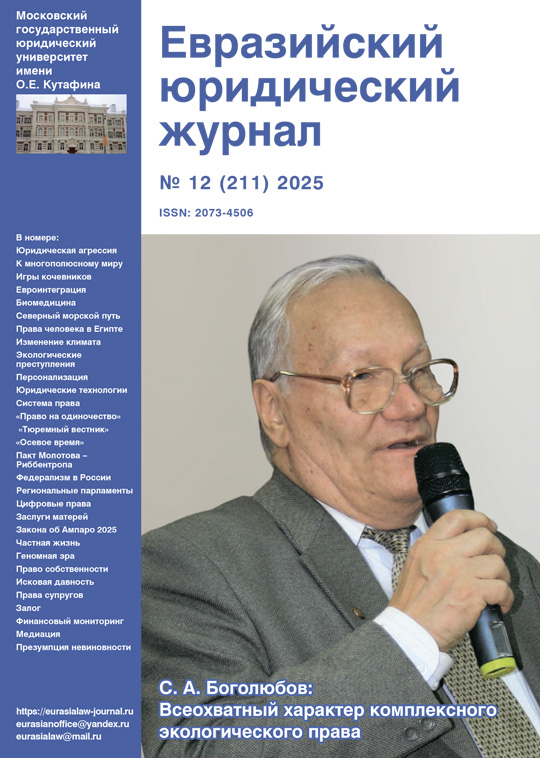
PERSONA GRATA
S. A. Bogolyubov
The Comprehensive Nature of Comprehensive Environmental Law
Interview with Sergey Alexandrovich Bogolyubov, Ph.D. in Law, professor, Honored Scientist of the Russian Federation, Academic Director of the Department of Environmental and Agrarian Legislation at the Institute of Legislation and Comparative Law under the Government of the Russian Federation.
INTERNATIONAL LAW
Ishmukhametov S. R., Morozova S. A.
On the conceptual understanding of the phenomenon of legal aggression and legal means of counteraction in contemporary international law
Tuchvatullin R. R., Shayakhmetov F. F., Kudashev U. N.
The crossroads of the world: from the crisis of the liberal world order to a multipolar world
Stolpnik D. V.
Nomad games in Kyrgyzstan: legal status and elements of soft power
Abduragimov M. P.
The impact of the European integration process on the implementation of international legal obligations to protect human rights in the Balkans
Galimov I. I.
Enforcement of international investment arbitral awards and the problem of sovereign immunity
Derkach-Rogozhin P. A.
The place of biomedicine in the international law system
Ma Bojiaer
The history of international legal regulation of the use of the Northern Sea Route
Mazurova N. N.
A system of means to combat new forms of international terrorism
Rybakov G. O.
The implementation of international legal obligations for the protection of human rights in Egypt
Fomina S. E.
Climate change, human rights and the protection of foreign investors’ interests: challenges in harmonizing states’ obligations
Yakovlev D. V.
Environmental crimes in the international arena as a catalyst for climate risks
THEORY OF STATE AND LAW
Sokolov V. V.
Legal sovereignty as the basis of national security
Abyzova E. R., Abyzova E. R.
Personalization as a phenomenon of social life and science
Allalyev R. M., Muromtsev G. I.
Predictive analytics and the future of law in the age of artificial intelligence
Gorokhova K. I.
Legal technologies in normative activity
Levchenkov A. I., Krasilnikova L. I.
Political violence: theoretical and practical issues
Skudarnov A. S.
The development of the theory of natural law
Sokolov V. V.
The legal system as a semiotic construction: the value content of legal texts and their interpretation
Marukov A. F.
Theoretical and legal views of P. I. Lyublinsky (On the occasion of the 115th anniversary of the publication of “Essays on Criminal Justice and Punishment in Modern England”)
Makhmadiev R. Z.
From legal support to legal design: artisan lawyers and architectural lawyers (issues of methodology and legal anthropocentrism)
Mineeva T. G., Kurzenin E. B.
On the specifics of English legal language
Muraeva V. V.
Resolution of judicial disputes and judicial interpretation as an effective element of the human rights and freedoms protection mechanism
Samusenko T. M., Malyavina K. D.
“The right to solitude” as a philosophical and legal basis for the concept of privacy and its relevance in the 21st century
Sivtsev N. I.
Prosecutor’s supervision of the implementation of labor laws in the 1920s and 1930s.
Seokheon L.
Quasimatrix logic methodology for protecting the soundness of the legal system: focusing on A. Ross’s paradox
Shlyakova A. V.
Regulation of the legal status of children in the Russian Federation in the 21st century
HISTORY OF STATE AND LAW
Golubev A. G.
On the rights of convicts and their implementation in Russia at the end of the 19th century (based on the Prison Bulletin)
Kuzubova A. Yu.
Legal archetypes of Russian civilization in the Russian conservative doctrine of the 19th century
Sataeva R. R.
Confucianism, the Chinese philosophical tradition, and the “Axial age”
Tishakov M. P.
Issues of legal regulation of road safety during the Great Patriotic War
Khadimullin R. R., Khadimullina E. D.
Historical and legal significance of the signing of the Molotov – Ribbentrop Pact
Vedernikov G. E.
Comparative analysis of the interaction between the state and society in pre-revolutionary and modern Russia in the field of wildlife protection and use
Dzhonov S. E.
The concept of proportionality in the scholarly works of pre-revolutionary thinkers
CONSTITUTIONAL LAW
Gadzhiev A. Sh.
Features and prospects of federalism development in Russia
Nigmetzyanov A. A.
The motivational factor in ensuring the work of the representative body
Nikitenko I. G.
Problems of exercising the powers of regional parliaments
Ulyanishchev P. V., Stepanyan S. A.
Impact of the parliament upon the legal regulation over innovative approaches in the electoral process of the Russian Federation
Fedorova I. E., Tereshenko E. G.
Constitutional foundations of Russia and Belarus as a union state and prospects for their development
Dvoryanchikov V. M.
Digital rights in the context of international and national law
Isaeva B. M.
Information transparency of executive branch bodies: some questions of theory
Karimov M. V.
On terminological certainty in the name of the head of the republic within the Russian Federation
Kotov S. S.
Analysis of the necessity of existence or elimination of duplication of official powers in the implementation of the protection of citizens’ constitutional rights in the context of administrative legal regulation
Muzhichenko A. V.
Unity of economic space: constitutional principle, method and regime
ADMINISTRATIVE LAW
Kamenev M. A.
Administrative liability for illegal possession of civilian weapons: legal and practical issues
Keramova S. N.
Some issues in the legal regulation of administrative complaints in the Russian Federation
Lobaseva E.G., Tsvetkov S.B.
Administrative detention and detention carried out in accordance with Federal Law № 3-FZ of February 07, 2011 “On Police”: specifics of application by police officers, legal regulations and differences
Shmelev I. V.
Protection from administrative omissions: the procedural distinction between the guarantee of filing a petition and the fulfillment of specific obligations
Khayrullin R. R., Garaeva S. F.
Legal regime for recognizing the merits of mothers
Garfutdinov A. Kh.
Сomparative characterization of the administrative and legal status of the arbitration manager under the legislation of the Russian Federation and the Republic of Kazakhstan
Zakharov I. V.
Risks of digitalization and legal ways to limit it
Lukina O. A.
Administrative and legal regulation of state and municipal procurement: a comparative legal study of Mexico and Russian Federation
Rusanovskiy Ya. V.
The administrative and legal mechanism for regulating potentially dangerous tourism: finding a balance between safety and economic feasibility
Shmelev I. V.
The 2025 Amparo Law reform: recalibration of constitutional control over administrative acts and a new regime of procedural legitimation
CIVIL LAW
Boyarskaya Yu. N., Balabanov A. A., Malovichko E. A.
Innovations in civil law: from digital technologies to the transformation of legal personality
Bychko M. A., Komarevtseva I. A., Razumov P. V.
Prospects for the development of the testament institution in the context of digitalization: a comparative legal analysis
Galyautdinova L. Yu., Alsynbaeva E. M., Akhtyamova E. V.
On the issue of protecting the rights of the heirs in the inheritance contract
Karpov K. V.
Installation of video surveillance in apartment buildings and the right to privacy
Kravtsov A. Yu., Bazyleva E. E.
Problems of applying the limitation period in deprivatization cases based on claims by prosecutors in the Russian Federation: theoretical approaches and judicial practice
Krashennikova T. V., Nochevka A. S.
Introduction of civil liability of state duma deputies: problems of legal regulation and directions for improving legislation
Linnikov A. S.
Principles of civil law control
Lonchakova Yu. A.
Specifics of legal regulation of the transport expedition contract
Odegnal E. A., Linichenko N. S.
Legal personality of an individual: current aspects of civil law regulation
Semenovykh A. E.
Personalized medicine in the new genomic era: legal and ethical aspects
Shvets A. V., Shvets I. A.
Modern conflicts in the Russian Federation’s inheritance law: analysis of judicial practice and doctrinal proposals
Biryukova D. S.
Advantages of using autonomous freight transport in commercial activity
Boboniyozov S. R.
Constitutional protection of the right to property and civil law regulation of data used by artificial intelligence
Gritsuk A. A.
Statute of limitations in intellectual property claims: analysis of the legal positions of the Supreme Court of the Russian Federation
Mutalieva A. A.
Some aspects of the legal regulation of the special regime for the delivery of goods (products) in the Republic of Sakha (Yakutia)
Smirnov P. V.
The institution of concession agreements as a form of state intervention in the activities of economic entities
Semenovykh A. E.
Genetic technologies and sustainable development goals: a legal analysis
Khvalynskiy V. M.
Inheritance rights of spouses: a retrospective analysis of doctrine and legislation
Churakova E. V.
Problematic aspects of the theory and judicial practice of state registration of rights to single immovable complexes
Shubin V. Yu.
Trust and the nature of property rights: a comparative analysis of English and Russian approaches
Shukhratpur M.
Prospects for integrating consumer financial lease agreements into the planned law «On consumer lending in Tajikistan»
Yakovlev Yu. S.
Criteria for determining technical premises included in the common property of an apartment building
CIVIL PROCESS
Kamaeva A. V., Gornev R. V., Smirnov N. N.
Issues of determining competence between arbitrage courts and courts of general jurisdiction in public disputes
Krashennikova T. V.
The institute of private court determination in the mechanism of judicial protection of voting rights: problems of effectiveness and abuses
Stolyarov S. O.
The institution of criminal proceedings in criminal proceedings: historical, legal and constitutional legal analysis
Pavlova M. S., Maradulin A. E.
The institution of recusal of a judge: the criterion of a judge’s interest in the outcome of a case
Paraskevidi M. A.
The doctrine of the institution of recognition in civil procedure: the evolution of understanding of the legal nature and essence of the named procedural institution in the Russian pre-revolutionary doctrine
COPYRIGHT LAW
Sazonov I. I.
Peculiarities of the legal nature of the results of intellectual activity and means of individualization in Russian civil law
Berezina M. V.
Pledge of exclusive rights to the results of intellectual activity: implementation issues
INHERITANCE LAW
Borisova-Zharova V. G.
Joint will of spouses: practical aspects of application and procedure for execution
LABOUR LAW
Vointsev A. N., Matveeva K. M., Afanasyevskiy V. L.
Some issues of implementing the labor duties of condemned persons during their sentence
Dolotina R. R.
Comparative analysis of judicial protection of labor rights in Russia and Brazil
Mikhalskaya A. O.
Protection of seafarers’ labour rights in Egyptian legislation: compliance with international maritime labour standards
Zhuzhgina A. A.
Fake job applicants as a legal problem
FINANCIAL LAW
Farikova E. A.
Prospects for the development of a tax regime for self-employed citizens: financial and legal aspects
Alekhin V. A.
On the issue of financial and legal prospects for the creation of new state extra-budgetary funds
Verbovoy G. S.
Largest taxpayers and closed-end mutual investment funds: tax advantages and main risks
Dibirov Yu. S.
Regulation of financial technologies in the context of digitalization
Ivanova E. A.
Legal regulation of electronic financial services: risks for consumers in the context of digitalization
Zaynakaev V. V.
On the issue of regulatory approvals in transactions structured using closed-end mutual funds and personal funds
Makhu V. F.
Current issues of taxation related to the issuance and circulation of digital financial assets and digital currencies (tax administration mechanisms)
Shipov M. V.
Digitalization of financial monitoring and digitalization of law enforcement practices
TAX LAW
Tregubov A. N., Stepanchenko A. N.
Excise as an instrument of integration synchronization: adaptive and institutional effects of tax harmonization in the EAEU (the case of Kazakhstan and Belarus)
Sanchenko I. D.
Windfall profit tax and internal double taxation
Khamidullin T. R.
The features of recognizing individuals as tax residents of the Russian Federation and the UAE: a comparative analysis
Yakhudin R. R.
Conceptual foundations for researching the phenomenon of “expectation” in tax law
LAND LAW
Butenko A. A., Nepomnyashchaya I. S., Shamray-Kurbatova L. V.
Chicane in the field of land lease
Potapov E. A.
Current issues of providing transport infrastructure (parking spaces) for planned construction/reconstruction of facilities in the context of the application of urban planning standards
Evgrafova A. G.
Legal framework for involving public in greening territories in new regions
INFORMATION LAW
Ogryzov D. V.
Public law regulation of the use of an electronic signature when using a machine-readable power of attorney
ENTREPRENEURIAL LAW
Savenko N. E.
Trends in Russia’s digital economy in the context of national interests and private rights of citizens
Privezentsev F. A.
Gas supply and transportation contracts in the Russian gas supply market: business, legal, and antitrust aspects of regulation
Shakaryan M. A.
The principle of information transparency in entrepreneurial law
Mirzoeva E. G.
Unfair competition in advertising: issues of legal regulation and qualification
Kvint S. V.
The concept of catering products as a commodity
Kozlovskiy Yu. A.
Current challenges of the legal regime of digital currency in Russia and ways to solve them
TRADE LAW
Lepeshin D. A.
Analysis of the effectiveness of anti-piracy legislation in the aspect of the jurisdiction of disputes on the protection of intellectual property rights on the Internet
CORPORATE LAW
Kudelya N. Yu., Gertman M. V.
Evolution of state policy for competition development in the Russian Federation: a comparative analysis of national plans (2018–2030)
CRIMINAL LAW
Abdulatipov A. M., Urumov A. V.
Terrorist crimes in the context of the development of the conceptual and terminological apparatus of criminal law (theory and practice issues)
Belareva O. A.
Judicial discretion in the imposition of punishment: concept, features, and determinants
Klebanov L. R., Smirnova I. V.
Security fences as a technical measure to combat crime: American-Mexican experience
Kuzmin S. S.
Limitation of the convicts legitimate interests in Russian criminal law
Lakhin A. N.
Selected areas of operational and search response to crimes committed using information and telecommunication technologies
Nabiev D. Kh.
Criminal legislation of some cis countries on liability for extremist crimes committed using information and telecommunication technologies
Nigmatullin R. V.
On some aspects of countering network terrorism
Senina E. N.
The potential of restorative mechanisms for exemption from criminal liability in cases arising from agrarian and land relations
Skorikov D. G., Izosimov V. S., Shuvalova A. M.
The criminal law significance and place of negligence in the criminal law
Smakhtin E. V., Sergeev A. B.
Exceptional measure of punishment during martial law or in wartime: the issue of application
Abdulatipov A. M., Urumov A. V., Gadzhieva S. M.
The internet as an environment for extremist propaganda for minors
Volkolupova V. V.
Controversial issues regarding the qualification of crimes under Article 207.3 of the Criminal Code of the Russian Federation arising in modern law enforcement practice
Gorshenin N. A.
The effectiveness of alternative measures to real imprisonment in corporate corruption, their limits, and admissibility
Guzeeva A. S.
On the question of determining the objective features of the crime provided for by Part 1 of Article 195 of the Criminal Code of the Russian Federation
Latypov A. Yu.
The specifics of the subjective aspect of the crime under Article 217 of the Criminal Code of the Russian Federation
Musienko N. S.
Evaluation features in the compositions of crimes against public (general) security under the legislation of some countries of the Romano-Germanic legal family (on the example of Germany and France)
Udintsev G. V.
Legislative practice of preventing crimes against corporate governance in jurisdictions with a common law system
CRIMINAL PROCESS
Asgarova M. P.
Procedural justice as an ındependent category of criminal procedure law: beyond formal compliance with procedure
Batchaeva A. A.
Criminal procedural reconciliation and criminal procedural compromise: the relationship of concepts
Gunina O. A., Yakubova S. M.
Possible boundaries of mediation in the criminal proceedings of Russia
Dyakonova V. V.
The internal meaning of the criminal procedural norm: concept, structure, significance
Kuvshinov I. A., Pogodina T. G., Rudomin S. V.
Analysis of criminal liability of anesthesiologist-resuscitators: systemic problems in delineating professional duties and ways to solve them
Kulakov A. V., Afanasyevskiy V. L., Kotov Ya. D.
Execution of criminal punishment as a type of law implementation
Makarova N. A.
The main problems of providing assistance in social adaptation to prisoners in modern Russia
Makogon I. V., Ignatova E. A.
Algorithm of actions to be taken by an official in checking received messages about crimes under Articles 272 and 273 of the Criminal Code of the Russian Federation
Mashovets A. O.
The accused’s right to silence and the presumption of innocence: squaring the circle
Nabatov M. B.
Personal and public trust as criminal procedural categories
Skakov A. B., Prys E. V.
International cooperation in the field of criminal proceedings: the case of Russia and the Republic of Kazakhstan
Smolyakov A. A., Mezentsev I. V., Chasovnikova O. G.
Ensuring the safety of victims and witnesses in criminal proceedings: problems of theory and practice
Sudakova O. V., Zolotov M. A., Vladimirov S. V.
Problems of ensuring the confidentiality of legal proceedings and ways to solve them
Udovichenko V. S.
Interrogation of the accused in a conflict situation in criminal cases involving illegal drug trafficking: forensic and procedural aspects
Chelokhsayev O. Z.
Some reflections on the goals (objectives) of the criminal process in the light of the modern criminal procedure policy of the state
Shamurzaev T. T., Ardashev R. G.
The court in criminal proceedings of the Kyrgyz Republic: current state and prospects for improvement
Voskanyan A. A.
Procedure for sure-up involvement of a minor in criminal procedings in the Russian Federation
Ibrahim L. A. I.
The specifics of identifying and exposing the staging of an accident in the investigation of murders
Soroka V. S.
Systemic aspects of criminal procedure digitalization
Shamurzaev T. T., Ardashev R. G.
Countering corruption crimes in the Kyrgyz Republic: current state and directions for improvement
Yang Xinqian
Ethico-philosophical and theoretical foundations of the admissibility of evidence: possibilities for harmonizing the ideas of Kant, Bentham, and Confucian thought in the rules for the exclusion of illegal evidence
CRIMINALISTICS
Achitueva Yu. V.
Legal regulation of operational-search activities in the context of digital transformation and combating illicit drug trafficking: problems and ways of improvement
Bondareva A. A.
Artificial intelligence in investigative operations: problems and prospects of use
Rakhimov F. D.
Joint investigative and operational groups as a form of cooperation among CIS member states in the investigation of investment fraud: the legal basis for forensic support
Saakyan A. G., Skorikov D. G., Trifonova K. A.
Criminalistic foundations of countering illicit trafficking in narcotic drugs, psychotropic substances or their analogues
Holevchuk A. G.
Disinformation in criminal proceedings
Archukova A. A.
Functional features of human appearance in the context of digitalization as an object of knowledge in forensic science
Kalinin A. N.
Рatterns of material information formation in special conditions of crime investigation
Maklakova A. A.
Some methods of property damage committed at railway facilities
CRIMINOLOGY
Gadzhieva A. A., Malikov A. T.
Problems of criminalization of crimes committed using digital technologies
Koryagina S. A.
Juveniles convicted of crimes against public safety: status, problems, and solutions
Shamekhina E. V.
Corruption in the digital environment: issues of conceptual and categorical apparatus
JUDICIARY
Lusegenova Z. S., Linkin V. N., Nasonov Yu. N.
Functions of the «interests» category in judicial law enforcement
LAW ENFORCEMENT AGENCIES
Zakhvatov I. Yu., Vasiljeva I. N.
Managerial decision as a semantic content of organizational activity in the internal affairs bodies
SECURITY AND LAW
Kubekov I. T.
Problems of the development of legislation in the field of ensuring the safety of oil industry facilities
HUMAN RIGHT
Ermakov D. N., Bekbulatov Sh. D.
Legal and technological deficiencies in protecting the digital rights of minors in the Russian Federation: results of an empirical study and ways to overcome them
STATE AND LAW
Volkov A. A.
Abilities of electoral commissions in the preparation and conduct of elections
Dudina Yu. A.
The main directions of state policy in the field of education
Suleymanova R. R.
The use of digital tools in public administration
Buryanov M. S.
A draft Declaration of Global Digital Human Rights
Ozimok D. V.
Peacekeeping and intervention within the framework of the United Nations: the difficulties of balancing the protection of peace and respect for the sovereignty of states
POLICY AND LAW
Vildanov R. R., Biktanova A. Sh.
The national question of china and the problems of preserving national identity
ECONOMY. LAW. SOCIETY
Vasiljev A. V., Baynazarov I. N.
Legal and economic consequences of applying artificial intelligence in antitrust regulation
Kuzminykh N. A., Militskaya A. O.
Approach to assessing the effectiveness of regional innovation policy implementation
Radchenko E. P., Vdovina A. N., Chumak S. G.
Provisions of civil legislation regulating the issues of compensation for losses arising from non-fulfillment of obligations by suppliers of food products
Leontjeva E. A.
The general register of real estate of the EAEU: integration breakthrough on the background of European lessons
Fatkullina G. R.
Labor socialization of the region’s youth: factors, value orientations and adaptation strategies (using the example of the Republic of Bashkortostan)
Chumlyakov K. S., Chumlyakova D. V., Ignatyuk Yu. L.
The structure of the research methodology and the logical organization of the development of international transport infrastructure
Elyakova I. D., Elyakov A. L.
Prospects for renewable energy supplies from South Yakutia to China
Grigorjeva A. A.
Evolution of regulatory framework for sustainable development and ESG disclosure in Russia: analysis of the implementation of international standards and national specifics
Liu Zhuo, Zhukovskaya O. Yu.
An analysis and outlook on the propelling effect of pop mart on the development of the designer toy sector within China’s cultural industries
Khoshimov N. I.
The mechanism of valuation of trademarks in the investment activities of companies
PHILOSOPHY. LAW. SOCIETY
Bakirova Z. Kh.
The social institute of higher professional school as a sphere of development of value orientations of youth
Baklanov I. S., Pokhilko A. D., Ivlev V. A.
Sapientity as a social value of the spiritual life of contemporary Russian society
Klimov S. N., Glozman O. S.
Socio-philosophical reflection on the evolution of the phenomenon of the city
Kozhukhovskaya A. A.
Philosophy of medicine in the context of artificial intelligence and transhumanist projects
Popov A. A., Lipich V. V.
In the image and likeness of God – the essence of concepts in the anthropological problematics of the idea of human godlikeness
Sudakova N. E., Bliznyuk A. G.
N. F. Fedorov’s heritage in a modern humanitarian perspective: value-meaning horizon of Russian civilizational development
Tarasov A. N., Bokova E. M.
Nietzsche’s prophecy for modern musical culture
Frolova N. A., Tarasov A. N., Ivanova V. G.
The Russian icon as a phenomenon of cultural cosmos: towards a philosophy of the sacred image
Sharipov A. R.
On the influence of national language on national identity
Abrarov I. I.
Social and cultural criteria for assessing the health of the population in the context of modernization of society
Drozdov S. V.
The problem of bio-power: biopolitical concepts in the works of Michel Foucault and Giorgio Agamben
Kamilova S. M.
Theoretical and philosophical aspects of the formation of students’ value orientation towards a healthy lifestyle
Stepanov V. A.
Spiritual security as a subject of social and philosophical research
Tratsevskiy D. S.
A liberal and conservative view of the problem of egalitarianism
S. A. Bogolyubov
The Comprehensive Nature of Comprehensive Environmental Law
Interview with Sergey Alexandrovich Bogolyubov, Ph.D. in Law, professor, Honored Scientist of the Russian Federation, Academic Director of the Department of Environmental and Agrarian Legislation at the Institute of Legislation and Comparative Law under the Government of the Russian Federation.
INTERNATIONAL LAW
Ishmukhametov S. R., Morozova S. A.
On the conceptual understanding of the phenomenon of legal aggression and legal means of counteraction in contemporary international law
Tuchvatullin R. R., Shayakhmetov F. F., Kudashev U. N.
The crossroads of the world: from the crisis of the liberal world order to a multipolar world
Stolpnik D. V.
Nomad games in Kyrgyzstan: legal status and elements of soft power
Abduragimov M. P.
The impact of the European integration process on the implementation of international legal obligations to protect human rights in the Balkans
Galimov I. I.
Enforcement of international investment arbitral awards and the problem of sovereign immunity
Derkach-Rogozhin P. A.
The place of biomedicine in the international law system
Ma Bojiaer
The history of international legal regulation of the use of the Northern Sea Route
Mazurova N. N.
A system of means to combat new forms of international terrorism
Rybakov G. O.
The implementation of international legal obligations for the protection of human rights in Egypt
Fomina S. E.
Climate change, human rights and the protection of foreign investors’ interests: challenges in harmonizing states’ obligations
Yakovlev D. V.
Environmental crimes in the international arena as a catalyst for climate risks
THEORY OF STATE AND LAW
Sokolov V. V.
Legal sovereignty as the basis of national security
Abyzova E. R., Abyzova E. R.
Personalization as a phenomenon of social life and science
Allalyev R. M., Muromtsev G. I.
Predictive analytics and the future of law in the age of artificial intelligence
Gorokhova K. I.
Legal technologies in normative activity
Levchenkov A. I., Krasilnikova L. I.
Political violence: theoretical and practical issues
Skudarnov A. S.
The development of the theory of natural law
Sokolov V. V.
The legal system as a semiotic construction: the value content of legal texts and their interpretation
Marukov A. F.
Theoretical and legal views of P. I. Lyublinsky (On the occasion of the 115th anniversary of the publication of “Essays on Criminal Justice and Punishment in Modern England”)
Makhmadiev R. Z.
From legal support to legal design: artisan lawyers and architectural lawyers (issues of methodology and legal anthropocentrism)
Mineeva T. G., Kurzenin E. B.
On the specifics of English legal language
Muraeva V. V.
Resolution of judicial disputes and judicial interpretation as an effective element of the human rights and freedoms protection mechanism
Samusenko T. M., Malyavina K. D.
“The right to solitude” as a philosophical and legal basis for the concept of privacy and its relevance in the 21st century
Sivtsev N. I.
Prosecutor’s supervision of the implementation of labor laws in the 1920s and 1930s.
Seokheon L.
Quasimatrix logic methodology for protecting the soundness of the legal system: focusing on A. Ross’s paradox
Shlyakova A. V.
Regulation of the legal status of children in the Russian Federation in the 21st century
HISTORY OF STATE AND LAW
Golubev A. G.
On the rights of convicts and their implementation in Russia at the end of the 19th century (based on the Prison Bulletin)
Kuzubova A. Yu.
Legal archetypes of Russian civilization in the Russian conservative doctrine of the 19th century
Sataeva R. R.
Confucianism, the Chinese philosophical tradition, and the “Axial age”
Tishakov M. P.
Issues of legal regulation of road safety during the Great Patriotic War
Khadimullin R. R., Khadimullina E. D.
Historical and legal significance of the signing of the Molotov – Ribbentrop Pact
Vedernikov G. E.
Comparative analysis of the interaction between the state and society in pre-revolutionary and modern Russia in the field of wildlife protection and use
Dzhonov S. E.
The concept of proportionality in the scholarly works of pre-revolutionary thinkers
CONSTITUTIONAL LAW
Gadzhiev A. Sh.
Features and prospects of federalism development in Russia
Nigmetzyanov A. A.
The motivational factor in ensuring the work of the representative body
Nikitenko I. G.
Problems of exercising the powers of regional parliaments
Ulyanishchev P. V., Stepanyan S. A.
Impact of the parliament upon the legal regulation over innovative approaches in the electoral process of the Russian Federation
Fedorova I. E., Tereshenko E. G.
Constitutional foundations of Russia and Belarus as a union state and prospects for their development
Dvoryanchikov V. M.
Digital rights in the context of international and national law
Isaeva B. M.
Information transparency of executive branch bodies: some questions of theory
Karimov M. V.
On terminological certainty in the name of the head of the republic within the Russian Federation
Kotov S. S.
Analysis of the necessity of existence or elimination of duplication of official powers in the implementation of the protection of citizens’ constitutional rights in the context of administrative legal regulation
Muzhichenko A. V.
Unity of economic space: constitutional principle, method and regime
ADMINISTRATIVE LAW
Kamenev M. A.
Administrative liability for illegal possession of civilian weapons: legal and practical issues
Keramova S. N.
Some issues in the legal regulation of administrative complaints in the Russian Federation
Lobaseva E.G., Tsvetkov S.B.
Administrative detention and detention carried out in accordance with Federal Law № 3-FZ of February 07, 2011 “On Police”: specifics of application by police officers, legal regulations and differences
Shmelev I. V.
Protection from administrative omissions: the procedural distinction between the guarantee of filing a petition and the fulfillment of specific obligations
Khayrullin R. R., Garaeva S. F.
Legal regime for recognizing the merits of mothers
Garfutdinov A. Kh.
Сomparative characterization of the administrative and legal status of the arbitration manager under the legislation of the Russian Federation and the Republic of Kazakhstan
Zakharov I. V.
Risks of digitalization and legal ways to limit it
Lukina O. A.
Administrative and legal regulation of state and municipal procurement: a comparative legal study of Mexico and Russian Federation
Rusanovskiy Ya. V.
The administrative and legal mechanism for regulating potentially dangerous tourism: finding a balance between safety and economic feasibility
Shmelev I. V.
The 2025 Amparo Law reform: recalibration of constitutional control over administrative acts and a new regime of procedural legitimation
CIVIL LAW
Boyarskaya Yu. N., Balabanov A. A., Malovichko E. A.
Innovations in civil law: from digital technologies to the transformation of legal personality
Bychko M. A., Komarevtseva I. A., Razumov P. V.
Prospects for the development of the testament institution in the context of digitalization: a comparative legal analysis
Galyautdinova L. Yu., Alsynbaeva E. M., Akhtyamova E. V.
On the issue of protecting the rights of the heirs in the inheritance contract
Karpov K. V.
Installation of video surveillance in apartment buildings and the right to privacy
Kravtsov A. Yu., Bazyleva E. E.
Problems of applying the limitation period in deprivatization cases based on claims by prosecutors in the Russian Federation: theoretical approaches and judicial practice
Krashennikova T. V., Nochevka A. S.
Introduction of civil liability of state duma deputies: problems of legal regulation and directions for improving legislation
Linnikov A. S.
Principles of civil law control
Lonchakova Yu. A.
Specifics of legal regulation of the transport expedition contract
Odegnal E. A., Linichenko N. S.
Legal personality of an individual: current aspects of civil law regulation
Semenovykh A. E.
Personalized medicine in the new genomic era: legal and ethical aspects
Shvets A. V., Shvets I. A.
Modern conflicts in the Russian Federation’s inheritance law: analysis of judicial practice and doctrinal proposals
Biryukova D. S.
Advantages of using autonomous freight transport in commercial activity
Boboniyozov S. R.
Constitutional protection of the right to property and civil law regulation of data used by artificial intelligence
Gritsuk A. A.
Statute of limitations in intellectual property claims: analysis of the legal positions of the Supreme Court of the Russian Federation
Mutalieva A. A.
Some aspects of the legal regulation of the special regime for the delivery of goods (products) in the Republic of Sakha (Yakutia)
Smirnov P. V.
The institution of concession agreements as a form of state intervention in the activities of economic entities
Semenovykh A. E.
Genetic technologies and sustainable development goals: a legal analysis
Khvalynskiy V. M.
Inheritance rights of spouses: a retrospective analysis of doctrine and legislation
Churakova E. V.
Problematic aspects of the theory and judicial practice of state registration of rights to single immovable complexes
Shubin V. Yu.
Trust and the nature of property rights: a comparative analysis of English and Russian approaches
Shukhratpur M.
Prospects for integrating consumer financial lease agreements into the planned law «On consumer lending in Tajikistan»
Yakovlev Yu. S.
Criteria for determining technical premises included in the common property of an apartment building
CIVIL PROCESS
Kamaeva A. V., Gornev R. V., Smirnov N. N.
Issues of determining competence between arbitrage courts and courts of general jurisdiction in public disputes
Krashennikova T. V.
The institute of private court determination in the mechanism of judicial protection of voting rights: problems of effectiveness and abuses
Stolyarov S. O.
The institution of criminal proceedings in criminal proceedings: historical, legal and constitutional legal analysis
Pavlova M. S., Maradulin A. E.
The institution of recusal of a judge: the criterion of a judge’s interest in the outcome of a case
Paraskevidi M. A.
The doctrine of the institution of recognition in civil procedure: the evolution of understanding of the legal nature and essence of the named procedural institution in the Russian pre-revolutionary doctrine
COPYRIGHT LAW
Sazonov I. I.
Peculiarities of the legal nature of the results of intellectual activity and means of individualization in Russian civil law
Berezina M. V.
Pledge of exclusive rights to the results of intellectual activity: implementation issues
INHERITANCE LAW
Borisova-Zharova V. G.
Joint will of spouses: practical aspects of application and procedure for execution
LABOUR LAW
Vointsev A. N., Matveeva K. M., Afanasyevskiy V. L.
Some issues of implementing the labor duties of condemned persons during their sentence
Dolotina R. R.
Comparative analysis of judicial protection of labor rights in Russia and Brazil
Mikhalskaya A. O.
Protection of seafarers’ labour rights in Egyptian legislation: compliance with international maritime labour standards
Zhuzhgina A. A.
Fake job applicants as a legal problem
FINANCIAL LAW
Farikova E. A.
Prospects for the development of a tax regime for self-employed citizens: financial and legal aspects
Alekhin V. A.
On the issue of financial and legal prospects for the creation of new state extra-budgetary funds
Verbovoy G. S.
Largest taxpayers and closed-end mutual investment funds: tax advantages and main risks
Dibirov Yu. S.
Regulation of financial technologies in the context of digitalization
Ivanova E. A.
Legal regulation of electronic financial services: risks for consumers in the context of digitalization
Zaynakaev V. V.
On the issue of regulatory approvals in transactions structured using closed-end mutual funds and personal funds
Makhu V. F.
Current issues of taxation related to the issuance and circulation of digital financial assets and digital currencies (tax administration mechanisms)
Shipov M. V.
Digitalization of financial monitoring and digitalization of law enforcement practices
TAX LAW
Tregubov A. N., Stepanchenko A. N.
Excise as an instrument of integration synchronization: adaptive and institutional effects of tax harmonization in the EAEU (the case of Kazakhstan and Belarus)
Sanchenko I. D.
Windfall profit tax and internal double taxation
Khamidullin T. R.
The features of recognizing individuals as tax residents of the Russian Federation and the UAE: a comparative analysis
Yakhudin R. R.
Conceptual foundations for researching the phenomenon of “expectation” in tax law
LAND LAW
Butenko A. A., Nepomnyashchaya I. S., Shamray-Kurbatova L. V.
Chicane in the field of land lease
Potapov E. A.
Current issues of providing transport infrastructure (parking spaces) for planned construction/reconstruction of facilities in the context of the application of urban planning standards
Evgrafova A. G.
Legal framework for involving public in greening territories in new regions
INFORMATION LAW
Ogryzov D. V.
Public law regulation of the use of an electronic signature when using a machine-readable power of attorney
ENTREPRENEURIAL LAW
Savenko N. E.
Trends in Russia’s digital economy in the context of national interests and private rights of citizens
Privezentsev F. A.
Gas supply and transportation contracts in the Russian gas supply market: business, legal, and antitrust aspects of regulation
Shakaryan M. A.
The principle of information transparency in entrepreneurial law
Mirzoeva E. G.
Unfair competition in advertising: issues of legal regulation and qualification
Kvint S. V.
The concept of catering products as a commodity
Kozlovskiy Yu. A.
Current challenges of the legal regime of digital currency in Russia and ways to solve them
TRADE LAW
Lepeshin D. A.
Analysis of the effectiveness of anti-piracy legislation in the aspect of the jurisdiction of disputes on the protection of intellectual property rights on the Internet
CORPORATE LAW
Kudelya N. Yu., Gertman M. V.
Evolution of state policy for competition development in the Russian Federation: a comparative analysis of national plans (2018–2030)
CRIMINAL LAW
Abdulatipov A. M., Urumov A. V.
Terrorist crimes in the context of the development of the conceptual and terminological apparatus of criminal law (theory and practice issues)
Belareva O. A.
Judicial discretion in the imposition of punishment: concept, features, and determinants
Klebanov L. R., Smirnova I. V.
Security fences as a technical measure to combat crime: American-Mexican experience
Kuzmin S. S.
Limitation of the convicts legitimate interests in Russian criminal law
Lakhin A. N.
Selected areas of operational and search response to crimes committed using information and telecommunication technologies
Nabiev D. Kh.
Criminal legislation of some cis countries on liability for extremist crimes committed using information and telecommunication technologies
Nigmatullin R. V.
On some aspects of countering network terrorism
Senina E. N.
The potential of restorative mechanisms for exemption from criminal liability in cases arising from agrarian and land relations
Skorikov D. G., Izosimov V. S., Shuvalova A. M.
The criminal law significance and place of negligence in the criminal law
Smakhtin E. V., Sergeev A. B.
Exceptional measure of punishment during martial law or in wartime: the issue of application
Abdulatipov A. M., Urumov A. V., Gadzhieva S. M.
The internet as an environment for extremist propaganda for minors
Volkolupova V. V.
Controversial issues regarding the qualification of crimes under Article 207.3 of the Criminal Code of the Russian Federation arising in modern law enforcement practice
Gorshenin N. A.
The effectiveness of alternative measures to real imprisonment in corporate corruption, their limits, and admissibility
Guzeeva A. S.
On the question of determining the objective features of the crime provided for by Part 1 of Article 195 of the Criminal Code of the Russian Federation
Latypov A. Yu.
The specifics of the subjective aspect of the crime under Article 217 of the Criminal Code of the Russian Federation
Musienko N. S.
Evaluation features in the compositions of crimes against public (general) security under the legislation of some countries of the Romano-Germanic legal family (on the example of Germany and France)
Udintsev G. V.
Legislative practice of preventing crimes against corporate governance in jurisdictions with a common law system
CRIMINAL PROCESS
Asgarova M. P.
Procedural justice as an ındependent category of criminal procedure law: beyond formal compliance with procedure
Batchaeva A. A.
Criminal procedural reconciliation and criminal procedural compromise: the relationship of concepts
Gunina O. A., Yakubova S. M.
Possible boundaries of mediation in the criminal proceedings of Russia
Dyakonova V. V.
The internal meaning of the criminal procedural norm: concept, structure, significance
Kuvshinov I. A., Pogodina T. G., Rudomin S. V.
Analysis of criminal liability of anesthesiologist-resuscitators: systemic problems in delineating professional duties and ways to solve them
Kulakov A. V., Afanasyevskiy V. L., Kotov Ya. D.
Execution of criminal punishment as a type of law implementation
Makarova N. A.
The main problems of providing assistance in social adaptation to prisoners in modern Russia
Makogon I. V., Ignatova E. A.
Algorithm of actions to be taken by an official in checking received messages about crimes under Articles 272 and 273 of the Criminal Code of the Russian Federation
Mashovets A. O.
The accused’s right to silence and the presumption of innocence: squaring the circle
Nabatov M. B.
Personal and public trust as criminal procedural categories
Skakov A. B., Prys E. V.
International cooperation in the field of criminal proceedings: the case of Russia and the Republic of Kazakhstan
Smolyakov A. A., Mezentsev I. V., Chasovnikova O. G.
Ensuring the safety of victims and witnesses in criminal proceedings: problems of theory and practice
Sudakova O. V., Zolotov M. A., Vladimirov S. V.
Problems of ensuring the confidentiality of legal proceedings and ways to solve them
Udovichenko V. S.
Interrogation of the accused in a conflict situation in criminal cases involving illegal drug trafficking: forensic and procedural aspects
Chelokhsayev O. Z.
Some reflections on the goals (objectives) of the criminal process in the light of the modern criminal procedure policy of the state
Shamurzaev T. T., Ardashev R. G.
The court in criminal proceedings of the Kyrgyz Republic: current state and prospects for improvement
Voskanyan A. A.
Procedure for sure-up involvement of a minor in criminal procedings in the Russian Federation
Ibrahim L. A. I.
The specifics of identifying and exposing the staging of an accident in the investigation of murders
Soroka V. S.
Systemic aspects of criminal procedure digitalization
Shamurzaev T. T., Ardashev R. G.
Countering corruption crimes in the Kyrgyz Republic: current state and directions for improvement
Yang Xinqian
Ethico-philosophical and theoretical foundations of the admissibility of evidence: possibilities for harmonizing the ideas of Kant, Bentham, and Confucian thought in the rules for the exclusion of illegal evidence
CRIMINALISTICS
Achitueva Yu. V.
Legal regulation of operational-search activities in the context of digital transformation and combating illicit drug trafficking: problems and ways of improvement
Bondareva A. A.
Artificial intelligence in investigative operations: problems and prospects of use
Rakhimov F. D.
Joint investigative and operational groups as a form of cooperation among CIS member states in the investigation of investment fraud: the legal basis for forensic support
Saakyan A. G., Skorikov D. G., Trifonova K. A.
Criminalistic foundations of countering illicit trafficking in narcotic drugs, psychotropic substances or their analogues
Holevchuk A. G.
Disinformation in criminal proceedings
Archukova A. A.
Functional features of human appearance in the context of digitalization as an object of knowledge in forensic science
Kalinin A. N.
Рatterns of material information formation in special conditions of crime investigation
Maklakova A. A.
Some methods of property damage committed at railway facilities
CRIMINOLOGY
Gadzhieva A. A., Malikov A. T.
Problems of criminalization of crimes committed using digital technologies
Koryagina S. A.
Juveniles convicted of crimes against public safety: status, problems, and solutions
Shamekhina E. V.
Corruption in the digital environment: issues of conceptual and categorical apparatus
JUDICIARY
Lusegenova Z. S., Linkin V. N., Nasonov Yu. N.
Functions of the «interests» category in judicial law enforcement
LAW ENFORCEMENT AGENCIES
Zakhvatov I. Yu., Vasiljeva I. N.
Managerial decision as a semantic content of organizational activity in the internal affairs bodies
SECURITY AND LAW
Kubekov I. T.
Problems of the development of legislation in the field of ensuring the safety of oil industry facilities
HUMAN RIGHT
Ermakov D. N., Bekbulatov Sh. D.
Legal and technological deficiencies in protecting the digital rights of minors in the Russian Federation: results of an empirical study and ways to overcome them
STATE AND LAW
Volkov A. A.
Abilities of electoral commissions in the preparation and conduct of elections
Dudina Yu. A.
The main directions of state policy in the field of education
Suleymanova R. R.
The use of digital tools in public administration
Buryanov M. S.
A draft Declaration of Global Digital Human Rights
Ozimok D. V.
Peacekeeping and intervention within the framework of the United Nations: the difficulties of balancing the protection of peace and respect for the sovereignty of states
POLICY AND LAW
Vildanov R. R., Biktanova A. Sh.
The national question of china and the problems of preserving national identity
ECONOMY. LAW. SOCIETY
Vasiljev A. V., Baynazarov I. N.
Legal and economic consequences of applying artificial intelligence in antitrust regulation
Kuzminykh N. A., Militskaya A. O.
Approach to assessing the effectiveness of regional innovation policy implementation
Radchenko E. P., Vdovina A. N., Chumak S. G.
Provisions of civil legislation regulating the issues of compensation for losses arising from non-fulfillment of obligations by suppliers of food products
Leontjeva E. A.
The general register of real estate of the EAEU: integration breakthrough on the background of European lessons
Fatkullina G. R.
Labor socialization of the region’s youth: factors, value orientations and adaptation strategies (using the example of the Republic of Bashkortostan)
Chumlyakov K. S., Chumlyakova D. V., Ignatyuk Yu. L.
The structure of the research methodology and the logical organization of the development of international transport infrastructure
Elyakova I. D., Elyakov A. L.
Prospects for renewable energy supplies from South Yakutia to China
Grigorjeva A. A.
Evolution of regulatory framework for sustainable development and ESG disclosure in Russia: analysis of the implementation of international standards and national specifics
Liu Zhuo, Zhukovskaya O. Yu.
An analysis and outlook on the propelling effect of pop mart on the development of the designer toy sector within China’s cultural industries
Khoshimov N. I.
The mechanism of valuation of trademarks in the investment activities of companies
PHILOSOPHY. LAW. SOCIETY
Bakirova Z. Kh.
The social institute of higher professional school as a sphere of development of value orientations of youth
Baklanov I. S., Pokhilko A. D., Ivlev V. A.
Sapientity as a social value of the spiritual life of contemporary Russian society
Klimov S. N., Glozman O. S.
Socio-philosophical reflection on the evolution of the phenomenon of the city
Kozhukhovskaya A. A.
Philosophy of medicine in the context of artificial intelligence and transhumanist projects
Popov A. A., Lipich V. V.
In the image and likeness of God – the essence of concepts in the anthropological problematics of the idea of human godlikeness
Sudakova N. E., Bliznyuk A. G.
N. F. Fedorov’s heritage in a modern humanitarian perspective: value-meaning horizon of Russian civilizational development
Tarasov A. N., Bokova E. M.
Nietzsche’s prophecy for modern musical culture
Frolova N. A., Tarasov A. N., Ivanova V. G.
The Russian icon as a phenomenon of cultural cosmos: towards a philosophy of the sacred image
Sharipov A. R.
On the influence of national language on national identity
Abrarov I. I.
Social and cultural criteria for assessing the health of the population in the context of modernization of society
Drozdov S. V.
The problem of bio-power: biopolitical concepts in the works of Michel Foucault and Giorgio Agamben
Kamilova S. M.
Theoretical and philosophical aspects of the formation of students’ value orientation towards a healthy lifestyle
Stepanov V. A.
Spiritual security as a subject of social and philosophical research
Tratsevskiy D. S.
A liberal and conservative view of the problem of egalitarianism
PERSONA GRATA
S. A. Bogolyubov
The Comprehensive Nature of Comprehensive Environmental Law
Interview with Sergey Alexandrovich Bogolyubov, Ph.D. in Law, professor, Honored Scientist of the Russian Federation, Academic Director of the Department of Environmental and Agrarian Legislation at the Institute of Legislation and Comparative Law under the Government of the Russian Federation.
INTERNATIONAL LAW
ISHMUKHAMETOV Samat Rustemovich
postgraduate student of Theory of state and law sub-faculty; assistant of International and integration law sub-faculty, Institute of Law, Ufa University of Science and Technology
MOROZOVA Svetlana Alexandrovna
specialist of the Export Support Center of the Republic of Bashkortostan under the Ministry of Foreign Economic Relations and Congress Activities of the Republic of Bashkortostan
ON THE CONCEPTUAL UNDERSTANDING OF THE PHENOMENON OF LEGAL AGGRESSION AND LEGAL MEANS OF COUNTERACTION IN CONTEMPORARY INTERNATIONAL LAW
The article substantiates the need for a doctrinal conceptualization of “legal aggression” as a contemporary method of encroaching on sovereignty and political independence without the use of armed force. While the classical approach to aggression reflected in UN General Assembly Resolution 3314 (1974) remains a reference point, modern pressure is increasingly exercised through abuse of rights and institutional instruments of rule-making, enforcement, and jurisdiction. The author proposes a definition of legal aggression as a set of abusive legislative, executive, and judicial techniques employed by states and their unions to inflict tangible economic, political, and reputational damage on a target state while maintaining a formal appearance of legality. The paper examines key patterns of such aggression, including extraterritorial sanctions and secondary sanctions, manipulation of international and quasi-international adjudicatory fora, and attempts to undermine the immunities of senior officials and sovereign assets. The conclusion emphasizes the need to develop both international-law and domestic-law countermeasures, including constitutional safeguards ensuring the supremacy of the national legal order when external pressure is politicized.
Keywords: legal aggression, abuse of rights, lawfare, sanctions, extraterritorial jurisdiction, international courts and arbitration, immunities, sovereign assets, international responsibility.
Bibliographic list of references
1. Zhemerov A.A. Abuse of international law by states playing a decisive role in the governing bodies of the UN // International Justice. 2020. No. 4. P. 46-58.
2. Shevtsov A.L. Possible confiscation of Russian state assets in the West: legal and political zugzwang // Bulletin of the Institute of Economics of the Russian Academy of Sciences. 2024. No. 3. P. 47-60.
3. Perekhod S.A., Mkhitaryan A.V., Selifonkina D.S. International sanctions against Russia (2014-2024): assessment and consequences for the financial market // Bulletin of the Institute of Economics of the Russian Academy of Sciences. 2024. No. 4. P. 116-138.
INTERNATIONAL LAW
TUCHVATULLIN Rustem Rasfarovich
Ph.D. in historical sciences, associate professor of International relations and foreign history sub-faculty, Institute of History and Public Administration, Ufa University of Science and Technology
SHAYAKHMETOV Fidail Fanilevich
Ph.D. in historical sciences, associate professor of International relations and foreign history sub-faculty, Institute of History and Public Administration, Ufa University of Science and Technology
KUDASHEV Usman Nabiullovich
assistant of International relations and foreign history sub-faculty, Institute of History and Public Administration, Ufa University of Science and Technology
THE CROSSROADS OF THE WORLD: FROM THE CRISIS OF THE LIBERAL WORLD ORDER TO A MULTIPOLAR WORLD
The article examines the crisis of the current world order based on a unipolar system and the transition to a polycentric world. The authors argue that the current geopolitical crisis reflects the exhaustion of the model of global dominance by a single center of power, which is unable to stop the processes of shifting economic activity to the countries of the Global South, the emergence of new geopolitical actors, and the strengthening of the role of new economies and alliances. The authors note the objectivity and inevitability of the processes of establishing new forms and mechanisms of international cooperation based on the principles of equality, respect for the sovereignty of states, and their national interests.
Keywords: liberal international order, multipolar world order, Global South, non-Western countries, collective West, USA, Russia, China.
Bibliographic list of references
1. Primakov E. M. International relations on the eve of the 21st century: problems, prospects // International life. 1996. No. 10. P. 3-13.
2. Primakov E. M. The World after September 11. Moscow: Mysl, 2002. 188 p.
3. Shumilov M. M., Gurkin A. B. The crisis of economic globalization as a factor in the formation of a multipolar world // Management Consulting. 2025. No. 4. P. 137-148. EDN KAJUUE.
INTERNATIONAL LAW
STOLPNIK Dmitriy Vladislavovich
postgraduate student of Russian history sub-faculty, Academician IG Petrovsky Bryansk State University
NOMAD GAMES IN KYRGYZSTAN: LEGAL STATUS AND ELEMENTS OF SOFT POWER
The article is devoted to the review of nomad games in Kyrgyzstan, considering them as a unique phenomenon of ethnocultural heritage with deep historical roots and modern legal status. The author explores the historical development of traditional Kyrgyz games, starting from ancient times, and their transformation into modern sports. The paper presents a classification of the main types of games, including equestrian games (kok-boru), strategy games (ordo, toguz-korgool) and complex competitions (salbuurun), with a detailed description of their rules and features. Special attention is paid to the legal regulation of the nomad games through the analysis of the Law of the Kyrgyz Republic “On National Sports” (2003) and subsequent regulatory documents governing the World Nomad Games. The article also examines international legal aspects, including cooperation with UNESCO and the significance of the Busan Appeal. In the final part, the author analyzes the nomad games as a tool of \”soft power\” and cultural diplomacy, allowing Kyrgyzstan to form an international image and assert the civilizational subjectivity of Central Asia in the modern geopolitical context.
Keywords: nomad games, Kyrgyzstan, legal status, soft power, cultural diplomacy, traditional games, World Nomad Games, legislation, ethnocultural heritage, geopolitics.
Bibliographic list of references
1. Bredikhin A. V., Li. I. Analysis of China’s soft power from the point of view of cultural communication // Issues of national and federal relations. – 2025. – Vol. 15. No. 2 (119). – P. 337-343.
2. Bredikhin A. V. Migration of Russians to Mongolia: historical and sociological aspect // Population. – 2024. – V. 27. No. 1. – P. 153-165.
3. Bredikhin A. V., Zotova A. D. Intercultural cooperation between Russia and China in the context of global transformations // Humanities. Bulletin of the Financial University. – 2024. – Vol. 13. No. 4. – P. 14-22.
4. Mambetaliev K. U. Law of the Kyrgyz Republic on national sports: historical significance and prospects for optimization, 2018 // Scientific notes. – P. 50-55.
INTERNATIONAL LAW
ABDURAGIMOV Maxim Pavlovich
postgraduate student of International law sub-faculty, Institute of Law, Patrice Lumumba Peoples\’ Friendship University of Russia
THE IMPACT OF THE EUROPEAN INTEGRATION PROCESS ON THE IMPLEMENTATION OF INTERNATIONAL LEGAL OBLIGATIONS TO PROTECT HUMAN RIGHTS IN THE BALKANS
The process of European integration has a significant impact on the system of implementation of the international legal obligations of the Balkan countries in the field of human rights protection. This article examines the mechanisms of adaptation of the national legal systems of the Balkan states to the standards of the European Union, identifies factors contributing to improving the level of respect for human rights, and identifies problems and obstacles that arise during the integration process. Special attention is paid to the issues of harmonization of national legislation with European standards, the development of justice institutions and ensuring effective protection of the rights of certain groups of the population. The article is based on an analysis of legislative acts, judicial practice and scientific research on the problems of legal regulation of human rights in the countries of Central and Southeastern Europe.
Keywords: European integration, international legal obligations, protection of human rights, harmonization of legislation, justice, European law.
Bibliographic list of references
1. Arlyapova E. S., Ponomareva E. G. Western Balkans: External Players on the Eve of and During the Current Crisis // RUDN Bulletin. Series: International Relations. – 2023. – No. 4. – P. 678-688.
2. Kaloeva E. B. European and national identity. Struggle or interaction (the Balkan experience) // Europeanism and nationalism in the countries of Eastern Europe. – 2014. – No. 2014. – P. 66-94.
3. Klimenko Z. V. Political factors of transformation of civilizational identities in the modern world (on the example of the Balkan region) // Bereginya.777.SOVA. – 2017. – No. 4 (35). – P. 177-183.
4. Lebedeva Ya. I. Legal approaches of the European Union to ensuring the balance of work and private life // Proceedings of the Institute of State and Law of the Russian Academy of Sciences. – 2023. – No. 3. – P. 223-252.
5. Mironov V. V. European interests and European values: general prospects of analysis or a false dichotomy? // SibScript. – 2022. – No. 3 (91). – P. 309-319.
6. Nadtochey Yu. I. The European Union in the changing paradigm of globalization // APE. – 2024. – No. 1 (121). – P. 106-130.
7. Naumova N. N., Yakimova M. O. Western Balkans on the way to the European Union: challenges and prospects of European integration (2003-2021) // Clio. – 2024. – No. 6 (210). – P. 75-81.
8. Nugmanova K. Zh., Kagazbaeva E. M. Digital media in ensuring information security: the experience of the European Union // Modern Europe. – 2022. – No. 6 (113). – P. 112-125.
9. Romanenko S. A. Balkans / South-Eastern Europe: a region-mystery and a region of mysteries // APE. – 2021. – No. 2 (110). – P. 22-58.
10. Yakimova M. O. The Role of the Berlin Process in Preparing for the Accession of the Western Balkan Countries to the European Union (2014–2021) // Bulletin of Moscow University. Series 21. Management (State and Society). – 2023. – No. 3. – P. 125-139.
INTERNATIONAL LAW
GALIMOV Ildus Ismagilovich
postgraduate student of the 3rd year of study, Kazan (Privolzhie) Federal University
ENFORCEMENT OF INTERNATIONAL INVESTMENT ARBITRAL AWARDS AND THE PROBLEM OF SOVEREIGN IMMUNITY
The article examines the enforcement of international investment arbitral awards in light of the doctrine of sovereign immunity. The analysis focuses on the interaction between States’ obligations arising from investment treaties and domestic legal rules governing immunity from enforcement measures. Particular attention is paid to the differences between the enforcement regime applicable to awards rendered under the ICSID Convention and awards issued outside the ICSID framework, including those under the UNCITRAL and SCC Rules. Drawing on judicial practice from the United States, the United Kingdom, France, Germany, the Netherlands, and Russia, the study explores judicial approaches to waiver of immunity, the commercial use of State assets, and the permissibility of coercive measures. The impact of sanctions regimes introduced in 2022-2023 on the practical recovery of awarded sums is also assessed. The article concludes that a persistent gap remains between the formal binding force of investment arbitral awards and their effective enforcement.
Keywords: international investment arbitration, enforcement of arbitral awards, sovereign immunity, immunity from execution, ICSID, New York Convention, State commercial assets, waiver of immunity, sanctions.
Bibliographic list of references
1. Convention on the Settlement of Investment Disputes between States and Nationals of Other States (Washington, March 18, 1965) (ICSID Convention). – Art. 53-55.
2. Convention on the Recognition and Enforcement of Foreign Arbitral Awards (New York, June 10, 1958) (New York Convention). – Art . IV-V.
3. State Immunity Act 1978 (United Kingdom).
4. Arbitration (International Investment Disputes) Act 1966 (United Kingdom).
5. Foreign Sovereign Immunities Act of 1976 (FSIA), 28 USC §§ 1602-1611 (United States).
6. Federal Law of November 3, 2015 No. 297-FZ “On Jurisdictional Immunities of a Foreign State and Property of a Foreign State in the Russian Federation” // Coll. legislation of the Russian Federation. – 2015. – No. 45. – Art. 6208.
7. Loi n° 2016-1691 du 9 December 2016 relative à la transparence, à la lutte contre la corruption et à la modernization de la vie économique (Sapin II) (France).
8. Code des procédures civiles d’exécution (France). – Art. L.111-1-1 – L.111-1-3.
9. DLA Piper. Infrastructure Services v Kingdom of Spain: Court of Appeal considers service in enforcement of an ICSID award against a State (commentary). – 2024.
10. Norton Rose Fulbright. Enforcement of investor–State arbitral awards: overview of the ICSID and non-ICSID routes (practice note / briefing). – 2022.
11. Teynier Pic. Commentaire: Cour de cassation (1re civ.), 13 avril 2023, Commisimpex c. République du Congo (immunité d’exécution; saisie de créances fiscales) (note). – 2023.
12. Herbert Smith Freehills Kramer. A law on immunity from enforcement in France: Sapin II and new rules on measures against state assets (briefing). 2016 (used only as a reference for the structure of the rules; will exclude if necessary to meet the 2020+ threshold). 13. Global Arbitration Review. Know-How: France – State Immunity and Enforcement against States (country Q&A). 2019 (used for reference only; will exclude where necessary to meet the 2020+ threshold). 14. Dechert. Avionics v Nigeria: High Court considers “commercial purposes” under the State Immunity Act 1978 (case note). – 2016 (used for reference only; excluded where necessary to meet the 2020+ threshold). 15. Lexology. Enforcement against sovereign states in Germany: execution immunity and protection of central bank reserves (practice note). – 2020.
16. Linklaters. State immunity from enforcement in the Netherlands: Supreme Court decisions of 2016 and practical implications (client note). – 2017 ( used only How reference material ; at necessity I will exclude that comply threshold 2020+).
17. ASIL (American Society of International Law). Case note: Blue Ridge Investments, LLC v. Republic of Argentina (2d Cir. 2013) – implied waiver and enforcement of ICSID awards (analysis). 2013 (used for reference only; will exclude where necessary to meet the 2020+ threshold). 18. Steptoe. Crystallex / Citgo enforcement updates: OFAC licensing and execution steps (blog / update). – 2023.
19. Norton Rose Fulbright. Sovereign immunity in Russia: the 2015 law and enforcement issues; Tatneft v Ukraine developments (briefing). – 2019 ( used only How reference material ; at necessity I will exclude that comply threshold 2020+).
INTERNATIONAL LAW
DERKACH-ROGOZHIN Pavel Andreevich
postgraduate student, Astrakhan State University
THE PLACE OF BIOMEDICINE IN THE INTERNATIONAL LAW SYSTEM
The article discusses the current issues of determining the place of biomedicine in the legal system, particularly in international law. It analyzes the current approaches to defining biomedicine as an independent branch or sub-branch of medical law. The article highlights the interdisciplinary and complex nature of biomedicine, which currently allows us to discuss the legal regulation of modern biomedical technologies rather than biomedicine as a science. The analysis shows that of all the principles of bioethics, only the principle of “do good” has not received an adequate legal interpretation. In this situation, an important direction in the search for a balance between legal and moral regulations in the creation and application of biotechnology could be guarantees of the rights of researchers to publicize concerns regarding the harm that these technologies may entail.
Keywords: biomedicine, biomedical technologies, medical law, healthcare law, health relations.
Bibliographic list of references
1. [Electronic resource]. – Access mode: https://plato.stanford.edu/entries/biomedicine/#HisBio – Stanford Encyclopedia of Philosophy
2. Biomedicine // Medical Dictionary. 2007. [Electronic resource]. – Access mode: dictionary.thefreedictionary.com/biomedicine (accessed: 05/20/2025).
3. Gazina N. I. International legal regulation of biomedical research and the use of biomedical technologies. Abstract for the degree of Candidate of Law. Moscow, 2024. P. 21. 4. Biomedicine // Medical Dictionary. 2007. [Electronic resource]. – Access mode: dictionary.thefreedictionary.com/biomedicine (accessed: 05/20/2025).
5. Romanovskaya O. V., Bezrukova O. V. Legal basis for international cooperation in the field of biomedicine // Science. Society. State. 2014. No. 1. [Electronic resource]. – Access mode: https://cyberleninka.ru/article/n/pravovye-osnovy-mezhdunarodnogo-sotrudnichestva-v-oblasti-biomeditsiny (date accessed: 03.12.2024).
6. Biomedical law in Russia and abroad: monograph / G. B. Romanovsky, N. N. Tarusina, A. A. Mokhov [etc.]. Moscow: Prospekt, 2015. 368 p. P. 13.
7. Milushin M. I. Formation of complex entities in the system of legislation of the Russian Federation. Abstract of the dissertation for the degree of candidate of legal sciences. Moscow, 2003. Pp. 1-14. 8. Kiryushina I., Mezentsev A. Biomedical law in Russia: the possibility of existence and development prospects // Russian-Asian Legal Journal. 2020. No. 1. P. 18-22.
9. Medical law. [Electronic resource]. – Access mode: https://bigenc.ru/c/meditsinskoe-pravo-2eb730 – Official website of the Great Russian Encyclopedia.
10. International Medical Law. [Electronic resource]. – Access mode: https://dipslo.ru/ru/mezhdunarodnoe-meditsinskoe-pravo – New Diplomatic Dictionary
11. Law and biomedicine: monograph / ed. F. V. Tsomartova. Moscow: IZiSP: Norma: INFRA-M, 2021. 136 p.
12. Buyanova A. V. Legal regulation of biomedicine in the Russian Federation // Problems of Economics and Legal Practice. 2018. No. 2. [Electronic resource]. – Access mode: https://cyberleninka.ru/article/n/pravovoe-regulirovanie-biomeditsiny-v-rf (date accessed: 05.12.2024).
13. Tretyakova E. S. Problems of terminology in biolaw // Electronic scientific journal “Science. Society. State”. 2023. Vol. 11. No. 3. P. 62.
14. Zolotareva E. A. Law and biomedical ethics: relationship, principles and forms of interaction. Abstract of dissertation for the degree of candidate of legal sciences. Rostov-on-Don, 2009. P. 3. 15. Shepeleva Yu. L., Petrenko A. V. On the issue of the legal policy of the modern Russian state in the field of biomedical technologies // South-Russian Journal of Therapeutic Practice. 2022. No. 3 (4). P. 125-128.
16. Akhmadova M.A. Norms of international law in the sphere of application of the results of scientific research in the field of biotechnology (on the example of therapeutic and reproductive cloning and editing of the human genome) and their patent protection // International Law and International Organizations. 2024. No. 3. P. 22-36.
17. Trukhanova E. F. Institutionalization of medical law as an independent branch: theoretical and legal analysis // Medical law. 2011. No. 2. March-April. [Electronic resource]. – Access mode: https://base.garant.ru/59694711/
18. Goverdovskaya T. V. The influence of the Second World War on the formation of modern standards of bioethics // Logistics as a factor of creation. Global world: threats and opportunities. Memory of generations. Materials of the VII International round table (conference), as part of the events dedicated to the celebration of the 80th anniversary Great Victory . Astrakhan , 2025. P. 113-115.
INTERNATIONAL LAW
MA Bojiaer
postgraduate student of International law sub-faculty, Institute of Law, Patrice Lumumba Peoples\’ Friendship University of Russia
THE HISTORY OF INTERNATIONAL LEGAL REGULATION OF THE USE OF THE NORTHERN SEA ROUTE
This article examines the historical development of the international legal regime governing the use of the Northern Sea Route (NSR) – a major Arctic maritime pathway along Russia’s coast. It analyzes key stages in the formation of the NSR’s legal status, from its de facto closure to foreign shipping during the Soviet era to its gradual opening in the late 20th century. Special attention is paid to the provisions of the 1982 United Nations Convention on the Law of the Sea (UNCLOS) and their impact on the NSR’s regime, including Article 234 (“ice-covered areas”), as well as contentious issues regarding the legal status of Arctic straits. The article also offers a comparison with other Arctic routes, primarily the Northwest Passage through the Canadian Arctic Archipelago, which presents similar legal challenges. Drawing on international legal instruments, national legislation, and scholarly commentary, the study highlights how the sovereign rights of coastal states and the freedom of navigation are balanced in the Arctic. It concludes that the NSR’s regulatory framework has evolved under the influence of global maritime law norms and unilateral actions by Arctic states, and that the future development of the NSR regime will require considering the experience of other Arctic Sea routes and strengthening international cooperation in the region.
Keywords: Northern Sea Route, international maritime law, UNCLOS, Arctic, Northwest Passage, historic waters, legal regime.
Bibliography
1. Avkhadeev VR Northern Sea Route: Development of Legal Regulation, Kutafin Law Review. Moscow, 2018. Pp. 60-73.
2. Buixadé Farré A., Stephenson SR, Chen L. Commercial Arctic Shipping through the Northeast Passage: Routes, Resources, Governance, Technology, and Infrastructure, Polar Geography. London, 2014. Vol. 37. No. 4. Pp. 298-324.
3. Byers M., International Law and the Arctic. Cambridge University Press. Cambridge, 2013, 276 pp.
4. Byers M. Who Owns the Arctic? Understanding Sovereignty Disputes in the North. Douglas & McIntyre, Vancouver, 2010. 226 pp.
5. Churchill R., Lowe V., Sander A. The Law of the Sea. Oxford University Press, Oxford, 2022. 496 pp.
6. Ergina N. The Regulation of International Navigation through the Northern Sea Route: Russian Legislation and International Law, UiT The Arctic University of Norway. Tromsø, 2014. 88 pp.
7. Fassbender B., Peters A., Peter S., Högger D. (Eds.). The Oxford Handbook of the History of International Law. Oxford University Press. Oxford, 2012. 1220 pp.
8. Guo P., Yang H., Chen J. et al. China and the Arctic: Global Interest in a Changing Region, NORDREGIO. Stockholm, 2012. 187 pp.
9. Lasserre F., Pelletier S. Polar Super Seaways? Maritime Transport in the Arctic: An Analysis of Shipowners’ Intentions, Journal of Transport Geography. Amsterdam, 2011. Vol. 19. No. 6. Pp. 1465-1473.
10. Liu M., Kronbak J. The Potential Economic Viability of Using the Northern Sea Route (NSR) as an Alternative Route between Asia and Europe, Journal of Transport Geography. Amsterdam, 2010. Vol. 18. No. 3. Pp. 434-444.
11. McDougal MS, Burke TJ The Public Order of the Oceans: A Contemporary International Law of the Sea, Yale University Press. New Haven, 2024. 900 pp.
12. Rothwell DR, Stephens T. The International Law of the Sea, Bloomsbury Publishing. London, 2023. 560 pp.
13. Sharapova AA Some Issues of the Legal Regulation of the Transportation through Northern Sea Route, Asia-Pacific Region: Economy, Politics, Law. Vladivostok, 2015. Pp. 102-110.
14. Smith LC, Stephenson SR New Trans-Arctic Shipping Routes Navigable by Midcentury, Proceedings of the National Academy of Sciences. Washington DC, 2013. Vol. 110. No. 13. Pp. E1191-E1195.
15. Tanaka Y. The International Law of the Sea. Cambridge University Press, Cambridge, 2023. 450 pp.
16. Ulaeva L. The Northern Sea Route: History, Challenges and Prospects, University of Akureyri. Akureyri (Iceland), 2020. 75 pp.
17. Vylegzhanin AN, Nazarov VP, Bunik IV The Northern Sea Route: Solving Political and Legal Problems, Herald of the Russian Academy of Sciences. Moscow, 2020. Pp. 525-533.
18. Zabella AA China’s Policy in the Arctic: Ambitions and Realities, RUDN Journal of World History. Moscow, 2025. No. 2. Pp. 88-103.
INTERNATIONAL LAW
MAZUROVA Natalya Nikolaevna
postgraduate student of International law sub-faculty, Faculty of Law, AI Herzen Russian State Pedagogical University
A SYSTEM OF MEANS TO COMBAT NEW FORMS OF INTERNATIONAL TERRORISM
In this study, the author identifies the key challenges in the current system of countering new forms of international terrorism associated with the use of developing advanced technologies. The study utilized methods of analysis and synthesis, formal logic, and problem-theoretical approaches. The study revealed that the current structure of international legal instruments for combating new forms of terrorism exhibits systemic shortcomings, including the extensive international legal framework for combating terrorism, which fails to keep pace with the rapid evolution of \”new forms\” of terrorism (cyberterrorism, financing through advanced technologies, the use of drones), coordination, legal uncertainty, disagreements between states, and jurisdictional issues, which hinder an effective response to new challenges.
Keywords: international law, international terrorism, new forms of international terrorism, cyberterrorism, terrorist financing, use of drones, system of means to combat international terrorism, advanced technologies, counter-terrorism.
Bibliographic list of references
1. Anisimov L. N. International legal means of combating the legalization (laundering) of proceeds from crime // Moscow Journal of International Law. – 2001. – No. 1. – P. 88-119.
2. Blinov A. E. Prospects for the development of international cooperation in the field of countering international terrorism // Young scientist. – 2021. – No. 47 (389). – P. 163-165.
3. Galenskaya L. N. Legal regulation of transnational relations. – St. Petersburg: Publishing house of St. Petersburg University, 2022. – 316 p.
4. Gritsenko L. Z., Mishin V. V., Mezhova O. K. [et al.]. Current issues of biological safety in the face of the growing threat of bioterrorism (lecture for students) // Medical and social problems of the family. – 2019. – Vol. 24, No. 1. – P. 101.
5. Dorosheva E. N., Levikin S. S. International terrorism as an international crime // Bulletin of Donetsk National University. Series E: Legal Sciences. – 2020. – No. 1. – P. 34-40.
6. Lyakhov E. G., Lyakhov D. E., Ryzhak V. A., Tarasova S. S. On the problem of the formation of regulatory framework for the prevention and fight against acts of international terrorism – threats to the world community // Bulletin of the Faculty of Law of the Southern Federal University. – 2022. – Vol. 9, No. 4. – P. 90-96.
7. Kunts E. V. International cooperation in the field of combating international terrorism // Scientific works of the Federal State Institution Research Institute of the Federal Penitentiary Service of Russia: Scientific and practical quarterly publication. – Moscow: Federal State Institution Research Institute of the Federal Penitentiary Service of Russia, 2024. – P. 193-198.
8. Li V. N. Cooperation between Russia and China in the field of countering international terrorism as a factor in ensuring international stability // International Relations. – 2024. – No. 2. – P. 11-23.
9. Lyakhov E. G., Ryzhak V. A. Counter-terrorism operation – a legitimate comprehensive method of preventing transnational crimes // Bulletin of the Faculty of Law of the Southern Federal University. – 2022. – Vol. 9, No. 2. – P. 109-114.
10. Lyakhov E. G., Popov A. V., Lyakhov D. E. Public and control over terrorism and international terrorism (History and Modernity) // North Caucasian Legal Bulletin. – 2021. – No. 4. – P. 104-119.
11. Matchanova Z. Sh. Counteracting international terrorism in crisis conditions of the development of international law and international relations // Education and Law. – 2021. – No. 5. – P. 316-320.
12. Metelkov A. N. Problems of countering nuclear terrorism and restrictions on human rights when repelling threats in the airspace // News of higher educational institutions. Volga region. Social sciences. – 2021. – No. 3 (59). – P. 65-77.
13. Petrova P. A. International terrorism as an international crime // A look into the future: science and practice in an era of change: Collection of articles based on the results of the International scientific and practical conference, Perm, May 12, 2024. – Sterlitamak: OOO Agency for International Research, 2024. – P. 268-271.
14. Ryzhak V. A. Current issues of cooperation between states and international regional organizations in the implementation of the UN global anti-terrorism strategy // Current issues of combating crimes and other offenses. – 2023. – No. 23-2. – P. 100-101.
15. Ryzhak V. A. Implementation of anti-terrorist norms of international law in the national legislation of the Russian Federation as a way to prevent acts of terrorism // Advances in Law Studies. – 2024. – Vol. 12, No. 2. – P. 41-45.
16. Ryzhak V. A. Terrorism as a transnational crime: methods and ways of prevention and warning. Counter-terrorism operation as a way to prevent acts of terrorism // Bulletin of the Moscow University of the Ministry of Internal Affairs of Russia. – 2022. – No. 6. – P. 198-201.
17. Filatov V. P. Legal aspects of the fight against international crime // Moscow Journal of International Law. – 1997. – No. 4. – P. 56-66.
18. Digital technologies and law: collection of scientific papers of the II International scientific and practical conference (Kazan, September 22, 2023) / edited by I. R. Begishev, E. A. Gromova, M. V. Zaloilo, I. A. Filipova, A. A. Shutova. In 6 volumes. Vol. 1. – Kazan: Publishing house “Poznanie” of Kazan Innovation University, 2023. – 356 p. 19. Chernyadyeva N. A., Bondarenko A. V., Lukianov M. Yu. UN counter-terrorism architecture. Reform. Achievements. Problems // Eurasian Law Journal. – 2022. – No. 3 (166). – P. 14-17.
20. Chernyadyeva N. A. The relationship between the concepts of “terrorism” and “international terrorism” in international law // Justice. – 2020. – Vol. 2, No. 4. – P. 62-76.
INTERNATIONAL LAW
RYBAKOV Gleb Olegovich
postgraduate student of International law sub-faculty, Institute of Law, Patrice Lumumba Peoples\’ Friendship University of Russia
THE IMPLEMENTATION OF INTERNATIONAL LEGAL OBLIGATIONS FOR THE PROTECTION OF HUMAN RIGHTS IN EGYPT
This article analyzes the current state of Egypt\’s fulfillment of its obligations arising from the provisions of international human rights treaties. A characteristic feature of the legislation of this State is the consideration of Sharia norms, which has a decisive impact on the process of implementing Egypt\’s international legal obligations in this area. To ensure and promote human rights in the country, specialized executive authorities have been established, as well as judicial authorities dealing with cases related to human rights violations. Having studied national reports and the practice of government agencies, the author comes to the conclusion that Egypt implements its obligations in good faith.
Keywords: human rights, Arab League, international legal obligations, implementation, international treaties.
Bibliographic list of references
1. Ermakova E. G. Some issues of international adoption of children according to the procedures of kafala and adoption at a distance // Bulletin of the Moscow University of the Ministry of Internal Affairs of Russia. – 2022. – No. 5. – P. 118-123.
2. Kurnosova T. I. Concept and methods of implementing the norms of international law in national legislation // Actual problems of Russian law. – 2015. – No. 4. – P. 203-208.
3. International Law: Textbook for Universities / Ed. A. N. Vylegzhanin. – 4th ed., revised and enlarged. – Moscow: Yurait Publishing House, 2025. – 664 p.
4. Regional systems for the protection of human rights: a textbook for universities / edited by A. Kh. Abashidze. – 3rd ed., revised and enlarged. – Moscow: Yurait Publishing House, 2025. – 434 p.
5. Rybakov G. O. Implementation of international legal obligations to protect the right to life in the LAS member states // Eurasian Law Journal. – 2025. – No. 6 (205). – P. 43-46.
6. Titova T. A. Reservations to international treaties on human rights using the example of the Convention on the Rights of the Child // Moscow Journal of International Law. – 2003. – No. 3. – P. 80-97.
7. Chechelnitsky I. V. Institute of Human Rights Commissioners: Ways to Improve the Efficiency of Functioning in Modern Conditions // Lex Russica (Russian Law). – 2025. – Vol. 78. No. 3 (220). – P. 66-85.
8. Abashidze A. Kh., Ocheretyanaya OV The new Constitution of the Arab Republic of Egypt of 2014 in the light of the former Constitution of 2012 and International Human Rights Standards // RUDN Journal of Law. – 2015. – No. 2. – P. 33-40.
9. Abdelrahman M. The nationalization of the human rights debate in Egypt // Nations and nationalism. – 2007. – T. 13. No. 2. – P. 285-300.
10. Ernada SE Issues of Compatibility Human Rights and Islam: The Experience of Egypt and Indonesia // Journal of Indonesian Islam. – 2007. – T. 1. No. 1. – S. 100-134.
11. Lombardi CB Egypt\’s Supreme Constitutional Court: Managing Constitutional Conflict in an Authoritarian, Aspirationally Islamic State // J. Comp. L. – 2008. – T. 3. – S. 234-253.
INTERNATIONAL LAW
FOMINA Svetlana Evgenjevna
postgraduate Student, Faculty of Law, St. Petersburg State University
CLIMATE CHANGE, HUMAN RIGHTS AND THE PROTECTION OF FOREIGN INVESTORS’ INTERESTS: CHALLENGES IN HARMONIZING STATES’ OBLIGATIONS
The article examines the legal conflict faced by States in simultaneously fulfilling their obligations related to climate change mitigation, the protection of human rights, and the safeguarding of foreign investors’ interests under bilateral investment treaties, particularly in the energy sector. It analyzes the content of States’ international legal obligations in the field of climate change mitigation and demonstrates that the implementation of measures aimed at reducing greenhouse gas emissions often entails restrictions on activities related to fossil fuel use, which may adversely affect foreign investors’ rights and conflict with investment protection standards. The article concludes by proposing approaches to resolving these conflicts, including the adaptation of investment treaties to better reflect climate objectives.
Keywords: foreign investor, sustainable development, climate change, investment, environment.
Bibliographic list of references
1. Azevedo I., Bataille C., Bistline J., Clarke L., Davis S. Net-zero emissions energy systems: What we know and do not know // Energy and Climate Change. – 2021. – Vol. 2.
2. Boyle A. Human Rights and the Environment: Where Next? // European Journal of International Law. – 2012. – Vol. 23. No. 3. – P. 613-642.
3. Heinämäki L. Human Rights and the Environment // Yearbook of International Environmental Law. – 2022. – Vol. 33. Issue 1. – P. 29-36.
4. Johnston BR Human Rights and the Environment // Human Ecology. – 1995. – Vol. 23, No. 2. – P. 111-123.
5. Knox JH, Morgera E. Human rights and the environment – The interdependence of human rights and a healthy environment in the context of national legislation on natural resources. – Rome: FAO, 2022.
6. Titi A. The Right to Regulate in International Investment Law. – Baden-Baden: Nomos Verlagsgesellschaft, 2014. – 376 p.
7. Welsby D., Price J., Pye S. Unextractable fossil fuels in a 1.5 °C world // Nature. – 2021. – Vol. 597. – P. 230-234.
INTERNATIONAL LAW
YAKOVLEV Daniil Viktorovich
postgraduate student, Admiral SO Makarov State University of Marine and River Fleet, St. Petersburg
ENVIRONMENTAL CRIMES IN THE INTERNATIONAL ARENA AS A CATALYST FOR CLIMATE RISKS
The article examines international environmental crimes as a factor contributing to the emergence and escalation of climate risks. It analyzes key forms of transnational environmental criminality, including illegal logging, illegal fishing, wildlife trafficking, illegal transboundary movements of hazardous waste and the illegal trade in ozone-depleting substances. The study demonstrates that such offenses undermine global environmental governance and directly affect the climate system by degrading ecosystems, increasing greenhouse gas emissions and diminishing natural carbon sinks. Based on international treaties and academic literature, the article identifies key problems in their investigation and proposes directions for improving international legal regulation.
Keywords: international environmental crime, climate risk, international responsibility, transnational crime, illegal logging, ozone-depleting substances, hazardous waste, climate security.
Bibliographic list of references
1. Artamonova M. E. International legal measures to combat illegal trade in wildlife // Journal of International Law and International Relations. – 2019. – No. 4. – P. 35-45.
2. Bykovsky V.K. Legal protection of the Earth’s ozone layer: international and national aspects // Bulletin of the O.E. Kutafin Moscow State Law University (MSAL). – 2022. – No. 5. – P. 156-165.
3. Kaigorodova I. V. International legal responsibility of states for violations in the field of protection of rare and endangered species // International public and private law. – 2021. – No. 3. – P. 45-52.
4. Krayniy A. A., Bekyashev K. A. International problems of combating IUU (illegal, unreported and unregulated) fishing: policy and law; Federal Agency for Fisheries, Federal State Unitary Enterprise “All-Russian Scientific Research Institute of Fisheries and Oceanography” (FSUE “VNIRO”). – Moscow: VNIRO Publishing House, 2012. – 358 p.
5. Levitskaya E. V. Implementation of international legal norms for the protection of the Earth’s ozone layer in domestic legislation and practice // International and comparative law. – 2021.
6. Seledchik D. D., Tatarinov M. K. Problems of international and personal liability for illegal trafficking of hazardous waste in the countries of Central and West Africa: a regional standard of international legal regulation // Environmental Law. – 2023. – No. 1. – P. 31–34. – DOI 10.18572/1812-3775-2023-1-31-34.
7. Troitskaya L. V. Legal regulation of the protection of forests as absorbers of greenhouse gases in foreign law // Bulletin of Economics, Law and Sociology. – 2016. – No. 2. – P. 219-228.
8. Khairutdinov M. U. International law in the field of transboundary environmental pollution: status, problems and prospects // Bulletin of Tomsk State University. Law . – 2020. – No. 36. – P. 204-215. – DOI: 10.17223/22253513/36/18.
9. Benedick RE Ozone Diplomacy: New Directions in Safeguarding the Planet. – Cambridge, MA: Harvard University Press, 1998. – 320 p.
10. Bodansky D. Protecting the Ozone Layer: The United Nations Environment Program and the Montreal Protocol. – New Haven: Yale School of Forestry and Environmental Studies, 1993. – 54 p.
11. Duarte CM et al. Rebuilding marine life // Nature. – 2020. – Vol. 580. – No. 7801. – P. 39-51. – DOI: 10.1038/s41586 020 2146 4. ( About roles recovery sea ecosystems V absorption of CO2.)
12. Kummer K. International Management of Hazardous Wastes: The Basel Convention and Related Legal Rules. – Oxford: Clarendon Press, 1995. – 455 p.
13. Lipman Z. Transboundary Movement of Hazardous Waste: Environmental Justice Issues for Developing Countries // Acta Juridica. – 1999. – P. 266-286.
14. Phelps J., Fitzer D., Biggs D. A Global Review of Wildlife Trafficking Policy // Biological Conservation. – 2016. – Vol. 204. – P. 1-12.
15. Wyatt T. Wildlife Trafficking: A Deconstruction of the Crime, the Victims and the Offenders. – London: New York: Palgrave Macmillan, 2013. – 200 p.
16. Rakhmanov R. A. International legal liability for improper air transportation of dangerous goods // Young scientist. – 2021. – No. 48 (390). – P. 328-330.
17. Van Uhm DP The Illegal Wildlife Trade: Inside the World of Poachers, Smugglers and Traders. – New York: Springer, 2016. – 367 p. – DOI: 10.1007/978-3-319-42129-2.
18. Yakimova E. M. et al. International cooperation in the fight against environmental crimes, 2018. [Electronic resource]. – Access mode: https://cyberleninka.ru/article/n/mezhdunarodnoe-sotrudnichestvo-v-borbe-s-ekologicheskimi-prestupleniyami (date of access: 11/27/2025).
THEORY OF STATE AND LAW
SOKOLOV Vadim Vyacheslavovich
Senator of the Federation Council of the Federal Assembly of the Russian Federation
LEGAL SOVEREIGNTY AS THE BASIS OF NATIONAL SECURITY
The purpose of this article is to provide a theoretical and legal justification for the concept of legal sovereignty as a fundamental ontological basis and a necessary condition for ensuring national security in the face of modern global, transnational, and digital challenges. The study aims to operationalize this category, identify its structural imperatives, and demonstrate their institutional implementation in contemporary constitutional law. The research is based on a synthesis of systemic, institutional, and constitutional-dogmatic analysis. The author employs a theoretical analysis of legal and political concepts (sovereignty, security, and constitutional identity), as well as a specific normative analysis of the provisions of the Constitution of the Russian Federation. The article develops and substantiates a definition of legal sovereignty as a dynamic constitutional-procedural regime that ensures independent and final law-making and law enforcement. Two interrelated imperatives are identified and explained: the imperative of the primacy and autonomy of the rule of law, and the imperative of effective and exclusive jurisdiction. The article demonstrates the key role of legal sovereignty as a foundation for national security. Security is interpreted as a state of protection of constitutional values, which can be achieved primarily through a sovereign, unified, and consistent legal system. The weakening of legal sovereignty leads to systemic vulnerability. The article uses the example of Russia\’s constitutional development, particularly the 2020 reform, to demonstrate the practical operationalization of the principles of legal sovereignty. Specific mechanisms are analyzed, including the doctrine of constitutional identity, the priority of the Constitution of the Russian Federation over decisions of interstate bodies, the strengthened regime of constitutional control, and special legal regimes in strategic areas. The article provides practical recommendations for strengthening legal sovereignty, including its doctrinal consolidation, the development of educational programs for law enforcement officials, and the initiation of an international dialogue on mutual respect for legal sovereignties. The study confirms the central hypothesis that legal sovereignty is the constitutive principle of national security. Protecting and actualizing legal sovereignty through national constitutional mechanisms, such as those in Russia, is a necessary response to modern hybrid threats and challenges to the legal identity of a state.
Keywords: legal sovereignty, national security, constitutional identity, constitutional control, jurisdictional control, digital sovereignty, and the imperative of the primacy of the rule of law.
Bibliographic list of references
1. Podosinnikova L. A. Internal legal sovereignty in the context of the Russian legal system // Education and Law. – 2025. – No. 5. – P. 54-64. – DOI 10.24412/2076-1503-2025-5-54-64. – EDN JIVZHS.
2. Kulkina I. V. Theoretical and legal aspects of the legal sovereignty of the Russian Federation // Strategy of sovereign development as a civilizational priority of modern Russia: materials of the All-Russian conference, Stavropol, December 26, 2024. – Stavropol: North Caucasian Social Institute, 2024. – P. 36-39. – EDN MVCTWW.
3. Lang P. P. Axiological principles of law // Russian Justice. – 2018. – No. 8. – P. 2-4. – EDN XUXMCL.
4. Albov A. P., Panchenko V. Yu. Sovereignty and public-law regulation in the context of legal culture // Modern lawyer. – 2024. – No. 1 (46). – P. 16-28. – EDN ZWWOPU.
5. Lang P. P. Law and order: value-legal aspect // Russian Justice. – 2022. – No. 10. – P. 9-13. – DOI 10.52433/01316761_2022_10_09. – EDN YVWQHQ.
6. The right to life, health, property: monograph / L. A. Andreeva, V. V. Batin, K. V. Dyadyun [et al.]. – Novosibirsk: NP \”SibAK\”, 2013. – 160 p. – EDN TZNUDT.
7. Lang P. P. Axiological paradigm in philosophical and legal discourse: genesis, evolution and methodological significance // Culture: management, economics, law. – 2025. – No. 3. – P. 12-17. – DOI 10.18572/2070-2159-2025-3-12-17. – EDN PJCKGR.
8. The Value of Law in the Context of Digital Reality / O. Yu. Rybakov, M. A. Belyaev, Yu. Yu. Vetyutnev [et al.]. – Moscow: Limited Liability Company \”Prospect\”, 2024. – 312 p. – ISBN 978-5-392-40426-1. – EDN VWQLQY.
9. Lawmaking: axiological foundations and strategic priorities / I. S. Barzilova, M. A. Belyaev, A. A. Golovina [et al.]. – Moscow: Limited Liability Company \”Rusains\”, 2024. – 298 p. – ISBN 978-5-466-08338-5. – EDN TXYKAR.
10. Rybakov O. Yu. Digital transformation of society and the state: the importance of legal information culture // Legal education and science. – 2024. – No. 11. – P. 36-40. – DOI 10.18572/1813-1190-2024-11-36-40. – EDN LOYBLH.
THEORY OF STATE AND LAW
ABYZOVA Elena Raviljevna
Ph.D. in Law, associate professor; judge of the Arbitration Court of Moscow
ABYZOVA Evgeniya Raviljevna
Ph.D. in Law, associate professor, associate professor of Criminal law sub-faculty, V. Ya. Kikot Moscow University of the MIA of Russia, colonel of police
PERSONALIZATION AS A PHENOMENON OF SOCIAL LIFE AND SCIENCE
This research addresses the growing importance of personalization, a trend now evident across many societal domains including politics, administration, education, medicine, interpersonal connections, and scientific endeavors, especially as society is becoming increasingly digital. Our objective is to identify the underlying principles of personalization, explore its potential applications in diverse public sectors and scientific fields, and examine its integration into legal processes through contemporary information technologies. We will delve into how both national and international scholars have conceptualized personalization and analyze its influence on various aspects of public life, such as politics, management, education, healthcare, social relations, science; the role of personalization in the fields of practical activity is determined: taxation, insurance, contractual relations, etc. The scientific novelty of the work consists in identifying new aspects of the relationship between science and technology in the light of their personalization. It is discussed that personalization and technoscience are two fundamental vectors whose interaction will determine the future of science, medicine, education, management, and even human identity. Promising areas for further development of personalization in the field of digital democracy, lawmaking, digital communication, and ethics of scientific research using modern digital platforms are highlighted.
Keywords: personalization, personalization of the policy, personalization of education, personalization of healthcare, personalized communication, information technology, digital democracy, technoscience.
Bibliographic list of references
1. Emelyanov B. M., Pravkin S. A. Theory of State and Law: Lecture Course. – M., 2009. [Electronic resource]. – Access mode: https://be5.biz/pravo/t007/14.html.
2. Petrovsky V. A. System-activity approach to personality: the concept of personalization // Psychology of the developing personality. – M.: Pedagogy, 1987. – P. 67.
3. Misostishkhov T. Z. Personalized law and fundamental rights // Digital law. – 2020. – Vol. 1. No. 4. – P. 78. [Electronic resource]. – Access mode: https://doi.org/10.38044/2686-9136-2020-1-4-56-73.
4. Misostishkhov T. Z. Personalized law and fundamental rights // Digital law. – 2020. – Vol. 1. No. 4. – P. 79. [Electronic resource]. – Access mode: https://doi.org/10.38044/2686-9136-2020-1-4-56-73.
5. Davenport T., Ronanki R. Artificial Intelligence for the Real World // Artificial Intelligence, Analytics and New Technologies. Monograph / trans. from English. – M .: Alpina Publisher, 2022. – P. 7, 12.
6. Petrovsky A. V. The need to “be a person” // Bulletin of practical psychology of education. – 2012. – No. 4. – P. 87. [Electronic resource]. – Access mode: https://psyjournals.ru/vestnik _psyobr/ 2012/n4/Petrovsky. shtml.
7. Orlov A. B. Psychology of personality and human essence: Paradigms, projections, practices. – M.: Academy, 2002. – P. 58-59.
8. Ignatenko A. S. The relationship between the standard (typical) and the individual (personal) in psychological knowledge and practice // Philosophical problems of biology and medicine. Issue 9: Standardization and personalization: a collection of articles. – M., 2015. – P. 46.
9. Ilakavicius M. R. Pedagogical development of the educational potential of personified ideals of culture: historical and social aspect // Man and education. – 2010. – No. 2. – P. 40-46.
10. Savina N. V. Methodological foundations of personalization of education // Science of Man: Humanitarian Research. – 2020. – Vol. 14. No. 4. – P. 82-90.
11. Stekhov A. V. Personalization as an approach to personality development in learning. // Personalized education. – 2022. – No. 3. – P. 44-52.
12. Khabrieva T. Ya., Chernogor N. N. Law in the context of digital reality // Russian law. Law Series. – 2018. – P. 105.
13. Lesch G. Self-destruction of humanity – Harald Lesch, Klaus Kamphausen / translated from German by Polina Shchekina. – Minsk: Discourse, 2018. – P. 168.
14. Antonov Ya. V. Political and legal aspects of the formation of the concept of electronic democracy in Russia and the CIS member states // Russian Law Journal. – 2017. – No. 5. – P. 39.
15. Dzidzoev R. M., Lolaeva A. S. Digital (electronic) democracy in Russia: concept and limits // Legal Bulletin of the Kuban State University. – 2022. – No. 14 (2). – P. 14-20.
THEORY OF STATE AND LAW
ALLALYEV Ruslan Muradovich
Ph.D. in Law, associate professor of Public and international legal support of national security sub-faculty, Faculty of Integrated Security, IM Gubkin Russian State University of Oil and Gas (National Research University)
MUROMTSEV Gennadiy Illarionovich
Ph.D. in Law, professor, professor of Theory of law and state sub-faculty, Institute of Law, Patrice Lumumba Peoples\’ Friendship University of Russia
PREDICTIVE ANALYTICS AND THE FUTURE OF LAW IN THE AGE OF ARTIFICIAL INTELLIGENCE
The article is devoted to a comprehensive analysis of the transformation of the legal profession under the influence of predictive judicial analytics (PJA) technologies. The authors trace the evolution from classical empirical studies of judicial discretion in the tradition of legal realism to modern data-driven approaches capable of revealing hidden patterns in vast arrays of court decisions. The work examines the contradictory potentials of legal technologies: from the automation of routine tasks and the optimization of access to justice to the risks of reinforcing systemic biases, digital inequality, and deprofessionalization. Based on a comparative legal analysis of the reactions of different countries (from prohibition in France to strategic implementation in China), key ethical and legal dilemmas are identified. The authors conclude that a balanced approach is imperative, one where technologies augment rather than replace human judgment, and where their advancement is coupled with preserving law\’s humanistic core and reconceptualizing legal epistemology for the digital era.
Keywords: predictive judicial analytics, artificial intelligence in law, legal realism, judicial discretion, legal technology (Legal Tech), AI ethics, digitalization of justice, big data, algorithmic bias, future of the legal profession.
Bibliographic list of references
1. Chen DL Judicial Analytics and the Great Transformation of American Law // Journal of Artificial Intelligence and the Law. – 2018. – [ Electronic resource ]. – Mode access : https://ssrn.com/abstract=3306071 ( date accesses : 10.05.2025).
2. Gowder P. Transformative Legal Technology and the Rule of Law // University of Toronto Law Journal. – 2018. – Vol. 68. – P. 82-105.
3. Hildebrandt M. Law as Computation in the Era of Artificial Legal Intelligence: Speaking Law to the Power of Statistics. – 2017. – [ Electronic resource ]. – Mode access : https://ssrn.com/abstract=2983045 ( date accesses : 10.11.2025).
4. Susskind R. The End of Lawyers? Rethinking the Nature of Legal Services. – Oxford: Oxford University Press, 2010. – 303 p.
5. Haney BS Applied Natural Language Processing for Law Practice // Intellectual Property & Technology Forum. – 2020. – P. 44-53. – Doi: 10.2139/ssrn.3476351.
THEORY OF STATE AND LAW
GOROKHOVA Kamila Ildusovna
legal counsel of the Legal support department for investment activities of the Russian practice and project work department of the Directorate on legal issues of JSC “RUSAL Management”
LEGAL TECHNOLOGIES IN NORMATIVE ACTIVITY
This article explores the essence of legal technologies used in rulemaking. The article first examines modern approaches to defining the concept of legal technology in jurisprudence, providing a detailed analysis of the nature of legal technologies and their role in improving the efficiency of the lawmaking process. It then provides a detailed analysis of various types of rulemaking technologies, such as scientific drafting of legal norms, conducting legal experiments, monitoring current legislation, and legal review. Furthermore, the article separately analyzes neurolinguistic technologies developed in Western countries and information and legal technologies, which play a significant role in the development of legislation in Russia. The article also provides several examples of international experience in the development of legal technologies, demonstrating the differences in approaches to their regulation and application. The conclusion contains recommendations for the development of rulemaking technologies in Russia.
Keywords: legal technologies, legislation process, scientific design, legal experimentation, monitoring of current law, neurolinguistic techniques, information-law technologies, expertise of legal acts, quality of legislation, efficiency of norm-making.
Bibliographic list of references
1. Cherdakov O. I. On the legal regulation of virtual space, legal technologies and ensuring the security of business and citizens // Business Security. – 2023. – No. 3. – P. 2-7.
2. Umedov K. M. Legal technology // Universum: economics and jurisprudence. – 2018. – No. 12 (57).
3. Kozhokar I. P., Frolova E. E. Rulemaking: from legal technique to legal engineering and engineering // Journal of Russian Law. – 2024. – No. 8. – P. 5-24.
4. Alekseev S. S. Law: ABC – theory – philosophy. Experience of a comprehensive study. – M.: Statut, 1999. – P. 106.
5. Sandevoir P. Introduction to law. – M., 1994. – P. 135.
6. Khabrieva T. Ya. Technological imperatives of the modern world and law // Journal of Foreign Legislation and Comparative Law. – 2023. – No. 1.
7. Senyakin I. N., Mikheeva I. V. Fundamental research of legal technique issues // Journal of Russian Law. – 2012. – No. 1. – P. 121-127.
THEORY OF STATE AND LAW
LEVCHENKOV Alexander Ivanovich
Ph.D. in Law, professor, professor of State and civil law disciplines sub-faculty, Voronezh Institute of the MIA of Russia
KRASILNIKOVA Lyudmila Ivanovna
Ph.D. in historical sciences, associate professor, associate professor of State and civil law disciplines sub-faculty, Voronezh Institute of the MIA of Russia
POLITICAL VIOLENCE: THEORETICAL AND PRACTICAL ISSUES
The article attempts to consider one of the most important problems of the theory of state and law, the history of state and law, political science, sociology and philosophy of law – the problem of political violence as an extremely dangerous, destructive form of state coercion. A comparative analysis of the concepts of \”state\” and \”political violence\” has been carried out, it has been proven that state violence will always be political, both in the form of external expression and in its political and legal nature. It is emphasized that the most dangerous type of state political violence against one\’s own people is terrorism, and similar actions against other countries and peoples can be qualified as elevated to the rank of state policy and ideologically based terrorism. It is concluded that today the methods of shaping and implementing the international political course of the leading Western states initially involve the use of violence to achieve their goals, which necessitates national states to take appropriate measures, including those of a forceful nature, to protect their own state sovereignty.
Keywords: violence, political violence, state coercion, terror, terrorist acts, political regime, corruption, power.
Bibliographic list of references
1. Darjndorf R. Out of Utopia: Toward a Reorientation of Sociological Analysis // Arner. J. Sociology. – 1958. – No. 64. – P. 127.
2. Fowles D. Aristos [philosophical notes] / John Fowles; [translated from English by I. Bessmertnaya]. – Moscow: AST, 2008. – P. 325-326 (348).
3. Schopenhauer A. (1788 – 1860). “The World as Will and Representation”. – Minsk: Lit., 1998. – P. 1390 (1407).
4. Giddens E. The structure of society. – Moscow: Academic Project, 2005. – P. 254 (525).
5. Rozanov V. V. About myself and my life. – Moscow: Moskovsky rabochy, 1990. – P. 288 (876).
6. International Law. Dictionary and Reference Book. – Moscow: INFRA-M, 1998. – P. 169 (369).
7. Epix Fromm. Mati chi buti? – Kiev: Ukrainian writer, 2010. – P. 50 (222).
8. Kommersant newspaper, No. 5, 16.01.2026. – [Electronic resource]. – Access mode: https://www.kommersant.ru/daily/166268?from=doc (accessed: 20.01.2026).
THEORY OF STATE AND LAW
SKUDARNOV Alexey Sergeevich
Ph.D. in Law, associate professor of Theory and history of state and law sub-faculty, Institute of Law, Krasnoyarsk State Agrarian University
THE DEVELOPMENT OF THE THEORY OF NATURAL LAW
This scientific article is devoted to a comprehensive analysis of the development of natural law theories, from ancient times to modern concepts. The main goal of the study is to identify and systematize the key stages of the formation of natural law theories, as well as to determine their contribution to the development of legal and philosophical thought, and to identify promising areas for further research in this field. The relevance of the topic is due to the significance of the concept of natural law for modern legal systems, as well as the need to understand the historical aspects of the formation of humanistic ideas and values in the context of modern legal practice. The significance of this research lies in its in-depth interdisciplinary analysis, which will not only shed light on the historical roots of the modern understanding of natural law, but also suggest new directions for studying their impact on contemporary law enforcement and legal policy.
Keywords: law, natural law, rights, freedoms, positive law.
Bibliographic list of references
1. Nersesyants V. S. Socrates. – M.: Nauka, 1984.
2. Ilyin I. A. On the essence of legal consciousness. – M., 2003.
3. Gutov E. V. Natural Law // Modern Philosophical Dictionary. Comp. and editor T. Kh. Kerimov. – M., 2004.
4. Gurvich G. D. Legal experience and pluralistic philosophy of law // Gurvich G. D. Philosophy and sociology of law. Selected works. – St. Petersburg, 2004.
5. Shershnevich G. F. General Theory of Law. In 2 volumes. Vol. 1. – M., 1995.
6. History of the state and law of foreign countries: a collection of documents and tasks. Comp. A. V. Ignatenko, I. P. Nikitina, in 2 parts. Part 1. – Ekaterinburg, 1999.
7. Alekseev N. N. Fundamentals of the philosophy of law. – St. Petersburg, 1998.
8. Reale G., Antiseri D. Western Philosophy from its Origins to the Present Day. Volume 2. The Middle Ages. – St. Petersburg, 1994.
9. Mikhailov A. M. Philosophy of Law and the History of the Formation of the Dogmatics of Public Law in the Continental Legal Tradition // Philosophy. Journal of the Higher School of Economics. – 2025. – Vol. 9. No. 2.
10. Kozlikhin I. Yu. History of political and legal doctrines. Modern times: from Machiavelli to Kant. Lecture course. – St. Petersburg, 2002. 11. Anisimov, A. P., Isakova, Yu. I. Legal status of natural objects in the legislation of Russia and foreign countries: subjective rights or legal regime? // NOMOTHETIKA: Philosophy. Sociology . Law . – 2024. – 49 (4).
THEORY OF STATE AND LAW
SOKOLOV Vadim Vyacheslavovich
Senator of the Federation Council of the Federal Assembly of the Russian Federation
THE LEGAL SYSTEM AS A SEMIOTIC CONSTRUCTION: THE VALUE CONTENT OF LEGAL TEXTS AND THEIR INTERPRETATION
The relevance of the research is determined by the processes of globalization and digitalization of society, transforming traditional mechanisms of legal communication. The author considers legal communication as a process of interaction of legal symbols, terminology and normative constructions forming a single legal reality. Special attention is paid to the axiological aspect of law, which manifests itself at various levels of perception of legal texts. The research contributes to the development of the methodology of legal science and contributes to improving the effectiveness of law enforcement practice.
Keywords: Keywords: legal system, semiotic construction, legal texts, legal signs, legal communication, axiological aspect, value meanings.
Bibliographic list of references
1. Pierce Ch. S. Selected philosophical works / trans. from English K. Golubovich, K. Chukhrukidze, T. Dmitrieva; ed. L. Makeeva, I. Borisova, A. Rodin, B. Skuratov, O. Nikiforov. – M.: Logos, 2000. – 448 p.
2. Pierce C. S. Principles of Philosophy. – St. Petersburg: St. Petersburg Philosophical Society, 2001. – 541 p.
3. Saussure F. Course in General Linguistics / trans. A. M. Sukhotin; edited by R. O. Shor. – M.: Yurait Publishing House, 2025. – 303 p. – (Anthology of Thought).
4. Morris C. W. (1946). Signs, Language and Behavior. Upper Saddle River, NJ: Prentice-Hall. (Original from the University of Michigan). Reprinted edition. 365 p. Digitized June 12, 2006 Morris, C. W. (1971). Writings on the General Theory of Signs. – The Hague: Mouton. – 486 p.
5. Polyakov A. V. General Theory of Law: Problems of Interpretation in the Context of the Communicative Approach / St. Petersburg State University, Faculty of Law. – M .: Prospect, 2016. – 832 p.
6. Nersesyants V. S., Muromtsev G. I., Maltsev G. V., et al. Law and Culture: Subject and Problems of Legal Axiology // Law and Culture: Monograph / Ed. N. S. Sokolova. – 2nd ed., revised. – M.: RUDN University, 2009. – 384 p.
7. Ronald Dworkin Taking Rights Seriously / Translated from English; Ed. L. B. Makeeva. – M.: “Russian Political Encyclopedia” (ROSSPEN), 2004. – 392 p.
8. Fuller LL The Anatomy of Law. Westport, CT: Greenwood Press, 1976. – 122 p.
9. Alekseev S.S. Social value of law in Soviet society. – M.: Legal literature, 1971. – 221 p.
10. Kisenko N. P., Shchebet V. E. The Importance of State and Legal Symbols of Russia in the Formation of Legal Culture at the Current Stage of Society Development // Journal of Legal Research. – 2025. – No. 1. – P. 34-39.
11. Marchenko M. N. Judicial law-making and judicial law / Moscow State University named after M. V. Lomonosov, Faculty of Law. – Moscow: Prospect, 2008. – 510 p.
12. Kartashov V. N. Legal culture, anti-culture and responsibility in the legal system of society. – M.: Prospect, 2016. – 352 p.
13. Alekseev S. S. Theory of Law / 2nd ed., revised. and additional – M.: Beck, 1995. – 311 p.
14. Marchenko M. N. Problems of legal understanding and development of a general concept of law // Theoretical and practical problems of legal understanding: materials of the III International scientific conference, held on April 22-24, 2008 at the Russian Academy of Justice. – M .: RAP, 2010. – P. 53-69.
15. Nersesyants V. S. Philosophy of Law / 2nd ed., revised. and additional – M.: Norma: INFRA-M, 2020. – 848 p.
16. Lang P. P. Axiological paradigm in philosophical and legal discourse: genesis, evolution and methodological significance // Culture: management, economics, law. – 2025. – No. 3. – P. 12-17.
17. Lang P. P. Axiological principles of law // Russian Justice. – 2018. – No. 8. – P. 2-4.
18. Rybakov O. Yu., Belyaev M. A., Vetyutnev Yu. Yu. [et al.]. The Value of Law in the Context of Digital Reality. – Moscow: Limited Liability Company \”Prospect\”, 2024. – 312 p.
19. Lang P. P. Law and order: value-legal aspect // Russian Justice. – 2022. – No. 10. – P. 9-13.
20. Lang P. P. Axiological foundations of legal hermeneutics // Bulletin of Moscow State Pedagogical University. Series : Legal sciences . – 2021. – No. 1 (41). – P. 20-26.
THEORY OF STATE AND LAW
MARUKOV Alexander Fedorovich
Ph.D. in Law, professor, professor of Theory and history of state and law sub-faculty, Institute of Law, St. Petersburg
THEORETICAL AND LEGAL VIEWS OF PI LYUBLINSKY (ON THE OCCASION OF THE 115TH ANNIVERSARY OF THE PUBLICATION OF \”ESSAYS ON CRIMINAL JUSTICE AND PUNISHMENT IN MODERN ENGLAND\”)
The article is devoted to the theoretical and legal views of Pavel Ivanovich Lyublinsky, a well-known Russian lawyer, private dozent of the Imperial Saint Petersburg University, who studied the prison policy of England in the field of social patronage work aimed at preparing convicts for release. He considered the reforms carried out in England to be an effective tool in the fight against recidivism. The Institute of foster care played an important role in the social adaptation of persons released from prison, as well as the execution of sentences for probationers and those on parole. The English patronage societies of that period managed to achieve a lot and laid the foundation for a modern system of working with convicts in prison institutions in many countries of the modern world.
Keywords: crime, serious crime, punishment, patronage societies, social adaptation, prison policy, patronage, re-socialization.
Bibliographic list of references
1. Lyublinsky P. I. “Essays on criminal court and punishment in modern England.” – St. Petersburg: Senate Printing House, 1911.
2. Marukov A. F. “Prison Policy of England and Wales: Experience of Legal Regulation”. – St. Petersburg University of the Ministry of Internal Affairs of Russia, 2001.
THEORY OF STATE AND LAW
MAKHMADIEV Rustam Zainiddinovich
postgraduate student of Theory and history of law and state sub-faculty, Russian New University; former senior adviser to the Legal department of the Ministry of Economic Development of Russia
FROM LEGAL SUPPORT TO LEGAL DESIGN: ARTISAN LAWYERS AND ARCHITECTURAL LAWYERS (ISSUES OF METHODOLOGY AND LEGAL ANTHROPOCENTRISM)
This article examines new approaches to defining the methodological foundations of legal science and the legal profession. It notes the strengthening of the systemic vector of transforming the legal profession toward the development of a new key competency in the form of comprehensive assessments of legal uncertainty management in a highly dynamic environment, which requires the development of lawyers\’ skills in the proactive design of organizational and contractual architectures. The author draws attention to the need to integrate into legal practice the methodological developments of legal anthropology, based on its key ontological and epistemological principles. It concludes that a paradigmatic shift in commercial activity is necessary from the concept of the lawyer -as-artisan, whose activities are limited to merely the casual interpretation of norms post factum, to the lawyer-as-designer (architect), who proactively designs an appropriate legal environment that hedges risks for businesses as recipients of their services.
Keywords: methodology of law, architect of law, lawyer-architect, philosophy of law, legal practice, business, legal tech, digitalization of law.
Bibliographic list of references
1. Anners E. History of European Law / translated from Swedish: R. L. Valinsky et al.; RAS, Institute of Europe, Swedish: Korolev. Academy of Sciences. – Moscow: Nauka, 1999. – 394, [1] p.
2. Bredikhin A. L., Protsenko D. E. Problems of the methodology of law in the teachings of V. P. Kazimirchuk // Agrarian and land law. – 2025. – No. 2. – P. 96-97.
3. Kashkin S. Yu. Methodology of integration law. Part I: general principles // Legal science. – 2018. – No. 2. – P. 6-16.
4. Kerimov D. A. Philosophical problems of law: monograph. – M .: Mysl, 1972. – 472 p.
5. Makhmadiev R. Z. Axiology of ius naturæ in modern conditions (philosophical and legal foundations of the crisis of the theory of international human rights law) // Law and state: theory and practice. – 2025. – No. 6. – P. 100-103.
6. Palazyan A. S. Problems of modern methodology of understanding legal phenomena // Bulletin of the Criminal Investigation Department of the Ministry of Internal Affairs of Russia. – 2016. – No. 4 (34). – P. 106.
7. Palyanova N.V. Development of the legal tech industry in Russia // Legal informatics. – 2022. – No. 4. – P. 27-38.
8. Sinyukov V. N. Systemic methodology and patterns of legal regulation // Moscow Law Journal. – 2017. – No. 4. – P. 42-51.
9. Chetverikov A. O. Anti-bureaucratic legislation: global experience, Russian prospects. Part 1: monograph . – M .: RUSAINS , 2022. – 222 p .
THEORY OF STATE AND LAW
MINEEVA Tatyana Germanovna
Ph.D. in Law, professor of Theory and history of state and law sub-faculty, NI Lobachevsky National Research State University of Nizhny Novgorod
KURZENIN Eduard Borisovich
Ph.D. in Law, Russian Presidential Academy of National Economy and Public Administration
ON THE SPECIFICS OF ENGLISH LEGAL LANGUAGE
The article is devoted to the study of some features of the English legal language, and also contains an attempt to establish a correspondence between individual legal terms of Anglo-Saxon and Russian law. The authors established the complexity of the development of English legal terms and legal constructions, which absorbed French, Latin, and national formative elements. Evidence is also provided of the distinctive features of English legal terminology, expressed in the use of archaic words and lexical constructions inherent in the speech of high-ranking classes in the 18th-19th centuries. Conclusions were also made about the impossibility of literally translating many English legal terms into Russian, as well as Russian into English. This impossibility is caused by differences in the development of law and legal institutions in Russia and the countries of the Anglo-Saxon legal family. The authors point out typical errors in the translation and understanding of terms in English-language legal documents.
Keywords: legal terms, Anglo-Saxon legal system, Russian law, archaisms, legal technique
Bibliographic list of references
1. Goodrich P. Legal Discourse: Studies in Linguistics, Rhetoric and Legal Analysis. – Londres: Macmillan Press, 1987. – 266 p.
2. Kozhemyakin A. E. Legal discourse // Discourse-Pi. – 2013. – No. 3. – P. 126-127.
3. Kunina M. N. Discursive features of English terms of criminal law // Bulletin of the Criminal Investigation Department of the Ministry of Internal Affairs of Russia. – 2016. – No. 2 (32). – P. 221-224.
4. Woolrych, Humphry William. The Life of the Right Honorable Sir Edward Coke. J. & W. T. Clarke, 1826. – 261 p.
5. Bosmajian H. Metaphor and Reason in Judicial Opinions. – Carbondale: Southern Illinois University Press, 1992. – 240 p.
6. Crystal D., Davy D. Investigating English Style. – Londres: Longman, 1969. – 264 p.
7. Garner B. The Elements of Legal Style. – Oxford: Oxford University Press, 1991. – 288 p.
8. Khitarova E. G. Lexical features of the Anglo-Saxon legal discourse // Modern pedagogical education. – 2022. – No. 2. – P. 210-215.
THEORY OF STATE AND LAW
MURAEVA Valeriya Viktorovna
postgraduate student, Moscow City Pedagogical University
RESOLUTION OF JUDICIAL DISPUTES AND JUDICIAL INTERPRETATION AS AN EFFECTIVE ELEMENT OF THE HUMAN RIGHTS AND FREEDOMS PROTECTION MECHANISM
The mechanism for protecting individual rights and freedoms, as proclaimed and safeguarded by the Constitution of the Russian Federation, comprises multiple instruments, each characterized by specific features and differing in their effectiveness regarding the quality of rights and freedoms\’ protection. Among these, judicial proceedings and the interpretative activities of judges stand out as the most effective elements of this mechanism. To substantiate this view, the author advances arguments grounded in theoretical frameworks, legal-normative principles, and statistical data. It is concluded that judicial interpretative activity, as a pivotal element of the judicial process, provides substantial advantages and guarantees in the mechanism of safeguarding rights and freedoms, surpassing other protective methods in terms of efficacy.
Keywords: interpretative activity, judicial process, safeguarding individual rights and freedoms, mechanism of rights protection, judicial efficacy.
Bibliographic list of references
1. Belyanskaya O. V. Concept and main methods of self-defense of individual rights and freedoms // Bulletin of TSU. – 2003. – No. 2 (30).
2. Goncharova N.V. Mechanism for protecting the rights and freedoms of man and citizen in the constituent entities of the Russian Federation: abstract of a dissertation for the degree of candidate of legal sciences: specialty 12.00.02. – Belgorod, 2011.
3. Malyutin N. S. Judicial interpretation of regulatory legal acts in the Russian Federation. – M.: Yurlitinform, 2018.
4. Ryzhkov K. S. Uniform interpretation and application of legal norms in civil and arbitration proceedings: influencing factors // Antinomies. – 2022. – Vol. 22. Issue 2. – DOI 10.17506/26867206_2022_22_2_96.
5. Terekhov E. M. Optimization of legal interpretation activities in modern Russia: problems of theory and practice: abstract of a dissertation for the degree of candidate of legal sciences. Specialty : 12.00.01. – Saratov , 2014.
THEORY OF STATE AND LAW
SAMUSENKO Tatyana Mikhaylovna
Ph.D. in Law, associate professor, Acting Head of Theory and history of state and law sub-faculty of the Law school, Far Eastern Federal University, Vladivostok, scientific director
MALYAVINA Kristina Dmitrievna
student of the Law school, Far Eastern Federal University, Vladivostok, independent researcher
\”THE RIGHT TO SOLITUDE\” AS A PHILOSOPHICAL AND LEGAL BASIS FOR THE CONCEPT OF PRIVACY AND ITS RELEVANCE IN THE 21ST CENTURY
The article is devoted to the understanding of the right to privacy and its implementation in the current conditions of digital transformation in the Russian Federation. The understanding of this issue involves tracing and examining the historical origins of the concept of the right to privacy, its evolution, and its current state. Digital transformation leads to increased economic efficiency and improved quality of life for the population. However, the introduction of technologies is characterized by ambiguity and contradictions, and it constantly poses new challenges to the protection of personal space, transforming and expanding the very concept of privacy.
Keywords: digitalization, private life, personal data, right to solitude, legal regulation, legislation.
Bibliographic list of references
1. Kanina I. A. Private life in the field of law: abstract of dis. cand. … jurid. sciences: 12.00.01. Tambov state University named after G. R. Derzhavin. – Tambov, 2006. – 24 p.
2. Krasavchikova L. O. Personal life of citizens under the protection of the law. – M.: Legal literature, 1983. – 160 p.
3. Maleina M. N. Concept and types of intangible assets as objects of personal non-property rights // State and Law. – 2014. – No. 7. – P. 40-47.
4. Romanovsky V. G. Digital crime: concept, criminological features, problems of counteraction // News of higher educational institutions. Volga region. Social sciences. – 2024. – No. 3. – P. 123-136.
5. Samusenko T. M., Malyavina K. D. The right to privacy and legal regulation in the context of digitalization // Eurasian Law Journal. – 2025. – No. 8. – P. 91-94.
6. Khalin V. G., Chernova G. V. Digitalization and its impact on the Russian economy and society: advantages, challenges, threats and risks // Management Consulting. – 2018. – No. 10. – P. 46-63.
7. Samuel D. Warren Louis D. Brandeis. The Right to Privacy // Harvard Law Review. – 1890. – Vol. 4. No. 5. – P. 193-220.
THEORY OF STATE AND LAW
SIVTSEV Nyurgun Ivanovich
competitor, Faculty of Law, MV Lomonosov Moscow State University; Deputy Head of the Legal Department of the Ministry of Finance of the Republic of Sakha (Yakutia)
Prosecutor\’s supervision of the implementation of labor laws in the 1920s and 1930s.
The article examines prosecutorial oversight in the USSR in the 1920s and 1930s. The article examines prosecutorial oversight of labor law enforcement in the 1920s and 1930s. The 1918 Constitution of the RSFSR proclaimed Soviet Russia a workers\’ state. The Labor Code of the RSFSR, adopted in 1918, guaranteed workers a broad range of rights and obligations, but it was largely a declaratory law. The Labor Code of 1922 became the enforceable body of labor law during the New Economic Policy (NEP). With the onset of industrialization and collectivization, the socialist sector became dominant in the economy, subordinating the will of workers to the state interests of socialist construction. The development of a planned economy required the complete replacement of private economy with a socialist one. This circumstance influenced the development of Soviet labor law. The Soviet prosecutor\’s office, along with the labor inspectorate and labor sessions of the people\’s court, oversaw compliance with labor legislation. Beginning in 1924, a labor assistant was appointed, whose task was to expedite the consideration of labor disputes. Gradually, by the mid-1930s, the prosecutor\’s office became the primary supervisory body for labor matters. The objective of the article is to study the organization of prosecutorial supervision by the prosecutor\’s office in labor matters in the 1920-1930s during the period of socialist construction.
Keywords: Prosecutor\’s supervision, labor legislation, labor rights, labor discipline, the Labor Code of 1922, industrialization, collectivization, labor inspection, labor sessions of the people\’s court, socialist construction, labor prosecutor\’s office, labor disputes.
Bibliographic list of references
1. Goykhbarg A. G. Our economy and law // Weekly of Soviet justice. – 1922. – No. 19-20.
2. Gubzhokova L. A. The Significance of the Labor Code of 1918 in the Development of Labor Law in Russia // Society and Law. – 2006. – No. 3 (13).
3. Ivanov A. B. Judicial procedure for resolving labor disputes in the Soviet state in the 20s of the twentieth century: experience of legal regulation // Society, politics, economics, law. – 2011. – No. 3.
4. Krasilnikov S. A. Labor Code of 1922: the rise and deformations of early Soviet labor legislation // ECO. – 2023. – No. 1.
5. Leikin O. Kulak counteraction // ESU. – 1929. – No. 19.
6. Petrov A. Ya. Protection of labor rights in the Soviet period: 1922-1929 // Law: history and modernity. – 2024. – V. 8. No. 4.
7. Letter from the Deputy Prosecutor of the Republic for Labor Affairs A. M. Stopani dated February 25, 1929. TO THE REPUBLIC OF KAZAKHSTAN (Yakutia). – F. 492. – Op. 1. – D. 17.
8. Stopani A. M. Work of the labor prosecutor’s office under new conditions // ESJU. – 1930. – No. 18.
9. Stopani A. M. The prosecutor’s office facing the proceedings // ECJ. – 1930. – No. 27-28.
10. Labor prosecutor’s office, labor sessions and labor inspection / ed. A. M. Stopani. – M., 1927.
THEORY OF STATE AND LAW
SEOKHEON Lee
independent researcher, Vladivostok
QUASIMATRIX LOGIC METHODOLOGY FOR PROTECTING THE SOUNDNESS OF THE LEGAL SYSTEM: FOCUSING ON A. ROSS\’S PARADOX
In the mid-20th century, the idea that the norms of a legal system possess logical relations began to attract worldwide attention. In 1951, the Finnish logician GH von Wright introduced new operators: obligation (O), prohibition (F), and permission (P), which enabled operations between norms. Over the decades, this model has been subject to constant criticism while serving as a basis for verifying the soundness of the legal system. One of the most representative examples of such criticism is Ross\’s Paradox. Ross\’s Paradox is a counterexample proposed by the Danish jurist A. Ross in 1941 to refute the logical discourses existing at that time. Its essence is as follows: if a certain proposition “A” is obligatory, then its disjunction “A or B” also becomes obligatory, which contradicts normative intuition. This is a simple paradox, which, however, breaches the soundness of the legal system and causes much debate among researchers. It is posited that this paradox arose because the interrelation occurring during the interpretation—where “A” and “A or B” are actually substituted—was overlooked, and a reduction to a single interpretation between abstract symbols was performed. According to this approach, the method of resolving the paradox lies in focusing on the specific interpretation in which “A” and “A or B” are actually substituted. In this paper, to address this specific interpretation, the methodology of quasimatrix logic developed by the Russian logician Yu. V. Ivlev is employed. First, Ross’s Paradox and the main existing methods for its resolution are briefly examined. Then, through the application of normative operators to Yu. V. Ivlev\’s quasimatrix logic, it is logically demonstrated that the system is indeed capable of preventing the destruction of the legal system\’s soundness by Ross\’s Paradox.
Keywords: quasimatrix logic, deontic operation, Ross\’s paradox, soundness, legal system.
Bibliographic list of references
1. Ross A. Imperatives and Logic // Philosophy of Science. – 1944. – Vol. 11. No. 1. – P. 30-46.
2. Hansson B. An Analysis of Some Deontic Logics // Deontic Logic: Introductory and Systematic Readings / ed. by R. Hilpinen. – Dordrecht: D. Reidel, 1971. – P. 121-147.
3. Ross A. On the Logical Nature of Propositions of Value // Theoria. – 1945. – Vol. 11. No. 3. – P. 172-210.
4. Ross, A. Directives and Norms. – London: Routledge & Kegan Paul, 1968. – 188 p.
5. Von Wright, G. H. An Essay in Deontic Logic and the General Theory of Action: with a Bibliography of Deontic and Imperative Logic. – Amsterdam: North-Holland Pub. Co., 1968. – 110 p.
6. Von Wright, G. H. Deontic Logic // Mind. – 1951. – Vol. 60. No. 237. – P. 1-15.
7. Von Wright, G. H. A note on deontic logic and derived obligation // Mind. – 1956. – Vol. 65. No. 1. – P. 507-509.
8. Weinberger, O. A Philosophical Approach to Norm Logic // Ratio juris – 2001. – Vol. 14. No. 1. – P. 130-141.
9. Von Wright, G. H. A New System of Deontic Logic // Deontic Logic: Introductory and Systematic Readings / ed. by R. Hilpinen. – Dordrecht: D. Reidel, 1971. – P. 105-120.
10. Von Wright, G. H. Deontic Logic and the Theory of Conditions // Deontic Logic: Introductory and Systematic Readings / ed. by R. Hilpinen. – Dordrecht: D. Reidel, 1971. – P. 159-177.
11. Chisholm RM Contrary-to-Duty Imperatives and Deontic Logic // Analysis. – 1963. – Vol. 24. No. 2. – P. 33-36.
12. Anderson AR Some nasty problems in the formalization of ethics // Noûs. – 1967. – Vol. 1. No. 4. – P. 345-360.
13. Van Fraassen. BC Values and the Heart\’s Command // The Journal of Philosophy – 1973. – Vol. 70. No. 1. – P. 5-19.
14. Føllesdal D., Hilpinen, R. Deontic Logic: An Introduction // Deontic Logic: Introductory and Systematic Readings / ed. by R. Hilpinen. – Dordrecht: Reidel, 1971. – P. 1-35.
15. Castañeda H.-N. The paradoxes of deontic logic: The simplest solution to all of them in one fell swoop // New Studies in Deontic Logic / ed. by R. Hilpinen – Dordrecht: Reidel, 1981. – P. 37-85.
16. Castañeda HN. The Logic of Obligation // Philosophical Studies. – 1959. – Vol. 10. No. 2. – P. 17-23.
17. Castañeda HN. Outline of a Theory on the General Structure of the Language of Action // Theoria. – 1960. – Vol. 26. No. 3. – P. 151-182.
18. Soeteman A. Logic in Law. – Dordrecht: Kluwer Academic Publishers, 1989. – 327 p.
19. Åqvist, L. Deontic Logic // Handbook of Philosophical Logic. Vol. II: Extensions of Classical Logic / ed. by D. Gabbay, F. Guenthner. – Dordrecht: Reidel, 1984. – P. 605-714.
20. Belnap N., et al. Facing the Future: Agents and Choices in Our Indeterminist World. – Oxford: Oxford University Press, 2001. – 501 p.
21. Hintikka J. The Ross Paradox as Evidence for the Reality of Semantical Games // The Monist – 1977. – Vol. 60. No. 3. – P. 370-379.
22. Hintikka J. Some Main Problems of Deontic Logic // Deontic Logic: Introductory and Systematic Readings / ed. by R. Hilpinen. – Dordrecht: D. Reidel, 1971. – P. 59-104.
23. Segerberg K. Validity and Satisfaction in Imperative Logic // Notre Dame Journal of Formal Logic. – 1990. – Vol. 31. No. 2. – P. 203-221.
24. Meyer J.-J. Ch. A different approach to deontic logic: Deontic logic viewed as a variant of dynamic logic // Notre Dame Journal of Formal Logic. – 1988. – Vol. 29. No. 1. – P. 109-136.
25. Nute D., Yu X. Introduction // Defeasible Deontic Logic / ed. by D. Nute. – Dordrecht: Kluwer Academic Publishers. – 1997. – P. 1-16.
26. Holgate P. Mathematical Notes on Ross’s Paradox // The British Journal for the Philosophy of Science. – 1994. – Vol. 45. No. 1. – P. 302-304.
27. Hellie B. Rationalization and the Ross Paradox // Deontic Modality / ed. by N. Charlow, M. Chrisman. – NY: Oxford University Press, 2016. – P. 283-323.
28. Danielsson S. Taking Ross’s Paradox Seriously: A note on the original problems of deontic logic // Theoria. – 2005. – Vol. 71. No. 1. – P. 20-28.
29. Ivlev Yu. V. Comparative analysis of quasi-functional logics // Humanitarian Bulletin of Bauman Moscow State Technical University. – 2017. – Vol. 11. No. 61. – P. 49-59.
30. Ivlev Yu. V. Subject and prospects for the development of logic // Logical studies. – 2018. – Vol. 24. No. 1. – P. 115-128.
31. Ivlev V. Yu., Ivlev Yu. V. The problem of constructing a theory of factual modalities // Logical studies. – 2000. – Issue 7. – P. 269-276.
32. Ivlev V. Yu., Ivlev Yu. V. From determinism to quasi-determinism in logic and outside logic // Logical studies. – 2018. – Vol. 24. No. 2. – P. 92-99.
33. Ivlev Yu. V. Quasifunctionality in logic and other sciences // Humanitarian Bulletin of the Bauman Moscow State Technical University. – 2019. – Vol. 6. No. 80. – P. 1-22.
34. Ivlev Yu. V. Quasi-matrix logic – the basis of the theory of factual (physical) modalities // Logical studies. – 2001. – Issue 8. – P. 50-64.
35. Ivlev Yu. V. Quasi-matrix (quasi-functional) logic. – M.: Publishing house Mosk. University, 2018. – 128 p.
36. Ivlev Yu. V. Logic for lawyers: textbook (5th edition, revised and enlarged). – M .: Prospect, 2018. – 272 p.
THEORY OF STATE AND LAW
SHLYAKOVA Angelina Vladimirovna
postgraduate student of History of state and law sub-faculty, Faculty of Law, MV Lomonosov Moscow State University
REGULATION OF THE LEGAL STATUS OF CHILDREN IN THE RUSSIAN FEDERATION IN THE 21ST CENTURY
This article analyzes the regulatory sources and scientific literature devoted to the regulation of the legal status of children in the Russian Federation. The author formulates the general methodological concept of “child” and the main problems in the field of regulating children’s rights in Russia, which require detailed development at the legislative level. The lack of a unified interpretation of the concept of \”child\” in the legal literature has led to an erroneous understanding of the essence of children, and consequently, to a distorted use of the term \”rights\” in relation to children. The author of the article explores the key features of the legal status of children in the Russian Federation: the special status of the child, the essence of the concept of \”rights\” in relation to children, issues of domestic violence, the right to know one\’s homeland, adoption abroad, regulation of the child\’s origin in connection with the use of assisted reproductive technologies.
Keywords: child, children\’s rights, children\’s law, child\’s interests.
Bibliographic list of references
1. Ilyina O. Yu. Interests of the child in family law of the Russian Federation: monograph / Institute of State and Law of the Russian Academy of Sciences. – M .: Gorodets, 2006. – 191 p.
2. Antokolskaya M. V. Family Law: Textbook / 3rd edition, revised and enlarged. – M .: Norma: INFRA-M, 2013. – 432 p.
3. Global Reflections on Children’s Rights and the Law: 30 Years After the Convention on the Rights of the Child / Ed. by E. Marrus, P. Laufer-Ukeles. – London and New York, 2022. – P. 274.
HISTORY OF THE STATE AND LAW
GOLUBEV Alexey Gennadjevich
Ph.D. in historical sciences, associate professor of Theory and history of state and law sub-faculty, Samara Law Institute of the FPS of Russia
ON THE RIGHTS OF CONVICTS AND THEIR IMPLEMENTATION IN RUSSIA AT THE END OF THE 19TH CENTURY (BASED ON THE PRISON BULLETIN)
The author provides a retrospective review of the state’s policy regarding the rights of convicts in the 1890s. The author draws special attension to the fact that the state, represented by the Main Prison Administration and its supervisory bodies, the Ministry of Internal Affairs and then the Ministry of Justice, actually took care of the convicts without emphasizing their rigts in legal acts and discussing this issue very cautiously in the press. The concepts of human rights and the rights of convicts had not yet been formulated in Russian science, and the feudal state preferred to keep silent on this issue in order to maintain public safety, or (as it was called back then) “public peace”. As arguments for these theses, the author cites a variety of materials published in the official journal of the Main Prison Administration, the Prison Bulletin, in 1893-1900. These include excepts from regulations, official information, and scientific works by Russian penitentiaries and officials.
Keywords: the General Prison Administration, public peace, the custody, the rights of convicts, the prison system, the Prison Bulletin.
Bibliographic list of references
1. On the publication of the journal “Prison Herald” // Prison Herald. – 1893. – No. 1. – P. 18-19.
2. Sipyagin A. P. A few words about the present and future of criminal exile and prison // Prison Bulletin. – 1898. – No. 6. – P. 263-312.
3. Shtrom V. Measures taken against the spread of cholera in St. Petersburg prisons in 1892 // Prison Bulletin. – 1893. – No. 2. – Pp. 43, 49, 53, 61-68 @@ Appendix to No. 2 of the Prison Bulletin for 1893. – Pp. 17, 27.
HISTORY OF THE STATE AND LAW
KUZUBOVA Angelina Yurjevna
Ph.D. in Law, associate professor, professor of Philosophy, economics and social and humanitarian disciplines sub-faculty, Voronezh State Pedagogical University
LEGAL ARCHETYPES OF RUSSIAN CIVILIZATION IN THE RUSSIAN CONSERVATIVE DOCTRINE OF THE 19TH CENTURY
The research undertaken illustrates the originality of the Russian legal tradition, one of the manifestations of which is the legal archetypes that transmit the experience of previous generations. It is proposed to define legal archetypes as primary images of law determined by the religious and cultural realities of a particular civilization, reproduced by subsequent generations, forming models of legal socialization. The thesis is substantiated, according to which the Russian conservative political and legal doctrine, built on religious and ontological principles, principles of historicism and traditionalism, actualized the most characteristic archetypes of Russian civilization. As a result of the research, it was revealed that legal archetypes act as a tool for connecting symbolic images of the past, embodied in the experience of many generations, and the legal realities of the present, providing a context for the existence of law.
Keywords: legal archetypes, Russian conservatism, civilization, legal tradition, legal doctrine, legal awareness, legal culture, state, law.
Bibliographic list of references
1. Karamzin N. M. History of the Russian state. – M.: Eksmo Publishing House, 2003. – 1024 p.
2. Kireevsky I. V. Spiritual foundations of Russian life. – M.: Institute of Russian Civilization, 2007. – 448 p.
3. Leontiev K. N. Temple and Church. – M.: OOO Izdatelstvo AST, 2003. – 636 p.
4. Pobedonostsev K. P. Law // K. P. Pobedonostsev: pro et contra. – St. Petersburg: RHGI, 1996. – 576 p.
5. Tikhomirov L. A. Monarchical statehood. – M.: Iris-Press, 2006. – 618 p.
6. Jung K. G. Consciousness and the Unconscious. – St. Petersburg: University Book. – Moscow: AST, 1997. – 539 p.
HISTORY OF THE STATE AND LAW
SATAEVA Rosa Ruslanovna
senior lecturer of Legal disciplines sub-faculty, Dagestan State University, branch in Khasavyurt
CONFUCIANISM, THE CHINESE PHILOSOPHICAL TRADITION, AND THE \”AXIAL AGE\”
This article examines Confucian legal philosophy in the context of the fundamental concepts of ancient Chinese philosophical thought. The ongoing inversion of conceptual vectors of political and cultural global interaction in the modern world makes it relevant to study the experience of “base” civilizations-cultural and historical communities that not only did not form on the borders of so-called “civilizational fault lines”, experiencing external civilizational influences, but, on the contrary, historically were bearers of unique intellectual meanings. The key conclusion of the article stems from the author\’s assertion about the immanent connection between intellectual tradition and the deep layers of a society\’s culture, the marker of which is, ultimately, the intellectual tradition itself.
Keywords: culture, civilization, philosophy, tradition, meaning, state, law, time, society, human being, harmony.
Bibliographic list of references
1. Alekseev V. M. Chinese literature / V. M. Alekseev. Favorite works. – M.: Commune, 1928. – 673 p.
2. Deliusin L. T. China: modernization and traditions // Politics. – 1990 – No. 2. – P. 36.
3. Du Weiming. Spiritual Humanism: Individual, Society, Earth and Heaven // Century of Globalization. – 2019. – No. 2. – P. 16-37.
4. Du Weiming. Community, Man, and the Anthropocosmic Vision in Confucian Humanism // Diogenes’ Lantern: Man in the Diversity of Practices. – 2015. – Vol. 1. No. 1. – P. 175-192.
5. Kozlovsky Yu. B. Methodological problems of studying the philosophical thought of the countries of the Ancient East // Philosophical sciences. – 1986. – No. 5. – P. 75.
6. Confucius. Judgments and Conversations / edited by D. V. Grishchenkov. – St. Petersburg: Globus, 2001. – 459 p.
7. Losev A. F. History of ancient aesthetics. Early classics. – Kharkov: Folio, 2000. – P. 109.
8. Song Yu. The Philosophy of Mencius and Xunzi as a Legacy of Confucianism in the Sphere of China’s International Politics // Russian-Chinese Studies. – 2025. – Vol. 9. No. 3. – P. 268-278.
9. Shalagina S. V., Serdyuk A. V. Philosophical concepts of ritual and philanthropy as the basis of the social credit system in China // Bulletin of Ufa State Petroleum Technical University. Science, education, economics. Series: Economics. – 2021. – No. 2 (36). – P. 109-117.
HISTORY OF THE STATE AND LAW
TISHAKOV Maxim Petrovich
Ph.D. in Law, associate professor, Department of law institute of economics, management and law, Moscow City Pedagogical University
ISSUES OF LEGAL REGULATION OF ROAD SAFETY DURING THE GREAT PATRIOTIC WAR
The article reveals the specifics of the legal regulation of certain issues of road safety during the Great Patriotic War. It was determined that, along with assigning additional tasks to the State Traffic Inspectorate bodies related to monitoring the efficiency of transport operation, employees carried out inspections of car farms and vehicles for their technical condition. Despite the difficult war years, the authorities, in their decisions concerning the functioning of road transport, paid special attention to ensuring its safety and high-quality legal regulation of these processes.
Keywords: traffic accidents, road safety, traffic police, traffic rules.
Bibliographic list of references
1. State Archives of the Russian Federation (GARF). – F. R-5446. – Op. 1. – D. 207.
2. GARF. – F. R-5446. – Op. 46a. – D. 6383.
3. State Archives of the Rostov Region (GARO). – F. R-3737. – Op. 17. – D. 2.
4. GARF. – F. R-5446. – Op. 46a. – D. 6357.
5. GARF. – F. R-5446. – Op. 46a. – D. 6359.
6. GARF. – F. R-5446. – Op. 48a. – D. 3588.
7. Donetsk State Archives (DGA). – F. R-2794. – Op. 1 – D. 101.
8. Nizamov V. T. Features of the functioning of the state automobile inspection during the Great Patriotic War of 1941-1945. – Orel: OVSh MVD RF, 1994. – 27 p.
9. GARF. – F. R-9401. – Op. 12. – D. 240. T.2.
10. On individual apprenticeship of drivers: Resolution of the Council of People’s Commissars of the USSR of April 3, 1943, No. 352 // SP USSR 1943. – No. 5. – Art. 92.
11. Central State Archives of the Supreme Authorities and Administration of Ukraine (TSAVOSU). – F. 2. – Op. 7. – D. 602.
12. Russian State Archive of Socio-Political History (RGASPI). – F. 644. – Op. 1. – D. 98.
13. Tishakov M. P. State policy in the field of road safety in the first post-war years // Legal science. – 2020. – No. 7. – P. 18-25.
HISTORY OF THE STATE AND LAW
KHADIMULLIN Ruslan Robertovich
Ph.D. in historical sciences, associate professor of International relations and foreign history sub-faculty, Institute of History and Public Administration, Ufa University of Science and Technology
KHADIMULLINA Elvira Damirovna
Ph.D. in historical sciences, associate professor of Humanities education sub-faculty, Institute for Education Development of the Republic of Bashkortostan
HISTORICAL AND LEGAL SIGNIFICANCE OF THE SIGNING OF THE MOLOTOV-RIBBENTROP PACT
This article provides a comprehensive analysis of the historical and legal significance of the Non-Aggression Pact between the USSR and Germany of August 23, 1939, known as the Molotov – Ribbentrop Pact. This document had a significant impact on the international situation on the eve of World War II and became the subject of heated debate among historians and lawyers, as well as political speculation, requiring an objective and balanced approach. The paper pays particular attention to the preconditions for its conclusion in the context of the crisis of the Versailles-Washington system of international relations and the Soviet Union\’s attempts to build a system of collective security in Europe. The authors argue that for Moscow, the Molotov-Ribbentrop Pact was not merely an act of tactical maneuvering but also the only step taken to ensure national security in the face of growing Nazi aggression and the European states that condoned it. The article aims to promote a deeper understanding of the complex historical and legal aspects of the signed document, emphasizing its importance for an objective assessment of the international situation during this period.
Keywords: Molotov – Ribbentrop Pact, international relations, international law, norms of international law, Versailles-Washington system of international relations, collective security system, Anschluss of Austria, Munich Agreement of 1938, additional secret protocol, division of spheres of influence, historical and legal assessment.
Bibliographic list of references
1. Non-aggression Pact between Germany and the Soviet Union. Electronic resource. – Access mode: https://docs.historyrussia.org/ru/nodes/105431-dogovor-o-nenapadenii-mezhdu-germaniey-i-sovetskim-soyuzom-23-avgusta-1939-g#mode/inspect/page/3/zoom/4 (date of access: 08.11.2025).
2. Documents and materials on the eve of World War II. 1937–1939. In 2 volumes. Vol. 1: November 1937–December 1938. Moscow: Politizdat, 1981.—306 p. Electronic resource.—Access mode: https://docs.historyrussia.org/ru/nodes/91051-dokumenty-i-materialy-kanuna-vtoroy-mirovoy-voyny- 1937-1939-v-2-tt-1-noyabr-1937-g-dekabr-1938-g#mode/inspect/page/177/zoom/4 (accessed: 08.11.2025)
3. Documents and materials on the eve of World War II. 1937–1939. In 2 volumes. Vol. 2: January–August 1939. Moscow: Politizdat, 1981. 418 p. Available at: https://docs.historyrussia.org/ru/nodes/91052-dokumenty-i-materialy-kanuna-vtoroy-mirovoy-voyny-1937-1939-v-2-tt-2-yanvar-avgust-1939-g#mode/inspect/page/170/zoom/4 (Accessed: 08.11.2025). 4. Information about G. Goering’s visit to Warsaw. Electronic resource. – Access mode: http://svr.gov.ru/upload/iblock/0a2/%D0%A1%D0%B5%D0%BA%D1%80%D0%B5%D1%82%D1%8B%20%D0%BF%D0%BE%D0%BB%D1%8C%D1%81%D0%BA%D0%BE%D0%B9%20%D0%BF%D0%BE%D0%BB%D0%B8%D1%82%D0%B8%D0%BA%D0%B8.pdf (date accessed: 08.11.2025).
5. Information about the meeting of Minister J. Beck with the French politician de la Rocque. Electronic resource. – Access mode: http://svr.gov.ru/upload/iblock/0a2/%D0%A1%D0%B5%D0%BA%D1%80%D0%B5%D1%82%D1%8B%20%D0%BF%D0%BE%D0%BB%D1%8C%D1%81%D0%BA%D0%BE%D0%B9%20%D0%BF%D0%BE%D0%BB%D0%B8%D1%82%D0%B8%D0%BA%D0%B8.pdf (date accessed: 08.11.2025).
6. Information on Polish-German relations. Electronic resource. – Access mode: http://svr.gov.ru/upload/iblock/0a2/%D0%A1%D0%B5%D0%BA%D1%80%D0%B5%D1%82%D1%8B%20%D0%BF%D0%BE%D0%BB%D1%8C%D1%81%D0%BA%D0%BE%D0%B9%20%D0%BF%D0%BE%D0%BB%D0%B8%D1%82%D0%B8%D0%BA%D0%B8.pdf (date of access: 08.11.2025).
7. Review of domestic and foreign policy of Poland. Electronic resource. – Access mode: http://svr.gov.ru/upload/iblock/0a2/%D0%A1%D0%B5%D0%BA%D1%80%D0%B5%D1%82%D1%8B%20%D0%BF%D0%BE%D0%BB%D1%8C%D1%81%D0%BA%D0%BE%D0%B9%20%D0%BF%D0%BE%D0%BB%D0%B8%D1%82%D0%B8%D0%BA%D0%B8.pdf (date of access: 08.11.2025).
8. On the political and legal assessment of the Soviet-German non-aggression pact of 1939. Electronic resource. – Access mode: https://vedomosti.sssr.su/1989/29/ (date accessed: 08.11.2025).
HISTORY OF THE STATE AND LAW
VEDERNIKOV Grigoriy Egorovich
postgraduate student of the 3rd year of study, Tyumen State University
COMPARATIVE ANALYSIS OF THE INTERACTION BETWEEN THE STATE AND SOCIETY IN PRE-REVOLUTIONARY AND MODERN RUSSIA IN THE FIELD OF WILDLIFE PROTECTION AND USE
The article is devoted to the analysis of the interaction between the state and society in the field of protection and use of wildlife in the Russian Empire of the XIX – early XX centuries and in modern Russia. The article identifies the features of modern Russian legislation affecting issues of cooperation between the state and society in solving environmental problems. Special attention is paid to the activities of pre-revolutionary public organizations that promoted the development of legislation in the field of wildlife protection and use. In particular, the influence of the pre-revolutionary “Imperial Society for the Reproduction of Hunting and Commercial Animals and proper Hunting” on the development of law in the field of hunting and conservation of hunting resources is revealed. Based on the ongoing research, amendments are proposed to the modern regional legislation of the Tyumen region concerning the interaction of regional authorities and society in solving problems of protection of hunting resources. As a result of studying the sources used in the scientific article, it is concluded that it was in the Russian Empire of the 19th and early 20th centuries that society had the opportunity to influence the improvement of domestic hunting legislation by preparing draft laws and promoting them, actively interacting with government authorities.
Keywords: state and society, protection of wildlife, hunting legislation, hunting resources, environmental legislation.
Bibliographic list of references
1. Ganusenko I. V. Legal capacity of persons subject to industrial taxation under Russian legislation of the 2nd half of the 19th century // Siberian Legal Bulletin. – 2014. – No. 2.
2. Egorov O. A. Founder of the national school of scientific game management (about A. A. Silantiev) // Hunting spaces. – 2009. – Book. 4 (62).
3. Zadereychuk A. A. On the history of the creation and activities of the “Dnieper department of the imperial society for the reproduction of game and commercial animals and proper hunting” // Scientific notes of the Crimean Federal University named after V. I. Vernadsky. Historical sciences. – 2014. – No. 2. 4. Kotlyar N. V. Public organizations in pre-revolutionary Russia: classification issues // Genesis: historical research. – 2021. – No. 6.
5. Molchanov B. A., Gartfeld A. A. Responsibility for illegal hunting in the history of Russia in the pre-Soviet period. – M .: RUSAINS, 2022.
6. Startsev A. V. State regulation of hunting in Russia in the 18th – early 20th centuries // Bulletin of Tomsk State University. – 2015. – No. 400.
HISTORY OF THE STATE AND LAW
DZHONOV Sino Ermahmadovich
assistant of Constitutional law and constitutional process sub-faculty, Institute of Law, Patrice Lumumba Peoples’ Friendship University of Russia
THE CONCEPT OF PROPORTIONALITY IN THE SCHOLARLY WORKS OF PRE-REVOLUTIONARY THINKERS
This study offers a historical-legal analysis of the concept of proportionality within the evolution of Russian statehood, relying exclusively on the works of Russian scholars from the pre-revolutionary period. It seeks to identify, reconstruct, and systematize key ideas, theses, and theoretical approaches to understanding proportionality—primarily as a universal principle of law. Particular attention is devoted to several core doctrinal foundations of proportionality: (1) as a criterion for just punishment; (2) as a prerequisite for justified limitations on rights and freedoms; (3) as a measure of state interference; (4) as a principle of distributive justice; and (5) as a balancing mechanism between individual and public interests. In this context, the study also highlights the category of absolute (inalienable) rights—those beyond any proportionality-based limitation. This approach enables a comprehensive reconstruction of the development of the idea of proportionality in pre-revolutionary Russian legal thought and substantiates the claim that pre-revolutionary Russian jurisprudence laid progressive theoretical foundations for the subsequent institutional codification of the principle of proportionality in constitutional law. It further confirms the deep-rooted nature of this principle within the domestic legal tradition—as an enduring expression of the pursuit of measure, justice, and a sustainable balance between liberty and state power.
Keywords: principle of proportionality, balancing of interests, pre-revolutionary legal thought, Russian legal doctrine
Bibliographic list of references
1. Bazhanov A. A. Proportionality as a principle of law: dis. … Cand. of Law: 12.00.01. – M., 2019. – 193 p.
2. Dolzhikov A. V. Proportionality as a general legal principle in constitutional justice in Russia (using fundamental social rights as an example): dis. doc. jurid. sciences: 5.1.2. – M., 2022. – 579 p.
3. Kunitsyn A. P. Natural Law: [Book 1: Pure Law. Part 1: Unconditional Law; Part 2: Conditional Law] / compiled by Alexander Kunitsyn. – St. Petersburg: Type. Ios. Ioannesov, 1818. – 135 p.
4. Radishchev A. N. Selected philosophical works. – M .: Gospolitizdat, 1949. – 559 p.
5. Radishchev A. N. Complete Works. Volume 3. – M.-L.: Publishing House of the USSR Academy of Sciences, 1952. – 689 p.
6. Chicherin B. N. Philosophy of Law. – M.-L.: Publishing House of the Typo-lithography Partnership I. N. Kushnerev, 1900. – 337 p.
7. Novgorodtsev P. I. On the social ideal. – M.: Press, 1991. – 640 p.
8. Ilyin I. A. Justice or equality? – M., 2006. – P. 467-469.
9. Solovyov V. S. Works in 2 volumes. – Volume 1. – M.: Mysl, 1988. – 899 p.
10. Yashchenko A. S. Theory of federalism: an experience of a synthetic theory of law and state. – Yuryev: Type. K. Matthiesen, 1912. – 841 p.
11. Muromtsev A. S. Definition and basic division of law. – M.: Yurait Publishing House, 2016. – 210 p.
12. Kistyakovsky B. A. Social sciences and law: essays on the methodology of social sciences and the general theory of law. – M.: M. and S. Sabashnikov, 1916. – 708 p.
CONSTITUTIONAL LAW
GADZHIEV Alisultan Shamsulaevich
Ph.D. in Law, associate professor of Constitutional and municipal law sub-faculty, Institute of Law, Dagestan State University, Makhachkala
FEATURES AND PROSPECTS OF FEDERALISM DEVELOPMENT IN RUSSIA
The article analyzes federalism in the Russian Federation. It examines the problems of constitutional and legal regulation of relations between the Russian Federation and its constituent entities. It is noted that in contemporary Russia the development of federalism has a number of specific features, which are primarily determined by its own unique foundations. After the adoption of the 2020 amendments, the number of constituent entities was increased. The article concludes that an effective model of Russian federalism must take into account the uneven development of the constituent entities, their economic and political inequality, interethnic relations, and issues of sovereignty. It is noted that the specific features of federalism in the Russian Federation indicate the need to improve legislation, state institutions, relations between the federal center and the regions, and to strengthen the financial foundations of federalism.
Keywords: federalism, Constitution of the Russian Federation, unification of the subjects of Russia, legislation, state sovereignty, foundations of federalism.
Bibliographic list of references
1. Avakyan S. A. Constitutional Lexicon: State and Legal Terminological Dictionary. – Moscow: Yustitsinform, 2015.
2. Davudov D. A., Davtyan V. R. Russian Federalism: a brief description // Agrarian and land law. – 2016. – No. 10 (142). – P. 40-49.
3. Kalanov I. A., Kozlova S. M. On the issue of some problems of federalism in the Russian Federation // E-Scio. – 2023. – No. 5 (80). – P. 652-663.
4. Kolesnikov E. V., Uglanova O. A. Russian federalism: some modern trends // Legal policy and legal life. – 2023. – No. 1. – P. 127-138.
5. Pastukhov V. B. Russian federalism: political and legal practice // Social sciences and modernity. – Moscow, 2003. – No. 3. – P. 60-65.
6. Sarbaev G. M., Zubkova D. V. Constitutional and legal foundations of Russian federalism // Modern science. – 2021. – No. 5. – P. 7-9.
7. Shudrenko T. Yu. Actual problems of federalism in modern Russia // Epomen. Global. – 2022. – No. 25. – P. 289-296.
CONSTITUTIONAL LAW
NIGMETZYANOV Almaz Albertovich
Ph.D. in Law, associate professor of Constitutional and administrative law sub-faculty, Kazan (Privolzhie) Federal University
THE MOTIVATIONAL FACTOR IN ENSURING THE WORK OF THE REPRESENTATIVE BODY
The organization of the representative body\’s activities is a multi-level process. At each stage of this process, its participants have their own tasks, respectively, their fulfillment is ensured by the legal influence of the relevant level of law. The article examines the importance of the motivational influence of regulations that ensure the work of a representative body. The main normative act regulating the work of the Parliament and its structural elements are the rules of procedure. It forms the motivation of the deputies and the staff of the representative body to comply with the requirements of the regulations. The conclusion is drawn that the independence of deputies from any influence, their independence in decision-making excludes other legal influence besides motivating.
Keywords: Parliament, legislators, structural elements of parliament, legal influence, motivation.
Bibliographic list of references
1. Avakyan S. A. People’s representation and parliamentarism // Bulletin of the O. E. Kutafin University (MSAL). – 2019. – No. 9 (61). – P. 37-48. – DOI 10.17803/2311-5998.2019.61.9.037-048. – EDN EVHGZE.
2. Baglai M. V. Constitutional law of the Russian Federation: textbook. – M., 2025. – 704 p.
3. Berdnikova E. V. Parliamentary law: a textbook for universities. – M., 2025. – 149 p.
4. Kokotov A. N. Parliamentary law of the Russian Federation: a textbook for the bachelor’s degree. – M., 2020. – 320 p.
5. Maly A. F. On the status of legislative bodies of territories and regions // Journal of Russian Law. – 1998. – No. 8. – P. 54.
6. Maly A. F., Gmyrin M. A. Organization of the regional parliament; Ministry of Education of the Russian Federation, Arkhangelsk State Technical University, Center for Legal Research. – Arkhangelsk: Pravda Severa, 2001. – 207 p. – ISBN 5-85879-114-X. – EDN TTBMIF.
7. Maly A. F., Nigmetzyanov A. A. Motivation in the system of regulatory influence of law on public relations // Scientific notes of Kazan University. Series: Humanities. – 2025. – Vol. 167. No. 1. – P. 158-168. – DOI 10.26907/2541-7738.2025.1.158-168. – EDN SBXQYU.
8. Nigmetzyanov A. A. On the motivating influence of the right to personality // Legal Psychology. – 2024. – No. 3. – P. 10-13. – DOI 10.18572/2071-1204-2024-3-10-13. – EDN NPXWHD.
9. Umnova I. A. Constitutional law of the Russian Federation. General part: textbook for universities. – M., 2025. – 412 p.
8. Formation and development of branches of law in the historical and modern legal reality of Russia. In 12 volumes. Vol. VI. Constitutional law of Russia: monograph / edited by prof. N. A. Bobrova and prof. R. L. Khachaturov. – M .: Yurlitinform, 2021. – 560 p.
CONSTITUTIONAL LAW
NIKITENKO Igor Gennadjevich
Ph.D. in Law, associate professor of Constitutional and administrative law sub-faculty, Kazan (Privolzhie) Federal University
PROBLEMS OF EXERCISING THE POWERS OF REGIONAL PARLIAMENTS
The article discusses the implementation of the powers of the regional parliament. The focus is on the existing problems in this area: the limited independence of the legislative initiative of deputies, the formalization of the legislative process, the low level of public participation, poor adaptation of federal standards to regional conditions and insufficient expert support. The reasons affecting the effectiveness of the implementation of legislative and supervisory powers of the representative body of the subject of the Russian Federation are shown. It is pointed out that there is insufficient use of the possibilities of modern digital communication. It is concluded that the development of modern means of digital communication makes it possible to solve many problems, including the involvement of a wide range of public associations and citizens in law-making activities.
Keywords: parliament, powers, subject of the Russian Federation, parliamentary control, digital communication.
Bibliographic list of references
1. Avakyan S. A. Representation in constitutional law: issues of theory and practice: monograph. – M .: Yustitsinform, 2022. – 484 p.
2. Varlen M. V. Parliamentary control: trends and customs // Bulletin of the O. E. Kutafin Moscow State Law University (MSAL). – 2019. – No. 9 (61). – P. 49-58. – DOI 10.17803/2311-5998.2019.61.9.049-058. – EDN GXFGSD.
3. Gadzhiev N. G., Konovalenko S. A. Main aspects of organizing the activities of control and audit bodies of the Russian Federation at the regional level // Bulletin of the Astrakhan State Technical University. Series: Economics. – 2019. – No. 4. – P. 94-103.
4. Demidov M. V. Regional parliament in the system of public authority of a constituent entity of the Russian Federation // Bulletin of the Russian University of Cooperation. – 2022. – No. 1 (47). – P. 137-141. – EDN JAFYWW.
5. Zinovieva E. A. Control function of the Russian parliament: current status // Gaps in Russian legislation. – 2022. – Vol. 15. No. 5. – P. 273-277. – EDN QBXAPU.
6. Maly A. F. On the status of legislative bodies of territories and regions // Journal of Russian Law. – 1998. – No. 8. – P. 54.
7. Maly A. F., Gmyrin M. A. Organization of the regional parliament; Ministry of Education of the Russian Federation, Arkhangelsk State Technical University, Center for Legal Research. – Arkhangelsk: Pravda Severa, 2001. – 207 p. – ISBN 5-85879-114-X. – EDN TTBMIF.
8. Nigmetzyanov A. A. Digitalization as a stimulating factor in increasing the efficiency of the administrative apparatus // Scientific Notes of Kazan University. Series: Humanities. – 2023. – Vol. 165. No. 6. – Pp. 51-61. – DOI 10.26907/2541-7738.2023.6.51-61. – EDN HQAFVU.
9. Nigmetzyanov A. A. Legal basis for the digitalization of citizens’ control over the activities of public authorities // Lex Russica (Russian law). – 2023. – Vol. 76. No. 8 (201). – P. 77-87. – DOI 10.17803/1729-5920.2023.201.8.077-087. – EDN EHAFLF.
10. Tlupova A. V. The problem of duplication of federal legislation with regional ones: reasons and solutions // Achievements of university science 2020: collection of articles from the XIV International research competition, Penza, May 20, 2020. – Penza: “Science and Education” (IP Gulyaev G. Yu.), 2020. – P. 86-88. – EDN VJAYAX.
11. Formation and development of branches of law in the historical and modern legal reality of Russia. In 12 volumes. Vol. VI. Constitutional law of Russia: monograph / edited by prof. N. A. Bobrova and prof. R. L. Khachaturov. – M .: Yurlitinform, 2021 .– 560 p.
12. Chervonyuk V. I. Representative nature of legislative power: modern context // Bulletin of the Moscow University of the Ministry of Internal Affairs of Russia. – 2017. – No. 2. – P. 130-137. – EDN YMRPBP.
CONSTITUTIONAL LAW
ULYANISHCHEV Pavel Viktorovich
Ph.D. in Law, associate professor of Constitutional law and constitutional litigation sub-faculty, Institute of Law, Patrice Lumumba Peoples\’ Friendship University of Russia
STEPANYAN Sona Arturovna
senior advisor to the Department of state policy in the field of scientific and technological development of the Ministry of Science and Higher Education
IMPACT OF THE PARLIAMENT UPON THE LEGAL REGULATION OVER INNOVATIVE APPROACHES IN THE ELECTORAL PROCESS OF THE RUSSIAN FEDERATION
The artiсle providеs а соmрrехеnѕive studу оf thе current problem of the introduction of technological innovations in the Russian electoral procedures and design of an effective legislative framework by the parliament, protecting the concerns оf thе communitу аnd thе government. In particular, the possibility of using online voting and its further development prospects in our country are analyzed. One of the key aspects is the development of certain areas of state policy targeting improvement of the security and control over the use of technological innovations in the framework of election campaigns. The existence of an effective legislative framework serves as assurance for steadiness of the democratic order in the state. Consequently, as a conclusion, the need to establish legal guarantees and to perfect elections procedure through electronic voting is justified.
Keywords: innovations, technological innovations, electoral process, elections, electronic voting, election campaign.
References
1. Aristotle Politics Book 7. – Ch. 4. – S. 5.
2. Bylinkina EV The concept and types of electronic voting in Russia and abroad: comparative legal analysis // Russian Law: education, practice, science. – 2021. – No. 5.
3. Bakshi PM, Science, technology and law. JTRI Journal. – First Year, Issue – 3 – Year. – July. – September, 1995. – P. 1.
4. Edler J., Fagerberg J. Innovation policy: what, why, and how, Oxford Review of Economic Policy. – 2017. – Vol. 33. – Issue 1 (1 January). – P. 2-23. – URL: https://doi.org/10.1093/oxrep/grx001.
CONSTITUTIONAL LAW
FEDOROVA Irina Evgenjevna
Ph.D. in Law, associate professor of State and law, international and European law sub-faculty, Academy of the FPS of Russia
TERESHENKO Egor Gennadjevich
Ph.D. in Law, senior lecturer of Penal law and criminology sub-faculty, Faculty of Penal Law, Academy of the MIA of the Republic of Belarus
CONSTITUTIONAL FOUNDATIONS OF RUSSIA AND BELARUS AS A UNION STATE AND PROSPECTS FOR THEIR DEVELOPMENT
The article is devoted to a comprehensive analysis of the constitutional and legal foundations of the interaction between the Russian Federation and the Republic of Belarus within the framework of the formation of the Union State. The evolution from the process of harmonization of national legislation to further integration affecting the constitutional principles of sovereignty and territorial integrity is studied. The authors examine the legal framework of the Union States. The article provides a comparative analysis of the constitutional norms of Russia and Belarus. The mechanisms and legal forms of integration, including the direct effect of decisions of supranational bodies, are considered. The article also explores some of the contradictions in the constitutional interaction of the Union States. Conclusions have been drawn and priority areas for further constitutional and legal development and cooperation between Russia and Belarus have been identified.
Keywords: constitutional law, integration, the Union State, Russia, Belarus, sovereignty, supranationality, constitutional amendments, harmonization of legislation, and the Treaty on the Creation of the Union State.
Bibliographic list of references
1. Kodan S. V., Mikheeva I. V. Model lawmaking as a tool for harmonizing legislation in the Union State // Lex Russica. – 2021. – No. 5. – P. 33-47.
2. Entin L. M. National constitutions and international law: problems of interaction in the context of globalization. – M .: Statut, 2022. – 512 p.
3. Berg L. A. Subsequent practice of applying international treaties as a means of judicial interpretation: dissertation … candidate of legal sciences: 5.1.5. / Berg L. A. [Place of defense: Institute of Legislation and Comparative Law under the Government of the Russian Federation; Dissertation Council D 503.001.XX (02.1.002.03)]. – M., 2025. – 219 p. 4. Law of the Union State of Belarus and Russia: textbook: in 2 volumes. Volume 2. / ed. R. A. Kurbanov. – M .: Prospect, 2018. – 368 p.
CONSTITUTIONAL LAW
DVORYANCHIKOV Vladislav Mikhaylovich
postgraduate student of Theory of law and public law disciplines sub-faculty, Samara State University of Economics
DIGITAL RIGHTS IN THE CONTEXT OF INTERNATIONAL AND NATIONAL LAW
This article examines digital rights within the framework of international and national law. The author explores the development of ideas and legal views on human rights and their subsequent reflection in both international and national legal sources. Based on the results of the study, the author comes to the conclusion that in the domestic doctrine there is no uniform approach to defining the concept of “digital rights”, while in foreign doctrine digital rights (digital rights) are traditionally considered in the context of public and international law, inextricably linked with human rights issues.
Keywords: digital rights, international law, domestic (national) law, information, information and digital environment, rights and freedoms, international standards, legal mechanism, national legal system, national legislation, sources of international law.
Bibliographic list of references
1. Convention on the Rights of the Child (approved by the UN General Assembly on 20.11.1989) (entered into force for the USSR on 15.09.1990) // ConsultantPlus. [Electronic resource]. – Access mode: consultant.ru/document/cons_doc_LAW_9959/ (date accessed: 20.04.2025).
2. International Convention on the Elimination of All Forms of Racial Discrimination (Concluded on 21.12.1965) (as amended on 15.01.1992) // Ministry of Foreign Affairs of the Russian Federation, access mode: mid.ru (date accessed: 20.04.2025).
3. Declaration of Principles “Building an Information Society – a Global Challenge in the New Millennium.” December 12, 2003 [Electronic resource]. – Access mode: un.org/russian/conferen/wsis/dec.pdf/ (date accessed: 20.04.2025).
4. Model Law on the Fundamentals of Internet Regulation (Adopted in St. Petersburg on 16.05.2011 by Resolution 36-9 at the 36th plenary session of the Interparliamentary Assembly of Member Nations of the CIS) // Information Bulletin. Interparliamentary Assembly of Member Nations of the Commonwealth of Independent States. 2011. No. 51. Pp. 191-198.
CONSTITUTIONAL LAW
ISAEVA Basirat Muratovna
competitor of Professor IE Farber and professor VT Kabysheva constitutional law sub-faculty, Saratov State Law Academy
INFORMATION TRANSPARENCY OF EXECUTIVE BRANCH BODIES: SOME QUESTIONS OF THEORY
The article is devoted to the analysis of the information openness of executive authorities. The relevance of the research topic is due to the increasing role of the information openness of executive authorities in the context of the digitalization of society. The main goal of the article is to analyze the theoretical aspects of the information openness of executive authorities, as well as to study the legal foundations, principles, and various mechanisms for its implementation. The article lists the main principles of ensuring the openness of government, as well as some existing problems in implementing the principles of government openness in Russia. To address some of the existing problems with the information openness of executive authorities, the article provides several suggestions for improving legislation.
Keywords: federal law, information transparency, trust in the government, executive authorities.
Bibliographic list of references
1. Ozhegov S.I. Dictionary of the Russian language. 25th ed. M.: Onyx, 2008. 1328 p.
2. Address of the President of the Russian Federation to the Federal Assembly on November 30, 2010 // Rossiyskaya Gazeta. 2010. December 1. 3. Rossinsky B.V. Executive power in the system of public administration. Moscow: Norma: INFRA-M, 2023. 376 p.
4. Kerimov A. D. State organization of social life: theoretical issues: monograph. M.: Norma: INFRA-M, 2022. 192 p. 5. Komarova V.V. Political rights of Russian citizens in the digital environment // Law and digital economy. 2021. No. 4. P. 63-72.
6. Afanasyeva O. V. Citizens’ access to official information as a state institution: social challenges and institutional innovations in the context of postmodernity. Moscow: Political Encyclopedia, 2014. 374 p.
CONSTITUTIONAL LAW
KARIMOV Marat Vildanovich
postgraduate student of Constitutional and administrative law sub-faculty, Kazan (Privolzhie) Federal University
ON TERMINOLOGICAL CERTAINTY IN THE NAME OF THE HEAD OF THE REPUBLIC WITHIN THE RUSSIAN FEDERATION
The name of the highest official, enshrined in the constitutions of the constituent republics of the Russian Federation, has its own history, determined by the political processes of the early 90s of the last century. The article discusses the issues of fixing the term \”president\” in the constitutions of the republics for naming the highest official of the republic. To a large extent, this name was predetermined by the name of the highest official of the Russian Federation, as well as by the absence of a direct indication in the Constitution of the Russian Federation. Methods. When writing the article, special methods were used, the application of which made it possible to reflect the peculiarities of the name of the highest official of the republics. Among them are formal legal, comparative legal, and legal analysis. Results. The choice of the name of the head of the republic by the president was motivated by the desire of republican political leaders to fix the attributes of statehood in the constitution. The requirements of the federal legislation concerning the consolidation in the Constitution of the Republic of the terms used for naming the head of the subject of the Russian Federation are outlined. The variability of the possible name of the head of the republic, taking into account national traditions, is noted.
Keywords: The Constitution of the Russian Federation, the Constitution of the Republic, the Head of the Republic, the Law, the President.
Bibliographic list of references
1. Avakyan S. A. Constitutional Law of Russia. Study Course: Textbook. Vol. 2 / 4th ed., revised and enlarged. – M .: Norma: Infra-M, 2010 – 928 p. 2. Maly A. F. The highest official of a constituent entity of the Russian Federation: issues of legal status // Science. Society. State. – 2024. – Vol. 12. No. 2. – P. 56-65.
3. Maly A. F. Organization of state authorities of the region as a subject of the Russian Federation: diss. … Doctor of Law. – Severodvinsk. 2000. – 342 p.
4. Maly A. F., Nigmetzyanov A. A. Motivation in the system of regulatory influence of law on public relations // Scientific notes of Kazan University. Series: humanitarian sciences. – 2025. – T. 1. P. 158-168. https://doi.org/10.26907/2541-7738.2025.1.191-201.
5. Nigmetzyanov A. A. Award legal relations: theory, history, technology – St. Petersburg: Aleteya Publishing House, 2020. – 208 p.
6. Sindyankin N. N. Institute of the highest official of a constituent entity of the Russian Federation: concept, structure, content (using the Republic of Mordovia as an example): author’s abstract. dis. … candidate of legal sciences. 12.00.02. – Saratov, 2004. – 25 p.
CONSTITUTIONAL LAW
KOTOV Stanislav Sergeevich
postgraduate student in the field: 5.1.2 “Public law (state law) sciences”, International Innovative University
ANALYSIS OF THE NECESSITY OF EXISTENCE OR ELIMINATION OF DUPLICATION OF OFFICIAL POWERS IN THE IMPLEMENTATION OF THE PROTECTION OF CITIZENS\’ CONSTITUTIONAL RIGHTS IN THE CONTEXT OF ADMINISTRATIVE LEGAL REGULATION
The article discusses the problem of eliminating duplication of official powers in the context of administrative and legal regulation, using the example of changes made by Federal Law No. 192-FZ of July 22, 2024, to Article 28.3 of the Code of Administrative Offenses of the Russian Federation. The analysis shows that the removal of internal affairs agencies from the list of agencies authorized to draw up protocols under Part 4 of Article 14.1 of the Code of Administrative Offenses of the Russian Federation has led to a decrease in the effectiveness of control in the field of pharmaceutical activities, especially in regions with limited resources for supervisory agencies (using the example of Krasnodar
Keywords: duplication of powers, administrative offense, internal affairs bodies, Roszdravnadzor, protection of constitutional rights, right to health, pharmaceutical activities, Administrative Code of the Russian Federation, state control, administrative reform
Bibliographic list of references
1. Ermolaeva O. N. Administrative and legal regulation of the organization of the healthcare system and the provision of medical services in the Russian Federation // Bulletin of Moscow University. Series 11. Legal sciences. – 2018. – No. 4. – P. 65-77.
2. Makarova L. A. Problems of lawmaking in the constituent entities of the Russian Federation // State and legal studies. – 2023. – Issue. 6. – P. 75-80.
3. Bodies and troops of the Ministry of Internal Affairs of Russia. A brief historical essay. – M., 1996. – P. 252.
4. Shestavin D. A. Implementation of the constitutional right of citizens to appeal: theoretical and legal problems // Actual problems of Russian law. – 2025. – Vol. 20. No. 10 (179). October. – P. 28-38.
CONSTITUTIONAL LAW
MUZHICHENKO Alexandra Vladimirovna
postgraduate student, University of the Prosecutor\’s Office of the Russian Federation
UNITY OF ECONOMIC SPACE: CONSTITUTIONAL PRINCIPLE, METHOD AND REGIME
The unity of the economic space of the Russian Federation, enshrined in Article 8 of the Constitution of the Russian Federation as a constitutional value and a foundation of the constitutional order, represents a complex, multi-level institution. The aim of the study is its comprehensive analysis through the triune model of \”principle-method-regime\”. In the article, the principle of the unity of economic space is revealed as a normative ideal setting the vector for development; the method – as a system of legal means and mechanisms for its enforcement), prosecutorial and judicial supervision); the regime – as the actual state of the economic and legal environment. The author identifies systemic challenges to this unity, including regional lawmaking, fragmentation due to special territorial regimes (Special Economic Zones – SEZs, Territories of Advanced Development – TADs), as well as new digital threats and opportunities. The conclusion is drawn about the dialectical interdependence of all three levels of the institution, where the weakening of any one of them undermines the constitutional foundations of Russia\’s economic system.
Keywords: unity of economic space, constitutional value, constitutional principle, method of legal regulation, legal regime, regional barriers, antimonopoly regulation, prosecutorial supervision.
Bibliographic list of references
1. Alekseev S. S. Ascent to Law. Searches and Solutions: monograph / 2nd ed., revised and enlarged. – M .: Norma, 2001. – 752 p.
2. Maltsev G. V. Social foundations of law. – M.: Norma, 2007. – 800 p.
3. Salikov M. S., Goncharov M. V. Constitutional values at a new stage of development of the Basic Law of the Russian Federation // Herald of the Euro-Asian Law Congress. – 2020. – No. 1. – P. 10.
4. Mitrofanov A. V. Unity of economic space: approaches to interpretation and content of the concept // Bulletin of Penza State University. – 2013. – No. 2. – P. 46-52.
5. Ebzeev B. S. Man, people, state in the constitutional system of the Russian Federation. – M.: Legal Literature, 2005. – P. 408.
6. Gadzhiev G. A. Constitutional principles, social values of interaction of legal cultures // Dialogue of cultures and partnership of civilizations: collection of materials of the international. scientific conf. – St. Petersburg: St. Petersburg State University of Printing Arts, 2009. – P. 50-58.
7. Tedeev A. A. Law, digital transformation, digital post-capitalism (problem statement) // Bulletin of the O. E. Kutafin Moscow State Law University (MSAL). Series: Law. – 2019. – No. 12 (64). – P. 61-73.
ADMINISTRATIVE LAW
KAMENEV Maxim Alexandrovich
lecturer of Administrative and legal disciplines sub-faculty, ID Putilina Belgorod Law Institute of the MIA of Russia
ADMINISTRATIVE LIABILITY FOR ILLEGAL POSSESSION OF CIVILIAN WEAPONS: LEGAL AND PRACTICAL ISSUES
This article is an in-depth analysis of the problems of law enforcement practice concerning the turnover of firearms hunting weapons. The main focus is on identifying and investigating violations related to non-compliance with storage regulations, illegal possession, and late renewal of permits. Within the framework of this study, a detailed analysis of the correlation between the identified offenses and the relevant regulatory provisions enshrined in the Code of Administrative Offenses of the Russian Federation is carried out. Particular attention is paid to identifying systemic gaps and conflicts in current legislation, as well as evaluating the effectiveness of law enforcement mechanisms aimed at ensuring law and order in this area.
Keywords: legal norms, civilian weapons, obtaining al cense, administrative sanctions, illegal possession of weapons, public safety.
Bibliographic list of references
1. Dorogin R. V., Zelensky P. A. Features of the application by the Federal Service of the National Guard Troops of the Russian Federation of administrative liability measures for violations of legislation in the sphere of arms circulation // Bulletin of the Russian Law Academy. – 2022. – No. 1. – P. 35-43.
2. Makeev N. N. Problems of bringing citizens to administrative responsibility for storing hunting firearms when permits for their storage have expired // Altai Bulletin of the State and Municipal Service. – 2021. – No. 19. – P. 59-61.
3. On judicial practice in cases of theft, extortion and illegal trafficking of weapons, ammunition, explosives and explosive devices: Resolution of the Plenum of the Supreme Court of the Russian Federation of March 12, 2002 No. 5 // SPS “ConsultantPlus”.
4. Gaidov D. V. Practice of bringing to administrative responsibility gun owners who violated the deadlines for extending a permit to store and carry weapons, as well as persons storing and carrying weapons on the basis of a permit that has expired // Administrative law and process. – 2016. – No. 4. – P. 31-34.
5. Goman O. S., Surgutskov V. I. Administrative liability for illegal circulation of civilian weapons // Scientific portal of the Ministry of Internal Affairs of Russia. – 2021. – No. 2 (54). – P. 101-108.
ADMINISTRATIVE LAW
KERAMOVA Saida Nazirovna
senior lecturer of Administrative and financial law sub-faculty, Dagestan State University, Makhachkala
SOME ISSUES IN THE LEGAL REGULATION OF ADMINISTRATIVE COMPLAINTS IN THE RUSSIAN FEDERATION
This article examines the institution of administrative complaints, general provisions for appealing the actions (inactions) of public administration bodies in the Russian Federation, and complaints against decisions and actions of state and municipal bodies. It also analyzes significant issues in the legal regulation of administrative complaints, including the lack of regulation of the rules for considering complaints in municipal acts, despite their regular detailed regulation. Four levels in the legal regulation of administrative complaints are listed. The active role of the court in administrative proceedings is explored. It argues that the court\’s authority in resolving administrative complaints extends beyond passive oversight of the parties\’ activities to creating appropriate conditions for the performance and implementation of procedural obligations, including the collection of evidence. The court\’s active role in resolving administrative complaints consists of creating certain conditions for the parties to fulfill their obligations during the process in order to fulfill their functions. The provisions of the Federal Law \”On the Procedure for Considering Citizens\’ Appeals\” are examined. It is stated that citizens\’ appeals can be sent to state and local government bodies. Citizens of the Russian Federation actively exercise their right to file complaints. Abuses of this right through its improper use are noted. Conclusions are drawn regarding the inclusion of a provision in Federal Law No. 59-FZ regarding the liability of officials for unsubstantiated responses to complaints.
Keywords: administrative law, administrative complaint, appeal of actions (inactions), government agency.
Bibliographic list of references
1. Kulakov N. A., Pauk N. N., Moskalenko S. A. Institute of administrative complaint in the Russian Federation: individual problems of legislative regulation // Law and state: theory and practice. – 2024. – No. 3 (231). – P. 184-188.
2. Avetisov G. S. The active role of the court and the consideration of complaints in administrative proceedings // Trends in the development of science and education. – 2022. – No. 91-3. – P. 8-9.
3. Sergeev A. L., Akhaeva O. S. On the procedure for resolving administrative complaints in the Russian Federation, as well as on certain problematic aspects that arise in the peculiarities of the administrative and judicial procedures for considering complaints against decisions, actions (inactions) of the public administration // Enigma. – 2020. – No. 28-1. – P. 51-55.
4. Kozlov Yu. M. Reception and consideration of workers’ complaints in the bodies of Soviet state administration // Soviet state and law. – 1954. – No. 4. – P. 42-44.
5. Sergeeva D. S. Features of the administrative and judicial procedures for considering complaints against decisions, actions (inactions) of the public administration // Alley of Science. – 2024. – V. 1. No. 10 (97). – P. 645-654.
6. Mendel A. S. Procedure for the consideration of administrative complaints // The Power of Law. – 2024. – No. 4 (60). – P. 291-303.
7. Mayakova E. O. Legal nature of a general administrative complaint // Bulletin of the Kaliningrad branch of the St. Petersburg University of the Ministry of Internal Affairs of Russia. – 2023. – No. 4 (74). – P. 78-83.
8. Klimova A. A. Abuse of rights under the administrative legislation of the Russian Federation // Science Bulletin. – 2023. – Vol. 1. No. 11 (68). – P. 318-322.
9. Malakhov S. A., Amelchakova V. N. Some aspects of abuse of rights in proceedings on administrative offenses // Bulletin of Economic Security. – 2025. – No. 3. – P. 89-92.
10. Fomin A. G. Problems of the Institute of Citizens’ Appeals in Administrative Law // Young Scientist. – 2023. – No. 52 (499). – P. 327-331. [Electronic resource]. – Access mode: https://moluch.ru/archive/499/109629.
ADMINISTRATIVE LAW
LOBASEVA Evgeniya Grigorjevna
Ph.D. in Law, associate professor of Private and public law sub-faculty, Volgograd Institute of Business
TSVETKOV Sergey Borisovich
Ph.D. in Law, associate professor, Deputy Head of Private and public law sub-faculty, Volgograd Institute of Business
ADMINISTRATIVE DETENTION AND DETENTION CARRIED OUT IN ACCORDANCE WITH FEDERAL LAW No. 3-FZ OF FEBRUARY 07, 2011 \”ON POLICE\”: SPECIFICS OF APPLICATION BY POLICE OFFICERS, LEGAL REGULATIONS AND DIFFERENCES
This article examines the theoretical and practical problems that arise during the use of detention and administrative detention by police officers. The article reveals the signs of administrative detention and detention conducted in accordance with the Criminal Procedure Code of the Russian Federation (hereinafter referred to as the CPC RF), the grounds for their differentiation, highlights the specifics of their implementation and legal regulation by the norms of the current legislation of the Russian Federation. In the course of the study, the authors identified existing conflicts and gaps in the norms of the current legislation of the Russian Federation, namely the Code of Administrative Offenses of the Russian Federation (hereinafter referred to as the Administrative Code), the Code of Criminal Procedure of the Russian Federation, regulating the studied coercive measures, and suggested ways to resolve and eliminate them.
Keywords: detention, administrative detention, protocol, administrative offense, crime, rights, offender, time limits, police powers, restriction of freedom, legal regulation.
Bibliographic list of references
1. Kichuk A. A. Problematic aspects of establishing the period of detention, determining subjects with the right to detention // In the collection: Russia in global world processes: history and current problems of our time. Materials of the All-Russian scientific and practical conference with international participation. – Dzerzhinsk, 2023. – P. 314-318.
2. Kaplunov A. I. Administrative coercion applied by internal affairs agencies (systemic legal analysis). Diss. … Doctor of Law. – Moscow: Moscow University of the Ministry of Internal Affairs of Russia. – 2005. – 498 p.
3. D. V. Pivovarov. Administrative detention as a measure to ensure production, applied by police officers // Administrative law and process. – 2016. – No. 11. – P. 77-81.
4. Garaeva T. B. Administrative and criminal procedural detention: legal analysis of coercive measures // Law and state: theory and practice. – 2024. – No. 9 (237). – P. 416-418.
5. Shaidenko D.A. Detention of a person on suspicion of committing a crime with administrative prejudice // In the book: Continuity and innovation in legal science. Proceedings of the international scientific conference of adjuncts, graduate students and applicants. – Omsk, 2024. – P. 146-148.
ADMINISTRATIVE LAW
SHMELEV Ivan Valerjevich
Ph.D. in Law, senior lecturer of Administrative and financial law sub-faculty, Institute of Law, Patrice Lumumba Peoples’ Friendship University of Russia
PROTECTION FROM ADMINISTRATIVE OMISSIONS: THE PROCEDURAL DISTINCTION BETWEEN THE GUARANTEE OF FILING A PETITION AND THE FULFILLMENT OF SPECIFIC OBLIGATIONS
The article explores amparo against administrative omissions as a tool to control the inactivity of public authorities. It analyzes the legal basis for challenging omissions, their relationship with the right of petition and the situations in which amparo is used to compel the fulfilment of specific administrative obligations. The paper proposes criteria for distinguishing between protection of the right to receive a response and substantive claims against the administration, and examines procedural features of such cases, including the identification of the responsible authority and interim relief. It argues that omission ‑ based cases are a key arena for balancing judicial oversight and administrative autonomy.
Keywords: amparo, administrative omissions, right of petition, administrative inactivity, interim measures, judicial review.
ADMINISTRATIVE LAW
KHAYRULLIN Ramis Ramilevich
Ph.D. in Law, senior lecturer of Constitutional and administrative law sub-faculty, Law Faculty, Kazan (Privolzhie) Federal University
GARAEVA Sabina Faritovna
student of the 3rd course, Law Faculty, Kazan (Privolzhie) Federal University, independent researcher
LEGAL REGIME FOR RECOGNIZING THE MERITS OF MOTHERS
The article is devoted to the study of award legislation in the field of encouraging motherhood on the example of two state awards: the “Ana dany” awards of the Republic of Tatarstan and the honorary title of “Mother Heroine” of the Russian Federation. The work reveals the legal concept of a state award, analyzes the conditions and criteria established by law for their assignment, as well as the mechanism of their implementation. A comparative analysis of statistical data is carried out: the total number of women who formally meet the requirements for awarding is compared with the actual number of awards made. It has been established that the initiative to implement award production in the existing model is shifted towards the activity of the awardee or their representatives.
Keywords: award legislation, state awards, encouragement of mothers, right to an award, award production, award initiative.
Bibliographic list of references
1. Garaeva S. F., Nigmetzyanov A. A. Incentive to perform publicly significant actions as a task of administrative law // Bulletin of the Eurasian Academy of Administrative Sciences. – 2025. – No. 1 (70). – P. 12-16.
2. Nigmetzyanov A. A. Concept and legal significance of state awards // Gaps in Russian legislation. – 2009. – No. 2. – P. 30-31.
3. Nigmetzyanov A. A., Sultanov E. B. Award legislation as a subject of exclusive jurisdiction of a constituent entity of the Russian Federation // Eurasian Law Journal. – 2018. – No. 7 (122). – P. 135-137.
4. Maly A. F., Nigmetzyanov A. A. Motivation in the system of regulatory influence of law on public relations // Scientific notes of Kazan University. Series: Humanities. – 2025. – Vol. 167. No. 1. – P. 158-168. – DOI 10.26907/2541–7738.2025.1.158-168.
5. Nigmetzyanov A. A. On the concept of the right to a state award // Bulletin of the Eurasian Academy of Administrative Sciences. – 2018. – No. 2 (43). – P. 68-72.
6. Maly A. F., Tsvil V. S. Human and civil rights and freedoms: problems of vertical delimitation of legislative competence: monograph. – Arkhangelsk: Sev. (Arkt.) federal university, 2011. – 278 p.
7. Adamova E. R. Mechanism for the implementation of the constitutional right to appeal of citizens of the Russian Federation // Scientific notes of Kazan State University. Series: Humanities. – 2008. – V. 150. No. 5. – P. 51-56.
8. Nigmetzyanov A. A. On the concept of the right to a state award // Bulletin of the Eurasian Academy of Administrative Sciences. – 2018. – No. 2 (43). – P. 68-72. – EDN UWALIV.
ADMINISTRATIVE LAW
GARFUTDINOV Andrey Khisamitinovich
postgraduate student, Siberian Institute of Management, Russian Presidential Academy of National Economy and Public Administration, Novosibirsk
COMPARATIVE CHARACTERIZATION OF THE ADMINISTRATIVE AND LEGAL STATUS OF THE ARBITRATION MANAGER UNDER THE LEGISLATION OF THE RUSSIAN FEDERATION AND THE REPUBLIC OF KAZAKHSTAN
This article uses a comparative legal method to examine the main characteristics of the administrative and legal status of arbitration managers in the Russian Federation and the Republic of Kazakhstan. In particular, it analyzes the grounds for acquiring and losing the status of arbitration manager, as well as the features of administrative regulation of their activities. Based on the results of the analysis, conclusions are drawn about the similarities and differences in the main characteristics of the administrative and legal status of an arbitration manager in the Russian Federation and the Republic of Kazakhstan, and proposals are made for their improvement within the Russian legal system.
Keywords: arbitration manager, receiver, bankruptcy, administrative and legal status, conducting bankruptcy proceedings, administrator status in Kazakhstan.
Bibliographic list of references
1. Zaitsev O. R. Remuneration of the arbitration manager. New clarifications of the Supreme Arbitration Court of the Russian Federation // Arbitration practice. – 2014. – No. 2.
2. Moroz S. P., Shukurova S. M. Novels in the legislation of the Republic of Kazakhstan on rehabilitation and bankruptcy // Bulletin of the Institute of Legislation and Legal Information of the Republic of Kazakhstan. – 2014. – No. 2 (34). [Electronic resource]. – Access mode: https://cyberleninka.ru/article/n/novelly-zakonodatelstva-respubliki-kazahstan-o-reabilitatsii-i-bankrotstve (date of access: 09.12.2025).
3. Tai Yu. V. Legal problems of arbitration management: diss. … candidate of legal sciences. – M., 2005. – P. 45.
4. Frolov I. V. Administrative and legal mechanism of public administration in the sphere of financial recovery, insolvency (bankruptcy) // Bulletin of the Novosibirsk State University. – 2010. – Vol. 6. No. 1. – P. 125-126.
5. Frolov I. V. Dynamics of changes in the function of an arbitration manager in the system of state (administrative) management of the sphere of financial recovery // Bulletin of NSUEM. – 2009. – No. 1. [Electronic resource]. – Access mode: https://cyberleninka.ru/article/n/dinamika-izmeneniya-funktsii-arbitrazhnogo-upravlyayuschego-v-sisteme-gosudarstvennogo-administrativnogo-upravleniya-sferoy (date of access: 09.12.2025).
6. Shershenevich G. F. The doctrine of insolvency. – Kazan, 1880. – P. 289.
7. Shershenevich G. F. Competitive process. – M., 2000. – P. 324.
ADMINISTRATIVE LAW
ZAKHAROV Ilya Vladimirovich
postgraduate of Administrative and Financial Law sub-faculty, Institute of Law, Patrice Lumumba Peoples’ Friendship University of Russia
RISKS OF DIGITALIZATION AND LEGAL WAYS TO LIMIT IT
The article analyzes the most obvious risks of digitalization, which can be limited by legal means. Among these are: \”technological\” discrimination, total control, and a moral and ethical crisis. At the same time, ways to consolidate the norms related to digital technologies are being considered. According to the author, the best regulatory option is changes in current legislation, rather than the adoption of a separate digital code. The author comes to the conclusion that changes in the current legislation can limit the risks of digitalization if permanent education and enlightenment, the implementation of traditional values and restrictions on the use of users\’ personal data are provided.
Keywords: risks of digitalization, legal restrictions, traditional values, digital code, total control
Bibliographic list of references
1. Borisova A. A., Babaeva A. V., Khutornaya M. L. Digitalization in Russia: ethical issues // MNIZH. – 2021. – No. 8-4. – P. 81-85.
2. Gravshina I. N., Denisova N. I. On the issue of legal regulation of the digital economy // Bulletin of the Moscow University named after S. Yu. Witte. Series 2: Legal Sciences. – 2023. – No. 1. – P. 12-16.
3. Pitron G. The Third Digital War: Energy and Rare Metals. – M.: AST Publishing House, 2021. – 320 p.
4. Stovba E. V., Stovba A. V., Nizamov S. S., Sharafutdinov A. G., Araslanbaev I. V., Porotnikov P. A. Modern threats and risks of the digital society: socio-economic aspects // Bulletin of the Altai Academy of Economics and Law. – 2023. – No. 12-3. – P. 485-491.
5. Yuzhakov V. N., Efremov A. A. Identification of systemic legal restrictions on the digitalization of public administration: current state and prospects // VSU Bulletin. – 2020. – No. 3. – P. 156-166.
ADMINISTRATIVE LAW
LUKINA Olesiya Andreevna
postgraduate student of the 3rd course of Administrative and financial law sub-faculty, Institute of Law, Patrice Lumumba Peoples\’ Friendship University of Russia
ADMINISTRATIVE AND LEGAL REGULATION OF STATE AND MUNICIPAL PROCUREMENT: A COMPARATIVE LEGAL STUDY OF MEXICO AND RUSSIAN FEDERATION
The article is devoted to a comparative legal analysis of the systems of administrative and legal regulation of public and municipal procurement in Mexico and Russia. Public procurement ensures public needs, rational use of budgets, and competition, with models that reflect national traditions. The relevance of the article is due to the 2025 reforms in Mexico (the new procurement law) and the optimization of the 44-FZ in Russia. The article identifies similarities (principles of transparency, competition, and electronic platforms) and differences (law structure, procedure thresholds, and control bodies). Recommendations for sharing experience to optimize contract systems are proposed.
Keywords: public procurement, administrative and legal regulation, Mexico, Russia, comparative law.
Bibliographic list of references
1. Gasanalieva A. Sh. Problems of the contract system in the field of procurement to meet state and municipal needs // Young scientist. – 2021. – No. 2. – P. 671-673.
2. Shuvalov S. S. Trends in reforming the contract procurement system in the Russian economy: legal aspects and empirical data // ETAP. – 2023. – No. 4. – P. 132-155
3. Fernández Ruiz J. Derecho administrativo: contratos. – 6 ed. – Mexico, 2022.
4. Derecho Administrativo de las infraestructuras. Contratación publica, compliance y combatte a la corrupción. – Mexico: Tirant lo Blanch, 2021.
ADMINISTRATIVE LAW
RUSANOVSKIY Yaroslav Vasiljevich
postgraduate student of Legal disciplines sub-faculty, Moscow Innovation University
THE ADMINISTRATIVE AND LEGAL MECHANISM FOR REGULATING POTENTIALLY DANGEROUS TOURISM: FINDING A BALANCE BETWEEN SAFETY AND ECONOMIC FEASIBILITY
This article analyzes the administrative and legal regulation of potentially dangerous types of tourism in the Russian Federation. The author substantiates the need to build regulations in this area based on a balance between the unconditional priority of protecting the lives and health of citizens and the inadmissibility of excessive restrictions that lead to the transition of activities into the shadow economy. The paper critically evaluates the current state of legislation and law enforcement practice and also proposes measures to optimize oversight by creating legal conditions for the legalization of activities.
Keywords: administrative and legal regulation, potentially dangerous tourism, extreme tourism, tourist safety, government control, balance of interests, legal incentives, shadow economy in tourism.
Bibliographic list of references
1. Agafonova N. P., Mekenya A. I., Simonenko Ya. A. Economic analysis of the role of the tourism sector in Russia // Journal of Applied Research. – 2025. – No. 7.
2. Akimova O. E., Kozhukhova M. T., Aybazova M. S. Development of tourism in Russia at the present stage: challenges and prospects // Bulletin of the Adyghe State University. Series 5: Economics. – 2025. – No. 1 (355).
3. Alekseev S. S. General theory of law: in 2 volumes. Volume 1. – M.: Legal literature, 1981.
4. Vyazankin V. S. Quality standards in tourism: analysis of changes in the Russian Federation (From 2021 to 2025) // Symbol of science. – 2025. – No. 2-1.
5. State control and supervision in the Russian Federation: a textbook / A. V. Korepina, Ya. V. Vasilyeva, Yu. A. Peganova; North-West Institute (branch) of the O. E. Kutafin Moscow State Law University (MSAL). – Vologda, 2022. – 320 p. 6. Zyryanov S. M. The place and role of state control (supervision) in the mechanism of legal regulation // Administrative law and process. – 2025. – No. 4.
7. Kononov P. I. Actual problems of administrative law: textbook. – M .: KNORUS, 2023.
8. Kushchenko A. A. Mechanism of legal regulation: concept, features and elements // State power and local self-government. – 2024. – No. 2.
9. Kushchenko A. A. The mechanism of legal regulation: concept, features and elements // State power and local self-government. – 2024. – No. 2. – P. 8-11.
10. Lyannoy G. G. Mechanism of administrative and legal regulation of ensuring the safety of entrepreneurial activity // Bulletin of IrSTU. – 2014. – No. 6 (89).
11. Malko A. V. Mechanism of legal regulation // Jurisprudence. – 1996. – No. 3.
12. Petrov A. V., Epifanov A. E. Legal nature of state control and supervision // Journal of Russian Law. – 2013. – No. 7.
13. Podmarev A. A. Proportionality as a constitutional principle of limiting the rights and freedoms of man and citizen in the Russian Federation // News of Saratov University, Nov. series. Series: Economics. Management. Law. – 2021. – No. 1.
14. Savenko O. E. Control function of state bodies: dis. … candidate of legal sciences. – M., 2004.
15. Skripnik A. V. The mechanism of legal regulation: its components and content // Law and state: theory and practice. – 2019. – No. 4 (172).
16. Upornikova I. V., Kulikova T. V., Khoroshilova Yu. S. The role of the state in the legal protection of personal safety as a necessary condition for the development of extreme tourism in the Russian Federation in modern conditions // Science and education: economy and economics; entrepreneurship; law and management. – 2021. – No. 12.
ADMINISTRATIVE LAW
SHMELEV Ivan Valerjevich
Ph.D. in Law, senior lecturer of Administrative and financial law sub-faculty, Institute of Law, Patrice Lumumba Peoples’ Friendship University of Russia
THE 2025 AMPARO LAW REFORM: RECALIBRATION OF CONSTITUTIONAL CONTROL OVER ADMINISTRATIVE ACTS AND A NEW REGIME OF PROCEDURAL LEGITIMATION
The article examines the 2025 reform of Mexico’s Amparo Law and its impact on constitutional review of administrative acts and access to administrative justice. It shows how the redefinition of “legitimate interest”, the new rules on suspension of challenged acts and the digitalization of proceedings shift the balance between effective rights protection and the needs of public administration. Special regimes for tax ‑ related and other administrative cases are discussed, together with the risks of narrowing amparo’s preventive function. The article concludes that judicial practice will be decisive in mitigating potentially restrictive effects of the reform and in preserving amparo as an effective mechanism of constitutional protection.
Keywords: amparo, administrative justice, 2025 reform, legitimate interest, suspension of acts, tax disputes, constitutional review.
CIVIL LAW
BOYARSKAYA Yuliya Nikolaevna
Ph.D. in Law, associate professor, associate professor of Civil law sub-faculty, Saratov State Law Academy,
BALABANOV Andrey Arkadjevich
Ph.D. in agricultural sciences, associate professor of Pedagogy and valeology sub-faculty, Vice-Rector for Comprehensive Security, North-Eastern State University
MALOVICHKO Evgeniy Alexandrovich
clerk of the scientific and organizational department of the Saratov State Law Academy, deputy editor-in-chief of the legal youth almanac “Legat”
INNOVATIONS IN CIVIL LAW: FROM DIGITAL TECHNOLOGIES TO THE TRANSFORMATION OF LEGAL PERSONALITY
In the context of dynamic scientific and technological developments and the digitalization of socioeconomic relations, innovations are acquiring strategic significance for the transformation of civil law. Innovative phenomena such as artificial intelligence technologies, unmanned vehicles, and digital platforms are significantly changing the fundamental institutions of civil law. In this article, the authors attempt to examine artificial intelligence technologies as a key area of technological development capable of transforming traditional understandings of the subjects, objects, and mechanisms of civil liability for harm caused by high-tech objects.
Keywords:innovation, artificial intelligence, civil liability, digital transformation, experimental legal regimes.
Bibliographic list of references
1. Schumpeter J. A. Sch. Theory of Economic Development. Capitalism, Socialism and Democracy / J. A. Schumpeter; [preface by V. S. Avtonomov; translated from German by V. S. Avtonomov, M. S. Lyubsky, A. Yu. Chepurenko; translated from English by V. S. Avtonomov, Yu. V. Avtonomov, L. A. Gromova, K. B. Kozlova, E. I. Nikolaenko, I. M. Osadchaya, I. S. Semenenko, E. G. Solovyova]. – M.: Eksmo, 2008. – 864 p. – (Anthology of Economic Thought).
2. Latin-Russian dictionary: About 50,000 words / I.Kh. Dvoretsky. – 2nd ed. – M.: Publisher: Russian language, 1976. – 1996.
3. Barinov N. A. Civil law and innovation: monograph. – M.: Publishing house “Yurist”, 2011. 260 p.
4. Belousov S. A. Legislative imbalance (doctrine, theory, practice). – Saratov: Saratov State Law Academy, 2015.
5. Friston K., J. Kilner and L. Harrison A free energy principle for the brain // Journal of Physiology. – 2006.
6. Graziano, Michael. The attention schema theory: a foundation for engineering artificial consciousness // Frontiers in Robotics and AI. – 2017. – No. 4.
7. Vasilevskaya L. Yu. Artificial intelligence: problems of civil-law qualification // Bulletin of the O. E. Kutafin Moscow State Law University (MSAL). – 2023. – No. 5.
8. Vavilin E. V., Vasilevskaya L. Yu., Ayusheeva I. Z. [et al.]. Modernization of civil legislation: legal experience and development directions. – M.: Limited Liability Company \”Prospect\”, 2025.
9. Morhat P. M. Artificial Intelligence: A Legal View: Scientific Monograph / ROO “Institute of State-Confessional Relations and Law”. – M .: Buki Vedi, 2017. – 257 p.
10. Laptev V. A. The concept of artificial intelligence and legal liability for its work // Law. Journal of the Higher School of Economics. – 2019. – No. 2. – P. 79-102. – DOI: 10.17323/2072-8166.2019.2.79.102
11. Boyarskaya Yu. N., Balabanov A. A., Malovichko E. A. On the legal personality of artificial intelligence // Education and Law. – 2024. – No. 11.
12. Tarkhov V. A. Roman private law. Textbook for students of law schools; Saratov State Academy of Law. – Saratov: Publishing house of Saratov University, 1994.
13. Tarkhov V. A. Responsibility under Soviet civil law [Text]. – Saratov: Publishing house of Saratov University, 1973.
14. Ioffe O. S. Responsibility under Soviet civil law [Text] / Leningrad. Order of Lenin State University named after A. A. Zhdanov. – L.: Publishing house of Leningrad University, 1955.
15. Sobchak A. A. On the concept of a source of increased danger in civil law // Jurisprudence. – 1964. – No. 2.
16. Morhat P. M. Legal personality of artificial intelligence in the field of intellectual property law: civil law issues: diss. … Doctor of Law: 12.00.03. – M., 2018.
17. Vavilin E. V. Liability for damage caused by an unmanned vehicle // Business and Law. – 2023. – No. 10 (561).
18. Solum LB Legal Personhood for Artificial Intelligences // North Carolina Law Review. – 1992. – No. 70. – P. 1231-1287.
19. Rozhkova M. A. Will artificial intelligence become an independent subject of law? // Business and Law. – 2021. – No. 6 (533). – P. 14-22.
20. Barinov N. A. On the trends of innovation in civil law // Power of Law. – 2012. – No. 1 (9). – P. 29-42.
21. Boyarskaya Yu. N. Civil liability for damage caused by an unmanned vehicle // Eurasian Law Journal. – 2024. – No. 7 (194). – P. 163-165.
CIVIL LAW
BYCHKO Marina Alexeevna
Ph.D. in Law, associate professor, associate professor of Civil law and process sub-faculty, Institute of Law, North Caucasus Federal University, Stavropol
KOMAREVTSEVA Irina Alexeevna
Ph.D. in Law, associate professor, associate professor of Civil law and process sub-faculty, Institute of Law, North Caucasus Federal University, Stavropol
RAZUMOV Pavel Vladimirovich
Ph.D. in Law, associate professor, associate professor of Basic department legal support for business, Institute of Law, North Caucasus Federal University, Stavropol; General Director of Razumov and Partners Law Company LLC
PROSPECTS FOR THE DEVELOPMENT OF THE TESTAMENT INSTITUTION IN THE CONTEXT OF DIGITALIZATION: A COMPARATIVE LEGAL ANALYSIS
This paper outlines the ways in which the current digitalization of society is influencing inheritance law. The authors conclude that this influence is occurring in two directions: through the expansion of the list of digital objects of civil rights, which necessitates defining their inheritance-legal regime, and through the digitalization of procedural aspects of law enforcement, which makes the issue of digitalizing inheritance procedures relevant. Particular attention is paid to the second direction of inheritance law development. The article notes the feasibility of legislatively enshrining video wills, the relevance of which is evident in situations where closed wills and wills are drafted in emergency circumstances. The prospects for legislatively enshrining electronic wills in Russia are separately analyzed. Ultimately, the authors conclude that the emergence of this concept in the Russian legal system is inevitable, which is entirely logical given the emerging trend of legalizing electronic wills in some foreign countries.
Keywords: inheritance law, video will, will, will form, electronic will, inheritance agreement.
Bibliographic list of references
1. Andropova T. V. Oral wills / edited by O. A. Kuznetsova, V. G. Golubtsov, G. Ya. Borisevich, L. V. Borovykh, Yu. V. Vasilyeva, S. G. Mikhailov, S. B. Polyakov, A. S. Telegin, T. V. Shershen // Perm legal almanac. Annual scientific journal. – 2018. – No. 1. – P. 181-186.
2. Yan Zhen. The structure of modern inheritance law in China // Lex russica. – 2014. – No. 1. – P. 78-84.
3. Yatsenko T. S. Problems of legal regulation of electronic wills in foreign countries // Notary. – 2019. – No. 7. – P. 42-44.
4. Crawford BJ Wills Formalities in the Twenty-First Century // Wisconsin Law Review. – 2019. – P. 292-293.
5. Gustke S. (2015) Is a digital last will and testament right for you?, available at: https://www.cnbc.com/2015/10/19/is-a-digital-last-will-and-testament-right-for-you.html (accessed: 22 22 December 2025).
6. Legerén Molina A. (2008) Has the time of electronic will arrive yet? available at: [Electronic resource]. – Access mode: http://www.legaltoday.com/practica- juridica/supranacional/american_law/has-the-time-of-electronic-will-arrived-yet (accessed: 22 December 2025).
7. Sneddon, Karen J. Speaking for the Dead: Voice in Last Wills and Testaments // St. John\’s Law Review, 2014. – R. 734-735.
CIVIL LAW
GALYAUTDINOVA Liliya Yurjevna
senior lecturer of Civil law sub-faculty, Institute of Law, Ufa University Science and Technology
ALSYNBAEVA Elvira Makhamatovna
Ph.D. in Law, associate professor of Civil law sub-faculty, Institute of Law, Ufa University Science and Technology
AKHTYAMOVA Evgeniya Viktorovna
Ph.D. in Law, associate professor, associate professor of Civil law sub-faculty, Institute of Law, Ufa University Science and Technology
ON THE ISSUE OF PROTECTING THE RIGHTS OF THE HEIRS IN THE INHERITANCE CONTRACT
This article analyzes the key problems that arise in the process of concluding and executing an inheritance contract, including the primacy of previous agreements, a conflict of interests in the presence of several contracts, as well as inconsistencies in the provisions on termination and amendment of the contract. The importance of notifying heirs of transactions with property that is the subject of an inheritance agreement and respecting their rights is emphasized. In the final part of the article, the authors propose some proposals to the current legislation. The proposed changes are intended to resolve existing legal inconsistencies and ensure the protection of the interests of, above all, bona fide heirs. This, in turn, will increase legal clarity in the design and execution of inheritance contracts.
Keywords: inheritance agreement, rights and obligations of heirs and testator, protection of the rights of heirs, conclusion of inheritance agreement, amendment and termination of inheritance agreement.
Bibliographic list of references
1. Sosipatrova N. E. Inheritance contract: a critical look at the legal structure // Lex Russica. – 2021. – Vol. 74. – No. 11. – P. 30-38.
2. Dymsky D. A. Actual problems of the inheritance contract in Russian law // Education and Law. – 2022. – No. 4. – P. 168-173.
3. Lorenz D. V. On the issue of the compensability of an inheritance contract for the purposes of vindication // Journal of Russian Law. – 2020. – No. 3. – P. 69-80.
4. Tuzhilova-Ordanskaya E. M., Atnabaeva Yu. V. Inheritance contract and lifelong maintenance contract with dependency: the relationship of concepts // Inheritance law. – 2018. – No. 4. – P. 38-40.
5. Ushakov R. M. Inheritance contract as a manifestation of civil-law permission: legal nature, legislative design and possible problems of application // Law and state: theory and practice. – 2020. – No. 3 (183). – P. 46-50.
CIVIL LAW
KARPOV Konstantin Valerievich
Ph.D. in Law, associate professor, Head of Civil law disciplines sub-faculty, Omsk Academy of the MIA of Russia
INSTALLATION OF VIDEO SURVEILLANCE IN APARTMENT BUILDINGS AND THE RIGHT TO PRIVACY
The article discusses the features of installing video surveillance in apartment buildings. The author assumes that the entire video surveillance system is not part of the common property of an apartment building, which determines the need for a general meeting of owners of residential and non-residential premises to resolve the issue of installing video surveillance. It also substantiates the conclusion that when deciding on the installation of video surveillance, it is necessary to resolve issues of maintenance, payment and access to the video surveillance system. The author comes to the conclusion that when deciding on the installation of video surveillance in an apartment building, it is necessary to observe not only the procedure itself, but also to prevent interference in the private life of the tenant of the apartment building.
Keywords: video surveillance, apartment building, privacy.
Bibliographic list of references
1. Korostiev A. A. Use of surveillance cameras to maintain public order // Trends in the development of science and education. – 2021. – No. 71 (6). – P. 76-80.
2. Ardasheva S. V. Rights and obligations of the owner of premises in an apartment building when using video surveillance // Young scientist. – 2020. – No. 16. – P. 49-51.
CIVIL LAW
KRAVTSOV Alexey Yurjevich
Ph.D. in Law, Dean, Law Faculty of the Irkutsk Law Institute (branch), University of the Prosecutor\’s Office of the Russian Federation
BAZYLEVA Elizaveta Evgenjevna
public assistant to the Irkutsk Transport Prosecutor of the East Siberian Transport Prosecutor\’s Office
PROBLEMS OF APPLYING THE LIMITATION PERIOD IN DEPRIVATIZATION CASES BASED ON CLAIMS BY PROSECUTORS IN THE RUSSIAN FEDERATION: THEORETICAL APPROACHES AND JUDICIAL PRACTICE
The article examines the current problem of applying limitation periods to claims by prosecutors to recognize privatization as invalid (deprivatization claims) and to recover property for the benefit of public-law entities. The scale of privatization in the 1990s-2000s, which was accompanied by violations of the law, and the role of the prosecutor\’s office in the mechanism for restoring the violated rights of the state are analyzed. The main focus is on the contradictions in judicial practice regarding the determination of the starting point of the limitation period. It is concluded that there is no uniform judicial practice, and the necessity of taking into account the principle of good faith (Article 10 of the Civil Code of the Russian Federation) when resolving such disputes is substantiated, as well as the advisability of clarifications by the Plenum of the Supreme Court of the Russian Federation to unify the approach.
Keywords: limitation period, deprivatization, prosecutor, claim, public-law entity, protection of public interests, restoration of state property, principle of good faith.
Bibliographic list of references
1. Analysis of the processes of privatization of state property in the Russian Federation for the period 1993–2003 (expert-analytical event) / head of the working group S. V. Stepashin. – Moscow: Olita, 2004. – 185 p.
2. Bochkarev S. A. The Institute of Statute of Limitations as an Unfulfilled Hope of Corrupt Officials // Journal of Russian Law. – 2025. – Vol. 29. No. 4. P. 104–121.
3. Poteeva A. V. Genesis of the statute of limitations in Russia: the countdown // Russian judge. – 2023. – No. 4. – P. 9-13.
CIVIL LAW
KRASHENNIKOVA Tatyana Vasiljevna
Ph.D. in economic sciences; member of the Election Commission of the Rostov Region, Assistant to a Member of the State Duma of the Russian Federation, Rostov-on-Don
OVERNIGHT Alexandra Sergeevna
lawyer
INTRODUCTION OF CIVIL LIABILITY OF STATE DUMA DEPUTIES: PROBLEMS OF LEGAL REGULATION AND DIRECTIONS FOR IMPROVING LEGISLATION
The article is devoted to the theoretical and legal analysis of the current legal status of a State Duma deputy, including the specifics of constitutional and legislative regulation of immunity, guarantees of independence, and existing mechanisms of responsibility. Based on the study of the norms of the Constitution of the Russian Federation, Federal Law No. 3-FZ of May 8, 1994 \”On the Status of a Senator of the Russian Federation and the Status of a Deputy of the State Duma of the Federal Assembly of the Russian Federation\”, and judicial practice, the article substantiates the conclusion that the mechanisms of responsibility of deputies are fragmented and there are no effective means of civil law response to damage caused during the exercise of deputy powers. The article proposes a concept of targeted legislative reform and the introduction of the institution of limited civil liability for actions committed by a deputy in excess of their parliamentary authority.
Keywords: State Duma deputy, parliamentary immunity, civil liability.
Bibliographic list of references
1. The Constitution of the Russian Federation (adopted by popular vote on 12.12.1993, with amendments approved during the all-Russian vote on 01.07.2020). [Electronic resource] – Access mode: http://www.pravo.gov.ru.
2. Resolution of the Constitutional Court of the Russian Federation of 20.02.1996 No. 5-P “On the case of verifying the constitutionality of the provisions of parts one and two of Article 18, Article 19 and part two of Article 20 of the Federal Law of May 8, 1994 \”On the status of a deputy of the Federation Council and the status of a deputy of the State Duma of the Federal Assembly of the Russian Federation” // Collection of Legislation of the Russian Federation, 26.02.1996. – No. 9. – Art. 828.
3. Federal Law of 08.05.1994 No. 3-FZ (as amended on 07.06.2025) “On the Status of a Senator of the Russian Federation and the Status of a Deputy of the State Duma of the Federal Assembly of the Russian Federation” (as amended and supplemented, entered into force on 06.09.2025) // Rossiyskaya Gazeta, 08.07.1999. – No. 130.
4. Arbitration Procedure Code of the Russian Federation of July 24, 2002 N 95-FZ (as amended on April 1, 2025) // “Parliamentary Newspaper”, July 27, 2002. – No. 140-141.
5. Determination of the Tverskoy District Court of Moscow in case No. Ma-1308-2021 dated September 8, 2021. [Electronic resource] – Access mode: http://mos-gorsud.ru.
6. Decision No. 2A-41/2025 2A-41/2025(2A-516/2024;)~M-375/2024 2A-516/2024 M-375/2024 dated March 20, 2025 in case No. 2A-41/2025. [Electronic resource] – Access mode: http://sudact.ru.
CIVIL LAW
LINNIKOV Alexander Sergeevich
Ph.D. in Law; lawyer of the Bar Association of the Moscow Region \”Linnikov and Partners\”, Chairman of the Board of the Association of Participants in the Payment Services Market \”Non-Profit Partnership \”National Payment Council\”
PRINCIPLES OF CIVIL LAW CONTROL
The paper considers the basic principles of civil law control. Their formation is justified on the basis of the principles of administrative and financial law, their characteristic features, types and order of implementation are revealed. It has been established that civil law control is characterized by special industry principles of efficiency, competence (professionalism), as well as documentation. The characteristics of each type and the conclusions drawn are based on an analysis of current legislation, judicial practice and existing doctrinal approaches to the problem under consideration.
Keywords: civil law control, principles, legal control system, legality, efficiency.
Bibliographic list of references
1. Bit-Shabo I. V. Implementation of the principles of financial control carried out within the framework of the contract system: issues of theory and practice // Financial Law. – 2022. – No. 6. – P. 9-13.
2. Vasiliev R. I. Administrative and legal regulation of customs value control: author’s abstract. dis. … candidate of legal sciences. – Lyubertsy, 2013. – P. 8-9.
3. Konovalova Z. A. Legal regulation of financial control in the sphere of state and municipal procurement of goods, works, services to meet public needs: author’s abstract. dis. … candidate of legal sciences. – M., 2025. – P. 10.
4. Migachev A. Yu. State financial control in the Russian Federation and the French Republic (comparative legal study): author’s abstract. dis. … candidate of legal sciences. – M., 2019. – P. 10.
5. Modyanov V. V. Legal regulation of state financial control as a factor in ensuring national security of the Russian Federation: author’s abstract. dis. … candidate of legal sciences. – M., 2006. – P. 11-12.
6. Tkachenko M. V. State control and supervision of notarial activities: administrative and legal issues: author’s abstract. dis. … candidate of legal sciences. – Rostov n / D, 2011. – P. 13-14, 28.
7. Shashkina A. N. Administrative and legal regulation of customs control after the release of goods: author’s abstract. dis. … candidate of legal sciences. – Lyubertsy, 2015. – P. 11.
8. Emirsultanova E. E. Regulation and control of the securities market: financial and legal aspect. – M., 2008. – P. 9.
CIVIL LAW
LONCHAKOVA Yuliya Andreevna
Ph.D. in Law, associate professor, Murom Institute Vladimir State University
SPECIFICS OF LEGAL REGULATION OF THE TRANSPORT EXPEDITION CONTRACT
The article analyzes the specifics of legal regulation of the transport expedition contract in modern Russian civil law. The author examines the features of normative and non-normative legal constructions of this contract, draws a distinction with the transportation contract and other related contractual obligations. Special attention is paid to the characteristics of the subject composition, the subject of the contract and the orientation of the actions of the freight forwarder. The conclusion is made about the independent nature of the transport expedition contract as a complex legal institution requiring a differentiated approach to legal regulation.
Keywords: transport expedition, legal construction of contract, freight forwarder, client, transport and expedition services, subject of contract, legal regulation.
References
1. Civil Code of the Russian Federation (Part One) of November 30. 1994. No. 51-FZ (as amended on July 31, 2025) (as amended, effective August 1, 2025) // SPS ConsultantPlus. – [Electronic resource]. – Access mode: http://www.consultant.ru (date of access: 10/12/2025).
2. On Freight Forwarding Activities: Federal Law of June 30, 2003, No. 87-FZ (as amended on June 7, 2025) (as amended, effective September 6, 2025) // SPS ConsultantPlus. – [Electronic resource]. – Access mode: http://www.consultant.ru (date of access: 10/12/2025).
3. On Amendments to the Federal Law \”On Transport and Forwarding Activities\” and Certain Legislative Acts of the Russian Federation: Federal Law of 06/07/2025 No. 140-FZ // SPS \”ConsultantPlus\”. – [Electronic resource]. – Access mode: http://www.consultant.ru (date of access: 10/12/2025).
4. Resolution of the Arbitration Court of the Volga District dated 06/11/2019 No. F06-28697/2017 in Case No. A55-32819/2016 // SPS \”ConsultantPlus\”. – [Electronic resource]. – Access mode: http://www.consultant.ru (date of access: 10/12/2025).
5. Alkhimova IM Features of customs operations in relation to vehicles of international transport // Current issues of economic security and customs affairs: collection of scientific papers of the All-Russian scientific and practical conference, Bryansk, April 17, 2020. – Bryansk: Bryansk State University named after Academician IG Petrovsky, 2020. – Pp. 13-16.
6. Anisimov AV Use of blockchain technologies in transport transactions // Bulletin of the University named after OE Kutafin (MSAL). – 2024. – No. 11 (123). – Pp. 70-77.
7. Vagizov AA Features of the contract of transport forwarding // Experience in studying sectoral aspects of civil law: an intersectoral approach: collected materials of the V regional student scientific conference, Novosibirsk, October 9, 2024. – Novosibirsk: Novosibirsk State Technical University, 2024. – Pp. 17-23.
8. Beshkok MM On the issue of the contract of transport forwarding // Epomen. Global. – 2023. – No. 33. – Pp. 111-116.
9. Goshko DK, Popova LI On some features of legal regulation of the contract of transport forwarding // Trends in the development of science and education. – 2024. – No. 114-5. – Pp. 77-79.
10. Dovgusha, NP General characteristics of the transport forwarding agreement // Problems of legality. – 2018. – No. 141. – Pp. 116-127.
11. Kravtsova EA Legislative regulation of environmental safety during the transportation of dangerous goods // Legal pensée. – 2019. – No. 1 (88). – [Electronic resource]. – Access mode: https://cyberleninka.ru/article/n/zakonodatelnoe-regulirovanie-obespecheniya-ekologicheskoy-bezopasnosti-pri-perevozkah-opasnyh-gruzov (date of access: 10/12/2025).
12. Kursanova II, Devyatov DM Improving the Technology of Expedited Freight Transportation // Actual Problems of Modern Transport. – 2021. – No. 2 (5). – P. 26-30.
13. Skuchaev AA Civil Liability of the Carrier for Breach of the Passenger Carriage Contract // Naukosphere. – 2022. – No. 11-2. – P. 496-501.
14. Surzhik AS On the Issue of Determining the Essential Terms of a Freight Forwarding Contract // Baikal Student Law Forum-2021. Modern Problems of Lawmaking and Law Enforcement: Proceedings of the All-Russian Student Scientific and Practical Conference, Irkutsk, March 25, 2021. – Irkutsk: Irkutsk Institute (branch) of VSUJ (RPA of the Ministry of Justice of Russia), 2021. – P. 243-248.
CIVIL LAW
ODEGNAL Ekaterina Alexandrovna
Ph.D. in Law, associate professor, associate professor, North Caucasus State Academy, Cherkessk
LINICHENKO Nikolay Sergeevich
student, Institute of Law, North Caucasus State Academy, Cherkessk
LEGAL PERSONALITY OF AN INDIVIDUAL: CURRENT ASPECTS OF CIVIL LAW REGULATION
The article says that in modern conditions, the provisions of civil legislation and doctrinal approaches that the legal capacity of an individual arises from the moment of birth and ends with the death of a citizen are no longer unconditional and indisputable. Deviations from this rule are due to certain legislative features that allow changing the legal status, protecting the interests of a deceased person, as well as the development of reproductive and other medical technologies that really affect the emergence and termination of life.
Keywords: legal personality, legal capacity, birth, death, individual, citizen.
Bibliographic list of references
1. Vedeneyeva N. A man implanted an antenna into the brain for the first time // Moskovsky Komsomolets. 09/03/2014. – [Electronic resource]. – Access mode: https://www.mk.ru/science/2014/09/03/chelovek-vpervye-vzhivil-v-mozg-antennu.html.
2. Grishchenko N. In Russia, for the first time, a court decided who would dispose of frozen embryos. – [Electronic resource]. – Access mode: https://rg.ru/2017/04/05/reg-skfo/v-rossii-sud-vpervye-reshal-komu-rasporiazhatsia-zamorozhennymi-embrionami.html.
3. A girl was born an hour after her mother’s death // Komsomolskaya Pravda. May 25, 2004. – [Electronic resource]. – Access mode: https://www.kp.ru/daily/23283/29136/.
4. Dorozhinskaya A. V., Minasyan A. V. Medical and legal foundations of the legal capacity of the human embryo // North Caucasian Legal Bulletin. – 2009. – No. 3. – P. 9.
5. The Disappeared. Man and the Law. Excerpt from the episode of November 22, 2024. – [Electronic resource]. – Access mode: https://www.1tv.ru/shows/chelovek-i-zakon/syuzhety/ischeznuvshie-chelovek-i-zakon-fragment-vypuska-ot-22-11-2024.
6. Kremnev I. Neuralink showed how paralyzed people play and control a PC with the power of thought. – [Electronic resource]. – Access mode: https://trends.rbc.ru/trends/innovation/686217189a79475835bd5940?from=copy.
7. Kuznetsova O. V. Legal regime of embryos in case of divorce // Bulletin of Chelyabinsk State University. Series: Law. – 2023. – No. 2. – P. 22.
8. Malakhov V.P. Myths of modern general legal theory. – M., 2013. – P. 84.
9. The dispute between Nick Loib and actress Sofia Vergara lasted seven years and came to nothing. The embryos remained in storage. – [Electronic resource]. – Access mode: https://www.woman.ru/news/cherez-7-let-sudov-sofiya-vergara-zapretila-eks-zhenikhu-ispolzovat-ikh-sovmestnye-embriony-id617496/.
10. Yashlavsky A. Elon Musk’s company implanted the first chip in the human brain: first details. – [Electronic resource]. – Access mode: https://www.mk.ru/. January 30, 2024.
CIVIL LAW
SEMENOVYKH Anastasiya Evgenjevna
Ph.D. in Law, lecturer of International law sub-faculty, First President of Russia BN Yeltsin Ural Federal University; assistant intern at the project office “Legal Genomics: An Interdisciplinary Project in the Field of Legal Support for the Use of Genetic Technologies and Genomic Information” VF Yakovlev Ural State Law University
PERSONALIZED MEDICINE IN THE NEW GENOMIC ERA: LEGAL AND ETHICAL ASPECTS
This article analyzes the concept of modern personalized medicine, taking into account recent advances in genetics and genomics. This modern approach envisions a shift from treating a disease and its symptoms to preventing symptoms before they appear. The article analyzes the regulatory framework for personalized medicine. The author explores the significance of the key principles of personalized medicine (prediction, prevention, personalization, and participation) through legal and ethical considerations, identifies potential risks and ways to overcome them, and concludes on the need for further scientific substantiation, development, and legislative enshrinement of the fundamental principles of personalized medicine.
Keywords: legal genomics, personalized medicine, legal regulation, legal impact, health protection, legal risks, ethical risks.
Bibliographic list of references
1. Berg L. N., Golubtsov V. G. Legal aspects of the use of epigenetic information: issues of confidentiality, discrimination and personal responsibility // Bulletin of Perm University. Legal sciences. – 2024. – Issue. 3 (65). – P. 373-381.
2. Berg L. N. Personalized medicine: legal and organizational foundations of the medicine of the future // Lex Genetica. – 2023. – Vol. 2. No. 1. – P. 7-23.
3. Kobrinsky B. A. Personalized medicine: genome, e-health and intelligent systems. Part 2. Molecular genetics and methods of intelligent analysis // Russian Bulletin of Perinatology and Pediatrics. – 2017. – No. 62 (6). – P. 16-23. 4. Akshay Sharma, et al. Improvements in Health-Related Quality of Life in Patients with Severe Sickle Cell Disease After Exagamglogene Autotemcel // Blood Advances. 2025. – [Electronic resource]. – Access mode: https://pubmed.ncbi.nlm.nih.gov/40857358/.
5. Josu de la Fuente, et al. Improvements in Health-Related Quality of Life in Patients with Transfusion-Dependent β-Thalassemia After Exagamglogene Autotemcel // Blood Advances. 2025. – [Electronic resource]. – Access mode: https://pubmed.ncbi.nlm.nih.gov/40862696/.
6. Kunysz M., Mora-Janiszewska O., Darmo-chwat-Kolarz D. Epigenetic modifications associated with exposure to endocrine disrupting chemicals in patients with gestational diabetes mellitus // International Journal of Molecular Sciences. – 2021. – Vol. 22. – Issue 9.17 p.
CIVIL LAW
SHVETS Alexander Vitaljevich
Ph.D. in Law, associate professor, associate professor of Civil law sub-faculty, Law Faculty, Amur State University, Blagoveshchensk
SHVETS Ivan Alexandrovich
assistant of the Chairman of the Amur Regional Public Law Organization “Themis”
MODERN CONFLICTS IN THE RUSSIAN FEDERATION\’S INHERITANCE LAW: ANALYSIS OF JUDICIAL PRACTICE AND DOCTRINAL PROPOSALS
The article analyzes the key problems of law enforcement in the field of inheritance law in Russia, which leads to a high share of court disputes. It examines the issues of establishing the fact of inheritance acceptance, the formation of the inheritance mass, the contestation of wills, interaction with family law, and procedural difficulties. The article uses examples from modern practice to demonstrate the role of the Supreme Court of the Russian Federation in shaping uniform approaches. The author proposes a set of measures to improve legislation and law enforcement, including legislative adjustments, detailing of court positions, and the introduction of digital technologies.
Keywords: inheritance law, conflicts, judicial practice, civil code, acceptance of inheritance, inheritance mass, testator\’s incapacity, escheated property, inheritance contract.
Bibliographic list of references
1. Popova L. I. Inheritance rights of minors in Russia // Epomen. – 2022. – No. 70. – P. 118-124.
2. Popova L. I. On the legal nature of invalidity of a will // Jurisprudence: theory and practice. – 2023. – No. 1. – P. 30-34.
3. Vavilycheva T. Yu. Problems of application of civil and family legislation in inheritance legal relations: review of judicial practice // Notarial Bulletin. – 2015. – No. 12. – P. 33-40.
CIVIL LAW
BIRYUKOVA DINA SERGEEVNA
postgraduate student of Commercial law and fundamentals of law sub-faculty, MV Lomonosov Moscow State University
ADVANTAGES OF USING AUTONOMOUS FREIGHT TRANSPORT IN COMMERCIAL ACTIVITY
This article is dedicated to the advantages of using autonomous freight transport in commercial activities. The study describes opportunities for businessmen such as reducing various types of costs, increasing transportation safety, and transporting goods in challenging weather conditions and high-risk areas. The author concludes that the future of freight transportation is inevitably linked to the use of the latest technologies, primarily due to the economic justification for implementing autonomous transport in commercial activities.
Keywords: vehicle, commercial activity, businessman, autonomous freight vehicle, transportation safety, reduction of transportation costs.
Bibliographic list of references
1. Abrosimova E. A., Belov V. A., Puginsky B. I., et al. Commercial law: textbook for universities. – 6th ed., revised and enlarged. – Moscow: Yurait Publishing House, 2024. – P. 21.
CIVIL LAW
BOBONIYOZOV Suhrob Rustamovich
Ph.D. doctoral student of Civil law sub-faculty, Tajik National University
CONSTITUTIONAL PROTECTION OF THE RIGHT TO PROPERTY AND CIVIL LAW REGULATION OF DATA USED BY ARTIFICIAL INTELLIGENCE
The article examines the civil-law regime of data used by artificial intelligence systems in the context of the constitutional principles of the Republic of Tajikistan. It analyzes the dual nature of such data both as personal information and as “digital assets,” comparing property-law constructs with the legal regime of personal and other types of data. Based on the Constitution and the Civil Code of the Republic of Tajikistan, as well as a comparative analysis of the approaches of the Russian Federation, the Republic of Kazakhstan, the Republic of Uzbekistan, the European Union, and model acts of the Commonwealth of Independent States, the article substantiates the need to further develop the concept of digital objects and digital rights, and to refine the legal regime governing data sets used in training and operating artificial intelligence systems.
Keywords: property rights, artificial intelligence, data, personal data, digital rights, civil-law regime, Constitution of the Republic of Tajikistan, artificial intelligence strategy, CIS model law, GDPR, EU AI Act.
Bibliographic list of references
1. Akinfeev D. V. Normative definition of the category “artificial intelligence” in the civil law of the Russian Federation and the Republic of Tajikistan. Collection of scientific papers, 2024. 2. Ayusheeva I. Z. Big data: problems of determining the civil law regime // Journal of Civil Law. – 2023.
3. Goncharova E. V. Personal data as an object of civil rights // Proceedings of the conference “Evolution of Law – 2023”, 2022.
4. Sverdlikova V. Biometric data as an object of civil law // Bulletin of Herzen University. – 2025.
5. Dissertation research “Digital data as an object of civil law regulation in Germany, the USA and Russia”, 2020.
6. Rozhkova M. A. Data as an object of civil rights and circulation of rights to data // LegalTech, FinTech, RegTech. – 2022.
7. Trofimova T. V. Personal data and intangible assets in civil law. Proceedings of the conference “Evolution of Law – 2023”, 2023. 8. Kuzbagarov M. N. Legal personality of artificial intelligence: theoretical and legal certainty // Legal journal. – 2025.
9. Filippova I. A. Legal regulation of artificial intelligence: a tutorial. – 3rd ed., updated and supplemented. – N. Novgorod: Nizhny Novgorod State University, 2025.
10. Kurto Ya. A. Legal regulation of artificial intelligence in the context of personal data protection // Path to Science. Legal Sciences. – 2024. – No. 52. – P. 30-33.
11. Imgrunt S. I. Features of legal regulation of artificial intelligence: anthropocentric approach // Law. – 2022.
12. Rudenko T. Yu. Legal aspects of the use of artificial intelligence in the musical sphere // Works on intellectual property. – 2025. – Vol. 55. – No. 4. – P. 124-131.
13. Ganiev Sh. Sh., Ochilov S., Suyunova Sh. Digital economic law of the Republic of Tajikistan as an independent branch of law // Electronic journal “eProff”. – 2025.
14. CCBE. Considerations on the Legal Aspects of Artificial Intelligence. Council of Bars and Law Societies of Europe, 2020.
15. Digital Promise. Review of Guidance from Seven States on AI in Education, 2024.
16. Volz S. Artificial Intelligence in Education: Legal Best Practices, 2024.
17. Electronic resource: UNESCO. Ethical Principles for Artificial Intelligence in Education.
18. UNDP, UNESCO. Global Approaches to AI Governance, 2025.
CIVIL LAW
GRITSUK Alexander Andreevich
postgraduate student, Faculty of Law, Moscow Financial and Industrial University \”Synergy\”
STATUTE OF LIMITATIONS IN INTELLECTUAL PROPERTY CLAIMS: ANALYSIS OF THE LEGAL POSITIONS OF THE SUPREME COURT OF THE RUSSIAN FEDERATION
This article provides an in-depth analysis of determining the starting point of the limitation period for claims for compensation for infringement of exclusive trademark rights. Based on the Ruling of the Judicial Panel on Economic Disputes of the Supreme Court of the Russian Federation of August 14, 2025, case No. A40-4841/2024, the article criticizes the formal legal approach linking the start of the limitation period to the moment the court ruling on the invalidity of a transaction comes into force. The author supports the doctrine of objective awareness (“knew or should have known”), based on the retroactive effect of invalidity and the declaratory nature of the judicial decision. Particular attention is given to procedural good faith as a decisive factor. Practical recommendations are provided for rights holders to establish preventive protection of rights to avoid missing the statute of limitations.
Keywords: statute of limitations, intellectual property rights, trademark, protection of exclusive rights, commencement of the limitation period, invalidity of a transaction, compensation, objective awareness standard, declaratory judgment, Supreme Court of the Russian Federation.
Bibliographic list of references
1. Civil Code of the Russian Federation (part one) of November 30, 1994 No. 51-FZ // Collected Legislation of the Russian Federation. – December 5, 1994. – No. 32. – Art. 3301.
2. Civil Code of the Russian Federation (Part Four) of 18.12.2006 No. 230-FZ // Collected Legislation of the Russian Federation. – 25.12.2006. – No. 52 (Part 1). – Art. 5496.
3. Arbitration Procedure Code of the Russian Federation of July 24, 2002 No. 95-FZ // Collected Legislation of the Russian Federation. – July 29, 2002. – No. 30. – Art. 3012.
4. Resolution of the Plenum of the Supreme Court of the Russian Federation of September 29, 2015 No. 43 \”On certain issues related to the application of the norms of the Civil Code of the Russian Federation on the statute of limitations\” // Bulletin of the Supreme Court of the Russian Federation. – No. 12. – 2015.
5. Resolution of the Plenum of the Supreme Court of the Russian Federation of April 23, 2019 No. 10 \”On the application of Part Four of the Civil Code of the Russian Federation\” // Bulletin of the Supreme Court of the Russian Federation. – No. 7. – 2019.
6. Determination of the Judicial Collegium for Economic Disputes of the Supreme Court of the Russian Federation dated August 14, 2025 No. 305-ES25-4071 in case No. A40-4841/2024 // Arbitration Case File. – [Electronic resource]. – Access mode: https://kad.arbitr.ru/ (date accessed: August 26, 2025).
7. Civil Code of the Russian Federation (part one) of November 30, 1994 No. 51-FZ // Collected Legislation of the Russian Federation. – December 5, 1994. – No. 32. – Art. 3301.
8. Civil Code of the Russian Federation (Part Four) of 18.12.2006 No. 230-FZ // Collected Legislation of the Russian Federation. – 25.12.2006. – No. 52 (Part 1). – Art. 5496.
9. Arbitration Procedure Code of the Russian Federation of July 24, 2002 No. 95-FZ // Collected Legislation of the Russian Federation. – July 29, 2002. – No. 30. – Art. 3012.
10. Resolution of the Plenum of the Supreme Court of the Russian Federation of September 29, 2015 No. 43 \”On certain issues related to the application of the norms of the Civil Code of the Russian Federation\”. Russian Federation on the statute of limitations\” // Bulletin of the Supreme Court of the Russian Federation. – 2015. – No. 12.
11. Resolution of the Plenum of the Supreme Court of the Russian Federation of April 23, 2019 No. 10 \”On the application of Part Four of the Civil Code of the Russian Federation\” // Bulletin of the Supreme Court of the Russian Federation. – 2019. – No. 7.
12. Resolution of the Judicial Collegium for Economic Disputes of the Supreme Court of the Russian Federation dated August 14, 2025 No. 305-ES25-4071 in case No. A40-4841/2024. [4841/2024]. Arbitration case file. – [Electronic resource]. – Access mode: https://kad.arbitr.ru/ (date of access: August 26, 2025).
CIVIL LAW
MUTALIEVA Aza Abukarovna
Ph.D. in Law, associate professor of Civil law and civil process sub-faculty, North-Eastern Federal University, Yakutsk
SOME ASPECTS OF THE LEGAL REGULATION OF THE SPECIAL REGIME FOR THE DELIVERY OF GOODS (PRODUCTS) IN THE REPUBLIC OF SAKHA (YAKUTIA)
This article examines specific aspects of the legal regulation of the special regime for the delivery of goods (products), established by regional law. The study identifies the main features of the special regime for northern delivery of goods (products), reflecting its legal, economic, and logistical nature within contemporary regulatory frameworks. The Law of the Sakha (Yakutia) Republic No. 519-VI \”On the Special Regime for the Delivery of Goods (Products) to Settlements of the Sakha (Yakutia) Republic for Sustaining the Population\’s Livelihood\”, dated December 24, 2020 (No. 2304-Z), provides the legal foundation for the northern delivery. It does so by introducing key concepts such as \”special delivery regime\”, \”inter-seasonal reserve\”, and criteria for differentiating settlements, which are essential for implementing the advanced delivery from a practical perspective in the Sakha (Yakutia) Republic.
Keywords: legal regulation of the special regime for the delivery of goods (products), extreme natural and climatic conditions, transportation infrastructure availability, transport accessibility and remoteness of settlements.
Bibliographic list of references
1. Leonov S.N., Zaostrovskikh E.A. Northern delivery as a trigger for the development of transport in the Arctic zone of Yakutia and the Far East as a whole // Arctic: ecology and economics. – 2023. – T. 13. No. 4. – P. 601-612.
2. Kubichek V. V., Igitkhanyan D. A., Brikotnina N. V. Territories of “northern delivery”: new approaches to categorization // Bulletin of Moscow University. Series 6. Economics. – 2024. – No. 4. – P. 267-292.
3. Egorova T. P. Organizational problems of cargo delivery to the Arctic zone of Yakutia // UECS. – 2014. – No. 12 (72).
CIVIL LAW
SMIRNOV Petr Valerievich
postgraduate student of Civil law and process and private international law sub-faculty, Patrice Lumumba Peoples\’ Friendship University of Russia; lawyer, General Director of the Legal Center Smirnov and Partners LLC
THE INSTITUTION OF CONCESSION AGREEMENTS AS A FORM OF STATE INTERVENTION IN THE ACTIVITIES OF ECONOMIC ENTITIES
This study focuses on the institution of concession agreements as a form of interaction between the state and private entities in civil law relations. By examining this institution, we can conclude that there is a need for further development of public-private partnership forms in the field of socially significant objects of state property rights. The author highlights the importance of reforming certain provisions of the current legislation to ensure a balance between the rights and interests of the parties.
Keywords: public property, concession agreement, public-private partnership, freedom of contract, balance of public and private interests.
Bibliographic list of references
1. Bazhenov A. Yu. Concessions and public-private partnership agreements: comparative analysis and issues of property rights // Justice. – 2025. – No. 2. – P. 96-112. – Text: direct.
2. Budylina A.O. Features of concession agreements in the context of global legal practice // Issues of Russian and international law. – 2025. – No. 15. – P. 442-447. – Text: direct.
3. Grigoriev A. A. Institute of special circumstances. Legal characteristics and practical problems of use in concession agreements and public-private partnership agreements // SPS ConsultantPlus. 2019.
4. Manokhin O. G., Ivanovskaya N. V. Certain issues of the relationship between the legal nature of penalties and judicial penalties // Gaps in Russian legislation. – 2024. – Vol. 17. No. 2. – P. 103-106. – Text: direct.
5. Popov A. I. Administrative-contractual nature of the concession agreement // Bulletin of Economic Security. – 2015. – No. 7. – P. 77-81. (79). – Text: direct.
6. Rusakova, E. P., Yong Dominguez, E. H. Extension of the arbitration clause to non-signatory parties: lessons from comparative law // Legal Concept = Legal paradigm. – 2021. – Vol. 20. No. 1. – P. 144-154. – DOI: https://doi.org/10.15688/lc.jvolsu.2021.1.22.
7. Sosna, S.A. Concession agreement – a new type of contract in Russian law // Journal of Russian Law. – 2003. – No. 2. – P. 14-24. (15). – Text: direct.
CIVIL LAW
SEMENOVYKH Anastasiya Evgenjevna
Ph.D. in Law, lecturer of International law sub-faculty, First President of Russia BN Yeltsin Ural Federal University; assistant intern at the project office “Legal Genomics: An Interdisciplinary Project in the Field of Legal Support for the Use of Genetic Technologies and Genomic Information” VF Yakovlev Ural State Law University
GENETIC TECHNOLOGIES AND SUSTAINABLE DEVELOPMENT GOALS: A LEGAL ANALYSIS
This article analyzes the concept of sustainable development goals and their application to the rapidly developing and implemented genetic and genomic technologies. Genetic testing technologies are becoming a daily reality every year. Today, genetic testing in medicine is affordable for the general population. It is believed that a synthesis of interdisciplinary approaches will enable the effective adaptation of genetic and genomic technologies to various areas of human activity, transforming potential risks and threats into promising opportunities for further development.
Keywords: genetic technologies, genomic technologies, sustainable development goals, legal framework, legal impact, legal protection, food security, health and well-being, science and innovation, ecosystem conservation, legal means.
Bibliographic list of references
1. Berg L. N. Personalized medicine: legal and organizational foundations of the medicine of the future // Lex Genetica. – 2023. – Vol. 2. No. 1. – P. 7-23.
2. Lisachenko A. V. Legal aspects of genomic provision of food security // Lex Genetica. – 2024. – Vol. 3, No. 2. – P. 38-53.
3. Meadows D. H., Randers J., Meadows D. L. The Limits to Growth: 30 Years Later / trans. from English by E. S. Oganesyan; edited by N. P. Tarasova. 2nd ed. (el.). Electronic text data. – Moscow: BINOM. Knowledge Laboratory, 2014. – 361 p. 4. Semenov A. E. The concepts of “legal protection” and “legal defense” in legal science // Eurasian Law Journal. – 2024. – No. 8 (195). – P. 63-64.
5. Sultanov G. S. Formation and development of the concept of sustainable development // Collection of materials of the XIX All-Russian scientific and practical conf., November 23-24, 2023, Donetsk, 2023. – Pp. 439-445.
6. Barbier E. The Concept of Sustainable Economic Development // Environmental Conservation. – July 1987. – Vol. 14. Issue 2. – Pp. 101-110.
7. Jeffrey D. Sachs. The Age of Sustainable Development // Columbia University Press. – 2015. – 544 p.
CIVIL LAW
KHVALYNSKIY Viktor Mikhaylovich
postgraduate student of the 2nd course, Institute of Law, North Caucasus Federal University, Stavropol
INHERITANCE RIGHTS OF SPOUSES: A RETROSPECTIVE ANALYSIS OF DOCTRINE AND LEGISLATION
This paper analyzes the formation and development of the institution of inheritance rights of spouses. The author emphasizes that the definition of the surviving spouse\’s rights to inheritance has been a subject of legal regulation since ancient times. It is concluded that during the development of inheritance legislation in the pre-revolutionary period, spouses were endowed with a “subsistence” right to inheritance and did not have the right to inheritance by law in its traditional sense. The prospects for legislatively enshrining the inheritance rights of spouses in the Russian Empire are analyzed separately, using the draft Civil Code as an example.
Keywords: inheritance law, rights of spouses, inheritance by law, history of inheritance law.
Bibliographic list of references
1. Vladimirsky-Budanov M. F. Review of the history of Russian law. – Rostov-on-Don, 1995.
2. Civil Code. Book 4. Inheritance Law: project of the Supremely instituted Editorial Commission for the compilation of the Civil Code (with explanations extracted from the works of the Editorial Commission) / edited by I. M. Tyutryumov; compiled by A. L. Saatchian. – Moscow: Wolters Kluwer, 2008.
3. Dolinskaya V. V. On development trends and problems of inheritance law in Russia // Laws of Russia: experience, analysis, practice. – 2018. – No. 10. – P. 3-13.
4. Efimov V. A. On the issue of the formation of the institution of inheritance legal relations in the monuments of Russian law (historical and legal analysis). Pre-revolutionary period // History of the state and law. – 2011. – No. 15. – P. 19-22.
5. Commentary on the Civil Code of the Russian Federation (part two) / edited by O. M. Kozyr, A. L. Makovsky, S. A. Khokhlova. – M.: \”MCFER\”, 1996.
6. Kravchuk A. G. Legal fate of inherited property: Diss. … Cand. of Law. – Volgograd, 2004.
7. Manannikov O. V. On the issues of history, theory and practice of legate // Notary. – 2009. – No. 3.
8. Meyer D. I. Russian civil law. Part 2. – M.: Statut, 1997.
9. Melnikova M. P., Komarevtseva I. A. On the issue of inheritance rights of spouses // Legal policy and legal life. – 2016. – No. 1. – P. 96-101.
10. Pokrovsky I. A. Basic problems of civil law. – M.: Statut, 1998.
11. Shershenevich G. F. Course in civil law. – Tula: Autograph, 2001.
CIVIL LAW
CHURAKOVA Elizaveta Valerjevna
postgraduate student, Moscow Financial and Law University
PROBLEMATIC ASPECTS OF THE THEORY AND JUDICIAL PRACTICE OF STATE REGISTRATION OF RIGHTS TO SINGLE IMMOVABLE COMPLEXES
The article is devoted to the analysis of actual problems of cadastral registration and state registration of unified immovable complexes (UIC) arising at the junction of legal regulation and technical performance practice. The article examines the evolution of the legislative framework – from the absence of special procedures to the introduction of comprehensive regulation within the framework of Federal Law No. 218-FZ. The author identifies the systemic nature of the difficulties associated with the preparation of documentation for complex facilities, especially linear structures and highways. Key problems include inconsistencies in the design of technical plans with established requirements, substantive and procedural errors, as well as a fundamental contradiction between the indivisibility of the ENK and the need for its continuous technological modernization. As a promising solution, the concept of a \”dynamic ENC\” is proposed, based on the digital twin of the facility, which allows for the legal unity of the complex while maintaining operational divisibility for repair and reconstruction purposes. The work summarizes law enforcement conflicts and suggests a vector for further harmonization of accounting procedures with the needs of modern infrastructure management.
Keywords: unified real estate complex, cadastral registration, state registration of rights, technical plan, linear objects, highways, digital twin.
Bibliographic list of references
1. Federal Law of 13.07.2015 No. 218-FZ (as amended on 28.12.2025) “On State Registration of Real Estate” (as amended and supplemented, entered into force on 08.01.2026) // Collected Legislation of the Russian Federation. – 20.07.201. – No. 29 (Part I). – Art. 4344.
2. Federal Law of 03.07.2016 No. 315-FZ (as amended on 23.11.2024) “On Amendments to Part One of the Civil Code of the Russian Federation and Certain Legislative Acts of the Russian Federation” // Collected Legislation of the Russian Federation. – 04.07.2016. – No. 27 (Part II). – Art. 4248.
3. Federal Law of 21.07.1997 No. 122-FZ (as amended on 07.05.2013) “On State Registration of Rights to Real Estate and Transactions Therewith” // Collected Legislation of the Russian Federation. – 28.07.1997. – No. 30. – Art. 3594 (no longer in effect).
4. Federal Law of 24.07.2007 No. 221-FZ (as amended on 02.07.2013) “On the State Real Estate Cadastre” // Collected Legislation of the Russian Federation. – 30.07.2007. – No. 31. – Art. 4017 (no longer in effect).
5. Order of the Ministry of Economic Development of the Russian Federation dated 16.12.2015 No. 943 (as amended on 03.12.2019) “On establishing the procedure for maintaining the Unified State Register of Real Estate, the form of a special registration inscription on a document expressing the content of a transaction, the composition of information included in a special registration inscription on a document expressing the content of a transaction, and the requirements for filling it out, as well as requirements for the format of a special registration inscription on a document expressing the content of a transaction in electronic form, the procedure for changing in the Unified State Register of Real Estate information on the location of the boundaries of a land plot when correcting a registry error” (Registered in the Ministry of Justice of Russia on 25.03.2016 No. 41548) // Official Internet portal of legal information http://www.pravo.gov.ru, 30.03.2016 (no longer in effect).
6. Order of the Ministry of Economic Development of Russia dated 18.12.2015 No. 953 (as amended on 25.09.2019) “On approval of the form of the technical plan and the requirements for its preparation, the composition of the information contained therein, as well as the form of the declaration of a real estate object, the requirements for its preparation, the composition of the information contained therein” (registered in the Ministry of Justice of Russia on 02.03.2016 No. 41304) // Official Internet portal of legal information http://www.pravo.gov.ru, 09.03.2016 (no longer in effect).
7. Buldakova O. A., Kustysheva I. N. A single real estate complex as a real estate object // Regulation of land and property relations in Russia: legal and geospatial support, real estate valuation, ecology, technological solutions. – 2019. – V. 1. – P. 52-56.
8. Gordienko I. I. Features of state registration of rights to roads // Legal regulation of balanced development of territories: collection of materials from international scientific conferences. – M .: Moscow State University of Geodesy and Cartography, 2018. – P. 192-196.
9. Klyushnichenko V. N., Ivchatova N. S. Features of the formation of the cadastre in Russia // Bulletin of SGUGiT. – 2020. – Vol. 25. – No. 2. – P. 198-208.
10. Kostesha V. A., Ruleva N. P., Kolesnikova I. K. Problems and prospects for improving the cadastral registration of roads // News of universities. Geodesy and aerial photography. – 2021. – Vol. 65. No. 3. – P. 366-374.
11. Muradyan V. Sh. Public roads as a single real estate complex // Science and education: economy and economics; entrepreneurship; law and management. – 2017. – No. 1 (80). – P. 87-90.
12. Nozdrachev V. A. Development of methodology and technology for cadastral registration and land management of linear transport facilities: diss. … Cand. Tech. Sciences. – M.: Moscow State University of Geod. and Cartography, 2017.
13. Review of the most common reasons impeding the implementation of state cadastral registration and state registration of rights in relation to enterprises as property complexes and real estate objects located within more than one cadastral district (based on the results of the analysis of decisions on suspension for the second quarter of 2025) // Rosreestr. [Electronic resource]. – Access mode: https://rosreestr.gov.ru/upload/Doc/01-egrn/ОП_за_II_кв_2025.pdf (date of access: 09.12.2025).
14. Poloyan R. A. Unified real estate complex: problems of legal regulation // Legal science in the 21st century: current problems and prospects for their solutions: a collection of scientific articles based on the results of the second round table with All-Russian and international participation, Shakhty, February 28-29, 2020. Shakhty: Limited Liability Company “CONVERT”, 2020. – P. 174-176.
15. Polyakov V. V., Andrusenko Yu. I., Russu M. F. Cadastral registration of linear structures located in several cadastral districts // Economy and ecology of territorial entities. – 2015. – No. 2. – P. 57-61.
16. Rakhimov E. Kh., Ponomareva E. V. Genesis of the concept of “Single real estate complex” in Russian civil law // Bulletin of the Ufa Law Institute of the Ministry of Internal Affairs of Russia. – 2020. – No. 3 (89). – P. 94-98.
17. Saveliev E. D., Voskresenskaya E. V. Legal status of a single real estate complex // Actual problems of science and practice. – 2021. – No. 1. – P. 34-38.
18. Yarotskaya E. V., Sheudzhen Z. R., Matveeva A. V. Features of entering information about a single real estate complex into the unified state register of real estate // International Journal of Applied Sciences and Technologies “Integral”. – 2022. – No. 4. – P. 1297-1309.
CIVIL LAW
SHUBIN Vladislav Yurjevich
postgraduate student, Moscow Financial and Industrial University \”Synergy\”
TRUST AND THE NATURE OF PROPERTY RIGHTS: A COMPARATIVE ANALYSIS OF ENGLISH AND RUSSIAN APPROACHES
The article examines real estate as an object of civil rights through the prism of comparative legal analysis of English and Russian legal systems. The main focus is on the institution of trust, in particular the land trust, as a legal structure that allows for a functional division of property rights, and its comparison with the Russian model of the unity and indivisibility of property rights. The article analyzes the doctrinal grounds for the separation of legal title and beneficial interest in English law, the role of the land registration system, as well as the significance of the Law on Land Trust Management and the Appointment of Trustees in 1996. The article considers the Russian approach to real estate regulation based on the principles of numerus clausus of property rights and public reliability of the state register, as well as mandatory legal mechanisms that perform functions similar to a trust. The conclusion is substantiated that the differences between the English and Russian models of real estate regulation are conceptual in nature and reflect different legal paradigms of understanding property, which makes it impossible to directly integrate the institution of trust into Russian civil law without transforming its fundamental principles.
Keywords: real estate, ownership, trust, trust of land, comparative law, property rights, state registration, beneficial interest.
Bibliographic list of references
1. Sukhanov E. A. Ownership and other property rights // Civil law: textbook: in 4 volumes / edited by E. A. Sukhanov. – M .: Statut, 2018. – Vol. 2. – P. 11-78.
2. Penner JE The Idea of Property in Law. – Oxford: Oxford University Press, 1997. – 312 p.
3. Maitland FW Equity: A Course of Lectures. – Cambridge: Cambridge University Press, 1936. – 420 p.
4. McFarlane B., Stevens R. The Nature of Equitable Property // Law Quarterly Review. – 2010. – Vol. 126. P. 447-468.
5. Land Registration Act 2002 // UK Public General Acts. – 2002. – Chapter 9.
6. Trusts of Land and Appointment of Trustees Act 1996 // UK Public General Acts. – 1996. – Chapter 47.
7. Hanbury HG, Martin J. Modern Equity / 21st ed. – London: Sweet & Maxwell, 2018. – 1032 p.
8. Akers v Samba Financial Group UKSC 6 // United Kingdom Supreme Court Reports. – 2017.
9. Khlimankov V. I. Trust property and the problem of its legal regulation. – M.: Yustitsinform, 2019. – 240 p.
10. Braginsky M. I., Vitryansky V. V. Contractual law. Book three. – M.: Statut, 2011. – 864 p.
CIVIL LAW
SHUKHRATPUR Muhammadyusuf
postgraduate student of Civil law and process and international private law sub-faculty, Institute of Law, Patrice Lumumba Peoples\’ Friendship University of Russia
PROSPECTS FOR INTEGRATING CONSUMER FINANCIAL LEASE AGREEMENTS INTO THE PLANNED LAW “ON CONSUMER LENDING IN TAJIKISTAN”
In the modern world, lending to individuals is primarily carried out in the form of consumer lending. Tajikistan is in the process of establishing this institution. The new Civil Code of the Republic of Tajikistan (CC RT) establishes provisions (Part 7, Article 888; Part 5, Article 890; Part 2, Article 900) indicating the imminent adoption of the relevant law. However, it is necessary to determine how the institution of consumer lending can be established in the country, what types of consumer contracts can be included within this institution, and, more importantly, what legal framework currently exists in the country for establishing this institution. One potential agreement that could be incorporated into this institution is a consumer financial lease agreement. This article examines the concept and features of this agreement, its differences from a commercial consumer loan agreement, and the possibility of its implementation in Tajikistan. The study highlights the importance and need for integrating consumer financial lease agreements into the planned consumer lending law and suggests several important aspects of these agreements that should be considered when developing the draft law.
Keywords: consumer lending, financial lease, banking law, Tajik legislation.
Bibliographic list of references
1. Cooluris JG, Winn EL Consumer Leasing Developments // The Business Lawyer. – 1984. – Vol. 39. No. 3. – P. 1163-1174.
2. Alekseev S. V. Leasing in the United States of America and the Russian Federation: a comparative legal study: author’s abstract. dis. … candidate of legal sciences: 12.00.03. – M., 2005. – 28 p.
3. Erosh S. G. Problems of legal regulation of leasing agreements with individuals // Almanac of a young researcher. – 2023. – No. 14. – P. 48-51.
4. Ibadova L. T. Legal issues of financing and lending to small businesses in the Russian Federation: diss. … candidate of legal sciences: 12.00.03. – M., 2005. – 202 p.
5. Shcherbakova E. B. Legal regulation of financial leasing in the Russian Federation taking into account the norms of international law and foreign legislation: diss. … candidate of legal sciences: 12.00.14. – M., 2008. – 197 p.
6. Shukhratpur M. Islamic Institute of Finance in Tajikistan: Historical and Legal Aspect // X Moscow Legal Forum “Sustainable Development of Russia: Legal Dimension”. Moscow, Moscow State Law Academy, April 6-8, 2023. Moscow: Moscow State Law Academy, 2023. – P. 258-261.
7. Shukhratpur M. Islamic alternative to traditional consumer lending: civil law aspects // Comparative legal aspects of legal relations of civil turnover in the modern world: a collection of articles of the International Scientific Legal Forum in memory of V.K. Puchinsky, Moscow, October 13, 2023 / edited by E.E. Frolova, E.P. Rusakova. – M .: RUDN University, 2023. – P. 493-499.
8. Shukhratpur M. The concept of Islamic consumer finance: civil law aspects // Bulletin of the Tajik State University of Law, Business and Politics. Series of social sciences. – 2024. – No. 2 (99). – P. 38-47.
9. Shukhratpur M. Conceptual foundations of the need to adopt the law of the Republic of Tajikistan “On consumer loans, credit and financing” // Bulletin of the Tajik State University of Law, Business and Politics. Series of social sciences. – 2024. – No. 3 (100). – P. 47-55. (in the Tajik language).
10. Shukhratpur M. Civil-legal features of halal financing of individual consumers (on the example of the legislation of the Republic of Tajikistan) // Bulletin of the O. E. Kutafin University (MSAL). – 2024. – No. 9 (121). – P. 195-202.
11. Shukhratpur M. Ijara muntahiyya bittamlik – an Islamic model of consumer finance (based on the legislation of the Republic of Tajikistan) // Bulletin of the O. E. Kutafin University (MSAL). – 2025. – No. 4 (128). – P. 213-218.
CIVIL LAW
YAKOVLEV Yuri Sergeevich
postgraduate student of Civil law sub-faculty, VF Yakovlev Ural State Law University, Ekaterinburg
CRITERIA FOR DETERMINING TECHNICAL PREMISES INCLUDED IN THE COMMON PROPERTY OF AN APARTMENT BUILDING
This article analyzes approaches used to resolve disputes regarding the recognition of shared ownership rights to common property in an apartment building, including utility rooms located within the building. Based on this analysis, the author concludes that the criteria established by law enforcement practice for determining which utility rooms constitute common property in an apartment building are contradictory and fail to take into account the purpose of including utility rooms within the common property in an apartment building. To address these shortcomings, the article argues that when developing criteria for determining which utility rooms constitute common property in an apartment building, the functional and technical characteristics of these rooms and the utility systems located within them should be taken into account.
Keywords: common property in an apartment building, right of common shared ownership, technical premises, utility lines.
Bibliographic list of references
1. Beregovaya T. A. Private and public law principles in regulating relations in the management of an apartment building: diss. … candidate of legal sciences. – Chelyabinsk, 2014. – 200 p.
2. Korotkov D. B. Signs of common property of owners of premises in an apartment building // Bulletin of Perm University. Legal sciences. – 2016. – Issue. 32. – P. 193-198.
3. Lomako N. N. Problems of recognizing common shared ownership of homeowners in basements // Bulletin of BSU. – 2012. – No. 2. – P. 237-240.
4. Sklovsky K. I. Property in civil law. 5th ed., revised. – M .: Statut, 2010. – 893 p.
5. Strembelev S. V. Management of common property of an apartment building: legal aspects. – M .: Wolters Kluwer, 2010. – 208 p.
6. Tikhomirov M. Yu. Common property in an apartment building: a practical guide. 2nd ed., supplemented and revised. – M.: Publishing house of Tikhomirov M. Yu., 2014. – 110 p.
7. Filippova O. S. Protection of the rights of owners of common property in an apartment building // Siberian Legal Review. – 2016. – No. 4. – P. 26-31.
8. Khismatullin O. Yu., Kudina S. A. Legal regulation of ownership relations on the common property of an apartment building // Bulletin of the UYUI. – 2014. – No. 3. – P. 57-61.
9. Tsydenov S. P. Apartment building as a complex real estate object // Leningrad Law Journal. – 2010. – No. 2. – P. 212-225.
10. Shemetova N. Yu. Collective control of owners of premises in multi-apartment residential buildings over common areas and equipment of the building // Property relations in the Russian Federation. – 2016. – No. 1. – P. 58-66.
CIVIL PROCEDURE
KAMAEVA Anastasiya Valerjevna
Ph.D. in Law, associate professor, associate professor of Civil Law in Russia and foreign countries sub-faculty, Mari State University, Yoshkar-Ola
GORNEV Roman Vadimovich
Ph.D. in Law, associate professor of Civil Law in Russia and foreign countries sub-faculty, Mari State University, Yoshkar-Ola
SMIRNOV Nikolay Nailevich
Ph.D. in Law, associate professor of Civil Law in Russia and foreign countries sub-faculty, Mari State University, Yoshkar-Ola
ISSUES OF DETERMINING COMPETENCE BETWEEN ARBITRAGE COURTS AND COURTS OF GENERAL JURISDICTION IN PUBLIC DISPUTES
The article is devoted to the actual problem of determining the competence between arbitration courts and courts of general jurisdiction in the consideration of disputes arising from public (administrative) legal relations. Despite the legislative consolidation of general criteria enshrined in procedural codes, significant difficulties and collisions remain in practice. The paper analyzes the main criteria developed by the doctrine and judicial practice for determining the competent court that has the authority to consider a dispute. The study concluded that it is necessary to improve the clarifications of the Supreme Court of the Russian Federation in order to reduce the risks of disputes over competence.
Keywords: competence, authority, arbitration court, court of general jurisdiction, public disputes, administrative disputes.
Bibliographic list of references
1. Kulyushin E. N. Court of first instance as a subject of administrative proceedings: monograph. – M.: Statut Publishing House, 2023. – 186 p.
2. Osipov Yu. K. Jurisdiction of legal cases. – Sverdlovsk, 1973. – 123 p.
3. Yarkov V. V. Problematic issues of regulation of competence in the draft Code of Civil Procedure of the Russian Federation // Bulletin of Civil Procedure. – 2015. – No. 1. – P. 28-45.
CIVIL PROCEDURE
KRASHENNIKOVA Tatyana Vasiljevna,
Ph.D. in economical sciences, member of the Election Commission of the Rostov Region, assistant to a member of the State Duma of the Russian Federation, Rostov-on-Don
THE INSTITUTE OF PRIVATE COURT DETERMINATION IN THE MECHANISM OF JUDICIAL PROTECTION OF VOTING RIGHTS: PROBLEMS OF EFFECTIVENESS AND ABUSES
The article is devoted to a comprehensive analysis of the institution of a private court ruling as a procedural response tool in the mechanism of judicial protection of electoral rights. The purpose of the study is to identify the potential and legal conflicts of this institution in the context of ensuring the legality and fairness of the electoral process. The article examines the legal nature of a private ruling as a special judicial act, its place in the system of judicial control measures over the actions of participants in electoral legal relations. The author analyzes the procedural grounds and limits for issuing private rulings in cases of protection of electoral rights, as well as their functions. The main focus is on the issues of effectiveness and abuse associated with the application of this institution. The problems of efficiency include the uncertainty of the criteria for making decisions, the formal nature of the competent authorities\’ responses, and the lack of effective mechanisms for monitoring compliance. At the same time, the risks of abuse are being investigated, including the possibility of using private definitions to exert unjustified pressure on participants in the electoral process, creating the appearance of an active judicial position while actually remaining inactive, and substituting direct methods of judicial protection. In conclusion, proposals are formulated to improve procedural legislation and law enforcement practices in order to optimize the use of private definitions in order to achieve a balance between prompt response, effectiveness, and prevention of abuse of procedural rights.
Keywords: private court order, electoral rights, judicial protection, electoral process, judicial control, procedural guarantees, efficiency of justice, abuse of procedural rights, prevention of offenses.
Bibliographic list of references
1. Code of Administrative Procedure of the Russian Federation of 08.03.2015 No. 21-FZ (as amended on 31.07.2025) // Rossiyskaya Gazeta. – No. 49. – 11.03.2015.
2. Resolution of the Plenum of the Supreme Court of the USSR of September 29, 1988 No. 11 \”On the practice of issuing private rulings (resolutions) by courts\” // \”Bulletin of the Supreme Court of the USSR\”. – No. 6. – 1988.
3. Federal Law of 12.06.2002 No. 67-FZ (as amended on 23.05.2025) “On the Basic Guarantees of Electoral Rights and the Right to Participate in Referendums of Citizens of the Russian Federation” // “Parliamentary Newspaper”. – No. 110-111. – 15.06.2002.
4. Resolution of the Constitutional Court of the Russian Federation of 15.01.2002 No. 1-P \ “On the case of verifying the constitutionality of certain provisions of Article 64 of the Federal Law \ “On the Basic Guarantees of Electoral Rights and the Right to Participate in a Referendum of Citizens of the Russian Federation \” and Article 92 of the Federal Law \ “On Elections of Deputies of the State Duma of the Federal Assembly of the Russian Federation \” in connection with the complaint of citizen A. M. Traspov \” // \”Rossiyskaya Gazeta \”. – No. 12. – 22.01.2002.
5. Frunzensky District Court of St. Petersburg – Case No. 2a-8177/19. – [Electronic resource]. – Access mode: https://frn–spb.sudrf.ru/
CIVIL PROCEDURE
STOLYAROV Stanislav Olegovich
Head of the fourth Department for the investigation of particularly important cases (economic crimes) of the Investigative Department of the Investigative Committee of the Russian Federation for the Republic of Tatarstan
THE INSTITUTION OF CRIMINAL PROCEEDINGS IN CRIMINAL PROCEEDINGS: HISTORICAL, LEGAL AND CONSTITUTIONAL LEGAL ANALYSIS
The article considers the institution of criminal proceedings as an independent stage of the criminal process, which determines the moment when criminal prosecution begins and the conditions for its admissibility. The historical development of this institution in the Russian criminal procedure legislation is analyzed and the features of its normative design in the pre-revolutionary, Soviet and modern periods are revealed. In the comparative legal aspect, the models of the beginning of criminal proceedings in foreign legal systems are studied, which makes it possible to identify differences in the degree of formalization of procedural decisions and the distribution of powers between subjects of criminal prosecution. The paper reveals the constitutional and legal guidelines of the Constitutional Court of the Russian Federation, which define the requirements for the motivation of decisions, the limits of verification and judicial control.
Keywords: criminal case, stage of the criminal process, report of a crime, pre-investigation check, judicial control, prosecutor\’s supervision, Constitutional Court of the Russian Federation.
Bibliographic list of references
1. Allaeva A. M. The controversial nature of the problem of preserving the stage of initiation of a criminal case in criminal proceedings // Criminological Journal. – 2022. – No. 4. – P. 22-24.
2. Gutsenko K. F., Golovko L. V., Filimonov B. A. Criminal procedure of Western states. – M .: IKD “Zertsalo-M”, 2001. – 480 p.
3. Derishev Yu. V., Nurmagambetov A. S. Reform of pre-trial proceedings under the latest criminal procedure legislation of the Republic of Kazakhstan // Scientific Bulletin of the Omsk Academy of the Ministry of Internal Affairs of Russia. – 2015. – No. 1. – P. 115-122.
4. Lazarev V. A. Act of initiation of criminal case in the system of criminal proceedings of the Russian Federation: author’s abstract. dis. … candidate of legal sciences. – M., 2002. – 26 p.
5. Lazareva T. V. Stage of initiation of criminal proceedings: comparative analysis // Bulletin of the Magistracy. – 2018. – No. 8 (83). – P. 85-90.
6. Nepranov R. G., Peryakina M. P., Korolenko I. I. On the history of the formation of the institution of initiating criminal proceedings in Russia // Jurist-legal expert. – 2016. – No. 6. – P. 23-28.
7. Smirnova I. G., Alekseeva E. V. Ensuring the rights and legitimate interests of the victim during the verification of a report of a crime: a comparative legal analysis of the Criminal Procedure Code of the Russian Federation and the Criminal Procedure Code of the People’s Republic of China // Russian Journal of Criminal Law. – 2021. – No. 17. – P. 127-131.
8. Shigurova E. I. Comparative legal analysis of the procedural order of initiating a criminal case under the legislation of England and Russia // Politics, state and law. – 2016. – No. 3. – P. 13-16.
CIVIL PROCEDURE
PAVLOVA Margarita Sergeevna
Ph.D. in Law, associate professor of Private law sub-faculty, Faculty of Law, National Research University “Higher School of Economics”
MARADULIN Aidar Emirovich
student, Faculty of Law, National Research University “Higher School of Economics”
THE INSTITUTION OF RECUSAL OF A JUDGE: THE CRITERION OF A JUDGE\’S INTEREST IN THE OUTCOME OF A CASE
The article is devoted to the analysis of the institution of recusal of a judge on the grounds of personal (direct or indirect) interest in the outcome of the case (clause 3, part 1, Article 16 of the Civil Procedure Code of the Russian Federation, clause 5, part 1, Article 21 of the Arbitration Procedure Code of the Russian Federation, part 2, Article 61 of the Criminal Procedure Code of the Russian Federation). The authors consider the “rubber” nature of these norms, emphasizing the absence of strict criteria for the concept of interest in the legislation, which ensures flexibility in judicial practice but creates difficulties in application. Particular attention is paid to the concept of the presumption of impartiality and objectivity of judges, as well as the standard of proof when refuting such a presumption. Based on judicial practice and doctrine, the authors provide examples of the broad application of the grounds and conclude that the formation of strict criteria is impossible and impractical. Instead, it is proposed to develop practice through periodic reviews of typical situations of conflict of interest.
Keywords: judge recusal, interest in the outcome of the case, impartiality and objectivity of the judge, conflict of interest, presumption of impartiality.
Bibliographic list of references
1. Absalyamov A. V., Abushenko D. B., Bessonova A. I. Commentary on the Arbitration Procedure Code of the Russian Federation (article by article) // edited by V. V. Yarkov. 4th ed., corrected and revised. – M .: Statut, 2020. – 1071 p.
2. Andreeva T. K., Afanasyev S. F., Blazheev V. V. Civil procedural law: textbook: in 2 volumes // edited by P. V. Krasheninnikov. 2nd ed., revised and enlarged. – M .: Statut, 2022. – T. 1: General part. – 550 p.
3. Argunov A.V., Argunov V.V., Demkina A.V. Article-by-article commentary to the Civil Procedure Code of the Russian Federation / ed. P. V. Krasheninnikova. – M.: Statute, 2012. – 636 p.
4. Derishev Yu. V., Krasnov V. E. Recusal of a judge as a guarantee of fair criminal justice // Bulletin of the Omsk Law Academy. – 2016. – No. 4. – P. 84-90.
5. Karelina S. A., Frolov I. V. Increased requirements for a judge in a bankruptcy case and their impact on the exclusion of a judge’s direct or indirect interest in the results of the case // Business Law. – 2022. – No. 2. – P. 42-49.
6. Moiseeva T. V. Ensuring the impartiality and objectivity of judges when considering criminal cases // Journal of Russian Law. – 2002. – No. 1. – P. 46-53.
7. Reshetnikova I. V. Article-by-article commentary to the Arbitration Procedure Code of the Russian Federation // Bulletin of Civil Procedure. – 2018. – No. 5. – P. 107-124; No. 6. – P. 97-116.
8. Sidorkin S. V. Challenge of a judge in arbitration proceedings: a step forward or an element of uniformity? // Arbitration and civil procedure. – 2020. – No. 5. – P. 16-20.
9. Taran A. S. Institute of challenge at the stage of preliminary investigation in light of the adversarial nature of criminal proceedings. – [Electronic resource]. – Access mode: http://www.iuaj.net/node/473 (date of access: 01/08/2026).
10. Taran A. S. Judicial review of the recusal of a lawyer: problematic aspects // Bulletin of Samara State University. – 2014. – No. 11 (1). – P. 77-83.
CIVIL PROCEDURE
PARASKEVIDI Mark Alexandrovich
postgraduate student, Assistant of MS Shakaryan Civil and administrative process sub-faculty, OE Kutafin Moscow State Law University (MSAL)
THE DOCTRINE OF THE INSTITUTION OF RECOGNITION IN CIVIL PROCEDURE: THE EVOLUTION OF UNDERSTANDING OF THE LEGAL NATURE AND ESSENCE OF THE NAMED PROCEDURAL INSTITUTION IN THE RUSSIAN PRE-REVOLUTIONARY DOCTRINE
The article examines the historical and doctrinal evolution of the institution of recognition in pre-revolutionary Russian procedural science. Based on the analysis of the works of leading pre-revolutionary researchers (TN Yablochkov, EA Nefediev, AH Golmsten, EV Vaskovsky, MI Malinin, KI Malyshev), the author reconstructs the main theoretical approaches to determining the legal nature and essence of this institution. Special attention is paid to the controversy between EV Vaskovsky and TN Yablochkov, in which the key issue was the understanding of recognition as evidence (testimony in favor of the opponent) or as an administrative action (a unilateral procedural transaction). The author also notes that the duality in the doctrinal understanding of the institution was largely predetermined by its internal complexity: the single term \”recognition\” combined two different procedural phenomena in terms of legal consequences – recognition of a claim and recognition of a separate fact in the process. This synthesis within the framework of one category has become a source of long-term theoretical uncertainty and the subject of scientific discussion.
Keywords: judicial recognition, recognition of the fact, recognition of the claim, administrative action, unilateral procedural transaction, the principle of dispositivity, the principle of competition, pre-revolutionary procedural doctrine, civil procedure, civilistic procedure.
Bibliographic list of references
1. Yablochkov T. N. Textbook of Russian civil procedure. Yaroslavl, 1910.
2. Nefediev E. A., Honored Ordinary Professor of Moscow University / 3rd ed. M.: Type. Moscow. University, 1909. 403 p.
3. Golstem A. Kh. Textbook of Russian civil proceedings / 5th ed., revised. and additional SPb.: Type. M. Merkusheva, 1913. P. 245-246.
4. Vas’kovsky E. V. Textbook of civil procedure. Moscow: Bashmakov Brothers, 1914. X, 571 p. 232.
5. Malinin M. I. Judicial recognition in civil cases. 2nd ed., supplemented. Odessa, 1878.
6. Malyshev K. I. Course of civil proceedings. St. Petersburg: Type. M. M. Stasyulevich, 1876. 449 p. 7. The meaning of recognition in civil proceedings. Pg.: Type. M. Merkusheva, 1915. 47 p.
8. Yablochkov T. N. Material features of the concept of judicial recognition in civil proceedings // Journal of the Ministry of Justice. Pg., 1915. No. 3.
9. Vaskovsky E. V. The Importance of Recognition in Civil Procedure // Collection of Articles on Civil and Commercial Law. In Memory of Professor Gabriel Felixovich Shershenevich. Moscow: Statut, 2005.
COPYRIGHT
SAZONOV Ivan Ivanovich
postgraduate student of Civil law and process sub-faculty, Academy of Labor and Social Relations
PECULIARITIES OF THE LEGAL NATURE OF THE RESULTS OF INTELLECTUAL ACTIVITY AND MEANS OF INDIVIDUALIZATION IN RUSSIAN CIVIL LAW
Copyright is understood not as a catalog of protected subject matter and claims, but as a mechanism that legally links a creative result to a specific person and organizes its circulation. The article analyzes the results of intellectual activity and means of individualization as special civil law objects, their intangible nature, the link with the author or rightholder, and the limits of exclusive rights that secure protection without blocking legitimate use.
Keywords: results of intellectual activity in civil law.
Bibliographic list of references
1. Bogdanova O. V. Protection of intellectual property rights by civil law means. – M., 2021. – P. 30.
2. Biryukov M. B. History of copyright in Russia // Young scientist. – 2022. – No. 45 (440). – P. 112
3. Polyanskaya E. M., Kadovbenko V. D. History of the emergence and development of copyright in the Russian Federation and in foreign countries // Legal Bulletin of Samara University. – 2022. – No. 4. – P. 115
4. Dementyeva E. S. Problems of legal regulation of the digital form of a work // Intellectual property. Copyright and related rights. – 2016. – No. 7. – P. 53.
5. Annaeva H., Gochmuradov B. On the role of economics and law in the digital age // Science Bulletin. – 2024. – Vol. 4. No. 10 (79). – P. 65-68.
6. Sotskov E. A. Non-jurisdictional methods of protecting intellectual property // Modern problems of law, economics and management. – 2022. – No. 1 (2). – P. 125.
7. Andreev Yu. N. Judicial protection of exclusive rights: civilistic aspects: monograph. – M .: Norma; INFRA-M, 2021. – P. 14.
8. Kashtanova P. A. Prospects for the legal protection of works created using artificial intelligence in Russia // Journal of the Intellectual Property Court. – 2023. – No. 1 (39). – P. 120-132.
COPYRIGHT
BEREZINA Marina Vyacheslavovna
postgraduate student, Russian State Academy of Intellectual Property
PLEDGE OF EXCLUSIVE RIGHTS TO THE RESULTS OF INTELLECTUAL ACTIVITY: IMPLEMENTATION ISSUES
This article examines the challenges of using exclusive rights to intellectual property as collateral, including to secure the fulfillment of credit obligations. It is noted that the existing challenges of incorporating such rights into economic circulation and transforming them into a fully-fledged economic asset are related to their specific nature, the complexities of valuing them, the difficulties of formalizing the associated relationships, and the novelty of legal regulation. The author concludes that the development of relationships involving the pledge of exclusive rights to intellectual property requires further clarification of legislative regulation, as well as the development of approaches based on the good faith behavior of the parties and the compliance of their actions with accepted practices in the relevant field.
Keywords: exclusive right, work, result of intellectual activity, author, copyright holder, pledge
Bibliographic list of references
1. Ivanov D. A. Pledge of exclusive rights as a way to secure credit obligations // Intellectual property. Copyright and related rights. – 2024. – No. 4. – P. 34-39.
2. Mazur N. Z., Popova A. V. Exclusive rights to the results of intellectual activity as collateral // Property relations in the Russian Federation. – 2025. – No. 1. – P. 37-42.
3. Novoselova L. A., Grin O. S. Implementation of intellectual rights as a subject of pledge (procedural aspects) // Bulletin of Civil Procedure. – 2020. – No. 5. – P. 64-82.
4. Ruzakova O. A. Problems of lending secured by intellectual property rights // Banking law. – 2024. – No. 3. – P. 72-78.
INHERITANCE LAW
BORISOVA-ZHAROVA Viktoriya Gennadjevna
Ph.D. in Law, associate professor of Private law sub-faculty, State University for Land Management; associate professor of Civil and business law sub-faculty, Russian State University of Justice (RLA of the Ministry of Justice of Russia)
JOINT WILL OF SPOUSES: PRACTICAL ASPECTS OF APPLICATION AND PROCEDURE FOR EXECUTION
The Institute of joint probate in the Russian Federation has a relatively recent history — it appeared on June 1, 2019. Previously, spouses could only dispose of their shares in joint ownership, as separate wills. The prerequisites for the emergence of a joint will be related to the need to systematize the procedure for disposing of the spouses\’ common property, which is especially important in the case of inheritance after their death. This article provides a comprehensive analysis of this institution, introduced by the Civil Code of the Russian Federation: its main characteristics, terms of compilation, legal consequences and practice of application are considered.
Keywords: Joint will of spouses, will, spouses, estate, notary, testamentary dispositions, joint property.
Bibliographic list of references
1. Abramov V. Yu. The procedure for inheritance and acceptance of inheritance: a practical guide. – Moscow: Legal House \”Yustitsinform\”, 2022. – 500 p. – EDN HXWGXQ.
2. Rasskazova N. Yu. Joint will of spouses and the rights based on it: difficulties in law enforcement // Law. – 2024 – No. 4. – P. 110-119.
3. Rifinius L. S. Problems of implementation and contestation of joint wills of spouses // Perm period: collection of materials of the XII All-Russian (with international participation) scientific festival of cadets and students of educational organizations, dedicated to the 25th anniversary of the founding of the Perm Institute of the Federal Penitentiary Service of Russia: in 3 volumes, Perm, May 19-23, 2025. – Perm: Perm Institute of the Federal Penitentiary Service, 2025. – P. 358-362. – EDN OOJMXG.
4. Tsybulskaya A. D. Actual problems of joint wills of spouses // Young scientist. – 2020. – No. 18 (308). – P. 341-343.
LABOR LAW
VOINTSEV Alexey Nikolaevich
senior lecturer of Theory and history of state and law sub-faculty, Samara Law Institute of the FPS of Russia
MATVEEVA Kseniya Maximovna
student, Samara Law Institute of the FPS of Russia, independent researcher
AFANASYEVSKIY Vadim Leonidovich
Ph.D. in philosophical sciences, associate professor, associate professor of Theory and history of state and law sub-faculty, Samara Law Institute of the FPS of Russia
SOME ISSUES OF IMPLEMENTING THE LABOR DUTIES OF CONDEMNED PERSONS DURING THEIR SENTENCE
In the article, the authors analyze the role and place of labor activity of convicts as a key element of the penal system of the Russian Federation. They analyze the current system of criminal penalties and the place of labor activity in them. Labor is enshrined in the penal legislation of the Russian Federation as a means of correction and a duty of convicts. The authors attempt to identify systemic problems in the organization of labor of convicts. They analyze the trends in the development of state policy in the field of regulation of labor activity of convicts in institutions of the penal system. Based on the analysis conducted, the authors believe that further research is needed to study the role of employment among prisoners.
Keywords: labor activity, recidivism, production, correctional facilities, material and technical base, modernization, reform of the penal system.
Bibliographic list of references
1. Dobryakov D. D., Minyazeva T. F. Types and places of work of persons sentenced to imprisonment in the Russian Federation and abroad // Law: history and modernity. – 2022. – No. 3. – P. 328-341.
2. Tarasova M. I., Smirnov I. S., Fedorova E. M. Problems of organizing vocational education of convicts held in correctional institutions // Legal science and law enforcement practice. – 2017. – No. 3 (41). – P. 94-99.
3. Filippova O. V. Ensuring employment of convicts as the main direction of recidivism prevention // Criminal Justice. – 2024. – No. 23. – P. 98-102.
LABOR LAW
DOLOTINA Regina Rashidovna
Ph.D. in Law, associate professor of KN Gusov Labor law and social security law sub-faculty, OE Kutafin Moscow State Law University (MSAL)
COMPARATIVE ANALYSIS OF JUDICIAL PROTECTION OF LABOR RIGHTS IN RUSSIA AND BRAZIL
The article is devoted to a comparative legal analysis of the institutions of judicial protection of labor rights in the Russian Federation and Brazil. The relevance of the topic is due to the common task for the BRICS countries to increase the effectiveness of labor law enforcement. The main focus is on comparing the organizational foundations of the Brazilian and Russian judicial systems, the specifics of procedural guarantees for employees, as well as the role of extrajudicial conciliation procedures. Based on the study of legislation, doctrine and judicial practice, the author comes to the conclusion about the high importance of judicial protection as a central element in both countries, despite institutional differences. The conclusion is drawn about the potential usefulness of elements of the Brazilian experience (specialization of judges, development of pre-trial mediation procedures) for improving the Russian system.
Keywords: judicial protection, labor rights; individual labor disputes, labor courts, access to justice.
Bibliographic list of references
1. Mikhalskaya A. O. Termination of an employment contract at the initiative of the employer: Russian and foreign experience of legal regulation: diss. … Cand. of Law. – M., 2023.
2. Oliveira T. V. The structure of the judiciary in Brazil: criminal prosecution in light of recent reforms of the Criminal Procedure Code (translated by Professor N. E. Krylova) // Bulletin of Moscow University. Law. – 2018. – Series 11. – No. 2. 3. Snezhko O. A. Problems of judicial protection of labor rights // Labor law. – 2007. – No. 9. – P. 15-21.
4. Stepin A. B. Methods of protecting labor rights // Modern law. – 2013. – No. 6. – P. 39-45.
5. Chernykh N. V. Transformation of labor as an object of social relations and the spread of atypical forms of employment // Actual problems of Russian law. – 2023. – No. 12. – P. 104-111.
6. Shesteryakova I. V., Shesteryakov I. A. On the issue of legal regulation of labor of employees of online platforms in the BRICS countries // Lex russica. – 2025. – Vol. 78. No. 5. – P. 54-67. DOI: https://doi.org/10.17803/1729-5920.2025.222.5.054-067.
7. Silva S., Campos A. Filiação sindical de trabalhadores no Brasil (2012–2022): indicadores, contexto institucional e fatores determinantes. Brasília: IPEA, 2024. 58 p. (Texto para Discussão; n. 2957). DOI: https://doi.org/10.38116/td2957-port (access date: 10/26/2025).
8. Borges D., Neto F., Zapata S. A situação da dispensa coletiva no Brasil face à exigência da prévia negociação com o sindicato representante dos trabalhadores // Revista TRT 8ª Região. – Belem, 2024. – Vol. 57, – No. 113. – P. 31-57. [Electronic resource]. – Access mode: https://www.trt8.jus.br/sites/portal/files/roles/revista/trt8-revista_113_-_pag-31-57_-_a_situacao_da_dispensa_coletiva_no_brasil_face_a_exigencia_da_previa_negociacao_com_o_sindicato_representante_dos_trabalhadores_.pdf (accessed: 26.10.2025).
LABOR LAW
MIKHALSKAYA Arina Olegovna
Ph.D. in Law, senior lecturer of KN Gusov Labor law and social security law sub-faculty, OE Kutafin Moscow State Law University (MSAL)
PROTECTION OF SEAFARERS\’ LABOUR RIGHTS IN EGYPTIAN LEGISLATION: COMPLIANCE WITH INTERNATIONAL MARITIME LABOR STANDARDS
The article analyzes legal transformations in the sphere of seafarers\’ labor in Egypt following the ratification of the International Labor Organization Convention on Maritime Labor, 2006. The author identifies systemic discrepancies between national legislation and international standards concerning the minimum age for shipboard employment, complaint-handling mechanisms, prevention of crew abandonment, repatriation guarantees, and medical coverage. Based on an analysis of judicial practice and institutional mechanisms, the study substantiates the necessity of comprehensive harmonization of domestic law with the Convention\’s requirements. The author concludes that Egypt\’s system for protecting seafarers\’ rights is transitioning from a reactive model (focused on debt recovery) to a proactive one (aimed at preventing violations), provided there is effective cooperation between national authorities and the ILO.
Keywords: ILO Maritime Labor Convention, 2006, maritime labor law, labor, seafarers, workers.
Bibliographic list of references
1. UNCTAD. Maritime profile: Egypt. [Electronic resource]. – Access mode: https://unctadstat.unctad.org/CountryProfile/MaritimeProfile/en-GB/818/index.html (accessed: 01.11.2025).
2. International Labour Organization Convention No. 186 on Maritime Labour, 2006 // Bulletin of International Treaties. 2014. May. No. 5. P. 3.
3. Parliament. ILO Conventions ratified by Egypt. [Electronic resource]. – Access mode: https://www.mts.gov.eg/en/ (accessed: 01.11.2025).
4. Ratifying MLC: Going the extra mile to protect seafarer rights. [Electronic resource]. – Access mode: https://safety4sea.com/ratifying-mlc-going-the-extra-mile-to-protect-seafarer-rights/ (access date: 11/01/2025).
5. The Egyptian Maritime Trade Law No. 8 of 1990. Official Gazette. 1990. No. 13.
6. Labor Law No. 14 of 2025. Official Gazette. 2025. No. 18 (Egypt).
7. Seafarer subject guide: abandonment in Egypt. [Electronic resource]. – Access mode: https://seafarersrights.org/wp-content/uploads/2018/03/EGYPT.SUBJECTGUIDE.ABANDONMENTOFSEAFARERS_2013_ENG.pdf (accessed: 01.11.2025). 8. ITF Seafarer Subject Guide: Abandonment in Egypt, 2013.
9. ITF Case Report: MV Aman, Adabiya Port, Egypt, 2021.
10. ITF Statement on MV Ever Given Crew Welfare, April 2021.
11. Ship arrest for seafarers\’ wages in Egypt // Youssry Saleh & Partners. [Electronic resource]. – Access mode: https://youssrysaleh.com (access date: 11/01/2025).
12. Egypt. President\’s Decree No. 399/2004. Establishing the Egyptian Authority for Maritime Safety (EAMS) // Official Gazette. 2004. 9 December. Vol. 50. P. 2710.
LABOR LAW
ZHUZHGINA Alexandra Andreevna
assistant of the School of Law and management, Tyumen State University
FAKE JOB APPLICANTS AS A LEGAL PROBLEM
The article examines job applicants’ use of generative AI, deepfakes and digital twins as a form of digital deception in hiring, undermining the personal nature of employment relations enshrined in Article 15 of the Russian Labor Code. It is shown that current Russian labor legislation primarily regulates employers’ obligations when using AI tools, but contains almost no provisions on applicants’ liability for identity fraud and misrepresentation during interviews. Based on an overview of foreign approaches (including the regulation of AI video interviews in certain US states and European compliance practice), the article proposes introducing into the Labor Code a legal definition of “digital deception in hiring”, establishing specific grounds for refusal to hire and dismissal, as well as minimum identity verification requirements for remote interviews in order to protect employers and bona fide applicants.
Keywords: artificial intelligence, fake job applicant, digital deception in hiring, deepfake, digital twin, personal nature of labor, bad faith behavior of the applicant.
Bibliographic list of references
1. Zhuzhgina A. A., Solovieva D. D. Legal regulation of human voice synthesis using artificial intelligence technologies // Bulletin of the N. I. Lobachevsky University of Nizhny Novgorod. – 2024. – No. 5. – P. 108-115.
2. Mitryasova A. S. Regulatory framework for measures to support the IT sphere and labor rights of IT specialists // Russian Law Journal. – 2023. – No. 2. – P. 125-132.
3. Tal L. S. Labor contract: a civilistic study. – Yaroslavl: Type. Yaroslavl. provincial government, 1913-1918. Part 1: General teachings. – 1913. – 422 p.
4. Mirsky Y., Lee W. The Creation and Detection of Deepfakes: A Survey // ACM Computing Surveys. – 2021. – Vol. 54. Iss. 6. – Art. 124.
FINANCIAL LAW
FARIKOVA Ekaterina Alexandrovna
Ph.D. in Law, associate professor of Administrative and financial law sub-faculty, North Caucasus branch, Russian State University of Justice, Krasnodar
PROSPECTS FOR THE DEVELOPMENT OF A TAX REGIME FOR SELF-EMPLOYED CITIZENS: FINANCIAL AND LEGAL ASPECTS
This article examines the prospects for developing the tax regime for self-employed individuals from a financial and legal perspective. The main trends in the tax system\’s impact on small businesses are analyzed through the lens of the potential transformation of self-employed individuals\’ status. All elements of small and medium-sized businesses are considered the foundation of a modern economic system, which is why legislators are establishing special tax regimes for such economic entities and expanding the state\’s support mechanisms for entrepreneurship.
Keywords: financial law, small businesses, special taxation regime, self-employed citizens, and professional income tax.
Bibliographic list of references
1. Boziev R. M. Legal regulation of taxation of self-employed persons in the Russian Federation: author’s abstract. dis. … candidate of legal sciences. – M., 2024. – 31 p.
2. Borisova A. M. Financial and legal mechanism of state support for small and medium-sized businesses in the constituent entities of the Russian Federation: abstract of dis. … Cand. of Law. – M., 2020. – 24 p.
3. Guzeva E. A., Azarova I. V. Tax regulation of the activities of self-employed citizens: problems and development prospects // Current issues of social and humanitarian knowledge in the system of higher education: collection of materials from scientific seminars / edited by N. M. Savitsky. – Voronezh, 2024. – P. 65-70.
4. Meshcheryakova T. V. Current problems and prospects for the development of taxation of the self-employed // Current issues of society, science and education: collection of articles from the IX International scientific and practical conference / ed. G. Yu. Gulyaev. – Penza, 2023. – P. 160-162.
FINANCIAL LAW
ALEKHIN Vladislav Anatoljevich
postgraduate student of Financial law sub-faculty, OE Kutafin Moscow State Law University (MSAL)
ON THE ISSUE OF FINANCIAL AND LEGAL PROSPECTS FOR THE CREATION OF NEW STATE EXTRA-BUDGETARY FUNDS
The Budget Code of the Russian Federation defines the list of currently operating state extra-budgetary funds by specifying their budgets, without providing answers to questions such as whether this list is exhaustive and whether new state extra-budgetary funds can be created, or whether their system is closed and the institution of state extra-budgetary funds fully formed. The author of the article proposes that when the state decides to create new state extra-budgetary funds, the rules for their creation and operating principles should be legislatively codified in a general federal law, and a special law should be created for each new state extra-budgetary fund (and for the existing Federal Compulsory Medical Insurance Fund and territorial compulsory medical insurance funds) regulating the management activities of the relevant state extra-budgetary fund. The dual nature of state extra-budgetary funds (as funds of public socially oriented monetary resources and as entities implementing public management activities) requires the establishment and observance of high legal, including financial and legal, guarantees for the stability of these institutions. Streamlining the regulation of state extra-budgetary funds in special federal laws and the Russian Federation Budget Code will help reduce the risks of arbitrary use of the term “fund” in relation to public finance management institutions. This article examines one example, the draft law “On the Social Justice Fund”, where arbitrary use of the term “fund” became a serious problem not only for compliance with the rules of legal technique in legislative acts but also for determining the legal framework (legal regime of operation) for the proposed new fund.
Keywords: state extra-budgetary funds, GVF, FFOMS, TFOMS, FPSS RF, Social Fund of the Russian Federation, public finances, social finances, economic security, social security, Social Justice Fund.
Bibliographic list of references
1. Bit-Shabo I. V. Conceptual problems of financial and legal regulation of the activities of state social extra-budgetary funds: abstract of dis. … Doctor of Law: 12.00.04. – Saratov, 2015. – 550 p.
2. Boltinova O. V., Arzumanov L. L. Legal regulation of mega-science projects in Russia // Actual problems of Russian law. – 2019. – No. 7 (104). – P. 39-42.
3. Finance: textbook / edited by A. G. Gryaznova, E. V. Markina. – 2nd edition, revised and enlarged. – M .: Finance and Statistics, 2012. – 496 p.
4. Financial law: a textbook for bachelors / edited by I. A. Tsindeliani. – 3rd ed. – M .: Prospect, 2016. – 656 p.
FINANCIAL LAW
VERBOVOY Gleb Sergeevich
postgraduate student of Financial Law sub-faculty, OE Kutafin Moscow State Law University (MSAL)
LARGEST TAXPAYERS AND CLOSED-END MUTUAL INVESTMENT FUNDS: TAX ADVANTAGES AND MAIN RISKS
This article analyzes the tax aspects of the use of closed-end unit investment funds by largest taxpayers amid the growth of collective investment vehicles and the increasing value of assets held in trust management. It demonstrates that collective investments are of practical interest to largest taxpayers as a means of reallocating and reinvesting cash flows through the deferral of corporate profits tax, since the tax burden on profits arises predominantly upon the redemption or sale of investment units. Using a model of a typical participation structure in a closed-end unit investment fund, the article systematizes the key tax consequences of relevant transactions, including issues of material benefit arising from contributions of property and the taxation of in-kind transfers of property upon the redemption of investment units. Particular attention is paid to how tax authorities assess such arrangements through the prism of the doctrine of unjustified tax benefit and the substance-over-form principle. The paper identifies the main risk indicators whose presence increases the likelihood of tax disputes. It concludes that transactions were undertaken by largest taxpayers in the collective investment market fall within an area of heightened scrutiny, which necessitates the development and approval of methodological guidelines by the Federal Tax Service of Russia.
Keywords: largest taxpayers, tax control, closed-end mutual investment fund (ZPIF), collective investments, trust management of assets, corporate income tax, personal income tax (PIT), value added tax (VAT), transactions with investment units, case law.
Bibliographic list of references
1. Vovchuk I. A. Comparative analysis of the market of mutual investment funds of the credit category and the banking lending system [Electronic document]. – 5 p.
2. Konovalova T. V., Kizimov A. S. Mutual investment funds and features of their taxation // Digest-Finances. – 2007. – No. 2 (146). – P. 22-28.
3. Konovalova T. V., Kizimov A. S. Mutual investment funds and features of their taxation // Finance and Credit. – 2007. – No. 13 (253). – P. 41-47.
4. Kushchenko V. V. Closed-end mutual investment fund as a collective investment instrument // Property relations in the Russian Federation. – 2004. – No. 7 (34). – P. 3-15.
5. Lyakhnova A. N. Control over assets and implementation of investment projects within the structure of a closed-end mutual investment fund // Finance and Credit. – 2013. – No. 42 (570). – P. 11-14.
6. Spiridonova A. V. Trends and prospects for the development of the market of closed-end mutual investment funds // Economics, statistics and informatics. Bulletin of the UMO. – 2013. – No. 6. – P. 106-109.
FINANCIAL LAW
DIBIROV Yusup Saibulaevich
senior lecturer of Administrative, financial and customs law sub-faculty, Law Faculty, Dagestan State University, Makhachkala
REGULATION OF FINANCIAL TECHNOLOGIES IN THE CONTEXT OF DIGITALIZATION
This article analyzes the transformation of social relations in the context of digitalization, focusing on financial technology. It examines changes in the composition of financial legal entities, the need to legally define the status of new market participants, the transformation of regulatory principles, the formation of special legal regimes, risk restructuring, and the development of infrastructure links. It examines the impact of digitalization on financial technology regulation, including the implementation of regulatory sandboxes and risk monitoring and management mechanisms. Particular attention is paid to the historical context of financial technology regulation and the emergence of digitalization in all areas of social relations.
Keywords: digitalization, financial technology, legal regulation, financial legal relations, regulatory sandbox, risks, infrastructure links, international cooperation.
Bibliographic list of references
1. Syromyatnikov A. P. Digitalization of the financial services market // Manager. – 2013. – Vol. 11. No. 4. – P. 240.
2. Nikolaeva L. R. Implementation of digital technologies in the financial sector // Bulletin of the University of the Prosecutor’s Office of the Russian Federation. – 2024. – No. 10. – P. 310.
3. Podgorny S. V. Digital technologies in financial law // Bulletin of the Academy of the Investigative Committee of the Russian Federation. – 2023. – No. 5. – P. 180.
4. The electronic version of the document is posted on the Bank of Russia website in the section “Bank of Russia Publications / Main Directions for the Development of Financial Technologies for the Period 2025-2027.”
5. Girfanova I. N., Imamova K. R., Prudenko A. N. Economics of Digital Security // Human Progress. – 2024. – Vol. 10. No. 5. – DOI 10.46320/2073-4506-2024-5a-8. – EDN DNSXWV.
6. Aleksandrov A. V. Transformation of the services market in the context of digitalization of the economy: regional aspect // Discussion. – 2024. – No. 12 (133). – P. 68-76. – DOI 10.46320/2077-7639-2024-12-133-68-76. – EDN MGBVSJ.
FINANCIAL LAW
IVANOVA Elizaveta Alexandrovna
competitor for the degree of Ph.D. in Law of Financial law sub-faculty, OE Kutafin Moscow State Law University (MSAL)
LEGAL REGULATION OF ELECTRONIC FINANCIAL SERVICES: RISKS FOR CONSUMERS IN THE CONTEXT OF DIGITALIZATION
Public law is currently protected through the application of private law institutions, as the formal division of law into private and public has long since transcended sectoral boundaries. Thus, the development of the financial services market is conditioned by a number of significant circumstances. Firstly, the number of financial offers for customers from banking and other credit institutions is systematically increasing due to the active spread of digital technologies. Secondly, the ways of providing financial services are also changing. Now interested citizens can receive such services from the comfort of their homes, which requires to some extent a revision of the specifics of the legal regulation of the forms and methods of their provision. Additionally, the improvement of the financial services market is caused by the territorial location of banking organizations. Digitalization achievements allow financial structures to reduce the number of offices, establishing interaction with clients via the Internet. At the same time, the speed and quality of electronic financial services are noticeably increasing, as digital technologies allow us to stay in touch with customers almost around the clock, providing them with assistance and support. On the one hand, the provision of online financial services increases their accessibility to the public, however, on the other hand, the risks for consumers are also growing, since unscrupulous organizations can intentionally commit fraudulent acts, taking advantage of the gullibility and low level of digital literacy of citizens. In order to minimize legal risks in the financial services market, the Russian legal framework needs to be systematically improved, as well as the list of tools available to financial organizations that provide services to citizens. Additionally, in the foreseeable future, the Bank of Russia may address issues related to improving financial literacy of the population, as well as regular information on the provision of electronic financial services.
Keywords: electronic service, electronic commerce, taxation, digital financial asset, tax base, tax payment.
Bibliographic list of references
1. Rozhdestvenskaya T. E., Kartashov A. V. Financial market: Current issues of public-law regulation // Eurasian Law Journal. – 2024. – No. 11 (198). – P. 14-16. – EDN SXFKFS.
2. Rozhdestvenskaya T. E., Kartashov A. V. Public-law aspects of counteracting greenwashing in the financial market // Eurasian Law Journal. – 2024. – No. 12 (199). – P. 262-264. – EDN LCLOMZ.
3. Kartashov A. V. On the issue of measures to support individual participants in the financial market in the context of the coronavirus pandemic // Eurasian Law Journal. – 2021. – No. 2 (153). – P. 217-219. – EDN ZLYIPN.
4. Ustimova S. A. Protection of the rights of consumers of banking services in the context of the development of digital technologies // Bulletin of the Moscow University of the Ministry of Internal Affairs of Russia. – 2024. – No. 3. P. 202-205.
5. Khramov D. S. Commissioner for the Rights of Consumers of Financial Services as an Institution of the State’s Human Rights Activities // Electronic Scientific Journal “Science. Society. State”. – 2024. – Vol. 12. No. 1. – P. 51-58.
6. Gavrin D. A. Features of the execution of the form of transactions using the financial platform // Russian law: education, practice, science. – 2021. – No. 5. – P. 29-35.
7. Fetisov A.K. Fairness – the principle of administration of justice. Part one: fairness in ordinary proceedings // Arbitration and civil procedure. – 2023. – No. 4. – P. 31-35.
8. Voronin Yu. V. The Institute of Financial Ombudsman as a Tool for Improving the Procedure for Resolving Typical Disputes in the Financial Market (An Attempt at Inductive Analysis) // Actual Problems of Russian Law. – 2020. – No. 11 (120). – P. 49-59.
9. Kolesnikov Yu. A., Smagina E. S. Problems of the procedural status of the Commissioner for the Rights of Consumers of Financial Services // Insurance Law. – 2023. – No. 1 (98). – P. 15-24.
FINANCIAL LAW
ZAYNAKAEV Vadim Vladimirovich
postgraduate student, OE Kutafin Moscow State Law University at (MSAL); Deputy Head of the Department for control over foreign investments of the Federal Antimonopoly Service of Russia
ON THE ISSUE OF REGULATORY APPROVALS IN TRANSACTIONS STRUCTURED USING CLOSED-END MUTUAL FUNDS AND PERSONAL FUNDS
The article discusses the regulatory aspects of the preliminary approval of transactions and other actions aimed at structuring assets using the mechanisms of closed-end mutual funds and personal funds in accordance with domestic antimonopoly and investment legislation. It is concluded that the need to obtain regulatory approval in the framework of compliance with antimonopoly and (or) investment legislation requires a comprehensive legal analysis in order to mitigate the risks of legal consequences provided for non-compliance with the requirements of the legislation.
Keywords: control of foreign investments, control of economic concentration, closed-end mutual investment fund, personal fund.
Bibliographic list of references
1. Grebenkina I. A. Legal status of a personal fund: an overview of key issues and changes // Laws of Russia: experience, analysis, practice. – 2025. – No. 1. – P. 92-96.
2. Korobeynikov N., Bukhtiarova D. New milestones in the regulation of closed-end mutual funds: what has changed with the adoption of the new Law? // EZh-Bukhgalter. – 2025. – No. 6. – P. 8.
3. Stepanova E. I. Legal features of asset preservation instruments: closed-end mutual investment fund and personal fund // Scientific and Practical Journal “Dialogue”. – 2024. – No. 4 (30). – P. 77-80.
FINANCIAL LAW
MAKHU Vasiliy Fedorovich
postgraduate student of the Higher School of State Audit (Faculty), MV Moscow State University,
CURRENT ISSUES OF TAXATION RELATED TO THE ISSUANCE AND CIRCULATION OF DIGITAL FINANCIAL ASSETS AND DIGITAL CURRENCIES (TAX ADMINISTRATION MECHANISMS)
The article analyzes the key legal problems arising in the process of integrating digital financial assets and digital currency into the financial and payment system of Russia, with a focus on the formation of an effective system for their taxation and administration. The author identifies systemic legal uncertainty in the qualification of digital assets for tax purposes, assesses new technological tools of tax control (AI, blockchain analytics) introduced by the Federal Tax Service of Russia. Based on a comparative legal analysis of foreign experience, a comprehensive model for improving legal regulation and administrative procedures is proposed, justifying the need for a balance between the fiscal interests of the state and the stimulation of innovation in the digital economy.
Keywords: digital financial assets (DFA), digital currency, taxation, tax administration, tax control, Federal Tax Service (FTS) of Russia, artificial intelligence, blockchain, payment system, tax liabilities.
Bibliographic list of references
1. Krokhina Yu. A. Financial law and financial digitalization: new challenges and solutions // Journal of Russian Law. – 2022. – No. 10. – P. 40-55.
2. Andrianova N. G. Tax administration in the digital economy: transformation of approaches and mechanisms // Financial law. – 2023. – No. 8. – P. 108-120.
FINANCIAL LAW
SHIPOV Maxim Viktorovich
postgraduate student of Financial law sub-faculty, OE Kutafin Moscow State Law University (MSAL)
DIGITALIZATION OF FINANCIAL MONITORING AND DIGITALIZATION OF LAW ENFORCEMENT PRACTICES
This article analyzes key issues in the enforcement of Federal Law No. 115-FZ in the context of the large-scale digitalization of financial monitoring procedures. Particular attention is paid to the impact of algorithmic risk assessment models on decision-making by credit institutions, as well as the resulting contradictions: an increase in false positives, variability in risk profiles, opacity of automatic triggers, and decreased predictability of law enforcement practices. It is shown that current legislation thoroughly regulates the responsibilities of financial monitoring entities, but does not provide a comprehensive list of citizens\’ rights, resulting in their actual vulnerability and regulatory asymmetry. The article examines the fragmentation of administrative protection mechanisms, including the limited list of disputes subject to review by the Interdepartmental Commission under the Bank of Russia. Proposed areas for legislative improvement include formalizing basic client rights, standardizing the scope of requested information, increasing the transparency of algorithmic procedures, and expanding administrative appeal tools.
Keywords: anti-money laundering, terrorist financing, customer identification, internal control, mandatory control, administrative liability, financial security, economic transparency.
Bibliographic list of references
1. Kiselev A. V. Digitalization of financial control and problems of legal certainty // Financial law. – 2022. – No. 9. – P. 23-31.
2. Gaziev E. A., Azizova E. A. Risk-oriented approach in control and supervisory activities // Bulletin of Eurasian Science. – 2025. – Vol. 17. No. s1.
3. National assessment of the risks of legalization (laundering) of proceeds and financing of terrorism in the Russian Federation: report / Federal Financial Monitoring Service. – M .: Rosfinmonitoring, 2022. – 176 p.
4. Methodological recommendations for organizing internal control in order to combat money laundering and the financing of terrorism in credit institutions: approved by the Bank of Russia. – Moscow: Bank of Russia, 2023.
5. Kutafin O. E., Avakyan S. A. Administrative procedures and protection of citizens’ rights in public law // Journal of Russian Law. – 2019. – No. 6. – P. 5-17.
6. Tikhomirov Yu. A. Legal certainty and limits of discretion in the activities of public bodies // State and Law. – 2020. – No. 4. – P. 15-26.
7. Morozov A. I. Administrative procedures for protecting the rights of citizens in financial and legal relations // Journal of Russian Law. – 2021. – No. 11. – P. 89-101.
TAX LAW
TREGUBOV Alexey Nikolaevich
senior lecturer of Organization of customs control and customs operations sub-faculty, Russian Presidential Academy of National Economy and Public Administration
STEPANCHENKO Anastasiya Nikolaevna
student of the course, Russian Presidential Academy of National Economy and Public Administration; independent researcher
EXCISE AS AN INSTRUMENT OF INTEGRATION SYNCHRONIZATION: ADAPTIVE AND INSTITUTIONAL EFFECTS OF TAX HARMONIZATION IN THE EAEU (THE CASE OF KAZAKHSTAN AND BELARUS)
The article examines the process of harmonizing excise policy within the Eurasian Economic Union (EAEU) on the example of Kazakhstan and Belarus. It analyzes the changes in excise rates on tobacco and alcoholic products during 2017–2019 and their impact on budget revenues, cross-border commodity flows, and integration mechanisms within the EAEU. The study demonstrates that the effectiveness of harmonization depends not only on aligning rates but also on the coherence of administration and control procedures. The paper concludes that excises function simultaneously as a fiscal instrument and an indicator of institutional synchronization within the Union.
Keywords: EAEU, excise policy, tax policy harmonization, integration processes, Kazakhstan, Belarus, tobacco products, alcoholic beverages, fiscal coordination, institutional synchronization
Bibliographic list of references
1. Decree of the President of the Republic of Belarus No. 29 of January 25, 2018 “On excise tax rates on excisable goods”. – National Legal Internet Portal of the Republic of Belarus. [Electronic resource]. – Access mode: https://pravo.by/document/?guid=12551&p0=P31800029 (date of access: 11/14/2025).
2. Tax Code of the Republic of Kazakhstan No. 120-VI dated December 25, 2017. – Information and legal system “Adilet”. [Electronic resource]. – Access mode: https://adilet.zan.kz/rus/docs/K1700000120 (date of access: 11/14/2025).
3. State Revenue Committee of the Ministry of Finance of the Republic of Kazakhstan. Section “Excise Taxes”. Statistical materials and reports. [Electronic resource]. – Access mode: https://kgd.gov.kz/ru/section/akcizy (date of access: 11/14/2025).
4. Ministry of Taxes and Duties of the Republic of Belarus. Section “Excise Taxes” (tabular rates and calculation procedure). – Official portal of the tax service of the Republic of Belarus. [Electronic resource]. – Access mode: https://nalog.gov.by/entrepreneurs/taxes/taxes_paid_by_entrepreneurs/excises/ (date of access: 11/14/2025).
5. Tikhonova A. V. Excise tax harmonization policy in the EU and the EAEU // Current issues of economics and law. – 2019. – Vol. 13. No. 4. – P. 1507-1521. DOI: http://dx.doi.org/10.21202/1993-047X.13.2019.4.1507-1521.
6. Excise taxes on alcohol and cigarettes will be gradually increased in Kazakhstan by 2019 // Inform.kz [website]. – B. m.: Inform.kz, 2025. [Electronic resource]. – Access mode: https://www.inform.kz/ru/akcizy-na-alkogol-i-sigarety-poetapno-povysyat-v-kazahstane-k-2019-godu_a2959883 (date of access: 11/14/2025).
7. Bishimbayev: Excise taxes on alcohol and tobacco will increase in 2017-2019 // Forbes.kz [website]. – B. m.: Forbes.kz, 2025. [Electronic resource]. – Access mode: https://forbes.kz/news/newsid_125132 (date accessed: 11/14/2025).
8. The EAEU has approved a single indicative excise tax rate on tobacco products // Eurasian Economic Commission [website]. – Moscow: EEC, 2025. [Electronic resource]. – Access mode: https://eec.eaeunion.org/news/v-eaes-utverzhdena-edinaya-indikativnaya-stavka-aktsizov-na-tabachnuyu-produktsiyu/ (date accessed: 11/14/2025).
9. In Kazakhstan, excise tax rates on alcohol and cigarettes will be increased // Myseldon.com [website]. – B. m.: Myseldon.com, 2025. [Electronic resource]. – Access mode: https://myseldon.com/ru/news/index/237881188 (date of access: 11/14/2025).
10. Information and analytical report on the consequences of the influence of the draft decision of the Eurasian Economic Commission on the conditions for doing business // Regulation.eaeunion.org [website]. – B. m.: EAEU, 2025. [Electronic resource]. – Access mode: https://regulation.eaeunion.org/upload/iblock/f5d/q629dodik419x8ielju6r0kzgwnqbi69/ria_03082023_ref.pdf (date of access: 11/14/2025).
11. Information on excise rates in the member states of the Eurasian Economic Union on the main types of alcohol and tobacco products // Eurasian Economic Commission [website]. – Moscow: EEC, 2025. [Electronic resource]. – Access mode: https://eec.eaeunion.org/upload/medialibrary/040/096bnypomg7wkbf5gfx19o12sczc10ut/Stavki-akcizov-EAES-2025.pdf (date of access: 11/14/2025).
12. Kazakhstanis have begun to drink less alcohol – research // Tengrinews.kz [website]. – B. m.: Tengrinews.kz, 2025. [Electronic resource]. – Access mode: https://tengrinews.kz/kazakhstan_news/kazaxstancy-stali-mense-pit-alkogol-issledovanie-380084/ (date of access: 11/14/2025).
13. Agreement on the principles of tax policy in the field of excise taxes on tobacco products of the member states of the Eurasian Economic Union (December 19, 2019) // TamDoc: official reference book of regulatory documents on customs legislation. – Moscow: Alta-Soft, 2019. [Electronic resource]. – Access mode: https://www.alta.ru/tamdoc/19bn0158/ (date of access: 11/14/2025).
14. Excise tax rates for 2020 // Zakon.kz [website]. – B. m.: Zakon.kz, 2020. [Electronic resource]. – Access mode https://www.zakon.kz/ekonomika biznes/5005879/o stavkah aktsizov na 2020 god.html (date of access: 11/14/2025).
15. Formats for the provision of official statistical information; section “Amount of VAT and excise taxes on goods imported into the country” // Eurasian Economic Commission [website]. – Moscow: EEC, 2025. [Electronic resource]. – Access mode: https://eec.eaeunion.org/comission/department/dep_stat/union_stat/metadata/formats/12/ (date of access: 11/14/2025).
TAX LAW
SANCHENKO Ivan Dmitrievich
postgraduate student of Financial law sub-faculty, OE Kutafin Moscow State University (MSAL)
WINDFALL PROFIT TAX AND INTERNAL DOUBLE TAXATION
In the article, the author examines the following problem: does the payment of a windfall profit tax by companies that pay corporate profit tax lead to internal double taxation? To answer this question, the analysis of Russian researchers’ approaches to the definition of “internal double taxation” is caried out. In addition, the review of the Russian Constitutional Court’s practice reveals the criteria that indicate a violation of the principal of a double taxation prohibition when levying several similar taxes from one business entity. Based on the results of the analysis, the author comes to the conclusion that the simultaneous collection of corporate profit tax and windfall profit tax should not lead to unjustified double taxation, since these fiscal payments have different objects of taxation, as well as socio-legal and economic purposes. In this regard, the position is expressed that the taxation of windfall profits can be used by the state as an effective and legitimate instrument of tax policy, which could potentially become an alternative to raising the basic corporate profit tax rate.
Keywords: windfall profit tax, corporate profit tax, internal double taxation, tax policy, taxation principles.
Bibliographic list of references
1. Grigoriev A. S. The concept of international double taxation and ways to eliminate it // Business, Management and Law. – 2017. – No. 1-2. – P. 58-62.
2. Zaripov V. M. Time for new tax decisions // Law. – 2024. – No. 11. – P. 23-28.
3. Zvereva T. V. Features of the application of excess profit tax for large companies in the Russian Federation // Property relations in the Russian Federation. – 2024. – No. 5. – P. 15-23.
4. Kilinkarova E. V. On the scientific discussion regarding the concept of “international double taxation” // Financial Law. – 2024. – No. 6. – P. 22-25.
5. Medzhitov T. V. Introduction of windfall tax into Russian tax practice: analysis of legislative innovations // Legal policy and legal life. – 2024. – No. 1. – P. 258-269.
6. Sbezhnev V. A. Specifics of the excess profit tax // Taxes. – 2024. – No. 1. – P. 6-9.
7. Khusainova S. Z., Kraeva N. V. Current problems of double taxation and ways to solve them // Modern law. – 2025. – No. 5. – P. 124-127.
8. The best optimization is not to overpay taxes [Interview with A. V. Bryzgalin] // Law. – 2024. – No. 11. – P. 8-16.
9. Greggi M., Miotto A. Windfall Profit Taxation in Europe (and Beyond) // Laws. – 2023. – No. 12. – P. 1-14.
TAX LAW
KHAMIDULLIN Timur Raphaelevich
postgraduate student of the 1st course, Institute of Law, Patrice Lumumba Peoples\’ Friendship University of Russia
THE FEATURES OF RECOGNIZING INDIVIDUALS AS TAX RESIDENTS OF THE RUSSIAN FEDERATION AND THE UAE: A COMPARATIVE ANALYSIS
The article examines the criteria for recognizing individuals as tax residents in the Russian Federation and the United Arab Emirates. Through the prism of analysis of formal legal aspects and relevant administrative practice, the author reveals the grounds for recognizing individuals as tax residents in the jurisdictions under study, refers to different approaches taken by jurisdictions to recognizing individuals as tax residents if they have a permanent residence or center of vital interests in the country, and analyzes the double tax treaty procedure for resolving situations in which individuals are recognized as tax residents of both jurisdictions.
Keywords: the institution of recognizing individuals as tax residents, personal income tax, center of vital interests, double taxation agreements.
Bibliographic list of references
1. Ternovoy I. A. “Center of vital interests” in Russian judicial practice: review and analysis // Taxes. – 2025. – No. 2. – P. 40-43.
2. Meshcheryakov D. M. Elimination of double taxation of income received by citizens recognized as tax residents of the Russian Federation in accordance with the Tax Code of the Russian Federation for work under employment contracts in foreign countries // Financial accounting and economic analysis in railway transport: status, problems and reserves for improving production efficiency. – 2016. – P. 48-51.
3. Yulgusheva L. Sh. Prospects for the development of the institution of tax residency of individuals in the Russian Federation // Journal of Russian Law. – 2021. – No. 3. – P. 126-137.
TAX LAW
YAKHUDIN Ratmir Ruslanovich
postgraduate student of Financial law sub-faculty, OE Kutafin Moscow State Law University named after (MSAL)
CONCEPTUAL FOUNDATIONS FOR RESEARCHING THE PHENOMENON OF \”EXPECTATION\” IN TAX LAW
The article explores the multifaceted nature of expectations as a key element of legal regulation and their role in ensuring the stability of tax relations. The need for a comprehensive approach to studying the phenomenon of \”expectation\” is substantiated, which requires going beyond traditional legal analysis. Key approaches to defining its essence are examined through the prism of philosophy, sociology, psychology, economics, linguistics, and legal science. It is concluded that expectation is not a passive state, but an active factor influencing the predictability of legal relations, particularly in the tax sphere. Therefore, legitimate expectations require practical mechanisms for protection in modern society.
Keywords: expectation, legitimate expectations, theory of rational expectations, theory of adaptive expectations, systems approach, taxpayer, legal certainty.
Bibliographic list of references
1. Barinova E. D. On the functional features of expectations in law // Preservation of traditional spiritual and moral values as the basis for the development of Russian statehood: historical, legal and intercultural aspects. Proceedings of the International scientific and practical conference dedicated to the 100th anniversary of the adoption of the 1st Union Constitution of 1924 and the 30th anniversary of the Constitution of the Republic of Buryatia. – Ulan-Ude: Publishing house: East Siberian State University of Technology and Management, 2024. – P. 22-24. 2. Ibragimova S. V. Social efficiency of law // Perm legal almanac. – 2018. – No. 1. – P. 227-232.
3. Linsky D. V. Specification of the category \”expectation of economic agents\” // Natural and humanitarian studies. – 2019. – No. 25 (3). – P. 100-108.
4. Nechaev A. V. Desires and expectations: a socio-philosophical view // Social phenomena. – 2015. – No. 3. – P. 10-21.
5. Tyukavkin N. M. Conceptual analysis of the \”Theory of rational expectations\” // International research journal. – 2015. – No. 8-1 (39). – P. 90-94.
6. Burgoon JK A communication model of personal space violations: Explication and an initial test // Human Communication Research. – 1978. – Vol. 4. Issue 2. – P. 129-142.
7. Silbey S. Everyday life and the constitution of legality // The Blackwell companion to the sociology of culture. MD Jacobs & N. Hanrahan (Eds.). – Maldem, MA: Blackwell publishing, 2005. – P. 332-345.
8. Muth JF Rational Expectations and the Theory of Price Movements. // Econometrica. – 1961. – Vol. 29. No. 3 (Jul). – P. 315-335.
LAND LAW
BUTENKO Alexander Alexandrovich
Ph.D. in Law, associate professor, Head of Private and public law sub-faculty, Volgograd Institute of Business
NEPOMNYASHCHAYA Irina Stanislavovna
Ph.D. in Law, associate professor, senior partner of the project \”Legal Center \”DOCTRINE\” in the field of \”Corporate disputes and judicial practice\”, Volgograd
SHAMRAI-KURBATOVA Lilia Viktorovna
Ph.D. in economical sciences, associate professor, Rector, Volgograd Institute of Business
CHICANE IN THE FIELD OF LAND LEASE
This article discusses the abuse of power by municipal authorities in the calculation of rent for the use of plots that are leased for long-term use. This problem is particularly acute in the regions of the Southern Federal District of the Russian Federation, as evidenced by court cases, where the unjustifiably high cadastral value of land plots, combined with the development of its own methodology for calculating land rent by each constituent entity of the Russian Federation, has led to widespread business bankruptcies and the “desertification” of large areas of land. The article provides specific examples of these issues and suggests ways to address them.
Keywords: chikane, land lease, tenant, landlord, municipal authority, cadastral value.
Bibliographic list of references
1. Resolution of the Administration of the Volgograd Region dated August 22, 2011 No. 469-p \”On approval of the Procedure for calculating rent for land plots, state ownership of which is not delimited, and land plots owned by the Volgograd Region, leased without bidding\” // The text of the resolution was published in the newspaper \”Volgogradskaya Pravda\” dated August 31, 2011 – No. 162.
2. Resolution of the Administration of the Frolovsky Municipal District of the Volgograd Region dated March 25, 2013 No. 254 // The text of the resolution was published in the newspaper \”Frolovskie Vesti\”. – 2013. – No. 9.
LAND LAW
POTAPOV Egor Andreevich
postgraduate student of Land, urban planning and environmental law sub-faculty, VF Yakovlev Ural State Law University, Yekaterinburg
CURRENT ISSUES OF PROVIDING TRANSPORT INFRASTRUCTURE (PARKING SPACES) FOR PLANNED CONSTRUCTION/RECONSTRUCTION OF FACILITIES IN THE CONTEXT OF THE APPLICATION OF URBAN PLANNING STANDARDS
Currently, the formation of a comfortable urban environment is a priority area of state policy, the achievement of the goals and objectives of which depends entirely on the availability and implementation of existing legal mechanisms. One of the main elements of the urban environment is the transport and road network, which includes parking spaces. Almost every municipality has regional or local standards for urban planning design, which contain calculated indicators of the availability and accessibility of infrastructure and landscaping facilities, including parking spaces. The media often raises questions about the lack of adequate provision of parking spaces in cities. Thus, this article examines the main problems of parking spaces organization: 1) the application or non-application of standards of urban planning design and 2) the legal and organizational reasons for the existing shortage of parking spaces. The author comes to the conclusion about the possible application of urban planning standards in the preparation of project documentation through compliance with the requirements of technical regulations. At the same time, attention is focused on the current lack of mechanisms to ensure the preservation of parking spaces outside the built-up land area that were previously organized and taken into account in the implementation of urban planning decisions. Thus, the author suggests considering the possibility of improving current legislation, including civil and land legislation, in order to preserve favorable living conditions for the population.
Keywords: standards of urban planning design, public property facilities, parking spaces, refusal to issue a building permit, the right to a comfortable urban environment.
Article-by-article bibliographic list
1. Vinnitsky A. V. Public property. – M.: Statut, 2013. – 737 p.
2. Koleber Yu. A., Chebakova E. O. Motorization and its impact on the development of Russian cities // IJAS. – 2025. – No. 2. – P. 177-201.
3. Lisina N. L. Urban development design standards as a legal instrument for ensuring a favorable environment in cities // Agrarian and land law. – 2021. – No. 11 (203). – P. 96-98.
4. Pugachev I. N., Gorev A. E., Oleshchenko E. M. Organization and safety of road traffic: a teaching aid for students of higher educational institutions. – M .: Publishing center “Academy”. 2009. – P. 272.
5. Kharinov I. N. Problems of protecting the right to a comfortable urban environment // Russian law: education, practice, science. – 2021. – No. 6. – P. 58-64. – DOI: 10.34076/2410_2709_2021_6_58.
LAND LAW
EVGRAFOVA Anna Georgievna
postgraduate student, State University of Land Management
LEGAL FRAMEWORK FOR INVOLVING PUBLIC IN GREENING TERRITORIES IN NEW REGIONS
This article focuses on the pressing issue of legal framework support for new regions of Russia regarding public involvement in greening territories. Special attention is given to necessary legal frameworks and mechanisms enabling broad segments of the population to participate in reforestation efforts and urban planning activities. Questions concerning engagement of volunteer movements and non-governmental organizations in tree planting initiatives are explored, along with legal obstacles impeding full participation of civil activists in restoring green spaces. Key challenges highlighted include lack of professional personnel, difficulties working in conflict zones, and insufficient regulatory basis. Information about regulations adopted in individual municipalities is provided, while emphasizing the need for developing corresponding federal-level procedures. Attention is drawn to the importance of reforestation for improving environmental conditions and promoting territorial development in newly acquired Russian regions. The article underscores the necessity of amending current legislation to enable more active citizen engagement in greening processes, primarily focusing on addressing issues related to normative regulation of this activity.
Keywords: regulatory framework, social movements, greenery, afforestation, new regions, public engagement, ecology, state policy.
Bibliographic list of references
1. Evgrafova A. G. The Family Forest Project as a Tool for Implementing State Policy in the Field of National Savings and Environmental Well-Being // Eurasian Advocacy. – 2024. – No. 4 (69). – P. 186-190. – DOI 10.52068/2304-9839_2024_69_4_186. – EDN MMBDLQ.
2. Zaitsev A. A. Improvement and landscaping of the territory as components of the quality of life and objects of state policy // Young scientists of Russia: Collection of articles of the XXI All-Russian scientific and practical conference, Penza, April 23, 2024. – Penza: International center for scientific cooperation \”Science and Education\”, 2024. – P. 81-84. – EDN KNHEEI.
3. Cheremushkin S. Stalin’s plan for the transformation of nature. Archived copy from January 26, 2022, on the Wayback Machine // Vechernyaya Moskva (newspaper of the Moscow City Committee of the All-Union Communist Party (Bolsheviks) and the Moscow City Council). – 1948. – No. 270 (7552). November 15. – P. 2. – [Electronic resource]. – Access mode: https://electro.nekrasovka.ru/books/6165200/pages/2.
4. Martynyuk A. A., Turchin T. Ya., Cheplyansky I. Ya., Kulik A. K. Current state of state protective forest belts of the steppe and semi-desert zones, the main directions of their conservation and rehabilitation // News of the Lower Volga Agrarian University Complex: Science and Higher Professional Education. – 2023. – No. 1 (69). – P. 78-91. – DOI 10.32786/2071-9485-2023-01-07. – EDN TLKSNA.
5. Vernodubenko V. S. On the causes of the “personnel shortage” in the forestry industry and ways to overcome it // Young researchers of the agro-industrial and forestry complexes – to the regions: Collection of scientific papers based on the results of the IV international youth scientific and practical conference, Vologda-Molochnoye, April 25, 2019. Volume 3. – Vologda-Molochnoye: Vologda State Dairy Farming Academy named after N. V. Vereshchagin, 2019. – P. 199-203. – EDN LTWVHB.
INFORMATION LAW
OGRYZOV Dmitriy Viktorovich
postgraduate student, Institute of Law, Patrice Lumumba Peoples\’ Friendship University of Russia
PUBLIC LAW REGULATION OF THE USE OF AN ELECTRONIC SIGNATURE WHEN USING A MACHINE-READABLE POWER OF ATTORNEY
This article analyzes the legal regulation of electronic signatures when using a machine-readable power of attorney, identifies existing problems and suggests specific solutions. Based on the norms of the Civil Code of the Russian Federation, Federal Law No. 63-FZ of April 06, 2011 “On Electronic Signatures” and Federal Law No. 476-FZ of December 27, 2019 “On Amendments to Certain Legislative Acts of the Russian Federation”, the basic requirements for electronic document management are defined and the procedure for the formation, storage and verification of machine-readable documents is disclosed. The author considers significant legislative changes aimed at simplifying and speeding up digital processes, but notes that the practical application of a machine-readable power of attorney is still hampered by a number of factors. In particular, it is pointed out the complexity of the monotony of the formats of powers of attorney, the disparate requirements of various departments and the need for notarization in cases not provided for by law. In addition, the problems associated with the simultaneous formation and signing of a machine-readable power of attorney are analyzed. In the final part of the article, solutions are proposed. The implementation of these measures, according to the author, will improve the efficiency of using electronic signatures in the context of machine-readable powers of attorney.
Keywords: machine-readable power of attorney, electronic signature, authority, public law regulation, principal.
Bibliographic list of references
1. Mashkova A. M., Egorova V. A., Novgorodtsev E. N. Upgrade of electronic signature and work with machine-readable power of attorney // Actual problems of financial management, accounting, analysis, control and taxation in the oil and gas complex: Interuniversity collection of scientific papers and results of joint research projects presented at the 7th national scientific and practical conference at the Russian State University of Oil and Gas. – Moscow: Rusains, 2022. – P. 88-93.
2. Ababkova A. Yu. Theoretical and practical aspects of concluding transactions using machine-readable law technologies // Evolution of Russian law: Proceedings of the XX International Scientific Conference of Young Scientists and Students. – Ekaterinburg: Ural State Law University, 2022. – P. 388-395.
3. Berezina E. A. Experience of introducing a machine-readable format of legal documents in the Russian Federation // Legal state: theory and practice. – 2024. – No. 3 (77). – P. 62-73.
4. Gorinova O. E. Machine-readable power of attorney as an element of electronic document management // Bulletin of the Rostov State University of Economics (RINH). – 2024. – No. 1. – P. 108-118.
5. Unified blockchain storage of machine-readable powers of attorney (M4D) – a distributed registry of the Federal Tax Service of Russia. – [Electronic resource]. – Access mode: https://m4d.nalog.gov.ru/EMCHD (date of access: 05.02.2025).
6. Kazmina E. A. Machine-readable law: main development trends // State and law in the era of global change: Proceedings of the international scientific and practical conference. – Barnaul: Barnaul Law Institute of the Ministry of Internal Affairs of the Russian Federation, 2022. – P. 455-457.
7. What problems do lawyers have to solve due to the transition to the International Monetary Disability Code? – [Electronic resource]. – Access mode: https://e.law.ru/1096074 (date of access: 03/15/2025).
8. The number of issued electronic powers of attorney has increased 22-fold this year. – [Electronic resource]. – Access mode: https://logirus.ru/news/transport/kolichestvo_vydannykh_elektronnykh_doverennostey_v_etom_godu_vyroslo_v_22_raza.html (date of access: 11.04.2025).
9. The number of issued electronic powers of attorney has increased 22-fold this year. – [Electronic resource]. – Access mode: https://logirus.ru/news/transport/kolichestvo_vydannykh_elektronnykh_doverennostey_v_etom_godu_vyroslo_v_22_raza.html (date accessed: 11.04.2025).
10. Lipchanskaya M. A., Privalov S. A. Development of machine-readable law technologies: theoretical problems and prospects // Journal of Russian Law. – 2022. – No. 10. – P. 85-96.
11. Letter of the Federal Tax Service of Russia dated 13.01.2023 No. AB-3-19/5172@ “On the consideration of an online application”. – [Electronic resource]. – Access mode: https://www.garant.ru/products/ipo/prime/doc/406637475/ (date of access: 28.11.2024).
12. Letter of the Federal Tax Service of Russia dated March 22, 2023 No. EA-4-26/3420@ “On sending information for the implementation and enforcement of the provisions of Federal Law dated April 6, 2011 No. 63-FZ “On Electronic Signature””. – [Electronic resource]. – Access mode: https://www.consultant.ru/document/cons_doc_LAW_444819/ (date of access: November 28, 2024).
13. Order of the Ministry of Digital Development, Communications and Mass Media of the Russian Federation dated August 18, 2021 No. 857 “On Approval of Uniform Requirements for the Forms of Powers of Attorney Required for the Use of a Qualified Electronic Signature.” – [Electronic resource]. – Access mode: https://base.garant.ru/402900597/ (date accessed: November 30, 2024).
14. Order of the Ministry of Communications of the Russian Federation dated September 14, 2020 No. 472 “On approval of the Electronic Signature Format, mandatory for implementation by all means of electronic signature.” – [Electronic resource]. – Access mode: https://www.consultant.ru/document/cons_doc_LAW_366354/ (date of access: November 24, 2024).
15. Letter of the Ministry of Digital Development, Communications and Mass Media of the Russian Federation dated 02.05.2024 No. P15–257362 “On the functioning of the information system “Unified blockchain storage of the Ministry of Digital Development, Communications and Mass Media – distributed register of the Federal Tax Service of Russia”. – [Electronic resource]. – Access mode: https://www.garant.ru/products/ipo/prime/doc/408883758/?ysclid=mffp4gye7r221354584 (date of access: 25.11.2024).
16. Letter of Rosreestr dated August 21, 2023 No. 06–01462/23 “On sending responses to questions about the use of powers of attorney in machine-readable form in XML format from September 1, 2023.” – [Electronic resource]. – Access mode: https://www.consultant.ru/document/cons_doc_LAW_455600/ (date of access: November 27, 2024).
ENTREPRENEURSHIP LAW
SAVENKO Natalya Evgenjevna
Ph.D. in Law, associate professor, associate professor of Business, competition and environmental law sub-faculty, South Ural State University, Chelyabinsk; associate professor of Civil and corporate law sub-faculty, Faculty of Law, St. Petersburg State University of Economics
TRENDS IN RUSSIA\’S DIGITAL ECONOMY IN THE CONTEXT OF NATIONAL INTERESTS AND PRIVATE RIGHTS OF CITIZENS
The article provides a legal analysis of legal acts regulating public relations in the field of the digital economy. The author examines the categories called \”digital economy trends\”: electronic (remote) trading, digital platforms, marketplaces, platform economy, and platform employment. Attention is drawn to the lack of proper legal unification of the phenomena under study, which does not contribute to a fair and effective legal regulation of relations between a wide range of participants (the state, business entities and other economic activities, society as a whole and, ultimately, an individual as a consumer of material and spiritual goods) in the focus of Russia\’s national interests. Proposals for improving legislation are being formulated.
Keywords: national interests, private rights of citizens, digital, electronic (remote) trade, digital platforms, marketplaces, platform economy, platform employment.
Bibliographic list of references
1. Alekseev I. Electronic commerce: legal problems of entrepreneurial activity on the Internet // Jurist. – 2000. – No. 3. – P. 43-45.
2. Ayusheeva I. Z. Virtual communities: problems of determining civil-legal status // Law. – 2022. – No. 6. – P. 56-65.
3. Burova A. Yu. Digital ecosystem as a way of doing business: a legal view // Current issues of Russian law. – 2023. – No. 11. – P. 111-117.
4. Golovina S. Yu., Serova A. V. Models of legal regulation of new forms of employment // Journal of Russian Law. – 2022. – No. 8. – P. 62-76.
5. Gulyaeva T. B., Kocharyan K. A., Bayramova R. O. Problems of legal regulation of marketplaces and ways to solve them: analysis of judicial practice // Theoretical and applied jurisprudence. – 2025. – No. 1 (23). – P. 92-101.
6. Lopatina S. V. Application of alternative dispute resolution methods by marketplaces (information intermediaries) as an alternative to legal proceedings // Arbitration and civil procedure. – 2023. – No. 8. – P. 19-22.
7. Khoroshunov A. A. Imbalance of legal relations on Russian marketplaces // Bulletin of the Plekhanov Russian University of Economics. – 2024. – No. 6. – P. 233-242.
8. Chesalina O. V. Platform employment – how to regulate in the labor code // Labor law in Russia and abroad. – 2022. – No. 1. – P. 57-60.
9. Shendrik P. V. Theoretical features of the functioning of marketplaces // International research journal. – 2022. – No. 10 (124). – P. 1-8.
10. Zwass V. Electronic Commerce: Structures and Issues // International Journal of Electronic Commerce. – 1996. – No. 1 (1). – P. 2-3.
ENTREPRENEURSHIP LAW
PRIVEZENTSEV Filipp Andreevich
postgraduate student of Business law sub-faculty, Faculty of Law, MV Lomonosov Moscow State University
GAS SUPPLY AND TRANSPORTATION CONTRACTS IN THE RUSSIAN GAS SUPPLY MARKET: BUSINESS, LEGAL, AND ANTITRUST ASPECTS OF REGULATION
This article explores the scientific study of gas supply and transportation contracts, which mediate entrepreneurial activity and turnover in the Russian gas supply market. It examines the legal regulation of these contracts, examines the current legislation governing these relationships, and addresses key controversial issues related to this topic. The article also analyzes the antitrust regulation of these relationships in the gas supply market, including entrepreneurial activity under gas transportation contracts, with regard to ensuring non-discriminatory access to the gas transmission network.
Keywords: gas supply market, gas supply agreement, gas transportation agreement, entrepreneurial activity, competition, natural monopoly.
Bibliographic list of references
1. Agarkov M. M. Obligation under Soviet civil law. – M.: Legal Publishing House of the People’s Commissariat of Justice of the USSR, 1940. – 192 p.
2. Asfandyarov I. R. Actual problems of legal regulation of gas supply contracts for use in entrepreneurial activities or for other purposes not related to personal, family, household and other similar use, in the Russian Federation // Bulletin of UNN. – 2025. – No. 2. – P. 64-68.
3. Babicheva M. M. Balance of private and public interests in the formation of price conditions in gas supply agreements through a pipeline // Legal Energy Forum. – 2016. – No. 4. – P. 22-34.
4. Golomolzin A. N. Features of antimonopoly control in gas markets // Energy law. – 2012. – No. 1. – P. 19-22.
5. Shevchenko L. I. Contractual relations in the energy sector: monograph / Moscow State Institute of International Relations (University) of the Ministry of Foreign Affairs of Russia. – M.: MGIMO-University, 2015. – 219 p.
6. Yelensky S. A. Legal regulation of gas supply for household needs of citizens // Issues of science and education. – 2018. – No. 4 (16).
7. Korepanov K. V. Legal regulation of oil and gas transportation through main pipelines: dissertation of candidate of legal sciences. – M., 2016. – 210 p.
8. Lukyanenko V. E. Legal problems of legal relations in the sphere of energy supply to citizens // The power of law. – 2010. – No. 2. – P. 52-58.
9. Lukyanenko V. E., Sokolov A. K. Contractual and legal means of providing citizens with gas // Agrarian and land law. – 2023. – No. 3 (219). – P. 93-96.
10. Parashchuk S. A. Antimonopoly regulation of access to the gas transportation system through pipelines under Russian legislation // Jurist. – 2016. – No. 1. – P. 38-46.
11. Entrepreneurial law of the Russian Federation: textbook: in 2 volumes / ed. E. P. Gubin, P. G. Lakhno. – 4th ed., revised and enlarged. – M .: Norma, INFRA-M, 2023. – V. 2. 440 p.
12. Sharifullina A. F. Legal regulation of access to gas transportation systems // Current issues of Russian law. – 2014. – No. 1. – P. 57-65.
13. Shafir A. M. Concept and system of contracts for supply through a connected network // Journal of Russian Law. – 2016. – No. 1. – P. 47-54.
14. Shilohvost O. Yu. Controversial issues of judicial practice under energy supply contracts. – M.: Norma, INFRA-M, 2012. – 223 p.
15. Shevchenko L. I. Legal regulation of contractual relations in the field of gas supply // Education and Law. – 2016. – No. 8.
16. Romanova V. V. Energy markets: problems and tasks of legal regulation: monograph. – M .: “Jurist”, 2018. – 240 p.
ENTREPRENEURSHIP LAW
SHAKARYAN Mara Araikovna
bachelor’s degree, magister student, MV Lomonosov Moscow State University; leading legal counsel of the ANO “Stroymonitoring”
THE PRINCIPLE OF INFORMATION TRANSPARENCY IN ENTREPRENEURIAL LAW
The article examines the principle of information transparency as one of the fundamental principles of modern business law. It substantiates its independent significance within the system of principles of entrepreneurial law and reveals its connection with the requirements of good faith, reasonableness, and fairness. The article proposes a doctrinal understanding of the principle of information transparency as a comprehensive legal requirement aimed at the timely and good-faith disclosure of material information. It analyzes the historical prerequisites for the formation of this principle, its manifestation in the norms of civil and business legislation, judicial practice, as well as in international corporate governance standards. The article concludes that the principle of information transparency is of a comprehensive nature and plays an important role in overcoming information asymmetry, fostering trust and stability in commercial turnover, and that its significance is increasing in the context of the digitalization of the economy.
Keywords: information transparency, entrepreneurial law, disclosure of information, good faith, information asymmetry, digitalization.
Bibliographic list of references
1. Civil Code of the Russian Federation (Part One) of November 30, 1994 No. 51-FZ (as amended on October 1, 2023) // Collected Legislation of the Russian Federation. – 1994. – No. 32. – Art. 3301.
2. Law of the Russian Federation of 07.02.1992 No. 2300-1 “On the Protection of Consumer Rights” // Collection of Legislation of the Russian Federation. – 1996. – No. 3. – Art. 140.
3. Federal Law of 05.04.2013 No. 44-FZ “On the contract system in the sphere of procurement of goods, works, services to meet state and municipal needs” // Collection of Legislation of the Russian Federation. – 2013. – No. 14. – Art. 1652.
4. Federal Law of 22.04.1996 No. 39-FZ “On the Securities Market” // Collection of Legislation of the Russian Federation. – 1996. – No. 17. – Art. 1918.
5. Federal Law of 13.07.2015 No. 218-FZ “On State Registration of Real Estate” // Collection of Legislation of the Russian Federation. – 2015. – No. 29 (Part I). – Art. 4344/
6. Shershenevich G. F. Textbook of commercial law. – M., 1912. – P. 92-99. [Electronic resource]. – Access mode: https://rusneb.ru/catalog/000199_000009_003775115/ (date of access: 12/21/2025).
7. Mayer D. I. Russian civil law: in 3 parts. Part 1. – M .: Statut, 2003 (based on the 1910 edition). [Electronic resource]. – Access mode: https://www.consultant.ru/edu/student/download_books/book/mejer_di_russkoe_grazhdanskoe_pravo/ (date of access: 12/21/2025).
8. Resolution of the Arbitration Court of the West Siberian District of April 12, 2023 in case No. A27-9693/2022 // Arbitration Case File. [Electronic resource]. – Access mode: https://kad.arbitr.ru/Card/95b3c875-82cb-476f-92df-9adb42a66e7a (date accessed: December 21, 2025).
9. Resolution of the Arbitration Court of the North-Western District of 01.02.2021 in case No. A56-22042/2020 // Arbitration Case File. [Electronic resource]. – Access mode: https://kad.arbitr.ru/Card/b324b34c-241b-457e-bb10-f320f5405bd7 (date of access: 21.12.2025).
10. Review of judicial practice of the Supreme Court of the Russian Federation on corporate disputes on the provision of information to shareholders and participants dated 11/15/2023: approved. by the Presidium of the Supreme Court of the Russian Federation. [Electronic resource]. – Access mode: https://www.consultant.ru/document/cons_doc_LAW_463125/ (date of access: 12/21/2025).
11. OECD. G20/OECD Principles of Corporate Governance. — Paris: OECD Publishing, 2015. [Electronic resource]. – Access mode: https://www.oecd.org/content/dam/oecd/en/publications/reports/2015/11/g20-oecd-principles-of-corporate-governance_g1g56c3d/9789264236882-en.pdf (date of access: 21.12.2025).
12. The World Bank. Benchmarking Public Procurement 2017. [Electronic resource]. – Access mode: https://documents1.worldbank.org/curated/en/121001523554026106/Benchmarking-Public-Procurement-2017-Assessing-Public-Procurement-Regulatory-Systems-in-180-Economies.pdf (date of access: 21.12.2025).
13. Directive 2004/109/EC of the European Parliament and of the Council of 15 December 2004 on the harmonisation of transparency requirements in relation to information about issuers. [Electronic resource]. – Access mode: https://eur-lex.europa.eu/eli/dir/2004/109/oj/eng (date accessed: 21.12.2025).
14. Unified State Register of Legal Entities. [Electronic resource]. – Access mode: https://egrul.nalog.ru/index.html (date of access: 12/21/2025).
15. Unified Federal Register of Bankruptcy Information. [Electronic resource]. – Access mode: https://bankrot.fedresurs.ru/ (date of access: 12/21/2025).
16. Bank of Russia. Disclosure of information by legal entities. [Electronic resource]. – Access mode: https://cbr.ru/counteraction_m_ter/platform_zsk/proverka-po-inn/ (date of access: 21.12.2025).
ENTREPRENEURSHIP LAW
MIRZOEVA Elizaveta Georgievna
postgraduate student of 3rd full-time year of education of Business law sub-faculty, MV Lomonosov Moscow State University
UNFAIR COMPETITION IN ADVERTISING: ISSUES OF LEGAL REGULATION AND QUALIFICATION
The article is devoted to the scientific analysis of the legal structure of unfair competition, including the concept, signs and features of its legal regulation in the field of advertising. The paper analyzes the correlation of the categories \”unfair competition\” and \”inappropriate advertising\”, as well as the problem of conflict in the qualification of violations in terms of liability in accordance with the legislation on advertising or antimonopoly legislation. It is noted that there is a need for a clearer delineation of these categories in regulatory regulation, including a revision of the attribution of an act of unfair competition to types of unfair advertising.
Keywords: unfair competition, advertising, act of unfair competition, inappropriate advertising, unfair advertising.
Bibliographic list of references
1. Badalov D. S., Vasilenkova I. I., Kartashov N. N., Kotov S. F., Nikitina T. E. Article-by-article commentary on the Federal Law “On Advertising”. M.: Statute, 2012.
2. Belov V. A. “Actions” or “activities”? On the problem of legal facts of competition law // Law. 2024. No. 7. P. 43-58. 3. Gorodov O. A., Petrov A. V., Shmigelskaya N. A. Unfair competition: a teaching aid / edited by O. A. Gorodov. Moscow: Yustitsinform, 2020. 4. Grigoriev D. A. The concepts of “unfair advertising” and “unfair competition” in Russian legislation // Competition and Law. 2015. No. 4.
5. Kolybanova V. A. Advertising activity as a type of entrepreneurship // Russian Justice. 2018. No. 6. P. 66-68.
6. Kuzina N. N., Strauning E. L. Legal regulation of advertising relations in Russia and Spain (comparative legal study). Moscow: Statut, 2014. 158 p.; Markovich A. M. Advertising (advertising activity) as a type of entrepreneurial activity: Abstract of Cand. Sci. (Law) Dissertation. Moscow, 2010; Problems of advertising legal relations: Textbook / edited by G. A. Sverdlyk. Moscow, 2002. P. 29. 7. Kulikova Yu. S. Improper advertising as a form of unfair competition: author’s abstract. diss. candidate of legal sciences. Moscow, 2003.
8. Moskvinin O. A., Bochinin I. P. Practice of the Appeals Board of the FAS Russia (scientific review of the most significant cases considered in the first quarter of 2020) // Russian Competition Law and Economics. 2020. No. 2. P. 106-110.
9. Oleynik P. V. On the relationship between certain types of unfair competition and improper advertising // Competition Law. 2023. No. 4. P. 9-12.
10. Parashchuk S. A. Prerequisites for unfair competition // Business law. 2006. No. 2.
11. Parashchuk S. A. Legal support for the protection of competition in the Russian legal order: status and development trends // Entrepreneurial law of Russia: results, trends and development paths: monograph / E. G. Afanasyeva, A. V. Belitskaya, V. A. Vaypan et al.; ed. E. P. Gubin. Moscow: Yustitsinform, 2019. 664 p. 12. Pisenko K. A., Badmaev B. G., Kazaryan K. V. Antimonopoly (competition) law: textbook // SPS ConsultantPlus. 2014.
13. Ryzhenkov A. Ya. On the relationship between civil and antimonopoly legislation in Russia // Competition and Law. 2015. No. 4. P. 27-31.
14. Semenova D. D. Legal aspects and conflicts of the relationship between unfair competition and unfair advertising // Business in law. Economic and legal journal. 2016. No. 2.
15. Shakhnazarov B. A. Suppression of unfair competition, unfair advertising and protection of exclusive rights to intellectual property on the Internet // Law and Digital Economy. 2021. No. 3.
ENTREPRENEURSHIP LAW
KVINT Svetlana Vladimirovna
postgraduate student of the 2nd course of the full-time education of Business and corporate law sub-faculty, OE Kutafin Moscow State Law University (MSAL); Head of the Legal Department Lucky Group, LLC
THE CONCEPT OF CATERING PRODUCTS AS A COMMODITY
The article analyzes the concept of “public catering products” in comparison with the related concepts of “trade activity”, “public catering services”, “food commodities”, and “food products”. This comparison makes it possible to determine the differences in the content of the indicated terms to identify similarities and differences in the legal regimes governing trade activities and public catering services, as well as to determine the optimal methods and channels of marketing public catering products. Based on this analysis, the article proposes a legal definition of public catering products, aimed at reducing legal risks, increasing transparency of turnover, and optimizing the provision of services in the field of public catering. The article also discusses possible applications of these terms in judicial practice and identifies deficiencies in their interpretation.
Keywords: public catering products, trade activity, food commodities, public catering services, food products.
ENTREPRENEURSHIP LAW
KOZLOVSKIY Yuriy Alexeevich
postgraduate student of Commercial law sub-faculty, Faculty of Law, St. Petersburg State University
CURRENT CHALLENGES OF THE LEGAL REGIME OF DIGITAL CURRENCY IN RUSSIA AND WAYS TO SOLVE THEM
The article analyzes the key gaps and contradictions of the Russian regulation of digital currency that persists in 2025. The author shows that the current definition of digital currency does not reflect the technological specifics of decentralized cryptocurrencies and contains redundant, virtually inapplicable elements. An updated version of the definition is proposed, based on the essence of the distributed registry. Special attention is paid to the uncertainty of the limits of the permissible turnover of the digital currency. The author substantiates the need for a balanced approach combining the limitation of the payment function with the recognition of digital currency as an object of turnover and the possibility of its use for investment and other purposes while complying with the requirements of financial monitoring.
Keywords: digital currency, cryptocurrency, blockchain, distributed registry, information system node, digital law, digital transaction registry.
Bibliographic list of references
1. Alekseenko A. P. Legal regulation of the use of cryptocurrency: the experience of foreign states // Economy. Taxes. Law. – 2021. – No. 5. – P. 139-146.
2. Goncharov A. I., Sadkov A. N., Sadkov V. A., Davudov D. A. Digital currency in modern Russia: legal content and place in circulation // Law. Journal of the Higher School of Economics. – 2023. – No. 3. – P. 128-153.
3. Egorova M. A., Efimova L. G. The concept of cryptocurrency in the context of improving Russian legislation // Lex Russica (Russian Law). – 2019. – No. 7 (152). – P. 130-140.
4. Kozlovsky Yu. A. Modernization of the legal regime of digital currency and its circulation in Russia: challenges and solutions // Business, management and law. – 2025. – No. 3 (67). – P. 130-134
5. Mikhailov A. A. On the legal consolidation of the concept of cryptocurrency in the legislation of the Russian Federation // International Journal of Humanities and Natural Sciences. – 2023. – No. 8-1. – P. 60-64.
6. Novoselova L. A., Medvedeva T. M. Digital rights – is there a place for them in the Russian legal system // Business and Law. – 2019. – No. 4 (507). – P. 3-17.
7. Novoselova L. A. On the prohibition of the use of cryptocurrencies in the Law on Digital Financial Assets // Business and Law. – 2021. – No. 3. – P. 3-8.
8. Popondopulo V. F. Legal forms of digital relations // Jurist. – 2019. – No. 6. – P. 29-36.
9. Sitnik A. A. Digital currencies: problems of legal regulation // Actual problems of Russian law. – 2020. – No. 11. – P. 103-113.
10. Yankovsky R. M., Popov V. A. What does the new Law on Mining change? // Law. – 2024. – No. 9. – P. 119-123.
11. Lessig L. Code and Other Laws of Cyberspace / Lawrence Lessig. – New York, 1999. – 243 p.
COMMERCE LAW
LEPESHIN Dmitriy Alexandrovich
Ph.D. in Law, associate professor of Civil law and process and international private law sub-faculty, Institute of Law, Patrice Lumumba Peoples\’ Friendship University of Russia
ANALYSIS OF THE EFFECTIVENESS OF ANTI-PIRACY LEGISLATION IN THE ASPECT OF THE JURISDICTION OF DISPUTES ON THE PROTECTION OF INTELLECTUAL PROPERTY RIGHTS ON THE INTERNET
The introduction of new mechanisms of state regulation is the result of long-term work and elaboration of the regulatory regulation of the institutions and their integration into the existing system. This is not only a large financial cost, but also the introduction of a transition period and testing, the collection and analysis of statistical performance indicators and, if the result of the institute\’s functioning meets the prerequisites for its introduction, the dissemination of the introduced transition model for widespread use. If we consider the issues of introducing new mechanisms for state regulation of economic sectors, then two categories of economic sectors can be distinguished: the introduction of a new institution that needs to be adapted or implemented as a previously unknown new element of the system, or the dissemination of the experience of one mechanism or structure to similar legal innovation relations (expanding functionality, simplifying procedures and methods of implementing algorithms due to digitalization of processes, optimization of existing processes, etc.). Within the framework of this study, the author conducts a retrospective analysis of the introduction of the institution of provisional interim measures in civil proceedings aimed at suppressing violations of intellectual property rights on the Internet, which is used to identify trends in the development and dissemination of successful experience gained as a result of the long-term practice of the Moscow City Court.
Keywords: jurisdiction, protection of copyright and related rights on the Internet, suppression of violations, provisional interim measures, \”pirated\” content, changes in the rules of jurisdiction, legal disputes, intellectual property law.
Bibliographic list of references
1. Novichkova Z. T. Securing a claim in Soviet legal proceedings: diss. for the degree of candidate of legal sciences. Moscow, 1972; Kutruev O. A. Historical aspect of interim measures in Russian legislation // Scientific and educational journal for students and teachers “StudNet”. 2022. No. 6.
2. Lvova S. V. The concept of a television film as a special object of copyright // Business in law. 2013. No. 5. P. 139-142.
3. Lepeshin D. A., Dautia T. V. The role of forensic examination in disputes over the protection of copyright and related rights on the Internet // Justice. 2024. No. 4. P. 108-131.
4. Lepeshin D. A., Petkilev P. I. Liability of a marketplace – an information intermediary // Civilist. 2025. No. 4. P. 14-20.
5. Frolova E. E., Kupchina E. V. Digital tools for protecting intellectual property rights: using blockchain and artificial intelligence as an example // Bulletin of Perm University. Legal sciences. 2023. No. 61. P. 479-498
6. Judicial protection of exclusive rights: civilistic aspects: monograph. Moscow: Norma, Infra-M, 2011. 400 p.
CORPORATE LAW
KUDELYA Natalya Yurjevna
senior lecturer, Far Eastern Federal University, Vladivostok
GERTMAN Melanya Viktorovna
student of the 3rd course, School of Law, Far Eastern Federal University, Vladivostok
EVOLUTION OF STATE POLICY FOR COMPETITION DEVELOPMENT IN THE RUSSIAN FEDERATION: A COMPARATIVE ANALYSIS OF NATIONAL PLANS (2018–2030)
This article provides a comparative analysis of three consecutive National Competition Development Plans in the Russian Federation (for 2018–2020, 2021–2025, and 2026–2030). The study aims to identify key trends, transformations in goals, indicators, expected results, and instruments of state competition policy. The methodology is based on a comparative legal and systematic analysis of regulatory acts and official data on the implementation of the plans. The results of the study demonstrate a strategic shift from narrow sectoral economic objectives to the integration of competition development policy into achieving broad national goals, including social well-being, technological sovereignty, and digital transformation. Significant successes in structural reforms, such as a reduction in the share of the public sector and increased employment in SMEs, are identified, as well as systemic challenges, in particular, the growing share of non-competitive procurement. A conclusion is drawn about the policy transition from creating basic competitive conditions to comprehensive regulation of the digital economy and building an infrastructure for innovation.
Keywords: competition, national plan, public policy, antitrust economy regulation, digital, small and medium businesses, public procurement, Russian Federation.
Bibliographic list of references
1. On the main directions of state policy for the development of competition: Decree of the President of the Russian Federation of December 21, 2017 No. 618 (as amended on October 27, 2023). – Access from the ConsultantPlus SPS.
2. On the National Plan for the Development of Competition in the Russian Federation for 2021–2025: Order of the Government of the Russian Federation of September 2, 2021 No. 2424-r (as amended on December 25, 2024). – Access from the ConsultantPlus SPS.
3. On the National Plan for the Development of Competition in the Russian Federation for 2026-2030: Order of the Government of the Russian Federation of October 8, 2025 No. 2816-r. – Access from the ConsultantPlus SPS.
4. Report on the results of the expert-analytical event “Monitoring the development of the public and corporate procurement system in the Russian Federation for 2020”: approved by the Board of the Accounts Chamber of the Russian Federation on June 22, 2021. – Access from the ConsultantPlus SPS.
5. On the application of the provisions of the Decree of the Government of the Russian Federation of December 23, 2024 No. 1875 “On measures to provide national treatment in the procurement of goods, works, services to meet state and municipal needs, procurement of goods, works, services by certain types of legal entities”: information letter of the Ministry of Finance of the Russian Federation dated January 31, 2025 No. 24-01-06 / 8697. – Access from the SPS “ConsultantPlus”.
6. On the state of competition in the Russian Federation in 2020: report of the Federal Antimonopoly Service. – Moscow, 2021. – Access from the SPS “ConsultantPlus”.
7. Draft strengthened structure of the Report on the state of competition in the Russian Federation for 2025. – Access from the ConsultantPlus SPS.
8. On the state of competition in the Russian Federation in 2024: report of the Federal Antimonopoly Service. – Moscow, 2025. – Access from the SPS “ConsultantPlus”.
9. On the state of competition in the Russian Federation in 2023: report of the Federal Antimonopoly Service. – Moscow, 2024. – Access from the SPS “ConsultantPlus”.
10. On the state of competition in the Russian Federation in 2019: report of the Federal Antimonopoly Service. – Moscow, 2020. – Access from the SPS “Consultantplus”.
11. On the state of competition in the Russian Federation in 2021: report of the Federal Antimonopoly Service. – Moscow, 2022. – Access from the ConsultantPlus SPS.
12. On the procurement of goods, works, and services by certain types of legal entities: Federal Law of July 18, 2011 No. 223-FZ (as amended on July 31, 2025). – Access from the ConsultantPlus SPS.
13. On the procurement of goods, works, and services by certain types of legal entities: Federal Law of July 18, 2011 No. 223-FZ (as amended on July 31, 2025). – Access from the ConsultantPlus SPS.
14. Official website of the Federal Antimonopoly Service (FAS Russia). – [Electronic resource]. – Access mode: http://fas.gov.ru (date of access: 12/21/2025).
15. Unified information system in the field of procurement. – [Electronic resource]. – Access mode: https://zakupki.gov.ru (date of access: 12/21/2025).
16. Official website of the Ministry of Economic Development of the Russian Federation. – [Electronic resource]. – Access mode: https://economy.gov.ru (date of access: 12/21/2025).
CRIMINAL LAW
ABDULATIPOV Abdulatip Magomedzagidovich
Ph.D. in Law, associate professor of Criminal law and criminology sub-faculty, Institute of Law, Dagestan State University, Makhachkala
URUMOV Asker Valerjevich
Ph.D. in Law, senior lecturer of Special and technical training sub-faculty, North-Caucasian Institute for Advanced Training (branch), Krasnodar University of the MIA of Russia, Nalchik
TERRORIST CRIMES IN THE CONTEXT OF THE DEVELOPMENT OF THE CONCEPTUAL AND TERMINOLOGICAL APPARATUS OF CRIMINAL LAW (THEORY AND PRACTICE ISSUES)
The study analyzes the development of the conceptual and terminological apparatus of terrorism in criminal law in legislative, scientific, and practical aspects. It describes the process of formation of the conceptual apparatus of terrorism and crimes of a terrorist nature. To ensure uniform application of the concept under study, it is proposed to legitimize the distinction between crimes of “terrorist orientation” and “terrorist nature”. The Criminal Code of the Russian Federation contains several articles (Articles 205-205.5, 206, 208, 211, and others) that cover both acts of terrorism and related crimes (financing, recruitment, and justification). However, a clear distinction between these concepts in the current legislation would allow for a more precise classification based on the degree of public danger, the subject and object of the offense, and the sanctions imposed, thereby addressing the issue of clarifying the legal classification of these acts. In the context of developing the conceptual and terminological apparatus for terrorist crimes, the authors propose moving from extensive development (more norms, broader formulations) to intensive development (better systematization, clarity, and predictability of application).
Keywords: terror, terrorism, terrorist act, terrorist-related crimes, crimes of a terrorist nature, conceptual and terminological apparatus, classification.
Bibliographic list of references
1. Vostroknutov A. L., Zykov V. V. Study of the concept and characteristics of terrorist crimes in the legislation of the Russian Federation // Bulletin of the Moscow University of the Ministry of Internal Affairs of Russia. – 2019. – No. 5. – P. 208-215.
2. Anisimova I. A. [et al.]. Terrorist-related crimes: comparative aspects: textbook / edited by I. A. Anisimova, V. A. Mazurov. – Barnaul: Publishing house of Altyn. University, 2021. – 122 p. 3. Sidorenko A. G., Tikhomirov Yu. V. Terrorism and anti-terrorist security in the context of history and modern geopolitics. – M.: Kuchkovo pole, 2011. – 640 p.
4. Dictionary of the Russian language: In 4 volumes / RAS, Institute of Linguistic Studies; edited by A. P. Evgenyeva. – 4th ed., reprinted – Moscow: Russian language; Polygraphresources. Vol. IV. 1999. – 797 p. – // Official website of the Fundamental Electronic Library “Russian Literature and Folklore” (FEB). – [Electronic resource]. – Access mode: https://feb-web.ru/feb/mas/mas-abc/default.asp (accessed: 11/10/2025).
5. The state of crime in the Russian Federation for January – December 2024. – [Electronic resource]. – Access mode: https://мвд.рф/reports/item/60248328 (date of access: 11/10/2025).
6. Sundiev I. Yu. Introduction to operational-search terrorism: monograph. – M.: UNITY-DANA: Law and Right, 2011. – 191 p.
7. Shishina E. A., Gorkovenko K. A. Features of the criminal-legal characteristics of terrorist crimes // Scientific notes of the Crimean Federal University named after V. I. Vernadsky. Legal sciences. – 2021. – No. 2. – P. 182-191.
CRIMINAL LAW
BELAREVA Olga Alexandrovna
Ph.D. in Law, associate professor, Head of Criminal law disciplines sub-faculty, Kuzbass Humanitarian and Pedagogical Institute, Kemerovo State University, Novokuznetsk
JUDICIAL DISCRETION IN THE IMPOSITION OF PUNISHMENT: CONCEPT, FEATURES, AND DETERMINANTS
The article presents an analysis of the author\’s definitions of the concept of \”judicial discretion\”, provides a substantive assessment of the three main approaches to defining the concept in the doctrine, and concludes that there are no fundamental contradictions between these approaches. The comparative analysis allowed for the formulation of a definition of judicial discretion in the imposition of punishment, which is defined as a mental activity that includes cognitive and creative processes. The article highlights the determinants that ensure the legality of judicial discretion in the imposition of punishment. After analyzing the criticisms of the verdicts that contain a decision to consider a number of circumstances as mitigating, which are not provided for in Part 1 of Article 61 of the Criminal Code of the Russian Federation, and assessing these circumstances as sufficient to change the category of the crime and reduce the punishment beyond the limits of the sanction, the author considers such decisions to be arbitrary rather than discretionary. To substantiate this conclusion, the author highlights the features of judicial discretion in the imposition of punishment and formulates criteria for a comparative assessment of discretion and its distinction from arbitrariness.
Keywords: judicial discretion, imposition of punishment, judicial arbitrariness, mitigating circumstances, exceptional circumstances.
Bibliographic list of references
1. Berg L. N. Judicial discretion and its limits (general theoretical aspect): dis. … candidate of legal sciences. – Ekaterinburg, 2008. – 212 p.
2. Gracheva Yu. V. Judicial discretion in the application of criminal law norms: problems and solutions / ed. A. I. Chuchaev. – M .: Prospect, 2015. – 376 p.
3. Commentary on the Criminal Code of the Russian Federation / edited by Yu. M. Skuratov and V. M. Lebedev. – M.: NORMA: NORMA-INFRA – M, 2001. – 881 p.
4. Mingalimova M. F. Appointment of punishment taking into account mitigating circumstances. dis. … candidate of legal sciences. – M., 2019. – 254 p.
5. Nechepurenko A. A., Kukovyakin A. E. Limitation of judicial discretion when transferring mitigating circumstances to the status of exceptional ones in accordance with Article 64 of the Criminal Code of the Russian Federation // Psychopedagogy in law enforcement agencies. – 2017. – No. 3 (70). – P.20-27
6. Nikonov M. A. Judicial discretion: criminal procedural aspects: author’s abstract. dis. … candidate of legal sciences. – M., 2014. – 33 p.
7. Papkova O. A. Discretion of the court. – M.: Statut. 2005. – 413 p.
8. Pivovarova A. A. Legal consciousness and discretion of the judge: the relationship of concepts, the role in sentencing: author’s abstract. dis. … candidate of legal sciences: 12.00.08. – Samara, 2009. – 20 p.
9. Rarog A. I. Judicial discretion in the application of criminal law norms // Bulletin of the Nizhny Novgorod University named after N. I. Lobachevsky. Series: Law. – 2003. – No. 2. – P. 376-381.
10. Sevostyanov A. P. Limits of judicial discretion in sentencing: author’s abstract. dis. … candidate of legal sciences: 12.00.08. – Krasnoyarsk, 2004. – 23 p.
11. Filimonov V. D. Creativity in the activities of the court when assigning punishment and changing criminal punishment: monograph. – M .: Yurlitinform, 2019. – 144 p.
12. Khaidarov A. A. Judicial discretion and its limits in the judicial stages of criminal proceedings in Russia: author’s abstract. dis. … candidate of legal sciences. – M., 2011. – 24 p.
CRIMINAL LAW
KLEBANOV Lev Romanovich
Ph.D. in Law, professor, professor of Criminal law, criminal process and criminalistics sub-faculty, Institute of Law, Patrice Lumumba Peoples’ Friendship University of Russia
SMIRNOVA Irina Viktorovna
Ph.D. in philological sciences, associate professor, associate professor of Foreign languages sub-faculty, Economics Faculty, Patrice Lumumba Peoples’ Friendship University of Russia
SECURITY FENCES AS A TECHNICAL MEASURE TO COMBAT CRIME: AMERICAN-MEXICAN EXPERIENCE
This article examines the legal and criminological issues surrounding the operation of such an engineering and technical complex for preventing transnational crime as a \”security wall/security fence,\” using the existing US-Mexico border barrier as an example. Such structures are a type of fortification constructed from a special material and equipped with the necessary equipment. This equipment includes physical barriers to illegal border crossings, video surveillance and perimeter breach warning systems, communications and lighting systems, and, where necessary, weapons systems. These structures utilize the latest technological advances, including digital technologies, artificial intelligence, and unmanned vehicles. In the literature, the US-Mexico border barrier is increasingly referred to as a \”smart wall,\” suggesting that many security, surveillance, and monitoring functions are performed by technology rather than humans. The security wall between the United States and Mexico has been in existence for several decades, and debate about its effectiveness continues. This article examines the main stages of constructing this security system. The regulatory documents governing the creation of this system are analyzed, and the main risks associated with the operation of the security wall are examined. These include the unreasonably high cost of such structures; irreparable damage to the environment; and social tensions arising from disputes between landowners and the government. The article also presents arguments against treating these structures as a panacea for preventing unwanted elements from entering the state.
Keywords: security, illegal migration, terrorism, fence, wall, border control, state border
Bibliographic list of references
1. Klebanov L. R. Technical measures for crime prevention: concept, types and subjects of application // Union of criminologists and criminologists. – 2021. – No. 2.
2. Klebanov L. R. Fortification structures and counteraction to modern criminal threats // Institute for the History of Natural Science and Technology named after S. I. Vavilov. XXVII Annual scientific international conference of the Institute for the History of Natural Science and Technology named after S. I. Vavilov, Russian Academy of Sciences. – Moscow, 2021. 3. Frank D. Bean, Roland Chanove, Robert G. Cushing, Rodolfo de la Garza, Gary P. Freeman, Charles W. Haynes, David Spener “Illegal Mexican Migration & the United States/Mexico Border: The Effects of Operation Hold the Line on El Paso/Juárez.” Population Research center the university of Texas at Austin, July, 1994.
4. Timothy J. Dunn, José Palafox “Militarization of the Border.” Handout 4.1 – Militarization of the Border. The Oxford Encyclopedia of Latinos and Latinas in the United States // Immigration as a Moral Issue A Six Week Introductory Curriculum for the 2010-2014 Congregational Study/Action Issue of the Unitarian Universalist Association.
5. Zonn I. S., Zhiltsov I. S. Fence-wall diplomacy – a factor in border security // Problems of the post-Soviet space / Post-Soviet Issues. – 2018. – No. 5 (4).
6. Blandón Salinas, MDLA Tecnologías de Seguridad Nacional en la Frontera Digital EUA-México: Tijuana, Estudio de Caso // Multidisciplinary Journal of Sciences, Discoveries, and Society. – 2025. – No. 2 (4). – R. 1-15.
CRIMINAL LAW
KUZMIN Sergey Spiridonovich
senior lecturer of Criminal law sub-faculty, Academy of the FPS of Russia
LIMITATION OF THE CONVICTS LEGITIMATE INTERESTS IN RUSSIAN CRIMINAL LAW
The article reflects the history of the development of criminal legislation that ensures the execution of criminal punishment in the period before the formation of the Soviet state (until 1917). For the analysis of the considered sphere of criminal law regulation, the most significant were the Lithuanian Statute of 1529, the Military Article of 1715, the Criminal Code of 1845, and the Criminal Code of 1903. The criminal law norms of the relevant laws of the pre-Soviet period have been highlighted and the main signs of crimes in the field of execution of punishment have been disclosed. Based on the work done, the trends in the development of criminal legislation in this area are reflected.
Keywords: criminal legislation, execution of criminal punishment, criminal law enforcement, Lithuanian Statute of 1529, Military Article of 1715, Criminal Code of 1845, Criminal Code of 1903, Pre-Soviet period, trends in the development of criminal law.
Bibliographic list of references
1. Lenin V. I. Complete Works. – Vol. 39. – 592 p.
2. Domestic legislation of the 11th-20th centuries. Part 1 / edited by O. I. Chistyakov. – M.: Jurist, 2000. – 464 p.
3. Political exile in Siberia. Nerchinsk penal servitude. Volume 1 / Ed. Corresponding Member of the Russian Academy of Sciences L. M. Goryushkin. – Novosibirsk: “Sibirsky khronograph”, 1993. – 294 p.
4. Russian legislation of the 10th-20th centuries. Vol. 6. Legislation of the first half of the 19th century. – M.: Legal Literature, 1988. – 432 p.
CRIMINAL LAW
LAKHIN Alexey Nikolaevich
Ph.D. in Law, Head of the 2nd Department of the Scientific Research Center No. 2, All-Russian Scientific Research Institute of the MIA of Russia
SELECTED AREAS OF OPERATIONAL AND SEARCH RESPONSE TO CRIMES COMMITTED USING INFORMATION AND TELECOMMUNICATION TECHNOLOGIES
In this article, the author explores issues aimed at overcoming certain challenges in combat crimes committed using information and telecommunication technologies. Based on the analysis of data in this area of law enforcement, including statistical information, the author concludes that it is necessary to include a focus on prevention, combat, and minimizing the consequences in the activities of operational units of law enforcement agencies. To enhance the effectiveness of combating crimes committed using information and telecommunication technologies, it is proposed to use the method of information-based crime prevention based on operational and investigative capabilities as a goal for further comprehensive research.
Keywords: operational and investigative counteraction, information counteraction to crime, operational units, information and telecommunication technologies, and crime.
Bibliographic list of references
1. Aslamova V. S. Operational-search counteraction to crimes committed in the sphere of illegal drug trafficking using the Internet on the territory of the Russian Federation and the Republic of Kazakhstan: comparative legal study: author’s abstract. dis. … candidate of legal sciences 5.1.4. – St. Petersburg: St. Petersburg University of the Ministry of Internal Affairs of Russia, 2024. – 19 p.
2. Voronin Yu. A., Mayorov A. V. Theoretical foundations of the formation of a system of combating crime in Russia // All-Russian Criminological Journal. – 2013. – No. 1. – P. 7-14.
3. Kutyakin S. A. Some aspects of the current state of development of the concept of “counteraction to crime” in legal science and legislative practice // Legal science and law enforcement practice. – 2009. – No. 2. – P. 40-51.
4. Lugovik V. F. Operational-search code of the Russian Federation: author’s project. – Omsk, 2014. – 96 p.
5. Maslov A. A. Information and scientific support for the activities of internal affairs bodies // Scientific portal of the Ministry of Internal Affairs of Russia. – 2013. – No. 1. – P. 112-114.
6. Osipenko A. L., Lakhin A. N. Use of information technologies in the activities of operational units of internal affairs bodies // Bulletin of the Volgograd Academy of the Ministry of Internal Affairs of Russia. – 2016. – No. 2. – P. 101-105.
7. Sharov V. I. Operational-investigative counteraction to crime: another concept or terminological features // Legal science and practice: Bulletin of the Nizhny Novgorod Academy of the Ministry of Internal Affairs of Russia. – 2021. – No. 4 (56). – P. 133-138.
CRIMINAL LAW
NABIEV Dilshodbek Khusniddinovich
leading specialist of the Department of Digital Technologies and Legal Statistics of the MIA of the Republic of Uzbekistan, Lieutenant
CRIMINAL LEGISLATION OF SOME CIS COUNTRIES ON LIABILITY FOR EXTREMIST CRIMES COMMITTED USING INFORMATION AND TELECOMMUNICATION TECHNOLOGIES
This article is dedicated to the very relevant topic of countering extremism in the CIS countries. It provides an analysis of the criminal law norms of a number of Commonwealth countries (Kazakhstan, Russia, and Belarus) aimed at combating extremist activities and criminal offenses of an extremist nature. Attention is paid to the prerequisites for committing extremist crimes, which are primarily related to the participation of representatives of the CIS countries in committing extremist crimes using information and telecommunication technologies, which manifest themselves in the organization of mass extremist actions through the use of information and telecommunication technologies; in the fabrication and dissemination of false information of extremist content in cyberspace; and in the support of large information platforms that actively disseminate extremist materials. The article presents laws and other regulatory acts of a number of Commonwealth countries aimed at combating extremist crimes committed using information and telecommunication technologies, and analyzes their application in modern conditions.
Keywords: CIS, extremism, countering extremism, extremist crimes, extremist activities, extremist organizations and communities, information and telecommunication technologies, extremist materials, financing of extremist activities, and electronic networks.
Bibliographic list of references
1. Ministry of Internal Affairs of the Russian Federation. The state of crime in the Russian Federation. – [Electronic resource]. – Access mode: https://xn--b1aew.xnp1ai/reports/item/28021552.
2. On approval of the Strategy for countering extremism in the Russian Federation until 2030: Decree of the President of the Russian Federation of December 28, 2024 No. 1124. Access from the reference and legal system “ConsultantPlus”.
3. Law of the Republic of Belarus of January 4, 2007 No. 203-Z “On Combating Extremism” // National Legal Internet Portal of the Republic of Belarus. – [Electronic resource]. – Access mode: https://pravo.by/document/
4. Criminal Code of the Republic of Belarus of July 9, 1999 No. 275-Z // National Legal Internet Portal of the Republic of Belarus. – [Electronic resource]. – Access mode: https://pravo.by/document/?guid=3871&p0=hk9900275.
5. Criminal Code of the Republic of Belarus of July 9, 1999 No. 275-Z // National Legal Internet Portal of the Republic of Belarus. – [Electronic resource]. – Access mode: https://pravo.by/document/?guid=3871&p0=hk9900275.
6. Criminal Code of the Republic of Belarus of July 9, 1999 No. 275-Z // National Legal Internet Portal of the Republic of Belarus. – [Electronic resource]. – Access mode: https://pravo.by/document/?guid=3871&p0=hk9900275.
7. Criminal Code of the Russian Federation: Federal Law of June 13, 1996 No. 63-FZ (as amended on February 28, 2025) // SPS “ConsultantPlus”.
8. Law of the Republic of Belarus of January 4, 2007 No. 203-Z “On Combating Extremism” // National Legal Internet Portal of the Republic of Belarus. – [Electronic resource]. – Access mode: https://pravo.by/document/
9. Criminal Code of the Republic of Kazakhstan // SPS Jurist. – [Electronic resource]. – Access mode: https://online.zakon.kz/lawyer
10. Law of the Republic of Kazakhstan “On Combating Extremism” dated February 18, 2005, No. 31 // SPS Jurist. – [Electronic resource]. – Access mode: https://online.zakon.kz/lawyer.
11. State program to combat religious extremism and terrorism in the Republic of Kazakhstan for 2018–2022 // Online law. – [Electronic resource]. – Access mode: https://online.zakon.kz/Document/?doc_id=36325215&pos=4;-109#pos=4;-109.
12. Ilyinykh N. A. The structure of extremist crimes committed using information and telecommunication technologies // Continuity and innovation in legal science: materials of the international scientific conference of adjuncts, postgraduate students and applicants (Omsk, May 21, 2024). – Issue 20, Omsk Academy of the Ministry of Internal Affairs of Russia, 2024. – P. 52.
CRIMINAL LAW
NIGMATULLIN Rishat Vakhidovich
Ph.D. in Law, professor, Head of International and integration law sub-faculty, Institute of Law, Ufa University of Science and Technology
ON SOME ASPECTS OF COUNTERING NETWORK TERRORISM
The article examines the reasons for the transformation of international terrorism into a network form. It is shown that this transformation gained traction after the defeat of the main forces of ISIS (Daesh) in the Middle East. The paper justifies the conditional identification of three groups of network terrorists. The article concludes that illegal migration has a significant negative potential as a “provider” of network terrorism. The article highlights the importance of preventive measures, including active cooperation between states within the UN, the CIS Anti-Terrorist Center, the SCO Regional Anti-Terrorist Structure, improving migration legislation, and implementing educational and other measures, including the involvement of national diasporas.
Keywords: international terrorism, network terrorism, foreign terrorist fighters, illegal and legal migrants.
Bibliographic list of references
1. Belsky V. Yu., Oleinik V. I. Network terrorism as a threat to international security // Social and humanitarian knowledge. – 2016. – No. 6. – P. 121-127.
2. Borichev K. V., Pavlik M. Yu. On the involvement of labor migrants – natives of Central Asian countries – in terrorist activities // Bulletin of the St. Petersburg University of the Ministry of Internal Affairs of Russia. – 2019. – No. 4 (84). – P. 92-98.
3. Zhuravlev D. A. Post-industrial society as an environment for the emergence and spread of network terrorism // Bulletin of the Moscow University of the Ministry of Internal Affairs of Russia. – 2014. – No. 9. – P. 74-77.
4. Koryagina S. A. Criminogenic potential of illegal migration and legislative initiatives to counter it // All-Russian Criminological Journal. – 2025. – Vol. 19. No. 5. – P. 525-534.
5. Nigmatullin R. V. International legal regulation of counteracting the activities of foreign terrorist fighters // Proceedings of the Institute of State and Law of the Russian Academy of Sciences. – 2025. – Vol. 20. No. 4. – P. 114-136.
6. Nigmatullin R.V., Suleymanova R.R., Nasyrova E.V. Modern trends in the UN fight against international terrorism // State and Law. – 2022. – No. 10. – P. 176-183.
7. Nigmatullin R. V., Suleimanova R. R. Migration policy of the state as a factor in its stability in the modern world // Eurasian Law Journal. – 2018. – No. 12 (127). – P. 370-373.
8. The UN and the challenges of the modern world in the 21st century: a collective monograph / A. Kh. Abashidze, M. A. Simonova, R. V. Nigmatullin [and others]. – Ufa: Bashkir State University, 2021. – 152 p.
9. Miss Menna Rose & John Morrison (2021): An exploratory analysis of leakage warning behavior in lone-actor terrorists, Behavioral Sciences of Terrorism and Political Aggression, DOI: 10.1080/19434472.2021.1900325. Available at: https://doi.org/10.1080/19434472.2021.1900325 (access date: 12/5/2025).
CRIMINAL LAW
SENINA Elena Nikolaevna
Ph.D. in Law, Director, Institute of Mediation, GB Mirzoev Russian University of Advocacy and Notary
THE POTENTIAL OF RESTORATIVE MECHANISMS FOR EXEMPTION FROM CRIMINAL LIABILITY IN CASES ARISING FROM AGRARIAN AND LAND RELATIONS
The article discusses the potential of a restorative approach when terminating criminal proceedings in cases involving agriculture and land. It shows that reconciliation, court fines, and other compensation mechanisms should be applied differentially, taking into account the object of the offense, the status of the victim, and the balance of private and public interests. It justifies the transition from formal compensation to verifiable restoration: the return of land plots, the removal of obstacles to land use, recultivation, and confirmation by expert examination. Criteria and procedural guarantees are proposed to prevent the replacement of public protection with private agreements, including an assessment of adequacy by the court.
Keywords: restorative approach; termination of criminal prosecution; agricultural and land legal relations; judicial fine; reconciliation with the victim; land damage; public interest.
Bibliographic list of references
1. Ivleva A. F. Criminal-legal protection of land circulation in the Russian Federation: monograph. – Arkhangelsk: Pomor University, 2007. – 93 p.
2. Maksimova E. V. On criminal-legal protection of land relations // Russian Law Journal. – 2015. – No. 2. – P. 59-66.
3. Slivko N.K. Criminal-legal mechanism ensuring compensation for criminal damage to victims: concept and system-forming components // Bulletin of the Far Eastern Law Institute of the Ministry of Internal Affairs of Russia. – 2022. – No. 1. – P. 36-43.
4. Sobolyk V. M. Land as an object of criminal encroachment: criminal-legal and forensic features // Legislation. – 2024. – No. 9. – P. 67-74. – DOI: 10.58741/16818695_2024_9_67.
5. Theory and practice of legal regulation of political processes: Collective monograph / edited by R. S. Markov. – M .: INFRA-M, 2025. – 210 p.
CRIMINAL LAW
SKORIKOV Dmitriy Gennadjevich
Ph.D. in Law, associate professor, Head of Organization of investigative work of the Educational and scientific complex on preliminary investigation in law enforcement agencies, Volgograd Academy of the MIA of Russia
IZOSIMOV Vadim Sergeevich
Ph.D. in Law, associate professor, associate professor of Criminal Law, criminology, and criminal process sub-faculty, Nizhny Novgorod branch, St. Petersburg Academy of the Investigative Committee of the Russian Federation, Nizhny Novgorod
SHUVALOVA Anastasia Mikhailovna
Ph.D. in Law, associate professor of National security law sub-faculty, Nizhny Novgorod Institute of Management (branch), Russian Presidential Academy of National Economy and Public Administration, Nizhny Novgorod
THE CRIMINAL LAW SIGNIFICANCE AND PLACE OF NEGLIGENCE IN THE CRIMINAL LAW
A crime in the form of negligence differs from other harmful acts in its specificity, which consists in the absence of active criminal acts, but manifests itself through inaction or improper performance of duties. This crime is regulated by Article 293 of the Criminal Code of the Russian Federation. The essence of negligence lies in the failure of a person to perform his official duties in the absence of direct intent, however, in circumstances where he should have foresee the negative consequences of his inappropriate professional behavior. Negligence manifests itself in the form of professional negligence and irresponsibility of officials, which can result in material and moral damage, as well as other serious consequences.
Keywords: negligence, criminal law, qualification, responsibility, punishment.
Bibliographic list of references
1. Bikkinin I. A., Golubeva E. R., Karimova G. Yu. Administrative responsibility: concept, principles and foundations. – Ufa: UUIM of the Ministry of Internal Affairs of the Russian Federation, 2021. – 32 p.
2. Biryukov S. Yu., Skorikov D. G., Zakatov A. A. The Importance of Speech Culture in the Work of an Investigator // Bulletin of the Volgograd Academy of the Ministry of Internal Affairs of Russia. – 2018. – No. 3 (46). – P. 116-121.
3. Vasiliev A. N., Bikkinin I. A. Problems of managing the work of district police officers in rural areas // Science of Krasnoyarsk. – 2020. – Vol. 9. No. 2-3. – P. 50-55.
4. Kolovorotny A. A., Skorikov D. G. Features of the tactics of interrogation of suspects, accused in criminal cases on crimes provided for by Art. 210 of the Criminal Code of the Russian Federation // Bulletin of the Volgograd Academy of the Ministry of Internal Affairs of Russia. – 2017. – No. 2 (41). – P. 80.
CRIMINAL LAW
SMAKHTIN Evgeniy Vladimirovich
Ph.D. in Law, professor, professor of Criminal law disciplines sub-faculty, Institute of State and Law, Tyumen State University
SERGEEV Andrey Borisovich
Ph.D. in Law, professor, professor of Criminal law sub-faculty, Institute of Law, Chelyabinsk State University
EXCEPTIONAL MEASURE OF PUNISHMENT DURING MARTIAL LAW OR IN WARTIME: THE ISSUE OF APPLICATION
The paper assesses the current international situation of Russia, which is forced to defend its national interests in the most difficult conditions of a sanctions policy, in a situation of determination of European states to subordinate Russia\’s interests to their own interests through \”victory on the battlefield\”. The conclusion is discussed: the humanistic potential of criminal policy carried out in peacetime, in wartime conditions, during martial law, cannot be fully realized. During these periods, the resumption of the practice of imposing the death penalty will contribute to increasing the level of protection of the state\’s sovereignty and reducing the threats of violent changes to the constitutional order of the Russian Federation and terrorist acts.
Keywords: Death penalty, wartime, martial law, national mentality, national security.
Bibliographic list of references
1. Vyskrebtsev B. S., Ryabokonev S. I., Sergeev A. B. The European Convention for the Protection of Human Rights and Fundamental Freedoms in the Russian Legal System: Reasons for Denunciation // Law and Order: History, Theory, Practice. – 2023. – No. 3 (38). – P. 13-19. – DOI: 10.47475/2311-696X-2023-38-3-13-19.
2. Vyskrebtsev B. S., Sergeev A. B. The influence of the socio-cultural identity of Russian society on the formation of domestic criminal procedural legislation and Russia’s legal positions in the European Court of Human Rights // Eurasian Law Journal. – 2020. – No. 6 (145). – P. 307-310.
3. Garkavenko O. G. The death penalty as a means of restoring social justice // Problems of law: theory and practice. – 2023. – No. 61. – P. 62-77.
4. Glukhova E. V., Sergeev A. B. Preservation of constitutional identity through denunciation of the Convention for the Protection of Human Rights and Fundamental Freedoms: the ontology of the problem // Society: politics, economics, law. – 2023. – No. 12. – P. 168-175. [Electronic resource]. – Access mode: https://doi.org/10.24158/pep.2023.12.21.
5. Dranichnikova N. V., Sergeev A. B. Exemption from criminal liability of persons who entered into a contract for military service in wartime // Investigation of crimes: problems and solutions. – 2025. – No. 1 (47). – P. 100-107. [Electronic resource]. – Access mode: 10.54217 / 2411-1627.2025.47.1.011.
6. Kufleva V. N., Litovchenko A. I. Abolitionism in the Framework of the Issue of the Death Penalty // Theory and Practice of Social Development. – 2023. – No. 4. – P. 133-138. [Electronic resource]. – Access mode: https://doi.org/10.24158/tipor.2023.4.18.
7. Sannikov N. A., Klestov E. D. The problem of applying the death penalty in the Russian Federation in modern conditions // Bulletin of the Perm Institute of the Federal Penitentiary Service. – 2023. – No. 2 (49). – P. 114-119. [Electronic resource]. – Access mode: 10.34988/2226-2326.2023.89.95.014.
8. Khodjaliev S. A. Legal basis for the application of the death penalty: Russian and foreign experience // Bulletin of the Kuzbass Institute. – 2024. – No. 4 (61). – P. 74-83.
9. Khodjaliev S. A. Comparative analysis of trends in the field of imposition of the death penalty as a type of punishment in different countries // Law and state: theory and practice. – 2024. – No. 11 (239). – P. 486-488. [Electronic resource]. – Access mode: http://doi.org/10.47643/1815-1337_2024_11_486.
CRIMINAL LAW
ABDULATIPOV Abdulatip Magomedzagidovich
Ph.D. in Law, associate professor of Criminal law and criminology sub-faculty, Institute of Law, Dagestan State University, Makhachkala
URUMOV Asker Valerjevich
Ph.D. in Law, senior lecturer of Special and technical training sub-faculty, North-Caucasian Institute for Advanced Training (branch), Krasnodar University of the MIA of Russia, Nalchik
GADZHIEVA Surakhi Makhachevna
student, Institute of Law, Dagestan State University, Makhachkala
THE INTERNET AS AN ENVIRONMENT FOR EXTREMIST PROPAGANDA FOR MINORS
The relevance of this study is due to the particular danger of using extremist propaganda on the Internet for a minor audience. The article provides an in-depth analysis of the problem of extremism in social networks, its forms of manifestation, games as a new type of recruitment for minors, etc. The authors note that it is possible to create suicide clubs, internet communities of drug addicts who teach teenagers how to use drugs and psychotropic substances, and groups that train terrorists, promote and justify terrorism, as well as groups that teach how to make and use improvised explosive devices, weapons, and other means of committing terrorist acts. Terrorist acts are the most dangerous manifestation that has a negative impact on minors and young people. The article contains the authors\’ recommendations for the prevention and suppression of such offenses. The authors\’ conclusions and suggestions can be useful in law enforcement practice and in the educational process when training specialists in countering extremism and terrorism.
Keywords: extremism, terrorism, minors, the Internet, social networks, recruitment in games and Internet forums.
Bibliographic list of references
1. Bastrykin: Children are being drawn into drug trafficking and sabotage through instant messengers // Official website of Kommersant Publishing House. [Electronic resource]. – Access mode: https://www.kommersant.ru/doc/7624570 (date accessed: 11/10/2025).
2. Lebedeva V. S. The influence of social media on the formation of criminal behavior of minors // Questions of Russian Justice. – 2024. – Issue No. 31. – P. 310-320.
3. A Pawn in the “Great Game” // Official website of the online publication “Interfax-Russia” [Electronic resource] – access mode: https://www.interfax-russia.ru/south-and-north-caucasus/view/peshka-v-bolshoy-igre (date of access: 11/10/2025).
4. Polozhiy B. S. Suicides among minors (epidemiological aspect) // Suicidology. – 2019. – Vol. 10. No. 1. – P. 21-26.
CRIMINAL LAW
VOLKOLUPOVA Vladislava Vladimirovna
postgraduate student of Criminal law sub-faculty, St. Petersburg State University
CONTROVERSIAL ISSUES REGARDING THE QUALIFICATION OF CRIMES UNDER ARTICLE 207.3 OF THE CRIMINAL CODE OF THE RUSSIAN FEDERATION ARISING IN MODERN LAW ENFORCEMENT PRACTICE
The article is devoted to the problems arising from the application of Article 207.3 of the Criminal Code of the Russian Federation (\”Public dissemination of deliberately false information about the use of the Armed Forces of the Russian Federation…\”), mainly in the qualification of these crimes. In particular, the paper examines controversial issues that are ambiguously resolved when interpreting such constitutive features of this crime as \”publicity\”, \”knowingly false information\”, as well as a particularly qualifying feature – \”grave consequences\”. Special attention is paid to the difficulties of establishing the subjective side and causal relationship in a specially qualified staff provided for in Part 3 of Article 207.3 of the Criminal Code of the Russian Federation. The author substantiates the expediency of further specifying the features established in the disposition of this norm within the framework of judicial interpretation, as well as possible improvement of the legislative technique of its construction.
Keywords: criminal liability, knowingly false information, Armed Forces of the Russian Federation, grave consequences, public dissemination, crime classification.
References
1. Klyuchko RN (2025). Information Security in the Socio ‑ Humanitarian Dimension: The Disco urse of Criminal ‑ Legal Institutionalization. Journal of Russian Law, vol. 29, no. 10, pp. 140-155.
2. Yakovenko K. A. (2025). Legal Frameworks for Countering the Spread of Fake Information in the Context of Ensuring National Security. Bulletin of Science, vol. 3, no. 4(85), pp. 368–372.
3. Dul’kina LV (2023). Criminal Liability for Public Dissemination of Knowingly False Information about the Use of the Armed Forces of the Russian Federation and the Exercise of Powers by State Bodies of the Russian Federation: Candidate of Legal Sciences Dissertation: 5.1.4. Krasnodar, 187 p.
4. Shmarion VI (2001). Liability for Crimes Against the Honor and Dignity of an Individual under Russian Criminal Law: Candidate of Legal Sciences Dissertation: 12.00.08. Rostov ‑ on ‑ Don, 228 p.
5. Malinin VB (ed.) (2010). Encyclopedia of Criminal Law. Vol. 14: Crimes Against Freedom, Honor, and Dignity. St. Petersburg: Professor Malinin’s Publishing House, 618 p.
6. Novikova O.V. (2023). The Essence of Public Dissemination of Knowingly False Information as Applied to Article 207.3 of the Criminal Code of the Russian Federation. Military Law, no. 1, pp. 175-180.
7. Saburov AN (2024). Some Aspects of Applying the “Publicity” Element in Crimes Related to the Dissemination of Knowingly False Publicly Significant Information. In: System ‑ Activity Approach: Criminalistics and Law Enforcement Practice: Proceedings of the All ‑ Russian Scientific and Practical Conference Dedicated to the 90th Anniversary of Doctor of Legal Sciences, Professor Marat Konstantinovich Kaminsky (Izhevsk, November 22, 2024). Izhevsk: Udmu rt State University, pp. 278-285.
8. Trakhov AI, Beshukova ZM (2020). Dissemination of Knowingly False Information (Articles 207.1 and 207.2 of the Criminal Code of the Russian Federation): New Offences with a Publicity Element. Theory and Practice of Social Development, no. 6(148), pp. 78-82.
9. Gabdrakhmanov RL, Kuzhikov VN (2023). Knowingly False Information as the Subject Matter of a Crime. Bulletin of the Moscow University of the Ministry of Internal Affairs of Russia, no. 4, pp. 53-57.
10. Tolmanov AN (2025). “Grave Consequences” as a Criminal ‑ Legal Category and Qualifying Element of Criminal Acts. In: Ensuring Human Rights in Law Enforcement Activities: Collection of Scientific Papers. Tver: Tver State University, pp. 319-32 5.
CRIMINAL LAW
GORSHENIN Nikolay Anatoljevich
postgraduate student of Criminal law sub-faculty, Moscow Financial and Industrial University “Synergy”
THE EFFECTIVENESS OF ALTERNATIVE MEASURES TO REAL IMPRISONMENT IN CORPORATE CORRUPTION, THEIR LIMITS, AND ADMISSIBILITY
The article discusses the current problem of finding a balance between the punitive and restorative functions of criminal law when imposing punishment for crimes of a corruption nature in the private sector. It analyzes the doctrinal approaches and modern law enforcement practice of imposing non-isolation punishments, their effectiveness and permissibility. Based on the economic approach, the thesis is substantiated that it is not the severity of punishment that can have a tangible effect on the level of crime in the commercial environment, but the probability of detection.
Keywords: corporate corruption, commercial bribery, alternative punishments, suspended sentences, fines, imprisonment, private sector.
Bibliographic list of references
1. Meshcheryakova A. B., Krotova M. A. Digital tools for combating corruption // Economy and entrepreneurship. – 2024. – No. 3 (164). – P. 1286-1292.
2. Tsurikov V. I. Economic approach to the problem of crime deterrence. Part 2. The deterrent effect of punishment // Theoretical and applied economics. – 2018. – No. 1. – P. 13-24. – DOI: 10.25136/2409-8647.2018.1.23260. [Electronic resource]. – Access mode: https://nbpublish.com/library_read_article.php?id=23260 (date accessed: 12/27/2025).
3. Krylova M. A., Galkin D. N. The relationship between the severity of punishment and the level of crime in different countries // Humanitarian studies of Central Russia. – 2023. – No. 4 (29). [Electronic resource]. – Access mode: https://cyberleninka.ru/article/n/vzaimosvyaz-faktora-strogosti-nakazaniya-i-urovnya-prestupnosti-v-razlichnyh-stranah (date of access: 12/27/2025).
4. Klenova T. V., Tukmakov P. A. On the interrelated problems of the appointment and execution of a criminal penalty in the form of a fine // Justice of the Peace. – 2015. – No. 1. – P. 20-27.
5. Loginov E. A. Causes of criminal behavior of conditionally sentenced persons // Psychopedagogy in law enforcement agencies. – 2014. – No. 3. – P. 35.
6. Larichev V. D., Truntsevskiy Yu. V., Bagraev S. L. Methodology of criminological study of tax crime: (issues of improvement). – M.: Publishing house of Shumilova I. I., 2007. – P. 47.
7. Volzhenkin B. V. Crimes in the economic sphere. – St. Petersburg: Legal Center Press, 2017. – P. 94-100.
8. Ivanova A. A. Effectiveness of criminal punishment for corruption crimes // Lex Russica. – 2022. – No. 6 (187). [Electronic resource]. – Access mode: https://cyberleninka.ru/article/n/effektivnost-ugolovnogo-nakazaniya-za-korruptsionnye-prestupleniya (date of access: 12/29/2025).
9. Dolgopolov K. A. Public attitude towards the imposition of the death penalty in Russia as a factor in social stability // Russian Economic Bulletin. – 2020. – No. 5. – P. 243-244
CRIMINAL LAW
GUZEEVA Anastasiya Sergeevna
adjunct of Criminal law sub-faculty, V. Ya. Kikot Moscow University of the MIA of Russia
ON THE QUESTION OF DETERMINING THE OBJECTIVE FEATURES OF THE CRIME PROVIDED FOR BY PART 1 OF ARTICLE 195 OF THE CRIMINAL CODE OF THE RUSSIAN FEDERATION
In recent years, the problem of qualifying crimes in the field of bankruptcy has attracted more and more attention from legal scholars, one of the most pressing and controversial topics is the correct qualification of acts provided for in Article 195 of the Criminal Code. Existing legal approaches and judicial practice sometimes do not allow us to give an unambiguous assessment of the actions of persons who committed unlawful acts in bankruptcy. At the same time, it is important to consider this problem not only from the point of view of the wording of legislation, but also in the context of the corpus delicti, which is key to the proper application of criminal law. The purpose of the study is to identify and uncover objective signs of a crime under Part 1 of Article 195 of the Criminal Code of the Russian Federation, identify problematic aspects of their establishment and propose possible approaches to improving the qualification of unfair actions in bankruptcy.
Keywords: bankruptcy, illegal actions in bankruptcy, objective signs, object, objective side, corpus delicti.
Bibliographic list of references
1. Vlasova S. V. On the issue of problems of disclosure and investigation of crimes related to the commission of illegal actions during bankruptcy and tax evasion // Legal science and practice: Bulletin of the Nizhny Novgorod Academy of the Ministry of Internal Affairs of Russia. 2015. No. 1. P. 68-72.
2. Volzhenkin B.V. Crimes in the sphere of economic activity under the criminal law of Russia. St. Petersburg, 2007. Pp. 77, 365.
3. Gaukhman L. D. Qualification of crimes: law, theory, practice. 3rd ed., revised and enlarged. Moscow: Center YurInfoR, 2005. P. 286.
4. Gorobets D. G. The concept of concealment in the investigative and judicial practice of applying Article 199.2 of the Criminal Code of the Russian Federation // Criminal Law. 2020. No. 6. P. 32-38.
5. Deryagina S. V. Theoretical and practical problems of determining the situation of criminal bankruptcies (Articles 195, 196 of the Criminal Code of the Russian Federation) and major damage in such crimes // Legal science and practice: Bulletin of the Nizhny Novgorod Academy of the Ministry of Internal Affairs of Russia. 2015. No. 1. P. 38.
6. Zhilkin M. G. Legal assessment of damage in case of criminal abuse in the field of bankruptcy // Property relations in the Russian Federation. 2020. No. 6. P. 225.
7. Ivanov A. Yu. Problems of determining major damage in criminal cases related to illegal actions during bankruptcy (Part 1 of Article 195 of the Criminal Code of the Russian Federation) // Bulletin of the Ural Law Institute of the Ministry of Internal Affairs of Russia. 2023. No. 2. P. 39-42.
8. Ivanov V. Yu., Ivanov A. Yu. On the issue of problems arising during the investigation of crimes related to illegal actions during bankruptcy // Law enforcement agencies: theory and practice. 2022. No. 1. P. 162-166.
9. Commentary on the Criminal Code of the Russian Federation: scientific and practical, article-by-article / edited by S. V. Dyakov, N. G. Kadnikov. 2nd edition, revised and enlarged. Moscow: Jurisprudence, 2013. Art. 195 of the Criminal Code of the Russian Federation. Pp. 532-533.
10. Klepitsky I. A. The system of economic crimes. Moscow: Statut, 2005. – P. 412.
11. Korzhansky N. I. Object and subject of criminal-legal protection. Moscow: Academy of the Ministry of Internal Affairs of the USSR, 1980. Pp. 4-5.
12. Kudryavtsev A. G. Current issues of criminal liability for crimes related to bankruptcy: diss. … candidate of legal sciences: 12.00.08. Voronezh, 2003. P. 217.
13. Kudryavtsev V. N. General theory of qualification of crimes. 2nd ed., revised and enlarged. Moscow: Jurist, 2007. P. 30.
14. Kuznetsova N. F. Problems of qualification of crimes: lectures on the special course “Fundamentals of qualification of crimes”. Moscow: Gorodets, 2007. Pp. 37, 534.
15. Lopashenko N. A. Crimes in the sphere of economic activity: concept, system, problems of qualification and punishment: dis. … doctor of legal sciences: 12.00.08. Saratov, 1997. P. 178.
16. Ovchinnikov O. V. Features of the methodology of proof in criminal cases of illegal actions during bankruptcy: monograph. Moscow: Yurlitinform, 2013. P. 22.
17. Rarog A. I. Qualification of crimes based on subjective characteristics. St. Petersburg: Legal Center Press, 2003. P. 23. 18. Sapparov R. R. The objective side of the crime provided for in Part 1 of Article 195 of the Criminal Code of the Russian Federation // Education and Law. 2019. No. 5. P. 21.
19. Saushkin D. V., Shulgina D. D., Korchagina M. A. Rights and obligations of an entrepreneur in relations with law enforcement agencies: law and practice. Moscow: Editorial office of the Rossiyskaya Gazeta, 2019. Issue 19. P. 51. 20. Skvortsova O. V., Zitulaeva D. A. Criminal liability for unlawful actions during bankruptcy: legislative innovations and judicial practice // Scientific notes of the Crimean Federal University named after V. I. Vernadsky. Legal sciences. 2022. No. 3. P. 16-17.
21. Trainin A. N. General doctrine on the elements of a crime. Moscow: Gosyurizdat, 1957. P. 124.
CRIMINAL LAW
LATYPOV Azat Yunirovich
postgraduate student of Criminal law disciplines sub-faculty, Chuvash State University, Cheboksary
THE SPECIFICS OF THE SUBJECTIVE ASPECT OF THE CRIME UNDER ARTICLE 217 OF THE CRIMINAL CODE OF THE RUSSIAN FEDERATION
The problems of understanding the form of guilt as an obligatory feature of the subjective side of the crime under Article 217 of the Criminal Code of the Russian Federation have been widely discussed in the field of criminal law. Determining the form of guilt in both the basic and qualified and especially qualified corpus delicti is of practical importance, as it serves as the basis for the application of several other institutions of criminal law. This article explores the issues related to the definition of the substantive essence of the form of guilt under Article 217 of the Criminal Code of the Russian Federation.
Keywords: subjective aspect, guilt, industrial safety, intent, negligence, violation of regulation.
Bibliographic list of references
1. Evdokimov A. A. Violation of special safety rules in the criminal law of Russia: diss. … candidate of legal sciences. – M., 2013. – 211 p.
2. Evdokimov A. A. Violation of special security rules in the criminal law of Russia / ed. A. I. Chuchaev. – M., 2012. – 152 p.
3. Eliseev S. A., Prozumentov L. M., Shesler A. V. Criminal-legal characteristics of violation of safety rules at explosive facilities // Bulletin of Tomsk State University. Law. – 2015. – No. 1 (15). – P. 63-75.
4. Commentary on the Criminal Code of the Russian Federation / edited by A. V. Brilliantov. – M., 2010. – 1392 p.
5. Kuznetsova N. F. Problems of qualification of crimes: lectures on the special course “Fundamentals of qualification of crimes”. – M., 2007. – P. 34-35.
6. Kursaev A. V. Qualification of violation of safety rules at explosive facilities (Article 217 of the Criminal Code of the Russian Federation) by the subjective side // PPD. – 2018. – No. 2. – P. 134-140.
7. Naumov A. V. Russian criminal law. Vol. 3: Special part (chapters XI – XXI). – M., 2016. – 704 p.
8. Special Part of the Criminal Code of the Russian Federation: commentary, judicial practice, statistics / edited by V. M. Lebedev; responsible editor A. V. Galakhov. – M., 2009. – 1168 p.
9. Tyazhkova I. M. Careless crimes using sources of increased danger: author’s abstract. dis. … doctor of legal sciences. – M., 2003. – 29 p.
10. Criminal Law. Special Part: Textbook for Universities / Ed. Prof. I. Ya. Kozachenko, Prof. Z. A. Neznamova, Prof. G. P. Novoselov. – Moscow: Norma, 2001. – 960 p. 11. Shchepelkov V. F. On the form of guilt in the crime provided for in Part 3 of Article 217 of the Criminal Code of the Russian Federation // Journal of Russian Law. – 2017. – No. 6 (246). – P. 89-97.
CRIMINAL LAW
MUSIENKO Natalya Sergeevna
competitor of Criminal law and criminology sub-faculty, Kuban State University, Krasnodar
EVALUATION FEATURES IN THE COMPOSITIONS OF CRIMES AGAINST PUBLIC (GENERAL) SECURITY UNDER THE LEGISLATION OF SOME COUNTRIES OF THE ROMANO-GERMANIC LEGAL FAMILY (ON THE EXAMPLE OF GERMANY AND FRANCE)
The effectiveness of the implementation of the criminal law directly depends on the content of the legal norms that form it and the uniformity of the practice of their application. The wording and content of individual features of the crimes are not unambiguous and clearly defined, which complicates the process of operating them by law enforcement officers. A significant group of such circumstances is formed by the so-called evaluative features or categories. Crimes against public (general) safety are no exception. In this regard, there is a need to study such features using foreign experience as an example. The paper considers some features of the use of evaluative categories in the crimes against public (general) safety under the legislation of Germany and France. It is noted that the study of such on the example of the legislation of these countries is due to the fact that it, like domestic legislation, is based on the reception of Roman law and is united by common structures, sources and similarity of the conceptual and legal apparatus. Based on the results of the study, a number of conclusions are made. In particular, the location of the crime group of interest in the criminal legislation of Germany and France was established. Specific features are defined in the analyzed part, in particular: the Criminal Code of France, unlike the Criminal Code of the Russian Federation, provides for independent liability for incitement to commit terrorist crimes; the Criminal Code of Germany and the Criminal Code of France do not provide for liability for banditry. The conducted comparative study made it possible to establish the following features of the use of evaluative categories: the Criminal Code of Germany specifies the purpose of terrorism, which is represented, among other things, by a serious violation of public order; in Germany, there are special mitigating circumstances for the financing of terrorism and the organization of criminal communities; when regulating liability for the financing of terrorism in the Criminal Code of France, in addition to the actions known to domestic criminal law, it indicates consultation; the Criminal Code of France contains a definition of the term \”gatherings\”, reminiscent of \”mass riots\”.
Keywords: evaluative features, features, elements of a crime, foreign legislation; crimes against general security.
Bibliographic list of references
1 Baburin V.V. The concept of criminal law of foreign countries and its importance for improving Russian criminal law // Current issues of criminal and criminal procedural policy of the Russian Federation: materials of the International scientific and practical conference (Omsk, May 21, 2021). – Omsk, 2022. – P. 6-10.
2 Golovnenkov P. V. Criminal Code of the Federal Republic of Germany: scientific and practical commentary and translation of the text of the law. – M., 2023. – 494 p.
3 Kozhar K. A., Weilert A. V. Criminal liability for terrorist crimes in France and the Russian Federation: a comparative analysis // Socio-economic and humanitarian sciences: a collection of selected articles based on the materials of the International Scientific Conference (St. Petersburg, October 28, 2019). – St. Petersburg, 2019. – P. 83-84.
4 Minyazeva T. F., Serebrennikova A. V. Criminal liability for terrorist activities in Russia and Germany // Eurasian Advocacy. – 2017. – No. 2 (27). – P. 62-68.
5 Musienko N. S. Evaluative features in the composition of crimes against public (general) safety: a modern concept of their use // Law and Politics. – 2024. – No. 12. – P. 65-78.
6 Sogomonov D.K. Optional features of the objective side in the composition of crimes against life and health under the legislation of some countries of the Romano-Germanic legal family (on the example of Germany and France) // Legal research. – 2024. – No. 4. – P. 9-22.
CRIMINAL LAW
UDINTSEV Gleb Vladimirovich
postgraduate student, Institute of International Law and Justice, Moscow State Linguistic University
LEGISLATIVE PRACTICE OF PREVENTING CRIMES AGAINST CORPORATE GOVERNANCE IN JURISDICTIONS WITH A COMMON LAW SYSTEM
The article examines the practice of preventing crimes against corporate governance in the countries of the Anglo-Saxon legal family – the United Kingdom and the United States. Based on the historical and legal analysis, it is shown how the Anglo Saxon legal system was formed, its combination of common law and statutory legislation, as well as the role of the precedent approach and the principle of “reasonability” in assessing the criminal acts of corporate executives. The key institutional mechanisms for crimes preventing against corporate governance are described: the specialized bodies of the British Serious Fraud Office, as well as the norms providing for criminal liability for falsification of accounting documents, false statements, concealment of information, misuse of insider information and concealment of conflicts of interest. A comparative analysis reveals the differences in the structure of responsibility for these crimes and the specific doctrines in British and American law. The advantages of the Anglo Saxon approach are revealed – the flexibility of law enforcement, the ability to respond promptly to such crimes due to the fact that the articles establishing responsibility for these crimes are structured according to the formal type. Based on the results obtained, recommendations are proposed for the adaptation of similar institutions and practices to the Russian law enforcement system.
Keywords: corporate governance, corporation, manager, conflict of interests, Anglo-Saxon legal system, abuse of authority, official crime, use of official position, economic crimes, violation of shareholders\’ rights.
Bibliographic list of references
1. Bagautdinov F. N., Khafizova L. S. Financial fraud (criminal-legal and criminological aspects of counteraction). – M.: Yurlitinform, 2008. – P. 42.
2. Ignatov A. N., Kozochkin I. D. Criminal law of bourgeois countries. – M.: RUDN University Press, 1990. – P. 9.
3. Nersesyants BC, Butler W. History of law: England and Russia. – M.: Progress, 1990. – P. 152.
4. Sutherland E. H. Are white-collar crimes crimes? // Sociology of crime. Modern bourgeois theories: a collection of articles / trans. from English; edited by B. S. Nikiforov. – M .: Progress, 1966. – P. 45-59.
5. Syroedova O. N. Responsibility of company managers (comparative analysis of the legislation of the USA and Russia) // State and Law. – 1995. – No. 10. – P. 68-75.
6. Chuprova E. V. Responsibility for economic crimes under the criminal law of England: dis. … candidate of legal sciences: 12.00.08. – M., 2005. – P. 22.
7. Farrell QC S., Yeo N., Ladenburg G. Blackstone’s Guide to the Fraud Act 2006. – Oxford: Oxford University Press. – N. Y, 2007. – P. 21.
8. Levi M. Regulating Fraud: White-Collar Crime and the Criminal Process. – L.: NY: Tavistock Publications, 1987. – 386 p.
9. Serious Fraud Office. Annual Report 2001-2002. Letter to the Attorney General. – London, 2002.
10. Sutherland EH White Collar Crime: The Uncut Version / Foreword by DR Cressey. Westport, Conn.: Greenwood Press, 1983. – 291 p.
11. Sutherland EH White Collar Criminality // American Sociological Review. – 1940. – Vol. 5. No. 1. – P. 1-12.
CRIMINAL PROCEEDINGS
ASGAROVA Matanat Pasha kyzy
Ph.D. in Law, Head of Criminal process, criminalistics and forensic examination sub-faculty, Academy of Justice of the Ministry of Justice of the Republic of Azerbaijan, Baku, justice counsellor
PROCEDURAL JUSTICE AS AN INDEPENDENT CATEGORY OF CRIMINAL PROCEDURE LAW: BEYOND FORMAL COMPLIANCE WITH PROCEDURE
The article substantiates an understanding of procedural justice as an independent, supra-procedural, and evaluative category of criminal procedure law that cannot be reduced to the formal observation of procedural rules. Drawing on an analysis of criminal procedure doctrine and the case-law of the European Court of Human Rights, the article reveals the content of procedural justice as an integrative standard for assessing the fairness of proceedings as a whole. Particular attention is paid to the methodology of the European Court, which is oriented toward a cumulative assessment of procedural restrictions and their impact on the balance of rights between the prosecution and the defense. The article concludes that procedural justice functions as a limit on judicial discretion and serves as an important guideline for reforming criminal procedures in the context of the expansion of simplified procedures and the digitalization of justice.
Keywords: procedural justice, criminal procedure, fair trial, Article 6 of the ECHR; judicial discretion, adversarial proceedings, equality of arms, European Court of Human Rights.
Bibliographic list of references
1. Belousova K. A., Belyaeva G. S., Umarova M. A. Concept and essence of evaluation criteria in law // Law and state: theory and practice. – 2020. – No. 8 (188). – P. 59-62.
2. Vlasov V. I., Valder E. S. Justice as a requirement for a court decision// Bulletin of the Faculty of Law of the Southern Federal University. – 2022. – Vol. 9. No. 3. – P. 32-36.
3. Vasiliev O. L. Theoretical aspects of the principle of justice at the pre-trial stages of Russian criminal proceedings: author’s abstract. dis. … doctor of legal sciences / Specialty 12.00.09 – Criminal Procedure. – Moscow, 2018. – 48 p.
4. Vasiliev O. L. Justice as a principle of criminal procedure // Judicial power and criminal procedure. – 2017. – No. 4. – P. 28-31.
5. Vovk E. V. The principle of justice in judicial activity: author’s abstract. dis. … candidate of legal sciences / Specialty: 5.1.4 – Criminal and legal sciences. – Rostov-on-Don, 2024. – 24 p.
6. Krivosheev S. I. Justice in criminal proceedings// Judicial power and criminal proceedings. – 2017. – No. 4. – P. 38-43.
7. Course in criminal procedure / ed. D. Yu. Sc., prof. L. V. Golovko. – 2nd ed., rev. – M.: Statute, 2017. – 1280 p.
8. Lukovskaya D. I., Vasiliev I. A., et al. The concept of justice in the modern Russian legal system // Bulletin of the Russian Foundation for Basic Research. Humanitarian and social sciences. – 2023. – No. 1. – P. 96-105.
9. Melnikov V. Yu. Justice as a necessary principle of criminal procedure. Historical, philosophical, political and legal sciences, cultural studies and art criticism // Questions of theory and practice. – 2011. – Issue 6-2. – P. 125-127.
10. Pobedkin A. V. Fairness of criminal proceedings as a condition of its legitimacy // Proceedings of the Academy of Management of the Ministry of Internal Affairs of Russia. – 2024. – No. 1 (69). – P. 17-27.
11. Khaidarov A. A. Judicial discretion and its limits in the judicial stages of criminal proceedings in Russia: author’s abstract. dis. … candidate of legal sciences / Specialty 12.00.09 – Criminal procedure, forensics; operational-search activity. – Moscow, 2011. – 25 p.
CRIMINAL PROCEEDINGS
BATCHAEVA Aminat Alkhazovna
senior lecturer, North Caucasus State Academy, Cherkessk
CRIMINAL PROCEDURAL RECONCILIATION AND CRIMINAL PROCEDURAL COMPROMISE: THE RELATIONSHIP OF CONCEPTS
The article examines the nature of criminal procedural reconciliation and formulates the author\’s concept of reconciliation. It analyzes the provisions of Part 2 of Article 20 and Article 25 of the Criminal Procedure Code of the Russian Federation from the perspective of the essence of the criminal procedural concepts of reconciliation. The article also conducts a comparative analysis of criminal procedural reconciliation and compromise, and determines the relationship between these categories. The article concludes that there is no equivalence between \”reconciliation\” and \”compromise\” in criminal proceedings. Examples of the most common violations of the law that occur in individual compromise proceedings are given. The author\’s concept of compromise is formulated.
Keywords: reconciliation of the parties, compromise, criminal proceedings, disposition, publicity, interests, and legal relations.
Bibliographic list of references
1. Batchaeva A. A. On succession in reconciliation in criminal cases of private prosecution // Law and Politics. – 2021. – No. 11.
2. Galimova M. A. Termination of a criminal case (criminal prosecution) due to reconciliation of the parties: a tutorial. Siberian Law Institute of the Ministry of Internal Affairs of Russia. – Krasnoyarsk: Siberian Law Institute of the Ministry of Internal Affairs of Russia, 2021.
3. Gerasenkov V. M. Models of expedited pre-trial proceedings in Russian criminal proceedings: diss. … Cand. of Law. – M., 2020. – P. 11.
4. Kobzeva E. V. On the content and definition of the concept of “circumstances excluding the criminality of an act” // Library of a criminalist. – 2011. – No. 1.
5. Kolesnik V. V. The concept of contractual relations in conciliation, accelerated and conciliation procedures of criminal proceedings: diss. … Doctor of Law. – Perm, 2024.
6. Koni A. F. Moral principles in criminal proceedings (General features of judicial ethics) // Jurisprudence. – 2011. – No. 1. [Electronic resource]. – Access mode: https:// cyberleninka.ru/article/n/nravstvennye-nachala-v-ugolovnom-protsesse-obschie-cherty-sudebnoy-etiki (date accessed: 04.11.2025).
7. Kuvaldina Yu. V. Prerequisites and prospects for the development of compromise methods for resolving criminal-legal conflicts in Russia: author’s abstract. dis. … candidate of legal sciences. – Samara, 2011.
8. Kudryavtsev V. N. Strategies for combating crime. – M., 2003. – P. 205.
9. Kuzbagarova E. V. Features of termination of cases in connection with reconciliation of the parties in criminal proceedings: author’s abstract. dis. … candidate of legal sciences. – St. Petersburg, 2003.
10. Kuznetsov V. N. Theory of compromise. – M., 2010.
11. Lazareva V. A. Criminal proceedings as a way to protect the rights and freedoms of man and citizen (the purpose of criminal proceedings) // LEX RUSSICA. – 2010. – No. 3.
12. Markovicheva E. V. Justice as a moral criterion for assessing judicial proceedings: problems of interpretation and application // Judicial power and criminal procedure. – 2017. – No. 4.
13. Orlova T. V. Differentiation of forms of judicial proceedings in the criminal process of the Russian state: author’s abstract. dis. … candidate of legal sciences. – Ekaterinburg, 2016.
14. Prokudin A. F. Reconciliation of the parties in criminal proceedings in Russia: author’s abstract. dis. … candidate of legal sciences. – Voronezh, 2006.
15. Rusman A. A. Termination of a criminal case due to reconciliation of the parties at the stage of preliminary investigation: author’s abstract. dis. … candidate of legal sciences. – Chelyabinsk, 2006.
16. Rusman G. S. Incentive forms of criminal proceedings: diss. … Doctor of Law. – Chelyabinsk, 2023.
17. Dictionary of foreign words. – 15th ed., corrected. – M., 1988. – P. 242.
18. Ozhegov S.I. Dictionary of the Russian language / ed. N. Yu. Shvedova. M., 1983.
19. Tokarchuk E. G., Evstifeeva E. A. Reconciliation as a way to resolve social conflict // Bulletin of Tver State Technical University. Series: Social Sciences and Humanities. – 2022. – No. 4 (31).
20. Usatiy G. O. Compromise as a sign of conflict in the criminal-legal conflict: abstract. dis. …cand. legal Sci. – Kyiv, 1999.
21. Chernysheva T. V. Reconciliation in law: concept and types: author’s abstract. dis. … candidate of legal sciences. – M., 2012.
22. Sharaeva Ya. A. Institute of reconciliation in the criminal procedural law of Russia: author’s abstract. dis. … candidate of legal sciences. – N. Novgorod, 2015.
23. Shakhtina N. S. Institute of Mediation in Russian Criminal Law: Diss. … Cand. of Law. – St. Petersburg, 2004.
CRIMINAL PROCEEDINGS
GUNINA Oksana Alexandrovna
Ph.D. in Law, associate professor of Criminal law and special disciplines sub-faculty, Moscow Humanitarian University
YAKUBOVA Selkhe Makhachevna
Ph.D. in Law, leading researcher at the Research center, Academy of Management of the MIA of Russia
POSSIBLE BOUNDARIES OF MEDIATION IN THE CRIMINAL PROCEEDINGS OF RUSSIA
The article examines one of the programs of restorative justice – mediation, in which the parties to a criminal conflict (the criminal and the victim) independently, with the assistance of a neutral mediator, find a mutually beneficial solution that is not imposed by the court. The article analyzes the boundaries of mediation in resolving legal conflicts in criminal proceedings in European countries such as France, Germany, and Austria. The article argues for the possibility and expediency of the widespread implementation of restorative justice in the Russian criminal process in order to ensure the compensation of harm caused to the victim by a crime, reduce the judicial burden, and mitigate criminal liability.
Keywords: restorative justice, mediation, criminal proceedings, victim (victim), perpetrator (perpetrator), investigator, investigator, prosecutor, court.
Bibliographic list of references
1. Kathleen Daly, Russ Immarigeon The Past, Present, and Future of Restorative Justice: Some Critical Reflections. – [Electronic resource]. – Access mode: https://docs.yandex.ru/=1998-Daly-and-Immarigeon-The-past-present-and-future-of-RJ-pre-print.pdf. (access date: 11/15/2025).
2. Glyanko O. A. Theoretical and legal model of the procedural status of an investigating judge: dis. … candidate of legal sciences. – Moscow, 2019. – 250 p.
3. Golovnenko P. V. Criminal Code of the Federal Republic of Germany: Strafgesetzbuch (StGB): scientific and practical commentary and translation of the text of the law. – Moscow: Prospect, 2016. – 311 p.
4. Yakubova S. M. Differentiation of investigation periods in connection with the suspension of proceedings in a criminal case: author’s abstract. dis. … candidate of legal sciences. – Moscow, 2017. – 22 p.
CRIMINAL PROCEEDINGS
DYAKONOVA Viktoriya Viktorovna
Ph.D. in Law, associate professor of PM Davidov Judicial activity and criminal process sub-faculty, VF Yakovlev Ural State Law University, Yekaterinburg
THE INTERNAL MEANING OF THE CRIMINAL PROCEDURAL NORM: CONCEPT, STRUCTURE, SIGNIFICANCE
Understanding the inner meaning of legal norms helps to apply them correctly, especially in complex or controversial cases where a literal interpretation may contradict their underlying value or purpose. In the context of criminal procedural law, this aspect is particularly important, as it facilitates the correct understanding and application of legal norms in judicial practice. Within the system of legal norms, their inner meaning—the essential, deep meaning that determines their purpose, goals, and value foundations—occupies a significant place. This article is devoted to the definition of the concept of the inner meaning of a norm, its structure, and its significance for ensuring legality and fairness in criminal proceedings.
Keywords: internal meaning, application of norms, literal interpretation, criminal procedural law, structure of the internal meaning of the norm, main elements of the structure of the criminal procedural norm, purpose and objectives of the criminal procedural norm, meaning of the internal meaning of the criminal procedural law, value guidelines, historical and social context of the formation of the structure, structural logical connections and limitations.
Bibliographic list of references
1. Trubnikova T. V. Theoretical foundations of simplified judicial proceedings. – Tomsk: Tomsk University Publishing House, 1999. – 132 p.
2. Smirnov A. V. Models of criminal procedure. – St. Petersburg: Science: Alpha, 2000. – 224 p.
3. Criminal Procedure: textbook / edited by A. V. Smirnov. – 9th edition, revised and supplemented. – Moscow: Norma: INFRA-M, 2024. – 784 p.
CRIMINAL PROCEEDINGS
KUVSHINOV Ivan Alexandrovich
assistant of Surgical diseases sub-faculty with a course in obstetrics and gynecology, Vladimir branch, Volga Research Medical University; anesthesiologist-resuscitator of the regional clinical hospital in Vladimir
POGODINA Tatyana Grigorjevna
Ph.D. in medical sciences, associate professor, professor of Criminal law and process sub-faculty, NI Lobachevsky National Research State University of Nizhny Novgorod
RUDOMIN Sergey Viktorovich
Head of Department, Plastic Surgeon of the \”Classics\” Clinic, Orenburg, Chief Freelance Forensic Medical Expert in Plastic Surgery
ANALYSIS OF CRIMINAL LIABILITY OF ANESTHESIOLOGIST-RESUSCITATORS: SYSTEMIC PROBLEMS IN DELINEATING PROFESSIONAL DUTIES AND WAYS TO SOLVE THEM
The article provides a comprehensive analysis of criminal law risks inherent in the activities of an anesthesiologist-resuscitator in the context of a modern multidisciplinary approach to treatment. The research focuses on a key problem – the legal uncertainty of the status of an anesthesiologist-resuscitator as an \”attending physician\” and the associated difficulties in delineating responsibility between them and consultant physicians (surgeons, therapists, etc.) in intensive care units (ICUs). Based on an analysis of materials from 47 published court decisions for 2019-2024, current legislation, expert opinions, and clinical protocols, systemic conflicts in the qualification of criminal negligence (Art. 26 of the Criminal Code of the Russian Federation) and innocent infliction of harm (Art. 28 of the Criminal Code of the Russian Federation) are identified. As a solution, the concept of a \”dynamic and documented model of responsibility\” is proposed, implemented through a set of measures: initiating a special Plenum Resolution of the Supreme Court of the Russian Federation, introducing mandatory multidisciplinary protocols with clear handover points, formalizing the procedure of \”expert veto\” by the anesthesiologist-resuscitator, and creating a system of preventive clinical and legal audit in medical organizations. The results of the study have practical significance for the formation of uniform law enforcement practice, improvement of intra-hospital regulations, and reduction of the risks of unjustified criminal prosecution of medical workers.
Keywords: criminal liability of a doctor, anesthesiology-resuscitology, delineation of responsibility, clinical guidelines, multidisciplinary interaction, forensic medical examination.
Bibliographic list of references
1. Kabanov S. A. Criminal-legal risks in the activities of a resuscitation physician: problems of qualification // Medical law. – 2022. – No. 4. – P. 34-39.
2. Klyukovkin K. S. et al. Modern problems of professional activity of anesthesiologists-resuscitators // Bulletin of the Russian Military Medical Academy. – 2020. – No. 2 (70). – P. 149-152.
3. Netesin E. S., Gorbachev V. I. Some aspects of the participation of anesthesiologists-resuscitators in forensic medical examinations // Medical law. – 2019. – No. 5. – P. 33-43.
4. Pashinyan G. A., Fedosyutkin B. A., Kazak S. S. Forensic medical assessment of defects in the provision of medical care: a guide for doctors. – M .: GEOTAR-Media, 2023. – 336 p.
5. Pogodina T. G., Kuvshinov I. A. Legal basis for the activities of an anesthesiologist-resuscitator, or who is the attending physician in the department // Medical law: theory and practice. – 2024. – V. 10. No. 1-2. – P. 89-92.
6. Sergeev Yu. D., Mokhov A. A. Medical law: textbook for universities. – 4th ed., revised and enlarged. – M .: GEOTAR-Media, 2024. – 608 p.
7. Tychkova Ya. I. Innocent harm: theory and practice // International&DomesticLaw. Proceedings of the XVI Annual International Conference. – Ekaterinburg: Ural State Law University, 2022. – P. 770-773.
CRIMINAL PROCEEDINGS
KULAKOV Andrey Vladimirovich
Ph.D. in Law, Associate Professor, Head of Theory and history of state and law sub-faculty, Samara Law Institute of the FPS of Russia
AFANASYEVSKIY Vadim Leonidovich
Ph.D. in philosophical sciences, associate professor, associate professor of Theory and history of state and law sub-faculty, Samara Law Institute of the FPS of Russia
KOTOV Yaroslav Dmitrievich
Samara Law Institute of the FPS of Russia; independent researcher
EXECUTION OF CRIMINAL PUNISHMENT AS A TYPE OF LAW IMPLEMENTATION
Based on general theoretical approaches to understanding the essence of the implementation of law, the article characterizes the execution of criminal punishment as a form of the application of law. In particular, it is noted that currently, despite the fact that the activities of the criminal executive system are the final link in the mechanism of state coercion, the ongoing discussion in academic circles about the boundaries of law enforcement leaves the activities of penitentiary institutions in a methodological \”blind zone\”, which negatively affects the development of criteria for its legality, effectiveness, and compliance with international human rights standards. In this regard, the authors aim to prove that the execution of criminal punishment is not a derivative technical function, but an independent stage of the application of law that forms a specific type of administrative and penal law enforcement practice.
Keywords: Implementation of law, application of law as a special form of law implementation, penal system, execution of criminal punishment.
Bibliographic list of references
1. Kartashov V. N. Legal practice as an object (subject) of legal science // Bulletin of the Nizhny Novgorod Academy of the Ministry of Internal Affairs of Russia. – 2010. – No. 1 (12). – P. 13-23.
CRIMINAL PROCEEDINGS
MAKAROVA Natalya Alexeevna
Ph.D. in Law, associate professor of Theory and history of state and law sub-faculty, Samara Law Institute of the FPS of Russia
THE MAIN PROBLEMS OF PROVIDING ASSISTANCE IN SOCIAL ADAPTATION TO PRISONERS IN MODERN RUSSIA
The article is devoted to identifying the main problems that hinder the effective social adaptation of prisoners in modern Russia, as well as formulating some suggestions for reducing the negative impact of factors that reduce the effectiveness of the relevant activities of state bodies and officials. The main problems of social adaptation of convicts include: staff shortages in the penal system and internal affairs agencies; problems with the employment of prisoners, especially after serving their sentences; the lack of legal regulation for providing drug treatment to prisoners; the limited capacity of probation centers, and others. According to the author of the article, an effective solution to these problems requires simultaneous changes at the legislative and enforcement levels. In particular, it is proposed: to adjust the norms that establish the amount of financial assistance to those released from places of deprivation of liberty; to consider the possibility of returning the legal norm contained in the Soviet correctional labor legislation on the mandatory employment of convicts; to establish a ban on transferring all functions of administrative supervision to district police officers; to regulate the procedure for providing narcological (at least advisory) assistance in correctional facilities, and more.
Keywords: social adaptation of prisoners, resocialization of prisoners, post-penitentiary adaptation, penal system, repeated commission of crimes.
Bibliographic list of references
1. Andreeva Yu. V. Post-penitentiary adaptation of persons sentenced to imprisonment: dis. … candidate of legal sciences. – Krasnoyarsk, 2008. – 227 p.
2. Krivopalova A. A. Problems of attracting persons sentenced to imprisonment to work // Bulletin of the Samara Law Institute. – 2020. – No. 3 (39). – P. 37-41.
3. Latysheva L. A. Problems of resocialization of persons sentenced to imprisonment: criminal-executive and criminological aspects: author’s abstract. dis. … candidate of legal sciences. – Ekaterinburg, 2015. – 29 p.
4. Leonova A. A. Problems of social adaptation of persons who have previously served a criminal sentence and ways to solve them // Young scientist. – 2021. – No. 19 (361). – P. 211-213.
5. Onokolokov Yu. P. Administrative supervision is a necessary part of the offense prevention system // Administrative law and process. – 2014. – No. 4. – P. 60-63.
6. Romanova E. S. Improving the legal framework for administrative supervision of persons released from prison // Young scientist. – 2020. – No. 46 (336). – P. 309-311.
7. Sulimova A. A. Social adaptation of persons released from places of deprivation of liberty: barriers and ways to overcome them // Social work: theory, methods, practice. – 2022. – Issue. 6. – P. 43-60.
CRIMINAL PROCEEDINGS
MAKOGON Irina Viktorovna
Ph.D. in Law, associate professor, associate professor of Preliminary Investigation sub-faculty of the Educational and methodological complex for the preliminary investigation in the DIA, Volgograd Academy of the MIA of Russia
IGNATOVA Ekaterina Alexandrovna
Ph.D. in Law, senior lecturer of Special disciplines sub-faculty, Krasnodar University of the MIA of Russia
ALGORITHM OF ACTIONS TO BE TAKEN BY AN OFFICIAL IN CHECKING RECEIVED MESSAGES ABOUT CRIMES UNDER ARTICLES 272 AND 273 OF THE CRIMINAL CODE OF THE RUSSIAN FEDERATION
Combating computer information crimes is one of the priority areas of combating crimes committed using IT technologies, both in our country and around the world. In today\’s environment, there is a constant improvement in computer technologies, which increases the opportunities for criminals to develop new methods of stealing information from the public. To successfully detect and investigate computer crimes, it is crucial for law enforcement agencies to respond promptly and effectively at the initial stage of investigating a crime report, which can help prevent the loss of valuable information about the circumstances of the crime. The actions of law enforcement officers should be organized and systematized, ie, algorithmized. This article proposes an algorithm for officials\’ actions that will improve the efficiency of their work in this area.
Keywords: computer crime, algorithm, unauthorized access, verification of crime reports, theft, Internet, email.
CRIMINAL PROCEEDINGS
MASHOVETS Asiya Okeanovna
Ph.D. in Law, professor of PM Davydov Judicial activity and criminal process sub-faculty, VF Yakovlev Ural State Law University, Yekaterinburg
THE ACCUSED\’S RIGHT TO SILENCE AND THE PRESUMPTION OF INNOCENCE: SQUARING THE CIRCLE
The article examines the fundamental conflict between the accused\’s right to silence and the principle of the presumption of innocence in the context of the landmark 1996 decision of the European Court of Human Rights in the case of Murray v. the United Kingdom. The author provides a critical analysis of the ECHR’s reasoning, which allowed for the possibility of drawing adverse inferences from the accused\’s silence under a set of procedural safeguards. Particular attention is paid to the so – called system of \”filters\” designed, according to the Court, to prevent a de facto shift in the burden of proof. The paper presents a comparative analysis of the American, German, and Russian models of regulating this issue. The conclusion is drawn that the ECHR\’s position represents a pragmatic compromise that, while mitigating the tension between the right to silence and the presumption of innocence, does not eliminate it entirely, leaving the room for doctrinal debate and inconsistent application in practice.
Keywords: presumption of innocence, right to silence, Murray case, adverse inferences from silence, burden of proof, Article 6 of the European Convention on Human Rights.
Bibliographic list of references
1. Golovko L. V. Course of criminal procedure. 2nd ed. – M .: Statut, 2022. – 1280 p.
2. Smirnov A. V. Formal means of legal proof in criminal law and procedure // Legal truth in criminal law and procedure: Proceedings of the All-Russian scientific and practical conference, St. Petersburg, March 16-17, 2018 / edited by K. B. Kalinovsky, L. A. Zashlyapin. – St. Petersburg: ID “Petropolis”, 2018. – P. 9-23. 3. Ashworth A. Human Rights, Serious Crime and Criminal Procedure. – London: Sweet & Maxwell, 2002. – 184 p.
4. Ashworth A., Redmayne M. The Criminal Process. 4th ed. – Oxford: Oxford University Press, 2010. – 512 p.
5. Dennis I. The Law of Evidence. 6th ed. – London: Sweet & Maxwell, 2017. – 896 p.
6. Jackson JD, Summers SJ The Internationalization of Criminal Evidence: Beyond the Common Law and Civil Law Traditions. – Cambridge: Cambridge University Press, 2012. – 420 p.
7. Trechsel S. Human Rights in Criminal Proceedings. – Oxford: Oxford University Press, 2005. – 611 p.
CRIMINAL PROCEEDINGS
NABATOV Mikhail Borisovich
Ph.D. in Law, lawyer of the Moscow Region Bar Association
PERSONAL AND PUBLIC TRUST AS CRIMINAL PROCEDURAL CATEGORIES
This article examines the phenomenon of public and private (personal) trust in justice as an essential and integral component of criminal proceedings. It reveals the content of this concept, its essence and significance, as well as its place in the system and hierarchy of related concepts. The author\’s methodology and methods for studying public trust in criminal proceedings are presented and explained. The article describes the process and results of the author\’s research on the level of public trust in criminal proceedings, as well as the criminal procedural factors that directly influence the level of public trust in justice in Russia. The article proposes and justifies the inclusion of the categories of solidarity and trust among the principles of criminal proceedings.
Keywords: criminal proceedings, criminal process, public trust in criminal proceedings, level of public trust in criminal proceedings, methodology, factors influencing public trust in criminal proceedings, categories and principles of criminal proceedings.
Bibliographic list of references
1. Vilkova T. Yu. The system of principles of Russian criminal proceedings: dissertation for the degree of Doctor of Law. – M., 2022. – 603 p.
2. Vilkova T. Yu., Nasonov S. A. The principle of citizen participation in the administration of justice in criminal proceedings: monograph. – M .: Yurait Publishing House, 2018. – 261 p.
3. Voskobitova L. A. Theoretical foundations of the judiciary. – M., 2017. – 288 p.
4. Information from the Constitutional Court of the Russian Federation “Constitutional and legal protection of human dignity: current aspects (approved by the decision of the Constitutional Court of the Russian Federation dated October 30, 2025). [Electronic resource]. – Access mode: https://www.ksrf.ru/ (date accessed: December 26, 2025).
5. Maslennikova L. N. Public and dispositive principles in criminal proceedings in Russia: diss. … Doctor of Law: 12.00.09. – M., 2000. – 555 p.
6. Mikhailovskaya I. B. Transformation of Russian criminal proceedings // Works of the Institute of State and Law of the Russian Academy of Sciences. – 2011. – No. 1. – P. 158-170.
7. Mikhailovsky I. V. Basic principles of organizing a criminal court. Criminal-political research. – Tomsk: Steam typo-lithography of P. I. Makushin, 1905, – 336 p. 8. Nabatov M. B. On some risks of digitalization of the state and society in the context of public trust in criminal proceedings // Journal of High-Tech Law. – 2025. – Vol. 1. No. 2. – P. 20-30.
9. Nabatov M. B. On the issue of public trust in Russian criminal proceedings in modern conditions // Law and state: theory and practice. – 2025. – No. 8. – P. 444-447.
10. Nabatov M. B. Experience of research and assessment of the phenomenon of public trust in criminal proceedings in a number of foreign countries // Eurasian Law Journal. – 2025. – No. 10 (209). – P. 353-356.
11. Polyansky N. N. Criminal procedure. Criminal court, its structure and activities. – M.: I. D. Sytin Company, 1911. – 201 p.
12. Radutnaya N.V. Professional judges and people’s assessors // Soviet Justice. – 1971. – No. 7. – P. 15-17.
13. Rozin N. N. On the jury trial. Public lecture given in Tomsk on February 24, 1901 / prof. N. N. Rozin. – Tomsk: steam typo-lithography of P. I. Makushin, 1901. – 47 p. 14. Sluchevsky V.K. Textbook of Russian criminal procedure. Judicial system – legal proceedings. – 4th ed. corr. and add. – St. Petersburg, 1913. – 506 p.
15. Smirnova I. G. Social value of Russian criminal proceedings: dissertation … Doctor of Law: 12.00.09. – Tomsk, 2012. – 517 p.
16. Strogovich M. S. The Prosecution and the Accused during the Preliminary Investigation and at the Trial / edited by A. Ya. Vyshinsky. – M.: Soviet Legislation. 1934. – 47 p.
17. Talberg D. G. Russian criminal proceedings. V. 1. – Kiev: Printing and Trading Company I. N. Kushnerev and Co. in Moscow. – Kiev. Department, 1889. – 407 p. 18. Terebilov V. I. Vladimir Ilyich Lenin on the principles of election, accountability and independence of judges // Soviet Justice. – 1969. – No. 18. – P. 4-6.
19. Cheltsov-Bebutov M. A. Essay on the history of Soviet criminal proceedings. – M.: VYuZI, 1948. – 40 p.
20. “Igor Krasnov: Without external influence – courts should be guided by the law, not by officials.” [Electronic resource]. – Access mode: https://rg.ru/2025/11/05/chest-i-zakon.html (date accessed: 07.12.2025).
21. “Speech by Igor Krasnov at the meeting of the High Qualification Commission of Judges on November 25, 2025 [Electronic resource]. – Access mode: https://www.vsrf.ru/press_center/news/34947/ (date accessed: 12/26/2025).
22. “Meeting with the Chairman of the Supreme Court Igor Krasnov.” [Electronic resource]. – Access mode: http://www.kremlin.ru/events/president/news/78408 (date accessed: 05.12.2025).
23. “Putin: The calling of a judge is to find justice, relying on law and order.” [Electronic resource]. – Access mode: https://rg.ru/2025/02/20/sudit-po-pravu.html (date accessed: 05.12.2025).
24. “All-Russian Congress of Judges.” [Electronic resource]. – Access mode: http://www.kremlin.ru/events/president/news (date accessed: 05.12.2025).
25. “Igor Krasnov: We must deprive corrupt officials of the joy of profit.” [Electronic resource]. – Access mode: https://tass.ru/interviews/22606205 (date of access: 01.11.2025).
26. “Igor Krasnov: “Without external influence – courts should be guided by the law, not by officials.” [Electronic resource]. – Access mode: https://rg.ru/2025/11/05/chest-i-zakon.html (date accessed: 07.12.2025).
CRIMINAL PROCEEDINGS
SKAKOV Aydarkan Baidykekovich
Ph.D. in Law, professor, Member of the Supreme Judicial Council of the Republic of Kazakhstan; leading researcher, Academy of the FPS of Russia, Honored Worker of Education of Kazakhstan; professor of Criminal law and criminology sub-faculty, Sh. Kabilbayev Kostanay Academy of the MIA of Kazakhstan
PRYS Evgeniy Vladimirovich
Ph.D. in Law, professor, Honored Professor of the Academy of the FPS of Russia; professor of Criminal process and criminalistics sub-faculty, Academy of the FPS of Russia
INTERNATIONAL COOPERATION IN THE FIELD OF CRIMINAL PROCEEDINGS: THE CASE OF RUSSIA AND THE REPUBLIC OF KAZAKHSTAN
The relevance of the topic chosen by the authors of two sovereign states is due to the need for a comprehensive review of the institution of international cooperation in the field of criminal proceedings. The article defines the concept of this institution, its types, and forms of implementation. The subjects of international cooperation in the field of criminal proceedings in Russia and Kazakhstan are identified. The article discusses the possibility of improving the efficiency of the activities of competent bodies and organizations in the field of criminal proceedings. Recommendations are provided for improving criminal proceedings between Kazakhstan and Russia.
Keywords: international cooperation, criminal proceedings, forms and types of cooperation, subjects of international cooperation, increasing efficiency, and combating crime.
Bibliographic list of references
1. Convention on Legal Assistance and Legal Relations in Civil, Family and Criminal Cases (concluded in Minsk on 22.01.1993) // Bulletin of International Treaties. – 1995. – No. 2. – P. 3-28 @@ Convention on the Transfer of Sentenced Persons to Deprivation of Liberty for Further Serving of Sentence (concluded in Moscow on 06.03.1998) // Collection of Legislation of the Russian Federation. – 2001. – No. 13. – Art. 1149.
2. Lukashuk I. I., Naumov A. V. International criminal law: Textbook. – M .: Yurait, 2020. – P. 245-260.
3. Regulation on the Ministry of Justice of the Russian Federation (approved by Decree of the President of the Russian Federation of 13.10.2004 No. 1313) // Collection of Legislation of the Russian Federation. – 2004. – No. 42. – Art. 4108 @@ Law of the Republic of Kazakhstan dated July 3, 2013 No. 121-V “On Legal Assistance and Other Legal Relations in Criminal Cases”.
4. Kunev D. A. Return of criminal assets from abroad: theory and practice: study guide / edited by A. G. Volevodz. – M .: Prometheus, 2021. – 542 p.
5. Topchieva TV Co-relation of collaboration agreements in criminal procedure of Russia and the Republic of Kazakhstan // Scientific notes of VI Vernadsky crimean federal university. Legal science. – 2019. – T. 4 (72). No. 4. – R. 255-260.
6. Ondar L. S. Issues of cooperation of some CIS countries in the field of criminal proceedings (on the example of the Russian Federation, the Republic of Belarus, the Republic of Kazakhstan and the Republic of Moldova) // Bulletin of the Institute of Legislation of the Republic of Kazakhstan. – 2008. – No. 3 (11). – P. 144-151.
7. [Electronic resource]. – Access mode: https://rg.ru/2025/11/12/druzia-i-soiuzniki.html?ysclid=mieeiwqu20360381695.
8. Tokayev K.-Zh. K. Essays of a diplomat: scientific publication. Book 2. Under the banner of independence. – Almaty: Zhibek zholy, 2016. – 284 p.
CRIMINAL PROCEEDINGS
SMOLYAKOV Anatoliy Antonovich
Ph.D. in Law, professor, professor of General legal disciplines sub-faculty, Leningrad Regional Branch, St. Petersburg University of the MIA of Russia, honored lawyer of the Russian Federation
MEZENTSEV Igor Vyacheslavovich
senior lecturer of Investigative management sub-faculty (Higher Academic Courses), St. Petersburg Academy of the Investigative Committee
CHASOVNIKOVA Olga Georgievna
Ph.D. in Law, associate professor of Criminal law and process sub-faculty, St. Petersburg University of the State Fire Service of the Ministry of Emergencies of Russia
ENSURING THE SAFETY OF VICTIMS AND WITNESSES IN CRIMINAL PROCEEDINGS: PROBLEMS OF THEORY AND PRACTICE
The article examines current issues of ensuring the safety of victims and witnesses in criminal proceedings in the Russian Federation. The provisions of the legislation are analyzed on the issue of the established set of rights of victims and witnesses aimed at ensuring the legality, fairness and safety of participants in criminal proceedings. Organizational and law enforcement shortcomings are identified within the framework of the issues under study. An analysis of current practice and statistical data is conducted, which indicates persistent problems in the area of ensuring the safety of victims and witnesses. Particular attention is given to research by contemporary authors that reveals the potential vulnerability of participants in the process. The need for comprehensive reforms to improve the effectiveness of the protection system is highlighted.
Keywords: security of process participants, criminal proceedings, protection of rights, witness, victim, state protection, threats, criminal proceedings, law enforcement, effectiveness of the protection system.
Bibliographic list of references
1. Aleksandrova L. A., Smirnov S. A. Ensuring the safety of participants in criminal proceedings: problems of law enforcement // East European Scientific Journal. – 2022. – No. 9 (85). – P. 26-29.
2. Mamoshin A. A., Barey N. S. Procedural position of a witness and problems of his safety in criminal proceedings // Law and Right. – 2023. – No. 11. – P. 233-239.
3. Malin P. M. Study of certain provisions of Article 77.1 of the Criminal Executive Code of the Russian Federation in the aspect of criminal proceedings // V International Penitentiary Forum “Crime, Punishment, Correction”: collection of abstracts of speeches and reports of forum participants, timed to coincide with the Year of Science and Technology in the Russian Federation in 2021: in 9 volumes, Ryazan, November 17-19, 2021. Vol. 3. – Ryazan: Academy of Law and Management of the Federal Penitentiary Service, 2021. – P. 134-138.
CRIMINAL PROCEEDINGS
SUDAKOVA Olga Vasiljevna
Ph.D. in Law, associate professor, associate professor of Economics and management sub-faculty, Volga State Transport University, Samara
ZOLOTOV Maxim Alexandrovich
Ph.D. in Law, associate professor of Organization of combating economic crimes sub-faculty, Institute of Law, Samara State Economic University
VLADIMIROV Sergey Vladislavovich
Ph.D. in Law, associate professor, associate professor of Criminal law disciplines sub-faculty, Samara Law Institute of the FPS of Russia
PROBLEMS OF ENSURING THE CONFIDENTIALITY OF LEGAL PROCEEDINGS AND WAYS TO SOLVE THEM
The article is dedicated to the study of the fundamental principles of criminal procedure related to maintaining the confidentiality of judicial proceedings during the consideration of criminal cases in courts. Procedural and organizational aspects of this issue are examined separately. Opinions of other authors regarding the confidentiality of the deliberation room, the protection of personal data, and the safeguarding of information contained in criminal case files are provided. The procedure for access by court staff and interested parties to judicial statistics data is also considered.
Keywords: secrecy of judicial proceedings, protection of information, secrecy of judges\’ deliberations, secrecy of the deliberation room, personal data.
Bibliographic list of references
1. Erkina T. N. Some issues of legal regulation of confidential information in Russia // Questions of state and law. – 2024. – No. 3 (6). – P. 30-36. – DOI 10.24888/2949-3293-2024-3-6-30-36. – EDN WRWDNX.
2. Vladimirov S. V., Sudakova O. V. Protection of information and legally protected secrets of legal proceedings: disputes in judicial practice // Bulletin of the Samara Law Institute. – 2025. – No. 3 (64). – P. 42-48. – DOI 10.37523 / SUI.2025.64.3.006. – EDN SNYQGK.
3. Ivensky A. I. The secrecy of the deliberation room as a guarantee of the independence of judges // Legal science and practice: almanac of scientific works of the Samara Law Institute of the Federal Penitentiary Service of Russia. – Samara: Samara Law Institute of the Federal Penitentiary Service of Russia, 2023. – P. 164-167. – EDN MXDXJF.
4. Kurbachevskaya K. I. On the issue of subjects of the implementation of secrecy in criminal proceedings // The Newman in Foreign Policy. – 2024. – Vol. 2. No. 77 (121). – P. 17-24. – EDN JSWUBN.
5. Zotova A. F. Closed court hearings in criminal proceedings in Russia: analysis of legislation and ways to improve it // Bulletin of the Volgograd Academy of the Ministry of Internal Affairs of Russia. – 2025. – No. 2 (73). – P. 57-64. – EDN VBNEMZ.
CRIMINAL PROCEEDINGS
UDOVICHENKO Viktor Sergeevich
senior lecturer of Criminal process sub-faculty, Barnaul Law Institute of the MIAof Russia
INTERROGATION OF THE ACCUSED IN A CONFLICT SITUATION IN CRIMINAL CASES INVOLVING ILLEGAL DRUG TRAFFICKING: FORENSIC AND PROCEDURAL ASPECTS
The article considers the interrogation of the accused in criminal cases of drug trafficking, taking into account the rules of the criminal process and forensic recommendations. The features of the procedural regulation of the named investigative action are highlighted, the decisions of the courts in which the requirements for the interrogation of the accused in the specified category of criminal cases are formulated are analyzed. The article pays special attention to the interrogation of the accused in a conflict situation, within the framework of the study of which tactical recommendations are proposed, taking into account the modern positions of forensic science. In the course of the scientific study, the key procedural and forensic conditions for the effectiveness of the interrogation of the accused in cases of drug trafficking were studied.
Keywords: interrogation of the accused, illegal drug trafficking, conflict situation, forensic tactics.
Bibliographic list of references
1. Belkin R. S. Forensic Encyclopedia. Reference manual for cadets, students and teachers of educational institutions of the Ministry of Internal Affairs, adjuncts, doctoral students, research staff and practical workers of internal affairs agencies / 2nd ed., supplemented. – M .: Megatron-XXI, 2000. – 333 p.
2. Forensic science: textbook / edited by Doctor of Law, Professor I. M. Komarov. – M .: Yurlitinform, 2023. – 712 p.
3. Meretukov G. M. Forensic methods of investigating certain types of crimes: a tutorial. – Krasnodar: KubSAU, 2016. – 544 p.
4. Mikhailichenko N. A. Conflicts at pre-trial stages of criminal proceedings and the main directions of their resolution: author’s abstract. dis. … candidate of legal sciences. – M., 2008. – 26 p.
5. Obraztsov V. A. Forensic Science: Lecture Course. – M.: Law and Law, 1996. – 447 p.
6. Udovichenko V. S. Pre-trial agreement as a form of increasing the effectiveness of interrogation tactics of suspects and accused for crimes under Articles 228 and 2281 of the Criminal Code of the Russian Federation // Bulletin of the Barnaul Law Institute of the Ministry of Internal Affairs of Russia. – 2011. – No. 1 (20). – P. 53-55.
CRIMINAL PROCEEDINGS
CHELOKHSAYEV Oleg Zaurovich
Ph.D. in Law, associate professor of Criminal law disciplines sub-faculty, KL Khetagurov North Ossetian State University; lawyer at the Doverie Law Office of the Chamber of Lawyers of the Republic of North Ossetia-Alania
SOME REFLECTIONS ON THE GOALS (OBJECTIVES) OF THE CRIMINAL PROCESS IN THE LIGHT OF THE MODERN CRIMINAL PROCEDURE POLICY OF THE STATE
The article provides an analytical review of the purpose of criminal proceedings, as defined in Article 6 of the Criminal Procedure Code of the Russian Federation. It examines the goals (objectives) of the criminal process, as outlined in the Criminal Procedure Code of the Russian Federation, and their relationship to the principles of criminal proceedings. The article highlights the challenges in legal regulation of the goals (objectives) of criminal proceedings and their implementation, and presents the author\’s perspective on addressing certain legislative issues to enhance the current criminal procedure policy of the state.
Keywords: criminal proceedings, purpose of criminal proceedings, goals (objectives) of criminal proceedings, principles of criminal proceedings, criminal procedure ideology, criminal prosecution, accusation, principle of publicity, principle of legality, criminal procedural policy of the state.
List of references
1. Boykov A. Sud. Skory, yes not very. Right, but not quite. Mercy, equal for all?.. // Russian Judge. – 2002. – No. 9. – Pp. 4-15.
2. Zhuk OD On the Concept and Content of the Functions of Criminal Prosecution in the Russian Criminal Procedure // Legislation. – 2004. – No. 2. – Pp. 77-87.
3. Zinatullin TZ The Hierarchy of Functions in the Russian Criminal Procedure // Scientific Works of the Russian Academy of Legal Sciences. Issue 1. Vol. 2. – M., 2001. – Pp. 102-104.
4. Kan MP Procedural Functions of the Prosecutor in the Pre-Trial Stages of Criminal Proceedings: Dissertation of a Candidate of Legal Sciences: 12.00.09. – Tashkent, 1988. – 175 p.
5. Commentary on the Criminal Procedure Code of the Russian Federation / Edited by VV Mozyakov. – Moscow: Examen, 2002. – 862 p.
6. Lavdarenko LI, Borbat AV On the Relationship between Public and Private Interests in Criminal Proceedings // Russian Investigator. – 2025. – No. 4. – Pp. 24-29.
7. Larin AM Investigation of a Criminal Case: Procedural Functions. – Moscow: Yuridicheskaya Literatura, 1986. – 159 p.
8. Orlov Yu. K. Problems of the Theory of Evidence in Criminal Procedure. – Moscow: Yurist, 2009. – 174 p.
9. Orlov Yu. K. Reflections on the Truth in Criminal Procedure // Bulletin of the Volgograd Academy of the Ministry of Internal Affairs of Russia. – 2016. – No. 1 (36). – Pp. 132-138.
10. Strogovich MS Criminal prosecution in the Soviet criminal process. – Moscow: USSR Academy of Sciences Publishing House, 1951. – 191 p.
11. Foinitsky I. Ya. Course of criminal proceedings = Lectures on criminal proceedings…: in 2 vols. Vol. 1. – St. Petersburg, 1896. – 594 p.
12. Khaliulin AG Implementation of the Function of Criminal Prosecution by the Prosecutor\’s Office of Russia. – Kemerovo: Kuzbassvuzizdat, 1997. – 223 p.
13. Chelokhsayev OZ The Principle of Protecting Human and Civil Rights and Freedoms and Its Implementation in Criminal Proceedings: A Monograph. – Moscow: Yustitsinform, 2024. – 180 p.
14. Chelokhsayev OZ Modern Criminal Procedure Policy of the State. – Vladikavkaz: V. Gassiev Publishing and Polygraphic Enterprise, 2009. – 238 p.
15. Shishkina EV, Bandurin SG, Gromov NA Criminal Prosecution: Function or Institution? // Investigator. – 2004. – No. 11. – Pp. 24-27.
16. Yakubovich NA Procedural Functions of the Investigator // Problems of Preliminary Investigation in Criminal Proceedings. Collection of Scientific Papers. – Moscow: Publishing House of the All-Union Institute for the Study of the Causes and Development of Crime Prevention Measures, 1980. – Pp. 15-32.
CRIMINAL PROCEEDINGS
SHAMURZAEV Taalaibek Tursunovich
Ph.D. in Law, professor, professor of Criminal law and process sub-faculty, First President of the Russian Federation BN Yeltsin Kyrgyz-Russian Slavic University; professor of Criminal process and forensic science sub-faculty, FM Dostoevsky Omsk State University
ARDASHEV Roman Georgievich
Ph.D. in philosophical sciences, Ph.D. of Law, Head of Philosophy and social and humanitarian disciplines sub-faculty, East Siberian Institute of the MIA of Russia, Irkutsk; professor of State and municipal administration sub-faculty, Institute of Social Sciences, Irkutsk State University
THE COURT IN CRIMINAL PROCEEDINGS OF THE KYRGYZ REPUBLIC: CURRENT STATE AND PROSPECTS FOR IMPROVEMENT
This article examines the transformation of the court system in the Kyrgyz Republic. It shows how criminal proceedings have changed over the past few years, what regulations govern the legal framework of Kyrgyzstan, and also outlines the prospects for the development of the courts in the context of reputation and actual legal regulation. These processes are examined based on the social and political changes that have occurred in Kyrgyzstan. Conclusions are drawn regarding subsequent changes in the Republic\’s legal framework and key markers of social and legal transformations that will continue to alter the role and place of justice in the Kyrgyz Republic are identified.
Keywords: court, criminal proceedings, legal improvement, law, Kyrgyz Republic.
Bibliographic list of references
1. The Constitution of the Kyrgyz Republic (entered into force by the Law of the Kyrgyz Republic of May 5, 2021). [Electronic resource]. – Access mode: https://cbd.minjust.gov.kg/1-2/edition/1202952/ru.
2. Shamurzaev T. T. Some issues of improving the judicial stages of criminal proceedings // Science and new technologies. – 2011. – No. 4. – P. 229-231.
3. Constitutional Law of the Kyrgyz Republic “On the Supreme Court of the Kyrgyz Republic and Local Courts” dated November 15, 2021 No. 134. [Electronic resource]. – Access mode: https://cbd.minjust.gov.kg/4-3105/edition/1268677/ru.
4. The Constitutional Law of the Kyrgyz Republic “On Amendments to the Constitutional Law of the Kyrgyz Republic “On the Supreme Court of the Kyrgyz Republic and Local Courts” dated October 10, 2025. [Electronic resource]. – Access mode: https://president.kg/ru/news/21/39676.
5. Criminal Procedure Code of the Kyrgyz Republic of October 28, 2021 No. 129. [Electronic resource]. – Access mode: https://cbd.minjust.gov.kg/3-37/edition/2086/ru.
6. Law of the Kyrgyz Republic “On Amendments to Certain Legislative Acts of the Kyrgyz Republic (to the Administrative Procedure Code of the Kyrgyz Republic, the Civil Procedure Code of the Kyrgyz Republic, the Criminal Procedure Code of the Kyrgyz Republic)” dated November 17, 2025 [Electronic resource]. – Access mode: https://president.kg/ru/news/21/39816.
CRIMINAL PROCEEDINGS
VOSKANYAN AA
postgraduate student, Patrice Lumumba Peoples’ Friendship University of Russia
PROCEDURE FOR SURE-UP INVOLVEMENT OF A MINOR IN CRIMINAL PROCEDINGS IN THE RUSSIAN FEDERATION
The paper analyzes the procedure for voluntary surrender (confession) of minors in Russian criminal procedure regulation. A gap in the Criminal Procedure Code of the Russian Federation is identified, which allows for the arbitrary formalization of confessions made by minors. The paper highlights the risks of physical and psychological coercion. The author proposes the unification of the procedure with regulated timeframes, a ban on pressure, and the mandatory participation of a lawyer and a legal representative. Introducing a detailed procedure for the voluntary surrender involving a minor will enhance procedural guarantees and protect the rights of this vulnerable category.
Keywords: minor, confession, Criminal Procedure Code of the Russian Federation, procedural guarantees, legal defense, psychological coercion, mitigating circumstance.
Bibliographic list of references
1. Constitution of the Russian Federation, 1993. Adopted by popular referendum 12 December 1993 // Collection of Legislation of the Russian Federation. – 2022 (31). – Art. 4398.
2. Criminal Code of the Russian Federation, 1996. Federal Law No. 63-FZ of June 13, 1996 (latest edition) // Collection of Legislation of the Russian Federation. – 1996 (25).
3. Code of Criminal Procedure of the Russian Federation, 2001. Federal Law No. 174-FZ of 18 December 2001 (latest edition) // Collection of Legislation of the Russian Federation. – 2001 (25).
4. European Court of Human Rights, 2015. Turbylev v. Russia, application no. 4722/09, judgment 6 October 2015. [Electronic resource]. – Access mode: https://www.genproc.gov.ru/documents/espch/document-1100775/ (Accessed: 29 May 2025).
5. [Electronic resource]. – Access mode: https://rg.ru/2025/10/22/kriminalnyj-podrost.html.
CRIMINAL PROCEEDINGS
IBRAHIM Luma Adnan Ibrahim
postgraduate student of Criminal law, criminal process, and forensics sub-faculty, Institute of Law, Patrice Lumumba Peoples\’ Friendship University of Russia
THE SPECIFICS OF IDENTIFYING AND EXPOSING THE STAGING OF AN ACCIDENT IN THE INVESTIGATION OF MURDERS
This study is devoted to the issues of committing and solving murders staged as accidents. The typical methods of criminal staging of accidents, the features of modeling the physical environment and the mechanism of the event during its implementation are considered. It is stated that the characteristic elements of staged accidents are an internally uncoordinated trace complex, which includes both real traces of exposure that arose during the commission of the murder, as well as artificially created traces designed to simulate an accident, as well as the information instability of the staging environment and the behavior of the person carrying it out. Based on the study of these patterns, an algorithm of actions for its diagnosis and exposure is proposed.
Keywords: criminal procedure, staging, murder, accident, investigation, diagnosis.
Bibliographic list of references
1. Aleshkov D. S., Kutsepalova E. V., Sukovin M. V. Investigation and recording of accidents at work. – Omsk: SibADI, 2019.
2. Kobelev Yu. G., Khamidullin R. S. Forensic support for the inspection of the crime scene upon discovery of a corpse: a teaching aid. – M .: Knowledge-M, 2025.
3. Investigation of industrial accidents / N. V. Vadulina, N. Kh. Abdrakhmanov, A. V. Fedosov [et al.]. – Ufa: Ufa State Oil Technological University, 2022.
4. Fomina E. E. Improving the process of investigating industrial accidents. – M.: Gubkin Russian State University of Oil and Gas (National Research University), 2023.
CRIMINAL PROCEEDINGS
SOROKA Vladimir Sergeevich
postgraduate student of Criminal process and criminalistics sub-faculty, Faculty of Law, Kazan (Privolzhie) Federal University; assistant judge of the Kirovsky District Court of Kazan, Department of the Judicial Department for the Republic of Tatarstan
SYSTEMIC ASPECTS OF CRIMINAL PROCEDURE DIGITALIZATION
The article provides a comprehensive analysis of systemic aspects of criminal procedure digitalization. It examines five key dimensions: technological (including instrumental and functional aspects), legal (adaptation of legislation to digital technologies), economic (balance of benefits and costs), ethical (issues of justice and equality), and humanitarian (impact on human and universal values). Special attention is paid to the role of artificial intelligence in the judicial system and the challenges of its implementation. The author emphasizes the need for a balanced approach to digital transformation of justice, preserving fundamental values of legal proceedings while improving its efficiency.
Keywords: digitalization, criminal procedure, systemic approach, artificial intelligence, information security, electronic document management, technological modernization, ethical aspects, humanitarian values.
Bibliographic list of references
1. Blauberg I. V., Yudin E. G., Sadovsky V. N. Systems approach // Humanitarian portal: concepts / Center for Humanitarian Technologies, 2002–2025. – [Electronic resource]. – Access mode: https://gtmarket.ru/concepts/7095 (date accessed: 06/02/2025).
2. Vilkova T. Yu., Maksimova T. Yu., Nichiporenko A. A. Prospects for the development of criminal proceedings in the context of digitalization of society and the state // Actual problems of Russian law. – 2024. – No. 12.
3. Vlasov P. E. Discussion areas of digitalization of criminal proceedings // Russian investigator. – 2024. – No. 9.
4. Gladysheva O. V., Semenov V. A., Loshkobanova Ya. V. Artificial intelligence and digital (electronic) evidence in criminal proceedings // Legal Bulletin of the Kuban State University. – 2024. – No. 1. – P. 89-99. – DOI 10.31429/20785836-16-1-89-99.
5. Dudarev V. A. Digitalization of criminal proceedings in Russia: pros and cons // Scientific Review. Series 1: Economics and Law. – 2021. – No. 2. – P. 151-161. – DOI 10.26653/2076-4650-2021-2-14.
6. Kartashov I. I., Kartashova I. I. Transformation of criminal proceedings in the era of the digital revolution // Ius Publicum et Privatum. – 2023. – No. 4 (24). – pp. 154-161. – DOI 10.46741/2713-2811.2023.24.4.017.
7. Meretukov G. M., Gritsaev S. I., Pomazanov V. V. Current issues of digitalization of criminal proceedings: a look into the future // Law enforcement. – 2022. – Vol. 6. No. 3. – P. 172-185. – DOI 10.52468/2542-1514.2022.6(3).172-185.
8. Oreshko V. E. Conditions and directions of digitalization of criminal proceedings // Legal science. – 2021. – No. 11. – P. 96-99.
9. Pisarenko A. P. The phenomenon of ethnic crime and its criminological and sociological characteristics // Criminological journal. – 2015. – [Electronic resource]. – Access mode: https://cyberleninka.ru/article/n/fenomen-etnicheskaya-prestupnost-i-ego-kriminologo-sotsiologicheskaya-harakteristika (date of access: 06/05/2025).
10. Development of criminal proceedings in the context of digitalization // Digital economy: current directions of legal regulation: scientific and practical manual / edited by I. I. Kucherov, S. A. Sinitsyn. – Moscow: IZiSP, NORMA, 2022. – Chapter VII, § 3. Access from the SPS “ConsultantPlus”.
11. Shushenachev A. V. Digital technologies in criminal proceedings: problems and risks // Bulletin of the Russian Academy. – 2024. – No. 1. – P. 214-229. – DOI 10.33874/2072-9936-2024-0-1-214-229.
CRIMINAL PROCEEDINGS
SHAMURZAEV Taalaibek Tursunovich
Ph.D. in Law, professor, professor of Criminal law and process sub-faculty, First President of the Russian Federation BN Yeltsin Kyrgyz-Russian Slavic University; professor of Criminal process and forensic science sub-faculty, FM Dostoevsky Omsk State University
ARDASHEV Roman Georgievich
Ph.D. in philosophical sciences, Ph.D. of Law, Head of Philosophy and social and humanitarian disciplines sub-faculty, East Siberian Institute of the MIA of Russia, Irkutsk; professor of State and municipal administration sub-faculty, Institute of Social Sciences, Irkutsk State University
COUNTERING CORRUPTION CRIMES IN THE KYRGYZ REPUBLIC: CURRENT STATE AND DIRECTIONS FOR IMPROVEMENT
This article examines and analyzes problematic anti-corruption issues in modern Kyrgyzstan within legal and government discourse. Particular emphasis is placed on the analysis of amendments and additions to criminal and criminal procedure legislation that came into effect in January 2025, as well as investigative and judicial practice, statistical data from international organizations, and competent government agencies. A new anti-corruption policy model, capable of changing the conditions and mechanisms of work and, at the same time, countering the corrupt mentality, offers prospects for the socio-legal modeling of the Republic\’s public space.
Keywords: corruption crimes; corruption; constitutional reform; crime; judicial and legal reform.
Bibliographic list of references
1. State Strategy for Combating Corruption in the Kyrgyz Republic for 2025-2030 (Approved by Decree of the President of the Kyrgyz Republic dated June 5, 2024, No. 137). [Electronic resource]. – Access mode: https://cbd.minjust.gov.kg/66-52/edition/11301/ru.
2. Corruption Perceptions Index for 2024. [Electronic resource]. – Access mode: https://transparency.kg/news/2/78.html.
3. Law of the Kyrgyz Republic “On Combating Corruption” dated August 8, 2012 No. 153. – [Electronic resource]. – Access mode: https://cbd.minjust.gov.kg/203753/edition/1268455/ru.
4. Law of the Kyrgyz Republic “On the Protection of Persons Who Reported Corruption Offenses” dated January 28, 2019 No. 19. [Electronic resource]. – Access mode: https://cbd.minjust.gov.kg/111829/edition/1037888/ru.
5. Law of the Kyrgyz Republic “On Conflict of Interest” dated December 12, 2017 No. 206 (11). [Electronic resource]. – Access mode: https://cbd.minjust.gov.kg/111716/edition/862143/ru.
6. Criminal Code of the Kyrgyz Republic of October 28, 2021 No. 127. [Electronic resource]. – Access mode: https://cbd.minjust.gov.kg/3-38/edition/2087/ru.
7. Criminal Procedure Code of the Kyrgyz Republic of October 28, 2021 No. 129. [Electronic resource]. – Access mode: https://cbd.minjust.gov.kg/3-37/edition/2086/ru.
8. Shamurzaev T. Combating corruption crimes in the Kyrgyz Republic: issues of legislation and law enforcement // Hansa: business cooperation as a resource for sustainable economic development: materials of the International scientific conference, Pskov, May 21-23, 2019. Volume Part III. – Pskov: Pskov State University, 2020. – Pp. 98-103. – EDN YHKMFK
9. Sulaimanova N. N. Criminal-legal and criminological problems of combating official crimes (based on the materials of the Kyrgyz Republic): specialty 12.00.08 “Criminal law and criminology; criminal-executive law”: abstract of a dissertation for the degree of Doctor of Law. – Bishkek, 2012. – 49 p. – EDN ZOLYMN.
10. Draft law of the Prosecutor General’s Office of the Kyrgyz Republic to the Law of the Kyrgyz Republic “On Combating Corruption”. [Electronic resource]. – Access mode: https://koomtalkuu.gov.kg/ru/view-npa/4981
11. Decree of the President of the Kyrgyz Republic of July 8, 2021 UP No. 293 “On the Anti-Corruption Business Council under the President of the Kyrgyz Republic.” [Electronic resource]. – Access mode: https://cbd.minjust.gov.kg/5-9649/edition/1085089/ru.
12. The budget of Kyrgyzstan received more than 20 billion soms from the fight against corruption. [Electronic resource]. – Access mode: https://news.com.kg/obshestvo/v-byudzhet-kyrgyzstana-ot-borby-s-korrupciej-postupilo-bolee-20-mlrd-somov/#:~:text=%D0%92%20%D0%B1%D1%8E%D0%B4%D0%B6%D0%B5%D1%82%20%D0% 9A%D1%8B%D1%80%D0%B3%D1%8B%D0%B7%D1%81%D1%82%D0%B0%D0%BD%D0%B0%20%D0%BE%D1%82%20%D0%B1%D0%BE%D1%80%D1%8C
13. Law of the Kyrgyz Republic “On Amendments to Certain Legislative Acts of the Kyrgyz Republic (to the Administrative Procedure Code of the Kyrgyz Republic, the Civil Procedure Code of the Kyrgyz Republic, the Criminal Procedure Code of the Kyrgyz Republic)” dated November 17, 2025 [Electronic resource]. – Access mode: https://president.kg/ru/news/21/39816.
CRIMINAL PROCEEDINGS
YANG Xinqian
postgraduate student, Law Faculty, St. Petersburg State University
ETHICO-PHILOSOPHICAL AND THEORETICAL FOUNDATIONS OF THE ADMISSIBILITY OF EVIDENCE: POSSIBILITIES FOR HARMONIZING THE IDEAS OF KANT, BENTHAM, AND CONFUCIAN THOUGHT IN THE RULES FOR THE EXCLUSION OF ILLEGAL EVIDENCE
The purpose of this article is to investigate the unresolved conflict between procedural justice and substantive justice, as well as the mechanisms for its coordination. Through an analysis of problematic aspects of the modern Chinese criminal evidence system, the author identifies a value conflict between procedural and substantive justice and the lack of adequate mechanisms for its resolution. The author analyzes the rule for the exclusion of illegal evidence through the lens of three ethical-philosophical approaches—Kantian, Benthamite, and Confucian—to elucidate its theoretical foundations. The author concludes that the combined application of Kantian deontology, Benthamite utilitarianism, and Confucianism to justify the validity of the exclusionary rule represents both a creative integration of multiple ethical traditions and a profound inquiry into the value foundations of modern law.
Keywords: admissibility of evidence, procedural justice, substantive justice, exclusionary rule, value conflict.
Bibliographic list of references
1. Bentham J. An Introduction to the Principles of Morals and Legislation. – London: T. Payne and Son, 1789. – P. 29-38.
2. Bian Jianlin , Tan Shigui. Law of Evidence. – Beijing: Publishing House of China University of Political Science and Law, 2014. – P. 31-34 .
3. Wen Zhe : 《非法证据排除的规则发展与制度完善》,载《江西社会科学》 2018年第12期,第172-179页。 (Wen Zhe. Development of rules for excluding inadmissible evidence and improvement of the relevant institution // Jiangxi Social Sciences. – 2018. – No. 12. – P. 172-179.)
4 . 2024年第5期,第133-143页。 (Guo Zhiyuan. Modernization and localization of Chinese rules of criminal evidence // Journal of Law. – 2024. – No. 5. – P. 133-143.)
5. [德]康德:《实践理性批判》,李秋零译,北京:中国人民大学出版社, 2011年,第17页。 (Kant I. Critique of Practical Reason / trans. Li Qiuling. – Beijing: People’s University of China Publishing House, 2011. – P. 17.)
6. [德]康德:《实践理性批判》,李秋零译,北京:中国人民大学出版社, 2011年,第31页。 (Kant I. Critique of Practical Reason / trans. Li Qiuling. – Beijing: People’s University of China Publishing House, 2011. – P. 31.)
7. [德]康德:《道德形而上学奠基》,杨云飞译,北京:人民出版社, 2013年,第50页。 (Kant I. Fundamentals of the metaphysics of morality / translated from it by Yang Yunfei – Beijing: Narodnoe Publishing House, 2013. – P. 50.)
8 . founder of utilitarian jurisprudence // People’s Judicial Newspaper – 2010. – July 30.)
9.中国范式:困境与出路》,载《武汉大学学报(哲学社会科学版)》 2018年第6期,第152-159页。 (Liu Lei. The Chinese paradigm of rules for excluding illegal evidence: difficulties and solutions // Journal of Wuhan University (philosophy and social sciences). – 2018. – No. 6. – P. 152-159.)
10.刘静:《刑事诉讼法第四次修改背景下的证据制度完善研究》,载《浙江工商大学学报》2024年第4期,第29-40页。 (Liu Jing. Study on improving the evidence system against the backdrop of the fourth modification of the Criminal Procedure Code // Journal of Zhejiang University of Commerce. – 2024. – No. 4. – P. 29-40.)
11. 雷雨嫣:《“毒树之果”在我国的适用及完善建议》,载《法学》,2023年第6期,第6106-6111页。(Lei Yuyan. Applicability and proposals for improving the doctrine of the “fruit of the poisoned tree” in China // Law – 2023. – No. 6. – P. 6106-6111.)
12. 马明亮:《非法证据排除规则的结构性困境———基于内部视角的反思》,载《现代法学》2015年第4期,第184-193页。(Ma Minlyan. Structural dilemmas of the rule for excluding inadmissible evidence – reflection based on an internal perspective // Modern Law – 2015. – No. 4. – P. 184-193.)
13. 牟军:《非法证据排除规则生成方式的困境与出路》,载《思想战线》2023年第6期,第160-168页。 (Mu Jun. Dilemmas and ways of developing a method for forming a rule for excluding inadmissible evidence // Front of Thinking. – 2023. – No. 6. – P. 160-168.)
14.吴洪淇:《刑事诉讼法“证据章”的体系化重塑——以刑事诉讼法再修改为背景》,载《当代法学》 2024 – № 4. – С. 33-46.)
CRIMINALISTICS
ACHITUEVA Yuliya Vasiljevna
senior operations officer for particularly important cases Drug trafficking control Department Ministry of Internal Affairs for the Republic of Buryatia
LEGAL REGULATION OF OPERATIONAL-SEARCH ACTIVITIES IN THE CONTEXT OF DIGITAL TRANSFORMATION AND COMBATING ILLICIT DRUG TRAFFICKING: PROBLEMS AND WAYS OF IMPROVEMENT
This article examines the pressing legislative challenges in regulating operational investigative activities amidst digital transformation, with a focus on two key areas: countering cybercrime and the procedural conduct of searches and seizures of narcotic substances by operational officers before a criminal case is formally initiated. The analysis identifies significant legal conflicts and regulatory gaps within the Federal Law “On Operational Investigative Activities”. These shortcomings undermine law enforcement efficacy and risk encroaching upon individual rights. The study concludes by proposing specific amendments and new statutory provisions to address these deficiencies and modernize the legal framework.
Keywords: operational-search activity, cyberspace, internet, inspection, seizure, narcotic drugs, legislative gaps, legal regulation.
Bibliographic list of references
1. Melikyan O. A. Operational-search activities on the Internet in the context of countering extremism: some issues of legal regulation // Young scientist. – 2023. – No. 19 (466). – P. 370-373.
2. Timofeev S. V. Problems of applying operational-search legislation regulating the procedure for the seizure of drugs // Bulletin of Tula State University. Economic and legal sciences. – 2020. – No. 1. – P. 151-156.
3. Ignatenko E. A. Illegal transfer of drugs: criteria for the admissibility of evidence when seizing postal items (based on materials from the Far Eastern Federal District) // Bulletin of Amur State University. Series: Humanities. – 2012. – No. 56. – P. 51-54.
4. Repin A. V., Popelnitsky E. V., Melnikov E. B. Detection, recording, and seizure of traces during the investigation of drug trafficking crimes. – Krasnoyarsk, 2018.
CRIMINALISTICS
BONDAREVA Anastasiya Anatoljevna
senior lecturer of ROD in the internal affairs directorate sub-faculty, Krasnodar University of the MIA of Russia, lieutenant colonel of police
ARTIFICIAL INTELLIGENCE IN INVESTIGATIVE OPERATIONS: PROBLEMS AND PROSPECTS OF USE
Digital transformation in the Russian Federation is a critical process that comprehensively affects all areas of society. Due to these ongoing changes, new approaches and methods are developing, including artificial intelligence technologies. Crime prevention is no exception, and the potential for using artificial intelligence (AI) technologies in operational investigative activities (OIA) is of particular interest. The purpose of this study is to examine the application of artificial intelligence technologies in OIA and identify challenges and potential future applications. The use of AI technologies in OIA has its own specific characteristics that must be considered by law enforcement officers. One of the challenges associated with the use of AI technologies in OIA is the legal regulation of certain aspects of AI use in the context of information confidentiality. Overall, it is necessary to develop an up-to-date legal framework for the use of AI in OIA, as it is currently in its infancy, leading to practical challenges. Therefore, studying the challenges and potential for using AI in OIA is crucial. The first area of artificial intelligence use involves the distribution of individual operations. Within this area, AI technologies are actively used in operational investigative activities through the creation of expert systems and databases. The second area involves the complete delegation of activities to AI technologies. In operational investigative activities, AI technologies are used to create corresponding software products capable of solving a given task given specific input data. This study examines the use of AI technologies in operational investigative activities (OIA). The predictive and analytical capabilities of AI are particularly relevant in OIA. The effectiveness of AI in combat corruption has been demonstrated in other countries.
Keywords: artificial intelligence, operational investigative activities, databases, neural networks, crime, banking sector, software products, automated systems.
Bibliographic list of references
1. Federal Law “On Banks and Banking Activities” dated 02.12.1990 No. 395-1 (latest revision).
2. Decree of the President of the Russian Federation of 10.10.2019 No. 490 (as amended on 15.02.2024) “On the development of artificial intelligence in the Russian Federation” (together with the “National Strategy for the Development of Artificial Intelligence for the period up to 2030”).
3. Resolution of the Government of Moscow dated 09.12.2014 No. 722-PP “On the automated information system “Information and analytical system for monitoring the crime situation and public safety in the city of Moscow” (AIS “Criminogenicity Map ” ).
4. Kovtun Yu. A., Lagutochkin A. V., Vinokurov E. A. Artificial intelligence in operational investigative activities. – Belgorod: CONSTANTA, 2023. – 49 p.
5. Zorina E. A., Lantukh N. V., Chasovnikova O. G. Artificial intelligence in criminal procedure and operational-search activities of Russia // Eurasian Law Journal. – 2024. – No. 9 (196). – P. 404-405.
CRIMINALISTICS
RAKHIMOV Faridun Davlatalievich
officer of the Department of Internal Affairs of the City of Dushanbe, captain of police
JOINT INVESTIGATIVE AND OPERATIONAL GROUPS AS A FORM OF COOPERATION AMONG CIS MEMBER STATES IN THE INVESTIGATION OF INVESTMENT FRAUD: THE LEGAL BASIS FOR FORENSIC SUPPORT
At present, the institution of joint investigative-operational groups has not become widespread in the CIS countries, which is partly due to the absence of an adequate legal framework for the forensic support of their functioning. The purpose of this article is to analyze certain provisions of supranational and national legislation regulating the establishment and operation of joint investigative-operational groups (JIOGs), and to develop scientifically grounded proposals for improving these norms, which form the basis for the forensic support of this form of cooperation among CIS member states. The key methods used in the study are the comparative legal method and a systematic approach. In formulating proposals for improving legislation, the method of legal forecasting was applied. The scientific novelty of the research lies in an interdisciplinary approach that integrates criminal procedural, forensic, and international legal aspects of JIOG activities.
Keywords: joint investigative-operational groups, investment fraud, international cooperation, forensic support, forms of international cooperation.
Bibliographic list of references
1. Belyansky E. B., Abliyazova E. B., Dyachenko N. N., Nadeykina O. A. Transformation of crime in the field of information and communication technologies in the CIS: an analytical review with proposals. – Moscow: All-Russian Research Institute of the Ministry of Internal Affairs of Russia, 2025. – 61 p.
2. The Prosecutor General’s Office: a criminal case against 55 participants in an international fraudulent criminal organization has been sent to court // The Prosecutor General’s Office of the Republic of Belarus. – [Electronic resource]. – Access mode: https://prokuratura.gov.by/ru/media/novosti/nadzor-za-resheniyami-po-ugolovnym-i-grazhdanskim-delam/generalnaya-prokurat11082025/?ysclid=mfw412u9d2825623835 (date of access: 10/20/2025).
3. Milovidova A. S. Mechanisms of police cooperation // State and law: evolution, current state, development prospects (towards the 300th anniversary of the Russian police): materials of the XIV international scientific and theoretical conference, St. Petersburg, April 27-28, 2017. – St. Petersburg: St. Petersburg University of the Ministry of Internal Affairs of the Russian Federation, 2017. – P. 294-296.
4. Butyrtseva I. V. Development of the institute of international cooperation in the legal regulation of international legal assistance in criminal cases // Issues of Russian and international law. – 2022. – Vol. 12. No. 6A. – P. 260-268. – DOI: 10.34670/AR.2022.77.35.034.
5. Lubyagin M. S. Current prospects for cooperation between the Russian Federation and the CIS member states on the organization of interstate investigative groups // All-Russian Criminological Journal. – 2022. – Vol. 16. No. 4. – P. 537-549. – DOI 10.17150/2500-4255.2022.16(4).537-549.
6. Afanasyeva E. Yu. Joint investigative and operational groups – an effective form of international cooperation in the investigation of criminal cases // Police and investigative activities. – 2025. – No. 4. – P. 152-167. – DOI: 10.25136/2409-7810.2025.4.76479.
7. Klevtsov K. K. Joint (international) investigative teams – a new direction of international cooperation in the field of criminal proceedings: problems and development prospects // Problems of Economics and Legal Practice. – 2015. – No. 2. – P. 143-146.
8. Volevodz A. G. Joint (international) investigations of drug crimes: international experience and Russian prospects // Nacrocontrol. – 2015. – No. 4. – P. 37-45.
9. Alisherovich ED International Legal Mechanism for Establishing Joint Investigation Teams among States in the European Region // American Journal of Education and Evaluation Studies. – 2024. – 1 (6). – P. 54-65. – [Electronic resource]. – Access mode: https://semantjournals.org/index.php/AJEES/article/view/182 (date accessed: 09.11.2025).
CRIMINALISTICS
SAAKYAN Artem Grigorjevich
Ph.D. in Law, associate professor, Deputy Head of Preliminary investigation sub-faculty, Nizhny Novgorod Academy of the MIA of Russia
SKORIKOV Dmitriy Gennadjevich
Ph.D. in Law, associate professor, Head of Organization of investigative work of the Educational and scientific complex on preliminary investigation in law enforcement agencies, Volgograd Academy of the MIA of Russia
TRIFONOVA Kristina Alexeevna
Ph.D. in Law, associate professor of Private and public law sub-faculty, Volgograd Institute of Business
CRIMINALISTIC FOUNDATIONS OF COUNTERING ILLICIT TRAFFICKING IN NARCOTIC DRUGS, PSYCHOTROPIC SUBSTANCES OR THEIR ANALOGUES
Illicit trafficking in narcotic drugs, psychotropic substances or their analogues, etc. is one of the most acute problems of modern society. The consequences of this negative phenomenon affect human health and life, public order, the security of the state and its citizens, and much more. Drug are closely linked to many other illegal acts, such as organized crime, extremism and terrorism, corruption, etc. In this regard, the fight aimed at reducing the level of drug trafficking is a priority not only for representatives of the criminal law complex, but also for other government agencies, as well as public associations.
Keywords: illicit trafficking, counteraction, narcotic drugs, psychotropic substances, crime prevention.
Bibliographic list of references
1. Kolovorotny A. A., Skorikov D. G. Features of the tactics of interrogation of suspects, accused in criminal cases on crimes provided for by Art. 210 of the Criminal Code of the Russian Federation // Bulletin of the Volgograd Academy of the Ministry of Internal Affairs of Russia. – 2017. – No. 2 (41). – P. 80.
CRIMINALISTICS
KHOLEVCHUK Artur Georgievich
Ph.D. in Law, associate professor of Humanities sub-faculty, Kuban State University, branch in Novorossiysk
DISINFORMATION IN CRIMINAL PROCEEDINGS
The article is devoted to the analysis of misinformation in criminal proceedings as a systemic phenomenon affecting the process of evidence and procedural decision-making. It is proven that disinformation is not limited to certain forms of information distortion, but is a purposeful process of forming and consolidating a distorted picture of the event under investigation. The features of the manifestation of disinformation at various stages of the criminal process, including preliminary investigation and judicial review, are considered. The existing approaches to understanding disinformation and their applicability to the criminal procedure sphere are analyzed. The author\’s definition of disinformation is proposed and its key features and classification are highlighted, including differentiation by source, method of implementation, level of impact and level of disinformation thinking. The importance of misinformation as a source of procedural risk is substantiated and directions for its detection and neutralization are formed in order to prevent investigative and judicial errors.
Keywords: disinformation; lies; falsification; forgery; distortion; criminal proceedings.
Bibliographic list of references
1. Galyashina E. I. Forensic science as a theoretical and applied basis for ensuring national media security // State and Law. – 2025. – No. 7. – P. 106-114.
2. Galyashina E. I., Antonyan E. A., Bogatyrev K. M. Protection against abuse of artificial intelligence and neurotechnology in the aspect of media security. – M .: Prospect, 2025. – P. 272.
3. Trotter W. Herd instinct in peacetime and in war. – M.: AST, 2025. – P. 256.
4. Harris S. Lying: Why Telling the Truth Is Always Better. – M.: Almina Publisher, 2023. – P. 120.
5. Ozhegov S. I., Shvedova N. Yu. Explanatory Dictionary of the Russian Language: 80,000 Words and Phraseological Expressions / Russian Academy of Sciences. V. V. Vinogradov Russian Language Institute. – Moscow, 2003. – P. 944.
6. The Great Russian Encyclopedic Dictionary. – M.: Great Russian Encyclopedia, 2003. – P. 1888.
7. Pakhomova A. Yu. The phenomenon of disinformation in domestic practice: definitions and synonymous concepts. [Electronic resource]. – Access mode: https://cyberleninka.ru/article/n/fenomen-dezinformatsii-v-otechestvennoy-praktike-definitsii-i-sinonimichnye-ponyatiya (date of access: 21.01.2026).
8. Borisov A. V. Large Economic Dictionary. – M., 2010. – P. 860.
9. Report of the United Nations Interregional Crime and Justice Research Institute. [Electronic resource]. – Access mode: https://unicri.org/sites/default/files/2025-06/Report%20to%20Ecosoc%202024%20Russian.pdf (date accessed: 24.01.2026).
10. Shklyaruk M., Skugarevsky D. Crime statistics – through openness to controllability, St. Petersburg-Moscow. [Electronic resource]. – Access mode: https://crimescience.ru/wp-content/uploads/2015/08/%D0%A8%D0%BA%D0%BB%D1%8F%D1%80%D1%83%D0%BA%D0%A1%D0%BA%D1%83%D0%B3%D0%B0%D1%80%D0%B5%D0%B2%D1%81%D0% BA%D0%B8%D0%B9_%D0%9A%D1%80%D0%B8%D0%BC%D0%B8%D0%BD%D0%B0%D0%BB%D1%8C%D0%BD%D0%B0%D1%8F-%D1%81%D1%82%D0%B0%D1%82%D0%B8%D1%81%D1%82%D0%B8%D0%BA%D0%B0.pdf (accessed: 24.01.2026).
11. Stoyanovskiy M. V. Classification approach in forensic science and practice (using forensic tactics as an example). – M.: Yurlitinform, 2010. – P. 160.
12. Laudan L. Truth, Error, and Criminal Law: an essay in legal epistemology. Cambridge. – New York: Cambridge University Press. – 2006. – R. 238.
13. Obraztsov V. A., Bertovsky L. V., Bertovskaya N. L. Disinformation in criminal, operational-search and investigative practice. – M.: Yurlitinform 2010. – P. 237.
14. Bertovsky L. V., Elisov P. P., Potapov I. N. Forensic staging and disinformation as techniques for identifying and solving corruption crimes // Gaps in Russian legislation. – 2017. – No. 4. – P. 228-233.
15. Obraztsov V. A., Andreev S. V., Bertovsky L. V. Using disinformation in identifying and investigating crimes // Russian investigator. – 2005. – No. 8. – P. 2-6.
16. Obraztsov V. A., Bertovsky L. V., Bertovskaya N. L. Fictions in criminal, operational-search and investigative practice. – M.: Yurlitinform, 2012. – P. 408.
17. Oxford Dictionary. [Electronic resource]. – Access mode: https://dictionary.cambridge.org/ (accessed: 22.01.2026).
CRIMINALISTICS
ARCHUKOVA Anna Alexeevna
adjunct, St. Petersburg University of the MIA of Russia
FUNCTIONAL FEATURES OF HUMAN APPEARANCE IN THE CONTEXT OF DIGITALIZATION AS AN OBJECT OF KNOWLEDGE IN FORENSIC SCIENCE
This article examines the potential for using functional features of human appearance in the context of digitalization in solving and investigating crimes. A new classification of these external manifestations is considered and presented. The practical necessity of further research into the use of functional features of human appearance in the context of digitalization is substantiated: functional elements of appearance, general functional features reflected in digital technology, functional features modified by digitalization, and functional features of appearance manifested in the digital environment.
Keywords: conditions of digitalization, identification, functional characteristics, human appearance, digital reality.
Bibliographic list of references
1. Averianova T. V., Belkin R. S. Forensic Science. Textbook for Universities. Ed. by Honored Scientist of the Russian Federation, Professor R. S. Belkin. – Moscow: NORMA Publishing House (NORMA-INFRA M Publishing Group), 2000. – 990 p. 2. Andreev A. S. Forensic cognition of external changes in criminal activity and post-criminal behavior of individuals: methodology, conceptual approaches and practical aspects // Forensic science: current issues of theory and practice: Collection of scientific papers of participants of the International scientific and practical conference, Rostov-on-Don, June 7, 2018. – Rostov-on-Don: Rostov Law Institute of the Ministry of Internal Affairs of the Russian Federation, 2018. – P. 26-30.
3. Archukova A. A. Using functional features of a person’s appearance, manifested when working with \”input devices\”, in solving and investigating crimes // Forensic science: yesterday, today, tomorrow. – 2024. – No. 2 (30). – P. 17-24. – DOI 10.55001/2587-9820.2024.75.58.002. – EDN FKOXIY.
4. Zinin A. M. Forensic description of a person’s appearance (functional and accompanying elements and features): Reference manual / edited by prof. V. A. Snetkov. – M.: All-Russian Research Institute of the Ministry of Internal Affairs of the USSR, 1988. – 242 p.
5. Forensic Science. Textbook. Part 1 / Vinberg A. I., Komarinets B. M., Mitrichev S. P., Popov V. I., et al.; Ed. by: Vinberg A. I., Mitrichev S. P. – M.: Gosyurizdat, 1950. – 304 p.
6. Pats N. Hypodynamic stress and the use of mobile communications as risk factors for the development of cervical spine curvature in schoolchildren // Human health, theory and methods of physical education and sports. – 2024. – No. 4 (36). – P. 13-22. – DOI 10.14258/zosh(2024)4.02. – EDN ABUFXO.
7. Types and elements of appearance (TEE) / Vinichenko I. F., Zinin A. M., Snetkov V. A.; Under the general editorship: Snetkov V. A. – M.: Publishing house of the All-Russian Research Institute of the Ministry of Internal Affairs of the USSR, 1970. – 140 p.
CRIMINALISTICS
KALININ Alexey Nikolaevich
competitor, Tula State University
PATTERNS OF MATERIAL INFORMATION FORMATION IN SPECIAL CONDITIONS OF CRIME INVESTIGATION
The article considers the features of the mechanism of formation of material criminalistically significant information in special conditions of crime investigation. Differentiation of the situation of special conditions into criminal and post-criminal is an essential condition for the effective activity of a specialist and expert in conditions of non-standard and dynamic processes at the scene, since the situation, especially in post-criminal situations, determines the special specifics of the initial stage of the investigation, including the organization and tactics of individual investigative actions, primarily the inspection of the scene, for the purpose of collecting material criminalistically significant information. According to these circumstances, there is an analysis of the practical activities of the investigators, as well as controversial issues that require analysis and appropriate assessment.
Keywords: special conditions, material situation, pre-criminal situation, criminal situation, post-criminal situation, situational approach, material traces, crime mechanism.
Bibliographic list of references
1. Davydov V. O. Scientific foundations of forensic support for the investigation of crimes in special conditions. Monograph. – M .: Yurlitinform, 2025. – 368 p.
2. Volchetskaya T. S. Forensic situationology: diss. … Doctor of Law. – M., 1997. – 248 p.
3. Yablokov N.P. Forensics. – M., 2010. – 751 p.
4. Kanevsky L. L. On the issue of forensic characteristics of crimes, criminal and investigative situations and their importance in solving and investigating crimes // Investigative situation. – M., 1985. – P. 62-65.
5. Yablokov N. P. The circumstances of the crime as an element of its forensic characteristics // Forensic characteristics of crimes. – M., 1985. – P.38-39.
6. Grigoriev V. N. Investigation of crimes in emergency conditions: diss. … doctor of legal sciences. – M., 1993.
7. Shatalov A. S. Technical and forensic support for the detection and investigation of crimes committed in conditions of mass riots: dis. … candidate of legal sciences: 12.00.09. – M., 1993. – 176 p.
8. Petrov Yu. P. Investigation and prevention of man-made disasters. – St. Petersburg, 2007. – 104 p.
9. Morozov V. N. Methodology for investigating crimes related to accidental explosions: diss. … candidate of legal sciences. – Tula, 2008. – 222 p.
10. Obukhov I. A. Features of the investigation of terrorist crimes in the context of the legal regime of a counter-terrorism operation: diss. … candidate of legal sciences. – Barnaul, 2019. – 226 p.
11. Khorev M. V. Sources of increased danger in the mechanism of careless crimes: forensic aspects: diss. … candidate of legal sciences. – Tula, 2023. – 277 p.
12. Ishchenko E. P. Situational approach to the use of scientific and technical means at the initial stage of investigation of non-obvious crimes // Investigative situation. – M., 1985. – P. 46-50.
13. Drapkin L. Ya. Situational approach in forensic science and programming of investigations // Problems of programming, organization and information support of preliminary investigation: Inter-university scientific collection. – Ufa, 1989. – P. 27-32.
14. Yablokov N.P. Forensics. Textbook. – M., 2003. – 376 p.
15. Svetlichny A. A., Tolstukhina T. V. Development and formation of systemic knowledge in the methodology of forensic science // Criminological journal. – 2024. – No. 1. – P. 156-164.
16. Modern trends in international relations and their impact on the national security of the Russian Federation in the 21st century. Collective monograph / edited by V. B. Zarudnitsky. – M .: Military Academy of the General Staff of the Armed Forces of the Russian Federation, 2024. – 648 p.
17. Svetlichny A. A., Tolstukhina T. V., Ustinova I. V. On the issue of the necessity and expediency of classifying forensic tasks // Bulletin of Tomsk State University. Law. – 2023. – No. 48. – P. 62-74.
18. Svetlichny A. A. Content and significance of forensic tactics in the structure of forensic knowledge: terminological aspects // Ius Publicum et Privatum. – 2024. – No. 1 (25). – P. 135-143.
CRIMINALISTICS
MAKLAKOVA Alexandra Alexandrovna
adjunct, Academy of Management of the MIA of Russia
SOME METHODS OF PROPERTY DAMAGE COMMITTED AT RAILWAY FACILITIES
The article is devoted to a comprehensive criminalistic analysis of the personality of a subject who commits acts of vandalism. The relevance of the study is due to the growth of destructive manifestations in public spaces, their high degree of latency and the lack of development of criminalistic methods of dealing with this category of offenders. The research used methods of system analysis, comparative legal study, modeling, content analysis of investigative practice materials and expert interviewing. As a result, criminalistically significant signs of the vandal\’s personality were identified and classified, their correlations with the method of committing the act were established, and a motivational typology was proposed.
Keywords: criminalistics, criminal identity, vandalism, criminalistic characteristics, method of committing a crime, motivation, criminalistic modeling, investigative situation, typology, investigation methodology.
Bibliographic list of references
1. Belkin R. S. Course in forensic science. In 3 volumes. – M., 1997.
2. Obraztsov V. A. Forensic Psychology. – 1st ed. – M.: Jurist, 2002.
3. Obraztsov V. A. Forensic Psychology. – 2nd ed. – M.: Jurist, 2005.
4. Antonyan Yu. M., Enikeev M. I., Eminov V. E. Psychology of a criminal and investigation of crimes. – M.: Jurist, 1996. – 336 p.
5. Korukhov Yu. G. Forensic diagnostics. – M., 1998.
6. Materials of investigative practice in criminal cases on crimes provided for in Article 214 of the Criminal Code of the Russian Federation (2019-2023).
CRIMINOLOGY
GADZHIEVA Aysha Ansarovna
Ph.D. in Law, associate professor of Criminal law and criminology sub-faculty, Dagestan State University; senior researcher, Scientific Research Institute of Economics and Law, Dagestan State University of National Economy, Makhachkala
MALIKOV Ali Tulparovich
postgraduate student of Criminal law and criminology sub-faculty, Institute of Law, Dagestan State University, Makhachkala
PROBLEMS OF CRIMINALIZATION OF CRIMES COMMITTED USING DIGITAL TECHNOLOGIES
This article examines the most pressing issues in the criminalization of certain types of crimes committed using digital technologies. Among the most important issues, the author highlights the need to improve the legislative framework for the current provisions that classify cybercrimes. He also draws attention to certain socially dangerous acts that require criminal prohibitions and increased penalties. The article also formulates specific proposals for improving the criminal law system for combating crimes committed using digital technologies, identifies gaps and shortcomings, and suggests ways to refine criminal law norms in light of current realities and the prospects for the development of digital technologies. The author argues for the inclusion of certain relatively independent and more dangerous types of digital crimes, currently not provided for in law, as qualifying features, and proposes their inclusion in Article 63 as an aggravating circumstance.
Keywords: methods of committing crimes, cybercrimes, digital technologies, deepfakes and voice phishing, criminalization issues, liability for deepfakes.
Bibliographic list of references
1. Komlev Yu. Yu. From the digitalization of society to cybercrime, cyberdeviance and the development of digital deviantology // Russian deviantological journal. – 2022. – Vol. 2. No. 1. – P. 17-26.
2. Lemaikina S. V. Current issues of counteracting the use of deepfake technology // Jurist-Pravoved. – 2022. – No. 3 (102). – P. 175-178.
3. Nadezhda I. V., Voloshina V. I. Current problems of identifying and solving crimes committed using information and telecommunication technologies // Problems of law enforcement. – 2024. – No. 2 (56). – P. 55-59.
4. Semenova I. A., Malyavina A. B. Modern trends in crime in the digital environment // Intellectual resources for regional development. – 2025. – No. 1. – P. 568-574.
CRIMINOLOGY
KORYAGINA Svetlana Anatoljevna
Ph.D. in Law, associate professor of Criminal law and criminology sub-faculty, Institute of Justice, Baikal State University, Irkutsk
JUVENILES CONVICTED OF CRIMES AGAINST PUBLIC SAFETY: STATUS, PROBLEMS, AND SOLUTIONS
The article notes that over the past five years (2020-2024), the proportion of complimentary minors for crimes in the field of public security ranged from 1.0% to 2.6%, which indicates a small proportion of such crimes relative to the total criminal record of minors. However, there is an alarming trend in their growth rate in 2022 +17%; 2023 +16.5%; and in 2024 – a sharp increase of +68.3%. There has been a noticeable increase in the number of minors lamented for \”participation in extremist and terrorist organizations\”, which is likely due to the active promotion of radical ideas on the internet and the lack of effective preventive measures. The report highlights the need for more than just punitive measures and emphasizes the importance of inclusive preventive education and awareness-raising programs that focus on legal consciousness, including adherence to established rules of conduct and respect for the rights of others in society. In this regard, the focus of the \”Concept for the Development of the System of Supervision and Juvenile Delinquency Prevention for the Period up to 2025\” is on improving legal regulation, developing effective prevention systems, and providing information, methodological, and personnel support. The document emphasizes the formation of a negative attitude towards the ideology of terrorism and extremism among children, the prevention of illegal arms trafficking, strengthening control over the rules for storing weapons, and preventing the involvement of teenagers in destructive communities.
Keywords: striking minors, public safety, suppression of illegal arms trafficking, control over compliance with rules on the storage of weapons, prevention of involvement of teenagers in destructive communities.
Bibliographic list of references
1. Antonyan Yu. M., Erkubaeva A. Yu. Crimes motivated by hooliganism: explanation and motives // Society and Law. – 2014. – No. 2 (48). – P. 129-132.
2. Boskholov S. S. Criminological security as an ideological basis for the theory and practice of combating crime // Baikal Research Journal. – 2021. – Vol. 12. No. 3. – P. 30.
3. Vetchinova Yu. I. Criminal liability of minors for crimes committed out of hooligan motives // Scientific notes of the Crimean Federal University named after V. I. Vernadsky. Legal sciences. – 2021. – V. 7 (73). No. 1. – P. 355-361.
4. Smirnova I. G. The roads we choose (instead of a preface) // Siberian criminal procedure and forensic readings. – 2014. – No. 2 (6). – P. 6-7.
5. Filippov A. R. Problems of qualification of violent crimes against public safety and public order committed by members of mixed organized crime groups // Bulletin of the St. Petersburg University of the Ministry of Internal Affairs of Russia. – 2016. – No. 3. – P. 68-72.
6. Rogova E. V., Peretolchin A. P. Crimes against property in the context of digital transformation // Academic Law Journal. – 2022. – Vol. 23. No. 3 (89). – P. 256-264.
CRIMINOLOGY
SHAMEKHINA Ellada Vladimirovna
senior lecturer of Delictology and criminology sub-faculty, Institute of Law, Director of the Center for Anti-Corruption and Legal Expertise, Siberian Federal University, Krasnoyarsk
CORRUPTION IN THE DIGITAL ENVIRONMENT: ISSUES OF CONCEPTUAL AND CATEGORICAL APPARATUS
The article analyzes the impact of digital transformation processes on the evolution of corruption crimes and the formation of new high-tech forms of corruption. The analysis of the author\’s approaches demonstrates that the terminological apparatus in this area is undergoing the process of its design. The lack of a single concept of corruption in the digital environment is due to the novelty and complexity of the phenomenon under study and reflects the natural stage of scientific knowledge. The conclusion is made about the need for further theoretical development and unification of the conceptual and categorical apparatus, which makes it possible to adequately reflect the specifics of “high tech” corruption and lay the foundations for building an effective anti-corruption system in the context of digitalization of public relations.
Keywords: corruption, digital technologies, digital corruption, e-corruption, cybercorruption, corrupt cybercrime.
Bibliographic list of references
1. Achkasova V. A., Zhang L. Corruption as a socio-political phenomenon: communication methods of struggle in the practice of the PRC (Part 2) // Russian School of Public Relations. – 2025. – No. 36. – P. 131-140.
2. Buraeva L. A., Dadova Z. I. Corruption cybercrime: forms of manifestation and methods of counteraction // Best scientific article 2020: collection of articles of the XXXIV International scientific research competition. – Penza: Science and Education, 2020. – P. 54-56.
3. Damm I. A. Basic elements of the system of anti-corruption criminological security theory // All-Russian Criminological Journal. – 2024. – Vol. 18. No. 6. – P. 591-601.
4. Eriskina N. V., Lipunova M. I., Bashkova E. V. Forms of corruption and fraud associated with digital technologies // Current research. – 2023. – No. 44.
5. Ilyina L. A. Combating IT crime and corruption in the digital economy // Current issues of economic theory: development and application in the practice of Russian reforms: Proceedings of the X International Scientific and Practical Conference, Ufa, May 28-29, 2021. – Ufa: Ufa State Aviation Technical University, 2021. – P. 137-140.
6. Kutsenko E. S. Current issues in the fight against cybercrime // Current issues in the fight against crime: issues of theory and practice: materials of the 26th international scientific and practical conference, Krasnoyarsk, April 20-21, 2023. – Krasnoyarsk: Siberian Law Institute of the Ministry of Internal Affairs of the Russian Federation, 2023. – P. 127-129.
7. Mukhamadieva D. N. Digitalization against corruption. The emergence of e-corruption // Bulletin of the Samara State University of Economics. – 2019. – No. 1 (171). – P. 9-13.
8. Naumov Yu. G., Beroev M. T. Trajectories of effective counteraction to cyber corruption with the participation of internal affairs agencies // Education. Science. Scientific personnel. – 2024. – No. 4. – P. 218-223.
9. Popova S. A., Akulin S. V. New forms of corruption associated with digital technologies // Legal science. – 2023. – No. 3. – P. 178-185.
10. Rasheva N. Yu. Some aspects of anti-corruption digitalization // Digital technologies and law: Collection of scientific papers of the 1st International scientific and practical conference. In 6 volumes, Kazan, September 23, 2022 / edited by I. R. Begishev [et al.]. Volume 1. – Kazan: Publishing house “Poznanie”, 2022. – Pp. 367-376. 11. Truntsevsky Yu. V. E-anti-corruption or e-corruption: the impact of global digitalization // International public and private law. – 2019. – No. 4. – P. 42-48.
12. Khairutdinova L. R. Formation of corruption cybercrime in the virtualized space // Politics, state and law. – 2014. – No. 4 (28).
LEGAL PROCEEDINGS
LUSEGENOVA Zinaida Sergeevna
Ph.D. in Law, associate professor, Head of Civil process law sub-faculty, Rostov branch, VM Lebedev Russian State University of Justice, retired judge
LINKIN Viktor Nikolaevich
Ph.D. in Law, associate professor, Head of State and legal disciplines sub-faculty, Rostov branch, VM Lebedev Russian State University of Justice, retired judge
NASONOV Yuriy Nikolaevich
senior lecturer of State and legal disciplines sub-faculty, Rostov branch, VM Lebedev Russian State University of Justice, retired police colonel, honorary employee of the MIA of Russia
FUNCTIONS OF THE “INTERESTS” CATEGORY IN JUDICIAL LAW ENFORCEMENT
The article examines the functions of the category \”interests\” in judicial law enforcement. The approaches of the jurisprudence of concepts, the school of free law and the jurisprudence of interests are analyzed. Special attention is paid to modern doctrinal positions and judicial practice, including decisions of the Constitutional Court of the Russian Federation and international standards. It is demonstrated that the category of \”interests\” acts as a methodological tool for reconciling private and public principles in law, as well as a universal social resource that ensures a balance between the interests of society and the individual in the context of digitalization, legal reforms and global challenges.
Keywords: interests, public interest, law enforcement, Constitutional Court of the Russian Federation, jurisprudence of interests, digitalization of legal proceedings, balance of public and private law.
Bibliographic list of references
1. Astafiev A. Yu. From the editors: Problems of the court’s assessment of evidence // Russian Journal of Legal Research. – 2024. – Vol. 11, No. 1. – P. 71-79.
2. Korkunov N. M. Lectures on the general theory of law. – St. Petersburg: Publishing house N.K. Martynov, 1894. – 324 p.
3. Maltsev G. V. Social foundations of law. – M.: Norma: INFRA-M, 2014. – 560 p.
4. Neshataeva T. N. Protection of property: in the European Court of Human Rights and in the arbitration courts of the Russian Federation // Russian justice. – 2006. – No. 1. – P. 60-74.
5. Review of decisions of the Constitutional Court of the Russian Federation for 2023 on issues of organizing local self-government // Local law. – 2024. – No. 3. – P. 41-82.
6. Syrykh V. M. Objective foundations of public law // Lex Russica. – 2016. – No. 2. – P. 17-26.
LAW ENFORCEMENT AGENCIES
ZAKHVATOV Igor Yurjevich
Ph.D. in Law, associate professor, professor of Organization of the activities of the internal affairs bodies of the Center for command and staff exercises sub-faculty, Academy of Management of the MIA of Russia
VASILJEVA Irina Nikolaevna
Ph.D. in sociological sciences, Deputy Head of Organization of the activities of the internal affairs bodies of the Center for command and staff exercises sub-faculty, Academy of Management of the MIA of Russia
MANAGERIAL DECISION AS A SEMANTIC CONTENT OF ORGANIZATIONAL ACTIVITY IN THE INTERNAL AFFAIRS BODIES
The article considers an algorithm for the development, adoption and execution of managerial decisions in the internal affairs of bodies of the Russian Federation that determine the meaning and content of organizational activities, on which the results of law enforcement efforts in the interests of society and the state directly depend. The necessity of improving organizational activities using modern information and communication technologies is substantiated. The conclusion is discussed that organizational activity in the internal affairs of bodies of the Russian Federation represents a certain algorithm of actions, embodying the purposeful work of management entities, the content of which is the implementation of managerial functions.
Keywords and phrases: organizational activity, management, management functions, managerial decision, subordination, coordination.
Bibliographic list of references
1. Sokolov E. V., Zakhvatov I. Yu., et al. Methodology for assessing the activities of the internal affairs bodies of the Russian Federation: history and modernity: a tutorial. – M.: Academy of Management of the Ministry of Internal Affairs of Russia, 2024. – 64 p.
2. Ulyanov A. D. et al. Operational situation: concept, analysis, forecast: study guide. – M .: Academy of Management of the Ministry of Internal Affairs of Russia, 2020. – 104 p.
3. Organization of management of internal affairs bodies: textbook. – 2nd edition, supplemented and revised / edited by A. M. Kononov, I. Yu. Zakhvatov. – Moscow: State Committee for State Security of the Ministry of Internal Affairs of Russia, 2017. – 296 p.
4. Zakhvatov I. Yu. et al. Legal and organizational foundations of managerial activities in internal affairs bodies: a tutorial. – M.: Academy of Management of the Ministry of Internal Affairs of Russia, 2019. – 56 p.
5. Theory and practice of social management: dictionary-reference book / author-compiler E. F. Yaskov. – M.: Academy of Management of the Ministry of Internal Affairs of Russia, 1997. – 268 p.
6. Tuborov A., Chumakova M., Vecherin A. International experience in applying mathematical and statistical algorithms for predicting crime // International processes. – 2019. – Vol. 17. – No. 4 (59).
SAFETY AND LAW
KUBEKOV Ilyas Tokhtarovich
postgraduate student of Energy law sub-faculty, OE Kutafin Moscow State Law University (MSAL)
PROBLEMS OF THE DEVELOPMENT OF LEGISLATION IN THE FIELD OF ENSURING THE SAFETY OF OIL INDUSTRY FACILITIES
Comprehensive protection of the oil and gas sector, which is vital to the Russian economy, from a variety of criminal threats is one of the most pressing challenges of our time. The strategic status of this industry, encompassing the entire production chain from raw material extraction and processing to transportation and distribution, makes it an attractive target for illegal activity by both internal and external destructive forces. Such attacks cause colossal economic losses and have a destabilizing impact on social relations, with negative consequences felt not only nationally but also internationally. This study provides an in-depth analysis of the current legal mechanisms designed to counter these threats and assesses their effectiveness.
Keywords: oil industry, criminal liability, oil, petroleum products, security, theft, illegal trafficking, economic security.
Bibliographic list of references
1. Elkina O. S., Elkin S. E., Syrchin V. A. Internal threats to energy security and ways to neutralize them // Theoretical Economics. – 2021. – No. 10 (82). – P. 56-70
2. Zhurba A. S., Snimshchikova I. V., Chugaeva Yu. A. Formation of a risk management system in companies in the oil industry as a factor in ensuring economic sustainability // Scientific support for the agro-industrial complex: Collection of articles based on the materials of the 75th scientific and practical conference of students on the results of research for 2019, Krasnodar, March 2-16, 2020 / Responsible for the release A. G. Koshchaev. – Krasnodar: Kuban State Agrarian University named after I. T. Trubilin, 2020. – P. 826-828.
3. Imangaliev N.K., Zavotpayeva A.T. On improving criminal law norms on liability for theft of oil // Bulletin of the Institute of Legislation of the Republic of Kazakhstan. – 2019. – No. 1 (55). – P. 89.
4. Isayan S. A., Demulkhanov M. Zh. The impact of falling oil prices on Russia // Science. Research. Practice. – 2020. – P. 101-105.
5. Comments on the state and business: review. – M., 2019. – No. 190.
6. Linnik Yu. N., Kiryukhin M. A. Digital technologies in the oil and gas complex // Bulletin of the University. – 2019. – No. 7. – P. 37-40.
7. Lunina D. S., Pokrovskaya R. Yu. Current state and development prospects of the oil refining complex of Russia // Young scientist. – 2017. – No. 3. – P. 118-121.
8. Pimanov B. V. Liberalization of legislation regulating the circulation of oil and oil products // Scientific and methodological electronic journal “Concept”. – 2014. – Vol. 20. – P. 2853. [Electronic resource]. – Access mode: http://e-koncept.ru/2014/54834.htm.
9. Pimanov B.V. Contents of the forensic characteristics of illegal entrepreneurship in the sphere of oil and oil products turnover // Gaps in Russian legislation. – 2009. – No. 4. – P. 265-269.
10. Pleshakov A. M., Osipov V. A. Criminal liability for the theft of oil or petroleum products and for their illegal acquisition: issues of qualification // Bulletin of Economic Security. – 2018. – No. 3. – P. 155-159.
HUMAN RIGHTS
ERMAKOV Dmitriy Nikolaevich
Ph.D. in historical sciences, Ph.D. in political science, Ph.D. in economical sciences, professor, Patrice Lumumba Peoples\’ Friendship University of Russia, Moscow
BEKBULATOV Shakhmir Damirovich
independent researcher
LEGAL AND TECHNOLOGICAL DEFICIENCIES IN PROTECTING THE DIGITAL RIGHTS OF MINORS IN THE RUSSIAN FEDERATION: RESULTS OF AN EMPIRICAL STUDY AND WAYS TO OVERCOME THEM
This article examines the complex issue of protecting the digital rights of minors in the Russian Federation, focusing on the legal protection of personal data and combating cyberbullying. The relevance of this work is determined by the digitalization of all spheres of life, the high level of adolescent engagement online, and the existing gap between their digital activity and legal literacy. The objective of the study is to develop and validate a comprehensive system for protecting the digital rights of minors, including legal mechanisms, educational tools, and rapid response capabilities. The methodological framework is based on an interdisciplinary approach combining a comparative legal analysis of Russian, EU, and US legislation, a sociological method (survey of 207 schoolchildren in grades 8-11), an analysis of judicial practice from 2019–2024, a systems approach, and a modeling method (development of an interactive Telegram bot). The study\’s results revealed systemic gaps in Russian regulation: the absence of a specific law on cyberbullying, insufficient law enforcement, and low levels of adolescent awareness of their rights and protection mechanisms (only 18% know the age of digital consent, and 73% are unaware of help services). The developed and tested interactive Telegram bot \”Digital Defender\”, which functions as a crisis assistant and legal construction tool, is presented as a practical solution. The scientific novelty of this work lies in the integration of legal analysis, empirical sociological research, and IT development within a single study, as well as the development of specific legislative proposals, including a draft federal law. The findings and tools developed have practical implications for educational institutions, law enforcement agencies, and civil society institutions.
Keywords: personal data, cyberbullying, legal protection, digital security, minors, legal literacy, educational module, Russian legislation.
Bibliographic list of references
1. Soldatova G. U., Rasskazova E. I. Digital competence of adolescents and parents: results of an all-Russian study. – M .: Internet Development Fund, 2019. – 180 p.
2. Global Kids Online: Growing Up in a Digital World. How Do Children’s Online Experiences Affect Their Rights and Well-Being? // UNICEF Office of Research – Innocenti. – [Electronic resource]. – Access mode: https://www.unicef-irc.org/publications/series/16/ (date accessed : 02.01.2026).
3. Livingstone S., Helsper EJ Parental mediation of children’s internet use // Journal of Broadcasting & Electronic Media. – 2008. – Vol. 52(4). – Pp. 581-599.
4. Malko A. V. Digital rights as a new legal category // Journal of Russian Law. – 2020. – No. 5. – P. 15-28.
5. Federal Law of July 27, 2006 No. 152-FZ (as amended on July 2, 2021) “On Personal Data” // Collected Legislation of the Russian Federation. – 2006. – No. 31 (part 1). – Art. 3451.
6. Regulation (EU) 2022/2065 of the European Parliament and of the Council of 19 October 2022 on a Single Market for Digital Services and amending Directive 2000/31/EC (Digital Services Act) // Official Journal of the European Union. – L 277. – 10.27.2022.
7. New research by MP-Analytics: Russian schoolchildren on careers, patriotism, bullying, and cybersecurity. 2025. – [Electronic resource]. – Access mode: https://mp.ru/media/novoe-issledovanie-mp-analitiki-rossijskie-shkolniki-o-karere-patriotizme-bullinge-i-kiberbezopasnosti/ (date of access: 02.01.2026).
8. Bachilo I. L. Information law: textbook for universities. 5th ed., revised and enlarged. – M .: Yurait, 2025. – 419 p.
9. Alferov O. L., Alferova E. V. Information technology and \”digital\” crime // Social and humanitarian sciences. Domestic and foreign literature. Series 4: State and law. – 2024. – No. 4. – P. 83-96.
10. Voyskunsky A. E. Behavior in cyberspace: psychological principles // Man. – 2016. – No. 1. – P. 36-49.
11. Children’s Online Privacy Protection Act of 1998 (COPPA) // Federal Trade Commission. 1998. – [Electronic resource]. – Access mode: https://www.ftc.gov/legal-library/browse/rules/childrens-online-privacy-protection-rule-coppa (date of access: 02.01.2026).
12. Shablinsky I. G. Legal regulation of information relations in the field of personal data processing: a textbook for universities / edited by M.A. Fedotov. 2nd ed., revised and enlarged. – M .: Yurait, 2024. – 52 p.
13. D’Souza N., Singh M. Cyberbullying: A Systematic Review of the Literature // Journal of Information Technology Education: Research. – 2022. – Vol. 21. – Pp. 245-269.
14. Panchenko A. N. The problem of cyberbullying among teenagers: forms of manifestation and prevention strategies // Humanitarian scientific journal. – 2025. – No. 9-3. – P. 264-269.
15. Tumanov D. A. Can artificial intelligence replace a human judge? // Digital Law. – 2024. – Vol. 5. No. 4. – P. 10-27.
16. Naumov Yu. G., Samolsov P. V., Trishkina E. A. Legal and economic instruments for combating cybercrime against minors // Bulletin of the O. E. Kutafin Moscow State Law University (MSAL). – 2023. – No. 5. – P. 128-140.
STATE AND LAW
VOLKOV Alexander Alexandrovich
student, postgraduate student, 3rd course, Volgograd Institute of Management (branch), Russian Presidential Academy of National Economy and Public Administration
ABILITIES OF ELECTORAL COMMISSIONS IN THE PREPARATION AND CONDUCT OF ELECTIONS
This article analyzes the abilities vested in electoral commissions. It touches on the organizational aspects and specific abilities of specific commissions, depending on their territorial division. During the writing process, regulatory and legal acts were analyzed, including the internal regulations of individual electoral commissions. Furthermore, the article briefly describes the internal structure of electoral commissions. The author also briefly examines the process of forming electoral commissions. The article outlines the key concepts necessary for exploring this topic.
Keywords: elections, electoral commissions, ability, electoral law, electoral process.
Bibliographic list of references
1. Savchenko M. S., Dyakova T. Yu. [et al.]. Electoral law and the electoral process in the Russian Federation: textbook / edited by M. S. Savchenko. – Krasnodar: KubSAU, 2015. – 159 p. 2. Electoral law and the electoral process (part 1): Methodological manual in diagrams: Electoral Commission of the Novosibirsk Region. – Novosibirsk, 2020. – 52 p.
3. Glebova I. Yu. Constitutional law of Russia: a textbook. – Orenburg: Orenburg Institute (branch) of the O. E. Kutafin University (MSAL), 2022. – P. 228.
4. Demyanov E. V., Mukhachev I. V. The system of electoral commissions in the constituent entities of the Russian Federation // Actual problems of Russian law. – 2016. – No. 11. – P. 41-47.
5. Yurchenko A. A. Pros and cons of delegating the powers of municipal election commissions to territorial commissions // Development of territories. – 2018. – No. 4 (14). – P. 25-26.
STATE AND LAW
DUDINA Yuliya Alexeevna
Ph.D. in philological sciences, associate professor of International relations, political science and regional studies sub-faculty, Institute of Linguistics and International Communications, National Research “South Ural State University”, Chelyabinsk
THE MAIN DIRECTIONS OF STATE POLICY IN THE FIELD OF EDUCATION
Modern socio-economic changes, the globalization of the educational space, the introduction of digital technologies and innovative approaches require constant improvement of the legal regulation of education, adequate reflection in legislation of the key directions of development of society and the economy. The research is aimed at identifying the most significant constitutional norms and political and social mechanisms that determine the directions and content of state policy in education, establishing relationships between them and developing recommendations for improving socio-political regulation, contributing to the creation of conditions for the sustainable development of the educational system and improving the level of training of qualified personnel necessary for society and the economy of modern Russia.
Keywords: social policy, education, social identity, Russian statehood, state policy.
Bibliographic list of references
1. Busygin A. E. Russian state educational policy: to what extent does it contribute to the formation of a new social reality? // Bulletin of Samara University. – 2023. – No. 1.
2. Buyarov D. V., Tseona K. A. State policy in the field of education and increasing its competitiveness in the world: goals and prospects // Education management: theory and practice. – 2022. – No. 4.
3. Mohammad A. O., Agibalov Yu. V. Formation and implementation of state policy in the field of education // Bulletin of the Voronezh Institute of Economics and Social Management. – 2022. – No. 3.
4. Novikova A. V., Osipov D. M. Updating the state policy of Russia in the field of education: implementation of the national project “Education” // Postgraduate student. Supplement to the journal Bulletin of the Transbaikal State University. – 2022. – No. 2.
5. Popovicheva O. N. The role of additional professional education in the implementation of state policy in the field of education // Development of modern educational systems: current design solutions: collection of conf. papers. – Orel: Institute for Education Development , 2024. 6. Rudakova O. V. Development of higher education during the pandemic: an analytical review // Russian science and education today: problems and prospects. – 2022. – No. 1.
STATE AND LAW
SULEYMANOVA Rimma Rifkhatovna
Ph.D. in philosophical sciences, associate professor of Political science and public relations sub-faculty, Ufa University of Science and Technology
THE USE OF DIGITAL TOOLS IN PUBLIC ADMINISTRATION
The article examines current trends in the use of digital tools in public administration. By analyzing scientific literature, UN data, and materials from government agencies, the author concludes that such activities are essential for addressing the complex challenges faced by modern societies. The article highlights key areas of development in this field, which the author considers to be of utmost importance. A comparative analysis of the implementation of digital tools in public administration has revealed a list of primary threats, including negative attitudes among government officials, lack of effective feedback, fraud, and cyberattacks.
Keywords: digital tools, communication, UN, digital government, “smart city”, monitoring, security, cyberattack.
Bibliographic list of references
1. Zagrebelny G.V. Performance Marketing. Make the Internet Work for You. – Moscow: Alpina Publisher, 2017. – P. 30.
2. Nigmatullin R. V. International cooperation of states in the fight against cybercrime // International public and private law. – 2025. – No. 4. – P. 18-22.
3. Nigmatullin R. V. On the problem of combating cybercrime against women and girls // Eurasian Law Journal. – 2025. – No. 10 (209). – P. 312-313.
4. Suleimanova R. R., Nigmatullin R. V., Yamalova E. N. [et al.]. Digitalization of humanitarian education. – Ufa: Ufa University of Science and Technology, 2024. – 164 p.
5. Ryan D., Jones K. A Brief Course in Internet Marketing. – M.: University Book, 2013. – 320 p.
6. Sukharev O. S., Kurmanov N. V., Melkovskaya K. R. Functional and Internet Marketing. – M.: Publishing House “Infra-M”, 2013. – 352 p.
STATE AND LAW
BURYANOV Maxim Sergeevich
Master of Law, postgraduate student, Institute of Economics, Management and Law, Moscow City Pedagogical University; expert of the Youth Council under the Commissioner for Human Rights in the Russian Federation
A DRAFT DECLARATION OF GLOBAL DIGITAL HUMAN RIGHTS
This work is a draft Declaration of Global Digital Human Rights, developed within the framework of the \”Global Digital Human Rights for 4IR\” project, initiated by the Global Law Forum online community, whose mission is to find a legal foundation for achieving sustainable development in the era of digital transformation [8], [9]. This initiative aims to address the fundamental challenges of our time associated with the development of information technology and the advent of the Fourth Industrial Revolution (4IR) [20], [21]. Globalization and digitalization are significantly changing the social, economic, and political landscapes. Big data, the internet, artificial intelligence, robotics, and the widespread implementation of digital governance systems pose new questions for humanity: How can human dignity and autonomy be ensured in a world where data is becoming the primary value? What rights should guarantee our freedom and security in the digital environment? How can basic human values be protected when algorithms make decisions that affect the lives of billions of people? This draft Declaration is an attempt to scientifically substantiate the necessary legal framework for protecting human rights in the new era. It is submitted for broad discussion by the scientific community, experts, politicians, and civil society activists. We invite all stakeholders to participate in the discussion so that we can jointly create a document that will serve as a roadmap for future international law and a guarantee of the implementation of a human-centered approach to technological development. We are convinced that only an open and inclusive dialogue will enable the formulation of principles capable of ensuring a just and sustainable digital future for all humanity [20], [21]. Digital human rights should become key indicators of the effectiveness of state digital transformation as benchmarks of accountability, transparency, decentralization, and genuine human-centeredness. The implementation of these indicators in gov-tech, civ-tech, DAO, and other Web 3.0 architectures will make public action proactive and inclusive, leaving no one behind and making the participation of every individual truly meaningful [20], [21]. The digital transformation of the state requires the innovative development of international law, taking into account the priority of human rights and the widespread implementation of 4.0 technologies. This means that digital human rights must become the main vector of human-centered legal evolution in modern conditions [1], [2], [3], [4]. The publication of the draft Declaration of Global Digital Human Rights is taking place in the run-up to the 100th anniversary of the birth of the world-renowned Soviet and Russian scholar and international legal expert Igor Ivanovich Lukashuk, whose scholarly legacy [10], [11], [12], [13], [14] provides a solid foundation for the development of international law in the current context of the contradictory development of global digitalization 4.0 processes and the escalation of geopolitical confrontation [5], [6], [7].
Keywords: international law, scholarly legacy of II Lukashuk, digital transformation of the state, human-centered development, digital human rights.
Bibliographic list of references
1. Buryanov M. S. Problems and prospects for the development of law in the context of the digital transformation of the state // Eurasian Law Journal. – 2025. – No. 10 (209). – P. 502-504.
2. Buryanov M. S. Digital human rights in the context of global processes: theory and practice of implementation. Monograph / edited by S. A. Buryanov. – M .: Rusains, 2024. – 148 p. 3. Buryanov M. S. Digital human rights as a condition for the effective participation of Russia and other member states of the Eurasian Economic Union in digitalization 4.0 // Technical and technological problems of service. – 2021. – No. 2 (56). – P. 83-90.
4. Buryanov M. S. Digital rights of the child: monograph. – M .: RUSAINS, 2023. – 294 p.
5. Buryanov S. A., Buryanov M. S. In Search of an Adequate World Order. The Future of the Rule of Law in the Era of Digital Globalization 4.0 // Century of Globalization. – 2024. – No. 2 (50). – P. 127-140. DOI: 10.30884/vglob/2024.02.10
6. Buryanov S. A., Buryanov M. S. Globalization of the world order and the law of force. What led to the aggravation of the power geopolitical confrontation in the modern world and is there a prospect of evolving towards sustainable human-oriented development? Part 1 // Eurasian Law Journal. – 2025. – No. 5 (204). – P. 23-27. 7. Buryanov S. A., Buryanov M. S. Globalization of the world order and the law of force. What led to the aggravation of the power geopolitical confrontation in the modern world and is there a prospect of evolving towards sustainable human-oriented development? Part 2 // Eurasian Law Journal. – 2025. – No. 7 (206). – P. 18-22. 8. Buryanov S. A., Buryanov M. S. Human rights as a key factor in achieving sustainable managed development // The Age of Globalization. – 2022. – No. 4 (44). – P. 97-110. DOI: 10.30884/vglob/2022.04.07.
9. Buryanov S. A., Buryanov M. S., Nikitaev D. M. The right to freedom of conscience in the context of global processes: theory and practice of implementation in the Russian Federation. (Master’s degree) / edited by S. A. Buryanov. – M .: Rusains, 2020. – 236 p.
10. Lukashuk I. I. Globalization and the State // Journal of Russian Law. – M.: Norma, 2001. – No. 4. – P. 64-75.
11. Lukashuk I. I. Globalization and Law // State and Law. – 2005. – No. 12. – P. 112-115.
12. Lukashuk I. I. Globalization, state, law, 21st century. – M.: Spark, 2000. – 279 p.
13. Lukashuk I. I. International Law. General Part: Textbook for Students of Law Faculties and Universities. 3rd Edition, Revised and Supplemented. – Moscow: Wolters Kluwer, 2005. – 415 p. 14. Lukashuk I. I. International law: special part: textbook for students of law faculties and universities. Lukashuk I. I. – M .: Wolters Kluwer, 2005. – 517 p.
15. Farkhutdinov I. Z. American doctrine of a preemptive military strike from Monroe to Trump: international legal aspects. – M .: INFRA-M, 2017. – 338 p.
16. Farkhutdinov I. Z. International law in the context of globalization // Law and Politics. – 2003. – No. 8. – P. 14-20.
17. Farkhutdinov I. Z. International legal regulation of investment relations: theory and practice: diss. … Doctor of Law. – M., 2006. – 390 p.
18. Farkhutdinov I. Z. Evolution of international law – from Westphal to Versailles: monograph. – M .: INFRA-M, 2024. – 446 p. – (Scientific thought). – DOI 10.12737/2135819.
19. Farkhutdinov I. Z. Evolution of international law from Versailles to Munich (1919-1938). Myths and realities. – M .: INFRA-M, 2025 .– 496 p. – (Scientific thought). – DOI 10.12737/2188100.
20. Burianov M. Global Digital Human Rights in the Implementation of the Global Digital Compact: The Toolkit for Human-Centered GovTech, AI and Global Governance. – United Humans Press, 2025. – 380 p.
21. Buryanov M. Global digital human rights in the implementation of the Global Digital Compact. Kindle Edition. – 2024. – 491 p.
STATE AND LAW
OZIMOK Dmitry Viktorovich
postgraduate student, St. Petersburg University of Management Technologies and Economics
PEACEKEEPING AND INTERVENTION WITHIN THE FRAMEWORK OF THE UNITED NATIONS: THE DIFFICULTIES OF BALANCING THE PROTECTION OF PEACE AND RESPECT FOR THE SOVEREIGNTY OF STATES
The article examines United Nations peacekeeping activities in the context of increasingly complex contemporary conflicts and the expansion of peacekeeping mandates. Under these conditions, understanding which legal mechanisms help maintain a balance between the objectives of preserving international peace and respecting state sovereignty becomes particularly important. The study draws on the provisions of the UN Charter, official UN documents and reports, as well as statistical data on peacekeeping missions for 2024-2025. The use of formal-legal, systematic, and comparative-analytical methods made it possible to link legal principles with their practical implementation. The paper analyzes the legal foundations and current practice of UN peacekeeping, which has developed as a mechanism for implementing the principles of the Charter amid rising global conflict. The author identifies several problems associated with the expansion of mandates, the politicization of Security Council decision-making, and the selective application of intervention mechanisms, all of which exacerbate tensions between peacekeeping objectives and the principle of state sovereignty. As a possible way forward, the article suggests strengthening peacekeeping through more cautious design, enhanced legal safeguards, and greater coherence in collective decision-making to maintain the integrity and effectiveness of operations. In conclusion, it is emphasized that UN peacekeeping continues to evolve under persistent tension between the legal norms of the Charter and the political logic of decision-making, making stronger accountability mechanisms essential for preserving the balance between peacekeeping tasks and respect for state sovereignty.
Keywords: UN peacekeeping, intervention, state sovereignty, UN Security Council, international security.
Bibliographic list of references
1. Barkhudaryan N. V. The problem of revising the strategies of UN peacekeeping activities // Seventeenth annual scientific conference. Social and humanitarian sciences. – Part II. – 2024. – P. 183-193. doi: 10.24412/cl-37234-2024-183-193.
2. Nikez A. Ya., Bokeria S. A., Degterev D. A., Mezyaev A. B., Shamarov P. V. Non-Western peacekeeping as a factor in a multipolar world: outlines of a research program // RUDN Bulletin. Series: International Relations. – 2023. – No. 3. – P. 415-434.
3. Salogub Ya. L., Ponochevny E. S. The concept of “responsibility to protect”: accumulated experience and possible prospects // Bulletin of VUiT. – 2024. – No. 4 (109). – P. 121-137. doi: 10.51965/2076-7919_2024_2_4_121.
4. Alieva M. N., Khizriev R. M. Problems of implementation and compliance with the principle of non-use of force or threat of force // Legal Bulletin of the Dagestan State University. – 2023. – Vol. 47. No. 3. – Pp. 67-73. – Doi: 10.21779/2224-0241-2023-47-3-67-73.
5. Bokeria S. A., Khudaykulova A. V. UN peacekeeping in Africa: character, scale and development // Bulletin of RUDN. Series: International Relations. – 2023. – Vol. 23. No. 3. – P. 435-450.
6. Loshkarev I. D., Zhuchkov V. V. Reform of the UN Security Council: the position of African countries // Bulletin of BSU. – 2024. – No. 2 (60). – P. 79-85. – Doi: 10.22281/2413-9912-2024-08-02-79-85.
7. Gabrielyan G. O., Karamalyan E. V. The UN Charter: its role and international significance // Scientific Bulletin of Crimea. – 2020. – No. 5 (28). – P. 32.
8. Kochanov A.K. The principle of non-interference in the internal affairs of states as a norm of jus cogens: the contestability of A. Guerreiro’s approach // Electronic supplement to the Russian Law Journal. – 2024. – No. 6. – P. 57-66. – Doi: 10.34076/22196838_2024_6_57.
POLITICS AND LAW
VILDANOV Ruslan Raisovich
Ph.D. in political sciences, associate professor of International relations, history and oriental studies sub-faculty, Ufa State Petroleum Technological University
BIKTANOVA Alina Shakirovna
specialist of the department of interaction with the media and the public, internal communications and corporate culture at Bashneft-Dobycha; magister student of International relations, history and oriental studies sub-faculty, Ufa State Petroleum Technological University
THE NATIONAL QUESTION OF CHINA AND THE PROBLEMS OF PRESERVING NATIONAL IDENTITY
The proposed work is a study of the formation of Chinese national identity. The process of forming Chinese national identity is examined. The importance of national identity for the Chinese in the era of globalization is determined. The study of the evolution of Chinese society shows the impact of globalization on the population\’s lives and governmental transformations, the preservation of traditions, the revival of Confucian values, and the common Chinese culture, which are spread through the media, national events, and education, supporting cultural symbols, emotional connections, and influencing worldviews. Xi Jinping\’s concept of the \”Chinese Dream\”, based on Marxism-Leninism, Confucianism, and the leader\’s experience, aims to strengthen national identity.
Keywords: China, Communist Party of China, Xi Jinping, Mao Zedong, Liang Qichao.
Bibliographic list of references
1. Nurzhaeva A. M., Aldabek N. A., Zhao H. Factors Shaping The Identity Of The Modern Chinese // Bulletin: Oriental Studies Series. – 2018. – Vol. 87. No. 4. – P. 62-69.
2. Ter-Minasova S. G. Language and intercultural communication. – M.: Slovo, 2000. – 146 p.
3. Dittmer L. et al. (ed.). China\’s quest for national identity. – Cornell University Press, 2012. – 320 RUR
4. Duara P. Rescuing History from the Nation: Questioning Narratives of Modern China. – University of Chicago Press, 1996. – 286 p.
5. 中国2010年人口普查资料[2010 China Census Data].中 China Statistical Publishing House . – 2010. [Electronic resource]. – Access mode: http://www.stats.gov.cn/tjsj/pcsj/rkpc/6rp/indexch.htm (accessed: 10/31/2025).
6.Cultural Identity and Its Roots (Cui Xinjian ) .Cultural Identity and Its Roots 京 师 范 大 学 学 报 : 社 会 科 学 [ Bulletin of Beijing Normal University: Social Science Edition]. – 2004. – No. 4. – P. 102-107.
ECONOMY. RIGHT. SOCIETY
VASILJEV Alexander Viktorovich
Ph.D. in political sciences, associate professor of Theory of state and law sub-faculty, Ufa University of Science and Technology; associate professor of Social and political communications sub-faculty, Ufa State Petroleum Technological University
BAYNAZAROV Irandyk Nailovich
Ph.D. in historical sciences, associate professor, Deputy Director, Institute of Fishing Fleet, Kamchatka State Technical University
LEGAL AND ECONOMIC CONSEQUENCES OF APPLYING ARTIFICIAL INTELLIGENCE IN ANTITRUST REGULATION
The use of artificial intelligence in antitrust regulation represents a new stage in the evolution of competition policy, bringing both significant potential benefits in the form of increased efficiency and serious systemic risks that require objective scientific legal and economic analysis. This study examines the social relations that develop through the use of artificial intelligence technologies by antitrust regulatory authorities and business entities. It also examines the legal norms, economic patterns, and practical effects that arise from the integration of artificial intelligence into competition policy tools. The objective of this study is to comprehensively analyze the legal and economic consequences of introducing artificial intelligence into antitrust regulation, identifying emerging contradictions, and formulating areas for adapting the legal framework. To achieve this objective, the following tasks are addressed: 1. To reveal the essence of artificial intelligence and its current capabilities as they relate to regulatory tasks; 2. To determine the key functions and implications of antitrust regulation in the digital economy; 3. To systematize the economic effects of artificial intelligence; 4. To analyze the legal implications, including issues of liability, transparency, and compliance with the principles of the rule of law; and to assess the Russian regulatory framework in this area. Conclusions are drawn regarding the dualistic nature of the consequences of artificial intelligence implementation, the lag of legal regulation behind technological developments, and proposals for improving legislation to balance efficiency and the protection of market participants\’ rights.
Keywords: artificial intelligence, antitrust regulation, legal consequences, economic consequences, digital economy, Russian legislation
Bibliographic list of references
1. Somenkov S. A. Artificial Intelligence: From Object to Subject? // Bulletin of the O. E. Kutafin Moscow State Law University (MSAL). 2019. No. 2 (54). P. 75-85. DOI 10.17803/2311-5998.2019.54.2.075-085. EDN ZBOCAP.
2. Dzhioeva L. S. On new approaches to antimonopoly regulation in the context of the digital economy // Russian competition law and economics. 2020. No. 1 (21). P. 32-37. EDN EEOAUP.
3. Tuzov I. S. Antimonopoly regulation // Sustainable development of science and education. 2020. No. 11 (50). P. 89-93. EDN ODKIRV.
4. Anisimova M. A. Setting up the tools of antitrust regulation of digital markets as an element of successful competition policy in the context of global challenges // Economic Security. 2023. Vol. 6. No. 4. Pp. 1453-1468. DOI 10.18334/ecsec.6.4.118643. EDN GSOYQN.
ECONOMY. RIGHT. SOCIETY
KUZMINYKH Natalya Alexandrovna
Ph.D. in economical sciences, associate professor, associate professor of Innovative economics sub-faculty, Ufa University of Science and Technology
MILITSKAYA Anastasiya Olegovna
postgraduate student of Innovative economics sub-faculty, Ufa University of Science and Technology
APPROACH TO ASSESSING THE EFFECTIVENESS OF REGIONAL INNOVATION POLICY IMPLEMENTATION
In order to increase the effectiveness of innovative management decisions, the article substantiates an approach to assessing the effectiveness of the region\’s innovation policy. This approach is characterized by an evaluation algorithm and a set of indicators distributed in 5 blocks: \”Innovation infrastructure and support systems for the development of innovation in the region\”, \”Formation, development and motivation of human and educational potential for an innovative economy\”, \”Digital maturity of organizations and the introduction of advanced technologies in key sectors of the economy\”, \”Assessment of social impact and sustainable innovation development with social responsibility\”, \”Improving the institutional environment and mechanisms for managing innovation development processes\”. Based on the integral index, \”leaders\”, \”catching up\” and \”lagging behind\” are determined. This typological division forms the basis for further in-depth analysis of each group, identification of essential characteristics and problems, as well as for the development of targeted recommendations aimed at improving the effectiveness of innovation policy.
Keywords: innovation policy, innovation activity, innovative development, innovative infrastructure, innovative economy, efficiency, region.
Bibliographic list of references
1. Balandin D. A., Glezman L. V., Fedoseeva S. S. Infrastructure development as a factor in the effectiveness of regional territorial space management // Economy, entrepreneurship and law. – 2022. – Vol. 12. No. 1. – P. 449-464. – DOI 10.18334/epp.12.1.114125
2. Official website of the Moscow digital technology platform. [Electronic resource]. – Access mode: https://ict.moscow/analytics/ (date of access: 05/25/2025).
3. Pishchalkin D. N., Suloeva S. B. Assessment of the innovative potential of a region in the formation of a development program // π-Economy. – 2025. – Vol. 18. No. 3. – Pp. 82-99. – DOI 10.18721/JE.18305
4. Pechatkin V. V. Assessment of the level of innovative development of Russian regions from the standpoint of the effectiveness of the implementation of innovation policy // Issues of innovation economics. – 2024. – Vol. 14. No. 4. – P. 1191-1214. – DOI 10.18334/vinec.14.4.121690
5. Merzlikina G. S. Innovative development of the region: new criteria – evaluation indicators // Bulletin of the Astrakhan State Technical University. Series: Economics. – 2020. – No. 3. – P. 7-18. – DOI: 10.24143/2073-5537-2020-3-7-18
6. Official website of the United Nations Economic Commission for Europe. [Electronic resource]. – Access mode: https://unece.org/ (date of access: 05/25/2025).
7. Official website of the Organization for Economic Co-operation and Development. [Electronic resource]. – Access mode: https://www.oecd.org/en.html (date of access: 05/25/2025).
8. Global Innovation Index. [Electronic resource]. – Access mode: https://www.wipo.int/en/web/global-innovation-index (accessed: 05/25/2025).
9. Bloomberg Innovation Index. [Electronic resource]. – Access mode: https://www.bloomberg.com/europe (date of access: 05/25/2025).
10. Abashkin V. L., Abdrakhmanova G. I., Artemov S. V., et al. Innovative development rating of constituent entities of the Russian Federation. Issue 10 / edited by L. M. Gokhberg, E. S. Kutsenko; National Research University Higher School of Economics. – Electronic text. – Moscow: ISSEK HSE , 2025. – ISBN978-5-7598-3113 6.
11. Official website of the World Bank. [Electronic resource]. – Access mode: https://www.worldbank.org (date of access: 05/25/2025).
12. Danilova T. N., Grishchenko V. A. Approaches to assessing the innovative potential of a region // Regional Economics: Theory and Practice. – 2007. – No. 5. – P. 43-49. – EDN HZVDUD.
ECONOMY. RIGHT. SOCIETY
RADCHENKO Elena Pavlovna
Ph.D. in economical sciences, leading researcher, Federal State Institution “Research Institute of the Federal Penitentiary Service of Russia”
VDOVINA Alina Nafisovna
senior researcher, Federal State Institution “Research Institute of the Federal Penitentiary Service of Russia”
CHUMAK Sergey Georgievich
Deputy Head of the Production Support Department of the Logistics Department of the Federal Penitentiary Service of Russia (UTO of the FPS of Russia)
PROVISIONS OF CIVIL LEGISLATION REGULATING THE ISSUES OF COMPENSATION FOR LOSSES ARISING FROM NON-FULFILLMENT OF OBLIGATIONS BY SUPPLIERS OF FOOD PRODUCTS
The study examines in detail the issues related to the compensation of losses resulting from non-fulfillment of obligations by food suppliers. The main reason for losses is non-fulfillment or unfair fulfillment of obligations assumed by the counterparty. The legislation and regulations governing the procedure for compensation of damages, as well as their application in the territorial bodies of the Federal Penitentiary Service, are analyzed. It has been established that the penal enforcement system carries out claims and judicial work aimed at collecting penalties, as well as resolving issues related to non-fulfillment or improper fulfillment of obligations by food suppliers under government contracts.
Keywords: procurement, supplier, food, Federal Penitentiary Service of Russia, regulatory legal acts, penal enforcement system.
Bibliographic list of references
1. Braginsky M. I. Obligations and methods of securing them: penalty, pledge, surety, bank guarantee (commentary on the new Civil Code of the Russian Federation). – M., 1995. – 127 p.
2. Karpov E. S., Komissarova S. V. and Avdeev V. V. On certain aspects of preventing non-fulfillment or improper fulfillment of obligations by suppliers under government contracts for the supply of food for the needs of the penal system of the Russian Federation // Bulletin of the criminal executive system. – 2021. – P. 32-43.
3. Simvolokova O. A. Civil liability for violation of the supply agreement for the needs of the penal system // Bulletin of the penal system. – 2013. – No. 6 (133). – P. 27-29.
4. Decree of the President of the Russian Federation of 21.12.2017 No. 618 “On the main directions of state policy for the development of competition” // Collection of Legislation of the Russian Federation of 25.12.2017 No. 52 (Part I). – Art. 8111.
5. Federal Law of 05.04.2013 No. 44-FZ “On the contract system in the sphere of procurement of goods, works, services to meet state and municipal needs” (as amended and supplemented on 26.12.2024 No. 494-FZ) // Collected Legislation of the Russian Federation of 08.04.2013 No. 14. – Art. 1652.
6. Vdovina A. N. Possible risks in the procurement of food for the needs of the penal system of the Russian Federation // Crime, Punishment, Correction: V International Penitentiary Forum, dedicated to the Year of Science and Technology in the Russian Federation in 2021 : collection of abstracts of speeches and reports of participants, Ryazan, November 17-19, 2021. Volume 4. – Ryazan: Academy of Law and Management of the Federal Penitentiary Service, 2021. – P. 36-42.
7. Resolution of the Government of the Russian Federation of June 30, 2004 No. 331 (as amended on June 9, 2025) “On approval of the Regulation on the Federal Antimonopoly Service” // SPS “ConsultantPlus”.
8. Kozin M.N., Radchenko E.P. On the issue of methodological support for departmental control over verification of compliance of delivered goods, completed work, rendered services with the terms of the contract // Scientific works of the Federal State Institution Research Institute of the Federal Penitentiary Service of Russia: scientific and practical quarterly publication . – M .: Federal State Institution Research Institute of the Federal Penitentiary Service of Russia, 2025. – Pp. 237-243. – EDN TNSJWL.
9. Federal Law of 05.10.2015 No. 275-FZ (as amended on 28.12.2024) “On Amendments to the Federal Law “On Protection of Competition” and Certain Legislative Acts of the Russian Federation” // SPS “ConsultantPlus”.
10. Order of the Federal Penitentiary Service of Russia dated July 18, 2022 No. 420 (as amended on March 4, 2024) “On approval of requirements for certain types of goods, works, and services (including maximum prices for goods, works, and services) purchased by the Federal Penitentiary Service of Russia, territorial bodies of the Federal Penitentiary Service of Russia, and institutions subordinate to them” // SPS “ConsultantPlus”.
11. Resolution of the Plenum of the Supreme Court of the Russian Federation of March 24, 2016 No. 7 (as amended on June 22, 2021) “On the application by courts of certain provisions of the Civil Code of the Russian Federation on liability for breach of obligations” // SPS “ConsultantPlus”.
12. Resolution of the Plenum of the Supreme Court of the Russian Federation No. 6, Plenum of the Supreme Arbitration Court of the Russian Federation No. 8 of July 1, 1996 (as amended on December 25, 2018) “On certain issues related to the application of Part One of the Civil Code of the Russian Federation” // SPS “ConsultantPlus”.
13. Federal Law of 02.12.1994 No. 53-FZ “On the purchase and supply of agricultural products, raw materials and food for state needs” (latest revision) // SPS “ConsultantPlus”.
14. Federal Law of 28.12.2009 No. 381-FZ (as amended on 31.07.2025) “On the Fundamentals of State Regulation of Trade Activities in the Russian Federation” (as amended and supplemented, entered into force on 01.09.2025) // SPS “ConsultantPlus”.
15. Order of the Ministry of Agriculture of Russia dated March 19, 2020 No. 140 (as amended on October 12, 2020) “On approval of a standard contract for the supply of food products” (Registered with the Ministry of Justice of Russia on May 15, 2020 No. 58362) // SPS “ConsultantPlus”.
16. Resolution of the Government of the Russian Federation of August 30, 2017 No. 1042 (as amended on August 2, 2019) “On approval of the Rules for determining the amount of a fine assessed in the event of improper performance by the customer, non-performance or improper performance by the supplier (contractor, and performer ) of obligations stipulated by the contract (except for late fulfillment of obligations by the customer, supplier (contractor, performer), on amendments to the Resolution of the Government of the Russian Federation of November 15, 2017 No. 570 and upon recognition of the Resolution of the Government of the Russian Federation of November 25, 2013 No. 1063 as invalid” // SPS “ConsultantPlus”.
17. Order of the Federal Penitentiary Service of January 19, 2024 No. 26 “On the organization of contractual, claims and litigation work in the penal system of the Russian Federation and its legal support” // SPS “ConsultantPlus”.
ECONOMY. RIGHT. SOCIETY
LEONTJEVA Elena Alexandrovna
Ph.D. in Law, associate professor, National Research University “Higher School of Economics”
THE GENERAL REGISTER OF REAL ESTATE OF THE EAEU: INTEGRATION BREAKTHROUGH ON THE BACKGROUND OF EUROPEAN LESSONS
In the context of deepening Eurasian economic integration, the formation of a unified information space for property turnover appears to be an important strategic direction. An innovative model of a supranational multifunctional real estate registry of the Eurasian Economic Union (Common Real Estate Registry – CRE) is proposed as a key integration tool. The article emphasizes the need for a critical understanding of foreign experience, particularly the analysis of the reasons for the low efficiency of the European system EULIS (European Land Information Service). The study substantiates the feasibility of implementing the project initially in the territory of the Union State of Belarus and Russia, with the prospect of subsequent expansion to the entire Eurasian Economic Union. The establishment of a Common Register of Real Estate is a practical initiative that can become the institutional basis for a common property market and a unified digital ecosystem in the Eurasian Economic Union.
Keywords: Eurasian Economic Union, economic integration, real estate registry, property rights, harmonization of legislation, Union State, EULIS, registration of rights.
Bibliographic list of references
1. Lorenz D. V. Real estate registers in Germany and Russia: public trust in data or bona fide acquisition of property // Jurisprudence. – 2023. – Vol. 67. No. 4.
2. Latyev A. N., Lisachenko A. V., Gubareva A. V., Grigorieva O. A. Real estate: legal regulation in Russia and abroad: study guide / Ministry of Science and Higher Education, Federal State Budgetary Educational Institution of Higher Education \”Ural State Law University\”. – Ekaterinburg: Ural State Law University, 2022. – 125 p. 3. Problems of property law in the Union State of Belarus and Russia: monograph / co. of authors; edited by V. P. Pavlov. – M .: RUSAINS, 2025. – 500 p.
4. Model rules of European private law / translated from English; scientific editor N. Yu. Rasskazova. – Moscow: Statut, 2013. – 989 p.
5. Pimenova O. I. Legal integration in the European Union and the Eurasian Economic Union: a comparative analysis // Bulletin of international organizations. – 2019. – Vol. 14. No. 1. – P. 76-93.
6. Private Law in the Countries of the Former USSR: Results of the 30th Anniversary: Collection of Articles / S. S. Alekseev Research Center for Private Law under the President of the Russian Federation; edited by L. Yu. Mikheeva. – M .: Statut, 2022. – 544 p. 7. Akkermans V. The role of the (D)CFR in the making of European property law // Maastricht European private law institute working paper. – No. 2011/29. – P. 1-23.
8. Principles, Definitions and Model Rules of European Private Law. Draft Common Frame of reference (DCFR). Full Edition. Prepared by the Study Group on a European Civil Code and the Research Group on EC Private Law (Acquis Group) / Ed. by Christian von Bar and Eric Clive. – Vol. I – VI. – Munich, 2009.
9. Yakovlev V. F. Civil Code and the State // Civil Code of Russia. Problems. Theory. Practice: Collection in memory of S. A. Khokhlov. / ed. A. L. Makovsky. – M .: Publishing house of the International center for financial and economic development, 1998. – P. 66.
10. Leontyeva E. A. Organization of real estate turnover in Russian and German law: a comparative study // LAP Lambert Academic Publishing. – Saarbrücken, 2011. – P. 35.
11. Leontyeva E. A., Oleynikov M. A. Autonomy of will with effect against third parties as a means of harmonizing and unifying the regulation of the transfer of property rights in private international law // RUDN Journal of Law. – 2025. – Vol. 29. No. 4. – P. 1013-1030. – https://doi.org/10.22363/2313-2337-2025-29-4-1013-1030.
12. Shershenevich G. F. Science of civil law in Russia. – M.: Statut, 2003. – P. 159.
13. Yakovets Yu. V. Scientific and technological basis for overcoming crises. Report at the session of the VI Astana Economic Forum and the World Anti-Crisis Conference “Eurasian Economic Integration – Problems of Modernization and Sustainable Development” // Partnership of Civilizations. – 2013. – No. 3. – P. 387-388.
ECONOMY. RIGHT. SOCIETY
FATKULLINA Gulshat Rashitovna
scientific researcher of the Sector of socio-political research, Institute of Socio-Economic Research, Ufa Scientific Center of the Russian Academy of Sciences
LABOR SOCIALIZATION OF THE REGION\’S YOUTH: FACTORS, VALUE ORIENTATIONS AND ADAPTATION STRATEGIES (USING THE EXAMPLE OF THE REPUBLIC OF BASHKORTOSTAN)
Based on representative data from the author\’s surveys (2021, 2024) and official statistics, this paper analyzes the labor socialization of young people in Bashkortostan. A paradox is revealed: high labor activity coexists with a deep structural imbalance, as half of the working youth are employed outside their field of education. The age-determined structure of labor motivations is detailed, with pragmatic orientations dominating but configured differently across age groups. A critically low level of job satisfaction was identified among the 15-19 age group, which poses risks of distorted professional trajectories at the career outset. The results substantiate the need to shift from universal to differentiated regional policy measures that account for the identified value-age specificities and barriers to labor market adaptation.
Keywords: labor socialization, youth, value orientations, employment, labor market, professional strategies, Republic of Bashkortostan.
References
1. Amirova RI The Potential for Technological Sovereignty in the Volga Federal District // Management Accounting. 2025. No. 6. P. 30-34.
2. Gerasimova LA Social Capital of Modern Russian Society: Key Management Mechanisms and Development Trends // Scientific and Methodological Electronic Journal “Concept”. 2023. No. 6. P. 219-227. [Electronic resource]. – Access mode: http://e-koncept.ru/ (date of access: 04/30/2025). DOI 10.24412/2304-120X-2023-13004.
3. Parsons T. The Structure of Social Action. Moscow: Akademicheskii Proekt, 2000. 880 p.
4. Merton RK Social Theory and Social Structure. New York: The Free Press, 1968. 702 p.
5. Mead GH Mind, Self and Society from the Standpoint of a Social Behaviorist. Chicago: University of Chicago Press, 1934. 440 p.
6. Blumer H. Symbolic Interactionism: Perspective and Method. Berkeley: University of California Press, 1986. 208 p.
7. Lazarczuk M., Zimmermann KF Social Capital and Labor Market Outcomes. Cham: Springer, 2020. 150 p.
8. Marx K. Capital: A Critique of Political Economy. Vol. 1. Moscow: Eksmo, 2021. 1200 p.
9. Dahrendorf R. The Modern Social Conflict: An Essay on the Politics of Liberty. Moscow: ROSSPEN, 2002. 288 p.
10. Chuprov VI, Zubok Yu. A., Williams K. Youth in a Risk Society / 2nd ed. Moscow: Nauka, 2003. 335 p.
11. Konstantinovsky DL, Voznesenskaya ED, Cherednichenko GA, Khokhlushkina FA Education and Life Trajectories of Youth: 1998-2008. Moscow: Institute of Sociology of the Russian Academy of Sciences, 2011. 277 p.
12. Sillaste GG Gender Sociology: From Idea and Discussions to a Scientific School // Humanitarian of the South of Russia. 2016. Vol. 19. No. 3. P. 15-30.
13. Akhmetova EI, Gerasimova LA, Dzyuba EI, Karimov AG, Sadykov RM, Svinukhova Yu. N., Faizullin FS, Fatkhullina GR Problems and Prospects for Intensifying the Development of a Region’s Social Capital: A Collective Monograph. Ufa: RIC BashSU, 2024. 210 p. 14. Family and Children in Russia. 2021: Statistical Compilation. Moscow: Pero, 2022. 150 p.
15. Comprehensive Observation of Living Conditions of the Population. (n.d.). Territorial Body of the Federal State Statistics Service for the Republic of Bashkortostan // Bashkortostanstat. [Electronic resource]. – Access mode: https://bashstat.gks.ru/folder/86298 (date of access: 04/30/2025).
16. Akhmetova EI Young Scientists of the Region: Opportunities and Prospects // Social Competence. 2020. T. 5. No. 1 (15). P. 74-85.
17. The Head of the Ministry of Labor Announced the Percentage of Unemployed among Russian Youth. // TASS Information Agency. [Electronic resource]. – Access mode: https://tass.ru/ekonomika/11571509 (date of access: 7.09.2025).
18. Career Growth Opportunity and High Salary are the Main Characteristics of an Ideal Employer for Young People. National Agency for Financial Studies // NAFI. [Electronic resource]. – Access mode: https://nafi.ru/analytics/vozmozhnost-karernogo-rosta-i-vysokaya-zarplata-glavnye-kharakteristiki-idealnogo-rabotodatelya-/ (date of access: 12/23/2024).
ECONOMY. RIGHT. SOCIETY
CHUMLYAKOV Kirill Stanislavovich
Ph.D. in engineering, associate professor of Transport and technological systems sub-faculty, Tyumen Industrial University
CHUMLYAKOVA Darya Vladimirovna
Ph.D. in economical sciences, associate professor of Economics and production organization sub-faculty, Tyumen Industrial University
IGNATYUK Yuliya Leonidovna
Ph.D., associate professor of Intelligent systems and technologies sub-faculty, Tyumen Industrial University
THE STRUCTURE OF THE RESEARCH METHODOLOGY AND THE LOGICAL ORGANIZATION OF THE DEVELOPMENT OF INTERNATIONAL TRANSPORT INFRASTRUCTURE
This article is dedicated to the creation of a methodology for international transport infrastructure development based on the internationalization of inland transport networks. The research aims to understand the essence of phenomena and processes within the context of the subject under research. This is achieved by using a systems approach. The overall structure of the methodology and a structural and logical framework for its implementation are presented. The author\’s methodology includes logically consistent analytical, methodological, and organizational blocks; and is based on the principles of achieving balance, sustainability, and advanced development when substantiating and selecting priority strategic directions for the internationalization of transport infrastructure links.
Keywords: international transport infrastructure, methodology, systems approach, structure, planning, management, strategizing, internationalization.
Bibliographic list of references
1. Amkuab K. G. Administrative and legal foundations of strategic planning in the public administration system: institutional and functional aspects // Eurasian Law Journal. – 2021. – No. 12 (163). – P. 171-174. – DOI 10.46320/2073-4506-2021-12-163-171-174.
2. Wei A. The content and essence of public administration // Eurasian Law Journal. – 2024. – No. 2 (189). – P. 465-466.
3. Kostrova V. N. Methodology of scientific research: textbook: Federal State Budgetary Educational Institution of Higher Education “Voronezh State Technical University”. – Voronezh: VSTU, 2020. – 153 p.
4. Methodological foundations of scientific research: a textbook / edited by Yu. D. Zemenkov. – Tyumen: Vector Book Publishing House, 2005. – 288 p.
5. Lipchiu N. V., Lipchiu K. I. Methodology of scientific research: a tutorial. – Krasnodar: KubSAU, 2013. – 290 p.
6. Tonysheva L. L., Kuzmina N. L., Cheimetova V. A. Methods and organization of scientific research: theoretical foundations and practical training. – Tyumen: Tyumen Industrial University, 2019. – 204 p. – ISBN 978-5-9961-2124-3.
7. Firsova O. N. Features of regional economic development management // Eurasian Law Journal. – 2025. – No. 1 (200). – P. 548-549.
8. Chumlyakov K. S. Development of international transport infrastructure of the Eurasian continent. – Kirov: Interregional Center for Innovative Technologies in Education, 2025. – 93 p.
9. Chumlyakov K. S. Theory of development of international transport infrastructure based on the internationalization of the transport network of internal territories. – Kirov: Interregional Center for Innovative Technologies in Education, 2024. – 87 p.
10. Yaroshevich N. Yu. Strategizing: Development of a Scientific Paradigm // e-FORUM. – 2022. – Vol. 6. No. 1 (18). – P. 4.
ECONOMY. RIGHT. SOCIETY
ELYAKOVA Izabella Damdinovna
Ph.D. in economical sciences, professor of Economics and finance sub-faculty, Financial and Economic Institute, MK Ammosov North-Eastern Federal University, Yakutsk
ELYAKOV Alexander Lvovich
senior lecturer, Financial and Economic Institute, MK Ammosov North-Eastern Federal University, Yakutsk
PROSPECTS FOR RENEWABLE ENERGY SUPPLIES FROM SOUTH YAKUTIA TO CHINA
In this article, the authors propose a rationale for the prospects for efficient electricity supply with the timely realization of the hydropower potential of Southern Yakutia to ensure long-term sustainable economic development in the territories of the Russian Far East and the northeastern provinces of the People\’s Republic of China. This rationale is based on the existing enormous deficit of energy capacity and the patterns of high demand for environmentally friendly electricity, as well as the large volume of harmful emissions from thermal power plants operating on low-quality and low-calorific coal in the study areas. The key advantages of using large volumes of electricity, especially generated for electric heating, are: 1) the uninterrupted nature of hydropower generation and the renewable nature of the hydropower resources of the Southern Yakutia hydroelectric cascades; 2) the high environmental friendliness (no harmful emissions into the environment) and the low cost of hydropower generation using renewable energy sources (the cheapness of hydropower resources compared to the use of coal, natural gas, fuel oil, and oil). Reliable transmission of electricity over long distances with minimal losses can be achieved through the construction and commissioning of ultra-high-voltage power lines, as in China. The efficiency of electricity and electric heating supplies from prospective hydroelectric power plants is substantiated by their economic, social, and environmental effectiveness. Recommendations are proposed for the development of a long-term Digital Prospective Energy Balance for the territories and the creation of a joint Target Fund for the Development of Hydroelectric Power Plants in South Yakutia with China, taking into account mutually beneficial cooperation in the field of scientific, innovative, and technological advances in the energy sector.
Keywords: prospects, potential, renewable energy, hydro resources, electricity supplies, harmful emissions, provinces, territories, South Yakutia, China.
Bibliographic list of references
1. Order of the Government of the Russian Federation dated December 30, 2024 No. 4153-r “On the General Scheme for the Placement of Electric Power Facilities until 2042.”
2. Resolution of the Government of the Republic of Sakha (Yakutia) of September 6, 2006 No. 411 “On the Scheme for the integrated development of productive forces, transport and energy of the Republic of Sakha (Yakutia) until 2020.” – [Electronic resource]. – Access mode: https://docs.cntd.ru/document/445038027.
3. Resolution of the Government of the Republic of Sakha (Yakutia) dated 21.12.06 No. 584 “On the Declaration of Intent to Build a Cascade of Hydroelectric Power Plants on the Timton River.” – [Electronic resource]. – Access mode: https://docs.cntd.ru/document/445037909.
4. Kondratiev V. B. China in the global mining industry // Mining industry. – 2023. – No. 3. – P. 78-87.
5. South Yakut hydropower complex. – [Electronic resource]. – Access mode: https://ru.wikipedia.org/wiki
ECONOMY. RIGHT. SOCIETY
GRIGORJEVA Anastasiya Anatoljevna
postgraduate student of JSC “Railway Research Institute” (JSC “VNIIZHT”)
EVOLUTION OF REGULATORY FRAMEWORK FOR SUSTAINABLE DEVELOPMENT AND ESG DISCLOSURE IN RUSSIA: ANALYSIS OF THE IMPLEMENTATION OF INTERNATIONAL STANDARDS AND NATIONAL SPECIFICS
This article examines the formation, stages of formation, development and current state of the Russian legal and regulatory framework in the field of sustainable development and disclosure of non-financial ESG information by companies, analyzes the process of implementing international ESG standards and principles into national legislation, taking into account the specifics of the Russian legal framework, identifies the national specifics of the approach of the Russian legislator, consistently traces the stages of transition from voluntary corporate practices to mandatory government requirements. Special attention is paid to government initiatives, new national standards and the adaptation of international ESG approaches to the conditions of the Russian economic, social and environmental context, the mechanisms of partial implementation of international standards (GRI, TCFD, SASB, ISSB) are analyzed. Based on the analysis of law enforcement practice (more than 50 regulations, recommendations of the Bank of Russia, data from national rating agencies and market statistics), it is concluded that a hybrid regulatory model is being formed that combines elements of soft law and the phased implementation of mandatory requirements, identifies key achievements, systemic limitations, and justifies the need for further systematization and detailing of norms in this area.
Keywords: sustainable development, ESG, disclosure, corporate social responsibility, green finance, national taxonomy, carbon reporting, international standards.
Bibliographic list of references
1. Avrunev E. I., Blokhin D. Yu. Digitalization of ESG reporting: challenges and opportunities // Digital economy. – 2024. – No. 1 (15). – P. 3-11.
2. Baltin V. E., Orlova E. I. National ESG standards: a new stage of regulation // Academy. – 2025. – P. 1-5.
3. Petrova T. V., Simonova N. A. Transformation of corporate reporting in the context of transition to sustainable development // Finance and credit. – 2022. – No. 5 (797). – P. 1015-1032.
4. Kovalev S. A., Mityaev D. A. Legal basis for “green” financing in Russia: first steps and prospects // Law. – 2021. – No. 12. – P. 78-89.
5. Lazarev D. N. Implementation of ESG principles in corporate governance: problems and solutions // Bulletin of civil law. – 2023. – No. 1. – P. 45-67.
6. Tsybulenko Z. I. Legal basis for disclosure of non-financial information in the Russian Federation // Bulletin of the Saratov State Law Academy. – 2024. – No. 3 (131). – P. 130-142.
7. Bashkatova A. G. Green sovereignty of Russia: how sanctions changed the ESG agenda // Nezavisimaya Gazeta. – 2023. – March 15. 8. Boyko A. V., Ivanova N. S. Regulation of the sustainable finance market in the Russian Federation: current state and development prospects // Finance and Credit. – 2024. – No. 7. – P. 34-48.
9. Kovalev V.V., Smirnova E.A. Evolution of the Bank of Russia’s approaches to managing climate and ESG risks in 2020–2025 // Money and Credit. – 2025. – No. 2. – P. 12–29.
10. Lebedev A. N. National taxonomy of sustainable projects: a comparative analysis of the Russian and European approaches // Economics and Management. – 2024. – No. 11. – P. 56-68.
ECONOMY. RIGHT. SOCIETY
LIU Zhuo
postgraduate student, Economics and Management of the National Economy (by Industries and Sectors), Faculty of Economics, Belarusian State University
ZHUKOVSKAYA Olga Yuryevna
Professor, Economics and Management of the National Economy (by Industries and Sectors) (English), Faculty of Economics, Belarusian State University
AN ANALYSIS AND OUTLOOK ON THE PROPELLING EFFECT OF POP MART ON THE DEVELOPMENT OF THE DESIGNER TOY SECTOR WITHIN CHINA’S CULTURAL INDUSTRIES
As a key component of China\’s national economic strategy, the cultural industries are witnessing the rise of new growth engines, with the designer toy sector being a prime example. The explosive, IP-catalyzed growth of unique enterprises like POP MART presents a critical case for understanding the driving mechanisms within this dynamic field. This study analyzes POP MART\’s business model and employs a Granger Causality Test on data from 2017 to 2024 to quantitatively assess its industry-wide impact. The research reveals a significant, unidirectional driving effect from POP MART on the industry, primarily through its establishment of an end-to-end IP commercialization platform and its innovative \”blind box\” marketing. Therefore, harnessing this momentum for the broader prosperity of China\’s cultural industries requires a dual focus: encouraging cultural enterprises to build core IP assets while establishing a balanced regulatory framework to guide innovation.
Keywords: cultural industries, designer toy market, POP MART, IP economy, business model.
References
1. Yu Wenxin. Research on the IP-based design and development strategy of museum cultural and creative products based on cultural consumption: a case study of Hangzhou DeShou Palace Site Museum. – Shanghai, China: University of Shanghai for Science and Technology, 2024. – Chinese.
2. Zhao Longkai. Pop Mart: from retail to the cultural ecology construction of art toys. – Beijing, China: Guanghua School of Management, Peking University, 2020. – Chinese.
3. Futu Holdings Ltd. POP MART (09992) Stock Price. Moomoo. – [Electronic resource]. – Access mode: https://www.moomoo.com/hans/stock/09992-HK (date of access: 06/20/2025). – Chinese.
4. Parker GG, Van Alstyne MW, Choudary SP Platform Revolution: How Networked Markets Are Transforming the Economy – and How to Make Them Work for You. – New York: W. W. Norton & Company, 2016. – 352 p.
5. Jenkins H. Convergence Culture: Where Old and New Media Collide. – New York: New York University Press, 2006. – 368 p.
6. Firat AF, Venkatesh A. Liberatory Postmodernism and the Reenchantment of Consumption // Journal of Consumer Research. – 1995. – No. 22(3). – R. 239-261.
7. Kostina AV Mass culture as a phenomenon of post-industrial society: development vectors. – Knowledge: Understanding. Umenie, 2018. – No. 2. – R. 85-99. – Russian.
8. Loiko AI On the prospects for the development of creative industries in the Republic of Belarus // Journal of the Belarusian State University. Sociology. – 2017. – No. 2. – R. 40-46. – Russian.
9. Xu Haoliang. Special report on the art toy industry: understanding new trends in trendy toy consumption // Minsheng zhengquan yanjiu baogao. – 2024. – 10 (16). – R. 1-26. – Chinese.
10. Pop Mart International Group Limited. [Prospectus]. – Hong Kong Stock Exchange, 2020 ‑ 12 ‑ 01. – Chinese.
11. Pop Mart International Group Limited. [2024 Annual Report]. Annual report for the year ended 31 December 2024. 2025 ‑ 03 ‑ 26. – Chinese.
12. Pop Mart International Group Limited. [2023 Annual Report]. Annual report for the year ended 31 December 2023. 2024 ‑ 03 ‑ 20. – Chinese.
13. Pop Mart International Group Limited. [2022 Annual Report]. Annual report for the year ended 31 December 2022. 2023 ‑ 03 ‑ 29. – Chinese.
14. Pop Mart International Group Limited. [2021 Annual Report]. Annual report for the year ended 31 December 2021. 2022 ‑ 03 ‑ 26. – Chinese.
15. Pop Mart International Group Limited. [2020 Annual Report]. Annual report for the year ended 31 December 2020. 2021 ‑ 03 ‑ 26. – Chinese.
16. Xu Haoliang, Du Jiaxin. From product going ‑ global to cultural going ‑ global: Global expansion insights of Pop Mart // Minsheng Securities deep report. – 2024. – R. 1-44. – Chinese.
ECONOMY. RIGHT. SOCIETY
KHOSHIMOV Nurali Iskandarovich
postgraduate student, Russian State Academy of Intellectual Property
THE MECHANISM OF VALUATION OF TRADEMARKS IN THE INVESTMENT ACTIVITIES OF COMPANIES
The article examines the mechanism of trademark valuation in the investment activities of companies. The role of trademarks as intangible assets that significantly influence a company’s investment attractiveness and market value is analyzed. The main approaches to trademark valuation – income-based, cost-based, and market-based – are considered, along with the specifics of their application in investment analysis. Special attention is paid to the factors affecting trademark value formation, including brand recognition, legal protection, and the economic efficiency of trademark use. The study concludes that accurate trademark valuation is of critical importance for informed investment decision-making and the development of effective corporate investment strategies.
Keywords: trademark, intangible assets, valuation, investment activity, investment attractiveness, brand, market value, intellectual property.
Bibliographic list of references
1. On appraisal activities in the Russian Federation: Federal Law of the Russian Federation of July 29, 1998 No. 135-FZ (current version).
2. Civil Code of the Russian Federation (part four): Federal Law of the Russian Federation of December 18, 2006 No. 230-FZ (current version).
3. Federal Valuation Standard No. 1 “General Concepts of Valuation, Approaches to Valuation, and Requirements for Conducting Valuation”: approved by order of the Ministry of Economic Development of the Russian Federation dated July 20, 2007 No. 256 // Bulletin of regulatory acts of federal executive bodies . – 2007. – No. 34.
4. Federal Valuation Standard No. 8 “Valuation of Intangible Assets and Intellectual Property”: approved by order of the Ministry of Economic Development of the Russian Federation dated June 1, 2015 No. 297 // Rossiyskaya Gazeta. – 2015. – No. 132.
5. Azgaldov G. G. Theory and practice of assessing the value of intellectual property: a tutorial. – Moscow: Economica, 2012. – 368 p.
6. Azgaldov G. G., Karpova N. N. Assessment of intangible assets and intellectual property. – Moscow: Economica, 2014. – 512 p.
7. Valdaytsev S. V. Business and Innovation Assessment: A Study Guide. – St. Petersburg: Piter, 2016. – 416 p.
8. Damodaran A. Investment valuation: tools and methods for valuing any assets: a tutorial. – Moscow: Alpina Publisher, 2020. – 1316 p.
9. Keller K. L. Strategic brand management: creation, evaluation and management of brand equity. – Moscow: Williams, 2013. – 608 p.
10. Kozyrev A. N. Intellectual property in economics and management: monograph. – Moscow: INFRA-M, 2015. – 304 p.
11. Reilly R. F., Schweikhs R. P. Valuation of intangible assets. – Moscow: Maroseyka, 2014. – 576 p.
12. Smith G.V., Parr R.L. Valuation of intellectual property and intangible assets. – Moscow: Alpina Business Books, 2006. – 656 p.
13. Fedotova M. A. Business valuation: a textbook for higher educational institutions. – Moscow: Yurait, 2019. – 453 p.
14. Rospatent. Official statistics on trademark registration for 2020-2023 [Electronic resource]. – Access mode: https://rospatent.gov.ru.
15. Federal Service for Intellectual Property (Rospatent). Statistical materials on the registration of trademarks in the Russian Federation. – Moscow, 2023.
PHILOSOPHY. LAW. SOCIETY
BAKIROVA Zarina Khalimovna
Ph.D. in sociological sciences, associate professor of Philosophy, history and social engineering sub-faculty, Ufa State Petroleum Technological University
THE SOCIAL INSTITUTE OF HIGHER PROFESSIONAL SCHOOL AS A SPHERE OF DEVELOPMENT OF VALUE ORIENTATIONS OF YOUTH
This article analyzes the social institution of higher education. It discusses changes in the structure of both primary and higher professional education that occur in the context of economic transformations. Special attention is given to the study of diverse groups of students, namely their choice of professional path, which is determined by a complex of determinants that include both objective and subjective characteristics of the individual, as well as their cognitive abilities and personality traits, such as willpower, each of which has a unique set of educational values.
Keywords: social institution, vocational school, youth, value orientations, higher professional education, system, structure.
Bibliographic list of references
1. Bakirova Z. Kh. Formation of value orientations of students of pedagogical colleges: abstract of a dissertation for the degree of candidate of sociological sciences. Ufa State Aviation Technical University. – Ufa, 2012. 2. Russian Science: Trends and Opportunities: Collection of Scientific Articles. Part VII / Ed. Dr. of Pharmaceutical Sciences, Assoc. Prof. Zh. V. Mironenkova. – Moscow: Pero Publishing House, 2021. – 75 p. 3. Titma M. Kh. The Beginning of the Journey: Generation with Secondary Education / ed. – M.: Nauka, 1989. – 91 p.
PHILOSOPHY. LAW. SOCIETY
BAKLANOV Igor Spartakovich
Ph.D. in philosophical sciences, professor, National Research Moscow State University of Civil Engineering; National Research University “Moscow Power Engineering Institute”
POKHILKO Alexander Dmitrievich
Ph.D. in philosophical sciences, professor of Fighter Aviation sub-faculty, Krasnodar Higher Military Aviation School of Pilots (Military Institute), Armavir
IVLEV Vladimir Alexandrovich
postgraduate student of Fundamentals of Russian statehood sub-faculty, Armavir State Pedagogical University
SAPIENTITY AS A SOCIAL VALUE OF THE SPIRITUAL LIFE OF CONTEMPORARY RUSSIAN SOCIETY
This article examines one of the most important questions about the biosocial nature and social essence of humans in terms of the study of rationality and spirituality. Humans strive to understand the capabilities and limits of their reason, their past, present, and possible future. Reason liberates individuals from their natural dependence on biological determinants, simultaneously transforming the biological prerequisites of their human and cultural existence. In a digital consumer society, a rational lifestyle, goals, values, and ideals of spirituality, if not rejected by the masses, are interpreted rationally. The spiritual progress or regression of individuals lies in their upward or downward mobility along the main path of human development and self-improvement. It is proposed to introduce and utilize the concept of sapientality in the search for ways to harmonize the autonomous foundations of the individual\’s life as a social subject and society.
Keywords: sapientity, mind, will, soul, consumption, creativity, society, spiritual life, value of life, moral.
Bibliographic list of references
1. Augustine Aurelius. Confession of Blessed Augustine, Bishop of Hippo. – M.: AST, 2003. – 440 p.
2. Aristotle. On the Soul / Aristotle. – St. Petersburg: Piter, 2002. – 220 p.
3. Baklanova O. A., Baklanov I. S., Lukyanov G. I., Pokhilko A. D. Basic reflections of sociality in modern social philosophy // Eurasian Law Journal. – 2024. – No. 3 (190). – P. 527-529.
4. Barkov S. A. Uncertainty or totalitarianism – a difficult choice for humanity // Bulletin of Moscow University. Series 18. Sociology and political science. – 2021. – Vol. 27. No. 4. – P. 49-77.
5. Durkheim E. Elementary forms of religious life: the totemic system in Australia. – M.: Elementary forms, 2018. – 806 p. 6. Zuboff Sh. The Era of Surveillance Capitalism. The Battle for the Human Future on the New Frontiers of Power. – M.: Gaidar Institute Publishing House, 2022. – 784 p.
7. Ivanov A. V. Myths and metamorphoses of the totalitarian mind // Bulletin of Moscow University. Series 7: Philosophy. – 1991. – No. 3. – P. 24-40.
8. Ivlev V. Yu., Ivleva M. L., Inozemtsev V. A. Evolution of concepts of computer representation of knowledge and epistemological content of artificial intelligence // Bulletin of Moscow State Technical University MAMI. – 2012. – Vol. 3. No. 2 (14). – P. 294-298.
9. Lukyanov G. I., Baklanov I. S., Baklanova O. A., Osadchiy A. A. Features of the problematization and genesis of ideas about the phenomenon of sociality in social and philosophical knowledge // Eurasian Law Journal. – 2024. – No. 4 (191). – P. 534-535.
10. Marx K. Towards a Critique of Political Economy // Marx K., Engels F. Works. – 2nd ed. – Vol. 13. – Pp. 5-9.
11. Przhilensky V. I. Social technologies: fundamental and applied problems. – M., 2016.
12. Seneca L. A. Moral letters to Lucilius. – Kemerovo: Book publishing house, 1986. – 462 p.
13. Spitsina D. D., Baklanov I. S., Kadanina A. V. Ideological foundations for the formation of a digital society: value and temporal guidelines of modern youth as generation Z // Eurasian Law Journal. – 2024. – No. 2 (189). – P. 547-548.
14. Stozhko D.K., Stozhko K.P. Development of economic activity in the system of modern social relations: socio-philosophical analysis. – Ekaterinburg: ID “Azhur”, 2025. – 198 p.
PHILOSOPHY. LAW. SOCIETY
KLIMOV Sergey Nikolaevich
Ph.D. in philosophical sciences, professor, professor of Philosophy, sociology and history sub-faculty, Russian Open Academy of Transport, Russian University of Transport (MIIT)
GLOGZMAN Olga Sergeevna
Ph.D. in technical sciences, associate professor of the Higher School of Engineering, Russian University of Transport (MIIT)
SOCIO-PHILOSOPHICAL REFLECTION ON THE EVOLUTION OF THE PHENOMENON OF THE CITY
The article develops the concept of the city as a relatively independent ontological component that mediates the interaction between nature, society, and spirit. Through the lens of socio-philosophical analysis, the transformation of society and the individual under the influence of urbanization is examined. A historical-philosophical reconstruction is employed to trace the evolution of conceptions of the city—from ancient polises to modern information agglomerations. Particular attention is paid to a dialectical approach for analyzing the contradictory relationships between nature and the artificially created urban environment, and to the use of urban experience and critical theory for revealing the power and mental mechanisms embedded in urban space. As a result, a four-component dialectical model is proposed: Nature ↔ City ↔ Society ↔ Human/Spirit, in which the city acts as an active mediator and transformer of natural and social processes.
Keywords: socio-philosophical analysis, urbanization, historical-philosophical reconstruction, city, urban dweller.
Bibliographic list of references
1. Marx K. Capital. Vol. 1: Critique of Political Economy: [translation from German, French, English] / K. Marx; scientific ed.: P. N. Klyukin [et al.]. – M .: Eksmo, 2021. – 1200 p.
2. Minkin K. S., Nikitina I. N. The Role of Spatial Oppositions \”city-suburb\”, \”city-village\” in Revealing the Ideological Meaning of Leonid Andreev’s Urban Prose Concept // Scientific Notes of OSU. Series: Humanities and Social Sciences. – 2024. – No. 2 (103).
3. K. Marx. Forms preceding capitalist production. – M., 1940. – P. 13-14
4. Usmanova L. T., Somov D. S. Dialectics of human relations with nature and technology in the works of N. A. Berdyaev // Kant. – 2021. – No. 2 (39).
5. Cerda I. Teoría general de la urbanización. – Madrid: Imprenta Española, 1867.
6. Markov B. V. Urbanization and social identity // Bulletin of St. Petersburg University. Sociology. – 2017. – Vol. 10. No. 4. – P. 390-403.
7. Trubina E. G. “The City in Theory: Experiments in Understanding Space.” – M.: New Literary Review, 2011. – 520 p.
8. Rosenberg N.V. Urbanization and psychological health: the influence of the urban environment on personality // Psychological research: electronic scientific journal. – 2020. – Vol. 13. No. 69. – P. 7.
9. Kapkov S. A. City and society in social philosophy: from antiquity to modernity // Series: Philosophical sciences. – 2018. – No. 2 (26).
10. Valdez O. M. S. Evolution of sociological theories of the city in the 19th-20th centuries // Knowledge. Understanding. Skill. – 2014. – No. 2.
11. Olifir D. I. Evolution of scientific knowledge about cities and urban space: philosophical aspect // Bulletin of the Leningrad State University named after A. S. Pushkin. – 2021. – No. 3. – P. 130-140. DOI 10.35231/18186653_2021_3_130
12. Weber M. History of the economy. City. – M.: Canon-Press-C; Kuchkovo pole, 2001. – 576 p.
13. Lefebvre H. Critique of everyday life. – London: Verso, 1991. – 283 p.
14. Castells M. The Information Age: Economy, Society and Culture / translated from English under the scientific editorship of O. I. Shkaratan. – M.: HSE, 2000. – 608 p.
15. Pereslegin A. G. Philosophical interpretations of the information society: from Bell to Castells // Actual problems of humanitarian and natural sciences. – 2015. – No. 5-1.
PHILOSOPHY. LAW. SOCIETY
KOZHUKHOVSKAYA Anastasiya Anatoljevna
Ph.D. in philosophical sciences, associate professor of Philosophy sub-faculty, Faculty of Eurasia and the East, Chelyabinsk State University
PHILOSOPHY OF MEDICINE IN THE CONTEXT OF ARTIFICIAL INTELLIGENCE AND TRANSHUMANIST PROJECTS
The article examines the philosophical transformations of medicine under the conditions of the implementation of artificial intelligence technologies and the development of transhumanist projects. It is shown that the digitalization of medical practice forms is a new type of medical knowledge based on algorithmic rationality and statistical prediction, which leads to the reduction of the interpretative and humanistic dimensions of clinical activity. It is discussed that the transhumanist paradigm redefines the goals of medicine, shifting them from therapy and the restoration of normativity to the design and optimization of the human organism. The epistemological, anthropological, and ontological consequences of these processes for contemporary philosophy of medicine are identified, particularly those related to the transformation of the subject of medical knowledge and the technocentric reinterpretation of human corporeality. The article concludes by emphasizing the necessity of a philosophical reconsideration of the fundamental categories of medicine in the digital age.
Keywords: philosophy of medicine, artificial intelligence, digitalization of medicine, transhumanism, bioethics.
Bibliographic list of references
1. Canguilhem J. Normal and pathological. – M.: Canon+, 2010. – 384 p.
2. Yudin B. G. Man in medicine: bioethical problems. – M.: Progress-Tradition, 2013. – 320 p.
3. Floridi L. Ethics of Artificial Intelligence / translated from English. – M.: Publishing house of the Institute of Philosophy of the Russian Academy of Sciences, 2021. – 240 p.
4. Chernikova I. V. Artificial intelligence and the transformation of scientific knowledge // Philosophical sciences. – 2020. – No. 4. – P. 7-21.
5. Lektorsky V. A. Man in the Conditions of Technological Revolution. – M.: Institute of Philosophy of the Russian Academy of Sciences, 2020. – 268 p.
6. Tishchenko P. D. Bioethics. – M.: Yurait, 2019. – 312 p.
7. Foucault M. The Birth of the Clinic: Archaeology of the Medical Gaze / translated from French. – M.: Smysl, 1998. – 352 p.
PHILOSOPHY. LAW. SOCIETY
POPOV Alexander Alexandrovich
postgraduate student of Philosophy and theology, Institute of Social Sciences and Mass Communications, Belgorod State National Research University
LIPICH Vasiliy Vasiljevich
Ph.D. in philological sciences, professor of Philosophy and theology, Institute of Social Sciences and Mass Communications, Belgorod State National Research University
IN THE IMAGE AND LIKENESS OF GOD – THE ESSENCE OF CONCEPTS IN THE ANTHROPOLOGICAL PROBLEMATICS OF THE IDEA OF HUMAN GODLIKENESS
Within the framework of revealing the anthropological problems of the idea of the God-likeness of man, a comparative analysis of the concepts of the image and likeness of God in the systems of dogmatic theology of Makary (Bulgakov), Ignatiy (Branchaninov), Feofan the Recluse and Filaret (Drozdov) is presented. The analysis of personalistic approaches to the presentation of generally accepted Christian terms made it possible to reveal the specifics of the concepts, to determine their similarities and differences, to establish the properties of mutual connection and dual significance, to highlight the characteristic features in the context of the involvement of dogmatic concepts in the absolute properties of the Prototype.
Keywords: deification, soul, image and likeness of God, reason, freedom, properties of the spirit, soteriology, Christology.
Bibliographic list of references
1. Davydenkov O., Archpriest. Dogmatic Theology. Study Guide. – M .: Publishing House Poznanie, 2020. – 456 p.
2. Dogmatic Theology. From lectures given to fourth-year students of the St. Petersburg Theological Academy in the 1991-1992 academic year. Textbook for theological educational institutions. 2nd ed. – Klin: Christian Life, 2000. – 123 p. 3. Ignatius Brianchaninov, Saint. Complete collection of works and letters: In 8 volumes / General editor O. I. Shavranova. 2nd ed., corrected and supplemented: Works: in 5 volumes, Vol. 2. – M .: Palomnik, 2014. – 704 p.
4. Cyprian (Kern), Archimandrite. Anthropology of St. Gregory Palamas. – M.: Palomnik, LXXVIII, 1996. – 449 p.
5. Macarius Bulgakov. Orthodox Dogmatic Theology / Macarius, Metropolitan of Moscow and Kolomna [In 2 volumes]. Publ. – 4th. – St. Petersburg: Printing House R. Golike, T. 1, 1883. – 598 p.
6. Saint Theophan the Recluse. Inner Life. / Saint Theophan the Recluse. Reprinted from 1899. – St. Petersburg: Abbess Taisia Memorial Society, 2021. – 144 p.
7. Saint Philaret (Drozdov). Interpretation of the Book of Genesis / Saint Philaret, Metropolitan of Moscow and Kolomna. – M.: Lepta-Press, 2004. – 831 p.
PHILOSOPHY. LAW. SOCIETY
SUDAKOVA Natalya Evgenjevna
Ph.D. in philosophical sciences, associate professor, professor of the Research Center \”Theory and Technologies of Management in the Field of Culture, Education and Science\”, Institute of Public Administration and Management, Russian Presidential Academy of National Economy and Public Administration
BLIZNYUK Alexander Gennadjevich
postgraduate Student, Institute of Public Administration and Management, Russian Presidential Academy of National Economy and Public Administration
NF FEDOROV\’S HERITAGE IN A MODERN HUMANITARIAN PERSPECTIVE: VALUE-MEANING HORIZON OF RUSSIAN CIVILIZATIONAL DEVELOPMENT
The subject of this article is the legacy of NF Fedorov. The aim of the work is to update the key aspects of Fedorov\’s philosophy – common cause, overcoming death, resurrection of ancestors, space exploration – in comparison with the general trends in the development of modern society. The paper presents a systematic analysis of the heritage of NF Fedorov, aimed at understanding its value and semantic significance for the civilizational development of Russia. It is shown that while there are a number of significant achievements corresponding to Fedorov\’s ideas about a common cause, humanity is still far from his ideals of universal unity and needs to actualize his ideas.
Keywords: Fedorov, common cause, overcoming death, resurrection of ancestors, space exploration, all-human unity, civilizational development of Russia, value-meaning horizon.
Bibliographic list of references
1. Varava V. V. Philosophy of death by N. F. Fedorov: thanatology, immortology or moral challenge? // Soloviev studies. – 2020. – No. 2 (66). – P. 166-177.
2. Gacheva A. G. Ethics of the common cause of N. F. Fedorov and the ethics of non-violence // Bulletin of the Russian State University for the Humanities. Series: Philosophy. Sociology. Art Criticism. – 2023. – No. 4. – P. 10-30
3. Fedorov N.F. Collected works: in 4 vols. Volume I. – M.: Progress Publishing Group, 1995. – 518 pp.
4. Fedorov N.F. Collected works: in 4 vols. Volume II. – M.: Progress Publishing Group, 1995. – 544 p.
5. Fedorov N. F. Collected Works: in 4 volumes. Volume III. – M .: “Tradition”, 1997. – 744 p.
6. Stepin V. S., Kuznetsova L. F. The modern scientific picture of the world, Russian cosmism and the dialogue of cultures “East-West” // Philosophy of Russian cosmism. Ed. Ogurtsov A. P., Fesenkova L. V. – M .: Foundation “New Millennium”, 1996. – 376 p.
7. Dennis AS Weather Modification by Cloud Seeding. – New York: Academic Press, Inc., 1980. – 267 p.
8. Nakarada AP, Tugnoli M. Promoting Productive Cooperation Between Space Lawyers and Engineers. – Hershey: IGI Global, 2019. – 339 p.
9. Savulescu J., Singer P. An ethical pathway for gene editing // Bioethics. – 2019 – Feb. No. 33 (2). – Pp. 221-222
10. World Health Organization. Organization of a smallpox eradication campaign. – Geneva, 1964. – 20 p. [Electronic resource]. – Access mode: https://iris.who.int/handle/10665/67654
PHILOSOPHY. LAW. SOCIETY
TARASOV Alexey Nikolaevich
Ph.D. in philosophical sciences, professor, Head of Philosophy, political science and theology sub-faculty, PP Semenov-Tyan-Shansky Lipetsk State Pedagogical University
BOKOVA Elvira Mikhaylovna
postgraduate student of Philosophy, political science and theology sub-faculty, PP Semenov-Tyan-Shansky Lipetsk State Pedagogical University
NIETZSCHE\’S PROPHECY FOR MODERN MUSICAL CULTURE
This article examines the relevance of Friedrich Nietzsche\’s philosophical ideas, formulated in his works on musical culture and developed in subsequent works, for the analysis and understanding of contemporary musical culture. The focus is on the dichotomy of Apollonian and Dionysian principles, the concept of nihilism, and the figure of the superman as key categories for interpreting the evolution of musical forms, perceptual practices, and the sociocultural functions of music in the 21st century. The authors argue that Nietzsche\’s prophecy of the return of the Dionysian spirit was realized not in Wagner\’s opera, but in the transgressive and immersive genres of electronic, experimental, and popular music, which are becoming a response to the \”death of God\” and the crisis of meaning.
Keywords: Friedrich Nietzsche, Dionysian and Apollonian, nihilism, contemporary musical culture, will to power, aesthetics, immersion, transgression.
Bibliographic list of references
1. Kashina N. I., Tagiltseva N. G. Musical culture in the formation of the cultural identity of the individual // Bulletin of Tomsk State University. Cultural Studies and Art Criticism. – 2022. – No. 45. – P. 32-40.
2. Galkina E. P., Kadnichanskaya M. I. Freedom as a social value of youth: regional aspect // Humanitarian studies of Central Russia. – 2025. – No. 3 (36). – P. 76-80.
3. Kaverina O. G., Menzhulina A. S. Digital transformations in professional education // Humanitarian studies of Central Russia. – 2025. – No. 2 (35). – P. 40-48.
4. Kropivyanskaya S. O., Berezina T. I. On the issue of trends in public policy, theory and practice in the field of organizing career guidance work in educational institutions // Humanitarian studies of Central Russia. – 2025. – No. 1 (34). – P. 59-68.
5. Panfilova A. A., Cherenkova S. V. Use of digital educational resources in the practical training of students // Humanitarian studies of Central Russia. -2025. – No. 1 (34). – P. 54-58.
6. Paramonov A. G. Theoretical and methodological aspects of professional training of future artist-teachers // Humanitarian studies of Central Russia. – 2025. – No. 3 (36). – P. 63-68.
7. Pushnova V. V. Comparative analysis of the concepts: “digital literacy” and “computer literacy” as system-forming components of the subject “Computer Science” // Humanitarian studies of Central Russia. – 2025. – No. 2 (35). – P. 49-57.
8. Serkina Ya. I., Kisel A. A. Education system: is a sociological diagnosis possible? // Humanitarian studies of Central Russia. – 2025. – No. 1 (34). – P. 91-99.
9. Yakovleva E. A., Berezina T. I., Fedorova E. N., Limberg E. A. Fostering Patriotism in University Students through Museum and Educational Activities Using the Example of the “Repeat Witness” Project // Humanitarian Research in Central Russia. – 2025. – No. 2 (35). – P. 26-39. 10. Nietzsche F. The Birth of Tragedy from the Spirit of Music. – M.: Azbuka, 2023. – 224 p.
PHILOSOPHY. LAW. SOCIETY
FROLOVA Nataliya Alexeevna
Ph.D. in philosophical sciences, associate professor of Philosophy, political science and theology sub-faculty, PP Semenov-Tyan-Shansky Lipetsk State Pedagogical University
TARASOV Alexey Nikolaevich
Ph.D. in philosophical sciences, professor, Head of Philosophy, political science and theology sub-faculty, PP Semenov-Tyan-Shansky Lipetsk State Pedagogical University
IVANOVA Valentina Georgievna
competitor of Philosophy, political science and theology sub-faculty, PP Semenov-Tyan-Shansky Lipetsk State Pedagogical University
THE RUSSIAN ICON AS A PHENOMENON OF CULTURAL COSMOS: TOWARDS A PHILOSOPHY OF THE SACRED IMAGE
This article presents a philosophical and cultural study of the Russian icon as a holistic phenomenon that shapes a distinctive cultural cosmos. The author examines the icon not from a narrowly religious or art historical perspective, but as a fundamental mental matrix defining the specificity of Russian culture on the ontological, epistemological, and aesthetic levels. The author analyzes the basic principles of the iconographic canon (reverse perspective, luminosity, symbolism, and timelessness) as expressions of a unique \”ontology of the image\” opposed to Western European mimesis. The author traces the transformation of the sacred image in the secular era and its role in the construction of national cultural identity. The author concludes that the Russian icon represents not simply a cult object, but a stable form of cultural consciousness, capable of being updated across various historical periods.
Keywords: Russian icon, philosophy of culture, cultural cosmos, sacred image, ontology of image, reverse perspective, symbol, cultural identity, canon, secularization.
Bibliographic list of references
1. Kaverina O. G., Menzhulina A. S. Digital transformations in professional education // Humanitarian studies of Central Russia. – 2025. – No. 2 (35). – P. 40-48.
2. Kosygina E. A. Features of pedagogical work on the formation of motivation for educational activities among students studying in the field of training “Special (defectological) education” // Humanitarian studies of Central Russia. – 2024. – No. 3 (32). – P. 68-75.
3. Kuznetsov V. V. Icon painters of old Torzhok // Bulletin of Slavic cultures. – 2025. – No. 77. – P. 310-322.
4. Panfilova A. A., Cherenkova S. V. Use of digital educational resources in the practical training of students // Humanitarian studies of Central Russia. – 2025. – No. 1 (34). – P. 54-58.
5. Prutskov A. V. Teaching Java programming at a university: pedagogical aspects // Humanitarian studies of Central Russia. – 2024. – No. 4 (33). – P. 62-68.
6. Pushnova V. V. Comparative analysis of the concepts: “digital literacy” and “computer literacy” as system-forming components of the subject “Computer Science” // Humanitarian studies of Central Russia. – 2025. – No. 2 (35). – P. 49-57.
7. Ryabukhina E. A., Safonov V. I., Firsova S. A. Determining the options for choosing future professional training for university applicants by means of organizing online testing // Humanitarian studies of Central Russia. – 2024. – No. 3 (32). – P. 48-57.
8. Stoyanov A. S. Abolition of gender differentiation in technology lessons: students’ expectations // Humanitarian studies of Central Russia. – 2024. – No. 4 (33). – P. 86-100.
9. Suravtsova Yu. S., Korovko I. L. Stylization of graphics in the video game environment // Humanitarian studies of Central Russia. – 2024. – No. 3 (32). – P. 84-92.
PHILOSOPHY. LAW. SOCIETY
SHARIPOV Azamat Razhapovich
Ph.D. in philosophical sciences, associate professor of Sociology and youth work sub-faculty, Ufa University of Science and Technology
ON THE INFLUENCE OF NATIONAL LANGUAGE ON NATIONAL IDENTITY
This article analyzes various aspects of the influence of language on national identity. It examines the problem of linguistic diversity in the world, which numbers over seven thousand languages and dialects, many of which are disappearing. Whether this is a good or bad question is not a rhetorical one, as the ancient Chinese proverb goes: If only one flower remained in the world – the rose – the world would become poor. The author notes, Imagine how rational it would be for all people on the planet to switch to the most widely spoken language in the world – English – and what would humanity gain from this? Imagine a world without linguistic diversity, without differences in speech culture. A sterile world, without oppositions due to linguistic differences. It is noted that national language is an essential marker demonstrating a person\’s belonging to a particular country and national culture, but it is not an absolute factor in shaping national identity.
Keywords: national language, national identity, assimilation, national identity, bilingualism.
Bibliographic list of references
1. Lingua Franca // The Great Russian Encyclopedia. Volume 17. – Moscow, 2010. – P. 490.
2. The origin of human races. Patterns of race formation. Africa. – M.: URSS, 2014. – 404 p.
3. Sokolov A. B. Strange monkey. Where did the fur go and why are people of different colors / Scientific editor, candidate of biological sciences, doctor of historical sciences M. B. Mednikova. – M .: Alpina non-fiction, 2020. – 576 p. 4. Philosophical Dictionary / Ed. by I. T. Frolov. – 4th ed. – Moscow: Politizdat, 1981. – 445 p.
5. Trubetskoy N. S. On true and false nationalism // The article was published in the collection “Exodus to the East”. – Sofia, 1921. – P. 71-85.
6. [Electronic resource]. – Access mode: https://www.unesco.org/ru.
7. [Electronic resource]. – Access mode: http://www.ethnologue.com/
8. Nonte, Serge. The Ancient World: A Complete History. – M.: AST Publishing House, 2019. – 352 p. 9. World History – Ptolemy I. Career under Alexander. Beginning of the Wars of the Diadochi. 10. Erin Hanson, with updates and revisions by Daniel P. Gamez& Alexa Manuel. The Residential School System.
11. [Electronic resource]. – Access mode: http://elib.shpl.ru/ru/nodes/17507-vsesoyuznaya-perepis-naseleniya-17-dekabrya-1926-g-kratkie-svodki-m-1927-1929.
PHILOSOPHY. LAW. SOCIETY
ABRAROV Ilmir Ildarovich
postgraduate student of the 1st course, Institute of Humanities and Social Sciences, Ufa University of Science and Technology
SOCIAL AND CULTURAL CRITERIA FOR ASSESSING THE HEALTH OF THE POPULATION IN THE CONTEXT OF MODERNIZATION OF SOCIETY
The article analyzes the social and cultural criteria for assessing the health of the population in the context of modernization of society. In the modern world, accelerated modernization processes are becoming more and more noticeable. They almost affect all spheres of society, including working conditions and lifestyle. In these conditions, public health is one of the key factors for the sustainable development of society. For a long time, health was interpreted primarily as the absence of diseases and functional disorders of the body [1]. However, the development of scientific research has led to an expansion of this concept. Currently, other factors are included in the health analysis, which allows for a deeper understanding of the causes of differences in the health status of different population groups. The modernization process is accompanied by changes in social institutions, norms and patterns of behavior, as well as in health-related practices. It is assumed that the importance of an individual\’s personal responsibility for their own well-being is also increasing, preventive medicine is developing and technologies are being introduced into the healthcare system. At the same time, problems of social stratification persist: unequal access to medical care and differences in cultural attitudes, which affect the health of society as a whole.
Keywords. Social determinants of health, cultural aspects of health, modernization of society, social health.
Bibliographic list of references
1. World Health Organization. Social determinants of health: report of the WHO commission. Geneva: WHO Press, 2019. 2. Engel GL The need for a new medical model: a challenge for biomedicine // Science. – 1977. – Vol. 196. – P. 129-136.
3. Beck W. Risk Society: Towards a Different Modernity. – M.: Progress-Tradition, 2000.
4. Giddens E. Consequences of modernity. – M.: Praxis, 2011.
5. Sorokin P. A. Man. Civilization. Society. – M.: Politizdat, 1992.
6. Lisitsyn Yu. P. Social medicine and healthcare organization. — M.: GEOTAR-Media, 2018.
PHILOSOPHY. LAW. SOCIETY
DROZDOV Sergey Vyacheslavovich
postgraduate student of the 2nd course, VP Astafjev Krasnoyarsk State Pedagogical University
THE PROBLEM OF BIO-POWER: BIOPOLITICAL CONCEPTS IN THE WORKS OF MICHEL FOUCAULT AND GIORGIO AGAMBEN
This article examines the development of biopower within Western civilization. It highlights biopolitical ideas in the works of ancient philosophers, using Plato and Aristotle as examples. It examines the transformation of biopolitical views across different historical eras. Concepts such as disciplinary power, concern for the individual, and the mechanisms of power proposed by Michel Foucault are analyzed in detail. Giorgio Agamben\’s concept of \”Bare Life\” is explored, as well as the structures of exception that shape sovereign power in the West. The article analyzes the similarities and differences between Michel Foucault\’s and Giorgio Agamben\’s concepts of biopower. Conclusions are drawn regarding the role of biopolitics in the development of Western civilization and its prospects in the age of digitalization.
Keywords: biopolitics, politics, Western philosophy, political authority, life management .
Bibliographic list of references
1. Foucault M. The Birth of Biopolitics. A series of lectures delivered at the Collège de France in the 1978-1979 academic year. – St. Petersburg, 2010 // Electronic publication: Center for Humanitarian Technologies. – 10.10.2013. – [Electronic resource]. – Access mode: https://gtmarket.ru/library/articles/6709.
2. Foucault M. Discipline and Punish. The Birth of Prison / translated from French by Yu. M. Danilov. – M.: Ad Marginem, 1999.
3. Agamben G. Homo sacer. Sovereign power and naked life. – M.: Europe, 2011. – 256 p.
4. Foucault M. It is necessary to defend society. A course of lectures given at the Collège de France in the 1975-1976 academic year. – St. Petersburg: Nauka, 2005. – 312 p.
PHILOSOPHY. LAW. SOCIETY
KAMILOVA Soltanat Magomedkamilovna
assistant of Public health and healthcare sub-faculty, Dagestan State Medical University, Makhachkala
THEORETICAL AND PHILOSOPHICAL ASPECTS OF THE FORMATION OF STUDENTS\’ VALUE ORIENTATION TOWARDS A HEALTHY LIFESTYLE
The article discusses the problems of forming a healthy lifestyle among students. Based on an analysis of philosophical, psychological, and pedagogical literature, the article provides an essential characterization of the main concepts of the study. The article presents an essential characterization of the concepts of \”value\” and \”value orientations.\” Values are defined as beliefs and principles that reflect social ideals that shape an individual\’s thoughts, emotions, and actions. Value orientations, as complex sociocultural and psychological phenomena, guide an individual\’s actions and goals and contribute to the formation of their unique perspective on the world and themselves. The author emphasizes the importance of fostering a conscious and value-based attitude towards a healthy lifestyle among students, and creating a health-promoting educational environment in educational institutions.
Keywords: healthy lifestyle, value, value orientations, student youth.
Bibliographic list of references
1. Al-Yanai E.K. The essence and genesis of the concepts of “value”, “value orientations”, “value attitude” in pedagogy // World of Science. Pedagogy and Psychology. – 2020. – No. 4.
2. Andreeva G. M. Social Psychology. – M.: Aspect Press, 2009. – 363 p.
3. Derkach A., Zazykin V. Acmeology [Text]. – St. Petersburg: Piter, 2003. – 256 p.
4. Kuznetsova E. G. Personal values: concepts, approaches, classification // Bulletin of OSU. – 2010. – No. 10.
5. Leontiev A. N. Activity. Consciousness. Personality. – M.: Smysl, 2005. – 352 p.
6. Nikolaeva Yu. R. Study of value orientations of university students / Yu. R. Nikolaeva // Young scientist. – 2024. – No. 2 (501). – P. 420-423.
7. Surina I. A. Values. Value orientations. Value space. – M., 1999.
8. Tugarikov V. P. Theory of values in Marxism. – L., 1968.
9. Shchetinina A. A. Value orientations of personality in psychology: theoretical aspect // Young scientist. – 2022. – No. 2 (397). – P. 184-185.
10. Yanitsky M. S. Value-semantic sphere of personality. – Kemerovo: Kemerovo State University, 1999. – 92 p.
PHILOSOPHY. LAW. SOCIETY
STEPANOV Vladimir Andreevich
postgraduate student of Philosophy, history and social engineering sub-faculty, Ufa State Petroleum Technical University
SPIRITUAL SECURITY AS A SUBJECT OF SOCIAL AND PHILOSOPHICAL RESEARCH
This article examines spiritual security as a social and spiritual phenomenon. The author examines the concept of spiritual security as an integrative cultural phenomenon, linked to the consideration of changes in the inner and outer worlds. The world of what should be (the Faustian spirit) and the reality of existence achieve harmony when the intensified confrontation between subject and object is overcome. At the same time, the human being as a question and the world as an answer achieve unity; that is, spiritual security is realized when the human inner world moves toward overcoming alienation and self-alienation. Spiritual alienation is associated with the violation of spiritual will as a moral obligation, which gradually inhibits the self-promotion of culture. This self-promotion must correspond to the structure of historical time, which today is characterized by ruptures and the destruction of the elasticity of space and time.
Keywords: spiritual security, social and spiritual security as an integrative phenomenon, the Faustian spirit, real being, the idea of harmony, the acuteness of subject and object, the idea of the self-movement of culture.
Bibliographic list of references
1. Bloch E. Tübingen Introduction to Philosophy // translated from German by T. Yu. Bystrova, S. E. Vershinina, D. I. Kriushova. – Ekaterinburg: Publishing house of the Ural University, 1997. – 400 p.
2. Goethe I. V. Faust / translated by N. Kholodkovsky. – Petrozavodsk: Karelia, 1975. – 304 p.
3. Bikmetov E. Yu., Lukyanov A.V., Pushkareva M.A. Sociocultural dimension of the political sphere of society: theoretical and methodological aspect // Eurasian Law Journal. – 2025. – No. 5 (204). – P. 556-558.
4. Social and spiritual life as a subject of philosophical research: monograph / F. S. Faizullin et al. – Ufa: UUNiT, 2025. – 158 p.
5. Bikmetov E. Yu., Urazova A. I., Frolova I. V. Socio-cultural foundations for decision-making in management in the context of historical consciousness // Social and humanitarian knowledge. – 2025. – No. 9. – P. 7-9.
6. Garipova G. R. Communication and information in the dialogue of cultures // Social and political problems of interaction of cultures: monograph / F. S. Fayzullin et al. – Ufa: UUNiT, 2024. – P. 38-51.
7. Lukyanov A. V. Fragility and fragmentation of modern social and political existence / Social and political problems of interaction of cultures: monograph / F. S. Fayzullin et al. – Ufa: UUNiT, 2024. – 170 p.
PHILOSOPHY. LAW. SOCIETY
TRATSEVSKIY Dmitriy Sergeevich
postgraduate student of Social philosophy sub-faculty, Patrice Lumumba Peoples’ Friendship University of Russia
A LIBERAL AND CONSERVATIVE VIEW OF THE PROBLEM OF EGALITARIANISM
This article examines the problem of egalitarianism in the context of liberal and conservative political doctrine, as well as socio-philosophical theory. This topic is very relevant in the context of the aggravation of the problem of social justice in modern society and the existing need to find new tools and mechanisms to ensure social equality. The purpose of the article is a meaningful analysis of the perception of problems related to social inequality in the context of the development of liberal and conservative thought. Despite the deep theoretical elaboration of the intellectual and theoretical content of liberal and conservative doctrines, until now egalitarianism has been considered as a separate doctrine that develops in the general context of the interaction of these main directions of political thought. In this article, the problem of egalitarianism is considered by the author in close connection with related issues of social justice and social hierarchy, which are raised by representatives of liberalism and conservatism. Based on the dialectical method, the systematic approach, and the methodology of the history of ideas, this article identifies the factors that determine the evaluative perception of egalitarianism as a vector of social reform in liberalism and conservatism. Based on the revealed patterns in the liberal and conservative solution of the problems of social inequality, the author fills in the gaps in understanding the differences and the differentiated attitude of the two doctrines to institutional constraints in the mechanism of unequal distribution of social benefits.
Keywords: equality, justice, liberalism, conservatism, discrimination, social benefits, egalitarianism.
Bibliographic list of references
1. Zhadunova N.V., Grishneva A.A. “New Ethics”: Normal and Abnormal // Social Norms and Practices. – 2023. – No. 2 (8). – P. 81-93.
2. Zhes’ko E. M., Petrukhin L. N. Intersectional approach to the study of inequality: a group scientific and educational project // Interaction. Interview. Interpretation. – 2024. – Vol. 16. No. 2. – P. 113-128.
3. Kanarsh G. Yu. At the origins of the problem of equality. Part I // Knowledge. Understanding. Skill. – 2024. – No. 1.- P. 105-123.
4. Parfenov A. D., Chubarov I. M. Anti-egalitarianism as an ideological orientation of the philosophy of cultural conservatism // Bulletin of Tula State University. Humanities. – 2024. – No. 1. – P. 183-196.
5. Rozhkov V. P. Freedom and Inequality: On the Problem of the History and Philosophy of Liberalism // Bulletin of the Saratov University. New Series. Series: Philosophy. Psychology. Pedagogy. – 2021. – Vol. 21. No. 3. – P. 283-287.
6. Rawls D. A Theory of Justice. Novosibirsk: Novosibirsk University Publishing House, 1995. – 540 p.
7. Rybyakova A. V. Sociological interpretation of the idea of social mobility // Bulletin of Perm National Research Polytechnic University. Social and Economic Sciences. – 2020. – No. 2. – P. 59-71.
8. Sereda D. Egalitarianism of luck: two directions of criticism // Sociological Review. – 2021. – Vol. 20. No. 2. – P. 273-289.
9. Tarasov O. I. Conservatism: preservation or restoration? // Scientific and information journal Army and Society. – 2012. – No. 4 (32). – P. 19-23.
10. Trunov A. A., Ryndin E. V. Ideologies and political religions in modern society // Kant. – 2021. – No. 3 (40). – P. 173-177.
11. Chernysh M. F. Institutional foundations of inequality in modern society // The World of Russia. Sociology. Ethnology. – 2021. – Vol. 30. No. 3. – P. 6-28.
12. Berlin I. Philosophy of Freedom. Europe. – M.: New Literary Review, 2001. – 448 p.
13. Nozick R. Anarchy, state and utopia. – M.: IRISEN, 2008. – 424 p.
14. Hayek F. A. von. The Road to Serfdom. – M.: New Publishing House, 2005. – 264 p.
15. Burke E. Reflections on the Revolution in France. – M.: Rudomino, 1993. – 144 p.
16. Oakeshott M. Rationalism in Politics and Other Articles. – M.: Idea-Press, 2002. – 288 p.
17. North D. Institutions, institutional changes and the functioning of the economy. – M.: Fund of economic books “Beginnings”, 1997. – 180 p.
18. Dvorkin R. About rights seriously. – M.: ROSSPEN, 2004. – 392 p.
19. Sen A. The idea of justice. – M.: Gaidar Institute Publishing House, 2016. – 520 p.
S. A. Bogolyubov
The Comprehensive Nature of Comprehensive Environmental Law
Interview with Sergey Alexandrovich Bogolyubov, Ph.D. in Law, professor, Honored Scientist of the Russian Federation, Academic Director of the Department of Environmental and Agrarian Legislation at the Institute of Legislation and Comparative Law under the Government of the Russian Federation.
INTERNATIONAL LAW
ISHMUKHAMETOV Samat Rustemovich
postgraduate student of Theory of state and law sub-faculty; assistant of International and integration law sub-faculty, Institute of Law, Ufa University of Science and Technology
MOROZOVA Svetlana Alexandrovna
specialist of the Export Support Center of the Republic of Bashkortostan under the Ministry of Foreign Economic Relations and Congress Activities of the Republic of Bashkortostan
ON THE CONCEPTUAL UNDERSTANDING OF THE PHENOMENON OF LEGAL AGGRESSION AND LEGAL MEANS OF COUNTERACTION IN CONTEMPORARY INTERNATIONAL LAW
The article substantiates the need for a doctrinal conceptualization of “legal aggression” as a contemporary method of encroaching on sovereignty and political independence without the use of armed force. While the classical approach to aggression reflected in UN General Assembly Resolution 3314 (1974) remains a reference point, modern pressure is increasingly exercised through abuse of rights and institutional instruments of rule-making, enforcement, and jurisdiction. The author proposes a definition of legal aggression as a set of abusive legislative, executive, and judicial techniques employed by states and their unions to inflict tangible economic, political, and reputational damage on a target state while maintaining a formal appearance of legality. The paper examines key patterns of such aggression, including extraterritorial sanctions and secondary sanctions, manipulation of international and quasi-international adjudicatory fora, and attempts to undermine the immunities of senior officials and sovereign assets. The conclusion emphasizes the need to develop both international-law and domestic-law countermeasures, including constitutional safeguards ensuring the supremacy of the national legal order when external pressure is politicized.
Keywords: legal aggression, abuse of rights, lawfare, sanctions, extraterritorial jurisdiction, international courts and arbitration, immunities, sovereign assets, international responsibility.
Bibliographic list of references
1. Zhemerov A.A. Abuse of international law by states playing a decisive role in the governing bodies of the UN // International Justice. 2020. No. 4. P. 46-58.
2. Shevtsov A.L. Possible confiscation of Russian state assets in the West: legal and political zugzwang // Bulletin of the Institute of Economics of the Russian Academy of Sciences. 2024. No. 3. P. 47-60.
3. Perekhod S.A., Mkhitaryan A.V., Selifonkina D.S. International sanctions against Russia (2014-2024): assessment and consequences for the financial market // Bulletin of the Institute of Economics of the Russian Academy of Sciences. 2024. No. 4. P. 116-138.
INTERNATIONAL LAW
TUCHVATULLIN Rustem Rasfarovich
Ph.D. in historical sciences, associate professor of International relations and foreign history sub-faculty, Institute of History and Public Administration, Ufa University of Science and Technology
SHAYAKHMETOV Fidail Fanilevich
Ph.D. in historical sciences, associate professor of International relations and foreign history sub-faculty, Institute of History and Public Administration, Ufa University of Science and Technology
KUDASHEV Usman Nabiullovich
assistant of International relations and foreign history sub-faculty, Institute of History and Public Administration, Ufa University of Science and Technology
THE CROSSROADS OF THE WORLD: FROM THE CRISIS OF THE LIBERAL WORLD ORDER TO A MULTIPOLAR WORLD
The article examines the crisis of the current world order based on a unipolar system and the transition to a polycentric world. The authors argue that the current geopolitical crisis reflects the exhaustion of the model of global dominance by a single center of power, which is unable to stop the processes of shifting economic activity to the countries of the Global South, the emergence of new geopolitical actors, and the strengthening of the role of new economies and alliances. The authors note the objectivity and inevitability of the processes of establishing new forms and mechanisms of international cooperation based on the principles of equality, respect for the sovereignty of states, and their national interests.
Keywords: liberal international order, multipolar world order, Global South, non-Western countries, collective West, USA, Russia, China.
Bibliographic list of references
1. Primakov E. M. International relations on the eve of the 21st century: problems, prospects // International life. 1996. No. 10. P. 3-13.
2. Primakov E. M. The World after September 11. Moscow: Mysl, 2002. 188 p.
3. Shumilov M. M., Gurkin A. B. The crisis of economic globalization as a factor in the formation of a multipolar world // Management Consulting. 2025. No. 4. P. 137-148. EDN KAJUUE.
INTERNATIONAL LAW
STOLPNIK Dmitriy Vladislavovich
postgraduate student of Russian history sub-faculty, Academician IG Petrovsky Bryansk State University
NOMAD GAMES IN KYRGYZSTAN: LEGAL STATUS AND ELEMENTS OF SOFT POWER
The article is devoted to the review of nomad games in Kyrgyzstan, considering them as a unique phenomenon of ethnocultural heritage with deep historical roots and modern legal status. The author explores the historical development of traditional Kyrgyz games, starting from ancient times, and their transformation into modern sports. The paper presents a classification of the main types of games, including equestrian games (kok-boru), strategy games (ordo, toguz-korgool) and complex competitions (salbuurun), with a detailed description of their rules and features. Special attention is paid to the legal regulation of the nomad games through the analysis of the Law of the Kyrgyz Republic “On National Sports” (2003) and subsequent regulatory documents governing the World Nomad Games. The article also examines international legal aspects, including cooperation with UNESCO and the significance of the Busan Appeal. In the final part, the author analyzes the nomad games as a tool of \”soft power\” and cultural diplomacy, allowing Kyrgyzstan to form an international image and assert the civilizational subjectivity of Central Asia in the modern geopolitical context.
Keywords: nomad games, Kyrgyzstan, legal status, soft power, cultural diplomacy, traditional games, World Nomad Games, legislation, ethnocultural heritage, geopolitics.
Bibliographic list of references
1. Bredikhin A. V., Li. I. Analysis of China’s soft power from the point of view of cultural communication // Issues of national and federal relations. – 2025. – Vol. 15. No. 2 (119). – P. 337-343.
2. Bredikhin A. V. Migration of Russians to Mongolia: historical and sociological aspect // Population. – 2024. – V. 27. No. 1. – P. 153-165.
3. Bredikhin A. V., Zotova A. D. Intercultural cooperation between Russia and China in the context of global transformations // Humanities. Bulletin of the Financial University. – 2024. – Vol. 13. No. 4. – P. 14-22.
4. Mambetaliev K. U. Law of the Kyrgyz Republic on national sports: historical significance and prospects for optimization, 2018 // Scientific notes. – P. 50-55.
INTERNATIONAL LAW
ABDURAGIMOV Maxim Pavlovich
postgraduate student of International law sub-faculty, Institute of Law, Patrice Lumumba Peoples\’ Friendship University of Russia
THE IMPACT OF THE EUROPEAN INTEGRATION PROCESS ON THE IMPLEMENTATION OF INTERNATIONAL LEGAL OBLIGATIONS TO PROTECT HUMAN RIGHTS IN THE BALKANS
The process of European integration has a significant impact on the system of implementation of the international legal obligations of the Balkan countries in the field of human rights protection. This article examines the mechanisms of adaptation of the national legal systems of the Balkan states to the standards of the European Union, identifies factors contributing to improving the level of respect for human rights, and identifies problems and obstacles that arise during the integration process. Special attention is paid to the issues of harmonization of national legislation with European standards, the development of justice institutions and ensuring effective protection of the rights of certain groups of the population. The article is based on an analysis of legislative acts, judicial practice and scientific research on the problems of legal regulation of human rights in the countries of Central and Southeastern Europe.
Keywords: European integration, international legal obligations, protection of human rights, harmonization of legislation, justice, European law.
Bibliographic list of references
1. Arlyapova E. S., Ponomareva E. G. Western Balkans: External Players on the Eve of and During the Current Crisis // RUDN Bulletin. Series: International Relations. – 2023. – No. 4. – P. 678-688.
2. Kaloeva E. B. European and national identity. Struggle or interaction (the Balkan experience) // Europeanism and nationalism in the countries of Eastern Europe. – 2014. – No. 2014. – P. 66-94.
3. Klimenko Z. V. Political factors of transformation of civilizational identities in the modern world (on the example of the Balkan region) // Bereginya.777.SOVA. – 2017. – No. 4 (35). – P. 177-183.
4. Lebedeva Ya. I. Legal approaches of the European Union to ensuring the balance of work and private life // Proceedings of the Institute of State and Law of the Russian Academy of Sciences. – 2023. – No. 3. – P. 223-252.
5. Mironov V. V. European interests and European values: general prospects of analysis or a false dichotomy? // SibScript. – 2022. – No. 3 (91). – P. 309-319.
6. Nadtochey Yu. I. The European Union in the changing paradigm of globalization // APE. – 2024. – No. 1 (121). – P. 106-130.
7. Naumova N. N., Yakimova M. O. Western Balkans on the way to the European Union: challenges and prospects of European integration (2003-2021) // Clio. – 2024. – No. 6 (210). – P. 75-81.
8. Nugmanova K. Zh., Kagazbaeva E. M. Digital media in ensuring information security: the experience of the European Union // Modern Europe. – 2022. – No. 6 (113). – P. 112-125.
9. Romanenko S. A. Balkans / South-Eastern Europe: a region-mystery and a region of mysteries // APE. – 2021. – No. 2 (110). – P. 22-58.
10. Yakimova M. O. The Role of the Berlin Process in Preparing for the Accession of the Western Balkan Countries to the European Union (2014–2021) // Bulletin of Moscow University. Series 21. Management (State and Society). – 2023. – No. 3. – P. 125-139.
INTERNATIONAL LAW
GALIMOV Ildus Ismagilovich
postgraduate student of the 3rd year of study, Kazan (Privolzhie) Federal University
ENFORCEMENT OF INTERNATIONAL INVESTMENT ARBITRAL AWARDS AND THE PROBLEM OF SOVEREIGN IMMUNITY
The article examines the enforcement of international investment arbitral awards in light of the doctrine of sovereign immunity. The analysis focuses on the interaction between States’ obligations arising from investment treaties and domestic legal rules governing immunity from enforcement measures. Particular attention is paid to the differences between the enforcement regime applicable to awards rendered under the ICSID Convention and awards issued outside the ICSID framework, including those under the UNCITRAL and SCC Rules. Drawing on judicial practice from the United States, the United Kingdom, France, Germany, the Netherlands, and Russia, the study explores judicial approaches to waiver of immunity, the commercial use of State assets, and the permissibility of coercive measures. The impact of sanctions regimes introduced in 2022-2023 on the practical recovery of awarded sums is also assessed. The article concludes that a persistent gap remains between the formal binding force of investment arbitral awards and their effective enforcement.
Keywords: international investment arbitration, enforcement of arbitral awards, sovereign immunity, immunity from execution, ICSID, New York Convention, State commercial assets, waiver of immunity, sanctions.
Bibliographic list of references
1. Convention on the Settlement of Investment Disputes between States and Nationals of Other States (Washington, March 18, 1965) (ICSID Convention). – Art. 53-55.
2. Convention on the Recognition and Enforcement of Foreign Arbitral Awards (New York, June 10, 1958) (New York Convention). – Art . IV-V.
3. State Immunity Act 1978 (United Kingdom).
4. Arbitration (International Investment Disputes) Act 1966 (United Kingdom).
5. Foreign Sovereign Immunities Act of 1976 (FSIA), 28 USC §§ 1602-1611 (United States).
6. Federal Law of November 3, 2015 No. 297-FZ “On Jurisdictional Immunities of a Foreign State and Property of a Foreign State in the Russian Federation” // Coll. legislation of the Russian Federation. – 2015. – No. 45. – Art. 6208.
7. Loi n° 2016-1691 du 9 December 2016 relative à la transparence, à la lutte contre la corruption et à la modernization de la vie économique (Sapin II) (France).
8. Code des procédures civiles d’exécution (France). – Art. L.111-1-1 – L.111-1-3.
9. DLA Piper. Infrastructure Services v Kingdom of Spain: Court of Appeal considers service in enforcement of an ICSID award against a State (commentary). – 2024.
10. Norton Rose Fulbright. Enforcement of investor–State arbitral awards: overview of the ICSID and non-ICSID routes (practice note / briefing). – 2022.
11. Teynier Pic. Commentaire: Cour de cassation (1re civ.), 13 avril 2023, Commisimpex c. République du Congo (immunité d’exécution; saisie de créances fiscales) (note). – 2023.
12. Herbert Smith Freehills Kramer. A law on immunity from enforcement in France: Sapin II and new rules on measures against state assets (briefing). 2016 (used only as a reference for the structure of the rules; will exclude if necessary to meet the 2020+ threshold). 13. Global Arbitration Review. Know-How: France – State Immunity and Enforcement against States (country Q&A). 2019 (used for reference only; will exclude where necessary to meet the 2020+ threshold). 14. Dechert. Avionics v Nigeria: High Court considers “commercial purposes” under the State Immunity Act 1978 (case note). – 2016 (used for reference only; excluded where necessary to meet the 2020+ threshold). 15. Lexology. Enforcement against sovereign states in Germany: execution immunity and protection of central bank reserves (practice note). – 2020.
16. Linklaters. State immunity from enforcement in the Netherlands: Supreme Court decisions of 2016 and practical implications (client note). – 2017 ( used only How reference material ; at necessity I will exclude that comply threshold 2020+).
17. ASIL (American Society of International Law). Case note: Blue Ridge Investments, LLC v. Republic of Argentina (2d Cir. 2013) – implied waiver and enforcement of ICSID awards (analysis). 2013 (used for reference only; will exclude where necessary to meet the 2020+ threshold). 18. Steptoe. Crystallex / Citgo enforcement updates: OFAC licensing and execution steps (blog / update). – 2023.
19. Norton Rose Fulbright. Sovereign immunity in Russia: the 2015 law and enforcement issues; Tatneft v Ukraine developments (briefing). – 2019 ( used only How reference material ; at necessity I will exclude that comply threshold 2020+).
INTERNATIONAL LAW
DERKACH-ROGOZHIN Pavel Andreevich
postgraduate student, Astrakhan State University
THE PLACE OF BIOMEDICINE IN THE INTERNATIONAL LAW SYSTEM
The article discusses the current issues of determining the place of biomedicine in the legal system, particularly in international law. It analyzes the current approaches to defining biomedicine as an independent branch or sub-branch of medical law. The article highlights the interdisciplinary and complex nature of biomedicine, which currently allows us to discuss the legal regulation of modern biomedical technologies rather than biomedicine as a science. The analysis shows that of all the principles of bioethics, only the principle of “do good” has not received an adequate legal interpretation. In this situation, an important direction in the search for a balance between legal and moral regulations in the creation and application of biotechnology could be guarantees of the rights of researchers to publicize concerns regarding the harm that these technologies may entail.
Keywords: biomedicine, biomedical technologies, medical law, healthcare law, health relations.
Bibliographic list of references
1. [Electronic resource]. – Access mode: https://plato.stanford.edu/entries/biomedicine/#HisBio – Stanford Encyclopedia of Philosophy
2. Biomedicine // Medical Dictionary. 2007. [Electronic resource]. – Access mode: dictionary.thefreedictionary.com/biomedicine (accessed: 05/20/2025).
3. Gazina N. I. International legal regulation of biomedical research and the use of biomedical technologies. Abstract for the degree of Candidate of Law. Moscow, 2024. P. 21. 4. Biomedicine // Medical Dictionary. 2007. [Electronic resource]. – Access mode: dictionary.thefreedictionary.com/biomedicine (accessed: 05/20/2025).
5. Romanovskaya O. V., Bezrukova O. V. Legal basis for international cooperation in the field of biomedicine // Science. Society. State. 2014. No. 1. [Electronic resource]. – Access mode: https://cyberleninka.ru/article/n/pravovye-osnovy-mezhdunarodnogo-sotrudnichestva-v-oblasti-biomeditsiny (date accessed: 03.12.2024).
6. Biomedical law in Russia and abroad: monograph / G. B. Romanovsky, N. N. Tarusina, A. A. Mokhov [etc.]. Moscow: Prospekt, 2015. 368 p. P. 13.
7. Milushin M. I. Formation of complex entities in the system of legislation of the Russian Federation. Abstract of the dissertation for the degree of candidate of legal sciences. Moscow, 2003. Pp. 1-14. 8. Kiryushina I., Mezentsev A. Biomedical law in Russia: the possibility of existence and development prospects // Russian-Asian Legal Journal. 2020. No. 1. P. 18-22.
9. Medical law. [Electronic resource]. – Access mode: https://bigenc.ru/c/meditsinskoe-pravo-2eb730 – Official website of the Great Russian Encyclopedia.
10. International Medical Law. [Electronic resource]. – Access mode: https://dipslo.ru/ru/mezhdunarodnoe-meditsinskoe-pravo – New Diplomatic Dictionary
11. Law and biomedicine: monograph / ed. F. V. Tsomartova. Moscow: IZiSP: Norma: INFRA-M, 2021. 136 p.
12. Buyanova A. V. Legal regulation of biomedicine in the Russian Federation // Problems of Economics and Legal Practice. 2018. No. 2. [Electronic resource]. – Access mode: https://cyberleninka.ru/article/n/pravovoe-regulirovanie-biomeditsiny-v-rf (date accessed: 05.12.2024).
13. Tretyakova E. S. Problems of terminology in biolaw // Electronic scientific journal “Science. Society. State”. 2023. Vol. 11. No. 3. P. 62.
14. Zolotareva E. A. Law and biomedical ethics: relationship, principles and forms of interaction. Abstract of dissertation for the degree of candidate of legal sciences. Rostov-on-Don, 2009. P. 3. 15. Shepeleva Yu. L., Petrenko A. V. On the issue of the legal policy of the modern Russian state in the field of biomedical technologies // South-Russian Journal of Therapeutic Practice. 2022. No. 3 (4). P. 125-128.
16. Akhmadova M.A. Norms of international law in the sphere of application of the results of scientific research in the field of biotechnology (on the example of therapeutic and reproductive cloning and editing of the human genome) and their patent protection // International Law and International Organizations. 2024. No. 3. P. 22-36.
17. Trukhanova E. F. Institutionalization of medical law as an independent branch: theoretical and legal analysis // Medical law. 2011. No. 2. March-April. [Electronic resource]. – Access mode: https://base.garant.ru/59694711/
18. Goverdovskaya T. V. The influence of the Second World War on the formation of modern standards of bioethics // Logistics as a factor of creation. Global world: threats and opportunities. Memory of generations. Materials of the VII International round table (conference), as part of the events dedicated to the celebration of the 80th anniversary Great Victory . Astrakhan , 2025. P. 113-115.
INTERNATIONAL LAW
MA Bojiaer
postgraduate student of International law sub-faculty, Institute of Law, Patrice Lumumba Peoples\’ Friendship University of Russia
THE HISTORY OF INTERNATIONAL LEGAL REGULATION OF THE USE OF THE NORTHERN SEA ROUTE
This article examines the historical development of the international legal regime governing the use of the Northern Sea Route (NSR) – a major Arctic maritime pathway along Russia’s coast. It analyzes key stages in the formation of the NSR’s legal status, from its de facto closure to foreign shipping during the Soviet era to its gradual opening in the late 20th century. Special attention is paid to the provisions of the 1982 United Nations Convention on the Law of the Sea (UNCLOS) and their impact on the NSR’s regime, including Article 234 (“ice-covered areas”), as well as contentious issues regarding the legal status of Arctic straits. The article also offers a comparison with other Arctic routes, primarily the Northwest Passage through the Canadian Arctic Archipelago, which presents similar legal challenges. Drawing on international legal instruments, national legislation, and scholarly commentary, the study highlights how the sovereign rights of coastal states and the freedom of navigation are balanced in the Arctic. It concludes that the NSR’s regulatory framework has evolved under the influence of global maritime law norms and unilateral actions by Arctic states, and that the future development of the NSR regime will require considering the experience of other Arctic Sea routes and strengthening international cooperation in the region.
Keywords: Northern Sea Route, international maritime law, UNCLOS, Arctic, Northwest Passage, historic waters, legal regime.
Bibliography
1. Avkhadeev VR Northern Sea Route: Development of Legal Regulation, Kutafin Law Review. Moscow, 2018. Pp. 60-73.
2. Buixadé Farré A., Stephenson SR, Chen L. Commercial Arctic Shipping through the Northeast Passage: Routes, Resources, Governance, Technology, and Infrastructure, Polar Geography. London, 2014. Vol. 37. No. 4. Pp. 298-324.
3. Byers M., International Law and the Arctic. Cambridge University Press. Cambridge, 2013, 276 pp.
4. Byers M. Who Owns the Arctic? Understanding Sovereignty Disputes in the North. Douglas & McIntyre, Vancouver, 2010. 226 pp.
5. Churchill R., Lowe V., Sander A. The Law of the Sea. Oxford University Press, Oxford, 2022. 496 pp.
6. Ergina N. The Regulation of International Navigation through the Northern Sea Route: Russian Legislation and International Law, UiT The Arctic University of Norway. Tromsø, 2014. 88 pp.
7. Fassbender B., Peters A., Peter S., Högger D. (Eds.). The Oxford Handbook of the History of International Law. Oxford University Press. Oxford, 2012. 1220 pp.
8. Guo P., Yang H., Chen J. et al. China and the Arctic: Global Interest in a Changing Region, NORDREGIO. Stockholm, 2012. 187 pp.
9. Lasserre F., Pelletier S. Polar Super Seaways? Maritime Transport in the Arctic: An Analysis of Shipowners’ Intentions, Journal of Transport Geography. Amsterdam, 2011. Vol. 19. No. 6. Pp. 1465-1473.
10. Liu M., Kronbak J. The Potential Economic Viability of Using the Northern Sea Route (NSR) as an Alternative Route between Asia and Europe, Journal of Transport Geography. Amsterdam, 2010. Vol. 18. No. 3. Pp. 434-444.
11. McDougal MS, Burke TJ The Public Order of the Oceans: A Contemporary International Law of the Sea, Yale University Press. New Haven, 2024. 900 pp.
12. Rothwell DR, Stephens T. The International Law of the Sea, Bloomsbury Publishing. London, 2023. 560 pp.
13. Sharapova AA Some Issues of the Legal Regulation of the Transportation through Northern Sea Route, Asia-Pacific Region: Economy, Politics, Law. Vladivostok, 2015. Pp. 102-110.
14. Smith LC, Stephenson SR New Trans-Arctic Shipping Routes Navigable by Midcentury, Proceedings of the National Academy of Sciences. Washington DC, 2013. Vol. 110. No. 13. Pp. E1191-E1195.
15. Tanaka Y. The International Law of the Sea. Cambridge University Press, Cambridge, 2023. 450 pp.
16. Ulaeva L. The Northern Sea Route: History, Challenges and Prospects, University of Akureyri. Akureyri (Iceland), 2020. 75 pp.
17. Vylegzhanin AN, Nazarov VP, Bunik IV The Northern Sea Route: Solving Political and Legal Problems, Herald of the Russian Academy of Sciences. Moscow, 2020. Pp. 525-533.
18. Zabella AA China’s Policy in the Arctic: Ambitions and Realities, RUDN Journal of World History. Moscow, 2025. No. 2. Pp. 88-103.
INTERNATIONAL LAW
MAZUROVA Natalya Nikolaevna
postgraduate student of International law sub-faculty, Faculty of Law, AI Herzen Russian State Pedagogical University
A SYSTEM OF MEANS TO COMBAT NEW FORMS OF INTERNATIONAL TERRORISM
In this study, the author identifies the key challenges in the current system of countering new forms of international terrorism associated with the use of developing advanced technologies. The study utilized methods of analysis and synthesis, formal logic, and problem-theoretical approaches. The study revealed that the current structure of international legal instruments for combating new forms of terrorism exhibits systemic shortcomings, including the extensive international legal framework for combating terrorism, which fails to keep pace with the rapid evolution of \”new forms\” of terrorism (cyberterrorism, financing through advanced technologies, the use of drones), coordination, legal uncertainty, disagreements between states, and jurisdictional issues, which hinder an effective response to new challenges.
Keywords: international law, international terrorism, new forms of international terrorism, cyberterrorism, terrorist financing, use of drones, system of means to combat international terrorism, advanced technologies, counter-terrorism.
Bibliographic list of references
1. Anisimov L. N. International legal means of combating the legalization (laundering) of proceeds from crime // Moscow Journal of International Law. – 2001. – No. 1. – P. 88-119.
2. Blinov A. E. Prospects for the development of international cooperation in the field of countering international terrorism // Young scientist. – 2021. – No. 47 (389). – P. 163-165.
3. Galenskaya L. N. Legal regulation of transnational relations. – St. Petersburg: Publishing house of St. Petersburg University, 2022. – 316 p.
4. Gritsenko L. Z., Mishin V. V., Mezhova O. K. [et al.]. Current issues of biological safety in the face of the growing threat of bioterrorism (lecture for students) // Medical and social problems of the family. – 2019. – Vol. 24, No. 1. – P. 101.
5. Dorosheva E. N., Levikin S. S. International terrorism as an international crime // Bulletin of Donetsk National University. Series E: Legal Sciences. – 2020. – No. 1. – P. 34-40.
6. Lyakhov E. G., Lyakhov D. E., Ryzhak V. A., Tarasova S. S. On the problem of the formation of regulatory framework for the prevention and fight against acts of international terrorism – threats to the world community // Bulletin of the Faculty of Law of the Southern Federal University. – 2022. – Vol. 9, No. 4. – P. 90-96.
7. Kunts E. V. International cooperation in the field of combating international terrorism // Scientific works of the Federal State Institution Research Institute of the Federal Penitentiary Service of Russia: Scientific and practical quarterly publication. – Moscow: Federal State Institution Research Institute of the Federal Penitentiary Service of Russia, 2024. – P. 193-198.
8. Li V. N. Cooperation between Russia and China in the field of countering international terrorism as a factor in ensuring international stability // International Relations. – 2024. – No. 2. – P. 11-23.
9. Lyakhov E. G., Ryzhak V. A. Counter-terrorism operation – a legitimate comprehensive method of preventing transnational crimes // Bulletin of the Faculty of Law of the Southern Federal University. – 2022. – Vol. 9, No. 2. – P. 109-114.
10. Lyakhov E. G., Popov A. V., Lyakhov D. E. Public and control over terrorism and international terrorism (History and Modernity) // North Caucasian Legal Bulletin. – 2021. – No. 4. – P. 104-119.
11. Matchanova Z. Sh. Counteracting international terrorism in crisis conditions of the development of international law and international relations // Education and Law. – 2021. – No. 5. – P. 316-320.
12. Metelkov A. N. Problems of countering nuclear terrorism and restrictions on human rights when repelling threats in the airspace // News of higher educational institutions. Volga region. Social sciences. – 2021. – No. 3 (59). – P. 65-77.
13. Petrova P. A. International terrorism as an international crime // A look into the future: science and practice in an era of change: Collection of articles based on the results of the International scientific and practical conference, Perm, May 12, 2024. – Sterlitamak: OOO Agency for International Research, 2024. – P. 268-271.
14. Ryzhak V. A. Current issues of cooperation between states and international regional organizations in the implementation of the UN global anti-terrorism strategy // Current issues of combating crimes and other offenses. – 2023. – No. 23-2. – P. 100-101.
15. Ryzhak V. A. Implementation of anti-terrorist norms of international law in the national legislation of the Russian Federation as a way to prevent acts of terrorism // Advances in Law Studies. – 2024. – Vol. 12, No. 2. – P. 41-45.
16. Ryzhak V. A. Terrorism as a transnational crime: methods and ways of prevention and warning. Counter-terrorism operation as a way to prevent acts of terrorism // Bulletin of the Moscow University of the Ministry of Internal Affairs of Russia. – 2022. – No. 6. – P. 198-201.
17. Filatov V. P. Legal aspects of the fight against international crime // Moscow Journal of International Law. – 1997. – No. 4. – P. 56-66.
18. Digital technologies and law: collection of scientific papers of the II International scientific and practical conference (Kazan, September 22, 2023) / edited by I. R. Begishev, E. A. Gromova, M. V. Zaloilo, I. A. Filipova, A. A. Shutova. In 6 volumes. Vol. 1. – Kazan: Publishing house “Poznanie” of Kazan Innovation University, 2023. – 356 p. 19. Chernyadyeva N. A., Bondarenko A. V., Lukianov M. Yu. UN counter-terrorism architecture. Reform. Achievements. Problems // Eurasian Law Journal. – 2022. – No. 3 (166). – P. 14-17.
20. Chernyadyeva N. A. The relationship between the concepts of “terrorism” and “international terrorism” in international law // Justice. – 2020. – Vol. 2, No. 4. – P. 62-76.
INTERNATIONAL LAW
RYBAKOV Gleb Olegovich
postgraduate student of International law sub-faculty, Institute of Law, Patrice Lumumba Peoples\’ Friendship University of Russia
THE IMPLEMENTATION OF INTERNATIONAL LEGAL OBLIGATIONS FOR THE PROTECTION OF HUMAN RIGHTS IN EGYPT
This article analyzes the current state of Egypt\’s fulfillment of its obligations arising from the provisions of international human rights treaties. A characteristic feature of the legislation of this State is the consideration of Sharia norms, which has a decisive impact on the process of implementing Egypt\’s international legal obligations in this area. To ensure and promote human rights in the country, specialized executive authorities have been established, as well as judicial authorities dealing with cases related to human rights violations. Having studied national reports and the practice of government agencies, the author comes to the conclusion that Egypt implements its obligations in good faith.
Keywords: human rights, Arab League, international legal obligations, implementation, international treaties.
Bibliographic list of references
1. Ermakova E. G. Some issues of international adoption of children according to the procedures of kafala and adoption at a distance // Bulletin of the Moscow University of the Ministry of Internal Affairs of Russia. – 2022. – No. 5. – P. 118-123.
2. Kurnosova T. I. Concept and methods of implementing the norms of international law in national legislation // Actual problems of Russian law. – 2015. – No. 4. – P. 203-208.
3. International Law: Textbook for Universities / Ed. A. N. Vylegzhanin. – 4th ed., revised and enlarged. – Moscow: Yurait Publishing House, 2025. – 664 p.
4. Regional systems for the protection of human rights: a textbook for universities / edited by A. Kh. Abashidze. – 3rd ed., revised and enlarged. – Moscow: Yurait Publishing House, 2025. – 434 p.
5. Rybakov G. O. Implementation of international legal obligations to protect the right to life in the LAS member states // Eurasian Law Journal. – 2025. – No. 6 (205). – P. 43-46.
6. Titova T. A. Reservations to international treaties on human rights using the example of the Convention on the Rights of the Child // Moscow Journal of International Law. – 2003. – No. 3. – P. 80-97.
7. Chechelnitsky I. V. Institute of Human Rights Commissioners: Ways to Improve the Efficiency of Functioning in Modern Conditions // Lex Russica (Russian Law). – 2025. – Vol. 78. No. 3 (220). – P. 66-85.
8. Abashidze A. Kh., Ocheretyanaya OV The new Constitution of the Arab Republic of Egypt of 2014 in the light of the former Constitution of 2012 and International Human Rights Standards // RUDN Journal of Law. – 2015. – No. 2. – P. 33-40.
9. Abdelrahman M. The nationalization of the human rights debate in Egypt // Nations and nationalism. – 2007. – T. 13. No. 2. – P. 285-300.
10. Ernada SE Issues of Compatibility Human Rights and Islam: The Experience of Egypt and Indonesia // Journal of Indonesian Islam. – 2007. – T. 1. No. 1. – S. 100-134.
11. Lombardi CB Egypt\’s Supreme Constitutional Court: Managing Constitutional Conflict in an Authoritarian, Aspirationally Islamic State // J. Comp. L. – 2008. – T. 3. – S. 234-253.
INTERNATIONAL LAW
FOMINA Svetlana Evgenjevna
postgraduate Student, Faculty of Law, St. Petersburg State University
CLIMATE CHANGE, HUMAN RIGHTS AND THE PROTECTION OF FOREIGN INVESTORS’ INTERESTS: CHALLENGES IN HARMONIZING STATES’ OBLIGATIONS
The article examines the legal conflict faced by States in simultaneously fulfilling their obligations related to climate change mitigation, the protection of human rights, and the safeguarding of foreign investors’ interests under bilateral investment treaties, particularly in the energy sector. It analyzes the content of States’ international legal obligations in the field of climate change mitigation and demonstrates that the implementation of measures aimed at reducing greenhouse gas emissions often entails restrictions on activities related to fossil fuel use, which may adversely affect foreign investors’ rights and conflict with investment protection standards. The article concludes by proposing approaches to resolving these conflicts, including the adaptation of investment treaties to better reflect climate objectives.
Keywords: foreign investor, sustainable development, climate change, investment, environment.
Bibliographic list of references
1. Azevedo I., Bataille C., Bistline J., Clarke L., Davis S. Net-zero emissions energy systems: What we know and do not know // Energy and Climate Change. – 2021. – Vol. 2.
2. Boyle A. Human Rights and the Environment: Where Next? // European Journal of International Law. – 2012. – Vol. 23. No. 3. – P. 613-642.
3. Heinämäki L. Human Rights and the Environment // Yearbook of International Environmental Law. – 2022. – Vol. 33. Issue 1. – P. 29-36.
4. Johnston BR Human Rights and the Environment // Human Ecology. – 1995. – Vol. 23, No. 2. – P. 111-123.
5. Knox JH, Morgera E. Human rights and the environment – The interdependence of human rights and a healthy environment in the context of national legislation on natural resources. – Rome: FAO, 2022.
6. Titi A. The Right to Regulate in International Investment Law. – Baden-Baden: Nomos Verlagsgesellschaft, 2014. – 376 p.
7. Welsby D., Price J., Pye S. Unextractable fossil fuels in a 1.5 °C world // Nature. – 2021. – Vol. 597. – P. 230-234.
INTERNATIONAL LAW
YAKOVLEV Daniil Viktorovich
postgraduate student, Admiral SO Makarov State University of Marine and River Fleet, St. Petersburg
ENVIRONMENTAL CRIMES IN THE INTERNATIONAL ARENA AS A CATALYST FOR CLIMATE RISKS
The article examines international environmental crimes as a factor contributing to the emergence and escalation of climate risks. It analyzes key forms of transnational environmental criminality, including illegal logging, illegal fishing, wildlife trafficking, illegal transboundary movements of hazardous waste and the illegal trade in ozone-depleting substances. The study demonstrates that such offenses undermine global environmental governance and directly affect the climate system by degrading ecosystems, increasing greenhouse gas emissions and diminishing natural carbon sinks. Based on international treaties and academic literature, the article identifies key problems in their investigation and proposes directions for improving international legal regulation.
Keywords: international environmental crime, climate risk, international responsibility, transnational crime, illegal logging, ozone-depleting substances, hazardous waste, climate security.
Bibliographic list of references
1. Artamonova M. E. International legal measures to combat illegal trade in wildlife // Journal of International Law and International Relations. – 2019. – No. 4. – P. 35-45.
2. Bykovsky V.K. Legal protection of the Earth’s ozone layer: international and national aspects // Bulletin of the O.E. Kutafin Moscow State Law University (MSAL). – 2022. – No. 5. – P. 156-165.
3. Kaigorodova I. V. International legal responsibility of states for violations in the field of protection of rare and endangered species // International public and private law. – 2021. – No. 3. – P. 45-52.
4. Krayniy A. A., Bekyashev K. A. International problems of combating IUU (illegal, unreported and unregulated) fishing: policy and law; Federal Agency for Fisheries, Federal State Unitary Enterprise “All-Russian Scientific Research Institute of Fisheries and Oceanography” (FSUE “VNIRO”). – Moscow: VNIRO Publishing House, 2012. – 358 p.
5. Levitskaya E. V. Implementation of international legal norms for the protection of the Earth’s ozone layer in domestic legislation and practice // International and comparative law. – 2021.
6. Seledchik D. D., Tatarinov M. K. Problems of international and personal liability for illegal trafficking of hazardous waste in the countries of Central and West Africa: a regional standard of international legal regulation // Environmental Law. – 2023. – No. 1. – P. 31–34. – DOI 10.18572/1812-3775-2023-1-31-34.
7. Troitskaya L. V. Legal regulation of the protection of forests as absorbers of greenhouse gases in foreign law // Bulletin of Economics, Law and Sociology. – 2016. – No. 2. – P. 219-228.
8. Khairutdinov M. U. International law in the field of transboundary environmental pollution: status, problems and prospects // Bulletin of Tomsk State University. Law . – 2020. – No. 36. – P. 204-215. – DOI: 10.17223/22253513/36/18.
9. Benedick RE Ozone Diplomacy: New Directions in Safeguarding the Planet. – Cambridge, MA: Harvard University Press, 1998. – 320 p.
10. Bodansky D. Protecting the Ozone Layer: The United Nations Environment Program and the Montreal Protocol. – New Haven: Yale School of Forestry and Environmental Studies, 1993. – 54 p.
11. Duarte CM et al. Rebuilding marine life // Nature. – 2020. – Vol. 580. – No. 7801. – P. 39-51. – DOI: 10.1038/s41586 020 2146 4. ( About roles recovery sea ecosystems V absorption of CO2.)
12. Kummer K. International Management of Hazardous Wastes: The Basel Convention and Related Legal Rules. – Oxford: Clarendon Press, 1995. – 455 p.
13. Lipman Z. Transboundary Movement of Hazardous Waste: Environmental Justice Issues for Developing Countries // Acta Juridica. – 1999. – P. 266-286.
14. Phelps J., Fitzer D., Biggs D. A Global Review of Wildlife Trafficking Policy // Biological Conservation. – 2016. – Vol. 204. – P. 1-12.
15. Wyatt T. Wildlife Trafficking: A Deconstruction of the Crime, the Victims and the Offenders. – London: New York: Palgrave Macmillan, 2013. – 200 p.
16. Rakhmanov R. A. International legal liability for improper air transportation of dangerous goods // Young scientist. – 2021. – No. 48 (390). – P. 328-330.
17. Van Uhm DP The Illegal Wildlife Trade: Inside the World of Poachers, Smugglers and Traders. – New York: Springer, 2016. – 367 p. – DOI: 10.1007/978-3-319-42129-2.
18. Yakimova E. M. et al. International cooperation in the fight against environmental crimes, 2018. [Electronic resource]. – Access mode: https://cyberleninka.ru/article/n/mezhdunarodnoe-sotrudnichestvo-v-borbe-s-ekologicheskimi-prestupleniyami (date of access: 11/27/2025).
THEORY OF STATE AND LAW
SOKOLOV Vadim Vyacheslavovich
Senator of the Federation Council of the Federal Assembly of the Russian Federation
LEGAL SOVEREIGNTY AS THE BASIS OF NATIONAL SECURITY
The purpose of this article is to provide a theoretical and legal justification for the concept of legal sovereignty as a fundamental ontological basis and a necessary condition for ensuring national security in the face of modern global, transnational, and digital challenges. The study aims to operationalize this category, identify its structural imperatives, and demonstrate their institutional implementation in contemporary constitutional law. The research is based on a synthesis of systemic, institutional, and constitutional-dogmatic analysis. The author employs a theoretical analysis of legal and political concepts (sovereignty, security, and constitutional identity), as well as a specific normative analysis of the provisions of the Constitution of the Russian Federation. The article develops and substantiates a definition of legal sovereignty as a dynamic constitutional-procedural regime that ensures independent and final law-making and law enforcement. Two interrelated imperatives are identified and explained: the imperative of the primacy and autonomy of the rule of law, and the imperative of effective and exclusive jurisdiction. The article demonstrates the key role of legal sovereignty as a foundation for national security. Security is interpreted as a state of protection of constitutional values, which can be achieved primarily through a sovereign, unified, and consistent legal system. The weakening of legal sovereignty leads to systemic vulnerability. The article uses the example of Russia\’s constitutional development, particularly the 2020 reform, to demonstrate the practical operationalization of the principles of legal sovereignty. Specific mechanisms are analyzed, including the doctrine of constitutional identity, the priority of the Constitution of the Russian Federation over decisions of interstate bodies, the strengthened regime of constitutional control, and special legal regimes in strategic areas. The article provides practical recommendations for strengthening legal sovereignty, including its doctrinal consolidation, the development of educational programs for law enforcement officials, and the initiation of an international dialogue on mutual respect for legal sovereignties. The study confirms the central hypothesis that legal sovereignty is the constitutive principle of national security. Protecting and actualizing legal sovereignty through national constitutional mechanisms, such as those in Russia, is a necessary response to modern hybrid threats and challenges to the legal identity of a state.
Keywords: legal sovereignty, national security, constitutional identity, constitutional control, jurisdictional control, digital sovereignty, and the imperative of the primacy of the rule of law.
Bibliographic list of references
1. Podosinnikova L. A. Internal legal sovereignty in the context of the Russian legal system // Education and Law. – 2025. – No. 5. – P. 54-64. – DOI 10.24412/2076-1503-2025-5-54-64. – EDN JIVZHS.
2. Kulkina I. V. Theoretical and legal aspects of the legal sovereignty of the Russian Federation // Strategy of sovereign development as a civilizational priority of modern Russia: materials of the All-Russian conference, Stavropol, December 26, 2024. – Stavropol: North Caucasian Social Institute, 2024. – P. 36-39. – EDN MVCTWW.
3. Lang P. P. Axiological principles of law // Russian Justice. – 2018. – No. 8. – P. 2-4. – EDN XUXMCL.
4. Albov A. P., Panchenko V. Yu. Sovereignty and public-law regulation in the context of legal culture // Modern lawyer. – 2024. – No. 1 (46). – P. 16-28. – EDN ZWWOPU.
5. Lang P. P. Law and order: value-legal aspect // Russian Justice. – 2022. – No. 10. – P. 9-13. – DOI 10.52433/01316761_2022_10_09. – EDN YVWQHQ.
6. The right to life, health, property: monograph / L. A. Andreeva, V. V. Batin, K. V. Dyadyun [et al.]. – Novosibirsk: NP \”SibAK\”, 2013. – 160 p. – EDN TZNUDT.
7. Lang P. P. Axiological paradigm in philosophical and legal discourse: genesis, evolution and methodological significance // Culture: management, economics, law. – 2025. – No. 3. – P. 12-17. – DOI 10.18572/2070-2159-2025-3-12-17. – EDN PJCKGR.
8. The Value of Law in the Context of Digital Reality / O. Yu. Rybakov, M. A. Belyaev, Yu. Yu. Vetyutnev [et al.]. – Moscow: Limited Liability Company \”Prospect\”, 2024. – 312 p. – ISBN 978-5-392-40426-1. – EDN VWQLQY.
9. Lawmaking: axiological foundations and strategic priorities / I. S. Barzilova, M. A. Belyaev, A. A. Golovina [et al.]. – Moscow: Limited Liability Company \”Rusains\”, 2024. – 298 p. – ISBN 978-5-466-08338-5. – EDN TXYKAR.
10. Rybakov O. Yu. Digital transformation of society and the state: the importance of legal information culture // Legal education and science. – 2024. – No. 11. – P. 36-40. – DOI 10.18572/1813-1190-2024-11-36-40. – EDN LOYBLH.
THEORY OF STATE AND LAW
ABYZOVA Elena Raviljevna
Ph.D. in Law, associate professor; judge of the Arbitration Court of Moscow
ABYZOVA Evgeniya Raviljevna
Ph.D. in Law, associate professor, associate professor of Criminal law sub-faculty, V. Ya. Kikot Moscow University of the MIA of Russia, colonel of police
PERSONALIZATION AS A PHENOMENON OF SOCIAL LIFE AND SCIENCE
This research addresses the growing importance of personalization, a trend now evident across many societal domains including politics, administration, education, medicine, interpersonal connections, and scientific endeavors, especially as society is becoming increasingly digital. Our objective is to identify the underlying principles of personalization, explore its potential applications in diverse public sectors and scientific fields, and examine its integration into legal processes through contemporary information technologies. We will delve into how both national and international scholars have conceptualized personalization and analyze its influence on various aspects of public life, such as politics, management, education, healthcare, social relations, science; the role of personalization in the fields of practical activity is determined: taxation, insurance, contractual relations, etc. The scientific novelty of the work consists in identifying new aspects of the relationship between science and technology in the light of their personalization. It is discussed that personalization and technoscience are two fundamental vectors whose interaction will determine the future of science, medicine, education, management, and even human identity. Promising areas for further development of personalization in the field of digital democracy, lawmaking, digital communication, and ethics of scientific research using modern digital platforms are highlighted.
Keywords: personalization, personalization of the policy, personalization of education, personalization of healthcare, personalized communication, information technology, digital democracy, technoscience.
Bibliographic list of references
1. Emelyanov B. M., Pravkin S. A. Theory of State and Law: Lecture Course. – M., 2009. [Electronic resource]. – Access mode: https://be5.biz/pravo/t007/14.html.
2. Petrovsky V. A. System-activity approach to personality: the concept of personalization // Psychology of the developing personality. – M.: Pedagogy, 1987. – P. 67.
3. Misostishkhov T. Z. Personalized law and fundamental rights // Digital law. – 2020. – Vol. 1. No. 4. – P. 78. [Electronic resource]. – Access mode: https://doi.org/10.38044/2686-9136-2020-1-4-56-73.
4. Misostishkhov T. Z. Personalized law and fundamental rights // Digital law. – 2020. – Vol. 1. No. 4. – P. 79. [Electronic resource]. – Access mode: https://doi.org/10.38044/2686-9136-2020-1-4-56-73.
5. Davenport T., Ronanki R. Artificial Intelligence for the Real World // Artificial Intelligence, Analytics and New Technologies. Monograph / trans. from English. – M .: Alpina Publisher, 2022. – P. 7, 12.
6. Petrovsky A. V. The need to “be a person” // Bulletin of practical psychology of education. – 2012. – No. 4. – P. 87. [Electronic resource]. – Access mode: https://psyjournals.ru/vestnik _psyobr/ 2012/n4/Petrovsky. shtml.
7. Orlov A. B. Psychology of personality and human essence: Paradigms, projections, practices. – M.: Academy, 2002. – P. 58-59.
8. Ignatenko A. S. The relationship between the standard (typical) and the individual (personal) in psychological knowledge and practice // Philosophical problems of biology and medicine. Issue 9: Standardization and personalization: a collection of articles. – M., 2015. – P. 46.
9. Ilakavicius M. R. Pedagogical development of the educational potential of personified ideals of culture: historical and social aspect // Man and education. – 2010. – No. 2. – P. 40-46.
10. Savina N. V. Methodological foundations of personalization of education // Science of Man: Humanitarian Research. – 2020. – Vol. 14. No. 4. – P. 82-90.
11. Stekhov A. V. Personalization as an approach to personality development in learning. // Personalized education. – 2022. – No. 3. – P. 44-52.
12. Khabrieva T. Ya., Chernogor N. N. Law in the context of digital reality // Russian law. Law Series. – 2018. – P. 105.
13. Lesch G. Self-destruction of humanity – Harald Lesch, Klaus Kamphausen / translated from German by Polina Shchekina. – Minsk: Discourse, 2018. – P. 168.
14. Antonov Ya. V. Political and legal aspects of the formation of the concept of electronic democracy in Russia and the CIS member states // Russian Law Journal. – 2017. – No. 5. – P. 39.
15. Dzidzoev R. M., Lolaeva A. S. Digital (electronic) democracy in Russia: concept and limits // Legal Bulletin of the Kuban State University. – 2022. – No. 14 (2). – P. 14-20.
THEORY OF STATE AND LAW
ALLALYEV Ruslan Muradovich
Ph.D. in Law, associate professor of Public and international legal support of national security sub-faculty, Faculty of Integrated Security, IM Gubkin Russian State University of Oil and Gas (National Research University)
MUROMTSEV Gennadiy Illarionovich
Ph.D. in Law, professor, professor of Theory of law and state sub-faculty, Institute of Law, Patrice Lumumba Peoples\’ Friendship University of Russia
PREDICTIVE ANALYTICS AND THE FUTURE OF LAW IN THE AGE OF ARTIFICIAL INTELLIGENCE
The article is devoted to a comprehensive analysis of the transformation of the legal profession under the influence of predictive judicial analytics (PJA) technologies. The authors trace the evolution from classical empirical studies of judicial discretion in the tradition of legal realism to modern data-driven approaches capable of revealing hidden patterns in vast arrays of court decisions. The work examines the contradictory potentials of legal technologies: from the automation of routine tasks and the optimization of access to justice to the risks of reinforcing systemic biases, digital inequality, and deprofessionalization. Based on a comparative legal analysis of the reactions of different countries (from prohibition in France to strategic implementation in China), key ethical and legal dilemmas are identified. The authors conclude that a balanced approach is imperative, one where technologies augment rather than replace human judgment, and where their advancement is coupled with preserving law\’s humanistic core and reconceptualizing legal epistemology for the digital era.
Keywords: predictive judicial analytics, artificial intelligence in law, legal realism, judicial discretion, legal technology (Legal Tech), AI ethics, digitalization of justice, big data, algorithmic bias, future of the legal profession.
Bibliographic list of references
1. Chen DL Judicial Analytics and the Great Transformation of American Law // Journal of Artificial Intelligence and the Law. – 2018. – [ Electronic resource ]. – Mode access : https://ssrn.com/abstract=3306071 ( date accesses : 10.05.2025).
2. Gowder P. Transformative Legal Technology and the Rule of Law // University of Toronto Law Journal. – 2018. – Vol. 68. – P. 82-105.
3. Hildebrandt M. Law as Computation in the Era of Artificial Legal Intelligence: Speaking Law to the Power of Statistics. – 2017. – [ Electronic resource ]. – Mode access : https://ssrn.com/abstract=2983045 ( date accesses : 10.11.2025).
4. Susskind R. The End of Lawyers? Rethinking the Nature of Legal Services. – Oxford: Oxford University Press, 2010. – 303 p.
5. Haney BS Applied Natural Language Processing for Law Practice // Intellectual Property & Technology Forum. – 2020. – P. 44-53. – Doi: 10.2139/ssrn.3476351.
THEORY OF STATE AND LAW
GOROKHOVA Kamila Ildusovna
legal counsel of the Legal support department for investment activities of the Russian practice and project work department of the Directorate on legal issues of JSC “RUSAL Management”
LEGAL TECHNOLOGIES IN NORMATIVE ACTIVITY
This article explores the essence of legal technologies used in rulemaking. The article first examines modern approaches to defining the concept of legal technology in jurisprudence, providing a detailed analysis of the nature of legal technologies and their role in improving the efficiency of the lawmaking process. It then provides a detailed analysis of various types of rulemaking technologies, such as scientific drafting of legal norms, conducting legal experiments, monitoring current legislation, and legal review. Furthermore, the article separately analyzes neurolinguistic technologies developed in Western countries and information and legal technologies, which play a significant role in the development of legislation in Russia. The article also provides several examples of international experience in the development of legal technologies, demonstrating the differences in approaches to their regulation and application. The conclusion contains recommendations for the development of rulemaking technologies in Russia.
Keywords: legal technologies, legislation process, scientific design, legal experimentation, monitoring of current law, neurolinguistic techniques, information-law technologies, expertise of legal acts, quality of legislation, efficiency of norm-making.
Bibliographic list of references
1. Cherdakov O. I. On the legal regulation of virtual space, legal technologies and ensuring the security of business and citizens // Business Security. – 2023. – No. 3. – P. 2-7.
2. Umedov K. M. Legal technology // Universum: economics and jurisprudence. – 2018. – No. 12 (57).
3. Kozhokar I. P., Frolova E. E. Rulemaking: from legal technique to legal engineering and engineering // Journal of Russian Law. – 2024. – No. 8. – P. 5-24.
4. Alekseev S. S. Law: ABC – theory – philosophy. Experience of a comprehensive study. – M.: Statut, 1999. – P. 106.
5. Sandevoir P. Introduction to law. – M., 1994. – P. 135.
6. Khabrieva T. Ya. Technological imperatives of the modern world and law // Journal of Foreign Legislation and Comparative Law. – 2023. – No. 1.
7. Senyakin I. N., Mikheeva I. V. Fundamental research of legal technique issues // Journal of Russian Law. – 2012. – No. 1. – P. 121-127.
THEORY OF STATE AND LAW
LEVCHENKOV Alexander Ivanovich
Ph.D. in Law, professor, professor of State and civil law disciplines sub-faculty, Voronezh Institute of the MIA of Russia
KRASILNIKOVA Lyudmila Ivanovna
Ph.D. in historical sciences, associate professor, associate professor of State and civil law disciplines sub-faculty, Voronezh Institute of the MIA of Russia
POLITICAL VIOLENCE: THEORETICAL AND PRACTICAL ISSUES
The article attempts to consider one of the most important problems of the theory of state and law, the history of state and law, political science, sociology and philosophy of law – the problem of political violence as an extremely dangerous, destructive form of state coercion. A comparative analysis of the concepts of \”state\” and \”political violence\” has been carried out, it has been proven that state violence will always be political, both in the form of external expression and in its political and legal nature. It is emphasized that the most dangerous type of state political violence against one\’s own people is terrorism, and similar actions against other countries and peoples can be qualified as elevated to the rank of state policy and ideologically based terrorism. It is concluded that today the methods of shaping and implementing the international political course of the leading Western states initially involve the use of violence to achieve their goals, which necessitates national states to take appropriate measures, including those of a forceful nature, to protect their own state sovereignty.
Keywords: violence, political violence, state coercion, terror, terrorist acts, political regime, corruption, power.
Bibliographic list of references
1. Darjndorf R. Out of Utopia: Toward a Reorientation of Sociological Analysis // Arner. J. Sociology. – 1958. – No. 64. – P. 127.
2. Fowles D. Aristos [philosophical notes] / John Fowles; [translated from English by I. Bessmertnaya]. – Moscow: AST, 2008. – P. 325-326 (348).
3. Schopenhauer A. (1788 – 1860). “The World as Will and Representation”. – Minsk: Lit., 1998. – P. 1390 (1407).
4. Giddens E. The structure of society. – Moscow: Academic Project, 2005. – P. 254 (525).
5. Rozanov V. V. About myself and my life. – Moscow: Moskovsky rabochy, 1990. – P. 288 (876).
6. International Law. Dictionary and Reference Book. – Moscow: INFRA-M, 1998. – P. 169 (369).
7. Epix Fromm. Mati chi buti? – Kiev: Ukrainian writer, 2010. – P. 50 (222).
8. Kommersant newspaper, No. 5, 16.01.2026. – [Electronic resource]. – Access mode: https://www.kommersant.ru/daily/166268?from=doc (accessed: 20.01.2026).
THEORY OF STATE AND LAW
SKUDARNOV Alexey Sergeevich
Ph.D. in Law, associate professor of Theory and history of state and law sub-faculty, Institute of Law, Krasnoyarsk State Agrarian University
THE DEVELOPMENT OF THE THEORY OF NATURAL LAW
This scientific article is devoted to a comprehensive analysis of the development of natural law theories, from ancient times to modern concepts. The main goal of the study is to identify and systematize the key stages of the formation of natural law theories, as well as to determine their contribution to the development of legal and philosophical thought, and to identify promising areas for further research in this field. The relevance of the topic is due to the significance of the concept of natural law for modern legal systems, as well as the need to understand the historical aspects of the formation of humanistic ideas and values in the context of modern legal practice. The significance of this research lies in its in-depth interdisciplinary analysis, which will not only shed light on the historical roots of the modern understanding of natural law, but also suggest new directions for studying their impact on contemporary law enforcement and legal policy.
Keywords: law, natural law, rights, freedoms, positive law.
Bibliographic list of references
1. Nersesyants V. S. Socrates. – M.: Nauka, 1984.
2. Ilyin I. A. On the essence of legal consciousness. – M., 2003.
3. Gutov E. V. Natural Law // Modern Philosophical Dictionary. Comp. and editor T. Kh. Kerimov. – M., 2004.
4. Gurvich G. D. Legal experience and pluralistic philosophy of law // Gurvich G. D. Philosophy and sociology of law. Selected works. – St. Petersburg, 2004.
5. Shershnevich G. F. General Theory of Law. In 2 volumes. Vol. 1. – M., 1995.
6. History of the state and law of foreign countries: a collection of documents and tasks. Comp. A. V. Ignatenko, I. P. Nikitina, in 2 parts. Part 1. – Ekaterinburg, 1999.
7. Alekseev N. N. Fundamentals of the philosophy of law. – St. Petersburg, 1998.
8. Reale G., Antiseri D. Western Philosophy from its Origins to the Present Day. Volume 2. The Middle Ages. – St. Petersburg, 1994.
9. Mikhailov A. M. Philosophy of Law and the History of the Formation of the Dogmatics of Public Law in the Continental Legal Tradition // Philosophy. Journal of the Higher School of Economics. – 2025. – Vol. 9. No. 2.
10. Kozlikhin I. Yu. History of political and legal doctrines. Modern times: from Machiavelli to Kant. Lecture course. – St. Petersburg, 2002. 11. Anisimov, A. P., Isakova, Yu. I. Legal status of natural objects in the legislation of Russia and foreign countries: subjective rights or legal regime? // NOMOTHETIKA: Philosophy. Sociology . Law . – 2024. – 49 (4).
THEORY OF STATE AND LAW
SOKOLOV Vadim Vyacheslavovich
Senator of the Federation Council of the Federal Assembly of the Russian Federation
THE LEGAL SYSTEM AS A SEMIOTIC CONSTRUCTION: THE VALUE CONTENT OF LEGAL TEXTS AND THEIR INTERPRETATION
The relevance of the research is determined by the processes of globalization and digitalization of society, transforming traditional mechanisms of legal communication. The author considers legal communication as a process of interaction of legal symbols, terminology and normative constructions forming a single legal reality. Special attention is paid to the axiological aspect of law, which manifests itself at various levels of perception of legal texts. The research contributes to the development of the methodology of legal science and contributes to improving the effectiveness of law enforcement practice.
Keywords: Keywords: legal system, semiotic construction, legal texts, legal signs, legal communication, axiological aspect, value meanings.
Bibliographic list of references
1. Pierce Ch. S. Selected philosophical works / trans. from English K. Golubovich, K. Chukhrukidze, T. Dmitrieva; ed. L. Makeeva, I. Borisova, A. Rodin, B. Skuratov, O. Nikiforov. – M.: Logos, 2000. – 448 p.
2. Pierce C. S. Principles of Philosophy. – St. Petersburg: St. Petersburg Philosophical Society, 2001. – 541 p.
3. Saussure F. Course in General Linguistics / trans. A. M. Sukhotin; edited by R. O. Shor. – M.: Yurait Publishing House, 2025. – 303 p. – (Anthology of Thought).
4. Morris C. W. (1946). Signs, Language and Behavior. Upper Saddle River, NJ: Prentice-Hall. (Original from the University of Michigan). Reprinted edition. 365 p. Digitized June 12, 2006 Morris, C. W. (1971). Writings on the General Theory of Signs. – The Hague: Mouton. – 486 p.
5. Polyakov A. V. General Theory of Law: Problems of Interpretation in the Context of the Communicative Approach / St. Petersburg State University, Faculty of Law. – M .: Prospect, 2016. – 832 p.
6. Nersesyants V. S., Muromtsev G. I., Maltsev G. V., et al. Law and Culture: Subject and Problems of Legal Axiology // Law and Culture: Monograph / Ed. N. S. Sokolova. – 2nd ed., revised. – M.: RUDN University, 2009. – 384 p.
7. Ronald Dworkin Taking Rights Seriously / Translated from English; Ed. L. B. Makeeva. – M.: “Russian Political Encyclopedia” (ROSSPEN), 2004. – 392 p.
8. Fuller LL The Anatomy of Law. Westport, CT: Greenwood Press, 1976. – 122 p.
9. Alekseev S.S. Social value of law in Soviet society. – M.: Legal literature, 1971. – 221 p.
10. Kisenko N. P., Shchebet V. E. The Importance of State and Legal Symbols of Russia in the Formation of Legal Culture at the Current Stage of Society Development // Journal of Legal Research. – 2025. – No. 1. – P. 34-39.
11. Marchenko M. N. Judicial law-making and judicial law / Moscow State University named after M. V. Lomonosov, Faculty of Law. – Moscow: Prospect, 2008. – 510 p.
12. Kartashov V. N. Legal culture, anti-culture and responsibility in the legal system of society. – M.: Prospect, 2016. – 352 p.
13. Alekseev S. S. Theory of Law / 2nd ed., revised. and additional – M.: Beck, 1995. – 311 p.
14. Marchenko M. N. Problems of legal understanding and development of a general concept of law // Theoretical and practical problems of legal understanding: materials of the III International scientific conference, held on April 22-24, 2008 at the Russian Academy of Justice. – M .: RAP, 2010. – P. 53-69.
15. Nersesyants V. S. Philosophy of Law / 2nd ed., revised. and additional – M.: Norma: INFRA-M, 2020. – 848 p.
16. Lang P. P. Axiological paradigm in philosophical and legal discourse: genesis, evolution and methodological significance // Culture: management, economics, law. – 2025. – No. 3. – P. 12-17.
17. Lang P. P. Axiological principles of law // Russian Justice. – 2018. – No. 8. – P. 2-4.
18. Rybakov O. Yu., Belyaev M. A., Vetyutnev Yu. Yu. [et al.]. The Value of Law in the Context of Digital Reality. – Moscow: Limited Liability Company \”Prospect\”, 2024. – 312 p.
19. Lang P. P. Law and order: value-legal aspect // Russian Justice. – 2022. – No. 10. – P. 9-13.
20. Lang P. P. Axiological foundations of legal hermeneutics // Bulletin of Moscow State Pedagogical University. Series : Legal sciences . – 2021. – No. 1 (41). – P. 20-26.
THEORY OF STATE AND LAW
MARUKOV Alexander Fedorovich
Ph.D. in Law, professor, professor of Theory and history of state and law sub-faculty, Institute of Law, St. Petersburg
THEORETICAL AND LEGAL VIEWS OF PI LYUBLINSKY (ON THE OCCASION OF THE 115TH ANNIVERSARY OF THE PUBLICATION OF \”ESSAYS ON CRIMINAL JUSTICE AND PUNISHMENT IN MODERN ENGLAND\”)
The article is devoted to the theoretical and legal views of Pavel Ivanovich Lyublinsky, a well-known Russian lawyer, private dozent of the Imperial Saint Petersburg University, who studied the prison policy of England in the field of social patronage work aimed at preparing convicts for release. He considered the reforms carried out in England to be an effective tool in the fight against recidivism. The Institute of foster care played an important role in the social adaptation of persons released from prison, as well as the execution of sentences for probationers and those on parole. The English patronage societies of that period managed to achieve a lot and laid the foundation for a modern system of working with convicts in prison institutions in many countries of the modern world.
Keywords: crime, serious crime, punishment, patronage societies, social adaptation, prison policy, patronage, re-socialization.
Bibliographic list of references
1. Lyublinsky P. I. “Essays on criminal court and punishment in modern England.” – St. Petersburg: Senate Printing House, 1911.
2. Marukov A. F. “Prison Policy of England and Wales: Experience of Legal Regulation”. – St. Petersburg University of the Ministry of Internal Affairs of Russia, 2001.
THEORY OF STATE AND LAW
MAKHMADIEV Rustam Zainiddinovich
postgraduate student of Theory and history of law and state sub-faculty, Russian New University; former senior adviser to the Legal department of the Ministry of Economic Development of Russia
FROM LEGAL SUPPORT TO LEGAL DESIGN: ARTISAN LAWYERS AND ARCHITECTURAL LAWYERS (ISSUES OF METHODOLOGY AND LEGAL ANTHROPOCENTRISM)
This article examines new approaches to defining the methodological foundations of legal science and the legal profession. It notes the strengthening of the systemic vector of transforming the legal profession toward the development of a new key competency in the form of comprehensive assessments of legal uncertainty management in a highly dynamic environment, which requires the development of lawyers\’ skills in the proactive design of organizational and contractual architectures. The author draws attention to the need to integrate into legal practice the methodological developments of legal anthropology, based on its key ontological and epistemological principles. It concludes that a paradigmatic shift in commercial activity is necessary from the concept of the lawyer -as-artisan, whose activities are limited to merely the casual interpretation of norms post factum, to the lawyer-as-designer (architect), who proactively designs an appropriate legal environment that hedges risks for businesses as recipients of their services.
Keywords: methodology of law, architect of law, lawyer-architect, philosophy of law, legal practice, business, legal tech, digitalization of law.
Bibliographic list of references
1. Anners E. History of European Law / translated from Swedish: R. L. Valinsky et al.; RAS, Institute of Europe, Swedish: Korolev. Academy of Sciences. – Moscow: Nauka, 1999. – 394, [1] p.
2. Bredikhin A. L., Protsenko D. E. Problems of the methodology of law in the teachings of V. P. Kazimirchuk // Agrarian and land law. – 2025. – No. 2. – P. 96-97.
3. Kashkin S. Yu. Methodology of integration law. Part I: general principles // Legal science. – 2018. – No. 2. – P. 6-16.
4. Kerimov D. A. Philosophical problems of law: monograph. – M .: Mysl, 1972. – 472 p.
5. Makhmadiev R. Z. Axiology of ius naturæ in modern conditions (philosophical and legal foundations of the crisis of the theory of international human rights law) // Law and state: theory and practice. – 2025. – No. 6. – P. 100-103.
6. Palazyan A. S. Problems of modern methodology of understanding legal phenomena // Bulletin of the Criminal Investigation Department of the Ministry of Internal Affairs of Russia. – 2016. – No. 4 (34). – P. 106.
7. Palyanova N.V. Development of the legal tech industry in Russia // Legal informatics. – 2022. – No. 4. – P. 27-38.
8. Sinyukov V. N. Systemic methodology and patterns of legal regulation // Moscow Law Journal. – 2017. – No. 4. – P. 42-51.
9. Chetverikov A. O. Anti-bureaucratic legislation: global experience, Russian prospects. Part 1: monograph . – M .: RUSAINS , 2022. – 222 p .
THEORY OF STATE AND LAW
MINEEVA Tatyana Germanovna
Ph.D. in Law, professor of Theory and history of state and law sub-faculty, NI Lobachevsky National Research State University of Nizhny Novgorod
KURZENIN Eduard Borisovich
Ph.D. in Law, Russian Presidential Academy of National Economy and Public Administration
ON THE SPECIFICS OF ENGLISH LEGAL LANGUAGE
The article is devoted to the study of some features of the English legal language, and also contains an attempt to establish a correspondence between individual legal terms of Anglo-Saxon and Russian law. The authors established the complexity of the development of English legal terms and legal constructions, which absorbed French, Latin, and national formative elements. Evidence is also provided of the distinctive features of English legal terminology, expressed in the use of archaic words and lexical constructions inherent in the speech of high-ranking classes in the 18th-19th centuries. Conclusions were also made about the impossibility of literally translating many English legal terms into Russian, as well as Russian into English. This impossibility is caused by differences in the development of law and legal institutions in Russia and the countries of the Anglo-Saxon legal family. The authors point out typical errors in the translation and understanding of terms in English-language legal documents.
Keywords: legal terms, Anglo-Saxon legal system, Russian law, archaisms, legal technique
Bibliographic list of references
1. Goodrich P. Legal Discourse: Studies in Linguistics, Rhetoric and Legal Analysis. – Londres: Macmillan Press, 1987. – 266 p.
2. Kozhemyakin A. E. Legal discourse // Discourse-Pi. – 2013. – No. 3. – P. 126-127.
3. Kunina M. N. Discursive features of English terms of criminal law // Bulletin of the Criminal Investigation Department of the Ministry of Internal Affairs of Russia. – 2016. – No. 2 (32). – P. 221-224.
4. Woolrych, Humphry William. The Life of the Right Honorable Sir Edward Coke. J. & W. T. Clarke, 1826. – 261 p.
5. Bosmajian H. Metaphor and Reason in Judicial Opinions. – Carbondale: Southern Illinois University Press, 1992. – 240 p.
6. Crystal D., Davy D. Investigating English Style. – Londres: Longman, 1969. – 264 p.
7. Garner B. The Elements of Legal Style. – Oxford: Oxford University Press, 1991. – 288 p.
8. Khitarova E. G. Lexical features of the Anglo-Saxon legal discourse // Modern pedagogical education. – 2022. – No. 2. – P. 210-215.
THEORY OF STATE AND LAW
MURAEVA Valeriya Viktorovna
postgraduate student, Moscow City Pedagogical University
RESOLUTION OF JUDICIAL DISPUTES AND JUDICIAL INTERPRETATION AS AN EFFECTIVE ELEMENT OF THE HUMAN RIGHTS AND FREEDOMS PROTECTION MECHANISM
The mechanism for protecting individual rights and freedoms, as proclaimed and safeguarded by the Constitution of the Russian Federation, comprises multiple instruments, each characterized by specific features and differing in their effectiveness regarding the quality of rights and freedoms\’ protection. Among these, judicial proceedings and the interpretative activities of judges stand out as the most effective elements of this mechanism. To substantiate this view, the author advances arguments grounded in theoretical frameworks, legal-normative principles, and statistical data. It is concluded that judicial interpretative activity, as a pivotal element of the judicial process, provides substantial advantages and guarantees in the mechanism of safeguarding rights and freedoms, surpassing other protective methods in terms of efficacy.
Keywords: interpretative activity, judicial process, safeguarding individual rights and freedoms, mechanism of rights protection, judicial efficacy.
Bibliographic list of references
1. Belyanskaya O. V. Concept and main methods of self-defense of individual rights and freedoms // Bulletin of TSU. – 2003. – No. 2 (30).
2. Goncharova N.V. Mechanism for protecting the rights and freedoms of man and citizen in the constituent entities of the Russian Federation: abstract of a dissertation for the degree of candidate of legal sciences: specialty 12.00.02. – Belgorod, 2011.
3. Malyutin N. S. Judicial interpretation of regulatory legal acts in the Russian Federation. – M.: Yurlitinform, 2018.
4. Ryzhkov K. S. Uniform interpretation and application of legal norms in civil and arbitration proceedings: influencing factors // Antinomies. – 2022. – Vol. 22. Issue 2. – DOI 10.17506/26867206_2022_22_2_96.
5. Terekhov E. M. Optimization of legal interpretation activities in modern Russia: problems of theory and practice: abstract of a dissertation for the degree of candidate of legal sciences. Specialty : 12.00.01. – Saratov , 2014.
THEORY OF STATE AND LAW
SAMUSENKO Tatyana Mikhaylovna
Ph.D. in Law, associate professor, Acting Head of Theory and history of state and law sub-faculty of the Law school, Far Eastern Federal University, Vladivostok, scientific director
MALYAVINA Kristina Dmitrievna
student of the Law school, Far Eastern Federal University, Vladivostok, independent researcher
\”THE RIGHT TO SOLITUDE\” AS A PHILOSOPHICAL AND LEGAL BASIS FOR THE CONCEPT OF PRIVACY AND ITS RELEVANCE IN THE 21ST CENTURY
The article is devoted to the understanding of the right to privacy and its implementation in the current conditions of digital transformation in the Russian Federation. The understanding of this issue involves tracing and examining the historical origins of the concept of the right to privacy, its evolution, and its current state. Digital transformation leads to increased economic efficiency and improved quality of life for the population. However, the introduction of technologies is characterized by ambiguity and contradictions, and it constantly poses new challenges to the protection of personal space, transforming and expanding the very concept of privacy.
Keywords: digitalization, private life, personal data, right to solitude, legal regulation, legislation.
Bibliographic list of references
1. Kanina I. A. Private life in the field of law: abstract of dis. cand. … jurid. sciences: 12.00.01. Tambov state University named after G. R. Derzhavin. – Tambov, 2006. – 24 p.
2. Krasavchikova L. O. Personal life of citizens under the protection of the law. – M.: Legal literature, 1983. – 160 p.
3. Maleina M. N. Concept and types of intangible assets as objects of personal non-property rights // State and Law. – 2014. – No. 7. – P. 40-47.
4. Romanovsky V. G. Digital crime: concept, criminological features, problems of counteraction // News of higher educational institutions. Volga region. Social sciences. – 2024. – No. 3. – P. 123-136.
5. Samusenko T. M., Malyavina K. D. The right to privacy and legal regulation in the context of digitalization // Eurasian Law Journal. – 2025. – No. 8. – P. 91-94.
6. Khalin V. G., Chernova G. V. Digitalization and its impact on the Russian economy and society: advantages, challenges, threats and risks // Management Consulting. – 2018. – No. 10. – P. 46-63.
7. Samuel D. Warren Louis D. Brandeis. The Right to Privacy // Harvard Law Review. – 1890. – Vol. 4. No. 5. – P. 193-220.
THEORY OF STATE AND LAW
SIVTSEV Nyurgun Ivanovich
competitor, Faculty of Law, MV Lomonosov Moscow State University; Deputy Head of the Legal Department of the Ministry of Finance of the Republic of Sakha (Yakutia)
Prosecutor\’s supervision of the implementation of labor laws in the 1920s and 1930s.
The article examines prosecutorial oversight in the USSR in the 1920s and 1930s. The article examines prosecutorial oversight of labor law enforcement in the 1920s and 1930s. The 1918 Constitution of the RSFSR proclaimed Soviet Russia a workers\’ state. The Labor Code of the RSFSR, adopted in 1918, guaranteed workers a broad range of rights and obligations, but it was largely a declaratory law. The Labor Code of 1922 became the enforceable body of labor law during the New Economic Policy (NEP). With the onset of industrialization and collectivization, the socialist sector became dominant in the economy, subordinating the will of workers to the state interests of socialist construction. The development of a planned economy required the complete replacement of private economy with a socialist one. This circumstance influenced the development of Soviet labor law. The Soviet prosecutor\’s office, along with the labor inspectorate and labor sessions of the people\’s court, oversaw compliance with labor legislation. Beginning in 1924, a labor assistant was appointed, whose task was to expedite the consideration of labor disputes. Gradually, by the mid-1930s, the prosecutor\’s office became the primary supervisory body for labor matters. The objective of the article is to study the organization of prosecutorial supervision by the prosecutor\’s office in labor matters in the 1920-1930s during the period of socialist construction.
Keywords: Prosecutor\’s supervision, labor legislation, labor rights, labor discipline, the Labor Code of 1922, industrialization, collectivization, labor inspection, labor sessions of the people\’s court, socialist construction, labor prosecutor\’s office, labor disputes.
Bibliographic list of references
1. Goykhbarg A. G. Our economy and law // Weekly of Soviet justice. – 1922. – No. 19-20.
2. Gubzhokova L. A. The Significance of the Labor Code of 1918 in the Development of Labor Law in Russia // Society and Law. – 2006. – No. 3 (13).
3. Ivanov A. B. Judicial procedure for resolving labor disputes in the Soviet state in the 20s of the twentieth century: experience of legal regulation // Society, politics, economics, law. – 2011. – No. 3.
4. Krasilnikov S. A. Labor Code of 1922: the rise and deformations of early Soviet labor legislation // ECO. – 2023. – No. 1.
5. Leikin O. Kulak counteraction // ESU. – 1929. – No. 19.
6. Petrov A. Ya. Protection of labor rights in the Soviet period: 1922-1929 // Law: history and modernity. – 2024. – V. 8. No. 4.
7. Letter from the Deputy Prosecutor of the Republic for Labor Affairs A. M. Stopani dated February 25, 1929. TO THE REPUBLIC OF KAZAKHSTAN (Yakutia). – F. 492. – Op. 1. – D. 17.
8. Stopani A. M. Work of the labor prosecutor’s office under new conditions // ESJU. – 1930. – No. 18.
9. Stopani A. M. The prosecutor’s office facing the proceedings // ECJ. – 1930. – No. 27-28.
10. Labor prosecutor’s office, labor sessions and labor inspection / ed. A. M. Stopani. – M., 1927.
THEORY OF STATE AND LAW
SEOKHEON Lee
independent researcher, Vladivostok
QUASIMATRIX LOGIC METHODOLOGY FOR PROTECTING THE SOUNDNESS OF THE LEGAL SYSTEM: FOCUSING ON A. ROSS\’S PARADOX
In the mid-20th century, the idea that the norms of a legal system possess logical relations began to attract worldwide attention. In 1951, the Finnish logician GH von Wright introduced new operators: obligation (O), prohibition (F), and permission (P), which enabled operations between norms. Over the decades, this model has been subject to constant criticism while serving as a basis for verifying the soundness of the legal system. One of the most representative examples of such criticism is Ross\’s Paradox. Ross\’s Paradox is a counterexample proposed by the Danish jurist A. Ross in 1941 to refute the logical discourses existing at that time. Its essence is as follows: if a certain proposition “A” is obligatory, then its disjunction “A or B” also becomes obligatory, which contradicts normative intuition. This is a simple paradox, which, however, breaches the soundness of the legal system and causes much debate among researchers. It is posited that this paradox arose because the interrelation occurring during the interpretation—where “A” and “A or B” are actually substituted—was overlooked, and a reduction to a single interpretation between abstract symbols was performed. According to this approach, the method of resolving the paradox lies in focusing on the specific interpretation in which “A” and “A or B” are actually substituted. In this paper, to address this specific interpretation, the methodology of quasimatrix logic developed by the Russian logician Yu. V. Ivlev is employed. First, Ross’s Paradox and the main existing methods for its resolution are briefly examined. Then, through the application of normative operators to Yu. V. Ivlev\’s quasimatrix logic, it is logically demonstrated that the system is indeed capable of preventing the destruction of the legal system\’s soundness by Ross\’s Paradox.
Keywords: quasimatrix logic, deontic operation, Ross\’s paradox, soundness, legal system.
Bibliographic list of references
1. Ross A. Imperatives and Logic // Philosophy of Science. – 1944. – Vol. 11. No. 1. – P. 30-46.
2. Hansson B. An Analysis of Some Deontic Logics // Deontic Logic: Introductory and Systematic Readings / ed. by R. Hilpinen. – Dordrecht: D. Reidel, 1971. – P. 121-147.
3. Ross A. On the Logical Nature of Propositions of Value // Theoria. – 1945. – Vol. 11. No. 3. – P. 172-210.
4. Ross, A. Directives and Norms. – London: Routledge & Kegan Paul, 1968. – 188 p.
5. Von Wright, G. H. An Essay in Deontic Logic and the General Theory of Action: with a Bibliography of Deontic and Imperative Logic. – Amsterdam: North-Holland Pub. Co., 1968. – 110 p.
6. Von Wright, G. H. Deontic Logic // Mind. – 1951. – Vol. 60. No. 237. – P. 1-15.
7. Von Wright, G. H. A note on deontic logic and derived obligation // Mind. – 1956. – Vol. 65. No. 1. – P. 507-509.
8. Weinberger, O. A Philosophical Approach to Norm Logic // Ratio juris – 2001. – Vol. 14. No. 1. – P. 130-141.
9. Von Wright, G. H. A New System of Deontic Logic // Deontic Logic: Introductory and Systematic Readings / ed. by R. Hilpinen. – Dordrecht: D. Reidel, 1971. – P. 105-120.
10. Von Wright, G. H. Deontic Logic and the Theory of Conditions // Deontic Logic: Introductory and Systematic Readings / ed. by R. Hilpinen. – Dordrecht: D. Reidel, 1971. – P. 159-177.
11. Chisholm RM Contrary-to-Duty Imperatives and Deontic Logic // Analysis. – 1963. – Vol. 24. No. 2. – P. 33-36.
12. Anderson AR Some nasty problems in the formalization of ethics // Noûs. – 1967. – Vol. 1. No. 4. – P. 345-360.
13. Van Fraassen. BC Values and the Heart\’s Command // The Journal of Philosophy – 1973. – Vol. 70. No. 1. – P. 5-19.
14. Føllesdal D., Hilpinen, R. Deontic Logic: An Introduction // Deontic Logic: Introductory and Systematic Readings / ed. by R. Hilpinen. – Dordrecht: Reidel, 1971. – P. 1-35.
15. Castañeda H.-N. The paradoxes of deontic logic: The simplest solution to all of them in one fell swoop // New Studies in Deontic Logic / ed. by R. Hilpinen – Dordrecht: Reidel, 1981. – P. 37-85.
16. Castañeda HN. The Logic of Obligation // Philosophical Studies. – 1959. – Vol. 10. No. 2. – P. 17-23.
17. Castañeda HN. Outline of a Theory on the General Structure of the Language of Action // Theoria. – 1960. – Vol. 26. No. 3. – P. 151-182.
18. Soeteman A. Logic in Law. – Dordrecht: Kluwer Academic Publishers, 1989. – 327 p.
19. Åqvist, L. Deontic Logic // Handbook of Philosophical Logic. Vol. II: Extensions of Classical Logic / ed. by D. Gabbay, F. Guenthner. – Dordrecht: Reidel, 1984. – P. 605-714.
20. Belnap N., et al. Facing the Future: Agents and Choices in Our Indeterminist World. – Oxford: Oxford University Press, 2001. – 501 p.
21. Hintikka J. The Ross Paradox as Evidence for the Reality of Semantical Games // The Monist – 1977. – Vol. 60. No. 3. – P. 370-379.
22. Hintikka J. Some Main Problems of Deontic Logic // Deontic Logic: Introductory and Systematic Readings / ed. by R. Hilpinen. – Dordrecht: D. Reidel, 1971. – P. 59-104.
23. Segerberg K. Validity and Satisfaction in Imperative Logic // Notre Dame Journal of Formal Logic. – 1990. – Vol. 31. No. 2. – P. 203-221.
24. Meyer J.-J. Ch. A different approach to deontic logic: Deontic logic viewed as a variant of dynamic logic // Notre Dame Journal of Formal Logic. – 1988. – Vol. 29. No. 1. – P. 109-136.
25. Nute D., Yu X. Introduction // Defeasible Deontic Logic / ed. by D. Nute. – Dordrecht: Kluwer Academic Publishers. – 1997. – P. 1-16.
26. Holgate P. Mathematical Notes on Ross’s Paradox // The British Journal for the Philosophy of Science. – 1994. – Vol. 45. No. 1. – P. 302-304.
27. Hellie B. Rationalization and the Ross Paradox // Deontic Modality / ed. by N. Charlow, M. Chrisman. – NY: Oxford University Press, 2016. – P. 283-323.
28. Danielsson S. Taking Ross’s Paradox Seriously: A note on the original problems of deontic logic // Theoria. – 2005. – Vol. 71. No. 1. – P. 20-28.
29. Ivlev Yu. V. Comparative analysis of quasi-functional logics // Humanitarian Bulletin of Bauman Moscow State Technical University. – 2017. – Vol. 11. No. 61. – P. 49-59.
30. Ivlev Yu. V. Subject and prospects for the development of logic // Logical studies. – 2018. – Vol. 24. No. 1. – P. 115-128.
31. Ivlev V. Yu., Ivlev Yu. V. The problem of constructing a theory of factual modalities // Logical studies. – 2000. – Issue 7. – P. 269-276.
32. Ivlev V. Yu., Ivlev Yu. V. From determinism to quasi-determinism in logic and outside logic // Logical studies. – 2018. – Vol. 24. No. 2. – P. 92-99.
33. Ivlev Yu. V. Quasifunctionality in logic and other sciences // Humanitarian Bulletin of the Bauman Moscow State Technical University. – 2019. – Vol. 6. No. 80. – P. 1-22.
34. Ivlev Yu. V. Quasi-matrix logic – the basis of the theory of factual (physical) modalities // Logical studies. – 2001. – Issue 8. – P. 50-64.
35. Ivlev Yu. V. Quasi-matrix (quasi-functional) logic. – M.: Publishing house Mosk. University, 2018. – 128 p.
36. Ivlev Yu. V. Logic for lawyers: textbook (5th edition, revised and enlarged). – M .: Prospect, 2018. – 272 p.
THEORY OF STATE AND LAW
SHLYAKOVA Angelina Vladimirovna
postgraduate student of History of state and law sub-faculty, Faculty of Law, MV Lomonosov Moscow State University
REGULATION OF THE LEGAL STATUS OF CHILDREN IN THE RUSSIAN FEDERATION IN THE 21ST CENTURY
This article analyzes the regulatory sources and scientific literature devoted to the regulation of the legal status of children in the Russian Federation. The author formulates the general methodological concept of “child” and the main problems in the field of regulating children’s rights in Russia, which require detailed development at the legislative level. The lack of a unified interpretation of the concept of \”child\” in the legal literature has led to an erroneous understanding of the essence of children, and consequently, to a distorted use of the term \”rights\” in relation to children. The author of the article explores the key features of the legal status of children in the Russian Federation: the special status of the child, the essence of the concept of \”rights\” in relation to children, issues of domestic violence, the right to know one\’s homeland, adoption abroad, regulation of the child\’s origin in connection with the use of assisted reproductive technologies.
Keywords: child, children\’s rights, children\’s law, child\’s interests.
Bibliographic list of references
1. Ilyina O. Yu. Interests of the child in family law of the Russian Federation: monograph / Institute of State and Law of the Russian Academy of Sciences. – M .: Gorodets, 2006. – 191 p.
2. Antokolskaya M. V. Family Law: Textbook / 3rd edition, revised and enlarged. – M .: Norma: INFRA-M, 2013. – 432 p.
3. Global Reflections on Children’s Rights and the Law: 30 Years After the Convention on the Rights of the Child / Ed. by E. Marrus, P. Laufer-Ukeles. – London and New York, 2022. – P. 274.
HISTORY OF THE STATE AND LAW
GOLUBEV Alexey Gennadjevich
Ph.D. in historical sciences, associate professor of Theory and history of state and law sub-faculty, Samara Law Institute of the FPS of Russia
ON THE RIGHTS OF CONVICTS AND THEIR IMPLEMENTATION IN RUSSIA AT THE END OF THE 19TH CENTURY (BASED ON THE PRISON BULLETIN)
The author provides a retrospective review of the state’s policy regarding the rights of convicts in the 1890s. The author draws special attension to the fact that the state, represented by the Main Prison Administration and its supervisory bodies, the Ministry of Internal Affairs and then the Ministry of Justice, actually took care of the convicts without emphasizing their rigts in legal acts and discussing this issue very cautiously in the press. The concepts of human rights and the rights of convicts had not yet been formulated in Russian science, and the feudal state preferred to keep silent on this issue in order to maintain public safety, or (as it was called back then) “public peace”. As arguments for these theses, the author cites a variety of materials published in the official journal of the Main Prison Administration, the Prison Bulletin, in 1893-1900. These include excepts from regulations, official information, and scientific works by Russian penitentiaries and officials.
Keywords: the General Prison Administration, public peace, the custody, the rights of convicts, the prison system, the Prison Bulletin.
Bibliographic list of references
1. On the publication of the journal “Prison Herald” // Prison Herald. – 1893. – No. 1. – P. 18-19.
2. Sipyagin A. P. A few words about the present and future of criminal exile and prison // Prison Bulletin. – 1898. – No. 6. – P. 263-312.
3. Shtrom V. Measures taken against the spread of cholera in St. Petersburg prisons in 1892 // Prison Bulletin. – 1893. – No. 2. – Pp. 43, 49, 53, 61-68 @@ Appendix to No. 2 of the Prison Bulletin for 1893. – Pp. 17, 27.
HISTORY OF THE STATE AND LAW
KUZUBOVA Angelina Yurjevna
Ph.D. in Law, associate professor, professor of Philosophy, economics and social and humanitarian disciplines sub-faculty, Voronezh State Pedagogical University
LEGAL ARCHETYPES OF RUSSIAN CIVILIZATION IN THE RUSSIAN CONSERVATIVE DOCTRINE OF THE 19TH CENTURY
The research undertaken illustrates the originality of the Russian legal tradition, one of the manifestations of which is the legal archetypes that transmit the experience of previous generations. It is proposed to define legal archetypes as primary images of law determined by the religious and cultural realities of a particular civilization, reproduced by subsequent generations, forming models of legal socialization. The thesis is substantiated, according to which the Russian conservative political and legal doctrine, built on religious and ontological principles, principles of historicism and traditionalism, actualized the most characteristic archetypes of Russian civilization. As a result of the research, it was revealed that legal archetypes act as a tool for connecting symbolic images of the past, embodied in the experience of many generations, and the legal realities of the present, providing a context for the existence of law.
Keywords: legal archetypes, Russian conservatism, civilization, legal tradition, legal doctrine, legal awareness, legal culture, state, law.
Bibliographic list of references
1. Karamzin N. M. History of the Russian state. – M.: Eksmo Publishing House, 2003. – 1024 p.
2. Kireevsky I. V. Spiritual foundations of Russian life. – M.: Institute of Russian Civilization, 2007. – 448 p.
3. Leontiev K. N. Temple and Church. – M.: OOO Izdatelstvo AST, 2003. – 636 p.
4. Pobedonostsev K. P. Law // K. P. Pobedonostsev: pro et contra. – St. Petersburg: RHGI, 1996. – 576 p.
5. Tikhomirov L. A. Monarchical statehood. – M.: Iris-Press, 2006. – 618 p.
6. Jung K. G. Consciousness and the Unconscious. – St. Petersburg: University Book. – Moscow: AST, 1997. – 539 p.
HISTORY OF THE STATE AND LAW
SATAEVA Rosa Ruslanovna
senior lecturer of Legal disciplines sub-faculty, Dagestan State University, branch in Khasavyurt
CONFUCIANISM, THE CHINESE PHILOSOPHICAL TRADITION, AND THE \”AXIAL AGE\”
This article examines Confucian legal philosophy in the context of the fundamental concepts of ancient Chinese philosophical thought. The ongoing inversion of conceptual vectors of political and cultural global interaction in the modern world makes it relevant to study the experience of “base” civilizations-cultural and historical communities that not only did not form on the borders of so-called “civilizational fault lines”, experiencing external civilizational influences, but, on the contrary, historically were bearers of unique intellectual meanings. The key conclusion of the article stems from the author\’s assertion about the immanent connection between intellectual tradition and the deep layers of a society\’s culture, the marker of which is, ultimately, the intellectual tradition itself.
Keywords: culture, civilization, philosophy, tradition, meaning, state, law, time, society, human being, harmony.
Bibliographic list of references
1. Alekseev V. M. Chinese literature / V. M. Alekseev. Favorite works. – M.: Commune, 1928. – 673 p.
2. Deliusin L. T. China: modernization and traditions // Politics. – 1990 – No. 2. – P. 36.
3. Du Weiming. Spiritual Humanism: Individual, Society, Earth and Heaven // Century of Globalization. – 2019. – No. 2. – P. 16-37.
4. Du Weiming. Community, Man, and the Anthropocosmic Vision in Confucian Humanism // Diogenes’ Lantern: Man in the Diversity of Practices. – 2015. – Vol. 1. No. 1. – P. 175-192.
5. Kozlovsky Yu. B. Methodological problems of studying the philosophical thought of the countries of the Ancient East // Philosophical sciences. – 1986. – No. 5. – P. 75.
6. Confucius. Judgments and Conversations / edited by D. V. Grishchenkov. – St. Petersburg: Globus, 2001. – 459 p.
7. Losev A. F. History of ancient aesthetics. Early classics. – Kharkov: Folio, 2000. – P. 109.
8. Song Yu. The Philosophy of Mencius and Xunzi as a Legacy of Confucianism in the Sphere of China’s International Politics // Russian-Chinese Studies. – 2025. – Vol. 9. No. 3. – P. 268-278.
9. Shalagina S. V., Serdyuk A. V. Philosophical concepts of ritual and philanthropy as the basis of the social credit system in China // Bulletin of Ufa State Petroleum Technical University. Science, education, economics. Series: Economics. – 2021. – No. 2 (36). – P. 109-117.
HISTORY OF THE STATE AND LAW
TISHAKOV Maxim Petrovich
Ph.D. in Law, associate professor, Department of law institute of economics, management and law, Moscow City Pedagogical University
ISSUES OF LEGAL REGULATION OF ROAD SAFETY DURING THE GREAT PATRIOTIC WAR
The article reveals the specifics of the legal regulation of certain issues of road safety during the Great Patriotic War. It was determined that, along with assigning additional tasks to the State Traffic Inspectorate bodies related to monitoring the efficiency of transport operation, employees carried out inspections of car farms and vehicles for their technical condition. Despite the difficult war years, the authorities, in their decisions concerning the functioning of road transport, paid special attention to ensuring its safety and high-quality legal regulation of these processes.
Keywords: traffic accidents, road safety, traffic police, traffic rules.
Bibliographic list of references
1. State Archives of the Russian Federation (GARF). – F. R-5446. – Op. 1. – D. 207.
2. GARF. – F. R-5446. – Op. 46a. – D. 6383.
3. State Archives of the Rostov Region (GARO). – F. R-3737. – Op. 17. – D. 2.
4. GARF. – F. R-5446. – Op. 46a. – D. 6357.
5. GARF. – F. R-5446. – Op. 46a. – D. 6359.
6. GARF. – F. R-5446. – Op. 48a. – D. 3588.
7. Donetsk State Archives (DGA). – F. R-2794. – Op. 1 – D. 101.
8. Nizamov V. T. Features of the functioning of the state automobile inspection during the Great Patriotic War of 1941-1945. – Orel: OVSh MVD RF, 1994. – 27 p.
9. GARF. – F. R-9401. – Op. 12. – D. 240. T.2.
10. On individual apprenticeship of drivers: Resolution of the Council of People’s Commissars of the USSR of April 3, 1943, No. 352 // SP USSR 1943. – No. 5. – Art. 92.
11. Central State Archives of the Supreme Authorities and Administration of Ukraine (TSAVOSU). – F. 2. – Op. 7. – D. 602.
12. Russian State Archive of Socio-Political History (RGASPI). – F. 644. – Op. 1. – D. 98.
13. Tishakov M. P. State policy in the field of road safety in the first post-war years // Legal science. – 2020. – No. 7. – P. 18-25.
HISTORY OF THE STATE AND LAW
KHADIMULLIN Ruslan Robertovich
Ph.D. in historical sciences, associate professor of International relations and foreign history sub-faculty, Institute of History and Public Administration, Ufa University of Science and Technology
KHADIMULLINA Elvira Damirovna
Ph.D. in historical sciences, associate professor of Humanities education sub-faculty, Institute for Education Development of the Republic of Bashkortostan
HISTORICAL AND LEGAL SIGNIFICANCE OF THE SIGNING OF THE MOLOTOV-RIBBENTROP PACT
This article provides a comprehensive analysis of the historical and legal significance of the Non-Aggression Pact between the USSR and Germany of August 23, 1939, known as the Molotov – Ribbentrop Pact. This document had a significant impact on the international situation on the eve of World War II and became the subject of heated debate among historians and lawyers, as well as political speculation, requiring an objective and balanced approach. The paper pays particular attention to the preconditions for its conclusion in the context of the crisis of the Versailles-Washington system of international relations and the Soviet Union\’s attempts to build a system of collective security in Europe. The authors argue that for Moscow, the Molotov-Ribbentrop Pact was not merely an act of tactical maneuvering but also the only step taken to ensure national security in the face of growing Nazi aggression and the European states that condoned it. The article aims to promote a deeper understanding of the complex historical and legal aspects of the signed document, emphasizing its importance for an objective assessment of the international situation during this period.
Keywords: Molotov – Ribbentrop Pact, international relations, international law, norms of international law, Versailles-Washington system of international relations, collective security system, Anschluss of Austria, Munich Agreement of 1938, additional secret protocol, division of spheres of influence, historical and legal assessment.
Bibliographic list of references
1. Non-aggression Pact between Germany and the Soviet Union. Electronic resource. – Access mode: https://docs.historyrussia.org/ru/nodes/105431-dogovor-o-nenapadenii-mezhdu-germaniey-i-sovetskim-soyuzom-23-avgusta-1939-g#mode/inspect/page/3/zoom/4 (date of access: 08.11.2025).
2. Documents and materials on the eve of World War II. 1937–1939. In 2 volumes. Vol. 1: November 1937–December 1938. Moscow: Politizdat, 1981.—306 p. Electronic resource.—Access mode: https://docs.historyrussia.org/ru/nodes/91051-dokumenty-i-materialy-kanuna-vtoroy-mirovoy-voyny- 1937-1939-v-2-tt-1-noyabr-1937-g-dekabr-1938-g#mode/inspect/page/177/zoom/4 (accessed: 08.11.2025)
3. Documents and materials on the eve of World War II. 1937–1939. In 2 volumes. Vol. 2: January–August 1939. Moscow: Politizdat, 1981. 418 p. Available at: https://docs.historyrussia.org/ru/nodes/91052-dokumenty-i-materialy-kanuna-vtoroy-mirovoy-voyny-1937-1939-v-2-tt-2-yanvar-avgust-1939-g#mode/inspect/page/170/zoom/4 (Accessed: 08.11.2025). 4. Information about G. Goering’s visit to Warsaw. Electronic resource. – Access mode: http://svr.gov.ru/upload/iblock/0a2/%D0%A1%D0%B5%D0%BA%D1%80%D0%B5%D1%82%D1%8B%20%D0%BF%D0%BE%D0%BB%D1%8C%D1%81%D0%BA%D0%BE%D0%B9%20%D0%BF%D0%BE%D0%BB%D0%B8%D1%82%D0%B8%D0%BA%D0%B8.pdf (date accessed: 08.11.2025).
5. Information about the meeting of Minister J. Beck with the French politician de la Rocque. Electronic resource. – Access mode: http://svr.gov.ru/upload/iblock/0a2/%D0%A1%D0%B5%D0%BA%D1%80%D0%B5%D1%82%D1%8B%20%D0%BF%D0%BE%D0%BB%D1%8C%D1%81%D0%BA%D0%BE%D0%B9%20%D0%BF%D0%BE%D0%BB%D0%B8%D1%82%D0%B8%D0%BA%D0%B8.pdf (date accessed: 08.11.2025).
6. Information on Polish-German relations. Electronic resource. – Access mode: http://svr.gov.ru/upload/iblock/0a2/%D0%A1%D0%B5%D0%BA%D1%80%D0%B5%D1%82%D1%8B%20%D0%BF%D0%BE%D0%BB%D1%8C%D1%81%D0%BA%D0%BE%D0%B9%20%D0%BF%D0%BE%D0%BB%D0%B8%D1%82%D0%B8%D0%BA%D0%B8.pdf (date of access: 08.11.2025).
7. Review of domestic and foreign policy of Poland. Electronic resource. – Access mode: http://svr.gov.ru/upload/iblock/0a2/%D0%A1%D0%B5%D0%BA%D1%80%D0%B5%D1%82%D1%8B%20%D0%BF%D0%BE%D0%BB%D1%8C%D1%81%D0%BA%D0%BE%D0%B9%20%D0%BF%D0%BE%D0%BB%D0%B8%D1%82%D0%B8%D0%BA%D0%B8.pdf (date of access: 08.11.2025).
8. On the political and legal assessment of the Soviet-German non-aggression pact of 1939. Electronic resource. – Access mode: https://vedomosti.sssr.su/1989/29/ (date accessed: 08.11.2025).
HISTORY OF THE STATE AND LAW
VEDERNIKOV Grigoriy Egorovich
postgraduate student of the 3rd year of study, Tyumen State University
COMPARATIVE ANALYSIS OF THE INTERACTION BETWEEN THE STATE AND SOCIETY IN PRE-REVOLUTIONARY AND MODERN RUSSIA IN THE FIELD OF WILDLIFE PROTECTION AND USE
The article is devoted to the analysis of the interaction between the state and society in the field of protection and use of wildlife in the Russian Empire of the XIX – early XX centuries and in modern Russia. The article identifies the features of modern Russian legislation affecting issues of cooperation between the state and society in solving environmental problems. Special attention is paid to the activities of pre-revolutionary public organizations that promoted the development of legislation in the field of wildlife protection and use. In particular, the influence of the pre-revolutionary “Imperial Society for the Reproduction of Hunting and Commercial Animals and proper Hunting” on the development of law in the field of hunting and conservation of hunting resources is revealed. Based on the ongoing research, amendments are proposed to the modern regional legislation of the Tyumen region concerning the interaction of regional authorities and society in solving problems of protection of hunting resources. As a result of studying the sources used in the scientific article, it is concluded that it was in the Russian Empire of the 19th and early 20th centuries that society had the opportunity to influence the improvement of domestic hunting legislation by preparing draft laws and promoting them, actively interacting with government authorities.
Keywords: state and society, protection of wildlife, hunting legislation, hunting resources, environmental legislation.
Bibliographic list of references
1. Ganusenko I. V. Legal capacity of persons subject to industrial taxation under Russian legislation of the 2nd half of the 19th century // Siberian Legal Bulletin. – 2014. – No. 2.
2. Egorov O. A. Founder of the national school of scientific game management (about A. A. Silantiev) // Hunting spaces. – 2009. – Book. 4 (62).
3. Zadereychuk A. A. On the history of the creation and activities of the “Dnieper department of the imperial society for the reproduction of game and commercial animals and proper hunting” // Scientific notes of the Crimean Federal University named after V. I. Vernadsky. Historical sciences. – 2014. – No. 2. 4. Kotlyar N. V. Public organizations in pre-revolutionary Russia: classification issues // Genesis: historical research. – 2021. – No. 6.
5. Molchanov B. A., Gartfeld A. A. Responsibility for illegal hunting in the history of Russia in the pre-Soviet period. – M .: RUSAINS, 2022.
6. Startsev A. V. State regulation of hunting in Russia in the 18th – early 20th centuries // Bulletin of Tomsk State University. – 2015. – No. 400.
HISTORY OF THE STATE AND LAW
DZHONOV Sino Ermahmadovich
assistant of Constitutional law and constitutional process sub-faculty, Institute of Law, Patrice Lumumba Peoples’ Friendship University of Russia
THE CONCEPT OF PROPORTIONALITY IN THE SCHOLARLY WORKS OF PRE-REVOLUTIONARY THINKERS
This study offers a historical-legal analysis of the concept of proportionality within the evolution of Russian statehood, relying exclusively on the works of Russian scholars from the pre-revolutionary period. It seeks to identify, reconstruct, and systematize key ideas, theses, and theoretical approaches to understanding proportionality—primarily as a universal principle of law. Particular attention is devoted to several core doctrinal foundations of proportionality: (1) as a criterion for just punishment; (2) as a prerequisite for justified limitations on rights and freedoms; (3) as a measure of state interference; (4) as a principle of distributive justice; and (5) as a balancing mechanism between individual and public interests. In this context, the study also highlights the category of absolute (inalienable) rights—those beyond any proportionality-based limitation. This approach enables a comprehensive reconstruction of the development of the idea of proportionality in pre-revolutionary Russian legal thought and substantiates the claim that pre-revolutionary Russian jurisprudence laid progressive theoretical foundations for the subsequent institutional codification of the principle of proportionality in constitutional law. It further confirms the deep-rooted nature of this principle within the domestic legal tradition—as an enduring expression of the pursuit of measure, justice, and a sustainable balance between liberty and state power.
Keywords: principle of proportionality, balancing of interests, pre-revolutionary legal thought, Russian legal doctrine
Bibliographic list of references
1. Bazhanov A. A. Proportionality as a principle of law: dis. … Cand. of Law: 12.00.01. – M., 2019. – 193 p.
2. Dolzhikov A. V. Proportionality as a general legal principle in constitutional justice in Russia (using fundamental social rights as an example): dis. doc. jurid. sciences: 5.1.2. – M., 2022. – 579 p.
3. Kunitsyn A. P. Natural Law: [Book 1: Pure Law. Part 1: Unconditional Law; Part 2: Conditional Law] / compiled by Alexander Kunitsyn. – St. Petersburg: Type. Ios. Ioannesov, 1818. – 135 p.
4. Radishchev A. N. Selected philosophical works. – M .: Gospolitizdat, 1949. – 559 p.
5. Radishchev A. N. Complete Works. Volume 3. – M.-L.: Publishing House of the USSR Academy of Sciences, 1952. – 689 p.
6. Chicherin B. N. Philosophy of Law. – M.-L.: Publishing House of the Typo-lithography Partnership I. N. Kushnerev, 1900. – 337 p.
7. Novgorodtsev P. I. On the social ideal. – M.: Press, 1991. – 640 p.
8. Ilyin I. A. Justice or equality? – M., 2006. – P. 467-469.
9. Solovyov V. S. Works in 2 volumes. – Volume 1. – M.: Mysl, 1988. – 899 p.
10. Yashchenko A. S. Theory of federalism: an experience of a synthetic theory of law and state. – Yuryev: Type. K. Matthiesen, 1912. – 841 p.
11. Muromtsev A. S. Definition and basic division of law. – M.: Yurait Publishing House, 2016. – 210 p.
12. Kistyakovsky B. A. Social sciences and law: essays on the methodology of social sciences and the general theory of law. – M.: M. and S. Sabashnikov, 1916. – 708 p.
CONSTITUTIONAL LAW
GADZHIEV Alisultan Shamsulaevich
Ph.D. in Law, associate professor of Constitutional and municipal law sub-faculty, Institute of Law, Dagestan State University, Makhachkala
FEATURES AND PROSPECTS OF FEDERALISM DEVELOPMENT IN RUSSIA
The article analyzes federalism in the Russian Federation. It examines the problems of constitutional and legal regulation of relations between the Russian Federation and its constituent entities. It is noted that in contemporary Russia the development of federalism has a number of specific features, which are primarily determined by its own unique foundations. After the adoption of the 2020 amendments, the number of constituent entities was increased. The article concludes that an effective model of Russian federalism must take into account the uneven development of the constituent entities, their economic and political inequality, interethnic relations, and issues of sovereignty. It is noted that the specific features of federalism in the Russian Federation indicate the need to improve legislation, state institutions, relations between the federal center and the regions, and to strengthen the financial foundations of federalism.
Keywords: federalism, Constitution of the Russian Federation, unification of the subjects of Russia, legislation, state sovereignty, foundations of federalism.
Bibliographic list of references
1. Avakyan S. A. Constitutional Lexicon: State and Legal Terminological Dictionary. – Moscow: Yustitsinform, 2015.
2. Davudov D. A., Davtyan V. R. Russian Federalism: a brief description // Agrarian and land law. – 2016. – No. 10 (142). – P. 40-49.
3. Kalanov I. A., Kozlova S. M. On the issue of some problems of federalism in the Russian Federation // E-Scio. – 2023. – No. 5 (80). – P. 652-663.
4. Kolesnikov E. V., Uglanova O. A. Russian federalism: some modern trends // Legal policy and legal life. – 2023. – No. 1. – P. 127-138.
5. Pastukhov V. B. Russian federalism: political and legal practice // Social sciences and modernity. – Moscow, 2003. – No. 3. – P. 60-65.
6. Sarbaev G. M., Zubkova D. V. Constitutional and legal foundations of Russian federalism // Modern science. – 2021. – No. 5. – P. 7-9.
7. Shudrenko T. Yu. Actual problems of federalism in modern Russia // Epomen. Global. – 2022. – No. 25. – P. 289-296.
CONSTITUTIONAL LAW
NIGMETZYANOV Almaz Albertovich
Ph.D. in Law, associate professor of Constitutional and administrative law sub-faculty, Kazan (Privolzhie) Federal University
THE MOTIVATIONAL FACTOR IN ENSURING THE WORK OF THE REPRESENTATIVE BODY
The organization of the representative body\’s activities is a multi-level process. At each stage of this process, its participants have their own tasks, respectively, their fulfillment is ensured by the legal influence of the relevant level of law. The article examines the importance of the motivational influence of regulations that ensure the work of a representative body. The main normative act regulating the work of the Parliament and its structural elements are the rules of procedure. It forms the motivation of the deputies and the staff of the representative body to comply with the requirements of the regulations. The conclusion is drawn that the independence of deputies from any influence, their independence in decision-making excludes other legal influence besides motivating.
Keywords: Parliament, legislators, structural elements of parliament, legal influence, motivation.
Bibliographic list of references
1. Avakyan S. A. People’s representation and parliamentarism // Bulletin of the O. E. Kutafin University (MSAL). – 2019. – No. 9 (61). – P. 37-48. – DOI 10.17803/2311-5998.2019.61.9.037-048. – EDN EVHGZE.
2. Baglai M. V. Constitutional law of the Russian Federation: textbook. – M., 2025. – 704 p.
3. Berdnikova E. V. Parliamentary law: a textbook for universities. – M., 2025. – 149 p.
4. Kokotov A. N. Parliamentary law of the Russian Federation: a textbook for the bachelor’s degree. – M., 2020. – 320 p.
5. Maly A. F. On the status of legislative bodies of territories and regions // Journal of Russian Law. – 1998. – No. 8. – P. 54.
6. Maly A. F., Gmyrin M. A. Organization of the regional parliament; Ministry of Education of the Russian Federation, Arkhangelsk State Technical University, Center for Legal Research. – Arkhangelsk: Pravda Severa, 2001. – 207 p. – ISBN 5-85879-114-X. – EDN TTBMIF.
7. Maly A. F., Nigmetzyanov A. A. Motivation in the system of regulatory influence of law on public relations // Scientific notes of Kazan University. Series: Humanities. – 2025. – Vol. 167. No. 1. – P. 158-168. – DOI 10.26907/2541-7738.2025.1.158-168. – EDN SBXQYU.
8. Nigmetzyanov A. A. On the motivating influence of the right to personality // Legal Psychology. – 2024. – No. 3. – P. 10-13. – DOI 10.18572/2071-1204-2024-3-10-13. – EDN NPXWHD.
9. Umnova I. A. Constitutional law of the Russian Federation. General part: textbook for universities. – M., 2025. – 412 p.
8. Formation and development of branches of law in the historical and modern legal reality of Russia. In 12 volumes. Vol. VI. Constitutional law of Russia: monograph / edited by prof. N. A. Bobrova and prof. R. L. Khachaturov. – M .: Yurlitinform, 2021. – 560 p.
CONSTITUTIONAL LAW
NIKITENKO Igor Gennadjevich
Ph.D. in Law, associate professor of Constitutional and administrative law sub-faculty, Kazan (Privolzhie) Federal University
PROBLEMS OF EXERCISING THE POWERS OF REGIONAL PARLIAMENTS
The article discusses the implementation of the powers of the regional parliament. The focus is on the existing problems in this area: the limited independence of the legislative initiative of deputies, the formalization of the legislative process, the low level of public participation, poor adaptation of federal standards to regional conditions and insufficient expert support. The reasons affecting the effectiveness of the implementation of legislative and supervisory powers of the representative body of the subject of the Russian Federation are shown. It is pointed out that there is insufficient use of the possibilities of modern digital communication. It is concluded that the development of modern means of digital communication makes it possible to solve many problems, including the involvement of a wide range of public associations and citizens in law-making activities.
Keywords: parliament, powers, subject of the Russian Federation, parliamentary control, digital communication.
Bibliographic list of references
1. Avakyan S. A. Representation in constitutional law: issues of theory and practice: monograph. – M .: Yustitsinform, 2022. – 484 p.
2. Varlen M. V. Parliamentary control: trends and customs // Bulletin of the O. E. Kutafin Moscow State Law University (MSAL). – 2019. – No. 9 (61). – P. 49-58. – DOI 10.17803/2311-5998.2019.61.9.049-058. – EDN GXFGSD.
3. Gadzhiev N. G., Konovalenko S. A. Main aspects of organizing the activities of control and audit bodies of the Russian Federation at the regional level // Bulletin of the Astrakhan State Technical University. Series: Economics. – 2019. – No. 4. – P. 94-103.
4. Demidov M. V. Regional parliament in the system of public authority of a constituent entity of the Russian Federation // Bulletin of the Russian University of Cooperation. – 2022. – No. 1 (47). – P. 137-141. – EDN JAFYWW.
5. Zinovieva E. A. Control function of the Russian parliament: current status // Gaps in Russian legislation. – 2022. – Vol. 15. No. 5. – P. 273-277. – EDN QBXAPU.
6. Maly A. F. On the status of legislative bodies of territories and regions // Journal of Russian Law. – 1998. – No. 8. – P. 54.
7. Maly A. F., Gmyrin M. A. Organization of the regional parliament; Ministry of Education of the Russian Federation, Arkhangelsk State Technical University, Center for Legal Research. – Arkhangelsk: Pravda Severa, 2001. – 207 p. – ISBN 5-85879-114-X. – EDN TTBMIF.
8. Nigmetzyanov A. A. Digitalization as a stimulating factor in increasing the efficiency of the administrative apparatus // Scientific Notes of Kazan University. Series: Humanities. – 2023. – Vol. 165. No. 6. – Pp. 51-61. – DOI 10.26907/2541-7738.2023.6.51-61. – EDN HQAFVU.
9. Nigmetzyanov A. A. Legal basis for the digitalization of citizens’ control over the activities of public authorities // Lex Russica (Russian law). – 2023. – Vol. 76. No. 8 (201). – P. 77-87. – DOI 10.17803/1729-5920.2023.201.8.077-087. – EDN EHAFLF.
10. Tlupova A. V. The problem of duplication of federal legislation with regional ones: reasons and solutions // Achievements of university science 2020: collection of articles from the XIV International research competition, Penza, May 20, 2020. – Penza: “Science and Education” (IP Gulyaev G. Yu.), 2020. – P. 86-88. – EDN VJAYAX.
11. Formation and development of branches of law in the historical and modern legal reality of Russia. In 12 volumes. Vol. VI. Constitutional law of Russia: monograph / edited by prof. N. A. Bobrova and prof. R. L. Khachaturov. – M .: Yurlitinform, 2021 .– 560 p.
12. Chervonyuk V. I. Representative nature of legislative power: modern context // Bulletin of the Moscow University of the Ministry of Internal Affairs of Russia. – 2017. – No. 2. – P. 130-137. – EDN YMRPBP.
CONSTITUTIONAL LAW
ULYANISHCHEV Pavel Viktorovich
Ph.D. in Law, associate professor of Constitutional law and constitutional litigation sub-faculty, Institute of Law, Patrice Lumumba Peoples\’ Friendship University of Russia
STEPANYAN Sona Arturovna
senior advisor to the Department of state policy in the field of scientific and technological development of the Ministry of Science and Higher Education
IMPACT OF THE PARLIAMENT UPON THE LEGAL REGULATION OVER INNOVATIVE APPROACHES IN THE ELECTORAL PROCESS OF THE RUSSIAN FEDERATION
The artiсle providеs а соmрrехеnѕive studу оf thе current problem of the introduction of technological innovations in the Russian electoral procedures and design of an effective legislative framework by the parliament, protecting the concerns оf thе communitу аnd thе government. In particular, the possibility of using online voting and its further development prospects in our country are analyzed. One of the key aspects is the development of certain areas of state policy targeting improvement of the security and control over the use of technological innovations in the framework of election campaigns. The existence of an effective legislative framework serves as assurance for steadiness of the democratic order in the state. Consequently, as a conclusion, the need to establish legal guarantees and to perfect elections procedure through electronic voting is justified.
Keywords: innovations, technological innovations, electoral process, elections, electronic voting, election campaign.
References
1. Aristotle Politics Book 7. – Ch. 4. – S. 5.
2. Bylinkina EV The concept and types of electronic voting in Russia and abroad: comparative legal analysis // Russian Law: education, practice, science. – 2021. – No. 5.
3. Bakshi PM, Science, technology and law. JTRI Journal. – First Year, Issue – 3 – Year. – July. – September, 1995. – P. 1.
4. Edler J., Fagerberg J. Innovation policy: what, why, and how, Oxford Review of Economic Policy. – 2017. – Vol. 33. – Issue 1 (1 January). – P. 2-23. – URL: https://doi.org/10.1093/oxrep/grx001.
CONSTITUTIONAL LAW
FEDOROVA Irina Evgenjevna
Ph.D. in Law, associate professor of State and law, international and European law sub-faculty, Academy of the FPS of Russia
TERESHENKO Egor Gennadjevich
Ph.D. in Law, senior lecturer of Penal law and criminology sub-faculty, Faculty of Penal Law, Academy of the MIA of the Republic of Belarus
CONSTITUTIONAL FOUNDATIONS OF RUSSIA AND BELARUS AS A UNION STATE AND PROSPECTS FOR THEIR DEVELOPMENT
The article is devoted to a comprehensive analysis of the constitutional and legal foundations of the interaction between the Russian Federation and the Republic of Belarus within the framework of the formation of the Union State. The evolution from the process of harmonization of national legislation to further integration affecting the constitutional principles of sovereignty and territorial integrity is studied. The authors examine the legal framework of the Union States. The article provides a comparative analysis of the constitutional norms of Russia and Belarus. The mechanisms and legal forms of integration, including the direct effect of decisions of supranational bodies, are considered. The article also explores some of the contradictions in the constitutional interaction of the Union States. Conclusions have been drawn and priority areas for further constitutional and legal development and cooperation between Russia and Belarus have been identified.
Keywords: constitutional law, integration, the Union State, Russia, Belarus, sovereignty, supranationality, constitutional amendments, harmonization of legislation, and the Treaty on the Creation of the Union State.
Bibliographic list of references
1. Kodan S. V., Mikheeva I. V. Model lawmaking as a tool for harmonizing legislation in the Union State // Lex Russica. – 2021. – No. 5. – P. 33-47.
2. Entin L. M. National constitutions and international law: problems of interaction in the context of globalization. – M .: Statut, 2022. – 512 p.
3. Berg L. A. Subsequent practice of applying international treaties as a means of judicial interpretation: dissertation … candidate of legal sciences: 5.1.5. / Berg L. A. [Place of defense: Institute of Legislation and Comparative Law under the Government of the Russian Federation; Dissertation Council D 503.001.XX (02.1.002.03)]. – M., 2025. – 219 p. 4. Law of the Union State of Belarus and Russia: textbook: in 2 volumes. Volume 2. / ed. R. A. Kurbanov. – M .: Prospect, 2018. – 368 p.
CONSTITUTIONAL LAW
DVORYANCHIKOV Vladislav Mikhaylovich
postgraduate student of Theory of law and public law disciplines sub-faculty, Samara State University of Economics
DIGITAL RIGHTS IN THE CONTEXT OF INTERNATIONAL AND NATIONAL LAW
This article examines digital rights within the framework of international and national law. The author explores the development of ideas and legal views on human rights and their subsequent reflection in both international and national legal sources. Based on the results of the study, the author comes to the conclusion that in the domestic doctrine there is no uniform approach to defining the concept of “digital rights”, while in foreign doctrine digital rights (digital rights) are traditionally considered in the context of public and international law, inextricably linked with human rights issues.
Keywords: digital rights, international law, domestic (national) law, information, information and digital environment, rights and freedoms, international standards, legal mechanism, national legal system, national legislation, sources of international law.
Bibliographic list of references
1. Convention on the Rights of the Child (approved by the UN General Assembly on 20.11.1989) (entered into force for the USSR on 15.09.1990) // ConsultantPlus. [Electronic resource]. – Access mode: consultant.ru/document/cons_doc_LAW_9959/ (date accessed: 20.04.2025).
2. International Convention on the Elimination of All Forms of Racial Discrimination (Concluded on 21.12.1965) (as amended on 15.01.1992) // Ministry of Foreign Affairs of the Russian Federation, access mode: mid.ru (date accessed: 20.04.2025).
3. Declaration of Principles “Building an Information Society – a Global Challenge in the New Millennium.” December 12, 2003 [Electronic resource]. – Access mode: un.org/russian/conferen/wsis/dec.pdf/ (date accessed: 20.04.2025).
4. Model Law on the Fundamentals of Internet Regulation (Adopted in St. Petersburg on 16.05.2011 by Resolution 36-9 at the 36th plenary session of the Interparliamentary Assembly of Member Nations of the CIS) // Information Bulletin. Interparliamentary Assembly of Member Nations of the Commonwealth of Independent States. 2011. No. 51. Pp. 191-198.
CONSTITUTIONAL LAW
ISAEVA Basirat Muratovna
competitor of Professor IE Farber and professor VT Kabysheva constitutional law sub-faculty, Saratov State Law Academy
INFORMATION TRANSPARENCY OF EXECUTIVE BRANCH BODIES: SOME QUESTIONS OF THEORY
The article is devoted to the analysis of the information openness of executive authorities. The relevance of the research topic is due to the increasing role of the information openness of executive authorities in the context of the digitalization of society. The main goal of the article is to analyze the theoretical aspects of the information openness of executive authorities, as well as to study the legal foundations, principles, and various mechanisms for its implementation. The article lists the main principles of ensuring the openness of government, as well as some existing problems in implementing the principles of government openness in Russia. To address some of the existing problems with the information openness of executive authorities, the article provides several suggestions for improving legislation.
Keywords: federal law, information transparency, trust in the government, executive authorities.
Bibliographic list of references
1. Ozhegov S.I. Dictionary of the Russian language. 25th ed. M.: Onyx, 2008. 1328 p.
2. Address of the President of the Russian Federation to the Federal Assembly on November 30, 2010 // Rossiyskaya Gazeta. 2010. December 1. 3. Rossinsky B.V. Executive power in the system of public administration. Moscow: Norma: INFRA-M, 2023. 376 p.
4. Kerimov A. D. State organization of social life: theoretical issues: monograph. M.: Norma: INFRA-M, 2022. 192 p. 5. Komarova V.V. Political rights of Russian citizens in the digital environment // Law and digital economy. 2021. No. 4. P. 63-72.
6. Afanasyeva O. V. Citizens’ access to official information as a state institution: social challenges and institutional innovations in the context of postmodernity. Moscow: Political Encyclopedia, 2014. 374 p.
CONSTITUTIONAL LAW
KARIMOV Marat Vildanovich
postgraduate student of Constitutional and administrative law sub-faculty, Kazan (Privolzhie) Federal University
ON TERMINOLOGICAL CERTAINTY IN THE NAME OF THE HEAD OF THE REPUBLIC WITHIN THE RUSSIAN FEDERATION
The name of the highest official, enshrined in the constitutions of the constituent republics of the Russian Federation, has its own history, determined by the political processes of the early 90s of the last century. The article discusses the issues of fixing the term \”president\” in the constitutions of the republics for naming the highest official of the republic. To a large extent, this name was predetermined by the name of the highest official of the Russian Federation, as well as by the absence of a direct indication in the Constitution of the Russian Federation. Methods. When writing the article, special methods were used, the application of which made it possible to reflect the peculiarities of the name of the highest official of the republics. Among them are formal legal, comparative legal, and legal analysis. Results. The choice of the name of the head of the republic by the president was motivated by the desire of republican political leaders to fix the attributes of statehood in the constitution. The requirements of the federal legislation concerning the consolidation in the Constitution of the Republic of the terms used for naming the head of the subject of the Russian Federation are outlined. The variability of the possible name of the head of the republic, taking into account national traditions, is noted.
Keywords: The Constitution of the Russian Federation, the Constitution of the Republic, the Head of the Republic, the Law, the President.
Bibliographic list of references
1. Avakyan S. A. Constitutional Law of Russia. Study Course: Textbook. Vol. 2 / 4th ed., revised and enlarged. – M .: Norma: Infra-M, 2010 – 928 p. 2. Maly A. F. The highest official of a constituent entity of the Russian Federation: issues of legal status // Science. Society. State. – 2024. – Vol. 12. No. 2. – P. 56-65.
3. Maly A. F. Organization of state authorities of the region as a subject of the Russian Federation: diss. … Doctor of Law. – Severodvinsk. 2000. – 342 p.
4. Maly A. F., Nigmetzyanov A. A. Motivation in the system of regulatory influence of law on public relations // Scientific notes of Kazan University. Series: humanitarian sciences. – 2025. – T. 1. P. 158-168. https://doi.org/10.26907/2541-7738.2025.1.191-201.
5. Nigmetzyanov A. A. Award legal relations: theory, history, technology – St. Petersburg: Aleteya Publishing House, 2020. – 208 p.
6. Sindyankin N. N. Institute of the highest official of a constituent entity of the Russian Federation: concept, structure, content (using the Republic of Mordovia as an example): author’s abstract. dis. … candidate of legal sciences. 12.00.02. – Saratov, 2004. – 25 p.
CONSTITUTIONAL LAW
KOTOV Stanislav Sergeevich
postgraduate student in the field: 5.1.2 “Public law (state law) sciences”, International Innovative University
ANALYSIS OF THE NECESSITY OF EXISTENCE OR ELIMINATION OF DUPLICATION OF OFFICIAL POWERS IN THE IMPLEMENTATION OF THE PROTECTION OF CITIZENS\’ CONSTITUTIONAL RIGHTS IN THE CONTEXT OF ADMINISTRATIVE LEGAL REGULATION
The article discusses the problem of eliminating duplication of official powers in the context of administrative and legal regulation, using the example of changes made by Federal Law No. 192-FZ of July 22, 2024, to Article 28.3 of the Code of Administrative Offenses of the Russian Federation. The analysis shows that the removal of internal affairs agencies from the list of agencies authorized to draw up protocols under Part 4 of Article 14.1 of the Code of Administrative Offenses of the Russian Federation has led to a decrease in the effectiveness of control in the field of pharmaceutical activities, especially in regions with limited resources for supervisory agencies (using the example of Krasnodar
Keywords: duplication of powers, administrative offense, internal affairs bodies, Roszdravnadzor, protection of constitutional rights, right to health, pharmaceutical activities, Administrative Code of the Russian Federation, state control, administrative reform
Bibliographic list of references
1. Ermolaeva O. N. Administrative and legal regulation of the organization of the healthcare system and the provision of medical services in the Russian Federation // Bulletin of Moscow University. Series 11. Legal sciences. – 2018. – No. 4. – P. 65-77.
2. Makarova L. A. Problems of lawmaking in the constituent entities of the Russian Federation // State and legal studies. – 2023. – Issue. 6. – P. 75-80.
3. Bodies and troops of the Ministry of Internal Affairs of Russia. A brief historical essay. – M., 1996. – P. 252.
4. Shestavin D. A. Implementation of the constitutional right of citizens to appeal: theoretical and legal problems // Actual problems of Russian law. – 2025. – Vol. 20. No. 10 (179). October. – P. 28-38.
CONSTITUTIONAL LAW
MUZHICHENKO Alexandra Vladimirovna
postgraduate student, University of the Prosecutor\’s Office of the Russian Federation
UNITY OF ECONOMIC SPACE: CONSTITUTIONAL PRINCIPLE, METHOD AND REGIME
The unity of the economic space of the Russian Federation, enshrined in Article 8 of the Constitution of the Russian Federation as a constitutional value and a foundation of the constitutional order, represents a complex, multi-level institution. The aim of the study is its comprehensive analysis through the triune model of \”principle-method-regime\”. In the article, the principle of the unity of economic space is revealed as a normative ideal setting the vector for development; the method – as a system of legal means and mechanisms for its enforcement), prosecutorial and judicial supervision); the regime – as the actual state of the economic and legal environment. The author identifies systemic challenges to this unity, including regional lawmaking, fragmentation due to special territorial regimes (Special Economic Zones – SEZs, Territories of Advanced Development – TADs), as well as new digital threats and opportunities. The conclusion is drawn about the dialectical interdependence of all three levels of the institution, where the weakening of any one of them undermines the constitutional foundations of Russia\’s economic system.
Keywords: unity of economic space, constitutional value, constitutional principle, method of legal regulation, legal regime, regional barriers, antimonopoly regulation, prosecutorial supervision.
Bibliographic list of references
1. Alekseev S. S. Ascent to Law. Searches and Solutions: monograph / 2nd ed., revised and enlarged. – M .: Norma, 2001. – 752 p.
2. Maltsev G. V. Social foundations of law. – M.: Norma, 2007. – 800 p.
3. Salikov M. S., Goncharov M. V. Constitutional values at a new stage of development of the Basic Law of the Russian Federation // Herald of the Euro-Asian Law Congress. – 2020. – No. 1. – P. 10.
4. Mitrofanov A. V. Unity of economic space: approaches to interpretation and content of the concept // Bulletin of Penza State University. – 2013. – No. 2. – P. 46-52.
5. Ebzeev B. S. Man, people, state in the constitutional system of the Russian Federation. – M.: Legal Literature, 2005. – P. 408.
6. Gadzhiev G. A. Constitutional principles, social values of interaction of legal cultures // Dialogue of cultures and partnership of civilizations: collection of materials of the international. scientific conf. – St. Petersburg: St. Petersburg State University of Printing Arts, 2009. – P. 50-58.
7. Tedeev A. A. Law, digital transformation, digital post-capitalism (problem statement) // Bulletin of the O. E. Kutafin Moscow State Law University (MSAL). Series: Law. – 2019. – No. 12 (64). – P. 61-73.
ADMINISTRATIVE LAW
KAMENEV Maxim Alexandrovich
lecturer of Administrative and legal disciplines sub-faculty, ID Putilina Belgorod Law Institute of the MIA of Russia
ADMINISTRATIVE LIABILITY FOR ILLEGAL POSSESSION OF CIVILIAN WEAPONS: LEGAL AND PRACTICAL ISSUES
This article is an in-depth analysis of the problems of law enforcement practice concerning the turnover of firearms hunting weapons. The main focus is on identifying and investigating violations related to non-compliance with storage regulations, illegal possession, and late renewal of permits. Within the framework of this study, a detailed analysis of the correlation between the identified offenses and the relevant regulatory provisions enshrined in the Code of Administrative Offenses of the Russian Federation is carried out. Particular attention is paid to identifying systemic gaps and conflicts in current legislation, as well as evaluating the effectiveness of law enforcement mechanisms aimed at ensuring law and order in this area.
Keywords: legal norms, civilian weapons, obtaining al cense, administrative sanctions, illegal possession of weapons, public safety.
Bibliographic list of references
1. Dorogin R. V., Zelensky P. A. Features of the application by the Federal Service of the National Guard Troops of the Russian Federation of administrative liability measures for violations of legislation in the sphere of arms circulation // Bulletin of the Russian Law Academy. – 2022. – No. 1. – P. 35-43.
2. Makeev N. N. Problems of bringing citizens to administrative responsibility for storing hunting firearms when permits for their storage have expired // Altai Bulletin of the State and Municipal Service. – 2021. – No. 19. – P. 59-61.
3. On judicial practice in cases of theft, extortion and illegal trafficking of weapons, ammunition, explosives and explosive devices: Resolution of the Plenum of the Supreme Court of the Russian Federation of March 12, 2002 No. 5 // SPS “ConsultantPlus”.
4. Gaidov D. V. Practice of bringing to administrative responsibility gun owners who violated the deadlines for extending a permit to store and carry weapons, as well as persons storing and carrying weapons on the basis of a permit that has expired // Administrative law and process. – 2016. – No. 4. – P. 31-34.
5. Goman O. S., Surgutskov V. I. Administrative liability for illegal circulation of civilian weapons // Scientific portal of the Ministry of Internal Affairs of Russia. – 2021. – No. 2 (54). – P. 101-108.
ADMINISTRATIVE LAW
KERAMOVA Saida Nazirovna
senior lecturer of Administrative and financial law sub-faculty, Dagestan State University, Makhachkala
SOME ISSUES IN THE LEGAL REGULATION OF ADMINISTRATIVE COMPLAINTS IN THE RUSSIAN FEDERATION
This article examines the institution of administrative complaints, general provisions for appealing the actions (inactions) of public administration bodies in the Russian Federation, and complaints against decisions and actions of state and municipal bodies. It also analyzes significant issues in the legal regulation of administrative complaints, including the lack of regulation of the rules for considering complaints in municipal acts, despite their regular detailed regulation. Four levels in the legal regulation of administrative complaints are listed. The active role of the court in administrative proceedings is explored. It argues that the court\’s authority in resolving administrative complaints extends beyond passive oversight of the parties\’ activities to creating appropriate conditions for the performance and implementation of procedural obligations, including the collection of evidence. The court\’s active role in resolving administrative complaints consists of creating certain conditions for the parties to fulfill their obligations during the process in order to fulfill their functions. The provisions of the Federal Law \”On the Procedure for Considering Citizens\’ Appeals\” are examined. It is stated that citizens\’ appeals can be sent to state and local government bodies. Citizens of the Russian Federation actively exercise their right to file complaints. Abuses of this right through its improper use are noted. Conclusions are drawn regarding the inclusion of a provision in Federal Law No. 59-FZ regarding the liability of officials for unsubstantiated responses to complaints.
Keywords: administrative law, administrative complaint, appeal of actions (inactions), government agency.
Bibliographic list of references
1. Kulakov N. A., Pauk N. N., Moskalenko S. A. Institute of administrative complaint in the Russian Federation: individual problems of legislative regulation // Law and state: theory and practice. – 2024. – No. 3 (231). – P. 184-188.
2. Avetisov G. S. The active role of the court and the consideration of complaints in administrative proceedings // Trends in the development of science and education. – 2022. – No. 91-3. – P. 8-9.
3. Sergeev A. L., Akhaeva O. S. On the procedure for resolving administrative complaints in the Russian Federation, as well as on certain problematic aspects that arise in the peculiarities of the administrative and judicial procedures for considering complaints against decisions, actions (inactions) of the public administration // Enigma. – 2020. – No. 28-1. – P. 51-55.
4. Kozlov Yu. M. Reception and consideration of workers’ complaints in the bodies of Soviet state administration // Soviet state and law. – 1954. – No. 4. – P. 42-44.
5. Sergeeva D. S. Features of the administrative and judicial procedures for considering complaints against decisions, actions (inactions) of the public administration // Alley of Science. – 2024. – V. 1. No. 10 (97). – P. 645-654.
6. Mendel A. S. Procedure for the consideration of administrative complaints // The Power of Law. – 2024. – No. 4 (60). – P. 291-303.
7. Mayakova E. O. Legal nature of a general administrative complaint // Bulletin of the Kaliningrad branch of the St. Petersburg University of the Ministry of Internal Affairs of Russia. – 2023. – No. 4 (74). – P. 78-83.
8. Klimova A. A. Abuse of rights under the administrative legislation of the Russian Federation // Science Bulletin. – 2023. – Vol. 1. No. 11 (68). – P. 318-322.
9. Malakhov S. A., Amelchakova V. N. Some aspects of abuse of rights in proceedings on administrative offenses // Bulletin of Economic Security. – 2025. – No. 3. – P. 89-92.
10. Fomin A. G. Problems of the Institute of Citizens’ Appeals in Administrative Law // Young Scientist. – 2023. – No. 52 (499). – P. 327-331. [Electronic resource]. – Access mode: https://moluch.ru/archive/499/109629.
ADMINISTRATIVE LAW
LOBASEVA Evgeniya Grigorjevna
Ph.D. in Law, associate professor of Private and public law sub-faculty, Volgograd Institute of Business
TSVETKOV Sergey Borisovich
Ph.D. in Law, associate professor, Deputy Head of Private and public law sub-faculty, Volgograd Institute of Business
ADMINISTRATIVE DETENTION AND DETENTION CARRIED OUT IN ACCORDANCE WITH FEDERAL LAW No. 3-FZ OF FEBRUARY 07, 2011 \”ON POLICE\”: SPECIFICS OF APPLICATION BY POLICE OFFICERS, LEGAL REGULATIONS AND DIFFERENCES
This article examines the theoretical and practical problems that arise during the use of detention and administrative detention by police officers. The article reveals the signs of administrative detention and detention conducted in accordance with the Criminal Procedure Code of the Russian Federation (hereinafter referred to as the CPC RF), the grounds for their differentiation, highlights the specifics of their implementation and legal regulation by the norms of the current legislation of the Russian Federation. In the course of the study, the authors identified existing conflicts and gaps in the norms of the current legislation of the Russian Federation, namely the Code of Administrative Offenses of the Russian Federation (hereinafter referred to as the Administrative Code), the Code of Criminal Procedure of the Russian Federation, regulating the studied coercive measures, and suggested ways to resolve and eliminate them.
Keywords: detention, administrative detention, protocol, administrative offense, crime, rights, offender, time limits, police powers, restriction of freedom, legal regulation.
Bibliographic list of references
1. Kichuk A. A. Problematic aspects of establishing the period of detention, determining subjects with the right to detention // In the collection: Russia in global world processes: history and current problems of our time. Materials of the All-Russian scientific and practical conference with international participation. – Dzerzhinsk, 2023. – P. 314-318.
2. Kaplunov A. I. Administrative coercion applied by internal affairs agencies (systemic legal analysis). Diss. … Doctor of Law. – Moscow: Moscow University of the Ministry of Internal Affairs of Russia. – 2005. – 498 p.
3. D. V. Pivovarov. Administrative detention as a measure to ensure production, applied by police officers // Administrative law and process. – 2016. – No. 11. – P. 77-81.
4. Garaeva T. B. Administrative and criminal procedural detention: legal analysis of coercive measures // Law and state: theory and practice. – 2024. – No. 9 (237). – P. 416-418.
5. Shaidenko D.A. Detention of a person on suspicion of committing a crime with administrative prejudice // In the book: Continuity and innovation in legal science. Proceedings of the international scientific conference of adjuncts, graduate students and applicants. – Omsk, 2024. – P. 146-148.
ADMINISTRATIVE LAW
SHMELEV Ivan Valerjevich
Ph.D. in Law, senior lecturer of Administrative and financial law sub-faculty, Institute of Law, Patrice Lumumba Peoples’ Friendship University of Russia
PROTECTION FROM ADMINISTRATIVE OMISSIONS: THE PROCEDURAL DISTINCTION BETWEEN THE GUARANTEE OF FILING A PETITION AND THE FULFILLMENT OF SPECIFIC OBLIGATIONS
The article explores amparo against administrative omissions as a tool to control the inactivity of public authorities. It analyzes the legal basis for challenging omissions, their relationship with the right of petition and the situations in which amparo is used to compel the fulfilment of specific administrative obligations. The paper proposes criteria for distinguishing between protection of the right to receive a response and substantive claims against the administration, and examines procedural features of such cases, including the identification of the responsible authority and interim relief. It argues that omission ‑ based cases are a key arena for balancing judicial oversight and administrative autonomy.
Keywords: amparo, administrative omissions, right of petition, administrative inactivity, interim measures, judicial review.
ADMINISTRATIVE LAW
KHAYRULLIN Ramis Ramilevich
Ph.D. in Law, senior lecturer of Constitutional and administrative law sub-faculty, Law Faculty, Kazan (Privolzhie) Federal University
GARAEVA Sabina Faritovna
student of the 3rd course, Law Faculty, Kazan (Privolzhie) Federal University, independent researcher
LEGAL REGIME FOR RECOGNIZING THE MERITS OF MOTHERS
The article is devoted to the study of award legislation in the field of encouraging motherhood on the example of two state awards: the “Ana dany” awards of the Republic of Tatarstan and the honorary title of “Mother Heroine” of the Russian Federation. The work reveals the legal concept of a state award, analyzes the conditions and criteria established by law for their assignment, as well as the mechanism of their implementation. A comparative analysis of statistical data is carried out: the total number of women who formally meet the requirements for awarding is compared with the actual number of awards made. It has been established that the initiative to implement award production in the existing model is shifted towards the activity of the awardee or their representatives.
Keywords: award legislation, state awards, encouragement of mothers, right to an award, award production, award initiative.
Bibliographic list of references
1. Garaeva S. F., Nigmetzyanov A. A. Incentive to perform publicly significant actions as a task of administrative law // Bulletin of the Eurasian Academy of Administrative Sciences. – 2025. – No. 1 (70). – P. 12-16.
2. Nigmetzyanov A. A. Concept and legal significance of state awards // Gaps in Russian legislation. – 2009. – No. 2. – P. 30-31.
3. Nigmetzyanov A. A., Sultanov E. B. Award legislation as a subject of exclusive jurisdiction of a constituent entity of the Russian Federation // Eurasian Law Journal. – 2018. – No. 7 (122). – P. 135-137.
4. Maly A. F., Nigmetzyanov A. A. Motivation in the system of regulatory influence of law on public relations // Scientific notes of Kazan University. Series: Humanities. – 2025. – Vol. 167. No. 1. – P. 158-168. – DOI 10.26907/2541–7738.2025.1.158-168.
5. Nigmetzyanov A. A. On the concept of the right to a state award // Bulletin of the Eurasian Academy of Administrative Sciences. – 2018. – No. 2 (43). – P. 68-72.
6. Maly A. F., Tsvil V. S. Human and civil rights and freedoms: problems of vertical delimitation of legislative competence: monograph. – Arkhangelsk: Sev. (Arkt.) federal university, 2011. – 278 p.
7. Adamova E. R. Mechanism for the implementation of the constitutional right to appeal of citizens of the Russian Federation // Scientific notes of Kazan State University. Series: Humanities. – 2008. – V. 150. No. 5. – P. 51-56.
8. Nigmetzyanov A. A. On the concept of the right to a state award // Bulletin of the Eurasian Academy of Administrative Sciences. – 2018. – No. 2 (43). – P. 68-72. – EDN UWALIV.
ADMINISTRATIVE LAW
GARFUTDINOV Andrey Khisamitinovich
postgraduate student, Siberian Institute of Management, Russian Presidential Academy of National Economy and Public Administration, Novosibirsk
COMPARATIVE CHARACTERIZATION OF THE ADMINISTRATIVE AND LEGAL STATUS OF THE ARBITRATION MANAGER UNDER THE LEGISLATION OF THE RUSSIAN FEDERATION AND THE REPUBLIC OF KAZAKHSTAN
This article uses a comparative legal method to examine the main characteristics of the administrative and legal status of arbitration managers in the Russian Federation and the Republic of Kazakhstan. In particular, it analyzes the grounds for acquiring and losing the status of arbitration manager, as well as the features of administrative regulation of their activities. Based on the results of the analysis, conclusions are drawn about the similarities and differences in the main characteristics of the administrative and legal status of an arbitration manager in the Russian Federation and the Republic of Kazakhstan, and proposals are made for their improvement within the Russian legal system.
Keywords: arbitration manager, receiver, bankruptcy, administrative and legal status, conducting bankruptcy proceedings, administrator status in Kazakhstan.
Bibliographic list of references
1. Zaitsev O. R. Remuneration of the arbitration manager. New clarifications of the Supreme Arbitration Court of the Russian Federation // Arbitration practice. – 2014. – No. 2.
2. Moroz S. P., Shukurova S. M. Novels in the legislation of the Republic of Kazakhstan on rehabilitation and bankruptcy // Bulletin of the Institute of Legislation and Legal Information of the Republic of Kazakhstan. – 2014. – No. 2 (34). [Electronic resource]. – Access mode: https://cyberleninka.ru/article/n/novelly-zakonodatelstva-respubliki-kazahstan-o-reabilitatsii-i-bankrotstve (date of access: 09.12.2025).
3. Tai Yu. V. Legal problems of arbitration management: diss. … candidate of legal sciences. – M., 2005. – P. 45.
4. Frolov I. V. Administrative and legal mechanism of public administration in the sphere of financial recovery, insolvency (bankruptcy) // Bulletin of the Novosibirsk State University. – 2010. – Vol. 6. No. 1. – P. 125-126.
5. Frolov I. V. Dynamics of changes in the function of an arbitration manager in the system of state (administrative) management of the sphere of financial recovery // Bulletin of NSUEM. – 2009. – No. 1. [Electronic resource]. – Access mode: https://cyberleninka.ru/article/n/dinamika-izmeneniya-funktsii-arbitrazhnogo-upravlyayuschego-v-sisteme-gosudarstvennogo-administrativnogo-upravleniya-sferoy (date of access: 09.12.2025).
6. Shershenevich G. F. The doctrine of insolvency. – Kazan, 1880. – P. 289.
7. Shershenevich G. F. Competitive process. – M., 2000. – P. 324.
ADMINISTRATIVE LAW
ZAKHAROV Ilya Vladimirovich
postgraduate of Administrative and Financial Law sub-faculty, Institute of Law, Patrice Lumumba Peoples’ Friendship University of Russia
RISKS OF DIGITALIZATION AND LEGAL WAYS TO LIMIT IT
The article analyzes the most obvious risks of digitalization, which can be limited by legal means. Among these are: \”technological\” discrimination, total control, and a moral and ethical crisis. At the same time, ways to consolidate the norms related to digital technologies are being considered. According to the author, the best regulatory option is changes in current legislation, rather than the adoption of a separate digital code. The author comes to the conclusion that changes in the current legislation can limit the risks of digitalization if permanent education and enlightenment, the implementation of traditional values and restrictions on the use of users\’ personal data are provided.
Keywords: risks of digitalization, legal restrictions, traditional values, digital code, total control
Bibliographic list of references
1. Borisova A. A., Babaeva A. V., Khutornaya M. L. Digitalization in Russia: ethical issues // MNIZH. – 2021. – No. 8-4. – P. 81-85.
2. Gravshina I. N., Denisova N. I. On the issue of legal regulation of the digital economy // Bulletin of the Moscow University named after S. Yu. Witte. Series 2: Legal Sciences. – 2023. – No. 1. – P. 12-16.
3. Pitron G. The Third Digital War: Energy and Rare Metals. – M.: AST Publishing House, 2021. – 320 p.
4. Stovba E. V., Stovba A. V., Nizamov S. S., Sharafutdinov A. G., Araslanbaev I. V., Porotnikov P. A. Modern threats and risks of the digital society: socio-economic aspects // Bulletin of the Altai Academy of Economics and Law. – 2023. – No. 12-3. – P. 485-491.
5. Yuzhakov V. N., Efremov A. A. Identification of systemic legal restrictions on the digitalization of public administration: current state and prospects // VSU Bulletin. – 2020. – No. 3. – P. 156-166.
ADMINISTRATIVE LAW
LUKINA Olesiya Andreevna
postgraduate student of the 3rd course of Administrative and financial law sub-faculty, Institute of Law, Patrice Lumumba Peoples\’ Friendship University of Russia
ADMINISTRATIVE AND LEGAL REGULATION OF STATE AND MUNICIPAL PROCUREMENT: A COMPARATIVE LEGAL STUDY OF MEXICO AND RUSSIAN FEDERATION
The article is devoted to a comparative legal analysis of the systems of administrative and legal regulation of public and municipal procurement in Mexico and Russia. Public procurement ensures public needs, rational use of budgets, and competition, with models that reflect national traditions. The relevance of the article is due to the 2025 reforms in Mexico (the new procurement law) and the optimization of the 44-FZ in Russia. The article identifies similarities (principles of transparency, competition, and electronic platforms) and differences (law structure, procedure thresholds, and control bodies). Recommendations for sharing experience to optimize contract systems are proposed.
Keywords: public procurement, administrative and legal regulation, Mexico, Russia, comparative law.
Bibliographic list of references
1. Gasanalieva A. Sh. Problems of the contract system in the field of procurement to meet state and municipal needs // Young scientist. – 2021. – No. 2. – P. 671-673.
2. Shuvalov S. S. Trends in reforming the contract procurement system in the Russian economy: legal aspects and empirical data // ETAP. – 2023. – No. 4. – P. 132-155
3. Fernández Ruiz J. Derecho administrativo: contratos. – 6 ed. – Mexico, 2022.
4. Derecho Administrativo de las infraestructuras. Contratación publica, compliance y combatte a la corrupción. – Mexico: Tirant lo Blanch, 2021.
ADMINISTRATIVE LAW
RUSANOVSKIY Yaroslav Vasiljevich
postgraduate student of Legal disciplines sub-faculty, Moscow Innovation University
THE ADMINISTRATIVE AND LEGAL MECHANISM FOR REGULATING POTENTIALLY DANGEROUS TOURISM: FINDING A BALANCE BETWEEN SAFETY AND ECONOMIC FEASIBILITY
This article analyzes the administrative and legal regulation of potentially dangerous types of tourism in the Russian Federation. The author substantiates the need to build regulations in this area based on a balance between the unconditional priority of protecting the lives and health of citizens and the inadmissibility of excessive restrictions that lead to the transition of activities into the shadow economy. The paper critically evaluates the current state of legislation and law enforcement practice and also proposes measures to optimize oversight by creating legal conditions for the legalization of activities.
Keywords: administrative and legal regulation, potentially dangerous tourism, extreme tourism, tourist safety, government control, balance of interests, legal incentives, shadow economy in tourism.
Bibliographic list of references
1. Agafonova N. P., Mekenya A. I., Simonenko Ya. A. Economic analysis of the role of the tourism sector in Russia // Journal of Applied Research. – 2025. – No. 7.
2. Akimova O. E., Kozhukhova M. T., Aybazova M. S. Development of tourism in Russia at the present stage: challenges and prospects // Bulletin of the Adyghe State University. Series 5: Economics. – 2025. – No. 1 (355).
3. Alekseev S. S. General theory of law: in 2 volumes. Volume 1. – M.: Legal literature, 1981.
4. Vyazankin V. S. Quality standards in tourism: analysis of changes in the Russian Federation (From 2021 to 2025) // Symbol of science. – 2025. – No. 2-1.
5. State control and supervision in the Russian Federation: a textbook / A. V. Korepina, Ya. V. Vasilyeva, Yu. A. Peganova; North-West Institute (branch) of the O. E. Kutafin Moscow State Law University (MSAL). – Vologda, 2022. – 320 p. 6. Zyryanov S. M. The place and role of state control (supervision) in the mechanism of legal regulation // Administrative law and process. – 2025. – No. 4.
7. Kononov P. I. Actual problems of administrative law: textbook. – M .: KNORUS, 2023.
8. Kushchenko A. A. Mechanism of legal regulation: concept, features and elements // State power and local self-government. – 2024. – No. 2.
9. Kushchenko A. A. The mechanism of legal regulation: concept, features and elements // State power and local self-government. – 2024. – No. 2. – P. 8-11.
10. Lyannoy G. G. Mechanism of administrative and legal regulation of ensuring the safety of entrepreneurial activity // Bulletin of IrSTU. – 2014. – No. 6 (89).
11. Malko A. V. Mechanism of legal regulation // Jurisprudence. – 1996. – No. 3.
12. Petrov A. V., Epifanov A. E. Legal nature of state control and supervision // Journal of Russian Law. – 2013. – No. 7.
13. Podmarev A. A. Proportionality as a constitutional principle of limiting the rights and freedoms of man and citizen in the Russian Federation // News of Saratov University, Nov. series. Series: Economics. Management. Law. – 2021. – No. 1.
14. Savenko O. E. Control function of state bodies: dis. … candidate of legal sciences. – M., 2004.
15. Skripnik A. V. The mechanism of legal regulation: its components and content // Law and state: theory and practice. – 2019. – No. 4 (172).
16. Upornikova I. V., Kulikova T. V., Khoroshilova Yu. S. The role of the state in the legal protection of personal safety as a necessary condition for the development of extreme tourism in the Russian Federation in modern conditions // Science and education: economy and economics; entrepreneurship; law and management. – 2021. – No. 12.
ADMINISTRATIVE LAW
SHMELEV Ivan Valerjevich
Ph.D. in Law, senior lecturer of Administrative and financial law sub-faculty, Institute of Law, Patrice Lumumba Peoples’ Friendship University of Russia
THE 2025 AMPARO LAW REFORM: RECALIBRATION OF CONSTITUTIONAL CONTROL OVER ADMINISTRATIVE ACTS AND A NEW REGIME OF PROCEDURAL LEGITIMATION
The article examines the 2025 reform of Mexico’s Amparo Law and its impact on constitutional review of administrative acts and access to administrative justice. It shows how the redefinition of “legitimate interest”, the new rules on suspension of challenged acts and the digitalization of proceedings shift the balance between effective rights protection and the needs of public administration. Special regimes for tax ‑ related and other administrative cases are discussed, together with the risks of narrowing amparo’s preventive function. The article concludes that judicial practice will be decisive in mitigating potentially restrictive effects of the reform and in preserving amparo as an effective mechanism of constitutional protection.
Keywords: amparo, administrative justice, 2025 reform, legitimate interest, suspension of acts, tax disputes, constitutional review.
CIVIL LAW
BOYARSKAYA Yuliya Nikolaevna
Ph.D. in Law, associate professor, associate professor of Civil law sub-faculty, Saratov State Law Academy,
BALABANOV Andrey Arkadjevich
Ph.D. in agricultural sciences, associate professor of Pedagogy and valeology sub-faculty, Vice-Rector for Comprehensive Security, North-Eastern State University
MALOVICHKO Evgeniy Alexandrovich
clerk of the scientific and organizational department of the Saratov State Law Academy, deputy editor-in-chief of the legal youth almanac “Legat”
INNOVATIONS IN CIVIL LAW: FROM DIGITAL TECHNOLOGIES TO THE TRANSFORMATION OF LEGAL PERSONALITY
In the context of dynamic scientific and technological developments and the digitalization of socioeconomic relations, innovations are acquiring strategic significance for the transformation of civil law. Innovative phenomena such as artificial intelligence technologies, unmanned vehicles, and digital platforms are significantly changing the fundamental institutions of civil law. In this article, the authors attempt to examine artificial intelligence technologies as a key area of technological development capable of transforming traditional understandings of the subjects, objects, and mechanisms of civil liability for harm caused by high-tech objects.
Keywords:innovation, artificial intelligence, civil liability, digital transformation, experimental legal regimes.
Bibliographic list of references
1. Schumpeter J. A. Sch. Theory of Economic Development. Capitalism, Socialism and Democracy / J. A. Schumpeter; [preface by V. S. Avtonomov; translated from German by V. S. Avtonomov, M. S. Lyubsky, A. Yu. Chepurenko; translated from English by V. S. Avtonomov, Yu. V. Avtonomov, L. A. Gromova, K. B. Kozlova, E. I. Nikolaenko, I. M. Osadchaya, I. S. Semenenko, E. G. Solovyova]. – M.: Eksmo, 2008. – 864 p. – (Anthology of Economic Thought).
2. Latin-Russian dictionary: About 50,000 words / I.Kh. Dvoretsky. – 2nd ed. – M.: Publisher: Russian language, 1976. – 1996.
3. Barinov N. A. Civil law and innovation: monograph. – M.: Publishing house “Yurist”, 2011. 260 p.
4. Belousov S. A. Legislative imbalance (doctrine, theory, practice). – Saratov: Saratov State Law Academy, 2015.
5. Friston K., J. Kilner and L. Harrison A free energy principle for the brain // Journal of Physiology. – 2006.
6. Graziano, Michael. The attention schema theory: a foundation for engineering artificial consciousness // Frontiers in Robotics and AI. – 2017. – No. 4.
7. Vasilevskaya L. Yu. Artificial intelligence: problems of civil-law qualification // Bulletin of the O. E. Kutafin Moscow State Law University (MSAL). – 2023. – No. 5.
8. Vavilin E. V., Vasilevskaya L. Yu., Ayusheeva I. Z. [et al.]. Modernization of civil legislation: legal experience and development directions. – M.: Limited Liability Company \”Prospect\”, 2025.
9. Morhat P. M. Artificial Intelligence: A Legal View: Scientific Monograph / ROO “Institute of State-Confessional Relations and Law”. – M .: Buki Vedi, 2017. – 257 p.
10. Laptev V. A. The concept of artificial intelligence and legal liability for its work // Law. Journal of the Higher School of Economics. – 2019. – No. 2. – P. 79-102. – DOI: 10.17323/2072-8166.2019.2.79.102
11. Boyarskaya Yu. N., Balabanov A. A., Malovichko E. A. On the legal personality of artificial intelligence // Education and Law. – 2024. – No. 11.
12. Tarkhov V. A. Roman private law. Textbook for students of law schools; Saratov State Academy of Law. – Saratov: Publishing house of Saratov University, 1994.
13. Tarkhov V. A. Responsibility under Soviet civil law [Text]. – Saratov: Publishing house of Saratov University, 1973.
14. Ioffe O. S. Responsibility under Soviet civil law [Text] / Leningrad. Order of Lenin State University named after A. A. Zhdanov. – L.: Publishing house of Leningrad University, 1955.
15. Sobchak A. A. On the concept of a source of increased danger in civil law // Jurisprudence. – 1964. – No. 2.
16. Morhat P. M. Legal personality of artificial intelligence in the field of intellectual property law: civil law issues: diss. … Doctor of Law: 12.00.03. – M., 2018.
17. Vavilin E. V. Liability for damage caused by an unmanned vehicle // Business and Law. – 2023. – No. 10 (561).
18. Solum LB Legal Personhood for Artificial Intelligences // North Carolina Law Review. – 1992. – No. 70. – P. 1231-1287.
19. Rozhkova M. A. Will artificial intelligence become an independent subject of law? // Business and Law. – 2021. – No. 6 (533). – P. 14-22.
20. Barinov N. A. On the trends of innovation in civil law // Power of Law. – 2012. – No. 1 (9). – P. 29-42.
21. Boyarskaya Yu. N. Civil liability for damage caused by an unmanned vehicle // Eurasian Law Journal. – 2024. – No. 7 (194). – P. 163-165.
CIVIL LAW
BYCHKO Marina Alexeevna
Ph.D. in Law, associate professor, associate professor of Civil law and process sub-faculty, Institute of Law, North Caucasus Federal University, Stavropol
KOMAREVTSEVA Irina Alexeevna
Ph.D. in Law, associate professor, associate professor of Civil law and process sub-faculty, Institute of Law, North Caucasus Federal University, Stavropol
RAZUMOV Pavel Vladimirovich
Ph.D. in Law, associate professor, associate professor of Basic department legal support for business, Institute of Law, North Caucasus Federal University, Stavropol; General Director of Razumov and Partners Law Company LLC
PROSPECTS FOR THE DEVELOPMENT OF THE TESTAMENT INSTITUTION IN THE CONTEXT OF DIGITALIZATION: A COMPARATIVE LEGAL ANALYSIS
This paper outlines the ways in which the current digitalization of society is influencing inheritance law. The authors conclude that this influence is occurring in two directions: through the expansion of the list of digital objects of civil rights, which necessitates defining their inheritance-legal regime, and through the digitalization of procedural aspects of law enforcement, which makes the issue of digitalizing inheritance procedures relevant. Particular attention is paid to the second direction of inheritance law development. The article notes the feasibility of legislatively enshrining video wills, the relevance of which is evident in situations where closed wills and wills are drafted in emergency circumstances. The prospects for legislatively enshrining electronic wills in Russia are separately analyzed. Ultimately, the authors conclude that the emergence of this concept in the Russian legal system is inevitable, which is entirely logical given the emerging trend of legalizing electronic wills in some foreign countries.
Keywords: inheritance law, video will, will, will form, electronic will, inheritance agreement.
Bibliographic list of references
1. Andropova T. V. Oral wills / edited by O. A. Kuznetsova, V. G. Golubtsov, G. Ya. Borisevich, L. V. Borovykh, Yu. V. Vasilyeva, S. G. Mikhailov, S. B. Polyakov, A. S. Telegin, T. V. Shershen // Perm legal almanac. Annual scientific journal. – 2018. – No. 1. – P. 181-186.
2. Yan Zhen. The structure of modern inheritance law in China // Lex russica. – 2014. – No. 1. – P. 78-84.
3. Yatsenko T. S. Problems of legal regulation of electronic wills in foreign countries // Notary. – 2019. – No. 7. – P. 42-44.
4. Crawford BJ Wills Formalities in the Twenty-First Century // Wisconsin Law Review. – 2019. – P. 292-293.
5. Gustke S. (2015) Is a digital last will and testament right for you?, available at: https://www.cnbc.com/2015/10/19/is-a-digital-last-will-and-testament-right-for-you.html (accessed: 22 22 December 2025).
6. Legerén Molina A. (2008) Has the time of electronic will arrive yet? available at: [Electronic resource]. – Access mode: http://www.legaltoday.com/practica- juridica/supranacional/american_law/has-the-time-of-electronic-will-arrived-yet (accessed: 22 December 2025).
7. Sneddon, Karen J. Speaking for the Dead: Voice in Last Wills and Testaments // St. John\’s Law Review, 2014. – R. 734-735.
CIVIL LAW
GALYAUTDINOVA Liliya Yurjevna
senior lecturer of Civil law sub-faculty, Institute of Law, Ufa University Science and Technology
ALSYNBAEVA Elvira Makhamatovna
Ph.D. in Law, associate professor of Civil law sub-faculty, Institute of Law, Ufa University Science and Technology
AKHTYAMOVA Evgeniya Viktorovna
Ph.D. in Law, associate professor, associate professor of Civil law sub-faculty, Institute of Law, Ufa University Science and Technology
ON THE ISSUE OF PROTECTING THE RIGHTS OF THE HEIRS IN THE INHERITANCE CONTRACT
This article analyzes the key problems that arise in the process of concluding and executing an inheritance contract, including the primacy of previous agreements, a conflict of interests in the presence of several contracts, as well as inconsistencies in the provisions on termination and amendment of the contract. The importance of notifying heirs of transactions with property that is the subject of an inheritance agreement and respecting their rights is emphasized. In the final part of the article, the authors propose some proposals to the current legislation. The proposed changes are intended to resolve existing legal inconsistencies and ensure the protection of the interests of, above all, bona fide heirs. This, in turn, will increase legal clarity in the design and execution of inheritance contracts.
Keywords: inheritance agreement, rights and obligations of heirs and testator, protection of the rights of heirs, conclusion of inheritance agreement, amendment and termination of inheritance agreement.
Bibliographic list of references
1. Sosipatrova N. E. Inheritance contract: a critical look at the legal structure // Lex Russica. – 2021. – Vol. 74. – No. 11. – P. 30-38.
2. Dymsky D. A. Actual problems of the inheritance contract in Russian law // Education and Law. – 2022. – No. 4. – P. 168-173.
3. Lorenz D. V. On the issue of the compensability of an inheritance contract for the purposes of vindication // Journal of Russian Law. – 2020. – No. 3. – P. 69-80.
4. Tuzhilova-Ordanskaya E. M., Atnabaeva Yu. V. Inheritance contract and lifelong maintenance contract with dependency: the relationship of concepts // Inheritance law. – 2018. – No. 4. – P. 38-40.
5. Ushakov R. M. Inheritance contract as a manifestation of civil-law permission: legal nature, legislative design and possible problems of application // Law and state: theory and practice. – 2020. – No. 3 (183). – P. 46-50.
CIVIL LAW
KARPOV Konstantin Valerievich
Ph.D. in Law, associate professor, Head of Civil law disciplines sub-faculty, Omsk Academy of the MIA of Russia
INSTALLATION OF VIDEO SURVEILLANCE IN APARTMENT BUILDINGS AND THE RIGHT TO PRIVACY
The article discusses the features of installing video surveillance in apartment buildings. The author assumes that the entire video surveillance system is not part of the common property of an apartment building, which determines the need for a general meeting of owners of residential and non-residential premises to resolve the issue of installing video surveillance. It also substantiates the conclusion that when deciding on the installation of video surveillance, it is necessary to resolve issues of maintenance, payment and access to the video surveillance system. The author comes to the conclusion that when deciding on the installation of video surveillance in an apartment building, it is necessary to observe not only the procedure itself, but also to prevent interference in the private life of the tenant of the apartment building.
Keywords: video surveillance, apartment building, privacy.
Bibliographic list of references
1. Korostiev A. A. Use of surveillance cameras to maintain public order // Trends in the development of science and education. – 2021. – No. 71 (6). – P. 76-80.
2. Ardasheva S. V. Rights and obligations of the owner of premises in an apartment building when using video surveillance // Young scientist. – 2020. – No. 16. – P. 49-51.
CIVIL LAW
KRAVTSOV Alexey Yurjevich
Ph.D. in Law, Dean, Law Faculty of the Irkutsk Law Institute (branch), University of the Prosecutor\’s Office of the Russian Federation
BAZYLEVA Elizaveta Evgenjevna
public assistant to the Irkutsk Transport Prosecutor of the East Siberian Transport Prosecutor\’s Office
PROBLEMS OF APPLYING THE LIMITATION PERIOD IN DEPRIVATIZATION CASES BASED ON CLAIMS BY PROSECUTORS IN THE RUSSIAN FEDERATION: THEORETICAL APPROACHES AND JUDICIAL PRACTICE
The article examines the current problem of applying limitation periods to claims by prosecutors to recognize privatization as invalid (deprivatization claims) and to recover property for the benefit of public-law entities. The scale of privatization in the 1990s-2000s, which was accompanied by violations of the law, and the role of the prosecutor\’s office in the mechanism for restoring the violated rights of the state are analyzed. The main focus is on the contradictions in judicial practice regarding the determination of the starting point of the limitation period. It is concluded that there is no uniform judicial practice, and the necessity of taking into account the principle of good faith (Article 10 of the Civil Code of the Russian Federation) when resolving such disputes is substantiated, as well as the advisability of clarifications by the Plenum of the Supreme Court of the Russian Federation to unify the approach.
Keywords: limitation period, deprivatization, prosecutor, claim, public-law entity, protection of public interests, restoration of state property, principle of good faith.
Bibliographic list of references
1. Analysis of the processes of privatization of state property in the Russian Federation for the period 1993–2003 (expert-analytical event) / head of the working group S. V. Stepashin. – Moscow: Olita, 2004. – 185 p.
2. Bochkarev S. A. The Institute of Statute of Limitations as an Unfulfilled Hope of Corrupt Officials // Journal of Russian Law. – 2025. – Vol. 29. No. 4. P. 104–121.
3. Poteeva A. V. Genesis of the statute of limitations in Russia: the countdown // Russian judge. – 2023. – No. 4. – P. 9-13.
CIVIL LAW
KRASHENNIKOVA Tatyana Vasiljevna
Ph.D. in economic sciences; member of the Election Commission of the Rostov Region, Assistant to a Member of the State Duma of the Russian Federation, Rostov-on-Don
OVERNIGHT Alexandra Sergeevna
lawyer
INTRODUCTION OF CIVIL LIABILITY OF STATE DUMA DEPUTIES: PROBLEMS OF LEGAL REGULATION AND DIRECTIONS FOR IMPROVING LEGISLATION
The article is devoted to the theoretical and legal analysis of the current legal status of a State Duma deputy, including the specifics of constitutional and legislative regulation of immunity, guarantees of independence, and existing mechanisms of responsibility. Based on the study of the norms of the Constitution of the Russian Federation, Federal Law No. 3-FZ of May 8, 1994 \”On the Status of a Senator of the Russian Federation and the Status of a Deputy of the State Duma of the Federal Assembly of the Russian Federation\”, and judicial practice, the article substantiates the conclusion that the mechanisms of responsibility of deputies are fragmented and there are no effective means of civil law response to damage caused during the exercise of deputy powers. The article proposes a concept of targeted legislative reform and the introduction of the institution of limited civil liability for actions committed by a deputy in excess of their parliamentary authority.
Keywords: State Duma deputy, parliamentary immunity, civil liability.
Bibliographic list of references
1. The Constitution of the Russian Federation (adopted by popular vote on 12.12.1993, with amendments approved during the all-Russian vote on 01.07.2020). [Electronic resource] – Access mode: http://www.pravo.gov.ru.
2. Resolution of the Constitutional Court of the Russian Federation of 20.02.1996 No. 5-P “On the case of verifying the constitutionality of the provisions of parts one and two of Article 18, Article 19 and part two of Article 20 of the Federal Law of May 8, 1994 \”On the status of a deputy of the Federation Council and the status of a deputy of the State Duma of the Federal Assembly of the Russian Federation” // Collection of Legislation of the Russian Federation, 26.02.1996. – No. 9. – Art. 828.
3. Federal Law of 08.05.1994 No. 3-FZ (as amended on 07.06.2025) “On the Status of a Senator of the Russian Federation and the Status of a Deputy of the State Duma of the Federal Assembly of the Russian Federation” (as amended and supplemented, entered into force on 06.09.2025) // Rossiyskaya Gazeta, 08.07.1999. – No. 130.
4. Arbitration Procedure Code of the Russian Federation of July 24, 2002 N 95-FZ (as amended on April 1, 2025) // “Parliamentary Newspaper”, July 27, 2002. – No. 140-141.
5. Determination of the Tverskoy District Court of Moscow in case No. Ma-1308-2021 dated September 8, 2021. [Electronic resource] – Access mode: http://mos-gorsud.ru.
6. Decision No. 2A-41/2025 2A-41/2025(2A-516/2024;)~M-375/2024 2A-516/2024 M-375/2024 dated March 20, 2025 in case No. 2A-41/2025. [Electronic resource] – Access mode: http://sudact.ru.
CIVIL LAW
LINNIKOV Alexander Sergeevich
Ph.D. in Law; lawyer of the Bar Association of the Moscow Region \”Linnikov and Partners\”, Chairman of the Board of the Association of Participants in the Payment Services Market \”Non-Profit Partnership \”National Payment Council\”
PRINCIPLES OF CIVIL LAW CONTROL
The paper considers the basic principles of civil law control. Their formation is justified on the basis of the principles of administrative and financial law, their characteristic features, types and order of implementation are revealed. It has been established that civil law control is characterized by special industry principles of efficiency, competence (professionalism), as well as documentation. The characteristics of each type and the conclusions drawn are based on an analysis of current legislation, judicial practice and existing doctrinal approaches to the problem under consideration.
Keywords: civil law control, principles, legal control system, legality, efficiency.
Bibliographic list of references
1. Bit-Shabo I. V. Implementation of the principles of financial control carried out within the framework of the contract system: issues of theory and practice // Financial Law. – 2022. – No. 6. – P. 9-13.
2. Vasiliev R. I. Administrative and legal regulation of customs value control: author’s abstract. dis. … candidate of legal sciences. – Lyubertsy, 2013. – P. 8-9.
3. Konovalova Z. A. Legal regulation of financial control in the sphere of state and municipal procurement of goods, works, services to meet public needs: author’s abstract. dis. … candidate of legal sciences. – M., 2025. – P. 10.
4. Migachev A. Yu. State financial control in the Russian Federation and the French Republic (comparative legal study): author’s abstract. dis. … candidate of legal sciences. – M., 2019. – P. 10.
5. Modyanov V. V. Legal regulation of state financial control as a factor in ensuring national security of the Russian Federation: author’s abstract. dis. … candidate of legal sciences. – M., 2006. – P. 11-12.
6. Tkachenko M. V. State control and supervision of notarial activities: administrative and legal issues: author’s abstract. dis. … candidate of legal sciences. – Rostov n / D, 2011. – P. 13-14, 28.
7. Shashkina A. N. Administrative and legal regulation of customs control after the release of goods: author’s abstract. dis. … candidate of legal sciences. – Lyubertsy, 2015. – P. 11.
8. Emirsultanova E. E. Regulation and control of the securities market: financial and legal aspect. – M., 2008. – P. 9.
CIVIL LAW
LONCHAKOVA Yuliya Andreevna
Ph.D. in Law, associate professor, Murom Institute Vladimir State University
SPECIFICS OF LEGAL REGULATION OF THE TRANSPORT EXPEDITION CONTRACT
The article analyzes the specifics of legal regulation of the transport expedition contract in modern Russian civil law. The author examines the features of normative and non-normative legal constructions of this contract, draws a distinction with the transportation contract and other related contractual obligations. Special attention is paid to the characteristics of the subject composition, the subject of the contract and the orientation of the actions of the freight forwarder. The conclusion is made about the independent nature of the transport expedition contract as a complex legal institution requiring a differentiated approach to legal regulation.
Keywords: transport expedition, legal construction of contract, freight forwarder, client, transport and expedition services, subject of contract, legal regulation.
References
1. Civil Code of the Russian Federation (Part One) of November 30. 1994. No. 51-FZ (as amended on July 31, 2025) (as amended, effective August 1, 2025) // SPS ConsultantPlus. – [Electronic resource]. – Access mode: http://www.consultant.ru (date of access: 10/12/2025).
2. On Freight Forwarding Activities: Federal Law of June 30, 2003, No. 87-FZ (as amended on June 7, 2025) (as amended, effective September 6, 2025) // SPS ConsultantPlus. – [Electronic resource]. – Access mode: http://www.consultant.ru (date of access: 10/12/2025).
3. On Amendments to the Federal Law \”On Transport and Forwarding Activities\” and Certain Legislative Acts of the Russian Federation: Federal Law of 06/07/2025 No. 140-FZ // SPS \”ConsultantPlus\”. – [Electronic resource]. – Access mode: http://www.consultant.ru (date of access: 10/12/2025).
4. Resolution of the Arbitration Court of the Volga District dated 06/11/2019 No. F06-28697/2017 in Case No. A55-32819/2016 // SPS \”ConsultantPlus\”. – [Electronic resource]. – Access mode: http://www.consultant.ru (date of access: 10/12/2025).
5. Alkhimova IM Features of customs operations in relation to vehicles of international transport // Current issues of economic security and customs affairs: collection of scientific papers of the All-Russian scientific and practical conference, Bryansk, April 17, 2020. – Bryansk: Bryansk State University named after Academician IG Petrovsky, 2020. – Pp. 13-16.
6. Anisimov AV Use of blockchain technologies in transport transactions // Bulletin of the University named after OE Kutafin (MSAL). – 2024. – No. 11 (123). – Pp. 70-77.
7. Vagizov AA Features of the contract of transport forwarding // Experience in studying sectoral aspects of civil law: an intersectoral approach: collected materials of the V regional student scientific conference, Novosibirsk, October 9, 2024. – Novosibirsk: Novosibirsk State Technical University, 2024. – Pp. 17-23.
8. Beshkok MM On the issue of the contract of transport forwarding // Epomen. Global. – 2023. – No. 33. – Pp. 111-116.
9. Goshko DK, Popova LI On some features of legal regulation of the contract of transport forwarding // Trends in the development of science and education. – 2024. – No. 114-5. – Pp. 77-79.
10. Dovgusha, NP General characteristics of the transport forwarding agreement // Problems of legality. – 2018. – No. 141. – Pp. 116-127.
11. Kravtsova EA Legislative regulation of environmental safety during the transportation of dangerous goods // Legal pensée. – 2019. – No. 1 (88). – [Electronic resource]. – Access mode: https://cyberleninka.ru/article/n/zakonodatelnoe-regulirovanie-obespecheniya-ekologicheskoy-bezopasnosti-pri-perevozkah-opasnyh-gruzov (date of access: 10/12/2025).
12. Kursanova II, Devyatov DM Improving the Technology of Expedited Freight Transportation // Actual Problems of Modern Transport. – 2021. – No. 2 (5). – P. 26-30.
13. Skuchaev AA Civil Liability of the Carrier for Breach of the Passenger Carriage Contract // Naukosphere. – 2022. – No. 11-2. – P. 496-501.
14. Surzhik AS On the Issue of Determining the Essential Terms of a Freight Forwarding Contract // Baikal Student Law Forum-2021. Modern Problems of Lawmaking and Law Enforcement: Proceedings of the All-Russian Student Scientific and Practical Conference, Irkutsk, March 25, 2021. – Irkutsk: Irkutsk Institute (branch) of VSUJ (RPA of the Ministry of Justice of Russia), 2021. – P. 243-248.
CIVIL LAW
ODEGNAL Ekaterina Alexandrovna
Ph.D. in Law, associate professor, associate professor, North Caucasus State Academy, Cherkessk
LINICHENKO Nikolay Sergeevich
student, Institute of Law, North Caucasus State Academy, Cherkessk
LEGAL PERSONALITY OF AN INDIVIDUAL: CURRENT ASPECTS OF CIVIL LAW REGULATION
The article says that in modern conditions, the provisions of civil legislation and doctrinal approaches that the legal capacity of an individual arises from the moment of birth and ends with the death of a citizen are no longer unconditional and indisputable. Deviations from this rule are due to certain legislative features that allow changing the legal status, protecting the interests of a deceased person, as well as the development of reproductive and other medical technologies that really affect the emergence and termination of life.
Keywords: legal personality, legal capacity, birth, death, individual, citizen.
Bibliographic list of references
1. Vedeneyeva N. A man implanted an antenna into the brain for the first time // Moskovsky Komsomolets. 09/03/2014. – [Electronic resource]. – Access mode: https://www.mk.ru/science/2014/09/03/chelovek-vpervye-vzhivil-v-mozg-antennu.html.
2. Grishchenko N. In Russia, for the first time, a court decided who would dispose of frozen embryos. – [Electronic resource]. – Access mode: https://rg.ru/2017/04/05/reg-skfo/v-rossii-sud-vpervye-reshal-komu-rasporiazhatsia-zamorozhennymi-embrionami.html.
3. A girl was born an hour after her mother’s death // Komsomolskaya Pravda. May 25, 2004. – [Electronic resource]. – Access mode: https://www.kp.ru/daily/23283/29136/.
4. Dorozhinskaya A. V., Minasyan A. V. Medical and legal foundations of the legal capacity of the human embryo // North Caucasian Legal Bulletin. – 2009. – No. 3. – P. 9.
5. The Disappeared. Man and the Law. Excerpt from the episode of November 22, 2024. – [Electronic resource]. – Access mode: https://www.1tv.ru/shows/chelovek-i-zakon/syuzhety/ischeznuvshie-chelovek-i-zakon-fragment-vypuska-ot-22-11-2024.
6. Kremnev I. Neuralink showed how paralyzed people play and control a PC with the power of thought. – [Electronic resource]. – Access mode: https://trends.rbc.ru/trends/innovation/686217189a79475835bd5940?from=copy.
7. Kuznetsova O. V. Legal regime of embryos in case of divorce // Bulletin of Chelyabinsk State University. Series: Law. – 2023. – No. 2. – P. 22.
8. Malakhov V.P. Myths of modern general legal theory. – M., 2013. – P. 84.
9. The dispute between Nick Loib and actress Sofia Vergara lasted seven years and came to nothing. The embryos remained in storage. – [Electronic resource]. – Access mode: https://www.woman.ru/news/cherez-7-let-sudov-sofiya-vergara-zapretila-eks-zhenikhu-ispolzovat-ikh-sovmestnye-embriony-id617496/.
10. Yashlavsky A. Elon Musk’s company implanted the first chip in the human brain: first details. – [Electronic resource]. – Access mode: https://www.mk.ru/. January 30, 2024.
CIVIL LAW
SEMENOVYKH Anastasiya Evgenjevna
Ph.D. in Law, lecturer of International law sub-faculty, First President of Russia BN Yeltsin Ural Federal University; assistant intern at the project office “Legal Genomics: An Interdisciplinary Project in the Field of Legal Support for the Use of Genetic Technologies and Genomic Information” VF Yakovlev Ural State Law University
PERSONALIZED MEDICINE IN THE NEW GENOMIC ERA: LEGAL AND ETHICAL ASPECTS
This article analyzes the concept of modern personalized medicine, taking into account recent advances in genetics and genomics. This modern approach envisions a shift from treating a disease and its symptoms to preventing symptoms before they appear. The article analyzes the regulatory framework for personalized medicine. The author explores the significance of the key principles of personalized medicine (prediction, prevention, personalization, and participation) through legal and ethical considerations, identifies potential risks and ways to overcome them, and concludes on the need for further scientific substantiation, development, and legislative enshrinement of the fundamental principles of personalized medicine.
Keywords: legal genomics, personalized medicine, legal regulation, legal impact, health protection, legal risks, ethical risks.
Bibliographic list of references
1. Berg L. N., Golubtsov V. G. Legal aspects of the use of epigenetic information: issues of confidentiality, discrimination and personal responsibility // Bulletin of Perm University. Legal sciences. – 2024. – Issue. 3 (65). – P. 373-381.
2. Berg L. N. Personalized medicine: legal and organizational foundations of the medicine of the future // Lex Genetica. – 2023. – Vol. 2. No. 1. – P. 7-23.
3. Kobrinsky B. A. Personalized medicine: genome, e-health and intelligent systems. Part 2. Molecular genetics and methods of intelligent analysis // Russian Bulletin of Perinatology and Pediatrics. – 2017. – No. 62 (6). – P. 16-23. 4. Akshay Sharma, et al. Improvements in Health-Related Quality of Life in Patients with Severe Sickle Cell Disease After Exagamglogene Autotemcel // Blood Advances. 2025. – [Electronic resource]. – Access mode: https://pubmed.ncbi.nlm.nih.gov/40857358/.
5. Josu de la Fuente, et al. Improvements in Health-Related Quality of Life in Patients with Transfusion-Dependent β-Thalassemia After Exagamglogene Autotemcel // Blood Advances. 2025. – [Electronic resource]. – Access mode: https://pubmed.ncbi.nlm.nih.gov/40862696/.
6. Kunysz M., Mora-Janiszewska O., Darmo-chwat-Kolarz D. Epigenetic modifications associated with exposure to endocrine disrupting chemicals in patients with gestational diabetes mellitus // International Journal of Molecular Sciences. – 2021. – Vol. 22. – Issue 9.17 p.
CIVIL LAW
SHVETS Alexander Vitaljevich
Ph.D. in Law, associate professor, associate professor of Civil law sub-faculty, Law Faculty, Amur State University, Blagoveshchensk
SHVETS Ivan Alexandrovich
assistant of the Chairman of the Amur Regional Public Law Organization “Themis”
MODERN CONFLICTS IN THE RUSSIAN FEDERATION\’S INHERITANCE LAW: ANALYSIS OF JUDICIAL PRACTICE AND DOCTRINAL PROPOSALS
The article analyzes the key problems of law enforcement in the field of inheritance law in Russia, which leads to a high share of court disputes. It examines the issues of establishing the fact of inheritance acceptance, the formation of the inheritance mass, the contestation of wills, interaction with family law, and procedural difficulties. The article uses examples from modern practice to demonstrate the role of the Supreme Court of the Russian Federation in shaping uniform approaches. The author proposes a set of measures to improve legislation and law enforcement, including legislative adjustments, detailing of court positions, and the introduction of digital technologies.
Keywords: inheritance law, conflicts, judicial practice, civil code, acceptance of inheritance, inheritance mass, testator\’s incapacity, escheated property, inheritance contract.
Bibliographic list of references
1. Popova L. I. Inheritance rights of minors in Russia // Epomen. – 2022. – No. 70. – P. 118-124.
2. Popova L. I. On the legal nature of invalidity of a will // Jurisprudence: theory and practice. – 2023. – No. 1. – P. 30-34.
3. Vavilycheva T. Yu. Problems of application of civil and family legislation in inheritance legal relations: review of judicial practice // Notarial Bulletin. – 2015. – No. 12. – P. 33-40.
CIVIL LAW
BIRYUKOVA DINA SERGEEVNA
postgraduate student of Commercial law and fundamentals of law sub-faculty, MV Lomonosov Moscow State University
ADVANTAGES OF USING AUTONOMOUS FREIGHT TRANSPORT IN COMMERCIAL ACTIVITY
This article is dedicated to the advantages of using autonomous freight transport in commercial activities. The study describes opportunities for businessmen such as reducing various types of costs, increasing transportation safety, and transporting goods in challenging weather conditions and high-risk areas. The author concludes that the future of freight transportation is inevitably linked to the use of the latest technologies, primarily due to the economic justification for implementing autonomous transport in commercial activities.
Keywords: vehicle, commercial activity, businessman, autonomous freight vehicle, transportation safety, reduction of transportation costs.
Bibliographic list of references
1. Abrosimova E. A., Belov V. A., Puginsky B. I., et al. Commercial law: textbook for universities. – 6th ed., revised and enlarged. – Moscow: Yurait Publishing House, 2024. – P. 21.
CIVIL LAW
BOBONIYOZOV Suhrob Rustamovich
Ph.D. doctoral student of Civil law sub-faculty, Tajik National University
CONSTITUTIONAL PROTECTION OF THE RIGHT TO PROPERTY AND CIVIL LAW REGULATION OF DATA USED BY ARTIFICIAL INTELLIGENCE
The article examines the civil-law regime of data used by artificial intelligence systems in the context of the constitutional principles of the Republic of Tajikistan. It analyzes the dual nature of such data both as personal information and as “digital assets,” comparing property-law constructs with the legal regime of personal and other types of data. Based on the Constitution and the Civil Code of the Republic of Tajikistan, as well as a comparative analysis of the approaches of the Russian Federation, the Republic of Kazakhstan, the Republic of Uzbekistan, the European Union, and model acts of the Commonwealth of Independent States, the article substantiates the need to further develop the concept of digital objects and digital rights, and to refine the legal regime governing data sets used in training and operating artificial intelligence systems.
Keywords: property rights, artificial intelligence, data, personal data, digital rights, civil-law regime, Constitution of the Republic of Tajikistan, artificial intelligence strategy, CIS model law, GDPR, EU AI Act.
Bibliographic list of references
1. Akinfeev D. V. Normative definition of the category “artificial intelligence” in the civil law of the Russian Federation and the Republic of Tajikistan. Collection of scientific papers, 2024. 2. Ayusheeva I. Z. Big data: problems of determining the civil law regime // Journal of Civil Law. – 2023.
3. Goncharova E. V. Personal data as an object of civil rights // Proceedings of the conference “Evolution of Law – 2023”, 2022.
4. Sverdlikova V. Biometric data as an object of civil law // Bulletin of Herzen University. – 2025.
5. Dissertation research “Digital data as an object of civil law regulation in Germany, the USA and Russia”, 2020.
6. Rozhkova M. A. Data as an object of civil rights and circulation of rights to data // LegalTech, FinTech, RegTech. – 2022.
7. Trofimova T. V. Personal data and intangible assets in civil law. Proceedings of the conference “Evolution of Law – 2023”, 2023. 8. Kuzbagarov M. N. Legal personality of artificial intelligence: theoretical and legal certainty // Legal journal. – 2025.
9. Filippova I. A. Legal regulation of artificial intelligence: a tutorial. – 3rd ed., updated and supplemented. – N. Novgorod: Nizhny Novgorod State University, 2025.
10. Kurto Ya. A. Legal regulation of artificial intelligence in the context of personal data protection // Path to Science. Legal Sciences. – 2024. – No. 52. – P. 30-33.
11. Imgrunt S. I. Features of legal regulation of artificial intelligence: anthropocentric approach // Law. – 2022.
12. Rudenko T. Yu. Legal aspects of the use of artificial intelligence in the musical sphere // Works on intellectual property. – 2025. – Vol. 55. – No. 4. – P. 124-131.
13. Ganiev Sh. Sh., Ochilov S., Suyunova Sh. Digital economic law of the Republic of Tajikistan as an independent branch of law // Electronic journal “eProff”. – 2025.
14. CCBE. Considerations on the Legal Aspects of Artificial Intelligence. Council of Bars and Law Societies of Europe, 2020.
15. Digital Promise. Review of Guidance from Seven States on AI in Education, 2024.
16. Volz S. Artificial Intelligence in Education: Legal Best Practices, 2024.
17. Electronic resource: UNESCO. Ethical Principles for Artificial Intelligence in Education.
18. UNDP, UNESCO. Global Approaches to AI Governance, 2025.
CIVIL LAW
GRITSUK Alexander Andreevich
postgraduate student, Faculty of Law, Moscow Financial and Industrial University \”Synergy\”
STATUTE OF LIMITATIONS IN INTELLECTUAL PROPERTY CLAIMS: ANALYSIS OF THE LEGAL POSITIONS OF THE SUPREME COURT OF THE RUSSIAN FEDERATION
This article provides an in-depth analysis of determining the starting point of the limitation period for claims for compensation for infringement of exclusive trademark rights. Based on the Ruling of the Judicial Panel on Economic Disputes of the Supreme Court of the Russian Federation of August 14, 2025, case No. A40-4841/2024, the article criticizes the formal legal approach linking the start of the limitation period to the moment the court ruling on the invalidity of a transaction comes into force. The author supports the doctrine of objective awareness (“knew or should have known”), based on the retroactive effect of invalidity and the declaratory nature of the judicial decision. Particular attention is given to procedural good faith as a decisive factor. Practical recommendations are provided for rights holders to establish preventive protection of rights to avoid missing the statute of limitations.
Keywords: statute of limitations, intellectual property rights, trademark, protection of exclusive rights, commencement of the limitation period, invalidity of a transaction, compensation, objective awareness standard, declaratory judgment, Supreme Court of the Russian Federation.
Bibliographic list of references
1. Civil Code of the Russian Federation (part one) of November 30, 1994 No. 51-FZ // Collected Legislation of the Russian Federation. – December 5, 1994. – No. 32. – Art. 3301.
2. Civil Code of the Russian Federation (Part Four) of 18.12.2006 No. 230-FZ // Collected Legislation of the Russian Federation. – 25.12.2006. – No. 52 (Part 1). – Art. 5496.
3. Arbitration Procedure Code of the Russian Federation of July 24, 2002 No. 95-FZ // Collected Legislation of the Russian Federation. – July 29, 2002. – No. 30. – Art. 3012.
4. Resolution of the Plenum of the Supreme Court of the Russian Federation of September 29, 2015 No. 43 \”On certain issues related to the application of the norms of the Civil Code of the Russian Federation on the statute of limitations\” // Bulletin of the Supreme Court of the Russian Federation. – No. 12. – 2015.
5. Resolution of the Plenum of the Supreme Court of the Russian Federation of April 23, 2019 No. 10 \”On the application of Part Four of the Civil Code of the Russian Federation\” // Bulletin of the Supreme Court of the Russian Federation. – No. 7. – 2019.
6. Determination of the Judicial Collegium for Economic Disputes of the Supreme Court of the Russian Federation dated August 14, 2025 No. 305-ES25-4071 in case No. A40-4841/2024 // Arbitration Case File. – [Electronic resource]. – Access mode: https://kad.arbitr.ru/ (date accessed: August 26, 2025).
7. Civil Code of the Russian Federation (part one) of November 30, 1994 No. 51-FZ // Collected Legislation of the Russian Federation. – December 5, 1994. – No. 32. – Art. 3301.
8. Civil Code of the Russian Federation (Part Four) of 18.12.2006 No. 230-FZ // Collected Legislation of the Russian Federation. – 25.12.2006. – No. 52 (Part 1). – Art. 5496.
9. Arbitration Procedure Code of the Russian Federation of July 24, 2002 No. 95-FZ // Collected Legislation of the Russian Federation. – July 29, 2002. – No. 30. – Art. 3012.
10. Resolution of the Plenum of the Supreme Court of the Russian Federation of September 29, 2015 No. 43 \”On certain issues related to the application of the norms of the Civil Code of the Russian Federation\”. Russian Federation on the statute of limitations\” // Bulletin of the Supreme Court of the Russian Federation. – 2015. – No. 12.
11. Resolution of the Plenum of the Supreme Court of the Russian Federation of April 23, 2019 No. 10 \”On the application of Part Four of the Civil Code of the Russian Federation\” // Bulletin of the Supreme Court of the Russian Federation. – 2019. – No. 7.
12. Resolution of the Judicial Collegium for Economic Disputes of the Supreme Court of the Russian Federation dated August 14, 2025 No. 305-ES25-4071 in case No. A40-4841/2024. [4841/2024]. Arbitration case file. – [Electronic resource]. – Access mode: https://kad.arbitr.ru/ (date of access: August 26, 2025).
CIVIL LAW
MUTALIEVA Aza Abukarovna
Ph.D. in Law, associate professor of Civil law and civil process sub-faculty, North-Eastern Federal University, Yakutsk
SOME ASPECTS OF THE LEGAL REGULATION OF THE SPECIAL REGIME FOR THE DELIVERY OF GOODS (PRODUCTS) IN THE REPUBLIC OF SAKHA (YAKUTIA)
This article examines specific aspects of the legal regulation of the special regime for the delivery of goods (products), established by regional law. The study identifies the main features of the special regime for northern delivery of goods (products), reflecting its legal, economic, and logistical nature within contemporary regulatory frameworks. The Law of the Sakha (Yakutia) Republic No. 519-VI \”On the Special Regime for the Delivery of Goods (Products) to Settlements of the Sakha (Yakutia) Republic for Sustaining the Population\’s Livelihood\”, dated December 24, 2020 (No. 2304-Z), provides the legal foundation for the northern delivery. It does so by introducing key concepts such as \”special delivery regime\”, \”inter-seasonal reserve\”, and criteria for differentiating settlements, which are essential for implementing the advanced delivery from a practical perspective in the Sakha (Yakutia) Republic.
Keywords: legal regulation of the special regime for the delivery of goods (products), extreme natural and climatic conditions, transportation infrastructure availability, transport accessibility and remoteness of settlements.
Bibliographic list of references
1. Leonov S.N., Zaostrovskikh E.A. Northern delivery as a trigger for the development of transport in the Arctic zone of Yakutia and the Far East as a whole // Arctic: ecology and economics. – 2023. – T. 13. No. 4. – P. 601-612.
2. Kubichek V. V., Igitkhanyan D. A., Brikotnina N. V. Territories of “northern delivery”: new approaches to categorization // Bulletin of Moscow University. Series 6. Economics. – 2024. – No. 4. – P. 267-292.
3. Egorova T. P. Organizational problems of cargo delivery to the Arctic zone of Yakutia // UECS. – 2014. – No. 12 (72).
CIVIL LAW
SMIRNOV Petr Valerievich
postgraduate student of Civil law and process and private international law sub-faculty, Patrice Lumumba Peoples\’ Friendship University of Russia; lawyer, General Director of the Legal Center Smirnov and Partners LLC
THE INSTITUTION OF CONCESSION AGREEMENTS AS A FORM OF STATE INTERVENTION IN THE ACTIVITIES OF ECONOMIC ENTITIES
This study focuses on the institution of concession agreements as a form of interaction between the state and private entities in civil law relations. By examining this institution, we can conclude that there is a need for further development of public-private partnership forms in the field of socially significant objects of state property rights. The author highlights the importance of reforming certain provisions of the current legislation to ensure a balance between the rights and interests of the parties.
Keywords: public property, concession agreement, public-private partnership, freedom of contract, balance of public and private interests.
Bibliographic list of references
1. Bazhenov A. Yu. Concessions and public-private partnership agreements: comparative analysis and issues of property rights // Justice. – 2025. – No. 2. – P. 96-112. – Text: direct.
2. Budylina A.O. Features of concession agreements in the context of global legal practice // Issues of Russian and international law. – 2025. – No. 15. – P. 442-447. – Text: direct.
3. Grigoriev A. A. Institute of special circumstances. Legal characteristics and practical problems of use in concession agreements and public-private partnership agreements // SPS ConsultantPlus. 2019.
4. Manokhin O. G., Ivanovskaya N. V. Certain issues of the relationship between the legal nature of penalties and judicial penalties // Gaps in Russian legislation. – 2024. – Vol. 17. No. 2. – P. 103-106. – Text: direct.
5. Popov A. I. Administrative-contractual nature of the concession agreement // Bulletin of Economic Security. – 2015. – No. 7. – P. 77-81. (79). – Text: direct.
6. Rusakova, E. P., Yong Dominguez, E. H. Extension of the arbitration clause to non-signatory parties: lessons from comparative law // Legal Concept = Legal paradigm. – 2021. – Vol. 20. No. 1. – P. 144-154. – DOI: https://doi.org/10.15688/lc.jvolsu.2021.1.22.
7. Sosna, S.A. Concession agreement – a new type of contract in Russian law // Journal of Russian Law. – 2003. – No. 2. – P. 14-24. (15). – Text: direct.
CIVIL LAW
SEMENOVYKH Anastasiya Evgenjevna
Ph.D. in Law, lecturer of International law sub-faculty, First President of Russia BN Yeltsin Ural Federal University; assistant intern at the project office “Legal Genomics: An Interdisciplinary Project in the Field of Legal Support for the Use of Genetic Technologies and Genomic Information” VF Yakovlev Ural State Law University
GENETIC TECHNOLOGIES AND SUSTAINABLE DEVELOPMENT GOALS: A LEGAL ANALYSIS
This article analyzes the concept of sustainable development goals and their application to the rapidly developing and implemented genetic and genomic technologies. Genetic testing technologies are becoming a daily reality every year. Today, genetic testing in medicine is affordable for the general population. It is believed that a synthesis of interdisciplinary approaches will enable the effective adaptation of genetic and genomic technologies to various areas of human activity, transforming potential risks and threats into promising opportunities for further development.
Keywords: genetic technologies, genomic technologies, sustainable development goals, legal framework, legal impact, legal protection, food security, health and well-being, science and innovation, ecosystem conservation, legal means.
Bibliographic list of references
1. Berg L. N. Personalized medicine: legal and organizational foundations of the medicine of the future // Lex Genetica. – 2023. – Vol. 2. No. 1. – P. 7-23.
2. Lisachenko A. V. Legal aspects of genomic provision of food security // Lex Genetica. – 2024. – Vol. 3, No. 2. – P. 38-53.
3. Meadows D. H., Randers J., Meadows D. L. The Limits to Growth: 30 Years Later / trans. from English by E. S. Oganesyan; edited by N. P. Tarasova. 2nd ed. (el.). Electronic text data. – Moscow: BINOM. Knowledge Laboratory, 2014. – 361 p. 4. Semenov A. E. The concepts of “legal protection” and “legal defense” in legal science // Eurasian Law Journal. – 2024. – No. 8 (195). – P. 63-64.
5. Sultanov G. S. Formation and development of the concept of sustainable development // Collection of materials of the XIX All-Russian scientific and practical conf., November 23-24, 2023, Donetsk, 2023. – Pp. 439-445.
6. Barbier E. The Concept of Sustainable Economic Development // Environmental Conservation. – July 1987. – Vol. 14. Issue 2. – Pp. 101-110.
7. Jeffrey D. Sachs. The Age of Sustainable Development // Columbia University Press. – 2015. – 544 p.
CIVIL LAW
KHVALYNSKIY Viktor Mikhaylovich
postgraduate student of the 2nd course, Institute of Law, North Caucasus Federal University, Stavropol
INHERITANCE RIGHTS OF SPOUSES: A RETROSPECTIVE ANALYSIS OF DOCTRINE AND LEGISLATION
This paper analyzes the formation and development of the institution of inheritance rights of spouses. The author emphasizes that the definition of the surviving spouse\’s rights to inheritance has been a subject of legal regulation since ancient times. It is concluded that during the development of inheritance legislation in the pre-revolutionary period, spouses were endowed with a “subsistence” right to inheritance and did not have the right to inheritance by law in its traditional sense. The prospects for legislatively enshrining the inheritance rights of spouses in the Russian Empire are analyzed separately, using the draft Civil Code as an example.
Keywords: inheritance law, rights of spouses, inheritance by law, history of inheritance law.
Bibliographic list of references
1. Vladimirsky-Budanov M. F. Review of the history of Russian law. – Rostov-on-Don, 1995.
2. Civil Code. Book 4. Inheritance Law: project of the Supremely instituted Editorial Commission for the compilation of the Civil Code (with explanations extracted from the works of the Editorial Commission) / edited by I. M. Tyutryumov; compiled by A. L. Saatchian. – Moscow: Wolters Kluwer, 2008.
3. Dolinskaya V. V. On development trends and problems of inheritance law in Russia // Laws of Russia: experience, analysis, practice. – 2018. – No. 10. – P. 3-13.
4. Efimov V. A. On the issue of the formation of the institution of inheritance legal relations in the monuments of Russian law (historical and legal analysis). Pre-revolutionary period // History of the state and law. – 2011. – No. 15. – P. 19-22.
5. Commentary on the Civil Code of the Russian Federation (part two) / edited by O. M. Kozyr, A. L. Makovsky, S. A. Khokhlova. – M.: \”MCFER\”, 1996.
6. Kravchuk A. G. Legal fate of inherited property: Diss. … Cand. of Law. – Volgograd, 2004.
7. Manannikov O. V. On the issues of history, theory and practice of legate // Notary. – 2009. – No. 3.
8. Meyer D. I. Russian civil law. Part 2. – M.: Statut, 1997.
9. Melnikova M. P., Komarevtseva I. A. On the issue of inheritance rights of spouses // Legal policy and legal life. – 2016. – No. 1. – P. 96-101.
10. Pokrovsky I. A. Basic problems of civil law. – M.: Statut, 1998.
11. Shershenevich G. F. Course in civil law. – Tula: Autograph, 2001.
CIVIL LAW
CHURAKOVA Elizaveta Valerjevna
postgraduate student, Moscow Financial and Law University
PROBLEMATIC ASPECTS OF THE THEORY AND JUDICIAL PRACTICE OF STATE REGISTRATION OF RIGHTS TO SINGLE IMMOVABLE COMPLEXES
The article is devoted to the analysis of actual problems of cadastral registration and state registration of unified immovable complexes (UIC) arising at the junction of legal regulation and technical performance practice. The article examines the evolution of the legislative framework – from the absence of special procedures to the introduction of comprehensive regulation within the framework of Federal Law No. 218-FZ. The author identifies the systemic nature of the difficulties associated with the preparation of documentation for complex facilities, especially linear structures and highways. Key problems include inconsistencies in the design of technical plans with established requirements, substantive and procedural errors, as well as a fundamental contradiction between the indivisibility of the ENK and the need for its continuous technological modernization. As a promising solution, the concept of a \”dynamic ENC\” is proposed, based on the digital twin of the facility, which allows for the legal unity of the complex while maintaining operational divisibility for repair and reconstruction purposes. The work summarizes law enforcement conflicts and suggests a vector for further harmonization of accounting procedures with the needs of modern infrastructure management.
Keywords: unified real estate complex, cadastral registration, state registration of rights, technical plan, linear objects, highways, digital twin.
Bibliographic list of references
1. Federal Law of 13.07.2015 No. 218-FZ (as amended on 28.12.2025) “On State Registration of Real Estate” (as amended and supplemented, entered into force on 08.01.2026) // Collected Legislation of the Russian Federation. – 20.07.201. – No. 29 (Part I). – Art. 4344.
2. Federal Law of 03.07.2016 No. 315-FZ (as amended on 23.11.2024) “On Amendments to Part One of the Civil Code of the Russian Federation and Certain Legislative Acts of the Russian Federation” // Collected Legislation of the Russian Federation. – 04.07.2016. – No. 27 (Part II). – Art. 4248.
3. Federal Law of 21.07.1997 No. 122-FZ (as amended on 07.05.2013) “On State Registration of Rights to Real Estate and Transactions Therewith” // Collected Legislation of the Russian Federation. – 28.07.1997. – No. 30. – Art. 3594 (no longer in effect).
4. Federal Law of 24.07.2007 No. 221-FZ (as amended on 02.07.2013) “On the State Real Estate Cadastre” // Collected Legislation of the Russian Federation. – 30.07.2007. – No. 31. – Art. 4017 (no longer in effect).
5. Order of the Ministry of Economic Development of the Russian Federation dated 16.12.2015 No. 943 (as amended on 03.12.2019) “On establishing the procedure for maintaining the Unified State Register of Real Estate, the form of a special registration inscription on a document expressing the content of a transaction, the composition of information included in a special registration inscription on a document expressing the content of a transaction, and the requirements for filling it out, as well as requirements for the format of a special registration inscription on a document expressing the content of a transaction in electronic form, the procedure for changing in the Unified State Register of Real Estate information on the location of the boundaries of a land plot when correcting a registry error” (Registered in the Ministry of Justice of Russia on 25.03.2016 No. 41548) // Official Internet portal of legal information http://www.pravo.gov.ru, 30.03.2016 (no longer in effect).
6. Order of the Ministry of Economic Development of Russia dated 18.12.2015 No. 953 (as amended on 25.09.2019) “On approval of the form of the technical plan and the requirements for its preparation, the composition of the information contained therein, as well as the form of the declaration of a real estate object, the requirements for its preparation, the composition of the information contained therein” (registered in the Ministry of Justice of Russia on 02.03.2016 No. 41304) // Official Internet portal of legal information http://www.pravo.gov.ru, 09.03.2016 (no longer in effect).
7. Buldakova O. A., Kustysheva I. N. A single real estate complex as a real estate object // Regulation of land and property relations in Russia: legal and geospatial support, real estate valuation, ecology, technological solutions. – 2019. – V. 1. – P. 52-56.
8. Gordienko I. I. Features of state registration of rights to roads // Legal regulation of balanced development of territories: collection of materials from international scientific conferences. – M .: Moscow State University of Geodesy and Cartography, 2018. – P. 192-196.
9. Klyushnichenko V. N., Ivchatova N. S. Features of the formation of the cadastre in Russia // Bulletin of SGUGiT. – 2020. – Vol. 25. – No. 2. – P. 198-208.
10. Kostesha V. A., Ruleva N. P., Kolesnikova I. K. Problems and prospects for improving the cadastral registration of roads // News of universities. Geodesy and aerial photography. – 2021. – Vol. 65. No. 3. – P. 366-374.
11. Muradyan V. Sh. Public roads as a single real estate complex // Science and education: economy and economics; entrepreneurship; law and management. – 2017. – No. 1 (80). – P. 87-90.
12. Nozdrachev V. A. Development of methodology and technology for cadastral registration and land management of linear transport facilities: diss. … Cand. Tech. Sciences. – M.: Moscow State University of Geod. and Cartography, 2017.
13. Review of the most common reasons impeding the implementation of state cadastral registration and state registration of rights in relation to enterprises as property complexes and real estate objects located within more than one cadastral district (based on the results of the analysis of decisions on suspension for the second quarter of 2025) // Rosreestr. [Electronic resource]. – Access mode: https://rosreestr.gov.ru/upload/Doc/01-egrn/ОП_за_II_кв_2025.pdf (date of access: 09.12.2025).
14. Poloyan R. A. Unified real estate complex: problems of legal regulation // Legal science in the 21st century: current problems and prospects for their solutions: a collection of scientific articles based on the results of the second round table with All-Russian and international participation, Shakhty, February 28-29, 2020. Shakhty: Limited Liability Company “CONVERT”, 2020. – P. 174-176.
15. Polyakov V. V., Andrusenko Yu. I., Russu M. F. Cadastral registration of linear structures located in several cadastral districts // Economy and ecology of territorial entities. – 2015. – No. 2. – P. 57-61.
16. Rakhimov E. Kh., Ponomareva E. V. Genesis of the concept of “Single real estate complex” in Russian civil law // Bulletin of the Ufa Law Institute of the Ministry of Internal Affairs of Russia. – 2020. – No. 3 (89). – P. 94-98.
17. Saveliev E. D., Voskresenskaya E. V. Legal status of a single real estate complex // Actual problems of science and practice. – 2021. – No. 1. – P. 34-38.
18. Yarotskaya E. V., Sheudzhen Z. R., Matveeva A. V. Features of entering information about a single real estate complex into the unified state register of real estate // International Journal of Applied Sciences and Technologies “Integral”. – 2022. – No. 4. – P. 1297-1309.
CIVIL LAW
SHUBIN Vladislav Yurjevich
postgraduate student, Moscow Financial and Industrial University \”Synergy\”
TRUST AND THE NATURE OF PROPERTY RIGHTS: A COMPARATIVE ANALYSIS OF ENGLISH AND RUSSIAN APPROACHES
The article examines real estate as an object of civil rights through the prism of comparative legal analysis of English and Russian legal systems. The main focus is on the institution of trust, in particular the land trust, as a legal structure that allows for a functional division of property rights, and its comparison with the Russian model of the unity and indivisibility of property rights. The article analyzes the doctrinal grounds for the separation of legal title and beneficial interest in English law, the role of the land registration system, as well as the significance of the Law on Land Trust Management and the Appointment of Trustees in 1996. The article considers the Russian approach to real estate regulation based on the principles of numerus clausus of property rights and public reliability of the state register, as well as mandatory legal mechanisms that perform functions similar to a trust. The conclusion is substantiated that the differences between the English and Russian models of real estate regulation are conceptual in nature and reflect different legal paradigms of understanding property, which makes it impossible to directly integrate the institution of trust into Russian civil law without transforming its fundamental principles.
Keywords: real estate, ownership, trust, trust of land, comparative law, property rights, state registration, beneficial interest.
Bibliographic list of references
1. Sukhanov E. A. Ownership and other property rights // Civil law: textbook: in 4 volumes / edited by E. A. Sukhanov. – M .: Statut, 2018. – Vol. 2. – P. 11-78.
2. Penner JE The Idea of Property in Law. – Oxford: Oxford University Press, 1997. – 312 p.
3. Maitland FW Equity: A Course of Lectures. – Cambridge: Cambridge University Press, 1936. – 420 p.
4. McFarlane B., Stevens R. The Nature of Equitable Property // Law Quarterly Review. – 2010. – Vol. 126. P. 447-468.
5. Land Registration Act 2002 // UK Public General Acts. – 2002. – Chapter 9.
6. Trusts of Land and Appointment of Trustees Act 1996 // UK Public General Acts. – 1996. – Chapter 47.
7. Hanbury HG, Martin J. Modern Equity / 21st ed. – London: Sweet & Maxwell, 2018. – 1032 p.
8. Akers v Samba Financial Group UKSC 6 // United Kingdom Supreme Court Reports. – 2017.
9. Khlimankov V. I. Trust property and the problem of its legal regulation. – M.: Yustitsinform, 2019. – 240 p.
10. Braginsky M. I., Vitryansky V. V. Contractual law. Book three. – M.: Statut, 2011. – 864 p.
CIVIL LAW
SHUKHRATPUR Muhammadyusuf
postgraduate student of Civil law and process and international private law sub-faculty, Institute of Law, Patrice Lumumba Peoples\’ Friendship University of Russia
PROSPECTS FOR INTEGRATING CONSUMER FINANCIAL LEASE AGREEMENTS INTO THE PLANNED LAW “ON CONSUMER LENDING IN TAJIKISTAN”
In the modern world, lending to individuals is primarily carried out in the form of consumer lending. Tajikistan is in the process of establishing this institution. The new Civil Code of the Republic of Tajikistan (CC RT) establishes provisions (Part 7, Article 888; Part 5, Article 890; Part 2, Article 900) indicating the imminent adoption of the relevant law. However, it is necessary to determine how the institution of consumer lending can be established in the country, what types of consumer contracts can be included within this institution, and, more importantly, what legal framework currently exists in the country for establishing this institution. One potential agreement that could be incorporated into this institution is a consumer financial lease agreement. This article examines the concept and features of this agreement, its differences from a commercial consumer loan agreement, and the possibility of its implementation in Tajikistan. The study highlights the importance and need for integrating consumer financial lease agreements into the planned consumer lending law and suggests several important aspects of these agreements that should be considered when developing the draft law.
Keywords: consumer lending, financial lease, banking law, Tajik legislation.
Bibliographic list of references
1. Cooluris JG, Winn EL Consumer Leasing Developments // The Business Lawyer. – 1984. – Vol. 39. No. 3. – P. 1163-1174.
2. Alekseev S. V. Leasing in the United States of America and the Russian Federation: a comparative legal study: author’s abstract. dis. … candidate of legal sciences: 12.00.03. – M., 2005. – 28 p.
3. Erosh S. G. Problems of legal regulation of leasing agreements with individuals // Almanac of a young researcher. – 2023. – No. 14. – P. 48-51.
4. Ibadova L. T. Legal issues of financing and lending to small businesses in the Russian Federation: diss. … candidate of legal sciences: 12.00.03. – M., 2005. – 202 p.
5. Shcherbakova E. B. Legal regulation of financial leasing in the Russian Federation taking into account the norms of international law and foreign legislation: diss. … candidate of legal sciences: 12.00.14. – M., 2008. – 197 p.
6. Shukhratpur M. Islamic Institute of Finance in Tajikistan: Historical and Legal Aspect // X Moscow Legal Forum “Sustainable Development of Russia: Legal Dimension”. Moscow, Moscow State Law Academy, April 6-8, 2023. Moscow: Moscow State Law Academy, 2023. – P. 258-261.
7. Shukhratpur M. Islamic alternative to traditional consumer lending: civil law aspects // Comparative legal aspects of legal relations of civil turnover in the modern world: a collection of articles of the International Scientific Legal Forum in memory of V.K. Puchinsky, Moscow, October 13, 2023 / edited by E.E. Frolova, E.P. Rusakova. – M .: RUDN University, 2023. – P. 493-499.
8. Shukhratpur M. The concept of Islamic consumer finance: civil law aspects // Bulletin of the Tajik State University of Law, Business and Politics. Series of social sciences. – 2024. – No. 2 (99). – P. 38-47.
9. Shukhratpur M. Conceptual foundations of the need to adopt the law of the Republic of Tajikistan “On consumer loans, credit and financing” // Bulletin of the Tajik State University of Law, Business and Politics. Series of social sciences. – 2024. – No. 3 (100). – P. 47-55. (in the Tajik language).
10. Shukhratpur M. Civil-legal features of halal financing of individual consumers (on the example of the legislation of the Republic of Tajikistan) // Bulletin of the O. E. Kutafin University (MSAL). – 2024. – No. 9 (121). – P. 195-202.
11. Shukhratpur M. Ijara muntahiyya bittamlik – an Islamic model of consumer finance (based on the legislation of the Republic of Tajikistan) // Bulletin of the O. E. Kutafin University (MSAL). – 2025. – No. 4 (128). – P. 213-218.
CIVIL LAW
YAKOVLEV Yuri Sergeevich
postgraduate student of Civil law sub-faculty, VF Yakovlev Ural State Law University, Ekaterinburg
CRITERIA FOR DETERMINING TECHNICAL PREMISES INCLUDED IN THE COMMON PROPERTY OF AN APARTMENT BUILDING
This article analyzes approaches used to resolve disputes regarding the recognition of shared ownership rights to common property in an apartment building, including utility rooms located within the building. Based on this analysis, the author concludes that the criteria established by law enforcement practice for determining which utility rooms constitute common property in an apartment building are contradictory and fail to take into account the purpose of including utility rooms within the common property in an apartment building. To address these shortcomings, the article argues that when developing criteria for determining which utility rooms constitute common property in an apartment building, the functional and technical characteristics of these rooms and the utility systems located within them should be taken into account.
Keywords: common property in an apartment building, right of common shared ownership, technical premises, utility lines.
Bibliographic list of references
1. Beregovaya T. A. Private and public law principles in regulating relations in the management of an apartment building: diss. … candidate of legal sciences. – Chelyabinsk, 2014. – 200 p.
2. Korotkov D. B. Signs of common property of owners of premises in an apartment building // Bulletin of Perm University. Legal sciences. – 2016. – Issue. 32. – P. 193-198.
3. Lomako N. N. Problems of recognizing common shared ownership of homeowners in basements // Bulletin of BSU. – 2012. – No. 2. – P. 237-240.
4. Sklovsky K. I. Property in civil law. 5th ed., revised. – M .: Statut, 2010. – 893 p.
5. Strembelev S. V. Management of common property of an apartment building: legal aspects. – M .: Wolters Kluwer, 2010. – 208 p.
6. Tikhomirov M. Yu. Common property in an apartment building: a practical guide. 2nd ed., supplemented and revised. – M.: Publishing house of Tikhomirov M. Yu., 2014. – 110 p.
7. Filippova O. S. Protection of the rights of owners of common property in an apartment building // Siberian Legal Review. – 2016. – No. 4. – P. 26-31.
8. Khismatullin O. Yu., Kudina S. A. Legal regulation of ownership relations on the common property of an apartment building // Bulletin of the UYUI. – 2014. – No. 3. – P. 57-61.
9. Tsydenov S. P. Apartment building as a complex real estate object // Leningrad Law Journal. – 2010. – No. 2. – P. 212-225.
10. Shemetova N. Yu. Collective control of owners of premises in multi-apartment residential buildings over common areas and equipment of the building // Property relations in the Russian Federation. – 2016. – No. 1. – P. 58-66.
CIVIL PROCEDURE
KAMAEVA Anastasiya Valerjevna
Ph.D. in Law, associate professor, associate professor of Civil Law in Russia and foreign countries sub-faculty, Mari State University, Yoshkar-Ola
GORNEV Roman Vadimovich
Ph.D. in Law, associate professor of Civil Law in Russia and foreign countries sub-faculty, Mari State University, Yoshkar-Ola
SMIRNOV Nikolay Nailevich
Ph.D. in Law, associate professor of Civil Law in Russia and foreign countries sub-faculty, Mari State University, Yoshkar-Ola
ISSUES OF DETERMINING COMPETENCE BETWEEN ARBITRAGE COURTS AND COURTS OF GENERAL JURISDICTION IN PUBLIC DISPUTES
The article is devoted to the actual problem of determining the competence between arbitration courts and courts of general jurisdiction in the consideration of disputes arising from public (administrative) legal relations. Despite the legislative consolidation of general criteria enshrined in procedural codes, significant difficulties and collisions remain in practice. The paper analyzes the main criteria developed by the doctrine and judicial practice for determining the competent court that has the authority to consider a dispute. The study concluded that it is necessary to improve the clarifications of the Supreme Court of the Russian Federation in order to reduce the risks of disputes over competence.
Keywords: competence, authority, arbitration court, court of general jurisdiction, public disputes, administrative disputes.
Bibliographic list of references
1. Kulyushin E. N. Court of first instance as a subject of administrative proceedings: monograph. – M.: Statut Publishing House, 2023. – 186 p.
2. Osipov Yu. K. Jurisdiction of legal cases. – Sverdlovsk, 1973. – 123 p.
3. Yarkov V. V. Problematic issues of regulation of competence in the draft Code of Civil Procedure of the Russian Federation // Bulletin of Civil Procedure. – 2015. – No. 1. – P. 28-45.
CIVIL PROCEDURE
KRASHENNIKOVA Tatyana Vasiljevna,
Ph.D. in economical sciences, member of the Election Commission of the Rostov Region, assistant to a member of the State Duma of the Russian Federation, Rostov-on-Don
THE INSTITUTE OF PRIVATE COURT DETERMINATION IN THE MECHANISM OF JUDICIAL PROTECTION OF VOTING RIGHTS: PROBLEMS OF EFFECTIVENESS AND ABUSES
The article is devoted to a comprehensive analysis of the institution of a private court ruling as a procedural response tool in the mechanism of judicial protection of electoral rights. The purpose of the study is to identify the potential and legal conflicts of this institution in the context of ensuring the legality and fairness of the electoral process. The article examines the legal nature of a private ruling as a special judicial act, its place in the system of judicial control measures over the actions of participants in electoral legal relations. The author analyzes the procedural grounds and limits for issuing private rulings in cases of protection of electoral rights, as well as their functions. The main focus is on the issues of effectiveness and abuse associated with the application of this institution. The problems of efficiency include the uncertainty of the criteria for making decisions, the formal nature of the competent authorities\’ responses, and the lack of effective mechanisms for monitoring compliance. At the same time, the risks of abuse are being investigated, including the possibility of using private definitions to exert unjustified pressure on participants in the electoral process, creating the appearance of an active judicial position while actually remaining inactive, and substituting direct methods of judicial protection. In conclusion, proposals are formulated to improve procedural legislation and law enforcement practices in order to optimize the use of private definitions in order to achieve a balance between prompt response, effectiveness, and prevention of abuse of procedural rights.
Keywords: private court order, electoral rights, judicial protection, electoral process, judicial control, procedural guarantees, efficiency of justice, abuse of procedural rights, prevention of offenses.
Bibliographic list of references
1. Code of Administrative Procedure of the Russian Federation of 08.03.2015 No. 21-FZ (as amended on 31.07.2025) // Rossiyskaya Gazeta. – No. 49. – 11.03.2015.
2. Resolution of the Plenum of the Supreme Court of the USSR of September 29, 1988 No. 11 \”On the practice of issuing private rulings (resolutions) by courts\” // \”Bulletin of the Supreme Court of the USSR\”. – No. 6. – 1988.
3. Federal Law of 12.06.2002 No. 67-FZ (as amended on 23.05.2025) “On the Basic Guarantees of Electoral Rights and the Right to Participate in Referendums of Citizens of the Russian Federation” // “Parliamentary Newspaper”. – No. 110-111. – 15.06.2002.
4. Resolution of the Constitutional Court of the Russian Federation of 15.01.2002 No. 1-P \ “On the case of verifying the constitutionality of certain provisions of Article 64 of the Federal Law \ “On the Basic Guarantees of Electoral Rights and the Right to Participate in a Referendum of Citizens of the Russian Federation \” and Article 92 of the Federal Law \ “On Elections of Deputies of the State Duma of the Federal Assembly of the Russian Federation \” in connection with the complaint of citizen A. M. Traspov \” // \”Rossiyskaya Gazeta \”. – No. 12. – 22.01.2002.
5. Frunzensky District Court of St. Petersburg – Case No. 2a-8177/19. – [Electronic resource]. – Access mode: https://frn–spb.sudrf.ru/
CIVIL PROCEDURE
STOLYAROV Stanislav Olegovich
Head of the fourth Department for the investigation of particularly important cases (economic crimes) of the Investigative Department of the Investigative Committee of the Russian Federation for the Republic of Tatarstan
THE INSTITUTION OF CRIMINAL PROCEEDINGS IN CRIMINAL PROCEEDINGS: HISTORICAL, LEGAL AND CONSTITUTIONAL LEGAL ANALYSIS
The article considers the institution of criminal proceedings as an independent stage of the criminal process, which determines the moment when criminal prosecution begins and the conditions for its admissibility. The historical development of this institution in the Russian criminal procedure legislation is analyzed and the features of its normative design in the pre-revolutionary, Soviet and modern periods are revealed. In the comparative legal aspect, the models of the beginning of criminal proceedings in foreign legal systems are studied, which makes it possible to identify differences in the degree of formalization of procedural decisions and the distribution of powers between subjects of criminal prosecution. The paper reveals the constitutional and legal guidelines of the Constitutional Court of the Russian Federation, which define the requirements for the motivation of decisions, the limits of verification and judicial control.
Keywords: criminal case, stage of the criminal process, report of a crime, pre-investigation check, judicial control, prosecutor\’s supervision, Constitutional Court of the Russian Federation.
Bibliographic list of references
1. Allaeva A. M. The controversial nature of the problem of preserving the stage of initiation of a criminal case in criminal proceedings // Criminological Journal. – 2022. – No. 4. – P. 22-24.
2. Gutsenko K. F., Golovko L. V., Filimonov B. A. Criminal procedure of Western states. – M .: IKD “Zertsalo-M”, 2001. – 480 p.
3. Derishev Yu. V., Nurmagambetov A. S. Reform of pre-trial proceedings under the latest criminal procedure legislation of the Republic of Kazakhstan // Scientific Bulletin of the Omsk Academy of the Ministry of Internal Affairs of Russia. – 2015. – No. 1. – P. 115-122.
4. Lazarev V. A. Act of initiation of criminal case in the system of criminal proceedings of the Russian Federation: author’s abstract. dis. … candidate of legal sciences. – M., 2002. – 26 p.
5. Lazareva T. V. Stage of initiation of criminal proceedings: comparative analysis // Bulletin of the Magistracy. – 2018. – No. 8 (83). – P. 85-90.
6. Nepranov R. G., Peryakina M. P., Korolenko I. I. On the history of the formation of the institution of initiating criminal proceedings in Russia // Jurist-legal expert. – 2016. – No. 6. – P. 23-28.
7. Smirnova I. G., Alekseeva E. V. Ensuring the rights and legitimate interests of the victim during the verification of a report of a crime: a comparative legal analysis of the Criminal Procedure Code of the Russian Federation and the Criminal Procedure Code of the People’s Republic of China // Russian Journal of Criminal Law. – 2021. – No. 17. – P. 127-131.
8. Shigurova E. I. Comparative legal analysis of the procedural order of initiating a criminal case under the legislation of England and Russia // Politics, state and law. – 2016. – No. 3. – P. 13-16.
CIVIL PROCEDURE
PAVLOVA Margarita Sergeevna
Ph.D. in Law, associate professor of Private law sub-faculty, Faculty of Law, National Research University “Higher School of Economics”
MARADULIN Aidar Emirovich
student, Faculty of Law, National Research University “Higher School of Economics”
THE INSTITUTION OF RECUSAL OF A JUDGE: THE CRITERION OF A JUDGE\’S INTEREST IN THE OUTCOME OF A CASE
The article is devoted to the analysis of the institution of recusal of a judge on the grounds of personal (direct or indirect) interest in the outcome of the case (clause 3, part 1, Article 16 of the Civil Procedure Code of the Russian Federation, clause 5, part 1, Article 21 of the Arbitration Procedure Code of the Russian Federation, part 2, Article 61 of the Criminal Procedure Code of the Russian Federation). The authors consider the “rubber” nature of these norms, emphasizing the absence of strict criteria for the concept of interest in the legislation, which ensures flexibility in judicial practice but creates difficulties in application. Particular attention is paid to the concept of the presumption of impartiality and objectivity of judges, as well as the standard of proof when refuting such a presumption. Based on judicial practice and doctrine, the authors provide examples of the broad application of the grounds and conclude that the formation of strict criteria is impossible and impractical. Instead, it is proposed to develop practice through periodic reviews of typical situations of conflict of interest.
Keywords: judge recusal, interest in the outcome of the case, impartiality and objectivity of the judge, conflict of interest, presumption of impartiality.
Bibliographic list of references
1. Absalyamov A. V., Abushenko D. B., Bessonova A. I. Commentary on the Arbitration Procedure Code of the Russian Federation (article by article) // edited by V. V. Yarkov. 4th ed., corrected and revised. – M .: Statut, 2020. – 1071 p.
2. Andreeva T. K., Afanasyev S. F., Blazheev V. V. Civil procedural law: textbook: in 2 volumes // edited by P. V. Krasheninnikov. 2nd ed., revised and enlarged. – M .: Statut, 2022. – T. 1: General part. – 550 p.
3. Argunov A.V., Argunov V.V., Demkina A.V. Article-by-article commentary to the Civil Procedure Code of the Russian Federation / ed. P. V. Krasheninnikova. – M.: Statute, 2012. – 636 p.
4. Derishev Yu. V., Krasnov V. E. Recusal of a judge as a guarantee of fair criminal justice // Bulletin of the Omsk Law Academy. – 2016. – No. 4. – P. 84-90.
5. Karelina S. A., Frolov I. V. Increased requirements for a judge in a bankruptcy case and their impact on the exclusion of a judge’s direct or indirect interest in the results of the case // Business Law. – 2022. – No. 2. – P. 42-49.
6. Moiseeva T. V. Ensuring the impartiality and objectivity of judges when considering criminal cases // Journal of Russian Law. – 2002. – No. 1. – P. 46-53.
7. Reshetnikova I. V. Article-by-article commentary to the Arbitration Procedure Code of the Russian Federation // Bulletin of Civil Procedure. – 2018. – No. 5. – P. 107-124; No. 6. – P. 97-116.
8. Sidorkin S. V. Challenge of a judge in arbitration proceedings: a step forward or an element of uniformity? // Arbitration and civil procedure. – 2020. – No. 5. – P. 16-20.
9. Taran A. S. Institute of challenge at the stage of preliminary investigation in light of the adversarial nature of criminal proceedings. – [Electronic resource]. – Access mode: http://www.iuaj.net/node/473 (date of access: 01/08/2026).
10. Taran A. S. Judicial review of the recusal of a lawyer: problematic aspects // Bulletin of Samara State University. – 2014. – No. 11 (1). – P. 77-83.
CIVIL PROCEDURE
PARASKEVIDI Mark Alexandrovich
postgraduate student, Assistant of MS Shakaryan Civil and administrative process sub-faculty, OE Kutafin Moscow State Law University (MSAL)
THE DOCTRINE OF THE INSTITUTION OF RECOGNITION IN CIVIL PROCEDURE: THE EVOLUTION OF UNDERSTANDING OF THE LEGAL NATURE AND ESSENCE OF THE NAMED PROCEDURAL INSTITUTION IN THE RUSSIAN PRE-REVOLUTIONARY DOCTRINE
The article examines the historical and doctrinal evolution of the institution of recognition in pre-revolutionary Russian procedural science. Based on the analysis of the works of leading pre-revolutionary researchers (TN Yablochkov, EA Nefediev, AH Golmsten, EV Vaskovsky, MI Malinin, KI Malyshev), the author reconstructs the main theoretical approaches to determining the legal nature and essence of this institution. Special attention is paid to the controversy between EV Vaskovsky and TN Yablochkov, in which the key issue was the understanding of recognition as evidence (testimony in favor of the opponent) or as an administrative action (a unilateral procedural transaction). The author also notes that the duality in the doctrinal understanding of the institution was largely predetermined by its internal complexity: the single term \”recognition\” combined two different procedural phenomena in terms of legal consequences – recognition of a claim and recognition of a separate fact in the process. This synthesis within the framework of one category has become a source of long-term theoretical uncertainty and the subject of scientific discussion.
Keywords: judicial recognition, recognition of the fact, recognition of the claim, administrative action, unilateral procedural transaction, the principle of dispositivity, the principle of competition, pre-revolutionary procedural doctrine, civil procedure, civilistic procedure.
Bibliographic list of references
1. Yablochkov T. N. Textbook of Russian civil procedure. Yaroslavl, 1910.
2. Nefediev E. A., Honored Ordinary Professor of Moscow University / 3rd ed. M.: Type. Moscow. University, 1909. 403 p.
3. Golstem A. Kh. Textbook of Russian civil proceedings / 5th ed., revised. and additional SPb.: Type. M. Merkusheva, 1913. P. 245-246.
4. Vas’kovsky E. V. Textbook of civil procedure. Moscow: Bashmakov Brothers, 1914. X, 571 p. 232.
5. Malinin M. I. Judicial recognition in civil cases. 2nd ed., supplemented. Odessa, 1878.
6. Malyshev K. I. Course of civil proceedings. St. Petersburg: Type. M. M. Stasyulevich, 1876. 449 p. 7. The meaning of recognition in civil proceedings. Pg.: Type. M. Merkusheva, 1915. 47 p.
8. Yablochkov T. N. Material features of the concept of judicial recognition in civil proceedings // Journal of the Ministry of Justice. Pg., 1915. No. 3.
9. Vaskovsky E. V. The Importance of Recognition in Civil Procedure // Collection of Articles on Civil and Commercial Law. In Memory of Professor Gabriel Felixovich Shershenevich. Moscow: Statut, 2005.
COPYRIGHT
SAZONOV Ivan Ivanovich
postgraduate student of Civil law and process sub-faculty, Academy of Labor and Social Relations
PECULIARITIES OF THE LEGAL NATURE OF THE RESULTS OF INTELLECTUAL ACTIVITY AND MEANS OF INDIVIDUALIZATION IN RUSSIAN CIVIL LAW
Copyright is understood not as a catalog of protected subject matter and claims, but as a mechanism that legally links a creative result to a specific person and organizes its circulation. The article analyzes the results of intellectual activity and means of individualization as special civil law objects, their intangible nature, the link with the author or rightholder, and the limits of exclusive rights that secure protection without blocking legitimate use.
Keywords: results of intellectual activity in civil law.
Bibliographic list of references
1. Bogdanova O. V. Protection of intellectual property rights by civil law means. – M., 2021. – P. 30.
2. Biryukov M. B. History of copyright in Russia // Young scientist. – 2022. – No. 45 (440). – P. 112
3. Polyanskaya E. M., Kadovbenko V. D. History of the emergence and development of copyright in the Russian Federation and in foreign countries // Legal Bulletin of Samara University. – 2022. – No. 4. – P. 115
4. Dementyeva E. S. Problems of legal regulation of the digital form of a work // Intellectual property. Copyright and related rights. – 2016. – No. 7. – P. 53.
5. Annaeva H., Gochmuradov B. On the role of economics and law in the digital age // Science Bulletin. – 2024. – Vol. 4. No. 10 (79). – P. 65-68.
6. Sotskov E. A. Non-jurisdictional methods of protecting intellectual property // Modern problems of law, economics and management. – 2022. – No. 1 (2). – P. 125.
7. Andreev Yu. N. Judicial protection of exclusive rights: civilistic aspects: monograph. – M .: Norma; INFRA-M, 2021. – P. 14.
8. Kashtanova P. A. Prospects for the legal protection of works created using artificial intelligence in Russia // Journal of the Intellectual Property Court. – 2023. – No. 1 (39). – P. 120-132.
COPYRIGHT
BEREZINA Marina Vyacheslavovna
postgraduate student, Russian State Academy of Intellectual Property
PLEDGE OF EXCLUSIVE RIGHTS TO THE RESULTS OF INTELLECTUAL ACTIVITY: IMPLEMENTATION ISSUES
This article examines the challenges of using exclusive rights to intellectual property as collateral, including to secure the fulfillment of credit obligations. It is noted that the existing challenges of incorporating such rights into economic circulation and transforming them into a fully-fledged economic asset are related to their specific nature, the complexities of valuing them, the difficulties of formalizing the associated relationships, and the novelty of legal regulation. The author concludes that the development of relationships involving the pledge of exclusive rights to intellectual property requires further clarification of legislative regulation, as well as the development of approaches based on the good faith behavior of the parties and the compliance of their actions with accepted practices in the relevant field.
Keywords: exclusive right, work, result of intellectual activity, author, copyright holder, pledge
Bibliographic list of references
1. Ivanov D. A. Pledge of exclusive rights as a way to secure credit obligations // Intellectual property. Copyright and related rights. – 2024. – No. 4. – P. 34-39.
2. Mazur N. Z., Popova A. V. Exclusive rights to the results of intellectual activity as collateral // Property relations in the Russian Federation. – 2025. – No. 1. – P. 37-42.
3. Novoselova L. A., Grin O. S. Implementation of intellectual rights as a subject of pledge (procedural aspects) // Bulletin of Civil Procedure. – 2020. – No. 5. – P. 64-82.
4. Ruzakova O. A. Problems of lending secured by intellectual property rights // Banking law. – 2024. – No. 3. – P. 72-78.
INHERITANCE LAW
BORISOVA-ZHAROVA Viktoriya Gennadjevna
Ph.D. in Law, associate professor of Private law sub-faculty, State University for Land Management; associate professor of Civil and business law sub-faculty, Russian State University of Justice (RLA of the Ministry of Justice of Russia)
JOINT WILL OF SPOUSES: PRACTICAL ASPECTS OF APPLICATION AND PROCEDURE FOR EXECUTION
The Institute of joint probate in the Russian Federation has a relatively recent history — it appeared on June 1, 2019. Previously, spouses could only dispose of their shares in joint ownership, as separate wills. The prerequisites for the emergence of a joint will be related to the need to systematize the procedure for disposing of the spouses\’ common property, which is especially important in the case of inheritance after their death. This article provides a comprehensive analysis of this institution, introduced by the Civil Code of the Russian Federation: its main characteristics, terms of compilation, legal consequences and practice of application are considered.
Keywords: Joint will of spouses, will, spouses, estate, notary, testamentary dispositions, joint property.
Bibliographic list of references
1. Abramov V. Yu. The procedure for inheritance and acceptance of inheritance: a practical guide. – Moscow: Legal House \”Yustitsinform\”, 2022. – 500 p. – EDN HXWGXQ.
2. Rasskazova N. Yu. Joint will of spouses and the rights based on it: difficulties in law enforcement // Law. – 2024 – No. 4. – P. 110-119.
3. Rifinius L. S. Problems of implementation and contestation of joint wills of spouses // Perm period: collection of materials of the XII All-Russian (with international participation) scientific festival of cadets and students of educational organizations, dedicated to the 25th anniversary of the founding of the Perm Institute of the Federal Penitentiary Service of Russia: in 3 volumes, Perm, May 19-23, 2025. – Perm: Perm Institute of the Federal Penitentiary Service, 2025. – P. 358-362. – EDN OOJMXG.
4. Tsybulskaya A. D. Actual problems of joint wills of spouses // Young scientist. – 2020. – No. 18 (308). – P. 341-343.
LABOR LAW
VOINTSEV Alexey Nikolaevich
senior lecturer of Theory and history of state and law sub-faculty, Samara Law Institute of the FPS of Russia
MATVEEVA Kseniya Maximovna
student, Samara Law Institute of the FPS of Russia, independent researcher
AFANASYEVSKIY Vadim Leonidovich
Ph.D. in philosophical sciences, associate professor, associate professor of Theory and history of state and law sub-faculty, Samara Law Institute of the FPS of Russia
SOME ISSUES OF IMPLEMENTING THE LABOR DUTIES OF CONDEMNED PERSONS DURING THEIR SENTENCE
In the article, the authors analyze the role and place of labor activity of convicts as a key element of the penal system of the Russian Federation. They analyze the current system of criminal penalties and the place of labor activity in them. Labor is enshrined in the penal legislation of the Russian Federation as a means of correction and a duty of convicts. The authors attempt to identify systemic problems in the organization of labor of convicts. They analyze the trends in the development of state policy in the field of regulation of labor activity of convicts in institutions of the penal system. Based on the analysis conducted, the authors believe that further research is needed to study the role of employment among prisoners.
Keywords: labor activity, recidivism, production, correctional facilities, material and technical base, modernization, reform of the penal system.
Bibliographic list of references
1. Dobryakov D. D., Minyazeva T. F. Types and places of work of persons sentenced to imprisonment in the Russian Federation and abroad // Law: history and modernity. – 2022. – No. 3. – P. 328-341.
2. Tarasova M. I., Smirnov I. S., Fedorova E. M. Problems of organizing vocational education of convicts held in correctional institutions // Legal science and law enforcement practice. – 2017. – No. 3 (41). – P. 94-99.
3. Filippova O. V. Ensuring employment of convicts as the main direction of recidivism prevention // Criminal Justice. – 2024. – No. 23. – P. 98-102.
LABOR LAW
DOLOTINA Regina Rashidovna
Ph.D. in Law, associate professor of KN Gusov Labor law and social security law sub-faculty, OE Kutafin Moscow State Law University (MSAL)
COMPARATIVE ANALYSIS OF JUDICIAL PROTECTION OF LABOR RIGHTS IN RUSSIA AND BRAZIL
The article is devoted to a comparative legal analysis of the institutions of judicial protection of labor rights in the Russian Federation and Brazil. The relevance of the topic is due to the common task for the BRICS countries to increase the effectiveness of labor law enforcement. The main focus is on comparing the organizational foundations of the Brazilian and Russian judicial systems, the specifics of procedural guarantees for employees, as well as the role of extrajudicial conciliation procedures. Based on the study of legislation, doctrine and judicial practice, the author comes to the conclusion about the high importance of judicial protection as a central element in both countries, despite institutional differences. The conclusion is drawn about the potential usefulness of elements of the Brazilian experience (specialization of judges, development of pre-trial mediation procedures) for improving the Russian system.
Keywords: judicial protection, labor rights; individual labor disputes, labor courts, access to justice.
Bibliographic list of references
1. Mikhalskaya A. O. Termination of an employment contract at the initiative of the employer: Russian and foreign experience of legal regulation: diss. … Cand. of Law. – M., 2023.
2. Oliveira T. V. The structure of the judiciary in Brazil: criminal prosecution in light of recent reforms of the Criminal Procedure Code (translated by Professor N. E. Krylova) // Bulletin of Moscow University. Law. – 2018. – Series 11. – No. 2. 3. Snezhko O. A. Problems of judicial protection of labor rights // Labor law. – 2007. – No. 9. – P. 15-21.
4. Stepin A. B. Methods of protecting labor rights // Modern law. – 2013. – No. 6. – P. 39-45.
5. Chernykh N. V. Transformation of labor as an object of social relations and the spread of atypical forms of employment // Actual problems of Russian law. – 2023. – No. 12. – P. 104-111.
6. Shesteryakova I. V., Shesteryakov I. A. On the issue of legal regulation of labor of employees of online platforms in the BRICS countries // Lex russica. – 2025. – Vol. 78. No. 5. – P. 54-67. DOI: https://doi.org/10.17803/1729-5920.2025.222.5.054-067.
7. Silva S., Campos A. Filiação sindical de trabalhadores no Brasil (2012–2022): indicadores, contexto institucional e fatores determinantes. Brasília: IPEA, 2024. 58 p. (Texto para Discussão; n. 2957). DOI: https://doi.org/10.38116/td2957-port (access date: 10/26/2025).
8. Borges D., Neto F., Zapata S. A situação da dispensa coletiva no Brasil face à exigência da prévia negociação com o sindicato representante dos trabalhadores // Revista TRT 8ª Região. – Belem, 2024. – Vol. 57, – No. 113. – P. 31-57. [Electronic resource]. – Access mode: https://www.trt8.jus.br/sites/portal/files/roles/revista/trt8-revista_113_-_pag-31-57_-_a_situacao_da_dispensa_coletiva_no_brasil_face_a_exigencia_da_previa_negociacao_com_o_sindicato_representante_dos_trabalhadores_.pdf (accessed: 26.10.2025).
LABOR LAW
MIKHALSKAYA Arina Olegovna
Ph.D. in Law, senior lecturer of KN Gusov Labor law and social security law sub-faculty, OE Kutafin Moscow State Law University (MSAL)
PROTECTION OF SEAFARERS\’ LABOUR RIGHTS IN EGYPTIAN LEGISLATION: COMPLIANCE WITH INTERNATIONAL MARITIME LABOR STANDARDS
The article analyzes legal transformations in the sphere of seafarers\’ labor in Egypt following the ratification of the International Labor Organization Convention on Maritime Labor, 2006. The author identifies systemic discrepancies between national legislation and international standards concerning the minimum age for shipboard employment, complaint-handling mechanisms, prevention of crew abandonment, repatriation guarantees, and medical coverage. Based on an analysis of judicial practice and institutional mechanisms, the study substantiates the necessity of comprehensive harmonization of domestic law with the Convention\’s requirements. The author concludes that Egypt\’s system for protecting seafarers\’ rights is transitioning from a reactive model (focused on debt recovery) to a proactive one (aimed at preventing violations), provided there is effective cooperation between national authorities and the ILO.
Keywords: ILO Maritime Labor Convention, 2006, maritime labor law, labor, seafarers, workers.
Bibliographic list of references
1. UNCTAD. Maritime profile: Egypt. [Electronic resource]. – Access mode: https://unctadstat.unctad.org/CountryProfile/MaritimeProfile/en-GB/818/index.html (accessed: 01.11.2025).
2. International Labour Organization Convention No. 186 on Maritime Labour, 2006 // Bulletin of International Treaties. 2014. May. No. 5. P. 3.
3. Parliament. ILO Conventions ratified by Egypt. [Electronic resource]. – Access mode: https://www.mts.gov.eg/en/ (accessed: 01.11.2025).
4. Ratifying MLC: Going the extra mile to protect seafarer rights. [Electronic resource]. – Access mode: https://safety4sea.com/ratifying-mlc-going-the-extra-mile-to-protect-seafarer-rights/ (access date: 11/01/2025).
5. The Egyptian Maritime Trade Law No. 8 of 1990. Official Gazette. 1990. No. 13.
6. Labor Law No. 14 of 2025. Official Gazette. 2025. No. 18 (Egypt).
7. Seafarer subject guide: abandonment in Egypt. [Electronic resource]. – Access mode: https://seafarersrights.org/wp-content/uploads/2018/03/EGYPT.SUBJECTGUIDE.ABANDONMENTOFSEAFARERS_2013_ENG.pdf (accessed: 01.11.2025). 8. ITF Seafarer Subject Guide: Abandonment in Egypt, 2013.
9. ITF Case Report: MV Aman, Adabiya Port, Egypt, 2021.
10. ITF Statement on MV Ever Given Crew Welfare, April 2021.
11. Ship arrest for seafarers\’ wages in Egypt // Youssry Saleh & Partners. [Electronic resource]. – Access mode: https://youssrysaleh.com (access date: 11/01/2025).
12. Egypt. President\’s Decree No. 399/2004. Establishing the Egyptian Authority for Maritime Safety (EAMS) // Official Gazette. 2004. 9 December. Vol. 50. P. 2710.
LABOR LAW
ZHUZHGINA Alexandra Andreevna
assistant of the School of Law and management, Tyumen State University
FAKE JOB APPLICANTS AS A LEGAL PROBLEM
The article examines job applicants’ use of generative AI, deepfakes and digital twins as a form of digital deception in hiring, undermining the personal nature of employment relations enshrined in Article 15 of the Russian Labor Code. It is shown that current Russian labor legislation primarily regulates employers’ obligations when using AI tools, but contains almost no provisions on applicants’ liability for identity fraud and misrepresentation during interviews. Based on an overview of foreign approaches (including the regulation of AI video interviews in certain US states and European compliance practice), the article proposes introducing into the Labor Code a legal definition of “digital deception in hiring”, establishing specific grounds for refusal to hire and dismissal, as well as minimum identity verification requirements for remote interviews in order to protect employers and bona fide applicants.
Keywords: artificial intelligence, fake job applicant, digital deception in hiring, deepfake, digital twin, personal nature of labor, bad faith behavior of the applicant.
Bibliographic list of references
1. Zhuzhgina A. A., Solovieva D. D. Legal regulation of human voice synthesis using artificial intelligence technologies // Bulletin of the N. I. Lobachevsky University of Nizhny Novgorod. – 2024. – No. 5. – P. 108-115.
2. Mitryasova A. S. Regulatory framework for measures to support the IT sphere and labor rights of IT specialists // Russian Law Journal. – 2023. – No. 2. – P. 125-132.
3. Tal L. S. Labor contract: a civilistic study. – Yaroslavl: Type. Yaroslavl. provincial government, 1913-1918. Part 1: General teachings. – 1913. – 422 p.
4. Mirsky Y., Lee W. The Creation and Detection of Deepfakes: A Survey // ACM Computing Surveys. – 2021. – Vol. 54. Iss. 6. – Art. 124.
FINANCIAL LAW
FARIKOVA Ekaterina Alexandrovna
Ph.D. in Law, associate professor of Administrative and financial law sub-faculty, North Caucasus branch, Russian State University of Justice, Krasnodar
PROSPECTS FOR THE DEVELOPMENT OF A TAX REGIME FOR SELF-EMPLOYED CITIZENS: FINANCIAL AND LEGAL ASPECTS
This article examines the prospects for developing the tax regime for self-employed individuals from a financial and legal perspective. The main trends in the tax system\’s impact on small businesses are analyzed through the lens of the potential transformation of self-employed individuals\’ status. All elements of small and medium-sized businesses are considered the foundation of a modern economic system, which is why legislators are establishing special tax regimes for such economic entities and expanding the state\’s support mechanisms for entrepreneurship.
Keywords: financial law, small businesses, special taxation regime, self-employed citizens, and professional income tax.
Bibliographic list of references
1. Boziev R. M. Legal regulation of taxation of self-employed persons in the Russian Federation: author’s abstract. dis. … candidate of legal sciences. – M., 2024. – 31 p.
2. Borisova A. M. Financial and legal mechanism of state support for small and medium-sized businesses in the constituent entities of the Russian Federation: abstract of dis. … Cand. of Law. – M., 2020. – 24 p.
3. Guzeva E. A., Azarova I. V. Tax regulation of the activities of self-employed citizens: problems and development prospects // Current issues of social and humanitarian knowledge in the system of higher education: collection of materials from scientific seminars / edited by N. M. Savitsky. – Voronezh, 2024. – P. 65-70.
4. Meshcheryakova T. V. Current problems and prospects for the development of taxation of the self-employed // Current issues of society, science and education: collection of articles from the IX International scientific and practical conference / ed. G. Yu. Gulyaev. – Penza, 2023. – P. 160-162.
FINANCIAL LAW
ALEKHIN Vladislav Anatoljevich
postgraduate student of Financial law sub-faculty, OE Kutafin Moscow State Law University (MSAL)
ON THE ISSUE OF FINANCIAL AND LEGAL PROSPECTS FOR THE CREATION OF NEW STATE EXTRA-BUDGETARY FUNDS
The Budget Code of the Russian Federation defines the list of currently operating state extra-budgetary funds by specifying their budgets, without providing answers to questions such as whether this list is exhaustive and whether new state extra-budgetary funds can be created, or whether their system is closed and the institution of state extra-budgetary funds fully formed. The author of the article proposes that when the state decides to create new state extra-budgetary funds, the rules for their creation and operating principles should be legislatively codified in a general federal law, and a special law should be created for each new state extra-budgetary fund (and for the existing Federal Compulsory Medical Insurance Fund and territorial compulsory medical insurance funds) regulating the management activities of the relevant state extra-budgetary fund. The dual nature of state extra-budgetary funds (as funds of public socially oriented monetary resources and as entities implementing public management activities) requires the establishment and observance of high legal, including financial and legal, guarantees for the stability of these institutions. Streamlining the regulation of state extra-budgetary funds in special federal laws and the Russian Federation Budget Code will help reduce the risks of arbitrary use of the term “fund” in relation to public finance management institutions. This article examines one example, the draft law “On the Social Justice Fund”, where arbitrary use of the term “fund” became a serious problem not only for compliance with the rules of legal technique in legislative acts but also for determining the legal framework (legal regime of operation) for the proposed new fund.
Keywords: state extra-budgetary funds, GVF, FFOMS, TFOMS, FPSS RF, Social Fund of the Russian Federation, public finances, social finances, economic security, social security, Social Justice Fund.
Bibliographic list of references
1. Bit-Shabo I. V. Conceptual problems of financial and legal regulation of the activities of state social extra-budgetary funds: abstract of dis. … Doctor of Law: 12.00.04. – Saratov, 2015. – 550 p.
2. Boltinova O. V., Arzumanov L. L. Legal regulation of mega-science projects in Russia // Actual problems of Russian law. – 2019. – No. 7 (104). – P. 39-42.
3. Finance: textbook / edited by A. G. Gryaznova, E. V. Markina. – 2nd edition, revised and enlarged. – M .: Finance and Statistics, 2012. – 496 p.
4. Financial law: a textbook for bachelors / edited by I. A. Tsindeliani. – 3rd ed. – M .: Prospect, 2016. – 656 p.
FINANCIAL LAW
VERBOVOY Gleb Sergeevich
postgraduate student of Financial Law sub-faculty, OE Kutafin Moscow State Law University (MSAL)
LARGEST TAXPAYERS AND CLOSED-END MUTUAL INVESTMENT FUNDS: TAX ADVANTAGES AND MAIN RISKS
This article analyzes the tax aspects of the use of closed-end unit investment funds by largest taxpayers amid the growth of collective investment vehicles and the increasing value of assets held in trust management. It demonstrates that collective investments are of practical interest to largest taxpayers as a means of reallocating and reinvesting cash flows through the deferral of corporate profits tax, since the tax burden on profits arises predominantly upon the redemption or sale of investment units. Using a model of a typical participation structure in a closed-end unit investment fund, the article systematizes the key tax consequences of relevant transactions, including issues of material benefit arising from contributions of property and the taxation of in-kind transfers of property upon the redemption of investment units. Particular attention is paid to how tax authorities assess such arrangements through the prism of the doctrine of unjustified tax benefit and the substance-over-form principle. The paper identifies the main risk indicators whose presence increases the likelihood of tax disputes. It concludes that transactions were undertaken by largest taxpayers in the collective investment market fall within an area of heightened scrutiny, which necessitates the development and approval of methodological guidelines by the Federal Tax Service of Russia.
Keywords: largest taxpayers, tax control, closed-end mutual investment fund (ZPIF), collective investments, trust management of assets, corporate income tax, personal income tax (PIT), value added tax (VAT), transactions with investment units, case law.
Bibliographic list of references
1. Vovchuk I. A. Comparative analysis of the market of mutual investment funds of the credit category and the banking lending system [Electronic document]. – 5 p.
2. Konovalova T. V., Kizimov A. S. Mutual investment funds and features of their taxation // Digest-Finances. – 2007. – No. 2 (146). – P. 22-28.
3. Konovalova T. V., Kizimov A. S. Mutual investment funds and features of their taxation // Finance and Credit. – 2007. – No. 13 (253). – P. 41-47.
4. Kushchenko V. V. Closed-end mutual investment fund as a collective investment instrument // Property relations in the Russian Federation. – 2004. – No. 7 (34). – P. 3-15.
5. Lyakhnova A. N. Control over assets and implementation of investment projects within the structure of a closed-end mutual investment fund // Finance and Credit. – 2013. – No. 42 (570). – P. 11-14.
6. Spiridonova A. V. Trends and prospects for the development of the market of closed-end mutual investment funds // Economics, statistics and informatics. Bulletin of the UMO. – 2013. – No. 6. – P. 106-109.
FINANCIAL LAW
DIBIROV Yusup Saibulaevich
senior lecturer of Administrative, financial and customs law sub-faculty, Law Faculty, Dagestan State University, Makhachkala
REGULATION OF FINANCIAL TECHNOLOGIES IN THE CONTEXT OF DIGITALIZATION
This article analyzes the transformation of social relations in the context of digitalization, focusing on financial technology. It examines changes in the composition of financial legal entities, the need to legally define the status of new market participants, the transformation of regulatory principles, the formation of special legal regimes, risk restructuring, and the development of infrastructure links. It examines the impact of digitalization on financial technology regulation, including the implementation of regulatory sandboxes and risk monitoring and management mechanisms. Particular attention is paid to the historical context of financial technology regulation and the emergence of digitalization in all areas of social relations.
Keywords: digitalization, financial technology, legal regulation, financial legal relations, regulatory sandbox, risks, infrastructure links, international cooperation.
Bibliographic list of references
1. Syromyatnikov A. P. Digitalization of the financial services market // Manager. – 2013. – Vol. 11. No. 4. – P. 240.
2. Nikolaeva L. R. Implementation of digital technologies in the financial sector // Bulletin of the University of the Prosecutor’s Office of the Russian Federation. – 2024. – No. 10. – P. 310.
3. Podgorny S. V. Digital technologies in financial law // Bulletin of the Academy of the Investigative Committee of the Russian Federation. – 2023. – No. 5. – P. 180.
4. The electronic version of the document is posted on the Bank of Russia website in the section “Bank of Russia Publications / Main Directions for the Development of Financial Technologies for the Period 2025-2027.”
5. Girfanova I. N., Imamova K. R., Prudenko A. N. Economics of Digital Security // Human Progress. – 2024. – Vol. 10. No. 5. – DOI 10.46320/2073-4506-2024-5a-8. – EDN DNSXWV.
6. Aleksandrov A. V. Transformation of the services market in the context of digitalization of the economy: regional aspect // Discussion. – 2024. – No. 12 (133). – P. 68-76. – DOI 10.46320/2077-7639-2024-12-133-68-76. – EDN MGBVSJ.
FINANCIAL LAW
IVANOVA Elizaveta Alexandrovna
competitor for the degree of Ph.D. in Law of Financial law sub-faculty, OE Kutafin Moscow State Law University (MSAL)
LEGAL REGULATION OF ELECTRONIC FINANCIAL SERVICES: RISKS FOR CONSUMERS IN THE CONTEXT OF DIGITALIZATION
Public law is currently protected through the application of private law institutions, as the formal division of law into private and public has long since transcended sectoral boundaries. Thus, the development of the financial services market is conditioned by a number of significant circumstances. Firstly, the number of financial offers for customers from banking and other credit institutions is systematically increasing due to the active spread of digital technologies. Secondly, the ways of providing financial services are also changing. Now interested citizens can receive such services from the comfort of their homes, which requires to some extent a revision of the specifics of the legal regulation of the forms and methods of their provision. Additionally, the improvement of the financial services market is caused by the territorial location of banking organizations. Digitalization achievements allow financial structures to reduce the number of offices, establishing interaction with clients via the Internet. At the same time, the speed and quality of electronic financial services are noticeably increasing, as digital technologies allow us to stay in touch with customers almost around the clock, providing them with assistance and support. On the one hand, the provision of online financial services increases their accessibility to the public, however, on the other hand, the risks for consumers are also growing, since unscrupulous organizations can intentionally commit fraudulent acts, taking advantage of the gullibility and low level of digital literacy of citizens. In order to minimize legal risks in the financial services market, the Russian legal framework needs to be systematically improved, as well as the list of tools available to financial organizations that provide services to citizens. Additionally, in the foreseeable future, the Bank of Russia may address issues related to improving financial literacy of the population, as well as regular information on the provision of electronic financial services.
Keywords: electronic service, electronic commerce, taxation, digital financial asset, tax base, tax payment.
Bibliographic list of references
1. Rozhdestvenskaya T. E., Kartashov A. V. Financial market: Current issues of public-law regulation // Eurasian Law Journal. – 2024. – No. 11 (198). – P. 14-16. – EDN SXFKFS.
2. Rozhdestvenskaya T. E., Kartashov A. V. Public-law aspects of counteracting greenwashing in the financial market // Eurasian Law Journal. – 2024. – No. 12 (199). – P. 262-264. – EDN LCLOMZ.
3. Kartashov A. V. On the issue of measures to support individual participants in the financial market in the context of the coronavirus pandemic // Eurasian Law Journal. – 2021. – No. 2 (153). – P. 217-219. – EDN ZLYIPN.
4. Ustimova S. A. Protection of the rights of consumers of banking services in the context of the development of digital technologies // Bulletin of the Moscow University of the Ministry of Internal Affairs of Russia. – 2024. – No. 3. P. 202-205.
5. Khramov D. S. Commissioner for the Rights of Consumers of Financial Services as an Institution of the State’s Human Rights Activities // Electronic Scientific Journal “Science. Society. State”. – 2024. – Vol. 12. No. 1. – P. 51-58.
6. Gavrin D. A. Features of the execution of the form of transactions using the financial platform // Russian law: education, practice, science. – 2021. – No. 5. – P. 29-35.
7. Fetisov A.K. Fairness – the principle of administration of justice. Part one: fairness in ordinary proceedings // Arbitration and civil procedure. – 2023. – No. 4. – P. 31-35.
8. Voronin Yu. V. The Institute of Financial Ombudsman as a Tool for Improving the Procedure for Resolving Typical Disputes in the Financial Market (An Attempt at Inductive Analysis) // Actual Problems of Russian Law. – 2020. – No. 11 (120). – P. 49-59.
9. Kolesnikov Yu. A., Smagina E. S. Problems of the procedural status of the Commissioner for the Rights of Consumers of Financial Services // Insurance Law. – 2023. – No. 1 (98). – P. 15-24.
FINANCIAL LAW
ZAYNAKAEV Vadim Vladimirovich
postgraduate student, OE Kutafin Moscow State Law University at (MSAL); Deputy Head of the Department for control over foreign investments of the Federal Antimonopoly Service of Russia
ON THE ISSUE OF REGULATORY APPROVALS IN TRANSACTIONS STRUCTURED USING CLOSED-END MUTUAL FUNDS AND PERSONAL FUNDS
The article discusses the regulatory aspects of the preliminary approval of transactions and other actions aimed at structuring assets using the mechanisms of closed-end mutual funds and personal funds in accordance with domestic antimonopoly and investment legislation. It is concluded that the need to obtain regulatory approval in the framework of compliance with antimonopoly and (or) investment legislation requires a comprehensive legal analysis in order to mitigate the risks of legal consequences provided for non-compliance with the requirements of the legislation.
Keywords: control of foreign investments, control of economic concentration, closed-end mutual investment fund, personal fund.
Bibliographic list of references
1. Grebenkina I. A. Legal status of a personal fund: an overview of key issues and changes // Laws of Russia: experience, analysis, practice. – 2025. – No. 1. – P. 92-96.
2. Korobeynikov N., Bukhtiarova D. New milestones in the regulation of closed-end mutual funds: what has changed with the adoption of the new Law? // EZh-Bukhgalter. – 2025. – No. 6. – P. 8.
3. Stepanova E. I. Legal features of asset preservation instruments: closed-end mutual investment fund and personal fund // Scientific and Practical Journal “Dialogue”. – 2024. – No. 4 (30). – P. 77-80.
FINANCIAL LAW
MAKHU Vasiliy Fedorovich
postgraduate student of the Higher School of State Audit (Faculty), MV Moscow State University,
CURRENT ISSUES OF TAXATION RELATED TO THE ISSUANCE AND CIRCULATION OF DIGITAL FINANCIAL ASSETS AND DIGITAL CURRENCIES (TAX ADMINISTRATION MECHANISMS)
The article analyzes the key legal problems arising in the process of integrating digital financial assets and digital currency into the financial and payment system of Russia, with a focus on the formation of an effective system for their taxation and administration. The author identifies systemic legal uncertainty in the qualification of digital assets for tax purposes, assesses new technological tools of tax control (AI, blockchain analytics) introduced by the Federal Tax Service of Russia. Based on a comparative legal analysis of foreign experience, a comprehensive model for improving legal regulation and administrative procedures is proposed, justifying the need for a balance between the fiscal interests of the state and the stimulation of innovation in the digital economy.
Keywords: digital financial assets (DFA), digital currency, taxation, tax administration, tax control, Federal Tax Service (FTS) of Russia, artificial intelligence, blockchain, payment system, tax liabilities.
Bibliographic list of references
1. Krokhina Yu. A. Financial law and financial digitalization: new challenges and solutions // Journal of Russian Law. – 2022. – No. 10. – P. 40-55.
2. Andrianova N. G. Tax administration in the digital economy: transformation of approaches and mechanisms // Financial law. – 2023. – No. 8. – P. 108-120.
FINANCIAL LAW
SHIPOV Maxim Viktorovich
postgraduate student of Financial law sub-faculty, OE Kutafin Moscow State Law University (MSAL)
DIGITALIZATION OF FINANCIAL MONITORING AND DIGITALIZATION OF LAW ENFORCEMENT PRACTICES
This article analyzes key issues in the enforcement of Federal Law No. 115-FZ in the context of the large-scale digitalization of financial monitoring procedures. Particular attention is paid to the impact of algorithmic risk assessment models on decision-making by credit institutions, as well as the resulting contradictions: an increase in false positives, variability in risk profiles, opacity of automatic triggers, and decreased predictability of law enforcement practices. It is shown that current legislation thoroughly regulates the responsibilities of financial monitoring entities, but does not provide a comprehensive list of citizens\’ rights, resulting in their actual vulnerability and regulatory asymmetry. The article examines the fragmentation of administrative protection mechanisms, including the limited list of disputes subject to review by the Interdepartmental Commission under the Bank of Russia. Proposed areas for legislative improvement include formalizing basic client rights, standardizing the scope of requested information, increasing the transparency of algorithmic procedures, and expanding administrative appeal tools.
Keywords: anti-money laundering, terrorist financing, customer identification, internal control, mandatory control, administrative liability, financial security, economic transparency.
Bibliographic list of references
1. Kiselev A. V. Digitalization of financial control and problems of legal certainty // Financial law. – 2022. – No. 9. – P. 23-31.
2. Gaziev E. A., Azizova E. A. Risk-oriented approach in control and supervisory activities // Bulletin of Eurasian Science. – 2025. – Vol. 17. No. s1.
3. National assessment of the risks of legalization (laundering) of proceeds and financing of terrorism in the Russian Federation: report / Federal Financial Monitoring Service. – M .: Rosfinmonitoring, 2022. – 176 p.
4. Methodological recommendations for organizing internal control in order to combat money laundering and the financing of terrorism in credit institutions: approved by the Bank of Russia. – Moscow: Bank of Russia, 2023.
5. Kutafin O. E., Avakyan S. A. Administrative procedures and protection of citizens’ rights in public law // Journal of Russian Law. – 2019. – No. 6. – P. 5-17.
6. Tikhomirov Yu. A. Legal certainty and limits of discretion in the activities of public bodies // State and Law. – 2020. – No. 4. – P. 15-26.
7. Morozov A. I. Administrative procedures for protecting the rights of citizens in financial and legal relations // Journal of Russian Law. – 2021. – No. 11. – P. 89-101.
TAX LAW
TREGUBOV Alexey Nikolaevich
senior lecturer of Organization of customs control and customs operations sub-faculty, Russian Presidential Academy of National Economy and Public Administration
STEPANCHENKO Anastasiya Nikolaevna
student of the course, Russian Presidential Academy of National Economy and Public Administration; independent researcher
EXCISE AS AN INSTRUMENT OF INTEGRATION SYNCHRONIZATION: ADAPTIVE AND INSTITUTIONAL EFFECTS OF TAX HARMONIZATION IN THE EAEU (THE CASE OF KAZAKHSTAN AND BELARUS)
The article examines the process of harmonizing excise policy within the Eurasian Economic Union (EAEU) on the example of Kazakhstan and Belarus. It analyzes the changes in excise rates on tobacco and alcoholic products during 2017–2019 and their impact on budget revenues, cross-border commodity flows, and integration mechanisms within the EAEU. The study demonstrates that the effectiveness of harmonization depends not only on aligning rates but also on the coherence of administration and control procedures. The paper concludes that excises function simultaneously as a fiscal instrument and an indicator of institutional synchronization within the Union.
Keywords: EAEU, excise policy, tax policy harmonization, integration processes, Kazakhstan, Belarus, tobacco products, alcoholic beverages, fiscal coordination, institutional synchronization
Bibliographic list of references
1. Decree of the President of the Republic of Belarus No. 29 of January 25, 2018 “On excise tax rates on excisable goods”. – National Legal Internet Portal of the Republic of Belarus. [Electronic resource]. – Access mode: https://pravo.by/document/?guid=12551&p0=P31800029 (date of access: 11/14/2025).
2. Tax Code of the Republic of Kazakhstan No. 120-VI dated December 25, 2017. – Information and legal system “Adilet”. [Electronic resource]. – Access mode: https://adilet.zan.kz/rus/docs/K1700000120 (date of access: 11/14/2025).
3. State Revenue Committee of the Ministry of Finance of the Republic of Kazakhstan. Section “Excise Taxes”. Statistical materials and reports. [Electronic resource]. – Access mode: https://kgd.gov.kz/ru/section/akcizy (date of access: 11/14/2025).
4. Ministry of Taxes and Duties of the Republic of Belarus. Section “Excise Taxes” (tabular rates and calculation procedure). – Official portal of the tax service of the Republic of Belarus. [Electronic resource]. – Access mode: https://nalog.gov.by/entrepreneurs/taxes/taxes_paid_by_entrepreneurs/excises/ (date of access: 11/14/2025).
5. Tikhonova A. V. Excise tax harmonization policy in the EU and the EAEU // Current issues of economics and law. – 2019. – Vol. 13. No. 4. – P. 1507-1521. DOI: http://dx.doi.org/10.21202/1993-047X.13.2019.4.1507-1521.
6. Excise taxes on alcohol and cigarettes will be gradually increased in Kazakhstan by 2019 // Inform.kz [website]. – B. m.: Inform.kz, 2025. [Electronic resource]. – Access mode: https://www.inform.kz/ru/akcizy-na-alkogol-i-sigarety-poetapno-povysyat-v-kazahstane-k-2019-godu_a2959883 (date of access: 11/14/2025).
7. Bishimbayev: Excise taxes on alcohol and tobacco will increase in 2017-2019 // Forbes.kz [website]. – B. m.: Forbes.kz, 2025. [Electronic resource]. – Access mode: https://forbes.kz/news/newsid_125132 (date accessed: 11/14/2025).
8. The EAEU has approved a single indicative excise tax rate on tobacco products // Eurasian Economic Commission [website]. – Moscow: EEC, 2025. [Electronic resource]. – Access mode: https://eec.eaeunion.org/news/v-eaes-utverzhdena-edinaya-indikativnaya-stavka-aktsizov-na-tabachnuyu-produktsiyu/ (date accessed: 11/14/2025).
9. In Kazakhstan, excise tax rates on alcohol and cigarettes will be increased // Myseldon.com [website]. – B. m.: Myseldon.com, 2025. [Electronic resource]. – Access mode: https://myseldon.com/ru/news/index/237881188 (date of access: 11/14/2025).
10. Information and analytical report on the consequences of the influence of the draft decision of the Eurasian Economic Commission on the conditions for doing business // Regulation.eaeunion.org [website]. – B. m.: EAEU, 2025. [Electronic resource]. – Access mode: https://regulation.eaeunion.org/upload/iblock/f5d/q629dodik419x8ielju6r0kzgwnqbi69/ria_03082023_ref.pdf (date of access: 11/14/2025).
11. Information on excise rates in the member states of the Eurasian Economic Union on the main types of alcohol and tobacco products // Eurasian Economic Commission [website]. – Moscow: EEC, 2025. [Electronic resource]. – Access mode: https://eec.eaeunion.org/upload/medialibrary/040/096bnypomg7wkbf5gfx19o12sczc10ut/Stavki-akcizov-EAES-2025.pdf (date of access: 11/14/2025).
12. Kazakhstanis have begun to drink less alcohol – research // Tengrinews.kz [website]. – B. m.: Tengrinews.kz, 2025. [Electronic resource]. – Access mode: https://tengrinews.kz/kazakhstan_news/kazaxstancy-stali-mense-pit-alkogol-issledovanie-380084/ (date of access: 11/14/2025).
13. Agreement on the principles of tax policy in the field of excise taxes on tobacco products of the member states of the Eurasian Economic Union (December 19, 2019) // TamDoc: official reference book of regulatory documents on customs legislation. – Moscow: Alta-Soft, 2019. [Electronic resource]. – Access mode: https://www.alta.ru/tamdoc/19bn0158/ (date of access: 11/14/2025).
14. Excise tax rates for 2020 // Zakon.kz [website]. – B. m.: Zakon.kz, 2020. [Electronic resource]. – Access mode https://www.zakon.kz/ekonomika biznes/5005879/o stavkah aktsizov na 2020 god.html (date of access: 11/14/2025).
15. Formats for the provision of official statistical information; section “Amount of VAT and excise taxes on goods imported into the country” // Eurasian Economic Commission [website]. – Moscow: EEC, 2025. [Electronic resource]. – Access mode: https://eec.eaeunion.org/comission/department/dep_stat/union_stat/metadata/formats/12/ (date of access: 11/14/2025).
TAX LAW
SANCHENKO Ivan Dmitrievich
postgraduate student of Financial law sub-faculty, OE Kutafin Moscow State University (MSAL)
WINDFALL PROFIT TAX AND INTERNAL DOUBLE TAXATION
In the article, the author examines the following problem: does the payment of a windfall profit tax by companies that pay corporate profit tax lead to internal double taxation? To answer this question, the analysis of Russian researchers’ approaches to the definition of “internal double taxation” is caried out. In addition, the review of the Russian Constitutional Court’s practice reveals the criteria that indicate a violation of the principal of a double taxation prohibition when levying several similar taxes from one business entity. Based on the results of the analysis, the author comes to the conclusion that the simultaneous collection of corporate profit tax and windfall profit tax should not lead to unjustified double taxation, since these fiscal payments have different objects of taxation, as well as socio-legal and economic purposes. In this regard, the position is expressed that the taxation of windfall profits can be used by the state as an effective and legitimate instrument of tax policy, which could potentially become an alternative to raising the basic corporate profit tax rate.
Keywords: windfall profit tax, corporate profit tax, internal double taxation, tax policy, taxation principles.
Bibliographic list of references
1. Grigoriev A. S. The concept of international double taxation and ways to eliminate it // Business, Management and Law. – 2017. – No. 1-2. – P. 58-62.
2. Zaripov V. M. Time for new tax decisions // Law. – 2024. – No. 11. – P. 23-28.
3. Zvereva T. V. Features of the application of excess profit tax for large companies in the Russian Federation // Property relations in the Russian Federation. – 2024. – No. 5. – P. 15-23.
4. Kilinkarova E. V. On the scientific discussion regarding the concept of “international double taxation” // Financial Law. – 2024. – No. 6. – P. 22-25.
5. Medzhitov T. V. Introduction of windfall tax into Russian tax practice: analysis of legislative innovations // Legal policy and legal life. – 2024. – No. 1. – P. 258-269.
6. Sbezhnev V. A. Specifics of the excess profit tax // Taxes. – 2024. – No. 1. – P. 6-9.
7. Khusainova S. Z., Kraeva N. V. Current problems of double taxation and ways to solve them // Modern law. – 2025. – No. 5. – P. 124-127.
8. The best optimization is not to overpay taxes [Interview with A. V. Bryzgalin] // Law. – 2024. – No. 11. – P. 8-16.
9. Greggi M., Miotto A. Windfall Profit Taxation in Europe (and Beyond) // Laws. – 2023. – No. 12. – P. 1-14.
TAX LAW
KHAMIDULLIN Timur Raphaelevich
postgraduate student of the 1st course, Institute of Law, Patrice Lumumba Peoples\’ Friendship University of Russia
THE FEATURES OF RECOGNIZING INDIVIDUALS AS TAX RESIDENTS OF THE RUSSIAN FEDERATION AND THE UAE: A COMPARATIVE ANALYSIS
The article examines the criteria for recognizing individuals as tax residents in the Russian Federation and the United Arab Emirates. Through the prism of analysis of formal legal aspects and relevant administrative practice, the author reveals the grounds for recognizing individuals as tax residents in the jurisdictions under study, refers to different approaches taken by jurisdictions to recognizing individuals as tax residents if they have a permanent residence or center of vital interests in the country, and analyzes the double tax treaty procedure for resolving situations in which individuals are recognized as tax residents of both jurisdictions.
Keywords: the institution of recognizing individuals as tax residents, personal income tax, center of vital interests, double taxation agreements.
Bibliographic list of references
1. Ternovoy I. A. “Center of vital interests” in Russian judicial practice: review and analysis // Taxes. – 2025. – No. 2. – P. 40-43.
2. Meshcheryakov D. M. Elimination of double taxation of income received by citizens recognized as tax residents of the Russian Federation in accordance with the Tax Code of the Russian Federation for work under employment contracts in foreign countries // Financial accounting and economic analysis in railway transport: status, problems and reserves for improving production efficiency. – 2016. – P. 48-51.
3. Yulgusheva L. Sh. Prospects for the development of the institution of tax residency of individuals in the Russian Federation // Journal of Russian Law. – 2021. – No. 3. – P. 126-137.
TAX LAW
YAKHUDIN Ratmir Ruslanovich
postgraduate student of Financial law sub-faculty, OE Kutafin Moscow State Law University named after (MSAL)
CONCEPTUAL FOUNDATIONS FOR RESEARCHING THE PHENOMENON OF \”EXPECTATION\” IN TAX LAW
The article explores the multifaceted nature of expectations as a key element of legal regulation and their role in ensuring the stability of tax relations. The need for a comprehensive approach to studying the phenomenon of \”expectation\” is substantiated, which requires going beyond traditional legal analysis. Key approaches to defining its essence are examined through the prism of philosophy, sociology, psychology, economics, linguistics, and legal science. It is concluded that expectation is not a passive state, but an active factor influencing the predictability of legal relations, particularly in the tax sphere. Therefore, legitimate expectations require practical mechanisms for protection in modern society.
Keywords: expectation, legitimate expectations, theory of rational expectations, theory of adaptive expectations, systems approach, taxpayer, legal certainty.
Bibliographic list of references
1. Barinova E. D. On the functional features of expectations in law // Preservation of traditional spiritual and moral values as the basis for the development of Russian statehood: historical, legal and intercultural aspects. Proceedings of the International scientific and practical conference dedicated to the 100th anniversary of the adoption of the 1st Union Constitution of 1924 and the 30th anniversary of the Constitution of the Republic of Buryatia. – Ulan-Ude: Publishing house: East Siberian State University of Technology and Management, 2024. – P. 22-24. 2. Ibragimova S. V. Social efficiency of law // Perm legal almanac. – 2018. – No. 1. – P. 227-232.
3. Linsky D. V. Specification of the category \”expectation of economic agents\” // Natural and humanitarian studies. – 2019. – No. 25 (3). – P. 100-108.
4. Nechaev A. V. Desires and expectations: a socio-philosophical view // Social phenomena. – 2015. – No. 3. – P. 10-21.
5. Tyukavkin N. M. Conceptual analysis of the \”Theory of rational expectations\” // International research journal. – 2015. – No. 8-1 (39). – P. 90-94.
6. Burgoon JK A communication model of personal space violations: Explication and an initial test // Human Communication Research. – 1978. – Vol. 4. Issue 2. – P. 129-142.
7. Silbey S. Everyday life and the constitution of legality // The Blackwell companion to the sociology of culture. MD Jacobs & N. Hanrahan (Eds.). – Maldem, MA: Blackwell publishing, 2005. – P. 332-345.
8. Muth JF Rational Expectations and the Theory of Price Movements. // Econometrica. – 1961. – Vol. 29. No. 3 (Jul). – P. 315-335.
LAND LAW
BUTENKO Alexander Alexandrovich
Ph.D. in Law, associate professor, Head of Private and public law sub-faculty, Volgograd Institute of Business
NEPOMNYASHCHAYA Irina Stanislavovna
Ph.D. in Law, associate professor, senior partner of the project \”Legal Center \”DOCTRINE\” in the field of \”Corporate disputes and judicial practice\”, Volgograd
SHAMRAI-KURBATOVA Lilia Viktorovna
Ph.D. in economical sciences, associate professor, Rector, Volgograd Institute of Business
CHICANE IN THE FIELD OF LAND LEASE
This article discusses the abuse of power by municipal authorities in the calculation of rent for the use of plots that are leased for long-term use. This problem is particularly acute in the regions of the Southern Federal District of the Russian Federation, as evidenced by court cases, where the unjustifiably high cadastral value of land plots, combined with the development of its own methodology for calculating land rent by each constituent entity of the Russian Federation, has led to widespread business bankruptcies and the “desertification” of large areas of land. The article provides specific examples of these issues and suggests ways to address them.
Keywords: chikane, land lease, tenant, landlord, municipal authority, cadastral value.
Bibliographic list of references
1. Resolution of the Administration of the Volgograd Region dated August 22, 2011 No. 469-p \”On approval of the Procedure for calculating rent for land plots, state ownership of which is not delimited, and land plots owned by the Volgograd Region, leased without bidding\” // The text of the resolution was published in the newspaper \”Volgogradskaya Pravda\” dated August 31, 2011 – No. 162.
2. Resolution of the Administration of the Frolovsky Municipal District of the Volgograd Region dated March 25, 2013 No. 254 // The text of the resolution was published in the newspaper \”Frolovskie Vesti\”. – 2013. – No. 9.
LAND LAW
POTAPOV Egor Andreevich
postgraduate student of Land, urban planning and environmental law sub-faculty, VF Yakovlev Ural State Law University, Yekaterinburg
CURRENT ISSUES OF PROVIDING TRANSPORT INFRASTRUCTURE (PARKING SPACES) FOR PLANNED CONSTRUCTION/RECONSTRUCTION OF FACILITIES IN THE CONTEXT OF THE APPLICATION OF URBAN PLANNING STANDARDS
Currently, the formation of a comfortable urban environment is a priority area of state policy, the achievement of the goals and objectives of which depends entirely on the availability and implementation of existing legal mechanisms. One of the main elements of the urban environment is the transport and road network, which includes parking spaces. Almost every municipality has regional or local standards for urban planning design, which contain calculated indicators of the availability and accessibility of infrastructure and landscaping facilities, including parking spaces. The media often raises questions about the lack of adequate provision of parking spaces in cities. Thus, this article examines the main problems of parking spaces organization: 1) the application or non-application of standards of urban planning design and 2) the legal and organizational reasons for the existing shortage of parking spaces. The author comes to the conclusion about the possible application of urban planning standards in the preparation of project documentation through compliance with the requirements of technical regulations. At the same time, attention is focused on the current lack of mechanisms to ensure the preservation of parking spaces outside the built-up land area that were previously organized and taken into account in the implementation of urban planning decisions. Thus, the author suggests considering the possibility of improving current legislation, including civil and land legislation, in order to preserve favorable living conditions for the population.
Keywords: standards of urban planning design, public property facilities, parking spaces, refusal to issue a building permit, the right to a comfortable urban environment.
Article-by-article bibliographic list
1. Vinnitsky A. V. Public property. – M.: Statut, 2013. – 737 p.
2. Koleber Yu. A., Chebakova E. O. Motorization and its impact on the development of Russian cities // IJAS. – 2025. – No. 2. – P. 177-201.
3. Lisina N. L. Urban development design standards as a legal instrument for ensuring a favorable environment in cities // Agrarian and land law. – 2021. – No. 11 (203). – P. 96-98.
4. Pugachev I. N., Gorev A. E., Oleshchenko E. M. Organization and safety of road traffic: a teaching aid for students of higher educational institutions. – M .: Publishing center “Academy”. 2009. – P. 272.
5. Kharinov I. N. Problems of protecting the right to a comfortable urban environment // Russian law: education, practice, science. – 2021. – No. 6. – P. 58-64. – DOI: 10.34076/2410_2709_2021_6_58.
LAND LAW
EVGRAFOVA Anna Georgievna
postgraduate student, State University of Land Management
LEGAL FRAMEWORK FOR INVOLVING PUBLIC IN GREENING TERRITORIES IN NEW REGIONS
This article focuses on the pressing issue of legal framework support for new regions of Russia regarding public involvement in greening territories. Special attention is given to necessary legal frameworks and mechanisms enabling broad segments of the population to participate in reforestation efforts and urban planning activities. Questions concerning engagement of volunteer movements and non-governmental organizations in tree planting initiatives are explored, along with legal obstacles impeding full participation of civil activists in restoring green spaces. Key challenges highlighted include lack of professional personnel, difficulties working in conflict zones, and insufficient regulatory basis. Information about regulations adopted in individual municipalities is provided, while emphasizing the need for developing corresponding federal-level procedures. Attention is drawn to the importance of reforestation for improving environmental conditions and promoting territorial development in newly acquired Russian regions. The article underscores the necessity of amending current legislation to enable more active citizen engagement in greening processes, primarily focusing on addressing issues related to normative regulation of this activity.
Keywords: regulatory framework, social movements, greenery, afforestation, new regions, public engagement, ecology, state policy.
Bibliographic list of references
1. Evgrafova A. G. The Family Forest Project as a Tool for Implementing State Policy in the Field of National Savings and Environmental Well-Being // Eurasian Advocacy. – 2024. – No. 4 (69). – P. 186-190. – DOI 10.52068/2304-9839_2024_69_4_186. – EDN MMBDLQ.
2. Zaitsev A. A. Improvement and landscaping of the territory as components of the quality of life and objects of state policy // Young scientists of Russia: Collection of articles of the XXI All-Russian scientific and practical conference, Penza, April 23, 2024. – Penza: International center for scientific cooperation \”Science and Education\”, 2024. – P. 81-84. – EDN KNHEEI.
3. Cheremushkin S. Stalin’s plan for the transformation of nature. Archived copy from January 26, 2022, on the Wayback Machine // Vechernyaya Moskva (newspaper of the Moscow City Committee of the All-Union Communist Party (Bolsheviks) and the Moscow City Council). – 1948. – No. 270 (7552). November 15. – P. 2. – [Electronic resource]. – Access mode: https://electro.nekrasovka.ru/books/6165200/pages/2.
4. Martynyuk A. A., Turchin T. Ya., Cheplyansky I. Ya., Kulik A. K. Current state of state protective forest belts of the steppe and semi-desert zones, the main directions of their conservation and rehabilitation // News of the Lower Volga Agrarian University Complex: Science and Higher Professional Education. – 2023. – No. 1 (69). – P. 78-91. – DOI 10.32786/2071-9485-2023-01-07. – EDN TLKSNA.
5. Vernodubenko V. S. On the causes of the “personnel shortage” in the forestry industry and ways to overcome it // Young researchers of the agro-industrial and forestry complexes – to the regions: Collection of scientific papers based on the results of the IV international youth scientific and practical conference, Vologda-Molochnoye, April 25, 2019. Volume 3. – Vologda-Molochnoye: Vologda State Dairy Farming Academy named after N. V. Vereshchagin, 2019. – P. 199-203. – EDN LTWVHB.
INFORMATION LAW
OGRYZOV Dmitriy Viktorovich
postgraduate student, Institute of Law, Patrice Lumumba Peoples\’ Friendship University of Russia
PUBLIC LAW REGULATION OF THE USE OF AN ELECTRONIC SIGNATURE WHEN USING A MACHINE-READABLE POWER OF ATTORNEY
This article analyzes the legal regulation of electronic signatures when using a machine-readable power of attorney, identifies existing problems and suggests specific solutions. Based on the norms of the Civil Code of the Russian Federation, Federal Law No. 63-FZ of April 06, 2011 “On Electronic Signatures” and Federal Law No. 476-FZ of December 27, 2019 “On Amendments to Certain Legislative Acts of the Russian Federation”, the basic requirements for electronic document management are defined and the procedure for the formation, storage and verification of machine-readable documents is disclosed. The author considers significant legislative changes aimed at simplifying and speeding up digital processes, but notes that the practical application of a machine-readable power of attorney is still hampered by a number of factors. In particular, it is pointed out the complexity of the monotony of the formats of powers of attorney, the disparate requirements of various departments and the need for notarization in cases not provided for by law. In addition, the problems associated with the simultaneous formation and signing of a machine-readable power of attorney are analyzed. In the final part of the article, solutions are proposed. The implementation of these measures, according to the author, will improve the efficiency of using electronic signatures in the context of machine-readable powers of attorney.
Keywords: machine-readable power of attorney, electronic signature, authority, public law regulation, principal.
Bibliographic list of references
1. Mashkova A. M., Egorova V. A., Novgorodtsev E. N. Upgrade of electronic signature and work with machine-readable power of attorney // Actual problems of financial management, accounting, analysis, control and taxation in the oil and gas complex: Interuniversity collection of scientific papers and results of joint research projects presented at the 7th national scientific and practical conference at the Russian State University of Oil and Gas. – Moscow: Rusains, 2022. – P. 88-93.
2. Ababkova A. Yu. Theoretical and practical aspects of concluding transactions using machine-readable law technologies // Evolution of Russian law: Proceedings of the XX International Scientific Conference of Young Scientists and Students. – Ekaterinburg: Ural State Law University, 2022. – P. 388-395.
3. Berezina E. A. Experience of introducing a machine-readable format of legal documents in the Russian Federation // Legal state: theory and practice. – 2024. – No. 3 (77). – P. 62-73.
4. Gorinova O. E. Machine-readable power of attorney as an element of electronic document management // Bulletin of the Rostov State University of Economics (RINH). – 2024. – No. 1. – P. 108-118.
5. Unified blockchain storage of machine-readable powers of attorney (M4D) – a distributed registry of the Federal Tax Service of Russia. – [Electronic resource]. – Access mode: https://m4d.nalog.gov.ru/EMCHD (date of access: 05.02.2025).
6. Kazmina E. A. Machine-readable law: main development trends // State and law in the era of global change: Proceedings of the international scientific and practical conference. – Barnaul: Barnaul Law Institute of the Ministry of Internal Affairs of the Russian Federation, 2022. – P. 455-457.
7. What problems do lawyers have to solve due to the transition to the International Monetary Disability Code? – [Electronic resource]. – Access mode: https://e.law.ru/1096074 (date of access: 03/15/2025).
8. The number of issued electronic powers of attorney has increased 22-fold this year. – [Electronic resource]. – Access mode: https://logirus.ru/news/transport/kolichestvo_vydannykh_elektronnykh_doverennostey_v_etom_godu_vyroslo_v_22_raza.html (date of access: 11.04.2025).
9. The number of issued electronic powers of attorney has increased 22-fold this year. – [Electronic resource]. – Access mode: https://logirus.ru/news/transport/kolichestvo_vydannykh_elektronnykh_doverennostey_v_etom_godu_vyroslo_v_22_raza.html (date accessed: 11.04.2025).
10. Lipchanskaya M. A., Privalov S. A. Development of machine-readable law technologies: theoretical problems and prospects // Journal of Russian Law. – 2022. – No. 10. – P. 85-96.
11. Letter of the Federal Tax Service of Russia dated 13.01.2023 No. AB-3-19/5172@ “On the consideration of an online application”. – [Electronic resource]. – Access mode: https://www.garant.ru/products/ipo/prime/doc/406637475/ (date of access: 28.11.2024).
12. Letter of the Federal Tax Service of Russia dated March 22, 2023 No. EA-4-26/3420@ “On sending information for the implementation and enforcement of the provisions of Federal Law dated April 6, 2011 No. 63-FZ “On Electronic Signature””. – [Electronic resource]. – Access mode: https://www.consultant.ru/document/cons_doc_LAW_444819/ (date of access: November 28, 2024).
13. Order of the Ministry of Digital Development, Communications and Mass Media of the Russian Federation dated August 18, 2021 No. 857 “On Approval of Uniform Requirements for the Forms of Powers of Attorney Required for the Use of a Qualified Electronic Signature.” – [Electronic resource]. – Access mode: https://base.garant.ru/402900597/ (date accessed: November 30, 2024).
14. Order of the Ministry of Communications of the Russian Federation dated September 14, 2020 No. 472 “On approval of the Electronic Signature Format, mandatory for implementation by all means of electronic signature.” – [Electronic resource]. – Access mode: https://www.consultant.ru/document/cons_doc_LAW_366354/ (date of access: November 24, 2024).
15. Letter of the Ministry of Digital Development, Communications and Mass Media of the Russian Federation dated 02.05.2024 No. P15–257362 “On the functioning of the information system “Unified blockchain storage of the Ministry of Digital Development, Communications and Mass Media – distributed register of the Federal Tax Service of Russia”. – [Electronic resource]. – Access mode: https://www.garant.ru/products/ipo/prime/doc/408883758/?ysclid=mffp4gye7r221354584 (date of access: 25.11.2024).
16. Letter of Rosreestr dated August 21, 2023 No. 06–01462/23 “On sending responses to questions about the use of powers of attorney in machine-readable form in XML format from September 1, 2023.” – [Electronic resource]. – Access mode: https://www.consultant.ru/document/cons_doc_LAW_455600/ (date of access: November 27, 2024).
ENTREPRENEURSHIP LAW
SAVENKO Natalya Evgenjevna
Ph.D. in Law, associate professor, associate professor of Business, competition and environmental law sub-faculty, South Ural State University, Chelyabinsk; associate professor of Civil and corporate law sub-faculty, Faculty of Law, St. Petersburg State University of Economics
TRENDS IN RUSSIA\’S DIGITAL ECONOMY IN THE CONTEXT OF NATIONAL INTERESTS AND PRIVATE RIGHTS OF CITIZENS
The article provides a legal analysis of legal acts regulating public relations in the field of the digital economy. The author examines the categories called \”digital economy trends\”: electronic (remote) trading, digital platforms, marketplaces, platform economy, and platform employment. Attention is drawn to the lack of proper legal unification of the phenomena under study, which does not contribute to a fair and effective legal regulation of relations between a wide range of participants (the state, business entities and other economic activities, society as a whole and, ultimately, an individual as a consumer of material and spiritual goods) in the focus of Russia\’s national interests. Proposals for improving legislation are being formulated.
Keywords: national interests, private rights of citizens, digital, electronic (remote) trade, digital platforms, marketplaces, platform economy, platform employment.
Bibliographic list of references
1. Alekseev I. Electronic commerce: legal problems of entrepreneurial activity on the Internet // Jurist. – 2000. – No. 3. – P. 43-45.
2. Ayusheeva I. Z. Virtual communities: problems of determining civil-legal status // Law. – 2022. – No. 6. – P. 56-65.
3. Burova A. Yu. Digital ecosystem as a way of doing business: a legal view // Current issues of Russian law. – 2023. – No. 11. – P. 111-117.
4. Golovina S. Yu., Serova A. V. Models of legal regulation of new forms of employment // Journal of Russian Law. – 2022. – No. 8. – P. 62-76.
5. Gulyaeva T. B., Kocharyan K. A., Bayramova R. O. Problems of legal regulation of marketplaces and ways to solve them: analysis of judicial practice // Theoretical and applied jurisprudence. – 2025. – No. 1 (23). – P. 92-101.
6. Lopatina S. V. Application of alternative dispute resolution methods by marketplaces (information intermediaries) as an alternative to legal proceedings // Arbitration and civil procedure. – 2023. – No. 8. – P. 19-22.
7. Khoroshunov A. A. Imbalance of legal relations on Russian marketplaces // Bulletin of the Plekhanov Russian University of Economics. – 2024. – No. 6. – P. 233-242.
8. Chesalina O. V. Platform employment – how to regulate in the labor code // Labor law in Russia and abroad. – 2022. – No. 1. – P. 57-60.
9. Shendrik P. V. Theoretical features of the functioning of marketplaces // International research journal. – 2022. – No. 10 (124). – P. 1-8.
10. Zwass V. Electronic Commerce: Structures and Issues // International Journal of Electronic Commerce. – 1996. – No. 1 (1). – P. 2-3.
ENTREPRENEURSHIP LAW
PRIVEZENTSEV Filipp Andreevich
postgraduate student of Business law sub-faculty, Faculty of Law, MV Lomonosov Moscow State University
GAS SUPPLY AND TRANSPORTATION CONTRACTS IN THE RUSSIAN GAS SUPPLY MARKET: BUSINESS, LEGAL, AND ANTITRUST ASPECTS OF REGULATION
This article explores the scientific study of gas supply and transportation contracts, which mediate entrepreneurial activity and turnover in the Russian gas supply market. It examines the legal regulation of these contracts, examines the current legislation governing these relationships, and addresses key controversial issues related to this topic. The article also analyzes the antitrust regulation of these relationships in the gas supply market, including entrepreneurial activity under gas transportation contracts, with regard to ensuring non-discriminatory access to the gas transmission network.
Keywords: gas supply market, gas supply agreement, gas transportation agreement, entrepreneurial activity, competition, natural monopoly.
Bibliographic list of references
1. Agarkov M. M. Obligation under Soviet civil law. – M.: Legal Publishing House of the People’s Commissariat of Justice of the USSR, 1940. – 192 p.
2. Asfandyarov I. R. Actual problems of legal regulation of gas supply contracts for use in entrepreneurial activities or for other purposes not related to personal, family, household and other similar use, in the Russian Federation // Bulletin of UNN. – 2025. – No. 2. – P. 64-68.
3. Babicheva M. M. Balance of private and public interests in the formation of price conditions in gas supply agreements through a pipeline // Legal Energy Forum. – 2016. – No. 4. – P. 22-34.
4. Golomolzin A. N. Features of antimonopoly control in gas markets // Energy law. – 2012. – No. 1. – P. 19-22.
5. Shevchenko L. I. Contractual relations in the energy sector: monograph / Moscow State Institute of International Relations (University) of the Ministry of Foreign Affairs of Russia. – M.: MGIMO-University, 2015. – 219 p.
6. Yelensky S. A. Legal regulation of gas supply for household needs of citizens // Issues of science and education. – 2018. – No. 4 (16).
7. Korepanov K. V. Legal regulation of oil and gas transportation through main pipelines: dissertation of candidate of legal sciences. – M., 2016. – 210 p.
8. Lukyanenko V. E. Legal problems of legal relations in the sphere of energy supply to citizens // The power of law. – 2010. – No. 2. – P. 52-58.
9. Lukyanenko V. E., Sokolov A. K. Contractual and legal means of providing citizens with gas // Agrarian and land law. – 2023. – No. 3 (219). – P. 93-96.
10. Parashchuk S. A. Antimonopoly regulation of access to the gas transportation system through pipelines under Russian legislation // Jurist. – 2016. – No. 1. – P. 38-46.
11. Entrepreneurial law of the Russian Federation: textbook: in 2 volumes / ed. E. P. Gubin, P. G. Lakhno. – 4th ed., revised and enlarged. – M .: Norma, INFRA-M, 2023. – V. 2. 440 p.
12. Sharifullina A. F. Legal regulation of access to gas transportation systems // Current issues of Russian law. – 2014. – No. 1. – P. 57-65.
13. Shafir A. M. Concept and system of contracts for supply through a connected network // Journal of Russian Law. – 2016. – No. 1. – P. 47-54.
14. Shilohvost O. Yu. Controversial issues of judicial practice under energy supply contracts. – M.: Norma, INFRA-M, 2012. – 223 p.
15. Shevchenko L. I. Legal regulation of contractual relations in the field of gas supply // Education and Law. – 2016. – No. 8.
16. Romanova V. V. Energy markets: problems and tasks of legal regulation: monograph. – M .: “Jurist”, 2018. – 240 p.
ENTREPRENEURSHIP LAW
SHAKARYAN Mara Araikovna
bachelor’s degree, magister student, MV Lomonosov Moscow State University; leading legal counsel of the ANO “Stroymonitoring”
THE PRINCIPLE OF INFORMATION TRANSPARENCY IN ENTREPRENEURIAL LAW
The article examines the principle of information transparency as one of the fundamental principles of modern business law. It substantiates its independent significance within the system of principles of entrepreneurial law and reveals its connection with the requirements of good faith, reasonableness, and fairness. The article proposes a doctrinal understanding of the principle of information transparency as a comprehensive legal requirement aimed at the timely and good-faith disclosure of material information. It analyzes the historical prerequisites for the formation of this principle, its manifestation in the norms of civil and business legislation, judicial practice, as well as in international corporate governance standards. The article concludes that the principle of information transparency is of a comprehensive nature and plays an important role in overcoming information asymmetry, fostering trust and stability in commercial turnover, and that its significance is increasing in the context of the digitalization of the economy.
Keywords: information transparency, entrepreneurial law, disclosure of information, good faith, information asymmetry, digitalization.
Bibliographic list of references
1. Civil Code of the Russian Federation (Part One) of November 30, 1994 No. 51-FZ (as amended on October 1, 2023) // Collected Legislation of the Russian Federation. – 1994. – No. 32. – Art. 3301.
2. Law of the Russian Federation of 07.02.1992 No. 2300-1 “On the Protection of Consumer Rights” // Collection of Legislation of the Russian Federation. – 1996. – No. 3. – Art. 140.
3. Federal Law of 05.04.2013 No. 44-FZ “On the contract system in the sphere of procurement of goods, works, services to meet state and municipal needs” // Collection of Legislation of the Russian Federation. – 2013. – No. 14. – Art. 1652.
4. Federal Law of 22.04.1996 No. 39-FZ “On the Securities Market” // Collection of Legislation of the Russian Federation. – 1996. – No. 17. – Art. 1918.
5. Federal Law of 13.07.2015 No. 218-FZ “On State Registration of Real Estate” // Collection of Legislation of the Russian Federation. – 2015. – No. 29 (Part I). – Art. 4344/
6. Shershenevich G. F. Textbook of commercial law. – M., 1912. – P. 92-99. [Electronic resource]. – Access mode: https://rusneb.ru/catalog/000199_000009_003775115/ (date of access: 12/21/2025).
7. Mayer D. I. Russian civil law: in 3 parts. Part 1. – M .: Statut, 2003 (based on the 1910 edition). [Electronic resource]. – Access mode: https://www.consultant.ru/edu/student/download_books/book/mejer_di_russkoe_grazhdanskoe_pravo/ (date of access: 12/21/2025).
8. Resolution of the Arbitration Court of the West Siberian District of April 12, 2023 in case No. A27-9693/2022 // Arbitration Case File. [Electronic resource]. – Access mode: https://kad.arbitr.ru/Card/95b3c875-82cb-476f-92df-9adb42a66e7a (date accessed: December 21, 2025).
9. Resolution of the Arbitration Court of the North-Western District of 01.02.2021 in case No. A56-22042/2020 // Arbitration Case File. [Electronic resource]. – Access mode: https://kad.arbitr.ru/Card/b324b34c-241b-457e-bb10-f320f5405bd7 (date of access: 21.12.2025).
10. Review of judicial practice of the Supreme Court of the Russian Federation on corporate disputes on the provision of information to shareholders and participants dated 11/15/2023: approved. by the Presidium of the Supreme Court of the Russian Federation. [Electronic resource]. – Access mode: https://www.consultant.ru/document/cons_doc_LAW_463125/ (date of access: 12/21/2025).
11. OECD. G20/OECD Principles of Corporate Governance. — Paris: OECD Publishing, 2015. [Electronic resource]. – Access mode: https://www.oecd.org/content/dam/oecd/en/publications/reports/2015/11/g20-oecd-principles-of-corporate-governance_g1g56c3d/9789264236882-en.pdf (date of access: 21.12.2025).
12. The World Bank. Benchmarking Public Procurement 2017. [Electronic resource]. – Access mode: https://documents1.worldbank.org/curated/en/121001523554026106/Benchmarking-Public-Procurement-2017-Assessing-Public-Procurement-Regulatory-Systems-in-180-Economies.pdf (date of access: 21.12.2025).
13. Directive 2004/109/EC of the European Parliament and of the Council of 15 December 2004 on the harmonisation of transparency requirements in relation to information about issuers. [Electronic resource]. – Access mode: https://eur-lex.europa.eu/eli/dir/2004/109/oj/eng (date accessed: 21.12.2025).
14. Unified State Register of Legal Entities. [Electronic resource]. – Access mode: https://egrul.nalog.ru/index.html (date of access: 12/21/2025).
15. Unified Federal Register of Bankruptcy Information. [Electronic resource]. – Access mode: https://bankrot.fedresurs.ru/ (date of access: 12/21/2025).
16. Bank of Russia. Disclosure of information by legal entities. [Electronic resource]. – Access mode: https://cbr.ru/counteraction_m_ter/platform_zsk/proverka-po-inn/ (date of access: 21.12.2025).
ENTREPRENEURSHIP LAW
MIRZOEVA Elizaveta Georgievna
postgraduate student of 3rd full-time year of education of Business law sub-faculty, MV Lomonosov Moscow State University
UNFAIR COMPETITION IN ADVERTISING: ISSUES OF LEGAL REGULATION AND QUALIFICATION
The article is devoted to the scientific analysis of the legal structure of unfair competition, including the concept, signs and features of its legal regulation in the field of advertising. The paper analyzes the correlation of the categories \”unfair competition\” and \”inappropriate advertising\”, as well as the problem of conflict in the qualification of violations in terms of liability in accordance with the legislation on advertising or antimonopoly legislation. It is noted that there is a need for a clearer delineation of these categories in regulatory regulation, including a revision of the attribution of an act of unfair competition to types of unfair advertising.
Keywords: unfair competition, advertising, act of unfair competition, inappropriate advertising, unfair advertising.
Bibliographic list of references
1. Badalov D. S., Vasilenkova I. I., Kartashov N. N., Kotov S. F., Nikitina T. E. Article-by-article commentary on the Federal Law “On Advertising”. M.: Statute, 2012.
2. Belov V. A. “Actions” or “activities”? On the problem of legal facts of competition law // Law. 2024. No. 7. P. 43-58. 3. Gorodov O. A., Petrov A. V., Shmigelskaya N. A. Unfair competition: a teaching aid / edited by O. A. Gorodov. Moscow: Yustitsinform, 2020. 4. Grigoriev D. A. The concepts of “unfair advertising” and “unfair competition” in Russian legislation // Competition and Law. 2015. No. 4.
5. Kolybanova V. A. Advertising activity as a type of entrepreneurship // Russian Justice. 2018. No. 6. P. 66-68.
6. Kuzina N. N., Strauning E. L. Legal regulation of advertising relations in Russia and Spain (comparative legal study). Moscow: Statut, 2014. 158 p.; Markovich A. M. Advertising (advertising activity) as a type of entrepreneurial activity: Abstract of Cand. Sci. (Law) Dissertation. Moscow, 2010; Problems of advertising legal relations: Textbook / edited by G. A. Sverdlyk. Moscow, 2002. P. 29. 7. Kulikova Yu. S. Improper advertising as a form of unfair competition: author’s abstract. diss. candidate of legal sciences. Moscow, 2003.
8. Moskvinin O. A., Bochinin I. P. Practice of the Appeals Board of the FAS Russia (scientific review of the most significant cases considered in the first quarter of 2020) // Russian Competition Law and Economics. 2020. No. 2. P. 106-110.
9. Oleynik P. V. On the relationship between certain types of unfair competition and improper advertising // Competition Law. 2023. No. 4. P. 9-12.
10. Parashchuk S. A. Prerequisites for unfair competition // Business law. 2006. No. 2.
11. Parashchuk S. A. Legal support for the protection of competition in the Russian legal order: status and development trends // Entrepreneurial law of Russia: results, trends and development paths: monograph / E. G. Afanasyeva, A. V. Belitskaya, V. A. Vaypan et al.; ed. E. P. Gubin. Moscow: Yustitsinform, 2019. 664 p. 12. Pisenko K. A., Badmaev B. G., Kazaryan K. V. Antimonopoly (competition) law: textbook // SPS ConsultantPlus. 2014.
13. Ryzhenkov A. Ya. On the relationship between civil and antimonopoly legislation in Russia // Competition and Law. 2015. No. 4. P. 27-31.
14. Semenova D. D. Legal aspects and conflicts of the relationship between unfair competition and unfair advertising // Business in law. Economic and legal journal. 2016. No. 2.
15. Shakhnazarov B. A. Suppression of unfair competition, unfair advertising and protection of exclusive rights to intellectual property on the Internet // Law and Digital Economy. 2021. No. 3.
ENTREPRENEURSHIP LAW
KVINT Svetlana Vladimirovna
postgraduate student of the 2nd course of the full-time education of Business and corporate law sub-faculty, OE Kutafin Moscow State Law University (MSAL); Head of the Legal Department Lucky Group, LLC
THE CONCEPT OF CATERING PRODUCTS AS A COMMODITY
The article analyzes the concept of “public catering products” in comparison with the related concepts of “trade activity”, “public catering services”, “food commodities”, and “food products”. This comparison makes it possible to determine the differences in the content of the indicated terms to identify similarities and differences in the legal regimes governing trade activities and public catering services, as well as to determine the optimal methods and channels of marketing public catering products. Based on this analysis, the article proposes a legal definition of public catering products, aimed at reducing legal risks, increasing transparency of turnover, and optimizing the provision of services in the field of public catering. The article also discusses possible applications of these terms in judicial practice and identifies deficiencies in their interpretation.
Keywords: public catering products, trade activity, food commodities, public catering services, food products.
ENTREPRENEURSHIP LAW
KOZLOVSKIY Yuriy Alexeevich
postgraduate student of Commercial law sub-faculty, Faculty of Law, St. Petersburg State University
CURRENT CHALLENGES OF THE LEGAL REGIME OF DIGITAL CURRENCY IN RUSSIA AND WAYS TO SOLVE THEM
The article analyzes the key gaps and contradictions of the Russian regulation of digital currency that persists in 2025. The author shows that the current definition of digital currency does not reflect the technological specifics of decentralized cryptocurrencies and contains redundant, virtually inapplicable elements. An updated version of the definition is proposed, based on the essence of the distributed registry. Special attention is paid to the uncertainty of the limits of the permissible turnover of the digital currency. The author substantiates the need for a balanced approach combining the limitation of the payment function with the recognition of digital currency as an object of turnover and the possibility of its use for investment and other purposes while complying with the requirements of financial monitoring.
Keywords: digital currency, cryptocurrency, blockchain, distributed registry, information system node, digital law, digital transaction registry.
Bibliographic list of references
1. Alekseenko A. P. Legal regulation of the use of cryptocurrency: the experience of foreign states // Economy. Taxes. Law. – 2021. – No. 5. – P. 139-146.
2. Goncharov A. I., Sadkov A. N., Sadkov V. A., Davudov D. A. Digital currency in modern Russia: legal content and place in circulation // Law. Journal of the Higher School of Economics. – 2023. – No. 3. – P. 128-153.
3. Egorova M. A., Efimova L. G. The concept of cryptocurrency in the context of improving Russian legislation // Lex Russica (Russian Law). – 2019. – No. 7 (152). – P. 130-140.
4. Kozlovsky Yu. A. Modernization of the legal regime of digital currency and its circulation in Russia: challenges and solutions // Business, management and law. – 2025. – No. 3 (67). – P. 130-134
5. Mikhailov A. A. On the legal consolidation of the concept of cryptocurrency in the legislation of the Russian Federation // International Journal of Humanities and Natural Sciences. – 2023. – No. 8-1. – P. 60-64.
6. Novoselova L. A., Medvedeva T. M. Digital rights – is there a place for them in the Russian legal system // Business and Law. – 2019. – No. 4 (507). – P. 3-17.
7. Novoselova L. A. On the prohibition of the use of cryptocurrencies in the Law on Digital Financial Assets // Business and Law. – 2021. – No. 3. – P. 3-8.
8. Popondopulo V. F. Legal forms of digital relations // Jurist. – 2019. – No. 6. – P. 29-36.
9. Sitnik A. A. Digital currencies: problems of legal regulation // Actual problems of Russian law. – 2020. – No. 11. – P. 103-113.
10. Yankovsky R. M., Popov V. A. What does the new Law on Mining change? // Law. – 2024. – No. 9. – P. 119-123.
11. Lessig L. Code and Other Laws of Cyberspace / Lawrence Lessig. – New York, 1999. – 243 p.
COMMERCE LAW
LEPESHIN Dmitriy Alexandrovich
Ph.D. in Law, associate professor of Civil law and process and international private law sub-faculty, Institute of Law, Patrice Lumumba Peoples\’ Friendship University of Russia
ANALYSIS OF THE EFFECTIVENESS OF ANTI-PIRACY LEGISLATION IN THE ASPECT OF THE JURISDICTION OF DISPUTES ON THE PROTECTION OF INTELLECTUAL PROPERTY RIGHTS ON THE INTERNET
The introduction of new mechanisms of state regulation is the result of long-term work and elaboration of the regulatory regulation of the institutions and their integration into the existing system. This is not only a large financial cost, but also the introduction of a transition period and testing, the collection and analysis of statistical performance indicators and, if the result of the institute\’s functioning meets the prerequisites for its introduction, the dissemination of the introduced transition model for widespread use. If we consider the issues of introducing new mechanisms for state regulation of economic sectors, then two categories of economic sectors can be distinguished: the introduction of a new institution that needs to be adapted or implemented as a previously unknown new element of the system, or the dissemination of the experience of one mechanism or structure to similar legal innovation relations (expanding functionality, simplifying procedures and methods of implementing algorithms due to digitalization of processes, optimization of existing processes, etc.). Within the framework of this study, the author conducts a retrospective analysis of the introduction of the institution of provisional interim measures in civil proceedings aimed at suppressing violations of intellectual property rights on the Internet, which is used to identify trends in the development and dissemination of successful experience gained as a result of the long-term practice of the Moscow City Court.
Keywords: jurisdiction, protection of copyright and related rights on the Internet, suppression of violations, provisional interim measures, \”pirated\” content, changes in the rules of jurisdiction, legal disputes, intellectual property law.
Bibliographic list of references
1. Novichkova Z. T. Securing a claim in Soviet legal proceedings: diss. for the degree of candidate of legal sciences. Moscow, 1972; Kutruev O. A. Historical aspect of interim measures in Russian legislation // Scientific and educational journal for students and teachers “StudNet”. 2022. No. 6.
2. Lvova S. V. The concept of a television film as a special object of copyright // Business in law. 2013. No. 5. P. 139-142.
3. Lepeshin D. A., Dautia T. V. The role of forensic examination in disputes over the protection of copyright and related rights on the Internet // Justice. 2024. No. 4. P. 108-131.
4. Lepeshin D. A., Petkilev P. I. Liability of a marketplace – an information intermediary // Civilist. 2025. No. 4. P. 14-20.
5. Frolova E. E., Kupchina E. V. Digital tools for protecting intellectual property rights: using blockchain and artificial intelligence as an example // Bulletin of Perm University. Legal sciences. 2023. No. 61. P. 479-498
6. Judicial protection of exclusive rights: civilistic aspects: monograph. Moscow: Norma, Infra-M, 2011. 400 p.
CORPORATE LAW
KUDELYA Natalya Yurjevna
senior lecturer, Far Eastern Federal University, Vladivostok
GERTMAN Melanya Viktorovna
student of the 3rd course, School of Law, Far Eastern Federal University, Vladivostok
EVOLUTION OF STATE POLICY FOR COMPETITION DEVELOPMENT IN THE RUSSIAN FEDERATION: A COMPARATIVE ANALYSIS OF NATIONAL PLANS (2018–2030)
This article provides a comparative analysis of three consecutive National Competition Development Plans in the Russian Federation (for 2018–2020, 2021–2025, and 2026–2030). The study aims to identify key trends, transformations in goals, indicators, expected results, and instruments of state competition policy. The methodology is based on a comparative legal and systematic analysis of regulatory acts and official data on the implementation of the plans. The results of the study demonstrate a strategic shift from narrow sectoral economic objectives to the integration of competition development policy into achieving broad national goals, including social well-being, technological sovereignty, and digital transformation. Significant successes in structural reforms, such as a reduction in the share of the public sector and increased employment in SMEs, are identified, as well as systemic challenges, in particular, the growing share of non-competitive procurement. A conclusion is drawn about the policy transition from creating basic competitive conditions to comprehensive regulation of the digital economy and building an infrastructure for innovation.
Keywords: competition, national plan, public policy, antitrust economy regulation, digital, small and medium businesses, public procurement, Russian Federation.
Bibliographic list of references
1. On the main directions of state policy for the development of competition: Decree of the President of the Russian Federation of December 21, 2017 No. 618 (as amended on October 27, 2023). – Access from the ConsultantPlus SPS.
2. On the National Plan for the Development of Competition in the Russian Federation for 2021–2025: Order of the Government of the Russian Federation of September 2, 2021 No. 2424-r (as amended on December 25, 2024). – Access from the ConsultantPlus SPS.
3. On the National Plan for the Development of Competition in the Russian Federation for 2026-2030: Order of the Government of the Russian Federation of October 8, 2025 No. 2816-r. – Access from the ConsultantPlus SPS.
4. Report on the results of the expert-analytical event “Monitoring the development of the public and corporate procurement system in the Russian Federation for 2020”: approved by the Board of the Accounts Chamber of the Russian Federation on June 22, 2021. – Access from the ConsultantPlus SPS.
5. On the application of the provisions of the Decree of the Government of the Russian Federation of December 23, 2024 No. 1875 “On measures to provide national treatment in the procurement of goods, works, services to meet state and municipal needs, procurement of goods, works, services by certain types of legal entities”: information letter of the Ministry of Finance of the Russian Federation dated January 31, 2025 No. 24-01-06 / 8697. – Access from the SPS “ConsultantPlus”.
6. On the state of competition in the Russian Federation in 2020: report of the Federal Antimonopoly Service. – Moscow, 2021. – Access from the SPS “ConsultantPlus”.
7. Draft strengthened structure of the Report on the state of competition in the Russian Federation for 2025. – Access from the ConsultantPlus SPS.
8. On the state of competition in the Russian Federation in 2024: report of the Federal Antimonopoly Service. – Moscow, 2025. – Access from the SPS “ConsultantPlus”.
9. On the state of competition in the Russian Federation in 2023: report of the Federal Antimonopoly Service. – Moscow, 2024. – Access from the SPS “ConsultantPlus”.
10. On the state of competition in the Russian Federation in 2019: report of the Federal Antimonopoly Service. – Moscow, 2020. – Access from the SPS “Consultantplus”.
11. On the state of competition in the Russian Federation in 2021: report of the Federal Antimonopoly Service. – Moscow, 2022. – Access from the ConsultantPlus SPS.
12. On the procurement of goods, works, and services by certain types of legal entities: Federal Law of July 18, 2011 No. 223-FZ (as amended on July 31, 2025). – Access from the ConsultantPlus SPS.
13. On the procurement of goods, works, and services by certain types of legal entities: Federal Law of July 18, 2011 No. 223-FZ (as amended on July 31, 2025). – Access from the ConsultantPlus SPS.
14. Official website of the Federal Antimonopoly Service (FAS Russia). – [Electronic resource]. – Access mode: http://fas.gov.ru (date of access: 12/21/2025).
15. Unified information system in the field of procurement. – [Electronic resource]. – Access mode: https://zakupki.gov.ru (date of access: 12/21/2025).
16. Official website of the Ministry of Economic Development of the Russian Federation. – [Electronic resource]. – Access mode: https://economy.gov.ru (date of access: 12/21/2025).
CRIMINAL LAW
ABDULATIPOV Abdulatip Magomedzagidovich
Ph.D. in Law, associate professor of Criminal law and criminology sub-faculty, Institute of Law, Dagestan State University, Makhachkala
URUMOV Asker Valerjevich
Ph.D. in Law, senior lecturer of Special and technical training sub-faculty, North-Caucasian Institute for Advanced Training (branch), Krasnodar University of the MIA of Russia, Nalchik
TERRORIST CRIMES IN THE CONTEXT OF THE DEVELOPMENT OF THE CONCEPTUAL AND TERMINOLOGICAL APPARATUS OF CRIMINAL LAW (THEORY AND PRACTICE ISSUES)
The study analyzes the development of the conceptual and terminological apparatus of terrorism in criminal law in legislative, scientific, and practical aspects. It describes the process of formation of the conceptual apparatus of terrorism and crimes of a terrorist nature. To ensure uniform application of the concept under study, it is proposed to legitimize the distinction between crimes of “terrorist orientation” and “terrorist nature”. The Criminal Code of the Russian Federation contains several articles (Articles 205-205.5, 206, 208, 211, and others) that cover both acts of terrorism and related crimes (financing, recruitment, and justification). However, a clear distinction between these concepts in the current legislation would allow for a more precise classification based on the degree of public danger, the subject and object of the offense, and the sanctions imposed, thereby addressing the issue of clarifying the legal classification of these acts. In the context of developing the conceptual and terminological apparatus for terrorist crimes, the authors propose moving from extensive development (more norms, broader formulations) to intensive development (better systematization, clarity, and predictability of application).
Keywords: terror, terrorism, terrorist act, terrorist-related crimes, crimes of a terrorist nature, conceptual and terminological apparatus, classification.
Bibliographic list of references
1. Vostroknutov A. L., Zykov V. V. Study of the concept and characteristics of terrorist crimes in the legislation of the Russian Federation // Bulletin of the Moscow University of the Ministry of Internal Affairs of Russia. – 2019. – No. 5. – P. 208-215.
2. Anisimova I. A. [et al.]. Terrorist-related crimes: comparative aspects: textbook / edited by I. A. Anisimova, V. A. Mazurov. – Barnaul: Publishing house of Altyn. University, 2021. – 122 p. 3. Sidorenko A. G., Tikhomirov Yu. V. Terrorism and anti-terrorist security in the context of history and modern geopolitics. – M.: Kuchkovo pole, 2011. – 640 p.
4. Dictionary of the Russian language: In 4 volumes / RAS, Institute of Linguistic Studies; edited by A. P. Evgenyeva. – 4th ed., reprinted – Moscow: Russian language; Polygraphresources. Vol. IV. 1999. – 797 p. – // Official website of the Fundamental Electronic Library “Russian Literature and Folklore” (FEB). – [Electronic resource]. – Access mode: https://feb-web.ru/feb/mas/mas-abc/default.asp (accessed: 11/10/2025).
5. The state of crime in the Russian Federation for January – December 2024. – [Electronic resource]. – Access mode: https://мвд.рф/reports/item/60248328 (date of access: 11/10/2025).
6. Sundiev I. Yu. Introduction to operational-search terrorism: monograph. – M.: UNITY-DANA: Law and Right, 2011. – 191 p.
7. Shishina E. A., Gorkovenko K. A. Features of the criminal-legal characteristics of terrorist crimes // Scientific notes of the Crimean Federal University named after V. I. Vernadsky. Legal sciences. – 2021. – No. 2. – P. 182-191.
CRIMINAL LAW
BELAREVA Olga Alexandrovna
Ph.D. in Law, associate professor, Head of Criminal law disciplines sub-faculty, Kuzbass Humanitarian and Pedagogical Institute, Kemerovo State University, Novokuznetsk
JUDICIAL DISCRETION IN THE IMPOSITION OF PUNISHMENT: CONCEPT, FEATURES, AND DETERMINANTS
The article presents an analysis of the author\’s definitions of the concept of \”judicial discretion\”, provides a substantive assessment of the three main approaches to defining the concept in the doctrine, and concludes that there are no fundamental contradictions between these approaches. The comparative analysis allowed for the formulation of a definition of judicial discretion in the imposition of punishment, which is defined as a mental activity that includes cognitive and creative processes. The article highlights the determinants that ensure the legality of judicial discretion in the imposition of punishment. After analyzing the criticisms of the verdicts that contain a decision to consider a number of circumstances as mitigating, which are not provided for in Part 1 of Article 61 of the Criminal Code of the Russian Federation, and assessing these circumstances as sufficient to change the category of the crime and reduce the punishment beyond the limits of the sanction, the author considers such decisions to be arbitrary rather than discretionary. To substantiate this conclusion, the author highlights the features of judicial discretion in the imposition of punishment and formulates criteria for a comparative assessment of discretion and its distinction from arbitrariness.
Keywords: judicial discretion, imposition of punishment, judicial arbitrariness, mitigating circumstances, exceptional circumstances.
Bibliographic list of references
1. Berg L. N. Judicial discretion and its limits (general theoretical aspect): dis. … candidate of legal sciences. – Ekaterinburg, 2008. – 212 p.
2. Gracheva Yu. V. Judicial discretion in the application of criminal law norms: problems and solutions / ed. A. I. Chuchaev. – M .: Prospect, 2015. – 376 p.
3. Commentary on the Criminal Code of the Russian Federation / edited by Yu. M. Skuratov and V. M. Lebedev. – M.: NORMA: NORMA-INFRA – M, 2001. – 881 p.
4. Mingalimova M. F. Appointment of punishment taking into account mitigating circumstances. dis. … candidate of legal sciences. – M., 2019. – 254 p.
5. Nechepurenko A. A., Kukovyakin A. E. Limitation of judicial discretion when transferring mitigating circumstances to the status of exceptional ones in accordance with Article 64 of the Criminal Code of the Russian Federation // Psychopedagogy in law enforcement agencies. – 2017. – No. 3 (70). – P.20-27
6. Nikonov M. A. Judicial discretion: criminal procedural aspects: author’s abstract. dis. … candidate of legal sciences. – M., 2014. – 33 p.
7. Papkova O. A. Discretion of the court. – M.: Statut. 2005. – 413 p.
8. Pivovarova A. A. Legal consciousness and discretion of the judge: the relationship of concepts, the role in sentencing: author’s abstract. dis. … candidate of legal sciences: 12.00.08. – Samara, 2009. – 20 p.
9. Rarog A. I. Judicial discretion in the application of criminal law norms // Bulletin of the Nizhny Novgorod University named after N. I. Lobachevsky. Series: Law. – 2003. – No. 2. – P. 376-381.
10. Sevostyanov A. P. Limits of judicial discretion in sentencing: author’s abstract. dis. … candidate of legal sciences: 12.00.08. – Krasnoyarsk, 2004. – 23 p.
11. Filimonov V. D. Creativity in the activities of the court when assigning punishment and changing criminal punishment: monograph. – M .: Yurlitinform, 2019. – 144 p.
12. Khaidarov A. A. Judicial discretion and its limits in the judicial stages of criminal proceedings in Russia: author’s abstract. dis. … candidate of legal sciences. – M., 2011. – 24 p.
CRIMINAL LAW
KLEBANOV Lev Romanovich
Ph.D. in Law, professor, professor of Criminal law, criminal process and criminalistics sub-faculty, Institute of Law, Patrice Lumumba Peoples’ Friendship University of Russia
SMIRNOVA Irina Viktorovna
Ph.D. in philological sciences, associate professor, associate professor of Foreign languages sub-faculty, Economics Faculty, Patrice Lumumba Peoples’ Friendship University of Russia
SECURITY FENCES AS A TECHNICAL MEASURE TO COMBAT CRIME: AMERICAN-MEXICAN EXPERIENCE
This article examines the legal and criminological issues surrounding the operation of such an engineering and technical complex for preventing transnational crime as a \”security wall/security fence,\” using the existing US-Mexico border barrier as an example. Such structures are a type of fortification constructed from a special material and equipped with the necessary equipment. This equipment includes physical barriers to illegal border crossings, video surveillance and perimeter breach warning systems, communications and lighting systems, and, where necessary, weapons systems. These structures utilize the latest technological advances, including digital technologies, artificial intelligence, and unmanned vehicles. In the literature, the US-Mexico border barrier is increasingly referred to as a \”smart wall,\” suggesting that many security, surveillance, and monitoring functions are performed by technology rather than humans. The security wall between the United States and Mexico has been in existence for several decades, and debate about its effectiveness continues. This article examines the main stages of constructing this security system. The regulatory documents governing the creation of this system are analyzed, and the main risks associated with the operation of the security wall are examined. These include the unreasonably high cost of such structures; irreparable damage to the environment; and social tensions arising from disputes between landowners and the government. The article also presents arguments against treating these structures as a panacea for preventing unwanted elements from entering the state.
Keywords: security, illegal migration, terrorism, fence, wall, border control, state border
Bibliographic list of references
1. Klebanov L. R. Technical measures for crime prevention: concept, types and subjects of application // Union of criminologists and criminologists. – 2021. – No. 2.
2. Klebanov L. R. Fortification structures and counteraction to modern criminal threats // Institute for the History of Natural Science and Technology named after S. I. Vavilov. XXVII Annual scientific international conference of the Institute for the History of Natural Science and Technology named after S. I. Vavilov, Russian Academy of Sciences. – Moscow, 2021. 3. Frank D. Bean, Roland Chanove, Robert G. Cushing, Rodolfo de la Garza, Gary P. Freeman, Charles W. Haynes, David Spener “Illegal Mexican Migration & the United States/Mexico Border: The Effects of Operation Hold the Line on El Paso/Juárez.” Population Research center the university of Texas at Austin, July, 1994.
4. Timothy J. Dunn, José Palafox “Militarization of the Border.” Handout 4.1 – Militarization of the Border. The Oxford Encyclopedia of Latinos and Latinas in the United States // Immigration as a Moral Issue A Six Week Introductory Curriculum for the 2010-2014 Congregational Study/Action Issue of the Unitarian Universalist Association.
5. Zonn I. S., Zhiltsov I. S. Fence-wall diplomacy – a factor in border security // Problems of the post-Soviet space / Post-Soviet Issues. – 2018. – No. 5 (4).
6. Blandón Salinas, MDLA Tecnologías de Seguridad Nacional en la Frontera Digital EUA-México: Tijuana, Estudio de Caso // Multidisciplinary Journal of Sciences, Discoveries, and Society. – 2025. – No. 2 (4). – R. 1-15.
CRIMINAL LAW
KUZMIN Sergey Spiridonovich
senior lecturer of Criminal law sub-faculty, Academy of the FPS of Russia
LIMITATION OF THE CONVICTS LEGITIMATE INTERESTS IN RUSSIAN CRIMINAL LAW
The article reflects the history of the development of criminal legislation that ensures the execution of criminal punishment in the period before the formation of the Soviet state (until 1917). For the analysis of the considered sphere of criminal law regulation, the most significant were the Lithuanian Statute of 1529, the Military Article of 1715, the Criminal Code of 1845, and the Criminal Code of 1903. The criminal law norms of the relevant laws of the pre-Soviet period have been highlighted and the main signs of crimes in the field of execution of punishment have been disclosed. Based on the work done, the trends in the development of criminal legislation in this area are reflected.
Keywords: criminal legislation, execution of criminal punishment, criminal law enforcement, Lithuanian Statute of 1529, Military Article of 1715, Criminal Code of 1845, Criminal Code of 1903, Pre-Soviet period, trends in the development of criminal law.
Bibliographic list of references
1. Lenin V. I. Complete Works. – Vol. 39. – 592 p.
2. Domestic legislation of the 11th-20th centuries. Part 1 / edited by O. I. Chistyakov. – M.: Jurist, 2000. – 464 p.
3. Political exile in Siberia. Nerchinsk penal servitude. Volume 1 / Ed. Corresponding Member of the Russian Academy of Sciences L. M. Goryushkin. – Novosibirsk: “Sibirsky khronograph”, 1993. – 294 p.
4. Russian legislation of the 10th-20th centuries. Vol. 6. Legislation of the first half of the 19th century. – M.: Legal Literature, 1988. – 432 p.
CRIMINAL LAW
LAKHIN Alexey Nikolaevich
Ph.D. in Law, Head of the 2nd Department of the Scientific Research Center No. 2, All-Russian Scientific Research Institute of the MIA of Russia
SELECTED AREAS OF OPERATIONAL AND SEARCH RESPONSE TO CRIMES COMMITTED USING INFORMATION AND TELECOMMUNICATION TECHNOLOGIES
In this article, the author explores issues aimed at overcoming certain challenges in combat crimes committed using information and telecommunication technologies. Based on the analysis of data in this area of law enforcement, including statistical information, the author concludes that it is necessary to include a focus on prevention, combat, and minimizing the consequences in the activities of operational units of law enforcement agencies. To enhance the effectiveness of combating crimes committed using information and telecommunication technologies, it is proposed to use the method of information-based crime prevention based on operational and investigative capabilities as a goal for further comprehensive research.
Keywords: operational and investigative counteraction, information counteraction to crime, operational units, information and telecommunication technologies, and crime.
Bibliographic list of references
1. Aslamova V. S. Operational-search counteraction to crimes committed in the sphere of illegal drug trafficking using the Internet on the territory of the Russian Federation and the Republic of Kazakhstan: comparative legal study: author’s abstract. dis. … candidate of legal sciences 5.1.4. – St. Petersburg: St. Petersburg University of the Ministry of Internal Affairs of Russia, 2024. – 19 p.
2. Voronin Yu. A., Mayorov A. V. Theoretical foundations of the formation of a system of combating crime in Russia // All-Russian Criminological Journal. – 2013. – No. 1. – P. 7-14.
3. Kutyakin S. A. Some aspects of the current state of development of the concept of “counteraction to crime” in legal science and legislative practice // Legal science and law enforcement practice. – 2009. – No. 2. – P. 40-51.
4. Lugovik V. F. Operational-search code of the Russian Federation: author’s project. – Omsk, 2014. – 96 p.
5. Maslov A. A. Information and scientific support for the activities of internal affairs bodies // Scientific portal of the Ministry of Internal Affairs of Russia. – 2013. – No. 1. – P. 112-114.
6. Osipenko A. L., Lakhin A. N. Use of information technologies in the activities of operational units of internal affairs bodies // Bulletin of the Volgograd Academy of the Ministry of Internal Affairs of Russia. – 2016. – No. 2. – P. 101-105.
7. Sharov V. I. Operational-investigative counteraction to crime: another concept or terminological features // Legal science and practice: Bulletin of the Nizhny Novgorod Academy of the Ministry of Internal Affairs of Russia. – 2021. – No. 4 (56). – P. 133-138.
CRIMINAL LAW
NABIEV Dilshodbek Khusniddinovich
leading specialist of the Department of Digital Technologies and Legal Statistics of the MIA of the Republic of Uzbekistan, Lieutenant
CRIMINAL LEGISLATION OF SOME CIS COUNTRIES ON LIABILITY FOR EXTREMIST CRIMES COMMITTED USING INFORMATION AND TELECOMMUNICATION TECHNOLOGIES
This article is dedicated to the very relevant topic of countering extremism in the CIS countries. It provides an analysis of the criminal law norms of a number of Commonwealth countries (Kazakhstan, Russia, and Belarus) aimed at combating extremist activities and criminal offenses of an extremist nature. Attention is paid to the prerequisites for committing extremist crimes, which are primarily related to the participation of representatives of the CIS countries in committing extremist crimes using information and telecommunication technologies, which manifest themselves in the organization of mass extremist actions through the use of information and telecommunication technologies; in the fabrication and dissemination of false information of extremist content in cyberspace; and in the support of large information platforms that actively disseminate extremist materials. The article presents laws and other regulatory acts of a number of Commonwealth countries aimed at combating extremist crimes committed using information and telecommunication technologies, and analyzes their application in modern conditions.
Keywords: CIS, extremism, countering extremism, extremist crimes, extremist activities, extremist organizations and communities, information and telecommunication technologies, extremist materials, financing of extremist activities, and electronic networks.
Bibliographic list of references
1. Ministry of Internal Affairs of the Russian Federation. The state of crime in the Russian Federation. – [Electronic resource]. – Access mode: https://xn--b1aew.xnp1ai/reports/item/28021552.
2. On approval of the Strategy for countering extremism in the Russian Federation until 2030: Decree of the President of the Russian Federation of December 28, 2024 No. 1124. Access from the reference and legal system “ConsultantPlus”.
3. Law of the Republic of Belarus of January 4, 2007 No. 203-Z “On Combating Extremism” // National Legal Internet Portal of the Republic of Belarus. – [Electronic resource]. – Access mode: https://pravo.by/document/
4. Criminal Code of the Republic of Belarus of July 9, 1999 No. 275-Z // National Legal Internet Portal of the Republic of Belarus. – [Electronic resource]. – Access mode: https://pravo.by/document/?guid=3871&p0=hk9900275.
5. Criminal Code of the Republic of Belarus of July 9, 1999 No. 275-Z // National Legal Internet Portal of the Republic of Belarus. – [Electronic resource]. – Access mode: https://pravo.by/document/?guid=3871&p0=hk9900275.
6. Criminal Code of the Republic of Belarus of July 9, 1999 No. 275-Z // National Legal Internet Portal of the Republic of Belarus. – [Electronic resource]. – Access mode: https://pravo.by/document/?guid=3871&p0=hk9900275.
7. Criminal Code of the Russian Federation: Federal Law of June 13, 1996 No. 63-FZ (as amended on February 28, 2025) // SPS “ConsultantPlus”.
8. Law of the Republic of Belarus of January 4, 2007 No. 203-Z “On Combating Extremism” // National Legal Internet Portal of the Republic of Belarus. – [Electronic resource]. – Access mode: https://pravo.by/document/
9. Criminal Code of the Republic of Kazakhstan // SPS Jurist. – [Electronic resource]. – Access mode: https://online.zakon.kz/lawyer
10. Law of the Republic of Kazakhstan “On Combating Extremism” dated February 18, 2005, No. 31 // SPS Jurist. – [Electronic resource]. – Access mode: https://online.zakon.kz/lawyer.
11. State program to combat religious extremism and terrorism in the Republic of Kazakhstan for 2018–2022 // Online law. – [Electronic resource]. – Access mode: https://online.zakon.kz/Document/?doc_id=36325215&pos=4;-109#pos=4;-109.
12. Ilyinykh N. A. The structure of extremist crimes committed using information and telecommunication technologies // Continuity and innovation in legal science: materials of the international scientific conference of adjuncts, postgraduate students and applicants (Omsk, May 21, 2024). – Issue 20, Omsk Academy of the Ministry of Internal Affairs of Russia, 2024. – P. 52.
CRIMINAL LAW
NIGMATULLIN Rishat Vakhidovich
Ph.D. in Law, professor, Head of International and integration law sub-faculty, Institute of Law, Ufa University of Science and Technology
ON SOME ASPECTS OF COUNTERING NETWORK TERRORISM
The article examines the reasons for the transformation of international terrorism into a network form. It is shown that this transformation gained traction after the defeat of the main forces of ISIS (Daesh) in the Middle East. The paper justifies the conditional identification of three groups of network terrorists. The article concludes that illegal migration has a significant negative potential as a “provider” of network terrorism. The article highlights the importance of preventive measures, including active cooperation between states within the UN, the CIS Anti-Terrorist Center, the SCO Regional Anti-Terrorist Structure, improving migration legislation, and implementing educational and other measures, including the involvement of national diasporas.
Keywords: international terrorism, network terrorism, foreign terrorist fighters, illegal and legal migrants.
Bibliographic list of references
1. Belsky V. Yu., Oleinik V. I. Network terrorism as a threat to international security // Social and humanitarian knowledge. – 2016. – No. 6. – P. 121-127.
2. Borichev K. V., Pavlik M. Yu. On the involvement of labor migrants – natives of Central Asian countries – in terrorist activities // Bulletin of the St. Petersburg University of the Ministry of Internal Affairs of Russia. – 2019. – No. 4 (84). – P. 92-98.
3. Zhuravlev D. A. Post-industrial society as an environment for the emergence and spread of network terrorism // Bulletin of the Moscow University of the Ministry of Internal Affairs of Russia. – 2014. – No. 9. – P. 74-77.
4. Koryagina S. A. Criminogenic potential of illegal migration and legislative initiatives to counter it // All-Russian Criminological Journal. – 2025. – Vol. 19. No. 5. – P. 525-534.
5. Nigmatullin R. V. International legal regulation of counteracting the activities of foreign terrorist fighters // Proceedings of the Institute of State and Law of the Russian Academy of Sciences. – 2025. – Vol. 20. No. 4. – P. 114-136.
6. Nigmatullin R.V., Suleymanova R.R., Nasyrova E.V. Modern trends in the UN fight against international terrorism // State and Law. – 2022. – No. 10. – P. 176-183.
7. Nigmatullin R. V., Suleimanova R. R. Migration policy of the state as a factor in its stability in the modern world // Eurasian Law Journal. – 2018. – No. 12 (127). – P. 370-373.
8. The UN and the challenges of the modern world in the 21st century: a collective monograph / A. Kh. Abashidze, M. A. Simonova, R. V. Nigmatullin [and others]. – Ufa: Bashkir State University, 2021. – 152 p.
9. Miss Menna Rose & John Morrison (2021): An exploratory analysis of leakage warning behavior in lone-actor terrorists, Behavioral Sciences of Terrorism and Political Aggression, DOI: 10.1080/19434472.2021.1900325. Available at: https://doi.org/10.1080/19434472.2021.1900325 (access date: 12/5/2025).
CRIMINAL LAW
SENINA Elena Nikolaevna
Ph.D. in Law, Director, Institute of Mediation, GB Mirzoev Russian University of Advocacy and Notary
THE POTENTIAL OF RESTORATIVE MECHANISMS FOR EXEMPTION FROM CRIMINAL LIABILITY IN CASES ARISING FROM AGRARIAN AND LAND RELATIONS
The article discusses the potential of a restorative approach when terminating criminal proceedings in cases involving agriculture and land. It shows that reconciliation, court fines, and other compensation mechanisms should be applied differentially, taking into account the object of the offense, the status of the victim, and the balance of private and public interests. It justifies the transition from formal compensation to verifiable restoration: the return of land plots, the removal of obstacles to land use, recultivation, and confirmation by expert examination. Criteria and procedural guarantees are proposed to prevent the replacement of public protection with private agreements, including an assessment of adequacy by the court.
Keywords: restorative approach; termination of criminal prosecution; agricultural and land legal relations; judicial fine; reconciliation with the victim; land damage; public interest.
Bibliographic list of references
1. Ivleva A. F. Criminal-legal protection of land circulation in the Russian Federation: monograph. – Arkhangelsk: Pomor University, 2007. – 93 p.
2. Maksimova E. V. On criminal-legal protection of land relations // Russian Law Journal. – 2015. – No. 2. – P. 59-66.
3. Slivko N.K. Criminal-legal mechanism ensuring compensation for criminal damage to victims: concept and system-forming components // Bulletin of the Far Eastern Law Institute of the Ministry of Internal Affairs of Russia. – 2022. – No. 1. – P. 36-43.
4. Sobolyk V. M. Land as an object of criminal encroachment: criminal-legal and forensic features // Legislation. – 2024. – No. 9. – P. 67-74. – DOI: 10.58741/16818695_2024_9_67.
5. Theory and practice of legal regulation of political processes: Collective monograph / edited by R. S. Markov. – M .: INFRA-M, 2025. – 210 p.
CRIMINAL LAW
SKORIKOV Dmitriy Gennadjevich
Ph.D. in Law, associate professor, Head of Organization of investigative work of the Educational and scientific complex on preliminary investigation in law enforcement agencies, Volgograd Academy of the MIA of Russia
IZOSIMOV Vadim Sergeevich
Ph.D. in Law, associate professor, associate professor of Criminal Law, criminology, and criminal process sub-faculty, Nizhny Novgorod branch, St. Petersburg Academy of the Investigative Committee of the Russian Federation, Nizhny Novgorod
SHUVALOVA Anastasia Mikhailovna
Ph.D. in Law, associate professor of National security law sub-faculty, Nizhny Novgorod Institute of Management (branch), Russian Presidential Academy of National Economy and Public Administration, Nizhny Novgorod
THE CRIMINAL LAW SIGNIFICANCE AND PLACE OF NEGLIGENCE IN THE CRIMINAL LAW
A crime in the form of negligence differs from other harmful acts in its specificity, which consists in the absence of active criminal acts, but manifests itself through inaction or improper performance of duties. This crime is regulated by Article 293 of the Criminal Code of the Russian Federation. The essence of negligence lies in the failure of a person to perform his official duties in the absence of direct intent, however, in circumstances where he should have foresee the negative consequences of his inappropriate professional behavior. Negligence manifests itself in the form of professional negligence and irresponsibility of officials, which can result in material and moral damage, as well as other serious consequences.
Keywords: negligence, criminal law, qualification, responsibility, punishment.
Bibliographic list of references
1. Bikkinin I. A., Golubeva E. R., Karimova G. Yu. Administrative responsibility: concept, principles and foundations. – Ufa: UUIM of the Ministry of Internal Affairs of the Russian Federation, 2021. – 32 p.
2. Biryukov S. Yu., Skorikov D. G., Zakatov A. A. The Importance of Speech Culture in the Work of an Investigator // Bulletin of the Volgograd Academy of the Ministry of Internal Affairs of Russia. – 2018. – No. 3 (46). – P. 116-121.
3. Vasiliev A. N., Bikkinin I. A. Problems of managing the work of district police officers in rural areas // Science of Krasnoyarsk. – 2020. – Vol. 9. No. 2-3. – P. 50-55.
4. Kolovorotny A. A., Skorikov D. G. Features of the tactics of interrogation of suspects, accused in criminal cases on crimes provided for by Art. 210 of the Criminal Code of the Russian Federation // Bulletin of the Volgograd Academy of the Ministry of Internal Affairs of Russia. – 2017. – No. 2 (41). – P. 80.
CRIMINAL LAW
SMAKHTIN Evgeniy Vladimirovich
Ph.D. in Law, professor, professor of Criminal law disciplines sub-faculty, Institute of State and Law, Tyumen State University
SERGEEV Andrey Borisovich
Ph.D. in Law, professor, professor of Criminal law sub-faculty, Institute of Law, Chelyabinsk State University
EXCEPTIONAL MEASURE OF PUNISHMENT DURING MARTIAL LAW OR IN WARTIME: THE ISSUE OF APPLICATION
The paper assesses the current international situation of Russia, which is forced to defend its national interests in the most difficult conditions of a sanctions policy, in a situation of determination of European states to subordinate Russia\’s interests to their own interests through \”victory on the battlefield\”. The conclusion is discussed: the humanistic potential of criminal policy carried out in peacetime, in wartime conditions, during martial law, cannot be fully realized. During these periods, the resumption of the practice of imposing the death penalty will contribute to increasing the level of protection of the state\’s sovereignty and reducing the threats of violent changes to the constitutional order of the Russian Federation and terrorist acts.
Keywords: Death penalty, wartime, martial law, national mentality, national security.
Bibliographic list of references
1. Vyskrebtsev B. S., Ryabokonev S. I., Sergeev A. B. The European Convention for the Protection of Human Rights and Fundamental Freedoms in the Russian Legal System: Reasons for Denunciation // Law and Order: History, Theory, Practice. – 2023. – No. 3 (38). – P. 13-19. – DOI: 10.47475/2311-696X-2023-38-3-13-19.
2. Vyskrebtsev B. S., Sergeev A. B. The influence of the socio-cultural identity of Russian society on the formation of domestic criminal procedural legislation and Russia’s legal positions in the European Court of Human Rights // Eurasian Law Journal. – 2020. – No. 6 (145). – P. 307-310.
3. Garkavenko O. G. The death penalty as a means of restoring social justice // Problems of law: theory and practice. – 2023. – No. 61. – P. 62-77.
4. Glukhova E. V., Sergeev A. B. Preservation of constitutional identity through denunciation of the Convention for the Protection of Human Rights and Fundamental Freedoms: the ontology of the problem // Society: politics, economics, law. – 2023. – No. 12. – P. 168-175. [Electronic resource]. – Access mode: https://doi.org/10.24158/pep.2023.12.21.
5. Dranichnikova N. V., Sergeev A. B. Exemption from criminal liability of persons who entered into a contract for military service in wartime // Investigation of crimes: problems and solutions. – 2025. – No. 1 (47). – P. 100-107. [Electronic resource]. – Access mode: 10.54217 / 2411-1627.2025.47.1.011.
6. Kufleva V. N., Litovchenko A. I. Abolitionism in the Framework of the Issue of the Death Penalty // Theory and Practice of Social Development. – 2023. – No. 4. – P. 133-138. [Electronic resource]. – Access mode: https://doi.org/10.24158/tipor.2023.4.18.
7. Sannikov N. A., Klestov E. D. The problem of applying the death penalty in the Russian Federation in modern conditions // Bulletin of the Perm Institute of the Federal Penitentiary Service. – 2023. – No. 2 (49). – P. 114-119. [Electronic resource]. – Access mode: 10.34988/2226-2326.2023.89.95.014.
8. Khodjaliev S. A. Legal basis for the application of the death penalty: Russian and foreign experience // Bulletin of the Kuzbass Institute. – 2024. – No. 4 (61). – P. 74-83.
9. Khodjaliev S. A. Comparative analysis of trends in the field of imposition of the death penalty as a type of punishment in different countries // Law and state: theory and practice. – 2024. – No. 11 (239). – P. 486-488. [Electronic resource]. – Access mode: http://doi.org/10.47643/1815-1337_2024_11_486.
CRIMINAL LAW
ABDULATIPOV Abdulatip Magomedzagidovich
Ph.D. in Law, associate professor of Criminal law and criminology sub-faculty, Institute of Law, Dagestan State University, Makhachkala
URUMOV Asker Valerjevich
Ph.D. in Law, senior lecturer of Special and technical training sub-faculty, North-Caucasian Institute for Advanced Training (branch), Krasnodar University of the MIA of Russia, Nalchik
GADZHIEVA Surakhi Makhachevna
student, Institute of Law, Dagestan State University, Makhachkala
THE INTERNET AS AN ENVIRONMENT FOR EXTREMIST PROPAGANDA FOR MINORS
The relevance of this study is due to the particular danger of using extremist propaganda on the Internet for a minor audience. The article provides an in-depth analysis of the problem of extremism in social networks, its forms of manifestation, games as a new type of recruitment for minors, etc. The authors note that it is possible to create suicide clubs, internet communities of drug addicts who teach teenagers how to use drugs and psychotropic substances, and groups that train terrorists, promote and justify terrorism, as well as groups that teach how to make and use improvised explosive devices, weapons, and other means of committing terrorist acts. Terrorist acts are the most dangerous manifestation that has a negative impact on minors and young people. The article contains the authors\’ recommendations for the prevention and suppression of such offenses. The authors\’ conclusions and suggestions can be useful in law enforcement practice and in the educational process when training specialists in countering extremism and terrorism.
Keywords: extremism, terrorism, minors, the Internet, social networks, recruitment in games and Internet forums.
Bibliographic list of references
1. Bastrykin: Children are being drawn into drug trafficking and sabotage through instant messengers // Official website of Kommersant Publishing House. [Electronic resource]. – Access mode: https://www.kommersant.ru/doc/7624570 (date accessed: 11/10/2025).
2. Lebedeva V. S. The influence of social media on the formation of criminal behavior of minors // Questions of Russian Justice. – 2024. – Issue No. 31. – P. 310-320.
3. A Pawn in the “Great Game” // Official website of the online publication “Interfax-Russia” [Electronic resource] – access mode: https://www.interfax-russia.ru/south-and-north-caucasus/view/peshka-v-bolshoy-igre (date of access: 11/10/2025).
4. Polozhiy B. S. Suicides among minors (epidemiological aspect) // Suicidology. – 2019. – Vol. 10. No. 1. – P. 21-26.
CRIMINAL LAW
VOLKOLUPOVA Vladislava Vladimirovna
postgraduate student of Criminal law sub-faculty, St. Petersburg State University
CONTROVERSIAL ISSUES REGARDING THE QUALIFICATION OF CRIMES UNDER ARTICLE 207.3 OF THE CRIMINAL CODE OF THE RUSSIAN FEDERATION ARISING IN MODERN LAW ENFORCEMENT PRACTICE
The article is devoted to the problems arising from the application of Article 207.3 of the Criminal Code of the Russian Federation (\”Public dissemination of deliberately false information about the use of the Armed Forces of the Russian Federation…\”), mainly in the qualification of these crimes. In particular, the paper examines controversial issues that are ambiguously resolved when interpreting such constitutive features of this crime as \”publicity\”, \”knowingly false information\”, as well as a particularly qualifying feature – \”grave consequences\”. Special attention is paid to the difficulties of establishing the subjective side and causal relationship in a specially qualified staff provided for in Part 3 of Article 207.3 of the Criminal Code of the Russian Federation. The author substantiates the expediency of further specifying the features established in the disposition of this norm within the framework of judicial interpretation, as well as possible improvement of the legislative technique of its construction.
Keywords: criminal liability, knowingly false information, Armed Forces of the Russian Federation, grave consequences, public dissemination, crime classification.
References
1. Klyuchko RN (2025). Information Security in the Socio ‑ Humanitarian Dimension: The Disco urse of Criminal ‑ Legal Institutionalization. Journal of Russian Law, vol. 29, no. 10, pp. 140-155.
2. Yakovenko K. A. (2025). Legal Frameworks for Countering the Spread of Fake Information in the Context of Ensuring National Security. Bulletin of Science, vol. 3, no. 4(85), pp. 368–372.
3. Dul’kina LV (2023). Criminal Liability for Public Dissemination of Knowingly False Information about the Use of the Armed Forces of the Russian Federation and the Exercise of Powers by State Bodies of the Russian Federation: Candidate of Legal Sciences Dissertation: 5.1.4. Krasnodar, 187 p.
4. Shmarion VI (2001). Liability for Crimes Against the Honor and Dignity of an Individual under Russian Criminal Law: Candidate of Legal Sciences Dissertation: 12.00.08. Rostov ‑ on ‑ Don, 228 p.
5. Malinin VB (ed.) (2010). Encyclopedia of Criminal Law. Vol. 14: Crimes Against Freedom, Honor, and Dignity. St. Petersburg: Professor Malinin’s Publishing House, 618 p.
6. Novikova O.V. (2023). The Essence of Public Dissemination of Knowingly False Information as Applied to Article 207.3 of the Criminal Code of the Russian Federation. Military Law, no. 1, pp. 175-180.
7. Saburov AN (2024). Some Aspects of Applying the “Publicity” Element in Crimes Related to the Dissemination of Knowingly False Publicly Significant Information. In: System ‑ Activity Approach: Criminalistics and Law Enforcement Practice: Proceedings of the All ‑ Russian Scientific and Practical Conference Dedicated to the 90th Anniversary of Doctor of Legal Sciences, Professor Marat Konstantinovich Kaminsky (Izhevsk, November 22, 2024). Izhevsk: Udmu rt State University, pp. 278-285.
8. Trakhov AI, Beshukova ZM (2020). Dissemination of Knowingly False Information (Articles 207.1 and 207.2 of the Criminal Code of the Russian Federation): New Offences with a Publicity Element. Theory and Practice of Social Development, no. 6(148), pp. 78-82.
9. Gabdrakhmanov RL, Kuzhikov VN (2023). Knowingly False Information as the Subject Matter of a Crime. Bulletin of the Moscow University of the Ministry of Internal Affairs of Russia, no. 4, pp. 53-57.
10. Tolmanov AN (2025). “Grave Consequences” as a Criminal ‑ Legal Category and Qualifying Element of Criminal Acts. In: Ensuring Human Rights in Law Enforcement Activities: Collection of Scientific Papers. Tver: Tver State University, pp. 319-32 5.
CRIMINAL LAW
GORSHENIN Nikolay Anatoljevich
postgraduate student of Criminal law sub-faculty, Moscow Financial and Industrial University “Synergy”
THE EFFECTIVENESS OF ALTERNATIVE MEASURES TO REAL IMPRISONMENT IN CORPORATE CORRUPTION, THEIR LIMITS, AND ADMISSIBILITY
The article discusses the current problem of finding a balance between the punitive and restorative functions of criminal law when imposing punishment for crimes of a corruption nature in the private sector. It analyzes the doctrinal approaches and modern law enforcement practice of imposing non-isolation punishments, their effectiveness and permissibility. Based on the economic approach, the thesis is substantiated that it is not the severity of punishment that can have a tangible effect on the level of crime in the commercial environment, but the probability of detection.
Keywords: corporate corruption, commercial bribery, alternative punishments, suspended sentences, fines, imprisonment, private sector.
Bibliographic list of references
1. Meshcheryakova A. B., Krotova M. A. Digital tools for combating corruption // Economy and entrepreneurship. – 2024. – No. 3 (164). – P. 1286-1292.
2. Tsurikov V. I. Economic approach to the problem of crime deterrence. Part 2. The deterrent effect of punishment // Theoretical and applied economics. – 2018. – No. 1. – P. 13-24. – DOI: 10.25136/2409-8647.2018.1.23260. [Electronic resource]. – Access mode: https://nbpublish.com/library_read_article.php?id=23260 (date accessed: 12/27/2025).
3. Krylova M. A., Galkin D. N. The relationship between the severity of punishment and the level of crime in different countries // Humanitarian studies of Central Russia. – 2023. – No. 4 (29). [Electronic resource]. – Access mode: https://cyberleninka.ru/article/n/vzaimosvyaz-faktora-strogosti-nakazaniya-i-urovnya-prestupnosti-v-razlichnyh-stranah (date of access: 12/27/2025).
4. Klenova T. V., Tukmakov P. A. On the interrelated problems of the appointment and execution of a criminal penalty in the form of a fine // Justice of the Peace. – 2015. – No. 1. – P. 20-27.
5. Loginov E. A. Causes of criminal behavior of conditionally sentenced persons // Psychopedagogy in law enforcement agencies. – 2014. – No. 3. – P. 35.
6. Larichev V. D., Truntsevskiy Yu. V., Bagraev S. L. Methodology of criminological study of tax crime: (issues of improvement). – M.: Publishing house of Shumilova I. I., 2007. – P. 47.
7. Volzhenkin B. V. Crimes in the economic sphere. – St. Petersburg: Legal Center Press, 2017. – P. 94-100.
8. Ivanova A. A. Effectiveness of criminal punishment for corruption crimes // Lex Russica. – 2022. – No. 6 (187). [Electronic resource]. – Access mode: https://cyberleninka.ru/article/n/effektivnost-ugolovnogo-nakazaniya-za-korruptsionnye-prestupleniya (date of access: 12/29/2025).
9. Dolgopolov K. A. Public attitude towards the imposition of the death penalty in Russia as a factor in social stability // Russian Economic Bulletin. – 2020. – No. 5. – P. 243-244
CRIMINAL LAW
GUZEEVA Anastasiya Sergeevna
adjunct of Criminal law sub-faculty, V. Ya. Kikot Moscow University of the MIA of Russia
ON THE QUESTION OF DETERMINING THE OBJECTIVE FEATURES OF THE CRIME PROVIDED FOR BY PART 1 OF ARTICLE 195 OF THE CRIMINAL CODE OF THE RUSSIAN FEDERATION
In recent years, the problem of qualifying crimes in the field of bankruptcy has attracted more and more attention from legal scholars, one of the most pressing and controversial topics is the correct qualification of acts provided for in Article 195 of the Criminal Code. Existing legal approaches and judicial practice sometimes do not allow us to give an unambiguous assessment of the actions of persons who committed unlawful acts in bankruptcy. At the same time, it is important to consider this problem not only from the point of view of the wording of legislation, but also in the context of the corpus delicti, which is key to the proper application of criminal law. The purpose of the study is to identify and uncover objective signs of a crime under Part 1 of Article 195 of the Criminal Code of the Russian Federation, identify problematic aspects of their establishment and propose possible approaches to improving the qualification of unfair actions in bankruptcy.
Keywords: bankruptcy, illegal actions in bankruptcy, objective signs, object, objective side, corpus delicti.
Bibliographic list of references
1. Vlasova S. V. On the issue of problems of disclosure and investigation of crimes related to the commission of illegal actions during bankruptcy and tax evasion // Legal science and practice: Bulletin of the Nizhny Novgorod Academy of the Ministry of Internal Affairs of Russia. 2015. No. 1. P. 68-72.
2. Volzhenkin B.V. Crimes in the sphere of economic activity under the criminal law of Russia. St. Petersburg, 2007. Pp. 77, 365.
3. Gaukhman L. D. Qualification of crimes: law, theory, practice. 3rd ed., revised and enlarged. Moscow: Center YurInfoR, 2005. P. 286.
4. Gorobets D. G. The concept of concealment in the investigative and judicial practice of applying Article 199.2 of the Criminal Code of the Russian Federation // Criminal Law. 2020. No. 6. P. 32-38.
5. Deryagina S. V. Theoretical and practical problems of determining the situation of criminal bankruptcies (Articles 195, 196 of the Criminal Code of the Russian Federation) and major damage in such crimes // Legal science and practice: Bulletin of the Nizhny Novgorod Academy of the Ministry of Internal Affairs of Russia. 2015. No. 1. P. 38.
6. Zhilkin M. G. Legal assessment of damage in case of criminal abuse in the field of bankruptcy // Property relations in the Russian Federation. 2020. No. 6. P. 225.
7. Ivanov A. Yu. Problems of determining major damage in criminal cases related to illegal actions during bankruptcy (Part 1 of Article 195 of the Criminal Code of the Russian Federation) // Bulletin of the Ural Law Institute of the Ministry of Internal Affairs of Russia. 2023. No. 2. P. 39-42.
8. Ivanov V. Yu., Ivanov A. Yu. On the issue of problems arising during the investigation of crimes related to illegal actions during bankruptcy // Law enforcement agencies: theory and practice. 2022. No. 1. P. 162-166.
9. Commentary on the Criminal Code of the Russian Federation: scientific and practical, article-by-article / edited by S. V. Dyakov, N. G. Kadnikov. 2nd edition, revised and enlarged. Moscow: Jurisprudence, 2013. Art. 195 of the Criminal Code of the Russian Federation. Pp. 532-533.
10. Klepitsky I. A. The system of economic crimes. Moscow: Statut, 2005. – P. 412.
11. Korzhansky N. I. Object and subject of criminal-legal protection. Moscow: Academy of the Ministry of Internal Affairs of the USSR, 1980. Pp. 4-5.
12. Kudryavtsev A. G. Current issues of criminal liability for crimes related to bankruptcy: diss. … candidate of legal sciences: 12.00.08. Voronezh, 2003. P. 217.
13. Kudryavtsev V. N. General theory of qualification of crimes. 2nd ed., revised and enlarged. Moscow: Jurist, 2007. P. 30.
14. Kuznetsova N. F. Problems of qualification of crimes: lectures on the special course “Fundamentals of qualification of crimes”. Moscow: Gorodets, 2007. Pp. 37, 534.
15. Lopashenko N. A. Crimes in the sphere of economic activity: concept, system, problems of qualification and punishment: dis. … doctor of legal sciences: 12.00.08. Saratov, 1997. P. 178.
16. Ovchinnikov O. V. Features of the methodology of proof in criminal cases of illegal actions during bankruptcy: monograph. Moscow: Yurlitinform, 2013. P. 22.
17. Rarog A. I. Qualification of crimes based on subjective characteristics. St. Petersburg: Legal Center Press, 2003. P. 23. 18. Sapparov R. R. The objective side of the crime provided for in Part 1 of Article 195 of the Criminal Code of the Russian Federation // Education and Law. 2019. No. 5. P. 21.
19. Saushkin D. V., Shulgina D. D., Korchagina M. A. Rights and obligations of an entrepreneur in relations with law enforcement agencies: law and practice. Moscow: Editorial office of the Rossiyskaya Gazeta, 2019. Issue 19. P. 51. 20. Skvortsova O. V., Zitulaeva D. A. Criminal liability for unlawful actions during bankruptcy: legislative innovations and judicial practice // Scientific notes of the Crimean Federal University named after V. I. Vernadsky. Legal sciences. 2022. No. 3. P. 16-17.
21. Trainin A. N. General doctrine on the elements of a crime. Moscow: Gosyurizdat, 1957. P. 124.
CRIMINAL LAW
LATYPOV Azat Yunirovich
postgraduate student of Criminal law disciplines sub-faculty, Chuvash State University, Cheboksary
THE SPECIFICS OF THE SUBJECTIVE ASPECT OF THE CRIME UNDER ARTICLE 217 OF THE CRIMINAL CODE OF THE RUSSIAN FEDERATION
The problems of understanding the form of guilt as an obligatory feature of the subjective side of the crime under Article 217 of the Criminal Code of the Russian Federation have been widely discussed in the field of criminal law. Determining the form of guilt in both the basic and qualified and especially qualified corpus delicti is of practical importance, as it serves as the basis for the application of several other institutions of criminal law. This article explores the issues related to the definition of the substantive essence of the form of guilt under Article 217 of the Criminal Code of the Russian Federation.
Keywords: subjective aspect, guilt, industrial safety, intent, negligence, violation of regulation.
Bibliographic list of references
1. Evdokimov A. A. Violation of special safety rules in the criminal law of Russia: diss. … candidate of legal sciences. – M., 2013. – 211 p.
2. Evdokimov A. A. Violation of special security rules in the criminal law of Russia / ed. A. I. Chuchaev. – M., 2012. – 152 p.
3. Eliseev S. A., Prozumentov L. M., Shesler A. V. Criminal-legal characteristics of violation of safety rules at explosive facilities // Bulletin of Tomsk State University. Law. – 2015. – No. 1 (15). – P. 63-75.
4. Commentary on the Criminal Code of the Russian Federation / edited by A. V. Brilliantov. – M., 2010. – 1392 p.
5. Kuznetsova N. F. Problems of qualification of crimes: lectures on the special course “Fundamentals of qualification of crimes”. – M., 2007. – P. 34-35.
6. Kursaev A. V. Qualification of violation of safety rules at explosive facilities (Article 217 of the Criminal Code of the Russian Federation) by the subjective side // PPD. – 2018. – No. 2. – P. 134-140.
7. Naumov A. V. Russian criminal law. Vol. 3: Special part (chapters XI – XXI). – M., 2016. – 704 p.
8. Special Part of the Criminal Code of the Russian Federation: commentary, judicial practice, statistics / edited by V. M. Lebedev; responsible editor A. V. Galakhov. – M., 2009. – 1168 p.
9. Tyazhkova I. M. Careless crimes using sources of increased danger: author’s abstract. dis. … doctor of legal sciences. – M., 2003. – 29 p.
10. Criminal Law. Special Part: Textbook for Universities / Ed. Prof. I. Ya. Kozachenko, Prof. Z. A. Neznamova, Prof. G. P. Novoselov. – Moscow: Norma, 2001. – 960 p. 11. Shchepelkov V. F. On the form of guilt in the crime provided for in Part 3 of Article 217 of the Criminal Code of the Russian Federation // Journal of Russian Law. – 2017. – No. 6 (246). – P. 89-97.
CRIMINAL LAW
MUSIENKO Natalya Sergeevna
competitor of Criminal law and criminology sub-faculty, Kuban State University, Krasnodar
EVALUATION FEATURES IN THE COMPOSITIONS OF CRIMES AGAINST PUBLIC (GENERAL) SECURITY UNDER THE LEGISLATION OF SOME COUNTRIES OF THE ROMANO-GERMANIC LEGAL FAMILY (ON THE EXAMPLE OF GERMANY AND FRANCE)
The effectiveness of the implementation of the criminal law directly depends on the content of the legal norms that form it and the uniformity of the practice of their application. The wording and content of individual features of the crimes are not unambiguous and clearly defined, which complicates the process of operating them by law enforcement officers. A significant group of such circumstances is formed by the so-called evaluative features or categories. Crimes against public (general) safety are no exception. In this regard, there is a need to study such features using foreign experience as an example. The paper considers some features of the use of evaluative categories in the crimes against public (general) safety under the legislation of Germany and France. It is noted that the study of such on the example of the legislation of these countries is due to the fact that it, like domestic legislation, is based on the reception of Roman law and is united by common structures, sources and similarity of the conceptual and legal apparatus. Based on the results of the study, a number of conclusions are made. In particular, the location of the crime group of interest in the criminal legislation of Germany and France was established. Specific features are defined in the analyzed part, in particular: the Criminal Code of France, unlike the Criminal Code of the Russian Federation, provides for independent liability for incitement to commit terrorist crimes; the Criminal Code of Germany and the Criminal Code of France do not provide for liability for banditry. The conducted comparative study made it possible to establish the following features of the use of evaluative categories: the Criminal Code of Germany specifies the purpose of terrorism, which is represented, among other things, by a serious violation of public order; in Germany, there are special mitigating circumstances for the financing of terrorism and the organization of criminal communities; when regulating liability for the financing of terrorism in the Criminal Code of France, in addition to the actions known to domestic criminal law, it indicates consultation; the Criminal Code of France contains a definition of the term \”gatherings\”, reminiscent of \”mass riots\”.
Keywords: evaluative features, features, elements of a crime, foreign legislation; crimes against general security.
Bibliographic list of references
1 Baburin V.V. The concept of criminal law of foreign countries and its importance for improving Russian criminal law // Current issues of criminal and criminal procedural policy of the Russian Federation: materials of the International scientific and practical conference (Omsk, May 21, 2021). – Omsk, 2022. – P. 6-10.
2 Golovnenkov P. V. Criminal Code of the Federal Republic of Germany: scientific and practical commentary and translation of the text of the law. – M., 2023. – 494 p.
3 Kozhar K. A., Weilert A. V. Criminal liability for terrorist crimes in France and the Russian Federation: a comparative analysis // Socio-economic and humanitarian sciences: a collection of selected articles based on the materials of the International Scientific Conference (St. Petersburg, October 28, 2019). – St. Petersburg, 2019. – P. 83-84.
4 Minyazeva T. F., Serebrennikova A. V. Criminal liability for terrorist activities in Russia and Germany // Eurasian Advocacy. – 2017. – No. 2 (27). – P. 62-68.
5 Musienko N. S. Evaluative features in the composition of crimes against public (general) safety: a modern concept of their use // Law and Politics. – 2024. – No. 12. – P. 65-78.
6 Sogomonov D.K. Optional features of the objective side in the composition of crimes against life and health under the legislation of some countries of the Romano-Germanic legal family (on the example of Germany and France) // Legal research. – 2024. – No. 4. – P. 9-22.
CRIMINAL LAW
UDINTSEV Gleb Vladimirovich
postgraduate student, Institute of International Law and Justice, Moscow State Linguistic University
LEGISLATIVE PRACTICE OF PREVENTING CRIMES AGAINST CORPORATE GOVERNANCE IN JURISDICTIONS WITH A COMMON LAW SYSTEM
The article examines the practice of preventing crimes against corporate governance in the countries of the Anglo-Saxon legal family – the United Kingdom and the United States. Based on the historical and legal analysis, it is shown how the Anglo Saxon legal system was formed, its combination of common law and statutory legislation, as well as the role of the precedent approach and the principle of “reasonability” in assessing the criminal acts of corporate executives. The key institutional mechanisms for crimes preventing against corporate governance are described: the specialized bodies of the British Serious Fraud Office, as well as the norms providing for criminal liability for falsification of accounting documents, false statements, concealment of information, misuse of insider information and concealment of conflicts of interest. A comparative analysis reveals the differences in the structure of responsibility for these crimes and the specific doctrines in British and American law. The advantages of the Anglo Saxon approach are revealed – the flexibility of law enforcement, the ability to respond promptly to such crimes due to the fact that the articles establishing responsibility for these crimes are structured according to the formal type. Based on the results obtained, recommendations are proposed for the adaptation of similar institutions and practices to the Russian law enforcement system.
Keywords: corporate governance, corporation, manager, conflict of interests, Anglo-Saxon legal system, abuse of authority, official crime, use of official position, economic crimes, violation of shareholders\’ rights.
Bibliographic list of references
1. Bagautdinov F. N., Khafizova L. S. Financial fraud (criminal-legal and criminological aspects of counteraction). – M.: Yurlitinform, 2008. – P. 42.
2. Ignatov A. N., Kozochkin I. D. Criminal law of bourgeois countries. – M.: RUDN University Press, 1990. – P. 9.
3. Nersesyants BC, Butler W. History of law: England and Russia. – M.: Progress, 1990. – P. 152.
4. Sutherland E. H. Are white-collar crimes crimes? // Sociology of crime. Modern bourgeois theories: a collection of articles / trans. from English; edited by B. S. Nikiforov. – M .: Progress, 1966. – P. 45-59.
5. Syroedova O. N. Responsibility of company managers (comparative analysis of the legislation of the USA and Russia) // State and Law. – 1995. – No. 10. – P. 68-75.
6. Chuprova E. V. Responsibility for economic crimes under the criminal law of England: dis. … candidate of legal sciences: 12.00.08. – M., 2005. – P. 22.
7. Farrell QC S., Yeo N., Ladenburg G. Blackstone’s Guide to the Fraud Act 2006. – Oxford: Oxford University Press. – N. Y, 2007. – P. 21.
8. Levi M. Regulating Fraud: White-Collar Crime and the Criminal Process. – L.: NY: Tavistock Publications, 1987. – 386 p.
9. Serious Fraud Office. Annual Report 2001-2002. Letter to the Attorney General. – London, 2002.
10. Sutherland EH White Collar Crime: The Uncut Version / Foreword by DR Cressey. Westport, Conn.: Greenwood Press, 1983. – 291 p.
11. Sutherland EH White Collar Criminality // American Sociological Review. – 1940. – Vol. 5. No. 1. – P. 1-12.
CRIMINAL PROCEEDINGS
ASGAROVA Matanat Pasha kyzy
Ph.D. in Law, Head of Criminal process, criminalistics and forensic examination sub-faculty, Academy of Justice of the Ministry of Justice of the Republic of Azerbaijan, Baku, justice counsellor
PROCEDURAL JUSTICE AS AN INDEPENDENT CATEGORY OF CRIMINAL PROCEDURE LAW: BEYOND FORMAL COMPLIANCE WITH PROCEDURE
The article substantiates an understanding of procedural justice as an independent, supra-procedural, and evaluative category of criminal procedure law that cannot be reduced to the formal observation of procedural rules. Drawing on an analysis of criminal procedure doctrine and the case-law of the European Court of Human Rights, the article reveals the content of procedural justice as an integrative standard for assessing the fairness of proceedings as a whole. Particular attention is paid to the methodology of the European Court, which is oriented toward a cumulative assessment of procedural restrictions and their impact on the balance of rights between the prosecution and the defense. The article concludes that procedural justice functions as a limit on judicial discretion and serves as an important guideline for reforming criminal procedures in the context of the expansion of simplified procedures and the digitalization of justice.
Keywords: procedural justice, criminal procedure, fair trial, Article 6 of the ECHR; judicial discretion, adversarial proceedings, equality of arms, European Court of Human Rights.
Bibliographic list of references
1. Belousova K. A., Belyaeva G. S., Umarova M. A. Concept and essence of evaluation criteria in law // Law and state: theory and practice. – 2020. – No. 8 (188). – P. 59-62.
2. Vlasov V. I., Valder E. S. Justice as a requirement for a court decision// Bulletin of the Faculty of Law of the Southern Federal University. – 2022. – Vol. 9. No. 3. – P. 32-36.
3. Vasiliev O. L. Theoretical aspects of the principle of justice at the pre-trial stages of Russian criminal proceedings: author’s abstract. dis. … doctor of legal sciences / Specialty 12.00.09 – Criminal Procedure. – Moscow, 2018. – 48 p.
4. Vasiliev O. L. Justice as a principle of criminal procedure // Judicial power and criminal procedure. – 2017. – No. 4. – P. 28-31.
5. Vovk E. V. The principle of justice in judicial activity: author’s abstract. dis. … candidate of legal sciences / Specialty: 5.1.4 – Criminal and legal sciences. – Rostov-on-Don, 2024. – 24 p.
6. Krivosheev S. I. Justice in criminal proceedings// Judicial power and criminal proceedings. – 2017. – No. 4. – P. 38-43.
7. Course in criminal procedure / ed. D. Yu. Sc., prof. L. V. Golovko. – 2nd ed., rev. – M.: Statute, 2017. – 1280 p.
8. Lukovskaya D. I., Vasiliev I. A., et al. The concept of justice in the modern Russian legal system // Bulletin of the Russian Foundation for Basic Research. Humanitarian and social sciences. – 2023. – No. 1. – P. 96-105.
9. Melnikov V. Yu. Justice as a necessary principle of criminal procedure. Historical, philosophical, political and legal sciences, cultural studies and art criticism // Questions of theory and practice. – 2011. – Issue 6-2. – P. 125-127.
10. Pobedkin A. V. Fairness of criminal proceedings as a condition of its legitimacy // Proceedings of the Academy of Management of the Ministry of Internal Affairs of Russia. – 2024. – No. 1 (69). – P. 17-27.
11. Khaidarov A. A. Judicial discretion and its limits in the judicial stages of criminal proceedings in Russia: author’s abstract. dis. … candidate of legal sciences / Specialty 12.00.09 – Criminal procedure, forensics; operational-search activity. – Moscow, 2011. – 25 p.
CRIMINAL PROCEEDINGS
BATCHAEVA Aminat Alkhazovna
senior lecturer, North Caucasus State Academy, Cherkessk
CRIMINAL PROCEDURAL RECONCILIATION AND CRIMINAL PROCEDURAL COMPROMISE: THE RELATIONSHIP OF CONCEPTS
The article examines the nature of criminal procedural reconciliation and formulates the author\’s concept of reconciliation. It analyzes the provisions of Part 2 of Article 20 and Article 25 of the Criminal Procedure Code of the Russian Federation from the perspective of the essence of the criminal procedural concepts of reconciliation. The article also conducts a comparative analysis of criminal procedural reconciliation and compromise, and determines the relationship between these categories. The article concludes that there is no equivalence between \”reconciliation\” and \”compromise\” in criminal proceedings. Examples of the most common violations of the law that occur in individual compromise proceedings are given. The author\’s concept of compromise is formulated.
Keywords: reconciliation of the parties, compromise, criminal proceedings, disposition, publicity, interests, and legal relations.
Bibliographic list of references
1. Batchaeva A. A. On succession in reconciliation in criminal cases of private prosecution // Law and Politics. – 2021. – No. 11.
2. Galimova M. A. Termination of a criminal case (criminal prosecution) due to reconciliation of the parties: a tutorial. Siberian Law Institute of the Ministry of Internal Affairs of Russia. – Krasnoyarsk: Siberian Law Institute of the Ministry of Internal Affairs of Russia, 2021.
3. Gerasenkov V. M. Models of expedited pre-trial proceedings in Russian criminal proceedings: diss. … Cand. of Law. – M., 2020. – P. 11.
4. Kobzeva E. V. On the content and definition of the concept of “circumstances excluding the criminality of an act” // Library of a criminalist. – 2011. – No. 1.
5. Kolesnik V. V. The concept of contractual relations in conciliation, accelerated and conciliation procedures of criminal proceedings: diss. … Doctor of Law. – Perm, 2024.
6. Koni A. F. Moral principles in criminal proceedings (General features of judicial ethics) // Jurisprudence. – 2011. – No. 1. [Electronic resource]. – Access mode: https:// cyberleninka.ru/article/n/nravstvennye-nachala-v-ugolovnom-protsesse-obschie-cherty-sudebnoy-etiki (date accessed: 04.11.2025).
7. Kuvaldina Yu. V. Prerequisites and prospects for the development of compromise methods for resolving criminal-legal conflicts in Russia: author’s abstract. dis. … candidate of legal sciences. – Samara, 2011.
8. Kudryavtsev V. N. Strategies for combating crime. – M., 2003. – P. 205.
9. Kuzbagarova E. V. Features of termination of cases in connection with reconciliation of the parties in criminal proceedings: author’s abstract. dis. … candidate of legal sciences. – St. Petersburg, 2003.
10. Kuznetsov V. N. Theory of compromise. – M., 2010.
11. Lazareva V. A. Criminal proceedings as a way to protect the rights and freedoms of man and citizen (the purpose of criminal proceedings) // LEX RUSSICA. – 2010. – No. 3.
12. Markovicheva E. V. Justice as a moral criterion for assessing judicial proceedings: problems of interpretation and application // Judicial power and criminal procedure. – 2017. – No. 4.
13. Orlova T. V. Differentiation of forms of judicial proceedings in the criminal process of the Russian state: author’s abstract. dis. … candidate of legal sciences. – Ekaterinburg, 2016.
14. Prokudin A. F. Reconciliation of the parties in criminal proceedings in Russia: author’s abstract. dis. … candidate of legal sciences. – Voronezh, 2006.
15. Rusman A. A. Termination of a criminal case due to reconciliation of the parties at the stage of preliminary investigation: author’s abstract. dis. … candidate of legal sciences. – Chelyabinsk, 2006.
16. Rusman G. S. Incentive forms of criminal proceedings: diss. … Doctor of Law. – Chelyabinsk, 2023.
17. Dictionary of foreign words. – 15th ed., corrected. – M., 1988. – P. 242.
18. Ozhegov S.I. Dictionary of the Russian language / ed. N. Yu. Shvedova. M., 1983.
19. Tokarchuk E. G., Evstifeeva E. A. Reconciliation as a way to resolve social conflict // Bulletin of Tver State Technical University. Series: Social Sciences and Humanities. – 2022. – No. 4 (31).
20. Usatiy G. O. Compromise as a sign of conflict in the criminal-legal conflict: abstract. dis. …cand. legal Sci. – Kyiv, 1999.
21. Chernysheva T. V. Reconciliation in law: concept and types: author’s abstract. dis. … candidate of legal sciences. – M., 2012.
22. Sharaeva Ya. A. Institute of reconciliation in the criminal procedural law of Russia: author’s abstract. dis. … candidate of legal sciences. – N. Novgorod, 2015.
23. Shakhtina N. S. Institute of Mediation in Russian Criminal Law: Diss. … Cand. of Law. – St. Petersburg, 2004.
CRIMINAL PROCEEDINGS
GUNINA Oksana Alexandrovna
Ph.D. in Law, associate professor of Criminal law and special disciplines sub-faculty, Moscow Humanitarian University
YAKUBOVA Selkhe Makhachevna
Ph.D. in Law, leading researcher at the Research center, Academy of Management of the MIA of Russia
POSSIBLE BOUNDARIES OF MEDIATION IN THE CRIMINAL PROCEEDINGS OF RUSSIA
The article examines one of the programs of restorative justice – mediation, in which the parties to a criminal conflict (the criminal and the victim) independently, with the assistance of a neutral mediator, find a mutually beneficial solution that is not imposed by the court. The article analyzes the boundaries of mediation in resolving legal conflicts in criminal proceedings in European countries such as France, Germany, and Austria. The article argues for the possibility and expediency of the widespread implementation of restorative justice in the Russian criminal process in order to ensure the compensation of harm caused to the victim by a crime, reduce the judicial burden, and mitigate criminal liability.
Keywords: restorative justice, mediation, criminal proceedings, victim (victim), perpetrator (perpetrator), investigator, investigator, prosecutor, court.
Bibliographic list of references
1. Kathleen Daly, Russ Immarigeon The Past, Present, and Future of Restorative Justice: Some Critical Reflections. – [Electronic resource]. – Access mode: https://docs.yandex.ru/=1998-Daly-and-Immarigeon-The-past-present-and-future-of-RJ-pre-print.pdf. (access date: 11/15/2025).
2. Glyanko O. A. Theoretical and legal model of the procedural status of an investigating judge: dis. … candidate of legal sciences. – Moscow, 2019. – 250 p.
3. Golovnenko P. V. Criminal Code of the Federal Republic of Germany: Strafgesetzbuch (StGB): scientific and practical commentary and translation of the text of the law. – Moscow: Prospect, 2016. – 311 p.
4. Yakubova S. M. Differentiation of investigation periods in connection with the suspension of proceedings in a criminal case: author’s abstract. dis. … candidate of legal sciences. – Moscow, 2017. – 22 p.
CRIMINAL PROCEEDINGS
DYAKONOVA Viktoriya Viktorovna
Ph.D. in Law, associate professor of PM Davidov Judicial activity and criminal process sub-faculty, VF Yakovlev Ural State Law University, Yekaterinburg
THE INTERNAL MEANING OF THE CRIMINAL PROCEDURAL NORM: CONCEPT, STRUCTURE, SIGNIFICANCE
Understanding the inner meaning of legal norms helps to apply them correctly, especially in complex or controversial cases where a literal interpretation may contradict their underlying value or purpose. In the context of criminal procedural law, this aspect is particularly important, as it facilitates the correct understanding and application of legal norms in judicial practice. Within the system of legal norms, their inner meaning—the essential, deep meaning that determines their purpose, goals, and value foundations—occupies a significant place. This article is devoted to the definition of the concept of the inner meaning of a norm, its structure, and its significance for ensuring legality and fairness in criminal proceedings.
Keywords: internal meaning, application of norms, literal interpretation, criminal procedural law, structure of the internal meaning of the norm, main elements of the structure of the criminal procedural norm, purpose and objectives of the criminal procedural norm, meaning of the internal meaning of the criminal procedural law, value guidelines, historical and social context of the formation of the structure, structural logical connections and limitations.
Bibliographic list of references
1. Trubnikova T. V. Theoretical foundations of simplified judicial proceedings. – Tomsk: Tomsk University Publishing House, 1999. – 132 p.
2. Smirnov A. V. Models of criminal procedure. – St. Petersburg: Science: Alpha, 2000. – 224 p.
3. Criminal Procedure: textbook / edited by A. V. Smirnov. – 9th edition, revised and supplemented. – Moscow: Norma: INFRA-M, 2024. – 784 p.
CRIMINAL PROCEEDINGS
KUVSHINOV Ivan Alexandrovich
assistant of Surgical diseases sub-faculty with a course in obstetrics and gynecology, Vladimir branch, Volga Research Medical University; anesthesiologist-resuscitator of the regional clinical hospital in Vladimir
POGODINA Tatyana Grigorjevna
Ph.D. in medical sciences, associate professor, professor of Criminal law and process sub-faculty, NI Lobachevsky National Research State University of Nizhny Novgorod
RUDOMIN Sergey Viktorovich
Head of Department, Plastic Surgeon of the \”Classics\” Clinic, Orenburg, Chief Freelance Forensic Medical Expert in Plastic Surgery
ANALYSIS OF CRIMINAL LIABILITY OF ANESTHESIOLOGIST-RESUSCITATORS: SYSTEMIC PROBLEMS IN DELINEATING PROFESSIONAL DUTIES AND WAYS TO SOLVE THEM
The article provides a comprehensive analysis of criminal law risks inherent in the activities of an anesthesiologist-resuscitator in the context of a modern multidisciplinary approach to treatment. The research focuses on a key problem – the legal uncertainty of the status of an anesthesiologist-resuscitator as an \”attending physician\” and the associated difficulties in delineating responsibility between them and consultant physicians (surgeons, therapists, etc.) in intensive care units (ICUs). Based on an analysis of materials from 47 published court decisions for 2019-2024, current legislation, expert opinions, and clinical protocols, systemic conflicts in the qualification of criminal negligence (Art. 26 of the Criminal Code of the Russian Federation) and innocent infliction of harm (Art. 28 of the Criminal Code of the Russian Federation) are identified. As a solution, the concept of a \”dynamic and documented model of responsibility\” is proposed, implemented through a set of measures: initiating a special Plenum Resolution of the Supreme Court of the Russian Federation, introducing mandatory multidisciplinary protocols with clear handover points, formalizing the procedure of \”expert veto\” by the anesthesiologist-resuscitator, and creating a system of preventive clinical and legal audit in medical organizations. The results of the study have practical significance for the formation of uniform law enforcement practice, improvement of intra-hospital regulations, and reduction of the risks of unjustified criminal prosecution of medical workers.
Keywords: criminal liability of a doctor, anesthesiology-resuscitology, delineation of responsibility, clinical guidelines, multidisciplinary interaction, forensic medical examination.
Bibliographic list of references
1. Kabanov S. A. Criminal-legal risks in the activities of a resuscitation physician: problems of qualification // Medical law. – 2022. – No. 4. – P. 34-39.
2. Klyukovkin K. S. et al. Modern problems of professional activity of anesthesiologists-resuscitators // Bulletin of the Russian Military Medical Academy. – 2020. – No. 2 (70). – P. 149-152.
3. Netesin E. S., Gorbachev V. I. Some aspects of the participation of anesthesiologists-resuscitators in forensic medical examinations // Medical law. – 2019. – No. 5. – P. 33-43.
4. Pashinyan G. A., Fedosyutkin B. A., Kazak S. S. Forensic medical assessment of defects in the provision of medical care: a guide for doctors. – M .: GEOTAR-Media, 2023. – 336 p.
5. Pogodina T. G., Kuvshinov I. A. Legal basis for the activities of an anesthesiologist-resuscitator, or who is the attending physician in the department // Medical law: theory and practice. – 2024. – V. 10. No. 1-2. – P. 89-92.
6. Sergeev Yu. D., Mokhov A. A. Medical law: textbook for universities. – 4th ed., revised and enlarged. – M .: GEOTAR-Media, 2024. – 608 p.
7. Tychkova Ya. I. Innocent harm: theory and practice // International&DomesticLaw. Proceedings of the XVI Annual International Conference. – Ekaterinburg: Ural State Law University, 2022. – P. 770-773.
CRIMINAL PROCEEDINGS
KULAKOV Andrey Vladimirovich
Ph.D. in Law, Associate Professor, Head of Theory and history of state and law sub-faculty, Samara Law Institute of the FPS of Russia
AFANASYEVSKIY Vadim Leonidovich
Ph.D. in philosophical sciences, associate professor, associate professor of Theory and history of state and law sub-faculty, Samara Law Institute of the FPS of Russia
KOTOV Yaroslav Dmitrievich
Samara Law Institute of the FPS of Russia; independent researcher
EXECUTION OF CRIMINAL PUNISHMENT AS A TYPE OF LAW IMPLEMENTATION
Based on general theoretical approaches to understanding the essence of the implementation of law, the article characterizes the execution of criminal punishment as a form of the application of law. In particular, it is noted that currently, despite the fact that the activities of the criminal executive system are the final link in the mechanism of state coercion, the ongoing discussion in academic circles about the boundaries of law enforcement leaves the activities of penitentiary institutions in a methodological \”blind zone\”, which negatively affects the development of criteria for its legality, effectiveness, and compliance with international human rights standards. In this regard, the authors aim to prove that the execution of criminal punishment is not a derivative technical function, but an independent stage of the application of law that forms a specific type of administrative and penal law enforcement practice.
Keywords: Implementation of law, application of law as a special form of law implementation, penal system, execution of criminal punishment.
Bibliographic list of references
1. Kartashov V. N. Legal practice as an object (subject) of legal science // Bulletin of the Nizhny Novgorod Academy of the Ministry of Internal Affairs of Russia. – 2010. – No. 1 (12). – P. 13-23.
CRIMINAL PROCEEDINGS
MAKAROVA Natalya Alexeevna
Ph.D. in Law, associate professor of Theory and history of state and law sub-faculty, Samara Law Institute of the FPS of Russia
THE MAIN PROBLEMS OF PROVIDING ASSISTANCE IN SOCIAL ADAPTATION TO PRISONERS IN MODERN RUSSIA
The article is devoted to identifying the main problems that hinder the effective social adaptation of prisoners in modern Russia, as well as formulating some suggestions for reducing the negative impact of factors that reduce the effectiveness of the relevant activities of state bodies and officials. The main problems of social adaptation of convicts include: staff shortages in the penal system and internal affairs agencies; problems with the employment of prisoners, especially after serving their sentences; the lack of legal regulation for providing drug treatment to prisoners; the limited capacity of probation centers, and others. According to the author of the article, an effective solution to these problems requires simultaneous changes at the legislative and enforcement levels. In particular, it is proposed: to adjust the norms that establish the amount of financial assistance to those released from places of deprivation of liberty; to consider the possibility of returning the legal norm contained in the Soviet correctional labor legislation on the mandatory employment of convicts; to establish a ban on transferring all functions of administrative supervision to district police officers; to regulate the procedure for providing narcological (at least advisory) assistance in correctional facilities, and more.
Keywords: social adaptation of prisoners, resocialization of prisoners, post-penitentiary adaptation, penal system, repeated commission of crimes.
Bibliographic list of references
1. Andreeva Yu. V. Post-penitentiary adaptation of persons sentenced to imprisonment: dis. … candidate of legal sciences. – Krasnoyarsk, 2008. – 227 p.
2. Krivopalova A. A. Problems of attracting persons sentenced to imprisonment to work // Bulletin of the Samara Law Institute. – 2020. – No. 3 (39). – P. 37-41.
3. Latysheva L. A. Problems of resocialization of persons sentenced to imprisonment: criminal-executive and criminological aspects: author’s abstract. dis. … candidate of legal sciences. – Ekaterinburg, 2015. – 29 p.
4. Leonova A. A. Problems of social adaptation of persons who have previously served a criminal sentence and ways to solve them // Young scientist. – 2021. – No. 19 (361). – P. 211-213.
5. Onokolokov Yu. P. Administrative supervision is a necessary part of the offense prevention system // Administrative law and process. – 2014. – No. 4. – P. 60-63.
6. Romanova E. S. Improving the legal framework for administrative supervision of persons released from prison // Young scientist. – 2020. – No. 46 (336). – P. 309-311.
7. Sulimova A. A. Social adaptation of persons released from places of deprivation of liberty: barriers and ways to overcome them // Social work: theory, methods, practice. – 2022. – Issue. 6. – P. 43-60.
CRIMINAL PROCEEDINGS
MAKOGON Irina Viktorovna
Ph.D. in Law, associate professor, associate professor of Preliminary Investigation sub-faculty of the Educational and methodological complex for the preliminary investigation in the DIA, Volgograd Academy of the MIA of Russia
IGNATOVA Ekaterina Alexandrovna
Ph.D. in Law, senior lecturer of Special disciplines sub-faculty, Krasnodar University of the MIA of Russia
ALGORITHM OF ACTIONS TO BE TAKEN BY AN OFFICIAL IN CHECKING RECEIVED MESSAGES ABOUT CRIMES UNDER ARTICLES 272 AND 273 OF THE CRIMINAL CODE OF THE RUSSIAN FEDERATION
Combating computer information crimes is one of the priority areas of combating crimes committed using IT technologies, both in our country and around the world. In today\’s environment, there is a constant improvement in computer technologies, which increases the opportunities for criminals to develop new methods of stealing information from the public. To successfully detect and investigate computer crimes, it is crucial for law enforcement agencies to respond promptly and effectively at the initial stage of investigating a crime report, which can help prevent the loss of valuable information about the circumstances of the crime. The actions of law enforcement officers should be organized and systematized, ie, algorithmized. This article proposes an algorithm for officials\’ actions that will improve the efficiency of their work in this area.
Keywords: computer crime, algorithm, unauthorized access, verification of crime reports, theft, Internet, email.
CRIMINAL PROCEEDINGS
MASHOVETS Asiya Okeanovna
Ph.D. in Law, professor of PM Davydov Judicial activity and criminal process sub-faculty, VF Yakovlev Ural State Law University, Yekaterinburg
THE ACCUSED\’S RIGHT TO SILENCE AND THE PRESUMPTION OF INNOCENCE: SQUARING THE CIRCLE
The article examines the fundamental conflict between the accused\’s right to silence and the principle of the presumption of innocence in the context of the landmark 1996 decision of the European Court of Human Rights in the case of Murray v. the United Kingdom. The author provides a critical analysis of the ECHR’s reasoning, which allowed for the possibility of drawing adverse inferences from the accused\’s silence under a set of procedural safeguards. Particular attention is paid to the so – called system of \”filters\” designed, according to the Court, to prevent a de facto shift in the burden of proof. The paper presents a comparative analysis of the American, German, and Russian models of regulating this issue. The conclusion is drawn that the ECHR\’s position represents a pragmatic compromise that, while mitigating the tension between the right to silence and the presumption of innocence, does not eliminate it entirely, leaving the room for doctrinal debate and inconsistent application in practice.
Keywords: presumption of innocence, right to silence, Murray case, adverse inferences from silence, burden of proof, Article 6 of the European Convention on Human Rights.
Bibliographic list of references
1. Golovko L. V. Course of criminal procedure. 2nd ed. – M .: Statut, 2022. – 1280 p.
2. Smirnov A. V. Formal means of legal proof in criminal law and procedure // Legal truth in criminal law and procedure: Proceedings of the All-Russian scientific and practical conference, St. Petersburg, March 16-17, 2018 / edited by K. B. Kalinovsky, L. A. Zashlyapin. – St. Petersburg: ID “Petropolis”, 2018. – P. 9-23. 3. Ashworth A. Human Rights, Serious Crime and Criminal Procedure. – London: Sweet & Maxwell, 2002. – 184 p.
4. Ashworth A., Redmayne M. The Criminal Process. 4th ed. – Oxford: Oxford University Press, 2010. – 512 p.
5. Dennis I. The Law of Evidence. 6th ed. – London: Sweet & Maxwell, 2017. – 896 p.
6. Jackson JD, Summers SJ The Internationalization of Criminal Evidence: Beyond the Common Law and Civil Law Traditions. – Cambridge: Cambridge University Press, 2012. – 420 p.
7. Trechsel S. Human Rights in Criminal Proceedings. – Oxford: Oxford University Press, 2005. – 611 p.
CRIMINAL PROCEEDINGS
NABATOV Mikhail Borisovich
Ph.D. in Law, lawyer of the Moscow Region Bar Association
PERSONAL AND PUBLIC TRUST AS CRIMINAL PROCEDURAL CATEGORIES
This article examines the phenomenon of public and private (personal) trust in justice as an essential and integral component of criminal proceedings. It reveals the content of this concept, its essence and significance, as well as its place in the system and hierarchy of related concepts. The author\’s methodology and methods for studying public trust in criminal proceedings are presented and explained. The article describes the process and results of the author\’s research on the level of public trust in criminal proceedings, as well as the criminal procedural factors that directly influence the level of public trust in justice in Russia. The article proposes and justifies the inclusion of the categories of solidarity and trust among the principles of criminal proceedings.
Keywords: criminal proceedings, criminal process, public trust in criminal proceedings, level of public trust in criminal proceedings, methodology, factors influencing public trust in criminal proceedings, categories and principles of criminal proceedings.
Bibliographic list of references
1. Vilkova T. Yu. The system of principles of Russian criminal proceedings: dissertation for the degree of Doctor of Law. – M., 2022. – 603 p.
2. Vilkova T. Yu., Nasonov S. A. The principle of citizen participation in the administration of justice in criminal proceedings: monograph. – M .: Yurait Publishing House, 2018. – 261 p.
3. Voskobitova L. A. Theoretical foundations of the judiciary. – M., 2017. – 288 p.
4. Information from the Constitutional Court of the Russian Federation “Constitutional and legal protection of human dignity: current aspects (approved by the decision of the Constitutional Court of the Russian Federation dated October 30, 2025). [Electronic resource]. – Access mode: https://www.ksrf.ru/ (date accessed: December 26, 2025).
5. Maslennikova L. N. Public and dispositive principles in criminal proceedings in Russia: diss. … Doctor of Law: 12.00.09. – M., 2000. – 555 p.
6. Mikhailovskaya I. B. Transformation of Russian criminal proceedings // Works of the Institute of State and Law of the Russian Academy of Sciences. – 2011. – No. 1. – P. 158-170.
7. Mikhailovsky I. V. Basic principles of organizing a criminal court. Criminal-political research. – Tomsk: Steam typo-lithography of P. I. Makushin, 1905, – 336 p. 8. Nabatov M. B. On some risks of digitalization of the state and society in the context of public trust in criminal proceedings // Journal of High-Tech Law. – 2025. – Vol. 1. No. 2. – P. 20-30.
9. Nabatov M. B. On the issue of public trust in Russian criminal proceedings in modern conditions // Law and state: theory and practice. – 2025. – No. 8. – P. 444-447.
10. Nabatov M. B. Experience of research and assessment of the phenomenon of public trust in criminal proceedings in a number of foreign countries // Eurasian Law Journal. – 2025. – No. 10 (209). – P. 353-356.
11. Polyansky N. N. Criminal procedure. Criminal court, its structure and activities. – M.: I. D. Sytin Company, 1911. – 201 p.
12. Radutnaya N.V. Professional judges and people’s assessors // Soviet Justice. – 1971. – No. 7. – P. 15-17.
13. Rozin N. N. On the jury trial. Public lecture given in Tomsk on February 24, 1901 / prof. N. N. Rozin. – Tomsk: steam typo-lithography of P. I. Makushin, 1901. – 47 p. 14. Sluchevsky V.K. Textbook of Russian criminal procedure. Judicial system – legal proceedings. – 4th ed. corr. and add. – St. Petersburg, 1913. – 506 p.
15. Smirnova I. G. Social value of Russian criminal proceedings: dissertation … Doctor of Law: 12.00.09. – Tomsk, 2012. – 517 p.
16. Strogovich M. S. The Prosecution and the Accused during the Preliminary Investigation and at the Trial / edited by A. Ya. Vyshinsky. – M.: Soviet Legislation. 1934. – 47 p.
17. Talberg D. G. Russian criminal proceedings. V. 1. – Kiev: Printing and Trading Company I. N. Kushnerev and Co. in Moscow. – Kiev. Department, 1889. – 407 p. 18. Terebilov V. I. Vladimir Ilyich Lenin on the principles of election, accountability and independence of judges // Soviet Justice. – 1969. – No. 18. – P. 4-6.
19. Cheltsov-Bebutov M. A. Essay on the history of Soviet criminal proceedings. – M.: VYuZI, 1948. – 40 p.
20. “Igor Krasnov: Without external influence – courts should be guided by the law, not by officials.” [Electronic resource]. – Access mode: https://rg.ru/2025/11/05/chest-i-zakon.html (date accessed: 07.12.2025).
21. “Speech by Igor Krasnov at the meeting of the High Qualification Commission of Judges on November 25, 2025 [Electronic resource]. – Access mode: https://www.vsrf.ru/press_center/news/34947/ (date accessed: 12/26/2025).
22. “Meeting with the Chairman of the Supreme Court Igor Krasnov.” [Electronic resource]. – Access mode: http://www.kremlin.ru/events/president/news/78408 (date accessed: 05.12.2025).
23. “Putin: The calling of a judge is to find justice, relying on law and order.” [Electronic resource]. – Access mode: https://rg.ru/2025/02/20/sudit-po-pravu.html (date accessed: 05.12.2025).
24. “All-Russian Congress of Judges.” [Electronic resource]. – Access mode: http://www.kremlin.ru/events/president/news (date accessed: 05.12.2025).
25. “Igor Krasnov: We must deprive corrupt officials of the joy of profit.” [Electronic resource]. – Access mode: https://tass.ru/interviews/22606205 (date of access: 01.11.2025).
26. “Igor Krasnov: “Without external influence – courts should be guided by the law, not by officials.” [Electronic resource]. – Access mode: https://rg.ru/2025/11/05/chest-i-zakon.html (date accessed: 07.12.2025).
CRIMINAL PROCEEDINGS
SKAKOV Aydarkan Baidykekovich
Ph.D. in Law, professor, Member of the Supreme Judicial Council of the Republic of Kazakhstan; leading researcher, Academy of the FPS of Russia, Honored Worker of Education of Kazakhstan; professor of Criminal law and criminology sub-faculty, Sh. Kabilbayev Kostanay Academy of the MIA of Kazakhstan
PRYS Evgeniy Vladimirovich
Ph.D. in Law, professor, Honored Professor of the Academy of the FPS of Russia; professor of Criminal process and criminalistics sub-faculty, Academy of the FPS of Russia
INTERNATIONAL COOPERATION IN THE FIELD OF CRIMINAL PROCEEDINGS: THE CASE OF RUSSIA AND THE REPUBLIC OF KAZAKHSTAN
The relevance of the topic chosen by the authors of two sovereign states is due to the need for a comprehensive review of the institution of international cooperation in the field of criminal proceedings. The article defines the concept of this institution, its types, and forms of implementation. The subjects of international cooperation in the field of criminal proceedings in Russia and Kazakhstan are identified. The article discusses the possibility of improving the efficiency of the activities of competent bodies and organizations in the field of criminal proceedings. Recommendations are provided for improving criminal proceedings between Kazakhstan and Russia.
Keywords: international cooperation, criminal proceedings, forms and types of cooperation, subjects of international cooperation, increasing efficiency, and combating crime.
Bibliographic list of references
1. Convention on Legal Assistance and Legal Relations in Civil, Family and Criminal Cases (concluded in Minsk on 22.01.1993) // Bulletin of International Treaties. – 1995. – No. 2. – P. 3-28 @@ Convention on the Transfer of Sentenced Persons to Deprivation of Liberty for Further Serving of Sentence (concluded in Moscow on 06.03.1998) // Collection of Legislation of the Russian Federation. – 2001. – No. 13. – Art. 1149.
2. Lukashuk I. I., Naumov A. V. International criminal law: Textbook. – M .: Yurait, 2020. – P. 245-260.
3. Regulation on the Ministry of Justice of the Russian Federation (approved by Decree of the President of the Russian Federation of 13.10.2004 No. 1313) // Collection of Legislation of the Russian Federation. – 2004. – No. 42. – Art. 4108 @@ Law of the Republic of Kazakhstan dated July 3, 2013 No. 121-V “On Legal Assistance and Other Legal Relations in Criminal Cases”.
4. Kunev D. A. Return of criminal assets from abroad: theory and practice: study guide / edited by A. G. Volevodz. – M .: Prometheus, 2021. – 542 p.
5. Topchieva TV Co-relation of collaboration agreements in criminal procedure of Russia and the Republic of Kazakhstan // Scientific notes of VI Vernadsky crimean federal university. Legal science. – 2019. – T. 4 (72). No. 4. – R. 255-260.
6. Ondar L. S. Issues of cooperation of some CIS countries in the field of criminal proceedings (on the example of the Russian Federation, the Republic of Belarus, the Republic of Kazakhstan and the Republic of Moldova) // Bulletin of the Institute of Legislation of the Republic of Kazakhstan. – 2008. – No. 3 (11). – P. 144-151.
7. [Electronic resource]. – Access mode: https://rg.ru/2025/11/12/druzia-i-soiuzniki.html?ysclid=mieeiwqu20360381695.
8. Tokayev K.-Zh. K. Essays of a diplomat: scientific publication. Book 2. Under the banner of independence. – Almaty: Zhibek zholy, 2016. – 284 p.
CRIMINAL PROCEEDINGS
SMOLYAKOV Anatoliy Antonovich
Ph.D. in Law, professor, professor of General legal disciplines sub-faculty, Leningrad Regional Branch, St. Petersburg University of the MIA of Russia, honored lawyer of the Russian Federation
MEZENTSEV Igor Vyacheslavovich
senior lecturer of Investigative management sub-faculty (Higher Academic Courses), St. Petersburg Academy of the Investigative Committee
CHASOVNIKOVA Olga Georgievna
Ph.D. in Law, associate professor of Criminal law and process sub-faculty, St. Petersburg University of the State Fire Service of the Ministry of Emergencies of Russia
ENSURING THE SAFETY OF VICTIMS AND WITNESSES IN CRIMINAL PROCEEDINGS: PROBLEMS OF THEORY AND PRACTICE
The article examines current issues of ensuring the safety of victims and witnesses in criminal proceedings in the Russian Federation. The provisions of the legislation are analyzed on the issue of the established set of rights of victims and witnesses aimed at ensuring the legality, fairness and safety of participants in criminal proceedings. Organizational and law enforcement shortcomings are identified within the framework of the issues under study. An analysis of current practice and statistical data is conducted, which indicates persistent problems in the area of ensuring the safety of victims and witnesses. Particular attention is given to research by contemporary authors that reveals the potential vulnerability of participants in the process. The need for comprehensive reforms to improve the effectiveness of the protection system is highlighted.
Keywords: security of process participants, criminal proceedings, protection of rights, witness, victim, state protection, threats, criminal proceedings, law enforcement, effectiveness of the protection system.
Bibliographic list of references
1. Aleksandrova L. A., Smirnov S. A. Ensuring the safety of participants in criminal proceedings: problems of law enforcement // East European Scientific Journal. – 2022. – No. 9 (85). – P. 26-29.
2. Mamoshin A. A., Barey N. S. Procedural position of a witness and problems of his safety in criminal proceedings // Law and Right. – 2023. – No. 11. – P. 233-239.
3. Malin P. M. Study of certain provisions of Article 77.1 of the Criminal Executive Code of the Russian Federation in the aspect of criminal proceedings // V International Penitentiary Forum “Crime, Punishment, Correction”: collection of abstracts of speeches and reports of forum participants, timed to coincide with the Year of Science and Technology in the Russian Federation in 2021: in 9 volumes, Ryazan, November 17-19, 2021. Vol. 3. – Ryazan: Academy of Law and Management of the Federal Penitentiary Service, 2021. – P. 134-138.
CRIMINAL PROCEEDINGS
SUDAKOVA Olga Vasiljevna
Ph.D. in Law, associate professor, associate professor of Economics and management sub-faculty, Volga State Transport University, Samara
ZOLOTOV Maxim Alexandrovich
Ph.D. in Law, associate professor of Organization of combating economic crimes sub-faculty, Institute of Law, Samara State Economic University
VLADIMIROV Sergey Vladislavovich
Ph.D. in Law, associate professor, associate professor of Criminal law disciplines sub-faculty, Samara Law Institute of the FPS of Russia
PROBLEMS OF ENSURING THE CONFIDENTIALITY OF LEGAL PROCEEDINGS AND WAYS TO SOLVE THEM
The article is dedicated to the study of the fundamental principles of criminal procedure related to maintaining the confidentiality of judicial proceedings during the consideration of criminal cases in courts. Procedural and organizational aspects of this issue are examined separately. Opinions of other authors regarding the confidentiality of the deliberation room, the protection of personal data, and the safeguarding of information contained in criminal case files are provided. The procedure for access by court staff and interested parties to judicial statistics data is also considered.
Keywords: secrecy of judicial proceedings, protection of information, secrecy of judges\’ deliberations, secrecy of the deliberation room, personal data.
Bibliographic list of references
1. Erkina T. N. Some issues of legal regulation of confidential information in Russia // Questions of state and law. – 2024. – No. 3 (6). – P. 30-36. – DOI 10.24888/2949-3293-2024-3-6-30-36. – EDN WRWDNX.
2. Vladimirov S. V., Sudakova O. V. Protection of information and legally protected secrets of legal proceedings: disputes in judicial practice // Bulletin of the Samara Law Institute. – 2025. – No. 3 (64). – P. 42-48. – DOI 10.37523 / SUI.2025.64.3.006. – EDN SNYQGK.
3. Ivensky A. I. The secrecy of the deliberation room as a guarantee of the independence of judges // Legal science and practice: almanac of scientific works of the Samara Law Institute of the Federal Penitentiary Service of Russia. – Samara: Samara Law Institute of the Federal Penitentiary Service of Russia, 2023. – P. 164-167. – EDN MXDXJF.
4. Kurbachevskaya K. I. On the issue of subjects of the implementation of secrecy in criminal proceedings // The Newman in Foreign Policy. – 2024. – Vol. 2. No. 77 (121). – P. 17-24. – EDN JSWUBN.
5. Zotova A. F. Closed court hearings in criminal proceedings in Russia: analysis of legislation and ways to improve it // Bulletin of the Volgograd Academy of the Ministry of Internal Affairs of Russia. – 2025. – No. 2 (73). – P. 57-64. – EDN VBNEMZ.
CRIMINAL PROCEEDINGS
UDOVICHENKO Viktor Sergeevich
senior lecturer of Criminal process sub-faculty, Barnaul Law Institute of the MIAof Russia
INTERROGATION OF THE ACCUSED IN A CONFLICT SITUATION IN CRIMINAL CASES INVOLVING ILLEGAL DRUG TRAFFICKING: FORENSIC AND PROCEDURAL ASPECTS
The article considers the interrogation of the accused in criminal cases of drug trafficking, taking into account the rules of the criminal process and forensic recommendations. The features of the procedural regulation of the named investigative action are highlighted, the decisions of the courts in which the requirements for the interrogation of the accused in the specified category of criminal cases are formulated are analyzed. The article pays special attention to the interrogation of the accused in a conflict situation, within the framework of the study of which tactical recommendations are proposed, taking into account the modern positions of forensic science. In the course of the scientific study, the key procedural and forensic conditions for the effectiveness of the interrogation of the accused in cases of drug trafficking were studied.
Keywords: interrogation of the accused, illegal drug trafficking, conflict situation, forensic tactics.
Bibliographic list of references
1. Belkin R. S. Forensic Encyclopedia. Reference manual for cadets, students and teachers of educational institutions of the Ministry of Internal Affairs, adjuncts, doctoral students, research staff and practical workers of internal affairs agencies / 2nd ed., supplemented. – M .: Megatron-XXI, 2000. – 333 p.
2. Forensic science: textbook / edited by Doctor of Law, Professor I. M. Komarov. – M .: Yurlitinform, 2023. – 712 p.
3. Meretukov G. M. Forensic methods of investigating certain types of crimes: a tutorial. – Krasnodar: KubSAU, 2016. – 544 p.
4. Mikhailichenko N. A. Conflicts at pre-trial stages of criminal proceedings and the main directions of their resolution: author’s abstract. dis. … candidate of legal sciences. – M., 2008. – 26 p.
5. Obraztsov V. A. Forensic Science: Lecture Course. – M.: Law and Law, 1996. – 447 p.
6. Udovichenko V. S. Pre-trial agreement as a form of increasing the effectiveness of interrogation tactics of suspects and accused for crimes under Articles 228 and 2281 of the Criminal Code of the Russian Federation // Bulletin of the Barnaul Law Institute of the Ministry of Internal Affairs of Russia. – 2011. – No. 1 (20). – P. 53-55.
CRIMINAL PROCEEDINGS
CHELOKHSAYEV Oleg Zaurovich
Ph.D. in Law, associate professor of Criminal law disciplines sub-faculty, KL Khetagurov North Ossetian State University; lawyer at the Doverie Law Office of the Chamber of Lawyers of the Republic of North Ossetia-Alania
SOME REFLECTIONS ON THE GOALS (OBJECTIVES) OF THE CRIMINAL PROCESS IN THE LIGHT OF THE MODERN CRIMINAL PROCEDURE POLICY OF THE STATE
The article provides an analytical review of the purpose of criminal proceedings, as defined in Article 6 of the Criminal Procedure Code of the Russian Federation. It examines the goals (objectives) of the criminal process, as outlined in the Criminal Procedure Code of the Russian Federation, and their relationship to the principles of criminal proceedings. The article highlights the challenges in legal regulation of the goals (objectives) of criminal proceedings and their implementation, and presents the author\’s perspective on addressing certain legislative issues to enhance the current criminal procedure policy of the state.
Keywords: criminal proceedings, purpose of criminal proceedings, goals (objectives) of criminal proceedings, principles of criminal proceedings, criminal procedure ideology, criminal prosecution, accusation, principle of publicity, principle of legality, criminal procedural policy of the state.
List of references
1. Boykov A. Sud. Skory, yes not very. Right, but not quite. Mercy, equal for all?.. // Russian Judge. – 2002. – No. 9. – Pp. 4-15.
2. Zhuk OD On the Concept and Content of the Functions of Criminal Prosecution in the Russian Criminal Procedure // Legislation. – 2004. – No. 2. – Pp. 77-87.
3. Zinatullin TZ The Hierarchy of Functions in the Russian Criminal Procedure // Scientific Works of the Russian Academy of Legal Sciences. Issue 1. Vol. 2. – M., 2001. – Pp. 102-104.
4. Kan MP Procedural Functions of the Prosecutor in the Pre-Trial Stages of Criminal Proceedings: Dissertation of a Candidate of Legal Sciences: 12.00.09. – Tashkent, 1988. – 175 p.
5. Commentary on the Criminal Procedure Code of the Russian Federation / Edited by VV Mozyakov. – Moscow: Examen, 2002. – 862 p.
6. Lavdarenko LI, Borbat AV On the Relationship between Public and Private Interests in Criminal Proceedings // Russian Investigator. – 2025. – No. 4. – Pp. 24-29.
7. Larin AM Investigation of a Criminal Case: Procedural Functions. – Moscow: Yuridicheskaya Literatura, 1986. – 159 p.
8. Orlov Yu. K. Problems of the Theory of Evidence in Criminal Procedure. – Moscow: Yurist, 2009. – 174 p.
9. Orlov Yu. K. Reflections on the Truth in Criminal Procedure // Bulletin of the Volgograd Academy of the Ministry of Internal Affairs of Russia. – 2016. – No. 1 (36). – Pp. 132-138.
10. Strogovich MS Criminal prosecution in the Soviet criminal process. – Moscow: USSR Academy of Sciences Publishing House, 1951. – 191 p.
11. Foinitsky I. Ya. Course of criminal proceedings = Lectures on criminal proceedings…: in 2 vols. Vol. 1. – St. Petersburg, 1896. – 594 p.
12. Khaliulin AG Implementation of the Function of Criminal Prosecution by the Prosecutor\’s Office of Russia. – Kemerovo: Kuzbassvuzizdat, 1997. – 223 p.
13. Chelokhsayev OZ The Principle of Protecting Human and Civil Rights and Freedoms and Its Implementation in Criminal Proceedings: A Monograph. – Moscow: Yustitsinform, 2024. – 180 p.
14. Chelokhsayev OZ Modern Criminal Procedure Policy of the State. – Vladikavkaz: V. Gassiev Publishing and Polygraphic Enterprise, 2009. – 238 p.
15. Shishkina EV, Bandurin SG, Gromov NA Criminal Prosecution: Function or Institution? // Investigator. – 2004. – No. 11. – Pp. 24-27.
16. Yakubovich NA Procedural Functions of the Investigator // Problems of Preliminary Investigation in Criminal Proceedings. Collection of Scientific Papers. – Moscow: Publishing House of the All-Union Institute for the Study of the Causes and Development of Crime Prevention Measures, 1980. – Pp. 15-32.
CRIMINAL PROCEEDINGS
SHAMURZAEV Taalaibek Tursunovich
Ph.D. in Law, professor, professor of Criminal law and process sub-faculty, First President of the Russian Federation BN Yeltsin Kyrgyz-Russian Slavic University; professor of Criminal process and forensic science sub-faculty, FM Dostoevsky Omsk State University
ARDASHEV Roman Georgievich
Ph.D. in philosophical sciences, Ph.D. of Law, Head of Philosophy and social and humanitarian disciplines sub-faculty, East Siberian Institute of the MIA of Russia, Irkutsk; professor of State and municipal administration sub-faculty, Institute of Social Sciences, Irkutsk State University
THE COURT IN CRIMINAL PROCEEDINGS OF THE KYRGYZ REPUBLIC: CURRENT STATE AND PROSPECTS FOR IMPROVEMENT
This article examines the transformation of the court system in the Kyrgyz Republic. It shows how criminal proceedings have changed over the past few years, what regulations govern the legal framework of Kyrgyzstan, and also outlines the prospects for the development of the courts in the context of reputation and actual legal regulation. These processes are examined based on the social and political changes that have occurred in Kyrgyzstan. Conclusions are drawn regarding subsequent changes in the Republic\’s legal framework and key markers of social and legal transformations that will continue to alter the role and place of justice in the Kyrgyz Republic are identified.
Keywords: court, criminal proceedings, legal improvement, law, Kyrgyz Republic.
Bibliographic list of references
1. The Constitution of the Kyrgyz Republic (entered into force by the Law of the Kyrgyz Republic of May 5, 2021). [Electronic resource]. – Access mode: https://cbd.minjust.gov.kg/1-2/edition/1202952/ru.
2. Shamurzaev T. T. Some issues of improving the judicial stages of criminal proceedings // Science and new technologies. – 2011. – No. 4. – P. 229-231.
3. Constitutional Law of the Kyrgyz Republic “On the Supreme Court of the Kyrgyz Republic and Local Courts” dated November 15, 2021 No. 134. [Electronic resource]. – Access mode: https://cbd.minjust.gov.kg/4-3105/edition/1268677/ru.
4. The Constitutional Law of the Kyrgyz Republic “On Amendments to the Constitutional Law of the Kyrgyz Republic “On the Supreme Court of the Kyrgyz Republic and Local Courts” dated October 10, 2025. [Electronic resource]. – Access mode: https://president.kg/ru/news/21/39676.
5. Criminal Procedure Code of the Kyrgyz Republic of October 28, 2021 No. 129. [Electronic resource]. – Access mode: https://cbd.minjust.gov.kg/3-37/edition/2086/ru.
6. Law of the Kyrgyz Republic “On Amendments to Certain Legislative Acts of the Kyrgyz Republic (to the Administrative Procedure Code of the Kyrgyz Republic, the Civil Procedure Code of the Kyrgyz Republic, the Criminal Procedure Code of the Kyrgyz Republic)” dated November 17, 2025 [Electronic resource]. – Access mode: https://president.kg/ru/news/21/39816.
CRIMINAL PROCEEDINGS
VOSKANYAN AA
postgraduate student, Patrice Lumumba Peoples’ Friendship University of Russia
PROCEDURE FOR SURE-UP INVOLVEMENT OF A MINOR IN CRIMINAL PROCEDINGS IN THE RUSSIAN FEDERATION
The paper analyzes the procedure for voluntary surrender (confession) of minors in Russian criminal procedure regulation. A gap in the Criminal Procedure Code of the Russian Federation is identified, which allows for the arbitrary formalization of confessions made by minors. The paper highlights the risks of physical and psychological coercion. The author proposes the unification of the procedure with regulated timeframes, a ban on pressure, and the mandatory participation of a lawyer and a legal representative. Introducing a detailed procedure for the voluntary surrender involving a minor will enhance procedural guarantees and protect the rights of this vulnerable category.
Keywords: minor, confession, Criminal Procedure Code of the Russian Federation, procedural guarantees, legal defense, psychological coercion, mitigating circumstance.
Bibliographic list of references
1. Constitution of the Russian Federation, 1993. Adopted by popular referendum 12 December 1993 // Collection of Legislation of the Russian Federation. – 2022 (31). – Art. 4398.
2. Criminal Code of the Russian Federation, 1996. Federal Law No. 63-FZ of June 13, 1996 (latest edition) // Collection of Legislation of the Russian Federation. – 1996 (25).
3. Code of Criminal Procedure of the Russian Federation, 2001. Federal Law No. 174-FZ of 18 December 2001 (latest edition) // Collection of Legislation of the Russian Federation. – 2001 (25).
4. European Court of Human Rights, 2015. Turbylev v. Russia, application no. 4722/09, judgment 6 October 2015. [Electronic resource]. – Access mode: https://www.genproc.gov.ru/documents/espch/document-1100775/ (Accessed: 29 May 2025).
5. [Electronic resource]. – Access mode: https://rg.ru/2025/10/22/kriminalnyj-podrost.html.
CRIMINAL PROCEEDINGS
IBRAHIM Luma Adnan Ibrahim
postgraduate student of Criminal law, criminal process, and forensics sub-faculty, Institute of Law, Patrice Lumumba Peoples\’ Friendship University of Russia
THE SPECIFICS OF IDENTIFYING AND EXPOSING THE STAGING OF AN ACCIDENT IN THE INVESTIGATION OF MURDERS
This study is devoted to the issues of committing and solving murders staged as accidents. The typical methods of criminal staging of accidents, the features of modeling the physical environment and the mechanism of the event during its implementation are considered. It is stated that the characteristic elements of staged accidents are an internally uncoordinated trace complex, which includes both real traces of exposure that arose during the commission of the murder, as well as artificially created traces designed to simulate an accident, as well as the information instability of the staging environment and the behavior of the person carrying it out. Based on the study of these patterns, an algorithm of actions for its diagnosis and exposure is proposed.
Keywords: criminal procedure, staging, murder, accident, investigation, diagnosis.
Bibliographic list of references
1. Aleshkov D. S., Kutsepalova E. V., Sukovin M. V. Investigation and recording of accidents at work. – Omsk: SibADI, 2019.
2. Kobelev Yu. G., Khamidullin R. S. Forensic support for the inspection of the crime scene upon discovery of a corpse: a teaching aid. – M .: Knowledge-M, 2025.
3. Investigation of industrial accidents / N. V. Vadulina, N. Kh. Abdrakhmanov, A. V. Fedosov [et al.]. – Ufa: Ufa State Oil Technological University, 2022.
4. Fomina E. E. Improving the process of investigating industrial accidents. – M.: Gubkin Russian State University of Oil and Gas (National Research University), 2023.
CRIMINAL PROCEEDINGS
SOROKA Vladimir Sergeevich
postgraduate student of Criminal process and criminalistics sub-faculty, Faculty of Law, Kazan (Privolzhie) Federal University; assistant judge of the Kirovsky District Court of Kazan, Department of the Judicial Department for the Republic of Tatarstan
SYSTEMIC ASPECTS OF CRIMINAL PROCEDURE DIGITALIZATION
The article provides a comprehensive analysis of systemic aspects of criminal procedure digitalization. It examines five key dimensions: technological (including instrumental and functional aspects), legal (adaptation of legislation to digital technologies), economic (balance of benefits and costs), ethical (issues of justice and equality), and humanitarian (impact on human and universal values). Special attention is paid to the role of artificial intelligence in the judicial system and the challenges of its implementation. The author emphasizes the need for a balanced approach to digital transformation of justice, preserving fundamental values of legal proceedings while improving its efficiency.
Keywords: digitalization, criminal procedure, systemic approach, artificial intelligence, information security, electronic document management, technological modernization, ethical aspects, humanitarian values.
Bibliographic list of references
1. Blauberg I. V., Yudin E. G., Sadovsky V. N. Systems approach // Humanitarian portal: concepts / Center for Humanitarian Technologies, 2002–2025. – [Electronic resource]. – Access mode: https://gtmarket.ru/concepts/7095 (date accessed: 06/02/2025).
2. Vilkova T. Yu., Maksimova T. Yu., Nichiporenko A. A. Prospects for the development of criminal proceedings in the context of digitalization of society and the state // Actual problems of Russian law. – 2024. – No. 12.
3. Vlasov P. E. Discussion areas of digitalization of criminal proceedings // Russian investigator. – 2024. – No. 9.
4. Gladysheva O. V., Semenov V. A., Loshkobanova Ya. V. Artificial intelligence and digital (electronic) evidence in criminal proceedings // Legal Bulletin of the Kuban State University. – 2024. – No. 1. – P. 89-99. – DOI 10.31429/20785836-16-1-89-99.
5. Dudarev V. A. Digitalization of criminal proceedings in Russia: pros and cons // Scientific Review. Series 1: Economics and Law. – 2021. – No. 2. – P. 151-161. – DOI 10.26653/2076-4650-2021-2-14.
6. Kartashov I. I., Kartashova I. I. Transformation of criminal proceedings in the era of the digital revolution // Ius Publicum et Privatum. – 2023. – No. 4 (24). – pp. 154-161. – DOI 10.46741/2713-2811.2023.24.4.017.
7. Meretukov G. M., Gritsaev S. I., Pomazanov V. V. Current issues of digitalization of criminal proceedings: a look into the future // Law enforcement. – 2022. – Vol. 6. No. 3. – P. 172-185. – DOI 10.52468/2542-1514.2022.6(3).172-185.
8. Oreshko V. E. Conditions and directions of digitalization of criminal proceedings // Legal science. – 2021. – No. 11. – P. 96-99.
9. Pisarenko A. P. The phenomenon of ethnic crime and its criminological and sociological characteristics // Criminological journal. – 2015. – [Electronic resource]. – Access mode: https://cyberleninka.ru/article/n/fenomen-etnicheskaya-prestupnost-i-ego-kriminologo-sotsiologicheskaya-harakteristika (date of access: 06/05/2025).
10. Development of criminal proceedings in the context of digitalization // Digital economy: current directions of legal regulation: scientific and practical manual / edited by I. I. Kucherov, S. A. Sinitsyn. – Moscow: IZiSP, NORMA, 2022. – Chapter VII, § 3. Access from the SPS “ConsultantPlus”.
11. Shushenachev A. V. Digital technologies in criminal proceedings: problems and risks // Bulletin of the Russian Academy. – 2024. – No. 1. – P. 214-229. – DOI 10.33874/2072-9936-2024-0-1-214-229.
CRIMINAL PROCEEDINGS
SHAMURZAEV Taalaibek Tursunovich
Ph.D. in Law, professor, professor of Criminal law and process sub-faculty, First President of the Russian Federation BN Yeltsin Kyrgyz-Russian Slavic University; professor of Criminal process and forensic science sub-faculty, FM Dostoevsky Omsk State University
ARDASHEV Roman Georgievich
Ph.D. in philosophical sciences, Ph.D. of Law, Head of Philosophy and social and humanitarian disciplines sub-faculty, East Siberian Institute of the MIA of Russia, Irkutsk; professor of State and municipal administration sub-faculty, Institute of Social Sciences, Irkutsk State University
COUNTERING CORRUPTION CRIMES IN THE KYRGYZ REPUBLIC: CURRENT STATE AND DIRECTIONS FOR IMPROVEMENT
This article examines and analyzes problematic anti-corruption issues in modern Kyrgyzstan within legal and government discourse. Particular emphasis is placed on the analysis of amendments and additions to criminal and criminal procedure legislation that came into effect in January 2025, as well as investigative and judicial practice, statistical data from international organizations, and competent government agencies. A new anti-corruption policy model, capable of changing the conditions and mechanisms of work and, at the same time, countering the corrupt mentality, offers prospects for the socio-legal modeling of the Republic\’s public space.
Keywords: corruption crimes; corruption; constitutional reform; crime; judicial and legal reform.
Bibliographic list of references
1. State Strategy for Combating Corruption in the Kyrgyz Republic for 2025-2030 (Approved by Decree of the President of the Kyrgyz Republic dated June 5, 2024, No. 137). [Electronic resource]. – Access mode: https://cbd.minjust.gov.kg/66-52/edition/11301/ru.
2. Corruption Perceptions Index for 2024. [Electronic resource]. – Access mode: https://transparency.kg/news/2/78.html.
3. Law of the Kyrgyz Republic “On Combating Corruption” dated August 8, 2012 No. 153. – [Electronic resource]. – Access mode: https://cbd.minjust.gov.kg/203753/edition/1268455/ru.
4. Law of the Kyrgyz Republic “On the Protection of Persons Who Reported Corruption Offenses” dated January 28, 2019 No. 19. [Electronic resource]. – Access mode: https://cbd.minjust.gov.kg/111829/edition/1037888/ru.
5. Law of the Kyrgyz Republic “On Conflict of Interest” dated December 12, 2017 No. 206 (11). [Electronic resource]. – Access mode: https://cbd.minjust.gov.kg/111716/edition/862143/ru.
6. Criminal Code of the Kyrgyz Republic of October 28, 2021 No. 127. [Electronic resource]. – Access mode: https://cbd.minjust.gov.kg/3-38/edition/2087/ru.
7. Criminal Procedure Code of the Kyrgyz Republic of October 28, 2021 No. 129. [Electronic resource]. – Access mode: https://cbd.minjust.gov.kg/3-37/edition/2086/ru.
8. Shamurzaev T. Combating corruption crimes in the Kyrgyz Republic: issues of legislation and law enforcement // Hansa: business cooperation as a resource for sustainable economic development: materials of the International scientific conference, Pskov, May 21-23, 2019. Volume Part III. – Pskov: Pskov State University, 2020. – Pp. 98-103. – EDN YHKMFK
9. Sulaimanova N. N. Criminal-legal and criminological problems of combating official crimes (based on the materials of the Kyrgyz Republic): specialty 12.00.08 “Criminal law and criminology; criminal-executive law”: abstract of a dissertation for the degree of Doctor of Law. – Bishkek, 2012. – 49 p. – EDN ZOLYMN.
10. Draft law of the Prosecutor General’s Office of the Kyrgyz Republic to the Law of the Kyrgyz Republic “On Combating Corruption”. [Electronic resource]. – Access mode: https://koomtalkuu.gov.kg/ru/view-npa/4981
11. Decree of the President of the Kyrgyz Republic of July 8, 2021 UP No. 293 “On the Anti-Corruption Business Council under the President of the Kyrgyz Republic.” [Electronic resource]. – Access mode: https://cbd.minjust.gov.kg/5-9649/edition/1085089/ru.
12. The budget of Kyrgyzstan received more than 20 billion soms from the fight against corruption. [Electronic resource]. – Access mode: https://news.com.kg/obshestvo/v-byudzhet-kyrgyzstana-ot-borby-s-korrupciej-postupilo-bolee-20-mlrd-somov/#:~:text=%D0%92%20%D0%B1%D1%8E%D0%B4%D0%B6%D0%B5%D1%82%20%D0% 9A%D1%8B%D1%80%D0%B3%D1%8B%D0%B7%D1%81%D1%82%D0%B0%D0%BD%D0%B0%20%D0%BE%D1%82%20%D0%B1%D0%BE%D1%80%D1%8C
13. Law of the Kyrgyz Republic “On Amendments to Certain Legislative Acts of the Kyrgyz Republic (to the Administrative Procedure Code of the Kyrgyz Republic, the Civil Procedure Code of the Kyrgyz Republic, the Criminal Procedure Code of the Kyrgyz Republic)” dated November 17, 2025 [Electronic resource]. – Access mode: https://president.kg/ru/news/21/39816.
CRIMINAL PROCEEDINGS
YANG Xinqian
postgraduate student, Law Faculty, St. Petersburg State University
ETHICO-PHILOSOPHICAL AND THEORETICAL FOUNDATIONS OF THE ADMISSIBILITY OF EVIDENCE: POSSIBILITIES FOR HARMONIZING THE IDEAS OF KANT, BENTHAM, AND CONFUCIAN THOUGHT IN THE RULES FOR THE EXCLUSION OF ILLEGAL EVIDENCE
The purpose of this article is to investigate the unresolved conflict between procedural justice and substantive justice, as well as the mechanisms for its coordination. Through an analysis of problematic aspects of the modern Chinese criminal evidence system, the author identifies a value conflict between procedural and substantive justice and the lack of adequate mechanisms for its resolution. The author analyzes the rule for the exclusion of illegal evidence through the lens of three ethical-philosophical approaches—Kantian, Benthamite, and Confucian—to elucidate its theoretical foundations. The author concludes that the combined application of Kantian deontology, Benthamite utilitarianism, and Confucianism to justify the validity of the exclusionary rule represents both a creative integration of multiple ethical traditions and a profound inquiry into the value foundations of modern law.
Keywords: admissibility of evidence, procedural justice, substantive justice, exclusionary rule, value conflict.
Bibliographic list of references
1. Bentham J. An Introduction to the Principles of Morals and Legislation. – London: T. Payne and Son, 1789. – P. 29-38.
2. Bian Jianlin , Tan Shigui. Law of Evidence. – Beijing: Publishing House of China University of Political Science and Law, 2014. – P. 31-34 .
3. Wen Zhe : 《非法证据排除的规则发展与制度完善》,载《江西社会科学》 2018年第12期,第172-179页。 (Wen Zhe. Development of rules for excluding inadmissible evidence and improvement of the relevant institution // Jiangxi Social Sciences. – 2018. – No. 12. – P. 172-179.)
4 . 2024年第5期,第133-143页。 (Guo Zhiyuan. Modernization and localization of Chinese rules of criminal evidence // Journal of Law. – 2024. – No. 5. – P. 133-143.)
5. [德]康德:《实践理性批判》,李秋零译,北京:中国人民大学出版社, 2011年,第17页。 (Kant I. Critique of Practical Reason / trans. Li Qiuling. – Beijing: People’s University of China Publishing House, 2011. – P. 17.)
6. [德]康德:《实践理性批判》,李秋零译,北京:中国人民大学出版社, 2011年,第31页。 (Kant I. Critique of Practical Reason / trans. Li Qiuling. – Beijing: People’s University of China Publishing House, 2011. – P. 31.)
7. [德]康德:《道德形而上学奠基》,杨云飞译,北京:人民出版社, 2013年,第50页。 (Kant I. Fundamentals of the metaphysics of morality / translated from it by Yang Yunfei – Beijing: Narodnoe Publishing House, 2013. – P. 50.)
8 . founder of utilitarian jurisprudence // People’s Judicial Newspaper – 2010. – July 30.)
9.中国范式:困境与出路》,载《武汉大学学报(哲学社会科学版)》 2018年第6期,第152-159页。 (Liu Lei. The Chinese paradigm of rules for excluding illegal evidence: difficulties and solutions // Journal of Wuhan University (philosophy and social sciences). – 2018. – No. 6. – P. 152-159.)
10.刘静:《刑事诉讼法第四次修改背景下的证据制度完善研究》,载《浙江工商大学学报》2024年第4期,第29-40页。 (Liu Jing. Study on improving the evidence system against the backdrop of the fourth modification of the Criminal Procedure Code // Journal of Zhejiang University of Commerce. – 2024. – No. 4. – P. 29-40.)
11. 雷雨嫣:《“毒树之果”在我国的适用及完善建议》,载《法学》,2023年第6期,第6106-6111页。(Lei Yuyan. Applicability and proposals for improving the doctrine of the “fruit of the poisoned tree” in China // Law – 2023. – No. 6. – P. 6106-6111.)
12. 马明亮:《非法证据排除规则的结构性困境———基于内部视角的反思》,载《现代法学》2015年第4期,第184-193页。(Ma Minlyan. Structural dilemmas of the rule for excluding inadmissible evidence – reflection based on an internal perspective // Modern Law – 2015. – No. 4. – P. 184-193.)
13. 牟军:《非法证据排除规则生成方式的困境与出路》,载《思想战线》2023年第6期,第160-168页。 (Mu Jun. Dilemmas and ways of developing a method for forming a rule for excluding inadmissible evidence // Front of Thinking. – 2023. – No. 6. – P. 160-168.)
14.吴洪淇:《刑事诉讼法“证据章”的体系化重塑——以刑事诉讼法再修改为背景》,载《当代法学》 2024 – № 4. – С. 33-46.)
CRIMINALISTICS
ACHITUEVA Yuliya Vasiljevna
senior operations officer for particularly important cases Drug trafficking control Department Ministry of Internal Affairs for the Republic of Buryatia
LEGAL REGULATION OF OPERATIONAL-SEARCH ACTIVITIES IN THE CONTEXT OF DIGITAL TRANSFORMATION AND COMBATING ILLICIT DRUG TRAFFICKING: PROBLEMS AND WAYS OF IMPROVEMENT
This article examines the pressing legislative challenges in regulating operational investigative activities amidst digital transformation, with a focus on two key areas: countering cybercrime and the procedural conduct of searches and seizures of narcotic substances by operational officers before a criminal case is formally initiated. The analysis identifies significant legal conflicts and regulatory gaps within the Federal Law “On Operational Investigative Activities”. These shortcomings undermine law enforcement efficacy and risk encroaching upon individual rights. The study concludes by proposing specific amendments and new statutory provisions to address these deficiencies and modernize the legal framework.
Keywords: operational-search activity, cyberspace, internet, inspection, seizure, narcotic drugs, legislative gaps, legal regulation.
Bibliographic list of references
1. Melikyan O. A. Operational-search activities on the Internet in the context of countering extremism: some issues of legal regulation // Young scientist. – 2023. – No. 19 (466). – P. 370-373.
2. Timofeev S. V. Problems of applying operational-search legislation regulating the procedure for the seizure of drugs // Bulletin of Tula State University. Economic and legal sciences. – 2020. – No. 1. – P. 151-156.
3. Ignatenko E. A. Illegal transfer of drugs: criteria for the admissibility of evidence when seizing postal items (based on materials from the Far Eastern Federal District) // Bulletin of Amur State University. Series: Humanities. – 2012. – No. 56. – P. 51-54.
4. Repin A. V., Popelnitsky E. V., Melnikov E. B. Detection, recording, and seizure of traces during the investigation of drug trafficking crimes. – Krasnoyarsk, 2018.
CRIMINALISTICS
BONDAREVA Anastasiya Anatoljevna
senior lecturer of ROD in the internal affairs directorate sub-faculty, Krasnodar University of the MIA of Russia, lieutenant colonel of police
ARTIFICIAL INTELLIGENCE IN INVESTIGATIVE OPERATIONS: PROBLEMS AND PROSPECTS OF USE
Digital transformation in the Russian Federation is a critical process that comprehensively affects all areas of society. Due to these ongoing changes, new approaches and methods are developing, including artificial intelligence technologies. Crime prevention is no exception, and the potential for using artificial intelligence (AI) technologies in operational investigative activities (OIA) is of particular interest. The purpose of this study is to examine the application of artificial intelligence technologies in OIA and identify challenges and potential future applications. The use of AI technologies in OIA has its own specific characteristics that must be considered by law enforcement officers. One of the challenges associated with the use of AI technologies in OIA is the legal regulation of certain aspects of AI use in the context of information confidentiality. Overall, it is necessary to develop an up-to-date legal framework for the use of AI in OIA, as it is currently in its infancy, leading to practical challenges. Therefore, studying the challenges and potential for using AI in OIA is crucial. The first area of artificial intelligence use involves the distribution of individual operations. Within this area, AI technologies are actively used in operational investigative activities through the creation of expert systems and databases. The second area involves the complete delegation of activities to AI technologies. In operational investigative activities, AI technologies are used to create corresponding software products capable of solving a given task given specific input data. This study examines the use of AI technologies in operational investigative activities (OIA). The predictive and analytical capabilities of AI are particularly relevant in OIA. The effectiveness of AI in combat corruption has been demonstrated in other countries.
Keywords: artificial intelligence, operational investigative activities, databases, neural networks, crime, banking sector, software products, automated systems.
Bibliographic list of references
1. Federal Law “On Banks and Banking Activities” dated 02.12.1990 No. 395-1 (latest revision).
2. Decree of the President of the Russian Federation of 10.10.2019 No. 490 (as amended on 15.02.2024) “On the development of artificial intelligence in the Russian Federation” (together with the “National Strategy for the Development of Artificial Intelligence for the period up to 2030”).
3. Resolution of the Government of Moscow dated 09.12.2014 No. 722-PP “On the automated information system “Information and analytical system for monitoring the crime situation and public safety in the city of Moscow” (AIS “Criminogenicity Map ” ).
4. Kovtun Yu. A., Lagutochkin A. V., Vinokurov E. A. Artificial intelligence in operational investigative activities. – Belgorod: CONSTANTA, 2023. – 49 p.
5. Zorina E. A., Lantukh N. V., Chasovnikova O. G. Artificial intelligence in criminal procedure and operational-search activities of Russia // Eurasian Law Journal. – 2024. – No. 9 (196). – P. 404-405.
CRIMINALISTICS
RAKHIMOV Faridun Davlatalievich
officer of the Department of Internal Affairs of the City of Dushanbe, captain of police
JOINT INVESTIGATIVE AND OPERATIONAL GROUPS AS A FORM OF COOPERATION AMONG CIS MEMBER STATES IN THE INVESTIGATION OF INVESTMENT FRAUD: THE LEGAL BASIS FOR FORENSIC SUPPORT
At present, the institution of joint investigative-operational groups has not become widespread in the CIS countries, which is partly due to the absence of an adequate legal framework for the forensic support of their functioning. The purpose of this article is to analyze certain provisions of supranational and national legislation regulating the establishment and operation of joint investigative-operational groups (JIOGs), and to develop scientifically grounded proposals for improving these norms, which form the basis for the forensic support of this form of cooperation among CIS member states. The key methods used in the study are the comparative legal method and a systematic approach. In formulating proposals for improving legislation, the method of legal forecasting was applied. The scientific novelty of the research lies in an interdisciplinary approach that integrates criminal procedural, forensic, and international legal aspects of JIOG activities.
Keywords: joint investigative-operational groups, investment fraud, international cooperation, forensic support, forms of international cooperation.
Bibliographic list of references
1. Belyansky E. B., Abliyazova E. B., Dyachenko N. N., Nadeykina O. A. Transformation of crime in the field of information and communication technologies in the CIS: an analytical review with proposals. – Moscow: All-Russian Research Institute of the Ministry of Internal Affairs of Russia, 2025. – 61 p.
2. The Prosecutor General’s Office: a criminal case against 55 participants in an international fraudulent criminal organization has been sent to court // The Prosecutor General’s Office of the Republic of Belarus. – [Electronic resource]. – Access mode: https://prokuratura.gov.by/ru/media/novosti/nadzor-za-resheniyami-po-ugolovnym-i-grazhdanskim-delam/generalnaya-prokurat11082025/?ysclid=mfw412u9d2825623835 (date of access: 10/20/2025).
3. Milovidova A. S. Mechanisms of police cooperation // State and law: evolution, current state, development prospects (towards the 300th anniversary of the Russian police): materials of the XIV international scientific and theoretical conference, St. Petersburg, April 27-28, 2017. – St. Petersburg: St. Petersburg University of the Ministry of Internal Affairs of the Russian Federation, 2017. – P. 294-296.
4. Butyrtseva I. V. Development of the institute of international cooperation in the legal regulation of international legal assistance in criminal cases // Issues of Russian and international law. – 2022. – Vol. 12. No. 6A. – P. 260-268. – DOI: 10.34670/AR.2022.77.35.034.
5. Lubyagin M. S. Current prospects for cooperation between the Russian Federation and the CIS member states on the organization of interstate investigative groups // All-Russian Criminological Journal. – 2022. – Vol. 16. No. 4. – P. 537-549. – DOI 10.17150/2500-4255.2022.16(4).537-549.
6. Afanasyeva E. Yu. Joint investigative and operational groups – an effective form of international cooperation in the investigation of criminal cases // Police and investigative activities. – 2025. – No. 4. – P. 152-167. – DOI: 10.25136/2409-7810.2025.4.76479.
7. Klevtsov K. K. Joint (international) investigative teams – a new direction of international cooperation in the field of criminal proceedings: problems and development prospects // Problems of Economics and Legal Practice. – 2015. – No. 2. – P. 143-146.
8. Volevodz A. G. Joint (international) investigations of drug crimes: international experience and Russian prospects // Nacrocontrol. – 2015. – No. 4. – P. 37-45.
9. Alisherovich ED International Legal Mechanism for Establishing Joint Investigation Teams among States in the European Region // American Journal of Education and Evaluation Studies. – 2024. – 1 (6). – P. 54-65. – [Electronic resource]. – Access mode: https://semantjournals.org/index.php/AJEES/article/view/182 (date accessed: 09.11.2025).
CRIMINALISTICS
SAAKYAN Artem Grigorjevich
Ph.D. in Law, associate professor, Deputy Head of Preliminary investigation sub-faculty, Nizhny Novgorod Academy of the MIA of Russia
SKORIKOV Dmitriy Gennadjevich
Ph.D. in Law, associate professor, Head of Organization of investigative work of the Educational and scientific complex on preliminary investigation in law enforcement agencies, Volgograd Academy of the MIA of Russia
TRIFONOVA Kristina Alexeevna
Ph.D. in Law, associate professor of Private and public law sub-faculty, Volgograd Institute of Business
CRIMINALISTIC FOUNDATIONS OF COUNTERING ILLICIT TRAFFICKING IN NARCOTIC DRUGS, PSYCHOTROPIC SUBSTANCES OR THEIR ANALOGUES
Illicit trafficking in narcotic drugs, psychotropic substances or their analogues, etc. is one of the most acute problems of modern society. The consequences of this negative phenomenon affect human health and life, public order, the security of the state and its citizens, and much more. Drug are closely linked to many other illegal acts, such as organized crime, extremism and terrorism, corruption, etc. In this regard, the fight aimed at reducing the level of drug trafficking is a priority not only for representatives of the criminal law complex, but also for other government agencies, as well as public associations.
Keywords: illicit trafficking, counteraction, narcotic drugs, psychotropic substances, crime prevention.
Bibliographic list of references
1. Kolovorotny A. A., Skorikov D. G. Features of the tactics of interrogation of suspects, accused in criminal cases on crimes provided for by Art. 210 of the Criminal Code of the Russian Federation // Bulletin of the Volgograd Academy of the Ministry of Internal Affairs of Russia. – 2017. – No. 2 (41). – P. 80.
CRIMINALISTICS
KHOLEVCHUK Artur Georgievich
Ph.D. in Law, associate professor of Humanities sub-faculty, Kuban State University, branch in Novorossiysk
DISINFORMATION IN CRIMINAL PROCEEDINGS
The article is devoted to the analysis of misinformation in criminal proceedings as a systemic phenomenon affecting the process of evidence and procedural decision-making. It is proven that disinformation is not limited to certain forms of information distortion, but is a purposeful process of forming and consolidating a distorted picture of the event under investigation. The features of the manifestation of disinformation at various stages of the criminal process, including preliminary investigation and judicial review, are considered. The existing approaches to understanding disinformation and their applicability to the criminal procedure sphere are analyzed. The author\’s definition of disinformation is proposed and its key features and classification are highlighted, including differentiation by source, method of implementation, level of impact and level of disinformation thinking. The importance of misinformation as a source of procedural risk is substantiated and directions for its detection and neutralization are formed in order to prevent investigative and judicial errors.
Keywords: disinformation; lies; falsification; forgery; distortion; criminal proceedings.
Bibliographic list of references
1. Galyashina E. I. Forensic science as a theoretical and applied basis for ensuring national media security // State and Law. – 2025. – No. 7. – P. 106-114.
2. Galyashina E. I., Antonyan E. A., Bogatyrev K. M. Protection against abuse of artificial intelligence and neurotechnology in the aspect of media security. – M .: Prospect, 2025. – P. 272.
3. Trotter W. Herd instinct in peacetime and in war. – M.: AST, 2025. – P. 256.
4. Harris S. Lying: Why Telling the Truth Is Always Better. – M.: Almina Publisher, 2023. – P. 120.
5. Ozhegov S. I., Shvedova N. Yu. Explanatory Dictionary of the Russian Language: 80,000 Words and Phraseological Expressions / Russian Academy of Sciences. V. V. Vinogradov Russian Language Institute. – Moscow, 2003. – P. 944.
6. The Great Russian Encyclopedic Dictionary. – M.: Great Russian Encyclopedia, 2003. – P. 1888.
7. Pakhomova A. Yu. The phenomenon of disinformation in domestic practice: definitions and synonymous concepts. [Electronic resource]. – Access mode: https://cyberleninka.ru/article/n/fenomen-dezinformatsii-v-otechestvennoy-praktike-definitsii-i-sinonimichnye-ponyatiya (date of access: 21.01.2026).
8. Borisov A. V. Large Economic Dictionary. – M., 2010. – P. 860.
9. Report of the United Nations Interregional Crime and Justice Research Institute. [Electronic resource]. – Access mode: https://unicri.org/sites/default/files/2025-06/Report%20to%20Ecosoc%202024%20Russian.pdf (date accessed: 24.01.2026).
10. Shklyaruk M., Skugarevsky D. Crime statistics – through openness to controllability, St. Petersburg-Moscow. [Electronic resource]. – Access mode: https://crimescience.ru/wp-content/uploads/2015/08/%D0%A8%D0%BA%D0%BB%D1%8F%D1%80%D1%83%D0%BA%D0%A1%D0%BA%D1%83%D0%B3%D0%B0%D1%80%D0%B5%D0%B2%D1%81%D0% BA%D0%B8%D0%B9_%D0%9A%D1%80%D0%B8%D0%BC%D0%B8%D0%BD%D0%B0%D0%BB%D1%8C%D0%BD%D0%B0%D1%8F-%D1%81%D1%82%D0%B0%D1%82%D0%B8%D1%81%D1%82%D0%B8%D0%BA%D0%B0.pdf (accessed: 24.01.2026).
11. Stoyanovskiy M. V. Classification approach in forensic science and practice (using forensic tactics as an example). – M.: Yurlitinform, 2010. – P. 160.
12. Laudan L. Truth, Error, and Criminal Law: an essay in legal epistemology. Cambridge. – New York: Cambridge University Press. – 2006. – R. 238.
13. Obraztsov V. A., Bertovsky L. V., Bertovskaya N. L. Disinformation in criminal, operational-search and investigative practice. – M.: Yurlitinform 2010. – P. 237.
14. Bertovsky L. V., Elisov P. P., Potapov I. N. Forensic staging and disinformation as techniques for identifying and solving corruption crimes // Gaps in Russian legislation. – 2017. – No. 4. – P. 228-233.
15. Obraztsov V. A., Andreev S. V., Bertovsky L. V. Using disinformation in identifying and investigating crimes // Russian investigator. – 2005. – No. 8. – P. 2-6.
16. Obraztsov V. A., Bertovsky L. V., Bertovskaya N. L. Fictions in criminal, operational-search and investigative practice. – M.: Yurlitinform, 2012. – P. 408.
17. Oxford Dictionary. [Electronic resource]. – Access mode: https://dictionary.cambridge.org/ (accessed: 22.01.2026).
CRIMINALISTICS
ARCHUKOVA Anna Alexeevna
adjunct, St. Petersburg University of the MIA of Russia
FUNCTIONAL FEATURES OF HUMAN APPEARANCE IN THE CONTEXT OF DIGITALIZATION AS AN OBJECT OF KNOWLEDGE IN FORENSIC SCIENCE
This article examines the potential for using functional features of human appearance in the context of digitalization in solving and investigating crimes. A new classification of these external manifestations is considered and presented. The practical necessity of further research into the use of functional features of human appearance in the context of digitalization is substantiated: functional elements of appearance, general functional features reflected in digital technology, functional features modified by digitalization, and functional features of appearance manifested in the digital environment.
Keywords: conditions of digitalization, identification, functional characteristics, human appearance, digital reality.
Bibliographic list of references
1. Averianova T. V., Belkin R. S. Forensic Science. Textbook for Universities. Ed. by Honored Scientist of the Russian Federation, Professor R. S. Belkin. – Moscow: NORMA Publishing House (NORMA-INFRA M Publishing Group), 2000. – 990 p. 2. Andreev A. S. Forensic cognition of external changes in criminal activity and post-criminal behavior of individuals: methodology, conceptual approaches and practical aspects // Forensic science: current issues of theory and practice: Collection of scientific papers of participants of the International scientific and practical conference, Rostov-on-Don, June 7, 2018. – Rostov-on-Don: Rostov Law Institute of the Ministry of Internal Affairs of the Russian Federation, 2018. – P. 26-30.
3. Archukova A. A. Using functional features of a person’s appearance, manifested when working with \”input devices\”, in solving and investigating crimes // Forensic science: yesterday, today, tomorrow. – 2024. – No. 2 (30). – P. 17-24. – DOI 10.55001/2587-9820.2024.75.58.002. – EDN FKOXIY.
4. Zinin A. M. Forensic description of a person’s appearance (functional and accompanying elements and features): Reference manual / edited by prof. V. A. Snetkov. – M.: All-Russian Research Institute of the Ministry of Internal Affairs of the USSR, 1988. – 242 p.
5. Forensic Science. Textbook. Part 1 / Vinberg A. I., Komarinets B. M., Mitrichev S. P., Popov V. I., et al.; Ed. by: Vinberg A. I., Mitrichev S. P. – M.: Gosyurizdat, 1950. – 304 p.
6. Pats N. Hypodynamic stress and the use of mobile communications as risk factors for the development of cervical spine curvature in schoolchildren // Human health, theory and methods of physical education and sports. – 2024. – No. 4 (36). – P. 13-22. – DOI 10.14258/zosh(2024)4.02. – EDN ABUFXO.
7. Types and elements of appearance (TEE) / Vinichenko I. F., Zinin A. M., Snetkov V. A.; Under the general editorship: Snetkov V. A. – M.: Publishing house of the All-Russian Research Institute of the Ministry of Internal Affairs of the USSR, 1970. – 140 p.
CRIMINALISTICS
KALININ Alexey Nikolaevich
competitor, Tula State University
PATTERNS OF MATERIAL INFORMATION FORMATION IN SPECIAL CONDITIONS OF CRIME INVESTIGATION
The article considers the features of the mechanism of formation of material criminalistically significant information in special conditions of crime investigation. Differentiation of the situation of special conditions into criminal and post-criminal is an essential condition for the effective activity of a specialist and expert in conditions of non-standard and dynamic processes at the scene, since the situation, especially in post-criminal situations, determines the special specifics of the initial stage of the investigation, including the organization and tactics of individual investigative actions, primarily the inspection of the scene, for the purpose of collecting material criminalistically significant information. According to these circumstances, there is an analysis of the practical activities of the investigators, as well as controversial issues that require analysis and appropriate assessment.
Keywords: special conditions, material situation, pre-criminal situation, criminal situation, post-criminal situation, situational approach, material traces, crime mechanism.
Bibliographic list of references
1. Davydov V. O. Scientific foundations of forensic support for the investigation of crimes in special conditions. Monograph. – M .: Yurlitinform, 2025. – 368 p.
2. Volchetskaya T. S. Forensic situationology: diss. … Doctor of Law. – M., 1997. – 248 p.
3. Yablokov N.P. Forensics. – M., 2010. – 751 p.
4. Kanevsky L. L. On the issue of forensic characteristics of crimes, criminal and investigative situations and their importance in solving and investigating crimes // Investigative situation. – M., 1985. – P. 62-65.
5. Yablokov N. P. The circumstances of the crime as an element of its forensic characteristics // Forensic characteristics of crimes. – M., 1985. – P.38-39.
6. Grigoriev V. N. Investigation of crimes in emergency conditions: diss. … doctor of legal sciences. – M., 1993.
7. Shatalov A. S. Technical and forensic support for the detection and investigation of crimes committed in conditions of mass riots: dis. … candidate of legal sciences: 12.00.09. – M., 1993. – 176 p.
8. Petrov Yu. P. Investigation and prevention of man-made disasters. – St. Petersburg, 2007. – 104 p.
9. Morozov V. N. Methodology for investigating crimes related to accidental explosions: diss. … candidate of legal sciences. – Tula, 2008. – 222 p.
10. Obukhov I. A. Features of the investigation of terrorist crimes in the context of the legal regime of a counter-terrorism operation: diss. … candidate of legal sciences. – Barnaul, 2019. – 226 p.
11. Khorev M. V. Sources of increased danger in the mechanism of careless crimes: forensic aspects: diss. … candidate of legal sciences. – Tula, 2023. – 277 p.
12. Ishchenko E. P. Situational approach to the use of scientific and technical means at the initial stage of investigation of non-obvious crimes // Investigative situation. – M., 1985. – P. 46-50.
13. Drapkin L. Ya. Situational approach in forensic science and programming of investigations // Problems of programming, organization and information support of preliminary investigation: Inter-university scientific collection. – Ufa, 1989. – P. 27-32.
14. Yablokov N.P. Forensics. Textbook. – M., 2003. – 376 p.
15. Svetlichny A. A., Tolstukhina T. V. Development and formation of systemic knowledge in the methodology of forensic science // Criminological journal. – 2024. – No. 1. – P. 156-164.
16. Modern trends in international relations and their impact on the national security of the Russian Federation in the 21st century. Collective monograph / edited by V. B. Zarudnitsky. – M .: Military Academy of the General Staff of the Armed Forces of the Russian Federation, 2024. – 648 p.
17. Svetlichny A. A., Tolstukhina T. V., Ustinova I. V. On the issue of the necessity and expediency of classifying forensic tasks // Bulletin of Tomsk State University. Law. – 2023. – No. 48. – P. 62-74.
18. Svetlichny A. A. Content and significance of forensic tactics in the structure of forensic knowledge: terminological aspects // Ius Publicum et Privatum. – 2024. – No. 1 (25). – P. 135-143.
CRIMINALISTICS
MAKLAKOVA Alexandra Alexandrovna
adjunct, Academy of Management of the MIA of Russia
SOME METHODS OF PROPERTY DAMAGE COMMITTED AT RAILWAY FACILITIES
The article is devoted to a comprehensive criminalistic analysis of the personality of a subject who commits acts of vandalism. The relevance of the study is due to the growth of destructive manifestations in public spaces, their high degree of latency and the lack of development of criminalistic methods of dealing with this category of offenders. The research used methods of system analysis, comparative legal study, modeling, content analysis of investigative practice materials and expert interviewing. As a result, criminalistically significant signs of the vandal\’s personality were identified and classified, their correlations with the method of committing the act were established, and a motivational typology was proposed.
Keywords: criminalistics, criminal identity, vandalism, criminalistic characteristics, method of committing a crime, motivation, criminalistic modeling, investigative situation, typology, investigation methodology.
Bibliographic list of references
1. Belkin R. S. Course in forensic science. In 3 volumes. – M., 1997.
2. Obraztsov V. A. Forensic Psychology. – 1st ed. – M.: Jurist, 2002.
3. Obraztsov V. A. Forensic Psychology. – 2nd ed. – M.: Jurist, 2005.
4. Antonyan Yu. M., Enikeev M. I., Eminov V. E. Psychology of a criminal and investigation of crimes. – M.: Jurist, 1996. – 336 p.
5. Korukhov Yu. G. Forensic diagnostics. – M., 1998.
6. Materials of investigative practice in criminal cases on crimes provided for in Article 214 of the Criminal Code of the Russian Federation (2019-2023).
CRIMINOLOGY
GADZHIEVA Aysha Ansarovna
Ph.D. in Law, associate professor of Criminal law and criminology sub-faculty, Dagestan State University; senior researcher, Scientific Research Institute of Economics and Law, Dagestan State University of National Economy, Makhachkala
MALIKOV Ali Tulparovich
postgraduate student of Criminal law and criminology sub-faculty, Institute of Law, Dagestan State University, Makhachkala
PROBLEMS OF CRIMINALIZATION OF CRIMES COMMITTED USING DIGITAL TECHNOLOGIES
This article examines the most pressing issues in the criminalization of certain types of crimes committed using digital technologies. Among the most important issues, the author highlights the need to improve the legislative framework for the current provisions that classify cybercrimes. He also draws attention to certain socially dangerous acts that require criminal prohibitions and increased penalties. The article also formulates specific proposals for improving the criminal law system for combating crimes committed using digital technologies, identifies gaps and shortcomings, and suggests ways to refine criminal law norms in light of current realities and the prospects for the development of digital technologies. The author argues for the inclusion of certain relatively independent and more dangerous types of digital crimes, currently not provided for in law, as qualifying features, and proposes their inclusion in Article 63 as an aggravating circumstance.
Keywords: methods of committing crimes, cybercrimes, digital technologies, deepfakes and voice phishing, criminalization issues, liability for deepfakes.
Bibliographic list of references
1. Komlev Yu. Yu. From the digitalization of society to cybercrime, cyberdeviance and the development of digital deviantology // Russian deviantological journal. – 2022. – Vol. 2. No. 1. – P. 17-26.
2. Lemaikina S. V. Current issues of counteracting the use of deepfake technology // Jurist-Pravoved. – 2022. – No. 3 (102). – P. 175-178.
3. Nadezhda I. V., Voloshina V. I. Current problems of identifying and solving crimes committed using information and telecommunication technologies // Problems of law enforcement. – 2024. – No. 2 (56). – P. 55-59.
4. Semenova I. A., Malyavina A. B. Modern trends in crime in the digital environment // Intellectual resources for regional development. – 2025. – No. 1. – P. 568-574.
CRIMINOLOGY
KORYAGINA Svetlana Anatoljevna
Ph.D. in Law, associate professor of Criminal law and criminology sub-faculty, Institute of Justice, Baikal State University, Irkutsk
JUVENILES CONVICTED OF CRIMES AGAINST PUBLIC SAFETY: STATUS, PROBLEMS, AND SOLUTIONS
The article notes that over the past five years (2020-2024), the proportion of complimentary minors for crimes in the field of public security ranged from 1.0% to 2.6%, which indicates a small proportion of such crimes relative to the total criminal record of minors. However, there is an alarming trend in their growth rate in 2022 +17%; 2023 +16.5%; and in 2024 – a sharp increase of +68.3%. There has been a noticeable increase in the number of minors lamented for \”participation in extremist and terrorist organizations\”, which is likely due to the active promotion of radical ideas on the internet and the lack of effective preventive measures. The report highlights the need for more than just punitive measures and emphasizes the importance of inclusive preventive education and awareness-raising programs that focus on legal consciousness, including adherence to established rules of conduct and respect for the rights of others in society. In this regard, the focus of the \”Concept for the Development of the System of Supervision and Juvenile Delinquency Prevention for the Period up to 2025\” is on improving legal regulation, developing effective prevention systems, and providing information, methodological, and personnel support. The document emphasizes the formation of a negative attitude towards the ideology of terrorism and extremism among children, the prevention of illegal arms trafficking, strengthening control over the rules for storing weapons, and preventing the involvement of teenagers in destructive communities.
Keywords: striking minors, public safety, suppression of illegal arms trafficking, control over compliance with rules on the storage of weapons, prevention of involvement of teenagers in destructive communities.
Bibliographic list of references
1. Antonyan Yu. M., Erkubaeva A. Yu. Crimes motivated by hooliganism: explanation and motives // Society and Law. – 2014. – No. 2 (48). – P. 129-132.
2. Boskholov S. S. Criminological security as an ideological basis for the theory and practice of combating crime // Baikal Research Journal. – 2021. – Vol. 12. No. 3. – P. 30.
3. Vetchinova Yu. I. Criminal liability of minors for crimes committed out of hooligan motives // Scientific notes of the Crimean Federal University named after V. I. Vernadsky. Legal sciences. – 2021. – V. 7 (73). No. 1. – P. 355-361.
4. Smirnova I. G. The roads we choose (instead of a preface) // Siberian criminal procedure and forensic readings. – 2014. – No. 2 (6). – P. 6-7.
5. Filippov A. R. Problems of qualification of violent crimes against public safety and public order committed by members of mixed organized crime groups // Bulletin of the St. Petersburg University of the Ministry of Internal Affairs of Russia. – 2016. – No. 3. – P. 68-72.
6. Rogova E. V., Peretolchin A. P. Crimes against property in the context of digital transformation // Academic Law Journal. – 2022. – Vol. 23. No. 3 (89). – P. 256-264.
CRIMINOLOGY
SHAMEKHINA Ellada Vladimirovna
senior lecturer of Delictology and criminology sub-faculty, Institute of Law, Director of the Center for Anti-Corruption and Legal Expertise, Siberian Federal University, Krasnoyarsk
CORRUPTION IN THE DIGITAL ENVIRONMENT: ISSUES OF CONCEPTUAL AND CATEGORICAL APPARATUS
The article analyzes the impact of digital transformation processes on the evolution of corruption crimes and the formation of new high-tech forms of corruption. The analysis of the author\’s approaches demonstrates that the terminological apparatus in this area is undergoing the process of its design. The lack of a single concept of corruption in the digital environment is due to the novelty and complexity of the phenomenon under study and reflects the natural stage of scientific knowledge. The conclusion is made about the need for further theoretical development and unification of the conceptual and categorical apparatus, which makes it possible to adequately reflect the specifics of “high tech” corruption and lay the foundations for building an effective anti-corruption system in the context of digitalization of public relations.
Keywords: corruption, digital technologies, digital corruption, e-corruption, cybercorruption, corrupt cybercrime.
Bibliographic list of references
1. Achkasova V. A., Zhang L. Corruption as a socio-political phenomenon: communication methods of struggle in the practice of the PRC (Part 2) // Russian School of Public Relations. – 2025. – No. 36. – P. 131-140.
2. Buraeva L. A., Dadova Z. I. Corruption cybercrime: forms of manifestation and methods of counteraction // Best scientific article 2020: collection of articles of the XXXIV International scientific research competition. – Penza: Science and Education, 2020. – P. 54-56.
3. Damm I. A. Basic elements of the system of anti-corruption criminological security theory // All-Russian Criminological Journal. – 2024. – Vol. 18. No. 6. – P. 591-601.
4. Eriskina N. V., Lipunova M. I., Bashkova E. V. Forms of corruption and fraud associated with digital technologies // Current research. – 2023. – No. 44.
5. Ilyina L. A. Combating IT crime and corruption in the digital economy // Current issues of economic theory: development and application in the practice of Russian reforms: Proceedings of the X International Scientific and Practical Conference, Ufa, May 28-29, 2021. – Ufa: Ufa State Aviation Technical University, 2021. – P. 137-140.
6. Kutsenko E. S. Current issues in the fight against cybercrime // Current issues in the fight against crime: issues of theory and practice: materials of the 26th international scientific and practical conference, Krasnoyarsk, April 20-21, 2023. – Krasnoyarsk: Siberian Law Institute of the Ministry of Internal Affairs of the Russian Federation, 2023. – P. 127-129.
7. Mukhamadieva D. N. Digitalization against corruption. The emergence of e-corruption // Bulletin of the Samara State University of Economics. – 2019. – No. 1 (171). – P. 9-13.
8. Naumov Yu. G., Beroev M. T. Trajectories of effective counteraction to cyber corruption with the participation of internal affairs agencies // Education. Science. Scientific personnel. – 2024. – No. 4. – P. 218-223.
9. Popova S. A., Akulin S. V. New forms of corruption associated with digital technologies // Legal science. – 2023. – No. 3. – P. 178-185.
10. Rasheva N. Yu. Some aspects of anti-corruption digitalization // Digital technologies and law: Collection of scientific papers of the 1st International scientific and practical conference. In 6 volumes, Kazan, September 23, 2022 / edited by I. R. Begishev [et al.]. Volume 1. – Kazan: Publishing house “Poznanie”, 2022. – Pp. 367-376. 11. Truntsevsky Yu. V. E-anti-corruption or e-corruption: the impact of global digitalization // International public and private law. – 2019. – No. 4. – P. 42-48.
12. Khairutdinova L. R. Formation of corruption cybercrime in the virtualized space // Politics, state and law. – 2014. – No. 4 (28).
LEGAL PROCEEDINGS
LUSEGENOVA Zinaida Sergeevna
Ph.D. in Law, associate professor, Head of Civil process law sub-faculty, Rostov branch, VM Lebedev Russian State University of Justice, retired judge
LINKIN Viktor Nikolaevich
Ph.D. in Law, associate professor, Head of State and legal disciplines sub-faculty, Rostov branch, VM Lebedev Russian State University of Justice, retired judge
NASONOV Yuriy Nikolaevich
senior lecturer of State and legal disciplines sub-faculty, Rostov branch, VM Lebedev Russian State University of Justice, retired police colonel, honorary employee of the MIA of Russia
FUNCTIONS OF THE “INTERESTS” CATEGORY IN JUDICIAL LAW ENFORCEMENT
The article examines the functions of the category \”interests\” in judicial law enforcement. The approaches of the jurisprudence of concepts, the school of free law and the jurisprudence of interests are analyzed. Special attention is paid to modern doctrinal positions and judicial practice, including decisions of the Constitutional Court of the Russian Federation and international standards. It is demonstrated that the category of \”interests\” acts as a methodological tool for reconciling private and public principles in law, as well as a universal social resource that ensures a balance between the interests of society and the individual in the context of digitalization, legal reforms and global challenges.
Keywords: interests, public interest, law enforcement, Constitutional Court of the Russian Federation, jurisprudence of interests, digitalization of legal proceedings, balance of public and private law.
Bibliographic list of references
1. Astafiev A. Yu. From the editors: Problems of the court’s assessment of evidence // Russian Journal of Legal Research. – 2024. – Vol. 11, No. 1. – P. 71-79.
2. Korkunov N. M. Lectures on the general theory of law. – St. Petersburg: Publishing house N.K. Martynov, 1894. – 324 p.
3. Maltsev G. V. Social foundations of law. – M.: Norma: INFRA-M, 2014. – 560 p.
4. Neshataeva T. N. Protection of property: in the European Court of Human Rights and in the arbitration courts of the Russian Federation // Russian justice. – 2006. – No. 1. – P. 60-74.
5. Review of decisions of the Constitutional Court of the Russian Federation for 2023 on issues of organizing local self-government // Local law. – 2024. – No. 3. – P. 41-82.
6. Syrykh V. M. Objective foundations of public law // Lex Russica. – 2016. – No. 2. – P. 17-26.
LAW ENFORCEMENT AGENCIES
ZAKHVATOV Igor Yurjevich
Ph.D. in Law, associate professor, professor of Organization of the activities of the internal affairs bodies of the Center for command and staff exercises sub-faculty, Academy of Management of the MIA of Russia
VASILJEVA Irina Nikolaevna
Ph.D. in sociological sciences, Deputy Head of Organization of the activities of the internal affairs bodies of the Center for command and staff exercises sub-faculty, Academy of Management of the MIA of Russia
MANAGERIAL DECISION AS A SEMANTIC CONTENT OF ORGANIZATIONAL ACTIVITY IN THE INTERNAL AFFAIRS BODIES
The article considers an algorithm for the development, adoption and execution of managerial decisions in the internal affairs of bodies of the Russian Federation that determine the meaning and content of organizational activities, on which the results of law enforcement efforts in the interests of society and the state directly depend. The necessity of improving organizational activities using modern information and communication technologies is substantiated. The conclusion is discussed that organizational activity in the internal affairs of bodies of the Russian Federation represents a certain algorithm of actions, embodying the purposeful work of management entities, the content of which is the implementation of managerial functions.
Keywords and phrases: organizational activity, management, management functions, managerial decision, subordination, coordination.
Bibliographic list of references
1. Sokolov E. V., Zakhvatov I. Yu., et al. Methodology for assessing the activities of the internal affairs bodies of the Russian Federation: history and modernity: a tutorial. – M.: Academy of Management of the Ministry of Internal Affairs of Russia, 2024. – 64 p.
2. Ulyanov A. D. et al. Operational situation: concept, analysis, forecast: study guide. – M .: Academy of Management of the Ministry of Internal Affairs of Russia, 2020. – 104 p.
3. Organization of management of internal affairs bodies: textbook. – 2nd edition, supplemented and revised / edited by A. M. Kononov, I. Yu. Zakhvatov. – Moscow: State Committee for State Security of the Ministry of Internal Affairs of Russia, 2017. – 296 p.
4. Zakhvatov I. Yu. et al. Legal and organizational foundations of managerial activities in internal affairs bodies: a tutorial. – M.: Academy of Management of the Ministry of Internal Affairs of Russia, 2019. – 56 p.
5. Theory and practice of social management: dictionary-reference book / author-compiler E. F. Yaskov. – M.: Academy of Management of the Ministry of Internal Affairs of Russia, 1997. – 268 p.
6. Tuborov A., Chumakova M., Vecherin A. International experience in applying mathematical and statistical algorithms for predicting crime // International processes. – 2019. – Vol. 17. – No. 4 (59).
SAFETY AND LAW
KUBEKOV Ilyas Tokhtarovich
postgraduate student of Energy law sub-faculty, OE Kutafin Moscow State Law University (MSAL)
PROBLEMS OF THE DEVELOPMENT OF LEGISLATION IN THE FIELD OF ENSURING THE SAFETY OF OIL INDUSTRY FACILITIES
Comprehensive protection of the oil and gas sector, which is vital to the Russian economy, from a variety of criminal threats is one of the most pressing challenges of our time. The strategic status of this industry, encompassing the entire production chain from raw material extraction and processing to transportation and distribution, makes it an attractive target for illegal activity by both internal and external destructive forces. Such attacks cause colossal economic losses and have a destabilizing impact on social relations, with negative consequences felt not only nationally but also internationally. This study provides an in-depth analysis of the current legal mechanisms designed to counter these threats and assesses their effectiveness.
Keywords: oil industry, criminal liability, oil, petroleum products, security, theft, illegal trafficking, economic security.
Bibliographic list of references
1. Elkina O. S., Elkin S. E., Syrchin V. A. Internal threats to energy security and ways to neutralize them // Theoretical Economics. – 2021. – No. 10 (82). – P. 56-70
2. Zhurba A. S., Snimshchikova I. V., Chugaeva Yu. A. Formation of a risk management system in companies in the oil industry as a factor in ensuring economic sustainability // Scientific support for the agro-industrial complex: Collection of articles based on the materials of the 75th scientific and practical conference of students on the results of research for 2019, Krasnodar, March 2-16, 2020 / Responsible for the release A. G. Koshchaev. – Krasnodar: Kuban State Agrarian University named after I. T. Trubilin, 2020. – P. 826-828.
3. Imangaliev N.K., Zavotpayeva A.T. On improving criminal law norms on liability for theft of oil // Bulletin of the Institute of Legislation of the Republic of Kazakhstan. – 2019. – No. 1 (55). – P. 89.
4. Isayan S. A., Demulkhanov M. Zh. The impact of falling oil prices on Russia // Science. Research. Practice. – 2020. – P. 101-105.
5. Comments on the state and business: review. – M., 2019. – No. 190.
6. Linnik Yu. N., Kiryukhin M. A. Digital technologies in the oil and gas complex // Bulletin of the University. – 2019. – No. 7. – P. 37-40.
7. Lunina D. S., Pokrovskaya R. Yu. Current state and development prospects of the oil refining complex of Russia // Young scientist. – 2017. – No. 3. – P. 118-121.
8. Pimanov B. V. Liberalization of legislation regulating the circulation of oil and oil products // Scientific and methodological electronic journal “Concept”. – 2014. – Vol. 20. – P. 2853. [Electronic resource]. – Access mode: http://e-koncept.ru/2014/54834.htm.
9. Pimanov B.V. Contents of the forensic characteristics of illegal entrepreneurship in the sphere of oil and oil products turnover // Gaps in Russian legislation. – 2009. – No. 4. – P. 265-269.
10. Pleshakov A. M., Osipov V. A. Criminal liability for the theft of oil or petroleum products and for their illegal acquisition: issues of qualification // Bulletin of Economic Security. – 2018. – No. 3. – P. 155-159.
HUMAN RIGHTS
ERMAKOV Dmitriy Nikolaevich
Ph.D. in historical sciences, Ph.D. in political science, Ph.D. in economical sciences, professor, Patrice Lumumba Peoples\’ Friendship University of Russia, Moscow
BEKBULATOV Shakhmir Damirovich
independent researcher
LEGAL AND TECHNOLOGICAL DEFICIENCIES IN PROTECTING THE DIGITAL RIGHTS OF MINORS IN THE RUSSIAN FEDERATION: RESULTS OF AN EMPIRICAL STUDY AND WAYS TO OVERCOME THEM
This article examines the complex issue of protecting the digital rights of minors in the Russian Federation, focusing on the legal protection of personal data and combating cyberbullying. The relevance of this work is determined by the digitalization of all spheres of life, the high level of adolescent engagement online, and the existing gap between their digital activity and legal literacy. The objective of the study is to develop and validate a comprehensive system for protecting the digital rights of minors, including legal mechanisms, educational tools, and rapid response capabilities. The methodological framework is based on an interdisciplinary approach combining a comparative legal analysis of Russian, EU, and US legislation, a sociological method (survey of 207 schoolchildren in grades 8-11), an analysis of judicial practice from 2019–2024, a systems approach, and a modeling method (development of an interactive Telegram bot). The study\’s results revealed systemic gaps in Russian regulation: the absence of a specific law on cyberbullying, insufficient law enforcement, and low levels of adolescent awareness of their rights and protection mechanisms (only 18% know the age of digital consent, and 73% are unaware of help services). The developed and tested interactive Telegram bot \”Digital Defender\”, which functions as a crisis assistant and legal construction tool, is presented as a practical solution. The scientific novelty of this work lies in the integration of legal analysis, empirical sociological research, and IT development within a single study, as well as the development of specific legislative proposals, including a draft federal law. The findings and tools developed have practical implications for educational institutions, law enforcement agencies, and civil society institutions.
Keywords: personal data, cyberbullying, legal protection, digital security, minors, legal literacy, educational module, Russian legislation.
Bibliographic list of references
1. Soldatova G. U., Rasskazova E. I. Digital competence of adolescents and parents: results of an all-Russian study. – M .: Internet Development Fund, 2019. – 180 p.
2. Global Kids Online: Growing Up in a Digital World. How Do Children’s Online Experiences Affect Their Rights and Well-Being? // UNICEF Office of Research – Innocenti. – [Electronic resource]. – Access mode: https://www.unicef-irc.org/publications/series/16/ (date accessed : 02.01.2026).
3. Livingstone S., Helsper EJ Parental mediation of children’s internet use // Journal of Broadcasting & Electronic Media. – 2008. – Vol. 52(4). – Pp. 581-599.
4. Malko A. V. Digital rights as a new legal category // Journal of Russian Law. – 2020. – No. 5. – P. 15-28.
5. Federal Law of July 27, 2006 No. 152-FZ (as amended on July 2, 2021) “On Personal Data” // Collected Legislation of the Russian Federation. – 2006. – No. 31 (part 1). – Art. 3451.
6. Regulation (EU) 2022/2065 of the European Parliament and of the Council of 19 October 2022 on a Single Market for Digital Services and amending Directive 2000/31/EC (Digital Services Act) // Official Journal of the European Union. – L 277. – 10.27.2022.
7. New research by MP-Analytics: Russian schoolchildren on careers, patriotism, bullying, and cybersecurity. 2025. – [Electronic resource]. – Access mode: https://mp.ru/media/novoe-issledovanie-mp-analitiki-rossijskie-shkolniki-o-karere-patriotizme-bullinge-i-kiberbezopasnosti/ (date of access: 02.01.2026).
8. Bachilo I. L. Information law: textbook for universities. 5th ed., revised and enlarged. – M .: Yurait, 2025. – 419 p.
9. Alferov O. L., Alferova E. V. Information technology and \”digital\” crime // Social and humanitarian sciences. Domestic and foreign literature. Series 4: State and law. – 2024. – No. 4. – P. 83-96.
10. Voyskunsky A. E. Behavior in cyberspace: psychological principles // Man. – 2016. – No. 1. – P. 36-49.
11. Children’s Online Privacy Protection Act of 1998 (COPPA) // Federal Trade Commission. 1998. – [Electronic resource]. – Access mode: https://www.ftc.gov/legal-library/browse/rules/childrens-online-privacy-protection-rule-coppa (date of access: 02.01.2026).
12. Shablinsky I. G. Legal regulation of information relations in the field of personal data processing: a textbook for universities / edited by M.A. Fedotov. 2nd ed., revised and enlarged. – M .: Yurait, 2024. – 52 p.
13. D’Souza N., Singh M. Cyberbullying: A Systematic Review of the Literature // Journal of Information Technology Education: Research. – 2022. – Vol. 21. – Pp. 245-269.
14. Panchenko A. N. The problem of cyberbullying among teenagers: forms of manifestation and prevention strategies // Humanitarian scientific journal. – 2025. – No. 9-3. – P. 264-269.
15. Tumanov D. A. Can artificial intelligence replace a human judge? // Digital Law. – 2024. – Vol. 5. No. 4. – P. 10-27.
16. Naumov Yu. G., Samolsov P. V., Trishkina E. A. Legal and economic instruments for combating cybercrime against minors // Bulletin of the O. E. Kutafin Moscow State Law University (MSAL). – 2023. – No. 5. – P. 128-140.
STATE AND LAW
VOLKOV Alexander Alexandrovich
student, postgraduate student, 3rd course, Volgograd Institute of Management (branch), Russian Presidential Academy of National Economy and Public Administration
ABILITIES OF ELECTORAL COMMISSIONS IN THE PREPARATION AND CONDUCT OF ELECTIONS
This article analyzes the abilities vested in electoral commissions. It touches on the organizational aspects and specific abilities of specific commissions, depending on their territorial division. During the writing process, regulatory and legal acts were analyzed, including the internal regulations of individual electoral commissions. Furthermore, the article briefly describes the internal structure of electoral commissions. The author also briefly examines the process of forming electoral commissions. The article outlines the key concepts necessary for exploring this topic.
Keywords: elections, electoral commissions, ability, electoral law, electoral process.
Bibliographic list of references
1. Savchenko M. S., Dyakova T. Yu. [et al.]. Electoral law and the electoral process in the Russian Federation: textbook / edited by M. S. Savchenko. – Krasnodar: KubSAU, 2015. – 159 p. 2. Electoral law and the electoral process (part 1): Methodological manual in diagrams: Electoral Commission of the Novosibirsk Region. – Novosibirsk, 2020. – 52 p.
3. Glebova I. Yu. Constitutional law of Russia: a textbook. – Orenburg: Orenburg Institute (branch) of the O. E. Kutafin University (MSAL), 2022. – P. 228.
4. Demyanov E. V., Mukhachev I. V. The system of electoral commissions in the constituent entities of the Russian Federation // Actual problems of Russian law. – 2016. – No. 11. – P. 41-47.
5. Yurchenko A. A. Pros and cons of delegating the powers of municipal election commissions to territorial commissions // Development of territories. – 2018. – No. 4 (14). – P. 25-26.
STATE AND LAW
DUDINA Yuliya Alexeevna
Ph.D. in philological sciences, associate professor of International relations, political science and regional studies sub-faculty, Institute of Linguistics and International Communications, National Research “South Ural State University”, Chelyabinsk
THE MAIN DIRECTIONS OF STATE POLICY IN THE FIELD OF EDUCATION
Modern socio-economic changes, the globalization of the educational space, the introduction of digital technologies and innovative approaches require constant improvement of the legal regulation of education, adequate reflection in legislation of the key directions of development of society and the economy. The research is aimed at identifying the most significant constitutional norms and political and social mechanisms that determine the directions and content of state policy in education, establishing relationships between them and developing recommendations for improving socio-political regulation, contributing to the creation of conditions for the sustainable development of the educational system and improving the level of training of qualified personnel necessary for society and the economy of modern Russia.
Keywords: social policy, education, social identity, Russian statehood, state policy.
Bibliographic list of references
1. Busygin A. E. Russian state educational policy: to what extent does it contribute to the formation of a new social reality? // Bulletin of Samara University. – 2023. – No. 1.
2. Buyarov D. V., Tseona K. A. State policy in the field of education and increasing its competitiveness in the world: goals and prospects // Education management: theory and practice. – 2022. – No. 4.
3. Mohammad A. O., Agibalov Yu. V. Formation and implementation of state policy in the field of education // Bulletin of the Voronezh Institute of Economics and Social Management. – 2022. – No. 3.
4. Novikova A. V., Osipov D. M. Updating the state policy of Russia in the field of education: implementation of the national project “Education” // Postgraduate student. Supplement to the journal Bulletin of the Transbaikal State University. – 2022. – No. 2.
5. Popovicheva O. N. The role of additional professional education in the implementation of state policy in the field of education // Development of modern educational systems: current design solutions: collection of conf. papers. – Orel: Institute for Education Development , 2024. 6. Rudakova O. V. Development of higher education during the pandemic: an analytical review // Russian science and education today: problems and prospects. – 2022. – No. 1.
STATE AND LAW
SULEYMANOVA Rimma Rifkhatovna
Ph.D. in philosophical sciences, associate professor of Political science and public relations sub-faculty, Ufa University of Science and Technology
THE USE OF DIGITAL TOOLS IN PUBLIC ADMINISTRATION
The article examines current trends in the use of digital tools in public administration. By analyzing scientific literature, UN data, and materials from government agencies, the author concludes that such activities are essential for addressing the complex challenges faced by modern societies. The article highlights key areas of development in this field, which the author considers to be of utmost importance. A comparative analysis of the implementation of digital tools in public administration has revealed a list of primary threats, including negative attitudes among government officials, lack of effective feedback, fraud, and cyberattacks.
Keywords: digital tools, communication, UN, digital government, “smart city”, monitoring, security, cyberattack.
Bibliographic list of references
1. Zagrebelny G.V. Performance Marketing. Make the Internet Work for You. – Moscow: Alpina Publisher, 2017. – P. 30.
2. Nigmatullin R. V. International cooperation of states in the fight against cybercrime // International public and private law. – 2025. – No. 4. – P. 18-22.
3. Nigmatullin R. V. On the problem of combating cybercrime against women and girls // Eurasian Law Journal. – 2025. – No. 10 (209). – P. 312-313.
4. Suleimanova R. R., Nigmatullin R. V., Yamalova E. N. [et al.]. Digitalization of humanitarian education. – Ufa: Ufa University of Science and Technology, 2024. – 164 p.
5. Ryan D., Jones K. A Brief Course in Internet Marketing. – M.: University Book, 2013. – 320 p.
6. Sukharev O. S., Kurmanov N. V., Melkovskaya K. R. Functional and Internet Marketing. – M.: Publishing House “Infra-M”, 2013. – 352 p.
STATE AND LAW
BURYANOV Maxim Sergeevich
Master of Law, postgraduate student, Institute of Economics, Management and Law, Moscow City Pedagogical University; expert of the Youth Council under the Commissioner for Human Rights in the Russian Federation
A DRAFT DECLARATION OF GLOBAL DIGITAL HUMAN RIGHTS
This work is a draft Declaration of Global Digital Human Rights, developed within the framework of the \”Global Digital Human Rights for 4IR\” project, initiated by the Global Law Forum online community, whose mission is to find a legal foundation for achieving sustainable development in the era of digital transformation [8], [9]. This initiative aims to address the fundamental challenges of our time associated with the development of information technology and the advent of the Fourth Industrial Revolution (4IR) [20], [21]. Globalization and digitalization are significantly changing the social, economic, and political landscapes. Big data, the internet, artificial intelligence, robotics, and the widespread implementation of digital governance systems pose new questions for humanity: How can human dignity and autonomy be ensured in a world where data is becoming the primary value? What rights should guarantee our freedom and security in the digital environment? How can basic human values be protected when algorithms make decisions that affect the lives of billions of people? This draft Declaration is an attempt to scientifically substantiate the necessary legal framework for protecting human rights in the new era. It is submitted for broad discussion by the scientific community, experts, politicians, and civil society activists. We invite all stakeholders to participate in the discussion so that we can jointly create a document that will serve as a roadmap for future international law and a guarantee of the implementation of a human-centered approach to technological development. We are convinced that only an open and inclusive dialogue will enable the formulation of principles capable of ensuring a just and sustainable digital future for all humanity [20], [21]. Digital human rights should become key indicators of the effectiveness of state digital transformation as benchmarks of accountability, transparency, decentralization, and genuine human-centeredness. The implementation of these indicators in gov-tech, civ-tech, DAO, and other Web 3.0 architectures will make public action proactive and inclusive, leaving no one behind and making the participation of every individual truly meaningful [20], [21]. The digital transformation of the state requires the innovative development of international law, taking into account the priority of human rights and the widespread implementation of 4.0 technologies. This means that digital human rights must become the main vector of human-centered legal evolution in modern conditions [1], [2], [3], [4]. The publication of the draft Declaration of Global Digital Human Rights is taking place in the run-up to the 100th anniversary of the birth of the world-renowned Soviet and Russian scholar and international legal expert Igor Ivanovich Lukashuk, whose scholarly legacy [10], [11], [12], [13], [14] provides a solid foundation for the development of international law in the current context of the contradictory development of global digitalization 4.0 processes and the escalation of geopolitical confrontation [5], [6], [7].
Keywords: international law, scholarly legacy of II Lukashuk, digital transformation of the state, human-centered development, digital human rights.
Bibliographic list of references
1. Buryanov M. S. Problems and prospects for the development of law in the context of the digital transformation of the state // Eurasian Law Journal. – 2025. – No. 10 (209). – P. 502-504.
2. Buryanov M. S. Digital human rights in the context of global processes: theory and practice of implementation. Monograph / edited by S. A. Buryanov. – M .: Rusains, 2024. – 148 p. 3. Buryanov M. S. Digital human rights as a condition for the effective participation of Russia and other member states of the Eurasian Economic Union in digitalization 4.0 // Technical and technological problems of service. – 2021. – No. 2 (56). – P. 83-90.
4. Buryanov M. S. Digital rights of the child: monograph. – M .: RUSAINS, 2023. – 294 p.
5. Buryanov S. A., Buryanov M. S. In Search of an Adequate World Order. The Future of the Rule of Law in the Era of Digital Globalization 4.0 // Century of Globalization. – 2024. – No. 2 (50). – P. 127-140. DOI: 10.30884/vglob/2024.02.10
6. Buryanov S. A., Buryanov M. S. Globalization of the world order and the law of force. What led to the aggravation of the power geopolitical confrontation in the modern world and is there a prospect of evolving towards sustainable human-oriented development? Part 1 // Eurasian Law Journal. – 2025. – No. 5 (204). – P. 23-27. 7. Buryanov S. A., Buryanov M. S. Globalization of the world order and the law of force. What led to the aggravation of the power geopolitical confrontation in the modern world and is there a prospect of evolving towards sustainable human-oriented development? Part 2 // Eurasian Law Journal. – 2025. – No. 7 (206). – P. 18-22. 8. Buryanov S. A., Buryanov M. S. Human rights as a key factor in achieving sustainable managed development // The Age of Globalization. – 2022. – No. 4 (44). – P. 97-110. DOI: 10.30884/vglob/2022.04.07.
9. Buryanov S. A., Buryanov M. S., Nikitaev D. M. The right to freedom of conscience in the context of global processes: theory and practice of implementation in the Russian Federation. (Master’s degree) / edited by S. A. Buryanov. – M .: Rusains, 2020. – 236 p.
10. Lukashuk I. I. Globalization and the State // Journal of Russian Law. – M.: Norma, 2001. – No. 4. – P. 64-75.
11. Lukashuk I. I. Globalization and Law // State and Law. – 2005. – No. 12. – P. 112-115.
12. Lukashuk I. I. Globalization, state, law, 21st century. – M.: Spark, 2000. – 279 p.
13. Lukashuk I. I. International Law. General Part: Textbook for Students of Law Faculties and Universities. 3rd Edition, Revised and Supplemented. – Moscow: Wolters Kluwer, 2005. – 415 p. 14. Lukashuk I. I. International law: special part: textbook for students of law faculties and universities. Lukashuk I. I. – M .: Wolters Kluwer, 2005. – 517 p.
15. Farkhutdinov I. Z. American doctrine of a preemptive military strike from Monroe to Trump: international legal aspects. – M .: INFRA-M, 2017. – 338 p.
16. Farkhutdinov I. Z. International law in the context of globalization // Law and Politics. – 2003. – No. 8. – P. 14-20.
17. Farkhutdinov I. Z. International legal regulation of investment relations: theory and practice: diss. … Doctor of Law. – M., 2006. – 390 p.
18. Farkhutdinov I. Z. Evolution of international law – from Westphal to Versailles: monograph. – M .: INFRA-M, 2024. – 446 p. – (Scientific thought). – DOI 10.12737/2135819.
19. Farkhutdinov I. Z. Evolution of international law from Versailles to Munich (1919-1938). Myths and realities. – M .: INFRA-M, 2025 .– 496 p. – (Scientific thought). – DOI 10.12737/2188100.
20. Burianov M. Global Digital Human Rights in the Implementation of the Global Digital Compact: The Toolkit for Human-Centered GovTech, AI and Global Governance. – United Humans Press, 2025. – 380 p.
21. Buryanov M. Global digital human rights in the implementation of the Global Digital Compact. Kindle Edition. – 2024. – 491 p.
STATE AND LAW
OZIMOK Dmitry Viktorovich
postgraduate student, St. Petersburg University of Management Technologies and Economics
PEACEKEEPING AND INTERVENTION WITHIN THE FRAMEWORK OF THE UNITED NATIONS: THE DIFFICULTIES OF BALANCING THE PROTECTION OF PEACE AND RESPECT FOR THE SOVEREIGNTY OF STATES
The article examines United Nations peacekeeping activities in the context of increasingly complex contemporary conflicts and the expansion of peacekeeping mandates. Under these conditions, understanding which legal mechanisms help maintain a balance between the objectives of preserving international peace and respecting state sovereignty becomes particularly important. The study draws on the provisions of the UN Charter, official UN documents and reports, as well as statistical data on peacekeeping missions for 2024-2025. The use of formal-legal, systematic, and comparative-analytical methods made it possible to link legal principles with their practical implementation. The paper analyzes the legal foundations and current practice of UN peacekeeping, which has developed as a mechanism for implementing the principles of the Charter amid rising global conflict. The author identifies several problems associated with the expansion of mandates, the politicization of Security Council decision-making, and the selective application of intervention mechanisms, all of which exacerbate tensions between peacekeeping objectives and the principle of state sovereignty. As a possible way forward, the article suggests strengthening peacekeeping through more cautious design, enhanced legal safeguards, and greater coherence in collective decision-making to maintain the integrity and effectiveness of operations. In conclusion, it is emphasized that UN peacekeeping continues to evolve under persistent tension between the legal norms of the Charter and the political logic of decision-making, making stronger accountability mechanisms essential for preserving the balance between peacekeeping tasks and respect for state sovereignty.
Keywords: UN peacekeeping, intervention, state sovereignty, UN Security Council, international security.
Bibliographic list of references
1. Barkhudaryan N. V. The problem of revising the strategies of UN peacekeeping activities // Seventeenth annual scientific conference. Social and humanitarian sciences. – Part II. – 2024. – P. 183-193. doi: 10.24412/cl-37234-2024-183-193.
2. Nikez A. Ya., Bokeria S. A., Degterev D. A., Mezyaev A. B., Shamarov P. V. Non-Western peacekeeping as a factor in a multipolar world: outlines of a research program // RUDN Bulletin. Series: International Relations. – 2023. – No. 3. – P. 415-434.
3. Salogub Ya. L., Ponochevny E. S. The concept of “responsibility to protect”: accumulated experience and possible prospects // Bulletin of VUiT. – 2024. – No. 4 (109). – P. 121-137. doi: 10.51965/2076-7919_2024_2_4_121.
4. Alieva M. N., Khizriev R. M. Problems of implementation and compliance with the principle of non-use of force or threat of force // Legal Bulletin of the Dagestan State University. – 2023. – Vol. 47. No. 3. – Pp. 67-73. – Doi: 10.21779/2224-0241-2023-47-3-67-73.
5. Bokeria S. A., Khudaykulova A. V. UN peacekeeping in Africa: character, scale and development // Bulletin of RUDN. Series: International Relations. – 2023. – Vol. 23. No. 3. – P. 435-450.
6. Loshkarev I. D., Zhuchkov V. V. Reform of the UN Security Council: the position of African countries // Bulletin of BSU. – 2024. – No. 2 (60). – P. 79-85. – Doi: 10.22281/2413-9912-2024-08-02-79-85.
7. Gabrielyan G. O., Karamalyan E. V. The UN Charter: its role and international significance // Scientific Bulletin of Crimea. – 2020. – No. 5 (28). – P. 32.
8. Kochanov A.K. The principle of non-interference in the internal affairs of states as a norm of jus cogens: the contestability of A. Guerreiro’s approach // Electronic supplement to the Russian Law Journal. – 2024. – No. 6. – P. 57-66. – Doi: 10.34076/22196838_2024_6_57.
POLITICS AND LAW
VILDANOV Ruslan Raisovich
Ph.D. in political sciences, associate professor of International relations, history and oriental studies sub-faculty, Ufa State Petroleum Technological University
BIKTANOVA Alina Shakirovna
specialist of the department of interaction with the media and the public, internal communications and corporate culture at Bashneft-Dobycha; magister student of International relations, history and oriental studies sub-faculty, Ufa State Petroleum Technological University
THE NATIONAL QUESTION OF CHINA AND THE PROBLEMS OF PRESERVING NATIONAL IDENTITY
The proposed work is a study of the formation of Chinese national identity. The process of forming Chinese national identity is examined. The importance of national identity for the Chinese in the era of globalization is determined. The study of the evolution of Chinese society shows the impact of globalization on the population\’s lives and governmental transformations, the preservation of traditions, the revival of Confucian values, and the common Chinese culture, which are spread through the media, national events, and education, supporting cultural symbols, emotional connections, and influencing worldviews. Xi Jinping\’s concept of the \”Chinese Dream\”, based on Marxism-Leninism, Confucianism, and the leader\’s experience, aims to strengthen national identity.
Keywords: China, Communist Party of China, Xi Jinping, Mao Zedong, Liang Qichao.
Bibliographic list of references
1. Nurzhaeva A. M., Aldabek N. A., Zhao H. Factors Shaping The Identity Of The Modern Chinese // Bulletin: Oriental Studies Series. – 2018. – Vol. 87. No. 4. – P. 62-69.
2. Ter-Minasova S. G. Language and intercultural communication. – M.: Slovo, 2000. – 146 p.
3. Dittmer L. et al. (ed.). China\’s quest for national identity. – Cornell University Press, 2012. – 320 RUR
4. Duara P. Rescuing History from the Nation: Questioning Narratives of Modern China. – University of Chicago Press, 1996. – 286 p.
5. 中国2010年人口普查资料[2010 China Census Data].中 China Statistical Publishing House . – 2010. [Electronic resource]. – Access mode: http://www.stats.gov.cn/tjsj/pcsj/rkpc/6rp/indexch.htm (accessed: 10/31/2025).
6.Cultural Identity and Its Roots (Cui Xinjian ) .Cultural Identity and Its Roots 京 师 范 大 学 学 报 : 社 会 科 学 [ Bulletin of Beijing Normal University: Social Science Edition]. – 2004. – No. 4. – P. 102-107.
ECONOMY. RIGHT. SOCIETY
VASILJEV Alexander Viktorovich
Ph.D. in political sciences, associate professor of Theory of state and law sub-faculty, Ufa University of Science and Technology; associate professor of Social and political communications sub-faculty, Ufa State Petroleum Technological University
BAYNAZAROV Irandyk Nailovich
Ph.D. in historical sciences, associate professor, Deputy Director, Institute of Fishing Fleet, Kamchatka State Technical University
LEGAL AND ECONOMIC CONSEQUENCES OF APPLYING ARTIFICIAL INTELLIGENCE IN ANTITRUST REGULATION
The use of artificial intelligence in antitrust regulation represents a new stage in the evolution of competition policy, bringing both significant potential benefits in the form of increased efficiency and serious systemic risks that require objective scientific legal and economic analysis. This study examines the social relations that develop through the use of artificial intelligence technologies by antitrust regulatory authorities and business entities. It also examines the legal norms, economic patterns, and practical effects that arise from the integration of artificial intelligence into competition policy tools. The objective of this study is to comprehensively analyze the legal and economic consequences of introducing artificial intelligence into antitrust regulation, identifying emerging contradictions, and formulating areas for adapting the legal framework. To achieve this objective, the following tasks are addressed: 1. To reveal the essence of artificial intelligence and its current capabilities as they relate to regulatory tasks; 2. To determine the key functions and implications of antitrust regulation in the digital economy; 3. To systematize the economic effects of artificial intelligence; 4. To analyze the legal implications, including issues of liability, transparency, and compliance with the principles of the rule of law; and to assess the Russian regulatory framework in this area. Conclusions are drawn regarding the dualistic nature of the consequences of artificial intelligence implementation, the lag of legal regulation behind technological developments, and proposals for improving legislation to balance efficiency and the protection of market participants\’ rights.
Keywords: artificial intelligence, antitrust regulation, legal consequences, economic consequences, digital economy, Russian legislation
Bibliographic list of references
1. Somenkov S. A. Artificial Intelligence: From Object to Subject? // Bulletin of the O. E. Kutafin Moscow State Law University (MSAL). 2019. No. 2 (54). P. 75-85. DOI 10.17803/2311-5998.2019.54.2.075-085. EDN ZBOCAP.
2. Dzhioeva L. S. On new approaches to antimonopoly regulation in the context of the digital economy // Russian competition law and economics. 2020. No. 1 (21). P. 32-37. EDN EEOAUP.
3. Tuzov I. S. Antimonopoly regulation // Sustainable development of science and education. 2020. No. 11 (50). P. 89-93. EDN ODKIRV.
4. Anisimova M. A. Setting up the tools of antitrust regulation of digital markets as an element of successful competition policy in the context of global challenges // Economic Security. 2023. Vol. 6. No. 4. Pp. 1453-1468. DOI 10.18334/ecsec.6.4.118643. EDN GSOYQN.
ECONOMY. RIGHT. SOCIETY
KUZMINYKH Natalya Alexandrovna
Ph.D. in economical sciences, associate professor, associate professor of Innovative economics sub-faculty, Ufa University of Science and Technology
MILITSKAYA Anastasiya Olegovna
postgraduate student of Innovative economics sub-faculty, Ufa University of Science and Technology
APPROACH TO ASSESSING THE EFFECTIVENESS OF REGIONAL INNOVATION POLICY IMPLEMENTATION
In order to increase the effectiveness of innovative management decisions, the article substantiates an approach to assessing the effectiveness of the region\’s innovation policy. This approach is characterized by an evaluation algorithm and a set of indicators distributed in 5 blocks: \”Innovation infrastructure and support systems for the development of innovation in the region\”, \”Formation, development and motivation of human and educational potential for an innovative economy\”, \”Digital maturity of organizations and the introduction of advanced technologies in key sectors of the economy\”, \”Assessment of social impact and sustainable innovation development with social responsibility\”, \”Improving the institutional environment and mechanisms for managing innovation development processes\”. Based on the integral index, \”leaders\”, \”catching up\” and \”lagging behind\” are determined. This typological division forms the basis for further in-depth analysis of each group, identification of essential characteristics and problems, as well as for the development of targeted recommendations aimed at improving the effectiveness of innovation policy.
Keywords: innovation policy, innovation activity, innovative development, innovative infrastructure, innovative economy, efficiency, region.
Bibliographic list of references
1. Balandin D. A., Glezman L. V., Fedoseeva S. S. Infrastructure development as a factor in the effectiveness of regional territorial space management // Economy, entrepreneurship and law. – 2022. – Vol. 12. No. 1. – P. 449-464. – DOI 10.18334/epp.12.1.114125
2. Official website of the Moscow digital technology platform. [Electronic resource]. – Access mode: https://ict.moscow/analytics/ (date of access: 05/25/2025).
3. Pishchalkin D. N., Suloeva S. B. Assessment of the innovative potential of a region in the formation of a development program // π-Economy. – 2025. – Vol. 18. No. 3. – Pp. 82-99. – DOI 10.18721/JE.18305
4. Pechatkin V. V. Assessment of the level of innovative development of Russian regions from the standpoint of the effectiveness of the implementation of innovation policy // Issues of innovation economics. – 2024. – Vol. 14. No. 4. – P. 1191-1214. – DOI 10.18334/vinec.14.4.121690
5. Merzlikina G. S. Innovative development of the region: new criteria – evaluation indicators // Bulletin of the Astrakhan State Technical University. Series: Economics. – 2020. – No. 3. – P. 7-18. – DOI: 10.24143/2073-5537-2020-3-7-18
6. Official website of the United Nations Economic Commission for Europe. [Electronic resource]. – Access mode: https://unece.org/ (date of access: 05/25/2025).
7. Official website of the Organization for Economic Co-operation and Development. [Electronic resource]. – Access mode: https://www.oecd.org/en.html (date of access: 05/25/2025).
8. Global Innovation Index. [Electronic resource]. – Access mode: https://www.wipo.int/en/web/global-innovation-index (accessed: 05/25/2025).
9. Bloomberg Innovation Index. [Electronic resource]. – Access mode: https://www.bloomberg.com/europe (date of access: 05/25/2025).
10. Abashkin V. L., Abdrakhmanova G. I., Artemov S. V., et al. Innovative development rating of constituent entities of the Russian Federation. Issue 10 / edited by L. M. Gokhberg, E. S. Kutsenko; National Research University Higher School of Economics. – Electronic text. – Moscow: ISSEK HSE , 2025. – ISBN978-5-7598-3113 6.
11. Official website of the World Bank. [Electronic resource]. – Access mode: https://www.worldbank.org (date of access: 05/25/2025).
12. Danilova T. N., Grishchenko V. A. Approaches to assessing the innovative potential of a region // Regional Economics: Theory and Practice. – 2007. – No. 5. – P. 43-49. – EDN HZVDUD.
ECONOMY. RIGHT. SOCIETY
RADCHENKO Elena Pavlovna
Ph.D. in economical sciences, leading researcher, Federal State Institution “Research Institute of the Federal Penitentiary Service of Russia”
VDOVINA Alina Nafisovna
senior researcher, Federal State Institution “Research Institute of the Federal Penitentiary Service of Russia”
CHUMAK Sergey Georgievich
Deputy Head of the Production Support Department of the Logistics Department of the Federal Penitentiary Service of Russia (UTO of the FPS of Russia)
PROVISIONS OF CIVIL LEGISLATION REGULATING THE ISSUES OF COMPENSATION FOR LOSSES ARISING FROM NON-FULFILLMENT OF OBLIGATIONS BY SUPPLIERS OF FOOD PRODUCTS
The study examines in detail the issues related to the compensation of losses resulting from non-fulfillment of obligations by food suppliers. The main reason for losses is non-fulfillment or unfair fulfillment of obligations assumed by the counterparty. The legislation and regulations governing the procedure for compensation of damages, as well as their application in the territorial bodies of the Federal Penitentiary Service, are analyzed. It has been established that the penal enforcement system carries out claims and judicial work aimed at collecting penalties, as well as resolving issues related to non-fulfillment or improper fulfillment of obligations by food suppliers under government contracts.
Keywords: procurement, supplier, food, Federal Penitentiary Service of Russia, regulatory legal acts, penal enforcement system.
Bibliographic list of references
1. Braginsky M. I. Obligations and methods of securing them: penalty, pledge, surety, bank guarantee (commentary on the new Civil Code of the Russian Federation). – M., 1995. – 127 p.
2. Karpov E. S., Komissarova S. V. and Avdeev V. V. On certain aspects of preventing non-fulfillment or improper fulfillment of obligations by suppliers under government contracts for the supply of food for the needs of the penal system of the Russian Federation // Bulletin of the criminal executive system. – 2021. – P. 32-43.
3. Simvolokova O. A. Civil liability for violation of the supply agreement for the needs of the penal system // Bulletin of the penal system. – 2013. – No. 6 (133). – P. 27-29.
4. Decree of the President of the Russian Federation of 21.12.2017 No. 618 “On the main directions of state policy for the development of competition” // Collection of Legislation of the Russian Federation of 25.12.2017 No. 52 (Part I). – Art. 8111.
5. Federal Law of 05.04.2013 No. 44-FZ “On the contract system in the sphere of procurement of goods, works, services to meet state and municipal needs” (as amended and supplemented on 26.12.2024 No. 494-FZ) // Collected Legislation of the Russian Federation of 08.04.2013 No. 14. – Art. 1652.
6. Vdovina A. N. Possible risks in the procurement of food for the needs of the penal system of the Russian Federation // Crime, Punishment, Correction: V International Penitentiary Forum, dedicated to the Year of Science and Technology in the Russian Federation in 2021 : collection of abstracts of speeches and reports of participants, Ryazan, November 17-19, 2021. Volume 4. – Ryazan: Academy of Law and Management of the Federal Penitentiary Service, 2021. – P. 36-42.
7. Resolution of the Government of the Russian Federation of June 30, 2004 No. 331 (as amended on June 9, 2025) “On approval of the Regulation on the Federal Antimonopoly Service” // SPS “ConsultantPlus”.
8. Kozin M.N., Radchenko E.P. On the issue of methodological support for departmental control over verification of compliance of delivered goods, completed work, rendered services with the terms of the contract // Scientific works of the Federal State Institution Research Institute of the Federal Penitentiary Service of Russia: scientific and practical quarterly publication . – M .: Federal State Institution Research Institute of the Federal Penitentiary Service of Russia, 2025. – Pp. 237-243. – EDN TNSJWL.
9. Federal Law of 05.10.2015 No. 275-FZ (as amended on 28.12.2024) “On Amendments to the Federal Law “On Protection of Competition” and Certain Legislative Acts of the Russian Federation” // SPS “ConsultantPlus”.
10. Order of the Federal Penitentiary Service of Russia dated July 18, 2022 No. 420 (as amended on March 4, 2024) “On approval of requirements for certain types of goods, works, and services (including maximum prices for goods, works, and services) purchased by the Federal Penitentiary Service of Russia, territorial bodies of the Federal Penitentiary Service of Russia, and institutions subordinate to them” // SPS “ConsultantPlus”.
11. Resolution of the Plenum of the Supreme Court of the Russian Federation of March 24, 2016 No. 7 (as amended on June 22, 2021) “On the application by courts of certain provisions of the Civil Code of the Russian Federation on liability for breach of obligations” // SPS “ConsultantPlus”.
12. Resolution of the Plenum of the Supreme Court of the Russian Federation No. 6, Plenum of the Supreme Arbitration Court of the Russian Federation No. 8 of July 1, 1996 (as amended on December 25, 2018) “On certain issues related to the application of Part One of the Civil Code of the Russian Federation” // SPS “ConsultantPlus”.
13. Federal Law of 02.12.1994 No. 53-FZ “On the purchase and supply of agricultural products, raw materials and food for state needs” (latest revision) // SPS “ConsultantPlus”.
14. Federal Law of 28.12.2009 No. 381-FZ (as amended on 31.07.2025) “On the Fundamentals of State Regulation of Trade Activities in the Russian Federation” (as amended and supplemented, entered into force on 01.09.2025) // SPS “ConsultantPlus”.
15. Order of the Ministry of Agriculture of Russia dated March 19, 2020 No. 140 (as amended on October 12, 2020) “On approval of a standard contract for the supply of food products” (Registered with the Ministry of Justice of Russia on May 15, 2020 No. 58362) // SPS “ConsultantPlus”.
16. Resolution of the Government of the Russian Federation of August 30, 2017 No. 1042 (as amended on August 2, 2019) “On approval of the Rules for determining the amount of a fine assessed in the event of improper performance by the customer, non-performance or improper performance by the supplier (contractor, and performer ) of obligations stipulated by the contract (except for late fulfillment of obligations by the customer, supplier (contractor, performer), on amendments to the Resolution of the Government of the Russian Federation of November 15, 2017 No. 570 and upon recognition of the Resolution of the Government of the Russian Federation of November 25, 2013 No. 1063 as invalid” // SPS “ConsultantPlus”.
17. Order of the Federal Penitentiary Service of January 19, 2024 No. 26 “On the organization of contractual, claims and litigation work in the penal system of the Russian Federation and its legal support” // SPS “ConsultantPlus”.
ECONOMY. RIGHT. SOCIETY
LEONTJEVA Elena Alexandrovna
Ph.D. in Law, associate professor, National Research University “Higher School of Economics”
THE GENERAL REGISTER OF REAL ESTATE OF THE EAEU: INTEGRATION BREAKTHROUGH ON THE BACKGROUND OF EUROPEAN LESSONS
In the context of deepening Eurasian economic integration, the formation of a unified information space for property turnover appears to be an important strategic direction. An innovative model of a supranational multifunctional real estate registry of the Eurasian Economic Union (Common Real Estate Registry – CRE) is proposed as a key integration tool. The article emphasizes the need for a critical understanding of foreign experience, particularly the analysis of the reasons for the low efficiency of the European system EULIS (European Land Information Service). The study substantiates the feasibility of implementing the project initially in the territory of the Union State of Belarus and Russia, with the prospect of subsequent expansion to the entire Eurasian Economic Union. The establishment of a Common Register of Real Estate is a practical initiative that can become the institutional basis for a common property market and a unified digital ecosystem in the Eurasian Economic Union.
Keywords: Eurasian Economic Union, economic integration, real estate registry, property rights, harmonization of legislation, Union State, EULIS, registration of rights.
Bibliographic list of references
1. Lorenz D. V. Real estate registers in Germany and Russia: public trust in data or bona fide acquisition of property // Jurisprudence. – 2023. – Vol. 67. No. 4.
2. Latyev A. N., Lisachenko A. V., Gubareva A. V., Grigorieva O. A. Real estate: legal regulation in Russia and abroad: study guide / Ministry of Science and Higher Education, Federal State Budgetary Educational Institution of Higher Education \”Ural State Law University\”. – Ekaterinburg: Ural State Law University, 2022. – 125 p. 3. Problems of property law in the Union State of Belarus and Russia: monograph / co. of authors; edited by V. P. Pavlov. – M .: RUSAINS, 2025. – 500 p.
4. Model rules of European private law / translated from English; scientific editor N. Yu. Rasskazova. – Moscow: Statut, 2013. – 989 p.
5. Pimenova O. I. Legal integration in the European Union and the Eurasian Economic Union: a comparative analysis // Bulletin of international organizations. – 2019. – Vol. 14. No. 1. – P. 76-93.
6. Private Law in the Countries of the Former USSR: Results of the 30th Anniversary: Collection of Articles / S. S. Alekseev Research Center for Private Law under the President of the Russian Federation; edited by L. Yu. Mikheeva. – M .: Statut, 2022. – 544 p. 7. Akkermans V. The role of the (D)CFR in the making of European property law // Maastricht European private law institute working paper. – No. 2011/29. – P. 1-23.
8. Principles, Definitions and Model Rules of European Private Law. Draft Common Frame of reference (DCFR). Full Edition. Prepared by the Study Group on a European Civil Code and the Research Group on EC Private Law (Acquis Group) / Ed. by Christian von Bar and Eric Clive. – Vol. I – VI. – Munich, 2009.
9. Yakovlev V. F. Civil Code and the State // Civil Code of Russia. Problems. Theory. Practice: Collection in memory of S. A. Khokhlov. / ed. A. L. Makovsky. – M .: Publishing house of the International center for financial and economic development, 1998. – P. 66.
10. Leontyeva E. A. Organization of real estate turnover in Russian and German law: a comparative study // LAP Lambert Academic Publishing. – Saarbrücken, 2011. – P. 35.
11. Leontyeva E. A., Oleynikov M. A. Autonomy of will with effect against third parties as a means of harmonizing and unifying the regulation of the transfer of property rights in private international law // RUDN Journal of Law. – 2025. – Vol. 29. No. 4. – P. 1013-1030. – https://doi.org/10.22363/2313-2337-2025-29-4-1013-1030.
12. Shershenevich G. F. Science of civil law in Russia. – M.: Statut, 2003. – P. 159.
13. Yakovets Yu. V. Scientific and technological basis for overcoming crises. Report at the session of the VI Astana Economic Forum and the World Anti-Crisis Conference “Eurasian Economic Integration – Problems of Modernization and Sustainable Development” // Partnership of Civilizations. – 2013. – No. 3. – P. 387-388.
ECONOMY. RIGHT. SOCIETY
FATKULLINA Gulshat Rashitovna
scientific researcher of the Sector of socio-political research, Institute of Socio-Economic Research, Ufa Scientific Center of the Russian Academy of Sciences
LABOR SOCIALIZATION OF THE REGION\’S YOUTH: FACTORS, VALUE ORIENTATIONS AND ADAPTATION STRATEGIES (USING THE EXAMPLE OF THE REPUBLIC OF BASHKORTOSTAN)
Based on representative data from the author\’s surveys (2021, 2024) and official statistics, this paper analyzes the labor socialization of young people in Bashkortostan. A paradox is revealed: high labor activity coexists with a deep structural imbalance, as half of the working youth are employed outside their field of education. The age-determined structure of labor motivations is detailed, with pragmatic orientations dominating but configured differently across age groups. A critically low level of job satisfaction was identified among the 15-19 age group, which poses risks of distorted professional trajectories at the career outset. The results substantiate the need to shift from universal to differentiated regional policy measures that account for the identified value-age specificities and barriers to labor market adaptation.
Keywords: labor socialization, youth, value orientations, employment, labor market, professional strategies, Republic of Bashkortostan.
References
1. Amirova RI The Potential for Technological Sovereignty in the Volga Federal District // Management Accounting. 2025. No. 6. P. 30-34.
2. Gerasimova LA Social Capital of Modern Russian Society: Key Management Mechanisms and Development Trends // Scientific and Methodological Electronic Journal “Concept”. 2023. No. 6. P. 219-227. [Electronic resource]. – Access mode: http://e-koncept.ru/ (date of access: 04/30/2025). DOI 10.24412/2304-120X-2023-13004.
3. Parsons T. The Structure of Social Action. Moscow: Akademicheskii Proekt, 2000. 880 p.
4. Merton RK Social Theory and Social Structure. New York: The Free Press, 1968. 702 p.
5. Mead GH Mind, Self and Society from the Standpoint of a Social Behaviorist. Chicago: University of Chicago Press, 1934. 440 p.
6. Blumer H. Symbolic Interactionism: Perspective and Method. Berkeley: University of California Press, 1986. 208 p.
7. Lazarczuk M., Zimmermann KF Social Capital and Labor Market Outcomes. Cham: Springer, 2020. 150 p.
8. Marx K. Capital: A Critique of Political Economy. Vol. 1. Moscow: Eksmo, 2021. 1200 p.
9. Dahrendorf R. The Modern Social Conflict: An Essay on the Politics of Liberty. Moscow: ROSSPEN, 2002. 288 p.
10. Chuprov VI, Zubok Yu. A., Williams K. Youth in a Risk Society / 2nd ed. Moscow: Nauka, 2003. 335 p.
11. Konstantinovsky DL, Voznesenskaya ED, Cherednichenko GA, Khokhlushkina FA Education and Life Trajectories of Youth: 1998-2008. Moscow: Institute of Sociology of the Russian Academy of Sciences, 2011. 277 p.
12. Sillaste GG Gender Sociology: From Idea and Discussions to a Scientific School // Humanitarian of the South of Russia. 2016. Vol. 19. No. 3. P. 15-30.
13. Akhmetova EI, Gerasimova LA, Dzyuba EI, Karimov AG, Sadykov RM, Svinukhova Yu. N., Faizullin FS, Fatkhullina GR Problems and Prospects for Intensifying the Development of a Region’s Social Capital: A Collective Monograph. Ufa: RIC BashSU, 2024. 210 p. 14. Family and Children in Russia. 2021: Statistical Compilation. Moscow: Pero, 2022. 150 p.
15. Comprehensive Observation of Living Conditions of the Population. (n.d.). Territorial Body of the Federal State Statistics Service for the Republic of Bashkortostan // Bashkortostanstat. [Electronic resource]. – Access mode: https://bashstat.gks.ru/folder/86298 (date of access: 04/30/2025).
16. Akhmetova EI Young Scientists of the Region: Opportunities and Prospects // Social Competence. 2020. T. 5. No. 1 (15). P. 74-85.
17. The Head of the Ministry of Labor Announced the Percentage of Unemployed among Russian Youth. // TASS Information Agency. [Electronic resource]. – Access mode: https://tass.ru/ekonomika/11571509 (date of access: 7.09.2025).
18. Career Growth Opportunity and High Salary are the Main Characteristics of an Ideal Employer for Young People. National Agency for Financial Studies // NAFI. [Electronic resource]. – Access mode: https://nafi.ru/analytics/vozmozhnost-karernogo-rosta-i-vysokaya-zarplata-glavnye-kharakteristiki-idealnogo-rabotodatelya-/ (date of access: 12/23/2024).
ECONOMY. RIGHT. SOCIETY
CHUMLYAKOV Kirill Stanislavovich
Ph.D. in engineering, associate professor of Transport and technological systems sub-faculty, Tyumen Industrial University
CHUMLYAKOVA Darya Vladimirovna
Ph.D. in economical sciences, associate professor of Economics and production organization sub-faculty, Tyumen Industrial University
IGNATYUK Yuliya Leonidovna
Ph.D., associate professor of Intelligent systems and technologies sub-faculty, Tyumen Industrial University
THE STRUCTURE OF THE RESEARCH METHODOLOGY AND THE LOGICAL ORGANIZATION OF THE DEVELOPMENT OF INTERNATIONAL TRANSPORT INFRASTRUCTURE
This article is dedicated to the creation of a methodology for international transport infrastructure development based on the internationalization of inland transport networks. The research aims to understand the essence of phenomena and processes within the context of the subject under research. This is achieved by using a systems approach. The overall structure of the methodology and a structural and logical framework for its implementation are presented. The author\’s methodology includes logically consistent analytical, methodological, and organizational blocks; and is based on the principles of achieving balance, sustainability, and advanced development when substantiating and selecting priority strategic directions for the internationalization of transport infrastructure links.
Keywords: international transport infrastructure, methodology, systems approach, structure, planning, management, strategizing, internationalization.
Bibliographic list of references
1. Amkuab K. G. Administrative and legal foundations of strategic planning in the public administration system: institutional and functional aspects // Eurasian Law Journal. – 2021. – No. 12 (163). – P. 171-174. – DOI 10.46320/2073-4506-2021-12-163-171-174.
2. Wei A. The content and essence of public administration // Eurasian Law Journal. – 2024. – No. 2 (189). – P. 465-466.
3. Kostrova V. N. Methodology of scientific research: textbook: Federal State Budgetary Educational Institution of Higher Education “Voronezh State Technical University”. – Voronezh: VSTU, 2020. – 153 p.
4. Methodological foundations of scientific research: a textbook / edited by Yu. D. Zemenkov. – Tyumen: Vector Book Publishing House, 2005. – 288 p.
5. Lipchiu N. V., Lipchiu K. I. Methodology of scientific research: a tutorial. – Krasnodar: KubSAU, 2013. – 290 p.
6. Tonysheva L. L., Kuzmina N. L., Cheimetova V. A. Methods and organization of scientific research: theoretical foundations and practical training. – Tyumen: Tyumen Industrial University, 2019. – 204 p. – ISBN 978-5-9961-2124-3.
7. Firsova O. N. Features of regional economic development management // Eurasian Law Journal. – 2025. – No. 1 (200). – P. 548-549.
8. Chumlyakov K. S. Development of international transport infrastructure of the Eurasian continent. – Kirov: Interregional Center for Innovative Technologies in Education, 2025. – 93 p.
9. Chumlyakov K. S. Theory of development of international transport infrastructure based on the internationalization of the transport network of internal territories. – Kirov: Interregional Center for Innovative Technologies in Education, 2024. – 87 p.
10. Yaroshevich N. Yu. Strategizing: Development of a Scientific Paradigm // e-FORUM. – 2022. – Vol. 6. No. 1 (18). – P. 4.
ECONOMY. RIGHT. SOCIETY
ELYAKOVA Izabella Damdinovna
Ph.D. in economical sciences, professor of Economics and finance sub-faculty, Financial and Economic Institute, MK Ammosov North-Eastern Federal University, Yakutsk
ELYAKOV Alexander Lvovich
senior lecturer, Financial and Economic Institute, MK Ammosov North-Eastern Federal University, Yakutsk
PROSPECTS FOR RENEWABLE ENERGY SUPPLIES FROM SOUTH YAKUTIA TO CHINA
In this article, the authors propose a rationale for the prospects for efficient electricity supply with the timely realization of the hydropower potential of Southern Yakutia to ensure long-term sustainable economic development in the territories of the Russian Far East and the northeastern provinces of the People\’s Republic of China. This rationale is based on the existing enormous deficit of energy capacity and the patterns of high demand for environmentally friendly electricity, as well as the large volume of harmful emissions from thermal power plants operating on low-quality and low-calorific coal in the study areas. The key advantages of using large volumes of electricity, especially generated for electric heating, are: 1) the uninterrupted nature of hydropower generation and the renewable nature of the hydropower resources of the Southern Yakutia hydroelectric cascades; 2) the high environmental friendliness (no harmful emissions into the environment) and the low cost of hydropower generation using renewable energy sources (the cheapness of hydropower resources compared to the use of coal, natural gas, fuel oil, and oil). Reliable transmission of electricity over long distances with minimal losses can be achieved through the construction and commissioning of ultra-high-voltage power lines, as in China. The efficiency of electricity and electric heating supplies from prospective hydroelectric power plants is substantiated by their economic, social, and environmental effectiveness. Recommendations are proposed for the development of a long-term Digital Prospective Energy Balance for the territories and the creation of a joint Target Fund for the Development of Hydroelectric Power Plants in South Yakutia with China, taking into account mutually beneficial cooperation in the field of scientific, innovative, and technological advances in the energy sector.
Keywords: prospects, potential, renewable energy, hydro resources, electricity supplies, harmful emissions, provinces, territories, South Yakutia, China.
Bibliographic list of references
1. Order of the Government of the Russian Federation dated December 30, 2024 No. 4153-r “On the General Scheme for the Placement of Electric Power Facilities until 2042.”
2. Resolution of the Government of the Republic of Sakha (Yakutia) of September 6, 2006 No. 411 “On the Scheme for the integrated development of productive forces, transport and energy of the Republic of Sakha (Yakutia) until 2020.” – [Electronic resource]. – Access mode: https://docs.cntd.ru/document/445038027.
3. Resolution of the Government of the Republic of Sakha (Yakutia) dated 21.12.06 No. 584 “On the Declaration of Intent to Build a Cascade of Hydroelectric Power Plants on the Timton River.” – [Electronic resource]. – Access mode: https://docs.cntd.ru/document/445037909.
4. Kondratiev V. B. China in the global mining industry // Mining industry. – 2023. – No. 3. – P. 78-87.
5. South Yakut hydropower complex. – [Electronic resource]. – Access mode: https://ru.wikipedia.org/wiki
ECONOMY. RIGHT. SOCIETY
GRIGORJEVA Anastasiya Anatoljevna
postgraduate student of JSC “Railway Research Institute” (JSC “VNIIZHT”)
EVOLUTION OF REGULATORY FRAMEWORK FOR SUSTAINABLE DEVELOPMENT AND ESG DISCLOSURE IN RUSSIA: ANALYSIS OF THE IMPLEMENTATION OF INTERNATIONAL STANDARDS AND NATIONAL SPECIFICS
This article examines the formation, stages of formation, development and current state of the Russian legal and regulatory framework in the field of sustainable development and disclosure of non-financial ESG information by companies, analyzes the process of implementing international ESG standards and principles into national legislation, taking into account the specifics of the Russian legal framework, identifies the national specifics of the approach of the Russian legislator, consistently traces the stages of transition from voluntary corporate practices to mandatory government requirements. Special attention is paid to government initiatives, new national standards and the adaptation of international ESG approaches to the conditions of the Russian economic, social and environmental context, the mechanisms of partial implementation of international standards (GRI, TCFD, SASB, ISSB) are analyzed. Based on the analysis of law enforcement practice (more than 50 regulations, recommendations of the Bank of Russia, data from national rating agencies and market statistics), it is concluded that a hybrid regulatory model is being formed that combines elements of soft law and the phased implementation of mandatory requirements, identifies key achievements, systemic limitations, and justifies the need for further systematization and detailing of norms in this area.
Keywords: sustainable development, ESG, disclosure, corporate social responsibility, green finance, national taxonomy, carbon reporting, international standards.
Bibliographic list of references
1. Avrunev E. I., Blokhin D. Yu. Digitalization of ESG reporting: challenges and opportunities // Digital economy. – 2024. – No. 1 (15). – P. 3-11.
2. Baltin V. E., Orlova E. I. National ESG standards: a new stage of regulation // Academy. – 2025. – P. 1-5.
3. Petrova T. V., Simonova N. A. Transformation of corporate reporting in the context of transition to sustainable development // Finance and credit. – 2022. – No. 5 (797). – P. 1015-1032.
4. Kovalev S. A., Mityaev D. A. Legal basis for “green” financing in Russia: first steps and prospects // Law. – 2021. – No. 12. – P. 78-89.
5. Lazarev D. N. Implementation of ESG principles in corporate governance: problems and solutions // Bulletin of civil law. – 2023. – No. 1. – P. 45-67.
6. Tsybulenko Z. I. Legal basis for disclosure of non-financial information in the Russian Federation // Bulletin of the Saratov State Law Academy. – 2024. – No. 3 (131). – P. 130-142.
7. Bashkatova A. G. Green sovereignty of Russia: how sanctions changed the ESG agenda // Nezavisimaya Gazeta. – 2023. – March 15. 8. Boyko A. V., Ivanova N. S. Regulation of the sustainable finance market in the Russian Federation: current state and development prospects // Finance and Credit. – 2024. – No. 7. – P. 34-48.
9. Kovalev V.V., Smirnova E.A. Evolution of the Bank of Russia’s approaches to managing climate and ESG risks in 2020–2025 // Money and Credit. – 2025. – No. 2. – P. 12–29.
10. Lebedev A. N. National taxonomy of sustainable projects: a comparative analysis of the Russian and European approaches // Economics and Management. – 2024. – No. 11. – P. 56-68.
ECONOMY. RIGHT. SOCIETY
LIU Zhuo
postgraduate student, Economics and Management of the National Economy (by Industries and Sectors), Faculty of Economics, Belarusian State University
ZHUKOVSKAYA Olga Yuryevna
Professor, Economics and Management of the National Economy (by Industries and Sectors) (English), Faculty of Economics, Belarusian State University
AN ANALYSIS AND OUTLOOK ON THE PROPELLING EFFECT OF POP MART ON THE DEVELOPMENT OF THE DESIGNER TOY SECTOR WITHIN CHINA’S CULTURAL INDUSTRIES
As a key component of China\’s national economic strategy, the cultural industries are witnessing the rise of new growth engines, with the designer toy sector being a prime example. The explosive, IP-catalyzed growth of unique enterprises like POP MART presents a critical case for understanding the driving mechanisms within this dynamic field. This study analyzes POP MART\’s business model and employs a Granger Causality Test on data from 2017 to 2024 to quantitatively assess its industry-wide impact. The research reveals a significant, unidirectional driving effect from POP MART on the industry, primarily through its establishment of an end-to-end IP commercialization platform and its innovative \”blind box\” marketing. Therefore, harnessing this momentum for the broader prosperity of China\’s cultural industries requires a dual focus: encouraging cultural enterprises to build core IP assets while establishing a balanced regulatory framework to guide innovation.
Keywords: cultural industries, designer toy market, POP MART, IP economy, business model.
References
1. Yu Wenxin. Research on the IP-based design and development strategy of museum cultural and creative products based on cultural consumption: a case study of Hangzhou DeShou Palace Site Museum. – Shanghai, China: University of Shanghai for Science and Technology, 2024. – Chinese.
2. Zhao Longkai. Pop Mart: from retail to the cultural ecology construction of art toys. – Beijing, China: Guanghua School of Management, Peking University, 2020. – Chinese.
3. Futu Holdings Ltd. POP MART (09992) Stock Price. Moomoo. – [Electronic resource]. – Access mode: https://www.moomoo.com/hans/stock/09992-HK (date of access: 06/20/2025). – Chinese.
4. Parker GG, Van Alstyne MW, Choudary SP Platform Revolution: How Networked Markets Are Transforming the Economy – and How to Make Them Work for You. – New York: W. W. Norton & Company, 2016. – 352 p.
5. Jenkins H. Convergence Culture: Where Old and New Media Collide. – New York: New York University Press, 2006. – 368 p.
6. Firat AF, Venkatesh A. Liberatory Postmodernism and the Reenchantment of Consumption // Journal of Consumer Research. – 1995. – No. 22(3). – R. 239-261.
7. Kostina AV Mass culture as a phenomenon of post-industrial society: development vectors. – Knowledge: Understanding. Umenie, 2018. – No. 2. – R. 85-99. – Russian.
8. Loiko AI On the prospects for the development of creative industries in the Republic of Belarus // Journal of the Belarusian State University. Sociology. – 2017. – No. 2. – R. 40-46. – Russian.
9. Xu Haoliang. Special report on the art toy industry: understanding new trends in trendy toy consumption // Minsheng zhengquan yanjiu baogao. – 2024. – 10 (16). – R. 1-26. – Chinese.
10. Pop Mart International Group Limited. [Prospectus]. – Hong Kong Stock Exchange, 2020 ‑ 12 ‑ 01. – Chinese.
11. Pop Mart International Group Limited. [2024 Annual Report]. Annual report for the year ended 31 December 2024. 2025 ‑ 03 ‑ 26. – Chinese.
12. Pop Mart International Group Limited. [2023 Annual Report]. Annual report for the year ended 31 December 2023. 2024 ‑ 03 ‑ 20. – Chinese.
13. Pop Mart International Group Limited. [2022 Annual Report]. Annual report for the year ended 31 December 2022. 2023 ‑ 03 ‑ 29. – Chinese.
14. Pop Mart International Group Limited. [2021 Annual Report]. Annual report for the year ended 31 December 2021. 2022 ‑ 03 ‑ 26. – Chinese.
15. Pop Mart International Group Limited. [2020 Annual Report]. Annual report for the year ended 31 December 2020. 2021 ‑ 03 ‑ 26. – Chinese.
16. Xu Haoliang, Du Jiaxin. From product going ‑ global to cultural going ‑ global: Global expansion insights of Pop Mart // Minsheng Securities deep report. – 2024. – R. 1-44. – Chinese.
ECONOMY. RIGHT. SOCIETY
KHOSHIMOV Nurali Iskandarovich
postgraduate student, Russian State Academy of Intellectual Property
THE MECHANISM OF VALUATION OF TRADEMARKS IN THE INVESTMENT ACTIVITIES OF COMPANIES
The article examines the mechanism of trademark valuation in the investment activities of companies. The role of trademarks as intangible assets that significantly influence a company’s investment attractiveness and market value is analyzed. The main approaches to trademark valuation – income-based, cost-based, and market-based – are considered, along with the specifics of their application in investment analysis. Special attention is paid to the factors affecting trademark value formation, including brand recognition, legal protection, and the economic efficiency of trademark use. The study concludes that accurate trademark valuation is of critical importance for informed investment decision-making and the development of effective corporate investment strategies.
Keywords: trademark, intangible assets, valuation, investment activity, investment attractiveness, brand, market value, intellectual property.
Bibliographic list of references
1. On appraisal activities in the Russian Federation: Federal Law of the Russian Federation of July 29, 1998 No. 135-FZ (current version).
2. Civil Code of the Russian Federation (part four): Federal Law of the Russian Federation of December 18, 2006 No. 230-FZ (current version).
3. Federal Valuation Standard No. 1 “General Concepts of Valuation, Approaches to Valuation, and Requirements for Conducting Valuation”: approved by order of the Ministry of Economic Development of the Russian Federation dated July 20, 2007 No. 256 // Bulletin of regulatory acts of federal executive bodies . – 2007. – No. 34.
4. Federal Valuation Standard No. 8 “Valuation of Intangible Assets and Intellectual Property”: approved by order of the Ministry of Economic Development of the Russian Federation dated June 1, 2015 No. 297 // Rossiyskaya Gazeta. – 2015. – No. 132.
5. Azgaldov G. G. Theory and practice of assessing the value of intellectual property: a tutorial. – Moscow: Economica, 2012. – 368 p.
6. Azgaldov G. G., Karpova N. N. Assessment of intangible assets and intellectual property. – Moscow: Economica, 2014. – 512 p.
7. Valdaytsev S. V. Business and Innovation Assessment: A Study Guide. – St. Petersburg: Piter, 2016. – 416 p.
8. Damodaran A. Investment valuation: tools and methods for valuing any assets: a tutorial. – Moscow: Alpina Publisher, 2020. – 1316 p.
9. Keller K. L. Strategic brand management: creation, evaluation and management of brand equity. – Moscow: Williams, 2013. – 608 p.
10. Kozyrev A. N. Intellectual property in economics and management: monograph. – Moscow: INFRA-M, 2015. – 304 p.
11. Reilly R. F., Schweikhs R. P. Valuation of intangible assets. – Moscow: Maroseyka, 2014. – 576 p.
12. Smith G.V., Parr R.L. Valuation of intellectual property and intangible assets. – Moscow: Alpina Business Books, 2006. – 656 p.
13. Fedotova M. A. Business valuation: a textbook for higher educational institutions. – Moscow: Yurait, 2019. – 453 p.
14. Rospatent. Official statistics on trademark registration for 2020-2023 [Electronic resource]. – Access mode: https://rospatent.gov.ru.
15. Federal Service for Intellectual Property (Rospatent). Statistical materials on the registration of trademarks in the Russian Federation. – Moscow, 2023.
PHILOSOPHY. LAW. SOCIETY
BAKIROVA Zarina Khalimovna
Ph.D. in sociological sciences, associate professor of Philosophy, history and social engineering sub-faculty, Ufa State Petroleum Technological University
THE SOCIAL INSTITUTE OF HIGHER PROFESSIONAL SCHOOL AS A SPHERE OF DEVELOPMENT OF VALUE ORIENTATIONS OF YOUTH
This article analyzes the social institution of higher education. It discusses changes in the structure of both primary and higher professional education that occur in the context of economic transformations. Special attention is given to the study of diverse groups of students, namely their choice of professional path, which is determined by a complex of determinants that include both objective and subjective characteristics of the individual, as well as their cognitive abilities and personality traits, such as willpower, each of which has a unique set of educational values.
Keywords: social institution, vocational school, youth, value orientations, higher professional education, system, structure.
Bibliographic list of references
1. Bakirova Z. Kh. Formation of value orientations of students of pedagogical colleges: abstract of a dissertation for the degree of candidate of sociological sciences. Ufa State Aviation Technical University. – Ufa, 2012. 2. Russian Science: Trends and Opportunities: Collection of Scientific Articles. Part VII / Ed. Dr. of Pharmaceutical Sciences, Assoc. Prof. Zh. V. Mironenkova. – Moscow: Pero Publishing House, 2021. – 75 p. 3. Titma M. Kh. The Beginning of the Journey: Generation with Secondary Education / ed. – M.: Nauka, 1989. – 91 p.
PHILOSOPHY. LAW. SOCIETY
BAKLANOV Igor Spartakovich
Ph.D. in philosophical sciences, professor, National Research Moscow State University of Civil Engineering; National Research University “Moscow Power Engineering Institute”
POKHILKO Alexander Dmitrievich
Ph.D. in philosophical sciences, professor of Fighter Aviation sub-faculty, Krasnodar Higher Military Aviation School of Pilots (Military Institute), Armavir
IVLEV Vladimir Alexandrovich
postgraduate student of Fundamentals of Russian statehood sub-faculty, Armavir State Pedagogical University
SAPIENTITY AS A SOCIAL VALUE OF THE SPIRITUAL LIFE OF CONTEMPORARY RUSSIAN SOCIETY
This article examines one of the most important questions about the biosocial nature and social essence of humans in terms of the study of rationality and spirituality. Humans strive to understand the capabilities and limits of their reason, their past, present, and possible future. Reason liberates individuals from their natural dependence on biological determinants, simultaneously transforming the biological prerequisites of their human and cultural existence. In a digital consumer society, a rational lifestyle, goals, values, and ideals of spirituality, if not rejected by the masses, are interpreted rationally. The spiritual progress or regression of individuals lies in their upward or downward mobility along the main path of human development and self-improvement. It is proposed to introduce and utilize the concept of sapientality in the search for ways to harmonize the autonomous foundations of the individual\’s life as a social subject and society.
Keywords: sapientity, mind, will, soul, consumption, creativity, society, spiritual life, value of life, moral.
Bibliographic list of references
1. Augustine Aurelius. Confession of Blessed Augustine, Bishop of Hippo. – M.: AST, 2003. – 440 p.
2. Aristotle. On the Soul / Aristotle. – St. Petersburg: Piter, 2002. – 220 p.
3. Baklanova O. A., Baklanov I. S., Lukyanov G. I., Pokhilko A. D. Basic reflections of sociality in modern social philosophy // Eurasian Law Journal. – 2024. – No. 3 (190). – P. 527-529.
4. Barkov S. A. Uncertainty or totalitarianism – a difficult choice for humanity // Bulletin of Moscow University. Series 18. Sociology and political science. – 2021. – Vol. 27. No. 4. – P. 49-77.
5. Durkheim E. Elementary forms of religious life: the totemic system in Australia. – M.: Elementary forms, 2018. – 806 p. 6. Zuboff Sh. The Era of Surveillance Capitalism. The Battle for the Human Future on the New Frontiers of Power. – M.: Gaidar Institute Publishing House, 2022. – 784 p.
7. Ivanov A. V. Myths and metamorphoses of the totalitarian mind // Bulletin of Moscow University. Series 7: Philosophy. – 1991. – No. 3. – P. 24-40.
8. Ivlev V. Yu., Ivleva M. L., Inozemtsev V. A. Evolution of concepts of computer representation of knowledge and epistemological content of artificial intelligence // Bulletin of Moscow State Technical University MAMI. – 2012. – Vol. 3. No. 2 (14). – P. 294-298.
9. Lukyanov G. I., Baklanov I. S., Baklanova O. A., Osadchiy A. A. Features of the problematization and genesis of ideas about the phenomenon of sociality in social and philosophical knowledge // Eurasian Law Journal. – 2024. – No. 4 (191). – P. 534-535.
10. Marx K. Towards a Critique of Political Economy // Marx K., Engels F. Works. – 2nd ed. – Vol. 13. – Pp. 5-9.
11. Przhilensky V. I. Social technologies: fundamental and applied problems. – M., 2016.
12. Seneca L. A. Moral letters to Lucilius. – Kemerovo: Book publishing house, 1986. – 462 p.
13. Spitsina D. D., Baklanov I. S., Kadanina A. V. Ideological foundations for the formation of a digital society: value and temporal guidelines of modern youth as generation Z // Eurasian Law Journal. – 2024. – No. 2 (189). – P. 547-548.
14. Stozhko D.K., Stozhko K.P. Development of economic activity in the system of modern social relations: socio-philosophical analysis. – Ekaterinburg: ID “Azhur”, 2025. – 198 p.
PHILOSOPHY. LAW. SOCIETY
KLIMOV Sergey Nikolaevich
Ph.D. in philosophical sciences, professor, professor of Philosophy, sociology and history sub-faculty, Russian Open Academy of Transport, Russian University of Transport (MIIT)
GLOGZMAN Olga Sergeevna
Ph.D. in technical sciences, associate professor of the Higher School of Engineering, Russian University of Transport (MIIT)
SOCIO-PHILOSOPHICAL REFLECTION ON THE EVOLUTION OF THE PHENOMENON OF THE CITY
The article develops the concept of the city as a relatively independent ontological component that mediates the interaction between nature, society, and spirit. Through the lens of socio-philosophical analysis, the transformation of society and the individual under the influence of urbanization is examined. A historical-philosophical reconstruction is employed to trace the evolution of conceptions of the city—from ancient polises to modern information agglomerations. Particular attention is paid to a dialectical approach for analyzing the contradictory relationships between nature and the artificially created urban environment, and to the use of urban experience and critical theory for revealing the power and mental mechanisms embedded in urban space. As a result, a four-component dialectical model is proposed: Nature ↔ City ↔ Society ↔ Human/Spirit, in which the city acts as an active mediator and transformer of natural and social processes.
Keywords: socio-philosophical analysis, urbanization, historical-philosophical reconstruction, city, urban dweller.
Bibliographic list of references
1. Marx K. Capital. Vol. 1: Critique of Political Economy: [translation from German, French, English] / K. Marx; scientific ed.: P. N. Klyukin [et al.]. – M .: Eksmo, 2021. – 1200 p.
2. Minkin K. S., Nikitina I. N. The Role of Spatial Oppositions \”city-suburb\”, \”city-village\” in Revealing the Ideological Meaning of Leonid Andreev’s Urban Prose Concept // Scientific Notes of OSU. Series: Humanities and Social Sciences. – 2024. – No. 2 (103).
3. K. Marx. Forms preceding capitalist production. – M., 1940. – P. 13-14
4. Usmanova L. T., Somov D. S. Dialectics of human relations with nature and technology in the works of N. A. Berdyaev // Kant. – 2021. – No. 2 (39).
5. Cerda I. Teoría general de la urbanización. – Madrid: Imprenta Española, 1867.
6. Markov B. V. Urbanization and social identity // Bulletin of St. Petersburg University. Sociology. – 2017. – Vol. 10. No. 4. – P. 390-403.
7. Trubina E. G. “The City in Theory: Experiments in Understanding Space.” – M.: New Literary Review, 2011. – 520 p.
8. Rosenberg N.V. Urbanization and psychological health: the influence of the urban environment on personality // Psychological research: electronic scientific journal. – 2020. – Vol. 13. No. 69. – P. 7.
9. Kapkov S. A. City and society in social philosophy: from antiquity to modernity // Series: Philosophical sciences. – 2018. – No. 2 (26).
10. Valdez O. M. S. Evolution of sociological theories of the city in the 19th-20th centuries // Knowledge. Understanding. Skill. – 2014. – No. 2.
11. Olifir D. I. Evolution of scientific knowledge about cities and urban space: philosophical aspect // Bulletin of the Leningrad State University named after A. S. Pushkin. – 2021. – No. 3. – P. 130-140. DOI 10.35231/18186653_2021_3_130
12. Weber M. History of the economy. City. – M.: Canon-Press-C; Kuchkovo pole, 2001. – 576 p.
13. Lefebvre H. Critique of everyday life. – London: Verso, 1991. – 283 p.
14. Castells M. The Information Age: Economy, Society and Culture / translated from English under the scientific editorship of O. I. Shkaratan. – M.: HSE, 2000. – 608 p.
15. Pereslegin A. G. Philosophical interpretations of the information society: from Bell to Castells // Actual problems of humanitarian and natural sciences. – 2015. – No. 5-1.
PHILOSOPHY. LAW. SOCIETY
KOZHUKHOVSKAYA Anastasiya Anatoljevna
Ph.D. in philosophical sciences, associate professor of Philosophy sub-faculty, Faculty of Eurasia and the East, Chelyabinsk State University
PHILOSOPHY OF MEDICINE IN THE CONTEXT OF ARTIFICIAL INTELLIGENCE AND TRANSHUMANIST PROJECTS
The article examines the philosophical transformations of medicine under the conditions of the implementation of artificial intelligence technologies and the development of transhumanist projects. It is shown that the digitalization of medical practice forms is a new type of medical knowledge based on algorithmic rationality and statistical prediction, which leads to the reduction of the interpretative and humanistic dimensions of clinical activity. It is discussed that the transhumanist paradigm redefines the goals of medicine, shifting them from therapy and the restoration of normativity to the design and optimization of the human organism. The epistemological, anthropological, and ontological consequences of these processes for contemporary philosophy of medicine are identified, particularly those related to the transformation of the subject of medical knowledge and the technocentric reinterpretation of human corporeality. The article concludes by emphasizing the necessity of a philosophical reconsideration of the fundamental categories of medicine in the digital age.
Keywords: philosophy of medicine, artificial intelligence, digitalization of medicine, transhumanism, bioethics.
Bibliographic list of references
1. Canguilhem J. Normal and pathological. – M.: Canon+, 2010. – 384 p.
2. Yudin B. G. Man in medicine: bioethical problems. – M.: Progress-Tradition, 2013. – 320 p.
3. Floridi L. Ethics of Artificial Intelligence / translated from English. – M.: Publishing house of the Institute of Philosophy of the Russian Academy of Sciences, 2021. – 240 p.
4. Chernikova I. V. Artificial intelligence and the transformation of scientific knowledge // Philosophical sciences. – 2020. – No. 4. – P. 7-21.
5. Lektorsky V. A. Man in the Conditions of Technological Revolution. – M.: Institute of Philosophy of the Russian Academy of Sciences, 2020. – 268 p.
6. Tishchenko P. D. Bioethics. – M.: Yurait, 2019. – 312 p.
7. Foucault M. The Birth of the Clinic: Archaeology of the Medical Gaze / translated from French. – M.: Smysl, 1998. – 352 p.
PHILOSOPHY. LAW. SOCIETY
POPOV Alexander Alexandrovich
postgraduate student of Philosophy and theology, Institute of Social Sciences and Mass Communications, Belgorod State National Research University
LIPICH Vasiliy Vasiljevich
Ph.D. in philological sciences, professor of Philosophy and theology, Institute of Social Sciences and Mass Communications, Belgorod State National Research University
IN THE IMAGE AND LIKENESS OF GOD – THE ESSENCE OF CONCEPTS IN THE ANTHROPOLOGICAL PROBLEMATICS OF THE IDEA OF HUMAN GODLIKENESS
Within the framework of revealing the anthropological problems of the idea of the God-likeness of man, a comparative analysis of the concepts of the image and likeness of God in the systems of dogmatic theology of Makary (Bulgakov), Ignatiy (Branchaninov), Feofan the Recluse and Filaret (Drozdov) is presented. The analysis of personalistic approaches to the presentation of generally accepted Christian terms made it possible to reveal the specifics of the concepts, to determine their similarities and differences, to establish the properties of mutual connection and dual significance, to highlight the characteristic features in the context of the involvement of dogmatic concepts in the absolute properties of the Prototype.
Keywords: deification, soul, image and likeness of God, reason, freedom, properties of the spirit, soteriology, Christology.
Bibliographic list of references
1. Davydenkov O., Archpriest. Dogmatic Theology. Study Guide. – M .: Publishing House Poznanie, 2020. – 456 p.
2. Dogmatic Theology. From lectures given to fourth-year students of the St. Petersburg Theological Academy in the 1991-1992 academic year. Textbook for theological educational institutions. 2nd ed. – Klin: Christian Life, 2000. – 123 p. 3. Ignatius Brianchaninov, Saint. Complete collection of works and letters: In 8 volumes / General editor O. I. Shavranova. 2nd ed., corrected and supplemented: Works: in 5 volumes, Vol. 2. – M .: Palomnik, 2014. – 704 p.
4. Cyprian (Kern), Archimandrite. Anthropology of St. Gregory Palamas. – M.: Palomnik, LXXVIII, 1996. – 449 p.
5. Macarius Bulgakov. Orthodox Dogmatic Theology / Macarius, Metropolitan of Moscow and Kolomna [In 2 volumes]. Publ. – 4th. – St. Petersburg: Printing House R. Golike, T. 1, 1883. – 598 p.
6. Saint Theophan the Recluse. Inner Life. / Saint Theophan the Recluse. Reprinted from 1899. – St. Petersburg: Abbess Taisia Memorial Society, 2021. – 144 p.
7. Saint Philaret (Drozdov). Interpretation of the Book of Genesis / Saint Philaret, Metropolitan of Moscow and Kolomna. – M.: Lepta-Press, 2004. – 831 p.
PHILOSOPHY. LAW. SOCIETY
SUDAKOVA Natalya Evgenjevna
Ph.D. in philosophical sciences, associate professor, professor of the Research Center \”Theory and Technologies of Management in the Field of Culture, Education and Science\”, Institute of Public Administration and Management, Russian Presidential Academy of National Economy and Public Administration
BLIZNYUK Alexander Gennadjevich
postgraduate Student, Institute of Public Administration and Management, Russian Presidential Academy of National Economy and Public Administration
NF FEDOROV\’S HERITAGE IN A MODERN HUMANITARIAN PERSPECTIVE: VALUE-MEANING HORIZON OF RUSSIAN CIVILIZATIONAL DEVELOPMENT
The subject of this article is the legacy of NF Fedorov. The aim of the work is to update the key aspects of Fedorov\’s philosophy – common cause, overcoming death, resurrection of ancestors, space exploration – in comparison with the general trends in the development of modern society. The paper presents a systematic analysis of the heritage of NF Fedorov, aimed at understanding its value and semantic significance for the civilizational development of Russia. It is shown that while there are a number of significant achievements corresponding to Fedorov\’s ideas about a common cause, humanity is still far from his ideals of universal unity and needs to actualize his ideas.
Keywords: Fedorov, common cause, overcoming death, resurrection of ancestors, space exploration, all-human unity, civilizational development of Russia, value-meaning horizon.
Bibliographic list of references
1. Varava V. V. Philosophy of death by N. F. Fedorov: thanatology, immortology or moral challenge? // Soloviev studies. – 2020. – No. 2 (66). – P. 166-177.
2. Gacheva A. G. Ethics of the common cause of N. F. Fedorov and the ethics of non-violence // Bulletin of the Russian State University for the Humanities. Series: Philosophy. Sociology. Art Criticism. – 2023. – No. 4. – P. 10-30
3. Fedorov N.F. Collected works: in 4 vols. Volume I. – M.: Progress Publishing Group, 1995. – 518 pp.
4. Fedorov N.F. Collected works: in 4 vols. Volume II. – M.: Progress Publishing Group, 1995. – 544 p.
5. Fedorov N. F. Collected Works: in 4 volumes. Volume III. – M .: “Tradition”, 1997. – 744 p.
6. Stepin V. S., Kuznetsova L. F. The modern scientific picture of the world, Russian cosmism and the dialogue of cultures “East-West” // Philosophy of Russian cosmism. Ed. Ogurtsov A. P., Fesenkova L. V. – M .: Foundation “New Millennium”, 1996. – 376 p.
7. Dennis AS Weather Modification by Cloud Seeding. – New York: Academic Press, Inc., 1980. – 267 p.
8. Nakarada AP, Tugnoli M. Promoting Productive Cooperation Between Space Lawyers and Engineers. – Hershey: IGI Global, 2019. – 339 p.
9. Savulescu J., Singer P. An ethical pathway for gene editing // Bioethics. – 2019 – Feb. No. 33 (2). – Pp. 221-222
10. World Health Organization. Organization of a smallpox eradication campaign. – Geneva, 1964. – 20 p. [Electronic resource]. – Access mode: https://iris.who.int/handle/10665/67654
PHILOSOPHY. LAW. SOCIETY
TARASOV Alexey Nikolaevich
Ph.D. in philosophical sciences, professor, Head of Philosophy, political science and theology sub-faculty, PP Semenov-Tyan-Shansky Lipetsk State Pedagogical University
BOKOVA Elvira Mikhaylovna
postgraduate student of Philosophy, political science and theology sub-faculty, PP Semenov-Tyan-Shansky Lipetsk State Pedagogical University
NIETZSCHE\’S PROPHECY FOR MODERN MUSICAL CULTURE
This article examines the relevance of Friedrich Nietzsche\’s philosophical ideas, formulated in his works on musical culture and developed in subsequent works, for the analysis and understanding of contemporary musical culture. The focus is on the dichotomy of Apollonian and Dionysian principles, the concept of nihilism, and the figure of the superman as key categories for interpreting the evolution of musical forms, perceptual practices, and the sociocultural functions of music in the 21st century. The authors argue that Nietzsche\’s prophecy of the return of the Dionysian spirit was realized not in Wagner\’s opera, but in the transgressive and immersive genres of electronic, experimental, and popular music, which are becoming a response to the \”death of God\” and the crisis of meaning.
Keywords: Friedrich Nietzsche, Dionysian and Apollonian, nihilism, contemporary musical culture, will to power, aesthetics, immersion, transgression.
Bibliographic list of references
1. Kashina N. I., Tagiltseva N. G. Musical culture in the formation of the cultural identity of the individual // Bulletin of Tomsk State University. Cultural Studies and Art Criticism. – 2022. – No. 45. – P. 32-40.
2. Galkina E. P., Kadnichanskaya M. I. Freedom as a social value of youth: regional aspect // Humanitarian studies of Central Russia. – 2025. – No. 3 (36). – P. 76-80.
3. Kaverina O. G., Menzhulina A. S. Digital transformations in professional education // Humanitarian studies of Central Russia. – 2025. – No. 2 (35). – P. 40-48.
4. Kropivyanskaya S. O., Berezina T. I. On the issue of trends in public policy, theory and practice in the field of organizing career guidance work in educational institutions // Humanitarian studies of Central Russia. – 2025. – No. 1 (34). – P. 59-68.
5. Panfilova A. A., Cherenkova S. V. Use of digital educational resources in the practical training of students // Humanitarian studies of Central Russia. -2025. – No. 1 (34). – P. 54-58.
6. Paramonov A. G. Theoretical and methodological aspects of professional training of future artist-teachers // Humanitarian studies of Central Russia. – 2025. – No. 3 (36). – P. 63-68.
7. Pushnova V. V. Comparative analysis of the concepts: “digital literacy” and “computer literacy” as system-forming components of the subject “Computer Science” // Humanitarian studies of Central Russia. – 2025. – No. 2 (35). – P. 49-57.
8. Serkina Ya. I., Kisel A. A. Education system: is a sociological diagnosis possible? // Humanitarian studies of Central Russia. – 2025. – No. 1 (34). – P. 91-99.
9. Yakovleva E. A., Berezina T. I., Fedorova E. N., Limberg E. A. Fostering Patriotism in University Students through Museum and Educational Activities Using the Example of the “Repeat Witness” Project // Humanitarian Research in Central Russia. – 2025. – No. 2 (35). – P. 26-39. 10. Nietzsche F. The Birth of Tragedy from the Spirit of Music. – M.: Azbuka, 2023. – 224 p.
PHILOSOPHY. LAW. SOCIETY
FROLOVA Nataliya Alexeevna
Ph.D. in philosophical sciences, associate professor of Philosophy, political science and theology sub-faculty, PP Semenov-Tyan-Shansky Lipetsk State Pedagogical University
TARASOV Alexey Nikolaevich
Ph.D. in philosophical sciences, professor, Head of Philosophy, political science and theology sub-faculty, PP Semenov-Tyan-Shansky Lipetsk State Pedagogical University
IVANOVA Valentina Georgievna
competitor of Philosophy, political science and theology sub-faculty, PP Semenov-Tyan-Shansky Lipetsk State Pedagogical University
THE RUSSIAN ICON AS A PHENOMENON OF CULTURAL COSMOS: TOWARDS A PHILOSOPHY OF THE SACRED IMAGE
This article presents a philosophical and cultural study of the Russian icon as a holistic phenomenon that shapes a distinctive cultural cosmos. The author examines the icon not from a narrowly religious or art historical perspective, but as a fundamental mental matrix defining the specificity of Russian culture on the ontological, epistemological, and aesthetic levels. The author analyzes the basic principles of the iconographic canon (reverse perspective, luminosity, symbolism, and timelessness) as expressions of a unique \”ontology of the image\” opposed to Western European mimesis. The author traces the transformation of the sacred image in the secular era and its role in the construction of national cultural identity. The author concludes that the Russian icon represents not simply a cult object, but a stable form of cultural consciousness, capable of being updated across various historical periods.
Keywords: Russian icon, philosophy of culture, cultural cosmos, sacred image, ontology of image, reverse perspective, symbol, cultural identity, canon, secularization.
Bibliographic list of references
1. Kaverina O. G., Menzhulina A. S. Digital transformations in professional education // Humanitarian studies of Central Russia. – 2025. – No. 2 (35). – P. 40-48.
2. Kosygina E. A. Features of pedagogical work on the formation of motivation for educational activities among students studying in the field of training “Special (defectological) education” // Humanitarian studies of Central Russia. – 2024. – No. 3 (32). – P. 68-75.
3. Kuznetsov V. V. Icon painters of old Torzhok // Bulletin of Slavic cultures. – 2025. – No. 77. – P. 310-322.
4. Panfilova A. A., Cherenkova S. V. Use of digital educational resources in the practical training of students // Humanitarian studies of Central Russia. – 2025. – No. 1 (34). – P. 54-58.
5. Prutskov A. V. Teaching Java programming at a university: pedagogical aspects // Humanitarian studies of Central Russia. – 2024. – No. 4 (33). – P. 62-68.
6. Pushnova V. V. Comparative analysis of the concepts: “digital literacy” and “computer literacy” as system-forming components of the subject “Computer Science” // Humanitarian studies of Central Russia. – 2025. – No. 2 (35). – P. 49-57.
7. Ryabukhina E. A., Safonov V. I., Firsova S. A. Determining the options for choosing future professional training for university applicants by means of organizing online testing // Humanitarian studies of Central Russia. – 2024. – No. 3 (32). – P. 48-57.
8. Stoyanov A. S. Abolition of gender differentiation in technology lessons: students’ expectations // Humanitarian studies of Central Russia. – 2024. – No. 4 (33). – P. 86-100.
9. Suravtsova Yu. S., Korovko I. L. Stylization of graphics in the video game environment // Humanitarian studies of Central Russia. – 2024. – No. 3 (32). – P. 84-92.
PHILOSOPHY. LAW. SOCIETY
SHARIPOV Azamat Razhapovich
Ph.D. in philosophical sciences, associate professor of Sociology and youth work sub-faculty, Ufa University of Science and Technology
ON THE INFLUENCE OF NATIONAL LANGUAGE ON NATIONAL IDENTITY
This article analyzes various aspects of the influence of language on national identity. It examines the problem of linguistic diversity in the world, which numbers over seven thousand languages and dialects, many of which are disappearing. Whether this is a good or bad question is not a rhetorical one, as the ancient Chinese proverb goes: If only one flower remained in the world – the rose – the world would become poor. The author notes, Imagine how rational it would be for all people on the planet to switch to the most widely spoken language in the world – English – and what would humanity gain from this? Imagine a world without linguistic diversity, without differences in speech culture. A sterile world, without oppositions due to linguistic differences. It is noted that national language is an essential marker demonstrating a person\’s belonging to a particular country and national culture, but it is not an absolute factor in shaping national identity.
Keywords: national language, national identity, assimilation, national identity, bilingualism.
Bibliographic list of references
1. Lingua Franca // The Great Russian Encyclopedia. Volume 17. – Moscow, 2010. – P. 490.
2. The origin of human races. Patterns of race formation. Africa. – M.: URSS, 2014. – 404 p.
3. Sokolov A. B. Strange monkey. Where did the fur go and why are people of different colors / Scientific editor, candidate of biological sciences, doctor of historical sciences M. B. Mednikova. – M .: Alpina non-fiction, 2020. – 576 p. 4. Philosophical Dictionary / Ed. by I. T. Frolov. – 4th ed. – Moscow: Politizdat, 1981. – 445 p.
5. Trubetskoy N. S. On true and false nationalism // The article was published in the collection “Exodus to the East”. – Sofia, 1921. – P. 71-85.
6. [Electronic resource]. – Access mode: https://www.unesco.org/ru.
7. [Electronic resource]. – Access mode: http://www.ethnologue.com/
8. Nonte, Serge. The Ancient World: A Complete History. – M.: AST Publishing House, 2019. – 352 p. 9. World History – Ptolemy I. Career under Alexander. Beginning of the Wars of the Diadochi. 10. Erin Hanson, with updates and revisions by Daniel P. Gamez& Alexa Manuel. The Residential School System.
11. [Electronic resource]. – Access mode: http://elib.shpl.ru/ru/nodes/17507-vsesoyuznaya-perepis-naseleniya-17-dekabrya-1926-g-kratkie-svodki-m-1927-1929.
PHILOSOPHY. LAW. SOCIETY
ABRAROV Ilmir Ildarovich
postgraduate student of the 1st course, Institute of Humanities and Social Sciences, Ufa University of Science and Technology
SOCIAL AND CULTURAL CRITERIA FOR ASSESSING THE HEALTH OF THE POPULATION IN THE CONTEXT OF MODERNIZATION OF SOCIETY
The article analyzes the social and cultural criteria for assessing the health of the population in the context of modernization of society. In the modern world, accelerated modernization processes are becoming more and more noticeable. They almost affect all spheres of society, including working conditions and lifestyle. In these conditions, public health is one of the key factors for the sustainable development of society. For a long time, health was interpreted primarily as the absence of diseases and functional disorders of the body [1]. However, the development of scientific research has led to an expansion of this concept. Currently, other factors are included in the health analysis, which allows for a deeper understanding of the causes of differences in the health status of different population groups. The modernization process is accompanied by changes in social institutions, norms and patterns of behavior, as well as in health-related practices. It is assumed that the importance of an individual\’s personal responsibility for their own well-being is also increasing, preventive medicine is developing and technologies are being introduced into the healthcare system. At the same time, problems of social stratification persist: unequal access to medical care and differences in cultural attitudes, which affect the health of society as a whole.
Keywords. Social determinants of health, cultural aspects of health, modernization of society, social health.
Bibliographic list of references
1. World Health Organization. Social determinants of health: report of the WHO commission. Geneva: WHO Press, 2019. 2. Engel GL The need for a new medical model: a challenge for biomedicine // Science. – 1977. – Vol. 196. – P. 129-136.
3. Beck W. Risk Society: Towards a Different Modernity. – M.: Progress-Tradition, 2000.
4. Giddens E. Consequences of modernity. – M.: Praxis, 2011.
5. Sorokin P. A. Man. Civilization. Society. – M.: Politizdat, 1992.
6. Lisitsyn Yu. P. Social medicine and healthcare organization. — M.: GEOTAR-Media, 2018.
PHILOSOPHY. LAW. SOCIETY
DROZDOV Sergey Vyacheslavovich
postgraduate student of the 2nd course, VP Astafjev Krasnoyarsk State Pedagogical University
THE PROBLEM OF BIO-POWER: BIOPOLITICAL CONCEPTS IN THE WORKS OF MICHEL FOUCAULT AND GIORGIO AGAMBEN
This article examines the development of biopower within Western civilization. It highlights biopolitical ideas in the works of ancient philosophers, using Plato and Aristotle as examples. It examines the transformation of biopolitical views across different historical eras. Concepts such as disciplinary power, concern for the individual, and the mechanisms of power proposed by Michel Foucault are analyzed in detail. Giorgio Agamben\’s concept of \”Bare Life\” is explored, as well as the structures of exception that shape sovereign power in the West. The article analyzes the similarities and differences between Michel Foucault\’s and Giorgio Agamben\’s concepts of biopower. Conclusions are drawn regarding the role of biopolitics in the development of Western civilization and its prospects in the age of digitalization.
Keywords: biopolitics, politics, Western philosophy, political authority, life management .
Bibliographic list of references
1. Foucault M. The Birth of Biopolitics. A series of lectures delivered at the Collège de France in the 1978-1979 academic year. – St. Petersburg, 2010 // Electronic publication: Center for Humanitarian Technologies. – 10.10.2013. – [Electronic resource]. – Access mode: https://gtmarket.ru/library/articles/6709.
2. Foucault M. Discipline and Punish. The Birth of Prison / translated from French by Yu. M. Danilov. – M.: Ad Marginem, 1999.
3. Agamben G. Homo sacer. Sovereign power and naked life. – M.: Europe, 2011. – 256 p.
4. Foucault M. It is necessary to defend society. A course of lectures given at the Collège de France in the 1975-1976 academic year. – St. Petersburg: Nauka, 2005. – 312 p.
PHILOSOPHY. LAW. SOCIETY
KAMILOVA Soltanat Magomedkamilovna
assistant of Public health and healthcare sub-faculty, Dagestan State Medical University, Makhachkala
THEORETICAL AND PHILOSOPHICAL ASPECTS OF THE FORMATION OF STUDENTS\’ VALUE ORIENTATION TOWARDS A HEALTHY LIFESTYLE
The article discusses the problems of forming a healthy lifestyle among students. Based on an analysis of philosophical, psychological, and pedagogical literature, the article provides an essential characterization of the main concepts of the study. The article presents an essential characterization of the concepts of \”value\” and \”value orientations.\” Values are defined as beliefs and principles that reflect social ideals that shape an individual\’s thoughts, emotions, and actions. Value orientations, as complex sociocultural and psychological phenomena, guide an individual\’s actions and goals and contribute to the formation of their unique perspective on the world and themselves. The author emphasizes the importance of fostering a conscious and value-based attitude towards a healthy lifestyle among students, and creating a health-promoting educational environment in educational institutions.
Keywords: healthy lifestyle, value, value orientations, student youth.
Bibliographic list of references
1. Al-Yanai E.K. The essence and genesis of the concepts of “value”, “value orientations”, “value attitude” in pedagogy // World of Science. Pedagogy and Psychology. – 2020. – No. 4.
2. Andreeva G. M. Social Psychology. – M.: Aspect Press, 2009. – 363 p.
3. Derkach A., Zazykin V. Acmeology [Text]. – St. Petersburg: Piter, 2003. – 256 p.
4. Kuznetsova E. G. Personal values: concepts, approaches, classification // Bulletin of OSU. – 2010. – No. 10.
5. Leontiev A. N. Activity. Consciousness. Personality. – M.: Smysl, 2005. – 352 p.
6. Nikolaeva Yu. R. Study of value orientations of university students / Yu. R. Nikolaeva // Young scientist. – 2024. – No. 2 (501). – P. 420-423.
7. Surina I. A. Values. Value orientations. Value space. – M., 1999.
8. Tugarikov V. P. Theory of values in Marxism. – L., 1968.
9. Shchetinina A. A. Value orientations of personality in psychology: theoretical aspect // Young scientist. – 2022. – No. 2 (397). – P. 184-185.
10. Yanitsky M. S. Value-semantic sphere of personality. – Kemerovo: Kemerovo State University, 1999. – 92 p.
PHILOSOPHY. LAW. SOCIETY
STEPANOV Vladimir Andreevich
postgraduate student of Philosophy, history and social engineering sub-faculty, Ufa State Petroleum Technical University
SPIRITUAL SECURITY AS A SUBJECT OF SOCIAL AND PHILOSOPHICAL RESEARCH
This article examines spiritual security as a social and spiritual phenomenon. The author examines the concept of spiritual security as an integrative cultural phenomenon, linked to the consideration of changes in the inner and outer worlds. The world of what should be (the Faustian spirit) and the reality of existence achieve harmony when the intensified confrontation between subject and object is overcome. At the same time, the human being as a question and the world as an answer achieve unity; that is, spiritual security is realized when the human inner world moves toward overcoming alienation and self-alienation. Spiritual alienation is associated with the violation of spiritual will as a moral obligation, which gradually inhibits the self-promotion of culture. This self-promotion must correspond to the structure of historical time, which today is characterized by ruptures and the destruction of the elasticity of space and time.
Keywords: spiritual security, social and spiritual security as an integrative phenomenon, the Faustian spirit, real being, the idea of harmony, the acuteness of subject and object, the idea of the self-movement of culture.
Bibliographic list of references
1. Bloch E. Tübingen Introduction to Philosophy // translated from German by T. Yu. Bystrova, S. E. Vershinina, D. I. Kriushova. – Ekaterinburg: Publishing house of the Ural University, 1997. – 400 p.
2. Goethe I. V. Faust / translated by N. Kholodkovsky. – Petrozavodsk: Karelia, 1975. – 304 p.
3. Bikmetov E. Yu., Lukyanov A.V., Pushkareva M.A. Sociocultural dimension of the political sphere of society: theoretical and methodological aspect // Eurasian Law Journal. – 2025. – No. 5 (204). – P. 556-558.
4. Social and spiritual life as a subject of philosophical research: monograph / F. S. Faizullin et al. – Ufa: UUNiT, 2025. – 158 p.
5. Bikmetov E. Yu., Urazova A. I., Frolova I. V. Socio-cultural foundations for decision-making in management in the context of historical consciousness // Social and humanitarian knowledge. – 2025. – No. 9. – P. 7-9.
6. Garipova G. R. Communication and information in the dialogue of cultures // Social and political problems of interaction of cultures: monograph / F. S. Fayzullin et al. – Ufa: UUNiT, 2024. – P. 38-51.
7. Lukyanov A. V. Fragility and fragmentation of modern social and political existence / Social and political problems of interaction of cultures: monograph / F. S. Fayzullin et al. – Ufa: UUNiT, 2024. – 170 p.
PHILOSOPHY. LAW. SOCIETY
TRATSEVSKIY Dmitriy Sergeevich
postgraduate student of Social philosophy sub-faculty, Patrice Lumumba Peoples’ Friendship University of Russia
A LIBERAL AND CONSERVATIVE VIEW OF THE PROBLEM OF EGALITARIANISM
This article examines the problem of egalitarianism in the context of liberal and conservative political doctrine, as well as socio-philosophical theory. This topic is very relevant in the context of the aggravation of the problem of social justice in modern society and the existing need to find new tools and mechanisms to ensure social equality. The purpose of the article is a meaningful analysis of the perception of problems related to social inequality in the context of the development of liberal and conservative thought. Despite the deep theoretical elaboration of the intellectual and theoretical content of liberal and conservative doctrines, until now egalitarianism has been considered as a separate doctrine that develops in the general context of the interaction of these main directions of political thought. In this article, the problem of egalitarianism is considered by the author in close connection with related issues of social justice and social hierarchy, which are raised by representatives of liberalism and conservatism. Based on the dialectical method, the systematic approach, and the methodology of the history of ideas, this article identifies the factors that determine the evaluative perception of egalitarianism as a vector of social reform in liberalism and conservatism. Based on the revealed patterns in the liberal and conservative solution of the problems of social inequality, the author fills in the gaps in understanding the differences and the differentiated attitude of the two doctrines to institutional constraints in the mechanism of unequal distribution of social benefits.
Keywords: equality, justice, liberalism, conservatism, discrimination, social benefits, egalitarianism.
Bibliographic list of references
1. Zhadunova N.V., Grishneva A.A. “New Ethics”: Normal and Abnormal // Social Norms and Practices. – 2023. – No. 2 (8). – P. 81-93.
2. Zhes’ko E. M., Petrukhin L. N. Intersectional approach to the study of inequality: a group scientific and educational project // Interaction. Interview. Interpretation. – 2024. – Vol. 16. No. 2. – P. 113-128.
3. Kanarsh G. Yu. At the origins of the problem of equality. Part I // Knowledge. Understanding. Skill. – 2024. – No. 1.- P. 105-123.
4. Parfenov A. D., Chubarov I. M. Anti-egalitarianism as an ideological orientation of the philosophy of cultural conservatism // Bulletin of Tula State University. Humanities. – 2024. – No. 1. – P. 183-196.
5. Rozhkov V. P. Freedom and Inequality: On the Problem of the History and Philosophy of Liberalism // Bulletin of the Saratov University. New Series. Series: Philosophy. Psychology. Pedagogy. – 2021. – Vol. 21. No. 3. – P. 283-287.
6. Rawls D. A Theory of Justice. Novosibirsk: Novosibirsk University Publishing House, 1995. – 540 p.
7. Rybyakova A. V. Sociological interpretation of the idea of social mobility // Bulletin of Perm National Research Polytechnic University. Social and Economic Sciences. – 2020. – No. 2. – P. 59-71.
8. Sereda D. Egalitarianism of luck: two directions of criticism // Sociological Review. – 2021. – Vol. 20. No. 2. – P. 273-289.
9. Tarasov O. I. Conservatism: preservation or restoration? // Scientific and information journal Army and Society. – 2012. – No. 4 (32). – P. 19-23.
10. Trunov A. A., Ryndin E. V. Ideologies and political religions in modern society // Kant. – 2021. – No. 3 (40). – P. 173-177.
11. Chernysh M. F. Institutional foundations of inequality in modern society // The World of Russia. Sociology. Ethnology. – 2021. – Vol. 30. No. 3. – P. 6-28.
12. Berlin I. Philosophy of Freedom. Europe. – M.: New Literary Review, 2001. – 448 p.
13. Nozick R. Anarchy, state and utopia. – M.: IRISEN, 2008. – 424 p.
14. Hayek F. A. von. The Road to Serfdom. – M.: New Publishing House, 2005. – 264 p.
15. Burke E. Reflections on the Revolution in France. – M.: Rudomino, 1993. – 144 p.
16. Oakeshott M. Rationalism in Politics and Other Articles. – M.: Idea-Press, 2002. – 288 p.
17. North D. Institutions, institutional changes and the functioning of the economy. – M.: Fund of economic books “Beginnings”, 1997. – 180 p.
18. Dvorkin R. About rights seriously. – M.: ROSSPEN, 2004. – 392 p.
19. Sen A. The idea of justice. – M.: Gaidar Institute Publishing House, 2016. – 520 p.
INDEXING OF THE JOURNAL
International scientific and practical law journal Included in the VAK Ministry of Education and Science of the Russian Federation list
1,103 ВСЕГО, 43 СЕГОДНЯ