
CONTENT OF NUMBER AND SUMMARIES OF ARTICLES
EURASIAN LAW JOURNAL №1(212)2026
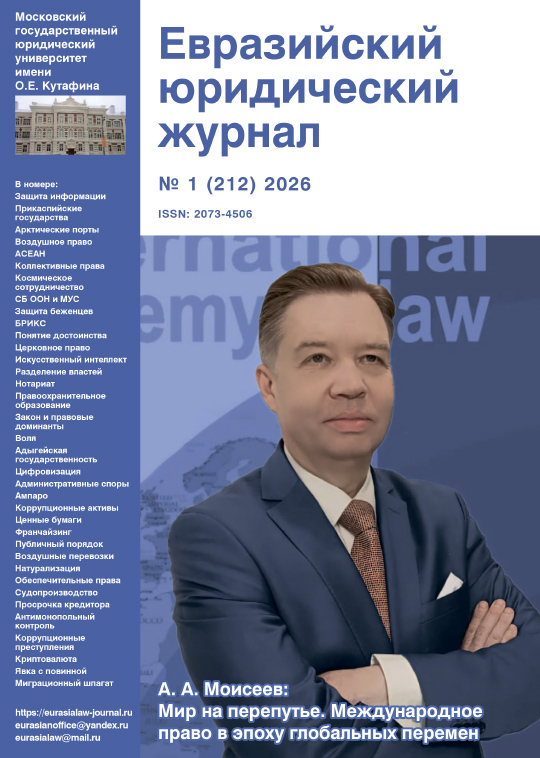
PERSONA GRATA
A. A. Moiseev:
The world is at a crossroads. International law in an era of global change
Interview with Alexey Alexandrovich Moiseev, Ph.D. in Law, Doctor of Law of Australia
INTERNATIONAL LAW
Bakulin V. M., Okhotnikov I. V., Spector A. A.
Analysis of international legal regimes for information protection in transport and logistics systems and supply chains
Mishalchenko Yu. V., Avrutina A. S., Mishalchenko M. Yu.
International legal and economic aspects of energy cooperation between the Caspian states and Turkey in the energy sector
Volodin Yu. A.
Institutional and legal aspects of arctic port development: prospects for adapting Canadian mechanisms in the Russian Federation
Leontjev E. A.
Prospects for the formation of a Eurasian regional mechanism for the protection of human rights
Nguyen T. T. L.
Vietnam’s role in The ASEAN Forum on Migrant Labour (AFML)
Saranchina V. A.
The history of the development of international cooperation for the protection of collective human rights
Suleymanov A. R., Karyakina E. S.
Analysis of international cooperation between Russia, the USA and China: political and legal aspect
Shamsutdinov I. R.
UN Security Council and the International Criminal Court: limits of influence and questions of legitimacy of decisions
Shen Yiyang
Refugee protection in Asia and the UN system’s response
INTERNATIONAL PRIVATE LAW
Glinshikova T. V., Bykhalova V. E., Solovjeva A. V.
The role of recommender acts in the system of regulation of international sales of goods contracts
Demidov I. A., Shugurov M. V.
Multilateral electronic commerce system within the BRICS framework: directions of formation
Glinshikova T. V., Rudiyko L. V., Sviridenko A. N.
The conflict-of-law phenomenon of reverse reference and reference to the law of a third state in the system of private international law
THEORY OF STATE AND LAW
Gereeva Z. A.
The historical and legal foundations of party system development in the USA and Germany: a comparative analysis
Danilenkova T. O.
The political and legal content of the concept of dignity based on an analysis of human rights theory
Кarev D. A.
The concept of Church law and its relation to related categories
Krasovskaya N. S., Sas M. R.
Implementation of artificial intelligence: features of modern legal regulation in the Russian Federation and current issues
Pirova R. N.
The theory of the separation of powers: history of origins and modern challenges
Selimova A. M., Magomedova P. G., Abdulhamidov A. B.
On the issue of reform in the activities of the notary
Smakuev R. A.
Sovereignty and cultural code: adaptation of state power institutions to the challenges of network sociality
Smirnov V. V., Evseev I. V.
From the history of special law enforcement education in Russia
Sukhorukov R. V.
The legal dimension of private security: a historical review
Tonkov D. E., Firsov E. D., Skalozubov A. I.
The principle of legality in the activities of modern judges: an analysis of the examples of the Russian Federation and the Republic of Uzbekistan
Tushko O. Yu.
On economic power in the context of stabilizing state power
Furman T. G.
Law and legal dominants of the media
Abduzhalilov T. F.
The theoretical significance of the sociology of law in the evolving chronology of the development of the legal scientific paradigm
Balashov I. V.
Will as an element of legal personality
Makhmadiev R. Z.
An anthropological turn in law: an architectural lawyer as a new type of lawyer to bridge the methodological gap between theory and practice
Sokolova A. I.
Classification of new religious associations for effective legal regulation during the digital transformation of Russian society
HISTORY OF STATE AND LAW
Egorov A. M., Matveev D. N.
The peculiarities of the organization and the ratio of the activities of inspections of correctional work and special commandants of the period of developed socialism (late 1960s – early 1980s)
Elistratov A. D.
History of air law in Russia: from Catherine the Great to sanctions and counter-sanctions
Mayurov N. P., Makarov D. A.
Circus parties – dims in the political and state system of the Byzantine Empire
Mikhaylik A. A., Zaitseva V. A., Anchekov R. B.
The history of the rights and laws of the Ancient Adygs – Adyge Khabze: the role of the Adyge Khabze in the development of the Adyghe state
Popova A. A., Nasekina E. S., Zaichenko L. N.
Historical and legal analysis of the formation and development of state secrets in Russia
Furman F. P.
The specifics of politics and law during the formation of the Russian centralized state
Pavlisova T. E., Ageeenko D. M., Alkhazov N. Ya.
The influence of foreign policy isolation on the evolution of norms and institutions of the law of the USSR State (Soviet State Law)
Poltavets E. M.
The history of the development of the relationship between the abuse of subjective law and delinquency
Prokhorov V. V.
Simferopol Police School (1993-1997): organizational structure and staffing
Furman F. P.
Features of the development of political and legal thought in Kievan Rus
CONSTITUTIONAL LAW
Vlasova E. L., Davydova M. V.
Problems of enforcing the constitutional rights of road users
Gazimagomedova N. A.
The concept of hybrid governance and a methodology for assessing the effectiveness of citizens’ rights protection in polynormative regions (case study of the constituent entities of the North Caucasian Federal District)
Gainetdinova G. S.
Scientific and educational potential as a tool for countering terrorism and strengthening national security
Kazantseva O. L., Eremeykina L. L.
Conflict of interest involving a municipal deputy: analysis of the ruling of the Constitutional Court of the Russian Federation of December 26, 2025, № 51-P
Mukhametshin F. B.
Enforcement and limitation of personal rights in the Russian Federation: dialectics of the constitutional-legal mechanism in modern conditions
Magomedkhanova Z. I.
The genesis of the constitutional principle of equality of human and civil rights, regardless of origin in foreign countries
ADMINISTRATIVE LAW
Kuryshova I. V., Brovina E. M.
On the question of the legal personality of artificial intelligence (based on the example of the use of the «SAFE CITY» hardware and software complex)
Lyashenko T. T.
The institution of notification of public events in the context of abuse of law: administrative, legal and constitutional aspects
Mokretsov Yu. V., Bikkinin A. D.
Digitalization of control and supervisory activities in the field of entrepreneurship
Pavlov N. V., Buraya A. A., Kokotova V. R.
Law enforcement issues in administrative regulation of business
Petrovskaya M. I., Molina A. D.
Anthropology of corruption: cultural practices, normative collisions, and problems of law enforcement in the Russian context
Farikova E. A.
The use of artificial intelligence in the economy as an object of legal regulation
Shmelev I. V.
Digitalization of the amparo procedure and guarantee of access to administrative justice: analysis of the 2025 procedural reform
Shukyurova A. S.
Forms of a lawyer’s participation in administrative disputes resolving
Chernov Yu. I., Maksimov R. V., Nikulin S. Yu.
Differentiation of the statute of limitations for administrative liability
Zhilnikov A. V.
Administrative and legal characteristics of the state of emergency
Lyukina O. A.
Administrative and legal regulation of public procurement in the Republic of South Africa: current state and problems of reforming
Maltyz K. I.
Liability for the consequences of artificial intelligence use in public administration: administrative law aspects
Shmelev I. V.
Amparo as an alternative to administrative proceedings: limits, scope, and effectiveness of protecting constitutional rights
CIVIL LAW
Borodina Zh. N., Abdullaeva R.R.
Features of civil liability of commercial legal entities
Vlasova N. V.
Recovery of the corrupt assets to the State income: constitutional and legal guidelines and judicial practice
Gorina N. V., Zhuzhgina A. A.
Problems of inheritance of copyright to works of art in the Russian Federation
Ziyanshina R. R.
Current directions of development of the issue of exclusion of property and (or) property rights from the bankruptcy estate of the debtor-citizen
Komogorov A. A.
Fiduciary duties in corporate relations and their specific features with respect to the controlling shareholder
Linnikov A. S.
Functions and stages of civil law control
Rumyantsev F. P.
On the extension of the use of escrow accounts to individual housing construction
Sadkov A. N., Igbaeva G. R., Sadkov V. A.
About legal nature of securities through the prism of the transaction form
Telibekova I. M.
On the issue of the concept of an educational funded insurance contract
Fadeeva A. V., Grishina A. V.
Information asymmetry in corporate relations: transformation of the right to information in the context of digital platforms and Big Data
Babaev E. A.
The problem of protecting franchisee rights in a commercial concession agreement
Brutskiy A. V.
Several issues of the public policy exception application as a bar to recognition or enforcement of an arbitral award
Vorontsov M. I.
Problematic issues of free use of intellectual property in video games
Gorchakova A.P.
Legal regulation of eco-design of packaging and advertising as instruments for implementing state environmental policy
Derkho D. S.
The creditor’s delay in the supply of utility resources to certain categories of consumers
Konovalov A. S., Kalishko A. K.
The legal regime of smart contracts in Russian civil law: theoretical and practical aspects
Konovalova Yu. A.
On the issue of concept of public policy exception
Lykov A. Yu.
The political and legal ideal in the system of concepts of the theory of state and law: main aspects
Markevich N. V.
Aerial special use contracts: notion and types
Mikhaylik A. A., Guseva S. V., Ryabchuk V. V.
The evolution of the institution of property (historical and legal analysis)
Musin A. R.
Legal regulation of the simplified procedure for the insolvency of an absent debtor in the Republic of Uzbekistan and in the Russian Federation
Petrova E. S.
The specifics of state participation in insolvency (bankruptcy) relations in connection with the need to protect the public interest and public order
Sazonov I. I.
The impact of digitalization on the system of civil-law protection of intellectual property rights
Solovev A. V.
Liability of the carrier for breach of the air carriage contract
Fefelov G. V.
Features of civil status of sports organizations in Germany
Shishkin A. E.
The improving of the institution of naturalization in the Russian Federation
Khodus V. M.
Digital financial assets as collateral: civil law qualification and registry mechanism of security rights
Yakovlev Yu. S.
Formation of a land plot that is part of the common property in an apartment building
CIVIL PROCESS
Lunev K. A.
Proving legal facts of abuse of procedural rights by state bodies
Minnebaev R. A.
The procedural regime of consumer rights protection in civil proceedings
Morozova S. Yu.
Stages and phases of administrative proceedings
Palushin K. K.
Material terms of an arbitration agreement: do not overcomplicate what the parties intended to be simple
Tarasov A. V.
Procedural fictions that secure evidential information in civil proceedings
FAMILY LAW
Ivanovskaya N. V., Stelmakh A. V.
Beyond death: the legalization of postmortem reproduction in the Russian Federation
LABOUR LAW
Dolotina R. R.
On the concept, types, and causes of labour disputes in the Russian Federation
Kuznetsova E. V.
The history of the development of pension systems in Russia and abroad
Mikhalskaya A. O.
Comparative analysis of termination of an employment contract at the initiative of the employer in Russia and China
Sinyugina T. V.
The problems of proving the fact of pressure from the employer when dismissing an employee
LAND LAW
Autonomov A. N., Evgrafova A. G.
On the issues of increasing the efficiency of involving agricultural land in the turnover for the development of nursery farming in the territories of the Donetsk People’s Republic, Lugansk People’s Republic, Zarozhskaya oblast and Kherson oblast: legal aspects
Kirillova T. K.
Legal aspects of correcting errors contained in the unified state register of real estate
Letyagina E. A.
Legal support for state policy in the field of land use and protection
PROPERTY LAW
Zaytseva D. N.
Ways to improve the institution of social infrastructure in light of the mandatory principle of strengthening measures to implement citizens’ housing rights
SOCIAL SECURITY LAW
Shvarts L. V., Tarkinskaya A. V.
Legal guarantees in the field of education and employment for the participants of the SMO and their family members
FINANCIAL LAW
Grunin A. G.
On the prospects for developing financial support in the penal system of the Russian Federation
Dmitriev I. N.
Legal regulation of import substitution: the case of the Russian Federation
Kankhush J.
Assessment of the good faith of the guarantor’s actions when using an independent (bank) guarantee
Elyakov A. L.
The legal framework and operating conditions of special economic zones in Vietnam
INFORMATION LAW
Yakovchuk T. V., Abdrabu N. W., Gritskevich A. E.
The impact of digital technologies on students’ motivation to engage in physical education
Shcheblyakov A. A.
Legal regulation of the right to information in context of the informational society: new issues for the legislator
ANTIMONOPOLY LAW
Baryshev S. A., Gizzyatova S. T.
Control of antimonopoly authorities in the field of advertising
ECOLOGICAL LAW
Kovtun I. S., Smagin V. A.
The property law of animal world objects in the domestic legal doctrine of the second half of the 19th century and the beginning of the 20th century
CRIMINAL LAW
Abyzova E. R., Kosenko I. S.
Current issues of criminal liability of foreign agents
Ageev E. G.
The system of principles of decriminalization of criminal acts in Russian criminal law
Volkolupova V. V., Sentsov A. S., Volkolupova V. A
Regulation of liability for public calls to engage in extremist activities: problems and prospects
Gadzhieva A. A., Murtuzaliev Sh. B.
Problems of criminal law prevention of thefts committed using information and communication technologies and the internet
Dvorzhickaya M. A.
Crime under Article 280 of the Criminal Code of the Russian Federation: criminal law characteristics and law enforcement practice
Efimov I. A., Kozhin D. A.
On certain problems in applying article 171.2 of the Criminal Code of the Russian Federation concerning the objective elements of the offence
Efremova M. A., Nagorny A. A.
On the issue of criminal liability for violation of the rules of operation of information systems
Kuzmin S. S.
Criminal law enforcement of criminal punishment in Russia (Soviet period – 1917-1958)
Kulev A. G.
Crimes against the state’s external security: problems of composition and law enforcement
Maslov B. V., Panina M. K.
Comparative legal analysis of the criminal legislation of the Russian Federation and the People’s Republic of China: contemporary trends and law enforcement practice
Nekrasov A. P.
Special criminal punishments for instigators and juvenile accomplices in the commission of sabotage and terrorist crimes
Nesterova S. S.
On the qualification of forced transaction or refusal to transact
Pisarevskaya E. A.
On the effectiveness of the application of criminal law provisions for indecent acts and violent acts of a sexual nature
Popova A. A., Abdrakhmanova A. R., Sokolovskaya N. S.
Legal regulation of state secrets in modern Russia
Proshin V. M.
Sources of criminal patterns of corruption crimes
Radzhabov Sh. R., Zairbekova E. M.
On the initial stage of tax crime investigation: theoretical and practical issues
Reshetnikov E. A.
The relevance of using various types of punishment for minors
Chistyakov A. A., Kolenteev K. E.
Artificial intelligence in the system of terrorist threat prevention: Russian experience and prospects of application
Yushina Yu. V., Klinchuk S. V.
On the issue of legislative logic in selecting articles of the special part of the Criminal Code of the Russian Federation for introducing a new qualifying feature
Aliev A. E., Oshmankevich E. R.
Current issues in the legal subsumption of illegal distribution of narcotic drugs
Al’-Masafir D. M. H.
Islamic legal approach to the protection of the rights of children and minors in cases of murder and imprisonment
Bashirova D. I.
Criminal law measures to combat high-level corruption: a case study of the trials of Presidents of the Republic of Korea
Volkovoy D. S.
Moderation of repression as a central ethical idea of criminal law regulation
Krasnov K. V.
On the issue of distinguishing public appeals and propaganda from incitement, involvement, and encouragement to deviant behavior
Larionov P. A.
Cryptocurrency in U.S. criminal law: criminalization through judicial interpretation
Hoang Kim Binh
Honor and dignity of the individual as objects of criminal law protection: a comparative analysis of the legislation of the Russian Federation and the Socialist Republic of Vietnam
CRIMINAL PROCESS
Buzanova A. R.
Issues of legal regulation of interaction between institutions and bodies of the institutions of the prison execution system and preliminary investigation bodies when using the results of operational search activities in providing cases
Vyskrebtsev B. S., Dranichnikova N. V., Sergeev A. B.
Forensic expert activity: current state and directions of improvement of legislation
Zhuravlev A. A.
The concept and content of criminal-procedural consequences of legally significant conduct in the context of compensation for harm caused by a crime
Zamurueva E. Yu.
The problem of ensuring citizens’ rights to privacy when using electronic evidence in criminal proceedings: a comparative analysis of the legislation of foreign countries and the Russian Federation
Karev E. A.
On the issue of using video recordings of a confession received from a convicted person
Karpikov A. S., Gerasenkov V. M.
Surrender: legal basis and problems of application
Nabatov M. B.
Methodology for studying public trust in criminal proceedings within the framework of criminal procedure science
Bogatskaya U. I.
Algorithm of actions of the investigator on the application of a measure of procedural coercion in the form of suspension of transactions with monetary funds, electronic monetary funds, monetary funds deposited as an advance for communication services: procedural guarantees and problems of law enforcement (art. 115.2 of the Criminal Procedure Code of the Russian Federation)
Ibrahim L. A. I.
Interdisciplinary expert support for the investigation of murders disguised by dramatizations
CRIMINAL JUDICIARY
Kulagin D. V.
Compensation for harm caused to the victim during periods of mobilization, martial law, or wartime
CRIMINAL-EXECUTIVE LAW
Avdyukhin S. A.
Forced feeding: the legal nature and the place in the system of Russian penal enforcement law
Igoshin V. G., Shinyaev K. A.
The role of public monitoring commissions (PMCS) in the system of security and law enforcement in the penal system
Nekrasov A. P.
The manifestation of Nazism and Neo-Nazism in the penitentiary system of society: history, memory and modernity
CRIMINALISTICS
Barasheva E. A.
Mechanism for detecting, fixing, removing, and examining traces when reviewing reports of traffic accidents
Garbouz G. S.
Several directions of the concept of intergeneric methods of environmental crimes investigation
Kutuzov A. V., Shumilova M. A.
Using internet search engines in crimes detection and investigation: problems and solutions
Poziy V. S., Beldin A. A.
Experiments of tissues and excrements of human and animal: opportunities, problems and prospects (part 1)
Kholevchuk A. G.
Disinformation in judicial proceedings: forensic mechanisms, subjects, and limits of admissibility
Gorenkov A. R.
Forensic support for detection and investigation of fraud committed with participation of droppers
JUDICIARY
Rashidov I. G.
Comparative analysis of the mechanisms of extradition and legal assistance in criminal matters within the CIS and on a bilateral basis with the participation of the Russian Federation
LAW ENFORCEMENT AGENCIES
Stepanian A. L.
Problems of recognizing signs of predicate crimes and questionable financial transactions, possibly used to legalize criminal proceeds
PROSECUTOR’S SUPERVISION
Tyunin V. A.
Prosecutorial supervision of the implementation of legislation in the field of healthcare
SECURITY AND LAW
Bedrin V. S., Denisenkova N. N., Kasumova D. M.
Legal framework for ensuring state information sovereignty in the context of the digital transformation of political communications
Dzyuban V. V., Slyusareva T. G., Stolpnik D. V.
The legal basis of counter-extremism practices on the Crimean peninsula
Ignatjeva I. V.
Legal aspects of using information warfare technologies
PEDAGOGY AND LAW
Alibekov D. I., Magomedov M. M., Mirzaev Z. M.
The possibility of an educational environment in the absence of civic consciousness and legal awareness in modern evolution
Gorbunov M. D., Evdeeva N. V.
Constitutional conflictology in the legal education system
Zorina N. S.
Prevention of deviant behavior of juvenile convicts
Levchenkov A. I., Krasilnikova L. I.
Political violence: theoretical and practical issues
Samoilova I. N., Serdyukova Yu. A., Timofeenko V. A.
Organizational and Pedagogical tools and methods for developing a positive image of law enforcement officers among young people
Furman T. G.
Theoretical foundations of professional training of future lawyers for project-based work in the information and communications environment
STATE AND LAW
Amelichkin A. V., Efanov V. K.
State policy in the field of preservation of the historical and cultural heritage of the city
Arsenjeva G. V., Khramova I. S.
The history of the formation and development of the right to freedom of conscience and freedom of religion in Russia
Ruzavina E. Yu., Vershinina L. K.
Features of the formation and development of the legal consciousness of the Russian civil servant in the context of digitalization
Salnikova O. A., Davletov R. R., Ryumshina D. A.
Anticorruption policy in the field of public procurement: mechanisms of legal regulation and problems of implementation
Serebryakov M. N.
Principles of human rights work
HUMAN RIGHT
Baydarova M. A., Fomin V. V.
International activities of the commissioner for human rights and the formation of a new architecture of the international human rights protection system
Suntsov A. P., Khabibullina A. R.
Legal aspects of using the Tyumen Oblast’s experience in implementing NPOs’ constitutional right to free medical care in the constituent entities of the Russian Federation
ECONOMY. LAW. SOCIETY
Burlakov V. V., Vozhzhov E. A., Provorova I. P.
Improving the efficiency of publishing by automating the process of detecting neural network text
Kugai A. I.
Migration Splits: the search for an institutional balance between the needs of the national economy and the imperatives of public security in modern Russia
Nizamov S. S., Stovba E. V., Porotnikov P. A.
Tax evasion as a threat to the economic security of the state: causes and ways to minimize
Nikiforova E. N.
Transformation of the professional identity of lawyers in the digital economy
Sidorenko V. S., Smirnov E. N.
Barriers to the introduction of an economic mechanism for solving environmental problems in Russia
Suleymanov A. R., Gerasina D. V.
Analysis of the formation of the common energy market of the EAEU: challenges and opportunities
Tuarmenskiy V. V., Pekareva V. V.
Historical retrospective of the system of social guarantees in the performance of employees of the management system: analysis and evaluation
Tsvetkov M. A., Pronina E. N., Knyazev A. V.
Operationalization of institutional transaction cost theory in technology transfer: a model for coupling readiness level standards with contractual forms
Nizamov S. S., Stovba E. V., Porotnikov P. A.
Russia’s food sovereignty: from dependence to sustainability in the agro-industrial complex
PHILOSOPHY. LAW. SOCIETY
Afanasevskiy V. L.
To the problem of the unity of the historical-philosophical process
Bikmetov E. Yu., Garifullina A. F., Ignatjeva O. N.
The worldview potential of the course “Fundamentals of Russian statehood” in shaping students’ value orientations in higher education
Vorokhobov A. V., Pronina N. S., Rozina T. Yu.
The use of the historical-philosophical method for the analysis of the tradition of the German classical philosophy
Elchaninov A. P.
Restorative justice through the lens of philosophy: conceptual foundations in the writings of Theo Gavrilidis
Korotina O. A.
Dialectics of the natural-science and sociocultural paradigms in the analysis of loneliness
Parilov O. V., Shcherbakova M. P., Alexandrina N. M.
Formation of the ethical corpus in early eastern Christian asceticism
Semenov A.
Prospects of reforms of the Russian Orthodox Church at the beginning of the XX century in the assessment of V. V. Rozanov
Sobko R. V., Spirin V. K., Tretyakov I. S.
Philosophical understanding of the concepts of justitia, transactio, salus in the context of the late antique and medieval scholastic tradition
Tarasov A. N., Fomin A. V.
Artificial intelligence and the crisis of anthropocentrism
Khairullin R. N.
Philosophical legacy of I. Kant: between pessimism and optimism
Sokol A. V.
Orthodox Christian concept of Russian statehood in the philosophical and legal doctrine of I. A. Ilyin
Korotina O. A., Grishina E. S.
Historical dialectics of natural science and humanities cognition
Semenov A.
V. V. Rozanov’s contribution to the formation and development of the Russian religious and philosophical renaissance
Sobko R. V., Spirin V. K., Tretyakov I. S.
Philosophical understanding of the concepts of satisfactio, imputatio, culpa, sacramentum and crimiator in the context of the late antique and medieval scholastic tradition: on the issue of late antique practices of reconciliation
A. A. Moiseev:
The world is at a crossroads. International law in an era of global change
Interview with Alexey Alexandrovich Moiseev, Ph.D. in Law, Doctor of Law of Australia
INTERNATIONAL LAW
Bakulin V. M., Okhotnikov I. V., Spector A. A.
Analysis of international legal regimes for information protection in transport and logistics systems and supply chains
Mishalchenko Yu. V., Avrutina A. S., Mishalchenko M. Yu.
International legal and economic aspects of energy cooperation between the Caspian states and Turkey in the energy sector
Volodin Yu. A.
Institutional and legal aspects of arctic port development: prospects for adapting Canadian mechanisms in the Russian Federation
Leontjev E. A.
Prospects for the formation of a Eurasian regional mechanism for the protection of human rights
Nguyen T. T. L.
Vietnam’s role in The ASEAN Forum on Migrant Labour (AFML)
Saranchina V. A.
The history of the development of international cooperation for the protection of collective human rights
Suleymanov A. R., Karyakina E. S.
Analysis of international cooperation between Russia, the USA and China: political and legal aspect
Shamsutdinov I. R.
UN Security Council and the International Criminal Court: limits of influence and questions of legitimacy of decisions
Shen Yiyang
Refugee protection in Asia and the UN system’s response
INTERNATIONAL PRIVATE LAW
Glinshikova T. V., Bykhalova V. E., Solovjeva A. V.
The role of recommender acts in the system of regulation of international sales of goods contracts
Demidov I. A., Shugurov M. V.
Multilateral electronic commerce system within the BRICS framework: directions of formation
Glinshikova T. V., Rudiyko L. V., Sviridenko A. N.
The conflict-of-law phenomenon of reverse reference and reference to the law of a third state in the system of private international law
THEORY OF STATE AND LAW
Gereeva Z. A.
The historical and legal foundations of party system development in the USA and Germany: a comparative analysis
Danilenkova T. O.
The political and legal content of the concept of dignity based on an analysis of human rights theory
Кarev D. A.
The concept of Church law and its relation to related categories
Krasovskaya N. S., Sas M. R.
Implementation of artificial intelligence: features of modern legal regulation in the Russian Federation and current issues
Pirova R. N.
The theory of the separation of powers: history of origins and modern challenges
Selimova A. M., Magomedova P. G., Abdulhamidov A. B.
On the issue of reform in the activities of the notary
Smakuev R. A.
Sovereignty and cultural code: adaptation of state power institutions to the challenges of network sociality
Smirnov V. V., Evseev I. V.
From the history of special law enforcement education in Russia
Sukhorukov R. V.
The legal dimension of private security: a historical review
Tonkov D. E., Firsov E. D., Skalozubov A. I.
The principle of legality in the activities of modern judges: an analysis of the examples of the Russian Federation and the Republic of Uzbekistan
Tushko O. Yu.
On economic power in the context of stabilizing state power
Furman T. G.
Law and legal dominants of the media
Abduzhalilov T. F.
The theoretical significance of the sociology of law in the evolving chronology of the development of the legal scientific paradigm
Balashov I. V.
Will as an element of legal personality
Makhmadiev R. Z.
An anthropological turn in law: an architectural lawyer as a new type of lawyer to bridge the methodological gap between theory and practice
Sokolova A. I.
Classification of new religious associations for effective legal regulation during the digital transformation of Russian society
HISTORY OF STATE AND LAW
Egorov A. M., Matveev D. N.
The peculiarities of the organization and the ratio of the activities of inspections of correctional work and special commandants of the period of developed socialism (late 1960s – early 1980s)
Elistratov A. D.
History of air law in Russia: from Catherine the Great to sanctions and counter-sanctions
Mayurov N. P., Makarov D. A.
Circus parties – dims in the political and state system of the Byzantine Empire
Mikhaylik A. A., Zaitseva V. A., Anchekov R. B.
The history of the rights and laws of the Ancient Adygs – Adyge Khabze: the role of the Adyge Khabze in the development of the Adyghe state
Popova A. A., Nasekina E. S., Zaichenko L. N.
Historical and legal analysis of the formation and development of state secrets in Russia
Furman F. P.
The specifics of politics and law during the formation of the Russian centralized state
Pavlisova T. E., Ageeenko D. M., Alkhazov N. Ya.
The influence of foreign policy isolation on the evolution of norms and institutions of the law of the USSR State (Soviet State Law)
Poltavets E. M.
The history of the development of the relationship between the abuse of subjective law and delinquency
Prokhorov V. V.
Simferopol Police School (1993-1997): organizational structure and staffing
Furman F. P.
Features of the development of political and legal thought in Kievan Rus
CONSTITUTIONAL LAW
Vlasova E. L., Davydova M. V.
Problems of enforcing the constitutional rights of road users
Gazimagomedova N. A.
The concept of hybrid governance and a methodology for assessing the effectiveness of citizens’ rights protection in polynormative regions (case study of the constituent entities of the North Caucasian Federal District)
Gainetdinova G. S.
Scientific and educational potential as a tool for countering terrorism and strengthening national security
Kazantseva O. L., Eremeykina L. L.
Conflict of interest involving a municipal deputy: analysis of the ruling of the Constitutional Court of the Russian Federation of December 26, 2025, № 51-P
Mukhametshin F. B.
Enforcement and limitation of personal rights in the Russian Federation: dialectics of the constitutional-legal mechanism in modern conditions
Magomedkhanova Z. I.
The genesis of the constitutional principle of equality of human and civil rights, regardless of origin in foreign countries
ADMINISTRATIVE LAW
Kuryshova I. V., Brovina E. M.
On the question of the legal personality of artificial intelligence (based on the example of the use of the «SAFE CITY» hardware and software complex)
Lyashenko T. T.
The institution of notification of public events in the context of abuse of law: administrative, legal and constitutional aspects
Mokretsov Yu. V., Bikkinin A. D.
Digitalization of control and supervisory activities in the field of entrepreneurship
Pavlov N. V., Buraya A. A., Kokotova V. R.
Law enforcement issues in administrative regulation of business
Petrovskaya M. I., Molina A. D.
Anthropology of corruption: cultural practices, normative collisions, and problems of law enforcement in the Russian context
Farikova E. A.
The use of artificial intelligence in the economy as an object of legal regulation
Shmelev I. V.
Digitalization of the amparo procedure and guarantee of access to administrative justice: analysis of the 2025 procedural reform
Shukyurova A. S.
Forms of a lawyer’s participation in administrative disputes resolving
Chernov Yu. I., Maksimov R. V., Nikulin S. Yu.
Differentiation of the statute of limitations for administrative liability
Zhilnikov A. V.
Administrative and legal characteristics of the state of emergency
Lyukina O. A.
Administrative and legal regulation of public procurement in the Republic of South Africa: current state and problems of reforming
Maltyz K. I.
Liability for the consequences of artificial intelligence use in public administration: administrative law aspects
Shmelev I. V.
Amparo as an alternative to administrative proceedings: limits, scope, and effectiveness of protecting constitutional rights
CIVIL LAW
Borodina Zh. N., Abdullaeva R.R.
Features of civil liability of commercial legal entities
Vlasova N. V.
Recovery of the corrupt assets to the State income: constitutional and legal guidelines and judicial practice
Gorina N. V., Zhuzhgina A. A.
Problems of inheritance of copyright to works of art in the Russian Federation
Ziyanshina R. R.
Current directions of development of the issue of exclusion of property and (or) property rights from the bankruptcy estate of the debtor-citizen
Komogorov A. A.
Fiduciary duties in corporate relations and their specific features with respect to the controlling shareholder
Linnikov A. S.
Functions and stages of civil law control
Rumyantsev F. P.
On the extension of the use of escrow accounts to individual housing construction
Sadkov A. N., Igbaeva G. R., Sadkov V. A.
About legal nature of securities through the prism of the transaction form
Telibekova I. M.
On the issue of the concept of an educational funded insurance contract
Fadeeva A. V., Grishina A. V.
Information asymmetry in corporate relations: transformation of the right to information in the context of digital platforms and Big Data
Babaev E. A.
The problem of protecting franchisee rights in a commercial concession agreement
Brutskiy A. V.
Several issues of the public policy exception application as a bar to recognition or enforcement of an arbitral award
Vorontsov M. I.
Problematic issues of free use of intellectual property in video games
Gorchakova A.P.
Legal regulation of eco-design of packaging and advertising as instruments for implementing state environmental policy
Derkho D. S.
The creditor’s delay in the supply of utility resources to certain categories of consumers
Konovalov A. S., Kalishko A. K.
The legal regime of smart contracts in Russian civil law: theoretical and practical aspects
Konovalova Yu. A.
On the issue of concept of public policy exception
Lykov A. Yu.
The political and legal ideal in the system of concepts of the theory of state and law: main aspects
Markevich N. V.
Aerial special use contracts: notion and types
Mikhaylik A. A., Guseva S. V., Ryabchuk V. V.
The evolution of the institution of property (historical and legal analysis)
Musin A. R.
Legal regulation of the simplified procedure for the insolvency of an absent debtor in the Republic of Uzbekistan and in the Russian Federation
Petrova E. S.
The specifics of state participation in insolvency (bankruptcy) relations in connection with the need to protect the public interest and public order
Sazonov I. I.
The impact of digitalization on the system of civil-law protection of intellectual property rights
Solovev A. V.
Liability of the carrier for breach of the air carriage contract
Fefelov G. V.
Features of civil status of sports organizations in Germany
Shishkin A. E.
The improving of the institution of naturalization in the Russian Federation
Khodus V. M.
Digital financial assets as collateral: civil law qualification and registry mechanism of security rights
Yakovlev Yu. S.
Formation of a land plot that is part of the common property in an apartment building
CIVIL PROCESS
Lunev K. A.
Proving legal facts of abuse of procedural rights by state bodies
Minnebaev R. A.
The procedural regime of consumer rights protection in civil proceedings
Morozova S. Yu.
Stages and phases of administrative proceedings
Palushin K. K.
Material terms of an arbitration agreement: do not overcomplicate what the parties intended to be simple
Tarasov A. V.
Procedural fictions that secure evidential information in civil proceedings
FAMILY LAW
Ivanovskaya N. V., Stelmakh A. V.
Beyond death: the legalization of postmortem reproduction in the Russian Federation
LABOUR LAW
Dolotina R. R.
On the concept, types, and causes of labour disputes in the Russian Federation
Kuznetsova E. V.
The history of the development of pension systems in Russia and abroad
Mikhalskaya A. O.
Comparative analysis of termination of an employment contract at the initiative of the employer in Russia and China
Sinyugina T. V.
The problems of proving the fact of pressure from the employer when dismissing an employee
LAND LAW
Autonomov A. N., Evgrafova A. G.
On the issues of increasing the efficiency of involving agricultural land in the turnover for the development of nursery farming in the territories of the Donetsk People’s Republic, Lugansk People’s Republic, Zarozhskaya oblast and Kherson oblast: legal aspects
Kirillova T. K.
Legal aspects of correcting errors contained in the unified state register of real estate
Letyagina E. A.
Legal support for state policy in the field of land use and protection
PROPERTY LAW
Zaytseva D. N.
Ways to improve the institution of social infrastructure in light of the mandatory principle of strengthening measures to implement citizens’ housing rights
SOCIAL SECURITY LAW
Shvarts L. V., Tarkinskaya A. V.
Legal guarantees in the field of education and employment for the participants of the SMO and their family members
FINANCIAL LAW
Grunin A. G.
On the prospects for developing financial support in the penal system of the Russian Federation
Dmitriev I. N.
Legal regulation of import substitution: the case of the Russian Federation
Kankhush J.
Assessment of the good faith of the guarantor’s actions when using an independent (bank) guarantee
Elyakov A. L.
The legal framework and operating conditions of special economic zones in Vietnam
INFORMATION LAW
Yakovchuk T. V., Abdrabu N. W., Gritskevich A. E.
The impact of digital technologies on students’ motivation to engage in physical education
Shcheblyakov A. A.
Legal regulation of the right to information in context of the informational society: new issues for the legislator
ANTIMONOPOLY LAW
Baryshev S. A., Gizzyatova S. T.
Control of antimonopoly authorities in the field of advertising
ECOLOGICAL LAW
Kovtun I. S., Smagin V. A.
The property law of animal world objects in the domestic legal doctrine of the second half of the 19th century and the beginning of the 20th century
CRIMINAL LAW
Abyzova E. R., Kosenko I. S.
Current issues of criminal liability of foreign agents
Ageev E. G.
The system of principles of decriminalization of criminal acts in Russian criminal law
Volkolupova V. V., Sentsov A. S., Volkolupova V. A
Regulation of liability for public calls to engage in extremist activities: problems and prospects
Gadzhieva A. A., Murtuzaliev Sh. B.
Problems of criminal law prevention of thefts committed using information and communication technologies and the internet
Dvorzhickaya M. A.
Crime under Article 280 of the Criminal Code of the Russian Federation: criminal law characteristics and law enforcement practice
Efimov I. A., Kozhin D. A.
On certain problems in applying article 171.2 of the Criminal Code of the Russian Federation concerning the objective elements of the offence
Efremova M. A., Nagorny A. A.
On the issue of criminal liability for violation of the rules of operation of information systems
Kuzmin S. S.
Criminal law enforcement of criminal punishment in Russia (Soviet period – 1917-1958)
Kulev A. G.
Crimes against the state’s external security: problems of composition and law enforcement
Maslov B. V., Panina M. K.
Comparative legal analysis of the criminal legislation of the Russian Federation and the People’s Republic of China: contemporary trends and law enforcement practice
Nekrasov A. P.
Special criminal punishments for instigators and juvenile accomplices in the commission of sabotage and terrorist crimes
Nesterova S. S.
On the qualification of forced transaction or refusal to transact
Pisarevskaya E. A.
On the effectiveness of the application of criminal law provisions for indecent acts and violent acts of a sexual nature
Popova A. A., Abdrakhmanova A. R., Sokolovskaya N. S.
Legal regulation of state secrets in modern Russia
Proshin V. M.
Sources of criminal patterns of corruption crimes
Radzhabov Sh. R., Zairbekova E. M.
On the initial stage of tax crime investigation: theoretical and practical issues
Reshetnikov E. A.
The relevance of using various types of punishment for minors
Chistyakov A. A., Kolenteev K. E.
Artificial intelligence in the system of terrorist threat prevention: Russian experience and prospects of application
Yushina Yu. V., Klinchuk S. V.
On the issue of legislative logic in selecting articles of the special part of the Criminal Code of the Russian Federation for introducing a new qualifying feature
Aliev A. E., Oshmankevich E. R.
Current issues in the legal subsumption of illegal distribution of narcotic drugs
Al’-Masafir D. M. H.
Islamic legal approach to the protection of the rights of children and minors in cases of murder and imprisonment
Bashirova D. I.
Criminal law measures to combat high-level corruption: a case study of the trials of Presidents of the Republic of Korea
Volkovoy D. S.
Moderation of repression as a central ethical idea of criminal law regulation
Krasnov K. V.
On the issue of distinguishing public appeals and propaganda from incitement, involvement, and encouragement to deviant behavior
Larionov P. A.
Cryptocurrency in U.S. criminal law: criminalization through judicial interpretation
Hoang Kim Binh
Honor and dignity of the individual as objects of criminal law protection: a comparative analysis of the legislation of the Russian Federation and the Socialist Republic of Vietnam
CRIMINAL PROCESS
Buzanova A. R.
Issues of legal regulation of interaction between institutions and bodies of the institutions of the prison execution system and preliminary investigation bodies when using the results of operational search activities in providing cases
Vyskrebtsev B. S., Dranichnikova N. V., Sergeev A. B.
Forensic expert activity: current state and directions of improvement of legislation
Zhuravlev A. A.
The concept and content of criminal-procedural consequences of legally significant conduct in the context of compensation for harm caused by a crime
Zamurueva E. Yu.
The problem of ensuring citizens’ rights to privacy when using electronic evidence in criminal proceedings: a comparative analysis of the legislation of foreign countries and the Russian Federation
Karev E. A.
On the issue of using video recordings of a confession received from a convicted person
Karpikov A. S., Gerasenkov V. M.
Surrender: legal basis and problems of application
Nabatov M. B.
Methodology for studying public trust in criminal proceedings within the framework of criminal procedure science
Bogatskaya U. I.
Algorithm of actions of the investigator on the application of a measure of procedural coercion in the form of suspension of transactions with monetary funds, electronic monetary funds, monetary funds deposited as an advance for communication services: procedural guarantees and problems of law enforcement (art. 115.2 of the Criminal Procedure Code of the Russian Federation)
Ibrahim L. A. I.
Interdisciplinary expert support for the investigation of murders disguised by dramatizations
CRIMINAL JUDICIARY
Kulagin D. V.
Compensation for harm caused to the victim during periods of mobilization, martial law, or wartime
CRIMINAL-EXECUTIVE LAW
Avdyukhin S. A.
Forced feeding: the legal nature and the place in the system of Russian penal enforcement law
Igoshin V. G., Shinyaev K. A.
The role of public monitoring commissions (PMCS) in the system of security and law enforcement in the penal system
Nekrasov A. P.
The manifestation of Nazism and Neo-Nazism in the penitentiary system of society: history, memory and modernity
CRIMINALISTICS
Barasheva E. A.
Mechanism for detecting, fixing, removing, and examining traces when reviewing reports of traffic accidents
Garbouz G. S.
Several directions of the concept of intergeneric methods of environmental crimes investigation
Kutuzov A. V., Shumilova M. A.
Using internet search engines in crimes detection and investigation: problems and solutions
Poziy V. S., Beldin A. A.
Experiments of tissues and excrements of human and animal: opportunities, problems and prospects (part 1)
Kholevchuk A. G.
Disinformation in judicial proceedings: forensic mechanisms, subjects, and limits of admissibility
Gorenkov A. R.
Forensic support for detection and investigation of fraud committed with participation of droppers
JUDICIARY
Rashidov I. G.
Comparative analysis of the mechanisms of extradition and legal assistance in criminal matters within the CIS and on a bilateral basis with the participation of the Russian Federation
LAW ENFORCEMENT AGENCIES
Stepanian A. L.
Problems of recognizing signs of predicate crimes and questionable financial transactions, possibly used to legalize criminal proceeds
PROSECUTOR’S SUPERVISION
Tyunin V. A.
Prosecutorial supervision of the implementation of legislation in the field of healthcare
SECURITY AND LAW
Bedrin V. S., Denisenkova N. N., Kasumova D. M.
Legal framework for ensuring state information sovereignty in the context of the digital transformation of political communications
Dzyuban V. V., Slyusareva T. G., Stolpnik D. V.
The legal basis of counter-extremism practices on the Crimean peninsula
Ignatjeva I. V.
Legal aspects of using information warfare technologies
PEDAGOGY AND LAW
Alibekov D. I., Magomedov M. M., Mirzaev Z. M.
The possibility of an educational environment in the absence of civic consciousness and legal awareness in modern evolution
Gorbunov M. D., Evdeeva N. V.
Constitutional conflictology in the legal education system
Zorina N. S.
Prevention of deviant behavior of juvenile convicts
Levchenkov A. I., Krasilnikova L. I.
Political violence: theoretical and practical issues
Samoilova I. N., Serdyukova Yu. A., Timofeenko V. A.
Organizational and Pedagogical tools and methods for developing a positive image of law enforcement officers among young people
Furman T. G.
Theoretical foundations of professional training of future lawyers for project-based work in the information and communications environment
STATE AND LAW
Amelichkin A. V., Efanov V. K.
State policy in the field of preservation of the historical and cultural heritage of the city
Arsenjeva G. V., Khramova I. S.
The history of the formation and development of the right to freedom of conscience and freedom of religion in Russia
Ruzavina E. Yu., Vershinina L. K.
Features of the formation and development of the legal consciousness of the Russian civil servant in the context of digitalization
Salnikova O. A., Davletov R. R., Ryumshina D. A.
Anticorruption policy in the field of public procurement: mechanisms of legal regulation and problems of implementation
Serebryakov M. N.
Principles of human rights work
HUMAN RIGHT
Baydarova M. A., Fomin V. V.
International activities of the commissioner for human rights and the formation of a new architecture of the international human rights protection system
Suntsov A. P., Khabibullina A. R.
Legal aspects of using the Tyumen Oblast’s experience in implementing NPOs’ constitutional right to free medical care in the constituent entities of the Russian Federation
ECONOMY. LAW. SOCIETY
Burlakov V. V., Vozhzhov E. A., Provorova I. P.
Improving the efficiency of publishing by automating the process of detecting neural network text
Kugai A. I.
Migration Splits: the search for an institutional balance between the needs of the national economy and the imperatives of public security in modern Russia
Nizamov S. S., Stovba E. V., Porotnikov P. A.
Tax evasion as a threat to the economic security of the state: causes and ways to minimize
Nikiforova E. N.
Transformation of the professional identity of lawyers in the digital economy
Sidorenko V. S., Smirnov E. N.
Barriers to the introduction of an economic mechanism for solving environmental problems in Russia
Suleymanov A. R., Gerasina D. V.
Analysis of the formation of the common energy market of the EAEU: challenges and opportunities
Tuarmenskiy V. V., Pekareva V. V.
Historical retrospective of the system of social guarantees in the performance of employees of the management system: analysis and evaluation
Tsvetkov M. A., Pronina E. N., Knyazev A. V.
Operationalization of institutional transaction cost theory in technology transfer: a model for coupling readiness level standards with contractual forms
Nizamov S. S., Stovba E. V., Porotnikov P. A.
Russia’s food sovereignty: from dependence to sustainability in the agro-industrial complex
PHILOSOPHY. LAW. SOCIETY
Afanasevskiy V. L.
To the problem of the unity of the historical-philosophical process
Bikmetov E. Yu., Garifullina A. F., Ignatjeva O. N.
The worldview potential of the course “Fundamentals of Russian statehood” in shaping students’ value orientations in higher education
Vorokhobov A. V., Pronina N. S., Rozina T. Yu.
The use of the historical-philosophical method for the analysis of the tradition of the German classical philosophy
Elchaninov A. P.
Restorative justice through the lens of philosophy: conceptual foundations in the writings of Theo Gavrilidis
Korotina O. A.
Dialectics of the natural-science and sociocultural paradigms in the analysis of loneliness
Parilov O. V., Shcherbakova M. P., Alexandrina N. M.
Formation of the ethical corpus in early eastern Christian asceticism
Semenov A.
Prospects of reforms of the Russian Orthodox Church at the beginning of the XX century in the assessment of V. V. Rozanov
Sobko R. V., Spirin V. K., Tretyakov I. S.
Philosophical understanding of the concepts of justitia, transactio, salus in the context of the late antique and medieval scholastic tradition
Tarasov A. N., Fomin A. V.
Artificial intelligence and the crisis of anthropocentrism
Khairullin R. N.
Philosophical legacy of I. Kant: between pessimism and optimism
Sokol A. V.
Orthodox Christian concept of Russian statehood in the philosophical and legal doctrine of I. A. Ilyin
Korotina O. A., Grishina E. S.
Historical dialectics of natural science and humanities cognition
Semenov A.
V. V. Rozanov’s contribution to the formation and development of the Russian religious and philosophical renaissance
Sobko R. V., Spirin V. K., Tretyakov I. S.
Philosophical understanding of the concepts of satisfactio, imputatio, culpa, sacramentum and crimiator in the context of the late antique and medieval scholastic tradition: on the issue of late antique practices of reconciliation
PERSONA GRATA
A. A. Moiseev:
The world is at a crossroads. International law in an era of global change
Interview with Alexey Alexandrovich Moiseev, Ph.D. in Law, Doctor of Law of Australia
INTERNATIONAL LAW
BAKULIN Vasiliy Mikhailovich
associate professor of Computer science and mathematics sub-faculty, Volgograd Academy of the MIA of Russia
OKHOTNIKOV Ilya Viktorovich
Ph.D. in economical sciences, associate professor, associate professor of Economic theory and management sub-faculty, Russian University of Transport (MIIT)
SPECTOR Asia Akhmetovna
Ph.D. in Law, associate professor, professor of Economic theory and management sub-faculty, Russian University of Transport (MIIT)
ANALYSIS OF INTERNATIONAL LEGAL REGIMES FOR INFORMATION PROTECTION IN TRANSPORT AND LOGISTICS SYSTEMS AND SUPPLY CHAINS
The object of this study is the social relations that develop during the cross-border circulation of information within global transport and logistics systems and supply chains. The subject of this study is the international legal regimes governing information protection in this area, including the provisions of international treaties, acts of international organizations, model legislation, and emerging customs. The objective of this study is to conduct a comprehensive analysis and systematization of existing international legal regimes for information protection in the context of transport and logistics activities, identifying their specific features, contradictions, and gaps. This study classifies and presents detailed characteristics of key international legal regimes affecting information protection in supply chains. A dualism between industry-specific logistics and cross-sectoral cyberlegal regulatory paradigms is revealed. The main problems of legal regulation fragmentation are identified. Reliable conclusions are formulated regarding trends toward harmonization through standardization and the need to develop specialized international legal instruments.
Keywords: international law, information security, transport and logistics systems, supply chains, cybersecurity, cross-border data, regime regulators.
Bibliographic list of articles
1. Krylov G. O., Lazarev V. M., Lyubimov A. E. International experience in legal regulation of information security and possibilities for its comprehensive use in the Russian Federation // Legal Informatics. – 2013. – No. 3. – P. 15-28. – EDN RUJPRL .
2. Fomina L. Yu. International standards for the protection of personal data in the information society // International Law. – 2019. – No. 4. – P. 50-59. – DOI 10.25136/2644-5514.2019.4.31828. – EDN YGTRQZ .
of information and information technology. – Rostov-on-Don: Litres , 2022 . 4. Kuzmenko Yu. G., Greiz G. M., Kalenteev S. V. Transport and logistics system as a subject of socio-economic development of the region // Bulletin of the Ural State University of Economics. – 2013. – No. 2 (46). – P. 111-118. – EDN QZETPF .
5. Lyukhanova S. V. Structure of the transport and logistics system // Marketing and logistics. – 2020. – No. 2 (28). – P. 53-63. – EDN IUMTKL .
6. Latypova R. R., Kalmykov M. Yu. Concept and essence of supply chains // Actual problems of economics and management. – 2018. – No. 3 (19). – P. 69-71. – EDN UZZYJZ .
INTERNATIONAL LAW
MISHALCHENKO Yuriy Vladimirovich
Ph.D. in Law, Ph.D. in economical sciences, professor, professor of International and humanitarian law sub-faculty, North-West Institute of Management, Russian Presidential Academy of National Economy and Public Administration, St. Petersburg
AVRUTINA Apollinariya Sergeevna
Ph.D. in philological sciences, associate professor, professor of Theory and methods of teaching Asian and African languages and cultures sub-faculty, St. Petersburg State University; professor of Oriental languages sub-faculty, Moscow State Linguistic University; Expert, I. Ilyin Higher Political School, Russian State University for the Humanities
MISHALCHENKO Mariya Yurjevna
Ph.D. in Law, associate professor of International and humanitarian law sub-faculty, North-West Institute of Management, Russian Presidential Academy of National Economy and Public Administration, St. Petersburg
INTERNATIONAL LEGAL AND ECONOMIC ASPECTS OF ENERGY COOPERATION BETWEEN THE CASPIAN STATES AND TURKEY IN THE ENERGY SECTOR
The article analyzes the international legal aspects of energy cooperation between the Russian Federation and the Caspian states (Azerbaijan, Kazakhstan, Turkmenistan, and Iran) and Turkey. It examines the theoretical foundations, the role of legal norms and organizations, key projects, problems, and prospects. Special attention is paid to the balance of interests, environmental challenges, and geopolitical factors. The article provides a comparative analysis of the international legal norms of agreements and diplomatic energy cooperation between various subjects of international law in the Caspian region, identifies the main interests and priorities of the Caspian states, and highlights the key international legal challenges and threats associated with pipeline projects (TANAP, TurkStream, TAPI) and the implementation of the 2018 Convention on the Status of the Caspian Sea. The authors emphasize that even during periods of geopolitical tension and sanctions, the Caspian states operate in accordance with the principles fundamental of international law.
Keywords: international law, international treaties on energy cooperation, Caspian region, legal status of the Caspian Sea, cross-border projects.
Bibliographic list of articles
1. Moscow, U. Legal issues of the functioning of the Nord Stream project. // Moscow Journal of International Law. – 2014. – No. 2 (2). – P. 192-201. – [Electronic resource]. – Access mode: https :// www . mjil . ru / jour / article / view /30/2622.
2. Efendiev O. F. Pipeline transport in the context of international law // Moscow Journal of International Law. – 2016. – No. 1. – P. 93.
3. Lesnykh Yu. G. Geopolitical factors of ensuring energy security of the state in a globalized world // Threats and security. – 2011. – 28 (121). – P. 73.
4. Robilant, Anna Di \”Genealogies of Soft Law\” // The American Journal of Comparative Law. – 2006. – No. 54 (3). – P. 499-554.
5. Rozhkov I. S. Mechanisms of multilateral interaction of the Caspian states at the present stage: problems and prospects // Europe, Russia, Asia: cooperation, contradictions, conflicts: collection of articles of the III Int. scientific and practical conf., April 18-19, 2018. – P. 74-75.
6. Not just a hub. Why will the Russian-Turkish gas project remain unrealized? – [Electronic resource]. – Access mode: https :// www . kommersant . ru / doc / 7776036 (date of access: 04.06.2025 ) . 7. Turkey discusses options for gas supplies from Turkmenistan. – [Electronic resource]. – Access mode: https :// ria . ru /20240308/ gaz -1931873453. html (date accessed: 10.05.2024).
8. Ankara stated that Russia saved Turkey from an energy crisis. – [Electronic resource]. – Access mode: https :// ria . ru /20240428/ gaz -1942958367. html (date accessed: 10.05.2024).
9. Erdogan stated that he had agreed with Putin on Russian gas supplies to Europe. – [Electronic resource]. – Access mode: https :// ria . ru /20231208/ gaz -1914585174. html ? in = t (date accessed: 10.05.2024).
10. Russia’s Strategic Economic Projects in the Caspian: Reality and Perspectives. – [Electronic resource]. – Access mode: https://www.cacianalyst.org/publications/analytical-articles/item/13581-russias-strategic-economic-projects-in-the-caspian-reality-and-perspectives.html (date of access: 05.05.2025).
11. Lukoil produced 50 million tons of liquid hydrocarbons at fields in the Northern Caspian. – [Electronic resource]. – Access mode: https :// lukoil . ru / PressCenter / Pressreleases / Pressrelease / lukoil – dobyl – na – mestorozhdeniiakh – severnogo – kaspiia -5 ( date of access: 05.05.2025) . 12. Russia ‘s Maritime Doctrine : Deep – ocean missions must be integrated with space capabilities . – [ Electronic resource ] . – Available at : https://eadaily.com/ru/ampnews/2015/07/29/morskaya-doktrina-rossii-zadachi-na-glubine-okeana-dolzhny-byt-integrirovany-s-vozmozhnostyami-v-kosmose ( accessed on 05.05.2025 ) .
13. Q & A / The Geopolitics of Caspian Gas . – [Electronic resource]. – Access mode: https :// www . energypolicy . columbia . edu / qa – the – geopolitics – of – caspian – gas / (date of access: 05.05.2025).
14. Russia’s Strategic Economic Projects in the Caspian: Reality and Perspectives. – [Electronic resource]. – Access mode: https://www.cacianalyst.org/publications/analytical-articles/item/13581-russias-strategic-economic-projects-in-the-caspian-reality-and-perspectives.html (date of access: 05.05.2025).
15. ENERJİ GÜVENLİĞİ BAĞLAMINDA TÜRKMENİSTAN ENERJİ DİPLOMASİSİ // Türk Dünyası Araştırmaları. Y ı l 2025, Cilt : 137 Say ı: 271. – S . 87-114. – [Electronic resource]. – Access mode: https :// dergipark . org . tr / tr / pub / tda / issue /90593/1537126 (accessed: 05/05/2025).
16. İ ran ‘ı n Energy Politikas ı n ı n Siyasi Tarihi // Avrasya Et ü dleri . Y ı l 2016, Cilt : 49 Say ı: 1, S . 33 – 54. – [Electronic resource]. – Access mode: https :// dergipark . org . tr / tr / pub / avrasya / issue /35349/392458.
17. H ü rriyet : Russia became the main supplier of energy resources to Turkey in 2024. – [Electronic resource]. – Access mode: https :// tass . ru / ekonomika / 22816891 (date of access: 06.05.2025).
18. TANAP . – [Electronic resource]. – Access mode: https :// www . tanap . com / en / tanap – project (date of access: 05.05.2025).
19. YILMAZ D . T ü rkiye ‘ nin Energy Politikas ı ve Altyap ı s ı Ba ğ lam ı nda Energy Hub Potansiyeli // Ulusam T ü rkiye Politik Ç al ış malar Dergisi . – 2021. – No. 1 (1). – S. 33-48.
20. Miller invited Turkish gas workers to the SPIEF. – [Electronic resource]. – Access mode: https :// www . interfax . ru / business / 1021397 (date of access: 02.05.2025).
21. Gazprom Abandons Idea of Turkish Backdoor to Europe ‘s Gas Market . – [Electronic resource]. – Access mode: https :// www . bloomberg . com / news / articles / 2025-06-03/ russia – abandons – idea – of – turkish – backdoor – to – europe – s – gas – market (date accessed: 03.06.2025).
22. T Ü RK İ YE ‘ DE VE D Ü NYA ‘ DA ENERJ İ KAYNAKLARININ GENERAL G Ö R Ü N Ü M Ü VE ALTERNAT İ F ENERJ İ KAYNAKLARININ Ö NEM İ // Dicle Ü niversitesi Sosyal Bilimler Enstit ü s ü Dergisi Say ı / Issue : 34(2023). – P . 496-519. – [Electronic resource]. – Access mode: https :// dergipark . org . tr / tr / download / article – file /3320879 (date accessed: 03.06.2025).
INTERNATIONAL LAW
VOLODIN Yuriy Alexeevich
postgraduate student, Admiral SO Makarov State University of Maritime and Inland Shipping, St. Petersburg
INSTITUTIONAL AND LEGAL ASPECTS OF ARCTIC PORT DEVELOPMENT: PROSPECTS FOR ADAPTING CANADIAN MECHANISMS IN THE RUSSIAN FEDERATION
The article provides a comparative legal analysis of the models of legal regulation and management of port infrastructure in the Arctic region, using the example of the Russian Federation and Canada. The study focuses on key aspects: the strategic importance of ports, institutional management models, regulatory requirements, and economic development mechanisms. The article identifies the specific features of national approaches, which are influenced by geographical, economic, and political factors. The Canadian model is characterized by a combination of operational autonomy of port administrations with strict environmental regulation, while the Russian model is distinguished by the predominant role of the state and the deep integration of port projects into resource-producing clusters. Based on the analysis, systemic contradictions in Russian practice have been identified, related to low investment attractiveness, excessive regulation of the Northern Sea Route, and depopulation of the region. As a solution, the author proposes the concept of the Arctic Port Administration (APA), a specialized management institution based on the principles of operational autonomy and financial self-sufficiency, capable of systematically applying public-private partnership mechanisms. Specific proposals have been developed and presented for amending the Federal Law \”On Seaports in the Russian Federation\” to implement this model.
Keywords: Arctic, port infrastructure, legal regulation, comparative legal analysis, Russian Federation, Canada, Northern Sea Route, public-private partnership, institutional management.
Bibliographic list of articles
1. Merchant Shipping Code of the Russian Federation of 30.04.1999 No. 81-FZ (as amended on 04.11.2022) // Access from the reference and legal system “ConsultantPlus”.
2. International Convention for the Prevention of Pollution from Ships, 1973/78 (MARPOL 73/78) // SPS “Garant”.
3. Resolution of the Government of the Russian Federation of September 18, 2020 No. 1487 “On approval of the Rules for navigation in the waters of the Northern Sea Route” // SPS “ConsultantPlus ” . 4. Order of the Government of the Russian Federation of November 27, 2021 No. 3363-r “On approval of the Transport Strategy of the Russian Federation for the period up to 2030 with a forecast for the period up to 2035” // SPS “ConsultantPlus”.
5. Decree of the President of the Russian Federation of 05.03.2020 No. 164 “On the Fundamentals of the State Policy of the Russian Federation in the Arctic for the Period up to 2035” // SPS “ConsultantPlus”.
6. Decree of the President of the Russian Federation of October 26, 2020 No. 645 “On the Strategy for the Development of the Arctic Zone of the Russian Federation and Ensuring National Security for the Period up to 2035” // SPS “ConsultantPlus”.
7. Federal Law of 08.11.2007 No. 261-FZ (as amended on 14.07.2022) “On seaports in the Russian Federation and on amendments to certain legislative acts of the Russian Federation” // SPS “ConsultantPlus”.
8. Federal Law of July 21, 2005 No. 115-FZ (as amended on July 23, 2025) “On Concession Agreements” (as amended and supplemented, entered into force on September 1, 2025) // Collected Legislation of the Russian Federation, July 25, 2005. – No. 30 (Part II ). – Art. 3126.
9. Canada Marine Act, SC 1998, c. 10, s. 4. [Electronic resource]. – Access mode: http : // laws – lois . justice . gc . ca (date of access: 08/28/2025).
10. Canada Shipping Act, 2001 (SC 2001, c. 26). // Ministry of Justice of Canada. [Electronic resource]. – Access mode: https : // laws – lois . justice . gc . ca / eng / acts / C -10.15/ (date of access: 18.08.2025) . 11. International Code for Ships Operating in Polar Waters (Polar Code). – 2015. // International Maritime Organization. [Electronic resource]. – Access mode: https : // www . imo . org / en / MediaCentre / HotTopics / Pages / Polar – default . aspx (date accessed: 25.08.2025) . 12. Oceans Protection Plan. // Government of Canada. [Electronic resource]. – Access mode: https :// www . tc . gc . ca / en / initiatives / oceans – protection – plan . html (date of access: 21.08.2025).
13. Kolpakov A. Yu., Safina E. V. Assessment of costs of the Russian oil producing sector to reduce the risks of permafrost degradation under the influence of climate change // Scientific works: Institute of Economic Forecasting of the Russian Academy of Sciences. – 2020. – No. 18. – P. 186-200.
14. Mazharova G. N. Improving the mechanism of public-private partnership in the context of modern “challenges” // Production organizer. – 2023. – Vol. 32. No. 2.
15. Pilyasov A. N., Poturaeva A. V. The Arctic facade of Russia: current state, challenges of uneven development and priority measures of state policy // Bulletin of St. Petersburg State University. Earth Sciences. – 2021. – No. 4. V. 4. – P. 734-758.
16. Canadian Northern Economic Development Agency // Government of Canada. [Electronic resource]. – Access mode: https :// www . cannor . gc . ca / eng / 1481304370150/1481304415904 (accessed: 15.08.2025 ) . 17. National Trade Corridors Fund. // Transport Canada. [Electronic resource]. – Access mode: https :// tc . canada . ca / en / programs / funding – programs / national – trade – corridors – fund (date of access: 19.08.2025 ).
INTERNATIONAL LAW
LEONTJEV Evgeniy Alexandrovich
postgraduate student of the Schools of Law and Management, Tyumen State University
PROSPECTS FOR THE FORMATION OF A EURASIAN REGIONAL MECHANISM FOR THE PROTECTION OF HUMAN RIGHTS
The article is devoted to substantiating the concept of a Eurasian regional mechanism for the protection of human rights in the context of the transformation of the architecture of the international legal order. The relevance of the study is determined by the normative and institutional fragmentation of the existing treaty commitments of Eurasian states in the field of human rights and by the absence of effective supranational guarantees for their implementation. The aim of the article is to formulate a doctrinal model of integration based human rights adjudication for the states of Eurasia, built on a special Eurasian Human Rights Charter and a gradual expansion of the jurisdiction of the Court of the Eurasian Economic Union, which makes it possible to bridge the gap between the body of regional treaties and the absence of a single mechanism for their judicial application. The methodological basis of the research is formed by formal legal, institutional and comparative legal methods combined with an analysis of treaty instruments of the Commonwealth of Independent States and the Eurasian Economic Union, materials of the CIS Human Rights Commission, documents of the Parliamentary Assembly of the Council of Europe and Russian international legal scholarship, which together constitute the empirical basis of the study. It is demonstrated that the limited effectiveness of the model of the CIS Convention on Human Rights and Fundamental Freedoms is due to the incompleteness of its institutional mechanism and the absence of supranational judicial control, as a result of which it cannot perform the function of a regional standard. On this basis, the article substantiates the conclusion that it is advisable to integrate human rights procedures step by step into the legal order of the Eurasian Economic Union, to build a multi-level system of rights protection centered on the Court of the Eurasian Economic Union.
Keywords: Eurasia, human rights, regional mechanism, CIS Convention, EAEU Court, SCO, charter, integration, jurisdiction, supranational guarantees.
Bibliographic list of articles
1. Garifullin R. R., Aminov I. R. Consequences of Russia’s withdrawal from the Council of Europe // Education and Law. 2022. No. 5. P. 36-41.
2. Dinorshoev A. M. On the concept of a mechanism for protecting human rights // Bulletin of the Moscow City Pedagogical University. Series: Legal Sciences. 2015. No. 2. P. 18-22 . 3. Kasyanov R. A., Torkunova E. A. Ensuring human rights in the post-Soviet space // Bulletin of MGIMO-University. 2015. No. 5 (44). P. 56-62. DOI : 10.24833/2071-8160-2015-5-44-56-62.
4. Kosolapov M. F. Constitutional right to appeal to international bodies in the CIS states: problems of the formation of a human rights mechanism // Law and State: Theory and Practice. 2023. No. 9 (225). P. 166-169.
5. Lunev A. A. Human rights mechanism of the CIS: a critical look at the activities of the Human Rights Commission // International Justice. 2025. Vol. 15. No. 3 (55). P. 116-138. DOI : 10.21128/2226-2059-2025-3-116-138.
6. Marochkin S. Yu. Decisions of international courts and treaty bodies on human rights in Russian judicial practice: new reality, first results, possible prospects // Comparative Constitutional Review. 2023. No. 4 (155). P. 32-55. DOI : 10.21128/1812-7126-2023-4-32-55.
7. International Humanitarian Law / edited by A. Ya. Kapustin. 2nd edition. [Electronic resource]. – Access mode: https ://your- URL -file. pdf (date accessed: 11/15/2025).
8. Mkhitaryan L. Yu., Mkhitaryan A. S. International mechanism for the protection of human rights at the regional level // Bulletin of the Kama Social Institute. 2017. No. 3 (78). P. 40-46.
9. Starodubtsev V. N., Makarova D. A. European Union sanctions packages against the Russian Federation in 2022-2024: monitoring of law enforcement // Law. Journal of the Higher School of Economics. 2024. No. 4. P. 49-79.
10. Tolstykh V.L. Central Asia and International Law // The BRICS Legal Cooperation and Perspectives / ed. by T. Du, X. Fei. Singapore: Springer Nature Singapore Pte Ltd., 2026, pp. 77-98. DOI: 10.1007/978-981-95-4356-4_4.
11. Devi P. The Range of Concurrent Criminal Jurisdiction and Its Interaction Between Russia and China: A Comparative Perspective // The BRICS Legal Cooperation and Perspectives / ed. by T. Du, X. Fei. Singapore: Springer Nature Singapore Pte Ltd., 2026, pp. 175-201. DOI: 10.1007/978-981-95-4356-4_7.
12. Marochkin S., Bezborodov Yu., Khalafyan R., Likhachev M. Eurasian Countries and Human Rights Protection: Perspectives and a Possible Mechanism for Cooperation // The BRICS Legal Cooperation and Perspectives / ed. by T. Du, X. Fei. Singapore: Springer Nature Singapore Pte Ltd., 2026, pp. 49-75. DOI: 10.1007/978-981-95-4356-4_3.
13. Marochkin S. Yu., Bezborodov Yu. S., Likhachev MA, Khalafyan RM Cooperation of Eurasian Countries in Human Rights Protection: A Possible Mechanism for the Regional Institutions // Law Science. 2024. Vol. 3. No. 2. P. 455-486.
INTERNATIONAL LAW
NGUYEN Thi Thuy Linh
postgraduate student, institute of Law, Patrice Lumumba Peoples\’ Friendship University of Russia
VIETNAM\’S ROLE IN THE ASEAN FORUM ON MIGRANT LABOUR (AFML)
The ASEAN Forum on Migrant Labor (AFML) functions as a key regional platform to promote cooperation among ASEAN member states in managing and protecting the rights of migrant workers. Vietnam – a country with a large number of migrant workers both within and outside ASEAN – has actively and responsibly participated in AFML. This article examines how Vietnam fulfills its role in the forum, as demonstrated through its contributions to development of recommendations; its efforts to incorporate these recommendations into the domestic legal framework; acting as a bridge to encourage dialogue and cooperation between ASEAN countries; and the way Vietnam responds to challenges in protecting the rights of migrant workers. Through this, the article highlights Vietnam’s positive contribution to managing and protecting the rights of migrant workers within the ASEAN framework.
Keywords: AFML; migrant labor; Vietnam; ASEAN; protection of labor rights; regional cooperation.
Bibliographic list of articles
1. ASEAN, ASEAN Declaration on the Protection and Promotion of the Rights of Migrant Workers. Jakarta: ASEAN Secretariat, 2007.
2. ASEAN Migration Outlook – Second Edition (2024) – Jakarta, ASEAN Secretariat, August 2024, pp. 19-22. [Electronic resource]. – Access mode: chrome-extension://kdpelmjpfafjppnhbloffcjpeomlnpah/https://www.asean.org/wp-content/uploads/2024/09/ASEAN-Migration-Outlook-SECOND-edition_Final.pdf
3. Circular 21/2021/TT-BLDTBXH detailing and guiding the implementation of some articles of the Law on Vietnamese Workers Working Abroad under Contract, Hanoi, December 15, 2021. [Electronic resource]. – Access mode: https://thuvienphapluat.vn/van-ban/Lao-dong-Tien-luong/Thong-tu-21-2021-TT-BLDTBXH-huong-dan-Luat-Nguoi-lao-dong-di-lam-viec-o-nuoc-ngoai-342517.aspx
4.Decision no. 23/2021/QD-TTg of the Prime Minister: Regulations on the implementation of a number of policies to support workers and employers facing difficulties due to the COVID-19 pandemic, Hanoi 07-07-2021. [Electronic resource]. – Access mode: https://vanban.chinhphu.vn/default.aspx?pageid=27160&docid=203559
5.Government Resolution No. 68/NQ-CP: On some policies to support workers and employers facing difficulties due to the COVID-19 pandemic, Hanoi 01/12/07/2021. [Electronic resource]. – Access mode: https://vanban.chinhphu.vn/?pageid=27160&docid=203480
6. Law on Vietnamese guest workers, Law No. 69/2020/QH14, Hanoi, November 13, 2020. [Electronic resource]. – Access mode: https://comingo.gov.vn/regarding-immigration-and-stay-in-vietnam-030103/en/ (accessed: 12/30/2025)
7. Recommendations from the 3rd ASEAN Forum on Migrant Labor, Enhancing Awareness and Information Services to Protect the Rights of Migrant Workers, 19-20 July 2010 Ha Noi. [Electronic resource]. – Access mode: https://asean.org/wp-content/uploads/2012/05/Recommendations-of-the-3rd-AFML-19-20-July-2010-Ha-Noi-Viet-Nam.pdf
8. The ASEAN Forum on Migrant Labour, A review of the implementation of Recommendations (3rd to 14th Forums), 2021, International Labor Organization 2023 // [Electronic resource]. – Access mode: chrome-extension://kdpelmjpfafjppnhbloffcjpeomlnpah/https://www.ilo.org/sites/default/files/wcmsp5/groups/public/%40asia/%40ro-bangkok/%40sro-bangkok/documents/publication/wcms_892740.pdf
9. The ASEAN Forum on Migrant Labor (AFML), Background information booklet 2019 (4th edition), p. 9. [Electronic resource]. – Access mode: https://labordoc.ilo.org/discovery/delivery/41ILO_INST:41ILO_V1/1265279990002676
10. The 13th ASEAN Forum on Migrant Labor (AFML), “Supporting Migrant Workers during the Pandemic for a Cohesive and Responsive ASEAN Community”, 10 & 12 November 2020, Ha Noi, Viet Nam and Virtual. [Electronic resource]. – Access mode: chrome-extension://kdpelmjpfafjppnhbloffcjpeomlnpah/https://www.ilo.org/sites/default/files/wcmsp5/groups/public/%40asia/%40ro-bangkok/documents/meetingdocument/wcms_761180.pdf
11. The 18th ASEAN Forum on Migrant Labor (AFML), “Accelerating Action Towards Sustainable Development Goals (SDGs) on Safe Migration and Decent Work for Migrant Workers in ASEAN”, 9-10 September 2025, Kuala Lumpur, Malaysia. [Electronic resource]. – Access mode: chrome-extension://kdpelmjpfafjppnhbloffcjpeomlnpah/https://asean.org/wp-content/uploads/2025/09/Recommendations-of-the-18th-AFML_final.pdf
INTERNATIONAL LAW
SARANCHINA Veronika Alexandrovna
postgraduate student of the 3rd year of study (full-time), scientific specialty “5.1.5. International legal sciences”, Russian Presidential Academy of National Economy and Public Administration
THE HISTORY OF THE DEVELOPMENT OF INTERNATIONAL COOPERATION FOR THE PROTECTION OF COLLECTIVE HUMAN RIGHTS
This article examines the evolution of international cooperation in protecting collective human rights—a special category of rights belonging to groups of people or nations. Recent increased interest in collective human rights is driven by new global challenges and threats facing the international community, including pandemics, armed conflicts, and climate change. Separately, the international community\’s need to build a multipolar, equitable world order prioritizes preserving the cultural identity of peoples, inclusiveness, and mental differences in protecting fundamental human rights and freedoms. This article attempts to elucidate the notion and concept of collective human rights, defines their place in the human rights system, and analyzes the historical process of recognition and enshrinement of collective human rights in international legal instruments and national acts of states.
Keywords: Collective human rights, solidarity rights, third generation of human rights, international human rights law, right of peoples to self-determination, right to development, international treaties.
Bibliographic list of articles
1. Vasak K. Pour une troisieme generation des droits de l\’homme // Studies and Essays on International Humanitarian Law and Red Cross Principles / ed. by C. Swinarski. – Hague, 1984.
2. Deryabina E. M. Changing views on human rights under the influence of globalization and regionalization processes // Sustainable development strategy: environmental rights and other components: materials of the international scientific and practical conference / ed.: T. A. Soshnikova, N. V. Kolotova, E. E. Pirogova. – 2018 . 3. Gadzhieva D. A. On the concept of collective rights of an individual // Legal Bulletin of DSU. – 2020. – Vol. 36. No. 4. – P. 46-52.
INTERNATIONAL LAW
SULEYMANOV Artur Ramilevich
Ph.D. in political sciences, associate professor of International relations, history and oriental studies, Ufa State Petroleum Technological University
KARYAKINA Eugenia Segreyevna
magister student of International relations, history and oriental studies, Ufa State Petroleum Technological University
ANALYSIS OF INTERNATIONAL COOPERATION BETWEEN RUSSIA, THE USA AND CHINA: POLITICAL AND LEGAL ASPECT
The article provides a political and legal analysis of the evolution and current state of international space cooperation between the three leading space powers: Russia, the USA and China. The relevance of the study is due to the transition from the post-cold war model of multilateral cooperation under the auspices of the United Nations to the era of strategic competition and the formation of opposing alliances. The aim of the work is to identify how the political interests and legal strategies of these countries shape new architectures of space interaction. The methodology includes comparative legal and institutional analysis, the study of national strategies and international treaties. The study shows how the fundamental principle of universality of space law is being eroded due to fragmentation into competing regulatory regimes (the Artemis Accords and the International Lunar Research Station Project). The article also considers the dominance of the coalition model over the universal one, where cooperation is possible inly in limited “islands” of common interests while maintaining the common logic of competition.
Keywords: international space law, Russia, USA, China, space cooperation, space policy, space safety, Artemis Accords, ILRS, ISS.
Bibliographic list of articles
1. Fundamentals of the state policy of the Russian Federation in the field of space activities for the period up to 2030 and beyond (approved by the President of the Russian Federation on April 29, 2022, No. 231) // Official Internet portal of legal information. [Electronic resource]. – Access mode: http : // publication . pravo . gov . ru / document / 0001202204190010 (date of access: January 28, 2026) . 2. Report of the UN Secretary-General. Developments in science and technology and their implications for international security and disarmament: Doc. A /78/174 // United Nations. – July 24, 2023. – [Electronic resource]. – Access mode: https :// undocs . org / Home / Mobile ? FinalSymbol = A %2 F 78%2 F 174& amp ; Language = R & amp ; DeviceType = Desktop (date accessed: 28.01.2026). – P. 45-68.
3. Agreement Governing the Activities of States on the Moon and Other Celestial Bodies. // Official website of the UN Office on the Elimination of All Forms of Corruption. [Electronic resource]. – Access mode: https :// www . unoosa . org / oosa / ru / ourwork / spacelaw / treaties / moon – agreement . html (date of access: 27.01.2026).
4. Decree of the President of the Russian Federation of August 2, 2023 No. 584 “On measures to ensure technological safety in the field of space activities” // Official Internet portal of legal information. [Electronic resource]. – Access mode: http : // publication . pravo . gov . ru / document / 0001202308020011 (date of access: January 28, 2026 ) . 5. Treaty on Principles Governing the Activities of States in the Exploration and Use of Outer Space, including the Moon and Other Celestial Bodies. // Official website of the UNOOSA. [Electronic resource]. – Access mode: https :// www . unoosa . org / oosa / en / ourwork / spacelaw / treaties / introouterspacetreaty . html (date of access 01/27/2026).
6. European Space Agency ( ESA ). Agenda 2025: European Space Strategy [Electronic resource]. – 2022. – [Electronic resource]. – Access mode: https : // www . esa . int / About _ Us / Agenda 2025 (date of access: 28.01.2026). – Section “Safety and Security”.
7. International Space Station. Intergovernmental Agreement of January 29, 1998, as amended // National Aeronautics and Space Administration ( NASA ). [Electronic resource]. – Access mode: https :// www . nasa . gov / wp – content / uploads / 2023/01 / igs – esa . pdf (date accessed: January 29, 2026 ) . 8. International Lunar Research Station ( ILRS ). Partnership Guide (Version 1.0) // China National Space Administration ( CNSA ). [Electronic resource]. – Access mode: http : // www . cnsa . gov . cn / english / n 6465652/ n 6465653/ c 6812150/ content . html (date of access: 01/29/2026).
9. Myslennikov S. A. “The Artemis Agreements” and International Law: A New Challenge or Evolution? // Moscow Journal of International Law. – 2021. – No. 3 (123). – P. 45-67 . 10. Todorov I. A. China’s Space Policy: From Isolation to Global Leadership? // Comparative Politics. – 2023. – Vol. 14. No. 1. – P. 88-105.
11. Center for Strategic and International Studies (CSIS). Space Threat Assessment 2023 / KHB et al. – April 2023. – [Electronic resource]. – Access mode: https://www.csis.org/analysis/space-threat-assessment-2023 (accessed: 01/27/2026). – Sect. “Russia”, “China”.
12. China’s Space Program: A 2021 Perspective // The State Council Information Office of the People’s Republic of China. [Electronic resource]. – Access mode: http :// english . www . gov . cn / archive / whitepaper / 202201/28/ content _ ws 61 f 37 b 50 c 6 d 09 c 94 e 48 a 46 aa . html (date accessed: 01/29/2026 ) . 13. Moltz, JC The Politics of Space Security: Strategic Restraint and the Pursuit of National Interests / JC Moltz. – 3rd ed. – Stanford, CA: Stanford University Press, 2019. – 440 p. – ISBN 978-1-5036-0989-4. – P. 250-290, 320-350.
14. Secure World Foundation (SWF). Global Counterspace Capabilities: An Open Source Assessment / B. Weeden, V. Samson. – April 2023. – [Electronic resource]. – Access mode: https://swfound.org/media/207622/swf_global_counterspace_capabilities_2023.pdf (accessed: 27.01.2026). – P. 15-30, 45-60.
15. The Artemis Accords: Principles for Cooperation in the Civil exploration and Use of the Moon, Mars, Comets, and Asteroids for Peaceful Purposes // National Aeronautics and Space Administration (NASA). [Electronic resource]. – Access mode: https :// www . nasa . gov / wp – content / uploads /2020/10/ Artemis – Accords – signed -13 Oct 2020. pdf (date of access: 01/29/2026).
16. United States Space Priorities Framework // The White House. [Electronic resource]. – Access mode: https :// www . whitehouse . gov / wp – content / uploads / 2022/10 / Biden – Harris – Administrations – National – Security – Strategy – 10.2022. pdf (date accessed: 01/29/2026 ).
INTERNATIONAL LAW
SHAMSUTDINOV Ilyas Rafikovich
postgraduate student, scientific specialty 5.1.5 “International Legal Studies”, University of Management “TISBI”, Kazan
UN SECURITY COUNCIL AND THE INTERNATIONAL CRIMINAL COURT: LIMITS OF INFLUENCE AND QUESTIONS OF LEGITIMACY OF DECISIONS
The interaction between the United Nations Security Council and the International Criminal Court constitutes a key element of the contemporary system of international criminal justice. Despite the formal separation of their powers, the practice of referring situations to the jurisdiction of the ICC demonstrates a significant influence of the Security Council on the Court’s activities. The purpose of this study is to identify the institutional and practical mechanisms of such influence and to assess their impact on the authority of decisions of the International Criminal Court. The methodological framework of the research is based on systematic, formal legal and comparative legal methods. The article substantiates the conclusion that the involvement of the Security Council in the system of international criminal justice has a dual nature, combining the expansion of the Court’s jurisdiction with an increased dependence on political factors. It is concluded that further improvement of the procedures of interaction between the ICC and the Security Council is necessary in order to strengthen confidence in the decisions of international criminal justice.
Keywords: International Criminal Court, United Nations Security Council, jurisdiction, international criminal justice, complementarity, legitimacy, international responsibility, veto power.
Bibliographic list of articles
1. Abashidze A. Kh. International criminal law. – M.: Yurait, 2018. – 512 p . 2. Korovina E. A. International Criminal Court: the nature and limits of jurisdiction // State and Law. – 2016. – No. 4. – P. 15-26.
3. Tiunov O. I. International organizations and issues of responsibility. – M.: Norma, 2014. – 304 p.
4. Lukashuk I. I. International Law. General Part. – M.: Wolters Kluwer, 2012. – 512 p . 5. Tarasova L. N. The International Criminal Court and States not party to the Rome Statute // Russian Yearbook of International Law. – 2019. – No. 1. – P. 120-135.
6. Schabas W. The International Criminal Court. 2nd ed. – Oxford: Oxford University Press, 2017. – 640 p.
7. Cassese A. International Criminal Law. – Oxford: Oxford University Press, 2013. – 432 p.
8. Stahn C. The Law and Practice of the International Criminal Court. – Cambridge: Cambridge University Press, 2015. – 1096 p.
9. Bosco D. Rough Justice: The International Criminal Court in a World of Power Politics. – Oxford: Oxford University Press, 2014. – 240 p.
10. Du M. Plessis Politics and the ICC // Journal of International Criminal Justice. – 2012. – Vol. 10. No. 2. – P. 309-326.
11. Kontorovich E. Israel/Palestine — The ICC’s Uncharted Territory // Journal of International Criminal Justice. – 2013. – Vol. 11. No. 4. – P. 979-999.
12. Brown C. Sovereignty, Rights and Justice. – Oxford: Oxford University Press, 2002. – 320 p.
13. Akande D. The Legal Nature of Security Council Referrals to the ICC // Journal of International Criminal Justice. 2009. Vol. 7. No. 2. P. 333-352.
INTERNATIONAL LAW
SHEN Yiyang
postgraduate student of International law sub-faculty, Institute of Law, Patrice Lumumba Peoples’ Friendship University of Russia
REFUGEE PROTECTION IN ASIA AND THE UN SYSTEM’S RESPONSE
Abstract: The region of Asia serves as a critical area which is a source of and host for a large number of refugees yet it lacks a single regional treaty for refugee protection and national laws of the states of the region do not provide sufficient protection. The United Nations High Commissioner for Refugees (UNHCR) together with the United Nations human rights mechanisms and the International Organization for Migration (IOM) have protected refugees in Asia through their collaborative efforts. The article provides a detailed analysis of refugee protection institutional gaps existing throughout Asia due to lack of a mandatory regional framework and insufficient domestic refugee laws of the corresponding states. The paper examines the operational methods which UNHCR and the UN human rights protection system and IOM use to connect refugees with their rights through legal support and technical aid and human rights involvement and sub-regional meetings and crisis management systems. The research examines how these actors work together while experiencing conflicting forces which produce two main patterns of \”soft law promotion\” and \”practice precedes norm\” in their Asian operations. The research shows that these methods have produced significant outcomes but they encounter major obstacles because of national sovereignty concerns and weak regional systems and irregular funding distribution. The article concludes that future initiatives need to establish a dialogue about \”inclusive sovereignty\” which takes into account Asian political dynamics while working to enhance sub-regional partnerships and implementing international standards within national legal frameworks. The research assesses both the success rate and operational limitations of present international refugee management systems to create academic foundations for developing enhanced governance systems which will better protect refugees in Asian regions.
Keywords: international law,; international refugee law;, refugee protection,; refugee protection in Asia;, UNHCR,; IOM;, UN system of human rights protection
Bibliographic list of references
1. Aziz, S. (2020). The Rohingya in South Asia: People Without a State. Routledge.
2. Chetail, V. (2019). International Migration Law. Oxford University Press.
3. Committee against Torture. (2015). Concluding observations on the initial report of Thailand (CAT/C/THA/CO/1). United Nations.
4. Committee against Torture. (2019). Concluding observations on the second periodic report of Malaysia (CAT/C/MYS/CO/2). United Nations.
5. Committee against Torture. (2021). Concluding observations on the second periodic report of Thailand (CAT/C/THA/CO/2). United Nations.
6. Davies, S. E., & Glanville, L. (Eds.). (2010). Protecting the Displaced: Deepening the Responsibility to Protect. Brill Nijhoff.
7. Ferris, E. G., & Donato, K. M. (2019). Refugees, Migration and Global Governance: Negotiating the Global Compacts. Routledge.
8. Frouws, B., & Phillips, M. (2019). The concept of ‘voluntariness’ in humanitarian return: A critical analysis. Journal of Ethnic and Migration Studies, 45(8), 1305–1321.
9. Goodwin-Gill, G.S., & McAdam, J. (2021). The refugee in international law (4th ed.). Oxford University Press.
10. Human Rights Committee. (2015). Jasin v. Denmark (CCPR/C/114/D/2360/2014). United Nations.
11. Human Rights Committee. (2022). MZ v. Japan (CCPR/C/135/D/2967/2017). United Nations.
12. International Organization for Migration. (2018, March 16). UN launches 2018 appeal for Rohingya refugees and Bangladeshi host communities [Joint Press Release].
13. International Organization for Migration. (2019). Border and immigration governance. In Essentials of Migration Management for Practitioners (Vol. 2, Ch. 7).
14. International Organization for Migration. (2020). IOM Institutional Strategy on Protection, 2020-2024.
15. Kneebone, S. (2014). The Asia-Pacific: A region without regional asylum mechanisms. In S. Kneebone (Ed.), Refugee Protection and the Role of Law: Conflicting Identities (pp. 251–274). Routledge.
16. Kneebone, S., McDowell, C., & Morrell, G. (2009). A Mediterranean solution? Chances of success. International Journal of Refugee Law, 21(3), 492–508.
17. McConnachie, K. (2016). Camps of containment: A genealogy of the refugee camp. In Governing Refugees: Justice, Order and Legal Pluralism (pp. 85–114). Routledge.
18. McConnachie, K. (2016). Governing refugees in Southeast Asia: From partition to the ‘Andaman Sea crisis’. Journal of Refugee Studies, 29(2), pp.170––187.
19. OHCHR. (2021). Report of the Special Rapporteur on the human rights of migrants, Felipe González Morales: Visit to Malaysia (A/HRC/47/30/Add.1). United Nations.
20. Petcharamesree, S. (2013). ASEAN and its approach to forced migration issues. The International Journal of Human Rights, 17(6), pp.817–830.
21. The Bali Process. (2011). The Bali Process Regional Cooperation Framework.
22. UN General Assembly. (2018). Global Compact on Refugees (A/RES/73/151). United Nations.
23. UNHCR. (2015). Global Report 2014.
24. UNHCR. (2016, March 23). Bali Process meeting an opportunity to prevent repeat of Andaman Sea crisis [Statement by Volker Türk].
25. UNHCR. (2021). Global Report 2021.
26. UNHCR. (2022). UNHCR Submission for the Universal Periodic Review of the Republic of Korea – 4th Cycle. United Nations Human Rights Council. UPR41.
27. UNHCR. (2023). Global Trends: Forced Displacement in 2022.
28. United Nations General Assembly. (2022). Report of the Special Rapporteur on the human rights of migrants on his visit to Bangladesh (A/HRC/50/26/Add.1). United Nations.
29. United Nations Human Rights Council. (2022). Report of the Working Group on the Universal Periodic Review: Malaysia (A/HRC/52/15). United Nations.
INTERNATIONAL PRIVATE LAW
GLINSHIKOVA Tatyana Vadimovna
Ph.D. in Law, associate professor, associate professor of International private and business law sub-faculty, Faculty of Law, IT Trubilin Kuban state Agrarian University, Krasnodar
BYKHALOVA Viktoriya Evgenjevna
student bachelor of the 4th course, Faculty of Law, IT Trubilin Kuban state Agrarian University, Krasnodar, independent researcher
SOLOVJEVA Alisa Vladimirovna
student bachelor of the 4th course, Faculty of Law, IT Trubilin Kuban state Agrarian University, Krasnodar, independent researcher
THE ROLE OF RECOMMENDER ACTS IN THE SYSTEM OF REGULATION OF INTERNATIONAL SALES OF GOODS CONTRACTS
The article is devoted to a comprehensive analysis of the role of advisory acts in regulating contracts for the international sale of goods. The paper examines the legal nature and functional purpose of such acts as the Unidroit Principles, Incoterms, Model Contracts of the International Chamber of Commerce, as well as the General Terms of Supply of CMEA that remain relevant. Special attention is paid to the application of advisory acts in arbitration and judicial practice, their interaction with mandatory norms of national law and international treaties, in particular with the Vienna Convention of 1980. Based on the analysis, proposals are being formulated to improve the legal regulation of the international sale of goods, including through the development of a document similar to the Unidroit Principles within the framework of the EAEU and the CIS.
Keywords: international contract for the sale of goods, Unidroit principles, Incoterms, Vienna Convention of 1980, soft law, international trade customs, unification of law, non-governmental regulation.
Bibliographic list of references
1. Guzman A., Meyer T. International soft law // Journal of Legal Analysis. – 2010. – Vol. 2. No. 1. – P. 45-78.
2. International private law: textbook / edited by N. I. Marysheva. – M., 2018. – P. 84.
3. International trade law and WTO law: textbook / edited by V. A. Belov. – M., 2015. – Vol. 2. – P. 267.
4. UNIDROIT Principles of International Commercial Contracts / translated from English by A. S. Komarova. – M., 2013. – P. 5.
5. Vienna Convention on Contracts for the International Sale of Goods (concluded in Vienna on 11.04.1980) // Bulletin of the Supreme Arbitration Court of the Russian Federation. – 1994. – No. 1.
6. Principles of European contract law // Journal of International Private Law. – 1999. – No. 1 (23). – P. 40-70.
INTERNATIONAL PRIVATE LAW
DEMIDOV Ivan Alexandrovich
Ph.D. in Law, associate professor of International law sub-faculty, Saratov State Law Academy
SHUGUROV Mark Vladimirovich
Ph.D. in philosophical sciences, associate professor, professor of International law sub-faculty, Saratov State Law Academy
MULTILATERAL ELECTRONIC COMMERCE SYSTEM WITHIN THE BRICS FRAMEWORK: DIRECTIONS OF FORMATION
This article explores the development and implementation of a coordinated approach among BRICS member states to building a multilateral e-commerce system within the alliance. The article devotes considerable attention to analyzing the content of political and legal instruments, as well as to disclosing the activities of the organizational structures that ensure the implementation of this agenda. The authors detail the key elements of this system\’s model and argue for the advisability of the intergovernmental nature of its legal framework. Particular emphasis is placed on examining a promising initiative related to exploring alternative judicial mechanisms for cross-border online dispute resolution.
Keywords: BRICS, digital trade, competitiveness, expert dialogue, barrier-free environment, digital economy, dispute resolution.
Bibliographic list of references
1. Revinova S. E-commerce in BRICS: similarities and differences // International Journal of Economic Policy in Emerging Economies. – 2019. – Vol. 12. No. 4. – P. 377-390.
2. Yampolskaya D. O., De Conti B. M., Morozov S. N. Problems and directions of development of electronic commerce in the BRICS countries // Bulletin of the Peoples’ Friendship University of Russia. Series: Economics. – 2021. – Vol. 29. No. 1. – P. 21-38.
3. Koval A. G., Evdokimova M. Yu. Features of the development of electronic commerce in the BRICS countries // Russian Foreign Economic Bulletin. – 2020. – No. 9. – P. 79-92.
4. Shaidullina V.K. Legal regulation of electronic commerce: the BRICS experience // Baltic Humanitarian Journal. – 2020. – Vol. 9. No. 1. – P. 393-397.
5. Bocharova A. M. Prospects for the creation of a single mechanism for resolving disputes in the field of electronic commerce within the BRICS framework // Bulletin of the O. E. Kutafin University. – 2025. – No. 3. – P. 212-219.
INTERNATIONAL PRIVATE LAW
GLINSHIKOVA Tatyana Vadimovna
Ph.D. in Law, associate professor, associate professor of International private and business law sub-faculty, Faculty of Law, IT Trubilin Kuban state Agrarian University, Krasnodar
RUDIYKO Liana Vladimirovna
student bachelor of the 4th course, Faculty of Law, IT Trubilin Kuban state Agrarian University, Krasnodar, independent researcher
SVIRIDENKO Anna Nikolaevna
student bachelor of the 4th course, Faculty of Law, IT Trubilin Kuban state Agrarian University, Krasnodar, independent researcher
THE CONFLICT-OF-LAW PHENOMENON OF REVERSE REFERENCE AND REFERENCE TO THE LAW OF A THIRD STATE IN THE SYSTEM OF PRIVATE INTERNATIONAL LAW
This article analyzes a range of issues related to the functioning of refoulement and refoulement to the law of a third state as a specific conflict-of-laws institution. It examines the nature of this phenomenon\’s emergence in the process of conflict-of-laws regulation, conditioned by the clash of various legal systems. It examines issues related to the classification of various states\’ approaches to regulating refoulement, ranging from complete acceptance to a complete ban. Emphasis is placed on the historical background of the formation of the theory of refoulement, in particular, on the precedent of the Forgo case, considered by the French Court of Cassation in the 18th century, which marked the beginning of the emergence of this institution. When interpreting the content and functions of refoulement, law enforcement officials should consider its dual nature, which does not allow for the formulation of a universal definition and allows only for a detailed description of its mechanism of operation. The authors draw attention to the controversial nature of classifying the rules on refoulement as a procedural institution of private international law, as well as its special role in legal systems and the search for the most adequate legal order for regulating cross-border private relations.
Keywords: private international law, reverse reference, conflict of laws regulation, reference to the law of a third state, application of foreign law.
Bibliographic list of references
1. Glinshchikova T. V., Abramov M. I. Protective clauses in private international law: problems of correlation and application // Humanitarian, socio-economic and social sciences. – 2023. – No. 6. – P. 118-120.
2. Tolstykh V. L. International private law: conflict of laws regulation. – St. Petersburg, 2004. – P. 206.
3. Nersesyants V. S. General Theory of Law and State. – M., 2000. – P. 430.
4. Boguslavsky M. M. International private law. – M., 2004. – P. 100.
THEORY OF STATE AND LAW
GEREEVA Zaira Arsenovna
legal counsel of the Legal Department, Patrice Lumumba Peoples\’ Friendship University of Russia
THE HISTORICAL AND LEGAL FOUNDATIONS OF PARTY SYSTEM DEVELOPMENT IN THE USA AND GERMANY: A COMPARATIVE ANALYSIS
Political parties, as a key institution of modern democracy, have formed within various national contexts, demonstrating significantly different models of interaction with legal systems and state structures. A comparative analysis of the party systems of the United States and Germany reveals how historical evolution and legal traditions influence the status, functions, and internal organization of political parties, thereby fostering the development of stable democratic systems based on seemingly contradictory principles. This study aims to examine this dialectic of spontaneous development and purposeful design.
Keywords: political parties, institutionalization, two-party system, multi-party system, judicial precedent.
Bibliographic list of references
1. Federalist. Political essays of A. Hamilton, J. Madison, and J. Jay: Trans. from English / Under the general editorship, with a preface by N. N. Yakovlev, comments by O. L. Stepanova. Moscow: Publishing group “Progress” “Litera”, 1993. 568 p. 2. Vlasov N. A. Political parties of the German Empire in the early 70s of the XIX century // Bulletin of St. Petersburg University. History. 2004. No. 1-2. [Electronic resource]. – Access mode: https://cyberleninka.ru/article/n/politicheskie-partii-germanskoy-imperii-v-nachale-70-h-godov-xix-v (date accessed: 02/05/2026).
3. Yakhlov A. V. Weimar Republic: Party System. Political Forces and Their Programs // POLITEX. 2005. No. 3. [Electronic resource]. – Access mode: https://cyberleninka.ru/article/n/veymarskaya-respublika-partiynaya-sistema-politicheskie-sily-i-ih-programmy (date accessed: 02/05/2026).
4. Kurochkin A. V. Features of the legal institutionalization of political parties // Scientific notes of Kazan State University. Series Humanities. 2008. Vol. 150, book 5. Pp. 35-44. 5. Dolenko D. D. Comparative analysis of the legal status of political parties in federal states on the example of Germany and the Russian Federation // Bulletin of the Herzen State Pedagogical Univ. 2009. No. 101. [Electronic resource]. – Access mode: https://cyberleninka.ru/article/n/sravnitelnyy-analiz-pravovogo-polozheniya-politicheskih-partiy-v-federativnyh-gosudarstvah-na-primere-frg-i-rf (date of access: 05.02.2026).
6. Kurochkin A. V. Comparative legal analysis of Russian and foreign current legislation on political parties // Scientific notes of Kazan State University. Series Humanities. 2007. Vol. 149, book 6. Pp. 16-30.
7. Ismailov R. R. Constitutional and legal status of political parties in Germany, Austria and Switzerland: main trends in legal regulation // Sociology of power. 2009. No. 3. [Electronic resource]. – Access mode: https://cyberleninka.ru/article/n/konstitutsionno-pravovoy-status-politicheskih-partiy-v-germanii-avstrii-i-shveytsarii-osnovnye-tendentsii-pravovogo-regulirovaniya (date of access: 05.02.2026).
THEORY OF STATE AND LAW
DANILENKOVA Tatyana Olegovna
Ph.D. in pedagogical sciences, associate professor of State and legal disciplines sub-faculty, Smolensk State University
THE POLITICAL AND LEGAL CONTENT OF THE CONCEPT OF DIGNITY BASED ON AN ANALYSIS OF HUMAN RIGHTS THEORY
The relevance of this study stems from the central, yet often ambiguous, place that the category of human dignity occupies in modern political and legal systems and human rights discourses. As a cornerstone of international and national legal acts, dignity as a legal and philosophical category requires constant conceptual understanding in the context of new social, technological, and bioethical challenges. The object of this study is a set of human rights theories in their historical and systematic development. The subject of this study is the political and legal content and evolution of the concept of human dignity, revealed through the prism of these theories. The purpose of this study is to identify and systematize the relationships between the conceptualization of the concept of dignity and the theoretical foundations of human rights in order to determine its contemporary political and legal content. It is established that the content of dignity has evolved from a status and moral-philosophical category to a universal legal principle, serving as the ontological and normative foundation of the entire modern human rights system. Its modern political and legal definition is formulated as an inalienable quality of the human personality, recognized and guaranteed by the state as the basis of freedom, justice, equality, and universal respect for the individual.
Keywords: equality, human rights, ethical concept, personality, welfare state.
Bibliographic list of references
1. Kant I. Critique of Pure Reason. Critique of Practical Reason. Critique of the Power of Judgment / Immanuel Kant; translated from German by N. Lossky, N. Sokolov, M. Levina. – Moscow: AST Publishing House: OGIZ, 2024. – 992 p. 2. Cicero M. T. Dialogues: On Laws. On the State: [Translated from Latin] / Ed. prepared by I. N. Veselovsky [and others]; USSR Academy of Sciences. – Moscow: Nauka, 1966. – 224 p.
3. Grotius G. (1583-1645). On the Law of War and Peace: full text with comments: [translation: 12+] / Hugo Grotius. – Moscow: AST, OGIZ, 2023. – 909 p. [2].
4. Locke D. Two Treatises of Government / John Locke; [translated from English by E. S. Lagutin and Yu. V. Semenov]. Liberal Programs Foundation \”Free World\”. – Moscow, Chelyabinsk: Socium, 2014. – X, 480, [1].
5. Montesquieu C. L. (1689-1755). On the Spirit of Laws / Charles Louis Montesquieu; [Compiled, translated and commented by A. V. Mateshuk]. – Moscow: Mysl, 1999. – 672 p. 6. Kant I. (1724-1804). … Metaphysics of Morals: Metaphysics of Morals Metaphysical Principles of the Doctrine of Law / Kant. – St. Petersburg: P. P. Soikin, censored. 1903. – 60 p.
7. Constant B. On freedom among the ancients in its comparison with freedom among modern people. – Moscow: Direct-Media, 2010. – 32 p. [Electronic resource]. – Access mode: http://www.biblioclub.ru/index.php?page=book&id=56043 (in Russian).
8. Hayek F. A. (1899-1992). The Constitution of Freedom / Friedrich August von Hayek; translated from English: Boris Pinsker. – Moscow: New Publishing House, 2018. – 525, [1] p.
9. Marx K. (1818-1883). On the Jewish Question / Karl Marx. – Moscow: Rus. Pravda, 2003. – 31 p.
10. Lutsina T. Yu. The theory of the social state of Lorenz von Stein and its influence on the perception of the values of the social state by the scientific community in modern Russia // Bulletin of the Udmurt University. Sociology. Political Science. International Relations. – 2019. – Vol. 3. No. 3. – P. 369-377.
11. Habermas J. Democracy. Reason. Morality. Moscow lectures and interviews / [Russian Academy of Sciences. Institute of Philosophy]. – M .: Kami, Publishing center \”Academia\”, 1995. – 244, [1] p.
12. Mikhailov I. A. \”The Struggle for Recognition\”. The Idea of Recognition in the Social-Critical Theory of A. Honneth // Western Philosophy of the Late 20th – Early 21st Centuries. Ideas. Problems. Trends / Russian Academy of Sciences, Institute of Philosophy. – Moscow: Institute of Philosophy, Russian Academy of Sciences, 2012. – P. 66-106.
13. Antonyan A.K. On the issue of the meaning and evolution of early doctrinal sources of the principle of the rule of law in Great Britain // Eurasian Law Journal. – 2025. – No. 7 (206). – P. 80-82.
14. Khairullin V. A., Baklanov I. S., Yamalova E. N. Economics and sociology of modern education // Discussion. – 2025. – No. 1 (134). – P. 6-32.
15. Bondarenko G. V. The concept of human nature by N. O. Lossky // Humanitarian, socio-economic and social sciences. – 2015. – No. 11-1. – P. 23-25.
16. Vildanov H. S., Midore K. V., Miroshnik A. A. Psychological and pedagogical aspects of social identity in the context of globalization // Human Progress. – 2024. – Vol. 10. No. 12.
THEORY OF STATE AND LAW
KAREV Dmitriy Alexandrovich
Ph. D. In Law, associate professor of Theory of law and philosophy sub-faculty, Samara State University of Economics
THE CONCEPT OF CHURCH LAW AND ITS RELATION TO RELATED CATEGORIES
With the spread of Christianity and the increase in the number of people who belong to religious communities, the emergence of church law has become a reality. The author argues that this type of law is unique and plays a crucial role in the legal system. This article explores the main approaches to understanding church law and its relationship to related concepts such as canon law, morality, ethics, and positive and natural law. It analyzes the opinions of contemporary and pre-revolutionary scholars and identifies the reasons for the terminological ambiguity. The article also states that church law is an independent regulatory system that includes common features of secular legislation. It concludes that church law occupies a special position between moral and ethical norms and the positive law of the state.
Keywords: church law, canon law, approach, positive and natural law, morality.
Bibliographic list of references
1. Belyakova E. V. Church court and problems of church life. – M .: Cultural center “Spiritual Library”, 2004. – 663 p.
2. Osavelyuk A. M., Eriashvili N. D. Features of the content and structure of church law // Bulletin of the Moscow University of the Ministry of Internal Affairs of Russia. – 2014. – P. 31-36.
3. Pavlyuk I. V. Orthodox church law in the legal system of Russia: historical and legal aspect // Bulletin of Kemerovo State University. Series: Humanities and social sciences. – 2021. – Vol. 5. No. 4 (20). – P. 358-364.
4. Spirin M. Yu. et al. General Theory of Law and State. – Samara: Publishing House: Samara University. – 2016. – T. 2016. – 456 p.
5. Pochekaev R. Yu. Coverage of the role of the Church and church law in the course “History of the state and law of Russia”: problems and prospects // Christian reading. – 2019. – No. 2. – P. 99-106.
6. Ospennikov Yu. V. On approaches to the interpretation of fictions in secular and church law (On the article by Hieromonk Mark (Svyatogorov) and N. A. Tarnakin “Legal fictions and presumptions in church proceedings”) // Christian reading. – 2018. – No. 2. – P. 92-96.
7. Bagan V. V. Genesis and ontology of the canon law of the Orthodox Church: scientific-theological and scientific-legal research // Smolensk Orthodox Theological Seminary. – Smolensk: Scroll, 2022. – 364 p.
8. Tsypin V. Course of church law: textbook. – Klin, Christian life, 2004. – 703 p.
9. Philosophy of Law: a textbook / ed.: N. N. Chernogor, O. Yu. Rybakov; Institute of Legislative and Comparative Law under the Government of the Russian Federation. – Moscow: Statut, 2018. – 224 p.
10. Erokhina Yu. V. Scientific approaches to defining the concept of “ecclesiastical law” // Nomothetika: Philosophy. Sociology. Law. – 2024. – Vol. 49. No. 2. – P. 280-289.
THEORY OF STATE AND LAW
KRASOVSKAYA Natalya Sergeevna
senior lecturer of Theory and history of state and law sub-faculty, Deputy Head of the Jurisprudence Department, Institute of Law, senior lecturer of Information systems sub-faculty, Institute of Space and Information Technologies, Siberian Federal University, Krasnoyarsk
SAS Mark Romanovich
student, Institute of Law, Siberian Federal University, Krasnoyarsk; Member of the Youth Assembly of the Krasnoyarsk City Council of Deputies
IMPLEMENTATION OF ARTIFICIAL INTELLIGENCE: FEATURES OF MODERN LEGAL REGULATION IN THE RUSSIAN FEDERATION AND CURRENT ISSUES
Artificial intelligence (hereinafter referred to as AI) is considered one of the most discussed and promising technologies in the world. The application of AI in various areas of society helps, improves, and accelerates processes and phenomena, such as the creation of unique content, transportation management, medicine, agriculture, and more. However, due to the negative aspects that also arises in the area of the illegal use of digital technologies, significant criticism and debate arises not only among scientists but also among governments, businesses, and citizens regarding the feasibility of the comprehensive use of these technologies in all spheres of society. Attempts to regulate this issue through both national and international legislation are currently urgent. This article analyzes the current regulatory framework for the use of artificial intelligence in the Russian Federation and presents relevant theoretical questions regarding the feasibility of using such digital technologies.
Keywords: digitalization, digital technologies, artificial intelligence, legal regulation, legal activity.
Bibliographic list of references
1. Karimov K. S. Methods of artificial intelligence and their application in transport // Post-Soviet continent. – 2023. – No. 4 (40). – [Electronic resource]. – Access mode: https://cyberleninka.ru/article/n/metody-iskusstvennogo-intellekta-i-primenenie-ih-na-transporte (date of access: 11/24/2025).
2. Mikhailov S. S. Artificial intelligence and its application in medicine // Modern innovations. – 2023. – No. 1 (42). – [Electronic resource]. – Access mode: https://cyberleninka.ru/article/n/iskusstvennyy-intellekt-i-ego-primenenie-v-meditsine (date of access: 11/23/2025).
3. Skvortsov E. A., Nabokov V. I., Nekrasov K. V., Skvortsova E. G., Krotov M. I. Application of artificial intelligence technologies in agriculture // AVU. – 2019. – No. 8 (187). – [Electronic resource]. – Access mode: https://cyberleninka.ru/article/n/primenenie-tehnologiy-iskusstvennogo-intellekta-v-selskom-hozyaystve (date of access: 11/22/2024).
4. Kryazhevskikh K. A. Artificial intelligence and legal activity: doctrine and practice // Issues of Russian justice. – 2024. – No. 32. – P. 35-41.
5. Provalinsky D. I. On the permissible limits of the use of artificial intelligence in legal activity // Law and state: theory and practice. – 2024. – No. 7 (235). – P. 106-108.
6. Osipov M. Yu. On the issue of the features and problems of using artificial intelligence: Chat GPT in legal activity // Advances in Law Studies. – 2024. – Vol. 12. No. 1. – P. 26-30.
7. Godovnikova A. M. Application of artificial intelligence and artificial intelligence technologies in legal activity: problems and prospects // International Law Journal. – 2025. – Vol. 8. No. 7. – P. 231-240.
8. Yakushkin S. A., Osipov I. V. Blockchain technology: meaning, categories, legal perspective // Bulletin of science and practice. – 2019. – No. 8. – [Electronic resource]. – Access mode: https://cyberleninka.ru/article/n/blokcheyn-tehnologiya-znachenie-kategorii-pravovaya-perspektiva (date of access: 11/22/2025).
THEORY OF STATE AND LAW
PIROVA Rena Nizamievna
Ph.D. in historical sciences, associate professor of General education and professional disciplines sub-faculty, Dagestan State University (branch), Kizlyar
THE THEORY OF THE SEPARATION OF POWERS: HISTORY OF ORIGINS AND MODERN CHALLENGES
In today\’s world, the principle of separation of powers faces a number of challenges, including the strengthening of executive power, the influence of oligarchic and media structures, and the spread of digital technologies capable of redistributing power resources beyond the classical triad. The issue of effectively functioning checks and balances remains a key one in the development of a rule-of-law state. Contemporary government practice demonstrates both the effectiveness and vulnerabilities of this theory. Preserving and developing the principle of separation of powers in the face of modern challenges is only possible through its genuine, rather than merely declarative, implementation.
Keywords: separation of powers, checks and balances, executive branch, rule of law, political systems, constitutional theory.
Bibliographic list of references
1. Aronov D. V., Novikov V. I. Historical and legal aspects of the use of the theory of separation of powers of C. L. Montesquieu in domestic political and legal thought // History of the state and law. – 2023. – No. 3. – P. 22-29.
2. Grachev N. I. Features of legal acts of the President of the Russian Federation and the constitutional and legal formula of presidential power in Russia // Bulletin of the Saratov State Law Academy. – 2021. – No. 2. – P. 22-38.
3. Gunich S. V., Stupnitsky A. E. Modernization of the powers of the head of state in the context of amendments to the Constitution of the Russian Federation // Lex russica. – 2021. – Vol. 74. No. 3. – P. 52-61.
4. Pakhomov V. G. Theory of separation of powers: controversial issues // Bulletin of the Moscow University of the Ministry of Internal Affairs of Russia. – 2019. – No. 2. – P. 53-61.
5. Pakhomov V. G. The principle of separation of powers as a legal problem // Bulletin of the Moscow University of the Ministry of Internal Affairs of Russia. – 2021. – No. 3. – P. 40-43.
6. Sharifulin A. A. The control branch of state power as a result of self-organization of the system of separation of powers // Ural Journal of Legal Research. – 2023. – No. 2. – P. 60-64.
7. Alekseev R. A. Evolution of the concept of the rule of law in the history of political and legal thought // Bulletin of the Moscow State University. Series: History and political sciences. – 2023. – No. 2. – P. 15-22.
THEORY OF STATE AND LAW
SELIMOVA Anara Maratovna
Ph.D. in Law, associate professor of Theory of state and law sub-faculty, North Caucasus Institute, All-Russian State University of Justice (Russian Legal Academy of the Ministry of Justice of the Russian Federation), Makhachkala
MAGOMEDOVA Patimat Gamzatovna
student, North Caucasus Institute, All-Russian State University of Justice (Russian Legal Academy of the Ministry of Justice of the Russian Federation), Makhachkala, independent researcher
ABDULHAMIDOV Abdulvaris Bagavdinovich
student, North Caucasus Institute, All-Russian State University of Justice (Russian Legal Academy of the Ministry of Justice of the Russian Federation), Makhachkala, independent researcher
ON THE ISSUE OF REFORM IN THE ACTIVITIES OF THE NOTARY
The article discusses the main directions of the large-scale reform of the notary institution in the Russian Federation, which is being implemented through the draft Federal Law \”On Notaries and Notary Activities\” prepared by the Ministry of Justice of the Russian Federation and the amendments to the legislation. The article analyzes the key changes related to the regulation of tariff formation, the increased requirements for notaries, the strengthening of control over the activities of notary chambers, and the introduction of digital technologies. Special attention is paid to improving the accessibility of notary services, enhancing their quality, and ensuring legal protection for citizens.
Keywords: notary activity, notary office, reform of the notary office, draft law.
Bibliographic list of references
1. Grishin G. G. On the need for changes in the public-legal regulation of notarial activity // Law and Right. – 2024. – No. 10. – P. 83-86.
2. Nikitenko A. V. Modern Notaries – New Competencies in a Changing Reality // Scientific Notes of the V. B. Bobkov St. Petersburg Branch of the Russian Customs Academy. – 2022. – No. 3 (83). – P. 97-100.
THEORY OF STATE AND LAW
SMAKUEV Ruslan Albertovich
Postgraduate student, Karachay-Cherkess branch, Moscow University of Finance and Industry “Synergy”, Cherkessk
SOVEREIGNTY AND CULTURAL CODE: ADAPTATION OF STATE POWER INSTITUTIONS TO THE CHALLENGES OF NETWORK SOCIALITY
The article examines the problem of transformation of state power institutions in the context of the dominance of network forms of social communication. The author considers network sociality as an environment that generates systemic challenges to state sovereignty in its informational, value-based and technological dimensions. It is proven that an effective response to these challenges cannot be limited to technical and legal measures but requires a strategy based on the mobilization of the nation\’s cultural and civilizational code. In the context of Russian reality, the thesis is substantiated that traditional spiritual and moral values and principles of collective solidarity are a key resource for the adaptation of power, the formation of a sovereign digital space and the strengthening of the sovereignty of governance. The contours of a new management paradigm that synthesizes technological efficiency and value continuity are proposed.
Keywords: state sovereignty, network sociality, cultural code, information security, traditional values, digital transformation, adaptation of power, national identity.
Bibliographic list of references
1. Degtyarev A. A. Political decision-making: a tutorial. – M.: KDU, 2004. – 416 p.
2. Dugin A. G. Theory of a multipolar world. – M.: Eurasian movement, 2013. – 532 p.
3. Castells M. The Power of Communication. – M.: Publishing House of the Higher School of Economics, 2016. – 564 p.
4. Volodenkov S. V. The phenomenon of digital sovereignty of a modern state in the context of global technological transformations: content and features // Journal of Political Studies. – 2020. – No. 4. – P. 3-11.
5. Panarin A. S. Orthodox civilization in the global world. – M.: Algorithm, 2003. – 544 p.
6. Toffler E. Metamorphoses of Power: Knowledge, Wealth, and Power on the Threshold of the 21st Century. – M.: AST, 2003. – 669 p.
7. Utkin A. I. Globalization: process and understanding. – M.: Logos, 2001. – 253 p.
8. Fukuyama F. Strong State: Governance and World Order in the 21st Century. – M.: AST, 2006. – 224 p.
9. Chugunov A. V. Development of the information society in Russia: theories, concepts, programs. – St. Petersburg: Publishing House of St. Petersburg University, 2007. – 98 p.
THEORY OF STATE AND LAW
SMIRNOV Vadim Valerjevich
Ph.D. in pedagogical sciences, associate professor of Psychological and pedagogical education sub-faculty, Russian New University, branch in Domodedovo
EVSEEV Ivan Valentinovich
Ph.D., associate professor of Basic Department of the Charitable Foundation for the Support of Educational Programs \”Kapitany\”, GV Plekhanov Russian University of Economics
FROM THE HISTORY OF SPECIAL LAW ENFORCEMENT EDUCATION IN RUSSIA
The article provides an analysis of the historical development of special law enforcement education in Russia. The chronological framework of the historical and pedagogical review covers the 10th-17th centuries, which were the period of the emergence and development of the administrative and police apparatus. The article describes the legal foundations of education in Russia through the training of servicemen and junior officials based on the custom of \”do as I do,\” where knowledge was passed down from father to son or from mentor to disciple. This custom reflected the structure of zemstvo-community education. The described structure of the zemstvo system of law enforcement was formed gradually from among young people who had received education in church institutions or at home. With the emergence of written laws and Christian religious texts, religious and secular education began to take shape, orders and the gubnaya system were formed, and the preconditions for the development of legal police education emerged. The creation of the Razboinyi Order and a specific document.
Keywords: police education, traditions, custom, education, orders, labial system, training, school, clergy, officials, law and order.
Bibliographic list of references
1. Evseev I. V. Historical and legal foundations of society’s perception of the concepts of legal institutions in Russia. // Ius publicum et privatum: online scientific and practical journal of private and public law. – 2025. – No. 1 (29). – P. 14–21. DOI: 10.46741/2713-2811.2025.29.1.001.
2. Russian State Library (RSL). Collection of state charters and treaties stored in the State Collegium of Foreign Affairs. – Part 1. – Moscow, 1813. – Pp. 65 – 68.
3. Tikhomirov M. N. Research on Russian Truth: Origin of texts / [Rep. ed. acad. B.D. Grekov]; Academy of Sciences of the USSR. – M.; L.: Academician. Sciences of the USSR, 1941. – 254 p.
4. Chernyshev V. Ya. Inventory of royal charters of the 17th century, included in the copy book of the Murom zemstvo prikaznaya izba (publication of the source) // Research in source studies of the history of Russia (before 1917) / Russian Academy of Sciences; Institute of Russian History; Center for the History of Russian Feudalism of the Institute of Russian History of the Russian Academy of Sciences; Editor-in-chief S. A. Kozlov. – Moscow: Institute of Russian History of the Russian Academy of Sciences, 2009. – Pp. 71-84. – EDN TJCSND.ID: 22990659. 5. Shalfeev N. P. On the charter book of the robbery department. – St. Petersburg, 1868. – 77 p.
6. The Tale of Bygone Years / edited and with the foreword by V. P. Adrianova-Peretz. – M.-L.: Publishing house of the USSR Academy of Sciences, 1950. – 239 p.
7. Belyaev V. I. The first schools in Russia. – “Bereginya”. 777. “Sova”, No. 1 (24) / 2015. – P. 251-255. – [Electronic resource]. – Access mode: https://cyberleninka.ru/article/n/pervye-shkoly-narusi?ysclid=mhuak493u732078628 (01.11.2025). ID: 26279926.
8. Institute of Archaeology of the Russian Academy of Sciences. Birch bark letters – 2024: The case of the kidnapped bride, the widow and her friend, and advice to hang oneself. – [Electronic resource]. – Access mode: https://arzamas.academy/mag/1311-beresta24 (11.11.2025).
9. Vladimir Monomakh II (1053-1125). Instructions to the Children of Vladimir Monomakh: With appendices from the Epistle of Vladimir Monomakh to Oleg, the teachings of Xenophon, a certain father, St. Basil the Great, and materials for characterizing Monomakh / ed. and notes by V. A. Voskresensky. – St. Petersburg: typography and lit. by V. A. Tikhanov, 1893. – XIV, 49 p. 10. Alpatov Yu. M., Grudtsyna L. Yu. The emergence of upbringing and education in Russia // Journal “Education Management”: Theory and Practice. – 2016. – No. 4 (24). – P. 26-34.
11. Dahl, V. I. (1801-1872). Proverbs of the Russian people: A collection of proverbs, sayings, sayings, adages, tongue twisters, jokes, riddles, beliefs, etc. / [Comp.] V. Dahl. – Moscow: Imperial Society of Russian History and Antiquities at Moscow University, 1862. – [4], XL, 1096. – 1154 p. 12. RGADA. – F.123. – Op. 1. – D.10. – L. 186 rev. – 187; 241-242.
13. RGADA. – F. 159. – Op. 3. – D. 2707. – L. 10-13.
14. This name probably comes from the verb “okolochat'” (to knock around): a law enforcement officer was given a special kind of mallet, which he would knock on while patrolling his area. The area in which the sound of the mallet could be heard was called a “okolotok” (district). – Etymological Dictionary of the Russian Language. – St. Petersburg: OOO “Viktoria Plus”. Krylov G. A., 2004. 15. Evseev I.V., Evseev T.I. Police and society of the Urals. 300 years of interaction. – Ekaterinburg: Publishing House IP Pidzhakov A.V., 2018. – 247 p. ID: 36502965.
16. Eroshkin N. P. History of state institutions of pre-revolutionary Russia / 3rd ed., revised and enlarged. – M., 1983. – 352 p.
17. Rybakov B. A. The first centuries of Russian history. – M.: “Nauka”, 1964. – 240 p.
18. Kungur acts of the XVII century (1668-1699). – St. Petersburg: MVDS printing house, 1888. – 333 p.
19. The Tsar’s charter to the Perm governor Ivan Lvov on the provision of the Assembly Hut with salaries from quarterly incomes, and not from the communal tax, April 30, 1646, No. 10 // Historical Acts. Vol. 4. (1645-1676). – St. Petersburg, 1842. – Pp. 37-38.
20. St. Petersburg Institute of Informatics and Automation of the Russian Academy of Sciences. SPII RAS. – F. 75. – Op. 1. Acts of the Kungur District Court. – D. 163.
21. Dmitriev A. A. “Perm antiquity.” Issue V. – Perm, 1884. – P. 350.
THEORY OF STATE AND LAW
SUKHORUKOV Roman Viktorovich
lecturer of the Faculty of Secondary Vocational and Pre-professional Education, Samara State University of Economics
THE LEGAL DIMENSION OF PRIVATE SECURITY: A HISTORICAL REVIEW
This article examines the evolution of legal regulation of private security in Russia from the early 20th century to the present. It explores the historical development of private security, beginning with the first attempts at legislative regulation during the New Economic Policy (NEP) and ending with the formation of the modern system of state oversight. Particular attention is paid to the analysis of key stages in the development of the legislative framework, including the adoption of the fundamental law of 1992, which ended the state monopoly on security services.
Keywords: private security, legal regulation, licensing, Rosgvardia, security, state oversight, legislation.
Bibliographic list of references
1. Nikolaev A. G. Subjects of internal affairs bodies and the tasks they solve in the field of property protection // Trends in the development of science and education. Collection of scientific papers, based on the materials of the XXVI International scientific and practical conference of May 31, 2017. Part 3. – Samara: Scientific Research Center “L-Journal”, 2017. – P. 47-54.
2. Osipov D. D. On the issues of licensing private detective and security activities at the present stage // Law and State: Theory and Practice. – 2024. – No. 4 (232). – P. 75-76. – DOI 10.47643/1815-1337_2024_4_75. – EDN FZJJSF.
3. Osipov D. D. Private detective activity in the Russian Federation: assessment of the current state // Law and state: theory and practice. – 2024. – No. 1 (229). – P. 22-24. – DOI 10.47643/1815-1337_2024_1_22. – EDN VBKZXI.
4. Osipov D. D. On the issue of sources of legal regulation of private detective and security activities // Law and state: theory and practice. – 2022. – No. 12 (216). – P. 85-87. – DOI 10.47643/1815-1337_2022_12_85. – EDN FGMRNU.
THEORY OF STATE AND LAW
TONKOV Dmitriy Evgenjevich
Ph.D. in Law, associate professor of Theory of law and comparative legal studies sub-faculty, International Law Faculty, Moscow State Institute of International Relations (University) of the MFA of Russia
FIRSOV Egor Dmitrievich
scholar, program “International Law and Legal Support of International Energy Cooperation”, Moscow State Institute of International Relations (University) of the MFA of Russia
SKALOZUBOV Artyom Igorevich
scholar, program “International Private and Civil Law”, Tashkent branch, Moscow State Institute of International Relations (University) of the MFA of Russia, Republic of Uzbekistan, Tashkent
THE PRINCIPLE OF LEGALITY IN THE ACTIVITIES OF MODERN JUDGES: AN ANALYSIS OF THE EXAMPLES OF THE RUSSIAN FEDERATION AND THE REPUBLIC OF UZBEKISTAN
The principle of legality is one of the fundamental categories of jurisprudence, but the modern content of this principle is controversial not only in legal theory, but also in practice. The most illustrative examples of comprehension and implementing the principle of legality are revealed in the acts of judicial activity. The paper examines the activities of judges based on their normative and doctrinal understanding in two states, the Russian Federation and the Republic of Uzbekistan, that belong to the same legal family with shared legal traditions and, thus, fall under the criterion of comparability. It is concluded that the judicial interpretation of the principle of legality depends on specific political, social and economic factors.
Keywords: legality, principle of law, judicial activity, legal order, interpretation of law, post-socialist legal family, extralegal factors.
Bibliographic list of references
1. Afanasyev V. S. Actual problems of the theory of legality // Bulletin of the Academy of Law and Management. – 2015. – No. 3 (40). – P. 17-23.
2. Voplenko N. N. Concept and main features of legality // Bulletin of Volgograd State University. Series 5: Jurisprudence. – 2006. – No. 8. – P. 33-48.
3. Dolgopyat A. O. The concept and meaning of the principle of legality // Modern scientific thought. – 2015. – No. 1. – P. 192-196.
4. Karakhodzhaeva D. M. Introduction to civil law: textbook. – Tashkent: TSLU, 2024. – 296 p.
5. Kudryavtsev I. V. Modern trends in the development of the state and law: a textbook. – Tashkent: TSLU, 2018. – 259 p. 6. Law and Order: Elements of General Theory: monograph / edited by M. A. Belyaev, V. V. Denisenko, A. I. Klimenko. – M .: Prospect, 2020. – 208 p.
7. The principle of legality: modern interpretations: monograph / edited by M. A. Belyaev, V. V. Denisenko, A. A. Malinovsky. – M .: Prospect, 2019. – 168 p.
8. Pugachev A. N. Legal properties of the constitution: concept, types, characteristics // Bulletin of Polotsk State University. Series D. Economic and legal sciences. – 2013. – No. 5. – P. 115-126.
9. Sidorova S. A. On the issue of the principle of legality in administrative proceedings // Legal Science. – 2016. – No. 5. – P. 167-170.
10. Strategies of judicial interpretation and principles of law: a textbook / edited by E. V. Timoshina. – St. Petersburg: Publishing house of St. Petersburg University, 2022. – 362 p.
11. Tonkov D. E. Types of normative hierarchies: the “lex superior” principle in R. Guastini’s approach to legal collisions // Bulletin of the Peoples’ Friendship University of Russia. Series: Legal Sciences. – 2025. – No. 4 (29). – P. 914–929. – DOI: 10.22363/2313-2337-2025-29-4-914-929.
12. Tonkov E. N. Theory of Law and State (in diagrams and definitions): a textbook. North-West Institute of Management, Branch of RANEPA. – St. Petersburg: Alef-Press, 2025. – 220 p. 13. Tonkov E. N., Tonkov D. E. Legal realism. – Series: Pax Britannica. – St. Petersburg: Aletheia, 2022. – 464 p.
14. Chirkin V. E. Rule of Law: Modern Terminology Options // Journal of Russian Law. – 2015. – No. 12. – P. 5-11. – DOI: 10.12737/16624.
15. Shershenevich G. F. On the Sense of Legality: public lecture given on March 10, 1897 / introductory remarks by Yu. N. Starilov. – Voronezh: VSU Publishing House, 2018. – 36 p.
16. Qurbonov OX Davlat boshqaruvida qonuniylikni ta’minlash // Central Asian Journal of Education and Innovation. – 2025. – Vol. 4. Iss. 5. – P. 32-34. – DOI: 10.5281/zenodo.15388894.
THEORY OF STATE AND LAW
TUSHKO Olesya Yurjevna
senior lecturer of Business, competition and financial law sub-faculty, Siberian Federal University, Krasnoyarsk
ON ECONOMIC POWER IN THE CONTEXT OF STABILIZING STATE POWER
The study substantiates the conclusion that the possession of economic power affects the stability of state power. The article examines the relationship between state power and economic power, and provides a theoretical, legal, economic, and Marxist-Leninist understanding of power. It presents an approach to solving this issue based on sociology and anthropology, which helps to understand the significance of economic power for state power. The article highlights the differences between individuals and government agencies who possess economic power, taking into account their authority and goals. The author points out the need for public authorities to have economic power in order to ensure the fulfillment of the functions assigned to the state.
Keywords:economic power, state power, legal regulation of economic relations, state functions, control, stability of state power, state bodies.
Bibliographic list of references
1. Zhukov V. N. The concept of the state: a return to the classics // State and Law. – 2023. – No. 5. – P. 9-23.
2. Sigalov K. E. Genesis of social and power institutions in Russia in the pre-Petrine era // Space and Time. – 2014. – No. 3 (17). – P. 175-188.
3. Kokoshkin F. F. Lectures on General State Law. – M.: Publishing House of the Bashmakov Brothers, 1912. – 306 p.
4. Fedorova L. N. Economic power and income distribution // Labor and social relations. – 2016. – Vol. 27. No. 4. – P. 3-20.
5. Mann M. Sources of social power: in 4 volumes. Volume 1. History of power from its origins to 1760 AD. – M .: Publishing house “Delo” RANEPA, 2018. – 760 p.
6. Marx K., Engels F. Manifesto of the Communist Party. – M.: Politizdat, 1974. – 63 p.
7. Kradin N. N. The Origin of Inequality, Civilization, and the State / Scientific publication. – St. Petersburg: Oleg Abyshko Publishing House, 2021. – 336 p.
8. Lipatov E. G. Economic behavior of the federal center as an expression of the economic psychology of power // Economic Psychology: Past, Present, Future. – 2019. – No. 4. – P. 97-103.
THEORY OF STATE AND LAW
FURMAN Tatyana Gennadjevna
Ph.D. in cultural studies, associate professor, associate professor of Constitutional and administrative law sub-faculty, North-West Institute of Management (branch), Russian Presidential Academy of National Economy and Public Administration, St. Petersburg
LAW AND LEGAL DOMINANTS OF THE MEDIA
This article examines the typological characteristics and legal dominants of mass media. It provides a legal analysis of the structure, content, and formats of news materials, identifying key production, visual, communicative, and technological factors that determine the specifics of their creation and audience perception from the perspective of contemporary Russian legislation. Based on the research conducted, a systematization of news typology from a legal perspective is proposed, and their functional and narrative features are analyzed. The results of the study are presented in the form of practical recommendations for optimizing the release structure, enhancing visual expressiveness, improving communication strategies, and integrating digital technologies to properly understand the specifics of contemporary Russian law.
Keywords: law, mass media and law, typology, procedural dominants, media text, visual and communication strategies, journalism, news release, media analytics, functions and features of legal information.
Bibliographic list of references
1. Lapuk E. V. Characteristics of the content and form of television news in the context of digitalization: dis. … Cand. Philological Sciences. – M., 2024. – 180 p.
2. Bykov D. V. Television news: from information to entertainment // Issues of the theory and practice of journalism. – 2022. – Vol. 11. No. 3. – P. 528-544.
3. Proskurnova E. L. Methods of increasing the popularity of news television broadcasting in the context of digitalization: dis. … Cand. Philological Sciences. – M., 2021. – 263 p.
4. Gromova E. B., Ershov Yu. M. Semantic structures of television news // Bulletin of Tomsk State University. Philology. – 2020. – No. 68. – P. 280-297.
5. Volkova I. I., Proskurnova E. L., Chan T. T. Z. On the prospects of news television: materials from in-depth interviews // Scientific dialogue. – 2021. – No. 3. – P. 157-170.
6. Nikolskaya E. S., Makeenko M. I. Forms of information presentation in news broadcasting: practices of Russian TV channels // Medialmanakh. – 2020. – No. 2. – P. 48-59.
7. Alieva M. M. Modern trends and prospects for the development of round-the-clock television news journalism: on the example of the Russia 24 TV channel: diss. … Cand. Philological Sciences. – M., 2015. – 165 p.
THEORY OF STATE AND LAW
ABDUZHALILOV Timur Farkhodovich
postgraduate student of the Graduate School of Law and Forensic Science, Peter the Great St. Petersburg Polytechnic University
THE THEORETICAL SIGNIFICANCE OF THE SOCIOLOGY OF LAW IN THE EVOLVING CHRONOLOGY OF THE DEVELOPMENT OF THE LEGAL SCIENTIFIC PARADIGM
The article provides a historical and theoretical generalization of doctrinal achievements at the turn of jurisprudence and sociology. Using the historical and chronological method, a study of the genesis of sociological concepts in different periods of time is carried out. The foundation philosophies of legal understanding are highlighted and the existing approaches to the study of state-legal institutions are revealed, the main stages of the formation and development of the sociology of law are determined. The relevance of the use of sociological methods in the study of state-legal phenomena is being investigated, the problems that occur in interdisciplinary scientific synthesis are identified, ways to improve scientific approaches to the sociological understanding of state-legal phenomena are proposed, and the possibility of harmonizing interdisciplinary integration is discussed. The study is complex and characterized as inter-institutional, since the field of research covers legal doctrinal research and related scientific developments in sociology. The results of the study present a synthesis of scientific achievements from the legal and sociological scientific fields. The results of the study have applied potential, can be used to develop a doctrinal paradigm and to improve the practice of rule-making and law enforcement.
Keywords: sociology of law, humanities, interdisciplinary research, Pierre Bourdieu\’s concept, philosophy of law, legal understanding, theory of law, legal harmonization, history of legal thought, legal chronology, legal regulation, social organization of power, legal culture, legal paradigms.
Bibliographic list of references
1. Bogdanov N. E. Sociology of Law: History and Modernity // Almanac of a Young Researcher. – 2022. – No. 12. – P. 10-13.
2. Zhukov V. I. Development of the theory of civilization in the paradigm of sociology, history and theory of state and law // Proceedings of the Institute of State and Law of the Russian Academy of Sciences. – 2022. – Vol. 17. No. 2. – P. 11-34.
3. Shadrina A. V. The relationship between the sociology of law and legal positivism in legal doctrines // Russia in the 21st century: strategy and tactics of socio-economic, political and legal reforms: materials of the XV All-Russian scientific and practical conference of students and young scientists, Barnaul, April 28-29, 2022. – Barnaul: Printing house of the administration of the Altai Territory, 2022. – P. 189-190.
4. Bogodukhov N. A. Sociology of law as an independent legal discipline // Bulletin of the Buryat State University. Jurisprudence. – 2023. – No. 3. – P. 19-23.
5. Kruglov A. Yu. Law as a social fact: the role of the theoretical views of Emile Durkheim in the emergence of the sociology of law // Advances in Law Studies. – 2023. – Vol. 11. No. 2. – P. 1-5.
6. Mayakunov A. E. On the issue of subject-object specificity of the sociology of law // Bulletin of the North-Eastern Federal University named after M.K. Ammosov. Series: History. Political Science. Law. – 2022. – No. 1 (25). – P. 15-21.
7. Romashov R. A. Legal technique of changing constitutional legislation in the system of \”living\” law of modern Russia // Legal technique. – 2023. – No. 17. – P. 22-26.
8. Kozyrev M. S. Study of the influence of social structure on ideology in the works of Pierre Bourdieu // Sociodynamics. – 2022. – No. 2. – P. 44-52.
9. Poluboyarinov A. R. Ideology in social space: characteristics of the structure of the ideological field based on the social theory of Pierre Bourdieu // Sociodynamics. – 2023. – No. 4. – P. 35-43.
THEORY OF STATE AND LAW
BALASHOV Ivan Vladimirovich
competitor of State and legal disciplines sub-faculty, Institute of Management Technologies, Russian Technological University (MIREA)
WILL AS AN ELEMENT OF LEGAL PERSONALITY
The article is devoted to the evolution of the concept of will in Russian civil law with the subsequent development of criteria for its concretization. The objectives of the work are to bridge the gap between traditional doctrinal structures and the needs of modern law enforcement by clarifying the substantive characteristics of the volitional element, as well as finding a balance between protecting the autonomy of subjects and ensuring the stability of civil circulation in the context of the complexity of legal relations. Based on the analysis of doctrinal positions and judicial practice, a conclusion is made about the terminological uncertainty in the qualification of volitional acts, which gives rise to contradictions in the assessment of the validity of transactions, in connection with which the need for legislative differentiation of the related concepts of “will”, “desire” and “intention” is substantiated for the unification of law enforcement approaches.
Keywords: will, expression of will, legal interest, legal capacity, legal capacity, validity of transactions, legal personality.
Bibliographic list of references
1. Alekseeva O. G., Aminov E. R., Bando M. V. Civil Law. Moscow: Statut, 2021. Pp. 24-25; Murtazalieva S. M. Will and expression of will as conditions for the validity of transactions // Bulletin of the Dagestan State University. 2006. No. 2. Pp. 84-85.
2. Braginsky M. I. Interest and will as criteria for the validity of a transaction // Law and Right. 2022. No. 3. P. 34-37.
3. Volodina A. A. G. Kelsen: the interaction of law and morality // Bulletin of the Oryol State University. Series: New Humanitarian Research. 2015. No. 2 (43). P. 323-327.
4. Civil law / edited by prof. M. M. Agarkov and prof. D. M. Genkin. Moscow: Yurizdat, 1944. Vol. 1. 216 p.
5. Ermolov I. O., Solovieva V. V. The Science of Positive Law of J. Austin // Scientific Leader. 2025. No. 25 (226). P. 113-114.
6. Efimova L. G. Banking transactions: law and practice: Monograph. M.: NIMP, 2001. 654 p.
7. Zubarev M. V. Development of Russian law of obligations in the Civil Code of 1905 // Bulletin of the Volga Region Institute of Management. 2022. Vol. 22. No. 4. P. 83-95.
8. Iofe O. S. Selected works on civil law. From the history of civilistic thought. Civil legal relationship. Moscow: Statut, 2020. 782 p. 9. Kalinin A. Yu. Issues of law formation from the standpoint of the structural-functional approach: monograph. Moscow: Jurist, 2011. 451 p. 10. Krasheninnikov P. V. Free will as a criterion for the validity of a transaction // Law and education. 2023. No. 5. P. 45-48.
11. Course of civil law. General part / ed. Yu. S. Gambarov. St. Petersburg, 1911. 780 p. 12. Mandzhiev A. D. Freedom of will in contractual legal relations. Moscow: Statut, 2017. 189 p.
13. Meyer D. I. Selected works: In 3 volumes. Moscow: Statut, 2022. 848 p.
14. Murtazalieva S. M. Will and expression of will as conditions for the validity of transactions // Bulletin of the Dagestan State University. 2006. No. 2. P. 83-87.
15. Invalidity of transactions and its consequences / ed. N. V. Rabinovich. L.: Leningrad State University Publishing House, 1960. 171 p.
16. Nersesyants V. S. History of political and legal doctrines: textbook. Moscow: Norma, 2009. 542 p.
17. Novitsky B. I. History of Soviet civil law. Moscow: Gosyurizdat, 1957. 327 p.
18. Ovdienko V. I. The problem of free will in ancient philosophy: cultural and historical aspect: diss. … candidate of philosophical sciences. Moscow, 2006. 175 p.
19. Pobedonostsev K. P. Selected legal works. Moscow: Yurait, 2016. 201 p.
20. Pokrovsky I. A. History of Roman Law. Moscow: Yurait, 2025. 321 p.
21. Ponomareva E. V. Methodological problems of distinguishing between legal entities and quasi-legal entities // Scientific notes of the Crimean Federal University named after V. I. Vernadsky. Legal sciences. 2018. No. 4. P. 74-81.
22. Rabinovich N. V. Invalidity of transactions and its consequences. L.: Publishing house of Leningrad University, 1960. 171 p.
23. Soviet civil law. Brief textbook / edited by Ya. F. Mikolenko. Moscow, 1940. 320 p. 24. Chestnov I. L. Quality of a law enforcement officer as a special legal capacity // Qualities of a law enforcement officer: materials of the interuniversity scientific and practical seminar / Under the general editorship of E. E. Ampleeva, I. L. Chestnov. St. Petersburg: St. Petersburg Law Institute (branch) of the Academy of the Prosecutor General’s Office of the Russian Federation, 2017. Pp. 5-9.
25. Shagdzhikov S. V. Partial legal capacity in Russian civil law // Scientific electronic journal Meridian. 2022. No. 2 (64). P. 117-119.
26. Shagdzhikov S. V. Partially limited legal capacity without a court decision – a new type of legal capacity of individuals // Scientific electronic journal Meridian. 2022. No. 2 (64). P. 117-119.
27. Soviet civil law. Brief textbook. Moscow: Yurizdat, 1940. Pp. 22-28.
THEORY OF STATE AND LAW
MAKHMADIEV Rustam Zainiddinovich
postgraduate student of Theory and history of law and state sub-faculty, Russian New University; former Senior Adviser to the Legal Department of the Ministry of Economic Development of Russia; former Chief State Inspector of the Legal Department of the Central Office of the Federal Antimonopoly Service of Russia
AN ANTHROPOLOGICAL TURN IN LAW: AN ARCHITECTURAL LAWYER AS A NEW TYPE OF LAWYER TO BRIDGE THE METHODOLOGICAL GAP BETWEEN THEORY AND PRACTICE
The author raises a fundamental question of legal science and practice about the crisis of the methodological foundations of the profession, which leads to a complete gap between legal theory and practice. The root cause of the crisis of the legal profession in the 21st century is determined – the use of an archaic methodology of legal science, focused on the cognitive metaphysical process, but not answering applied questions about how to work with new emerging sources of law and types of public relations. In order to overcome the total crisis of the profession, a new anthropocentric model of a lawyer is proposed, which is being developed by the author – the \”lawyer-architect\”. This model suggests a new methodological approach to explaining legal phenomena and working with them in practice.
Keywords: lawyer-architect, lawyer-craftsman, legal positivism, natural law, methodology of law, business lawyer, theory of law, artificial intelligence, digitalization of law, philosophy of law.
Bibliographic list of references
1. Vasiliev A. A., Pechatnova Yu. V. Artificial intelligence and law: problems, prospects // Russian-Asian legal journal. – 2020. – No. 2. – P. 14-18.
2. Dedov D. I. Methodology of Law 2.0. – Moscow: Delo, 2023. – 750, [1] p.
3. Zapolsky S. V. Financial law: research methodology, genesis, system: monograph / edited by S. V. Zapolsky; Russian Academy of Justice. – Moscow: RAP, 2013. – 251 p.
4. Kalinin S. A. Methodology of jurisprudence in the context of paradigms of scientific rationality // Legal science and practice: Bulletin of the Nizhny Novgorod Academy of the Ministry of Internal Affairs of Russia. – 2019. – No. 4 (48). – P. 12-22.
5. Kerimov D. A. Methodology of law. Subject, functions, problems of the philosophy of law = Subject, functions, problems of the philosophy of law [Text]: [monograph] / 6th ed. – Moscow: Publishing house of Saratov State University, 2011. – 520 p.
6. Lukich. R. Methodology of Law / Radomir Lukich; Translated from Serbo-Croatian by V. M. Kulistikova. – Moscow: Progress, 1981. – 304 p.
7. Maleshin D. Ya. Methodology of civil procedural law [Text] / Moscow State University named after M. V. Lomonosov, Faculty of Law. – Moscow: Statut, 2010. – 205, [2] p.
8. Makhmadiev R. Z. Axiology of ius naturæ in modern conditions (philosophical and legal foundations of the crisis of the theory of international human rights law) // Law and state: theory and practice. – 2025. – No. 6.
9. Makhmadiev R. Z. From legal support to legal design: lawyers-craftsmen and lawyers-architects (problems of methodology and legal anthropocentrism) // Eurasian Law Journal. – 2025. – No. 12 (211). – P. 85-88.
10. Nersesyants V. S. Law-mathematics of freedom: Experience of the past and prospects. – Moscow: Jurist, 1996. – 157 p.
11. Nikitashina N. A. Artificial intelligence in jurisprudence: myth or reality? // Legal technology. – 2021. – No. 15. – P. 388-393.
12. Pantykina M. I. Phenomenological Methodology: Experience of Legal Research. – Ekaterinburg: Publishing House of the Ural University, 2008 (Ekaterinburg: Ural University). – 238, [1] p.
13. Syrykh V. M. Conflict of leading theories of law in Russian jurisprudence: past, present and future // State and legal studies. – 2022. – No. 5. – P. 15.
14. Tolstova O. S., Pasharina E. S. Problems of modern methodology of understanding private law phenomena // Legal Concept. – 2019. – No. 1. – P. 118-122.
15. Khilyuta V. V. Legal science and education: crisis or transition period? // Philosophy of Law. – 2021. – No. 4 (99). – P. 99-106.
THEORY OF STATE AND LAW
SOKOLOVA Anna Ivanovna
postgraduate student, Faculty of Training Scientific and Scientific-Pedagogical Personnel, University of the Prosecutor\’s Office of the Russian Federation
CLASSIFICATION OF NEW RELIGIOUS ASSOCIATIONS FOR EFFECTIVE LEGAL REGULATION DURING THE DIGITAL TRANSFORMATION OF RUSSIAN SOCIETY
The article analyzes the essence of a new religious association, defines its concept, and proposes an author\’s classification of religious associations, taking into account the current processes of digitalization in public life. The author examines the problems of legal regulation of religious groups in Russian legislation, as well as some issues of regulating state-religious relations in the era of digital transformation. The article substantiates the feasibility of introducing the modern phenomenon of \”digital\” religion into Russian legislation as an independent legal institution for ensuring this preventive measure against religious extremism in cyberspace.
Keywords: legal regulation of digitalization, new religious associations, new religious organizations, new religious groups, new religious establishments, new religious movements, state-religious relations, digital transformation, digital systems, neural networks, digital religions, freedom of conscience, freedom of faith.
Bibliographic list of references
1. Volodina N. V. Relations between the state and religious associations in modern society: domestic and foreign experience. Moscow: Academy of Management of the Ministry of Internal Affairs of Russia, 2003.
2. Runaev T. A. Digital sociology: a tutorial / Ministry of Science and Higher Education of the Russian Federation, Kuban State University. Krasnodar: KubSU, 2025.
3. Zaluzhny A. G. Prosecutor’s supervision of the implementation of laws on freedom of conscience, religious associations and countering extremism. Scientific and methodological manual. Moscow, 2004.
HISTORY OF THE STATE AND LAW
EGOROV Andrey Mikhailovich
Ph.D. in historical sciences, associate professor, associate professor of State and legal disciplines sub-faculty, Pskov branch, St. Petersburg University of the FPS of Russia
MATVEEV Dmitriy Nikolaevich
Ph.D. in Law, associate professor of Law enforcement, criminal law and process sub-faculty, Pskov State University
THE PECULIARITIES OF THE ORGANIZATION AND THE RATIO OF THE ACTIVITIES OF INSPECTIONS OF CORRECTIONAL WORK AND SPECIAL COMMANDANTS OF THE PERIOD OF DEVELOPED SOCIALISM (LATE 1960S – EARLY 1980S)
The article examines the peculiarities of the organization of administrative supervision carried out by special commandant\’s offices in relation to conditionally praised and conditionally released from places of deprivation of liberty with the obligatory involvement in labor at enterprises and construction sites of the national economy. Entering the system of the Fifth Main Directorate of the Ministry of Internal Affairs of the USSR for the execution of sentences not related to imprisonment, special commandants were directly subordinate to the heads of local city and district internal affairs bodies. They represented an alternative way of implementing criminal penalties to correctional labor institutions, differing in a different organizational structure and methods of work.
Keywords: probation, conditional release, compulsory labor, national economy, special commandant\’s office, administrative supervision.
Bibliographic list of references
1. Zhulanov A. V., Tepleev A. A. Historical and legal aspects of the development of law in Russia in the 70s of the XX century // Education and Law. – 2023. – No. 7. – P. 158-165.
2. Egorov A. M. Features of the organization and the relationship between the activities of correctional labor inspections and special commandant’s offices during the period of developed socialism (late 1960s – early 1980s) // Eurasian Law Journal. – 2023. – No. 6 (181). – P. 107-109. – DOI 10.46320/2073-4506-2023-6-181-107-109.
3. Egorov A. M. Activities of judicial institutions of the Pskov region in the field of working with complaints and appeals of citizens at the turn of the 1970-1980s (historical and legal aspect) // Eurasian Law Journal. – 2018. – No. 10 (125). – P. 81-82.
4. Egorov A. M., Egorov I. A. The main trends in the development of punishments not related to the isolation of convicts from society in the history of criminal legislation of Russia // Eurasian Law Journal. – 2024. – No. 1 (188). – P. 90-92. – DOI 10.46320/2073-4506-2023-1-188-90-92.
5. Egorov I. A. International assistance of the USSR internal affairs agencies in maintaining law and order and public safety in Afghanistan // State and Law: Evolution, Current State, Development Prospects (for the 100th Anniversary of the USSR): Proceedings of the XIX International Scientific and Theoretical Conference. In 2 parts, St. Petersburg, April 28-29, 2022 / Edited by N. S. Nizhnik, compiled by N. S. Nizhnik, E. N. Kozinnikova. Volume Part II. – St. Petersburg: St. Petersburg University of the Ministry of Internal Affairs of the Russian Federation, 2022. – Pp. 457-461.
6. Koloshinskaya N.V. Evolution of theoretical and legal views on criminal punishment in Russia // Scientific notes of the St. Petersburg branch of the Russian Customs Academy named after V.B. Bobkov. – 2007. – No. 1 (27). – P. 180-197.
7. Maistrenko G. A. Execution of punishments not related to the isolation of convicts from society: organizational and legal aspects // Issues of Russian and international law. – 2023. – Vol. 13. No. 3-1. – P. 502-507. – DOI 10.34670/AR.2023.29.44.054.
8. Maistrenko G. A. Penal colony as a type of correctional institution: posing the question // Law and Right. – 2023. – No. 3. – P. 203-206. – DOI 10.56539/20733313_2023_3_203.
9. Trofimova Yu. V. Conceptual foundations for regulating the legal status of persons sentenced to imprisonment in the Correctional Labor Code of the RSFSR of 1970 // Bulletin of the Kuzbass Institute. Law. – 2015. – No. 3 (24). – P. 121-128.
10. Scientific notes of VNIISZ. – 1966. – Issue 7 / editorial board: I. S. Vlasov, S. S. Karinsky, M. G. Kirichenko, B. S. Krylov, A. A. Ruskol, I. S. Samoshchenko (editors-in-chief), E. A. Fleishits. – M., 1966. – 209 p.
11. The effectiveness of criminal-legal measures to combat crime. – M., 1968. – 255 p.
HISTORY OF THE STATE AND LAW
ELISTRATOV Artem Denisovich
postgraduate student of International law sub-faculty, Faculty of Law, MV Lomonosov Moscow State University
HISTORY OF AIR LAW IN RUSSIA: FROM CATHERINE THE GREAT TO SANCTIONS AND COUNTER-SANCTIONS
The article provides a comprehensive historical and legal analysis of the formation and development of air law in Russia during three key periods: the Russian Empire, the Soviet Union, and the Russian Federation. The author traces the evolution of air space regulation from the first decrees of Catherine II on air balloons to the modern Air Code of the Russian Federation of 1997. Special attention is paid to the legal analysis of anti-Russian sanctions and counter-sanctions in the field of air law introduced since 2022. The compliance of unilateral restrictive measures with the provisions of the Chicago Convention on International Civil Aviation of 1944 is examined. Based on the analysis of the Russian Federation\’s working paper No. A41-WP/456, presented at the 41st ICAO Assembly, the conclusion is drawn that the closure of airspace contradicts the principles of international air law, in particular subparagraph b) of Article 9 of the Chicago Convention. The legal consequences of the sanctions regime for international air transportation and the prospects for adapting air law to new geopolitical realities are considered.
Keywords: air law, Air Code, Chicago Convention of 1944, ICAO, international air law, sanctions, counter-sanctions, airspace sovereignty, civil aviation, aviation legislation, unilateral restrictive measures.
Bibliographic list of references
1. Abdullaev V. A. Civil aviation of Russia: legal and international aspects. – M.: Legal World, 2016.
2. Averchenko O. I. Sanctions and counter-sanctions in Russian air law: legal analysis. – M.: Yurait, 2019.
3. Bordunov V. D. International air law. – M.: Aviabusiness, 2007.
4. Gavrilov A. M. Legal aspects of the first aviation flights in Russia. – M.: Legal Literature, 2012.
5. Zavyalov E. N. Aviation law of modern Russia: history and prospects. – M.: Moscow State Law Academy, 2014.
6. Kondratyev S. P. Countermeasures in international air law: from sanctions to countermeasures // Bulletin of International Law. – 2022. – No. 4.
7. Kuraev G. I. Air law of the Russian Empire: from inception to fall. – M.: MGIMO Publishing House, 2007.
8. Martynov P. I. History of the development of legal regulation of airspace in Russia // Russian Law Journal. – 2020. – No. 3.
9. Morozov A. I. International sanctions and Russian airspace: legal challenges and solutions. – M.: MGIMO Publishing House, 2023.
10. Travnikov A. I. International air law: theory and practice. – M.: Zertsalo-M, 2013.
11. Chetvernin S. M. Soviet air law in the context of international relations. – M.: Nauka, 2006.
12. Shestakov L. V. History of Soviet air law: 1917-1991. – M.: Legal Publishing House, 1983.
HISTORY OF THE STATE AND LAW
MAYUROV Nikolay Petrovich
Ph.D. in Law, Ph.D. in historical sciences, professor, professor of Theory and history of state and law sub-faculty, Institute of International Transport Management of the Admiral SO Makarov State University of Maritime and Inland Shipping, Honored Lawyer of the Russian Federation
MAKAROV Dmitriy Andreevich
Ph.D. in Law, associate professor, associate professor of State law sub-faculty, AS Pushkin Leningrad State University
CIRCUS PARTIES – DIMS IN THE POLITICAL AND STATE SYSTEM OF THE BYZANTINE EMPIRE
The article reveals the role and significance of the circus parties, the dims, in the political and state system of the Byzantine Empire. It examines the relationship between the preservation of republican institutions and the formation of monarchical statehood in Byzantium. The authors argue that the authority of the Byzantine emperors\’ power was based on the act of\”popular election\”, which was reflected in the political activism of the urban population. However, the establishment of the Byzantine emperors\’ power as autocrats contradicted the institution of popular election. However, the denial of the will of the people who elected the emperors undermined their own authority. As a result, the functioning of the dems as a relic of ancient democracy strengthened the autocratic power of the Basileus, who relied on the will of the people in his rule.
Keywords: administrative apparatus, Byzantium, election, emperor, authority, parties, Roman Empire.
Bibliographic list of references
1. Dyakonov A. P. Byzantine dimes and factions (τα μέρη) in the 5th-7th centuries // Byzantine collection. – M.: L., 1945. – P. 144-227.
2. Krikh S. B. Peripheral historian and his time (review: Kazarov S. S. “A. D. Dmitrev and the development of classical studies on the Don”): [archive. October 25, 2019] // Bulletin of Ancient History. – 2018. – Vol. 78. No. 3. – P. 746-751.
3. The works of our holy father John Chrysostom, Archbishop of Constantinople, in Russian translation: in 12 volumes. St. Petersburg, 1895-1906 (in 2 books) / Conversations to the Antiochian people about statues. – 1896. – V. 2. – P. 5-247.
4. Administration and politics in the cities of the fifth to the mid seventh century: 425-640 // The Cambridge Ancient History / A. Cameron (ed). – Cambridge: Cambridge University Press, 2000. – Vol. XIV. – P. 207-237.
5. Condurachi E. Factions et jeux du cirque à Rome au début du VIe siècle // Revue historique du Sud-Est européen. – 1941. – Vol. XVIII. – P. 95-102.
6. Downey G. History of Antioch. – Princeton: Princeton University Press, 1961. – 767 p.
7. Grégoire H. Le peuple de Constantinople ou les Bleus et les Verts // Comptes-rendus des séances de l\’Académie des Inscriptions et Belles-Lettres. – 1946. – Vol. 4. – P. 568-578.
8. Liebeschutz W. Decline and fall of the Roman City. – Oxford and New York: Oxford University Press, 2001. – 479 p.
9. Perles J. Thron und Circus des Königs Solomo // Monatsschrift für Geschichte und Wissenschaft des Judentums. – Breslau, 1872. – P. 122-139.
HISTORY OF THE STATE AND LAW
MIKHAYLIK Anna Alexandrovna
Ph.D. in Law, associate professor, associate professor of Theory and history of state and law sub-faculty, IT Trubilin Kuban State Agrarian University
ANCHEKOV Rustam Bislanovich
student, IT Trubilin Kuban State Agrarian University, Krasnodar, independent researcher
ZAITSEVA Viktoriya Alexeevna
student, IT Trubilin Kuban State Agrarian University, Krasnodar, independent researcher
THE HISTORY OF THE RIGHTS AND LAWS OF THE ANCIENT ADYGS – ADYGE KHABZE: THE ROLE OF THE ADYGE KHABZE IN THE DEVELOPMENT OF THE ADYGHE STATE
This article is devoted to a comprehensive historical and legal study of the system of customary law of the Adygs – “Adyge Khabze”. The work traces the genesis and evolution of the Adyghe Khabze from ancient times to the present, analyzing it as a unique socio-cultural phenomenon deeply rooted in the public consciousness and regulating the main spheres of life of the Adyghe people. The article examines the stages of Habze formation in the pre-state period, its heyday in the Middle Ages, as well as the processes of transformation and adaptation in the context of interaction with Islamic Sharia, imperial legislation of the Russian Empire and Soviet law. Special attention is paid to the essential features of the Adyge Khase, such as the lack of written codification, the priority of honor and dignity, institutions of hospitality and blood feud, as well as the role of the Khase as an organ of ordinary justice. The influence of the Adyghe Khabze on the Adyghe identity and its significance in the modern cultural space of the Russian Federation, in the context of the current legislation on the preservation of cultural heritage, is analyzed. The work demonstrates the exceptional vitality and adaptability of customary law, its ability to self-regulate and maintain functionality even under conditions of external pressure and changes in the political system.
Keywords: Adyge Khabze, customary law, Adygs, Circassians, history of law, Caucasus, Sharia, Russian Empire, Soviet law, legal system, honor, hospitality, blood feud, Khase, cultural heritage, ethnography of law, legal anthropology, sources of law, legal awareness.
Bibliographic list of references
1. Dumanov H. M. Customary law of the Kabardians. Nalchik: Elbrus, 1993. 240 p.
2. Kardanov A. V. Customary law and its role in the life of the Adyghe society in the 18th – first half of the 19th century. Nalchik: [Publisher], 2003. 180 p.
3. Kosven M. O. Ethnography and history of the Caucasus. Moscow: Publishing House of the USSR Academy of Sciences, 1961. 264 p.
4. Leontovich F. I. Customs of the Caucasian Highlanders: Materials on the Customary Law of the Northern and Eastern Caucasus. Issue 1. Nalchik: Elbrus, 1993. 288 p.
5. Mafedzev S. Kh. Customs and rituals of the Adyghe. Nalchik: Elbrus, 1979. 128 p.
6. Neflyasheva N. A. The Sun in the Cradle // Man and the World. Dialogue No. 4 (21). Moscow. 2025. 55 p.
7. Neflyasheva N. A. Regulation and use of Muslim institutions by the Russian Empire in the North-West Caucasus (1860s – early 20th century) // Vostok. Afro-Asian societies: history and modernity, No. 6. Moscow. 2010. 46 p.
HISTORY OF THE STATE AND LAW
POPOVA Anastasiya Alexandrovna
Ph.D. in Law, associate professor, associate professor of Human resources and personnel management in law enforcement agencies sub-faculty, All-Russian Institute for Advanced Training of Employees of the MIA of Russia
NASEKINA Ekaterina Sergeevna
Deputy Head of Operational and technical measures of the internal affairs bodies sub-faculty, All-Russian Institute for Advanced Training of Employees of the MIA of Russia
ZAICHENKO Lyubov Nikolaevna
senior lecturer of Operational and technical measures of the internal affairs bodies sub-faculty, All-Russian Institute for Advanced Training of Employees of the MIA of Russia
HISTORICAL AND LEGAL ANALYSIS OF THE FORMATION AND DEVELOPMENT OF STATE SECRETS IN RUSSIA
The institution of state secrets is a phenomenon with deep historical roots, originating in the period of formation of the first state entities [1]. The relevance of the topic is due to the fact that any conspiratorial methods, even the Moscow Empire or the digital systems of the 21st century, secrecy remains a tool for protecting national interests. The evolution of this legal institution is inextricably linked with the process of statehood formation, during which specific mechanisms for protecting confidential information were formed, taking into account the socio-political and geopolitical features of the relevant historical period. , the institution of state secrets in Russia has evolved from fragmented measures of the Middle Ages to a comprehensive system integrated into the global challenges of the information age. At each stage, its development was determined by the balance between geopolitical risks, technological opportunities and the public demand for transparency of government. The history of the institute reflects the dialectic between tradition and innovation.
Keywords: state, state secret, historical and legal analysis.
Bibliographic list of references
1. Turkova V. N. Historical aspects of the formation and development of state secrets // Law and Right. – 2021. – No. 6. – P. 47-48.
2. Voroshilin I. A. Protection of secrets as a political and legal function of the state // Sociology of power. – 2012. – No. 3. – P. 170-175.
3. Kamalova G. G. History of the protection of confidentiality of information in Russia // Dialogue with Time. – 2019. – No. 66. – P. 336-347.
4. Kharitonov A. Yu. Historical and legal aspects of the protection of state secrets in the Russian Empire // Legal Thought. – 2010. – No. 5 (61). – P. 48-52.
5. Babina E. E. History of the development of legislation in the field of protection of state secrets in Russia // Bulletin of the Ural Federal District. Security in the information sphere. – 2013. – No. 2 (8). – P. 6-12.
6. Nikonorova T. N. Documents of the Party Control Commission under the Central Committee of the All-Union Communist Party (Bolsheviks) in the Russian State Archive of Socio-Political History // Archivist’s Bulletin. – 2015. – No. 1. – P. 89-99.
7. On state secrets: Law of the Russian Federation of July 21, 1993 No. 5485-1 (as amended on August 8, 2024) // Collected Legislation of the Russian Federation. – 1997. – No. 41. – Art. 4673.
8. Korsun R. V. Stages of formation of the institute of state secrets in different periods of development of the Russian state // Administrative law and process. – 2007. – No. 2. – P. 9-12.
9. Panarin A. V. Stages of the historical development of approaches to the criminal-legal protection of state secrets in the legislation of Russia: a collection of scientific articles of the VI National Correspondence Scientific and Practical Conference – Stavropol: \”Paragraph\”, 2024. – P. 300-305.
HISTORY OF THE STATE AND LAW
FURMAN Felix Pavlovich
Ph.D. in philosophical sciences, professor of Social sciences sub-faculty, Northwestern Institute of Management (branch), Russian Presidential Academy of National Economy and Public Administration, St. Petersburg
THE SPECIFICS OF POLITICS AND LAW DURING THE FORMATION OF THE RUSSIAN CENTRALIZED STATE
The article is devoted to the analysis of the specifics of politics and law during the formation of the Russian centralized state, covering the XV-XVI centuries. The work examines the main stages of the political consolidation of Russian lands around Moscow, reveals the mechanisms for the formation of a unified system of public administration and the reasons for the strengthening of princely power. Particular attention is paid to the evolution of the legal system, including the adoption of the Judicial Code of 1497, the development of the order apparatus and reforms of the mid-16th century, which contributed to the streamlining of administrative and judicial relations. It is shown that the political and legal transformations of this period were interconnected and ensured the formation of the foundations of Russian statehood. According to the results of the study, it was concluded about the systemic influence of state reforms on the process of centralization and strengthening the vertical of power.
Keywords: Russian centralized state, Moscow principality, centralization, political system, Judicial code, order system, Chosen Rada.
Bibliographic list of references
1. Chirkin V. A. On the relationship between internal and external factors in the development of the early statehood of Russia in the 12th-early 14th centuries // Bulletin of the Udmurt University. Series “Economics and Law”. – 2020. – No. 30 (3). – P. 451-457.
2. Volter O. V. The role of traditional religions in the process of formation of the Russian state and national identity // Historical Psychology and Sociology of History. – 2020. – No. 13 (1). – P. 18-34.
3. Efremenko D. V. The Origins of Russian Great Power // Russia in Global Politics. – 2024. – No. 22 (6). – P. 52-73.
4. Momotov V. V. Formation of Russian medieval law in the 9th-14th centuries: diss. … Doctor of Law. – M., 2003. – P. 515.
5. Vornovskikh D. V. Political and legal foundations of the formation and development of the public administration system in the centralized Moscow state from the 14th to the 17th centuries: historical and legal aspect: diss. … candidate of legal sciences. – St. Petersburg, 2010. – P. 199.
6. Loginov V. V. The form of the Russian state in the second half of the 16th-17th centuries: historical and legal research: diss. … candidate of legal sciences. – M., 2012. – P. 221.
7. Sulimov S. I., Chernigovskikh I. V. Social and spiritual reasons for the emergence of the concept of “Moscow – the Third Rome” // Culture and Civilization. – 2024. – No. 2. – P. 75-81.
HISTORY OF THE STATE AND LAW
PAVLISOVA Tatyana Evgenjevna
Ph.D. in Law, associate professor of Theory and history of state and law sub-faculty, IT Trubilin Kuban State Agrarian University, Krasnodar
AGEEENKO Daniil Mikhailovich
student, IT Trubilin Kuban State Agrarian University, Krasnodar, independent researcher
ALKHAZOV Nikolay Yakovlevich
student, IT Trubilin Kuban State Agrarian University, Krasnodar, independent researcher
THE INFLUENCE OF FOREIGN POLICY ISOLATION ON THE EVOLUTION OF NORMS AND INSTITUTIONS OF THE LAW OF THE USSR STATE (SOVIET STATE LAW)
The article provides a comprehensive analysis of the impact of the USSR\’s foreign policy isolation on the formation and transformation of norms and institutions of Soviet state law. The key stages of the international isolation of the Soviet state and their reflection in constitutional, legal, administrative and repressive mechanisms are considered. Special attention is paid to the causal relationships between international pressure, the institutional development of the Soviet legal system. Specific historical and legal examples are given that confirm the thesis of the systemic impact of foreign policy isolation on the evolution of Soviet law.
Keywords: Soviet state law, foreign policy isolation, legal institutions, state sovereignty.
Bibliographic list of references
1. Kutafin O. E. Sources of constitutional law of the Russian Federation: a textbook. – M.: Jurist, 2003. – 348 p.
2. Alekseev S.S. Theory of Law: textbook. – M.: BEK, 1995. – 320 p.
3. Stuchka P. I. The revolutionary role of law and state 1 part – M.: State publishing house, 1921. – 125 p.
4. Yavich L. S. Law and socialism. – M.: Legal literature, 1982. – 304 p.
5. Chistyakov O. I. History of the domestic state and law: textbook in 2 parts. Part 2. – M.: Jurist, 2006. – 544 p.
6. Kozlova E. I., Kutafin O. E. Constitutional law of Russia: textbook. – 5th ed., revised and enlarged. – M .: Prospect, 2010. – 592 p.
7. Vengerov A. B. Theory of State and Law: textbook. – 3rd edition. – M .: Omega-L, 2009. – 608 p.
HISTORY OF THE STATE AND LAW
POLTAVETS Elena Mihailovna
postgraduate student of the Department of Law, Institute of Economics, Management and Law, Moscow City University
THE HISTORY OF THE DEVELOPMENT OF THE RELATIONSHIP BETWEEN THE ABUSE OF SUBJECTIVE LAW AND DELINQUENCY
The article discusses the relationship between abuse of subjective law and delinquency. The Civil Code of the Russian Federation does not provide a clear definition and signs of abuse of a subjective right and does not allow to determine the ratio of these categories. It is established that the tendency to identify the abuse of subjective law and an offense originates in the norms of Roman law, which qualified chicane as an offense, and finds its further development in the norms of European legislation. In modern legal science, there is still no single approach to understanding how these legal categories relate.
Keywords: abuse of subjective law, offense, Roman law, chicane.
Bibliographic list of references
1. Agarkov M. M. The problem of abuse of rights in modern civil law // Bulletin of the USSR Academy of Sciences. Department of Economics and Law. – 1946. – No. 6.
2. Baron Yu. The system of Roman civil law. – Book 1: General part / translated from German by L. Petrazhitsky. – Moscow, 1898.
3. Gambarov Yu. S. Course of civil law. – T. 1: General part. – St. Petersburg, 1911.
4. Gribanov V. P. Implementation and protection of civil rights / 3rd ed., corrected. – M .: Statut, 2022. – 414 p. – ISBN 978-5-8354-1852-7.
5. Debosheva A. A. History of the development and emergence of abuse of law // Law and Right. – 2014. – No. 7. – P. 57-58. – EDN SIANKP.
6. Denisov S. I. Formation and evolution of the category \”Abuse of law\” in foreign legislation // Economy. Sociology. Law. – 2017. – No. 2 (6). – P. 90-96. – EDN YRCBYL.
7. Domanzho V. P. Liability for harm caused by abuse of rights. – M., 1998.
8. Abuse of law in the Russian legal system: a textbook. – M.; Berlin: Direct-Media, 2020. – 156 p. P. 6.
9. Kazbekova K. M. \”Abuse of law\” and \”offense\”: correlation of concepts // Business in law. – 2010. – No. 1. – P. 74-76. – EDN LMASEJ.
10. Korshakova K. V. Abuse of law (chicane) and Roman law // Theory and practice of social development. – 2015. – No. 23. – P. 98-100. – EDN VBCPGT.
11. Matuzov N. I., Malko A. V. Theory of State and Law: textbook / 5th ed. – M .: Publishing house “Delo” RANEPA, 2022. – 528 p. – ISBN 978-5-85006-370-2.
12. Pokrovsky I. A. Basic Problems of Civil Law / 8th ed. – M .: Statut, 2020 .– 351 p. – (Classics of Russian civil law). – ISBN 978-5-8354-1635-6.
13. Russian civil law: Textbook: In 2 volumes. Volume I: General part. Property law. Inheritance law. Intellectual rights. Personal non-property rights / Ed. E. A. Sukhanov. – 2nd ed., stereotype. – M .: Statut, 2011 .– 958 p.
14. Sazanova I. V. Abuse of subjective civil rights: monograph. – Yuzhno-Sakhalinsk: SakhSU, 2009. – 120 p.
15. Temnov E. I. Latin legal sayings / compiled and author’s foreword by prof. E. I. Temnov. – M., 2003.
16. Fatkullin F. N. Fundamentals of the Doctrine of Law and State: Textbook. – Kazan, 1997. – 223 p.
17. Chernilovsky Z. M. (1914-1995). Roman private law. – M .: Prospect, 2001. – 220 p.
18. Yanev Ya. G. Rules of socialist community life. Their functions in the application of legal norms / translated from Bulgarian by Safronov V. M.; Ed. by Yampolskaya Ts. A.; [Introductory article by A. M. Aisenberg]. – M.: Progress, 1980. – 271 p.
19. Yatsenko T. S. The category of chicane in civil law: history and modernity. – M., 2003. – 154 p.
HISTORY OF THE STATE AND LAW
PROKHOROV Vladimir Vladimirovich
Ph.D. in historical sciences, associate professor, associate professor of Constitutional and civil law sub-faculty, Crimean branch, Krasnodar University of the MIA of Russia, Simferopol
SIMFEROPOL POLICE SCHOOL (1993-1997): ORGANIZATIONAL STRUCTURE AND STAFFING
The article, examines the organizational structure and recruitment process of the Simferopol Police Academy from 1993 to 1997. The effective functioning of departmental higher education institutions within the Ministry of Internal Affairs is a crucial factor in recruiting highly qualified personnel for domestic law enforcement agencies, which ultimately contributes to strengthening public order and protecting the rights and legitimate interests of Russian citizens. The author identifies the prerequisites for the establishment of a departmental higher education institution. The legal framework for selection and admission to the school, as well as the objectives and key areas of legal and specialized training for future law enforcement officers, are discussed.
Keywords: departmental education, Ministry of Internal Affairs, Autonomous Republic of Crimea, Department of Internal Affairs, school, police, educational institution, cycles, applicants, cadets, academic disciplines, university, accreditation level, specialization.
Bibliographic list of references
1. Mikityuk Yu. V. Departmental formation in the Republic of Crimea: history and modernity // Bulletin of the Belgorod Law Institute of the Ministry of Internal Affairs of Russia named after I. D. Putilin. – 2018. – No. 3. – P. 6.
2. Pradid O. Yu. Yesterday, today, tomorrow // From the scene of the incident. – 2003. – No. 51 (248). – P. 12.
3. Prokhorov V. V. Crimean Law School – from the RCM command courses to the Institute of the Ministry of Internal Affairs: stages of formation and development (1921-2006) // Culture of the peoples of the Black Sea region. – 2006. – No. 86. – P. 78-84.
4. Borisenko G. Replacing Captain Larin and Detective Dukalis // Krymskie Izvestia. – 2003. – No. 20 (2760). – P. 2.
HISTORY OF THE STATE AND LAW
FURMAN Felix Pavlovich
Ph.D. in philosophical sciences, professor of Social sciences sub-faculty, Northwestern Institute of Management (branch), Russian Presidential Academy of National Economy and Public Administration, St. Petersburg
FEATURES OF THE DEVELOPMENT OF POLITICAL AND LEGAL THOUGHT IN KIEVAN RUS
The article examines the peculiarities of the formation and development of political and legal thought of Kievan Rus in the context of the formation of early state institutions and the socio-political structure of Old Russian society; key sources of law are analyzed – primarily Russian Pravda – as a reflection of the process of institutionalization of the judicial and legal system; it is shown that the political and legal thought of Kievan Rus was a synthetic phenomenon that combined local East Slavic norms, elements of customary law and borrowings from Byzantine and Western European legal traditions. According to the results of the study, it was concluded that the development of political and legal ideas in Kievan Rus became the foundation for the subsequent formation of Russian statehood and legal culture.
Keywords: Kievan Rus, political thought, statehood; Byzantine influence, Old Russian law; Christianization; customary law, early state institutions.
Bibliographic list of references
1. Khodjaliev S. A., Abdulkadyrova M. A. Customary law in the history of Russian law // Agrarian and land law. – 2023. – No. 10. P. 35-37.
2. Demchenko T. I. Russian political and legal thought on the culture of state building // Lex russica. – 2020. – No. 11. – P. 81-105.
3. Plotskaya O. A., Serditova E. N. Customary legal consolidation of property rights: from generic signs to ex-libris // Actual problems of Russian law. – 2022. – Vol. 17. No. 7. – P. 11-23.
4. Allamuratov A. Political thoughts and legal ideas of Ancient Russia // Interpretation and researches. – 2025. – No. 5. – P. 79-88.
5. Bredikhin A. L. Law as a means of legitimizing state power at the stage of formation of the Russian centralized state // Scientific notes of the Kazan Law Institute of the Ministry of Internal Affairs of Russia. – 2020. – Vol. 5. No. 1. – P. 17-22.
6. Solomin V. A. The role of the first ancient Russian monks in the formation of the religious factor in preserving the political and cultural unity of Kievan Rus // Via in tempore. History. Political Science. – 2025. – Vol. 52. No. 1. – P. 104-112.
7. Seregin A. V. Old Russian legal civilization // Lex russica. – 2024. – T. 77. No. 7. – P. 124-139.
8. Pratsko G. S. Features of the formation of the legislation of Kievan Rus // Bulletin of Economics and Law. – 2024. – No. 94. – P. 128-139.
9. Stozhko D.K., Stozhko K.P. “Russian Truth” of Yaroslav the Wise and issues of legal social structure // Axiology of Russian humanism: History. Philosophy. Culture. Economics. Law. – 2023. – P. 35-42.
10. Bibikov M. V. Modern studies of the treaties of Russia and Byzantium of the 10th century // Christianity in the Middle East. – 2024. – Vol. 8. No. 3. – P. 77-92.
11. Kostromin K. A. Civil power and church power: symphony or competition? 11th-13th centuries // Quaestio Rossica. – 2025. – V. 13. No. 1. – P. 353-364.
12. Buryakov S. K., Filimonov A. G. The nature of Russian power and the history of popular representation in Russia // Psychopedagogy in law enforcement agencies. – 2025. – V. 30. No. 3. – P. 358-364.
CONSTITUTIONAL LAW
VLASOVA Elena Lvovna
Ph.D. in pedagogical sciences, associate professor, associate professor of Administrative law and administrative activities of internal affairs bodies sub-faculty, East Siberian Institute of the MIA of Russia, Irkutsk
DAVYDOVA Marina Vitaljevna
Ph.D. in Law, associate professor of General theoretical and state-law disciplines sub-faculty, East Siberian branch, VM Lebedev Russian State University of Justice, Irkutsk
PROBLEMS OF ENFORCING THE CONSTITUTIONAL RIGHTS OF ROAD USERS
This article examines the challenges of implementing the constitutional rights of road users in the context of current Russian transport legislation. It analyzes the relationship between the constitutional right to freedom of movement and the legal restrictions established by special regulatory legal acts. The article reveals the criteria for the admissibility of restrictions on citizens\’ rights. Particular attention is paid to the imperfections of the regulatory framework in the area of road traffic. Problematic aspects are highlighted, such as contradictions between various regulations, gaps in the regulation of specific situations, difficulties in understanding and ambiguous wording of legal norms. The authors propose areas for comprehensive legislative reform: the development of a unified law on road traffic, simplified wording, the introduction of clear standards, the consideration of modern technologies, increased oversight, and improved judicial practice.
Keywords: constitutional rights, freedom of movement, road safety, traffic regulations, restrictions on rights, Constitutional Court of the Russian Federation, road users, driver\’s rights, pedestrian\’s rights, judicial practice, legal certainty, Supreme Court of the Russian Federation.
Bibliographic list of references
1. Lifshits M. L. Freedom of movement: typology of arguments, policies and practices // Bulletin of Moscow University. Series 6. Economics. – 2020. – No. 2. – P. 181-197.
CONSTITUTIONAL LAW
GAZIMAGOMEDOVA Naida Abulmuslimovna
senior lecturer of Constitutional and municipal law sub-faculty, Institute of Law, Dagestan State University, Makhachkala
THE CONCEPT OF HYBRID GOVERNANCE AND A METHODOLOGY FOR ASSESSING THE EFFECTIVENESS OF CITIZENS\’ RIGHTS PROTECTION IN POLYNORMATIVE REGIONS (CASE STUDY OF THE CONSTITUENT ENTITIES OF THE NORTH CAUCASIAN FEDERAL DISTRICT)
The article addresses the problem of low effectiveness in the implementation of constitutional socio-economic rights of citizens in the constituent entities of the North Caucasian Federal District (NCFD). The aim of the study is to substantiate a theoretical and methodological model of \”hybrid governance\” capable of bridging the gap between formal legal guarantees and actual social practices regulated by traditional norms. The research is grounded in the concepts of integrative constitutionalism and the anthropological approach to law. It is demonstrated that a strategy of ignoring legal pluralism in the NCFD leads to the criminalization of social relations and a decline in public trust in authorities. The author proposes a \”constitutional filter\” model that enables the selective legalization of positive traditional practices (eg, mediation, mutual aid) while rigorously excluding discriminatory norms. A three-tiered system of effectiveness indicators is developed and justified. The study concludes that the implementation of the hybrid governance model is a necessary condition for the sustainable development of polynormative regions in contemporary Russia, allowing the transformation of ethnocultural specificity from a risk factor into a resource for the rule of law.
Keywords: hybrid governance, polynormativity, legal effectiveness, North Caucasian Federal District, traditional institutions, integrative constitutionalism, constitutional filter, masliat, legal culture.
Bibliographic list of references
1. Avakyan S. A. Constitutional Law of Russia. Study course: study guide: in 2 volumes. 7th ed. – M .: Norma: INFRA-M, 2023.
2. Bondar N. S. Judicial constitutionalism: doctrine and practice: monograph. 2nd ed., revised. – M .: Norma: INFRA-M, 2016. – 528 p.
3. Bobrovnikov V. O. Muslims of the North Caucasus: custom, law, violence. – M.: Eastern Literature, 2002. – 368 p.
4. Gadzhiev G. A. Ontology of law: (a critical study of the legal concept of reality). – M.: Norma: INFRA-M, 2013. – 320 p.
5. Gazimagomedova N. A. Theoretical foundations and practical mechanisms for ensuring constitutional rights and freedoms of citizens: regional aspect // Eurasian Law Journal. – 2025. – No. 5 (204). – P. 132-134.
6. Zorkin V.D. Law against chaos. 2nd ed., rev. and additional – M.: Norma: INFRA-M, 2022. – 368 p.
7. Kovler A. I. Anthropology of law: a textbook for universities. – M.: Norma, 2002. – 480 p.
8. Litvinova T. N. Socio-economic development of the republics of the North Caucasus Federal District: problems and prospects // Sociological research. – 2024. – No. 5. – P. 40-52.
9. Lyubov H. S. Code of honor of the peoples of the Caucasus as a moral and ethical regulator of social relations // Civil service and personnel. – 2025. – No. 2. – P. 40-44.
10. Ebzeev B. S. Individual and state in Russia: mutual responsibility and constitutional duties. – M .: Norma, 2017. – 384 p.
11. Benda-Beckmann F. von. Legal Pluralism and Social Justice: Economic regulation and law // Journal of Legal Pluralism and Unofficial Law. – 2001. – No. 46. – P. 120–135.
12. Eckert J. The Social Life of Rights: Anthropological Perspectives. – Berlin: De Gruyter, 2023. – 240 p.
CONSTITUTIONAL LAW
GAINETDINOVA Gulnaz Semigullovna
senior lecturer of Public law sub-faculty, Faculty of Law, IN Uljanov Chuvash State University, Cheboksary
SCIENTIFIC AND EDUCATIONAL POTENTIAL AS A TOOL FOR COUNTERING TERRORISM AND STRENGTHENING NATIONAL SECURITY
The role of scientific and educational potential as a strategic tool to counter terrorism and strengthen national security is being investigated. Some definitions of scientific and educational potential available in the legal literature are considered, the absence of a legislative definition is indicated… Based on the analysis, the author offers his definition of the term “scientific and educational potential” in the context of countering terrorism… Foreign experience of using scientific and educational potential in countering terrorism and strengthening its role in national strategies of countries is studied.
Keywords: scientific and educational potential, national security, countering terrorism.
Bibliographic list of references
1. The Constitution of the Russian Federation (adopted by popular vote on 12.12.1993) (as last amended) // Collected Legislation of the Russian Federation. – 2014. – No. 31. – Art. 4398 @@ Official Internet Portal of Legal Information. – [Electronic resource]. – Access mode: www.pravo.gov.ru. – 06.10.2022.
2. On science and state scientific and technical policy: Federal Law of the Russian Federation of August 23, 1996 No. 127-FZ // Collection of Legislation of the Russian Federation. – 1996. – No. 35. – Art. 4137.
3. On education in the Russian Federation: Federal Law of the Russian Federation of 29.12.2012 No. 273-FZ // Collection of Legislation of the Russian Federation. – 2012. – No. 53 (Part I). – Art. 7598.
4. On the National Security Strategy of the Russian Federation: Decree of the President of July 2, 2021 No. 400 // Collected Legislation of the Russian Federation. – 2021. – No. 27 (Part II). – Art. 5351.
5. Comprehensive plan to counter the ideology of terrorism in the Russian Federation for 2024-2028: approved by the President of the Russian Federation on 30.12.2023 No. Pr-2610 // The document was not published.
6. Xi Jinping’s Thought on Military Development. – [Electronic resource]. – Access mode: https://russiancouncil.ru/analytics-and-comments/comments/idei-si-tszinpina-o-voennom-stroitelstve/ (date of access: 01/31/2026).
7. Mallaeva M. I. Scientific and educational potential as a factor in modernizing the region’s economy // Bulletin of Dagestan State University. Series 3: Social Sciences. – 2019. – No. 3. – [Electronic resource]. – Access mode: https://cyberleninka.ru/article/n/nauchno-obrazovatelnyy-potentsial-kak-faktor-modernizatsii-ekonomiki-regiona (date of access: 01/25/2026).
8. Putin: Education and science have become key factors in national security. – [Electronic resource]. – Access mode: https://aif.ru/society/education/putin_obrazovanie_i_nauka_stali_klyuchevymi_faktorami_nacbezopasnosti (date of access: 25.11.2025).
9. Rogov A. S. On Certain Areas of Scientific Support for Countering Terrorism in the Russian Federation // Gaps in Russian Legislation. – 2017. – No. 4. – [Electronic resource]. – Access mode: https://cyberleninka.ru/article/n/ob-otdelnyh-napravleniyah-nauchnogo-obespecheniya-protivodeystviya-terrorizmu-v-rossiyskoy-federatsii-1 (date of access: 31.01.2026).
10. Cyber Education Center. – [Electronic resource]. – Access mode: https://cyber.org.il/programs/ (date of access: 01/31/2026).
11. Prevent strategy in education. – [Electronic resource]. – Access mode: https://www.yorkcollege.ac.uk/about/governance-and-reports/equality-and-diversity/the-prevent-strategy-british-and-college-values (accessed: 31.01.2026).
12. Singapore’s Total Defence Day Remains Relevant More Than 40 Years Onhttps. – [Electronic resource]. – Access mode: https://rsis.edu.sg/rsis-publication/rsis/singapores-total-defence-day-remains-relevant-more-than-40-years-on/ (date of access: 31.01.2026).
CONSTITUTIONAL LAW
KAZANTSEVA Olesya Leonidovna
Ph.D. in Law, associate professor, associate professor of Constitutional and international law sub-faculty, Institute of Law, Altai State University, Barnaul
EREMEYKINA Lada Lvovna
student of the 3rd course, Institute of Law, Altai State University, Barnaul, independent researcher
CONFLICT OF INTEREST INVOLVING A MUNICIPAL DEPUTY: ANALYSIS OF THE RULING OF THE CONSTITUTIONAL COURT OF THE RUSSIAN FEDERATION OF DECEMBER 26, 2025, No. 51-P
In connection with the implementation of municipal reform affecting all areas of local self-government, the adoption of a new Federal Law dated 03/20/2025 No. 33-FZ “On general principles of the organization of local self-government in the unified system of public authority”, which defines the legal status of municipal deputies, the issue of their responsibility for non-compliance with the requirements on the prevention or settlement of conflicts of interest in voting at a meeting of the representative body in case of their personal interest in making a decision. Recently, the deprivation of parliamentary mandates has become widespread as a consequence of the unresolved conflict of interest situation. The prosecutor\’s office issued warnings on violations of anti-corruption legislation in cases of participation of municipal deputies in making collegial decisions, even if they had an indirect interest, and subsequently the deputies were completely deprived of their mandates. In connection with the inclusion in the new law on local self-government, Part 10 of art. 29 on the lack of grounds for the responsibility of municipal deputies in cases of their voting in the presence of personal interest, there was a misunderstanding when such a situation could be qualified as a conflict of interest, and responsibility for deputies was inevitable, and when not. The Constitutional Court of the Russian Federation resolved this situation by recognizing the contested norm as constitutional, delimiting the situation, thereby putting an end to this issue.
Keywords: conflict of interests, deputy of a representative body, responsibility, Constitutional Court of the Russian Federation.
Bibliographic list of references
1. Volosova N. Yu. “Conflict of Interest”: Problems of Formation of the Concept // Problems of Economics and Legal Practice. – 2022. – Vol. 18. No. 2. – P. 34-41.
2. Moskvitina M. A. Genesis of the definition of the concept of “conflict of interest” in the system of state and municipal administration of the Russian Federation // Higher school: scientific research: materials of the Interuniversity International Congress. – Moscow, 2021. – P. 8-18.
3. Shevchenko R. N. The concept of a conflict of interest in the Russian legal doctrine // Legality and law and order in modern society. – 2016. – No. 34. – P. 95-100.
4. Tsirin A. M., Spektor E. I., Sevalnev V. V. On the concept of conflict of interest // Journal of Foreign Legislation and Comparative Law. – 2015. – No. 5 (54). – P. 896-902.
5. Andreevich I. S. Prevention and resolution of conflicts of interest in the activities of deputies of representative bodies of municipalities: problems of legal regulation and practical application // Local law. – 2021. – No. 3. – P. 3-30.
CONSTITUTIONAL LAW
MUKHAMETSHIN Faím Bayazitovich
Ph.D. in Law, professor, professor of State and legal disciplines sub-faculty, Ufa Law Institute of the MIA of Russia, Honored Lawyer of the Republic of Bashkortostan, major general of police
ENFORCEMENT AND LIMITATION OF PERSONAL RIGHTS IN THE RUSSIAN FEDERATION: DIALECTICS OF THE CONSTITUTIONAL-LEGAL MECHANISM IN MODERN CONDITIONS
The submitted article provides a comprehensive analysis of the constitutional and legal mechanism for ensuring human and civil rights and freedoms in the Russian Federation. Its systemic elements are investigated: the regulatory framework (Constitution of the Russian Federation, sectoral legislation), the institutional structure (state authorities, the Constitutional Court of the Russian Federation, the institution of the Commissioner for Human Rights) and procedural forms. Particular attention is paid to the dialectic of the absolute nature of rights and their legislative restrictions, including the principle of proportionality and the specifics of restrictions in a state of emergency and in the field of operational-search activities. Based on the analysis of modern scientific approaches and regulatory legal acts, key problems and trends in the development of the mechanism are identified. Among them are the transformation of the role of constitutional justice after the 2020 amendments, the sovereignization of legal regulation, the strengthening of national guarantees and the active digitalization of human rights procedures. A conclusion is drawn about the extensive but dynamic system of guarantees that has developed in Russia, the effectiveness of which directly depends on the consolidation of the efforts of the state and civil society, as well as on the level of legal culture.
Keywords: human rights and freedoms, the Constitution of the Russian Federation, constitutional and legal mechanism, restriction of rights, judicial protection, constitutional justice, Commissioner for Human Rights, the principle of proportionality, digitalization, sovereignty of law.
Bibliographic list of references
1. Astafichev P. A. Judicial form of protection of constitutional rights and freedoms of man and citizen: priorities and problems of improvement // Implementation of the Constitution of the Russian Federation: state and prospects: materials of the VI International scientific and practical conference, Omsk, December 15-16, 2021 – Omsk: Omsk Academy of the Ministry of Internal Affairs of Russia, 2022. – P. 75-79.
2. Andreev A. P. Concept, goals and principles of limiting the rights and freedoms of man and citizen: theoretical and legal research // Law and state: theory and practice. – 2024. – No. 11 (239). – P. 164-167.
3. Kulakova D. V. On the development of a public-law mechanism for the protection of individual rights and freedoms // Fifth International Theoretical and Legal Readings named after Professor N. A. Pyanov: conference materials, Irkutsk, November 1, 2023 – Moscow – Irkutsk: Interregional Association of Theorists of State and Law, 2024. – P. 52-57.
4. Mukhametshin A. F., Mukhametshin F. B. On the issue of ensuring the rights and freedoms of man and citizen in the implementation of operational-search activities // Modern problems of criminal procedure: solutions (dedicated to the 160th anniversary of the Charter of Criminal Procedure): collection of materials from the V International scientific and practical conference, Ufa, April 4-5, 2024 – Ufa: Ufa Law Institute of the Ministry of Internal Affairs of Russia, 2024. – P. 195-198.
5. Mukhametshin F. B. Constitutional foundations for ensuring human rights in the Russian Federation // Actual problems of the state and society in the field of ensuring the rights and freedoms of man and citizen. – 2017. – No. 1. – P. 10-15.
6. Starin B. S., Lomakina I. B. On state rights and freedoms of man and citizen // Law. Right. State. – 2024. – No. 1 (41). – P. 14-16.
7. Smotryaeva N. P. Restriction of human and civil rights and freedoms // Implementation of the constitutional principle of economic, political and social solidarity: issues of theory and practice: materials of the International scientific and practical conference, Moscow, November 10-11, 2023. – M .: Moscow Humanitarian University, 2023. – P. 140-144.
8. Shelengovsky P. G. Institute of Human and Civil Rights and Freedoms in the History of the State and Civil Society // Bulletin of the Moscow University of the Ministry of Internal Affairs of Russia. – 2024. – No. 3. – P. 222-226.
CONSTITUTIONAL LAW
MAGOMEDKHANOVA Zarifa Islamovna
lecturer of State and legal disciplines sub-faculty, North Caucasus Institute, All-Russian State University of Justice (RLA of the Ministry of Justice of the Russian Federation), Makhachkala, competitor of the Ph.D. in Law
THE GENESIS OF THE CONSTITUTIONAL PRINCIPLE OF EQUALITY OF HUMAN AND CIVIL RIGHTS, REGARDLESS OF ORIGIN IN FOREIGN COUNTRIES
The principle of equality of man and citizen is an important and necessary element of the rule of law, reflecting the interaction and relationships between people based on equal rights, freedoms and duties, as well as opportunities for their implementation. The purpose of this scientific work is to present the evolution of the principle of equality regardless of origin in foreign countries. The content of the category \”origin\” is indicated within the framework of the principle of equality at various stages of society. The methodological basis of the research was made up of general scientific (dialectics, analysis, synthesis, comparison, analogy) and private scientific methods (historicism, comparative law). The novelty of the work lies in the fact that the author cites the features of human inequality in legal status described in the research, depending on his origin according to the class-class principle. The characteristics of the approach to this principle in different states and certain discrepancies in the constitutional design are indicated.
Keywords: principle of equality, society, origin, inequality, category, stratification, legal status.
Bibliographic list of references
1. Plato. The State. An Exclusive Classic / edited by A. N. Egunov. – M.: AST. 2022. [Electronic resource]. – Access mode: https://www.labirint.ru/books/780425/ (accessed: 03/15/2024).
2. Machiavelli N. The Sovereign. – 1990 OCR: 1998, VV Lab. [Electronic resource]. – Access mode: https://www.100bestbooks.ru/files/Machiavelli_Gosudar.pdf. (date accessed: 03/18/2024).
3. Beccaria Ch. On Crimes and Punishments [Text]: Biographical essay [pp. 5-176] and translation of Beccaria’s book “On Crimes and Punishments” by prof. M. M. Isaev / All-Union Institute of Legal Sciences of the People’s Commissariat of Justice of the USSR. – Moscow: Yurizdat, 1939.
4. Novitsky I. B. Roman law: textbook. – M.: KNORUS, 2011.
5. Antonov M. V. Law and Society in the Concept of Georgy Davidovich Gurvich. Nat. Research University “Higher School of Economics”. – M .: Publishing House of the Higher School of Economics, 2013. [Electronic resource]. – Access mode: (date accessed: 03/10/2024).
6. Kotovsky G. G. Castes in India. – M., 1965. [Electronic resource]. – Access mode: https://djvu.online/file/E9McGXO5wHzCY (date accessed: 03/19/2024).
7. Constitution of September 3, 1791 // Constitutions and legislative acts of bourgeois states of the XVII-XIX. – M .: State Publishing House of Legal Literature, 1957. [Electronic resource]. – Access mode: https://djvu.online/file/Xg1J36uYTK3RX.
8. The Constitution of France of 1958, as amended on July 23, 2008. [Electronic resource]. – Access mode: https://www.conseil-constitutionnel.fr/sites/default/files/as/root/bank_mm/constitution/constitution_russe.pdf.
9. Karpova S. Ya. History of the Middle Ages / edited by S. Ya. Karpov. – M., 2010. – T. 1. – P. 320-321.
10. The Constitution of India, 1950. [Electronic resource]. – Access mode: https://legalns.com/download/books/cons/india.pdf.
11. Constitution of Turkey (Turkish Republic) of November 7, 1982. [Electronic resource]. – Access mode: https://studylib.ru/doc/585416/konstituciya-turcii–tureckoj-respubliki–ot-7-noyabrya-1982.
12. Constitution of Japan, November 3, 1946. [Electronic resource]. – Access mode: https://www.booksite.ru/fulltext/1/001/004/082/21.htm.
ADMINISTRATIVE LAW
KURYSHOVA Irina Vasiljevna
Ph.D. in historical sciences, associate professor, Head of Theory of law, constitutional and administrative law sub-faculty, Irkutsk National Research Technical University
BROVINA Elizaveta Mikhailovna
student of the 2nd course in direction of training “Jurisprudence”, Irkutsk National Research Technical University, independent researcher
ON THE QUESTION OF THE LEGAL PERSONALITY OF ARTIFICIAL INTELLIGENCE (BASED ON THE EXAMPLE OF THE USE OF THE “SAFE CITY” HARDWARE AND SOFTWARE COMPLEX)
The article is devoted to the use of artificial intelligence in public law relations using the example of using the Safe City hardware and software complex. Approaches to solving the issue of the legal capacity of artificial intelligence, the problems of identification and recognition of evidence obtained using artificial intelligence are considered, models of legal responsibility in the context of digitalization are analyzed. The work notes the need to develop mechanisms for protecting the rights of citizens and transparency of decisions made on the basis of information obtained using artificial intelligence.
Keywords: artificial intelligence, legal entity, administrative process, hardware and software complex “Safe City”.
Bibliographic list of references
1. Vavilin E. V. Status of artificial intelligence: from object to subject of legal relations // Bulletin of Tomsk State University. Law. – 2022. – No. 45. – P. 147-158.
2. Kayumov D. R. Administrative agreement as a mechanism for improving economic and legal forms and methods of subsoil use // Notes of the Mining Institute. – 2011. – V. 194. – P. 255-259.
3. Kobets P. N. Issues of liability for acts committed using artificial intelligence technologies: problems and approaches to their solution // Bulletin of the Belgorod Law Institute of the Ministry of Internal Affairs of Russia. – 2024. – No. 4. – P. 49-55.
4. Klimkin N. S. Administrative contract in the system of contractual relations of the Russian Federation // News of universities. Volga region. Social sciences. – 2014. – No. 2 (30). – P. 43-55.
5. Morhat P. M. On the issue of legal capacity of an “electronic person” // Legal research. – 2018. – No. 4. – P. 1-8.
6. Morhat P. M. Artificial Intelligence Unit as an Electronic Person // Moscow Law Journal. – 2018. – No. 2. – P. 61-73.
7. Morhat P. M. The concept of an individual subject of law as applied to an electronic person (legal capacity of an artificial intelligence unit, correlated (related, comparable) with the legal capacity of a person) // Law and State: Theory and Practice. – 2018. – No. 8 (164). – P. 74-77.
8. Nobel A. R. The system of procedural principles of proceedings in cases of administrative offenses // Actual problems of Russian law. – 2020. – No. 11 (120). – P. 153-159.
9. Popkov D. V., Shenshin V. M. On the digitalization of public administration // Agrarian and land law. – 2024. – No. 11 (239). – P. 125-130.
ADMINISTRATIVE LAW
LYASHENKO Taras Tarasovich
senior lecturer of Fire training sub-faculty, St. Petersburg University of the MIA of Russia; senior lecturer of Civil law and process sub-faculty, Institute of Law, St. Petersburg University of Management and Economics
THE INSTITUTION OF NOTIFICATION OF PUBLIC EVENTS IN THE CONTEXT OF ABUSE OF LAW: ADMINISTRATIVE, LEGAL AND CONSTITUTIONAL ASPECTS
The article discusses an urgent administrative and legal problem related to bringing to justice for submitting a fictitious notice about a public event. The author analyzes how this rule, aimed at curbing abuses, in practice creates risks of disproportionate restriction of the constitutional freedom of assembly due to the need to prove the subjective intentions of the organizer. Particular attention is paid to the emerging judicial practice, which acts as a protective mechanism, consistently limiting the application of this article to cases where the event has been officially agreed. It is noted that law enforcement agencies often make mistakes at the stage of initiating cases, which leads to a high percentage of their termination by the courts. As a result, it is concluded that clearer legislative and doctrinal guidelines are needed, as well as the transition of law enforcement agencies from a formal approach to a systematic assessment of the entire procedure for interacting with organizers.
Keywords: article 20.2.3 of the Administrative Code of the Russian Federation, public events, administrative responsibility, fictitious notification, abuse of the right, freedom of assembly, judicial practice, constitutional restrictions, approval procedure, presumption of innocence.
Bibliographic list of references
1. Nikitina E. E., Seleznev V. A. Use of administrative liability measures in the mechanism for implementing the right to a public event // Journal of Russian Law. – 2019. – No. 3 (267). – P. 38-51.
2. Grishchenko T. A. Certain issues of administrative regulation of the right of citizens to hold public events // Actual problems of administrative and administrative-procedural law (Sorokin Readings): a collection of articles based on the materials of the International scientific and practical conference dedicated to the memory of Doctor of Law, Professor, Honored Scientist of the Russian Federation Valentin Dmitrievich Sorokin in connection with the 100th anniversary of his birth, St. Petersburg, March 29, 2024. – St. Petersburg: St. Petersburg University of the Ministry of Internal Affairs of the Russian Federation, 2024. – P. 1338-1343.
3. Gogleva K. Yu. Current issues of assessing the effectiveness and efficiency of the activities of constitutional control bodies // Current issues of control and supervision in socially significant areas of society and the state: materials of the IX All-Russian scientific and practical conference dedicated to the 20th anniversary of the adoption of the Federal Law of July 27, 2004 No. 79-FZ “On the state civil service of the Russian Federation”, Nizhny Novgorod, July 4-5, 2024. – Nizhny Novgorod: National Research Nizhny Novgorod State University named after N. I. Lobachevsky, 2025. – P. 297-300.
4. Astafichev P. A. On the issue of the presumption of innocence in Russian public law: the view of a constitutionalist // Bulletin of the St. Petersburg University of the Ministry of Internal Affairs of Russia. – 2025. – No. 2 (106). – P. 61-71.
ADMINISTRATIVE LAW
MOKRETSOV Yuriy Vladimirovich
Ph.D. in economical sciences, associate professor, associate professor, Vologda Institute of Law and Economics of the FPS of Russia
BIKKININ Alexander Dmitrievich
master\’s degree, Vologda Institute of Law and Economics of the FPS of Russia
DIGITALIZATION OF CONTROL AND SUPERVISORY ACTIVITIES IN THE FIELD OF ENTREPRENEURSHIP
Control and supervision activities (hereinafter referred to as “CND”) in the field of entrepreneurship are an essential element of interaction between the state and businesses. However, excessive administrative pressure, duplicative inspections, and subjectivity can become significant barriers to economic growth. Therefore, the legal regulation of CND aims to strike a balance between public interests (protecting society) and private interests (business freedom), moving from a model of comprehensive control to a risk-based approach to supervision. In the realm of entrepreneurship, RegTech solutions promise to make surveillance more efficient, less burdensome on entrepreneurs, and better at identifying actual risks. This paper examines the fundamental legal structures of CND, law enforcement issues, and prospects for future development.
Keywords: control and supervision, entrepreneurship, risk-based approach, inspections.
Bibliographic list of references
1. Kryukova D. Yu., Mokretsov Yu. V. Actual problems of legal regulation of circulation and protection of personal data in Russia // Bulletin of the Institute: Crime, Punishment, Correction. – 2017. – No. 2 (38). – P. 34-38.
ADMINISTRATIVE LAW
PAVLOV Nikolay Vladimirovich
Ph.D. in Law, associate professor of Administrative and financial law sub-faculty, Faculty of Law, IT Trubilin Kuban State Agrarian University, Krasnodar
BURAYA Arina Andreevna
student, Faculty of Law, IT Trubilin Kuban State Agrarian University, Krasnodar, independent researcher
KOKOTOVA Vasilisa Radislavovna
student, Faculty of Law, IT Trubilin Kuban State Agrarian University, Krasnodar, independent researcher
LAW ENFORCEMENT ISSUES IN ADMINISTRATIVE REGULATION OF BUSINESS
The article examines the main problems of law enforcement in the field of administrative regulation of entrepreneurial activity, which determine the contradictions between the tasks of the state to legal ensureity and the need for business freedom of economic initiative. An analysis of the current legal framework shows that modern legal regulation faces challenges such as ambiguity of norms, excessive control and inconsistency of government actions, which negatively affects business stability. To ensure the sustainability of the business environment, it is critically important to achieve uniformity in the work of administrative structures, harmonization of legislation and improvement of law enforcement mechanisms. It should also be noted that increasing the effectiveness of regulation is possible only with a systematic approach that takes into account the interests of both the state and the private sector. The article substantiates the position on the need to develop the concept of \”smart regulation\”, which presupposes transparency, predictability and adaptability of legal norms capable of creating a favorable environment for entrepreneurial activity while maintaining the functions of state control.
Keywords: administrative regulation, entrepreneurial activity, state oversight, regulatory improvement, public interests, business environment, legal framework for business.
Bibliographic list of references
1. Ignatyeva S. V. Improvement of legislation regulating entrepreneurial activity // Bulletin of the St. Petersburg University of the Ministry of Internal Affairs of Russia. 2012. No. 2 (54). P. 187-192.
2. Lashko T. E., Pavlov N. V. Aspects of innovations in the law on administrative responsibility // Eurasian Law Journal. 2025. No. 1 (200). P. 197-199.
3. Nabokov A. A., Darziyan M. A., Pavlov N. V. Principles of administrative law: their meaning and implementation in practice // State, society, personality: history and modernity: Collection of articles from the VIII International scientific and practical conference, Penza, April 25-26, 2025. Penza: Penza State University, 2025. Pp. 432-436.
4. Pavlov N.V., Kazakhetsyan G.O., Balashov E.M. Actual problems of administrative proceedings in the Russian Federation // Eurasian Law Journal. 2021. No. 6 (157). P. 141-142.
5. Smorchkova L. N. Legal regime of mandatory requirements as a means of administrative and legal regulation of economic relations // Law and Practice. 2021. No. 1. P. 49-53.
ADMINISTRATIVE LAW
PETROVSKAYA Miroslava Ivanovna
Ph.D. in Law, associate professor of Law studies sub-faculty, North-West Institute of Management, Russian Presidential Academy of National Economy and Public Administration, St. Petersburg
MOLINA Anna Denisovna
student of the 3rd course of the full-time, Faculty of Law, North-West Institute of Management, Russian Presidential Academy of National Economy and Public Administration, St. Petersburg
ANTHROPOLOGY OF CORRUPTION: CULTURAL PRACTICES, NORMATIVE COLLISIONS, AND PROBLEMS OF LAW ENFORCEMENT IN THE RUSSIAN CONTEXT
This article examines corruption not merely as a legal or criminological phenomenon but as a comprehensive socio-cultural one, embedded within a system of informal relations, exchanges, and ethical paradigms. Through the lens of an anthropological approach, it analyzes the root causes of the persistence of corrupt practices in Russia. Particular attention is paid to the contradictions between formal legal regulation, as exemplified by Federal Law No. 273-FZ of December 25, 2008, \”On Combating Corruption,\” and prevailing social norms. The article identifies key problems in law enforcement practice, including the latent nature of corruption, selective prosecution, and the declarative character of preventive measures. The methodological foundation comprises the analysis of normative legal acts, a systemic approach, and a review of academic works in the fields of sociology of law, anthropology, and political science.
Keywords: anthropology of corruption, informal practices, social exchange, law enforcement, latency, Federal Law \”On Combating Corruption\”, ethos.
Bibliographic list of references
1. Constitution of the Russian Federation (adopted by popular vote on 12.12.1993 with amendments approved during the all-Russian vote on 01.07.2020) // Official Internet portal of legal information. – [Electronic resource]. – Access mode: http://www.pravo.gov.ru (date accessed: 01.12.2025).
2. On combating corruption: Federal Law of December 25, 2008 No. 273-FZ (as amended on November 4, 2022) // Collected Legislation of the Russian Federation. – 2008. – No. 52 (Part 1). – Art. 6228.
3. Criminal Code of the Russian Federation of 13.06.1996 No. 63-FZ (as amended on 24.04.2024) // Collected Legislation of the Russian Federation. – 1996. – No. 25. – Art. 2954.
4. On the National Anti-Corruption Plan for 2021–2024: Decree of the President of the Russian Federation of August 16, 2021 No. 478 // Collected Legislation of the Russian Federation. – 2021. – No. 34. – Art. 5659.
5. On approval of the Model Code of Ethics and Official Conduct of Civil Servants of the Russian Federation and Municipal Employees: decision of the Presidium of the Presidential Council of the Russian Federation for Combating Corruption dated December 23, 2021 (Minutes No. 44) // Official Internet Portal of Legal Information. – [Electronic resource]. – Access mode: http://publication.pravo.gov.ru/document/0001202201060001 (date of access: 01.12.2025).
6. Astanin V.V., Kabanov P.A. Combating corruption in Russia: evolution of the political and legal model (2012–2022) // State and Law. – 2023. – No. 5. – P. 22-34.
7. Volkov V. V. Power entrepreneurship and corruption: institutional analysis of informal practices // The World of Russia. Sociology. Ethnology. – 2021. – Vol. 30. No. 3. – P. 8-29.
8. Zudin A. Yu. Clientelism and the modern Russian state: the trajectory of transformation // Polis. Political studies. – 2022. – No. 3. – P. 40-58.
9. Kabanov P. A. Anti-corruption system in Russia: political and legal analysis. – St. Petersburg: Aleteya, 2020. – 318 p.
10. Klimenko A. F. Corruption as a socio-cultural phenomenon: informal norms and practices in modern Russia // Sociological research. – 2022. – No. 4. – P. 84-95.
11. Naumkina V. V., Zyryanov V. N. Latency of corruption crimes: problems of detection and criminal-legal counteraction // Bulletin of the Moscow University of the Ministry of Internal Affairs of Russia. – 2023. – No. 2. – P. 67-72.
12. Sungurov A. Yu., Stolbov V. P. Institutional traps of anti-corruption policy in Russia: declarations and reality // Political science. – 2021. – No. 4. – P. 70-93.
13. Yarskikh-Smirnova E. R., Karpova G. A. Anthropology of bureaucracy and corruption: practices of informal exchange in the sphere of public services // Ethnographic review. – 2023. – No. 1. – P. 100-118.
ADMINISTRATIVE LAW
FARIKOVA Ekaterina Alexandrovna
Ph.D. in Law, associate professor of Administrative and financial law sub-faculty, North Caucasus Branch, VM Lebedev Russian State University of Justice, Krasnodar
THE USE OF ARTIFICIAL INTELLIGENCE IN THE ECONOMY AS AN OBJECT OF LEGAL REGULATION
The article analyzes the role of artificial intelligence in the development of social processes and the formation of a digital economy. It assesses the existing means of legal regulation of relations related to artificial intelligence in Russia, and determines the nature of the regulatory provisions dedicated to artificial intelligence technologies. Based on the analysis of theoretical studies on the topic, the article identifies the place of artificial intelligence in the mechanism of legal regulation and substantiates its nature as an object of law. The study of regulatory and theoretical material leads to the conclusion that it is necessary to regulate relations related to the use of artificial intelligence in economic processes at the level of federal legislation.
Keywords: digital economy, digital technologies, artificial intelligence, legal entity, legal personality, object of law.
Bibliographic list of references
1. Belozertseva V. V. Legal regulation of artificial intelligence // Gaps in Russian legislation. – 2024. – No. 6. – P. 78-86.
2. Kitieva M. I., Musaeva H. M. Prospects for the use of artificial intelligence in economics // Natural Sciences and Humanities Research. – 2023. – No. 4 (48). – P. 152-154.
3. Makharadze N. S. Legal regulation of artificial intelligence // Bulletin of the Volga University named after V. N. Tatishchev. – 2022. – No. 4 (103). – P. 62-69.
4. Olimov N. A. Use of artificial intelligence in the digital economy // Open education. – 2025. – No. 2. – P. 46-54.
5. Shchitova A. A. Legal regulation of information relations on the use of artificial intelligence systems: author’s abstract. dis. … candidate of legal sciences. – M., 2022. – 29 p.
ADMINISTRATIVE LAW
SHMELEV Ivan Valerjevich
Ph.D. in Law, senior lecturer of Administrative and financial law sub-faculty, Institute of Law, Patrice Lumumba Peoples’ Friendship University of Russia
DIGITALIZATION OF THE AMPARO PROCEDURE AND GUARANTEE OF ACCESS TO ADMINISTRATIVE JUSTICE: ANALYSIS OF THE 2025 PROCEDURAL REFORM
The article analyzes the digitalization of the amparo proceeding following the 2025 reform and its impact on access to administrative justice. It discusses the legal framework for introducing the online services portal, electronic signatures and electronic case files, as well as the asymmetric obligation of public authorities to use digital communication channels. The paper shows how the digital format speeds up information exchange and improves interoperability with administrative systems, while at the same time exacerbating the “digital divide” and data protection risks. It concludes that digitalization has a dual nature: it may expand access to justice but also create new barriers.
Keywords: digitalisation, amparo proceeding, e ‑ justice, administrative justice, access to justice, digital divide, data protection.
ADMINISTRATIVE LAW
SHUKYUROVA Alena Sergeevna
advocate, member of Krasnodar region Advocates Chamber
FORMS OF A LAWYER\’S PARTICIPATION IN ADMINISTRATIVE DISPUTES RESOLVING
The article analyzes the concept, features, nature and forms of a lawyer\’s participation in resolving administrative disputes. Lawyer\’s activities are considered as one of the most important elements of a legal democratic state in the context of administrative disputes involving public entities with state administrative powers. The study attempts to provide a theoretical justification for the identification of two forms of a lawyer\’s participation in resolving administrative disputes, which allow for a comprehensive understanding of the legal status of a lawyer as a professional representative and a subject of providing qualified legal assistance, as well as a direct participant (party) in an administrative dispute.
Keywords: administrative legal relations, administrative legal dispute, lawyer, legal activity, qualified legal assistance.
Bibliographic list of references
1. Luparev E. B. Administrative-legal disputes: diss. … doctor of legal sciences. – Voronezh, 2004. – 467 p.
2. Revina I. V. State and non-state system of providing free legal aid as a constitutional guarantee of ensuring and protecting the rights of citizens // Humanitarian, socio-economic and social sciences. – 2025. – No. 12. – P. 217-222.
3. Charykov A. V. Qualified legal assistance or lawyer monopoly? // Law and Management. – 2024. – No. 9. – P. 25-28.
ADMINISTRATIVE LAW
CHERNOV Yuriy Ivanovich
Ph.D. in Law, associate professor, associate professor of Administrative and financial law sub-faculty, IT Trubilin Kuban State Agrarian University, Krasnodar
MAKSIMOV Ruslan Vladimirovich
student, IT Trubilin Kuban State Agrarian University, Krasnodar, independent researcher
NIKULIN Semyon Yurjevich
student, IT Trubilin Kuban State Agrarian University, Krasnodar, independent researcher
DIFFERENTIATION OF THE STATUTE OF LIMITATIONS FOR ADMINISTRATIVE LIABILITY
The research paper is devoted to the study of the issues of differentiating the statute of limitations for administrative liability in Russian legislation. The authors examine the problems of harmonizing two types of legal liability – criminal and administrative. A comprehensive analysis of the current state of legislation and judicial practice is conducted, revealing the existing shortcomings and contradictions in the legal regulation of the statute of limitations for administrative offenses. The paper also includes a proposal for a number of innovative solutions and recommendations aimed at improving the efficiency and fairness of legal regulation. The study is important for the further development of Russia\’s administrative law system and contributes to the formation of clearer and more equitable norms that protect the legitimate interests of citizens and the state.
Keywords: statute of limitations for administrative liability, administrative liability, procedure for calculating the statute of limitations for administrative liability.
Bibliographic list of references
1. Novikov A. V. The statute of limitations for bringing to administrative responsibility or the statute of limitations for initiating a case on an administrative offense? // Bulletin of the Voronezh State University. Series: Law. – 2015. – No. 3. – P. 112-126.
2. Calculation of the limitation period for bringing to administrative responsibility: trends in judicial practice Belyakovich E. V. // Bulletin of the Voronezh State University. Series: Law. – 2022. – No. 3 (50). – P. 214-223.
ADMINISTRATIVE LAW
ZHILNIKOV Alexander Vasiljevich
adjunct, ID Putilin Belgorod Law Institute of the MIA of Russia
ADMINISTRATIVE AND LEGAL CHARACTERISTICS OF THE STATE OF EMERGENCY
The article analyzes the current trends in the development of the administrative and legal regime of the state of emergency in the Russian Federation. It is proven that in order to improve legislation in the field of legal regimes, it is necessary to adopt a codified act that establishes a unified approach to the grounds for the introduction of emergency regimes, as well as to the scope and delimitation of powers of public authorities. Additionally, there is a need to specify the assessment categories and special powers of law enforcement and other bodies, which will ensure a balance between the interests of the individual and the state and increase the effectiveness of law enforcement.
Keywords: administrative and legal regimes, state of emergency, powers of authorities, emergency situations, legal regulation.
Bibliographic list of references
1. Volkov P. A., Krasnoperov E. O. Features of the implementation of administrative-legal regimes in the Belgorod region // Problems of law enforcement. – 2024. – No. 1. – P. 6-10.
2. Starostin S. A. The system of emergency administrative-legal regimes: problems of theory, legislation and practice // Bulletin of Tomsk State University. Law. – 2023. – No. 48. – P. 29-43.
3. Snegovoy A. V. Legal and organizational aspects of the activities of the internal affairs bodies of the Russian Federation in emergency situations // Bulletin of the Voronezh Institute of the Ministry of Internal Affairs of Russia. – 2014. – No. 2. – P. 61-65.
4. Konstantinov A. V., Fayzulin E. R. Administrative and legal aspects of the martial law regime in Russia: current issues and trends // International Scientific Review. – 2016. – No. 5 (15). – P. 84-87.
5. Meshcheryakov A. N. Powers of the highest official of a constituent entity of the Russian Federation in the field of ensuring martial law // Legal science and law enforcement practice. – 2015. – No. 3 (33). – P. 30-36.
6. Dizer O. A., Filippov O. Yu. Petty hooliganism: errors in the interpretation and application of the norm providing for liability // Legal science and law enforcement practice. – 2015. – No. 2 (32). – P. 140-146.
7. Ziborov O. V. Modern emergency legislation: excessive cruelty or the only way to restore order? // Society and Law. – 2014. – No. 2 (48). – P. 272-275.
ADMINISTRATIVE LAW
LYUKINA Olesyia Andreevna
postgraduate student of the 3rd course, Administrative and financial law sub-faculty, Institute of Law, Patrice Lumumba Peoples\’ Friendship University of Russia
ADMINISTRATIVE AND LEGAL REGULATION OF PUBLIC PROCUREMENT IN THE REPUBLIC OF SOUTH AFRICA: CURRENT STATE AND PROBLEMS OF REFORMING
The article examines the administrative and legal regime of public procurement in the Republic of South Africa as a tool for financial management and socio-economic transformation. It reveals the legal foundations of regulation, analyzes the main regulatory acts and institutional architecture, and highlights key issues in practice, such as fragmented regulation, conflicting goals of efficiency and transformation, and a lack of human resources. Special attention is given to recent reforms aimed at codifying regulations and creating a unified procurement framework based on the Public Procurement Act. Proposals have been formulated to improve the administrative and legal regulation of procurement in South Africa, taking into account the need to balance the principles of fairness, transparency, and social equalization.
Keywords: public procurement, administrative legal regulation, Republic of South Africa, corruption, preferential policy.
Bibliographic list of references
1. Public Procurement Reform and Governance in Africa. – Cheltenham: Edward Elgar, 2012. – Section on public procurement reform in South Africa.
2. Public Procurement Regulation for 21st Century Africa. – Cape Town: Juta, 2024. – Section on South African public procurement law.
3. Hoexter C., Administrative Law in South Africa. – 3rd ed. – Cape Town: Juta, 2021. – Sections on tenders and administrative control.
4. Fose M., Pauw J., Public Finance and Procurement Law in South Africa. – Pretoria: University of South Africa Press, 2020. – Textbook on financial management and procurement.
ADMINISTRATIVE LAW
MALTYZ Kirill Igorevich
postgraduate student, Institute of Legislation and Comparative Law under the Government of the Russian Federation
LIABILITY FOR THE CONSEQUENCES OF ARTIFICIAL INTELLIGENCE USE IN PUBLIC ADMINISTRATION: ADMINISTRATIVE LAW ASPECTS
The digital transformation of public administration is accompanied by the expanded use of automated decision-making systems in state and municipal information systems. Alongside the expected efficiency gains, such decisions generate legal risks associated with the opacity of algorithms and data, the reproducibility of errors in administrative acts, and the diffusion of responsibility where developers and operators are involved who are not formally subjects of public authority. The article substantiates that legal liability should be structured with due regard to the degree of human participation in the preparation and adoption of managerial decisions. A classification of managerial decisions according to the level of automation is proposed, and it is concluded that there is a need for statutory consolidation of obligations to ensure the legality of the administrative procedure, the transparency and explainability of the administrative decision, as well as effective oversight of the system’s functioning throughout its entire life cycle.
Keywords: automated decision-making; state information systems; personal data.
Bibliographic list of references
1. Vasiliev AA, Pechatnova Yu. V. The place of artificial intelligence among the elements of the legal relationship // Digital Law. 2020. No. 4 (volume 1). P. 74-83.
2. Davydov K. V. Administrative procedures: concept of legal regulation: author’s abstract. dis. … doctor of legal sciences. Nizhny Novgorod, 2020. 44 p.
3. Davydov K. V. Principles of administrative law: towards the construction of a universal system // VSU Bulletin. Series: Law. 2019. No. 4 (39). P. 150.
4. Zykov S. V. The problem of subjectivity of artificial intelligence // Actual problems of Russian law. 2024. Vol. 19. No. 2. P. 131-139.
5. Nazarov N. A. Automated adoption of legally significant decisions in the sphere of public administration: legal aspect: dis. … candidate of legal sciences. Moscow, 2025. 250 p.
6. Starilov Yu. N. Administrative procedures are an integral part of the legislation on state and municipal administration: problems of theory, practice and lawmaking // Bulletin of the Voronezh State University. Series: Law. 2019. No. 4 (39). P. 8-27.
7. Talapina E. V. Transparency of artificial intelligence algorithms // Law. Journal of the Higher School of Economics. 2025. No. 3. P. 4-27.
ADMINISTRATIVE LAW
SHMELEV Ivan Valerjevich
Ph.D. in Law, senior lecturer of Administrative and financial law sub-faculty, Institute of Law, Patrice Lumumba Peoples’ Friendship University of Russia
AMPARO AS AN ALTERNATIVE TO ADMINISTRATIVE PROCEEDINGS: LIMITS, SCOPE, AND EFFECTIVENESS OF PROTECTING CONSTITUTIONAL RIGHTS
The article examines the writ of amparo as a functional substitute for administrative contentious proceedings in Mexico. It traces the historical development of amparo administrativo alongside the establishment of specialised administrative courts and analyzes the dual role of amparo: as a substitute where contentious mechanisms are absent or weak, and as a constitutional review tool for decisions of administrative tribunals. The paper compares the subject-matter and limits of amparo and the administrative contentious trial, with particular attention to the requirement to exhaust administrative and judicial remedies. It highlights the advantages and risks of using amparo instead of contentious proceedings and describes the current trend towards functional role-sharing between the two mechanisms.
Keywords: amparo; administrative contentious proceedings; administrative courts; exhaustion of remedies; constitutional review; administrative justice.
CIVIL LAW
BORODINA Zhanna Nikolaevna
Ph.D. in Law, associate professor, Head of Civil and business law sub-faculty, VG Timiryasov Kazan Innovative University (IEPU)
ABDULLAEVA Rumiya Rakifovna
Ph.D. in Law, associate professor of Civil and business law sub-faculty, VG Timiryasov Kazan Innovative University (IEPU)
FEATURES OF CIVIL LIABILITY OF COMMERCIAL LEGAL ENTITIES
This article examines the specifics of civil liability for commercial legal entities. Based on an analysis of legislation and law enforcement practice, the authors conclude that there is a lack of clarity regarding the criteria and conditions for applying subsidiary liability, as well as a lack of uniform regulation of the legal status of groups of companies. Therefore, they propose expanding the grounds for holding parties to corporate conflicts liable, ensuring the protection of the interests of all shareholders and company participants, introducing presumptions of interdependence between parent and subsidiary companies in the event of joint actions, and legally enshrining the possibility of holding the entire group of companies jointly and severally liable if corporate control is proven.
Keywords: civil liability, commercial organizations, compensation for damages, collection of penalties, restitution, joint and several liability, subsidiary liability, recourse liability.
Bibliographic list of references
1. Gushchina I. V. Liability of legal entities in civil law: monograph. – M .: Yurlitinform, 2020. – 289 p.
2. Gutnikov O. V. Special measures of civil liability in corporate law as a basic characteristic of corporate liability // Journal of Russian Law. – 2019. – No. 8. – P. 123-130.
3. Krasheninnikov P. V. Foreclosure on the property of a legal entity: current issues // Journal of Russian Law. – 2021. – No. 6. – P. 15-22.
4. Andreev Yu. N. et al. Actual problems of civil law: textbook / ed. N. M. Korshunov. – M .: UNITY-DANA, 2014. – 611 p.
5. Bychkov A. Regressive claims in civil circulation // Legal practice. – 2021. – No. 3. – P. 7-12.
6. Kabalkin A. Yu. Liability in corporate legal relations. – M.: Yurait, 2022. – 368 p.
7. Rakhmilovich I. S. Application of the rules of exemption from liability in judicial practice // Bulletin of civil law. – 2022. – No. 1. – P. 112-120.
8. Vorobyov V.V., Smirnova I.A. Subsidiary liability in corporate law: problems and prospects. – M.: Yurait, 2021. – 256 p.
9. Petrova E. S. Features of the application of the institute of subsidiary liability in the practice of Russian courts // Bulletin of civil law. – 2022. – No. 2. – P. 45-53.
10. Kuznetsov A. V. Derivative suit in US corporate law and prospects for its application in Russia // Corporate Law. – 2021. – No. 4. – P. 23-32.
11. Kraakman R., Hansmann H. et al. The Anatomy of Corporate Law. – Oxford University Press, 2017. – 320 p.
CIVIL LAW
VLASOVA Nataliya Viktorovna
Ph.D. in Law, leading researcher of the Center of private law, Institute of Legislation and Comparative Law under the Government of the Russian Federation
RECOVERY OF THE CORRUPT ASSETS TO THE STATE INCOME: CONSTITUTIONAL AND LEGAL GUIDELINES AND JUDICIAL PRACTICE
The article is devoted to the analysis of the institution of recovery of the corrupt assets to the income of the Russian Federation, in respect of which no evidence has been provided of its acquisition for legitimate income, located at the junction of civil law regulation and public law anti-corruption measures. Based on a formal legal and systematic analysis of legislation, the legal positions of the highest judicial instances, the public ‑ legal nature of this measure, the specifics of its implementation in civil proceed ings, the distribution of the burden of proof, the limits of proportionate interference in property rights and the protection of the rights of third parties in the consideration of relevant disputes are investigation. It is shown that the basis for the conversion of property into state income is not a formal discrepancy between expenses and income, but a set of circumstances established by the court, while respecting the principles of fairness, proportionality and balance of public and private interests. The author comes to the conclusion about the formation of a stable model of interaction between public law and private law principles in regulating the property consequences of corruption acts and justifies the need for regulatory clarification of the criteria for selecting seized property, formalization of an increased standard of evidence and special approaches to the timing of claims.
Keywords: ownership, property, forced seizure, acts of corruption, anti-corruption, balance of interests, legitimate income, illegal income, burden of proof, legal positions.
Bibliographic list of references
1. Anti-corruption ethics and official conduct: scientific and practical manual / edited by I. I. Kucherov, A. M. Tsirin. – M .: INFRA-M: IZiSP, 2018. – 124 p.
2. Bochkarev S. A. The Institute of Lending: Role in Laundering Corruption Proceeds // Legality. – 2025. – No. 1. – P. 3-6.
3. Erohova M. A. Types and legal consequences of expropriation under Russian law: an overview of the main problems // Law. – 2025. – No. 9. – P. 155-170.
4. Zaloilo M. V. Monitoring of anti-corruption legislation: a scientific and practical guide / edited by D. A. Pashentsev. – M .: Prospect, 2021. – 112 p.
5. Nosov D. V., Ustinova A. V. On the limitation periods in case of forced succession in the event of the transfer of property to the income of the Russian Federation, in relation to which no information has been provided confirming its acquisition with legal income // Business and Law. – 2025. – No. 6. – P. 18-33.
6. Truntsevskiy Yu. V., Tsirin A. M., Cherepanova E. V., et al. Anti-corruption and digitalization processes: a scientific and practical guide. – M .: Infotropic Media, 2023. – 196 p.
7. Sklovsky K. I. Application of legislation on the conversion of property received as a result of violation of anti-corruption legislation into state revenue // Bulletin of Economic Justice of the Russian Federation. – 2021. – No. 11. – P. 156-186.
8. Modern legal and media technologies for combating corruption in the Russian Federation: a scientific and practical guide / ed. I. I. Kucherov. – M .: Infotropic Media, 2021. – 168 p.
9. Chernogor N. N., Zaloilo M. V., Ivanyuk O. A. The role of ethical and moral standards in ensuring compliance with prohibitions, restrictions and requirements established to combat corruption // Journal of Russian Law. – 2017. – No. 9. – P. 130-141.
CIVIL LAW
GORINA Nataliya Valerjevna
PhD in Law, associate professor of the School of Law and Management, Tyumen State University
ZHUZHGINA Alexandra Andreevna
assistant of the School of Law and Management, Tyumen State University
PROBLEMS OF INHERITANCE OF COPYRIGHT TO WORKS OF ART IN THE RUSSIAN FEDERATION
This article examines the legal issues of copyright inheritance in works of art in the Russian Federation. Works of fine art, as products of intellectual activity, are traditional objects of copyright. The author analyzes the main legally protected rights to works of art that arise during the process of registering inheritance rights. Key issues in legal regulation are identified: insufficient specification of the rules regarding the circle of copyright heirs, the absence of a clear procedure for administering inherited rights, and gaps in the regulation of the transfer of exclusive rights as escheat to the state. Based on an analysis of legislation and judicial practice, ways to improve the regulatory framework for copyright inheritance are proposed.
Keywords: copyright, works of art, inheritance, intellectual property, exclusive rights, ownerless property, succession.
Bibliographic list of references
1. Bolshakov V. P., Novitskaya L. F., Zavershinsky K. F. History and Theory of Culture: a textbook for the academic bachelor’s degree / edited by V. P. Bolshakov. – 2nd ed., revised and enlarged. – Moscow: Yurait Publishing House, 2018. – 289 p. 2. Bentley L., Sherman B. Intellectual Property Law: Copyright / translated from English by V. L. Wolfson. – St. Petersburg: Legal Center Press, 2004. – 535 p.
3. Gavrilov E. P. Commentary on Part Four of the Civil Code of the Russian Federation (article by article). – M.: Exam, 2009. – 800 p.
4. Gordon M. V. Inheritance by law and by will. – M.: Legal Literature, 1967. – 120 p.
5. Dozortsev V. A. Intellectual property rights: Concept. System. Codification tasks: collection of articles / research center for private law. – M.: Statut, 2003. – 416 p.
6. Zenin I. A. Intellectual Property Law: a textbook for masters. – M.: Yurait Publishing House, 2014. – 567 p.
7. Kalyatin V. O. Intellectual property (Exclusive rights): textbook for universities. – M.: Norma, 2000. – 480 p.
8. Kiselnikov V. S. Inheritance and transfer of rights to the results of intellectual activity. – M.: Norma, 2009. – 256 p.
9. Klementyeva I. L. Inheritance of non-property rights to the results of intellectual activity. – M.: Wolters Kluwer, 2008. – 192 p.
10. Kolosov R. A. Some issues of regulation of inheritance rights under the legislation of the Russian Federation // Legislation and Economics. – 2015. – No. 4. – P. 153-167.
11. Korneev S. M. Intellectual property law in the Russian Federation: textbook. – M.: Gorodets, 2016. – 480 p.
12. Kurkina N.V. On the issue of protecting intellectual property in the Russian Federation // Russian Justice. – 2012. – No. 8. – P. 15-18.
13. Perova T. A. Copyright protection for works of art on the Internet: diss. … Cand. of Law. – M., 2012. – 185 p.
14. Sergeev A. P. Intellectual Property Law in the Russian Federation: textbook. – 2nd edition, revised and enlarged. – M .: Prospect, 2005. – 752 p.
15. Smirnov D. V. Inheritance and transfer of exclusive non-property rights of the author to a work. – M.: Jurisprudence, 2007. – 144 p.
16. Telyukina M. V. Inheritance law: commentary on the Civil Code of the Russian Federation: a teaching aid. – M.: Delo, 2002. – 216 p.
17. Shershenevich G. F. Copyright of literary works. – Kazan: Printing House of the Imperial University, 1891. – 315 p.
18. Eidinova E. B. Inheritance by law and will. – M.: Legal Literature, 1985. – 112 p.
19. Cornish W., Llewelyn D. Intellectual Property: Patents, Copyright, Trade Marks and Allied Rights. 7th ed. – London: Sweet & Maxwell, 2010. – 912 p.
20. Goldstein P., Hugenholtz PB International Copyright: Principles, Law, and Practice. – 3rd ed. – New York: Oxford University Press, 2013. – 528 p.
21. Ricketson S., Ginsburg JC International Copyright and Neighboring Rights: The Berne Convention and Beyond. – 2nd ed. – Oxford: Oxford University Press, 2006. – Vol. 1-2. – 1680 p.
CIVIL LAW
ZIYANSHINA Regina Rasikhovna
independent researcher, Kazan
CURRENT DIRECTIONS OF DEVELOPMENT OF THE ISSUE OF EXCLUSION OF PROPERTY AND (OR) PROPERTY RIGHTS FROM THE BANKRUPTCY ESTATE OF THE DEBTOR-CITIZEN
The article is devoted to the institution of insolvency (bankruptcy) of an individual considers one of the significant tools for protecting the socio-economic rights and legitimate interests of a citizen debtor, the content of which is to exclude property and (or) property rights necessary for his life. There are gaps in the legal regulation of this issue, which is why arbitration court practice currently has the predominant importance, while differing in each of the established arbitration judicial districts. This article is aimed at summarizing judicial practice in correlation with current legislation in order to propose new rules that ensure a balance between the interests of creditors and the debtor.
Keywords: insolvency (bankruptcy), bankruptcy estate, exclusion of property, rental of residential premises, motor vehicle.
Bibliographic list of references
1. Belopolskaya A. M. The concept of a bankruptcy estate and the possibility of excluding property from it in the insolvency procedure (bankruptcy) of a citizen // Legal sciences, the rule of law and modern legislation: collection of articles from the XII International scientific and practical conference, Penza, September 5, 2020. – Penza: “Science and Education” (IP Gulyaev G.Yu.), 2020. – P. 122-127.
2. Gladysheva E. V. Exclusion of a citizen-debtor’s property from the bankruptcy estate as a guarantee of protection of his property and personal non-property rights // Actual problems of Russian law. – 2024. – Vol. 19. No. 9 (166). – P. 54-60.
3. Ermakov A. N., Kazakova S. P., Kruzhalova A. V. Procedural Features of Consideration of Insolvency (Bankruptcy) Cases: A Teaching Aid for Universities / ed. by S. F. Afanasyev; Saratov State Law Academy. – Saratov: Publishing House of Sarat. State Legal Academy, 2024. – 148 p. 4. Kirichenko T. S. On the balance of interests of the parties when excluding property from the bankruptcy estate of a citizen-debtor // Economic justice in the Russian Far East. – 2024. – No. 4 (35). – P. 54-59.
5. Kochkalov S. A. Exclusion of the debtor’s property from the bankruptcy estate in the bankruptcy procedure of a citizen: grounds and procedure // Liberal democratic values. – 2023. – Vol. 7. No. 1. – P. 58-66.
CIVIL LAW
KOMOGOROV Anton Andreevich
advocate, senior associate at the Advocates Bureau of the city of Moscow “Dyakin, Gortsunyan and Partners”, LLM MIDS (Master in International Dispute Settlement), Geneva, Switzerland
FIDUCIARY DUTIES IN CORPORATE RELATIONS AND THEIR SPECIFIC FEATURES WITH RESPECT TO THE CONTROLLING SHAREHOLDER
The article examines the concept of fiduciary duties in corporate relations, with particular emphasis on the duties of the controlling shareholder. The author analyzes the theoretical foundations for the emergence of fiduciary duties, as well as their key features and content. Special attention is paid to the specific nature of the fiduciary duties of the controlling shareholder, in particular to the need to differentiate between the standards of conduct applicable to the controlling shareholder and those applicable to the company’s director. Based on doctrinal approaches and Russian legislation, the author concludes that fiduciary duties of the controlling shareholder have a specific character and should be interpreted more narrowly in comparison with the fiduciary duties of the company’s director.
Keywords: fiduciary duties, duty of loyalty, duty of care, controlling shareholder.
Bibliographic list of references
1. DeMott DA Beyond Metaphor: An Analysis of Fiduciary Obligation // Duke Law Journal. – 1988. – No. 5.
2. Smith D. The Critical Resource Theory of Fiduciary Duty // Vanderbilt Law Review. – 2002. – Vol. 55.
3. Ribstein LE The Structure of the Fiduciary Relationship // SSRN. – [Electronic resource]. – Access mode: https://papers.ssrn.com/sol3/papers.cfm?abstract_id=397641 (date of access: 12/15/2025).
4. Stout LA, Blair MM Trust, Trustworthiness, and the Behavioral Foundations of Corporate Law // SSRN. – [Electronic resource]. – Access mode: https://papers.ssrn.com/sol3/papers.cfm?abstract_id=241403 (date of access: 12/18/2025).
5. Damman J. The Controlling Shareholder’s General Duty of Care: A Dogma that Should be Abandoned // University of Illinois Law Review. – [Electronic resource]. – Access mode: https://www.illinoislawreview.org/wp-content/ilr-content/articles/2015/2/Dammann.pdf (date accessed: 12/16/2025).
6. Renée BA, Benjamin EH, Michael SW The Role of Boards of Directors in Corporate Governance: A Conceptual Framework and Survey // JSTOR. – [Electronic resource]. – Access mode: https://www.jstor.org/stable/40651578 (accessed: 12/19/2025).
CIVIL LAW
LINNIKOV Alexander Sergeevich
Ph.D. in Law, Lawyer of the Linnikov and Partners Bar Association of the Moscow Region, Chairman of the Board of the Association of Payment Services Market Participants, Non-Profit Partnership National Payment Council
FUNCTIONS AND STAGES OF CIVIL LAW CONTROL
The paper considers the main functions and stages of implementation of civil law control. It has been established that civil law control, like any legal phenomenon, has a certain functional orientation, which can be specified depending on various grounds. At the same time, it is proven that all forms of manifestations of civil law control are characterized by the performance of certain functions, which include: auditing, preventive and self-regulatory functions. The paper concludes that, like any organized activity, the implementation of civil law control involves a sequence of specific actions that collectively contribute to achieving the goal. The following stages of the implementation of civil law control are highlighted: informational, diagnostic, corrective, and a characteristic of each of them is given.
Keywords: functions of civil law control, stages of civil law control, legal regulation, direction of controlling influence.
Bibliographic list of references
1. Baulina A. A. Economic attractiveness of business participation in environmental self-regulation // Scientific research of the Faculty of Economics. Electronic journal. – 2010. – No. 2. – P. 72-73.
2. Grabko O. V. Concept and specific features of civil-law control // Laws of Russia: experience, analysis, practice. – 2018. – No. 9. – P. 60-68.
3. Egorova M. A. Commercial law: textbook for universities. – M.: RANEPA under the President of the Russian Federation. – Statut, 2013. – P. 248.
4. Ivanov V. V. General issues of contract theory / Russian Law Academy of the Ministry of Justice of the Russian Federation. – M.: Editorial URSS, 2000. – P. 7.
5. Kirillov A. A. Legal aspects of self-regulation in advertising activities // Legislation and Economics. – 2013. – No. 1. – P. 33.
6. Korsik K. A. Some aspects of the preventive function of the notary // Actual problems of Russian law. – 2021. – No. 5. – P. 148-154.
7. Kryuchkova P. V. Self-regulation as a discrete institutional alternative to market regulation: diss. … Doctor of Economics. – M., 2005. – P. 3.
8. Lomakin D. V. Corporate legal relations: general theory and practice of its application in business entities. – M.: Statut, 2008. – 511 p.
9. Patenkova V. Yu. Control over the activities of a joint-stock company: legal regulation: monograph. – M .: Yustitsinform, 2023. – 180 p.
10. Sablin M. T. Concluding transactions without risk: checking the counterparty, contractual work, organizational system. – M.: Library of the “Rossiyskaya Gazeta”. – 2012. – Issue 14.
11. Semenova E. A. Practical guide for legal advisers. – M.: Yustitsinform, 2013. – 294 p.
12. Sergeev P. V. Information determinants of violence against the individual and the preventive function of law // Actual problems of Russian law. – 2024. – No. 3. – P. 81-88.
13. Chelyshev M. Yu. On local-corporate regulatory framework in the field of professional sports // Sports Law. – 2013. – No. 1. – P. 19-20.
CIVIL LAW
RUMYANTSEV Fedor Poliektovich
Ph.D. in Law, professor, Head of Civil law and civil process sub-faculty, Nizhny Novgorod State University of Architecture and Civil Engineering
ON THE EXTENSION OF THE USE OF ESCROW ACCOUNTS TO INDIVIDUAL HOUSING CONSTRUCTION
The article provides a comparative analysis of the provisions of Federal Law No. 186-FZ of July 22, 2022, \”On the Construction of Residential Buildings under Construction Contracts Using Escrow Accounts\”, and the regulation of shared construction of apartments in multi-story buildings. The article provides an assessment of new measures aimed at ensuring the contractor\’s fulfillment of its obligations and introduces the author\’s proposal for curbing the growth of the cost of individual housing construction in suburban cottage settlements by including unused land in the programs for low-rise construction by the Institute for the Development of Housing Construction Assistance. The scale of these areas can allow citizens to obtain not only free use or lease rights, but also ownership rights at reasonable prices, which can significantly increase the public\’s interest in building new suburban houses while simultaneously supporting the stability of the construction industry.
Keywords: individual housing construction, citizen-developer, construction contract, escrow account, notifications.
Bibliographic list of references
1. Ivanov A. A. Legal regulation of the use of escrow accounts in construction // Civilist. – 2025. – No. 5. – P. 28-35
2. Pachulia G. T. Current issues of liability of developers under purchase and sale agreements and agreements on participation in shared construction // Russian judge. – 2025. – No. 11. – P. 17-20.
3. Bova D. A. Abuse of rights by a shareholder: general conclusions and individual examples from judicial practice // Jurist. – 2023. – No. 7. – P. 22-27.
4. Ustyukova V. V., Rednikova T. V. Scientific works of G. A. Aksenenko as a reflection of the state land policy // State and Law. – 2025. – No. 3. – P. 28-38.
5. Lipsky S. A., Rumyantsev F. P. The importance of an integrated approach to reforming legislative norms governing the allocation of land shares formed 30 years ago // Business and Law. – 2024. – No. 6 (569). – P. 72-85.
6. Rumyantsev F. P. Political and legal aspects of regulating forest use on agricultural lands // Law and state: theory and practice. – 2023. – No. 2 (218). – P. 51-53.
CIVIL LAW
SADKOV Andrey Nikolaevich
Ph.D. in Law, associate professor, associate professor of PD Sakharov civil and land law sub-faculty, EA Engel Institute of Law, St. Petersburg State Agrarian University
IGBAEVA Guzel\’ Rimovna
Ph.D. in Law, associate professor, Head of Civil law disciplines sub-faculty, St. Petersburg Academy of the Investigative Committee of the Russian Federation
SADKOV Vitaliy Andreevich
Ph.D. in Law, associate professor of Civil law disciplines sub-faculty, St. Petersburg Academy of the Investigative Committee of the Russian Federation
ABOUT LEGAL NATURE OF SECURITIES THROUGH THE PRISM OF THE TRANSACTION FORM
The authors propose to abstract from the traditional approach to the phenomenon of “security”, in which this phenomenon is considered as a special object of civil rights, and to analyze this legal structure from the perspective of the form of the transaction. During the research, the thesis is substantiated that the essence of securities lies not in a special set of property rights, but in an original way of objectification and personification of the rights of claim already known to civil law. The position is substantiated, according to which security is one of the varieties of the transaction form, providing a simplified procedure for fixing and transferring property rights. It is proposed to amend the wording of Article 128 of the Civil Code of the Russian Federation to eliminate terminological conflicts and systemic contradictions in the regulation of civil relations, which will entail the introduction of appropriate amendments to other norms of the Civil Code of the Russian Federation.
Keywords: securities, property rights, objects of civil rights, and the form of the transaction.
Bibliographic list of references
1. Belov V. A. Securities in Russian civil law: a textbook on a special course. – 2nd edition, revised and enlarged. In 2 volumes. T. I. – M .: “Center YurInfoR®”, 2007. – 589 p.
2. Braginsky M. I., Vitryansky V. V. Contract Law. Book One: General Provisions. – 2nd ed., corrected. – M.: “Statut”, 1999. – 848 p.
3. Civil law: textbook. In 2 volumes / edited by B. M. Gongalo. Volume 1. 2nd ed. revised and enlarged. – Moscow: Statut, 2017. – 511 p.
4. Murzin D. V. Securities as legal constructs of civil law: author’s abstract. dis. … candidate of legal sciences. – Ekaterinburg, 2001. – 23 p.
5. Objects of Civil Rights [Text]: a textbook for bachelor’s, specialist’s and master’s degrees / [Baltutite I. V., Goncharov A. I., Davtyan-Davydova D. N. et al.]; edited by Professor A. O. Inshakova, Professor A. I. Goncharov; Volgograd State University, Department of Civil and International Private Law (base department of the Southern Scientific Center of the Russian Academy of Sciences). – Volgograd: Volgograd State University, 2018. – 565 p. 6. Sadkov V. A. Digital financial assets as objects of civil rights and their circulation: diss. … candidate of legal sciences. – Volgograd, 2022. – 211 p.
7. Yakovlev A. S. Property rights as objects of civil legal relations: author’s abstract. dis. … candidate of legal sciences. – Voronezh, 2003. – 25 p.
CIVIL LAW
TELIBEKOVA Irina Mendigerеevna
Ph.D. in Law, associate professor of the Higher School of Natural Sciences and Humanities, Baishev University, Aktobe, Republic of Kazakhstan: doctoral student, Russian State Academy of Intellectual Property
ON THE ISSUE OF THE CONCEPT OF AN EDUCATIONAL FUNDED INSURANCE CONTRACT
The article is devoted to the consideration of the points of view of scientists on educational accumulative insurance and the concept of the relevant contract as a way to protect the property interests of parents related to the payment of children\’s education in universities. The article emphasizes that educational accumulative insurance is considered as an alternative to educational lending. The author concludes that it is necessary to formalize educational accumulative insurance, eliminate legislative gaps and strengthen the role of the state in order to form an effective and targeted model of education financing.
Keywords: educational insurance, educational accumulative insurance contract, the concept of an educational accumulative insurance contract, insurer, policyholder, beneficiary.
Bibliographic list of references
1. Makhdieva, Y. (2017). Social/Economic Preconditions and Prospects for the Development of Education Insurance in Russia. European research studies journal. Vol. XX. Issue 4A. pp. 160-174. DOI: 10.35808/ersj/826. [Electronic resource]. – Access mode: https://ersj.eu/journal/826 (accessed: 05.12.2025). 2. Makhdieva, Y. (2019). Public Awareness of the Issues of the Education Insurance as a Necessary Factor for Its Development in the Modern Russian Conditions. International Journal of Civil Engineering and Technology (IJCIET). Vol. 10 (2). Pp. 1712-1718. [Electronic resource]. – Access mode: https://iaeme.com/Home/article_id/IJCIET_10_02_165 (accessed: 05.12.2025).
3. Zatepyakin, O., Filippova, T., Chesnokova, I. & Buryhin, B. (2017). State Educational Insurance as a Basis for Continuous Wellbeing of a Man and Society. In F. Casati, G. A. Barysheva, & W. Krieger (Eds.), Lifelong Wellbeing in the World – WELLSO 2016, vol 19. European Proceedings of Social and Behavioural Sciences (pp. 209–216). Future Academy. https://doi.org/10.15405/epsbs.2017.01.28 [Electronic resource]. – Access mode: https://www.europeanproceedings.com/article/10.15405/epsbs.2017.01.28 (accessed: 05.12.2025). 4. Balashov A. V. Justification of ways and mechanisms for improving the economic activities of a university: Diss. … Cand. of Economic Sciences: 08.00.05. – Izhevsk, 1998. – 476 p.
5. Burykhin B. S., Zatepyakin O. A. Ensuring the quality of education based on state educational insurance // Bulletin of Tomsk State University. Economics. – 2011. – No. 3 (15). – P. 193-206.
6. Vishnyakova T. V. The role of the insurance fund in the development of the educational lending system // Young scientist. – 2009. – No. 4 (4). – P. 63-67.
7. Grachev E. Know about the place: in the Russian Federation they are preparing insurance for guaranteed payment of tuition at a university // Daily public-analytical newspaper Izvestia. – 2025. – No. 240 (31918) of December 19, 2025. – P. 1, 6. [Electronic resource]. – Access mode: chrome-extension://efaidnbmnnnibpcajpcglclefindmkaj/https://iz.ru/sites/default/files/pdf/2025/19_12_2025.pdf; https://iz.ru/2011059/evgenii-grachev/znat-o-meste-v-rf-gotovyat-strahovku-dlya-garantirovannoj-oplaty-obucheniya-v-vuze (date of access: 20.12.2025).
8. Law of the Republic of Kazakhstan dated 14.01.2013 No. 67-V “On the State Educational Accumulative System” (as amended on 10.01.2025). [Electronic resource]. – Access mode: https://adilet.zan.kz/rus/docs/Z1300000067 (date of access: 14.11.2025).
9. Law of the Republic of Kazakhstan “On Amendments and Additions to Certain Legislative Acts of the Republic of Kazakhstan on the Regulation and Development of the Insurance Market and the Securities Market, Banking Activities” dated July 12, 2022 No. 138-VII ZRK. [Electronic resource]. – Access mode: https://adilet.zan.kz/rus/docs/Z2200000138#z3260 (date of access 12/18/2025).
10. Law of the Republic of Kazakhstan “On the State Educational Accumulative System” dated 14.01.2013 No. 67-V. [Electronic resource]. – Access mode: https://adilet.zan.kz/rus/docs/Z1300000067 (date of access 12/18/2025).
11. Zatepyakin O. A. Conceptual content of educational insurance // Russian Economic Internet Journal. – 2008. – No. 4 (01.10.08 – 31.12.08). [Electronic resource]. – Access mode: https://www.e-rej.ru/publications/117/%D0%B7/ (date of access: 10.11.2025).
12. Zatepyakin O. A. Sustainable formation of the labor force based on state insurance in the sphere of education: dissertation … Doctor of Economics: 08.00.05; [Place of protection: Nat. research. Tomsk state University]. – Tomsk, 2013. – 367 p.
13. Makhdieva Yu. M. Directions of state stimulation of the development of accumulative educational insurance in Russia // Economics and Management: Problems, Solutions. – 2019. – Vol. 5. No. 18. – P. 91-96.
14. Sberbank Life Insurance LLC has developed the Children’s Educational Plan insurance product. [Electronic resource]. – Access mode: https://sberbank-insurance.ru/policy/obrazovatelniy_plan (accessed: 11/15/2025).
15. PAO Insurance Company Rosgosstrakh offers the insurance product “Children’s Capital. Classic 2.0”. [Electronic resource]. – Access mode: https://www.rgs.ru/other-products/dk (date of access: 11/15/2025).
16. Dictionary of insurance terms / edited by E. V. Kolomin, V. V. Shakhov. – M.: Finance and Statistics, 1991. – 336 p.
17. Telibekova I. M. Law enforcement practice of educational insurance in the Russian Federation // Eurasian Law Journal. – 2025. – No. 4 (203). – P. 196-197.
18. Telibekova I. M. Educational insurance contract as a way of realizing subjective civil rights // Scientific works. Russian Academy of Law Sciences. Issue 25. – M .: LLC “Publishing Group” Jurist “, 2025. – 734 p. DOI: 10.18572/978-5-94103-523-6-2025-1-734, pp. 373-379.
19. Telibekova I. M. Theoretical aspects of educational insurance // Copyright (Bulletin of the Academy of Intellectual Property). – 2025. – No. 2. – P. 23-30.
20. Tyapkina I. V. Legal mechanism for the implementation of the constitutional right to education in secondary and higher vocational educational institutions in Russia: dissertation of candidate of legal sciences: 12.00.02; [Place of protection: Russian Academy of Justice]. – M., 2009. – 239 p.
21. Federal Law of 10.07.2023 No. 299-FZ “On Amendments to Certain Legislative Acts of the Russian Federation” (as amended on 25.12.2023). [Electronic resource]. – Access mode: https://www.consultant.ru/document/cons_doc_LAW_451696/ (date accessed: 05.12.2025).
CIVIL LAW
FADEEVA Antonina Viktorovna
associate professor of Business, labor and corporate law sub-faculty, Institute of Law and National Security, Russian Presidential Academy of National Economy and Public Administration
GRISHINA Alexandra Vladimirovna
student, Faculty of Law, Institute of Law and National Security, Russian Presidential Academy of National Economy and Public Administration
INFORMATION ASYMMETRY IN CORPORATE RELATIONS: TRANSFORMATION OF THE RIGHT TO INFORMATION IN THE CONTEXT OF DIGITAL PLATFORMS AND BIG DATA
The article examines the transformation of a corporate participant’s right to information under the influence of Big Data technologies. A paradox of digitalization is revealed: platform solutions reduce the operational costs of accessing data but aggravate cognitive asymmetry. The legal nature of big data circulation, defects in their marketability, and the conflict between the principle of inalienability of intrinsic benefits and the commercialization of user profiles are analyzed. The conclusion is substantiated on the need to construct a “right to explanation” of algorithmic decisions as an element of corporate control.
Keywords: information asymmetry, corporate governance, digital platforms, Big Data, right to information, data anonymization, algorithmic discrimination, data circulation, state information system, mixed contract.
Bibliographic list of references
1. Braginsky M. I., Vitryansky V. V. Contractual law. General provisions. – M., 2001. – 526 p.
2. Konovalova V. G. The other side of the coin: social and ethical problems of introducing digital technologies // Personnel and Intellectual Resources Management in Russia. – 02/27/2019. – P. 61-67.
3. Lebedeva D. S., Yatsenko A. O. Information as an object of civil law // Scientific notes of the Crimean Federal University named after V. I. Vernadsky. Legal sciences. – 2017. – T. 3 (69). – No. 4. – P. 163-167.
4. Chereshneva I. A. Transformation of the right to information self-determination in the era of the development of artificial intelligence and other digital technologies: challenges and prospects // Legal research. – 2025. – No. 12. – DOI: 10.25136/2409-7136.2025.12.77307. – EDN: TTVLDG. – [Electronic resource]. – Access mode: htps: / nbpublish.com/library_read_article.php?id=77307 (date of access: 12.02.2026).
CIVIL LAW
BABAEV Emil Afikovich
postgraduate student, Moscow Financial Industrial University “Synergy”
THE PROBLEM OF PROTECTING FRANCHISEE RIGHTS IN A COMMERCIAL CONCESSION AGREEMENT
The relevance of this study stems from the following issue: the franchisee (user), being an economically dependent party, often finds themselves in a vulnerable position due to standardized contracts imposed by a powerful franchisor (copyright holder) and legislative gaps, which clearly require addressing. The object of this study is the legal relations arising from a commercial concession agreement. The subject of this study is the franchisee\’s complex rights, the mechanisms for protecting them, and existing legal issues that lead to an imbalance of interests. The objective of this study is to identify systemic problems in protecting user rights in a commercial concession agreement and to develop scientifically sound proposals for improving legislation and law enforcement practice. Key problematic factors are identified: information asymmetry at the pre-contractual stage, the onerous nature of certain contractual terms, abuse of control by the franchisor, unfair termination terms, and problems with compensation for damages. The research\’s novelty lies in its comprehensive examination of franchisee vulnerability through the lens of not only civil law but also competition law, as well as in its justification for the need to introduce special security measures and pre-contractual disclosure mechanisms.
Keywords: civil law contract, franchisee, commercial concession, pre-contractual document, entrepreneurship.
Bibliographic list of references
1. Shakirova D. M., Garanina A. O., Moiseeva K. S. [et al.]. Trends and problems of franchising development in Russia // Kazan Economic Bulletin. – 2021. – No. 2 (52). – P. 92-97. – EDN HVNNQR.
2. Poltoran M. B., Troshchenko D. G. Problems of applying a franchise agreement in civil law: analysis of judicial practice // Scientific notes of the Tambov branch of the Russian University of Management. – 2025. – No. 37. – P. 69-79. – EDN RNLRZM.
3. Formakidov D. A. Commercial concession agreement: legal nature and essential conditions // Russian Law Journal. – 2023. – No. 5 (152). – P. 153-162. – DOI 10.34076/20713797_2023_5_153. – EDN EZUGPF.
4. Belousov V. N., Bayanova Zh. L. Institute of commercial concession in Russia and franchising abroad: relationship, problems of legal regulation and options for their solution // Baikal Research Journal. – 2022. – Vol. 13. No. 3. – DOI 10.17150/2411-6262.2022.13(3).41. – EDN XBKTMW.
5. Ryabovolov V. A., Bessarabova V. V. Franchising agreement: elimination of conceptual and terminological uncertainty // Actual problems of civil law. – 2024. – No. 1 (23). – P. 174-186. – EDN WXBQXE.
CIVIL LAW
BRUTSKIY Alexander Vladimirovich
postgraduate student, Institute of Legislation and Comparative Law under the Government of the Russian Federation
SEVERAL ISSUES OF THE PUBLIC POLICY EXCEPTION APPLICATION AS A BAR TO RECOGNITION OR ENFORCEMENT OF AN ARBITRAL AWARD
The public policy, enshrined in Russian and foreign legislation, particularly as it applies to determining the applicable law in conflict of laws cases and recognizing and enforcing arbitral awards, traditionally gives rise to disputes over its interpretation and the scope of values it protects. This article is devoted to courts interpretation of the public policy exception as a bar to recognition or enforcement of an arbitral award. Based on the results of the study, the author has formulated a proposal to improve domestic law enforcement practice by introducing the proposed test to verify is there any grounds to apply public policy exception.
Keywords: enforcement of arbitration awards, nullification of arbitration awards, public policy exception.
Bibliographic list of references
1. Khvalei V.V. The world is not yet universal; there are national and regional interests – Interview with the editor-in-chief of the magazine “Law” // “Law”. 2013. No. 2.
2. Shak H. International civil procedural law. M., 2001.
3. Pauknerová M., Mandatory rules and public policy in international contract law, ERA Forum, 2010. P. 41.
4. Decision of the Milan Court of Appeal dated 04.12.1992.
5. Sanders, “Commentary” in 60 Years of ICC Arbitration – A Look at the Future (ICC Publishing, 1984).
6. Fouchard, Gaillard and Goldman on International Commercial Arbitration (ed. Gaillard and Savage) (Kluwer, 1999), paragraph 1648.
7. Buchannan, “Public policy and International Commercial Arbitration” (1988), American Business law Journal.
8. Interim report on Public policy as a bar to enforcement of international arbitral awards // International Law association, Committee of international commercial arbitration, London conference, 2000.
9. Van den Berg AJ “Refusals of Enforcement under the New York Convention of 1958: the Unfortunate Few” in Arbitration in the Next Decade (ICC Bulletin – 1999 Special Supplement) on p. 86.
10. Sinitsyn S. A. “Greening” as a neo-vector of formation and development of private law in the 21st century: general and specific // Bulletin of Moscow University. Series 11. Law. 2025. No. 1. P. 3-36.
11. Resolution of the Arbitration Court of the Moscow District dated January 31, 2019 in case No. A40-213796/2017 // SPS “ConsultantPlus”.
CIVIL LAW
VORONTSOV Maxim Igorevich
postgraduate student, Patrice Lumumba Peoples\’ Friendship University of Russia
PROBLEMATIC ISSUES OF FREE USE OF INTELLECTUAL PROPERTY IN VIDEO GAMES
The article analyzes the legal problems of applying the institution of free use of intellectual property to video games. The specifics of citation and parody are examined in the context of various doctrinal approaches to the legal qualification of a video game as an object of intellectual property. The author considers the conflicts arising from the application of Articles 1274-1279 of the Civil Code of the Russian Federation to video games qualified as computer programs, complex objects, or audiovisual works. Based on the analysis of domestic doctrine and foreign judicial practice, proposals are formulated to improve the legal regulation of free use of works in the gaming industry. The necessity of legislative consolidation of the concept of a video game to eliminate legal uncertainty in this area is substantiated.
Keywords: video game, free use of works, citation, parody, computer program, complex object, intellectual property, copyright, legal regime of video games.
Bibliographic list of references
1. Novoselova L. A. Intellectual Property Law. Volume 2. Copyright: Textbook. – M.: Statut, 2017.
2. Video games, gaming, eSports: legal issues: collective monograph / edited by M. A. Rozhkova, R. L. Lukyanova. – M.: Development of legal systems, 2023.
3. Wolfson V. Paradoxes of legal objectivity: quotation and allusion; parody – pastiche // Intellectual property. Copyright and related rights. – 2003. – No. 10.
4. Sobol M. N. Parody as one of the ways of free use of works in the media industry of the USA and the Russian Federation // Prospects of Science. – 2015. – No. 9.
5. Litvina A. I. Some issues of defining the legal nature of caricature and parody in copyright law // The Fourth Perm International Congress of Legal Scientists: Proc. of the international. scientific and practical. conf. – Perm, 2013. 6. Sukhareva A. E., Turkin R. E. Legal problems of parody in the copyright law of the Russian Federation // Journal of the Court of Intellectual Property. – 2017. – No. 15.
7. Yugay I. I. Computer game as a type of artistic practice // Bulletin of the A. I. Herzen Russian State Pedagogical University. – 2007. – No. 37.
8. Yugay I. I. Computer game as a type of artistic practice // Bulletin of the A. I. Herzen State Pedagogical University. – 2007. – No. 37.
9. Boyd G., Kane S., Pyne B. Video Game Law: everything you need to know about legal and business issues in the game industry. – CRC Press, 2018.
CIVIL LAW
GORCHAKOVA Anastasiya Pavlovna
assistant of Customs and commodity expertise sub-faculty, International Institute of Management and Business \”ROSBIOTECH\”, Moscow
LEGAL REGULATION OF ECO-DESIGN OF PACKAGING AND ADVERTISING AS INSTRUMENTS FOR IMPLEMENTING STATE ENVIRONMENTAL POLICY
The article examines the legal aspects of regulating eco-design of packaging and advertising in the context of implementing state environmental policy. The current Russian legislation in the field of advertising and competition protection in relation to environmental claims of manufacturers is analyzed. Special attention is paid to the problem of greenwashing as a form of unfair competition and consumer deception. The international experience of legal stimulation of environmental innovations is considered, including programs for accelerated patenting of \”green\” technologies in the USA and the European Patent Office. The author substantiates the need to improve the legal regulation of eco-design at national and international levels, proposes specific directions for the development of legislation, including unification of environmental labeling standards, simplification of customs procedures for eco-friendly products and development of a state support system for innovative environmental projects. It is concluded that the formation of a comprehensive legal framework for eco-design contributes to achieving sustainable development goals and implementing the constitutional right of citizens to a favorable environment.
Keywords: eco-design, environmental law, greenwashing, unfair competition, environmental labeling, advertising, intellectual property, green technologies, sustainable development, consumer protection.
Bibliographic list of references
1. Chubik M. P. “Green” technologies and their role in a situation of resource crisis // Transformation of scientific paradigms and communication practices in the information society: Collection of scientific papers of the conference. – Tomsk: National Research Tomsk Polytechnic University, 2013. – P. 181-182.
2. Sevostyanova N. N. Graphic design as a catalyst for positive changes in the environment // Cultural Readings – 2020. Cultural code in the era of globalization: digitalization of society and education: collection of materials of the All-Russian (with international participation) scientific and practical conference. – Ekaterinburg: Publishing house of the Ural. University, 2020. – P. 223-230.
3. Green Evolution. Green Encyclopedia. – [Electronic resource]. – Access mode: http://greenevolution.ru/enc/wiki/zelenyj-ekologicheskij-dizajn/ (date of access: 01/15/2025).
4. Chembarov E. A., Belova I. L. Ecodesign as a new direction in design // Electronic scientific and practical journal Culture and Education. – 2014. – No. 4 (8). – P. 44-48.
5. Zmitrovich L. O. The role of intellectual property in the development of the concept of a “green” future // Intellectual property in the modern world: challenges of the time and development prospects: materials of the International scientific and practical conference: in 2 parts. – Minsk: Alfa-book, 2021. – Part 1. – P. 169-175.
6. Hickey J. Green technology: an alternative path to accelerated patent examination // Syracuse Law Review. – 2012. – P. 145-165.
7. Programme for Accelerated Prosecution of European Patent Applications. – [Electronic resource]. – Access mode: https://www.epo.org/xx/legal/official-journal/2015/11/a93/2015-a93.pdf (date of access: 15.01.2025).
8. Environmental improvement through product development. – [Electronic resource]. – Access mode: https://web.archive.org/web/20130603225559/http://www.ecodesignsociety.org/upload/institutter/mek/kp/mpu-elektronisk-uk.pdf (date of access: 15.01.2025).
9. Voronina N. P. Greenwashing as a threat to sustainable development: a legal response // Legal research. – 2023. – P. 124-135.
10. Goncharov V. V. Greenwashing in the financial sector – from banking products to “green bonds”. Notes on the margins of the new monograph by Bernd Vilgauer // Law and State. – 2023. – No. 3 (100). – P. 68-75. 11. Recommendations of the FAS Russia on preventing greenwashing in marketing communications. – 2024. – Access from the ConsultantPlus SPS.
12. VTsIOM. Eco-friendly consumption. – [Electronic resource]. – Access mode: https://wciom.ru/analytical-reviews/analiticheskii-obzor/ehkologichnoe-potreblenie (date of access: 01/15/2025).
13. Siegel RP. In Peru, billboard puts out message while taking in pollution. – [Electronic resource]. – Access mode: https://www.triplepundit.com/story/2014/peru-billboard-puts-out-message-while-taking-pollution/44021 (date of access: 01/15/2025).
CIVIL LAW
DERKHO Daniil Sergeevich
Ph.D. in Law, associate professor of Constitutional and administrative law sub-faculty, South Ural State University; Federal Judge, Salehard
THE CREDITOR\’S DELAY IN THE SUPPLY OF UTILITY RESOURCES TO CERTAIN CATEGORIES OF CONSUMERS
The article analyzes the problem of creditor delay in legal relations for the supply of municipal resources, when consumers are state-owned and budgetary institutions, as well as public law entities. Based on the norms of civil and budgetary legislation, as well as modern judicial practice and doctrine, the issue of the distribution of risks and the burden of proof between a resource-supplying organization and a public subscriber in the absence or defect of payment documents (invoices, UPD) is considered. The author shows the emerging judicial practice that qualifies account defects as a creditor\’s delay and excludes the collection of a legal penalty; notes the excessive categorical judgments about the direct dependence of the possibility of fulfilling a monetary obligation on the content of the underlying document; substantiates an alternative approach based on the possibility of a public consumer, acting in good faith and reasonably, to independently determine the amount to be paid (including by specifying a smaller amount of debt in the treasury payment order) and thereby prevent his own delay; concludes that it is necessary to form a uniform judicial practice that takes into account the imperative nature of pricing in the field of resource supply and the priority of finding timely payment in the sphere of consumer control, including budgetary and government institutions
Keywords: creditor\’s delay, energy supply contract, utility resources, legal penalty, state-owned institution, budgetary institution, public law education, treasury services, personal account, universal transfer document (UPD), payment discipline, debtor\’s fault, standard of good behavior of the subscriber, financial authority, budget legislation.
Bibliographic list of references
1. Akimov L. Yu. Improving legal mechanisms to ensure timely payment by consumers of energy resources for supplied energy // Legal Energy Forum. 2016. No. 1. P. 13-17.
2. Fundamental Provisions of Civil Law: Article-by-Article Commentary to Articles 1-16.1 of the Civil Code of the Russian Federation [Electronic publication. Edition 1.0] / A. V. Asoskov, V. V. Baibak, R. S. Bevzenko [et al.]; ed. A. G. Karapetyan. Moscow: M-Logos, 2020. 1469 p. 3. Kulakov V. V. On creditor obligations // Bulletin of Tver State University. Series: Law. 2013. No. 36. P. 56-64.
4. Chaikovskaya L. A., Mikheev M. V. Features and problems in maintaining a special personal account by non-participants in the budget process // Economics and Management: Problems, Solutions. 2021. Vol. 3. No. 11 (119). P. 88-95.
5. Kirdina-Chandler S. G. New \”old\” institutionalization of money circulation in post-Soviet Russia // Journal of Institutional Studies. 2021. Vol. 13. No. 4. Pp. 6-24.
CIVIL LAW
KONOVALOV Alexey Sergeevich
postgraduate student (Program Private Law (Civil Law), Institute of Law, Patrice Lumumba Peoples’ Friendship University of Russia
KALISHKO Alexander Konstantinovich
magister student, Faculty of Law, St. Petersburg State University, independent researcher
THE LEGAL REGIME OF SMART CONTRACTS IN RUSSIAN CIVIL LAW: THEORETICAL AND PRACTICAL ASPECTS
The article explores the legal regime of smart contracts in Russian Civil law. The authors analyze theoretical and practical aspects of their application, including issues related to their formation, performance, modification, and termination. Particular attention is paid to the collisions between the technological features of smart contracts and traditional institutions of contract and obligations law. Doctrinal approaches to defining the legal nature of smart contracts are examined, as well as key regulatory challenges arising from the anonymity of parties, the immutability of code, and restrictions on the use of digital currencies. Based on an analysis of pilot projects by Russian companies, the conclusion is drawn about the necessity to adapt legislation and develop the digital ruble infrastructure for the integration of smart contracts into civil circulation. This article was developed as part of the research school \”Comparative Studies in Private Law and Civil Procedure\”.
Keywords: smart contracts, digitalization, civil law regulation, Russian contract law, distributed ledger technology, contract formation, performance of obligations, termination of obligations, digital ruble, DeFi.
Bibliographic list of references
1. Frolova E. E. Methods of expression of the will of the parties in the context of digital transformation: current trends in law enforcement E. E. Frolova, A. M. Berman // Law. Journal of the Higher School of Economics. – 2024. – No. 3. – P. 57-83. – DOI 10.17323/2072-8166.2024.3.57.83.
2. Odintsov S. V., Nakleskina E. A. Smart contracts in business activities: a comparative legal analysis of legal regulation // Property relations in the Russian Federation. – 2022. – No. 10 (253). – P. 53-63. – DOI 10.24412/2072-4098-2022-10253-53-63.
3. Khadeeva M. V. Smart contracts in the USA and Russia: conclusion, execution, development prospects // Problems of Economics and Legal Practice. – 2019. – Vol. 15. No. 3. – P. 182-186.
4. Churilov A. Yu. Smart contracts and principles of the law of obligations // Legal Concept = Legal paradigm. – 2021. – Vol. 20. No. 1. – P. 113-117. – DOI: https://doi.org/10.15688/lc.jvolsu.2021.1.17.
5. Novoselova L. A. “Tokenization” of civil law objects // Business and Law. – 2017. – No. 12 (491). – P. 29-44.
6. Zakharkina A. V. Smart contract in the context of the formation of a regulatory platform for the ecosystem of the digital economy of the Russian Federation // Bulletin of Perm University. Legal sciences. – 2020. – Issue. 47. – P. 66-82. – DOI: 10.17072/1995-4190-2020-47-66-82. 7. Sinitsyn S. A., Dyakonova M. O., Chursina T. I. Smart contracts in the digital economy: contractual regulation and dispute resolution. Digital law. – 2021. – No. 2 (4). – P. 40-50. – [Electronic resource]. – Access mode: https://doi.org/10.38044/2686-9136-2021-2-4-40-50.
8. Shushkanov P. A., Ryakhovskaya Ya. O. Smart contracts in the Russian legal system // Law and Management. – 2022. – No. 10. – P. 99-105.
9. Akhmedov A. Ya. Legal nature of a smart contract // Bulletin of the Saratov State Law Academy. – 2019. – No. 5. – P. 103-106.
10. Zainutdinova E. V. Smart contract in the civil law of Russia: dis. … candidate of legal sciences: 12.00.03. – Novosibirsk, 2022. – 238 p.
CIVIL LAW
KONOVALOVA Yuliya Alexeevna
postgraduate student, Kuban State University, Krasnodar
ON THE ISSUE OF CONCEPT OF PUBLIC POLICY EXCEPTION
The article is devoted to the analysis of the category of “public order” in civil law relations of an international nature, with an emphasis on the lack of a clear legislative definition and the problems that arise in this regard. The article examines various approaches of domestic and foreign scholars to understanding this institution. It highlights the criteria for classification, such as the localization of the destabilizing factor and the form of expression in legal norms. The article also analyzes the role of the “public order clause” as a tool for protecting national interests in the context of globalization and the influence of traditional values on the formation of law enforcement practices.
Keywords: public policy, public policy exception, private international law.
Bibliographic list
1. Lunts L. A. International private law. – M.: Legal publishing house of the Ministry of Justice of the USSR, 1949. – P. 109.
2. Makarov A. N. Basic principles of international private law. – M., 1924. – P. 58.
3. Morozova Yu. G. The public order clause in private international law: Concept and modern application procedure: diss. … Cand. of Law. – M., 2001. – P. 22.
4. Pylnev P. V. Foreign Doctrine of Public Order // Current Scientific Research in the Modern World. – 2020. – Issue. 6 (62). Part 9. – P. 101.
5. Issad M. International Private Law / trans. from French by A. L. Afanasyeva, E. B. Gendzekhadze; Ed. and afterword by M. M. Boguslavsky; Note by L. R. Syukiyainen. – M.: Progress, 1989. – P. 66.
6. Anufrieva L. P. International private law: In 3 volumes. Volume 1. General part: Textbook. – M .: BEK Publishing House, 2002. – P. 142.
7. Novikova O. V. Reservations on public order and imperative norms in the English doctrine of private international law: diss. … Cand. of Law. – M., 2011. – P. 26.
8. Ihering R. F. The Goal of Law. Vol. 1 / trans. by V. R. Litsky [and others]; edited by V. R. Litsky. – St. Petersburg: N. V. Muravyov, 1881. – P. 47.
9. Dorokhin S. V. Division of law into public and private: constitutional and legal aspect. – M.: Wolters Kluwer, 2006. – P. 65.
10. Nussbaum A. Money in the Law, National and International. – Brooklyn, 1950. – Pp. 461-463.
11. Kudashkin V. V. Legal regulation of international private relations. – St. Petersburg: Legal Center Press, 2004. – P. 8.
12. Brun M. V. Public order in international private law. – Petrograd: Senate Printing House, 1916. – P. 6.
13. Wolf M. International Private Law / translated from English by S. M. Rapoport; edited and with a preface by prof. L. A. Lunts. – Moscow: State Publishing House of Foreign Literature, 1948. – P. 188-189.
14. Zykov R. O. Ordre public norms of antitrust law of the European Union as a basis for the annulment of an arbitration decision // International Commercial Arbitration. – 2007. – No. 1. – P. 77-84.
15. Ushakov’s Explanatory Dictionary. [Electronic resource]. – access mode: https://gufo.me/dict/ushakov/порядок?ysclid=m7eu34idsm636098025 (date of access: 02/15/2025).
16. Gafarov E. A. On the concept of a public order clause. [Electronic resource]. – access mode: https://naukaru.ru/ru/nauka/article/15671/view (date accessed: 03.04.2025).
17. The European Commission filed a lawsuit against Hungary over a law banning LGBT propaganda among children // TASS. [Electronic resource]. – access mode: https://tass.ru/mezhdunarodnaya-panorama/15229687 (date accessed: 05.04.2025).
18. Ivanov P. S. Confrontation of the interests of Hungary and the EU // Universum: social sciences. 2024. No. 2 (105). [Electronic resource]. – access mode: https://7universum.com/ru/social/archive/item/16812 (date accessed: 04/08/2025).
CIVIL LAW
LYKOV Andrey Yurjevich
lecturer of Civil and entrepreneurial law sub-faculty, Russian State Academy of Intellectual Property; competitor of Theory and history of state and law sub-faculty, All-Russian State University of Justice (RLA of the Ministry of Justice of Russia)
THE POLITICAL AND LEGAL IDEAL IN THE SYSTEM OF CONCEPTS OF THE THEORY OF STATE AND LAW: MAIN ASPECTS
The place of the political and legal ideal in the conceptual apparatus of the theory of state and law is determined. The multiplicity of terms denoting this phenomenon is demonstrated, and the need to distinguish them is substantiated. The correlation of the political and legal ideal with related categories is established: political ideology, legal doctrine, the form and content of the state, the functions of the state, as well as with legal norms-goals and norm-declarations. A classification of political and legal ideals is proposed based on various criteria (progressive/regressive, shared/not shared by elites, official/operational), and a conclusion is drawn about the independent significance of the concept of the political and legal ideal for the theory of state and law.
Keywords: political and legal ideal, progress, political ideology, legal doctrine, form of state, content of state, functions of state, theory of state and law.
Bibliographic list of references
1. Karnaushenko L. V. Legal ideal in the process of formation of the legal culture of Russian society in the 21st century // Society and Law. – 2021. – No. 3. – P. 108-113.
2. Ol P. A. On the concept of the state-legal ideal // Bulletin of the Nizhny Novgorod State University named after Lobachevsky. Series Law. – 2001. – No. 1. – P. 158-163.
3. Treushnikov I. A., Gryaznova E. V. On the issue of the structure of the legal ideal in modern conditions // Legal science and practice: Bulletin of the Nizhny Novgorod Academy of the Ministry of Internal Affairs of Russia. – 2021. – No. 3. – P. 33-38.
4. Momdzhyan K. Kh. On the possibility and criteria of social progress // Bulletin of Moscow University. Series 7: Philosophy. – 2018. – No. 5. – P. 55-70.
5. Maltsev G. V. Understanding Law. Approaches and Problems. – M.: Prometheus, 1999. – 419 p.
6. Nersesyants V. S. General Theory of Law and State. – M.: Norma, 2012. – 560 p.
7. Chirkin V. E. Political science. – M.: Jurist, 2000. – 382 p.
8. Problems of the general theory of law and state / edited by V. S. Nersesyants. – M.: Norma, 2004. – 832 p.
9. Denisov S. A. Risks in transitional legal systems // Bulletin of the Humanitarian University. – 2020. – No. 4 (31). – P. 28-36.
10. Kerimov A. D. Democracy: an experience of critical analysis: monograph. – M .: Norma, 2023. – 288 p.
11. Popov D. I. The political ideal of right-wing populism in the West at the beginning of the 21st century // Omsk social and humanitarian readings: materials. XV International scientific and practical conf. (Omsk, March 22-24, 2022) / ed. L. A. Kudrinskaya. – Omsk, 2022. – Pp. 124-129.
12. Malko A. V., Panchenko V. Yu. Contents of the state: controversial issues // Legal science. – 2024. – No. 1. – P. 41-48.
13. Protasov V. N. Theories of state and law. – M.: Yurait, 2025. – 455 p.
14. Maltsev G. V. Social foundations of law: monograph. – M.: Norma, 2023. – 800 p.
CIVIL LAW
MARKEVICH Natalya Vasiljevna
competitor of Civil law sub-faculty, VF Yakovlev Ural State Law University, Yekaterinburg; judge assistant of the Commercial Court of the Urals District
AERIAL SPECIAL USE CONTRACTS: NOTION AND TYPES
The article examines the concept and classification (types) of aerial special use contracts, which are not related to air carriages. The author focuses on the concept and qualification of these contracts, their essential terms, and examines the varieties named in the law and those that are not named. The ongoing research allows us to conclude that contracts for the special use of aviation represent a special type of contract for the provision of aviation services. Therefore, the use of the term \”contracts for the performance of aviation work\” in aviation legislation does not fully reflect their legal nature and actual content.
Keywords: contracts for the provision of aviation services, aerial special use contracts, aviation services, aerial works, air carriages, aviation.
Bibliographic list of references
1. Aksamentov O. I. Legal regime of aviation works. // Scientific Bulletin of Moscow State Technical University of Civil Aviation. – 2011. – No. 170. – P. 7-12.
2. Bezruk V. D. Contractual relations of civil aviation for the production of aerochemical work in agriculture of the USSR: diss. … candidate of legal sciences. – Alma-Ata, 1967.
3. Bezruk N. A. Features of concluding a contract for the performance of aerial photography works // Sov. justice. – 1973. – No. 14. – P. 21-22.
4. Braginsky M. I., Vitryansky V. V. Contractual law. Book 4: Contracts for transportation, towing, transport expedition and other services in the field of transport. – M., 2011.
5. Ivanova O. N., Simonov A. M. Commentary on the Air Code of the Russian Federation. – M., 2004 // SPS “ConsultantPlus”.
6. Commentary on the Air Code of the Russian Federation / edited by A. I. Travnikov. – M., 2009.
7. Manokhin V. M. Economic services for organizations and citizens. – M., 1975.
8. Markevich N. V. Contracts for the provision of aviation services: concept, characteristics and classification // Economic justice in the Ural district. – 2025. – No. 3 (75). – P. 93-109.
9. Molchanov V. V. Contract for the performance of aviation work // Legislation. – 2009. – No. 1. – P. 33-40.
10. Ostroumov N. N. Legal regime of international air transport: monograph. – M., 2015.
11. Pletnev V. A. Selected works / compiled and scientifically edited by B. M. Gongalo. – M.: Statut, 2016.
12. Simonenko A. M., Troitskaya O. N. Commentary on the Air Code of the Russian Federation. 2007 // SPS “ConsultantPlus”.
13. Soviet air law / edited by N. N. Ostroumov. – M., 1990.
CIVIL LAW
MIKHAYLIK Anna Alexandrovna
Ph.D. in Law, associate professor, associate professor of Theory and history of state and law sub-faculty, IT Trubilin Kuban State Agrarian University, Krasnodar
GUSEVA Safina Vladimirovna
student, IT Trubilin Kuban State Agrarian University, Krasnodar, independent researcher
RYABCHUK Valeria Vitalievna
student, IT Trubilin Kuban State Agrarian University, Krasnodar, independent researcher
THE EVOLUTION OF THE INSTITUTION OF PROPERTY (HISTORICAL AND LEGAL ANALYSIS)
The article is devoted to the study of the historical development of the institution of private property in Russia, from the Old Russian period to the present day. The main stages of the transformation of legal regulation of property relations are considered, and the regulatory acts of various historical eras are analyzed. Method, research methodology: the article uses historical-legal, comparative-legal, and formal-legal research methods. Special attention is paid to the analysis of regulatory legal acts of the Russian Federation and doctrinal sources of domestic legal scholars. Research novelty and conclusions: the scientific novelty of the study lies in the comprehensive analysis of the evolutionary processes of the institution of private property through the prism of Russian legislation. The study concludes that the development of the institution of private property in Russia is cyclical, with alternating periods of expansion and restriction of property rights.
Keywords: private property, ownership rights, historical and legal analysis, evolution of a legal institution, Civil Code of the Russian Federation, nationalization, privatization, real rights, legal regulation, constitutional guarantees.
Bibliographic list of references
1. Alekseev S. S. Civil law: textbook. – M.: Prospect, 2015. – 434 p.
2. Belov V. A. Civil Law: General Part. Vol. III. Persons, Benefits, Facts. – M.: Yurait, 2016. – 754 p.
3. Venediktov A. V. State socialist property. – M.: USSR Academy of Sciences, 1948. – 840 p.
4. Vladimirsky-Budanov M. F. Review of the history of Russian law. – Rostov-on-Don: Phoenix, 1995. – 640 p.
5. Grekov B. D. Kievan Rus. – M.: AST, 2004. – 672 p.
6. Decree on land of 10.26.1917 // Decrees of the Soviet government. T. I. – M .: Politizdat, 1957. – P. 17-20.
7. Dubrovsky S. M. Stolypin land reform. – M.: USSR Academy of Sciences, 1963. – 600 p.
8. Isaev I. A. History of the state and law of Russia: textbook. – M .: Norma, 2016. – 800 p.
9. Klyuchevsky V. O. Russian history. Complete course of lectures. – M.: Olma-Press, 2005. – 831 p.
10. Russian legislation of the 10th-20th centuries. In 9 volumes. Vol. 4. – M.: Legal Literature, 1986. – 512 p.
11. Code of Laws of the Russian Empire. Vol. 10. Part 1. – St. Petersburg: Printing House of the 2nd Section of His Imperial Majesty’s Chancellery, 1857. – 536 p.
12. Sergeev A. P. Intellectual property law in the Russian Federation: textbook. – M .: Prospect, 2018. – 752 p.
13. Sklovsky K. I. Property in civil law. – M.: Statut, 2010. – 893 p.
14. Sukhanov E. A. Property law: a scientific and educational essay. – M.: Statut, 2017. – 560 p.
15. Shershenevich G. F. Textbook of Russian civil law. – M.: Statut, 2005. – 461 p.
CIVIL LAW
MUSIN Artemiy Ruslanovich
postgraduate student, Institute of Law, Patrice Lumumba Peoples\’ Friendship University of Russia
LEGAL REGULATION OF THE SIMPLIFIED PROCEDURE FOR THE INSOLVENCY OF AN ABSENT DEBTOR IN THE REPUBLIC OF UZBEKISTAN AND IN THE RUSSIAN FEDERATION
The work is devoted to a comparative legal study of the institution of insolvency (bankruptcy) of an absent debtor in the Russian Federation and the Republic of Uzbekistan. As a result of the analysis, it has been established that, despite the common legal nature, expressed in the exclusive application of the liquidation procedure and the absence of a requirement for a minimum amount of debt, there are significant differences in legal regulation. These include discrepancies in the range of persons entitled to file an insolvency petition, the time limits for creditors to submit their claims, and the criteria for applying a simplified procedure in cases where the debtor\’s assets are insufficient to cover the costs of the proceedings. The analysis has revealed legal problems: the absence of a unified deadline for creditors to submit their claims in the simplified procedure in Russia and the restriction of creditors\’ access to the procedure in Uzbekistan when the debtor\’s assets are insufficient to cover the costs of the proceedings. Based on the research, the author concludes that legal reforms aimed at harmonizing legislation are necessary, as well as the elimination of the identified legal problems by, respectively, unifying the deadline for creditors to submit claims in the absent debtor procedure in Russia and extending the application of the absent debtor insolvency procedure in Uzbekistan to cases where the debtor\’s assets are insufficient to cover the costs of the proceedings. This will create a foundation for establishing a unified legal framework and developing cross-border bankruptcy.
Keywords: insolvency (bankruptcy), absent debtor, simplified procedure, liquidation proceedings, Russian Federation, Republic of Uzbekistan.
Bibliographic list of references
1. Suslova T. M. Bankruptcy of an absent debtor // Legal science and problems of its improvement: collection of scientific papers. – Perm: Perm state national research university, 2005. – Part 1. – P. 88.
2. Baranov S. Yu. On the issue of participation of authorized bodies in the consideration of insolvency (bankruptcy) cases // Modern trends in the development of civil and civil procedural legislation and the practice of its application. – 2017. – No. 4. – P. 225.
3. Akinfieva V. V. Features of bankruptcy of an absent debtor // Sixth Perm Congress of Legal Scholars: selected materials / ed. V. G. Golubtsov, O. A. Kuznetsova. – M .: Statut, 2016. – P. 286.
CIVIL LAW
PETROVA Elena Sergeevna
postgraduate student of Legal support of economic activity sub-faculty, Samara State University of Economics
THE SPECIFICS OF STATE PARTICIPATION IN INSOLVENCY (BANKRUPTCY) RELATIONS IN CONNECTION WITH THE NEED TO PROTECT THE PUBLIC INTEREST AND PUBLIC ORDER
This article examines the specifics of state involvement in insolvency (bankruptcy) proceedings from the perspective of the need to protect the public interest and maintain public order. It analyzes the legal nature of the public interest manifested in bankruptcy proceedings and identifies the main forms and mechanisms of state intervention at various stages of bankruptcy proceedings. Particular attention is paid to the functions of state bodies as participants in bankruptcy proceedings, the specifics of their rights and obligations, and mechanisms for preventing abuse by private individuals in the implementation and protection of the public interest. Key regulations and judicial practice governing state involvement in insolvency cases are examined, as well as related issues of ensuring a balance between the interests of private creditors and the objectives of protecting economic, social, and other public values. A conclusion is drawn regarding the importance of developing effective legal instruments that facilitate the harmonization of private and public law principles in the institution of bankruptcy.
Keywords: bankruptcy, procedure, production, practice, tool.
Electronic list of references
1. Bal’din K. V. Public interests in bankruptcy proceedings: problems of security // Jurist. – 2020. – No. 9. – P. 55-61.
2. Bezrukov A. G. The role of the state in the bankruptcy of legal entities: modern approaches // Law and Economics. – 2022. – No. 4. – P. 120-128.
3. Goryunov K. A. Balance of private and public interests in bankruptcy proceedings // Arbitration disputes. – 2021. – No. 12. – P. 35-42.
4. Grigorieva M. P. The state as a participant in bankruptcy proceedings: modern trends // Bulletin of the civil process. – 2023. – No. 2. – P. 91-99.
5. Dzyuba I. V. Public order in Russian bankruptcy law // Arbitration practice. – 2021. – No. 7. – P. 22-28.
6. Karetnikov P. M. Protection of public interests in insolvency proceedings // Legal world. – 2020. – No. 11. – P. 49-56.
7. Kondratiev A. I. Responsibility of the state and its bodies in bankruptcy legal relations // Legislation and Economics. – 2019. – No. 6. – P. 18-25.
8. Mashkova I. E. Modern mechanisms for protecting public order in bankruptcy cases // Questions of Russian law. – 2022. – No. 15. – P. 134-142.
9. Polivanov D.S. State regulation and public interests in the bankruptcy of enterprises // Economics and Law. – 2019. – No. 9. – P. 73-81.
10. Fedorova E. R. Features of the implementation of the public interest in the bankruptcy of debtors // Modern law. – 2023. – No. 5. – P. 102-108.
CIVIL LAW
SAZONOV Ivan Ivanovich
postgraduate student of Civil law and process sub-faculty, Academy of Labor and Social Relations
THE IMPACT OF DIGITALIZATION ON THE SYSTEM OF CIVIL-LAW PROTECTION OF INTELLECTUAL PROPERTY RIGHTS
Digitalization as a stable socioeconomic trend has transformed the creation, fixation, and circulation of creative results. The digital form makes content easily reproducible and distributable at minimal cost, while rights circulation increasingly passes through technological intermediaries and ecosystems. The article examines how these processes affect regulation of intellectual rights protection in the Russian Federation, including the balance between rightholders and users, contract models, liability measures, and evidence from digital traces.
Keywords: digitalization of intellectual property rights; protection of intellectual property rights.
Bibliographic list of references
1. Rozhkova M. A. Intellectual property: legal aspects. – St. Petersburg, 2020. – P. 23.
2. Civil Code of the Russian Federation (Part One) of November 30, 1994 No. 51-FZ (as amended on July 31, 2025, as amended on November 25, 2025) // Collected Legislation of the Russian Federation. – December 5, 1994. – No. 32. – Art. 128.
3. Ganeva E. O. Legal protection of works created by artificial intelligence technology // State, religion, church in Russia and abroad. – 2024. – No. 2. – P. 70-75.
4. Shevando A. I. Legal protection of works created using artificial intelligence // Bulletin of Polotsk State University. Series D: Economic and legal sciences. – 2023. – No. 2. – P. 259-269.
5. Entin V. L. Copyright in virtual reality (new opportunities and challenges of the digital age). – M.: Statut, 2017. – P. 22.
6. Popov R. M. Infringement of copyright by public performance of musical works // Law and Economics. – 2021. – No. 7. – P. 21.
CIVIL LAW
SOLOVEV Artem Vladimirovich
postgraduate student of Legal Regulation of Business and Civil Process sub-faculty, Moscow Financial Industrial University “Synergy”
LIABILITY OF THE CARRIER FOR BREACH OF THE AIR CARRIAGE CONTRACT
The article analyzes the liability of the air carrier for breach of the air carriage contract of passengers and baggage. It substantiates that the carrier’s liability constitutes a normatively constructed mechanism of redistribution of operational risk, embedded in the structure of the obligation and formed through the interaction of international conventions, civil and air legislation, as well as corporate rules of the carrier. The internal heterogeneity of liability regimes depending on the element of the subject matter of the obligation is demonstrated, and the limits of contractual discretion under multi-level regulation and digitalization of the carriage process are examined.
Keywords: air transportation, carrier\’s responsibility, liability, operational risk, obligation.
Bibliographic list of references
1. Kichenina V. S., Semenov A. V. Liability of the carrier for violation of obligations under the contract for the carriage of passengers and baggage // Scientific notes of the St. Petersburg branch of the Russian Customs Academy named after V. B. Bobkov. 2018. No. 2 (66). P. 87-90.
2. Melnikov V. S., Melnikova Yu. V. Civil liability of the carrier under the air carriage agreement // Education and Law. 2021. No. 2. pp. 133-138. DOI: 10.24412/2076-1503-2021-2-133-138.
3. Ostroumov N. N. Montreal Convention on International Carriage by Air as an Integral Part of the Legal System of Russia // Journal of Russian Law. 2017. No. 9 (249). P. 108-118. DOI: 10.12737/article_599d74426b28d8.24334900.
4. Prokopovich A. E., Trapitsyna M. V., Stepanova T. G. On the liability of the carrier for violation of obligations under the contract for the carriage of passengers by air transport // Bulletin of Scientific Thought. 2022. No. 5. pp. 229-234. DOI: 10.34983/DTIPB.2022.96.39.002.
5. Skuchaev A. A. Development of a legal model for regulating passenger transportation by air // Legal Science. 2023. No. 2. P. 73-78.
6. Tolstova M. L. Legal regulation of the air carriage agreement: current aspects // Oeconomia et Jus. 2022. No. 2. P. 89-97. DOI: 10.47026/2499-9636-2022-2-89-97.
CIVIL LAW
FEFELOV Georgy Valentinovich
postgraduate student, Moscow City Pedagogical University
FEATURES OF CIVIL STATUS OF SPORTS ORGANIZATIONS IN GERMANY
The Federal Republic of Germany is one of the most successful countries in the sports industry. However, the country does not have specialized sports legislation, so the issue of legal regulation of sports organizations is of great interest. Sports play a significant role in the lives of Germans, and the culture of associations (die Vereine), particularly sports associations, is well developed and widespread in Germany. This article examines the legislative framework for the civil status of sports organizations in the Federal Republic of Germany. Legislation regulating the activities of legal entities in the Federal Republic of Germany is examined.
Keywords: physical education, sports, organizations, associations, joint-stock companies, limited liability companies.
Bibliographic list of references
1. Arslanov K. M. Concept and composition of property of a business entity (Kapitalgesellschaft) under German law // Laws of Russia: experience, analysis, practice. – 2017. – No. 2, February. – P. 43-47.
2. Krasavchikova L. I. Liability of a managing limited liability company under German law: problems of definition and interpretation // Current problems of Russian law. – 2012. – No. 3 (24). – P. 108-115.
3. Seidvalieva A. R., Yurchenko A. L. Comparative analysis of regulatory framework for the sports industry in Russia, Canada and Germany // Scientific Bulletin of MGIFKSiT. – 2021. – No. 1 (67). – P. 71-85.
4. Soloviev A. A. Russian and foreign experience in systematizing sports legislation / Commission on Sports Law of the Association of Lawyers of Russia. – M., 2011 – 383 p.
5. Shevchenko O. A. Features of legal regulation of labor of professional athletes and coaches in foreign countries and Russian legislation // Bulletin of the O. E. Kutafin University. – 2015. – No. 4. – P. 111-123.
CIVIL LAW
SHISHKIN Artem Evgenjevich
postgraduate student, PA Stolypin Volga Institute of Administration (branch), Russian Presidential Academy of National Economy and Public Administration, Saratov
THE IMPROVING OF THE INSTITUTION OF NATURALIZATION IN THE RUSSIAN FEDERATION
The author examines the key provisions of the new Federal Law No. 138-FZ of April 28, 2023 \”On Citizenship of the Russian Federation\” regarding the admission to citizenship and deprivation of citizenship. Attention is drawn to the differences in legal regulation compared to the now-repealed Federal Law No. 62-FZ of May 31, 2002 \”On Citizenship of the Russian Federation\”, and a number of relevant measures are proposed for further improvement of the legislation. Among these, the author proposes enshrining the mandatory judicial review of citizenship deprivation in all cases; introducing a general statute of limitations for deprivation of citizenship; establishing in legislation categories of citizens who are not subject to extradition to a foreign state and upon deprivation of citizenship; prohibiting deprivation of citizenship in cases of disability, if the person was previously a citizen of the Russian Federation by birth, persons who committed crimes as minors, persons naturalized at a very young age, and persons for whom all means of appealing a criminal conviction have not been exhausted. According to the author, these measures should contribute to balanced regulation in order to strengthen guarantees for the protection of human and civil rights in matters of deprivation of citizenship of naturalized citizens.
Keywords: admission to citizenship, deprivation of citizenship, citizenship of the Russian Federation, naturalization in the Russian Federation, citizenship reform, naturalization, citizenship, human and civil rights, protection of rights, improvement of legislation.
Bibliographic list of references
1. Anisimova E. A., Derevnina A. A. New federal law on citizenship of the Russian Federation: correcting mistakes? // Education and Law. 2024. No. 3. P. 406-414.
2. Buvaka N.A., Potapova M.D. Modern prerequisites for the study of the institution of citizenship of the Russian Federation // Agrarian and land law. 2024. No. 11 (239). P. 64-66.
3. Gerasimenko Yu. V., Smashnikova T. B. The Institute of Russian Citizenship and Modern Trends of its Development // Legal Science and Law Enforcement Practice. 2025. No. 2 (72). P. 6-13.
4. Leletova M. V. Some features of naturalization in Russia: current state, problems and solutions // Proceedings of the Academy of Management of the Ministry of Internal Affairs of Russia. 2024. No. 4 (72). P. 87-100.
5. Nebogatikova E. I. The current state of crime among naturalized citizens of the Russian Federation // Proceedings of the Academy of Management of the Ministry of Internal Affairs of Russia. 2025. No. 2 (74). P. 80-88.
6. Piryazeva N. E. Termination of citizenship of the Russian Federation. Abstract for the degree of candidate of legal sciences. Scientific specialty 5.1.2. Public law (state-legal) sciences. Moscow: Federal State Research Institution “Institute of Legislation and Comparative Law under the Government of the Russian Federation”, 2025. 31 p. 7. Putov A. V. The status of foreigners in the immigration law of Great Britain in the era of globalization. Abstract of a dissertation for the degree of candidate of legal sciences. Specialty 12.00.02 – constitutional law; municipal law. Moscow: Comparative Law Sector of the Institution of the Russian Academy of Sciences, Institute of State and Law of the Russian Academy of Sciences, 2010. 27 p. 8. Reshnyak M. G. Migration: on the issue of counteracting the destructive influence of migration on the security of the Russian state // Theory and practice of social development. 2024. No. 10. P. 76-81.
9. Uvarov A. A. On the evolution and problems of differentiation of the legal status of Russian citizenship // Agrarian and land law. 2025. No. 7. P. 206-210.
10. Cherenkova A. I. Cancellation of the decision on admission to citizenship of the Russian Federation: conflicts and gaps in the current legislation // Bulletin of the Control and Reconstruction Department of the Ministry of Internal Affairs of Russia. 2024. No. 1 (63). P. 100-104.
CIVIL LAW
KHODUS Valeriy Mikhailovich
postgraduate student of Civil law and process sub-faculty, Faculty of Law, Academy of Labor and Social Relations
DIGITAL FINANCIAL ASSETS AS COLLATERAL: CIVIL LAW QUALIFICATION AND REGISTRY MECHANISM OF SECURITY RIGHTS
The article discusses the issues of civil law qualification of digital financial assets as collateral, taking into account the specifics of their existence in the form of an account in an information system. Digital financial assets are analyzed as property rights of a binding or corporate nature that exist in a special accounting and registry form, which makes it possible to identify the specifics of the use of collateral rights in the context of digital turnover. The pledge of digital financial assets is considered as a kind of pledge of binding rights, for which the record of encumbrance in the information system has a constitutive meaning and acts as a condition for the emergence and opposability of the pledge right. It is shown that the principle of collateral publicity is transformed in the context of the registry model of digital rights circulation and is implemented through the availability of information to participants in the relevant information system, and the priority of security rights is determined by the chronology of accounting operations. Special attention is paid to the limits of automation of security relations using smart contracts, as well as the legal role of the information system operator as an infrastructural entity ensuring the authority of collateral and foreclosure.
Keywords: digital financial assets, digital rights, pledge of rights, pledge of digital financial assets, priority of security rights, smart contract, information system operator.
Bibliographic list of references
1. Vasilevskaya L. Yu. Token as a new object of civil rights: problems of legal qualification of digital law // Actual problems of Russian law. – 2019. – No. 5 (102). – P. 111-119.
2. Sukhanov E. A. On the civil-legal nature of “digital property” // Bulletin of civil law. – 2021. – Vol. 21. No. 6. – P. 7-29.
3. Goncharov A. I., Sadkov V. A., Orlova A. A. Digital financial assets as a technology for recording property claims and exchanging data about them // Legal science and practice: Bulletin of the Nizhny Novgorod Academy of the Ministry of Internal Affairs of Russia. – 2024. – No. 3 (67). – P. 160-165.
4. Efimova O. V. On the pledge of digital rights // Property relations in the Russian Federation. – 2022. – No. 6 (249). – P. 57-61.
5. Zakharkina A. V. Digital financial assets through the prism of the doctrine of uncertificated securities // Ex jure. – 2022. – No. 3. – P. 55-69.
6. Sinitsyn S. A., Dyakonova M. O., Chursina T. I. Smart contracts in the digital economy: contractual regulation and dispute resolution // Digital law. – 2021. – Vol. 2. No. 4. – P. 40-50.
7. Rozhdestvenskaya T.E., Guznov A.G. Peculiarities of the legal status of the operator of an information system in which digital financial assets are issued, and the operator of the exchange of digital financial assets as organizations providing digital financial technologies // Bulletin of the O.E. Kutafin Moscow State Law University (MSAL). – 2021. – No. 9 (85). – P. 124-134.
8. Miftyakhetdinov A. T. Legal nature of a smart contract // Issues of Russian justice. – 2024. – No. 33. – P. 173-187.
9. Belikov E. G. Features of legal relations in the field of organizing the issue and circulation of digital financial assets // Society: politics, economics, law. – 2025. – No. 3. – P. 139-145.
10. Kolodub G.V. Civil-legal nature of shares in digital form and prospects for reforming corporate regulation // Legal policy and legal life. – 2025. – No. 4. – P. 104-116.
11. Novikov M. A., Lomakina M. S. Using digital financial assets as a way to ensure the fulfillment of obligations under a contract // Civil Service and Personnel. – 2025. – No. 12. – P. 171-179.
12. Efimova L. G. The category “digital property” in the context of doctrinal disputes // Bulletin of the O.E. Kutafin University (MSAL). – 2024. – No. 9 (121). – P. 25-39.
13. Orlov G. N. Pledge of digital rights // Commercial law. – 2019. – No. 4 (Vol. 35). – P. 47-53.
14. Volos E. P. Protection of the weak party to a banking agreement in the context of the use of a smart contract by the parties // Theoretical and applied jurisprudence. 2022. – No. 2 (12). – P. 70-74.
15. Lobashchuk V. E. Pledge of digital rights in Russian civil law: issues of ensuring the principles of specialty and publicity, as well as compulsory implementation in the context of the controlling role of information system operators (ISO) // Law and Politics. – 2025. – No. 12. – P. 306-324.
16. Shishmareva T. P., Enkova E. E. Digital assets as objects of collection in bankruptcy proceedings // Journal of the Siberian Federal University. Series: Humanities. – 2024. – Vol. 17. No. 6. – P. 1078-1087.
17. Shipikova A. G. Approaches to defining a digital object and a digital asset // Digital Law. – 2024. – No. 2. – P. 53-68.
CIVIL LAW
YAKOVLEV Yuri Sergeevich
postgraduate student of Civil law sub-faculty, VF Yakovleva Ural State Law University, Ekaterinburg
FORMATION OF A LAND PLOT THAT IS PART OF THE COMMON PROPERTY IN AN APARTMENT BUILDING
This study examines the current model of legal regulation of public relations related to the formation of land plots as part of the common property of an apartment building. An analysis of scientific literature and law enforcement practice has shown that situations where a land plot under an apartment building has not been formed are quite common. This suggests that the current model of legal regulation of these public relations is not perfect and requires modernization. To address this issue, an alternative model of legal regulation has been proposed that eliminates the need for the owners of premises (parking spaces) to express their will of an apartment building to form the corresponding land plots.
Keywords: land plot, apartment building, common property, ownership, shared ownership.
Bibliographic list of references
1. Beregovaya T. A. Private and public law principles in regulating relations in the management of an apartment building: diss. … candidate of legal sciences. – Chelyabinsk, 2014. – 200 p.
2. Vlasova O. I. Legal regulation of ownership relations on the common property of an apartment building: author’s abstract. dis. … candidate of legal sciences. – M. 2008. – 21 p.
3. Golubev A. V. Boundaries of a land plot located in common shared ownership of owners of premises in an apartment building // Legislation and Economics. – 2010. – No. 11. – P. 23-30.
4. Danilov K. S., Nizovtsev I. V., Agababyan K. K. Registration of a land plot on which an apartment building is located as common shared ownership: current issues of law enforcement // Property relations in the Russian Federation. – 2022. – No. 10. – P. 85-91.
5. Linev A. N. On some aspects of the emergence and exercise of ownership of a land plot on which an apartment building is located // Bulletin of the Moscow University of the Ministry of Internal Affairs of Russia. – 2012. – No. 7. – P. 62-67.
6. Makeev P. V. Formation of land plots under apartment buildings: issues of legal regulation at the federal level // Housing Law. – 2011. – No. 7. – P. 45-54.
7. Oleynik L. V. Implementation of the right of ownership of the adjacent territory // Gaps in Russian legislation. – 2012. – No. 6. – P. 106-108.
8. Ostanina E. A. Land plot as part of the common property of an apartment building: commentary on the determination of the panel of judges for economic disputes of the Supreme Court dated 17.02.2015 in case No. A51-27083/2013 // Law and order: history, theory, practice. – 2015. – No. 3. – P. 31-38.
9. Permyakov M. A. On the form of organization of the institution of floor ownership in Russia // Legal paradigm. – 2019. – No. 3. – P. 107-114.
10. Tsydenov S. P. Land plot under an apartment building as an object of the right of common shared ownership // Bulletin of the St. Petersburg University of the Ministry of Internal Affairs of Russia. – 2010. – No. 3. – P. 104-109.
11. Shishov D. A., Matveeva T. B., Yaremenko S. V. Economic and legal issues of improving land relations in the aspect of the formation of land plots under apartment buildings (based on materials from St. Petersburg) // Izvestia SPbSAU. – 2015. – No. 41. – P. 225-230.
CIVIL PROCEDURE
LUNEV Kirill Alexandrovich
postgraduate student of Civil process sub-faculty, VF Yakovlev Ural State Law University, Yekaterinburg
PROVING LEGAL FACTS OF ABUSE OF PROCEDURAL RIGHTS BY STATE BODIES
The author examines the issues of participation of state bodies in proving the circumstances and legal relations mediating the abuse of procedural rights. Based on the concept of Yu. K. Osipov, related to the distinction between direct and indirect types of judicial knowledge, the author notes that the involvement of state bodies in cases related to facts of procedural abuse is due to the need for indirect knowledge of these legal facts by the court. The article substantiates the need to resolve the issue of admitting state bodies to participate in a case related to the presence of legal facts of violation of procedural rights during preliminary judicial proceedings.
Keywords: abuse of procedural law, legal facts, subjects of proof, proof, state bodies.
Bibliographic list of references
1. Borisova E., Tuzov D., Yarkov V., Mikheenkova M., Rusetsky A., Tukhvatullin T., Avilkin V. Initiative court in adversarial proceedings: clarification of the Supreme Court of the Russian Federation on combating the legalization of criminal proceeds // Law. – 2020. – No. 8. – P. 21-30.
2. Dobrovolsky A. A. Participation of government bodies in civil proceedings // Selected works: in 2 volumes; Moscow State University named after M. V. Lomonosov, Faculty of Law, Department of Civil, Arbitration Process and Labor Law. – Krasnodar, 2011. – V. 1. – 714 p.
3. Kallistratova R. F. Institute of “special participation” of state and public organizations in Soviet civil proceedings: author’s abstract. dis. … candidate of legal sciences / R. F. Kallistratova. – M., 1954. – 15 p.
4. Kinsburskaya V. A. Features of the participation of government agencies in cases related to AML/CFT/CFMD in civil and administrative proceedings // Jurist. – 2023. – No. 8. – P. 62-67.
5. Mamatov M. V., Maslov I. A. Genesis of the procedural powers of the prosecutor in the sphere of combating fictitious and deliberate bankruptcies // Bulletin of the University of the Prosecutor’s Office of the Russian Federation. – 2025. – No. 2. – P. 84-91.
6. Osipov Yu. K. On the issue of the relationship between judicial knowledge and judicial proof: collection of academic papers. – Sverdlovsk, 1967. – Issue 7. – P. 211-228.
7. Chaikina A. V. Reforming types of legal proceedings in light of the development of information technologies: on the example of special proceedings // Bulletin of Civil Procedure. – 2024. – Vol. 14. No. 2. – P. 138-150.
8. Chechot D. M. Participants in civil proceedings. – M.: Gosyurizdat, 1960. – 192 p.
9. Shakaryan M. S. Participation of government bodies in the Soviet civil process // M. S. Shakaryan. Selected works / Introduction by prof. A. T. Bonner and Assoc. Prof. M. E. Mirzoyan. – St. Petersburg: R. Arslanov Publishing House “Legal Center”, 2014. – 880 p.
10. Yudin A. V. Civil proceedings and counteraction to violations of financial discipline (on the issue of participation of Rosfinmonitoring bodies in civil and arbitration proceedings) // Bulletin of civil procedure. – 2018. – No. 6. – P. 260-279.
CIVIL PROCEDURE
MINNEBAEV Rinat Amirovich
postgraduate student of Civil and business law sub-faculty, University of Management “TISBI”
THE PROCEDURAL REGIME OF CONSUMER RIGHTS PROTECTION IN CIVIL PROCEEDINGS
The article reveals the features of the implementation of the constitutional right of consumers to judicial protection. Judicial protection is an inalienable right of participants in legal relations in the event of a violation of their subjective rights or a threat of such a violation. The procedural standard for protecting a violated right within the framework of legal proceedings may also have specific features, depending on the social significance of the material legal relations, by creating a procedural regime for protecting certain rights within the framework of legal proceedings. Consumer legal relations, which create additional procedural preferences for the consumer-plaintiff, are among such socially significant relations.
Keywords: procedural regime, judicial protection, consumer, civil proceedings, protection of consumer rights.
Bibliographic list of references
1. Bogdan V. V. Some features of the implementation of consumers’ rights to judicial protection // Legal research. – 2015. – No. 2. – P. 40-58.
2. Borisova E. A. Problems of realization of the right to judicial protection in civil and administrative proceedings // Bulletin of civil procedure. – 2017. – Vol. 7. No. 1. – P. 25-48.
3. Vedernikov A. N. Constitutional right of an individual to judicial protection in the legislation and judicial practice of Russia. – M.: Law and Right, 2015. – 150 p.
4. Volkova S. S. Implementation of the right to judicial protection // Arbitration and civil procedure. – 2011. – No. 8. – P. 41-44.
5. Demichev A. A., Isaenkova O. V. The right to judicial protection and practical aspects of its implementation // Arbitration and civil procedure. – 2006. – No. 12. – P. 39-47.
6. Zhukov V. M. Implementation of the constitutional right to judicial protection: dis. … candidate of legal sciences in the form of a scientific report. – M., 1996. – 29 p.
7. Zhuykov V. M. Theoretical and practical problems of the constitutional right to judicial protection: author’s abstract. dis. … doctor of legal sciences. – M., 1997. – 51 p.
8. Levushkin A. N. Protection of rights in court of the rights of consumers of services and the liability of the service provider // Russian justice. – 2021. – No. 1. – P. 24-31.
9. Pavelieva A. A. Procedural features of judicial protection of the rights of consumers of medical services // Scientific education. – 2024. – No. 6. – P. 98-103.
10. Sakhnova T. V. The right to judicial protection as a substantive procedural right: the effect of globalization // Bulletin of Civil Procedure. – 2014. – No. 3. – P. 11-25.
11. Chetkina O. Issues of judicial interpretation of legal norms using the example of cases on the protection of consumer rights // Arbitration and civil procedure. – 2007. – No. 6. – P. 22-25.
12. Sherstobitov A. E. Civil law issues of consumer protection. – M.: Moscow State University Publishing House, 1993. – 144 p.
CIVIL PROCEDURE
MOROZOVA Sofiya Yurjevna
postgraduate student of Procedural Law Sector, Institute of State and Law, Russian Academy of Sciences
STAGES AND PHASES OF ADMINISTRATIVE PROCEEDINGS
The article analyzes the preparation of an administrative case for trial as a mandatory stage rather than an independent stage of the process. There are two models: the classical (joint) model in legal proceedings, and the sole (camera) model in simplified forms. The functional approach is substantiated: the essence of preparation is determined not by the form, but by the goal of ensuring the legality and validity of a judicial act. The passive, formal approach is criticized for violating constitutional guarantees of effective protection. In order to increase transparency and strengthen judicial control, it is proposed to introduce a protocol for sole preparation of a case.
Keywords: administrative proceedings, public law, Administrative Procedure Code of the Russian Federation, stage of the administrative process, stage of case preparation, case preparation protocol, public law dispute.
Bibliographic list of references
1. Administrative proceedings: Textbook / edited by M.K. Treushnikov. – M., 2017.
2. Code of Administrative Procedure of the Russian Federation (CAP RF) dated 08.03.2015 No. 21-FZ (latest revision).
3. Lebedev V. M. Judicial power in modern Russia. – St. Petersburg, 2001.
4. Yarkov V. V. Administrative proceedings. – M., 2016.
5. Starilov Yu. N. Administrative justice. Theory, history, prospects. – M., 2001.
6. Mikhailova E. V. On some issues of initiating administrative proceedings // Lex russica. – 2023. – No. 6.
7. Chechina N. A. Selected works on civil procedure / 2nd edition. – Publishing House of St. Petersburg State University (SPbSU), 2021.
8. Sakhnova T. V. Course of civil procedure. – M., 2014.
9. Smirnov A. V., Kalinovsky K. B. Criminal procedure: author’s course: textbook: [0+]. – M .: Eksmo, 2022.
10. Malyshev K. I. Course of Russian judicial practice. – St. Petersburg, 1874.
CIVIL PROCEDURE
PALUSHIN Kirill Konstantinovich
postgraduate student, Russian Foreign Trade Academy; lawyer at Kucher Kuleshov Maksimenko and Partners Law Firm; master of law, Russian School of Private Law
MATERIAL TERMS OF AN ARBITRATION AGREEMENT: DO NOT OVERCOMPLICATE WHAT THE PARTIES INTENDED TO BE SIMPLE
This article examines which terms of an arbitration agreement should be classified as material, ie, necessary for the agreement to be deemed concluded. The author argues that legal doctrine and court practice often unjustifiably expand the list of material terms to include elements such as the choice between ad hoc and administered arbitration, the law governing the arbitration clause. This article posits that the sole material term of an arbitration agreement is its subject matter, which should be understood as the mutual consent of the parties to submit their disputes to arbitration. Any other terms can be supplemented by arbitrators or state courts through the interpretation of the arbitration agreement. The article also analyzes the legal concept of an arbitration agreement\’s conclusion (its \”coming into existence\”). By comparing this concept with the distinct doctrines of enforceability and validity, the author concludes that the question of an agreement\’s conclusion arises only in a limited number of cases, specifically, when the text of the agreement makes it fundamentally impossible to ascertain that the parties have indeed expressed their consent to arbitrate.
Keywords: International Arbitration, Material Terms of an Arbitration Agreement, Conclusion of an Arbitration Agreement.
Bibliographic list of references
1. Anurov V. N. Arbitration agreement. – M., 2009. – 368 p.
2. Anurov V. N. Legal nature of international commercial arbitration. – M.: Prospect, 2000. – P. 50-51 @@ Quoted from Karabelnikov B. R. Enforcement and challenge of decisions of international commercial arbitrations. Commentary on the New York Convention of 1958 and Chapters 30 and 31 of the Arbitration Procedure Code of the Russian Federation of 2002. 3rd ed., revised and enlarged. – M.: Statut, 2008. – 606 p. – SPS “ConsultantPlus”.
3. Born G. B. International Arbitration: Law and Practice / translated from English edited by N. A. Babajanyan. – M .: Russian Arbitration Center, 2020. – 928 p.
4. Vasiliev A. R. Validity of arbitration agreements in foreign trade contracts with the participation of Russian companies // Bulletin of the Civil Procedure. – 2024. – No. 6. – P. 226-239.
5. Civil Law. In 4 volumes. Volume 3: General Provisions on Obligations and Contracts. Contractual Obligations to Transfer Things into Ownership or Use: Textbook / ed. E. A. Sukhanov. – 3rd ed., revised and enlarged. – Moscow: Statut, 2023. 524 p. 6. Baibak V. V., Bevzenko R. S., Belyaeva O. A., et al. Contractual and obligatory law (general part) article-by-article commentary to Articles 307-453 of the Civil Code of the Russian Federation / ed. A. G. Karapetyan. – M .: M-Logos, 2017. Electronic publication. Edition 1.0. 1120 p. – SPS “Consultant Plus”.
7. Kurbatov A. Ya. Recognition of contracts as invalid as a consequence of irreparability and their essential conditions // Civilist. – 2011. – No. 3. – P. 60-65. – SPS “Consultant Plus”.
8. Kuchin A. S. Arbitration agreement: content and form // Arbitration disputes. – 2006. – No. 4. – P. 143-146.
9. International Commercial Arbitration: textbook (3rd edition, revised and supplemented) (editors O. Yu. Skvortsov, M. Yu. Savransky, G. V. Sevastyanov). – Statut, 2025. – 1005 p.
10. Monastyrsky Yu. E. Lex loci arbitri in the Russian legislative concept of alternative dispute resolution // Arbitration court. – 2023. – No. 1/2. – P. 146-162. – SPS “ConsultantPlus”.
11. Nikolyukin S. V. Arbitration agreements and competence of international commercial arbitration. Problems of theory and practice. – M.: Jurisprudence, 2009. – 144 p. – SPS “Consultant Plus”.
12. Savransky M. Yu., Sevastyanov G. V. Validity and enforceability of the pre-reform international arbitration agreement: some topical issues caused by the practice of the transition period // Arbitration court. – 2021. – No. 2. – P. 37-51. – SPS “ConsultantPlus”.
13. Tuzov D. O. Theory of invalidity of transactions: the experience of Russian law in the context of the European legal tradition. – M.: Statut, 2007. – 602 p. – SPS “Consultant Plus”.
14. Khvalei V. V. How to kill an arbitration agreement // Arbitration court. – 2003. – No. 5. P. 49-59.
15. Born G. International Commercial Arbitration. 3rd ed. Kluwer Law International, – 2021.
16. Redfern & Hunter on International Arbitration / Ed. by N. Blackaby, C. Partasides, A. Redfern et al. – Oxford, 2009.
CIVIL PROCEDURE
TARASOV Alexander Vladimirovich
competitor of Environmental, labor law and civil process sub-faculty, Kazan (Privolzhie) Federal University
PROCEDURAL FICTIONS THAT SECURE EVIDENTIAL INFORMATION IN CIVIL PROCEEDINGS
The article reveals the significance of procedural fictions in civil proceedings. The study is based on the examination of procedural fictions from the perspective of their functional purpose. An approach is presented that suggests examining procedural fictions from the perspective of ensuring the dynamics of civil proceedings and securing evidential information. It is concluded that most procedural fictions that establish evidence are the basis for the court\’s assessment of the circumstances that determine the presence or absence of circumstances relevant to the resolution of the case.
Keywords: procedural fiction, evidence, assessment of evidence, public registers, civil proceedings.
Bibliographic list of references
1. Velichko M. B. Certain features of administrative proceedings in comparison with civil ones, which are subject to reflection in the procedure of proof, application of the rules on the prejudicial nature of a judicial act, determining their features // Bulletin of Civil Procedure. – 2019. – Vol. 9. No. 1. – P. 423-437.
2. Zotov D. V. Fictions and fictitiousness in criminal procedural law // Russian Justice. – 2018. – No. 1. – P. 41-43.
3. Kovalev I. D. The role of evidentiary presumptions and legal fictions in distributing the burden of proof in civil proceedings // Issues of Russian Justice. – 2020. – No. 8. – P. 548-554.
4. Nakhova E. A. The role of presumptions and fictions in the distribution of the burden of proof: author’s abstract. dis. … candidate of legal sciences. – Saratov, 2004. – 22 p.
5. Soloviev V. Yu. Legal fictions and evidentiary presumptions in civil proceedings // Education and Law. – 2019. – No. 11. – P. 121-126.
6. Fokina M. A. Legal assumptions in civil and arbitration proceedings // Modern law. – 2009. – No. 6. – P. 71-80.
FAMILY LAW
IVANOVSKAYA Nataliya Vladimirovna
Ph.D. in Law, associate professor of Civil law and process and private international law sub-faculty, Institute of Law, Patrice Lumumba Peoples\’ Friendship University of Russia
STELMAKH Artem Vladimirovich
postgraduate student of Civil law and process and private international law sub-faculty, Institute of Law, Patrice Lumumba Peoples\’ Friendship University of Russia
BEYOND DEATH: THE LEGALIZATION OF POSTMORTEM REPRODUCTION IN THE RUSSIAN FEDERATION
The present work is aimed at investigating the prospects of legalization and possible legal problems related to the permission to use posthumous reproduction in Russian law. The authors analyze the norms of the civil and family legislation of the Russian Federation, judicial practice, norms of international law, including the scientific publications of Russian and foreign jurists. The purpose of this study is to assess the permissibility of legalization and identify the legal consequences of post-mortem reproduction in the Russian Federation. To conduct this research, the authors use the following methodological framework: induction, systematic analysis of social relations, dialectics, comparative legal and formal legal methods. The authors use Russian legislation in the field of healthcare, family legislation, judicial practice, and scientific articles by Russian and foreign legal scholars and scientists in the field of medical sciences as sources. Based on the results of the study, a conclusion was formulated on the expediency of legalizing postmortem reproduction in the legal field of the Russian Federation, taking into account the need to develop appropriate regulatory framework and establish clear legal mechanisms.
Keywords: postmortem reproduction, civil law, family law, legal protection of children, in vitro fertilization, a gap in the law.
Bibliographic list of references
1. Tretyak I. A. Constitutional and legal aspects of posthumous reproduction in Russia and foreign countries // Law enforcement. Russia, Omsk: Federal State Autonomous Educational Institution of Higher Education “Omsk State University named after F. M. Dostoevsky”, 2024. – V. 8. No. 4. – P. 44-53.
2. Molodyakov A. M. Legal regulation of postmortem reproduction in Russia: aspects of inheritance rights // Bulletin of Science. Russia, Tolyatti: Rasskazova Lyubov Fedorovna, 2025. – V. 3. No. 1 (82). – P. 370-376.
3. Vakhina V. A., Zorina S. P., Suchkova T. E. Problems of legal regulation of postmortem reproduction. – Kirov, 2024. – P. 52-59.
4. Sabatello M. Posthumously Conceived Children: An International and Human Rights Perspective // Journal of Law and Health. – 2014. – Vol. 27. No. 1. [Electronic resource]. – Access mode: https://engagedscholarship.csuohio.edu/jlh/vol27/iss1/5/ (accessed: 06.11.2025).
5. Odintsova I. A., Rusakova S. E., Schmidt A. A., Timoshkova Yu. L. Cryopreservation of germ cells: history and current state of the issue // Genes and cells. Russia, Moscow: Public Joint-Stock Company “Human Stem Cell Institute”, 2021. – V. 16. No. 3. – P. 44-51.
6. Allahyarov D. Z., Petrov Yu. A., Palieva N. V. The risk of developing gynecological cancer in women after an in vitro fertilization program // Medical and pharmaceutical journal “Pulse”. Russia, Kaliningrad: Non-profit partnership “Community of young doctors and healthcare organizers”, 2021. – V. 23. No. 9. – P. 7-13. 7. Pitskhelauri E. G., Strizhakov A. N., Timokhina E. V., Belousova V. S., Bogomozova I. M., Garina A. O. Children’s health after assisted reproductive technologies: probable risks and possible complications // Obstetrics, gynecology and reproduction. Russia, Moscow: Limited Liability Company “Irbis”, 2018. – V. 12. No. 3. – P. 53-60.
8. Ovics SO, Baram S., Nothman S., Weiss A., Beck-Fruchter R. Perimortem and postmortem sperm acquisition: review of clinical data // J Assist Reprod Genet. – 2022. – T. 39. No. 4. – P. 977-986.
9. Notaries: a textbook and practical training for universities / edited by A. O. Inshakova, A. Ya. Ryzhenkov. – 3rd ed., revised and enlarged. – Moscow: Yurait Publishing House, 2025. – 467 p. // Yurait Educational Platform. [Electronic resource]. – Access mode: https://urait.ru/bcode/564821/p.63 (accessed: 11.11.2025).
LABOR LAW
DOLOTINA Regina Rashidovna
Ph.D. in Law, associate professor of KN Gusov Labor law and social security law sub-faculty, OE Kutafin Moscow State Law University (MSAL)
ON THE CONCEPT, TYPES, AND CAUSES OF LABOR DISPUTES IN THE RUSSIAN FEDERATION
The article examines labor disputes both as a legal category and as an object of law-enforcement (law-application) activity. Drawing on the Constitution of the Russian Federation and the Labor Code of the Russian Federation, it elucidates the normative foundations for the resolution of individual and collective labor disputes, as well as the correlation – within the doctrine of labor law – between the notions of “disagreement,” “labor conflict,” and “labor dispute.” The author proposes an original definition of a labor dispute and substantiates a comprehensive typology of labor disputes. The causes and conditions underlying labor disputability are analyzed with due regard to official judicial statistics, the legal positions of the Constitutional Court of the Russian Federation, and the Supreme Court of the Russian Federation’s generalizations of judicial practice. The paper formulates conclusions regarding avenues for the prevention of labor disputes, focusing on enhancing legal certainty in local (internal) regulation and improving the quality of employers’ procedures.
Keywords: labor dispute, individual labor dispute, collective labor dispute, labor conflict, disagreement, protection of labor rights, labor dispute commission, judicial protection, classification of labor disputes, local normative acts, collective agreement, bonus payments, remuneration, Constitutional Court of the Russian Federation, Supreme Court of the Russian Federation.
Bibliographic list of references
1. Amirov M. G., Guseinov K. M. Collective labor disputes: causes and conditions of occurrence // Legal Bulletin of DSU. – 2011. – No. 1. – P. 51-53
2. Buyanova M. O. Individual labor disputes: substantive and procedural issues of legal regulation // Law. HSE Journal. – 2014. – No. 2. – P. 48-59.
3. Convention No. 98 of the International Labor Organization “Concerning the Application of the Principles of the Right to Organize and to Conclude Collective Bargaining” (adopted in Geneva on July 1, 1949 at the 32nd session of the ILO General Conference) // Collection of current treaties, agreements and conventions concluded by the USSR with foreign states. – Issue XIX, – Moscow, 1960. – P. 292-297.
4. Review of judicial practice of the Supreme Court of the Russian Federation No. 1 (2024) (approved by the Presidium of the Supreme Court of the Russian Federation on May 29, 2024) (as amended on November 27, 2024) // Bulletin of the Supreme Court of the Russian Federation. – 2024 – No. 7.
5. Review of judicial practice of the Supreme Court of the Russian Federation No. 1 (2025) (approved by the Presidium of the Supreme Court of the Russian Federation on April 25, 2025) (as amended on November 19, 2025) // SPS “ConsultantPlus” (date of access: December 27, 2025).
6. Petrov A. Ya. Individual labor disputes: fundamental aspects of labor law // Law. HSE Journal. – 2014. – No. 2. – P. 36-47.
7. Resolution of the Constitutional Court of the Russian Federation of June 27, 2023 No. 35-P “On the case of verifying the constitutionality of the provisions of Part One of Article 152 of the Labor Code of the Russian Federation and paragraph two of the Resolution of the Government of the Russian Federation “On the minimum increase in wages for night work” in connection with the complaint of citizen S. A. Ivanichenko” // Rossiyskaya Gazeta. – No. 147. – July 6, 2023
8. Resolution of the Constitutional Court of the Russian Federation of June 15, 2023 No. 32-P “On the case of verifying the constitutionality of part two of Article 135 and part one of Article 193 of the Labor Code of the Russian Federation in connection with the complaint of citizen E. V. Tsaregorodskaya” // Rossiyskaya Gazeta. – No. 138. – June 27, 2023
9. Consolidated statistical information on the activities of federal courts of general jurisdiction and justices of the peace for 2024. [Electronic resource]. – Access mode: https://cdep.ru/index.php?id=79&item=8942 (date accessed: 12/29/2025).
10. Tolkunova V. N. Labor disputes and the procedure for their resolution: Textbook. Manual / 2nd ed., revised. and additional – M.: Lawyer, 1996. – 208 p.
11. Federal Law of 12.01.1996 No. 10-FZ (as amended on 21.12.2021) “On Trade Unions, Their Rights and Guarantees of Activities” // Rossiyskaya Gazeta. – No. 12. – 20.01.1996.
12. Kholodionova Yu. V. Labor disputes and labor conflicts as legal categories and methods of their resolution. 2012 // Innovations in science: materials of the 10th International correspondence scientific and practical conference (July 16, 2012). – Novosibirsk. – 2012. – No. 11. – P. 2-29.
LABOR LAW
KUZNETSOVA Elena Vyacheslavovna
Ph.D. in historical sciences, associate professor of Legal science sub-faculty, Institute of Economics and Law, Astrakhan State Technical University
THE HISTORY OF THE DEVELOPMENT OF PENSION SYSTEMS IN RUSSIA AND ABROAD
The article focuses on the specifics of the formation of the pension system in Russia and foreign countries. Problems were identified in the pension reform, which included a new model with compulsory pension insurance, state pension provision and non-state pension insurance. We came to the conclusion that the formation and development of pension systems in Russia and foreign countries, the formation of organizational, financial and other foundations lasted for quite a long historical period. Over time, the pension systems of foreign countries and Russia have become more complex and diverse.
Keywords: pension system, social protection, pension, insurance law, Social Fund of Russia (SFR).
Bibliographic list of references
1. Ivanova Yu. S., Ignatyeva L. N. Pension reform in China // In the collection: VIII International scientific and practical conference “Harmonization of interethnic relations in a global society”. – N. Novgorod, 2022. – P. 396-400.
2. Malyukov I. A., Samitov E. O. Pension system of Japan // Colloquium-Journal. – 2019. – No. 10-8 (34). – P. 81-82.
3. Mironova T.K. Russian pension system: law, economics, demography // Matters of Russian and International Law. – 2014. – No. 2. – P. 80-107.
4. Roik V. D. Pension insurance and provision / a textbook for universities. – M .: Publishing house Yurait, 2024. – 479 p.
5. Sakurova L. R. Pension system of Germany // In the collection: Modern issues of sustainable development of society in the era of transformation processes. Collection of materials. V International scientific and practical conference. – M., 2023. – P. 129-135.
6. Tyurin S. B. The pension system of Russia: history and modernity // BIST Bulletin. – 2019. – No. 4. – P. 67.
LABOR LAW
MIKHALSKAYA Arina Olegovna
Ph.D. in Law, senior lecturer of KN Gusov labor law and social security law sub-faculty, OE Kutafin Moscow State Law University (MSAL)
COMPARATIVE ANALYSIS OF TERMINATION OF AN EMPLOYMENT CONTRACT AT THE INITIATIVE OF THE EMPLOYER IN RUSSIA AND CHINA
The article provides a comparative legal analysis of the institutions governing termination of employment relations at the initiative of the employer in the Russian Federation and the People\’s Republic of China. The author examines the regulatory framework, classifies the grounds for dismissal, analyzes procedural guarantees, the role of trade union bodies, and the system of compensation payments. It is concluded that Chinese legislation, despite its apparent rigidity, provides employers with more flexible tools for workforce management while ensuring compliance with financial obligations, whereas Russian law emphasizes procedural formalization and protection of employees\’ rights against dismissal.
Keywords: labor law, termination of employment contract, employee, employer, protection of labor rights.
Bibliographic list of references
1. Gusov K. N. Labor law of Russia: textbook / 4th ed., revised and enlarged. – M .: Prospect, 2022. – 560 p.
2. Smirnov O. V., Snigireva I. O. Labor law: textbook / 6th edition, revised and enlarged. – M .: Prospect, 2021. – 480 p.
3. Nurtdinova A.F. Commentary on the Labor Code of the Russian Federation (item-by-item). – M.: Prospekt, 2020. – 688 p.
4. Chan PCH The Regulation of Dismissal in China: Diverging Standards of Serious Breach Dismissal and the Need for Reform // King\’s Law Journal. – 2022. – Vol. 33(2). – P. 210.
5. Chen Y. Employment Termination in China: Legal Risks and Practical Solutions // Asian Journal of Comparative Law. – 2021. – Vol. 16. Issue 2. – P. 112-130.
LABOR LAW
SINYUGINA Tatyana Viktorovna
Ph.D. in sociological sciences, associate professor of Jurisprudence sub-faculty, MI Platov South-Russian State Polytechnic University (NPI), Novocherkassk
THE PROBLEMS OF PROVING THE FACT OF PRESSURE FROM THE EMPLOYER WHEN DISMISSING AN EMPLOYEE
The article is devoted to the urgent problem of protecting the rights of employees when dismissed under pressure, focusing on the complex procedural mechanism for proving the discrepancy between internal will and external will when writing an application for termination of an employment contract at their own request. Modern Russian labor legislation is faced with the problem of how to effectively protect the rights of employees whose decisions to dismiss on their own may be the result not of their own initiative, but of manipulation or influence from the employer. The author examines the concept of \”dismissal under pressure\”, highlighting its main signs and forms of manifestation, such as psychological pressure, threats of dismissal without objective grounds, manipulation of official position and other methods aimed at forcing termination of the contract on the initiative of the employee. The research is based on a comprehensive approach, including an analysis of regulations, judicial practice, and sociological research.
Keywords: The right to a decent lifestyle, the right to work, termination of an employment contract, voluntary expression of the employee\’s will, vice of will, coercion by the employer, reinstatement at work, subject of proof, burden of proof, indirect evidence.
Bibliographic list of references
1. Gritskikh E. A., Fedotova D. A. Subject composition in cases of recognizing a transaction as invalid: through the prism of the internal perception of the transaction by its parties // Law and Power. – 2025. – No. 11. – P. 96-98.
2. Lazareva O. V. Defects of the will of subjects in civil legislation: issues of theory and practice // Legal policy and legal life. – 2019. – No. 4. – P. 59-65.
3. Luzyanin T. Yu. Legal composition of transactions in labor law // Law. Journal of the Higher School of Economics. – 2022. – No. 2. – P. 187-215.
LAND LAW
AUTONOMOV Alexey Nikolaevich
Ph.D. in agricultural sciences, Ph.D. in biological sciences, associate professor, professor of Construction production sub-faculty, Cheboksary Institute, Moscow Polytechnic University
EVGRAFOVA Anna Georgievna
postgraduate student, State University for Land Management
ON THE ISSUES OF INCREASING THE EFFICIENCY OF INVOLVING AGRICUL-TURAL LAND IN THE TURNOVER FOR THE DEVELOPMENT OF NURSERY FARMING IN THE TERRITORIES OF THE DONETSK PEOPLE\’S REPUBLIC, LUGANSK PEOPLE\’S REPUBLIC, ZAROZHSKAYA REGION AND KHERSON OB-LAST: LEGAL ASPECTS
The article is devoted to the study of the legal aspects of increasing the efficiency of the involvement of agricultural lands in the territories of the Donetsk People\’s Republic, the Lugansk People\’s Republic, the Zaporizhzhia Region, and the Kherson Region in order to develop a nursery farm. The article analyzes the existing problems related to the legal regulation of land use in these regions and proposes ways to solve them. Special attention is paid to the adaptation of land legislation to the new realities, the determination of the legal status of lands in various forms of ownership, and the development of mechanisms to stimulate the development of a nursery farm. The study aims to create an effective regulatory framework for sustainable agricultural development and environmental safety in the new regions of the Russian Federation.
Keywords: nursery farm, family forest, environmental safety, reunited territories, land inventory.
Bibliographic list of references
1. Evgrafova A. G. The Family Forest Project as a Tool for Implementing State Policy in the Field of National Savings and Environmental Well-Being // Eurasian Advocacy. – 2024. – No. 4 (69). – P. 186-190. – DOI 10.52068/2304-9839_2024_69_4_186. – EDN MMBDLQ.
2. Shabanov S. I., Tokhtar V. K. Donbass forests as a regional climatic factor // Scientific bulletin of Belgorod State University. Series: Natural sciences. – 2012. – No. 21-1 (140). – P. 73-77. – EDN RZFSLX.
3. Boldanova E. V. Methodological approaches to selecting sites for forest nurseries using geographic information systems // Implementation of the Strategy for the Development of the Forest Complex of the Russian Federation until 2030 in the new realities: Proceedings of the All-Russian Scientific and Practical Conference, Irkutsk, December 16, 2022 / Scientific editor O. I. Gorbunova. – Irkutsk: Baikal State University, 2023. – Pp. 163-167. – EDN KAADWZ.
4. Ashmarina E. A., Potashev V. A. Features of the design and creation of a permanent forest nursery // Student. – 2023. – No. 3-3 (215). – P. 41-44. – EDN XFPARI.
5. Burganskaya T. M., Ivashkevich V. G. Design and use of automatic plant irrigation systems in Belarus // Epoch of Science. – 2019. – No. 20. – P. 46-49. – DOI 10.24411/2409-3203-2019-12007. – EDN QHAQOK.
LAND LAW
KIRILLOVA Tatyana Konstantinovna
Ph.D. in Law, professor, professor of Civil law sub-faculty, Saint-Petersburg State University of Aerospace Instrumentation
LEGAL ASPECTS OF CORRECTING ERRORS CONTAINED IN THE UNIFIED STATE REGISTER OF REAL ESTATE
The article analyzes the problem of unreliability of information contained in the Unified State Register of Real Estate caused by the presence of registry errors. The author examines the law enforcement practice associated with the emergence of a new method of protection, namely, a claim for correcting registry errors. Special attention is paid to the difficulties of differentiating the specified claim with a claim for establishing the boundaries of a land plot. The result of the study was the identification of criteria for distinguishing these claims. These criteria can be reflected in the Resolution of the Plenum of the High Court of the Russian Federation, which will optimize the resolution of land disputes and increase legal certainty for land rights holders.
Keywords: land plot, registry error, registration authority, claim, boundaries of the land plot, cadastral engineer, surveying.
Bibliographic list of references
1. Kirillova T.K. Land plot as an object of state cadastral registration // Law. Right. State. – 2025. – No. 3 (47). – P. 64-67.
2. Ovchinnikova A. G. Classification of errors in the information of the state real estate cadastre on land plots // News of higher educational institutions. Geodesy and aerial photography. – 2013. – No. 2. – P. 90-95.
LAND LAW
LETYAGINA Ekaterina Alexandrovna
Ph.D. in Law, associate professor of Civil law and process sub-faculty, Krasnoyarsk State Agrarian University
LEGAL SUPPORT FOR STATE POLICY IN THE FIELD OF LAND USE AND PROTECTION
At the same time, the state land policy should also be based on the land doctrine of ownership, use, and disposal of land resources in order to adequately form strategic directions of activity, taking into account the latest scientific approaches and achievements. It is also important to understand that not only the land and property relations themselves should be formalized and legally established, but also the relations related to the activities of various bodies and organizations that carry out management activities, including control and supervisory functions in the field of land resources. The paper identifies the main issues of legal and regulatory support for state policy in the field of land management and protection. It is noted that the state\’s land activities have multiple aspects: economic (land as a productive resource), political (land as the territory of the state), social (land as a means of subsidence for low-income individuals, taking into account state benefits), and national and spiritual (land as a legacy for future generations). Taking these positions into account, we can define state land policy as one of the main areas of state activity based on the constitutional and legal principles of the value of land as the basis for the vital activity of Russian society, which implements socio-economic, political, national, and spiritual and moral objectives. At the same time, the state land policy should also be based on the land doctrine of ownership, use, and disposal of land resources in order to adequately form strategic directions of activity, taking into account the latest scientific approaches and achievements. It is also important to understand that not only the land and property relations themselves should be formalized and legally established, but also the relations related to the activities of various bodies and organizations that carry out management activities, including control and supervisory functions in the field of land resources.
Keywords: land law, formalization of legal regulations, state land policy, planning, strategies for developing land relations, land resources, and land plots.
Bibliographic list of references
1. Khlystun V. N. On the doctrine of land policy in the Russian Federation // Land management, cadastre and land monitoring. – 2020. – No. 6 (185). – P. 5-10.
2. Khlystun V. N. On the essence and content of modern land policy // Digitalization of land use and land management: trends and prospects, Moscow, November 29, 2022. – Moscow: Federal State Budgetary Educational Institution of Higher Professional Education State University of Land Management, 2023. – P. 40-46.
3. Lipsky S. A. Modern problems of formation and implementation of state land policy. – Moscow: Limited Liability Company “KnoRus Publishing House”, 2023. – 312 p.
4. Shoshin S. V. Prospects for the development of the digital state project in public policy in the sphere of land relations // Results and prospects of constitutional development of Russia: Materials of the XV International Constitutional Forum, Saratov, December 13-15, 2023. – Saratov: \”Saratov Source\”, 2024. – P. 173-177.
5. Klyukanova L. G. Constitutional and legal foundations for the development of state land policy of the Russian Federation // The Constitution of the Russian Federation as the foundation of modern land relations and the development of land legislation: collection of materials from the International scientific and practical conference, Moscow, December 19, 2023. – Moscow: Federal State Budgetary Educational Institution of Higher Professional Education State University of Land Management, 2024. – P. 62-68.
6. Borodina O. B. Formation of a modern land use system in Russia // Land management, cadastre and land monitoring. – 2024. – Vol. 19. No. 3 (230). – P. 142-145.
7. Zemlyakova G. L. Modern policy in the field of regulation of land relations: problems of form and content. Part 1 // Agrarian and land law. – 2023. – No. 10 (226). – P. 51-54. 8. Vylegzhanina V. V. Actual problems of land resources management // Regulation of land and property relations in Russia: legal and geospatial support, real estate valuation, ecology, technological solutions. – 2023. – No. 1. – P. 51-55.
9. Alakoz V. V. Land policy in the sphere of agricultural land use and organization of agricultural land use. Strategy for the development of agricultural land use in the regions of the Central Black Earth Economic Region // Land management, cadastre and land monitoring. – 2023. – No. 5. – P. 261-271.
10. Korolev S. Yu. Transformation of the functions of managing the land fund of the Russian Federation in the context of modern challenges // Legal policy and legal life. – 2024. – No. 3. – P. 33-41.
PROPERTY LAW
ZAYTSEVA Diana Nikolaevna
postgraduate student of Land and environmental law sub-faculty, Institute of Law, Patrice Lumumba Peoples\’ Friendship University of Russia
WAYS TO IMPROVE THE INSTITUTION OF SOCIAL INFRASTRUCTURE IN LIGHT OF THE MANDATORY PRINCIPLE OF STRENGTHENING MEASURES TO IMPLEMENT CITIZENS\’ HOUSING RIGHTS
In this article, the author examines current issues related to the shortcomings of the doctrinal and legislative development and implementation of the institution of social infrastructure as an inherent (attribute) element of citizens\’ housing rights. The author draws attention to the inaccuracy of the existing doctrinal approach to the methodological explication of the institution of social infrastructure, which distorts the debate about its significance in law enforcement into an exaggerated discussion of only the forms of rights protection in the sphere of social infrastructure, obscuring the true content of the rights protected themselves. Development of a theoretical and legislative model of sufficiency criteria for the provision of housing rights in terms of access to social infrastructure facilities is required.
Keywords: social infrastructure, housing rights, welfare state, housing law, urban planning law, protection of rights, social security, decent life, decent housing.
Bibliographic list of references
1. Egorova Zh. A. Practical features of the implementation of the right to adequate housing in modern cities // Journal of Applied Research. – 2024. – No. S1. – P. 155-161.
2. Zaitseva D. N. The role of social infrastructure in the sustainable development of territories and the implementation of housing rights of citizens // Agrarian and land law. – 2025. – No. 5. – P. 170-172.
3. Karaiman A. R., Yakovlev V. I. Current issues of housing rights protection // Epomen.Global. – 2025. – No. 60. – P. 32-36.
4. Ovinnikov V. A. On the problem of defining the concept of “housing” and the related concepts of “right to housing”, “protection of housing rights” in housing law // Law and state: theory and practice. – 2022. – No. 1 (205).
5. Torgashin I. M. The concept of “Decent life” and the right to housing // News of PSU named after V. G. Belinsky. – 2011. – No. 24. – P. 140-143.
6. Official website of the Starominsky District Administration. The Institute of Regional Service Commissioner has been established in Kuban. [Electronic resource]. – Access mode: https://adm.starominska.ru/news/na-kubani-sozdali-institut-regionalnogo-servisnogo-upolnomochennogo-/ (date of access: 10.02.2026).
SOCIAL SECURITY LAW
SHVARTS Larisa Vladimirovna
Ph.D. in Law, associate professor of Civil and labor law sub-faculty, North-West Institute of Management, Russian Presidential Academy of National Economy and Public Administration, St. Petersburg
TARKINSKAYA Alena Viktorovna
senior lecturer, of Civil and labor law sub-faculty, North-West Institute of Management, Russian Presidential Academy of National Economy and Public Administration, St. Petersburg
LEGAL GUARANTEES IN THE FIELD OF EDUCATION AND EMPLOYMENT FOR THE PARTICIPANTS OF THE SMO AND THEIR FAMILY MEMBERS
The article provides a comprehensive analysis of the system of legal guarantees in the field of education and employment established for participants in a special military operation (SMO) and their family members in the Russian Federation. The article examines the norms of federal legislation regulating the social rights of this category of citizens. The purpose of the work is to identify and systematize key guarantees, as well as analyze problems of law enforcement practice and form proposals for improving current legal regulation. Based on the methods of comparative legal analysis, synthesis and generalization of law enforcement practice, the authors conclude that, despite the formation of a well-developed support system, gaps remain related to adaptation, awareness and implementation of rights at the regional level. In conclusion, specific measures are proposed to optimize legislation and law enforcement mechanisms.
Keywords: member of the SMO, social guarantees, labor rights, educational rights, family members of military personnel, legal regulation, social adaptation.
Bibliographic list of references
1. Bobkov V. N., Odintsova E. V., Chashchina T. V. On social guarantees for participants in a special military operation and their family members // Social and labor research. – 2024. – Vol. 54. No. 1. – P. 138-146.
2. Rybalka E. A. Social support measures for SVO participants and their family members: problems and prospects for their implementation // Jurist-Pravoved. – 2024. – No. 3 (110). – P. 75-79.
3. Semyannikova D. A. Legal norms of social security for military personnel – participants in a special military operation // Eurasian integration: economics, law, politics. – 2022. – No. 16 (4). – P. 89-97.
FINANCIAL LAW
GRUNIN Anton Gennadjevich
Ph.D. in Law, associate professor of Administrative and legal disciplines, Faculty of Law, Vladimir Law Institute of the FPS of Russia
ON THE PROSPECTS FOR DEVELOPING FINANCIAL SUPPORT IN THE PENAL SYSTEM OF THE RUSSIAN FEDERATION
The article explores modern aspects of financial support for the penal enforcement system of the Russian Federation, taking into account strictly established limits of budgetary obligations and the limited possibility of using extra-budgetary sources of financing. Timely growth vectors are proposed, including the improvement of regulatory financing, the introduction of public-private partnership mechanisms, the development of correctional facilities and the use of innovative financial instruments to improve the efficiency of the financial system. In addition, in order to form prospects for the consistent development of the department, conceptual ways for further improvement of these areas are proposed for scientific discussion.
Keywords: penal enforcement system, financing, production activities, material support, budgetary resources, state budget, public-private partnership, financial instruments, sources of financing.
Bibliographic list of references
1. Stashevskaya K. A. State sovereignty and financing of the penal system // IV scientific and pedagogical readings of young scientists named after Professor S. V. Poznyshev: collection of materials of the All-Russian scientific and practical conference of cadets and students, Voronezh, April 17, 2024. – Voronezh: Voronezh Institute of the Federal Penitentiary Service of Russia, 2024. – P. 115-116.
2. Butenko T. P. Implementation of the main means of correction of convicts in the context of the COVID-19 virus pandemic // Criminal-executive law. – 2020. – Vol. 15 (1-4). No. 2. – P. 151-157.
3. Zagarskikh V. V. Issues of development of income-generating activities of the penal system // Issues of modern science and practice. – 2022. – No. 2 (7). – P. 66-72.
4. Montlevich T. A., Radchenko E. P. On the issue of food security of institutions of the penal system of the Russian Federation // Bulletin of the public research laboratory “Interaction of the penal system with civil society institutions: historical, legal and theoretical-methodological aspects”. – 2021. – No. 21. – P. 123-128.
5. On the meeting on the issue of attracting the business community to the production sites of the penal system / Official website of the Ministry of Justice of Russia. [Electronic resource]. – Access mode. https://www.minjust.gov.ru/ru/events/43672/ (date of access 02.02.2026).
6. Grunin A. G., Grishchenkova A. S. Employees of the Federal Penitentiary Service of Russia and investment activities // Agency “Mergers and Acquisitions”. – 2023. – No. 1 (16). – P. 12-13.
7. Vorobyov S. M., Grunin A. G. Some aspects of the implementation of compensatory mechanisms in the activities of correctional institutions of the penal system of the Russian Federation // Law and state: theory and practice. – 2020. – No. 6 (186). – P. 13-15.
FINANCIAL LAW
DMITRIEV Ivan Nikolaevich
postgraduate student of Financial law sub-faculty, Institute of Postgraduate and Doctoral Studies, OE Kutafin Moscow State Law University (MSAL)
LEGAL REGULATION OF IMPORT SUBSTITUTION: THE CASE OF THE RUSSIAN FEDERATION
This article analyzes the theoretical and practical foundations of legal regulation of import substitution in the Russian Federation in the context of ensuring financial sovereignty and adapting to sanctions pressure. It examines the intersectoral nature of the legal regime, which includes financial, budgetary, administrative, customs, and civil law, as well as the system of special laws and acts of the President of the Russian Federation and the Government of the Russian Federation. Particular attention is paid to the contractual procurement system, industrial policy, the work of government commissions, and departmental regulations. The article highlights the fragmented nature of regulation, its multi-layered nature, duplication, and gaps, and substantiates the need for systematization, codification, and clarification of the conceptual framework.
Keywords: Financial Sovereignty, International Legal Guarantees of Financial Sovereignty, State Sovereignty, Financial and Legal Regulation, Legislation.
Bibliographic list of references
1. Ilyukhina Yu. V. Legal support for the effectiveness of import substitution in a market economy // Jurist. – 2023. – No. 12.
2. Novikov A. B., Rogozina N. A., Vasilyeva T. V. Concept and legal support for import substitution in the Russian Federation // Journal of Legal and Economic Studies. – 2016. – No. 4. P. 28-34.
3. Alekseenko V. A. The main objectives and regulatory framework for the import substitution process implemented in the interests of the defense industry complex of the Russian Federation in modern conditions. – [Electronic resource]. – Access mode: https://www.lsp-adm.ru/novosti/osnovnye-zadachi-i-normativnaya-pravovaya-baza-protsessa-importozameshcheniya-realizuemogo-v-interesakh-oboronno-promyshlennogo-kompleksa-rossijskoj-federatsii-v-sovremennykh-usloviyakh-2.
4. Resolution of the Government of the Russian Federation of August 4, 2015 No. 785 \”On the Government Commission for Import Substitution\” (with amendments and additions). – [Electronic resource]. – Access mode: https://base.garant.ru/71152492/
5. Abdreev T. I. Current issues of legal regulation of public procurement in the context of import substitution // Court Administrator. – 2024. – No. 01.
6. Kazantsev D. A. New rules for import substitution: documents and procedures // Finkontrol. – 2025. – No. 2.
7. Anti-sanction measures 2022-2026 (special economic measures and measures aimed at supporting businesses and citizens) (prepared by experts from the Garant company). – [Electronic resource]. – Access mode: https://base.garant.ru/57750630/
8. Orlova A., Makhanova N. The law on counter-sanctions extended until 2027: on responsibilities // Journal of business security. – [Electronic resource]. – Access mode: https://focus.kontur.ru/site/news/50907-obyazannosti_kompaniyam_iz_finansovogo_sektora.
9. The Association of Software Developers (ARPP) presented an overview of the regulatory framework for import substitution of software in Russia. – [Electronic resource]. – Access mode: https://ru-ikt.ru/tpost/544ush0yt1-v-arpp-predstavili-obzor-normativnoi-baz.
10. The law on import substitution of foreign software was signed by the head of state. – [Electronic resource]. – Access mode: https://www.garant.ru/news/1807783/
11. Redkous V. M. On the issue of forming the legal basis for import substitution in the CIS member states. – [Electronic resource]. – Access mode: https://search.rads-doi.org/showfile/ru/media-10486.pdf.
12. Svistunova L. Yu., Lyashenko T. G. Legal regulation of import substitution in the domestic economy under external sanctions // Leningrad Law Journal. – 2025. – No. 1 (79).
FINANCIAL LAW
KANKHUSH Jalal
competitor of Banking law sub-faculty, OE Kutafin Moscow State Law University (MSAL)
ASSESSMENT OF THE GOOD FAITH OF THE GUARANTOR\’S ACTIONS WHEN USING AN INDEPENDENT (BANK) GUARANTEE
The article is devoted to assessing the good faith of the guarantor\’s actions in the execution of an independent (bank) guarantee and identifying the grounds for which the guarantor refers when refusing to make a payment. The article clarifies the legal and contractual prerequisites for suspending payment, delineates the limits of formal document verification and the inadmissibility of substituting it with an analysis of the main obligation. The article examines typical models of the guarantor\’s abuse of rights, such as making additional demands, delaying the deadline, unjustified suspension, and ignoring the principal\’s notifications. Based on judicial practice, the criteria of dishonesty are substantiated, and an author\’s classification of violations by the guarantor and beneficiary is proposed to prevent disputes.
Keywords: independent (bank) guarantee, good faith, abuse of rights, refusal to pay, suspension of payment, beneficiary, guarantor, principal, formal document review, and judicial practice.
Bibliographic list of references
1. Vakhrushev L. A. Independent guarantee: dis. … candidate of legal sciences. – Ekaterinburg, 2018. – 246 p.
2. Gurin O. Costs of providing an independent guarantee as security for the execution of a contract for the performance of construction work // Progoszakaz.rf. – 2024. – No. 3. – P. 38.
3. Efimova L. G. Legal nature of an independent (bank) guarantee // Legal Concept. – 2018. – Vol. 17. No. 4. – P. 85-95.
4. Michurina E. A. Bank guarantee as a way to ensure the fulfillment of credit obligations // Bulletin of the Udmurt University. Series: Economics and Law. – 2015. – Vol. 25. No. 3. – P. 149.
5. Povarov Yu. S. The problem of “pluralism” of legal facts mediating the emergence of a security obligation between the guarantor and the beneficiary // Civil Law. – 2025. – No. 2. – P. 10-13.
6. Soyko R. P. Bank guarantee as a way to ensure the fulfillment of obligations under a loan agreement: author’s abstract. dis. … candidate of legal sciences. – M., 2004. – P. 14.
7. Stankevich A., Matskevich P. Methods of counteracting abuse of rights when presenting a claim for payment under a guarantee // Bank lending. – 2020. – No. 4. July – August. – P. 99-107.
8. Tesis S. D. Unfair behavior of the guarantor in the execution of an independent guarantee: problems of legal regulation and judicial practice // Bulletin of arbitration practice. – 2025. – No. 3. – P. 59-65.
9. Frolov A. I. Accessoryity as an effect of functional derivativeness of a civil legal relationship // Bulletin of Tomsk State University. Series: Law. – 2018. – No. 29. – P. 197.
10. Yusupov D. D. Legal nature of an independent (bank) guarantee // Issues of Russian and international law. – 2023. – Vol. 13. No. 11-1. – P. 178.
FINANCIAL LAW
ELYAKOV Alexander Lvovich
postgraduate student, Institute of Legislation and Comparative Law under the Government of the Russian Federation
THE LEGAL FRAMEWORK AND OPERATING CONDITIONS OF SPECIAL ECONOMIC ZONES IN VIETNAM
Abstract. For countries with transition and emerging market economies, special economic zones are particularly important. They create the opportunity to test new economic regulation mechanisms within a limited spatial framework without disrupting the stability of the national economic system as a whole. In this context, the experience of Vietnam is of significant scientific and practical interest. The country has developed a model for the development of special economic zones that combines market incentives and active government regulation, ensuring a sustainable influx of investment and the expansion of export-oriented production. Special economic zones in Vietnam function as institutionalized areas for the concentration of capital, production, and foreign economic relations. Their development is based on decisions by central government bodies and is consistent with the state\’s foreign policy and economic priorities. The role of the zones extends beyond domestic regional policy and touches upon issues of Vietnam\’s participation in international economic processes and the redistribution of influence within the regional system. In terms of geopolitical positioning, Vietnam\’s special economic zones are embedded in the broader context of regional and global economic competition. Official government documents emphasize the role of zones as elements of the country\’s integration into international production chains, primarily in the Asia-Pacific region. The location of multinational corporations in Vietnam reflects the redistribution of production capacity in East and Southeast Asia and the changing configuration of global industrial cooperation.
Keywords: Vietnam, Southeast Asia, government, regulations, territory, provinces, special economic zone, formation, operation, model, approach
Bibliographic list of references
1. Sapir E. V., Karachev I. A. Special economic zones in the global economy: a textbook for universities / 2nd ed., revised and enlarged. – Moscow: Publishing house Yurait, 2026. – 149 p. – (Higher education). – ISBN 978-5-534-16901-0. – Text: electronic // Educational platform Yurait [website]. – URL: https://urait.ru/bcode/588694/p.19.
2. Ikromov D. Z. International Economic Integration: textbook for universities / 2nd ed., revised and enlarged. – Moscow: Publishing house Yurait, 2026. – 99 p. – (Higher education). – ISBN 978-5-534-15476-4. – Text: electronic // Educational platform Yurait [website]. – URL: https://urait.ru/bcode/588298/p.1.
3. Vasiliev V. P. State regulation of the economy: textbook and practical training for secondary vocational education / 6th ed., revised and enlarged. – Moscow: Publishing house Yurait, 2026. – 178 p. – (Vocational education). – ISBN 978-5-534-18712-0. – Text: electronic // Educational platform Yurait [website]. – URL: https://urait.ru/bcode/586268.
4. Danh sách 13 đặc khu của Việt Nam dự kiến theo Quyết định 759/QĐ-TTg [Electronic resource]. – Access mode: https://thuvienphapluat.vn/chinh-sach-phap-luat-moi/vn/ho-tro-phap-luat/chinh-sach-moi/82792/danh-sach-13-dac-khu-cua-viet-nam-du-kien-theo-quyet-dinh-759-qd-ttg.
5. Điểm đặc biệt của 13 đặc khu sắp đi vào hoạt động khi không còn cấp huyện [Electronic resource]. – Access mode: https://vietnamnet.vn/diem-dac-biet-cua-13-dac-khu-sap-di-vao-hoat-dong-khi-khong-con-cap-huyen-2391983.html
6. Đặc khu kinh tế Việt Nam. [Electronic resource]. – Access mode: https://ktgindustrial.com/vi/new/dac-khu-kinh-te-viet-nam/.
7. Law on Investment (Vietnam). [Electronic resource]. – Access mode: https://vbpl.vn/TW/Pages/vbpqen-toanvan.aspx?ItemID=11133.
8. Decree No. 31/2021/ND-CP of the Government of Vietnam. [Electronic resource]. – Access mode: https://expertis.vn/en/kb/vbpl/nghi-dinh-31-2021-nd-cp/.
9. Law on Import and Export Duties (Vietnam). [Electronic resource]. – Access mode: https://vbpl.vn/TW/Pages/vbpqen-toanvan.aspx?ItemID=11101.
INFORMATION LAW
YAKOVCHUK Tatyana Valentinovna
senior lecturer of General educational disciplines sub-faculty, Crimean branch, VM Lebedev Russian State University of Justice, Simferopol
ABDRABU Nadya Wajdy
student bachelor of the 3rd course, Crimean branch, VM Lebedev Russian State University of Justice, Simferopol
GRITSKEVICH Alexandra Evgenjevna
student bachelor of the 3rd course, Crimean branch, VM Lebedev Russian State University of Justice, Simferopol
THE IMPACT OF DIGITAL TECHNOLOGIES ON STUDENTS\’ MOTIVATION TO ENGAGE IN PHYSICAL EDUCATION
This study focuses on a comprehensive analysis of the role of digital technologies in increasing students\’ motivation to engage in physical activity. It examines various digital tools that promote interest in physical activity. The study aims not only to evaluate the effectiveness of these technologies (fitness apps, activity trackers, etc.) in the modern educational environment, but also to explore their role in shaping healthy lifestyle values among students. The study relies on a survey conducted among first- to fourth-year university students to assess their use of physical activity apps.
Keywords: digital technologies, physical culture, motivation, students, university.
Bibliographic list of references
1. Zverev I. D., A book for reading on human anatomy, physiology and hygiene: a manual for students / 3rd edition. – M.: Education, 1983. – 224 p.
2. Ilyinich V. I., Physical Education of a Student: textbook / edited by V. I. Ilyinich. – M.: Gardariki, 2000. – 448 p.
3. Stradze A. E., Smirnov K. R. Variability of digital capabilities and tools for developing motivation for regular sports and physical education // Bulletin of Moscow State Pedagogical Univ. Series: Natural Sciences. – 2024. – 137 p.
INFORMATION LAW
SHCHEBLYAKOV Artem Alexandrovich
postgraduate student of Public law sciences sub-faculty, Moscow City Pedagogical University
LEGAL REGULATION OF THE RIGHT TO INFORMATION IN CONTEXT OF THE INFORMATIONAL SOCIETY: NEW ISSUES FOR THE LEGISLATOR
The article discusses the trends in the development of legislation related to the implementation of the constitutional right to information in the context of the informational society. The author argues that the typical society-state relations have changes with the addition of another actor – digital platform owners. The article analyzes the legislative regulation in this area in recent years that shows that the legislature seeks to maintain a balance between the interests of the state and the citizen ensuring that adopted legislative acts comply with the letter and spirit of the Constitution of the Russian Federation.
Keywords: informational society, right to information, public safety, balance of interests.
Bibliographic list of references
1. Bachilo I. L. Development of the information environment of civil society // Proceedings of the Institute of State and Law of the Russian Academy of Sciences. 2011. No. 6. P. 11-12.
2. Kameneva E. A. The right to freedom of dissemination of information: historical and legal aspect // Agrarian and land law. 2023. No. 7 (223). [Electronic resource]. – Access mode: https://cyberleninka.ru/article/n/pravo-na-svobodu-rasprostraneniya-informatsii-istoriko-pravovoy-aspekt (date of access: 11/26/2025).
3. Napso M. B. Information Society: Realities and Risks // The Power of History – History of Power. 2022. No. 40. [Electronic resource]. – Access mode: https://cyberleninka.ru/article/n/informatsionnoe-obschestvo-realii-i-riski (date of access: 11/26/2025).
4. Prosvirnin Yu. G. Theoretical and legal aspects of informatization in the modern Russian state: diss. … Doctor of Law. Moscow, 2002. P. 66.
ANTIMONPOLY LAW
BARYSHEV Sergey Alexandrovich
Ph.D. in Law, associate professor, associate professor of Civil law sub-faculty, Faculty of Law, Kazan branch, VM Lebedev Russian State University of Justice
GIZZYATOVA Sabina Timurovna
student, Faculty of Law, Kazan branch, VM Lebedev Russian State University of Justice
CONTROL OF ANTIMONOPOLY AUTHORITIES IN THE FIELD OF ADVERTISING
The article explores the control of antitrust authorities over advertising as a key tool for ensuring fair competition. It examines the concept of advertising in the context of antitrust legislation and analyzes the current changes in regulation for 2025, including new restrictions on digital advertising. The article also explores the practical aspects of the classification of inappropriate advertising based on the decision of the Federal Antimonopoly Service of Russia in a case involving the incorrect use of the claim \”the best loyalty program.\” The authors demonstrate the evolution of antitrust control approaches in the context of digitalization of the economy and the tightening of requirements for advertising activities.
Keywords: advertising, digital advertising, control, Federal Antimonopoly Service, unfair competition.
Bibliographic list of references
1. Fedotova L. N. Advertising: theory and practice: textbook for universities / 2nd ed., revised and enlarged. – Moscow: Yurait Publishing House, 2025. – P. 14-16.
2. Avdeev V. V. Antimonopoly law: violation of advertising legislation // Accounting in publishing and printing. – 2013. – No. 3.
3. Lipka D. V. Violation of advertising legislation in Russia and in the world // Education and Law. – 2023. – No. 8. – P. 271.
4. Vorontsov M. I. Advertising in streaming: problems of practice and ways of its regulation // Issues of Russian and international law. – 2025. – Vol. 15. No. 6A. – P. 415.
5. Bulatov A. D. Prospects for the development of legal regulation of advertising activities on the Internet // Education and Law. – 2024. – No. 10. – P. 509.
6. Gogin A. A. Gogina G. N. Supervision of antimonopoly authorities over the effectiveness of compliance by economic entities with the federal law “On Advertising” // Bulletin of the Volga University named after V. N. Tatishchev. – 2017. – No. 4. T. 2.
ECOLOGICAL LAW
KOVTUN Irina Sergeevna
Ph.D. in Law, associate professor, associate professor of Labor and environmental law sub-faculty, Faculty of Law, NI Lobachevsky National Research Nizhny Novgorod State University
SMAGIN Viktor Alexeevich
student, Faculty of Law, NI Lobachevsky National Research Nizhny Novgorod State University
THE PROPERTY LAW OF ANIMAL WORLD OBJECTS IN THE DOMESTIC LEGAL DOCTRINE OF THE SECOND HALF OF THE 19TH CENTURY AND THE BEGINNING OF THE 20TH CENTURY
The article examines the issue of ownership of animal resources in the domestic doctrine of the second half of the 19th century and the early 20th century. It analyzes the positions of legal scholars regarding the purpose and significance of limiting ownership rights and acquiring ownership of animal resources. The article concludes that there were prerequisites for the formation of such an institution of environmental law as ownership of animal resources in the pre-revolutionary doctrine, but the purpose and significance of limiting these rights were primarily motivated by economic interests. In this regard, it is stated that the objects of the animal world had not yet acquired ecological self-value during the period under review, and their importance was still determined by the domestic and economic significance of animals.
Keywords: ownership of animal objects, restriction of ownership, animal life.
Bibliographic list of references
1. Annenkov K. N. Principles of Russian Civil Law. First edition. – St. Petersburg: Printing house of M. M. Stasyulevich, 1900. – 237 p.
2. Artamonova M. A., Bezverkhov A. G., Yudina T. F. Genesis of protective legislation of pre-revolutionary Russia in the field of ecology: historical and legal analysis // Legal Bulletin of Samara University. – 2022. – Vol. 8. No. 1. – P. 14-20.
3. Bogolyubov S. A. History of the development of land and other natural resource legislation // Agrarian and land law. – 2016. – No. 3 (135). – P. 4-14.
4. Golichenkov A.K. Environmental law of Russia: dictionary of legal terms: textbook for universities. – Moscow: Publishing House “Gorodets”, 2008. – 448 p.
5. Doynikov P. I. On the legal significance of animals // Agrarian and land law. – 2022. – No. 9 (213). – P. 63-66.
6. Ivanova S. V. Stages of development of legislation on the animal world // Agrarian and land law. – 2016. – No. 10 (142). – P. 96-100.
7. Meyer D. I. Selected works: in 3 volumes / D. I. Meyer; editors-in-chief Dr. of Law, Professor P. V. Krasheninnikov, Dr. of Law, Professor D. Kh. Valeev. – Moscow: Statut, 2022. – Vol. 1. – 848 p.
8. Nasonova A. V. Legal regulation of environmental protection in the Russian Empire (XVIII-early XX centuries): author’s abstract. dis. … candidate of legal sciences. – Moscow, 2012. – 26 p.
9. Pobedonostsev K. P. Course of civil law. First part: Patrimonial rights. – Moscow: Statut, 2002. – 800 p.
10. Pokrovsky I. A. Basic problems of civil law. – Moscow: Statut, 1998. – 353 p.
11. Shershenevich G. F. Textbook of Russian civil law. – 11th edition. Vol. 1. – Moscow: Publishing House of the Bashmakov Brothers, 1914. – 483 p.
12. Environmental law: textbook for universities / S. A. Bogolyubov [et al.]; edited by S. A. Bogolyubov. – 8th ed. – Moscow: Yurait, 2025. – 318 p.
CRIMINAL LAW
ABYZOVA Evgeniya Ravilyevna
Ph.D. in Law, associate professor, associate professor of Criminal law sub-faculty, V. Ya. Kikot Moscow University of the MIA of Russia, colonel of police
KOSENKO Ivan Sergeevich
cadet, Faculty of Training for Operational Units of the Police, V. Ya. Kikotya Moscow University of the MIA of Russia
CURRENT ISSUES OF CRIMINAL LIABILITY OF FOREIGN AGENTS
The relevance of this material is not so much due to the definition of the legal status of a \”foreign agent\” as a subject of public relations, which appeared not so long ago in Russian legislation, as to the lack of clear legal positions in the scientific literature regarding the new legal concept and the specifics of regulating public relations related to this legal phenomenon. At the same time, it is obvious that \”foreign agency\” as a social phenomenon appeared much earlier than the legal concept of \”foreign agent\” appeared and was enshrined in the law. Based on an analysis of the judicial practice in the United States, Australia, and Russia, the article examines the validity of criminal liability for violating the legislation on foreign agents, taking into account the experience of foreign jurisdictions. It is discussed that a more complex mechanism for recognizing individuals and legal entities as foreign agents is required, and such a decision should be made by a court upon the relevant request of a government agency, based on a comprehensive examination of the materials.
Keywords: individual foreign agent, foreign influence, register of individual foreign agents, law on foreign agents, foreign financing, political activity in the interests of a foreign state, foreign agent, US law on individuals under foreign influence.
Bibliographic list of references
1. Federal Law “On Control over the Activities of Persons under Foreign Influence” dated July 14, 2022 No. 255-FZ // SPS “Consultant Plus”. [Electronic resource]. – Access mode: https://www.consultant.ru/document/cons_doc_LAW_421788/
2. Miftakhov R. L., Belousov A. I. Features of the administrative and legal status of foreign agents in the Russian Federation // Legal Bulletin of the Dagestan State University. – 2023. – No. 2. – P. 56. [Electronic resource]. – Access mode: https://cyberleninka.ru/article/n/osobennosti-administrativno-pravovogo-statusa-inostrannyh-agentov-v-rossiyskoy-federatsii.
3. Dolgieva M. M., Dolgiev M. M. Criminal liability for violation of legislation on foreign agents // Bulletin of Tomsk. state University. – 2023. – No. 488. – P. 78. [Electronic resource]. – Access mode: https://cyberleninka.ru/article/n/ugolovnaya-otvetstvennost-za-narushenie-zakonodatelstva-ob-inostrannyh-agentah.
4. Dolgieva M. M., Dolgiev M. M. Administrative prejudice to the criminal liability of foreign agents // Bulletin of Tomsk. state University. – 2023. – No. 490. – P. 114. [Electronic resource]. – Access mode: https://cyberleninka.ru/article/n/administrativnaya-preyuditsiya-ugolovnoy-otvetstvennosti-inostrannyh-agentov.
5. Kurbanov R. A., Naletov K. I. The Status of Foreign Agents in Russia, the USA and Australia: A Comparative Legal Study // Journal of Foreign Legislation and Comparative Law. – 2021. – No. 5. – P. 90. [Electronic resource]. – Access mode: https://cyberleninka.ru/article/n/status-inostrannyh-agentov-v-rossii-ssha-i-avstralii-sravnitelno-pravovoe-issledovanie.
6. Vasilenko A. I. Adoption of the Law “On Foreign Agents” as the First Stage on the Path to Legal Regulation of Lobbying Activities in Russia // Bulletin of Perm University. Legal Sciences. – 2014. – No. 3 (25). – P. 77. [Electronic resource]. – Access mode: https://cyberleninka.ru/article/n/prinyatie-zakona-ob-inostrannyh-agentah-kak-pervyy-etap-na-puti-k-pravovomu-regulirovaniyu-lobbistskoy-deyatelnosti-v-rossii.
CRIMINAL LAW
AGEEV Ernest Gennadjevich
assistant of Criminal law sub-faculty, Kazan (Volga) Federal University
THE SYSTEM OF PRINCIPLES OF DECRIMINALIZATION OF CRIMINAL ACTS IN RUSSIAN CRIMINAL LAW
Decriminalization principles, as a type of legal principle, ensure predictability and stability in the legislative regulation of criminal liability. Excessively frequent regulatory changes in such a sensitive area as criminal law do not lead to the desired effectiveness. The purpose of this study is to assess the influence of social and political factors, as well as law enforcement practices, on the fundamental principles of decriminalization. To achieve this goal, the article utilized general scientific methods (analysis, synthesis, comparison) and specific scientific methods (formal legal, comparative legal and systematic). It is concluded that in the modern legal reality, established principles of decriminalization have undergone changes in their internal content.
Keywords: criminalization, decriminalization, principles of decriminalization, criminal legislation, crime, criminality, criminal liability.
Bibliographic list of references
1. Bavsun M. V. The problem of relative certainty in criminal law // Current issues of combating crimes and other offenses. – 2004. – No. 4. – P. 150-154.
2. Bavsun M. V. Criminal liability as a legal fiction // Russian justice. – 2017. – No. 5 (133). – P. 68-78.
3. Batyukova V. E. Illegal entrepreneurship: criminal law aspect // Bulletin of Economic Security. – 2024. – No. 4. – P. 16-18.
4. Beccaria C. On Crimes and Punishments / Cesare Beccaria; compiled and prefaced by V.S. Ovchinsky. – Moscow: INFRA-M, 2025. – P. 46.
5. Gertsenzon A. A. Criminal law and sociology: problems of the sociology of criminal law and criminal policy. – Moscow: Legal Literature, 1970. – P. 151. 286 p.
6. Degtyareva O. L. On the issue of decriminalization of certain crimes // Law and Right. – 2016. – No. 6. – P. 97-98.
7. Dzhatiev V. S. Proving and assessing the circumstances that determine the nature and degree of social danger of a crime. Dissertation for the degree of candidate of legal sciences. – Leningrad, 1984. – 233 p. 8. Zharkoy M. E. Criminological characteristics of speculation and its negative impact on the state of the consumer market (historical, legal and economic aspects) // Agrarian and land law. – 2025. – No. 1. – P. 24-27.
9. Zhesterov P. V. Limits of criminal repression in the sphere of economic activity: issues of decriminalization // Agrarian and land law. – 2025. – No. 4. – P. 407-408.
10. Jeremy Bentham. Introduction to the Principles of Morality and Legislation / Kapustin Boris Guryevich (translator). – Moscow: ROSSPEN, 1998. – P. 253.
11. Kartashov S. V. On the issue of the elements of a crime related to illegal entrepreneurship (Article 171 of the Criminal Code of the Russian Federation) in light of the theory of criminalization and decriminalization // Actual problems of the state and law. – 2022. – Vol. 6. No. 1 (21). – P. 39-51.
12. Kobzeva E. V. Evaluative features in criminal law. Dissertation for the degree of candidate of legal sciences. – Saratov, 2002. – P. 91.
13. Koshaeva T. O. Criminal liability as a type of legal liability // Journal of Russian Law. – 2004. – No. 8 (92). – P. 47-53.
14. Krylov G. V. Problems of decriminalization of acts in Soviet criminal law. Dissertation for the degree of candidate of legal sciences. – Moscow, 1985. – P. 28.
15. Course of Russian criminal law: General part. Book 1. Issues 1-3 / Works of N. S. Tagantsev, prof. St. Petersburg University. – St. Petersburg: M. Stasyulevich printing house. – 3 volumes; 24. Book 1. Issue 1: Theory of crime: [Issue 1]. – 1874. – P. 86.
16. List F. Tasks of criminal policy; Crime as a socio-pathological phenomenon / Franz von List. – Moscow: Infra-M, 2004. – P. 29.
17. Montesquieu C. L. On the Spirit of Laws / Charles Louis Montesquieu; Comp., translation and commentary notes by A. V. Mateshuk. – Moscow: Mysl, 1999. – P. 428.
18. Nechevin D.K., Kolodkin L.M. Social danger of crime: the genesis of the concept and the problem of measurement and distinction from an administrative offense // Administrative law and process. – 2020. – No. 1. – P. 14-21.
19. Prozumentov L. M. Conditionality of criminalization and decriminalization of acts // Criminal Justice. – 2014. – No. 2 (4). – P. 76-79.
20. Rueva E. O. Problems of decriminalization of slander and insult in Russian criminal law // News of higher educational institutions. Ural region. – 2011. – No. 3. – P. 4-8.
21. Sereda I. M. Problems of legislative regulation of criminal liability for illegal entrepreneurship // Prologue. – 2013. – No. 1 (1). – P. 49-58.
22. Solodkov I. A. Social danger of crime and its criminal-legal dimension. Dissertation for the degree of candidate of legal sciences. – Saratov, 2013. – 223 p.
23. Tretyakov A. The problem of criminalization (decriminalization) in law enforcement activities // Law and Right. – 2007. – No. 3. – P. 91-92.
24. Filimonov V. D. The semantic content of criminal law norms: monograph / V. D. Filimonov. – Moscow: Yurlitinform, 2022. – P. 57.
25. Klug Ulrich. Logica juridica. – Berlin: Universidad Central, 1961. – S. 48.
CRIMINAL LAW
VOLKOLUPOVA Vladislava Vladimirovna
postgraduate student of Criminal law sub-faculty, St. Petersburg State University
SENTSOV Alexander Sergeevich
Ph.D. in Law, professor of Criminal law, criminal process and criminalistics sub-faculty, Volgograd Institute of Management (branch), Russian Presidential Academy of National Economy and Public Administration
VOLKOLUPOVA Valentina Alexandrovna
Ph.D. in Law, associate professor of Criminal law, criminal process and criminalistics sub-faculty, Volgograd Institute of Management (branch), Russian Presidential Academy of National Economy and Public Administration
REGULATION OF LIABILITY FOR PUBLIC CALLS TO ENGAGE IN EXTREMIST ACTIVITIES: PROBLEMS AND PROSPECTS
The article is devoted to the study of current problems arising in the qualification of public calls for extremist activities (Article 280 of the Criminal Code of the Russian Federation) in the context of the digital transformation of communications in the social environment. Based on the analysis of certain constitutive elements of this corpus delicti, the study clarifies the content of the concepts of \”publicity\”, \”calls\”, as well as their focus on the \”implementation of extremist activities\”. Based on the analysis of current judicial practice, taking into account doctrinal approaches and the legal positions of the Plenum of the Supreme Court of the Russian Federation, the authors identify problematic aspects in the interpretation of the concepts used in the disposition of this norm by law enforcers. It is concluded that the legislator must strictly adhere to the principles of legal certainty of criminal law and proportionality in order to prevent excessive criminalization and ensure a reasonable constitutional balance between the interests of public safety and every individual’s right to freedom of thought and speech. The authors substantiate a proposal to amend Part 1 of Article 280 of the Criminal Code of the Russian Federation.
Keywords: extremist activity, public calls, crime qualification, freedom of speech, digital environment, judicial practice.
Bibliographic list of references
1. Khachidogov R. A. Criminal liability for public calls to carry out extremist activities in the Russian Federation // Gaps in Russian legislation. – 2021. – Vol. 14. No. 4. – P. 45-48.
2. Akhyadov E. S.-M. Analysis of the composition of public calls to carry out extremist activities (Article 280 of the Criminal Code of the Russian Federation) // Eurasian Scientific Journal. – 2016. – No. 3. – P. 175-177.
3. Reutskaya E. A., Sidorova E. Z. Criminal liability for public calls for extremist activities in the Republic of Belarus and the Russian Federation // Bulletin of the Academy of the Ministry of Internal Affairs of the Republic of Belarus. – 2025. – No. 1 (49). – P. 171-176.
4. Khlebushkin A. G. Crimes of an extremist nature in the system of attacks on the foundations of the constitutional order of the Russian Federation: issues of qualification and judicial practice. – M .: Prospect, 2016. – 192 p.
5. Repin I. S. Some issues of defining calls for extremist activity // St. Petersburg meetings of young scientists: Proceedings of the II All-Russian Congress, St. Petersburg, June 11, 2024. – St. Petersburg: St. Petersburg University of the Ministry of Internal Affairs of Russia, 2024. – P. 759-765.
6. Kochoi S. M. Terrorism and extremism: criminal-legal characteristics. – M .: TK Velby, Prospect, 2005. – 171 p.
CRIMINAL LAW
GADZHIEVA Aysha Ansarovna
Ph.D. in Law, associate professor of Criminal law and criminology sub-faculty, Institute of Law, Dagestan State University; senior researcher of the Research Institute of Economics and Law Enforcement, Dagestan State University of National Economy, Makhachkala
MURTUZALIEV Shamil Bagomedovich
master, Institute of Law, Dagestan State University, Makhachkala
PROBLEMS OF CRIMINAL LAW PREVENTION OF THEFTS COMMITTED USING INFORMATION AND COMMUNICATION TECHNOLOGIES AND THE INTERNET
The article examines the problems of criminal law prevention of crimes committed using information and telecommunication (information and communication) means and the Internet, with an emphasis on the quality of criminal law prohibitions, their certainty, differentiation of responsibility, and compliance with constitutional standards of restricting individual rights in countering digital encroachments. The author has established that the preventive potential of criminal law is reduced due to competition and partial duplication of offenses (theft from a bank account/electronic funds; fraud using electronic means of payment; computer information fraud), the ambiguity of the criteria for distinguishing between “secret withdrawal” and “fraud” in digital scenarios, and the lack of legal stable guidelines for qualifying actions involving “droppers” and other intermediaries who facilitate the withdrawal of stolen funds.
Keywords: cybertheft, remote theft, fraud, electronic means of payment, qualifications, competition of norms, general prevention, anti-corruption mechanisms.
Bibliographic list of references
1. Gumarov I. A., Tyryshkin V. V. Theft from a bank account, as well as in relation to electronic money: problems of disclosure // Bulletin of the Kazan Law Institute of the Ministry of Internal Affairs of Russia. – 2024. – Vol. 15. No. 4 (58). – [Electronic resource]. – Access mode: https://doi.org/10.37973/VESTNIKKUI-2024-58-10 (date of access: 12.02.2026).
2. Zheleznova N. F. Some issues of the theory and practice of anti-corruption expertise of regulatory legal acts and their drafts. – Text: direct // Young scientist. – 2020. – No. 7 (297). – P. 85-87.
3. Ovchinnikov A. I. Combating corruption in the context of digitalization: opportunities, prospects, risks // Journal of Russian Law. – 2019. – No. 11. – P. 158-170. – DOI 10.12737/jrl.2019.11.12.
4. Sevalnev V. V., Cherepanova E. V. Conflict of interest as a legal phenomenon in the public sphere // Journal of Russian Law. – 2017. – No. 10 (250). – P. 143-151.
5. Utorova T. N., Krotov Ya. R., Pavlov M. M. Use of information and telecommunication networks in criminal activities: problems of legislative regulation and law enforcement practice // Lex Criminalis Scientiarum. – 2024. – V. 1. No. 2 (2). – P. 128-134.
CRIMINAL LAW
DVORZHITSKAYA Marina Andreevna
Ph.D. in Law, associate professor, senior lecturer of Criminal law sub-faculty, North-Western branch, VM Lebedev Russian State University of Justice, St. Petersburg
CRIME UNDER ARTICLE 280 OF THE CRIMINAL CODE OF THE RUSSIAN FEDERATION: CRIMINAL LAW CHARACTERISTICS AND LAW ENFORCEMENT PRACTICE
This article analyzes the criminal law aspects of public calls for extremist activity in accordance with article 280 of the Criminal Code of the Russian Federation. It has been noted that, following the explanations provided by the Supreme Court of the Russian Federation in order to ensure uniform application of this provision, there are no difficulties in the classification of criminal acts. However, some evaluative features can be interpreted ambiguously, which requires the systematization of judicial practice and the formation of uniform legal approaches to ensure effective protection of the foundations of the constitutional order and public safety.
Keywords: public appeals, extremist activity, qualifications, law enforcement practice.
Bibliographic list of references
1. Akhyadov E. S. M. Analysis of the composition of public calls to carry out extremist activities (Article 280 of the Criminal Code of the Russian Federation) // Eurasian Scientific Journal. – 2016. – No. 3. – P. 172-174.
2. Vlasova O. B. Signs of conscription in the context of linguistic examination // International research journal. – 2016. – No. 9 (51). – 123-125.
3. Grimal’skaya S. A. Public calls for extremist activity: criminal-legal characteristics (Article 280 of the Criminal Code of the Russian Federation) // Modern law. – 2025. – No. 7 // SPS “ConsultantPlus”. – [Electronic resource]. – Access mode: https://www.consultant.ru/cons/cgi/online.cgi?req=doc&base=CJI&n=159885#WtoKo7VcLdQlBwtl1 (date of access: 01/09/2026
4. Commentary on the Criminal Code of the Russian Federation. In 4 volumes. Special Part. Sections X – XII (article by article) (volume 4) / ed. V. M. Lebedev. – Moscow: Yurait, 2017 // SPS “ConsultantPlus”. – [Electronic resource]. – Access mode: https://www.consultant.ru/cons/cgi/online.cgi?req=doc&base=CMB&n=18607#69MJo7VgTge1mWq7 (date of access: 01/09/2026).
5. Kunashev A. A. Public calls for extremist activity: problems of qualification and distinction from related and competing offenses // Criminal Law. – 2023. – No. 2. – [Electronic resource]. – Access mode: https://online.consultant.ru/riv/cgi/online.cgi?req=home&rnd=SoWzy4VIU4mVoHI5 (date of access: 11/18/2025).
6. Terrorist-related crimes: a scientific and practical commentary on the provisions of the Criminal Code of the Russian Federation / edited by P. V. Agapov. – Moscow: Prospect, 2019 // Consultant Plus. – [Electronic resource]. – Access mode: https://www.consultant.ru/cons/cgi/online.cgi?req=doc&base=CMB&n=18809#hWBZ05V1IgC610KD/ (accessed: 11/18/2025).
7. Burkovskaya V. A., Markina E. A., Melnik V. V., et al. Criminal prosecution of terrorism: monograph. – M .: Yurait, 2008 .– [Electronic resource]. – Access mode: https://www.consultant.ru/law/podborki/podsudnost_ugolovnyh_del_po_ch.3_st._327_uk_rf/ (date of access: 11/18/2025).
CRIMINAL LAW
EFIMOV Ivan Alexandrovich
Ph.D. in Law, associate professor, associate professor of Supervisory activities and law sub-faculty, Ural Institute of State Fire Service of the Ministry of Emergency Situations of Russia, Yekaterinburg
KOZHIN Dmitriy Alexandrovich
senior lecturer of Fire training sub-faculty, East Siberian Institute of the MIA of Russia, Irkutsk
ON CERTAIN PROBLEMS IN APPLYING ARTICLE 171.2 OF THE CRIMINAL CODE OF THE RUSSIAN FEDERATION CONCERNING THE OBJECTIVE ELEMENTS OF THE OFFENCE
The article examines certain difficulties arising in the application of the norm providing for criminal liability for the illegal organization and conduct of gambling (Article 171.2 of the Criminal Code of the Russian Federation). It analyzes specific provisions of Federal Law No. 244-FZ dated December 29, 2006, “On State Regulation of Activities for Organizing and Conducting Gambling and on Amending Certain Legislative Acts of the Russian Federation” and their correlation with the criminal law norm. Attention is focused on the legal-technical shortcomings made by the legislator in constructing the legal prohibition. The need for clarifications from the Supreme Court of the Russian Federation, which would serve as a basis for streamlining law enforcement practice, is indicated.
Keywords: gambling, organization of gambling, conduct of gambling, objective side of a crime.
Bibliographic list of references
1. In Moscow, 17 people were detained for organizing illegal gambling // TASS Information Agency. [Electronic resource]. – Access mode: https://tass.ru/proisshestviya/22784981 (date accessed: 01.11.2025).
2. The reputation of legal gambling zones suffers from underground casinos // Internet portal of the Rossiyskaya Gazeta. [Electronic resource]. – Access mode: https://rg.ru/2025/08/27/reg-ufo/reputaciia-legalnyh-igornyh-zon-stradaet-ot-podpolnyh-kazino.html.
3. Judicial statistics data for 2022, 2023, 2024, 6 months of 2025 of the Judicial Department of the Supreme Court of the Russian Federation // Judicial Department of the Supreme Court of the Russian Federation. [Electronic resource]. – Access mode: https://cdep.ru/?id=79 (date accessed: 01.11.2025).
4. Appellate ruling of the Moscow City Court dated June 29, 2023 in case No. 10-11219/2023 // Official portal of the courts of general jurisdiction of Moscow. [Electronic resource]. – Access mode: https://mos-gorsud.ru/ (date accessed: 05.11.2025).
5. Lopatina T. M. Assessment of the prospects for improving the norm on liability for the illegal organization and conduct of gambling (Article 171.2 of the Criminal Code of the Russian Federation) // Russian judge. – 2020. – No. 3. – P. 45-49.
6. Appellate ruling of the St. Petersburg City Court dated September 10, 2024 in case No. 22-7926/2024 // Official website of the St. Petersburg City Court. [Electronic resource]. – Access mode: https://sankt-peterburgsky.spb.sudrf.ru/ (date accessed: November 7, 2025).
7. Zebnitskaya A.K. Some issues of legislative regulation of gambling activities in Russia and Kazakhstan // International criminal law and international justice. – 2021. – No. 4. – P. 14-18.
8. Appellate ruling of the Moscow City Court dated September 5, 2022 in case No. 10-12127/2022 // Official portal of the courts of general jurisdiction of Moscow. [Electronic resource]. – Access mode: https://mos-gorsud.ru/ (date accessed: 11/15/2025).
CRIMINAL LAW
EFREMOVA Marina Alexandrovna
Ph.D. in Law, professor, Head of Criminal law disciplines sub-faculty, Kazan branch, VM Lebedev Russian State University of Justice
NAGORNY Alexander Alexandrovich
Prosecutor of the Zheleznodorozhny District of Ulyanovsk
ON THE ISSUE OF CRIMINAL LIABILITY FOR VIOLATION OF THE RULES OF OPERATION OF INFORMATION SYSTEMS
The article examines the legal nature of modern information systems in the context of digitalization and the development of distributed technologies. Particular attention is paid to information systems based on blockchain technology, as well as virtual digital environments, including metaverses, as new objects of criminal law protection. The study analyzes the architectural features of distributed ledgers and their impact on the rules of access, operation, and protection of computer information, as well as the problems of applying the provisions of Chapter 28 of the Criminal Code of the Russian Federation. Based on an analysis of legislation, doctrinal approaches, and judicial practice, the article identifies gaps and inconsistencies in criminal law regulation caused by the mismatch between traditional legal constructs and modern technological realities. The author substantiates the need to adapt criminal law provisions, including Article 274 of the Criminal Code of the Russian Federation, to the specific features of distributed information systems and digital ecosystems.
Keywords: information systems, computer information, blockchain, distributed ledger, metaverses, criminal liability, information security.
Bibliographic list of references
1. Beglaryan M.E., Dobrovolskaya N.Yu. Blockchain technology in the legal space // Bulletin of the Krasnodar University of the Ministry of Internal Affairs of Russia. – 2018. – No. 2 (40). – P. 108-112.
2. Isaeva D. G. On blockchain technology // Economy and Business: Theory and Practice. – 2024. – Vol. 10-1 (116). – P. 171-173.
3. Minbaleev A. V., Safronov E. G. Legal nature of blockchain // Bulletin of the South Ural State University “PRAVO” series. – 2018. – Vol. 18. No. 2. – P. 94-97.
CRIMINAL LAW
KUZMIN Sergey Spiridonovich
senior lecturer of Criminal law sub-faculty, Academy of the FPS of Russia
CRIMINAL LAW ENFORCEMENT OF CRIMINAL PUNISHMENT IN RUSSIA (SOVIET PERIOD – 1917-1958)
The article reflects the history of the development of Soviet criminal legislation, ensuring the execution of criminal punishment in the period before its reform (until 1958). For the analysis of the considered sphere of criminal law regulation, the most significant were individual Decrees, the Guiding Principles on the Criminal Law of the RSFSR, the Criminal Code of the RSFSR of 1922, the Basic Principles of the Criminal Legislation of the USSR and the Union Republics, and the Criminal Code of the RSFSR of 1926. The criminal law norms of these laws of the Soviet period have been highlighted and the main signs of crimes in the field of execution of punishment have been disclosed. Based on the work done, the trends in the development of criminal legislation in this area are reflected.
Keywords: Soviet criminal legislation, execution of criminal punishment, criminal law enforcement, Soviet period (1917-1958), Criminal Code of the RSFSR of 1922, Criminal Code of the RSFSR of 1926, Basic principles of criminal legislation of the USSR and Union republics, trends in the development of criminal legislation.
Bibliographic list of references
1. Kuzmin S. S. Criminal-legal support for the execution of criminal punishment in Russia (pre-Soviet period) // Eurasian Law Journal. – 2025. – No. 12. – P. 368-369.
2. Gernet M. N. History of the Tsarist Prison. Vol. 1. – M.: Gosyurizdat, 1951. – 464 p.
3. Kolokolov G. E. Criminal law. General part. Lectures. – M.: Moscow University Publishing House, 1900. – 432 p.
4. Astemirov Z.A. History of Soviet correctional labor law. – Ryazan, 1975. – 132 p.
5. Weekly of Soviet justice. – 1924. – No. 35-36. – P. 815-870.
6. Weekly of Soviet Justice. – 1928. – No. 14. – P. 417-448.
CRIMINAL LAW
KULEV Alexander Gennadievich
Ph.D. in Law, associate professor, associate professor of Criminal process and criminalistics sub-faculty, PG Demidov Yaroslavl State University
CRIMES AGAINST THE STATE\’S EXTERNAL SECURITY: PROBLEMS OF COMPOSITION AND LAW ENFORCEMENT
This article analyzes some of the challenges in constructing crimes against the external security of the state, as well as specific issues in the enforcement of the relevant provisions. Despite the legislative abolition of the term \”external security of the state,\” it continues to have significant doctrinal and practical significance. These offenses traditionally include treason and espionage, as well as relatively recently introduced offenses: confidential cooperation with a foreign state, international, or foreign organization, and assisting an adversary in activities knowingly directed against the security of the Russian Federation. Statistical data generally confirm the validity of these legislative innovations. However, the regulation of these provisions does not always demonstrate the required level of legislative technicality and optimal differentiation of liability. Problems arise in the classification of these acts, including in the area of distinguishing between related offenses. The author of this article attempts to resolve these difficulties, errors, and shortcomings.
Keywords: external state security, treason, espionage, confidential cooperation, assistance to the enemy, other forms of assistance, state secrets, qualifying features, criminal classification, and direct object.
Bibliographic list of references
1. Borisov S. V., Chugunov A. A. High treason and espionage as some of the most dangerous crimes against the security of the Russian Federation // Altai Legal Bulletin. – 2016. – No. 3 (15). – P. 87-93.
2. Gladkikh V. I. Crimes against state power. Scientific and practical commentary with materials of judicial practice: monograph. – M .: KNORUS, 2022. – 330 p. 3. Inogamova-Khegay L. V. Novels of the Criminal Code on the protection of the foundations of the constitutional order, state security and the systematic nature of the Criminal Code, the concept of the elements of a crime // Criminal law: development strategy in the 21st century: periodical, journal. – 2023. – No. 1. – M .: Prospect Publishing House. – P. 155-160.
4. Kulev A. G. Crimes against the external security of the state: issues of legislative technique and differentiation of responsibility: Abstract of Cand. Sci. (Law) dissertation. – Samara, 2009. – 20 p.
5. Mikhailov V. I. Issues of the construction of the elements of high treason and their influence on qualification // Russian investigator. – 2025. – No. 9 // SPS “Consultant Plus”.
6. Plaksin A. V. Issues of differentiation of signs of crimes against the security of the Russian Federation // Law and Right. – 2025. – No. 5. – P. 229-234.
7. Plaksin A. V. Issues of differentiation of criminal liability for treason // Criminal law: development strategy in the 21st century. – 2025. – No. 3. – M .: Prospect Publishing House. – P. 106-114.
8. Ponomarenko E. V., Kopsheva K. O. Validity of changes in criminal legislation concerning certain types of crimes against the foundations of the constitutional order and state security // Legal policy and legal life. – 2023. – No. 1. – P. 121-125.
9. Styazhkina S. A. Criminal-legal protection of state secrets // Bulletin of the Udmurt University. – 2023. – Vol. 33. Issue. 4. – P. 728-734.
10. Thematic collection of resolutions of the Plenum of the Supreme Court. Explanations on the Criminal Code. – Moscow: AST Publishing House, 2025. – 608 p.
11. Ustinov A. A. High treason and cooperation on a confidential basis with a foreign state, international or foreign organization: some issues of criminal liability // Lex criminalis scientiarum. – 2025. – Vol. 2. No. 1 (3). – P. 38-45.
12. Khlebushkin A. G. Qualification of cooperation on a confidential basis with a foreign state, international or foreign organization and its distinction from treason // Criminal law. – 2024. – No. 7 (167). – P. 58-66.
13. Ermoolovich Ya. N. Improving the norms on criminal liability for treason, espionage and related crimes (Scientific and practical commentary to the Federal Law “On Amendments to the Criminal Code of the Russian Federation and the Criminal Procedure Code of the Russian Federation” dated December 28, 2024 No. 510-FZ) // Law in the Armed Forces. – 2025. – No. 4 // SPS “ConsultantPlus”.
CRIMINAL LAW
MASLOV Boris Vasiljevich
Ph.D. in Law, associate professor, Kazan Institute (branch), All-Russian State University of Justice (RLA of the Ministry of Justice of Russia)
PANINA Maya Konstantinovna
Kazan Institute (branch), All-Russian State University of Justice (RLA of the Ministry of Justice of Russia); Beijing Language and Culture University, independent researcher
COMPARATIVE LEGAL ANALYSIS OF THE CRIMINAL LEGISLATION OF THE RUSSIAN FEDERATION AND THE PEOPLE\’S REPUBLIC OF CHINA: CONTEMPORARY TRENDS AND LAW ENFORCEMENT PRACTICE
The article presents a comparative legal analysis of the criminal legislation of the Russian Federation and the People\’s Republic of China, focusing on contemporary development trends and specific features of law enforcement practice. The study covers key aspects of the two countries\’ criminal justice systems: the principles of criminal law, the structure of legislation, the penal system, and the specifics of qualifying certain types of crimes. Particular attention is paid to the analysis of the transformation of criminal legislation under the influence of digitalization and globalization, as well as a comparative study of judicial practice in cases of economic crimes, cybercrimes, and crimes against the person. Based on the analysis conducted, general trends and fundamental differences in approaches to criminalizing acts, sentencing, and implementing criminal policy are identified. The practical significance of the research lies in the possibility of using the identified patterns to improve national legislation and strengthen international cooperation in combating transnational crime. The results of the study can be used in lawmaking, law enforcement practice, and in the educational process for training international lawyers.
Keywords: criminal law, comparative jurisprudence, Russian Federation, People\’s Republic of China, criminal legislation, law enforcement practice, penal system, judicial practice, criminal policy.
Bibliographic list of references
1. Boyko A. I. Comparative criminal law: Russia and China. – St. Petersburg: R. Aslanov Publishing House “Legal Center Press”, 2020. – 320 p.
2. Wang Zhihao Comparative study of the punishment systems in the criminal law of Russia and China // Journal of Foreign Legislation and Comparative Law. – 2020. – No. 4. – P. 45-58.
3. Annual Report of the Supreme People’s Court of the People’s Republic of China (2022). – Beijing: People’s Court Publishing House, 2023. – 240 p.
4. Esakov G. A., Krylova N. E., Serebrennikova A. V. Criminal law of foreign countries. – M .: Prospect, 2021. – 560 p.
5. Inogamova-Khegay L. V., Rarog A. I., Chuchaev A. I. Criminal law of the Russian Federation. General part: textbook. – M .: Prospect, 2022. – 480 p.
6. Cybercrime: criminal-legal and criminological aspects / edited by A. I. Boyko, V. S. Komissarov. – M .: Yurlitinform, 2021. – 440 p.
7. Lu Li Basic Principles of Criminal Law of the PRC: Theory and Practice. – Shanghai: Shanghai People’s Publishing House, 2019. – 280 p.
8. International standards in criminal law and their implementation in the national legislation of Russia and China / edited by A. V. Fedotov, Li Wei. – Moscow: Statut, 2021. – 290 p.
9. Judicial statistics: guilty verdicts by type of crime (2019-2022) / Judicial Department of the Supreme Court of the Russian Federation. – M., 2023. – 180 p.
10. Zhang Mingkai. Criminal Law of China: Current Problems and Development Prospects. – Beijing: Peking University Press, 2021. – 420 p.
11. Chen Xingliang Digital Transformation and Criminal Law: Challenges and Responses. – Beijing: China University of Political Science and Law Press, 2022. – 310 p.
CRIMINAL LAW
NEKRASOV Alexander Petrovich
Ph.D. in Law, professor, professor of Professional disciplines sub-faculty, Samara Law Institute of the FPS of Russia
SPECIAL CRIMINAL PUNISHMENTS FOR INSTIGATORS AND JUVENILE ACCOMPLICES IN THE COMMISSION OF SABOTAGE AND TERRORIST CRIMES
This research article analyzes criminal law articles and a number of crimes of heightened public danger committed by minors in the community at railway transport facilities and other infrastructure. These crimes are committed by adolescents with selfish motives of sabotage and terrorism and are aimed at undermining the economic and social order in society. Thus, certain special services of the Armed Forces of Ukraine are attempting to sow destruction within society. Through social media, these services, from abroad, induce adolescents to commit criminal acts in exchange for rewards, resulting in the suffering of innocent citizens and the jeopardy of the state and social order of our country. It is well known that during this early period of development, minors\’ cognitive functions are not yet fully developed, making their thinking and consciousness easily manipulated. It should be noted that in the Russian Federation, acts of sabotage and terrorism by minors have increased significantly. The author proposes strengthening preventative measures against juvenile crime. Curators from neighboring countries have intensified their propaganda efforts and often recruit minors to commit serious and especially serious crimes, as the cognitive functions of this category of individuals are not yet fully developed. In writing this article, the author relied on the latest information from forensic practice, as well as scientific literature and judicial statistics.
Keywords: terrorism, sabotage, minors, increased criminal liability, lowering the age, curators from abroad, recruitment of teenagers, the Internet, instigators, accomplices, judicial statistics, life imprisonment, special services, the Internet, society, the state, criminal penalties, criminal acts.
Bibliographic list of references
1. Newspaper “Komsomolskaya Pravda”, publication dated October 30, 2025.
2. NGS.RU. Novosibirsk. August 16, 2025,
3. Orenburg-online56.RU. 2025.
4. The Constitution of the Russian Federation with amendments and additions as amended on October 6, 2022.
5. The Criminal Code of the Russian Federation with amendments and additions as of September 5, 2024.
6. RIA Novosti, publication dated June 6, 2025.
7. Kommersant newspaper, No. 208, published on November 12, 2025.
8. Newspaper “Komsomolskaya Pravda”, publication dated October 30, 2025.
9. News from the Ural Meridian News Agency from 11.11.2025
10. Simferopol, April 8 – RIA Novosti Crimea.
CRIMINAL LAW
NESTEROVA Svetlana Sergeevna
Ph.D. in Law, associate professor, associate professor of Criminal law sub-faculty, VM Lebedev Russian State University of Justice
ON THE QUALIFICATION OF FORCED TRANSACTION OR REFUSAL TO TRANSACT
In this work, the author draws attention to the problems that arise when qualifying the crime under Article 179 of the Criminal Code of the Russian Federation, which require strict legal regulation. These shortcomings lead to difficulties in applying this norm in practice and generate active discussions among legal scholars. The article also provides a detailed analysis of various types of transactions that are relevant to the composition of cooperation to commit a transaction or to refuse to commit it. In the conclusion, the author suggests clear criteria for differentiating the analyzed composition from other related norms and identifies areas that require further research.
Keywords: significant harm, coercion to commit a transaction, threat of violence, threat of destruction of property, threat of damage to property, threat of dissemination of information, related compositions, economic crimes.
Bibliographic list of references
1. Bezverkhov A. G. Property crimes – Samara: Samara University Publishing House, 2002.
2. Kursaev A. V. Competition between violent forms of theft and coercion to complete a transaction // Bulletin of the Moscow University of the Ministry of Internal Affairs of Russia. – 2024. – No. 2.
3. Minskaya V. S. Criminal liability for coercion to complete a transaction or to refuse to complete it // Criminal law. – 2006. – No. 6.
4. Nesterova S. S. Problems of qualification of crimes in the sphere of economic activity: a textbook: in 2 parts. – Part 1. – M .: Moscow State Pedagogical Univ., 2018.
5. Ovchinnikova K. O. Distinction between coercion to complete a transaction or to refuse to complete it and the elements of extortion // Theory and practice of modern science. – 2016. – No. 6 (12).
CRIMINAL LAW
PISAREVSKAYA Elena Anatoljevna
Ph.D. in Law, associate professor, associate professor of Criminal law sub-faculty, North-Western branch, VM Lebedev Russian State University of Justice, St. Petersburg
ON THE EFFECTIVENESS OF THE APPLICATION OF CRIMINAL LAW PROVISIONS FOR INDECENT ACTS AND VIOLENT ACTS OF A SEXUAL NATURE
The article analyzes the effectiveness of criminal law provisions for certain sexual crimes. The author focuses on issues related to legal uncertainty in the application of these provisions, including that numerous appeals to the Constitutional Court of the Russian Federation indicate persistent legal uncertainty, which is what generates numerous complaints filed with this judicial body. Based on this analysis, the author formulates recommendations for amendments to current criminal legislation and makes recommendations on the need to systematize existing judicial practice, based on clarifications from the highest judicial authority.
Keywords: indecent assault, other acts of a sexual nature, victims under 12 years of age, legal uncertainty.
Bibliographic list of references
1. Gusarova M. V. Violent acts of a sexual nature and indecent acts // Criminal law. – 2023. – No. 7. – P. 19-24.
2. Tydykova N. V. On the problems of establishing the subjective side in sexual crimes against minors committed in a non-contact manner // Criminal Law. – 2023. – No. 1. – P. 65-72.
3. Filatyev V. A. The problem of qualification of sexual crimes based on the fact that the act is aimed at satisfying the sexual desire of the perpetrator // Law. – 2024. – No. 11. – P. 196-204.
CRIMINAL LAW
POPOVA Anastasiya Alexandrovna
Ph.D. in Law, associate professor, associate professor of Personnel support and personnel management in the internal affairs bodies sub-faculty, All-Russian Institute for Advanced Training of Employees of the MIA of Russia
ABDRAKHMANOVA Alsu Ramazanovna
senior researcher of the Research Department, All-Russian Institute for Advanced Training of Employees of the MIA of Russia
SOKOLOVSKAYA Natalya Sergeevna
senior lecturer of Personnel support and personnel management in the internal affairs bodies sub-faculty, All-Russian Institute for Advanced Training of Employees of the MIA of Russia
LEGAL REGULATION OF STATE SECRETS IN MODERN RUSSIA
The topic of the article is relevant due to the fact that in the current conditions of development of society and the state, the issues of ensuring state secrets are of particular importance. In the context of increased geopolitical competition, hybrid threats, and the transformation of the information space, the institution of state secrets is becoming strategically important as a tool for ensuring the national security of the Russian Federation. The current political situation, characterized by sanctions pressure, cyberattacks on critical infrastructure, and attempts to destabilize the domestic political situation, highlights the need to improve legislative regulation in the field of protecting classified information. As a legal mechanism for protecting information in the military, foreign policy, economic, and technological fields, state secrecy is not only a guarantor of sovereignty, but also an element of strategic deterrence in a multipolar world.
Keywords: state secret, law, information, disclosure.
Bibliographic list of references
1. Constitution of the Russian Federation of December 12, 1993 // Rossiyskaya Gazeta. – No. 144 (8198).
2. On ensuring access to information on the activities of state bodies and local governments: Federal Law of the Russian Federation of 09.02.2009 No. 8-FZ.
3. On approval of the list of positions, when filling which persons are considered to be admitted to state secrets: Order of the President of the Russian Federation dated 15.01.2010 No. 24-rp.
4. Questions of the Interdepartmental Commission for the Protection of State Secrets: Decree of the President of 06.10.2004 No. 1286.
5. Filippov E. M. Analysis of the concept of “State secret” in the constitutional law of the Russian Federation // Bulletin of PAGS. – 2013. – No. 3 (36). – P. 48-52.
6. Martyshin M. Yu. State secret as an object of constitutional and legal regulation: author’s abstract. dis. … candidate of legal sciences. – Moscow, 2009. – 25 p.
7. Kodaneva S. I. “Hybrid threats” to Russia’s security: identification and counteraction // Contours of global transformations: politics, economics, law. – 2020. – No. 2. – P. 44-71.
8. Filippov E. M. Analysis of the concept of “State secret” in the constitutional law of the Russian Federation // Bulletin of PAGS. – 2013. – No. 3 (36). – P. 48-52.
9. Yusupov R. M., Vus M. A. Institute of State Secrets: Post-Soviet Space // Management Consulting. – 2017. – No. 4 (100). – P. 8-13.
10. Veryutin V. N. Certain aspects of the protection of state secrets in the Russian Federation // Bulletin of the Ministry of Internal Affairs of Russia. – 2009. – No. 2. – P. 17-22.
11. Alekseev V. V., Brazhnikov D. A., Bychkov V. V. [et al.]. Operational-search activity (and state secrets) / 2nd edition, revised and supplemented. – Moscow: Limited Liability Company \”Unity-Dana Publishing House\”, 2020. – 111 p.
CRIMINAL LAW
PROSHIN Vladimir Mikhailovich
lawyer of the Moscow Bar Association “Zashchita”
SOURCES OF CRIMINAL PATTERNS OF CORRUPTION CRIMES
The criminal patterns underlying the commission of any corruption crime have their own logic in the formation of circumstances that determine the progression to the criminal event. In this process, the preparatory stage is characterized by the subject\’s psychological readiness to commit a series of corruption crimes and an awareness of the need to do so. That is, the motivation for committing any corruption crime is not a spontaneous desire to illegally satisfy a property interest, but rather a constant willingness to extract illegal property benefits from the position held within the functional scope of official duties. This readiness is formed in the subject\’s consciousness assuming upon a position whose status opens the door to corrupt abuses. The subject\’s corrupt actions (or inactions) are reflected in the formation of traces, revealing the official\’s attitude toward emerging opportunities to satisfy selfish interests as a condition for resolving a specific issue during official duties in accordance with the official\’s authority.
Keywords: corruption, corrupt actions, corruption crime, selfish motive, elements of a crime, event of a crime, official, powers of an official, assumption of office, series of crimes, property gain, direct intent, public interest, personal interest.
Bibliographic list of references
1. Constitution of the Russian Federation (adopted on 12.12.1993, as amended on 01.07.2020)
2. Law of the Russian Federation “On Combating Corruption” dated December 25, 2008 No. 273-FZ.
3. Law of the Russian Federation “On Combating the Legalization (Laundering) of Criminally Obtained Incomes and the Financing of Terrorism” dated August 7, 2001 No. 115-FZ.
4. Criminal Code of the Russian Federation of June 13, 1996 No. 63-FZ (as amended on October 15, 2025).
5. Convention on Combating Bribery of Foreign Public Officials in International Business Transactions (Organization for Economic Cooperation and Development, Paris, December 17, 1997).
6. United Nations Convention against Corruption (New York. Resolution 58/4 of 31.10.2003, adopted at the 51st plenary meeting of the 58th session of the UN General Assembly).
7. Resolution of the Plenum of the Supreme Court of the Russian Federation of 16.10.2009 No. 19 “On judicial practice in cases of abuse of office and exceeding official powers.”
8. Resolution of the Plenum of the Supreme Court of the Russian Federation of July 9, 2013 No. 24 (as amended on December 24, 2019) “On judicial practice in cases of bribery and other corruption crimes.”
9. Instruction of the Prosecutor General’s Office of the Russian Federation (No. 35/11) and the Ministry of Internal Affairs of the Russian Federation (No. 1) dated January 24, 2020 “On the introduction of lists of articles of the Criminal Code of the Russian Federation used in the formation of statistical reporting.”
10. Kommersant. Article “Prosecutors Reveal the Nature of Corruption.” [Electronic resource]. – 2025. – No. 160 (Wednesday, September 3). – P. 4.
11. Kommersant. Article “Plyos liberated from foreign agent Shevtsov.” [Electronic resource]. – 2025. – No. 197 (Friday, October 24).
CRIMINAL LAW
RADZHABOV Shamil Radzhabovich
Ph.D. in Law, associate professor, Acting Head of Criminal law and criminology sub-faculty, Faculty of Law, Dagestan State University, Makhachkala
ZAIRBEKOVA Elmira Magomedovna
master degree in “Jurisprudence”, North Caucasus Institute (branch), All-Russian State University of Justice (RLA of the Ministry of Justice of Russia), Makhachkala
ON THE INITIAL STAGE OF TAX CRIME INVESTIGATION: THEORETICAL AND PRACTICAL ISSUES
This article examines the problematic aspects of the initial stage of investigating crimes under Articles 198–199 of the Criminal Code of the Russian Federation. Particular attention is paid to analyzing the tactics of commissioning and conducting a forensic tax assessment as a key element of evidence. The article examines the contradictions arising from the interaction of tax audit materials and criminal proceedings, as well as the practical difficulties associated with assessing artificial tax evasion schemes. Based on an analysis of scientific literature and law enforcement practice, the need for investigator specialization, a comprehensive approach to proving intent, and improved tactics for commissioning forensic examinations is substantiated. The conclusion offers recommendations for optimizing the initial stage of an investigation, including the use of digital technologies and interagency collaboration.
Keywords: crimes tax, initial stage of investigation, forensic tax examination, tactics of appointing an examination, proof, business fragmentation, tax evasion.
Bibliographic list of references
1. Kolesnichenko A. N. Prejudice in criminal proceedings: problems of theory and practice // Bulletin of the Moscow University of the Ministry of Internal Affairs of Russia. – 2022. – No. 5. – P. 45-51.
2. Yarovoy V. V. Proving the subjective side of tax crimes: monograph. – M.: Prospect, 2023. – 176 p.
3. Trapeznikov A. I. Proving the artificial nature of the business model during business fragmentation // Taxes and taxation. – 2025. – No. 5. – P. 85-111.
4. Review of judicial practice in criminal cases concerning crimes in the sphere of economic activity (approved by the Presidium of the Supreme Court of the Russian Federation on 12/25/2024) // SPS “ConsultantPlus”.
5. Sarygina E. S. Features of the tactics of appointing a forensic tax examination // Legal research. – 2020. – No. 7. – P. 1-12.
6. Lazareva V. A. The role of defense in forensic examination of tax crimes: results of an empirical study // Law. – 2025. – No. 3. – P. 112-125.
7. Statistical report on the work of the investigative bodies of the Investigative Committee of the Russian Federation for 2024. – M.: Investigative Committee of the Russian Federation, 2025.
8. Petrov K. A., Smirnova O. I. Digital traces and big data in the investigation of tax crimes // Information law. – 2024. – No. 1. – P. 34-42.
9. Kashepov V. P. Modern challenges and prospects for the development of forensic methods for investigating economic crimes // State and Law. – 2023. – No. 10. – P. 7-19.
CRIMINAL LAW
RESHETNIKOV Evgeniy Alexandrovich
lecturer of Humanities and socio-economic disciplines sub-faculty, Vladimir Law Institute of FPS of Russia
THE RELEVANCE OF USING VARIOUS TYPES OF PUNISHMENT FOR MINORS
The purpose of this article is to disclose the issue of the variety of types of punishments provided for juvenile offenders in the territory of the Russian Federation. A detailed description was given for each type of punishment and the circumstances under which one or another measure of punishment occurs were indicated. In the end, a conclusion was made regarding the need for further development of the institution of punishments imposed on minors in the territory of the Russian Federation. It should be remembered that juvenile offenders enjoy certain \”benefits\” when sentencing. Many researchers are wondering about tougher penalties for minors for committing certain crimes.
Keywords: minor, criminal code, criminal punishment, fine, types of punishments.
Bibliographic list of references
1. Babaev M. M., Kruter M. S. Youth crime. – M.: Publishing house \”Yurist\”, 2016. – P. 89.
2. Savinkova E. N. Juvenile delinquency // Criminology. – M., 2021. – P. 770-776.
3. Smirnov A. V., Kalinovsky K. B. Criminal procedure: textbook. – St. Petersburg, 2024. – P. 142.
4. Zhilyaeva S.K. Problematic issues of juvenile delinquency prevention // Russian investigator. – 2023. – No. 1. – P. 24.
5. Efremov A. N. Victims of cruelty – children. – M.: Pedagogy, 1985.
6. The Black Book of Crimes against Children in St. Petersburg: Facts, Documents, Comments. – St. Petersburg: Children’s Fund named after F. M. Dostoevsky, 1994.
CRIMINAL LAW
CHISTYAKOV Alexey Alexeevich
Ph.D. in Law, professor, professor of Criminal law, criminal process and criminalistics sub-faculty, Institute of Law, Patrice Lumumba Peoples\’ Friendship University of Russia; professor, Institute of High-Tech Law, Social Sciences and Humanities, National Research University Moscow Institute of Electronic Technology (MIET)
KOLENTEEV Konstantin Evgenjevich
postgraduate student, Institute of High-Tech Law, Social Sciences and Humanities, National Research University Moscow Institute of Electronic Technology (MIET)
ARTIFICIAL INTELLIGENCE IN THE SYSTEM OF TERRORIST THREAT PREVENTION: RUSSIAN EXPERIENCE AND PROSPECTS OF APPLICATION
The article explores the possibilities of using artificial intelligence technologies in the field of public safety and countering terrorist activities. It analyzes the key legal issues of using intelligent technologies, as well as the possibilities of using machine learning methods and processing large data sets in the practical work of law enforcement agencies. The article demonstrates that the adoption of these technologies enhances the effectiveness of information space monitoring, reinforces cybersecurity measures, and advances predictive capabilities for the detection of terrorist-related activities. The article substantiates the feasibility of integrating artificial intelligence technologies into the system of anti-terrorism measures.
Keywords: artificial intelligence, machine learning, security, anti-terrorism protection, video analytics, and facial recognition.
Bibliographic list of references
1. Lemaikina S. V. Use of artificial intelligence in combating crime // UP. – 2021. – No. 2 (97). – P. 54-56.
2. Sukhodolov A. P., Bychkova A. M. Artificial intelligence in combating crime, its forecasting, prevention and evolution // All-Russian Criminological Journal. – 2018. – No. 6. – P. 753-766.
3. Malko A. V. Draft concept of Russian legal policy in the field of artificial intelligence as a doctrinal document // BGZ. – 2019. – P. 6.
4. Baranov V. V. Using artificial intelligence to identify and prevent the spread of extremist and terrorist propaganda on the Internet // Proceedings of the Academy of Management of the Ministry of Internal Affairs of Russia. – 2024. – No. 4 (72). – P. 113-126.
5. Kosorukov A. A. Artificial intelligence technologies in modern public administration // Sociodynamics. – 2019. – No. 5. – P. 43-56.
6. Cherkesov A. Yu. Artificial intelligence in countering terrorist threats in the global information space // Gaps in Russian legislation. – 2023. – No. 5. – P. 166-170.
7. Sheveleva K. V. Possibilities of using artificial intelligence technologies in law enforcement: foreign experience // Law and State: Theory and Practice. – 2023. – No. 7 (223). – P. 448-450.
CRIMINAL LAW
YUSHINA Yuliya Vladimirovna
Ph.D. in Law, associate professor of Criminal law and criminology sub-faculty, Lugansk branch, Voronezh Institute of the MIA of Russia
KLINCHUK Svetlana Vasiljevna
senior lecturer of Criminal process and criminology sub-faculty, Crimean branch, Krasnodar University of the MIA of Russia, lieutenant colonel of police
ON THE ISSUE OF LEGISLATIVE LOGIC IN SELECTING ARTICLES OF THE SPECIAL PART OF THE CRIMINAL CODE OF THE RUSSIAN FEDERATION FOR INTRODUCING A NEW QUALIFYING FEATURE
The article analyzes the problematic aspects of legislative technique related to the introduction of a new qualifying feature into the Criminal Code of the Russian Federation – “commission of a crime with public demonstration”. Using specific examples (Art. 243.4, 244, 282.4, 329 of the Criminal Code), the authors demonstrate the lack of uniform logical criteria for including this feature in some offenses while ignoring it in others. This leads to conflicts in law enforcement and a decrease in the level of criminal-legal protection of crucial social values. Particular attention is paid to the increased public danger of crimes committed with demonstration in the Internet environment. As a solution, the authors propose the development and consolidation of clear legislative principles for selecting articles to introduce the qualifying feature, as well as the necessity for corresponding clarifications by the Supreme Court of the Russian Federation.
Keywords: public demonstration, qualifying feature, legislative technique, Criminal Code of the Russian Federation, public danger, internet platforms, digital environment, criminalization, law enforcement conflicts.
Bibliographic list of references
1. On Amendments to the Criminal Code of the Russian Federation: Federal Law of 08.08.2024 No. 218-FZ (as amended on 08.08.2024). – [Electronic resource]. – Access mode: https://www.consultant.ru/document/cons_doc_LAW_482413/ (date of access: 21.01.2026).
2. On Amendments to Article 243.4 of the Criminal Code of the Russian Federation: Federal Law of July 23, 2025 No. 247-FZ. – [Electronic resource]. – Access mode: https://www.consultant.ru/document/cons_doc_LAW_510535/ (date accessed: January 21, 2026).
3. Bavsun M. V. The influence of the publicity feature on the criminalization of acts and the differentiation of criminal liability // Demidov Law Journal. – 2023. – Vol. 13. No. 3. – P. 426-433.
4. Mosin I. V. Determinants of crimes committed using computer and telecommunication technologies // Bulletin of the Ural Law Institute of the Ministry of Internal Affairs of Russia. – 2024. – No. 2 (42). – P. 79-84.
5. Moskalyev G. L. Criminal-legal characteristics of the crime provided for in Article 243.4 of the Criminal Code of the Russian Federation // Bulletin of the Siberian Law Institute. – 2023. – P. 14-15.
6. Attack on the Immortals: Desecration of Memorials Has Increased in Russia // Izvestia. – [Electronic resource]. – Access mode: https://iz.ru/1314129/ivan-petrov/ataka-na-bessmertnykh-v-rossii-uchastilis-oskverneniia-memorialov (date of access: 12/17/2025).
7. Levandovskaya M. G. Conditions for the application of a uniform approach to the construction of a qualifying feature of a public demonstration of the commission of crimes against a person // Legal science. – 2024. – No. 10. – P. 263-267. – [Electronic resource]. – Access mode: https://cyberleninka.ru/article/n/usloviya-primeneniya-edinoobraznogo-podhoda-k- konstruirovaniyu-kvalifitsiruyuschego-priznaka-publichnoy-demonstratsii-soversheniya (date of access: 12/17/2025).
CRIMINAL LAW
ALIEV Ali-bala Elkhan oglu
independent researcher, Moscow
OSHMANKEVICH Ekaterina Romanovna
independent researcher, Moscow
CURRENT ISSUES IN THE LEGAL SUBSUMPTION OF ILLEGAL DISTRIBUTION OF NARCOTIC DRUGS
The article addresses pressing issues in the legal classification of drug distribution following December 2025 amendments to the Review of Judicial Practice of the Supreme Court of the Russian Federation on cases involving the illicit trafficking of narcotic drugs, psychotropic substances and their analogues. Analyzing high-court jurisprudence, the authors systematize criteria for distinguishing between single continuing offenses and multiple counts (conjunction of crimes) in “dead-drop” distribution schemes. Based on the doctrine of retroactivity, the study evaluates the legal status of individuals complimenting under article 228.1 of the Criminal Code of the Russian Federation amid the Court\’s shifting interpretive approach. The authors formulate proposals to ensure uniform judicial practice and enhance the regulatory and deterrent potential of current criminal provisions.
Keywords: drug trafficking, rules of legal classification, single continuing offense, conjunction of crimes, non-specified intent, challenges in legal classification, contactless distribution, narcotic drugs, criminal law characteristics, sentencing.
Bibliographic list of references
1. Garbatovich D. A. Features of the qualification of some continuing crimes // Court Administrator. 2023. No. 1. P. 13-17.
2. Kudryavtsev V. N. Theoretical foundations of the qualification of crimes: monograph. M.: Jur. Norma; Infra-M. 2016. 324 p.
3. Kudryavtseva N. A. The concept of repeated crimes in the criminal law of Russia // Actual problems of modern society, science and education. 2025. 252 p.
4. Lyubavina M. A. Criminal-legal analysis and problems of qualification of crimes provided for in Articles 228, 228.1 of the Criminal Code of the Russian Federation: a textbook. St. Petersburg: Legal Institute of the Prosecutor General’s Office of the Russian Federation. 2007.152 p.
5. Problems of qualification of crimes: monograph / edited by K. V. Obrazhiev, N. I. Pikurov. M., 2018. 460 p.
6. Khromov E. V. Qualification of repeated facts of drug trafficking in decisions of the Supreme Court of the Russian Federation // Legality. 2022. No. 10. P. 41-46.
CRIMINAL LAW
AL’-MASAFIR Durajd Mohammed Hassun
postgraduate student, Patrice Lumumba Peoples\’ Friendship University of Russia
ISLAMIC LEGAL APPROACH TO THE PROTECTION OF THE RIGHTS OF CHILDREN AND MINORS IN CASES OF MURDER AND IMPRISONMENT
This article examines how Muslim countries approach criminal liability for crimes involving children. It focuses on two issues: how is the murder of a child punished and whether juveniles can be imprisoned. The author compares the criminal laws of various Islamic countries, demonstrating how Sharia influences the classification of criminal cases. This article demonstrates that the varied nature of the crime of infanticide, as well as the imprisonment of children in Muslim countries, is a natural manifestation of cultural diversity and traditions, as well as the influence of the Islamic religion. It also examines the penalties applied to young offenders. The purpose of this article is to examine the specifics of criminal liability for the murder of a child and the permissibility of imprisonment for minors in Muslim criminal law.
Keywords: criminal liability, child murder, minor, punishment, imprisonment, Saudi Arabia, United Arab Emirates (UAE), Jordan.
Bibliographic list of references
1. Aushev H. O. Crime and Punishment in the Quran and Sunnah: Philosophical and Religious Studies Analysis. – M., 2018. – 176 p.
2. Ahmed A. H. A. Murder as a criminal act in the legislative doctrines of Russia and Iraq. // Socio-economic phenomena and processes. – 2015. – Vol. 10. No. 6. – P. 114-118.
3. Ibragimova H. A. Problems of Muslim criminal law. – Makhachkala: DSUNH, 2016.
4. Nabil Abdelrahman al-Assoumi. Crime and Punishment under the Criminal Law of Bahrain and the UAE. – M., 2000. [5] GOST R 51872-2002 Executive Geodetic Documentation. Rules for Execution. 5. Petrovsky A. V. Muslim criminal law and features of the legislation of Muslim countries. – Krasnodar, 2013. – P. 53 57
6. Krachkovsky I. Yu. The Koran. Translation and commentary. – M.: Science, 1986. – Surah 5, verse 32
7. Kuliev E. R. The Holy Quran. Translation of meanings. – M .: Ummah, 2015. – Surah 5, verse 32. 8. Krachkovsky I. Yu. The Koran. Translation and commentary. – M.: Science, 1986. – Surah 6, verse 140
9. Krachkovsky I. Yu. Koran. Sura 81 “At-Takuir”, verses 8-9. Translation by I. Yu. Krachkovsky. – M.: Nauka, 1986.
10. Raed S. A. Fakir, Ehab M. A. Al-Russan. Community Service as an Alternative Penalty to Short-Term Imprisonment in the UAE and Malaysia: A Comparative Legal Analysis // Russian Law Journal, Volume XI, Issue 3 (2023). [Electronic resource]. – Access mode: https://russianlawjournal.org/index.php/journal/article/download/1513/834?utm_source=chatgpt.com.
11. Malkina O. A. Features of the legal capacity of an individual in Muslim and Russian criminal law // Legal journal. – 2013. coercion.” [Electronic resource]. – Access mode: https://cyberleninka.ru/article/n/osobennosti-pravosubektnosti-lichnosti-v-musulmanskom-i-rossiyskom-ugolovnom-prave?utm_source=chatgpt.com
CRIMINAL LAW
BASHIROVA Diana Ilgarovna
assistant of Criminal law, criminal process and criminalistics sub-faculty, Institute of Law, Patrice Lumumba People’s Friendship University of Russia
CRIMINAL LAW MEASURES TO COMBAT HIGH-LEVEL CORRUPTION: A CASE STUDY OF THE TRIALS OF PRESIDENTS OF THE REPUBLIC OF KOREA
This article provides a comprehensive analysis of the effectiveness of criminal law measures to combat high-level corruption, using the Republic of Korea as an example. The author examines the criminal trials of former presidents to identify the reasons for the persistence of corrupt practices among top officials, despite the existence of a well-developed legal framework and a system of specialized anti-corruption agencies. The author concludes that a comprehensive approach is needed that combines strengthening the independence of these agencies, reforming political financing of ruling parties, and long-term changes in public culture.
Keywords: corruption, high-level officials, criminal law measures, Republic of Korea, political system.
Bibliographic list of references
1. Nigmanova P. G. Political systems of the Republic of Korea and the DPRK: a comparative analysis // Korean studies in Russia: direction and development. – 2024. – No. 2. [Electronic resource]. – Access mode: https://cyberleninka.ru/article/n/politicheskie-sistemy-respubliki-koreya-i-kndr-sravnitelnyy-analiz (date of access: 12.12.2025).
2. Confucius. Sayings. Book of Songs and Hymns. – M.: AST, Astrel, 2011.
CRIMINAL LAW
VOLKOVOY Dmitriy Sergeevitch
postgraduate student of Criminal law and criminology sub-faculty, Faculty of Law, MV Lomonosov Moscow State University
MODERATION OF REPRESSION AS A CENTRAL ETHICAL IDEA OF CRIMINAL LAW REGULATION
The article is devoted to issues related to the ethical component of the principle of economy of criminal repression. Through the prism of domestic and foreign criminal law concepts, the author substantiates the conclusion that the moderation of repression is a fundamental ethical idea of criminal law regulation, preventing the blurring of the boundaries of criminal law as an independent branch and stimulating the legislator to a moderate approach in criminalizing acts. The article notes that the essence of the principle of economy of repression consists in a limited amount of benefits protected by criminal law and a moderate approach when using blank criminal law norms.
Keywords: principles of criminal law, justice, moderation of repression, blankness, value protected by criminal law.
Bibliographic list of references
1. Berestennikov A. G. Formation and development of the principles of Russian criminal law in the 18th – early 20th centuries: diss. … candidate of legal sciences. – M., 2019.
2. Gerasimov A. M. Morality in the criminal law of Russia: diss. … candidate of legal sciences. – Saratov, 2006.
3. Grigoriev P. A. Moral categories in the criminal law of Russia // Actual problems of Russian law. – 2023. – V. 18. No. 5 (150).
4. Guseinov A. A., Apresyan R. G. Ethics: Textbook. – M., 2000.
5. Zhalinsky A.E. Modern German criminal law. – M., 2006.
6. Klepitsky I. A. The system of economic crimes. – M., 2005.
7. Kozhokar I. P. Legislative inflation: theoretical and legal research // Bulletin of Perm University. Legal sciences. – 2022. – Issue. 56.
8. Konyakhin V. P. Theoretical foundations for the construction of the General Part of Russian criminal law: diss. … Doctor of Law. – Krasnodar, 2002.
9. Korobeev A. I. Criminal-legal policy of Russia: from genesis to crisis: monograph. – M., 2019.
10. Kudryavtsev V. N., Kelina S. G. On the principles of Soviet criminal law // Problems of Soviet criminal policy. Interuniversity thematic collection. – Vladivostok, 1985. 11. Mikheenkova M. A. The principle of autonomy of criminal law and procedure in the classical continental doctrine // Law. – 2013. – No. 8.
12. Nikiforov B. S. Object of crime according to Soviet criminal law / Selected. – M., 2010.
13. Obraziev K. V. The system of formal (legal) sources of Russian criminal law: diss. … doctor of law. – M., 2014.
14. Pikurov N. I. Theoretical problems of inter-branch relations of criminal law: diss. … Doctor of Law. – Volgograd, 1998.
15. Pikurov N. I., Ivanov N. V. Blanket form of construction in criminal law // Legal technology. – 2013. – No. 7 (part 2).
16. Rawls J. Theory of Justice. – M., 2010.
17. Criminal Law of the Russian Federation. General Part: Textbook for Universities / Edited by Doctor of Law V. S. Komissarov, Doctor of Law N. E. Krylova, Doctor of Law I. M. Tyazhkova. – Moscow, 2012.
18. Hume D. A Treatise on Human Nature // Hume D. Works: in 2 volumes. – M., 1996. – T. 1.
19. Bustos Rubio M. Delitos acumulativos y delitos de peligro abstracto: el paradigma de la acumulación en derecho penal // Anuario de Derecho Penal y Ciencias Penales. – Vol. LXX, 2017.
20. Carrasco Jiménez E. El concepto de “expansión” del derecho penal puesto en cuestionamiento. su relación conflictiva con el concepto de “inflación” penal // Estudios Penales y Criminológicos. – Vol. XXXVII (2017).
21. Hassemer W. Kennzeichen und Krisen des modernen Strafrechts // Zeitschrift für Rechtspolitik, 25. Jahrg. – H. 10 (Oktober 1992).
22. Roxin C., Greco L. Strafrecht. Allgemeiner Teil. 5. Auflage. – Munich. 2020.
23. Walter T. Die Vergeltungsidee als Grenze des Strafrechts // Juristen Zeitung. – 74/13. – 2019.
CRIMINAL LAW
KRASNOV Konstantin Vladimirovich
postgraduate student of Criminal law and criminology sub-faculty, Kuban State University, Krasnodar
ON THE ISSUE OF DISTINGUISHING PUBLIC APPEALS AND PROPAGANDA FROM INCITEMENT, INVOLVEMENT, AND ENCOURAGEMENT TO DEVIANT BEHAVIOR
This paper examines the distinction between related crimes involving destructive informational and psychological influence on individuals and society. Based on an analysis of legislative provisions, interpretative acts, and doctrinal developments, the author attempts to systematize such forms of influence as public appeals, propaganda, incitement, and involvement in deviant behavior. The study identified their legal definitions, methods of commission, and specific targeting and focus. The result of this work is a comprehensive comparative analysis of these forms, formulated as delineation criteria and illustrated with a specific example for a clearer understanding. The findings contribute to the refinement of legal frameworks and can be used to improve law enforcement practices in the field of countering terrorism, extremism, drug use, and other socially dangerous phenomena.
Keywords: public appeal, propaganda, inducement, involvement, destructive influence, deviant behavior, distinction between elements, classification of crimes.
Bibliographic list of references
1. Krasnov K. V. “Public appeal” and “propaganda”: criminal-legal content of terms // Legal research. – 2025. – No. 6. – P. 44-52.
2. Semykina O. I. Criminal-legal measures to counter radicalism in the CIS member states // Journal of Foreign Legislation and Comparative Law. – 2023. – Vol. 19. No. 5. – P. 32-44.
3. Grebenkov A. A., Grebenkova L. A. Propaganda of socially negative behavior among minors as a socially dangerous phenomenon // Problems of law enforcement. – 2019. – No. 3. – P. 24-28.
4. Gorenko M. G. Institute of special types of organization, incitement and aiding of criminal activity (theoretical, legal and applied research): dis. … candidate of legal sciences. – Krasnodar, 2023. – 301 p.
CRIMINAL LAW
LARIONOV Pavel Alexeevich
postgraduate student of Criminal law and criminology sub-faculty, Law Faculty, MV Lomonosov Moscow State University; High Honors LL.M (Criminal Law), University of Illinois Urbana-Champaign
CRYPTOCURRENCY IN US CRIMINAL LAW: CRIMINALIZATION THROUGH JUDICIAL INTERPRETATION
The article examines how US criminal law has come to cover cryptocurrency-related conduct without explicit amendments to key federal offense definitions. It argues that much of the “criminalization” has been achieved through judicial interpretation of technologically neutral statutory terms (“funds”, “money”) and evaluative categories (“anything of value”). Using United States v. Ulbricht (2014) and United States v. Harmon (2020) as case studies, the paper reconstructs the interpretive logic applied by courts: where the statute provides no operative definition, courts rely on ordinary meaning and the functional role of a digital asset as a medium for transferring value; where competing definitions exist (including private-law definitions), courts may refuse to import a narrower civil/commercial meaning if doing so would undermine the purposes of the criminal prohibition. The article concludes by outlining the institutional significance and limits of this model, especially when contrasted with legality constraints in Russian criminal law.
Keywords: cryptocurrency, virtual currency, US criminal law, statutory interpretation, judicial interpretation, “funds”, “money”, “anything of value”, money laundering, unlicensed money transmitting business.
Bibliographic list of references
1. Ershov V. V. “Judicial lawmaking”: pro et contra // Justice. 2020. Vol. 2. No. 2. Pp. 7-28.
2. Ispolinov A. S. Judicial activism and judicial rule-making of the Court of Justice of the European Union // International Justice. 2016. No. 1 (17). P. 81-94.
3. Korennaya A. A., Tydykova N. V. Cryptocurrency as a subject and means of committing crimes // All-Russian Criminological Journal. 2019. Vol. 13. No. 3. P. 408-415.
4. Judicial legal policy in Russia and foreign countries: collective monograph / edited by A. A. Dorskaya. St. Petersburg: Asterion, 2019. 608 p. 5. Blackstone W. Commentaries on the Laws of England / ed. W. H. Browne. St. Paul: West Publ. Co., 1897. 808 p.
6. Hamilton A., Madison J., Jay J. The Federalist Papers / ed. I. Shapiro. New Haven: Yale University Press, 2009. 608 p.
7. Plowden E. Commentaries or Reports. Part I. Dublin: Printed for H. Watts and W. Jones, 1792. 1000 p.
8. Popkin WD Statutes in Court: The History and Theory of Statutory Interpretation. Durham: Duke University Press, 1999. 352 p.
CRIMINAL LAW
HOANG Kim Binh
postgraduate student of Criminal law, criminal process and criminalistics sub-faculty, Institute of Law, Patrice Lumumba Peoples’ Friendship University of Russia; staff member, Department C10, Ministry of Public Security of the Socialist Republic of Vietnam
HONOR AND DIGNITY OF THE INDIVIDUAL AS OBJECTS OF CRIMINAL LAW PROTECTION: A COMPARATIVE ANALYSIS OF THE LEGISLATION OF THE RUSSIAN FEDERATION AND THE SOCIALIST REPUBLIC OF VIETNAM
The article examines honor and dignity of the individual as objects of criminal law protection within the criminal legislation of the Russian Federation and the Socialist Republic of Vietnam. Drawing on theoretical approaches to the concept of the object of crime in criminal law doctrine, the author analyzes the legal content of the notions of honor and dignity and clarifies the place of these intangible values within the system of crimes against the person. Using the comparative legal method, the article identifies similarities and differences in the legislative approaches of the Russian Federation and Vietnam, particularly in the context of the rapid development of digital communication technologies and social networks. On this basis, proposals are formulated aimed at improving the criminal legislation of Vietnam in order to ensure a balanced approach between the protection of honor and dignity of the individual and the safeguarding of freedom of expression. The scientific novelty of the study lies in the consideration of honor and dignity not only as independent protected values, but also as elements of the object of crime that are directly affected by the digital information environment. This approach makes it possible to refine the criteria for assessing the social danger of relevant offenses and to determine reasonable limits of criminal law intervention under contemporary conditions.
Keywords: honor, dignity, object of crime, criminal law protection, criminal law of the Russian Federation and Vietnam.
Bibliographic list of references
1. Criminal Code of the Russian Federation of June 13, 1996 No. 63-FZ (current version). Access from the Garant legal reference system.
2. Criminal Code of the Russian Federation. Article 128.1 “Defamation”. – [Electronic resource]. – Access mode: https://legalacts.ru (date of access: 12/11/2025).
3. The Constitution of the Russian Federation (adopted by popular vote on December 12, 1993, as amended and supplemented). Article 21. Official text. 4. Federal Law of December 30, 2020 No. 538-FZ “On Amendments to Article 128-1 of the Criminal Code of the Russian Federation.” – [Electronic resource]. – Access mode: https://publication.pravo.gov.ru (date of access: 12/11/2025).
5. Criminal Law. Special Part. Crimes against the Person: textbook / edited by V. I. Gladkikh, A. K. Yesayan. – M.: Yurait, 2024. 6. Golenko D. V. Crimes against freedom, honor and dignity of the individual: a textbook. – Samara, 2019.
7. Specifics of the evolution of criminal liability for slander in Russian criminal law // CyberLeninka: scientific electronic library. – [Electronic resource]. – Access mode: https://cyberleninka.ru (date of access: 12.12.2025).
8. Judicial practice under Article 128.1 of the Criminal Code of the Russian Federation: a selection of documents // SPS “ConsultantPlus”. – [Electronic resource]. – Access mode: https://consultant.ru (date of access: 12/15/2025).
9. National Assembly of the Socialist Republic of Vietnam. Criminal Code 2015 No. 100/2015/QH13. – [Electronic resource]. – Access mode: https://vanban.chinhphu.vn (date of access: 12/10/2025).
10. Constitution of the Socialist Republic of Vietnam 2013 – [Electronic resource]. – Access mode: https://thuvienphapluat.vn (date of access: 12/20/2025).
11. Government of the Socialist Republic of Vietnam. Resolution No. 15/2020/NĐ-CP dated February 3, 2020 on administrative responsibility in the field of postal communications, telecommunications and information technology. – [Electronic resource]. – Access mode: https://thuvienphapluat.vn (date of access: 01.12.2025).
12. National Assembly of the Socialist Republic of Vietnam. Civil Code 2015 – [Electronic resource]. – Access mode: https://thuvienphapluat.vn (date of access: 08.12.2025).
13. Hanoi Law University. Criminal Law of Vietnam (General Part): Textbook. – Hanoi, 2019.
14. Hanoi University of Law. Vietnam Criminal Law (Crimes): Textbook. – Hanoi, 2019.
15. The crime of insulting a person under Article 155 of the Criminal Code of Vietnam 2015 (as amended in 2017) // Thư viện Pháp luật. – [Electronic resource]. – Access mode: https://thuvienphapluat.vn (accessed: 12/19/2025).
16. The crime of defamation under Article 156 of the Criminal Code of Vietnam 2015 (as amended in 2017) // Thư viện Pháp luật. – [Electronic resource]. – Access mode: https://thuvienphapluat.vn (date accessed: 05.12.2025).
CRIMINAL PROCEEDINGS
BUZANOVA Anastasiya Romanovna
Chief Specialist of the Department of Methodological Support for Educational Work with Personnel Federal State Institution “Central Scientific and Technical Laboratory” of the Federal Penitentiary Service of Russia
ISSUES OF LEGAL REGULATION OF INTERACTION BETWEEN INSTITUTIONS AND BODIES OF THE INSTITUTIONS OF THE PRISON EXECUTION SYSTEM AND PRELIMINARY INVESTIGATION BODIES WHEN USING THE RESULTS OF OPERATIONAL SEARCH ACTIVITIES IN PROVIDING CASES
This article examines the legal regulation of interdepartmental cooperation in criminal procedural matters between institutions and bodies of the Russian penal system and preliminary investigation agencies. A detailed analysis of current legislation led the author to conclude that there is no direct legal regulation of this area of activity, and to identify and outline the key issues associated with it. Proposals for the development and adoption of an interdepartmental regulatory document are presented, along with the key provisions that, in the author\’s opinion, should be contained in it.
Keywords: legal regulation, interdepartmental cooperation, criminal procedure activity, investigation of crimes, penal system, inquiry bodies, preliminary investigation bodies.
Bibliographic list of references
1. Internet Archive: Statistical data of the Federal Penitentiary Service. [Electronic resource]. – Access mode: https://web.archive.org/web/20 230120194008/https://fsin.gov.ru/statistics/.
2. Dzabiev U.K. Use by the investigator of the results of operational-search measures in pre-trial proceedings: specialty 5.1.4. – “Criminal Law Sciences”: dissertation for the degree of candidate of legal sciences. – Krasnodar, 2023. – 258 p.
CRIMINAL PROCEEDINGS
VYSKREBTSEV Bogdan Sergeevich
Ph.D. in Law, associate professor of Criminal law disciplines sub-faculty, Orsk Institute of Humanities and Technology (branch), Orenburg State University
DRANICHNIKOVA Natalya Vladimirovna
Ph.D. in Law, associate professor of Criminal law disciplines sub-faculty, Institute of Law, Chelyabinsk State University
SERGEEV Andrey Borisovich
Ph.D. in Law, professor, professor of Criminal law disciplines sub-faculty, Institute of Law, Chelyabinsk State University
FORENSIC EXPERT ACTIVITY: CURRENT STATE AND DIRECTIONS OF IMPROVEMENT OF LEGISLATION
The relevance is related to the appointment and production of forensic expert research, including the activities of non-governmental expert institutions and private experts. The article raises the problems of improving the legal regulation of forensic expertise in the field of criminal proceedings. The purpose of the study: based on the generalization and analysis of criminal cases, to identify and systematize problematic issues related to the operation of Federal Law No. 73-FZ dated 05/31/2001, which defines the legal framework, principles of organization of state forensic expertise, and formulate directions for its improvement. The article outlines the position of the authors that the law does not regulate the alternative granting of the right to conduct examinations to state and other (non-governmental) organizations. The directions of improving forensic expertise to solve the identified problems through changes in regulatory legal acts have been identified.
Keywords: forensic examination, non-governmental expert institution, competence of an expert, expert activity, expertise.
Bibliographic list of references
1. Biryukov S. Yu. Legal grounds for the use of special knowledge in criminal proceedings in the form of appointing and conducting forensic examinations // Forum. 2024. No. 1 (31). P. 165-169.
2. Goryanov Yu. I. Forensic examination in modern criminal proceedings: legal regulation and law enforcement practice: diss. … candidate of legal sciences. Moscow, 2006. 208 p.
3. Moskalkova T. N. Forensic examination in the mechanism of ensuring the rights of participants in criminal proceedings // Russian judge. 2024. No. 2. P. 28-33.
4. Pashin S. A. Without adversarial examination in criminal proceedings there will be no real adversarial nature // Criminal Procedure. 2012. No. 12 (96). P. 34-37.
5 Rossinskaya E. R. Modern forensic activity and directions for its improvement // Law.2019. No. 10. P. 31-42.
6. Ryabokonev S. I., Sergeev A. B. Competing directions for the further development of pre-trial investigation and investigation in the court of first instance // Bulletin of the Academy of the Investigative Committee of the Russian Federation. 2019. No. 1 (19). P. 110-113.
7. Sergeev A. B. Critical analysis of certain provisions of the draft federal law “On forensic activity in the Russian Federation” // Legal science and law enforcement practice. 2019. No. 2 (48). P. 156-162.
8. Chislov A. I., Sergeev K. A., Sergeev A. B. Issues of improving criminal-legal means of combating criminal raiding // Legal science and law enforcement practice. 2012. No. 1 (19). P. 81-86.
CRIMINAL PROCEEDINGS
ZHURAVLEV Andrey Anatoljevich
attorney at law, member of the “Stavropol-Advokat” Bar association of the Stavropol territory bar association
THE CONCEPT AND CONTENT OF CRIMINAL-PROCEDURAL CONSEQUENCES OF LEGALLY SIGNIFICANT CONDUCT IN THE CONTEXT OF COMPENSATION FOR HARM CAUSED BY A CRIME
The article examines the criminal-procedural consequences of legally significant conduct using the example of compensation for harm caused by a crime. The principle of compensation, enshrined in Article 52 of the Constitution of the Russian Federation, establishes the priority of restoring victims’ rights: both actual compensation and its proper procedural and legal recording are required. In practice, however, a gap often remains between the fact of compensation and its “visibility” in the criminal case file. Information about compensation is sometimes recorded unsystematically and does not affect the subject of proof; securing measures are often applied inconsistently, correlatedly, or in a manner disproportionate to the damage; and judgments are frequently insufficiently specific, failing to reflect the actual amount compensated. The solution lies in shifting the focus to the pre-trial stage and developing algorithms for documenting compensation and selecting appropriate securing measures.
Keywords: criminal procedure; compensation for harm; civil claim; reparation; subject of proof; interim measures; asset seizure; escrow deposit; pre-trial stage; trial stage; operative part of the judgment; mitigating circumstance.
Bibliographic list of references
1. Martynenko, N. E. The concepts of “harm” and “damage” and their criminal-legal assessment // Proceedings of the Academy of Management of the Ministry of Internal Affairs of Russia. – 2020. – No. 2 (54). – P.103-109.
2. Definition of the Judicial Collegium for Civil Cases of the Supreme Court of the Russian Federation dated January 27, 2015 No. 81-KG14-19 // ConsultantPlus: comp. reference legal system. [Electronic resource]. – Access mode: http://www.consultant.ru (date of access 06/27/2024).
3. Shkabin G. S. Harm in criminal law: types and legal regulation // Lex Russica. – 2016. – No. 8 (117). – P. 62-80.
4. Pashkova E. V. On the need for a judicial model of the institution of civil action in criminal proceedings // Bulletin of the Voronezh Institute of the Ministry of Internal Affairs of Russia. – 2024. – No. 2. – P. 235-238.
5. Dorzhieva I. B. Genesis of the criminal procedural mechanism for compensation for harm (damage) caused to a public-law entity as a result of the commission of a crime // Criminologist. – 2023. – No. 1 (42). – P. 100-105.
6. Goltsov A. T. Initiation of a criminal case and pre-investigation checks: current issues of practice // Eurasian Advocacy. – 2021. – No. 3 (52). – P. 47-57.
7. Saleeva Yu. E., Kurilov S. I. Compensation for damage caused by crimes in the sphere of housing and communal services // Criminological journal. – 2022. – No. 2. – P. 51-54.
8. Sadov A. Yu. Criminal procedural mechanism for restoring violated property and non-property rights of persons who suffered from a crime: author’s abstract. dis. … candidate of legal sciences. – Vladimir, 2008. – 22 p.
9. Arsentyeva S. S., Savchenko A. N. Termination of a criminal case due to reconciliation of the parties: a critical analysis of judicial practice // Scientific notes of the Crimean Federal University named after V. I. Vernadsky. Legal sciences. – 2022. – No. 1 (74). – P. 87-91.
10. Luginets E. F., Bondar M. M., Nikolaeva T. A. Civil claim in criminal proceedings in Russia: concept, legal framework, current problems and their resolution // Bulletin of the Volgograd Academy of the Ministry of Internal Affairs of Russia. – 2022. – No. 3 (62). – P. 64-75.
CRIMINAL PROCEEDINGS
ZAMURUEVA Elizaveta Yurjevna
Ph.D. in Law, senior lecturer of Criminal process sub-faculty, VV Lukyanov Oryol Law Institute of the MIA of Russia
THE PROBLEM OF ENSURING CITIZENS\’ RIGHTS TO PRIVACY WHEN USING ELECTRONIC EVIDENCE IN CRIMINAL PROCEEDINGS: A COMPARATIVE ANALYSIS OF THE LEGISLATION OF FOREIGN COUNTRIES AND THE RUSSIAN FEDERATION
The principles of assessing electronic information, which is increasingly pervasive in the information age and facilitates the detection of cybercrime, are of great importance to law enforcement agencies. The Criminal Procedure Code of the Russian Federation does not define the term “electronic evidence”. Despite the rapid development of technologies in the acquisition, processing, and storage of information, the legislator has not yet legalized this definition. This raises the question of which devices are subject to seizure in practice, in order to avoid violating citizens\’ constitutional rights, as law enforcement agencies gain unlimited access to all data stored on a digital storage device when seizing it.
Keywords: electronic evidence, electronic media, judicial review, seizure of electronic media.
Bibliographic list of references
1. Vasyukov V. F., Bulyzhkin A. V. Seizure of electronic storage media during crime investigations: unresolved issues of legal regulation and law enforcement // Russian investigator. – 2016. – No. 6. – P. 3-8.
2. Evseenko V. E. Problems of ensuring the rights of citizens to secrets protected by law at the pre-trial stages of criminal proceedings // Modern problems of criminal policy. – 2014. – P. 198-203.
3. Methodieva K. A. Digital data as an object of civil-law regulation in Germany, the USA and Russia: dis. … candidate of legal sciences. – M .: IZISP, 2019.
4. Okonenko R. I. “Electronic evidence” and the problems of ensuring the rights of citizens to protect their privacy in criminal proceedings: a comparative analysis of the legislation of the United States of America and the Russian Federation: diss. … Cand. of Law. – M., 2016.
5. Sergeev M. S. The problem of observing the rights of participants in criminal proceedings when receiving electronic evidentiary information // VEPS. – 2017. – No. 2. – P. 110-114.
CRIMINAL PROCEEDINGS
KAREV Evgeniy Anatoljevich
Ph.D. in Law, senior lecturer of Administrative and legal disciplines sub-faculty, Faculty of Law, Vladimir Law Institute of the FPS of Russia
ON THE ISSUE OF USING VIDEO RECORDINGS OF A CONFESSION RECEIVED FROM A CONVICTED PERSON
The article examines specific issues related to the use of video recordings obtained from embarrassed offenders. The study focuses on provisions of criminal procedure legislation and scholarly works addressing the use of video recording in criminal proceedings. The objective of the study is to substantiate the feasibility of using video recordings when accepting (receiving) a confession. The study concludes that mandatory use of video recordings when accepting (receiving) a confession will allow the confession to be used even in situations where the insulting offender has refused to do so.
Keywords: confession, statement, sad person, employee, detective, penal system, video recording, protocol, technical means.
Bibliographic list of references
1. Zaitsev, O. A. Features of the use of electronic information as evidence in a criminal case: a comparative legal analysis of foreign legislation // Journal of Foreign Legislation and Comparative Law. – 2019. – No. 4 (77). – P. 42-57. – DOI 10.12737/jflcl.2019.4.4. – EDN KQZZXP.
2. Antonov O. A. Self-incrimination in Transport Crimes / O. A. Antonov // Transport Law and Safety. – 2021. – No. 4 (40). – P. 168-174. – EDN KKVAGG.
3. Belitsky V. Yu. Evidentiary value of a confession in criminal proceedings in Russia // State and Law in the Era of Global Change: Proceedings of the International Scientific and Practical Conference, Barnaul, June 28-29, 2022 / edited by D. L. Prokazin. – Barnaul: Federal State Budgetary Educational Institution of Higher Professional Education \”Barnaul Law Institute of the Ministry of Internal Affairs of the Russian Federation\”, 2022. – P. 90-93. – EDN WDSILP.
4. Levinova T. A. Deliberately false confession and its procedural consequences: theory and practice // Theoretical and practical aspects of the development of modern science: theory, methodology, practice: Collection of articles based on the materials of the international scientific and practical conference, Ufa, June 3, 2019. Volume Part 2. – Ufa: Limited Liability Company \”Scientific Publishing Center \”Vestnik Nauki\”, 2019. – P. 170-179. – EDN KIJGKK.
5. Seleznev V. M. On the issue of using video recording as a means of recording the results of investigative actions // Digital technologies in jurisprudence: genesis and prospects: Proceedings of the I International Interuniversity Scientific and Practical Conference, Moscow, February 28, 2020. – Moscow: Krasnoyarsk State Agrarian University, 2020. – P. 144-147. – EDN NHRKMB.
6. Kuznetsov S. E. Preparatory stage in video recording of investigative actions // Civil Service and Personnel. – 2017. – No. 2. – P. 133-137. – EDN YUDXNV.
7. Vorobyova A. S. Features of the confession of persons held in correctional institutions and pre-trial detention centers of the penal system // Bulletin of the Kuzbass Institute. – 2020. – No. 2 (43). – P. 30-38. – EDN FAWIOL.
CRIMINAL PROCEEDINGS
KARPIKOV Alexander Semenovich
Ph.D. in Law, associate professor, associate professor of Civil, criminal law and process and financial and legal disciplines sub-faculty, Bryansk branch, GV Plekhanov Russian University of Economics
GERASENKOV Vadim Mikhailovich
Ph.D. in Law, associate professor of Criminal law disciplines, theory and history of state and law sub-faculty, Academician IG Petrovsky Bryansk State University
SURRENDER: LEGAL BASIS AND PROBLEMS OF APPLICATION
This article examines the theoretical and legal foundations of a self-incrimination under Russian criminal procedure legislation. Particular attention is paid to the procedure for obtaining a self-incrimination, the circumstances considered when obtaining a self-incrimination, the difference between a self-incrimination and a confession, the impact of a self-incrimination on the initiation of a criminal case and subsequent procedural actions and decision-making, as well as the possible criminal law consequences of a self-incrimination. Based on an analysis of criminal procedure legislation, the article substantiates the requirement for a self-incrimination to require the personal participation of the individual. Failure to comply with this requirement results in the absence of a self-incrimination, as stipulated by current criminal procedure legislation. It is discussed that a self-incrimination must take into account the circumstances that prompted the individual to confess and the voluntariness of the decision. The article proposes that cases where a person who has decided to voluntarily report a crime is unable to appear in person at a law enforcement agency due to health or other reasons be considered a self-incrimination. In this regard, it is proposed to amend the current criminal procedure legislation accordingly.
Keywords: criminal procedure legislation, self-incrimination, grounds for initiating criminal proceedings, voluntariness, self-incrimination protocol, self-incrimination, criminal case, procedural actions.
Bibliographic list of references
1. Morugina N. A. Self-incrimination: concept, historical and legal analysis // Bulletin of the Voronezh Institute of the Ministry of Internal Affairs of Russia. – 2023. – No. 4. – P. 262-266.
2. Chabukiani O. A., Makarova E. N. Self-incrimination: forms of recording and rules of use in the process of investigation and consideration of a criminal case // Legal research. – 2024. – No. 12. – P. 1-12.
CRIMINAL PROCEEDINGS
NABATOV Mikhail Borisovich
Ph.D. in Law, lawyer of the Moscow Region Bar Association
METHODOLOGY FOR STUDYING PUBLIC TRUST IN CRIMINAL PROCEEDINGS WITHIN THE FRAMEWORK OF CRIMINAL PROCEDURE SCIENCE
The article is devoted to the methodology of studying the phenomenon of public trust in criminal proceedings. The principles, methods, approaches, and techniques of studying this phenomenon are described. The author presents general scientific and special methods of cognition that are most applicable, in the author\’s opinion, to the study of this object of study. The author proposes an original methodological approach to the study of public trust in criminal proceedings. The position is substantiated that data on the level of public trust in criminal proceedings and the factors that influence this level of trust are important for criminal procedure science in the context of how doctrine, legislation, and law enforcement affect public trust in criminal justice.
Keywords: criminal proceedings, criminal trial, public trust in criminal proceedings, level of public trust in criminal proceedings, methodology and methods of studying public trust in criminal proceedings, factors influencing public trust in criminal proceedings.
Bibliographic list of references
1. Alekseev P.V., Panin A.V. Philosophy: textbook / 4th ed., revised. and additional – M.: Prospekt, 2025. – 597 p.
2. Afanasyev A. Yu. Introduction to the methodology of criminal procedural science // Scientific Bulletin of the Omsk Academy of the Ministry of Internal Affairs of Russia. – 2021. – Vol. 27. No. 3 (82). – P. 255-261.
3. Kilina I. V. On the factors influencing the content of public interest in criminal proceedings (using the example of the institution of termination of criminal cases on non-rehabilitating grounds) // Public and dispositive principles in criminal proceedings in Russia. – M .: Publishing house “Yurlitinform”, 2025. – P. 225-233.
4. Lazarev V. V., Lipen S. V. History and methodology of legal science: university course for master’s students of law schools / edited by A. V. Kornev. – M .: Norma: Infra-M, 2016. – 496 p.
5. Nabatov M. B. Personal and public trust as criminal procedural categories // Eurasian Law Journal. – 2025. – No. 12 (211). – P. 433-435. DOI 10.46320/2073-4506-2025-12-211-433-435.
6. Nabatov M. B. On the issue of public trust in Russian criminal proceedings in modern conditions // Law and state: theory and practice. – 2025. – No. 8. – P. 444-447. DOI 10.47643/1815-1337_2025_8_444. – EDN UAGXZX.
7. Nabatov M. B. Experience of research and assessment of the phenomenon of public trust in criminal proceedings in a number of foreign countries // Eurasian Law Journal. – 2025. – No. 10 (209). – P. 353-356. – DOI 10.46320/2073-4506-2025-10-209-353-356.
8. Spesivov N.V. Trust as the most important element in achieving the social purpose of criminal proceedings // Legal policy and legal life. – 2025. – No. 2. – P. 278-286 and others.
9. Smirnova I. G. Social value of Russian criminal proceedings: dissertation … Doctor of Law: 12.00.09. – Tomsk, 2012. – 517 p.
10. Vilkova T. Yu., Nasonov S. A. The principle of citizen participation in the administration of justice in criminal proceedings: monograph. – M .: Yurait Publishing House, 2018. – 261 p.
11. Maslennikova L. N. Public and dispositive principles in criminal proceedings in Russia: diss. … Doctor of Law: 12.00.09. – M., 2000. – 555 p.
CRIMINAL PROCEEDINGS
BOGATSKAYA Ulyana Igorevna
postgraduate student of Law enforcement, criminal law and process sub-faculty, Pskov State University; Senior Investigator of the Department for the Investigation of Crimes in the Field of Economics of the SU of the Ministry of Internal Affairs of Russia in the Krasnoselsky district of St. Petersburg
ALGORITHM OF ACTIONS OF THE INVESTIGATOR ON THE APPLICATION OF A MEASURE OF PROCEDURAL COERCION IN THE FORM OF SUSPENSION OF TRANSACTIONS WITH MONETARY FUNDS, ELECTRONIC MONETARY FUNDS, MONETARY FUNDS DEPOSITED AS AN ADVANCE FOR COMMUNICATION SERVICES: PROCEDURAL GUARANTEES AND PROBLEMS OF LAW ENFORCEMENT (ART. 115.2 OF THE CRIMINAL PROCEDURE CODE OF THE RUSSIAN FEDERATION)
The subject of the study is a complex of procedural and organizational relations that arises in the activities of the preliminary investigation bodies during the implementation of a new measure of procedural coercion – the suspension of transactions with funds and other digital assets (art. 115.2 of the Criminal Procedure Code). The author analyzes in detail the conditions of application of this measure and its impact on the effectiveness of the investigation of IT crimes. The investigation of the \”rapid response\” mechanism in the first hours after theft is a response to an urgent request from investigative practice. St. 115.2 The CPC of the Russian Federation is an effective \”procedural bridge\”, but its effectiveness is limited by the technical inequality of regions and the specifics of decentralized crypto assets. The scientific novelty lies in the author\’s algorithmization of the investigator\’s activities. Unlike the general comments on the law, the work presents a step–by-step cycle – from the interrogation of the victim to the judicial legalization of blocking. The analysis of the application of Article 115.2 of the Criminal Procedure Code of the Russian Federation in the context of the latest position of the Constitutional Court of the Russian Federation (2026) regarding the legal regime of digital currencies is also characterized by novelty.
Keywords: a measure of procedural coercion, algorithm of actions, suspending operations, electronic money, cryptocurrency, seizure of property, information and telecommunication technologies, drop, remote fraud, biodrop.
Bibliographic list of references
1. Afanasyev A. B., Afanasyeva S. I. Suspension and blocking of transactions on bank accounts in light of the legislative initiative // Perm legal almanac. – 2025. – No. 8. – P. 303-312. – EDN ACLVWH.
2. Barkalova E.V. Current issues of investigating crimes in the field of information and communication technologies // St. Petersburg School of Forensic Science: materials, St. Petersburg, October 17-19, 2024. – St. Petersburg: University of the Prosecutor’s Office of the Russian Federation, 2025. – P. 27-31. – EDN RNRLHU.
3. Borbat A. V., Bulatov B. B., Pavlov A. V. Suspension of transactions with cash, electronic money, cash deposited as an advance payment for communication services – a new measure of procedural coercion // Russian investigator. – 2025. – No. 12. – P. 6-11. – DOI 10.18572/1812-3783-2025-12-6-11. – EDN KDRKLK.
4. Endoltseva A. A. On the issue of applying another measure of procedural coercion provided for in Article 115.2 of the Criminal Procedure Code of the Russian Federation // Modern criminal procedural law – lessons of history and problems of further reform: Collection of materials of the International scientific and practical conference, Orel, October 17, 2025. – Orel: Orel Law Institute of the Ministry of Internal Affairs of the Russian Federation named after V.V. Lukyanov, 2025. – P. 93-95. – EDN YNOHCQ.
5. Karchevsky K. A. Suspension of transactions with funds as a new measure of procedural coercion // Scientific notes of the Crimean Federal University named after V. I. Vernadsky. Legal sciences. – 2025. – V. 11. No. 2. – P. 321-326. – EDN TRQHKM.
6. Smirnova V. V. On the issue of legal regulation of banking secrecy // Agrarian and land law. – 2025. – No. 4. – P. 209-211. – DOI 10.47643/1815-1329_2025_4_209. – EDN GOKFLV.
7. Teterkina O. I. Analysis of certain provisions of the draft Federal Law “On Amendments to the Criminal Procedure Code of the Russian Federation,” developed by the Ministry of Internal Affairs of Russia (project ID 01/05/04-24/00147276) // Legal Science and Practice: Bulletin of the Nizhny Novgorod Academy of the Ministry of Internal Affairs of Russia. – 2024. – No. 4 (68). – P. 239-245. – DOI 10.36511/2078-5356-2024-4-239-245. – EDN CVYMPW.
8. Khalikov A. N. Procedural and tactical problems of suspending transactions with funds // Current issues of investigating crimes in the context of the development of digital technologies: Proceedings of the All-Russian scientific and practical conference dedicated to the 20th anniversary of the Department of Forensic Science and the Department of Criminal Procedure, Ufa, October 17, 2025. – Ufa: Ufa Law Institute of the Ministry of Internal Affairs of the Russian Federation, 2025. – P. 25-30. – EDN YNKAMA.
9. Yakovleva K. Yu. Conditions and procedure for suspending transactions with cash, electronic cash, cash deposited as an advance payment for communication services // Modern criminal procedural law – lessons from history and problems of further reform: Collection of materials from the International scientific and practical conference, Orel, October 17, 2025. – Orel: Orel Law Institute of the Ministry of Internal Affairs of the Russian Federation named after V.V. Lukyanov, 2025. – P. 359-363. – EDN PUPOGR.
10. Chernyshova E., Vinogradova E. The authorities are using the idea of the Ministry of Internal Affairs about the right of investigators to freeze accounts without a trial. – [Electronic resource]. – Access mode: https://www.rbc.ru/finances/10/12/2024/6756d93d9a79472189ada93f (date of access: 06.02.2026).
CRIMINAL PROCEEDINGS
IBRAHIM Luma Adnan Ibrahim
postgraduate student of Criminal law, criminal process, and criminalistics cub-faculty, Institute of Law, Patrice Lumumba Peoples\’ Friendship University of Russia
INTERDISCIPLINARY EXPERT SUPPORT FOR THE INVESTIGATION OF MURDERS DISGUISED BY DRAMATIZATIONS
The article analyzes the features of the investigation of murders disguised by dramatizations, with an emphasis on the influence of staged activities on the process of criminal procedural cognition. It is shown that the use of disparate expert studies does not allow to identify systemic distortions of cause-and-effect relationships and reduces the stability of evidentiary conclusions. The necessity of forming a model of interdisciplinary expert support focused on the integration of forensic, forensic, psychological and digital knowledge is substantiated. The author concludes that interdisciplinary expert interaction provides a reconstruction of the real mechanism of a criminal event.
Keywords: criminal staging, murder investigation, criminal procedural cognition, special knowledge, interdisciplinary expertise, evidentiary conclusions.
Bibliographic list of references
1. Zbrueva Yu. V. Investigation of a staged suicide in death from a gunshot wound (case study) // International Research Journal. – 2022. – No. 8 (122). – P. 1-5.
2. Kazimirova A. A., Usenko A. S. Features of the interaction of the investigator with the expert and specialist in the investigation of murders staged as suicide // Epomen. Global. – 2024. – No. 47. – P. 48-52.
3. Kuzminykh D. R., Vinnichenko A. S. Methodology for investigating murders disguised as suicides // Man. Society. Obshchestvo. – 2024. – No. S6. – P. 203-209.
4. Mikhailov M. A. Disappearance of people on sea vessels: forensic characteristics of crimes and typical versions // Scientific notes of the Crimean Federal University named after V. I. Vernadsky. Legal sciences. – 2023. – V. 9 (75). No. 2. – P. 459-468.
5. Nebratenko G. G., Trubkina O. V. On the issue of criminal staging as a relevant form of counteracting the detection and investigation of crimes // Jurist-Pravoved. – 2024. – No. 2 (109). – P. 164-171.
6. Petrosyan M. A., Kazakhetsyan G. O. Some features of the methodology for investigating murders committed by poisoning // Epomen. Global. – 2025. – No. 60. – P. 150-155.
7. Prikhodko I. S. On the issue of the forensic definition of staging as a method of countering an investigation // Bulletin of the East Siberian Institute of the Ministry of Internal Affairs of Russia. – 2021. – No. 4 (99). – P. 212-219.
8. Chugunov A. M. Features of the investigation of murders committed with the use of firearms and disguised as non-criminal events // Bulletin of the Saratov State Law Academy. – 2021. – No. 3 (140). – P. 225-233.
9. Shemetov A.K., Vasyukov V.F. On the role of crime scene inspection in exposing staged suicides // Forensic science: yesterday, today, tomorrow. – 2020. – No. 2 (14). – P. 201-208.
10. Yakovlev M. M., Samsonova S. S. Staging as an element of forensic characteristics of crimes // Law and state: theory and practice. – 2024. – No. 7 (235). – P. 420-423.
CRIMINAL PROCEEDINGS
KULAGIN Dmitriy Vladimirovich
senior lecturer of Criminal process and criminalistics sub-faculty, Law Faculty, Orenburg State University
COMPENSATION FOR HARM CAUSED TO THE VICTIM DURING PERIODS OF MOBILIZATION, MARTIAL LAW, OR WARTIME
During periods of mobilization, martial law, or wartime, criminal proceedings are conducted in accordance with Federal Law No. 64 of 03/23/2024. The law established a legal mechanism for the release from criminal liability of defendants who, during the investigation period, expressed a desire and signed a contract for military service. As a result of conscientious fulfillment of the duty to defend the fatherland, they were awarded a state award or, on the grounds of paragraphs \”a\”, \”b\”, were released from criminal liability (art. 78.1 of the Criminal Code, art. 208 of the Criminal Procedure Code, art. 28.2 of the Criminal Procedure Code). By solving the problem of recruiting military units and showing humanity to those who have committed a crime, the legal mechanism contains legal uncertainties in the issue of compensation for victims of crime. This provision does not ensure the achievement of the purpose of criminal proceedings (Part 1 of Article 6 of the Code of Criminal Procedure of the Russian Federation), constrains the implementation of the constitutional right to property and other benefits. The study aims to uncover the ambiguities of the norms of Federal Law No. 64, which are designed to ensure the implementation of Part 1 of Article 6 of the Criminal Procedure Code of the Russian Federation, as well as to justify and make a proposal to eliminate these ambiguities and contradictions. The solution of this problem is provided by methodological methods corresponding to the level of complexity of the task. Using a systematic approach, we assess the logical unity of the norms of law at the federal and departmental levels. In view of the special importance of the protective function of criminal law and criminal procedure legislation, the axiological (value) method is used. The comparison method is used to establish the elements of imbalance of individual legal norms. The conclusions of the study contain the results of a scientific assessment of the legal mechanism, as well as proposals for making editorial clarifications to the legislation that eliminate the different approaches of the investigation of the court and the prosecutor\’s office in interpreting the legal ambiguities and contradictions. The scientific novelty consists in the increment of new knowledge regarding the content of legal inaccuracies of Federal Law No. 64, art. 208 of the Criminal Procedure Code of the Russian Federation, directions for their elimination, as well as proposed legislative initiatives.
Keywords: mobilization of martial law or during wartime, suspension of preliminary investigation, exemption from criminal liability.
Bibliographic list of references
1. Garipov T. I., Dvoryanov I. B. Conceptual foundations of exemption from criminal liability and punishment in connection with conscription for military service or the conclusion of a contract for military service // Bulletin of the Kazan Law Institute of the Ministry of Internal Affairs of Russia. – 2024. – V. 15. No. 4 (58). – P. 64-70.
2. Dranichnikova N.V., Sergeev A.B. Exemption from criminal liability of persons who have entered into a contract for military service in wartime // Investigation of crimes: problems and solutions. – 2025. – No. 1 (47). – P. 100-107.
3. Vyskrebtsev B. S., Sergeev A. B. Constitutional provisions as a methodological basis for further improvement of criminal proceedings (including in wartime) // Legal science and law enforcement practice. – 2025. – No. 2 (72). – P. 30-37.
4. Latypov V. S. Institute of suspension of preliminary investigation in light of the amendments introduced by Federal Law of March 23, 2024 No. 64-FZ // Bulletin of the Ural Law Institute of the Ministry of Internal Affairs of Russia. – 2024. – No. 2. – P. 10-15.
5. Yakubova G. T. Ensuring the rights and legitimate interests of the victim when applying the norms of the institute of suspension of proceedings in a criminal case // In the collection: Jurisprudence: current issues of theory and practice. Collection of articles from the VII International Scientific and Practical Conference. – Penza, 2024. – Pp. 64-69.
6. Popova I. P. Civil claim and interim measures in criminal cases: problems of efficiency and ways to solve them // Legislation and practice. – 2024. – No. 1 (52). – P. 28-32.
7. Sevostyanova A. V. Procedural order of consideration and resolution of a civil claim in a criminal case: diss. … candidate of legal sciences. – M., 2023. – 243 p.
8. Nikulochkin E. O., Sergeev A. B. Regulatory framework and judicial practice in providing civil-law means of confiscation of property in criminal proceedings // Society and power. – 2013. – No. 5 (43). – P. 69-74.
9. Sergeev A. B. The threshold for legalization of funds acquired by criminal means as a criterion for criminal liability // Society and Power. – 2012. – No. 1 (33). – P. 85-87.
10. Popova I. P. Restorative approach as a vector of optimization of criminal proceedings in modern realities // Collection of articles based on the materials of the III International scientific and practical conference “Cooperation and Sustainable Development”. – M., 2023. – P. 984-993.
CRIMINAL-EXECUTIVE LAW
AVDYUKHIN Sergey Alexeevich
postgraduate student of Criminal law and criminology sub-faculty, Faculty of Law, MV Lomonosov Moscow State University
FORCED FEEDING: THE LEGAL NATURE AND THE PLACE IN THE SYSTEM OF RUSSIAN PENAL ENFORCEMENT LAW
The article is devoted to the definition of the legal nature of forced feeding applied to convicts in case of refusal to eat and the threat to their lives, and the place of this measure in the system of Russian penal enforcement law. The author comes to the conclusion that, although the actions of the convicts to declare a hunger strike, which led to a threat to their lives, violate the rules of the internal regulations of correctional institutions, forced feeding cannot be considered as a measure of punishment due to the discrepancy between the goals and the moment of its application and the moment of application of penalties. According to the author, forced feeding should be considered as a special medical and penitentiary security measure, removed from the system of security measures provided for in Article 86 of the Penal-Enforcement Code of the Russian Federation, due to the specifics of the subject of its application. Despite the existence of all the necessary social prerequisites for this, forced feeding cannot currently be recognized as an established legal institution due to the limited scope of existing legal regulation.
Keywords: forced feeding, refusal to eat, penalties, security measures, medical intervention, institute of law.
Bibliographic list of references
1. Golovastova Yu. A. Criminal-executive law as a branch of Russian law: subject, method, sources, system: monograph, edited by Doctor of Law, Professor, Honored Scientist of the Russian Federation V. I. Seliverstov. – M .: Jurisprudence, 2019. – 560 p.
2. Zhuk M. A. Institutions of Russian criminal law: concept, system and development prospects: diss. … doctor of law. – Krasnodar, 2013. – 380 p.
3. General Theory of State and Law: Academic Course / ed. M. N. Marchenko. – 3rd ed., revised and enlarged. – M.: Norma: INFRA-M, 2007. – 698 p.
4. Forced feeding of persons sentenced to imprisonment. Monograph / edited by A. P. Skiba, general editor A. A. Krymov. – Moscow: UNITY-DANA, 2018. – 175 p.
5. Skiba A. P. Application of security measures in the context of the correction of convicts and the prevention of new crimes // North Caucasian Legal Bulletin – 2015. – No. 1. – P. 100-105.
6. Skiba A. P., Rodionov A. V. Legal status of persons sentenced to imprisonment during their forced feeding // Law. Journal of the Higher School of Economics – 2018. – No. 4 – P. 216-234.
7. Criminal-executive law of Russia / edited by V. I. Seliverstov. – 9th ed., revised and enlarged. – M .: NORMA: INFRA-M, 2024. – 464 p.
8. Filimonov V. D., Filimonov O. V. Institute of Law. Institute of Criminal Law. Institute of Criminal-Executive Law. – M.: Jurisprudence, 2014. – 256 p.
CRIMINAL-EXECUTIVE LAW
IGOSHIN Vladimir Gennadjevich
Ph.D. in pedagogical sciences, associate professor of Regime organization, security and escort sub-faculty, Samara Law Institute of the FPS of Russia
SHINYAEV Klim Alexandrovich
Ph.D. in Psychological Sciences, associate professor of Regime organization sub-faculty, Faculty of Law, University of the FPS of Russia, St. Petersburg, Pushkin
THE ROLE OF PUBLIC MONITORING COMMISSIONS (PMCS) IN THE SYSTEM OF SECURITY AND LAW ENFORCEMENT IN THE PENAL SYSTEM
This article provides a comprehensive analysis of the role of public monitoring commissions in ensuring security and public order in penal institutions of the Russian Federation. It examines the legal status of PMCs as a civil society institution exercising independent public oversight of human rights in places of detention. It examines the main areas of activity of PMCs, including monitoring prison conditions, identifying violations of their rights and legitimate interests, promoting the social adaptation of inmates, and interacting with the administration of penal institutions. Particular attention is paid to analyze the mechanisms by which PMCs influence security in penal institutions through identifying and preventing conflicts, countering informal hierarchical relationships among inmates, and monitoring compliance with prison regulations.
Keywords: public monitoring commissions, penal system, public monitoring, prisoners\’ rights, institutional security, law and order, penitentiary system.
Bibliographic list of references
1. Adamov V. V., Ammosova V. I. Public control over the activities of penitentiary institutions and its features // StudNet. – 2020. – No. 3 (7). – P. 173-178.
2. Vladimirova Yu. K. Features of interaction between the public monitoring commission and the FSIN bodies // Bulletin of the Voronezh Institute of the Ministry of Internal Affairs of Russia. – 2024. – No. 3. – P. 170-174.
3. Kuznetsova E. V. Efficiency and functionality of public control over the activities of the penal system: on the issue of the essence and choice of evaluation criteria // Penitentiary science. – 2022. – No. 16 (1 (57)). – P. 19-28.
4. Maloletkina N. S., Kameneva I. M. Public control over the activities of institutions of the penal system: some issues // Criminal-executive law. – 2020. – No. 15 (4). – P. 403-406.
CRIMINAL-EXECUTIVE LAW
NEKRASOV Alexander Petrovich
Ph.D. in Law, professor, professor of Criminal law disciplines sub-faculty, Samara Law Institute of the FPS of Russia
THE MANIFESTATION OF NAZISM AND NEO-NAZISM IN THE PENITENTIARY SYSTEM OF SOCIETY: HISTORY, MEMORY AND MODERNITY
Based on the research materials, the author has analyzed quite deeply a number of regulatory legal acts, the Decree of the President of the Russian Federation, the Constitution of the Russian Federation in order to summarize and present the material in the article. The examples given in the article indicate that some similar crimes in the form of rehabilitation of Nazism are also committed in the penal system. Of course, this is a relatively new type of criminal act, which has already shown its negative side in the form of desecration of historical memory during the Second World War. The legal nature of the difference between fascism and Nazism in the European Community, as well as in Ukraine, is shown. Based on the material presented, the author suggests a number of measures aimed at reducing such crimes as the justification of Nazism.
Keywords: Nazism, fascism, its rehabilitation, criminal responsibility, the history of the origin of these concepts, SVO, penitentiary crimes, justice, normative legal acts, Decree of the President of the Russian Federation, Constitution, international law, the years of Nazism, the history of memory.
Bibliographic list of references
1. Decree of the President of the Russian Federation of December 28, 2024 No. 1124 “On approval of the strategy for countering extremism in society.”
2. Nuremberg Trials November 20, 1945 Nuremberg. – Germany, 1945.
3. Criminal Code of the Russian Federation, Art. 354.1, with amendments and additions as of September 5, 2025 – M.: Spark Publishing House.
4. Electronic resource: material from Wikipedia – the free encyclopedia, verified October 18, 2025.
5. Electronic resource: on the Palm. Media. The main thing in Mari El, 10.21.2025.
6. Moscow, April 8, 2020 [Electronic resource] // TASS.
7. Electronic resource: Internet Edition – “SOCIETY”, 06/17/2022.
8. Electronic resource: Donetsk // RIA Novosti, August 15, 2022.
9. Poshelova P. V. Criminal-legal assessment of the rehabilitation of Nazism in specialty 5.1.4: dis. … candidate of legal sciences. – Novosibirsk, 2023.
CRIMINALISTICS
BARASHEVA Ekaterina Alexeevna
lecturer of Philosophy, psychology and humanities sub-faculty, Ural Law Institute of the MIA of Russia, Yekaterinburg, lieutenant of police
MECHANISM FOR DETECTING, FIXING, REMOVING, AND EXAMINING TRACES WHEN REVIEWING REPORTS OF TRAFFIC ACCIDENTS
For many investigators, the issue of conducting investigative and operational search activities when traveling as part of an investigative team to a traffic accident with victims and fatalities is very urgent. There are many reference books that specify the actions of an investigator at a traffic accident scene, including the algorithm for conducting a traffic accident scene examination, but many investigators make serious mistakes at the initial stage of collecting evidence. This is the main starting point for determining whether the actions of the person driving the vehicle constitute a crime under Article 264 of the Criminal Code of the Russian Federation.
Keywords: traffic accident, driver, road, traffic, settlement, traffic hazard, passenger, intersection, pedestrian, dark time, vehicle, obstacle, instrument panels, forensic examination, car.
Bibliographic list of references
1. RF Government Resolution No. 1090 of 23.10.1993 (as amended on 19.04.2024) “On the Rules of the Road” (together with the “Basic Provisions for the Admission of Vehicles to Operation and the Responsibilities of Officials to Ensure Road Safety”). [Electronic resource]. – Access mode: https://www.consultant.ru/document/cons_doc_LAW_2709/.
2. Federal Target Program “Improving Road Safety in 2006-2012.” [Electronic resource]. – Access mode: http:///www.gibdd.ru.
CRIMINALISTICS
GARBOUZ Grigoriy Sergeevich
Ph.D. in Law, associate professor of Forensic science sub-faculty, Siberian Law Institute of the MIA of Russia, Krasnoyarsk; retired judge of the Kezhemsky Federal Court of Krasnoyarsk Region
SEVERAL DIRECTIONS OF THE CONCEPT OF INTERGENERIC METHODS OF ENVIRONMENTAL CRIMES INVESTIGATION
The article reveals the author’s vision on the complications of investigation of environmental crimes. From the standpoint of modern forensic science the analysis of several methodological problems that exist in environmental crime investigation is given. The attention is focused on classification problem that forms the base for systematization of crimes included in the composition of crimes that are being committed in ecological sphere and for forensic methods of environmental crime investigation, the vital importance of implementation of high-tech methods that fill the arsenal of technical and forensic support of environmental crime investigation is discussed, the arguments in favor of development of forensic forecasting that is able to meet the needs of ecological crime investigation strategy are given.
Keywords: forensic science, forensic methods of crime investigation, environmental crimes, classification, technical and forensics support, forensic forecasting.
Bibliographic list of references
1. Bertovsky L. V. Problems of development of high-tech law // High-tech law: genesis and prospects: materials of the III International Interuniversity Scientific and Practical Conference (February 24-25, 2022, Moscow – Krasnoyarsk) / National Research University “Moscow Institute of Electronic Technology”; Krasnoyarsk State Agrarian University. – Krasnoyarsk, 2022. – P. 26-29. 2. Bertovsky L. V. Investigation of a criminal violation of the rules of economic activity. – Moscow: Cameron, 2006. – 240 p.
3. Vasilyeva M. A. On the issue of forensic classification of environmental crimes and methods of investigating crimes of this category // Law and State: Theory and Practice. – 2021. – No. 3 (195). – P. 170-172.
4. Garbuz G. S. Remote methods for detecting environmental crimes in the focus of forensic science // Eurasian Law Journal. – 2025. – No. 6 (205). – P. 452-454.
5. Zhevlakov E. N. Environmental and alternative-environmental crimes committed using the media, electronic or information and telecommunication systems // Criminal Law. – 2024. – No. 5. – P. 32-38.
6. Komarov I. M. Basic principles of studying conflicts arising during the investigation of crimes // Legislation. – 2025. – No. 4. – P. 71-76.
7. Obraztsov V. A. Forensic classification of crimes: monograph. – Krasnoyarsk: Publishing house of Krasnoyarsk University, 1988. – P. 100-102.
8. Investigation of environmental crimes: a guide for the investigator and inquiry officer / edited by O. I. Tsokolova, D. V. Osipov, N. E. Muzhenskaya. – Moscow: Prospect, 2018. – 320 p.
9. Center E. E., Ignatiev M. E. On the theoretical and practical essence of forensic science as an academic discipline // Bulletin of Moscow University. Series 11. Law. – 2024. – No. 3. – P. 197-204.
10. Shcherbachenko A.K. Forensic forecasting as part of the basic methodology for detecting, investigating and preventing fraud committed by a group of persons // Jurist-Pravoved. – 2020. – No. 1 (92). – P. 161-164.
CRIMINALISTICS
KUTUZOV Alexey Vladimirovich
Ph.D. in Law, associate professor of Traditional and digital forensic sub-faculty, Institute of Law, Sevastopol State University
SHUMILOVA Marina Anatoljevna
Ph.D. in Law, associate professor of Traditional and digital forensic sub-faculty, Institute of Law, Sevastopol State University
USING INTERNET SEARCH ENGINES IN CRIMES DETECTION AND INVESTIGATION: PROBLEMS AND SOLUTIONS
This article examines the specifics of obtaining information from internet search engines for law enforcement agencies during the detection and investigation of various crimes. The study focuses on the distortion of search results due to ignoring the specific features of a particular search engine. It concludes that continuous improvement of information retrieval methods is essential to achieve the goals and objectives of criminal proceedings. Recommendations are formulated for improving the quality of information retrieval in these systems by law enforcement officers.
Keywords: internet, search engines, crime detection, crime investigation, open sources of information, forensic science.
Bibliographic list of references
1. Akhgar B., Bayerl P., Sampson F. Open Source Intelligence Investigation. Advanced Sciences and Technologies for Security Applications. – Springer, Cham. – 2016 // URL: https://doi.org/10.1007/978-3-319-47671-1_10 (access date: 10/30/2025).
2. Vasyukov V. F., Afanasyev A. Yu. On the issue of obtaining operationally significant information from open sources of information on the Internet // Legal science and practice: Bulletin of the Nizhny Novgorod Academy of the Ministry of Internal Affairs of Russia. – 2024. – No. 1 (65). – P. 79-86.
3. Lebedeva A. A. OSINT – the legality of use for the purposes of investigating crimes // Problems of countering cybercrime: materials of the International scientific and practical conference, Moscow, April 28, 2023. – Moscow: Moscow Academy of the Investigative Committee of the Russian Federation, 2023. – P. 87-93.
4. Bakanach E. A. Adaptive search algorithms in search engines: theory and practice // Science Bulletin. – 2024. – No. 6 (75). – P. 585-586.
5. Prutskov A. V. Information retrieval thinking: how to speed up searching on the Internet and not burn out // Information society. – 2024. – No. 4. – P. 50-60.
CRIMINALISTICS
POZIY Viktoriya Stanislavovna
Ph.D. in chemical sciences, associate professor, associate professor of Criminal process and criminalistics sub-faculty, Crimean branch, Krasnodar University of the MIA of Russia, Simferopol
BELDIN Alexander Andreevich
student, Crimean branch, Krasnodar University of the MIA of Russia, Simferopol
EXPERIMENTS OF TISSUES AND EXCREMENTS OF HUMAN AND ANIMAL: OPPORTUNITIES, PROBLEMS AND PROSPECTS (PART 1)
This article discusses the essence of tissue and secretions examinations of tissues and excretions of human and animal, which include independent types of examinations: DNA research, research of human and animal hair, research of human odor traces, research of altered human hands, identification of a person by a human skull, reconstruction of the appearance. Attention is drawn to the problems associated with the preparation of objects for research, their packaging, and special storage and transportation conditions. The article addresses issues related to the selection, removal, and packaging of samples for comparative research. The article reflects the possibilities of checking biological objects in data banks and the prospects for research in this area.
Keywords: forensic examination, DNA research, buccal epithelia, reconstruction of appearance, olfactory traces, altered hands, and human identification, fingerprint card.
Bibliographic list of references
1. Issues of organizing the production of forensic examinations in the forensic departments of the internal affairs bodies of the Russian Federation (together with the “Instructions for organizing the production of forensic examinations in the forensic departments of the internal affairs bodies of the Russian Federation”: order of the Ministry of Internal Affairs of Russia dated June 29, 2005 No. 511 (as amended).
2. Poziy V. S., Bel’din A. A. Problematic issues of conducting examinations of tissues and secretions of humans and animals: collection of conference papers // Science, education, society: trends and development prospects: materials of the II All-Russian scientific and practical conf. (Cheboksary, October 3, 2025) / editorial board: V. I. Kozhanov [et al.]. – Cheboksary: Center for Scientific Cooperation “Interactive Plus”, 2025.
3. On Amendments to the Federal Law “On State Genomic Registration in the Russian Federation” and Certain Legislative Acts of the Russian Federation” (as currently amended): federal law of 06.02.2023 No. 8. – [Electronic resource]. – Access mode: http://publication.pravo.gov.ru/Document/View/0001202302060001?index=8 (date accessed: 31.01.2026).
4. Forensic Science: a textbook for universities / edited by A. G. Filippov. – 4th ed., revised and enlarged. – M .: Yurait, 2023. – P. 285-287.
5. Instructions for the collection of samples for comparative study of human odor traces in the internal affairs bodies of the Russian Federation: approved by the Ministry of Internal Affairs of Russia. – M., 2013. – P. 8-10.
6. On approval of the Rules for the conduct of forensic medical examinations, including the list and criteria for assessing specialized knowledge when establishing the presence or absence of medical indications for termination of pregnancy: order of the Ministry of Health of Russia dated May 24, 2021 No. 514n // Official Internet portal of legal information. – 2021. – May 28. – Appendix No. 5 p. 10-11, 47-49.
CRIMINALISTICS
KHOLEVCHUK Artur Georgievich
Ph.D. in Law, associate professor, associate professor of Humanities sub-faculty, Kuban State University, branch in Novorossiysk
DISINFORMATION IN JUDICIAL PROCEEDINGS: FORENSIC MECHANISMS, SUBJECTS, AND LIMITS OF ADMISSIBILITY
The article is devoted to the criminalistic analysis of disinformation as a multilevel process of distortion of the information and cognitive model of a criminal case, manifested at the stages of criminal activity, operational investigative support, preliminary investigation and judicial proceedings. Based on the teachings of VA Obraztsov and co-authors on disinformation in criminal, operational-investigative and investigative activities, as well as the author\’s approaches to falsification as a criminally relevant form of distortion of evidentiary information substantiate the need to identify the judicial stage as a special level of manifestation of disinformation processes. The mechanisms of information influence in court, typical ways of countering justice, as well as procedural and cognitive distortions that can increase the risk of judicial error are revealed. The author\’s definition of criminal judicial disinformation is proposed and the directions of development of the private criminalistic theory of disinformation are outlined.
Keywords: disinformation, judicial proceedings, criminalistics, falsification, procedural risk, judicial error, evidence.
Bibliographic list of references
1. Belousov A. D. Psychological models for obtaining reliable testimony from suspects and accused: a scientific and practical guide. – M .: Prospect, 2026. – P. 80.
2. Belousov A. D. Investigator’s resistance to manipulation during interrogation: a scientific and practical guide. – M .: Prospect, 2026. – P. 46.
3. Bertovsky L. V., Elisov P. P., Potapov I. N. Forensic staging and disinformation as techniques for identifying and solving corruption crimes // Gaps in Russian legislation. – 2017. – No. 4. – P. 228-233.
4. Vlasov A. I. Psychological and acmeological technologies for identifying knowingly false testimony in investigative activities: dissertation … candidate of legal sciences. – M., 2010. – P. 255.
5. Zakatov A. A. Lies and the fight against them. – Volgograd, 1984. – P. 192.
6. Kruchinina N. V. Fundamentals of forensic science on verifying the reliability of criminally relevant information: author’s abstract. dis. … doctor of law. – M., 2003. – P. 53.
7. Lifanova M. V. Identification and exposure of false testimony during the preliminary investigation: diss. … candidate of legal sciences. – Ufa, 1997. – P. 254.
8. Obraztsov V. A., Andreev S. V., Bertovsky L. V. Use of disinforming in the detection and investigation of crimes // Russian investigator. – 2005. – No. 8. – P. 2-6.
9. Obraztsov V. A., Bertovsky L. V., Bertovskaya N. L. Fictions in criminal, operational-search and investigative practice. – M.: Yurlitinform, 2012. – P. 408.
10. Obraztsov V. A., Bertovsky L. V., Bertovskaya N. L. Disinformation in criminal, operational-search and investigative practice. – M .: Yurlitinform, 2010. – P. 240.
11. Pereverza E. N. Formation of false testimony, a system of tactical techniques for identifying and overcoming them: author’s abstract. dis. … candidate of legal sciences. – Kharkov, 2000. – P. 21.
12. Shepeleva S. V. Tactics of interrogating persons with the intention of giving false testimony: dissertation … candidate of legal sciences. – St. Petersburg, 2001. – P. 205.
13. Schmidt A. A. Tactical principles of recognizing false testimony and exposing false witnesses: forensic and criminological research: diss. … candidate of legal sciences. – Sverdlovsk, 1973. – P. 218.
CRIMINALISTICS
GORENKOV Anton Rustamovich
postgraduate student, Pitirim Sorokin Syktyvkar State University
FORENSIC SUPPORT FOR DETECTION AND INVESTIGATION OF FRAUD COMMITTED WITH PARTICIPATION OF DROPPERS
The article examines forensic aspects of detection and investigation of fraud using information and telecommunication technologies committed with participation of droppers. Modern methods of involving persons in activities for withdrawal and cashing out stolen funds are analyzed, features of forensic characteristics of this type of crime are studied. Based on the analysis of judicial and investigative practice, typical investigative situations are identified and an algorithm of investigator\’s actions at the initial stage of investigation is proposed. Special attention is paid to problems of interaction between investigative bodies and credit organizations and telecom operators, as well as prospects for legislative regulation of droppers\’ liability.
Keywords: droppers, fraud, information and telecommunication technologies, forensic support, investigative situations, investigation organization, theft of funds, electronic means of payment.
Bibliographic list of references
1. Zheludkov M. A. Dropping as a new type of complicity in the theft of funds // Law: history and modernity. – 2025. – Vol. 9. No. 3. – P. 378-388.
2. Semenikhina T. N. Features of the organization of the investigation of fraud using information and telecommunication technologies at the initial stage // Bulletin of the Voronezh Institute of the Ministry of Internal Affairs of Russia. – 2023. – No. 2. – P. 307-312.
3. Saenko A. A. Forensic features of fraud investigation at the present stage // Youth, science and civilization: materials of the international student scientific conference. – Krasnoyarsk: Siberian Law Institute of the Ministry of Internal Affairs of Russia, 2023. – Issue 25. – P. 793-795.
4. Golyatina S. M. Methodology for investigating thefts of electronic funds: dis. … candidate of legal sciences. – Volgograd, 2022.
5. Egorov V. A. Forensic support for organizing the investigation of fraud committed using communications equipment // Legal science and law enforcement practice. – 2017. – No. 2 (40). – P. 168-177.
6. Beketova M. D. Use of digital technologies in the investigation of crimes in the economic sphere // Law: education, science, practice. – 2024. – P. 375-380.
LEGAL PROCEEDINGS
RASHIDOV Ismat Gabil ogly
postgraduate student of Judicial power, civil society and law enforcement sub-faculty, Institute of Law, Patrice Lumumba Peoples\’ Friendship University of Russia
COMPARATIVE ANALYSIS OF THE MECHANISMS OF EXTRADITION AND LEGAL ASSISTANCE IN CRIMINAL MATTERS WITHIN THE CIS AND ON A BILATERAL BASIS WITH THE PARTICIPATION OF THE RUSSIAN FEDERATION
This article presents a comparative legal analysis of extradition law in the Russian Federation and the CIS countries. The authors study the difficulties in executing extradition requests, the main differences in legislation, and the political nature of extradition. The paper examines the legal foundations of the institution of extradition, including interstate treaties and national legal frameworks, as well as analyzes the practical aspects of the implementation of extradition procedures. Special attention is paid to the analysis of similarities and differences in law enforcement approaches, challenges to the harmonization of legislation and the consequences of interference from political aspects. Based on the analysis of court cases, the main problems related to maintaining a balance between international legal order and the protection of human rights are discussed.
Keywords: extradition, legal assistance, Minsk Convention, bilateral treaties.
Bibliographic list of references
1. Appellate ruling of the Supreme Court of the Russian Federation dated October 3, 2019 No. 4-APU19-30 // Access from the reference and legal system “ConsultantPlus”.
2. Archive of the Tagilstroevsky District Court of the city of Nizhny Tagil, Sverdlovsk Region for 2023.
3. Alieva M. N. Modern problems of international legal regulation of the institution of extradition // Legal Bulletin of Dagestan State University. – 2025. – No. 2. [Electronic resource]. – Access mode: https://cyberleninka.ru/article/n/sovremennye-problemy-mezhdunarodno-pravovogo-regulirovaniya-instituta-ekstraditsii (date of access: 11/17/2025).
4. Demina E. P. General characteristics of prosecutorial supervision and prosecutorial activity // Law and Right. – 2024. – No. 10. – P. 87-91.
5. Klevtsov K. K. Providing mutual legal assistance in criminal cases within the Commonwealth of Independent States // Bulletin of Economic Security. – 2023. – No. 3. [Electronic resource]. – Access mode: https://cyberleninka.ru/article/n/okazanie-vzaimnoy-pravovoy-pomoschi-po-ugolovnym-delam-v-ramkah-sodruzhestva-nezavisimyh-gosudarstv (date of access: 11/17/2025).
6. Kolosovich, O. S. Extradition Legal Regulation in Russia: The Relationship between International and National Provisions // Bulletin of the Immanuel Kant Baltic Federal University. Series: Humanities and Social Sciences. – 2024. – No. 1. [Electronic resource]. – Access mode: https://cyberleninka.ru/article/n/ekstraditsionnoe-pravovoe-regulirovanie-v-rossii-vzaimosvyaz-mezhdunarodnyh-i-natsionalnyh-polozheniy (accessed: 11/17/2025).
7. Koryagin Yu. G. International cooperation in criminal proceedings: harmonization of extradition procedures based on the principle of reciprocity // Law and state: theory and practice. – 2023. – No. 8 (224). [Electronic resource]. – Access mode: https://cyberleninka.ru/article/n/mezhdunarodnoe-sotrudnichestvo-v-sfere-ugolovnogo-sudoproizvodstva-garmonizatsiya-protsedur-ekstraditsii-na-osnove-printsipa (date of access: 11/17/2025).
8. Kulpin A. A. New challenges to the institution of extradition in the context of global tension (on the example of Article 207.3 of the Criminal Code of the Russian Federation) // Issues of Russian Justice. – 2023. – No. 29. [Electronic resource]. – Access mode: https://cyberleninka.ru/article/n/novye-vyzovy-institutu-ekstraditsii-v-usloviyah-globalnoy-napryazhennosti-na-primere-st-207-3-uk-rf (date of access: 11/17/2025).
9. Rizaeva D. E. General characteristics of circumstances excluding in England and the USA: concept and origin// Eurasian Law Journal. – 2017. – No. 3 (106). – P. 217-219.
10. Tokarev R. Yu., Galkin A. G. Comparative legal analysis of the institution of extradition in Russia and the CIS countries // Bulletin of Economics and Law. – 2024. – No. 97. [Electronic resource]. – Access mode: https://cyberleninka.ru/article/n/sravnitelno-pravovoy-analiz-instituta-ekstraditsii-v-rossii-i-stranah-sng (date accessed: 11/13/2025).
11. The Prosecutor General’s Office of Russia has approved the indictment in a criminal case on the embezzlement of over 156 billion rubles. 10/02/2023 // Prosecutor General’s Office of the Russian Federation: [official website]. [Electronic resource]. – Access mode: https://epp.genproc. gov.ru/web/gprf/mass-media/news?item=90596283 (date accessed: 11/14/2025).
12. Montenegro, at the request of the Russian side, will extradite a person accused of violent crimes against a minor. – 09/28/2023 // Prosecutor General’s Office of the Russian Federation: [official website]. [Electronic resource]. – Access mode: https://epp.genproc.gov.ru/web/gprf/mass-media/news?item=90507398 (date accessed: 11/14/2025).
13. Interview of the Prosecutor General of the Russian Federation Igor Krasnov to Izvestia // Prosecutor General’s Office of the Russian Federation: [official website]. [Electronic resource]. – Access mode: https://epp.genproc.gov.ru/web/gprf/search?article=84754075 (date accessed: 20.11.2025).
LAW ENFORCEMENT AGENCIES
STEPANYAN Artur Levonovich
leading specialist, Khimki City Prosecutor\’s Office, Khimki, Moscow region
PROBLEMS OF RECOGNIZING SIGNS OF PREDICATE CRIMES AND QUESTIONABLE FINANCIAL TRANSACTIONS, POSSIBLY USED TO LEGALIZE CRIMINAL PROCEEDS
The article is devoted to the current problems faced by law enforcement agencies in the process of detecting such acts, especially in the context of the rapid development of information technology and digitalization of financial services. It is noted that modern methods of conducting financial transactions online with a high degree of confidentiality significantly complicate the process of their control and analysis by authorized bodies. Special attention is paid to the analysis of legislative and methodological approaches to identifying signs of predicate crimes, as well as the formation of criteria that allow classifying certain financial transactions as questionable. The article examines in detail the existing methods of monitoring and analyzing financial flows, as well as indicates the main directions for improving law enforcement practice in this area. The need for the development of interdepartmental cooperation, the use of modern analytical tools and the introduction of artificial intelligence technologies to increase the effectiveness of countering money laundering is emphasized.
Keywords: legalization, criminal proceeds, Dark Net, cryptocurrency.
Bibliographic list of references
1. Federal Law of 28.06.2013 No. 134-FZ “On Amendments to Certain Legislative Acts of the Russian Federation in Terms of Combating Illegal Financial Transactions” // Collection of Legislation of the Russian Federation. – 2013. – No. 26. – Art. 3207.
2. Aleksandrov A. G., Safronov A. A. Use of the Darknet in the preparation and commission of crimes // Bulletin of the St. Petersburg University of the Ministry of Internal Affairs of Russia. – 2021. – No. 1 (89). – P. 156-160.
3. Gryzlova A. S. Distinction between the legalization (laundering) of funds or other property from the acquisition and sale of property knowingly obtained by criminal means // New Legal Bulletin. – 2019. – No. 3. – P. 46-47.
4. Iksanov R. A., Slepov G. S. Protecting the rights of citizens from attacks on the Darknet // International Journal of Humanities and Natural Sciences. – 2018. – No. 4. – P. 271-273.
5. All this nonsense. A study on what Russia is dependent on // All this nonsense: Russia leads in drugs on the darknet. Project. [Electronic resource]. – Access mode: https://proekt.media
6. Recommendation 3. The crime of money laundering. [Electronic resource]. – Access mode: https://eurasiangroup.org/Methodology/rus/tech_mark/3/
7. Criminal Code of the RSFSR (approved by the Supreme Council of the RSFSR on October 27, 1960). [Electronic resource]. – Access mode: http://www.consultant.ru/document/cons_doc_LAW_2950/
8. Khoroshikh E. S. Practical problems of law enforcement of criminal legislation on combating the legalization (laundering) of funds and other property acquired by criminal means. [Electronic resource]. – Access mode: https://nauchforum.ru/journal/stud/42/41388
9. Kaspersky Daily. Darknet, dark web, deep web, and surface web—what’s the difference? [Electronic resource]. – Access mode: How the darknet, dark web, deep web, and surface web differ / Kaspersky official blog.
10. Tor. [Electronic resource]. – Access mode: https://www.torproject.org/
PROSECUTORAL SUPERVISION
TYUNIN Vladimir Alexandrovich
Ph.D. in Law Head of Prosecutorial supervision and prosecutor\’s participation in civil, arbitration and administrative process sub-faculty, Crimean Law Institute (branch), University of the Prosecutor\’s Office of the Russian Federation, Simferopol
PROSECUTORIAL SUPERVISION OF THE IMPLEMENTATION OF LEGISLATION IN THE FIELD OF HEALTHCARE
In the article, the author reveals the specifics of prosecutorial supervision of the implementation of legislation in the field of healthcare, defines the subject of supervision and departmental control, and the effectiveness of cooperation between the prosecutor\’s office and state control bodies in this area. Analysis of prosecutorial practice in identifying typical violations by medical organizations of citizens\’ rights in the field of accessibility of healthcare. The adoption of response measures by employees of the prosecutor\’s office in case they identify legislation in the field of healthcare, namely inadequate sanitary and hygienic conditions, malfunctions of fire alarms and security systems of institutions providing treatment services to citizens.
Keywords: prosecutorial supervision, healthcare, medical services, health protection.
Bibliographic list of references
1. Usmanova R. M. On the issue of prosecutorial supervision in the field of healthcare // Personality, society and state in the historical process: Collection of scientific papers of the All-Russian (with international participation) scientific and practical conference, Sterlitamak, April 12, 2024. – Sterlitamak: Ufa University of Science and Technology, 2024. – P. 207-210.
2. The Constitution of the Russian Federation (adopted by popular vote on 12/12/1993, with amendments approved during the all-Russian vote on 07/01/2020). – Access from the Consultant-Plus SPS.
3. Federal Law of November 21, 2011 No. 323-FZ “On the Fundamentals of Protecting the Health of Citizens in the Russian Federation.” – Access from the Consultant-Plus SPS.
4. Aliyev Ya. L., Loginov A. N., Romanova A. E. Prosecutor’s supervision in the field of healthcare // Bulletin of the N. I. Lobachevsky University of Nizhny Novgorod. – 2018. – No. 5. – P. 83-91.
5. Order of the Prosecutor General of the Russian Federation dated 07.12.2007 No. 195 “On the organization of prosecutorial supervision over the implementation of laws, observance of human and civil rights and freedoms.” – Access from the SPS “Consultant-Plus”.
6. Prosecutor’s supervision over the execution of laws and the legality of legal acts: a textbook / [O. N. Korshunova, I. I. Golovko, E. R. Islamova, S. I. Koryachentsova, M. N. Kustov, V. V. Omelyanovich, D. M. Plugar, K. I. Timoshchuk]; edited by E. R. Islamova. – 2nd ed., revised. – St. Petersburg: St. Petersburg Law Institute (branch) of the University of the Prosecutor’s Office of the Russian Federation, 2023. – P. 96. 7. Rogacheva V. N. On prosecutorial supervision over the implementation of legislation in the field of healthcare: issues of theory and practice // Young scientist. – 2023. – No. 3 (450). – P. 386.
8. Bogdanova A. O. Prosecutor’s supervision of the implementation of legislation in the field of healthcare // Bulletin of Science. – 2026. – No. 1 (94). – P. 386.
9. The Simferopol prosecutor’s office won compensation in court for the family’s expenses on the treatment of a disabled child. [Electronic resource]. – Access mode: https://gazetacrimea.ru/news/simferopolskaya-prokuratura-v-sude-dobilas-kompensatsii-dlya-semi-zatrachennykh-sredstv-na-lechenie-/ (date of access: 03.02.2026).
10. At the request of the prosecutor’s office, the Yevpatoriya maternity hospital has abolished charging for services that should be free. [Electronic resource]. – Access mode: https://epp.genproc.gov.ru/ru/proc_91/mass-media/news/archive/e2713512/ (date accessed: 03.02.2026).
11. The Simferopol City Prosecutor’s Office oversees the procurement and supply of medical equipment. [Electronic resource]. – Access mode: https://epp.genproc.gov.ru/ru/proc_91/mass-media/news/archive/e8286582/ (date accessed: 01/24/2026).
12. In the Leninsky District, at the request of the prosecutor’s office, repairs will be carried out on a medical building. [Electronic resource]. – Access mode: https://epp.genproc.gov.ru/ru/proc_91/mass-media/news/archive/e8286582/ (date accessed: 01/24/2026).
13. Aliyev Ya. L., Loginov A. N., Romanova A. E. Prosecutor’s supervision in the field of healthcare // Bulletin of the N. I. Lobachevsky University of Nizhny Novgorod. – 2018. – No. 5. – P. 84.
SAFETY AND LAW
BEDRIN Vitaliy Sergeevich
Ph.D. in Law, associate professor, associate professor (Higher Attestation Commission) of Computer science and mathematics sub-faculty, Volgograd Academy of the MIA of Russia
DENISENKOVA Natalya Nikolaevna
Ph.D. in political sciences, associate professor of Political analysis and socio-psychological processes sub-faculty, GV Plekhanov Russian University of Economics
KASUMOVA Dinara Marklenovna
senior lecturer of Economic theory and management sub-faculty, Russian University of Transport (MIIT)
LEGAL FRAMEWORK FOR ENSURING STATE INFORMATION SOVEREIGNTY IN THE CONTEXT OF THE DIGITAL TRANSFORMATION OF POLITICAL COMMUNICATIONS
The object of this study is the social relations that develop during the implementation of state information sovereignty in the context of the rapid digital transformation of the political and communication environment. The subject of the study is constitutional, information, and international legal norms, doctrinal approaches, and the practice of their implementation, which determine the content and mechanisms for ensuring state information sovereignty in the era of digitalization of political communications. The goal of the work is to develop a comprehensive scientific and legal concept of information sovereignty adequate to the current stage of technological development of society, and to develop specific proposals for improving the legal instruments for its protection. To achieve this goal, it was necessary to solve the following tasks: 1. analyze the transformation of political communications under the influence of digital technologies and identify threats to information sovereignty; 2. clarify the conceptual and categorical apparatus in the context of the fusion of physical and virtual political space; A systematization of legal mechanisms for ensuring sovereignty; 3. A justification for the need for state control over the development of artificial intelligence technologies; and a study of the legal regime of energy infrastructure as an integral element of digital sovereignty. The author presents an interpretation of information sovereignty not simply as state supremacy in the national segment of the internet, but as the state\’s ability to autonomously set goals and implement political will in the digital environment. It is demonstrated that legal support for sovereignty requires a transition from a protective model to a model of active infrastructure construction, including the creation of state neural network platforms and a special legal regime for the energy supply of critical digital infrastructure facilities.
Keywords: information sovereignty, digital transformation, political communications, legal mechanisms, algorithmic sovereignty, state neural networks, energy infrastructure.
Bibliographic list of references
1. Chudinov A. P. Discursive characteristics of political communication // Political linguistics. – 2012. – No. 2 (40). – P. 53-59. – EDN PCAVQP.
2. Gureeva A. N., Kireeva P. A. Formation of the media image of the state in the context of mediatization of political communication // Bulletin of Moscow University. Series 10: Journalism. – 2022. – No. 6. – P. 28-56. – DOI 10.30547/vestnik.journ.6.2022.2856. – EDN YHNWGV.
3. Chekunova M. A. New power-public communication studies and political consequences of the digital transformation of society // Central Russian Bulletin of Social Sciences. – 2021. – Vol. 16. No. 2. – Pp. 125-138. – DOI 10.22394/2071-2367-2021-16-2-125-138. – EDN TMOIVL.
4. Naruto S. V., Kolmakov S. Yu., Yapryntsev I. M. Information sovereignty: constitutional and legal foundations in the context of the development of a digital state // Education and Law. – 2022. – No. 10. – P. 14-22. – DOI 10.24412/2076-1503-2022-10-14-22. – EDN ZHNOSG.
5. Ivantsov A. V. Information sovereignty of the Republic of Belarus and the Russian Federation: directions of provision and ways of their improvement // Eurasian integration: economics, law, politics. – 2024. – Vol. 18. No. 1 (47). – P. 100-108. – DOI 10.22394/2073-2929-2024-01-100-108. – EDN CALCXS.
6. Alekseev S. S. (1924-2013). General theory of law: textbook / S. S. Alekseev. – 2nd ed. – Moscow: Prospekt, 2008. – 565 p.: ill.; 22 cm; ISBN 978-5-482-01784-5.
7. Bachilo I. L. Information Law: Textbook / – 5th ed., trans. and add. – Moscow: Yurait Publishing House, 2019. – 419 p. – (Author’s textbook). – ISBN 978-5-534-00608-7. – EDN OYUMDJ.
8. Goloskokov L. V. Problems, risks and prospects for the development of the digital economy // Russia: trends and development prospects. – 2017. – No. 12-3. – P. 304-308.
9. Goloskokov L. V. Theory of network law: practice and prospects for its implementation in Russia // Power of law. – 2019. – No. 1. – P. 20-41.
SAFETY AND LAW
DZYUBAN Valeriy Valerjevich
Ph.D. in historical sciences, Ph.D. in pedagogical sciences, professor of History and philosophy sub-faculty, GV Plekhanov Russian University of Economics
SLYUSAREVA Tatyana Gennadjevna
Ph.D. in Law, associate professor of Law and humanities sub-faculty, Nevinnomyssk State Humanitarian Technical Institute
STOLPNIK Dmitriy Vladislavovich
postgraduate student of National history sub-faculty, Academician IG Petrovsky Bryansk State University
THE LEGAL BASIS OF COUNTER-EXTREMISM PRACTICES ON THE CRIMEAN PENINSULA
Based on modern scientific research in the field of countering extremism, it can be stated that the modern paradigm of criminal law regulation in this area is undergoing a significant transformation due to the digitalization of public relations. The systemic nature of legislative regulation, emphasized by the researchers, is complemented in modern conditions by adaptive mechanisms capable of responding to dynamically changing forms of extremist activity. Within the framework of this study, the authors present an analysis of regulatory legal acts and scientific papers on the problems of counteracting extremism on the Crimean Peninsula.
Keywords: Crimea, Crimean Tatars, radical movements, Ukraine, extremism.
Bibliographic list of references
1. Bredikhin A. V. The influence of foreign states on the activities of extremist organizations in the South of Russia // Bulletin of Volgograd State University. Series 4. History, Regional Studies, International Relations. – 2019. – Vol. 24. No. 1. – P. 216-224.
2. Bredikhin A. V. The Crimean Tatar issue in the foreign policy of the Ukrainian authorities (2014-2017) // Russia and the new states of Eurasia. – 2017. – No. 4 (37). – P. 37-47.
3. Bredikhin A. V. Extremism in the South of Russia: External Challenges. – M.: ANO CEMI, 2019. – 151 p.
4. Bugaev V. A., Gridasov K. L. Features of counteracting extremism in Crimea // Actual problems of law. – 2023. – No. 4 (52). – P. 34-41.
5. Butkevich S. A., Konopleva A. A. Spread of extremism in the Republic of Crimea: problems of counteraction and ways to solve them // Bulletin of the Krasnodar University of the Ministry of Internal Affairs of Russia. – 2022. – No. 3 (57). – P. 45-52.
6. Gudkov Yu. A., Filina N. V. On countering extremism in the Russian Federation // State and Law. – 2023. – No. 7. – P. 56-63.
7. Zaitsev O. A., Shkhagapsoev Z. L. Counteracting extremism as a priority direction of the criminal policy of the Russian state // Criminal Law. – 2024. – No. 1. – P. 4-10.
8. Korkmazov A. V. Modern trends in digital extremism and terrorism // Gaps in Russian legislation. – 2023. – Vol. 16. No. 4. – P. 208-212.
9. Kostyuk M. F. Legal basis for countering extremism // Journal of Russian Law. – 2023. – No. 8. – P. 23-30.
10. Usmanov I. M., Silaeva N. A. Counteracting extremism in the context of informatization of society // Bulletin of the St. Petersburg University of the Ministry of Internal Affairs of Russia. – 2022. – No. 1 (93). – P. 168-175.
SAFETY AND LAW
IGNATJEVA Irina Valentinovna
Ph.D. in economical sciences, associate professor, associate professor of Journalism and marketing technologies sub-faculty, Baikal State University, Irkutsk
LEGAL ASPECTS OF USING INFORMATION WARFARE TECHNOLOGIES
In the modern world, interstate conflicts are increasingly being waged using information space and technologies, which has a negative impact not only on the state, but also on its population. The article, taking into account the latest changes in the national legislation of the Russian Federation, examines conceptual concepts on the topic under study, including the author considers various options for defining the term \”information war\”, focusing on the classification of information wars and technologies for waging it. The article draws significant conclusions about the need to regulate the procedure and conditions for waging information wars in national legislation, and proposal makes for the creation of international legal mechanisms – the adoption of a universal code of conduct in cyberspace, which will enshrine the equal rights of all countries to participate in Internet governance.
Keywords: information technology, information war, information war technologies, communication technology, cyber war, cyberattack, cyber defense, cyber intelligence, conscious wars, cyber security, cybercrime, international legal mechanisms, critical infrastructure.
Bibliographic list of references
1. Aksyanova A. R. Methods of manipulation of public consciousness by modern media // Bulletin of Science. – 2024. – No. 12 (81). – P. 921-925.
2. Global cybersecurity issues and Russia’s international initiatives to combat cybercrime. [Electronic resource]. – Access mode: https://eer.ru/article/ (date accessed: 07/22/2025).
3. Dvoryankin O. A. Information war on the Internet // Young scientist. – 2021. – No. 6 (348). – P. 146-151.
4. Igor Panarin: In information wars, Russia must have a strong shield. [Electronic resource]. – Access mode: https://aif.ru/society/ (date of access: 07/21/2025).
5. Klintsova M. N. Tactics of waging information warfare during the Second World War // Russian School of Public Relations. – 2023. – No. 29. – P. 56-69.
6. Puzyreva Yu. V. Cyberwar as a new challenge to the international community: issues of international legal regulation // Advances in Law Studies. – 2022. – No. 3. – P. 51-55.
7. Tagiltseva Yu. R. Strategies and tactics of information and psychological warfare in the context of Russian-British relations // Ecology of language and communicative practice. – 2018. – No. 4. – P. 92-104.
8. Sharp, W. G. Cyberspace and the Use of Force. – Virginia: Aegis Research Corporation, 1999. – 234 p.
PEDAGOGY AND LAW
ALIBEKOV Daniyal Ibranimovich
postgraduate student of Legal disciplines and teaching methods sub-faculty, R. Gamzatov Dagestan State Pedagogical University, Makhachkala
MAGOMEDOV Magomed Muradbekovich
postgraduate student of Legal disciplines and teaching methods sub-faculty, R. Gamzatov Dagestan State Pedagogical University, Makhachkala
MIRZAEV Zakir Mukailovich
Ph.D. in Law, associate professor of Legal disciplines and teaching methods sub-faculty, R. Gamzatov Dagestan State Pedagogical University, Makhachkala
THE POSSIBILITY OF AN EDUCATIONAL ENVIRONMENT IN THE ABSENCE OF CIVIC CONSCIOUSNESS AND LEGAL AWARENESS IN MODERN EVOLUTION
In this case, the potential of the educational environment as a result of the transformation of views and legal consciousness among schoolchildren is analyzed based on three typologies of legal consciousness – legal nihilism, underdeveloped civil-legal consciousness, and fully formed civil-legal consciousness – and the school-related causes of the formation of civil-legal attitudes, including the content based on the level typology of legal consciousness, pedagogical methods (dialogical, experimental, and problem-oriented learning), institutional culture (procedural transparent rules), extracurricular activities (debates, simulation work processes, school self-government), peer and family influence, and partnership with the community. This analysis in the article is based on the methodological system of monitoring and the assessment of changes in knowledge, attitudes, and civic behavior, as well as for an iterative approach with expected measures aimed at an independent, responsible, law-abiding civic generation among the younger generation.
Keywords: civic education, legal awareness, youth, educational environment, citizenship, rule of law, democratic school climate.
Bibliographic list of references
1. Voplenko N. N. Legal consciousness and legal culture: a textbook. – Volgograd: Volgograd State University, 2022. – 52 p. – EDN SUPDAN.
2. Kovalev I. A. Contradictions in the legal consciousness of the era of globalization: socio-philosophical aspect // Fundamental research. – 2021. – No. 5-3. – P. 653-657. – EDN SCDPXX.
3. Sapogov V. M. Legal culture and legal consciousness of minors. Working with pupils of closed state institutions: a teaching aid for universities: 2nd ed., revised and enlarged. – M .: Yurait, 2023. – 273 p. 4. Sitdikova D. Sh. Didactic conditions of continuity in the forms and methods of teaching in secondary and higher schools. – M .: Science, 2034. – 151 p.
5. Smirnova E. O. How to cultivate legal culture? Searches and solutions // Library science. – 2023. – No. 15. – P. 30-32.
6. Tosunyan G. A. The culture of lawmaking in modern Russia // State and Law. – 2022. – No. 3. – P. 28-34.
7. Tretyakov A. Problems of legal education: “social health” as a phenomenon // Library Science. – 2021. – No. 13. – P. 31-33.
8. Tkhakokhov A. A. On the problem of legal education of adolescents // International scientific journal “Young scientist”. – 2024. – No. 3. – P. 685-686.
9. Shaptieva E. T. Library as a tool for forming the legal culture of youth // Young people in librarianship. – 2024. – No. 10. – P. 55-56.
PEDAGOGY AND LAW
GORBUNOV Maxim Dmitrievich
Ph.D. in Law, associate professor of Theory and history of state and law sub-faculty, NI Lobachevsky National Research Nizhny Novgorod State University
EVDEEVA Nataliya Vladimirovna
Ph.D. in Law, associate professor of Theory and history of state and law sub-faculty, NI Lobachevsky National Research Nizhny Novgorod State University
CONSTITUTIONAL CONFLICTOLOGY IN THE LEGAL EDUCATION SYSTEM
This article substantiates the need to develop constitutional conflictology as a new reform of the educational discipline, developing professional competencies in the face of contemporary challenges to domestic constitutionalism. The relevance of this task is determined both by the patterns within the evolution of constitutional law and by the accumulation of conflicts within the domestic legal system, which pose various practical problems and boundaries. This paper consistently explores the subject matter, goals, objectives, and structure of constitutional conflictology, and analyzes the organizational challenges of the discipline in the educational process.
Keywords: legal conflictology, constitutional law, constitutional conflictology, legal education, professional training, socio-political conflicts.
Bibliographic list of references
1. Bondar N. S. At the origins of the doctrine of “Living” (real) domestic constitutionalism // Bulletin of the Saratov State Law Academy. – 2013. – No. 4 (93). – P. 42-47.
2. Duverger M. Political institutions and constitutional law // Sociology of power. – 2011. – No. 5. – P. 206-217.
3. Zhigachev G. A. Constitutional crisis as a special type of legal conflict // Bulletin of Tambov University. Series: Humanities. – 2010. – No. 8. – P. 220-224.
4. Kononov K. A. “The subject of the branch receives its real expression in the system”: Professor E. I. Kozlova on the system of the branch of constitutional law and its institutions // Actual problems of Russian law. – 2020. – No. 3 (112). – P. 26-34.
5. Nikitina A. V. Typology of constitutional conflicts // Bulletin of Omsk University. Series “Law”. – 2016. – No. 1 (46). – P. 69-78.
6. Novoseltsev V. I., Polevoy Yu. L. Conflict theory: misconceptions and prospects // Bulletin of the Tula State University. Technical sciences. – 2013. – No. 2. – P. 240-247.
7. Sadovnikova G. D. System-forming institutions of constitutional law // Actual problems of Russian law. – 2018. – No. 10 (95). – P. 84-91.
8. Tretyak I. A. Constitutional conflictology in the system of constitutional and legal science // Law enforcement. – 2019. – No. 3 (3). – P. 44-52.
9. Tretyak I. A. Resolution of constitutional conflicts as a manifestation of the constitutional identity of the state // Bulletin of the Saratov State Law Academy. – 2021. – No. 5 (142). – P. 63-75.
10. Khurmatullina A. M. The relationship between the letter and the “spirit” of the Constitution of the Russian Federation in modern conditions // Bulletin of Economics, Law and Sociology. – 2018. – No. 2. – P. 147-149.
11. Miller DAH Constitutional Conflict and Sensitive Places // William & Mary Bill of Rights Journal. – 2019. – Vol. 28(2). – P. 459-487.
12. Hein M. Constitutional Conflicts between Politics and Law in Transition Societies: A Systems-Theoretical Approach // Studies of Transition States and Societies. – 2011. – Vol. 3(1). – P. 3-23.
PEDAGOGY AND LAW
ZORINA Natalya Sergeevna
senior researcher of the Department for Improving Legal Regulation of the Penitentiary System of the Center for the Study of Problems of Management and Organization of the Execution of Sentences in the Penitentiary System of the Federal State Institution “Research Institute of the Federal Penitentiary Service”
PREVENTION OF DEVIANT BEHAVIOR OF JUVENILE CONVICTS
The article discusses the problem of prevention of deviant behavior among minors serving sentences in educational colonies or registered with penal enforcement inspections. The key determinants of deviant behavior in this specific environment are considered, justifying the need for a transition from punitive to rehabilitative and preventive models. The structure of comprehensive prevention is presented, including psychological, pedagogical, social, educational and labor areas. The conclusion is made about the priority of resocialization and rehabilitation practices as a basis for sustainable positive dynamics and prevention of relapses.
Keywords: juvenile convicts, deviant behavior, educational colony, penal enforcement system, Federal Penitentiary Service of Russia, re-socialization.
Bibliographic list of references
1. Gilinsky Ya. I. Deviantology: sociology of crime, drug addiction, prostitution, suicide and other “deviations” / 2nd ed., corrected and supplemented. – St. Petersburg: Legal Center Press, 2017. – 528 p.
2. Tumanov A. S., Zorina N. S. Problems of delinquent behavior of juvenile convicts and ways to solve them // Bulletin of the public research laboratory “Interaction of the penal system with civil society institutions: historical, legal and theoretical and methodological aspects”. – 2025. – No. 38. – P. 161-168.
3. Kashinsky M. Yu. Prevention of self-destructive behavior of persons held in penal institutions // Jurnauka-vipe.ru. – 2021.
4. Fedorov A. F. On the issue of preventing deviant behavior of juvenile convicts // Anthropogogy. – 2022. – No. 1 (5). – P. 66-69.
5. Kleiberg Yu. A. Psychology of deviant behavior: a textbook for universities. – M .: Yurait, 2019. – 288 p.
PEDAGOGY AND LAW
LEVCHENKOV Alexander Ivanovich
Ph.D. in Law, professor, professor of State and civil law disciplines sub-faculty, Voronezh Institute of the MIA of Russia
KRASILNIKOVA Lyudmila Ivanovna
Ph.D. in historical sciences, associate professor, associate professor of State and civil law disciplines sub-faculty, Voronezh Institute of the MIA of Russia
POLITICAL VIOLENCE: THEORETICAL AND PRACTICAL ISSUES
The article attempts to find out the real state of the education system in the countries that emerged in the post-Soviet space, primarily in Ukraine and the Russian Federation. It draws attention to the strengths and weaknesses of the “old” Soviet education system and the possibilities of using its individual components in the process of training and education of young specialists, primarily in the system of the Ministry of Internal Affairs of the Russian Federation. It is emphasized that the educational process, an important component of education in state and especially private universities, is not given enough attention, which is unacceptable in the context of the Special Military Operation.
Keywords: education, training, upbringing, universities, branches, competencies, patriotism, artificial intelligence.
Bibliographic list of references
1. Ushinsky K. D. Selected works [Text]: in 4 books. Book 1. Problems of pedagogy. – M.: Drofa, 2005. – 638 p.
2. Makarenko A. S. Education of a citizen / introductory article by M. Pavlova. – M .: Education, 1968. – 373 p.
3. Levchenkov A. I. Features of continuous education of young people in the conditions of a special military operation (on the example of universities of the Ministry of Internal Affairs of the Russian Federation) // Russian-Asian Journal. – 2025. – No. 4. – P. 18.
4. Rozanov V. V. About myself and my life. Moskovsky rabochy, 1990. – 876 p.
5. Sivkov K. V., Sokolov K. N. Hybrid war. – M .: Publishing house “Our tomorrow”, 2023. – 280 p.
6. Zharinov E. History through the centuries. – M .: AST Publishing House, 2024.
PEDAGOGY AND LAW
SAMOILOVA Irina Nikolaevna
Ph.D. in philosophical sciences, associate professor, Dean, Faculty of Higher Education Programs, Moscow Institute of Economics
SERDYUKOVA Yuliya Alexandrovna
Ph.D. in Law, associate professor, Head of Economics and humanitarian-legal disciplines sub-faculty, AP Chekhov Taganrog Institute (branch), Rostov State University of Economics (RINE)
TIMOFEENKO Veronika Andreevna
Ph.D. in philosophical sciences, associate professor, associate professor of Economics and humanitarian-legal disciplines sub-faculty, AP Chekhov Taganrog Institute (branch), Rostov State University of Economics (RINE)
ORGANIZATIONAL AND PEDAGOGICAL TOOLS AND METHODS FOR DEVELOPING A POSITIVE IMAGE OF LAW ENFORCEMENT OFFICERS AMONG YOUNG PEOPLE
This article examines the organizational and pedagogical tools, content, and methods for shaping a positive image of law enforcement officers among young people. The current public perception of law enforcement officers, especially among young people, is often negative. This is due to historical stereotypes, as well as real cases of unethical behavior by individual law enforcement officials, as well as insufficient transparency and poor communication between law enforcement agencies and society. This article proposes a solution through the interaction of two key actors: the state and law enforcement officers themselves, emphasizing personal responsibility for shaping the public image of the profession. Thus, it will be concluded that in shaping a positive image of law enforcement officers, only through concerted interaction between the state and the personal example of officers is it possible to gradually change public opinion and restore the profession\’s prestige among the younger generation. Furthermore, the research findings can be used in the educational and training practices of higher education institutions and in the development of civic and patriotic education programs for youth.
Keywords: Educational work, law enforcement agencies, students, state, youth environment, public trust, social image, legal education, value constants, social and pedagogical interaction.
Bibliographic list of references
1. Borodavko L. T. Professional education of law enforcement officers in universities of the Ministry of Internal Affairs of Russia: theoretical foundations and organizational practices: monograph. – St. Petersburg: St. Petersburg University of the Ministry of Internal Affairs of Russia, 2020. – 219 p.
2. Korablyov S. E. Psychological aspects of organizing interaction between police structures and the population: monograph. – Voronezh: Voronezh Institute of the Ministry of Internal Affairs of Russia, 2021. – 280 p.
3. Timofeenko V. A. Fostering the Legal Culture of Students Taking into Account Age-Related Characteristics // In the collection: Problems of Childhood in the Focus of Interdisciplinary Research. Proceedings of the IV International Forum of the Taganrog Institute named after A.P. Chekhov (branch) of the Federal State Budgetary Educational Institution of Higher Education “Rostov State University of Economics (RINH)”. – Rostov-on-Don, 2024. – P. 120-127.
4. Timofeenko V. A., Monchenko K. I. Interaction of educational organizations with bodies and institutions of the system of prevention of neglect and juvenile delinquency // Pedagogical education: traditions and innovations. – 2024. – No. 4. – P. 95-101.
PEDAGOGY AND LAW
FURMAN Tatyana Gennadjevna
Ph.D. in cultural studies, associate professor, associate professor of Constitutional and administrative law sub-faculty, North-West Institute of Management (branch), Russian Presidential Academy of National Economy and Public Administration, St. Petersburg
THEORETICAL FOUNDATIONS OF PROFESSIONAL TRAINING OF FUTURE LAWYERS FOR PROJECT-BASED WORK IN THE INFORMATION AND COMMUNICATIONS ENVIRONMENT
The article describes the theoretical and methodological foundations of preparing future lawyers for project activities in an information and communication subject environment (ICT); the role of project activities in the formation of key professional competencies of a lawyer was analyzed; ICT and digital platforms are shown to create new opportunities for situation modeling and collaboration; the need to develop an integrative training model combining traditional and innovative technologies, as well as digital project management tools is justified; basic requirements and key pedagogical conditions for the formation of readiness for project activities were identified; a structural and functional training model has been developed, which ensures the phased formation of competencies, and criteria for assessing their level.
Keywords: professional training of lawyers, project activities, information and communication subject environment, professional competencies, practice-oriented training.
Bibliographic list of references
1. Titor S. E. Design in the preparation of students in the field of training “Jurisprudence” // Bulletin of the University. – 2023. – No. 10. – P. 65-72.
2. Ryzhova A. A., Ryzhova O. A. Project activities of law students in the implementation of the policy of legal education of youth // News of higher educational institutions. Volga region. Social sciences. – 2023. – No. 2 (66). – P. 76-85.
3. Ezhova T. G., Fadeeva E. S., Navagina T. A. Implementation of a pilot project to improve the system of higher legal education // Legal education and science. – 2024. – No. 2. – P. 21-25.
4. Nezhelskaya T. N., Malova M. A. Development of professional competencies of lawyers in modern conditions // Education. Career. Society. – 2022. – No. 4 (75). – P. 5-7.
5. Naumova L. Yu. Pedagogical stimulation of the formation of readiness of future lawyers for law-making activities: approaches, stages, means // Bulletin of Minin University. – 2020. – Vol. 8. No. 3 (32). – P. 4-24.
6. Beglaryan M.E., Dobrovolskaya N.Yu. Formation of digital competencies of lawyers in the modern legal educational space // Legal informatics. – 2022. – No. 3. – P. 61-71.
7. Serebrennikova A. V. Improving legal education in the era of digitalization. Gaps in Russian legislation // Legal journal. – 2024. – Vol. 17. No. 7. – P. 90-97.
STATE AND LAW
AMELICHKIN Artem Valerjevich
Ph.D. in pedagogical sciences, associate professor, Head of Socio-cultural activities and pedagogy sub-faculty, Orel State Institute of Culture
EFANOV Vladimir Konstantinovich
magister student, Orel State Institute of Culture
STATE POLICY IN THE FIELD OF PRESERVATION OF THE HISTORICAL AND CULTURAL HERITAGE OF THE CITY
The state policy for the preservation of historical and cultural heritage in the cities of the Russian Federation is aimed at protecting, restoring and integrating monuments into modern life, acting as a tool for preserving identity and developing tourism. The measures include state accounting, strict legislation and the involvement of local communities, while cities are considered as unique carriers of cultural codes. The relevance of the research topic is due to the fact that it is in small towns that two processes are most acutely facing each other today: accelerated development of the urban environment and the need to preserve historical memory, cultural identity and uniqueness of the territory. Therefore, the state policy in the field of preserving the historical and cultural heritage of the city is becoming a multi-level system that combines federal frameworks, regional programs and local initiatives. Grant projects of cultural institutions are a key tool for preserving historical and cultural heritage, providing financing for the digitization and popularization of local traditions, strengthening the unique identity of the regions.
Keywords: state policy, preservation of historical and cultural heritage, grant, cultural institution.
Bibliographic list of references
1. Ayvazyan M. V. State policy for the preservation of the historical and cultural heritage of the Republic of Armenia // Rostov Scientific Bulletin. 2022. No. 3. P. 57-60.
2. Solovieva I. A. Culture in the context of the concept of sustainable development // Education and cultural space. 2025. No. 2. P. 144-153.
3. Taratorin E. V., Kurapina E. V. Forms of preservation and popularization of the cultural heritage of the peoples of Russia at the Oryol State Institute of Culture // Center and Periphery. 2022. No. 3. P. 11-16.
4. Tatarnikov A. A. The essence of public administration for the preservation of cultural heritage in the Russian Federation // Bulletin of the Academy of Knowledge. 2025. No. 6 (71). P. 1104-1107.
5. Filatova E. L. Investments in the preservation of the historical and cultural heritage of the city of Tyumen: approaches, methods, concepts // Modern problems of land and property relations, urbanization of the territory and the formation of a comfortable urban environment. Collection of reports of the International scientific and practical conference. Tyumen: TIU, 2023. Pp. 294-297.
STATE AND LAW
ARSENJEVA Galina Vitaljevna
Ph.D. in Law, associate professor, associate professor of State and legal disciplines and international law sub-faculty, VN Tatishchev Astrakhan State University
KHRAMOVA Irina Sergeevna
Ph.D. in Law, associate professor, associate professor of Civil law and legal regulation of innovative activities sub-faculty, VN Tatishchev Astrakhan State University
THE HISTORY OF THE FORMATION AND DEVELOPMENT OF THE RIGHT TO FREEDOM OF CONSCIENCE AND FREEDOM OF RELIGION IN RUSSIA
The article presents the main evolutionary stages of the development of legislation on freedom of speech and religion, typical models of the implementation of freedom of conscience, and retrospective issues of the model that exists in the modern Russian state. The article focuses on the development and analysis of key legal acts in the history of Russian legislation that reflect the evolution of the right to freedom of conscience and freedom of religion. It also examines the legal regulation of relations between citizens and religion in Russia during the pre-revolutionary period, the period of the bourgeois republic, and the period of the Soviet republic. The emphasis is placed on the fact that the right to freedom of conscience in the Russian state was only officially recognized in the 20th century. A periodization of the state\’s religious policy and the development of citizens\’ rights in the areas of freedom of conscience and religion has been established.
Keywords: freedom of conscience, freedom of religion, status of a subject, status of a citizen, atheism, official religion, Orthodoxy, church-state relations.
Bibliographic list of references
1. Decree “On the separation of church from state and school from church” of January 23, 1918 // Collection of laws and regulations of the government. 1917-1918. – No. 18. Section 1. – Art. 263.
2. Law of the RSFSR of 25.10.1990 No. 267-1 (as amended on 27.01.1995) “On Freedom of Religion” // Vedomosti SND and VS RSFSR. – 1990. – No. 21. – Art. 240.
3. Constitution of the RSFSR of 1918 // Collection of Laws of the RSFSR. – 1918. – No. 51. – Art. 582.
4. Constitution of the USSR of 1936 // News of the Central Executive Committee of the USSR and the All-Russian Central Executive Committee. – No. 283, 06.12.1936.
5. Constitution of the RSFSR of 1937 // Collection of Laws of the RSFSR. – 1922. – No. 2. – Art. 11.
6. Constitution of the USSR 1977 // Gazette of the SND and the Armed Forces of the Russian Federation. – 1991. – No. 51. – Art. 1798.
7. Constitution of the RSFSR of 1978 // Vedomosti of the Supreme Soviet of the RSFSR. – 1978. – No. 15. – Art. 407.
8. Manifesto of October 17, 1905 “On the improvement of state order.” [Electronic resource]. – Access mode: https://constitution.garant.ru/history/act1600-1918/35000/ (date accessed: 01/09/2026).
9. Appeal of the Provisional Government to the population, March 6, 1917 // The revolutionary movement in Russia after the overthrow of the autocracy (The Great October Revolution. Documents and materials). Ed. L. S. Gaponenko. – M., 1957. – P. 424-426.
10. Pogasiy A.K. Lectures on Legal Religious Studies: a tutorial. – Kazan, 2021. – 304 p.
11. Resolution of the Provisional Government “On Freedom of Conscience” of July 14, 1917 // Bulletin of the Provisional Government. – Petrograd, July 20, 1917. – No. 109.
12. Code of Laws of the Russian Empire. – St. Petersburg, 1857.
13. Suvorov V. I. History of the concepts of freedom of conscience and freedom of religion in the context of the formation of Russian religious policy // Notes of a scientist. – 2023. – No. 7. – P. 355-360.
14. Decree of April 17, 1905 “On Strengthening the Principles of Religious Tolerance.” [Electronic resource]. – Access mode: https://diletant.media/articles/35435160/ (date accessed: 01/09/2026).
15. Charter of Deanery of 1782 [Electronic resource]. – Access mode: https://constitutions.ru/?p=11381 (date of access: 01/09/2026).
16. Fabinsky M. V. Decree on the separation of church from state and school from church, its implementation in Petrograd (based on materials from the state archive of the Russian Federation) // Bulletin of the Russian Christian Humanitarian Academy. – 2014. – Vol. 15. Issue 2.
17. Shimanskaya O. K. Freedom of conscience: history, genesis, current state // Bulletin of the N. I. Lobachevsky University of Nizhny Novgorod. Series: Law. – 2001. – No. 1. – P. 308-314.
STATE AND LAW
RUZAVINA Evgeniya Yurjevna
Ph.D. in Law, associate professor of General theoretical and state-legal disciplines sub-faculty, East Siberian branch, VM Lebedev Russian State University of Justice, Irkutsk
VERSHININA Lyudmila Konstantinovna
student of the 1st course, Faculty of Training Specialists for the Judicial System (Faculty of Law) in the field of training 04/40/01 Jurisprudence (Master\’s program \”Legal Activity in State and Municipal Authorities\”), East Siberian branch, VM Lebedev Russian State University of Justice, Irkutsk, independent researcher
FEATURES OF THE FORMATION AND DEVELOPMENT OF THE LEGAL CONSCIOUSNESS OF THE RUSSIAN CIVIL SERVANT IN THE CONTEXT OF DIGITALIZATION
The article examines the problems, positive aspects, as well as the features of the formation and development of the legal consciousness of the Russian civil servant in the context of the digitalization of society. It is the formation of a \”correct\” legal awareness of a Russian civil servant that can ensure legality and law and order, as well as guarantee the effectiveness of the exercising state power, and strengthen public confidence in the law and the state as a whole. However, the digitalization of society, in addition to improving the standard and quality of life, can distort the perceptions and ideas of citizens in relation to the law, and civil servants are no exception. The author traces in detail both positive and negative aspects in the formation and development of the legal consciousness of a Russian civil servant in the context of digitalization, since due to the peculiarities of their professional activities, civil servants can become carriers of a deformed legal consciousness. Why is it that the legal consciousness of the Russian civil servant, its formation and development features are given special attention in the context of digitalization? A civil servant, as a bearer of certain duties and powers peculiar to him, which he exercises within the framework of his professional official activity, is obliged to possess such a level of legal awareness that allows him not only to quickly adapt to the constantly changing reality, but also to maintain a correct and adequate attitude towards the law and all the phenomena arising from it.
Keywords: legal consciousness, law, the state, deformation of legal consciousness, digitalization of society, civil servant, official, official activity, crime, social values, society, legal culture, domestic legislation.
Bibliographic list of references
1. Smolensky M. B. Theory of State and Law: textbook. – M .: INFRA-M, 2022 .– 272 p. (Higher education: Bachelor’s degree). – ISBN 978-5-16-006508-3. [Electronic resource]. – access mode: https://znanium.com/catalog/product/1844273 (date of access: 03.11.2025).
2. Zokoeva A. G., Kazimirova N. G. Formation of competence of civil servants in the context of the digital economy // Bulletin of science. – Rostov-on-Don, 2025. – No. 4 (85). T. 3. – P. 513-519.
3. Alenina O. A. Features of the legal status of a civil servant in the Russian Federation // Young scientist. – M., 2023. – No. 27 (474). – P. 135-138.
4. Dobrobaba M. B. Digitalization of civil service: problems of legal support // Digital technologies and law. – M., 2025. – No. 1 (6). – P. 112-118.
STATE AND LAW
SALNIKOVA Oksana Anatoljevna
lecturer of Administrative and legal disciplines sub-faculty, Faculty of Law, Samara Law Institute of the FPS of Russia, major of internal service
DAVLETOV Ruslan Railevich
postgraduate student of the 3rd course of the scientific specialty of 5.1.2. Public Law (State Law) Sciences, Institute of Law, Samara State University of Economics
RYUMSHINA Darya Alexeevna
magister student of the 3rd course in the field of training 04/40/01, Institute of Law, Samara State University of Economics
ANTICORRUPTION POLICY IN THE FIELD OF PUBLIC PROCUREMENT: MECHANISMS OF LEGAL REGULATION AND PROBLEMS OF IMPLEMENTATION
In order to ensure effective public administration and social stability in the Russian Federation, the fight against corruption is of particular importance. Corruption remains one of the key factors hindering proper economic development, investment attractiveness, and public confidence in government institutions. In modern conditions of globalization and digitalization, the creation of a comprehensive system of preventive and control measures aimed at preventing corruption offenses and minimizing their consequences is of particular importance. The article discusses the main directions of anti-corruption policy in the field of public procurement in the Russian Federation. The authors analyzed statistical data indicating a significant increase in corruption offenses committed in the course of procurement activities, identified lists of the most common violations, studied anti-corruption mechanisms in procurement for public needs, and identified problems in the implementation of anti-corruption policy at the present time.
Keywords: anti-corruption policy, state (municipal) procurement, legal responsibility, anti-corruption.
Bibliographic list of references
1. Montesquieu C. L. Quotes from the book “On the Spirit of Laws”. [Electronic resource]. – Access mode: https://mybook.ru/author/sharl-lui-monteske/o-duhe-zakonov/citations/?page=16 (date accessed: 12/30/2025).
2. Report on the work of the Accounts Chamber of the Russian Federation (2022, 2023, 2024) // Official website of the Accounts Chamber of the Russian Federation. [Electronic resource]. – Access mode: https://ach.gov.ru/reports/ (date of access: 12/30/2025).
3. Criminal Code of the Russian Federation of 13.06.1996 No. 63-FZ (with latest amendments) // Official Internet portal of legal information. [Electronic resource]. – Access mode: http://www.pravo.gov.ru (date of access: 30.12.2025).
4. Ryumshina D. A. Digital cartels – a new type of restriction of competition in the Russian Federation // Science of the XXI century: current directions of development / Collection of scientific articles of the XIV International scientific and practical conference. – Samara, 2025. – No. 2 (2). – P. 438-442.
5. On combating corruption: Federal Law of 25.12.2008 No. 273-FZ (as subsequently amended) // Official Internet portal of legal information. [Electronic resource]. – Access mode: http://www.pravo.gov.ru (date accessed: 30.12.2025).
6. Federal Law of 05.04.2013 No. 44-FZ “On the contract system in the sphere of procurement of goods, works, services for meeting state and municipal needs” (with the latest amendments) // Official Internet portal of legal information. [Electronic resource]. – Access mode: http://www.pravo.gov.ru (date of access: 12/30/2025).
STATE AND LAW
SEREBRYAKOV Mikhail Nikolaevich
postgraduate student, Moscow City Pedagogical University
PRINCIPLES OF HUMAN RIGHTS WORK
The article examines the prospects for a systematic legislative consolidation of the principles of human rights activities. The author reveals the current problems of reflecting the principles of human rights protection: fragmentation, inconsistency, ambiguity of interpretation and application. The necessity of adopting a single conceptual legal document at the federal level, systematically consolidating universal principles of human rights activity in the legal plane, and coordinating the principles of protection in sectoral legislation and legislative acts regulating the activities of various human rights institutions, is comprehensively elaborated. In conclusion, it is noted that the systematic consolidation of the principles of human rights activities is a key step towards increasing the effectiveness, transparency and predictability of the human rights mechanism in Russia. This will make it possible to coordinate the actions of all subjects of human rights protection, eliminate contradictions in interpretation and ensure real protection of human and civil rights and freedoms.
Keywords: protection of rights and freedoms, legal protection, human rights activities, human rights principles, the principle of law.
Bibliographic list of references
1. Butler I. Kh. Latin-Russian dictionary. Ed. 2nd. reworked and additional – M.: Russian language, 1976. – 1096 pp.
2. Anokhin Yu. V., Chesnokov A. A. Principles of protecting individual rights in the foreign and domestic legal policy of the Russian state // Legal science and law enforcement practice. – 2014. – No. 4 (30). – P. 33-39.
3. Smirnova A. V. On the issue of problems of implementing the principles of law in law enforcement practice // Law and state: theory and practice. – 2020. – No. 3 (183). – P. 87-91.
4. Chesnokov A. A. State mechanism for the protection of individual rights: history, theory, practice. – Barnaul: Barnaul Law Institute of the Ministry of Internal Affairs of the Russian Federation, 2010. – 178 p.
5. Rosinsky V. V. Constitutional foundations of human rights activities of the Prosecutor’s Office of the Russian Federation. – M .: AlfaM, 2010. – 224 p.
6. Krasilova E. V. On the issue of the system of principles of the human rights function of the state // Jurist-Pravoved. – 2021. – No. 1 (96). – P. 212-216.
7. Chechelnitsky I. V. Concept and types of principles of state human rights activities // Lex Russica (Russian law). – 2024. – T. 77. No. 2 (207). – P. 83-96.
8. The Constitutional Court of the Russian Federation: implementation of the human rights function: monograph / R. E. Karasev; foreword by S. A. Avakyan; edited by N. M. Dobrynin. – M .: INFRA-M, 2023. – 184 p. 9. Krasilova E. V. Approaches to understanding the term “principles of the human rights function of the state” // Current problems of combating crimes and other offenses. – 2022. – No. 22-2. – P. 265-267.
10. Chechelnitsky I. V. Subjects of state human rights activities // Bulletin of the Nizhny Novgorod University named after N. I. Lobachevsky. – 2024. – No. 5. – P. 177-189.
11. Gazimagomedova N. A. Prospects for improving human rights legislation in the Russian Federation: key challenges and directions of modernization // Legal Bulletin of the Dagestan State University. – 2025. – Vol. 55. No. 3. – P. 41-49.
12. Stepin A. B. Principles of protection of private law in Russian legislation // Modern law. – 2011. – No. 4. – P. 54-56.
13. Markheim M. V. Human rights activities of public structures in the Russian Federation. – Rostov n / D: Rostizdat, 2006. – 111 p.
14. Kulikov V. Without external influence – courts should be guided by the law, not by officials. – [Electronic resource]. – Access mode: https://rg.ru/2025/11/05/chest-i-zakon.html (date of access: 03.02.2026).
HUMAN RIGHTS
BAYDAROVA Marina Alexandrovna
Ph.D. in Law, associate professor of Justice sub-faculty, Penza State University
FOMIN Vladimir Vladimirovich
student of group 25YUYOM1, Penza State University
INTERNATIONAL ACTIVITIES OF THE COMMISSIONER FOR HUMAN RIGHTS AND THE FORMATION OF A NEW ARCHITECTURE OF THE INTERNATIONAL HUMAN RIGHTS PROTECTION SYSTEM
The article is devoted to the analysis of the strategic role and transformation of the international activities of the institution of the Commissioner for Human Rights in the Russian Federation in the context of the transition to a polycentric world order and the escalation of geopolitical confrontation. The authors substantiate the thesis that under current conditions, the Commissioner acts not only as a national human rights institution but also as an active subject in the formation of alternative, non-bloc mechanisms of international cooperation. The paper examines practical aspects of this activity: work within the Eurasian Ombudsman Alliance and the CIS Human Rights Commission, adaptation to digital challenges, and specific humanitarian missions (repatriation of children, prisoner of war issues). Based on the analysis of statistics, regulatory acts, and existing problems, the authors conclude that there is a need to legislatively strengthen the international powers of the Commissioner. In conclusion, promising directions for international interaction aimed at forming a new, more equitable architecture of the global human rights protection system are outlined.
Keywords: global security, international activity, international cooperation, international institutions, international order, human rights institution, Commissioner for Human Rights.
Bibliographic list of references
1. Baidarova M. A., Fomin V. V. Legally significant consequences in the activities of the Human Rights Commissioner: theoretical and practical aspects // Eurasian Law Journal. – 2025. – No. 4. – P. 69-72.
2. Bannikova O. M. The role and prospects of the activities of the Eurasian Alliance of Ombudsmen in the mechanism for protecting human rights // A new benchmark for regional development – integration into the Eurasian economic perspective: materials of the XVIII International scientific and practical conference, Stavropol, February 8-9, 2024. – Stavropol: Institute of Friendship of the Peoples of the Caucasus, 2024. – P. 175-179.
3. Goncharenko O. K., Akhmetzyanov A. O. Development of international cooperation in the activities of the Commissioner for Human Rights in the Russian Federation // Bulletin of the O. E. Kutafin Moscow State Law University (MSAL). – 2021. – No. 4 (80). – P. 85-95.
4. Kutepova A. D. Prospects for the development of international cooperation in the activities of the Commissioner for Human Rights in the Russian Federation // International Journal of Humanities and Natural Sciences. – 2022. – No. 12-1 (75). – P. 196-199.
5. Moskalkova T. N. Institute of Human Rights Commissioners: Yesterday, Today, Tomorrow // Bulletin of the O. E. Kutafin Moscow State Law University (MSAL). – 2021. – No. 4 (80). – P. 23-44.
6. Moskalkova T. N. Russophobia as a threat to the international human rights system // Jurist-Pravoved. – 2023. – No. 3 (106). – P. 56-68.
7. Sumenkov S. Yu., Osipov R. A. Legal education in the context of digitalization of public relations // Legal policy and legal life. – 2024. – No. 4. – P. 267-277.
8. Chechelnitsky I. V. International activities of the Commissioner for Human Rights in the Russian Federation: content, problems, prospects // Lex Russica (Russian law). – 2024. – T. 77. No. 7 (212). – P. 70-85.
HUMAN RIGHTS
SUNTSOV Alexander Pavlovich
Ph.D. in Law, professor of the School of State and Law, Tyumen State University
KHABIBULLINA Azaliya Rinadovna
bachelor\’s degree of the School of State and Law, Tyumen State University, independent researcher
LEGAL ASPECTS OF USING THE TYUMEN REGION\’S EXPERIENCE IN IMPLEMENTING NPOS\’ CONSTITUTIONAL RIGHT TO FREE MEDICAL CARE IN THE CONSTITUENT ENTITIES OF THE RUSSIAN FEDERATION
This article examines the specific activities of socially oriented non-profit organizations. The study focuses on federal laws, other federal and regional legal acts, as well as official legal documents from the website of the President of the Russian Federation and doctrinal sources. The authors note the high ability of socially oriented non-profit organizations to adapt their work to emerging needs. This gives them significant advantages in addressing the most pressing social issues. One such issue today is the provision of medical care to homeless citizens. The authors also believe that the interaction between public authorities and socially oriented non-profit organizations (SONPOs) in these contexts requires further study. It appears that the state\’s goal is to unite, coordinate, and, under certain circumstances, align a significant portion of socially oriented non-profit organizations in areas such as charity and medical care for homeless citizens. The methodological basis of the study is a system of scientific methods and techniques. At the philosophical level, the dialectical method of cognition was used, which is the fundamental method used in the study. In this study, this method was used to elucidate the similarities and contrasts in the interactions between NPOs and regional executive bodies, and to view this interaction as a process-driven, fluid, and evolving phenomenon. A legal comparative analysis of this interaction revealed the positive experience of the Tyumen Region in providing medical care to homeless individuals. As a result of this study, the authors conclude that the state currently faces the challenge of establishing interactions with socially oriented non-profit organizations that have a wide range of goals, enabling them to respond quickly to emergency situations and flexibly engage in joint functions with public authorities during emergencies. A scientific understanding of this new area of activity for socially oriented non-profit organizations and the legal framework for their interactions with public authorities in the area of charity and assistance to homeless individuals is required. In this regard, it is proposed to amend Federal Law No. 7-FZ \”On Non-Commercial Organizations\” accordingly, adding a new clause to Article 31.1 as follows: \”22) implementation of measures for medical and social rehabilitation, social and labor reintegration of citizens who do not have the appropriate documents and a fixed place of residence.\”.
Keywords: non-profit organizations, socially oriented non-profit organizations, charity, homeless persons, constitutional rights, right to free medical care, financial support, bill.
Bibliographic list of references
1. Veliev E. E. Constitutional and legal status of municipal public associations and their role in the development of local self-government in the Russian Federation: diss. … Cand. of Law. – M., 2018. – 23 p.
2. Gornev R. V. Interaction of local governments and public associations: legal aspects: author’s abstract. dis. … candidate of legal sciences. – Kazan, 2020. – 24 p.
3. Gladun E. F. Constitutional and legal development of indigenous peoples in a changing world: the experience of the Arctic states: diss. … doctor of legal sciences. – Tyumen, 2024. – 46 p.
4. Kozlov V. N. Activities of non-profit organizations to ensure national security: constitutional and legal research: dis. … candidate of legal sciences. – Belgorod, 2025. – 25 p.
5. Orlova A. N. Interaction between the state and non-profit organizations in providing social services to the population (theoretical and legal aspect): dis. … candidate of legal sciences. – Saransk, 2021. – 24 p.
6. Transcript of the meeting of the Presidential Council for Civil Society and Human Rights (HRC) dated 04.12.2023. // Published in the sections: “News, Speeches and Transcripts, Commissions and Councils, Council for Civil Society and Human Rights”, 04.12.2023. [Electronic resource]. – Access mode: http://www.kremlin.ru/events/president/transcripts/72905 (date accessed: 25.11.2025).
7. Monuments of Russian law / edited by L. V. Cherepnin. Issue 4. Monuments of law from the period of strengthening of the Russian centralized state of the 15th-17th centuries. – M.: Gosyurizdat, 1956. – 632 p.
8. Charitable Russia: the history of state, public and private charity in Russia / edited by P. I. Lykoshin. – St. Petersburg: publication of the Most Serene Princess O. F. Imeretinskaya and P. I. Lykoshin, 1901 (St. Petersburg Electric Printing House). – V. 1 (part 1). – 1901. – P. 26.
9. Suntsov A. P., Andrienko A. I. Priority areas of activity of socially oriented non-profit organizations in modern conditions: legal regulation and practice // Bulletin of Surgut State University. – 2023. – Vol. 11. No. 2. – P. 112-117.
10. List of instructions following the meeting of the Presidential Council of the Russian Federation for Civil Society and Human Rights (HRC) (approved by the President of the Russian Federation on 14.01.2024 No. Pr-64). [Electronic resource]. – Access mode: http://www.kremlin.ru/acts/assignments/orders/76233 (date accessed: 25.11.2025).
11. Transcript of the meeting of the Council under the President of the Russian Federation for Civil Society and Human Rights (HRC), 10.12.2024. [Electronic resource]. – Access mode: http://www.kremlin.ru/events/president/transcripts/75816 (date accessed: 25.11.2025).
12. Medical assistance to homeless people – a project that saves lives. [Electronic resource]. – Access mode: https://lpu.zdrav.mosreg.ru/gbuz_mo_schelkovskaya_bolnitsa/news/meditsinskaya_pomosch_bezdomnim_lyudyam__proekt_spasayuschii (date of access: 11/25/2025).
13. Information for people in difficult life situations. // Official portal of the city of Yekaterinburg, Russian Federation. [Electronic resource]. – Access mode: https://екатеринбург.рф/жителям/помогь/трудная_ситуация (date of access: 25.11.2025).
14. Other medicine: charity clinic. [Electronic resource]. – Access mode: https://dm74.org/?ysclid=mietrvho8i193237266 (date of access: 11/25/2025).
15. Resolution of the State Duma of the Federal Assembly of the Russian Federation of 07.10.2025 No. 9152-8 GD “On draft federal law No. 965271-8 “On amending Article 31.1 of the Federal Law “On non-profit organizations” // Collected Legislation of the Russian Federation. – 2025. – No. 41. – Art. 5979.
16. Law of the Russian Federation on amendments to the Constitution of the Russian Federation of March 14, 2020 No. 1-FKZ “On improving the regulation of certain issues of the organization and functioning of public authority” // Official Internet portal of legal information. [Electronic resource]. – Access mode: http://www.pravo.gov.ru (date accessed: November 25, 2025).
17. Transcript of the meeting of the Council under the President of the Russian Federation for Civil Society and Human Rights (HRC), 12/09/2025. [Electronic resource]. – Access mode: http://www.kremlin.ru/events/president/transcripts/75816 (date accessed: 12/12/2025).
ECONOMY. RIGHT. SOCIETY
BURLAKOV Vyacheslav Viktorovich
Ph.D. in economical sciences, associate professor, professor of Information technologies in public administration sub-faculty, Russian Technological University (MIREA), professor of Marketing and branding sub-faculty, Russian State Humanitarian University
VOZHZHOV Egor Andreevich
magister student of Information technologies in public administration sub-faculty, Russian Technological University (MIREA), independent researcher
PROVOROVA Irina Pavlovna
Ph.D. in technical sciences, associate professor, associate professor of Information technologies in public administration sub-faculty, Russian Technological University (MIREA)
IMPROVING THE EFFICIENCY OF PUBLISHING BY AUTOMATING THE PROCESS OF DETECTING NEURAL NETWORK TEXT
This study aims to analyze existing problems in identifying the neural network origin of texts, as well as to explore methods and software that can be used by publishers to verify incoming materials. The results of this work can be used in both preliminary analysis of text origins and expert text evaluation, which will improve the reliability of publishing content, minimize reputational and legal risks, reduce the costs of initial verification, and contribute to the development of ethical standards for the use of generative technologies in publishing.
Keywords: automation, neural network text, process, efficiency, publishing.
Bibliographic list of references
1. Akhrameeva K. A., Gerling E. Yu., Mitskovsky D. Yu., Prudnikov S. V. Using the BLEU metric to assess the naturalness of the text of linguistic stegosystems // Bulletin of the Russian New University. Series: Complex systems: models, analysis and control. – 2020. – No. 2. – P. 73-80.
2. Gritsai G. M., Grabovoi A. V., Kildyakov A. S., Chekhovich Yu. V. Search for artificially generated text fragments in scientific documents // Reports of the Russian Academy of Sciences. Mathematics, informatics, control processes. Series: complex systems: models, analysis and control. – 2023. – No. 514 (2). – P. 208-217.
3. Ashish Vaswani, Noam Shazeer, Niki Parmar, Jakob Uszkoreit, Llion Jones, Aidan N Gomez, Łukasz Kaiser, and Illia Polosukhin, 2017. Attention is all you need. In Advances in neural information processing systems, pages 5998-6008.
4. Ippolito D., Duckworth D., Callison-Burch C. Automatic detection of generated text is easiest when humans are fooled // Proceedings of the 58th Annual Meeting of the Association for Computational Linguistics. – 2020. – P. 1808-1822.
5. Sudharsan Ravichandiran Getting Started with Google BERT. – Packt Publishing, 2021. – P. 53-61.
6. Zhong Wanjun, Tang Duyu, Xu Zenan, Wang Ruize, Duan Nan, Zhou Ming, Wang Jiahai, Yin Jian. Neural Deepfake Detection with Factual Structure of Text, Proceedings of the 2020 Conference on Empirical Methods in Natural Language Processing (EMNLP), 2020.
ECONOMY. RIGHT. SOCIETY
KUGAI Alexander Ivanovich
Ph.D. in philosophical sciences, professor of State and municipal management sub-faculty, North-Western Institute of Management, Russian Presidential Academy of National Economy and Public Administration, St. Petersburg
MIGRATION SPLITS: THE SEARCH FOR AN INSTITUTIONAL BALANCE BETWEEN THE NEEDS OF THE NATIONAL ECONOMY AND THE IMPERATIVES OF PUBLIC SECURITY IN MODERN RUSSIA
The aim of the study is to scientifically substantiate and develop mechanisms for institutional balance between meeting the personnel needs of the Russian economy in the context of labor shortages and adhering to national security imperatives through the implementation of digital control systems and organized recruitment models. Objectives. The study aims to analyze the state of the Russian labor market in 2026, systematize national security threats related to migration, assess the effectiveness of digital public administration systems, study sociocultural integration issues (\”smartphone ghetto\”), and develop a \”quality migration\” model based on organized recruitment institutions. The research methodology is based on a systems approach and the integrated use of statistical and economic analysis of personnel shortages at the beginning of 2026, institutional analysis of public administration tools, scenario modeling of the organized recruitment system, and the method of expert assessments based on data from the Ministry of Economic Development and the Ministry of Internal Affairs of the Russian Federation Results. The transformation of migration from a cost-cutting tool to a critical survival factor for strategic industries (military-industrial complex, construction) in 2026 is demonstrated. The effectiveness of end-to-end digital identification systems for minimizing the risk of criminalization is substantiated. The phenomenon of \”smartphone ghettoization\” as a barrier to social adaptation is identified, and a mechanism for overcoming it by restricting access to government services without verifying language proficiency is proposed. A \”quality migration\” model is developed that integrates organized recruitment, targeted contracts, and unconditional employer responsibility. Conclusions. Solving the \”migration gap\” problem in 2026 is impossible through unilateral bans or complete market liberalization. A transition to a service-policing management model is required, where the economic benefits of businesses are strictly synchronized with digital transparency and the personal responsibility of employers. The sustainability of the system is guaranteed by transferring adaptation procedures to the countries of origin and eliminating the conditions for digital self-isolation of migrants within Russian society.
Keywords: migration policy, national security, labor market, labor migration, migration split, institutional balance, digital profile of a foreigner, organized recruitment, socio-cultural adaptation, digital self-isolation.
Bibliographic list of references
1. Kugai A. I. Extremism: nature, symptoms, experience and conditions of counteraction // Management consulting. – 2015. – No. 2. – P. 16-26.
2. Kugai A. I. Etiology of terrorism // Management consulting. – 2017. – No. 3. – P. 16-27.
3. Kugai A. I. Hopes and disappointment: processes of involvement in radical extremist groups and exit from them / Management consulting. – 2023. – No. 2. – P. 122-131.
4. Hollifield, J. The Emerging Migration State // International Migration Review. – 2004. – Vol. 38.Is. 3. – Pp. 885-912.
5. Buzan B., Wæver O. Security: A New Framework for Analysis. – Boulder: Lynne Rienner Publishers, 1998. – 239 p.
6. Leurs K. Digital Migration. – London: Sage Publications, 2023. – 224 p.
7. Borjas GJ Labor Economics. – 9th ed. – McGraw Hill, 2024. – 624 p.
ECONOMY. RIGHT. SOCIETY
NIZAMOV Sadik Sabirovich
Ph.D. in economical sciences, associate professor, associate professor of Humanities and socio-economic disciplines sub-faculty, Ufa Law Institute of the MIA of Russia
STOVBA Evgeniy Vladimirovich
Ph.D. in economical sciences, associate professor, professor of Digital technologies and applied informatics sub-faculty, Bashkir State Agrarian University, Ufa
POROTNIKOV Pavel Anatoljevich
Ph.D. in economical sciences, associate professor, associate professor of Socio-economic disciplines sub-faculty, Ural Law Institute of the MIA of Russia, Yekaterinburg
TAX EVASION AS A THREAT TO THE ECONOMIC SECURITY OF THE STATE: CAUSES AND WAYS TO MINIMIZE
The article examines the current problem of tax evasion in the Russian Federation, which poses a serious threat to the economic and social stability of the state. The negative consequences of crimes tax, expressed in the underfunding of key government institutions and social programs, are analyzed. The complex of reasons for the growth of tax deviance, including legal, economic, moral and psychological factors, is under investigation. This requires a balanced approach that combines increased control and interaction between tax and law enforcement agencies with improved legislation and the creation of incentives for the faithful fulfillment of tax obligations.
Keywords:economics, tax, taxviolations, taxcontrol, budget.
Bibliographic list of references
1. Legal regulation of economic activity: a textbook for universities / edited by G. F. Ruchkina. – 2nd ed., revised and enlarged. – Moscow: Yurait Publishing House, 2025. – 398 p. – (Higher education). – ISBN 978-5-534-15967-7. – Text: electronic // Yurait Educational Platform [website]. [Electronic resource]. – Access mode: https://urait.ru/bcode/566809 (accessed: 12/22/2025).
2. Agabekyan O. V. The Tax System of the Russian Federation: a textbook for universities / 3rd ed., revised and enlarged. – Moscow: Yurait Publishing House, 2025. – 404 p. – (Higher education). – ISBN 978-5-534-21348-5 . – Text: electronic // Yurait Educational Platform [website]. [Electronic resource]. – Access mode: https://urait.ru/bcode/569766 (accessed: 12/22/2025).
3. Gusmanov R. U., Shevchenko V. V. Problems of ensuring economic and information security in the Republic of Bashkortostan // Society, law, statehood: retrospective and prospect. – 2025. – No. 4 (24). – P. 88-95. – HJKIJY.
4. Nizamov S. S. Concept and essence of economic security of an economic entity // Eurasian space: economy, law, society. – 2025. – No. 2. – P. 28-30. – EDN VRZGON.
5. Nizamov S. S., Gusmanov R. U. The shadow economy as a threat factor in the system of economic security of organizations in the context of the formation of a digital economy // Improving the engineering and technical support of production processes and technological systems: materials of the national scientific and practical conference with international participation dedicated to the 70th anniversary of the beginning of the development of virgin and fallow lands in the Orenburg region, Orenburg, February 2, 2024. – Moscow: OOO \”Izdatelstvo \”Pero\”, 2024. – P. 566-569. – EDN WJZYTT.
6. Porotnikov P. A. Research of markets in ensuring the economic security of the region, industry aspect // Economic security of the individual, society, state: problems and ways of ensuring: materials of the annual all-Russian scientific and practical conference, in 2 parts, St. Petersburg, April 6, 2017. Volume Part 1. – St. Petersburg: St. Petersburg University of the Ministry of Internal Affairs of the Russian Federation, 2017. – P. 161-166. – EDN PNWBGR.
7. Semin A. N. Information support of business entities in the system of economic security of material production // Organizational and legal foundations of economic security of business entities in the context of new challenges of the external environment: problems and solutions: collection of materials from the International scientific and practical conference, Yekaterinburg, April 12, 2022 / General editor N. V. Maltsev. – Yekaterinburg: Ural State Mining University, 2022. – Pp. 242-250. – EDN IMRIHF.
8. Semin A. N. Regional program \”Ural village\”: socio-economic aspect // Economy of agricultural and processing enterprises. – 2008. – No. 1. – P. 11-17. – EDN IJANBX.
9. Semin A. N. Social and economic security and development of non-urban (rural) territories // Economic security – XXI century: issues of theory and practice: collection of materials of the IX International scientific and practical conference, Yekaterinburg, April 08, 2025. – Yekaterinburg: Ural State Mining University, 2025. – P. 253-260. – EDN FWPUIK.
10. Semin A. N., Stovba E. V., Nizamov S. S. Some aspects of economic security in the context of the digital economy // Actual problems and trends in the development of modern economics and informatics: Proceedings of the International scientific and practical conference, Birsk, December 4-6, 2024. – Birsk: Ufa University of Science and Technology, 2024. – P. 196-200. – EDN EKDMYG.
11. Subkhangulov R. R. On the issue of ensuring the economic security of an agricultural enterprise in the production of products // Bulletin of KrasSAU. – 2014. – No. 4 (91). – P. 8-13. – EDN SFDSHN.
12. Subkhangulov R. R. On the issue of the fundamentals of ensuring economic security in the credit and financial system // The world in the era of economic and legal globalization: the role of biotechnology and digital technologies: a collection of scientific articles following the results of the VII International Scientific and Practical Conference, Moscow, July 15-16, 2021. – Moscow: Limited Liability Company \”CONVERT\”, 2021. – P. 38-40. – EDN NJPAEH.
13. Subkhangulov R. R. On the issue of materialization of the agro-industrial complex as a factor ensuring the economic security of the region // VIII Baltic Legal Forum \”Law and Order in the Third Millennium\”: materials of the International scientific and practical conference, Kaliningrad, December 13, 2019 / Kaliningrad branch of the St. Petersburg University of the Ministry of Internal Affairs of Russia. – Kaliningrad: Kaliningrad branch of the St. Petersburg University of the Ministry of Internal Affairs of Russia, 2020. – P. 49-50. – EDN DMGDLH.
14. Subkhangulov R. R. Materialization of the agro-industrial complex as a factor in the economic security of the region // Actual problems of the state and society in the field of ensuring the rights and freedoms of man and citizen. – 2019. – No. 2. – P. 195-199. – EDN MRAWCN.
15. Subkhangulov R. R., Eliseev A. P. Resource component of innovation potential as a determining condition for the economic security of a region: a textbook. – Ufa: Ufa Law Institute of the Ministry of Internal Affairs of the Russian Federation, 2020. – 40 p. – EDN CGVQPL.
ECONOMY. RIGHT. SOCIETY
NIKIFOROVA Elena Nikolaevna
Ph.D. in Law, professor, professor of Constitutional and administrative law sub-faculty, Faculty of Law, St. Petersburg State Economic University
TRANSFORMATION OF THE PROFESSIONAL IDENTITY OF LAWYERS IN THE DIGITAL ECONOMY
The article examines the peculiarities of transformation in professional identity among legal specialists under conditions of active penetration of digital technologies into legal practice. It is discussed that an important task for educational institutions training professionals in the field of law “Jurisprudence” becomes purposeful formation of students’ professional identity, enabling specialist futures to acquire a clear understanding of their professional mission, values, and role in modern society within the framework of the digital economy. The study notes that while such traditional professional qualities as integrity, motivation for self-development, and stress resilience remain relevant, the main focus now shifts towards digital technologies and corresponding legal aspects, contributing to the establishment of contemporary professional identity for lawyers.
Keywords: professional identity, transformation, digital economy, educational approaches, jurisprudence, digital competencies.
Bibliographic list of references
1. Berdyaev N. A. Man and machine (the problem of sociology and metaphysics of technology) // Put. – 05.1933. – No. 38. – P. 25.
2. Gryaznova E. V., Goncharuk A. G., Blokhina M. A. The problem of defining the concept of “professional identity” in psychology // Azimuth of scientific research: pedagogy and psychology. – 2019. – V. 8. No. 3 (28). – P. 323-325.
3. Dolzhikov A. V., Revazov M. A. Use of Latin maxims in Russian judicial practice // Russian Justice. – 2024. – No. 4. – P. 50-58.
4. Inkizhekova M. S. Professional and legal identity as a concept and legal phenomenon // Philosophy of Law. – 2020. – No. 4 (95). – P. 47-53.
5. Kalashnik N. I., Neimark M. A., Kiseleva E. V. On the concept of “professional identity” and increasing the effectiveness of legal professional education // Jurislinguistics. – 2021. – No. 21. – P. 14-19. [Electronic resource]. – Access mode: https://cyberleninka.ru/article/n/professionalnaya-identichnost-ponyatie-i-znachenie-dlya-povysheniya-effektivnosti-obrazovaniya-studentov-yuridicheskih-vuzov/viewer.
6. Kolomin V. V. On the issue of investigating fraud in the field of computer information // Baikal Research Journal. – 2025. – Vol. 16. No. 2. – P. 541-549. – DOI 10.17150/2411-6262.2025.16(2).541-549. – EDN YBLVDL
7. Malyutina T. V. Professional identity, its structure and components // Omsk Scientific Bulletin. – 2014. – No. 5 (132). – P. 149-152.
8. Momotov V. V. Fundamental legal disciplines and their role in the professional training of judges: a historical retrospective // Bulletin of the O. E. Kutafin University. – 2018. – No. 8 (48). – P. 127-133.
9. Ozerov K. I. Disclosure of fraud using information and telecommunication technologies // Bulletin of the St. Petersburg University of the Ministry of Internal Affairs of Russia. – 2021. – No. 1 (89). – P. 167-171. – Doi: 10.35750/2071-8284-2021-1-167-171.
10. Reznikov E. V. On the issue of professional identity of a judge // Bulletin of Perm University. Legal sciences. – 2012. – No. 3. – P. 238-241.
11. Khabrieva T. Ya. Law in the realities of the technological revolution: monograph. – Moscow: Norma: INFRA-M, 2025. – 168 p. – DOI 10.12737/2184987.
ECONOMY. RIGHT. SOCIETY
SIDORENKO Vlada Sergeevna
junior researcher, State University of Management; lecturer, Russian Technological University (MIREA), Moscow
SMIRNOV Evgenij Nikolaevich
Ph.D. in economical sciences, professor, Head of World economy and international economic relations sub-faculty, State University of Management, Moscow
BARRIERS TO THE INTRODUCTION OF AN ECONOMIC MECHANISM FOR SOLVING ENVIRONMENTAL PROBLEMS IN RUSSIA
The article is devoted to the analysis of barriers preventing the introduction of an economic mechanism for solving environmental problems in the Russian Federation. Based on the assessment of the degree of development of the existing elements of the mechanism (financial, market, institutional, technological), critical gaps have been identified, such as the lack of a national quota trading system, a unified \”green\” taxonomy, and harmonization of carbon accounting methods. Barriers have been systematized into five categories: regulatory, administrative, institutional, technological, financial, economic, and barriers caused by sanctions pressure and geopolitics. The article shows their interrelation and cumulative negative impact on all functional blocks of the formed mechanism.
Keywords: environmental problems, economic mechanism, \”green\” economy, \”green\” transformation, carbon regulation.
Bibliographic list of references
1. Federal Law of July 2, 2021 No. 296-FZ “On Limiting Greenhouse Gas Emissions.” [Electronic resource]. – Access mode: http://www.kremlin.ru/acts/bank/47013.
2. JSC Kontur. Register of Carbon Units. [Electronic resource]. – Access mode: https://carbonreg.ru/ru/about/?ysclid=milugq11io125186109.
3. Federal Law of 10.01.2002 No. 7-FZ “On Environmental Protection”. [Electronic resource]. – Access mode: https://www.consultant.ru/document/cons_doc_LAW_34823/bb9e97fad9d14ac66df4b6e67c453d1be3b77b4c/.
4. Federal Law of June 24, 1998 No. 89-FZ “On Production and Consumption Waste”. [Electronic resource]. – Access mode: https://www.consultant.ru/document/cons_doc_LAW_19109/.
5. Strategy for the socio-economic development of Russia with low greenhouse gas emissions until 2050 (approved by the Order of the Government of the Russian Federation of 29.10.2021 No. 3052-r). [Electronic resource]. – Access mode: http://government.ru/docs/43708/ (date of access: 14.01.2026).
ECONOMY. RIGHT. SOCIETY
SULEYMANOV Artur Ramilevich
Ph.D. in political sciences, associate professor of International relations, history and oriental studies sub-faculty, Ufa State Petroleum Technological University
GERASINA Darya Vladimirovna
magister student of International relations, history and oriental studies sub-faculty, Ufa State Petroleum Technological University
ANALYSIS OF THE FORMATION OF THE COMMON ENERGY MARKET OF THE EAEU: CHALLENGES AND OPPORTUNITIES
The article examines the formation of the common energy market of the Eurasian Economic Union as a key area of economic integration among the member states. The object of the study is energy integration within the EAEU, while the subject is the institutional, legal, and economic conditions for the development of a common energy market. The purpose of the article is to identify the main challenges and opportunities for the development of the common energy market of the EAEU based on the analysis of the regulatory framework, stages of integration, and the specifics of national energy markets. The study employs methods of comparative institutional analysis, legal analysis, and structural comparison of the energy markets of EAEU member states. The empirical basis of the research includes the provisions of the Treaty on the Eurasian Economic Union, program documents of EAEU bodies, and findings of Russian academic studies. The results show that the formation of the common energy market is uneven: the electricity sector is the most institutionally developed, while gas and oil markets remain under strong national regulation. The study reveals that the main constraints to integration are differences in regulatory models, the priority of national energy security, and the lack of effective supranational market institutions. The scientific novelty of the article lies in comparing the declared goals of energy integration with the actual economic and institutional conditions of EAEU member states. The findings may be used to adjust integration programs and develop coordination mechanisms for energy policy within the EAEU.
Keywords: Eurasian Economic Union, energy integration, common energy market, electricity market, energy policy, institutional barriers, supranational regulation.
Bibliographic list of references
1. Borisova Yu. M. The future common electricity market in the EAEU countries: problems and prospects // Problems of the post-Soviet space. – 2019. – Vol. 6. No. 1. – Pp. 43-52. – DOI 10.24975/2313-8920-2019-6-1-43-52. – EDN ZCHERN.
2. Gibadullin A. A., Bortalevich S. I., Kalenskaya E. V. Problems of formation of the electric power system of the Eurasian Economic Union // Waste and resources. – 2016. – Vol. 3. No. 4. – P. 3. – DOI 10.15862/03RRO416. – EDN YJBLBD.
3. Treaty on the Eurasian Economic Union: signed in Astana on May 29, 2014: as amended and supplemented, enters into force on June 24, 2024. – Access from the reference and legal system.
4. Kozhevnikova D. S. Formation of common energy markets of the EAEU: current state and forecast // Economy and management: problems, solutions. – 2024. – Vol. 4. No. 9 (150). – P. 101-107. – DOI 10.36871/ek.up.pr2024.09.04.012. – EDN PSZVBB.
5. Migranyan A. A., Shavina E. V. Formation of common electricity and gas markets in the EAEU: market models, barriers and solutions // Contours of global transformations: politics, economics, law. – 2019. – Vol. 12. No. 6. – P. 220-245. – DOI 10.23932/2542-0240-2019-12-6-11. – EDN RVKUXS.
6. Decision of the Supreme Eurasian Economic Council of 08.05.2015 No. 12 On the Concept of Forming a Common Electricity Market of the Eurasian Economic Union.
7. Decision of the Supreme Eurasian Economic Council of 26.12.2016 No. 20 On the Program for the Formation of a Common Electricity Market of the Eurasian Economic Union.
8. Sargsyan T. S. Creation of common markets for energy resources in the EAEU: stages and content // Bulletin of the St. Petersburg State University of Economics. – 2017. – No. 1-1 (103). – P. 65-69. – EDN XIRAKB.
9. Skvortsov I. A. Prospects for the creation of a common energy market within the EAEU // Economic research and development. – 2023. – No. 4-1. – P. 138-149. – EDN QGXUKB.
10. Sopilko N. Yu. Energy integration of the states of the Eurasian Economic Union // Issues of regional economics. – 2019. – No. 1 (38). – P. 146-152. – EDN YBCTEZ.
11. Sopilko N. Yu., Eremina I. Yu., Zenkina E. V. Consequences of the energy transition for the energy integration of the states of the Eurasian Economic Union // Problems of Economics and Management of the Oil and Gas Complex. – 2022. – No. 2 (206). – P. 38-45. – DOI 10.33285/1999-6942-2022-2(206)-38-45. – EDN SGBJML.
12. Uel’danov S. R. The role of the energy factor in the formation and development of the EAEU / S. R. Uel’danov // World Politics. – 2024. – No. 1. – P. 44-57. – DOI 10.25136/2409-8671.2024.1.69966. – EDN TNEHXG.
13. Filkevich I. A. Formation of common energy markets of the EAEU // Economy. Business. Banks. – 2021. – No. 12 (62). – P. 8-16. – EDN QDHLSH.
ECONOMY. RIGHT. SOCIETY
TUARMENSKIY Vladimir Viktorovich
Ph.D. in pedagogical sciences, associate professor of Philosophy and history sub-faculty, Academy of Law and Management of the FPS of Russia, Ryazan
PEKAREVA Viktoriya Vladimirovna
investigator with the DMIA of Russia for the Moscow district of Ryazan
HISTORICAL RETROSPECTIVE OF THE SYSTEM OF SOCIAL GUARANTEES IN THE PERFORMANCE OF EMPLOYEES OF THE MANAGEMENT SYSTEM: ANALYSIS AND EVALUATION
The article provides a historical perspective of the emergence and development of a system of social guarantees in the professional activities of employees of the penitentiary system. The authors have been analyzing the formation of social security for correctional officers since the middle of the 19th century and up to modern Russia. For the convenience of considering the dynamics of the system of social guarantees for employees of the penal system, a periodization was proposed that corresponds to the main stages of the existence of the Russian state. As a result of the study, it was revealed that the improvement or deterioration of the socio-economic situation of employees of the UIS system directly depended on the state policy pursued in a particular historical period.
Keywords: social security, penal enforcement system, Russia.
Bibliographic list of references
1. Avanesyan A. A. Continuity and differences in approaches to providing housing for employees of government agencies in the USSR and the Russian Federation // Social guarantees for employees of the penal system of the Russian Federation: collection of materials from the All-Russian scientific and practical conference, St. Petersburg, February 8, 2021 / St. Petersburg University of the Federal Penitentiary Service of Russia. – SPb .: FKOU VO St. Petersburg University of the Federal Penitentiary Service, 2021. – Pp. 5-9. – EDN PHYMQE.
2. Kanakhina Yu. P., Bondarenko I. V. Socio-economic means of ensuring the life support of employees of the penal system // Bulletin of the public research laboratory “Interaction of the penal system with civil society institutions: historical, legal and theoretical-methodological aspects”. – 2022. – No. 25. – P. 101-106. – EDN FYWQXI.
3. Mishanova E. V., Romanov A. A. Historical development of financial support for the penal system // Vedomosti UIS. – 2024. – No. 7. – P. 7-11.
4. Reent Yu. A. History of the penal system and justice bodies of Russia textbook. – 3rd ed., revised and enlarged. – M .: Blok-Print, 2022 .– 448 p. – ISBN 978-5-6047147-2-0. – EDN JAMLIG.
5. Uporov A. G. Disciplinary responsibility of employees of the penal system // Criminal-executive law. – 2014. – No. 2 (18). – P. 114-117.
ECONOMY. RIGHT. SOCIETY
TSVETKOV Maxim Alexeevich
Ph.D. in economical sciences, associate professor of Trade and commerce sub-faculty, Institute of Economics, NI Lobachevsky National Research Nizhny Novgorod State University
PRONINA Ekaterina Nikolaevich
Ph.D. in Law, associate professor of Theory of state and law sub-faculty, Faculty of Law, NI Lobachevsky National Research Nizhny Novgorod State University
KNYAZEV Alexander Vladimirovich
Ph.D. in chemical sciences, professor of Analytical and medicinal chemistry sub-faculty, Faculty of Chemistry, NI Lobachevsky National Research Nizhny Novgorod State University
OPERATIONALIZATION OF INSTITUTIONAL TRANSACTION COST THEORY IN TECHNOLOGY TRANSFER: A MODEL FOR COUPLING READINESS LEVEL STANDARDS WITH CONTRACTUAL FORMS
The article proposes an approach to operationalizing institutional transaction cost theory in the context of technology transfer. An economic and legal model for selecting contractual and organizational forms of technology transfer has been developed, based on coupling technology (TRL), commercial (CRL), manufacturing (MRL), and investment (IRL) readiness levels established by GOST R 71726-71729-2024 standards with categories of institutional theory (asset specificity, opportunism, transaction costs, contracts). It is shown that standardized readiness scales enable operationalization of institutional transaction cost theory concepts and their linkage to the selection of specific contractual forms at different stages of the technological cycle. The model has been tested on the material of complex university-industry cooperation projects implemented under Russian Government Decree No. 218, using data from the published competition protocol of the XV round (code 2022-218-15) and open publications on project progress. An analytical table \”readiness levels – transaction cost profile – recommended contractual forms\” is proposed, systematizing the choice of institutional forms of cooperation between participants. Practical recommendations are formulated for integrating TRL/CRL/MRL/IRL scales into competitive procedures and for applying standard contractual structures in accordance with Chapters 38, 55, 69, and 54 of the Civil Code of the Russian Federation.
Keywords: operationalization, model, technology transfer, technology readiness level (TRL), commercial readiness level (CRL), manufacturing readiness level (MRL), investment readiness level (IRL), institutional approach, transaction cost theory, contract theory, contractual forms.
Bibliographic list of references
1. Decree of the President of the Russian Federation of February 28, 2024 No. 145 “On the Strategy for Scientific and Technological Development of the Russian Federation”. – [Electronic resource]. – Access mode: http://kremlin.ru/acts/bank/50358 (date accessed: 02/11/2026).
2. The concept of technological development for the period up to 2030, approved by the order of the Government of the Russian Federation of May 20, 2023 No. 1315 r. – [Electronic resource]. – Access mode: http://government.ru/docs/48570/ (date of access: 11.02.2026).
3. GOST R 71726 2024. Technology Transfer. Guidelines for Assessing the Technology Readiness Level (TRL). – Moscow: Russian Institute of Standardization, 2024. – 24 p.
4. GOST R 71727 2024. Technology Transfer. Guidelines for Assessing the Market Readiness Level (CRL). – Moscow: Russian Institute of Standardization, 2024. – 20 p.
5. GOST R 71728 2024. Technology Transfer. Guidelines for Assessing the Manufacturing Readiness Level (MRL). – Moscow: Russian Institute of Standardization, 2024. – 24 p.
6. GOST R 71729 2024. Technology Transfer. Guidelines for Assessing the Investment Readiness Level (IRL). – Moscow: Russian Institute of Standardization, 2024. – 20 p.
7. Resolution of the Government of the Russian Federation of April 9, 2010 No. 218 “On measures of state support for the development of cooperation between Russian higher education organizations, state scientific institutions and organizations of the real sector of the economy…” – [Electronic resource]. – Access mode: https://sutd.ru/upload/iblock/804/PP_218.pdf (date accessed: 11.02.2026).
8. Results and analysis of the implementation of Resolution 218 // Official portal. – [Electronic resource]. – Access mode: https://pp218.ru/result/ (date of access: 02/11/2026).
9. Cooperation between universities and industry: a new paradigm of interaction in the era of technological transformation // Roscongress Foundation. Proceedings of the SPIEF 2025. – [Electronic resource]. – Access mode: https://roscongress.org/materials/kooperatsiya-universitetov-i-industrii-novaya-paradigma-vzaimodeystviya-v-epokhu-tekhnologicheskikh-/ (date of access: 11.02.2026).
10. Williamson O. Transaction-Cost Economics: The Governance of Contractual Relations // Journal of Law and Economics. – 1979. – Vol. 22. No. 2. – R. 233-261
11. Coase R. The firm, the Market and the Law. – The University of Chicago Press, 1988. – P. 115, 158.
12. Cuypers IRP, Hennart J.-F., Silverman BS, Ertug G. Transaction Cost Theory: Past Progress, Current Challenges, and Suggestions for the Future // Academy of Management Annals. – 2021. – Vol. 15. No. 1. – P. 111-150.
13. David R. J., Han S.-K. A Systematic Assessment of the Empirical Support for Transaction Cost Economics // Strategic Management Journal. – 2004. – Vol. 25. – P. 39-58.
14. Popov E. V., Vlasov M. V., Veretennikova A. Yu. Institutions for the Development of the Regional Sector of Science and Innovation // Bulletin of the Plekhanov Russian Economic Academy. – 2021. – No. 3. – P. 5-16.
15. Potaptseva E. V. Transactional configuration of innovative development of the economy // Journal of Economic Theory. – 2024. – Vol. 21. No. 4. – P. 818-832.
16. Minutes of the meeting of the competition commission of the Ministry of Education and Science of the Russian Federation for the evaluation of applications for participation in the competition for the right to receive subsidies (fifteenth stage, competition code 2022-218-15) dated 16.12.2022 No. PA / 4728-pr. – M .: Ministry of Education and Science of the Russian Federation, 2022. – 39 p. – [Electronic resource]. – Access mode: https://minobrnauki.gov.ru/upload/iblock/2f6/3khwt0q91zbhe428ab7k3smjjtbu439s.pdf (date of access: 30.01.2026).
17. TSNK has created a robotic X-ray complex for non-destructive testing // OOO Diagnostika M. – 2025. – December 12. – [Electronic resource]. – Access mode: https://tsnk.ru/news/2025/12/12/news_641.html (date accessed: 02/11/2026).
18. ETU “LETI” has developed a system for quality control of industrial products using ultrasound // ETU “LETI”: [official website]. – 2024. – April 15. – [Electronic resource]. – Access mode: https://etu.ru/ru/nauchnaya-i-innovacionnaya-deyatelnost/novosti1/v-leti-razrabotali-ustanovku-dlya-kontrolya-kachestva-promyshlennyh-izdelij-s-pomoshhyu-ultrazvuka (date of access: 11.02.2026).
19. Aleshchenko A. S., Muntin A. V., Gamin Yu. V., Yushchuk V. V., Zlobin D. A. Application of the pilot industrial complex of equipment of NUST MISIS for physical modeling of the technology of production of seamless pipes // Ferrous metals. – 2024. – No. 11. – P. 33-39.
20. A seamless pipe workshop worth 50 billion rubles is being created at VSW // RBC Nizhny Novgorod. – 2019. – May 12. – [Electronic resource]. – Access mode: https://nn.rbc.ru/nn/freenews/5cbdc0419a794744bacaefc3 (date of access: 11.02.2026).
21. Molchanov N. N., Muravyova O. S., Bystrova M. Yu. Technology transfer and methods for assessing the scientific and technical level of technology // The Eighth International Economic Symposium dedicated to the 300th anniversary of St. Petersburg State University: materials of international scientific conferences: XI Int. scientific and practical conf.; XXI Int. conf.; XXX Int. scientific and practical conf.; round table (dedicated to the 200th anniversary of the Department of Statistics, Accounting and Audit of St. Petersburg State University); International Conf. of Young Scientists Economists, St. Petersburg, April 11-13, 2024. – St. Petersburg: OOO “Skifiya Print”, 2024. – Pp. 217-223. – EDN: PFXPDK.
22. Wei R. International technology transfer and intellectual property: an economic analysis of the \’Belt and Road\’ Initiative // Horizons of Economics. – 2024. – No. 4 (84). – P. 95-101. EDN: JCENYA.
23. Khairullina O. Yu., Solovieva I. A. Principles and mechanism of effective organization of technology transfer centers in industry // Science of SUSU. Sections of economic sciences: Proc. of the 76th scientific. conf. (Chelyabinsk, April 16–17, 2024). – Chelyabinsk: South Ural State University (national research university), 2024. – P. 93–98. – EDN: NAFAQL.
24. Paredes Leon F., Rodriguez Salvador M., Castillo Valdez P. F. The Impact of Technology Transfer on the Development of Entrepreneurial Potential // Foresight. – 2023. – Vol. 17. No. 1. – P. 80-87. – DOI: 10.17323/2500-2597.2023.1.80.87. EDN: OCWPYS.
25. Mankovsky I. A. Institutional economic theory as a scientific basis for the transition to a new technological order: prospects and conditions of application // Economic revival of Russia. – 2022. – No. 4 (74). – P. 57-67. – DOI: 10.37930/1990-9780-2022-4-74-57-67.
26. Nesterov A. A. Increasing the efficiency of technology transfer by taking into account the levels of technology readiness and interoperability maturity of interacting organizations // Bulletin of SPbSUT. – 2024. – Vol. 2. No. 2. – P. 2-8. – EDN: ODDULA.
27. Tsvetkov M. A., Smirnov E. S., Chkalova O. V. Transaction costs “ex-ante”: an approach to assessment to ensure innovative development of the Russian economy in the context of digitalization // Bulletin of Samara State University of Railways. – 2021. – No. 3 (53). – P. 14-20.
28. Salakhatdinov A.Kh. Methodology for optimizing transaction costs of economic entities as a result of eliminating the level of information asymmetry // Modern Economy Success. – 2024. – No. 5. – P. 236-241. – DOI: 10.58224/2500-3747-2024-5-236-241.
29. Ukolova N. V., Monakhov S. V., Potockaya L. N., Novikova N. A., Vasilyeva E. V. On the issue of improving the technology transfer mechanism // Fundamental research. – 2021. – No. 9. – P. 71-76.
30. Anisimov A. Yu., Aleksakhin A. N., Aleksakhina S. A., Alekhine E. I. The role of universities in the process of technology transfer // Bulletin of the Academy of Knowledge. – 2024. – No. 5 (64). – P. 55-61.
31. Silakova L. V., Saykina T. A., Sysoenko M. V., Artsytov N. A. Comparative analysis of the performance of university technology transfer centers // Economic Revival of Russia. – 2024. – No. 2 (80). – P. 154-170. – DOI: 10.37930/1990-9780-2024-2-80-154-170.
32. Tsvetkov M. A. Institutional aspects of technology transfer in the context of ensuring innovative development of the Russian economy // Actual problems of management: collection of scientific articles based on the results of the XI All-Russian scientific and practical conference “Actual problems of management” (Nizhny Novgorod, October 22, 2024). – Nizhny Novgorod: Lobachevsky State University of Nizhny Novgorod, 2025. – Pp. 389-395.
33. Tcvetkov M., Tсvetkova I. Yu., Chkalova O. Transaction costs under globalization: the example of Russian economy // European Research Studies Journal. – 2015. – Vol. 18. No. 2. – P. 107–116.
ECONOMY. RIGHT. SOCIETY
NIZAMOV Sadik Sabirovich
Ph.D. in economical sciences, associate professor, associate professor of Humanities and socio-economic disciplines sub-faculty, Ufa Law Institute of the MIA of Russia
STOVBA Evgeniy Vladimirovich
Ph.D. in economical sciences, associate professor, professor of Digital technologies and applied informatics sub-faculty, Bashkir State Agrarian University, Ufa
POROTNIKOV Pavel Anatoljevich
Ph.D. in economical sciences, associate professor, associate professor of Socio-economic disciplines sub-faculty, Ural Law Institute of the MIA of Russia, Yekaterinburg
RUSSIA\’S FOOD SOVEREIGNTY: FROM DEPENDENCE TO SUSTAINABILITY IN THE AGRO-INDUSTRIAL COMPLEX
The article examines the evolution of the concept of food sovereignty of the Russian Federation in the context of global challenges and sanctions pressure. The transition from vulnerability caused by import dependence in the 1990s – 2000s to the formation of basic sustainability of the agro–industrial complex in the 2010s is analyzed. The main focus is on the systemic risks to economic security that persist in the current geopolitical turbulence. Based on the analysis of statistical data, the regulatory framework and key industry programs, the authors identify structural imbalances and propose strategic directions for the transition from import substitution policy to a model of long-term sustainability adaptive based on technological sovereignty, human resources and balanced development of all elements of the agri-food system.
Keywords: food security, agro-industrial complex, economic security, import substitution, sanctions
Bibliographic list of references
1. Decree of the President of the Russian Federation of January 21, 2020 No. 20 “On approval of the Doctrine of Food Security of the Russian Federation.”
2. Internet portal of the Federal State Statistics Service. [Electronic resource]. – Access mode: http://www.gks.ru.
3. Altukhov A. I. Food security of Russia in the context of global challenges. – Moscow: Federal Scientific Center for Agrarian Economics and Social Development of Rural Areas – All-Russian Research Institute of Agricultural Economics, 2024. – 576 p. – ISBN 978-5-00227-311-9. 4. Gusmanov R. U., Stovba E. V., Nizomov S. S. Food security and monitoring of grain production in the Republic of Bashkortostan under sanctions // Competitiveness in the global world: economics, science, technology. – 2017. – No. 4-5 (41). – P. 91-93. – EDN YLZZBX.
5. Gusmanov R. U., Nizomov S. S. The role of grain production in food security of the region // Agro-food policy of Russia. – 2016. – No. 1 (49). – P. 20-22. – EDN WAISER.
6. Gusmanov R. U., Nizomov S. S. State of food security in the Republic of Bashkortostan // Regional problems of sustainable development of rural areas: collection of articles from the XIV International scientific and practical conference, Penza, June 15-16, 2017. – Penza: Penza State Agrarian University, 2017. – P. 50-52. – EDN YZIUPR.
7. Gusmanov U. G., Gusmanov R. U., Stovba E. V. Sustainable development of rural areas – the basis for ensuring food security in the region // Nikonovskie readings. – 2014. – No. 19. – P. 295-297. – EDN TCVYPN.
8. Semin A. N. On the concept of “food independence” and “food security” // Economics of agricultural and processing enterprises. – 2013. – No. 11. – P. 1-4. – EDN RNLWUV.
9. Semin A. N. Food security of the region: generation factors and provision mechanism // Economy of agricultural and processing enterprises. – 2010. – No. 5. – P. 8-13. – EDN MNGVCF.
10. Semin A. N. Food security of Russia under embargo conditions // Economy of agricultural and processing enterprises. – 2015. – No. 5. – P. 9-14. – EDN TSOJTF.
11. Semin A. N. Efficient agricultural production is the central link in the state’s food security // Economics of agricultural and processing enterprises. – 2007. – No. 2. – P. 8-11. – EDN HEGSBA.
12. Semin A. N., Gusmanov R. U., Chernogor I. A., Subkhangulov R. R. Level model of food security // Economics of agricultural and processing enterprises. – 2023. – No. 5. – P. 2-8. – DOI 10.31442/0235-2494-2023-0-5-2-8. – EDN RMLNOY.
13. Subkhangulov R. R., Chernogor I. A. On the issue of ensuring food security: problems and prospects of import substitution // Innovations and investments. – 2014. – No. 11. – P. 199-202. – EDN XALKYL.
14. Subkhangulov R. R. Cooperation as a way to ensure food security // Agro-food policy of Russia. – 2015. – No. 4 (40). – P. 25-28. – EDN TWIIGL.
15. Subkhangulov R. R. Modernization of agriculture in Russia as an element of food security // Collection of materials of the I International (X All-Russian) scientific and methodological conference, Ufa, April 29-30, 2014 / LLC MIP “Association of independent experts in the field of quality”, FGBOU HPE “Bashkir State University”, FGBOU HPE “Orenburg State University”. – Ufa: Federal State Budgetary Educational Institution of Higher Professional Education \”Orenburg State University\”, Ufa branch, 2014. – P. 116-121. – EDN SWDOWZ.
PHILOSOPHY. LAW. SOCIETY
AFANASEVSKIY Vadim Leonidovich
Ph.D. in Law, associate professor of Theory and history of state and law sub-faculty, Samara Law Institute of the FPS of Russia
TO THE PROBLEM OF THE UNITY OF THE HISTORICAL-PHILOSOPHICAL PROCESS
The article focuses on the historical and philosophical process. Its subject is the problem of the universality of philosophical discourse. The author proceeds from the notion that every nation has the potential to develop its own philosophy and, consequently, its own history of philosophy. To substantiate this point of view, the author focuses on a structural analysis of the text, which follows from the concept of structural linguistics. The article substantiates the concept of the universality of the historical and philosophical process, while the possibility of realizing the potential for one\’s own philosophy is determined by the presence of specific historical and cultural conditions, which determine the presence or absence of philosophical temptation.
Keywords: philosophy, history of philosophy, culture, historical and cultural era, Antiquity, Ancient India, Ancient China, consciousness.
Bibliographic list of references
1. Fragments of early Greek philosophers. Part I. From epic theocosmogonies to the emergence of atomism. – Moscow: Nauka, 1989. – 576 p.
2. Marx K. Letter to L. Kugelman, July 11, 1868 // Marx K., Engels F. Works. 2nd ed. v. 32. – M .: Publishing house of political literature, 1964. – P. 460-462.
3. Yaroshevsky M. G. Logic of development of science and scientific school // Schools in science. – M.: Nauka, 1977. – P. 7-97.
4. Asimov M. S., Tursunov A. East and West: the problem of continuity in the development of philosophy / Methodological and ideological problems of the history of philosophy. – M .: Nauka, 1988. – P. 84-99.
5. Likhachev D. S. Poetics of Old Russian Literature. – L., 1979. – 360 p.
6. Springer S., Deutsch G. Left brain, right brain. Brain asymmetry. – M.: “Mir”, 1983. – 256 p.
7. Chaadaev P. Ya. To the article by Kireevsky in the “Moscow Collection” (1852) // Chaadaev P. Ya. Complete Works and Selected Letters. Volume 1. – M .: Science, 1991. – P. 559-560.
8. Jung K.-G. The difference between Eastern and Western thinking // Philosophical sciences. – No. 10. – 1988. – P. 90-107.
9. Mamardashvili M.K. Introduction to Philosophy // Mamardashvili M.K. The Necessity of Oneself. Lectures. Articles. Philosophical Notes. – M .: “Labyrinth”, 1996. – P. 6-154.
10. Radhakrishnan S. Indian Philosophy. – Volume I. – M.: “Myth”, 1993. – 623 p.
11. Klimov G. A. Typological studies in the USSR in the 20-40s. – M.: Nauka, 1981. – 111 p.
12. Konrad N. I. On the meaning of history // Konrad N. I. West and East. Articles. – M.: Main editorial office of oriental literature, 1972. – P. 466-512.
13. Levi-Strauss K. Structural anthropology. – M.: Main editorial office of oriental literature, 1983. – P. 194.
14. Jaspers K. The origins of history and its purpose // Jaspers K. The meaning and purpose of history. – M .: Politizdat, 1991. – P. 27-287.
PHILOSOPHY. LAW. SOCIETY
BIKMETOV Evgeniy Yurjevich
Ph.D. in sociological sciences, professor, Ufa University of Science and Technology
GARIFULLINA Albina Fatikhovna
Ph.D. in political sciences, associate professor, Ufa University of Science and Technology
IGNATJEVA Oksana Nikolaevna
Ph.D. in sociological sciences, associate professor, Ufa University of Science and Technology
THE WORLDVIEW POTENTIAL OF THE COURSE \”FUNDAMENTALS OF RUSSIAN STATEHOOD\” IN SHAPING STUDENTS\’ VALUE ORIENTATIONS IN HIGHER EDUCATION
The article, based on the analysis and interpretation of survey data from university students studying the fundamentals of Russian statehood, reveals the worldview potential of the course and its capacity to shape the value orientations. It concludes that in the process of mastering the course, which is practice-oriented, knowledge serves as the value-cognitive foundation for the civic identity of student youth. The acquired skills and competencies are oriented towards practices that strengthen civic unity and collective solidarity. An individual who preserves moral and patriotic values while simultaneously feeling their historical and spiritual unity with society is capable of taking a responsible approach to life choices. To achieve an educational effect, a high level of moral maturity and professionalism among teaching mentors is required, as well as a comprehensive approach to implementing state policy for the preservation and strengthening of Russian spiritual and moral values, and unity of purpose among all subjects of youth civic socialization.
Keywords: foundations of Russian statehood, the worldview potential of the course, students\’ value orientations, civic identity, patriotism.
Bibliographic list of references
1. Decree of the President of the Russian Federation of November 9, 2022 No. 809 “On Approval of the Fundamentals of State Policy for the Preservation and Strengthening of Traditional Russian Spiritual and Moral Values.” [Electronic resource]. – Access mode: https://docs.cntd.ru/document/352246667 (date accessed: 11/16/2025).
2. Letter of the Ministry of Education and Science of Russia dated April 21, 2023 No. MN-11/1516-PK “Draft concept of the educational and methodological complex “Fundamentals of Russian Statehood”. [Electronic resource]. – Access mode: https://fgosvo.ru/news/view/7168 (date accessed: 11/16/2025).
3. Letter of the Ministry of Education and Science of Russia dated September 2, 2025 No. MN-11/3563-OP “Draft concept of the educational and methodological complex in the current version of “Fundamentals of Russian Statehood”. [Electronic resource]. – Access mode: https://fgosvo.ru/news/view/8731 (date accessed: 11/16/2025).
4. Report VPO-1 “Information on the organization implementing educational activities in higher education programs – bachelor’s degree programs, specialist’s degree programs, master’s degree programs.” [Electronic resource]. – Access mode: https://minobrnauki.gov.ru/action/stat/highed/ (date of access: 11/16/2025).
5. Patriotism: monitoring. [Electronic resource]. – Access mode: https://wciom.ru/analytical-reviews/analiticheskii-obzor/patriotizm-monitoring (date of access: 11/16/2025).
6. Ignatyeva O. N., Sizonenko Z. L. Patriotism as the basis of civil identity // The relationship between confessional, ethnic, regional and civil all-Russian identity in the social and political environment of the Republic of Bashkortostan: a collection of articles based on the materials of the All-Russian youth scientific school-conf., held March 26-28, 2020 – Ufa: Mir Pechati, 2020. – P. 84-91.
7. Bikmetov E. Yu., Frolova I. V., Urazova A. I. Human-centric management as an alternative to the technocratic approach and the basis for corporate solidarity // Social and humanitarian knowledge. – 2024. – No. 6. – P. 21-23.
PHILOSOPHY. LAW. SOCIETY
VOROKHOBOV Alexander Vladimirovich
Ph.D. in philosophical sciences, professor of Humanitarian and socio-economic disciplines sub-faculty, Volga branch, MV Lebedev Russian State University of Justice, Nizhny Novgorod
PRONINA Natalya Sergeevna
Ph.D. in pedagogical sciences, associate professor of Theory and practice of foreign languages and linguistics sub-faculty, K. Minin Nizhny Novgorod State Pedagogical University
ROZINA Tatyana Yurjevna
lecturer of Theory and practice of foreign languages and linguistics sub-faculty, K. Minin Nizhny Novgorod State Pedagogical University
THE USE OF THE HISTORICAL-PHILOSOPHICAL METHOD FOR THE ANALYSIS OF THE TRADITION OF THE GERMAN CLASSICAL PHILOSOPHY
The article demonstrates the application of the historical-philosophical method to the analysis of the key trends of classical German philosophy – from idealism to materialism and vitalism. Using the material of the philosophical-historical concepts of Kant, Hegel, Marx, and Nietzsche, the specificity and heuristic potential of historical-philosophical research are revealed. Particular attention is paid to the comparison of teleological models of history, the analysis of the dialectical method, and the critique of absolutist systems. The study illustrates how the historical-philosophical approach, integrating hermeneutic and comparative techniques, reveals the dynamics of philosophical thought, the dialogue of traditions, and the change of paradigms in 19th-century German philosophy. The relevance of methodological reflection on the limits and possibilities of the historical-philosophical method, its role in overcoming schematism and revealing the living problematic field of philosophical tradition, is emphasized.
Keywords: historical-philosophical method, German idealism, philosophy of history, teleology, dialectics, materialism, vitalism, hermeneutics, comparativism, methodological reflection.
Bibliographic list of references
1. Volkov Yu. K. The image and meaning of history in the mythological picture of the world // Bulletin of Minin University. – 2025. – V. 13. No. 2 (51).
2. Vorokhobov A. V., Ulanov M. V. The problem of the method and development of a model for studying the history of philosophy // Eurasian Law Journal. – 2023. – No. 9 (184). – P. 302-304.
3. Vorokhobov A. V. Genesis and evolution of the anti-metaphysical trend in the philosophy of modern times // Bulletin of Tomsk State University. Philosophy. Sociology. Political Science. – 2021. – No. 63. – P. 64-74.
4. Semikopov D. V., Spirin V. K. Metaphysical personalism and existential personalism // Bulletin of Minin University. – 2025. – V. 13. No. 2 (51).
5. Hegel G. V. F. Lectures on the Philosophy of History. – St. Petersburg: Nauka, 1993. – 477 p.
6. Kant I. The idea of universal history in a world-civil plan. – M .: Direct-Media, 2007. – 36 p.
7. Marx K., Engels F. German Ideology // Collected Works. Vol. 3. – M.: Gospolitizdat, 1955. – 689 p.
8. Nietzsche F. On the Benefits and Harms of History for Life // Works: in 2 volumes. Vol. 1. – M.: Mysl, 1990. – P. 158-230.
9. Collingwood RG The Idea of History. – Oxford: Oxford University Press 1946. – 1991. – 340 p.
PHILOSOPHY. LAW. SOCIETY
ELCHANINOV Andrey Petrovich
Ph.D. in Law, senior researcher, Scientific Research Institute of the FPS of Russia, Moscow
RESTORATIVE JUSTICE THROUGH THE LENS OF PHILOSOPHY: CONCEPTUAL FOUNDATIONS IN THE WRITINGS OF THEO GAVRILIDIS
The article is an analysis of the concept of restorative justice as interpreted by the British philosopher Theo Gavrilidis. The relevance of the research is determined by the need for critical reflection on the cultural foundations of restorative justice, which, despite widespread institutional support, remains insufficiently understood in a philosophical and legal way. The methodological basis is the hermeneutic analysis of T. Gavrilidis\’ texts. The author demonstrates that the scientist, relying on ancient Greek philosophy, is wondering about the morality and ethics of restorative justice. In conclusion, the thesis substantiates the need for a philosophical study of the conceptual foundations of restorative justice in order to prevent its degeneration into a technological procedure without a meaningful ethical core.
Keywords: restorative justice, legal philosophy, Theo Gavrilidis, morality, ethics, justice.
Bibliographic list of references
1. Gavrielides T. Some Meta-theoretical Questions for Restorative Justice. Ratio Juris. 2005. pp. 84-106. [Electronic resource]. – Access mode: https://www.theogavrielides.org/lprjp/ (date accessed: 01/08/2026).
2. Gavrielides T. Restorative Pain: A new vision of punishment. In Theo Gavrielides & Vasso Artinopoulou, Epilogue: Reconstructing Restorative Justice Philosophy. Furnham: Ashgate Publishing, 2013. Pp. 311-337. [Electronic resource]. – Access mode: https://philpapers.org/archive/GAVRPA-3.pdf (accessed: 01/08/2026).
3. Gavrielides T. Routledge International Handbook of Restorative Justice. By Routledge 2 Park Square, Milton Park, Abingdon, Oxon OX14 4RN. – 2019. – P. 504. [Electronic resource]. – Access mode: https://philpapers.org/archive/GAVRIH.pdf (accessed: 08.01.2026).
PHILOSOPHY. LAW. SOCIETY
KOROTINA Olga Alexandrovna
Ph.D. in philosophical science, associate professor, Director of the Department of Philosophy and religious studies, Far Eastern Federal University, Vladivostok
DIALECTICS OF THE NATURAL-SCIENCE AND SOCIOCULTURAL PARADIGMS IN THE ANALYSIS OF LONELINESS
The actualization of the attention of researchers of all directions to the issues of finding effective forms of communication in the context of new results of scientific and technological progress and establishing all forms of communication in a rapidly changing world brings to the forefront of theoretical search methodological problems. Tasked with studying the essence of the phenomenon of loneliness, the author in this article precedes the solution of this problem with the problem of choosing methods of cognition and, first of all, self-determination of the researcher\’s position as a subject in the process of interaction with the object. The inability of the thinker to completely abstract himself from the object of cognition in the process of comprehending loneliness led to the conclusion that when studying loneliness, it is necessary to be included in the dialectical unity of natural-science and sociocultural paradigms.
Keywords: loneliness, mass, communication, researcher, paradigm.
Bibliographic list of references
1. Canetti E. Crowd and Power. – Moscow: Ad Marginem Publishing House, 1997. – 528 p. 2. Kuhn T. The Structure of Scientific Revolutions. – Moscow: Progress, 1977. – 300 p.
3. Mannheim K. Selected Works. Diagnosis of Our Time. – Moscow: Jurist, 1994. – 704 p.
4. Audie J. R. Man is a lonely creature: the biological roots of loneliness // Labyrinths of loneliness. – Moscow: Progress, 1988. – P. 129-152.
5. Ortego y Gasset Jose The Revolt of the Masses. – Moscow: AST Publishing House, 2016. – 156 p.
6. Polanyi M. Personal knowledge. – Moscow: Progress, 1985. – 344 p.
PHILOSOPHY. LAW. SOCIETY
PARILOV Oleg Viktorovich
Ph.D. in philosophical science, professor, professor of Social and humanitarian disciplines sub-faculty, Nizhny Novgorod Academy of the MIA of Russia
SHCHERBAKOVA Mariya Pavlovna
Ph.D. in sociological sciences, Deputy Head of Social and humanitarian disciplines sub-faculty, Nizhny Novgorod Academy of the MIA of Russia
ALEXANDRINA Natalya Mikhailovna
Ph.D. in Law, associate professor of Social and humanitarian disciplines sub-faculty, Nizhny Novgorod Academy of the MIA of Russia
FORMATION OF THE ETHICAL CORPUS IN EARLY EASTERN CHRISTIAN ASCETICISM
This article examines the Roman Stoics\’ views on happiness. Western scholars have demonstrated a persistent stereotypical view of Stoic happiness: to be free and happy means living in accordance with God\’s will, and ultimately, what mattered in life was the virtuous state of the soul, not the circumstances of external life. The Stoic sage was indifferent to the vicissitudes of external events [See: 8, p. 76]. This can be agreed with, but only as a general tendency. The Roman Stoics\’ views on happiness varied, and this variability was primarily determined by the different social statuses of the thinkers. The position expressed above is more characteristic of the slave Epictetus, but for the high-ranking dignitary Seneca and the emperor Marcus Aurelius, who were both involved in active social work, it was not absolute. Christian approaches to happiness are also variable; they do not fit into the Procrustean bed of the scheme: \”happiness = inner virtue + external goods\”.
Keywords: Roman Stoicism, happiness, external goods, virtue, Greek polis, ethics.
Bibliographic list of references
1. Lucius Seneca. Moral Letters to Lucilius. [Electronic resource]. – Access mode: https://www.100bestbooks.ru/files/Seneka_Nravstvennye_pisma_k_Lutsiliyu.pdf (date accessed: 11/21/2025).
2. Marcus Aurelius. Alone with himself / trans. S. Rogovin. – M.: M. and S. Sabashnikov, 1914. – 199 p.
3. Renan E. Marcus Aurelius and the End of Antiquity. – M.: Publishing Center “Terra”, 1991. – 347 p.
4. Epictetus. Enchiridion (A Brief Guide to Moral Life); Simplicius. Commentary on Epictetus’s Enchiridion. – St. Petersburg: Vladimir Dal, 2012. – 399 p. 5. Diogenes Laertius. Lives of the Eminent Philosophers // The Systems of The Hellenistic Age: A History of Ancient Philosophy / Edited and Translated by John R. Catan. – Albany: State University of New York Press, 1985. – 261 p.
6. Jaeger W. Paideia: The Ideals of Greek Culture. – Oxford: Oxford University Press, 1948. – 510 rub.
7. Naugle D. Stoic and Christian conceptions of happiness. [Electronic resource]. – Access mode: https://www3.dbu.edu/Naugle/pdf/stoic_christian_views.pdf (accessed: 11/21/2025).
8. Tarnas R. The Passion of the Western Mind: Understanding the Ideas That Have Shaped Our World View. – New York: Harmony Books, 1991. – 560 RUR
9. Taylor Ch. Sources of the Self: The Making of the Modern Identity. – Cambridge, MA.: Harvard University Press, 1989. – 601 RUR
PHILOSOPHY. LAW. SOCIETY
SEMENOV Arseniy
postgraduate student, Moscow Theological Academy, Trinity Sergius Lavra, Sergiev Posad; lecturer, Nizhny Novgorod Theological Seminary; priest, clergyman of the Nizhny Novgorod Archdiocese
PROSPECTS OF REFORMS OF THE RUSSIAN ORTHODOX CHURCH AT THE BEGINNING OF THE XX CENTURY IN THE ASSESSMENT OF VV ROZANOV
Russian religious philosopher VV Rozanov\’s assessment of the prospects for reform of the Russian Orthodox Church in the early 20th century, primarily related to the organization of the upcoming Local Council, is analyzed in this article. The need for internal church transformations at that time was dictated by the following circumstances: the crisis of the Synodal system, the strengthening of the spirit of legalism and bureaucracy in the life of the Church, the lack of a spirit of conciliarity, the monopoly of the power of the black clergy in the management of the Church, the weak level of development of theological education and church enlightenment. Considering the religious and social demands of society at the beginning of the 20th century, the thinker forces the hierarchy of the Russian Orthodox Church to think about existing church problems that can be solved, in his opinion, solely through radical transformations. By convening a Local Council, it is possible to eliminate all ambiguities, errors and inaccuracies not only in matters of doctrine and canonical tradition, but also to change the external and internal life of the Church in accordance with the demands and problems of the modern cultural and historical context.
Keywords: VV Rozanov, church reforms, Local Council, Orthodoxy, Synod, theology, church education, religious philosophy.
Bibliographic list of references
1. Evlampiev I. I. True Christianity of V. V. Rozanov and its origins in Russian culture // Humanitarian research in Eastern Siberia and the Far East. – 2021. – No. 3 (57). – P. 46-56
2. Zaozersky N. A. On the means of strengthening the power of our highest church administration // Theological Bulletin: journal. – 1903. – Vol. 2. No. 11. – 68 p.
3. Levitsky S. A. Essays on the history of Russian philosophy. – M .: Canon, 1996. – 351 p.
4. Maksimov E. A. Opening and the first day of work of the State Duma in Russia on April 27, 1906 // Northern region: science, education, culture. – 2013. – No. 2 (28). – P. 140-149.
5. Rozanov V.V. Thoughts about marriage. Freedom and Necessity // Collected Works. Judaism: in 30 volumes – M.: Respublika, 2009. T. 27. – P. 189-193.
6. Rozanov V. V. On the Adogmatism of Christianity // Russian Church and other articles. – Paris, 1906. – P. 84-96.
7. Rozanov V.V. Near the Church Walls. – M.: Republic, 1995. – 558 p.
8. Rozanov V. V. P. A. Prokoshev. Didascatia Apostolorum and the first six books of the “Apostolic Constitutions” // New Time. – 1913. – No. 13479. – P. 71-73.
9. Rozanov V. V. On writing and writers. – M.: Republic, 1995. – 734 p.
10. Rozanov V.V. Around the people’s soul (Articles 1906 – 1908) // Collected works: in 30 volumes – M.: Respublika, 2003. – T. 16. – 447 pp.
PHILOSOPHY. LAW. SOCIETY
SOBKO Ruslan Vasiljevich
Ph.D. in philosophical sciences, associate professor of Volga Region, Russian State University of Justice, Nizhny Novgorod
SPIRIN Vasiliy Konstantinovich
master of philosophy, lecturer, Nizhny Novgorod Theological Seminary, Nizhny Novgorod
TRETYAKOV Ilya Sergeevich
bachelor of theology, master of religious studies, lecturer, Nizhny Novgorod Theological Seminary, Nizhny Novgorod
PHILOSOPHICAL UNDERSTANDING OF THE CONCEPTS OF SATISFACTIO, IMPUTATIO, CULPA, SACRAMENTUM AND CRIMIATOR IN THE CONTEXT OF THE LATE ANTIQUE AND MEDIEVAL SCHOLASTIC TRADITION: ON THE ISSUE OF LATE ANTIQUE PRACTICES OF RECONCILIATION
This article examines the contemporary problem of mediation as part of extrajudicial reconciliation. Reconciliation is formed as a necessary ethical and legal norm of the social contract. Transformed by changes in the provisions of tribal law, reconciliation finds expression in the terms and categories of the developed system of Roman law. Late antique Hellenistic Christianity developed within the cultural landscape of the disintegrating Roman Empire and consistently borrowed the fundamental tenets of the legal system into its terminology, simultaneously enriching and supplementing them with its own interpretations. This borrowing of terms is culminated and reinterpreted in the Christian context within the medieval scholastic model of salvation as a consistent legal process of reconciliation with God.
Keywords: mediation, reconciliation, law, saticfactio, imputatio, culpa, sacramentum, criminator.
Bibliographic list of references
1. Petrus Lombardus. Sententiae in IV libris distinctae. Lib. II, dist. 35, cap. 1, §4. // Editio Collegii Bonaventurae. Ad Claras Aquas (Quaracchi). – 1916. – P. 525.
2. Rogers AP “Confession Is Good for the Soul?” Charismatics and Confession in Conversation // Religions. – 2025. – T. 16. No. 4. – P. 461.
3. Rourke W. Ego absolvo te // The Catholic Layman. – 1857. – T. 6. No. 69. – P. 105-106.
4. More details on the juridification of church institutions: Töbelmann P. Excommunication in the Middle Ages: A Meta-Ritual and the Many Faces of Its Efficacy // The Problem of Ritual Efficacy. – 2010. – P. 93-112.
5. Dzhamalova E.K., Radzhabov G.T. Continuity of inheritance law as a phenomenon of the legal culture of the peoples of Dagestan // Law and Right. – 2021. – No. 7. – P. 46-48.
6. Spanò G. Culpa in contrahendo as an autonomous concept of EU law. A legal-linguistic approach // Legal Translation & Interpreting on the move Research and Professional Opportunities. – 2024. – P. 150.
7. Tampubolon YH Satan and Social Regulation: Exploring Socio-Political and Economic Dimensions in Jewish-Christian Thought // Journal of Sociology and Christianity. – 2025. – T. 15. No. 1. – P. 51-64.
8. Wright AT The Myth of the Devil in the Early Church // The Routledge History of the Devil in the Western Tradition. – Routledge – 2025. – P. 35-59.
9. Ježek FV The Holy Spirit in John Chrysostom\’s Fourth Homily on Acts: Implications for Exegetical Imagination // Ortodoksia. – 2025. – P. 190-212.
10. Nestle-Aland. Novum Testamentum Graece. 28th ed. Edited by Barbara Aland et al. Stuttgart: Deutsche Bibelgesellschaft, 2012. (Apparatus at Mark 14:56), conjecture proposed in the book Burgon JW The Last Twelve Verses of the Gospel According to S. Mark, Vindicated Against Recent Critical Objectors, and Established… With Facsimiles of Codex N and Codex L. – J. Parker & Company, 1871.
11. Minale VM Byzantine Criminal Law: again on a decision by Maurice // Codex: giornale romanistico di studi giuridici, politici e sociali: 6, 2025. – P. 193-230.
12. Sobko R. V. What is grace? Greeting of the Apostle Paul in the Judeo-Christian context // Damaskin. – 2022. – No. 4 (60). – P. 50-53. – EDN GLBCUJ.
13. Sobko R. V. Philosophy of Law of I. Kant – Prospects and Problems: Modern Reading // Legal Science and Practice: Bulletin of the Nizhny Novgorod Academy of the Ministry of Internal Affairs of Russia. – 2025. – Vol. 1. No. 69. – P. 234-237. – EDN HTRHVZ.
PHILOSOPHY. LAW. SOCIETY
TARASOV Alexey Nikolaevich
Ph.D. in philosophical sciences, professor, Head of Philosophy, political science and theology sub-faculty, PP Semenov-Tyan-Shansky Lipetsk State Pedagogical University
FOMIN Andrey Vyacheslavovich
postgraduate student of Philosophy, science political and theology sub-faculty, PP Semenov-Tyan-Shansky Lipetsk State Pedagogical University
ARTIFICIAL INTELLIGENCE AND THE CRISIS OF ANTHROPOCENTRISM
This article explores the cultural-philosophical challenges posed by artificial intelligence technologies to the traditional anthropocentric worldview. It argues that artificial intelligence is not simply a tool, but an active agent, systematically displacing humans from their positions as exclusive subjects of knowledge, creativity, and power. As a result, a new configuration is emerging – “homo digitalis”, existing in symbiosis with non-human intelligences. The article examines three key aspects of the crisis: epistemological (the shift from reason to computation), creative (demystification and delegating creativity), and ethical-political (the redistribution of agency and responsibility). It concludes that a transition from anthropocentrism to \”planetary\” or \”network\” centrism is inevitable, where the human is an important, but not the only, node in an ecosystem of interacting intelligences.
Keywords: artificial intelligence, anthropocentrism, philosophy of culture, posthumanism, digital culture, subjectivity, creativity, epistemology.
Bibliographic list of references
1. Boguslavsky M. V., Milovanov K. Yu. Dynamics of substantiation of the methodology for forming interdisciplinary connections in the lesson in domestic pedagogy of the second half of the twentieth century // Humanitarian studies of Central Russia. – 2025. – No. 3 (36). – P. 35-42.
2. Kobzev M. S., Smolova M. A. On the differentiation of the concept of “storytelling” as a possible educational tool in Russia and China // Humanitarian studies of Central Russia. – 2025. – No. 3 (36). – P. 57-62.
3. Leonova O. G. Artificial Intelligence: Political and Geopolitical Risks for Russia and the World // Russia and the Modern World. – 2025. – No. 1 (126). – P. 6-25.
4. Paramonov A. G. Theoretical and methodological aspects of professional training of future artist-teachers // Humanitarian studies of Central Russia. – 2025. – No. 3 (36). – P. 63-68.
5. Ryabukhina E. A., Firsova S. A., Safonov V. I., Butkina A. A. Teaching university students to model trends in demographic processes based on real statistical data // Humanitarian studies of Central Russia. – 2025. – No. 3 (36). – P. 52-56.
6. Torkunov A. V. Digital transformation and artificial intelligence in the transformation of the political world // Polis. Political studies. – 2025. – No. 5. – P. 24-35.
7. Panfilova A. A., Cherenkova S. V. Use of digital educational resources in the practical training of students // Humanitarian studies of Central Russia. -2025. – No. 1 (34). – P. 54-58.
8. Prutskov A. V. Teaching Java programming at a university: pedagogical aspects // Humanitarian studies of Central Russia. – 2024. – No. 4 (33). – P. 62-68.
9. Pushnova V. V. Comparative analysis of the concepts: “digital literacy” and “computer literacy” as system-forming components of the subject “Computer Science” // Humanitarian studies of Central Russia. – 2025. – No. 2 (35). – P. 49-57.
10. Ryabukhina E. A., Safonov V. I., Firsova S. A. Determining the options for choosing future professional training for university applicants by means of organizing online testing // Humanitarian studies of Central Russia. – 2024. – No. 3 (32). – P. 48-57.
11. Stoyanov A.S. Abolition of gender differentiation in technology lessons: students’ expectations // Humanitarian studies of Central Russia. – 2024. – No. 4 (33). – P. 86-100.
PHILOSOPHY. LAW. SOCIETY
KHAIRULLIN Rim Nurovich
Ph.D. in philosophical sciences, associate professor of Philosophy and culturology sub-faculty, Ufa University of Science and Technology
PHILOSOPHICAL LEGACY OF I. KANT: BETWEEN PESSIMISM AND OPTIMISM
The article examines Kantian philosophy in its most famous positions and approaches. In the study of I. Kant\’s doctrines in the field of epistemology and ethics, the author shows that the well-known pessimism of the German thinker in the field of knowledge is associated with his optimism in the field of morality. Starting from D. Hume\’s epistemological skepticism to a certain extent, the German thinker Thus comes to different views on moral issues in comparison with D. Hume. In particular, he believes that freedom is of fundamental importance in moral discourse.
Keywords: pessimism, optimism, theory of knowledge, ethics, antinomy, categorical imperative, causality, freedom.
Bibliographic list of references
1. Gulyga A.V. Kant. – M.: Young Guard, 1977.
2. Camus A. The Rebel. – M.: Publishing House of Political Literature, 1990.
3. Kant I. Critique of Practical Reason / Kant I. Works in 6 volumes. Vol. 4. Part 1. – M.: Mysl, 1965.
4. Kant I. On the Originally Evil in Human Nature / Kant I. Works in 6 volumes. Vol. 4. Part 2. – M.: Mysl, 1965.
5. Kant I. On the Application of Teleological Principles in Philosophy / Kant I. Works in 6 volumes. Vol. 5 – M.: Mysl, 1966.
6. Critical rationalism: philosophy and politics (analysis of concepts and trends). – M.: Mysl, 1981.
7. Sartre J.P. Existentialism is a humanism // Twilight of the Gods. – M .: Politizdat, 1990.
8. Hume D. An Inquiry Concerning Human Knowledge / Hume D. Works in 2 volumes. Vol. 2. – M.: Mysl, 1966.
9. Dilman I. Free will: An historical and philosophical introduction. – London, New York: Routledge, 1999.
PHILOSOPHY. LAW. SOCIETY
SOKOL Alexey Valerjevich
assistant of Pedagogy and Psychology sub-faculty, I. T. Trubilin Kuban Agrarian State University, Krasnodar
ORTHODOX CHRISTIAN CONCEPT OF RUSSIAN STATEHOOD IN THE PHILOSOPHICAL AND LEGAL DOCTRINE OF I. A. ILYIN
This article explores I. A. Ilyin’s views on the spiritual and moral foundations of the state and law, as well as the search for the most effective state structure in Russia. Based on a synthesis of Christian ethics, legal philosophy, and the doctrine of the state, I. A. Ilyin developed a unique model of Russian Orthodox Christian statehood. The Russian thinker viewed substantial morality not as a set of external prescriptions or the product of subjective reflection, but as a universal moral process, an objective spiritual order, and a Christian ideal. I. A. Ilyin draws a fundamental distinction between formal authority, based solely on force and fear, and authoritative authority, based on trust, moral authority, and spiritual guidance. In I. A. Ilyin’s metaphysical interpretation, the state is presented as a moral force.
Keywords: I. A. Ilyin, Orthodox Christian concept, Russian statehood.
Article Bibliography
1. Gutlin M. N. The Concept of Spiritual Renewal of Russian Society in the Social Philosophy of I. A. Ilyin: Abstract of Cand. Sci. (Philos.) Dissertation. – Ivanovo, 2008. – 22 p.
2. Ilyin I. A. On Resisting Evil by Force // Collected Works: In 10 volumes. Vol. 5. Comp. and commentary by Yu. T. Lisitsy; Art. L. F. Shkanov. – Moscow: Russkaya Kniga, 1996. – 608 p.
3. Ilyin I. Axioms of Religious Experience. – M.: OOO Izdatelstvo ACT, 2002. – 586 p.
4. Ilyin I. A. The Struggle for Russia // Ilyin I. A. Collected Works: in 10 volumes. Vol. 9-10. – M.: Russkaya kniga, 1999. – pp. 316-415.
5. Ilyin I. A. Collected Works: in 10 volumes. Vol. 4. – M.: Russkaya kniga, 1994. – 624 p.
6. Ilyin I. A. The Path of Spiritual Renewal. – Munich: Printing House of the Monastery of St. Job of Pochaev, 1962. – 269 p.
7. Ilyin I. A. The Path to Obviousness. – Munich: Printing House of the Monastery of St. Job Pochaevsky, 1957. – 155 p.
8. Ilyin I. A. Collected works: In 10 volumes. T. 1 / Comp., intro. Art. and comment. Yu. T. Lisitsy. – M.: Russian Book, 1996. – 400 p.
PHILOSOPHY. LAW. SOCIETY
KOROTINA Olga Alexandrovna
Ph.D. in philosophical science, associate professor, Director of the Department of Philosophy and religious studies, Far Eastern Federal University, Vladivostok
GRISHINA Elena Sergeevna
Ph.D. in Philosophical Science, associate professor, associate professor of the Department of Philosophy and religious studies, Far Eastern Federal University, Vladivostok
HISTORICAL DIALECTICS OF NATURAL SCIENCE AND HUMANITIES COGNITION
Having studied the methodology of the cognitive process of the main periods of the development of Western European thought, the authors came to the conclusion that the presence of natural philosophical and human-oriented directions in cognition was already found in ancient, essentially syncretic thinking. They became the forerunner of the modern scientific and humanitarian paradigms of cognitive activity studied in detail in the article. The ratio of their power and meaning varies over time and is determined by the goals of cognition in each historical epoch. The most significant changes in the confrontation of these two foundations of the methodology of cognition occurred in the period of Modern times.
Keywords: cognition, methodology, paradigm, humanitarian knowledge, natural science knowledge, interaction.
Bibliographic list of references
1. Diogenes Laërtius. On the Lives, Teachings, and Sayings of Famous Philosophers. – Moscow: Azbuka Publishing House, 2020. – 608 p. 2. Anthology of World Philosophy. In 4 volumes. Vol. 1. Philosophy of Antiquity and the Middle Ages. – Moscow: Nauka, 1969. – 576 p.
3. Bacon F. New Organon. Experiments. – Moscow: Publisher: Azbuka, 2021. – 448 p. 4. Spinoza B. Selected works in 2 volumes. T. 1. – Moscow: State Publishing House of Political Literature, 1957. – 204 p.
5. Anthology of World Philosophy. European Philosophy from the Age of Objection to the Age of Enlightenment. – Moscow: Academichesky Proekt Publishing House, 2015. – 651 p.
6. Einstein A. Einstein on Religion. – Moscow; Alpina Non-Fiction Publishing House, 2015. – 144 p.
7. Danakari R. A. Philosophy of Science. – Volgograd: Publishing house of the Volgograd Institute of Management – branch of RANEPA. 2021. – 252 p.
PHILOSOPHY. LAW. SOCIETY
SEMENOV Arseniy
Priest, Moscow Theological Academy
VV ROZANOV\’S CONTRIBUTION TO THE FORMATION AND DEVELOPMENT OF THE RUSSIAN RELIGIOUS AND PHILOSOPHICAL RENAISSANCE
This article examines the role of VV Rozanov in the development of the Russian religious and philosophical renaissance, a clear manifestation of which was the organization of religious and philosophical meetings (1901–1903) and the society (1907) in St. Petersburg. VV Rozanov went down in history as one of the main initiators of meetings between the clergy of the Russian Orthodox Church and the intelligentsia at the beginning of the XX century, which originally took place in the apartment of D. Merezhkovsky and VV Rozanov himself. The thinker identified the \”anthropological turn\” that had emerged in the philosophical thought of his time, identified many key topics of future religious and philosophical meetings that took place in St. Petersburg in the period from 1901 to 1903. VV Rozanov was convinced that a radical revision of church life and tradition (especially ascetic) could revive not only Orthodoxy itself, but also public consciousness, national culture and socio-political reality. After the establishment of the Religious and Philosophical Society in St. Petersburg in 1907, VV Rozanov is gradually separating himself from his activities. The turning point here was the quarrel between him and D. Merezhkovsky, which occurred in 1909. After AV Kartashev became the chairman of the society in 1912, VV Rozanov finally separated from the society, and on January 26, 1914, he was officially expelled from it.
Keywords: VV Rozanov, clergy, intelligentsia, theology, church education, religious and philosophical society, religious and philosophical renaissance.
Bibliographic list of references
1. Gavrilov Yu. A., Shevchenko A. G. Religious Renaissance in Russia: dynamics and qualitative characteristics // Russia and the modern world. – 2012. – No. 1. – P. 67-68.
2. Gippius Z. N. Diaries: In 2 volumes. – M.: Intelvak, 1999. – V. 1. – 718 p.
3. Evlampiev I. I. True Christianity of V. V. Rozanov and its origins in Russian culture // Humanitarian research in Eastern Siberia and the Far East. – 2021. – No. 3 (57). – P. 46-56.
4. Kazakova N. Yu. “Sworn Friends”: on the issue of the relationship between Merezhkovsky and Rozanov // Literary journal. – 2023. – No. 59. – P. 127-144.
5. Mochulsky K. V. Vladimir Solovyov: life and teaching // Vladimir Solovyov: proetcontra: Anthology. – St. Petersburg, 2000. – P. 229-276.
6. Peshkov A. A. Philosophical and theological studies: selected topics. – N. Novgorod: Nizhny Novgorod Theological Seminary, 2018. – 284 p.
7. Religious and Philosophical Society in St. Petersburg (Petrograd) [1907-1917]: History in materials and documents: in 3 volumes. – M.: Russian Way, 2009. – Vol. 1. – 676 p.
8. Rozanov V. V. In the world of the unclear and unresolved. – St. Petersburg: Printing house of M. Merkushev, 1901. – 271 p.
9. Rozanov V. V. On writing and writers. – M .: Republic, 1995. – 734 p.
10. Rozanov V.V. Around the people’s soul (Articles 1906 – 1908) // Collected works: in 30 volumes – M.: Respublika, 2003. – T. 16. – 447 pp.
11. Rozanov V.V. Near the church walls. – M.: Republic, 1995. – 558 p.
12. Rozanov V. V. Secluded. Fallen Leaves. – M .: Vita-nova, 2021. – 480 p.
PHILOSOPHY. LAW. SOCIETY
SOBKO Ruslan Vasiljevich
Ph.D. in philosophical sciences, associate professor of Volga Region, Russian State University of Justice, Nizhny Novgorod
SPIRIN Vasiliy Konstantinovich
master of philosophy, lecturer, Nizhny Novgorod Theological Seminary, Nizhny Novgorod
TRETYAKOV Ilya Sergeevich
bachelor of theology, master of religious studies, lecturer, Nizhny Novgorod Theological Seminary, Nizhny Novgorod
PHILOSOPHICAL UNDERSTANDING OF THE CONCEPTS OF JUSTITIA, TRANSACTIO, SALUS IN THE CONTEXT OF THE LATE ANTIQUE AND MEDIEVAL SCHOLASTIC TRADITION
This article examines the contemporary problem of mediation as part of extrajudicial reconciliation. Reconciliation is one of the foundations of the survival of homo sapiens as a species, prompting thinkers to develop philosophical foundations for reconciliation since the very beginning of the development of Eurasian civilization. The need to create alternative sources of pre-trial reconciliation, supported by legislative initiatives, requires the development of new types of legal consciousness. Meanwhile, philosophical and socio-cultural foundations for reconciliation are already contained within the late antique and medieval scholastic tradition. In our study, we turn to terms from ancient Greek and Roman law—justitia, transactio, salus—to demonstrate the possibility of their philosophical, extra-legal reinterpretation within reconciliation procedures.
Keywords: mediation, reconciliation, social talion, justitificatio, salus, ex fide, reconsiliatio.
Bibliographic list of references
1. Homer Ilias, song 9, 137-142 cited with cuts from: Homer. Iliad. Song IX. Embassy / Homer. Iliad. – L., “Science”, 1990. Translated by N. I. Gnedich. The edition was prepared by A. I. Zaitsev. With variants of corrections to the text of the translation, introduced by Gnedich in his copy of the 1829 edition (GPB, 197, Gnedich, 25, 26) Greek text: Homer. Homeri Opera in five volumes. Oxford, Oxford University Press, 1920. [Electronic text]. [Electronic resource]. – Access mode: https://ancientrome.ru/antlitr/t.htm?a=1344000009 (date of access: 11/18/2025).
2. Nazir MA et al. Conceptualizing the Alternate Dispute Resolution Models in the Contemporary World // ASSAJ. – 2025. – T. 4. No. 01. – P. 998-1004.
3. Sobko R. V. Social state: historical and theological retrospective / R. V. Sobko // Legal science and practice: Bulletin of the Nizhny Novgorod Academy of the Ministry of Internal Affairs of Russia. – 2021. – No. 1 (53). – P. 308-311. – EDN WPWWUE.
4. Balzer B., Schneider J. Managing a conflict: optimal alternative dispute resolution // The RAND Journal of Economics. – 2021. – T. 52. No. 2. – P. 415-445.
5. Aeschylus. Tragedies / Trans. V. Ivanova. – M., 1989. – P. 161-195.
6. Aristoteles. Rhetorica // Aristotelis Opera / Ed. Academia Regia Borussica. – Berolini: Apud Georgium Reimerum, 1831. – Vol. 2. – P. 1354a-1420b.
7. Sobko R. V. Mediation: religious and anthropological aspects / R. V. Sobko // Actual problems of mediation and judicial reconciliation: traditional and alternative approaches in law. Criminal law and procedure: problems of theory and practice in the context of modern challenges. Constitutional values in the focus of legal science and practice: materials of three All-Russian scientific and practical conferences, Nizhny Novgorod, September 28-14, 2023. – Nizhny Novgorod: PF FGBOUVO “Russian State University of Justice”, 2024. – Pp. 131-136. – EDN HCPVXN.
8. Ottenhof R. The kingdom of god: Jesus’ vision for peace // International Journal of Professional Business Review: Int. J. Prof. Bus. Rev. – 2025. – T. 10. No. 3. – P. 15.
A. A. Moiseev:
The world is at a crossroads. International law in an era of global change
Interview with Alexey Alexandrovich Moiseev, Ph.D. in Law, Doctor of Law of Australia
INTERNATIONAL LAW
BAKULIN Vasiliy Mikhailovich
associate professor of Computer science and mathematics sub-faculty, Volgograd Academy of the MIA of Russia
OKHOTNIKOV Ilya Viktorovich
Ph.D. in economical sciences, associate professor, associate professor of Economic theory and management sub-faculty, Russian University of Transport (MIIT)
SPECTOR Asia Akhmetovna
Ph.D. in Law, associate professor, professor of Economic theory and management sub-faculty, Russian University of Transport (MIIT)
ANALYSIS OF INTERNATIONAL LEGAL REGIMES FOR INFORMATION PROTECTION IN TRANSPORT AND LOGISTICS SYSTEMS AND SUPPLY CHAINS
The object of this study is the social relations that develop during the cross-border circulation of information within global transport and logistics systems and supply chains. The subject of this study is the international legal regimes governing information protection in this area, including the provisions of international treaties, acts of international organizations, model legislation, and emerging customs. The objective of this study is to conduct a comprehensive analysis and systematization of existing international legal regimes for information protection in the context of transport and logistics activities, identifying their specific features, contradictions, and gaps. This study classifies and presents detailed characteristics of key international legal regimes affecting information protection in supply chains. A dualism between industry-specific logistics and cross-sectoral cyberlegal regulatory paradigms is revealed. The main problems of legal regulation fragmentation are identified. Reliable conclusions are formulated regarding trends toward harmonization through standardization and the need to develop specialized international legal instruments.
Keywords: international law, information security, transport and logistics systems, supply chains, cybersecurity, cross-border data, regime regulators.
Bibliographic list of articles
1. Krylov G. O., Lazarev V. M., Lyubimov A. E. International experience in legal regulation of information security and possibilities for its comprehensive use in the Russian Federation // Legal Informatics. – 2013. – No. 3. – P. 15-28. – EDN RUJPRL .
2. Fomina L. Yu. International standards for the protection of personal data in the information society // International Law. – 2019. – No. 4. – P. 50-59. – DOI 10.25136/2644-5514.2019.4.31828. – EDN YGTRQZ .
of information and information technology. – Rostov-on-Don: Litres , 2022 . 4. Kuzmenko Yu. G., Greiz G. M., Kalenteev S. V. Transport and logistics system as a subject of socio-economic development of the region // Bulletin of the Ural State University of Economics. – 2013. – No. 2 (46). – P. 111-118. – EDN QZETPF .
5. Lyukhanova S. V. Structure of the transport and logistics system // Marketing and logistics. – 2020. – No. 2 (28). – P. 53-63. – EDN IUMTKL .
6. Latypova R. R., Kalmykov M. Yu. Concept and essence of supply chains // Actual problems of economics and management. – 2018. – No. 3 (19). – P. 69-71. – EDN UZZYJZ .
INTERNATIONAL LAW
MISHALCHENKO Yuriy Vladimirovich
Ph.D. in Law, Ph.D. in economical sciences, professor, professor of International and humanitarian law sub-faculty, North-West Institute of Management, Russian Presidential Academy of National Economy and Public Administration, St. Petersburg
AVRUTINA Apollinariya Sergeevna
Ph.D. in philological sciences, associate professor, professor of Theory and methods of teaching Asian and African languages and cultures sub-faculty, St. Petersburg State University; professor of Oriental languages sub-faculty, Moscow State Linguistic University; Expert, I. Ilyin Higher Political School, Russian State University for the Humanities
MISHALCHENKO Mariya Yurjevna
Ph.D. in Law, associate professor of International and humanitarian law sub-faculty, North-West Institute of Management, Russian Presidential Academy of National Economy and Public Administration, St. Petersburg
INTERNATIONAL LEGAL AND ECONOMIC ASPECTS OF ENERGY COOPERATION BETWEEN THE CASPIAN STATES AND TURKEY IN THE ENERGY SECTOR
The article analyzes the international legal aspects of energy cooperation between the Russian Federation and the Caspian states (Azerbaijan, Kazakhstan, Turkmenistan, and Iran) and Turkey. It examines the theoretical foundations, the role of legal norms and organizations, key projects, problems, and prospects. Special attention is paid to the balance of interests, environmental challenges, and geopolitical factors. The article provides a comparative analysis of the international legal norms of agreements and diplomatic energy cooperation between various subjects of international law in the Caspian region, identifies the main interests and priorities of the Caspian states, and highlights the key international legal challenges and threats associated with pipeline projects (TANAP, TurkStream, TAPI) and the implementation of the 2018 Convention on the Status of the Caspian Sea. The authors emphasize that even during periods of geopolitical tension and sanctions, the Caspian states operate in accordance with the principles fundamental of international law.
Keywords: international law, international treaties on energy cooperation, Caspian region, legal status of the Caspian Sea, cross-border projects.
Bibliographic list of articles
1. Moscow, U. Legal issues of the functioning of the Nord Stream project. // Moscow Journal of International Law. – 2014. – No. 2 (2). – P. 192-201. – [Electronic resource]. – Access mode: https :// www . mjil . ru / jour / article / view /30/2622.
2. Efendiev O. F. Pipeline transport in the context of international law // Moscow Journal of International Law. – 2016. – No. 1. – P. 93.
3. Lesnykh Yu. G. Geopolitical factors of ensuring energy security of the state in a globalized world // Threats and security. – 2011. – 28 (121). – P. 73.
4. Robilant, Anna Di \”Genealogies of Soft Law\” // The American Journal of Comparative Law. – 2006. – No. 54 (3). – P. 499-554.
5. Rozhkov I. S. Mechanisms of multilateral interaction of the Caspian states at the present stage: problems and prospects // Europe, Russia, Asia: cooperation, contradictions, conflicts: collection of articles of the III Int. scientific and practical conf., April 18-19, 2018. – P. 74-75.
6. Not just a hub. Why will the Russian-Turkish gas project remain unrealized? – [Electronic resource]. – Access mode: https :// www . kommersant . ru / doc / 7776036 (date of access: 04.06.2025 ) . 7. Turkey discusses options for gas supplies from Turkmenistan. – [Electronic resource]. – Access mode: https :// ria . ru /20240308/ gaz -1931873453. html (date accessed: 10.05.2024).
8. Ankara stated that Russia saved Turkey from an energy crisis. – [Electronic resource]. – Access mode: https :// ria . ru /20240428/ gaz -1942958367. html (date accessed: 10.05.2024).
9. Erdogan stated that he had agreed with Putin on Russian gas supplies to Europe. – [Electronic resource]. – Access mode: https :// ria . ru /20231208/ gaz -1914585174. html ? in = t (date accessed: 10.05.2024).
10. Russia’s Strategic Economic Projects in the Caspian: Reality and Perspectives. – [Electronic resource]. – Access mode: https://www.cacianalyst.org/publications/analytical-articles/item/13581-russias-strategic-economic-projects-in-the-caspian-reality-and-perspectives.html (date of access: 05.05.2025).
11. Lukoil produced 50 million tons of liquid hydrocarbons at fields in the Northern Caspian. – [Electronic resource]. – Access mode: https :// lukoil . ru / PressCenter / Pressreleases / Pressrelease / lukoil – dobyl – na – mestorozhdeniiakh – severnogo – kaspiia -5 ( date of access: 05.05.2025) . 12. Russia ‘s Maritime Doctrine : Deep – ocean missions must be integrated with space capabilities . – [ Electronic resource ] . – Available at : https://eadaily.com/ru/ampnews/2015/07/29/morskaya-doktrina-rossii-zadachi-na-glubine-okeana-dolzhny-byt-integrirovany-s-vozmozhnostyami-v-kosmose ( accessed on 05.05.2025 ) .
13. Q & A / The Geopolitics of Caspian Gas . – [Electronic resource]. – Access mode: https :// www . energypolicy . columbia . edu / qa – the – geopolitics – of – caspian – gas / (date of access: 05.05.2025).
14. Russia’s Strategic Economic Projects in the Caspian: Reality and Perspectives. – [Electronic resource]. – Access mode: https://www.cacianalyst.org/publications/analytical-articles/item/13581-russias-strategic-economic-projects-in-the-caspian-reality-and-perspectives.html (date of access: 05.05.2025).
15. ENERJİ GÜVENLİĞİ BAĞLAMINDA TÜRKMENİSTAN ENERJİ DİPLOMASİSİ // Türk Dünyası Araştırmaları. Y ı l 2025, Cilt : 137 Say ı: 271. – S . 87-114. – [Electronic resource]. – Access mode: https :// dergipark . org . tr / tr / pub / tda / issue /90593/1537126 (accessed: 05/05/2025).
16. İ ran ‘ı n Energy Politikas ı n ı n Siyasi Tarihi // Avrasya Et ü dleri . Y ı l 2016, Cilt : 49 Say ı: 1, S . 33 – 54. – [Electronic resource]. – Access mode: https :// dergipark . org . tr / tr / pub / avrasya / issue /35349/392458.
17. H ü rriyet : Russia became the main supplier of energy resources to Turkey in 2024. – [Electronic resource]. – Access mode: https :// tass . ru / ekonomika / 22816891 (date of access: 06.05.2025).
18. TANAP . – [Electronic resource]. – Access mode: https :// www . tanap . com / en / tanap – project (date of access: 05.05.2025).
19. YILMAZ D . T ü rkiye ‘ nin Energy Politikas ı ve Altyap ı s ı Ba ğ lam ı nda Energy Hub Potansiyeli // Ulusam T ü rkiye Politik Ç al ış malar Dergisi . – 2021. – No. 1 (1). – S. 33-48.
20. Miller invited Turkish gas workers to the SPIEF. – [Electronic resource]. – Access mode: https :// www . interfax . ru / business / 1021397 (date of access: 02.05.2025).
21. Gazprom Abandons Idea of Turkish Backdoor to Europe ‘s Gas Market . – [Electronic resource]. – Access mode: https :// www . bloomberg . com / news / articles / 2025-06-03/ russia – abandons – idea – of – turkish – backdoor – to – europe – s – gas – market (date accessed: 03.06.2025).
22. T Ü RK İ YE ‘ DE VE D Ü NYA ‘ DA ENERJ İ KAYNAKLARININ GENERAL G Ö R Ü N Ü M Ü VE ALTERNAT İ F ENERJ İ KAYNAKLARININ Ö NEM İ // Dicle Ü niversitesi Sosyal Bilimler Enstit ü s ü Dergisi Say ı / Issue : 34(2023). – P . 496-519. – [Electronic resource]. – Access mode: https :// dergipark . org . tr / tr / download / article – file /3320879 (date accessed: 03.06.2025).
INTERNATIONAL LAW
VOLODIN Yuriy Alexeevich
postgraduate student, Admiral SO Makarov State University of Maritime and Inland Shipping, St. Petersburg
INSTITUTIONAL AND LEGAL ASPECTS OF ARCTIC PORT DEVELOPMENT: PROSPECTS FOR ADAPTING CANADIAN MECHANISMS IN THE RUSSIAN FEDERATION
The article provides a comparative legal analysis of the models of legal regulation and management of port infrastructure in the Arctic region, using the example of the Russian Federation and Canada. The study focuses on key aspects: the strategic importance of ports, institutional management models, regulatory requirements, and economic development mechanisms. The article identifies the specific features of national approaches, which are influenced by geographical, economic, and political factors. The Canadian model is characterized by a combination of operational autonomy of port administrations with strict environmental regulation, while the Russian model is distinguished by the predominant role of the state and the deep integration of port projects into resource-producing clusters. Based on the analysis, systemic contradictions in Russian practice have been identified, related to low investment attractiveness, excessive regulation of the Northern Sea Route, and depopulation of the region. As a solution, the author proposes the concept of the Arctic Port Administration (APA), a specialized management institution based on the principles of operational autonomy and financial self-sufficiency, capable of systematically applying public-private partnership mechanisms. Specific proposals have been developed and presented for amending the Federal Law \”On Seaports in the Russian Federation\” to implement this model.
Keywords: Arctic, port infrastructure, legal regulation, comparative legal analysis, Russian Federation, Canada, Northern Sea Route, public-private partnership, institutional management.
Bibliographic list of articles
1. Merchant Shipping Code of the Russian Federation of 30.04.1999 No. 81-FZ (as amended on 04.11.2022) // Access from the reference and legal system “ConsultantPlus”.
2. International Convention for the Prevention of Pollution from Ships, 1973/78 (MARPOL 73/78) // SPS “Garant”.
3. Resolution of the Government of the Russian Federation of September 18, 2020 No. 1487 “On approval of the Rules for navigation in the waters of the Northern Sea Route” // SPS “ConsultantPlus ” . 4. Order of the Government of the Russian Federation of November 27, 2021 No. 3363-r “On approval of the Transport Strategy of the Russian Federation for the period up to 2030 with a forecast for the period up to 2035” // SPS “ConsultantPlus”.
5. Decree of the President of the Russian Federation of 05.03.2020 No. 164 “On the Fundamentals of the State Policy of the Russian Federation in the Arctic for the Period up to 2035” // SPS “ConsultantPlus”.
6. Decree of the President of the Russian Federation of October 26, 2020 No. 645 “On the Strategy for the Development of the Arctic Zone of the Russian Federation and Ensuring National Security for the Period up to 2035” // SPS “ConsultantPlus”.
7. Federal Law of 08.11.2007 No. 261-FZ (as amended on 14.07.2022) “On seaports in the Russian Federation and on amendments to certain legislative acts of the Russian Federation” // SPS “ConsultantPlus”.
8. Federal Law of July 21, 2005 No. 115-FZ (as amended on July 23, 2025) “On Concession Agreements” (as amended and supplemented, entered into force on September 1, 2025) // Collected Legislation of the Russian Federation, July 25, 2005. – No. 30 (Part II ). – Art. 3126.
9. Canada Marine Act, SC 1998, c. 10, s. 4. [Electronic resource]. – Access mode: http : // laws – lois . justice . gc . ca (date of access: 08/28/2025).
10. Canada Shipping Act, 2001 (SC 2001, c. 26). // Ministry of Justice of Canada. [Electronic resource]. – Access mode: https : // laws – lois . justice . gc . ca / eng / acts / C -10.15/ (date of access: 18.08.2025) . 11. International Code for Ships Operating in Polar Waters (Polar Code). – 2015. // International Maritime Organization. [Electronic resource]. – Access mode: https : // www . imo . org / en / MediaCentre / HotTopics / Pages / Polar – default . aspx (date accessed: 25.08.2025) . 12. Oceans Protection Plan. // Government of Canada. [Electronic resource]. – Access mode: https :// www . tc . gc . ca / en / initiatives / oceans – protection – plan . html (date of access: 21.08.2025).
13. Kolpakov A. Yu., Safina E. V. Assessment of costs of the Russian oil producing sector to reduce the risks of permafrost degradation under the influence of climate change // Scientific works: Institute of Economic Forecasting of the Russian Academy of Sciences. – 2020. – No. 18. – P. 186-200.
14. Mazharova G. N. Improving the mechanism of public-private partnership in the context of modern “challenges” // Production organizer. – 2023. – Vol. 32. No. 2.
15. Pilyasov A. N., Poturaeva A. V. The Arctic facade of Russia: current state, challenges of uneven development and priority measures of state policy // Bulletin of St. Petersburg State University. Earth Sciences. – 2021. – No. 4. V. 4. – P. 734-758.
16. Canadian Northern Economic Development Agency // Government of Canada. [Electronic resource]. – Access mode: https :// www . cannor . gc . ca / eng / 1481304370150/1481304415904 (accessed: 15.08.2025 ) . 17. National Trade Corridors Fund. // Transport Canada. [Electronic resource]. – Access mode: https :// tc . canada . ca / en / programs / funding – programs / national – trade – corridors – fund (date of access: 19.08.2025 ).
INTERNATIONAL LAW
LEONTJEV Evgeniy Alexandrovich
postgraduate student of the Schools of Law and Management, Tyumen State University
PROSPECTS FOR THE FORMATION OF A EURASIAN REGIONAL MECHANISM FOR THE PROTECTION OF HUMAN RIGHTS
The article is devoted to substantiating the concept of a Eurasian regional mechanism for the protection of human rights in the context of the transformation of the architecture of the international legal order. The relevance of the study is determined by the normative and institutional fragmentation of the existing treaty commitments of Eurasian states in the field of human rights and by the absence of effective supranational guarantees for their implementation. The aim of the article is to formulate a doctrinal model of integration based human rights adjudication for the states of Eurasia, built on a special Eurasian Human Rights Charter and a gradual expansion of the jurisdiction of the Court of the Eurasian Economic Union, which makes it possible to bridge the gap between the body of regional treaties and the absence of a single mechanism for their judicial application. The methodological basis of the research is formed by formal legal, institutional and comparative legal methods combined with an analysis of treaty instruments of the Commonwealth of Independent States and the Eurasian Economic Union, materials of the CIS Human Rights Commission, documents of the Parliamentary Assembly of the Council of Europe and Russian international legal scholarship, which together constitute the empirical basis of the study. It is demonstrated that the limited effectiveness of the model of the CIS Convention on Human Rights and Fundamental Freedoms is due to the incompleteness of its institutional mechanism and the absence of supranational judicial control, as a result of which it cannot perform the function of a regional standard. On this basis, the article substantiates the conclusion that it is advisable to integrate human rights procedures step by step into the legal order of the Eurasian Economic Union, to build a multi-level system of rights protection centered on the Court of the Eurasian Economic Union.
Keywords: Eurasia, human rights, regional mechanism, CIS Convention, EAEU Court, SCO, charter, integration, jurisdiction, supranational guarantees.
Bibliographic list of articles
1. Garifullin R. R., Aminov I. R. Consequences of Russia’s withdrawal from the Council of Europe // Education and Law. 2022. No. 5. P. 36-41.
2. Dinorshoev A. M. On the concept of a mechanism for protecting human rights // Bulletin of the Moscow City Pedagogical University. Series: Legal Sciences. 2015. No. 2. P. 18-22 . 3. Kasyanov R. A., Torkunova E. A. Ensuring human rights in the post-Soviet space // Bulletin of MGIMO-University. 2015. No. 5 (44). P. 56-62. DOI : 10.24833/2071-8160-2015-5-44-56-62.
4. Kosolapov M. F. Constitutional right to appeal to international bodies in the CIS states: problems of the formation of a human rights mechanism // Law and State: Theory and Practice. 2023. No. 9 (225). P. 166-169.
5. Lunev A. A. Human rights mechanism of the CIS: a critical look at the activities of the Human Rights Commission // International Justice. 2025. Vol. 15. No. 3 (55). P. 116-138. DOI : 10.21128/2226-2059-2025-3-116-138.
6. Marochkin S. Yu. Decisions of international courts and treaty bodies on human rights in Russian judicial practice: new reality, first results, possible prospects // Comparative Constitutional Review. 2023. No. 4 (155). P. 32-55. DOI : 10.21128/1812-7126-2023-4-32-55.
7. International Humanitarian Law / edited by A. Ya. Kapustin. 2nd edition. [Electronic resource]. – Access mode: https ://your- URL -file. pdf (date accessed: 11/15/2025).
8. Mkhitaryan L. Yu., Mkhitaryan A. S. International mechanism for the protection of human rights at the regional level // Bulletin of the Kama Social Institute. 2017. No. 3 (78). P. 40-46.
9. Starodubtsev V. N., Makarova D. A. European Union sanctions packages against the Russian Federation in 2022-2024: monitoring of law enforcement // Law. Journal of the Higher School of Economics. 2024. No. 4. P. 49-79.
10. Tolstykh V.L. Central Asia and International Law // The BRICS Legal Cooperation and Perspectives / ed. by T. Du, X. Fei. Singapore: Springer Nature Singapore Pte Ltd., 2026, pp. 77-98. DOI: 10.1007/978-981-95-4356-4_4.
11. Devi P. The Range of Concurrent Criminal Jurisdiction and Its Interaction Between Russia and China: A Comparative Perspective // The BRICS Legal Cooperation and Perspectives / ed. by T. Du, X. Fei. Singapore: Springer Nature Singapore Pte Ltd., 2026, pp. 175-201. DOI: 10.1007/978-981-95-4356-4_7.
12. Marochkin S., Bezborodov Yu., Khalafyan R., Likhachev M. Eurasian Countries and Human Rights Protection: Perspectives and a Possible Mechanism for Cooperation // The BRICS Legal Cooperation and Perspectives / ed. by T. Du, X. Fei. Singapore: Springer Nature Singapore Pte Ltd., 2026, pp. 49-75. DOI: 10.1007/978-981-95-4356-4_3.
13. Marochkin S. Yu., Bezborodov Yu. S., Likhachev MA, Khalafyan RM Cooperation of Eurasian Countries in Human Rights Protection: A Possible Mechanism for the Regional Institutions // Law Science. 2024. Vol. 3. No. 2. P. 455-486.
INTERNATIONAL LAW
NGUYEN Thi Thuy Linh
postgraduate student, institute of Law, Patrice Lumumba Peoples\’ Friendship University of Russia
VIETNAM\’S ROLE IN THE ASEAN FORUM ON MIGRANT LABOUR (AFML)
The ASEAN Forum on Migrant Labor (AFML) functions as a key regional platform to promote cooperation among ASEAN member states in managing and protecting the rights of migrant workers. Vietnam – a country with a large number of migrant workers both within and outside ASEAN – has actively and responsibly participated in AFML. This article examines how Vietnam fulfills its role in the forum, as demonstrated through its contributions to development of recommendations; its efforts to incorporate these recommendations into the domestic legal framework; acting as a bridge to encourage dialogue and cooperation between ASEAN countries; and the way Vietnam responds to challenges in protecting the rights of migrant workers. Through this, the article highlights Vietnam’s positive contribution to managing and protecting the rights of migrant workers within the ASEAN framework.
Keywords: AFML; migrant labor; Vietnam; ASEAN; protection of labor rights; regional cooperation.
Bibliographic list of articles
1. ASEAN, ASEAN Declaration on the Protection and Promotion of the Rights of Migrant Workers. Jakarta: ASEAN Secretariat, 2007.
2. ASEAN Migration Outlook – Second Edition (2024) – Jakarta, ASEAN Secretariat, August 2024, pp. 19-22. [Electronic resource]. – Access mode: chrome-extension://kdpelmjpfafjppnhbloffcjpeomlnpah/https://www.asean.org/wp-content/uploads/2024/09/ASEAN-Migration-Outlook-SECOND-edition_Final.pdf
3. Circular 21/2021/TT-BLDTBXH detailing and guiding the implementation of some articles of the Law on Vietnamese Workers Working Abroad under Contract, Hanoi, December 15, 2021. [Electronic resource]. – Access mode: https://thuvienphapluat.vn/van-ban/Lao-dong-Tien-luong/Thong-tu-21-2021-TT-BLDTBXH-huong-dan-Luat-Nguoi-lao-dong-di-lam-viec-o-nuoc-ngoai-342517.aspx
4.Decision no. 23/2021/QD-TTg of the Prime Minister: Regulations on the implementation of a number of policies to support workers and employers facing difficulties due to the COVID-19 pandemic, Hanoi 07-07-2021. [Electronic resource]. – Access mode: https://vanban.chinhphu.vn/default.aspx?pageid=27160&docid=203559
5.Government Resolution No. 68/NQ-CP: On some policies to support workers and employers facing difficulties due to the COVID-19 pandemic, Hanoi 01/12/07/2021. [Electronic resource]. – Access mode: https://vanban.chinhphu.vn/?pageid=27160&docid=203480
6. Law on Vietnamese guest workers, Law No. 69/2020/QH14, Hanoi, November 13, 2020. [Electronic resource]. – Access mode: https://comingo.gov.vn/regarding-immigration-and-stay-in-vietnam-030103/en/ (accessed: 12/30/2025)
7. Recommendations from the 3rd ASEAN Forum on Migrant Labor, Enhancing Awareness and Information Services to Protect the Rights of Migrant Workers, 19-20 July 2010 Ha Noi. [Electronic resource]. – Access mode: https://asean.org/wp-content/uploads/2012/05/Recommendations-of-the-3rd-AFML-19-20-July-2010-Ha-Noi-Viet-Nam.pdf
8. The ASEAN Forum on Migrant Labour, A review of the implementation of Recommendations (3rd to 14th Forums), 2021, International Labor Organization 2023 // [Electronic resource]. – Access mode: chrome-extension://kdpelmjpfafjppnhbloffcjpeomlnpah/https://www.ilo.org/sites/default/files/wcmsp5/groups/public/%40asia/%40ro-bangkok/%40sro-bangkok/documents/publication/wcms_892740.pdf
9. The ASEAN Forum on Migrant Labor (AFML), Background information booklet 2019 (4th edition), p. 9. [Electronic resource]. – Access mode: https://labordoc.ilo.org/discovery/delivery/41ILO_INST:41ILO_V1/1265279990002676
10. The 13th ASEAN Forum on Migrant Labor (AFML), “Supporting Migrant Workers during the Pandemic for a Cohesive and Responsive ASEAN Community”, 10 & 12 November 2020, Ha Noi, Viet Nam and Virtual. [Electronic resource]. – Access mode: chrome-extension://kdpelmjpfafjppnhbloffcjpeomlnpah/https://www.ilo.org/sites/default/files/wcmsp5/groups/public/%40asia/%40ro-bangkok/documents/meetingdocument/wcms_761180.pdf
11. The 18th ASEAN Forum on Migrant Labor (AFML), “Accelerating Action Towards Sustainable Development Goals (SDGs) on Safe Migration and Decent Work for Migrant Workers in ASEAN”, 9-10 September 2025, Kuala Lumpur, Malaysia. [Electronic resource]. – Access mode: chrome-extension://kdpelmjpfafjppnhbloffcjpeomlnpah/https://asean.org/wp-content/uploads/2025/09/Recommendations-of-the-18th-AFML_final.pdf
INTERNATIONAL LAW
SARANCHINA Veronika Alexandrovna
postgraduate student of the 3rd year of study (full-time), scientific specialty “5.1.5. International legal sciences”, Russian Presidential Academy of National Economy and Public Administration
THE HISTORY OF THE DEVELOPMENT OF INTERNATIONAL COOPERATION FOR THE PROTECTION OF COLLECTIVE HUMAN RIGHTS
This article examines the evolution of international cooperation in protecting collective human rights—a special category of rights belonging to groups of people or nations. Recent increased interest in collective human rights is driven by new global challenges and threats facing the international community, including pandemics, armed conflicts, and climate change. Separately, the international community\’s need to build a multipolar, equitable world order prioritizes preserving the cultural identity of peoples, inclusiveness, and mental differences in protecting fundamental human rights and freedoms. This article attempts to elucidate the notion and concept of collective human rights, defines their place in the human rights system, and analyzes the historical process of recognition and enshrinement of collective human rights in international legal instruments and national acts of states.
Keywords: Collective human rights, solidarity rights, third generation of human rights, international human rights law, right of peoples to self-determination, right to development, international treaties.
Bibliographic list of articles
1. Vasak K. Pour une troisieme generation des droits de l\’homme // Studies and Essays on International Humanitarian Law and Red Cross Principles / ed. by C. Swinarski. – Hague, 1984.
2. Deryabina E. M. Changing views on human rights under the influence of globalization and regionalization processes // Sustainable development strategy: environmental rights and other components: materials of the international scientific and practical conference / ed.: T. A. Soshnikova, N. V. Kolotova, E. E. Pirogova. – 2018 . 3. Gadzhieva D. A. On the concept of collective rights of an individual // Legal Bulletin of DSU. – 2020. – Vol. 36. No. 4. – P. 46-52.
INTERNATIONAL LAW
SULEYMANOV Artur Ramilevich
Ph.D. in political sciences, associate professor of International relations, history and oriental studies, Ufa State Petroleum Technological University
KARYAKINA Eugenia Segreyevna
magister student of International relations, history and oriental studies, Ufa State Petroleum Technological University
ANALYSIS OF INTERNATIONAL COOPERATION BETWEEN RUSSIA, THE USA AND CHINA: POLITICAL AND LEGAL ASPECT
The article provides a political and legal analysis of the evolution and current state of international space cooperation between the three leading space powers: Russia, the USA and China. The relevance of the study is due to the transition from the post-cold war model of multilateral cooperation under the auspices of the United Nations to the era of strategic competition and the formation of opposing alliances. The aim of the work is to identify how the political interests and legal strategies of these countries shape new architectures of space interaction. The methodology includes comparative legal and institutional analysis, the study of national strategies and international treaties. The study shows how the fundamental principle of universality of space law is being eroded due to fragmentation into competing regulatory regimes (the Artemis Accords and the International Lunar Research Station Project). The article also considers the dominance of the coalition model over the universal one, where cooperation is possible inly in limited “islands” of common interests while maintaining the common logic of competition.
Keywords: international space law, Russia, USA, China, space cooperation, space policy, space safety, Artemis Accords, ILRS, ISS.
Bibliographic list of articles
1. Fundamentals of the state policy of the Russian Federation in the field of space activities for the period up to 2030 and beyond (approved by the President of the Russian Federation on April 29, 2022, No. 231) // Official Internet portal of legal information. [Electronic resource]. – Access mode: http : // publication . pravo . gov . ru / document / 0001202204190010 (date of access: January 28, 2026) . 2. Report of the UN Secretary-General. Developments in science and technology and their implications for international security and disarmament: Doc. A /78/174 // United Nations. – July 24, 2023. – [Electronic resource]. – Access mode: https :// undocs . org / Home / Mobile ? FinalSymbol = A %2 F 78%2 F 174& amp ; Language = R & amp ; DeviceType = Desktop (date accessed: 28.01.2026). – P. 45-68.
3. Agreement Governing the Activities of States on the Moon and Other Celestial Bodies. // Official website of the UN Office on the Elimination of All Forms of Corruption. [Electronic resource]. – Access mode: https :// www . unoosa . org / oosa / ru / ourwork / spacelaw / treaties / moon – agreement . html (date of access: 27.01.2026).
4. Decree of the President of the Russian Federation of August 2, 2023 No. 584 “On measures to ensure technological safety in the field of space activities” // Official Internet portal of legal information. [Electronic resource]. – Access mode: http : // publication . pravo . gov . ru / document / 0001202308020011 (date of access: January 28, 2026 ) . 5. Treaty on Principles Governing the Activities of States in the Exploration and Use of Outer Space, including the Moon and Other Celestial Bodies. // Official website of the UNOOSA. [Electronic resource]. – Access mode: https :// www . unoosa . org / oosa / en / ourwork / spacelaw / treaties / introouterspacetreaty . html (date of access 01/27/2026).
6. European Space Agency ( ESA ). Agenda 2025: European Space Strategy [Electronic resource]. – 2022. – [Electronic resource]. – Access mode: https : // www . esa . int / About _ Us / Agenda 2025 (date of access: 28.01.2026). – Section “Safety and Security”.
7. International Space Station. Intergovernmental Agreement of January 29, 1998, as amended // National Aeronautics and Space Administration ( NASA ). [Electronic resource]. – Access mode: https :// www . nasa . gov / wp – content / uploads / 2023/01 / igs – esa . pdf (date accessed: January 29, 2026 ) . 8. International Lunar Research Station ( ILRS ). Partnership Guide (Version 1.0) // China National Space Administration ( CNSA ). [Electronic resource]. – Access mode: http : // www . cnsa . gov . cn / english / n 6465652/ n 6465653/ c 6812150/ content . html (date of access: 01/29/2026).
9. Myslennikov S. A. “The Artemis Agreements” and International Law: A New Challenge or Evolution? // Moscow Journal of International Law. – 2021. – No. 3 (123). – P. 45-67 . 10. Todorov I. A. China’s Space Policy: From Isolation to Global Leadership? // Comparative Politics. – 2023. – Vol. 14. No. 1. – P. 88-105.
11. Center for Strategic and International Studies (CSIS). Space Threat Assessment 2023 / KHB et al. – April 2023. – [Electronic resource]. – Access mode: https://www.csis.org/analysis/space-threat-assessment-2023 (accessed: 01/27/2026). – Sect. “Russia”, “China”.
12. China’s Space Program: A 2021 Perspective // The State Council Information Office of the People’s Republic of China. [Electronic resource]. – Access mode: http :// english . www . gov . cn / archive / whitepaper / 202201/28/ content _ ws 61 f 37 b 50 c 6 d 09 c 94 e 48 a 46 aa . html (date accessed: 01/29/2026 ) . 13. Moltz, JC The Politics of Space Security: Strategic Restraint and the Pursuit of National Interests / JC Moltz. – 3rd ed. – Stanford, CA: Stanford University Press, 2019. – 440 p. – ISBN 978-1-5036-0989-4. – P. 250-290, 320-350.
14. Secure World Foundation (SWF). Global Counterspace Capabilities: An Open Source Assessment / B. Weeden, V. Samson. – April 2023. – [Electronic resource]. – Access mode: https://swfound.org/media/207622/swf_global_counterspace_capabilities_2023.pdf (accessed: 27.01.2026). – P. 15-30, 45-60.
15. The Artemis Accords: Principles for Cooperation in the Civil exploration and Use of the Moon, Mars, Comets, and Asteroids for Peaceful Purposes // National Aeronautics and Space Administration (NASA). [Electronic resource]. – Access mode: https :// www . nasa . gov / wp – content / uploads /2020/10/ Artemis – Accords – signed -13 Oct 2020. pdf (date of access: 01/29/2026).
16. United States Space Priorities Framework // The White House. [Electronic resource]. – Access mode: https :// www . whitehouse . gov / wp – content / uploads / 2022/10 / Biden – Harris – Administrations – National – Security – Strategy – 10.2022. pdf (date accessed: 01/29/2026 ).
INTERNATIONAL LAW
SHAMSUTDINOV Ilyas Rafikovich
postgraduate student, scientific specialty 5.1.5 “International Legal Studies”, University of Management “TISBI”, Kazan
UN SECURITY COUNCIL AND THE INTERNATIONAL CRIMINAL COURT: LIMITS OF INFLUENCE AND QUESTIONS OF LEGITIMACY OF DECISIONS
The interaction between the United Nations Security Council and the International Criminal Court constitutes a key element of the contemporary system of international criminal justice. Despite the formal separation of their powers, the practice of referring situations to the jurisdiction of the ICC demonstrates a significant influence of the Security Council on the Court’s activities. The purpose of this study is to identify the institutional and practical mechanisms of such influence and to assess their impact on the authority of decisions of the International Criminal Court. The methodological framework of the research is based on systematic, formal legal and comparative legal methods. The article substantiates the conclusion that the involvement of the Security Council in the system of international criminal justice has a dual nature, combining the expansion of the Court’s jurisdiction with an increased dependence on political factors. It is concluded that further improvement of the procedures of interaction between the ICC and the Security Council is necessary in order to strengthen confidence in the decisions of international criminal justice.
Keywords: International Criminal Court, United Nations Security Council, jurisdiction, international criminal justice, complementarity, legitimacy, international responsibility, veto power.
Bibliographic list of articles
1. Abashidze A. Kh. International criminal law. – M.: Yurait, 2018. – 512 p . 2. Korovina E. A. International Criminal Court: the nature and limits of jurisdiction // State and Law. – 2016. – No. 4. – P. 15-26.
3. Tiunov O. I. International organizations and issues of responsibility. – M.: Norma, 2014. – 304 p.
4. Lukashuk I. I. International Law. General Part. – M.: Wolters Kluwer, 2012. – 512 p . 5. Tarasova L. N. The International Criminal Court and States not party to the Rome Statute // Russian Yearbook of International Law. – 2019. – No. 1. – P. 120-135.
6. Schabas W. The International Criminal Court. 2nd ed. – Oxford: Oxford University Press, 2017. – 640 p.
7. Cassese A. International Criminal Law. – Oxford: Oxford University Press, 2013. – 432 p.
8. Stahn C. The Law and Practice of the International Criminal Court. – Cambridge: Cambridge University Press, 2015. – 1096 p.
9. Bosco D. Rough Justice: The International Criminal Court in a World of Power Politics. – Oxford: Oxford University Press, 2014. – 240 p.
10. Du M. Plessis Politics and the ICC // Journal of International Criminal Justice. – 2012. – Vol. 10. No. 2. – P. 309-326.
11. Kontorovich E. Israel/Palestine — The ICC’s Uncharted Territory // Journal of International Criminal Justice. – 2013. – Vol. 11. No. 4. – P. 979-999.
12. Brown C. Sovereignty, Rights and Justice. – Oxford: Oxford University Press, 2002. – 320 p.
13. Akande D. The Legal Nature of Security Council Referrals to the ICC // Journal of International Criminal Justice. 2009. Vol. 7. No. 2. P. 333-352.
INTERNATIONAL LAW
SHEN Yiyang
postgraduate student of International law sub-faculty, Institute of Law, Patrice Lumumba Peoples’ Friendship University of Russia
REFUGEE PROTECTION IN ASIA AND THE UN SYSTEM’S RESPONSE
Abstract: The region of Asia serves as a critical area which is a source of and host for a large number of refugees yet it lacks a single regional treaty for refugee protection and national laws of the states of the region do not provide sufficient protection. The United Nations High Commissioner for Refugees (UNHCR) together with the United Nations human rights mechanisms and the International Organization for Migration (IOM) have protected refugees in Asia through their collaborative efforts. The article provides a detailed analysis of refugee protection institutional gaps existing throughout Asia due to lack of a mandatory regional framework and insufficient domestic refugee laws of the corresponding states. The paper examines the operational methods which UNHCR and the UN human rights protection system and IOM use to connect refugees with their rights through legal support and technical aid and human rights involvement and sub-regional meetings and crisis management systems. The research examines how these actors work together while experiencing conflicting forces which produce two main patterns of \”soft law promotion\” and \”practice precedes norm\” in their Asian operations. The research shows that these methods have produced significant outcomes but they encounter major obstacles because of national sovereignty concerns and weak regional systems and irregular funding distribution. The article concludes that future initiatives need to establish a dialogue about \”inclusive sovereignty\” which takes into account Asian political dynamics while working to enhance sub-regional partnerships and implementing international standards within national legal frameworks. The research assesses both the success rate and operational limitations of present international refugee management systems to create academic foundations for developing enhanced governance systems which will better protect refugees in Asian regions.
Keywords: international law,; international refugee law;, refugee protection,; refugee protection in Asia;, UNHCR,; IOM;, UN system of human rights protection
Bibliographic list of references
1. Aziz, S. (2020). The Rohingya in South Asia: People Without a State. Routledge.
2. Chetail, V. (2019). International Migration Law. Oxford University Press.
3. Committee against Torture. (2015). Concluding observations on the initial report of Thailand (CAT/C/THA/CO/1). United Nations.
4. Committee against Torture. (2019). Concluding observations on the second periodic report of Malaysia (CAT/C/MYS/CO/2). United Nations.
5. Committee against Torture. (2021). Concluding observations on the second periodic report of Thailand (CAT/C/THA/CO/2). United Nations.
6. Davies, S. E., & Glanville, L. (Eds.). (2010). Protecting the Displaced: Deepening the Responsibility to Protect. Brill Nijhoff.
7. Ferris, E. G., & Donato, K. M. (2019). Refugees, Migration and Global Governance: Negotiating the Global Compacts. Routledge.
8. Frouws, B., & Phillips, M. (2019). The concept of ‘voluntariness’ in humanitarian return: A critical analysis. Journal of Ethnic and Migration Studies, 45(8), 1305–1321.
9. Goodwin-Gill, G.S., & McAdam, J. (2021). The refugee in international law (4th ed.). Oxford University Press.
10. Human Rights Committee. (2015). Jasin v. Denmark (CCPR/C/114/D/2360/2014). United Nations.
11. Human Rights Committee. (2022). MZ v. Japan (CCPR/C/135/D/2967/2017). United Nations.
12. International Organization for Migration. (2018, March 16). UN launches 2018 appeal for Rohingya refugees and Bangladeshi host communities [Joint Press Release].
13. International Organization for Migration. (2019). Border and immigration governance. In Essentials of Migration Management for Practitioners (Vol. 2, Ch. 7).
14. International Organization for Migration. (2020). IOM Institutional Strategy on Protection, 2020-2024.
15. Kneebone, S. (2014). The Asia-Pacific: A region without regional asylum mechanisms. In S. Kneebone (Ed.), Refugee Protection and the Role of Law: Conflicting Identities (pp. 251–274). Routledge.
16. Kneebone, S., McDowell, C., & Morrell, G. (2009). A Mediterranean solution? Chances of success. International Journal of Refugee Law, 21(3), 492–508.
17. McConnachie, K. (2016). Camps of containment: A genealogy of the refugee camp. In Governing Refugees: Justice, Order and Legal Pluralism (pp. 85–114). Routledge.
18. McConnachie, K. (2016). Governing refugees in Southeast Asia: From partition to the ‘Andaman Sea crisis’. Journal of Refugee Studies, 29(2), pp.170––187.
19. OHCHR. (2021). Report of the Special Rapporteur on the human rights of migrants, Felipe González Morales: Visit to Malaysia (A/HRC/47/30/Add.1). United Nations.
20. Petcharamesree, S. (2013). ASEAN and its approach to forced migration issues. The International Journal of Human Rights, 17(6), pp.817–830.
21. The Bali Process. (2011). The Bali Process Regional Cooperation Framework.
22. UN General Assembly. (2018). Global Compact on Refugees (A/RES/73/151). United Nations.
23. UNHCR. (2015). Global Report 2014.
24. UNHCR. (2016, March 23). Bali Process meeting an opportunity to prevent repeat of Andaman Sea crisis [Statement by Volker Türk].
25. UNHCR. (2021). Global Report 2021.
26. UNHCR. (2022). UNHCR Submission for the Universal Periodic Review of the Republic of Korea – 4th Cycle. United Nations Human Rights Council. UPR41.
27. UNHCR. (2023). Global Trends: Forced Displacement in 2022.
28. United Nations General Assembly. (2022). Report of the Special Rapporteur on the human rights of migrants on his visit to Bangladesh (A/HRC/50/26/Add.1). United Nations.
29. United Nations Human Rights Council. (2022). Report of the Working Group on the Universal Periodic Review: Malaysia (A/HRC/52/15). United Nations.
INTERNATIONAL PRIVATE LAW
GLINSHIKOVA Tatyana Vadimovna
Ph.D. in Law, associate professor, associate professor of International private and business law sub-faculty, Faculty of Law, IT Trubilin Kuban state Agrarian University, Krasnodar
BYKHALOVA Viktoriya Evgenjevna
student bachelor of the 4th course, Faculty of Law, IT Trubilin Kuban state Agrarian University, Krasnodar, independent researcher
SOLOVJEVA Alisa Vladimirovna
student bachelor of the 4th course, Faculty of Law, IT Trubilin Kuban state Agrarian University, Krasnodar, independent researcher
THE ROLE OF RECOMMENDER ACTS IN THE SYSTEM OF REGULATION OF INTERNATIONAL SALES OF GOODS CONTRACTS
The article is devoted to a comprehensive analysis of the role of advisory acts in regulating contracts for the international sale of goods. The paper examines the legal nature and functional purpose of such acts as the Unidroit Principles, Incoterms, Model Contracts of the International Chamber of Commerce, as well as the General Terms of Supply of CMEA that remain relevant. Special attention is paid to the application of advisory acts in arbitration and judicial practice, their interaction with mandatory norms of national law and international treaties, in particular with the Vienna Convention of 1980. Based on the analysis, proposals are being formulated to improve the legal regulation of the international sale of goods, including through the development of a document similar to the Unidroit Principles within the framework of the EAEU and the CIS.
Keywords: international contract for the sale of goods, Unidroit principles, Incoterms, Vienna Convention of 1980, soft law, international trade customs, unification of law, non-governmental regulation.
Bibliographic list of references
1. Guzman A., Meyer T. International soft law // Journal of Legal Analysis. – 2010. – Vol. 2. No. 1. – P. 45-78.
2. International private law: textbook / edited by N. I. Marysheva. – M., 2018. – P. 84.
3. International trade law and WTO law: textbook / edited by V. A. Belov. – M., 2015. – Vol. 2. – P. 267.
4. UNIDROIT Principles of International Commercial Contracts / translated from English by A. S. Komarova. – M., 2013. – P. 5.
5. Vienna Convention on Contracts for the International Sale of Goods (concluded in Vienna on 11.04.1980) // Bulletin of the Supreme Arbitration Court of the Russian Federation. – 1994. – No. 1.
6. Principles of European contract law // Journal of International Private Law. – 1999. – No. 1 (23). – P. 40-70.
INTERNATIONAL PRIVATE LAW
DEMIDOV Ivan Alexandrovich
Ph.D. in Law, associate professor of International law sub-faculty, Saratov State Law Academy
SHUGUROV Mark Vladimirovich
Ph.D. in philosophical sciences, associate professor, professor of International law sub-faculty, Saratov State Law Academy
MULTILATERAL ELECTRONIC COMMERCE SYSTEM WITHIN THE BRICS FRAMEWORK: DIRECTIONS OF FORMATION
This article explores the development and implementation of a coordinated approach among BRICS member states to building a multilateral e-commerce system within the alliance. The article devotes considerable attention to analyzing the content of political and legal instruments, as well as to disclosing the activities of the organizational structures that ensure the implementation of this agenda. The authors detail the key elements of this system\’s model and argue for the advisability of the intergovernmental nature of its legal framework. Particular emphasis is placed on examining a promising initiative related to exploring alternative judicial mechanisms for cross-border online dispute resolution.
Keywords: BRICS, digital trade, competitiveness, expert dialogue, barrier-free environment, digital economy, dispute resolution.
Bibliographic list of references
1. Revinova S. E-commerce in BRICS: similarities and differences // International Journal of Economic Policy in Emerging Economies. – 2019. – Vol. 12. No. 4. – P. 377-390.
2. Yampolskaya D. O., De Conti B. M., Morozov S. N. Problems and directions of development of electronic commerce in the BRICS countries // Bulletin of the Peoples’ Friendship University of Russia. Series: Economics. – 2021. – Vol. 29. No. 1. – P. 21-38.
3. Koval A. G., Evdokimova M. Yu. Features of the development of electronic commerce in the BRICS countries // Russian Foreign Economic Bulletin. – 2020. – No. 9. – P. 79-92.
4. Shaidullina V.K. Legal regulation of electronic commerce: the BRICS experience // Baltic Humanitarian Journal. – 2020. – Vol. 9. No. 1. – P. 393-397.
5. Bocharova A. M. Prospects for the creation of a single mechanism for resolving disputes in the field of electronic commerce within the BRICS framework // Bulletin of the O. E. Kutafin University. – 2025. – No. 3. – P. 212-219.
INTERNATIONAL PRIVATE LAW
GLINSHIKOVA Tatyana Vadimovna
Ph.D. in Law, associate professor, associate professor of International private and business law sub-faculty, Faculty of Law, IT Trubilin Kuban state Agrarian University, Krasnodar
RUDIYKO Liana Vladimirovna
student bachelor of the 4th course, Faculty of Law, IT Trubilin Kuban state Agrarian University, Krasnodar, independent researcher
SVIRIDENKO Anna Nikolaevna
student bachelor of the 4th course, Faculty of Law, IT Trubilin Kuban state Agrarian University, Krasnodar, independent researcher
THE CONFLICT-OF-LAW PHENOMENON OF REVERSE REFERENCE AND REFERENCE TO THE LAW OF A THIRD STATE IN THE SYSTEM OF PRIVATE INTERNATIONAL LAW
This article analyzes a range of issues related to the functioning of refoulement and refoulement to the law of a third state as a specific conflict-of-laws institution. It examines the nature of this phenomenon\’s emergence in the process of conflict-of-laws regulation, conditioned by the clash of various legal systems. It examines issues related to the classification of various states\’ approaches to regulating refoulement, ranging from complete acceptance to a complete ban. Emphasis is placed on the historical background of the formation of the theory of refoulement, in particular, on the precedent of the Forgo case, considered by the French Court of Cassation in the 18th century, which marked the beginning of the emergence of this institution. When interpreting the content and functions of refoulement, law enforcement officials should consider its dual nature, which does not allow for the formulation of a universal definition and allows only for a detailed description of its mechanism of operation. The authors draw attention to the controversial nature of classifying the rules on refoulement as a procedural institution of private international law, as well as its special role in legal systems and the search for the most adequate legal order for regulating cross-border private relations.
Keywords: private international law, reverse reference, conflict of laws regulation, reference to the law of a third state, application of foreign law.
Bibliographic list of references
1. Glinshchikova T. V., Abramov M. I. Protective clauses in private international law: problems of correlation and application // Humanitarian, socio-economic and social sciences. – 2023. – No. 6. – P. 118-120.
2. Tolstykh V. L. International private law: conflict of laws regulation. – St. Petersburg, 2004. – P. 206.
3. Nersesyants V. S. General Theory of Law and State. – M., 2000. – P. 430.
4. Boguslavsky M. M. International private law. – M., 2004. – P. 100.
THEORY OF STATE AND LAW
GEREEVA Zaira Arsenovna
legal counsel of the Legal Department, Patrice Lumumba Peoples\’ Friendship University of Russia
THE HISTORICAL AND LEGAL FOUNDATIONS OF PARTY SYSTEM DEVELOPMENT IN THE USA AND GERMANY: A COMPARATIVE ANALYSIS
Political parties, as a key institution of modern democracy, have formed within various national contexts, demonstrating significantly different models of interaction with legal systems and state structures. A comparative analysis of the party systems of the United States and Germany reveals how historical evolution and legal traditions influence the status, functions, and internal organization of political parties, thereby fostering the development of stable democratic systems based on seemingly contradictory principles. This study aims to examine this dialectic of spontaneous development and purposeful design.
Keywords: political parties, institutionalization, two-party system, multi-party system, judicial precedent.
Bibliographic list of references
1. Federalist. Political essays of A. Hamilton, J. Madison, and J. Jay: Trans. from English / Under the general editorship, with a preface by N. N. Yakovlev, comments by O. L. Stepanova. Moscow: Publishing group “Progress” “Litera”, 1993. 568 p. 2. Vlasov N. A. Political parties of the German Empire in the early 70s of the XIX century // Bulletin of St. Petersburg University. History. 2004. No. 1-2. [Electronic resource]. – Access mode: https://cyberleninka.ru/article/n/politicheskie-partii-germanskoy-imperii-v-nachale-70-h-godov-xix-v (date accessed: 02/05/2026).
3. Yakhlov A. V. Weimar Republic: Party System. Political Forces and Their Programs // POLITEX. 2005. No. 3. [Electronic resource]. – Access mode: https://cyberleninka.ru/article/n/veymarskaya-respublika-partiynaya-sistema-politicheskie-sily-i-ih-programmy (date accessed: 02/05/2026).
4. Kurochkin A. V. Features of the legal institutionalization of political parties // Scientific notes of Kazan State University. Series Humanities. 2008. Vol. 150, book 5. Pp. 35-44. 5. Dolenko D. D. Comparative analysis of the legal status of political parties in federal states on the example of Germany and the Russian Federation // Bulletin of the Herzen State Pedagogical Univ. 2009. No. 101. [Electronic resource]. – Access mode: https://cyberleninka.ru/article/n/sravnitelnyy-analiz-pravovogo-polozheniya-politicheskih-partiy-v-federativnyh-gosudarstvah-na-primere-frg-i-rf (date of access: 05.02.2026).
6. Kurochkin A. V. Comparative legal analysis of Russian and foreign current legislation on political parties // Scientific notes of Kazan State University. Series Humanities. 2007. Vol. 149, book 6. Pp. 16-30.
7. Ismailov R. R. Constitutional and legal status of political parties in Germany, Austria and Switzerland: main trends in legal regulation // Sociology of power. 2009. No. 3. [Electronic resource]. – Access mode: https://cyberleninka.ru/article/n/konstitutsionno-pravovoy-status-politicheskih-partiy-v-germanii-avstrii-i-shveytsarii-osnovnye-tendentsii-pravovogo-regulirovaniya (date of access: 05.02.2026).
THEORY OF STATE AND LAW
DANILENKOVA Tatyana Olegovna
Ph.D. in pedagogical sciences, associate professor of State and legal disciplines sub-faculty, Smolensk State University
THE POLITICAL AND LEGAL CONTENT OF THE CONCEPT OF DIGNITY BASED ON AN ANALYSIS OF HUMAN RIGHTS THEORY
The relevance of this study stems from the central, yet often ambiguous, place that the category of human dignity occupies in modern political and legal systems and human rights discourses. As a cornerstone of international and national legal acts, dignity as a legal and philosophical category requires constant conceptual understanding in the context of new social, technological, and bioethical challenges. The object of this study is a set of human rights theories in their historical and systematic development. The subject of this study is the political and legal content and evolution of the concept of human dignity, revealed through the prism of these theories. The purpose of this study is to identify and systematize the relationships between the conceptualization of the concept of dignity and the theoretical foundations of human rights in order to determine its contemporary political and legal content. It is established that the content of dignity has evolved from a status and moral-philosophical category to a universal legal principle, serving as the ontological and normative foundation of the entire modern human rights system. Its modern political and legal definition is formulated as an inalienable quality of the human personality, recognized and guaranteed by the state as the basis of freedom, justice, equality, and universal respect for the individual.
Keywords: equality, human rights, ethical concept, personality, welfare state.
Bibliographic list of references
1. Kant I. Critique of Pure Reason. Critique of Practical Reason. Critique of the Power of Judgment / Immanuel Kant; translated from German by N. Lossky, N. Sokolov, M. Levina. – Moscow: AST Publishing House: OGIZ, 2024. – 992 p. 2. Cicero M. T. Dialogues: On Laws. On the State: [Translated from Latin] / Ed. prepared by I. N. Veselovsky [and others]; USSR Academy of Sciences. – Moscow: Nauka, 1966. – 224 p.
3. Grotius G. (1583-1645). On the Law of War and Peace: full text with comments: [translation: 12+] / Hugo Grotius. – Moscow: AST, OGIZ, 2023. – 909 p. [2].
4. Locke D. Two Treatises of Government / John Locke; [translated from English by E. S. Lagutin and Yu. V. Semenov]. Liberal Programs Foundation \”Free World\”. – Moscow, Chelyabinsk: Socium, 2014. – X, 480, [1].
5. Montesquieu C. L. (1689-1755). On the Spirit of Laws / Charles Louis Montesquieu; [Compiled, translated and commented by A. V. Mateshuk]. – Moscow: Mysl, 1999. – 672 p. 6. Kant I. (1724-1804). … Metaphysics of Morals: Metaphysics of Morals Metaphysical Principles of the Doctrine of Law / Kant. – St. Petersburg: P. P. Soikin, censored. 1903. – 60 p.
7. Constant B. On freedom among the ancients in its comparison with freedom among modern people. – Moscow: Direct-Media, 2010. – 32 p. [Electronic resource]. – Access mode: http://www.biblioclub.ru/index.php?page=book&id=56043 (in Russian).
8. Hayek F. A. (1899-1992). The Constitution of Freedom / Friedrich August von Hayek; translated from English: Boris Pinsker. – Moscow: New Publishing House, 2018. – 525, [1] p.
9. Marx K. (1818-1883). On the Jewish Question / Karl Marx. – Moscow: Rus. Pravda, 2003. – 31 p.
10. Lutsina T. Yu. The theory of the social state of Lorenz von Stein and its influence on the perception of the values of the social state by the scientific community in modern Russia // Bulletin of the Udmurt University. Sociology. Political Science. International Relations. – 2019. – Vol. 3. No. 3. – P. 369-377.
11. Habermas J. Democracy. Reason. Morality. Moscow lectures and interviews / [Russian Academy of Sciences. Institute of Philosophy]. – M .: Kami, Publishing center \”Academia\”, 1995. – 244, [1] p.
12. Mikhailov I. A. \”The Struggle for Recognition\”. The Idea of Recognition in the Social-Critical Theory of A. Honneth // Western Philosophy of the Late 20th – Early 21st Centuries. Ideas. Problems. Trends / Russian Academy of Sciences, Institute of Philosophy. – Moscow: Institute of Philosophy, Russian Academy of Sciences, 2012. – P. 66-106.
13. Antonyan A.K. On the issue of the meaning and evolution of early doctrinal sources of the principle of the rule of law in Great Britain // Eurasian Law Journal. – 2025. – No. 7 (206). – P. 80-82.
14. Khairullin V. A., Baklanov I. S., Yamalova E. N. Economics and sociology of modern education // Discussion. – 2025. – No. 1 (134). – P. 6-32.
15. Bondarenko G. V. The concept of human nature by N. O. Lossky // Humanitarian, socio-economic and social sciences. – 2015. – No. 11-1. – P. 23-25.
16. Vildanov H. S., Midore K. V., Miroshnik A. A. Psychological and pedagogical aspects of social identity in the context of globalization // Human Progress. – 2024. – Vol. 10. No. 12.
THEORY OF STATE AND LAW
KAREV Dmitriy Alexandrovich
Ph. D. In Law, associate professor of Theory of law and philosophy sub-faculty, Samara State University of Economics
THE CONCEPT OF CHURCH LAW AND ITS RELATION TO RELATED CATEGORIES
With the spread of Christianity and the increase in the number of people who belong to religious communities, the emergence of church law has become a reality. The author argues that this type of law is unique and plays a crucial role in the legal system. This article explores the main approaches to understanding church law and its relationship to related concepts such as canon law, morality, ethics, and positive and natural law. It analyzes the opinions of contemporary and pre-revolutionary scholars and identifies the reasons for the terminological ambiguity. The article also states that church law is an independent regulatory system that includes common features of secular legislation. It concludes that church law occupies a special position between moral and ethical norms and the positive law of the state.
Keywords: church law, canon law, approach, positive and natural law, morality.
Bibliographic list of references
1. Belyakova E. V. Church court and problems of church life. – M .: Cultural center “Spiritual Library”, 2004. – 663 p.
2. Osavelyuk A. M., Eriashvili N. D. Features of the content and structure of church law // Bulletin of the Moscow University of the Ministry of Internal Affairs of Russia. – 2014. – P. 31-36.
3. Pavlyuk I. V. Orthodox church law in the legal system of Russia: historical and legal aspect // Bulletin of Kemerovo State University. Series: Humanities and social sciences. – 2021. – Vol. 5. No. 4 (20). – P. 358-364.
4. Spirin M. Yu. et al. General Theory of Law and State. – Samara: Publishing House: Samara University. – 2016. – T. 2016. – 456 p.
5. Pochekaev R. Yu. Coverage of the role of the Church and church law in the course “History of the state and law of Russia”: problems and prospects // Christian reading. – 2019. – No. 2. – P. 99-106.
6. Ospennikov Yu. V. On approaches to the interpretation of fictions in secular and church law (On the article by Hieromonk Mark (Svyatogorov) and N. A. Tarnakin “Legal fictions and presumptions in church proceedings”) // Christian reading. – 2018. – No. 2. – P. 92-96.
7. Bagan V. V. Genesis and ontology of the canon law of the Orthodox Church: scientific-theological and scientific-legal research // Smolensk Orthodox Theological Seminary. – Smolensk: Scroll, 2022. – 364 p.
8. Tsypin V. Course of church law: textbook. – Klin, Christian life, 2004. – 703 p.
9. Philosophy of Law: a textbook / ed.: N. N. Chernogor, O. Yu. Rybakov; Institute of Legislative and Comparative Law under the Government of the Russian Federation. – Moscow: Statut, 2018. – 224 p.
10. Erokhina Yu. V. Scientific approaches to defining the concept of “ecclesiastical law” // Nomothetika: Philosophy. Sociology. Law. – 2024. – Vol. 49. No. 2. – P. 280-289.
THEORY OF STATE AND LAW
KRASOVSKAYA Natalya Sergeevna
senior lecturer of Theory and history of state and law sub-faculty, Deputy Head of the Jurisprudence Department, Institute of Law, senior lecturer of Information systems sub-faculty, Institute of Space and Information Technologies, Siberian Federal University, Krasnoyarsk
SAS Mark Romanovich
student, Institute of Law, Siberian Federal University, Krasnoyarsk; Member of the Youth Assembly of the Krasnoyarsk City Council of Deputies
IMPLEMENTATION OF ARTIFICIAL INTELLIGENCE: FEATURES OF MODERN LEGAL REGULATION IN THE RUSSIAN FEDERATION AND CURRENT ISSUES
Artificial intelligence (hereinafter referred to as AI) is considered one of the most discussed and promising technologies in the world. The application of AI in various areas of society helps, improves, and accelerates processes and phenomena, such as the creation of unique content, transportation management, medicine, agriculture, and more. However, due to the negative aspects that also arises in the area of the illegal use of digital technologies, significant criticism and debate arises not only among scientists but also among governments, businesses, and citizens regarding the feasibility of the comprehensive use of these technologies in all spheres of society. Attempts to regulate this issue through both national and international legislation are currently urgent. This article analyzes the current regulatory framework for the use of artificial intelligence in the Russian Federation and presents relevant theoretical questions regarding the feasibility of using such digital technologies.
Keywords: digitalization, digital technologies, artificial intelligence, legal regulation, legal activity.
Bibliographic list of references
1. Karimov K. S. Methods of artificial intelligence and their application in transport // Post-Soviet continent. – 2023. – No. 4 (40). – [Electronic resource]. – Access mode: https://cyberleninka.ru/article/n/metody-iskusstvennogo-intellekta-i-primenenie-ih-na-transporte (date of access: 11/24/2025).
2. Mikhailov S. S. Artificial intelligence and its application in medicine // Modern innovations. – 2023. – No. 1 (42). – [Electronic resource]. – Access mode: https://cyberleninka.ru/article/n/iskusstvennyy-intellekt-i-ego-primenenie-v-meditsine (date of access: 11/23/2025).
3. Skvortsov E. A., Nabokov V. I., Nekrasov K. V., Skvortsova E. G., Krotov M. I. Application of artificial intelligence technologies in agriculture // AVU. – 2019. – No. 8 (187). – [Electronic resource]. – Access mode: https://cyberleninka.ru/article/n/primenenie-tehnologiy-iskusstvennogo-intellekta-v-selskom-hozyaystve (date of access: 11/22/2024).
4. Kryazhevskikh K. A. Artificial intelligence and legal activity: doctrine and practice // Issues of Russian justice. – 2024. – No. 32. – P. 35-41.
5. Provalinsky D. I. On the permissible limits of the use of artificial intelligence in legal activity // Law and state: theory and practice. – 2024. – No. 7 (235). – P. 106-108.
6. Osipov M. Yu. On the issue of the features and problems of using artificial intelligence: Chat GPT in legal activity // Advances in Law Studies. – 2024. – Vol. 12. No. 1. – P. 26-30.
7. Godovnikova A. M. Application of artificial intelligence and artificial intelligence technologies in legal activity: problems and prospects // International Law Journal. – 2025. – Vol. 8. No. 7. – P. 231-240.
8. Yakushkin S. A., Osipov I. V. Blockchain technology: meaning, categories, legal perspective // Bulletin of science and practice. – 2019. – No. 8. – [Electronic resource]. – Access mode: https://cyberleninka.ru/article/n/blokcheyn-tehnologiya-znachenie-kategorii-pravovaya-perspektiva (date of access: 11/22/2025).
THEORY OF STATE AND LAW
PIROVA Rena Nizamievna
Ph.D. in historical sciences, associate professor of General education and professional disciplines sub-faculty, Dagestan State University (branch), Kizlyar
THE THEORY OF THE SEPARATION OF POWERS: HISTORY OF ORIGINS AND MODERN CHALLENGES
In today\’s world, the principle of separation of powers faces a number of challenges, including the strengthening of executive power, the influence of oligarchic and media structures, and the spread of digital technologies capable of redistributing power resources beyond the classical triad. The issue of effectively functioning checks and balances remains a key one in the development of a rule-of-law state. Contemporary government practice demonstrates both the effectiveness and vulnerabilities of this theory. Preserving and developing the principle of separation of powers in the face of modern challenges is only possible through its genuine, rather than merely declarative, implementation.
Keywords: separation of powers, checks and balances, executive branch, rule of law, political systems, constitutional theory.
Bibliographic list of references
1. Aronov D. V., Novikov V. I. Historical and legal aspects of the use of the theory of separation of powers of C. L. Montesquieu in domestic political and legal thought // History of the state and law. – 2023. – No. 3. – P. 22-29.
2. Grachev N. I. Features of legal acts of the President of the Russian Federation and the constitutional and legal formula of presidential power in Russia // Bulletin of the Saratov State Law Academy. – 2021. – No. 2. – P. 22-38.
3. Gunich S. V., Stupnitsky A. E. Modernization of the powers of the head of state in the context of amendments to the Constitution of the Russian Federation // Lex russica. – 2021. – Vol. 74. No. 3. – P. 52-61.
4. Pakhomov V. G. Theory of separation of powers: controversial issues // Bulletin of the Moscow University of the Ministry of Internal Affairs of Russia. – 2019. – No. 2. – P. 53-61.
5. Pakhomov V. G. The principle of separation of powers as a legal problem // Bulletin of the Moscow University of the Ministry of Internal Affairs of Russia. – 2021. – No. 3. – P. 40-43.
6. Sharifulin A. A. The control branch of state power as a result of self-organization of the system of separation of powers // Ural Journal of Legal Research. – 2023. – No. 2. – P. 60-64.
7. Alekseev R. A. Evolution of the concept of the rule of law in the history of political and legal thought // Bulletin of the Moscow State University. Series: History and political sciences. – 2023. – No. 2. – P. 15-22.
THEORY OF STATE AND LAW
SELIMOVA Anara Maratovna
Ph.D. in Law, associate professor of Theory of state and law sub-faculty, North Caucasus Institute, All-Russian State University of Justice (Russian Legal Academy of the Ministry of Justice of the Russian Federation), Makhachkala
MAGOMEDOVA Patimat Gamzatovna
student, North Caucasus Institute, All-Russian State University of Justice (Russian Legal Academy of the Ministry of Justice of the Russian Federation), Makhachkala, independent researcher
ABDULHAMIDOV Abdulvaris Bagavdinovich
student, North Caucasus Institute, All-Russian State University of Justice (Russian Legal Academy of the Ministry of Justice of the Russian Federation), Makhachkala, independent researcher
ON THE ISSUE OF REFORM IN THE ACTIVITIES OF THE NOTARY
The article discusses the main directions of the large-scale reform of the notary institution in the Russian Federation, which is being implemented through the draft Federal Law \”On Notaries and Notary Activities\” prepared by the Ministry of Justice of the Russian Federation and the amendments to the legislation. The article analyzes the key changes related to the regulation of tariff formation, the increased requirements for notaries, the strengthening of control over the activities of notary chambers, and the introduction of digital technologies. Special attention is paid to improving the accessibility of notary services, enhancing their quality, and ensuring legal protection for citizens.
Keywords: notary activity, notary office, reform of the notary office, draft law.
Bibliographic list of references
1. Grishin G. G. On the need for changes in the public-legal regulation of notarial activity // Law and Right. – 2024. – No. 10. – P. 83-86.
2. Nikitenko A. V. Modern Notaries – New Competencies in a Changing Reality // Scientific Notes of the V. B. Bobkov St. Petersburg Branch of the Russian Customs Academy. – 2022. – No. 3 (83). – P. 97-100.
THEORY OF STATE AND LAW
SMAKUEV Ruslan Albertovich
Postgraduate student, Karachay-Cherkess branch, Moscow University of Finance and Industry “Synergy”, Cherkessk
SOVEREIGNTY AND CULTURAL CODE: ADAPTATION OF STATE POWER INSTITUTIONS TO THE CHALLENGES OF NETWORK SOCIALITY
The article examines the problem of transformation of state power institutions in the context of the dominance of network forms of social communication. The author considers network sociality as an environment that generates systemic challenges to state sovereignty in its informational, value-based and technological dimensions. It is proven that an effective response to these challenges cannot be limited to technical and legal measures but requires a strategy based on the mobilization of the nation\’s cultural and civilizational code. In the context of Russian reality, the thesis is substantiated that traditional spiritual and moral values and principles of collective solidarity are a key resource for the adaptation of power, the formation of a sovereign digital space and the strengthening of the sovereignty of governance. The contours of a new management paradigm that synthesizes technological efficiency and value continuity are proposed.
Keywords: state sovereignty, network sociality, cultural code, information security, traditional values, digital transformation, adaptation of power, national identity.
Bibliographic list of references
1. Degtyarev A. A. Political decision-making: a tutorial. – M.: KDU, 2004. – 416 p.
2. Dugin A. G. Theory of a multipolar world. – M.: Eurasian movement, 2013. – 532 p.
3. Castells M. The Power of Communication. – M.: Publishing House of the Higher School of Economics, 2016. – 564 p.
4. Volodenkov S. V. The phenomenon of digital sovereignty of a modern state in the context of global technological transformations: content and features // Journal of Political Studies. – 2020. – No. 4. – P. 3-11.
5. Panarin A. S. Orthodox civilization in the global world. – M.: Algorithm, 2003. – 544 p.
6. Toffler E. Metamorphoses of Power: Knowledge, Wealth, and Power on the Threshold of the 21st Century. – M.: AST, 2003. – 669 p.
7. Utkin A. I. Globalization: process and understanding. – M.: Logos, 2001. – 253 p.
8. Fukuyama F. Strong State: Governance and World Order in the 21st Century. – M.: AST, 2006. – 224 p.
9. Chugunov A. V. Development of the information society in Russia: theories, concepts, programs. – St. Petersburg: Publishing House of St. Petersburg University, 2007. – 98 p.
THEORY OF STATE AND LAW
SMIRNOV Vadim Valerjevich
Ph.D. in pedagogical sciences, associate professor of Psychological and pedagogical education sub-faculty, Russian New University, branch in Domodedovo
EVSEEV Ivan Valentinovich
Ph.D., associate professor of Basic Department of the Charitable Foundation for the Support of Educational Programs \”Kapitany\”, GV Plekhanov Russian University of Economics
FROM THE HISTORY OF SPECIAL LAW ENFORCEMENT EDUCATION IN RUSSIA
The article provides an analysis of the historical development of special law enforcement education in Russia. The chronological framework of the historical and pedagogical review covers the 10th-17th centuries, which were the period of the emergence and development of the administrative and police apparatus. The article describes the legal foundations of education in Russia through the training of servicemen and junior officials based on the custom of \”do as I do,\” where knowledge was passed down from father to son or from mentor to disciple. This custom reflected the structure of zemstvo-community education. The described structure of the zemstvo system of law enforcement was formed gradually from among young people who had received education in church institutions or at home. With the emergence of written laws and Christian religious texts, religious and secular education began to take shape, orders and the gubnaya system were formed, and the preconditions for the development of legal police education emerged. The creation of the Razboinyi Order and a specific document.
Keywords: police education, traditions, custom, education, orders, labial system, training, school, clergy, officials, law and order.
Bibliographic list of references
1. Evseev I. V. Historical and legal foundations of society’s perception of the concepts of legal institutions in Russia. // Ius publicum et privatum: online scientific and practical journal of private and public law. – 2025. – No. 1 (29). – P. 14–21. DOI: 10.46741/2713-2811.2025.29.1.001.
2. Russian State Library (RSL). Collection of state charters and treaties stored in the State Collegium of Foreign Affairs. – Part 1. – Moscow, 1813. – Pp. 65 – 68.
3. Tikhomirov M. N. Research on Russian Truth: Origin of texts / [Rep. ed. acad. B.D. Grekov]; Academy of Sciences of the USSR. – M.; L.: Academician. Sciences of the USSR, 1941. – 254 p.
4. Chernyshev V. Ya. Inventory of royal charters of the 17th century, included in the copy book of the Murom zemstvo prikaznaya izba (publication of the source) // Research in source studies of the history of Russia (before 1917) / Russian Academy of Sciences; Institute of Russian History; Center for the History of Russian Feudalism of the Institute of Russian History of the Russian Academy of Sciences; Editor-in-chief S. A. Kozlov. – Moscow: Institute of Russian History of the Russian Academy of Sciences, 2009. – Pp. 71-84. – EDN TJCSND.ID: 22990659. 5. Shalfeev N. P. On the charter book of the robbery department. – St. Petersburg, 1868. – 77 p.
6. The Tale of Bygone Years / edited and with the foreword by V. P. Adrianova-Peretz. – M.-L.: Publishing house of the USSR Academy of Sciences, 1950. – 239 p.
7. Belyaev V. I. The first schools in Russia. – “Bereginya”. 777. “Sova”, No. 1 (24) / 2015. – P. 251-255. – [Electronic resource]. – Access mode: https://cyberleninka.ru/article/n/pervye-shkoly-narusi?ysclid=mhuak493u732078628 (01.11.2025). ID: 26279926.
8. Institute of Archaeology of the Russian Academy of Sciences. Birch bark letters – 2024: The case of the kidnapped bride, the widow and her friend, and advice to hang oneself. – [Electronic resource]. – Access mode: https://arzamas.academy/mag/1311-beresta24 (11.11.2025).
9. Vladimir Monomakh II (1053-1125). Instructions to the Children of Vladimir Monomakh: With appendices from the Epistle of Vladimir Monomakh to Oleg, the teachings of Xenophon, a certain father, St. Basil the Great, and materials for characterizing Monomakh / ed. and notes by V. A. Voskresensky. – St. Petersburg: typography and lit. by V. A. Tikhanov, 1893. – XIV, 49 p. 10. Alpatov Yu. M., Grudtsyna L. Yu. The emergence of upbringing and education in Russia // Journal “Education Management”: Theory and Practice. – 2016. – No. 4 (24). – P. 26-34.
11. Dahl, V. I. (1801-1872). Proverbs of the Russian people: A collection of proverbs, sayings, sayings, adages, tongue twisters, jokes, riddles, beliefs, etc. / [Comp.] V. Dahl. – Moscow: Imperial Society of Russian History and Antiquities at Moscow University, 1862. – [4], XL, 1096. – 1154 p. 12. RGADA. – F.123. – Op. 1. – D.10. – L. 186 rev. – 187; 241-242.
13. RGADA. – F. 159. – Op. 3. – D. 2707. – L. 10-13.
14. This name probably comes from the verb “okolochat'” (to knock around): a law enforcement officer was given a special kind of mallet, which he would knock on while patrolling his area. The area in which the sound of the mallet could be heard was called a “okolotok” (district). – Etymological Dictionary of the Russian Language. – St. Petersburg: OOO “Viktoria Plus”. Krylov G. A., 2004. 15. Evseev I.V., Evseev T.I. Police and society of the Urals. 300 years of interaction. – Ekaterinburg: Publishing House IP Pidzhakov A.V., 2018. – 247 p. ID: 36502965.
16. Eroshkin N. P. History of state institutions of pre-revolutionary Russia / 3rd ed., revised and enlarged. – M., 1983. – 352 p.
17. Rybakov B. A. The first centuries of Russian history. – M.: “Nauka”, 1964. – 240 p.
18. Kungur acts of the XVII century (1668-1699). – St. Petersburg: MVDS printing house, 1888. – 333 p.
19. The Tsar’s charter to the Perm governor Ivan Lvov on the provision of the Assembly Hut with salaries from quarterly incomes, and not from the communal tax, April 30, 1646, No. 10 // Historical Acts. Vol. 4. (1645-1676). – St. Petersburg, 1842. – Pp. 37-38.
20. St. Petersburg Institute of Informatics and Automation of the Russian Academy of Sciences. SPII RAS. – F. 75. – Op. 1. Acts of the Kungur District Court. – D. 163.
21. Dmitriev A. A. “Perm antiquity.” Issue V. – Perm, 1884. – P. 350.
THEORY OF STATE AND LAW
SUKHORUKOV Roman Viktorovich
lecturer of the Faculty of Secondary Vocational and Pre-professional Education, Samara State University of Economics
THE LEGAL DIMENSION OF PRIVATE SECURITY: A HISTORICAL REVIEW
This article examines the evolution of legal regulation of private security in Russia from the early 20th century to the present. It explores the historical development of private security, beginning with the first attempts at legislative regulation during the New Economic Policy (NEP) and ending with the formation of the modern system of state oversight. Particular attention is paid to the analysis of key stages in the development of the legislative framework, including the adoption of the fundamental law of 1992, which ended the state monopoly on security services.
Keywords: private security, legal regulation, licensing, Rosgvardia, security, state oversight, legislation.
Bibliographic list of references
1. Nikolaev A. G. Subjects of internal affairs bodies and the tasks they solve in the field of property protection // Trends in the development of science and education. Collection of scientific papers, based on the materials of the XXVI International scientific and practical conference of May 31, 2017. Part 3. – Samara: Scientific Research Center “L-Journal”, 2017. – P. 47-54.
2. Osipov D. D. On the issues of licensing private detective and security activities at the present stage // Law and State: Theory and Practice. – 2024. – No. 4 (232). – P. 75-76. – DOI 10.47643/1815-1337_2024_4_75. – EDN FZJJSF.
3. Osipov D. D. Private detective activity in the Russian Federation: assessment of the current state // Law and state: theory and practice. – 2024. – No. 1 (229). – P. 22-24. – DOI 10.47643/1815-1337_2024_1_22. – EDN VBKZXI.
4. Osipov D. D. On the issue of sources of legal regulation of private detective and security activities // Law and state: theory and practice. – 2022. – No. 12 (216). – P. 85-87. – DOI 10.47643/1815-1337_2022_12_85. – EDN FGMRNU.
THEORY OF STATE AND LAW
TONKOV Dmitriy Evgenjevich
Ph.D. in Law, associate professor of Theory of law and comparative legal studies sub-faculty, International Law Faculty, Moscow State Institute of International Relations (University) of the MFA of Russia
FIRSOV Egor Dmitrievich
scholar, program “International Law and Legal Support of International Energy Cooperation”, Moscow State Institute of International Relations (University) of the MFA of Russia
SKALOZUBOV Artyom Igorevich
scholar, program “International Private and Civil Law”, Tashkent branch, Moscow State Institute of International Relations (University) of the MFA of Russia, Republic of Uzbekistan, Tashkent
THE PRINCIPLE OF LEGALITY IN THE ACTIVITIES OF MODERN JUDGES: AN ANALYSIS OF THE EXAMPLES OF THE RUSSIAN FEDERATION AND THE REPUBLIC OF UZBEKISTAN
The principle of legality is one of the fundamental categories of jurisprudence, but the modern content of this principle is controversial not only in legal theory, but also in practice. The most illustrative examples of comprehension and implementing the principle of legality are revealed in the acts of judicial activity. The paper examines the activities of judges based on their normative and doctrinal understanding in two states, the Russian Federation and the Republic of Uzbekistan, that belong to the same legal family with shared legal traditions and, thus, fall under the criterion of comparability. It is concluded that the judicial interpretation of the principle of legality depends on specific political, social and economic factors.
Keywords: legality, principle of law, judicial activity, legal order, interpretation of law, post-socialist legal family, extralegal factors.
Bibliographic list of references
1. Afanasyev V. S. Actual problems of the theory of legality // Bulletin of the Academy of Law and Management. – 2015. – No. 3 (40). – P. 17-23.
2. Voplenko N. N. Concept and main features of legality // Bulletin of Volgograd State University. Series 5: Jurisprudence. – 2006. – No. 8. – P. 33-48.
3. Dolgopyat A. O. The concept and meaning of the principle of legality // Modern scientific thought. – 2015. – No. 1. – P. 192-196.
4. Karakhodzhaeva D. M. Introduction to civil law: textbook. – Tashkent: TSLU, 2024. – 296 p.
5. Kudryavtsev I. V. Modern trends in the development of the state and law: a textbook. – Tashkent: TSLU, 2018. – 259 p. 6. Law and Order: Elements of General Theory: monograph / edited by M. A. Belyaev, V. V. Denisenko, A. I. Klimenko. – M .: Prospect, 2020. – 208 p.
7. The principle of legality: modern interpretations: monograph / edited by M. A. Belyaev, V. V. Denisenko, A. A. Malinovsky. – M .: Prospect, 2019. – 168 p.
8. Pugachev A. N. Legal properties of the constitution: concept, types, characteristics // Bulletin of Polotsk State University. Series D. Economic and legal sciences. – 2013. – No. 5. – P. 115-126.
9. Sidorova S. A. On the issue of the principle of legality in administrative proceedings // Legal Science. – 2016. – No. 5. – P. 167-170.
10. Strategies of judicial interpretation and principles of law: a textbook / edited by E. V. Timoshina. – St. Petersburg: Publishing house of St. Petersburg University, 2022. – 362 p.
11. Tonkov D. E. Types of normative hierarchies: the “lex superior” principle in R. Guastini’s approach to legal collisions // Bulletin of the Peoples’ Friendship University of Russia. Series: Legal Sciences. – 2025. – No. 4 (29). – P. 914–929. – DOI: 10.22363/2313-2337-2025-29-4-914-929.
12. Tonkov E. N. Theory of Law and State (in diagrams and definitions): a textbook. North-West Institute of Management, Branch of RANEPA. – St. Petersburg: Alef-Press, 2025. – 220 p. 13. Tonkov E. N., Tonkov D. E. Legal realism. – Series: Pax Britannica. – St. Petersburg: Aletheia, 2022. – 464 p.
14. Chirkin V. E. Rule of Law: Modern Terminology Options // Journal of Russian Law. – 2015. – No. 12. – P. 5-11. – DOI: 10.12737/16624.
15. Shershenevich G. F. On the Sense of Legality: public lecture given on March 10, 1897 / introductory remarks by Yu. N. Starilov. – Voronezh: VSU Publishing House, 2018. – 36 p.
16. Qurbonov OX Davlat boshqaruvida qonuniylikni ta’minlash // Central Asian Journal of Education and Innovation. – 2025. – Vol. 4. Iss. 5. – P. 32-34. – DOI: 10.5281/zenodo.15388894.
THEORY OF STATE AND LAW
TUSHKO Olesya Yurjevna
senior lecturer of Business, competition and financial law sub-faculty, Siberian Federal University, Krasnoyarsk
ON ECONOMIC POWER IN THE CONTEXT OF STABILIZING STATE POWER
The study substantiates the conclusion that the possession of economic power affects the stability of state power. The article examines the relationship between state power and economic power, and provides a theoretical, legal, economic, and Marxist-Leninist understanding of power. It presents an approach to solving this issue based on sociology and anthropology, which helps to understand the significance of economic power for state power. The article highlights the differences between individuals and government agencies who possess economic power, taking into account their authority and goals. The author points out the need for public authorities to have economic power in order to ensure the fulfillment of the functions assigned to the state.
Keywords:economic power, state power, legal regulation of economic relations, state functions, control, stability of state power, state bodies.
Bibliographic list of references
1. Zhukov V. N. The concept of the state: a return to the classics // State and Law. – 2023. – No. 5. – P. 9-23.
2. Sigalov K. E. Genesis of social and power institutions in Russia in the pre-Petrine era // Space and Time. – 2014. – No. 3 (17). – P. 175-188.
3. Kokoshkin F. F. Lectures on General State Law. – M.: Publishing House of the Bashmakov Brothers, 1912. – 306 p.
4. Fedorova L. N. Economic power and income distribution // Labor and social relations. – 2016. – Vol. 27. No. 4. – P. 3-20.
5. Mann M. Sources of social power: in 4 volumes. Volume 1. History of power from its origins to 1760 AD. – M .: Publishing house “Delo” RANEPA, 2018. – 760 p.
6. Marx K., Engels F. Manifesto of the Communist Party. – M.: Politizdat, 1974. – 63 p.
7. Kradin N. N. The Origin of Inequality, Civilization, and the State / Scientific publication. – St. Petersburg: Oleg Abyshko Publishing House, 2021. – 336 p.
8. Lipatov E. G. Economic behavior of the federal center as an expression of the economic psychology of power // Economic Psychology: Past, Present, Future. – 2019. – No. 4. – P. 97-103.
THEORY OF STATE AND LAW
FURMAN Tatyana Gennadjevna
Ph.D. in cultural studies, associate professor, associate professor of Constitutional and administrative law sub-faculty, North-West Institute of Management (branch), Russian Presidential Academy of National Economy and Public Administration, St. Petersburg
LAW AND LEGAL DOMINANTS OF THE MEDIA
This article examines the typological characteristics and legal dominants of mass media. It provides a legal analysis of the structure, content, and formats of news materials, identifying key production, visual, communicative, and technological factors that determine the specifics of their creation and audience perception from the perspective of contemporary Russian legislation. Based on the research conducted, a systematization of news typology from a legal perspective is proposed, and their functional and narrative features are analyzed. The results of the study are presented in the form of practical recommendations for optimizing the release structure, enhancing visual expressiveness, improving communication strategies, and integrating digital technologies to properly understand the specifics of contemporary Russian law.
Keywords: law, mass media and law, typology, procedural dominants, media text, visual and communication strategies, journalism, news release, media analytics, functions and features of legal information.
Bibliographic list of references
1. Lapuk E. V. Characteristics of the content and form of television news in the context of digitalization: dis. … Cand. Philological Sciences. – M., 2024. – 180 p.
2. Bykov D. V. Television news: from information to entertainment // Issues of the theory and practice of journalism. – 2022. – Vol. 11. No. 3. – P. 528-544.
3. Proskurnova E. L. Methods of increasing the popularity of news television broadcasting in the context of digitalization: dis. … Cand. Philological Sciences. – M., 2021. – 263 p.
4. Gromova E. B., Ershov Yu. M. Semantic structures of television news // Bulletin of Tomsk State University. Philology. – 2020. – No. 68. – P. 280-297.
5. Volkova I. I., Proskurnova E. L., Chan T. T. Z. On the prospects of news television: materials from in-depth interviews // Scientific dialogue. – 2021. – No. 3. – P. 157-170.
6. Nikolskaya E. S., Makeenko M. I. Forms of information presentation in news broadcasting: practices of Russian TV channels // Medialmanakh. – 2020. – No. 2. – P. 48-59.
7. Alieva M. M. Modern trends and prospects for the development of round-the-clock television news journalism: on the example of the Russia 24 TV channel: diss. … Cand. Philological Sciences. – M., 2015. – 165 p.
THEORY OF STATE AND LAW
ABDUZHALILOV Timur Farkhodovich
postgraduate student of the Graduate School of Law and Forensic Science, Peter the Great St. Petersburg Polytechnic University
THE THEORETICAL SIGNIFICANCE OF THE SOCIOLOGY OF LAW IN THE EVOLVING CHRONOLOGY OF THE DEVELOPMENT OF THE LEGAL SCIENTIFIC PARADIGM
The article provides a historical and theoretical generalization of doctrinal achievements at the turn of jurisprudence and sociology. Using the historical and chronological method, a study of the genesis of sociological concepts in different periods of time is carried out. The foundation philosophies of legal understanding are highlighted and the existing approaches to the study of state-legal institutions are revealed, the main stages of the formation and development of the sociology of law are determined. The relevance of the use of sociological methods in the study of state-legal phenomena is being investigated, the problems that occur in interdisciplinary scientific synthesis are identified, ways to improve scientific approaches to the sociological understanding of state-legal phenomena are proposed, and the possibility of harmonizing interdisciplinary integration is discussed. The study is complex and characterized as inter-institutional, since the field of research covers legal doctrinal research and related scientific developments in sociology. The results of the study present a synthesis of scientific achievements from the legal and sociological scientific fields. The results of the study have applied potential, can be used to develop a doctrinal paradigm and to improve the practice of rule-making and law enforcement.
Keywords: sociology of law, humanities, interdisciplinary research, Pierre Bourdieu\’s concept, philosophy of law, legal understanding, theory of law, legal harmonization, history of legal thought, legal chronology, legal regulation, social organization of power, legal culture, legal paradigms.
Bibliographic list of references
1. Bogdanov N. E. Sociology of Law: History and Modernity // Almanac of a Young Researcher. – 2022. – No. 12. – P. 10-13.
2. Zhukov V. I. Development of the theory of civilization in the paradigm of sociology, history and theory of state and law // Proceedings of the Institute of State and Law of the Russian Academy of Sciences. – 2022. – Vol. 17. No. 2. – P. 11-34.
3. Shadrina A. V. The relationship between the sociology of law and legal positivism in legal doctrines // Russia in the 21st century: strategy and tactics of socio-economic, political and legal reforms: materials of the XV All-Russian scientific and practical conference of students and young scientists, Barnaul, April 28-29, 2022. – Barnaul: Printing house of the administration of the Altai Territory, 2022. – P. 189-190.
4. Bogodukhov N. A. Sociology of law as an independent legal discipline // Bulletin of the Buryat State University. Jurisprudence. – 2023. – No. 3. – P. 19-23.
5. Kruglov A. Yu. Law as a social fact: the role of the theoretical views of Emile Durkheim in the emergence of the sociology of law // Advances in Law Studies. – 2023. – Vol. 11. No. 2. – P. 1-5.
6. Mayakunov A. E. On the issue of subject-object specificity of the sociology of law // Bulletin of the North-Eastern Federal University named after M.K. Ammosov. Series: History. Political Science. Law. – 2022. – No. 1 (25). – P. 15-21.
7. Romashov R. A. Legal technique of changing constitutional legislation in the system of \”living\” law of modern Russia // Legal technique. – 2023. – No. 17. – P. 22-26.
8. Kozyrev M. S. Study of the influence of social structure on ideology in the works of Pierre Bourdieu // Sociodynamics. – 2022. – No. 2. – P. 44-52.
9. Poluboyarinov A. R. Ideology in social space: characteristics of the structure of the ideological field based on the social theory of Pierre Bourdieu // Sociodynamics. – 2023. – No. 4. – P. 35-43.
THEORY OF STATE AND LAW
BALASHOV Ivan Vladimirovich
competitor of State and legal disciplines sub-faculty, Institute of Management Technologies, Russian Technological University (MIREA)
WILL AS AN ELEMENT OF LEGAL PERSONALITY
The article is devoted to the evolution of the concept of will in Russian civil law with the subsequent development of criteria for its concretization. The objectives of the work are to bridge the gap between traditional doctrinal structures and the needs of modern law enforcement by clarifying the substantive characteristics of the volitional element, as well as finding a balance between protecting the autonomy of subjects and ensuring the stability of civil circulation in the context of the complexity of legal relations. Based on the analysis of doctrinal positions and judicial practice, a conclusion is made about the terminological uncertainty in the qualification of volitional acts, which gives rise to contradictions in the assessment of the validity of transactions, in connection with which the need for legislative differentiation of the related concepts of “will”, “desire” and “intention” is substantiated for the unification of law enforcement approaches.
Keywords: will, expression of will, legal interest, legal capacity, legal capacity, validity of transactions, legal personality.
Bibliographic list of references
1. Alekseeva O. G., Aminov E. R., Bando M. V. Civil Law. Moscow: Statut, 2021. Pp. 24-25; Murtazalieva S. M. Will and expression of will as conditions for the validity of transactions // Bulletin of the Dagestan State University. 2006. No. 2. Pp. 84-85.
2. Braginsky M. I. Interest and will as criteria for the validity of a transaction // Law and Right. 2022. No. 3. P. 34-37.
3. Volodina A. A. G. Kelsen: the interaction of law and morality // Bulletin of the Oryol State University. Series: New Humanitarian Research. 2015. No. 2 (43). P. 323-327.
4. Civil law / edited by prof. M. M. Agarkov and prof. D. M. Genkin. Moscow: Yurizdat, 1944. Vol. 1. 216 p.
5. Ermolov I. O., Solovieva V. V. The Science of Positive Law of J. Austin // Scientific Leader. 2025. No. 25 (226). P. 113-114.
6. Efimova L. G. Banking transactions: law and practice: Monograph. M.: NIMP, 2001. 654 p.
7. Zubarev M. V. Development of Russian law of obligations in the Civil Code of 1905 // Bulletin of the Volga Region Institute of Management. 2022. Vol. 22. No. 4. P. 83-95.
8. Iofe O. S. Selected works on civil law. From the history of civilistic thought. Civil legal relationship. Moscow: Statut, 2020. 782 p. 9. Kalinin A. Yu. Issues of law formation from the standpoint of the structural-functional approach: monograph. Moscow: Jurist, 2011. 451 p. 10. Krasheninnikov P. V. Free will as a criterion for the validity of a transaction // Law and education. 2023. No. 5. P. 45-48.
11. Course of civil law. General part / ed. Yu. S. Gambarov. St. Petersburg, 1911. 780 p. 12. Mandzhiev A. D. Freedom of will in contractual legal relations. Moscow: Statut, 2017. 189 p.
13. Meyer D. I. Selected works: In 3 volumes. Moscow: Statut, 2022. 848 p.
14. Murtazalieva S. M. Will and expression of will as conditions for the validity of transactions // Bulletin of the Dagestan State University. 2006. No. 2. P. 83-87.
15. Invalidity of transactions and its consequences / ed. N. V. Rabinovich. L.: Leningrad State University Publishing House, 1960. 171 p.
16. Nersesyants V. S. History of political and legal doctrines: textbook. Moscow: Norma, 2009. 542 p.
17. Novitsky B. I. History of Soviet civil law. Moscow: Gosyurizdat, 1957. 327 p.
18. Ovdienko V. I. The problem of free will in ancient philosophy: cultural and historical aspect: diss. … candidate of philosophical sciences. Moscow, 2006. 175 p.
19. Pobedonostsev K. P. Selected legal works. Moscow: Yurait, 2016. 201 p.
20. Pokrovsky I. A. History of Roman Law. Moscow: Yurait, 2025. 321 p.
21. Ponomareva E. V. Methodological problems of distinguishing between legal entities and quasi-legal entities // Scientific notes of the Crimean Federal University named after V. I. Vernadsky. Legal sciences. 2018. No. 4. P. 74-81.
22. Rabinovich N. V. Invalidity of transactions and its consequences. L.: Publishing house of Leningrad University, 1960. 171 p.
23. Soviet civil law. Brief textbook / edited by Ya. F. Mikolenko. Moscow, 1940. 320 p. 24. Chestnov I. L. Quality of a law enforcement officer as a special legal capacity // Qualities of a law enforcement officer: materials of the interuniversity scientific and practical seminar / Under the general editorship of E. E. Ampleeva, I. L. Chestnov. St. Petersburg: St. Petersburg Law Institute (branch) of the Academy of the Prosecutor General’s Office of the Russian Federation, 2017. Pp. 5-9.
25. Shagdzhikov S. V. Partial legal capacity in Russian civil law // Scientific electronic journal Meridian. 2022. No. 2 (64). P. 117-119.
26. Shagdzhikov S. V. Partially limited legal capacity without a court decision – a new type of legal capacity of individuals // Scientific electronic journal Meridian. 2022. No. 2 (64). P. 117-119.
27. Soviet civil law. Brief textbook. Moscow: Yurizdat, 1940. Pp. 22-28.
THEORY OF STATE AND LAW
MAKHMADIEV Rustam Zainiddinovich
postgraduate student of Theory and history of law and state sub-faculty, Russian New University; former Senior Adviser to the Legal Department of the Ministry of Economic Development of Russia; former Chief State Inspector of the Legal Department of the Central Office of the Federal Antimonopoly Service of Russia
AN ANTHROPOLOGICAL TURN IN LAW: AN ARCHITECTURAL LAWYER AS A NEW TYPE OF LAWYER TO BRIDGE THE METHODOLOGICAL GAP BETWEEN THEORY AND PRACTICE
The author raises a fundamental question of legal science and practice about the crisis of the methodological foundations of the profession, which leads to a complete gap between legal theory and practice. The root cause of the crisis of the legal profession in the 21st century is determined – the use of an archaic methodology of legal science, focused on the cognitive metaphysical process, but not answering applied questions about how to work with new emerging sources of law and types of public relations. In order to overcome the total crisis of the profession, a new anthropocentric model of a lawyer is proposed, which is being developed by the author – the \”lawyer-architect\”. This model suggests a new methodological approach to explaining legal phenomena and working with them in practice.
Keywords: lawyer-architect, lawyer-craftsman, legal positivism, natural law, methodology of law, business lawyer, theory of law, artificial intelligence, digitalization of law, philosophy of law.
Bibliographic list of references
1. Vasiliev A. A., Pechatnova Yu. V. Artificial intelligence and law: problems, prospects // Russian-Asian legal journal. – 2020. – No. 2. – P. 14-18.
2. Dedov D. I. Methodology of Law 2.0. – Moscow: Delo, 2023. – 750, [1] p.
3. Zapolsky S. V. Financial law: research methodology, genesis, system: monograph / edited by S. V. Zapolsky; Russian Academy of Justice. – Moscow: RAP, 2013. – 251 p.
4. Kalinin S. A. Methodology of jurisprudence in the context of paradigms of scientific rationality // Legal science and practice: Bulletin of the Nizhny Novgorod Academy of the Ministry of Internal Affairs of Russia. – 2019. – No. 4 (48). – P. 12-22.
5. Kerimov D. A. Methodology of law. Subject, functions, problems of the philosophy of law = Subject, functions, problems of the philosophy of law [Text]: [monograph] / 6th ed. – Moscow: Publishing house of Saratov State University, 2011. – 520 p.
6. Lukich. R. Methodology of Law / Radomir Lukich; Translated from Serbo-Croatian by V. M. Kulistikova. – Moscow: Progress, 1981. – 304 p.
7. Maleshin D. Ya. Methodology of civil procedural law [Text] / Moscow State University named after M. V. Lomonosov, Faculty of Law. – Moscow: Statut, 2010. – 205, [2] p.
8. Makhmadiev R. Z. Axiology of ius naturæ in modern conditions (philosophical and legal foundations of the crisis of the theory of international human rights law) // Law and state: theory and practice. – 2025. – No. 6.
9. Makhmadiev R. Z. From legal support to legal design: lawyers-craftsmen and lawyers-architects (problems of methodology and legal anthropocentrism) // Eurasian Law Journal. – 2025. – No. 12 (211). – P. 85-88.
10. Nersesyants V. S. Law-mathematics of freedom: Experience of the past and prospects. – Moscow: Jurist, 1996. – 157 p.
11. Nikitashina N. A. Artificial intelligence in jurisprudence: myth or reality? // Legal technology. – 2021. – No. 15. – P. 388-393.
12. Pantykina M. I. Phenomenological Methodology: Experience of Legal Research. – Ekaterinburg: Publishing House of the Ural University, 2008 (Ekaterinburg: Ural University). – 238, [1] p.
13. Syrykh V. M. Conflict of leading theories of law in Russian jurisprudence: past, present and future // State and legal studies. – 2022. – No. 5. – P. 15.
14. Tolstova O. S., Pasharina E. S. Problems of modern methodology of understanding private law phenomena // Legal Concept. – 2019. – No. 1. – P. 118-122.
15. Khilyuta V. V. Legal science and education: crisis or transition period? // Philosophy of Law. – 2021. – No. 4 (99). – P. 99-106.
THEORY OF STATE AND LAW
SOKOLOVA Anna Ivanovna
postgraduate student, Faculty of Training Scientific and Scientific-Pedagogical Personnel, University of the Prosecutor\’s Office of the Russian Federation
CLASSIFICATION OF NEW RELIGIOUS ASSOCIATIONS FOR EFFECTIVE LEGAL REGULATION DURING THE DIGITAL TRANSFORMATION OF RUSSIAN SOCIETY
The article analyzes the essence of a new religious association, defines its concept, and proposes an author\’s classification of religious associations, taking into account the current processes of digitalization in public life. The author examines the problems of legal regulation of religious groups in Russian legislation, as well as some issues of regulating state-religious relations in the era of digital transformation. The article substantiates the feasibility of introducing the modern phenomenon of \”digital\” religion into Russian legislation as an independent legal institution for ensuring this preventive measure against religious extremism in cyberspace.
Keywords: legal regulation of digitalization, new religious associations, new religious organizations, new religious groups, new religious establishments, new religious movements, state-religious relations, digital transformation, digital systems, neural networks, digital religions, freedom of conscience, freedom of faith.
Bibliographic list of references
1. Volodina N. V. Relations between the state and religious associations in modern society: domestic and foreign experience. Moscow: Academy of Management of the Ministry of Internal Affairs of Russia, 2003.
2. Runaev T. A. Digital sociology: a tutorial / Ministry of Science and Higher Education of the Russian Federation, Kuban State University. Krasnodar: KubSU, 2025.
3. Zaluzhny A. G. Prosecutor’s supervision of the implementation of laws on freedom of conscience, religious associations and countering extremism. Scientific and methodological manual. Moscow, 2004.
HISTORY OF THE STATE AND LAW
EGOROV Andrey Mikhailovich
Ph.D. in historical sciences, associate professor, associate professor of State and legal disciplines sub-faculty, Pskov branch, St. Petersburg University of the FPS of Russia
MATVEEV Dmitriy Nikolaevich
Ph.D. in Law, associate professor of Law enforcement, criminal law and process sub-faculty, Pskov State University
THE PECULIARITIES OF THE ORGANIZATION AND THE RATIO OF THE ACTIVITIES OF INSPECTIONS OF CORRECTIONAL WORK AND SPECIAL COMMANDANTS OF THE PERIOD OF DEVELOPED SOCIALISM (LATE 1960S – EARLY 1980S)
The article examines the peculiarities of the organization of administrative supervision carried out by special commandant\’s offices in relation to conditionally praised and conditionally released from places of deprivation of liberty with the obligatory involvement in labor at enterprises and construction sites of the national economy. Entering the system of the Fifth Main Directorate of the Ministry of Internal Affairs of the USSR for the execution of sentences not related to imprisonment, special commandants were directly subordinate to the heads of local city and district internal affairs bodies. They represented an alternative way of implementing criminal penalties to correctional labor institutions, differing in a different organizational structure and methods of work.
Keywords: probation, conditional release, compulsory labor, national economy, special commandant\’s office, administrative supervision.
Bibliographic list of references
1. Zhulanov A. V., Tepleev A. A. Historical and legal aspects of the development of law in Russia in the 70s of the XX century // Education and Law. – 2023. – No. 7. – P. 158-165.
2. Egorov A. M. Features of the organization and the relationship between the activities of correctional labor inspections and special commandant’s offices during the period of developed socialism (late 1960s – early 1980s) // Eurasian Law Journal. – 2023. – No. 6 (181). – P. 107-109. – DOI 10.46320/2073-4506-2023-6-181-107-109.
3. Egorov A. M. Activities of judicial institutions of the Pskov region in the field of working with complaints and appeals of citizens at the turn of the 1970-1980s (historical and legal aspect) // Eurasian Law Journal. – 2018. – No. 10 (125). – P. 81-82.
4. Egorov A. M., Egorov I. A. The main trends in the development of punishments not related to the isolation of convicts from society in the history of criminal legislation of Russia // Eurasian Law Journal. – 2024. – No. 1 (188). – P. 90-92. – DOI 10.46320/2073-4506-2023-1-188-90-92.
5. Egorov I. A. International assistance of the USSR internal affairs agencies in maintaining law and order and public safety in Afghanistan // State and Law: Evolution, Current State, Development Prospects (for the 100th Anniversary of the USSR): Proceedings of the XIX International Scientific and Theoretical Conference. In 2 parts, St. Petersburg, April 28-29, 2022 / Edited by N. S. Nizhnik, compiled by N. S. Nizhnik, E. N. Kozinnikova. Volume Part II. – St. Petersburg: St. Petersburg University of the Ministry of Internal Affairs of the Russian Federation, 2022. – Pp. 457-461.
6. Koloshinskaya N.V. Evolution of theoretical and legal views on criminal punishment in Russia // Scientific notes of the St. Petersburg branch of the Russian Customs Academy named after V.B. Bobkov. – 2007. – No. 1 (27). – P. 180-197.
7. Maistrenko G. A. Execution of punishments not related to the isolation of convicts from society: organizational and legal aspects // Issues of Russian and international law. – 2023. – Vol. 13. No. 3-1. – P. 502-507. – DOI 10.34670/AR.2023.29.44.054.
8. Maistrenko G. A. Penal colony as a type of correctional institution: posing the question // Law and Right. – 2023. – No. 3. – P. 203-206. – DOI 10.56539/20733313_2023_3_203.
9. Trofimova Yu. V. Conceptual foundations for regulating the legal status of persons sentenced to imprisonment in the Correctional Labor Code of the RSFSR of 1970 // Bulletin of the Kuzbass Institute. Law. – 2015. – No. 3 (24). – P. 121-128.
10. Scientific notes of VNIISZ. – 1966. – Issue 7 / editorial board: I. S. Vlasov, S. S. Karinsky, M. G. Kirichenko, B. S. Krylov, A. A. Ruskol, I. S. Samoshchenko (editors-in-chief), E. A. Fleishits. – M., 1966. – 209 p.
11. The effectiveness of criminal-legal measures to combat crime. – M., 1968. – 255 p.
HISTORY OF THE STATE AND LAW
ELISTRATOV Artem Denisovich
postgraduate student of International law sub-faculty, Faculty of Law, MV Lomonosov Moscow State University
HISTORY OF AIR LAW IN RUSSIA: FROM CATHERINE THE GREAT TO SANCTIONS AND COUNTER-SANCTIONS
The article provides a comprehensive historical and legal analysis of the formation and development of air law in Russia during three key periods: the Russian Empire, the Soviet Union, and the Russian Federation. The author traces the evolution of air space regulation from the first decrees of Catherine II on air balloons to the modern Air Code of the Russian Federation of 1997. Special attention is paid to the legal analysis of anti-Russian sanctions and counter-sanctions in the field of air law introduced since 2022. The compliance of unilateral restrictive measures with the provisions of the Chicago Convention on International Civil Aviation of 1944 is examined. Based on the analysis of the Russian Federation\’s working paper No. A41-WP/456, presented at the 41st ICAO Assembly, the conclusion is drawn that the closure of airspace contradicts the principles of international air law, in particular subparagraph b) of Article 9 of the Chicago Convention. The legal consequences of the sanctions regime for international air transportation and the prospects for adapting air law to new geopolitical realities are considered.
Keywords: air law, Air Code, Chicago Convention of 1944, ICAO, international air law, sanctions, counter-sanctions, airspace sovereignty, civil aviation, aviation legislation, unilateral restrictive measures.
Bibliographic list of references
1. Abdullaev V. A. Civil aviation of Russia: legal and international aspects. – M.: Legal World, 2016.
2. Averchenko O. I. Sanctions and counter-sanctions in Russian air law: legal analysis. – M.: Yurait, 2019.
3. Bordunov V. D. International air law. – M.: Aviabusiness, 2007.
4. Gavrilov A. M. Legal aspects of the first aviation flights in Russia. – M.: Legal Literature, 2012.
5. Zavyalov E. N. Aviation law of modern Russia: history and prospects. – M.: Moscow State Law Academy, 2014.
6. Kondratyev S. P. Countermeasures in international air law: from sanctions to countermeasures // Bulletin of International Law. – 2022. – No. 4.
7. Kuraev G. I. Air law of the Russian Empire: from inception to fall. – M.: MGIMO Publishing House, 2007.
8. Martynov P. I. History of the development of legal regulation of airspace in Russia // Russian Law Journal. – 2020. – No. 3.
9. Morozov A. I. International sanctions and Russian airspace: legal challenges and solutions. – M.: MGIMO Publishing House, 2023.
10. Travnikov A. I. International air law: theory and practice. – M.: Zertsalo-M, 2013.
11. Chetvernin S. M. Soviet air law in the context of international relations. – M.: Nauka, 2006.
12. Shestakov L. V. History of Soviet air law: 1917-1991. – M.: Legal Publishing House, 1983.
HISTORY OF THE STATE AND LAW
MAYUROV Nikolay Petrovich
Ph.D. in Law, Ph.D. in historical sciences, professor, professor of Theory and history of state and law sub-faculty, Institute of International Transport Management of the Admiral SO Makarov State University of Maritime and Inland Shipping, Honored Lawyer of the Russian Federation
MAKAROV Dmitriy Andreevich
Ph.D. in Law, associate professor, associate professor of State law sub-faculty, AS Pushkin Leningrad State University
CIRCUS PARTIES – DIMS IN THE POLITICAL AND STATE SYSTEM OF THE BYZANTINE EMPIRE
The article reveals the role and significance of the circus parties, the dims, in the political and state system of the Byzantine Empire. It examines the relationship between the preservation of republican institutions and the formation of monarchical statehood in Byzantium. The authors argue that the authority of the Byzantine emperors\’ power was based on the act of\”popular election\”, which was reflected in the political activism of the urban population. However, the establishment of the Byzantine emperors\’ power as autocrats contradicted the institution of popular election. However, the denial of the will of the people who elected the emperors undermined their own authority. As a result, the functioning of the dems as a relic of ancient democracy strengthened the autocratic power of the Basileus, who relied on the will of the people in his rule.
Keywords: administrative apparatus, Byzantium, election, emperor, authority, parties, Roman Empire.
Bibliographic list of references
1. Dyakonov A. P. Byzantine dimes and factions (τα μέρη) in the 5th-7th centuries // Byzantine collection. – M.: L., 1945. – P. 144-227.
2. Krikh S. B. Peripheral historian and his time (review: Kazarov S. S. “A. D. Dmitrev and the development of classical studies on the Don”): [archive. October 25, 2019] // Bulletin of Ancient History. – 2018. – Vol. 78. No. 3. – P. 746-751.
3. The works of our holy father John Chrysostom, Archbishop of Constantinople, in Russian translation: in 12 volumes. St. Petersburg, 1895-1906 (in 2 books) / Conversations to the Antiochian people about statues. – 1896. – V. 2. – P. 5-247.
4. Administration and politics in the cities of the fifth to the mid seventh century: 425-640 // The Cambridge Ancient History / A. Cameron (ed). – Cambridge: Cambridge University Press, 2000. – Vol. XIV. – P. 207-237.
5. Condurachi E. Factions et jeux du cirque à Rome au début du VIe siècle // Revue historique du Sud-Est européen. – 1941. – Vol. XVIII. – P. 95-102.
6. Downey G. History of Antioch. – Princeton: Princeton University Press, 1961. – 767 p.
7. Grégoire H. Le peuple de Constantinople ou les Bleus et les Verts // Comptes-rendus des séances de l\’Académie des Inscriptions et Belles-Lettres. – 1946. – Vol. 4. – P. 568-578.
8. Liebeschutz W. Decline and fall of the Roman City. – Oxford and New York: Oxford University Press, 2001. – 479 p.
9. Perles J. Thron und Circus des Königs Solomo // Monatsschrift für Geschichte und Wissenschaft des Judentums. – Breslau, 1872. – P. 122-139.
HISTORY OF THE STATE AND LAW
MIKHAYLIK Anna Alexandrovna
Ph.D. in Law, associate professor, associate professor of Theory and history of state and law sub-faculty, IT Trubilin Kuban State Agrarian University
ANCHEKOV Rustam Bislanovich
student, IT Trubilin Kuban State Agrarian University, Krasnodar, independent researcher
ZAITSEVA Viktoriya Alexeevna
student, IT Trubilin Kuban State Agrarian University, Krasnodar, independent researcher
THE HISTORY OF THE RIGHTS AND LAWS OF THE ANCIENT ADYGS – ADYGE KHABZE: THE ROLE OF THE ADYGE KHABZE IN THE DEVELOPMENT OF THE ADYGHE STATE
This article is devoted to a comprehensive historical and legal study of the system of customary law of the Adygs – “Adyge Khabze”. The work traces the genesis and evolution of the Adyghe Khabze from ancient times to the present, analyzing it as a unique socio-cultural phenomenon deeply rooted in the public consciousness and regulating the main spheres of life of the Adyghe people. The article examines the stages of Habze formation in the pre-state period, its heyday in the Middle Ages, as well as the processes of transformation and adaptation in the context of interaction with Islamic Sharia, imperial legislation of the Russian Empire and Soviet law. Special attention is paid to the essential features of the Adyge Khase, such as the lack of written codification, the priority of honor and dignity, institutions of hospitality and blood feud, as well as the role of the Khase as an organ of ordinary justice. The influence of the Adyghe Khabze on the Adyghe identity and its significance in the modern cultural space of the Russian Federation, in the context of the current legislation on the preservation of cultural heritage, is analyzed. The work demonstrates the exceptional vitality and adaptability of customary law, its ability to self-regulate and maintain functionality even under conditions of external pressure and changes in the political system.
Keywords: Adyge Khabze, customary law, Adygs, Circassians, history of law, Caucasus, Sharia, Russian Empire, Soviet law, legal system, honor, hospitality, blood feud, Khase, cultural heritage, ethnography of law, legal anthropology, sources of law, legal awareness.
Bibliographic list of references
1. Dumanov H. M. Customary law of the Kabardians. Nalchik: Elbrus, 1993. 240 p.
2. Kardanov A. V. Customary law and its role in the life of the Adyghe society in the 18th – first half of the 19th century. Nalchik: [Publisher], 2003. 180 p.
3. Kosven M. O. Ethnography and history of the Caucasus. Moscow: Publishing House of the USSR Academy of Sciences, 1961. 264 p.
4. Leontovich F. I. Customs of the Caucasian Highlanders: Materials on the Customary Law of the Northern and Eastern Caucasus. Issue 1. Nalchik: Elbrus, 1993. 288 p.
5. Mafedzev S. Kh. Customs and rituals of the Adyghe. Nalchik: Elbrus, 1979. 128 p.
6. Neflyasheva N. A. The Sun in the Cradle // Man and the World. Dialogue No. 4 (21). Moscow. 2025. 55 p.
7. Neflyasheva N. A. Regulation and use of Muslim institutions by the Russian Empire in the North-West Caucasus (1860s – early 20th century) // Vostok. Afro-Asian societies: history and modernity, No. 6. Moscow. 2010. 46 p.
HISTORY OF THE STATE AND LAW
POPOVA Anastasiya Alexandrovna
Ph.D. in Law, associate professor, associate professor of Human resources and personnel management in law enforcement agencies sub-faculty, All-Russian Institute for Advanced Training of Employees of the MIA of Russia
NASEKINA Ekaterina Sergeevna
Deputy Head of Operational and technical measures of the internal affairs bodies sub-faculty, All-Russian Institute for Advanced Training of Employees of the MIA of Russia
ZAICHENKO Lyubov Nikolaevna
senior lecturer of Operational and technical measures of the internal affairs bodies sub-faculty, All-Russian Institute for Advanced Training of Employees of the MIA of Russia
HISTORICAL AND LEGAL ANALYSIS OF THE FORMATION AND DEVELOPMENT OF STATE SECRETS IN RUSSIA
The institution of state secrets is a phenomenon with deep historical roots, originating in the period of formation of the first state entities [1]. The relevance of the topic is due to the fact that any conspiratorial methods, even the Moscow Empire or the digital systems of the 21st century, secrecy remains a tool for protecting national interests. The evolution of this legal institution is inextricably linked with the process of statehood formation, during which specific mechanisms for protecting confidential information were formed, taking into account the socio-political and geopolitical features of the relevant historical period. , the institution of state secrets in Russia has evolved from fragmented measures of the Middle Ages to a comprehensive system integrated into the global challenges of the information age. At each stage, its development was determined by the balance between geopolitical risks, technological opportunities and the public demand for transparency of government. The history of the institute reflects the dialectic between tradition and innovation.
Keywords: state, state secret, historical and legal analysis.
Bibliographic list of references
1. Turkova V. N. Historical aspects of the formation and development of state secrets // Law and Right. – 2021. – No. 6. – P. 47-48.
2. Voroshilin I. A. Protection of secrets as a political and legal function of the state // Sociology of power. – 2012. – No. 3. – P. 170-175.
3. Kamalova G. G. History of the protection of confidentiality of information in Russia // Dialogue with Time. – 2019. – No. 66. – P. 336-347.
4. Kharitonov A. Yu. Historical and legal aspects of the protection of state secrets in the Russian Empire // Legal Thought. – 2010. – No. 5 (61). – P. 48-52.
5. Babina E. E. History of the development of legislation in the field of protection of state secrets in Russia // Bulletin of the Ural Federal District. Security in the information sphere. – 2013. – No. 2 (8). – P. 6-12.
6. Nikonorova T. N. Documents of the Party Control Commission under the Central Committee of the All-Union Communist Party (Bolsheviks) in the Russian State Archive of Socio-Political History // Archivist’s Bulletin. – 2015. – No. 1. – P. 89-99.
7. On state secrets: Law of the Russian Federation of July 21, 1993 No. 5485-1 (as amended on August 8, 2024) // Collected Legislation of the Russian Federation. – 1997. – No. 41. – Art. 4673.
8. Korsun R. V. Stages of formation of the institute of state secrets in different periods of development of the Russian state // Administrative law and process. – 2007. – No. 2. – P. 9-12.
9. Panarin A. V. Stages of the historical development of approaches to the criminal-legal protection of state secrets in the legislation of Russia: a collection of scientific articles of the VI National Correspondence Scientific and Practical Conference – Stavropol: \”Paragraph\”, 2024. – P. 300-305.
HISTORY OF THE STATE AND LAW
FURMAN Felix Pavlovich
Ph.D. in philosophical sciences, professor of Social sciences sub-faculty, Northwestern Institute of Management (branch), Russian Presidential Academy of National Economy and Public Administration, St. Petersburg
THE SPECIFICS OF POLITICS AND LAW DURING THE FORMATION OF THE RUSSIAN CENTRALIZED STATE
The article is devoted to the analysis of the specifics of politics and law during the formation of the Russian centralized state, covering the XV-XVI centuries. The work examines the main stages of the political consolidation of Russian lands around Moscow, reveals the mechanisms for the formation of a unified system of public administration and the reasons for the strengthening of princely power. Particular attention is paid to the evolution of the legal system, including the adoption of the Judicial Code of 1497, the development of the order apparatus and reforms of the mid-16th century, which contributed to the streamlining of administrative and judicial relations. It is shown that the political and legal transformations of this period were interconnected and ensured the formation of the foundations of Russian statehood. According to the results of the study, it was concluded about the systemic influence of state reforms on the process of centralization and strengthening the vertical of power.
Keywords: Russian centralized state, Moscow principality, centralization, political system, Judicial code, order system, Chosen Rada.
Bibliographic list of references
1. Chirkin V. A. On the relationship between internal and external factors in the development of the early statehood of Russia in the 12th-early 14th centuries // Bulletin of the Udmurt University. Series “Economics and Law”. – 2020. – No. 30 (3). – P. 451-457.
2. Volter O. V. The role of traditional religions in the process of formation of the Russian state and national identity // Historical Psychology and Sociology of History. – 2020. – No. 13 (1). – P. 18-34.
3. Efremenko D. V. The Origins of Russian Great Power // Russia in Global Politics. – 2024. – No. 22 (6). – P. 52-73.
4. Momotov V. V. Formation of Russian medieval law in the 9th-14th centuries: diss. … Doctor of Law. – M., 2003. – P. 515.
5. Vornovskikh D. V. Political and legal foundations of the formation and development of the public administration system in the centralized Moscow state from the 14th to the 17th centuries: historical and legal aspect: diss. … candidate of legal sciences. – St. Petersburg, 2010. – P. 199.
6. Loginov V. V. The form of the Russian state in the second half of the 16th-17th centuries: historical and legal research: diss. … candidate of legal sciences. – M., 2012. – P. 221.
7. Sulimov S. I., Chernigovskikh I. V. Social and spiritual reasons for the emergence of the concept of “Moscow – the Third Rome” // Culture and Civilization. – 2024. – No. 2. – P. 75-81.
HISTORY OF THE STATE AND LAW
PAVLISOVA Tatyana Evgenjevna
Ph.D. in Law, associate professor of Theory and history of state and law sub-faculty, IT Trubilin Kuban State Agrarian University, Krasnodar
AGEEENKO Daniil Mikhailovich
student, IT Trubilin Kuban State Agrarian University, Krasnodar, independent researcher
ALKHAZOV Nikolay Yakovlevich
student, IT Trubilin Kuban State Agrarian University, Krasnodar, independent researcher
THE INFLUENCE OF FOREIGN POLICY ISOLATION ON THE EVOLUTION OF NORMS AND INSTITUTIONS OF THE LAW OF THE USSR STATE (SOVIET STATE LAW)
The article provides a comprehensive analysis of the impact of the USSR\’s foreign policy isolation on the formation and transformation of norms and institutions of Soviet state law. The key stages of the international isolation of the Soviet state and their reflection in constitutional, legal, administrative and repressive mechanisms are considered. Special attention is paid to the causal relationships between international pressure, the institutional development of the Soviet legal system. Specific historical and legal examples are given that confirm the thesis of the systemic impact of foreign policy isolation on the evolution of Soviet law.
Keywords: Soviet state law, foreign policy isolation, legal institutions, state sovereignty.
Bibliographic list of references
1. Kutafin O. E. Sources of constitutional law of the Russian Federation: a textbook. – M.: Jurist, 2003. – 348 p.
2. Alekseev S.S. Theory of Law: textbook. – M.: BEK, 1995. – 320 p.
3. Stuchka P. I. The revolutionary role of law and state 1 part – M.: State publishing house, 1921. – 125 p.
4. Yavich L. S. Law and socialism. – M.: Legal literature, 1982. – 304 p.
5. Chistyakov O. I. History of the domestic state and law: textbook in 2 parts. Part 2. – M.: Jurist, 2006. – 544 p.
6. Kozlova E. I., Kutafin O. E. Constitutional law of Russia: textbook. – 5th ed., revised and enlarged. – M .: Prospect, 2010. – 592 p.
7. Vengerov A. B. Theory of State and Law: textbook. – 3rd edition. – M .: Omega-L, 2009. – 608 p.
HISTORY OF THE STATE AND LAW
POLTAVETS Elena Mihailovna
postgraduate student of the Department of Law, Institute of Economics, Management and Law, Moscow City University
THE HISTORY OF THE DEVELOPMENT OF THE RELATIONSHIP BETWEEN THE ABUSE OF SUBJECTIVE LAW AND DELINQUENCY
The article discusses the relationship between abuse of subjective law and delinquency. The Civil Code of the Russian Federation does not provide a clear definition and signs of abuse of a subjective right and does not allow to determine the ratio of these categories. It is established that the tendency to identify the abuse of subjective law and an offense originates in the norms of Roman law, which qualified chicane as an offense, and finds its further development in the norms of European legislation. In modern legal science, there is still no single approach to understanding how these legal categories relate.
Keywords: abuse of subjective law, offense, Roman law, chicane.
Bibliographic list of references
1. Agarkov M. M. The problem of abuse of rights in modern civil law // Bulletin of the USSR Academy of Sciences. Department of Economics and Law. – 1946. – No. 6.
2. Baron Yu. The system of Roman civil law. – Book 1: General part / translated from German by L. Petrazhitsky. – Moscow, 1898.
3. Gambarov Yu. S. Course of civil law. – T. 1: General part. – St. Petersburg, 1911.
4. Gribanov V. P. Implementation and protection of civil rights / 3rd ed., corrected. – M .: Statut, 2022. – 414 p. – ISBN 978-5-8354-1852-7.
5. Debosheva A. A. History of the development and emergence of abuse of law // Law and Right. – 2014. – No. 7. – P. 57-58. – EDN SIANKP.
6. Denisov S. I. Formation and evolution of the category \”Abuse of law\” in foreign legislation // Economy. Sociology. Law. – 2017. – No. 2 (6). – P. 90-96. – EDN YRCBYL.
7. Domanzho V. P. Liability for harm caused by abuse of rights. – M., 1998.
8. Abuse of law in the Russian legal system: a textbook. – M.; Berlin: Direct-Media, 2020. – 156 p. P. 6.
9. Kazbekova K. M. \”Abuse of law\” and \”offense\”: correlation of concepts // Business in law. – 2010. – No. 1. – P. 74-76. – EDN LMASEJ.
10. Korshakova K. V. Abuse of law (chicane) and Roman law // Theory and practice of social development. – 2015. – No. 23. – P. 98-100. – EDN VBCPGT.
11. Matuzov N. I., Malko A. V. Theory of State and Law: textbook / 5th ed. – M .: Publishing house “Delo” RANEPA, 2022. – 528 p. – ISBN 978-5-85006-370-2.
12. Pokrovsky I. A. Basic Problems of Civil Law / 8th ed. – M .: Statut, 2020 .– 351 p. – (Classics of Russian civil law). – ISBN 978-5-8354-1635-6.
13. Russian civil law: Textbook: In 2 volumes. Volume I: General part. Property law. Inheritance law. Intellectual rights. Personal non-property rights / Ed. E. A. Sukhanov. – 2nd ed., stereotype. – M .: Statut, 2011 .– 958 p.
14. Sazanova I. V. Abuse of subjective civil rights: monograph. – Yuzhno-Sakhalinsk: SakhSU, 2009. – 120 p.
15. Temnov E. I. Latin legal sayings / compiled and author’s foreword by prof. E. I. Temnov. – M., 2003.
16. Fatkullin F. N. Fundamentals of the Doctrine of Law and State: Textbook. – Kazan, 1997. – 223 p.
17. Chernilovsky Z. M. (1914-1995). Roman private law. – M .: Prospect, 2001. – 220 p.
18. Yanev Ya. G. Rules of socialist community life. Their functions in the application of legal norms / translated from Bulgarian by Safronov V. M.; Ed. by Yampolskaya Ts. A.; [Introductory article by A. M. Aisenberg]. – M.: Progress, 1980. – 271 p.
19. Yatsenko T. S. The category of chicane in civil law: history and modernity. – M., 2003. – 154 p.
HISTORY OF THE STATE AND LAW
PROKHOROV Vladimir Vladimirovich
Ph.D. in historical sciences, associate professor, associate professor of Constitutional and civil law sub-faculty, Crimean branch, Krasnodar University of the MIA of Russia, Simferopol
SIMFEROPOL POLICE SCHOOL (1993-1997): ORGANIZATIONAL STRUCTURE AND STAFFING
The article, examines the organizational structure and recruitment process of the Simferopol Police Academy from 1993 to 1997. The effective functioning of departmental higher education institutions within the Ministry of Internal Affairs is a crucial factor in recruiting highly qualified personnel for domestic law enforcement agencies, which ultimately contributes to strengthening public order and protecting the rights and legitimate interests of Russian citizens. The author identifies the prerequisites for the establishment of a departmental higher education institution. The legal framework for selection and admission to the school, as well as the objectives and key areas of legal and specialized training for future law enforcement officers, are discussed.
Keywords: departmental education, Ministry of Internal Affairs, Autonomous Republic of Crimea, Department of Internal Affairs, school, police, educational institution, cycles, applicants, cadets, academic disciplines, university, accreditation level, specialization.
Bibliographic list of references
1. Mikityuk Yu. V. Departmental formation in the Republic of Crimea: history and modernity // Bulletin of the Belgorod Law Institute of the Ministry of Internal Affairs of Russia named after I. D. Putilin. – 2018. – No. 3. – P. 6.
2. Pradid O. Yu. Yesterday, today, tomorrow // From the scene of the incident. – 2003. – No. 51 (248). – P. 12.
3. Prokhorov V. V. Crimean Law School – from the RCM command courses to the Institute of the Ministry of Internal Affairs: stages of formation and development (1921-2006) // Culture of the peoples of the Black Sea region. – 2006. – No. 86. – P. 78-84.
4. Borisenko G. Replacing Captain Larin and Detective Dukalis // Krymskie Izvestia. – 2003. – No. 20 (2760). – P. 2.
HISTORY OF THE STATE AND LAW
FURMAN Felix Pavlovich
Ph.D. in philosophical sciences, professor of Social sciences sub-faculty, Northwestern Institute of Management (branch), Russian Presidential Academy of National Economy and Public Administration, St. Petersburg
FEATURES OF THE DEVELOPMENT OF POLITICAL AND LEGAL THOUGHT IN KIEVAN RUS
The article examines the peculiarities of the formation and development of political and legal thought of Kievan Rus in the context of the formation of early state institutions and the socio-political structure of Old Russian society; key sources of law are analyzed – primarily Russian Pravda – as a reflection of the process of institutionalization of the judicial and legal system; it is shown that the political and legal thought of Kievan Rus was a synthetic phenomenon that combined local East Slavic norms, elements of customary law and borrowings from Byzantine and Western European legal traditions. According to the results of the study, it was concluded that the development of political and legal ideas in Kievan Rus became the foundation for the subsequent formation of Russian statehood and legal culture.
Keywords: Kievan Rus, political thought, statehood; Byzantine influence, Old Russian law; Christianization; customary law, early state institutions.
Bibliographic list of references
1. Khodjaliev S. A., Abdulkadyrova M. A. Customary law in the history of Russian law // Agrarian and land law. – 2023. – No. 10. P. 35-37.
2. Demchenko T. I. Russian political and legal thought on the culture of state building // Lex russica. – 2020. – No. 11. – P. 81-105.
3. Plotskaya O. A., Serditova E. N. Customary legal consolidation of property rights: from generic signs to ex-libris // Actual problems of Russian law. – 2022. – Vol. 17. No. 7. – P. 11-23.
4. Allamuratov A. Political thoughts and legal ideas of Ancient Russia // Interpretation and researches. – 2025. – No. 5. – P. 79-88.
5. Bredikhin A. L. Law as a means of legitimizing state power at the stage of formation of the Russian centralized state // Scientific notes of the Kazan Law Institute of the Ministry of Internal Affairs of Russia. – 2020. – Vol. 5. No. 1. – P. 17-22.
6. Solomin V. A. The role of the first ancient Russian monks in the formation of the religious factor in preserving the political and cultural unity of Kievan Rus // Via in tempore. History. Political Science. – 2025. – Vol. 52. No. 1. – P. 104-112.
7. Seregin A. V. Old Russian legal civilization // Lex russica. – 2024. – T. 77. No. 7. – P. 124-139.
8. Pratsko G. S. Features of the formation of the legislation of Kievan Rus // Bulletin of Economics and Law. – 2024. – No. 94. – P. 128-139.
9. Stozhko D.K., Stozhko K.P. “Russian Truth” of Yaroslav the Wise and issues of legal social structure // Axiology of Russian humanism: History. Philosophy. Culture. Economics. Law. – 2023. – P. 35-42.
10. Bibikov M. V. Modern studies of the treaties of Russia and Byzantium of the 10th century // Christianity in the Middle East. – 2024. – Vol. 8. No. 3. – P. 77-92.
11. Kostromin K. A. Civil power and church power: symphony or competition? 11th-13th centuries // Quaestio Rossica. – 2025. – V. 13. No. 1. – P. 353-364.
12. Buryakov S. K., Filimonov A. G. The nature of Russian power and the history of popular representation in Russia // Psychopedagogy in law enforcement agencies. – 2025. – V. 30. No. 3. – P. 358-364.
CONSTITUTIONAL LAW
VLASOVA Elena Lvovna
Ph.D. in pedagogical sciences, associate professor, associate professor of Administrative law and administrative activities of internal affairs bodies sub-faculty, East Siberian Institute of the MIA of Russia, Irkutsk
DAVYDOVA Marina Vitaljevna
Ph.D. in Law, associate professor of General theoretical and state-law disciplines sub-faculty, East Siberian branch, VM Lebedev Russian State University of Justice, Irkutsk
PROBLEMS OF ENFORCING THE CONSTITUTIONAL RIGHTS OF ROAD USERS
This article examines the challenges of implementing the constitutional rights of road users in the context of current Russian transport legislation. It analyzes the relationship between the constitutional right to freedom of movement and the legal restrictions established by special regulatory legal acts. The article reveals the criteria for the admissibility of restrictions on citizens\’ rights. Particular attention is paid to the imperfections of the regulatory framework in the area of road traffic. Problematic aspects are highlighted, such as contradictions between various regulations, gaps in the regulation of specific situations, difficulties in understanding and ambiguous wording of legal norms. The authors propose areas for comprehensive legislative reform: the development of a unified law on road traffic, simplified wording, the introduction of clear standards, the consideration of modern technologies, increased oversight, and improved judicial practice.
Keywords: constitutional rights, freedom of movement, road safety, traffic regulations, restrictions on rights, Constitutional Court of the Russian Federation, road users, driver\’s rights, pedestrian\’s rights, judicial practice, legal certainty, Supreme Court of the Russian Federation.
Bibliographic list of references
1. Lifshits M. L. Freedom of movement: typology of arguments, policies and practices // Bulletin of Moscow University. Series 6. Economics. – 2020. – No. 2. – P. 181-197.
CONSTITUTIONAL LAW
GAZIMAGOMEDOVA Naida Abulmuslimovna
senior lecturer of Constitutional and municipal law sub-faculty, Institute of Law, Dagestan State University, Makhachkala
THE CONCEPT OF HYBRID GOVERNANCE AND A METHODOLOGY FOR ASSESSING THE EFFECTIVENESS OF CITIZENS\’ RIGHTS PROTECTION IN POLYNORMATIVE REGIONS (CASE STUDY OF THE CONSTITUENT ENTITIES OF THE NORTH CAUCASIAN FEDERAL DISTRICT)
The article addresses the problem of low effectiveness in the implementation of constitutional socio-economic rights of citizens in the constituent entities of the North Caucasian Federal District (NCFD). The aim of the study is to substantiate a theoretical and methodological model of \”hybrid governance\” capable of bridging the gap between formal legal guarantees and actual social practices regulated by traditional norms. The research is grounded in the concepts of integrative constitutionalism and the anthropological approach to law. It is demonstrated that a strategy of ignoring legal pluralism in the NCFD leads to the criminalization of social relations and a decline in public trust in authorities. The author proposes a \”constitutional filter\” model that enables the selective legalization of positive traditional practices (eg, mediation, mutual aid) while rigorously excluding discriminatory norms. A three-tiered system of effectiveness indicators is developed and justified. The study concludes that the implementation of the hybrid governance model is a necessary condition for the sustainable development of polynormative regions in contemporary Russia, allowing the transformation of ethnocultural specificity from a risk factor into a resource for the rule of law.
Keywords: hybrid governance, polynormativity, legal effectiveness, North Caucasian Federal District, traditional institutions, integrative constitutionalism, constitutional filter, masliat, legal culture.
Bibliographic list of references
1. Avakyan S. A. Constitutional Law of Russia. Study course: study guide: in 2 volumes. 7th ed. – M .: Norma: INFRA-M, 2023.
2. Bondar N. S. Judicial constitutionalism: doctrine and practice: monograph. 2nd ed., revised. – M .: Norma: INFRA-M, 2016. – 528 p.
3. Bobrovnikov V. O. Muslims of the North Caucasus: custom, law, violence. – M.: Eastern Literature, 2002. – 368 p.
4. Gadzhiev G. A. Ontology of law: (a critical study of the legal concept of reality). – M.: Norma: INFRA-M, 2013. – 320 p.
5. Gazimagomedova N. A. Theoretical foundations and practical mechanisms for ensuring constitutional rights and freedoms of citizens: regional aspect // Eurasian Law Journal. – 2025. – No. 5 (204). – P. 132-134.
6. Zorkin V.D. Law against chaos. 2nd ed., rev. and additional – M.: Norma: INFRA-M, 2022. – 368 p.
7. Kovler A. I. Anthropology of law: a textbook for universities. – M.: Norma, 2002. – 480 p.
8. Litvinova T. N. Socio-economic development of the republics of the North Caucasus Federal District: problems and prospects // Sociological research. – 2024. – No. 5. – P. 40-52.
9. Lyubov H. S. Code of honor of the peoples of the Caucasus as a moral and ethical regulator of social relations // Civil service and personnel. – 2025. – No. 2. – P. 40-44.
10. Ebzeev B. S. Individual and state in Russia: mutual responsibility and constitutional duties. – M .: Norma, 2017. – 384 p.
11. Benda-Beckmann F. von. Legal Pluralism and Social Justice: Economic regulation and law // Journal of Legal Pluralism and Unofficial Law. – 2001. – No. 46. – P. 120–135.
12. Eckert J. The Social Life of Rights: Anthropological Perspectives. – Berlin: De Gruyter, 2023. – 240 p.
CONSTITUTIONAL LAW
GAINETDINOVA Gulnaz Semigullovna
senior lecturer of Public law sub-faculty, Faculty of Law, IN Uljanov Chuvash State University, Cheboksary
SCIENTIFIC AND EDUCATIONAL POTENTIAL AS A TOOL FOR COUNTERING TERRORISM AND STRENGTHENING NATIONAL SECURITY
The role of scientific and educational potential as a strategic tool to counter terrorism and strengthen national security is being investigated. Some definitions of scientific and educational potential available in the legal literature are considered, the absence of a legislative definition is indicated… Based on the analysis, the author offers his definition of the term “scientific and educational potential” in the context of countering terrorism… Foreign experience of using scientific and educational potential in countering terrorism and strengthening its role in national strategies of countries is studied.
Keywords: scientific and educational potential, national security, countering terrorism.
Bibliographic list of references
1. The Constitution of the Russian Federation (adopted by popular vote on 12.12.1993) (as last amended) // Collected Legislation of the Russian Federation. – 2014. – No. 31. – Art. 4398 @@ Official Internet Portal of Legal Information. – [Electronic resource]. – Access mode: www.pravo.gov.ru. – 06.10.2022.
2. On science and state scientific and technical policy: Federal Law of the Russian Federation of August 23, 1996 No. 127-FZ // Collection of Legislation of the Russian Federation. – 1996. – No. 35. – Art. 4137.
3. On education in the Russian Federation: Federal Law of the Russian Federation of 29.12.2012 No. 273-FZ // Collection of Legislation of the Russian Federation. – 2012. – No. 53 (Part I). – Art. 7598.
4. On the National Security Strategy of the Russian Federation: Decree of the President of July 2, 2021 No. 400 // Collected Legislation of the Russian Federation. – 2021. – No. 27 (Part II). – Art. 5351.
5. Comprehensive plan to counter the ideology of terrorism in the Russian Federation for 2024-2028: approved by the President of the Russian Federation on 30.12.2023 No. Pr-2610 // The document was not published.
6. Xi Jinping’s Thought on Military Development. – [Electronic resource]. – Access mode: https://russiancouncil.ru/analytics-and-comments/comments/idei-si-tszinpina-o-voennom-stroitelstve/ (date of access: 01/31/2026).
7. Mallaeva M. I. Scientific and educational potential as a factor in modernizing the region’s economy // Bulletin of Dagestan State University. Series 3: Social Sciences. – 2019. – No. 3. – [Electronic resource]. – Access mode: https://cyberleninka.ru/article/n/nauchno-obrazovatelnyy-potentsial-kak-faktor-modernizatsii-ekonomiki-regiona (date of access: 01/25/2026).
8. Putin: Education and science have become key factors in national security. – [Electronic resource]. – Access mode: https://aif.ru/society/education/putin_obrazovanie_i_nauka_stali_klyuchevymi_faktorami_nacbezopasnosti (date of access: 25.11.2025).
9. Rogov A. S. On Certain Areas of Scientific Support for Countering Terrorism in the Russian Federation // Gaps in Russian Legislation. – 2017. – No. 4. – [Electronic resource]. – Access mode: https://cyberleninka.ru/article/n/ob-otdelnyh-napravleniyah-nauchnogo-obespecheniya-protivodeystviya-terrorizmu-v-rossiyskoy-federatsii-1 (date of access: 31.01.2026).
10. Cyber Education Center. – [Electronic resource]. – Access mode: https://cyber.org.il/programs/ (date of access: 01/31/2026).
11. Prevent strategy in education. – [Electronic resource]. – Access mode: https://www.yorkcollege.ac.uk/about/governance-and-reports/equality-and-diversity/the-prevent-strategy-british-and-college-values (accessed: 31.01.2026).
12. Singapore’s Total Defence Day Remains Relevant More Than 40 Years Onhttps. – [Electronic resource]. – Access mode: https://rsis.edu.sg/rsis-publication/rsis/singapores-total-defence-day-remains-relevant-more-than-40-years-on/ (date of access: 31.01.2026).
CONSTITUTIONAL LAW
KAZANTSEVA Olesya Leonidovna
Ph.D. in Law, associate professor, associate professor of Constitutional and international law sub-faculty, Institute of Law, Altai State University, Barnaul
EREMEYKINA Lada Lvovna
student of the 3rd course, Institute of Law, Altai State University, Barnaul, independent researcher
CONFLICT OF INTEREST INVOLVING A MUNICIPAL DEPUTY: ANALYSIS OF THE RULING OF THE CONSTITUTIONAL COURT OF THE RUSSIAN FEDERATION OF DECEMBER 26, 2025, No. 51-P
In connection with the implementation of municipal reform affecting all areas of local self-government, the adoption of a new Federal Law dated 03/20/2025 No. 33-FZ “On general principles of the organization of local self-government in the unified system of public authority”, which defines the legal status of municipal deputies, the issue of their responsibility for non-compliance with the requirements on the prevention or settlement of conflicts of interest in voting at a meeting of the representative body in case of their personal interest in making a decision. Recently, the deprivation of parliamentary mandates has become widespread as a consequence of the unresolved conflict of interest situation. The prosecutor\’s office issued warnings on violations of anti-corruption legislation in cases of participation of municipal deputies in making collegial decisions, even if they had an indirect interest, and subsequently the deputies were completely deprived of their mandates. In connection with the inclusion in the new law on local self-government, Part 10 of art. 29 on the lack of grounds for the responsibility of municipal deputies in cases of their voting in the presence of personal interest, there was a misunderstanding when such a situation could be qualified as a conflict of interest, and responsibility for deputies was inevitable, and when not. The Constitutional Court of the Russian Federation resolved this situation by recognizing the contested norm as constitutional, delimiting the situation, thereby putting an end to this issue.
Keywords: conflict of interests, deputy of a representative body, responsibility, Constitutional Court of the Russian Federation.
Bibliographic list of references
1. Volosova N. Yu. “Conflict of Interest”: Problems of Formation of the Concept // Problems of Economics and Legal Practice. – 2022. – Vol. 18. No. 2. – P. 34-41.
2. Moskvitina M. A. Genesis of the definition of the concept of “conflict of interest” in the system of state and municipal administration of the Russian Federation // Higher school: scientific research: materials of the Interuniversity International Congress. – Moscow, 2021. – P. 8-18.
3. Shevchenko R. N. The concept of a conflict of interest in the Russian legal doctrine // Legality and law and order in modern society. – 2016. – No. 34. – P. 95-100.
4. Tsirin A. M., Spektor E. I., Sevalnev V. V. On the concept of conflict of interest // Journal of Foreign Legislation and Comparative Law. – 2015. – No. 5 (54). – P. 896-902.
5. Andreevich I. S. Prevention and resolution of conflicts of interest in the activities of deputies of representative bodies of municipalities: problems of legal regulation and practical application // Local law. – 2021. – No. 3. – P. 3-30.
CONSTITUTIONAL LAW
MUKHAMETSHIN Faím Bayazitovich
Ph.D. in Law, professor, professor of State and legal disciplines sub-faculty, Ufa Law Institute of the MIA of Russia, Honored Lawyer of the Republic of Bashkortostan, major general of police
ENFORCEMENT AND LIMITATION OF PERSONAL RIGHTS IN THE RUSSIAN FEDERATION: DIALECTICS OF THE CONSTITUTIONAL-LEGAL MECHANISM IN MODERN CONDITIONS
The submitted article provides a comprehensive analysis of the constitutional and legal mechanism for ensuring human and civil rights and freedoms in the Russian Federation. Its systemic elements are investigated: the regulatory framework (Constitution of the Russian Federation, sectoral legislation), the institutional structure (state authorities, the Constitutional Court of the Russian Federation, the institution of the Commissioner for Human Rights) and procedural forms. Particular attention is paid to the dialectic of the absolute nature of rights and their legislative restrictions, including the principle of proportionality and the specifics of restrictions in a state of emergency and in the field of operational-search activities. Based on the analysis of modern scientific approaches and regulatory legal acts, key problems and trends in the development of the mechanism are identified. Among them are the transformation of the role of constitutional justice after the 2020 amendments, the sovereignization of legal regulation, the strengthening of national guarantees and the active digitalization of human rights procedures. A conclusion is drawn about the extensive but dynamic system of guarantees that has developed in Russia, the effectiveness of which directly depends on the consolidation of the efforts of the state and civil society, as well as on the level of legal culture.
Keywords: human rights and freedoms, the Constitution of the Russian Federation, constitutional and legal mechanism, restriction of rights, judicial protection, constitutional justice, Commissioner for Human Rights, the principle of proportionality, digitalization, sovereignty of law.
Bibliographic list of references
1. Astafichev P. A. Judicial form of protection of constitutional rights and freedoms of man and citizen: priorities and problems of improvement // Implementation of the Constitution of the Russian Federation: state and prospects: materials of the VI International scientific and practical conference, Omsk, December 15-16, 2021 – Omsk: Omsk Academy of the Ministry of Internal Affairs of Russia, 2022. – P. 75-79.
2. Andreev A. P. Concept, goals and principles of limiting the rights and freedoms of man and citizen: theoretical and legal research // Law and state: theory and practice. – 2024. – No. 11 (239). – P. 164-167.
3. Kulakova D. V. On the development of a public-law mechanism for the protection of individual rights and freedoms // Fifth International Theoretical and Legal Readings named after Professor N. A. Pyanov: conference materials, Irkutsk, November 1, 2023 – Moscow – Irkutsk: Interregional Association of Theorists of State and Law, 2024. – P. 52-57.
4. Mukhametshin A. F., Mukhametshin F. B. On the issue of ensuring the rights and freedoms of man and citizen in the implementation of operational-search activities // Modern problems of criminal procedure: solutions (dedicated to the 160th anniversary of the Charter of Criminal Procedure): collection of materials from the V International scientific and practical conference, Ufa, April 4-5, 2024 – Ufa: Ufa Law Institute of the Ministry of Internal Affairs of Russia, 2024. – P. 195-198.
5. Mukhametshin F. B. Constitutional foundations for ensuring human rights in the Russian Federation // Actual problems of the state and society in the field of ensuring the rights and freedoms of man and citizen. – 2017. – No. 1. – P. 10-15.
6. Starin B. S., Lomakina I. B. On state rights and freedoms of man and citizen // Law. Right. State. – 2024. – No. 1 (41). – P. 14-16.
7. Smotryaeva N. P. Restriction of human and civil rights and freedoms // Implementation of the constitutional principle of economic, political and social solidarity: issues of theory and practice: materials of the International scientific and practical conference, Moscow, November 10-11, 2023. – M .: Moscow Humanitarian University, 2023. – P. 140-144.
8. Shelengovsky P. G. Institute of Human and Civil Rights and Freedoms in the History of the State and Civil Society // Bulletin of the Moscow University of the Ministry of Internal Affairs of Russia. – 2024. – No. 3. – P. 222-226.
CONSTITUTIONAL LAW
MAGOMEDKHANOVA Zarifa Islamovna
lecturer of State and legal disciplines sub-faculty, North Caucasus Institute, All-Russian State University of Justice (RLA of the Ministry of Justice of the Russian Federation), Makhachkala, competitor of the Ph.D. in Law
THE GENESIS OF THE CONSTITUTIONAL PRINCIPLE OF EQUALITY OF HUMAN AND CIVIL RIGHTS, REGARDLESS OF ORIGIN IN FOREIGN COUNTRIES
The principle of equality of man and citizen is an important and necessary element of the rule of law, reflecting the interaction and relationships between people based on equal rights, freedoms and duties, as well as opportunities for their implementation. The purpose of this scientific work is to present the evolution of the principle of equality regardless of origin in foreign countries. The content of the category \”origin\” is indicated within the framework of the principle of equality at various stages of society. The methodological basis of the research was made up of general scientific (dialectics, analysis, synthesis, comparison, analogy) and private scientific methods (historicism, comparative law). The novelty of the work lies in the fact that the author cites the features of human inequality in legal status described in the research, depending on his origin according to the class-class principle. The characteristics of the approach to this principle in different states and certain discrepancies in the constitutional design are indicated.
Keywords: principle of equality, society, origin, inequality, category, stratification, legal status.
Bibliographic list of references
1. Plato. The State. An Exclusive Classic / edited by A. N. Egunov. – M.: AST. 2022. [Electronic resource]. – Access mode: https://www.labirint.ru/books/780425/ (accessed: 03/15/2024).
2. Machiavelli N. The Sovereign. – 1990 OCR: 1998, VV Lab. [Electronic resource]. – Access mode: https://www.100bestbooks.ru/files/Machiavelli_Gosudar.pdf. (date accessed: 03/18/2024).
3. Beccaria Ch. On Crimes and Punishments [Text]: Biographical essay [pp. 5-176] and translation of Beccaria’s book “On Crimes and Punishments” by prof. M. M. Isaev / All-Union Institute of Legal Sciences of the People’s Commissariat of Justice of the USSR. – Moscow: Yurizdat, 1939.
4. Novitsky I. B. Roman law: textbook. – M.: KNORUS, 2011.
5. Antonov M. V. Law and Society in the Concept of Georgy Davidovich Gurvich. Nat. Research University “Higher School of Economics”. – M .: Publishing House of the Higher School of Economics, 2013. [Electronic resource]. – Access mode: (date accessed: 03/10/2024).
6. Kotovsky G. G. Castes in India. – M., 1965. [Electronic resource]. – Access mode: https://djvu.online/file/E9McGXO5wHzCY (date accessed: 03/19/2024).
7. Constitution of September 3, 1791 // Constitutions and legislative acts of bourgeois states of the XVII-XIX. – M .: State Publishing House of Legal Literature, 1957. [Electronic resource]. – Access mode: https://djvu.online/file/Xg1J36uYTK3RX.
8. The Constitution of France of 1958, as amended on July 23, 2008. [Electronic resource]. – Access mode: https://www.conseil-constitutionnel.fr/sites/default/files/as/root/bank_mm/constitution/constitution_russe.pdf.
9. Karpova S. Ya. History of the Middle Ages / edited by S. Ya. Karpov. – M., 2010. – T. 1. – P. 320-321.
10. The Constitution of India, 1950. [Electronic resource]. – Access mode: https://legalns.com/download/books/cons/india.pdf.
11. Constitution of Turkey (Turkish Republic) of November 7, 1982. [Electronic resource]. – Access mode: https://studylib.ru/doc/585416/konstituciya-turcii–tureckoj-respubliki–ot-7-noyabrya-1982.
12. Constitution of Japan, November 3, 1946. [Electronic resource]. – Access mode: https://www.booksite.ru/fulltext/1/001/004/082/21.htm.
ADMINISTRATIVE LAW
KURYSHOVA Irina Vasiljevna
Ph.D. in historical sciences, associate professor, Head of Theory of law, constitutional and administrative law sub-faculty, Irkutsk National Research Technical University
BROVINA Elizaveta Mikhailovna
student of the 2nd course in direction of training “Jurisprudence”, Irkutsk National Research Technical University, independent researcher
ON THE QUESTION OF THE LEGAL PERSONALITY OF ARTIFICIAL INTELLIGENCE (BASED ON THE EXAMPLE OF THE USE OF THE “SAFE CITY” HARDWARE AND SOFTWARE COMPLEX)
The article is devoted to the use of artificial intelligence in public law relations using the example of using the Safe City hardware and software complex. Approaches to solving the issue of the legal capacity of artificial intelligence, the problems of identification and recognition of evidence obtained using artificial intelligence are considered, models of legal responsibility in the context of digitalization are analyzed. The work notes the need to develop mechanisms for protecting the rights of citizens and transparency of decisions made on the basis of information obtained using artificial intelligence.
Keywords: artificial intelligence, legal entity, administrative process, hardware and software complex “Safe City”.
Bibliographic list of references
1. Vavilin E. V. Status of artificial intelligence: from object to subject of legal relations // Bulletin of Tomsk State University. Law. – 2022. – No. 45. – P. 147-158.
2. Kayumov D. R. Administrative agreement as a mechanism for improving economic and legal forms and methods of subsoil use // Notes of the Mining Institute. – 2011. – V. 194. – P. 255-259.
3. Kobets P. N. Issues of liability for acts committed using artificial intelligence technologies: problems and approaches to their solution // Bulletin of the Belgorod Law Institute of the Ministry of Internal Affairs of Russia. – 2024. – No. 4. – P. 49-55.
4. Klimkin N. S. Administrative contract in the system of contractual relations of the Russian Federation // News of universities. Volga region. Social sciences. – 2014. – No. 2 (30). – P. 43-55.
5. Morhat P. M. On the issue of legal capacity of an “electronic person” // Legal research. – 2018. – No. 4. – P. 1-8.
6. Morhat P. M. Artificial Intelligence Unit as an Electronic Person // Moscow Law Journal. – 2018. – No. 2. – P. 61-73.
7. Morhat P. M. The concept of an individual subject of law as applied to an electronic person (legal capacity of an artificial intelligence unit, correlated (related, comparable) with the legal capacity of a person) // Law and State: Theory and Practice. – 2018. – No. 8 (164). – P. 74-77.
8. Nobel A. R. The system of procedural principles of proceedings in cases of administrative offenses // Actual problems of Russian law. – 2020. – No. 11 (120). – P. 153-159.
9. Popkov D. V., Shenshin V. M. On the digitalization of public administration // Agrarian and land law. – 2024. – No. 11 (239). – P. 125-130.
ADMINISTRATIVE LAW
LYASHENKO Taras Tarasovich
senior lecturer of Fire training sub-faculty, St. Petersburg University of the MIA of Russia; senior lecturer of Civil law and process sub-faculty, Institute of Law, St. Petersburg University of Management and Economics
THE INSTITUTION OF NOTIFICATION OF PUBLIC EVENTS IN THE CONTEXT OF ABUSE OF LAW: ADMINISTRATIVE, LEGAL AND CONSTITUTIONAL ASPECTS
The article discusses an urgent administrative and legal problem related to bringing to justice for submitting a fictitious notice about a public event. The author analyzes how this rule, aimed at curbing abuses, in practice creates risks of disproportionate restriction of the constitutional freedom of assembly due to the need to prove the subjective intentions of the organizer. Particular attention is paid to the emerging judicial practice, which acts as a protective mechanism, consistently limiting the application of this article to cases where the event has been officially agreed. It is noted that law enforcement agencies often make mistakes at the stage of initiating cases, which leads to a high percentage of their termination by the courts. As a result, it is concluded that clearer legislative and doctrinal guidelines are needed, as well as the transition of law enforcement agencies from a formal approach to a systematic assessment of the entire procedure for interacting with organizers.
Keywords: article 20.2.3 of the Administrative Code of the Russian Federation, public events, administrative responsibility, fictitious notification, abuse of the right, freedom of assembly, judicial practice, constitutional restrictions, approval procedure, presumption of innocence.
Bibliographic list of references
1. Nikitina E. E., Seleznev V. A. Use of administrative liability measures in the mechanism for implementing the right to a public event // Journal of Russian Law. – 2019. – No. 3 (267). – P. 38-51.
2. Grishchenko T. A. Certain issues of administrative regulation of the right of citizens to hold public events // Actual problems of administrative and administrative-procedural law (Sorokin Readings): a collection of articles based on the materials of the International scientific and practical conference dedicated to the memory of Doctor of Law, Professor, Honored Scientist of the Russian Federation Valentin Dmitrievich Sorokin in connection with the 100th anniversary of his birth, St. Petersburg, March 29, 2024. – St. Petersburg: St. Petersburg University of the Ministry of Internal Affairs of the Russian Federation, 2024. – P. 1338-1343.
3. Gogleva K. Yu. Current issues of assessing the effectiveness and efficiency of the activities of constitutional control bodies // Current issues of control and supervision in socially significant areas of society and the state: materials of the IX All-Russian scientific and practical conference dedicated to the 20th anniversary of the adoption of the Federal Law of July 27, 2004 No. 79-FZ “On the state civil service of the Russian Federation”, Nizhny Novgorod, July 4-5, 2024. – Nizhny Novgorod: National Research Nizhny Novgorod State University named after N. I. Lobachevsky, 2025. – P. 297-300.
4. Astafichev P. A. On the issue of the presumption of innocence in Russian public law: the view of a constitutionalist // Bulletin of the St. Petersburg University of the Ministry of Internal Affairs of Russia. – 2025. – No. 2 (106). – P. 61-71.
ADMINISTRATIVE LAW
MOKRETSOV Yuriy Vladimirovich
Ph.D. in economical sciences, associate professor, associate professor, Vologda Institute of Law and Economics of the FPS of Russia
BIKKININ Alexander Dmitrievich
master\’s degree, Vologda Institute of Law and Economics of the FPS of Russia
DIGITALIZATION OF CONTROL AND SUPERVISORY ACTIVITIES IN THE FIELD OF ENTREPRENEURSHIP
Control and supervision activities (hereinafter referred to as “CND”) in the field of entrepreneurship are an essential element of interaction between the state and businesses. However, excessive administrative pressure, duplicative inspections, and subjectivity can become significant barriers to economic growth. Therefore, the legal regulation of CND aims to strike a balance between public interests (protecting society) and private interests (business freedom), moving from a model of comprehensive control to a risk-based approach to supervision. In the realm of entrepreneurship, RegTech solutions promise to make surveillance more efficient, less burdensome on entrepreneurs, and better at identifying actual risks. This paper examines the fundamental legal structures of CND, law enforcement issues, and prospects for future development.
Keywords: control and supervision, entrepreneurship, risk-based approach, inspections.
Bibliographic list of references
1. Kryukova D. Yu., Mokretsov Yu. V. Actual problems of legal regulation of circulation and protection of personal data in Russia // Bulletin of the Institute: Crime, Punishment, Correction. – 2017. – No. 2 (38). – P. 34-38.
ADMINISTRATIVE LAW
PAVLOV Nikolay Vladimirovich
Ph.D. in Law, associate professor of Administrative and financial law sub-faculty, Faculty of Law, IT Trubilin Kuban State Agrarian University, Krasnodar
BURAYA Arina Andreevna
student, Faculty of Law, IT Trubilin Kuban State Agrarian University, Krasnodar, independent researcher
KOKOTOVA Vasilisa Radislavovna
student, Faculty of Law, IT Trubilin Kuban State Agrarian University, Krasnodar, independent researcher
LAW ENFORCEMENT ISSUES IN ADMINISTRATIVE REGULATION OF BUSINESS
The article examines the main problems of law enforcement in the field of administrative regulation of entrepreneurial activity, which determine the contradictions between the tasks of the state to legal ensureity and the need for business freedom of economic initiative. An analysis of the current legal framework shows that modern legal regulation faces challenges such as ambiguity of norms, excessive control and inconsistency of government actions, which negatively affects business stability. To ensure the sustainability of the business environment, it is critically important to achieve uniformity in the work of administrative structures, harmonization of legislation and improvement of law enforcement mechanisms. It should also be noted that increasing the effectiveness of regulation is possible only with a systematic approach that takes into account the interests of both the state and the private sector. The article substantiates the position on the need to develop the concept of \”smart regulation\”, which presupposes transparency, predictability and adaptability of legal norms capable of creating a favorable environment for entrepreneurial activity while maintaining the functions of state control.
Keywords: administrative regulation, entrepreneurial activity, state oversight, regulatory improvement, public interests, business environment, legal framework for business.
Bibliographic list of references
1. Ignatyeva S. V. Improvement of legislation regulating entrepreneurial activity // Bulletin of the St. Petersburg University of the Ministry of Internal Affairs of Russia. 2012. No. 2 (54). P. 187-192.
2. Lashko T. E., Pavlov N. V. Aspects of innovations in the law on administrative responsibility // Eurasian Law Journal. 2025. No. 1 (200). P. 197-199.
3. Nabokov A. A., Darziyan M. A., Pavlov N. V. Principles of administrative law: their meaning and implementation in practice // State, society, personality: history and modernity: Collection of articles from the VIII International scientific and practical conference, Penza, April 25-26, 2025. Penza: Penza State University, 2025. Pp. 432-436.
4. Pavlov N.V., Kazakhetsyan G.O., Balashov E.M. Actual problems of administrative proceedings in the Russian Federation // Eurasian Law Journal. 2021. No. 6 (157). P. 141-142.
5. Smorchkova L. N. Legal regime of mandatory requirements as a means of administrative and legal regulation of economic relations // Law and Practice. 2021. No. 1. P. 49-53.
ADMINISTRATIVE LAW
PETROVSKAYA Miroslava Ivanovna
Ph.D. in Law, associate professor of Law studies sub-faculty, North-West Institute of Management, Russian Presidential Academy of National Economy and Public Administration, St. Petersburg
MOLINA Anna Denisovna
student of the 3rd course of the full-time, Faculty of Law, North-West Institute of Management, Russian Presidential Academy of National Economy and Public Administration, St. Petersburg
ANTHROPOLOGY OF CORRUPTION: CULTURAL PRACTICES, NORMATIVE COLLISIONS, AND PROBLEMS OF LAW ENFORCEMENT IN THE RUSSIAN CONTEXT
This article examines corruption not merely as a legal or criminological phenomenon but as a comprehensive socio-cultural one, embedded within a system of informal relations, exchanges, and ethical paradigms. Through the lens of an anthropological approach, it analyzes the root causes of the persistence of corrupt practices in Russia. Particular attention is paid to the contradictions between formal legal regulation, as exemplified by Federal Law No. 273-FZ of December 25, 2008, \”On Combating Corruption,\” and prevailing social norms. The article identifies key problems in law enforcement practice, including the latent nature of corruption, selective prosecution, and the declarative character of preventive measures. The methodological foundation comprises the analysis of normative legal acts, a systemic approach, and a review of academic works in the fields of sociology of law, anthropology, and political science.
Keywords: anthropology of corruption, informal practices, social exchange, law enforcement, latency, Federal Law \”On Combating Corruption\”, ethos.
Bibliographic list of references
1. Constitution of the Russian Federation (adopted by popular vote on 12.12.1993 with amendments approved during the all-Russian vote on 01.07.2020) // Official Internet portal of legal information. – [Electronic resource]. – Access mode: http://www.pravo.gov.ru (date accessed: 01.12.2025).
2. On combating corruption: Federal Law of December 25, 2008 No. 273-FZ (as amended on November 4, 2022) // Collected Legislation of the Russian Federation. – 2008. – No. 52 (Part 1). – Art. 6228.
3. Criminal Code of the Russian Federation of 13.06.1996 No. 63-FZ (as amended on 24.04.2024) // Collected Legislation of the Russian Federation. – 1996. – No. 25. – Art. 2954.
4. On the National Anti-Corruption Plan for 2021–2024: Decree of the President of the Russian Federation of August 16, 2021 No. 478 // Collected Legislation of the Russian Federation. – 2021. – No. 34. – Art. 5659.
5. On approval of the Model Code of Ethics and Official Conduct of Civil Servants of the Russian Federation and Municipal Employees: decision of the Presidium of the Presidential Council of the Russian Federation for Combating Corruption dated December 23, 2021 (Minutes No. 44) // Official Internet Portal of Legal Information. – [Electronic resource]. – Access mode: http://publication.pravo.gov.ru/document/0001202201060001 (date of access: 01.12.2025).
6. Astanin V.V., Kabanov P.A. Combating corruption in Russia: evolution of the political and legal model (2012–2022) // State and Law. – 2023. – No. 5. – P. 22-34.
7. Volkov V. V. Power entrepreneurship and corruption: institutional analysis of informal practices // The World of Russia. Sociology. Ethnology. – 2021. – Vol. 30. No. 3. – P. 8-29.
8. Zudin A. Yu. Clientelism and the modern Russian state: the trajectory of transformation // Polis. Political studies. – 2022. – No. 3. – P. 40-58.
9. Kabanov P. A. Anti-corruption system in Russia: political and legal analysis. – St. Petersburg: Aleteya, 2020. – 318 p.
10. Klimenko A. F. Corruption as a socio-cultural phenomenon: informal norms and practices in modern Russia // Sociological research. – 2022. – No. 4. – P. 84-95.
11. Naumkina V. V., Zyryanov V. N. Latency of corruption crimes: problems of detection and criminal-legal counteraction // Bulletin of the Moscow University of the Ministry of Internal Affairs of Russia. – 2023. – No. 2. – P. 67-72.
12. Sungurov A. Yu., Stolbov V. P. Institutional traps of anti-corruption policy in Russia: declarations and reality // Political science. – 2021. – No. 4. – P. 70-93.
13. Yarskikh-Smirnova E. R., Karpova G. A. Anthropology of bureaucracy and corruption: practices of informal exchange in the sphere of public services // Ethnographic review. – 2023. – No. 1. – P. 100-118.
ADMINISTRATIVE LAW
FARIKOVA Ekaterina Alexandrovna
Ph.D. in Law, associate professor of Administrative and financial law sub-faculty, North Caucasus Branch, VM Lebedev Russian State University of Justice, Krasnodar
THE USE OF ARTIFICIAL INTELLIGENCE IN THE ECONOMY AS AN OBJECT OF LEGAL REGULATION
The article analyzes the role of artificial intelligence in the development of social processes and the formation of a digital economy. It assesses the existing means of legal regulation of relations related to artificial intelligence in Russia, and determines the nature of the regulatory provisions dedicated to artificial intelligence technologies. Based on the analysis of theoretical studies on the topic, the article identifies the place of artificial intelligence in the mechanism of legal regulation and substantiates its nature as an object of law. The study of regulatory and theoretical material leads to the conclusion that it is necessary to regulate relations related to the use of artificial intelligence in economic processes at the level of federal legislation.
Keywords: digital economy, digital technologies, artificial intelligence, legal entity, legal personality, object of law.
Bibliographic list of references
1. Belozertseva V. V. Legal regulation of artificial intelligence // Gaps in Russian legislation. – 2024. – No. 6. – P. 78-86.
2. Kitieva M. I., Musaeva H. M. Prospects for the use of artificial intelligence in economics // Natural Sciences and Humanities Research. – 2023. – No. 4 (48). – P. 152-154.
3. Makharadze N. S. Legal regulation of artificial intelligence // Bulletin of the Volga University named after V. N. Tatishchev. – 2022. – No. 4 (103). – P. 62-69.
4. Olimov N. A. Use of artificial intelligence in the digital economy // Open education. – 2025. – No. 2. – P. 46-54.
5. Shchitova A. A. Legal regulation of information relations on the use of artificial intelligence systems: author’s abstract. dis. … candidate of legal sciences. – M., 2022. – 29 p.
ADMINISTRATIVE LAW
SHMELEV Ivan Valerjevich
Ph.D. in Law, senior lecturer of Administrative and financial law sub-faculty, Institute of Law, Patrice Lumumba Peoples’ Friendship University of Russia
DIGITALIZATION OF THE AMPARO PROCEDURE AND GUARANTEE OF ACCESS TO ADMINISTRATIVE JUSTICE: ANALYSIS OF THE 2025 PROCEDURAL REFORM
The article analyzes the digitalization of the amparo proceeding following the 2025 reform and its impact on access to administrative justice. It discusses the legal framework for introducing the online services portal, electronic signatures and electronic case files, as well as the asymmetric obligation of public authorities to use digital communication channels. The paper shows how the digital format speeds up information exchange and improves interoperability with administrative systems, while at the same time exacerbating the “digital divide” and data protection risks. It concludes that digitalization has a dual nature: it may expand access to justice but also create new barriers.
Keywords: digitalisation, amparo proceeding, e ‑ justice, administrative justice, access to justice, digital divide, data protection.
ADMINISTRATIVE LAW
SHUKYUROVA Alena Sergeevna
advocate, member of Krasnodar region Advocates Chamber
FORMS OF A LAWYER\’S PARTICIPATION IN ADMINISTRATIVE DISPUTES RESOLVING
The article analyzes the concept, features, nature and forms of a lawyer\’s participation in resolving administrative disputes. Lawyer\’s activities are considered as one of the most important elements of a legal democratic state in the context of administrative disputes involving public entities with state administrative powers. The study attempts to provide a theoretical justification for the identification of two forms of a lawyer\’s participation in resolving administrative disputes, which allow for a comprehensive understanding of the legal status of a lawyer as a professional representative and a subject of providing qualified legal assistance, as well as a direct participant (party) in an administrative dispute.
Keywords: administrative legal relations, administrative legal dispute, lawyer, legal activity, qualified legal assistance.
Bibliographic list of references
1. Luparev E. B. Administrative-legal disputes: diss. … doctor of legal sciences. – Voronezh, 2004. – 467 p.
2. Revina I. V. State and non-state system of providing free legal aid as a constitutional guarantee of ensuring and protecting the rights of citizens // Humanitarian, socio-economic and social sciences. – 2025. – No. 12. – P. 217-222.
3. Charykov A. V. Qualified legal assistance or lawyer monopoly? // Law and Management. – 2024. – No. 9. – P. 25-28.
ADMINISTRATIVE LAW
CHERNOV Yuriy Ivanovich
Ph.D. in Law, associate professor, associate professor of Administrative and financial law sub-faculty, IT Trubilin Kuban State Agrarian University, Krasnodar
MAKSIMOV Ruslan Vladimirovich
student, IT Trubilin Kuban State Agrarian University, Krasnodar, independent researcher
NIKULIN Semyon Yurjevich
student, IT Trubilin Kuban State Agrarian University, Krasnodar, independent researcher
DIFFERENTIATION OF THE STATUTE OF LIMITATIONS FOR ADMINISTRATIVE LIABILITY
The research paper is devoted to the study of the issues of differentiating the statute of limitations for administrative liability in Russian legislation. The authors examine the problems of harmonizing two types of legal liability – criminal and administrative. A comprehensive analysis of the current state of legislation and judicial practice is conducted, revealing the existing shortcomings and contradictions in the legal regulation of the statute of limitations for administrative offenses. The paper also includes a proposal for a number of innovative solutions and recommendations aimed at improving the efficiency and fairness of legal regulation. The study is important for the further development of Russia\’s administrative law system and contributes to the formation of clearer and more equitable norms that protect the legitimate interests of citizens and the state.
Keywords: statute of limitations for administrative liability, administrative liability, procedure for calculating the statute of limitations for administrative liability.
Bibliographic list of references
1. Novikov A. V. The statute of limitations for bringing to administrative responsibility or the statute of limitations for initiating a case on an administrative offense? // Bulletin of the Voronezh State University. Series: Law. – 2015. – No. 3. – P. 112-126.
2. Calculation of the limitation period for bringing to administrative responsibility: trends in judicial practice Belyakovich E. V. // Bulletin of the Voronezh State University. Series: Law. – 2022. – No. 3 (50). – P. 214-223.
ADMINISTRATIVE LAW
ZHILNIKOV Alexander Vasiljevich
adjunct, ID Putilin Belgorod Law Institute of the MIA of Russia
ADMINISTRATIVE AND LEGAL CHARACTERISTICS OF THE STATE OF EMERGENCY
The article analyzes the current trends in the development of the administrative and legal regime of the state of emergency in the Russian Federation. It is proven that in order to improve legislation in the field of legal regimes, it is necessary to adopt a codified act that establishes a unified approach to the grounds for the introduction of emergency regimes, as well as to the scope and delimitation of powers of public authorities. Additionally, there is a need to specify the assessment categories and special powers of law enforcement and other bodies, which will ensure a balance between the interests of the individual and the state and increase the effectiveness of law enforcement.
Keywords: administrative and legal regimes, state of emergency, powers of authorities, emergency situations, legal regulation.
Bibliographic list of references
1. Volkov P. A., Krasnoperov E. O. Features of the implementation of administrative-legal regimes in the Belgorod region // Problems of law enforcement. – 2024. – No. 1. – P. 6-10.
2. Starostin S. A. The system of emergency administrative-legal regimes: problems of theory, legislation and practice // Bulletin of Tomsk State University. Law. – 2023. – No. 48. – P. 29-43.
3. Snegovoy A. V. Legal and organizational aspects of the activities of the internal affairs bodies of the Russian Federation in emergency situations // Bulletin of the Voronezh Institute of the Ministry of Internal Affairs of Russia. – 2014. – No. 2. – P. 61-65.
4. Konstantinov A. V., Fayzulin E. R. Administrative and legal aspects of the martial law regime in Russia: current issues and trends // International Scientific Review. – 2016. – No. 5 (15). – P. 84-87.
5. Meshcheryakov A. N. Powers of the highest official of a constituent entity of the Russian Federation in the field of ensuring martial law // Legal science and law enforcement practice. – 2015. – No. 3 (33). – P. 30-36.
6. Dizer O. A., Filippov O. Yu. Petty hooliganism: errors in the interpretation and application of the norm providing for liability // Legal science and law enforcement practice. – 2015. – No. 2 (32). – P. 140-146.
7. Ziborov O. V. Modern emergency legislation: excessive cruelty or the only way to restore order? // Society and Law. – 2014. – No. 2 (48). – P. 272-275.
ADMINISTRATIVE LAW
LYUKINA Olesyia Andreevna
postgraduate student of the 3rd course, Administrative and financial law sub-faculty, Institute of Law, Patrice Lumumba Peoples\’ Friendship University of Russia
ADMINISTRATIVE AND LEGAL REGULATION OF PUBLIC PROCUREMENT IN THE REPUBLIC OF SOUTH AFRICA: CURRENT STATE AND PROBLEMS OF REFORMING
The article examines the administrative and legal regime of public procurement in the Republic of South Africa as a tool for financial management and socio-economic transformation. It reveals the legal foundations of regulation, analyzes the main regulatory acts and institutional architecture, and highlights key issues in practice, such as fragmented regulation, conflicting goals of efficiency and transformation, and a lack of human resources. Special attention is given to recent reforms aimed at codifying regulations and creating a unified procurement framework based on the Public Procurement Act. Proposals have been formulated to improve the administrative and legal regulation of procurement in South Africa, taking into account the need to balance the principles of fairness, transparency, and social equalization.
Keywords: public procurement, administrative legal regulation, Republic of South Africa, corruption, preferential policy.
Bibliographic list of references
1. Public Procurement Reform and Governance in Africa. – Cheltenham: Edward Elgar, 2012. – Section on public procurement reform in South Africa.
2. Public Procurement Regulation for 21st Century Africa. – Cape Town: Juta, 2024. – Section on South African public procurement law.
3. Hoexter C., Administrative Law in South Africa. – 3rd ed. – Cape Town: Juta, 2021. – Sections on tenders and administrative control.
4. Fose M., Pauw J., Public Finance and Procurement Law in South Africa. – Pretoria: University of South Africa Press, 2020. – Textbook on financial management and procurement.
ADMINISTRATIVE LAW
MALTYZ Kirill Igorevich
postgraduate student, Institute of Legislation and Comparative Law under the Government of the Russian Federation
LIABILITY FOR THE CONSEQUENCES OF ARTIFICIAL INTELLIGENCE USE IN PUBLIC ADMINISTRATION: ADMINISTRATIVE LAW ASPECTS
The digital transformation of public administration is accompanied by the expanded use of automated decision-making systems in state and municipal information systems. Alongside the expected efficiency gains, such decisions generate legal risks associated with the opacity of algorithms and data, the reproducibility of errors in administrative acts, and the diffusion of responsibility where developers and operators are involved who are not formally subjects of public authority. The article substantiates that legal liability should be structured with due regard to the degree of human participation in the preparation and adoption of managerial decisions. A classification of managerial decisions according to the level of automation is proposed, and it is concluded that there is a need for statutory consolidation of obligations to ensure the legality of the administrative procedure, the transparency and explainability of the administrative decision, as well as effective oversight of the system’s functioning throughout its entire life cycle.
Keywords: automated decision-making; state information systems; personal data.
Bibliographic list of references
1. Vasiliev AA, Pechatnova Yu. V. The place of artificial intelligence among the elements of the legal relationship // Digital Law. 2020. No. 4 (volume 1). P. 74-83.
2. Davydov K. V. Administrative procedures: concept of legal regulation: author’s abstract. dis. … doctor of legal sciences. Nizhny Novgorod, 2020. 44 p.
3. Davydov K. V. Principles of administrative law: towards the construction of a universal system // VSU Bulletin. Series: Law. 2019. No. 4 (39). P. 150.
4. Zykov S. V. The problem of subjectivity of artificial intelligence // Actual problems of Russian law. 2024. Vol. 19. No. 2. P. 131-139.
5. Nazarov N. A. Automated adoption of legally significant decisions in the sphere of public administration: legal aspect: dis. … candidate of legal sciences. Moscow, 2025. 250 p.
6. Starilov Yu. N. Administrative procedures are an integral part of the legislation on state and municipal administration: problems of theory, practice and lawmaking // Bulletin of the Voronezh State University. Series: Law. 2019. No. 4 (39). P. 8-27.
7. Talapina E. V. Transparency of artificial intelligence algorithms // Law. Journal of the Higher School of Economics. 2025. No. 3. P. 4-27.
ADMINISTRATIVE LAW
SHMELEV Ivan Valerjevich
Ph.D. in Law, senior lecturer of Administrative and financial law sub-faculty, Institute of Law, Patrice Lumumba Peoples’ Friendship University of Russia
AMPARO AS AN ALTERNATIVE TO ADMINISTRATIVE PROCEEDINGS: LIMITS, SCOPE, AND EFFECTIVENESS OF PROTECTING CONSTITUTIONAL RIGHTS
The article examines the writ of amparo as a functional substitute for administrative contentious proceedings in Mexico. It traces the historical development of amparo administrativo alongside the establishment of specialised administrative courts and analyzes the dual role of amparo: as a substitute where contentious mechanisms are absent or weak, and as a constitutional review tool for decisions of administrative tribunals. The paper compares the subject-matter and limits of amparo and the administrative contentious trial, with particular attention to the requirement to exhaust administrative and judicial remedies. It highlights the advantages and risks of using amparo instead of contentious proceedings and describes the current trend towards functional role-sharing between the two mechanisms.
Keywords: amparo; administrative contentious proceedings; administrative courts; exhaustion of remedies; constitutional review; administrative justice.
CIVIL LAW
BORODINA Zhanna Nikolaevna
Ph.D. in Law, associate professor, Head of Civil and business law sub-faculty, VG Timiryasov Kazan Innovative University (IEPU)
ABDULLAEVA Rumiya Rakifovna
Ph.D. in Law, associate professor of Civil and business law sub-faculty, VG Timiryasov Kazan Innovative University (IEPU)
FEATURES OF CIVIL LIABILITY OF COMMERCIAL LEGAL ENTITIES
This article examines the specifics of civil liability for commercial legal entities. Based on an analysis of legislation and law enforcement practice, the authors conclude that there is a lack of clarity regarding the criteria and conditions for applying subsidiary liability, as well as a lack of uniform regulation of the legal status of groups of companies. Therefore, they propose expanding the grounds for holding parties to corporate conflicts liable, ensuring the protection of the interests of all shareholders and company participants, introducing presumptions of interdependence between parent and subsidiary companies in the event of joint actions, and legally enshrining the possibility of holding the entire group of companies jointly and severally liable if corporate control is proven.
Keywords: civil liability, commercial organizations, compensation for damages, collection of penalties, restitution, joint and several liability, subsidiary liability, recourse liability.
Bibliographic list of references
1. Gushchina I. V. Liability of legal entities in civil law: monograph. – M .: Yurlitinform, 2020. – 289 p.
2. Gutnikov O. V. Special measures of civil liability in corporate law as a basic characteristic of corporate liability // Journal of Russian Law. – 2019. – No. 8. – P. 123-130.
3. Krasheninnikov P. V. Foreclosure on the property of a legal entity: current issues // Journal of Russian Law. – 2021. – No. 6. – P. 15-22.
4. Andreev Yu. N. et al. Actual problems of civil law: textbook / ed. N. M. Korshunov. – M .: UNITY-DANA, 2014. – 611 p.
5. Bychkov A. Regressive claims in civil circulation // Legal practice. – 2021. – No. 3. – P. 7-12.
6. Kabalkin A. Yu. Liability in corporate legal relations. – M.: Yurait, 2022. – 368 p.
7. Rakhmilovich I. S. Application of the rules of exemption from liability in judicial practice // Bulletin of civil law. – 2022. – No. 1. – P. 112-120.
8. Vorobyov V.V., Smirnova I.A. Subsidiary liability in corporate law: problems and prospects. – M.: Yurait, 2021. – 256 p.
9. Petrova E. S. Features of the application of the institute of subsidiary liability in the practice of Russian courts // Bulletin of civil law. – 2022. – No. 2. – P. 45-53.
10. Kuznetsov A. V. Derivative suit in US corporate law and prospects for its application in Russia // Corporate Law. – 2021. – No. 4. – P. 23-32.
11. Kraakman R., Hansmann H. et al. The Anatomy of Corporate Law. – Oxford University Press, 2017. – 320 p.
CIVIL LAW
VLASOVA Nataliya Viktorovna
Ph.D. in Law, leading researcher of the Center of private law, Institute of Legislation and Comparative Law under the Government of the Russian Federation
RECOVERY OF THE CORRUPT ASSETS TO THE STATE INCOME: CONSTITUTIONAL AND LEGAL GUIDELINES AND JUDICIAL PRACTICE
The article is devoted to the analysis of the institution of recovery of the corrupt assets to the income of the Russian Federation, in respect of which no evidence has been provided of its acquisition for legitimate income, located at the junction of civil law regulation and public law anti-corruption measures. Based on a formal legal and systematic analysis of legislation, the legal positions of the highest judicial instances, the public ‑ legal nature of this measure, the specifics of its implementation in civil proceed ings, the distribution of the burden of proof, the limits of proportionate interference in property rights and the protection of the rights of third parties in the consideration of relevant disputes are investigation. It is shown that the basis for the conversion of property into state income is not a formal discrepancy between expenses and income, but a set of circumstances established by the court, while respecting the principles of fairness, proportionality and balance of public and private interests. The author comes to the conclusion about the formation of a stable model of interaction between public law and private law principles in regulating the property consequences of corruption acts and justifies the need for regulatory clarification of the criteria for selecting seized property, formalization of an increased standard of evidence and special approaches to the timing of claims.
Keywords: ownership, property, forced seizure, acts of corruption, anti-corruption, balance of interests, legitimate income, illegal income, burden of proof, legal positions.
Bibliographic list of references
1. Anti-corruption ethics and official conduct: scientific and practical manual / edited by I. I. Kucherov, A. M. Tsirin. – M .: INFRA-M: IZiSP, 2018. – 124 p.
2. Bochkarev S. A. The Institute of Lending: Role in Laundering Corruption Proceeds // Legality. – 2025. – No. 1. – P. 3-6.
3. Erohova M. A. Types and legal consequences of expropriation under Russian law: an overview of the main problems // Law. – 2025. – No. 9. – P. 155-170.
4. Zaloilo M. V. Monitoring of anti-corruption legislation: a scientific and practical guide / edited by D. A. Pashentsev. – M .: Prospect, 2021. – 112 p.
5. Nosov D. V., Ustinova A. V. On the limitation periods in case of forced succession in the event of the transfer of property to the income of the Russian Federation, in relation to which no information has been provided confirming its acquisition with legal income // Business and Law. – 2025. – No. 6. – P. 18-33.
6. Truntsevskiy Yu. V., Tsirin A. M., Cherepanova E. V., et al. Anti-corruption and digitalization processes: a scientific and practical guide. – M .: Infotropic Media, 2023. – 196 p.
7. Sklovsky K. I. Application of legislation on the conversion of property received as a result of violation of anti-corruption legislation into state revenue // Bulletin of Economic Justice of the Russian Federation. – 2021. – No. 11. – P. 156-186.
8. Modern legal and media technologies for combating corruption in the Russian Federation: a scientific and practical guide / ed. I. I. Kucherov. – M .: Infotropic Media, 2021. – 168 p.
9. Chernogor N. N., Zaloilo M. V., Ivanyuk O. A. The role of ethical and moral standards in ensuring compliance with prohibitions, restrictions and requirements established to combat corruption // Journal of Russian Law. – 2017. – No. 9. – P. 130-141.
CIVIL LAW
GORINA Nataliya Valerjevna
PhD in Law, associate professor of the School of Law and Management, Tyumen State University
ZHUZHGINA Alexandra Andreevna
assistant of the School of Law and Management, Tyumen State University
PROBLEMS OF INHERITANCE OF COPYRIGHT TO WORKS OF ART IN THE RUSSIAN FEDERATION
This article examines the legal issues of copyright inheritance in works of art in the Russian Federation. Works of fine art, as products of intellectual activity, are traditional objects of copyright. The author analyzes the main legally protected rights to works of art that arise during the process of registering inheritance rights. Key issues in legal regulation are identified: insufficient specification of the rules regarding the circle of copyright heirs, the absence of a clear procedure for administering inherited rights, and gaps in the regulation of the transfer of exclusive rights as escheat to the state. Based on an analysis of legislation and judicial practice, ways to improve the regulatory framework for copyright inheritance are proposed.
Keywords: copyright, works of art, inheritance, intellectual property, exclusive rights, ownerless property, succession.
Bibliographic list of references
1. Bolshakov V. P., Novitskaya L. F., Zavershinsky K. F. History and Theory of Culture: a textbook for the academic bachelor’s degree / edited by V. P. Bolshakov. – 2nd ed., revised and enlarged. – Moscow: Yurait Publishing House, 2018. – 289 p. 2. Bentley L., Sherman B. Intellectual Property Law: Copyright / translated from English by V. L. Wolfson. – St. Petersburg: Legal Center Press, 2004. – 535 p.
3. Gavrilov E. P. Commentary on Part Four of the Civil Code of the Russian Federation (article by article). – M.: Exam, 2009. – 800 p.
4. Gordon M. V. Inheritance by law and by will. – M.: Legal Literature, 1967. – 120 p.
5. Dozortsev V. A. Intellectual property rights: Concept. System. Codification tasks: collection of articles / research center for private law. – M.: Statut, 2003. – 416 p.
6. Zenin I. A. Intellectual Property Law: a textbook for masters. – M.: Yurait Publishing House, 2014. – 567 p.
7. Kalyatin V. O. Intellectual property (Exclusive rights): textbook for universities. – M.: Norma, 2000. – 480 p.
8. Kiselnikov V. S. Inheritance and transfer of rights to the results of intellectual activity. – M.: Norma, 2009. – 256 p.
9. Klementyeva I. L. Inheritance of non-property rights to the results of intellectual activity. – M.: Wolters Kluwer, 2008. – 192 p.
10. Kolosov R. A. Some issues of regulation of inheritance rights under the legislation of the Russian Federation // Legislation and Economics. – 2015. – No. 4. – P. 153-167.
11. Korneev S. M. Intellectual property law in the Russian Federation: textbook. – M.: Gorodets, 2016. – 480 p.
12. Kurkina N.V. On the issue of protecting intellectual property in the Russian Federation // Russian Justice. – 2012. – No. 8. – P. 15-18.
13. Perova T. A. Copyright protection for works of art on the Internet: diss. … Cand. of Law. – M., 2012. – 185 p.
14. Sergeev A. P. Intellectual Property Law in the Russian Federation: textbook. – 2nd edition, revised and enlarged. – M .: Prospect, 2005. – 752 p.
15. Smirnov D. V. Inheritance and transfer of exclusive non-property rights of the author to a work. – M.: Jurisprudence, 2007. – 144 p.
16. Telyukina M. V. Inheritance law: commentary on the Civil Code of the Russian Federation: a teaching aid. – M.: Delo, 2002. – 216 p.
17. Shershenevich G. F. Copyright of literary works. – Kazan: Printing House of the Imperial University, 1891. – 315 p.
18. Eidinova E. B. Inheritance by law and will. – M.: Legal Literature, 1985. – 112 p.
19. Cornish W., Llewelyn D. Intellectual Property: Patents, Copyright, Trade Marks and Allied Rights. 7th ed. – London: Sweet & Maxwell, 2010. – 912 p.
20. Goldstein P., Hugenholtz PB International Copyright: Principles, Law, and Practice. – 3rd ed. – New York: Oxford University Press, 2013. – 528 p.
21. Ricketson S., Ginsburg JC International Copyright and Neighboring Rights: The Berne Convention and Beyond. – 2nd ed. – Oxford: Oxford University Press, 2006. – Vol. 1-2. – 1680 p.
CIVIL LAW
ZIYANSHINA Regina Rasikhovna
independent researcher, Kazan
CURRENT DIRECTIONS OF DEVELOPMENT OF THE ISSUE OF EXCLUSION OF PROPERTY AND (OR) PROPERTY RIGHTS FROM THE BANKRUPTCY ESTATE OF THE DEBTOR-CITIZEN
The article is devoted to the institution of insolvency (bankruptcy) of an individual considers one of the significant tools for protecting the socio-economic rights and legitimate interests of a citizen debtor, the content of which is to exclude property and (or) property rights necessary for his life. There are gaps in the legal regulation of this issue, which is why arbitration court practice currently has the predominant importance, while differing in each of the established arbitration judicial districts. This article is aimed at summarizing judicial practice in correlation with current legislation in order to propose new rules that ensure a balance between the interests of creditors and the debtor.
Keywords: insolvency (bankruptcy), bankruptcy estate, exclusion of property, rental of residential premises, motor vehicle.
Bibliographic list of references
1. Belopolskaya A. M. The concept of a bankruptcy estate and the possibility of excluding property from it in the insolvency procedure (bankruptcy) of a citizen // Legal sciences, the rule of law and modern legislation: collection of articles from the XII International scientific and practical conference, Penza, September 5, 2020. – Penza: “Science and Education” (IP Gulyaev G.Yu.), 2020. – P. 122-127.
2. Gladysheva E. V. Exclusion of a citizen-debtor’s property from the bankruptcy estate as a guarantee of protection of his property and personal non-property rights // Actual problems of Russian law. – 2024. – Vol. 19. No. 9 (166). – P. 54-60.
3. Ermakov A. N., Kazakova S. P., Kruzhalova A. V. Procedural Features of Consideration of Insolvency (Bankruptcy) Cases: A Teaching Aid for Universities / ed. by S. F. Afanasyev; Saratov State Law Academy. – Saratov: Publishing House of Sarat. State Legal Academy, 2024. – 148 p. 4. Kirichenko T. S. On the balance of interests of the parties when excluding property from the bankruptcy estate of a citizen-debtor // Economic justice in the Russian Far East. – 2024. – No. 4 (35). – P. 54-59.
5. Kochkalov S. A. Exclusion of the debtor’s property from the bankruptcy estate in the bankruptcy procedure of a citizen: grounds and procedure // Liberal democratic values. – 2023. – Vol. 7. No. 1. – P. 58-66.
CIVIL LAW
KOMOGOROV Anton Andreevich
advocate, senior associate at the Advocates Bureau of the city of Moscow “Dyakin, Gortsunyan and Partners”, LLM MIDS (Master in International Dispute Settlement), Geneva, Switzerland
FIDUCIARY DUTIES IN CORPORATE RELATIONS AND THEIR SPECIFIC FEATURES WITH RESPECT TO THE CONTROLLING SHAREHOLDER
The article examines the concept of fiduciary duties in corporate relations, with particular emphasis on the duties of the controlling shareholder. The author analyzes the theoretical foundations for the emergence of fiduciary duties, as well as their key features and content. Special attention is paid to the specific nature of the fiduciary duties of the controlling shareholder, in particular to the need to differentiate between the standards of conduct applicable to the controlling shareholder and those applicable to the company’s director. Based on doctrinal approaches and Russian legislation, the author concludes that fiduciary duties of the controlling shareholder have a specific character and should be interpreted more narrowly in comparison with the fiduciary duties of the company’s director.
Keywords: fiduciary duties, duty of loyalty, duty of care, controlling shareholder.
Bibliographic list of references
1. DeMott DA Beyond Metaphor: An Analysis of Fiduciary Obligation // Duke Law Journal. – 1988. – No. 5.
2. Smith D. The Critical Resource Theory of Fiduciary Duty // Vanderbilt Law Review. – 2002. – Vol. 55.
3. Ribstein LE The Structure of the Fiduciary Relationship // SSRN. – [Electronic resource]. – Access mode: https://papers.ssrn.com/sol3/papers.cfm?abstract_id=397641 (date of access: 12/15/2025).
4. Stout LA, Blair MM Trust, Trustworthiness, and the Behavioral Foundations of Corporate Law // SSRN. – [Electronic resource]. – Access mode: https://papers.ssrn.com/sol3/papers.cfm?abstract_id=241403 (date of access: 12/18/2025).
5. Damman J. The Controlling Shareholder’s General Duty of Care: A Dogma that Should be Abandoned // University of Illinois Law Review. – [Electronic resource]. – Access mode: https://www.illinoislawreview.org/wp-content/ilr-content/articles/2015/2/Dammann.pdf (date accessed: 12/16/2025).
6. Renée BA, Benjamin EH, Michael SW The Role of Boards of Directors in Corporate Governance: A Conceptual Framework and Survey // JSTOR. – [Electronic resource]. – Access mode: https://www.jstor.org/stable/40651578 (accessed: 12/19/2025).
CIVIL LAW
LINNIKOV Alexander Sergeevich
Ph.D. in Law, Lawyer of the Linnikov and Partners Bar Association of the Moscow Region, Chairman of the Board of the Association of Payment Services Market Participants, Non-Profit Partnership National Payment Council
FUNCTIONS AND STAGES OF CIVIL LAW CONTROL
The paper considers the main functions and stages of implementation of civil law control. It has been established that civil law control, like any legal phenomenon, has a certain functional orientation, which can be specified depending on various grounds. At the same time, it is proven that all forms of manifestations of civil law control are characterized by the performance of certain functions, which include: auditing, preventive and self-regulatory functions. The paper concludes that, like any organized activity, the implementation of civil law control involves a sequence of specific actions that collectively contribute to achieving the goal. The following stages of the implementation of civil law control are highlighted: informational, diagnostic, corrective, and a characteristic of each of them is given.
Keywords: functions of civil law control, stages of civil law control, legal regulation, direction of controlling influence.
Bibliographic list of references
1. Baulina A. A. Economic attractiveness of business participation in environmental self-regulation // Scientific research of the Faculty of Economics. Electronic journal. – 2010. – No. 2. – P. 72-73.
2. Grabko O. V. Concept and specific features of civil-law control // Laws of Russia: experience, analysis, practice. – 2018. – No. 9. – P. 60-68.
3. Egorova M. A. Commercial law: textbook for universities. – M.: RANEPA under the President of the Russian Federation. – Statut, 2013. – P. 248.
4. Ivanov V. V. General issues of contract theory / Russian Law Academy of the Ministry of Justice of the Russian Federation. – M.: Editorial URSS, 2000. – P. 7.
5. Kirillov A. A. Legal aspects of self-regulation in advertising activities // Legislation and Economics. – 2013. – No. 1. – P. 33.
6. Korsik K. A. Some aspects of the preventive function of the notary // Actual problems of Russian law. – 2021. – No. 5. – P. 148-154.
7. Kryuchkova P. V. Self-regulation as a discrete institutional alternative to market regulation: diss. … Doctor of Economics. – M., 2005. – P. 3.
8. Lomakin D. V. Corporate legal relations: general theory and practice of its application in business entities. – M.: Statut, 2008. – 511 p.
9. Patenkova V. Yu. Control over the activities of a joint-stock company: legal regulation: monograph. – M .: Yustitsinform, 2023. – 180 p.
10. Sablin M. T. Concluding transactions without risk: checking the counterparty, contractual work, organizational system. – M.: Library of the “Rossiyskaya Gazeta”. – 2012. – Issue 14.
11. Semenova E. A. Practical guide for legal advisers. – M.: Yustitsinform, 2013. – 294 p.
12. Sergeev P. V. Information determinants of violence against the individual and the preventive function of law // Actual problems of Russian law. – 2024. – No. 3. – P. 81-88.
13. Chelyshev M. Yu. On local-corporate regulatory framework in the field of professional sports // Sports Law. – 2013. – No. 1. – P. 19-20.
CIVIL LAW
RUMYANTSEV Fedor Poliektovich
Ph.D. in Law, professor, Head of Civil law and civil process sub-faculty, Nizhny Novgorod State University of Architecture and Civil Engineering
ON THE EXTENSION OF THE USE OF ESCROW ACCOUNTS TO INDIVIDUAL HOUSING CONSTRUCTION
The article provides a comparative analysis of the provisions of Federal Law No. 186-FZ of July 22, 2022, \”On the Construction of Residential Buildings under Construction Contracts Using Escrow Accounts\”, and the regulation of shared construction of apartments in multi-story buildings. The article provides an assessment of new measures aimed at ensuring the contractor\’s fulfillment of its obligations and introduces the author\’s proposal for curbing the growth of the cost of individual housing construction in suburban cottage settlements by including unused land in the programs for low-rise construction by the Institute for the Development of Housing Construction Assistance. The scale of these areas can allow citizens to obtain not only free use or lease rights, but also ownership rights at reasonable prices, which can significantly increase the public\’s interest in building new suburban houses while simultaneously supporting the stability of the construction industry.
Keywords: individual housing construction, citizen-developer, construction contract, escrow account, notifications.
Bibliographic list of references
1. Ivanov A. A. Legal regulation of the use of escrow accounts in construction // Civilist. – 2025. – No. 5. – P. 28-35
2. Pachulia G. T. Current issues of liability of developers under purchase and sale agreements and agreements on participation in shared construction // Russian judge. – 2025. – No. 11. – P. 17-20.
3. Bova D. A. Abuse of rights by a shareholder: general conclusions and individual examples from judicial practice // Jurist. – 2023. – No. 7. – P. 22-27.
4. Ustyukova V. V., Rednikova T. V. Scientific works of G. A. Aksenenko as a reflection of the state land policy // State and Law. – 2025. – No. 3. – P. 28-38.
5. Lipsky S. A., Rumyantsev F. P. The importance of an integrated approach to reforming legislative norms governing the allocation of land shares formed 30 years ago // Business and Law. – 2024. – No. 6 (569). – P. 72-85.
6. Rumyantsev F. P. Political and legal aspects of regulating forest use on agricultural lands // Law and state: theory and practice. – 2023. – No. 2 (218). – P. 51-53.
CIVIL LAW
SADKOV Andrey Nikolaevich
Ph.D. in Law, associate professor, associate professor of PD Sakharov civil and land law sub-faculty, EA Engel Institute of Law, St. Petersburg State Agrarian University
IGBAEVA Guzel\’ Rimovna
Ph.D. in Law, associate professor, Head of Civil law disciplines sub-faculty, St. Petersburg Academy of the Investigative Committee of the Russian Federation
SADKOV Vitaliy Andreevich
Ph.D. in Law, associate professor of Civil law disciplines sub-faculty, St. Petersburg Academy of the Investigative Committee of the Russian Federation
ABOUT LEGAL NATURE OF SECURITIES THROUGH THE PRISM OF THE TRANSACTION FORM
The authors propose to abstract from the traditional approach to the phenomenon of “security”, in which this phenomenon is considered as a special object of civil rights, and to analyze this legal structure from the perspective of the form of the transaction. During the research, the thesis is substantiated that the essence of securities lies not in a special set of property rights, but in an original way of objectification and personification of the rights of claim already known to civil law. The position is substantiated, according to which security is one of the varieties of the transaction form, providing a simplified procedure for fixing and transferring property rights. It is proposed to amend the wording of Article 128 of the Civil Code of the Russian Federation to eliminate terminological conflicts and systemic contradictions in the regulation of civil relations, which will entail the introduction of appropriate amendments to other norms of the Civil Code of the Russian Federation.
Keywords: securities, property rights, objects of civil rights, and the form of the transaction.
Bibliographic list of references
1. Belov V. A. Securities in Russian civil law: a textbook on a special course. – 2nd edition, revised and enlarged. In 2 volumes. T. I. – M .: “Center YurInfoR®”, 2007. – 589 p.
2. Braginsky M. I., Vitryansky V. V. Contract Law. Book One: General Provisions. – 2nd ed., corrected. – M.: “Statut”, 1999. – 848 p.
3. Civil law: textbook. In 2 volumes / edited by B. M. Gongalo. Volume 1. 2nd ed. revised and enlarged. – Moscow: Statut, 2017. – 511 p.
4. Murzin D. V. Securities as legal constructs of civil law: author’s abstract. dis. … candidate of legal sciences. – Ekaterinburg, 2001. – 23 p.
5. Objects of Civil Rights [Text]: a textbook for bachelor’s, specialist’s and master’s degrees / [Baltutite I. V., Goncharov A. I., Davtyan-Davydova D. N. et al.]; edited by Professor A. O. Inshakova, Professor A. I. Goncharov; Volgograd State University, Department of Civil and International Private Law (base department of the Southern Scientific Center of the Russian Academy of Sciences). – Volgograd: Volgograd State University, 2018. – 565 p. 6. Sadkov V. A. Digital financial assets as objects of civil rights and their circulation: diss. … candidate of legal sciences. – Volgograd, 2022. – 211 p.
7. Yakovlev A. S. Property rights as objects of civil legal relations: author’s abstract. dis. … candidate of legal sciences. – Voronezh, 2003. – 25 p.
CIVIL LAW
TELIBEKOVA Irina Mendigerеevna
Ph.D. in Law, associate professor of the Higher School of Natural Sciences and Humanities, Baishev University, Aktobe, Republic of Kazakhstan: doctoral student, Russian State Academy of Intellectual Property
ON THE ISSUE OF THE CONCEPT OF AN EDUCATIONAL FUNDED INSURANCE CONTRACT
The article is devoted to the consideration of the points of view of scientists on educational accumulative insurance and the concept of the relevant contract as a way to protect the property interests of parents related to the payment of children\’s education in universities. The article emphasizes that educational accumulative insurance is considered as an alternative to educational lending. The author concludes that it is necessary to formalize educational accumulative insurance, eliminate legislative gaps and strengthen the role of the state in order to form an effective and targeted model of education financing.
Keywords: educational insurance, educational accumulative insurance contract, the concept of an educational accumulative insurance contract, insurer, policyholder, beneficiary.
Bibliographic list of references
1. Makhdieva, Y. (2017). Social/Economic Preconditions and Prospects for the Development of Education Insurance in Russia. European research studies journal. Vol. XX. Issue 4A. pp. 160-174. DOI: 10.35808/ersj/826. [Electronic resource]. – Access mode: https://ersj.eu/journal/826 (accessed: 05.12.2025). 2. Makhdieva, Y. (2019). Public Awareness of the Issues of the Education Insurance as a Necessary Factor for Its Development in the Modern Russian Conditions. International Journal of Civil Engineering and Technology (IJCIET). Vol. 10 (2). Pp. 1712-1718. [Electronic resource]. – Access mode: https://iaeme.com/Home/article_id/IJCIET_10_02_165 (accessed: 05.12.2025).
3. Zatepyakin, O., Filippova, T., Chesnokova, I. & Buryhin, B. (2017). State Educational Insurance as a Basis for Continuous Wellbeing of a Man and Society. In F. Casati, G. A. Barysheva, & W. Krieger (Eds.), Lifelong Wellbeing in the World – WELLSO 2016, vol 19. European Proceedings of Social and Behavioural Sciences (pp. 209–216). Future Academy. https://doi.org/10.15405/epsbs.2017.01.28 [Electronic resource]. – Access mode: https://www.europeanproceedings.com/article/10.15405/epsbs.2017.01.28 (accessed: 05.12.2025). 4. Balashov A. V. Justification of ways and mechanisms for improving the economic activities of a university: Diss. … Cand. of Economic Sciences: 08.00.05. – Izhevsk, 1998. – 476 p.
5. Burykhin B. S., Zatepyakin O. A. Ensuring the quality of education based on state educational insurance // Bulletin of Tomsk State University. Economics. – 2011. – No. 3 (15). – P. 193-206.
6. Vishnyakova T. V. The role of the insurance fund in the development of the educational lending system // Young scientist. – 2009. – No. 4 (4). – P. 63-67.
7. Grachev E. Know about the place: in the Russian Federation they are preparing insurance for guaranteed payment of tuition at a university // Daily public-analytical newspaper Izvestia. – 2025. – No. 240 (31918) of December 19, 2025. – P. 1, 6. [Electronic resource]. – Access mode: chrome-extension://efaidnbmnnnibpcajpcglclefindmkaj/https://iz.ru/sites/default/files/pdf/2025/19_12_2025.pdf; https://iz.ru/2011059/evgenii-grachev/znat-o-meste-v-rf-gotovyat-strahovku-dlya-garantirovannoj-oplaty-obucheniya-v-vuze (date of access: 20.12.2025).
8. Law of the Republic of Kazakhstan dated 14.01.2013 No. 67-V “On the State Educational Accumulative System” (as amended on 10.01.2025). [Electronic resource]. – Access mode: https://adilet.zan.kz/rus/docs/Z1300000067 (date of access: 14.11.2025).
9. Law of the Republic of Kazakhstan “On Amendments and Additions to Certain Legislative Acts of the Republic of Kazakhstan on the Regulation and Development of the Insurance Market and the Securities Market, Banking Activities” dated July 12, 2022 No. 138-VII ZRK. [Electronic resource]. – Access mode: https://adilet.zan.kz/rus/docs/Z2200000138#z3260 (date of access 12/18/2025).
10. Law of the Republic of Kazakhstan “On the State Educational Accumulative System” dated 14.01.2013 No. 67-V. [Electronic resource]. – Access mode: https://adilet.zan.kz/rus/docs/Z1300000067 (date of access 12/18/2025).
11. Zatepyakin O. A. Conceptual content of educational insurance // Russian Economic Internet Journal. – 2008. – No. 4 (01.10.08 – 31.12.08). [Electronic resource]. – Access mode: https://www.e-rej.ru/publications/117/%D0%B7/ (date of access: 10.11.2025).
12. Zatepyakin O. A. Sustainable formation of the labor force based on state insurance in the sphere of education: dissertation … Doctor of Economics: 08.00.05; [Place of protection: Nat. research. Tomsk state University]. – Tomsk, 2013. – 367 p.
13. Makhdieva Yu. M. Directions of state stimulation of the development of accumulative educational insurance in Russia // Economics and Management: Problems, Solutions. – 2019. – Vol. 5. No. 18. – P. 91-96.
14. Sberbank Life Insurance LLC has developed the Children’s Educational Plan insurance product. [Electronic resource]. – Access mode: https://sberbank-insurance.ru/policy/obrazovatelniy_plan (accessed: 11/15/2025).
15. PAO Insurance Company Rosgosstrakh offers the insurance product “Children’s Capital. Classic 2.0”. [Electronic resource]. – Access mode: https://www.rgs.ru/other-products/dk (date of access: 11/15/2025).
16. Dictionary of insurance terms / edited by E. V. Kolomin, V. V. Shakhov. – M.: Finance and Statistics, 1991. – 336 p.
17. Telibekova I. M. Law enforcement practice of educational insurance in the Russian Federation // Eurasian Law Journal. – 2025. – No. 4 (203). – P. 196-197.
18. Telibekova I. M. Educational insurance contract as a way of realizing subjective civil rights // Scientific works. Russian Academy of Law Sciences. Issue 25. – M .: LLC “Publishing Group” Jurist “, 2025. – 734 p. DOI: 10.18572/978-5-94103-523-6-2025-1-734, pp. 373-379.
19. Telibekova I. M. Theoretical aspects of educational insurance // Copyright (Bulletin of the Academy of Intellectual Property). – 2025. – No. 2. – P. 23-30.
20. Tyapkina I. V. Legal mechanism for the implementation of the constitutional right to education in secondary and higher vocational educational institutions in Russia: dissertation of candidate of legal sciences: 12.00.02; [Place of protection: Russian Academy of Justice]. – M., 2009. – 239 p.
21. Federal Law of 10.07.2023 No. 299-FZ “On Amendments to Certain Legislative Acts of the Russian Federation” (as amended on 25.12.2023). [Electronic resource]. – Access mode: https://www.consultant.ru/document/cons_doc_LAW_451696/ (date accessed: 05.12.2025).
CIVIL LAW
FADEEVA Antonina Viktorovna
associate professor of Business, labor and corporate law sub-faculty, Institute of Law and National Security, Russian Presidential Academy of National Economy and Public Administration
GRISHINA Alexandra Vladimirovna
student, Faculty of Law, Institute of Law and National Security, Russian Presidential Academy of National Economy and Public Administration
INFORMATION ASYMMETRY IN CORPORATE RELATIONS: TRANSFORMATION OF THE RIGHT TO INFORMATION IN THE CONTEXT OF DIGITAL PLATFORMS AND BIG DATA
The article examines the transformation of a corporate participant’s right to information under the influence of Big Data technologies. A paradox of digitalization is revealed: platform solutions reduce the operational costs of accessing data but aggravate cognitive asymmetry. The legal nature of big data circulation, defects in their marketability, and the conflict between the principle of inalienability of intrinsic benefits and the commercialization of user profiles are analyzed. The conclusion is substantiated on the need to construct a “right to explanation” of algorithmic decisions as an element of corporate control.
Keywords: information asymmetry, corporate governance, digital platforms, Big Data, right to information, data anonymization, algorithmic discrimination, data circulation, state information system, mixed contract.
Bibliographic list of references
1. Braginsky M. I., Vitryansky V. V. Contractual law. General provisions. – M., 2001. – 526 p.
2. Konovalova V. G. The other side of the coin: social and ethical problems of introducing digital technologies // Personnel and Intellectual Resources Management in Russia. – 02/27/2019. – P. 61-67.
3. Lebedeva D. S., Yatsenko A. O. Information as an object of civil law // Scientific notes of the Crimean Federal University named after V. I. Vernadsky. Legal sciences. – 2017. – T. 3 (69). – No. 4. – P. 163-167.
4. Chereshneva I. A. Transformation of the right to information self-determination in the era of the development of artificial intelligence and other digital technologies: challenges and prospects // Legal research. – 2025. – No. 12. – DOI: 10.25136/2409-7136.2025.12.77307. – EDN: TTVLDG. – [Electronic resource]. – Access mode: htps: / nbpublish.com/library_read_article.php?id=77307 (date of access: 12.02.2026).
CIVIL LAW
BABAEV Emil Afikovich
postgraduate student, Moscow Financial Industrial University “Synergy”
THE PROBLEM OF PROTECTING FRANCHISEE RIGHTS IN A COMMERCIAL CONCESSION AGREEMENT
The relevance of this study stems from the following issue: the franchisee (user), being an economically dependent party, often finds themselves in a vulnerable position due to standardized contracts imposed by a powerful franchisor (copyright holder) and legislative gaps, which clearly require addressing. The object of this study is the legal relations arising from a commercial concession agreement. The subject of this study is the franchisee\’s complex rights, the mechanisms for protecting them, and existing legal issues that lead to an imbalance of interests. The objective of this study is to identify systemic problems in protecting user rights in a commercial concession agreement and to develop scientifically sound proposals for improving legislation and law enforcement practice. Key problematic factors are identified: information asymmetry at the pre-contractual stage, the onerous nature of certain contractual terms, abuse of control by the franchisor, unfair termination terms, and problems with compensation for damages. The research\’s novelty lies in its comprehensive examination of franchisee vulnerability through the lens of not only civil law but also competition law, as well as in its justification for the need to introduce special security measures and pre-contractual disclosure mechanisms.
Keywords: civil law contract, franchisee, commercial concession, pre-contractual document, entrepreneurship.
Bibliographic list of references
1. Shakirova D. M., Garanina A. O., Moiseeva K. S. [et al.]. Trends and problems of franchising development in Russia // Kazan Economic Bulletin. – 2021. – No. 2 (52). – P. 92-97. – EDN HVNNQR.
2. Poltoran M. B., Troshchenko D. G. Problems of applying a franchise agreement in civil law: analysis of judicial practice // Scientific notes of the Tambov branch of the Russian University of Management. – 2025. – No. 37. – P. 69-79. – EDN RNLRZM.
3. Formakidov D. A. Commercial concession agreement: legal nature and essential conditions // Russian Law Journal. – 2023. – No. 5 (152). – P. 153-162. – DOI 10.34076/20713797_2023_5_153. – EDN EZUGPF.
4. Belousov V. N., Bayanova Zh. L. Institute of commercial concession in Russia and franchising abroad: relationship, problems of legal regulation and options for their solution // Baikal Research Journal. – 2022. – Vol. 13. No. 3. – DOI 10.17150/2411-6262.2022.13(3).41. – EDN XBKTMW.
5. Ryabovolov V. A., Bessarabova V. V. Franchising agreement: elimination of conceptual and terminological uncertainty // Actual problems of civil law. – 2024. – No. 1 (23). – P. 174-186. – EDN WXBQXE.
CIVIL LAW
BRUTSKIY Alexander Vladimirovich
postgraduate student, Institute of Legislation and Comparative Law under the Government of the Russian Federation
SEVERAL ISSUES OF THE PUBLIC POLICY EXCEPTION APPLICATION AS A BAR TO RECOGNITION OR ENFORCEMENT OF AN ARBITRAL AWARD
The public policy, enshrined in Russian and foreign legislation, particularly as it applies to determining the applicable law in conflict of laws cases and recognizing and enforcing arbitral awards, traditionally gives rise to disputes over its interpretation and the scope of values it protects. This article is devoted to courts interpretation of the public policy exception as a bar to recognition or enforcement of an arbitral award. Based on the results of the study, the author has formulated a proposal to improve domestic law enforcement practice by introducing the proposed test to verify is there any grounds to apply public policy exception.
Keywords: enforcement of arbitration awards, nullification of arbitration awards, public policy exception.
Bibliographic list of references
1. Khvalei V.V. The world is not yet universal; there are national and regional interests – Interview with the editor-in-chief of the magazine “Law” // “Law”. 2013. No. 2.
2. Shak H. International civil procedural law. M., 2001.
3. Pauknerová M., Mandatory rules and public policy in international contract law, ERA Forum, 2010. P. 41.
4. Decision of the Milan Court of Appeal dated 04.12.1992.
5. Sanders, “Commentary” in 60 Years of ICC Arbitration – A Look at the Future (ICC Publishing, 1984).
6. Fouchard, Gaillard and Goldman on International Commercial Arbitration (ed. Gaillard and Savage) (Kluwer, 1999), paragraph 1648.
7. Buchannan, “Public policy and International Commercial Arbitration” (1988), American Business law Journal.
8. Interim report on Public policy as a bar to enforcement of international arbitral awards // International Law association, Committee of international commercial arbitration, London conference, 2000.
9. Van den Berg AJ “Refusals of Enforcement under the New York Convention of 1958: the Unfortunate Few” in Arbitration in the Next Decade (ICC Bulletin – 1999 Special Supplement) on p. 86.
10. Sinitsyn S. A. “Greening” as a neo-vector of formation and development of private law in the 21st century: general and specific // Bulletin of Moscow University. Series 11. Law. 2025. No. 1. P. 3-36.
11. Resolution of the Arbitration Court of the Moscow District dated January 31, 2019 in case No. A40-213796/2017 // SPS “ConsultantPlus”.
CIVIL LAW
VORONTSOV Maxim Igorevich
postgraduate student, Patrice Lumumba Peoples\’ Friendship University of Russia
PROBLEMATIC ISSUES OF FREE USE OF INTELLECTUAL PROPERTY IN VIDEO GAMES
The article analyzes the legal problems of applying the institution of free use of intellectual property to video games. The specifics of citation and parody are examined in the context of various doctrinal approaches to the legal qualification of a video game as an object of intellectual property. The author considers the conflicts arising from the application of Articles 1274-1279 of the Civil Code of the Russian Federation to video games qualified as computer programs, complex objects, or audiovisual works. Based on the analysis of domestic doctrine and foreign judicial practice, proposals are formulated to improve the legal regulation of free use of works in the gaming industry. The necessity of legislative consolidation of the concept of a video game to eliminate legal uncertainty in this area is substantiated.
Keywords: video game, free use of works, citation, parody, computer program, complex object, intellectual property, copyright, legal regime of video games.
Bibliographic list of references
1. Novoselova L. A. Intellectual Property Law. Volume 2. Copyright: Textbook. – M.: Statut, 2017.
2. Video games, gaming, eSports: legal issues: collective monograph / edited by M. A. Rozhkova, R. L. Lukyanova. – M.: Development of legal systems, 2023.
3. Wolfson V. Paradoxes of legal objectivity: quotation and allusion; parody – pastiche // Intellectual property. Copyright and related rights. – 2003. – No. 10.
4. Sobol M. N. Parody as one of the ways of free use of works in the media industry of the USA and the Russian Federation // Prospects of Science. – 2015. – No. 9.
5. Litvina A. I. Some issues of defining the legal nature of caricature and parody in copyright law // The Fourth Perm International Congress of Legal Scientists: Proc. of the international. scientific and practical. conf. – Perm, 2013. 6. Sukhareva A. E., Turkin R. E. Legal problems of parody in the copyright law of the Russian Federation // Journal of the Court of Intellectual Property. – 2017. – No. 15.
7. Yugay I. I. Computer game as a type of artistic practice // Bulletin of the A. I. Herzen Russian State Pedagogical University. – 2007. – No. 37.
8. Yugay I. I. Computer game as a type of artistic practice // Bulletin of the A. I. Herzen State Pedagogical University. – 2007. – No. 37.
9. Boyd G., Kane S., Pyne B. Video Game Law: everything you need to know about legal and business issues in the game industry. – CRC Press, 2018.
CIVIL LAW
GORCHAKOVA Anastasiya Pavlovna
assistant of Customs and commodity expertise sub-faculty, International Institute of Management and Business \”ROSBIOTECH\”, Moscow
LEGAL REGULATION OF ECO-DESIGN OF PACKAGING AND ADVERTISING AS INSTRUMENTS FOR IMPLEMENTING STATE ENVIRONMENTAL POLICY
The article examines the legal aspects of regulating eco-design of packaging and advertising in the context of implementing state environmental policy. The current Russian legislation in the field of advertising and competition protection in relation to environmental claims of manufacturers is analyzed. Special attention is paid to the problem of greenwashing as a form of unfair competition and consumer deception. The international experience of legal stimulation of environmental innovations is considered, including programs for accelerated patenting of \”green\” technologies in the USA and the European Patent Office. The author substantiates the need to improve the legal regulation of eco-design at national and international levels, proposes specific directions for the development of legislation, including unification of environmental labeling standards, simplification of customs procedures for eco-friendly products and development of a state support system for innovative environmental projects. It is concluded that the formation of a comprehensive legal framework for eco-design contributes to achieving sustainable development goals and implementing the constitutional right of citizens to a favorable environment.
Keywords: eco-design, environmental law, greenwashing, unfair competition, environmental labeling, advertising, intellectual property, green technologies, sustainable development, consumer protection.
Bibliographic list of references
1. Chubik M. P. “Green” technologies and their role in a situation of resource crisis // Transformation of scientific paradigms and communication practices in the information society: Collection of scientific papers of the conference. – Tomsk: National Research Tomsk Polytechnic University, 2013. – P. 181-182.
2. Sevostyanova N. N. Graphic design as a catalyst for positive changes in the environment // Cultural Readings – 2020. Cultural code in the era of globalization: digitalization of society and education: collection of materials of the All-Russian (with international participation) scientific and practical conference. – Ekaterinburg: Publishing house of the Ural. University, 2020. – P. 223-230.
3. Green Evolution. Green Encyclopedia. – [Electronic resource]. – Access mode: http://greenevolution.ru/enc/wiki/zelenyj-ekologicheskij-dizajn/ (date of access: 01/15/2025).
4. Chembarov E. A., Belova I. L. Ecodesign as a new direction in design // Electronic scientific and practical journal Culture and Education. – 2014. – No. 4 (8). – P. 44-48.
5. Zmitrovich L. O. The role of intellectual property in the development of the concept of a “green” future // Intellectual property in the modern world: challenges of the time and development prospects: materials of the International scientific and practical conference: in 2 parts. – Minsk: Alfa-book, 2021. – Part 1. – P. 169-175.
6. Hickey J. Green technology: an alternative path to accelerated patent examination // Syracuse Law Review. – 2012. – P. 145-165.
7. Programme for Accelerated Prosecution of European Patent Applications. – [Electronic resource]. – Access mode: https://www.epo.org/xx/legal/official-journal/2015/11/a93/2015-a93.pdf (date of access: 15.01.2025).
8. Environmental improvement through product development. – [Electronic resource]. – Access mode: https://web.archive.org/web/20130603225559/http://www.ecodesignsociety.org/upload/institutter/mek/kp/mpu-elektronisk-uk.pdf (date of access: 15.01.2025).
9. Voronina N. P. Greenwashing as a threat to sustainable development: a legal response // Legal research. – 2023. – P. 124-135.
10. Goncharov V. V. Greenwashing in the financial sector – from banking products to “green bonds”. Notes on the margins of the new monograph by Bernd Vilgauer // Law and State. – 2023. – No. 3 (100). – P. 68-75. 11. Recommendations of the FAS Russia on preventing greenwashing in marketing communications. – 2024. – Access from the ConsultantPlus SPS.
12. VTsIOM. Eco-friendly consumption. – [Electronic resource]. – Access mode: https://wciom.ru/analytical-reviews/analiticheskii-obzor/ehkologichnoe-potreblenie (date of access: 01/15/2025).
13. Siegel RP. In Peru, billboard puts out message while taking in pollution. – [Electronic resource]. – Access mode: https://www.triplepundit.com/story/2014/peru-billboard-puts-out-message-while-taking-pollution/44021 (date of access: 01/15/2025).
CIVIL LAW
DERKHO Daniil Sergeevich
Ph.D. in Law, associate professor of Constitutional and administrative law sub-faculty, South Ural State University; Federal Judge, Salehard
THE CREDITOR\’S DELAY IN THE SUPPLY OF UTILITY RESOURCES TO CERTAIN CATEGORIES OF CONSUMERS
The article analyzes the problem of creditor delay in legal relations for the supply of municipal resources, when consumers are state-owned and budgetary institutions, as well as public law entities. Based on the norms of civil and budgetary legislation, as well as modern judicial practice and doctrine, the issue of the distribution of risks and the burden of proof between a resource-supplying organization and a public subscriber in the absence or defect of payment documents (invoices, UPD) is considered. The author shows the emerging judicial practice that qualifies account defects as a creditor\’s delay and excludes the collection of a legal penalty; notes the excessive categorical judgments about the direct dependence of the possibility of fulfilling a monetary obligation on the content of the underlying document; substantiates an alternative approach based on the possibility of a public consumer, acting in good faith and reasonably, to independently determine the amount to be paid (including by specifying a smaller amount of debt in the treasury payment order) and thereby prevent his own delay; concludes that it is necessary to form a uniform judicial practice that takes into account the imperative nature of pricing in the field of resource supply and the priority of finding timely payment in the sphere of consumer control, including budgetary and government institutions
Keywords: creditor\’s delay, energy supply contract, utility resources, legal penalty, state-owned institution, budgetary institution, public law education, treasury services, personal account, universal transfer document (UPD), payment discipline, debtor\’s fault, standard of good behavior of the subscriber, financial authority, budget legislation.
Bibliographic list of references
1. Akimov L. Yu. Improving legal mechanisms to ensure timely payment by consumers of energy resources for supplied energy // Legal Energy Forum. 2016. No. 1. P. 13-17.
2. Fundamental Provisions of Civil Law: Article-by-Article Commentary to Articles 1-16.1 of the Civil Code of the Russian Federation [Electronic publication. Edition 1.0] / A. V. Asoskov, V. V. Baibak, R. S. Bevzenko [et al.]; ed. A. G. Karapetyan. Moscow: M-Logos, 2020. 1469 p. 3. Kulakov V. V. On creditor obligations // Bulletin of Tver State University. Series: Law. 2013. No. 36. P. 56-64.
4. Chaikovskaya L. A., Mikheev M. V. Features and problems in maintaining a special personal account by non-participants in the budget process // Economics and Management: Problems, Solutions. 2021. Vol. 3. No. 11 (119). P. 88-95.
5. Kirdina-Chandler S. G. New \”old\” institutionalization of money circulation in post-Soviet Russia // Journal of Institutional Studies. 2021. Vol. 13. No. 4. Pp. 6-24.
CIVIL LAW
KONOVALOV Alexey Sergeevich
postgraduate student (Program Private Law (Civil Law), Institute of Law, Patrice Lumumba Peoples’ Friendship University of Russia
KALISHKO Alexander Konstantinovich
magister student, Faculty of Law, St. Petersburg State University, independent researcher
THE LEGAL REGIME OF SMART CONTRACTS IN RUSSIAN CIVIL LAW: THEORETICAL AND PRACTICAL ASPECTS
The article explores the legal regime of smart contracts in Russian Civil law. The authors analyze theoretical and practical aspects of their application, including issues related to their formation, performance, modification, and termination. Particular attention is paid to the collisions between the technological features of smart contracts and traditional institutions of contract and obligations law. Doctrinal approaches to defining the legal nature of smart contracts are examined, as well as key regulatory challenges arising from the anonymity of parties, the immutability of code, and restrictions on the use of digital currencies. Based on an analysis of pilot projects by Russian companies, the conclusion is drawn about the necessity to adapt legislation and develop the digital ruble infrastructure for the integration of smart contracts into civil circulation. This article was developed as part of the research school \”Comparative Studies in Private Law and Civil Procedure\”.
Keywords: smart contracts, digitalization, civil law regulation, Russian contract law, distributed ledger technology, contract formation, performance of obligations, termination of obligations, digital ruble, DeFi.
Bibliographic list of references
1. Frolova E. E. Methods of expression of the will of the parties in the context of digital transformation: current trends in law enforcement E. E. Frolova, A. M. Berman // Law. Journal of the Higher School of Economics. – 2024. – No. 3. – P. 57-83. – DOI 10.17323/2072-8166.2024.3.57.83.
2. Odintsov S. V., Nakleskina E. A. Smart contracts in business activities: a comparative legal analysis of legal regulation // Property relations in the Russian Federation. – 2022. – No. 10 (253). – P. 53-63. – DOI 10.24412/2072-4098-2022-10253-53-63.
3. Khadeeva M. V. Smart contracts in the USA and Russia: conclusion, execution, development prospects // Problems of Economics and Legal Practice. – 2019. – Vol. 15. No. 3. – P. 182-186.
4. Churilov A. Yu. Smart contracts and principles of the law of obligations // Legal Concept = Legal paradigm. – 2021. – Vol. 20. No. 1. – P. 113-117. – DOI: https://doi.org/10.15688/lc.jvolsu.2021.1.17.
5. Novoselova L. A. “Tokenization” of civil law objects // Business and Law. – 2017. – No. 12 (491). – P. 29-44.
6. Zakharkina A. V. Smart contract in the context of the formation of a regulatory platform for the ecosystem of the digital economy of the Russian Federation // Bulletin of Perm University. Legal sciences. – 2020. – Issue. 47. – P. 66-82. – DOI: 10.17072/1995-4190-2020-47-66-82. 7. Sinitsyn S. A., Dyakonova M. O., Chursina T. I. Smart contracts in the digital economy: contractual regulation and dispute resolution. Digital law. – 2021. – No. 2 (4). – P. 40-50. – [Electronic resource]. – Access mode: https://doi.org/10.38044/2686-9136-2021-2-4-40-50.
8. Shushkanov P. A., Ryakhovskaya Ya. O. Smart contracts in the Russian legal system // Law and Management. – 2022. – No. 10. – P. 99-105.
9. Akhmedov A. Ya. Legal nature of a smart contract // Bulletin of the Saratov State Law Academy. – 2019. – No. 5. – P. 103-106.
10. Zainutdinova E. V. Smart contract in the civil law of Russia: dis. … candidate of legal sciences: 12.00.03. – Novosibirsk, 2022. – 238 p.
CIVIL LAW
KONOVALOVA Yuliya Alexeevna
postgraduate student, Kuban State University, Krasnodar
ON THE ISSUE OF CONCEPT OF PUBLIC POLICY EXCEPTION
The article is devoted to the analysis of the category of “public order” in civil law relations of an international nature, with an emphasis on the lack of a clear legislative definition and the problems that arise in this regard. The article examines various approaches of domestic and foreign scholars to understanding this institution. It highlights the criteria for classification, such as the localization of the destabilizing factor and the form of expression in legal norms. The article also analyzes the role of the “public order clause” as a tool for protecting national interests in the context of globalization and the influence of traditional values on the formation of law enforcement practices.
Keywords: public policy, public policy exception, private international law.
Bibliographic list
1. Lunts L. A. International private law. – M.: Legal publishing house of the Ministry of Justice of the USSR, 1949. – P. 109.
2. Makarov A. N. Basic principles of international private law. – M., 1924. – P. 58.
3. Morozova Yu. G. The public order clause in private international law: Concept and modern application procedure: diss. … Cand. of Law. – M., 2001. – P. 22.
4. Pylnev P. V. Foreign Doctrine of Public Order // Current Scientific Research in the Modern World. – 2020. – Issue. 6 (62). Part 9. – P. 101.
5. Issad M. International Private Law / trans. from French by A. L. Afanasyeva, E. B. Gendzekhadze; Ed. and afterword by M. M. Boguslavsky; Note by L. R. Syukiyainen. – M.: Progress, 1989. – P. 66.
6. Anufrieva L. P. International private law: In 3 volumes. Volume 1. General part: Textbook. – M .: BEK Publishing House, 2002. – P. 142.
7. Novikova O. V. Reservations on public order and imperative norms in the English doctrine of private international law: diss. … Cand. of Law. – M., 2011. – P. 26.
8. Ihering R. F. The Goal of Law. Vol. 1 / trans. by V. R. Litsky [and others]; edited by V. R. Litsky. – St. Petersburg: N. V. Muravyov, 1881. – P. 47.
9. Dorokhin S. V. Division of law into public and private: constitutional and legal aspect. – M.: Wolters Kluwer, 2006. – P. 65.
10. Nussbaum A. Money in the Law, National and International. – Brooklyn, 1950. – Pp. 461-463.
11. Kudashkin V. V. Legal regulation of international private relations. – St. Petersburg: Legal Center Press, 2004. – P. 8.
12. Brun M. V. Public order in international private law. – Petrograd: Senate Printing House, 1916. – P. 6.
13. Wolf M. International Private Law / translated from English by S. M. Rapoport; edited and with a preface by prof. L. A. Lunts. – Moscow: State Publishing House of Foreign Literature, 1948. – P. 188-189.
14. Zykov R. O. Ordre public norms of antitrust law of the European Union as a basis for the annulment of an arbitration decision // International Commercial Arbitration. – 2007. – No. 1. – P. 77-84.
15. Ushakov’s Explanatory Dictionary. [Electronic resource]. – access mode: https://gufo.me/dict/ushakov/порядок?ysclid=m7eu34idsm636098025 (date of access: 02/15/2025).
16. Gafarov E. A. On the concept of a public order clause. [Electronic resource]. – access mode: https://naukaru.ru/ru/nauka/article/15671/view (date accessed: 03.04.2025).
17. The European Commission filed a lawsuit against Hungary over a law banning LGBT propaganda among children // TASS. [Electronic resource]. – access mode: https://tass.ru/mezhdunarodnaya-panorama/15229687 (date accessed: 05.04.2025).
18. Ivanov P. S. Confrontation of the interests of Hungary and the EU // Universum: social sciences. 2024. No. 2 (105). [Electronic resource]. – access mode: https://7universum.com/ru/social/archive/item/16812 (date accessed: 04/08/2025).
CIVIL LAW
LYKOV Andrey Yurjevich
lecturer of Civil and entrepreneurial law sub-faculty, Russian State Academy of Intellectual Property; competitor of Theory and history of state and law sub-faculty, All-Russian State University of Justice (RLA of the Ministry of Justice of Russia)
THE POLITICAL AND LEGAL IDEAL IN THE SYSTEM OF CONCEPTS OF THE THEORY OF STATE AND LAW: MAIN ASPECTS
The place of the political and legal ideal in the conceptual apparatus of the theory of state and law is determined. The multiplicity of terms denoting this phenomenon is demonstrated, and the need to distinguish them is substantiated. The correlation of the political and legal ideal with related categories is established: political ideology, legal doctrine, the form and content of the state, the functions of the state, as well as with legal norms-goals and norm-declarations. A classification of political and legal ideals is proposed based on various criteria (progressive/regressive, shared/not shared by elites, official/operational), and a conclusion is drawn about the independent significance of the concept of the political and legal ideal for the theory of state and law.
Keywords: political and legal ideal, progress, political ideology, legal doctrine, form of state, content of state, functions of state, theory of state and law.
Bibliographic list of references
1. Karnaushenko L. V. Legal ideal in the process of formation of the legal culture of Russian society in the 21st century // Society and Law. – 2021. – No. 3. – P. 108-113.
2. Ol P. A. On the concept of the state-legal ideal // Bulletin of the Nizhny Novgorod State University named after Lobachevsky. Series Law. – 2001. – No. 1. – P. 158-163.
3. Treushnikov I. A., Gryaznova E. V. On the issue of the structure of the legal ideal in modern conditions // Legal science and practice: Bulletin of the Nizhny Novgorod Academy of the Ministry of Internal Affairs of Russia. – 2021. – No. 3. – P. 33-38.
4. Momdzhyan K. Kh. On the possibility and criteria of social progress // Bulletin of Moscow University. Series 7: Philosophy. – 2018. – No. 5. – P. 55-70.
5. Maltsev G. V. Understanding Law. Approaches and Problems. – M.: Prometheus, 1999. – 419 p.
6. Nersesyants V. S. General Theory of Law and State. – M.: Norma, 2012. – 560 p.
7. Chirkin V. E. Political science. – M.: Jurist, 2000. – 382 p.
8. Problems of the general theory of law and state / edited by V. S. Nersesyants. – M.: Norma, 2004. – 832 p.
9. Denisov S. A. Risks in transitional legal systems // Bulletin of the Humanitarian University. – 2020. – No. 4 (31). – P. 28-36.
10. Kerimov A. D. Democracy: an experience of critical analysis: monograph. – M .: Norma, 2023. – 288 p.
11. Popov D. I. The political ideal of right-wing populism in the West at the beginning of the 21st century // Omsk social and humanitarian readings: materials. XV International scientific and practical conf. (Omsk, March 22-24, 2022) / ed. L. A. Kudrinskaya. – Omsk, 2022. – Pp. 124-129.
12. Malko A. V., Panchenko V. Yu. Contents of the state: controversial issues // Legal science. – 2024. – No. 1. – P. 41-48.
13. Protasov V. N. Theories of state and law. – M.: Yurait, 2025. – 455 p.
14. Maltsev G. V. Social foundations of law: monograph. – M.: Norma, 2023. – 800 p.
CIVIL LAW
MARKEVICH Natalya Vasiljevna
competitor of Civil law sub-faculty, VF Yakovlev Ural State Law University, Yekaterinburg; judge assistant of the Commercial Court of the Urals District
AERIAL SPECIAL USE CONTRACTS: NOTION AND TYPES
The article examines the concept and classification (types) of aerial special use contracts, which are not related to air carriages. The author focuses on the concept and qualification of these contracts, their essential terms, and examines the varieties named in the law and those that are not named. The ongoing research allows us to conclude that contracts for the special use of aviation represent a special type of contract for the provision of aviation services. Therefore, the use of the term \”contracts for the performance of aviation work\” in aviation legislation does not fully reflect their legal nature and actual content.
Keywords: contracts for the provision of aviation services, aerial special use contracts, aviation services, aerial works, air carriages, aviation.
Bibliographic list of references
1. Aksamentov O. I. Legal regime of aviation works. // Scientific Bulletin of Moscow State Technical University of Civil Aviation. – 2011. – No. 170. – P. 7-12.
2. Bezruk V. D. Contractual relations of civil aviation for the production of aerochemical work in agriculture of the USSR: diss. … candidate of legal sciences. – Alma-Ata, 1967.
3. Bezruk N. A. Features of concluding a contract for the performance of aerial photography works // Sov. justice. – 1973. – No. 14. – P. 21-22.
4. Braginsky M. I., Vitryansky V. V. Contractual law. Book 4: Contracts for transportation, towing, transport expedition and other services in the field of transport. – M., 2011.
5. Ivanova O. N., Simonov A. M. Commentary on the Air Code of the Russian Federation. – M., 2004 // SPS “ConsultantPlus”.
6. Commentary on the Air Code of the Russian Federation / edited by A. I. Travnikov. – M., 2009.
7. Manokhin V. M. Economic services for organizations and citizens. – M., 1975.
8. Markevich N. V. Contracts for the provision of aviation services: concept, characteristics and classification // Economic justice in the Ural district. – 2025. – No. 3 (75). – P. 93-109.
9. Molchanov V. V. Contract for the performance of aviation work // Legislation. – 2009. – No. 1. – P. 33-40.
10. Ostroumov N. N. Legal regime of international air transport: monograph. – M., 2015.
11. Pletnev V. A. Selected works / compiled and scientifically edited by B. M. Gongalo. – M.: Statut, 2016.
12. Simonenko A. M., Troitskaya O. N. Commentary on the Air Code of the Russian Federation. 2007 // SPS “ConsultantPlus”.
13. Soviet air law / edited by N. N. Ostroumov. – M., 1990.
CIVIL LAW
MIKHAYLIK Anna Alexandrovna
Ph.D. in Law, associate professor, associate professor of Theory and history of state and law sub-faculty, IT Trubilin Kuban State Agrarian University, Krasnodar
GUSEVA Safina Vladimirovna
student, IT Trubilin Kuban State Agrarian University, Krasnodar, independent researcher
RYABCHUK Valeria Vitalievna
student, IT Trubilin Kuban State Agrarian University, Krasnodar, independent researcher
THE EVOLUTION OF THE INSTITUTION OF PROPERTY (HISTORICAL AND LEGAL ANALYSIS)
The article is devoted to the study of the historical development of the institution of private property in Russia, from the Old Russian period to the present day. The main stages of the transformation of legal regulation of property relations are considered, and the regulatory acts of various historical eras are analyzed. Method, research methodology: the article uses historical-legal, comparative-legal, and formal-legal research methods. Special attention is paid to the analysis of regulatory legal acts of the Russian Federation and doctrinal sources of domestic legal scholars. Research novelty and conclusions: the scientific novelty of the study lies in the comprehensive analysis of the evolutionary processes of the institution of private property through the prism of Russian legislation. The study concludes that the development of the institution of private property in Russia is cyclical, with alternating periods of expansion and restriction of property rights.
Keywords: private property, ownership rights, historical and legal analysis, evolution of a legal institution, Civil Code of the Russian Federation, nationalization, privatization, real rights, legal regulation, constitutional guarantees.
Bibliographic list of references
1. Alekseev S. S. Civil law: textbook. – M.: Prospect, 2015. – 434 p.
2. Belov V. A. Civil Law: General Part. Vol. III. Persons, Benefits, Facts. – M.: Yurait, 2016. – 754 p.
3. Venediktov A. V. State socialist property. – M.: USSR Academy of Sciences, 1948. – 840 p.
4. Vladimirsky-Budanov M. F. Review of the history of Russian law. – Rostov-on-Don: Phoenix, 1995. – 640 p.
5. Grekov B. D. Kievan Rus. – M.: AST, 2004. – 672 p.
6. Decree on land of 10.26.1917 // Decrees of the Soviet government. T. I. – M .: Politizdat, 1957. – P. 17-20.
7. Dubrovsky S. M. Stolypin land reform. – M.: USSR Academy of Sciences, 1963. – 600 p.
8. Isaev I. A. History of the state and law of Russia: textbook. – M .: Norma, 2016. – 800 p.
9. Klyuchevsky V. O. Russian history. Complete course of lectures. – M.: Olma-Press, 2005. – 831 p.
10. Russian legislation of the 10th-20th centuries. In 9 volumes. Vol. 4. – M.: Legal Literature, 1986. – 512 p.
11. Code of Laws of the Russian Empire. Vol. 10. Part 1. – St. Petersburg: Printing House of the 2nd Section of His Imperial Majesty’s Chancellery, 1857. – 536 p.
12. Sergeev A. P. Intellectual property law in the Russian Federation: textbook. – M .: Prospect, 2018. – 752 p.
13. Sklovsky K. I. Property in civil law. – M.: Statut, 2010. – 893 p.
14. Sukhanov E. A. Property law: a scientific and educational essay. – M.: Statut, 2017. – 560 p.
15. Shershenevich G. F. Textbook of Russian civil law. – M.: Statut, 2005. – 461 p.
CIVIL LAW
MUSIN Artemiy Ruslanovich
postgraduate student, Institute of Law, Patrice Lumumba Peoples\’ Friendship University of Russia
LEGAL REGULATION OF THE SIMPLIFIED PROCEDURE FOR THE INSOLVENCY OF AN ABSENT DEBTOR IN THE REPUBLIC OF UZBEKISTAN AND IN THE RUSSIAN FEDERATION
The work is devoted to a comparative legal study of the institution of insolvency (bankruptcy) of an absent debtor in the Russian Federation and the Republic of Uzbekistan. As a result of the analysis, it has been established that, despite the common legal nature, expressed in the exclusive application of the liquidation procedure and the absence of a requirement for a minimum amount of debt, there are significant differences in legal regulation. These include discrepancies in the range of persons entitled to file an insolvency petition, the time limits for creditors to submit their claims, and the criteria for applying a simplified procedure in cases where the debtor\’s assets are insufficient to cover the costs of the proceedings. The analysis has revealed legal problems: the absence of a unified deadline for creditors to submit their claims in the simplified procedure in Russia and the restriction of creditors\’ access to the procedure in Uzbekistan when the debtor\’s assets are insufficient to cover the costs of the proceedings. Based on the research, the author concludes that legal reforms aimed at harmonizing legislation are necessary, as well as the elimination of the identified legal problems by, respectively, unifying the deadline for creditors to submit claims in the absent debtor procedure in Russia and extending the application of the absent debtor insolvency procedure in Uzbekistan to cases where the debtor\’s assets are insufficient to cover the costs of the proceedings. This will create a foundation for establishing a unified legal framework and developing cross-border bankruptcy.
Keywords: insolvency (bankruptcy), absent debtor, simplified procedure, liquidation proceedings, Russian Federation, Republic of Uzbekistan.
Bibliographic list of references
1. Suslova T. M. Bankruptcy of an absent debtor // Legal science and problems of its improvement: collection of scientific papers. – Perm: Perm state national research university, 2005. – Part 1. – P. 88.
2. Baranov S. Yu. On the issue of participation of authorized bodies in the consideration of insolvency (bankruptcy) cases // Modern trends in the development of civil and civil procedural legislation and the practice of its application. – 2017. – No. 4. – P. 225.
3. Akinfieva V. V. Features of bankruptcy of an absent debtor // Sixth Perm Congress of Legal Scholars: selected materials / ed. V. G. Golubtsov, O. A. Kuznetsova. – M .: Statut, 2016. – P. 286.
CIVIL LAW
PETROVA Elena Sergeevna
postgraduate student of Legal support of economic activity sub-faculty, Samara State University of Economics
THE SPECIFICS OF STATE PARTICIPATION IN INSOLVENCY (BANKRUPTCY) RELATIONS IN CONNECTION WITH THE NEED TO PROTECT THE PUBLIC INTEREST AND PUBLIC ORDER
This article examines the specifics of state involvement in insolvency (bankruptcy) proceedings from the perspective of the need to protect the public interest and maintain public order. It analyzes the legal nature of the public interest manifested in bankruptcy proceedings and identifies the main forms and mechanisms of state intervention at various stages of bankruptcy proceedings. Particular attention is paid to the functions of state bodies as participants in bankruptcy proceedings, the specifics of their rights and obligations, and mechanisms for preventing abuse by private individuals in the implementation and protection of the public interest. Key regulations and judicial practice governing state involvement in insolvency cases are examined, as well as related issues of ensuring a balance between the interests of private creditors and the objectives of protecting economic, social, and other public values. A conclusion is drawn regarding the importance of developing effective legal instruments that facilitate the harmonization of private and public law principles in the institution of bankruptcy.
Keywords: bankruptcy, procedure, production, practice, tool.
Electronic list of references
1. Bal’din K. V. Public interests in bankruptcy proceedings: problems of security // Jurist. – 2020. – No. 9. – P. 55-61.
2. Bezrukov A. G. The role of the state in the bankruptcy of legal entities: modern approaches // Law and Economics. – 2022. – No. 4. – P. 120-128.
3. Goryunov K. A. Balance of private and public interests in bankruptcy proceedings // Arbitration disputes. – 2021. – No. 12. – P. 35-42.
4. Grigorieva M. P. The state as a participant in bankruptcy proceedings: modern trends // Bulletin of the civil process. – 2023. – No. 2. – P. 91-99.
5. Dzyuba I. V. Public order in Russian bankruptcy law // Arbitration practice. – 2021. – No. 7. – P. 22-28.
6. Karetnikov P. M. Protection of public interests in insolvency proceedings // Legal world. – 2020. – No. 11. – P. 49-56.
7. Kondratiev A. I. Responsibility of the state and its bodies in bankruptcy legal relations // Legislation and Economics. – 2019. – No. 6. – P. 18-25.
8. Mashkova I. E. Modern mechanisms for protecting public order in bankruptcy cases // Questions of Russian law. – 2022. – No. 15. – P. 134-142.
9. Polivanov D.S. State regulation and public interests in the bankruptcy of enterprises // Economics and Law. – 2019. – No. 9. – P. 73-81.
10. Fedorova E. R. Features of the implementation of the public interest in the bankruptcy of debtors // Modern law. – 2023. – No. 5. – P. 102-108.
CIVIL LAW
SAZONOV Ivan Ivanovich
postgraduate student of Civil law and process sub-faculty, Academy of Labor and Social Relations
THE IMPACT OF DIGITALIZATION ON THE SYSTEM OF CIVIL-LAW PROTECTION OF INTELLECTUAL PROPERTY RIGHTS
Digitalization as a stable socioeconomic trend has transformed the creation, fixation, and circulation of creative results. The digital form makes content easily reproducible and distributable at minimal cost, while rights circulation increasingly passes through technological intermediaries and ecosystems. The article examines how these processes affect regulation of intellectual rights protection in the Russian Federation, including the balance between rightholders and users, contract models, liability measures, and evidence from digital traces.
Keywords: digitalization of intellectual property rights; protection of intellectual property rights.
Bibliographic list of references
1. Rozhkova M. A. Intellectual property: legal aspects. – St. Petersburg, 2020. – P. 23.
2. Civil Code of the Russian Federation (Part One) of November 30, 1994 No. 51-FZ (as amended on July 31, 2025, as amended on November 25, 2025) // Collected Legislation of the Russian Federation. – December 5, 1994. – No. 32. – Art. 128.
3. Ganeva E. O. Legal protection of works created by artificial intelligence technology // State, religion, church in Russia and abroad. – 2024. – No. 2. – P. 70-75.
4. Shevando A. I. Legal protection of works created using artificial intelligence // Bulletin of Polotsk State University. Series D: Economic and legal sciences. – 2023. – No. 2. – P. 259-269.
5. Entin V. L. Copyright in virtual reality (new opportunities and challenges of the digital age). – M.: Statut, 2017. – P. 22.
6. Popov R. M. Infringement of copyright by public performance of musical works // Law and Economics. – 2021. – No. 7. – P. 21.
CIVIL LAW
SOLOVEV Artem Vladimirovich
postgraduate student of Legal Regulation of Business and Civil Process sub-faculty, Moscow Financial Industrial University “Synergy”
LIABILITY OF THE CARRIER FOR BREACH OF THE AIR CARRIAGE CONTRACT
The article analyzes the liability of the air carrier for breach of the air carriage contract of passengers and baggage. It substantiates that the carrier’s liability constitutes a normatively constructed mechanism of redistribution of operational risk, embedded in the structure of the obligation and formed through the interaction of international conventions, civil and air legislation, as well as corporate rules of the carrier. The internal heterogeneity of liability regimes depending on the element of the subject matter of the obligation is demonstrated, and the limits of contractual discretion under multi-level regulation and digitalization of the carriage process are examined.
Keywords: air transportation, carrier\’s responsibility, liability, operational risk, obligation.
Bibliographic list of references
1. Kichenina V. S., Semenov A. V. Liability of the carrier for violation of obligations under the contract for the carriage of passengers and baggage // Scientific notes of the St. Petersburg branch of the Russian Customs Academy named after V. B. Bobkov. 2018. No. 2 (66). P. 87-90.
2. Melnikov V. S., Melnikova Yu. V. Civil liability of the carrier under the air carriage agreement // Education and Law. 2021. No. 2. pp. 133-138. DOI: 10.24412/2076-1503-2021-2-133-138.
3. Ostroumov N. N. Montreal Convention on International Carriage by Air as an Integral Part of the Legal System of Russia // Journal of Russian Law. 2017. No. 9 (249). P. 108-118. DOI: 10.12737/article_599d74426b28d8.24334900.
4. Prokopovich A. E., Trapitsyna M. V., Stepanova T. G. On the liability of the carrier for violation of obligations under the contract for the carriage of passengers by air transport // Bulletin of Scientific Thought. 2022. No. 5. pp. 229-234. DOI: 10.34983/DTIPB.2022.96.39.002.
5. Skuchaev A. A. Development of a legal model for regulating passenger transportation by air // Legal Science. 2023. No. 2. P. 73-78.
6. Tolstova M. L. Legal regulation of the air carriage agreement: current aspects // Oeconomia et Jus. 2022. No. 2. P. 89-97. DOI: 10.47026/2499-9636-2022-2-89-97.
CIVIL LAW
FEFELOV Georgy Valentinovich
postgraduate student, Moscow City Pedagogical University
FEATURES OF CIVIL STATUS OF SPORTS ORGANIZATIONS IN GERMANY
The Federal Republic of Germany is one of the most successful countries in the sports industry. However, the country does not have specialized sports legislation, so the issue of legal regulation of sports organizations is of great interest. Sports play a significant role in the lives of Germans, and the culture of associations (die Vereine), particularly sports associations, is well developed and widespread in Germany. This article examines the legislative framework for the civil status of sports organizations in the Federal Republic of Germany. Legislation regulating the activities of legal entities in the Federal Republic of Germany is examined.
Keywords: physical education, sports, organizations, associations, joint-stock companies, limited liability companies.
Bibliographic list of references
1. Arslanov K. M. Concept and composition of property of a business entity (Kapitalgesellschaft) under German law // Laws of Russia: experience, analysis, practice. – 2017. – No. 2, February. – P. 43-47.
2. Krasavchikova L. I. Liability of a managing limited liability company under German law: problems of definition and interpretation // Current problems of Russian law. – 2012. – No. 3 (24). – P. 108-115.
3. Seidvalieva A. R., Yurchenko A. L. Comparative analysis of regulatory framework for the sports industry in Russia, Canada and Germany // Scientific Bulletin of MGIFKSiT. – 2021. – No. 1 (67). – P. 71-85.
4. Soloviev A. A. Russian and foreign experience in systematizing sports legislation / Commission on Sports Law of the Association of Lawyers of Russia. – M., 2011 – 383 p.
5. Shevchenko O. A. Features of legal regulation of labor of professional athletes and coaches in foreign countries and Russian legislation // Bulletin of the O. E. Kutafin University. – 2015. – No. 4. – P. 111-123.
CIVIL LAW
SHISHKIN Artem Evgenjevich
postgraduate student, PA Stolypin Volga Institute of Administration (branch), Russian Presidential Academy of National Economy and Public Administration, Saratov
THE IMPROVING OF THE INSTITUTION OF NATURALIZATION IN THE RUSSIAN FEDERATION
The author examines the key provisions of the new Federal Law No. 138-FZ of April 28, 2023 \”On Citizenship of the Russian Federation\” regarding the admission to citizenship and deprivation of citizenship. Attention is drawn to the differences in legal regulation compared to the now-repealed Federal Law No. 62-FZ of May 31, 2002 \”On Citizenship of the Russian Federation\”, and a number of relevant measures are proposed for further improvement of the legislation. Among these, the author proposes enshrining the mandatory judicial review of citizenship deprivation in all cases; introducing a general statute of limitations for deprivation of citizenship; establishing in legislation categories of citizens who are not subject to extradition to a foreign state and upon deprivation of citizenship; prohibiting deprivation of citizenship in cases of disability, if the person was previously a citizen of the Russian Federation by birth, persons who committed crimes as minors, persons naturalized at a very young age, and persons for whom all means of appealing a criminal conviction have not been exhausted. According to the author, these measures should contribute to balanced regulation in order to strengthen guarantees for the protection of human and civil rights in matters of deprivation of citizenship of naturalized citizens.
Keywords: admission to citizenship, deprivation of citizenship, citizenship of the Russian Federation, naturalization in the Russian Federation, citizenship reform, naturalization, citizenship, human and civil rights, protection of rights, improvement of legislation.
Bibliographic list of references
1. Anisimova E. A., Derevnina A. A. New federal law on citizenship of the Russian Federation: correcting mistakes? // Education and Law. 2024. No. 3. P. 406-414.
2. Buvaka N.A., Potapova M.D. Modern prerequisites for the study of the institution of citizenship of the Russian Federation // Agrarian and land law. 2024. No. 11 (239). P. 64-66.
3. Gerasimenko Yu. V., Smashnikova T. B. The Institute of Russian Citizenship and Modern Trends of its Development // Legal Science and Law Enforcement Practice. 2025. No. 2 (72). P. 6-13.
4. Leletova M. V. Some features of naturalization in Russia: current state, problems and solutions // Proceedings of the Academy of Management of the Ministry of Internal Affairs of Russia. 2024. No. 4 (72). P. 87-100.
5. Nebogatikova E. I. The current state of crime among naturalized citizens of the Russian Federation // Proceedings of the Academy of Management of the Ministry of Internal Affairs of Russia. 2025. No. 2 (74). P. 80-88.
6. Piryazeva N. E. Termination of citizenship of the Russian Federation. Abstract for the degree of candidate of legal sciences. Scientific specialty 5.1.2. Public law (state-legal) sciences. Moscow: Federal State Research Institution “Institute of Legislation and Comparative Law under the Government of the Russian Federation”, 2025. 31 p. 7. Putov A. V. The status of foreigners in the immigration law of Great Britain in the era of globalization. Abstract of a dissertation for the degree of candidate of legal sciences. Specialty 12.00.02 – constitutional law; municipal law. Moscow: Comparative Law Sector of the Institution of the Russian Academy of Sciences, Institute of State and Law of the Russian Academy of Sciences, 2010. 27 p. 8. Reshnyak M. G. Migration: on the issue of counteracting the destructive influence of migration on the security of the Russian state // Theory and practice of social development. 2024. No. 10. P. 76-81.
9. Uvarov A. A. On the evolution and problems of differentiation of the legal status of Russian citizenship // Agrarian and land law. 2025. No. 7. P. 206-210.
10. Cherenkova A. I. Cancellation of the decision on admission to citizenship of the Russian Federation: conflicts and gaps in the current legislation // Bulletin of the Control and Reconstruction Department of the Ministry of Internal Affairs of Russia. 2024. No. 1 (63). P. 100-104.
CIVIL LAW
KHODUS Valeriy Mikhailovich
postgraduate student of Civil law and process sub-faculty, Faculty of Law, Academy of Labor and Social Relations
DIGITAL FINANCIAL ASSETS AS COLLATERAL: CIVIL LAW QUALIFICATION AND REGISTRY MECHANISM OF SECURITY RIGHTS
The article discusses the issues of civil law qualification of digital financial assets as collateral, taking into account the specifics of their existence in the form of an account in an information system. Digital financial assets are analyzed as property rights of a binding or corporate nature that exist in a special accounting and registry form, which makes it possible to identify the specifics of the use of collateral rights in the context of digital turnover. The pledge of digital financial assets is considered as a kind of pledge of binding rights, for which the record of encumbrance in the information system has a constitutive meaning and acts as a condition for the emergence and opposability of the pledge right. It is shown that the principle of collateral publicity is transformed in the context of the registry model of digital rights circulation and is implemented through the availability of information to participants in the relevant information system, and the priority of security rights is determined by the chronology of accounting operations. Special attention is paid to the limits of automation of security relations using smart contracts, as well as the legal role of the information system operator as an infrastructural entity ensuring the authority of collateral and foreclosure.
Keywords: digital financial assets, digital rights, pledge of rights, pledge of digital financial assets, priority of security rights, smart contract, information system operator.
Bibliographic list of references
1. Vasilevskaya L. Yu. Token as a new object of civil rights: problems of legal qualification of digital law // Actual problems of Russian law. – 2019. – No. 5 (102). – P. 111-119.
2. Sukhanov E. A. On the civil-legal nature of “digital property” // Bulletin of civil law. – 2021. – Vol. 21. No. 6. – P. 7-29.
3. Goncharov A. I., Sadkov V. A., Orlova A. A. Digital financial assets as a technology for recording property claims and exchanging data about them // Legal science and practice: Bulletin of the Nizhny Novgorod Academy of the Ministry of Internal Affairs of Russia. – 2024. – No. 3 (67). – P. 160-165.
4. Efimova O. V. On the pledge of digital rights // Property relations in the Russian Federation. – 2022. – No. 6 (249). – P. 57-61.
5. Zakharkina A. V. Digital financial assets through the prism of the doctrine of uncertificated securities // Ex jure. – 2022. – No. 3. – P. 55-69.
6. Sinitsyn S. A., Dyakonova M. O., Chursina T. I. Smart contracts in the digital economy: contractual regulation and dispute resolution // Digital law. – 2021. – Vol. 2. No. 4. – P. 40-50.
7. Rozhdestvenskaya T.E., Guznov A.G. Peculiarities of the legal status of the operator of an information system in which digital financial assets are issued, and the operator of the exchange of digital financial assets as organizations providing digital financial technologies // Bulletin of the O.E. Kutafin Moscow State Law University (MSAL). – 2021. – No. 9 (85). – P. 124-134.
8. Miftyakhetdinov A. T. Legal nature of a smart contract // Issues of Russian justice. – 2024. – No. 33. – P. 173-187.
9. Belikov E. G. Features of legal relations in the field of organizing the issue and circulation of digital financial assets // Society: politics, economics, law. – 2025. – No. 3. – P. 139-145.
10. Kolodub G.V. Civil-legal nature of shares in digital form and prospects for reforming corporate regulation // Legal policy and legal life. – 2025. – No. 4. – P. 104-116.
11. Novikov M. A., Lomakina M. S. Using digital financial assets as a way to ensure the fulfillment of obligations under a contract // Civil Service and Personnel. – 2025. – No. 12. – P. 171-179.
12. Efimova L. G. The category “digital property” in the context of doctrinal disputes // Bulletin of the O.E. Kutafin University (MSAL). – 2024. – No. 9 (121). – P. 25-39.
13. Orlov G. N. Pledge of digital rights // Commercial law. – 2019. – No. 4 (Vol. 35). – P. 47-53.
14. Volos E. P. Protection of the weak party to a banking agreement in the context of the use of a smart contract by the parties // Theoretical and applied jurisprudence. 2022. – No. 2 (12). – P. 70-74.
15. Lobashchuk V. E. Pledge of digital rights in Russian civil law: issues of ensuring the principles of specialty and publicity, as well as compulsory implementation in the context of the controlling role of information system operators (ISO) // Law and Politics. – 2025. – No. 12. – P. 306-324.
16. Shishmareva T. P., Enkova E. E. Digital assets as objects of collection in bankruptcy proceedings // Journal of the Siberian Federal University. Series: Humanities. – 2024. – Vol. 17. No. 6. – P. 1078-1087.
17. Shipikova A. G. Approaches to defining a digital object and a digital asset // Digital Law. – 2024. – No. 2. – P. 53-68.
CIVIL LAW
YAKOVLEV Yuri Sergeevich
postgraduate student of Civil law sub-faculty, VF Yakovleva Ural State Law University, Ekaterinburg
FORMATION OF A LAND PLOT THAT IS PART OF THE COMMON PROPERTY IN AN APARTMENT BUILDING
This study examines the current model of legal regulation of public relations related to the formation of land plots as part of the common property of an apartment building. An analysis of scientific literature and law enforcement practice has shown that situations where a land plot under an apartment building has not been formed are quite common. This suggests that the current model of legal regulation of these public relations is not perfect and requires modernization. To address this issue, an alternative model of legal regulation has been proposed that eliminates the need for the owners of premises (parking spaces) to express their will of an apartment building to form the corresponding land plots.
Keywords: land plot, apartment building, common property, ownership, shared ownership.
Bibliographic list of references
1. Beregovaya T. A. Private and public law principles in regulating relations in the management of an apartment building: diss. … candidate of legal sciences. – Chelyabinsk, 2014. – 200 p.
2. Vlasova O. I. Legal regulation of ownership relations on the common property of an apartment building: author’s abstract. dis. … candidate of legal sciences. – M. 2008. – 21 p.
3. Golubev A. V. Boundaries of a land plot located in common shared ownership of owners of premises in an apartment building // Legislation and Economics. – 2010. – No. 11. – P. 23-30.
4. Danilov K. S., Nizovtsev I. V., Agababyan K. K. Registration of a land plot on which an apartment building is located as common shared ownership: current issues of law enforcement // Property relations in the Russian Federation. – 2022. – No. 10. – P. 85-91.
5. Linev A. N. On some aspects of the emergence and exercise of ownership of a land plot on which an apartment building is located // Bulletin of the Moscow University of the Ministry of Internal Affairs of Russia. – 2012. – No. 7. – P. 62-67.
6. Makeev P. V. Formation of land plots under apartment buildings: issues of legal regulation at the federal level // Housing Law. – 2011. – No. 7. – P. 45-54.
7. Oleynik L. V. Implementation of the right of ownership of the adjacent territory // Gaps in Russian legislation. – 2012. – No. 6. – P. 106-108.
8. Ostanina E. A. Land plot as part of the common property of an apartment building: commentary on the determination of the panel of judges for economic disputes of the Supreme Court dated 17.02.2015 in case No. A51-27083/2013 // Law and order: history, theory, practice. – 2015. – No. 3. – P. 31-38.
9. Permyakov M. A. On the form of organization of the institution of floor ownership in Russia // Legal paradigm. – 2019. – No. 3. – P. 107-114.
10. Tsydenov S. P. Land plot under an apartment building as an object of the right of common shared ownership // Bulletin of the St. Petersburg University of the Ministry of Internal Affairs of Russia. – 2010. – No. 3. – P. 104-109.
11. Shishov D. A., Matveeva T. B., Yaremenko S. V. Economic and legal issues of improving land relations in the aspect of the formation of land plots under apartment buildings (based on materials from St. Petersburg) // Izvestia SPbSAU. – 2015. – No. 41. – P. 225-230.
CIVIL PROCEDURE
LUNEV Kirill Alexandrovich
postgraduate student of Civil process sub-faculty, VF Yakovlev Ural State Law University, Yekaterinburg
PROVING LEGAL FACTS OF ABUSE OF PROCEDURAL RIGHTS BY STATE BODIES
The author examines the issues of participation of state bodies in proving the circumstances and legal relations mediating the abuse of procedural rights. Based on the concept of Yu. K. Osipov, related to the distinction between direct and indirect types of judicial knowledge, the author notes that the involvement of state bodies in cases related to facts of procedural abuse is due to the need for indirect knowledge of these legal facts by the court. The article substantiates the need to resolve the issue of admitting state bodies to participate in a case related to the presence of legal facts of violation of procedural rights during preliminary judicial proceedings.
Keywords: abuse of procedural law, legal facts, subjects of proof, proof, state bodies.
Bibliographic list of references
1. Borisova E., Tuzov D., Yarkov V., Mikheenkova M., Rusetsky A., Tukhvatullin T., Avilkin V. Initiative court in adversarial proceedings: clarification of the Supreme Court of the Russian Federation on combating the legalization of criminal proceeds // Law. – 2020. – No. 8. – P. 21-30.
2. Dobrovolsky A. A. Participation of government bodies in civil proceedings // Selected works: in 2 volumes; Moscow State University named after M. V. Lomonosov, Faculty of Law, Department of Civil, Arbitration Process and Labor Law. – Krasnodar, 2011. – V. 1. – 714 p.
3. Kallistratova R. F. Institute of “special participation” of state and public organizations in Soviet civil proceedings: author’s abstract. dis. … candidate of legal sciences / R. F. Kallistratova. – M., 1954. – 15 p.
4. Kinsburskaya V. A. Features of the participation of government agencies in cases related to AML/CFT/CFMD in civil and administrative proceedings // Jurist. – 2023. – No. 8. – P. 62-67.
5. Mamatov M. V., Maslov I. A. Genesis of the procedural powers of the prosecutor in the sphere of combating fictitious and deliberate bankruptcies // Bulletin of the University of the Prosecutor’s Office of the Russian Federation. – 2025. – No. 2. – P. 84-91.
6. Osipov Yu. K. On the issue of the relationship between judicial knowledge and judicial proof: collection of academic papers. – Sverdlovsk, 1967. – Issue 7. – P. 211-228.
7. Chaikina A. V. Reforming types of legal proceedings in light of the development of information technologies: on the example of special proceedings // Bulletin of Civil Procedure. – 2024. – Vol. 14. No. 2. – P. 138-150.
8. Chechot D. M. Participants in civil proceedings. – M.: Gosyurizdat, 1960. – 192 p.
9. Shakaryan M. S. Participation of government bodies in the Soviet civil process // M. S. Shakaryan. Selected works / Introduction by prof. A. T. Bonner and Assoc. Prof. M. E. Mirzoyan. – St. Petersburg: R. Arslanov Publishing House “Legal Center”, 2014. – 880 p.
10. Yudin A. V. Civil proceedings and counteraction to violations of financial discipline (on the issue of participation of Rosfinmonitoring bodies in civil and arbitration proceedings) // Bulletin of civil procedure. – 2018. – No. 6. – P. 260-279.
CIVIL PROCEDURE
MINNEBAEV Rinat Amirovich
postgraduate student of Civil and business law sub-faculty, University of Management “TISBI”
THE PROCEDURAL REGIME OF CONSUMER RIGHTS PROTECTION IN CIVIL PROCEEDINGS
The article reveals the features of the implementation of the constitutional right of consumers to judicial protection. Judicial protection is an inalienable right of participants in legal relations in the event of a violation of their subjective rights or a threat of such a violation. The procedural standard for protecting a violated right within the framework of legal proceedings may also have specific features, depending on the social significance of the material legal relations, by creating a procedural regime for protecting certain rights within the framework of legal proceedings. Consumer legal relations, which create additional procedural preferences for the consumer-plaintiff, are among such socially significant relations.
Keywords: procedural regime, judicial protection, consumer, civil proceedings, protection of consumer rights.
Bibliographic list of references
1. Bogdan V. V. Some features of the implementation of consumers’ rights to judicial protection // Legal research. – 2015. – No. 2. – P. 40-58.
2. Borisova E. A. Problems of realization of the right to judicial protection in civil and administrative proceedings // Bulletin of civil procedure. – 2017. – Vol. 7. No. 1. – P. 25-48.
3. Vedernikov A. N. Constitutional right of an individual to judicial protection in the legislation and judicial practice of Russia. – M.: Law and Right, 2015. – 150 p.
4. Volkova S. S. Implementation of the right to judicial protection // Arbitration and civil procedure. – 2011. – No. 8. – P. 41-44.
5. Demichev A. A., Isaenkova O. V. The right to judicial protection and practical aspects of its implementation // Arbitration and civil procedure. – 2006. – No. 12. – P. 39-47.
6. Zhukov V. M. Implementation of the constitutional right to judicial protection: dis. … candidate of legal sciences in the form of a scientific report. – M., 1996. – 29 p.
7. Zhuykov V. M. Theoretical and practical problems of the constitutional right to judicial protection: author’s abstract. dis. … doctor of legal sciences. – M., 1997. – 51 p.
8. Levushkin A. N. Protection of rights in court of the rights of consumers of services and the liability of the service provider // Russian justice. – 2021. – No. 1. – P. 24-31.
9. Pavelieva A. A. Procedural features of judicial protection of the rights of consumers of medical services // Scientific education. – 2024. – No. 6. – P. 98-103.
10. Sakhnova T. V. The right to judicial protection as a substantive procedural right: the effect of globalization // Bulletin of Civil Procedure. – 2014. – No. 3. – P. 11-25.
11. Chetkina O. Issues of judicial interpretation of legal norms using the example of cases on the protection of consumer rights // Arbitration and civil procedure. – 2007. – No. 6. – P. 22-25.
12. Sherstobitov A. E. Civil law issues of consumer protection. – M.: Moscow State University Publishing House, 1993. – 144 p.
CIVIL PROCEDURE
MOROZOVA Sofiya Yurjevna
postgraduate student of Procedural Law Sector, Institute of State and Law, Russian Academy of Sciences
STAGES AND PHASES OF ADMINISTRATIVE PROCEEDINGS
The article analyzes the preparation of an administrative case for trial as a mandatory stage rather than an independent stage of the process. There are two models: the classical (joint) model in legal proceedings, and the sole (camera) model in simplified forms. The functional approach is substantiated: the essence of preparation is determined not by the form, but by the goal of ensuring the legality and validity of a judicial act. The passive, formal approach is criticized for violating constitutional guarantees of effective protection. In order to increase transparency and strengthen judicial control, it is proposed to introduce a protocol for sole preparation of a case.
Keywords: administrative proceedings, public law, Administrative Procedure Code of the Russian Federation, stage of the administrative process, stage of case preparation, case preparation protocol, public law dispute.
Bibliographic list of references
1. Administrative proceedings: Textbook / edited by M.K. Treushnikov. – M., 2017.
2. Code of Administrative Procedure of the Russian Federation (CAP RF) dated 08.03.2015 No. 21-FZ (latest revision).
3. Lebedev V. M. Judicial power in modern Russia. – St. Petersburg, 2001.
4. Yarkov V. V. Administrative proceedings. – M., 2016.
5. Starilov Yu. N. Administrative justice. Theory, history, prospects. – M., 2001.
6. Mikhailova E. V. On some issues of initiating administrative proceedings // Lex russica. – 2023. – No. 6.
7. Chechina N. A. Selected works on civil procedure / 2nd edition. – Publishing House of St. Petersburg State University (SPbSU), 2021.
8. Sakhnova T. V. Course of civil procedure. – M., 2014.
9. Smirnov A. V., Kalinovsky K. B. Criminal procedure: author’s course: textbook: [0+]. – M .: Eksmo, 2022.
10. Malyshev K. I. Course of Russian judicial practice. – St. Petersburg, 1874.
CIVIL PROCEDURE
PALUSHIN Kirill Konstantinovich
postgraduate student, Russian Foreign Trade Academy; lawyer at Kucher Kuleshov Maksimenko and Partners Law Firm; master of law, Russian School of Private Law
MATERIAL TERMS OF AN ARBITRATION AGREEMENT: DO NOT OVERCOMPLICATE WHAT THE PARTIES INTENDED TO BE SIMPLE
This article examines which terms of an arbitration agreement should be classified as material, ie, necessary for the agreement to be deemed concluded. The author argues that legal doctrine and court practice often unjustifiably expand the list of material terms to include elements such as the choice between ad hoc and administered arbitration, the law governing the arbitration clause. This article posits that the sole material term of an arbitration agreement is its subject matter, which should be understood as the mutual consent of the parties to submit their disputes to arbitration. Any other terms can be supplemented by arbitrators or state courts through the interpretation of the arbitration agreement. The article also analyzes the legal concept of an arbitration agreement\’s conclusion (its \”coming into existence\”). By comparing this concept with the distinct doctrines of enforceability and validity, the author concludes that the question of an agreement\’s conclusion arises only in a limited number of cases, specifically, when the text of the agreement makes it fundamentally impossible to ascertain that the parties have indeed expressed their consent to arbitrate.
Keywords: International Arbitration, Material Terms of an Arbitration Agreement, Conclusion of an Arbitration Agreement.
Bibliographic list of references
1. Anurov V. N. Arbitration agreement. – M., 2009. – 368 p.
2. Anurov V. N. Legal nature of international commercial arbitration. – M.: Prospect, 2000. – P. 50-51 @@ Quoted from Karabelnikov B. R. Enforcement and challenge of decisions of international commercial arbitrations. Commentary on the New York Convention of 1958 and Chapters 30 and 31 of the Arbitration Procedure Code of the Russian Federation of 2002. 3rd ed., revised and enlarged. – M.: Statut, 2008. – 606 p. – SPS “ConsultantPlus”.
3. Born G. B. International Arbitration: Law and Practice / translated from English edited by N. A. Babajanyan. – M .: Russian Arbitration Center, 2020. – 928 p.
4. Vasiliev A. R. Validity of arbitration agreements in foreign trade contracts with the participation of Russian companies // Bulletin of the Civil Procedure. – 2024. – No. 6. – P. 226-239.
5. Civil Law. In 4 volumes. Volume 3: General Provisions on Obligations and Contracts. Contractual Obligations to Transfer Things into Ownership or Use: Textbook / ed. E. A. Sukhanov. – 3rd ed., revised and enlarged. – Moscow: Statut, 2023. 524 p. 6. Baibak V. V., Bevzenko R. S., Belyaeva O. A., et al. Contractual and obligatory law (general part) article-by-article commentary to Articles 307-453 of the Civil Code of the Russian Federation / ed. A. G. Karapetyan. – M .: M-Logos, 2017. Electronic publication. Edition 1.0. 1120 p. – SPS “Consultant Plus”.
7. Kurbatov A. Ya. Recognition of contracts as invalid as a consequence of irreparability and their essential conditions // Civilist. – 2011. – No. 3. – P. 60-65. – SPS “Consultant Plus”.
8. Kuchin A. S. Arbitration agreement: content and form // Arbitration disputes. – 2006. – No. 4. – P. 143-146.
9. International Commercial Arbitration: textbook (3rd edition, revised and supplemented) (editors O. Yu. Skvortsov, M. Yu. Savransky, G. V. Sevastyanov). – Statut, 2025. – 1005 p.
10. Monastyrsky Yu. E. Lex loci arbitri in the Russian legislative concept of alternative dispute resolution // Arbitration court. – 2023. – No. 1/2. – P. 146-162. – SPS “ConsultantPlus”.
11. Nikolyukin S. V. Arbitration agreements and competence of international commercial arbitration. Problems of theory and practice. – M.: Jurisprudence, 2009. – 144 p. – SPS “Consultant Plus”.
12. Savransky M. Yu., Sevastyanov G. V. Validity and enforceability of the pre-reform international arbitration agreement: some topical issues caused by the practice of the transition period // Arbitration court. – 2021. – No. 2. – P. 37-51. – SPS “ConsultantPlus”.
13. Tuzov D. O. Theory of invalidity of transactions: the experience of Russian law in the context of the European legal tradition. – M.: Statut, 2007. – 602 p. – SPS “Consultant Plus”.
14. Khvalei V. V. How to kill an arbitration agreement // Arbitration court. – 2003. – No. 5. P. 49-59.
15. Born G. International Commercial Arbitration. 3rd ed. Kluwer Law International, – 2021.
16. Redfern & Hunter on International Arbitration / Ed. by N. Blackaby, C. Partasides, A. Redfern et al. – Oxford, 2009.
CIVIL PROCEDURE
TARASOV Alexander Vladimirovich
competitor of Environmental, labor law and civil process sub-faculty, Kazan (Privolzhie) Federal University
PROCEDURAL FICTIONS THAT SECURE EVIDENTIAL INFORMATION IN CIVIL PROCEEDINGS
The article reveals the significance of procedural fictions in civil proceedings. The study is based on the examination of procedural fictions from the perspective of their functional purpose. An approach is presented that suggests examining procedural fictions from the perspective of ensuring the dynamics of civil proceedings and securing evidential information. It is concluded that most procedural fictions that establish evidence are the basis for the court\’s assessment of the circumstances that determine the presence or absence of circumstances relevant to the resolution of the case.
Keywords: procedural fiction, evidence, assessment of evidence, public registers, civil proceedings.
Bibliographic list of references
1. Velichko M. B. Certain features of administrative proceedings in comparison with civil ones, which are subject to reflection in the procedure of proof, application of the rules on the prejudicial nature of a judicial act, determining their features // Bulletin of Civil Procedure. – 2019. – Vol. 9. No. 1. – P. 423-437.
2. Zotov D. V. Fictions and fictitiousness in criminal procedural law // Russian Justice. – 2018. – No. 1. – P. 41-43.
3. Kovalev I. D. The role of evidentiary presumptions and legal fictions in distributing the burden of proof in civil proceedings // Issues of Russian Justice. – 2020. – No. 8. – P. 548-554.
4. Nakhova E. A. The role of presumptions and fictions in the distribution of the burden of proof: author’s abstract. dis. … candidate of legal sciences. – Saratov, 2004. – 22 p.
5. Soloviev V. Yu. Legal fictions and evidentiary presumptions in civil proceedings // Education and Law. – 2019. – No. 11. – P. 121-126.
6. Fokina M. A. Legal assumptions in civil and arbitration proceedings // Modern law. – 2009. – No. 6. – P. 71-80.
FAMILY LAW
IVANOVSKAYA Nataliya Vladimirovna
Ph.D. in Law, associate professor of Civil law and process and private international law sub-faculty, Institute of Law, Patrice Lumumba Peoples\’ Friendship University of Russia
STELMAKH Artem Vladimirovich
postgraduate student of Civil law and process and private international law sub-faculty, Institute of Law, Patrice Lumumba Peoples\’ Friendship University of Russia
BEYOND DEATH: THE LEGALIZATION OF POSTMORTEM REPRODUCTION IN THE RUSSIAN FEDERATION
The present work is aimed at investigating the prospects of legalization and possible legal problems related to the permission to use posthumous reproduction in Russian law. The authors analyze the norms of the civil and family legislation of the Russian Federation, judicial practice, norms of international law, including the scientific publications of Russian and foreign jurists. The purpose of this study is to assess the permissibility of legalization and identify the legal consequences of post-mortem reproduction in the Russian Federation. To conduct this research, the authors use the following methodological framework: induction, systematic analysis of social relations, dialectics, comparative legal and formal legal methods. The authors use Russian legislation in the field of healthcare, family legislation, judicial practice, and scientific articles by Russian and foreign legal scholars and scientists in the field of medical sciences as sources. Based on the results of the study, a conclusion was formulated on the expediency of legalizing postmortem reproduction in the legal field of the Russian Federation, taking into account the need to develop appropriate regulatory framework and establish clear legal mechanisms.
Keywords: postmortem reproduction, civil law, family law, legal protection of children, in vitro fertilization, a gap in the law.
Bibliographic list of references
1. Tretyak I. A. Constitutional and legal aspects of posthumous reproduction in Russia and foreign countries // Law enforcement. Russia, Omsk: Federal State Autonomous Educational Institution of Higher Education “Omsk State University named after F. M. Dostoevsky”, 2024. – V. 8. No. 4. – P. 44-53.
2. Molodyakov A. M. Legal regulation of postmortem reproduction in Russia: aspects of inheritance rights // Bulletin of Science. Russia, Tolyatti: Rasskazova Lyubov Fedorovna, 2025. – V. 3. No. 1 (82). – P. 370-376.
3. Vakhina V. A., Zorina S. P., Suchkova T. E. Problems of legal regulation of postmortem reproduction. – Kirov, 2024. – P. 52-59.
4. Sabatello M. Posthumously Conceived Children: An International and Human Rights Perspective // Journal of Law and Health. – 2014. – Vol. 27. No. 1. [Electronic resource]. – Access mode: https://engagedscholarship.csuohio.edu/jlh/vol27/iss1/5/ (accessed: 06.11.2025).
5. Odintsova I. A., Rusakova S. E., Schmidt A. A., Timoshkova Yu. L. Cryopreservation of germ cells: history and current state of the issue // Genes and cells. Russia, Moscow: Public Joint-Stock Company “Human Stem Cell Institute”, 2021. – V. 16. No. 3. – P. 44-51.
6. Allahyarov D. Z., Petrov Yu. A., Palieva N. V. The risk of developing gynecological cancer in women after an in vitro fertilization program // Medical and pharmaceutical journal “Pulse”. Russia, Kaliningrad: Non-profit partnership “Community of young doctors and healthcare organizers”, 2021. – V. 23. No. 9. – P. 7-13. 7. Pitskhelauri E. G., Strizhakov A. N., Timokhina E. V., Belousova V. S., Bogomozova I. M., Garina A. O. Children’s health after assisted reproductive technologies: probable risks and possible complications // Obstetrics, gynecology and reproduction. Russia, Moscow: Limited Liability Company “Irbis”, 2018. – V. 12. No. 3. – P. 53-60.
8. Ovics SO, Baram S., Nothman S., Weiss A., Beck-Fruchter R. Perimortem and postmortem sperm acquisition: review of clinical data // J Assist Reprod Genet. – 2022. – T. 39. No. 4. – P. 977-986.
9. Notaries: a textbook and practical training for universities / edited by A. O. Inshakova, A. Ya. Ryzhenkov. – 3rd ed., revised and enlarged. – Moscow: Yurait Publishing House, 2025. – 467 p. // Yurait Educational Platform. [Electronic resource]. – Access mode: https://urait.ru/bcode/564821/p.63 (accessed: 11.11.2025).
LABOR LAW
DOLOTINA Regina Rashidovna
Ph.D. in Law, associate professor of KN Gusov Labor law and social security law sub-faculty, OE Kutafin Moscow State Law University (MSAL)
ON THE CONCEPT, TYPES, AND CAUSES OF LABOR DISPUTES IN THE RUSSIAN FEDERATION
The article examines labor disputes both as a legal category and as an object of law-enforcement (law-application) activity. Drawing on the Constitution of the Russian Federation and the Labor Code of the Russian Federation, it elucidates the normative foundations for the resolution of individual and collective labor disputes, as well as the correlation – within the doctrine of labor law – between the notions of “disagreement,” “labor conflict,” and “labor dispute.” The author proposes an original definition of a labor dispute and substantiates a comprehensive typology of labor disputes. The causes and conditions underlying labor disputability are analyzed with due regard to official judicial statistics, the legal positions of the Constitutional Court of the Russian Federation, and the Supreme Court of the Russian Federation’s generalizations of judicial practice. The paper formulates conclusions regarding avenues for the prevention of labor disputes, focusing on enhancing legal certainty in local (internal) regulation and improving the quality of employers’ procedures.
Keywords: labor dispute, individual labor dispute, collective labor dispute, labor conflict, disagreement, protection of labor rights, labor dispute commission, judicial protection, classification of labor disputes, local normative acts, collective agreement, bonus payments, remuneration, Constitutional Court of the Russian Federation, Supreme Court of the Russian Federation.
Bibliographic list of references
1. Amirov M. G., Guseinov K. M. Collective labor disputes: causes and conditions of occurrence // Legal Bulletin of DSU. – 2011. – No. 1. – P. 51-53
2. Buyanova M. O. Individual labor disputes: substantive and procedural issues of legal regulation // Law. HSE Journal. – 2014. – No. 2. – P. 48-59.
3. Convention No. 98 of the International Labor Organization “Concerning the Application of the Principles of the Right to Organize and to Conclude Collective Bargaining” (adopted in Geneva on July 1, 1949 at the 32nd session of the ILO General Conference) // Collection of current treaties, agreements and conventions concluded by the USSR with foreign states. – Issue XIX, – Moscow, 1960. – P. 292-297.
4. Review of judicial practice of the Supreme Court of the Russian Federation No. 1 (2024) (approved by the Presidium of the Supreme Court of the Russian Federation on May 29, 2024) (as amended on November 27, 2024) // Bulletin of the Supreme Court of the Russian Federation. – 2024 – No. 7.
5. Review of judicial practice of the Supreme Court of the Russian Federation No. 1 (2025) (approved by the Presidium of the Supreme Court of the Russian Federation on April 25, 2025) (as amended on November 19, 2025) // SPS “ConsultantPlus” (date of access: December 27, 2025).
6. Petrov A. Ya. Individual labor disputes: fundamental aspects of labor law // Law. HSE Journal. – 2014. – No. 2. – P. 36-47.
7. Resolution of the Constitutional Court of the Russian Federation of June 27, 2023 No. 35-P “On the case of verifying the constitutionality of the provisions of Part One of Article 152 of the Labor Code of the Russian Federation and paragraph two of the Resolution of the Government of the Russian Federation “On the minimum increase in wages for night work” in connection with the complaint of citizen S. A. Ivanichenko” // Rossiyskaya Gazeta. – No. 147. – July 6, 2023
8. Resolution of the Constitutional Court of the Russian Federation of June 15, 2023 No. 32-P “On the case of verifying the constitutionality of part two of Article 135 and part one of Article 193 of the Labor Code of the Russian Federation in connection with the complaint of citizen E. V. Tsaregorodskaya” // Rossiyskaya Gazeta. – No. 138. – June 27, 2023
9. Consolidated statistical information on the activities of federal courts of general jurisdiction and justices of the peace for 2024. [Electronic resource]. – Access mode: https://cdep.ru/index.php?id=79&item=8942 (date accessed: 12/29/2025).
10. Tolkunova V. N. Labor disputes and the procedure for their resolution: Textbook. Manual / 2nd ed., revised. and additional – M.: Lawyer, 1996. – 208 p.
11. Federal Law of 12.01.1996 No. 10-FZ (as amended on 21.12.2021) “On Trade Unions, Their Rights and Guarantees of Activities” // Rossiyskaya Gazeta. – No. 12. – 20.01.1996.
12. Kholodionova Yu. V. Labor disputes and labor conflicts as legal categories and methods of their resolution. 2012 // Innovations in science: materials of the 10th International correspondence scientific and practical conference (July 16, 2012). – Novosibirsk. – 2012. – No. 11. – P. 2-29.
LABOR LAW
KUZNETSOVA Elena Vyacheslavovna
Ph.D. in historical sciences, associate professor of Legal science sub-faculty, Institute of Economics and Law, Astrakhan State Technical University
THE HISTORY OF THE DEVELOPMENT OF PENSION SYSTEMS IN RUSSIA AND ABROAD
The article focuses on the specifics of the formation of the pension system in Russia and foreign countries. Problems were identified in the pension reform, which included a new model with compulsory pension insurance, state pension provision and non-state pension insurance. We came to the conclusion that the formation and development of pension systems in Russia and foreign countries, the formation of organizational, financial and other foundations lasted for quite a long historical period. Over time, the pension systems of foreign countries and Russia have become more complex and diverse.
Keywords: pension system, social protection, pension, insurance law, Social Fund of Russia (SFR).
Bibliographic list of references
1. Ivanova Yu. S., Ignatyeva L. N. Pension reform in China // In the collection: VIII International scientific and practical conference “Harmonization of interethnic relations in a global society”. – N. Novgorod, 2022. – P. 396-400.
2. Malyukov I. A., Samitov E. O. Pension system of Japan // Colloquium-Journal. – 2019. – No. 10-8 (34). – P. 81-82.
3. Mironova T.K. Russian pension system: law, economics, demography // Matters of Russian and International Law. – 2014. – No. 2. – P. 80-107.
4. Roik V. D. Pension insurance and provision / a textbook for universities. – M .: Publishing house Yurait, 2024. – 479 p.
5. Sakurova L. R. Pension system of Germany // In the collection: Modern issues of sustainable development of society in the era of transformation processes. Collection of materials. V International scientific and practical conference. – M., 2023. – P. 129-135.
6. Tyurin S. B. The pension system of Russia: history and modernity // BIST Bulletin. – 2019. – No. 4. – P. 67.
LABOR LAW
MIKHALSKAYA Arina Olegovna
Ph.D. in Law, senior lecturer of KN Gusov labor law and social security law sub-faculty, OE Kutafin Moscow State Law University (MSAL)
COMPARATIVE ANALYSIS OF TERMINATION OF AN EMPLOYMENT CONTRACT AT THE INITIATIVE OF THE EMPLOYER IN RUSSIA AND CHINA
The article provides a comparative legal analysis of the institutions governing termination of employment relations at the initiative of the employer in the Russian Federation and the People\’s Republic of China. The author examines the regulatory framework, classifies the grounds for dismissal, analyzes procedural guarantees, the role of trade union bodies, and the system of compensation payments. It is concluded that Chinese legislation, despite its apparent rigidity, provides employers with more flexible tools for workforce management while ensuring compliance with financial obligations, whereas Russian law emphasizes procedural formalization and protection of employees\’ rights against dismissal.
Keywords: labor law, termination of employment contract, employee, employer, protection of labor rights.
Bibliographic list of references
1. Gusov K. N. Labor law of Russia: textbook / 4th ed., revised and enlarged. – M .: Prospect, 2022. – 560 p.
2. Smirnov O. V., Snigireva I. O. Labor law: textbook / 6th edition, revised and enlarged. – M .: Prospect, 2021. – 480 p.
3. Nurtdinova A.F. Commentary on the Labor Code of the Russian Federation (item-by-item). – M.: Prospekt, 2020. – 688 p.
4. Chan PCH The Regulation of Dismissal in China: Diverging Standards of Serious Breach Dismissal and the Need for Reform // King\’s Law Journal. – 2022. – Vol. 33(2). – P. 210.
5. Chen Y. Employment Termination in China: Legal Risks and Practical Solutions // Asian Journal of Comparative Law. – 2021. – Vol. 16. Issue 2. – P. 112-130.
LABOR LAW
SINYUGINA Tatyana Viktorovna
Ph.D. in sociological sciences, associate professor of Jurisprudence sub-faculty, MI Platov South-Russian State Polytechnic University (NPI), Novocherkassk
THE PROBLEMS OF PROVING THE FACT OF PRESSURE FROM THE EMPLOYER WHEN DISMISSING AN EMPLOYEE
The article is devoted to the urgent problem of protecting the rights of employees when dismissed under pressure, focusing on the complex procedural mechanism for proving the discrepancy between internal will and external will when writing an application for termination of an employment contract at their own request. Modern Russian labor legislation is faced with the problem of how to effectively protect the rights of employees whose decisions to dismiss on their own may be the result not of their own initiative, but of manipulation or influence from the employer. The author examines the concept of \”dismissal under pressure\”, highlighting its main signs and forms of manifestation, such as psychological pressure, threats of dismissal without objective grounds, manipulation of official position and other methods aimed at forcing termination of the contract on the initiative of the employee. The research is based on a comprehensive approach, including an analysis of regulations, judicial practice, and sociological research.
Keywords: The right to a decent lifestyle, the right to work, termination of an employment contract, voluntary expression of the employee\’s will, vice of will, coercion by the employer, reinstatement at work, subject of proof, burden of proof, indirect evidence.
Bibliographic list of references
1. Gritskikh E. A., Fedotova D. A. Subject composition in cases of recognizing a transaction as invalid: through the prism of the internal perception of the transaction by its parties // Law and Power. – 2025. – No. 11. – P. 96-98.
2. Lazareva O. V. Defects of the will of subjects in civil legislation: issues of theory and practice // Legal policy and legal life. – 2019. – No. 4. – P. 59-65.
3. Luzyanin T. Yu. Legal composition of transactions in labor law // Law. Journal of the Higher School of Economics. – 2022. – No. 2. – P. 187-215.
LAND LAW
AUTONOMOV Alexey Nikolaevich
Ph.D. in agricultural sciences, Ph.D. in biological sciences, associate professor, professor of Construction production sub-faculty, Cheboksary Institute, Moscow Polytechnic University
EVGRAFOVA Anna Georgievna
postgraduate student, State University for Land Management
ON THE ISSUES OF INCREASING THE EFFICIENCY OF INVOLVING AGRICUL-TURAL LAND IN THE TURNOVER FOR THE DEVELOPMENT OF NURSERY FARMING IN THE TERRITORIES OF THE DONETSK PEOPLE\’S REPUBLIC, LUGANSK PEOPLE\’S REPUBLIC, ZAROZHSKAYA REGION AND KHERSON OB-LAST: LEGAL ASPECTS
The article is devoted to the study of the legal aspects of increasing the efficiency of the involvement of agricultural lands in the territories of the Donetsk People\’s Republic, the Lugansk People\’s Republic, the Zaporizhzhia Region, and the Kherson Region in order to develop a nursery farm. The article analyzes the existing problems related to the legal regulation of land use in these regions and proposes ways to solve them. Special attention is paid to the adaptation of land legislation to the new realities, the determination of the legal status of lands in various forms of ownership, and the development of mechanisms to stimulate the development of a nursery farm. The study aims to create an effective regulatory framework for sustainable agricultural development and environmental safety in the new regions of the Russian Federation.
Keywords: nursery farm, family forest, environmental safety, reunited territories, land inventory.
Bibliographic list of references
1. Evgrafova A. G. The Family Forest Project as a Tool for Implementing State Policy in the Field of National Savings and Environmental Well-Being // Eurasian Advocacy. – 2024. – No. 4 (69). – P. 186-190. – DOI 10.52068/2304-9839_2024_69_4_186. – EDN MMBDLQ.
2. Shabanov S. I., Tokhtar V. K. Donbass forests as a regional climatic factor // Scientific bulletin of Belgorod State University. Series: Natural sciences. – 2012. – No. 21-1 (140). – P. 73-77. – EDN RZFSLX.
3. Boldanova E. V. Methodological approaches to selecting sites for forest nurseries using geographic information systems // Implementation of the Strategy for the Development of the Forest Complex of the Russian Federation until 2030 in the new realities: Proceedings of the All-Russian Scientific and Practical Conference, Irkutsk, December 16, 2022 / Scientific editor O. I. Gorbunova. – Irkutsk: Baikal State University, 2023. – Pp. 163-167. – EDN KAADWZ.
4. Ashmarina E. A., Potashev V. A. Features of the design and creation of a permanent forest nursery // Student. – 2023. – No. 3-3 (215). – P. 41-44. – EDN XFPARI.
5. Burganskaya T. M., Ivashkevich V. G. Design and use of automatic plant irrigation systems in Belarus // Epoch of Science. – 2019. – No. 20. – P. 46-49. – DOI 10.24411/2409-3203-2019-12007. – EDN QHAQOK.
LAND LAW
KIRILLOVA Tatyana Konstantinovna
Ph.D. in Law, professor, professor of Civil law sub-faculty, Saint-Petersburg State University of Aerospace Instrumentation
LEGAL ASPECTS OF CORRECTING ERRORS CONTAINED IN THE UNIFIED STATE REGISTER OF REAL ESTATE
The article analyzes the problem of unreliability of information contained in the Unified State Register of Real Estate caused by the presence of registry errors. The author examines the law enforcement practice associated with the emergence of a new method of protection, namely, a claim for correcting registry errors. Special attention is paid to the difficulties of differentiating the specified claim with a claim for establishing the boundaries of a land plot. The result of the study was the identification of criteria for distinguishing these claims. These criteria can be reflected in the Resolution of the Plenum of the High Court of the Russian Federation, which will optimize the resolution of land disputes and increase legal certainty for land rights holders.
Keywords: land plot, registry error, registration authority, claim, boundaries of the land plot, cadastral engineer, surveying.
Bibliographic list of references
1. Kirillova T.K. Land plot as an object of state cadastral registration // Law. Right. State. – 2025. – No. 3 (47). – P. 64-67.
2. Ovchinnikova A. G. Classification of errors in the information of the state real estate cadastre on land plots // News of higher educational institutions. Geodesy and aerial photography. – 2013. – No. 2. – P. 90-95.
LAND LAW
LETYAGINA Ekaterina Alexandrovna
Ph.D. in Law, associate professor of Civil law and process sub-faculty, Krasnoyarsk State Agrarian University
LEGAL SUPPORT FOR STATE POLICY IN THE FIELD OF LAND USE AND PROTECTION
At the same time, the state land policy should also be based on the land doctrine of ownership, use, and disposal of land resources in order to adequately form strategic directions of activity, taking into account the latest scientific approaches and achievements. It is also important to understand that not only the land and property relations themselves should be formalized and legally established, but also the relations related to the activities of various bodies and organizations that carry out management activities, including control and supervisory functions in the field of land resources. The paper identifies the main issues of legal and regulatory support for state policy in the field of land management and protection. It is noted that the state\’s land activities have multiple aspects: economic (land as a productive resource), political (land as the territory of the state), social (land as a means of subsidence for low-income individuals, taking into account state benefits), and national and spiritual (land as a legacy for future generations). Taking these positions into account, we can define state land policy as one of the main areas of state activity based on the constitutional and legal principles of the value of land as the basis for the vital activity of Russian society, which implements socio-economic, political, national, and spiritual and moral objectives. At the same time, the state land policy should also be based on the land doctrine of ownership, use, and disposal of land resources in order to adequately form strategic directions of activity, taking into account the latest scientific approaches and achievements. It is also important to understand that not only the land and property relations themselves should be formalized and legally established, but also the relations related to the activities of various bodies and organizations that carry out management activities, including control and supervisory functions in the field of land resources.
Keywords: land law, formalization of legal regulations, state land policy, planning, strategies for developing land relations, land resources, and land plots.
Bibliographic list of references
1. Khlystun V. N. On the doctrine of land policy in the Russian Federation // Land management, cadastre and land monitoring. – 2020. – No. 6 (185). – P. 5-10.
2. Khlystun V. N. On the essence and content of modern land policy // Digitalization of land use and land management: trends and prospects, Moscow, November 29, 2022. – Moscow: Federal State Budgetary Educational Institution of Higher Professional Education State University of Land Management, 2023. – P. 40-46.
3. Lipsky S. A. Modern problems of formation and implementation of state land policy. – Moscow: Limited Liability Company “KnoRus Publishing House”, 2023. – 312 p.
4. Shoshin S. V. Prospects for the development of the digital state project in public policy in the sphere of land relations // Results and prospects of constitutional development of Russia: Materials of the XV International Constitutional Forum, Saratov, December 13-15, 2023. – Saratov: \”Saratov Source\”, 2024. – P. 173-177.
5. Klyukanova L. G. Constitutional and legal foundations for the development of state land policy of the Russian Federation // The Constitution of the Russian Federation as the foundation of modern land relations and the development of land legislation: collection of materials from the International scientific and practical conference, Moscow, December 19, 2023. – Moscow: Federal State Budgetary Educational Institution of Higher Professional Education State University of Land Management, 2024. – P. 62-68.
6. Borodina O. B. Formation of a modern land use system in Russia // Land management, cadastre and land monitoring. – 2024. – Vol. 19. No. 3 (230). – P. 142-145.
7. Zemlyakova G. L. Modern policy in the field of regulation of land relations: problems of form and content. Part 1 // Agrarian and land law. – 2023. – No. 10 (226). – P. 51-54. 8. Vylegzhanina V. V. Actual problems of land resources management // Regulation of land and property relations in Russia: legal and geospatial support, real estate valuation, ecology, technological solutions. – 2023. – No. 1. – P. 51-55.
9. Alakoz V. V. Land policy in the sphere of agricultural land use and organization of agricultural land use. Strategy for the development of agricultural land use in the regions of the Central Black Earth Economic Region // Land management, cadastre and land monitoring. – 2023. – No. 5. – P. 261-271.
10. Korolev S. Yu. Transformation of the functions of managing the land fund of the Russian Federation in the context of modern challenges // Legal policy and legal life. – 2024. – No. 3. – P. 33-41.
PROPERTY LAW
ZAYTSEVA Diana Nikolaevna
postgraduate student of Land and environmental law sub-faculty, Institute of Law, Patrice Lumumba Peoples\’ Friendship University of Russia
WAYS TO IMPROVE THE INSTITUTION OF SOCIAL INFRASTRUCTURE IN LIGHT OF THE MANDATORY PRINCIPLE OF STRENGTHENING MEASURES TO IMPLEMENT CITIZENS\’ HOUSING RIGHTS
In this article, the author examines current issues related to the shortcomings of the doctrinal and legislative development and implementation of the institution of social infrastructure as an inherent (attribute) element of citizens\’ housing rights. The author draws attention to the inaccuracy of the existing doctrinal approach to the methodological explication of the institution of social infrastructure, which distorts the debate about its significance in law enforcement into an exaggerated discussion of only the forms of rights protection in the sphere of social infrastructure, obscuring the true content of the rights protected themselves. Development of a theoretical and legislative model of sufficiency criteria for the provision of housing rights in terms of access to social infrastructure facilities is required.
Keywords: social infrastructure, housing rights, welfare state, housing law, urban planning law, protection of rights, social security, decent life, decent housing.
Bibliographic list of references
1. Egorova Zh. A. Practical features of the implementation of the right to adequate housing in modern cities // Journal of Applied Research. – 2024. – No. S1. – P. 155-161.
2. Zaitseva D. N. The role of social infrastructure in the sustainable development of territories and the implementation of housing rights of citizens // Agrarian and land law. – 2025. – No. 5. – P. 170-172.
3. Karaiman A. R., Yakovlev V. I. Current issues of housing rights protection // Epomen.Global. – 2025. – No. 60. – P. 32-36.
4. Ovinnikov V. A. On the problem of defining the concept of “housing” and the related concepts of “right to housing”, “protection of housing rights” in housing law // Law and state: theory and practice. – 2022. – No. 1 (205).
5. Torgashin I. M. The concept of “Decent life” and the right to housing // News of PSU named after V. G. Belinsky. – 2011. – No. 24. – P. 140-143.
6. Official website of the Starominsky District Administration. The Institute of Regional Service Commissioner has been established in Kuban. [Electronic resource]. – Access mode: https://adm.starominska.ru/news/na-kubani-sozdali-institut-regionalnogo-servisnogo-upolnomochennogo-/ (date of access: 10.02.2026).
SOCIAL SECURITY LAW
SHVARTS Larisa Vladimirovna
Ph.D. in Law, associate professor of Civil and labor law sub-faculty, North-West Institute of Management, Russian Presidential Academy of National Economy and Public Administration, St. Petersburg
TARKINSKAYA Alena Viktorovna
senior lecturer, of Civil and labor law sub-faculty, North-West Institute of Management, Russian Presidential Academy of National Economy and Public Administration, St. Petersburg
LEGAL GUARANTEES IN THE FIELD OF EDUCATION AND EMPLOYMENT FOR THE PARTICIPANTS OF THE SMO AND THEIR FAMILY MEMBERS
The article provides a comprehensive analysis of the system of legal guarantees in the field of education and employment established for participants in a special military operation (SMO) and their family members in the Russian Federation. The article examines the norms of federal legislation regulating the social rights of this category of citizens. The purpose of the work is to identify and systematize key guarantees, as well as analyze problems of law enforcement practice and form proposals for improving current legal regulation. Based on the methods of comparative legal analysis, synthesis and generalization of law enforcement practice, the authors conclude that, despite the formation of a well-developed support system, gaps remain related to adaptation, awareness and implementation of rights at the regional level. In conclusion, specific measures are proposed to optimize legislation and law enforcement mechanisms.
Keywords: member of the SMO, social guarantees, labor rights, educational rights, family members of military personnel, legal regulation, social adaptation.
Bibliographic list of references
1. Bobkov V. N., Odintsova E. V., Chashchina T. V. On social guarantees for participants in a special military operation and their family members // Social and labor research. – 2024. – Vol. 54. No. 1. – P. 138-146.
2. Rybalka E. A. Social support measures for SVO participants and their family members: problems and prospects for their implementation // Jurist-Pravoved. – 2024. – No. 3 (110). – P. 75-79.
3. Semyannikova D. A. Legal norms of social security for military personnel – participants in a special military operation // Eurasian integration: economics, law, politics. – 2022. – No. 16 (4). – P. 89-97.
FINANCIAL LAW
GRUNIN Anton Gennadjevich
Ph.D. in Law, associate professor of Administrative and legal disciplines, Faculty of Law, Vladimir Law Institute of the FPS of Russia
ON THE PROSPECTS FOR DEVELOPING FINANCIAL SUPPORT IN THE PENAL SYSTEM OF THE RUSSIAN FEDERATION
The article explores modern aspects of financial support for the penal enforcement system of the Russian Federation, taking into account strictly established limits of budgetary obligations and the limited possibility of using extra-budgetary sources of financing. Timely growth vectors are proposed, including the improvement of regulatory financing, the introduction of public-private partnership mechanisms, the development of correctional facilities and the use of innovative financial instruments to improve the efficiency of the financial system. In addition, in order to form prospects for the consistent development of the department, conceptual ways for further improvement of these areas are proposed for scientific discussion.
Keywords: penal enforcement system, financing, production activities, material support, budgetary resources, state budget, public-private partnership, financial instruments, sources of financing.
Bibliographic list of references
1. Stashevskaya K. A. State sovereignty and financing of the penal system // IV scientific and pedagogical readings of young scientists named after Professor S. V. Poznyshev: collection of materials of the All-Russian scientific and practical conference of cadets and students, Voronezh, April 17, 2024. – Voronezh: Voronezh Institute of the Federal Penitentiary Service of Russia, 2024. – P. 115-116.
2. Butenko T. P. Implementation of the main means of correction of convicts in the context of the COVID-19 virus pandemic // Criminal-executive law. – 2020. – Vol. 15 (1-4). No. 2. – P. 151-157.
3. Zagarskikh V. V. Issues of development of income-generating activities of the penal system // Issues of modern science and practice. – 2022. – No. 2 (7). – P. 66-72.
4. Montlevich T. A., Radchenko E. P. On the issue of food security of institutions of the penal system of the Russian Federation // Bulletin of the public research laboratory “Interaction of the penal system with civil society institutions: historical, legal and theoretical-methodological aspects”. – 2021. – No. 21. – P. 123-128.
5. On the meeting on the issue of attracting the business community to the production sites of the penal system / Official website of the Ministry of Justice of Russia. [Electronic resource]. – Access mode. https://www.minjust.gov.ru/ru/events/43672/ (date of access 02.02.2026).
6. Grunin A. G., Grishchenkova A. S. Employees of the Federal Penitentiary Service of Russia and investment activities // Agency “Mergers and Acquisitions”. – 2023. – No. 1 (16). – P. 12-13.
7. Vorobyov S. M., Grunin A. G. Some aspects of the implementation of compensatory mechanisms in the activities of correctional institutions of the penal system of the Russian Federation // Law and state: theory and practice. – 2020. – No. 6 (186). – P. 13-15.
FINANCIAL LAW
DMITRIEV Ivan Nikolaevich
postgraduate student of Financial law sub-faculty, Institute of Postgraduate and Doctoral Studies, OE Kutafin Moscow State Law University (MSAL)
LEGAL REGULATION OF IMPORT SUBSTITUTION: THE CASE OF THE RUSSIAN FEDERATION
This article analyzes the theoretical and practical foundations of legal regulation of import substitution in the Russian Federation in the context of ensuring financial sovereignty and adapting to sanctions pressure. It examines the intersectoral nature of the legal regime, which includes financial, budgetary, administrative, customs, and civil law, as well as the system of special laws and acts of the President of the Russian Federation and the Government of the Russian Federation. Particular attention is paid to the contractual procurement system, industrial policy, the work of government commissions, and departmental regulations. The article highlights the fragmented nature of regulation, its multi-layered nature, duplication, and gaps, and substantiates the need for systematization, codification, and clarification of the conceptual framework.
Keywords: Financial Sovereignty, International Legal Guarantees of Financial Sovereignty, State Sovereignty, Financial and Legal Regulation, Legislation.
Bibliographic list of references
1. Ilyukhina Yu. V. Legal support for the effectiveness of import substitution in a market economy // Jurist. – 2023. – No. 12.
2. Novikov A. B., Rogozina N. A., Vasilyeva T. V. Concept and legal support for import substitution in the Russian Federation // Journal of Legal and Economic Studies. – 2016. – No. 4. P. 28-34.
3. Alekseenko V. A. The main objectives and regulatory framework for the import substitution process implemented in the interests of the defense industry complex of the Russian Federation in modern conditions. – [Electronic resource]. – Access mode: https://www.lsp-adm.ru/novosti/osnovnye-zadachi-i-normativnaya-pravovaya-baza-protsessa-importozameshcheniya-realizuemogo-v-interesakh-oboronno-promyshlennogo-kompleksa-rossijskoj-federatsii-v-sovremennykh-usloviyakh-2.
4. Resolution of the Government of the Russian Federation of August 4, 2015 No. 785 \”On the Government Commission for Import Substitution\” (with amendments and additions). – [Electronic resource]. – Access mode: https://base.garant.ru/71152492/
5. Abdreev T. I. Current issues of legal regulation of public procurement in the context of import substitution // Court Administrator. – 2024. – No. 01.
6. Kazantsev D. A. New rules for import substitution: documents and procedures // Finkontrol. – 2025. – No. 2.
7. Anti-sanction measures 2022-2026 (special economic measures and measures aimed at supporting businesses and citizens) (prepared by experts from the Garant company). – [Electronic resource]. – Access mode: https://base.garant.ru/57750630/
8. Orlova A., Makhanova N. The law on counter-sanctions extended until 2027: on responsibilities // Journal of business security. – [Electronic resource]. – Access mode: https://focus.kontur.ru/site/news/50907-obyazannosti_kompaniyam_iz_finansovogo_sektora.
9. The Association of Software Developers (ARPP) presented an overview of the regulatory framework for import substitution of software in Russia. – [Electronic resource]. – Access mode: https://ru-ikt.ru/tpost/544ush0yt1-v-arpp-predstavili-obzor-normativnoi-baz.
10. The law on import substitution of foreign software was signed by the head of state. – [Electronic resource]. – Access mode: https://www.garant.ru/news/1807783/
11. Redkous V. M. On the issue of forming the legal basis for import substitution in the CIS member states. – [Electronic resource]. – Access mode: https://search.rads-doi.org/showfile/ru/media-10486.pdf.
12. Svistunova L. Yu., Lyashenko T. G. Legal regulation of import substitution in the domestic economy under external sanctions // Leningrad Law Journal. – 2025. – No. 1 (79).
FINANCIAL LAW
KANKHUSH Jalal
competitor of Banking law sub-faculty, OE Kutafin Moscow State Law University (MSAL)
ASSESSMENT OF THE GOOD FAITH OF THE GUARANTOR\’S ACTIONS WHEN USING AN INDEPENDENT (BANK) GUARANTEE
The article is devoted to assessing the good faith of the guarantor\’s actions in the execution of an independent (bank) guarantee and identifying the grounds for which the guarantor refers when refusing to make a payment. The article clarifies the legal and contractual prerequisites for suspending payment, delineates the limits of formal document verification and the inadmissibility of substituting it with an analysis of the main obligation. The article examines typical models of the guarantor\’s abuse of rights, such as making additional demands, delaying the deadline, unjustified suspension, and ignoring the principal\’s notifications. Based on judicial practice, the criteria of dishonesty are substantiated, and an author\’s classification of violations by the guarantor and beneficiary is proposed to prevent disputes.
Keywords: independent (bank) guarantee, good faith, abuse of rights, refusal to pay, suspension of payment, beneficiary, guarantor, principal, formal document review, and judicial practice.
Bibliographic list of references
1. Vakhrushev L. A. Independent guarantee: dis. … candidate of legal sciences. – Ekaterinburg, 2018. – 246 p.
2. Gurin O. Costs of providing an independent guarantee as security for the execution of a contract for the performance of construction work // Progoszakaz.rf. – 2024. – No. 3. – P. 38.
3. Efimova L. G. Legal nature of an independent (bank) guarantee // Legal Concept. – 2018. – Vol. 17. No. 4. – P. 85-95.
4. Michurina E. A. Bank guarantee as a way to ensure the fulfillment of credit obligations // Bulletin of the Udmurt University. Series: Economics and Law. – 2015. – Vol. 25. No. 3. – P. 149.
5. Povarov Yu. S. The problem of “pluralism” of legal facts mediating the emergence of a security obligation between the guarantor and the beneficiary // Civil Law. – 2025. – No. 2. – P. 10-13.
6. Soyko R. P. Bank guarantee as a way to ensure the fulfillment of obligations under a loan agreement: author’s abstract. dis. … candidate of legal sciences. – M., 2004. – P. 14.
7. Stankevich A., Matskevich P. Methods of counteracting abuse of rights when presenting a claim for payment under a guarantee // Bank lending. – 2020. – No. 4. July – August. – P. 99-107.
8. Tesis S. D. Unfair behavior of the guarantor in the execution of an independent guarantee: problems of legal regulation and judicial practice // Bulletin of arbitration practice. – 2025. – No. 3. – P. 59-65.
9. Frolov A. I. Accessoryity as an effect of functional derivativeness of a civil legal relationship // Bulletin of Tomsk State University. Series: Law. – 2018. – No. 29. – P. 197.
10. Yusupov D. D. Legal nature of an independent (bank) guarantee // Issues of Russian and international law. – 2023. – Vol. 13. No. 11-1. – P. 178.
FINANCIAL LAW
ELYAKOV Alexander Lvovich
postgraduate student, Institute of Legislation and Comparative Law under the Government of the Russian Federation
THE LEGAL FRAMEWORK AND OPERATING CONDITIONS OF SPECIAL ECONOMIC ZONES IN VIETNAM
Abstract. For countries with transition and emerging market economies, special economic zones are particularly important. They create the opportunity to test new economic regulation mechanisms within a limited spatial framework without disrupting the stability of the national economic system as a whole. In this context, the experience of Vietnam is of significant scientific and practical interest. The country has developed a model for the development of special economic zones that combines market incentives and active government regulation, ensuring a sustainable influx of investment and the expansion of export-oriented production. Special economic zones in Vietnam function as institutionalized areas for the concentration of capital, production, and foreign economic relations. Their development is based on decisions by central government bodies and is consistent with the state\’s foreign policy and economic priorities. The role of the zones extends beyond domestic regional policy and touches upon issues of Vietnam\’s participation in international economic processes and the redistribution of influence within the regional system. In terms of geopolitical positioning, Vietnam\’s special economic zones are embedded in the broader context of regional and global economic competition. Official government documents emphasize the role of zones as elements of the country\’s integration into international production chains, primarily in the Asia-Pacific region. The location of multinational corporations in Vietnam reflects the redistribution of production capacity in East and Southeast Asia and the changing configuration of global industrial cooperation.
Keywords: Vietnam, Southeast Asia, government, regulations, territory, provinces, special economic zone, formation, operation, model, approach
Bibliographic list of references
1. Sapir E. V., Karachev I. A. Special economic zones in the global economy: a textbook for universities / 2nd ed., revised and enlarged. – Moscow: Publishing house Yurait, 2026. – 149 p. – (Higher education). – ISBN 978-5-534-16901-0. – Text: electronic // Educational platform Yurait [website]. – URL: https://urait.ru/bcode/588694/p.19.
2. Ikromov D. Z. International Economic Integration: textbook for universities / 2nd ed., revised and enlarged. – Moscow: Publishing house Yurait, 2026. – 99 p. – (Higher education). – ISBN 978-5-534-15476-4. – Text: electronic // Educational platform Yurait [website]. – URL: https://urait.ru/bcode/588298/p.1.
3. Vasiliev V. P. State regulation of the economy: textbook and practical training for secondary vocational education / 6th ed., revised and enlarged. – Moscow: Publishing house Yurait, 2026. – 178 p. – (Vocational education). – ISBN 978-5-534-18712-0. – Text: electronic // Educational platform Yurait [website]. – URL: https://urait.ru/bcode/586268.
4. Danh sách 13 đặc khu của Việt Nam dự kiến theo Quyết định 759/QĐ-TTg [Electronic resource]. – Access mode: https://thuvienphapluat.vn/chinh-sach-phap-luat-moi/vn/ho-tro-phap-luat/chinh-sach-moi/82792/danh-sach-13-dac-khu-cua-viet-nam-du-kien-theo-quyet-dinh-759-qd-ttg.
5. Điểm đặc biệt của 13 đặc khu sắp đi vào hoạt động khi không còn cấp huyện [Electronic resource]. – Access mode: https://vietnamnet.vn/diem-dac-biet-cua-13-dac-khu-sap-di-vao-hoat-dong-khi-khong-con-cap-huyen-2391983.html
6. Đặc khu kinh tế Việt Nam. [Electronic resource]. – Access mode: https://ktgindustrial.com/vi/new/dac-khu-kinh-te-viet-nam/.
7. Law on Investment (Vietnam). [Electronic resource]. – Access mode: https://vbpl.vn/TW/Pages/vbpqen-toanvan.aspx?ItemID=11133.
8. Decree No. 31/2021/ND-CP of the Government of Vietnam. [Electronic resource]. – Access mode: https://expertis.vn/en/kb/vbpl/nghi-dinh-31-2021-nd-cp/.
9. Law on Import and Export Duties (Vietnam). [Electronic resource]. – Access mode: https://vbpl.vn/TW/Pages/vbpqen-toanvan.aspx?ItemID=11101.
INFORMATION LAW
YAKOVCHUK Tatyana Valentinovna
senior lecturer of General educational disciplines sub-faculty, Crimean branch, VM Lebedev Russian State University of Justice, Simferopol
ABDRABU Nadya Wajdy
student bachelor of the 3rd course, Crimean branch, VM Lebedev Russian State University of Justice, Simferopol
GRITSKEVICH Alexandra Evgenjevna
student bachelor of the 3rd course, Crimean branch, VM Lebedev Russian State University of Justice, Simferopol
THE IMPACT OF DIGITAL TECHNOLOGIES ON STUDENTS\’ MOTIVATION TO ENGAGE IN PHYSICAL EDUCATION
This study focuses on a comprehensive analysis of the role of digital technologies in increasing students\’ motivation to engage in physical activity. It examines various digital tools that promote interest in physical activity. The study aims not only to evaluate the effectiveness of these technologies (fitness apps, activity trackers, etc.) in the modern educational environment, but also to explore their role in shaping healthy lifestyle values among students. The study relies on a survey conducted among first- to fourth-year university students to assess their use of physical activity apps.
Keywords: digital technologies, physical culture, motivation, students, university.
Bibliographic list of references
1. Zverev I. D., A book for reading on human anatomy, physiology and hygiene: a manual for students / 3rd edition. – M.: Education, 1983. – 224 p.
2. Ilyinich V. I., Physical Education of a Student: textbook / edited by V. I. Ilyinich. – M.: Gardariki, 2000. – 448 p.
3. Stradze A. E., Smirnov K. R. Variability of digital capabilities and tools for developing motivation for regular sports and physical education // Bulletin of Moscow State Pedagogical Univ. Series: Natural Sciences. – 2024. – 137 p.
INFORMATION LAW
SHCHEBLYAKOV Artem Alexandrovich
postgraduate student of Public law sciences sub-faculty, Moscow City Pedagogical University
LEGAL REGULATION OF THE RIGHT TO INFORMATION IN CONTEXT OF THE INFORMATIONAL SOCIETY: NEW ISSUES FOR THE LEGISLATOR
The article discusses the trends in the development of legislation related to the implementation of the constitutional right to information in the context of the informational society. The author argues that the typical society-state relations have changes with the addition of another actor – digital platform owners. The article analyzes the legislative regulation in this area in recent years that shows that the legislature seeks to maintain a balance between the interests of the state and the citizen ensuring that adopted legislative acts comply with the letter and spirit of the Constitution of the Russian Federation.
Keywords: informational society, right to information, public safety, balance of interests.
Bibliographic list of references
1. Bachilo I. L. Development of the information environment of civil society // Proceedings of the Institute of State and Law of the Russian Academy of Sciences. 2011. No. 6. P. 11-12.
2. Kameneva E. A. The right to freedom of dissemination of information: historical and legal aspect // Agrarian and land law. 2023. No. 7 (223). [Electronic resource]. – Access mode: https://cyberleninka.ru/article/n/pravo-na-svobodu-rasprostraneniya-informatsii-istoriko-pravovoy-aspekt (date of access: 11/26/2025).
3. Napso M. B. Information Society: Realities and Risks // The Power of History – History of Power. 2022. No. 40. [Electronic resource]. – Access mode: https://cyberleninka.ru/article/n/informatsionnoe-obschestvo-realii-i-riski (date of access: 11/26/2025).
4. Prosvirnin Yu. G. Theoretical and legal aspects of informatization in the modern Russian state: diss. … Doctor of Law. Moscow, 2002. P. 66.
ANTIMONPOLY LAW
BARYSHEV Sergey Alexandrovich
Ph.D. in Law, associate professor, associate professor of Civil law sub-faculty, Faculty of Law, Kazan branch, VM Lebedev Russian State University of Justice
GIZZYATOVA Sabina Timurovna
student, Faculty of Law, Kazan branch, VM Lebedev Russian State University of Justice
CONTROL OF ANTIMONOPOLY AUTHORITIES IN THE FIELD OF ADVERTISING
The article explores the control of antitrust authorities over advertising as a key tool for ensuring fair competition. It examines the concept of advertising in the context of antitrust legislation and analyzes the current changes in regulation for 2025, including new restrictions on digital advertising. The article also explores the practical aspects of the classification of inappropriate advertising based on the decision of the Federal Antimonopoly Service of Russia in a case involving the incorrect use of the claim \”the best loyalty program.\” The authors demonstrate the evolution of antitrust control approaches in the context of digitalization of the economy and the tightening of requirements for advertising activities.
Keywords: advertising, digital advertising, control, Federal Antimonopoly Service, unfair competition.
Bibliographic list of references
1. Fedotova L. N. Advertising: theory and practice: textbook for universities / 2nd ed., revised and enlarged. – Moscow: Yurait Publishing House, 2025. – P. 14-16.
2. Avdeev V. V. Antimonopoly law: violation of advertising legislation // Accounting in publishing and printing. – 2013. – No. 3.
3. Lipka D. V. Violation of advertising legislation in Russia and in the world // Education and Law. – 2023. – No. 8. – P. 271.
4. Vorontsov M. I. Advertising in streaming: problems of practice and ways of its regulation // Issues of Russian and international law. – 2025. – Vol. 15. No. 6A. – P. 415.
5. Bulatov A. D. Prospects for the development of legal regulation of advertising activities on the Internet // Education and Law. – 2024. – No. 10. – P. 509.
6. Gogin A. A. Gogina G. N. Supervision of antimonopoly authorities over the effectiveness of compliance by economic entities with the federal law “On Advertising” // Bulletin of the Volga University named after V. N. Tatishchev. – 2017. – No. 4. T. 2.
ECOLOGICAL LAW
KOVTUN Irina Sergeevna
Ph.D. in Law, associate professor, associate professor of Labor and environmental law sub-faculty, Faculty of Law, NI Lobachevsky National Research Nizhny Novgorod State University
SMAGIN Viktor Alexeevich
student, Faculty of Law, NI Lobachevsky National Research Nizhny Novgorod State University
THE PROPERTY LAW OF ANIMAL WORLD OBJECTS IN THE DOMESTIC LEGAL DOCTRINE OF THE SECOND HALF OF THE 19TH CENTURY AND THE BEGINNING OF THE 20TH CENTURY
The article examines the issue of ownership of animal resources in the domestic doctrine of the second half of the 19th century and the early 20th century. It analyzes the positions of legal scholars regarding the purpose and significance of limiting ownership rights and acquiring ownership of animal resources. The article concludes that there were prerequisites for the formation of such an institution of environmental law as ownership of animal resources in the pre-revolutionary doctrine, but the purpose and significance of limiting these rights were primarily motivated by economic interests. In this regard, it is stated that the objects of the animal world had not yet acquired ecological self-value during the period under review, and their importance was still determined by the domestic and economic significance of animals.
Keywords: ownership of animal objects, restriction of ownership, animal life.
Bibliographic list of references
1. Annenkov K. N. Principles of Russian Civil Law. First edition. – St. Petersburg: Printing house of M. M. Stasyulevich, 1900. – 237 p.
2. Artamonova M. A., Bezverkhov A. G., Yudina T. F. Genesis of protective legislation of pre-revolutionary Russia in the field of ecology: historical and legal analysis // Legal Bulletin of Samara University. – 2022. – Vol. 8. No. 1. – P. 14-20.
3. Bogolyubov S. A. History of the development of land and other natural resource legislation // Agrarian and land law. – 2016. – No. 3 (135). – P. 4-14.
4. Golichenkov A.K. Environmental law of Russia: dictionary of legal terms: textbook for universities. – Moscow: Publishing House “Gorodets”, 2008. – 448 p.
5. Doynikov P. I. On the legal significance of animals // Agrarian and land law. – 2022. – No. 9 (213). – P. 63-66.
6. Ivanova S. V. Stages of development of legislation on the animal world // Agrarian and land law. – 2016. – No. 10 (142). – P. 96-100.
7. Meyer D. I. Selected works: in 3 volumes / D. I. Meyer; editors-in-chief Dr. of Law, Professor P. V. Krasheninnikov, Dr. of Law, Professor D. Kh. Valeev. – Moscow: Statut, 2022. – Vol. 1. – 848 p.
8. Nasonova A. V. Legal regulation of environmental protection in the Russian Empire (XVIII-early XX centuries): author’s abstract. dis. … candidate of legal sciences. – Moscow, 2012. – 26 p.
9. Pobedonostsev K. P. Course of civil law. First part: Patrimonial rights. – Moscow: Statut, 2002. – 800 p.
10. Pokrovsky I. A. Basic problems of civil law. – Moscow: Statut, 1998. – 353 p.
11. Shershenevich G. F. Textbook of Russian civil law. – 11th edition. Vol. 1. – Moscow: Publishing House of the Bashmakov Brothers, 1914. – 483 p.
12. Environmental law: textbook for universities / S. A. Bogolyubov [et al.]; edited by S. A. Bogolyubov. – 8th ed. – Moscow: Yurait, 2025. – 318 p.
CRIMINAL LAW
ABYZOVA Evgeniya Ravilyevna
Ph.D. in Law, associate professor, associate professor of Criminal law sub-faculty, V. Ya. Kikot Moscow University of the MIA of Russia, colonel of police
KOSENKO Ivan Sergeevich
cadet, Faculty of Training for Operational Units of the Police, V. Ya. Kikotya Moscow University of the MIA of Russia
CURRENT ISSUES OF CRIMINAL LIABILITY OF FOREIGN AGENTS
The relevance of this material is not so much due to the definition of the legal status of a \”foreign agent\” as a subject of public relations, which appeared not so long ago in Russian legislation, as to the lack of clear legal positions in the scientific literature regarding the new legal concept and the specifics of regulating public relations related to this legal phenomenon. At the same time, it is obvious that \”foreign agency\” as a social phenomenon appeared much earlier than the legal concept of \”foreign agent\” appeared and was enshrined in the law. Based on an analysis of the judicial practice in the United States, Australia, and Russia, the article examines the validity of criminal liability for violating the legislation on foreign agents, taking into account the experience of foreign jurisdictions. It is discussed that a more complex mechanism for recognizing individuals and legal entities as foreign agents is required, and such a decision should be made by a court upon the relevant request of a government agency, based on a comprehensive examination of the materials.
Keywords: individual foreign agent, foreign influence, register of individual foreign agents, law on foreign agents, foreign financing, political activity in the interests of a foreign state, foreign agent, US law on individuals under foreign influence.
Bibliographic list of references
1. Federal Law “On Control over the Activities of Persons under Foreign Influence” dated July 14, 2022 No. 255-FZ // SPS “Consultant Plus”. [Electronic resource]. – Access mode: https://www.consultant.ru/document/cons_doc_LAW_421788/
2. Miftakhov R. L., Belousov A. I. Features of the administrative and legal status of foreign agents in the Russian Federation // Legal Bulletin of the Dagestan State University. – 2023. – No. 2. – P. 56. [Electronic resource]. – Access mode: https://cyberleninka.ru/article/n/osobennosti-administrativno-pravovogo-statusa-inostrannyh-agentov-v-rossiyskoy-federatsii.
3. Dolgieva M. M., Dolgiev M. M. Criminal liability for violation of legislation on foreign agents // Bulletin of Tomsk. state University. – 2023. – No. 488. – P. 78. [Electronic resource]. – Access mode: https://cyberleninka.ru/article/n/ugolovnaya-otvetstvennost-za-narushenie-zakonodatelstva-ob-inostrannyh-agentah.
4. Dolgieva M. M., Dolgiev M. M. Administrative prejudice to the criminal liability of foreign agents // Bulletin of Tomsk. state University. – 2023. – No. 490. – P. 114. [Electronic resource]. – Access mode: https://cyberleninka.ru/article/n/administrativnaya-preyuditsiya-ugolovnoy-otvetstvennosti-inostrannyh-agentov.
5. Kurbanov R. A., Naletov K. I. The Status of Foreign Agents in Russia, the USA and Australia: A Comparative Legal Study // Journal of Foreign Legislation and Comparative Law. – 2021. – No. 5. – P. 90. [Electronic resource]. – Access mode: https://cyberleninka.ru/article/n/status-inostrannyh-agentov-v-rossii-ssha-i-avstralii-sravnitelno-pravovoe-issledovanie.
6. Vasilenko A. I. Adoption of the Law “On Foreign Agents” as the First Stage on the Path to Legal Regulation of Lobbying Activities in Russia // Bulletin of Perm University. Legal Sciences. – 2014. – No. 3 (25). – P. 77. [Electronic resource]. – Access mode: https://cyberleninka.ru/article/n/prinyatie-zakona-ob-inostrannyh-agentah-kak-pervyy-etap-na-puti-k-pravovomu-regulirovaniyu-lobbistskoy-deyatelnosti-v-rossii.
CRIMINAL LAW
AGEEV Ernest Gennadjevich
assistant of Criminal law sub-faculty, Kazan (Volga) Federal University
THE SYSTEM OF PRINCIPLES OF DECRIMINALIZATION OF CRIMINAL ACTS IN RUSSIAN CRIMINAL LAW
Decriminalization principles, as a type of legal principle, ensure predictability and stability in the legislative regulation of criminal liability. Excessively frequent regulatory changes in such a sensitive area as criminal law do not lead to the desired effectiveness. The purpose of this study is to assess the influence of social and political factors, as well as law enforcement practices, on the fundamental principles of decriminalization. To achieve this goal, the article utilized general scientific methods (analysis, synthesis, comparison) and specific scientific methods (formal legal, comparative legal and systematic). It is concluded that in the modern legal reality, established principles of decriminalization have undergone changes in their internal content.
Keywords: criminalization, decriminalization, principles of decriminalization, criminal legislation, crime, criminality, criminal liability.
Bibliographic list of references
1. Bavsun M. V. The problem of relative certainty in criminal law // Current issues of combating crimes and other offenses. – 2004. – No. 4. – P. 150-154.
2. Bavsun M. V. Criminal liability as a legal fiction // Russian justice. – 2017. – No. 5 (133). – P. 68-78.
3. Batyukova V. E. Illegal entrepreneurship: criminal law aspect // Bulletin of Economic Security. – 2024. – No. 4. – P. 16-18.
4. Beccaria C. On Crimes and Punishments / Cesare Beccaria; compiled and prefaced by V.S. Ovchinsky. – Moscow: INFRA-M, 2025. – P. 46.
5. Gertsenzon A. A. Criminal law and sociology: problems of the sociology of criminal law and criminal policy. – Moscow: Legal Literature, 1970. – P. 151. 286 p.
6. Degtyareva O. L. On the issue of decriminalization of certain crimes // Law and Right. – 2016. – No. 6. – P. 97-98.
7. Dzhatiev V. S. Proving and assessing the circumstances that determine the nature and degree of social danger of a crime. Dissertation for the degree of candidate of legal sciences. – Leningrad, 1984. – 233 p. 8. Zharkoy M. E. Criminological characteristics of speculation and its negative impact on the state of the consumer market (historical, legal and economic aspects) // Agrarian and land law. – 2025. – No. 1. – P. 24-27.
9. Zhesterov P. V. Limits of criminal repression in the sphere of economic activity: issues of decriminalization // Agrarian and land law. – 2025. – No. 4. – P. 407-408.
10. Jeremy Bentham. Introduction to the Principles of Morality and Legislation / Kapustin Boris Guryevich (translator). – Moscow: ROSSPEN, 1998. – P. 253.
11. Kartashov S. V. On the issue of the elements of a crime related to illegal entrepreneurship (Article 171 of the Criminal Code of the Russian Federation) in light of the theory of criminalization and decriminalization // Actual problems of the state and law. – 2022. – Vol. 6. No. 1 (21). – P. 39-51.
12. Kobzeva E. V. Evaluative features in criminal law. Dissertation for the degree of candidate of legal sciences. – Saratov, 2002. – P. 91.
13. Koshaeva T. O. Criminal liability as a type of legal liability // Journal of Russian Law. – 2004. – No. 8 (92). – P. 47-53.
14. Krylov G. V. Problems of decriminalization of acts in Soviet criminal law. Dissertation for the degree of candidate of legal sciences. – Moscow, 1985. – P. 28.
15. Course of Russian criminal law: General part. Book 1. Issues 1-3 / Works of N. S. Tagantsev, prof. St. Petersburg University. – St. Petersburg: M. Stasyulevich printing house. – 3 volumes; 24. Book 1. Issue 1: Theory of crime: [Issue 1]. – 1874. – P. 86.
16. List F. Tasks of criminal policy; Crime as a socio-pathological phenomenon / Franz von List. – Moscow: Infra-M, 2004. – P. 29.
17. Montesquieu C. L. On the Spirit of Laws / Charles Louis Montesquieu; Comp., translation and commentary notes by A. V. Mateshuk. – Moscow: Mysl, 1999. – P. 428.
18. Nechevin D.K., Kolodkin L.M. Social danger of crime: the genesis of the concept and the problem of measurement and distinction from an administrative offense // Administrative law and process. – 2020. – No. 1. – P. 14-21.
19. Prozumentov L. M. Conditionality of criminalization and decriminalization of acts // Criminal Justice. – 2014. – No. 2 (4). – P. 76-79.
20. Rueva E. O. Problems of decriminalization of slander and insult in Russian criminal law // News of higher educational institutions. Ural region. – 2011. – No. 3. – P. 4-8.
21. Sereda I. M. Problems of legislative regulation of criminal liability for illegal entrepreneurship // Prologue. – 2013. – No. 1 (1). – P. 49-58.
22. Solodkov I. A. Social danger of crime and its criminal-legal dimension. Dissertation for the degree of candidate of legal sciences. – Saratov, 2013. – 223 p.
23. Tretyakov A. The problem of criminalization (decriminalization) in law enforcement activities // Law and Right. – 2007. – No. 3. – P. 91-92.
24. Filimonov V. D. The semantic content of criminal law norms: monograph / V. D. Filimonov. – Moscow: Yurlitinform, 2022. – P. 57.
25. Klug Ulrich. Logica juridica. – Berlin: Universidad Central, 1961. – S. 48.
CRIMINAL LAW
VOLKOLUPOVA Vladislava Vladimirovna
postgraduate student of Criminal law sub-faculty, St. Petersburg State University
SENTSOV Alexander Sergeevich
Ph.D. in Law, professor of Criminal law, criminal process and criminalistics sub-faculty, Volgograd Institute of Management (branch), Russian Presidential Academy of National Economy and Public Administration
VOLKOLUPOVA Valentina Alexandrovna
Ph.D. in Law, associate professor of Criminal law, criminal process and criminalistics sub-faculty, Volgograd Institute of Management (branch), Russian Presidential Academy of National Economy and Public Administration
REGULATION OF LIABILITY FOR PUBLIC CALLS TO ENGAGE IN EXTREMIST ACTIVITIES: PROBLEMS AND PROSPECTS
The article is devoted to the study of current problems arising in the qualification of public calls for extremist activities (Article 280 of the Criminal Code of the Russian Federation) in the context of the digital transformation of communications in the social environment. Based on the analysis of certain constitutive elements of this corpus delicti, the study clarifies the content of the concepts of \”publicity\”, \”calls\”, as well as their focus on the \”implementation of extremist activities\”. Based on the analysis of current judicial practice, taking into account doctrinal approaches and the legal positions of the Plenum of the Supreme Court of the Russian Federation, the authors identify problematic aspects in the interpretation of the concepts used in the disposition of this norm by law enforcers. It is concluded that the legislator must strictly adhere to the principles of legal certainty of criminal law and proportionality in order to prevent excessive criminalization and ensure a reasonable constitutional balance between the interests of public safety and every individual’s right to freedom of thought and speech. The authors substantiate a proposal to amend Part 1 of Article 280 of the Criminal Code of the Russian Federation.
Keywords: extremist activity, public calls, crime qualification, freedom of speech, digital environment, judicial practice.
Bibliographic list of references
1. Khachidogov R. A. Criminal liability for public calls to carry out extremist activities in the Russian Federation // Gaps in Russian legislation. – 2021. – Vol. 14. No. 4. – P. 45-48.
2. Akhyadov E. S.-M. Analysis of the composition of public calls to carry out extremist activities (Article 280 of the Criminal Code of the Russian Federation) // Eurasian Scientific Journal. – 2016. – No. 3. – P. 175-177.
3. Reutskaya E. A., Sidorova E. Z. Criminal liability for public calls for extremist activities in the Republic of Belarus and the Russian Federation // Bulletin of the Academy of the Ministry of Internal Affairs of the Republic of Belarus. – 2025. – No. 1 (49). – P. 171-176.
4. Khlebushkin A. G. Crimes of an extremist nature in the system of attacks on the foundations of the constitutional order of the Russian Federation: issues of qualification and judicial practice. – M .: Prospect, 2016. – 192 p.
5. Repin I. S. Some issues of defining calls for extremist activity // St. Petersburg meetings of young scientists: Proceedings of the II All-Russian Congress, St. Petersburg, June 11, 2024. – St. Petersburg: St. Petersburg University of the Ministry of Internal Affairs of Russia, 2024. – P. 759-765.
6. Kochoi S. M. Terrorism and extremism: criminal-legal characteristics. – M .: TK Velby, Prospect, 2005. – 171 p.
CRIMINAL LAW
GADZHIEVA Aysha Ansarovna
Ph.D. in Law, associate professor of Criminal law and criminology sub-faculty, Institute of Law, Dagestan State University; senior researcher of the Research Institute of Economics and Law Enforcement, Dagestan State University of National Economy, Makhachkala
MURTUZALIEV Shamil Bagomedovich
master, Institute of Law, Dagestan State University, Makhachkala
PROBLEMS OF CRIMINAL LAW PREVENTION OF THEFTS COMMITTED USING INFORMATION AND COMMUNICATION TECHNOLOGIES AND THE INTERNET
The article examines the problems of criminal law prevention of crimes committed using information and telecommunication (information and communication) means and the Internet, with an emphasis on the quality of criminal law prohibitions, their certainty, differentiation of responsibility, and compliance with constitutional standards of restricting individual rights in countering digital encroachments. The author has established that the preventive potential of criminal law is reduced due to competition and partial duplication of offenses (theft from a bank account/electronic funds; fraud using electronic means of payment; computer information fraud), the ambiguity of the criteria for distinguishing between “secret withdrawal” and “fraud” in digital scenarios, and the lack of legal stable guidelines for qualifying actions involving “droppers” and other intermediaries who facilitate the withdrawal of stolen funds.
Keywords: cybertheft, remote theft, fraud, electronic means of payment, qualifications, competition of norms, general prevention, anti-corruption mechanisms.
Bibliographic list of references
1. Gumarov I. A., Tyryshkin V. V. Theft from a bank account, as well as in relation to electronic money: problems of disclosure // Bulletin of the Kazan Law Institute of the Ministry of Internal Affairs of Russia. – 2024. – Vol. 15. No. 4 (58). – [Electronic resource]. – Access mode: https://doi.org/10.37973/VESTNIKKUI-2024-58-10 (date of access: 12.02.2026).
2. Zheleznova N. F. Some issues of the theory and practice of anti-corruption expertise of regulatory legal acts and their drafts. – Text: direct // Young scientist. – 2020. – No. 7 (297). – P. 85-87.
3. Ovchinnikov A. I. Combating corruption in the context of digitalization: opportunities, prospects, risks // Journal of Russian Law. – 2019. – No. 11. – P. 158-170. – DOI 10.12737/jrl.2019.11.12.
4. Sevalnev V. V., Cherepanova E. V. Conflict of interest as a legal phenomenon in the public sphere // Journal of Russian Law. – 2017. – No. 10 (250). – P. 143-151.
5. Utorova T. N., Krotov Ya. R., Pavlov M. M. Use of information and telecommunication networks in criminal activities: problems of legislative regulation and law enforcement practice // Lex Criminalis Scientiarum. – 2024. – V. 1. No. 2 (2). – P. 128-134.
CRIMINAL LAW
DVORZHITSKAYA Marina Andreevna
Ph.D. in Law, associate professor, senior lecturer of Criminal law sub-faculty, North-Western branch, VM Lebedev Russian State University of Justice, St. Petersburg
CRIME UNDER ARTICLE 280 OF THE CRIMINAL CODE OF THE RUSSIAN FEDERATION: CRIMINAL LAW CHARACTERISTICS AND LAW ENFORCEMENT PRACTICE
This article analyzes the criminal law aspects of public calls for extremist activity in accordance with article 280 of the Criminal Code of the Russian Federation. It has been noted that, following the explanations provided by the Supreme Court of the Russian Federation in order to ensure uniform application of this provision, there are no difficulties in the classification of criminal acts. However, some evaluative features can be interpreted ambiguously, which requires the systematization of judicial practice and the formation of uniform legal approaches to ensure effective protection of the foundations of the constitutional order and public safety.
Keywords: public appeals, extremist activity, qualifications, law enforcement practice.
Bibliographic list of references
1. Akhyadov E. S. M. Analysis of the composition of public calls to carry out extremist activities (Article 280 of the Criminal Code of the Russian Federation) // Eurasian Scientific Journal. – 2016. – No. 3. – P. 172-174.
2. Vlasova O. B. Signs of conscription in the context of linguistic examination // International research journal. – 2016. – No. 9 (51). – 123-125.
3. Grimal’skaya S. A. Public calls for extremist activity: criminal-legal characteristics (Article 280 of the Criminal Code of the Russian Federation) // Modern law. – 2025. – No. 7 // SPS “ConsultantPlus”. – [Electronic resource]. – Access mode: https://www.consultant.ru/cons/cgi/online.cgi?req=doc&base=CJI&n=159885#WtoKo7VcLdQlBwtl1 (date of access: 01/09/2026
4. Commentary on the Criminal Code of the Russian Federation. In 4 volumes. Special Part. Sections X – XII (article by article) (volume 4) / ed. V. M. Lebedev. – Moscow: Yurait, 2017 // SPS “ConsultantPlus”. – [Electronic resource]. – Access mode: https://www.consultant.ru/cons/cgi/online.cgi?req=doc&base=CMB&n=18607#69MJo7VgTge1mWq7 (date of access: 01/09/2026).
5. Kunashev A. A. Public calls for extremist activity: problems of qualification and distinction from related and competing offenses // Criminal Law. – 2023. – No. 2. – [Electronic resource]. – Access mode: https://online.consultant.ru/riv/cgi/online.cgi?req=home&rnd=SoWzy4VIU4mVoHI5 (date of access: 11/18/2025).
6. Terrorist-related crimes: a scientific and practical commentary on the provisions of the Criminal Code of the Russian Federation / edited by P. V. Agapov. – Moscow: Prospect, 2019 // Consultant Plus. – [Electronic resource]. – Access mode: https://www.consultant.ru/cons/cgi/online.cgi?req=doc&base=CMB&n=18809#hWBZ05V1IgC610KD/ (accessed: 11/18/2025).
7. Burkovskaya V. A., Markina E. A., Melnik V. V., et al. Criminal prosecution of terrorism: monograph. – M .: Yurait, 2008 .– [Electronic resource]. – Access mode: https://www.consultant.ru/law/podborki/podsudnost_ugolovnyh_del_po_ch.3_st._327_uk_rf/ (date of access: 11/18/2025).
CRIMINAL LAW
EFIMOV Ivan Alexandrovich
Ph.D. in Law, associate professor, associate professor of Supervisory activities and law sub-faculty, Ural Institute of State Fire Service of the Ministry of Emergency Situations of Russia, Yekaterinburg
KOZHIN Dmitriy Alexandrovich
senior lecturer of Fire training sub-faculty, East Siberian Institute of the MIA of Russia, Irkutsk
ON CERTAIN PROBLEMS IN APPLYING ARTICLE 171.2 OF THE CRIMINAL CODE OF THE RUSSIAN FEDERATION CONCERNING THE OBJECTIVE ELEMENTS OF THE OFFENCE
The article examines certain difficulties arising in the application of the norm providing for criminal liability for the illegal organization and conduct of gambling (Article 171.2 of the Criminal Code of the Russian Federation). It analyzes specific provisions of Federal Law No. 244-FZ dated December 29, 2006, “On State Regulation of Activities for Organizing and Conducting Gambling and on Amending Certain Legislative Acts of the Russian Federation” and their correlation with the criminal law norm. Attention is focused on the legal-technical shortcomings made by the legislator in constructing the legal prohibition. The need for clarifications from the Supreme Court of the Russian Federation, which would serve as a basis for streamlining law enforcement practice, is indicated.
Keywords: gambling, organization of gambling, conduct of gambling, objective side of a crime.
Bibliographic list of references
1. In Moscow, 17 people were detained for organizing illegal gambling // TASS Information Agency. [Electronic resource]. – Access mode: https://tass.ru/proisshestviya/22784981 (date accessed: 01.11.2025).
2. The reputation of legal gambling zones suffers from underground casinos // Internet portal of the Rossiyskaya Gazeta. [Electronic resource]. – Access mode: https://rg.ru/2025/08/27/reg-ufo/reputaciia-legalnyh-igornyh-zon-stradaet-ot-podpolnyh-kazino.html.
3. Judicial statistics data for 2022, 2023, 2024, 6 months of 2025 of the Judicial Department of the Supreme Court of the Russian Federation // Judicial Department of the Supreme Court of the Russian Federation. [Electronic resource]. – Access mode: https://cdep.ru/?id=79 (date accessed: 01.11.2025).
4. Appellate ruling of the Moscow City Court dated June 29, 2023 in case No. 10-11219/2023 // Official portal of the courts of general jurisdiction of Moscow. [Electronic resource]. – Access mode: https://mos-gorsud.ru/ (date accessed: 05.11.2025).
5. Lopatina T. M. Assessment of the prospects for improving the norm on liability for the illegal organization and conduct of gambling (Article 171.2 of the Criminal Code of the Russian Federation) // Russian judge. – 2020. – No. 3. – P. 45-49.
6. Appellate ruling of the St. Petersburg City Court dated September 10, 2024 in case No. 22-7926/2024 // Official website of the St. Petersburg City Court. [Electronic resource]. – Access mode: https://sankt-peterburgsky.spb.sudrf.ru/ (date accessed: November 7, 2025).
7. Zebnitskaya A.K. Some issues of legislative regulation of gambling activities in Russia and Kazakhstan // International criminal law and international justice. – 2021. – No. 4. – P. 14-18.
8. Appellate ruling of the Moscow City Court dated September 5, 2022 in case No. 10-12127/2022 // Official portal of the courts of general jurisdiction of Moscow. [Electronic resource]. – Access mode: https://mos-gorsud.ru/ (date accessed: 11/15/2025).
CRIMINAL LAW
EFREMOVA Marina Alexandrovna
Ph.D. in Law, professor, Head of Criminal law disciplines sub-faculty, Kazan branch, VM Lebedev Russian State University of Justice
NAGORNY Alexander Alexandrovich
Prosecutor of the Zheleznodorozhny District of Ulyanovsk
ON THE ISSUE OF CRIMINAL LIABILITY FOR VIOLATION OF THE RULES OF OPERATION OF INFORMATION SYSTEMS
The article examines the legal nature of modern information systems in the context of digitalization and the development of distributed technologies. Particular attention is paid to information systems based on blockchain technology, as well as virtual digital environments, including metaverses, as new objects of criminal law protection. The study analyzes the architectural features of distributed ledgers and their impact on the rules of access, operation, and protection of computer information, as well as the problems of applying the provisions of Chapter 28 of the Criminal Code of the Russian Federation. Based on an analysis of legislation, doctrinal approaches, and judicial practice, the article identifies gaps and inconsistencies in criminal law regulation caused by the mismatch between traditional legal constructs and modern technological realities. The author substantiates the need to adapt criminal law provisions, including Article 274 of the Criminal Code of the Russian Federation, to the specific features of distributed information systems and digital ecosystems.
Keywords: information systems, computer information, blockchain, distributed ledger, metaverses, criminal liability, information security.
Bibliographic list of references
1. Beglaryan M.E., Dobrovolskaya N.Yu. Blockchain technology in the legal space // Bulletin of the Krasnodar University of the Ministry of Internal Affairs of Russia. – 2018. – No. 2 (40). – P. 108-112.
2. Isaeva D. G. On blockchain technology // Economy and Business: Theory and Practice. – 2024. – Vol. 10-1 (116). – P. 171-173.
3. Minbaleev A. V., Safronov E. G. Legal nature of blockchain // Bulletin of the South Ural State University “PRAVO” series. – 2018. – Vol. 18. No. 2. – P. 94-97.
CRIMINAL LAW
KUZMIN Sergey Spiridonovich
senior lecturer of Criminal law sub-faculty, Academy of the FPS of Russia
CRIMINAL LAW ENFORCEMENT OF CRIMINAL PUNISHMENT IN RUSSIA (SOVIET PERIOD – 1917-1958)
The article reflects the history of the development of Soviet criminal legislation, ensuring the execution of criminal punishment in the period before its reform (until 1958). For the analysis of the considered sphere of criminal law regulation, the most significant were individual Decrees, the Guiding Principles on the Criminal Law of the RSFSR, the Criminal Code of the RSFSR of 1922, the Basic Principles of the Criminal Legislation of the USSR and the Union Republics, and the Criminal Code of the RSFSR of 1926. The criminal law norms of these laws of the Soviet period have been highlighted and the main signs of crimes in the field of execution of punishment have been disclosed. Based on the work done, the trends in the development of criminal legislation in this area are reflected.
Keywords: Soviet criminal legislation, execution of criminal punishment, criminal law enforcement, Soviet period (1917-1958), Criminal Code of the RSFSR of 1922, Criminal Code of the RSFSR of 1926, Basic principles of criminal legislation of the USSR and Union republics, trends in the development of criminal legislation.
Bibliographic list of references
1. Kuzmin S. S. Criminal-legal support for the execution of criminal punishment in Russia (pre-Soviet period) // Eurasian Law Journal. – 2025. – No. 12. – P. 368-369.
2. Gernet M. N. History of the Tsarist Prison. Vol. 1. – M.: Gosyurizdat, 1951. – 464 p.
3. Kolokolov G. E. Criminal law. General part. Lectures. – M.: Moscow University Publishing House, 1900. – 432 p.
4. Astemirov Z.A. History of Soviet correctional labor law. – Ryazan, 1975. – 132 p.
5. Weekly of Soviet justice. – 1924. – No. 35-36. – P. 815-870.
6. Weekly of Soviet Justice. – 1928. – No. 14. – P. 417-448.
CRIMINAL LAW
KULEV Alexander Gennadievich
Ph.D. in Law, associate professor, associate professor of Criminal process and criminalistics sub-faculty, PG Demidov Yaroslavl State University
CRIMES AGAINST THE STATE\’S EXTERNAL SECURITY: PROBLEMS OF COMPOSITION AND LAW ENFORCEMENT
This article analyzes some of the challenges in constructing crimes against the external security of the state, as well as specific issues in the enforcement of the relevant provisions. Despite the legislative abolition of the term \”external security of the state,\” it continues to have significant doctrinal and practical significance. These offenses traditionally include treason and espionage, as well as relatively recently introduced offenses: confidential cooperation with a foreign state, international, or foreign organization, and assisting an adversary in activities knowingly directed against the security of the Russian Federation. Statistical data generally confirm the validity of these legislative innovations. However, the regulation of these provisions does not always demonstrate the required level of legislative technicality and optimal differentiation of liability. Problems arise in the classification of these acts, including in the area of distinguishing between related offenses. The author of this article attempts to resolve these difficulties, errors, and shortcomings.
Keywords: external state security, treason, espionage, confidential cooperation, assistance to the enemy, other forms of assistance, state secrets, qualifying features, criminal classification, and direct object.
Bibliographic list of references
1. Borisov S. V., Chugunov A. A. High treason and espionage as some of the most dangerous crimes against the security of the Russian Federation // Altai Legal Bulletin. – 2016. – No. 3 (15). – P. 87-93.
2. Gladkikh V. I. Crimes against state power. Scientific and practical commentary with materials of judicial practice: monograph. – M .: KNORUS, 2022. – 330 p. 3. Inogamova-Khegay L. V. Novels of the Criminal Code on the protection of the foundations of the constitutional order, state security and the systematic nature of the Criminal Code, the concept of the elements of a crime // Criminal law: development strategy in the 21st century: periodical, journal. – 2023. – No. 1. – M .: Prospect Publishing House. – P. 155-160.
4. Kulev A. G. Crimes against the external security of the state: issues of legislative technique and differentiation of responsibility: Abstract of Cand. Sci. (Law) dissertation. – Samara, 2009. – 20 p.
5. Mikhailov V. I. Issues of the construction of the elements of high treason and their influence on qualification // Russian investigator. – 2025. – No. 9 // SPS “Consultant Plus”.
6. Plaksin A. V. Issues of differentiation of signs of crimes against the security of the Russian Federation // Law and Right. – 2025. – No. 5. – P. 229-234.
7. Plaksin A. V. Issues of differentiation of criminal liability for treason // Criminal law: development strategy in the 21st century. – 2025. – No. 3. – M .: Prospect Publishing House. – P. 106-114.
8. Ponomarenko E. V., Kopsheva K. O. Validity of changes in criminal legislation concerning certain types of crimes against the foundations of the constitutional order and state security // Legal policy and legal life. – 2023. – No. 1. – P. 121-125.
9. Styazhkina S. A. Criminal-legal protection of state secrets // Bulletin of the Udmurt University. – 2023. – Vol. 33. Issue. 4. – P. 728-734.
10. Thematic collection of resolutions of the Plenum of the Supreme Court. Explanations on the Criminal Code. – Moscow: AST Publishing House, 2025. – 608 p.
11. Ustinov A. A. High treason and cooperation on a confidential basis with a foreign state, international or foreign organization: some issues of criminal liability // Lex criminalis scientiarum. – 2025. – Vol. 2. No. 1 (3). – P. 38-45.
12. Khlebushkin A. G. Qualification of cooperation on a confidential basis with a foreign state, international or foreign organization and its distinction from treason // Criminal law. – 2024. – No. 7 (167). – P. 58-66.
13. Ermoolovich Ya. N. Improving the norms on criminal liability for treason, espionage and related crimes (Scientific and practical commentary to the Federal Law “On Amendments to the Criminal Code of the Russian Federation and the Criminal Procedure Code of the Russian Federation” dated December 28, 2024 No. 510-FZ) // Law in the Armed Forces. – 2025. – No. 4 // SPS “ConsultantPlus”.
CRIMINAL LAW
MASLOV Boris Vasiljevich
Ph.D. in Law, associate professor, Kazan Institute (branch), All-Russian State University of Justice (RLA of the Ministry of Justice of Russia)
PANINA Maya Konstantinovna
Kazan Institute (branch), All-Russian State University of Justice (RLA of the Ministry of Justice of Russia); Beijing Language and Culture University, independent researcher
COMPARATIVE LEGAL ANALYSIS OF THE CRIMINAL LEGISLATION OF THE RUSSIAN FEDERATION AND THE PEOPLE\’S REPUBLIC OF CHINA: CONTEMPORARY TRENDS AND LAW ENFORCEMENT PRACTICE
The article presents a comparative legal analysis of the criminal legislation of the Russian Federation and the People\’s Republic of China, focusing on contemporary development trends and specific features of law enforcement practice. The study covers key aspects of the two countries\’ criminal justice systems: the principles of criminal law, the structure of legislation, the penal system, and the specifics of qualifying certain types of crimes. Particular attention is paid to the analysis of the transformation of criminal legislation under the influence of digitalization and globalization, as well as a comparative study of judicial practice in cases of economic crimes, cybercrimes, and crimes against the person. Based on the analysis conducted, general trends and fundamental differences in approaches to criminalizing acts, sentencing, and implementing criminal policy are identified. The practical significance of the research lies in the possibility of using the identified patterns to improve national legislation and strengthen international cooperation in combating transnational crime. The results of the study can be used in lawmaking, law enforcement practice, and in the educational process for training international lawyers.
Keywords: criminal law, comparative jurisprudence, Russian Federation, People\’s Republic of China, criminal legislation, law enforcement practice, penal system, judicial practice, criminal policy.
Bibliographic list of references
1. Boyko A. I. Comparative criminal law: Russia and China. – St. Petersburg: R. Aslanov Publishing House “Legal Center Press”, 2020. – 320 p.
2. Wang Zhihao Comparative study of the punishment systems in the criminal law of Russia and China // Journal of Foreign Legislation and Comparative Law. – 2020. – No. 4. – P. 45-58.
3. Annual Report of the Supreme People’s Court of the People’s Republic of China (2022). – Beijing: People’s Court Publishing House, 2023. – 240 p.
4. Esakov G. A., Krylova N. E., Serebrennikova A. V. Criminal law of foreign countries. – M .: Prospect, 2021. – 560 p.
5. Inogamova-Khegay L. V., Rarog A. I., Chuchaev A. I. Criminal law of the Russian Federation. General part: textbook. – M .: Prospect, 2022. – 480 p.
6. Cybercrime: criminal-legal and criminological aspects / edited by A. I. Boyko, V. S. Komissarov. – M .: Yurlitinform, 2021. – 440 p.
7. Lu Li Basic Principles of Criminal Law of the PRC: Theory and Practice. – Shanghai: Shanghai People’s Publishing House, 2019. – 280 p.
8. International standards in criminal law and their implementation in the national legislation of Russia and China / edited by A. V. Fedotov, Li Wei. – Moscow: Statut, 2021. – 290 p.
9. Judicial statistics: guilty verdicts by type of crime (2019-2022) / Judicial Department of the Supreme Court of the Russian Federation. – M., 2023. – 180 p.
10. Zhang Mingkai. Criminal Law of China: Current Problems and Development Prospects. – Beijing: Peking University Press, 2021. – 420 p.
11. Chen Xingliang Digital Transformation and Criminal Law: Challenges and Responses. – Beijing: China University of Political Science and Law Press, 2022. – 310 p.
CRIMINAL LAW
NEKRASOV Alexander Petrovich
Ph.D. in Law, professor, professor of Professional disciplines sub-faculty, Samara Law Institute of the FPS of Russia
SPECIAL CRIMINAL PUNISHMENTS FOR INSTIGATORS AND JUVENILE ACCOMPLICES IN THE COMMISSION OF SABOTAGE AND TERRORIST CRIMES
This research article analyzes criminal law articles and a number of crimes of heightened public danger committed by minors in the community at railway transport facilities and other infrastructure. These crimes are committed by adolescents with selfish motives of sabotage and terrorism and are aimed at undermining the economic and social order in society. Thus, certain special services of the Armed Forces of Ukraine are attempting to sow destruction within society. Through social media, these services, from abroad, induce adolescents to commit criminal acts in exchange for rewards, resulting in the suffering of innocent citizens and the jeopardy of the state and social order of our country. It is well known that during this early period of development, minors\’ cognitive functions are not yet fully developed, making their thinking and consciousness easily manipulated. It should be noted that in the Russian Federation, acts of sabotage and terrorism by minors have increased significantly. The author proposes strengthening preventative measures against juvenile crime. Curators from neighboring countries have intensified their propaganda efforts and often recruit minors to commit serious and especially serious crimes, as the cognitive functions of this category of individuals are not yet fully developed. In writing this article, the author relied on the latest information from forensic practice, as well as scientific literature and judicial statistics.
Keywords: terrorism, sabotage, minors, increased criminal liability, lowering the age, curators from abroad, recruitment of teenagers, the Internet, instigators, accomplices, judicial statistics, life imprisonment, special services, the Internet, society, the state, criminal penalties, criminal acts.
Bibliographic list of references
1. Newspaper “Komsomolskaya Pravda”, publication dated October 30, 2025.
2. NGS.RU. Novosibirsk. August 16, 2025,
3. Orenburg-online56.RU. 2025.
4. The Constitution of the Russian Federation with amendments and additions as amended on October 6, 2022.
5. The Criminal Code of the Russian Federation with amendments and additions as of September 5, 2024.
6. RIA Novosti, publication dated June 6, 2025.
7. Kommersant newspaper, No. 208, published on November 12, 2025.
8. Newspaper “Komsomolskaya Pravda”, publication dated October 30, 2025.
9. News from the Ural Meridian News Agency from 11.11.2025
10. Simferopol, April 8 – RIA Novosti Crimea.
CRIMINAL LAW
NESTEROVA Svetlana Sergeevna
Ph.D. in Law, associate professor, associate professor of Criminal law sub-faculty, VM Lebedev Russian State University of Justice
ON THE QUALIFICATION OF FORCED TRANSACTION OR REFUSAL TO TRANSACT
In this work, the author draws attention to the problems that arise when qualifying the crime under Article 179 of the Criminal Code of the Russian Federation, which require strict legal regulation. These shortcomings lead to difficulties in applying this norm in practice and generate active discussions among legal scholars. The article also provides a detailed analysis of various types of transactions that are relevant to the composition of cooperation to commit a transaction or to refuse to commit it. In the conclusion, the author suggests clear criteria for differentiating the analyzed composition from other related norms and identifies areas that require further research.
Keywords: significant harm, coercion to commit a transaction, threat of violence, threat of destruction of property, threat of damage to property, threat of dissemination of information, related compositions, economic crimes.
Bibliographic list of references
1. Bezverkhov A. G. Property crimes – Samara: Samara University Publishing House, 2002.
2. Kursaev A. V. Competition between violent forms of theft and coercion to complete a transaction // Bulletin of the Moscow University of the Ministry of Internal Affairs of Russia. – 2024. – No. 2.
3. Minskaya V. S. Criminal liability for coercion to complete a transaction or to refuse to complete it // Criminal law. – 2006. – No. 6.
4. Nesterova S. S. Problems of qualification of crimes in the sphere of economic activity: a textbook: in 2 parts. – Part 1. – M .: Moscow State Pedagogical Univ., 2018.
5. Ovchinnikova K. O. Distinction between coercion to complete a transaction or to refuse to complete it and the elements of extortion // Theory and practice of modern science. – 2016. – No. 6 (12).
CRIMINAL LAW
PISAREVSKAYA Elena Anatoljevna
Ph.D. in Law, associate professor, associate professor of Criminal law sub-faculty, North-Western branch, VM Lebedev Russian State University of Justice, St. Petersburg
ON THE EFFECTIVENESS OF THE APPLICATION OF CRIMINAL LAW PROVISIONS FOR INDECENT ACTS AND VIOLENT ACTS OF A SEXUAL NATURE
The article analyzes the effectiveness of criminal law provisions for certain sexual crimes. The author focuses on issues related to legal uncertainty in the application of these provisions, including that numerous appeals to the Constitutional Court of the Russian Federation indicate persistent legal uncertainty, which is what generates numerous complaints filed with this judicial body. Based on this analysis, the author formulates recommendations for amendments to current criminal legislation and makes recommendations on the need to systematize existing judicial practice, based on clarifications from the highest judicial authority.
Keywords: indecent assault, other acts of a sexual nature, victims under 12 years of age, legal uncertainty.
Bibliographic list of references
1. Gusarova M. V. Violent acts of a sexual nature and indecent acts // Criminal law. – 2023. – No. 7. – P. 19-24.
2. Tydykova N. V. On the problems of establishing the subjective side in sexual crimes against minors committed in a non-contact manner // Criminal Law. – 2023. – No. 1. – P. 65-72.
3. Filatyev V. A. The problem of qualification of sexual crimes based on the fact that the act is aimed at satisfying the sexual desire of the perpetrator // Law. – 2024. – No. 11. – P. 196-204.
CRIMINAL LAW
POPOVA Anastasiya Alexandrovna
Ph.D. in Law, associate professor, associate professor of Personnel support and personnel management in the internal affairs bodies sub-faculty, All-Russian Institute for Advanced Training of Employees of the MIA of Russia
ABDRAKHMANOVA Alsu Ramazanovna
senior researcher of the Research Department, All-Russian Institute for Advanced Training of Employees of the MIA of Russia
SOKOLOVSKAYA Natalya Sergeevna
senior lecturer of Personnel support and personnel management in the internal affairs bodies sub-faculty, All-Russian Institute for Advanced Training of Employees of the MIA of Russia
LEGAL REGULATION OF STATE SECRETS IN MODERN RUSSIA
The topic of the article is relevant due to the fact that in the current conditions of development of society and the state, the issues of ensuring state secrets are of particular importance. In the context of increased geopolitical competition, hybrid threats, and the transformation of the information space, the institution of state secrets is becoming strategically important as a tool for ensuring the national security of the Russian Federation. The current political situation, characterized by sanctions pressure, cyberattacks on critical infrastructure, and attempts to destabilize the domestic political situation, highlights the need to improve legislative regulation in the field of protecting classified information. As a legal mechanism for protecting information in the military, foreign policy, economic, and technological fields, state secrecy is not only a guarantor of sovereignty, but also an element of strategic deterrence in a multipolar world.
Keywords: state secret, law, information, disclosure.
Bibliographic list of references
1. Constitution of the Russian Federation of December 12, 1993 // Rossiyskaya Gazeta. – No. 144 (8198).
2. On ensuring access to information on the activities of state bodies and local governments: Federal Law of the Russian Federation of 09.02.2009 No. 8-FZ.
3. On approval of the list of positions, when filling which persons are considered to be admitted to state secrets: Order of the President of the Russian Federation dated 15.01.2010 No. 24-rp.
4. Questions of the Interdepartmental Commission for the Protection of State Secrets: Decree of the President of 06.10.2004 No. 1286.
5. Filippov E. M. Analysis of the concept of “State secret” in the constitutional law of the Russian Federation // Bulletin of PAGS. – 2013. – No. 3 (36). – P. 48-52.
6. Martyshin M. Yu. State secret as an object of constitutional and legal regulation: author’s abstract. dis. … candidate of legal sciences. – Moscow, 2009. – 25 p.
7. Kodaneva S. I. “Hybrid threats” to Russia’s security: identification and counteraction // Contours of global transformations: politics, economics, law. – 2020. – No. 2. – P. 44-71.
8. Filippov E. M. Analysis of the concept of “State secret” in the constitutional law of the Russian Federation // Bulletin of PAGS. – 2013. – No. 3 (36). – P. 48-52.
9. Yusupov R. M., Vus M. A. Institute of State Secrets: Post-Soviet Space // Management Consulting. – 2017. – No. 4 (100). – P. 8-13.
10. Veryutin V. N. Certain aspects of the protection of state secrets in the Russian Federation // Bulletin of the Ministry of Internal Affairs of Russia. – 2009. – No. 2. – P. 17-22.
11. Alekseev V. V., Brazhnikov D. A., Bychkov V. V. [et al.]. Operational-search activity (and state secrets) / 2nd edition, revised and supplemented. – Moscow: Limited Liability Company \”Unity-Dana Publishing House\”, 2020. – 111 p.
CRIMINAL LAW
PROSHIN Vladimir Mikhailovich
lawyer of the Moscow Bar Association “Zashchita”
SOURCES OF CRIMINAL PATTERNS OF CORRUPTION CRIMES
The criminal patterns underlying the commission of any corruption crime have their own logic in the formation of circumstances that determine the progression to the criminal event. In this process, the preparatory stage is characterized by the subject\’s psychological readiness to commit a series of corruption crimes and an awareness of the need to do so. That is, the motivation for committing any corruption crime is not a spontaneous desire to illegally satisfy a property interest, but rather a constant willingness to extract illegal property benefits from the position held within the functional scope of official duties. This readiness is formed in the subject\’s consciousness assuming upon a position whose status opens the door to corrupt abuses. The subject\’s corrupt actions (or inactions) are reflected in the formation of traces, revealing the official\’s attitude toward emerging opportunities to satisfy selfish interests as a condition for resolving a specific issue during official duties in accordance with the official\’s authority.
Keywords: corruption, corrupt actions, corruption crime, selfish motive, elements of a crime, event of a crime, official, powers of an official, assumption of office, series of crimes, property gain, direct intent, public interest, personal interest.
Bibliographic list of references
1. Constitution of the Russian Federation (adopted on 12.12.1993, as amended on 01.07.2020)
2. Law of the Russian Federation “On Combating Corruption” dated December 25, 2008 No. 273-FZ.
3. Law of the Russian Federation “On Combating the Legalization (Laundering) of Criminally Obtained Incomes and the Financing of Terrorism” dated August 7, 2001 No. 115-FZ.
4. Criminal Code of the Russian Federation of June 13, 1996 No. 63-FZ (as amended on October 15, 2025).
5. Convention on Combating Bribery of Foreign Public Officials in International Business Transactions (Organization for Economic Cooperation and Development, Paris, December 17, 1997).
6. United Nations Convention against Corruption (New York. Resolution 58/4 of 31.10.2003, adopted at the 51st plenary meeting of the 58th session of the UN General Assembly).
7. Resolution of the Plenum of the Supreme Court of the Russian Federation of 16.10.2009 No. 19 “On judicial practice in cases of abuse of office and exceeding official powers.”
8. Resolution of the Plenum of the Supreme Court of the Russian Federation of July 9, 2013 No. 24 (as amended on December 24, 2019) “On judicial practice in cases of bribery and other corruption crimes.”
9. Instruction of the Prosecutor General’s Office of the Russian Federation (No. 35/11) and the Ministry of Internal Affairs of the Russian Federation (No. 1) dated January 24, 2020 “On the introduction of lists of articles of the Criminal Code of the Russian Federation used in the formation of statistical reporting.”
10. Kommersant. Article “Prosecutors Reveal the Nature of Corruption.” [Electronic resource]. – 2025. – No. 160 (Wednesday, September 3). – P. 4.
11. Kommersant. Article “Plyos liberated from foreign agent Shevtsov.” [Electronic resource]. – 2025. – No. 197 (Friday, October 24).
CRIMINAL LAW
RADZHABOV Shamil Radzhabovich
Ph.D. in Law, associate professor, Acting Head of Criminal law and criminology sub-faculty, Faculty of Law, Dagestan State University, Makhachkala
ZAIRBEKOVA Elmira Magomedovna
master degree in “Jurisprudence”, North Caucasus Institute (branch), All-Russian State University of Justice (RLA of the Ministry of Justice of Russia), Makhachkala
ON THE INITIAL STAGE OF TAX CRIME INVESTIGATION: THEORETICAL AND PRACTICAL ISSUES
This article examines the problematic aspects of the initial stage of investigating crimes under Articles 198–199 of the Criminal Code of the Russian Federation. Particular attention is paid to analyzing the tactics of commissioning and conducting a forensic tax assessment as a key element of evidence. The article examines the contradictions arising from the interaction of tax audit materials and criminal proceedings, as well as the practical difficulties associated with assessing artificial tax evasion schemes. Based on an analysis of scientific literature and law enforcement practice, the need for investigator specialization, a comprehensive approach to proving intent, and improved tactics for commissioning forensic examinations is substantiated. The conclusion offers recommendations for optimizing the initial stage of an investigation, including the use of digital technologies and interagency collaboration.
Keywords: crimes tax, initial stage of investigation, forensic tax examination, tactics of appointing an examination, proof, business fragmentation, tax evasion.
Bibliographic list of references
1. Kolesnichenko A. N. Prejudice in criminal proceedings: problems of theory and practice // Bulletin of the Moscow University of the Ministry of Internal Affairs of Russia. – 2022. – No. 5. – P. 45-51.
2. Yarovoy V. V. Proving the subjective side of tax crimes: monograph. – M.: Prospect, 2023. – 176 p.
3. Trapeznikov A. I. Proving the artificial nature of the business model during business fragmentation // Taxes and taxation. – 2025. – No. 5. – P. 85-111.
4. Review of judicial practice in criminal cases concerning crimes in the sphere of economic activity (approved by the Presidium of the Supreme Court of the Russian Federation on 12/25/2024) // SPS “ConsultantPlus”.
5. Sarygina E. S. Features of the tactics of appointing a forensic tax examination // Legal research. – 2020. – No. 7. – P. 1-12.
6. Lazareva V. A. The role of defense in forensic examination of tax crimes: results of an empirical study // Law. – 2025. – No. 3. – P. 112-125.
7. Statistical report on the work of the investigative bodies of the Investigative Committee of the Russian Federation for 2024. – M.: Investigative Committee of the Russian Federation, 2025.
8. Petrov K. A., Smirnova O. I. Digital traces and big data in the investigation of tax crimes // Information law. – 2024. – No. 1. – P. 34-42.
9. Kashepov V. P. Modern challenges and prospects for the development of forensic methods for investigating economic crimes // State and Law. – 2023. – No. 10. – P. 7-19.
CRIMINAL LAW
RESHETNIKOV Evgeniy Alexandrovich
lecturer of Humanities and socio-economic disciplines sub-faculty, Vladimir Law Institute of FPS of Russia
THE RELEVANCE OF USING VARIOUS TYPES OF PUNISHMENT FOR MINORS
The purpose of this article is to disclose the issue of the variety of types of punishments provided for juvenile offenders in the territory of the Russian Federation. A detailed description was given for each type of punishment and the circumstances under which one or another measure of punishment occurs were indicated. In the end, a conclusion was made regarding the need for further development of the institution of punishments imposed on minors in the territory of the Russian Federation. It should be remembered that juvenile offenders enjoy certain \”benefits\” when sentencing. Many researchers are wondering about tougher penalties for minors for committing certain crimes.
Keywords: minor, criminal code, criminal punishment, fine, types of punishments.
Bibliographic list of references
1. Babaev M. M., Kruter M. S. Youth crime. – M.: Publishing house \”Yurist\”, 2016. – P. 89.
2. Savinkova E. N. Juvenile delinquency // Criminology. – M., 2021. – P. 770-776.
3. Smirnov A. V., Kalinovsky K. B. Criminal procedure: textbook. – St. Petersburg, 2024. – P. 142.
4. Zhilyaeva S.K. Problematic issues of juvenile delinquency prevention // Russian investigator. – 2023. – No. 1. – P. 24.
5. Efremov A. N. Victims of cruelty – children. – M.: Pedagogy, 1985.
6. The Black Book of Crimes against Children in St. Petersburg: Facts, Documents, Comments. – St. Petersburg: Children’s Fund named after F. M. Dostoevsky, 1994.
CRIMINAL LAW
CHISTYAKOV Alexey Alexeevich
Ph.D. in Law, professor, professor of Criminal law, criminal process and criminalistics sub-faculty, Institute of Law, Patrice Lumumba Peoples\’ Friendship University of Russia; professor, Institute of High-Tech Law, Social Sciences and Humanities, National Research University Moscow Institute of Electronic Technology (MIET)
KOLENTEEV Konstantin Evgenjevich
postgraduate student, Institute of High-Tech Law, Social Sciences and Humanities, National Research University Moscow Institute of Electronic Technology (MIET)
ARTIFICIAL INTELLIGENCE IN THE SYSTEM OF TERRORIST THREAT PREVENTION: RUSSIAN EXPERIENCE AND PROSPECTS OF APPLICATION
The article explores the possibilities of using artificial intelligence technologies in the field of public safety and countering terrorist activities. It analyzes the key legal issues of using intelligent technologies, as well as the possibilities of using machine learning methods and processing large data sets in the practical work of law enforcement agencies. The article demonstrates that the adoption of these technologies enhances the effectiveness of information space monitoring, reinforces cybersecurity measures, and advances predictive capabilities for the detection of terrorist-related activities. The article substantiates the feasibility of integrating artificial intelligence technologies into the system of anti-terrorism measures.
Keywords: artificial intelligence, machine learning, security, anti-terrorism protection, video analytics, and facial recognition.
Bibliographic list of references
1. Lemaikina S. V. Use of artificial intelligence in combating crime // UP. – 2021. – No. 2 (97). – P. 54-56.
2. Sukhodolov A. P., Bychkova A. M. Artificial intelligence in combating crime, its forecasting, prevention and evolution // All-Russian Criminological Journal. – 2018. – No. 6. – P. 753-766.
3. Malko A. V. Draft concept of Russian legal policy in the field of artificial intelligence as a doctrinal document // BGZ. – 2019. – P. 6.
4. Baranov V. V. Using artificial intelligence to identify and prevent the spread of extremist and terrorist propaganda on the Internet // Proceedings of the Academy of Management of the Ministry of Internal Affairs of Russia. – 2024. – No. 4 (72). – P. 113-126.
5. Kosorukov A. A. Artificial intelligence technologies in modern public administration // Sociodynamics. – 2019. – No. 5. – P. 43-56.
6. Cherkesov A. Yu. Artificial intelligence in countering terrorist threats in the global information space // Gaps in Russian legislation. – 2023. – No. 5. – P. 166-170.
7. Sheveleva K. V. Possibilities of using artificial intelligence technologies in law enforcement: foreign experience // Law and State: Theory and Practice. – 2023. – No. 7 (223). – P. 448-450.
CRIMINAL LAW
YUSHINA Yuliya Vladimirovna
Ph.D. in Law, associate professor of Criminal law and criminology sub-faculty, Lugansk branch, Voronezh Institute of the MIA of Russia
KLINCHUK Svetlana Vasiljevna
senior lecturer of Criminal process and criminology sub-faculty, Crimean branch, Krasnodar University of the MIA of Russia, lieutenant colonel of police
ON THE ISSUE OF LEGISLATIVE LOGIC IN SELECTING ARTICLES OF THE SPECIAL PART OF THE CRIMINAL CODE OF THE RUSSIAN FEDERATION FOR INTRODUCING A NEW QUALIFYING FEATURE
The article analyzes the problematic aspects of legislative technique related to the introduction of a new qualifying feature into the Criminal Code of the Russian Federation – “commission of a crime with public demonstration”. Using specific examples (Art. 243.4, 244, 282.4, 329 of the Criminal Code), the authors demonstrate the lack of uniform logical criteria for including this feature in some offenses while ignoring it in others. This leads to conflicts in law enforcement and a decrease in the level of criminal-legal protection of crucial social values. Particular attention is paid to the increased public danger of crimes committed with demonstration in the Internet environment. As a solution, the authors propose the development and consolidation of clear legislative principles for selecting articles to introduce the qualifying feature, as well as the necessity for corresponding clarifications by the Supreme Court of the Russian Federation.
Keywords: public demonstration, qualifying feature, legislative technique, Criminal Code of the Russian Federation, public danger, internet platforms, digital environment, criminalization, law enforcement conflicts.
Bibliographic list of references
1. On Amendments to the Criminal Code of the Russian Federation: Federal Law of 08.08.2024 No. 218-FZ (as amended on 08.08.2024). – [Electronic resource]. – Access mode: https://www.consultant.ru/document/cons_doc_LAW_482413/ (date of access: 21.01.2026).
2. On Amendments to Article 243.4 of the Criminal Code of the Russian Federation: Federal Law of July 23, 2025 No. 247-FZ. – [Electronic resource]. – Access mode: https://www.consultant.ru/document/cons_doc_LAW_510535/ (date accessed: January 21, 2026).
3. Bavsun M. V. The influence of the publicity feature on the criminalization of acts and the differentiation of criminal liability // Demidov Law Journal. – 2023. – Vol. 13. No. 3. – P. 426-433.
4. Mosin I. V. Determinants of crimes committed using computer and telecommunication technologies // Bulletin of the Ural Law Institute of the Ministry of Internal Affairs of Russia. – 2024. – No. 2 (42). – P. 79-84.
5. Moskalyev G. L. Criminal-legal characteristics of the crime provided for in Article 243.4 of the Criminal Code of the Russian Federation // Bulletin of the Siberian Law Institute. – 2023. – P. 14-15.
6. Attack on the Immortals: Desecration of Memorials Has Increased in Russia // Izvestia. – [Electronic resource]. – Access mode: https://iz.ru/1314129/ivan-petrov/ataka-na-bessmertnykh-v-rossii-uchastilis-oskverneniia-memorialov (date of access: 12/17/2025).
7. Levandovskaya M. G. Conditions for the application of a uniform approach to the construction of a qualifying feature of a public demonstration of the commission of crimes against a person // Legal science. – 2024. – No. 10. – P. 263-267. – [Electronic resource]. – Access mode: https://cyberleninka.ru/article/n/usloviya-primeneniya-edinoobraznogo-podhoda-k- konstruirovaniyu-kvalifitsiruyuschego-priznaka-publichnoy-demonstratsii-soversheniya (date of access: 12/17/2025).
CRIMINAL LAW
ALIEV Ali-bala Elkhan oglu
independent researcher, Moscow
OSHMANKEVICH Ekaterina Romanovna
independent researcher, Moscow
CURRENT ISSUES IN THE LEGAL SUBSUMPTION OF ILLEGAL DISTRIBUTION OF NARCOTIC DRUGS
The article addresses pressing issues in the legal classification of drug distribution following December 2025 amendments to the Review of Judicial Practice of the Supreme Court of the Russian Federation on cases involving the illicit trafficking of narcotic drugs, psychotropic substances and their analogues. Analyzing high-court jurisprudence, the authors systematize criteria for distinguishing between single continuing offenses and multiple counts (conjunction of crimes) in “dead-drop” distribution schemes. Based on the doctrine of retroactivity, the study evaluates the legal status of individuals complimenting under article 228.1 of the Criminal Code of the Russian Federation amid the Court\’s shifting interpretive approach. The authors formulate proposals to ensure uniform judicial practice and enhance the regulatory and deterrent potential of current criminal provisions.
Keywords: drug trafficking, rules of legal classification, single continuing offense, conjunction of crimes, non-specified intent, challenges in legal classification, contactless distribution, narcotic drugs, criminal law characteristics, sentencing.
Bibliographic list of references
1. Garbatovich D. A. Features of the qualification of some continuing crimes // Court Administrator. 2023. No. 1. P. 13-17.
2. Kudryavtsev V. N. Theoretical foundations of the qualification of crimes: monograph. M.: Jur. Norma; Infra-M. 2016. 324 p.
3. Kudryavtseva N. A. The concept of repeated crimes in the criminal law of Russia // Actual problems of modern society, science and education. 2025. 252 p.
4. Lyubavina M. A. Criminal-legal analysis and problems of qualification of crimes provided for in Articles 228, 228.1 of the Criminal Code of the Russian Federation: a textbook. St. Petersburg: Legal Institute of the Prosecutor General’s Office of the Russian Federation. 2007.152 p.
5. Problems of qualification of crimes: monograph / edited by K. V. Obrazhiev, N. I. Pikurov. M., 2018. 460 p.
6. Khromov E. V. Qualification of repeated facts of drug trafficking in decisions of the Supreme Court of the Russian Federation // Legality. 2022. No. 10. P. 41-46.
CRIMINAL LAW
AL’-MASAFIR Durajd Mohammed Hassun
postgraduate student, Patrice Lumumba Peoples\’ Friendship University of Russia
ISLAMIC LEGAL APPROACH TO THE PROTECTION OF THE RIGHTS OF CHILDREN AND MINORS IN CASES OF MURDER AND IMPRISONMENT
This article examines how Muslim countries approach criminal liability for crimes involving children. It focuses on two issues: how is the murder of a child punished and whether juveniles can be imprisoned. The author compares the criminal laws of various Islamic countries, demonstrating how Sharia influences the classification of criminal cases. This article demonstrates that the varied nature of the crime of infanticide, as well as the imprisonment of children in Muslim countries, is a natural manifestation of cultural diversity and traditions, as well as the influence of the Islamic religion. It also examines the penalties applied to young offenders. The purpose of this article is to examine the specifics of criminal liability for the murder of a child and the permissibility of imprisonment for minors in Muslim criminal law.
Keywords: criminal liability, child murder, minor, punishment, imprisonment, Saudi Arabia, United Arab Emirates (UAE), Jordan.
Bibliographic list of references
1. Aushev H. O. Crime and Punishment in the Quran and Sunnah: Philosophical and Religious Studies Analysis. – M., 2018. – 176 p.
2. Ahmed A. H. A. Murder as a criminal act in the legislative doctrines of Russia and Iraq. // Socio-economic phenomena and processes. – 2015. – Vol. 10. No. 6. – P. 114-118.
3. Ibragimova H. A. Problems of Muslim criminal law. – Makhachkala: DSUNH, 2016.
4. Nabil Abdelrahman al-Assoumi. Crime and Punishment under the Criminal Law of Bahrain and the UAE. – M., 2000. [5] GOST R 51872-2002 Executive Geodetic Documentation. Rules for Execution. 5. Petrovsky A. V. Muslim criminal law and features of the legislation of Muslim countries. – Krasnodar, 2013. – P. 53 57
6. Krachkovsky I. Yu. The Koran. Translation and commentary. – M.: Science, 1986. – Surah 5, verse 32
7. Kuliev E. R. The Holy Quran. Translation of meanings. – M .: Ummah, 2015. – Surah 5, verse 32. 8. Krachkovsky I. Yu. The Koran. Translation and commentary. – M.: Science, 1986. – Surah 6, verse 140
9. Krachkovsky I. Yu. Koran. Sura 81 “At-Takuir”, verses 8-9. Translation by I. Yu. Krachkovsky. – M.: Nauka, 1986.
10. Raed S. A. Fakir, Ehab M. A. Al-Russan. Community Service as an Alternative Penalty to Short-Term Imprisonment in the UAE and Malaysia: A Comparative Legal Analysis // Russian Law Journal, Volume XI, Issue 3 (2023). [Electronic resource]. – Access mode: https://russianlawjournal.org/index.php/journal/article/download/1513/834?utm_source=chatgpt.com.
11. Malkina O. A. Features of the legal capacity of an individual in Muslim and Russian criminal law // Legal journal. – 2013. coercion.” [Electronic resource]. – Access mode: https://cyberleninka.ru/article/n/osobennosti-pravosubektnosti-lichnosti-v-musulmanskom-i-rossiyskom-ugolovnom-prave?utm_source=chatgpt.com
CRIMINAL LAW
BASHIROVA Diana Ilgarovna
assistant of Criminal law, criminal process and criminalistics sub-faculty, Institute of Law, Patrice Lumumba People’s Friendship University of Russia
CRIMINAL LAW MEASURES TO COMBAT HIGH-LEVEL CORRUPTION: A CASE STUDY OF THE TRIALS OF PRESIDENTS OF THE REPUBLIC OF KOREA
This article provides a comprehensive analysis of the effectiveness of criminal law measures to combat high-level corruption, using the Republic of Korea as an example. The author examines the criminal trials of former presidents to identify the reasons for the persistence of corrupt practices among top officials, despite the existence of a well-developed legal framework and a system of specialized anti-corruption agencies. The author concludes that a comprehensive approach is needed that combines strengthening the independence of these agencies, reforming political financing of ruling parties, and long-term changes in public culture.
Keywords: corruption, high-level officials, criminal law measures, Republic of Korea, political system.
Bibliographic list of references
1. Nigmanova P. G. Political systems of the Republic of Korea and the DPRK: a comparative analysis // Korean studies in Russia: direction and development. – 2024. – No. 2. [Electronic resource]. – Access mode: https://cyberleninka.ru/article/n/politicheskie-sistemy-respubliki-koreya-i-kndr-sravnitelnyy-analiz (date of access: 12.12.2025).
2. Confucius. Sayings. Book of Songs and Hymns. – M.: AST, Astrel, 2011.
CRIMINAL LAW
VOLKOVOY Dmitriy Sergeevitch
postgraduate student of Criminal law and criminology sub-faculty, Faculty of Law, MV Lomonosov Moscow State University
MODERATION OF REPRESSION AS A CENTRAL ETHICAL IDEA OF CRIMINAL LAW REGULATION
The article is devoted to issues related to the ethical component of the principle of economy of criminal repression. Through the prism of domestic and foreign criminal law concepts, the author substantiates the conclusion that the moderation of repression is a fundamental ethical idea of criminal law regulation, preventing the blurring of the boundaries of criminal law as an independent branch and stimulating the legislator to a moderate approach in criminalizing acts. The article notes that the essence of the principle of economy of repression consists in a limited amount of benefits protected by criminal law and a moderate approach when using blank criminal law norms.
Keywords: principles of criminal law, justice, moderation of repression, blankness, value protected by criminal law.
Bibliographic list of references
1. Berestennikov A. G. Formation and development of the principles of Russian criminal law in the 18th – early 20th centuries: diss. … candidate of legal sciences. – M., 2019.
2. Gerasimov A. M. Morality in the criminal law of Russia: diss. … candidate of legal sciences. – Saratov, 2006.
3. Grigoriev P. A. Moral categories in the criminal law of Russia // Actual problems of Russian law. – 2023. – V. 18. No. 5 (150).
4. Guseinov A. A., Apresyan R. G. Ethics: Textbook. – M., 2000.
5. Zhalinsky A.E. Modern German criminal law. – M., 2006.
6. Klepitsky I. A. The system of economic crimes. – M., 2005.
7. Kozhokar I. P. Legislative inflation: theoretical and legal research // Bulletin of Perm University. Legal sciences. – 2022. – Issue. 56.
8. Konyakhin V. P. Theoretical foundations for the construction of the General Part of Russian criminal law: diss. … Doctor of Law. – Krasnodar, 2002.
9. Korobeev A. I. Criminal-legal policy of Russia: from genesis to crisis: monograph. – M., 2019.
10. Kudryavtsev V. N., Kelina S. G. On the principles of Soviet criminal law // Problems of Soviet criminal policy. Interuniversity thematic collection. – Vladivostok, 1985. 11. Mikheenkova M. A. The principle of autonomy of criminal law and procedure in the classical continental doctrine // Law. – 2013. – No. 8.
12. Nikiforov B. S. Object of crime according to Soviet criminal law / Selected. – M., 2010.
13. Obraziev K. V. The system of formal (legal) sources of Russian criminal law: diss. … doctor of law. – M., 2014.
14. Pikurov N. I. Theoretical problems of inter-branch relations of criminal law: diss. … Doctor of Law. – Volgograd, 1998.
15. Pikurov N. I., Ivanov N. V. Blanket form of construction in criminal law // Legal technology. – 2013. – No. 7 (part 2).
16. Rawls J. Theory of Justice. – M., 2010.
17. Criminal Law of the Russian Federation. General Part: Textbook for Universities / Edited by Doctor of Law V. S. Komissarov, Doctor of Law N. E. Krylova, Doctor of Law I. M. Tyazhkova. – Moscow, 2012.
18. Hume D. A Treatise on Human Nature // Hume D. Works: in 2 volumes. – M., 1996. – T. 1.
19. Bustos Rubio M. Delitos acumulativos y delitos de peligro abstracto: el paradigma de la acumulación en derecho penal // Anuario de Derecho Penal y Ciencias Penales. – Vol. LXX, 2017.
20. Carrasco Jiménez E. El concepto de “expansión” del derecho penal puesto en cuestionamiento. su relación conflictiva con el concepto de “inflación” penal // Estudios Penales y Criminológicos. – Vol. XXXVII (2017).
21. Hassemer W. Kennzeichen und Krisen des modernen Strafrechts // Zeitschrift für Rechtspolitik, 25. Jahrg. – H. 10 (Oktober 1992).
22. Roxin C., Greco L. Strafrecht. Allgemeiner Teil. 5. Auflage. – Munich. 2020.
23. Walter T. Die Vergeltungsidee als Grenze des Strafrechts // Juristen Zeitung. – 74/13. – 2019.
CRIMINAL LAW
KRASNOV Konstantin Vladimirovich
postgraduate student of Criminal law and criminology sub-faculty, Kuban State University, Krasnodar
ON THE ISSUE OF DISTINGUISHING PUBLIC APPEALS AND PROPAGANDA FROM INCITEMENT, INVOLVEMENT, AND ENCOURAGEMENT TO DEVIANT BEHAVIOR
This paper examines the distinction between related crimes involving destructive informational and psychological influence on individuals and society. Based on an analysis of legislative provisions, interpretative acts, and doctrinal developments, the author attempts to systematize such forms of influence as public appeals, propaganda, incitement, and involvement in deviant behavior. The study identified their legal definitions, methods of commission, and specific targeting and focus. The result of this work is a comprehensive comparative analysis of these forms, formulated as delineation criteria and illustrated with a specific example for a clearer understanding. The findings contribute to the refinement of legal frameworks and can be used to improve law enforcement practices in the field of countering terrorism, extremism, drug use, and other socially dangerous phenomena.
Keywords: public appeal, propaganda, inducement, involvement, destructive influence, deviant behavior, distinction between elements, classification of crimes.
Bibliographic list of references
1. Krasnov K. V. “Public appeal” and “propaganda”: criminal-legal content of terms // Legal research. – 2025. – No. 6. – P. 44-52.
2. Semykina O. I. Criminal-legal measures to counter radicalism in the CIS member states // Journal of Foreign Legislation and Comparative Law. – 2023. – Vol. 19. No. 5. – P. 32-44.
3. Grebenkov A. A., Grebenkova L. A. Propaganda of socially negative behavior among minors as a socially dangerous phenomenon // Problems of law enforcement. – 2019. – No. 3. – P. 24-28.
4. Gorenko M. G. Institute of special types of organization, incitement and aiding of criminal activity (theoretical, legal and applied research): dis. … candidate of legal sciences. – Krasnodar, 2023. – 301 p.
CRIMINAL LAW
LARIONOV Pavel Alexeevich
postgraduate student of Criminal law and criminology sub-faculty, Law Faculty, MV Lomonosov Moscow State University; High Honors LL.M (Criminal Law), University of Illinois Urbana-Champaign
CRYPTOCURRENCY IN US CRIMINAL LAW: CRIMINALIZATION THROUGH JUDICIAL INTERPRETATION
The article examines how US criminal law has come to cover cryptocurrency-related conduct without explicit amendments to key federal offense definitions. It argues that much of the “criminalization” has been achieved through judicial interpretation of technologically neutral statutory terms (“funds”, “money”) and evaluative categories (“anything of value”). Using United States v. Ulbricht (2014) and United States v. Harmon (2020) as case studies, the paper reconstructs the interpretive logic applied by courts: where the statute provides no operative definition, courts rely on ordinary meaning and the functional role of a digital asset as a medium for transferring value; where competing definitions exist (including private-law definitions), courts may refuse to import a narrower civil/commercial meaning if doing so would undermine the purposes of the criminal prohibition. The article concludes by outlining the institutional significance and limits of this model, especially when contrasted with legality constraints in Russian criminal law.
Keywords: cryptocurrency, virtual currency, US criminal law, statutory interpretation, judicial interpretation, “funds”, “money”, “anything of value”, money laundering, unlicensed money transmitting business.
Bibliographic list of references
1. Ershov V. V. “Judicial lawmaking”: pro et contra // Justice. 2020. Vol. 2. No. 2. Pp. 7-28.
2. Ispolinov A. S. Judicial activism and judicial rule-making of the Court of Justice of the European Union // International Justice. 2016. No. 1 (17). P. 81-94.
3. Korennaya A. A., Tydykova N. V. Cryptocurrency as a subject and means of committing crimes // All-Russian Criminological Journal. 2019. Vol. 13. No. 3. P. 408-415.
4. Judicial legal policy in Russia and foreign countries: collective monograph / edited by A. A. Dorskaya. St. Petersburg: Asterion, 2019. 608 p. 5. Blackstone W. Commentaries on the Laws of England / ed. W. H. Browne. St. Paul: West Publ. Co., 1897. 808 p.
6. Hamilton A., Madison J., Jay J. The Federalist Papers / ed. I. Shapiro. New Haven: Yale University Press, 2009. 608 p.
7. Plowden E. Commentaries or Reports. Part I. Dublin: Printed for H. Watts and W. Jones, 1792. 1000 p.
8. Popkin WD Statutes in Court: The History and Theory of Statutory Interpretation. Durham: Duke University Press, 1999. 352 p.
CRIMINAL LAW
HOANG Kim Binh
postgraduate student of Criminal law, criminal process and criminalistics sub-faculty, Institute of Law, Patrice Lumumba Peoples’ Friendship University of Russia; staff member, Department C10, Ministry of Public Security of the Socialist Republic of Vietnam
HONOR AND DIGNITY OF THE INDIVIDUAL AS OBJECTS OF CRIMINAL LAW PROTECTION: A COMPARATIVE ANALYSIS OF THE LEGISLATION OF THE RUSSIAN FEDERATION AND THE SOCIALIST REPUBLIC OF VIETNAM
The article examines honor and dignity of the individual as objects of criminal law protection within the criminal legislation of the Russian Federation and the Socialist Republic of Vietnam. Drawing on theoretical approaches to the concept of the object of crime in criminal law doctrine, the author analyzes the legal content of the notions of honor and dignity and clarifies the place of these intangible values within the system of crimes against the person. Using the comparative legal method, the article identifies similarities and differences in the legislative approaches of the Russian Federation and Vietnam, particularly in the context of the rapid development of digital communication technologies and social networks. On this basis, proposals are formulated aimed at improving the criminal legislation of Vietnam in order to ensure a balanced approach between the protection of honor and dignity of the individual and the safeguarding of freedom of expression. The scientific novelty of the study lies in the consideration of honor and dignity not only as independent protected values, but also as elements of the object of crime that are directly affected by the digital information environment. This approach makes it possible to refine the criteria for assessing the social danger of relevant offenses and to determine reasonable limits of criminal law intervention under contemporary conditions.
Keywords: honor, dignity, object of crime, criminal law protection, criminal law of the Russian Federation and Vietnam.
Bibliographic list of references
1. Criminal Code of the Russian Federation of June 13, 1996 No. 63-FZ (current version). Access from the Garant legal reference system.
2. Criminal Code of the Russian Federation. Article 128.1 “Defamation”. – [Electronic resource]. – Access mode: https://legalacts.ru (date of access: 12/11/2025).
3. The Constitution of the Russian Federation (adopted by popular vote on December 12, 1993, as amended and supplemented). Article 21. Official text. 4. Federal Law of December 30, 2020 No. 538-FZ “On Amendments to Article 128-1 of the Criminal Code of the Russian Federation.” – [Electronic resource]. – Access mode: https://publication.pravo.gov.ru (date of access: 12/11/2025).
5. Criminal Law. Special Part. Crimes against the Person: textbook / edited by V. I. Gladkikh, A. K. Yesayan. – M.: Yurait, 2024. 6. Golenko D. V. Crimes against freedom, honor and dignity of the individual: a textbook. – Samara, 2019.
7. Specifics of the evolution of criminal liability for slander in Russian criminal law // CyberLeninka: scientific electronic library. – [Electronic resource]. – Access mode: https://cyberleninka.ru (date of access: 12.12.2025).
8. Judicial practice under Article 128.1 of the Criminal Code of the Russian Federation: a selection of documents // SPS “ConsultantPlus”. – [Electronic resource]. – Access mode: https://consultant.ru (date of access: 12/15/2025).
9. National Assembly of the Socialist Republic of Vietnam. Criminal Code 2015 No. 100/2015/QH13. – [Electronic resource]. – Access mode: https://vanban.chinhphu.vn (date of access: 12/10/2025).
10. Constitution of the Socialist Republic of Vietnam 2013 – [Electronic resource]. – Access mode: https://thuvienphapluat.vn (date of access: 12/20/2025).
11. Government of the Socialist Republic of Vietnam. Resolution No. 15/2020/NĐ-CP dated February 3, 2020 on administrative responsibility in the field of postal communications, telecommunications and information technology. – [Electronic resource]. – Access mode: https://thuvienphapluat.vn (date of access: 01.12.2025).
12. National Assembly of the Socialist Republic of Vietnam. Civil Code 2015 – [Electronic resource]. – Access mode: https://thuvienphapluat.vn (date of access: 08.12.2025).
13. Hanoi Law University. Criminal Law of Vietnam (General Part): Textbook. – Hanoi, 2019.
14. Hanoi University of Law. Vietnam Criminal Law (Crimes): Textbook. – Hanoi, 2019.
15. The crime of insulting a person under Article 155 of the Criminal Code of Vietnam 2015 (as amended in 2017) // Thư viện Pháp luật. – [Electronic resource]. – Access mode: https://thuvienphapluat.vn (accessed: 12/19/2025).
16. The crime of defamation under Article 156 of the Criminal Code of Vietnam 2015 (as amended in 2017) // Thư viện Pháp luật. – [Electronic resource]. – Access mode: https://thuvienphapluat.vn (date accessed: 05.12.2025).
CRIMINAL PROCEEDINGS
BUZANOVA Anastasiya Romanovna
Chief Specialist of the Department of Methodological Support for Educational Work with Personnel Federal State Institution “Central Scientific and Technical Laboratory” of the Federal Penitentiary Service of Russia
ISSUES OF LEGAL REGULATION OF INTERACTION BETWEEN INSTITUTIONS AND BODIES OF THE INSTITUTIONS OF THE PRISON EXECUTION SYSTEM AND PRELIMINARY INVESTIGATION BODIES WHEN USING THE RESULTS OF OPERATIONAL SEARCH ACTIVITIES IN PROVIDING CASES
This article examines the legal regulation of interdepartmental cooperation in criminal procedural matters between institutions and bodies of the Russian penal system and preliminary investigation agencies. A detailed analysis of current legislation led the author to conclude that there is no direct legal regulation of this area of activity, and to identify and outline the key issues associated with it. Proposals for the development and adoption of an interdepartmental regulatory document are presented, along with the key provisions that, in the author\’s opinion, should be contained in it.
Keywords: legal regulation, interdepartmental cooperation, criminal procedure activity, investigation of crimes, penal system, inquiry bodies, preliminary investigation bodies.
Bibliographic list of references
1. Internet Archive: Statistical data of the Federal Penitentiary Service. [Electronic resource]. – Access mode: https://web.archive.org/web/20 230120194008/https://fsin.gov.ru/statistics/.
2. Dzabiev U.K. Use by the investigator of the results of operational-search measures in pre-trial proceedings: specialty 5.1.4. – “Criminal Law Sciences”: dissertation for the degree of candidate of legal sciences. – Krasnodar, 2023. – 258 p.
CRIMINAL PROCEEDINGS
VYSKREBTSEV Bogdan Sergeevich
Ph.D. in Law, associate professor of Criminal law disciplines sub-faculty, Orsk Institute of Humanities and Technology (branch), Orenburg State University
DRANICHNIKOVA Natalya Vladimirovna
Ph.D. in Law, associate professor of Criminal law disciplines sub-faculty, Institute of Law, Chelyabinsk State University
SERGEEV Andrey Borisovich
Ph.D. in Law, professor, professor of Criminal law disciplines sub-faculty, Institute of Law, Chelyabinsk State University
FORENSIC EXPERT ACTIVITY: CURRENT STATE AND DIRECTIONS OF IMPROVEMENT OF LEGISLATION
The relevance is related to the appointment and production of forensic expert research, including the activities of non-governmental expert institutions and private experts. The article raises the problems of improving the legal regulation of forensic expertise in the field of criminal proceedings. The purpose of the study: based on the generalization and analysis of criminal cases, to identify and systematize problematic issues related to the operation of Federal Law No. 73-FZ dated 05/31/2001, which defines the legal framework, principles of organization of state forensic expertise, and formulate directions for its improvement. The article outlines the position of the authors that the law does not regulate the alternative granting of the right to conduct examinations to state and other (non-governmental) organizations. The directions of improving forensic expertise to solve the identified problems through changes in regulatory legal acts have been identified.
Keywords: forensic examination, non-governmental expert institution, competence of an expert, expert activity, expertise.
Bibliographic list of references
1. Biryukov S. Yu. Legal grounds for the use of special knowledge in criminal proceedings in the form of appointing and conducting forensic examinations // Forum. 2024. No. 1 (31). P. 165-169.
2. Goryanov Yu. I. Forensic examination in modern criminal proceedings: legal regulation and law enforcement practice: diss. … candidate of legal sciences. Moscow, 2006. 208 p.
3. Moskalkova T. N. Forensic examination in the mechanism of ensuring the rights of participants in criminal proceedings // Russian judge. 2024. No. 2. P. 28-33.
4. Pashin S. A. Without adversarial examination in criminal proceedings there will be no real adversarial nature // Criminal Procedure. 2012. No. 12 (96). P. 34-37.
5 Rossinskaya E. R. Modern forensic activity and directions for its improvement // Law.2019. No. 10. P. 31-42.
6. Ryabokonev S. I., Sergeev A. B. Competing directions for the further development of pre-trial investigation and investigation in the court of first instance // Bulletin of the Academy of the Investigative Committee of the Russian Federation. 2019. No. 1 (19). P. 110-113.
7. Sergeev A. B. Critical analysis of certain provisions of the draft federal law “On forensic activity in the Russian Federation” // Legal science and law enforcement practice. 2019. No. 2 (48). P. 156-162.
8. Chislov A. I., Sergeev K. A., Sergeev A. B. Issues of improving criminal-legal means of combating criminal raiding // Legal science and law enforcement practice. 2012. No. 1 (19). P. 81-86.
CRIMINAL PROCEEDINGS
ZHURAVLEV Andrey Anatoljevich
attorney at law, member of the “Stavropol-Advokat” Bar association of the Stavropol territory bar association
THE CONCEPT AND CONTENT OF CRIMINAL-PROCEDURAL CONSEQUENCES OF LEGALLY SIGNIFICANT CONDUCT IN THE CONTEXT OF COMPENSATION FOR HARM CAUSED BY A CRIME
The article examines the criminal-procedural consequences of legally significant conduct using the example of compensation for harm caused by a crime. The principle of compensation, enshrined in Article 52 of the Constitution of the Russian Federation, establishes the priority of restoring victims’ rights: both actual compensation and its proper procedural and legal recording are required. In practice, however, a gap often remains between the fact of compensation and its “visibility” in the criminal case file. Information about compensation is sometimes recorded unsystematically and does not affect the subject of proof; securing measures are often applied inconsistently, correlatedly, or in a manner disproportionate to the damage; and judgments are frequently insufficiently specific, failing to reflect the actual amount compensated. The solution lies in shifting the focus to the pre-trial stage and developing algorithms for documenting compensation and selecting appropriate securing measures.
Keywords: criminal procedure; compensation for harm; civil claim; reparation; subject of proof; interim measures; asset seizure; escrow deposit; pre-trial stage; trial stage; operative part of the judgment; mitigating circumstance.
Bibliographic list of references
1. Martynenko, N. E. The concepts of “harm” and “damage” and their criminal-legal assessment // Proceedings of the Academy of Management of the Ministry of Internal Affairs of Russia. – 2020. – No. 2 (54). – P.103-109.
2. Definition of the Judicial Collegium for Civil Cases of the Supreme Court of the Russian Federation dated January 27, 2015 No. 81-KG14-19 // ConsultantPlus: comp. reference legal system. [Electronic resource]. – Access mode: http://www.consultant.ru (date of access 06/27/2024).
3. Shkabin G. S. Harm in criminal law: types and legal regulation // Lex Russica. – 2016. – No. 8 (117). – P. 62-80.
4. Pashkova E. V. On the need for a judicial model of the institution of civil action in criminal proceedings // Bulletin of the Voronezh Institute of the Ministry of Internal Affairs of Russia. – 2024. – No. 2. – P. 235-238.
5. Dorzhieva I. B. Genesis of the criminal procedural mechanism for compensation for harm (damage) caused to a public-law entity as a result of the commission of a crime // Criminologist. – 2023. – No. 1 (42). – P. 100-105.
6. Goltsov A. T. Initiation of a criminal case and pre-investigation checks: current issues of practice // Eurasian Advocacy. – 2021. – No. 3 (52). – P. 47-57.
7. Saleeva Yu. E., Kurilov S. I. Compensation for damage caused by crimes in the sphere of housing and communal services // Criminological journal. – 2022. – No. 2. – P. 51-54.
8. Sadov A. Yu. Criminal procedural mechanism for restoring violated property and non-property rights of persons who suffered from a crime: author’s abstract. dis. … candidate of legal sciences. – Vladimir, 2008. – 22 p.
9. Arsentyeva S. S., Savchenko A. N. Termination of a criminal case due to reconciliation of the parties: a critical analysis of judicial practice // Scientific notes of the Crimean Federal University named after V. I. Vernadsky. Legal sciences. – 2022. – No. 1 (74). – P. 87-91.
10. Luginets E. F., Bondar M. M., Nikolaeva T. A. Civil claim in criminal proceedings in Russia: concept, legal framework, current problems and their resolution // Bulletin of the Volgograd Academy of the Ministry of Internal Affairs of Russia. – 2022. – No. 3 (62). – P. 64-75.
CRIMINAL PROCEEDINGS
ZAMURUEVA Elizaveta Yurjevna
Ph.D. in Law, senior lecturer of Criminal process sub-faculty, VV Lukyanov Oryol Law Institute of the MIA of Russia
THE PROBLEM OF ENSURING CITIZENS\’ RIGHTS TO PRIVACY WHEN USING ELECTRONIC EVIDENCE IN CRIMINAL PROCEEDINGS: A COMPARATIVE ANALYSIS OF THE LEGISLATION OF FOREIGN COUNTRIES AND THE RUSSIAN FEDERATION
The principles of assessing electronic information, which is increasingly pervasive in the information age and facilitates the detection of cybercrime, are of great importance to law enforcement agencies. The Criminal Procedure Code of the Russian Federation does not define the term “electronic evidence”. Despite the rapid development of technologies in the acquisition, processing, and storage of information, the legislator has not yet legalized this definition. This raises the question of which devices are subject to seizure in practice, in order to avoid violating citizens\’ constitutional rights, as law enforcement agencies gain unlimited access to all data stored on a digital storage device when seizing it.
Keywords: electronic evidence, electronic media, judicial review, seizure of electronic media.
Bibliographic list of references
1. Vasyukov V. F., Bulyzhkin A. V. Seizure of electronic storage media during crime investigations: unresolved issues of legal regulation and law enforcement // Russian investigator. – 2016. – No. 6. – P. 3-8.
2. Evseenko V. E. Problems of ensuring the rights of citizens to secrets protected by law at the pre-trial stages of criminal proceedings // Modern problems of criminal policy. – 2014. – P. 198-203.
3. Methodieva K. A. Digital data as an object of civil-law regulation in Germany, the USA and Russia: dis. … candidate of legal sciences. – M .: IZISP, 2019.
4. Okonenko R. I. “Electronic evidence” and the problems of ensuring the rights of citizens to protect their privacy in criminal proceedings: a comparative analysis of the legislation of the United States of America and the Russian Federation: diss. … Cand. of Law. – M., 2016.
5. Sergeev M. S. The problem of observing the rights of participants in criminal proceedings when receiving electronic evidentiary information // VEPS. – 2017. – No. 2. – P. 110-114.
CRIMINAL PROCEEDINGS
KAREV Evgeniy Anatoljevich
Ph.D. in Law, senior lecturer of Administrative and legal disciplines sub-faculty, Faculty of Law, Vladimir Law Institute of the FPS of Russia
ON THE ISSUE OF USING VIDEO RECORDINGS OF A CONFESSION RECEIVED FROM A CONVICTED PERSON
The article examines specific issues related to the use of video recordings obtained from embarrassed offenders. The study focuses on provisions of criminal procedure legislation and scholarly works addressing the use of video recording in criminal proceedings. The objective of the study is to substantiate the feasibility of using video recordings when accepting (receiving) a confession. The study concludes that mandatory use of video recordings when accepting (receiving) a confession will allow the confession to be used even in situations where the insulting offender has refused to do so.
Keywords: confession, statement, sad person, employee, detective, penal system, video recording, protocol, technical means.
Bibliographic list of references
1. Zaitsev, O. A. Features of the use of electronic information as evidence in a criminal case: a comparative legal analysis of foreign legislation // Journal of Foreign Legislation and Comparative Law. – 2019. – No. 4 (77). – P. 42-57. – DOI 10.12737/jflcl.2019.4.4. – EDN KQZZXP.
2. Antonov O. A. Self-incrimination in Transport Crimes / O. A. Antonov // Transport Law and Safety. – 2021. – No. 4 (40). – P. 168-174. – EDN KKVAGG.
3. Belitsky V. Yu. Evidentiary value of a confession in criminal proceedings in Russia // State and Law in the Era of Global Change: Proceedings of the International Scientific and Practical Conference, Barnaul, June 28-29, 2022 / edited by D. L. Prokazin. – Barnaul: Federal State Budgetary Educational Institution of Higher Professional Education \”Barnaul Law Institute of the Ministry of Internal Affairs of the Russian Federation\”, 2022. – P. 90-93. – EDN WDSILP.
4. Levinova T. A. Deliberately false confession and its procedural consequences: theory and practice // Theoretical and practical aspects of the development of modern science: theory, methodology, practice: Collection of articles based on the materials of the international scientific and practical conference, Ufa, June 3, 2019. Volume Part 2. – Ufa: Limited Liability Company \”Scientific Publishing Center \”Vestnik Nauki\”, 2019. – P. 170-179. – EDN KIJGKK.
5. Seleznev V. M. On the issue of using video recording as a means of recording the results of investigative actions // Digital technologies in jurisprudence: genesis and prospects: Proceedings of the I International Interuniversity Scientific and Practical Conference, Moscow, February 28, 2020. – Moscow: Krasnoyarsk State Agrarian University, 2020. – P. 144-147. – EDN NHRKMB.
6. Kuznetsov S. E. Preparatory stage in video recording of investigative actions // Civil Service and Personnel. – 2017. – No. 2. – P. 133-137. – EDN YUDXNV.
7. Vorobyova A. S. Features of the confession of persons held in correctional institutions and pre-trial detention centers of the penal system // Bulletin of the Kuzbass Institute. – 2020. – No. 2 (43). – P. 30-38. – EDN FAWIOL.
CRIMINAL PROCEEDINGS
KARPIKOV Alexander Semenovich
Ph.D. in Law, associate professor, associate professor of Civil, criminal law and process and financial and legal disciplines sub-faculty, Bryansk branch, GV Plekhanov Russian University of Economics
GERASENKOV Vadim Mikhailovich
Ph.D. in Law, associate professor of Criminal law disciplines, theory and history of state and law sub-faculty, Academician IG Petrovsky Bryansk State University
SURRENDER: LEGAL BASIS AND PROBLEMS OF APPLICATION
This article examines the theoretical and legal foundations of a self-incrimination under Russian criminal procedure legislation. Particular attention is paid to the procedure for obtaining a self-incrimination, the circumstances considered when obtaining a self-incrimination, the difference between a self-incrimination and a confession, the impact of a self-incrimination on the initiation of a criminal case and subsequent procedural actions and decision-making, as well as the possible criminal law consequences of a self-incrimination. Based on an analysis of criminal procedure legislation, the article substantiates the requirement for a self-incrimination to require the personal participation of the individual. Failure to comply with this requirement results in the absence of a self-incrimination, as stipulated by current criminal procedure legislation. It is discussed that a self-incrimination must take into account the circumstances that prompted the individual to confess and the voluntariness of the decision. The article proposes that cases where a person who has decided to voluntarily report a crime is unable to appear in person at a law enforcement agency due to health or other reasons be considered a self-incrimination. In this regard, it is proposed to amend the current criminal procedure legislation accordingly.
Keywords: criminal procedure legislation, self-incrimination, grounds for initiating criminal proceedings, voluntariness, self-incrimination protocol, self-incrimination, criminal case, procedural actions.
Bibliographic list of references
1. Morugina N. A. Self-incrimination: concept, historical and legal analysis // Bulletin of the Voronezh Institute of the Ministry of Internal Affairs of Russia. – 2023. – No. 4. – P. 262-266.
2. Chabukiani O. A., Makarova E. N. Self-incrimination: forms of recording and rules of use in the process of investigation and consideration of a criminal case // Legal research. – 2024. – No. 12. – P. 1-12.
CRIMINAL PROCEEDINGS
NABATOV Mikhail Borisovich
Ph.D. in Law, lawyer of the Moscow Region Bar Association
METHODOLOGY FOR STUDYING PUBLIC TRUST IN CRIMINAL PROCEEDINGS WITHIN THE FRAMEWORK OF CRIMINAL PROCEDURE SCIENCE
The article is devoted to the methodology of studying the phenomenon of public trust in criminal proceedings. The principles, methods, approaches, and techniques of studying this phenomenon are described. The author presents general scientific and special methods of cognition that are most applicable, in the author\’s opinion, to the study of this object of study. The author proposes an original methodological approach to the study of public trust in criminal proceedings. The position is substantiated that data on the level of public trust in criminal proceedings and the factors that influence this level of trust are important for criminal procedure science in the context of how doctrine, legislation, and law enforcement affect public trust in criminal justice.
Keywords: criminal proceedings, criminal trial, public trust in criminal proceedings, level of public trust in criminal proceedings, methodology and methods of studying public trust in criminal proceedings, factors influencing public trust in criminal proceedings.
Bibliographic list of references
1. Alekseev P.V., Panin A.V. Philosophy: textbook / 4th ed., revised. and additional – M.: Prospekt, 2025. – 597 p.
2. Afanasyev A. Yu. Introduction to the methodology of criminal procedural science // Scientific Bulletin of the Omsk Academy of the Ministry of Internal Affairs of Russia. – 2021. – Vol. 27. No. 3 (82). – P. 255-261.
3. Kilina I. V. On the factors influencing the content of public interest in criminal proceedings (using the example of the institution of termination of criminal cases on non-rehabilitating grounds) // Public and dispositive principles in criminal proceedings in Russia. – M .: Publishing house “Yurlitinform”, 2025. – P. 225-233.
4. Lazarev V. V., Lipen S. V. History and methodology of legal science: university course for master’s students of law schools / edited by A. V. Kornev. – M .: Norma: Infra-M, 2016. – 496 p.
5. Nabatov M. B. Personal and public trust as criminal procedural categories // Eurasian Law Journal. – 2025. – No. 12 (211). – P. 433-435. DOI 10.46320/2073-4506-2025-12-211-433-435.
6. Nabatov M. B. On the issue of public trust in Russian criminal proceedings in modern conditions // Law and state: theory and practice. – 2025. – No. 8. – P. 444-447. DOI 10.47643/1815-1337_2025_8_444. – EDN UAGXZX.
7. Nabatov M. B. Experience of research and assessment of the phenomenon of public trust in criminal proceedings in a number of foreign countries // Eurasian Law Journal. – 2025. – No. 10 (209). – P. 353-356. – DOI 10.46320/2073-4506-2025-10-209-353-356.
8. Spesivov N.V. Trust as the most important element in achieving the social purpose of criminal proceedings // Legal policy and legal life. – 2025. – No. 2. – P. 278-286 and others.
9. Smirnova I. G. Social value of Russian criminal proceedings: dissertation … Doctor of Law: 12.00.09. – Tomsk, 2012. – 517 p.
10. Vilkova T. Yu., Nasonov S. A. The principle of citizen participation in the administration of justice in criminal proceedings: monograph. – M .: Yurait Publishing House, 2018. – 261 p.
11. Maslennikova L. N. Public and dispositive principles in criminal proceedings in Russia: diss. … Doctor of Law: 12.00.09. – M., 2000. – 555 p.
CRIMINAL PROCEEDINGS
BOGATSKAYA Ulyana Igorevna
postgraduate student of Law enforcement, criminal law and process sub-faculty, Pskov State University; Senior Investigator of the Department for the Investigation of Crimes in the Field of Economics of the SU of the Ministry of Internal Affairs of Russia in the Krasnoselsky district of St. Petersburg
ALGORITHM OF ACTIONS OF THE INVESTIGATOR ON THE APPLICATION OF A MEASURE OF PROCEDURAL COERCION IN THE FORM OF SUSPENSION OF TRANSACTIONS WITH MONETARY FUNDS, ELECTRONIC MONETARY FUNDS, MONETARY FUNDS DEPOSITED AS AN ADVANCE FOR COMMUNICATION SERVICES: PROCEDURAL GUARANTEES AND PROBLEMS OF LAW ENFORCEMENT (ART. 115.2 OF THE CRIMINAL PROCEDURE CODE OF THE RUSSIAN FEDERATION)
The subject of the study is a complex of procedural and organizational relations that arises in the activities of the preliminary investigation bodies during the implementation of a new measure of procedural coercion – the suspension of transactions with funds and other digital assets (art. 115.2 of the Criminal Procedure Code). The author analyzes in detail the conditions of application of this measure and its impact on the effectiveness of the investigation of IT crimes. The investigation of the \”rapid response\” mechanism in the first hours after theft is a response to an urgent request from investigative practice. St. 115.2 The CPC of the Russian Federation is an effective \”procedural bridge\”, but its effectiveness is limited by the technical inequality of regions and the specifics of decentralized crypto assets. The scientific novelty lies in the author\’s algorithmization of the investigator\’s activities. Unlike the general comments on the law, the work presents a step–by-step cycle – from the interrogation of the victim to the judicial legalization of blocking. The analysis of the application of Article 115.2 of the Criminal Procedure Code of the Russian Federation in the context of the latest position of the Constitutional Court of the Russian Federation (2026) regarding the legal regime of digital currencies is also characterized by novelty.
Keywords: a measure of procedural coercion, algorithm of actions, suspending operations, electronic money, cryptocurrency, seizure of property, information and telecommunication technologies, drop, remote fraud, biodrop.
Bibliographic list of references
1. Afanasyev A. B., Afanasyeva S. I. Suspension and blocking of transactions on bank accounts in light of the legislative initiative // Perm legal almanac. – 2025. – No. 8. – P. 303-312. – EDN ACLVWH.
2. Barkalova E.V. Current issues of investigating crimes in the field of information and communication technologies // St. Petersburg School of Forensic Science: materials, St. Petersburg, October 17-19, 2024. – St. Petersburg: University of the Prosecutor’s Office of the Russian Federation, 2025. – P. 27-31. – EDN RNRLHU.
3. Borbat A. V., Bulatov B. B., Pavlov A. V. Suspension of transactions with cash, electronic money, cash deposited as an advance payment for communication services – a new measure of procedural coercion // Russian investigator. – 2025. – No. 12. – P. 6-11. – DOI 10.18572/1812-3783-2025-12-6-11. – EDN KDRKLK.
4. Endoltseva A. A. On the issue of applying another measure of procedural coercion provided for in Article 115.2 of the Criminal Procedure Code of the Russian Federation // Modern criminal procedural law – lessons of history and problems of further reform: Collection of materials of the International scientific and practical conference, Orel, October 17, 2025. – Orel: Orel Law Institute of the Ministry of Internal Affairs of the Russian Federation named after V.V. Lukyanov, 2025. – P. 93-95. – EDN YNOHCQ.
5. Karchevsky K. A. Suspension of transactions with funds as a new measure of procedural coercion // Scientific notes of the Crimean Federal University named after V. I. Vernadsky. Legal sciences. – 2025. – V. 11. No. 2. – P. 321-326. – EDN TRQHKM.
6. Smirnova V. V. On the issue of legal regulation of banking secrecy // Agrarian and land law. – 2025. – No. 4. – P. 209-211. – DOI 10.47643/1815-1329_2025_4_209. – EDN GOKFLV.
7. Teterkina O. I. Analysis of certain provisions of the draft Federal Law “On Amendments to the Criminal Procedure Code of the Russian Federation,” developed by the Ministry of Internal Affairs of Russia (project ID 01/05/04-24/00147276) // Legal Science and Practice: Bulletin of the Nizhny Novgorod Academy of the Ministry of Internal Affairs of Russia. – 2024. – No. 4 (68). – P. 239-245. – DOI 10.36511/2078-5356-2024-4-239-245. – EDN CVYMPW.
8. Khalikov A. N. Procedural and tactical problems of suspending transactions with funds // Current issues of investigating crimes in the context of the development of digital technologies: Proceedings of the All-Russian scientific and practical conference dedicated to the 20th anniversary of the Department of Forensic Science and the Department of Criminal Procedure, Ufa, October 17, 2025. – Ufa: Ufa Law Institute of the Ministry of Internal Affairs of the Russian Federation, 2025. – P. 25-30. – EDN YNKAMA.
9. Yakovleva K. Yu. Conditions and procedure for suspending transactions with cash, electronic cash, cash deposited as an advance payment for communication services // Modern criminal procedural law – lessons from history and problems of further reform: Collection of materials from the International scientific and practical conference, Orel, October 17, 2025. – Orel: Orel Law Institute of the Ministry of Internal Affairs of the Russian Federation named after V.V. Lukyanov, 2025. – P. 359-363. – EDN PUPOGR.
10. Chernyshova E., Vinogradova E. The authorities are using the idea of the Ministry of Internal Affairs about the right of investigators to freeze accounts without a trial. – [Electronic resource]. – Access mode: https://www.rbc.ru/finances/10/12/2024/6756d93d9a79472189ada93f (date of access: 06.02.2026).
CRIMINAL PROCEEDINGS
IBRAHIM Luma Adnan Ibrahim
postgraduate student of Criminal law, criminal process, and criminalistics cub-faculty, Institute of Law, Patrice Lumumba Peoples\’ Friendship University of Russia
INTERDISCIPLINARY EXPERT SUPPORT FOR THE INVESTIGATION OF MURDERS DISGUISED BY DRAMATIZATIONS
The article analyzes the features of the investigation of murders disguised by dramatizations, with an emphasis on the influence of staged activities on the process of criminal procedural cognition. It is shown that the use of disparate expert studies does not allow to identify systemic distortions of cause-and-effect relationships and reduces the stability of evidentiary conclusions. The necessity of forming a model of interdisciplinary expert support focused on the integration of forensic, forensic, psychological and digital knowledge is substantiated. The author concludes that interdisciplinary expert interaction provides a reconstruction of the real mechanism of a criminal event.
Keywords: criminal staging, murder investigation, criminal procedural cognition, special knowledge, interdisciplinary expertise, evidentiary conclusions.
Bibliographic list of references
1. Zbrueva Yu. V. Investigation of a staged suicide in death from a gunshot wound (case study) // International Research Journal. – 2022. – No. 8 (122). – P. 1-5.
2. Kazimirova A. A., Usenko A. S. Features of the interaction of the investigator with the expert and specialist in the investigation of murders staged as suicide // Epomen. Global. – 2024. – No. 47. – P. 48-52.
3. Kuzminykh D. R., Vinnichenko A. S. Methodology for investigating murders disguised as suicides // Man. Society. Obshchestvo. – 2024. – No. S6. – P. 203-209.
4. Mikhailov M. A. Disappearance of people on sea vessels: forensic characteristics of crimes and typical versions // Scientific notes of the Crimean Federal University named after V. I. Vernadsky. Legal sciences. – 2023. – V. 9 (75). No. 2. – P. 459-468.
5. Nebratenko G. G., Trubkina O. V. On the issue of criminal staging as a relevant form of counteracting the detection and investigation of crimes // Jurist-Pravoved. – 2024. – No. 2 (109). – P. 164-171.
6. Petrosyan M. A., Kazakhetsyan G. O. Some features of the methodology for investigating murders committed by poisoning // Epomen. Global. – 2025. – No. 60. – P. 150-155.
7. Prikhodko I. S. On the issue of the forensic definition of staging as a method of countering an investigation // Bulletin of the East Siberian Institute of the Ministry of Internal Affairs of Russia. – 2021. – No. 4 (99). – P. 212-219.
8. Chugunov A. M. Features of the investigation of murders committed with the use of firearms and disguised as non-criminal events // Bulletin of the Saratov State Law Academy. – 2021. – No. 3 (140). – P. 225-233.
9. Shemetov A.K., Vasyukov V.F. On the role of crime scene inspection in exposing staged suicides // Forensic science: yesterday, today, tomorrow. – 2020. – No. 2 (14). – P. 201-208.
10. Yakovlev M. M., Samsonova S. S. Staging as an element of forensic characteristics of crimes // Law and state: theory and practice. – 2024. – No. 7 (235). – P. 420-423.
CRIMINAL PROCEEDINGS
KULAGIN Dmitriy Vladimirovich
senior lecturer of Criminal process and criminalistics sub-faculty, Law Faculty, Orenburg State University
COMPENSATION FOR HARM CAUSED TO THE VICTIM DURING PERIODS OF MOBILIZATION, MARTIAL LAW, OR WARTIME
During periods of mobilization, martial law, or wartime, criminal proceedings are conducted in accordance with Federal Law No. 64 of 03/23/2024. The law established a legal mechanism for the release from criminal liability of defendants who, during the investigation period, expressed a desire and signed a contract for military service. As a result of conscientious fulfillment of the duty to defend the fatherland, they were awarded a state award or, on the grounds of paragraphs \”a\”, \”b\”, were released from criminal liability (art. 78.1 of the Criminal Code, art. 208 of the Criminal Procedure Code, art. 28.2 of the Criminal Procedure Code). By solving the problem of recruiting military units and showing humanity to those who have committed a crime, the legal mechanism contains legal uncertainties in the issue of compensation for victims of crime. This provision does not ensure the achievement of the purpose of criminal proceedings (Part 1 of Article 6 of the Code of Criminal Procedure of the Russian Federation), constrains the implementation of the constitutional right to property and other benefits. The study aims to uncover the ambiguities of the norms of Federal Law No. 64, which are designed to ensure the implementation of Part 1 of Article 6 of the Criminal Procedure Code of the Russian Federation, as well as to justify and make a proposal to eliminate these ambiguities and contradictions. The solution of this problem is provided by methodological methods corresponding to the level of complexity of the task. Using a systematic approach, we assess the logical unity of the norms of law at the federal and departmental levels. In view of the special importance of the protective function of criminal law and criminal procedure legislation, the axiological (value) method is used. The comparison method is used to establish the elements of imbalance of individual legal norms. The conclusions of the study contain the results of a scientific assessment of the legal mechanism, as well as proposals for making editorial clarifications to the legislation that eliminate the different approaches of the investigation of the court and the prosecutor\’s office in interpreting the legal ambiguities and contradictions. The scientific novelty consists in the increment of new knowledge regarding the content of legal inaccuracies of Federal Law No. 64, art. 208 of the Criminal Procedure Code of the Russian Federation, directions for their elimination, as well as proposed legislative initiatives.
Keywords: mobilization of martial law or during wartime, suspension of preliminary investigation, exemption from criminal liability.
Bibliographic list of references
1. Garipov T. I., Dvoryanov I. B. Conceptual foundations of exemption from criminal liability and punishment in connection with conscription for military service or the conclusion of a contract for military service // Bulletin of the Kazan Law Institute of the Ministry of Internal Affairs of Russia. – 2024. – V. 15. No. 4 (58). – P. 64-70.
2. Dranichnikova N.V., Sergeev A.B. Exemption from criminal liability of persons who have entered into a contract for military service in wartime // Investigation of crimes: problems and solutions. – 2025. – No. 1 (47). – P. 100-107.
3. Vyskrebtsev B. S., Sergeev A. B. Constitutional provisions as a methodological basis for further improvement of criminal proceedings (including in wartime) // Legal science and law enforcement practice. – 2025. – No. 2 (72). – P. 30-37.
4. Latypov V. S. Institute of suspension of preliminary investigation in light of the amendments introduced by Federal Law of March 23, 2024 No. 64-FZ // Bulletin of the Ural Law Institute of the Ministry of Internal Affairs of Russia. – 2024. – No. 2. – P. 10-15.
5. Yakubova G. T. Ensuring the rights and legitimate interests of the victim when applying the norms of the institute of suspension of proceedings in a criminal case // In the collection: Jurisprudence: current issues of theory and practice. Collection of articles from the VII International Scientific and Practical Conference. – Penza, 2024. – Pp. 64-69.
6. Popova I. P. Civil claim and interim measures in criminal cases: problems of efficiency and ways to solve them // Legislation and practice. – 2024. – No. 1 (52). – P. 28-32.
7. Sevostyanova A. V. Procedural order of consideration and resolution of a civil claim in a criminal case: diss. … candidate of legal sciences. – M., 2023. – 243 p.
8. Nikulochkin E. O., Sergeev A. B. Regulatory framework and judicial practice in providing civil-law means of confiscation of property in criminal proceedings // Society and power. – 2013. – No. 5 (43). – P. 69-74.
9. Sergeev A. B. The threshold for legalization of funds acquired by criminal means as a criterion for criminal liability // Society and Power. – 2012. – No. 1 (33). – P. 85-87.
10. Popova I. P. Restorative approach as a vector of optimization of criminal proceedings in modern realities // Collection of articles based on the materials of the III International scientific and practical conference “Cooperation and Sustainable Development”. – M., 2023. – P. 984-993.
CRIMINAL-EXECUTIVE LAW
AVDYUKHIN Sergey Alexeevich
postgraduate student of Criminal law and criminology sub-faculty, Faculty of Law, MV Lomonosov Moscow State University
FORCED FEEDING: THE LEGAL NATURE AND THE PLACE IN THE SYSTEM OF RUSSIAN PENAL ENFORCEMENT LAW
The article is devoted to the definition of the legal nature of forced feeding applied to convicts in case of refusal to eat and the threat to their lives, and the place of this measure in the system of Russian penal enforcement law. The author comes to the conclusion that, although the actions of the convicts to declare a hunger strike, which led to a threat to their lives, violate the rules of the internal regulations of correctional institutions, forced feeding cannot be considered as a measure of punishment due to the discrepancy between the goals and the moment of its application and the moment of application of penalties. According to the author, forced feeding should be considered as a special medical and penitentiary security measure, removed from the system of security measures provided for in Article 86 of the Penal-Enforcement Code of the Russian Federation, due to the specifics of the subject of its application. Despite the existence of all the necessary social prerequisites for this, forced feeding cannot currently be recognized as an established legal institution due to the limited scope of existing legal regulation.
Keywords: forced feeding, refusal to eat, penalties, security measures, medical intervention, institute of law.
Bibliographic list of references
1. Golovastova Yu. A. Criminal-executive law as a branch of Russian law: subject, method, sources, system: monograph, edited by Doctor of Law, Professor, Honored Scientist of the Russian Federation V. I. Seliverstov. – M .: Jurisprudence, 2019. – 560 p.
2. Zhuk M. A. Institutions of Russian criminal law: concept, system and development prospects: diss. … doctor of law. – Krasnodar, 2013. – 380 p.
3. General Theory of State and Law: Academic Course / ed. M. N. Marchenko. – 3rd ed., revised and enlarged. – M.: Norma: INFRA-M, 2007. – 698 p.
4. Forced feeding of persons sentenced to imprisonment. Monograph / edited by A. P. Skiba, general editor A. A. Krymov. – Moscow: UNITY-DANA, 2018. – 175 p.
5. Skiba A. P. Application of security measures in the context of the correction of convicts and the prevention of new crimes // North Caucasian Legal Bulletin – 2015. – No. 1. – P. 100-105.
6. Skiba A. P., Rodionov A. V. Legal status of persons sentenced to imprisonment during their forced feeding // Law. Journal of the Higher School of Economics – 2018. – No. 4 – P. 216-234.
7. Criminal-executive law of Russia / edited by V. I. Seliverstov. – 9th ed., revised and enlarged. – M .: NORMA: INFRA-M, 2024. – 464 p.
8. Filimonov V. D., Filimonov O. V. Institute of Law. Institute of Criminal Law. Institute of Criminal-Executive Law. – M.: Jurisprudence, 2014. – 256 p.
CRIMINAL-EXECUTIVE LAW
IGOSHIN Vladimir Gennadjevich
Ph.D. in pedagogical sciences, associate professor of Regime organization, security and escort sub-faculty, Samara Law Institute of the FPS of Russia
SHINYAEV Klim Alexandrovich
Ph.D. in Psychological Sciences, associate professor of Regime organization sub-faculty, Faculty of Law, University of the FPS of Russia, St. Petersburg, Pushkin
THE ROLE OF PUBLIC MONITORING COMMISSIONS (PMCS) IN THE SYSTEM OF SECURITY AND LAW ENFORCEMENT IN THE PENAL SYSTEM
This article provides a comprehensive analysis of the role of public monitoring commissions in ensuring security and public order in penal institutions of the Russian Federation. It examines the legal status of PMCs as a civil society institution exercising independent public oversight of human rights in places of detention. It examines the main areas of activity of PMCs, including monitoring prison conditions, identifying violations of their rights and legitimate interests, promoting the social adaptation of inmates, and interacting with the administration of penal institutions. Particular attention is paid to analyze the mechanisms by which PMCs influence security in penal institutions through identifying and preventing conflicts, countering informal hierarchical relationships among inmates, and monitoring compliance with prison regulations.
Keywords: public monitoring commissions, penal system, public monitoring, prisoners\’ rights, institutional security, law and order, penitentiary system.
Bibliographic list of references
1. Adamov V. V., Ammosova V. I. Public control over the activities of penitentiary institutions and its features // StudNet. – 2020. – No. 3 (7). – P. 173-178.
2. Vladimirova Yu. K. Features of interaction between the public monitoring commission and the FSIN bodies // Bulletin of the Voronezh Institute of the Ministry of Internal Affairs of Russia. – 2024. – No. 3. – P. 170-174.
3. Kuznetsova E. V. Efficiency and functionality of public control over the activities of the penal system: on the issue of the essence and choice of evaluation criteria // Penitentiary science. – 2022. – No. 16 (1 (57)). – P. 19-28.
4. Maloletkina N. S., Kameneva I. M. Public control over the activities of institutions of the penal system: some issues // Criminal-executive law. – 2020. – No. 15 (4). – P. 403-406.
CRIMINAL-EXECUTIVE LAW
NEKRASOV Alexander Petrovich
Ph.D. in Law, professor, professor of Criminal law disciplines sub-faculty, Samara Law Institute of the FPS of Russia
THE MANIFESTATION OF NAZISM AND NEO-NAZISM IN THE PENITENTIARY SYSTEM OF SOCIETY: HISTORY, MEMORY AND MODERNITY
Based on the research materials, the author has analyzed quite deeply a number of regulatory legal acts, the Decree of the President of the Russian Federation, the Constitution of the Russian Federation in order to summarize and present the material in the article. The examples given in the article indicate that some similar crimes in the form of rehabilitation of Nazism are also committed in the penal system. Of course, this is a relatively new type of criminal act, which has already shown its negative side in the form of desecration of historical memory during the Second World War. The legal nature of the difference between fascism and Nazism in the European Community, as well as in Ukraine, is shown. Based on the material presented, the author suggests a number of measures aimed at reducing such crimes as the justification of Nazism.
Keywords: Nazism, fascism, its rehabilitation, criminal responsibility, the history of the origin of these concepts, SVO, penitentiary crimes, justice, normative legal acts, Decree of the President of the Russian Federation, Constitution, international law, the years of Nazism, the history of memory.
Bibliographic list of references
1. Decree of the President of the Russian Federation of December 28, 2024 No. 1124 “On approval of the strategy for countering extremism in society.”
2. Nuremberg Trials November 20, 1945 Nuremberg. – Germany, 1945.
3. Criminal Code of the Russian Federation, Art. 354.1, with amendments and additions as of September 5, 2025 – M.: Spark Publishing House.
4. Electronic resource: material from Wikipedia – the free encyclopedia, verified October 18, 2025.
5. Electronic resource: on the Palm. Media. The main thing in Mari El, 10.21.2025.
6. Moscow, April 8, 2020 [Electronic resource] // TASS.
7. Electronic resource: Internet Edition – “SOCIETY”, 06/17/2022.
8. Electronic resource: Donetsk // RIA Novosti, August 15, 2022.
9. Poshelova P. V. Criminal-legal assessment of the rehabilitation of Nazism in specialty 5.1.4: dis. … candidate of legal sciences. – Novosibirsk, 2023.
CRIMINALISTICS
BARASHEVA Ekaterina Alexeevna
lecturer of Philosophy, psychology and humanities sub-faculty, Ural Law Institute of the MIA of Russia, Yekaterinburg, lieutenant of police
MECHANISM FOR DETECTING, FIXING, REMOVING, AND EXAMINING TRACES WHEN REVIEWING REPORTS OF TRAFFIC ACCIDENTS
For many investigators, the issue of conducting investigative and operational search activities when traveling as part of an investigative team to a traffic accident with victims and fatalities is very urgent. There are many reference books that specify the actions of an investigator at a traffic accident scene, including the algorithm for conducting a traffic accident scene examination, but many investigators make serious mistakes at the initial stage of collecting evidence. This is the main starting point for determining whether the actions of the person driving the vehicle constitute a crime under Article 264 of the Criminal Code of the Russian Federation.
Keywords: traffic accident, driver, road, traffic, settlement, traffic hazard, passenger, intersection, pedestrian, dark time, vehicle, obstacle, instrument panels, forensic examination, car.
Bibliographic list of references
1. RF Government Resolution No. 1090 of 23.10.1993 (as amended on 19.04.2024) “On the Rules of the Road” (together with the “Basic Provisions for the Admission of Vehicles to Operation and the Responsibilities of Officials to Ensure Road Safety”). [Electronic resource]. – Access mode: https://www.consultant.ru/document/cons_doc_LAW_2709/.
2. Federal Target Program “Improving Road Safety in 2006-2012.” [Electronic resource]. – Access mode: http:///www.gibdd.ru.
CRIMINALISTICS
GARBOUZ Grigoriy Sergeevich
Ph.D. in Law, associate professor of Forensic science sub-faculty, Siberian Law Institute of the MIA of Russia, Krasnoyarsk; retired judge of the Kezhemsky Federal Court of Krasnoyarsk Region
SEVERAL DIRECTIONS OF THE CONCEPT OF INTERGENERIC METHODS OF ENVIRONMENTAL CRIMES INVESTIGATION
The article reveals the author’s vision on the complications of investigation of environmental crimes. From the standpoint of modern forensic science the analysis of several methodological problems that exist in environmental crime investigation is given. The attention is focused on classification problem that forms the base for systematization of crimes included in the composition of crimes that are being committed in ecological sphere and for forensic methods of environmental crime investigation, the vital importance of implementation of high-tech methods that fill the arsenal of technical and forensic support of environmental crime investigation is discussed, the arguments in favor of development of forensic forecasting that is able to meet the needs of ecological crime investigation strategy are given.
Keywords: forensic science, forensic methods of crime investigation, environmental crimes, classification, technical and forensics support, forensic forecasting.
Bibliographic list of references
1. Bertovsky L. V. Problems of development of high-tech law // High-tech law: genesis and prospects: materials of the III International Interuniversity Scientific and Practical Conference (February 24-25, 2022, Moscow – Krasnoyarsk) / National Research University “Moscow Institute of Electronic Technology”; Krasnoyarsk State Agrarian University. – Krasnoyarsk, 2022. – P. 26-29. 2. Bertovsky L. V. Investigation of a criminal violation of the rules of economic activity. – Moscow: Cameron, 2006. – 240 p.
3. Vasilyeva M. A. On the issue of forensic classification of environmental crimes and methods of investigating crimes of this category // Law and State: Theory and Practice. – 2021. – No. 3 (195). – P. 170-172.
4. Garbuz G. S. Remote methods for detecting environmental crimes in the focus of forensic science // Eurasian Law Journal. – 2025. – No. 6 (205). – P. 452-454.
5. Zhevlakov E. N. Environmental and alternative-environmental crimes committed using the media, electronic or information and telecommunication systems // Criminal Law. – 2024. – No. 5. – P. 32-38.
6. Komarov I. M. Basic principles of studying conflicts arising during the investigation of crimes // Legislation. – 2025. – No. 4. – P. 71-76.
7. Obraztsov V. A. Forensic classification of crimes: monograph. – Krasnoyarsk: Publishing house of Krasnoyarsk University, 1988. – P. 100-102.
8. Investigation of environmental crimes: a guide for the investigator and inquiry officer / edited by O. I. Tsokolova, D. V. Osipov, N. E. Muzhenskaya. – Moscow: Prospect, 2018. – 320 p.
9. Center E. E., Ignatiev M. E. On the theoretical and practical essence of forensic science as an academic discipline // Bulletin of Moscow University. Series 11. Law. – 2024. – No. 3. – P. 197-204.
10. Shcherbachenko A.K. Forensic forecasting as part of the basic methodology for detecting, investigating and preventing fraud committed by a group of persons // Jurist-Pravoved. – 2020. – No. 1 (92). – P. 161-164.
CRIMINALISTICS
KUTUZOV Alexey Vladimirovich
Ph.D. in Law, associate professor of Traditional and digital forensic sub-faculty, Institute of Law, Sevastopol State University
SHUMILOVA Marina Anatoljevna
Ph.D. in Law, associate professor of Traditional and digital forensic sub-faculty, Institute of Law, Sevastopol State University
USING INTERNET SEARCH ENGINES IN CRIMES DETECTION AND INVESTIGATION: PROBLEMS AND SOLUTIONS
This article examines the specifics of obtaining information from internet search engines for law enforcement agencies during the detection and investigation of various crimes. The study focuses on the distortion of search results due to ignoring the specific features of a particular search engine. It concludes that continuous improvement of information retrieval methods is essential to achieve the goals and objectives of criminal proceedings. Recommendations are formulated for improving the quality of information retrieval in these systems by law enforcement officers.
Keywords: internet, search engines, crime detection, crime investigation, open sources of information, forensic science.
Bibliographic list of references
1. Akhgar B., Bayerl P., Sampson F. Open Source Intelligence Investigation. Advanced Sciences and Technologies for Security Applications. – Springer, Cham. – 2016 // URL: https://doi.org/10.1007/978-3-319-47671-1_10 (access date: 10/30/2025).
2. Vasyukov V. F., Afanasyev A. Yu. On the issue of obtaining operationally significant information from open sources of information on the Internet // Legal science and practice: Bulletin of the Nizhny Novgorod Academy of the Ministry of Internal Affairs of Russia. – 2024. – No. 1 (65). – P. 79-86.
3. Lebedeva A. A. OSINT – the legality of use for the purposes of investigating crimes // Problems of countering cybercrime: materials of the International scientific and practical conference, Moscow, April 28, 2023. – Moscow: Moscow Academy of the Investigative Committee of the Russian Federation, 2023. – P. 87-93.
4. Bakanach E. A. Adaptive search algorithms in search engines: theory and practice // Science Bulletin. – 2024. – No. 6 (75). – P. 585-586.
5. Prutskov A. V. Information retrieval thinking: how to speed up searching on the Internet and not burn out // Information society. – 2024. – No. 4. – P. 50-60.
CRIMINALISTICS
POZIY Viktoriya Stanislavovna
Ph.D. in chemical sciences, associate professor, associate professor of Criminal process and criminalistics sub-faculty, Crimean branch, Krasnodar University of the MIA of Russia, Simferopol
BELDIN Alexander Andreevich
student, Crimean branch, Krasnodar University of the MIA of Russia, Simferopol
EXPERIMENTS OF TISSUES AND EXCREMENTS OF HUMAN AND ANIMAL: OPPORTUNITIES, PROBLEMS AND PROSPECTS (PART 1)
This article discusses the essence of tissue and secretions examinations of tissues and excretions of human and animal, which include independent types of examinations: DNA research, research of human and animal hair, research of human odor traces, research of altered human hands, identification of a person by a human skull, reconstruction of the appearance. Attention is drawn to the problems associated with the preparation of objects for research, their packaging, and special storage and transportation conditions. The article addresses issues related to the selection, removal, and packaging of samples for comparative research. The article reflects the possibilities of checking biological objects in data banks and the prospects for research in this area.
Keywords: forensic examination, DNA research, buccal epithelia, reconstruction of appearance, olfactory traces, altered hands, and human identification, fingerprint card.
Bibliographic list of references
1. Issues of organizing the production of forensic examinations in the forensic departments of the internal affairs bodies of the Russian Federation (together with the “Instructions for organizing the production of forensic examinations in the forensic departments of the internal affairs bodies of the Russian Federation”: order of the Ministry of Internal Affairs of Russia dated June 29, 2005 No. 511 (as amended).
2. Poziy V. S., Bel’din A. A. Problematic issues of conducting examinations of tissues and secretions of humans and animals: collection of conference papers // Science, education, society: trends and development prospects: materials of the II All-Russian scientific and practical conf. (Cheboksary, October 3, 2025) / editorial board: V. I. Kozhanov [et al.]. – Cheboksary: Center for Scientific Cooperation “Interactive Plus”, 2025.
3. On Amendments to the Federal Law “On State Genomic Registration in the Russian Federation” and Certain Legislative Acts of the Russian Federation” (as currently amended): federal law of 06.02.2023 No. 8. – [Electronic resource]. – Access mode: http://publication.pravo.gov.ru/Document/View/0001202302060001?index=8 (date accessed: 31.01.2026).
4. Forensic Science: a textbook for universities / edited by A. G. Filippov. – 4th ed., revised and enlarged. – M .: Yurait, 2023. – P. 285-287.
5. Instructions for the collection of samples for comparative study of human odor traces in the internal affairs bodies of the Russian Federation: approved by the Ministry of Internal Affairs of Russia. – M., 2013. – P. 8-10.
6. On approval of the Rules for the conduct of forensic medical examinations, including the list and criteria for assessing specialized knowledge when establishing the presence or absence of medical indications for termination of pregnancy: order of the Ministry of Health of Russia dated May 24, 2021 No. 514n // Official Internet portal of legal information. – 2021. – May 28. – Appendix No. 5 p. 10-11, 47-49.
CRIMINALISTICS
KHOLEVCHUK Artur Georgievich
Ph.D. in Law, associate professor, associate professor of Humanities sub-faculty, Kuban State University, branch in Novorossiysk
DISINFORMATION IN JUDICIAL PROCEEDINGS: FORENSIC MECHANISMS, SUBJECTS, AND LIMITS OF ADMISSIBILITY
The article is devoted to the criminalistic analysis of disinformation as a multilevel process of distortion of the information and cognitive model of a criminal case, manifested at the stages of criminal activity, operational investigative support, preliminary investigation and judicial proceedings. Based on the teachings of VA Obraztsov and co-authors on disinformation in criminal, operational-investigative and investigative activities, as well as the author\’s approaches to falsification as a criminally relevant form of distortion of evidentiary information substantiate the need to identify the judicial stage as a special level of manifestation of disinformation processes. The mechanisms of information influence in court, typical ways of countering justice, as well as procedural and cognitive distortions that can increase the risk of judicial error are revealed. The author\’s definition of criminal judicial disinformation is proposed and the directions of development of the private criminalistic theory of disinformation are outlined.
Keywords: disinformation, judicial proceedings, criminalistics, falsification, procedural risk, judicial error, evidence.
Bibliographic list of references
1. Belousov A. D. Psychological models for obtaining reliable testimony from suspects and accused: a scientific and practical guide. – M .: Prospect, 2026. – P. 80.
2. Belousov A. D. Investigator’s resistance to manipulation during interrogation: a scientific and practical guide. – M .: Prospect, 2026. – P. 46.
3. Bertovsky L. V., Elisov P. P., Potapov I. N. Forensic staging and disinformation as techniques for identifying and solving corruption crimes // Gaps in Russian legislation. – 2017. – No. 4. – P. 228-233.
4. Vlasov A. I. Psychological and acmeological technologies for identifying knowingly false testimony in investigative activities: dissertation … candidate of legal sciences. – M., 2010. – P. 255.
5. Zakatov A. A. Lies and the fight against them. – Volgograd, 1984. – P. 192.
6. Kruchinina N. V. Fundamentals of forensic science on verifying the reliability of criminally relevant information: author’s abstract. dis. … doctor of law. – M., 2003. – P. 53.
7. Lifanova M. V. Identification and exposure of false testimony during the preliminary investigation: diss. … candidate of legal sciences. – Ufa, 1997. – P. 254.
8. Obraztsov V. A., Andreev S. V., Bertovsky L. V. Use of disinforming in the detection and investigation of crimes // Russian investigator. – 2005. – No. 8. – P. 2-6.
9. Obraztsov V. A., Bertovsky L. V., Bertovskaya N. L. Fictions in criminal, operational-search and investigative practice. – M.: Yurlitinform, 2012. – P. 408.
10. Obraztsov V. A., Bertovsky L. V., Bertovskaya N. L. Disinformation in criminal, operational-search and investigative practice. – M .: Yurlitinform, 2010. – P. 240.
11. Pereverza E. N. Formation of false testimony, a system of tactical techniques for identifying and overcoming them: author’s abstract. dis. … candidate of legal sciences. – Kharkov, 2000. – P. 21.
12. Shepeleva S. V. Tactics of interrogating persons with the intention of giving false testimony: dissertation … candidate of legal sciences. – St. Petersburg, 2001. – P. 205.
13. Schmidt A. A. Tactical principles of recognizing false testimony and exposing false witnesses: forensic and criminological research: diss. … candidate of legal sciences. – Sverdlovsk, 1973. – P. 218.
CRIMINALISTICS
GORENKOV Anton Rustamovich
postgraduate student, Pitirim Sorokin Syktyvkar State University
FORENSIC SUPPORT FOR DETECTION AND INVESTIGATION OF FRAUD COMMITTED WITH PARTICIPATION OF DROPPERS
The article examines forensic aspects of detection and investigation of fraud using information and telecommunication technologies committed with participation of droppers. Modern methods of involving persons in activities for withdrawal and cashing out stolen funds are analyzed, features of forensic characteristics of this type of crime are studied. Based on the analysis of judicial and investigative practice, typical investigative situations are identified and an algorithm of investigator\’s actions at the initial stage of investigation is proposed. Special attention is paid to problems of interaction between investigative bodies and credit organizations and telecom operators, as well as prospects for legislative regulation of droppers\’ liability.
Keywords: droppers, fraud, information and telecommunication technologies, forensic support, investigative situations, investigation organization, theft of funds, electronic means of payment.
Bibliographic list of references
1. Zheludkov M. A. Dropping as a new type of complicity in the theft of funds // Law: history and modernity. – 2025. – Vol. 9. No. 3. – P. 378-388.
2. Semenikhina T. N. Features of the organization of the investigation of fraud using information and telecommunication technologies at the initial stage // Bulletin of the Voronezh Institute of the Ministry of Internal Affairs of Russia. – 2023. – No. 2. – P. 307-312.
3. Saenko A. A. Forensic features of fraud investigation at the present stage // Youth, science and civilization: materials of the international student scientific conference. – Krasnoyarsk: Siberian Law Institute of the Ministry of Internal Affairs of Russia, 2023. – Issue 25. – P. 793-795.
4. Golyatina S. M. Methodology for investigating thefts of electronic funds: dis. … candidate of legal sciences. – Volgograd, 2022.
5. Egorov V. A. Forensic support for organizing the investigation of fraud committed using communications equipment // Legal science and law enforcement practice. – 2017. – No. 2 (40). – P. 168-177.
6. Beketova M. D. Use of digital technologies in the investigation of crimes in the economic sphere // Law: education, science, practice. – 2024. – P. 375-380.
LEGAL PROCEEDINGS
RASHIDOV Ismat Gabil ogly
postgraduate student of Judicial power, civil society and law enforcement sub-faculty, Institute of Law, Patrice Lumumba Peoples\’ Friendship University of Russia
COMPARATIVE ANALYSIS OF THE MECHANISMS OF EXTRADITION AND LEGAL ASSISTANCE IN CRIMINAL MATTERS WITHIN THE CIS AND ON A BILATERAL BASIS WITH THE PARTICIPATION OF THE RUSSIAN FEDERATION
This article presents a comparative legal analysis of extradition law in the Russian Federation and the CIS countries. The authors study the difficulties in executing extradition requests, the main differences in legislation, and the political nature of extradition. The paper examines the legal foundations of the institution of extradition, including interstate treaties and national legal frameworks, as well as analyzes the practical aspects of the implementation of extradition procedures. Special attention is paid to the analysis of similarities and differences in law enforcement approaches, challenges to the harmonization of legislation and the consequences of interference from political aspects. Based on the analysis of court cases, the main problems related to maintaining a balance between international legal order and the protection of human rights are discussed.
Keywords: extradition, legal assistance, Minsk Convention, bilateral treaties.
Bibliographic list of references
1. Appellate ruling of the Supreme Court of the Russian Federation dated October 3, 2019 No. 4-APU19-30 // Access from the reference and legal system “ConsultantPlus”.
2. Archive of the Tagilstroevsky District Court of the city of Nizhny Tagil, Sverdlovsk Region for 2023.
3. Alieva M. N. Modern problems of international legal regulation of the institution of extradition // Legal Bulletin of Dagestan State University. – 2025. – No. 2. [Electronic resource]. – Access mode: https://cyberleninka.ru/article/n/sovremennye-problemy-mezhdunarodno-pravovogo-regulirovaniya-instituta-ekstraditsii (date of access: 11/17/2025).
4. Demina E. P. General characteristics of prosecutorial supervision and prosecutorial activity // Law and Right. – 2024. – No. 10. – P. 87-91.
5. Klevtsov K. K. Providing mutual legal assistance in criminal cases within the Commonwealth of Independent States // Bulletin of Economic Security. – 2023. – No. 3. [Electronic resource]. – Access mode: https://cyberleninka.ru/article/n/okazanie-vzaimnoy-pravovoy-pomoschi-po-ugolovnym-delam-v-ramkah-sodruzhestva-nezavisimyh-gosudarstv (date of access: 11/17/2025).
6. Kolosovich, O. S. Extradition Legal Regulation in Russia: The Relationship between International and National Provisions // Bulletin of the Immanuel Kant Baltic Federal University. Series: Humanities and Social Sciences. – 2024. – No. 1. [Electronic resource]. – Access mode: https://cyberleninka.ru/article/n/ekstraditsionnoe-pravovoe-regulirovanie-v-rossii-vzaimosvyaz-mezhdunarodnyh-i-natsionalnyh-polozheniy (accessed: 11/17/2025).
7. Koryagin Yu. G. International cooperation in criminal proceedings: harmonization of extradition procedures based on the principle of reciprocity // Law and state: theory and practice. – 2023. – No. 8 (224). [Electronic resource]. – Access mode: https://cyberleninka.ru/article/n/mezhdunarodnoe-sotrudnichestvo-v-sfere-ugolovnogo-sudoproizvodstva-garmonizatsiya-protsedur-ekstraditsii-na-osnove-printsipa (date of access: 11/17/2025).
8. Kulpin A. A. New challenges to the institution of extradition in the context of global tension (on the example of Article 207.3 of the Criminal Code of the Russian Federation) // Issues of Russian Justice. – 2023. – No. 29. [Electronic resource]. – Access mode: https://cyberleninka.ru/article/n/novye-vyzovy-institutu-ekstraditsii-v-usloviyah-globalnoy-napryazhennosti-na-primere-st-207-3-uk-rf (date of access: 11/17/2025).
9. Rizaeva D. E. General characteristics of circumstances excluding in England and the USA: concept and origin// Eurasian Law Journal. – 2017. – No. 3 (106). – P. 217-219.
10. Tokarev R. Yu., Galkin A. G. Comparative legal analysis of the institution of extradition in Russia and the CIS countries // Bulletin of Economics and Law. – 2024. – No. 97. [Electronic resource]. – Access mode: https://cyberleninka.ru/article/n/sravnitelno-pravovoy-analiz-instituta-ekstraditsii-v-rossii-i-stranah-sng (date accessed: 11/13/2025).
11. The Prosecutor General’s Office of Russia has approved the indictment in a criminal case on the embezzlement of over 156 billion rubles. 10/02/2023 // Prosecutor General’s Office of the Russian Federation: [official website]. [Electronic resource]. – Access mode: https://epp.genproc. gov.ru/web/gprf/mass-media/news?item=90596283 (date accessed: 11/14/2025).
12. Montenegro, at the request of the Russian side, will extradite a person accused of violent crimes against a minor. – 09/28/2023 // Prosecutor General’s Office of the Russian Federation: [official website]. [Electronic resource]. – Access mode: https://epp.genproc.gov.ru/web/gprf/mass-media/news?item=90507398 (date accessed: 11/14/2025).
13. Interview of the Prosecutor General of the Russian Federation Igor Krasnov to Izvestia // Prosecutor General’s Office of the Russian Federation: [official website]. [Electronic resource]. – Access mode: https://epp.genproc.gov.ru/web/gprf/search?article=84754075 (date accessed: 20.11.2025).
LAW ENFORCEMENT AGENCIES
STEPANYAN Artur Levonovich
leading specialist, Khimki City Prosecutor\’s Office, Khimki, Moscow region
PROBLEMS OF RECOGNIZING SIGNS OF PREDICATE CRIMES AND QUESTIONABLE FINANCIAL TRANSACTIONS, POSSIBLY USED TO LEGALIZE CRIMINAL PROCEEDS
The article is devoted to the current problems faced by law enforcement agencies in the process of detecting such acts, especially in the context of the rapid development of information technology and digitalization of financial services. It is noted that modern methods of conducting financial transactions online with a high degree of confidentiality significantly complicate the process of their control and analysis by authorized bodies. Special attention is paid to the analysis of legislative and methodological approaches to identifying signs of predicate crimes, as well as the formation of criteria that allow classifying certain financial transactions as questionable. The article examines in detail the existing methods of monitoring and analyzing financial flows, as well as indicates the main directions for improving law enforcement practice in this area. The need for the development of interdepartmental cooperation, the use of modern analytical tools and the introduction of artificial intelligence technologies to increase the effectiveness of countering money laundering is emphasized.
Keywords: legalization, criminal proceeds, Dark Net, cryptocurrency.
Bibliographic list of references
1. Federal Law of 28.06.2013 No. 134-FZ “On Amendments to Certain Legislative Acts of the Russian Federation in Terms of Combating Illegal Financial Transactions” // Collection of Legislation of the Russian Federation. – 2013. – No. 26. – Art. 3207.
2. Aleksandrov A. G., Safronov A. A. Use of the Darknet in the preparation and commission of crimes // Bulletin of the St. Petersburg University of the Ministry of Internal Affairs of Russia. – 2021. – No. 1 (89). – P. 156-160.
3. Gryzlova A. S. Distinction between the legalization (laundering) of funds or other property from the acquisition and sale of property knowingly obtained by criminal means // New Legal Bulletin. – 2019. – No. 3. – P. 46-47.
4. Iksanov R. A., Slepov G. S. Protecting the rights of citizens from attacks on the Darknet // International Journal of Humanities and Natural Sciences. – 2018. – No. 4. – P. 271-273.
5. All this nonsense. A study on what Russia is dependent on // All this nonsense: Russia leads in drugs on the darknet. Project. [Electronic resource]. – Access mode: https://proekt.media
6. Recommendation 3. The crime of money laundering. [Electronic resource]. – Access mode: https://eurasiangroup.org/Methodology/rus/tech_mark/3/
7. Criminal Code of the RSFSR (approved by the Supreme Council of the RSFSR on October 27, 1960). [Electronic resource]. – Access mode: http://www.consultant.ru/document/cons_doc_LAW_2950/
8. Khoroshikh E. S. Practical problems of law enforcement of criminal legislation on combating the legalization (laundering) of funds and other property acquired by criminal means. [Electronic resource]. – Access mode: https://nauchforum.ru/journal/stud/42/41388
9. Kaspersky Daily. Darknet, dark web, deep web, and surface web—what’s the difference? [Electronic resource]. – Access mode: How the darknet, dark web, deep web, and surface web differ / Kaspersky official blog.
10. Tor. [Electronic resource]. – Access mode: https://www.torproject.org/
PROSECUTORAL SUPERVISION
TYUNIN Vladimir Alexandrovich
Ph.D. in Law Head of Prosecutorial supervision and prosecutor\’s participation in civil, arbitration and administrative process sub-faculty, Crimean Law Institute (branch), University of the Prosecutor\’s Office of the Russian Federation, Simferopol
PROSECUTORIAL SUPERVISION OF THE IMPLEMENTATION OF LEGISLATION IN THE FIELD OF HEALTHCARE
In the article, the author reveals the specifics of prosecutorial supervision of the implementation of legislation in the field of healthcare, defines the subject of supervision and departmental control, and the effectiveness of cooperation between the prosecutor\’s office and state control bodies in this area. Analysis of prosecutorial practice in identifying typical violations by medical organizations of citizens\’ rights in the field of accessibility of healthcare. The adoption of response measures by employees of the prosecutor\’s office in case they identify legislation in the field of healthcare, namely inadequate sanitary and hygienic conditions, malfunctions of fire alarms and security systems of institutions providing treatment services to citizens.
Keywords: prosecutorial supervision, healthcare, medical services, health protection.
Bibliographic list of references
1. Usmanova R. M. On the issue of prosecutorial supervision in the field of healthcare // Personality, society and state in the historical process: Collection of scientific papers of the All-Russian (with international participation) scientific and practical conference, Sterlitamak, April 12, 2024. – Sterlitamak: Ufa University of Science and Technology, 2024. – P. 207-210.
2. The Constitution of the Russian Federation (adopted by popular vote on 12/12/1993, with amendments approved during the all-Russian vote on 07/01/2020). – Access from the Consultant-Plus SPS.
3. Federal Law of November 21, 2011 No. 323-FZ “On the Fundamentals of Protecting the Health of Citizens in the Russian Federation.” – Access from the Consultant-Plus SPS.
4. Aliyev Ya. L., Loginov A. N., Romanova A. E. Prosecutor’s supervision in the field of healthcare // Bulletin of the N. I. Lobachevsky University of Nizhny Novgorod. – 2018. – No. 5. – P. 83-91.
5. Order of the Prosecutor General of the Russian Federation dated 07.12.2007 No. 195 “On the organization of prosecutorial supervision over the implementation of laws, observance of human and civil rights and freedoms.” – Access from the SPS “Consultant-Plus”.
6. Prosecutor’s supervision over the execution of laws and the legality of legal acts: a textbook / [O. N. Korshunova, I. I. Golovko, E. R. Islamova, S. I. Koryachentsova, M. N. Kustov, V. V. Omelyanovich, D. M. Plugar, K. I. Timoshchuk]; edited by E. R. Islamova. – 2nd ed., revised. – St. Petersburg: St. Petersburg Law Institute (branch) of the University of the Prosecutor’s Office of the Russian Federation, 2023. – P. 96. 7. Rogacheva V. N. On prosecutorial supervision over the implementation of legislation in the field of healthcare: issues of theory and practice // Young scientist. – 2023. – No. 3 (450). – P. 386.
8. Bogdanova A. O. Prosecutor’s supervision of the implementation of legislation in the field of healthcare // Bulletin of Science. – 2026. – No. 1 (94). – P. 386.
9. The Simferopol prosecutor’s office won compensation in court for the family’s expenses on the treatment of a disabled child. [Electronic resource]. – Access mode: https://gazetacrimea.ru/news/simferopolskaya-prokuratura-v-sude-dobilas-kompensatsii-dlya-semi-zatrachennykh-sredstv-na-lechenie-/ (date of access: 03.02.2026).
10. At the request of the prosecutor’s office, the Yevpatoriya maternity hospital has abolished charging for services that should be free. [Electronic resource]. – Access mode: https://epp.genproc.gov.ru/ru/proc_91/mass-media/news/archive/e2713512/ (date accessed: 03.02.2026).
11. The Simferopol City Prosecutor’s Office oversees the procurement and supply of medical equipment. [Electronic resource]. – Access mode: https://epp.genproc.gov.ru/ru/proc_91/mass-media/news/archive/e8286582/ (date accessed: 01/24/2026).
12. In the Leninsky District, at the request of the prosecutor’s office, repairs will be carried out on a medical building. [Electronic resource]. – Access mode: https://epp.genproc.gov.ru/ru/proc_91/mass-media/news/archive/e8286582/ (date accessed: 01/24/2026).
13. Aliyev Ya. L., Loginov A. N., Romanova A. E. Prosecutor’s supervision in the field of healthcare // Bulletin of the N. I. Lobachevsky University of Nizhny Novgorod. – 2018. – No. 5. – P. 84.
SAFETY AND LAW
BEDRIN Vitaliy Sergeevich
Ph.D. in Law, associate professor, associate professor (Higher Attestation Commission) of Computer science and mathematics sub-faculty, Volgograd Academy of the MIA of Russia
DENISENKOVA Natalya Nikolaevna
Ph.D. in political sciences, associate professor of Political analysis and socio-psychological processes sub-faculty, GV Plekhanov Russian University of Economics
KASUMOVA Dinara Marklenovna
senior lecturer of Economic theory and management sub-faculty, Russian University of Transport (MIIT)
LEGAL FRAMEWORK FOR ENSURING STATE INFORMATION SOVEREIGNTY IN THE CONTEXT OF THE DIGITAL TRANSFORMATION OF POLITICAL COMMUNICATIONS
The object of this study is the social relations that develop during the implementation of state information sovereignty in the context of the rapid digital transformation of the political and communication environment. The subject of the study is constitutional, information, and international legal norms, doctrinal approaches, and the practice of their implementation, which determine the content and mechanisms for ensuring state information sovereignty in the era of digitalization of political communications. The goal of the work is to develop a comprehensive scientific and legal concept of information sovereignty adequate to the current stage of technological development of society, and to develop specific proposals for improving the legal instruments for its protection. To achieve this goal, it was necessary to solve the following tasks: 1. analyze the transformation of political communications under the influence of digital technologies and identify threats to information sovereignty; 2. clarify the conceptual and categorical apparatus in the context of the fusion of physical and virtual political space; A systematization of legal mechanisms for ensuring sovereignty; 3. A justification for the need for state control over the development of artificial intelligence technologies; and a study of the legal regime of energy infrastructure as an integral element of digital sovereignty. The author presents an interpretation of information sovereignty not simply as state supremacy in the national segment of the internet, but as the state\’s ability to autonomously set goals and implement political will in the digital environment. It is demonstrated that legal support for sovereignty requires a transition from a protective model to a model of active infrastructure construction, including the creation of state neural network platforms and a special legal regime for the energy supply of critical digital infrastructure facilities.
Keywords: information sovereignty, digital transformation, political communications, legal mechanisms, algorithmic sovereignty, state neural networks, energy infrastructure.
Bibliographic list of references
1. Chudinov A. P. Discursive characteristics of political communication // Political linguistics. – 2012. – No. 2 (40). – P. 53-59. – EDN PCAVQP.
2. Gureeva A. N., Kireeva P. A. Formation of the media image of the state in the context of mediatization of political communication // Bulletin of Moscow University. Series 10: Journalism. – 2022. – No. 6. – P. 28-56. – DOI 10.30547/vestnik.journ.6.2022.2856. – EDN YHNWGV.
3. Chekunova M. A. New power-public communication studies and political consequences of the digital transformation of society // Central Russian Bulletin of Social Sciences. – 2021. – Vol. 16. No. 2. – Pp. 125-138. – DOI 10.22394/2071-2367-2021-16-2-125-138. – EDN TMOIVL.
4. Naruto S. V., Kolmakov S. Yu., Yapryntsev I. M. Information sovereignty: constitutional and legal foundations in the context of the development of a digital state // Education and Law. – 2022. – No. 10. – P. 14-22. – DOI 10.24412/2076-1503-2022-10-14-22. – EDN ZHNOSG.
5. Ivantsov A. V. Information sovereignty of the Republic of Belarus and the Russian Federation: directions of provision and ways of their improvement // Eurasian integration: economics, law, politics. – 2024. – Vol. 18. No. 1 (47). – P. 100-108. – DOI 10.22394/2073-2929-2024-01-100-108. – EDN CALCXS.
6. Alekseev S. S. (1924-2013). General theory of law: textbook / S. S. Alekseev. – 2nd ed. – Moscow: Prospekt, 2008. – 565 p.: ill.; 22 cm; ISBN 978-5-482-01784-5.
7. Bachilo I. L. Information Law: Textbook / – 5th ed., trans. and add. – Moscow: Yurait Publishing House, 2019. – 419 p. – (Author’s textbook). – ISBN 978-5-534-00608-7. – EDN OYUMDJ.
8. Goloskokov L. V. Problems, risks and prospects for the development of the digital economy // Russia: trends and development prospects. – 2017. – No. 12-3. – P. 304-308.
9. Goloskokov L. V. Theory of network law: practice and prospects for its implementation in Russia // Power of law. – 2019. – No. 1. – P. 20-41.
SAFETY AND LAW
DZYUBAN Valeriy Valerjevich
Ph.D. in historical sciences, Ph.D. in pedagogical sciences, professor of History and philosophy sub-faculty, GV Plekhanov Russian University of Economics
SLYUSAREVA Tatyana Gennadjevna
Ph.D. in Law, associate professor of Law and humanities sub-faculty, Nevinnomyssk State Humanitarian Technical Institute
STOLPNIK Dmitriy Vladislavovich
postgraduate student of National history sub-faculty, Academician IG Petrovsky Bryansk State University
THE LEGAL BASIS OF COUNTER-EXTREMISM PRACTICES ON THE CRIMEAN PENINSULA
Based on modern scientific research in the field of countering extremism, it can be stated that the modern paradigm of criminal law regulation in this area is undergoing a significant transformation due to the digitalization of public relations. The systemic nature of legislative regulation, emphasized by the researchers, is complemented in modern conditions by adaptive mechanisms capable of responding to dynamically changing forms of extremist activity. Within the framework of this study, the authors present an analysis of regulatory legal acts and scientific papers on the problems of counteracting extremism on the Crimean Peninsula.
Keywords: Crimea, Crimean Tatars, radical movements, Ukraine, extremism.
Bibliographic list of references
1. Bredikhin A. V. The influence of foreign states on the activities of extremist organizations in the South of Russia // Bulletin of Volgograd State University. Series 4. History, Regional Studies, International Relations. – 2019. – Vol. 24. No. 1. – P. 216-224.
2. Bredikhin A. V. The Crimean Tatar issue in the foreign policy of the Ukrainian authorities (2014-2017) // Russia and the new states of Eurasia. – 2017. – No. 4 (37). – P. 37-47.
3. Bredikhin A. V. Extremism in the South of Russia: External Challenges. – M.: ANO CEMI, 2019. – 151 p.
4. Bugaev V. A., Gridasov K. L. Features of counteracting extremism in Crimea // Actual problems of law. – 2023. – No. 4 (52). – P. 34-41.
5. Butkevich S. A., Konopleva A. A. Spread of extremism in the Republic of Crimea: problems of counteraction and ways to solve them // Bulletin of the Krasnodar University of the Ministry of Internal Affairs of Russia. – 2022. – No. 3 (57). – P. 45-52.
6. Gudkov Yu. A., Filina N. V. On countering extremism in the Russian Federation // State and Law. – 2023. – No. 7. – P. 56-63.
7. Zaitsev O. A., Shkhagapsoev Z. L. Counteracting extremism as a priority direction of the criminal policy of the Russian state // Criminal Law. – 2024. – No. 1. – P. 4-10.
8. Korkmazov A. V. Modern trends in digital extremism and terrorism // Gaps in Russian legislation. – 2023. – Vol. 16. No. 4. – P. 208-212.
9. Kostyuk M. F. Legal basis for countering extremism // Journal of Russian Law. – 2023. – No. 8. – P. 23-30.
10. Usmanov I. M., Silaeva N. A. Counteracting extremism in the context of informatization of society // Bulletin of the St. Petersburg University of the Ministry of Internal Affairs of Russia. – 2022. – No. 1 (93). – P. 168-175.
SAFETY AND LAW
IGNATJEVA Irina Valentinovna
Ph.D. in economical sciences, associate professor, associate professor of Journalism and marketing technologies sub-faculty, Baikal State University, Irkutsk
LEGAL ASPECTS OF USING INFORMATION WARFARE TECHNOLOGIES
In the modern world, interstate conflicts are increasingly being waged using information space and technologies, which has a negative impact not only on the state, but also on its population. The article, taking into account the latest changes in the national legislation of the Russian Federation, examines conceptual concepts on the topic under study, including the author considers various options for defining the term \”information war\”, focusing on the classification of information wars and technologies for waging it. The article draws significant conclusions about the need to regulate the procedure and conditions for waging information wars in national legislation, and proposal makes for the creation of international legal mechanisms – the adoption of a universal code of conduct in cyberspace, which will enshrine the equal rights of all countries to participate in Internet governance.
Keywords: information technology, information war, information war technologies, communication technology, cyber war, cyberattack, cyber defense, cyber intelligence, conscious wars, cyber security, cybercrime, international legal mechanisms, critical infrastructure.
Bibliographic list of references
1. Aksyanova A. R. Methods of manipulation of public consciousness by modern media // Bulletin of Science. – 2024. – No. 12 (81). – P. 921-925.
2. Global cybersecurity issues and Russia’s international initiatives to combat cybercrime. [Electronic resource]. – Access mode: https://eer.ru/article/ (date accessed: 07/22/2025).
3. Dvoryankin O. A. Information war on the Internet // Young scientist. – 2021. – No. 6 (348). – P. 146-151.
4. Igor Panarin: In information wars, Russia must have a strong shield. [Electronic resource]. – Access mode: https://aif.ru/society/ (date of access: 07/21/2025).
5. Klintsova M. N. Tactics of waging information warfare during the Second World War // Russian School of Public Relations. – 2023. – No. 29. – P. 56-69.
6. Puzyreva Yu. V. Cyberwar as a new challenge to the international community: issues of international legal regulation // Advances in Law Studies. – 2022. – No. 3. – P. 51-55.
7. Tagiltseva Yu. R. Strategies and tactics of information and psychological warfare in the context of Russian-British relations // Ecology of language and communicative practice. – 2018. – No. 4. – P. 92-104.
8. Sharp, W. G. Cyberspace and the Use of Force. – Virginia: Aegis Research Corporation, 1999. – 234 p.
PEDAGOGY AND LAW
ALIBEKOV Daniyal Ibranimovich
postgraduate student of Legal disciplines and teaching methods sub-faculty, R. Gamzatov Dagestan State Pedagogical University, Makhachkala
MAGOMEDOV Magomed Muradbekovich
postgraduate student of Legal disciplines and teaching methods sub-faculty, R. Gamzatov Dagestan State Pedagogical University, Makhachkala
MIRZAEV Zakir Mukailovich
Ph.D. in Law, associate professor of Legal disciplines and teaching methods sub-faculty, R. Gamzatov Dagestan State Pedagogical University, Makhachkala
THE POSSIBILITY OF AN EDUCATIONAL ENVIRONMENT IN THE ABSENCE OF CIVIC CONSCIOUSNESS AND LEGAL AWARENESS IN MODERN EVOLUTION
In this case, the potential of the educational environment as a result of the transformation of views and legal consciousness among schoolchildren is analyzed based on three typologies of legal consciousness – legal nihilism, underdeveloped civil-legal consciousness, and fully formed civil-legal consciousness – and the school-related causes of the formation of civil-legal attitudes, including the content based on the level typology of legal consciousness, pedagogical methods (dialogical, experimental, and problem-oriented learning), institutional culture (procedural transparent rules), extracurricular activities (debates, simulation work processes, school self-government), peer and family influence, and partnership with the community. This analysis in the article is based on the methodological system of monitoring and the assessment of changes in knowledge, attitudes, and civic behavior, as well as for an iterative approach with expected measures aimed at an independent, responsible, law-abiding civic generation among the younger generation.
Keywords: civic education, legal awareness, youth, educational environment, citizenship, rule of law, democratic school climate.
Bibliographic list of references
1. Voplenko N. N. Legal consciousness and legal culture: a textbook. – Volgograd: Volgograd State University, 2022. – 52 p. – EDN SUPDAN.
2. Kovalev I. A. Contradictions in the legal consciousness of the era of globalization: socio-philosophical aspect // Fundamental research. – 2021. – No. 5-3. – P. 653-657. – EDN SCDPXX.
3. Sapogov V. M. Legal culture and legal consciousness of minors. Working with pupils of closed state institutions: a teaching aid for universities: 2nd ed., revised and enlarged. – M .: Yurait, 2023. – 273 p. 4. Sitdikova D. Sh. Didactic conditions of continuity in the forms and methods of teaching in secondary and higher schools. – M .: Science, 2034. – 151 p.
5. Smirnova E. O. How to cultivate legal culture? Searches and solutions // Library science. – 2023. – No. 15. – P. 30-32.
6. Tosunyan G. A. The culture of lawmaking in modern Russia // State and Law. – 2022. – No. 3. – P. 28-34.
7. Tretyakov A. Problems of legal education: “social health” as a phenomenon // Library Science. – 2021. – No. 13. – P. 31-33.
8. Tkhakokhov A. A. On the problem of legal education of adolescents // International scientific journal “Young scientist”. – 2024. – No. 3. – P. 685-686.
9. Shaptieva E. T. Library as a tool for forming the legal culture of youth // Young people in librarianship. – 2024. – No. 10. – P. 55-56.
PEDAGOGY AND LAW
GORBUNOV Maxim Dmitrievich
Ph.D. in Law, associate professor of Theory and history of state and law sub-faculty, NI Lobachevsky National Research Nizhny Novgorod State University
EVDEEVA Nataliya Vladimirovna
Ph.D. in Law, associate professor of Theory and history of state and law sub-faculty, NI Lobachevsky National Research Nizhny Novgorod State University
CONSTITUTIONAL CONFLICTOLOGY IN THE LEGAL EDUCATION SYSTEM
This article substantiates the need to develop constitutional conflictology as a new reform of the educational discipline, developing professional competencies in the face of contemporary challenges to domestic constitutionalism. The relevance of this task is determined both by the patterns within the evolution of constitutional law and by the accumulation of conflicts within the domestic legal system, which pose various practical problems and boundaries. This paper consistently explores the subject matter, goals, objectives, and structure of constitutional conflictology, and analyzes the organizational challenges of the discipline in the educational process.
Keywords: legal conflictology, constitutional law, constitutional conflictology, legal education, professional training, socio-political conflicts.
Bibliographic list of references
1. Bondar N. S. At the origins of the doctrine of “Living” (real) domestic constitutionalism // Bulletin of the Saratov State Law Academy. – 2013. – No. 4 (93). – P. 42-47.
2. Duverger M. Political institutions and constitutional law // Sociology of power. – 2011. – No. 5. – P. 206-217.
3. Zhigachev G. A. Constitutional crisis as a special type of legal conflict // Bulletin of Tambov University. Series: Humanities. – 2010. – No. 8. – P. 220-224.
4. Kononov K. A. “The subject of the branch receives its real expression in the system”: Professor E. I. Kozlova on the system of the branch of constitutional law and its institutions // Actual problems of Russian law. – 2020. – No. 3 (112). – P. 26-34.
5. Nikitina A. V. Typology of constitutional conflicts // Bulletin of Omsk University. Series “Law”. – 2016. – No. 1 (46). – P. 69-78.
6. Novoseltsev V. I., Polevoy Yu. L. Conflict theory: misconceptions and prospects // Bulletin of the Tula State University. Technical sciences. – 2013. – No. 2. – P. 240-247.
7. Sadovnikova G. D. System-forming institutions of constitutional law // Actual problems of Russian law. – 2018. – No. 10 (95). – P. 84-91.
8. Tretyak I. A. Constitutional conflictology in the system of constitutional and legal science // Law enforcement. – 2019. – No. 3 (3). – P. 44-52.
9. Tretyak I. A. Resolution of constitutional conflicts as a manifestation of the constitutional identity of the state // Bulletin of the Saratov State Law Academy. – 2021. – No. 5 (142). – P. 63-75.
10. Khurmatullina A. M. The relationship between the letter and the “spirit” of the Constitution of the Russian Federation in modern conditions // Bulletin of Economics, Law and Sociology. – 2018. – No. 2. – P. 147-149.
11. Miller DAH Constitutional Conflict and Sensitive Places // William & Mary Bill of Rights Journal. – 2019. – Vol. 28(2). – P. 459-487.
12. Hein M. Constitutional Conflicts between Politics and Law in Transition Societies: A Systems-Theoretical Approach // Studies of Transition States and Societies. – 2011. – Vol. 3(1). – P. 3-23.
PEDAGOGY AND LAW
ZORINA Natalya Sergeevna
senior researcher of the Department for Improving Legal Regulation of the Penitentiary System of the Center for the Study of Problems of Management and Organization of the Execution of Sentences in the Penitentiary System of the Federal State Institution “Research Institute of the Federal Penitentiary Service”
PREVENTION OF DEVIANT BEHAVIOR OF JUVENILE CONVICTS
The article discusses the problem of prevention of deviant behavior among minors serving sentences in educational colonies or registered with penal enforcement inspections. The key determinants of deviant behavior in this specific environment are considered, justifying the need for a transition from punitive to rehabilitative and preventive models. The structure of comprehensive prevention is presented, including psychological, pedagogical, social, educational and labor areas. The conclusion is made about the priority of resocialization and rehabilitation practices as a basis for sustainable positive dynamics and prevention of relapses.
Keywords: juvenile convicts, deviant behavior, educational colony, penal enforcement system, Federal Penitentiary Service of Russia, re-socialization.
Bibliographic list of references
1. Gilinsky Ya. I. Deviantology: sociology of crime, drug addiction, prostitution, suicide and other “deviations” / 2nd ed., corrected and supplemented. – St. Petersburg: Legal Center Press, 2017. – 528 p.
2. Tumanov A. S., Zorina N. S. Problems of delinquent behavior of juvenile convicts and ways to solve them // Bulletin of the public research laboratory “Interaction of the penal system with civil society institutions: historical, legal and theoretical and methodological aspects”. – 2025. – No. 38. – P. 161-168.
3. Kashinsky M. Yu. Prevention of self-destructive behavior of persons held in penal institutions // Jurnauka-vipe.ru. – 2021.
4. Fedorov A. F. On the issue of preventing deviant behavior of juvenile convicts // Anthropogogy. – 2022. – No. 1 (5). – P. 66-69.
5. Kleiberg Yu. A. Psychology of deviant behavior: a textbook for universities. – M .: Yurait, 2019. – 288 p.
PEDAGOGY AND LAW
LEVCHENKOV Alexander Ivanovich
Ph.D. in Law, professor, professor of State and civil law disciplines sub-faculty, Voronezh Institute of the MIA of Russia
KRASILNIKOVA Lyudmila Ivanovna
Ph.D. in historical sciences, associate professor, associate professor of State and civil law disciplines sub-faculty, Voronezh Institute of the MIA of Russia
POLITICAL VIOLENCE: THEORETICAL AND PRACTICAL ISSUES
The article attempts to find out the real state of the education system in the countries that emerged in the post-Soviet space, primarily in Ukraine and the Russian Federation. It draws attention to the strengths and weaknesses of the “old” Soviet education system and the possibilities of using its individual components in the process of training and education of young specialists, primarily in the system of the Ministry of Internal Affairs of the Russian Federation. It is emphasized that the educational process, an important component of education in state and especially private universities, is not given enough attention, which is unacceptable in the context of the Special Military Operation.
Keywords: education, training, upbringing, universities, branches, competencies, patriotism, artificial intelligence.
Bibliographic list of references
1. Ushinsky K. D. Selected works [Text]: in 4 books. Book 1. Problems of pedagogy. – M.: Drofa, 2005. – 638 p.
2. Makarenko A. S. Education of a citizen / introductory article by M. Pavlova. – M .: Education, 1968. – 373 p.
3. Levchenkov A. I. Features of continuous education of young people in the conditions of a special military operation (on the example of universities of the Ministry of Internal Affairs of the Russian Federation) // Russian-Asian Journal. – 2025. – No. 4. – P. 18.
4. Rozanov V. V. About myself and my life. Moskovsky rabochy, 1990. – 876 p.
5. Sivkov K. V., Sokolov K. N. Hybrid war. – M .: Publishing house “Our tomorrow”, 2023. – 280 p.
6. Zharinov E. History through the centuries. – M .: AST Publishing House, 2024.
PEDAGOGY AND LAW
SAMOILOVA Irina Nikolaevna
Ph.D. in philosophical sciences, associate professor, Dean, Faculty of Higher Education Programs, Moscow Institute of Economics
SERDYUKOVA Yuliya Alexandrovna
Ph.D. in Law, associate professor, Head of Economics and humanitarian-legal disciplines sub-faculty, AP Chekhov Taganrog Institute (branch), Rostov State University of Economics (RINE)
TIMOFEENKO Veronika Andreevna
Ph.D. in philosophical sciences, associate professor, associate professor of Economics and humanitarian-legal disciplines sub-faculty, AP Chekhov Taganrog Institute (branch), Rostov State University of Economics (RINE)
ORGANIZATIONAL AND PEDAGOGICAL TOOLS AND METHODS FOR DEVELOPING A POSITIVE IMAGE OF LAW ENFORCEMENT OFFICERS AMONG YOUNG PEOPLE
This article examines the organizational and pedagogical tools, content, and methods for shaping a positive image of law enforcement officers among young people. The current public perception of law enforcement officers, especially among young people, is often negative. This is due to historical stereotypes, as well as real cases of unethical behavior by individual law enforcement officials, as well as insufficient transparency and poor communication between law enforcement agencies and society. This article proposes a solution through the interaction of two key actors: the state and law enforcement officers themselves, emphasizing personal responsibility for shaping the public image of the profession. Thus, it will be concluded that in shaping a positive image of law enforcement officers, only through concerted interaction between the state and the personal example of officers is it possible to gradually change public opinion and restore the profession\’s prestige among the younger generation. Furthermore, the research findings can be used in the educational and training practices of higher education institutions and in the development of civic and patriotic education programs for youth.
Keywords: Educational work, law enforcement agencies, students, state, youth environment, public trust, social image, legal education, value constants, social and pedagogical interaction.
Bibliographic list of references
1. Borodavko L. T. Professional education of law enforcement officers in universities of the Ministry of Internal Affairs of Russia: theoretical foundations and organizational practices: monograph. – St. Petersburg: St. Petersburg University of the Ministry of Internal Affairs of Russia, 2020. – 219 p.
2. Korablyov S. E. Psychological aspects of organizing interaction between police structures and the population: monograph. – Voronezh: Voronezh Institute of the Ministry of Internal Affairs of Russia, 2021. – 280 p.
3. Timofeenko V. A. Fostering the Legal Culture of Students Taking into Account Age-Related Characteristics // In the collection: Problems of Childhood in the Focus of Interdisciplinary Research. Proceedings of the IV International Forum of the Taganrog Institute named after A.P. Chekhov (branch) of the Federal State Budgetary Educational Institution of Higher Education “Rostov State University of Economics (RINH)”. – Rostov-on-Don, 2024. – P. 120-127.
4. Timofeenko V. A., Monchenko K. I. Interaction of educational organizations with bodies and institutions of the system of prevention of neglect and juvenile delinquency // Pedagogical education: traditions and innovations. – 2024. – No. 4. – P. 95-101.
PEDAGOGY AND LAW
FURMAN Tatyana Gennadjevna
Ph.D. in cultural studies, associate professor, associate professor of Constitutional and administrative law sub-faculty, North-West Institute of Management (branch), Russian Presidential Academy of National Economy and Public Administration, St. Petersburg
THEORETICAL FOUNDATIONS OF PROFESSIONAL TRAINING OF FUTURE LAWYERS FOR PROJECT-BASED WORK IN THE INFORMATION AND COMMUNICATIONS ENVIRONMENT
The article describes the theoretical and methodological foundations of preparing future lawyers for project activities in an information and communication subject environment (ICT); the role of project activities in the formation of key professional competencies of a lawyer was analyzed; ICT and digital platforms are shown to create new opportunities for situation modeling and collaboration; the need to develop an integrative training model combining traditional and innovative technologies, as well as digital project management tools is justified; basic requirements and key pedagogical conditions for the formation of readiness for project activities were identified; a structural and functional training model has been developed, which ensures the phased formation of competencies, and criteria for assessing their level.
Keywords: professional training of lawyers, project activities, information and communication subject environment, professional competencies, practice-oriented training.
Bibliographic list of references
1. Titor S. E. Design in the preparation of students in the field of training “Jurisprudence” // Bulletin of the University. – 2023. – No. 10. – P. 65-72.
2. Ryzhova A. A., Ryzhova O. A. Project activities of law students in the implementation of the policy of legal education of youth // News of higher educational institutions. Volga region. Social sciences. – 2023. – No. 2 (66). – P. 76-85.
3. Ezhova T. G., Fadeeva E. S., Navagina T. A. Implementation of a pilot project to improve the system of higher legal education // Legal education and science. – 2024. – No. 2. – P. 21-25.
4. Nezhelskaya T. N., Malova M. A. Development of professional competencies of lawyers in modern conditions // Education. Career. Society. – 2022. – No. 4 (75). – P. 5-7.
5. Naumova L. Yu. Pedagogical stimulation of the formation of readiness of future lawyers for law-making activities: approaches, stages, means // Bulletin of Minin University. – 2020. – Vol. 8. No. 3 (32). – P. 4-24.
6. Beglaryan M.E., Dobrovolskaya N.Yu. Formation of digital competencies of lawyers in the modern legal educational space // Legal informatics. – 2022. – No. 3. – P. 61-71.
7. Serebrennikova A. V. Improving legal education in the era of digitalization. Gaps in Russian legislation // Legal journal. – 2024. – Vol. 17. No. 7. – P. 90-97.
STATE AND LAW
AMELICHKIN Artem Valerjevich
Ph.D. in pedagogical sciences, associate professor, Head of Socio-cultural activities and pedagogy sub-faculty, Orel State Institute of Culture
EFANOV Vladimir Konstantinovich
magister student, Orel State Institute of Culture
STATE POLICY IN THE FIELD OF PRESERVATION OF THE HISTORICAL AND CULTURAL HERITAGE OF THE CITY
The state policy for the preservation of historical and cultural heritage in the cities of the Russian Federation is aimed at protecting, restoring and integrating monuments into modern life, acting as a tool for preserving identity and developing tourism. The measures include state accounting, strict legislation and the involvement of local communities, while cities are considered as unique carriers of cultural codes. The relevance of the research topic is due to the fact that it is in small towns that two processes are most acutely facing each other today: accelerated development of the urban environment and the need to preserve historical memory, cultural identity and uniqueness of the territory. Therefore, the state policy in the field of preserving the historical and cultural heritage of the city is becoming a multi-level system that combines federal frameworks, regional programs and local initiatives. Grant projects of cultural institutions are a key tool for preserving historical and cultural heritage, providing financing for the digitization and popularization of local traditions, strengthening the unique identity of the regions.
Keywords: state policy, preservation of historical and cultural heritage, grant, cultural institution.
Bibliographic list of references
1. Ayvazyan M. V. State policy for the preservation of the historical and cultural heritage of the Republic of Armenia // Rostov Scientific Bulletin. 2022. No. 3. P. 57-60.
2. Solovieva I. A. Culture in the context of the concept of sustainable development // Education and cultural space. 2025. No. 2. P. 144-153.
3. Taratorin E. V., Kurapina E. V. Forms of preservation and popularization of the cultural heritage of the peoples of Russia at the Oryol State Institute of Culture // Center and Periphery. 2022. No. 3. P. 11-16.
4. Tatarnikov A. A. The essence of public administration for the preservation of cultural heritage in the Russian Federation // Bulletin of the Academy of Knowledge. 2025. No. 6 (71). P. 1104-1107.
5. Filatova E. L. Investments in the preservation of the historical and cultural heritage of the city of Tyumen: approaches, methods, concepts // Modern problems of land and property relations, urbanization of the territory and the formation of a comfortable urban environment. Collection of reports of the International scientific and practical conference. Tyumen: TIU, 2023. Pp. 294-297.
STATE AND LAW
ARSENJEVA Galina Vitaljevna
Ph.D. in Law, associate professor, associate professor of State and legal disciplines and international law sub-faculty, VN Tatishchev Astrakhan State University
KHRAMOVA Irina Sergeevna
Ph.D. in Law, associate professor, associate professor of Civil law and legal regulation of innovative activities sub-faculty, VN Tatishchev Astrakhan State University
THE HISTORY OF THE FORMATION AND DEVELOPMENT OF THE RIGHT TO FREEDOM OF CONSCIENCE AND FREEDOM OF RELIGION IN RUSSIA
The article presents the main evolutionary stages of the development of legislation on freedom of speech and religion, typical models of the implementation of freedom of conscience, and retrospective issues of the model that exists in the modern Russian state. The article focuses on the development and analysis of key legal acts in the history of Russian legislation that reflect the evolution of the right to freedom of conscience and freedom of religion. It also examines the legal regulation of relations between citizens and religion in Russia during the pre-revolutionary period, the period of the bourgeois republic, and the period of the Soviet republic. The emphasis is placed on the fact that the right to freedom of conscience in the Russian state was only officially recognized in the 20th century. A periodization of the state\’s religious policy and the development of citizens\’ rights in the areas of freedom of conscience and religion has been established.
Keywords: freedom of conscience, freedom of religion, status of a subject, status of a citizen, atheism, official religion, Orthodoxy, church-state relations.
Bibliographic list of references
1. Decree “On the separation of church from state and school from church” of January 23, 1918 // Collection of laws and regulations of the government. 1917-1918. – No. 18. Section 1. – Art. 263.
2. Law of the RSFSR of 25.10.1990 No. 267-1 (as amended on 27.01.1995) “On Freedom of Religion” // Vedomosti SND and VS RSFSR. – 1990. – No. 21. – Art. 240.
3. Constitution of the RSFSR of 1918 // Collection of Laws of the RSFSR. – 1918. – No. 51. – Art. 582.
4. Constitution of the USSR of 1936 // News of the Central Executive Committee of the USSR and the All-Russian Central Executive Committee. – No. 283, 06.12.1936.
5. Constitution of the RSFSR of 1937 // Collection of Laws of the RSFSR. – 1922. – No. 2. – Art. 11.
6. Constitution of the USSR 1977 // Gazette of the SND and the Armed Forces of the Russian Federation. – 1991. – No. 51. – Art. 1798.
7. Constitution of the RSFSR of 1978 // Vedomosti of the Supreme Soviet of the RSFSR. – 1978. – No. 15. – Art. 407.
8. Manifesto of October 17, 1905 “On the improvement of state order.” [Electronic resource]. – Access mode: https://constitution.garant.ru/history/act1600-1918/35000/ (date accessed: 01/09/2026).
9. Appeal of the Provisional Government to the population, March 6, 1917 // The revolutionary movement in Russia after the overthrow of the autocracy (The Great October Revolution. Documents and materials). Ed. L. S. Gaponenko. – M., 1957. – P. 424-426.
10. Pogasiy A.K. Lectures on Legal Religious Studies: a tutorial. – Kazan, 2021. – 304 p.
11. Resolution of the Provisional Government “On Freedom of Conscience” of July 14, 1917 // Bulletin of the Provisional Government. – Petrograd, July 20, 1917. – No. 109.
12. Code of Laws of the Russian Empire. – St. Petersburg, 1857.
13. Suvorov V. I. History of the concepts of freedom of conscience and freedom of religion in the context of the formation of Russian religious policy // Notes of a scientist. – 2023. – No. 7. – P. 355-360.
14. Decree of April 17, 1905 “On Strengthening the Principles of Religious Tolerance.” [Electronic resource]. – Access mode: https://diletant.media/articles/35435160/ (date accessed: 01/09/2026).
15. Charter of Deanery of 1782 [Electronic resource]. – Access mode: https://constitutions.ru/?p=11381 (date of access: 01/09/2026).
16. Fabinsky M. V. Decree on the separation of church from state and school from church, its implementation in Petrograd (based on materials from the state archive of the Russian Federation) // Bulletin of the Russian Christian Humanitarian Academy. – 2014. – Vol. 15. Issue 2.
17. Shimanskaya O. K. Freedom of conscience: history, genesis, current state // Bulletin of the N. I. Lobachevsky University of Nizhny Novgorod. Series: Law. – 2001. – No. 1. – P. 308-314.
STATE AND LAW
RUZAVINA Evgeniya Yurjevna
Ph.D. in Law, associate professor of General theoretical and state-legal disciplines sub-faculty, East Siberian branch, VM Lebedev Russian State University of Justice, Irkutsk
VERSHININA Lyudmila Konstantinovna
student of the 1st course, Faculty of Training Specialists for the Judicial System (Faculty of Law) in the field of training 04/40/01 Jurisprudence (Master\’s program \”Legal Activity in State and Municipal Authorities\”), East Siberian branch, VM Lebedev Russian State University of Justice, Irkutsk, independent researcher
FEATURES OF THE FORMATION AND DEVELOPMENT OF THE LEGAL CONSCIOUSNESS OF THE RUSSIAN CIVIL SERVANT IN THE CONTEXT OF DIGITALIZATION
The article examines the problems, positive aspects, as well as the features of the formation and development of the legal consciousness of the Russian civil servant in the context of the digitalization of society. It is the formation of a \”correct\” legal awareness of a Russian civil servant that can ensure legality and law and order, as well as guarantee the effectiveness of the exercising state power, and strengthen public confidence in the law and the state as a whole. However, the digitalization of society, in addition to improving the standard and quality of life, can distort the perceptions and ideas of citizens in relation to the law, and civil servants are no exception. The author traces in detail both positive and negative aspects in the formation and development of the legal consciousness of a Russian civil servant in the context of digitalization, since due to the peculiarities of their professional activities, civil servants can become carriers of a deformed legal consciousness. Why is it that the legal consciousness of the Russian civil servant, its formation and development features are given special attention in the context of digitalization? A civil servant, as a bearer of certain duties and powers peculiar to him, which he exercises within the framework of his professional official activity, is obliged to possess such a level of legal awareness that allows him not only to quickly adapt to the constantly changing reality, but also to maintain a correct and adequate attitude towards the law and all the phenomena arising from it.
Keywords: legal consciousness, law, the state, deformation of legal consciousness, digitalization of society, civil servant, official, official activity, crime, social values, society, legal culture, domestic legislation.
Bibliographic list of references
1. Smolensky M. B. Theory of State and Law: textbook. – M .: INFRA-M, 2022 .– 272 p. (Higher education: Bachelor’s degree). – ISBN 978-5-16-006508-3. [Electronic resource]. – access mode: https://znanium.com/catalog/product/1844273 (date of access: 03.11.2025).
2. Zokoeva A. G., Kazimirova N. G. Formation of competence of civil servants in the context of the digital economy // Bulletin of science. – Rostov-on-Don, 2025. – No. 4 (85). T. 3. – P. 513-519.
3. Alenina O. A. Features of the legal status of a civil servant in the Russian Federation // Young scientist. – M., 2023. – No. 27 (474). – P. 135-138.
4. Dobrobaba M. B. Digitalization of civil service: problems of legal support // Digital technologies and law. – M., 2025. – No. 1 (6). – P. 112-118.
STATE AND LAW
SALNIKOVA Oksana Anatoljevna
lecturer of Administrative and legal disciplines sub-faculty, Faculty of Law, Samara Law Institute of the FPS of Russia, major of internal service
DAVLETOV Ruslan Railevich
postgraduate student of the 3rd course of the scientific specialty of 5.1.2. Public Law (State Law) Sciences, Institute of Law, Samara State University of Economics
RYUMSHINA Darya Alexeevna
magister student of the 3rd course in the field of training 04/40/01, Institute of Law, Samara State University of Economics
ANTICORRUPTION POLICY IN THE FIELD OF PUBLIC PROCUREMENT: MECHANISMS OF LEGAL REGULATION AND PROBLEMS OF IMPLEMENTATION
In order to ensure effective public administration and social stability in the Russian Federation, the fight against corruption is of particular importance. Corruption remains one of the key factors hindering proper economic development, investment attractiveness, and public confidence in government institutions. In modern conditions of globalization and digitalization, the creation of a comprehensive system of preventive and control measures aimed at preventing corruption offenses and minimizing their consequences is of particular importance. The article discusses the main directions of anti-corruption policy in the field of public procurement in the Russian Federation. The authors analyzed statistical data indicating a significant increase in corruption offenses committed in the course of procurement activities, identified lists of the most common violations, studied anti-corruption mechanisms in procurement for public needs, and identified problems in the implementation of anti-corruption policy at the present time.
Keywords: anti-corruption policy, state (municipal) procurement, legal responsibility, anti-corruption.
Bibliographic list of references
1. Montesquieu C. L. Quotes from the book “On the Spirit of Laws”. [Electronic resource]. – Access mode: https://mybook.ru/author/sharl-lui-monteske/o-duhe-zakonov/citations/?page=16 (date accessed: 12/30/2025).
2. Report on the work of the Accounts Chamber of the Russian Federation (2022, 2023, 2024) // Official website of the Accounts Chamber of the Russian Federation. [Electronic resource]. – Access mode: https://ach.gov.ru/reports/ (date of access: 12/30/2025).
3. Criminal Code of the Russian Federation of 13.06.1996 No. 63-FZ (with latest amendments) // Official Internet portal of legal information. [Electronic resource]. – Access mode: http://www.pravo.gov.ru (date of access: 30.12.2025).
4. Ryumshina D. A. Digital cartels – a new type of restriction of competition in the Russian Federation // Science of the XXI century: current directions of development / Collection of scientific articles of the XIV International scientific and practical conference. – Samara, 2025. – No. 2 (2). – P. 438-442.
5. On combating corruption: Federal Law of 25.12.2008 No. 273-FZ (as subsequently amended) // Official Internet portal of legal information. [Electronic resource]. – Access mode: http://www.pravo.gov.ru (date accessed: 30.12.2025).
6. Federal Law of 05.04.2013 No. 44-FZ “On the contract system in the sphere of procurement of goods, works, services for meeting state and municipal needs” (with the latest amendments) // Official Internet portal of legal information. [Electronic resource]. – Access mode: http://www.pravo.gov.ru (date of access: 12/30/2025).
STATE AND LAW
SEREBRYAKOV Mikhail Nikolaevich
postgraduate student, Moscow City Pedagogical University
PRINCIPLES OF HUMAN RIGHTS WORK
The article examines the prospects for a systematic legislative consolidation of the principles of human rights activities. The author reveals the current problems of reflecting the principles of human rights protection: fragmentation, inconsistency, ambiguity of interpretation and application. The necessity of adopting a single conceptual legal document at the federal level, systematically consolidating universal principles of human rights activity in the legal plane, and coordinating the principles of protection in sectoral legislation and legislative acts regulating the activities of various human rights institutions, is comprehensively elaborated. In conclusion, it is noted that the systematic consolidation of the principles of human rights activities is a key step towards increasing the effectiveness, transparency and predictability of the human rights mechanism in Russia. This will make it possible to coordinate the actions of all subjects of human rights protection, eliminate contradictions in interpretation and ensure real protection of human and civil rights and freedoms.
Keywords: protection of rights and freedoms, legal protection, human rights activities, human rights principles, the principle of law.
Bibliographic list of references
1. Butler I. Kh. Latin-Russian dictionary. Ed. 2nd. reworked and additional – M.: Russian language, 1976. – 1096 pp.
2. Anokhin Yu. V., Chesnokov A. A. Principles of protecting individual rights in the foreign and domestic legal policy of the Russian state // Legal science and law enforcement practice. – 2014. – No. 4 (30). – P. 33-39.
3. Smirnova A. V. On the issue of problems of implementing the principles of law in law enforcement practice // Law and state: theory and practice. – 2020. – No. 3 (183). – P. 87-91.
4. Chesnokov A. A. State mechanism for the protection of individual rights: history, theory, practice. – Barnaul: Barnaul Law Institute of the Ministry of Internal Affairs of the Russian Federation, 2010. – 178 p.
5. Rosinsky V. V. Constitutional foundations of human rights activities of the Prosecutor’s Office of the Russian Federation. – M .: AlfaM, 2010. – 224 p.
6. Krasilova E. V. On the issue of the system of principles of the human rights function of the state // Jurist-Pravoved. – 2021. – No. 1 (96). – P. 212-216.
7. Chechelnitsky I. V. Concept and types of principles of state human rights activities // Lex Russica (Russian law). – 2024. – T. 77. No. 2 (207). – P. 83-96.
8. The Constitutional Court of the Russian Federation: implementation of the human rights function: monograph / R. E. Karasev; foreword by S. A. Avakyan; edited by N. M. Dobrynin. – M .: INFRA-M, 2023. – 184 p. 9. Krasilova E. V. Approaches to understanding the term “principles of the human rights function of the state” // Current problems of combating crimes and other offenses. – 2022. – No. 22-2. – P. 265-267.
10. Chechelnitsky I. V. Subjects of state human rights activities // Bulletin of the Nizhny Novgorod University named after N. I. Lobachevsky. – 2024. – No. 5. – P. 177-189.
11. Gazimagomedova N. A. Prospects for improving human rights legislation in the Russian Federation: key challenges and directions of modernization // Legal Bulletin of the Dagestan State University. – 2025. – Vol. 55. No. 3. – P. 41-49.
12. Stepin A. B. Principles of protection of private law in Russian legislation // Modern law. – 2011. – No. 4. – P. 54-56.
13. Markheim M. V. Human rights activities of public structures in the Russian Federation. – Rostov n / D: Rostizdat, 2006. – 111 p.
14. Kulikov V. Without external influence – courts should be guided by the law, not by officials. – [Electronic resource]. – Access mode: https://rg.ru/2025/11/05/chest-i-zakon.html (date of access: 03.02.2026).
HUMAN RIGHTS
BAYDAROVA Marina Alexandrovna
Ph.D. in Law, associate professor of Justice sub-faculty, Penza State University
FOMIN Vladimir Vladimirovich
student of group 25YUYOM1, Penza State University
INTERNATIONAL ACTIVITIES OF THE COMMISSIONER FOR HUMAN RIGHTS AND THE FORMATION OF A NEW ARCHITECTURE OF THE INTERNATIONAL HUMAN RIGHTS PROTECTION SYSTEM
The article is devoted to the analysis of the strategic role and transformation of the international activities of the institution of the Commissioner for Human Rights in the Russian Federation in the context of the transition to a polycentric world order and the escalation of geopolitical confrontation. The authors substantiate the thesis that under current conditions, the Commissioner acts not only as a national human rights institution but also as an active subject in the formation of alternative, non-bloc mechanisms of international cooperation. The paper examines practical aspects of this activity: work within the Eurasian Ombudsman Alliance and the CIS Human Rights Commission, adaptation to digital challenges, and specific humanitarian missions (repatriation of children, prisoner of war issues). Based on the analysis of statistics, regulatory acts, and existing problems, the authors conclude that there is a need to legislatively strengthen the international powers of the Commissioner. In conclusion, promising directions for international interaction aimed at forming a new, more equitable architecture of the global human rights protection system are outlined.
Keywords: global security, international activity, international cooperation, international institutions, international order, human rights institution, Commissioner for Human Rights.
Bibliographic list of references
1. Baidarova M. A., Fomin V. V. Legally significant consequences in the activities of the Human Rights Commissioner: theoretical and practical aspects // Eurasian Law Journal. – 2025. – No. 4. – P. 69-72.
2. Bannikova O. M. The role and prospects of the activities of the Eurasian Alliance of Ombudsmen in the mechanism for protecting human rights // A new benchmark for regional development – integration into the Eurasian economic perspective: materials of the XVIII International scientific and practical conference, Stavropol, February 8-9, 2024. – Stavropol: Institute of Friendship of the Peoples of the Caucasus, 2024. – P. 175-179.
3. Goncharenko O. K., Akhmetzyanov A. O. Development of international cooperation in the activities of the Commissioner for Human Rights in the Russian Federation // Bulletin of the O. E. Kutafin Moscow State Law University (MSAL). – 2021. – No. 4 (80). – P. 85-95.
4. Kutepova A. D. Prospects for the development of international cooperation in the activities of the Commissioner for Human Rights in the Russian Federation // International Journal of Humanities and Natural Sciences. – 2022. – No. 12-1 (75). – P. 196-199.
5. Moskalkova T. N. Institute of Human Rights Commissioners: Yesterday, Today, Tomorrow // Bulletin of the O. E. Kutafin Moscow State Law University (MSAL). – 2021. – No. 4 (80). – P. 23-44.
6. Moskalkova T. N. Russophobia as a threat to the international human rights system // Jurist-Pravoved. – 2023. – No. 3 (106). – P. 56-68.
7. Sumenkov S. Yu., Osipov R. A. Legal education in the context of digitalization of public relations // Legal policy and legal life. – 2024. – No. 4. – P. 267-277.
8. Chechelnitsky I. V. International activities of the Commissioner for Human Rights in the Russian Federation: content, problems, prospects // Lex Russica (Russian law). – 2024. – T. 77. No. 7 (212). – P. 70-85.
HUMAN RIGHTS
SUNTSOV Alexander Pavlovich
Ph.D. in Law, professor of the School of State and Law, Tyumen State University
KHABIBULLINA Azaliya Rinadovna
bachelor\’s degree of the School of State and Law, Tyumen State University, independent researcher
LEGAL ASPECTS OF USING THE TYUMEN REGION\’S EXPERIENCE IN IMPLEMENTING NPOS\’ CONSTITUTIONAL RIGHT TO FREE MEDICAL CARE IN THE CONSTITUENT ENTITIES OF THE RUSSIAN FEDERATION
This article examines the specific activities of socially oriented non-profit organizations. The study focuses on federal laws, other federal and regional legal acts, as well as official legal documents from the website of the President of the Russian Federation and doctrinal sources. The authors note the high ability of socially oriented non-profit organizations to adapt their work to emerging needs. This gives them significant advantages in addressing the most pressing social issues. One such issue today is the provision of medical care to homeless citizens. The authors also believe that the interaction between public authorities and socially oriented non-profit organizations (SONPOs) in these contexts requires further study. It appears that the state\’s goal is to unite, coordinate, and, under certain circumstances, align a significant portion of socially oriented non-profit organizations in areas such as charity and medical care for homeless citizens. The methodological basis of the study is a system of scientific methods and techniques. At the philosophical level, the dialectical method of cognition was used, which is the fundamental method used in the study. In this study, this method was used to elucidate the similarities and contrasts in the interactions between NPOs and regional executive bodies, and to view this interaction as a process-driven, fluid, and evolving phenomenon. A legal comparative analysis of this interaction revealed the positive experience of the Tyumen Region in providing medical care to homeless individuals. As a result of this study, the authors conclude that the state currently faces the challenge of establishing interactions with socially oriented non-profit organizations that have a wide range of goals, enabling them to respond quickly to emergency situations and flexibly engage in joint functions with public authorities during emergencies. A scientific understanding of this new area of activity for socially oriented non-profit organizations and the legal framework for their interactions with public authorities in the area of charity and assistance to homeless individuals is required. In this regard, it is proposed to amend Federal Law No. 7-FZ \”On Non-Commercial Organizations\” accordingly, adding a new clause to Article 31.1 as follows: \”22) implementation of measures for medical and social rehabilitation, social and labor reintegration of citizens who do not have the appropriate documents and a fixed place of residence.\”.
Keywords: non-profit organizations, socially oriented non-profit organizations, charity, homeless persons, constitutional rights, right to free medical care, financial support, bill.
Bibliographic list of references
1. Veliev E. E. Constitutional and legal status of municipal public associations and their role in the development of local self-government in the Russian Federation: diss. … Cand. of Law. – M., 2018. – 23 p.
2. Gornev R. V. Interaction of local governments and public associations: legal aspects: author’s abstract. dis. … candidate of legal sciences. – Kazan, 2020. – 24 p.
3. Gladun E. F. Constitutional and legal development of indigenous peoples in a changing world: the experience of the Arctic states: diss. … doctor of legal sciences. – Tyumen, 2024. – 46 p.
4. Kozlov V. N. Activities of non-profit organizations to ensure national security: constitutional and legal research: dis. … candidate of legal sciences. – Belgorod, 2025. – 25 p.
5. Orlova A. N. Interaction between the state and non-profit organizations in providing social services to the population (theoretical and legal aspect): dis. … candidate of legal sciences. – Saransk, 2021. – 24 p.
6. Transcript of the meeting of the Presidential Council for Civil Society and Human Rights (HRC) dated 04.12.2023. // Published in the sections: “News, Speeches and Transcripts, Commissions and Councils, Council for Civil Society and Human Rights”, 04.12.2023. [Electronic resource]. – Access mode: http://www.kremlin.ru/events/president/transcripts/72905 (date accessed: 25.11.2025).
7. Monuments of Russian law / edited by L. V. Cherepnin. Issue 4. Monuments of law from the period of strengthening of the Russian centralized state of the 15th-17th centuries. – M.: Gosyurizdat, 1956. – 632 p.
8. Charitable Russia: the history of state, public and private charity in Russia / edited by P. I. Lykoshin. – St. Petersburg: publication of the Most Serene Princess O. F. Imeretinskaya and P. I. Lykoshin, 1901 (St. Petersburg Electric Printing House). – V. 1 (part 1). – 1901. – P. 26.
9. Suntsov A. P., Andrienko A. I. Priority areas of activity of socially oriented non-profit organizations in modern conditions: legal regulation and practice // Bulletin of Surgut State University. – 2023. – Vol. 11. No. 2. – P. 112-117.
10. List of instructions following the meeting of the Presidential Council of the Russian Federation for Civil Society and Human Rights (HRC) (approved by the President of the Russian Federation on 14.01.2024 No. Pr-64). [Electronic resource]. – Access mode: http://www.kremlin.ru/acts/assignments/orders/76233 (date accessed: 25.11.2025).
11. Transcript of the meeting of the Council under the President of the Russian Federation for Civil Society and Human Rights (HRC), 10.12.2024. [Electronic resource]. – Access mode: http://www.kremlin.ru/events/president/transcripts/75816 (date accessed: 25.11.2025).
12. Medical assistance to homeless people – a project that saves lives. [Electronic resource]. – Access mode: https://lpu.zdrav.mosreg.ru/gbuz_mo_schelkovskaya_bolnitsa/news/meditsinskaya_pomosch_bezdomnim_lyudyam__proekt_spasayuschii (date of access: 11/25/2025).
13. Information for people in difficult life situations. // Official portal of the city of Yekaterinburg, Russian Federation. [Electronic resource]. – Access mode: https://екатеринбург.рф/жителям/помогь/трудная_ситуация (date of access: 25.11.2025).
14. Other medicine: charity clinic. [Electronic resource]. – Access mode: https://dm74.org/?ysclid=mietrvho8i193237266 (date of access: 11/25/2025).
15. Resolution of the State Duma of the Federal Assembly of the Russian Federation of 07.10.2025 No. 9152-8 GD “On draft federal law No. 965271-8 “On amending Article 31.1 of the Federal Law “On non-profit organizations” // Collected Legislation of the Russian Federation. – 2025. – No. 41. – Art. 5979.
16. Law of the Russian Federation on amendments to the Constitution of the Russian Federation of March 14, 2020 No. 1-FKZ “On improving the regulation of certain issues of the organization and functioning of public authority” // Official Internet portal of legal information. [Electronic resource]. – Access mode: http://www.pravo.gov.ru (date accessed: November 25, 2025).
17. Transcript of the meeting of the Council under the President of the Russian Federation for Civil Society and Human Rights (HRC), 12/09/2025. [Electronic resource]. – Access mode: http://www.kremlin.ru/events/president/transcripts/75816 (date accessed: 12/12/2025).
ECONOMY. RIGHT. SOCIETY
BURLAKOV Vyacheslav Viktorovich
Ph.D. in economical sciences, associate professor, professor of Information technologies in public administration sub-faculty, Russian Technological University (MIREA), professor of Marketing and branding sub-faculty, Russian State Humanitarian University
VOZHZHOV Egor Andreevich
magister student of Information technologies in public administration sub-faculty, Russian Technological University (MIREA), independent researcher
PROVOROVA Irina Pavlovna
Ph.D. in technical sciences, associate professor, associate professor of Information technologies in public administration sub-faculty, Russian Technological University (MIREA)
IMPROVING THE EFFICIENCY OF PUBLISHING BY AUTOMATING THE PROCESS OF DETECTING NEURAL NETWORK TEXT
This study aims to analyze existing problems in identifying the neural network origin of texts, as well as to explore methods and software that can be used by publishers to verify incoming materials. The results of this work can be used in both preliminary analysis of text origins and expert text evaluation, which will improve the reliability of publishing content, minimize reputational and legal risks, reduce the costs of initial verification, and contribute to the development of ethical standards for the use of generative technologies in publishing.
Keywords: automation, neural network text, process, efficiency, publishing.
Bibliographic list of references
1. Akhrameeva K. A., Gerling E. Yu., Mitskovsky D. Yu., Prudnikov S. V. Using the BLEU metric to assess the naturalness of the text of linguistic stegosystems // Bulletin of the Russian New University. Series: Complex systems: models, analysis and control. – 2020. – No. 2. – P. 73-80.
2. Gritsai G. M., Grabovoi A. V., Kildyakov A. S., Chekhovich Yu. V. Search for artificially generated text fragments in scientific documents // Reports of the Russian Academy of Sciences. Mathematics, informatics, control processes. Series: complex systems: models, analysis and control. – 2023. – No. 514 (2). – P. 208-217.
3. Ashish Vaswani, Noam Shazeer, Niki Parmar, Jakob Uszkoreit, Llion Jones, Aidan N Gomez, Łukasz Kaiser, and Illia Polosukhin, 2017. Attention is all you need. In Advances in neural information processing systems, pages 5998-6008.
4. Ippolito D., Duckworth D., Callison-Burch C. Automatic detection of generated text is easiest when humans are fooled // Proceedings of the 58th Annual Meeting of the Association for Computational Linguistics. – 2020. – P. 1808-1822.
5. Sudharsan Ravichandiran Getting Started with Google BERT. – Packt Publishing, 2021. – P. 53-61.
6. Zhong Wanjun, Tang Duyu, Xu Zenan, Wang Ruize, Duan Nan, Zhou Ming, Wang Jiahai, Yin Jian. Neural Deepfake Detection with Factual Structure of Text, Proceedings of the 2020 Conference on Empirical Methods in Natural Language Processing (EMNLP), 2020.
ECONOMY. RIGHT. SOCIETY
KUGAI Alexander Ivanovich
Ph.D. in philosophical sciences, professor of State and municipal management sub-faculty, North-Western Institute of Management, Russian Presidential Academy of National Economy and Public Administration, St. Petersburg
MIGRATION SPLITS: THE SEARCH FOR AN INSTITUTIONAL BALANCE BETWEEN THE NEEDS OF THE NATIONAL ECONOMY AND THE IMPERATIVES OF PUBLIC SECURITY IN MODERN RUSSIA
The aim of the study is to scientifically substantiate and develop mechanisms for institutional balance between meeting the personnel needs of the Russian economy in the context of labor shortages and adhering to national security imperatives through the implementation of digital control systems and organized recruitment models. Objectives. The study aims to analyze the state of the Russian labor market in 2026, systematize national security threats related to migration, assess the effectiveness of digital public administration systems, study sociocultural integration issues (\”smartphone ghetto\”), and develop a \”quality migration\” model based on organized recruitment institutions. The research methodology is based on a systems approach and the integrated use of statistical and economic analysis of personnel shortages at the beginning of 2026, institutional analysis of public administration tools, scenario modeling of the organized recruitment system, and the method of expert assessments based on data from the Ministry of Economic Development and the Ministry of Internal Affairs of the Russian Federation Results. The transformation of migration from a cost-cutting tool to a critical survival factor for strategic industries (military-industrial complex, construction) in 2026 is demonstrated. The effectiveness of end-to-end digital identification systems for minimizing the risk of criminalization is substantiated. The phenomenon of \”smartphone ghettoization\” as a barrier to social adaptation is identified, and a mechanism for overcoming it by restricting access to government services without verifying language proficiency is proposed. A \”quality migration\” model is developed that integrates organized recruitment, targeted contracts, and unconditional employer responsibility. Conclusions. Solving the \”migration gap\” problem in 2026 is impossible through unilateral bans or complete market liberalization. A transition to a service-policing management model is required, where the economic benefits of businesses are strictly synchronized with digital transparency and the personal responsibility of employers. The sustainability of the system is guaranteed by transferring adaptation procedures to the countries of origin and eliminating the conditions for digital self-isolation of migrants within Russian society.
Keywords: migration policy, national security, labor market, labor migration, migration split, institutional balance, digital profile of a foreigner, organized recruitment, socio-cultural adaptation, digital self-isolation.
Bibliographic list of references
1. Kugai A. I. Extremism: nature, symptoms, experience and conditions of counteraction // Management consulting. – 2015. – No. 2. – P. 16-26.
2. Kugai A. I. Etiology of terrorism // Management consulting. – 2017. – No. 3. – P. 16-27.
3. Kugai A. I. Hopes and disappointment: processes of involvement in radical extremist groups and exit from them / Management consulting. – 2023. – No. 2. – P. 122-131.
4. Hollifield, J. The Emerging Migration State // International Migration Review. – 2004. – Vol. 38.Is. 3. – Pp. 885-912.
5. Buzan B., Wæver O. Security: A New Framework for Analysis. – Boulder: Lynne Rienner Publishers, 1998. – 239 p.
6. Leurs K. Digital Migration. – London: Sage Publications, 2023. – 224 p.
7. Borjas GJ Labor Economics. – 9th ed. – McGraw Hill, 2024. – 624 p.
ECONOMY. RIGHT. SOCIETY
NIZAMOV Sadik Sabirovich
Ph.D. in economical sciences, associate professor, associate professor of Humanities and socio-economic disciplines sub-faculty, Ufa Law Institute of the MIA of Russia
STOVBA Evgeniy Vladimirovich
Ph.D. in economical sciences, associate professor, professor of Digital technologies and applied informatics sub-faculty, Bashkir State Agrarian University, Ufa
POROTNIKOV Pavel Anatoljevich
Ph.D. in economical sciences, associate professor, associate professor of Socio-economic disciplines sub-faculty, Ural Law Institute of the MIA of Russia, Yekaterinburg
TAX EVASION AS A THREAT TO THE ECONOMIC SECURITY OF THE STATE: CAUSES AND WAYS TO MINIMIZE
The article examines the current problem of tax evasion in the Russian Federation, which poses a serious threat to the economic and social stability of the state. The negative consequences of crimes tax, expressed in the underfunding of key government institutions and social programs, are analyzed. The complex of reasons for the growth of tax deviance, including legal, economic, moral and psychological factors, is under investigation. This requires a balanced approach that combines increased control and interaction between tax and law enforcement agencies with improved legislation and the creation of incentives for the faithful fulfillment of tax obligations.
Keywords:economics, tax, taxviolations, taxcontrol, budget.
Bibliographic list of references
1. Legal regulation of economic activity: a textbook for universities / edited by G. F. Ruchkina. – 2nd ed., revised and enlarged. – Moscow: Yurait Publishing House, 2025. – 398 p. – (Higher education). – ISBN 978-5-534-15967-7. – Text: electronic // Yurait Educational Platform [website]. [Electronic resource]. – Access mode: https://urait.ru/bcode/566809 (accessed: 12/22/2025).
2. Agabekyan O. V. The Tax System of the Russian Federation: a textbook for universities / 3rd ed., revised and enlarged. – Moscow: Yurait Publishing House, 2025. – 404 p. – (Higher education). – ISBN 978-5-534-21348-5 . – Text: electronic // Yurait Educational Platform [website]. [Electronic resource]. – Access mode: https://urait.ru/bcode/569766 (accessed: 12/22/2025).
3. Gusmanov R. U., Shevchenko V. V. Problems of ensuring economic and information security in the Republic of Bashkortostan // Society, law, statehood: retrospective and prospect. – 2025. – No. 4 (24). – P. 88-95. – HJKIJY.
4. Nizamov S. S. Concept and essence of economic security of an economic entity // Eurasian space: economy, law, society. – 2025. – No. 2. – P. 28-30. – EDN VRZGON.
5. Nizamov S. S., Gusmanov R. U. The shadow economy as a threat factor in the system of economic security of organizations in the context of the formation of a digital economy // Improving the engineering and technical support of production processes and technological systems: materials of the national scientific and practical conference with international participation dedicated to the 70th anniversary of the beginning of the development of virgin and fallow lands in the Orenburg region, Orenburg, February 2, 2024. – Moscow: OOO \”Izdatelstvo \”Pero\”, 2024. – P. 566-569. – EDN WJZYTT.
6. Porotnikov P. A. Research of markets in ensuring the economic security of the region, industry aspect // Economic security of the individual, society, state: problems and ways of ensuring: materials of the annual all-Russian scientific and practical conference, in 2 parts, St. Petersburg, April 6, 2017. Volume Part 1. – St. Petersburg: St. Petersburg University of the Ministry of Internal Affairs of the Russian Federation, 2017. – P. 161-166. – EDN PNWBGR.
7. Semin A. N. Information support of business entities in the system of economic security of material production // Organizational and legal foundations of economic security of business entities in the context of new challenges of the external environment: problems and solutions: collection of materials from the International scientific and practical conference, Yekaterinburg, April 12, 2022 / General editor N. V. Maltsev. – Yekaterinburg: Ural State Mining University, 2022. – Pp. 242-250. – EDN IMRIHF.
8. Semin A. N. Regional program \”Ural village\”: socio-economic aspect // Economy of agricultural and processing enterprises. – 2008. – No. 1. – P. 11-17. – EDN IJANBX.
9. Semin A. N. Social and economic security and development of non-urban (rural) territories // Economic security – XXI century: issues of theory and practice: collection of materials of the IX International scientific and practical conference, Yekaterinburg, April 08, 2025. – Yekaterinburg: Ural State Mining University, 2025. – P. 253-260. – EDN FWPUIK.
10. Semin A. N., Stovba E. V., Nizamov S. S. Some aspects of economic security in the context of the digital economy // Actual problems and trends in the development of modern economics and informatics: Proceedings of the International scientific and practical conference, Birsk, December 4-6, 2024. – Birsk: Ufa University of Science and Technology, 2024. – P. 196-200. – EDN EKDMYG.
11. Subkhangulov R. R. On the issue of ensuring the economic security of an agricultural enterprise in the production of products // Bulletin of KrasSAU. – 2014. – No. 4 (91). – P. 8-13. – EDN SFDSHN.
12. Subkhangulov R. R. On the issue of the fundamentals of ensuring economic security in the credit and financial system // The world in the era of economic and legal globalization: the role of biotechnology and digital technologies: a collection of scientific articles following the results of the VII International Scientific and Practical Conference, Moscow, July 15-16, 2021. – Moscow: Limited Liability Company \”CONVERT\”, 2021. – P. 38-40. – EDN NJPAEH.
13. Subkhangulov R. R. On the issue of materialization of the agro-industrial complex as a factor ensuring the economic security of the region // VIII Baltic Legal Forum \”Law and Order in the Third Millennium\”: materials of the International scientific and practical conference, Kaliningrad, December 13, 2019 / Kaliningrad branch of the St. Petersburg University of the Ministry of Internal Affairs of Russia. – Kaliningrad: Kaliningrad branch of the St. Petersburg University of the Ministry of Internal Affairs of Russia, 2020. – P. 49-50. – EDN DMGDLH.
14. Subkhangulov R. R. Materialization of the agro-industrial complex as a factor in the economic security of the region // Actual problems of the state and society in the field of ensuring the rights and freedoms of man and citizen. – 2019. – No. 2. – P. 195-199. – EDN MRAWCN.
15. Subkhangulov R. R., Eliseev A. P. Resource component of innovation potential as a determining condition for the economic security of a region: a textbook. – Ufa: Ufa Law Institute of the Ministry of Internal Affairs of the Russian Federation, 2020. – 40 p. – EDN CGVQPL.
ECONOMY. RIGHT. SOCIETY
NIKIFOROVA Elena Nikolaevna
Ph.D. in Law, professor, professor of Constitutional and administrative law sub-faculty, Faculty of Law, St. Petersburg State Economic University
TRANSFORMATION OF THE PROFESSIONAL IDENTITY OF LAWYERS IN THE DIGITAL ECONOMY
The article examines the peculiarities of transformation in professional identity among legal specialists under conditions of active penetration of digital technologies into legal practice. It is discussed that an important task for educational institutions training professionals in the field of law “Jurisprudence” becomes purposeful formation of students’ professional identity, enabling specialist futures to acquire a clear understanding of their professional mission, values, and role in modern society within the framework of the digital economy. The study notes that while such traditional professional qualities as integrity, motivation for self-development, and stress resilience remain relevant, the main focus now shifts towards digital technologies and corresponding legal aspects, contributing to the establishment of contemporary professional identity for lawyers.
Keywords: professional identity, transformation, digital economy, educational approaches, jurisprudence, digital competencies.
Bibliographic list of references
1. Berdyaev N. A. Man and machine (the problem of sociology and metaphysics of technology) // Put. – 05.1933. – No. 38. – P. 25.
2. Gryaznova E. V., Goncharuk A. G., Blokhina M. A. The problem of defining the concept of “professional identity” in psychology // Azimuth of scientific research: pedagogy and psychology. – 2019. – V. 8. No. 3 (28). – P. 323-325.
3. Dolzhikov A. V., Revazov M. A. Use of Latin maxims in Russian judicial practice // Russian Justice. – 2024. – No. 4. – P. 50-58.
4. Inkizhekova M. S. Professional and legal identity as a concept and legal phenomenon // Philosophy of Law. – 2020. – No. 4 (95). – P. 47-53.
5. Kalashnik N. I., Neimark M. A., Kiseleva E. V. On the concept of “professional identity” and increasing the effectiveness of legal professional education // Jurislinguistics. – 2021. – No. 21. – P. 14-19. [Electronic resource]. – Access mode: https://cyberleninka.ru/article/n/professionalnaya-identichnost-ponyatie-i-znachenie-dlya-povysheniya-effektivnosti-obrazovaniya-studentov-yuridicheskih-vuzov/viewer.
6. Kolomin V. V. On the issue of investigating fraud in the field of computer information // Baikal Research Journal. – 2025. – Vol. 16. No. 2. – P. 541-549. – DOI 10.17150/2411-6262.2025.16(2).541-549. – EDN YBLVDL
7. Malyutina T. V. Professional identity, its structure and components // Omsk Scientific Bulletin. – 2014. – No. 5 (132). – P. 149-152.
8. Momotov V. V. Fundamental legal disciplines and their role in the professional training of judges: a historical retrospective // Bulletin of the O. E. Kutafin University. – 2018. – No. 8 (48). – P. 127-133.
9. Ozerov K. I. Disclosure of fraud using information and telecommunication technologies // Bulletin of the St. Petersburg University of the Ministry of Internal Affairs of Russia. – 2021. – No. 1 (89). – P. 167-171. – Doi: 10.35750/2071-8284-2021-1-167-171.
10. Reznikov E. V. On the issue of professional identity of a judge // Bulletin of Perm University. Legal sciences. – 2012. – No. 3. – P. 238-241.
11. Khabrieva T. Ya. Law in the realities of the technological revolution: monograph. – Moscow: Norma: INFRA-M, 2025. – 168 p. – DOI 10.12737/2184987.
ECONOMY. RIGHT. SOCIETY
SIDORENKO Vlada Sergeevna
junior researcher, State University of Management; lecturer, Russian Technological University (MIREA), Moscow
SMIRNOV Evgenij Nikolaevich
Ph.D. in economical sciences, professor, Head of World economy and international economic relations sub-faculty, State University of Management, Moscow
BARRIERS TO THE INTRODUCTION OF AN ECONOMIC MECHANISM FOR SOLVING ENVIRONMENTAL PROBLEMS IN RUSSIA
The article is devoted to the analysis of barriers preventing the introduction of an economic mechanism for solving environmental problems in the Russian Federation. Based on the assessment of the degree of development of the existing elements of the mechanism (financial, market, institutional, technological), critical gaps have been identified, such as the lack of a national quota trading system, a unified \”green\” taxonomy, and harmonization of carbon accounting methods. Barriers have been systematized into five categories: regulatory, administrative, institutional, technological, financial, economic, and barriers caused by sanctions pressure and geopolitics. The article shows their interrelation and cumulative negative impact on all functional blocks of the formed mechanism.
Keywords: environmental problems, economic mechanism, \”green\” economy, \”green\” transformation, carbon regulation.
Bibliographic list of references
1. Federal Law of July 2, 2021 No. 296-FZ “On Limiting Greenhouse Gas Emissions.” [Electronic resource]. – Access mode: http://www.kremlin.ru/acts/bank/47013.
2. JSC Kontur. Register of Carbon Units. [Electronic resource]. – Access mode: https://carbonreg.ru/ru/about/?ysclid=milugq11io125186109.
3. Federal Law of 10.01.2002 No. 7-FZ “On Environmental Protection”. [Electronic resource]. – Access mode: https://www.consultant.ru/document/cons_doc_LAW_34823/bb9e97fad9d14ac66df4b6e67c453d1be3b77b4c/.
4. Federal Law of June 24, 1998 No. 89-FZ “On Production and Consumption Waste”. [Electronic resource]. – Access mode: https://www.consultant.ru/document/cons_doc_LAW_19109/.
5. Strategy for the socio-economic development of Russia with low greenhouse gas emissions until 2050 (approved by the Order of the Government of the Russian Federation of 29.10.2021 No. 3052-r). [Electronic resource]. – Access mode: http://government.ru/docs/43708/ (date of access: 14.01.2026).
ECONOMY. RIGHT. SOCIETY
SULEYMANOV Artur Ramilevich
Ph.D. in political sciences, associate professor of International relations, history and oriental studies sub-faculty, Ufa State Petroleum Technological University
GERASINA Darya Vladimirovna
magister student of International relations, history and oriental studies sub-faculty, Ufa State Petroleum Technological University
ANALYSIS OF THE FORMATION OF THE COMMON ENERGY MARKET OF THE EAEU: CHALLENGES AND OPPORTUNITIES
The article examines the formation of the common energy market of the Eurasian Economic Union as a key area of economic integration among the member states. The object of the study is energy integration within the EAEU, while the subject is the institutional, legal, and economic conditions for the development of a common energy market. The purpose of the article is to identify the main challenges and opportunities for the development of the common energy market of the EAEU based on the analysis of the regulatory framework, stages of integration, and the specifics of national energy markets. The study employs methods of comparative institutional analysis, legal analysis, and structural comparison of the energy markets of EAEU member states. The empirical basis of the research includes the provisions of the Treaty on the Eurasian Economic Union, program documents of EAEU bodies, and findings of Russian academic studies. The results show that the formation of the common energy market is uneven: the electricity sector is the most institutionally developed, while gas and oil markets remain under strong national regulation. The study reveals that the main constraints to integration are differences in regulatory models, the priority of national energy security, and the lack of effective supranational market institutions. The scientific novelty of the article lies in comparing the declared goals of energy integration with the actual economic and institutional conditions of EAEU member states. The findings may be used to adjust integration programs and develop coordination mechanisms for energy policy within the EAEU.
Keywords: Eurasian Economic Union, energy integration, common energy market, electricity market, energy policy, institutional barriers, supranational regulation.
Bibliographic list of references
1. Borisova Yu. M. The future common electricity market in the EAEU countries: problems and prospects // Problems of the post-Soviet space. – 2019. – Vol. 6. No. 1. – Pp. 43-52. – DOI 10.24975/2313-8920-2019-6-1-43-52. – EDN ZCHERN.
2. Gibadullin A. A., Bortalevich S. I., Kalenskaya E. V. Problems of formation of the electric power system of the Eurasian Economic Union // Waste and resources. – 2016. – Vol. 3. No. 4. – P. 3. – DOI 10.15862/03RRO416. – EDN YJBLBD.
3. Treaty on the Eurasian Economic Union: signed in Astana on May 29, 2014: as amended and supplemented, enters into force on June 24, 2024. – Access from the reference and legal system.
4. Kozhevnikova D. S. Formation of common energy markets of the EAEU: current state and forecast // Economy and management: problems, solutions. – 2024. – Vol. 4. No. 9 (150). – P. 101-107. – DOI 10.36871/ek.up.pr2024.09.04.012. – EDN PSZVBB.
5. Migranyan A. A., Shavina E. V. Formation of common electricity and gas markets in the EAEU: market models, barriers and solutions // Contours of global transformations: politics, economics, law. – 2019. – Vol. 12. No. 6. – P. 220-245. – DOI 10.23932/2542-0240-2019-12-6-11. – EDN RVKUXS.
6. Decision of the Supreme Eurasian Economic Council of 08.05.2015 No. 12 On the Concept of Forming a Common Electricity Market of the Eurasian Economic Union.
7. Decision of the Supreme Eurasian Economic Council of 26.12.2016 No. 20 On the Program for the Formation of a Common Electricity Market of the Eurasian Economic Union.
8. Sargsyan T. S. Creation of common markets for energy resources in the EAEU: stages and content // Bulletin of the St. Petersburg State University of Economics. – 2017. – No. 1-1 (103). – P. 65-69. – EDN XIRAKB.
9. Skvortsov I. A. Prospects for the creation of a common energy market within the EAEU // Economic research and development. – 2023. – No. 4-1. – P. 138-149. – EDN QGXUKB.
10. Sopilko N. Yu. Energy integration of the states of the Eurasian Economic Union // Issues of regional economics. – 2019. – No. 1 (38). – P. 146-152. – EDN YBCTEZ.
11. Sopilko N. Yu., Eremina I. Yu., Zenkina E. V. Consequences of the energy transition for the energy integration of the states of the Eurasian Economic Union // Problems of Economics and Management of the Oil and Gas Complex. – 2022. – No. 2 (206). – P. 38-45. – DOI 10.33285/1999-6942-2022-2(206)-38-45. – EDN SGBJML.
12. Uel’danov S. R. The role of the energy factor in the formation and development of the EAEU / S. R. Uel’danov // World Politics. – 2024. – No. 1. – P. 44-57. – DOI 10.25136/2409-8671.2024.1.69966. – EDN TNEHXG.
13. Filkevich I. A. Formation of common energy markets of the EAEU // Economy. Business. Banks. – 2021. – No. 12 (62). – P. 8-16. – EDN QDHLSH.
ECONOMY. RIGHT. SOCIETY
TUARMENSKIY Vladimir Viktorovich
Ph.D. in pedagogical sciences, associate professor of Philosophy and history sub-faculty, Academy of Law and Management of the FPS of Russia, Ryazan
PEKAREVA Viktoriya Vladimirovna
investigator with the DMIA of Russia for the Moscow district of Ryazan
HISTORICAL RETROSPECTIVE OF THE SYSTEM OF SOCIAL GUARANTEES IN THE PERFORMANCE OF EMPLOYEES OF THE MANAGEMENT SYSTEM: ANALYSIS AND EVALUATION
The article provides a historical perspective of the emergence and development of a system of social guarantees in the professional activities of employees of the penitentiary system. The authors have been analyzing the formation of social security for correctional officers since the middle of the 19th century and up to modern Russia. For the convenience of considering the dynamics of the system of social guarantees for employees of the penal system, a periodization was proposed that corresponds to the main stages of the existence of the Russian state. As a result of the study, it was revealed that the improvement or deterioration of the socio-economic situation of employees of the UIS system directly depended on the state policy pursued in a particular historical period.
Keywords: social security, penal enforcement system, Russia.
Bibliographic list of references
1. Avanesyan A. A. Continuity and differences in approaches to providing housing for employees of government agencies in the USSR and the Russian Federation // Social guarantees for employees of the penal system of the Russian Federation: collection of materials from the All-Russian scientific and practical conference, St. Petersburg, February 8, 2021 / St. Petersburg University of the Federal Penitentiary Service of Russia. – SPb .: FKOU VO St. Petersburg University of the Federal Penitentiary Service, 2021. – Pp. 5-9. – EDN PHYMQE.
2. Kanakhina Yu. P., Bondarenko I. V. Socio-economic means of ensuring the life support of employees of the penal system // Bulletin of the public research laboratory “Interaction of the penal system with civil society institutions: historical, legal and theoretical-methodological aspects”. – 2022. – No. 25. – P. 101-106. – EDN FYWQXI.
3. Mishanova E. V., Romanov A. A. Historical development of financial support for the penal system // Vedomosti UIS. – 2024. – No. 7. – P. 7-11.
4. Reent Yu. A. History of the penal system and justice bodies of Russia textbook. – 3rd ed., revised and enlarged. – M .: Blok-Print, 2022 .– 448 p. – ISBN 978-5-6047147-2-0. – EDN JAMLIG.
5. Uporov A. G. Disciplinary responsibility of employees of the penal system // Criminal-executive law. – 2014. – No. 2 (18). – P. 114-117.
ECONOMY. RIGHT. SOCIETY
TSVETKOV Maxim Alexeevich
Ph.D. in economical sciences, associate professor of Trade and commerce sub-faculty, Institute of Economics, NI Lobachevsky National Research Nizhny Novgorod State University
PRONINA Ekaterina Nikolaevich
Ph.D. in Law, associate professor of Theory of state and law sub-faculty, Faculty of Law, NI Lobachevsky National Research Nizhny Novgorod State University
KNYAZEV Alexander Vladimirovich
Ph.D. in chemical sciences, professor of Analytical and medicinal chemistry sub-faculty, Faculty of Chemistry, NI Lobachevsky National Research Nizhny Novgorod State University
OPERATIONALIZATION OF INSTITUTIONAL TRANSACTION COST THEORY IN TECHNOLOGY TRANSFER: A MODEL FOR COUPLING READINESS LEVEL STANDARDS WITH CONTRACTUAL FORMS
The article proposes an approach to operationalizing institutional transaction cost theory in the context of technology transfer. An economic and legal model for selecting contractual and organizational forms of technology transfer has been developed, based on coupling technology (TRL), commercial (CRL), manufacturing (MRL), and investment (IRL) readiness levels established by GOST R 71726-71729-2024 standards with categories of institutional theory (asset specificity, opportunism, transaction costs, contracts). It is shown that standardized readiness scales enable operationalization of institutional transaction cost theory concepts and their linkage to the selection of specific contractual forms at different stages of the technological cycle. The model has been tested on the material of complex university-industry cooperation projects implemented under Russian Government Decree No. 218, using data from the published competition protocol of the XV round (code 2022-218-15) and open publications on project progress. An analytical table \”readiness levels – transaction cost profile – recommended contractual forms\” is proposed, systematizing the choice of institutional forms of cooperation between participants. Practical recommendations are formulated for integrating TRL/CRL/MRL/IRL scales into competitive procedures and for applying standard contractual structures in accordance with Chapters 38, 55, 69, and 54 of the Civil Code of the Russian Federation.
Keywords: operationalization, model, technology transfer, technology readiness level (TRL), commercial readiness level (CRL), manufacturing readiness level (MRL), investment readiness level (IRL), institutional approach, transaction cost theory, contract theory, contractual forms.
Bibliographic list of references
1. Decree of the President of the Russian Federation of February 28, 2024 No. 145 “On the Strategy for Scientific and Technological Development of the Russian Federation”. – [Electronic resource]. – Access mode: http://kremlin.ru/acts/bank/50358 (date accessed: 02/11/2026).
2. The concept of technological development for the period up to 2030, approved by the order of the Government of the Russian Federation of May 20, 2023 No. 1315 r. – [Electronic resource]. – Access mode: http://government.ru/docs/48570/ (date of access: 11.02.2026).
3. GOST R 71726 2024. Technology Transfer. Guidelines for Assessing the Technology Readiness Level (TRL). – Moscow: Russian Institute of Standardization, 2024. – 24 p.
4. GOST R 71727 2024. Technology Transfer. Guidelines for Assessing the Market Readiness Level (CRL). – Moscow: Russian Institute of Standardization, 2024. – 20 p.
5. GOST R 71728 2024. Technology Transfer. Guidelines for Assessing the Manufacturing Readiness Level (MRL). – Moscow: Russian Institute of Standardization, 2024. – 24 p.
6. GOST R 71729 2024. Technology Transfer. Guidelines for Assessing the Investment Readiness Level (IRL). – Moscow: Russian Institute of Standardization, 2024. – 20 p.
7. Resolution of the Government of the Russian Federation of April 9, 2010 No. 218 “On measures of state support for the development of cooperation between Russian higher education organizations, state scientific institutions and organizations of the real sector of the economy…” – [Electronic resource]. – Access mode: https://sutd.ru/upload/iblock/804/PP_218.pdf (date accessed: 11.02.2026).
8. Results and analysis of the implementation of Resolution 218 // Official portal. – [Electronic resource]. – Access mode: https://pp218.ru/result/ (date of access: 02/11/2026).
9. Cooperation between universities and industry: a new paradigm of interaction in the era of technological transformation // Roscongress Foundation. Proceedings of the SPIEF 2025. – [Electronic resource]. – Access mode: https://roscongress.org/materials/kooperatsiya-universitetov-i-industrii-novaya-paradigma-vzaimodeystviya-v-epokhu-tekhnologicheskikh-/ (date of access: 11.02.2026).
10. Williamson O. Transaction-Cost Economics: The Governance of Contractual Relations // Journal of Law and Economics. – 1979. – Vol. 22. No. 2. – R. 233-261
11. Coase R. The firm, the Market and the Law. – The University of Chicago Press, 1988. – P. 115, 158.
12. Cuypers IRP, Hennart J.-F., Silverman BS, Ertug G. Transaction Cost Theory: Past Progress, Current Challenges, and Suggestions for the Future // Academy of Management Annals. – 2021. – Vol. 15. No. 1. – P. 111-150.
13. David R. J., Han S.-K. A Systematic Assessment of the Empirical Support for Transaction Cost Economics // Strategic Management Journal. – 2004. – Vol. 25. – P. 39-58.
14. Popov E. V., Vlasov M. V., Veretennikova A. Yu. Institutions for the Development of the Regional Sector of Science and Innovation // Bulletin of the Plekhanov Russian Economic Academy. – 2021. – No. 3. – P. 5-16.
15. Potaptseva E. V. Transactional configuration of innovative development of the economy // Journal of Economic Theory. – 2024. – Vol. 21. No. 4. – P. 818-832.
16. Minutes of the meeting of the competition commission of the Ministry of Education and Science of the Russian Federation for the evaluation of applications for participation in the competition for the right to receive subsidies (fifteenth stage, competition code 2022-218-15) dated 16.12.2022 No. PA / 4728-pr. – M .: Ministry of Education and Science of the Russian Federation, 2022. – 39 p. – [Electronic resource]. – Access mode: https://minobrnauki.gov.ru/upload/iblock/2f6/3khwt0q91zbhe428ab7k3smjjtbu439s.pdf (date of access: 30.01.2026).
17. TSNK has created a robotic X-ray complex for non-destructive testing // OOO Diagnostika M. – 2025. – December 12. – [Electronic resource]. – Access mode: https://tsnk.ru/news/2025/12/12/news_641.html (date accessed: 02/11/2026).
18. ETU “LETI” has developed a system for quality control of industrial products using ultrasound // ETU “LETI”: [official website]. – 2024. – April 15. – [Electronic resource]. – Access mode: https://etu.ru/ru/nauchnaya-i-innovacionnaya-deyatelnost/novosti1/v-leti-razrabotali-ustanovku-dlya-kontrolya-kachestva-promyshlennyh-izdelij-s-pomoshhyu-ultrazvuka (date of access: 11.02.2026).
19. Aleshchenko A. S., Muntin A. V., Gamin Yu. V., Yushchuk V. V., Zlobin D. A. Application of the pilot industrial complex of equipment of NUST MISIS for physical modeling of the technology of production of seamless pipes // Ferrous metals. – 2024. – No. 11. – P. 33-39.
20. A seamless pipe workshop worth 50 billion rubles is being created at VSW // RBC Nizhny Novgorod. – 2019. – May 12. – [Electronic resource]. – Access mode: https://nn.rbc.ru/nn/freenews/5cbdc0419a794744bacaefc3 (date of access: 11.02.2026).
21. Molchanov N. N., Muravyova O. S., Bystrova M. Yu. Technology transfer and methods for assessing the scientific and technical level of technology // The Eighth International Economic Symposium dedicated to the 300th anniversary of St. Petersburg State University: materials of international scientific conferences: XI Int. scientific and practical conf.; XXI Int. conf.; XXX Int. scientific and practical conf.; round table (dedicated to the 200th anniversary of the Department of Statistics, Accounting and Audit of St. Petersburg State University); International Conf. of Young Scientists Economists, St. Petersburg, April 11-13, 2024. – St. Petersburg: OOO “Skifiya Print”, 2024. – Pp. 217-223. – EDN: PFXPDK.
22. Wei R. International technology transfer and intellectual property: an economic analysis of the \’Belt and Road\’ Initiative // Horizons of Economics. – 2024. – No. 4 (84). – P. 95-101. EDN: JCENYA.
23. Khairullina O. Yu., Solovieva I. A. Principles and mechanism of effective organization of technology transfer centers in industry // Science of SUSU. Sections of economic sciences: Proc. of the 76th scientific. conf. (Chelyabinsk, April 16–17, 2024). – Chelyabinsk: South Ural State University (national research university), 2024. – P. 93–98. – EDN: NAFAQL.
24. Paredes Leon F., Rodriguez Salvador M., Castillo Valdez P. F. The Impact of Technology Transfer on the Development of Entrepreneurial Potential // Foresight. – 2023. – Vol. 17. No. 1. – P. 80-87. – DOI: 10.17323/2500-2597.2023.1.80.87. EDN: OCWPYS.
25. Mankovsky I. A. Institutional economic theory as a scientific basis for the transition to a new technological order: prospects and conditions of application // Economic revival of Russia. – 2022. – No. 4 (74). – P. 57-67. – DOI: 10.37930/1990-9780-2022-4-74-57-67.
26. Nesterov A. A. Increasing the efficiency of technology transfer by taking into account the levels of technology readiness and interoperability maturity of interacting organizations // Bulletin of SPbSUT. – 2024. – Vol. 2. No. 2. – P. 2-8. – EDN: ODDULA.
27. Tsvetkov M. A., Smirnov E. S., Chkalova O. V. Transaction costs “ex-ante”: an approach to assessment to ensure innovative development of the Russian economy in the context of digitalization // Bulletin of Samara State University of Railways. – 2021. – No. 3 (53). – P. 14-20.
28. Salakhatdinov A.Kh. Methodology for optimizing transaction costs of economic entities as a result of eliminating the level of information asymmetry // Modern Economy Success. – 2024. – No. 5. – P. 236-241. – DOI: 10.58224/2500-3747-2024-5-236-241.
29. Ukolova N. V., Monakhov S. V., Potockaya L. N., Novikova N. A., Vasilyeva E. V. On the issue of improving the technology transfer mechanism // Fundamental research. – 2021. – No. 9. – P. 71-76.
30. Anisimov A. Yu., Aleksakhin A. N., Aleksakhina S. A., Alekhine E. I. The role of universities in the process of technology transfer // Bulletin of the Academy of Knowledge. – 2024. – No. 5 (64). – P. 55-61.
31. Silakova L. V., Saykina T. A., Sysoenko M. V., Artsytov N. A. Comparative analysis of the performance of university technology transfer centers // Economic Revival of Russia. – 2024. – No. 2 (80). – P. 154-170. – DOI: 10.37930/1990-9780-2024-2-80-154-170.
32. Tsvetkov M. A. Institutional aspects of technology transfer in the context of ensuring innovative development of the Russian economy // Actual problems of management: collection of scientific articles based on the results of the XI All-Russian scientific and practical conference “Actual problems of management” (Nizhny Novgorod, October 22, 2024). – Nizhny Novgorod: Lobachevsky State University of Nizhny Novgorod, 2025. – Pp. 389-395.
33. Tcvetkov M., Tсvetkova I. Yu., Chkalova O. Transaction costs under globalization: the example of Russian economy // European Research Studies Journal. – 2015. – Vol. 18. No. 2. – P. 107–116.
ECONOMY. RIGHT. SOCIETY
NIZAMOV Sadik Sabirovich
Ph.D. in economical sciences, associate professor, associate professor of Humanities and socio-economic disciplines sub-faculty, Ufa Law Institute of the MIA of Russia
STOVBA Evgeniy Vladimirovich
Ph.D. in economical sciences, associate professor, professor of Digital technologies and applied informatics sub-faculty, Bashkir State Agrarian University, Ufa
POROTNIKOV Pavel Anatoljevich
Ph.D. in economical sciences, associate professor, associate professor of Socio-economic disciplines sub-faculty, Ural Law Institute of the MIA of Russia, Yekaterinburg
RUSSIA\’S FOOD SOVEREIGNTY: FROM DEPENDENCE TO SUSTAINABILITY IN THE AGRO-INDUSTRIAL COMPLEX
The article examines the evolution of the concept of food sovereignty of the Russian Federation in the context of global challenges and sanctions pressure. The transition from vulnerability caused by import dependence in the 1990s – 2000s to the formation of basic sustainability of the agro–industrial complex in the 2010s is analyzed. The main focus is on the systemic risks to economic security that persist in the current geopolitical turbulence. Based on the analysis of statistical data, the regulatory framework and key industry programs, the authors identify structural imbalances and propose strategic directions for the transition from import substitution policy to a model of long-term sustainability adaptive based on technological sovereignty, human resources and balanced development of all elements of the agri-food system.
Keywords: food security, agro-industrial complex, economic security, import substitution, sanctions
Bibliographic list of references
1. Decree of the President of the Russian Federation of January 21, 2020 No. 20 “On approval of the Doctrine of Food Security of the Russian Federation.”
2. Internet portal of the Federal State Statistics Service. [Electronic resource]. – Access mode: http://www.gks.ru.
3. Altukhov A. I. Food security of Russia in the context of global challenges. – Moscow: Federal Scientific Center for Agrarian Economics and Social Development of Rural Areas – All-Russian Research Institute of Agricultural Economics, 2024. – 576 p. – ISBN 978-5-00227-311-9. 4. Gusmanov R. U., Stovba E. V., Nizomov S. S. Food security and monitoring of grain production in the Republic of Bashkortostan under sanctions // Competitiveness in the global world: economics, science, technology. – 2017. – No. 4-5 (41). – P. 91-93. – EDN YLZZBX.
5. Gusmanov R. U., Nizomov S. S. The role of grain production in food security of the region // Agro-food policy of Russia. – 2016. – No. 1 (49). – P. 20-22. – EDN WAISER.
6. Gusmanov R. U., Nizomov S. S. State of food security in the Republic of Bashkortostan // Regional problems of sustainable development of rural areas: collection of articles from the XIV International scientific and practical conference, Penza, June 15-16, 2017. – Penza: Penza State Agrarian University, 2017. – P. 50-52. – EDN YZIUPR.
7. Gusmanov U. G., Gusmanov R. U., Stovba E. V. Sustainable development of rural areas – the basis for ensuring food security in the region // Nikonovskie readings. – 2014. – No. 19. – P. 295-297. – EDN TCVYPN.
8. Semin A. N. On the concept of “food independence” and “food security” // Economics of agricultural and processing enterprises. – 2013. – No. 11. – P. 1-4. – EDN RNLWUV.
9. Semin A. N. Food security of the region: generation factors and provision mechanism // Economy of agricultural and processing enterprises. – 2010. – No. 5. – P. 8-13. – EDN MNGVCF.
10. Semin A. N. Food security of Russia under embargo conditions // Economy of agricultural and processing enterprises. – 2015. – No. 5. – P. 9-14. – EDN TSOJTF.
11. Semin A. N. Efficient agricultural production is the central link in the state’s food security // Economics of agricultural and processing enterprises. – 2007. – No. 2. – P. 8-11. – EDN HEGSBA.
12. Semin A. N., Gusmanov R. U., Chernogor I. A., Subkhangulov R. R. Level model of food security // Economics of agricultural and processing enterprises. – 2023. – No. 5. – P. 2-8. – DOI 10.31442/0235-2494-2023-0-5-2-8. – EDN RMLNOY.
13. Subkhangulov R. R., Chernogor I. A. On the issue of ensuring food security: problems and prospects of import substitution // Innovations and investments. – 2014. – No. 11. – P. 199-202. – EDN XALKYL.
14. Subkhangulov R. R. Cooperation as a way to ensure food security // Agro-food policy of Russia. – 2015. – No. 4 (40). – P. 25-28. – EDN TWIIGL.
15. Subkhangulov R. R. Modernization of agriculture in Russia as an element of food security // Collection of materials of the I International (X All-Russian) scientific and methodological conference, Ufa, April 29-30, 2014 / LLC MIP “Association of independent experts in the field of quality”, FGBOU HPE “Bashkir State University”, FGBOU HPE “Orenburg State University”. – Ufa: Federal State Budgetary Educational Institution of Higher Professional Education \”Orenburg State University\”, Ufa branch, 2014. – P. 116-121. – EDN SWDOWZ.
PHILOSOPHY. LAW. SOCIETY
AFANASEVSKIY Vadim Leonidovich
Ph.D. in Law, associate professor of Theory and history of state and law sub-faculty, Samara Law Institute of the FPS of Russia
TO THE PROBLEM OF THE UNITY OF THE HISTORICAL-PHILOSOPHICAL PROCESS
The article focuses on the historical and philosophical process. Its subject is the problem of the universality of philosophical discourse. The author proceeds from the notion that every nation has the potential to develop its own philosophy and, consequently, its own history of philosophy. To substantiate this point of view, the author focuses on a structural analysis of the text, which follows from the concept of structural linguistics. The article substantiates the concept of the universality of the historical and philosophical process, while the possibility of realizing the potential for one\’s own philosophy is determined by the presence of specific historical and cultural conditions, which determine the presence or absence of philosophical temptation.
Keywords: philosophy, history of philosophy, culture, historical and cultural era, Antiquity, Ancient India, Ancient China, consciousness.
Bibliographic list of references
1. Fragments of early Greek philosophers. Part I. From epic theocosmogonies to the emergence of atomism. – Moscow: Nauka, 1989. – 576 p.
2. Marx K. Letter to L. Kugelman, July 11, 1868 // Marx K., Engels F. Works. 2nd ed. v. 32. – M .: Publishing house of political literature, 1964. – P. 460-462.
3. Yaroshevsky M. G. Logic of development of science and scientific school // Schools in science. – M.: Nauka, 1977. – P. 7-97.
4. Asimov M. S., Tursunov A. East and West: the problem of continuity in the development of philosophy / Methodological and ideological problems of the history of philosophy. – M .: Nauka, 1988. – P. 84-99.
5. Likhachev D. S. Poetics of Old Russian Literature. – L., 1979. – 360 p.
6. Springer S., Deutsch G. Left brain, right brain. Brain asymmetry. – M.: “Mir”, 1983. – 256 p.
7. Chaadaev P. Ya. To the article by Kireevsky in the “Moscow Collection” (1852) // Chaadaev P. Ya. Complete Works and Selected Letters. Volume 1. – M .: Science, 1991. – P. 559-560.
8. Jung K.-G. The difference between Eastern and Western thinking // Philosophical sciences. – No. 10. – 1988. – P. 90-107.
9. Mamardashvili M.K. Introduction to Philosophy // Mamardashvili M.K. The Necessity of Oneself. Lectures. Articles. Philosophical Notes. – M .: “Labyrinth”, 1996. – P. 6-154.
10. Radhakrishnan S. Indian Philosophy. – Volume I. – M.: “Myth”, 1993. – 623 p.
11. Klimov G. A. Typological studies in the USSR in the 20-40s. – M.: Nauka, 1981. – 111 p.
12. Konrad N. I. On the meaning of history // Konrad N. I. West and East. Articles. – M.: Main editorial office of oriental literature, 1972. – P. 466-512.
13. Levi-Strauss K. Structural anthropology. – M.: Main editorial office of oriental literature, 1983. – P. 194.
14. Jaspers K. The origins of history and its purpose // Jaspers K. The meaning and purpose of history. – M .: Politizdat, 1991. – P. 27-287.
PHILOSOPHY. LAW. SOCIETY
BIKMETOV Evgeniy Yurjevich
Ph.D. in sociological sciences, professor, Ufa University of Science and Technology
GARIFULLINA Albina Fatikhovna
Ph.D. in political sciences, associate professor, Ufa University of Science and Technology
IGNATJEVA Oksana Nikolaevna
Ph.D. in sociological sciences, associate professor, Ufa University of Science and Technology
THE WORLDVIEW POTENTIAL OF THE COURSE \”FUNDAMENTALS OF RUSSIAN STATEHOOD\” IN SHAPING STUDENTS\’ VALUE ORIENTATIONS IN HIGHER EDUCATION
The article, based on the analysis and interpretation of survey data from university students studying the fundamentals of Russian statehood, reveals the worldview potential of the course and its capacity to shape the value orientations. It concludes that in the process of mastering the course, which is practice-oriented, knowledge serves as the value-cognitive foundation for the civic identity of student youth. The acquired skills and competencies are oriented towards practices that strengthen civic unity and collective solidarity. An individual who preserves moral and patriotic values while simultaneously feeling their historical and spiritual unity with society is capable of taking a responsible approach to life choices. To achieve an educational effect, a high level of moral maturity and professionalism among teaching mentors is required, as well as a comprehensive approach to implementing state policy for the preservation and strengthening of Russian spiritual and moral values, and unity of purpose among all subjects of youth civic socialization.
Keywords: foundations of Russian statehood, the worldview potential of the course, students\’ value orientations, civic identity, patriotism.
Bibliographic list of references
1. Decree of the President of the Russian Federation of November 9, 2022 No. 809 “On Approval of the Fundamentals of State Policy for the Preservation and Strengthening of Traditional Russian Spiritual and Moral Values.” [Electronic resource]. – Access mode: https://docs.cntd.ru/document/352246667 (date accessed: 11/16/2025).
2. Letter of the Ministry of Education and Science of Russia dated April 21, 2023 No. MN-11/1516-PK “Draft concept of the educational and methodological complex “Fundamentals of Russian Statehood”. [Electronic resource]. – Access mode: https://fgosvo.ru/news/view/7168 (date accessed: 11/16/2025).
3. Letter of the Ministry of Education and Science of Russia dated September 2, 2025 No. MN-11/3563-OP “Draft concept of the educational and methodological complex in the current version of “Fundamentals of Russian Statehood”. [Electronic resource]. – Access mode: https://fgosvo.ru/news/view/8731 (date accessed: 11/16/2025).
4. Report VPO-1 “Information on the organization implementing educational activities in higher education programs – bachelor’s degree programs, specialist’s degree programs, master’s degree programs.” [Electronic resource]. – Access mode: https://minobrnauki.gov.ru/action/stat/highed/ (date of access: 11/16/2025).
5. Patriotism: monitoring. [Electronic resource]. – Access mode: https://wciom.ru/analytical-reviews/analiticheskii-obzor/patriotizm-monitoring (date of access: 11/16/2025).
6. Ignatyeva O. N., Sizonenko Z. L. Patriotism as the basis of civil identity // The relationship between confessional, ethnic, regional and civil all-Russian identity in the social and political environment of the Republic of Bashkortostan: a collection of articles based on the materials of the All-Russian youth scientific school-conf., held March 26-28, 2020 – Ufa: Mir Pechati, 2020. – P. 84-91.
7. Bikmetov E. Yu., Frolova I. V., Urazova A. I. Human-centric management as an alternative to the technocratic approach and the basis for corporate solidarity // Social and humanitarian knowledge. – 2024. – No. 6. – P. 21-23.
PHILOSOPHY. LAW. SOCIETY
VOROKHOBOV Alexander Vladimirovich
Ph.D. in philosophical sciences, professor of Humanitarian and socio-economic disciplines sub-faculty, Volga branch, MV Lebedev Russian State University of Justice, Nizhny Novgorod
PRONINA Natalya Sergeevna
Ph.D. in pedagogical sciences, associate professor of Theory and practice of foreign languages and linguistics sub-faculty, K. Minin Nizhny Novgorod State Pedagogical University
ROZINA Tatyana Yurjevna
lecturer of Theory and practice of foreign languages and linguistics sub-faculty, K. Minin Nizhny Novgorod State Pedagogical University
THE USE OF THE HISTORICAL-PHILOSOPHICAL METHOD FOR THE ANALYSIS OF THE TRADITION OF THE GERMAN CLASSICAL PHILOSOPHY
The article demonstrates the application of the historical-philosophical method to the analysis of the key trends of classical German philosophy – from idealism to materialism and vitalism. Using the material of the philosophical-historical concepts of Kant, Hegel, Marx, and Nietzsche, the specificity and heuristic potential of historical-philosophical research are revealed. Particular attention is paid to the comparison of teleological models of history, the analysis of the dialectical method, and the critique of absolutist systems. The study illustrates how the historical-philosophical approach, integrating hermeneutic and comparative techniques, reveals the dynamics of philosophical thought, the dialogue of traditions, and the change of paradigms in 19th-century German philosophy. The relevance of methodological reflection on the limits and possibilities of the historical-philosophical method, its role in overcoming schematism and revealing the living problematic field of philosophical tradition, is emphasized.
Keywords: historical-philosophical method, German idealism, philosophy of history, teleology, dialectics, materialism, vitalism, hermeneutics, comparativism, methodological reflection.
Bibliographic list of references
1. Volkov Yu. K. The image and meaning of history in the mythological picture of the world // Bulletin of Minin University. – 2025. – V. 13. No. 2 (51).
2. Vorokhobov A. V., Ulanov M. V. The problem of the method and development of a model for studying the history of philosophy // Eurasian Law Journal. – 2023. – No. 9 (184). – P. 302-304.
3. Vorokhobov A. V. Genesis and evolution of the anti-metaphysical trend in the philosophy of modern times // Bulletin of Tomsk State University. Philosophy. Sociology. Political Science. – 2021. – No. 63. – P. 64-74.
4. Semikopov D. V., Spirin V. K. Metaphysical personalism and existential personalism // Bulletin of Minin University. – 2025. – V. 13. No. 2 (51).
5. Hegel G. V. F. Lectures on the Philosophy of History. – St. Petersburg: Nauka, 1993. – 477 p.
6. Kant I. The idea of universal history in a world-civil plan. – M .: Direct-Media, 2007. – 36 p.
7. Marx K., Engels F. German Ideology // Collected Works. Vol. 3. – M.: Gospolitizdat, 1955. – 689 p.
8. Nietzsche F. On the Benefits and Harms of History for Life // Works: in 2 volumes. Vol. 1. – M.: Mysl, 1990. – P. 158-230.
9. Collingwood RG The Idea of History. – Oxford: Oxford University Press 1946. – 1991. – 340 p.
PHILOSOPHY. LAW. SOCIETY
ELCHANINOV Andrey Petrovich
Ph.D. in Law, senior researcher, Scientific Research Institute of the FPS of Russia, Moscow
RESTORATIVE JUSTICE THROUGH THE LENS OF PHILOSOPHY: CONCEPTUAL FOUNDATIONS IN THE WRITINGS OF THEO GAVRILIDIS
The article is an analysis of the concept of restorative justice as interpreted by the British philosopher Theo Gavrilidis. The relevance of the research is determined by the need for critical reflection on the cultural foundations of restorative justice, which, despite widespread institutional support, remains insufficiently understood in a philosophical and legal way. The methodological basis is the hermeneutic analysis of T. Gavrilidis\’ texts. The author demonstrates that the scientist, relying on ancient Greek philosophy, is wondering about the morality and ethics of restorative justice. In conclusion, the thesis substantiates the need for a philosophical study of the conceptual foundations of restorative justice in order to prevent its degeneration into a technological procedure without a meaningful ethical core.
Keywords: restorative justice, legal philosophy, Theo Gavrilidis, morality, ethics, justice.
Bibliographic list of references
1. Gavrielides T. Some Meta-theoretical Questions for Restorative Justice. Ratio Juris. 2005. pp. 84-106. [Electronic resource]. – Access mode: https://www.theogavrielides.org/lprjp/ (date accessed: 01/08/2026).
2. Gavrielides T. Restorative Pain: A new vision of punishment. In Theo Gavrielides & Vasso Artinopoulou, Epilogue: Reconstructing Restorative Justice Philosophy. Furnham: Ashgate Publishing, 2013. Pp. 311-337. [Electronic resource]. – Access mode: https://philpapers.org/archive/GAVRPA-3.pdf (accessed: 01/08/2026).
3. Gavrielides T. Routledge International Handbook of Restorative Justice. By Routledge 2 Park Square, Milton Park, Abingdon, Oxon OX14 4RN. – 2019. – P. 504. [Electronic resource]. – Access mode: https://philpapers.org/archive/GAVRIH.pdf (accessed: 08.01.2026).
PHILOSOPHY. LAW. SOCIETY
KOROTINA Olga Alexandrovna
Ph.D. in philosophical science, associate professor, Director of the Department of Philosophy and religious studies, Far Eastern Federal University, Vladivostok
DIALECTICS OF THE NATURAL-SCIENCE AND SOCIOCULTURAL PARADIGMS IN THE ANALYSIS OF LONELINESS
The actualization of the attention of researchers of all directions to the issues of finding effective forms of communication in the context of new results of scientific and technological progress and establishing all forms of communication in a rapidly changing world brings to the forefront of theoretical search methodological problems. Tasked with studying the essence of the phenomenon of loneliness, the author in this article precedes the solution of this problem with the problem of choosing methods of cognition and, first of all, self-determination of the researcher\’s position as a subject in the process of interaction with the object. The inability of the thinker to completely abstract himself from the object of cognition in the process of comprehending loneliness led to the conclusion that when studying loneliness, it is necessary to be included in the dialectical unity of natural-science and sociocultural paradigms.
Keywords: loneliness, mass, communication, researcher, paradigm.
Bibliographic list of references
1. Canetti E. Crowd and Power. – Moscow: Ad Marginem Publishing House, 1997. – 528 p. 2. Kuhn T. The Structure of Scientific Revolutions. – Moscow: Progress, 1977. – 300 p.
3. Mannheim K. Selected Works. Diagnosis of Our Time. – Moscow: Jurist, 1994. – 704 p.
4. Audie J. R. Man is a lonely creature: the biological roots of loneliness // Labyrinths of loneliness. – Moscow: Progress, 1988. – P. 129-152.
5. Ortego y Gasset Jose The Revolt of the Masses. – Moscow: AST Publishing House, 2016. – 156 p.
6. Polanyi M. Personal knowledge. – Moscow: Progress, 1985. – 344 p.
PHILOSOPHY. LAW. SOCIETY
PARILOV Oleg Viktorovich
Ph.D. in philosophical science, professor, professor of Social and humanitarian disciplines sub-faculty, Nizhny Novgorod Academy of the MIA of Russia
SHCHERBAKOVA Mariya Pavlovna
Ph.D. in sociological sciences, Deputy Head of Social and humanitarian disciplines sub-faculty, Nizhny Novgorod Academy of the MIA of Russia
ALEXANDRINA Natalya Mikhailovna
Ph.D. in Law, associate professor of Social and humanitarian disciplines sub-faculty, Nizhny Novgorod Academy of the MIA of Russia
FORMATION OF THE ETHICAL CORPUS IN EARLY EASTERN CHRISTIAN ASCETICISM
This article examines the Roman Stoics\’ views on happiness. Western scholars have demonstrated a persistent stereotypical view of Stoic happiness: to be free and happy means living in accordance with God\’s will, and ultimately, what mattered in life was the virtuous state of the soul, not the circumstances of external life. The Stoic sage was indifferent to the vicissitudes of external events [See: 8, p. 76]. This can be agreed with, but only as a general tendency. The Roman Stoics\’ views on happiness varied, and this variability was primarily determined by the different social statuses of the thinkers. The position expressed above is more characteristic of the slave Epictetus, but for the high-ranking dignitary Seneca and the emperor Marcus Aurelius, who were both involved in active social work, it was not absolute. Christian approaches to happiness are also variable; they do not fit into the Procrustean bed of the scheme: \”happiness = inner virtue + external goods\”.
Keywords: Roman Stoicism, happiness, external goods, virtue, Greek polis, ethics.
Bibliographic list of references
1. Lucius Seneca. Moral Letters to Lucilius. [Electronic resource]. – Access mode: https://www.100bestbooks.ru/files/Seneka_Nravstvennye_pisma_k_Lutsiliyu.pdf (date accessed: 11/21/2025).
2. Marcus Aurelius. Alone with himself / trans. S. Rogovin. – M.: M. and S. Sabashnikov, 1914. – 199 p.
3. Renan E. Marcus Aurelius and the End of Antiquity. – M.: Publishing Center “Terra”, 1991. – 347 p.
4. Epictetus. Enchiridion (A Brief Guide to Moral Life); Simplicius. Commentary on Epictetus’s Enchiridion. – St. Petersburg: Vladimir Dal, 2012. – 399 p. 5. Diogenes Laertius. Lives of the Eminent Philosophers // The Systems of The Hellenistic Age: A History of Ancient Philosophy / Edited and Translated by John R. Catan. – Albany: State University of New York Press, 1985. – 261 p.
6. Jaeger W. Paideia: The Ideals of Greek Culture. – Oxford: Oxford University Press, 1948. – 510 rub.
7. Naugle D. Stoic and Christian conceptions of happiness. [Electronic resource]. – Access mode: https://www3.dbu.edu/Naugle/pdf/stoic_christian_views.pdf (accessed: 11/21/2025).
8. Tarnas R. The Passion of the Western Mind: Understanding the Ideas That Have Shaped Our World View. – New York: Harmony Books, 1991. – 560 RUR
9. Taylor Ch. Sources of the Self: The Making of the Modern Identity. – Cambridge, MA.: Harvard University Press, 1989. – 601 RUR
PHILOSOPHY. LAW. SOCIETY
SEMENOV Arseniy
postgraduate student, Moscow Theological Academy, Trinity Sergius Lavra, Sergiev Posad; lecturer, Nizhny Novgorod Theological Seminary; priest, clergyman of the Nizhny Novgorod Archdiocese
PROSPECTS OF REFORMS OF THE RUSSIAN ORTHODOX CHURCH AT THE BEGINNING OF THE XX CENTURY IN THE ASSESSMENT OF VV ROZANOV
Russian religious philosopher VV Rozanov\’s assessment of the prospects for reform of the Russian Orthodox Church in the early 20th century, primarily related to the organization of the upcoming Local Council, is analyzed in this article. The need for internal church transformations at that time was dictated by the following circumstances: the crisis of the Synodal system, the strengthening of the spirit of legalism and bureaucracy in the life of the Church, the lack of a spirit of conciliarity, the monopoly of the power of the black clergy in the management of the Church, the weak level of development of theological education and church enlightenment. Considering the religious and social demands of society at the beginning of the 20th century, the thinker forces the hierarchy of the Russian Orthodox Church to think about existing church problems that can be solved, in his opinion, solely through radical transformations. By convening a Local Council, it is possible to eliminate all ambiguities, errors and inaccuracies not only in matters of doctrine and canonical tradition, but also to change the external and internal life of the Church in accordance with the demands and problems of the modern cultural and historical context.
Keywords: VV Rozanov, church reforms, Local Council, Orthodoxy, Synod, theology, church education, religious philosophy.
Bibliographic list of references
1. Evlampiev I. I. True Christianity of V. V. Rozanov and its origins in Russian culture // Humanitarian research in Eastern Siberia and the Far East. – 2021. – No. 3 (57). – P. 46-56
2. Zaozersky N. A. On the means of strengthening the power of our highest church administration // Theological Bulletin: journal. – 1903. – Vol. 2. No. 11. – 68 p.
3. Levitsky S. A. Essays on the history of Russian philosophy. – M .: Canon, 1996. – 351 p.
4. Maksimov E. A. Opening and the first day of work of the State Duma in Russia on April 27, 1906 // Northern region: science, education, culture. – 2013. – No. 2 (28). – P. 140-149.
5. Rozanov V.V. Thoughts about marriage. Freedom and Necessity // Collected Works. Judaism: in 30 volumes – M.: Respublika, 2009. T. 27. – P. 189-193.
6. Rozanov V. V. On the Adogmatism of Christianity // Russian Church and other articles. – Paris, 1906. – P. 84-96.
7. Rozanov V.V. Near the Church Walls. – M.: Republic, 1995. – 558 p.
8. Rozanov V. V. P. A. Prokoshev. Didascatia Apostolorum and the first six books of the “Apostolic Constitutions” // New Time. – 1913. – No. 13479. – P. 71-73.
9. Rozanov V. V. On writing and writers. – M.: Republic, 1995. – 734 p.
10. Rozanov V.V. Around the people’s soul (Articles 1906 – 1908) // Collected works: in 30 volumes – M.: Respublika, 2003. – T. 16. – 447 pp.
PHILOSOPHY. LAW. SOCIETY
SOBKO Ruslan Vasiljevich
Ph.D. in philosophical sciences, associate professor of Volga Region, Russian State University of Justice, Nizhny Novgorod
SPIRIN Vasiliy Konstantinovich
master of philosophy, lecturer, Nizhny Novgorod Theological Seminary, Nizhny Novgorod
TRETYAKOV Ilya Sergeevich
bachelor of theology, master of religious studies, lecturer, Nizhny Novgorod Theological Seminary, Nizhny Novgorod
PHILOSOPHICAL UNDERSTANDING OF THE CONCEPTS OF SATISFACTIO, IMPUTATIO, CULPA, SACRAMENTUM AND CRIMIATOR IN THE CONTEXT OF THE LATE ANTIQUE AND MEDIEVAL SCHOLASTIC TRADITION: ON THE ISSUE OF LATE ANTIQUE PRACTICES OF RECONCILIATION
This article examines the contemporary problem of mediation as part of extrajudicial reconciliation. Reconciliation is formed as a necessary ethical and legal norm of the social contract. Transformed by changes in the provisions of tribal law, reconciliation finds expression in the terms and categories of the developed system of Roman law. Late antique Hellenistic Christianity developed within the cultural landscape of the disintegrating Roman Empire and consistently borrowed the fundamental tenets of the legal system into its terminology, simultaneously enriching and supplementing them with its own interpretations. This borrowing of terms is culminated and reinterpreted in the Christian context within the medieval scholastic model of salvation as a consistent legal process of reconciliation with God.
Keywords: mediation, reconciliation, law, saticfactio, imputatio, culpa, sacramentum, criminator.
Bibliographic list of references
1. Petrus Lombardus. Sententiae in IV libris distinctae. Lib. II, dist. 35, cap. 1, §4. // Editio Collegii Bonaventurae. Ad Claras Aquas (Quaracchi). – 1916. – P. 525.
2. Rogers AP “Confession Is Good for the Soul?” Charismatics and Confession in Conversation // Religions. – 2025. – T. 16. No. 4. – P. 461.
3. Rourke W. Ego absolvo te // The Catholic Layman. – 1857. – T. 6. No. 69. – P. 105-106.
4. More details on the juridification of church institutions: Töbelmann P. Excommunication in the Middle Ages: A Meta-Ritual and the Many Faces of Its Efficacy // The Problem of Ritual Efficacy. – 2010. – P. 93-112.
5. Dzhamalova E.K., Radzhabov G.T. Continuity of inheritance law as a phenomenon of the legal culture of the peoples of Dagestan // Law and Right. – 2021. – No. 7. – P. 46-48.
6. Spanò G. Culpa in contrahendo as an autonomous concept of EU law. A legal-linguistic approach // Legal Translation & Interpreting on the move Research and Professional Opportunities. – 2024. – P. 150.
7. Tampubolon YH Satan and Social Regulation: Exploring Socio-Political and Economic Dimensions in Jewish-Christian Thought // Journal of Sociology and Christianity. – 2025. – T. 15. No. 1. – P. 51-64.
8. Wright AT The Myth of the Devil in the Early Church // The Routledge History of the Devil in the Western Tradition. – Routledge – 2025. – P. 35-59.
9. Ježek FV The Holy Spirit in John Chrysostom\’s Fourth Homily on Acts: Implications for Exegetical Imagination // Ortodoksia. – 2025. – P. 190-212.
10. Nestle-Aland. Novum Testamentum Graece. 28th ed. Edited by Barbara Aland et al. Stuttgart: Deutsche Bibelgesellschaft, 2012. (Apparatus at Mark 14:56), conjecture proposed in the book Burgon JW The Last Twelve Verses of the Gospel According to S. Mark, Vindicated Against Recent Critical Objectors, and Established… With Facsimiles of Codex N and Codex L. – J. Parker & Company, 1871.
11. Minale VM Byzantine Criminal Law: again on a decision by Maurice // Codex: giornale romanistico di studi giuridici, politici e sociali: 6, 2025. – P. 193-230.
12. Sobko R. V. What is grace? Greeting of the Apostle Paul in the Judeo-Christian context // Damaskin. – 2022. – No. 4 (60). – P. 50-53. – EDN GLBCUJ.
13. Sobko R. V. Philosophy of Law of I. Kant – Prospects and Problems: Modern Reading // Legal Science and Practice: Bulletin of the Nizhny Novgorod Academy of the Ministry of Internal Affairs of Russia. – 2025. – Vol. 1. No. 69. – P. 234-237. – EDN HTRHVZ.
PHILOSOPHY. LAW. SOCIETY
TARASOV Alexey Nikolaevich
Ph.D. in philosophical sciences, professor, Head of Philosophy, political science and theology sub-faculty, PP Semenov-Tyan-Shansky Lipetsk State Pedagogical University
FOMIN Andrey Vyacheslavovich
postgraduate student of Philosophy, science political and theology sub-faculty, PP Semenov-Tyan-Shansky Lipetsk State Pedagogical University
ARTIFICIAL INTELLIGENCE AND THE CRISIS OF ANTHROPOCENTRISM
This article explores the cultural-philosophical challenges posed by artificial intelligence technologies to the traditional anthropocentric worldview. It argues that artificial intelligence is not simply a tool, but an active agent, systematically displacing humans from their positions as exclusive subjects of knowledge, creativity, and power. As a result, a new configuration is emerging – “homo digitalis”, existing in symbiosis with non-human intelligences. The article examines three key aspects of the crisis: epistemological (the shift from reason to computation), creative (demystification and delegating creativity), and ethical-political (the redistribution of agency and responsibility). It concludes that a transition from anthropocentrism to \”planetary\” or \”network\” centrism is inevitable, where the human is an important, but not the only, node in an ecosystem of interacting intelligences.
Keywords: artificial intelligence, anthropocentrism, philosophy of culture, posthumanism, digital culture, subjectivity, creativity, epistemology.
Bibliographic list of references
1. Boguslavsky M. V., Milovanov K. Yu. Dynamics of substantiation of the methodology for forming interdisciplinary connections in the lesson in domestic pedagogy of the second half of the twentieth century // Humanitarian studies of Central Russia. – 2025. – No. 3 (36). – P. 35-42.
2. Kobzev M. S., Smolova M. A. On the differentiation of the concept of “storytelling” as a possible educational tool in Russia and China // Humanitarian studies of Central Russia. – 2025. – No. 3 (36). – P. 57-62.
3. Leonova O. G. Artificial Intelligence: Political and Geopolitical Risks for Russia and the World // Russia and the Modern World. – 2025. – No. 1 (126). – P. 6-25.
4. Paramonov A. G. Theoretical and methodological aspects of professional training of future artist-teachers // Humanitarian studies of Central Russia. – 2025. – No. 3 (36). – P. 63-68.
5. Ryabukhina E. A., Firsova S. A., Safonov V. I., Butkina A. A. Teaching university students to model trends in demographic processes based on real statistical data // Humanitarian studies of Central Russia. – 2025. – No. 3 (36). – P. 52-56.
6. Torkunov A. V. Digital transformation and artificial intelligence in the transformation of the political world // Polis. Political studies. – 2025. – No. 5. – P. 24-35.
7. Panfilova A. A., Cherenkova S. V. Use of digital educational resources in the practical training of students // Humanitarian studies of Central Russia. -2025. – No. 1 (34). – P. 54-58.
8. Prutskov A. V. Teaching Java programming at a university: pedagogical aspects // Humanitarian studies of Central Russia. – 2024. – No. 4 (33). – P. 62-68.
9. Pushnova V. V. Comparative analysis of the concepts: “digital literacy” and “computer literacy” as system-forming components of the subject “Computer Science” // Humanitarian studies of Central Russia. – 2025. – No. 2 (35). – P. 49-57.
10. Ryabukhina E. A., Safonov V. I., Firsova S. A. Determining the options for choosing future professional training for university applicants by means of organizing online testing // Humanitarian studies of Central Russia. – 2024. – No. 3 (32). – P. 48-57.
11. Stoyanov A.S. Abolition of gender differentiation in technology lessons: students’ expectations // Humanitarian studies of Central Russia. – 2024. – No. 4 (33). – P. 86-100.
PHILOSOPHY. LAW. SOCIETY
KHAIRULLIN Rim Nurovich
Ph.D. in philosophical sciences, associate professor of Philosophy and culturology sub-faculty, Ufa University of Science and Technology
PHILOSOPHICAL LEGACY OF I. KANT: BETWEEN PESSIMISM AND OPTIMISM
The article examines Kantian philosophy in its most famous positions and approaches. In the study of I. Kant\’s doctrines in the field of epistemology and ethics, the author shows that the well-known pessimism of the German thinker in the field of knowledge is associated with his optimism in the field of morality. Starting from D. Hume\’s epistemological skepticism to a certain extent, the German thinker Thus comes to different views on moral issues in comparison with D. Hume. In particular, he believes that freedom is of fundamental importance in moral discourse.
Keywords: pessimism, optimism, theory of knowledge, ethics, antinomy, categorical imperative, causality, freedom.
Bibliographic list of references
1. Gulyga A.V. Kant. – M.: Young Guard, 1977.
2. Camus A. The Rebel. – M.: Publishing House of Political Literature, 1990.
3. Kant I. Critique of Practical Reason / Kant I. Works in 6 volumes. Vol. 4. Part 1. – M.: Mysl, 1965.
4. Kant I. On the Originally Evil in Human Nature / Kant I. Works in 6 volumes. Vol. 4. Part 2. – M.: Mysl, 1965.
5. Kant I. On the Application of Teleological Principles in Philosophy / Kant I. Works in 6 volumes. Vol. 5 – M.: Mysl, 1966.
6. Critical rationalism: philosophy and politics (analysis of concepts and trends). – M.: Mysl, 1981.
7. Sartre J.P. Existentialism is a humanism // Twilight of the Gods. – M .: Politizdat, 1990.
8. Hume D. An Inquiry Concerning Human Knowledge / Hume D. Works in 2 volumes. Vol. 2. – M.: Mysl, 1966.
9. Dilman I. Free will: An historical and philosophical introduction. – London, New York: Routledge, 1999.
PHILOSOPHY. LAW. SOCIETY
SOKOL Alexey Valerjevich
assistant of Pedagogy and Psychology sub-faculty, I. T. Trubilin Kuban Agrarian State University, Krasnodar
ORTHODOX CHRISTIAN CONCEPT OF RUSSIAN STATEHOOD IN THE PHILOSOPHICAL AND LEGAL DOCTRINE OF I. A. ILYIN
This article explores I. A. Ilyin’s views on the spiritual and moral foundations of the state and law, as well as the search for the most effective state structure in Russia. Based on a synthesis of Christian ethics, legal philosophy, and the doctrine of the state, I. A. Ilyin developed a unique model of Russian Orthodox Christian statehood. The Russian thinker viewed substantial morality not as a set of external prescriptions or the product of subjective reflection, but as a universal moral process, an objective spiritual order, and a Christian ideal. I. A. Ilyin draws a fundamental distinction between formal authority, based solely on force and fear, and authoritative authority, based on trust, moral authority, and spiritual guidance. In I. A. Ilyin’s metaphysical interpretation, the state is presented as a moral force.
Keywords: I. A. Ilyin, Orthodox Christian concept, Russian statehood.
Article Bibliography
1. Gutlin M. N. The Concept of Spiritual Renewal of Russian Society in the Social Philosophy of I. A. Ilyin: Abstract of Cand. Sci. (Philos.) Dissertation. – Ivanovo, 2008. – 22 p.
2. Ilyin I. A. On Resisting Evil by Force // Collected Works: In 10 volumes. Vol. 5. Comp. and commentary by Yu. T. Lisitsy; Art. L. F. Shkanov. – Moscow: Russkaya Kniga, 1996. – 608 p.
3. Ilyin I. Axioms of Religious Experience. – M.: OOO Izdatelstvo ACT, 2002. – 586 p.
4. Ilyin I. A. The Struggle for Russia // Ilyin I. A. Collected Works: in 10 volumes. Vol. 9-10. – M.: Russkaya kniga, 1999. – pp. 316-415.
5. Ilyin I. A. Collected Works: in 10 volumes. Vol. 4. – M.: Russkaya kniga, 1994. – 624 p.
6. Ilyin I. A. The Path of Spiritual Renewal. – Munich: Printing House of the Monastery of St. Job of Pochaev, 1962. – 269 p.
7. Ilyin I. A. The Path to Obviousness. – Munich: Printing House of the Monastery of St. Job Pochaevsky, 1957. – 155 p.
8. Ilyin I. A. Collected works: In 10 volumes. T. 1 / Comp., intro. Art. and comment. Yu. T. Lisitsy. – M.: Russian Book, 1996. – 400 p.
PHILOSOPHY. LAW. SOCIETY
KOROTINA Olga Alexandrovna
Ph.D. in philosophical science, associate professor, Director of the Department of Philosophy and religious studies, Far Eastern Federal University, Vladivostok
GRISHINA Elena Sergeevna
Ph.D. in Philosophical Science, associate professor, associate professor of the Department of Philosophy and religious studies, Far Eastern Federal University, Vladivostok
HISTORICAL DIALECTICS OF NATURAL SCIENCE AND HUMANITIES COGNITION
Having studied the methodology of the cognitive process of the main periods of the development of Western European thought, the authors came to the conclusion that the presence of natural philosophical and human-oriented directions in cognition was already found in ancient, essentially syncretic thinking. They became the forerunner of the modern scientific and humanitarian paradigms of cognitive activity studied in detail in the article. The ratio of their power and meaning varies over time and is determined by the goals of cognition in each historical epoch. The most significant changes in the confrontation of these two foundations of the methodology of cognition occurred in the period of Modern times.
Keywords: cognition, methodology, paradigm, humanitarian knowledge, natural science knowledge, interaction.
Bibliographic list of references
1. Diogenes Laërtius. On the Lives, Teachings, and Sayings of Famous Philosophers. – Moscow: Azbuka Publishing House, 2020. – 608 p. 2. Anthology of World Philosophy. In 4 volumes. Vol. 1. Philosophy of Antiquity and the Middle Ages. – Moscow: Nauka, 1969. – 576 p.
3. Bacon F. New Organon. Experiments. – Moscow: Publisher: Azbuka, 2021. – 448 p. 4. Spinoza B. Selected works in 2 volumes. T. 1. – Moscow: State Publishing House of Political Literature, 1957. – 204 p.
5. Anthology of World Philosophy. European Philosophy from the Age of Objection to the Age of Enlightenment. – Moscow: Academichesky Proekt Publishing House, 2015. – 651 p.
6. Einstein A. Einstein on Religion. – Moscow; Alpina Non-Fiction Publishing House, 2015. – 144 p.
7. Danakari R. A. Philosophy of Science. – Volgograd: Publishing house of the Volgograd Institute of Management – branch of RANEPA. 2021. – 252 p.
PHILOSOPHY. LAW. SOCIETY
SEMENOV Arseniy
Priest, Moscow Theological Academy
VV ROZANOV\’S CONTRIBUTION TO THE FORMATION AND DEVELOPMENT OF THE RUSSIAN RELIGIOUS AND PHILOSOPHICAL RENAISSANCE
This article examines the role of VV Rozanov in the development of the Russian religious and philosophical renaissance, a clear manifestation of which was the organization of religious and philosophical meetings (1901–1903) and the society (1907) in St. Petersburg. VV Rozanov went down in history as one of the main initiators of meetings between the clergy of the Russian Orthodox Church and the intelligentsia at the beginning of the XX century, which originally took place in the apartment of D. Merezhkovsky and VV Rozanov himself. The thinker identified the \”anthropological turn\” that had emerged in the philosophical thought of his time, identified many key topics of future religious and philosophical meetings that took place in St. Petersburg in the period from 1901 to 1903. VV Rozanov was convinced that a radical revision of church life and tradition (especially ascetic) could revive not only Orthodoxy itself, but also public consciousness, national culture and socio-political reality. After the establishment of the Religious and Philosophical Society in St. Petersburg in 1907, VV Rozanov is gradually separating himself from his activities. The turning point here was the quarrel between him and D. Merezhkovsky, which occurred in 1909. After AV Kartashev became the chairman of the society in 1912, VV Rozanov finally separated from the society, and on January 26, 1914, he was officially expelled from it.
Keywords: VV Rozanov, clergy, intelligentsia, theology, church education, religious and philosophical society, religious and philosophical renaissance.
Bibliographic list of references
1. Gavrilov Yu. A., Shevchenko A. G. Religious Renaissance in Russia: dynamics and qualitative characteristics // Russia and the modern world. – 2012. – No. 1. – P. 67-68.
2. Gippius Z. N. Diaries: In 2 volumes. – M.: Intelvak, 1999. – V. 1. – 718 p.
3. Evlampiev I. I. True Christianity of V. V. Rozanov and its origins in Russian culture // Humanitarian research in Eastern Siberia and the Far East. – 2021. – No. 3 (57). – P. 46-56.
4. Kazakova N. Yu. “Sworn Friends”: on the issue of the relationship between Merezhkovsky and Rozanov // Literary journal. – 2023. – No. 59. – P. 127-144.
5. Mochulsky K. V. Vladimir Solovyov: life and teaching // Vladimir Solovyov: proetcontra: Anthology. – St. Petersburg, 2000. – P. 229-276.
6. Peshkov A. A. Philosophical and theological studies: selected topics. – N. Novgorod: Nizhny Novgorod Theological Seminary, 2018. – 284 p.
7. Religious and Philosophical Society in St. Petersburg (Petrograd) [1907-1917]: History in materials and documents: in 3 volumes. – M.: Russian Way, 2009. – Vol. 1. – 676 p.
8. Rozanov V. V. In the world of the unclear and unresolved. – St. Petersburg: Printing house of M. Merkushev, 1901. – 271 p.
9. Rozanov V. V. On writing and writers. – M .: Republic, 1995. – 734 p.
10. Rozanov V.V. Around the people’s soul (Articles 1906 – 1908) // Collected works: in 30 volumes – M.: Respublika, 2003. – T. 16. – 447 pp.
11. Rozanov V.V. Near the church walls. – M.: Republic, 1995. – 558 p.
12. Rozanov V. V. Secluded. Fallen Leaves. – M .: Vita-nova, 2021. – 480 p.
PHILOSOPHY. LAW. SOCIETY
SOBKO Ruslan Vasiljevich
Ph.D. in philosophical sciences, associate professor of Volga Region, Russian State University of Justice, Nizhny Novgorod
SPIRIN Vasiliy Konstantinovich
master of philosophy, lecturer, Nizhny Novgorod Theological Seminary, Nizhny Novgorod
TRETYAKOV Ilya Sergeevich
bachelor of theology, master of religious studies, lecturer, Nizhny Novgorod Theological Seminary, Nizhny Novgorod
PHILOSOPHICAL UNDERSTANDING OF THE CONCEPTS OF JUSTITIA, TRANSACTIO, SALUS IN THE CONTEXT OF THE LATE ANTIQUE AND MEDIEVAL SCHOLASTIC TRADITION
This article examines the contemporary problem of mediation as part of extrajudicial reconciliation. Reconciliation is one of the foundations of the survival of homo sapiens as a species, prompting thinkers to develop philosophical foundations for reconciliation since the very beginning of the development of Eurasian civilization. The need to create alternative sources of pre-trial reconciliation, supported by legislative initiatives, requires the development of new types of legal consciousness. Meanwhile, philosophical and socio-cultural foundations for reconciliation are already contained within the late antique and medieval scholastic tradition. In our study, we turn to terms from ancient Greek and Roman law—justitia, transactio, salus—to demonstrate the possibility of their philosophical, extra-legal reinterpretation within reconciliation procedures.
Keywords: mediation, reconciliation, social talion, justitificatio, salus, ex fide, reconsiliatio.
Bibliographic list of references
1. Homer Ilias, song 9, 137-142 cited with cuts from: Homer. Iliad. Song IX. Embassy / Homer. Iliad. – L., “Science”, 1990. Translated by N. I. Gnedich. The edition was prepared by A. I. Zaitsev. With variants of corrections to the text of the translation, introduced by Gnedich in his copy of the 1829 edition (GPB, 197, Gnedich, 25, 26) Greek text: Homer. Homeri Opera in five volumes. Oxford, Oxford University Press, 1920. [Electronic text]. [Electronic resource]. – Access mode: https://ancientrome.ru/antlitr/t.htm?a=1344000009 (date of access: 11/18/2025).
2. Nazir MA et al. Conceptualizing the Alternate Dispute Resolution Models in the Contemporary World // ASSAJ. – 2025. – T. 4. No. 01. – P. 998-1004.
3. Sobko R. V. Social state: historical and theological retrospective / R. V. Sobko // Legal science and practice: Bulletin of the Nizhny Novgorod Academy of the Ministry of Internal Affairs of Russia. – 2021. – No. 1 (53). – P. 308-311. – EDN WPWWUE.
4. Balzer B., Schneider J. Managing a conflict: optimal alternative dispute resolution // The RAND Journal of Economics. – 2021. – T. 52. No. 2. – P. 415-445.
5. Aeschylus. Tragedies / Trans. V. Ivanova. – M., 1989. – P. 161-195.
6. Aristoteles. Rhetorica // Aristotelis Opera / Ed. Academia Regia Borussica. – Berolini: Apud Georgium Reimerum, 1831. – Vol. 2. – P. 1354a-1420b.
7. Sobko R. V. Mediation: religious and anthropological aspects / R. V. Sobko // Actual problems of mediation and judicial reconciliation: traditional and alternative approaches in law. Criminal law and procedure: problems of theory and practice in the context of modern challenges. Constitutional values in the focus of legal science and practice: materials of three All-Russian scientific and practical conferences, Nizhny Novgorod, September 28-14, 2023. – Nizhny Novgorod: PF FGBOUVO “Russian State University of Justice”, 2024. – Pp. 131-136. – EDN HCPVXN.
8. Ottenhof R. The kingdom of god: Jesus’ vision for peace // International Journal of Professional Business Review: Int. J. Prof. Bus. Rev. – 2025. – T. 10. No. 3. – P. 15.
INDEXING OF THE JOURNAL
International scientific and practical law journal Included in the VAK Ministry of Education and Science of the Russian Federation list
3,340 ВСЕГО, 46 СЕГОДНЯ